
RGL e-Book Cover
Based on an image created with Microsoft Bing software
Roy Glashan's Library
Non sibi sed omnibus
Go to Home Page
This work is out of copyright in countries with a copyright
period of 70 years or less, after the year of the author's death.
If it is under copyright in your country of residence,
do not download or redistribute this file.
Original content added by RGL (e.g., introductions, notes,
RGL covers) is proprietary and protected by copyright.
RGL e-Book Cover
Based on an image created with Microsoft Bing software


"The Door of Dread," A.L. Burt Company, New York, 1916

"The Door of Dread," The Bobbs-Merrill Company, Indianapolis, 1916
"The Door of Dread" is a fast-moving Secret Service adventure novel set against the tense backdrop of pre-World War I espionage. It blends undercover work, international intrigue, and a touch of romance, all driven by Stringer's characteristic pace and flair for action. The United States government faces a series of alarming intelligence leaks—naval codes, fortification plans, wireless innovations, and submarine technology are being stolen and funneled to foreign powers. The Secret Service identifies a shadowy mastermind behind these operations: Keudell, a brilliant and ruthless foreign agent. To counter him, Chief Blynn of the U.S. Secret Service assembles an unlikely team of operatives, each with his or her own strengths and vulnerabilities.

An adroit and attractive young woman.
"WHAT'S your name?"
"Sadie Wimpel."
"And your home?"
"Anywhere under me hat!"
The heavy-jowled man with the incongruously alert side-glance looked up across the polished desktop.
"What do you mean by that?"
"That me home's mostly where I happen to be."
He studied her with an eye as wistful as an old hound's eye in winter. She looked as dapper and neat, in her trim-cut tailor-made gown, as a well groomed polo pony. And under her neatness of limb was a suggestion of strength, and under her strength a trace of audacity, and under that audacity a touch of restiveness.
"Have you ever been in Europe?"
"Sure!"
"Where?"
"About all over the lot," was the languid response.
"I asked you where?"
"Well, Odessa, Budapest, Palermo, Petersburg, Rome, the Riviera, Paris, Ostend, Amsterdam, the——"
"That'll do!" cut in the man at the desk.
"Quite some little pilgrim, ain't I? the trim-figured young woman in the Bendel hat had the effrontery to ask.
The man at the desk fingered a paper-weight fashioned from an old coin-die of the Philadelphia Mint.
"Supposing you tell me what you know about this Fletcher report leak," he quietly suggested.
There was a rustle of silk as Sadie Wimpel crossed her knees.
"Admir'l Fletcher roped out a Navy report showin' how and why a foreign fleet could land in the United States. Sen'tor Lodge s'bmitted that report to the Senate. But before doin' it he told 'em the report ought 'o be printed in confidence, as they put it, and the motion was carried. Secret'ry Daniels, yuh see, didn't want any foreign guy gettin' next to the data in that report. It'd be LIke advertisin' your safe-combination to——"
"I know all that."
"Well, there was a certain foreign guy got hold o' that report."
"Who was it?"
"A capper for Keudell."
"But who?"
"The same capper that got hold of our secret signal code book from the destroyer Hull last summer."
"How do you know that?"
"B'cause I'm a friend of a friend of a friend of the boob of an ensign who gave up the book and faced a court-martial for it, a few weeks ago, on the Oregon."
"Where was the Oregon when that court-martial was held?"
"Anchored in San Francisco Bay," was the girl's answer.
For a moment or two Chief Blynn of the Secret Service stared out of the broad window of the Treasury Building. Just beyond that window was the Washington Monument, and behind that the Bureau of Engraving and Printing, where the electric elevators were rising and dipping with their afternoon crowds, and into B Street was swarming a motley throng of designers and engravers and plate-printers, side by side with stitchers and counters and sizers, with steel-press men and bull-gangers and oil-burners from the Ink Mill, all hurrying homeward after the day's work. They were part of a machinery which took on a touch of nobility because of its labyrinthine intricateness, because of its sheer unguessed complexities. Yet they were a mere company in that vast army which Chief Blynn and his agents were appointed both to appraise and protect. And they brought home to the haggard-eyed official so meditatively watching them a hint of the more immediate complications confronting him.
"You said you'd done Secret Service work before?" he asked, as he turned back to the girl.
"Yes."
"Where?"
"In Europe."
"Anywhere else?"
"Right here in America."
"For whom?"
"For yuh!"
The chief looked ponderously up from the papers in which he had pretended to be so pertinaciously interested. It was an old trick of the chief's, that of masking his mental batteries behind an escarpment of manuscripts.
"Then why haven't I a record of that work?"
"I guess you didn't know I was doin' it."
"Why?"
"Because I was actin' for Kestner."
"Of the Paris office?"
"Yes."
"And with anybody else?"
The girl hesitated.
"Yes; with young Wilsnach as well."
The chief glanced down at his pages of script.
"On what case?"
"The Lambert counterfeitin' case."
"Then why aren't you still acting with Kestner?"
"Because he's quittin' the Service."
"Who told you that?"
"Wilsnach."
"Does Wilsnach tell you everything he knows?"
Sadie Wimpel uncrossed her knees.
"Not by a long shot!"
"But working together that way, the two of you naturally became more or less confidential?"
A slight flush showed under the rice-powder on the woman's sophisticated young face.
"I was wise to Kestner's duckin' the buggy long before Wilsnach ever opened his peep about it."
"How did that happen?"
"Because I knew the skirt who was cannin' his purfession'l chances by marryin' him."
"Does marriage always do that?"
"When a slooth settles down it ain't wise to stack too high on him stayin' the curly wolf o' the singed-cat crib."
The chief puzzled for a moment or two over this apparently enigmatic statement.
"Then it's Wilsnach you want to swing in with on this new work?"
"Not if I have to crowbar me way into it."
"But why are you so sure you can help the Service out in this case?"
"I never said I wanted to help the Service out."
"Then what do you want to do?"
"I want 'o see Wilsnach make good."
For just a moment a smile flickered about the face of the pendulous-jowled man at the desk. It made the watching girl think of heat-lightning along an August sky-line.
"But how do you know Wilsnach is going to be put on this case?"
"Because he's the only man yuh've got who can round up that gang."
Again a meditative silence fell over the man at the desk. Then he threw aside his pose of hostility, as a man makes ready for work by throwing off his coat.
"Sadie, how old are you?" he quickly inquired.
"Good night!" was the girl's grimly evasive answer.
"You said your name was Wimpel. Have you any other?"
"None worth mentionin'."
"You mean you're not a married woman?"
"Not on your life!"
"And never were?"
A shadow crossed the pert young face under the Bendel hat.
"Me for the single harness!" she announced, with a shrug.
He sat pondering her for a silent moment or two.
"What nationality are you?"
"Come again," said the puzzled girl.
"Are you a good American?"
"I won't gamble on the 'good.' But ain't bein' just Amurican about enough in times like these?"
"It's enough!" acknowledged the man at the desk, with a sigh.
"But what I wanted to get at is, where did your parents come from?"
"Me mother was Irish."
"And your father?"
"Search me!"
The dew-lapped head moved slowly up and down. Then came still another moment of silence.
"Now, Sadie, there's a door you're keeping shut between the two of us."
"A door?" echoed the girl.
"Yes, a door that you don't seem willing to open; a door that seems to lead out on other days." He raised a heavy hand at the flash of alarm in her wide-open young eyes. "But I'm going to let that door stay shut, my girl; for as long as it stays that way it needn't count with either one of us."
"I don't quite get yuh," murmured the not altogether tranquil young woman. "And what's the game, anyway, wit' all this third-degree stuff?"
"Have I seemed too inquisitive?"
"No-o-o-o! But when yuh get me thumb-prints and me weight, tub-side, yuh'll just about have me record, won't yuh ?"
The chief smiled as he bent over the papers in front of him.
"My dear girl, we've had your record here for the last five years. That's part of our business."
"Hully gee!" said the girl, stiffening in the chair where she sat. Then, furrowing her young brow, she craned apprehensively about at the intimidating sheets of closely-written script.
"But that's not the point, Sadie," pursued her inquisitor. "The point is that you're a remarkably clever young woman."
Sadie Wimpel, under her rice-powder, turned promptly and visibly pink.
"Aw, Chief, cut out the con!"
"But I mean it." The girl shook her head.
"I'm a mutt and I know it. And I've been as nervous as a cat since I breezed in here, for when yuh swivel-chair boys throw a scare into me I flop straight back to me Eight' Ward talk. But plant me outside wit' the hotel broads and I can pull the s'ciety stuff so's Ida Vernon'd look like an also-ran!"
"You're not only clever, Sadie, but you're attractive. You're young and you're good to look at. And the fact that you're a distinct deviation from type makes you especially valuable for the work we're going to lay out for you."
A secretarial-looking young man in glasses entered the room and stepped softly to the chief's desk. There he murmured a discreet word or two and as softly left the room. Chief Blynn's hand went out and touched a buzzer-button on his desk-end. Insignificant as that movement was, the girl's quick eye detected a valedictory note in it.
"Then yuh're goin' to gimme that work?" she asked as she rose to her feet.
"That depends on your friend Kestner."
"Where does Kestner come in?"
"He comes in through that door in two minutes. He and Wilsnach, in fact, are waiting out there to talk this case over with me."
"So Wilsnach's there too?" said the girl, staring at the door.
"Yes, Sadie; but I've got to deny you the pleasure of seeing him. I want you to step out this other way, and go straight back to your room at the Raleigh. Then I want you to wait there until I call you up. And to-night after dinner either Shrubb or Brubacher will come and explain just what has to be done !"
The heavy-bodied man was on his feet by this time, piloting her toward the door on the far side of the room. But the girl hung back for a moment.
"There's just one thing, Chief," she ventured, with a hand-movement toward the written sheets on the desk-top. "Have yuh gotta put Wilsnach wise to all that dope there?"
"What dope?"
"About me black velvet past!"
The chief laughed.
"That's an operative's report on the Warren pearl-smuggling case," he explained. "But in the matter of that door I happened to mention, I said it would stay shut, Sadie, and shut it stays!"
"I get yuh!" she announced, as she passed out of the room. But flippant as her words were, there remained in them a tremulous note of gratitude.
Chief Blynn swung about, still smiling, as the door on the opposite side of the room opened. The next moment he was shaking hands with Kestner and Wilsnach of the Paris office.
"Kestner," the head of the Service said as he sank into his swivel-chair, "I want you to come back."
"My fighting days are over," announced the man who had said good-by to the Service. Yet he looked with no unfriendly glance at the ponderous face in which was set the shrewdest pair of eyes he had ever stared into.
"Then make this your last fight," almost pleaded the official, who plainly was not greatly given to petitioning for favors.
"Try the younger men," Kestner smilingly suggested. "Give Wilsnach here a chance on the case."
The man from the Paris office shifted a little uneasily.
"Wilsnach was on the case for a week," explained the chief, "and yesterday he asked me to wire for you."
There was open reproof in Kestner's glance at his colleague of other days.
"Wilsnach knows I came to America for quite another purpose," he explained; "for the somewhat personal, though trifling, purpose of getting married."
"My dear fellow, by all means get married," began the man at the desk. "But—"
"But at once tear off on a beagle-chase around the world after some verminous criminal with a weakness for ten-cent bed-houses and traveling steerage!"
"This chase will not take you out of America," corrected Chief Blynn. "That much I can guarantee."
"But it will take me out of my club and my newer way of looking at things," explained the patient-eyed Kestner. "You see, I seem to be developing a sort of philosophic sense of humor, and that leads to self-criticism, and that in turn keeps whispering to me that gum-shoeing and gray hairs don't always go well together!"
"So what you want is peace with honor, the same as the rest of this country that's sleeping on a volcano!"
"I've had enough of the volcano, at any rate."
"Well, for a family man who's tired of eruptions, I should think an embassy secretaryship, say Rome for ten months, then London for a year, and then one of the quieter Continental Embassies itself, would be just about the right thing to keep the rust off."
Kestner turned and eyed the older man; but that older man disregarded his stare.
"This isn't loose talk, Kestner. We can't expect you to come back without making it worth while for you. But you know the way things stand with the Administration. You know the Navy people can't afford to let much more of their stuff get out. And when you land your people you'll get your post. That's as sure as taxes and death!"
"You could do it inside of a month," prompted the bland-eyed Wilsnach.
"There are occasions," said the solemn-eyed Kestner, "when a month may seem a very long space of time."
"Isn't an ambassadorship sometimes worth three or four weeks of waiting?" inquired the man at the desk. "I know a few guys who've worked twenty years for 'em!"
"But I'm not working for ambassadorships."
"D' you mean you don't even want one?" was the somewhat acidulated inquiry.
"It's a great honor, and a great opportunity," acknowledged Kestner. "But when I work for my country I don't do it with one hand in the pork-barrel!"
The chief's gesture was one of heavy impatience.
"This thing's already been thought over and talked over. Foreign posts aren't passed around like trading-stamps. They go to the men equipped for them—and from this year those men are going to need greater equipment than flashing a gold-headed cane and writing sonnets. You know seven or eight languages, and you've covered Europe for ten or twelve years. You've learned the lay of the land and served your country on some pretty big questions."
The big form leaned forward over the desk and the big voice dropped to a more serious tone. "Kestner, that country needs you now. It needs you as it never quite needed you before. And if you're the American I think you are, you're going to side-step the tulle and organ-music for a few weeks and help this Administration out of a hole!"
A telephone-call interrupted the chief's words, but never once did his eyes leave the other man's face.
"Remember, it's not this newspaper war-talk that's worrying us. We're three months ahead of that. And it's not the ship-bombs and the factory-burnings and the labor-plots that are worrying us. We've got plenty of good workers to trail down the rest of that rough-neck stuff. We can handle the Fays and Von Papens and Van Homes and Loudens and Scholzes easily enough, though we can't always holler out how much we know about 'em. But there's another gang operating over here that's getting on our nerves. For example, who told both Vienna and Berlin that we'd approached the Danish Minister on the matter of the purchase of the Danish West Indies and gave the Germans a chance to set the Rigsdag against the bill of cession? Who surrendered our vacuum valve amplifier, for picking up wireless, to that same power? Who stole the Pearl Island's mine-field maps for the protection of the Canal? Who gave our new Fort Totten target-firing records to the foreign agent who was taken off the Nieuw Amsterdam at Kirkwall and carried them in his shoe-sole when arrested? And God knows what might happen before our next dreadnought gets off the stays! And I'm only telling you one-half of what we're up against here, with this second underground band sneaking our data before it can even be reported to the Department itself. You can pretty well see, I guess, what's got to be done by some one from this office. And I'm not the only man who thinks you ought to do it. You can count on the Secretary of the Navy, and, what's more, you can count on the White House!"
Wilsnach moved, as though to break the silence, but Kestner stopped him. Then he turned to the thick-shouldered man at the desk.
"Let me explain something to you," he began in his cool and even tones. "You know what our work is. It's a bit like tiger-shooting, seductive enough, but still dangerous. It has, as you say, a great deal of rough-neck work, and now and then an occasional risk. When you're young, you're glad enough to face those risks. There's a thrill about it. But to keep on at it, once you're nearing forty, you've got to have a spark of youth that won't go out. You've got to nurse your streak of romance. Now, the trouble is, I find my spark going out. The work doesn't seem romantic to me any more. It seems nearly always humdrum, and very often underhand."
"It's necessary work," interrupted the other.
"So is scavenging. And I feel I've done about enough of it."
"Then keep it up," persisted the chief, "by helping us clear away this final mess."
"But I'm tired of messes like this. I'm tired of the types they bring you in contact with. I'm tired of the way they have to be rounded up. I'm tired of crook-warrens and gun-play and wire-tapping. I want quietness and decency and an acre or two of lawn with a tennis-court at one end and a Japanese tea-house at the other!"
"Which is exactly what I've been trying to argue you into," promptly pointed out the chief. "You get all those things when you get your rosewood desk at the Embassy—with a silk hat and a state carriage thrown in!"
"My experience with Embassies," suggested Kestner, "hasn't precisely fixed them in my mind as abodes of quietude."
"But instead of stewing along the undercrust, you'll be a monument on the upper," said the chief, with a repeated heavy gesture that was almost one of impatience. "And we can leave the Embassies out, for we've got troubles closer than that. We've got one of the shrewdest and completest systems of espionage ever organized to break up. As I've already told you, we've founds leaks from the Navy and from the Aviation Corps. Our cipher codes have been stolen and our wireless adaptations lifted. Our canal fortification plans have been dug out, and we know two different foreign powers are trying to get the secret of our new balanced turbines, to say nothing of the Cross torpedo for which, we know beyond a doubt, one Intelligence Department has offered a cool million. And we have every reason to believe the whole business is being engineered by one of the trickiest foreign agents who ever bought a war-map."
Kestner sighed a little wearily. "And the gentleman's name?" he casually inquired.
The chief was silent for a moment or two, as though weighing the expediency of making further confession to one still outside the Service. Then he pulled out a drawer and tossed a mounted group-photograph across the desk.
"That's an enlargement from a moving-picture film showing the crowd that watched the launching of our new submersible destroyer. We stumbled on it by accident. But in that crowd is one face, and if you look at it under the glass you'll see the face of the man who's organized the entire system that we've got to beat. That's about all we know, beyond the fact, apparently, that he's working with foreign people he's brought over for the purpose, people unknown to our operatives here."
"But who's the man?" repeated Kestner, running a casual eye along the welter of closely crowded figures on the mounted picture.
"Keudell!" was the chief's answer.
Kestner's hand dropped to the desk-top. "Keudell?" he echoed, a trifle vacuously, as he took up the picture and searched through its serried faces with a narrowing eye.
"Then you've heard the name?" inquired the chief.
"Yes, I've heard the name," was Kestner's slowly enunciated answer. "And even Wilsnach here will recognize the face, I imagine."
"You mean you know the man?"
"Do we know him, Wilsnach?" Kestner asked, turning to his colleague, bent low over the photograph.
"That's Keudell," cried out the younger man. "I'd swear it."
"And what do you know about him?" asked Blynn, turning back to Kestner.
"For one thing, that I hate him the same as a woman hates a snake."
"Why?"
Kestner's answer was neither so prompt nor so direct as it might have been. "Because embodied in him is everything about this life that made it, and still makes it, odious to me."
"Does that mean," asked the chief as he watched Kestner restore the photograph to the desk-top, "that we're not to count on you in this case?"
Kestner stared for a meditative moment or two at the Washington Monument. Then he turned back to the man at the desk.
"I'm not the man for this case. But I know the people it belongs to. And I can at least start those people right."
"What people?" asked the chief.
"Wilsnach here, for one."
"And the other?"
"Is a young woman named Sadie Wimpel."
"Why this young woman?"
"Because she knows Keudell the same as a keeper knows a diamond-back!"
The heavy-shouldered man behind the desk was already on his feet.
"Then supposing we talk to the Secretary of the Navy for five or ten minutes," he suggested. "And then we'll see if we can't get in to the President himself for a few minutes."
The other two men had already risen.
"The first thing we ought to do," explained Kestner, "is to round up Sadie Wimpel."
"That," announced the chief as he crossed to the Inner door, "should not be a difficult matter."
"Do you happen to know Sadie?" Kestner asked.
"Sadie Wimpel, gentlemen, is already engaged on this case," announced the chief, with a pardonable note of pride in his voice. "And to-morrow, as Madame Fatichiara, the world-renowned astrologist, I might add, she will be doing the decoy-duck act just off Broadway!"
IT was six days after his conference in Washington that Kestner was breakfasting in his rooms overlooking San Diego Bay. He had his reasons for privacy, and nursed no inclination, apparently, to mingle with the gayer company thronging the wide verandas and corridors of that huge hostelry which seemed to exist only for laughter and music and dancing and love-making.
Yet the table was laid for two, and as Kestner sat before his iced Casaba he might have been seen to glance repeatedly and impatiently down at his watch. His look of anxiety, in fact, did not pass away until a telephone-bell rang and the hotel-office announced the arrival of Lieutenant Keays.
"I'm sorry to be late," proclaimed this young lieutenant, as Kestner admitted him and at the same moment dismissed the waiter.
The newcomer, who bore a startling resemblance to Wilsnach of the Paris office, inspected the laden breakfast table with evident relief. It was, however, a rejuvenated Wilsnach, an airy and summery Wilsnach in white cricketer's flannel, carrying a roll-brim Panama and a bamboo swagger-stick. "But to rig out in this get-up takes time."
Kestner, as they took their seats, cast a somnolently critical eye over his younger colleague. "You'll do!" he finally announced.
"But just why am I Lieutenant Keays?" inquired the man in cricketer's flannel.
"Because, my dear fellow, your arrival has been duly heralded in the evening papers," Kestner announced, "and there are one or two persons, quite outside official circles, who are rather interested in your new war-plane."
"My new war-plane?"
"Yes; which you have brought with you from the Brooklyn Navy Yard—at least, the specifications are now with you."
Kestner handed an oblong packet of papers across the table to his inquiring-eyed colleague.
"Then you've actually been finding something out?" Wilsnach asked.
"I've found out quite a number of things," was Kestner's quiet-toned answer, as he squeezed a slice of lemon over his fried sand-dabs. "And not the least important is the fact that Wallaby Sam is working with Keudell."
Wilsnach looked up in astonishment.
"That's a sweet pair to have against us!" he solemnly affirmed.
"But this seems to be only a side-show," Kestner explained. "The main-top, we must remember, is back in New York. It's only outpost work we're doing here, Wilsnach, for it's Sadie they've planted at the center of things."
A shadow crossed Wilsnach's face.
"But will it be safe for that girl, working alone there?"
Kestner smiled.
"You'd rather have her here?" he inquired.
"Couldn't she help us out, on a case like this?"
"But this case, Wilsnach, is off the main line. And you needn't worry about Sadie Wimpel not being able to take care of herself. In the meantime, however, we've got our own work cut out for us."
"Along what lines?"
"I'm not quite sure myself, yet. You see, I've had to keep under cover and remain a purely nocturnal animal, so to speak. And that's counted against me."
"Why under cover?"
"Because one of the facts I've dug out is that the sweet-scented couple we spoke of a moment ago have got Anna Makaieff operating for them, and operating right here in this hotel."
"Makaieff?" cogitated Wilsnach. "That name's new to me."
"Well, it isn't to me—and I've had the dictaphone annunciator on the end of this jointed bamboo fishing-pole covering her window every night it was open."
"Where does she come from?"
"Her father was an Anglicized Pole and her mother a music-hall singer in Paris. She was trained for the stage herself, but married before she was twenty. Then she went to India with an English army-officer who knew nothing of her antecedents. There she hitched up with a Russian grand-duke and ran away to the Orient, where she was soon deserted, and had to live by her wits. Keudell found her there when he was buying up German coast-defense data, and took her to Vienna, where she learned two or three more languages, and how to dress, and a few of the tricks of the international spy trade. She was four years in Petrograd, and those four years, I'd venture, cost the Russian government a good many million rubles in military leaks. Then she rather dropped out of things for a few years, for she actually fell in love with a young artist and stuck to him like a bur until the family railroaded the boy out of the country. To-day she's an exceptionally adroit and attractive woman of the panther type, at the dangerous age of thirty, and with her claws this time set in the flesh of a Lieutenant-Colonel Diehms out here."
"And has Diehms been—?" Wilsnach seemed reluctant to put his fellow-officer's fall into words,
"I'm afraid so."
"Poor devil!"
"Yes, poor devil, for he has a wife and two children at Wilmington, and Shrubb wires me they're the right sort!"
"And does the Makaieff woman dream you're on her trail?"
"Naturally not, or she'd even let Diehms out of her claws to get away. It makes me sick to see that poor devil dancing about with her. He's like a man in a trance."
"Could she care for him?"
"Not a rap! What she's after is Navy information. Why, she had possession of every detail of our L-1 ten days after it was launched at the yards of the Fore River Shipbuilding Company and three weeks before its acceptance trials by the Navy people themselves. And now she's after our new airship specifications. That seems to be her main object. But incidentally she's picking up any Army or Navy secret that she can get her hands on. So the only thing for this man Diehms to do, when the truth comes out, is to shut himself up and quietly blow his brains out."
"But can you afford to let him do that?"
"I can't exactly say, just yet. But our panther has hypnotized him. For example, you read last week about the aviation tests over here at the North Island school? You probably read how Lieutenant Taylor, of the Aviation Corps, established an endurance record for eleven hours and twelve minutes on only thirty gallons of gasoline. That was with our new Farlow motor. Keudell and his people to-day have full specifications of that motor in their possession. Anna Makaieff is the agent who got it for them—though it didn't come from Diehms. And inside another ten days, if no one interferes with her activities, she'll know as much about our secret adaptation of the Crozier-Buffington disappearing carriage for coast-defense guns as the Chief of Ordnance himself. So that gives you a slight hint of why this very handsome young lady from Austria has to be rounded up."
Wilsnach poured himself out a second cup of coffee. "She won't be easy to corner, I imagine."
"The hardest part is Diehms, with that decent family to pull down after him," was Kestner's meditative reply. "The poor devil can't be saved, of course. But I find it isn't easy to get the thought of that Wilmington home out of my head."
"And the woman doesn't worry you ?"
"What good is a woman of that type? She's like a cat in a squab-pen. The sooner her hide is nailed to the aviary door, the better. She's merely a sneak-thief in spangles. She's nothing more than a penny-weighter with a Paris accent, or a lush-dip with the grande dame air." Kestner's gesture was one of half-wearied disgust. "She's just panther—which means cat written large. What I'm trying to tell you is that she's carnivorous, and always will be, for wherever your panther wanders you are going to find her feeding on somebody's flesh and blood. And we'd all prefer that she wandered about in some other part of the world."
"Panthers aren't so easily rounded up," reiterated the mild-eyed Wilsnach.
Kestner sat for several minutes in studious silence. Then he smiled as he glanced up at his younger companion. "The approved method of rounding them up, I believe, is to locate their runaway, and then stake an innocent young lamb down in the jungle."
"And you're to be the lamb?" was the quick inquiry.
"On the contrary, I'm too lamentably old for such uses. And the wool would never cover me, for there's a limit to all disguises, once you've been known. Besides, your bleat can always give you away. You agree with me there, don't you, Wilsnach, that a man can never really disguise his voice?"
"I've never seen it done, off the stage."
"Precisely. So that counts me out with the lady, with whom I once had the pleasure of conversing."
"Then who in thunder is going to be the lamb?" was Wilsnach's perturbed demand.
"How would you like to be?"
"I wouldn't like it at all," was Wilsnach's prompt retort.
"Well, you may as well get used to the idea," and this time Kestner spoke without smiling, "for my plans are made, and you're going to be planted right in the path of this most predaceous lady."
"Well, it's not work I care for, and that I'll say right now!"
Kestner got up from the table and looked a little wearily out across the Bay where the green lowlands of the Aviation Field were freckled with the tiny mushrooms of serried army tents.
"I've always said, Wilsnach, that there are times the Service takes us into dirty work. And I'm sorry if this has got to be one of them."
THE second evening following the printed announcements of the arrival of Lieutenant Keays at the Coast a number of his younger fellow-officers tendered him a quite informal dinner. This dinner, which was served in one of the upper rooms opening off the dancing-floor, was sufficiently convivial in character to attract the attention of casual couples tired of waltzing and fox-trotting to the strains of an orchestra.
It had been the source of much disappointment to the young stranger from the Brooklyn Navy Yard that Lieutenant-Colonel Diehms had failed to attend this dinner. Yet Wilsnach, keeping his wits about him, did not betray his feelings. For before the evening was over he had the satisfaction of seeing Diehms step into the room where he sat. The last notes of Nights of Gladness had just died away, and to the young Lieutenant-Colonel's arm clung one of the loveliest women that the man from the Paris office had ever had the dubious good luck to behold.
Wilsnach, for all the byplay with those about him, studied her closely, but not so closely as he studied the face of the man with her.
"I call that an uncommonly beautiful woman," ventured the light-hearted Wilsnach to the officer on his right as he glanced toward the small table to which a silver cooler filled with chopped ice had just been brought. "Who is she?"
"That's Madame Garnier," answered the man on Wilsnach's right.
"Then not an American?"
"No; she's merely spending the winter here."
"But why here?" blithely persisted Wilsnach.
"She's rather interested in aviation. They say her husband is Garnier, the French inventor who's getting out that gyroscopic stabilizer for air-craft. She's going to look after the government trials for him."
Yet as the talk at Wilsnach's crowded table grew louder, and the laughter more convivial, the shadowy-eyed woman with the orange opera-cloak looked more than once in the direction of the newly arrived Lieutenant Keays. From under her dark lashes, from time to time, she might even have been detected studying his well-tailored figure with a not altogether impersonal interest. Her companion, it might also have been observed, lapsed more and more into periods of gloomy silence. And if Madame Garnier occasionally spoke at greater length to the young French waiter who attended her table than might seem necessary, and if this waiter showed any undue interest in the neighboring table and its noisy officers, no one outside of the alert-eyed Wilsnach seemed to take notice of the matter.
When the technicalities of a wordy argument among his confrères warranted Lieutenant Keays in producing certain papers and specifications from his pocket, and he allowed these to pass from hand to hand about the table, a close observer might also have noticed the minutest tightening of Madame Garnier's languorous lips. And when these papers were duly restored to the young lieutenant's possession, and later to his pocket, the woman with the ivory-white skin might have been seen whispering certain information to the gloomy-eyed officer beside her. Then as the glasses were refilled and the noisy talk resumed, Madame Garnier and Diehms left the room.
When, an hour later, the last toast had been drunk and Keays' last companion had bidden him good night, he wandered disconsolately but warily about those suddenly quieted upper regions off the dancing-floor. He wandered erratically yet alertly on, with his heart in his boots, for the sudden fear possessed him that Madame Gamier had retired for the night. Then quite as suddenly he felt his heart come back from his boots to his throat. For as he stepped out of the deserted ballroom he felt his body brushed by the perilous fringes of a golden-orange opera-cloak trimmed with sable. At the same moment a little Watteau-like fan of ivory dropped to the floor.
He stood staring down at it stupidly. He heard a small coo of startled laughter and an even softer apologetic murmur of regret. He leaned forward unsteadily and groped about on the polished floor, trying, with what appeared to be the ineffectual struggles of inebriacy, to recover the fan.
The woman at his side laughed a second time, laughed softly and mysteriously, as she stooped and caught it up. Then she crossed the room and passed out through the door into the shadowy darkness of the wide loggia swept by the balmy night sea-breeze.
Wilsnach, with studiously unsteady steps, made his way toward that same door and stepped out upon the same shadowy loggia. There, finding the wide spaces of that balmy-aired veranda unoccupied, he groped his way to a huge rustic chair beside the railing, and after swayingly communing with nature and essaying several fruitless efforts to reform his dangling tie-ends, subsided into a sleep that seemed as untroubled as it was profound.
Out of the shadowy doorway behind the sleeper stole, a few moments later, the equally shadowy figure of a woman in a golden-orange opera-cloak trimmed with sable. She advanced slowly and noiselessly to the railing, close beside the rustic chair. She turned toward the chair, stood motionless and murmured an almost inaudible sentence or two.
Her words, however, brought no answer from the recumbent figure with the straggling tie-ends. So the woman looked quietly about, stepped closer to the sleeping man and stooped over him.
A tingling of nerves needled through Wilsnach's cramped body as he felt the touch of that white hand. The fingers slipped like a snake in under his coat, but he neither moved nor lifted an eyelid. He was conscious of the fact that the woman's breath was fanning warmly at his face, that he lay within the aura of some soft and voluptuous aroma, that there was something perversely appealing about the very nearness of that perfumed body, no matter what mission had brought it so close to his own. He could still feel the slender fingers feeling exploringly about under his coat.
He could hear her quiet little gasp of relief as they closed on the packet of papers which he carried there. And he was conscious of her complete suspension of breath as the hand, still holding his papers, was slowly and stealthily withdrawn.
The next moment she was standing at the rail again, as quiet as a statue, staring dreamily out over the moonlit water. Then she turned and with a quickening murmur of drapery passed out of the circle of Wilsnach's hearing and observation.
He waited there, however, for what seemed a reasonable length of time to reckon at the margin of safety.
Yet the tired limbs remained as cramped as before. For at the very moment he had decided to gather himself together he heard the sound of a stealthy step behind him. A man stood at his side, stooped close over his face and then once more peered cautiously about the darkness. For the second time a tingle of nerves swept through Wilsnach's tired body. And for a second time a hand insinuated itself under his coat, padded quietly about and then proceeded to explore his lower pockets.
But the search proved fruitless. The man swung about, crossed the loggia and hurried in through the open door. As he did so Wilsnach twisted quickly about In the rustic chair, and peered after him.
A second later the disappearing figure had passed from Wilsnach's line of vision. His glimpse of the man was a brief one; and the light had been uncertain. But it both angered and amazed him to realize that his second visitor had been an agent so menial; had been, in fact, one of the hotel waiters.
He was still half-kneeling on the chair, with a head craned about its back, when a quicker step sounded beside him and a hand was clamped on his shoulder. The next moment he saw It was Kestner.
"Who was that man?"
"Never mind who he is. You get down to the carriage entrance and head off Diehms if he tries to climb Into an automobile. I'll get to the main door and stop him there, If he goes that way. If there's no sign of Diehms at your end of the house put a man on guard and get back into Madame Garnier's rooms with this pass-key. For if Diehms and that woman ever get out of this hotel, it's good-by!"
"But what can they do?"
"God only knows! But I've a feeling, Wilsnach, that we'll never see them alive again!"
Wilsnach did not linger to talk this over. He made his way down through the hotel and inspected the neighborhood of the porte-cocheère. He found there, however, no trace of Diehms. So, having slipped a bill into the hand of a sleepy-eyed "starter," he explained what was expected of that attendant and quickly swung back through the all but deserted hotel corridors.
He hesitated for several seconds before the door which he knew to be Madame Garnier's, for he was still uncertain as to what was demanded of him. Then he took a deep breath, fitted the key to the lock, listened intently and stepped inside.
On his right, he could see, stood a partly opened door, and he felt convinced of the fact that it led to a bedroom. This discovery left him a little uneasy and a little uncertain as to how to advance.
Then all thought on the matter suddenly vanished, for a quick sound smote on his startled ear, a sound like that of a window-sash being savagely pried open.
This was followed by a rustle of drapery and the quick sharp scream of a woman. Then came a silence, followed by the sound of a woman's voice, slightly tremulous with terror. "Who are you?"
It was a man's voice that answered, menacing, deliberate and not altogether pleasant to hear. "Never mind who I am. But I want those Navy plans you took off that Easterner, and I want them quick!"
"You will never get those papers," was the woman's deliberately defiant reply.
"I think I will!"
"Those papers belong to the Navy Department and they will go back to the Navy Department, no matter what Keudell or any of his spies may do!"
The man, apparently, had advanced farther into the room.
"Keep back!"
"Not this—"
The sentence was never finished. The next moment a shot rang out, followed by the sound of an uncertain step or two, and then the dull thud of a falling body.
Wilsnach, with his heart in his mouth, ran across the room and darted in through the half-open door.
In the center of the bedroom he saw an ivory-skinned woman in an evening-gown, with a smoking revolver in her hand. Stretched out on the floor lay the figure of a man. Beside him, on the polished hardwood floor, glistened a small pool of blood. And Wilsnach's first glance told him this was the same man who had stooped over him as he lay in his loggia chair.
The next moment Wilsnach was at the telephone. "Send the house doctor to Madame Garnier's rooms at once. At once, please, for it's an emergency case."
Then he called over the wire: "Give me room four hundred and twenty-seven." Frantically as Wilsnach called room four hundred and twenty-seven, he could get no response there from Kestner. And now, of all times, he wanted the guidance and help of his older colleague. For he was in the midst of a tangle that he could not quite comprehend.
"If this is known," still sobbed the woman, "everything will be lost."
Wilsnach stood regarding the tumbled mass of her dusky hair. He stared at it a little vacantly, as though it were no easy thing for him to digest his discovery.
"What shall I do?" cried the white-shouldered woman, as she looked up at him with distracted eyes.
"What do you want to do?" asked the somewhat bewildered Wilsnach.
Instead of answering that question, she stared at him with what seemed to be a sudden reproof.
"Can't you see what has happened here?" she asked, in little more than a whisper.
"I can see that we both seem to be working for the same Service, without quite—"
"Then what are we to do?" she cut in. "For no one must dream I'm in that Service——and every moment means danger!"
"There are several things we can do. The first is to let in that house doctor. But remember, no one else. Then wait for me here until I get back!"
He was off, the next moment, scouring the midnight hotel for some trace of Kestner. It was not until he reached the loggia itself that he caught sight of his older colleague's figure. And Wilsnach hesitated for a moment to approach that older colleague, for he saw Kestner was already accosting a trim-shouldered officer with a military cloak thrown over his arm.
"Lieutenant Diehms?" Wllsnach could hear his fellow-operative say. He could also see the officer's curt head-movement of assent.
"There's a matter I'd like to talk to you about," announced Kestner.
"Why?"
"Because in this hotel, not an hour ago, Madame Garnier stole a number of Navy secrets from an officer named Keays."
The two men confronted each other. Their stares seemed to meet and lock, like the antlers of embattled stags.
"Who are you?"
"I'm from the Secret Service at Washington, and I am here investigating Navy leaks—Navy leaks in which you are involved."
"In which I am involved?" repeater the officer.
"Do you know who Madame Garnier is, and where she comes from?"
"She is a confidential agent of our own government," was the officer's reply. "And she comes from Washington for the same work that you pretend to be doing."
Kestner stood for a moment studying the other man. But his vague look of pity did not desert him.
"I'm sorry for you, Diehms! Truly sorry! Because you've been made a tool of—more than a tool of!"
Diehms swung suddenly about. He caught the other man in a grip as fixed and frantic as the last grip of the drowning.
"By God, you'll not say that!" was his passionate cry.
Kestner had no chance to reply to that cry, for Wilsnach, reluctant to wait longer, stepped quickly up to him.
"Something's happened," announced the newcomer, at a loss as to how he should proceed.
"I know it," quietly acknowledged Kestner.
"But I must speak to you alone!"
"On the contrary. Lieutenant Diehms will be equally interested in the occurrence," coolly declared the older man. "So you needn't hesitate to speak out."
But still Wilsnach hesitated.
"Then I'll do it for you," explained the calm-eyed Kestner. "You were about to announce that Madame Garnier, to protect certain invaluable Navy secrets, has just shot a man who attempted to force those secrets from her. Is that not true?"
"Yes!" gasped Wilsnach.
"And is it not equally true that he was shot in the leg?"
"Yes."
"And yet, Wilsnach, entirely for our benefit! Listen to me, both of you. An hour ago Madame Garnier found she was under observation, when she stole certain papers I've already mentioned. She is a quick-witted woman. She proved this by the promptness with which she pretended she'd taken those papers to forestall their theft by quite another spy. But that spy is her own colleague, once known as Soldier-Ben. For the last three weeks, I find, he has been gay-catting for her here in this hotel as a waiter."
"Preposterous!" was the one word that came from Diehms' lips.
"Yet equally true," continued Kestner. "But that is not all. Madame Garnier had other evidence, to-night, that her position had become a dangerous one. She realized things had suddenly come to a final issue. She made several discoveries, yet one of them was not the fact that during the last three days a dictaphone had been placed in her room—as my duly transcribed shorthand will later show. She knew she was near her last ditch. She had courage, and she had cleverness, so she engineered this particular shooting-scene, promptly and deliberately engineered it with that poor dupe of hers, for the purpose of throwing us off the track, if only for half an hour. During that half-hour, as you very well know, Lieutenant Diehms, you and she would be out of this hotel and in a motor-car headed for the Mexican border."
Diehms stood with unseeing eyes.
"What," finally asked the young officer, "what will this mean—for her?"
"From twelve to twenty years in federal prison at Atlanta," was Kestner's answer.
A visible muscular twinge ran through the man's rigid body. "And for me?" he added.
"Only one thing—court-martial."
The young officer with the premature gray about the temples folded his arms. He stood for several moments staring heavily ahead of him.
"I'd prefer... ending things... in the other way," he slowly announced.
"l'm sorry," said Kestner, as he looked out over the midnight Bay, twinkling with its countless lights. "But it seems the only way out!"
"It's the only way," echoed the officer at his side.
"But even then there are certain things to be remembered," Kestner reminded him.
"I have not forgotten them."
"Then we can arrange those details in my room, if you'll be so good as to wait for me a moment or two."
Kestner, as the officer walked to the end of the loggia, turned to his colleague, wiping his forehead as he did so. "Wilsnach, the side-show's over, and they've sent word for you to catch the first train for New York. Are you ready to start?"
"Yes, I'm ready," the younger man replied. "But what are you going to do about this poor devil Diehms?"
Kestner stared out over the water.
"You'll find the answer to that waiting for you when you report at Sadie Wimpel's rooms. And then you'll understand why I've been saying that Service work can't always be clean work!"
SIX days later a funereal old figure came to a stop before a shabby-fronted house in a shabby New York side-street not far from Herald Square. He hesitated for a moment at the foot of an iron hand-rail, red with rust. Then he glanced pensively eastward toward Broadway, and then as pensively westward toward Eighth Avenue. Then the dolorous eyes blinked once more up at the sign-board which announced:
MME. FATICHIARA
PALMIST AND ASTROLOGIST
The next moment the man in black ascended the broken sandstone house-steps and rang the bell.
He stood in the doorway, pensive and dejected, with his rusty umbrella in his hand. About his arm was a band of crape, faded to a bottle green, and on his bespectacled face was a look of timorous audacity.
He rang again, apparently quite unconscious of having been under scrutiny from a shrewd pair of eyes that stared out through the shuttered grille-work of the door itself. Then he sighed heavily, and was about to ring for the third time, when the door opened and he found himself confronted by a large negress who, while arrayed in a costume that was unmistakably Oriental, still bore many of the earmarks of Eighth Avenue origin.
"Madame Fatichiara?" the visitor ventured, with a timid glance at the imperturbable turbaned figure.
The negress solemnly nodded, stepped aside and motioned for him to advance. This movement was made with an arm far too athletic to be lightly disregarded. Then the door was closed behind him, and another door at the rear, suggestively presided over by a stuffed owl with two small ruby lights set in its head, was silently opened.
The visitor sidled in past a screen embossed with a skull-and-cross-bones surrounded by an ample parade of what appeared to be interlocked copperheads worked in lemon-yellow. Then he edged about a bowl of goldfish suspended from a black tripod and found himself confronted by a silent and motionless woman in an ebony-black peignoir.
This woman sat behind a table draped with black velvet, on which still another suggestively reptilious design was worked in beryl green, the emblem in this case being that of a diamond-back rattler engaged in biting its own tail. On the table behind which the woman sat as motionless as an Egyptian idol stood a green jade vase in which smoldered three Japanese punk-sticks. Beside it, on a bronze tripod embossed with snakes, stood a glass globe, iridescent in the shadowy and uncertain light of the curtained room. Facing it was a human skull on a black plush pad embroidered with the signs of the Zodiac, while behind the skull stood a planchette, a pack of green-backed playing-cards, a lacquer tray of what appeared to be "mad-stones," and an astronomical chart of the heavens, framed and under glass.
The newcomer's pensive gaze, however, was directed more toward the woman than toward her significantly arrayed accessories.
As this woman's figure was backed by the dusky curtains of a materializing cabinet, and her heavily massed hair was itself as dark as these curtains, the contrasting pallor of her face, well whitened with rice-powder, produced an impression that approached the uncanny.
This impression of uncanniness was in no way mitigated by the blue pigment which had been added to the elongated eyelids or by the woman's studied attitude of languor and aloofness or by the fixed stare with which her mysterious and half-closed eyes accosted her crow-like visitor in rusty black.
This visitor, however, dropped into a chair facing the young seeress. He regarded her and her surroundings with a nod of pensive approval. Then he took out a cigar and proceeded to light it.
For one brief moment the mystic-eyed seeress watched that unlooked-for movement. Then she sank limply back in her chair.
"Hully-gee!" she suddenly ejaculated. The blue-lidded eyes were now staring and wide-opened. Their owner's air of esoteric mystery suddenly evaporated, pricked like a soap-bubble by that one betraying exclamation.
"Hully-gee, if it ain't old Willsie himself!"
Wilsnach looked quickly yet casually about, to make sure they were alone. "Sadie," he solemnly murmured, "you're fine!"
"Well, I ain't feelin' the way I look! But it kind o' sets me up, Willsie, to lamp that classic map o' yours!" She stared at him long and hungrily. Then she sat back with an audible sigh. "I guess yuh ain't back none too soon!"
"Why?" asked Wilsnach.
"B'cause yuh're sure goin' to lose your little stick-up, if yuh leave her long in this dump!"
"Anything happened?"
"Yes, lots! And here's a letter Kestner sent on for yuh."
Wilsnach took the note from her hand. But he stood smiling down at her, without breaking the envelope's seal.
"Sadie, you're fine!" he repeated.
"Fine!" she cried, wuth a hoot of derision. "I was more'n that. I was dog-goned near fined!"
"Wait," commanded Wilsnach. "What was it I told you about that enunciation of yours?"
"Oh, gee, teacher, I just gotta denounce a while b'fore I can stop to pr'nounce! I always get weak on the English when I get indignant. And I've been some little bob-cat for the big-gunners o' this swamp!"
"But why were you nearly fined?"
"Well," began the seeress, with an abandoned rush of words that contrasted strangely with her earlier air of immobility, "I hadn't been stuck up in this drum two days b'fore a flatty lamped me street-sign and blew in for a two-dollar palm-readin'. So I took 'im by the mitt and said he was sure goin' to make a journey soon. And he sez to me, 'Excuse me, miss, but yuh're the guy who's goin' to do the travelin'! And it's goin' to be right over to the Island,' he sez, 'for I'm a plain-clothes man from Headquarters!' Seein' Kestner and yuh'd told me the Feds had ev'rything fixt, I give him the glassy eye and sez, *Nix, honey-boy, nix! Save that for the web-foots,' sez I, 'for I'm hep to this burg and what yuh kin pull over on the chief! I ain't been hibernatin' up-state wit' the hay-tossers, son, and I wouldn't be exhumin' this ol' stuff if I didn't have purtection!' 'Well,' sez the flatty, showin' his badge, 'yuh'd better send in a hurry call for them purtectin' spirits, for I'm goin' to gather yuh in, and I'm goin' to do it right now! So git your street-rags on!'"
"Why didn't you do as we said, and phone Hendry?"
"That gink wouldn't let me git near a phone, nor git long enough out'n his sight to stow away a box o' smokes. He towed me acrosst to Eight' Avenoo b'fore he even melted enough to let me call a taxi. He was jus' swingin' the door open when a cop come along. That cop sez, 'Whadda yuh doin' wit' the skirt, Tim?' The gink climbs in beside me. 'Pinchin' her fur palm-readin',' he sez, as he waves for the driver to git under way. And that cop was all that saved me from being disgraced for life! He put a hand on me friend's arm and sez, 'Nuttin' doin', Tim! If they hadn't jus' brought yuh in from the goat-cliffs yuh'd a-knowed the green lamps was givin' this lady the wink! She's a federal plant, son, and yuh'd better git her back before the whole ward gives yuh the laugh!' And he got me back. But when I got back I was so hot under the collar I cudda jumped the Service for life!"
"We all have our troubles, Sadie, at work like this," soothed Wilsnach, as he studied her pert young face. He realized, as he watched her, that the very audacities which had once made her a trying enemy were converting her into an invaluable colleague.
"But this stall's bin trouble from the first crack out o' the box!" complained the young seeress as she lighted a cork-tip cigarette. "It's easy enough to say not to talk and jus' feed your sucker list on a few Mong-jews and Wollas and Sack-rays, for to make 'em think I'm French. But I ain't no more French 'n a Frankfurter, and I can't git away wit' it! I jus' can't!"
"Then you've already had visitors ?"
"Visitors? Say, a street-sign like mine brings the nuts down like an October black-frost! Gee, but the ginks yuh bump into at this game! The first ol' guy who got a dollar readin' turned confidential and said he was a widower and wanted me to join him in a Back-to-Natcher Society and take dew-baths in his back yard. Then a fat Swede who'd been a ring-thief in a Turkish-bath joint wanted me to work the Riviera wit' him as a hotel-sneak. Then a fat woman wit' three chins and no lap, the same claimin' to be the slickest clairvoyant on the Island, pleaded to know jus' how I could git p'lice purtection, especially wit' a face like mine! The ol' cat! Then a yellow-faced undertaker wit' a front yard full o' spinach and a white string-tie wanted me for his housekeeper up in Syracuse. Natcherally, I said nuttin' doin', Grandpaw!"
"Go on!" prompted Wilsnach.
"Then a mutt in the sash, door and blind trade wanted to move in wit' his trunks, bein' soused to the gills and tempor'ry furgittin' home and mother up in Ithica. Zuleika rolled him down the steps and left him cryin' ag'inst a hydrant fit to break your heart! Then a mulatto lady bookmaker come in to git me to dream track-numbers for her. So in me off time I'm makin' a stab at pickin' the circuit winners. Then' another washed-out ol' guy wit' a patented Elixir O' Life wanted me to run his Second Ark O' The Sacred Elect and be his spirit-wife on the side. I told him to git ready for the grave b'fore his mind went any worse!"
"Is that all?"
"Not by a long shot! Yesterday a couple o' promoters dropped in. One wanted me for a come-on to a company o' his to make blood oranges by stabbin' 'em wit' a needle-ful o' saccharine and red aniline. The other had doped out a scheme for makin' a million or two importin' the Guatemalan kelep-ant to kill all the boll-weevil out o' the cotton states. He offered to split even and pay travelin' expenses if I'd get out and lobby for state grants. Then a widow come in for a message from her husband, and got cryin' all over the place until I hadda warn her she was spottin' me plush-goods. I give her back her money and told her this spirit-rappin' game was all bunk. Then a couple o' sailors come in from the Navy Yard, and—"
"Sailors?" snapped out Wilsnach.
Sadie dashed his hopes. "They was soused to the gills—worse'n the sash and door guy! They was so lit up I short-changed 'em a couple o' bones, jus' for squeezin' me hand durin' business hours!"
"There doesn't seem to be much for us to work on in that group," meditated Wilsnach, after a moment or two of silence.
"What I wantta know," demanded Sadie, fixing him with a rebellious eye, "is jus' why I'm planted here, and jus' what good I'm doin' at this palm-readin' guff!"
"There's a reason for it, Sadie, and the reason is this: We've got to rake this big city for a man named Dorgan. We don't know where he is, or where he's headed for. All we know is that he's hidden away somewhere in New York."
"But where d' I come in?" demanded the seeress.
"You come in as the decoy-duck who's going to persuade the gun-shy stranger to dip down into your neighborhood. For before this man came to our city, Kestner tells me, he'd been consulting a fortune-teller named Madame Fatichiara."
"Then I ain't the one and only?" demanded Sadie Wimpel, with a distinct note of disappointment.
"No, you're merely the one particular kind of fly our particular kind of fish will rise to. I mean by that, Sadie, that if our man sees your sign, or stumbles across your newspaper advertising, it's reasonable to assume he'll come out of hiding and try to have a talk with you."
"I don't quite git that!" objected Sadie.
"You're his friend of other days," explained Wilsnach. "You were his adviser before he went under cover."
"Then why'd he go under cover?"
"Because ten days ago when he was fired from the Sinclair Steel Plant he stole a bundle of chart plans of one of our Navy boats. That boat's our new long-cruising submarine known as the Carp-Mouth Submersible. It's called that because it has a system of air-valve ejectors for mine-laying and a perfected mechanism for taking on fresh supplies along the sea-bottom. That gives it a ninety-day cruising radius without any need of returning to its base, in time of war. Dorgan got those plans. In the same bunch he also got the new Dupont magnetic detector, for indicating under water the approach of any ironclad. They were all plans and specifications from which decently qualified experts could finally work out models."
"Then this guy Dorgan's a spy?"
"Old man Sinclair contends Dorgan isn't a paid agent, but merely a sore-head who tried to get even with the company by sniping any office-papers he could grab while waiting round for his pay envelope, after being fired. Sinclair says he can't even know the value of those papers, for most of the work was done in bond and under government inspectors. That's a matter we can't be sure of. But there is one matter we can be sure of, and that is that for these papers Dorgan could get a quarter of a million in cold cash!"
"Hold me up!" breathed out the amazed Sadie Wimpel.
"Kestner's belief is that Dorgan was actually planted at the Sinclair Works. There's a kink or two in Dorgan's record. We know that he originally came from the government gun factories at Watervleit, that he was some six months at Newport News, and that he even did work on the new Arizona in the Brooklyn Navy Yard. That doesn't look like a plant. But he may have been after something worth waiting a couple of years for. The worst kink in his record, though, is that Dorgan became a pool-room habitué."
"Playin' the ponies?"
"Yes; and through this he got to neglect his work and was finally discharged. It was this woman named Fatichiara who gave him track-return tips. That's about all we know, except one thing. And that one thing is that Keudell and his gang would cut this man's throat as quick as they'd strike a match once they thought those plans were within their reach !"
"How d' yuh know he ain't gay-cattin' for Keudell right along?" demanded Sadie.
"Because Keudell doesn't appear to have been on this trail two months, let alone two years. There may have been others, it's true. But Kestner wired me that he'd got enough tips from the Madame Garnier papers to show that Keudell himself had laid a number of ropes. And those are the things we've got to trace up!"
The mention of Madame Garnier's name took his thoughts back to the letter which he still held unopened In his hand. Sadie Wimpel sat resentfully watching him as he tore the end from the envelope and unfolded a sheet of paper on which a clipping from a newspaper was pasted.
"From the Los Angeles Times," he said aloud as he made note of a brief inscription at the bottom.
But Sadie's thoughts, at the moment, were not concerned with that communication.
"It's all right t' talk about tracin' up these things, but that kind o' tracin' takes yuh through a stack o' rough-neck work, and yuh know it as well as I do! The slooth-king who sits in a swivel-chair and rounds up the big crook by tappin' a two-story bean is all right for the movies, but it won't go in real life. And if yuh ain't ready to get your roof tore off yuh'd better can your hide-and-seek game wit' the Big House boys!"
"Just a minute!" expostulated Wilsnach, preoccupied with his sheet of paper.
"What's the dope, anyway?" demanded Sadie, blinking at the sudden solemnity of Wilsnach's face, as he stared abstractedly across the table at her.
"Listen," he said, turning back to the clipping which he held in his hand. Then he read aloud:
"To the long list of Pacific Coast aviation accidents must be added still another fatality. Early this morning Lieutenant-Colonel Alfred Diehms, who had been cooperating with the Navy Aviation Corps at San Diego, together with Madame Theophile Garnier, the wife of a Continental inventor, met their death in the Pacific. The accident occurred while Colonel Diehms was experimenting with the new Garnier gyroscopic stabilizer for aircraft. The trial, which was under governmental supervision, involved an altitude-test with passenger. At an estimated height of about five thousand feet the machine was seen suddenly to dip and fall. As, unfortunately, both pilot and passenger had neglected to wear life-belts, neither body has been recovered..."
It was Sadie who spoke up out of the silence.
"Yuh don't mean to say that Kestner cooked up that end for 'em?"
Wilsnach looked at her out of unseeing eyes. Then he slowly nodded his head.
"I suppose it was the best way!" he meditated aloud.
"Hully gee," Sadie cried, as she sat absorbing the significance of the words to which she had been listening, "ain't that just what I've been tryin' to tell yuh? Don't that show yuh it's just dog eat dog, and the Old Boy take the guy who's too good to sneak a chance?"
Wilsnach, at the moment, was remembering what Kestner, only one short week before, had said to him about Service work. And it was with an effort that he pulled himself together.
"Well, Sadie, no matter what kind of work it is, we're in it, and we've got to go through with it! And the sooner we get down to tin tacks the better!"
"I ain't delayin' yuh!" announced the young woman beside the crystal-gazer's globe. But for the fraction of a moment a faint shadow hung about her face, a shadow of disappointment, apparently, at his calmly masculine eagerness to escape to the impersonal.
"We've got to remember why you're here, and why I'm here. And the answer is, Keudell. And our hopes of finding Keudell seem to hang on just one thin thread: that somewhere in this city is a thief who's stolen papers which he can't unload, unless he unloads them on Keudell. And if we can't find the thief, we've got to find Keudell, or the people who are acting for Keudell."
"Then why wasn't I give a description of this guy called Dorgan?"
"Because there wasn't time, for one thing, and, for another, Romano's been covering your house and would never 've let him get away before I had a chance to get here. But I'm going to describe the man, in case any of us should miss him. Dorgan's a mechanic, remember, and he's about thirty years old. He's wide-shouldered and rather short, with curly black hair, cut close. His ears stick out a little, and one of them is mushroomed, for he worked in the prize-ring for a couple of winters. Then—"
"Wait!" suddenly announced Sadie. The faint purr of a desk-buzzer had sounded behind her black-draped table. She bent her head and watched the quick play of the vari-colored electric globes of her tiny annunciator.
"Hully gee," she murmured, as she hid away the end of her cigarette, "here's a hob-nail comin' for a readin'. And Zuleika's pushin' the double-green to say he's a guy worth watchin'!"
Wilsnach, who was already on his feet, circled about the table and lifted the black velvet drapery of the cabinet.
"I'll wait here until your man goes," he quietly announced.
Sadie, reverting to her posture of esoteric impassivity, intoned a solemn "Ong-tray-voo!" in answer to the questioning knock on the door.
That door promptly opened and a man stepped into the room. He carried his hat in his hand, and Sadie could see the black hair that curled about the edges of his outstanding ears. He was half-way across the room before he stopped, hesitated and then slowly advanced toward the vacant chair that faced the table, groping for it with an abstracted hand as he stared into the woman's heavily powdered face. Then he sat down in the chair.
"You ain't Fannie Fatichiara!" he suddenly and deliberately announced.
"Ain't I?" murmured the impassive-eyed Sadie.
"You're a faker!" announced the stranger, suddenly leaning forward in his chair.
Sadie's somnolent eye was languid with scorn.
"If any she-cat's been crabbin' my name," she majestically proclaimed, "I'll put her outta business b'fore she kin squeal for help!"
The man sniffed. "You smoke cigars?" he demanded.
"No," was Sadie's languid retort. "But I guess that pool-room king I'm pickin' winners for kin maybe blow hisself to an occasional purfecto!"
"You ain't Fannie Fatichiara!" doggedly repeated the newcomer.
The woman behind the black-draped table suddenly lost the last of her majestic mien. "Well, if I ain't Fannie Fatichiara," she challenged, "I jus' wish yuh'd lead me to her!"
The man pondered this for a moment. He seemed puzzled. "All right," he suddenly announced.
It was Sadie's turn to ponder the problem so unexpectedly confronting her. "When?" she inquired.
"Any old time!" promptly declared the visitor.
Again Sadie pondered. "How'll we go?" she temporized.
"We'll go in a taxi, by gum," was the altogether reckless answer, "and the sooner the better!"
Sadie drew her sable wrappings together and rose with both dignity and determination to her feet.
"Then yuh wait until I grab me hat and mitts," she explained to him.
She stepped back and slipped in under the draped curtains of the cabinet front. There Wilsnach caught her by the arm, his lips close to her ear.
"Follow that man!" was his fierce whisper. "Keep with him to the last gasp. For that's the thief who stole our Navy plans!"
"Then gimme a gun," whispered back the unperturbed Sadie, before stepping out through the second tier of curtains at the cabinet back. "For I'm goin' to make good on this case or quit the Service!"
SADIE WIMPEL leaned back in the taxicab with a titter of care-free amusement. That worldly-wise young lady had long since learned to preserve an outward calm during her moments of inward tension. She experienced a desire to powder her nose, but there were reasons, she knew, why it would be better not to open up the hand-bag that lay on her lap. So she merely tittered again.
Her pertly insouciant face seemed to puzzle the man at her side. He studied the azure-lidded eyes and the rouge-brightened lips, studied them with a frank and open curiosity.
"Do you know where you're going?" he finally asked.
"Nope, but I'm on my way," was Sadie's blithely irresponsible reply.
For the second time the man beside her turned and studied her face. "You've certainly got nerve!" he slowly admitted.
"Yuh've gotta have nerve," conceded Sadie, "when yuh're scratchin' for yourself!"
"It ain't always easy scratching, is it?" he inquired, with a note of newly awakened hope in his voice.
"Not by a long shot!"
Her companion still hesitated. "Maybe I could make it easier for you," he finally suggested, though it took an effort for him to say the words.
"How?" languidly inquired the woman.
"I'll tell you that in about ten minutes' time." Then he added, in audible afterthought, "I guess I'm kind of up against it myself!"
He said no more, for the cab had stopped before a sinister-looking brownstone-fronted house with curtained windows and an iron-grilled door.
Sadie did not altogether like the appearance of that house. It looked like a place, she promptly concluded, where anything might happen. But she gave no sign of her secret misgivings.
"So here's where we wade in?" was her careless chirp as she stepped from the cab and followed the stranger up the brownstone steps, swinging her hand-bag as she went.
She watched him as he rang the bell, noting the two short and the two long pushes of his finger against the little button. Then she turned and glanced carelessly about at the house-front windows, making note of the fact that they were barred by a grille work which, if airily ornamental, was none the less substantial.
There was a wait of some time before the door itself was opened. It was opened by an oddly hirsute man in the service-coat of a butler. Sadie, whose quick eyes had taken him in at a glance, found him almost as unprepossessing as the house itself. He was a peculiarly large-boned and muscular-looking man, with his hairy skin singularly suggestive of a gorilla. His eyes seemed much too small for his heavy-jowled face, and about their haggard corners was a touch of animal-like pathos. Yet about those eyes was something sullen and reserved, something heavily taciturn, something which left the whole face as blank as the front of the curtain-windowed house itself.
"Where's the boss?" asked the man who had rung the bell.
Sadie watched both of them closely, determined that no secret message or sign should pass between them without her knowing it. But there seemed no break in the steely enmity of the servant's steely eyes.
"The boss is busy," he curtly announced.
"Well, he's expecting me," confidentially announced the caller.
"Both of you?" inquired the man inside the door, apparently without so much as a direct look at the woman with the carelessly swinging hand-bag.
"Yes, I guess we'll both come in." The words were spoken casually. But for all their quietness they seemed to carry the weight of an ultimatum.
The large-boned man at the door hesitated for one moment. Then he stepped back, watched the two visitors pass into the hallway and carefully and quietly closed the heavy door behind them.
"That's Canby," whispered Dorgan out of one corner of his mouth.
"Ain't he the sour old thing?" remarked Sadie Wimpel aloud.
To that alert-eyed young woman there seemed something ominous in the snap of the closing door's lock-bar. It seemed like the spring of a trap which might be cutting off all retreat. There was something dungeon-like in its very noisiness.
Her step, however, did not lose any of its carefree resilience as she followed her companion through the second door which the servant had opened for them. The questioning glance she turned on that companion, once the room-door had closed on them again, was as tranquil as ever.
"What kind of a dump's this, anyway?" she casually inquired.
The man, who had tiptoed to the door, made a gesture for silence. He pressed an ear against the dark-wooded panel and stood there listening. Then he turned and faced her. "You wait here for a minute or two," he said in a tone so low she could hardly catch the words.
She stood watching him as he silently and with the utmost precaution opened the door through which they had just passed. Then he closed it as quietly behind him.
Yet the moment that door was shut Sadie Wimpel's manner underwent a prompt and unequivocal change. She ran to the windows and found them locked and barred, as she had expected. Then she silently tried the second door at the back of the room. That, too, she found to be securely locked. Then she promptly peeled off her gloves and stowed them away in her hand-bag. She next gave the room itself her undivided attention, making note of the faded and shabby furniture, of the white mantel-piece with its silent ormolu clock, of the wires for the call and lighting circuits which ran along the broken picture-molding. Then she took one of the faded chairs, pushed it against the wall on the farther side of the room and quietly seated herself. Whatever happened, she preferred knowing there was nothing more than solid masonry at her back.
She was sitting there, with her knees crossed, when the door was once more silently opened and the man called Dorgan stepped back into the room. He came quietly, as though the house were the abode of sleepers who dare not be awakened. Yet Sadie noticed a change in his face. It looked more troubled. The skin had lost the last of its outdoor color. It looked oily, like the skin of a liner-stoker climbing deckward for a breath of air. She noticed, too, that he was breathing more quickly. And on the low forehead she could see a faint but unmistakable dewing of sweat-drops.
He did not turn and speak to her for several moments, apparently intent on making sure his return had been unobserved.
Then, still standing at the door, he turned and studied the young woman with the pert eyes and the carelessly swinging foot. That troubled look of his seemed one of appraisal.
"What's the game?" she quietly inquired.
He stepped forward as she spoke, crossing the room with the same studied quietness. Yet he shrugged a shoulder as he stood before her, as though to disguise the urgency, the apprehension, which he could not keep from his eyes. "I'm getting leery about these people here," he said in little more than a whisper. Then he stopped.
"What's the game?" repeated the patient-eyed woman.
"I've got certain documents these people want to get hold of. They want them bad, but they're going to pay me my price for 'em!"
"Your troubles is interestin'," quietly admitted Sadie. "But I came here to see the dame who said I'd crabbed her name."
The moist-browed man gave a gesture of impatience. Then he grew very grave.
"Lady, I'm going to be very honest with you. There's trouble ahead of me in this house, and I'm not ready to meet it. What I want to know is, are you game to help me out?"
He turned and looked at the door as though to make sure it was still closed.
"Whadda I have to do?" demanded Sadie. "And whadda I get out of it?"
"You play your cards right and you'll get about anything you want! Can I count on you?"
"Sure!" assented the woman. The man called Dorgan drew still closer to her.
"I've got an envelope of papers here that aren't worth a cent to anybody but the folks they're intended for. These people know I've got them, and they may get nasty over it. Can you stow them away until the coast is clear?"
"And then what?" asked Sadie, making an effort to control herself.
"Get away yourself as soon as the chance comes. Then meet me in your rooms, say to-morrow at five."
Sadie preferred to seem non-committal. "And how'll I get away?" she demanded, as she watched his hand insinuate itself in under his vest and unbutton a pocket-flap there.
"That's what I'm going out there to make sure of. Here's the stuff. Can you take care of it?"
"Sure!"
"Then quick!" prompted the other as he thrust a long manila envelope into Sadie's hand. She noticed, considerably to her disappointment, that it was sealed.
"Then you gaze the other way, son, until I stow it down in me lisle-thread safe," Sadie requested, turning her face so that he might not see the sudden flash of triumph which she was unable to hide. For she had every reason to believe that she had the plans of the secret submarine in her possession.
"Quick!" repeated the man watching the door.
There was a rustle of drapery, the snap of an elastic and a little sigh of relief. Then the two conspirators stood facing each other again.
"What's next?" inquired the young woman.
"These people won't imagine I've given you those papers," explained the man. "So they won't try to stop you, once you start for the street."
"Oh, I ain't hungerin' to linger round a drum like this, b'lieve me!"
"Then wait here a minute or two until I come back," whispered the moist-browed man. "For the sooner you can beat it the better."
Sadie watched him as he tiptoed to the door, as he stood listening there, as he cautiously turned the knob, and as he stepped guardedly out and closed the door behind him.
Then she stood with her lips slightly parted and her blue-stenciled eyes very wide. For the moment that door had closed there came to her ear the sounds of a sudden struggle, a muffled thud of feet, vague concussions of the flooring, faint gasps and grunts, telling of some brief and wordless struggle taking place in the hallway immediately outside that door which had so recently opened and closed.
Sadie did not like those sounds. They reminded her of earlier and less equable days. They sent a thousand mouse-feet of alarm scampering up her spinal column. But they also brought back to her a sort of second wind of audacity. Her hand was quite steady as she opened her hand-bag and took Wilsnach's revolver from its hiding-place there. Quite steady, too, was her tread as she advanced to the closed door, listened there and then pressed a straining ear against the dark panel, as Dorgan himself had done.
She could hear nothing more. All movement, apparently, had ceased. But she waited, listening intently. The silence remained unbroken.
The quietness of that house of mystery no longer puzzled her. It became a source of apprehension, of actual alarm. Yet she compelled herself to wait, changing her position a little from time to time, to rest her straining body. Then all further waiting became unendurable.
She closed her hand about the door-knob, turning it softly. To her relief she found the door still unlocked. She swung it back an inch or two, peered out and opened it still wider. Then she stepped into the hall itself. She stood close against the door-frame, staring from one end of this hall to the other.
It was empty.
Her next movement, in accordance with a natural impulse to escape, was toward the street-door. She sidled forward cautiously and silently, until she could go no farther. Then, with a deep breath, she dropped her revolver back in the hand-bag, reached out a hand and turned the knob.
But the door refused to open. It was securely locked, and in it she could find no trace of a key. Close as she was to the open, she found herself shut off from the street by an iron grilling as heavy as cell-bars. Yet it was not alarm that swept through her. It was more a wave of exasperation.
She stood with her back to the door, studying the gloomy house confronting her. Nothing, she decided, was to be gained by inaction. If she could not get out one way, she would proceed to find another. Yet she hesitated to advance deeper into that field of possible ambush, into territory which might be bristling with danger.
She stood there, with her pert young face wrinkled up, carefully weighing what doors to try first and what line of retreat to take up in case of surprise.
Instead of advancing, however, she suddenly shrank deeper into her corner, for close beside her she heard the sound of a key being thrust into the heavy iron door-lock. She waited, breathless, as this key was turned back and the old-fashioned lock-bar released.
The next moment the door itself swung open and a man stepped quickly inside.
She stood crouched back behind the half-opened door, hoping against hope that the newcomer would pass on without locking the doors and without catching sight of her in the uncertain light.
But in this hope she was disappointed. The stranger quickly closed the door, stooped forward a little as he thrust the key into its hole, and then swung about on her with a startled little noise in his throat, strangely like the grunt of a feeding pig confronted by a farm-collie.
Yet he stared at her quietly enough, without any further movement of the body. Sadie Wimpel, equally motionless, stared back at the man confronting her. He was big and blond, with yellow eyelashes and a number of small intersecting scars on either cheek.
She knew, even before she completed her study of the grim and mocking mouth and the pale blue eyes with their serpent-like fortitude, that the man was Keudell himself.
"What are you doing in this house?" he quietly demanded. Yet there was menace in his very calmness, the menace of an alert mind alive to any contingency.
"I'm waiting to get out," was Sadie's prompt and quite truthful reply.
He calmly locked the door and pocketed the key. But never once did the studious pale eyes leave her face. "How did you get in?"
"I came for work," was the prompt reply.
"What kind of work?"
"House-work."
"Who let you in?"
"A big man in a butler's suit; a gink who looks like a gorilla. Then another man came hurryin' in b'hind me and asked for the boss."
"Go on!" commanded the newcomer.
"I was shoved into that room there, and when I was waitin' those two men had a fight at the back o' the house. And I ain't goin' to work in no drum with doin's like that goin' on in it! And I wantta get out!"
The man did not move. "Who sent you here?"
"The Oberholdt Employment Bureau."
"And did my man tell you we had work for you?"
"He told me to wait."
The big blond face did not lose its studiousness. "He did perfectly right," was the altogether unexpected reply. "Will you step this way?"
Sadie held back. "I don't want no work in this kind of a dump," she stubbornly proclaimed.
"Will you step this way?" repeated the big blond man. There was more than command in those five words. There was a threat, a cold and deliberate challenge that could not be disregarded. And the girl knew it was not her moment for finalities.
"Watch your step!" Sadie whispered to herself.
She walked slowly and sullenly ahead of him until he came to a door at the back of a hallway. This door he opened, and waited for her to pass inside. She was disturbed by his calmness. She was further disturbed by the fact that his glance never once left her. And there were certain eventualities for which she wished to be prepared.
"Sit down," he suavely commanded.
Keudell himself, she noticed, took a chair behind a walnut library-table on which stood a desk-telephone and a green-shaded electric reading-lamp. Diffident as was his pose, she chafed under the consciousness of his unparaded power. Behind all his apparent urbanity, she very well knew, was a malice which might at any moment break out.
She started visibly when the call-bell of the desk-phone suddenly rang. She wondered how long it would be before the claws showed through the velvet.
Yet Keudell, as he answered that call, did so with affected unconcern, languidly placing the receiver against a pink and partly inclined ear. He even listened with the faint shadow of a smile on his lips.
Sadie Wimpel sat watching him, wondering why he made her think of a razor-blade wrapped in flannel. And she kept warning herself to be careful, for she knew, from the faint tinkle of that phone-bell, that it was merely a private circuit operated from a dry-cell or two. This meant that from some other quarter in that place of mystery Keudell was being told things which could not be to her advantage.
So she sat watching him, without movement, for he was now talking quickly and not quite so calmly as before. She had no means of even guessing at what his words meant, since they were in a language quite unknown to her. So she watched him with veiled and non-committal eyes as he hung up the receiver, sat leaning forward over the table for a moment or two in deep thought and then looked up at her again. He was even able to indulge in a half-ironic smile as he spoke.
"So you were sent here for work?" he purred, stroking his yellow mustache.
"Yes, sir," was her studiously patient answer.
"Have you any references?" he demanded.
That question sent a sudden tingle through her. It was not one of fear; it was more the faint thrill of hope that comes to the shipwrecked at the sight of a sail on the horizon.
"Yes, sir!"
She spoke demurely and looked down at her handbag with an expectant smile. Then she deferentially stood up as she opened this bag, groping down into it with fingers which did not at once find the papers she seemed to be looking for.
"How'd this do?" she casually inquired.
She stepped demurely forward, until her coat-edge brushed against the top of the walnut table itself.
Keudell looked at her half-raised hand both a little scornfully and a little heavily. He did not move as his vision focused on that outstretched hand, but the pupils of his pale eyes, converging in a stare that retained none of their former indifference, grew suddenly darker in tone. The rabbit-like pinkness of his many-scarred cheeks also deepened, here and there, until the skin was fantastically blotched with brick-red splashes of color.
He found himself staring into the barrel-end of a most formidable-looking revolver. And the hand that held it, he was not slow to notice, was remarkably steady. Yet he faced it without any apparent flinching of his huge body. He even seemed too preoccupied with his predicament to lift his eyes from that unwavering barrel-end to the woman's angry face.
"Don't be a fool!" he cried out, in his quick and impatient guttural.
But the fires of Sadie's anger had stood too long banked to be thus brushed aside. Her blue-lidded eyes flashed with a resentment that was not to be mistaken; the nostrils of her pert young nose were distended with an anger that was ominous.
"I'll be just fool enough to put half-a-dozen holes clean through that fat carcass o' yours, if yuh so much as shift one finger off'n that table, yuh pink-eyed ol' white-slaver yuh!" she hissed out at him. "So don't yuh monkey wit' me, or it'll all be over but the shoutin'!"
"Don't be a fool!" he quietly repeated. Yet it was taking an effort for him to hold himself in. "I admire your spirit, mademoiselle. It is excellent."
"Ha!" snorted Sadie. But her gun stayed where it was.
"And most assuredly I shall find work for you," continued the man at the table.
Sadie's second snort was even more wrathful. "Yuh gimme a pain in the neck! Whadda yuh take me for, anyway? Yuh save that bull-con for the gorilla-guy who's butlerin' for this hang-out! Hand it to the corn-rustlers who ain't hep to a crook from the gyp-game days! For it don't go wit' me! I know who yuh are, and what yuh are, and I could git a Carnegie medal for ev'ry gun-hole I put in that fat head o' yours!"
"One moment, mademoiselle!"
"Not on your life! Yuh and your gorilla-gink 've done consider'ble monkeyin' wit' me this last half-hour, and there's been doin's in this dump that'll call for consider'ble ventilatin'. But if any guy tries to stop me from walkin' out o' this house, I'll ventilate 'em first, and ventilate 'em good! Now, take that door-key out o' your pocket and hand it to me, and hand it to me slow!"
They confronted each other for a silent moment. The man's hand moved across the table-top. Sadie promptly comprehended and intercepted that movement.
"No, yuh don't! Not on your life! Yuh touch that bell-button and it'll be your last move on this green earth!" The revolver-barrel was advanced several inches closer to Keudell's head. "Yuh hand out that door-key!"
Keudell slowly and deliberately reached into his pocket and handed out the key, dropping it on the table-top in front of her. She reached for it with her left hand, feeling about the smooth wood until her fingers came in contact with it. Then she drew back a step or two. She still watched Keudell and still kept him covered. Yet as she did so a barely perceptible change crept over the figure confronting her from the chair on the other side of the table.
"I see, mademoiselle, you do not trust me," he said with a smile as she backed away.
"'Bout as much as a rattler!" was her prompt reply. Yet his smile widened, apparently at this pleasantry. And that smile disturbed Sadie. It wavered before her as the signal of some secret and reassuring knowledge to which she was not as yet a party. But she intended not to lose her chance.
"Yuh don't make a mark outta me!" she proclaimed as she continued to back away, step by step, with her revolver in one hand and the house-key in the other. "And it's worth rememberin' the first move outta that chair means flirtin' wit' a tombstone!"
He turned his head a little as she continued to back away, shifting about so as to be still facing her. And still again he smiled.
"Then I warn you, mademoiselle, to watch me most carefully," he half mockingly called out to her. Yet it was his expression more than his actual words that disturbed the retreating Sadie.
"Oh, I'll watch yuh," she said, as she felt behind her and opened the door into the hallway. Three more steps, she knew, would take her out of his sight, and twenty more would take her out of the house. So she withdrew with infinite precaution, never letting her eye waver from her enemy.
It was at the third step that she wondered why he suddenly ducked beneath the table-top. Her answer to that question came unexpectedly, in a sudden clutch about the body that swung her feet clear of the floor at the same time that it clamped her right arm closely against her side.
It was not until she saw the pair of great hairy wrists clutching her arms that she realized the meaning of that sudden imprisonment. It was then only that she understood the significance of Keudell's smile. Some time during her retreat across the room the door that led to the hall had been silently opened and closed. And without dreaming of what awaited her, she had backed into the arms of Keudell's gorilla-like accomplice.
She knew this, but she did not waste energy in any prolonged resistance, for she also knew that it was foolish to struggle against the pressure of Canby's vise-like arms. Yet she watched for her chance, watched with a wariness born of desperation.
She watched as the hairy hand reached out and wrenched the house-key from her fingers. She saw it flung across the room, and Keudell's sudden movement as he hurriedly slipped from his chair to recover it.
It was, indeed, not until her captor reached out for her revolver that she started to struggle. Into that struggle she put all the vehemence of her outraged innocence, her ill-treated body, her revolt against indignities not to be endured.
But for all her fury she found herself helpless. She was imprisoned by thongs and sinews incomparably stronger than her own. Her right hand was still free and the revolver was still clutched in her fingers. But the hairy hand clenched over her forearm prevented any use of the weapon. The most she could do, during that one-sided struggle, was to keep it out of Canby's grasp. Her enemy realized the necessity of possessing that firearm and seemed determined to have it, at the cost of any effort. He twisted her writhing body cruelly about, so that her back was held close against his own panting body. Then he worked his left arm up so that it was held crook-like close in under her chin and in a position for promptly garroting her, once the pressure of that constricting arm was brought to bear on her neck. And this would undoubtedly have been effected, had not Sadie Wimpel suddenly twisted her head about and at the same time bent her knees, so that she dropped and hung suspended from the arm that imprisoned her. This brought her mouth close to the bare flesh of the hairy wrist. Without a moment's hesitation she caught that wrist in her singularly strong young teeth. She snapped at it like an animal, sinking her teeth in the yielding flesh with all the strength of her jaw-muscles. She bit deeper, until the taste of blood all but sickened her and the man himself, with an angry gasp, released his right hand and struck blindly at her face. It was an instinctive and unreasoning reaction against pain too acute to be endured. And while it was not what the struggling girl had looked for, she was still alert-minded enough, for all her lack of breath, to realize her chance when it was presented to her. Clamped as she still was close against that gross body behind her, she found her right arm suddenly released.
She had neither the time nor the strength to deliberate on her aim. But the lurching struggles of the man holding her had brought his right leg forward so that it fell within her line of vision at the same moment that her exhausted right hand went down. Instinctively she pulled the trigger, even while the garroting arm about her throat constricted until her very breath of life was shut off.
She had neither the time nor the strength for a second shot, for that strangle-hold was too much for her, stopping as it did her very power of breathing, clamping close about under her chin until she could feel the very cartilage of her neck crackle.
It was at the moment that this vise-like clutch seemed unendurable that she realized her shot had not gone wide. For the next moment the pressure relaxed, the arm about her throat fell slowly away and the hairy figure so close behind her fell as slowly to the ground.
She staggered back against the wall, gaping at the fallen man and gasping for breath. She stared down at his ludicrously exposed white sock and the leather shoe-top already reddened with blood. She saw that she had shot him somewhere below the knee. Yet that fact did not altogether disturb her. She was not thinking of others, but of herself. What apprehension she knew arose from the question as to how long the first nervous shock of such a wound would eliminate this hairy monster as a factor in her fight for freedom, for she still remembered that she had Keudell to reckon with, and that before all other things she wanted freedom, and nothing but freedom.
The thought of that second enemy steeled her into sudden activity. She crouched back, sweeping the room with one quick and combative stare. Had she found Keudell there, facing her, she could have felt more at her ease. But the discovery that the room was already empty filled her with a sudden unreasoning terror, since it confronted her with a peril that was both unknown and unseen. Keudell, she felt convinced, would never permit her to escape. Things had gone too far. And a Keudell out of sight implied a Keudell maneuvering in some secret manner against her, making ready to confound her with some blow that would be as unexpected as it would be decisive.
Sadie's next move was to swing about and face the open door. But even in that corroding storm of anger at the affronts which had been heaped upon her, much of her native wariness remained with her. So as she crept toward the hall-door she did so with a series of movements that were feline in their noiselessness. Then she stood there, with one hand against the door-frame, listening. A moment later, as she advanced her head about the corner of that door-frame, the movement was as cautious as the blink of a gopher from its sand-knoll.
"For the love o' Mike!" she softly murmured.
For she at last realized, as she stared toward the front of the house, why Keudell was not for the moment interested in her.
That blond giant, she could see, was otherwise engaged. He was engaged in holding down on the carpeted floor the still struggling figure of the man who called himself Dorgan. Where the latter had reappeared from, Sadie could not even guess. But she could see, as she ventured a second view, that he was plainly much the worse for wear. He was, however, still struggling fiercely if hopelessly against his stronger opponent, who apparently had witnessed his flight toward the house-door and had taken prompt measures to intercept it.
Yet in neither of these combatants did the watching woman evince any prolonged interest. She felt no regret at the discovery that Keudell's nose was bleeding profusely, giving an air of sodden dejection to his haughtily up-turned Teutonic mustache. She felt no sympathy for the bruised and battered Dorgan, with his discolored eyes and his sadly torn clothing. His ultimate fate did not even concern her. She was sick of the whole house. Her soul was by this time preoccupied with its one passion, its one undeviating and all-consuming passion to escape, to get away from that abode of uncouth encounters and mysterious enemies. Something within her whimpered like a kenneled hound for release from those gloomy quarters. Her lungs ached for the breath of the open again. And she intended to go, she solemnly told herself, while the going was good.
To go by the natural avenue of the street-door, she knew, was now out of the question. That would take her too close to Keudell, who at any moment could leave Dorgan to his own devices. So she stood back in the doorway, studying the stairs that led upward. She was familiar enough with the structure of city houses to feel assured that somewhere from those upper regions would be an opening to the roof. And on more than one occasion, in the past, Sadie had had occasion to soar upward and skim along the sky-line route.
So she stooped down and made sure the manila envelope was still in her stocking. Then, with a deep breath, she took the hall at a run.
She was across the hall and had reached the stairway before Keudell even caught sight of her. Before he had scrambled to his feet and started in pursuit she was half-way up the stairway itself. She was harried by the fear that he might fire at her, yet she did not let this thought deter her flying steps. She decided not to lose ground by trying to shoot back until she was compelled to. Then, she grimly concluded, she would go the limit. For she felt reasonably certain there were no enemies above her, or she should have long since heard from that quarter. Her one fear was that the heavy-bodied Keudell might overtake her—and that would mean the undoing of Kestner's planning, and the defeat of Wilsnach's hopes.
She decided, as she reached the landing and swung about the banister, to take a pot-shot or two for luck. So she fired, as she ran, and saw her first bullet scatter the wall-plaster not two feet from Keudell's bobbing head. The second shot splintered one of the hardwood banister spindles. And she did not stop for another, for by this time she realized her pursuer was at least not gaining on her.
She was almost at the top of the second flight before that pursuer reached its bottom step. Facing her on the landing above, she caught sight of a white enamel high-boy on which stood a pewter tray whereon were arrayed a row of drinking glasses, a soda-siphon and a collection of empty beer bottles. With one quick jerk, as she reached the landing, she swung this laden high-boy out from the wall. A second push sent it crashing and careening down the stairway, gathering speed as it went.
But she did not stop to determine the result of that catapulting descent. She rounded the banister and made for the next floor, swung about to the last stairway and found herself at the top of the house, confronted by a door which proved to be locked. This door, she felt, would surely lead toward the roof. So after a second ineffectual tug at its knob she stood back, fired one quick shot into its lock and swung it open to the sound of falling metal.
In front of her stood a small iron ladder. Up this she swarmed, until she came to a transom, held shut by a chain over a heavy iron staple. It took her but a moment or two to untie this chain, push up the transom and climb into the open air.
With that advent to the open her spirits suddenly came back to her, and she giggled audibly, with a half-hysterical and sobbing choke at the end of her laughter. But she did not even stop to replace the transom. She scurried across the flat tin roof until she came to a tile-covered wall-top. Over this she scrambled, dropping to a roof of tar-and-gravel a couple of feet lower than the first one. Then came the climb to another tinned roof with a locked transom, another tile-covered party-wall which taxed her strength to surmount, another series of roofs in ever ascending planes, and then a flat house-top studded with clothes-line stanchions, between which stood a square frame shed like the deck-house of a schooner.
At the back of this roof-shed Sadie found a door that opened on a steep and narrow flight of steps. She paused for just one moment, first to look back, then to stow away her revolver, and then to straighten her hat.
Then she entered the hatchway between the line-stanchions and stepped quietly but quickly down the narrow stairs. She listened, when she came to the first floor below, but could hear nothing beyond the distant sound of a piano. So she crept on, peering over the banister from time to time, and breathing easier at every foot of territory safely covered.
She had reached the second floor and was almost at the last stair-head when an interruption came. It came suddenly, with the unexpected opening of a door close beside her. Through this door stepped a tall and angular man in a voluminous bathrobe. In his hand he carried a towel and sponge, and the high-arched dome of his freshly scrubbed bald head shone like polished metal in the strong side-light.
Sadie, quick as thought, stopped and veered about so that she faced the door nearest her on the opposite side of the hall. She seemed to be staring at this door with troubled anxiety.
"Pawdon me," she drawled over her shoulder to the advancing figure, "but is this Miss Derfflinger's room?"
"Derfflinger?" repeated the man in the bathrobe, eying her suspiciously. "There's no Miss Derfflinger in this house."
"There must be," suavely argued Sadie Wimpel, with one ear cocked for any telltale sound from the upper regions through which she had so recently descended.
"Who told you there was?" demanded the man.
Sadie, instead of answering that question, asked another.
"What number is this?" she promptly inquired.
"Two hundred and thirty-one!"
Sadie had backed away until her hand was on the banister-rail leading to the floor below. Nothing, she decided, was now going to come between her and the street.
"Then wasn't it funny of the maid not to tell me?" she murmured in mild perplexity. But she turned about and began her descent.
"What maid?" barked out the man in the bath-robe, following her to the head of the stairs.
"Why, your maid, of course," answered the tranquil-eyed young woman who was now half-way down the stairs.
"We have no maid!" decisively and belligerently called out the man at the stair-head.
Sadie had reached the ground floor and was advancing toward the street entrance by this time. She knew she was safe.
"No, I don't s'pose a cheap skate like yuh ever would have one!" called back the defiant and quite reckless trespasser, conscious of the fact that she was only ten short steps from the open street and that nothing could now stand between her and her freedom.
As she swept through the door she slammed it shut with a force vindictive enough to loosen the paint-checks on its faded panels. Then she hurried down the steps, turned to the right, and once she had rounded the corner was glad to hear the companionable pulse of the city's traffic all about her and the press of the prosaic and every-day Avenue crowd close at her elbows. She pushed her way on through that crowd until she spotted an empty taxicab and promptly signaled its driver.
A minute later she was sitting back in an upholstered seat, humming homeward, sighing with relief as she poised her tired feet well up on the leather-covered railing in front of her. And during that journey she divided her time between powdering her nose and massaging with a gently investiatory forefinger certain more or less bruised and tender portions of her body.
"I guess I'm some little singed-cat," she meditated, "shootin' that boob through the shin-bone! But when yuh mosey round wit' the big-mitters yuh gotta watch the deck or drop your pile! And he sure did squeeze in me rib-cage for me!"
IT was ten minutes later that Sadie Wimpel seated herself in her reptiliously embroidered palm-reading parlor. Leaning back in her chair of state, she languidly tapped a cork-tipped cigarette on her plaster-of-Paris property-skull. As she did so Wilsnach, seated on the other side of the table, turned over and over the heavy manila envelope which she had quietly yet triumphantly handed to him. Then he tore it open.
He leaned forward over the papers with a quite audible gasp of bewilderment, which Sadie made it a point to ignore, being at the moment studiously engaged in blowing a smoke-ring in between the slightly parted curtains of her materializing cabinet.
Then Wilsnach, rounding the table, came and stared down at the pert young face so thickly covered with rice-powder.
"Sadie," he announced, a little tremulously, "you've got 'em!"
"Huh?" inquired the languid-eyed Sadie, disconsolately looking into a chocalate box which she only too well knew to be empty.
"Sadie, you're simply wonderful!" declared Wilsnach, as he stooped down and caught her by the shoulders.
"Do anything, Willsie, but tamp the bull-con into a trustin' heart!" mocked the girl. But a solemn look came into her eyes as she stood up beside her colleague and his hand slipped happily about her shoulder.
"You are a wonder, Sadie," repeated Wilsnach, with a preoccupied and brotherly pat, as he stared down at the manila envelope. "Why, you've saved the War Office stuff here that's worth millions to them!"
The vague look of hunger that had crept into Sadie's eyes slowly crept out of them again.
"Have I?" she listlessly asked. For he had already turned away and was once more bent over the papers on the table.
"But how did you do it?"
Sadie, watching him appraisingly out of the corner of her eye, blew another smoke-ring. Then, with a shrug, she sat back in her chair.
"The same as I've done any other Service work," she announced, wondering if it was merely an empty stomach that left all the world so suddenly empty.
"But how?"
Sadie briefly but picturesquely retailed to him the happenings of the afternoon. Wilsnach, when she had finished, sat for a luxurious minute or two staring at her in silent approval. Then his gaze went still again to the manila envelope which he now held in his hand.
He sat there, in troubled thought, as Sadie herself went to the window, opened the slats of the heavy colonial shutter and stared out into the gathering darkness of the side-street.
"And it's rainin' pitch-forks!" she declared. Wilsnach looked up at her sharply as she crossed to the hall-door and opened it.
"Zuleika," she called out, "yuh gotta can that turban outfit and get into a rain-coat! Then beat it over to Broadway and loor a taxi back to this cave o' hunger!"
Wilsnach was on his feet by this time.
"What do you want with a taxi?" he demanded.
Sadie eyed him with mild disfavor.
"I'm goin' to feed!" was her ultimatum. "And seein' I ain't et for over seven hours, I'm goin' to feed in a joint where they don't have to send out for the fizz!"
"You can't do it, Sadie," Wilsnach calmly declared. He stowed the carefully folded charts down in his inner pocket and stood studying the empty manila enevelope.
"Why can't I? Ain't I done enough roof-runnin' to git an honest appetite?"
"You've done enough to get a life-medal from Daniels himself," he admitted. "But don't you see what's still ahead of us?"
"I'd like to see about a yard of steak ahead o' me!"
"We've only been through the first act of this play, and the second might begin any time now. And we're not ready for it. Don't you suppose that man Dorgan is going to come back here as soon as he imagines it's safe? How are you going to face him without his papers?"
But Sadie was not interested in papers.
"For the love o' Mike, ain't yuh goin' to gimme a chance to eat between now and Christmas?"
"You can eat later, Sadie, but just now we are acting for the Service, and to the Service everything must bow."
"Yuh got them papers, and Keudell didn't—ain't that enough?"
"These are not the only papers Keudell was after. Either that man or one of his agents planted at Watervliet got our new coast-gun plans, our new seventeen-inch gun with the new Winton automatic breech-lock." Wilsnach looked down at his watch. "And in ten minutes it's up to me to be inside Keudell's house and going through it from cellar to attic."
"And just where'll Keudell be?" Sadie inquired.
"If Dorgan got away I rather imagine he'll be shadowing Dorgan."
Sadie suddenly backed away.
"And s'posin' that pink-eyed wop comes down here to raise a holler?" demanded the girl.
"Nothing could be more satisfactory," was the other's answer.
"And what am I goin' to do if that wire-haired Irish terrier beats it back here and finds out I've double-crossed him? What'm I goin' to tell him about them papers?"
"Those papers," corrected Wilsnach.
"Those papers," dutifully repeated the girl.
"You're going to give them back to him."
"While yuh still have 'em?" mocked Sadie. "Hypnotizin' him wit' a couple o' passes, I s'pose, so he'll sit down and eat outta me hand?"
Their eyes met.
"Sadie, I believe you could hypnotize that man Dorgan!"
"I'd have a fine chanct, wouldn't I, wit' his envelope tore open and his blue-prints missin'?"
"We'll get another envelope and we'll make it look like one full of blue-prints," explained Wilsnach.
"And where'll yuh get it?"
"Where most envelopes come from—a stationery store. And I'll see if Kestner himself can't drop in with it, in ten or fifteen minutes, on his way to help me out up at the Keudell house. But before I forget. it, I want my revolver."
She crossed the room to the black-draped table, opened her hand-bag and gave Wilsnach the weapon.
"And what t'ell am I goin' to do if that gink starts rough-housin' round here?"
"He may never even come here. But I hope he does!"
"Then what's the matter wit' yuh stayin' right here and gatherin' in both Dorgan and Keudell yourself?"
"I don't want Dorgan. He's the sick oyster that's had the pearl taken out of him. And I don't want Keudell until I can get him right. And I can't waste another minute arguing about it. If Dorgan comes before I can get back you'll have to handle him alone!"
Sadie watched him as he stepped hurriedly toward the door.
"Hold on a minute!" she commanded, for she hated the thought of his leaving her.
"I can't!" was Wilsnach's retort as he flung open the door and made for the street.
Sadie stood looking after him for a meditative moment or two. She shut her lips tight, to put a stop to their trembling. Then she studiously and dejectedly scratched the point of her tip-tilted nose. Then she stared slowly about her mysteriously lighted reception-room, from the reptiliously-adorned screen to the black-draped materializing cabinet. Then she crossed to the table and stood between her framed signs of the Zodiac and the leering white skull on its velvet pad. She stood peering down at the languid-bodied goldfish circling idly about their iridescent glass bowl, moodily pondering the question as to whether or not goldfish were good to eat.
Then she looked up suddenly at the sound of angry voices, the reproving throaty tones of the negress Zuleika and the heavier challenging notes of the intruder who was not to be kept back.
Then she rounded the table and stood between it and the cabinet curtains, watching the door.
"It's that wire-haired terrier come back!" she lugubriously announced, as she took a deep breath and waited for the door to open.
A moment after the door had opened Sadie Wimpel saw that it was indeed Dorgan. But it was a figure much different to the Dorgan who had stepped into her reception-room a few hours earlier in the day. About him, however, still clung a forlorn air of bravado, seeming to announce him as a spirit not easily cowed.
Sadie, as she stood staring at him, decided that much of that woebegone buoyancy was based on the courage which is paid for over a mahogany bar. For Dorgan's figure was not an inspiriting one. Over one eye and surrounding his entire head was a huge white bandage, startlingly suggestive of Zuleika's pontifical turban. A diminutive mountain-ridge of court-plaster adhered to his lower lip, and along the point of his right jaw-bone ran still another spur of plaster, to say nothing of divers abrasions about the collarless and bull-like neck. In several places, too, his clothing was plainly torn.
"So they did things to yuh, too!" she announced, as he stood returning her stare of inspection.
Sadie's appreciation of character was quick and instinctive. She knew that Dorgan was no coward, yet she also knew that in some undefined way she was cleverer than this man with the belligerent square jaw and the wiry black hair. She recalled what Wilsnach had already told her about Dorgan being at one time a prize-fighter. She herself, in the days which she kept behind the locked door of her memory, had had occasion to study a prize-ring professional at close range, and her contempt for that gentry was open and unqualified. It left her less afraid of Dorgan. Life's final victories, Sadie had long since learned, were not won by fists.
So as she stared with quiet appraisal at the thick-muscled arms, the significant "mushroom" ear showing below the tilted head-bandage, and the short flat nose shadowing the elongated potato-lip which so unequivocally announced Dorgan's ancestry, she decided that he was not altogether an agreeable type to "double-cross." The mere fact that he had battled his way back to her house was sign enough of his bull-headedness.
But her feeling, as she confronted him, was not one of actual fear. He was, after all, merely a "rough-neck." He was nothing more than a lathe-worker who had gone wrong, a mechanic who had stolen factory secrets and was bent on financing his stolen papers. And if Kestner or Wilsnach only got back in time there was still a fighting chance of slipping out of the man's clutches.
"So they did things to yuh, too!" repeated Sadie.
Dorgan, ignoring her exclamation, sank into a chair. He turned about, with a strangely bird-like movement, and sat studying her out of his one good eye. A look of grim approbation crept over his battered face.
"You're about the nerviest skirt I ever hitched up with!" he finally ejaculated.
Sadie, having absorbed the full significance of those words, breathed easier.
"Oh, yuh weren't without your nerve, takin' a decent girl into a dump like that!" she announced, with a parade of anger.
He sat solemnly cogitating this accusation.
"D'you suppose I thought Kendall was going to pull any of that strong-arm stuff?"
"Who's Kendall?" she demanded. The more they talked, she began to realize, the wider would be her margin of safety. And Kestner, she remembered, ought to be there at any moment.
"Kendall's the man we tried to do business with—the big blond stiff with the saber-marks on the cheek!"
So Kendall, Sadie inwardly remarked, was another name for Keudell. And Keudell rather interested her, even while he intimidated her. He was of a type altogether different to Dorgan. Keudell would be tricky, and apt to keep you guessing, with that cool eye which never put you wise to when he was bluffing and when he was beaten. And she was glad it was Dorgan, and not Keudell, that she had to combat.
"He certainly put a few marks on me!" declared the irate-eyed young woman.
Dorgan sniffed.
"You can't hold a candle to what I got," he announced. "And I guess Kendall had to take a jolt or two himself." Dorgan wiped his mouth with the back of his hand. "And he'll bump into his biggest jolt when he finds out it was you who got away with those papers!"
"How'll he find out?" inquired Sadie, realizing that the talk was veering around to rather dangerous ground.
"I'll see that he knows," was Dorgan's quick retort. "And I'll see that he doesn't get another chance at them!"
Sadie saw his face change; and the thin voice of some deep-kenneled instinct told her of the question he was about to ask, even before the words were spoken. "You've got those papers all right?" he suddenly demanded.
"Sure!" was Sadie's casual reply.
"And you've got 'em on you?" he continued.
"Sure I have," she replied. Yet the next moment she could have bitten her tongue-point off for that insane admission. She realized then that she should have proclaimed they were not immediately available; that they had been stored away for safe-keeping; that it would take a little time to get them—anything to hold him off until Kestner could be sent to her help. She knew, intuitively, what Dorgan's next demand would be, and she was resolved that its utterance should be withheld as long as possible. So it was with a show of sudden hot resentment that she jumped up from her chair and fusilladed him with her quick volleys of indignation.
"But I wantta know the reason for all this rough-house," she stormed with a violence that made him wince. "I wantta know the meanin' of all this gumshoein' and door-lockin' and gun-play. And just why'd that pork-eyed gink wit' the sword-marks gimme the chase up over the cat-teasers? And jus' why'd yuh root me out o' this decent palm-readin' emporium and try to make me a runner-in for a bunch o' papers I don't know nothin' about and I don't b'lieve are worth a tradin' stamp?"
"Haven't you any idea what those papers are?" demanded Dorgan.
"The only thing I've gotta an idea about is that my floatin' ribs are sure achin' for a six-course dinner! I ain't no freight-jumper, and bein' throwed around by a couple o' wild-eyed boobs ain't my idea of indoor sports! And what t'ell am I goin' to git out o' being man-hauled by a he-butler that looks like a missin' link and then finished off by that pink-gilled wop wit' the meat-carver fresco-work all over his map!"
The unbandaged side of Dorgan's face wrinkled up with a semblance of mirth. Then it grew solemn again.
"You're all right!" he gravely and appreciatively announced. "And if you hadn't split that butler's shin-bone we'd have had Kendall down here on top of us long before this! Yes, sir; you're all right!"
"No, I ain't all right!" promptly contended Sadie, still talking against time. "I swung in to help yuh outta a hole, but I ain't seen nothin' in all this to be writin' home about!"
"Well, what were you expecting out of it?"
"I expeck t'know where I'm at!"
"Where you're at? You're back home, aren't you? And you didn't have to have a hotel doctor solder you up before you got here, did you? Well, I did!"
"And after bein' pounded 'round by a couple o' crooks yuh made for the tall timber without a sign of a come-back!"
Sadie's lips curled with scorn.
"Say! D'you suppose I'm going to let that man Kendall hang the Indian sign on me and expect to get away with it?" was Dorgan's angry demand. "Not much! He tried to put one over on me, and he's going to pay for it!"
Sadie deemed it best to follow her new tack of bull-baiting.
"Yuh look as though yuh'd been makin' him pay for it!" was the girl's contemptuous rejoinder.
Dorgan was on his feet in a twinkling. There was something more than ever taurine about the squared shoulders and the belligerently lowered head.
"Give me those papers," was his quiet, unlocked for demand. "Give me those papers, and I'll show you!"
Sadie's lips still curled with contempt, but in her opulent young bosom she experienced a feeling not unlike that which comes to the passenger of an express-elevator on its downward flight. It was the fatal demand at last. And she could see no way of evading it.
She dropped into her chair, behind the black-draped table, and made a pretense of fumbling with her skirt-edges. Then she suddenly sat up, looked at Dorgan's expectantly poised figure, and from Dorgan turned her gaze toward the door.
"What's that?" she demanded.
For clearly to her now came the sound of contending voices from the hall without. She knew, as she listened, that one of those voices was Kestner's, and a great wave of relief sped through her tired body. There was still a chance, she felt, if only the cards could be played right.
But she was puzzled by the fact that Kestner's voice was rising high and angry above the protesting tones of the negress. She was still worrying over this discovery when the door opened and Kestner himself strode into the room. But it was a Kestner in no way like the immaculate Kestner of old. His wet hat was pulled down over his eyes, and he carried a newspaper in his hand. Sadie, with her heart in her mouth, tried to arrest him with a warning glance. But the newcomer deliberately ignored both Dorgan and the challenging eye of Dorgan which studied him from under its turban-llke bandage. He walked straight to the table where Sadie Wimpel sat.
"So you call yourself a clairvoyant!" he shouted, and still Sadie could not comprehend the source of his indignation. She gestured to him for caution, for silence, but he ignored the movement.
"You're about the cheesiest thing at picking track-winners that ever got loose!" he irately avowed,
"I'm what?" asked the amazed Sadie.
Kestner flung his folded newspaper indignantly down on the table in front of her.
"You had the nerve to take a fiver for that sure-thing tip of yours," he declared, menacing her with an unsteady forefinger, "and you didn't come within a mile of a winner!" He pushed the paper toward her. "Did you get a look-in on that list? And did you or didn't you advise me to go the limit on those two long shots you were so sure about?"
Sadie resignedly shook her head. It was too much for her. Then she wearily took up the paper and held it in front of her. As she did so her quick eye caught sight of the end of a scaled manila envelope showing from between its folded pages. Her face did not change. But she drew in a great breath of relief. She could have hugged Kestner until his collar-bones cracked.
Instead of any such amatory outburst, however, she suddenly rose to her feet and confronted him with a show of anger as great as his own. And as she did so the folded newspaper fell from the table-edge to the floor where she stood.
"Whadda yuh mean by blowin' in here and interrupting a privut readin'?" demanded Sadie, making sure her foot was planted on the yellow envelope. "I ain't no sheet writer, and I ain't no miracle worker—"
"No, but you're a bunco-steerer, and you can't con me!"
"Say, yuh big four-flush, if yuh could lay a bet as vig'rous as yuh can beef over a lost chance yuh'd be a second Canfield b'fore the spring circuits closed!"
"I've laid my bets! And now I'm goin' to lay a complaint!"
"Well, yuh needn't cackle as if yuh was goin' to lay an egg!"
"You're a faker!"
"Whadda yuh goin' to do about it?"
"I'm going to have you pinched, that's what I'm going to do about it!"
Sadie leisurely took her seat.
"Yuh got any other business wit' me?" she asked. "For this is my crowded evenin' and I ain't got much time for pikers!"
"You'll have time to burn when I get through with you!"
Sadie, turning to the door, called to her turbaned negress.
"Zuleika, show this gen'l'mun where he kin find the nearest cop!"
"And you think I won't come back with him?" demanded the irate intruder.
"It costs yuh money to know what I think!" calmly announced the girl behind the black-draped table. A sense of triumph welled through her tired body. She felt like an actress who had faced one of her big scenes and had not failed in it. Yet she knew a vague sensation of anxiety, at the thought of her impending isolation, when she saw Kestner turn away. She had always been a little intimidated by the man from the Paris office. But never had her desire for his companionship been keener.
"You'll soon change your song!" he announced, as he paused for a moment at the end of the snake-embossed screen and stared belligerently back at her. Sadie, as he turned and stalked out, raked her mind for some adequate excuse to keep him there. But she could find none. She began to realize, to her inner consternation, that she would have to face whatever that night held for her, and face it alone. And she tried to figure up how many hours it was since she had eaten.
"That's the brand o' squealer I've gotta face ev'ry day in this business," she wrathfully announced.
But Dorgan, who had dropped into his chair and remained utterly passive through all this scene, suddenly swung about on her.
"You're steering for a fall here," he announced, with calm conviction.
"I'm what?" demanded Sadie, making sure the manila envelope was under her foot.
"I've got a hunch you're going to have trouble here! There's something wrong about that guy, and I know it!"
"How d' yuh know it?"
"He's the same guy I saw gum-shoeing around here two days ago! And if he's not putting something over on this house there's nothing in a hunch."
"Well, all he can do is close me up."
"Then what'll you do?"
Sadie pondered this question. The zest of battle was in her veins and she wanted no misstep to mar her chance of final victory. She was one small factor working blindly in a campaign which she could not comprehend in its entirety. But there were certain things, she knew, which Wilsnach was demanding of her, and she did not propose to be a blunderhead in the Service.
She let her gaze dwell pregnantly on Dorgan's battered features. She still had very thin ice, she remembered, over which to pick her way.
"I was thinkin' yuh might finance me for a move on to the Windy City, if I gotta move," she solemnly yet blandly suggested.
Dorgan shifted his chair closer to the table behind which she sat. Then he studied her face for a moment or two.
"I've got to beat it myself," he finally began.
"And how about me?" queried Sadie.
"That's what I'm coming to!" was his answer. Still again he studied her face, and her hopes rose with his silent nod of approval. But they went as promptly down again at the next words he spoke.
"Let me see that envelope of mine!"
She was conscious enough of the danger ahead of her. She knew that everything depended on whether he accepted that envelope as it was or tore it open and discovered that it no longer held his secret plans. One rip of the manila paper flap and the game was up. Yet she knew that further equivocation would only serve to leave him suspicious, and increase the danger. So she betrayed neither hesitation nor active concern as she stooped down behind her table, fumbled for a moment with her dress drapery, and then tossed the sealed envelope on the table-top.
It was the envelope, and not the man's face, that she watched as his heavily sinewed hand descended on the yellow oblong of paper, turned it over and then placed it again on the table-top.
"Lady," said Dorgan, as he sat back in his chair, "you've done me a good turn; and I'm going to square up for it, but I can't square up in cash!"
Sadie scarcely heard his words, for all her mind was intent on that menacing oblong of yellow. Her very heart stopped beating as he again reached out a hand, leisurely took up the envelope and as leisurely stowed it down in his inner breast pocket, buttoning the flap of this pocket over it. It was then and only then that Sadie came back to earth.
"Cash's about the only thing that kin talk wit' me!" she announced. And she announced it with vigor, for she saw the tide of affairs was now flowing in her direction.
He leaned forward again and tapped his coat-front just over his heart.
"I'm going to slope up to Canada and sit on this nest-egg of mine until the excitement blows over," he quietly explained to her. "This town's too hot for me, and I can afford to wait until it cools down. Money isn't much good after they've given you a number and shaved your head."
"It'd help me along consider'ble!" acknowledged Sadie.
Dorgan was on his feet by this time, and had taken off his coat. Then he as deliberately took off his vest and placed it on the end of the table.
"Goin' to turn in?" Sadie solemnly inquired.
But Dorgan, as he took a small pen-knife from one pocket of the vest, did not even smile.
"No; it's more a case of turn out," he explained as he flattened the vest on the table-top. He saw the look of wonder in her eyes, and wrinkled his face in a one-sided smile as he stood for a moment looking down at her.
"I'm taking a chance with you I wouldn't take with any man this side of the Ohio," he went on, as he opened the knife, turned over one edge of the vest and began picking but the stitching along its lining-front.
Sadie watched him as he pulled the released edges of this vest-lining apart and from its hiding-place between the garment-padding drew out an oblong of black silk carefully stitched about the edges.
This oblong was scarcely eight inches long and two inches wide, and no thicker than an empty card-case.
"That's your pay!" announced Dorgan as he tossed it down on the table. He took up his vest and put it on. Then he did the same with his coat.
Sadie continued to view him with carefully coerced disapproval as he once more took up the pen-knife and proceeded to cut the stitching at one end of his mysterious oblong of black silk. From the interior of this sheathing he drew out a sheet or two of paper tightly folded together.
"I ain't interested in house-plans," she wearily announced, as he unfolded the thin sheets on her table-top and revealed to her puzzled eye an indescribably intricate network of lines and figures and lettering, the latter so crowded and minute that for all its scholar-like precision she was unable to read it.
"House-plans!" ejaculated Dorgan, holding up one of the sheets in front of her. "Do you call that a cottage wall or the cross-section of a coast gun?"
"I never seen no gun like that!" avowed Sadie, squinting closer at the paper.
"No; you never did! And what's more, not six people outside official circles ever did either! Do you know what that is? That's the government's new seventeen-inch coast gun with the secret Winton breech-block. There's the whole business, right there on two sheets of paper!"
"It don't look much t' me!" protested the unimpressed Sadie with a shoulder-shrug of disdain.
"Well, it will certainly look good to any gun expert who happens to clap eyes on it. And it'll look so good to a man hanging out up at the Alsatia Hotel that he'll hand you over quite a few hundred dollars for those specifications!"
"What man?" inquired the still skeptic Sadie.
"He's a guy called Breitman!"
Sadie stooped lower over the paper that still lay on the table. For a distinct quiver of nerves sped through her body at the mention of that all too familiar name. Breitman, she remembered, was one of the aliases under which her old-time enemy, Wallaby Sam, was wont to masquerade.
She suddenly felt that she was on the fringe of movements that were too momentous for her. The thought of her own insignificance intimidated her, made her wish for the reappearance of Wilsnach or the intervention of Kestner himself. But she knew that she was ordained to blunder along alone. And since she must go it alone, she decided to go it slow.
"Where'd you get 'em?" she asked, with a careless hand movement toward the closely figured sheet which he had dropped on the table.
The barricaded look that came into his eye at that question did not escape her.
"I got that gun plan before I got this other stuff!" he explained, as he tapped his breast with a casual forefinger.
"But where?" she persisted, for she knew that if there were leaks both Wilsnach and Kestner and the chief himself would want to know where those leaks had occurred.
"Up at Watervliet," he acknowledged.
"And how?"
"I roomed with an Austrian named Heinold. He put me wise to what could be made out of some of the ordnance secrets, once we got away with them. He was in the gun works there with me, but they got leery and held up his mail. He skipped the country before he could make his deal. I decided to move on, after that, so I got a transfer to Navy Department work."
"And what t'ell good is a gun map goin' to be to me, or to this man Breitman, or any other wop who isn't busy runnin' a gun factory?" demanded Sadie. It was well, she knew, not to appear too wise.
"That gun," retorted Dorgan, pounding with an impressive forefinger on the table-top, "is the gun that's going to win the next war. The country that knows how to make it is the country that comes out first. And the foreign agent who thinks you've got those specifications is going to be after 'em as keen as Kendall was after that new submarine. And he'd got it if he played straight, but he played crooked and lost his chance!"
Sadie's sigh was one of exhausted patience.
"And this guy up at the Alsatia is one o' them foreign agents?"
"Sure he is! And it's up to you to finance this thing so we can split even on the proceeds. It'll put you on Easy Street. All you've got to do is to make sure of the money before you hand over the papers. We've got the real thing; there isn't another copy outside of Strauss' office in Washington!"
Sadie reached out a languid hand and picked up the sheets. She looked them over with an indifferent eye, and then proceeded to fold them together.
"And what 'm I to git for this stuff?" she inquired.
"As much as you can—the more the better!"
Sadie sat back and viewed him with open hostility. But she made it a point to keep the folded sheets still between her fingers.
"Say, what d'yuh take me for anyway, talkin' about peddlin' 'round gun plans that'll gimme a limousine and Eyetalian gardens out on Long Island? Doesn't it strike yuh that ol' stuff's about as dead as the dropped pocketbook gag and the filled-watch stall! It's about even wit' the ol' silkworm scheme and the Spanish prisoner fake that caught 'em ev'ry time in the early eighties! But yuh can't make it go down wit' this generation! Yuh gotta change your dope, or the wire-gang'll tap into your circuit and sure steer yuh for an early fall!"
"Listen to me!" cried Dorgan, suddenly swinging about on her.
But Sadie, at that particular moment, was not listening to him. Her thoughts were elsewhere. For still again from beyond her room-door she heard the sound of voices, the expostulatory tones of the bewildered Zuleika, and the heavier tones of the unknown intruder whose entrance she seemed to be disputing.
For a second or two Sadie thought the intruder might be Wilsnach come back, or even Kestner himself. But intervention so timely as that, she felt, was too good to be true.
Dorgan himself suddenly backed away and turned to the door, with his head thrust forward and his one visible eye interrogatively blinking. Then he looked a little helplessly at the languid-eyed seeress behind the table, for louder above the thick notes of the huge negress suddenly sounded the authoritative guttural of the man's voice. Then came a silence which seemed interminable.
"That's Kendall!" said Dorgan in a whisper, as he continued to retreat until he stood with his back against the wall.
SADIE WIMPEL kept her eye on Dorgan as he backed against the wall. She watched him quite as closely as he watched the door. Yet as she did so she was not altogether idle. She quietly picked up the two sheets of India paper folded together on the table. Then with her eyes still on Dorgan she unbuttoned her shirt-waist and as quietly secreted the papers, reassuring herself of their safety before she let her gaze wander from her enemy's face.
The next moment she was lounging indolently back in her chair, viewing with veiled eyes the door through which Keudell would enter. Yet for all her pose of impassivity a close observer might have noticed the quickened throb of her throat-pulse and the quickened rise and fall of her breast, for she was only too keenly aware that the advent of Keudell meant the advent of a newer and a greater peril. And that peril was all the more disturbing because it remained still undefined.
She sat without perceptible movement, however as the door swung open and Keudell himself strode in past the snake-embrodered screen. Nor did she move as he advanced toward the center of the room, seeming to fill it with his huge presence, menacing it with his smile of apparent unconcern. On his scarred blond face, still damp from the driving rain through which he had passed, was an expression too unconcerned to be called a sneer and too sinister to be described as a smile. It was only a pale and slightly protuberant eye, moving restlessly from side to side, which typified the alertness of the mind behind the pretended apathy of the gross and heavy body.
But what most interested Sadie Wimpel was the fact that Keudell's right hand rested in the loose side pocket of his coat. It remained there with a rigidity which tended to thrust the corner of that carefully tailored garment slightly forward and did not at first thought add to the impressiveness of the figure. But Sadie had seen enough of underworld life to venture a guess as to just what Keudell held in that hidden right hand.
"So this is your hang-out?" the newcomer finally remarked, taking a step or two nearer the table behind which the indifferent-eyed seeress sat. Dorgan, as Keudell advanced deeper into the room, swung slowly about so as to keep facing him.
The pale-faced seeress seemed to emerge from her catalepsy.
"Ain't the wall-paper to your likin'?" she calmly inquired.
Keudell stood for a moment returning her stare.
"And it seems so short a time since you and I were engaged In a conversation which, unfortunately, did not come to a finish!" suavely intoned her huge blond visitor.
"It was finish enough for me!" promptly asserted the young woman confronting him. The half-sneering smile went from Keudell's face. For one brief moment his glacial eye rested on Dorgan.
"So you two thought you could get away with it," he said, with an oddly meditative movement of the jaw muscles which did not tend to add to his attractiveness. Sadie waited for Dorgan to speak, but that worthy merely stood watching the newcomer, watching him with a steely and non-committal stare of deliberation.
"Ain't yuh kind o' takin' chances," the young woman mildly inquired, "blowin' into a privut house where yuh ain't been askt?"
"I'm going to take more than chances!" retorted Keudell.
"Ain't he the ol' cut-up!" cooed the derisive Sadie. But her mockery had small effect on Keudell.
"You know what I came for," he deliberately announced.
"For to git your hand read?" asked the innocent-eyed Sadie.
Her evasiveness seemed too much for Keudell's patience. He turned away from her and confronted the watchful-eyed Dorgan.
"I want those papers," he quietly announced.
"I haven't got 'em," retorted the man with his back to the wall, "and you wouldn't get them if I had 'em!"
It was Sadie who cut in before Keudell could speak again.
"Don't yuh let this pink-eye buffalo yuh into sayin' or doin' what yuh don't wantta!" she shrilled out, with a sudden show of anger. "For he's goin' to git outta here, and git out quick, or he'll be took out!"
"Who'll take me out?"
"What's the matter wit' a bunch o' cops doin' it?"
"Who will get them?"
"I gotta feelin' that me maid's already out after 'em!"
"Neither you nor your maid can leave this house," calmly announced Keudell. "And nobody's going to leave it until I get what I came after."
"Even though yuh're pinched on the way out?"
Keudell laughed at her.
"You fail to remember that I'm an attaché of the Austrian Embassy, and members of an embassy can not be arrested."
It was Sadie's turn to laugh. She even suspected him of lying.
"I don't care if yuh're the King of Siam! Yuh can't pull that wild-west stuff this close to Broadway! It ain't bein' done this season!"
"How about that man of mine you shot through the leg?"
"He got what was comin' to him!"
"And I'm going to get what is coming to me. I have a right to those papers, and I'm going to get them."
Sadie was thinking both hard and fast. But to disguise the fact that her empty little head was for once working overtime, she languidly took up a cigarette and lighted it. Then she looked at Keudell, with pity in her eye.
"Honest, King, yuh wring me heart wit' thoughts o' the ol' days when the rubes were buyin' gold bricks down to Union Square! For yuh're sure workin' the wrong game! Ain't yuh ever goin' to git gerry to the fact yuh can't throw a scare into us two? And ain't yuh ever goin' to wake up to the fact that if yuh want them submarine models yuh gotta git down and talk business?"
The one thing for which Sadie was now maneuvering was time. Dorgan she no longer feared. He and his destinies were nothing to her. All she remembered was that she carried certain papers which must reach either Wilsnach or Kestner, and nobody else. She carried them, yet she carried them at a time when their possession was a peril. The heavy-witted Dorgan, she felt, might still betray her to save his own scalp. And she felt equally assured of the fact that Keudell himself would kill her as readily as he would strike a match, rather than let those gun plans slip through his fingers.
"There's been too much talking business," was Keudell's retort, "and nothing came of it. And now I'm not going to waste words and I'm not going to waste time. I want those papers!"
Time, however, was the one thing which Sadie was insisting that he should waste. And closely as she watched her enemy, and that enemy watched her, one of her fingers was repeatedly and frantically playing on the button of her hidden push bell and she was silently praying for intervention, intervention in the form of Zuleika, or Wilsnach, or Kestner himself.
"Where'd yuh git a license to come rough-housin' through this ward and squealin' about papers yuh ain't even paid for yet?" she burst out, with all the insolence at her command.
Keudell, with his pale eyes fixed on Dorgan's face, quietly lifted his right hand from the side pocket where it had been resting.
"My license is right here!" he announced.
"Hully gee!" gasped Sadie. For Keudell's threat of force was no longer a veiled one. In his half-raised right hand he held a heavy-bodied automatic revolver. And he repeated his command of "I want those papers!" as he stepped closer to the strangely divergent pair opposing him.
There was something in Keudell's face, as he stood facing her, which sent a distinct wave of apprehension through that watchful-eyed young woman. It was not merely the face of a braggart and bully. It was the face of an aggressively determined man, who, for reasons that could not be fathomed, found himself confronted by his last resource. There was no longer mere belligerency about the grim lines of the mouth. There was something strangely like desperation itself. It suggested a final abandonment to a course which could no longer be evaded, a final comprehension of consequences which, however grave they might prove, now had to be unflinchingly faced. Something deep within Sadie Wimpel's unanalytical little soul convinced her of the fact that Keudell was at the end of his rope, and being at the end of his rope, was no longer going to be satisfied with half measures.
Then her eyes followed Keudell's figure as he stepped closer to the sullen-faced Dorgan. Dorgan, she knew, was not subtle. Yet, on the other hand, he was not easily intimidated.
"You can't hold me up this way!" he rebelliously announced, with his one unbandaged eye blinking down at the somber gunmetal of the leveled revolver.
"Can't I?" was Keudell's cry.
"No, you can't! And what's more you can't even scare me!"
"Then I'll do a little more than merely scare you!" said Keudell with an audible gasp, as he took one step closer to the man against the wall.
Sadie's heart leaped up into her throat. She knew what was coming. She knew that Keudell had suffered indignities enough to leave him desperate. That much was evident from the very fact that he had sought her out in her own home; that he had forced his way into the enemy's lair; that he had been willing to place his head in the lion's mouth. And unimaginative as she was, this thought fixed in her mind the value of the papers she carried in her own breast, the papers for which Wilsnach would have traveled half-way around the world. They were certainly worth the fight. But once Keudell broke loose, her last chance was gone. And Keudell was surely going to break loose.
"Wait!" was her shrill cry as she suddenly stood up behind her table. "If yuh want your papers that bad, you sure kin have 'em!"
For one fraction of a second Keudell looked about at her. But he still kept the revolver pointed at Dorgan's ribs.
"I intend to have them!"
"Then put that gun down and yuh'll git 'em!"
"Where are they?"
"In that man's pocket!"
"Then come and take them out of his pocket! And come quick!"
For one brief second Sadie Wimpel hesitated. But it was a second and no more, for she had decided on her plan and intended to carry it through. She rounded the table and stepped close to the rebellious-eyed Dorgan. She even essayed a reproving jerk of his coat lapel.
"Can't yuh see the jig's up?" she demanded. For time was the one thing for which she was still fighting.
"Hand over those papers!" repeated Keudell. And Sadie knew it was not a moment for trifling.
She slipped a hand down inside Dorgan's coat, unbuttoned the pocket-flap, and drew out the yellow manila envelope which he had stored away there. There was something more than reproof in Dorgan's eye as she did so; there was blind revolt and the white heat of a rage that had no chance of exhausting itself in action. But by this time Dorgan was a mere incident in the widening circle of Sadie's enterprises. What she wanted now was escape from that house, and escape at any cost.
She saw Dorgan raise a hand, as though to strike at her, and she caught at this movement as a pretext for dodging back behind her table. For a moment she nursed the hope of continuing her flight through the black curtains that draped the front of her materializing cabinet, and through the cabinet to the rear door that opened on the hall, and from the hall to the upper regions of the house.
But this hope lasted only for a moment, for Keudell was at her side before she had even rounded the table-end. He stood so close to her, as she drew up, that the revolver barrel in his upraised hand pressed against her body and gave her a runway of chills up and down the backbone.
"Hand me that package!" he commanded. He spoke with a quiet huskiness of voice that seemed more threatening and more intimidating than the loudest shout could be.
During one moment's space Sadie's questioning eyes rested on those of her captor, for the fingers of the left hand were now clamped about her arm. She saw the foolishness of all further evasion, the danger of all quibbling. Still watching him, she slowly raised her hand and held out the sealed manila envelope.
Keudell took possession of it with a clutch of the fingers and a quick backward movement like that of a child jerking a chestnut from an overheated hearth. As he did so Sadie was vaguely concious of Dorgan's stealthy movement along the room-wall. She had no time to give this much thought, for she saw that Keudell was engaged in an equally absorbing movement. She realized that he was promptly and deliberately tearing open the end of the manila envelope which she had handed to him. And the opening of that envelope, she knew, would bring still another change to the shifting drama.
Sadie leaned forward a little over the table-edge, watching the big blond figure, oddly calm in the presence of a crisis which she knew could no longer be averted. She saw Keudell draw forth the contents of the opened envelope. She saw, even before he unfolded it, that the sheet which he had withdrawn was nothing more than the carefully folded page of a newspaper. She saw the foreign agent stare down at this newspaper page, stare down at it a little stupidly, with his jaw muscles slightly relaxed. Then he no longer occupied her attention, for she became suddenly conscious of the fact that Dorgan no longer stood with his back against the wall, but had advanced toward the center of the room, and even as his unbandaged eye was bent on Keudell his right hand was groping quickly and foolishly about the bowl of goldfish on its little tripod of Ruskin bronze.
For Dorgan himself had undoubtedly been awaiting that moment of divided attention on the part of his enemy. Even as his hand closed on the lip of the glass bowl, about which the small swarm of iridescent bodies were dreamily revolving, Sadie stood puzzled as to the meaning of the movement. She was puzzled, too, by the quick writhe of his body, like the twist of a ball-thrower's torso, as he wheeled and swept the bowl from its bronze tripod.
Then she understood. For with one and the same movement the bowl with its flame-colored bodies and its gravel-bed and its gallon of green-tinted water went hurtling straight at the head of the startled Keudell.
It struck true. But Keudell still wore his hat, and the stiff fiber brim of this served to break somewhat the force of the blow. Yet it could not stop the blinding deluge of water and gravel and madly flopping bodies which cascaded about him. And almost coincident with the crash of the breaking glass came the sound of Keudell's revolver falling to the floor.
Yet, oddly enough, what most held Sadie's attention at the moment was one goldfish which writhed and flopped on Keudell's wide shoulder as he staggered back against the table-edge. She watched it as it danced like a flame down his vest-front and then minuetted with its fellows at his feet, like quavering shreds of sunlight dancing on the water-stained carpet.
She stared in horror as Keudell's heels stamped impartially on these fragile bits of pulsing life and on the crunching fragments of bowl-glass. She saw him grope and flounder about, blinded for a moment by both the blow and the shower about his head.
The next moment, however, he had recovered himself and was stooping to catch up the fallen revolver. At the same instant that his fingers came in contact with it, Dorgan took two quick steps forward, swinging back his right foot as he came to a stop. He kicked viciously, and with all his force, his heavy shoe striking the firearm and the grasping fingers at the same time.
The blow sent the revolver scuttling across the carpeted floor, under the black-draped table and out of sight again beyond the curtains of the materializing cabinet.
The force of the blow; also sent Keudell's body swinging half-way about, and brought Dorgan himself staggering against the table behind which Sadie Wimpel now stood. There his hand fell on the plaster-of-Paris skull which stood on its black velvet mat. He caught it up, irreverently, by the jawbone. The next moment he sent it with all his force against the half-turned body of Keudell, where it ricochetted from the heavy shoulder and crashed against the door-frame, shattering into a hundred pieces.
But by this time Keudell was no longer passive. He swung about and seized a chair. At the same moment that Dorgan caught up the clairvoyant's large crystal-gazer's globe of solid glass from its bronze tripod and sent it cannonading against his enemy, Keudell himself flung the chair with all his force.
Dorgan's howl, half of anger and half of pain, as the chair-back struck against his hip, was brute-like and throaty and singularly suggestive of the bleat of a stock-yards calf.
But Sadie did not wait for more. She swung about and dove through the curtains of her cabinet-front. Her first impulse was to find and possess herself of the fallen revolver. But as she stood staring about at the back of her cabinet she saw the door so invitingly confronting her. At the same time she realized that her flight remained unobserved by the two combatants. And a natural and instinctive propulsion toward escape asserted itself.
She opened the door and slipped through it into the shadowy back hallway, where she could still hear the muffled crash of furniture and the thud of stamping feet. But Sadie no longer hesitated. Her passion to reach the open was now an all-consuming one. She was even vaguely conscious, as she darted for the front of the house, of a gaunt and towering figure bound close to the spindles of the stair-banister. She was dimly aware that this dusky figure was that of her own attendant, Zuleika, and that she hung there tied and trussed with the voluminous cotton drapery of her own Oriental turban. A fold of this same turban had also been used as a gag, knotted and tied tight across the bruised cheek-flaps and holding the rigid head close in against the stair-spindles. Above the gash of white this gag made across the dusky face, the eyes of the unhappy negress rolled dolorously, both in speechless revolt against such treatment and in mute appeal for release.
But Zuleika no longer figured in Sadie's movements or her sympathies. Her one obsession was to reach the open. And her passion to escape was based on something more than mere fear. It was based on the knowledge that she was acting for the Service, and that now, as never before, the Service stood in need of her help.
She was out through the door and half-way down the house-steps before she noticed that a taxicab was standing at the curb. Its engine was humming, and from under the dripping hood of its driving-seat a water-proofed figure was studiously watching her approach.
As she reached the sidewalk and turned to the east this driver speeded up his engine and started westward. She felt relieved at this movement, until she discovered through the falling rain another taxicab facing her farther down the block. The driver of this cab, the moment he caught sight of her, jumped from his seat. She at once divined his intention, and much as she dreaded a retreat from the direction of Broadway, she swung sharply about and started westward. By this time she was running.
Before she had taken a hundred steps she could hear the hum of the second taxicab and the chink of its loose tire-chains against the fender-wings.
That cab, she knew, was pursuing her. And she also knew, by this time, that the side-street which held them was practically deserted. Her one object now was to reach Eighth Avenue, where, if no patrolman happened in sight, there would at least be decent citizens enough to call on for protection.
But the taxicab which had preceded her westward, she suddenly discovered, had already swung sharply about and drawn up close to the curb at the Avenue corner. And this first driver, like his confederate, had descended from his seat and was plainly awaiting her approach. And still there seemed nobody in sight to whom she could appeal for help.
It was not that she was greatly afraid for her own sake. More than once, in her earlier days of adventure, she had proved to the predatory male a captive only too readily liberated and too willingly abandoned. But she remembered the gun plans hidden away behind the flimsy barrier of her shirt-waist front, and she knew what to expect from any agent of Keudell. A five-minute search in the darkened body of either of those cabs, she knew, would cause her and poor Wilsnach's papers to part company forever. And she wanted this to be a home run. Since she had gone through so much on that day of days, she did not intend to give up until the last ditch was reached. That much at least she owed to Willsie.
Suddenly, as she ran, she veered diagonally across the rain-pooled street, her instinct telling her that the farther she kept away from that waiting taxi-cab with its sinister shadowed hood the better would be her chances. The driver, who was not ignorant of her maneuver, stepped promptly about the front of his car and crossed the side-street ahead of her. He did not run, since a dripping pedestrian or two imposed on him the necessity of not exciting undue suspicions. Yet Sadie saw that he might still head her off before she turned south into Eighth Avenue. And she knew the second cab was close behind her, making impossible any lateral escape into the doorways past which she was speeding.
Then, of a sudden, a wave of renewing hope swept through her tired body. For under the clearer light of the street corner lamp beyond the waiting taxicab she made out the crimson oblong of a mail box. It stood out, a quadrangle of warm red, as reassuring and consoling as a harbor light to a distressed skipper. Trivial as it seemed, it suddenly typified the organized strength of a nation's governmental machinery. It stood there, a sanctuary demanding respect, something official and inviolate, something which it was peril to outrage.
It was not until she heard the pursuing cab draw up behind her that she ventured once more to change her course and dart across the street. She was running now with little groaning gasps of desperation, whimpering like a harried pup, but grimly resolved to reach that mail box before the driver who had come between her and her goal could do so.
All she asked was to reach that corner without interruption. Once she was there, she knew, and once her precious packet was dropped within its protecting sheet-iron sanctuary, she did not much care what happened. So she ran now as she never ran before.
Her foot turned as she took the muddy curb on the run, and she went down and slithered across the wet pavement like a base-runner charging for third. But that movement brought her body into contact with the box-pillar. At the same instant that she struggled to her knees she drew the packet from its hiding-place. The next moment she had staggered to her feet and shoved the precious packet into the narrow maw of the box itself, which seemed to swallow it up like a sea-lion swallowing a fish-tail. And that, she knew, was the end of her battle.
She felt the sudden weight of a hand on her shoulder. It was more a blow than a clutch, and she did not have strength enough to resist its force. So she once more subsided to the wet pavement, going down as quietly and invertebrate as a straw-stuffed dummy, but still clinging stubbornly to the painted box-pillar with her wet arms. As she clung there, however, she threw back her head and screamed, again and again, with all the power of her lungs.
"Slam her one, Hunk!" calmly suggested the second driver, as he joined his confederate, "or that she-hyena'll have the whole ward buttin' in on this!"
Sadie ducked as Hunk promptly proceeded to slam her one, and Hunk's fist came into violent collision with the box-pillar. Whereupon Sadie screamed louder than ever. So arresting were those screams, in fact, that neither Hunk nor his water-proofed friend had the chance for a second effort. A spindle-legged messenger boy suddenly scurried across the Avenue. A second later a round-eyed German butcher emerged from his shop, with his carving knife and one corner of a ruddy-stained apron still in his hand.
"Whadda yuh doin' t' that rib, anyway?" impersonally inquired the spindle-legged youth, for the two water-proofed figures were now tugging in unison at the woman who still clung to the box-pillar.
"This souse's gotta pay her fare, or come to the station-house!" wrathfully and tactfully responded the man called Hunk. Two other pedestrians had joined the messenger boy and the gory-aproned butcher, and already stood staring at the struggle, viewing it with that impassive detachment peculiar to the metropolitan spectator on such occasions. Yet Sadie continued to cling to her pillar and scream.
"Aw, hell!" said Hunk, as he glanced apprehensively about the rain-swept Avenue. Then he suddenly backed away toward his cab.
"Beat it, Chick!" he called back. "There comes a cop!" And Chick promptly did as Hunk suggested.
Sadie Wimpel, although no longer exercising her lungs, still kept her arms wrapped about the box-pillar as the patrolman sauntered up. She even continued to cling to that pillar, blindly, perversely, as the officer stooped and made an effort to lift her to her feet.
"I'll show them wise babies!" she was sobbingly announcing, over and over again. The patrolman had her on her feet by this time. He suddenly stopped and turned her face to the light. Then she quietly and wearily relaxed on the broad bosom spangled with metal buttons. For it was the same officer, she saw, who had earlier in the week saved her from the over-zealous plain-clothes man still in ignorance of Washington's side-street "plant."
"What're they tryin' to do to you this time?" he demanded as he held her up.
"Try in' to pinch me roll!" she pantingly responded.
"Who did?"
"Them taxi-bandits!"
The officer warded the accumulating crowd back with the flailing end of his night-stick. "Did they get it?" he demanded as he stared up and down the rain-swept side-street already empty of any sign of a taxicab. Then he stooped and pounded on the curbstone with his night-stick. "Did they get it?" he repeated.
"Not on your life!" returned Sadie. "I poked it into this mail box!"
"Then what d' you want me for?" asked the officer, remembering that he was conferring with a federal agent.
"Yuh gotta call up Hendry and tell 'im to have Morgan hurry a couple o' men up here to this box! And that box's gotta be watched!"
The officer hesitated.
"What's the matter with lettin' the collector be takin' it up on his next round?"
"Collector?" shrilled Sadie. "Yuh gotta keep any collector from unlockin' that box till Morgan gets his men up here, or your job won't be wort' a tradin' stamp!"
"Why?"
Sadie's eye met the slightly skeptical eye of the officer.
"B'cause there's a bunch o' stuff in under that lid wort' a hundred thousand dollars, or yuh kin put me in the nut-ward up at Bellevue!"
The officer replaced his night-stick. The federal authorities, he remembered, had a way of moving darkly and by means of mysterious agents.
"And then what d'you want me to do?"
"I want yuh t' pass me through this ring o' pop-eyed rubbernecks," Sadie said, as she stared wearily about at the ever deepening circle of onlookers, "and then git something in brass buttons up to that house o' mine. But before yuh do that yuh'll kindly lead me into a drum where I kin wrassle wit' a couple o' broiled Delmonicoes! For I'm goin' to feed, and feed deep," she grimly announced. "And what's more, I'm goin' to wash it down wit' a full quart o' fizz!"
SADIE WIMPEL sat studying her face in the glass.
"Yuh ain't lookin' so rotten to-night, Duchess,"she ruminated aloud, as she poked a plait of her freshly marcelled hair into place. Then she languidly proceeded to powder her neck and shoulders with a swan's-down "spreader," solemnly studying her own image in the mirror as she did so.
Then a smile broke across her sober young face, for in the doorway behind her she caught sight of Wilsnach, in evening dress, and with a top-coat over his arm.
"Come in!" she sang out over her calcinated shoulder, for her hesitating visitor had shown every sign of vanishing.
"I'll wait," announced the ever decorous Wilsnach.
"Ain't he the timid bird?" Sadie demanded of her mirror, as she gave a finishing touch to her face with the powder-puff. Then she stood up and turned about, shaking out her skirt and massaging her trim waist-line with outspread thumb and forefinger. "These dinner gowns ain't none too heavy in the upper-works, are they?" she asked, as she pinned a bunch of violets to her corsage. She looked wistfully up at Wilsnach. There were times when he seemed to touch her spirit with a vague and undefined sense of disappointment.
"How'd I look?" she courageously demanded.
"You look fine, Sadie," acknowledged Wilsnach. "But Kestner seems disappointed that Keudell got away from us."
Sadie sighed.
"And I guess Dorgan ought 'o get a medal as a quarter-miler," she indifferently announced. For Service work loomed small beside the thought of her first Collet creation and a three-hour dinner with Wilsnach. But a small cloud showed itself in the sky of Sadie's hopes.
"I wish we was eatin' alone," she said as she reached for her cloak.
"Were eating!" corrected the other.
"Were eating," dutifully repeated the girl.
"But it's Andelman of the Intelligence Department that we're going to dine with. And I imagine his talk is going to help straighten out this Keudell case."
Sadie looked up at him out of wistfully reproving eyes.
"It was nice o' yuh to send me them flowers—those flowers," she told him.
"You deserved them," Wilsnach protested.
For the second time Sadie sighed.
"And I sure got a lot out o' that spiel o' yours in the art gallery," she went on, smiling gratefully as he held her cloak for her.
"We can get there oftener, when this case is over," explained Wilsnach, looking at his watch.
"I'm ready," she announced, her face sobering as she noticed his movement. And she remained silent as they made their way to the street and stepped into the waiting taxicab. She was perversely quiet, too, during the ride to the carriage-entrance of the huge hotel just off the Avenue.
"You ought to enjoy this dinner," Wilsnach' told her, as they made their way through the carpeted corridors to the chambre separée where Kestner was awaiting them.
Still again her wistful eye sought his preoccupied face.
"I don't expect to," she declared.
"Why not?"
"B'cause business is business, no matter what frills yuh pin on it! And I'd rather be eatin' alone wit' yuh in a forty-cent red-ink dump than dinin' on terrapin wit' foreigners!"
Wilsnach was robbed of the necessity of replying to this somewhat embarrassing confession, since the door of their secluded dining-room had been thrown open and they found themselves confronted by Kestner and another man.
This second man stared at Sadie Wimpel with a glance that was openly antagonistic.
"Who is this girl?" he promptly and somewhat belligerently inquired.
"This," said Kestner as he watched Sadie flush up to the little runway of freckles spanning her well-powdered nose, "is Miss Wimpel."
"And who is Miss Wimpel?"
"I can best describe her," continued Kestner, as he eyed the official so newly arrived from Washington, "as the most valuable woman agent in all the Service."
"And she is to dine with us to-night?" the Washington envoy none too affably inquired.
Kestner's smile was still punctiliously non-committal. It even broadened a little as Sadie Wimpel whispered back to Wilsnach over her bare shoulder: "I'd a hunch this feed was goin' to be a frost!"
"Since you are the host this evening," Kestner was suavely explaining, "the number of your guests must, of course, depend on your own wishes!"
The edged steel of Kestner's urbanity caused Lieutenant Andelman to stand regarding him for a moment or two of thoughtful silence. Sadie herself, during this tableau, turned away toward the squared circle of the dinner-table. She was embarrassed by both the open hostility of Andelman's manner and by the consciousness of that Collet creation which Wilsnach himself had persuaded her into purchasing. So she stood with rueful and abstracted eyes, staring down at the shimmer of silver and glass, at the center of which stood a vase of Richmond rose-buds half-buried in a circling wreath of smilax. And to cover both her embarrassment and her indignation she deliberately leaned over the table and sniffed with her heaviest grande dame air at the perfume of the clustered Richmonds.
Then, looking over her stooping shoulder and finding Andelman's eyes still fixed on Kestner's face, she stooped still closer and studied that cluster of flowers with quick and searching eyes.
"But we were to discuss matters of a somewhat confidential nature," protested the official from Washington. "And this dinner was arranged merely that we might talk without interruption and without danger."
"Miss Wimpel will be quite prepared to take a part in that discussion," Kestner calmly announced. Sadie was standing now with her back to the table and was conscious of the fact that Andelman had once more turned toward her. His glance, she saw, was still a hostile one.
"Then the colleague you spoke of as Romano is not to be with us?" the steely-eyed officer inquired.
"Romano, I regret to say, is elsewhere engaged."
Sadie neither heard Kestner's words nor was she longer conscious of her Collet dinner-gown. She was, in fact, struggling with a problem which seemed to lie beyond her powers of comprehension. That problem had arisen from a discovery which she had made quite by accident. And that discovery had been made as she leaned over the vase of Richmond roses circled with smilax. For cunningly buried in the midst of those innocent-looking flowers she had caught sight of a small metallic disk no larger than a watch-case. Yet had this half-hidden disk been a coiled and glimmering snake it could not have startled her more. She had seen such things before. She knew, at a glance, that it was the annunciator of a dictaphone.
Yet she stood watching the three men before her with a face as expressionless as a mask. So absorbed, indeed, did she seem in her own thoughts that her handkerchief fell unnoticed from her gloved fingers. And it was not until the waiter came into the room that Wilsnach noticed the bit of lace and linen as it lay at her feet. Before he could cross to her side and recover it, however, she herself had bent down and picked it up. But that brief stoop had given her a moment's vision of two small silk-covered wires running from the center of the table-bottom to the rug on which the table itself stood.
She knew, then, that there could be no mistake about the matter. She realized that a plan had been perfected whereby every word of their talk could be overheard and recorded by some unseen and unknown auditor. Wherever that auditor might be stationed at the far end of those small fiber-covered threads of metal, he stood virtually a spy on every sentence that might be uttered at their table. But the problem that confronted her was whether that annunciator had been placed there by Kestner himself, or by an enemy of Kestner's.
She had no time to give the matter further thought, however, for the three men were already advancing to their places. And Andelman, with his cocktail glass in his hand, was smiling across the table at the drooping-lidded girl in the dropping-bosomed Collet dinner-gown. For by this time Sadie was mmistakably drooping-lidded. One of the lessons which life had taught her was, when in doubt, to assume an outward mien of utter meekness.
"I am sorry," said the envoy from Washington, "that official discretion made me for even a moment seem inhospitable!"
Sadie disliked the man, and it took a struggle for her not to show it.
"It ain't troublin' me," she replied, as she tugged at the shoulder-straps of her gown. Then she suddenly remembered Wilsnach's stern admonition as to her verbs. So for the second time she blushed visibly as she amended her reply. "It isn't troubling me!"
"Then what can I possibly do to make amends?" inquired the officer, facing her.
She looked calmly and deliberately at the smiling face, nettled by the fact that there was more than a touch of mockery in its smile. Yet she herself laughed a little as she turned about to the vase of roses that stood between them.
"Yuh c'd square yourself," she quietly announced, "by lettin' me pin a couple o' them roses on me new armor-plate!"
She was maintaining an inspection of both Andelman and Kestner as she spoke. She was still watching them as she promptly leaned forward, with an arm outstretched, wondering from which of the men the sign of betrayal was to come.
It was Andelman who spoke. He spoke sharply, with a quick sign of command to the waiter so close to Sadie's elbow.
"Alphonse," he said, "give the lady two of the Richmond rose-buds, please!"
And with that command the mystery stood no longer a mystery.
Sadie, for a voluptuous second or two, sat staring down at the new shoulder-length white gloves of which she was so inordinately proud. Then having digested her victory, she looked up at Andelman.
"I'd rather pick me choose," she demurred, with one rounded arm still stretched languidly out across the table. Her fingers were within six inches of the innocent-looking vase before the waiter, for all his celerity of movement, could interpose.
"Pardon, madame," he murmured as he stooped over the table. Yet as he did so he crowded in so close to the girl's forward-bent body that she was compelled to shrink back into her chair.
"You will find Alphonse's taste irreproachable," said Andelman, once more able to smile.
Sadie did not answer him, for at the moment her mind was occupied with the drama in front of her. Kestner, she saw, had not moved. He merely sat viewing her with a casual indifference touched with amusement. Wilsnach, it is true, looked about him a little puzzled, but to be puzzled was habitual with the interrogative-souled man from the Paris office.
Andelman was the man! That much the voice of Sadie's instincts at once proclaimed to her. It was Andelman who had promptly betrayed the tension under which her maneuver had placed him. It was Andelman who, for all his pose of care-free gallantry, pointedly watched the deft-fingered waiter as the latter meagerly broke off two of the buds which drooped loosely over the edge of the vase. Sadie then knew not only that Andelman was the man, but that the waiter called Alphonse stood not altogether ignorant of the situation. The fact that he had chosen two buds which in no way served to screen the center of the vase, and the further fact that he had broken these off short rather than withdraw their stems from the tangled company of their fellows, confirmed his position as an accomplice of the Washington official who, for some unknown reason, was working against the interests of her chief.
"Yuh may be long on taste," she calmly announced, as she took the two buds from the waiter's fingers, "but yuh're suttinly short on stems!"
"Is madame not pleased?" asked the waiter. There was almost a challenge in his inquiry. It was Andelman himself who spoke up sharply.
"Alphonse, bring the oysters! And also, if you please, a violet-pin for the lady!"
Kestner's indolent eye followed the waiter's figure as he departed. Then the secret agent turned back to his host.
"Why was it Brubacher himself didn't run over for this talk?" Kestner casually inquired.
"Brubacher was not so intimately in touch with the new code movements as I am myself. Captain Oliver made that clear, I thought, in his talk over the telephone with you."
Kestner nodded.
"How long have you been doing code work for the Department?" he next asked. Andelman smiled at the question. He seemed to be glad of the chance of talking again.
"As far back as the war with Spain. I had an under-secretaryshrip in Barcelona at the time, and devised a system of keeping our people at Paris in touch with the movements of the enemy's battleships and torpedo-boats and that sort of thing. There were, as you may remember, some forty-four of them altogether. I adopted the two French words of 'achete' and 'vendez' to stand for 'arrived' and 'departed,' and then prepared a code-list of possible ports where these boats might arrive or depart. I did this by giving each the name of some particular stock listed on the French Exchange. Each boat, in turn, was represented by a certain number, so when I wired Paris to buy or sell so many shares of such and such a stock, it meant the arrival or departure of such and such a boat from such and such a point."
It was Sadie who spoke next.
"Yuh're the first Navy man I ever heard speak of 'em as boats!" she murmured as she looked up at him with languidly drooping lashes.
"I'm sorry to give offense!" was Andelman's acidulated retort. But the languid-eyed girl made note of the fact that the dart had not missed its mark.
"Oh, it ain't offensive," she lazily acknowledged. "It's only funny!" Then, seeing Wilsnach's reproving eye on her, and misjudging the cause of that critical side-glance, she cried in hasty amendment: "It isn't offensive!"
"And what was the data you were to present to me?" inquired Kestner, as he squeezed a slice of lemon over his Blue Points.
Andelman looked at him for a silent moment.
"My first duty was to learn from you just what progress you have been making."
"Progress in what?"
"In tracing out the different leaks from our two Departments."
"It is Wilsnach here who is doing that work. I am merely a sort of overseer, in this case."
"But it was you who wired in the last report to the Washington authorities."
Kestner smiled.
"And that is the data you wish?"
"Yes."
"But why repeat what has already been incorporated in my official reports?"
If there was a sting behind his words the man from Washington preferred to ignore it. Sadie found a wayward satisfaction in the conclusion that the two men were not destined to be kindred souls. It would make her task easier, she felt, when her chance should come.
"But, don't you see, I've got to know what's been done before I can outline what still remains to be done," patiently expounded the Washington envoy. "And you know as well as I do that the situation is a serious one."
"It is even more serious than you imagine," acknowledged Kestner. And again Sadie's eye sought her chief's, as though behind that curt announcement might lie some hidden meaning.
"And in view of that fact," Andelman continued, "I have a plan, by means of which, provided we can work harmoniously together, we can surely round up all of this stolen data. But unless we work together I think there's small chance of either your plan or mine succeeding. So the sooner we get down to hard-pan, the better!"
Kestner, in spite of the persistently patient tone of Andelman's talk, betrayed no immediate intention of getting down to hard-pan. And Sadie, to her secret relief, began to realize that her chief was more set on acquiring information than on divulging it.
"But in a case like this you never do get down to hard-pan," Kestner was parrying, "until you make your haul. And we haven't yet made our haul."
"Precisely," agreed his host. "But what I must know is what steps have been taken toward that haul."
Kestner's glance was a distinctly combative one.
"Am I to understand that the Washington authorities are questioning our method of procedure?"
Wilsnach, at this tartly-put interrogation, looked about with mild surprise at his chief. The latter, Wilsnach inwardly remarked, seemed less stable and less urbane than usual. For once he seemed to have lost control of his nerves. Even Sadie Wimpel sat a little bewildered by Kestner's unwonted acerbity. Yet she watched him quietly, from under studiously veiled eyes, wondering what his game could possibly be, and just when her chance for a word of warning to him would come.
"Of course your methods are not under question," the smiling Andelman was saying. "But before the two of us can cooperate in this thing we must each know where the other stands."
Kestner did not seem disposed to deny this. He merely became more earnest.
"Then where do you stand with regard to the theft of what they're calling the Wheel Code?" he asked.
Andelman hesitated, with his glance resting questioningly on Wilsnach and the woman at his side.
"You can talk as freely before these two as you can before me," announced Kestner. "But, in the first place, what the devil is the Wheel Code?"
Andelman smiled with patience if not altogether vith pleasure.
"Since your hesitation seems to hinge on some doubt as to my knowledge of official affairs, I'll be very glad to explain a code which, as you probably know, is used by both the Navy and the Army. The device itself merely depends on the use of two disks, on the same center. There's a series of numbers on one; on the other an arrangement of letters and certain codified service-words. Now, once a key-relation is determined on, the sender picks out his message, and the receiver, placing his disks according to the predetermined key-relation, reads this otherwise undecipherable message without any great trouble. What made the loss of this code of ours especially costly, however, was that the 'filler' or 'blind' words incorporated in the cipher—very much after the fashion of the duck that barked like a dog, in the old conundrum—took months and months of hard work for the two Departments to work out."
"But what was the use of these blind words, as you call them, in a code like that?" asked Wilsnach.
"Merely to insure secrecy! These fillers are put in as a stumbling-block, for the code-expert of the enemy to bark his shins on. For, once your enemy has messages enough to work with, he can eventually decipher any code ever devised by human intelligence."
"Now we do seem to be getting down to hard-pan," Kestner suddenly exclaimed. "You say this Japanese officer has possession of our Wheel Code—"
"I have said no such thing," cut in Andelman, with his slightly puzzled eyes on the other man's face.
"But the Department has just said so," maintained Kestner.
Sadie, realizing that her chief had at last committed himself to a positive statement, endeavored to kick at his shins under the table. But he was beyond her reach. Wilsnach, wincing visibly, stopped eating to stare at her in silent reproach.
Andelman, for the fraction of a second, seemed to be at sea. But before he could speak again Kestner was facing him with an earnestness even more marked than before.
"My own belief is that Washington is taking an exaggerated view of this whole situation. There's been a leak or two, but that is no excuse for getting hysterical over it. And if this Japanese officer boasted that he had our Silberton Code, I don't even believe he's stolen it. You know as well as I do that the Japanese are the trickiest code-makers on earth. This code expert of theirs probably got hold of a number of our messages, months or even years old. Then, working them out on lines of classification, and resorting to a few imaginative guesses, he stumbled on the key to the whole thing!"
Andelman sat in thoughtful silence, at the end of this speech. Kestner waited for several moments: then he swung unctuously back to his theme.
"Any code can be worked out in that way. There isn't a cipher-code in the Service, land or sea, that isn't vulnerable to the expert, once he has time enough and reason enough for working it out."
Andelman's slowly awakening smile was one of patient forbearance.
"You are altogether wrong. How could a foreigner, for example, derive any earthly good from a knowledge of the Navy Department's new wireless Clock Code?"
"Why not?" asked Kestner.
"Because the significance of every cipher depends not only on the hour of the day, but on the minute of that hour, at which it is despatched, the same message, I mean, sent at twenty different times during the day may mean twenty entirely different things. And the chronometrical determination of each cipher value, again, is protected by our adaptation of the Hovland Keyboard Cipher,—you've doubtless heard our Navy officers speak of it as the Keyboard."
"Why the Keyboard Cipher?" asked Wilsnach.
"Because the transmitting machine—for wireless, of course,—is a good deal like an ordinary typewriter, with keys to close a certain number of 'contacts' for each letter. But the cipher-language is produced by first switching the letter-keys, the same as a mischievous boy might do on a typewriter—mixing 'em up in a hopeless mess. The receiving operator, of course, works with a keyboard correspondingly switched and at the same time combined about the same as the numeral sequence of a safe-lock. In wireless, of course, this shuts out the outsider. It stops eavesdropping. Since the decodification is done automatically, and printed on the tape of the receiving apparatus, it does no good for the outsider to try to tune in!" Andelman laughed as he took a sip of wine. "Sounds pretty complicated, doesn't it? But it's about two hundred times more complicated than I could ever make it sound, for it's just by its infinite complicatedness that it is made secret."
Kestner, who seemed deep in thought, did not comment on this statement.
"But I thought our Bobine Whisperer had superseded all that?" he finally ventured. And Sadie, watching from the other side of the table, felt sure that she saw a secret eye-flash pass some secret message between Andelman and the waiter called Alphonse, as the latter lifted away the empty oyster-plates.
"Why should the Bobine Whisperer supersede the Hovland adaptation?" inquired Andelman, with his eyes on Kestner's impassive face.
"Because both Scrivner and Oliver have acknowledged its superiority." Kestner looked up at Andelman with sudden surprise on his face. "You knew it was the Bobine Whisperer specifications which were stolen, didn't you?"
It was a direct interrogation, but Andelman did not directly reply to It. For just a moment his eyes rested absently on the vase of Richmond roses. Then he turned smilingly to Sadie Wimpel and Wilsnach.
"Perhaps our friends here would like you to give them a description of this mysterious Whisperer," he finally ventured.
It was at this point that Sadie turned to Wilsnach with the carelessly put command: "Gimme a card and pencil! For we had a code at the Convent that used to stump 'em ev'ry time!"
Then straight down the card, Chinese style, she smilingly penciled the words: "Roses have tin ears!"
She smiled again as she looked down at her minutely inscribed column. She was still smiling as she passed it over to Kestner, who for a moment hesitated about taking it.
He glanced at the card for only a second or two. Then shook his head with disapproval.
"Sadie, that's indecent!" he angrily announced, as he proceeded to tear the card into shreds, and having tossed these pieces contemptuously toward the center of the table, he turned deliberately away from her, once more facing Andelman. "We're here to discuss Service business, and not make jokes!"
For the third time that evening a flush mantled Sadie's sophisticated young face. Andelman noted it, and not without approval. For a moment, too, his hungry eyes rested on the scattered fragments of pasteboard. It was the waiter, who, having carefully placed plates before each of the guests, turned to remove the litter of paper-ends from the table-cloth.
Sadie promptly defeated this end by insolently and half-angrily blowing the card-fragments back into Kestner's lap. He ignored the maneuver, for his mind seemed set on more serious things. He even frowned a little when the bland-eyed Wilsnach broke in with one of his apparently uninspired interrogations.
"But just what is the Bobine Whisperer?" the methodic-minded man from the Paris office was inquiring.
Andelman, for some unknown reason, permitted the ghost of a smile to flit for a moment about his lips. Then he leaned patiently back in his chair as Kestner began to speak.
"Since we've all united in the task of keeping this Bobine Whisperer secret from getting out of America," began Kestner, "it won't be a loss of time to try to give you an inkling of what it is. But please correct me," he added, as he again turned smilingly toward Andelman, "if I make mistakes. The Bovine Whisperer is our improvement on the Bellini and Tosi rectangular aerial device for wireless. That is to say, two aerials at right angles are so attached to both sending and receiving apparatus as to permit of the transmission of unequal currents. By a simple enough law of mechanics which I needn't go into here, these two electro-magnetic forces are made to unite, not unlike a fireman's water screen made by the interjection of two hose streams. The Hertzian waves are projected in a single vertical plane, capable of being instantly alternated by the Bobine device, and because of the fact that this apparatus can transmit messages a hundred miles without their waves being perceptible to intervening operators, it has been called the Whisperer."
"Exactly—the Whisperer!" said Andelman.
"It gives an admiral a chance for absolutely secret communication between his different units," pursued Kestner. "It also puts a stop to the danger of 'jamming,' which helped the Germans out in their South Pacific fight with the British, as it did the Russians when they had the Austrians shut up in Przemysl. But it does still more than this. It makes possible the determination by triangulation of the position of any foreign operator whose messages have been intercepted. This means it can decipher the position, and also the speed, of any hostile ship, or, for that matter, any hostile squadron, once its sending-zone has been invaded. And what that means to a foreign power has been very well instanced by the fact that the specifications for this device are among those stolen by our same Oriental friend who got the new submarine and the new coast-gun plans!"
It was Sadie Wimpel who looked up sharply at Kestner's last words. Through his welter of wireless technicalities her untutored mind had caught no feeblest ray of light. She was not ignorant, however, of who had got both the submarine and the coast-gun plans. And she knew it was not an Oriental.
It dawned on her, suddenly, that Kestner was not telling the truth, that he was deliberately and studiously lying to the thoughtful- faced envoy from Washington. But his reason for doing so was something more than she could fathom.
"Then this Oriental is the man we must round up?" Andelman was asking.
"Wouldn't that be your suggestion?" parried Kestner, with his gaze fixed on the other man.
The other man shrugged a non-committal shoulder. He seemed undecided as to his stand. And from his very indecisiveness Kestner appeared to derive a discreet yet definite satisfaction.
None of this satisfaction, however, imparted itself to the restless-minded Sadie. Her chief, for once in his life, seemed obtuse. He had scoffed at her warning. And now, speech by speech, he was not only handing his secrets out to a man who had no right to them, but was also tossing the most sacred information of the Service into a metal ear hidden amid a cluster of roses not three feet away from him. And the thing could not go on.
Sadie found it hard to hit on a feasible plan of action. The best she could do, she finally decided, would be to slip away to the hotel office, on the pretext of telephoning, and there write out a second message of warning to Kestner. This could be done on a telegraph blank, and after her return to the table a page could deliver the message. In that way, she felt, Kestner could receive it without unduly arousing Andelman's suspicions. And then he would be free to act as he saw fit.
Sadie finally decided to put this plan into execution. She saw that it would be best, however, to leave the table when the waiter himself was engaged at its side. She did not care to be followed. So as the talk went on she impatiently awaited the return of that discreet-eyed functionary.
Yet it was this waiter himself, when he stepped back into the room, who made the first move. He somewhat bruskly interrupted Andelman's talk with the announcement that there was a long-distance call awaiting him at the office. And this waiter, Sadie noticed, was not so inwardly calm as his outward appearance might indicate.
"Find who is calling!" commanded Andelman, with a distinct note of annoyance. Then he turned to Kestner again, repeating an inquiry if it could be true that the new Army satchel-wireless designs, based on the "Whisker Wireless" of the French Intelligence Corps, had been among the secrets so mysteriously and so ingeniously stolen from Headquarters. Then he stopped talking, for the waiter once more stood close behind him. This servant's face, Sadie now noticed, was moist with a faint dewing of sweat-drops.
"It is Washington, sir, that wants you!" he announced.
"But who?" irritably demanded Andelman.
"I think they said the Navy Department, sir!"
Andelman's manner changed.
"Then you'll excuse me for a minute or two?" he graciously implored, as he rose from his chair. And Kestner watched him in silence until he left the room. It was not until the waiter followed, carrying away a trayful of empty dishes, that Sadie spoke up.
"That man's a fake," she promptly announced.
It was Wilsnach, still watching the door, who made a sudden hissing sound for silence.
"Why do you say that?" Kestner quietly inquired.
"B'cause I know it," was her quick retort.
"I am equally aware of the fact," was Kestner's even-toned reply.
Wilsnach paused in the act of lighting a cigarette to stare at his chief.
"How do you know it?" he demanded.
"For the last two days I find my private telephone wire has been tapped. My steps have been dogged, and a decoy message which I sent out was intercepted. Such incidents, naturally, point only to one thing!"
"But why couldn't we have been given a tip?" demanded Wilsnach.
"I wanted to be sure of my ground. And it was only an hour before sitting down to this table I verified my suspicion that Andelman was in no way officially connected with any Washington . I have just further verified it by the matter of the Bobine Whisperer. While I have given not a little of my time and thought to the working out of such a device, there is, at present, no such thing in existence!"
"And that ain't all!" announced Sadie.
"What else?" asked the indifferent-eyed Kestner.
"As I tried to tell yuh b'fore, the guy's gotta dictaphone planted in that bunch o' roses there!"
"He's got a—"
Kestner, instead of re-echoing the rest of that sentence, suddenly sprang to his feet. He leaned over the table, pushed back the loose cluster of dark crimson buds, stared there for a second or two and then sat down again.
"So that's his game!" he ejaculated. Then before either Wilsnach or Sadie could speak, he was on his feet again.
"Quick!" he cried to Wilsnach, as he leaned over the vase and with one fierce jerk freed the annunciator from its wires. "They've heard every word we've been saying! Get the waiter! Go right to the kitchen if you have to!"
"Couldn't it be done more quietly, as he comes back, and—"
"Comes back? He won't be back here any more than Andelman will! Hurry, man, hurry, or they'll be away before we can get to the doors!"
Kestner, who had pushed the annunciator into his pocket, was already half-way across the room.
"And what 'm I to do?" demanded the indignant-eyed Sadie. She had small relish for being thus elbowed out of a movement in which she should have been the chief factor.
"Anything you like," was Kestner's abstracted message as he disappeared from sight. Wilsnach was rounding the table to follow him. But Sadie, knowing what she knew, caught him firmly by the sleeve of his coat.
"Yuh just wait a minute!" she commanded. "Who's that Oriental guy the chief's been talkin' about?"
Wilsnach tried to shake her off.
"I don't know!"
"Did he ever tell yuh he knew a Jap had got those plans?"
"No," said the tugging Wilsnach. "Three hours ago he said everything pointed to one man and only one man!"
"Wait! What man?"
"Wallaby Sam!"
Sadie at once released the bewildered and still struggling Wilsnach.
"Then where's your Wallaby Sam?'* she called after him, remembering what Dorgan had already told her.
"That's what we'd give our eye teeth to know!" was Wilsnach's answer as he slipped out through the door.
Sadie looked after his disappearing figure. Then she gathered up her wraps, powdered her nose and quietly but resolutely proceeded down to the rotunda of the big hotel. From there, perceiving neither Andelman nor Wilsnach nor Kestner, she strolled on to the starter's office, at the carriage entrance, and called for a taxicab.
"Where to?" was the question put to her.
For one moment she hesitated. Then she said with determination: "Hotel Alsatia!"
SADIE WIMPEL nursed no great love for head waiters. She had, in the past, too often dashed with these mysterious embodiments of interlocking authority and subserviency. Yet after her interview with the head waiter of the Alsatia, the same being both brief and persuasive, she sat in the pink-lighted room of serried tables and near-onyx and plate mirrors, sedately sipping her second cup of black coffee.
She would have much preferred a gin rickey. But seeing matters of moment before her, she decided to keep a clear head and a cool hand. For, over the rim of her cup as she drank, she could distinctly see at a table not more than the toss of an oyster cracker from her, a rotund and somewhat familiar figure in full evening dress.
About this rubicund figure, seated in solitary state at his small rose-shaded table, there was still something both inalienably blithe and disarmingly inconsequential. Had the serviette tucked up under his many-terraced chin been red instead of white he would have suggested a weather-beaten but still light-hearted old robin. There was something perkily ingenuous and bird-like in the very movements of this portly diner as he lifted a chafing-dish cover and peered interrogatively into what appeared to be a generous portion of chicken a la King.
Sadie, as she sat gazing at this rotund voluptuary so engrossingly immured in his ventral delights, decided that Wallaby Sam made an ideal figure for the work of a foreign agent. His blitheness of aspect was in itself a discourager of suspicion. His beaming blandness of eye and his rosiness of cheek gave him an outward semblance of care-free innocence in no way suggestive of the international intrigant. And Sadie further realized that if Wallaby Sam had seen her, he was now bent on ignoring her.
So at the moment that he was engaged in prodding critically into the depths of his steaming chafing-dish Sadie took the bull by the horns. She rose from her chair, gathered up her possessions and moved forward until she came to the table of the fat man so engrossed in his collation.
The fat man in question did not even look up as the young lady with the debonair droop and the tip-tilted nose sank into a seat opposite him. As before, all his attention seemed centered on the viands before him.
"Ain't it crool, the way most men'll furget a soul-mate?" murmured Sadie.
Wallaby Sam reached for his glass of Chablis, took a sip from it and put it down on the table again. Then he looked up at Sadie, blinking at her with impassive and only mildly querulous eyes. Then he gave all his attention to the plate beside him.
"And me tryin' to ketch your eye for the last half-hour!" lamented the slighted Sadie.
"So I noticed," the blithe old robin calmly announced.
This, for a moment, seemed to dampen the effusive young lady's ardor. But it was only for a moment.
"What's the reason for the frost?" she determinedly inquired.
"I don't get bit twice by the same snake!" quietly averred the rosy-cheeked old gentleman, as he stabbed his heart of lettuce to the core. Then he cut it, crisscross, with much vigor.
"I guess I'm the party that's gotta kick comin' for that old rumble," maintained the girl. But Wallaby Sam, alias Adolph Breitman, chose to ignore her complaint. It was several minutes, in fact, before he spoke again.
"What, I mean who, are you doing these days?" he grimly inquired.
"I ain't feedin' no goldfish!" quite as grimly retorted Sadie, and that reference to the old days tended to make the man opposite her wince a trifle. "But for a couple o' months, Baron, I was eatin' wheat-cakes wit' the down-and-outers. And yuh was the party that put me there!"
Wallaby Sam glanced appreciatively over her resplendent attire.
"You seem to have emerged from the experience without material loss," he reminded her.
Sadie was able to muster up the semblance of a contented little laugh.
"Oh, I'm workin' a new line nowadays!"
"What line?" casually inquired the diner.
"Cuttin' keys!" was the laconic reply.
Wallaby Sam finished up his creamed chicken before speaking again.
"And what do you make out of cutting keys?" he finally inquired.
"I make a haul o' loose joolry now and then!" Sadie recklessly acknowledged. "And now and then I get sumpin worth more'n joolry!"
"Such as?" inquired her companion.
"Yuh see," explained Sadie, "I hit one o' the best hotels, rent a room for a day and get a key. But b'fore I give up me room I beat it over to me own little joint, cut a dooplicate o' that hotel key and hand in the original. Then I blow up from the Palm Room or the Fox Trottery when the next party is out, and fine 'em a bunch o' rhinestones for not keepin' their jools under cover!"
"And I assume you are working this hotel at this particular moment?"
Sadie smiled.
"Oh, I slipped into four twenty-seven jus' for the sake of old times," she audaciously announced. Wallaby Sam, with knife and fork poised upright, sat studying her serene-eyed young face. For she had taken the trouble, before approaching him, to ascertain from the office the exact number of Breitman's quarters in the Alsatia.
"So you were in four twenty-seven?" he meditatively repeated.
"That gimme the nerve to swing down here," she pregnantly acknowledged.
Wallaby Sam put aside his knife and fork. Then, still meditatively, he moved his head slowly up and down.
"You're a clever girl!" he quietly declared. "You deserve a better line of work!"
"I'm wit' yuh there!"
"And I'm going to give it to you."
"When?" asked Sadie.
"As soon as I finish this meal," replied Wallaby Sam with decision. But still he sat regarding her without the slightest spirit of animus.
"And where'll it be?" asked the careless-eyed Sadie.
"Right over in my office," was the answer.
"Then s'posin' yuh loosen up and order me a Peach Melba and a cup o' cawfee," suggested the pert-faced girl, with a shrug of indifference. "For if I work wit' a party, I also eat wit' him!"
Wallaby Sam studied her as she sat licking whipped cream from her long-handled spoon. She did it with a quietness oddly feline. He studied her as she smiled back at him over her demi-tasse, chirpily inquiring if it didn't kind of remind him of other days. And he continued to study her as she sat at his side in a taxicab, nonchalantly smoking a cigarette as they made their way to his rooms.
Sadie, on the other hand, was by no means favorably impressed with either the unsavory neighborhood or the blank-fronted side-street house wherein Wallaby Sam acknowledged those rooms to be. But she showed no hesitation as she stepped from the taxicab and waited for her ruddy-cheeked companion to unlock the house-door. She was not afraid of Wallaby Sam as she would have been of Keudell. And she had sufficiently run the gauntlet of forbidding-fronted houses to be no longer intimidated by them.
"We'll go to my office on the first floor up," explained Wallaby Sam, as he ushered her in. He switched on the hall lights and led Sadie toward the stairway which faced them. He touched another light-button at the head of the stairs, unlocked a massive-looking door and opened it.
"Be so good as to switch on the light," he politely requested as he ushered Sadie through this second door and pointed to the push-button faintly discernible on the farther wall.
She still felt reasonably sure of herself. And at that juncture, she told herself, nothing was to be gained by hesitation. So she stepped briskly forward to turn on the switch.
She was half-way across the room when she heard the slam of the door behind her. Then came the sound of a key hurriedly turned in the massive lock, and then she uttered a foolish and quite child-like little squeal of indignation.
She ran back to the door and tugged at the knob. Then she fell to kicking at the panels. But this resulted in nothing. And she knew, by this time, that Wallaby Sam had deliberately, and a little more promptly than she had expected, made her a prisoner.
She stood there for a minute or two in the darkness, schooling herself to calmness. Then she felt her way carefully about the room, padding along the solid wall until she came to the light-button. To her relief, as she pushed this, a solitary electric bulb flowered into light in the ceiling above her. Then she stood with her back to the wall, studying the room about her.
It was not a promising room, she saw, in which to be a prisoner. It was quite without windows, and with the exception of an old leather couch, was equally without furniture. She surmised that it must have once been used as a storeroom, for the heavy door, she saw, had been fireproofed with sheet-iron, painted and grained to look like wood. A rectangle of bare bricks above it showed where a transom-opening had been later walled up, for screwed to the door-frame still stood the slender rod of a transom shift. In the ceiling, at the far side of the room, was the grill work of a small ventilating flue. But beyond this the room was sealed as tight as a strong box.
"I guess I'm the Crusoe o' this island, all right, all right!" she announced to the walls about her.
But she next gave her attention to the walls, for on more than one occasion in the past she had succeeded in eating her way out through mere plaster and laths. But the walls in question, she discovered as she tapped interrogatively about, seemed to be of solid masonry plastered and then covered with painted burlap.
She went to the heavy leather couch and carefully and noiselessly turned it over. Amid the quadrangle of dust where it had stood she found a small pile of old newspapers, a pair of faded tapestry window curtains, an empty cardboard box and a faded cotton umbrella with a broken ferule. She stared down at them with disgust. Then she returned the couch to its former position, and sat down on it, deep in thought.
Then she slipped off her wrap, pinned up the skirt of her Collet gown, and having vigorously but determinedly worked a steel from her corsets, crossed to the door-frame against which the transom-rod was screwed. Then patiently and laboriously, using her corset-steel as a screw-driver, she removed the fastenings which held the lower end of this rod to the wood. The upper fastenings were beyond her reach. But she was satisfied with being able to lever away a good two-thirds of the rod, twisting and bending the solid iron until it broke under the strain.
When she shook it free of its fasteners she held in her hand an instrument of either offense or defense that was two feet in length and almost a quarter of an inch in thickness. She weighed it in her hand, studiously, as a golf player weighs a driver, and then stared even more studiously about the room in which she found herself a prisoner.
Her first point of attack was the door, on which, she concluded, she might be able to use her rod as a jimmy. But this, she soon saw, was hopeless, as the sheet-iron covering gave her no opening and the necessity for silence limited her to only prying and levering movements. So she directed her attention next to the walls. These she found, once she had scratched away the burlap and plaster, to be of brickwork. And she promptly realized that it would take her all night to burrow through a barrier so formidable.
Her last resource, accordingly, was the floor. This was covered by a well-worn Wilton carpet securely tacked in place. So it took several minutes' work with her rod to free even one corner of this carpet. She worked slowly and cautiously, for she found the dust disagreeable, and she worked silently because she wanted no betrayal of her movements.
When she had two sides of the carpet free of tacks she rolled it carefully back, revealing a dust-covered hardwood floor not at all to her liking. But near the center of this floor, she saw, was a break in the solid boarding, apparently marking the spot where a pipe-flue or a ventilator had once stood. It had been neatly and firmly patched, however, with short boards matching the rest of the tongue-and-groove flooring. So she spread out one of the old newspapers, kneeled down upon it, and began a silent and cautious investigation of the board-cracks.
In five minutes she had the first short piece of flooring removed. In a scarcely greater length of time she had succeeded in lifting away the remaining six boards. This gave her a clear view of the floor-joists and the plaster and laths forming the ceiling of the room below. What stood in that room below she had no means of knowing and no power of judging. She merely remembered that her work must be absolutely silent. For with the first sound, she felt, her last chance would be gone.
She knelt beside her burrow, for several minutes, deep in thought. Then she rose to her feet, spread several of the newspapers about the opening, found the corset-steel she had tossed aside, and from under the couch drew out the old cotton umbrella with the broken ferule. Placing these beside her, she lay face down on the floor with her head directly over the opening. Then, with the utmost care and delicacy of finger movement, she began to pick away all detachable pieces of plaster showing between the laths. She persevered at this until she had picked and nibbled a square foot of the lathing as clean of plaster as a hound gnaws a ham bone clean of meat. But the finishing coat of the ceiling below still remained intact. And this, she knew, was the perilous part of the operation.
So it was with the care of a surgeon, using her corset-steel as a bistoury, that she made her first tentative incision through the harder plaster-of-Paris below one of the wider lath-vents. A small section of this cracked loose, and with the aid of her steel point she was able to keep it from falling. Holding her breath, she finally succeeded in lifting it away. By the soft flow of warmer air against her cheek she knew that she had cut an opening through the ceiling-shell into the room below.
So she lay there, without moving, listening intently and staring down through the narrow crevice. Yet no sound was to be heard and no faintest glimmer of light showed itself. So she began to work again at the plaster, this time attacking a lath-end nearly severed by a heaven-sent knot-hole. From this knot-hole she picked away every shred of plaster, taking infinite precautions that no loose ends should fall away and strike the floor below. For what that floor held was still a mystery to her.
By this time she was able to insert a couple of fingers through the opening and could work to greater advantage. Once the lath-end was clean of plaster she held it firmly and pressed it from the joist until it was free of the nail-head, after which it was easy enough to twist it entirely away. This gave her an opening a good two inches wide and four inches long, an opening entirely through the ceiling. Through this she guardedly and slowly pushed the umbrella, first releasing the handle-spring so that when it was completely through the aperture the steel cover-rods mushroomed outward and opened wider and wider as she drew the umbrella handle cautiously upward again.
She heaved a sigh of relief as she fixed this handle in place, for she knew now that she could work without danger of being overheard. From now on all falling fragments of plaster merely dropped soundlessly into the inverted bell of the umbrella cover and hung there until she had an opening large enough to let her hand through and lift them away. She worked more quickly now, both grateful for the current of fresh air that seeped up against her face and encouraged by the thought that her movements had been quite silent. And by this time she had cleared away over a foot and a half of the laths and plaster between the two joists.
She emptied the umbrella of its debris, closed it and carefully drew it up through the aperture. Then she silently and cautiously moved the heavy leather couch over against the opening. She next took up the pair of old tapestry window curtains and tied and twisted and knotted them together. One end of this roughly improvised scaling-ladder she tied to the nearest couch-leg, the other end she lowered into the darkness of the room beneath her.
She kneeled over this little well of darkness again, listening intently. Then she rose to her feet, took up her wrap and gloves, gave one final look about her disordered prison and carefully switched off the light. Then, holding her wrap in her teeth, she sat down on the floor and gathered her skirts close about her knees, letting her slippered feet protrude through the ceiling-hole. The next moment she was lowering herself slowly and cautiously down through this hole.
It was not an easy thing to do. But Sadie was youthful and she was also muscular. She had need, none the less, of all the strength of her lithe young body as she lowered herself, hand by hand and inch by inch, along that pair of knotted window curtains swinging free in space.
Two small fears possessed her as she did so. One was that the dust from the curtains would compel her to sneeze. The other was that she might reach the curtain-end before her dangling feet came in contact with the floor of the room beneath her and that the sound of her fall might yet betray her. For she knew, once her shoulders were below the upper floor level, that there could be no going back.
Her fears, however, were quite groundless, and she had no inclination to go back. Her swaying toe touched a carpeted floor and with her next movement both feet were firmly planted. Then she took a great breath of relief and peered about through the unbroken darkness, with her ears straining for the slightest sound.
She stood there listening for several minutes. Then she stooped and pulled the slippers from her feet. These, together with her long white gloves, she bundled up in her wrap. Then she groped her way slowly and noiselessly across the floor until her outstretched fingers came in contact with a wall-surface. She continued to work her guarded way along this wall until she came to a door. Once there she put down her wrap, leaving it close beside the baseboard. Then she stood with her ear pressed flat against the door-panel.
As she listened there she could make out the faint but unmistakable sound of movements in some other part of the house. Just where those movements came from she could not tell. But they served as a warning that her way to the street might not be so clear as she had hoped.
She reached for the door-knob, and nursing it between firm Angers, turned it so guardedly that she succeeded in opening the door without ponderable sound. She swung it back with equal caution. Then, from some room farther along the darkened hall, she made out a vague ray of light. And the next moment she knew that it was from this room that she had caught the sound of some one moving cautiously about.
She tiptoed forward through the darkness, advancing on her shoeless feet without appreciable noise. She crept on until she came to the partly opened door itself. Without moving this door, she craned about and peered into the lighted room.
Then she held her breath again and stood without the shift or change of a muscle-flexor. For on the far side of that room, with his back to her, she could distinctly see the rotund figure of Wallaby Sam.
He was stooping before the opened door of a small wall safe. She could see the high lights on the polished dome of his head and along the arc of his smoothly starched collar-back. Above this collar she could see the pendulous and pink-fleshed neck. She could even hear his heavy breathing as he stooped lower and drew a packet of papers from one of the inner chambers of the open safe. And even in that position of stooping abstraction he retained an aspect that was both rubicund and bird-like in its suggestion of perky inconsequentiality.
Sadie's stare, as she studied him, was even more abstracted. It wandered from the high light on the forward stooping head-top to the center table half-way across the room, where her mildly inquiring glance rested on the tall column of a Russian brass candlestick at least a foot and a half in height. Then, taking a deep breath, she advanced noiselessly into the room, edging step by guarded step toward the center table.
Once there, and with her eyes still fastened on Wallaby Sam's stooping back, she reached gropingly out for the brass candlestick. Then she advanced again toward the open safe- front, with her intent gaze fixed on the small shining area of the pink-fleshed skull.
He neither saw her nor heard her as she stood so closely behind him. He was crouched, with blithe wheezes of contentment, over a little bundle of folded white sheets and blue-prints. Around these, after a voluptuous stare at the closely inscribed white pages, he snapped a rubber band to hold them together.
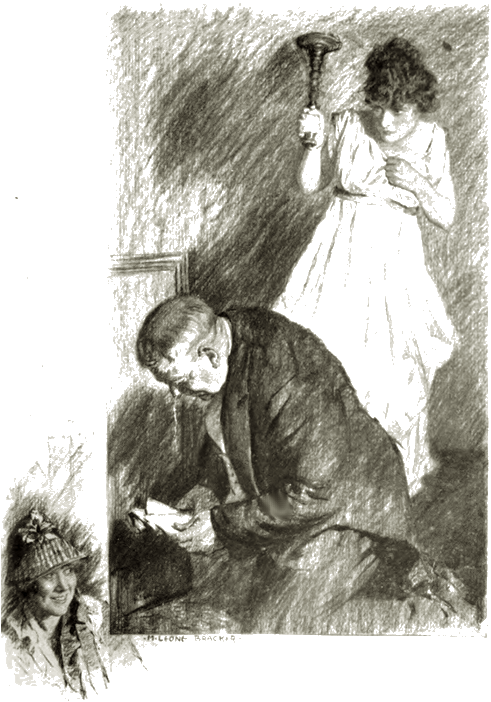
He neither saw her nor heard her
It was at the precise moment that the rubber band snapped against the folded and sorted papers that his world suddenly went out, like a bubble bursting in mid-air.
For it was at that moment that the woman so close behind him, swinging with all her force, brought the heavy candlestick down on the wavering high light along the pink-fleshed skull.
It was only at the moment of the impact itself that she closed her eyes. In the next breath she was watching him go over sidewise, slowly and gently, and quite without sound or outcry. She saw him lie there on his side, with one hand thrown out, in a child-like attitude of inconsequential weariness.
"He neither saw nor heard her..."
When she had made sure that he did not move she went back to the table and replaced the candle-stick. Then she stepped quickly in over his outstretched legs, crouched down in front of the safe and tossed out on the middle of the floor the different bundles of paper which she found there. An exultant little thrill ran through her as she glanced at the appellation penciled on the third bundle. It ran: "Secret & Confidential—Navy Department Wireless Code—For Officers Only."
She had no chance to read further, for a throaty little groan from the fallen man told her that he was coming to his senses. But she knew that she had recovered the wireless code.
So she scrambled to her feet, dodged back to the other room for her wrap and slippers and as quickly returned. She flung her wrap on the floor, and into it tossed the entire collection of papers. She had no time for sorting. That, she knew, could be done later. But she took everything that the wall safe could yield. Then she even more hurriedly put on her slippers, for by this time the grotesquely rotund figure on the floor had moved an arm and then its head, and was even staring up at her with dazed and uncomprehending eyes.
She caught up her wrap, tied the precious papers in it by the trick of knotting together her long sleeves, and held it close to her side, like a Calabrian immigrant clutching the shawl that carries her worldly goods. Then she crossed the room, stepped outside and closed the door after her. She groped her way hurriedly along the dark hall until she came to the street-door. It opened with a spring lock. The next moment she was outside the house.
But the side-street confronting her was both silent and deserted. And she had already recognized it as an unsavory part of the city. She was afraid of solitude, wordlessly terrified at the thought of isolation. Some mischance, she felt, was still destined to intervene and rob her of her precious haul. And now, of all times, she wanted to be sure of herself.
A little way down the street she made out a milliner's shop window, opposite a street lamp. And from beyond this street lamp she could hear the sound of steadily approaching footsteps.
A small chill seized her at the fateful sound of those feet. Needling tremors of apprehension continued to play along her spine until in the uncertain light she made out the brass buttons of a patrolman on his beat. Then she promptly dove down the house-steps and made for him, like a winded swimmer making for a life raft.
He drew up, as he saw her, and awaited her coming. He did so with not a little wonderment. He even suspended judgment as she caught his arm and clung to it.
"I want yuh t' pinch me!" she gasped.
Instead of doing so, however, he calmly swung her about and inspected her from her slippered toes to the undulatory upper hem of her dinner gown.
"What's the trouble, lady?" he quietly inquired.
"Pinch me!" commanded Sadie.
"Now, little one, you calm down!"
But Sadie refused to be calmed.
"Officer, are yuh goin' to gather me in?"
He turned her half-patiently and half-wearily about. Finding her breath unimpeachable, he had secretly decided that it was cocaine.
"You run along home and sleep it off," he mildly advised her. "Take a nice long sleep and the Willies'll all be gone in the morning!"
"Yuh won't run me in?" she challenged, as she turned and stared in terror first one way and then the other along the midnight street.
"I ain't no rest cure rubber," he announced, "and I guess the best—"
But he did not finish that sentence. For Sadie had backed slowly away until she stood beside a galvanized garbage pail awaiting its collector at the curb. From the top of this pail she lifted an empty beer bottle. Then she sent it flying straight and true through the plate-glass window of the milliner's shop beside them.
"Now yuh gotta gather me in!" she triumphantly announced.
And the officer, impressed with the fact that such madness might direct the next missile at his own person, promptly gathered her in.
Her smiling docility as he hurried her along to his signal box rather perplexed him. And she seemed clear-headed enough, now that his night-stick was out and his arm was securely linked through hers.
"Excuse me, lady," he finally inquired, "but why're you so bent on going to the station house?"
Sadie laughed quietly and triumphantly as she noted that a precinct captain was swinging across the street to join them.
"B'cause I've gotta gold mine under me left arm here," was her ridiculous answer, "and I sure wantta get behind bars before it's taken off me!"
IT was ten o'clock the next morning that Sadie Wimpel presented herself at Kestner's door, in response to her superior officer's summons.
"Sit down," said that superior officer, without his customary smile. Sadie, eying him, sank into a chair.
"I suppose you know that we missed Wallaby Sam by half an hour last night?"
"He always was a headliner on the get-away circuits!" acknowledged the girl.
"But the thing I can't understand, Sadie, is why you neglected to call us up the moment you knew where Breitman's plant was. I'm not saying that this code stuff wasn't a magnificent haul. But it would have been twice as valuable if we'd been able to round up Wallaby Sam himself. And it was quite bad enough losing Andelman."
The girl betrayed a tendency to fidget.
"Well, there's one remark I wantta make, Mista Kestner. When this work turns into a three-ring circus I can't watch but one ring at a time. I got so excited when I put me hands on those gover'ment codes that I thought I'd better be goin' when the goin' was good. I didn't think much about Wallaby Sam, except that he might come to, and gimme the chase!"
Kestner studied her with a form of perplexity.
"But Breitman has been acting as Keudell's right-hand man! And I felt sure that had been made plain to you."
"Oh, I was gerry to that, all right," admitted the somewhat embarrassed young woman in the chair. "But there were certain reasons why I wasn't so crazy about havin' Wallaby Sam rounded up last night!"
"What reasons?"
"Well, I knew Wilsnach would be on the job. And I didn't want Wilsnach third-degreein' that old robin!"
"Why not?"
"B'cause that old robin knows too much about me past."
"What past?"
"The past Blynn said yuh'd all keep the door shut on, s'long as I kept it shut myself!"
"But can you, Sadie?"
"Not if there's a roast comin' ev'ry time I make a try at it!" was the girl's somewhat embittered retort.
Kestner, conscious of her anger, glanced down at his watch.
"But why isn't Wilsnach here?" he asked.
Sadie, getting up from her chair, crossed aimlessly to the window and stared out over the serrated line of the housetops.
"I ain't his nurse!" was her retort, flung back over an insolent shoulder.
"But I sent for you both," explained Kestner, at a loss to account for both her sudden acerbity and her splendor of raiment. For Sadie was arrayed in a tailored suit of steel blue that fitted her like a glove, with a modish little rainbow hat a-rake on her elaborately coiffured head and a huge bunch of hothouse violets pinned to her waist.
"Service work ain't exactly made us into Siamese twins," she announced, as she continued to stare out over the housetops. Her soul was not at peace with itself, and she preferred to evade the over-investigatory eye of her chief. The belated Wilsnach, she even suspected, was at that moment patiently stand in line to buy two seats for the Casino opening. And one of those seats, she also suspected, was for her.
Kestner sat studying the trim young figure in steel blue. Then he smiled a little, as though some untoward incident had confirmed his earlier suspicions as to her disingenuousness.
"Sadie, where did those violets come from?" he calmly inquired.
"Is wearin' 'em against the law?'* she as calmly equivocated.
Kestner smiled for the second time.
"Has Wilsnach been sending you flowers for the second time?"
Sadie, at this, swung squarely about and faced her interrogator.
"So he told yuh he sent me them roses?" There was an unlooked-for note of sharpness in that indignantly put question.
"Yes," admitted Kestner, "he told me."
Sadie's laugh was quite without mirth.
"And I s'pose he told yuh why?"
"He said you deserved them, as I remember it, for he considered you'd done as neat a piece of work as he'd ever seen in all the Service."
Sadie turned back to the window. She laughed again, but her eyes were smarting.
"About the same as slippin' a fish-tail to the trained seal at the end of its stunt, I s'pose!" she commented.
Kestner suddenly became serious.
"Sadie, how many times have you been married?"
When the girl in the steel blue suit swung about for the second time, it was almost with fierceness.
"S'posin' I have hitched up a time or two! Ain't a girl gotta have some hobby?"
"How many times have you been married?" repeated the man confronting her.
Open antagonism now showed itself in Sadie's stare.
"Yuh'll be wantin' me finger-prints next!" was her pertly derisive cry.
"But how many times, please?"
Their eyes met. Then Sadie turned back to the window.
"I was married twice—not countin' Cambridge Charlie! And it took so much dough to git a decree against that first lemon that I let the other guy attend to his own unhitchin'!"
"How about Wallaby Sam?"
Sadie snorted aloud.
"That old geezer was nothin' but a gang-boss to me! And yuh canned me chances before I could git a hook into him!" Her voice took on a note of mockery. "But wasn't I the foolish kid to run away wit' the idear that gittin' married was just me own privut affair? Wasn't I the wall-eyed wop not to see that about ev'ry gover'ment agent paradin' a tin badge had a right to poke his nose into me birt' certificate and me other equally privut matters? Wasn't I, now?"
Kestner did not smile. His patience, in fact, carried with it a touch of pity.
"That is not the point, Sadie. You just spoke about a certain door. And the point is that a very wise man has said the future is only the past, entered by another door. No one is more anxious for your eventual happiness than I am. But our past has the habit of reaching out a hand and taking our happiness away from us. I only want to warn you that—"
"Well, there's no wop can put the rollers under me!" cut in the indignant-eyed young woman. "There was nothin' underhand about any o' that hitchin' up, and there was nothin' underhand about the unhitchin'—which is more than some o' these Fift' Avenoo ribs can say! I was druv to it! Three lemons in a row, who never come through wit' enough to pay a honest board-bill!"
"Then I'm as glad as you are that you're legally free. But there is one other question I must ask you. Has—er—has Wilsnach ever led you to believe that a termination of that freedom might be not altogether undesirable?"
"Come again!" said the puzzled Sadie.
"Has Wilsnach," repeated Kestner with a sigh, "been trying to make love to you?"
Still again Sadie's laugh was about as mirthless as the chatter of a kingfisher.
"That gink?" she inquired, with a gesture of contempt. "Why, that gink ain't got no more idear o' makin' love than a hearse-plume has!"
"But you don't altogether dislike him, do you?"
Sadie's face softened a little.
"He's the only guy who's been decent to me in a dog's age! I mean exceptin' yuh—and yuh're goin' to beat it for the double-harness shop as soon as yuh get through pilotin' this case!"
Kestner's face retained all its solemnity. "But this case is far from ended," he reminded her.
"No, it ain't ended. And until it's ended I s'pose there's no use rememberin' we're human bein's! It's all for the sake o' the Law! But take it from me, I'm gettin' good and tired o' the Law! What I've saw o' the Law this last few weeks is enough to drive a girl to blackmailin' her way up and down Broadway until her sucker-list is as empty as a last year's bird's nest!"
"You could never, never go back to that sort of thing, Sadie."
"Yuh don't know what I could go back to," declared the desperate-eyed young woman at the window. "And gum-shoein' ain't so soul-satisfyin' that I'm goin' to hang crape over me natural feelin's until Keudell's last come-on goes up to the Big House!"
"But until this case is finished, Sadie, none of us can afford to have feelings. That may seem a little hard, but I've suffered from it quite as much as you have. The three of us, Wilsnach and you and myself, are now secret agents. And a secret agent, after all, is only a spy. And a spy has to remember that he must always work alone, without official help, and that when working he can have no friends, and that if he's cornered he can't even ask for protection. This is a big case we're on, and in a case like this we sometimes have to use queer agents."
Sadie swung about on him.
"Am I so queer?" she promptly demanded.
"I'm trying to save you from getting that way. You're far too fine a girl, Sadie, to let a chance like this ever slip away from you."
"I don't see that it's gettin' me anywhere in partic'lar."
"But it isn't ended yet."
"And don't look like it ever will end."
Kestner could afford to smile at her petulance.
"You must remember," he explained with the utmost patience, "that it took Wilkie just fourteen months to run down that famous one-hundred-dollar Monroe-head silver certificate. And we're running down something infinitely more important than a piece of counterfeit paper."
"Oh, I ain't kickin' against helpin' to round up Keudell. No decent Amurican wants a foreign agent like that nosin' out our Navy secrets. And I guess I hate him as much as yuh do. What's more, he's the kind o' crook yuh gotta get, or he'll get yuh. But I ain't consoomed wit' affection for gropin' round in the dark. I wantta be gerry to what's goin' on, and I wantta know when I'm gummin' the game."
"Precisely," the patient-eyed Kestner assured her. "And that's exactly why you and Wilsnach were sent for. There's a new kink in this case, and I've got to explain it. But I can't understand why Wilsnach's so late in reporting. By the way, did you see him after leaving the Alsatia?"
"No!"
"Did you see him before that Andelman dinner?"
Sadie, under her rice-powder, turned a shade or two pinker.
"Yes," she finally acknowledged.
"Where?"
"Up t' the Metropolitan."
"What Metropolitan?"
"The Museum wit' all those old Masters in it. Mista Wilsnach said it'd do me mind good. He's been tryin' to argue me into believin' that picture gallery guff's got something in it."
Kestner knew better than to smile openly. He wheeled about in his chair and toyed with the paper-weight on his table, apparently finding it difficult to phrase any fit reply to his companion's last remark. He surprised that companion by suddenly opening a drawer and flinging a photograph on the table-top.
"Well, since you insist on being gerry to what's going on, here's a different kind of picture for you to study. And it will pay you quite as well as any canvas up at the Metropolitan."
Sadie did not deign to examine the photograph. She was busy repinning the violets to her waist. Kestner himself took up the picture and held it out for her.
"Who's the gink?" she casually inquired.
"That's the man we've got to round up in the next twenty- four hours."
"Why?" was Sadie's indifferent demand, as she took the photograph from Kestner's fingers.
Her companion did not answer her, for the bell of the desk-phone close beside him shrilled out a sudden call. He lifted the receiver and spoke a word or two over the wire.
"Here's Wilsnach now," he announced, as he hung up the receiver.
But Sadie paid no attention to his words, for her face was bent low over the photograph which he had handed to her. She studied it long and earnestly. She studied it so long that Kestner sat in turn studying her. Yet what her thoughts were he was unable to decipher. He merely saw that a new and quite unlooked-for air of solemnity had descended about her.
"So that's the guy I gotta help round up!" she said, as Wilsnach stepped into the room. But she said it more to herself, apparently, than to either of the two men confronting her. And she continued to stare abstractedly out over the serrated line of the housetops as the newcomer seated himself at her side.
Kestner, in the meantime, handed the photograph to Wilsnach.
"This mild-looking gentleman," began the man at the table, "is the cause of this little conference of ours. We're here to discuss him. And having discussed him, we're commanded to gather him in some time before to-morrow night!"
Wilsnach looked up from his second scrutiny of the picture.
"Anything to do with the Keudell case?" he inquired.
"That is a point which we still have to determine. His name seems to be Strasser, David Strasser. And he's either a genius or one of the cleverest gay-cats, as they call them over here, that ever scouted ahead of a foreign spy."
"Whadda yuh mean by genius?" contemptuously inquired Sadie, coming out of her trance. Kestner noticed that she ignored the snapshot which Wilsnach was endeavoring to pass on to her.
"A man has surely some claim to being called a genius when he can walk up to Lieutenant-Commander Hellweg, who is in charge of the government's proving-grounds at Indian Head, and quietly but unequivocally inform him that both his ordnance and his explosives are out of date!"
"Or a nut!" interjected Sadie.
"Well, that's what this mild-eyed little man did, and, what's more to the point, he seems to have come dangerously near to proving it!"
Kestner took up the photograph which Wilsnach had placed on the table and stared down at it as he continued to speak.
"I'm not an expert on such things, so I'm not going to give you an expert's report on the case. But as Brubacher explains it to me, this man has invented a new explosive. No, it's not exactly a new explosive, but it's an adaptation of the form of the older high explosives. These nitric and picric acid mixtures are all about the same thing, really, whether they happen to be called Melinite or Maximite or Cordite or Ballastite or Turpinite or Lyddite or any other old thing ending in 'ite.' Chemically, they've reached their topmost limit of power, and the problem has been to build guns strong enough to stand their fire (where a pressure of twelve thousand pounds to the square inch is now considered low) and at the same time resist their heat, when less than two hundred discharges burns out a sixteen-inch gun."
"Sixty-four discharges did for the Sider coast gun," amended Wilsnach.
"This man Strasser has apparently hit on a new idea. He realized that our naval guns couldn't be made much heavier, for such a rifle has to have three feet of length for every inch of caliber. This means that our new sixteen-inch gun, for instance, has to be at least forty-eight feet long. Each gun, Brubacher tells me, weighs almost ninety-four tons. To mount heavier guns than that in the turret of a dreadnaught means the displacement of the ship has to be enormously increased, since the projectile of each rifle weighs two thousand pounds and a broadside from a battery of them would keel over any vessel that wasn't of proportionately enormous tonnage. And there is a reasonable limit, of course, to the size of all warships, even though our newer inventions have emancipated gun range beyond the mere line of human vision. It was once possible, I mean, to shoot only as far as the eye can see. But the hydroplane and the machinery of modern range-finding have pretty well overcome that. And now the naval gun that can reach the farthest is the gun that wins the fight. Do you follow me?"
"We're right behind yuh!" retorted Sadie.
"But, as I said before, charges can't be increased because guns can't be made heavier. And too much explosive in a gun makes it about as dangerous for the man behind it as for the man in front of it. Strasser apparently realized all this. So he set to work studying the character of the explosive. He decided that what was wanted was not a pound on the projectile, but a push. He wanted an explosive that would 'follow through,' like the driver of a golf player as it lifts the ball, and not like the single sharp crack of a baseball bat. That single sharp crack burns out the bore, after a certain number of discharges, and keeps the breech-pressure always up to the danger mark."
"Do yuh get him?" the despairing-eyed Sadie demanded of the scrupulously attentive Wilsnach. The latter nodded, though with a touch of impatience.
"Now this man Strasser," continued Kestner, "saw that the explosive itself was about as powerful as chemistry could make it. So he began to experiment with guncotton, in the matter of mechanical distribution. He found that a multi-perforated charge resulted in a relatively low initial pressure in the gun, while the explosive, because it was cushioned with these countless perforations, burned with sufficiently accelerating rapidity to maintain a constant pressure behind the projectile during its entire transit through the gun-barrel. In other words, he devised an explosive that would 'follow through' and make the longest drive. The longer the gun, of course, the greater the push. So he calmly walked up to the Washington authorities and requested them to make him a sixty-foot gun. This gun was to weigh some sixty-nine tons, the same weight as our present fourteen-inch naval gun, and would cost the government, Brubacher said, about one hundred and thirty thousand dollars to build."
"And they built it?" asked Sadie.
"They called the man a crank, and got rid of him. Then he went to Indian Head and saw Hellweg. He was carrying a satchel full of the explosive and Hellweg let him have his talk out. They kept the man there for several days, or one pretext or another, and got hold of all his new explosive they could. Then they secretly tried it out at the Coast Artillery School at Fort Monroe—and it made good! It wasn't properly aged, for cannon powder needs half a year to dry out, but even with a twelve-inch gun they got a range of almost sixteen miles. And that was an eye-opener!"
"But what," demanded Wilsnach, "had this man Strasser hit on?"
"He'd hit on the idea of packing his explosive in a series of attenuated fibers instead of in a solid mass, so that combustion, diffused for even the infinite part of a moment, uniformly prolonged pressure throughout the entire length of the gun. That gave the push instead of the crack."
"Hully gee!" interrupted the wearied girl.
"Instead of being made into tightly packed flakes or strips," Kestner went on, "Strasser seems to have secured a compound annularization of the explosive by twisting infinitely small hollow tubes of it into spirals and then spiraling this into coils and then still again spiraling the result, the same as big cables are made by twisting small wires together and then again twisting the twist, ad infinitum. The wires, in this case, were like extremely small bed-springs prodigiously prolonged and finally combined so as to produce the greatest fiber attenuation possible. So combustion, instead of being like the sound-crack you get when you smite twelve keys of a piano, was more like the trickle of sound when you run your finger along their face."
"I believe I get it now," admitted Wilsnach.
"But there's another kink to this, which I can't make very plain. It depends on the fact that an explosive, in vacuo, loses its effectiveness. And Strasser seems to have adapted this to his granularization process, for chemical analysis showed our people that periodically along his row of detonating units he had produced a semi-vacuum. They think this in some way tends to retard the full force of the explosion and helps to give the pushing power I spoke of. And that's about all we know."
"Which seems to be consld'r'ble!" commented Sadie, as she took a small mirror from her vanity bag and wearily proceeded to powder her nose.
"And what are we to do?" asked the ever-practical Wilsnach.
"They've sent us orders to corral Strasser. That mild-mannered crank, it seems, finally got indignant at the suspicion and contempt with which he was being treated by the federal authorities. He kicked over the traces and announced that if Uncle Sam didn't want to buy his secret he'd go to a government that would be glad enough to get it. He suddenly packed up and made for New York."
It was Sadie who spoke next.
"How d'yuh know he wasn't tryin' to get next to those new coast guns of ours?" she casually inquired. "Why couldn't a guy like that be a come-on for Keudell all the time?"
"As for that, of course, we are still in the dark! And we can't get the answer to it until we get the man himself."
"And what's the procedure this time?" inquired Wilsnach.
Kestner sat for a moment deep in thought. Then he handed over the photograph to his colleague.
"Here's the man we want. It's a good snapshot of him. Brubacher had him photographed without letting him know he was being taken. To-morrow a print of this picture will be sent out to about every city in America. But I'd rather like to get Strasser before the city authorities could step in."
"And we've nothing but the picture to go on?"
"Nothing beyond the fact that Strasser bought a ticket for New York and was seen heading this way."
"Then what are your suggestions?"
Kestner shrugged a shoulder. "I have none," he admitted.
"Then we must follow the usual procedure."
"Precisely. We've first got to seine the city. And the only suggestion I can make is that we divide our territory so that any two of us will not be covering the same ground."
Wilsnach, after deeply scrutinizing the picture for the second time, again passed it on to Sadie Wimpel. As before, she gave a cursory glance at it and tossed it back on the table.
"I'll cover the trains and ferries along the River," finally announced Kestner. "And you, Wilsnach, might fine-comb the likeliest hotels and restaurants and that sort of thing." Kestner, as he turned to the woman seated by the window, seemed to hesitate. "As for you, Sadie, what would you prefer doing?"
Sadie was busy buttoning her gloves.
"Seein' it's such a nice day," she languidly announced, "I guess I'll just blacksnake along Broadway and see what I can slide into!"
"Am I to infer from this," asked Kestner, "that the case rather fails to interest you?"
"Oh, I'll be on the job when the gong rings!" was Sadie's listless reply. "Yuh needn't cut off the mitts, Chief, until yuh're dead sure I've gone to the mat!"
SADIE WIMPEL'S progress up Broadway that morning was much brusker than the movements of most blacksnakes. She hurried north as far as Forty-second Street, made sure that she was not being followed and then dipped into the Subway. There she caught an express for East Fourteenth Street.
Ascending to the street, she hurried still farther eastward and then turned south. When she came to the "family entrance" of a corner saloon she stepped in through the faded swing door, looked about, and seated herself at one of the little round tables in the empty room. A bartender in his shirtsleeves presented himself.
"Gimme a long beer," commanded the girl.
When the bartender returned with this, however, she viewed its foaming collar with indifference.
"Where's Tim?" she demanded.
"Still sunnin' hisself out in front," solemnly announced her servitor.
"I wantta see him."
"Sure!" assented the bartender, as he swept Sadie's spurned change into his huge palm and went whistling from the heavy-aired room with its residuary taint of many beverages.
Two minutes later a portly figure wearing a diamond shirt-stud and pink-striped collar and cuffs stepped back into the empty "parlor." From one corner of his mouth drooped a dark-colored cigar.
"Howdy, Sadie!" he said, without removing the cigar. He stared down at her with open and half-derisive approbation. "Hully gee, but they've got yous queened up like a Coney Island float!"
"Tim, where's Shindler?" demanded the woman at the table, altogether ignoring the other's gallantry.
The man called Tim smoked meditatively for a moment or two: it was plain that he nursed a latent respect for Sadie Wimpel.
"That's one on me, little one," he confessed. "If yuh want to find Shindler yuh'd better dig up Coke Kilvert. I seen him and Coke drinkin' Chianti over to Peruchetti's some time early last week."
"And not since then?"
"Nope!"
Sadie rose to her feet. "All right," she announced. "I'll root out Coke."
She made her way farther eastward and again turned south. She walked hurriedly and with determination. She passed through unsavory streets and veered nonchalantly about even more unsavory characters who looked after her with quietly appraising eyes. But there was that in her carriage which discouraged pursuit.
She kept on her way until she entered a Second Avenue pawnshop which she knew to be a "fence" for a gang of up-town "dips." Leaning against a counter she beheld a slim-bodied young man with a misleading air of delicacy and with eyes as soft as a woman's. That disarming air of fragility, she remembered, was a valued asset in professions such as his.
"Hello, kid," he said, without moving.
"Hello, Coke."
"What's doin'?" was the youth's languid inquiry.
"Where's Shindler?"
Coke gazed impassively at his nail-ends.
"Search me! I ain't seen him this week."
"Where'd yuh see him last week?"
Coke pondered that question for several moments. There was an air or determined authority about Sadie Wimpel which rather disquieted him.
"Down to Nitro Charlie's," he finally admitted.
"What was he cookin' up?"
Coke's eyes fluttered.
"How t'ell should I know?"
"Yuh gotta know," was Sadie's quiet response.
Coke passed a second measuring glance over her trimly clad body.
"Why?"
"Because I'm stoolin' for a Fed guy, this week. And I don't wantta have to dig up nothin' against yuh. Coke! What was Shindler cookin' up?"
Their studiously contending glances came together like aerial scouts above masked batteries. Behind his enemy's entrenchments, Coke conceded, might be reserves which it would be foolish to oppose.
"Him and Charlie hit on a plan o' squeezin' a bunch out of a German gunpowder man called Piorkowski. It was some plant, for Charlie'd pinched a river-launch full o' new smokeless from the naval magazine up to Iona Island. It was a Navy officer's patent and was bein' stored there to ripen for a mont' or two."
"Go on!" commanded Sadie.
"Then Shindler faded away."
"But where?"
"Search me, Sadie! All I know is that Charlie's sore as a pup, and squealin' about Shindler givin' him the go-by!"
"And who's Piorkowski?"
"He's the big spade over here for that Krupp gang o' ammunition makers. And that's about all I know."
"That'll help," said Sadie.
Ten minutes later she was in the Subway again, bound for the upper parts of the city. She sat deep in thought as her train sped northward, remembering from other days the fact that Shindler had once been a "runner" for the Deutsche Waff en Munitions Gesellschaft. This brought her other equally disturbing thoughts, and she did not look up until her train stopped at the Grand Central Station.
Then she suddenly shrank lower in her seat, between the crowding shoulders on either side of her, like a snail into its shell. For walking slowly along the platform with his habitual air of aimless vacuity she caught sight of Shindler himself.
There, not thirty feet away from her, she had the dubious triumph of beholding the one man in all the world she had the least desire to see. For Shindler and Strasser, she very well knew, were one and the same man.
If for a moment Sadie shrank unconsciously back between her fellow-travelers, at the sight of that disturbingly familiar figure, her scrutiny of the gentleman in question was none the less pointed.
Three years, she noticed, had worked considerable change with him, more than her study of Kestner's Washington snapshot had led her to anticipate. He had plainly lost a ponderable part of his old-time jauntiness. His air of innocuous perkiness seemed no longer a part of him. It appeared more like a mask, put on to conceal the fact that he was a hounded and harried man uncertain of the future. He now wore eye-glasses, she saw, a pair of tortoise-shell "blinkers" which further dissimilated his true appearance by giving him an air of owlish preoccupation. That beguiling and half-scholarly stoop of his was more accentuated than of old, and as he moved along the crowded platform carrying a yellow hand-bag stained with grease he seemed merely an innocuous and neutral-tinted citizen ready to merge inconspicuously into his background of neutral-tinted companions. Yet Shindler himself, Sadie knew, was not unlike the drab-liveried water-moccasin, in being quite as virulent as he was self-effacing. That was a part of his effectiveness.
By this time Sadie had collected her wits and started for the door. Yet before she stepped from the car platform she made a second and even more disconcerting discovery. Moving aimlessly along through the ever-shifting crowd, with the air of a man who had no object in view and no mission in life, Wilsnach himself passed within ten feet of her. And she knew, at a glance, that Wilsnach was shadowing Shindler.
She realized, as she merged into the crowd and moved discreetly after them, that her career seemed suddenly to focus and centralize on those two strangely divergent yet alarmingly contiguous figures.
The thought of their coming together did not add to her peace of mind. Shindler, she knew, was a good dodger. She had, in the past, encountered only too many proofs of that. And if in the tumult of her seething little brain any one definite idea sought articulation, it was the frantic hope that Shindler would once again prove himself the master of flight that he had seemed in his earlier days.
But Sadie did not intend to leave things to chance. There was too much at stake and already that strangely incongruous couple were slipping beyond her sphere of observation. So she started resolutely in pursuit.
Shindler she could no longer see. But there was no mistaking Wilsnach as he slowly and with elaborate carelessness mounted the steps that led above-ground. She hurried after him, once he had turned the corner, but in Forty-second Street she held back again, guardedly watching her confederate as he ambled across the car-tracks and passed eastward in front of the Belmont. Still farther eastward she could now make out the figure of the man with the "blinkers" and the yellow hand-bag.
So she followed discreetly after them, keeping to the north side of the street. She clung to the trail with the casual nonchalance of an expert "tailer," taking advantage of any bit of cover that offered and falling promptly back when she found the thinning stream of pedestrians no longer a veil between her and her quarry.
Then she suddenly stopped and wheeled about, for on the opposite side of the street she had seen Wilsnach do the same. She noticed, as she bent over a corner news-stand and inspected the second edition of an evening paper whose ink was quite dry before mid-day, that the man with the leather handbag had swung about and was retracing his steps westward. So she leisurely and aimlessly purchased a newspaper.
Wilsnach, as the enemy essayed his doubling movement, turned and stared interestedly through a plate-glass window at a seductive array of ninety-cent outing-shirts. Then he leisurely entered the store itself.
Shindler must have seen that movement, Sadie promptly surmised, for he lost no time in taking advantage of a clear field. He ducked for a cross-town car, walked through it and quickly jumped aboard another car moving westward. Wilsnach, emerging into the open, hailed a taxicab and plainly started in pursuit.
That cross-town stream of traffic was too turgid to permit of Sadie's eye following any one particular unit. She saw the twin rows of cars stop and start and stop again, and she wondered if in the complexities of that thousand-wheeled movement Shindler could still make his escape. But the taxi-cab that held Wilsnach, she could see, had already passed on to the west of Fifth Avenue.
Sadie hovered about the news-stand for an irresolute moment or two and then started westward. She stood back in the shadow of a Subway kiosk to wait for a Madison Avenue surface-car to swing about into Vanderbilt, when on the opposite corner, emerging demurely and quietly from the grill of the Manhattan, she caught sight of a figure wearing tortoise-shell "blinkers" and carrying a yellow handbag.
It was Shindler. She at once turned about and descended the Subway steps, wondering whether or not this figure was destined to come down the same underground passage that for the moment concealed her.
As soon as she felt reasonably assured that this was not to be the case, she hurriedly retraced her steps. By the time she reached the street Shindler was well past the kiosk and was now walking definitely eastward. He was doing so with a quite unlooked for briskness of step.
Sadie, still carrying her newspaper, followed him. She continued to follow him as he turned southward again. She did not hesitate until she saw him stop before the entrance of one of those shabbier side-street hotels which are little more than bed-houses with bar-room attachments. She was well within a sheltering doorway as he stood looking sharply back along the almost empty thoroughfare. Then he made a dive for his warren.
Sadie stood there for several moments. Then, once her plan of action was formulated, she swung west and north again to Forty-second Street. Near the corner of Madison Avenue she dipped into a trunk-shop, bought a cheap rattan suit-case and swung back eastward again. At the Grand Central news-stand she bought seven magazines, the bulkiest she could find, and half a dozen newspapers. These she stowed away in the suit-case, concluding this to be the quickest way to give it sufficient weight for a lady traveling light. Then she promptly proceeded to the squalid caravansary, whose only splendor was its brightly gilded brewery sign, where Shindler had already installed himself.
She was given a room, together with many heavily inquiring glances, on the third floor. She was oblivious of both its meager furniture and its unkempt condition, for once she was alone she placed herself on sentry duty at her slightly opened door. Then, growing bolder, she ventured into the many-odored hallway and explored it from end to end. A study of the room-numbers as she did so convinced her of the fact that the figures which she had seen opposite the name of Strasser on the dog-eared register implied he had been given a room on the floor below.
So she returned to her quarters, got her suit-case and her door-key and went boldly down to the office. There she demanded a larger room. She was proffered one with a bath, but it would cost her a dollar more. Sadie, when she learned this was on the second floor, took it without hesitation. She even went so far as to allay official suspicion by paying for it in advance.
Yet she knew, as she made her way up to this room, that the hardest part of her work was still ahead of her. She knew, as she took off her gloves and her absurd bunch of hothouse violets, that she could not expect luck to come her way twice in the same morning.
Her success, she decided, would have to depend on her own initiative. So she waited beside her slightly opened door, as patient as a farm-collie above a wood-chuck's hole. To wait and watch, in fact, seemed the only thing left for her to do.
It was a long quarter of an hour before she was rewarded with any sound from that immediate neighborhood. But the sound, in this case, was Shindler's own voice. Narrowing her door-crack, she could see him standing in his own doorway, three rooms to the right on the opposite side of the hall, frugally ordering a pitcher of beer and a cheese sandwich. As of old, he spoke suavely and softly, with an intonation that seemed almost plaintive.
Sadie waited until the slatternly bell-boy had disappeared. Then she stepped out into the hallway, closed her door behind her, and walked quietly to the room which she knew to be harboring Shindler.
On the door of this room, after waiting for a moment or two, she quietly knocked. A preoccupied voice from within said "Come!" Taking a deeper breath, she opened the door and stepped into the room.
Bending over a chair, on which stood the opened yellow hand-bag, was Shindler. His coat was off and he was gazing with studious abstraction at some unknown object in the interior of the bag. He sighed pensively as he turned slowly about. He raised one hand, as though to run it through his disordered and grotesquely thinning cow-lick. But the movement was arrested in mid-air.
"For the love o' Gawd!" he slowly ejaculated.
Sadie viewed him with apparent unconcern.
"Don't let me butt in on your unpackin'!" she smilingly announced.
He stood still staring at her. Astonishment such as his could not be swallowed whole.
"I thought—thought you were in Budapest!" was his plainly inadequate exclamation.
Sadie's lip curled with scorn.
"Yuh mean yuh left me there!" she amended.
His mildly abstracted eyes took on a look of trouble.
"I had the chance of beatin' it or bein' gathered in. So naturally I beat it."
"That's what most yella dawgs 'd do!"
She could see the habitually mild eyes harden a little.
"That's a hell of a way to talk to your husband!"
Sadie stood for a second or two with her eyes closed, as though her body had sustained a blow which bewildered even her mind.
"Well, yuh suttinly were that partic'lar kind of a husband," she finally retorted. She stepped over closer to him. "Yuh were a crook when yuh roped me into marryin' yuh, and yuh made me a crook! Yuh killed any chanct I ever had o' bein' decent. Yuh were ready to use me for your dirty work. Yuh made me into a gun-moll. Yuh didn't even stop—"
But he cut her short.
"Didn't I keep you from starvin'? And didn't I spend on you when I had it to spend?"
"Yes; yuh lit me up like an all-night drug-store! But yuh did it wit' stolen money. And when I got your number yuh tried to lie your way out of it. And when trouble came yuh did more than show your heels like a hound—yuh were so white-livered yuh planted them Bavarian fort-maps in me trunk and left me to face the music!"
"They'd have shot me—and it don't look like they did much to you!"
"And when yuh thought I was off the map," went on the relentless-eyed Sadie, "yuh married that wire-tapper's widow! And then yuh—"
"What's the use of rakin' all that up?" suddenly demanded the wrinkled-browed man confronting her. It was not adding to his happiness,
"There's a lot of use in it. They tell me this ain't a good country for bigamists. Mebbe it ain't. But I know that wit' things as they are it's an awful unhealthy climate for spy-work!"
Shindler stood eying her for several moments of utter silence.
"What do you want, any way?" he finally demanded.
"I wantta know just what yuh're goin' to do about it!"
The man in the "blinkers" sat down in the chair beside the many-stained table on which stood a crockery ash-receiver, a highly lithographed tray advertising a German beer, and a melancholy plaster-of-Paris statuette of Columbus without a head.
"What are you goin' to do about it?" Shindler inquired. Behind his beguiling air of pensiveness, by this time, was the craftiness of the professional criminal declining to be cornered.
Sadie Wimpel also sat down. Shindler, she knew, was not so guileless an enemy as he appeared. And she was equally aware of the fact that her steps would have to be picked with caution.
"What's your graft these days?" she calmly inquired.
"What's yours?" he asked, as his roving eye made an inventory of her outward apparel. His sardonic approval of that apparel only seemed to anger her. She gave no expression to that anger, however, for a knock sounded on the door and brought a sudden chill about her heart where the tightness of the steel blue tailor-made had already established certain vague discomforts.
She saw, to her relief, that it was merely the slatternly bell-boy with a pitcher of beer and a cheese sandwich. Shindler, after inspecting the tray, sent for a second glass.
"You seem to be on Easy Street," he continued, as the boy took his departure.
"Are yuh?" Sadie demanded.
"I'm goin' to be, or I'm goin' to know the reason why," was Shindler's retort. For the first time he spoke with a perceptible trace of passion.
"It'll never be in this burg," announced Sadie.
"Why won't it?" he demanded.
"Yuh know, Abe, I'm a kind of a astrologer and clairvoyant these days. That's me purfession, this season. And I've been readin' your stars, and they sure say yuh're goin' to travel!"
There was a touch of scorn in his smile.
"You're dead certain of that?" he quietly inquired.
"I'm dead certain of it," was her equally impassive reply: "Yuh're goin' to slip over to the Grand Central this afternoon and get the first train out o' this town for Montreal. And from there yuh're goin' to beat it back to Europe!"
"And what's goin' to make me do that?"
"Ain't yuh hep to the fact that yuh've been tailed for the last three weeks?"
Shindler laughed.
"I've been tailed for the last three years—and I'm still wearin' my hair long, ain't I?" He suddenly turned about on her. "But why're you so keen about gettin' me off to the other side again?"
She realized, in view of the gulfs that yawned between them, the newer things that Wilsnach had brought into her life.
"Abe, I'm goin' to be honest wit' yuh. I've a gen'l'man friend here who's the right sort. I think a good deal o' that man. And some day he's goin' to think a good deal o' me—if I can ever get a chance o' showin' him I wantta travel in his class!"
"And it ain't my class?" was Shindler's sneering demand.
"Your class? If he ever found out I'd hitched up wit' a pole-cat like yuh, it'd sure make him seasick!"
Shindler's scrutiny of her impassive face was interrupted by the boy with the glass.
"So you're ashamed o' me?" he pensively complained.
"I'm ashamed o' myself," solemnly acknowledged Sadie Wimpel. "I'm so ashamed o' myself that I'm goin' to grubstake yuh to a cabin passage over to Cherbourg!"
Shindler stood in the middle of the room, with the glass in his hand. "Ain't you kind of knockin' your own home-circle?" he inquired. But behind that velvety mask, Sadie knew, there was the fire of a rage that burned all the fiercer for being self-consuming.
"I ain't knockin' yuh—nuttin could knock yuh! I'm blamin' myself for ever bein' so blind and foolish as to hitch up wit' a cur like yuh. I didn't know much then, but I should've known better'n that. I didn't even know it was Schmielz and yuh that killed Padolsky over in Odessa the same as Keudell killed Eichendorff! I didn't—"
"Cut that out!" Shindler suddenly barked. His voice was as sharp as a pup's yelp.
"That's what I intend to do—cut the whole business out."
Shindler's sneer was not a pretty one.
"That don't make your record over. I guess there's more than me between you and your kid-glove friend!"
It was Sadie's turn to show passion.
"No, there ain't! There's no man livin' got a claim on me—exceptin' yuh, and I don't reckon yuh as a man!"
"Well, there's one thing you can reckon on!"
"What's that?"
"That I don't go to Cherbourg."
"Then yuh go up the River to the Big House!"
He looked at her quietly, with the beer-pitcher in his hand. So impassive were their attitudes that an outsider, contemplating them through the window, might have accepted their talk as an exchange of mere conjugal commonplaces. And such, Sadie suddenly remembered, they were—for Shindler's career had been made up of revolt and crime and evasion.
"What'll send me up to the Big House?" he was casually inquiring.
"I may be a purfessional clairvoyant, Abe, but I don't need to go into no trance to dig out what yuh and Nitro Charlie've been tryin' to cook up this last two weeks! And Charlie'd sure take it hard, after lootin' that launch-full of Iona Island powder, to know yuh were hangin' the Indian sign on him for the chance o' doin' a little gay-cattin' for Keudell and his gang!"
Shindler slowly replaced his beer-jug.
"What're you ragin' about, anyway?" he demanded. But his blink was one of bewilderment, bewilderment at her comprehension of his well-hidden secrets.
"There's a Service man or two who'd sure be interested to know just what yuh found out about them coast-defense guns at Indian Head, and them mortars at Fort Monroe!"
Shindler quite as slowly sat down beside the table. He did not look at Sadie Wimpel. His vacantly ruminative eyes were fixed on the two empty beer glasses in front of him. He toyed idly, as he sat there, with a seal ring on his finger, twisting it nervously round and round. And Sadie, as she sat studying him, remembered that he was always most virulent when he was most passive.
Through the gray mists of memory, too, as she sat regarding him, there came to her the impression that she had witnessed this scene before, or some scene mysteriously akin to it. Then through these mists, like sunlight through fog, came the key to the coincidence. It came with the thin remembrance of something she had not thought or heard of, for several long years. It was some ghostly memory of a ghostly rumor that Shindler's ring was a "trick" ring. Once, when happy with heroin, he had explained its theft from the mistress of a murdered coke-snuffer in Bourdeaux. And he had boasted that inside its tiny sliding panel was ample space for enough chloral hydrate for a knock-out.
Shindler laughed a little as he turned toward the table. But Sadie was so keenly alert that her nerve-ends began to tingle.
"So that's how the land lies!" he said, as he slowly proceeded to fill the two empty glasses. Sadie watched him from under her demurely drooping eyelids. Adeptly as the move was made, she had the satisfaction of seeing the little cloud of whitish powder sift down into the second glass. The thought of his suave depravity sickened her. But she was determined to act out her part.
He shrugged as he handed her the glass, though his face was still wrinkled with its mildly contemptuous laughter.
"Say, kid, we can't afford to fight, us two!" he protested.
"We ain't goin' to fight!" announced Sadie.
"Then don't you lose any sleep about me tryin' to butt in on your love-affairs. I guess I've got troubles of my own!"
Sadie noticed that he eyed her closely as she lifted the beer to her lips and made a pretense of drinking it. Then she put down the glass with a sudden show of anger.
"But yuh can't help buttin' into my affairs so long as yuh're on this side of the Atlantic. And if yuh stay another two days in this burg yuh're goin' to butt into Sing-Sing!"
"Who'll put me there?" once more demanded Shindler. He was collected enough to light a cigarette.
"The guy who was tailin' yuh up to half an hour ago!"
She could see Shindler's face smiling through the smoke-cloud.
"Well, I guess I'm ready for that guy," he announced. Sadie watched him as he crossed the room to the open hand-bag. As he stooped over this hand-bag and carefully lifted something from it her hand shot out and the glass of beer it held was poured into the headless statute of Columbus that stood at the center of the table.
Then she lounged back in her chair and held the emptied glass to her lips. As Shindler slowly walked toward her she was apparently engaged in draining the last of her drink. So intent was she on this maneuver that she did not at first notice what Shindler had taken from his bag.
But as he placed it carefully on the table she saw that it was a tin box about five inches high and some eight inches long. To one end of it was wired a bit of mechanism that looked like a small clock without its metal casing.
She blinked up at Shindler as the latter leaned over it and stared down into her face.
"That's what your gum-shoe man is goin' to tail into!" he announced.
The girl put her empty glass down on the table-edge. She did it a little unsteadily.
"What is it?" she asked, as she rubbed her forehead. For the second time Shindler intently studied her face.
"It's a pound tobacco-box packed with something to put him asleep. It's packed with a damned sight stronger brand o' guncotton than ever came off Iona Island. And this neat little alarm-clock works, you see, has a piece of picture-wire tied to a wheel-shaft here, so that as it winds up it pulls the cork out of a bottle of sulphuric acid inside the box. That does the trick. And if you get inquisitive, and try to open the box, that also does the trick!"
Sadie was leaning somnolently back in her chair. "What trick?" she demanded with vacuous eyes.
Shindler emitted a small sigh of satisfaction. Then he lifted the tin box carefully back into his hand-bag. Then he turned and faced the woman again.
"Aren't you feelin' all right?" he innocently inquired.
"I'm—I'm queer!" she murmured, as she made an effort to grope ineffectually for the table-edge. "I guess yuh'd—yuh'd better get me outta here!"
Shindler, however, made no immediate move to get her out of there. He did not even deign to answer her. He stared for a moment down at her inert figure. Then he crossed to the shabby oak dresser at the far side of the room and took up the few worn toilet articles which he had so recently unpacked. These he deliberately and slowly packed away in the hand-bag. He next looked studiously about the room, to make sure that nothing had been forgotten. Then he put on his coat, took up his hat and the hand-bag and walked toward the door.
Sadie could hear him as he took the key from the lock. She could also hear the door behind her open and close. She did not raise her head, but she was thinking both hard and fast. She knew that within the next minute or two she must reach a decision, and she knew only too well that this decision would be a momentous one in her life. Shindler, the king of dodgers, was making another of his get-aways. Wasn't that, she argued with her unhappy soul, the best thing that could happen to him? And to her? Wouldn't that really make things easier for her? Wouldn't that give her a fighting chance with Wilsnach, the fighting chance that every decent girl ought to have?
She rolled her head to one side. She made sure, as she did so, that the room was empty. Then, as she sat up and stared at the two empty beer glasses, another question came to her. What could she tell Kestner? And what would Wilsnach say? And how much did either of them already know?
She felt sure, the next moment, that she could never lie to them. And she knew that she could never start to go straight by crooked thinking. She was in the Service, and that meant being on the side of the Law, and the Law meant truth. She was on a case for Kestner. What that case meant in all its complexities, she could not quite understand. But she had her part to play. She had to stick to Shindler, by hook or crook, to the bitter end. She had to stick to him, no matter what it cost. And Wilsnach, when he found out what he found out, could say and think what he liked.
The next moment she was on her feet, straightening her hat and essaying a furtive dab or two at her nose. She shook down her rumpled skirt as she crossed the room to the door. Then a gasp of dismay broke from her, for Shindler, she found, had quietly locked this door behind him.
She circled back about the room in search of a telephone. But there was none. She found a push-bell, with a printed card of directions, and she was trying to decipher these when she heard the sound of hurrying steps in the hallway without. And the next moment came the rattle of a key in the lock.
That could mean only one thing. It was Shindler coming back.
Quick as a cat, she sank once more into her chair beside the table, with her arms outspread and her face flat on the beer-stained wooden surface stippled with cigarette-burns. She scarcely breathed as she heard the door behind her open and a quick step or two cross the room.
Then out of the silence and quite close to her she heard a voice. And she knew it was the voice of Wilsnach.
"Good God, it's Sadie!" she heard him gasp.
He dropped on one knee beside her and she could feel his hand against her body, with an interrogatory touch on the wrist and the quick pressure of a finger against her neck artery, as though to make sure her heart was still beating. Then he lifted her face and stared into it.
"Sadie, what is it? What's the matter?" he cried in mingled alarm and pity.
But Sadie kept her eyes closed, luxuriating in the consciousness that his arm was about her and half holding her up, that his hand was brushing her temple and his breath fanning her cheek. And it was equally consoling to know that the thought of calamity to her could bring anything like a feeling of consternation to him. He was fumbling at the neck of her dress, by this time, trying to loosen it. And even the absurd movements of his fingers engaged in that absurd mission were not altogether disagreeable to her.
"Sadie, speak to me!" he implored.
But Sadie entertained no intention of speaking to him. To do that would end a situation which might never come again. So Sadie kept her eyes shut and made the most of it.
Wilsnach, as he stared down into her face, felt the injustice of it all. It was not the kind of work into which any woman should have been dragged. Sadie, he knew, was not like other women. But still it was not quite fair to her. He felt more than sorry for her: he felt under a tremendous debt of gratitude to her. She had stood by him in more than one crisis. She had, in fact, never failed him. Her companionship had come to mean a great deal to him. She was a quick-witted and a big-hearted girl who'd never been given a chance. And there was something about her that he liked, and liked a lot.
Wilsnach, as he held her there, leaned down and did a very human but a very indiscreet thing. He pressed his lips against the full red lips that were so close to his own. And it startled him a little to find them quite warm and the pressure of them against his own a sensation that was unexpectedly and altogether pleasant.
Equally startling was the effect of that caress on Sadie herself. Resolute as she was in the performance of her professional duty, fixed as had been her determination to play out her part, that one unlooked for touch was too much for her. Her will crumbled under it. All memory slipped away from her. She no longer thought of Shindler or Kestner or the case that had brought her within those unsavory walls. All she knew was that Wilsnach had kissed her.
Her reaction to that advance was both unwilled and immediate. Her eyes opened dreamily and for one moment she stared up into his face. Then her head sank contentedly down into the hollow of his protecting shoulder. Her arms tightened about his neck. And in a response as unreasoned as had been those movements themselves she found herself murmuring: "Do yuh care? Do yuh?"
Wilsnach, an hour before, might have been in some doubt as to his answer to that question. In his austerely busy life there had been neither time nor place for women. But now he found the gaze of a pair of dumbly appealing eyes something distinctly more than pleasant. He realized that the pressure of a pair of clinging arms could make a man dizzily and absurdly happy. He discovered something strangely desirable in the lips murmuring so close to his own. They seemed to cannonade the cemented stronghold of his bachelorhood with explosion of emotions against which he stood quite unfortified. And forsaking reason himself, he bent lower and for the second time pressed his lips against the warmth of her responding lips.
"I love you, Sadie!" a voice that did not seem like his own voice was saying. And if the truth of that declaration had not before been plain to him, he now found it both pleasant enough and plausible enough to reiterate. And even more bewildering was the quiet light of rapture which his words had produced in the intent face staring up into his.
"I'd go through Hell for yuh!" she solemnly announced. She could not make love as other women did. Life had been too hard with her. But with her capitulation there could and there would be no reservations.
"You'll never need to do that," protested Wilsnach. "We'll try and make it more like the other place!"
"And yuh care that much?" she hungrily repeated.
"I care far more than that!" stoutly declared Wilsnach.
"And yuh wasn't just kiddin' when yuh sent me them violets?" she forlornly demanded.
"Of course I wasn't."
That brought Sadie's thoughts back to the world that still lay about them.
"And yuh—yuh could care for a girl who'd got balled up wit' a couple o' lemons, b'fore she got gerry to what a real man was like?"
"We're not going to think of the past," he told her. "Neither of yours nor of mine!" But her strangling little sigh did not escape his notice. She was remembering what Kestner had only that morning told her.
"But yuh can't get away from the past," she declared, as she shook herself free and stared about the room that brought the thought of Shindler sweeping back into her memory.
Wilsnach followed her glance. And he too came back to realities.
"But what happened here?" he demanded.
"I tailed that boob to this dump, and got into his room when he thought it was a bell-hop at the door. Then he tried to put me under wit' a couple o' knock-out drops."
"That cur!" said Wilsnach. "I'll make him pay for that!"
"How'll yuh make him pay for it?" demanded Sadie, "He's given us both the slip."
"Given us both the slip!" exclaimed Wilsnach. "Not on your life! He walked right into my arms on those stairs!"
"He what?"
"And I had the irons on him before he so much as got his breath!"
Sadie stared at her feet again.
"Then where'd yuh leave him?"
Wilsnach could not even guess as to the source of her alarm.
"Why, I locked him in the clothes-closet of that empty room down the hall, the room where you left your violets and gloves. That's what sent me in here, double-quick."
"But how'd yuh know I was here, in this room?"
"I found Strasser carrying a key with this room-number on its shank-plate. So I dove for this room to see what it meant."
"And what'd yuh do wit' his valise?"
"Why?" inquired the puzzled Wilsnach.
"What'd yuh do wit' his valise?" shrilly repeated the girl.
Wilsnach stood staring at her in perplexity.
"Why, I gave it to the officer to take down to the taxi."
"What taxi? What officer?"
Wilsnach could afford to be patient.
"The officer I brought along for the purpose of formally gathering in Strasser, of course. And the taxi, I might add, was to get him quickly down to Headquarters, without any fuss and feathers, before the arrest became known."
"Then Strasser's still in that closet?"
"By this time," exclaimed Wilsnach, "our officer has doubtless taken him down to the taxi, as I instructed him to do when I handed him the closet key."
"But the valise?"
"The valise, Sadie, is naturally going along with the rest of us!"
"Not wit' yuh!" was her unexpectedly passionate declaration.
"Why not?" asked the still more amazed Wilsnach.
That question remained for all time unanswered.
For at that precise moment a sudden detonation shook the building in which they stood. The windows rattled. A tremor ran along the floor under their feet and minute flakes of loosened plaster snowed down about them. Sadie stood gaping at Wilsnach, an unuttered question in her staring eyes.
Wilsnach himself ran to the window and thrust out his head. But this window opened on the back of the house and showed nothing of the street. Then he went to the door and opened it. The place seemed oddly quiet after that one sudden thunder of sound which had shaken its floors.
"What do you suppose that was?" he asked through the open door. Then he stared along the hall toward the stair-head where he could make out a hurriedly approaching figure. This figure was both hatless and breathless. It was quite close to Wilsnach before the latter realized it was his own officer, the officer to whom he had handed the key.
This officer came and leaned against the door-post where Wilsnach stood. His eyes were red-rimmed and blinking and his nose was bleeding a little. He wiped his stained lip with the back of his hand. Then he blinked heavily down at his singed uniform.
"Well, your guy got away!" he said in a muffled voice, like a man with a mouthful of food.
"Got away?" echoed Wilsnach.
The hatless man snickered. Both his movements and the sounds that he made seemed oddly uncoordinated.
"Blew himself up with a bomb, before I could even get a foot on the running-board!"
"He what?"
"He blew himself up! Why, there ain't a piece o' him the size of an oyster cracker!"
It was not Wilsnach's voice that spoke next, but Sadie Wimpel's. It sounded thin and quavering from the stillness of the shadowy room.
"Somebody get—get me a drink o' water, quick!" she said, as she sank into the shabby chair beside the table that still held the two empty glasses. "I'm—I'm kind o' sick!"
Wilsnach caught up one of these glasses and ran to the wash-bowl tap on the other side of the room. Water dripped down the sides of the unsteady glass as he hurried back to her.
"Don't you worry about that man," he said, as he tried to hold the glass to her lips.
"But he's dead!" cried out the girl, sitting up straight in her chair.
"Do you call that much loss?" he demanded, as she pushed the glass away from her mouth. About its brim she could still detect a thin odor of beer. It reminded her too much of the past.
She was herself by this time, staring frowningly up into Wilsnach's worried face.
"Do you know what that man was?" he asked, as in answer to her signal he helped her to her feet.
"Yes, I know what he was," Sadie replied, clinging forlornly to Wilsnach's arm. For a moment she was tempted to tell him everything, to cleanse her soul of the secret, to swing wide the door which she had once so dreaded to open.
Yet, looking up at him, she hesitated. It could be done later on, at some other time, when she was surer of his faith in her. For she could not afford to lose that faith of his in her. It was the one thing she had left. It was the one thing that could save her.
She surprised both Wilsnach and the officer waiting somewhat restlesstly at the open door by suddenly flinging her arms about the man beside her.
"D'yuh rully care for me?" she passionately demanded.
"Of course I do," was the reply of a somewhat constrained Wilsnach, glancing apprehensively toward the hallway.
"Then I don't give a rip what happens!" she cried out with her abandoned little vibrata of emotion.
"YOU can smoke here," announced Wilsnach, as he refilled his demi-tasse from the battered pewter coffee-pot with the ebony handle.
A faint tinge of pink crept up into Sadie Wimpel's powdered cheek. "I don't wantta smoke!"
Sadie spoke with apparent indifference, yet across the narrow white estuary of the restaurant-table she shot a glance of quick interrogation. Wilsnach, she felt, was trying her out. He was still a little uncertain about her being able to act like a lady.
"Why not?" he asked, recalling her earlier declaration that she had seen enough European duchesses engaged in that innocent pastime to swamp a ship. There were times, he had to acknowledge, when Sadie was still a bit of a mystery to him.
"I told yuh I was goin' to cut out the smokin' and the slang! And I'm goin' to cut them out for good!" For the second time the color showed a little deeper between the powdered ear-lobe and the ineradicable little runway of freckles. "I don't wantta do anything that'll make yuh ashamed of me. That's why!"
Wilsnach smiled at her solemnity. He could afford to be indulgent. He had vindicated his discovery. His exotic little side-street restaurant had yielded them up a dinner that was irreproachable. Sadie had eaten her way through that dinner with the open and honest appetite of a healthy boy. Wilsnach himself had dined with the delight of a truant who had found the balm of freedom edged with the zest of adventure.
"But I want you to be happy," he maintained, smiling at her from that hazy headland of content which is bastioned on the seas of ventral appeal. Trouble, he realized, could not house for long in that resilient young heart of hers. It was only two days since the tragic taking-off of Shindler, but shocked as she may have been by that occurrence, she now seemed intent on forgetting it. As she sat smiling across the table at him she could even surrender her hand to his, with a child-like little gulp of contentment.
"Well, I'm so happy when I see yuh coppin' anything about me to like, that I'd go without eatin', if yuh said so!" Here Sadie once more sighed contentedly. "And I sure like my eats!"
Their hands clasped midway across the narrow table.
"I like everything about you!" he said with sudden fervor. And he knew it was true.
"Yuh see I've canned that junk yuh kicked about," she announced, as she stared hungrily down at her now ringless fingers. Yet she looked up at him again, even more hungrily. "Yuh ain't ashamed of me?" she implored.
"You're wonderful!" he averred.
Her eyes deepened and darkened. She sighed happily. Then her linked fingers at the table-center closed with sudden passion about his hand. "Hully gee, but I love yuh!" she cried out with a tremulous little choke in her voice. "I love yuh so much that it hurts!"
"You'll never be sorry for it!" was Wilsnach's equally tremulous reply.
"I know I won't. But sometimes I think yuh will!"
"Try me!"
"Sometimes," went on the woman with whom, he knew, life had dealt so harshly, "sometimes I wish we could have known each other when I was as young and baby-eyed as those girls that go up and down Fift' Avenue, ev'ry afternoon! Why couldn't this have come to me before I got mixed up with all those things I can't get away from?"
Wilsnach felt the raven wing of tragedy that fluttered over them, and he did his best to brush it away. "Then I would never have known you! I wouldn't have been fit to sit beside you! And the dead past has buried its dead, and we're not going to dig it up. We've got a whole lifetime to look forward to!"
"A whole lifetime!" she echoed.
"And once we've helped Kestner clear up this Keudell case we'll be free to start over."
He thought, for a moment, that the sudden release of his hand was due to her resentment at the intrusion of those sterner realities which they had for the moment evaded. But he saw that it was actually due to the fact that their funereal waiter was returning to the table. And from the first Sadie had most heartily disliked that waiter.
They sat in silence until the funereal figure once more took its laggard departure. Then the estuary was again bridged by its linked warmth of hand meeting hand.
"Will yuh always love me?" Saide wistfully asked.
Wilsnach did not answer that question. He did not answer it because at the moment his eye was fixed on yet another figure that stepped quietly over to their table even as he watched.
"Are you Mr. Wilsnach?" this stranger inquired.
"Why?" asked Wilsnach.
"There's a man wants you at the phone."
"What man?"
"He called himself Kestner, I think."
It was the school-bell sounding accusingly on the ears of the truant. Wilsnach looked at Sadie Wimpel. Their hour was over.
The heavy-browed intruder seemed quite indifferent to their emotions. "You'll find the telephone on the second floor," he said as he moved indifferently away.
Wilsnach got up from his chair. "I'll be back in a minute," he announced.
"Don't be long," she murmured, as her eye still followed him. Then she sat back watching the man with the proprietary air as he directed Wilsnach to the stairway that led above. Then she fell to wondering what the meaning of Kestner's sudden call would be.
She was still pondering this when the man with the proprietary air stepped back to her table side. He moved with more haste than before. But his aspect was one of bored preoccupation.
"Mr. Wilsnach is waiting for you outside," he explained. He even languidly and impersonally assisted her in gathering up her belongings.
"Why didn't Mr. Wilsnach come for me?" she demanded. If a party took you out to dinner, she had been taught, it was a party's job to see that you didn't have to cruise out of a slum-joint without an escort.
"He said he had to find a taxicab. I guess maybe he's in a hurry."
Of course he would be in a hurry, Sadie remembered, with a call like that from Kestner. And nothing could shake her faith in the rock of Wilsnach's gentility. So she quickened her steps and caught up her skirts as she mounted to the sidewalk. There, to her relief, she caught sight of the waiting taxicab.
She could even see Wilsnach's hand swing the door open for her. She knew, as she stepped lightly up into the hooded darkness of the cab, that he was moving over on the seat to make room for her. At the same moment, however, she became conscious of the fact that a second man was crowding in through the narrow door behind her.
She turned to Wilsnach with a question on her lips. She realized, as she did so, that the taxicab was already well under way. But her second discovery quite obliterated her earlier one. As she stared through the gloom she found that the man who sat so close beside her was not Wilsnach.
She twisted quickly about and saw that the second man who had followed her into the cab was equally unknown to her. It was a moment or two before the significance of the situation actually struck home. Then followed a reaction that was as natural as it was inevitable. She wasted no further time on doubts. She had for too many months been the center of contending forces, buffeted by the tides of intrigue, conspired against by the enemies of evil. She started to her feet and shouted aloud with all the strength of her lusty young lungs.
But that call of alarm was not long-lived. She found herself jerked bodily back into the cab-seat and a massive hand at the same time placed over her mouth. It cupped itself artfully over her chin, with a gigantic thumb and forefinger squeezing tight on her nostrils until the very breath of life was shut off from her body. She felt herself wedged closely in between the two bodies. They held her like the horns of a vise, held her until all movement became impossible.
She tried to writhe and twist away from the great hand that was shutting off her breath. But this was impossible. Reverting to feral ways, she tried to fight with nail and tooth. But this was equally useless. She was without strength. The ache for air caused her to collapse. Then, and then only, the gross thumb and forefinger over her nose relaxed their pressure a little and permitted her to breathe again.
The man who had thrown an arm about her, she saw, was huge of stature. He was massive and thick-shouldered, almost giant-like in size. And about the entire proceeding he had remained maddeningly self-contained.
"This dame's sure to be heeled," he said to the smaller man on her right. "You frisk her when I hold her down!"
Again her revolt against indignity was prompt and instinctive. She felt the odious hand padding impersonally about her body, in search for a possible weapon. Those bruskly interrogative fingers seemed to her as beastial as the slathering of a snake about her helpless limbs. And she fought against them with all the strength that was left to her.
The big man beside her tightened his grip. "Quit that!" he warned her, "or you'll quit breathing!"
And again the great hand cupped over her face and shut off her breath. And again she was compelled to subside.
"Nothin' doin'" grunted the smaller man when the exploration was completed. He sat back in the seat again, linking his arm dexterously through the girl's so that any further movement of her hand was impossible. Then the big man on her left did the same. She felt at least grateful for being able to breathe again. But she was held as tightly between the two bodies on each side of her as though she had been strapped in a straight-jacket. She had no clear knowledge of where the hurrying taxicab was threading its way. She knew that they had turned, and turned again. The lights seemed to be fewer, and she could see they were now following streets that were both quiet and unkempt. And she concluded that for the time at least all resistance was useless.
She warned herself to be calm and keep her wits about her. It was no longer the fleeting physical terror at being physically overpowered that possessed her. It was more a great and all-consuming indignation at the treatment to which she had been subjected. She could know sustained fear no more than could the homeless feline that has adventured through the thousand nocturnal vicissitudes of all street-life. It took some bunch of trouble to give her cold feet. Her own life for the last few years, as she had so recently told Wilsnach, stood too checkered to leave room for such a chill. But that was the only medal, she explained, that her years of outlawry had hung on her. It had put her out of the house-pet class. Yet she was startled and upset and disturbed in soul by the sudden thought of her helplessness. They had got her head in chancery. But even more disquieting to her was the thought that they had tricked her so easily, that they had put one over on her, by a dodge that was as old as the dip-jostler's.
"Going to keep quiet now?" the big man at her side was inquiring.
Sadie did not even deign to answer that question. She was wondering what form her chance would take when it came. For chances always come, in some shape or other, and if not at one moment, then at another. She could not afford to give up her faith in that.
"Sure she's goin' to keep quiet," was the grim response of the man on the other side of her. His face advanced toward her in the darkness, like the head of a fighting-cock. "For if she can't do it her way, she'll do it ours!"
Sadie, as the car rattled on, pounding over car-tracks and swerving about corners, decided to do it in her own way. She preferred the privilege of breathing. But she decided, in her secret soul of souls, that if it came to a show-down she could do up that smaller man, even though she had to eat his ears off. She could make the runt take the mat. She was sure of it. And the only thing that held her back was the memory of the second man with a hand like a ham. He was a different proposition, that human derrick.
It was this second man who suddenly shouted aloud to the driver as their car took still another corner on the run. They slowed down and stopped. The smaller man on Sadie's right stepped out, closing the door behind him. Sadie could see him talking in low tones to the driver. What passed between them she could not tell. But her heart went down a little at the resultant discovery that this licensed chauffeur was a conscious factor in the movement. And the big man on her left, with his ever-menacing big hand close to her face, was holding her securely down in the seat.
It was as the smaller man climbed back in the car that Sadie's hopes suddenly rose. Under a street lamp not twenty paces away she saw the light flash on the metal buttons of a patrolman's uniform. A glimpse of that uniform fortified her with the memory that she was now on the side of the Law—that she and the approaching officer were colleagues in a common sense. She squinted thoughtfully at the huge paw poised so close to her face. She took a deep breath, like a diver about to make his plunge. Then with all the strength of her sturdy young lungs she shrilled out the one pregnant and disturbing word of "Help!"
It was a scream that could not be altogether stifled. Even a feather mattress could not have completely muffled it. But the poised hand came down on it, like a pianist's soft-pedal on a concerto's loudest chord.
The smaller man swore softly as he dodged up into his seat. The cry, it is true, could not be repeated, for the great engulfing paw had closed over the girl's face and promptly prohibited the inhalation of her next breath. The human derrick, above the whispered vitriolic blasphemies of the smaller man, shouted wrathfully to the driver to get his car under way. But before it could even gather speed the blue-coat was out beside the running-board. Sadie did not even object to having her breath cut off, for in another second the officer himself had swung open the cab-door. And that, she knew, meant rescue.
"What's doin' in here?" he demanded. Then the belligerency went out of his face, for the smaller man had leaned forward into the light. Yet nothing, so far as Sadie could see, passed between them.
"Hello, that you, Spike?" was the officer's milder-spoken inquiry. "Whatcha got there, anyway?"
"It's all right, Tim! She's only lit and noisy!"
"Who is?"
"It's Blink Hogan's skirt. We had to dig her out o' Cumiskey's hop-joint!"
"Soused?"
"To the gills! Says she's a she-hyena and been tryin' to prove it!"
"Whatcha doin' with her?" was the officer's more indifferent-noted inquiry. For Sadie, with her breath cut off, was unable orally to contradict this gross misstatement. So she did her best to kick the glass out of the cab-front. But the big man was too much for her.
"We gave Blink our promise to get her home," was the smaller man's weary retort. "But if you can do it any easier, I wish t'ell you'd take her over."
The officer now stood on the curb. He was swinging his night-stick.
"Not for mine!" he finally announced.
It was not until the cab was under way, and well under way, that Sadie was really permitted to breathe again. They were traveling faster now, rocking along streets that were still unknown to her. She had, in fact, long since lost all sense of time and direction. Even their movements of the passing moment became more or less indistinct to her. She was vaguely conscious of the fact that they had pulled up before a forbidding-looking house and the two men were half-lifting her down out of the cab. The street, as she later recalled it, seemed deserted. But her companions gave her little time for observation. They walked, one on each side of her, holding her up by the arm-pits. The cab moved on, she remembered, as they hurried her in toward the house-door, which swung open with a signal, seeming to suck them in like a bivalve. Then the double-doors closed behind her, and the sound of their closing seemed like the thud of a dead- fall, like the double snap of a trap.
They crossed a hallway and went stumblingly up a stairway, through unbroken darkness. They went three abreast, the men feeling their way as they mounted. At the top of the stairs, after taking a turn, the smaller man stopped and pushed a wall-button. This flooded the upper hallway with light. Then they moved on to a closed door. This the bigger man opened with his left hand.
They stepped into a room papered with sulphur-colored wall-paper. It was not large, and its furniture was both mean and meager. From this room, however, a door opened into a lighted room at the rear.
The smaller man stepped promptly in through this second door, leaving the girl still firmly held by his larger companion.
Sadie could hear a broken hum of voices, one more guttural than the others. It was the guttural voice, emerging louder and more authoritative than its rivals, which finally made itself heard.
"Then bring her in here!" this voice commanded.
Sadie, as she heard it, found the situation less mysterious but none the less menacing. For it was Keudell himself who had spoken. And the next moment she was being led into his presence.
Sadie blinked a little at the strong light with which she found herself suddenly confronted. But she blinked even more at the figures which she saw ranged before her. They made her think of a row of magistrates set up to intimidate a prisoner. For behind the long green-baize table which stood almost at the center of the room sat four men in four high-backed chairs.
Three of them she recognized at a glance. The one directly behind the reflecting library lamp that stared at her like a headlight, was Keudell himself. The next man to him was Breitman, alias Wallaby Sam. And next to Breitman sat Andelman, the same suave Andelman who had posed as the ordnance officer from the Department at Washington. The fourth man, who sat on Keudell's left, she could not for a moment place. Then she remembered the Secret Service photograph which Kestner had once handed out to her and Wilsnach for inspection. It was Heinold, the Austrian who had stolen the gun plans from the Watervliet works and handed them on to Dorgan.
That quartette's silent contemplation of her, she realized, was meant to be inquisitional. She felt, even against her will, like a prisoner brought to the dock. There was something disturbing, for a moment, in that judicial array. It brought to her mind the impression that she was a cell-inmate suddenly confronted by her accusers. Yet she was not altogether afraid of them. The whole thing, she tried to tell herself, had been stage-managed for the sole purpose of terrorizing her. Even the high-backed chairs and the formidable-looking table of green-baize did not quite succeed in giving them the dignity of a judicatory tribunal. For taking them all in all, she knew, they were as unsavory a quartette of intrigants and agents provocateur as ever skulked like rats through the sub-cellars of a nation's defenses. And the knowledge that she was a servant of that nation kept her courage up.
But Sadie had little more time to think of this, for Keudell had already given a curt command to Heinold.
"Lock that door!" he barked out.
As Heinold crossed to the door and locked it Keudell turned back to the still standing girl.
"Sit down!" he commanded.
She advanced a step or two to the worn leather chair, which had apparently been carefully placed for her, and sank languidly into it. This left her even more in the full glare of the light from the reflector of the green-topped reading-lamp on the table.
"Yuh might switch that electric," she mildly suggested.
"Why?" demanded Keudell.
Sadie sat intently regarding him. They watched each other warily, like boxers pondering the problem of how the first blow should strike. Then the girl's lip curled a little with scorn. But otherwise she remained outwardly unmoved.
"It rather annoys me," she finally replied.
Keudell swept her with a glacial eye. "It suits me as it is," was his reply. "And you will have, madame, worse things than that to annoy you before you have finished with us!"
"Ain't he the big man!" murmured Sadie, settling back in her chair.
Her nonchalance seemed for a moment to nonplus Keudell, to leave him nothing against which to storm. Then he cleared himself again for action.
"You will tell us," he suddenly said, and his voice gave the sense of thundering even while it remained moderate in volume, "you will tell us what you know about Abraham Shindler."
Sadie continued to study him with a perplexed yet casual eye.
"What's the guy's name?" she inquired.
"Shindler, I said!" repeated Keudell. But the thunder-bolt, repeated, was without its sense of shock. Sadie Wimpel merely shook her head.
"Yuh're barkin' up the wrong tree. That gink ain't on my callin' list!"
Keudell, with his molars clamped together, sat regarding her. The thought that he had made a bad beginning did not tend to soften his manner. "What's your name?" he suddenly shot out at her.
Sadie smiled. "What difference does it make?" she languidly inquired.
"Were you not known in Monte Carlo as Cherry Dreiser?" asked Andelman.
"Maybe!" was Sadie's reply.
"And two years ago last April," continued Keudell, "you were in Odessa. What was your business there?"
"I wasn't murderin' any Jewish map-thief!" she announced as she met Keudell's steely stare. The latter's face did not actually change in expression. But there was a ponderable lapse of time before he put his next question.
"Why did you leave Budapest exactly two years ago?"
"Did I?" parried Sadie.
"You did!"
"And yuh're dead sure of it?"
"I am!"
"Then yuh're probably dead sure of the reason why!"
It was Wallaby Sam who spoke next. His voice was shaking a little, and for the first time in his life he seemed to have parted from his rubicund suavity. He was like a robin with a house-cat too close to its fledglings.
"Look here, my girl, we're not here for the fun of all this. You know who we are, don't you?"
Sadie continued to eye them with languid scorn. "I know the whole bunch!"
"And do you imagine we're going to put up with much of this monkey-work?"
"I ain't interested in what yuh're goin' to put up with!"
"But you're here, and you're going to stay here until you answer certain questions."
"And then what?" inquired Sadie.
It was Keudell who spoke next. "You do not intend to talk, perhaps?" he demanded.
"Ain't I talkin'?" inquired Sadie.
Keudell leaned forward across the green-baize table-top, staring at her. For a moment he stared at her almost abstractedly, as though pondering the mystery of human speech and the inviolability of the human will. He stood arrested by the consciousness that behind the unfurrowed frontal-bone of this chit of a girl facing him were certain facts to which he sought access, certain facts which he must possess. They were there in the small vault of her skull, there clear and plain, there as definitely and indisputably as a tradesman's greenbacks lie in a safe-drawer. Yet between that frontal-bone and a safe-door there was a perilous difference. The heavier chamber of steel could be shattered and ravished. But with the crushing of that smaller chamber of bone and tissue its treasure went with it.
It was that which frustrated him, as it must frustrate all men who seek to live by force alone. Between him and those most desired of facts stood nothing more than a fraction of an inch of sutured calcium salts which one blow could shatter. Yet they remained inaccessible, impervious to his power.
"You think, madame, you may perhaps beat us at this game?" he finally suggested. An ominous note of quietness had come into his voice. It was in his suavest moods, she remembered, that he was most to be feared.
"What game?" temporized Sadie.
"The game, madame, that is going to end before you get out of this house!"
Time, Sadie felt, was an asset to her. She no longer stood alone. She was part of a complex mechanism which her absence would disturb, as a slipped cog disrupts a machine. Already, she felt, the word had gone out and the search was under way. So her first duty now was to fence for time.
"Then what's the use o' talkin' about it?" was her nonchalant retort to Keudell's threat.
"But you are going to talk about it!"
"Am I?"
"You are going to say, first, where this man Kestner is, and where the papers you stole are, and then what became of the blue-prints you tricked out of Dorgan. And you are going to say it before you see God's sunshine again!"
Sadie's passivity suddenly dropped from her. Fixed as may have been her purpose, her mind, in the final analysis, was still an untutored one. And anger possessed her.
"Say, yuh can't pull that movie stuff on me!" she cried back at him. "I'm not the goat in this deal. And what's more, yuh guys can't throw a scare into me, either! Yuh may as well get wise to that! Get it—and get it good! This is the third time yuh've tried to put over the rough-neck work—and yuh know how far it got yuh before and how far it's goin' to get yuh this time!"
Keudell seemed to relish her opposition. Resistance was what he wanted. It supplied him with a bone on which to set his teeth. He stood up in his place, almost exultantly, and leaned across the table menacing her with an accusatory forefinger.
"This, madame, will be the fourth time. And this time it will get us somewhere. It will—"
He stopped, interrupted by a sudden knock on the door. He motioned, still standing, for Heinold to answer that knock.
The entire tribunal waited, anxious-eyed, as the key was turned and the door opened. But most anxious of all waited Sadie, for all the indifferent glance with which she apparently regarded her suede shoe-tips. For she remembered that she was still the part of a machine.
It was the huge-bodied man who had held her in the taxicab. He came in thoughtfully, ignoring her where she sat. But she watched him as he crossed the room and leaned over the green-baize table toward Keudell.
"We've got him this time!" he quietly announced.
"Which one?"
"Wilsnach!"
Keudell, with slightly incredulous eyes, sank slowly back into his chair. "Where is he?"
Sadie, for the moment, was quite forgotten.
"I left Spike and Otto bringing him in from the cab."
"Do you mean he is hurt, perhaps?"
The big man shrugged a shoulder. "Of course he got noisy when he saw he was nipped. They always do. So we had to shut him up."
"Can he talk?"
"He could talk all right if he wanted to."
"But will he talk?" was Keudell's quick inquiry.
"We haven't tried."
It was Wallaby Sam, with his rosily bald head slightly inclined, who spoke next. "Then hadn't we better get him up here?"
Keudell made a gesture of impatience.
"We don't want him up here until this woman has said what she's going to say." Sadie Wimpel already seemed a mere incident in his activities. He had bigger fish to fry. "Tell Spike and Otto to take him down-stairs and take his boots off. Give him five minutes to write out what we want to know. If he refuses, and fails to change his mind in that time, light the gas-tube and get busy with it."
"And if he still refuses?"
"You can cook his feet off, for all I care!"
The big man turned coolly away. "I'll cook 'em all right!" he determinedly announced, as he crossed the room and passed out through the door.
The quietness of that room was ominous. The man called Heinold was waiting to relock the door before returning to his seat. He even had his hand on the knob before anything happened to interrupt that ominous lull. Yet it was not so much an interruption as an eruption.
The crater of it was the worn leather chair in which Sadie Wimpel sat. It seemed less a reasoned and pre-determined movement than a blind and frenzied explosion of activity. Yet behind that tumult, mad as it seemed, was some shadow of thought, some forlorn attempt at strategy.
For Sadie, in her revolt against quiescence, had not altogether lost her head. When she struck, she struck in the only way possible to her.
She dived so quickly for the green-baize table that the impact of her body sent it crowding over against the breasts of the three men seated behind it, before they could rise to their feet. This, for a few seconds, preoccupied them with purely defensive movements. Yet before those three men could actually comprehend the meaning of her advance she had caught and snatched away the electric-light standard, tearing the cloth-covered wires from their socket as she darted back across the room.
The result of this maneuver was to plunge the place into total darkness. She could hear the sound of overturned chairs and the quick shouts to Heinold to guard the door. But she was close beside the pale-eyed Austrian before he could recover from his first surprise. He threw out his arms to bar her way, and clutched at her when she brushed against him. But the lacquered brass lamp-standard was already poised, and at the right moment she brought it down with all her force.
She could hear his curse of anger as he fell back before that onslaught, for her blow had not fallen true. But he no longer occupied her thoughts. Her one passion was to get through the door, against which she had fallen bodily. She heard, even before she had it open, quick steps stumbling and advancing about her in the darkness. But she had found the knob and swung through to the outer room without any of the outstretched hands reaching her. A revolver barked out, somewhere behind her, before she could swing the door shut again. But the bullet missed her, and she was now well ahead of her pursuers. She even had time to swing shut the hall door as she passed through it. Another ten steps took her to the head of the stairway. The exultation of battle was in her veins by this time, and she went down the carpeted treads like a reindeer down a rock-side.
At the bottom she saw a shadow looming up before her. But she was unable to stop. She saw this shadow assume the form of a cross, and even as she felt her hurtling body engulfed in a pair of massive arms, she knew, sickeningly, that it was the same huge-bodied man who had held her down in the taxicab once more making her a prisoner. Above the shock of that sudden arrest and the deadening pressure of the constricting arms about her she could hear the sharp calls and shouts from above and then the huskily reassuring words of her captor. "It's all right! I've got her!"
Keudell and Andelman were already down the stairs and close behind her. Wallaby Sam, leaning over the banister, shouted down an order in German, an order which she could not quite understand. But the others seemed to disregard him.
"What'll I do with her?" the big man was calmly if a little breathlessly inquiring of Keudell.
The light was too dim for Sadie to see his face. But his voice was once more menacing in its quietness. "You will tie her up," he commanded. "Then you will lock her—in the room at the back. You will be so good as to tie her securely, quite securely. For we shall have need of her, later on. She is a she-cat, my friend, it will not be unpleasant to tame!"
"I'll tie her all right!" announced the wide-shouldered man as he lifted her clear of her feet. And once more Sadie knew that all struggle was useless.
SADIE WIMPEL knew that the task of trussing her up had not been neglected. She lay like a mummy, flat on what seemed to be a dusty tapestry-covered box-couch, staring up at the ceiling. She could move neither hand nor foot. The pain in her arms, pinioned close behind her back, had already become acute. A numbness about the ankles told her that they were tied quite as tightly. After a series of seismic contortions of the body she succeeded in rolling slightly over on her side.
In this position she was better able to study the room in which she lay a prisoner.
She studied it carefully and methodically, and she did not find it an encouraging harborage. It was small and neglected-looking, with a shuttered window on one side and a fireproofed door on the other. This door, she knew, was locked, for she had heard the sound of the turning key after she had been coolly but unceremoniously dropped on the box-couch along the wall. On one side of the door was a broken rocking-chair and an overturned packing-case still half filled with moldy-looking books. On the other side was a bamboo table, a rolled-up hair mattress and a couple of cardboard hat-boxes. On the table stood a faded and wilted palm in a flat majolica vase. This palm, apparently unwatered for months, had long since died and dried up. Along the outer wall was a bamboo book-shelf filled with dust-covered magazines. The floor was painted and without a carpet. A solitary and unshaded electric bulb had been left burning, presumably for the purpose of some future spying on her.
Sadie, viewing the room with studious eyes, acknowledged to herself that it was anything but inspiriting.
Then she directed her thoughts back to the bonds which held her a prisoner. She saw, by the expedient of suddenly kicking up her heels, that a white cotton rope reinforced by a trunk-strap held her ankles together. It was the same kind of rope, she discovered, that was used for many a housetop clothes-line. And judging from the way it swathed and circled her limbs, there had been an ample supply of it. Yet for several minutes she worked doggedly and valiantly at these bonds, trying first to worry her hands free, and then her feet. It did not take her long to discover that all such efforts were useless. It only tired her body and added to the pain in her shoulders. And after all her struggles there was no appreciable loosening of any of the strands that were so cruelly interfering with her circulation.
She lay back on the box-couch, once more studying the room about her. From time to time her eye returned to the dead palm in its ugly majolica vase. It towered above her in its corner, as melancholy as a hearse-plume. It stood a monument of neglect and abuse. It depressed her with its spiritlessness. Its pallid and withered fronds became something pathetic. It seemed so funereal in its etiolated dejection that she turned wearily away from it.
Then she stared back at the dead palm, for it had suddenly become of interest to her. She looked at it long and pointedly, with her forehead slightly wrinkled. Then she took a deeper breath. It was almost a breath of relief. For on the faded fronds of that dead palm, she saw, hung her one and only hope.
She wormed her way to the edge of the box-couch, letting herself drop limply to the floor. Then by much writhing and working of her torso she placed herself in position for rolling toward the bamboo table. These movements were painful. But she worked both methodically and patiently, for by this time she had arrived at a definite plan of action. And as she rolled toward the fragile-looking bamboo table she did so with all the vigor at her command. She bore down on it, in fact, with ever accelerating speed. Instead of pausing before coming into contact with its spindle legs, her rolling body struck it as a bowling-alley ball strikes a nine-pin.
She struck with sufficient force to send the faded palm and its ugly majolica vase tumbling to the floor. As it tumbled it crashed to pieces.
Instead of exhibiting dismay at this catastrophe, Sadie Wimpel turned over on her side, waited for the cloud of dust from the dried earth to settle, and then viewed the ruins with calmly studious eyes.
The bottom of the vase, she noticed, was the largest remaining piece of majolica. But what was more important for her purposes, along the edge of it ran a shattered edge of the vase-side. This fragment of earthenware she bunted and shouldered patiently away from the others. She did so very much like a sea-lion pushing its trick ball across a stage. But Sadie, for all the ludicrous absurdity of those movements so like an amphibian's, was never more serious in her life.
When she had disposed the fragment of crockery to her liking, she again rolled over and regarded it with critical eyes. Then, carefully measuring her distance, she rolled away from it, this time at a slightly different angle. But on this occasion, disregarding any personal discomfort which it might involve, she rolled completely over on the saw-edge of the broken majolica, so that when she lay face upward her two forearms, tightly tied against her back at the waist-line, rested on the jagged edge of the earthenware. Then, with a series of movements even more undignified than her earlier ones, she began to see-saw her tired body back and forth, making sure to press a strand or two of the cotton rope against the serrated edge of the vase-side as she moved.
It took much patience and even more strength of body. But by this time she was working in that icy calm of determination which is the sublimation of indignant rage. She was no longer thinking of herself. She was thinking only of what stood before her. And she could not afford to fail.
Yet she was compelled to stop and rest, from time to time, for her position was a strained one and her body was tired. She continued the abrasion of the cotton fiber pinioning her arms, however, until her neck-cords seemed ready to crack. Then she rolled wearily over, face downward, and rested. Then she began a series of muscular twists and tugs, worrying at the swathings that bound her hands behind her. She noticed, as she tugged and worked, an ever increased sense of relaxed tension. So she continued her labors, more frenziedly than before. And it suddenly came home to her that her campaign of attrition had actually severed the rope that held her deadened forearms in their painfully unnatural position.
She sat up, at this discovery, warning herself to be cool. But her body was stippled with nerve-quivers as she worked at the loosened strands still about her arms. When they were quite free, and the blood was tingling and needling once more through her numbed finger-ends, she sat there for several luxurious moments, reveling in the thought of that release. The one thing to complete her happiness, she felt, was a glass of water. For by this time she was inexpressibly thirsty.

She sat up, warning herself to be cool.
When she had rested sufficiently, it was a matter of much less difficulty to lean forward and conquer first the trunk-strap and then the knots of the rope about her ankles. This too brought its own relief, though it was several moments, she found, before she could regain the use of her limbs. At first she thought they were paralyzed, so unresponding they were to the commands of will. They seemed, indeed, like something not belonging to her own body. And the pain became as sharp as the pain that follows frost-bite, merging from a multitudinous needling of nerve-ends into a dull ache of discomfort. But she persevered in her exercises, determinedly working the fingers of one hand and then the other. She next gave her attention to her feet. When these became normal she crept to the couch and lay on it, full length. She knew that she was once more free to move. And for that primal freedom she was not ungrateful.
But she did not remain idle for long. After a brief breathing-spell she was on her feet again, busily exploring the room. The window, she had imagined, would be the vulnerable point of her prison. But an examination of this window soon showed her to be wrong. It was not only shuttered but it was even securely barred. So she directed her attention to the other side of the room where the door stood.
The door itself was not encouraging. But above it stood a transom, the glass of which had at some time been replaced by a heavy walnut panel. This transom, she felt, was the one assailable point in the enemy's line. So she decided to storm it.
To storm it, however, was not an altogether easy matter. But Sadie's wits had in the past risen to emergencies even greater than this. She stood for a moment deep in thought. Then she quietly dragged the tapestry-covered box-couch toward the door. This couch she turned over and stood up on end, making sure it was firmly fixed against the floor-boards. In this position, she had already decided, the exposed rows of coil-springs would provide her with a sort of scaling-ladder, unstable perhaps, but still possible.
This proved to be the case. She found the transom held shut by three nails driven into the door lintel; and it took but a few minutes' work with a piece of the palm-vase to work these nails free of the wood. The transom, once these were removed, swung back without trouble and showed the outer hall to be in darkness. So she carefully descended her improvised scaling-ladder, looked about the room and proceeded to wrench one of the rocker-rods from the antique chair that stood in the corner. This, she concluded, would serve both as an instrument of defense and a possible weapon of assault, if the need arose. And before she had gone far, she felt, there would be every promise of that need. She also broke away a piece of the dilapidated bamboo table, to serve as a rod to hold open the transom. Then she twisted and knotted her two lengths of cotton rope together, tying one end securely to the door-knob and placing the other, to which she had already tied her wooden rocker-rod, within reach at the couch-top. Then, having slipped off her shoes and tied them about her neck, she switched out the light and groped her way back toward the door.
She clambered up the treacherous spring-tiers as best she could, cautiously feeling for the transom. Having swung it open, she placed her bamboo support beneath it. She next reached for the rocker-rod tied to the rope-end, carefully lowering it through the opened transom. Then she took a deep breath, for she knew the hardest part of her task was still ahead of her. To emerge head down from a transom seven feet high is no easy matter. But to do this encumbered with skirts, half choked with dust and in utter darkness, takes unto itself the nature of both an exercise in audacity and an adventure in acrobatics.
But Sadie knew her possibilities. As she slowly and silently vermiculated over the dust-covered door-lintel she retained her hold on the cotton rope. She emerged, head down, until her knees were free of the cross-bar. Then, pivoting on the taut rope, she swung about with a cat-like twist of the body, describing an aerial cart-wheel and dropping quietly if a little dazed on the carpeted floor of the hall. She was on her feet in a moment, untying her rocker-rod from the rope-end. The latter she tossed lightly back through the open transom. Then with her rod she pushed away the piece of bamboo holding up the hinged panel, the latter swinging back into place as the bamboo stick dropped back into the room from which she had escaped.
Then the girl turned and stood with her back to the door, straining her eyes through the darkness, with her aural nerves acutely alert, with even her moist skin-surfaces sensitized to atmospheric impressions, and with nostrils distended, like a winded moose sniffing for some hint of its pursuers.
She could hear and see nothing. But her over-delicate olfactory nerves warned her of the imminence of others. The signs of this were devious and diffused. And faint but unmistakable on the musty air floated the smell of tobacco-smoke. For once in her life she found that aroma anything but tranquilizing. Her mouth was dry, and more than ever the thought of long and cooling draughts appealed to her. When she got to a water-tap, she told herself, she would drink like a camel.
She was not content, however, to remain long inactive. So with one hand extended she advanced slowly and noiselessly through the darkness, stopping at every step or two to listen and then going on again. The absence of both sound and light tended to disturb her. It left every doorway an imminent menace and every corner a possible ambush. Her groping fingers came in contact with a door-frame, yet she was afraid to turn the knob. Darkness had imposed on her its accumulation of uncertainties. She even began to entertain exaggerated ideas of distances, imagining that she had traversed scores of feet where she had covered only as many inches.
Still again, as she advanced on her shoeless feet, she encountered the square of a door-frame between which she could feel the panels of the closed door itself. She explored it with fastidious finger-tips, wondering what could lay behind it.
She was standing close in beside it, with one ear pressed intently against its panel, when a sudden sound startled her. She could hear the rattle and clink of portière-rings and the sound of a key being quickly turned in a lock. The next moment a door opened and a fulcrum of light cascaded out across the darkness of the hallway.
It was the door, she saw, past which she had so recently and so innocently worked her way. It was wide open by this time, and two figures had stepped out into the hall. One was Keudell and the other was Andelman. She had a clear vision of them in silhouette, and at the same time her quick eye caught sight of the banister and the stair-head for which she had been searching, not five paces away from her.
Instinctively she flattened her body against the paneled door, pressing as deep into the shadow of its frame as she could. She saw Keudell, with his hat already on his head, step toward the stairs. She saw Andelman reach out a hand to grasp the banister before the closing door behind him again left the hallway in darkness. She heard the sound of the lock and the second clink and tinkle of the portière-rings. And she knew that this door on her right had been locked by some one still within the room. She could at the same time hear the steps of the two men descending the stairs.
She stood listening intently, for the direction of their advance was a matter of vast moment to her. Before those steps reached the bottom of the stairs, however, she heard them come to a stop. She caught a whispered word or two and then the sound of the men as they hurriedly reascended the treads, stopped again and listened. At the same time, from somewhere below-stairs, she heard the dull thud of a door being quickly closed.
While she stood speculating as to whether or not this could be the street-door which had suddenly opened and shut, a vague flare of light showed somewhere deep in the well of the stairway. This brought her creeping forward to the banister. Then she knew her surmise had been right; some one had entered from the street and was now striking a match, either to make sure of his whereabouts or to guide the manner of his advance. The uncertain light of that burning match showed her one other tableau. This was Keudell, half-way up the stairs, with a revolver in his hand and Andelman crouching close behind him. He stood poised and menacing, as though prepared for any emergency. But a gasp that was half anger and half relief burst from him as the match burned up.
"Easy there!" suddenly called out the man with the match-end. And as he spoke Sadie Wimpel knew it was the big man who had held her down in the taxicab. He had obviously just caught sight of his colleague with the leveled firearm.
"What the devil do you mean by coming in that way?" demanded Andelman. "Without a word of warning?"
"It's the only way I had time for!"
"What's wrong?"
"Listen: he's got Spike's driver. In ten minutes they'll be hot on this trail!"
"Who has?"
"Wilsnach has!"
"Hell!" said Keudell, out of the silence.
But Sadie, at the sound of that name, knew a sudden sense of released tension. She breathed deep. Wilsnach had captured their taxi-driver. Then Wilsnach was free! A soft and warming glow crept through her body and left her indeterminately dizzy with hope. They had lied to her, from the first. Wilsnach was not a prisoner with her in that house. He had been too clever for them. He had trumped their ace and captured their own driver. And he would be after them, any time now, hot-foot Ike. For that was Wilsnach's way.
She could hear the sound of steps again.
"What are we going to do?" asked Andelman out of the darkness.
It was the big man who spoke next.
"You've got to beat it out of here, and beat it quick!"
"But why?"
"I tell you this house ain't safe! They'll third-degree that driver until he can't keep his trap shut!"
"Supposing he doesn't!"
"It means you've got to scatter!"
"And it means," complained Andelman, "a fine messing up of this thing!"
Again there was a brief interlude of silence. Sadie, listening above, strained for every word. "And it will be a worse mess, unless we get away from here!"
It was Keudell speaking at last. He did so without apparent alarm, almost meditatively. He struck a match and looked at his watch. Then he spoke again. "Give the word to Breitman and Heinold. And make it where I said!"
"London?"
"Yes!"
"London in six days. Am I right?"
"That is right. But remember that we are watched. Go by way of St. Louis and take the Wabash back. Drop off at Detroit and hang over in Bartholomew's rooming-house in East Ferry Street until you get word from me."
"And you?" asked Andelman.
"I will go by the river, with McKensic. That is the only way left for me—with McKensic as far as Kingston, in the launch, and then the Lackawanna!"
"But where in London?"
That question remained for the moment unanswered for the door at the stair-head above them suddenly opened and the cautious but inquisitive head of Wallaby Sam appeared in the vague shaft of light.
"We're in for a rumble!" Andelman called warningly up to him.
Wallaby Sam shuffled out on the landing. His was the only figure plainly visible to the watching girl. More than ever, with his rounded paunch and his rumpled-up hair-fringe and rubicund face, he looked like a blithe-spirited old robin finally driven into a dejection for which he had not been fashioned.
He pursed his heavy lips up in a dolorous whistle, blinking meditatively down into the darkness where the other three men were grouped.
"You'll have to hurry!" once more warned the big man.
"But where in London?" repeated Andelman, almost fretfully.
"The Tecumseh House. And have Heinold—"
He did not finish, for Wallaby Sam was calling down to him. "How about that girl?"
It was Andelman who answered. "For God's sake don't holler so loud! And why can't we have some light here?"
It was Keudell's voice, calm and authoritative, which spoke above Andelman's whimper. "Bring Heinold down here so we can talk this thing out."
Wallaby Sam, with a grunt, turned and shuffled back into the lighted room.
"I tell you you haven't time for debating societies around this house! You're steering for a fall!"
It was the big man of the taxi who spoke.
"When those guys hit us, they'll hit heavy. You leave the girl to me. I can have her held for a couple of weeks, and when you send the word I'll—"
Still again he broke off for Wallaby Sam and Heinold were groping and stumbling their way down the stairs. They had switched out the light behind them, Sadie noticed, but they had not stopped to lock the door. Of that she was positive. And on that she built her hopes.
She sidled noiselessly along the wall, working her way step by cautious step toward the stair-head. Her movements were equally deliberate as she groped for the door-knob, caressed it between her strong young fingers and carefully turned it. As she expected, it yielded and swung back to her pressure. She slipped inside and with a silence born of infinite precaution closed and relocked the door, leaving the key in the lock.
It disturbed her, as she did so, to find that the sound of conferring voices was no longer reaching her. But her first aim, once she was locked in that room, was to find the light-switch. So she groped and padded about as a blind woman might, following the line of the walls and exploring every piece of furniture with which she came in contact. It was several minutes before she came to an open roll-top desk on which stood a reading-lamp. In another moment or two she had discovered the switch and turned on the light.
She found herself in a sparsely-furnished room which had apparently been fitted up as an office. A telephone-directory on the desk-top in front of her sent her circling about the chamber for a telephone, but none was to be found in the room. She could not even unearth a trace of wiring. So she returned to the desk. There, beside the telephone-book, stood a box of cigarettes and a match-holder. For one brief moment she looked hesitatingly at the cigarettes, then began a hurried yet methodic search of the desk-drawers.
But these she found practically empty. It was not until she came to the bottom drawer on the right-hand side that her search was in any way rewarded. In this drawer she found an automatic pistol and several clips of cartridges. And a small wave of satisfaction sped through her tired body as she possessed herself of this weapon. For now, she knew, the fight would not be such a one-sided one.
She was standing deep in thought again, balancing the gunmetal weapon in her hand when a sudden sound arrested her. She heard the knob of her door turn and then move more vigorously, as though tugged at by an impatient hand.
"Who locked this door?" demanded a muffled voice from the hall. She knew it was Wallaby Sam speaking. She heard him step to the stair-banister and call down to his companions in the lower regions of the house. Then came the sound of answering voices, hushed and hurried, and the further sound of quick steps on the stairs and past the door behind which she stood.
At any time now, she surmised, they would discover the fact of her escape. And that would promptly solve for them the mystery of the locked door. So she knew that she would have to be ready. Their work, she concluded, would be hurried, and being hurried, would be ruthless.
They could advance, she knew, only by way of the door behind which she stood. So she carefully wheeled about the roll-top desk and in front of it placed the chairs which stood in the room.
From this ambuscade, she felt, she could at least keep things interesting, as long as her cartridge-clips held out, at any rate. For, this time, she knew, she could expect no quarter from them. She was not ignorant of Keudell's record and his character. He would never give her another chance.
She waited with the calmness of the unimaginative young animal that she was, still further narcotized by sheer physical weariness. She waited with her eyes on the locked door and her pistol in her hand. She even forgot her thirst. One determined assault on those panels, she knew, would easily carry them away. So she decided that it would be better, on the whole, to have the light turned off.
She reached out for the switch. As she did so her eyes fell on the box of cigarettes, A wayward temptation to take one of them up and light it possessed her. But the business on hand, she remembered, was too serious for trifling. So she switched out the light and stood in the darkness, waiting. And as she waited she remembered that she was very thirsty.
The tension of her position also began to tell on her tired body. She found standing irksome. So she groped her way about the desk and lifted one of the chairs back next to the wall which enfiladed her. She sat down in this chair, with the automatic still in her hand, still waiting.
She thought she heard a vague sound or two, but of this she could not be sure. The silence tended to unnerve her. She became obsessed with the thought that vast and intricate tissues of intrigue were being woven on the looms of silence about her. Countless ghostly contingencies, as the minutes dragged on, stood serried and sinister in the gloom above her. Inactivity became an ache. The fingers of her restless left hand toyed for a moment with the open cigarette-box on the desk-top. She took up one of the tiny cylinders, tapped its end against the desk-edge and tried to moisten it with her lips. Then her hand went back to the match-holder. She sat motionless for a minute or two, hemmed in by the velvety blackness about her. Then she deliberately took up a match, struck it and lighted the cigarette which still drooped from between her lips. She sighed at the second puff. It almost made her forget her thirst again. She was in the act of exhaling the third luxurious puff when she suddenly leaned forward, rising from her chair as she did so.
It was at the same moment that the sudden crash came that she leveled her pistol and pulled the trigger. For she knew that the door had been suddenly broken in, that her enemies were already through that door and advancing on her. It came home to her consciousness, at the same instant, that there had been no detonations from her fire-arm. There had been the snap of metal against metal, and that was all. She had scarcely time to realize that her automatic was empty, that she had neglected to slip in a clip, before she heard a voice calling out, a little thick with excitement: "I've got 'em! They're here!"
She groped frenziedly about for the clips of cartridges. As she did so the level ray of a flash-light exploded across the darkness of the room, and the voice cried out for the second time.
"Stick up your hands there! Stick 'em up quick!"
It was not the savagery with which these words were uttered that appalled her. It was the fact that they were spoken by Wilsnach hirnself.
For one moment the flash-light wavered about the room and then centered white and clear on her startled face. She sank weakly back in her chair, with the cigarette still drooping from her slightly parted lips.
She heard Wilsnach's exclamation of "Good God!" as she reached forward and switched on the electric-lamp. She could see the light shine on his revolver barrel. He was without a hat or coat, and his eyes, in the sudden light, were ridiculously round and blinking.
"Wh—where are they?" he rather vacuously demanded. In the doorway behind him, Sadie saw, stood Romano of the city force, with a gunmetal automatic in his hand.
"Where are they?" repeated Wilsnach.
Kestner himself swung in past Romano as Wilsnach stood still regarding her.
"Didn't you get 'em?" shrilled Sadie.
"Get who?" demanded Kestner.
"Keudell and the others!"
"No!"
"They're in this house then!"
Kestner suddenly relaxed and sank into a chair. Then he shook his head. "They can't."
"But they were here not ten minutes ago—and I oughtta know!"
Kestner still was dolorously shaking his head from side to side. "They've made their get-away!"
Sadie leaned back in her chair. Wilsnach came forward a step or two and gently took the automatic from her somewhat shaky right hand. He looked at it curiously. Then he looked even more curiously into her white face with the disturbingly febrile glitter about the weary-looking eyes. The cigarette was still in her hand. She stared down at it guiltily.
"Hully gee," she said with listless insolence, "I said I'd cut out the smokin', didn't I?"
No one spoke as she laughed, quite without mirth. "Well, I guess I earned this coffin-nail, all right! For I've had quite a night of it!"
Kestner, with the bitterness of defeat in his blood, swung half angrily about on her.
"You seem to think all this was engineered for your amusement!"
Sadie smiled up at him.
"It looks funny t' me!" she announced.
"What does?"
"The way yuh keep lettin' that bunch get by yuh!"
Kestner was in no mood to encourage such levity.
"Could you handle this case any better?" was his curt demand.
"I guess mebbe I could," was the girl's languid reply.
"Then why don't you try it?"
Sadie blew a ring of smoke ceilingward. She watched it meditatively, for a silent moment or two.
"I guess mebbe that's what I'll have to do!" she finally declared.
IT was five days later that Miss Mabel Poole, six short weeks out of her Victoria Hospital training-school, found herself alone with a patient. And the first point that made itself apparent to the young trained nurse was that this patient's room was disturbingly dark. The second point that came to her attention was that this darkness seemed crowded with cut flowers, giving it the heavy air of a hot-house. And the third fact to impress itself on her was that the bell-boy who had carried her bag down the hotel hallway had not waited for his tip. He had gone, and in going had softly closed the bedroom door behind him. In that flight, she felt, there was something disquieting and stealthy; it was like being treacherously abandoned by her last ally.
Miss Mabel Poole's apprehensions as to that tyrannical new patient of hers did not decrease as she stared across the darkened room. She was, in fact, the second nurse to be called in. The first one, she had been told at the register in Strong's drug-store, had been unceremoniously bundled back within the hour of her arrival. The sick woman had disliked her personality. And Miss Poole, being still young and ardent, did not wish to share her fate. So, nursing a human distaste for defeat, she squared her young shoulders to the situation with the solemn cheerfulness of youth.
"Wouldn't you like a little air in here?" was her gently persuasive suggestion as she turned to open her hand-bag.
The scarcely discernible figure on the bed did not move.
"Are yuh the new nurse?" asked a weak and quavering voice.
Miss Poole, as she buckled on her fragile armor of nurse's gingham, acknowledged that she was. Then she crossed to the windows. But a sudden command arrested her.
"I don't want those shutters opened!" called out the querulous-voiced woman on the bed.
The newcomer stood thoughtful for a moment or two. "But I think we could do much better with a little light," She spoke softly; but it was the rustling softness of a bocage that masks a machine-gun.
"Then switch on that wall light beside the dresser there!" was the invalid's petulant concession.
Miss Poole switched on the wall light. Her mind, as she did so, promptly reverted to restraining-sheets, for she was possessed of the dampening suspicion that she was straddled with a road actress in the twilight zone of delirium tremens. But this was only the girl's second case: and she was anxious not to fail on it.
"Did Doctor Wilson leave any instructions?" she asked, as a matter of form. For she was disagreeably conscious that the patient's head, raised from the pillow, had been studiously regarding her from the dim light of the bed-corner. The invalid, Miss Poole observed, was a somewhat younger woman than she had expected.
"I guess any instructions yuh get will be comin' from me!" was the patient's announcement. A mordant sense of humor seemed to relieve her words of their possible bruskness.
"Then supposing we see if we can't make you more comfortable," suggested the young nurse, remembering her training-school procedure.
Her patient, however, rather startled her by suddenly sitting up in bed, with a vigorous fling of the coverings that sent them over the foot-board. And the querulous whimper had completely gone from that patient's voice.
"Sit down!" she commanded.
Miss Poole, after four weeks on her feet, was not unwilling to sit down.
"Are yuh a trained nurse?"
"Yes!"
"And a Canadian?"
"Yes!"
"Where do yuh come from?"
"Lucan."
"Where's Lucan?"
"A few miles out of London."
This, and still another thoughtful inspection of the girl's face, seemed to reassure the woman on the bed.
"Was your last case a hard one?"
"Rather. It was a boy with typhoid. I had to be both day and night nurse—and he died!"
"Well, yuh won't see me follow his example! And yuh look tireder than I do, right at this moment!"
"I am tired!" acknowledged the girl.
"Then what's the matter with an easy case this time, with a room o' your own, and a three-hour taxi ride every afternoon?"
A look of alarm promptly came into Miss Poole's honest Ontarian eyes.
"I'm a trained nurse," she primly announced.
"Well, that's what I took yuh for!"
"But you are not ill," protested the girl in the striped blue and white uniform.
The woman on the bed laughed a little.
"Oh, yes, I am! I gotta be! For three or four days I'm goin' to be the sickest woman in this backwoods town o' yours. And if I'm sick I guess I've gotta have a nurse."
"I don't quite understand," protested the Canadian girl.
"What's your name?"
"Mabel Poole."
"All right, Mabel. I like your looks—and I'm some judge o' maps! Yuh pass—for yuh're as honest as daylight and I know it. And if yuh don't think the same about me, yuh can make sure o' your first week's salary by takin' a double fee from that chamois coin-bag over there on the dresser!"
"But I was sent here to take care of a patient."
"Gee, but yuh're the finicky-fingered kid! Now, honey child, yuh listen to me. Yuh're honest, and I'm goin' to be honest with yuh. That's the best way, isn't it?"
"I think so," answered the girl.
"Well, to begin with, I'm a plant. I'm a plant and nothin' more."
"A plant?" echoed the girl in the uniform. She was beginning to see daylight. Here, after all, was dementia with delusions. Here was a human being calmly asserting herself to be a member of the vegetable kingdom.
"I mean, Mabel, I'm in this bush-league burg o' yours on secret service."
"On secret service?" repeated the girl.
"Yuh ain't hep to what that means?"
The head under the nurse's cap moved slowly from side to side.
"D'yuh know what a gumshoe is?"
"No."
"Well, I'm one," answered the woman on the bed. "I mean I'm here actin' for the federal authorities at Washington. And in our country, Mabel, that's about the same as actin' for the king and queen of all the British Empire."
"And what must you do?" asked the girl, studying the woman on the bed with interested but still uncompromising eyes.
"I gotta stay buried!"
She smiled at the girl's returning look of alarm. "I gotta stay buried in this hotel until four or five o' the biggest crooks that ever wore shoe-leather sneak into this town for a secret conference."
"That sounds like moving pictures," said the young nurse, with her contemplative eyes still skeptical.
"It's got movin' pictures stung to death, for that bunch is so bad they daren't all get into one town, in our country, without bein' smelt out. So they've had to beat it up across the border, some from the East and some from the West. And I've had the straight tip that they're goin' to meet here, right here in this hotel. As I say, they were leery o' bunchin' up anywheres in the States. And little Sadie is goin' to gather 'em all in. She's goin' to do it with her little hatchet, first crack out o' the box. And when Wilson and Daniels and the other big guns are gerry to what I've done they're goin' to melt down enough bar gold to strike me off a Service medal the size of a soup-plate!"
There were moments when the younger woman's mind seemed unable to follow the Gargantuan footsteps of her companion.
"Do you mean you are going to arrest all these men?"
"I'm goin' to do more'n arrest 'em. I'm goin' to extradict 'em and have 'em go home with irons on, and get the life sentence they've been workin' overtime to earn."
The alarm on the young nurse's face did not appreciably decrease.
"And what am I to do with all this?"
Sadie Wimpel sat on the edge of the bed, swinging her feet. She even smiled a little, for she felt sure that she knew her woman.
"Yuh're goin' to be my gay-cat."
"Your what?"
"Yuh're goin' to act as my stick-up. And that needn't give yuh cold feet, dearie, for it won't be any harder'n what yuh're doin' at this moment. All yuh gotta do is wear a uniform and put me cut flowers out in the hall ev'ry night and stand between me and the wide, wide world. I mean yuh gotta keep me from bein' seen. Ev'ry gink in this Indian-sign hotel's gotta think I'm a real patient. For Gawd only knows when the first o' that gang 'll be bobbin' up here. And if he smelt a rat the whole bunch 'd beat it for the tall timber. All yuh gotta do is answer the door and order meals and use the phone for me. I've been up talkin' with that nice kind-eyed old Crown Attorney o' yours and makin' depositions and havin' a couple o' pow-wows with your city magistrate. So to-morrow yuh'll have to drop round and get a bunch o' papers from them for me to sign up. That's to oil the extradictin' process and have the gang held here until the Amurican authorities are ready to take 'em over."
Miss Poole sat down in a chair beside the dresser. She was too interested to be afraid.
"But I don't see how you, how any woman, can actually arrest four or five men, especially men of the kind you mention."
Sadie, as she thrust her toes into her bedroom slippers, laughed quietly.
"Why, honey child, I don't have to handle 'em. There'll be four or five cops from your city force to do the navvy work. And that strong-arm squad 'll be waitin' and ready in a room in this hotel, watchin' for me to give 'em the signal. And if there's any hitch in that I've doped out a scheme for sendin' a push-bell signal to the house-engineer down-stairs, so's he can shut off the power and get the bunch between floors in the elevator, once they try to make a break for the open. Yuh see, all I gotta do is make sure I got my gang together. And that reminds me: Yuh're goin' to have the room directly above this one. In a day or two I'm goin' to be moved up to that room. I'll have to make a kick about the noise—and there's sure ground for it, with them Grand Trunk engine-bells goin' all night and them street-cars poundin' across the station-rails all day!"
"But why change rooms?" asked the young nurse.
"Because this is the room where that gang is goin' to sit down and have its secret conference. They're goin' to sit down at that round table there, right under that old-fashioned chandelier, and imagine they're gettin' their money's worth because they're lit up by the heaviest brass-work east of Keokuk!"
Still again the younger woman seemed unable to follow her older companion.
"But how can you be sure they will come to this room?"
Sadie paused in the act of dropping a skirt over her head.
"They gotta come here, dearie, b'cause I'm goin' to have this room rigged up special for 'em. If I can't work it any other way, I'll engage ev'ry other empty room in this whole dump and pay for it in advance. And that'll leave 'em only this one to crawl into. But that ain't the important point." Sadie, having hooked her skirt and locked the door, switched on the rest of the light. "Did yuh ever go to a county fair and see the rubes crowdin' in to what they called a camera ohscura?"
"I think I have!"
"Of course yuh have! Well, I'm carryin' our War Department's improvement on that, an improvement that was first worked out for our submarine periscopes. Yuh see the brass globe on the bottom o' that old chandelier that looks as if it come out o' the Ark? Well, I'm goin' to take off that globe and set my glass lens in there. It'll blend in with the ornamental work and couldn't be spotted with a microscope. Then after I've had a hole cut in the floor up in your room, I'm goin' to set up my refractin' mirrors. Then all I gotta do is adjust my white glazed dial. It may be too small to show ev'ry one sittin' 'round this table at once, but by revolvin' the dial I can bring most any figure in the room on it. But that ain't all. Yuh see that nifty oil paintin' o' seven bilious cows eatin' zinc quartz off'n a hillside that's been overrun with what looks like a carload o' German mustard? Just pipe that picture and that five-inch plaster-of-Paris gilt frame, and tell me if yuh see anything special about it."
The girl in the uniform studied the picture on the wall.
"All I can see is that it seems an especially stupid bit of painting."
"The paintin' may be stoopid, but the plaster-of-Paris frame ain't, not by a long shot. For if yuh stand on that chair and study them gilt-covered upperworks yuh'll see where one o' them three-inch scrolls is cut away. Where that scroll oughtta be is the annunciator of a dictaphone covered with gilt. And them picture wires that go up to the moldin' there are covered with silk fiber. But instead o' stoppin' at the moldin' they go right up through the ceilin' and are waitin' to be connected with a receiver and dry-cell to-morrow when I get up there. That means I can sit up in that room, like a firin' line listener. I can sit back with a watch-case receiver at my ear and pick up what I want to pick up, for if any one o' that bunch doesn't show up, I sure want to know where he's at."
"But still I don't quite see—" began the other.
"Well, I'll show yuh. To-morrow I'm goin' to be a pretty sick woman. So we'll have an electrician string a private wire over to Doctor Wilson's office. This hotel knows I've got money to burn, but they don't know it's comin' out o' your Uncle Sam's pocket. That electrician'll do the work the way I tell him and he'll carry the wires up through that floor. Where we stop 'em after that won't be any o' his or anybody else's business. Then we'll move up above and get ready. I'll powder up till I look like a last-gasper and yuh'll have 'em carry me up on a stretcher—for we're goin' to do this thing right. Then, as soon as we see the bunch is beginnin' to show up, I'm goin' to get worse. I'm goin' to get so bad that yuh'll have to send a wire to Noo Yawk. That's me home town. Yuh'll telegraph for a specialist to beat it up here as quick as a train can bring him. Yuh'll have to wire to Doctor Wilsnach to come at once. And yuh may even send a wire for Doctor Kestner."
Sadie stopped speaking and stared wide-eyed at the wall opposite her. "And although they're both pretty clever specialists in their way, they're goin' to arrive just a little too late for this operation. For the case is sure goin' to be wound up b'fore them big guns get their kit laid out!"
"But won't there be danger? Won't—"
Again Sadie cut the other short.
"For yuh?" she demanded. "Or for me?"
The Canadian girl blushed.
"I'm afraid I was thinking more about myself," she had the honesty to acknowledge.
"And yuh're gettin' cold feet?"
"It's not so much a matter of cold feet, as you call it. But it's all so—so new to me. And I rather wish you—you hadn't taken me into your confidence in this way."
Sadie sat regarding her. She studied with contemplative and not unfriendly eyes the tired young face opposite her.
"No, dearie, there won't be anything new about it. All yuh've gotta do is be what yuh are, a trained nurse and a nice clean-livin' girl. If there was anything more'n that in it I wouldn't try to drag a decent skirt into it. It's secret work, and it's gotta stay secret, and the lord-mayor o' Lucan'll never even know yuh've been gay-cattin' for a gumshoe expert. And if yuh're a quitter I've sure made the mistake of my life!"
Still again the younger woman blushed a little.
"I don't think I'm what you call a quitter. But there's your own side of the case. Isn't a thing like this dangerous for you?"
"Hully gee, child, I gotta eat danger in a callin' like mine! That's my job, takin' chances. And the only thing that's worrying me is whether yuh're goin' to stick it out or not."
"I think you can count on me," the Canadian girl very quietly announced.
A sigh of relief escaped Sadie.
"Then s'posin' we get down to cases," she said, as she seated herself with a telephone directory on her lap. "For I sure don't want any loopholes in those extradiction proceedin's!"
MISS MABEL POOLE both by training and temperament was not given to excitability. But two days later, as Sadie Wimpel sat in her upper room like a spider at the center of its web, the young trained nurse began to grow into a realization of the dramatic values of the situation about her. She could not quite understand the game, but she was openly interested in its movements. And they were movements all new to her eyes. She saw, for instance, that by means of the little dark object so like a gunmetal watch with a couple of shoe-strings dangling from it, her alert-minded companion was able to overhear any word spoken in the room below them. And the adventure was already under way.
She had been infected with an echo of Sadie's excitement as the latter, listening intently with the microphone at her ear, suddenly leaned forward, turned a switch and began slowly revolving the polished white dial which stood on the small table at the center of the room. She had caught the other woman's faint gasp of satisfaction as two diminished figures, clear in outline for all the prismatic tints which haloed their images, crossed the face of the dial.
"That's Andelman!" said Sadie under her breath. Then she added: "Andelman and a bell-boy. He's puttin' the hand-bag at the foot o' the bed and openin' the window. And that's Andelman takin' the key from the outside o' the door and puttin' it on the inside. Which is the fit and proper thing for any crook to do. The boy is askin' him if he wants ice-water.... So he wants a highball, does he, to steady his nerves a bit! Which same isn't to be wondered at, Mister Andelman!"
Sadie, leaning intently forward, continued to turn the dial slowly about.
"He's given the boy a quarter—which oughtta be quite a handsome tip for the Tecumseh! And that's a cigarette he's lightin'." The dial became empty of all movement. "And now he's out o' reach."
Sadie, with the watch-case receiver still at her ear, turned suddenly to the other woman.
"Mabel, I want yuh to scoot down to the office and ask if there's any mail for me. And when yuh're at the desk I want yuh to look at the register and find out what name that man put down there, and where he pretends to come from. And lock that door when yuh go out and take the key with yuh."
The young nurse started on her errand without comment, for during the last forty-eight hours she had learned not to be too inquisitive as to the meaning of things. There had been too many movements to puzzle her, even to being sent to Cowan's hardware store for a Colt automatic and to the house engineer in the basement with a ten-dollar bill sealed up in an envelope.
When she returned to the room with the information that the newcomer had signed himself as "Adolph Weininger," of Milwaukee, she found Sadie once more leaning intently over the glazed dial.
"That's Heinold who's just come in," was the staring woman's whispered comment. Then she no longer watched the dial, but sat with inclined head, all her attention directed toward the microphone at her ear. "Hully gee, they're talkin' Magyar!" she muttered, and there was disappointment in her voice.
Yet as she sat there, in a sort of expectant crouch, she reminded the younger woman of a house cat seated close over a mouse-hole. But still the watch continued. The manipulator of the strange instruments even called for paper and pencil and from time to time on a telegraph pad made notes in a sprawling and all but illegible script. Then she divided her attention between the dial and the dictaphone receiver. But still the watch continued. An hour passed away.
The girl in the uniform, tired of suspended action, tried to bury herself in a book. She had given up the book and turned to needlework when Sadie looked up and asked the time.
"They'll come in on the night train, those other ginks," she finally asserted. "Yes, on the night train—I'll bet my hat!" And she consulted her time-table to make sure of the hour of its arrival. And after again turning to her instruments she announced with a sigh that the room was once more empty.
So they took advantage of the lull to eat their meal together. Then the trays were carried away and the cat once more crouched over its mouse-hole. As the time for the night train from the West drew nearer Sadie grew more restless. But still nothing happened.
"Gee, I wisht I could get outta this hole for half an hour! I'd sure do some sloothin' round this town that'd make those wops walk light!"
"Is there anything I can do for you?" asked the young nurse. She was too restless to read. The air was too thick with a sense of hidden drama to think of more needlework. She felt the same stir and tingle in things that had marked her first big operation.
"Yuh can ring up the chief," was Sadie's sudden response, "and tell him to hold his men for that call!"
"What chief?" asked the girl.
"The chief of police. That's his number written on the wall-paper next to the phone. He'll understand."
Then Sadie's attention went back to her dictaphone, for the repeated sound of a closing door had come up to her over the wires. She saw, as she revolved her camera obscura dial, that Heinold and Andelman had returned to their room. But what startled her was the fact that they had brought a third man back with them.
She leaned closer over the dial, staring intently at the foreshortened image of this man as he took off his hat and wiped his forehead. She noticed the low receding line of that forehead as it ran back into the delta of the bald head, the square and bony jaw, the wide slope of the loose-hung shoulders. And her study of that simian figure did not leave her long in doubt. She knew it was Canby, the same Canby who had acted as Breitman's butler in New York at the time of the coast-gun thefts.
"That's three of them!" she said under her breath.
Then she looked and listened again, for the three men had ranged themselves about the table directly under her lens, and Andelman had produced a pack of cards and a pocket case of chips. They were about to mask their conference, she saw, by pretending that it was a friendly game of poker.
Heinold was indolently counting out the chips when a knock sounded on the door. It was Andelman, Sadie saw, who rose to answer that knock.
She waited, breathless, until she saw Andelman's figure again move across the dial. Then close behind this figure moved another, a shorter and stouter figure, a figure that walked with a bird-like waddle, looking in diminuendo more than ever like a blithe and rubicund old robin. She could see the checkered silk handkerchief as he blew his nose and the keen cockiness of his eye as he turned his thick-necked body slowly about and made a silent yet careful inspection of the room. Then he sat down.
"That's Wallaby Sam! And that makes four o' them!" said the woman watching the dial, sotto voce.
"Should there be more than four?" asked Miss Poole.
"There should be five o' them!"
"Then who is the other?"
"It's Keudell," she whispered back.
"Do you—do you have to wait for him?"
Sadie snorted.
"He's the big wagon!"
"I don't quite understand."
"In plain United States, he's the main squeeze, the whole push! And he's the one I gotta get!"
The situation still seemed to perplex Miss Mabel Poole.
"Then why don't you have the officers step in and arrest these four men, and get the missing one when he comes?"
For the second time Sadie emitted a hoot.
"And throw a scare into that big crook that'd keep him rollin' till the heavenly cows came home! Not on your life, dearie! That's not the way to—" She suddenly broke off and sat with inclined head, listening to the sounds that trickled into her ear over the wire.
"That's Andelman telephonin', and that's the same old password they used on Dorgan in the gun-map deal—polkadot. And no gink who ain't a counter-jumper says polkadot into a phone transmitter for nothin', do they, Mabel? From which even a pinhead like me can argue that he's talkin' to one o' the bunch. And that one's gotta be Keudell. And that means our friend Keudell ain't more'n a thousand miles away from this hotel, at any rate."
She sighed with satisfaction, thoughtfully pursing up her deep-cut lips as she weighed the situation. Then she suddenly rose to her feet.
"I guess, Mabel, yuh can mosey up the street to that telegraph office and wire for them two specialists. For things look as though I was goin' to be taken bad before to-morrow. And I sure want Doctor Wilsnach to see the end o' this case before he loses his chanct. And when yuh sign that wire, sign it 'Cherry'—and see that it goes straight to the man poundin' the key!"
The young trained nurse slipped into a raincoat and with a wayward and by no means repugnant sense of excitement hurried down through the hotel to the street.
When she returned, twenty minutes later, she found her patient still intently watching the dial of the camera ohscura in the center of the room.
But that somewhat weary-limbed young nurse, keen as was her interest in the only half-decipherable drama being enacted about her, was even more interested in balancing the inexorable ledger of vital energy. The strain of many over-novel contingencies had, in fact, tired her out. Nothing but a miracle, she acknowledged, could keep her longer out of bed. So, as everything below stairs was quiet, she followed Sadie Wimpel's advice and turned in. Yet she did so reluctantly, secretly lamenting the lull in the drama which had secretly disappointed her. It was, after all, strangely different to the moving pictures she had witnessed, where action crowds on the heels of action and no tedious interregnum of waiting tires the nerves.
She fell asleep, a trifle guiltily, with a vision of the more patient-eyed woman sitting alert and intent before a glazed white dial, with a dictaphone receiver clamped over her ear. She reminded the heavy-eyed girl of a crystal-gazer sitting above her globe, with her thoughts on the incomprehensible. Then, as her brain grew drowsier, it made her think of the huddled figure in one corner of Michelangelo's Last Judgment—a figure that was both tragic and brooding and had haunted her mind from an art print in her childhood home.
Then the watcher, with her utter absence of movement, seemed to become something grotesque, merging into a gargoyle on a lonely tower, crouching silent and cynic, over a world wrapped in darkness. Then the attenuated chain of thought melted into sleep itself, and the picture became a blank.
The girl was wakened from that sleep by a shake from Sadie Wimpel's hand. She sat up at once, for she was used to sudden calls.
"What is it?" she asked.
"Where'd yuh go to send that telegram?" demanded the other woman. It was plain to see that something had happened to disturb her.
"Why?"
"Because I've just picked up a point or two from that bunch underneath us."
"I went to the telegraph office a couple of blocks up Richmond Street. That's the same street this hotel is on."
"Did any one tail yuh when yuh went to that office?"
"Tail me?"
"Yes, shadow yuh? Follow yuh there?"
The girl on the bed sat thinking it over.
"No, nobody followed me. I'm quite sure of that."
"But did yuh see anybody? Or pipe anything suspicious?"
"No, nothing in any way suspicious."
"And yuh're dead sure nobody followed yuh to that office?" persisted the other.
"Not a soul. The only person I saw, outside of the operator, was an old man already there. He was asking about a message. He said he was expecting a wire from his wife, on her way back from Mount Clements. He explained that he didn't know which train to meet."
"What did that old man look like? Think, dearie, think, for I sure've got to get this thing straight. What was he like?"
"He was a big man and he wore big glasses with blue lenses. And he was rather old, I should say."
"And there was nothin' else yuh noticed about him?"
The girl was silent for a moment or two.
"I remember one thing, now. There were a number of crisscross marks on his cheek. I remember wondering what could have caused them."
Sadie Wimpel heaved a sigh. The girl could not tell whether it was one of relief or of resignation.
"Was he fair or dark?"
"He was fair, I think. Yes, he must have been fair, for I noticed that his eyebrows were a yellowish gray."
Sadie sat down on the side of the bed.
"That man was Keudell!" she quietly announced. But the Arctic feet of uncounted mice, for all the older woman's quietness, ran up and down the young nurse's spine.
"But that man didn't even look at me," protested the girl. "He didn't know why I went there, or what I brought."
"Trust Keudell for that!"
"But he didn't see my message—he couldn't have seen it. I even folded it before I handed it over to the operator. And I watched him take it back to his desk. There wasn't a moment when that old man could have seen or read a word of it."
"And he was still in the office when yuh left?"
"Yes, he was still there. I remember that."
Sadie's laugh was not altogether a happy one.
"And he sat there, of course, waitin' for his own message from Mount Clements. And bein' able to read Morse, he sat there until the operator sent out our message. And that means he sat and read ev'ry word of it as it went on the wire."
Sadie got up from the bed and went listlessly back to her seat at the center of the room.
"I thought something had stirred up that bunch o' rubbernecks. They're hep to the fact that things aren't quite right. The Lord only knows how much they've got wise to. But there's one thing we've gotta face. And that's the fact that Keudell knows I'm in this burg!"
"Will that make—any difference?"
"That's up to me to find out. But there's times when it don't pay to advertise. They don't know; I'm in this hotel. That's certain, or they wouldn't still be smokin' down there in that room. And Keudell himself doesn't know it yet, or he'd have tipped 'em off and had 'em duck for the open."
She sat deep in thought for a moment or two. The younger woman, who had slipped out of bed, began to dress.
"But this man you call Keudell wouldn't come here, to this room, would he?"
"Keudell'd do anything. And I guess we'll know his limit before the night is over." She rose to her feet and hurried across the room to make sure that the door was locked. Then, after further safeguarding this door by sliding to the heavy brass bolt screwed against it, she stood, with ruminative eyes, regarding the room.
"Is that 'Knock softly' sign still hangin' on the outside o' this door?"
"Yes," answered the, girl, as she thrust her white arms up through a petticoat.
"Well, go to the phone, please, and send a message down to the office. I see I'm goin' to be pretty low to-night, and I want yuh to warn 'em that your patient's not to be disturbed, not to be disturbed on any account."
She stood with her back against the door, collected and authoritative, as the operator was called and the message was duly delivered.
"But supposing that man should come here?" inquired the practical-minded Miss Poole. The newer complexion of things was plainly disturbing her. She had relished excitement, but there were times when excitement could come too close for comfort.
"Oh, I guess worse things could happen," was Sadie's casual retort, as she crossed the room and once more took up her dictaphone receiver. "That'd at least put me hep to where he was," she continued, as she applied the instrument to her ear. "And knowin' where Keudell is oughtta be me first aim in life!"
She wheeled suddenly about, and bent over her dial.
"They're goin' out again, the whole bunch o' them!"
She sat frowning over the empty white surface. The girl stood patiently watching her.
"But how can the man you call Keudell know you're in this room, or even in this hotel?" she finally demanded.
Sadie, after nodding affirmatively over her dial and putting down her receiver, sat pondering this question.
"Don't yuh s'pose Keudell saw yuh beat it back here?"
"I don't think he could have. In the first place, you yourself said he had to wait to overhear our message. And in the second place, there was a crowd at the corner of Yorke Street when I came back, a crowd right north of the hotel here, for a policeman had stopped a man for speeding."
"How'd that ever hide yuh from Keudell? That guy could tail yuh a thousand miles and yuh'd never know it."
"But I had to push through this crowd, right into it, and at first I couldn't get away again. And I would surely have noticed a huge man like Keudell if he had been anywhere about. The crowd had closed in so thick that I edged toward the policeman, for I intended to tell him I was a trained nurse and ask him to help me through, as I was in a hurry."
"And did he?"
"He was too busy talking with the man he had stopped to notice me. I heard some one say that his car had made the eighteen miles from St. Thomas in a little under twenty-seven minutes, and didn't even slow up at the city limits. Then I heard some one else say they thought he was a doctor. That interested me, and I waited a while to see what would happen. But the man wasn't a doctor, after all, for I saw him take a paper out of his pocket and show it to the policeman and then lift the edge of his coat where he had a little silver shield pinned."
"A what?" snapped Sadie Wimpel, swinging sharply about.
"A little shield made of silver, a good deal like some of our class pins, only not so small."
"And what did the cop do then?"
"I saw him point back toward the American Consulate office on Yorke Street. Then he pushed the crowd back and let the man slip into the side entrance of the hotel. I knew that was my chance, so I followed close after them."
"What did that man look like?"
The girl was silent for a moment or two, apparently struggling to visualize her memory of the stranger's face.
"He had a motor-cap pulled down over his forehead and he wore a pair of those big mica goggles, so I couldn't see much of his face. But he was a nice-looking man, and rather professional-looking, I should say. I don't think he could have been more than thirty-five."
Sadie was on her feet by this time. The younger girl seemed quite unable to comprehend the source of her excitement.
"But, hully gee, what was he like? Fat or thin? Tall or short? Fair or dark?"
Again the girl patiently tried to retrace the uncertain footprints of memory.
"I think he was a little above medium height. And he was rather thin."
"And a little gray over the ears?"
"Yes, his hair was dark, but gray about the temples. I remember that. And I remember his jaw-line, now that I come to think of it. It was hard and clean-cut, and from the casual manner in which he viewed the crowd and from the way he talked to the officer I thought he must be a man of affairs, a man who was in some way used to power."
"And yet he came from St. Thomas! What and Where's St. Thomas?"
"That's a city nearly twenty miles south of here. It's—oh, I remember now, he explained to the officer that he wasn't the owner of the car, but had wired to have it waiting for him."
"Wired from where?"
"From aboard a New York Central train."
"But what train?"
"It must have been the Wolverine—that's the flier that cuts through western Ontario between Niagara Falls and the tunnel at the Detroit River."
"From Noo Yawk?" suddenly demanded Sadie.
"Yes," was the girl's answer.
"And he came into this hotel?"
"Yes; but I don't think he took a room, for I feel sure he didn't register. Instead of stopping at the desk, he said a word or two to the clerk, who came out and hurried with him to the elevator. Then they were both whisked off up-stairs."
"To which floor?"
"I don't know, because I came up by the stairs."
"What'd yuh do that for, at a time like this?"
The younger girl stared at her older companion. The strain, she saw, was beginning to tell on her patient's nerves.
"Because yesterday you said that would always be the safest way."
"And yuh saw nobody in the halls, after that, or around any o' the doors? Yuh didn't pipe anything suspicious?"
"Not a thing. I remembered what you had already told me about keeping my eyes open. And if there had been a sign of anything out of the ordinary I should have remembered it."
"Any thing out o' the ordinary!" gasped Sadie. She smiled a little as she stared into the young nurse's wondering face. Then she looked at the disordered bed. "And there yuh were, sleepin' like a babe, with all this stowed away in your innocent young nut!"
"All what?" asked the amazed girl.
"Why, child, don't yuh realize what this means? That man who came into this hotel is the man we wired for last night. That man was Wilsnach himself!"
"But he couldn't have got our message, if—"
"Of course he couldn't. But bein' in the Secret Service himself, and workin' on this case, he must've bumped into a tip on his own hook. Then, naturally, he just made a runnin' broad jump for where he knew this gang was holdin' out!"
The young woman looked relieved.
"Then he can step in and take this case off your hands? He can get you away from all this danger?"
Sadie laughed.
"I gotta keep him away from all this danger! I gotta put him wise to the ropes that've been laid around here. For I sure don't want that man takin' risks, if I can help it !"
"But why should you worry about him?" asked the nurse, as she adjusted her cap on mahogany brown hair which Sadie regarded as altogether too primly coiffured.
"Because there ain't another man like him in all the world," was Sadie's quite unexpected answer. Her capacity for surprising her younger companion seemed without limit.
"Then you know him?"
"In a kind of a way," was Sadie's ironic retort. Then she once more became studious. "But the stunt we gotta face is how to get in touch with him. It's ten to one he's told that night clerk to keep his trap shut. But the first thing we can do is see if he'll talk or not!"
"What shall I ask him?" inquired the girl as she crossed to the telephone in answer to the older woman's gesture.
"Ask him for the room number o' that specialist who just blew in from Noo Yawk to-night, the one he took up-stairs without waitin' to register—and give him to understand that man's business is also yours!"
Sadie, who from time to time had been applying the dictaphone receiver to her ear, suddenly turned about and bent over the dial again.
"The bunch is back!" she announced with obvious relief.
But the girl at the telephone did not hear her, for her attention was centered on the words coming to her over the wire. She suddenly turned about to her companion.
"He's in the office now. They caught him on his way down-stairs, and the night clerk wants to know if he'll put him on the wire."
Sadie started toward the telephone. Then she hesitated.
"No," she concluded. "Ask that clerk to send him up to this room as soon as he can come."
Sadie, as this message was being delivered, crossed to her dresser mirror, viewed the face in it with open disapproval and promptly proceeded to rearrange her hair. Then she with equal promptness powdered her nose, rubbed a moistened finger-end along her eyebrows, and again studied herself in the glass.
"I gotta face like a Dutch cheese!" she announced. The confinement and anxieties of the last few days had left it tired and colorless. So she discreetly switched out all the lights except the small bulb beside the dresser. But even that did not quite satisfy her. She was fumbling through her dresser drawer for a rouge-tube when a knock sounded on the door.
Even the younger girl, as Sadie motioned for her to answer that knock, was not unconscious of the momentary exaltation which shone in her companion's tired eyes.
Sadie sank into a chair at the end of the shadowy room. It astonished her that the mere thought of seeing Wilsnach again could so upset her. As she watched the door and told herself that with its opening all her world would surely change, she was conscious not only of quickened pulses and equally quickened breathing, but also of a vague yet vast weight being lifted away from her spirit. Thereafter, she knew, everything would be different. Wilsnach would be with her.
She leaned forward, listening for his voice. She watched the striped blue and white back of the girl in the doorway, vaguely wondering why the familiar accents had failed to reach her ear. Then an even greater surprise took possession of her.
For, although she heard a. voice, it was the voice of the girl alone. And it rose shrill and expostulatory and was punctuated by the thump of the door as it was flung back and swung flat against the papered wall. She saw then that for a brief second or two a struggle had taken place, that the trained nurse had been tossed to one side, and was now running with little sobs of terror down the full length of the red-carpeted hallway.
But Sadie Wimpel's thoughts no longer centered on the nurse. It was the towering figure which stood just inside the door that held her attention.
The discovery that it was Keudell facing her left her passive, with a shadowy wonder in her eyes. That passivity was not due to fear. It was based more on the reluctance of her mind to accept the totally unexpected. She required time to digest her shock. She found herself compelled to reiterate, as she stared at the approaching figure, that this man was not Wilsnach, but Keudell. And Keudell was her enemy. And her enemy was advancing upon her.
She could see the smile of triumph which showed his white teeth. But instead of depicting merriment, that sinister contraction of the buccinatory muscles seemed more like the unmasking of a battery, seemed more menacing than even the wink of the polished metal of the revolver in his hand as that hand moved upward.
She was not crafty, now, for there seemed to be no time for craftiness. In that austere moment of finalities she came austerely to the point. For she knew exactly what he intended to do.
"Yuh can't do it!" she quietly announced. "Yuh can't do it and get away!"
This warning, she saw, meant nothing to Keudell, for Keudell was no longer a sentient and reasoning being. He was a blind accumulation of instincts harrying him to strike before he himself could be struck. His will was a city with all its wires down. There was no way by which she could send a message into its storm-stricken central offices. No voice could reach him; no word could strike home to the still judicial vaults of reason. It would be like trying to argue with a tiger. He would act, and act at once.
Yet even tigers, she remembered, had been held back by mystery, by a mirror in daylight or a firebrand at night. And the elapse of even a minute, she next poignantly remembered, might be the means of her salvation—must be the means of her salvation, something indomitable in her cowering body suddenly called up to her. And with that rebound of mortal hope came a return of guile, a forlorn knowledge that life was good and something to be fought for to the end.
"Yuh're goin' to croak me," she said, staring across the shadowy room into the face which she could not distinctly see. "But before yuh do it I'm tellin' yuh where your codes and gun charts are. They're lyin' there in that bureau drawer, And the submarine plans—"
It was both forlorn and foolish, and the truth of this she realized as her dry lips failed in uttering the words themselves. She came to a stop, for Keudell's eye had fallen on her instruments of espionage in the center of the room. And that discovery, she knew, sealed her fate. There was much bitterness in his guttural bark of a laugh, for it took only a glance for him to realize the meaning of the microphone and its wires.
"So you got that far!" he said. And again his eye wavered, caught as a child's might be by the movements of an automaton, held by the strange sight of the diminutive figures moving about on the glazed white dial.
This, apparently, was something new to him. And the mystery deepened as he took a step or two forward and beheld the figures of his own colleagues from the periscopic mirrors of the apparatus. It took on a touch of the uncanny, of black arts that defied explanation. For one vital moment it arrested and held his attention.
There before him he could see the moving, breathing, gesticulating images of his own fellow conspirators. There were the four of them, Heinold, Andelman, Breitman and Canby. And even as he stared down at them the drama on that diminutive stage of mystery shifted and changed. He could see the four figures erupt into sudden activity. Heinold caught at a chair-back and swung it above his head. Andelman dropped low behind the table. Canby, wheeling sharply about, whipped a revolver from his pocket and thrust it in front of him with a slight stabbing motion. At the same instant, from below stairs, came the sound of a shot, thick and muffled, synchronizing with the movement of the diminutive figure as neatly as the off-stage "business" of a melodrama. Keudell could see the thin cloud of smoke drift across the dial-face, for a moment obscuring the figures. But he realized, as he watched, that those figures were contending with other figures, that a circle of men with poised revolvers were closing in about his four startled colleagues, that Heinold, who tried to break through this agitated yet constricting circle, was clubbed back and clapped into handcuffs the moment he fell sprawling across the table-legs.
Keudell did not fail to comprehend the final meaning of that spectacle. It meant defeat and capture for the men on whom he had depended. It meant the end of everything. But in comprehending this there was one thing that escaped his attention.
That was the movement of Sadie Wimpel, who had sat bent forward in her chair, with her earnest eyes on his face as he advanced into the room. It was as his own eyes widened with wonder at the pantoscopic vision confronting him from the illuminated dial that Sadie, in the shadowy background, slipped from her chair, bending low like a track runner awaiting the starting signal, with the tips of her fingers almost touching the carpeted floor. But in reality she awaited no signal. She saw the still open door and bolted for it.
She felt, all along, that it was absurd, as absurd and hopeless as her only too obvious lie about the stolen gun charts being in the bureau drawer. But any movement, however foolish and futile, was now; better than mere passivity. To remain longer quiescent was out of the question. Even a rat, she reminded herself, would not die meekly in its corner.
She braced herself, mentally, for some indeterminate sense of bodily shock, for she knew that before she could reach and round that open door the leveled revolver in Keudell's hand would be following her movements. Yet the mere leap of mind from one plane of thought to another, the mere act of directing that revolver barrel on her body, involved at least a ponderable space of time. There would be a precious second or two, she knew, before Keudell could cover her. And no street-cat could have been more agile than that white-faced girl who knew she was running for her life.
She did not reach the door before the shot rang out. But she knew, as she caught at the frame-work and swung about into the hall, that the bullet had failed to reach her, firmly as her body had been braced to meet its impact. She realized, with an exultation which expressed itself in an unwilled and atavistic scream of triumph, that Keudell's first shot had missed.
That shout was still on her lips when she awakened to the fact that her path along the hall was already blocked. She saw, even before she realized it was Wilsnach himself, that a hurrying body, running toward the door, was confronting her own as it staggered away from that portal of perils. She thought, as she collided with this figure, that it was one of her enemies from below stairs. Then, as she realized it was indeed Wilsnach, a new terror swept through her. She swung about and caught at his arm as he stumbled past her, reaching for his revolver as he went. For she knew that he must be stopped.
She clutched at him, clung to him, choking in her breathless efforts to warn him back. And he ignored her articulate struggles, plainly thinking her a little mad, for he shook her off, almost impatiently. She was still holding him back by his right arm, swung somewhat behind him in his effort to reach his hip pocket, when Keudell's huge figure blocked the doorway.
She did not actually see the revolver still in their enemy's hand. She was no more conscious of it than she was of the figures that crowded close at Wilsnach's heels. All she saw was the malignity of Keudell's heavy and colorless face. In its slightly vacuous and foolish-looking eyes she beheld only venom. It was the venom of ultimate and unreasoning hate. And she knew only too well what it meant.
At the same moment that she wondered why Keudell did not raise his weapon higher, she flung her body against the barrel-end that had wavered and wheeled until it centered on Wilsnach.
The shot did not seem loud to her. Her one fear was that it would be repeated and that with the second shot she might not be able to act as a shield for the man behind her. But there was no chance for a second shot, for a night-stick of seasoned ash, stained to look like cherry wood, reached fantastically over the head of Wilsnach and smote Keudell's fingers clustered on the metal revolver-stock.
It was wielded by a policeman, Sadie vaguely realized, a policeman even bigger than Keudell himself, a policeman who seemed unnaturally long of arm as he brought the night-stick down for the second time, this time flat against Keudell's pink-fleshed skull. The sound was not a pleasant one, but all thought of it was swept away by the dull glory of the knowledge that Keudell had fallen, that he was on the floor, prostrate, grotesquely huddled, so pathetically inert that without movement or protest he could be jerked over on his back and a pair of handcuffs could be snapped clicking over his great wrists.
Yet her triumph seemed overshadowed by a vague worry which she could not define, a worry keen but incomprehensible, which brought her appealing eyes back to Wilsnach's face.
"This woman's shot!" she heard him call out in a voice husky with alarm.

"This woman's shot!"
She was about to contradict this, and contradict it with vigor, when she found that the words seemed unwilling to frame themselves for utterance. She also found, to her mild surprise, that Wilsnach was holding her up with one arm about her waist.
The sudden perplexity of her helplessness brought her studious eyes once more back to Wilsnach's face. Into those eyes crept a plaintive wonder, a dumb and animal-like questioning, an unspoken imploring
"This woman's shot..."
for a denial of what was recognized as already undeniable. The figures about her seemed to recede, as though viewed from a river ferry parting from its slip-edge. Wilsnach alone remained close to her, so close that as her eyes searched his face she could see the look of pity on it.
Her wistful gaze was still on his face as he lifted her in his arms and carried her into the room. There with awkward gentleness he placed her on the disordered bed. She thought, for a moment, that he was alone with her. But she could hear the girl in the nurse's uniform, at the telephone, making patiently frantic efforts to get Doctor Wilson on the wire. Then, as Wilsnach ran to the door and shouted out an order or two to the men grouped there, the white-faced girl in the uniform came to the bedside. She carried a pair of scissors in her hand. She began cutting, recklessly, ruinously, at the clothing encompassing Sadie's body. The latter noticed with languid wonder that the girl was crying softly to herself as she worked. She also noticed for the first time that the clothing being cut away from her was warm and wet, as though drenched in hot tea. She still wondered why they felt sorry for her. Even the last of the coerced professional calmness went from the girl with the scissors as Wilsnach closed the door and stepped back to the bedside.
"It's no use!" she was saying in teary little gasps. "It's no use! I know it's no use! It's gone right through—"
She did not finish, for Sadie, like a sleeper awakening to midnight alarms, called out with a clearness and strength of voice that was startling: "What has happened to me?"
Wilsnach, tight-lipped, turned to the girl with the scissors. He seemed to find something dependable and consolatory in her uniform. He did not actually speak, but his eyes said, as plainly as words: "Is there nothing we can do?"
The girl shook her head. Then she backed slowly away from the bedside, in obedience to Sadie's languid gesture. Wilsnach's gaze followed her.
"But Doctor Wilson—" began the tragic-eyed man.
For the second time the girl shook her head. "It's no use," she whispered, staring at her ensanguined fingers.
Wilsnach turned back to the bed. Then he made a sign for the nurse to withdraw.
"I'd like to be alone with her," he said quite simply. And Sadie's gray face brightened like a sick child's whose broken toy has been glued together. She did not speak for a minute or two as Wilsnach bent over her, pushing back the tumbled hair from her white forehead.
"Have we got 'em?" she finally asked in a whisper.
"Yes, yes—all of them!" was his bitterly impatient reply. His hands dropped, in tragic helplessness, on the stained bedding. "But see what it's cost us!"
Sadie remained silent again, for she could feel the tears that fell so foolishly from Wilsnach's eyes. They puzzled her a little, for he was a man, not given to crying over trifles.
"Then the case is ended?" she said with a great sigh. He could feel the tremor that sped through her body.
"Yes, it's ended," he acknowledged. The thin ghost of a smile played about her lips.
"And I guess I wasn't such a hum-dinger as I thought I was goin' to be!"
He turned his head away, for that wintry smile stabbed him to the heart.
"I tried to be a three-bagger, wit' bells on. And I turned out to be only an also-ran!"
"You're the bravest woman I ever knew," Wilsnach tried to tell her. "And instead of me saving your life, you—"
He could not finish. She smiled again as she stared mistily up at him. Her fingers were clinging to his arm, hungrily, and she seemed to be following her own lonely furrow of thought.
"I ain't goin' to lose yuh, anyhow. I might've done that, yuh know, tryin' to make good and not bein' able to. And that would've been far worse than—than this!"
A look of contentment crept into her face at Wilsnach's impassioned little cry of "You could never have lost me!" Then it merged into a look of wisdom touched with pity, for she felt in her secret soul of souls that he was wrong. And her fingers still clutched at him, as though seeking in the misty dissolution of all life some final tangibility which might remain stable.
"Will yuh kiss me?" she asked, as simply as a child.
He kissed her. As he did so he struggled to control the shaking of his body. He could see that she had closed her eyes....
"You must come away now," he heard a voice say to him. It was the young nurse speaking, once more efficient and dry-eyed and armored in the impersonality of her profession.
Wilsnach's stricken eyes, as he looked up at her, were an interrogation. The girl in the uniform did not answer in words. But the slowly affirmative movement of her head as she crossed to the door and opened it was answer enough to his question.
Roy Glashan's Library
Non sibi sed omnibus
Go to Home Page
This work is out of copyright in countries with a copyright
period of 70 years or less, after the year of the author's death.
If it is under copyright in your country of residence,
do not download or redistribute this file.
Original content added by RGL (e.g., introductions, notes,
RGL covers) is proprietary and protected by copyright.