
RGL e-Book Cover
Based on an image created with Microsoft Bing software
Roy Glashan's Library
Non sibi sed omnibus
Go to Home Page
This work is out of copyright in countries with a copyright
period of 70 years or less, after the year of the author's death.
If it is under copyright in your country of residence,
do not download or redistribute this file.
Original content added by RGL (e.g., introductions, notes,
RGL covers) is proprietary and protected by copyright.
RGL e-Book Cover
Based on an image created with Microsoft Bing software

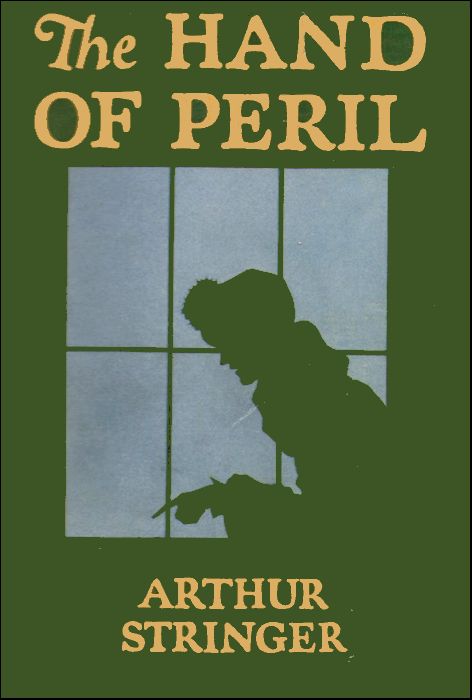
"The Hand of Peril," A.L. Burt Company, New York, 1916

"The Hand of Peril," McKinlay, Stone & Mackenzie, New York, 1915

"The Hand of Peril," Frontispiece from the Macmillan edition
This thriller is a fast-moving blend of espionage, counterfeiting, and psychological tension. It follows Kestner, a seasoned American Secret Service agent, as he pursues an unusually sophisticated international forgery ring whose work threatens the stability of modern financial systems. Kestner discovers that a master forger known as Paul Lambert—once a brilliant accountant embittered by wrongful imprisonment—has built a globe-spanning criminal operation. Lambert’s obsession: to undermine the world’s financial order by flooding nations with counterfeit currency so perfect that no one can trust paper money again. His most dangerous asset is his daughter Maura Lambert, a gifted artist trained from childhood in miniature painting, etching, engraving, and every technique needed to forge banknotes, stamps, and documents with uncanny precision...

"I think I'll go this alone," was Kestner's final answer.
"That's your woman!"
It was Wilsnach of the Paris Office who spoke. He spoke quietly, over the edge of his Le Journal Amusant, But the fingers that held the sheet were a little unsteady.
"The woman with the bird of paradise plumes?" asked Kestner of the Secret Service, paddling in his half-melted mousse au chocolat with a long-handled spoon.
"Yes," answered Wilsnach. "Get her, and get her good!"
Kestner, the wandering mouchard whose home was under his hat and whose beat was all Europe, quietly took out a cigar and lighted it.
He was not studying the woman. Instead, he was sleepily studying the end of his cigar. Yet he studied it persistently, as though its newly formed ash held the solution of many solemn mysteries.
Across the rue de la Paix, opposite the double row of little iron tables where he sat, his idly wandering gaze caught the gleam of metal letters against a white marble wall. These letters spelt the name of an American jeweller. The afternoon sun made them shine like gold. The same sun glinted pleasantly through the leaves of a sycamore. It shone on motor-busses threading their way through the heart of Paris. It shone on tonneaux in which lounged painted actresses and on taxicabs in which sat tired-eyed tourists. It shone on promenading sidewalk-throngs and red-trousered Zouaves and bare-headed students in black gowns and pastry-boys with trays balanced on their heads and a street-tumbler with a mat under his arm and a haggard-browed old man in frugal search of cigarette-ends along the boulevarde curbing.
Kestner, while his mousse au chocolat deliquesced on the little iron table in front of him, saw all this. But incidentally, and as though by accident, he saw other things. Among these was the woman in the bird of paradise hat.
He sat watching her as his many years in the service had taught him always to watch his quarry, with that casual and intermittent glance, with that discreet obliquity, which could so easily be interpreted as the idle curiosity of an idle-minded sightseer.
Yet Kestner, at the moment, was anything but idle-minded. At each apparently casual side-glance his quick eye was picking up some new point, very much as a magnet catches up its iron filings.
"So that's our woman!" he finally murmured. He spoke without emotion.
Yet he was a little startled, inwardly, by her appearance of youthfulness. At the outside, he concluded, she could not be more than twenty-two or twenty-three. That was younger than most of them. In other ways, too, he saw that she was a distinct deviation from type. She even puzzled him a little. And he was not a man frequently puzzled by the women he encountered.
Still again he studied her from under drooping and indifferent eyelids. He could see that she had taken off her gloves and rolled them up into a tight ball. Her bare hands were linked together, as she leaned forward with her elbows on the round-topped table, and on the delicate bridgeway of those interwoven fingers rested the perfect oval of her chin.
Of these fingers Kestner took especial notice. For all their slenderness there was a nervous strength about them, an odd fastidiousness of movement, a promise of vast executive capabilities. The mam watching them saw at a glance that they were the fingers of an artist.
Kestner's indolent glance went back to her face. The pallor of that youthful yet ascetic-looking face was accentuated by the dark brim of the hat under the bird of paradise plumes. The violet-blue eyes, at the moment almost as sleepy-looking as Kestner's, were made darker by the heavy fringe of their lashes. Yet there seemed nothing suppressed or circuitous in their outlook on the world.
Kestner, in fact, could find no fault with the modelling of the face. It should have had more colour, he might have admitted, yet the ivory creaminess of the skin seemed to atone for that absence of colour. The dull chestnut of the heavily massed hair would have been more effective if done in the mode of the hour—but even that, he concluded, was a matter of taste.
It seemed, on the whole, a face singularly devoid of guile. It was only about the lips, with their vague line of revolt, that Kestner could detect anything Ishmael-like, anything significant of her career and calling.
"That's right," muttered Wilsnach, as he bent over his illustrated paper. "Get her good—she's the kind who'll need it!"
"That's where I think you're wrong," remarked the Secret Agent, as he noted the haughtiness of the well-poised head. "I could spot her among a million."
"But you'll never see her there to be spotted," amended Wilsnach. "She's the one they keep out of sight in working hours."
"Tell me about 'em," said the listless-eyed Kestner.
Wilsnach drew his iron chair a little closer to the table.
"It took us over seven months to fine-comb what we know about them out of six different cities. You see, we could only spot them on the wing, the same as I spotted them to-day when I 'phoned you."
"Who's the man?" asked Kestner.
"He's carrying the name of Lambert, just at present. In Budapest he was known as Hartmann. In Rome it's probably something else. But we're sure of one thing: he's the manager of their little circle. He's also their paper expert. He's perfected a bleaching process of his own, and he's the only man in Europe who can re-fill cheque perforations. He's also a finished etcher and engraver, and an expert in inks and colour-work."
"Now the woman," prompted Kestner.
"She's the old man's daughter, as far as we can learn. In fact there's no doubt of it. He's had her in hand for years. She's the free-hand worker for the gang. She can work on stone or steel or copper, and she can do the best imitation of lathe-work on a Treasury note you ever clapped eyes on. The old man taught her all that, the brush work, the photo-engraving process, the silk-thread trick, and the oil washes for ageing a note."
"Got any samples?" asked Kestner, revolving his cigar-end about his puckered lips as though life held no serious thoughts for him.
"The office has one or two. But look at those hands of hers! You could tell that girl was an adept by those fingers!"
"How about the face?"
"That's what puzzled me. She certainly doesn't look the part. But there were certain things we traced up. This man Lambert brought her to Florence years ago, when she was a mere child. He trained her for miniature painting there. Then he taught her etching and engraving. Then he started her working in oils, and for a couple of years she was forging old masters for him. Next, as far as we can learn, he turned his attention to free-hand script work. He got her copying museum records and manuscripts in the Uffizi., Then they migrated to Pisa for a year. It was there she must have done the ten-kroner Austrian note that the office has a sample of. She also got away with an uncommonly good Italian postage-stamp, for which Lambert had made a waterproof ink of his own. Then they bobbed up in Brussels next, and moved on to London, and a year later were back in Rome, sliding from city to city, and doing the smoothest forging and cheque-raising and counterfeiting and flimflam work of the century."
"But as you say, she certainly doesn't look the part."
"She sure doesn't," admitted Wilsnach. "Poucher's got a theory that the old man hypnotises the girl and makes her do the work without knowing she does it. But that's fantastic. I don't even think it's worth considering."
Wilsnach stared down at his paper again, for at the moment Kestner was speaking sotto voce to a withered-cheeked old man with a trayful of street-toys. He was speaking to the camelot in the patois of the street.
"Galipaux, pipe that woman at the sixth table on my left. Lift her handbag when you get the chance. Take your time about it, and whatever you do, don't mess the job!"
The old toy-vender called Galipaux neither answered nor looked back. He merely passed on his way through the jostling crowd. Kestner continued to puddle lazily with his melted mousse au chocolat.
"What's your theory?" he finally asked.
"I rather think the old man's a nut. As far as we can gather, he was an expert accountant in his time, and later swung into bankwork. Then he fell. He always claimed it was a frame-up. But he did four years in Sing Sing—was the school teacher in the prison there—before the other man confessed. That soured him, and he just went bad after that. He did time again, in Atlanta, but forged his own pardon and got away with it."
"What's the rest of the gang?"
"The only other person we've been able to spot is a Neapolitan named Morello. They call him Tony. He's as big as the old man there, and as smooth as they make 'em. They use him as their breaker and shover. He's been years in America and speaks English without an accent. He was a paying-teller in an Italian bank in New York, and later on an olive-oil importer there. He came under the police eye seven years ago for smuggling."
"Ever indicted?"
"Never in America. He fell in Europe, a year and a half ago. He got the blue-prints of the Heligoland Naval Fortifications and was selling a forged copy to a French secret agent in Brussels when the German government got wise. They got him back across the border and tied him up with a fifteen year sentence. Then the girl and the old man got busy, did the Atlanta trick over again, and got Morello liberated and on a steamer for Harwich before the officials knew the release-order was a forgery. I've every reason to imagine he thinks a lot of that girl. He follows her around like a dog."
"And that's all you know?" asked the unemotional Kestner.
"There's an American girl who calls herself Cherry Dreiser floating somewhere about the fringes of that gang, but we can't connect her with them. She was known in New York as Sadie Wimpel, and has a record as a con-woman. We know she worked with a wire-tapper named Davis, and later decided to leave America for a year or two. That was after a badger-game rake-off over there. We first tailed her in Amsterdam on some diamond smuggling work. Later, we found her on her way to Paris with this woman called Maura Lambert."
"So her name's Maura!" languidly commented Kestner, as he threw away his cigar. "But I think you're wrong about the old gentleman. That man is not a lunatic."
"Oh, he's shrewd and keen enough," admitted Wilsnach. "But he has that one obsession of his."
"Which one?"
"That nut idea that he can stampede all modern commerce off the range, that one woman's hand, properly trained, can crowbar over the whole modern world of business. His claim, I suppose, is that all our money-machinery, all our business, our banks and credit systems and negotiable security methods, actually depend on one thing. And that thing is the integrity of paper. The modern business man has got to know that his documents are genuine, that his bank-notes are bona-fide, that his drafts are authentic, that his currency certificates are unquestioned."
"Naturally!"
"Lambert's got the idea that he can undermine the whole structure of modern commercial life by striking at that one thing, by making men feel that its paper, its bank-notes and bonds and certificates are no longer to be depended upon. He imagines he is going to make banks crumble and governments totter by simply flooding the country with counterfeits, by leaving every one in doubt as to which is the real thing and which is the worthless imitation."
"And thereby add a little to his own income?"
"I don't think that's the prime consideration. He's always had money enough. I know for certain he got eleven thousand marks for supplying the forgeries of the Kiel fortifications when the originals were carried away."
"And his next move?" prompted Kestner.
"We've concluded that his next move must mean America. It's what he's been planning for, for years. He's laid all his ropes. He's going into the thing on a big scale. In six months' time he's going to unload three or four million dollars in counterfeit on the republic. In the second six months he'll put out more than double that amount."
"And then what?"
"Isn't that enough?" inquired Wilsnach.
"It sounds like a very fine plan. But if you knew all this, why haven't you closed in on them?"
"Headquarters said hands off until you could take over the case."
"That was very kind of Headquarters," sighed Kestner. Then Kestner sat without speaking, for a withered-faced street-vendor had placed on his knees a folded copy of an afternoon newspaper. This paper the Secret Agent carefully unfolded and let lie on the table in front of him, and for a short while seemed busied with its contents.
In that brief space of time, however, Kestner had done several things. One was to hold a lady's bag between the flaps of his coatfront, well under the table edge, and there quickly but minutely examine its contents. Another was to register a mental note of every name and address found therein. And still another was to trace on a gilt-edged carte des glaces an outline of each key found in the bag of that quiet unsuspecting lady, while the final movement was to slip the bag back into the adroit hands of one Galipaux, who, in due time, drew the attention of a stately lady in a bird of paradise hat to the fact that her purse had fallen to the pavement. And for this, Kestner saw, the mendacious old scoundrel was rewarded with a franc.
"Her money, I regret to say, was all unmistakably genuine," observed Kestner.
"And so is her appetite, for I notice that she's just made away with her third Coupe Jacques."
"She is certainly not true to type," repeated the perplexed Kestner.
"Well, you'll find her true to her gang!"
"I'll tell you that before midnight."
"You mean you're going to jump right into the case?"
"I'm in it already," retorted Kestner, looking at his watch. "I have located the lady, and, if I am not vastly mistaken, I have located the plant."
"Where?"
"The first in a little street off the Boulevard Montparnasse, and the second in so remote a place as the city of Palermo."
Wilsnach followed the other man as he rose to his feet.
"What'll be your line of procedure?" he inquired.
"That I can't tell until my visit south of the river."
"Then what men will you want?"
Kestner lighted a second cigar—as usual, he was smoking too much—and for a few seconds was deep in thought.
"I think I'll go this alone," was his final answer to Wilsnach.
Kestner, who at times gave the appearance of being as lethargic as a blacksnake, could on occasions move with the astounding rapidity of that reptilious animal.
His activities during the hour that ensued stood proof enough of this. Within that brief space the Lamberts, father and daughter, had been shadowed to the restaurant where they gave every promise of dining; divers messengers had been despatched and interviewed; a number of pass-keys had been freshly cut from the diagrams pencilled on a gilt-edged carte des glaces from the Café de la Paix; an artfully worded telegram had lured Antonio Morello to the Gare de Lyon to meet an Italian confederate arriving unexpectedly from Milan, and a handsome pourboire had engaged the sympathetic attention of the concierge presiding over the entrance to that remarkably ramshackle old studio building in that ramshackle old court just off a side-street leading from the Boulevard Montparnasse in which the Lamberts were temporarily housed. One of the doors on the top floor of this building, in fact, bore the modest inscription
Paul Lambert, Graveur Sur Acier
and it was before this door that Kestner paused, listened, knocked, and then listened again. Taking out one of his newly cut keys, he inserted it in the lock, opened the door, and stepped inside.
Still again he stood just inside the closed door listening, for several moments. With a catlike quietness of tread he moved first to one door, and then to another. Then, having satisfied himself that he was alone in the apartment, he began an expeditious and systematic search of the place. This search soon narrowed itself down to the large studio, lighted only by a skylight of ground glass, which proved itself to be the workroom of his friend, the "graveur sur acier." For in this studio Kestner found many things of interest.
The first thing that caught his attention was a projecting lantern and a white cotton screen. Across the room from this stood a camera hooded by a square of black lustre. In the centre of the room stood a large oak table littered with etchings and art prints, while between two doors leading into two closets stood a cabinet filled with miniatures painted on ivory. On a second table, against the remoter wall of the studio, stood rows of acid bottles, inks, and a collection of engraving-tools.
All of these, Kestner knew, might be used by as etcher on steel or copper, and none of them implied an industry that was illicit. So he continued his search, minutely, and sighed with relief when under a drapery of imitation Gobelin tapestry his exploring knuckles came in contact with the metallic surface of a safe-front.
It took him but a moment to throw back that factory-made affront to the Gobelins and discover himself face to face with an oblong of japanned steel held shut by a combination lock. Within that wall, he felt, lay the object of his search. He tapped the metal aarface, inquiringly, as a physician's fingers tap a patient's chest. He tested the combination, but without success. He examined the armoured hinge-sockets. Then he stood off and studied the oblong of japanned metal.
He was an expert in such things; his life had made him such. He knew that with a little glazier's putty, an air-pump, and a few ounces of nitroglycerine he could in a quarter of an hour have that metal door blown away. Or with a strong enough current he could corrode away its lock bars by electrolysis, or with a forced acetylene flame cut away its lock-dial. But such procedure was not in keeping with either his ends or his aims. He knew that his attack could not be one of force.
He suddenly turned, crossed the studio, and stepped quietly out to the entrance door, making sure that it was locked. Then he returned to the studio, took off his coat, and went to the large worktable in the centre of the room.
There he took a huge sheet of draughting paper, twisting it about into the shape of a cone. He secured it in this shape with liquid glue from the smaller table, fashioning it with a flap lip at the larger end. This lip he in turn glued to the safe-front, over the tumbler, to the left of the combination dial, holding it there until the glue hardened. The pointed apex of the cone he carefully cut away with a pair of scissors, leaving it standing out from the safe-front like a huge speaking-trumpet.
When he knelt before the safe again, however, it was his ear and not his mouth which he pressed closely against the open apex of the draughting paper trumpet. His ear, even without the aid of this roughly improvised microphone, was one of the most sensitive of organs. But now, through even that thick wall of steel, he could hear the soft click of the tumblers and the noise of the dial as he worked the combination. He knew the possible permutations, and he tried them, one after the other, listening always for the deeper sound when a lock-tumbler had engaged.
It was expert work, and it called into play both the patience and the delicacy of touch of an expert. Yet it was a full half-hour before Kestner had mastered the combination, and throwing back the lock-bars, swung the heavy safe-door open.
He was confronted, as he had half-expected, by an array of innocent-looking engravings and art prints. Behind these again was a litter of artist's proofs and etchings, such as might have been gathered together by any collector wandering about the quays and shops of Paris.
He stopped and looked at his watch, and then turned and worked his way deeper into the vault. He worked rapidly now, impressed by the discovery that time was more than precious.
In an inner drawer, which he was reluctantly forced to pry open, he found a trayful of photographic plates, and under them a small old-fashioned mother-of-pearl writing-desk. The lock of this desk he was able to pick. Inside, under a scattering of letters and tradesmen's bills, he unearthed a number of neatly baled packages. Still again he showed no hesitation as he tore the wrapper from the first of these.
He knew, the next moment, that his search had been at least partially rewarded. He held in his hand a package of American yellow-backs. In denomination they were all "tens." The next package, the same in size, was made up of notes in the denomination of "one hundred." Still the next was a twenty-dollar note, and then came more packages, of the "tens," and still more of the "one hundreds."
Kestner turned these packages over, studiously deciding that each package must hold at least three hundred bills. He qualified that estimate, however, for he could see that the bills were not new. They all carried the ear-marks of age and wear. It was to determine whether they had been mechanically abraded and worn that he drew one of the bills from the package and carried it to the centre of the room under the more direct light from the skylight above. He warned himself, as he did so, that he had not yet found the plates, and the plates were the one thing that he wanted, that he must have.
Kestner was familiar enough with counterfeiting in all its forms. In his work as roving agent for the Treasury Department he stumbled across more counterfeit money than did any bank-teller in America. He knew his currency as a mother knows the faces of her children. He knew genuine "paper" instinctively, without hesitation or analysis. He could, in the same way as instinctively detect fraudulent "paper." He did so without conscious thought, by some vague sixth sense, a gift that was not altogether feeling and not altogether the sense of sight. Even before the microscope was put over a counterfeit and the line of divergence was established—for somewhere there was always a line of divergence!—he knew in his own mind that a given note was spurious.
He had long known, too, both the tricks and the limitations of the counterfeiter, the bleaching and raising, the camel-hair brush work, the splitting and pasting, the hand-engraving on steel, and the photographic reproducing. He knew that the camera work was always flat and weak, no matter how artfully retouched and tooled over. He likewise knew that the governmental lathe-work on a note was a series of curves and shadings and backgrounds mathematical in their precision and unvarying in pattern. No human hand could duplicate the nicety of that machine-engraving, each line unvarying and unbroken from end to end. And since these machines cost well upward of one hundred thousand dollars, and their manufacture and sales were closely inspected, no counterfeiter could be expected to possess one.
Yet as Kestner stood in the late afternoon light that streamed into the silent studio and held his newly found yellow-back up before him, he could not restrain a rather solemn gasp of admiration.
The note seemed a perfect one. It was on the first Colonial National, of the series of 1909. It carried the Check Letter "C," and the Charter Number of 8939.
Kestner's first thought was as to the paper itself. It was genuine bond, of good quality and weight, and the closest approximation to the "safety paper" of the American Bank Note Company that he had yet encountered. It did not strike him as being two thinner sheets pasted together, although he could plainly see the silk-fibre in the actual tissue of the paper. How his government's secret process had been so successfully imitated he could not at the moment tell. But as he turned over the note he saw that the engraving had been as expert a piece of work as the paper-making itself.
He saw at once it was not a mere photo-etching process, later tooled out by hand, for every line of the lathe-work was clear-cut, and every touch of colour on the vignette was sharp and full. Even the cross-matching had been worked out with infinite detail and patience. And equally good was the colouring of the border-backs.
It took but a moment to establish the fact that the note had been printed in waterproof ink and not superimposed with a wash-pigment and camel-hair brush. Equally convincing-looking were the denomination counters.
It was, in fact, not one especial feature of the note that won Kestner's admiration. It was the beauty and authoritativeness of the bill as a whole, even to the "ageing" oil-wash to which it had been subjected and the mechanically abraded surface and artfully frayed edges.
He folded up the bill and thrust it down in his vest pocket, chucklingly anticipating Wilsnach's stare of incredulity when it should be passed under the latter's inspection. Then Kestner stepped briskly back to the open safe, dropping on his knees and reaching in for the next package, the one of large denomination. It came home to him, as he did so, that here lay the source and origin of what might indeed prove a tidal-wave of illicit money, that here, indeed, lay the means of debauching and imperilling the currency of an entire country.
Then he stopped short, still kneeling there, and scarcely breathing.
It was just as his fingers had closed about the second package that he heard that first small noise behind him. It sounded like the diminished thud of an outer door being softly closed. A second and nearer sound, that of an inaudible gasp, brought him wheeling about on one knee. He did not rise, but his hand shot down to his hip, where his automatic always rested in its specially padded pocket.
"Not this time, honey-boy!" cried a firm if somewhat nasal young voice.
Facing him, with her back against the closed door of the studio, was a woman who could not have been more than twenty-four or twenty-five years of age. She had a pert young face, with a short nose, a rebellious and slightly heavy-lipped mouth, and a row of singularly white and singularly large teeth.
Kestner noted that she wore the small tiptilted hat affected by the Parisienne of the moment. He further noted that she was startlingly well dressed, and that in this attire she had attempted to approach the chicness of the native. Yet it was plain to see, for all her exotic raiment, that she was American to the finger-tips.
But Kestner's mind did not dwell on these points. His attention was directed to the fact that in her right hand she held a hammerless Colt, and that the barrel of this hammerless Colt was pointed unequivocally at his own head.
He did not like the idea of that Colt, for there was a calm audacity about the young woman in the tiptilted hat that left the next possibility a matter of rather painful conjecture.
"Put 'em up!" commanded the girl, taking a step or two nearer him, "and put 'em up quick!"
Kestner assumed that she meant his hands at the same moment that he decided it to be expedient to do as she ordered.
"Now stand up!" said the girl.
The audacious grey-green eyes looked him over. Then the owner of the audacious eyes sighed audibly.
"Gee, an' you an Amurrican! An' gotta pass away so many miles from home."
"Oh, put that thing down!" cried the impatient Kestner, for his attitude was not a comfortable one.
The girl laughed. But the ever-menacing revolver remained where it was.
"No, honey-child, not on your life!" She took still another step nearer him. "Don't you s'pose I've got me home an' mother to purtect? No sir-ee, not on your retouched negative!"
"Then what do you intend doing?" asked Kestner. He risked the movement, as he spoke, of calmly folding his arms.
Her face hardened, for a second, as she saw the movement. But on second thought she seemed to accept the new position as one sufficiently safe.
"You don't dream you're goin' to get out o' here alive, do you?" innocently demanded the girl.
"Why not?" questioned Kestner. He was watching her closely, every second of the time. And she, in turn, was watching him as closely. His sense of comfort did not increase. Yet the look of fixed somnolence still hung about his eyes.
The girl did not answer him, for at that moment the further studio swung open and with a quick movement a man stepped inside.
Kestner liked neither that man nor his unheralded intrusion. The newcomer stood there, a little breathless, as though he had been conscious of danger impending and had raced up the stairs. He was an olive-skinned, square-shouldered man of about thirty, with close-set eyes, seal-brown in colour. While he was in no way conspicuous as to attire, there was both audacity and cunning in those calm and ever-searching eyes. Kestner knew, even before the girl spoke, that this was the Neapolitan called Morello.
"Got your gink for you, Tony!" said the girl, with a look of relief, clearly at the thought of a confederate's advent.
That confederate, however, still stood by the door, alert and non-committal. It was several moments before he spoke.
"Who is he?" he asked, tensely, yet without moving, and all the while studying the face of Kestner.
"That's what we're goin' to squeeze out o' him," was the girl's reply.
Kestner noticed that the Neapolitan spoke English without a trace of accent. He also noticed the expression in the seal-brown eyes as they turned and studied the open safe.
"What did he get?" asked Morello.
"You mean, what's he goin' to get!" cried the girl, with her curt laugh. She did not lower her fire-arm as the newcomer stepped towards the centre of the room.
"Tony," she suddenly called out, "this guy's heeled. Get his gun!"
She herself stepped still closer to Kestner as she spoke, holding her revolver so that it pointed directly at his upper left-hand vest-pocket. On the whole, Kestner saw with dampening spirits, they were two extremely capable and clear-witted individuals.
So capable were they, in fact, that their prisoner stood silent and helpless, with a revolver-barrel within a yard of his heart, while the quick-fingered Neapolitan explored and felt about Kestner's clothing. He emitted a faint grunt of satisfaction as he drew the automatic from its padded hip-pocket.
"What next?" he asked, as he stepped back with the revolver in his hand.
"Pull out that old oak chair, the one with the high back," commanded the girl. "Then get that bunch o' picture-cord from the top shelf there."
Morello did as directed. But the girl, all the while, kept her eyes on Kestner. His sustained air of composure seemed to worry her.
"Now you back up," she commanded, with sudden roughness. "Back up! Right back until you're sittin' in that chair!"
Kestner turned and looked at the heavy fauteuil of carved oak. A suspicion of what their intentions were crept over him.
"Supposing I don't care to?" he ventured.
The girl confronted him with a show of anger.
"Look here, Mister Pretty-man, you've put yourself in Dutch an' you're goin' to do what I say! D' you get me? Poke him into that chair, Tony, and poke him quick!"
Kestner sat down with a sigh. The sleepy and half-amused smile was still on his face. He was still watching for his chance.
The smile disappeared, however, before the unlooked for and lightning-like movement of Morello. That worthy suddenly garroted his captive's head against the fauteuil back while the girl promptly and securely tied his wrists to the chair-arms. His ankles were also made fast in the same way, and all were for the second time wrapped and reinforced with many yards of the heavy crimson cord. Then his neck was released and he could breathe quite freely again.
There was now something more than a look of concern on the face of that sleepy-eyed captive. Deep down in his heart was a vast rage at the indignities to which his body had been subjected. And when the time came, he inwardly vowed, some one would pay for those outrages. He was still straining uselessly at the cords holding him when he heard a quick cry from the girl.
"Thank Gawd, here's the Governor!" she said over her shoulder, as she helped Morello with the final knots.
The studio-door opened quietly and the same austere and self-contained man who had sat at the café table stepped into the room.
There was no visible change of facial expression as his eye swept the studio and at one circling glance seemed to take in every detail of the situation.
"What's this?" was his final curt demand.
"We caught this guy rubberin' into our safe," was the girl's answer. She stepped over and swung half-shut the steel door to which still clung Kestner's sounding-tube of pasteboard. "And, say, Governor, he ain't no sandpaper artist, either!"
Kestner saw it was time to talk.
"I want you to listen to me, Lambert," he began, in that clear and steady note of authority which his office could at times give to him.
"Shut up!" was Lambert's command.
"No; I'll not shut up! We've got something to talk out here, and—"
"Gag him, Tony!" cried Lambert, with an impatient gesture towards the door at the far end of the studio.
Morello stepped through this door, and promptly stepped back into the room with a towel in his hands. This towel he quickly tore in two, knotting the two pieces together as he approached the chair where Kestner sat.
"There's no need to do this, Lam—"
Kestner's cry was shut off by the towel with the tightened knot being dexterously tossed over his head and drawn taut, so taut that the pressure of the knot on his lips became unendurable. Involuntarily the jaws relaxed, to relieve the pain.
"Tighter!" commanded Lambert. The band, now against the slightly parted teeth, was tightened and securely knotted at the back of the captive's head.
It was then that the man designated as the Governor stepped quietly back and closed the door which he had left partly open. Then he stood in silent thought for a moment or two.
It was the girl in the tip-tilted hat who spoke first.
"What's the matter with givin' him a crack on the coco?" she gravely volunteered. "Put 'im to sleep until we're dead sure of a get-away?"
The man called the Governor did not seem to hear her.
"Tony," he suddenly said with a crisp and incisive authority, "take that gun from Cherry. Now hand me that automatic. Keep that man covered. If anything happens, plug him where he sits. If any one tries to get in here, plug him first,—him first, remember. Cherry, you frisk him! I want everything, everything, mind you, out of his pockets."
The girl, with a small frown of intentness, bent over the heavy oak fauteuil and went through Kestner's pockets, one at a time. The man called the Governor stood in deep thought as she did so.
As she placed the fruits of her search upon the drawing-table to the left the older man stepped over and examined the little collection. He looked up quickly as he came to the neatly folded bank-note.
"So you wanted only one?" he said, and the grim lines about his mouth hardened a little as he stared at Kestner. Then he bent over the drawing-table again.
"Tell Maura to come here," he said, with a quick motion towards the girl in the tip-tilted hat. He was studying a sheet of writing which had been taken from Kestner's pocket.
"Where'll I get her?" asked the girl.
"Downstairs in Bennoit's. Promptly, please!"
The girl slipped out through the studio-door, and closed it after her. Kestner sat there and watched Lambert wheel a projecting-lantern out into the middle of the studio and direct the lens towards the screen of white cotton at the farther end of the room. He saw the sheet of paper inserted in the lens, heard the snap of a switch, and black across the white screen beheld his own signature, magnified many times, magnified until each letter was at least a foot in height.
Morello, tired of standing, sank into a chair, facing the prisoner. In his hand, however, the Neapolitan still held the revolver, and never for a moment did his gaze wander from Kestner.
Lambert, going back to the drawing-table, suddenly turned and crossed to the open safe. His search there seemed a brief one. But his face paled as he turned and stood erect again. He was still beside the safe when the girl called Cherry stepped back into the room. She was followed by the woman Lambert had spoken of as Maura, the woman whom Kestner had watched as she sat at the little round table of the Café de la Paix.
Kestner's intent gaze was fixed on this woman's face as she stepped into the room. More than ever he was struck by its sense of reserve, of spiritual isolation, and more than ever he was impressed by its youthful yet austere beauty. He was struck, too, by a newer note, by something that seemed almost a touch of fragility. And about the softer lines of the mouth he detected a trace of latent rebelliousness.
The newcomer, however, scarcely looked at Kestner. The sight of a man tied and trussed and gagged there seemed in no wise to disturb her. Her eyes went close to the face of Lambert and remained there while she spoke.
"What is it?" she asked, in a clear and reedy voice that made Kestner think of a clarionet.
Lambert waved a hand towards the signature thrown on the screen by the projecting lantern.
"Try that, freehand," he said. "Then do it over again on the tracing-desk. I want it right."
The woman took paper and ink and from a row of pens selected a particular point. She stared for a few seconds at the signature, and then bent over her task.
She did not speak as she handed the slip of paper to Lambert. He took it, too, in silence, switching off his lantern, withdrawing Kestner's signature, and adjusting the newly written imitation in its place. Then he switched on the light again.
Even Kestner, accustomed as he was to the cleverest of forgeries, was plainly startled as he saw that name projected on the cotton screen. It disturbed him in a manner which he would have found hard to describe. For even in its magnified form, where any deviation from the original would be doubly and trebly accentuated, it stood out a practically perfect facsimile of his own handwriting.
This quiet-mannered woman with the violet-blue eyes and the misleading delicacy of Dresden china was one of the most accomplished forgers who ever handled a pen. That much Kestner could see at a glance. And at a second glance it came home to him that this same woman, in the right hands, could indeed develop into an actual peril to society.
"Try tracing it," Lambert was saying to her.
She took the Kestner signature and crossed to a small table, the top of which consisted of plate glass. She reached in under this glass and turned a switch. The moment she did so a powerful electric light showed itself directly below the table-top.
On this top she placed the paper, covered by a second sheet. Then she tested a number of pens, and having found one to her purpose, carried on a similar test with regard to her ink. Then for a silent moment or two she bent over her task.
Lambert took the paper from her when she had finished. This time he placed the three signatures in the lens and threw them on the screen, one above the other.
Kestner, studying the three, could not be sure which was his own and which were the imitations. The other occupants of the room, he noticed, were studying the letters quite as intently as he had done.
It was the girl called Cherry who spoke first.
"Take it from me," she said with sudden conviction, "the freehand wins!"
Lambert turned to the woman who had done the writing.
"Your tracing is stiff to-day. What's the matter?"
The question remained unanswered for several seconds. The troubled violet-blue eyes moved from the screen to the man in the fauteuil and then back to the screen again.
"I'd like to know what this means," she finally declared.
Lambert stepped quickly across the room. For a man of his years and a career such as his that gaunt old counterfeiter retained a startling degree of virility.
"You'll find that out quick enough," was his half impatient retort. He tossed the papers he had withdrawn from the lens across the table and motioned for her to be seated.
"Take half a sheet of that bond and write what I tell you. I want it done in the handwriting of that signature, and I want it done right. Are you ready?"
"I'm ready," answered the woman. She spoke in the flat and lifeless tones of a coerced child.
"Then write this: 'I have made a mess of things, and I am tired of life. I'm sorry, but this seems the only way out.' Then add the signature. No; wait a minute. Add this: 'The finder will please notify the American Embassy, where the secretary, I trust, will cable the Treasury Department at Washington.' Have you got that?"
The woman at the table went on writing for a second or two.
"Yes," she said at last, with her head a little on one side as she studied the sheet in front of her.
"Then we'll put it on the slide and see how it looks," answered Lambert. He took the sheet from her, adjusted it in the lantern, and turned on the light.
An undeniable tingle crept up and down Kestner's backbone as he read the words on the screen. It was, to the eje, his own handwriting. It would and could be accepted as his own. Not one person in a thousand would even stop to question its authenticity.
The woman named Maura, who had been supporting herself with one hand on the end of the table, turned and faced Lambert.
"Are you going to kill him?"
It was spoken so quietly that Kestner could scarcely hear it. But the last of the colour had gone from the woman's face, and her eyes, as she spoke, took on an animal-like translucence.
"On the contrary," was Lambert's calm retort, "he is going to kill himself."
"Why?" demanded the woman.
"Because, as he himself says, he's tired of living. He confesses that in this paper he's leaving behind. And he's proved it by invading our home the way he did. Homes have to be protected. And I intend to protect mine."
"You're not protecting it," she contended.
"Well, I'm making a stab at it—and a stab at saving your neck at the same time!"
"Oh, what's the good of all this!" cried the white-faced woman, with a gesture of both protest and repudiation. For the second time Kestner saw the lines about Lambert's mouth harden. There was no doubt of his domination in that little circle.
"It's necessary, and that's enough. You've done your part, now, Tony and I will do ours."
"But you can't kill a man in cold blood,—you can't!" she cried, her voice shaking with a vibrata of horror.
"I've already told you," retorted Lambert, quite untouched by her outburst, "that he's going to do the thing himself!"
"Himself?"
"He's going to hold his own gun, and pull his own trigger with his own finger. And to make sure it's his own act, he's even going to hold that gun in his mouth, pointing upward and backward!"
He met her staring eyes without a moment's flinching.
"Tony, of course, may help him a trifle, but that's our business. There's one too many in this game. And it's too big a game to drop now. Somebody has to step down and out."
"But you can't do this!" she still protested.
Lambert turned on her.
"Can you suggest something better?" was his quick and half-mocking demand.
She looked from Kestner to Lambert, and then back at the man so securely tied down to the huge oak fauteuil.
"Yes," she replied.
"Well," mocked Lambert. "Out with it."
"If this man knows what you hint he knows, we can't stay in Paris."
"Naturally not."
"But whatever he knows, or whoever he is, he can't be acting alone."
"I fail to see his friends, at the moment."
"But there must be others, others who—"
"But we've got him!"
"Yes, you've got him—precisely. You've got him there, and he'll be safe there for at least several hours!"
"How about us?"
"Those few hours are all we need. We can leave him as he is. By that time we can be—be wherever you say."
Lambert and Morello did not openly and patently exchange glances; but the watching Kestner knew that a silent message had been given out by one and received by the other.
"All right," suddenly acquiesced the older man. "Go and get your things together—and remember, we've got to travel light!"
He nodded towards the woman called Cherry. "And you do the same. But I want you both to move quick!"
The woman called Cherry stepped towards the door. But the more resolute-eyed woman still hesitated. She seemed to have her doubts as to Lambert's promises. The latter, however, was not in a mood to endure equivocations.
"I said I wanted you to move quick!" was the sharp and sudden cry.
She stood there, staring at him, almost challengingly at first. Then her eyes fell, as though worsted in that silent duel of wills. She started to speak, hesitated, and remained silent. Then she turned slowly about and walked quietly out of the room.
The moment she was gone Lambert's manner changed. He moved with a celerity surprising in one of his years.
"Now, Tony, quick—get the notes into that bag of yours. And the plates. We must have every plate, remember!" He was himself busy going through the drawers of one of the work-tables as he talked. "Never mind the other stuff—that will take time. And there's been too much time wasted here already."
Lambert snapped shut the club bag into which he had been cramming the different things caught up from the rummaged drawers. Then he stepped quickly to the door, listened for a moment, and crossed to Kestner's side. The expression on his face was extremely disturbing to the man in the high-backed chair.
"So you work alone, Monsieur Kestner!" he said with a cold smile of mockery. "You come after us singlehanded! I admire your courage, sir, but I deplore your lack of judgment!"
With his left hand, as he spoke, he deftly cut the gag which held apart Kestner's aching jaws. With his right hand at the same instant, he reached down into his pocket and brought forth the girl's sombre-looking hammerless Colt. With an equally quick movement he cut the cord holding Kestner's right wrist so firmly down to the arm of the chair.
Before Kestner could cry out, before even he could raise that throbbing and stiffened right arm, Lambert had caught him by the hand, forced the prisoner's fingers about the grip of the revolver, and covered those flaccid fingers with his own muscular and bony hand.
It was not until he had forced up Kestner's inert right forearm that the Secret Agent fully awakened to the imminence of his peril. As always, he had counted on some intervention, on some moment of relaxed vigilance when his chance should come. But here there seemed to be no chance.
He saw, in a flash, what it all meant, and how quickly it could all be over. His position was against him. The suspended circulation of that over-bound right arm was against him. But still he fought, fought every inch of the way, with every jot of strength at his command.
The third man stood watching the tableau, his impassive and olive-skinned face giving no sign of heightened emotion as the contending forces centralised in those two quivering arms came into the equilibrium of nicely matched strength. Then one arm weakened a trifle. The dark-barrelled weapon of gun-metal was slowly forced further and further upward.
Kestner knew quite well what it meant. But he was now powerless to withstand that cruel pressure. He knew that the forefinger of that muscular hand, held so firmly over his own, would contract the moment the barrel was levelled in the right direction. He felt it was all but useless to cry out. Under no condition would he cry out. Yet at the moment the revolver was in a perpendicular position, a flash of hope came to him.
It was with that flash of hope that he quickly and deliberately did the unexpected thing. He pulled on the trigger with his own finger.
The sharp bark of the revolver reverberated through the high-walled room as the bullet went splintering into the framework of the skylight overhead. Kestner had hoped it might crash through the panes themselves. He doubted if the sound of a small calibre revolver would carry much beyond the closed apartment.
Yet that unexpected discharge of the fire-arm startled Lambert. The arm still forlornly straining against his relentless upward pressure gained several inches of precious space before the struggle could be renewed. But inch by quavering inch the fire-arm was again forced up.
"Tony," panted Lambert, "give me a hand!"
Kestner was only dimly conscious of the other man sliding up to him.
"Get his jaws apart," was the next command gasped out by Lambert.
Kestner was conscious enough now of gross fingers on his face, bruising his lips, of knuckles rowelling the cheek-flaps against his clenched teeth. And a corroding wave of rage and resentment swept through him, at the ignominy of it all. Then he clenched his jaws still closer together, in the face of that rowelling knuckle, for at that moment a second interruption was taking place.
This interruption took the form of a door flung open and a white-faced woman calling into the studio.
"Stop!" gasped the woman, as she flung through the door and turned the key in the lock.
Both men looked up, a little stupidly, their mouths still open, their postures still those of strained muscles and sinews. Kestner saw it was the woman called Maura.
"Stop!" she gasped, a little weakly. "We're being watched!"
Her hat was awry of her head, her veil was hanging loose, and she was plainly out of breath.
"Quick," she gasped again, leaning against the wall; "there's a man at every door! and two gendarmes are on the stairs! Listen! I hear them coming!"
Morello was the first to stoop and catch up his handbag. Lambert's grip on the prisoner's arm relaxed. He wrenched the revolver from Kestner's fingers, dropped it into his pocket, and darted for his bag.
"Then the closet!" he cried as he ran.
"Why the closet?" asked the bewildered Neapolitan.
"The secret passage, you fool!" called Lambert, as he dove through the door leading into the second closet. He was followed by Morello. Kestner heard the soft scrape and stutter of a sliding-panel. It had been a piece of stupidity, he told himself, to overlook those closet-walls.
"It leads to the roof, and then down through the Poret's passage," explained the woman, still leaning against the wall. She stood watching Kestner as he worked frantically at the cord still binding his left arm down to the heavy chair.
"They're safe by now," she murmured.
"But you're not!" cried Kestner, vindictively, all the indignities to which he had been subjected lending anger to his voice.
"Quite safe, monsieur," she replied, as she proceeded to straighten her hat and then adjust the heavy veil about its brim.
"Oh, are you!" cried the infuriated Kestner.
"Yes, monsieur. There are no men, and no gendarmes."
"Then why did you lie?" gasped Kestner.
She smiled a little wanly.
"They would have shot you through the head, monsieur!"
She had turned the key in the lock. Her hand was on the doorknob as she looked back.
"I hope," she said, "that we shall not meet again!"
"One minute," called Kestner, imagining that by hook or crook he might delay her until that fatal cord was loosened. "Pardon my asking, but how long did that plate take you to make?"
"Which plate?"
That First Colonial Ten."
Again he caught a shadow of the wan and half ironical smile.
"Why are you interested?"
"I shall always be interested in you."
"That is something you cannot afford."
Their eyes met. They continued to stare at each other for several seconds.
"I think we shall meet again," he finally said, with the utmost conviction.
"Adieu, monsieur, for we shall never meet again!"
"You leave that to me!" cried the defeated Kestner, and into those five words he threw both the bitterness and the tenaciousness born of that momentary defeat.
But the woman had already closed the door and locked it after her.
It was two weeks later that, after the docking of a Navigazione Generale Italiana steamer at Palermo, an old woman wearing amber-coloured spectacles stepped solemnly ashore.
As this old woman had taken the pains to await the departure of all other passengers, and as she carried only a hand-bag of the same faded hue as her attire, her visit to the Dogana was a brief one. Then, for all her humped shoulders and a somewhat sidling method of progression suggestive of sciatic rheumatism, she proceeded with a melancholy briskness along the Via del Molo. It was not until she had entered the Piazza Ucciardone that she encountered an idle vettura.
After looking peevishly about her in all directions, she signalled to the driver. The dilapidated vehicle swung about and drew up beside her with a mingled clatter of wheels and hooves. The long arm in faded black thrust up to the cabman a scratch-pad on which a city address was written.
The small and swarthy man of the reins, having scrutinised this address, blithely nodded his understanding. Then he showed his teeth in a still broader grin. For his Saracenic black eye had swept the dowdy figure, noting the well-worn metal ear-trumpet hanging from one arm by a frayed black cord, the antiquated silver-mounted black cane, the gloves of faded black silk, and the shimmer of jet spangles arrayed along the somewhat opulent breast. He was murmuring the all-condoning word of "Inglese!" when he made note of a further and more compelling fact. The black-gloved hand was holding out to him a ten lire note. Thereupon, having promptly pocketed the same, he sent his long-lashed Sicilian whip whistling about his pony's ears and his cab-wheels went rattling up through the streets of the city.
Arrived at the desired address, his fare stepped painfully and lumberingly from the little open cab, watched hesitatingly until that vehicle was out of sight, and then rounded a corner. This eccentric-minded tourist then walked six doors southward, limping stolidly into the entrance-court of a grey-stone house, as silent and sepulchral of aspect as a mediæval mausoleum.
Here, after being accosted by a rotund and mild-eyed little man in grass slippers and after writing certain words on the pad which she carried, the newcomer was given a key and instructed, in Italian, to mount the stairs.
This she did, unlocking the first door on the left, withdrawing the key, and again carefully locking the door after she had stepped inside.
Once there, she surveyed the chamber with much deliberation. Then she sighed, took off the amber-coloured glasses, divested herself first of the black silk gloves and later of the faded widow's-bonnet. Then she placed her hand-bag on the bed beside them, consulted a watch, and with a second deep sigh unbuttoned the jet-spangled waist and groped about the voluminous corsage.
With a still deeper sigh the hand was withdrawn, bringing with it a cigar. A match was struck, the cigar was lighted, and the figure in dowdy black sank into a chair, resting its boot-heels high on the end of the bed.
Before six luxurious puffs had been taken at that cigar a quiet knock sounded on the door. This knock was oddly repeated, translating itself to the attentive ear into a sort of organised tattoo.
The smoker arose, crossed the room and unlocked the door. Then he opened it, but without showing himself. His right hand, as he did so, was thrust through a slit in the black silk skirt, resting on the grip of a revolver half withdrawn from a padded hip-pocket.
The man who stepped into the room exhibited no surprise at either the scene or the figure confronting him. Like the first-comer, in fact, he scrutinised the chamber with the utmost care.
"Speak quietly," said the first occupant of the room as he re-locked the door.
"You can trust Maresi," explained the other, with a head-nod towards the outer passage.
"Then what's new?" was the prompt inquiry.
"Nothing of importance," answered the other, "since my last wire."
"Anything of Lambert?"
"Not a sign!"
"Morello?"
"Still under cover!"
"The Wimpel woman?"
"Not a trace of her so far!"
There was a moment's pause.
"And the other woman?" asked the man in the half-demolished make-up, "the woman called Maura?
The other man permitted himself the luxury of a smile.
"Has set up a miniature-painting studio on the other side of this block, as I first wired you. A showcase of 'em in the window! And not even a stab at secrecy!"
"And you say she's put in a telephone?"
"The wiring goes to the top of the house, across a couple of others, and from there rounds south to the street-main. I've traced it out. It can be reached from the roof of this building!"
"That's worth a mint to us," murmured the other. "And it hasn't been interfered with?"
"I left that expert work for you."
"Then the sooner we get a loop in that circuit the better!"
"You may be right, but, Kestner, I think your gang has flown the coop!"
It was Wilsnach who spoke, but not the shabby and self-effacing Wilsnach of the rue de la Paix. Instead, it was a dandified, edition-de-luxe Wilsnach as a tourist in peg-top trousers and pointed patent leathers, a Wilsnach with a waist line and a waxed imperial.
Kestner pulled off the iron-grey wig that had been making his head uncomfortably warm.
"I think you're wrong," he replied without emotion, "and later on I'll tell you why. But did you get the girl?"
"Yes. Not as young as I wanted, though."
"Where have you quartered her?"
"She's at the Hotel des Palmes with her mother."
"With her mother?"
"Couldn't get her alone—she's only twelve. But she's small for her age. I gathered them up in Taormina. The mother was working at the Hotel Trinacria there. The father's a German named Vandersmissen, a tubercular chef, sent South, on his last legs. They're glad of the money!"
"But that mother!" demurred Kestner.
"I've rigged the woman out in a uniform as a German nurse."
"And the child?"
"Is dolled up the best the island could do. Neither speak a word of English. They're here waiting, meek but mystified. They'll do anything we want, in reason. And she's a pretty kid, yellow hair, blue eyes, German type. But they're costing us sixty francs a day."
"They'll be worth it!"
"But what's your plan?"
"My plan is simply this: Lambert knows I'm after him. He isn't quite sure how much I've found out about him and this daughter of his. He can't be certain if he's shadowed or not. And that's what he wants to make sure of. So he's posted the girl here at this miniature-painting business. He's made her into a wooden decoy-duck."
"But I can't see what he gains by that."
"Well, here's his game, as I figure it out: People in hiding don't usually advertise their whereabouts. They don't post markers. So don't you see what they're driving at? They simply intend her for the fly, and I am the trout that's to jump at it. They can't even be sure the trout's in this particular pool. But they know that trout have a habit of rising to flies!"
"And this is sure a handsome one!"
"I'm going to rise to it, at any rate. Only, in this case, let's hope we're big enough fish to carry the fly off with us when we go!"
"Now I'm beginning to see daylight," acknowledged Wilsnach. "But what must I do?"
Kestner smoked in silence for several moments.
"Where have you put up?"
"At the Hotel de France, in the Piazza Marina. I thought it best for us to scatter a bit."
"Good! I'm a widow from Hamburg, remember, named Vendersmissen—we can't improve on that name. I've a room at the Hotel des Palmes, next to my grandchild and her nurse. I'm deaf, and I'm eccentric, but I've got money."
"I understand all that, but what does it lead to?"
"Simply that I'm going to take my little blue-eyed grandchild and have her miniature painted on ivory. And I want to be with Maura Lambert when she's doing it."
"She's pretty keen, that young woman!"
"Well, I worked for a week on this make-up. I tried it out on Todaro, in Naples, and on Coletta, at the wharf. It passed both of them."
"And when you're getting the portrait?"
"When the first chance comes, I'll plant a dictograph. I'll toss a metal spool from the window and you'll get the wires and run them across the roofs to this room. Keep them under cover. Then I want to get the lay-out of that house, and ward-impressions for the different door-keys. And in the meanwhile I'll be feeling my way for still the next step."
"But why are you so sure the gang's here in Palermo?"
"Where the treasure is there also is the heart! Those people 've got a plant somewhere in this city. It's something more than a desk and an etching outfit. It's a big plant for doing their business in a big way. It's going to be hidden, naturally, and hidden deep. But it's our business to dig it out."
"And when we dig it out?"
"It will be no earthly use to us. But I want to know where it is and what it is. In the meantime, I also want a canvass of every printing place in this town. You're a political refugee, with a revolutionary pamphlet to print. And you want an anarchist printer to do this job. That will get you next to anything that looks suspicious."
"And supposing we find their plant?"
"If we get the plant, we'll get them! They won't be far away from where their work comes from."
"They'll fight like cornered rats!"
"Then we'll keep 'em cornered. And while we're at it, I want to look into that olive-oil export business of Morello's. I imagine some of those cans of his hold stuff that never came out of an olive-press."
Kestner was on his feet again, readjusting the iron-grey wig.
"You're sure this man Maresi is to be relied on?" he was asking.
"As true as steel," was Wilsnach's answer. "He's been doing Department work for us."
Kestner stopped to consult his watch.
"I've got to get back to that hotel. We can't leave here together. You have Maresi tip you off when the court is clear, and get away. Then I'll meet you in thirty minutes at Beppino's. You've got to plant me in that hotel. You see I'm deaf, and don't speak the language."
One half hour later, as the two drove away from Beppino's in a clattering carrozza, Wilsnach stared up through the soft-aired Sicilian evening with a shrug of vague apprehension.
"I hate this country," he said.
"It's a very beautiful place," retorted the old lady in dowdy black, as she stared out through her amber-coloured spectacles.
"You remember what happened just about here?" casually inquired the other.
They were crossing a square bathed in the soft golden light of a tropical evening. This square lay before them as calm and peaceful as a garden. But a small and ominous silence fell over the two of them, for Kestner remembered it was the square where a great man and a brave officer, once known as Petrosini, had been shot down.
It was the next morning that an eccentric old lady in dowdy black, accompanied by a child and nurse, left the Hotel des Palmes and wandered idly and unconcernedly about the streets of Palermo.
For a time this erratic trio followed a tinkling herd of milk-goats leisurely out towards the suburbs. Then, apparently tiring of this, they made a purchase from a native pedlar of sponges. A keen observer might have noticed that notwithstanding the silver-mounted ear-trumpet, several quietly spoken words passed between the sponge-seller and the old lady in black.
Taking up their course again, the idle-minded trio stopped before a house of the pink-stucco villa type. There they peered through the glass front of a cabinet filled with miniatures, showed open admiration for the work which they were inspecting, and after some debate entered the house itself.
There they encountered a quiet-mannered and violet-eyed young woman who announced herself as "Miss Keating," the owner of the studio. It was to this young lady, whose knowledge of German was manifestly limited, that the nurse politely and patiently explained that the old lady in black—who, she confessed, was erratic but wealthy—had decided to have a painting on ivory of her grandchild.
Miss Keating, who showed small delight at the prospect of a sitter, explained that the cost of a miniature would be forty pounds.
The uniformed nurse made it as clear as she could that the old lady was quite deaf, that she was whimsical, but that she was too wealthy to quibble over a matter of price. And Miss Keating, having lifted the child's face and gazed into its shy and innocent eyes, admitted that a portrait might be attempted and that it might be completed in a couple of sittings. After some hesitation, she even acknowledged that the first sitting might take place that morning.
Thereupon, this being vociferously explained to the old lady, through the ear-trumpet, that worthy calmly settled herself in an arm-chair at the far end of the big room with its all but bare walls and its moderated north light.
There, with the self-immuring tendency of the deaf, she promptly fell asleep. She dozed, huddled up in her chair, apparently oblivious of the further arrangements for the sitting, such as the placing of the subject in the most favourable light, the addition of a touch of colour in the form of a hair-ribbon, the wheeling about of a bevel-topped drawing-desk, and the arraying of the needed pigments. The nurse, seating herself by one of the windows, produced a paper-covered edition of a Sudermann novel and promptly lost herself in its pages.
The old lady in the shadows at the far end of the room apparently continued to doze behind her amber-coloured glasses. But in a light less accommodating it might have been observed that nothing which took place in the room escaped the somnolent eye behind the amber-tinted lens.
These eyes made note of the fact that the wires of telephone, so recently installed in the apartment, ran from the table-edge to the floor, close beside the light-wires. They made note of these incongruous innovations in a villa so antiquated, and they also made note of the doors, and the modern manner of lock with which they were now protected. They appraised the furniture and the work-table on which the telephone stood.
But most of all they quietly studied the face of the young woman on the far side of the drawing-desk. This face revealed itself as being thinner and paler than when last seen by those same studious eyes. It showed a deepened sense of trouble about the clouded white brow, a more wistful line of revolt about the full lines of the red lips that parted in a curve that was almost child-like. But the dull chestnut of the heavily massed hair was the same, and the same, too, was the light in the violet-blue eyes with their adumbrating fringe of lashes. The delicate oval of the face carried the same incongruous suggestion of fragility, of unblunted sensibilities. The tilt of the chin as the head was thrown back to observe through drooping lids the effect of the first hurrying brush-strokes seemed as unstudied and adorable as before.
Yet the watcher did not fail to observe the facile and quick-fingered hand as it worked, and the thought that this hand belonged to the most skilful forger in all Europe suddenly robbed the face of its inherent loveliness. The mere memory of it sent a twitch of revolt through the dowdy old lady in black. It seemed incredible. A look of shadowy bewilderment troubled the eyes behind the amber lenses. But the painting went on in silence.
This silence was shatterd by the sudden shrill of a call-bell. At that sound, however, the old lady in the arm-chair neither stirred nor blinked.
It was the younger woman at the drawing-desk who started, looked apprehensively about, paused a moment, and then quickly crossed to the table where the telephone stood. There, placing the receiver at her ear, she listened intently, speaking back an occasional guarded monosyllable or two, in Italian. It was plain that she was receiving and not delivering a message. When she returned to her work she did so with somewhat heightened colour and with a more energetic movement of the fingers as she bent over the little oval of ivory.
A second interruption to this work came in the form of a peremptory knock on the entrance-door. Again the woman who called herself Miss Keating stopped in her labours, looked from the novel-reading nurse to the slumberous figure in black, and then promptly answered the knock.
It turned out to be nothing more than a street pedlar, selling sponges. So eager was he to make a sale, so eloquent was he in his talk, that the preoccupied woman apparently purchased a sponge as the most expeditious way of ending his importunities.
That young woman, however, had scarcely reached her chair before the knock was repeated, more peremptorily than ever.
This time she was greeted by the Sicilian seller with fire in his eye and indignation in his voice. He loudly proclaimed that the silver coin she had given him was spurious. This, once she had comprehended his dialect, she firmly but gently denied, only to be met with a louder storm of abusive anger. So persistent were his outcries that first the child and then the uniformed nurse followed the miniature-painter into the hallway, where, apparently by accident, the door closed behind them.
Yet in the few moments during which that altercation took place the dowdy old lady in black was the most active figure in Palermo. She had fitted key-blanks covered with coloured wax to each of the doors leading from that room. She had experimentally lifted the telephone receiver and heard a voice answer from the other end of the wire. She had examined the desk drawers, and had traced out the wire-circuits, and had even made careful note of what lay immediately beyond the north-fronting windows.
When the miniature-painter and her youthful sitter re-entered the room they saw this same old lady dozing heavily in her arm-chair. The child resumed her pose in the mellow side-light from the north window. The nurse went back to her Sudermann. The painter once more took up her brush. But those repeated interruptions seemed to have taken the zest from her touch.
She bent over her work for several minutes. Then she suddenly pushed back her chair, stood up, and announced that the sitting would have to end. There could be another appointment, if necessary. But she could not go on with the picture that day.
The old lady in black, pulling herself together after being shaken out of her sleep, fumbled with scratch-pad and ear-trumpet and finally came to an understanding of the situation.
She was by no means willing to be put off. The miniature was begun, and there was no reason why it should not be finished, and finished before they started North.
"Then it will have to be in the evening," announced the owner of the studio, "for my days for the rest of the week will be quite taken up."
To this the old lady in black eventually agreed, provided the work could be properly done by electric-light. On being reassured of this the group moved brokenly towards the door.
But for one brief moment the eyes behind the amber-coloured lenses searched the face of the woman so inhospitably ushering them out. Still again about that self-contained and ascetic face the searching eyes seemed able to discern some vague sense of the pathos of isolation, as though a once ardent and buoyant spirit had been driven under protest into a shadowy underworld of solitude.
"To-morrow evening at eight," the young woman with the voice as clear and reedy as a clarionet was quietly repeating, as she held the door for her oddly-sorted visitors.
The child smiled shyly back at her. The German nurse nodded pleasantly. But the figure in black with the silver-mounted old ear-trumpet neither ventured a word of farewell nor essayed a backward glance. She merely trudged stolidly out behind the others.
At the entrance door her cane slipped from her rheumatic fingers and she stooped to pick it up. This was not easy to do. She had to steady herself, as she stooped, with one hand clinging to the door beside her.
Yet in that brief space of time a skeleton-blank had been thrust into the key-hole, a quick turn made, and an exact imprint of the wards of the lock left on the wax-coated metal of the key-flange.
Waving her cane in a splutter of anger, she hobbled on after the others, without so much as a glance back over her shoulder as she went.
Wilsnach, as had been planned, waited until an hour past midnight.
Then he left his room in the Hotel de France, struck through the Via Bottai to the Corso Vittorio Emanuele, swung back out of the life and lights of that thoroughfare, and by streets more obscure threaded his way steadily westward. Then he rounded a block, to make sure he was not being shadowed, and quietly admitted himself to the same house where he and Kestner had met earlier in the day.
On the closed door at the top of the stairs he played a tattoo with his finger-tips, the same tattoo that had been used before, but this time more lightly.
A key turned, and he was admitted to the room.
There he beheld Kestner in his shirt-sleeves, with a half-smoked cigar in his mouth, and a switchboard operator's "helmet" made from the wires of a bed-spring clamped over his head. To one side of this improvised helmet was tied a small watch-case receiver, connected with two wires covered with insulation-silk, which ran to the window. Attached to the other side of the helmet and held still close to Kestner's ear by his own hand was a small metal microphone, also connected with two wires which led to the window and from there ran somewhere out into the night.
"Well, we're getting down to tin tacks!" quietly announced Kestner, as he motioned Wilsnach into a chair and at the same time resumed his own seat.
"What have you got?" asked Wilsnach, still standing.
"I've got their telephone wire tapped, and I've got a dictograph planted."
"Anything coming in?" anxiously inquired the newcomer.
"Not a thing from the dictograph. They're all lying low. The whole place is like a hen-run with a hawk overhead. And I can't figure out what's made them suspicious. But I'm waiting for something over this 'phone wire."
"Why do you say it's like a hen-run?"
"Because I've found their coop and they haven't altogether flown it!"
"They're here?" demanded Wilsnach.
"I've explored their whole blessed warren. And it's as complete a lay-out as you ever clapped eyes on—only I wish it were anywhere but in Palermo!"
"You mean you've found their quarters?" questioned Wilsnach, staring at him as he stopped to relight his cigar.
"I've found them and been through them. Every blessed—Wait a minute, there's something going over the wire!"
The two men suddenly froze into positions of suspended movement. Kestner was holding his head a little to one side, with the watch-case receiver pressed close against his ear, a blank stare of concentration on his face. He made the other man think of the hen-hawk again, a poised and quiescent vigilance forever on the look-out. And to that other man there also came a thought as to the wonders of electricity and the strange ends which it might be made to serve.
"That's their pass-word," Kestner was saying, "Che maestro avete? They always ask that question first."
Wilsnach was not a man of imagination. In his calling he contended, such things were a drawback. But as he stood watching that other man with the tiny receiver at his ear, the subordinate from the Paris Office was oddly impressed by the silent drama of the situation. He was conscious of a latent theatricality in Kestner's position as he sat there so quietly breaking through the reserve behind which their enemies had entrenched themselves. There, by means of a few delicate instruments and a couple of slender threads of copper, he was able to sit, like a god on Olympus, unseen and unheard, yet all the while listening to the petty talk and plans of the unsuspecting mortals below him.
Then all thought on the matter suddenly ended, for Kestner had leaned forward with a nervous jerk of the body.
"That's Morello!" he gasped, with his unseeing eyes fixed on the blank wall before him. There was silence for a while. Then Kestner spoke again.
"He's just said the Pannonia is due in Palermo harbour sometime to-morrow, and will sail again at midnight." He turned quickly to Wilsnach. "Where does that steamer come from?"
"She's a Cunarder, sailing from Trieste and Fiume. This is a port of call on her westbound trip."
"But westbound to where?"
"To New York."
"New York!" repeated Kestner, as he sat back, deep in thought. The watch-case receiver was still being held close against his ear.
"Just why should those people be interested in the Pannonia?" he ruminated aloud.
"Anything on the wire now?" inquired Wilsnach. Kestner shook his head.
Yet Wilsnach stood waiting, with the feeling that there were vast issues in the air. He watched his colleague light a fresh cigar and decided that Kestner, as usual, was smoking too much.
"Could you give me a hint or two about that plant of theirs?" he finally ventured.
Kestner tossed the silk-covered wires back over his shoulder. The movement reminded the other man of a girl tossing aside her troublesome braids.
"It's about where I thought it would be, only with a difference. They're using this woman, of course, as their stick-up. The rear door of her place opens on a garden planted with lemon trees. There's a narrow passage running under the stone walk that lies between those lemon trees. It leads from the cellar of her house right through to the broken-down villa backing it. They've taken the old wine-cellar there and wired it and fitted it up for a work-shop. They've even got a forced-draught ventilating system, for it's all underground, you see, and shut off with silence doors. And they've got a sweet collection of contraband stuff there!"
"Such as?"
"Well, such as three good-sized presses for printing their counterfeit notes, a stock of the finest inks I ever saw outside a government plant, etching tools, and a complete collection of plate-steel and copper. They've got dies for striking off silver coins, and a lathe for rimming gold."
"Then everything's grist for their mill!"
"But that's nothing compared to their stock of paper! Wilsnach, those people have paper for bank-notes of about every power in the world. They've got an imitation water-lined Irish linen, five by eight, with ragged edges, for Bank of England work. They've got an equally good white water-lined paper for their Banque de France stuff. They've got silk-fibre stock for their German thousand-mark bills. They've even got South American currency-paper done up in cinnamon brown and slate blues. They've also got the trick of process-hardening steel. I imagine that partly explains the clearness of their counterfeit print-work. They don't print from the original plate. That woman artist of theirs works out their plate first, on soft steel—and it must take her many a week to do one of those plates I They take an impression from this, and process-harden it, doing the Government trick, except that instead of printing from a cylinder they pound it off on a bed-press."
"God, what a find!" gasped Wilsnach.
Kestner did not seem to share in his exultation.
"But, don't you see, the plant's not what we want! The plant's an incident. We could wire Rome and have the Italian authorities close in on that plant, of course, at any time we wanted to show our hand. It's here, and it can't get away."
"You mean it's the people we want?"
"It's the people we've got to get. The authorities can drop that junk into the Tyrrhenian, any day they see fit. But the people who own the hands that make those plates and prepare that paper can't be allowed to wander about the world at their own sweet will. And when we get one person we get the keystone of their little arch."
"You mean the woman, Lambert's daughter?"
"I mean the woman."
"Then how are you going to get her?"
"I'm going to try a trick of her own. In other words, I think I'll try uttering a forgery. But instead of being on paper, it's going to be on this telephone circuit. To-morrow I'll have a field-transmitter to attach to this bridge I've put on her wire. Then I'll watch my time, and at the right moment have Maresi here call her up, give the pass-word, and speak to her."
"Why Maresi?"
"I'm afraid of my own voice. He can tell her the latest word is for her to get aboard the Pannonia some time before midnight. A cab will call for her, say at eleven, take her to the Marina or to the foot of Via Principe Belmonte, and there a boatman will be waiting to row her out to the steamer. Then I'll cut the wire, so there can be no more calls."
"It's a fine scheme," admitted Wilsnach, "but I don't think any woman would start across the Atlantic at a few words over a telephone."
"But some such trip is in the air, or they wouldn't be interested in the Pannonia."
"Even though she acted on the message, there'd be some one in that circle of hers to interfere."
"Then, for a few hours, it would be our duty to see that she was not interfered with."
"But you and I and Maresi can't fight all Sicily. That woman is being watched, you may be sure. She's not going to move far without the rest of the gang knowing it. And if it's a suspicious move, they won't be slow about stepping in."
"Then we must be there to help them out."
"But that gang has got money, and with money, m. this hanged country, they can have half the brigantaggio of the island at their heels. It's a combination we can't stand up against."
"Then we've got to think out a plan of beating them from under cover."
"But this doesn't take any account of Lambert himself," demurred Wilsnach.
"We don't know where Lambert is. But this much we do know: his daughter is essential to his ends. Whatever his personal feelings may be towards her, he at least needs her in his work. And wherever she goes, he'll tail along if you give him time."
"Then how about the other man, Morello?"
"Morello's in the same boat with Lambert. He'll follow the woman. And he'll be in New York, for that olive-oil importing business needs him there. I found twelve of his gallon tins in the wine-cellar. They've been packing them with counterfeit paper, filling them up with sand and cork-dust to make the right weight, and then soldering the tops on. It's as neat a scheme as I've stumbled on for some time and the Treasury Department's got to get busy on that Morello brand of oil!"
"And would this mean that you'd be on the Pannononia yourself?"
"I'd have to slip aboard at the last moment."
Wilsnach was on his feet, pacing perplexedly up and down the barren little room.
"You land your woman in New York, of course, but what do you get out of it?"
"First I get the woman."
"But what do you mean by getting her?" interrupted the other. "And what will you do with her when you've got her?"
"Heaven only knows," finally admitted the man with the helmet of wire across the top of his head.
"I'll confess the woman is more interesting than—"
"Wait!" cried Kestner. His voice was sharp and quick. "There's some one on the wire. That's the pass-word! They're going to talk again."
Once more silence reigned in the barren little room. Wilsnach sat watching the other man's face. There seemed something grotesque in the pose of the forward-stooping body, in the inclined head, in the vacant stare of the eyes that encompassed nothing of their surroundings.
But Wilsnach knew by the fine moisture lending a scattering of high-lights to the intent face before him, that things of moment were trickling in along that tiny rivulet of silk-covered copper.
The silence prolonged itself interminably. Wilsnach became restive, shifting his position and still waiting. But neither spoke.
Kestner sat back in his chair, with a sigh. Then consciousness of his immediate surroundings returned to him. He looked tired but contented.
"Maresi won't need to send that message for us," he said very quietly. "Lambert's on the Pannonia!"
Wilsnach stood staring down at him, slowly digesting this unlooked-for information.
"Lambert—on the Pannonia?" he intoned, with voluptuous delay in the delivery of each pregnant word.
"And his daughter is to join him there, as late as possible to-morrow night, before the boat sails."
"You're—you're sure of this?"
"Positive! And the gentleman known as Antonio Morello is to follow on a later steamer. He will go steerage. And like most immigrants, he will take his own bedding. But sewn up in his mattress he is to carry in seven of Maura Lambert's note plates."
Wilsnach sat down on the edge of the narrow bed. Then he sighed devoutly as he stared at the wire helmet.
"Thank the Lord, Kestner, that you ever learned the tricks of the wire-tapper! This cuts right into the core of things! This plays right into our hands! And this means I can be back in Paris by Friday!"
"But in the meantime," suggested Kestner, taking the helmet from his head, "I'd like you to relieve me here while I get six hours' sleep. If anything goes over the wire, jot it down. And keep an ear open for that dictograph."
"But what's there left for us to do?"
"Several things! One of them is to rig up my field-transmitter. And among other things, I've got to be shaved to the blood again. You see, I still have that appointment with Maura Lambert to-morrow at eight."
"But what's the use of that, now? You've got the bunch where you want them, and inside of three weeks you'll have 'em behind bars!"
"Still, I think I'll keep that appointment."
"But it's only facing danger when there's no need for it!"
"Well, I imagine it's worth it," was Kestner's somewhat enigmatic reply.
At eight o'clock the following evening the dowdy old lady in black, the innocent-eyed grandchild, and the uniformed nurse duly made their appearance at the door of the Palermo miniature-painter. Here they were duly admitted, and, as on the day before, disposed themselves in their various places.
Outwardly, the studio showed no signs of change. Yet on this occasion some newer and undefined spirit of tension intruded itself on that incongruous circle. The old lady with the ear-trumpet, it is true, apparently made herself quite comfortable in the arm-chair. But before doing so she moved this chair back against the farthest wall of the room.
She betrayed no active interest in the scene before her, it is equally true, yet at no time did she permit the eyes behind the amber glasses to close in slumber.
The somewhat mystified nurse no longer found relish in the pages of her Sudermann. The artist bending over the drawing-desk no longer struggled to talk in broken German with her youthful sitter. She worked on her oval of ivory with perfunctory and spasmodic haste, interrupted by brief spaces of inaction. During these interims of idleness she sat staring thoughtfully at the sloping desk-top in front of her.
The silence weighed heavily on the child in the stiff-backed chair. She moved restlessly, from time to time. Then her eyelids drooped, her head nodded sleepily forward, and she recovered her equilibrium with a start.
The woman behind the drawing-desk watched the small blonde head as it nodded again. Then she suddenly rose to her feet, turning to the nurse as she spoke.
"This child is tired," she said in the best German at her command.
"Yes," admitted the woman in the nurse's uniform.
"You will be so good as to take her back to the hotel. The pose is useless now."
"You do not need her?"
"The picture can be finished without a sitter."
And as though to close all argument, the miniature-painter crossed the room to the door and opened it. The nurse tied the child's hat-ribbons under her chin.
"I shall not need you again," Maura Lambert was repeating, with the ghost of a smile. "Only I should like to speak with the grandmother for a few minutes."
"But the grandmother is quite deaf," protested the slightly puzzled German woman.
"Notwithstanding that," was the other woman's reply in English, "we shall get on very nicely."
Kestner, at that first message of dismissal, had risen to his feet. His instincts warned him of something electric in the air, of something impending. His initial impulse was to intercept the departing couple. But on second thoughts he let them pass out through the opened door without speaking.
The calm-eyed young woman closed the door again and crossed slowly to the drawing-desk.
"Perhaps you would like to see my work as far as it has gone," she inquired, without raising her voice, "to assure yourself that it is authentic, that my vocation is not unlawful."
Kestner, in a mechanical continuation of his rôle, raised the ear-trumpet to the edge of his wig.
"That is quite unnecessary," said the woman at the drawing-desk, with a movement that seemed one of mingled contempt and impatience. "You heard perfectly well what I said!"
And still Kestner remained silent, knowing only too well that his voice would irretrievably betray him. He merely watched the woman as she crossed to the wide-topped table on which the telephone stood. There she sat down, facing him.
"The make-up is admirable, monsieur," she went on in a coerced evenness of tone. "But work such as mine demands unusual acuteness of eyesight." She leaned forward on the table. "I am Maura Lambert. And you are Lewis Kestner. I had the pleasure of recognising you when you first came into the room. So please be seated, Mr. Kestner."
The moment was not a happy one for Lewis Kestner. He found himself, in the first place, confronted by the ignominy of being beaten at his own game. He also faced the humiliation of the actor who has failed in sustaining a rôle. And he nursed the forlorn realisation, as he stared at her through the futile amber-coloured glasses, that he was both cutting a very sorry figure and that nothing was now to be gained by trying to face the thing out.
"But was it a pleasure. Miss Lambert." he inquired of her, with an effort toward coolness, as he seated himself in the arm-chair.
"Only in so far as all duties accomplished can be called a pleasure," was her acidulated response.
"Then you have done what was expected of you?" demanded the Secret Agent, parrying for his opening.
"Only partly, Mr. Kestner," was her reply, "for the most painful part of it has yet to come."
He was perversely conscious of the fact that he wished to talk to her, to hear her voice, to await some accidental sounding of a note that would not be impersonal, to break through the mists which were making her personality such an elusive one.
"And that part is?" he prompted.
"That I cannot tell you." She was silent for a moment or two, staring down at the table in front of her. "I helped you once, and gained nothing by it. This time I must think of myself."
An inapposite impression of her bodily fineness, of a wayward delicacy of line and colouring, crept over him, even in that moment of tension.
"But are you thinking of yourself?" he demanded.
Only once before, he remembered, had this personal note been struck between them and that for not more than a breath or two. Once only had there been anything more than a hand-grope through the vague draperies of reserve shutting her off from his world. And it astonished Kestner to find himself confronting her with emotions which, however mixed, were still actual and disturbing.
"What do you mean by that?" she countered.
He knew she was a woman of spirit. He could see that by the quickened colour, by the full under-lip of a mouth that was warm but not yielding, by the immediate and open challenge of the translucent eye. But he decided, now that the chance he had been waiting for had come, to tell her what he felt it his duty to tell her.
"You can't go on with this work," he said, quite simply.
She looked at him with wonder in her quiet stare.
"I'm compelled to go on with this work," she retorted, speaking as quietly as he had spoken.
"How can you?" he inquired. He felt that he must be very foolish-looking, in the transparencies of his outlandish make-up. He was conscious of being at a disadvantage, of having suffered a loss of dignity, of standing a sorry figure for the utterance of the things he most wanted to say.
"How can you?" he repeated.
Her face suddenly grew quite white; she sat arrested in a pose where some new thought had struck her. Then she reached down and opened one of the drawers at her side.
Kestner could not see what she held in her hand. He arrived at his own conclusions. But he did not change his position.
"I could shoot you!" she said, with the same even calmness with which she had spoken before.
He noticed that her right hand moved forward. But he did not change his position. He merely decided that he knew his woman.
"On the contrary, you are altogether afraid to," was his tranquil-noted rejoinder.
They faced each other, with glances locked, for several seconds of embattled silence.
"It would simplify matters," she said. She was speaking more to herself than to him.
"Again on the contrary, it would sadly complicate them," was Kestner's reply.
"Why?" she asked. But that dangerous look of appraisal, of hesitation between two possible ends, was still in her eyes.
"Because you're fighting something bigger than I am," he told her. "Because in two minutes another would take my place, and another his place, and still another, and then still another, if need be."
There was something nettling in the half-wearied indifferency of her smile. He knew that he was not making an impressive stand against her. And it did not add to his peace of mind to remember that Wilsnach at the other end of his dictograph wires was an auditor of every spoken word.
"That's a very pretty play-actor speech, monsieur," the woman at the table was saying. "But your trade is as full of tricks and deceits as mine. That, at least, you have already proved to me."
"Then I'll prove something else," said Kestner.
"What?" she demanded.
"Lift that receiver at your elbow, and ask if you are watched—watched at this moment. Speak just those three words into it: 'Am I watched?'"
She sat studying his face intently, her mind still occupied with some inward debate. Then with her left hand she lifted the transmitter closer to where she sat. With the same hand she took the receiver from its hook. Her right hand, he noticed, still held the unseen thing which had been lifted from the table drawer.
"Am I watched?" she said into the transmitter, with the clear and reedy voice which had first reminded Kestner of a clarionet.
He could not hear what answer came back to her over the wire. But he knew that Wilsnach was there with the field-transmitter in front of him and he knew that Wilsnach would not fail him.
She did not raise her eyes to her enemy as she slowly hung up the receiver. But that enemy knew, by the look of troubled thought clouding her brow, that the expected message had come in to her.
When she spoke, she did so with a slow impersonality which gave an added barb to her words.
"The situation," she quietly announced, "is not without its novelty. For I am compelled to acknowledge that you too are being watched!"
Kestner, in his work, had always opposed the intrusion of the personal equation. When he had erred, as all men must, it had mostly been through the emotions. Yet here he had made the mistake, as Wilsnach had anticipated, of confounding a case by giving rein to a personal impulse.
There are times, however, when the ultimate truths of instinct and feeling are saner than facts. And Kestner, as he looked at the violet-blue eyes facing him, saw nothing to deplore and little to regret. He only wished he was well out of that dowdy black silk monstrosity which encompassed him with the gloom of a shroud.
"So I am being watched?" he said, striving to make his tone a casual one. "And who or what happens to be watching me?"
"To demonstrate that would only mean to bring danger still closer to you," she replied, puzzled by his sustained air of fortitude.
"It may not be so important as you imagine," he suggested. "The important fact is that you and I are here together, face to face, and able to talk this thing out."
"What thing?" she parried.
"Please don't compel me to preach," said Kestner, wondering at the spirit of humility with which the attainment of his own ends was crowning him.
"To preach about what?" she still inquired. He realised that she still shrank back from those frontiers of intimacy which he seemed bound to cross.
"About this life you're leading," he said. "About what it will lead to, and what it will do to you."
"Is painting on ivory so fatal?" she asked. But her smile was almost pitiful.
"It's crime that's fatal," cried Kestner. "You can't succeed, neither you nor your father nor Morello. You're getting protection of a kind at the present moment. But it's a poor kind, and it can't last! You're facing the wrong way. You'll only go down, and still farther down, and at every step you'll have meaner and dirtier work to do. You'll go down until you're nothing but a slum-worker leading the life of a street-cat. You'll shut yourself off from every decent influence that can come into a woman's life. And even though you should slip through the hands of the law—and you can't do that—month by month and year by year you'll fall lower and lower, lying and cheating and flimflamming and bunco-steering and scurrying from one warren to another."
"Wait," she said, white to the lips. But Kestner did not choose to wait.
"You won't come in contact with one man you can respect or trust. But crooked as they are, the time will come when you'll have to turn to them for protection. And if they give you that, they'll expect their price for it. And they'll get their price, in the end. Oh, believe me, I've seen the woman adventurer. I've followed their careers, by the hundred—not through novels, but through life. They all lead one way, and that way is down!"
The woman sitting opposite him did not speak for several moments. Her face was very white. Kestner could see the blue veining in the temple under the heavily massed chestnut hair. When she spoke she spoke very quietly.
"All this is very eloquent," she said, "and, I'm afraid, very obvious. But it is quite beside the mark. There are things you don't understand. But the fact remains that I am already with these people. And I intend to stay there until the end!"
"But what end?" demanded Kestner.
"It will not be the end you expect," was her tranquil-toned reply.
"I know your position, and I know what it leads to."
"Yet hopeless as that position appears, I may enjoy advantages unknown to my enemies."
"I am not your enemy. I have no desire to be."
"In that," she answered, "I cannot believe you."
"But I have nothing to gain in all this."
"That is the one thing I doubt," she replied, after a slight pause.
"How can I prove it?"
She pondered a moment.
"By going quietly through that door, returning to your hotel, and taking the night boat for Naples, and from Naples returning to Paris."
Kestner did not even smile.
"It will be for your own good," she warned him, "for your own safety."
"That is a feature of the situation on which I am not permitted to figure," he said.
She glanced at the leather-bound travelling clock on the table in front of her.
"It is more dangerous, every moment you stay," she said, and he felt sure her uneasiness was not a pretence. He crossed to the table and stood in front of her.
"Do you know," he said, quite close to her, "I don't believe you're as brave as you'd have me believe, or as hard as they've tried to make you! You're not that sort! I can't believe it!"
She was about to answer him, with her eyes still fixed on his, when the faintest shadow of a change crept over her face. The lips framing themselves to speak remained silent. Her gaze did not actually wander from his face, yet he knew that into her line of vision some outer and newer element had entered.
He had no time to determine what this was. But at the same moment that it flashed home to his wondering mind that a door behind had opened and some one had stealthily entered the room, he heard her voice, a little thin and shrill with fear.
"Tony—don't shoot!"
He saw her hand dart out to the corner of the table. The movement was so quick that it left him no time to determine its significance. But the next instant the room was in utter darkness.
"Don't shoot," he heard her pleading, almost in a frenzy. "Not yet—not yet!"
Kestner swung his body about the corner of the table, stooping low as he did so. He brushed the woman's skirts, and crouched there. He could hear her breathing, quick and tense, as she waited. Yet even at that moment he was conscious of the fact that he did not want her to know he was hiding there, that he was using her as a shield.
It was then that he heard Morello's voice out of the darkness, quite close to him.
"No!" proclaimed the Neapolitan, with a catch of the breath that was almost a grunt of contempt. "I will not shoot! But I will cut his heart out!"
Kestner edged forward to the table again, padding quickly and lightly about its surface. He had started to grope through the foolish and faded black draperies for his own automatic, when he remembered the other revolver which the woman had taken from the drawer. He felt a little easier in mind when he held it in his band.
As he backed away again he could hear Morello cross the room. He listened intently, for he had no love for naked steel. The next moment he heard a key turned in a lock, and then the sound of the key withdrawn.
"What are you doing?" asked the woman's voice through the blackness. Kestner knew she was still standing close behind the table.
"Turn on the lights," panted Morello.
Kestner dropped on his hands and knees and wormed his way over to where he remembered the wires ran from the table to the floor. He caught and twisted them together, using the revolver-barrel for a lever. He twisted them until they snapped under the strain. He knew then that the light-circuit was broken.
"Turn on the lights!" cried Morello, this time in a command.
"When you promise to do what I say," contended the woman at the table.
An oath escaped the Neapolitan.
"Do you want that man to escape?"
Kestner, as he crouched low, awaiting his chance, wondered if she did or not. He knew he still carried a key for that carefully locked door. He also knew that it would have to be used silently. So he crouched there, still waiting.
"Oh, I'll get you!" he heard that Americanised Neapolitan voice announce, with still another oath. The Secret Agent felt, from the sound of that voice, that his opponent had retreated to the farther wall, so as to command a full view of the place.
The next moment a white bulb of light exploded on the darkness, wavered about the wall, and pencilled for one interrogative moment towards the locked door.
Kestner knew that Morello had turned on a pocket flash-light. As quick as the thought came home to him, and before the light could steady itself, he aimed directly into the heart of the bulb and fired.
There was a gasp from the woman, a cry from the man. But the light went out. And at the same moment that he pulled the trigger Kestner leapt to one side. He ran with cat-like quickness, for he knew what was coming.
He was almost at the locked door before the first shots of that quick volley rang through the room. And he knew the shots were being fired at the quarter in which the flash of his own gun had shown itself.
He was at the door, and his key was in the lock, before the reverberations from that volley had died down. He had the door open and had sidled out before he heard Morello's repeated command for light, and the woman's distracted cry that she could not turn them on.
Kestner, listening to their contending voices, closed the door and locked it. He decided, on second thoughts, to leave the key where it stood. Then he groped his way through the velvety blackness to the street door. As he expected, he found it locked. But for this, too, he still carried his pass-key.
He opened the door quickly but cautiously, dreading what the sound of those shots might at any moment bring about him. It had never been an inviting neighbourhood; and it was no longer an inviting household.
He held his automatic in his right hand as he slipped through the partly opened door and faced the narrow street. He saw that street lying peacefully before him, bathed in its white Sicilian moonlight. He could see the serrated shadow-edge of the house-fronts dividing the roadway, one half in moonlight, one half in unbroken darkness.
It was as he squinted down this tranquil moonlit vista, feeling sure that Wilsnach would be coming on the run at any moment, that the gloom opposite him was stabbed by a jet of flame.
Kestner, at the same moment, stumbled back with a sense of shock. He awakened, the next second, first to a stinging sensation along the top of the head, and next to the fact that he had dropped back into a half-crouching and half-sitting posture on the stone doorstep. He threw up one hand, involuntarily, to find that his iron-grey wig had been whisked from its place on the top of his head. He did not wait to decipher this seeming miracle, for another stab of flame flashed from the gloom, and then another and another, from different points along the shadowy line of houses.
By this time Kestner had awakened to what it all meant, for still again he felt a quick sting of pain across the ridge of his shoulder. And his blood was up.
It was then that he brought his automatic into play. He watched for his light-flash, and shot abstemiously, remembering that his ammunition was limited and his period of defence problematical.
He was firing with the second revolver when Wilsnach came dodging and scurrying and fighting his way to the door. He kept calling out, as he came nearer, for the other man to get back out of the light.
Kestner did not get back out of the light, however, until he had seized the panting Wilsnach and swung him in through the half-opened door. Then the door was slammed shut and a key turned in the lock. The darkness was Cimmerian. But Wilsnach could feel Kestner catching and tugging at his coat-sleeve.
"Quick!" cried the Secret Agent. "They're on both sides of us here!"
"But are you hurt?" demanded Wilsnach.
"I've got a scratch or two," was the other's hurried answer. "But we'll be getting a heap worse if we're not out of here in three minutes!" He was dragging Wilsnach back deeper into the velvety darkness. "D'you hear them? They'll have that door down in a jiffy!"
"But we can't hide in this hole!" panted Wilsnach.
Kestner was now stumbling and groping his way through the blackness.
"Come on!" he commanded.
"But where?" demurred Wilsnach.
"We've still got the wine-cellar. There's a chance there, if we're quick enough."
The next minute they were running down a flight of stone steps, fumbling with a door-lock, and groping and passing their way along a mouldy passage between unbroken walls.
"Hurry," urged Kestner. "And keep one hand against me, through this crowded press-room." For he was groping with both hands now, deviously, through a larger chamber that smelled of benzine and inks and acids, then fumbling and struggling with another door-knob, and climbing still another flight of stone steps.
"Stoop low!" panted Kestner, as he bent a little unsteadily to unlatch a small grated window no bigger than a kennel-front. He swayed from side to side as he did so, like a man uncertain of his footing. He was attempting to scramble up through the opening, but seemed without strength to make it. Wilsnach got a shoulder under him and pushed him up.
When Wilsnach followed he found Kestner still on the flagstone outside, lying flat and gulping down quick lungsful of fresh air, as though the last of his strength had gone. Wilsnach had to help the other man to his feet.
"It's all right," he whispered, "There's the strada just beyond this wall!"
Wilsnach, with an arm about his colleague, scurried unsteadily along the deep shadows of the house-fronts, rounding a corner and striking further eastward.
"And there's a carrozza!" panted Kestner, with his hand pressed to his side.
Wilsnach, the next moment, was hailing the driver. Night-hawks, the world over, can never afford to be too inquisitive. So the swarthy little Sicilian made no comment as the all but helpless Kestner was lifted bodily into the open carriage.
"Where to?" asked Wilsnach, jumping in beside him, with one glance back to make sure they were not being followed.
"Tell him to get us down to the Via Francesco Crispi, quick!" was the determined but weak-toned answer.
Wilsnach repeated the order. Then, as he sat back on the worn seat-cushions, he stared down at his hand, rubbing his fingers slowly together and stooping over them in the white moonlight.
He slipped one hand back over Kestner's left shoulder.
"There's blood on your coat," he suddenly announced. The other man languidly lifted a hand and felt his wet shoulder.
"I got a crack on the collar-bone," he explained, with a wan attempt at a laugh.
"Is that all?"
Again Kestner raised a languid hand and felt gingerly along the top of his bare head, where the hair was matted and wet and still warm to the touch.
"And what feels like a bullet-scrape along my bump of veneration," gently added the Secret Agent.
"Then we must get to a hospital!" cried out the suddenly perturbed Wilsnach.
"Not on your life," was Kestner's answer as they went rattling down through the narrow streets.
"Then where in the name of God are we going?" Wilsnach suddenly demanded.
"We're going to the water-front, where we can find a boatman!"
"A boatman?" echoed Wilsnach.
"A boatman to get us out to the Pannonia," was Kestner's thin-timbered but resolute response. "For we're going to America, old man, and we're going on the same boat with the Lamberts!"
It was late the next afternoon, as the Pannonia ploughed her way steadily westward over a smooth sea, that Wilsnach paced the white-boarded deck deep in thought. From below came the sound of guitars and mandolins, mingled with the chant of voices. On the sun-steeped hatch-coverings amidships Montenegrin mothers suckled their babies, top-booted men in sheep-skins played cards on the tar-stained canvas, children romped and chattered, while nearby a music-drunk band of Hungarians from Fiume danced their native Czardas.
Wilsnach, as he stopped and stared down over the rail at this blithe-spirited throng, found small reason for sharing in their merriment. A frown of trouble clouded his brow, and his step was heavy and listless as he turned back, and for the tenth time paused irresolutely before Kestner's cabin door.
Then he took a deep breath, knocked determinedly on the white-leaded panel, and stepped into the narrow stateroom.
He stood staring anxiously down at Kestner as the latter sat up in his berth, rubbing his eyes with his one free hand. For Kestner's left arm was in a sling, and the shoulder above it was ridged high with much bandaging. A narrow helmet of pink sticking-plaster along the top of his head stood up startlingly like a cock's comb. And the Secret Agent's face, Wilsnach noticed, was without its usual touch of colour.
"You've had a great sleep," began the dolorous-eyed Wilsnach, glancing down at his watch.
"I needed it," was Kestner's reply. "And that bull-headed ship's doctor made me take a bromide."
"How are you feeling?" Wilsnach was plainly evading some sterner issue which he found it hard to approach.
"Much better—but like the day after a big game!"
"That's good!" temporised the other.
"But where are we?" Kestner suddenly asked.
"Eleven hours out from Palermo."
Kestner settled back more comfortably on his pillow.
"And when do we get to Gib?"
"We don't stop at Gibraltar westward-bound," was Wilsnach's listless answer.
"You're sure?"
"Positive!"
Kestner emitted a sigh of relief.
"That makes it all the easier for us. That means our troubles are pretty well over."
Wilsnach moved uneasily about the cabin. Then he turned and met the mildly inquiring glance of his chief.
"Our troubles are not over," he solemnly amended.
Kestner sat up with a jerk that made him wince. Then, as though already apprehending the ill-news which had not yet been enunciated, he made an effort to pull himself together.
"What is it?" he quietly inquired.
"The Lamberts are not on this boat," was Wilsnach's answer.
Kestner made no movement and no word escaped his lips. He was inured to those disappointments which obtain in a calling where the unexpected must so often be accepted. But this, Wilsnach knew and had known all morning, was not an easy pill to swallow. It spelt confusion to all their plans, if not the end of all their hopes. It meant another escape and another slow and toilsome gathering up of ghostly clues. And Wilsnach knew, as Kestner sat deep in troubled thought, that it was taking no little effort of the will to readjust consciousness to the newer situation.
"But you saw them come aboard?" the Secret Agent finally asked.
"They came an hour after we did, at least Lambert landed and came back with a woman who wore a veil. That woman must have been Maura Lambert. In fact, I'm sure it was Maura Lambert, although, of course, I couldn't get a clear look at her face. Lambert went to his stateroom, and I watched his door until four o'clock in the morning. I was all in then, falling asleep without knowing it. I knew there was no use trying to stir you out, so I paid an English steward to keep guard until morning, on both doors, the old man's and the girl's."
"I'd like to see that steward," interrupted Kestner.
"It's no use," explained Wilsnach; "he's merely a blockhead, and was ordered below before I could get back. The stateroom doors were locked, but both the girl and the old man were gone."
"But when? And how?"
"There were boats going back and forth all the time—they could have slipped down the accommodation-ladder at any moment before daybreak. No, it wasn't that steward. Some one else must have given the tip. You know these Sicilians—they all have a wireless system of their own, a crook of the arm or the shift of an eye can always mean something we can't understand. And they got the tip—wherever it came from!"
"So we are not to sail together," meditated Kestner.
"And we can't go back," was Wilsnach's dolorous amendment.
Kestner sat up again, deep in thought. Through the intricacies of that thought Wilsnach was incapable of following him, for the man from the Paris Office had always been content to travel behind his trail-blazing leader.
"We don't want to go back!" Kestner announced with sudden energy. "We can't go back any more than Lambert can. He can't stay in Palermo, for he knows he's been dug out of his warren there. Paris is impossible. England is out of the question. He was headed for America, equipped for an American campaign. And to America he will go. Only, he'll go by a quicker route than this. This southern route will take us eleven days from Gibraltar to New York. Before we're two days out in the Atlantic Lambert can get through Paris and land at Dover, scoot across to Fishguard, and catch the Lusitania for the other side."
"Provided that is their plan," agreed Wilsnach.
"That will give them nearly a week's start of us again!"
Kestner countered Wilsnach's haggard eye with the ghost of a grin. "And what's a week, Wilsnach, with men like us?"
He was reminding himself of the consolatory axiom that the Law never forgets—and he was on the side of the Law. It was equally self-evident that offenders against that Law could not and did not forever conceal themselves, even with a whole continent to wander about in. No matter how well under cover they might place themselves, there were times when they had to emerge into the open, as whales come up to breathe.
"If we could only be sure they were headed that way!" suggested the still lugubrious Wilsnach.
"Well, we'll do what we can to make sure," contended the unshaken Kestner as he felt tenderly along the bandaging over his collar-bone. "And since we're not exactly clairvoyants, we'll work that wireless until its aërials wear out!"
Kestner, no longer wearing his pink cock's comb and his arm-sling, stared over the ship's rail as his liner, having slipped through Quarantine a few minutes before sunset, crept from the Upper Bay into the narrower reaches of the North River. He stared disconsolately at the city of his birth, depressed by that thin misery which so often returns to the traveller who remembers that he has become a man without a country.
"So that's New York!" sighed Wilsnach, close beside him at the ship's rail.
Kestner continued to look at the precipitous skyline of the city shouldering up into the misty evening light, the incomparable outline of man's effort and aspiration. Yet he looked at it only as a hunter stares into an unbroken woodland.
Somewhere in that undecipherable warren of steel and stone lurked the fugitives whom it was his duty to find. Somewhere amid that tangle and welter of life, he remembered, were Lambert and Lambert's daughter. And the whole aim and object of Kestner's existence, once that liner had docked, was to seek out this perilous pair and protect that undreaming city from their attacks.
"And we've lost a week!" persisted the still melancholy-minded Wilsnach, whose thoughts had obviously followed the same line as Kestner's.
The other man took out a cigar and smiled.
"But we've got a whole skin on our bodies again," he cheerily corrected. "And the subtler satisfaction of knowing that our sagest deductions have practically been verified!"
As he smoked at the ship's rail, lazily watching the broken skyline in front of him, already stippled like a snake's back with its innumerable lights, the Pannnonia's wireless operator hurried to his side.
This alert-minded youth and Kestner had already transacted much confidential business together, so no word was spoken as he thrust the loose sheets into the Secret Agent's hand.
Then the operator stood at the other man's side, staring for a moment at the unparalleled panorama of the evening city.
"When did these come?" asked Kestner as he casually unfolded the slightly crumpled sheets. He did so without haste and with no anxiety as to the message which they might carry.
Yet he saw, to his surprise, that they were in the secret code of the Department. It took him several moments to translate the first message into intelligibility. Then he stood with an odd catch of the breath, staring down at the fluttering yellow sheet.
For the message read:
"Local agents are completing Lambert case. Don't complicate, but catch Mauretania with Wilsnach to-night for Fishguard and report promptly at Paris Office for instruction on Stillwell pearl smuggling case."
The message bore the signature of the Service head himself. It left Kestner inwardly disturbed. Yet, stirred as he was, he betrayed no emotion as he pondered the second enigmatic row of words. This second message was equally explicit. He noticed, even before fully deciphering its meaning, that it was signed by the Secretary of the Department himself. Then he went back and translated the code.
"Department taken over Lambert case and round up of trio assured. Act promptly on Byrne's wired instructions and consult mail already despatched Paris Office."
Kestner stared down at the message for several seconds. His first vague feeling of frustration had already given way to a quick sense of revolt, of indignation at official tyranny. He felt like a player ordered off the field at the first innings—and ordered off because of his own unforgiveable error. He was alive to the reproof in those two messages. He saw that he had been superseded. He had crossed the Atlantic on a wild goose chase. He had travelled five thousand miles only to be sent back by a few curt words flashed over a wire and tossed across the Bay to his incoming steamer.
It was the end of the game. Maura Lambert and her activities were no longer a thing of moment to him. She and her fellow conspirators had passed on to other hands. The most alluring case on which he had ever worked had been snatched from him. And the most alluring woman he had ever had occasion to shadow had suddenly been carried out of his world. And this meant that she too had come to the end of her game. He had hoped to figure in that end. But it had been ordered otherwise.
Kestner handed the fluttering sheets over to the patiently-waiting Wilsnach.
"We're out of it," he announced, though it took an effort to speak as lightly as he wished.
"Out of what?" asked Wilsnach.
"Read them!" was all Kestner said.
Wilsnach frowned over the two despatches for several seconds. Then he too looked disconsolately up, and stared at the broken skyline of the evening city and the crowded waterways and the ever shuttling ferries and harbour-tugs.
"Why, this means we've got to get aboard the Mauretania to-night!" Kestner heard his companion exclaim. "This is Wednesday, and she'll sail an hour after midnight. We can't even get to a hotel."
Kestner quietly lighted a cigar and leaned on the ship's rail.
"It's all in the game!" he said as he folded up the messages.
"But what are we to do?" asked Wilsnach.
"The only thing there is to do," was Kestner's answer. "First make sure of a stateroom on that steamer and then buy some clothes. Of course we might do the Avenue and the Drive in a taxi, with dinner at Delmonico's, say, for the sake of old times."
"It'll seem like a funeral!" scoffed Wilsnach.
"Well, it is one!" acknowledged Kestner.
It was the theatre hour, the hour when the city flutters with solemn excitement like a bird fluttering in its bath. In that valley of light known as Broadway motor-cars and taxi-cabs hummed and throbbed and circled up to brightly-lighted foyers and were off again, like hungry trout in search of dusk's most glittering flies. Electric sky-signs flashed and shimmered in every colour of the rainbow, street crowds moved and gathered and moved again, lines of traffic pulsed intermittently along the side-streets, and over all hung that vague and misty aura of light which could crown even canyons of concrete with a wayward sense of beauty.
Kestner leaned forward in his taxi seat, drinking it in with hungrily unhappy eyes. They had already explored Fifth Avenue to the lonelier reaches of the upper city, and had swung sadly down through the wooded silences of Central Park, and had wandered by way of Seventy-second Street over to Riverside Drive, and had stopped to stare pensively up at Grant's Tomb, and had swung down Broadway again, bewildered by the changes which had crept over a city altering with every altering season. And now, made doubly melancholy by the hilarity which beleaguered them from every side, they were making their way back to Fifth Avenue and their belated dinner at Delmonico's.
Kestner stared out at the hurrying stream of faces, eager and yet unelated. He continued to peer out as the taxi-cab came to a standstill before the imperious arm of a traffic-squad officer. He watched the cross-section of suspended traffic which the same imperious arm sent shuttling across their right-of-way, like waters loosened from an opened sluice-gate.
Then, in a passing car, he caught one fleeting glimpse of a woman's face. Her beauty may have seemed no more pictorial than that of a hundred faces he had already passed. Yet there was a sudden trip and skip of the pulse as he stared out at that transitory picture made by the soft pallor of an oval face framed against the gloom of a cab-hood.
"What's up? " demanded Wilsnach as their taxi started forward with a jerk.
Kestner, who had risen, did not answer him. He was already struggling with the cab-door and calling aloud to his driver. Then he saw it was useless. An intervening tumult of traffic was sweeping them on, like a chip on a stream. The oval face and the unknown carriage were already lost in the crowd.
"What's the matter?" repeated Wilsnach, as Kestner dropped back in his seat.
For several seconds the Secret Agent's face was blank with preoccupation as they swung from Longacre Square into Forty-fourth Street, and went purring on towards the quieter areas of Fifth Avenue.
"Among other things," said Kestner, with the ghost of a sigh, "I just remembered that I'm as hungry as a hound-pup, and here's Delmonico's!"
This acknowledgment of hunger was confirmed by the meal that ensued. Kestner's sense of depression seemed to have forsaken him. He became more communicative, more interested in the people about him. Yet twice he deserted the table on the excuse of a telephone-call, and twice Wilsnach was left to listen idly to the music and stare at the multi-coloured raiment of the white-shouldered women and ponder over Kestner's prolonged absence.
Wilsnach knew by the other's air of abstraction as he resumed his seat that something out of the ordinary was in the air. And knowing his man, he was content to wait. But time slipped by, and still Kestner sat in a brown study.
"I suppose we ought to be getting aboard that steamer," suggested Wilsnach after a listless glance at his watch.
Kestner stared across the rose-shaded table at him. The music of the distant orchestra was pleasing to the ear; the coffee had been irreproachable; and Kestner's fresh cigar was precisely his idea of what a cigar should be.
"Why?" he asked with half-humorous indolence. The lazy tone of that question made Wilsnach look up. For the latter had long since learned that when his friend was most somnolent of eye he was most alert of mind.
"Because by daylight we've got to be out on the rolling deep."
"Wilsnach, that's where you're wrong," quietly announced the other man.
"In what way?" inquired Wilsnach, feeling, for all the other's quietness, the approach of something epochal.
"It is quite true that within an hour we shall go aboard the Mauretania. But morning will not see us on the rolling deep!"
"Why not?"
"Because, once aboard that liner, we shall quietly disembark from her other side—by way, I mean, of one of the lighters in the slip."
"Go on," prompted Wilsnach. Life had always been too full of surprises to let a small bouleversement like this bewilder him.
"We shall then with equal quietness proceed to a hotel. And in the morning, instead of watching the waves and betting on the day's run, I fancy we shall both be rather busy."
"At what?"
"At the task which has been engaging us for some time, Wilsnach, that of rounding up this Lambert gang."
The agent from the Paris Office sat absorbing this ultimatum.
"And what changed the Chief's mind?" he finally inquired.
"The Chief has not changed his mind. It merely happens that I have changed mine."
"What made you?"
"Remembering certain things, two of which stand out conspicuously from the others. The first is that this gang I speak of can lay claim to the most expert forger that ever handled a pen."
"That's the woman!"
"Precisely. And the second is that when Lambert took possession of my personal effects in that Paris studio, he got, among other things, my Department pocket cipher-code."
"Which would do him precious little good!"
"On the contrary, it was of sufficient value to enable him to hurry on to Washington with the girl, pick up what he could of the Department procedure, and then have the girl forge two signatures to despatches addressed to the incoming steamer Pannonia. That's the situation. Those messages were made to bear every evidence of being official. The one feature missing was the fact that they were sent from a district office and not from the Department's own operator."
"You mean they faked those two wires?" This time Wilsnach could not dissemble his astonishment.
"I do. And it strikes me as being about as bold a bit of work to head off pursuit as I ever encountered. I take off my hat to Lambert!"
"But are you sure, dead sure?"
Kestner smiled.
"I've been talking to both Cuddeback and the Chief himself, on long distance. No such messages ever came out of the Department."
"Then what are we to do?"
"We're to keep after Lambert and his gang until we get them and get them right. We're to keep on that trail until we run the last man down."
Wilsnach's perplexity did not disappear.
"But it's not even a trail," he protested. "We know they're in America. But America happens to be quite a sized continent."
Kestner smoked on for a meditative minute or two.
"It's a small world, Wilsnach, when you're trying to hide in it. Do you recall that Paris case of Elise Van Damme—how the girl's head was found in a doorway, wrapped in paper, without a single clue, except an old brass key? Our friend Hamard visited eight thousand houses, eight thousand, mind you, and tested over fifty thousand door-locks, before he got on the trail. But in the end he found his man and unravelled that mystery."
"But we haven't even the brass key," demurred Wilsnach.
"We have something better," amended his companion. "We have the knowledge that Maura Lambert is in this city at this present moment."
"What makes you say that?"
"Because we passed her in an automobile, in Longacre Square, not three hours ago!"
"How do you know that?"
"I know it because I saw her."
Wilsnach sat staring at the other man. He even ventured a slightly satiric smile.
"You should have every reason to remember her," he had the temerity to remark.
"What's more important, Wilsnach, we should have every reason for finding her again. And to-morrow we take up the trail."
"But why wait until to-morrow?"
Kestner leaned forward across the table.
"Don't you realise that we're being watched, from some quarter or other, ever since we landed from that steamer? We've been shadowed. And don't you suppose we'll be shadowed until we go aboard the Mauretania to-night? That's why we're going to turn Lambert's trick on his own gang and go over the side into a lighter when they imagine we're safe in our cabin. This is a stage of the game, Wilsnach, when we've got to make good, as they say on this side of the water."
"I'm ready," said Wilsnach, not without relish, as he sat thinking the situation over.
"Then here's where we start," announced the listless-eyed Secret Agent as he rose from the table and glanced casually about. But Wilsnach, as he followed him into the open, knew that listless glance was only a mask behind which a quick brain was already at work.
It was seven days later that Wilsnach patiently awaited Kestner's visit to that comparatively obscure uptown hotel in which the Agent from the Paris Office had installed himself as a cattle-buyer from the Argentine.
Wilsnach's mood was as dispirited as the weather, for a heavy rain was falling. It was falling without interruption, leaving the upper streets of the city as desolate as a glacial moraine. And the cattle-buyer from the Argentine, quite apart from the weather, found little in which to exult. His week had been a busy enough one. But it had resulted in little beyond a renewed acquaintance with the city of his youth. Official quarters had been unofficially sounded, unsavoury friends of the underworld had been duly interrogated, an unbroken line of espionage had been quietly established, and every likely corner of Greater New York had been invaded and inspected. He had twice encountered Kestner, first as a black-bearded Latin-American in the coffee-business, and later as a municipal water-inspector, but on neither occasion did his fellow-worker have anything definite to tell him. Wilsnach had not happened on the faintest echo as to where Lambert and his confederates were hidden away. And again the Agent from the Paris Office felt that Kestner had made the mistake of his life in keeping the chase a personal one, in ever letting his quarry slip in past the Port authorities.
So Wilsnach showed little enthusiasm as he turned to greet his colleague, an hour late, and on this occasion a spare-looking figure in clericals and horn-bow spectacles. He remembered that the taxi-cab trail had proved a blind one, that two days as a gas company employé had brought in nothing, and that each different drag-net at each cast had come up empty. So Wilsnach stood a little resentful of the fixed optimism of the gentleman in clericals as the latter struck a match, lighted the inevitable cigar, and for the second time peered out along the empty hallway.
His back was still to Wilsnach, for he was turning the key in the lock when he spoke.
"Well, I've found 'em!" was his quiet announcement.
At those four words the gloom suddenly went out of the day. Life took on a purpose and the face of the visitor from the Argentine took on a less morose expression
"Where?" was his quick query.
Kestner inspected the room, closed a window, and then came and sat close beside the other man. When he spoke, he spoke very quietly.
"Like monarchs, in a brownstone mansion on Fifty-first Street, just off the Avenue."
Wilsnach took a deep breath. "Posing as what?" he inquired.
"Not posing at all! Just sedately living there, the same as other people live on Fifty-first Street. They must have leased it furnished, for the season."
"I should call that nerve."
"And also good judgment. It's a fine example of what you might term the privacy of conspicuity. Who'd ever think of digging out a gang of refugee counterfeiters from a rather fashionable private mansion with a two-figured address and a brownstone front?"
"Then what made you dig them out?"
"It began with Inky Davis and skipped to the young lady we knew as Cherry Dreiser. In West Forty-seventh Street, between Fifth and Sixth Avenue, is a very chic little millinery shop. It is run by a very chic little woman who calls herself Mdlle. Baby. At different times of the day some very fashionable-looking women go to that shop. They go, in fact, in rather surprising numbers. Wilsnach, can you guess why?"
"It's a stall, as they say over here?"
"Exactly. Those plumes and Paris hats are merely a fence behind which one of the busiest of women's poolrooms is being run. They have wire connection with a distributing bureau that gives track-returns by 'phone. They also have a very comfortable room where tea and cigarettes can be served. Here ladies with too much time and money can escape the ennui of life by plunging on the ponies. And one of the heaviest plungers, at the present time, happens to be our young friend, Miss Sadie Wimpel, alias Cherry Dreiser."
A look of comprehension crept into Wilsnach's eyes.
"How did you spot her?" he inquired.
"I tailed her from the Grand Union Hotel, where she met her old friend, Inky Davis the wire-tapper. I shadowed her twice to Mdlle. Baby's. Then I got a girl planted inside, and found Sadie was a regular visitor. She lays her bets with considerable judgment. Sometimes she wins, and sometimes she loses. But she doesn't worry over losing. She doesn't need to. For every bill she pays out in that poolroom is one of Maura Lambert's counterfeits!"
"But this doesn't sound like Lambert's procedure."
"It isn't his procedure as a rule. But I suppose he's got to pay running expenses until he effects his coup. So he jumped at the quickest and safest way of uttering his bad paper. Sadie is his layer out. She unloads big denominations, breaks them and gets good money in return. Those counterfeits will fool every one until they get in expert hands at the banks, and even there they may pass muster for a while. And in the meantime, Sadie will move on."
"But how about Lambert himself?"
"We may as well remember, Wilsnach, there's no such man as Lambert. Names never count for very much in the criminal world. Our man's at present known as Hardman, a slight variation of his old alias of Hartman. I've been watching Hardman for a day and a half, every move he makes in the open. He's posing as a Southerner, a horse breeder from Virginia with a frock-coat and a wide-brimmed black hat—you know the get-up! Three hours ago Morello met him in a downtown hotel. An hour later our Italian friend bought a ticket for Washington, and I'm having him tailed to see just what his business might be in that city. He's out of our reach for to-night. But there are other things we've got to take care of."
"To-night?"
"Yes; to-night—for Hardman is ready to launch one of the biggest tricks ever turned by a crook. I almost respect that man; he's Napoleonic in some ways. While Sadie Wimpel's been unloading on that uptown women's poolroom Hardman's been manoeuvring with Doc Kilvert's downtown establishment. And this is how he did it: Kilvert spotted that benevolent-eyed old Southerner in the frock-coat and sized him up as something ready and waiting for a killing. Hardman even looked good enough for a variation of the old green goods game, and Kilvert got busy. Hardman did some investigating on his own hook, played coy with Kilvert, and then fell for the plan. Can you beat that for one of life's little ironies?—a tin-horn conman like Kilvert trying to sell a handful of phoney money to America's most accomplished counterfeiter doing business on a Sub-Treasury basis!"
"But did he fall for it?"
"To-day, when the time for delivery came. Hardman turned on Kilvert and nailed him down. He turned the trick so well that he took that piker's breath away. Then he took Kilvert up to his room and talked real business with him."
"You mean you think he did."
"I know he did—part through Redney Sissons, part through our dictograph, and part through a bell-boy stool I'd planted there. But here's the point of the whole thing: As soon as Kilvert spotted that counterfeit paper of Hardman's, he agreed that big things could be done with it. Hardman supplied him with samples and sent him over to Pip Tarbeau's with them. Tarbeau's called the Poolroom King of this country. I don't know everything that took place between Tarbeau and Kilvert, after that Poolroom King had sent out for a microscope and a second green-goods expert. But that paper made him ready to deal with Hardman, who claims the money is coming to him in job lots from Sicily, through a lemon-importer named Bastedo. And that deal means that to-night Tarbeau is going to take over exactly one half million dollars in Hardman hank-notes!"
"I don't get the point," admitted Wilsnach, after a moment of thought.
"It's this, Wilsnach; one hundred thousand of that half million is going to be placed in this city; another hundred thousand goes to Chicago; another hundred thousand to New Orleans; still another hundred thousand to San Francisco; and the remaining hundred thousand is to be split between Charleston and Denver. That money's going to be held by Tarbeau's operators until a release date. Then it's going to be let loose through the paying-tellers of those different poolrooms. In other words, Wilsnach, a half million dollars in bad money is going to be suddenly exploded on the country. They can get it out the same as Sadie Wimpel has been getting hers out. It will pass muster with those poolroom patrons. It will spread like a sort of scarlet-fever into commercial circles. Then the coup will be repeated, and the second half million will make it an epidemic. By the time some bank expert has spotted the stuff and the general warning goes out, the whole currency of the country will be infected with that bad paper, and nine people out of ten won't even know whether it's bad or good!"
Wilsnach's eyes rested on Kestner as the figure in clericals took out a second cigar, lighted it, and then looked at his watch.
"My God, what a coup!" finally gasped the man from the Paris Office.
"You see what it means—we've got to jump in and stop that half million from getting out. They've got their own tailers. I made sure of that yesterday, when I called a messenger and gave him a sealed envelope to deliver, for a decoy. That messenger was waylaid and my message was opened and read. That shows you we've got to do some side-stepping. We've got to get that counterfeit paper; and we've got to get Hardman or Lambert, or whatever you want to call him. Then we've got to get Maura Lambert and gather in the Wimpel woman, and be ready and waiting for Morello when he dodges back from Washington!"
"But what's the plan?"
"It's this: Lambert will leave that Fifty-first Street house to-night at nine o'clock sharp. He'll carry the money in a black club bag, and he'll be alone. He'll take a taxi-cab to Dirlam's Casino on upper Broadway, just north of One Hundred and First Street. And you will be driving that taxi-cab."
"Will I?" inquired Wilsnach.
"That'll be all fixed, for unless we get him on the wing we can't land him without police help—and this is our case." Kestner crossed quickly to the window and glanced out. "Look at that rain. You'll be rubber-coated up to the ears and he doesn't dream of your chauffeur days in that old Poirret picture-smuggling case. You'll drive him up to Dirlam's to meet Tarbeau and Kilvert in a private room there. He may tell you to strike up Broadway and stick to the white lights. But you've got to go by way of Central Park, and then swing in to the drinking-fountain between the north end of the Mall and the West Seventy-second Street entrance. We'll cover that route in a taxi, as soon as we get out of here, to make sure of our lay-out. But to-night, once you get Lambert as far as that fountain, you've got to stall there. Make it engine-trouble, or anything you like. But hold him there until I get my chance to get into that taxicab. Here's a gun and a pair of handcuffs. It's ten to one you won't need to use either of them, but we've got to guard against a tailer coming up and interfering. These two extra pair of cuffs I'll keep for myself, for later in the evening."
Wilsnach watched him as he slipped the pair of polished double rings back in his pocket.
"Remember," repeated Kestner, "that I'll attend to Lambert. All you've got to do is to hold any one off from interfering, and get under way again, once I'm sure of my man."
"Under way for where?"
"Down the West Drive of the Park to Columbus Circle, dropping me and the club bag as soon as I can pick up another taxi. There'll be a federal tailer with the Department pass-word waiting at the Maine Monument there. Then get Lambert down to the Forty-seventh Street police station as quick as you can. The Lieutenant there is fixed; he'll hold him, on a Sullivan Law charge until he's needed."
"Then where will you be?"
"I'll be back investigating that Fifty-first Street house, gathering in the girl, and getting hold of all the plates and paper I can find there."
"How about Sadie Wimpel?"
"Sadie still believes in clairvoyants and is to have a reading at nine to-night with a Madame Musetta, who, oddly enough, also gives sucker-tips for Inky Davis and his gang. At nine-thirty a federal agent will interrupt that reading and tell Sadie something more definite about her future. In the meantime, you've got to get back to that Lambert house with your taxi. You're waiting for a fare there. But lie low, and keep tab on anybody who enters the house. If I don't appear in thirty minutes' time, get inside as soon as you can. But give me at least thirty minutes."
Wilsnach crossed the room and then confronted Kestner again.
"But isn't all this taking chances?" he protested. "Why couldn't we sail up to the Fifty-first Street house with a few plain clothes men, break down the door, and gather up our people?"
"In the first place, we wouldn't be doing the gathering. That would fall to the City police. And I'm not aching to hand over a case I've already travelled five thousand miles for. To be candid, this case has grown into rather a personal matter with me."
"But while we're landing Lambert why couldn't the police look after the woman and pass her over to the federal officers later on?"
"Because I want to get that woman myself," was Kestner's answer.
"Why?" Wilsnach pointedly inquired.
"As I've already said, for personal reasons," was Kestner's retort as he looked at his watch again and got up from his chair.
"Don't you think that in things like this the personal equation sometimes comes rather expensive?" Wilsnach asked, watching the other man as he took the receiver down from the wall-phone beside him.
Kestner, with the receiver at his ear, did not turn about to face Wilsnach as he answered him.
"The personal equation is the only thing that makes work like this worth while," was his quiet-toned retort.
At precisely nine o'clock a tall and benignant looking figure, made more stately by the loose folds of a black raincoat, stepped from a door in Fifty-first Street, not a hundred yards from Fifth Avenue, and peered carefully eastward and then as carefully westward. On his head he wore a broad-brimmed black hat and in his right hand he carried a black club bag.
He stepped quickly down to the street, where a taxi-cab stood waiting. He crossed to the curb, stooping against the heavy slant of rain that swept down from the east. The taxi-driver, huddled back out of the drip from his cab-hood, nodded a head half-buried in a water-proof helmet, blithely said "Yep" to a second question from the new-comer, and speeded up his engine.
The man with the club bag again looked up and down the street, directed the driver to hurry him to Dirlam's Casino by way of Fifty-ninth Street and Broadway, and then stepped into the cab and slammed the door after him.
It was an inclement night for an excursion in even a closed carriage. The cross-street stood as empty as a drained flume-way, the pooled asphalt throwing up scattered reflections of the lonely city lamps. The floor of Fifth Avenue, washed as clean as a ballroom and shimmering like a mirror, undulated mistily northward. It was a canyon of silence along which the only sound was the periodic clatter of non-skid chains and the throb of an occasional motor-engine. New York stood like a city suddenly depopulated by some vast cataclysm.
The benignant looking Southerner in the black raincoat pounded sharply on the cab-front when his driver, apparently forgetful of instructions, jolted over the Fifty-ninth Street car-tracks and swerved to the right through the Park entrance beside the Sherman Statue.
"I said by way of Broadway," he peremptorily called out.
But the speeding car kept on its way, the driver apparently oblivious of the fact that he was being addressed.
His angry fare flung open the cab door, thrust one foot out on the running board, and for a second time shouted for his driver to swing about.
But still the car continued on its way.
The benignant looking Southerner thereupon reached about with one long arm and pounded on the body of that insensate driver. There was nothing for that driver to do but slow down, stare stupidly about and demand what was wrong. But the car still crept slowly northward.
"Where are you goin', anyway?" demanded the driver, making note of the fact that they had already reached the lower end of the Mall.
"You know where I am going and you know the way I told you to go," proclaimed the man in the black rain-coat.
"What t'ell's the use of circlin' the Island to get to Dirlam's?" he expostulated. "I'm takin' you the shortest way up, ain't I?"
"Get out of this Park," shouted back his fare with an unreasonable show of anger. But the car was still crawling forward.
"Then I'll cut out through the Seventy-second Street gate," announced the man on the driving-seat as he speeded up again. He had the inward satisfaction of hearing the taxi-door slam shut. He took a turn at high speed to the west, tried to correct what appeared a mistake, turned again, skidded, and came up with a bump against the stone base of a large drinking-fountain.
The cab-door opened again as the driver emerged from under his water-proof apron. He found himself assailed by an oath of anger which seemed quite out of keeping with that benignant looking figure in black.
"What is it this time?"
"Engine's gone dead," was the gloomy response. He walked to the front of the car and began to crank.
Then he stood up, with a gesture of helplessness, staring about as though looking for some quarter from which help might miraculously come. But they seemed alone in a world of driving rain.
Then the driver stepped about to the side of the car, placing one hand against the partly opened door, for he saw that his fare had taken up the black bag and was about to step out.
"You know anything about engines?" he demanded, blocking the other's way. He made a pretence of doing this unconsciously. But the other man had grown suddenly suspicious.
"Look here," said the man in the car, twisting angrily about so that he faced the driver through the cab-door, "if you try any—"
That was as far as the tall Southerner got. For out of the dripping shrubbery a third figure had emerged, had stepped up to the running board, and had opened the opposite door of the cab. And the next moment a crooked arm was thrown tightly about Hardman's neck and the cab was thumping and rocking with the tumult of the sudden struggle.
The driver did not even wait to determine the outcome of that encounter. He ran to the front of his car, cranked his engine, and climbed into his seat. He could still feel the cab rock and jolt with the fury of the struggle going on inside. From that narrow little arena he could hear short gasps and grunts which warned him that the fight was not as one-sided as it had promised to be. And by the light of a nearby Park lamp Wilsnach could see slowly approaching them the great waterproofed figure of a policeman. He knew that this officer's curiosity had been aroused. So he dropped his revolver back in his pocket and speeded up his engine, knowing the racing machinery would serve as a muffler to the more dangerous sounds from within the cab.
Then Wilsnach's heart came up in his throat, for above the other noises rang out the quick report of a pistol-shot. At the same time a bullet tore its way out through the roof of the cab-hood. Then came a moment of more frenzied agitation and threshing about, and then comparative silence.
Wilsnach, pedalling his accelerator, still let his motor flutter, uncertain as to how to act. He dare not swing about to investigate, for the approaching officer was already within forty feet of him, and he felt the possible need of that officer if things had already gone against them.
Then, the next moment his ear caught the rattle of the dropped door-glass. At the same time that the huge-bodied officer in the dripping raincoat drew up on the other side of the fountain Kestner's head appeared through the open window. Between his lips he held a freshly lighted cigar—which served to explain the small cloud of smoke drifting thinly out from under the cab-hood.
"Driver, what the devil's the matter with that engine of yours?" promptly demanded the man with the cigar.
"She's all right now—she was only back firin' that time," cheerily announced Wilsnach as he let in his clutch and got under way.
The waterproofed officer stood watching them. He stood there immobile, without speaking, the car-lamps refracting from his wet oil-skins in a hundred scattering high-lights. He stood there, ominous, colossal, heavily impassive, as the taxicab made its turn and swung so close to him that he could have reached out and touched its hood.
Wilsnach held his breath, wondering if he was to be stopped or not, knowing better than to turn and look back. Then he breathed again, for they had already taken the turn to the west and no word had been spoken.
It was Kestner's voice that came to him, calm, and reassuring, through the open cab-door as they swung down into the West Drive.
"I had to knock him out with the butt of his gun. Slow down a little until I go through his pockets."
Wilsnach crawled forward until Kestner suddenly commanded him to stop.
"There's an empty taxi. I'll catch that, and cut across to the Avenue." He was out on the running-board by this time, with the black bag in his hand, hailing the passing taxicab. Then he turned back to Wilsnach. "Your man's still down and out in there. Pick up that federal tailer at the Circle and get to the Forty-seventh Street station as fast as you can. Then make for the Lambert house. We're behind time, and this is just the beginning of our night's work!"
It was twelve minutes later that Kestner stepped from his taxi-cab in front of the Union Club, paid his driver, and effected a careful scrutiny of Fifty-first Street before passing in through the ponderous doors of the Club itself.
His visit within those doors, however, was a brief one. Having made reasonably sure that he was not shadowed, he crossed Fifth Avenue and made his way westward along Fifty-first Street, facing the steady downpour which still deluged the city.
Then he went quietly up a wide flight of brownstone house-steps, as quietly inserting in the door lock one of the keys which he had taken from Lambert's pocket.
He opened the door without appreciable sound, sidling quickly in and as quickly closing the heavy door behind him.
Then he stood motionless in the unlighted entrance hall, with every sense alert, silently appraising the situation which lay before him.
He knew that he was on delicate ground, with a delicate task ahead of him. And he did not care to make a mis-step.
He stood there with ears strained, peering through the unbroken gloom. At one moment he thought he heard a sound somewhere in the undecipherable depths of the house. But he could not be sure of this. Yet he waited again, remembering that time was a matter of importance to him. And as he stood there he was oppressed by the consciousness that his method was as odious as his mission. But he knew that now there could be neither hesitation nor compromise. He was in the fight, and it had to be fought out.
His first task, once he felt the way was clear, was to get rid of his dripping raincoat and watersoaked hat. These he took off. Then groping about for the club bag which he had carried in with him, he moved silently forward, feeling his way as he went. The rubbers which he wore on his feet, he knew, would make his advance a noiseless one.
He found a door to the left, standing partly open, and groped his way through it, disturbed by the fact that he was leaving a trail of water-drops after him as he moved. Even in this inner room he did not risk a light. But when his groping fingers came in contact with what proved to be a bevel-fronted cabinet on heavily carved legs, he pushed hat, coat, and club bag well in under this piece of furniture. Then he turned about and made his way deeper into the house.
So far, he felt, luck had been with him. And luck was no insignificant feature in work such as his, where a turn of the hand brought a contingency that had not been counted on or a peril that had been unapprehended. Yet he had laid his plans carefully, and s far nothing had gone amiss.
He drew up, suddenly, subconsciously warned of a condition that was not normal, vaguely disconcerted by something which for a moment he could not define.
Then the truth of the matter came home to him. He could feel a faint current of cooler air blowing against his face. And as he crept on, from somewhere in front of him, he could hear the steady patter of falling raindrops.
That meant, he felt, that a door or window was open at the back of the house. And it was a conclusion which did not add to his sense of comfort. But he could not afford to leave it unexplained.
He groped his way on, veering through an open door and threading his way about furniture, until he had traversed the full length of the house. And in front of him, as he had feared, he found an open window and the rain blowing against a gently-flapping curtain-end.
He studiously explored the sash of this window. A little tingle of apprehension went through him as he did so, for his inquisitively caressing fingers told him how a segment, large enough to admit a man's hand, had been cut out of an inner window pane comer. It had obviously been scratched with a diamond chip, tapped sharply until the crack followed the line of the scratch, and then lifted away with a suction-cap. A hand had been reached in and unlocked the window. And it was ten to one that the owner of that hand was still in the house where Kestner stood. It was the practised work of the practised house-breaker and porch-climber, and Kestner knew just what to expect from such gentry.
His first move was to lift his revolver from its none too convenient hip-pocket and drop it into the right-hand pocket of his coat. Then he stood listening again, straining his eyes through the darkness, disturbed by the thought that plans so carefully laid could be so gratuitously disrupted by a factor on which he had failed to count.
He moved towards the front of the house again, following the wall as he went, with his right hand close to his side, ready for action. He paused when he reached the hall, pondering what his next step should be.
Then he crouched back, with every muscle tense, for there came to his ear the sudden and distinct sound of a key being fitted into the door that opened from the street.
He had no time to turn and find a hiding place. The door had already opened and a figure was stepping in. Then the door was heard to close again, shutting out the sound of the beating rain.
As Kestner stood with his back to the wall and his revolver in his hand, he could detect a newer small odour, the odour of rainsoaked garments on a warm body. He knew that the man was standing there, not five paces from him, listening as intently as he himself was listening. He could hear the faint drip of the water from the wet coat. He could even catch the sound of the other's breathing. The next moment, too, he could hear the subdued movement of feet as that newcomer advanced deeper into the house. He could hear a sleeve-button as it tapped against the newel-post at the foot of the stairway, while a hand groped through the darkness for the banister.
Kestner could have reached out and touched the hesitating figure as it stood there. But he crouched back, ready for the worst, hoping against hope that the light would not be switched on. The next sound that came to him was a sigh, and then the faint stir and rustle of cloth. Kestner knew the man was taking off his wet overcoat and hanging it across the banister-rail. On it, he knew, that the man was next balancing his rainsoaked hat. Then the steps went slowly and stealthily up the stairway.
Kestner waited until they took the turn at the head of the stairs. Then he reached over and examined the wet hat, gauging its dimensions with his distended fingers, sniffing at it as a hound might. Then he felt quickly through the dripping raincoat, attempting to verify the disquieting suspicion that the newcomer was indeed Morello. But the overcoat held nothing to confirm this fear.
Kestner no longer hesitated. He felt his way about the newel-post, creeping up the stairs as quietly as the man who had preceded him. Looking up, at the first turn, he was able to make out a faint glimmer of light falling across the well of the stairway on the floor still one flight above him. So he crept on, his rubber-soled feet deadening the sound of his steps.
He drew up, suddenly, as his head reached the level of this second floor, for blocked out against the oblong of light in a partly opened door he could see the figure of the newcomer. And it took no second glance to tell him that it was indeed Morello—Morello who by that hour should have been well on his way to Washington.
Something suspended and guarded in the pose of that figure told Kestner that within the lighted room was a third person, and that the movements of this third person were being watched by Morello. And Kestner felt reasonably sure that this third person could be no one but Maura Lambert.
He had scarcely time to digest this discovery before he became aware of the fact that Morello himself had suddenly and noiselessly sidled in through the partly opened door. Kestner waited, breathless, for some cry of alarm at that sudden invasion, or for at least the quick give and take of angry voices. But no sound came to him.
He waited for a moment or two and then the suspense became more than he cared to endure. He crept up the rest of the stairway and circled about to the partly opened door. Then he stooped forward and peered into the room.
In front of a dressing-table surmounted by a three-panelled mirror he could plainly see Maura Lambert. She was seated there in the full light of the two electric-globes on either side of her mirror. She wore a loose-sleeved dressing-gown of rose-coloured silk, open at the throat. Her hair was down, and in her right hand she held a silver-backed brush. She was not, at the moment, making use of this brush. She was leaning forward a little, staring absently into the middle panel of her looking-glass.
Kestner could see both the clear-cut profile and the reflected image of her in the mirror. He could see the ivory whiteness of the rounded throat, the shimmer of the heavy cascade of loosened hair, the soft line of one relaxed arm, almost white against the rose-colour of her gown. And more than ever before a wayward impression of her sheer physical beauty swept over him.
It was the first time he had ever seen her in a moment of impassivity, quite off her guard, with that touch of wistfulness which comes to humanity when alone with its own thoughts. He could detect a look of vague trouble about the idly staring eyes, a sense of want about the slightly parted lips, a listlessness about the droop of the forward-bent body hooded by its cascade of dull chestnut.
But Kestner gave little thought to this. For he had made the further discovery that Morello himself stood in that room, within six feet of the door. And the man peering through this door realised why Morello's advent had as yet remained undiscovered by the girl in front of the mirror. A few steps inside the door stood a panel-screen of rose and gold, and behind this screen Morello still crouched.
There seemed something intent and animal-like in his pose, and at the same time something childlike and ludicrous. Kestner could not analyse this mixed impression. He had scarcely time to make note of it, for at that moment he heard a sudden gasp from the woman in front of the mirror, and he knew she must have discovered she was being watched.
The rose-clad woman in front of the dressing-table did not scream out. She did not even swing about in her fragile-looking chair of cream and gold. She sat, leaning a little forward, staring past her own image in the mirror.
Her face had lost the last of its colour. Her arms, Kestner could now see, were stippled with a faint mottling of colour. The droop of the torso was eloquent of suddenly diverted attention. It was plain that she had caught sight of the head about the screen-top. Then her prepossession seemed to return to her, for the suddenly rose from her chair and faced the other side of the room.
It was at the same moment that Morello, nettled by the discovery of his spying attitude, stepped into the open. The two strangely divergent figures stood confronting each other for several seconds of unbroken silence. Then the woman spoke.
"What are you doing here?" she demanded, her voice clear and reed-like but a little tense with its angry challenge.
"I came back!" Morello spoke quietly, almost humbly.
"Why?"
"I came back," he repeated, "for you!"
He held out his two hands as he spoke, with a gesture that was characteristically Latin, as exotic as the intonation of the English which he spoke almost without accent. But Kestner noticed that the outstretched hands were shaking a little.
"Tony," demanded the woman again, more sharply this time, "what does this mean?"
He took a step nearer to her before he spoke again. Kestner could detect a growing tenseness in that strange and swarthy figure. He could see an animal-like radiance in the seal-brown eyes. Malignancy was not the note of that passionate figure. It seemed more one of tragic misery.
"I can not wait—I can not!" Morello half-whispered, closing the fingers of his outstretched hands and then drawing his arms quickly back until the closed fists smote on his breast. It was an eloquent gesture; unconsciously it made the watching Kestner think of a grand-opera hero: its one redemption was its sincerity.
"You were to meet Fonaro in Washington," the woman said with a sharp note of reproof.
"No, that was useless. I have been shadowed. I was followed. I saw it was no good. So I turned back."
She stood studying him.
"Then you were followed here," she cried.
He shook his head.
"That was impossible," he replied, with his eyes always fixed on her face.
"Nothing is impossible, with things as they are!" she quickly warned him.
"It is impossible," he repeated.
"And you knew I was alone?"
"Yes," he admitted, with the imploring hands again thrust out towards her. "I knew, and I came."
She was breathing more quickly by this time and a touch of colour had come to either cheek.
"Then you must go!" was her summary command.
The Neapolitan stood with his head bowed. "I can not," he said with almost a moan.
Maura Lambert took a step nearer him and was about to speak when the telephone-bell on the dressing-table shrilled out a sudden alarm. She crossed to the table and took up the receiver, cupping the bell with her hand. She sat listening, poured a quick torrent of French into the 'phone and then sat listening again, interrupting with an intent monosyllable or two. Then she hung up the receiver and swung about on Morello.
"Listen," she said sharply. "There's been trouble. Father was shadowed and held up in Central Park. They struck him and took everything. He pretended to be unconscious until the chance came, then he slipped out of the cab and got away in the Park. He's just sent word to Cherry and Fontana!"
She pressed her hands against her side with a gesture of despair, oblivious for the moment of Morello and his presence. "It's the same thing over again—the same thing over!"
"It will always be the same thing over, now," Morello reminded her.
"We can't stay here," she said, still oblivious of him, still unconscious of the luminous seal-brown eyes watching her.
"You will have to come with me," he said.
"With you?" she demanded, staring at him with slowly awakening eyes. "And where will I go with you?"
"I do not care—so long as you come," was his passionate declaration.
"Didn't I tell you there was to be no more of this?" she demanded, fixing him with a gaze as cold as glacial ice. But he seemed conscious of only one compulsion, swept by only one emotion.
"I love you!" he suddenly cried out, the words seeming to erupt from a volcano that could not be controlled.
It startled Kestner a little to see that the tears were streaming down the Neapolitan's face, that his body was shaking with the passion that swept it
Yet the girl turned studiously about and placed the silver-backed hair-brush on her dressing table. Then she stepped quietly over to where he stood, facing him fearlessly, with a brow still slightly wrinkled in thought. She opened her lips to speak. But Morello drowned her first words in his suddenly repeated cry of "I love you!" He lifted his two hands quaveringly, one on each side of her uncovered arms. They came together and touched the bare flesh. Then with a sob he seized her.
His arms went about her slender body, crushing it and drawing it in against his own. He held her, writhing and twisting, until there seemed something antediluvial and barbaric in their struggles, in the woman's cloud of tangled and tossing hair, in her gasping cry that was shut off by Morello's mouth closing over her own.
Then Kestner could stand it no longer. He felt that his moment had come, and he made ready for it.
Yet he did not spring into the room. Every tense chord suddenly relaxed, for quick as thought the scene had taken on a new and quite unexpected aspect. The door just beyond the screen of rose and gold had quickly opened and a third figure had suddenly crossed the room. It at once reminded Kestner of the opened back window belowstairs, for in one hand this figure held a burglar's billy. One glance at that roughly clad interloper, with his narrow and rat-like brow, his weak and vicious mouth, told only too plainly what was coming.
There was a cat-like quickness in his movement as he struck at Morello. Well directed as that blow was, the Neapolitan did not go down. He staggered, threw his arms up, and swung about. He was groping for his revolver when the second blow came. Then the man with the billy, comprehending the movement, clinched, and fought with the fury of a wharf-rat. The screen of rose and gold went down in the struggle; a chair was overturned. Instinctively Morello gave way before that shower of blows. The two had fought their way to the doorway before Kestner realised the necessity of slipping back into the darkness. Then came another blow, at the base of the skull, and Morello went down like a stockyard steer, without a sound.
The rat-browed victor dropped on one knee beside him. A second later he had possession of the revolver. With an equally quick movement or two he had taken what money there was in the unconscious man's pockets. Then he turned the vanquished man over, pushing him towards the head of the stairs. One final shove, as the inert figure balanced there, sent Morello rolling down the wide stairway. A moment later the conqueror had darted back into the room.
"Git into that corner!" Kestner could hear him cry out. The cry brought Kestner back to the doorway, with his own revolver in his hand.
"Git back there, quick!" barked the housebreaker, accentuating the command with an oath. Then he stood, squint-eyed in front of her, staring at the white column of her throat, at the torn front of her dressing-gown, at the quick rise and fall of her bosom.
"No wonder th' guinney fell f'r yuh," he said with a contemplative bark of a laugh.
"What do you want?" she asked, pure terror in her voice by this time.
"Wat do I want?" repeated the man with the revolver. "First t'ing I want some o' the money that's rottin' round this house. Then I want"—He broke off with a raucous and mirthless cackle of a laugh.
"There's no money here."
"No money?" he mocked. "Not a cent t' play th' ponies wit', day after day, I s'pose? Honey-bird, I got me tip straight, an' I'm goin' to git me haul."
She struggled to achieve an appearance of calmness. But her hand was shaking as she looked at the watch hanging by its slender gold chain from her neck. "Unless you get that haul in five minutes there will be other people in this house!"
The man's response to that threat was both quick and decisive.
"Gi' me that timepiece!"
She hesitated, with her eyes meeting his. He swung out a hand, caught the watch, and with a quick jerk broke the chain from her neck.
"Now the junk out o' them drawers!" he commanded.
She turned to the dressing-table, the man with the revolver stepping after her. He stood directly behind her, with his head thrust forward like the head of a fighting-cock, following every move she made.
Kestner could wait no longer. He had suffered too much through the interference of others; and time, he knew, was terribly precious.
His rubbers made his footsteps noiseless as he glided into the room. When he sprang for the man with the revolver it was with a down-sweep of two outstretched arms.
That impact, from a quarter so unexpected, not only sent the man staggering forward, but struck the poised right arm with the revolver sharply floorward, the sudden finger pressure on the trigger exploding one chamber as they fell. But Kestner's grip on the other man was well placed and that other man's arms were pinioned close to his side as the two of them went down.
The woman swung about with a sound, half-gasp and half-scream, at the struggle so close to her. That struggle was still going on as she suddenly ran forward, stooped down, and wrenched the firearm from the clutch of the overtaxed burglar. Then she backed away, conscious that she was mistress of the situation.
Kestner heard her sharp call of command to him. But he ignored it, for his fighting blood was up and his rat-browed adversary had betrayed a desire to close his teeth on Kestner's thumb.
The woman repeated the command, more sharply, but still the fight went on. When it was over and Kestner stooped, panting, with one knee on the other man's chest, that other man showed a sadly battered face and a much subdued spirit. On the whole, Kestner grimly remembered, it had been an evening of uncommonly active pugilism.
"Stand up," Maura Lambert was commanding him as he stopped to wipe the sweat from his eyes. Her face disturbed him. Never before had he seen it wear a look so steely. There was something ominous in her very calmness.
"Stand up!" she repeated with the revolver covering him.
Kestner slowly and reluctantly rose to his feet. As the other man made an effort to raise himself the woman stepped back quickly. "Don't move," she called out to this other man, her voice now breaking shrill with tension, "or I'll kill you!" Then she turned back to Kestner.
"You have a revolver," she said. "Where is it?"
Kestner did not answer her, for at that moment still another figure stepped into the room. It was the figure of a young woman in a sodden-plumed hat and a dripping cravenette coat. And it took only a glance at that pert young face to see that the newcomer was Sadie Wimpel.
"Hully gee," was her slightly breathless cry as her gaze swept the room, "this sure looks like somethin' doin' here too!"
"Cherry, take that man's revolver," commanded Maura Lambert, "and then get what this other man has taken!"
"Sure," answered the girl. She stepped over to Kestner and proceeded to "frisk" him. The other woman commanded the burglar to get to his feet.
"Pipe the cop!" exclaimed Cherry as she lifted the two pairs of polished metal handcuffs from Kestner's pocket. Then she glanced disdainfully at the rat-browed burglar whom the other woman had backed up beside Kestner. "An' who's th' high-brow?" she nonchalantly inquired as she went on with her search.
Then she stopped, listening. She ran across the room and out into the hall, leaning over the banister for a moment or two. Her jocularity had departed when she returned to the room.
"Lady, we've gotta beat it when the goin's good! That's the Governer's signal!"
"Are you sure?" asked the other woman.
"Sure? Ain't he just gathered up Tony an' the bag full o' paper an' this guy's overcoat? An' ain't he sendin' me up here to give you th' tip before th' line closes in on us?"
"Then what can we do with this man?" asked the woman with the revolver. Her eyes met Kestner's; then she looked away.
"Keep 'em covered an' I'll fix that," announced the girl as she ran over to where Kestner stood, caught him by the coat-sleeve and quickly snapped a pair of his own handcuffs over his wrists. She did the same with the smaller man beside him. Only, before she snapped the last cuff on that soiled and skinny wrist, she suddenly linked his free hand through Kestner's locked arms. This left the incongruous pair linked together, arm in arm. Then the girl ran to the stair-head for a second time.
"F'r th' love o' Mike, get a move on!" she called impatiently back.... And when Wilsnach arrived, twelve minutes later, he found Kestner sitting on the bedroom window-sill, morosely chewing on an unlighted cigar and linked to an even more morose-looking burglar with a brow like a rat! And Wilsnach knew that for the third time they had failed.
Kestner waited until the chamber-maid had finished putting his newly acquired room to rights. He waited still another moment or two until he heard the click of her pass-key in a room farther down the hall. Then he locked the door with its safety-latch, opened his suit-case and from it lifted out a coil of insulated wire, a dry-cell little bigger than a cigarette case, and a telephonic helmet made up of a band of spring-steel with two small watch-case receivers attached to its ends. Then he went to the window, opened it, and from an awning hook on the outside unwound the loose ends of two insulated wires.
These he drew in over the sill, shutting the window down on them and carefully connecting them with the ends of wire which he had taken from his suit-case. Having drawn down the window-blinds, he switched on the electric lights, swung an arm chair about, so that his back would be to the electrolier, and placed on the table beside him a pile of morning papers and a copy of the "Isle of Penguins."
He next adjusted the helmet to his head, fitting the microphones over his ears. He seated himself in his chair, with one knee crooked leisurely over the leather-covered arm. Thereupon he took out a cigar, lighted it, and lay back in his chair calmly and contentedly perusing one of the morning papers which he had picked up from the table beside him.
Kestner had not read more than a quarter of a column before he let the paper drop in his lap, and sat listening, with his head a little on one side. Thinly but distinctly, along the thread of silk-covered copper which connected the receiver at his ear with the dictophone transmitter concealed behind the window-curtains in the room below, came the sound of a piano. Kestner, as he continued to listen, recognised the air. It was Rubinstein's Barcarole, and it was being extremely well played.
The piano-music continued, stopped, and began again. Then still again it stopped. Kestner, as he dropped his paper, caught the distinct and unmistakable sound of a door being closed.
Then came the sound of voices, thin but clear, over that connecting thread of copper. And with the opening words, Kestner knew it was Cherry Dreiser alias Sadie Wimpel alias Puggy Mason who was speaking.
"How's that for stealin' a base?" demanded the pert and slightly nasal voice of the shover for the Lambert counterfeiters. Her inquiry was followed by a chuckle of satisfaction.
"Are you sure you weren't noticed?" It was Maura Lambert's voice that sounded next, deeper and fuller-noted than the other woman's.
"Dead sure! I beat it up to the seventh floor; then I walked down three. An' when I meets a floor-skirt on the stairs I brush by with a Chilcoot stare that leaves her frozen to the marble!"
"But why have you kept us waiting and worrying so long?" asked the more solemn voice.
"Ain't a girl like me gotta look out for herself? Ain't I hep to what's goin' to happen to this gang?"
"Nothing can happen to this gang, Sadie, so long as we stick together!" was the answer.
"Can't it? With that sleepy-eyed slooth fr'm over the water doggin' us ev'ry step we take! Oh, I see the Gov'nor's finish, an' I see it close! Why, I can't slide into a pool-room an' lay a bet without havin' some one lookin' over me shoulder an' countin' me change! An' this shadow business is sure givin' me the Willies! Doggone it, I want somethin' I can freeze onto, this time. I've always been fooled. That Count dub I married in Monte Carlo turned out to be a bank-sneak. That Hinkle man I loved like a father was nothing but a mail-pouch thief lookin' for a capper. That American photographer who wanted me to hit the state-fair circuits with him had cooked up a panel-game so's I could go through a haytosser's clothes while he took his photograph in a cow-boy rig-out! They was grafters, dearie, ev'ry last one o' them, an' I was hungerin' for a Harlem flat and the simple life!"
"Then what do you intend to do?" asked the deeper voice, none too sympathetically.
"Why, I inten' to cotton to that bunch o' rhino an' make hay while the sun shines! D'ye get me? I've got a cherub-faced old guy from Saginaw, who's made a million out o' Michigan lumber an' never learnt how to spend it. I'm going to kindergarten him into the trick o' movin' through the white lights! I'm goin' to mason-jar this sucked orange stuff an' freeze onto that old guy. I'm sick o' bein' a dip an' capper and livin' like a street cat!"
"And then what?"
"I'm thinkin' some of starrin', if things come my way. An' that old geezer is certainly crazy about me. He's got dropsy, an' a face like a Dutch cheese, but he's just famishin' for a female who'll be half-way decent to him an' tote him aroun' to the Broadway shows an' help him with his pinochle on rainy nights! A girl's always got a better chance with an old guy like that. They kind o' git grateful. So I'm goin' to kick in when the kickin's easy!"
"Cherry, you can't do a thing like this! I couldn't believe it of you!"
The other girl laughed.
"Wait until you see me steam down the White Lane dolled up like a Longacre Squab! That'll be better'n gettin' chased off the map by a bunch o' federal flatties, I guess. Why, I gotta do it, to save me neck! I've been sufferin' from chronic cold feet ever since this gink Kestner landed on us! I ain't got the nerve to break a plugged nickel for a postage-stamp without gettin' a chill wonderin' who's goin' to spring on me with the wrist irons! An' once they get your finger-prints down at headquarters, what chanct has a girl got? You can slide across the pond, an' blacksnake round the Loov an' take in early mass at the Madeleine. But I can't get away with that foreign stuff. First place, I git balled up on the languidge. Then I get so homesick I could fall on the neck of ev'ry Cook's tourist that buys American white-wear at the Gallerie Lafayette! An' I'm canned for Monte Carlo, after that badger coup with old Novikoff!"
"Then what do you intend to do?"
"Me ? Why, I'm goin' to sour on this crime stuff an' reform. Do what I've been tellin' you—have a nice old Uncle Updyke an' an electric runabout an' start studyin' for the stage. No, dearie, this ain't no repentance act I'm puttin' over. But I've got the winter to think of. An' I'm tired o' being chased across the map by ev'ry low-brow slooth who owns a nickel lodge-pin. I wanta rest. I'm dead sick o' needle-pumpers an' hop-nuts an' crooks an' dips and con guys. An' I'm dead sick o' the Gov'nor an' his day-dream about makin' eighty million o' counterfeit an' gettin' away with it! It can't be done, dearie. It can't! An' take a little tip from Sadie, an' beat it while the goin's good!"
"And what could I gain by that?" was the quiet-toned and half-indignant inquiry of the other woman.
"You'd get over havin' heart-failure ev'ry time you hear a bell ring! Hully gee, woman, don't you know that shovin' the queer is a felony in this country an' good for fifteen years with hard labour? D'you expect me to keep me beauty an' have a thing like that to brood over? It's too wearin'! An' if I was in your place, with your looks, I'd sure tie a tin can to that nutty parent o' yours! I'd get a smooth talker an' go into suburban real estate or open a swell little bucket-shop down in the Wall Street distric'!"
"Cherry, you're talking nonsense, and you know it!" reproved the fuller-toned voice.
"No, I ain't. An' I mean it. It don't take me a year to crack wise to a fightin' chance. You're a boob to stick to a nut who hasn't a show in the runnin'. He's in bad, an' you know it. An' that guinney Morello's as bughouse as the Gov'nor hisself. He'll hang the Indian sign on you. An' when them dagoes git to makin' love, I want somethin' to back up against so I won't git a knife in the back for stallin' him off when his zooin' bug gits workin' overtime! They ain't safe, dearie! An' he's so stuck on you he'd file his way into Sing Sing if they sent you up!"
"Cherry, you're not telling me the truth about that lumberman from Saginaw!"
"So help me Mike, dearie, I got that old pineland fossil so he'll eat out o' my hand! An' I breeze into that house o' his just off the upper Avenoo an' tell the butler I want covers laid for four an' holler for a Clover Club quick before I pass away! Why, all I gotta do is dust the cigar ashes off that ol' guy's vest-front an' feed the gold-fish!"
"And what is this going to lead to?" was the other woman's question. "What do you expect to get out of it?"
"I expec' to git took care of," was the deliberate answer, "an' I expec' to eat regular an' to be able to hold my head up when I walk into a Winter Garden first night and show them lobster-palace broads what a year in Paris can do for a girl who keeps her eyes open!"
"And you intend to blackmail that ridiculous old man, the same as you blackmailed Novikoff and—"
"Have a heart, woman, have a heart!" broke in the other voice. "I've never so much as lifted a baroque-pearl out o' that old guy's stud-set! I ain't even pinched a coffee spoon. I've got a bigger scheme than that, an' a neater one, an' I'm goin' to land it, or I'm all to the Camembert as a Lambert gang capper!"
"You mean that when you make your haul it will be a big one?"
"Nix on the rough stuff, lady! I ain't goin' to loot no Fift' Avenoo home an' I ain't goin' to have a van back up to the curb an' crack that ol' geezer's faith in me. Not on your life. I'm goin' to make this a home run or nothin'! I ain't goin' to crab a nickel from him. I'm goin' to make that ol' man marry me, an' I'm goin' to make him do it of his own free will!"
There was silence for a few moments before the deeper-toned voice of Maura Lambert spoke again. "You are going to make this man marry you?" she repeated with a note of incredulity.
"Sure," was Cherry's airy reply. "Is that any worse than bein' a shover for a run-down gang that dasen't stick a head out o' the shell without havin' a federal slooth starin' it in the eye?"
"I fancy that federal sleuth will be out of the service before we are much older," was Maura Lambert's reply.
"Well, I can't live on promises. I've got my chance with Uncle Updyke, an' I'm goin' to take it. An' he's no piker. Why, the first thing he does is to stow a bond-safe in under the stairs as big as a movin' van. I ain't the rubberin' kind, but I would like to know how much junk he's got in that strong-box o' his. An' that ol' guy's got a Japanese valet who can talk in seven diffrent languidges! An' me still wrestlin' with stage-English an' goin' to the mat with the broad A's!"
"Sadie, why should a Mackinaw lumberman have a valet who can speak seven different languages?" demanded Maura Lambert.
"Dearie, don't worry about Uncle Updyke. I'm the down an' outer in this deal; an' that's why I got you on the wire this mornin'. You gotta help me out. You gotta dope me out some phoney paper from me Mother-Superior! I know you hate doin' that pen work, but I gotta have somethin' to clinch me past. You gotta forge me a couple o' family charts to steer by!"
A moment's silence ensued in that strange conversation. Then Maura Lambert spoke again.
"Sadie, where did you meet this man?"
"Jus' a minute," reprimanded the other woman. "I wantta put you gerry to my name, from now on. Nix on the Sadie an' the Puggy an' the Wimpel. I've canned that low-brow monacker. After this I'm Francine Florette. Get so you won't be gun-shy to that. An' remember I'm a movie actress temp'ry laid off with water on the knee. An' I've got the knee to show for it. Francine Florette, remember, educated at Ann Arbor an' from an ol' southern family that lost everythin' in the Galveston flood. As for that Uncle Updyke of mine, I met him through Madam De Martinette. She's that astrologist off Herald Square, the fleshy dame who gets fifteen a crack at the crystal, an' fifty for a full readin'. I grubstaked her to tip the old boy off, so things would fall easier for me! An' now he thinks the stars got together an' kind of wished me on him an' calls it Kismet an' spiels about me bein' the reincarnation of his first rag buried out in Kickapoo. How's that for finesse? I guess poor ol' Uncle Updyke's been stung by so many female grafters makin' a straight head-dive for his dough, he's got to dreamin' I'm an angel from above, jus' because I never once squeal for a rake-off!"
"And still I don't see what you expect out of all this?" was the somewhat scornful conclusion of the other woman.
"As I said before, I'm goin' to make that ol' guy marry me. Then I'll have him nailed for life! If he has the nerve to renig on the splice, I'll cinch him in the only way that's left. I'll clean him out, the first chanct that comes. I'll shovel up ev'ry sou and ev'ry piece of jool'ry I can get in a Gladstone bag an' beat it!"
"And what good will that do you?"
"It'll do me as much good as bein' shover for a note-printer who's goin' to be cornered before he can cry quits!"
There was a pause before either spoke again.
"I almost think you're right," finally admitted Maura Lambert. "I'm beginning to believe he will be cornered, in the end. I feel that we're cornered now, that nothing is safe any more. I always have the impression of being watched. I know I was shadowed to the door of this hotel this morning. And I know it will never be safe for me here!"
"Then what're you goin' to do about it?" was the unsympathetic inquiry.
"You came here to ask for help. But there's one thing in which I've got to ask you for help."
"What's that?"
"Wait a minute."
Kestner, through the silence that ensued, could not catch the sound of any movement, though he felt sure that one of them must have risen and crossed the room.
"What's the dope?" the voice of Francine Florette finally inquired.
"I want you to take care of these," the other woman explained. "It's not safe for me to keep them any longer. And you would never be suspected of having them!"
"But once more, lady, what's the dope?"
"It's the eight plates that we must keep, whatever happens. They've been taken off the blocks and wrapped in strips of one of my silk underskirts. That is so they can't mar or scratch. Then I've sewn them up in this piece of chamois. That makes them into a small parcel."
The other girl whistled.
"You're not goin' to hand that hardware over to me?" she demanded.
"I've got to hand it to somebody, until things clear up!"
"But what can I do with it?"
"Simply keep it where it's safe until I come for it, or send for it."
"But s'posin' that ol' guy got gerry to me bein' mixed up with a bunch o' paper-pushers? It'd queer me for life. He thinks I'm only ten months out of a private school!"
"It won't be the plates that will enlighten him!"
"But s'posin' they shadow me?"
"Nobody saw you come here, and nobody need see you go away. It's not the first time you've taken care of them. And they are more important than your Saginaw millionaire."
"Not to me!" amended the other.
"They may be, when you find your millionaire out!" was Maura Lambert's none too sympathetic reply.
"Aw, don't knock me only life-buoy!" There was a moment of silence. "An' if I wet-nurse those plates, do I get that phoney paper about me family-tree?"
"How soon do you want it?"
"The sooner, the better, dearie!"
"Then when you hand these plates back to me in three days' time, I'll do what I can for you about the family papers!"
"An' I want a couple of mash-notes jus' to show the old geezer he ain't the only pebble! An' I'll stow that hardware where a truffle-hound couldn't nose it out!"
There was still another period of silence.
"They'll go in your muff, you see," said the other more carefully modulated voice, "and no one will be any the wiser!"
"Sure," was the abstracted reply. Then came a vague movement or two about the room, and the same voice speaking again. "There's me house number, an' me phone, if anything turns up. But be sure to ask for Francine, dearie, Francine Florette."
Kestner did not wait for more. He did not even take time to stow away his dry-cell and his dictophone wires. He merely dropped them beside the back wall of the room, pushed an arm chair over the litter to hide it from the casual eye, and made a dive for his hat and coat.
He was through the door and down the corridor before the elevator boy who had stopped at his floor could slam shut the iron grill and continue his downward flight.
By the time Kestner had reached the street, he had quite recovered his breath and composure, assured of the fact that the woman he wanted had not preceded him. So he lighted a cigar and stood back in the shelter of the carriage starter's box. His wait was not a long one.
His first impression, as he watched Sadie Wimpel alias Francine Florette step to her waiting taxicab door, was that the lady in question seemed very debonair as to manner and very resplendent as to attire. His next impression, as she turned to give a word of direction to her driver, was that she was a valuable woman for the work she had elected to follow, a woman of quick wit and pert manners, touched with both audacity and the love of adventure, as unconscious of any complicating moral-code as were the birds of the air, as light of heart, indeed, as a city sparrow, as ready to snatch at a chance as a terrier is to snatch at a chicken-bone. She was, he decided, in every way a contradiction of what Maura Lambert stood for and seemed to embody.
Kestner waited until the taxi was under way. Then he swung himself up on the running-board, caught the handle of the door, opened it, and stepped inside. It was all done so quickly that the driver of the taxi himself was quite ignorant of that intrusion as the car gathered speed and took the turn at the next corner.
Sadie Wimpel, as Kestner sank down in the seat beside her, did not scream. She made no movement to escape. She did not change colour, since the rouge on her cheeks was too thick to admit of its being a barometer of her emotions. She merely sank back in her seat, staring at the intruder with half petulant and half interrogative eyes.
"Hully gee!" she finally and fretfully remarked. She took a deeper breath as they sped on. "You gumshoe guys sure give me the Willies!"
"That's all right, Francine!" was Kestner's unconcerned retort. He himself leaned forward and glanced out through the taxi window to make sure of their position.
The girl beside him was silent for a minute or two.
"Is this a pinch?" she demanded.
"Not unless you insist on turning it into one!" Kestner told her.
"Then what's the string?"
"Eight bank-note plates!"
She stared at him with widened eyes.
"What's the man ravin' about?" she asked of the circumambient taxi-hood.
"Eight Lambert counterfeit plates sewn up in a chamois," explained Kestner.
"Not in my vanity-bag!" averred Sadie.
"But in this taxi," insisted Kestner.
"Search me!" protested Sadie.
"That's what I'll have to do," intimated Kestner. He slipped a hand into the muff lying on her knees, and found it empty.
"Say, Mister Slooth, haven't you got your numbers mixed?" asked the pitying Sadie.
"It's no use, Sadie. I know. And this is only wasting time and words. I want those eight plates!"
"Then you're go in' to do some slick stage-conjurin'!"
"All right, but I'll get them!"
"I know a plate when I see it, an' I ain't handled one since meal-time!"
"Sadie, we're wasting time. I know what I'm after, and I know that you've got it. Do I get it now, or do we have to go to Bowling Green and see Captain Henry and waste a nice morning in the federal offices?"
"But I tell you I ain't got any plates!"
"And you didn't leave Maura Lambert's hotel-room ten minutes ago?" demanded Kestner.
"Rave away," said the resigned Sadie. But she stirred a little uneasily.
"Sadie, I don't want to spoil your chances about brushing cigar-ashes off anybody's vest-front, but unless I get those plates, I'm going to stick to you until the cows come home!"
Sadie turned and looked at him. Then she sat for a moment in silent thought.
"Oh, hell!" she finally said. She stooped forward with a sigh of resignation. "Just gaze out of that window for a moment."
"Why?"
"Because those plates are stowed away in my stockin'!" was her grimly indifferent reply. The taxi-cab had slowed down and was drawing close in beside the curb.
Kestner turned perfunctorily away. He heard the rustle of silken drapery and the sound of a deeper breath from the stooping figure so close to his side.
"All right," said the young woman so close to him. The taxi-cab by this time had come to a stop.
Kestner turned about to her. She had swung half round in her seat, and her forward-thrust face was quite close to his. Something about the expression on that face made him glance quickly down. Her right hand, he saw, was held up close to him. But instead of holding the package of plates between her fingers, she held a black-metalled automatic revolver. It was a short and ugly-looking firearm, suggestive of both a Boston bull-terrier in its squat proportions, and, oddly enough, of the girl who held it. Its lines seemed to repeat the lines of that pert and impertinent profile, and one seemed as unexpectedly menacing as the other.
"Now, Mister Slooth," said the determined rouged lips, "you make one move an' I'll pump your floatin' ribs so full o' lead you'll look like a range-target! One move—an', by Gawd, I mean it!"
She groped for the taxi door as she spoke, half rising from her seat and backing slowly away as the door swung open.
Kestner stared into that crafty and audacious young face as the girl lifted the revolver so that the round black "O" of its barrel-end gaped insolently and impudently up into his own face. He watched her as she stepped to the running-board of the cab, and from there drew still further back to the curb of the sidewalk.
"Not a move!" she warned him, as she slammed shut the cab door behind her.
She had crossed the sidewalk and was half way up the brownstone steps before he came to a decision. The ignominy of utter inaction, under the circumstances, was more than he could endure. He decided to take the risk. And taking it, he knew it would have to be taken with a rush.
He was half up out of his seat before she saw him. She turned fully around, at that, raising her right arm a little as she turned.
The next moment, Kestner dropped low in the seat, hugging the worn upholstery, for instinctively he knew what was coming. The sharp bark of the revolver mingled with the sudden crash of glass. She had deliberately shot out the window of the cab door.
Kestner heard the driver's shout of terror, and felt the sudden pulse of the accelerated engine as the clutch was let in and the cab started forward. The man inside called for the driver to stop, but several precious moments slipped by before the order could be understood. And before Kestner could fling himself from the seat, the girl who had fired from the brownstone steps had slipped inside the house and the door had closed behind her.
A blue-coat who had heard the shot came on the run from the cross-street to the east. Kestner met him as he came up.
"There's a woman there in One-twenty-seven we've got to get," cried out the Secret Agent.
"Who fired that gun?" demanded the officer.
"Blow for help," was Kestner's frantic command.
"Who're you?"
"Rap for help! And get a cordon round this block. I'm a federal officer and I've got to get that woman!"
"What woman?"
The officer was already tattooing on the curb-stone with his night-stick. The bounding staff of seasoned ash filled the valley of the street with an odd ringing call that carried even better than a human voice could. Kestner remembered that it was a long time since he had heard the sound of a night-stick drumming the pavement.
"What's up?" again asked the still stooping officer, as a second blue-coated figure rounded the corner and approached them on the double quick.
"It's a counterfeiter," was Kestner's answer, as he made for the steps. "And one with the goods on!"
On the second floor of that house which bore the number of One-hundred-and-twenty-seven, a lank and slatternly young girl was bent over a porcelain bath-tub, scrubbing therefrom the residuary tide-marks of many communal ablutions. Her head was bent low over her work and she saw nothing of the resplendent and somewhat short-winded figure that darted suddenly up the stairs and contemplated her from the open bath-room door.
"Sis," demanded this figure, "d'you believe in fairies?"
The scrub-girl dropped her scrub-rag and raised a dishevelled head.
"No, m'm!" she answered, quite without emotion.
"Then it's time to!" was the prompt retort. "I'm your fairy, sis, an' to prove it I'm going to hand you over about a hundred dollars worth o' Fift' Avenoo wearin' apparel!"
Even while she spoke, the resplendent apparition began tugging and unbuttoning and unsheathing.
"What d'ye mean, m'm?" asked the vacant-eyed girl with the scrub-rag.
"I mean I'm going to swop with you. Gi'me them shoes an' that gingham skirt an' shirt-waist, quick. Peel 'em off, quick, or I might change me mind! This is your lucky day! An' here's five bones, sis, to seal the bargain!"
Sadie, breathless and writhing, slipped from her shimmering cocoon. Then she pounced on the still-hesitating house-maid, peeled her as a cook peels an onion, and struggled into the more ample folds of that borrowed raiment, kicking her own finery toward the staring-eyed denuded one as she dressed.
"They're all yours, dearie, gloves, a Gimbel hat an' all! Save 'em for Sunday an' you'll sure make a hit!"
She continued to talk as she caught up the unclean scrub-rag and mopped her face with it. "An' don't try chasin' me or worryin' me with questions! I've got a husband who's gone bughouse with payin' me bills an' says I've gotta dress simple!"
Sadie slammed and locked shut the bath-room door on that still astounded young house-maid who did not altogether seem ready to believe in fairies. Then she turned and ran for the next stairway. As she did so, she heard the street door below give way with a crash. That sound served to lend wings to her flight.
Not once did she stop on her way to the roof. There she tarried only long enough to restore the transom to its place. Then she ran nimbly across the flat tin of the house-top, dropped to the next roof, crossed that, and ran on until she came to a clothes-line dangling with a row of freshly washed clothes. At the far end of this line was a door opening upon a stairway. At the top of this stairway lay an empty laundry bag. Quick as thought the hurrying girl caught it up. Then she listened for a second or two, peering down into the house before her. Then quickly but quietly, pausing at each stair-head as she took up her flight, she made her way down through that silent and many-odoured house.
She reached the basement without discovery or interruption. There, on a row of hooks beside the door, she saw a widow's bonnet, a pair of oil-stained overalls and a faded plaid shawl. The shawl she quickly threw over her shoulders. The overalls she promptly stuffed down into her laundry bag. Then she stopped for a minute with a mouthful of hairpins, while she twisted her hair tightly together, and pinned it flat above her ears. Then she let herself out through the door, stepped across the area, and mounted to the sidewalk.
As she had expected, a blue-coated officer was posted between her and the street-corner to the west. To the east, half way down the block, stood an empty taxi-cab and a scattering of curious onlookers. Here and there she could see still more blue-coated figures. She gaped at them for a moment, chewing vacantly on an imaginary cud of gum. Then she turned about and shambled westward, hitching at her skirt as she went. She was looking straight up, squinting vacantly at the blue sky above her, as she approached the idle officer. He stared at her for a moment, without perceptible hostility, and went on swinging his night-stick. Once she was past that swinging night-stick, she took a deep breath. And, once she had rounded the corner, she quickened her pace, crossed the street, went north for a block, struck west again, rounded still another corner, and slipped quietly into the family entrance of a corner saloon, where, having sought out the telephone, she expeditiously exhumed a hidden pocketbook and sent across the city a hurried call for assistance.
Then, having retired to the one dingy chambre separee which that dingy caravansary offered, and having made sure a certain chamois-covered package was still in place, she ordered a silver fizz and a package of Turkish cigarettes.
"Gee," she confided to the shirt-sleeved Hibernian who proceeded to supply her wants, "but I'm sure gapin' at the gills for a smoke!"
It was five minutes later that Kestner and a patrolman, giving up their house-search, returned to the open street. There they met nothing to revive their failing hopes of a round-up.
"Tim," said the patrolman to the officer still swinging his night-stick, "you dead sure nobody got by you here?"
"Divil a sowl," was Tim's answer. "Nothin' in petticoats—beyant a young slip of a gerrl wid a laundry-bag!"
"A what?" demanded Kestner.
"A kitchen-gerrl wid a twisted face and a mug full av chewin' gum—a kid widout a hat!"
The patrolman, unconscious of Kestner's little groan of disgust, turned contemplatively to the Secret Agent.
"I guess we'd better work to the east. If your woman's in that block, the sooner we dig her out, the better!"
Kestner laughed—but quite without mirth.
"The woman's gone," he called back, as he strode toward the waiting taxi-cab. "She made her getaway with that laundry-bag. And here's where I have to begin all over again!"
To begin all over again was a predicament which not infrequently occurred in Kestner's profession. It involved, as a rule, work that was neither romantic nor engaging. But he was compelled to accept it as part of the game. And in the end, out of the humdrum greyness of the commonplace arose the pillaring flame of the unexpected.
So it was with heightened spirits that Kestner slipped into a street-corner drug-store and for the third time in three hours called up his hotel and got Wilsnach on the wire.
"What have you picked up?" was Kestner's quick but casual demand.
"Not a thing," was the answer over the wire.
"And nothing has happened?"
"Nothing but two solid hours of Chopin nocturnes," was the plaintively disgusted reply. "And a neck-ache from wearing this helmet!"
"And you can get nothing now?"
"Not a sound—the lady, doubtless, having gone to bed."
"And not a caller, or a phone-call to the room?"
"Not one. I couldn't have missed it!"
"Good! I was afraid Sadie Wimpel might double back with those plates. But Sadie knows her business. And that means I'll want your help at my end of the line."
"What have you rounded up?"
"I've rounded up that Saginaw man's house!"
"How?"
"It took over two hours of canvassing, first renting agencies and later the employment bureaus. I knew he'd have to have a servant or two. They sent him up a butler two days ago. And I'm shadowing that butler at the present moment."
"Why the butler? "
"Because he began his new job by showing he's a flat-looter looking for larger fields. He's just unloaded a bundle of silverware on a Sixth Avenue pawn-shop, and I've got him across the street at Tierney's drinking corn whiskey and cursing the Japanese."
"Then what do you want me to do?" Wilsnach inquired.
"Let the dictophone go for to-night and get Byrnes on the wire. Have him hurry a city force man up to Tierney's—one he can trust. I want that butler held down at headquarters until some time to-morrow. But here's the important point: that man's got the pass-key to the house. I want that key before he gets out of Tierney's!"
"All right! Anything else?"
"In an hour's time I want you to be covering that house. Make a note of the street and number.... And if Sadie Wimpel is there, those Lambert plates are there with her."
"Supposing she shows up, do I let her go in?"
Kestner pondered this question for a minute or two.
"Let her or anybody else go in. But don't let anybody coming out get past you. Be sure of that. Don't let any man or woman get away from that house. And if anything suspicious shows up when I'm inside, join me as soon as you can."
"I understand."
"But hurry that Byrnes' man up here. I'm pretty sure our butler is heeled. That gives us a chance to frisk him. And he's just drunk enough to be ugly. I want the pass-key without his knowing I'm getting it."
"I'll explain that to Byrnes. And I'll be up at that house in one hour."
"All right, Wilsnach. This may be a busy night for both of us."
"Good!" said Wilsnach as he hung up the receiver, "for this piano-recital business has its draw-backs!"
It was less than an hour later when Kestner turned casually in at the Indiana sandstone front of a cheaply ornate house not far from Fifth Avenue, glanced up at its heavily curtained windows, and slipped a pass-key into the lock. Then he swung open the vestibule door, a weighty combination of plate-glass faced by a grill-work of wrought iron and backed by a panel curtain of brocaded red silk. He did this calmly and quietly, yet he breathed a little easier when once he had found the entire front of the house was in darkness.
Once inside, he came to a stop and took out his pocket flash-light. Then he stood for a minute or two, listening intently, with that abnormal nervous perceptivity which is common to the hunted and frequently acquired by the hunter. Once assured by those over-sensitised aural nerves that he was momentarily safe from interruptions, he proceeded to explore his immediate surroundings. He did this cautiously, probing with his narrow light-shaft into the gloom as delicately as a cook's broom-straw probes a rising cake.
Before him, he saw a wide hallway. The back of this hallway was bisected by a proportionately broad stairway, mounting some eighteen or twenty wide steps to a landing. From this landing it branched right and left to the floor above. At the back of the landing stood a huge grandfather's clock, and on pedestals at either side of it were two suits of what looked like fifteenth-century armour. The polished metal of these two suits, as obviously factory-made as the clock, threw back Kestner's interrogative flash in scattered pencils of light.
Brief as that survey of the place was, it proved sufficient to convey to the trespasser a conviction of the general shoddiness of its grandeur. From the rug on which he stood to the indirect-lighting alabaster-basin, suspended on gilded links, it impressed Kestner as being shoddy, as being meretricious in its splendours.
He did not wait, however, to cogitate long over this impression. He made his way straight to the stairs, circled about to the right, and under a velour portière found a pair of doors, stained to look like mahogany. These doors were locked. A minute or two with his "spider," however, soon had them open. And he was rewarded by the sight of the steel front of the bond-safe he had expected there.
So without more ado, he pushed back the pine doors flat against the wall, shut off his pocket flashlight, and let the velour drapery fall into place behind him. There, with his straining ear against the japanned steel surface, he set to work on the safe combination.
He worked for a quarter of an hour, quite without success. Then he changed his position, dropped on his knee again, and once more took up the contest between a mechanism of obdurate steel wards and dials, on the one hand, and a long-trained and supersensitised ear on the other. But a half hour had slipped away before he had conquered the combination.
He sighed with relief as the plungers slid back, in response to his pressure on the nickelled handle. He rose to his feet, swung open the heavy door, and again switched on his flash-light. Then he proceeded to search the safe.
The contents of that carefully concealed vault were eminently disappointing. There were a number of guide-books and passports and railway-maps, revealing the innocent fact that the gentleman from Saginaw was a surprisingly extensive and an apparently unwearied traveller. There was a canvas bag of French gold, and a few hundred dollars in American yellow-backs. Under these was a plate of etched steel, such as might be used for an exceptionally large business card. There were also a package or two of letters, banded and sealed, and a larger package of unmounted photographs, carefully tied together and as carefully sealed where the yellow tape-ends had been knotted together.
The one thing that caught and held Kestner's attention was a despatch-box of metal covered with an outer case of worn pig-skin. He drew this to the front of the safe, turning it over and over and flashing his light interrogatively about it. It was locked, and his "spider" was too large to be of use.
He hesitated for a moment, but only for a moment. Then he caught up the plate of etched steel, held the box under his knee, and worked the edge of the plate between the box and its lid. Then he pried with all his force. That force was sufficient to make the lock-bar yield and let the lid fall back. A moment later he was going through the contents.
The first thing on which his wavering pencil of light fell was a methodic bundle of blue-prints, each print folded to the size of a legal envelope, and each backed by several pages of typewritten matter and enigmatic rows of figures, interspersed with small designs, the nature of which the man with the flashlight had no time to determine. But what impressed him, even in that cursory survey, was the care and neatness with which each document had been prepared and filed away. On the back of each, he also discovered, stood a methodically penned descriptive-title, and he stooped closer to decipher these titles. Then he stopped and took a fuller breath, as though an unlooked-for shock had imposed on him the necessity of some prompt mental readjustment. For the documents into which he had peered at haphazard were labelled as follows:—
"Baker, Fort. Cal. (West Dept) R.R.S. Sausalito—T. M. Weaver—maps.
"Banks, Fort. Mass. Cal. (East Dept) Winthrop Branch, Boston—depend on Screven for code-wires and data.
"Barrancas, Fort. Fla. (East. Dept) Tel. and P.O. same; 8m, Pensacola—Leavett or Riley safe.
"Barry, Fort. Cal—"
Kestner would have read more, for that list most acutely appealed to his professional curiosity. But the chance to delve deeper into the package, he saw, was suddenly lost to him. His first instinctive movement was to quench his flash-light. His next was to crowd close in under the velour hanging and stand there holding his breath. There had come to him the distinct sound of a door opening and closing again, the fall of quick steps along the floor, the rustle of drapery, and the tap of hurrying heels on the polished hardwood treads of the stairway. A moment later he heard the snap of a switch. He could tell, even from his hiding-place, that the upper hall had been lighted.
Kestner waited a moment and then slipped quietly out from under his covering. He crept forward to the foot of the stairway, keeping close to the shadowy wainscoting. Then he peered up the stairs, to where the light shone strongest.
There, in front of the great old-fashioned grandfather's clock, he saw Sadie Wimpel. She had swung open the clock-door and had dropped on one knee before the large time-piece. Kestner could see her as she reached carefully into the clock, with one hand, and he knew that she had either just concealed something in that untoward hiding-place or had just taken something from it.
Kestner watched her as she rose to her feet, dusted her finger-tips by brushing them lightly together, and then carefully closed the clock-door. Then she looked quickly to the right and the left, to where the divided stairway led to the floor above. Apparently satisfied that she had been quite unobserved from that quarter, she stepped forward and turned out the light at the wall-switch on the landing.
Kestner stood listening as she made her way on up the stairs and deeper into the house. He heard a door open and close and the sound of steps and another door being opened. Then came the sound of voices, thin and faraway, from an inner room, the dim echo of a girl's laugh, an answering more guttural laugh, and then the soft thud of a closing door again.
Kestner tiptoed back to the safe, closed the steel door, restored the imitation velour drapery to its place, and started cautiously up the stairs. He moved quietly but quickly, taking the turn to the right as the girl had done. He did not come to a stop until he had passed a portière and found himself in utter darkness, a little puzzled as to which way to proceed.
As he stood there in doubt, he heard the thin sound of voices again. Then he made still another discovery. For several seconds he had remained stationary, puzzled by the faint aroma which filled the darkness about him, assailing his memory with some ghostly association which eluded explanation. Then, of a sudden, it came home to him. That indeterminate reminder of the past arose from nothing more nor less than a Russian cigarette. It was a fragrance that took him at a bound back to Newskii Prospekt and the Moika, to Contant's and Pivato's and to Mavritania and Moscow and the coffee-houses of Kherson on those hot August nights when certain Asiatic fortress-plans had been lost and in the end found again.
Kestner knew that he was sniffing a cigarette which had been bought and made in Russia. And the thin and exotic odour of that tobacco suddenly stirred him beyond reason, disturbed him more than he would have been willing to acknowledge.
He stepped gropingly toward the door from which the sound of muffled voices still came. But he could hear nothing clearly. So he crept still closer, until his body was against the door-frame itself. He was about to reach out a cautious hand and grasp the door-knob when he became suddenly and tinglingly aware that he was no longer standing in darkness. The electrics had been switched on behind him.
That discovery brought him wheeling about as though he had been shot. He found himself, even as his hand went to his hip, standing face to face with a straight-bodied and youthful-looking Japanese in a service coat. This was the valet, Kestner surmised, of whom Sadie Wimpel had spoken. And here, he further surmised, was as pretty a kettle of fish as a man could stumble into!
"You wish to see?"—the imperturbed voice inquired in excellent and most crisply enunciated English. He spoke very quietly, without surprise and without apprehension, with a fortitude that seemed reptilious in its casual intentness.
The two strangely divergent figures stood facing each other, studying each other in silent appraisal. Kestner stared at the immobile Oriental face; the oblique aloe-like eyes stared back at the scrutinising Secret Agent. Odd as those two figures were, they had one thing in common. Each man bore the consciousness of having achieved an area of authority; each man, in his own way, was plainly not unused to power. So that combative stare lasted for several seconds, and from it neither emerged in any way a victor. But to the silence there had to be an end.
"I wish to see your master," was Kestner's final response.
"For what purpose?" inquired the crisp and tacitly challenging voice.
"On confidential business," was Kestner's reply. He was pondering just what pretext would appear the most reasonable.
"But the nature, please, of that business?" was the uncompromising query.
"Are you a servant here?" demanded Kestner, in his heaviest note of authority.
"The business, please?" repeated the Oriental, prolonging the ultimate sibilant into a strangely snake-like warning hiss.
"A servant here, a butler, has been stealing from this house. I have just arrested him."
The studious slant eyes did not move from Kestner's face.
"You are, please, an officer?"
"Naturally—and some time before morning I'd like to see your master."
Again there was that silent, combative stare of appraisal and counter-appraisal and then a chair was pushed forward,
"Wait, please!"
Kestner bowed and stepped over to the chair, but he did not drop into it. He saw the slim-bodied servant cross to the door, tap the panel with his knuckles, and step inside, closing the door after him.
Kestner was used to thinking quickly, but here was a dilemma where an immediate decision seemed impossible. His first impulse was to follow that wise-eyed young Jap through the door and have it out, face to face with the Saginaw lumberman who smoked Russian cigarettes. For Kestner's plans had miscarried. Appearances, he had to confess, were dolefully against him. Yet, nothing, his next thought was, could be gained by waiting.
He stood up, looked about, and then sat down again. For the portière at the far end of the room had suddenly lifted. Through the doorway where this portière hung stepped a young woman. And that young woman was Sadie Wimpel.
She carried a tray on which stood a small chafing-dish and an electric coffee percolator. Several seconds elapsed before she actually saw Kestner. Then she came to a standstill, stooping forward a little with the weight of the tray. Her eyes slowly widened and then narrowed again, like camera lenses controlled by an invisible bulb.
"For the love o' Mike!" she said, very quietly and very slowly.
Kestner himself did not move. He sat watching the young woman as she placed the tray on the end of a table, still staring back at him all the while. Then she lifted a puzzled hand and milked the pink lobe of her ear between a meditative thumb and forefinger.
"For the love o' Mike!" she slowly and somewhat lugubriously repeated.
Kestner decided to take the bull by the horns. The situation was too full of menace for delay.
"Sadie," he said, as he took a step or two nearer her, "this is one of the big moments of your life!"
"Yes, it looks it!" was her mocking retort. "It looks it, with me last chance queered!"
"You never had a chance here," he told her. "And it won't be long before you find that out."
"So you're gay-cattin' for me now!" she derided. Kestner, ignoring her scorn, stepped still nearer, for the door had opened and the Japanese valet was stepping out through it.
"Whatever happens in there, forget we're enemies. Give me five minutes with that man and you'll understand. Wait, that's all I want you to do!"
She did not answer him, for the valet was already close to them.
"Come, please," he said with his crisp intonation and his punctiliously polite forward bend of the body.
And Kestner, wary and watchful, for all his heavy-lidded smile of indifference, crossed to the open door and stepped into the other room.
Kestner, as he stepped into that second room, found himself confronting a figure which at first sight reminded him of a rubicund and weather-beaten old robin.
This figure sat in a wing-chair, at the end of a heavy oak table. Its ample paunch was covered by a cherry-coloured dressing-gown of quilted silk. It had a patriarchal polished dome, and a ruffled fringe of greyish-blonde hair. It also had round and innocent-looking amber-coloured eyes. A terrace of fleshy dewlaps took the place of a chin, and added to the blithe inanity, the cherubic other-worldliness, of the figure's general expression.
The man in the wing-chair, at first sight, seemed querulously invertebrate, a pathetic and foolish figure without guile and without purpose in life. Kestner could not help remembering how good a mask that misleading air of vague imbecility must have proved in the past. It was a pose, and nothing more. For even as he sat there blinking up with his watery-looking amber eyes, it was plain that he was not altogether off his guard. The newcomer noticed that one hand rested in the partly-opened table drawer, as though arrested in that position in search for a paper. But those unseen fingers, Kestner felt sure, held something which in no way resembled paper.
"We meet again, m'sieu, after many years!" said the Secret Agent, as he calmly surveyed the figure in the cherry-coloured gown. It was not so antique a figure as it made a pretence of being.
"You have the advantage of me, young man!" piped up the thin and querulous voice, reviving Kestner's impression of the weather-beaten robin.
"I know it!" was the other's quiet-toned response.
"We've never met before," sharply contended the thin-noted voice.
"On the contrary. Baron Piozzo, we—"
"My name's Nittner, Updyke Nittner! You're mixing me with somebody else!"
"Possibly with Gibraltar Breitmann, who was interested in the Algiceras map-robbery," was Kestner's gentle suggestion.
"My home's in Saginaw, Michigan!"
"And your business is lumbering?"
"It is! And what is yours in this house?"
Kestner noticed that Sadie Wimpel had followed him into the room.
"I'll answer that when you tell me who this woman is!"
"That woman's my niece."
"Are you?" demanded Kestner, turning to the girl.
"Sure," was her solemn response.
The rotund and robin-like figure hopped out of its wing-chair with a celerity that was startling, and a change of colour that tended to add to its rubicund appearance. Then he clapped his two hands sharply together.
The Japanese servant appeared at once in the doorway.
"Miyako! Put on the lights. Then open the front door for this gentleman! And open it wide!"
He was no longer a ludicrous and watery-eyed invertebrate; he was a quick-witted and hornet-like figure hot with the fires of a vast indignation. He swung about and faced the quietly smiling Kestner.
"Have you anything more to say?"
"Just one thing," said Kestner, addressing himself to the girl at the end of the oak table. "And that is, my dear, to warn you that you've hitched your wagon to a star that never came out of the Saginaw valley! Your uncle is Wallaby Sam, who eleven years ago came out of an Australian penal colony and as Gustav Korff stole war-secrets for certain German military attachés. Three years later, a Baron Piozzo was arrested at Boden, a Swedish fortification on the Russian frontier, for selling military maps to Petrograd agents. That Baron was your uncle here! Two years later he was rounded up in Budapest, at the same game, only this time he was operating with a woman he had especially trained for that work. And if you stay with him you'll do more than brush the cigar-ashes off his vest-front and feed the gold-fish, because he wants you for one thing, and only one thing. Inside of two months he'll have you gay-catting for him, the same as he had that Polish countess who didn't happen to be born in Saginaw, Michigan!"
Kestner, as he paused for breath, fell back a step or two, until he stood in the open door. "And I guess that's about all!"
The hornet-like figure was no longer looking at him. The man in the cherry-coloured gown had turned toward the girl, and over that cherubic and chinless face a brick-red colour, apoplectic in intensity, had slowly spread. He became suddenly significant and impressive in his rage.
"This is your doing!" he cried out as he advanced on the wide-eyed girl, who fell back before him, step by step. But it was more bewilderment than fear that caused this retreat.
"Mine? What t' hell have I done?" was her belligerent demand.
The robin-like figure was now all but majestic in its rage.
"Done?" Words seemed beyond him.
"Yes, what have I done, you double-faced old cut-up?"
"What have you done? You've—"
He suddenly stopped, for from the front of the house came a cry that sounded strangely like a cry of warning, or a cry for help. Kestner, at the same moment that he surmised Wilsnach had got through the front door and encountered the Jap, saw the cherry-clad figure wheel suddenly about and run for the door at the far end of the room. He himself dodged out through the doorway in which he stood and ran for the head of the stairs.
On the landing below him he saw Wilsnach and the Japanese valet writhing together, face down on the hardwood boards. Kestner could not decipher the nature of the valet's hold on his colleague. It seemed, at that first fleeting glance, a hold inextricably complicated and yet absurdly powerful.
Even before Kestner realised the need for interference, even before he could descend his wing of the stairway, he saw the figure in the cherry-coloured dressing-gown catapult down the wing that led from the opposite side of the wide hallway. He knew then that it was no longer a time for hesitation. Throwing off his coat, he took the stairs at a bound.
They seemed to come together, those four contending figures, as though drawn to one spot by a magnet. They came together on that landing like kernels thrown into a hopper, like contending acids poured into a test-tube.
Kestner was conscious only of the fact that he and the startlingly robust figure with the cherubic face had come together, had locked arms and legs and were engaged in an Adamitic struggle for supremacy. He knew, in a vague way, that the other struggling couple were involved with them, that a third hand was clawing at his face and hair, that a power which he found it hard to resist was straining itself to force him back and roll him down the wide stairway to the floor below. He scarcely knew, as he fought for anchorage, that he had caught at the clock-base. There was no mental registration of the fact that a rustling figure had slipped down to the landing, switched out the light, and groped her way onward down through the darkness to the street. He had a vague memory of the huge clock coming over, and bringing with it the two suits of factory-made armour. There was the crash of glass, the release of weights and springs, the tumult of contending plates of steel, an intermingling clangour of brass and chains and splintering wood and shouting throats as the great clock and the suits of rattling steel and the four bewilderingly involved human beings went rolling and cascading down that wide stairway to the hall floor below.
Then came gasps and calls and spasmodic movements, a thick grunt or two of satisfaction, a final stir amid the shattered glass and clock entrails, and then nothing but the sound of quickly taken breaths.
"Wilsnach!" called Kestner, with his knees planted firmly on a rotund and heaving chest. But still for several seconds there was silence.
"It's all right!" finally answered Wilsnach, a little thickly. "I've got him! Dam' 'im, he's taken the count!"
"Can you switch on the lights there?"
"Yes."
There was the sound of crunching glass, a clang of metal being struck by a shoe, and the next moment the newel-post lights flashed up.
"Where's Sadie?" asked Kestner, staring a little dazedly about the ruins, and realising for the first time, that he was cut and scratched and streaked with blood.
"I heard her get past us on the stairs!" acknowledged Wilsnach.
Kestner did not hear him.
"Call up headquarters," he said.
"But what's the game?" demanded the bewildered Wilsnach.
Kestner laughed as he wiped the blood from his face.
"Oh, we were trailing a rabbit and rounded up a hyena!" was his answer. "That's all!"
It was three days later that Kestner talked with the Department at Washington.
"That was good work rounding up Wallaby Sam," said the chief's voice over the wire. "But what we want is that Lambert woman."
"It will take time," announced Kestner.
"I don't care what it takes," said the voice on the thread of steel that brought the ear of Manhattan leaning close to the lips of Washington. "We've got to gather her in. Casey reports another Indian Head ten from your district!"
"That Indian Head ten never came from the Lambert gang," protested Kestner. "I talked it over with Casey and put Wilsnach on the case. It's the work of a Williamsburg Italian named Carlesi, cheap photo-engraving with brush-work colouring and hand shading. And Wilsnach ought to have Carlesi rounded up before midnight."
"But you know what it means to us, having this woman and her old man running loose!"
"They're still loose, of course, but they'd never do cheap work like Carlesi's. You can always be sure of that. If they break bad paper, they break it big!"
"Precisely! And that's why we've got to get them and get them quick. That First Colonial Hundred was one of the neatest counterfeits that ever went under the glass. And three banks had O.K'd it before it was turned in!"
"I'll do my best," answered Kestner, "but you'll have to let me do it my own way."
"It's your case," assented the Chief's voice.
It was at the same moment that Kestner meditatively hung up the receiver that a knock sounded on his door. He crossed the room and peered into his fan-light projecting-mirror with its minute camera obscura attachment (an invention of his own) and saw that his caller was nothing more than a messenger-boy in uniform. Before he could turn the key and open the door, however, the knock was repeated.
Kestner eyed that boy keenly as he stepped inside. The occupant of the room even yawned and stretched himself, with an air of indifference, but made his scrutiny still more searching. For the sealed envelope which he stared down at bore Kestner's own name, to say nothing of this new address of his which he had supposed unknown to the rest of the world.
He signed for the message, opened it, and motioned for the boy to sit down. At the same moment Kestner backed against the door and quietly turned the key in the lock. For one quick glance had already carried back to consciousness the startling fact that the sheet of paper which he held was signed by Maura Lambert herself.
The message which he found himself reading was both explicit and brief. "Could I see you at once?" it read. "I ask only because it is most urgent and most important. Maura Lambert."
After studying this message for a second time Kestner stood submitting the bearer of it to still another of his apparently impersonal and abstracted scrutinies. Yet in that brief second or two the Secret Service man had taken in every detail of that youth's uniform and appearance, from the celluloid number-plate on his cap to the worn-down heels of his shoes.
His final decision was in no way a contradiction of his first impression. That A.D.T. boy was authentic enough. But somewhere behind that message, he felt, there was still some trickery, some hidden trap which it was his business to fathom.
"Where did this note come from?" was Kestner's casual inquiry.
"Fr'm th' Alambo," was the equally casual reply.
"What's that?" demanded Kestner.
"Squab-dump!" was the laconic answer.
Then seeing he was not understood, the uniformed youth added: "It's one o' them burlap-lined apartment-hotels wit' all th' onyx in th' office an' all the Tenderloin in th' uppers!"
"You mean it's not the right place for a young woman?"
"Gee; it's full o' th'm! An' I guess it's as good 's any other theatrical dump along th' Way."
"Where is it?"
"Jus' above Longacre Square."
"And where did you get this note?"
"From a woman in number seventeen."
"What did she look like?"
The youth appraised his interrogator, looking him up and down with listless yet uncannily sagacious eyes.
"She was a peach," he finally asserted. "But, say, she wasn't th' cheap kind!"
"Then the other kind there are cheap?"
"They's all got a sprinklin' o' broads, them second-raters,—'nd I guess th' Alambo ain't no Martha Washington."
"What did that woman look like?" repeated Kestner.
The youth struggled through a description which Kestner was able to organise into a sufficiently convincing picture of Maura Lambert. But the mystery of the situation only increased. There was a touch of novelty in having the enemy one had pursued half way round the world suddenly turning about and soliciting an interview. And it was equally disturbing to the established order of things to find Maura Lambert in an environment as unsavoury as the Alambo promised to be, for Lambert, whatever his activities, had always sheltered his youthful "scratcher" behind at least a façade of respectability.
"Was that woman alone when she gave you this note?" pursued Kestner.
"Sure," was the answer.
"Did she tell you to bring back an answer?"
"Yep! An' give me a bone extra f'r bein' quick!"
Kestner pondered the situation for a moment or two.
"How soon will you be back at the Alambo?"
The youth took off his cap and examined a second message stowed away there.
"'S soon as I beat it down to th' McAlpin an' back," was his answer.
"That means inside an hour?" asked Kestner, as he sat down and began writing on a sheet of paper.
"Yep," answered the boy.
Kestner's written reply was as brief as the message that prompted it. He merely said:
"I'll be glad to see you and since you say it's urgent, the sooner the better."
He sealed the note, quietly crossed the room to the locked door, turned the key, and stepped out into the hall. He seemed relieved to find that hallway quite empty.
"Wait here for me," he called back to the boy.
The wait, to the listless-eyed youth, was not a long one. But in that brief space of time a message had gone down for a taxi-cab and a federal plain-clothes man had received instructions to shadow an A.D.T. messenger to the Hotel McAlpin and from the McAlpin back to the Alambo. But that boy was to be in no way interfered with.
Kestner handed his message to the waiting youth, and with it a dollar bill.
"Now are you sure that second message is for the McAlpin?" he inquired.
For answer, the youth produced the message itself. It was a violet-coloured envelope, redolent of patchouli, and inscribed with a handwriting that was almost childish in its formlessness.
One glance at it was enough, and the next moment Kestner was pushing the boy half-humorously towards the open door. Once that door was closed again, however, Kestner's diffidence had disappeared. In two minutes he had made himself ready for the street, and in another two minutes he was in a taxicab speeding across the city in the direction of the Alambo.
It was a case, he felt, where nothing was to be lost by taking the initiative. He had long since learned, in his warfare against the criminal, that there was always an advantage in the unexpected. Instead of quietly waiting for Maura Lambert to come to him, whatever that visit might signify, he was going to her. And in work such as his, he reassured himself, it was worth something, now and then, to trump an enemy's ace.
It was exactly twelve minutes later that Kestner's knock sounded on the door of Suite Seventeen in that rookery of migratory birds known as the Alambo.
He knew the type well enough, for in Paris and Budapest and Monte Carlo and Trouville his work had only too often taken him into such quarters. He was familiar enough with each sordid detail, the entrance of gilt and marble and plush, the belittered breakfast-trays at bedroom doors, the kimonoed figures that visited from floor to floor and calmly arranged hydrogenated hair in elevator-mirrors, the overflow of cocktail glasses and beer bottles ungarnered by slatternly chamber-maids, the mingled odours of musty carpets and house-pets and Turkish cigarettes.
It puzzled Kestner not a little, as he repeated his knock and stood prepared for any emergency, to find adequate excuse for Maura Lambert's presence in such a place. She was not of the breed common to such a rookery. He reminded himself that there must be some exceptional reason for her retreat to an environment so exceptional. Then all thought on the matter ended, for he heard a light step cross the room, and a moment later found himself staring into the somewhat startled eyes of Maura Lambert herself.
It was plain that she was not expecting him. He could see that he had taken her unawares, for over one arm she carried a low-necked gown of white chiffon cloth embellished with dotted net and lace and ribbon-flowers. This she must have been about to pack away in a travelling-bag, for one stood open in a shabby Morris-chair on the far side of the room. He noticed, too, that she was dressed for the street, and it did not surprise him to catch sight of her hat and gloves standing close beside the travelling-bag. Then he looked once more back at her face.
On the brow beneath the heavily massed chestnut hair was a small frown of wonder. The dark-lashed violet-blue eyes were wide with a vague incredulity. There was, too, a touch of timorousness in her pose, but she made no move to withdraw.
"You wanted to see me," was Kestner's casual reminder, as he advanced a trifle, that the door might not be swung between him and the one woman he desired to see. Even as she looked at him her self-possession seemed to return to her.
"I asked if I might come to see you," she amended, with her wide-irised eyes still fixed on his face.
"But you said it was urgent," argued her visitor.
"It is urgent," she admitted.
Kestner could not help noticing the deepened shadows about the heavily-lashed eyes, the sense of nervous strain about the softly-curving lips. The oval face, with its accentuated note of tragedy, reminded him of some pictorial figure which at first he could not place. It was several minutes before his mind reached the goal towards which it had been groping. He knew, then, that her shadowy face was in some way suggestive of Sargent's painting of the prophet "Hosea."
"Then shall I come in?" he quietly inquired.
"Yes," she said with an abstraction which implied her mind was occupied by other and more troubling things.
Kestner, as he stepped into the room, swept the place with one of his quick and comprehensive glances. Through a door opening into a small bedroom he caught sight of a partly packed trunk. On the bed beside it was a disordered tumble of clothing, the litter of wrapping paper about it implying that much of that apparel was newly bought. These quickly comprehended details gave to the place a spirit of transiency. They made it plain to the newcomer that he had interrupted Maura Lambert in some sudden movement towards flight. And again, as he stared into her face, his earlier suspicions as to the possibility of a trap returned to him.
Yet he was very much at his ease, face to face with this old-time enemy of his, and in no way afraid of her. The one thought that troubled him was the contingency that she might not be alone, that behind one of those menacing doors might be a confederate, that close at hand was some coarser-fibred colleague who was using her for his own ends. But the persistent voice of some feeling which he could not quite decipher kept telling him that this was not the case. He wanted to believe in her.
"Won't you sit down?" she said, quietly motioning him towards a chair.
"Thank you," he answered, as formally as though his call had been a social one. Yet he wondered just why she should have this power of restraining and intimidating him. In work such as his there was little room for the finer issues of life, and he had long since learned not to be overcourteous to an enemy.
The sudden consciousness that he was treating her with a consideration which she as his quarry had done nothing to merit made him more watchful of eye and more wary of movement. He resented the higher plane to which she still had the power of coercing him, even while he prayed that she would not confound his inward belief in her.
Before seating himself, however, he moved his chair back until it stood against the wall of the room. This was an announcement, he knew, of his latent distrust in her and her motives. Yet the movement seemed lost on her, though Kestner reminded himself that in the past she had proved herself a capable enough actress. He even wondered, as he gazed about those small and dingy chambers, how often the antique games of blackmail had been played between their faded walls. He also pondered the fact that she would be an especially valuable woman at such work, with her incongruous air of purity and other-worldliness, her undeniable beauty, her almost boy-like unconcern of sex.
Yet the next movement, as he looked back at the intent face with its inapposite flower-like appeal, he resented the very thought of her as a pawn in anything so sordid as the panel-game. It was unbelievable. He had seen too many of those ladies of draggled plumes and their meretricious assumptions of grandeur. About them all had been the betraying taint, the inconsequential word or move that marked them as demimondaine, the over-acted gentility that proved as obvious, in the end, as the paper roses of stagedom.
"You should not have come here," she said, after several moments of thought.
"Why not?" demanded Kestner.
"Because it is dangerous," was her answer.
"For whom?"
There was a touch of cynicism in his smile, but she chose to disregard it. Her brow did not lose its look of troubled thought.
"For you," she answered.
"But not for you?" he inquired.
"For both of us," she amended. He won a thin and wintry pleasure from the thought that they were bracketed together, if only by peril.
"Then why did you send for me?" was his next question.
There was a shadow of reproof in her eyes at the obliquity of that inquiry.
"I did not send for you," she reminded him. "I asked to come to you."
"For what reason?"
Her eyes were again studying his face. He was struck by both their fearlessness and their lack of guile. That strange life of hers, he felt, must have beaten down those flimsier reticences and privacies of sex behind which youth, as a rule, sat with its illusions.
"I wanted to see if we could possibly come to terms," she finally announced.
It took an effort for Kestner to retain his pose of impersonality.
"What terms?" he quietly inquired.
"That is what we must decide on," she said in the same tone of solemn candour.
"Why?" demanded her visitor, still fencing for time.
"Because I can't go on like this," she replied, with a listlessly tragic movement of the hands; "nothing can go on like this!"
"I know it," was Kestner's quiet retort.
She did not resent any note of triumph that may have been in his voice. Her brow still wore its look of troubled thought.
"It isn't you that I'm afraid of," she announced, the abstraction of her tone taking all sting from the statement.
"Then what is it?" he asked, lamenting the fact that he could not see her face.
"It's myself," she answered after a moment's hesitation. "I can't go on with this. I've got to get away from it all!" The violet-blue eyes were once more courageously meeting Kestner's unparticipating stare. "You remember what you told me in Palermo? How father and I could never keep on at this sort of work, how it must go from bad to worse, and always lead to one end, and only one end? Well, that is the way it is leading. I always tried to tell myself that money would be a protection. To do what we were doing seemed terrible only when it implied poverty and terror and flight from one corner to another. We always had money enough to keep up appearances. And when we worked together we always felt safe. But we were safe only because we kept together."
"And you're not keeping together?" Kestner inquired.
"We can't," was her almost tragic answer,
"Are you willing to tell me why?"
"I'm compelled to tell you why."
"What is it?" he asked.
When she spoke, after a pause, she unconsciously lowered her voice. "It's Morello!"
Kestner could see that she had not easily made that confession.
"But why should you be afraid of one of your own circle?"
"I think you know why I am afraid of him," she answered. Kestner could also see that it was now costing her an effort to speak calmly. "He was always an animal. But now he is half mad, and worse than an animal!"
"Has he anything to do with your being here?" Kestner demanded.
"He has everything to do with my being here. I came here to escape him. I chose this place because I knew he would come to a place like this last. He knows how I hate such things!"
Kestner was watching her narrowly. He decided that she was one of two things: either the most accomplished of actresses, or a woman who was indeed nearing, in some way, the end of her rope. But the years had indurated his sympathies, and he warned himself to go slowly.
"What does your father say about it?" he demanded.
There was a momentary look of revolt in the brooding violet-blue eyes.
"That is the hopeless part of it all," she acknowledged. "He is willing that I should go with Morello. Something has made him change. He doesn't seem willing to help me any more!"
"But without you he is helpless?"
"Without me, as things are, he cannot go on with the work he has been doing," she admitted.
"Why?" asked Kestner.
She did not answer him at once. Instead, she rose to her feet, crossed the room to her open travelling-bag, and from its depths took out a parcel wrapped in a strip of green baize. This parcel was small, and oblong in shape, but as she walked back to the chair with it, it impressed Kestner as being of considerable weight.
"Because here," she said, as she sat down and held the baize-covered bundle on her knees, "I have all the plates with which his new counterfeits were to be printed!"
Kestner sat staring at her as she slowly undid that innocent-looking oblong parcel covered with its green baize wrapper. His pulse quickened a little as he caught the glint of polished metal. There were eight plates, he could see, each padded by an oblong of red blotting-paper trimmed to the size of the plate itself.
Maura Lambert looked up and saw the Secret Agent's eyes studying the sheets of metal that lay in her lap.
"It's only natural for you not to believe me any more. I can't even ask you to accept my word. But these," she went on, as she touched the plates with her finger-tips, "you can recognise at a glance. I want you to take them. That will show you I am being sincere!"
She was holding them out to him, but he did not reach for them. Yet the irony of the situation did not escape him. Here he sat face to face with the cleverest counterfeiter in all Europe, the woman he had pursued half way round the world, and she of her own free will was handing over to him the fateful pieces of engraved metal which had once stood the end and object of all that pursuit. Life, he told himself, did not resolve itself into theatricalities like this! Somewhere at the core of all that carefully carpentered structure was the canker of untruth. And it was his duty to break down her arch of deception while there was still time.
"You must believe me!" she cried out, startled by the look of doubt that had swept over his face.
"Why?" he demanded.
"Because I am asking you to help me!" she said with a forlornness of tone which touched him even against his will.
"But how can I do that?"
"By letting things stand as they are," was her quick retort. "By dropping this persecution, of me and my father and giving me the chance of going back to Europe!"
Kestner was watching her closely.
"Who told you to ask for this?" he demanded.
"I am asking it for myself," was her reply. "And in asking it I can give you the promise there will be no need for further action on your part."
"By that you mean no more counterfeiting?"
"Yes."
"But can you answer for your father, and for Morello, when you venture that promise?"
"No, I can't answer for them," she acknowledged, as she looked down at the plates on her knee. Then she turned back to Kestner again. "But, don't you see, without these to print from they will be helpless. They can't carry out what they have planned, without plates. And without me they can never make more!"
That, at least, seemed reasonable enough.
"Then what must I do?" inquired the Secret Agent.
"Let me get away from all this," was her answer. He knew that any such cry for quarter, from that proud spirit, was not easy of utterance.
"But it's not in my hands," he protested. "I'm only one small cog in the wheels of a huge machine they call the law."
"But what does that machine gain by grinding us down, now? What good can it do you, or your government, or the whole world, if you keep me from going back to the decent life I want to live?"
"My personal feelings have nothing to do with the matter. Do you imagine everything that has happened during the last few weeks has been merely a personal matter with me? That I haven't been driven into doing things that were odious to me? That I haven't always wanted to save you from what was ahead of you?"
"You can do that," she interrupted. "All I want is the chance to get away, to save myself from worse things than you can face me with! And you won't even believe me!"
Kestner sat for several moments without speaking.
"You must rather despise me," he ventured, as his meditative eyes met hers.
"Not so much as I despise myself!" was her slightly embittered answer. "And I don't blame you for anything. I think I understand, now. Sometimes I've been almost glad that you were doing what you were. I got a sort of relief from the thought that you were following us, every move we made. I've felt safer, lately, remembering you were somewhere near, even if it was to undo everything my father had been working for. But when I say that, too, you can't believe me, can you?"
"I wish I could," Kestner admitted. He found himself speaking with an earnestness of which on second thought he felt slightly ashamed. He was still torturing his soul with the query as to how much of all she said was genuine and how much was trickery. He could indulge in none of the exultation of a combatant who finds his adversary in an extremity. Her predicament, if such it were, brought him no sense of personal triumph. Yet as he glanced about that dingy and disordered room and then back at the pale oval of her face he felt reassured of the fact that she was ill-suited to the setting in which he had found her. She still impressed him as being intrinsically too fine of fibre for the life of the social free-booter. But he could not forget the fact that she was Paul Lambert's daughter and the agent through whom that master-criminal had planned to debauch a nation's currency.
They sat there, facing each other in one of those pregnant silences which sometimes come when wide issues are at stake. Kestner remembered that she was beleaguering him with none of the artifices of sex. There was something almost judicial in her impassivity, as though her case had been put and her last word had been said. And in that very abnegation of appeal, he felt, she was circuitously assailing his will and breaking down his resolution.
She must have caught from his eyes some vague look of capitulation, for she raised her head, as though to speak to him. But she did not open her lips, and no word passed between them.
For at that moment the silence was broken by another and a quite unexpected sound. It came in the form of a sudden knock on the door, a peremptory and authoritative knock which caused Kestner's figure to stiffen in its chair, and the next moment brought him, alert and tingling, to his feet.
He did not look at the door, for he was watching the woman before whom he stood, wondering if this marked the consummation of her undeciphered plan, speculating as to what his next step should be. Then he suddenly remembered the messenger boy and his undelivered message. Kestner was able to breathe more freely. It left him with still a shadow of hope as to her integrity.
He could see her as she sat there, with her gaze fixed on the locked door. She had made no movement, and she had not changed colour. But as the knock was repeated, more peremptorily than before, her whole face altered. There seemed to be a narrowing of vision, a hardening of the lines about the sensitive mouth, a masking of the spirit which a moment earlier had stood before him like an open book. She was running truer to type, he felt, in that newer pose. It was a nearer approach to what he had expected of her.
"Who is that?" he demanded in a whisper.
The woman sitting in the chair did not answer him. But she made a quick and terrified motion for silence. Then she rose to her feet, glancing wide-eyed about the room.
"Who is that?" again demanded Kestner as he lifted his revolver from its pocket.
Still she did not answer him. But a look of mute protest leaped into her eyes as she saw his fire-arm.
"Wait," she implored in a whisper. She gave him the impression of being afraid to speak. But her eyes seemed to appeal to him for help, touched with the pathos of an animal to whom the power of speech has not been given. And for a moment, in the teeth of the odds that were against her, he believed in her.
"Wait," she whispered again as she pointed towards the door of the dingy little bedroom behind him. He understood her gesture. But for a moment he hesitated, staring down into her face. It was quite colourless, by this time, and oddly twisted, as a child's face is sometimes contorted with pain. But her hand was still stretched half-imploringly towards that dingy room in the rear.
Then, as the knock was repeated, he stepped silently back through that second door, with his hat in one hand and his revolver in another. Then he quietly closed the door and secured it by the heavy brass bolt which he found on the inside. At the same moment he heard the rustle of her skirts and the sound of a key being turned in the lock. He had no time to deliberate on the fact that she had locked him in the room where he stood, for in the next breath he could hear the sound of her voice, addressed to the impatient knocker at the outer door.
"Just a moment," she called out with a slightly rising inflection which gave a note of casualness to her cry. And Kestner, crouching behind that inner door, could easily picture how desperately she was re-marshalling the scattered lines of her composure. He could hear her as she crossed the room again. He could even catch the sound of the key as it was turned in the distant lock.
He knew the door had been opened, but no sound reached his ears. He heard the thud of the door as it was swung shut again. But still no sound of voices came to the listener in the inner room.
That listener suddenly caught his breath, clasped his hat on his head, and swung about. For a moment the suspicion flashed through him that Maura Lambert had cleverly given him the slip. His fingers were already lifted to the brass draw-bolt when the silence was broken by the sound of a laugh, an open-throated and deep-chested laugh of mockery that was not pleasant to hear. Then a voice spoke.
"You are not glad—that I have come!"
And Kestner, as he listened there, knew that the voice was the voice of Morello.
It was by no means a feeling of fear that surged through the man imprisoned in that squalid inner room of the Alambo, as he heard the voice of his old-time enemy. It was more an incongruous feeling of deliverance, of relief at the thought that Maura Lambert had not as yet betrayed him. Then he stood again listening, for the sound of voices was once more coming from the outer room.
"How dare you come here?" he could hear the woman demand.
He could hear Morello's repeated laugh of mockery, and then the sound of the Neapolitan's voice. It was a voice to which little of its native colouring still clung, for as Kestner had so often remarked, many years in America had robbed his speech of its idiom, and his vocation as a criminal had further imposed on him the necessity of denationalisation.
"I can come anywhere now," was Morello's careless answer. There was an audacity in that declaration which seemed new to the man: it was not without its effect on the woman confronting him.
"But what right have you to come here?" she repeated in a voice which quavered a little, in spite of herself.
From some apartment nearby the strident notes of a piano struck up, as a vaudeville team settled down to determined rehearsals of an undetermined ragtime hit. Over and over the syncopated music was repeated, providing a raucous and ceaseless accompaniment for the dialogue taking place in Number Seventeen. That tumult of sound compelled Kestner to place his ear flat against the panel of the intervening door, that none of the talk might escape him in the general din.
"What right have you to keep me out?" he could hear Morello demand. And again there was the sound of the full-throated laugh, but this time it was quite without mirth.
"You have been drinking!" proclaimed the accusatory voice of the woman.
"Have I?" was the heavy retort of her tormentor. It was plain that he had stepped closer to her. "And what if I have? When I want a thing, I get it."
"Tony!" cried the reed-like voice of the other, in sharp command.
"Bah!" cried back the scoffing voice. "Do not talk to me as though I were a child. The time for that is over!"
"And the time for this sort of nonsense is over," countered the woman. She had backed away from him, apparently, and was standing quite close to the bedroom door. Kestner, in the brief lapse of silence that followed, could catch the sound of her breathing. Then the neighbouring piano struck up a louder tumult and he could hear only Morello's voice again.
"Do you think you can get away from me?" the Neapolitan was saying. "No, signorita, it is too late in the game for that! You are one of us, and you will stay one of us always!"
"You have nothing to do with what I am, or what I intend to be," was Maura Lambert's defiant retort.
"No, that is already settled. You cannot get away from that, any more than you can get away from me. You came here, thinking I would not find you. And the next morning I am here. And on still the next morning I will be here!"
Kestner found himself unable to combat the sense of uneasiness which rose like a chilling tide through his indignant body. Here was a force that was elemental in its primitiveness, that could not be combated by the ordinary movements of life. And because of that very primitiveness it would always prove doubly perilous. It seemed to reduce everything to the plane of the brute. It was as disconcerting as the discovery of a tigress patrolling a city street. It was a padded Hunger which could be checkmated only by a force as feral as its own.
"My father would kill you for this!" he could hear the frightened girl cry out. And the next moment he could hear Morello's laugh of careless disdain.
"He would kill me, would he? And two days ago he sent me to you, and said just what I have said to-day!"
"That is a lie!" Maura Lambert called out. "You know what happened to Ferrone, two winters ago in Capri! He talked that way, and he went to Corfu with a bullet in his arm! And when Shoenbein insisted on insulting me, as you are doing, my father followed him to Abbazzia and he was in the hospital at Fiume for over three weeks!"
"Yes," mocked Morello, "he watched over you then, because you were of use to him. He watched over you the same as a circus manager watches over an animal in a cage! Oh, yes, he took good care of you—the same care that a track-racer takes of his horse! He took care of you because he had use for you. He kept others away so that you could serve him and his ends. He put you in a cage, and fed you and kept you warm. He taught you the tricks he needed. He decked you out in fine feathers and let you idle about in soft places—but he did that because it paid him to do it! And it paid him to see that you were always alone, and he kept you always alone!"
"That's not true! You know it's not true! He kept my life clean, he kept it decent, no matter what it cost, because he was my father and he cared for me!"
"How much has he cared?" demanded Morello. "The same as a crook cares for his capper! The same as a rabbit-hunter cares for his ferret! And when he thinks you cannot be of use to him, he will drop you, the same as he would drop an old shoe!"
Kestner had to strain his ear to catch the girl's answer above the din of the piano-pounding in the nearby apartment.
"That is my father you are speaking of," he could hear the quavering voice reply, and it rose in pitch as the phrase was repeated, "my father—do you hear!"
Still again the sound of Morello's heavy laughter filled the outer room.
"So he's your father," he scoffed. "Then I call him a fine kind of a father! Ha, a fine father, wasn't he, to take all those years to train you as a forger! A fine father to take a young girl and show her the secrets of counterfeiting, and keep her at it, until she was the best steel-engraver in the business! He was a kind man, was he not, to take you out of a convent, when he found you were clever with a pen and brush, and put you to copying postage-stamps and Austrian bank-notes and let you think it was for museum exhibitions! That was a fine trick, was it not? Ha, and he was a fine father when he tried to match you off with that check-forger named Carlesi, that smooth-tongued cut-throat who had swindled his way from Messina to Berlin and back before you had stopped playing with your dolls! Ah, I see you remember Carlesi!"
"I don't want to hear any more of this!" cried the girl. "I can't listen to—"
"But you must hear more of this," contended the other, losing himself more and more in that fiery torrent of words as he went on. "And you are going to hear it now. I, myself, Antonio Morello, have something to say about that. Carlesi you remember, yes, and you will never forget him. This man you call your father said you should marry him—you, a girl of eighteen and Carlesi already hunted out of Berne and Vienna and Budapest by the police! Do you know why he planned that marriage? I will tell you why. He saw he was losing his hold over you, and he was afraid. He needed you in his work. He had spent years in making you what you were. But he saw you were beginning to be restless, that your heart was not at rest, that you might break away from him! And he wanted to tie you down, for his own use. He wanted to chain you to where he had placed you, the same as a dog is tied to its kennel. And Carlesi was to be the chain to hold you there!"
"That is not true!" half moaned the girl.
"Ha, so it is not true? And it is not true, that night in Perugia, in the villa where by chance you found the first printing-press? That night when Carlesi tried to come through the window, after you had quarrelled with him in the garden. That was your father's villa, on that night, and Carlesi could never have come to that window without your father's consent. No, this fine father of yours knew what Carlesi was going to do. That was part of the plan. But you shot Carlesi as he pushed his way in through the window. Ah, you remember that too! You shot him, through the curtains, and he fell back into the garden. That was something which this man Lambert had not looked for. It changed his plans. But it did not end them. He was too clever for that!"
"I will not listen," cried the desperate girl. "I will not listen to this!"
"You must listen. For it is time you heard these things. You killed Carlesi. And he fell into the garden, and your father took care of the body. He covered up the crime and promised that no one should know. It took much money. That was explained to you, and that was why, the next day, you forged the signatures to the Paris Electric certificates which had been stolen a month before. Lambert knew, then, that he had you under his thumb. You had killed a man, and no one must know. It was the secret between you and your father. It was the chain that held you down. And Carlesi dead was worth even more to him than Carlesi alive!"
"Oh, don't—don't!" half sobbed the girl. "Don't go on with this!"
But Morello was not to be stopped.
"You killed Carlesi. You leaned out of the window and saw your father carry the body away. You saw it, with your own eyes. But you did not see everything. You did not see where he was taken. You did not see that he was still alive, and that in three weeks' time he was given four thousand lira on condition that he go to America and never be seen back in Italy!"
"What do you mean by that?" gasped the breathless girl.
"I mean what I have said. You did not kill Carlesi. It was this fine father of yours who lied to you, who made you think you had murdered a man!"
"This can't be true—it can't!"
"I can prove it is true. I can bring this man Carlesi to you, and then you will know. He will point out the bullet-wound, with his own finger. Then you will understand who the liar is!"
The girl's voice was so quiet that the listening Kestner could scarcely catch her next words as she spoke.
"My father would never lie to me like that! He would never do that!"
It was then that Morello exploded his final devastating truth at her.
"Your father!" he cried. "He is no more your father than I am!"
Kestner, as he stood there leaning against the faded panel of that locked door which separated him from those passionately contending voices, retained little memory of where he was. He had forgotten the Alambo and its unsavoury warrens, he had forgotten the dingy gaiety of the crimson-papered bedroom behind him, he had forgotten the fusillade of ragtime piano-music, melancholy in its constant reiterations, which assailed his ears. He no longer remembered just why he was there. He was unconscious even of the ignominy of his position, of his eavesdropper's attitude behind a closed door, where he crouched with twitching nerves along his body and beads of sweat on his forehead.
All he heard and comprehended were those words of Morello's—the words which seemed to solve at one stroke the enigma of Maura Lambert's life. They flashed light into the deepest corner of a mystery which from the first he had been unable to explain or explore. They brought to him a sudden yet undecipherable sense of elation. They not only carried with them a readjustment of the entire case, but also the consciousness that his interest in the career of this girl, who had been driven into crime under compulsion, was more than a professional interest. And he did not lament the discovery. It left him with something to live for, something to work for.
But Kestner could give no further thought to the matter, for the girl on the other side of the door was already speaking again. The timbre of her voice had altered. It seemed touched with fear, and at the same time with exaltation. It carried, even above the trivial noises of that sordid rookery of sordid lives, the note of a soul which found itself confronted by issues wider than it could understand.
"That can't be true!" she half-sobbed. "It can't!"
"You do not believe? No! That is natural," Morello cried back at her. "They have made all your life a lie. But when I show you Carlesi, face to face, will you believe?"
"I can't believe it!" Yet for all that protest her voice carried a note of tremulous rhapsody which even Kestner could detect. And Morello, glorying in the discovery that he was upsetting her world about her, that he was leaving her nothing stable, nothing on which to rely, let the tide of his grim purpose carry him along.
"You will come with me, and then you will know. I do not ask you to believe. You will see, with your own eyes. And then you will know. You will know what I know, that Paul Lambert is not your father, that he robbed your father in Civitavecchia when he went there dying of Roman fever. Lambert had been sent there from Paris, to steal maps of the fort. But instead of stealing the maps, he stole you. He saw you were a clever child and that he could make use of you. He took you to a convent in Switzerland. You will remember that. And when he took you out of that convent he began training you for his work. Already he was a forger, yes, a good forger. He forged the papers in which you always believed, the papers about yourself. Then you know what he did. You know how he—"
Kestner, straining to catch every word, heard Morello's voice trail off into sudden silence. In that silence, for a second or two, he could hear nothing but the stridently muffled notes of the distant piano and the far-away rattle and clank of an elevator door-grill as it slid shut on its runway. Then he caught the unmistakable sound of a woman's gasp of terror and surprise.
Immediately following that strange gasp came another sound, the sound of a newer and deeper voice sounding in the room just beyond the locked door.
"You welcher!" boomed out that sterner and harsher voice. And the cry was repeated, slowly and deliberately, but in a tone even more passionate. "You dirty welcher!"
Kestner could see nothing of what had taken place or was then taking place. But as he heard that voice he knew it was Lambert himself speaking, Lambert who must have stepped quietly into the room while the Neapolitan was pouring out his volcanic utterances to the bewildered woman in front of him. And the sudden realisation of what Lambert's intrusion meant at such a moment brought a tingle of nerves needling up and down the backbone of the intently listening Kestner.
He waited there, motionless and breathless, as that silence of only a few seconds prolonged itself into something which to his straining nerves seemed almost interminable.
Then, above the din of the Alambo's many activities, came still another sound. It was not loud. It was a sound not unlike that of one board being dropped flat on another, or of two books being slapped together to rid them of dust.
It was a sound that might have been accepted as the distant explosion of gases in the exhaust of a back-firing automobile, or, to the uninitiated ear, as the quick slam of a door. But to Kestner it meant something quite different. It was a sound which he had heard on more than one occasion, and always with a feeling of nettling nerve-ends.
Almost before the meaning of that sound had fully registered itself on his startled consciousness there was a second and less determinate sound. The floor under Kestner's feet quivered a little with the concussion of some sudden weight imposed upon it.
But the Secret Agent no longer stood there inactive. That tell-tale thud brought his hand up to the brass draw-bolt. Even when this was released, however, he found the door still locked. He could not distinctly remember whether he cried out or not. But he at least knew that he was struggling and straining ineffectually against a locked door, and losing valuable time.
Then he wheeled about and ran back into the centre of the room. There he caught up a slattern-cushioned arm-chair, letting the cushions fall about him as he raised it high above his head. Then, swinging back to the locked door, he brought the chair-legs with a shattering crash against the faded panels. That quick blow splintered the edge of the door, breaking away the mortised lock and leaving it free to swing outward into the next room.
Kestner, dropping the chair, stepped into that next room.
On the floor, half-way between the bedroom and the opened door leading to the hall, lay Morello. He lay on his back, with either arm thrown out at right angles to his body, in the form of a cross.
Kestner stooped over him. There was a small blue hole in the man's forehead, just above the nose-bridge where the black-haired eye-brows met, and from the back of the head the skull had been blown entirely away. And in the meantime the rhapsodic rag-time Saturnalia of sound went on in its. nearby room uninterrupted.
Kestner stepped to the hall door and shut and locked it. Then he picked up the revolver which Lambert must have thrown back into the room as he fled. The Secret Agent's fingers were a little unsteady as from force of habit he examined this revolver and found the cartridge of one chamber empty. But he dropped the fire-arm, without emotion, close beside Morello's outstretched right hand. Then he peered quickly and inquiringly about the room.
The package of plates was no longer there. On the floor was the piece of green baize in which they had been wrapped, but the delicately chased oblongs of metal were gone. Gone too was the travelling-bag and the hat and gloves which had stood beside it.
And with them, Kestner suddenly realised, Maura Lambert had once more slipped away from him.
He was not so troubled by the thought that Lambert also had made his escape. A getaway such as that was only the fortune of war, a reverse to be atoned for by other movements on other days.
But the memory of what had so recently taken place in that dingy-walled room, and the thought that now of all times he could be of help to the girl so sorely in need of that help, carried him across the room and down the many-odoured hall to the elevator.
The car rose to his floor, in response to his frantic pushes on the bell-button. A second later he was shooting down towards the office.
"Did a tall man and a girl with a leather bag go down here a moment ago?" Kestner asked the close-cropped negro-boy operating the car. That youth's heavily impersonal face lightened into sudden interest as he felt a coin pressed into his hand.
"Yas, sah, dat young woman wen' down about two minutes ago! But th' tall gen'elmun, I see him go down by th' sta'ahs, sah, on de up trip w'en de woman rung f'r me, sah!"
"Was he hurrying?"
"Yas, sah—he was trabbelin', all right!"
Kestner stepped from the elevator-car to the office-desk. A pale-eyed clerk, with a head as bare as a billiard-ball, was leisurely re-addressing a heterogeneous pile of mail-matter.
Beside this mail-matter Kestner placed a card on which he had scribbled his name and address.
"I think you had better call a policeman," he said to the pale-eyed clerk, still bent over his letters. "A man has just been murdered in Number Seventeen!"
The shining bald dome moved upward with incredible rapidity.
"A man's been what?" he vacuously demanded.
"If you want me later ring me up," cried back Kestner as he made for the door of the Alambo.
Outside that door his quick eye fell on Wilsnach himself. His colleague of the Service was holding by the arm a small and vigorously protesting messenger-boy.
"There's th' guy I want!" was that youth's triumphant cry as Kestner made a spring for them.
"What's wrong here?" barked out the Secret Agent.
"This gink's tryin' to butt into my business. He comes up on th' run an' grabs me after I hand over that message o' yours!"
"Where did you hand it?"
"W'y, to th' dame herself as she hops into a taxi an' beats it for Broadway without even waitin' to sign for it!"
Kestner wheeled about and stared eastward. There was no taxi in sight.
"Was she alone?" was his next quick query.
"Yep!"
"Not with a tall man of about fifty?"
"Oh, that ol' guy grabbed th' first taxi an' got away as though he was answerin' a three-alarm call. That was b'fore th' dame wit' th' bag come out o' the hotel!"
"We're too late!" gasped Kestner.
He suddenly turned about and caught Wilsnach by the coat sleeve.
"You got that man Carlesi?" he demanded. And his heart went down as he read the answer on Wilsnach's somewhat bewildered face, even before his lips spoke the words.
"I thought I had him cornered, but he gave me the slip!"
Kestner's hand dropped.
"O God, what a mess for one morning!" he breathed aloud.
Wilsnach stepped back a little and stared at his superior. It was not often that Kestner lapsed into emotionalism over trivialities.
"But this man Carlesi is only small potatoes," argued Wilsnach. "He's nothing but—"
"Never mind what he is," cut in Kestner, "we've got to get that man if it takes us round the world!"
Kestner sat in a brown study. It was three full hours since the murder of Antonio Morello in the Alambo. Not a word had as yet come in to him, and here was a situation, he knew, where time was precious.
On the rosewood table in front of Kestner lay what was left of his third cigar. About his feet was a scattering of ashes, the residuary evidence of an hour's Vesuvian mental ferment. Confronting him on the polished table-top, not unlike huge pawns on an abandoned chessboard, stood three telephone transmitters. Two of them were Kestner's recently installed private wires. The third was the switch-board connection of the hotel itself.
Kestner sat between those transmitters, momentarily undecided as to what the next move should be. He sat where those wires converged, waiting, like a spider at the centre of its web. Yet for all the intricate network of espionage that had been so feverishly and yet so dexterously thrown out across the City, no slightest word of value had trickled in to him. He was still hesitating between the house-connection and his second private wire when the brisk tinkle of a bell brought an end to his indecision.
He caught up the receiver on his left and found Wilsnach on the wire.
"We've got something," announced Wilsnach. "Can I talk?"
"Talk away!"
"We haven't a trace of the woman yet," began Wilsnach.
"What woman?" angrily demanded Kestner. He always hated the other man when he spoke of Maura Lambert as a Bertillon exhibit, and there were times when he half-suspected Wilsnach's knowledge of that feeling.
"The scratcher for that Lambert gang," was the none too placatory response over the wire. But time was too precious for personal issues.
"We can find that woman best by first finding Carlesi. I've already told you that."
"But she's the king-pin of those counterfeiters. She's the one we've got to get!"
"And she's the one we'll get the easiest—when the time comes!"
"Well, Carlesi shouldn't be hard. Romano has just phoned me that one of his men has spotted Carlesi."
"Spotted him?"
"Yes, and tailed him to a shooting-gallery."
"Where?"
"Down on the East River water-front."
"And he's there now?" demanded Kestner.
"As far as I know," was the answer. "He'll be easy to find. A middle-aged Dago, stoop-shouldered, with granulated eye-lids."
"But why a shooting-gallery?"
"That they can't say until some one gets inside. And they waited for word from you."
"Good!"
"There's only one thing more, Romano says. What looks like a bundle of bond paper was delivered there a few, minutes after Carlesi went in."
"That's important. Now describe that shooting-gallery to me, and tell me just where it is."
Kestner listened intently as Wilsnach told what he knew of the place. Then the Secret Agent glanced down at his watch.
"I think I can be inside that gallery in an hour's time. Meanwhile, you have Romano run down the Lambert taxi number. Put Schmidt on it too, if nothing turns up in an hour. I've phoned Hendry to have all trains and ferries covered, and the City staff people are watching the bridges and motor-routes. We can't afford to let that man Lambert get off the Island."
"You mean if he gets going, now, he'll never stop?"
"Murder in the first degree can make a man travel a long way, Wilsnach. And we've done enough travelling on this case."
"And you'll cover Carlesi and the gallery alone?"
"I'll attend to Carlesi. But post a man to tail him, in case he tries to move on before I get there. Get a man who'd know Lambert if he saw him."
"Lambert?"
"Yes; either Lambert or Maura Lambert are going to get in touch with Carlesi as soon as they safely can. Perhaps Lambert's already seen him. It's ten to one the girl will try to. And that's why I'm going to cover Carlesi."
"All right—I understand."
"And in case of doubt, report to Hendry by wire."
"Of course," answered Wilsnach.
"And as soon as you're free, yourself, get around to that shooting-gallery. I may need you."
"I'll be there," said the ever-dependable Wilsnach, as he hung up the receiver.
It was exactly one hour later that Kestner stopped his taxi-cab on a side-street sloping down to the East River water-front. He was apparelled in a suit of rusty brown, purchased from a Seventh Avenue second-hand man, a pair of square-toed tan shoes that had both seen better days and been made for larger feet, and a weather-stained felt hat with an oily sweatband and a sagging brim.
He slackened his pace a little as he turned the corner, leisurely rolling a Durham cigarette and as leisurely returning the cotton pouch to his coat-pocket. He stared indolently and irresolutely about him, as he stood opposite the shooting-gallery window. Then he shuffled by, hesitated, and finally swung back in his tracks. But during every moment of that apparent aimlessness he was carefully inspecting his ground.
As he shuffled into the gallery itself he found it comparatively deserted, steeped in the lull of its mid-afternoon quietness. Yet he stood puffing his cigarette, lethargically watching two youths in sailor blouses as they shot at a glass ball dancing at the summit of a fountain spray. They were shooting desultorily, and with comments of ribald disgust. So Kestner sank into one of the four red-armed chairs ranged in front of the street-window. From that point of vantage he stared casually and dreamily about him.
He found himself confronted by a long and rather low-ceilinged room filled with the drifting fumes of gun-oil and tobacco and smokeless cartridges. Across the front of this room ran a counter, with a hinge-top at one end, and at the other an orderly row of waiting fire-arms.
Behind this counter stood an anæmic and sallow-faced youth of about twenty, languidly passing the blade of a broken-handled razor along the face of an oil-covered hone. About that youth Kestner could find little that was worthy of attention. But he let no movement of the sallow-faced boy escape him.
Beyond the counter-top were the targets, white-painted discs of metal, a row of clay pipes illuminated by unseen electric-bulbs, and a further row of diminutive white ducks which travelled on an endless chain across a dusky and well-devised background, a ceaseless, hurrying procession ceaselessly inviting the skill of the most casual visitor. A more remote target stood at the end of a galvanised iron tube, and along one side of this narrow tube ran a hemp rope connecting with a whitening brush on a pivot.
It was not until the two sea-faring youths put down their rifles, relighted their stogies, and wandered on to other diversions, that Kestner languidly rose from his chair and advanced to the gun-counter. As he did so the sallow-faced youth pulled the hemp rope and rewhitened the tunnel target, switched on the lights which illuminated his crowded parliament of targets, and went on with his honing.
Kestner threw down a quarter and picked up a rifle. As he took deliberate aim at one of the moving white ducks he noticed that a door in the side-wall to the left had opened and another man had stepped into the room. And Kestner's interest in that gallery immediately increased.
He fired and saw a duck go down. Then he turned and glanced sleepily at the newcomer. It would have taken a keen eye to discern any interest or any alteration in that look. The change was there, however, for at a glance the man in the rusty brown clothes had realised that the intruder was not Carlesi.
Yet this intruder was not without his points of interest. He appeared to be a rotund and square-shouldered and small-eyed man of about forty-five, with a skin so oddly weather-reddened that its colour seemed to have been deepened with brick-dust. His wide-brimmed Stetson hat was stained with sweat, and from one corner of the full-blooded thick lips drooped a green Havana cheroot.
Kestner, as he tried for another duck and sent it over, conceded there was both audacity and authority in that figure with the brick-dust skin and the alert little eyes. And Kestner, as he aimed for a bull's-eye and missed by a bare inch, wondered just what that picturesque newcomer's business could be, and just what connection he could have with Carlesi and a bundle of bond-paper.
But curiosity did not deter Kestner from his target practice. He remembered, as he tried again for the nearest bull's-eye and rang the bell, his long months of rifle and revolver work, his early pistol-drill as a police "rookie," his idle weeks and weeks of shooting at the Monte Carlo pigeons. He had always been proud of his gun-work. But his aim would have been more assured, he knew, if the number of his cigars had been more limited.
He was able to go down the row of clay pipes, however, snapping pipe after pipe off at the stem, each in its turn. Then, having leaned over the counter in utter idleness for a minute or two, he tried out the tube target. His third shot rang the bell. So did his fifth, his eighth, his ninth and his tenth. Then he put down his gun, felt through his pockets, and stared about with a heavy-eyed dismay.
"Hell!" he mumbled, "there ain't even a dime for another go!"
He was conscious of the fact that the stranger in the sweat-stained Stetson had crossed over to the counter and was standing close beside him. He could hear the click of a coin as it was snapped down on the board.
"Jigger, hand the gen'leman a gun. It's worth a nickel or two to see real shootin'!"
Kestner laughed with lazy unconcern, took the rifle, and tried for his eleventh target.
"Missed!" ejaculated the stranger as the bullet left its tell-tale stain a half-inch above the bull's-eye.
"'S what booze does," complained Kestner as he sighted again. Out of the next six shots, however, four of them were bull's-eyes. It was by that time, too, that Kestner had decided on his rôle.
"You're a slick shot," solemnly admitted the stranger.
"Get me some day without a hang-over," was the other's heavily boastful reply.
"Say, son, where'd you learn to shoot that way?"
"Down in the Panhandle Country," was the promptly mendacious reply.
"Learnt ridin', too, I s'pose?"
"Anything on hoofs," acknowledged the other, as he made a fumble at rolling a cigarette.
"You out o' work?" casually inquired the stranger.
"Yep!"
"What's your trade?"
Kestner felt that his new friend was not long in getting down to cases.
"Tried brakin' on the C. and G. T., but the work was too heavy. Before that I was a plumber. But I got in bad, out yonder."
"Where?"
Out West."
"How?"
"Scabbin'."
"I guess you've done strike-breakin' then?"
"Sure. A man's got to live."
"And you ain't gun-shy of a little excitement?" Kestner laughed.
"I can eat it." Then he yawned, openly and audibly. "But what I could eat now's about ten hours' sleep."
The stranger at his side grew suddenly thoughtful.
"I'm roundin' up a bunch o' strike-breakers myself," he explained. The lowering of his voice became confidential, fraternal. "I'm lookin' for a couple o' hundred good men; and you're the style I'm after."
Kestner viewed him with a carelessly cynical eye.
"What're you payin'?"
"Three dollars a day, and everything found. That includes transportation from New York."
"In gold?"
The query elicited a guarded look of appraisal from the stranger in the Stetson hat. The figure in rusty brown, apparently, was not as unsophisticated as he looked.
"Gold, sure," was the final response.
"And where's the transportation to?"
The stranger waved an ambiguously comprehensive arm.
"Down South."
"But how far down?" Kestner backed disdainfully away. "Get this, my friend, first crack: No Mexican stuff for mine!"
"Oh, we'll call this the other side of the Canal."
"But what's the game?"
"Protectin' nitrate mines."
"Go on!"
"Ain't that enough?"
"Not for me." Kestner leaned sleepily against the shooting-gallery counter. The other man stood studying him.
"Look here, son, I'm roundin' up a bunch o' longhorns who can take a chance, and do what they're told, and keep their mugs shut. That's worth three dollars a day. And if they can shoot it's worth two dollars extra."
"That sounds like Banana belt revolution work."
"No, son, it's just Banana belt politics. And once we carry the election in that republic there's a three hundred dollar bonus waitin' for ev'ry man who's made good. And I'm a poor guesser if you'd be a quitter in a game like that."
"Oh, I'm glad enough to get out o' this burg. But I'm bust. What're you givin' me down?"
"Twenty bones."
"And no questions asked?"
"All you've got to do is step down to the office and sign up."
Kestner viewed the other man with a sudden show of suspicion. But that mention of an office interested him.
"There's no street-parade about this thing, is there?"
"Son, what're you scared of?" was the stranger's gentle inquiry.
"I'm scared o' nothin'. But a couple o' flatties've got my number and they're goin' to pound me off the island. All I want is a corner to crawl into till I can sleep this head o' mine off."
"Then just step this way," said the man with the Stetson hat, as he glanced casually about and crossed to the sidewall door and opened it. He waited until the sleepy-eyed man at his heels had passed through that door. Then he swung it shut.
"And here's your twenty to cinch the thing," he added as he produced a capacious roll of bills and peeled off two yellowbacks.
Kestner took the two bills, folded them up, and started to tuck them carefully into his vest pocket. Then, as he listlessly followed the other man down the narrow steps into the next room, he drew out those yellowbacks for a second inspection.
"I thought you paid in gold," he suddenly demurred.
"That's as good as gold, ain't it?"
Kestner, at the moment, did not answer, for he was staring down at the two ten-dollar notes, re-inspecting them with the trained eye of the expert.
"Ain't that as good as gold?" demanded the other man.
"Sure," was Kestner's easy answer, for the first glance had warned him that those two yellowbacks were counterfeits. And the second glance had convinced him of the fact that they had been printed from Lambert plates, with Lambert inks, and on Lambert paper.
Kestner found himself in a basement-room which, bore evidence of at one time being used as a plumber's shop. In the front corner stood an overturned enamel bath-tub and a couple of hand-bowls of the same material. Behind these lay a pile of gas-piping, and in the heavily grated window below the street-level Kestner could make out a dusty array of pipe-wrenches and faucets, a gasoline pump torch, and a broken heat-coil. Next to this window was a grated door which opened on a steep flight of steps leading to the sidewalk level. In the middle of the room stood a huge flat-topped desk on which was a telephone transmitter, a city directory, and a green-shaded electric-light.
But it was none of these things that held Kestner's attention. His quick glance had already taken in the fact that two doors opened through a wooden partition across the back of the room. And from behind one of these doors came the sound of machinery, the rhythmic clatter and thump of what could be only a bed press in operation.
"Got a printin' plant back there?" he somnolently inquired as he sniffed the betraying smell of benzine.
"Sure," said the other man, pulling open one of the desk drawers and flinging a form-pad on the battered table-top. His next movement was one of impatience. "You sign here," he said as a stubby forefinger touched the bottom of the pad.
"I do a little printin' myself," amiably persisted the new recruit. He sat stiffly down at the desk and took up a pen. Then he leaned close over the form, possessed of a sudden desire to conceal his face. For on the floor, at one end of the desk where he sat, stood a gallon can—a can from which the top had been cut away. Yet the insignia and the lettering on this can testified to the fact that it must recently have held olive oil. And oil, Kestner knew, could have been poured readily enough from the unsealed spout in a corner of the severed top. What startled him, however, was the discovery that the can bore the same stamp as those which had been stored full of sand and counterfeit paper in the Lambert printing-plant at Palermo.
Kestner, as he leaned in sleepy dejection over the printed form and scrawlingly attached a signature to its bottom, was not as absentminded as his appearance implied. He could see that the shooting-gallery abovestairs was merely a trap to gather in adventurous roustabouts and beach-combers and strike-breakers. These worthies were apparently being drafted for some dubious expedition into Latin-American politics. What that expedition was did not greatly interest the man who had so recently sworn allegiance to the cause. What held his attention was the fact that this movement was being financed by spurious Lambert money, that he himself carried two of those counterfeit yellowbacks in his pocket, and that the murderer of Morello had in some way associated himself with the brick-skinned man in front of him.
Kestner still leaned sleepily over the desk-top. He was demanding of himself what deal Lambert in his desperation could have made with this adventurer from the Tropics.
"Gi' me a dollar a day extra," he languidly suggested, "and I'll do your printin' for you."
"You're a day too late," announced the other. "And you said you wanted to sleep off that head."
"I sure do. I never got a wink las—"
He stopped speaking, for the telephone bell beside him shrilled out its sudden summons. The man in the Stetson hat very promptly lifted the transmitter away from the desk-top and took down the receiver.
"Yes," he answered over the wire. "Sure.... This is Burke.... Sure.... An Italian named Carlesi ... ever since morning.... Yes.... Carlesi.... Search me.... All right.... Any old time.... Sure.... Sure!"
Kestner, still sitting at the desk, rubbed a heavy forehead.
"I thought you were goin' to let me get where it was quiet for a couple of hours," he complained.
The man in the Stetson hat had taken the topmost sheet from the pad, folded it up, and placed it in his wallet. He stood for a moment or two without speaking, his alert little eyes studying the other man's stooping shoulders. The silhouette of that somnolent figure seemed to reassure him.
"All right," he said as he crossed the room and unlocked the door that led into what seemed to be a narrow passageway to the left of the printing-room. "You can have my whole private office."
"Me for the hay!" announced Kestner. He got up slowly, yawned, and stepped towards the open door.
"It ain't exactly hay, son," amended his new-found host, "but I've put in a night or two myself on that bit of counter along the wall."
"It looks good to me," responded Kestner as he sleepily unlaced his square-toed shoes and slipped them off. Then he made a show of clambering heavily up on the counter-top. He yawned again as he covered his legs with a worn and paint-stained square of tarpaulin.
"Sleep tight," he heard the stranger call back to him as he closed the door—and the man on the counter suddenly lifted his head, for he felt sure of a touch of mockery in that apparently blithe-noted farewell.
Then a sensation not altogether conducive to quiet repose sped through Kestner's body. He had distinctly heard the sound of a key being turned in the lock and then withdrawn. That meant he had been made a prisoner. And the Secret Agent was further conscious of the somewhat disconcerting fact that in taking his departure the man in the Stetson hat had also carried away with him a pair of square-toed shoes which obviously were of no immediate use to a sleeper.
Kestner lay stretched out along his counter-top, carefully considering his predicament. Steadily, from the next room, came the consoling clank and pound of the bed press. Occasionally from the shooting-gallery in the adjoining building crept the thin and muffled bark of the target-rifles. Now and then, too, he could hear the faint drone of a steamer whistle somewhere out on the East River. But beyond this narrow cantata of noises no enlightening sounds came to him.
He waited a few minutes, to make sure he was not being watched. Then he slipped quietly from the counter-top, walked noiselessly to the door, and cautiously turned the knob. That door, as he already knew, was locked.
He wheeled slowly about, studying the narrow chamber in which he found himself a prisoner. High up in the brick wall at the rear was a two-foot window, guarded with bar-iron sunk In the masonry. A few feet beyond this opening he could see a white-washed plane of unbroken brick, but nothing else.
Between him and the printing-room stood a wooden partition of unpainted matched pine. Here and there along cracks in the boards he could make out the glimmer of light, presumably from an electric bulb swung above the busy hand press. But no crevice was broad enough to permit him a glimpse of that room which he so wished to inspect.
The front of his narrow prison was shut off from the outer office by a partition of pine no heavier than that which ran along the side. And Kestner, when he realised that it would require no great effort to force a way through a barrier so flimsy, felt less disturbed in spirit. The worthy in the Stetson hat, he concluded, had merely taken an ordinary precaution to keep a new and untried recruit under surveillance. He had not imprisoned an acknowledged enemy. He had merely impounded an unstable adventurer who could later be made to serve certain desired ends.
Kestner returned to his study of the little chamber. Except for the counter and the tarpaulin he found it as bare as a cell. The one thing that worried him now was the loss of his shoes. But a source of even greater perplexity was the fact that he could see nothing of the printing-room next to him. And to investigate that printing-room was his first business in life.
He explored the partition wall, foot by foot. Then he took out his pocket-knife, squatted down at the inner end of the counter, and found two boards where the tongue and groove of the matched pine did not come close together.
He cut away the wood along this narrow fissure, timing each knife stroke to synchronise with the clank of the press. Each sliver and shaving of pine was brushed carefully up and hidden beneath the counter-end. And a ten-inch shift of the counter, he saw when he had finished, could easily hide all signs of work.
But that work resulted in a quarter-inch crevice which commanded a reasonably clear view of the next room. And Kestner, leaning forward, could see the shock-headed dome of a middle-aged man at work above the hand press, picked out by the light from an unshaded electric bulb. On shelves beyond the press stood a litter of grey camp-blankets and waterproofs and wooden boxes that looked suspiciously like cases of ammunition. One corner of the room was piled high with larger boxes. A couple of these had been broken open, apparently for inspection. From the unsealed end of one protruded the stock of an army carbine.
Exceptional and significant as this merchandise appeared, it did not interest Kestner so much as did the man at work beside the press. He watched that man as he carefully re-inked his rollers and continued to feed in his sheets of cinnamon-brown bond paper, some eight or nine inches square. He watched the stooping-shouldered and swarthy-skinned worker as he held one of these squares up to the light, examined it with his squinting and red-rimmed eyes, and then proceeded to adjust a platen-shaft which seemed to be giving him trouble.
As the printer returned to his task of running his cinnamon-brown squares through the press Kestner awoke to a realisation of just what was taking place behind the closed door of that cellar work-room. Those sheets of tinted bond, the Secret Agent decided, could be used for just one purpose. He had surmised it even before he caught sight of the oddly prepared shade of ink and the figures and letters so freshly impressed on the sheets themselves.
In that humble little cellar-room was being created the currency of an impending Republic. From eight photo-engraved plates, in one block, the man at the press was busily printing forty-peso "shin-plasters." And those forty-peso notes, Kestner suddenly remembered, were an integral part of the cause to which he himself had so recently sworn allegiance.
He was reminded of the imminence of this cause by the sudden thump of a closed door, the sound of steps, and then the murmur of hurried voices from the room to the front. The Secret Agent crept back to the transverse partition that shut off his narrow cell and pressed an ear flat against the pine boards. In that position he was able to make out the clear-cut tones of the man who had first spoken to him in the shooting-gallery above.
"But I've got business of my own to wind up here," he was complaining. "I've got to gather up another couple o' dozen men. Then I've got to get sixty cases o' wind-mill equipment aboard, and a lighter loaded with those phony gasoline engines o' mine."
"But I tell you, Burke, I've got to get away from here!"
At the first sound of that voice, so guardedly lowered in tone, Kestner knew it was Lambert speaking.
"And I've got to get away from here too." It was Burke's voice speaking this time. "And I've got a few palms to grease before I can get clearance."
"But when we made our deal you agreed to get me away, and get me away without any waiting," retorted the impatient voice of Lambert. Kestner, behind his thin screen of matched pine, remembered that he was within twenty feet of the man who had murdered Morello.
"Then the thing for you to do," said the heavier voice of the man called Burke, "is to get down to Tompkinsville and slip aboard the Laminian. You'll be all right there for a couple o' days. Then I'll push things through and get off by Friday noon."
"But I've got that paper to gather up. And it amounts to over three millions. We'll need that, no matter which side of the Equator we're on!"
There was a change, Kestner realised, in the voice of Lambert. It seemed the voice of a nervous and harried man uncertain of the future. It had lost its oldtime placid sense of power, its full-throated resonance. It seemed now to hold something not unlike a touch of pleading, an undertone of plaintiveness.
"Well, why not do your gatherin' to-day?" demanded Burke.
"But I can't do it. That stuff is consigned to a man named Morello."
"Then what's the matter with an order from Morello?"
"I can't get one."
"Why?"
There was a moment of silence.
"Morello's where he can't be reached."
"Then why not work the wharf people?"
"I took the risk and went to the Brooklyn pier. They telephoned somewhere to verify my statement. Then they told me the shipment would have to be held. And I can't keep dodging around this town in daylight."
"I imagined that," was the other's laconic retort.
"If we get that stuff, I've got to get it myself."
"Well, that wouldn't be so much of a stunt. There's no time-lock on it."
"It's held and guarded in a bonded warehouse."
"S'posin' it is. I've got a couple o' river junkies who can get into anything along the waterfront."
"But I must handle those cans myself. We must have the right ones. We don't want seven hundred gallons of olive oil mixed up with that shipment of paper."
"Which means you'll have to get into that warehouse."
"Then tell me how. For God's sake, tell me how!"
"How? Why, I'll get you two or three men who can slip in under with a muffled kicker and cut out one of those six-inch floor-planks."
"But there'll be a watchman there at the street end of the pier—perhaps two of them."
Kestner could hear the easy laugh of the man called Burke.
"Whitey McKensic'll fix that for you. He's got a trick o' cuttin' out a pier-plank and asphalt over-lay with a brace and bit, goin' through eight inches of oak without makin' more noise than eatin' through a cheese—just gets up between a couple o' stringers and runs a row o' holes across a plank. Then he runs another row close together, about three feet from the first row. Then he chisels that block free, lets it drop out, and crawls up through the hole. He drops what he wants into his boat, slips down with the tide, and unloads at a Bath Beach fence."
"But all that takes time," complained the restless-souled Lambert.
"I've seen Whitey take a half-inch ship auger, bore up through a pier floor, tap an eighty-gallon brandy-cask, and drain it off and get away in half an hour's time."
"Then the sooner I get through the floor the better. How about to-night at eleven?"
There was a moment or two of silence.
"Tide's against us."
"Then twelve?"
"Too early. About four in the mornin' would be the best."
Then came still another silence.
"Hold on a minute! Why couldn't you wait until about half-past nine to-night, go to their watchman with an order from the office, and get inside and stay there until Whitey gives a signal?"
"Where would I get the order?" Lambert, it was plain, was not his usual inventive and expeditious self. The other man even laughed a little.
"Ain't you a scratcher? Couldn't you work a little Jim the Penman stunt on that wharf bunch?"
"If you can get me a letter-head."
"Sure I can."
"That would give me time to sort out the paper and get it baled together ready for handling."
"There's just one thing," objected the man called Burke.
"What's that?" demanded Lambert.
His question remained unanswered, for at that moment a door opened and a youthful and nasal-noted voice, apparently that of Jigger, was heard to call out from the head of the stair-way: "Yes, ma'am, he's here all right."
The tableau which must have succeeded that unexpected speech was lost to Kestner. He was conscious only of the sudden silence, prolonging itself until it became epochal. And that silence, to the listener, was doubly hard to bear, for he had no means of determining its cause and no way of relieving its tension.
Then, almost with relief, came the sound of a woman's voice, tense, reed-like, touched with both defiance and determination. And the moment he heard that voice, Kestner knew it was Maura Lambert speaking.
"Where is Carlesi?"
It was not merely a question. It was a declaration, an exaction, a challenge. It came as an ultimatum that was not to be ignored. It was apparently directed at Lambert, who required several moments' time before he could remarshal his forces against it. Kestner was further conscious of the fact that the man in the next room had not resumed his work at the press. He could hear the snap of the switch as the light was turned out, and he knew that Carlesi himself was becoming an interested spectator of that encounter. But Kestner had not time to dwell on these discoveries.
"What are you doing here?"
It was Lambert's voice that spoke. In that voice was an effort at the authoritative, the autocratic. It was not without the note of scorn; but as a counter-challenge it lacked confidence.
"You know what I am doing here," was the woman's calm retort. There was an answering and unequivocal derisiveness in her voice as she spoke. Kestner could even catch Lambert's movement of impatience.
"Let me talk to this girl for a few minutes," he said to the man called Burke.
"Sure," was Burke's airily indifferent reply. He evidently stopped and turned back as he crossed the room. "I've got to get that letter-head anyway. How long'll you be here?"
"It will not be long."
There was a barb to the words as Lambert shot them out.
"It may be longer than you imagine," said the quiet-voiced young woman. Burke must have stopped to study her. He laughed quietly, for no reason that Kestner could fathom.
"Then there's a door-key in the desk-drawer," the adventurer called back as he opened the street-door. "But don't you two high-spirited aristocrats get messin' up my office, or you'll be sorry you came."
Kestner could hear the sound of the door as it closed. Then came a period of silence, pregnant, disturbing, ominous.
"Now what do you want?" Lambert was heard to ask. There was quietness in his tone by this time, but there was also menace.
"I want Carlesi."
"Why?"
"My business is with Carlesi," was her uncompromising retort.
"And also with me"
"It will never again be with you." Her voice shook with a tremolo of restrained passion.
"Don't be too sure of that."
"I'm sure now of only one thing."
"Are you?" he mocked.
"That's of your life-time of lying and cheating and cowardice, of your utter baseness."
"And you're through with all that?" he taunted.
"I'm through with all that," she passionately maintained.
"Don't be too sure of yourself," he suddenly cried out to her. "You're in the mess as deep as I am. You're marked, and you know it. And you can't get away from this town any easier than I can."
There was almost a note of weariness in her reply. "I have got away from you."
"No, you haven't. And you're not going to. You've tried that before, and it never worked. It never will work."
It was words like these, Kestner suddenly remembered, that Morello himself had used to the girl.
"This time I think it will.... I came here to see Carlesi."
Lambert forced a laugh. It was not a mirthful one.
"Then you've started a little late. Carlesi's been dead for just seven years."
"Why should you lie to me—now?" she asked, and her quietness seemed more disturbing than any outburst could be.
Kestner, as he tried to picture them aligned there, combative face to face, felt that Lambert was not his old self, that his contention as to Carlesi was foolish, that some newborn timorousness of soul had robbed him of his old astuteness just as it had denuded him of his old dignity.
"I know Carlesi is in this building," was the girl's deliberate announcement.
"And what makes you think that?"
"I don't think it, I know it."
Then came still another interim of silence. Lambert was plainly not sure of his ground.
"And what do you intend to do? "
"I intend to see him."
"Then you're on the wrong trail."
"Can I never look for the truth from you?"
"Carlesi's on a freighter—on a freighter called the Laminian, anchored down the Bay—on a tramp carrying contraband of war, that's going to take him and you and me to South America."
"You know that neither you nor Carlesi can ever leave New York."
"Can't we? And who'll stop us?" That challenge was mouthed largely, but there was something deeper than concern in the strident voice.
"I don't need to tell you that."
Again Lambert emitted his scoffing laugh.
"Not your cigar-eating mouchard this time, my dear!"
There was a brief intermission of silence as Lambert obviously drew closer to the woman he was addressing. "Listen to me, my girl," and his voice was lower and more rasping as he went on. "You can't change your spots or jump your gang over-night. I'm not going to haggle about the past. But we're both cornered here, and we've both got a chance for a get-away. Wait—listen to me. We can get down to Colon or perhaps Port Limon, and strike up to San Jose. Then we can work Rio and Pemambuco and Buenos Ayres until things straighten out. Inside of two years, we can slip back to Europe, and by that time you can have enough to go where you like, and stay where you like."
"Enough what?"
There was something akin to pity in her voice as she put that question to him. It accentuated, to the listening Kestner, the essential difference in their natures, the one accepting without protest or revolt a condition of life which must always stand odious to the other.
"Enough hard cash," was Lambert's reply. "Enough to keep you going the way it kept you going in the past, that gave you the best in the land, no matter how I had to scheme and plot for it."
"I am not thinking of the past. I cannot think of it. What I'm thinking of is the future. And my problems are not the kind hard cash, as you call it, can solve."
"Ha, you'll sing another tune when the hard cash isn't where you want it."
"I shall thank God for the chance," was her devout rejoinder.
"And after that what'll you do?"
"I shall live my own life, in my own way."
"How'll you live? And where'll you live?"
"That must be my own concern.... And I came to see Carlesi."
"Well, find him!" challenged the other, swept away by his anger.
Kestner suddenly held his breath, for he could hear the woman as she quickly crossed the room and tried the very door behind which he crouched. Then she went to the door of the printing-room. It too was locked. But she was not to be deterred by trivial obstacles or side-issues.
"What is behind those doors?" she demanded.
"Nothing," was Lambert's retort.
"Then why are they locked?"
Her opponent did not answer for a moment or two.
"Why ask me? Ask the man who owns them."
"Will you open those doors?"
There was a finality in that demand, a finality which seemed to compel her adversary to a still newer course of equivocation.
"How am I to open them?" he craftily inquired.
"Then I shall find some one who can."
Lambert must have intercepted her on the way to the street door.
"Would you be fool enough to bring a cop in here?" he cried out, and he was panting a little, either from the exertion of holding her or from the shock at the thought of her madness.
"Don't dare to touch me," she said to him, and again the coerced and icy quietness of her voice was ominous.
"Then for the love o' God be reasonable," he cried, plainly conscious that the avenue of his escape was a narrowing one.
"Then take me to Carlesi."
"I tell you I can't do it," he protested, surrendering to some final compulsion of fear. There was, however, a subtler note in his voice as he spoke again. "But if you've got to have him, I'll get him for you."
"I intend to see him."
"Then stay here a minute."
Kestner waited, without breathing, wondering what it could mean. He waited for the sound of Lambert's approaching steps. But instead of approaching, they receded; they crossed the floor, and mounted the stairs, and passed out through the quickly opened door.
Then the white light of truth smote on the Secret Agent with a suddenness which caused him to gasp, as a banqueter gasps at a flashlight taken over his shoulder. The unexpected had happened, had come about in its unexpected way. Lambert had gone.
Kestner crouched there, waiting interminably, tortured by the thought that he was unable to act. He could merely listen with straining ears behind his locked door, debating within himself whether it would be better or not to push through that flimsy barrier and confront Carlesi and Maura Lambert while they stood within the same walls. For Lambert, he had instinctively felt, would never return to that room.
Just why Kestner hesitated was not quite clear to himself. To break through a pine door, he knew, was easy enough, but it was not so easy to face the predicament of appearing ridiculous in Maura Lambert's eyes. His intrusion now could never be a dignified one. Among other things he was sadly in need of his shoes—and few men can hope to be impressive without their footwear. He was also a little ashamed of his rusty brown apparel. But he was more ashamed of the thought that around him would necessarily hang the odium of the eavesdropper, of the spy and lurker behind closed doors. He dreaded to face the woman in the next room. He would seem doubly ignoble before her now, swept as she was by her expiatory passion of renunciation. She was in some way above him, exalted by an emotion which he could not share with her. She was facing the light, for the first time in her life, and in that hour of illumination he himself would cut but a sorry figure. For a moment or two the Secret Agent almost hated his calling.
But all thought on the matter was ended by an abrupt movement from the next room. Kestner had no means of determining just what had prompted Carlesi's action. There was nothing to show that any sign or word had been passed in to the Italian in the printing-room. But some message, Kestner felt, must have been given and received, to bring about so new a course of action. There was the sound of a light switch being snapped on, the grate of a key turning in a lock, and the door of the printing-room was suddenly thrown open.
This was followed by a silence of several seconds, and then from the startled girl came a cry, low in note, yet shot through with a timbre which caused a small thrill to speed through Kestner's crouching body.
"Carlesi!"
She repeated the word more quietly, as though it were balm to her breast, as though she were hugging to her soul some truth which could never be taken away from her.
Kestner could see nothing. He no longer had any definite idea as to their positions. But he knew they were talking in Italian now, volubly, excitedly, feverishly. She was assailing him with anxious questions and demands. His answers, at times, seemed equivocal and circuitous. He kept hedging and contradicting himself, but by sheer force of will she was finally wringing the truth from him, forcing from his reluctant lips a confirmation of what Morello had already told her.
It was only brokenly that Kestner could follow the hurrying interplay of their talk. But he gathered that Carlesi had opened his shirt-front and was showing the girl a bullet scar there, the scar which she herself had made.
Then Kestner became instinctively aware of the fact that Carlesi's manner had changed. What caused that change the eavesdropper had no way of telling. But it was transparent enough that Carlesi was protesting that he was an old man, that he was broken in health, that his bullet wound had left him with a weak lung. He began to whimper for money, protesting that the girl had plenty and that all he needed was enough to get out of the country, to where it was warm and his cough could be cured.
The listener behind the closed door could hear the girl promising him her help, protesting she would give him what she could. The tones of her voice struck Kestner as being strangely impetuous and exalted, as though the consciousness of some great deliverance had lifted her high above the things of everyday life. Yet something about the answering voice of Carlesi touched the listener with disquiet. It brought that listener's ear closer against the wooden partition, in a panic to catch every sound that might pass between the couple so completely hidden from his view.
Yet what took place he could not altogether decipher. He only knew there was the sound of a sudden gasp from the girl, followed by an oddly choked little cry, as though a hand had been pressed over her mouth at the very moment she was about to call out. Then came a sharp concussion of the partition-boards and the equally sharp sounds of two bodies struggling together.
Kestner no longer hesitated. He stepped quickly back from the locked door and, throwing himself forward, shouldered against it with all his weight. That impact burst it open as readily as though it had been made of cardboard.
He was in time to see Carlesi grappling and twisting and catching at the girl's body—and he blindly recalled that there had been too much of this primal and animal-like contention, of this underworld assault of body against body. One gross arm, he saw, was about the girl's head, and a blackened and ink-stained hand clamped over her mouth. And she was being forced back against the metal of the bed press, calmly, vindictively, while Carlesi plainly deliberated as to the best manner of making her a prisoner.
The sight of that uneven struggle, of a body so contaminated confronting one so incongruously fragile, angered Kestner beyond all reason. It sent a blind surge of rage through his veins, seeming to explode like a bomb in the very core of his brain. He had no recollection of catching up the type-bar which he afterwards found in his hand. He faintly remembered the dull sound of the impact as that bar descended on the forward-bent head with its mat of unkempt and crow-black hair. He saw the Italian go down like a clouted rabbit. He saw the girl lean back against the press-wheel, and then stagger a little to one side, as this wheel half-turned with her weight. The pallor of her face made the ink stains about her mouth almost ludicrous. She did not seem to recognise him. She was panting and weak, and it was several seconds before she could compel her gaze to seek out the huddled figure on the paper-littered floor.
"You've killed him!" she gasped in a little more than a whisper. Then she looked at Kestner long and steadily, without moving.
"It's you this time!" she moaned, as she stared helplessly about her.
Kestner laughed, hysterically, foolishly. It seemed life again, that plunge into action after such aeons of silence and waiting.
"Killed him?" he cried as he stooped forward and slapped about the inert hip of the stunned man. "I ought to have killed him," he added as he drew Carlesi's revolver from its hidden pocket.
"Is he dead?" she quavered. Her hand was groping blindly about until it rested on one of the carbine-cases.
"He's no more dead than he was when Lambert said you'd shot him. And we know how dead that was!"
Kestner had already dropped to his knees and was busily engaged in unlacing the unconscious Italian's shoes. But his glance wandered to the white-faced woman, and still again there swept over him the ineffaceable conviction of her bodily beauty, the sense of that inapposite fineness of fibre which unfitted her for such scenes as this, just as it had unfitted her for the ways of the underworld into which she had been thrust.
"But what does it all mean?" she asked as she stared at Kestner's stooping figure.
"It means that Lambert tipped this man off to act just as he's acted. And it means, now, we both know who Lambert is and what he is."
She had dropped into a wooden chair on the far aide of the hand-press and was mopping her stained mouth with a foolishly small handkerchief. She stared at him a little vacantly as he quickly pulled on the Italian's shoes and fell to lacing them up. The feverish haste of his movements seemed to puzzle her.
"What are you going to do?" she finally asked.
"I'm going to get ready for Lambert," was his answer.
"But he'll never come back."
"Then I'll go for him." Kestner was on his feet by this time, dodging across the room. He found relief in quick movement, for he was not so calm as he pretended to be.
"But where can you go?"
"It won't be far," said Kestner as he dodged out to the telephone and caught up the receiver. Carlesi, he saw, had moved one hairy arm a little. There was no time to be lost.
He dodged back to the printing-room door and stood there with his hand on the knob. The girl saw that he was waiting for her to step to the outer room.
It was not until he had closed and locked the printing-room door that she turned slowly about and faced him. He could see that she was steeling herself to a final composure which was not easy to achieve.
"What must I do?" she asked him.
Kestner, who had been disconsolately studying his ill-fitting shoes, looked even more disconsolately up into her face. He stared at the shadowy violet-blue eyes, at the misty rose of the unhappy mouth that seemed made for happiness, and his own misery increased. Then he took a deep breath.
"I am a federal officer," he began, wondering why it was so hard for him to say what was necessary to say.
"I know it," she said. She was no longer looking at him.
"And I have certain duties to perform."
A silence fell between them. He found it hard to go on.
"You mean you can't let me go?" she finally suggested.
"No," he replied, "I can't let you go."
"Once," she said, "you told me I could count on your help."
"How can enemies help each other?"
She looked up quickly.
"We can never be enemies—now."
"And still there is nothing I can do."
"There is only one thing."
"What?" he asked, staring at the pale oval of her face.
"You must let me go."
"But where?"
"Anywhere. Anywhere away from here!"
"But that would only mean going out into danger."
She smiled a little wanly.
"I shall have to learn to face that danger."
"But you can't fight a thing like this out alone. You'll need help."
"I shall have to learn to fight it out alone. And I'm not afraid any more."
A great desolation was eating at his heart, the desolation of a man who must face failure both before and behind him.
"But how could I ever find you?"
That query arrested her as she moved to adjust the veil about her hat-brim. He had tried in vain to keep his voice from shaking as he spoke.
"You said once that the world was small," she began, in little more than a whisper. Then she stopped, hesitating. He realised, at that moment, how they were proceeding by indirection only, how vast were the reservations which dare not be forgotten, how divergent were the lives confronting each other across a narrow desk-top in that water-front cellar. But the desolation in his heart seemed more than he could endure.
"We may meet again," she was saying. "Some time when I can meet you without—without shame."
She was at the bottom of the steep little flight of steps that led to the street and liberty. One hand was on the rusty iron railing. He could have reached out and taken it. But he made no effort to stop her.
"We shall meet again!" he cried out with sudden conviction, catching at that hope as the drowning catch at a life-belt.
"Good-bye," she said very quietly. For one moment she looked into his eyes, and then she turned away. Her face, he remembered, was quite colourless. It wore more an air of relinquishment than of triumph. There were no tears in the dark lashed eyes as they gazed down into his, for she was already on the first step leading to the street. But they seemed crowned with a shadowy wistfulness that impressed him as more poignant than tears. And he cherished the thought, foolishly, that in that last vision of her, he was compelled to look up to her, and not down at her.
Wilsnach, dropping from his overdriven taxi-cab ten minutes later, beheld a dejectedly shabby figure in a soiled felt hat and a rusty brown suit staring absently out over the East River, grey with the light of the late afternoon.
Twice Wilsnach was compelled to accost this figure before eliciting any response.
"Wilsnach, there's a counterfeiter named Carlesi locked in down there," Kestner finally explained. "You'd better place him under arrest, for after to-night I'm quitting the service!"
"You mean you've got Lambert?" gasped Wilsnach.
"No," was Kestner's quiet response. "I said after to-night. And I'm going to get him before morning!"
Kestner knew it was not yet morning. He also knew that he had not as yet captured Lambert.
There were still other things which he knew, and one of them was the need for silence. He was only too keenly alive to the danger, in that strange place, of the slightest sound. There might be peril in the minutest audible movement.
Yet sound seemed the one thing for which his over-tensioned nerves were clamoring. And the one relief which his aching muscles demanded was movement, free and abandoned movement. Yet he dare not so much as lift his rib-cage and enjoy the luxury of a good sigh.
That misery of mind and body would have been less acute had there been some glimmer of light, however microscopic. The unbroken darkness had become inquisitional. It kept imparting to him the impression of being disembodied, of floating ghost-like between heaven and earth, of crouching poised at the lonely centre of some lonely etheric waste. He felt lonesome. And he wished he could smoke.
The darkness that encompassed Kestner was like a covering of muffling black velvet. It was a blanketing opaqueness that seemed to shut off the very air from his lungs. It seemed something more than a mere negation of light, something tractile and enflolding, a deepening inky tide which threatened to solidify and embalm him, struggling for breath, in its Nubian depths. It had merged into something tangible and threatening, something active and assailing, seeming to cannonade the harried sentries of his nervous system with its thunderous volleys of immaterialities.
The silence too was more than oppressive. It had become enervating, exhausting. It lay about him no longer a silence of rhythms, of periodic climaxes and relapses. It was now a dull monotone, a Dead Sea of uninterrupted hush, a cessation of movement and life so complete that it seemed universal, something incredibly diffused and prolonged, a culmination of stillness that assaulted the nerves even as the continued top-most note of a steam calliope might.
Yet somewhere under the arched iron roof of that huge wharf-shed, cathedral-like in its trick of echoing and re-echoing with the slightest movement, waited the enemy he had followed so far and hunted so long. Somewhere within the walls of that water-front warehouse, perhaps not ten spaces from him, waited the leader and the last active member of the Lambert gang.
Just where that enemy waited Kestner could not tell. And in that absence of knowledge lay the core of the Secret Agent's mental unrest, his strain of suspense. They were there, together, in that midnight building. That was all he could be sure of. They were pitted in that abysmal blackness, as men pit game-cocks to fight out their fight to a finish.
Fate had indeed pitted them there, but Fate had not ordained that they should fight. For something had made Lambert suspicious. He had grown as silent as a hunted animal assured of the adequacy of its shelter. He had converted that interminable night into a duel of silences. He had suddenly lapsed into utter stillness,—and for a stillness so heroically maintained, Kestner knew, there must indeed be an ample reason. It was an unending Waterloo of waiting, and it had not been engineered without cause.
Once, as Kestner thought this over, the chill of the night air brought a tickle to his nostrils, and he had to put a finger over his upper lip, pressing it tight against his teeth, to stop the sneeze which threatened to shake his body and fling an explosion of sound across the darkness.
This brought a fresh terror to Kestner's already harassed mind. A mere cough could be his undoing; one uncontrolled spasm of the body could crown his night's work with ignominious defeat. One telltale sound would verify Lambert's suspicions. And Lambert must have nursed these suspicions. For it was plain that something had happened. Something had occurred to disturb his enemy's peace of mind, to shake his confidence, to put a stop to his raid on the olive-oil tins in which the counterfeit paper from the Palermo plant was so cunningly sealed.
Lambert, his pursuer acknowledged, might be even closer to him than he imagined. The counterfeiter might be within a dozen feet of him. He might be even closer. Kestner might reach out a hand and suddenly find his waiting enemy within touch. Nothing could be certain, in that engulfing darkness. All Kestner knew was that the other man was there, between the same imprisoning walls as himself, waiting, watching, motionless, confronting him with a stoic campaign of inactivity, an ordeal of suspended action.
That suspension of action was even harder on Kestner than on his enemy, for Lambert was inured to the periodic quiescence of the fugitive. He had always faced danger, as an outlaw, and under the strain and stress of undefined pursuers had acquired fortitude. As a criminal he had always been surrounded by some vague and unknown menace, never knowing from what quarter the arm of the law might suddenly reach. And he had adjusted himself to these indeterminate apprehensions. He had grown reconciled to the tedium of prolonged concealment.
But with Kestner it was different. As an officer of constituted authority he had been taught to move promptly and to act decisively. He had always been the aggressor, the pursuer. His nerves were the nerves of the beagle. He had always run with the hounds. He had never been schooled in this rabbit- like trick of skulking motionless in protective shadows. He hated the dark. And it was beginning to tell on him.
He wondered how much longer it would have to last. The quietness seemed to manacle him, limb by limb. He had never dreamed that silence could become such a torture. He knew that sound would spell peril, and yet he prayed for sound in some form or another. He knew that somewhere in the neighbourhood, lonely as it was along that South Brooklyn waterfront, there must be companionable little noises, the whisper of the tide running between the piles under the wharf, far-off ferry-engines churning from the Battery to Staten Island, steel shovels clanging deep in the stoke-holes of rusty freighters lying at their slips. Across that distant cobweb of steel known as Brooklyn Bridge, he remembered electric trains were roaring and surface cars were clattering. Above that huddled island of unrest, beyond the bridge again, where even midnight could not fix the seal of silence, must swarm a multitudinous crown of noises, like bees above a hive. But none of these came to that locked and shuttered wharf-shed along a lonely and sleep-wrapped waterfront where Lambert and the man who sought him were prisoners.
Kestner fell to wondering how many hours they had been shut in there together, and how much longer the darkness would last. He had no means of judging the time. He dramatized the coming of morning, picturing to himself the first faint inkling of the first faint glimmer of grey. He could imagine the anxiety with which that vague glimmer would be watched, the tensity with which he and his enemy would peer at each other through the slowly lifting translucent veil, the breathlessness with which the first actual light would be welcomed, the suddenness with which the inevitable encounter would then begin.
That encounter, he knew, was bound to take place. LLambert, after that night, could never get away. Lambert, indeed, could have no immediate wish to get away. That counterfeiter, without scratcher or breaker or colleague left, would never think of fleeing from New York and leaving behind him those three millions in bank-notes, still sealed in their oil-tins so artfully weighted with sand and cork-dust. And those oil-tins could not be opened and moved without Kestner's knowledge.
No, Lambert was there, breathing the same heavy odour of baled Morocco leather and spices and tropical fruits shot through with the homelier ammoniacal smell from the planking where countless draught-horses had stood. He was there on the lonely fringe of the great city from which he had fled; and he was there, waiting, watching, knowing that the time for finalities could not long be delayed.
But the wait seemed an endless one.
Kestner found relief in studiously rehearsing in his own mind each step that had led up to the present situation. He recalled Lambert's flight from the room in the shooting-gallery building, the talk with Burke the gun-runner, the latter's promise to get him and his three million in counterfeit aboard the Laminian and in three days off for South America.
He remembered Burke's suggestion as to Whitey McKensic, the water-front junkie and river-pirate ready for anything from "milking" coffee-bags in transit on their lighters to stealing coal from the Canarsie barges. This same Whitey was to pick up two or three of his wharf-rat friends. He was given money to hire a boat and also to purchase an inch auger of the best tempered steel. Then when the tide was right Whitey was to slip in under the Saltus Pier, with his motor muffled and his lights quenched. Then he was to take bis auger and with that comparatively noiseless tool he was to cut out a square of the flooring big enough to admit a man's body. Through that hole they were to carry off Lambert and his illicit paper, leaving him aboard the Laminian before daylight crept over the lower Bay.
But Romano and his three federal confederates had been tipped off as to Whitey's intentions. They were to shadow that gang of wharf-rats and at the right moment intercept them and hold them, awaiting Kestner's. instructions. And Romano could be depended on.
Romano had to be depended on, for just before the ponderous doors of the Saltus wharf-shed had swung shut for the night a "gay-cat" acting for Lambert had appeared with the forged order from the Saltus offices in Bowling Green. There had been a dispute between this gay-cat and the thick-headed watchman, ending in an angry visit to the telephone in the little pier-office. The watchman had triumphed and the gay-cat had promptly taken his departure. Yet the manoeuvre had proved successful, for in the meantime Lambert himself had slipped quietly into the wharf-shed and secreted himself in its shadowy recesses.
Three minutes later a trucking team had thundered in over the worn planking. From the truck itself a piano-crate—duly labelled and consigned for foreign parts—had been promptly dumped beside a pile of lemon-crates from Sicily. There had been some words between the watchman and the truck-driver, the former announcing his intention of not waiting all night before locking up. So the team had turned about and thundered out again, and the great doors had swung shut.
But during that tumult of sound a strange thing had taken place. In the darkness of the wharf-shed the cover of that piano-crate had apparently taken on life, had quietly and silently opened, as though it were a huge bivalve. And from that mouth-like orifice, inch by inch and with infinite precaution, a human figure had sidled out. Then, having cautiously replaced the cover, this figure had slipped back into the deeper shadows between the pungent tiers of crated lemons.
It had had its discomforts, that hurried journey in a cramped piano-crate, for all its eighteen inches of excelsior padding. But Kestner had not given that feature of the plan much thought. For he had been satisfied with the knowledge that he and Lambert were to be locked together in that silent warehouse, and could remain there without interruption.
Kestner still waited. But he moved a little, to relieve the ache in his knees. As before, he did so with the utmost care and deliberation, straightening his legs almost imperceptibly, inch by studious inch, moving his stockinged feet out experimentally, tentatively, interrogatively, so there might be no betraying creak of the knee-joint. His shoes he had long since removed. And in the heavy planking under him, luckily, there was little chance of a floor squeak.
He moved slowly and softly, yet it was laborious enough to bring a sweat to his straining body. Then he sat tailor-wise, leaning slightly forward, listening again.
Out of the infinite stillness a small trouble had insinuated itself on his consciousness. At first he thought it was the sound of his own laboured inhalations. Then he attributed it to the blood-pressure in his head. Yet the next second he was leaning further forward and listening more intently.
On his over-sensitized aural nerves that small trouble still impressed itself. He could neither explain nor define it. Then a running and ramifying thrill of apprehension swept through his stiffened body. He rolled slowly and cautiously over on one hip, and as slowly lowered his torso until the side of his head was flat against the planking on which he had been sitting. He lay there for a second or two, with his ear pressed flat against the heavy boards. Then he raised his head, listened, and snaked his body slowly forward, stopping again to press an ear against the planking before continuing that silent and erratic advance.
He was nosing about one particular plank, by this time, like a French hound in quest of its underground truffles, moving back and forth and listening and again and again quietly cupping his ear against the rough wood.
He could now hear the sound quite distinctly, a continuous muffled rasp, as faint as the slide of a blacksnake over dead leaves. He kept passing the tips of his fingers delicately along the surface of the plank over which he leaned, questioningly, as though the oak were inscribed with the raised lettering of an alphabet for the blind and he were intent on spelling out some answer to the enigma.
He was rewarded by the sudden small sounds of splintering wood, no louder than the crack of a strained match-stalk. Moving forward a few inches, he again fell to fingering the floor-surface. For the second time an involuntary thrill sped through his body. His hand had fallen on the revolving sharp steel-point of an auger boring up through the wharf-floor.
He knew then, in a flash, that his plans had gone astray, that Whitey McKensic and his men had in some manner evaded Romano, that they were there with their boat, and that in less than half an hour's time they would have a passage-way cut up through the floor-planking and would be in touch with Lambert.
Kestner thought quickly. He was not afraid of those newcomers. He could, in a way, handle them one by one as they came up through the floor. But that could not be done silently. That would betray his position. It would give an advantage to his enemy. And Kestner's one fear now was that Lambert might get away, that something might intervene between him and the fugitive and his capture. And it was too late to waste energy on interlopers, and too late to be sidetracked from his one end in life.
Kestner's first move was as odd as it was prompt. He drew out his revolver, feeling with his left hand along the plank-face for that ever-turning point of steel. When he had found it he caught his fire-arm by the barrel and the grip, holding it horizontally and pressing heavily down on the point where the auger was emerging from the pierced wood. He held the hardened metal of the stock firmly against the cutting edge of that revolving auger, knowing that a few turns would blunt the edge beyond repair. But he made sure of his job; he wanted that bit so that it could never again eat its way through four inches of oak.
Then he sat back, trying to place his position in the wharf-shed. He guardedly felt the seams of the floor, reviewed each movement he had made during his last advance, and concluded he had progressed some twenty or thirty feet towards the water-front end of the pier. At the other end, he knew, stood the small office-room with the telephone. And Kestner felt that his best chance lay in getting to that telephone and calling for help.
But it would have to be a soundless journey, and a laborious one. It would have its dangers, yet they would have to be faced. There was a grave mis-step to be corrected. And the sooner that call went out, Kestner knew, the safer he would be.
He started on his journey, patiently, laboriously, grimly. He kept reminding himself that above all things no sound must be made. He knew that at any moment he might come into sudden collision with the watching and waiting Lambert. He could not forget that any unexpected contact with a bale of merchandise or a pine box end or an unconsidered scrap of paper or twig of wood might betray his presence. A mere bone-creak might spoil his plan. A garment rustle might announce his whereabouts.
Kestner went forward, inch by inch, in the strained attitude of a runner awaiting the starter's pistol-crack.
His feet had become tentacles, groping and questioning for noiseless contact. His outstretched fingers were converted into vibrating antennæ, poised and extended for the transmission of the slightest message of warning. He moved slowly through the engulfing blackness, seeming to push it aside as though it were something material and muffling. A snowflake fell no more softly than did those stockinged feet. Each foot-fall seemed an experiment of vital importance, each forward shift of the body became an adventure fraught with the direst peril. Yet he continued to advance, step by caressing step, veering his course about an occasional obstacle, sounding for his channel, shying away from each danger-spot as a careful pilot shies away from a shoal-buoy.
When he came to the empty piano-crate he felt like a swimmer who had reached an island of deliverance. That gave him something on which to base a new reckoning of his position. It brought him assurance, as the voice of an old friend might, and permitted him to breathe more freely. So far all had been well. And every foot that he covered meant a further guarantee of safety.
He began his journey again, astonished by the apparent length of the pier, wondering how wrong he might also be in his reckoning of time, arguing with himself that an hour or two of mental agony might easily prolong itself into what seemed a whole night. He had heard of such cases.
Perhaps, after all, it was little past midnight, and in his torturing anxiety he had translated minutes into hours, just as during that stealthy advance towards the pier-end he had accepted his travels as something which should have carried him into mid-ocean, as something which seemed to have no beginning and no end. But he kept on, doggedly, determinedly, unceasingly.
He kept on until his extended fingers came in contact with the sheet-iron covering of a side-wall. He felt noiselessly along this wall until he had groped his way to what seemed the door he wanted. Then came the hardest part of his night's work. For that door was locked, he found, as he let his fingers caress the huge knob and turn it with incalculable slowness so that no click of the latch might betray his movements. And to open it meant much delicate work with the "spider" and the five "skeletons" which he always carried, the same as he carried his watch and his cigar-case.
That new task would have to be noiseless, and to render it so meant much nursing of naked metal, uncounted cautious movements of the fingers, slow and tentative pryings and turnings of delicately insinuated steel flanges, careful withdrawals and stowing away of unneeded metallic objects which must never be allowed to clink together.
But he conquered the lock, in time. Then, with equally studious precaution, he slowly slipped inside and closed the door after him. Then the explorations began anew.
He found himself in a small fire-proofed chamber, as bald as a tomb and quite as dark. He could even touch the metal roof, and set in its centre found one electric-light bulb. But this he could not use, much as he wanted to. For the emptiness of that little iron-clad room was a puzzle to him. Then he realised that it must have been equipped as a strong box, a treasure vault, for holding valuables in transit.
But he had little time to give it thought. His task was still to reach the telephone. He remembered that he had lost time, when time might be precious. He stood studying the matter out. Then he concluded the pier-office must be somewhere close beside this treasure-room. So he emerged again into the more open space of the high-arched pier-shed, listening and staring through the blackness to make sure the light was not coming to put an end to all his plan.
But the velvety blackness was still unbroken, and again he had to exercise the greatest care as he groped on along the wall, feeling and padding about for the office door.
He came to that door, at last, and let a finger light as thistle-down caress and explore the knob. Then he permitted his entire hand slowly to encompass it, slowly turn it, and with steady but guarded pressure determine whether or not it was locked.
To his joy he found it was not.
He swung the door inward, inch by inch. He was breathing only with the upper area of his lungs as he waited, to make sure there would be no squeak. or whine of rusty hinges. It was with equal precaution and slowness that he closed the door again. Then he felt his way inward, circling about until he came to the edge of the desk, and exploring it with questioning fingers.
He found the cloth-covered telephone wires and traced them up to the transmitter stand. With the most scrupulous care he took up that transmitter and lifted it to the floor. Then he silenced the call-bell with his pocket handkerchief, tying it about the clapper to make all sound impossible. Then he stood in thought, for a moment or two, before groping his way back to the office wall. There his busy fingers again took up their exploration work, as he circled the room and stopped meditatively when he came to an overcoat hanging on a hook beside a paper-littered cabinet-top. It was a heavy overcoat, apparently of pilot-cloth, and it was lined with rabbit-skin sadly worn at the edges, and rent in the seams.
Kestner possessed himself of that overcoat. Then he lowered himself to the floor, sinking first on one knee and then on the other, slowly, so there should be no shadow of a concussion-sound or bone-creak. Then he leaned forward, with his finger-tips on the floor-boards, letting his body descend inch by inch until his face was close to the wharf-planks and his outstretched hands were within touch of the transmitter-stand.
He first lifted this stand until it was directly in front of him, close to his face. Then he slowly drew the heavy pilot-cloth coat up over his body until it covered both the transmitter and his head. He draped it cautiously about him, as a camera-man covers his instrument, making sure no vent was left. Then he slowly lifted the receiver from its hook, placed it to his ear, and with his lips almost touching the diaphragm of the transmitter whispered his number to Central. From that little tented corner of blackness he was able to call for Wilsnach and help. For Central had heard and given him his connection.
"Wilsnach!" he whispered into the tiny cave of metal against his lip.
There came a faltering and somewhat puzzled "Hello?" in response to his whisper.
"Wilsnach, do you hear me?"
"Hello!" repeated the answering voice.
"Don't you hear me?"
"No! Speak up!"
"This is Kestner," continued the whisper from under the muffling pilot-cloth coat. At last the man at the far end of the line appeared to comprehend the situation.
"Kestner, is it you? Yes—yes—go on!"
"I want help, and I want it quick!"
As never before there flashed home to the whispering man the miracle of the telephone, the renewed mystery of a human voice being projected along its tenuous nervous system of countless wires. He suddenly reawakened to the magic of thus bringing a far-distant voice winging along its rivulet of metal, of guarding and conserving and directing that voice through all the beleaguering uproars of a great city and leading it safely home to his own waiting ear.
"Where are you?"
"On the Saltus Pier in South Brooklyn. I can't talk. I'm shut in here with Lambert. His friends are cutting their way into the other end of the pier."
"I understand."
"Get here quick!"
That was all Kestner needed to say. The ever dependable Wilsnach, he knew, would be away from that telephone before the musty-smelling pilot-cloth coat could be thrown aside from his own head.
Kestner, as he emerged from that unllghted pier-office into the cavernous gloom of the equally unlighted warehouse, knew there was no time to be wasted. He felt the need for prompt action. Yet he was still undecided as to what line this action should follow and as to what form it could take.
There was one danger-zone, however, of which he could be sure. That was the spot where Whitey McKensic had attempted to bore his way up through the wharf-planking, Whitey might possess resources unknown to Kestner, and the sooner that spot was investigated the better. Daylight, Kestner felt convinced, could not be far off.
He allowed no impatience of mind, however, to interfere with his earlier demand for caution. He groped his blind way back along the warehouse as stealthily and as silently as he had first advanced from its depths. Once more his outstretched fingers became antenna. Still again his fastidiously exploring stockinged feet became tentacles, feeling ahead of the ever-shrinking body that followed them.
Then his advance came to a stop.
Suddenly one of the tentacles drew back, as natural in its reaction as the recoil of an insect's feeler, for it had come in contact with something unexpected, something unexplained. Kestner, chilling a little through his moist body at the discovery, slowly lowered himself and explored the unknown object.
There, directly in his path, he found a pair of shoes. He examined them thoughtfully, uppers and sole, as a blind man might. And he knew they were not his own. Close beside them, a moment later, he found a discarded coat. He felt it over, carefully,slipping a silent finger into its pockets, burying his nose in its folds, and sniffing at it as a hound might. Even before he held it up and made sure of its dimensions, of its length of body and width of shoulder, he knew the coat belonged to Lambert.
He knew then that his enemy was still there; and it was fair to assume he was not asleep. That enemy, in fact, was as prepared for emergency as was his pursuer. He stood as ready for silent retreat or advance as did Kestner himself.
The man with the antennæ-like fingers stood erect, peering about the blackness that engulfed him. He seemed to sniff danger in the air, as an animal upwind sniffs pursuit. Instinctively he reached down to make sure that his revolver was in place. Then he buttoned his coat, and once more stooping forward like a track-runner, moved guardedly on. He began to breathe more freely, digesting his discovery, adjusting himself to the newer condition of things. But he kept warning himself to be cautious, to feel his way carefully, to let no betraying sound announce the secret of his advance.
Then all thought stopped, with the quickness of a lightning flash. His next movement was unvolitioned and spasmodic. It was a movement of sharp recoil. Had his outstretched fingers suddenly touched a red-hot plate of metal he could not have moved more quickly.
But it was nothing like a plate of metal, that something which he had touched. It was a human hand, like his own. His groping fingers had momentarily become involved with another set of fingers, outstretched like his own. Those distended antennæ had locked together loathsomely, as the feelers of submarine monsters might, had clutched and had suddenly withdrawn, each cluster telegraphing to the brain behind them the imminence of danger, the need for action.
That action, on Kestner's part, became one of uncouth acrobatics. It sent him leaping and side-stepping backwards, in a series of jerks as quick and uncoordinated as the leaps of a beheaded pullet. Then he stood for a second, silent, poised and motionless, bayoneted with a tingle of horripilated nerves.
He seemed to know what was coming. He saw the quick stab of flame at the same moment that the high-roofed building reverberated with the thunder of the revolver-shot. Lambert was using his gun. He was forcing the issue by suddenly raking the silence about him. And he was keeping on the move as he fired, charging from side to side, craftily changing his position after each flash.
Kestner crouched there, watching those flashes, all but deafened by the echoing tumult after so many hours of silence. He wanted Lambert, and he wanted him at any cost. That was the one vague over-tone to all consciousness. Yet his first definite thought was as to the absurdity of standing there passive. The second lucid impression to enter his mind was a self-warning about seeking shelter. Quarters were too close for firing such as that, with bullets ricochetting and whistling about him and the smell of powder-smoke stinging in his nostrils. It was a fusillade from a running and ever-shifting adversary, from now one point and now another, taking on the menace of a general attack. It seemed more like the assault of a small army.
Yet Kestner was still untouched by any thought of personal fear. What he felt was more relief at sudden sound and movement. It still puzzled him a little that this sound could be so tumultuous and the movement so frenzied. He even wondered, for a moment, if he were not being confronted by more than one enemy, if Lambert's confederates had not indeed joined him in that running attack.
Then a greater wonder possessed him, for he found himself wheeling half about and groping in the air with his hands, like a skater struggling to recover his balance. He felt a sting of pain somewhere below the waist. He could not tell where, beyond the fact that the sting had merged into a feeling not unlike a burn and was on the left side. Then with a sense of shock, he realised what it meant.
Kestner knew that he was shot.
What surprised him was the discovery that a wound could be received and yet cause so little pain. He remembered, however, that loss of blood often enough implied loss of consciousness. And he could not afford to take chances. Yes, he was bleeding, somewhere along the hip-bone. He could feel it. His trouser-leg was wet and warm. It might be more serious than he imagined. And he had to be sure of his case. Whatever happened, Lambert was not to get away. So quietly and deliberately Kestner reached down for his revolver.
He began to fire, falling back and dodging from quarter to quarter as he shot. That feverish movement exhilarated him. He found a vast relief in action merely as action. To be able to do something was now a deliverance. And he knew that the end of the drama could not be far away.
Yet he shot deliberately, always aiming low, with nothing to guide him but that ever-shifting ruby flame-jet arrowing for the moment out of the blackness. Then, as he strained forward, he heard the sound he had been hoping for, the telltale snap of a trigger on an empty cartridge-chamber.
He ran forward at the sound, knowing what that implied. It meant that his enemy's ammunition was exhausted. It meant that his moment for closing in on that enemy had arrived.
He heard the click of metal against metal, close before him in the darkness, but he did not take time to reason out its meaning. He raised his automatic and fired again, still aiming low, calculating the source and central point of that one guiding sound.
Then he stopped short, dropping his hand to his side, for a quick gasp of pain had come to his ears, followed by a low and half-moaning cry of "Oh, my God!" Then came the sound of a body falling and threshing for a moment against the flooring.
Then the silence was unbroken.
Kestner knew what the sound of that falling body meant. He groped his way forward in a sudden panic of apprehension. He ran back and forth in the open spaces, searching for the spot where that other man must surely have gone down.
Then he stopped short and crouched back, listening, warned by some whispering sixth sense, remembering that Lambert had long since proved himself a master of trickery. He stood there, pondering if that fall might not be the pretence of a wily enemy to gain time enough to reload a revolver, or at least drag himself silently off to more sheltered quarters. But he could be sure of nothing.
Kestner decided it was too late to take chances. That echoing tumult would only too quickly bring outside interference. And he wanted nothing to come between him and his quarry. Lambert belonged to him. He was there to make his capture, and he did not intend to be cheated out of his prisoner.
Then he stopped short, astounded by his own stupidity, his own absence of resource. Here he was groping about in utter darkness from sheer force of habit, when he had matches in his own pocket. There was no longer need for secrecy. What he wanted now was light. What he had to have was light.
He felt in his pocket for a match, made sure of the dipped end, and struck it. Just what happened after that Kestner never quite knew.
He remembered seeing the sudden spurt of the flame. Then he was conscious of shock, as though that flame had been struck in the midst of an explosive gas and he had stood facing the resultant detonation.
That shock carried him backward, flinging the revolver from his hand, jolting the very breath out of his body. He was sprawling and scrambling and threshing about the wharf-floor before he fully realised the meaning of that onslaught. Lambert, after all, had tricked him.
His enemy had feinted and snatched at a pretence of being shot. Under cover of that feint he had gathered himself together and waited for the first sign of Kestner's position. Then he had leaped for him out of the darkness. He had closed in on him, with the antediluvian fury of a cave-man cornered in his cave. He had resolved to make that ultimate struggle a struggle of fang and nail and fist. And now they were on the wharf-floor, locked together in the darkness, with quick gasps and grunts from each straining and contending body.
Lambert was the bulkier man of the two, Kestner remembered, and in some ways much the stronger man. But Kestner had the advantage of youth. And there were certain things the lighter-bodied man had learned in his earliest days in the Service. He had long since mastered the rudimentary jiu-jitsu tricks of a vocation where, in contests, manual force was invariably the final arbiter. His police-rooky training had also included something more than morning pistol-practice and "strong-arm" artifices and first aid to the injured. It had taught him the use of the "arm-twist" and the "hip-throw," of the "neck-hold" for breaking a rear attack clutch, of the "leg-lock" for pinning down a prisoner so that a captor's hands could be free. He had also mastered that most efficacious expedient of thumb-pressure on the nose, that torturing pressure, on the thin and membranous bones, which could so promptly break a waist-hold, not only by engendering a pain that soon became unendurable but also by compressing an air-passage that was essential to life.
That was the trick which Kestner thought of as he felt Lambert's bear-like pressure about his constricted waist. That was the trick on which he hung his hopes, remembering that his hip-wound, however slight, might still leave him weak from loss of blood. It was not time, he inwardly repeated, for half-measures.
He even lost ground a little as he shifted his right arm, but this did not cause him to lose hope. Once his hand was free, even as the struggle along the rough boards continued, he fought to gain that lean and bony face. He clutched it savagely, as a collie's jaw clamps on a chicken bone. He felt for the nose, placed his thumb, locked his fingers, and applied the pressure.
He knew as he did so, that it was then merely a matter of time. Lambert fought with fresh fire, knowing that clutch had to be broken, and broken soon. But Kestner hung on like a leech. The great body under him lurched and tossed and heaved. Together they rolled over and over. Then they went bodily against a wall of high-piled lemon-crates. That tottering pillar of uneven units swayed outward, imparted its unsteadiness to other columns, and then came tumbling down in an ever-increasing avalanche of bales, half-burying the two figures under their weight, adding to the clamour and noise and confusion at the core of which those two madly threshing bodies still contended.
Not once did Kestner loosen his clutch. Not once did he give up. Not once did he relieve that cruel pressure. He knew that this movement was final, that with it he must lose or win, for all time. And he had suffered certain indignities, in the past, which did not leave him over-tender of heart. It was a fight to a finish; and this was the finish.
Kestner was not sure of his man until he felt the stiifened body relax and the arms fall away. Then he rolled over, heavily, uncouthly, so that he stood straddling the other figure, one knee on each side of the heaving lungs, but with a hand held close on the sinewy throat.
"I've got you!" he gasped, a little drunkenly.
He still held the great throat with one hand while the other explored the shaking body, every pocket and garment, to see that nothing was there which ought not to be there. He remembered, to his sorrow, that he had come without a pair of hand-cuffs. And from now on he would take no risks. He had learned his lesson, with this gang; henceforth he would act as an official, and not as an individual. And the Law was relentless.
"It's taken a long time, Lambert," he mumbled foolishly through the darkness. "A long time—but now I've got you!"
He sat back, trying to think connectedly, his body burning with its innumerable cuts and bruises. His hip was still bleeding a little. But he knew it was only a flesh wound. He could also feel the slow trickle of blood down one side of his stiffened face. What troubled him most was his thirst. He would have given up anything but Lambert for a glass of ice-water. And he crouched still closer over his captive.
"You're mine," he repeated. The thumb of his left hand, which had been bitten deep by the other's teeth, throbbed and smarted with pain. His lip was torn. His breath was still coming in gasps. The ache of utter weariness was in all his limbs. But the ordeal was over, and he sat there dully and foolishly happy.
Then he tightened his hold on Lambert and lifted him to a sitting posture. He was able to stagger to his feet with that inert enemy, always making sure of his hold. That enemy's arm, as Kestner swayed with him there for a moment or two, was swung back and twisted oddly behind the other's waist. Small-bodied policemen may occasionally be observed leading huge drunkards stationward by much the same method.
Kestner knew the need for caution, for making assurance doubly sure. He half-led and half-dragged his captive along the dark length of the wharf, feeling his way as he went. When he came to the little iron-clad storage-room, he opened the door and thrust Lambert inside.
"And that's the end," he murmured to himself. He relocked the door with his skeleton-key. This took him some time, for he was a little dizzy and his hands were numb and his fingers shaking. But the triumph faded out of his heart, for his thoughts at that inapposite moment went back to Maura Lambert.
He remembered that he was very thirsty. Then he felt through his pockets for a cigar. He found nothing more than some powdered tobacco leaves. He thought next of the telephone. But he decided to recover his lost revolver first,—and also his shoes, for his feet were bruised and sore. Yet he relished least of all the thought of being there without a gun.
He groped weakly about, trying to strike matches on his moist trouser-leg. When he came to an open crate of olive-oil tins he sat down. He concluded it would be best to rest there for a moment or two, for he felt light-headed, impressed with the idea that the oak-flooring under him was gently but perceptibly oscillating, heaving back and forth with wave-like regularity. He laughed a little as he leaned forward and turned one of the olive-oil tins over and over in his hands. Then he was dimly conscious of the doors at the wharf-end being swung open, of hurrying figures with lanterns, of the lightening greyness of the world beyond the wide maw of the door, of the call of voices through the cavernous gloom of the wharf-shed itself.
He leaned back against the crate, wishing he had a drink of water. But he did not forget that Lambert was safely locked in the little iron-clad storage-room next to the pier-office.
"Are you all right now?" Wilsnach was asking as he handed a pocket-flask back to a second stooping figure beside him.
"I'm all right," was Kestner's slowly articulated answer, after blinking for a moment or two up into the face of the ever-dependable Wilsnach. He stared about him for another moment or two. Then he remembered.
"I've got Lambert," he quietly announced.
He turned himself about, so that he faced the end of the pier, where the lights were clustering round the locked door of the storage-room. Some one, he finally comprehended, was pounding on that door with a piece of timber. Kestner started dizzily but determinedly to his feet.
"Get that man away," was his jealous command. "I don't want any interference with my prisoner."
"You've got him in there?" demanded the incredulous Wilsnach.
"I've got him there," said Kestner as he leaned forward and began to pull on the pair of shoes which Wilsnach had dropped beside him.
Wilsnach, however, did not wait for his colleague. He pulled a pair of nippers from his pocket as he ran. And he ran straight for the storage-room. He pushed through the group with the lanterns as the door gave way. Kestner could see the flicker of his flash-light inside the small chamber. That invasion and that interrogative shaft of light angered him. This was a personal matter. And here was a case and a prisoner that was entirely his own.
He scrambled to his feet, stiff and sore. Yet he was running by the time he reached the pier-end and the lanterns that moved in and out through the small storage-room door, like the fire-flies in and out of a cave-mouth. He fell against those silent figures, pushing them promptly aside. When he reached the narrow doorway itself he found Wilsnach blocking his advance. The nippers were still in his hand. He looked at them foolishly, as though he dreaded meeting Kestner's eye.
Wilsnach's face seemed heavy and colourless in the uncertain light. Yet there was something solemn and authoritative about it as he clutched at the door-post. He even refused to move aside as Kestner pushed peevishly against him.
"I want that man," proclaimed the Secret Agent.
Wilsnach looked at him almost pityingly. He looked at him for a long time.
"You can't have him," he said at last.
"What?" It was more a bark than a definitely articulated interrogation.
Wilsnach put the hand-cuffs in his pocket and caught his friend by the arm, just below the elbow.
"He's gone!" he quietly announced.
"Gone?" echoed the other, now tugging to free himself.
"You can't go in, old man!" contended Wilsnach. "It's no use!"
"But Lambert's in there!"
"He's there! But you can't get him!"
"I've got to get him!"
The look of pity went out of Wilsnach's face. He seemed to lose patience at the other man's unlooked for heaviness of mind. But he began to push Kestner back from the doorway, step by step.
"What good 's he to you," was his almost angry demand, "when he's dead?"
It was Kestner's turn to stare a long time at his comrade of the Paris Office. Carefully every detail and condition of that small iron-clad storage-room was reviewed in Kestner's incredulous mind.
"He can't be," he protested. "He couldn't do it!"
"He has done it!"
"But there was no way."
"There was a light-bulb in the roof. He unscrewed that bulb and broke it."
"Cut his throat with it," amplified a watchman in a bottle-green overcoat, as he pushed out through the narrow door. His face had taken on a tinge of the same colouring as his raiment, and he laughed foolishly as he pushed back his faded cap. "Cut his throat with it, clean as a whistle!"
Kestner leaned heavily against the side-wall covered with sheet-iron.
"Then we've lost him!" he slowly acknowledged.
Kestner, crossed to his hotel window and looked out. It was spring,—and spring in Rome. Yet his heart was heavy.
The City of the Seven Hills lay before him, bathed in a golden mist. Beyond the soft tones of grey and yellow he could see the dark squares of ilex and cypress and orange, where old gardens stood amid close-huddled roofs and walls. Off towards Monte Gianicala, where the shadowy valleys were already touched with their purple mists, a stately row of stone-pines reminded Kestner that he was indeed back in the city of his youth.
But he had no eye for its beauty. He crossed to the writing-table where his mail of the past month awaited him. He sat down before that pile of duly assorted letters and telegrams, regarded them for a meditative moment or two, and then began his task of going through them. He did so slowly and methodically. But his heart sank when he came to the end. He was still without a clue.
It had been the same thing over and over again, for months, the same wandering from place to place, the same fruitless search, the same patiently put questions. And the answer had always been the same. Maura Lambert had escaped him.
A recurring sense of desolation crept over Kestner as he unfolded his pocket-atlas of Europe and traced his course from city to city. He had journeyed half way around the world in search of a woman, and he seemed no nearer her than seven long months ago when, after the death of Lambert, he had taken up the trail.
He had first gone over New York, every nook and cranny. He had questioned and cross-questioned every person who had been in touch with Lambert and his little band. He had canvassed taxicab drivers and ticket sellers and station guards. He had interviewed pier officials and booking offices. He had studied hotel registers and Pullman reservation lists. He had sent out wires to every city worth soliciting, calling on friends, both official and unofficial, for any hint that might fall into their hands.
The first inkling of hope had come in a night-letter from Cody of the American Customs at Montreal. A woman answering the description had been seen alighting from a New York sleeper at Windsor Station. A "news-butcher" had pointed her out to an idle porter as being "some queen." She wore a heavy veil, and she was travelling alone. The porter had helped her with her bags, two of them. But she had no other luggage. That was as much as either Cody or Chamberlain, the Chief of the Canadian Pacific Criminal Investigation Department, had been able to find out. But the wire was enough to take Kestner to Canada by the next train.
There the hunt began over again. The porter in time was found. But he had no knowledge of what hotel the "queen" in question had gone to. He had merely helped her to a cab. Then followed a round of the cab-drivers. On the third day a chauffeur was found who vaguely remembered such a woman. He had driven her to an English pension known as Beaver Hall Chambers, on Beaver Hall Hill.
It did not take Kestner long to authenticate this. But the lady, who called herself Miss Farr, had left Beaver Hall Chambers weeks before. She had paid a full week's rent, yet she had stayed only three days. The one hint worth while was that given by a chamber maid, who remembered the lady telephoning about painting on ivory.
Kestner promptly looked up every miniature painter in the city. He eventually unearthed the artist to whom Miss Farr had applied for work. She had painted for a week in this Philips Square studio, and had proved herself clever enough. But she had met a Devonshire woman, an invalid, on her way to Banff, and had caught at the chance of going West, as a companion. So Kestner went on to Banff.
She had been in Banff for weeks. There was no doubt of that. The little mountain town was full of impressions of her. She and the eccentric-minded English patient had lived much in the open air, had ridden and fished and golfed and had once motored down to Calgary. She had also been seen sketching at Devil's Lake, and a local hotel had even bought a couple of her water-colours.
By this time Kestner knew the trail was genuine.
He followed that trail up to Victoria. There Maura Lambert and her patient had parted company, the invalid being joined by her son and going on to Japan, the companion for some unknown reason striking eastward again as far as Winnipeg. From Winnipeg she had gone to Chicago. There, Kestner found, she had engaged to accompany two girl students to Paris, sailing from Boston on a ten day steamer. Then Paris, for causes that could not be ascertained, had become suddenly undesirable to her. She had moved on to Munich. And at Munich the trail ended.
Kestner sat absently contemplating his atlas. Then he stared as absently out over the roofs and gardens and hills of Rome. Then he suddenly wheeled about in his chair, his trained ear advising him that some one was opening the door of his hotel room.
The next moment his heart was in his mouth, for he saw a young woman step quickly inside and as quickly close the door behind her. For one brief second he thought it was Maura Lambert herself. But that foolish flutter of hope did not survive his quick stare of inquiry.
He found himself confronted by a figure more pertly audacious, more casually intimate, than that of Lambert's one-time etcher on steel.
They regarded each other for a silent moment or two. Then the girl spoke.
"Some time since we met!" she tentatively chirped.
Kestner studied her. It was Sadie Wimpel resplendent in vernal raiment, raiment plainly from the rue de la Paix.
"Yes, it's some time," he agreed, not without a touch of bitterness, remembering the past.
"You've quit the Service," she continued.
"And how did you know that?" Kestner inquired.
She laughed as she tucked her veil up about her modish little hat.
"Hully gee, there's things we've gotta know!"
"So I surmise!"
"An' I was wise to you droppin' out, or I wouldn't be here!"
"Then why are you here?" demanded Kestner.
Sadie Wimpel stepped to the middle of the room. She eyed him as she advanced, as though some dregs of her former fear of him still troubled her mind. Her face had grown quite sober, touched with a determination which Kestner had never before seen on it.
"I'm lookin' for a life line!" she calmly announced.
Kestner motioned her into a chair.
"In trouble?" he queried.
"Do I look it?" she demanded, with an appreciative glance down her own shimmering façade.
"Not altogether!" he acknowledged with the ghost of a smile. "But what's the line for?"
"For some one you've gotta help!"
"But who?"
Sadie, with a rustle of silk, condescended to seat herself.
"You've been trailin' Maura Lambert f'r the last six or seven mont's," she reminded him.
"How do you know that?" promptly inquired Kestner. But his pulse quickened at the mere mention of the name.
"Oh, I'm hep to that, an' consid'r'ble more. But before I switch to that I wantta put you wise to the fact I'm runnin' straight these days. I'm a Art Importer now. Me an' Cambridge Charlie 've doubled up. I'm a canvas runner between here an' London."
"And what's a canvas runner?"
Sadie studied her eyebrows in the mirror of her vanity-bag.
"These Eyetalians don't allow an ol' master to be taken out o' the country. We've got a Dago named Muselli gatherin' up what he can. Then I've tied down one o' the best copyists in Rome here, doin' dooplicates of the gallery pictures. We take the copy, scaled up or down to the size we order, an' frame it. But before we frame it we fit our ol' master canvas under the gallery copy, an' about once a month I skip over to London wit' the goods. Then we fake a story about findin' a new Roobens, or a Raphael Madonna bein' dug out o' some moth-eaten English collection. Then we re-ship to our New York agent, payin' full duty, mind you, an' divvyin' on the rake-off. Ain't that square enough? "
"Nothing could be more honest!"
Sadie disregarded the ironic note in Kestner's remark.
"It's a darned sight more genteel'n the sable game I stuck to for more'n a month," she argued.
"The sable game?"
"Yep! High-Collar Connors rigged me out wit' a seven-hundred dollar set o' sables—stole from a Milwaukee theatre-box. I'd blow into a high-class hotel, register, an' leave me furs in the room. High-Collar'd watch me leave the room, an' then slip in an' pinch the furs. Then I'd make a big noise t' the office, an' they'd gener'ly compromise on a couple o' hundred, to stop my squeal. But that kept you on the move, an' lacked class. This picture runnin' business is on a dif'rent plane. An' it ain't so hard on the noives."
"While keeping you intimately and actively in touch with Art," suggested Kestner.
"An' kept me in touch wit' more'n Art," Sadie stoutly maintained. "D'you happen to know jus' who's been doin' our gallery copyin' for the last two mont's? "
"I haven't the remotest idea."
"Of course you haven't or you wouldn't be sittin' there givin' me the glassy eye," pursued the unperturbed Sadie. Then she moved her chair a little closer to the table where Kestner sat before his atlas.
"It's the woman you've been fine-combin' that map for," she announced. "It's Maura Lambert."
Sadie Wimpel met Kestner's glance squarely, without flinching. But in that glance she saw only weariness and unbelief and the listless ennui of the man whose last aim in life has led him into the valley of defeat. He was too old a bird to be duped by a molly-gow.
"Sadie," he solemnly and cynically inquired, "what's the game?"
"Ain't he the sour ol' cynic?" Sadie demanded of the circumambient. Then the pert young face grew suddenly sober, and into the sagacious young eyes came a look not unlike resentment. "There ain't no game in this. All I say is Maura Lambert's right here in Rome, an' I can lead you to her any minute you wantta go."
Kestner pushed the atlas to one side and leaned forward, studying the girl's face. Then his own face grew solemn.
"Sadie, how am I to believe you?"
She answered that question by asking another.
"How close d' you ever get to Maura after ol' Lambert cashed in last year over in New York?"
"That's a question I can't answer."
"Then give me a stab at it. Just to show what I'm jerry to! That girl slipped up to Montreal, an' from Montreal she beat it on to Banff. Then she went to the Coast, an' doubled back from Victoria. Then she hit Chicago an' mosied on to Boston. Did you trace along any o' that trail?"
"I did," acknowledged Kestner. The animosity had gone out of his voice.
"Well, I'll give you some more along the same line. From Bean-Town she sailed f'r Paris, an' from Paris she went on to Munich, an' from Munich she ambled off to Prague, an' then swung round to Milan an' then down to Rome. An' all that time she was tryin' to do decent work, kindergartenin' some mutt of a school-girl, or paintin' kid miniatures, or copyin' gallery chromos, or teachin' drawin' to a bunch o' pension dubs whose husbands started zooin' her first crack out o' the box, and gettin' in bad jus' because she had a pair o' lamps that'd make any man sit up an' take notice. She had to do all that woik wit' women. She had to."
"Why?"
"I guess you oughtta know the answer to that," retorted the girl.
"Why should I know?"
"Hully gee! Because she's stuck on you! That's why!"
"Don't say that!" Kestner cried out, revolting against the crudity of the underworld phrase, repelled by the freeness with which a thing so sacred could be tossed about.
"What's the good o' side-steppin' the truth? Didn't I see her fall for you that first time you bumped together in our Paris studio? Didn't she keep the Governor from croakin' you when he had you hipped? An' didn't you let her go when you thought you had her wit' the goods? An' ain't she always mooned round about you an' had blinders on for ev'rybody else? She was stuck on you! An' that's as true as Gawd made little green apples!"
Kestner was on his feet by this time. There was a light of resentment in the world-weary eyes, a look that was almost defiance about the grim line of the mouth.
"I won't have you say a thing like that!" he contended.
"Oh, I've been tellin' her a few things myself this past month. An' she was about as high an' mighty as you're tryin' to be now. But if she wants to make a monkey of herself, that ain't my business. I've got my own reason for handin' out this bunch o' talk, an' I guess you'd better cool down an' listen to it."
Kestner swung about on her.
"If you've got an object in talking this way, I want to know it, and know it quick."
There was a touch of perverseness in her languid unconcern as she went on.
"Y' know, Maura Lambert was never cut out for the brand o' work that I've been doin'. She's not my kind. In the first place, she's too thin-skinned. In the second place, she couldn't get away wit' a lie in a month o' Sundays. She's about as green as grass. Lambert kept her caged up like a white mouse. And when he dropped out she was as alone as a she-lamb that'd fallen off a sheep-train. She saw what she wanted. She decided she was goin' t' go straight. But that's easier t' say than do. She got in wrong, at the start. An' when people know she can do the work she does, there'll always be some guy or other t' give her a yank back to the ol' groove. They jus' won't give her a chance."
"I know all that," quickly acknowledged her impatient companion. "What I want to find out is where she is—now—at this moment!"
"Hold your horses a minute! I'm comin' to that. Maura never was a mixer like me. An' she had more'n lonesomeness to fight against when, I happened along. A girl like that's gotta have money. She's gotta have it to pertect herself. She's gotta go to good hotels, an' keep to the better quarters, an' stick a buffer out b'tween her an' the riff-raff. An' how's she goin' to do that when she's gotta skimp an' save jus' to keep things goin'? And when she won't even push a bit o' phoney paper when the cash runs low?"
"Of course she'd never do that," agreed Kestner. The pert and sophisticated young face across the table from him smiled for a moment. But her manner grew serious as she hurried on with her talk.
"An' when she shook herself free that time in New York she said she was goin' to keep within the law. Y' know that as well as I do. Lambert was gone; Morello was wiped out. The whole gang was done for. It looked like the chance of a lifetime. An' I guess it would 've been—only something reached out an' rattled the skeleton in the fam'ly closet. No; it wasn't a skeleton; it was a whole boneyard!"
"Make that plainer," commanded Kestner.
"I mean that when Maura got to Paris this las' time she was spotted by a guy called Watchel."
"Watchel?" repeated Kestner. He could not, at the moment, place the name. But he was on his feet by this time, confronting the calm-eyed girl.
"I guess you'd know Watchel by some name or other, as soon as you lamped his mug. He's the big yellow-haired guy who gathered in that Coast Defence stuff for the Tokio people an' sold your Navy's colloiding process secret for big gun smokeless to the Germans. Cambridge Charlie says this guy can get a cool half million for the Flamenco an' Perico blue-prints an' the Canal defence plans. But he's canned for America. He can't even get in. An' he wants somebody, Charlie says, who's able to. An' a woman who's a good looker'd be worth a few thousand to him for that job alone. An' with what she knows o' languages, an' that face o' hers, an' bein' able to copy any paper that's needed, she'd soon be worth more to 'im than any other woman in Europe."
"Do you mean to say this man has been hounding Maura Lambert?" was Kestner's curt demand.
"Watchel never hounds anybody. He's too smooth for that. He jus' does the spider-act, runnin' out a web an' waitin' his chance. An' when he thinks he's got his fly he jus' kicks out one little thread after another, until he's got her tied up like a blue-bottle. An' that's the way he's goin' to tie up our friend Maura."
"How do you know this?"
"I made it my business to know 't. Even Cambridge Charlie's wise to what's goin' on. They've got a plant on foot."
"A plant?"
"Yes—and they're goin' to spring it, an' spring it soon. That's why I'm here."
Kestner leaned forward across the table.
"How soon?"
"Before ten o'clock to-night."
"What's the plant?" was his next demand. He was no longer suspicious of her. It was not a time for equivocating. The thought of action awoke something innate and long idle in his breast.
"Maura's hangin' out in the Piazza Barberini. She's got two or three rooms there. A couple o' days ago the Dago girl who takes care o' those rooms for her lost the keys. They were pinched, an' by one o' Watchel's men. Watchel wants to get her out o' Rome. He knows he can't handle her here. So they're goin' to work a plant on her."
"But what is it?" was Kestner's impatient demand.
"There's an Austrian agent named Ruhl, who's been diggin' out Eyetalian army secrets. He's been reportin' to the Chief o' the General Staff o' the Eighth Army Corps. That's stationed at Prague. They're goin' to take his ol' code messages, an' stick in the cipher key, an' copies o' the blue-prints an' maps an' things he's gathered up. Then they're goin' to plant 'em in Maura's desk. It's ten to one they've got 'em there already. To-night Watchel and two o' his Eyetalian subs are goin' to make a bluff o' raidin' them rooms, Watchel holdin' back until the two subs dig out the papers. Then Watchel's goin' to step in an' catch her on the bounce. He's goin' to pose as the little gawd fr'm the machine, an' buy 'em off until she can get out o' Rome an' across to Corfu or Ragusa. An' that means he's got her tied up for his own work. An' it may mean he's got her for more'n that!"
Kestner looked at his watch. The old listless air had gone from him. He was once more on his feet.
"What else do you know?"
"Ain't that enough?"
"God knows, it's enough!" he gasped, as he strode up and down.
"Then what're you goin' to do about it?"
"I'm going to get to those rooms before Watchel gets there."
"And then what?"
"Then I'm going to hang the Indian sign on that plant, as you'd put it!"
"And then?"
Kestner stood deep in thought. When he spoke, he did so with much deliberation.
"It may even be necessary for you to get some one else to copy those old masters for you. I imagine Maura Lambert isn't going to be many more days in this city."
There was a smile on the pert young face.
"That may not be as easy as it listens."
"I'm used to things that are not easy," admitted Kestner. "And there's just one thing I want you to help me in."
"Fire ahead!"
"I want you to keep Maura Lambert away from her rooms until eight o'clock to-night."
"That's easy!" admitted Sadie, as she rose to her feet. She paused for a moment as she stood powdering her nose. "It may help some," she absently added, "to know that this guy Watchel used to call himself by the name of Wimpffen!"
"Wimpffen!" echoed Kestner, with quickly narrowed eyes and a heavier droop to his meditative lips. "So it's Wimpffen!"
Sadie Wimpel regarded Kestner over her shoulder as she buttoned her glove.
"Cambridge Charlie's some hustler, when it comes to a scrap," she suggested, not without a touch of pride.
For one brief moment a smile played about Kestner's lips.
"I think I'll make this my own particular scrap," he announced; and his tone as he spoke was not without its own touch of pride.
"Then me for the tall timber," said Sadie as she snapped shut her vanity-bag.
Kestner's next hour was a frantically busy one. Almost his first move was to wire Wilsnach at the Paris Office, using the familiar Service Code. "Send me Wimpffen's record quick." This was followed by hurried calls at certain Embassies and on certain Aides, followed again by a brief talk with two civic officials and a secret conference with the uniformed head of the Intelligence Department.
By the time these were over and Kestner had proved that he was not yet without friends and influence in Europe, Wilsnach's cipher wire had arrived. And the reading of that wire brought a more contented smile to Kestner's face.
It was less than half an hour later that an invalid American, much muffled up, made a circuit of the Piazza Barberini, looking for rooms. His knowledge of Italian was excellent, and while he panted up stairways and poked about passages he talked fluently of his ailments and wheezily of his dislike for dampness.
But this invalid American was not easy to suit, and many rooms were explored and many passageways investigated before his loss of strength compelled him to give up for the afternoon.
It was several hours later that a figure oddly resembling this same invalid appeared on a loggia overlooking a diminutive walled garden bathed in the soft light of an Italian moon. Having reasonably assured himself that he was unobserved, he betrayed an agility unlooked for in one of his years as he climbed over the heavy stone balustrade, swung himself to a nearby jointed iron water-pipe, and climbed nimbly down to a shuttered window. The shutters of this window he forced open with a small instrument of tempered steel taken from his pocket. Then he directed his attention towards the double sashes themselves. These were built to swing outward on heavy wrought-iron hinges and were clearly locked from the inside. A few moments' work with the same piece of tempered steel, however, had the sashes open, and the house-breaker without more ado climbed quietly and nimbly inside.
There he took out a flashlight and began a hurried but none the less methodic exploration of the small apartment. He noted the sleepy canary in a painted Swiss cage, the number of bowls and vases about the place, filled with spring flowers, Roman anemones and narcissi and daffodils and Parma violets in profusion, reminding him of the Piazza di Spagna steps and the Flower Market in the Stranger's Quarter.
When he groped his way into a narrow closet and found one wall hung with an orderly array of woman's clothing, he gathered the folds of that subtly odorous raiment in his arms, and acting on an impulse that seemed uncoördinated and instinctive, buried his face in them. For one brief moment he drank in a sublimated fragrance which seemed to leave him both light of head and heavy of heart. Then he pulled himself together and went on with his search, more guardedly than before, for the room seemed haunted with a presence which he could no longer quite divorce from it.
He deliberated for some time over a heavy teakwood desk which he found securely locked. He studied this old-fashioned piece of furniture, back and front, testing its panels and feeling about it for a possible secret spring. Then he gave his attention to the lock. He was reluctant to force that lock, easy as such an act would make his work. He looked at his watch, calculating his margin of safety as to time. Then he sat down before the desk, balanced his flashlight on the bronze base of a Roman lamp, and began to work at the lock with a small steel instrument not unlike a button-hook.
Then he suddenly paused in the midst of his work. With a movement equally abrupt he reached out for his flashlight and snapped it off. Then he sat at the desk, without moving. For distinctly there came to him the sound of a key being turned in a lock and a door being opened. And he knew it was the door of the apartment into which he himself had broken.
He sat there, screened by the desk-top, waiting for the intruder to show himself.
He heard the door close, and then the sound of a quick step. The next moment a wall-switch snapped and the room flowered into sudden light. And then he saw that the intruder was Maura Lambert.
He sat without moving, studying her as she stood there, with a japanned tin paint-box in her hand. She was looking intently down at the envelope of an unopened letter, quite unconscious of his presence. He could see the same soft oval of the ivory-tinted face, the same wealth of chestnut-brown hair under the slightly tilted hat-brim, the same shadowy light about the violet-blue eyes, the same misty rose of the slightly puckered lips. And he knew, as he gazed at her with quickening pulse, not only that she was beautiful, that she was desirable with a loveliness which left an ache in his heart, but that his life had been empty because it had been empty of her.
He still sat there as she crossed the room and placed her paint-box on a table beside the bronze bowl heaped with Parma violets. She stooped for a moment, to bury her face in the flowers. When she raised her head again, she stopped and half turned about, as though some psychic current had carried to her the warning of his presence there.
Her bewildered gaze fell on him as he leaned forward with his elbows on the desk before him. That gaze seemed to encompass him for several moments before she became actually conscious of his presence. She did not move or cry out. But she grew paler in the side-light from the small electrolier above the table. Then a slow flush mantled the ivory-like texture of her skin, making the misty rose of the mouth less marked. He could see the widened pupil of the eye darken and invade the violet-blue iris. He could hear the quick and quite involuntary intake of her breath. But otherwise there was no movement from her. And the silence prolonged itself, foolishly yet epochally, until he suddenly realised the necessity for speech.
She put out one hand, as he rose to his feet, and steadied herself by resting her finger-tips against the edge of the table beside her. His own hand, he noticed, was not as controlled as it ought to be.
"I'm sorry," he began, and the very inadequacy of such a beginning brought him up short. He stood there, groping vacantly for the right word, for some reasonable phrase of explanation.
"I thought you were not to follow me!"
She spoke quietly, but he could see that it was costing her an effort. And her wondering gaze was still encompassing him, studying him with an impersonal intentness which did not add to his peace of mind.
"There was nothing else for me to do," he finally found the wit to exclaim.
She did not seem to understand him. There was still something more than a mild reproof in her eyes as she stared at him. She seemed mystified by the fact that he could have gained admission to her rooms without her knowledge. And when she spoke there was a touch of bitterness in her voice.
"This is history repeating itself."
"That," replied Kestner, "is a habit history has!"
Her eyes narrowed, almost in a wince, as though his words carried a sting which had struck home.
"You should not have come here," she finally exclaimed.
"I had to come."
"Why?" she demanded.
"Because you are in danger."
His words did not disturb her. She could even afford to smile a little at their solemnity.
"I have been making it my life study to avoid danger," she quietly explained. "There was too much of that in the past."
"Precisely. And that past is reaching out a hand to threaten you, when you least expect it."
She sank into a chair facing him.
"What have I done?" she asked him.
"It's nothing you've done. It's something you may be compelled to do."
"Compelled by whom?" was her quick inquiry.
"By Watchel," was his answer. She looked up, as though the name had startled her.
"Who told you this?"
"Isn't it enough that I know? Can't you ever learn to trust me?"
"But you haven't told me what you know," she replied, and the familiar tremolo of the full-noted contralto voice stirred him until his own voice shook.
"There's only one thing I know," he suddenly found himself saying as he sat facing her in the softened light, oppressed by the futility of all further fencing over trivialities.
"Only one thing?" she echoed with a timorous movement of her white hand. He knew the time was wrong, and the place was wrong, but he could not keep back the words.
"The only thing I know is that I love you, that I've loved you from the first day I saw you. I've known that through every hour of the time I've had to act as your enemy, and now that I've found you I know it more than ever."
His voice was quite steady by this time, but the colour had gone from his face until it was almost as pale as that of the Ivory-browed woman before him. She did not move as she sat there; yet he could see the quickened rise and fall of her bosom.
"You should not say these things," she said, struggling to achieve a calm as complete as his own.
"But I've got to say them," he contended. "I've followed you half way round the world to say them."
She had clasped together the hands that lay in her lap and then unclasped them, with a small gesture of hopelessness. Yet somewhere deep in the shadowy eyes was a light which made them less rebellious, less combative.
"But what good can it do?" she cried out to him.
"I love you, and I want you," was his simple rejoinder.
"You can't! You can't!" she said with a little shudder of self-abasement. She was on her feet by this time, staring down at him with almost frightened eyes.
"Are you ashamed of me, of what I've been?" he asked as he stood confronting her.
"I am ashamed of myself, of all my life."
"But all your life's still before you," he contended. "We've both got to begin over again."
"If I only could!" she said with a half-mournful little gasp.
Hope surged through him at the sound of those words. He stepped quickly over to where she stood between the bowl of Parma violets and an Etruscan vase filled with anemones. She did not shrink away from him. But the look in her eyes was almost one of commiseration.
"Oh, you should never have come here!" she mourned.
"Can't you give me a shred of hope?" he pleaded as he caught her passive hand in his. Yet its possession brought him no sense of triumph. She stared down at it as it lay limp and listless between his fingers, as though in it lay epitomised all that was abhorrent in her past life. She was moving her head slowly from side to side.
"There's nothing to give now, not even hope!"
Her mournful eyes were studying his face. It was not their beauty that barbed his body with sudden arrows of fire. It was the look of wordless pleading in them, of pleading touched with vague pity and regret for something which he could not comprehend. It awoke in him the dormant energy which had made his life what it was, the quick and instinctive revolt against surrender, against quiescence and hesitation in moments of crisis.
"Then I don't ask for hope," was his sudden cry. "Can't you see that all I want is you—you!"
She wavered mistily for a moment before his eyes. Then his hungering arms went out and she seemed to melt into them and he stood holding her sobbing body against his own. He could feel each quick and capitulating catch of the breath as he held her there without resistance. And she seemed something flower-like and precious, something to be always cherished and sheltered, as she lifted her face and looked into his eyes.
"Oh, it's no use," she said with a little child-like wail. "I can't help it! I love you! I do! I do!"
He could feel the arms that had seemed so impassive suddenly lift themselves about his shoulder and cling there. He could feel the warmth of her body close against his own. He could see the misty red of the mouth and the perfect line of the up-poised chin. He was conscious only of an infinite want, as he leaned closer to that mingled warmth and fragrance. His lips met hers, and all thought of time and place and the world slipped away from them.
Abrupt as the crash of a stone through a conservatory-pane came the break in the silence which had enisled them. It came in the form of a knock on the door, peremptory, impatient, authoritative. It brought the world back about them, at a stroke. It reminded Kestner of why he was there, of a mission that had stood for the moment forgotten, of the danger that might still be ahead of them.
"Wait!" he said in a whisper as he started for the door. But before he could cross the room that door swung open and a man stepped inside.
The first thing about this man that impressed Kestner was his size. Yet an over-fastidiousness of apparel seemed to lend to the great figure a touch of the effeminate. He reminded the American of an Angle viking in a silk-lined Inverness. He made a figure that at first glance might pass unchallenged through the grand monde of Rome, yet beneath the immaculate raiment and the official-like posture of the shoulders lay some inalienable trace of the charlatan.
Kestner saw at a glance that the man was Watchel, at one time answering to the name of Wimpffen, and at still another known as Keudell. He knew it by the small sword-scars on the blonde cheek, by the deep-set eyes under the yellow lashes, by the grim and saturnine mouth with the touch of mockery about the heavy lips. He recalled certain things from Wilnach's wire, the murder of Eichendorff at Odessa, the court-martial at Boden, the Provincial Court case at Vienna over the Galician fortification betrayals, the earlier rumour of a year once spent in the penal mines of Siberia, the Livorno plot to smuggle the fruits of a winter's espionage out of Italy by concealing certain papers in the coffin of a British Admiral who had died at Pisa, There were other unsavoury details from equally unsavoury quarters. And remembering them, Kestner also remembered that knowledge was power. Yet his enemy seemed in no way discomfited by the American's calm stare of opposition.
"Herr Keudell, I believe?"
Kestner had the satisfaction of beholding the deep-set eyes betray one brief second of disquiet. But it was a second and no more.
"Herr Watchel," corrected the other. Kestner bowed.
"It's some time, Herr Watchel, since we've had the pleasure of meeting."
"It is," admitted Watchel. But the grim line of his mouth did not relax.
"At that last meeting, you may remember, I had occasion to inquire as to your particular business of the moment. I must now repeat that inquiry."
Watchel's movement was one of brusque impatience.
"My business is my own," was his coldly enunciated retort.
"In this room and the presence of this lady"—Watchel sniffed audibly at Kestner's ceremonial bow—"I fear that all business must first be referred to me."
"Why?" demanded Watchel.
"That I can explain when I recognise the necessity for doing so."
Watchel made a sign to the white-faced woman who stood so intently watching them.
"Get this man out of here," he commanded.
"That," was Kestner's easy retort, "may not be as simple as it appears."
Watchel threw back the silk-lined cape of his Inverness. Then he went to the door and opened it. Having done that, he took out a time-piece of heavily embossed gold.
"I will give you three minutes," he calmly announced. "Three minutes and no more!"
"And then?" suggested Kestner. The dull glow that burned through his body forewarned him that all his old fighting blood was again being stirred into life. It was the voice of Maura Lambert that broke the silence.
"Please go!" she timorously implored. The unlooked for note of anxiety in her voice made Kestner swing sharply about on her.
"You want me to?" he demanded, staring at her colourless face.
"Yes," she answered.
She did not look at him. She was staring intently at Watchel, as a child stares into an unlighted room through which it must pass.
"Then you'll tell me why," insisted Kestner. He was still further perplexed by her unconscious gesture of despair, by the tragic light in her troubled eyes.
"Tell him!" was Watchel's curt command.
She still stood at the far side of the room, but all the while that she spoke she kept watching the huge blonde figure facing Kestner.
"For two months I have been in this man's pay," she slowly and distinctly said.
"In this man's pay?" echoed Kestner.
"I was alone, and without money," she went determinedly on in her flat and unhurried monotone. "A dealer for whom I had copied eight gallery canvasses went away without paying me. I was in trouble about a studio I had taken from an English artist in the Via Cavour. I had to move to a cheap pension. And even there the same trouble presented itself."
"Go on," prompted Kestner.
"Then this man came to me, when I was making a copy of Raphael's Sybils in Santa Maria Delle Pace, for a Pittsburgh banker who countermanded the order when he found it wouldn't fit his dining-room. I seemed to be at the end of my rope. Then this man asked me to copy a signature for him. He said that a copy would be worth five hundred lire to him. I did it, in the end, and he paid me. Then he came again, saying that a friend of his held to have credentials and passports to take him through the Turkish lines to Adrianople."
"Go on," again commanded Kestner as she came to a stop.
"I put him off, day by day, until my money was gone and I was helpless again. There seemed no other way. Then I borrowed what money I could from the piccolo who used to run errands for me. I borrowed that money to cable to you at Washington. An answer came back saying you were no longer with the Department."
"And I never even knew," cried Kestner, taking a deep breath.
"I made copies of a passport," she went on, "and was paid for it. Then I copied a signature on the official paper of the Austrian Embassy, and was paid for that. Then this man came to me and said I would have to go with him to Corfu, where I could work with him on duplicates of the Toulon fortifications. I refused to go. He tried to force me to go, but that same day I met Sadie Wimpel in the Piazza di Spagna. Through her I got a commission to make gallery copies for an English dealer."
"Is that all?" demanded Kestner. His face was now almost as colourless as the woman's.
"Yes," she said in the same flat monotone as before.
Kestner turned slowly about, confronting the man who still stood with the time-piece in his hand.
"You can put away that watch," he announced with a steely incisiveness. He did not speak loudly, but from his eyes shone a white-heat of indignation which could not be concealed.
"Why can I?" asked Watchel, still making a pretence of viewing him with bland and rounded eyes.
"Because I'm going to thrash you within an inch of your life!" declared the American as he threw off his coat and tossed it into a corner of the room.
The shoulders of Watchel's huge figure shook with an effort at contemptuous laughter. But that laughter was as mirthless as the cackle of a guinea-hen. Kestner did not even deign to observe it. He turned sharply about to the watching woman.
"In the meantime I want you to take a botta direct to the American Embassy. Ask for Schuyler there, tell him I sent you, and wait until I come for you."
Watchel made a move of heavy impatience. The change in his own face denoted his determination to waste no more time over non-essentials.
"She can't do it. And you may as well know it now."
"Why can't she do it?"
Watchel unbuttoned his Inverness and tossed it to one side.
"Because at the bottom of that stairway, my young friend, are two officers waiting to place her under arrest, for selling Italian military secrets to the agent of a foreign power."
It was Kestner's turn to laugh.
"Call them up!" he commanded.
"I don't need to call them up," retorted Watchel, visibly disturbed by his opponent's confident manner.
"You can't call them up," broke in Kestner. "And I'll tell you the reason why. Those men are not there. And they're not there because of my orders. Do you understand that? And from this evening on, Herr Watchel, alias Gustav Wimpffen, alias Adolph Keudell, you're going to have something more than a lonely girl to fight against!"
Watchel, with an assumption of leisure, proceeded to remove his immaculate gloves.
"And what must I fight against?" he inquired with a lift of the eyebrows.
"Against me!" barked out Kestner as he crossed the room. Then he swung about to Maura Lambert again. "Have you got a key for this desk?"
"Yes," she answered.
"Where'd you get it?"
"I had a duplicate made after losing the first one, two days ago."
"And who got the first one?"
"I don't know."
"But I do. And this man Watchel does. Open the desk, please."
Kestner strode to the door and closed it, standing with his back to the heavy panels. The girl crossed to the teakwood desk and with shaking fingers fitted a key to the lock. Then she opened the lid.
Watchel took three steps forward, as though to follow her. Suddenly he stopped and turned about, facing Kestner.
"Do you know what this woman is?" he contemptuously demanded.
"Yes, I know what she is," cried back Kestner, and his voice was shaking. Seven months of banked fires, of repressed human passion, blazed out from him as he spoke. "And I know what you are, Wimpffen, and before you're taken back to Odessa to answer for the murder of Eichendorff a few others are going to know it! You're the cur who's low enough to steal a woman's keys and plant in her private desk a package of papers you thought would leave her in your power! You're the cowardly hound who tried to drag an honest woman into a life that was hateful to her, and you tried to do it by stealing Alfred Ruhl's cipher-messages to the Chief of the General Staff at Prague and hiding them in that desk and then having a couple of Italian agents as currish as yourself hound her until she was to swing in with your plans! That was the scheme, and when the time comes you're going to answer for it! But you're going to answer for it to me first! And you're going to do it before you get out of this room!"
The big blonde face was no longer unconcerned. The debonair expression about the heavy lips had vanished. The yellow-lashed lids had narrowed over the eyes and the jaw was thrust forward, as though the huge skull had been racked by the pressure of some vast yet invisible force at the nape of the neck. The colour of the face itself had also changed, the blood beneath the cuticle seeming to curdle and stagnate and leave splashes of saffron against a yellow background. And it was not a pleasant face to look upon.
But Kestner dwelt on none of these things. What suddenly but indeterminately disturbed him was the discovery that Watchel's hands were shaking as he fell back a step or two, with his eyes on the other man as he did so.
"Yes, I'm going to answer for it," Watchel said in a voice that seemed to come from his throat without a movement of the lips. "And I'm going to answer for it in the right way!"
Kestner's eyes had been fixed on the trembling hand that pawed for a moment along the carefully pressed lapel of the carefully tailored coat. He saw that hand suddenly disappear beneath the lapel, and at the same moment his own hand swung down to his hip. He knew, even as he did so, that the movement was useless, that his own automatic was in the side-pocket of the coat which he had flung into a corner of the room.
He saw the metal-flash of Watchel's revolver before he could possibly reach that corner or that coat. He was not a coward, but his heart stopped, for he knew what the next moment had in store for him.
His next action was instinctive; he had no time for thought. He ducked low and darted forward, thinking to reach the shelter of the heavy teakwood desk.
But the first shot came at the same moment that he ducked. He could feel a small twitch at the elbow, as though his coat-sleeve had been plucked by impatient and invisible fingers. That first flying bullet, he knew, had actually cut through the cloth of his coat.
But he had reached the desk-end before the second shot could be fired. His movement there was equally unreasoned and instinctive as his first. He caught the Roman lamp of heavy brass by the top. He was possessed of a vague idea to smash down the shaking hand still holding the revoler. But he could already feel that the action was a foolish one, for the waiting finger compressed on its trigger before that swinging standard of brass could even reach the zenith of its orbit.
Kestner was conscious of the quickly shifting barrel being directed at his own body. And he knew that the shot was to be fired, and fired at calamitously close quarters, that the small black mouth of the weapon was ordained to deliver its flame and lead.
Then the picture in some way became confused. Its shiftings were too rapid to decipher. But at what seemed the moment when the black barrel-end spoke he heard Maura Lambert's cry, flat with fear. He saw her hand dart out and clutch the glimmering steel barrel. She caught at it foolishly, insanely, as though a barrier so frail might hold back that tearing and rending bullet which an inch of solid oak could scarcely stop.
Her cry and the report of the revolver seemed almost simultaneous. Kestner saw her arm flung outward and downward, sharply. That movement could not have been more spasmodic had it been controlled by the quick jerk of a wire. But he saw that his own body had sustained no shock, and he had sense enough to remember there must be no time for a third shot.
Kestner was on his tiptoes as he brought the Roman lamp down on Watchel's upraised right arm, for all the strength of his being was behind that blow. It struck true. The fire-arm went clattering across the room and the hand that had held it suddenly collapsed.
A quick wonder seemed to fill Watchel's eyes as he stared at his own arm, for from the elbow down it hung helpless. But the wonder did not remain long in the pale eyes, for Kestner's second blow crashed down on the huge head, held slightly to one side. Before Kestner could strike again the swaying figure crumpled up on itself and sank to the floor, oddly twisted and contorted, as apparently spineless as a straw-stuffed effigy fallen from a fruit-tree.
Kestner stared for a moment at the tall standard of the lamp, bent like a rod of lead. Then he stared at the man on the floor. Then he suddenly dropped the lamp, for at the sound of a little gasp he remembered the fact of Maura Lambert's presence there.
She had sunk into a chair, and was bent forward clasping her right hand in her left. The thumb and fore-finger of the latter tightly enclosed the first finger of the other hand. There was blood on her skirt.
For a moment Kestner's breath caught in his throat. Then he saw what it all meant. That tightly held forefinger was without its first joint. Watchel's second bullet had torn away the entire bone and flesh of the first phalanx.
The thought of that perfect hand being thus disfigured awakened a foolish rage in him. Then through the first black moment of his anger shot a newer thought. It was more than a disfigured hand. It was a helpless one. Its power had been taken from it. Its meticulous adeptness with pen and brush would be forever lost. All that Paul Lambert had ever taught her belonged to another world.
Then a fury of activity seized him. He remembered running to the next room and catching up a folded towel and tearing it into strips. He remembered hearing many steps and voices in the passageway outside and much pounding and knocking on the door. He remembered telling her that they could get down to a cab and be at the Ospedale Internazionale in ten minutes' time. He remembered the convulsive shaking of her body as she surrendered her hand to his "first-aid" bandaging, and his clumsy efforts to reassure her that everything would be all right, and her renewed shudder as Watchel groaned aloud where he lay.
"Don't be frightened," Kestner said as he tied the ends of the roughly-made bandage.
"I'm not frightened—for myself," she quavered as she stared down at the inert figure on the floor.
"Then don't worry about that ox," was the other's quick cry of contempt. "Nothing but a rope will end him!"
Kestner steadied her as she rose to her feet. A sob caught in her throat as she leaned on his arm.
"Do you know what this means?" she tremulously asked. She was still staring apprehensively down at Watchel's groaning figure.
"It means the end of this sort of thing," declared Kestner. "It means you must come with me, and there can be no going back!"
She stared down at her roughly bandaged hand as Kestner crossed the room and unlocked the door.
"There can be no going back!" she repeated.
And when a rotund Guardia di Pubblica flung open the door he beheld a coatless man take the signora inglese in his arms and hold her there as she murmured, "Oh, I love you! I do! I do!"
Roy Glashan's Library
Non sibi sed omnibus
Go to Home Page
This work is out of copyright in countries with a copyright
period of 70 years or less, after the year of the author's death.
If it is under copyright in your country of residence,
do not download or redistribute this file.
Original content added by RGL (e.g., introductions, notes,
RGL covers) is proprietary and protected by copyright.