RGL e-Book Cover©
Roy Glashan's Library
Non sibi sed omnibus
Go to Home Page
This work is out of copyright in countries with a copyright
period of 70 years or less, after the year of the author's death.
If it is under copyright in your country of residence,
do not download or redistribute this file.
Original content added by RGL (e.g., introductions, notes,
RGL covers) is proprietary and protected by copyright.
RGL e-Book Cover©
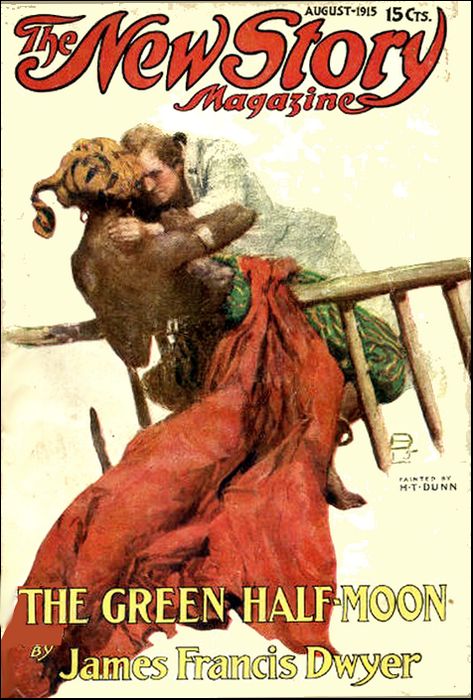
The New Story Magazine, July 1915, with "On the Wing"
IF Mr. Bunn had not been a born artist it is improbable that either he or his partner, ex-Lord Fortworth, would ever have been invited to spend a week or so at Longmoor Court, in Dorset, the stately country home of the wealthy Mrs. Lee-Hulsey.
It was at Epsom, on the day that Brilliancy nearly won the Oaks, that Mr. Bunn made the lady's acquaintance. They were standing among the crowd round the unsaddling enclosure when Smiler saw just in front of him the hand of a well-dressed man engaged in opening a lady's handbag. For a second he watched the groping fingers—the thief himself was looking very ostentatiously elsewhere—and he saw that the man was working clumsily. Years before, Mr. Bunn had done a good deal in the handbag line on his own account—but he had not worked so bunglingly as this gentleman.
"I could pick that bag better with my foot!" he said contemptuously.
Then the thief appeared to lose patience suddenly, and grabbed the bag, lock, stock, and barrel, "as a going concern," and Mr. Bunn, in sheer disgust, grabbed the thief in turn. He had no scruples in the matter—he did not care whether the lady lost her bag or whether she did not. It was purely a question of impulsive impatience—the irritation of a genuine artist with an imitation one.
But it cost the "pick-bag" six months' hard labour, and was the beginning of an acquaintance between the partners and the owner of the bag, a Mrs. Lee-Hulsey, which a month or two later resulted in Messrs. Bunn and Fortworth motoring down to Longmoor Court to join the house-party which foregathered there at the end of the London season.
THEY found the big house crowded with wealthy-looking people, and, having once convinced themselves that there was no one there likely to recognise them, they settled down to enjoy themselves—if possible, at a profit. They seemed to be rather favourites of their hostess, and their host—a gentleman whose aim in life appeared to be intoxication—gave them the impression that he looked upon them as likely to prove ideal boon companions.
On the whole they were satisfied with their quarters, and when at about two o'clock on the night of their arrival they settled down for a final whisky and soda in the deserted smoking-room, they did not hesitate to tell each other so.
"There are so many rich people in the house," said Fortworth, "that I wonder the village isn't populated entirely with crooks!"
Mr. Bunn nodded.
"Yes, there's money here," he agreed. "And the thing is," he added, lowering his voice, "how're we going to get hold of our share of it all?"
"Oh, there's plenty of time yet. It'll be all right. I can smell money coming our way like a war-horse smells the battle from afar off. Who's this?"
A small gentleman of undistinguished appearance—Mr. Lee-Hulsey, their host, or rather their hostess's husband—was coming carefully across the smoking-room towards them, holding his glass in one hand and steering himself with the other. He seemed to be the only man besides themselves who had not yet gone to bed.
"Sunday-schoolers, I call 'em!" he said very distinctly and slowly. "Lot of Y.M.CA.-ers!" He fixed a pair of pale-blue, uncertain-looking eyes on the partners. "Only one o'clock—all gone to bed. Lot of con-convess—I say they're all like a lot of convessel—" He took breath, pulled himself together, and started a forlorn hope at it. "Every ma' Jack of 'em—lot of d—— convesselescents!"
He smiled fatuously and triumphantly and sat down.
"Wha' d'you think of thiss-wisky?" he asked, letting the pronunciation take care of itself—a thing which obviously it was incapable of doing.
"Excellent. Best whisky I've tasted away from home for years," said Fortworth.
The undistinguished man looked doubtfully at the partners, evidently wondering whether he had been insulted. He decided that nothing of the kind had been intended, and nodded gravely.
"Besswisky I evtasted," he said with dignity. "Have s'more—less all have s'more—less have lotmore—thousanglasses—an' then all go-bed!" he proposed enthusiastically.
"Well, we'll finish what we've got first," said Mr. Bunn, "and then, if we mean to tackle your suggestion, perhaps we ought to go down to the cellar and let the servants clear off to bed."
Mr. Lee-Hulsey looked disappointed.
"Muss'n' godown cellar," he said sorrowfully. "Made promise—wordofonour—to my wife not to godown cellar alone any more. Used to godown cellar lottimes—bad habit. Verbad. Faith'fly promise my wife. Thasspity, y'see I don'—believe—Goo' night!"
And Mr. Lee-Hulsey quite suddenly dozed off—or would have dozed off had his wife not entered the room just then, apparently hunting for something she had mislaid.
"Oh, is my poor boy there, Mr. Flood?" she asked, coming in. "I see he is." She smiled at them both, perfectly calm and collected. "A large house-party always upsets him. He's a dear, really—when he remembers."
She talked just as though her "poor boy" was a prized and petted toy terrier of which she was extremely fond. Her smile grew dazzlingly sweet. "You will like him immensely when you meet—every one does. I wonder if you would be so very kind as to carry him upstairs. I never allow a servant to carry him up—I think it is so nice to know that his friends are so loyal to him," she gushed.
"Certainly," said Fortworth, rising. "Any little thing like that—at any time," murmured Mr. Bunn. The lady smiled again.
"You will keep his poor dear head steady, will you not? It aches so passionately in the morning unless it is kept steady. I will show you his room."
She turned to the door, and the solemn procession followed her. One or two of the highly-paid footmen who were ornamenting the large hall through which they passed seemed to observe nothing out of the common. Possibly they did not notice anything—out of the common.
Half-way up the stairs Mr. Lee-Hulsey found his tongue again.
"Lot o' con-convesselescents," he muttered contemptuously. "No go in 'em—deadnalive lot. Gobed early—slug-a-beds—thass it—lot o' slug-beds. 'Shamed of 'em. Goo' night."
His valet received him at the door of his room without surprise.
"Thank you, gentlemen," he said gratefully.
Then, politely waving aside the gushful thanks of their hostess, they went down to the smoking-room to think it over. It was extraordinary, they agreed, and could only be possible in a house where the lady was either unusually cynical or miraculously silly. With their previous knowledge of Mrs. Lee-Hulsey they had no difficulty in arriving at the conclusion that their hostess was what Fortworth termed "topweight in the Tomfool Handicap."
"I knew she was a gusher," he said over their third final whisky. "But I allowed for a certain amount of sense in her. I was extravagant, I suppose."
Smiler nodded.
"There are a few women like it. I suppose she's fond of the little cuss, and it's her way of making the best of a bad job."
Fortworth glanced round the luxurious smoking-room.
"What a heap of money there is around us," he said with a sigh. "I wonder whose it is—his or hers?"
Mr. Bunn rose.
"That," he said grimly, "is what we're here to discover."
"Well, well, I suppose it is," agreed his partner gladly, and the pair proceeded leisurely to bed.
THE following day afforded them plenty of opportunity to "sum up" their fellow-guests, and by the time they found themselves sitting comfortably in easy-chairs at midnight watching a game of Russian pool—which they had just left, Smiler (who was good for a fifty break at any hour of the day) carting away a tenner of other people's money—they found, on comparing notes, that they had judged sixty per cent, of the guests to be very rich but capable of taking care of their money, about thirty-five per cent, as being fairly easy to deal with but hardly worth while, and five per cent, to be "dead fair game."
Among the five per cent, were Mr. and, possibly, Mrs. Lee-Hulsey. They had acquired the information that Mr, Lee-Hulsey was rather poorer than a church mouse, and that his wife was certainly richer than, they considered, any woman had a right to be.
"She treats money like mud—as though it wasn't worthy of the name," said Smiler. "I went for a stroll through the park this afternoon with that stringy old dame in pale pink who sat next to me at dinner, and she reeled off the family history like a skein of wool. She likes Mrs. Lee-Hulsey, only she's so jealous of her that she can't help ripping her to pieces with her tongue."
Fortworth nodded. He understood. He had been married himself.
"Our hostess has an income of seventy to eighty thousand a year, she told me," continued Mr. Bunn, "and she can't add more than two and two together. Sounds silly, don't it—but there are women like it. They don't need to be able to add up, I suppose—just give some Honest John or other two quid a week to add up for 'em. She gets the money from coal mines and things. It seems that she's got a manager who is in love with her and wouldn't put his foot on a single quid of hers that rolled off the table—if you can imagine such a man. But she's only in love with two people—one being herself and the other her husband. Sounds ridiculous, don't it? But it's true. He was an artist, and he came here to paint something or other, and she took a shine to him and snapped the poor little devil up before he could cry 'Help!' He was a handsome little cuss in those days—in a girly kind of way—and she went for him on the top speed, and got him. Funny, ain't it? He soon found out that his painting was squeegeed—these geniuses can't stand anything but starvation. Feed 'em and they misfire—you've got to half starve 'em, dress 'em in rags, pinch 'em on 'baccy, and bury 'em with debts, before it occurs to 'em to work. Then they wake up and paint a masterpiece—according to the pink chicken who dined at my elbow. So Mr. Lee-Hulsey the second burnt his paints and took to whisky. Now and again he has a sober spell, and on the whole they get on wonderfully. She's come to look on his thirst as a kind of illness. She gives him practically everything he wants. He only has to say the word and out comes her miracle machine and she runs him off a few noughts on a 'bearer ' form and sends him away to play. Sounds like Paradise, don't it? And it's true. I've said my piece now—that's all I know. Have you heard anything?"
And Mr. Bunn resumed his cigar.
Fortworth nodded slowly. His pale eyes were half shut, but a little spark of light gleamed through the narrowed lids that augured ill for the "miracle machine," as Smiler had playfully called their hostess's cheque-book.
"I've heard pretty much the same thing," he said softly, "and it looks to me that our only difficulty is to choose which way we'll take our money—by the handful or hodful. Got any ideas?"
Smiler shook his head.
"Not yet. I can't quite get the yellow dazzle out of my nut. These 'idle rich' are different from the 'working rich,' like you were. They all seem so wide open for an enterprising man. There are times when I want to blink my eyes, I seem to see so many gazaloons lying round in heaps waiting for a friendly hand."
His partner agreed.
"That's the way I feel—and it's a beautiful, beautiful feeling. There are so many choices you don't know which to choose. But it's all right—the idea will blow along after a day or so."
They smiled blandly like a couple of well-fed and kind-hearted old wolves, who were so perfectly content with what they had that they would not trouble to cross the road for more.
BUT, curiously enough, they smiled too soon. Absurd though it seemed to them, the days passed tranquilly by and the "ide " came not at all.
They made friends easily and listened to the amazingly loose and careless revelations as to their financial affairs which many members of the house-party made quite as a matter of course and in conversation. A man would tell a roomful of people, in the most casual way in the world, something or other about his funds, which people of the keener class among which Fortworth and Mr. Bunn had chiefly mixed hitherto would regard as being one of the things that must certainly be kept to oneself.
"They are so rich, some of them, that they don't seem to care a cuss whether anybody's got an eye on their pile and a hand reaching for it, or whether they haven't," complained Mr. Bunn, who could not readily accustom himself to the ways of this particular type of the "idle rich." "And yet somehow they never seem to leave a loose end sticking out anywhere. It's like a man banging the door of his safe to and going off without troubling to see if it's really closed—and somehow it always is closed!"
"It's because they've all got lawyers or estate agents or trustees or some middle party handling their money for 'em," said Fortworth glumly. "To get at it we've got to nip in while it's passing between these middle sports and the owners in the lump. That's where the kink comes in. We've got to grab it on the wing or not at all—and it flies mighty nippy when it starts."
THE two were playing a very leisurely round at the nine-hole golf course laid out in the park, and were resting on an iron seat near the fifth tee, while a couple of servants hunted for the balls they had sliced into some very rough "rough" that an expensive expert had suggested should he put there.
"The thing's worrying me," said Fortworth, with some gloom. "Here are the days slipping by and we're no nearer to any real money than when we arrived. Of course, we can afford a holiday, but with all this cold coin lying about asking to be picked up, it's annoying."
"It's more than that—it's damned offensive," remarked Mr. Bunn, "and it's got to stop. I had a glimmer of a notion last night "—he hesitated a moment, and then, lowering his voice, continued—"Have you paid any particular attention to Colonel Kincardell and his wife?" he asked, referring to two of the guests.
Fortworth nodded.
"I've had a notion that they're a bit different from most of the others," he said. "Why?"
"Well, so've I. I wouldn't swear they're not a pair of crooks," said Smiler. "I've noticed that they seem to be remarkably thick with Reggie-boy." "Reggie-boy" was Mrs. Lee-Hulsey's pet name for her thirsty husband—the ex-genius. "And they aren't the sort to waste much of their time or company on a stiff like that unless there's something to be chipped off it for themselves."
"That's true," said Fortworth. "They're about the most expensive-looking of the whole push here, but, come to think of it, I've got an idea that their cash-box would give off a hollow sound if you tapped it. They're too well-dressed—and don't talk in quite the same loose way about money as the rest of 'em. We'll watch 'em, Flood."
"Sure," said Smiler.
Once they had accepted a definite plan they got results quickly. Their own keen wits and eyes were reinforced by those of their "valets"—Messrs. Sing Song and Ferdinand Bloom.
To any really close observer a brief study of Colonel Kincardell and his wife would have brought the conviction that in deciding to "follow up" this couple the Bunn-Fortworth Company had acted with their usual unerring instinct of a possibility of "something doing."
The Colonel was a tall, very thin, dark individual, with a dagger-pointed moustache, yellowish complexion, and a pair of dark, smouldering eyes that possessed a curious quality of practically always seeming sheathed. Once Mr. Bunn had seen him momentarily startled from his habitual coolness and self-possession, and had received a shock. A tennis-racket wielded by a well-meaning but unskilful beginner had slipped from the player's hand and whizzed across the court, smashing a glass which Colonel Kincardell, who was sitting close by with Smiler and some others, held in his hand. Mr. Bunn had caught the Colonel's startled eyes for the fraction of a second, and they were no longer dull and sleepy. The "sheath" had slipped away and they were glittering—glittering malignantly as one imagines the eyes of a deadly reptile to glitter. It gave Smiler what he afterwards resentfully described as a "turn." An instant later the Colonel's eyes were sombre as usual—but somehow Mr. Bunn had acquired the impression that Kincardell was a dangerous man.
AS regards the wife, the partners were in comfortable agreement that, beautiful and charming though she was, there was a strong strain of wild-cat in her, somewhere or other, carefully tucked out of sight, but ready for instant use when required. She, too, was tall and slim. She would curl up on a big lounge graceful as a pantheress and purr sweetly to any one she liked—but under the purr, no doubt, one could have found a snarl if one had gone the right way to tempt it out.
The couple seemed fairly well liked, but they were not by any means the most popular of the house-party, and at first glance seemed to belong actually to the class and kind of people from which most of the guests were chosen.
But, now that they were watching the couple, Messrs. Fortworth and Bunn noticed that Mrs. Lee-Hulsey was a shade more formal with the Kincardells than with her other guests. This again was not particularly noticeable unless one looked for it, but nevertheless it was there.
It occurred to the partners that the Kincardells were detectives—for there was some valuable jewellery owned by the house-party. But another point they observed rather quashed this depressing idea—namely, that Mrs. Lee-Hulsey unmistakably encouraged her husband's friendship with the Kincardells. This, indeed, was occasionally so obvious that other guests observed it too, although they appeared to attach no importance to it.
But the partners were perplexed.
"Here's a woman—no fairy herself, mind you—who doesn't seem quite so cordial and 'old-friendy' to a man and his good-looking wife as she is to the rest of her pals, and yet she goes out of her way to throw her husband at these very two people. They can't be 'tecs or she wouldn't be so anxious for her husband to be so friendly with them," said Fortworth querulously one evening as he sat smoking in Mr. Bunn's room while Smiler finished dressing for dinner.
"Perhaps they're blackmailers," said Mr. Bunn, "or drink-cure fakirs "
Fortworth looked up suddenly.
"Say, that's a good shot—drink-cure fakirs! That'd explain a lot of the things we've noticed."
"Well—" began Smiler, but broke off as Sing Song entered, in order to demand where the Chinaman had been and precisely what he meant by putting his master to the trouble of getting out his own clothes. It was the first time he had seen Sing Song since lunch.
Sing Song moved his hands in an apologetic manner.
"Sing Song solly, master. Undel bed long time—hidee—waitee." They stared at him.
"What d'ye mean, Canary?" asked Mr. Bunn severely.
Sing Song explained—the ghost of a smile flickering about his lips.
It appeared that, in accordance with the instructions given him jointly with Bloom to keep an eye on the Kincardells, he had proposed to have a thorough search through the effects of the couple that afternoon, having carefully watched them leave the house. In the course of his investigations he had encountered some difficult locks, and had spent so much time in "solving" them that he had been almost surprised by the Colonel and his wife when they came in to dress for dinner. The opening of the door had coincided with one of the swiftest dives—under the bed—which Sing Song had ever made in his life. And there he had remained for an hour, motionless as a vegetable marrow. He had caught most of the conversation which had passed between the Kincardells, but it seemed innocent enough until the Colonel, half-dressed, had passed through the communicating door into his wife's chamber while her maid had left the room on some errand, and, in an altered tone, had said keenly, "It's all right; I've fixed him."
Then he had returned to the room wherein Sing Song crouched, finished dressing, and shortly after went down to dinner. The moment the Kincardells and their servant were gone, Sing Song had crawled out and grabbed certain letters he had marked down before he was disturbed, and had hurried to Smiler with them.
The partners had listened in silence, and now Mr. Bunn took the letters. There were quite a number of them, and the faces of the two fell. Obviously they must be read while the Kincardells were at dinner, and returned before the meal was finished.
It meant that one of them had to announce a headache or neuralgia, or something to that effect, and instead of going down to dine, put in the time in study.
They looked at each other seriously—for Mrs. Lee-Hulsey kept a chef who knew his business.
"Well?" said Smiler.
"What are you going to do?" said Fortworth.
"Toss for it, I suppose," said Smiler. "Winner goes down to dinner; loser stays and reads these letters."
"All right," said Fortworth grimly.
They tossed. Fortworth won.
"You've got the luck of Old Harry," growled Mr. Bunn. "Tell 'em I'm paralysed or something. You'd better get off down now—you're late as it is. Sing Song, go down to the chef and explain that the Right Honourable Mr. Wilton Flood has had a little stomach trouble, and is hoping that the chef will be able to send up a particularly rekarky (sic, presumably a typographical error for "tasty") little snack—suitable for a man who's lost his real dinner." And lighting a cigarette to stave off the immediate pangs of hunger, he nodded sulkily to his partner and turned his attention to the temporarily purloined letters. In two minutes he had forgotten his cigarette and was absorbed, reading intently and swiftly, with occasional interjections of surprise and even admiration. So intent was he on the letters, indeed, that Sing Song, returning with an enormous tray twenty minutes later, had to remind him a second time that his "snack" awaited his attention.
"Let it wait," said he, and for once in his life Sing Song looked dumbfounded.
Smiler took a notebook and scrawled a number of extracts from some of the letters. Then, with a sigh, he returned the bundle to Sing Song.
"Put 'em back, Chinky boy," he said cheerfully, and fell on his "snack" tooth and nail.
"Mental healers—I don't think!" he chuckled-to himself. "Now we can slip in the clutch and open the throttle, and let her rip!"
AND, three hours later, when, miraculously recovered from his "indisposition," he and Fortworth sat in their favourite corner of the huge smoking-room, he explained why they could now go ahead.
From certain of the letters it appeared that the Kincardells, so far from being members of the leisured classes, were really what they themselves described as "mental healers." Among their various specialities was the curing of the alcohol habit by "hypnotic suggestion," and it was to effect just such a cure upon Mr. Lee-Hulsey that they were in the house.
They had, of course, been engaged by Mrs. Lee-Hulsey, and were received as guests in order that they might more readily gain the confidence of the "patient." Their fee, incidentally, was to be £100 and all expenses—half paid in advance.
"What do you think of it?" asked Smiler, having explained so much.
"Well, I think there isn't much in it for us," said his partner. "They're a couple of quacks—and cheap quacks, too. Why, they could get a thousand as easy as a hundred for undertaking a chap like Lee-Hulsey, once they got his wife convinced enough to have them here."
Smiler nodded.
"Yes, that's just the fishy part of it. They're too cheap. That's what gives the game away. As a matter of fact, they don't care a cuss for the £100 fee. What they want to do is to get influence over Lee-Hulsey; they want to be able to make or persuade him to do anything they like. See? And the clever part of it is that Lee-Hulsey's own wife is doing her best to help them. See?" Smiler looked round cautiously. For the moment the room was empty; it was a gorgeous August evening, and most of the guests were on the terrace or in the drawing-room or card-room.
"Listen to this," continued Mr. Bunn, and rapidly read a few more of his extracts. When he had finished, Fortworth leaned forward, his eyes burning.
"Say, that's a smooth pair of crooks, ain't it?" he said, a trace of excitement in his voice. "But I can see where we get our hooks on the game. Lee-Hulsey's a pauper—it's his wife that's got the bones. There's only one way they can get anything worth getting."
Smiler nodded.
"Then it's our money," said Fortworth with a snap. "We'll grab it on the wing."
"With a bit of luck," agreed Smiler, and dropped the subject swiftly as Lee-Hulsey steered himself into the room.
"Dew's fallin' in mos' r'mark'ble fashion outside," he said, and added, apparently with a dim idea that he was quoting something from somewhere :
"'Th' barley sheaves are wet with fallin' dew
As we go down the vale, love,
And dash' dangerous, too.'
"Where's the whisky?" He helped himself and sat heavily. "Everybody's out o' doors. Craze-outdoor life—r'mark'ble thing. Dangerous—catch cold. You and I only sensible men in th' house —r'mark'ble thing. Out there—all in dark. They don' care 'bout dew fallin'—talkin'. Dry work —r'mark'ble thing. Where's Curl Kiddlecarl? Goin' playin' game poker—bluff'm. You two and Curl and Mrs. Kiddlecarl and me. Nice game poker."
He touched a bell and a servant slid in soundlessly.
"Fin' Curl Kiddlecarl and Mrs. Kiddlecarl, Briggs," he ordered. "Goin' play poker—show'm thing'r two. Can you play poker, Briggs? Ver' good game—ought to learn—play with chef and the girls in servan's hall. Make a lot o' money, Briggs. Good advice—lis'n to words of older man—only tellin' you f'r your own good, Briggs."
"Thank you, sir," said Briggs gratefully, and departed to find the Kincardells.
"Less play in my studio—quiet as mouse there—ver' comfortable—big sideboard and plenty besswisky in world." He rose again. "I'll go an' have studio lighted up."
And without a word from the partners he ambled amiably off to the studio, talking to himself of the sums he intended to win very shortly.
Hardly had he left the room before Colonel Kincardell and his wife entered with Mrs. Lee-Hulsey, talking earnestly.
Mrs. Lee-Hulsey came over to the partners.
"Briggs tells me Reggie wants you to play poker with him," she said; and, without waiting for a reply, went on: "I know you won't mind humouring him, will you? "
"Certainly not," said Mr. Bunn, with the smile of a money-lender in need of a cheque.
"I mean," explained Mrs. Lee-Hulsey, "you won't mind not taking him seriously. He will bet wildly, I expect—absurdly, you know. I hope you will look upon the game as one without stakes—Reggie is quite as likely to bet a hundred thousand pounds on one hand as ten pounds. I expect it sounds ridiculous to you—but he will make rather a scene if no one will play with him. In the morning he will not remember the game at all—so there will be no harm done."
The partners rose as one man.
"Of course—we quite understand," said Fortworth. "We also shall forget the game from the moment it ends!"
"Thank you so much—you are so very kind," said their hostess. "I am so glad you understand so well."
And she returned to her guests on the terrace.
THE game that followed was one of the most remarkable in which either of the partners had ever taken a hand.
From the first deal it was obvious that Mr. Lee-Hulsey was in an optimistic mood. He backed the two miserable jacks with which he opened the preliminary jackpot to the tune of a hundred and eighty pounds. Colonel Kincardell won the jackpot with four queens, and all the players gravely paid him their losses. Mr. Lee-Hulsey took a whisky and soda to brace himself up, and bought a modest thousand pounds' worth of chips from Kincardell—who was acting as banker.
So the game went on for an hour—no one apparently playing seriously but Mr. Lee-Hulsey, who was losing like a millionaire. He was about three thousand pounds in Kincardell's debt—on paper—and then, appearing to tire of the game, he suggested one last hand.
All agreed, and Colonel Kincardell shuffled carelessly for his wife, who dealt swiftly, deftly, like a lady who knew how to handle cards. But neither the husband nor the lady was quick enough for the two vultures, who lay back in their chairs watching lazily through their cigar-smoke.
Mr. Bunn was no more surprised to pick up a pair of threes than ex-Lord Fortworth was to receive a pair of jacks. They drew cards, but neither improved their hand, and so they threw in and went out of the game.
Lee-Hulsey, however, seemed to have picked up an unusually good hand, and the Kincardells also appeared ready and willing to bet on what had been dealt to them.
They were playing without a limit, and it was Lee-Hulsey's first bet.
"Thousan'-poun'!" he said eagerly, and put ten hundred pounds into the pool.
"I raise that a thousand," said the Colonel, and dropped in his chips.
Mrs. Kincardell "saw" her husband, and put in her two thousand pounds' worth of chips.
Lee-Hulsey wagged his head.
"Thousan' better'n me, eh?" he said. "Well, I go two thousan' better 'n that."
He made—with IOU's—his total stake four thousand pounds.
"Let's look—that's four thousand to see, ain't it?" said Kincardell slowly. "I raise it a thousand!"
It occurred to Mr. Bunn that the man's voice had altered. It had suddenly lost the half-jesting tone Kincardell had used all the evening, and was hard and almost brutal. Smiler raised his eyes from the pool and looked at the Colonel. It was as he thought—the man's eyes were glittering like points of steel, and his mouth was no more than a thin thread of scarlet. Smiler felt Fortworth's foot touch his under the table—and pressed Fortworth's. As clearly as though they had spoken the partners knew that the crux of the situation was at hand. The Kincardells were nearing the climax of their scheme. The two watched without movement or speech.
Mrs. Kincardell, her beautiful feline face rather pale, "saw" her husband's bet and remained in the game. It was Mr. Lee-Hulsey's turn again.
He stared foolishly at the IOU's in the pool.
"Tha'—that's five thousan'. All right—I raise you five thousan' pound," he said loudly—and Kincardell was at him like a wolf.
"I see that bet," he said with a snap.
Mrs. Kincardell threw in, and the two men scrawled their IOU's. Each now had a stake of ten thousand pounds in the pool, and the holder of the higher hand of the two would win the whole of the pool.
"I see you," said Kincardell.
Lee-Hulsey slowly spread his cards on the table, face upwards. They were a two, three, four, five, and six of clubs—a straight flush, a splendid hand—almost the best possible hand in the pack.
"A straight flush," said Lee-Hulsey, and reached for the pool.
"Wait!" said Kincardell, and snapped his cards down. "A royal flush!"
Lee-Hulsey stared at the cards as he would have stared at an asp.
There they were—ten, jack, queen, king, and ace of hearts—the best hand in poker.
"Your money," said Lee-Hulsey, and reached for the whisky.
Mr. Bunn rose.
"What a game!" he said. "You're a plucked 'un, Lee-Hulsey." He made a note of the amount of his IOU for chips. "I'll give you a cheque in the morning," he said, and Fortworth did the same.
The Colonel nodded and smiled meaningly, as though to remind the partners that the game was not in earnest, and that nothing was really owed by any one to any one. (Lee-Hulsey, it must be remembered, would have forgotten the game by next morning.)
"Well, I'll retire to the drawing-room, and leave you people to settle," said Smiler cheerfully, and, slipping his arm through Fortworth's, withdrew with his partner.
But he "withdrew" no farther than the door.
As the Kincardells leaned across to Lee-Hulsey, Mr. Bunn slipped behind a heavy curtain which hung along the wall, screening certain lay figures. Fortworth, without hesitation, passed across the threshold and closed the door of the studio. It was a rule of the partners never to hesitate for a second should either of them suddenly do anything unexpected. The result was that any one in the world would have taken it for granted that both Mr. Bunn and Lord Fortworth had left the room.
An instant later Mr. Bunn, standing breathless and without movement behind the curtain, heard a quick swish of skirts and a click.
Mrs. Kincardell had locked the door. Then Smiler heard the voice of the Colonel, sibilant and amazingly authoritative.
"That is fourteen thousand precisely you owe me, Lee-Hulsey," he said.
Lee-Hulsey was "game" to the last.
"Toss you double or quits!" he said hilariously.
"No—you shall have your revenge some other night."
"I'm sure that Mr. Lee-Hulsey will win it back from you, Dick," came the smooth, rich voice of Mrs. Kincardell.
"Tha's right, Mrs. Kiddlecarl—per'fly right. Win it back 'gain 'nother day—rain, rain, go 'way, come 'gain 'nother day," corroborated Lee-Hulsey.
"Nobody will be pleased better than I," said Kincardell. "Scribble me a cheque, then, and we'll join the others. I shall not present the cheque, of course, until I've given you your revenge. Here's a fountain pen."
"Where's cheque-book? I can't sign cheque without cheque-book—per'fly imposs'ble," said Lee-Hulsey querulously.
"Oh, here you are—I'll lend you a cheque!"
The listener behind the curtain heard the rustle of leaves being turned; evidently the Kincardells were prepared.
Then suddenly Lee-Hulsey spoke again.
"Why, wass matter with your eyes, Curl? Wha'? Wha' say?"
There was a sudden dullness, other than that caused by alcohol, in the man's voice. But in the voice of Kincardell as he answered was authority—absolute, all-compelling.
"Write!" said the Colonel.
In the silence that followed Mr. Bunn heard his heart beating. There was something uncanny about the business. He knew that Lee-Hulsey was hypnotised—that he was obeying the master-will of the villain who dominated him.
"Stop!"
Lee-Hulsey stopped writing precisely like an automaton, staring with glassy eyes at the chequebook before him.
"Look at this signature: 'Augusta Lee-Hulsey,'" ordered Kincardell. "Copy it—copy it well." He thrust a letter bearing the signature "Augusta Lee-Hulsey" under the eyes of his victim. "Write!"
Very slowly Lee-Hulsey wrote at the foot of the cheque, and what he wrote was the signature "Augusta Lee-Hulsey," and the signature was an exact replica of his wife's signature on the letter before him. Whether it was by some sinister and unknown development of his devilish art that the hypnotist had obtained such power over Lee-Hulsey, or whether it was because, in the hypnotic spell, Lee-Hulsey's dormant gift for painting was roused, and enabled him to copy so faithfully his wife's signature, Mr. Bunn never knew nor cared. He had heard enough now to know what the Kincardells were aiming at.
"Good!" said the Colonel, and put the forged cheque and the fountain pen in his pocket. Then, "You will forget this cheque—forget—forget— forget," he said imperatively.
"I forget," came the queer, lifeless voice of the hypnotised man.
"Wake!" said Kincardell, and in a few moments Mr. Bunn heard the true voice of Lee-Hulsey again, complaining of thirst.
A syphon hissed, Mrs. Kincardell began to talk of trivial things, and her husband, in a breezy, friendly style, slapped Lee-Hulsey on the back, and suggested joining the people in the drawing-room.
They passed out, and Mr. Bunn was left to his reflections, which were short but sweet.
"I don't like that damned man at all—he's wicked and dangerous," said Mr. Bunn very solemnly, for he was feeling a little scared at the black mystery of the hypnotist's art. "I don't like that damned snake at all," he repeated with unusual seriousness. "The graveyard is where he belongs—under the nettles and the poisonous plants. That's his form. And I don't like that woman neither, for she's his mate; she's the mate that was meant for that reptile. Why, me and Fortworth and my brother Tony and Vahana and Kate the Gun and Mirza Khan, and, in fact, the whole blooming push, are babies—harmless little babies compared with those two vipers out of the dark places."
He pondered, still standing behind the curtain.
"Dangerous," he muttered—"ugly dangerous."
Then suddenly the uneasiness left him as quickly as it had come.
"Yes," he repeated, "they're dangerous; and me and Fortworth and Sing Song have got to knock the sawdust out of 'em." And he departed in search of his partner and the refreshment he felt he had really earned. Fortworth was waiting for him in the smoking-room, his pale eyes flaring in a way that Smiler knew meant good news.
"What happened?" said the ex-Baron in a half-whisper.
"They made him forge his wife's name to a cheque for fourteen thousand pounds," said Smiler. "They hypnotised him. But what I can't see is how they're going to negotiate the cheque. It's too big to draw over the counter, and they can't risk putting it through an account."
Fortworth pondered a moment. Then, "They're clever birds, those two," he said. "I've been talking to Mrs. Lee-Hulsey, and she's been complaining about the price of land. She sold a couple of biggish farms in Wiltshire some time ago, about eighteen hundred acres. She got ten pounds an acre instead of twenty, and she's been grizzling about the price and the time the lawyers took to settle. She says landowning is not worth the trouble. 'The farms were sold four months ago,' she said, 'and the money was only paid into my bank two days ago.' And the Kincardells know that, of course. You know the loose way these rich guys talk."
He leaned forward, staring at Smiler, who nodded, smiling.
"Clever devils, Mr. and Mrs. Hypnotiser, ain't they, Flood? Probably they've been watching and planning for this for a year or more. No doubt they've got an account at Mrs. Lee-Hulsey's bank—had one there for some time. What they'll do is to pay in the forged cheque and draw against it on their own cheque all the ready money the bank can hand over the counter. The bank won't mind hitting it up pretty heavy, as they know Mrs. Lee-Hulsey is a spender all right, and they keep her account, too. I know that bank. They could pay anything up to ten thousand over the counter at a moment's notice if they were satisfied. See? And you can bet your breakfast that the Kincardell forgery is handed in within an hour of the bank opening to-morrow—"
He paused again, thinking.
Then, "On the wing," he said. "We've got to grab it on the wing. How's this for an idea? Listen to me—"
THE partners were not surprised to hear the Kincardells announce next morning that they had been called to London by that morning's mail, and were leaving by motor immediately after breakfast. (It was not for nothing that Sing Song was filling the petrol tank of the big Bunn-Fortworth motor down in the garage at that identical moment.)
And when, about an hour later, the slim, grey two-seater of the Kincardells slid to a stealthy standstill outside the head offices of the South and West Counties Bank in Dorchester—some five miles from Longmoor Court—the big car of the partners was waiting quietly round a convenient corner like a big black shark basking in the sun. Sing Song was at the wheel—he had a Chinese nerve that no speed could shake—and the partners were sitting behind with cigars. The fat, unimportant-looking person loafing at the corner watching the entrance to the bank was Mr. Ferdinand Bloom. Within a quarter of an hour the Colonel came quickly out of the bank with a small dispatch-case in his hand, and took his seat in the grey car. At the same moment Mr. Bunn used his handkerchief and Sing Song switched his ignition into business. The big car crept forward like a cat preparing to spring and Mr. Bloom stepped into the seat next to Sing Song as the car rounded the corner.
Rather to the surprise of the partners, their quarry did not take the London road, but headed west, and presently swung into the road for Bristol. Smiler smiled.
"Bristol or London it's all the same to us," he said, and Fortworth nodded agreement.
Twenty minutes later, Mr. Bunn leaned forward and turned the indicator knob to "Faster." Sing Song touched his hair as a well-conducted driver should, and the car shot forward. In three minutes they were past the two-seater and were slowing up. They had chosen a narrow stretch of road and the Kincardell horn began to hoot impatiently as Sing Song, slowing carefully, brought the big car up obliquely across the road, almost blocking it. Mr. Bloom jumped out at once and went to the bonnet, as though to examine the engine, and quite unsuspectingly the grey car slid gently up and stopped perforce, as it would have stopped before any similar "breakdown" blocking the way.
The instant it stopped its occupants received visitors—four of them, the whole Bunn-Fortworth Combination, in fact.
Kincardell's face darkened as he recognised his two fellow-guests.
"Hand over the notes, Kincardell," commanded Fortworth curtly. "You must be crazy to think you could pull off a scheme like this. Why, man, Mrs. Lee-Hulsey has had you watched from the moment you set foot in the house. What do you think she employed us for?"
Mrs. Kincardell turned to her husband.
"There, you stupid fool!" she said, with contempt so bitter as to seem almost malevolent. "I told you they were detectives."
She glared at them, all trembling with snakish fury.
"So you thought you knew better than the missus, Colonel? " said Smiler banteringly. " Well, well!"
"Come on with the notes," urged Fortworth roughly. " And thank your lucky stars that Mrs. Lee-Hulsey's more afraid of the scandal than she is of you. If it hadn't have been for that I'd have had you both in jail by. now."
Without a word the Colonel handed out the dispatch-case. It was stuffed with small-figure notes. Fortworth counted them hurriedly.
"Nine thousand," he said. "Is that the lot?"
"You can have my odd coppers, if you like," snarled Kincardell sourly. But the black scowl on his face was a sufficient answer.
"Good," said Fortworth. "We've finished with you—you can pull your freight!"
With a parting curse the hypnotic experts edged carefully past the big car and disappeared in clouds of dust. They had lost their loot but kept their freedom. Evidently they were willing to let it stand at that.
The Combination shook hands round and drove comfortably home to lunch. They were perfectly safe, and they knew it. When, a day or two later, it all came out, they were most helpful to Mrs. Lee-Hulsey. They gave her more advice for nothing than that wealthy lady had ever before received at the price. As they had expected, she shirked the scandal that the capture and trial of the Kincardells would involve, and wrote off the nine thousand pounds as a dead loss. The numbers of the notes were widely circulated, but, as Mr. Bunn remarked, "What was the good of that?" They negotiated the notes for almost their full value on the Continent. Mr. Lee-Hulsey was the unfortunate individual who, as a result of the affair, "found himself in the cart" (to quote Mr. Bunn once again). In his case "the cart" was represented by a high-class inebriates' home. He served a year there and finally left the establishment with such a hatred of alcohol that the mere smell of a Christmas pudding ever after made his brains turn a hand-spring. So that Mr. Bunn spoke the truth when, on the occasion of the fourth visit of the partners to Longmoor Court, he said that it had been all for the best. And as far as he and Fortworth were concerned it certainly had been all for the best—nine thousand of them!
Roy Glashan's Library
Non sibi sed omnibus
Go to Home Page
This work is out of copyright in countries with a copyright
period of 70 years or less, after the year of the author's death.
If it is under copyright in your country of residence,
do not download or redistribute this file.
Original content added by RGL (e.g., introductions, notes,
RGL covers) is proprietary and protected by copyright.