RGL e-Book Cover©
Roy Glashan's Library
Non sibi sed omnibus
Go to Home Page
This work is out of copyright in countries with a copyright
period of 70 years or less, after the year of the author's death.
If it is under copyright in your country of residence,
do not download or redistribute this file.
Original content added by RGL (e.g., introductions, notes,
RGL covers) is proprietary and protected by copyright.
RGL e-Book Cover©
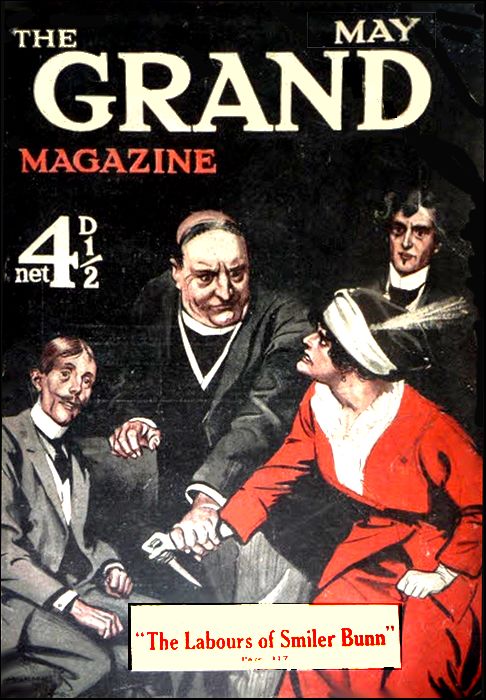
The Grand Magazine, May 1914, with "Only Buffaloes"
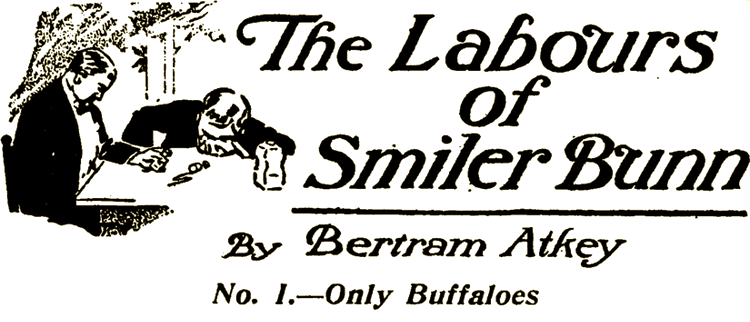
Industriously cultivating the art of Self-Help, or Help-Yourself, the Grand Bunn-Fortworth Combine collide with a genius or two from New Orleans.
"NO, Fortworth," said Mr. Smiler Bunn, "there's no such thing as luck in this world, and never will be. Hither a man's got a good digestion or he's got a bad one. Luck's got nothing to do with it. You can't say that a man like you, for instance, who is capable of totally destroying from ten to twelve courses twice a day, is lucky just because he don't have the nightmare the moment he shuts his lamps at night. Lucky ain't the right word for it. It's a question of care—care and thought and—well, hunger, I s'pose, if you like to put it that way."
Ex-Lord Fortworth, partner to that amiable "crook," Mr. Smiler Bunn, looked a little dissatisfied about something.
"No," he said, rather shortly. "And if it comes to that it wouldn't be right to call a man such as yourself, who has been in the habit of sopping up twelve to fifteen whiskies-and-sodas daily, not counting wine, lucky because he never sees purple hyenas chasing pink rattlesnakes off his dressing-table of a night. He'd be more of a human freak."
But Smiler Bunn shook his head.
"Not freak, Fortworth. You couldn't call a man like me a freak. 'Careful' is the word. I'm a very careful man, and my motto is 'Quality and moderation in all things.'"
"Yes, it will be found etched upon your liver when you die," Fortworth chuckled, his good humour quite restored at his own repartee.
"My liver is as sound as a bell, old man. I haven't heard from it for five years," said Smiler Bunn gravely.
"Perhaps it's extinct!"
Fortworth was surpassing himself this afternoon.
Mr. Bunn's bland face grew a little warm.
"That's not a fair thing to say about any man's liver, Fortworth, and it don't sound very well coming from a man who has had the experience with whisky that you have," he replied stiffly. "A good liver is a thing to be grateful for—not to be made a fool of. It's like the carburettor of a good motor. You don't feed cheap heavy oil into a high-class motor carburettor—it wouldn't stand for it. And you don't feed cheap whisky to a high-class liver—you'd kill it. What you've got to remember is this—your liver is your carburettor! If I had my way I'd have that added on to all these meaningless proverbs. If they taught the youngsters at school facts like that there would be some sense in it. Have you made up your mind about the soles to-night? We can't go on arguing all day. Time's getting on; it'll be dinner-time in less than four hours. I ask you as a personal favour to me, Fortworth, to be guided by me about the soles. Try 'em a la Niçoise to-night—and if you aren't grateful to me I shall be surprised."
Fortworth looked doubtful.
"It's the gherkins that worry me—I don't see how the gherkins fit in with the anchovy, Flood, and that's the solid truth," he replied.
Mr. Bunn, more usually known as Wilton Flood, his favourite nom de guerre, leaned forward earnestly.
"But can't you see the gherkins go with the Parmesan cheese! They blend, you understand—the anchovy blends with something else. Listen again; it's as clear as poetry to me—clearer, in fact."
Smiler proceeded to read from a book he held.
"Soles à la Niçoise," he began. "Listen now. Baked, rolled fillets of soles, stuffed with fish farce, herbs, and anchovy paste; sauced over with a rich tomato purée—and you know what sort of a purée sharp Sing Song is, Fortworth—rich tomato purée containing Parmesan cheese; garnished—see, Fortworth?—garnished with small gherkins, sprinkled with grated cheese—only sprinkled, mind—and browned in the oven. And I don't mind saying that I would as soon read that as I would 'The Pilgrim's Progress'—and that's pretty hot stuff in the writing line, so they say."
Fortworth gave in.
"Well, perhaps you're right. It does sound eatable. Let it be Niçoise. Touch the bell."
Smiler touched the bell, and Sing Song, the unparalleled Chinese cook, man-servant, and general familiar of the partners—though strictly Mr. Bunn considered him to be his own personal property—appeared.
"Sing Song, my lad, it will be Niçoise. Mr. Black agrees with me."
For a thousand reasons, each more important than the other, Lord Fortworth, when he had left his innumerable creditors to hunt for unexistent assets on the occasion of his elaborate smash a few years previously, had left his title behind also, and now looked the whole world in the face as plain Mr. Henry Black—for Henry Black owed not any man.
Sing Song grinned a painful-looking grin and departed to the regions from whence it was his pleasing habit to conjure the amazingly fine dishes which kept the partners in such super-excellent fettle.
"And now, what about making a little money?" said Mr. Bunn comfortably. "We're overdrawn again. Life à la Niçoise comes high., although I don't grudge it."
He assisted himself and his partner to a whisky-and-soda that would have stunned him if it had been ordinary f our-and-six whisky instead of the magnificent twenty-four-and-six speciality upon which the two old rascals were "economising" at the moment.
Then he took from a drawer close by a little red-leather notebook.
"It's about time we looked up the father of that intoxicated stiff that stopped here last month—what's his name? I mean the long lout that called himself Viscount Markardon."
Fortworth nodded.
"Sure—I remember. Said he'd married a girl that beat the Queen of Sheba for style, and left Cleopatra practically standing still for beauty and high spirits, but he couldn't live with her. Struck me as a candidate for the Foolish House." The ex-financier and banker-brewer tapped his forehead meaningly.
"Well, I made a note of him, anyway. He wasn't off his meter though—that was his way; he was one of the educated prodigals that never go home. I told Bloomy to look up the folk he said he was related to."
By " Bloomy " Mr. Bunn meant Mr. Ferdinand Bloom, the gentleman who officiated as butler and understudy of Sing Song at the secluded country house of the two partners near the quiet village of Purdston, on the Surrey-Hants border. He had once been an actor, but had found that the supply of Ferdinand Bloom was so ludicrously in excess of the demand for him that he had given up art and devoted his genius to domestic service, with such a conspicuous lack of success that, when buttling for Lord Fortworth in his palmy days, he had carelessly allowed himself to be detected in the act of perpetrating a gentle little forgery designed to relieve his master of a tolerable slice of the money which, had Ferdinand but known it, Fortworth did not possess.
Fortworth had not sent him to gaol, but later had contented himself with transforming Mr. Bloom into his own private slave and all-round patient ass at Purdston. Ferdinand, in short, was a sort of Sing Song the Second, minus Sing Song's natural talent for ways that were dark and tricks that were vain.
But Fortworth began to look interested.
"What did he find out? Anything?" he asked.
"Well, not much, but it might be worth going into. He picked up a lot of rumours from the innkeeper at Irmington—this chap Markardon's father is the Earl of Irmington—where he stayed a day or two. It seems that ever since the old lord came back from a trip to America, three years ago, he's lived a different kind of life. He used to be a sporty old blade, but now he's a sort of hermit. He sees no callers except a very good-looking, foreign style woman—very dark, like a Spaniard—a quadroon, I believe. They say she's his son's wife, and that she blackmails the Earl; but that's only rumour. He spends most of his time in London, they say, but doesn't mix with the lively push there. He's quarrelled badly with Markardon—at least, they are never seen together. That's all; but I've got an idea I can smell a rat somewhere, Fortworth."
Fortworth nodded thoughtfully.
"Well, the first thing to do i's to run down to Irmington and take a look round," he said.
"We may as well start Sing Song in to find this Markardon, too," added Smiler, and rang for the Chink.
Sing Song was probably the toughest crook of them all. He was absolutely faithful, like a dog, to Mr. Bunn, feared nothing in the world, accepted and, indeed, appeared grateful for a weekly salary that left a fair show of small silver out of a half-sovereign, worked like a traction engine, though more silently, and made a genial hobby of transactions each of which was practically a post-dated cheque for penal servitude.
"Now, Sing Song, my son, do you remember the man we took in at the fiat who said his name was Viscount Markardon?" asked Smiler.
"Yes, 'membel velly well, mastel."
"Well, you can get out round the town to-morrow, understand, and find him. We want him. See?"
"Yes, mastel. Hald t'ing, mastel. Much huntee fol findee that Malkaldon man."
"Hard be damned! You go and find him!" responded Mr. Bunn. "He says his wife's the Queen of Sheba and Cleopatra rolled into one, or something of the sort. He's alway-s diving in and out—mostly in—the West End bars. Why, you can't miss a man like that."
A' No, mastel."
"Well, don't interrupt again, you lemon. You can skid."
Sing Song bowed a Celestial bow and " skidded."
"That's a good reliable Chink," said Smiler thoughtfully, as the door closed. "I'm thinking of raising his money one of these days. It's one of the things I like about him—he ain't greedy. Eight shillings a week and his keep isn't any too much for a reliable Chink. Still, it don't do to pamper 'em. We'll see what this Irmington business brings in. I'm not one of the greedy-minded ones either, as you know, Fortworth, but I've got an idea there's a great big slab of real money waiting for somebody at the other end of this affair."
It was noticeable that the appearance of the partners had altered considerably. Their air of well-nourished content and tranquillity had vanished, giving place to a keener, more alert, "awakened " poise. Their eyes were no longer restful and somnolent, but were wide open and lighted up with the hot glare of the hunter.
For, indeed, they were hunters now—money-hunters, man-eaters.
It was time to get ready to step politely out of their way. for it may be staled at once that as a general rule it was easier for a camel to climb to the eyrie of a beetle than for a rich man to get out of the way of the Bunn-Fortworth Combine during the critical periods when their bank account was overdrawn and the life à la Niçoise appeared to be in jeopardy.
The golf-course at the old-world village of Irmington is something to shed tears—or oaths—over. It was once a nine-hole course, but when Farmer Barleycorn took in the greater part of the second hole as feed for his cows, and the whole of the fifth for sowing lucerne, the visitor who used to go there yearly withdrew his patronage and was no more seen. He was missed, for, being one of the wooden school, his "goings-on" had been annually a source of great interest and amusement to the villagers.
So that when a day or so after the planning of the new Bunn-Fortworth campaign two strange gentlemen with golf-bags arrived at Irmington, their coming created quite a stir at the Irmington Arms. Indeed. Martians or Hairy Ainus could have caused very little more excitement than did the two stoutish, cleanshaven, eagle-eyed golfers, who were brothers, it seemed, named Wellow.
Curiously enough they played no golf after all. They made the acquaintance of Mr. Henry Tester, valet to the Earl of Irmington, the first night they stayed at the Irmington Arms, and since, thanks to the kind offices of Mr. Tester, permission was accorded them by the agent to fish in the lake at Irmington Castle, they abandoned golf entirely and devoted themselves to sitting strenuously in a boat continually carping at the coyness of the carp with which the lake was liberally stocked.
Mr. Tester kept them company a good deal, for Lord Irmington was away, presumably valeting himself. And once they invited him to dine at the Irmington Arms.
Mr. Henry Tester, a slim, quiet, melancholy, middle-aged person, was a man with a grievance against his employer.
Quite what the grievance was the Wellow brothers never really discovered. Roughly, it appeared to have something to do with the curious fact that Henry was allowed to do little or no valeting; but this did not grieve them very much, for at the end of four days they had extracted as much information from Mr. Tester as they required. It had been necessary to well and truly intoxicate the valet, a process extending over the whole four days, for upper servants of the " Castle" class are no mere amateurs at the gentle art of saturation; but the end appeared to justify the expense, for when on the fifth morning of their stay they received a telegram signed "Sing Song," and almost instantly thereafter departed, they went as men who have no reason to complain about things in general.
As the stouter of the brothers—Mr. Smiler Bunn—remarked when their motor rolled away :
"We've got all the juice out of Tester, so what's the good of starving here any longer? If old Irmington knew the kind of sieve he was using as confidential valet he'd have four kinds of apoplexy and two of paralysis."
For Mr. Tester had unwittingly given away vague ideas as to what might prove to be very important secrets indeed.
"Next thing is to see this Markardon," said Smiler presently.
Fortworth nodded in silence, and as the car floated smoothly London-wards their faces grew grimmer and grimmer, for they were unearthing as queer a family skeleton as could be found quietly tucked away in the private corner cupboard of any "ancient great-named house" in the country. The only difference between the Irmington and the average old-nobility skeleton was that the former was a brand-new one replete with all the modern improvements, so to speak.
Sing Song received them at the door of the flat.
Got him, Sing Song, my lad?" asked Smiler cautiously.
The Chink nodded.
"Yes, mastel. He waitee in libally. Give no tlouble. He came lound allee same sheepee, velly tame."
"All right, my son, you've done very well, but don't get excited and -spoil lunch. Get to it, now."
Thus gracefully dismissing the cheerful Chinese worm that never turned, the partners entered the library, as they termed the room where they were wont to rest and reflect.
The man who claimed to be the Viscount Markardon was there, lying on a big leather lounge, interviewing one of their best cigars and the liqueur stand that Sing Song had placed on a Moorish coffee-table at his elbow.
He turned as the partners came in and surveyed them with a leisurely lack-lustre stare. Then he spoke :
"I like your green Chartreuse," he said, "but your maraschino's rotten."
Mr. Bunn fired up.
"Don't talk such dam' nonsense," he almost shouted. "I chose it myself. It's your palate that's wrong; you've pickled your palate so long that it's dead, tanned like leather."
"Well, what's a palate for?" asked the Viscount with an air of patient reason.
"To be taken care of—and valued," threw in Fortworth severely, and sat down.
"How's your wife—the Queen of Sheba?" asked Smiler bluntly.
Markardon—a fragile, sallow-looking, meaningless weed of about thirty-five—smiled wanly.
"How on earth do I know?" he asked. "She still knows how to sign her name to a cheque, and that's all I expect from her. Is it any business of yours, do you know?"
"No." said Smiler, who imagined that he had fairly well taken the measure of the man by now. "Only we happen to have heard that Lord Irmington is tired of paying out an allowance to you as well as her, and means to stop it."
This was a shot in the dark, evolved from the grievance-galled Mr. Tester, and neither of the partners anticipated the effect it
had upon the listless weed on the lounge.
His pale face flamed suddenly to an unhealthy red, and his eyes glistened. It was characteristic of the man that he did not sit up.
"And does he imagine I shall allow it?" he asked. "I happen to be his heir. You seem to know a lot about my business, whoever you are, so perhaps you will tell me that."
"You?" said Smiler, with calculated brutality. "Oh, what you allow don't matter."
He turned to Fortworth.
"Does it?" he asked, for confirmation.
"Certainly not. He's the man in the cart," said Fortworth promptly.
The Viscount foamed a little, his hands shaking.
"Oh, that's to be the line, is it?" he said. "What does my wife say about it?"
"Oh, she thinks you ought to be put in a bag with a half-hundredweight of old iron and dropped into the Thames," replied Smiler, goading him on.
He succeeded in goading.
The man sat up sharply, his face mottled with rage, catching his breath, his whole emaciated, excess-ravaged body shaking like a framework of bamboo.
Twice he tried to speak and failed, but the third time was lucky.
"Very well," he drawled with a queer calm and distinctness so at variance with his whole demeanour as to strike unpleasantly upon the partners. "Very well "—he was turning now a curious and disagreeable fish-belly white—" that being the case, I shall now proceed to blow the whole gaff."
He then uttered a string of language that, used though they were to expletive, seemed to the partners remarkable.
Then, recovering a little, he poured himself a green Chartreuse, devoured it, and repeated in a very loud and defiant manner indeed:
"I shall now proceed to blow the gaff!"
That was precisely what the partners, who were working more or less in the dark, wanted.
But he did not blow any gaffs—for even as he spoke certain Chinese sounds were heard from outside, the door opened, and a woman entered, followed a second later by an elderly rather "made-up" clean-shaven man, slightly dishevelled, apparently from an encounter with Sing Song. The Chink himself followed them in—and, for once in a decade, the partners had the felicity of seeing unbounded amazement upon the usually wooden face of the Chinaman.
He looked like what Mr. Kipling so whimsically calls " a bloomin' idol made of mud"—yellow and, in this case, partially petrified or frozen.
But the partners had no time to spend in the study of Sing Song's facial eccentricities just then; they were too interested in the new arrivals.
The man smoothed down his hair, and, turning to the partners, said, in a rather high, reedy, slightly affected voice :
"Forgive this intrusion, gentlemen. I am the Karl of Irmington, and it was most imperative that 1 should see you at once. Your servant very naturally resented our entry while you were engaged with my son."
"It's a wise child that knows its own father," remarked the Viscount Markardon with a caricature of a sneer.
The Earl scowled at Markardon, and, as he continued, his reedy voice shrilled to a queer, thin treble.
"I fancy I overheard you saying—with your accustomed vulgarity—something about ' blowing the gaff.' Permit me to remind you that it is occasionally an expensive form of
amusement—or revenge—and to ask whether you have blown it?"
Markardon's eyes dropped suddenly.
"I've said nothing/' he replied.
"You are fortunate," said the Karl of Irmington very blandly. But a look of extraordinary relief dawned upon his thin, small-featured face. "Mae has something to say to you."
The woman with him leaned forward, whispering. The partners saw that she was very handsome in a dark, yellowish-complexioned style, and they realised that this must be the quadroon woman who was Markardon's wife.
Sing Song had crept up like a cat and was plucking at Smiler's sleeve.
"Mastel, please come fol lilly minute. I tellee plentee queel thing. Yelly stlange tling," he whispered, eyeing Lord Irmington curiously, his fingers trembling with excitement.
"All right."
Smiler, who understood the Chink far too well not to know that there was something in the wind, went out, leaving Fortworth scowling dubiously at their callers.
He was back an instant later, his eyes flaring.
Lord Irmington turned to him with a very sweet smile—a trifle too sweet, in fact.
"You are very indulgent, gentlemen, to permit us to air the family linen in your Hat. I shall hope to thank you suitably later."
"That's all right—don't you worry about us, Lord Irmington," said Smiler heartily. "We understand about the family skeleton's linen all right. You go ahead and fix up what you want to with Mark here, and we'll have our chat later on."
He smiled at the nobleman as a kind-hearted but hungry old hippopotamus might smile at a bale of hay.
The Earl turned to Markardon, but the quadroon was before him.
She had crossed to the frail, rickety dipsomaniac on the couch and leaned over him, speaking swiftly in a rather deep voice, with a soft Southern accent.
"I want you to come back, George. I am tiahed now an' lonely, an' I want it to be like it was befo' when we weah in Ca'lina, an' to fo'get we qua'lled."
It did not sound very sincere, and the pleading note in her voice failed entirely to penetrate the hide of the Viscount, who laughed.
"Are you trying to be funny, Mae?" he asked. "Or is it something gone wrong in your head?"
A sudden dull colour burned on his face, and he grinned unpleasantly.
"My God, you have effrontery enough for a thousand, you two," he swore. "What? You marry me; ruin any decent feeling I have left; steal my birthright—"
"Quiet, you fool!" cried the Earl on a note so shrill and high that it jarred the ears of the listeners, and turned sharply, white-faced, on the partners.
"The man's mad " he began.
"Mad, do you say?" shouted Markardon, his face a deep, dark red. "Mad, is it? You have the impudence to say that, you swindlers that cannot even run straight with your fellow-swindler. Well, I'm not mad enough to let that yellow tigress fool me any more—or you either, you clever devil. You promised me twenty thousand a year—you've staved me off with two. What's it worth to me? I want my own—and I'll take it now."
His face was so congested with passion that it seemed black.
"Now—from now onwards," he shouted. "Look at them—Mae Taylor—the Viscountess Markardon! Only don t tell them that in New Orleans, unless you want to be laughed at—"
Smiler Bunn stretched out an arm with surprising swiftness and caught the hand of the quadroon woman, who had leaped at the Viscount.
"Easy, you!" said Smiler, and a wicked-looking knife dropped to the floor from the half-crushed hand of the woman.
"Yes, she'd knife me like a shot," said Markardon, swaying a little.
"And so would that," he laughed, a note of savage irony in his mirth—"the Earl of Irmington! The Earl of Irmington—only—only—only—"
The man stopped and swung forward, falling, crumpling. Sing Song sprang across and caught him as he fell.
"Lay him down flat, loosen his collar, and hop it for a doctor, Sing," said Fortworth. Smiler released the quadroon.
The Earl turned as though to go, but stopped with a start as Smiler's hand fell on his shoulder.
"Wait!" said Mr. Bunn, very grimly indeed, and backed his request with a heavy repeating pistol that had suddenly made its appearance in his other hand.
The Karl grinned wryly—and waited.
"Watch the woman," said Smiler to Fortworth. "And you cart Mark into a bedroom and fetch the doctor, Sing Song. Look alive now!"
The Chink carried Markardon out as lightly as a child, and Mr. Bunn locked the door behind him and sat down facing Lord Irmington.
"And now, madam—or shall I say 'miss'?"—he said to the Earl of Irmington. "How much is there left?"
The Earl gasped.
"Prove it," he said, very white.
"Prove it be damned!" replied Mr. Bunn elegantly. "Madam or miss, it's all one to me. You're a woman, my ladylord, and I want to know what you've done with the real Earl for one thing, and how much you've got away with for another. And I warn you we're whales for ready money—ain't we, Fortworth?"
"We are that," said Fortworth solemnly.
THEN the Earl of Irmington proceeded to surprise the partners, who really knew very little about the facts, and had been working more or less blindfold—save, of course, for the knowledge that the "Earl" was a woman, a piece of information acquired by Sing Song during his struggle with her at the door.
"Oh, all right!" said the ladylord, sitting down and suddenly dropping her affected voice, with an air of immense relief. "I'm glad of it. I was tired of earling it anyway. It's a man's job, believe me. Give me a cigarette and a maraschino. Who told you? Tester, the valet, I suppose. I always thought that pig suspected it. I've heard of how you two have been spying about down at Irmington, and guessed you'd get hold of Markardon next. That's why we watched him here and came in."
Smiler gave her the refreshment she required, but without any very pronounced cordiality. He and Fortworth were undeniable " crooks," but they were strategy-crooks, and they had no use whatever for murder.
And it was in their minds that this woman or the quadroon, or both, had blotted the real Earl out of existence.
"Look here," said Smiler curtly. "Before we go into things, just let us know how we stand about the old man. Is he dead?"
"Dead nothing," said the woman contemptuously. "What sort of black-jackers do you think we are? Do you think an artist like I am goes galushing around slaughtering Earls? No, the old boy is living in the country as happy and limited as a Jersey cow. He's catching moths all day and gluing 'em up all night. It's all he cares about ever since that lovely son of his frappéd him in New Orleans three years ago, when they quarrelled over Mae here."
She turned to the quadroon.
"Hadn't you better go in and take a look at your husband, Mae?" she said. "You've had practice with those patent fits of his."
The quadroon went out swiftly, and Mr. Bunn called Sing Song off the Viscount.
"Well, let's have the whole story," said Smiler casually, "and then we'll go into the question of money."
Perhaps he was just a shade too casual, for a sudden keen look of suspicion flashed into the eyes of the woman.
"Why, you're bluffing, you old buffalo. You don't know anything about it 1 Gee! And I was within a minute and a half of dividing the loot with you. Why, all you know is that I'm a woman."
That was quite true, and for a second the Bunn Combine looked a trifle disconcerted. Then a thought beautifully apt came to Smiler. Those who have read the earlier archives of Mr. Bunn will remember that he possessed relatives, one of these being a very capable and up-to-date brother named Tony Bunn, who, falling in love with an American lady detective named Fanchon Grey, had married her and, some years before, had joined the staff of Westerton's, the great American detective agency, where, proving the correctness of the adage, "Set a crook to catch a crook," he had made many successes.*
* See story, "The Pig-iron King," in "The Amazing Mr. Bunn," Newnes's Sevenpenny Novels.
This was the relative Smiler remembered.
It was very obvious that the ladylord was an American adventuress, and so Smiler shot off a random arrow.
"No, no," he said pleasantly. *' This old buffalo is no bluffer. Do you happen to know of a party who works for Westerton's, named Tony Bohun?" (Tony preferred the more classical spelling of Bunn.)
A gleam appeared in the woman's eye.
"Or Fanchon Bohun—at one time Fanchon Grey?" continued Smiler.
A gleam appeared in the other eye. She did not answer.
"Tony's my brother," said Smiler cheerfully. "And he's told me a few things about you, my dear."
The woman flushed slightly. Then she smiled.
"You don't look much like Tony," she said.
"No," agreed Mr. Bunn. "He's one of the slim and slender ones. Neglects his meals—always did. But I'm glad you know him."
"Know him? I guess I do. Say, I'd sooner be arrested by Tony than any cop in America. All the girls like Tony. He's a dandy detective. Got such tact. He arrested me once at San Diego—as it happened he'd got nothing on me at the time. He'd made a mistake, and knew it. But we had a golden time, crossing to New York. Oh, Tony's all right, and he's some detective, too, but he don't cram it down your throat. Always seems sorry to have to send a girl to a gaol—but he treats you fair, and that counts for a lot. Say, though, ain't he the curly-headed boy, Tony?"
She seemed quite enthusiastic about the good-looking Tony; and Fortworth, who was no Apollo himself, felt bored.
"Well, anyhow, you know now whether we know about you or not," said the ex-financier grimly. "And it can't do you any harm to give us your side of the story."
"And don't forget that kidnapping an Earl in England is just about as serious as pinching the Crown jewels. The English value their Earls—dunno why, but they do," said Smiler.
"Oh, the English are like that!" replied the woman. "Now, listen here. I suppose we're going to split it fair and put the old man back where he belongs?"
The partners looked at each other.
"How much have you got loose?"
"I don't know within a few thousand dollars—but it's a great big heap. What I want is this : Let me get out of these clothes and dress as I've been wanting to dress for months—we can motor down to my country place near Guildford—have lunch there, cut up the plunder, see the old Earl, and deliver him and Markardon back at the castle, carriage forward. Then Mae and I fade away—and you two get a pantechnicon and fade away, too."
The partners agreed, and as the ladylord rose the quadroon and Markardon, very white and shaky, came in.
The woman repeated her suggestion, and they agreed.
"What kind of a cook have you got?" asked Smiler, as, a little later, they went down to the waiting motors.
"Cook? Oh, pretty good!" said the woman indifferently. Smiler stopped.
"Pretty good! Well, excuse me, my dear, but pretty good ain't good enough for me. Wait a minute."
He shouted for Sing Song, who was at the wheel of their car, held a hurried consultation, and Sing Song vanished into the kitchen regions of the flat, from which he shortly emerged with a hamper that looked like a young haystack.
The woman frowned, then smiled.
"Well, that's the limit for rudeness " she began.
"Not rudeness," said Smiler, very earnestly. "Hunger—and reasonable care. Get in."
He opened the door of the limousine very politely, and she entered.
Fortworth was escorting the quadroon and the Viscount in the ladylord's car.
BUT before they were clear of London the suspicions of the old campaigner, Mr. Bunn, were suddenly roused. The ladylord—who said her name was Corinne Van Schust, and that she was one of an old Dutch family who had settled in America with the Vangrabz, Vansnatchits, and others—seemed to be a shade too sweet. She took the prospect of parting with at least half the plunder she had accumulated in her four years of "earling" it much too serenely to please Mr. Bunn. She was too frank and candid to suit him.
He stopped the cars.
"What is your bank?" he asked.
She told him—Barr and Warden's, Ltd., a mighty bank. It made Smiler feel romantic merely to hear the name.
"Ah, well, before we go any farther, Corinne, let's have a guarantee of good faith. You don't want to sharp us, and we don't want to sharp you. We'll just drive round to Barr and Warden's, and you shall cough up five thousand, say, to go on with, just as a sweetener. It'll take off some of the strain, and give us a chance to get better friends."
Corinne agreed with a calmness and indifference which convinced Smiler that she must have pried off a fearful pile from the Irmington revenues.
The motors were run round to Barr and Warden's, the cheque cashed, and the money laid quietly to rest in the partners' bank, and then the procession headed for Guildford.
It was past one when they arrived, and nearing four by the time they had destroyed a lunch which, apart from Sing Song s masterly work with the solids, was notable for the wine—the pick of the Irmington cellars—laid down in the past by some of those sporting old three to five-bottle suction-plants who knew far more about the wine they drank than the air they breathed.
The Earl had not put in an appearance. He sent word at a quarter to two that he was in full cry after what he appeared to think was an unusually tigery specimen of Phragmatobia fuliginosa, or Ruby Tiger Moth, and had not returned.
"Doesn't he ever remember who he is, and where this wine came from?" asked Fortworth hungrily.
Corinne shook her head.
"No, he's quite bats, poor old fellow. But he's always happy with his moths. Ever since that dead-beat laid him out in New Orleans he's been like that."
Markardon, the dead-beat referred to, rose as haughtily as his wine would allow him.
"If you meana 'sult me I'll move—I'll r'move m'self from comp'ny," he bubbled vaguely. "Ver' 'fensive thing-a-say—r'move m'self."
He then sat on Corinne's King Charles spaniel, an ugly little beast that was dozing on the floor, and was removed by a hard-looking footman.
A little later the partners and Corinne moved out on to a verandah where coffee was to be served, while the lady—who had transformed herself into a very skilfully gowned, rather handsome, interesting-looking woman of about thirty-mph—told them her side of the story.
The quadroon, who had proved to be a very silent, keep-your-distance dream (much to Fortworth's pain and annoyance), did not accompany them, but Smiler, who had found an opportunity of whispering to Sing Song to watch her, judged that she would do no harm without the kind assistance of Corinne.
"You'll come begging for more of this liqueur," said Corinne, as the hard-visaged footman poured for them tiny glasses of a marvellous-looking liqueur—a violet-tinted, thinnish-looking brew, with tiny silver specks and flakes floating in it. "There aren't a dozen bottles in England. It's made up by a firm of monks in a monastery in Tibet, and the Tsar of Russia takes the whole output every year."
She turned to Smiler with a laugh.
"And where do you think I got this bottle from?"
"I don't know—and, as it's here, I don't particularly care," said Mr. Bunn, who was reaching for his.
"From your brother Tony—who got it from a Russian bombsharp he arrested last year. Tony tried it and didn't like it," she said.
"Tony never was a judge of liqueurs," said Smiler, more curious than ever, and sipped the stuff—and sipped it, and sipped it, and sipped it, until finally he had sopped it, dead-heating with ex-Lord Fortworth.
The partners looked at each other with interested eyes, gently moving their lips. A full minute passed.
"What d'you make of it?" asked Fortworth.
"It's queer stuff. New to me. I don't know.... Tastes like med'cin. The Tsar's welcome tos—every outpu'—ev'ry year."
Smiler's voice grew thick and drowsy. He pulled himself together with a violent effort; a sudden light of comprehension flicked into his eyes for a second.
"She's—doped—us—¦ this—ti'—" he said, and his head fell forward. With a desperate jerk he flung it up.
"Si' So'," he whispered. "Loo' out!"
But Sing Song was lying in a picturesque heap on the kitchen floor, with a lump on his skull the size of a large lemon, and the hard-faced footman was more or less carefully putting the poker back where he had found it.
Corinne rose, smiling whimsically.
"Only buffaloes after all," she said. "Dear at five thousand," and went into the house.
The quadroon had almost finished packing.
THE moon and Sing Song arose that night and peeped into the verandah to see a painful and thought-provoking sight—four bodies lying in all directions upon the verandah floor, viz., those of Smiler Bunn, ex-Lord Fortworth, the Viscount Markardon, and the Earl of Irmington.
The Viscount had discovered the partners sleeping the sleep of the drugged first, wondered in a whirly sort of way at the potency of the strange liqueur, made haste to sample it, and had promptly joined them.
Shortly after, the Earl had drifted up with his moth-box, and, scared at the sight, had instinctively finished what his son had left, just as a man takes brandy medicinally. He had been the last and unluckiest recruit to the ranks of the slumberers.
Sing Song observed the fascinating silver-flaked liqueur, took out the stopper, sniffed at it, and... replaced the stopper with a sad, yellow smile.
"Dluggee—plentee much dopee!" he said softly, and fell to work on the master he adored.
An hour later he had brought them all round.
It was the old Earl who revived last—and most strangely.
He came to himself, sitting in a chair, talking loud and agitatedly to Markardon.
"You are to understand that henceforward you are dead to me, Markardon. Unfortunately the title ultimately must come to you—when I die. But I intend to live a long time yet. Blackguard though you have always been, I had ventured to hope that you had the decency at least to keep the blood clean. So much for my hopes—you have chosen to pick your wife from among the criminals of New Orleans—a quadroon, daughter of a mulatto—"
There he stopped, with dazed eyes, gasping.
"What is this?," he asked pitifully. "Gentlemen! Where are those women? I—I don't understand."
Neither did the partners; but for once Markardon did.
"He thinks he's back in New Orleans, five years ago—when we quarrelled," said the, Viscount. "He was talking like that when—when somebody hit him—and—"
Then they saw.
The poor old man was staring wildly at them through the moonlight.
Smiler went quickly to Markardon.
"He's got his memory back—the drug—see?" he hissed. "Help him, you Markardon! Lend him a hand, quick—or, so help me, I'll break every bone in your carcass. Quick, now."
Beside him Fortworth was growling like a chained beast.
And the Viscount Markardon made great haste to help his father. He went to him.
"Steady, sir, steady! You are quite mistaken, I assure you. You have been ill—ill, I say. It is all over."
His voice wavered reedily, and they could hear the chatter of his teeth.
"Go on," growled Smiler, shaking with excitement.
"You have been misinformed, sir," went on the reedy voice. "This is not New Orleans. I am not married. I assure you!—I—have never contemplated it. I have been libelled, sir. I will explain everything. You have been ill—very ill."
The voice broke.
But the Earl was steadied.
"Thank God—thank God! Yes, my boy, I—have been gravely ill. I do not remember things clearly;—clearly. Is all well?"
But Markardon had shot his bolt.
Mr. Bunn saw that, and answered for him.
"Sure, my lord," he said. "You can be sure of that. Now you'd better have a snooze. I—am a medical man. Put yourself in my hands."
And Lord Irmington was glad to. So they took him in and put him to bed in Corinne Van Schust's own daintily luxurious room. He had got to where a little luxury would do him no harm.
And Corinne was not likely to disturb him. She and the quadroon were probably half-way across the Channel by then—and still hurrying. And without doubt the loot was with them.
Then Smiler and Fortworth dealt with Markardon.
First they terrorised the true story out of him. It was very simple.
Three years before, blundering about America, whither be had been sent in the hope that travel would stiffen him, he had met and married the quadroon in New Orleans. She had been married on other occasions, and was a notorious swindler—working in partnership with the woman who called herself Corinne Van Schust. Desperate at the news, Lord Irmington had hurried to America; there had been a fearful quarrel, during which the father, not unnaturally carried away, had struck the son, who, half intoxicated, struck back. The woman had hurried him out, and later brought him news that he had killed the Earl. The only way out, they informed the dazed wretch, was for Corinne—a clever actress, as a crook needs to be—to impersonate the old man, an idea inspired by a rather remarkable resemblance between Corinne and Lord Irmington. After a year or so, they said, Corinne could die in America, or somewhere abroad, and Markardon succeed in the usual way.
Markardon, believing that he had killed his father, agreed, taught Corinne all she needed to know, agreed to accept, twenty thousand a year to. keep quietly out of the way; and so, in due course, the false Earl returned to England, after having had the staff of servants at his various seats changed, learned how to imitate the Earl's writing, got into the habit of conducting legal and estate business by post, and, in short, having overcome various difficulties of that sort.
The real Earl, upon whom the blow, or shock, or both, had had the curious effect, of destroying his memory, had been brought over by another boat, unknown of course to Markardon, who had only recently discovered the truth—and was now too much of a moral wreck to benefit by it.
So for years Corinne Van Schust, living a retired, quiet life as Lord Irmington, had been taking an undisturbed hack at the Irmington revenues, and only certain bankers in America and herself knew the size of the hack. But it was huge, for the Irmingtons were wealthy. The partners' five thousand was a flea-bite.
It was a miserable story coming from the man who told it; and Smiler, annoyed at the ease with which they had been outwitted, said so plainly.
"I'll tell you freely what I think, you long lout," he said. "There's a lot owing from you to that poor old chap upstairs:, d'ye understand?—a lot—and we're going to make it our business to see you pay it in full. Get him home tomorrow and take care of him, understand—take care of him He's worth a gross and a half of you. Take every care of him. Have you got that well through your skull and into your pickled brains? Neglect him, or cut loose with any of your funny capers again, and we'll come down and break up you and tell the truth about you. We'll bring the police with us, understand? Don't run away with the idea that we're joking. We aren't. We've lost too much on this for joking."
He certainly did not look as if he were joking—and the Viscount's hard-boiled eyes took a full note of the fact.
"It's up to you to cultivate the simple life—and cultivate it hard!" said Fortworth. "You've got another chance—take it, my lad, or we'll break your neck. See?"
"Probably your father will give you a thundering allowance if you do well. Half that'll be ours for a few years, understand. Until you've made a man of yourself. We'll take it quarterly. Kick, my sou, and we'll gaol you quicker than a conjuring trick. We'll call for it. You'd better drop drinks of all kinds until we give you permission. You're valuable to us—and, anyway, it takes a man to treat wine and spirits properly, and when you're a man you'll know how to shake us off. Have you got all that right? Will you remember it?"
The Viscount nodded sullenly.
"All right," said Mr. Bunn. "You can pull your freight."
And, white with mortification, burning with thirst he dared not satisfy, half-mad with hatred for these two fat sharks that, as they claimed, and rightly, were about to make him into a man, the Viscount Markardon, sole heir to all the glory, wealth, and honour that was popularly believed to go with the Irmington Earldom, "pulled his freight" out of the room with the alacrity of a scorched Manx cat.
Smiler looked after him with a grin.
"He'll do, I think," he said to Fortworth.
"Do?" snarled that battered old Fate's football. "By God, he'd better do!"
Sing Song drifted in, looking like a double-headed guinea.
"What's wrong with your bean?" demanded Smiler.
The Chink grinned lopsidedly.
"Othel cook hittee from behind with pokel," he said.
"Oh, so they did you up, too!" replied Mr. Bunn with a queer mingling of regret and relief in his tone. "You were just as easy as we were..... Ah, well, say no more, my lad! It'll shrink some day—but it certainly is some bump."
He stared thoughtfully at the Chink.
"Did it ever occur to you that if we died of starvation you'd be out of a job, my son?"
"No, mastel," answered Sing Song very truthfully.
"Well, you would. So see if you can scare up a snack for us. Nothing much—some soup, a bit of fish, and a chicken perhaps, or ducklings, if there are any about, a cutlet or two—eh, Fortworth?—and just a sweet, some cheese, and a savoury. We don't want a lot—but do it right, my lad—don't let's have any slovenly business, you know. We'll see about wine. Slip into it, there's a good lad."
Sing Song disappeared—presumably to slip into it. It was midnight; he was in a strange house, and the fires were out, but the partners knew they could rely upon him.
Smiler lighted a cigar and, sinking into a big, baggy chair, turned to Fortworth.
"Well, on the whole, we get out with a little—that might grow into a lot," he said grudgingly. "But I shall never forget it—never. She was a flyer—a flyer, Corinne was. What was it she called us?"
"Buffaloes!" said Fortworth with surprising vehemence. "Buffaloes!"
Mr. Bunn nodded thoughtfully.
"Buffaloes, was it? Very likely—very likely. But if we are, it was Corinne who gave us the everlasting hump!"
Roy Glashan's Library
Non sibi sed omnibus
Go to Home Page
This work is out of copyright in countries with a copyright
period of 70 years or less, after the year of the author's death.
If it is under copyright in your country of residence,
do not download or redistribute this file.
Original content added by RGL (e.g., introductions, notes,
RGL covers) is proprietary and protected by copyright.