RGL e-Book Cover©
Roy Glashan's Library
Non sibi sed omnibus
Go to Home Page
This work is out of copyright in countries with a copyright
period of 70 years or less, after the year of the author's death.
If it is under copyright in your country of residence,
do not download or redistribute this file.
Original content added by RGL (e.g., introductions, notes,
RGL covers) is proprietary and protected by copyright.
RGL e-Book Cover©
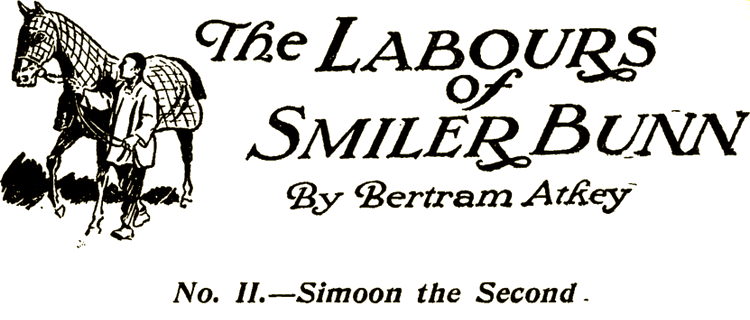
The Bunn-Fortworth Combine take note of the methods of a lady-owner, and with the expert collaboration of Sing Song, the Chink, very successfully give their imitation of two gentlemen buying a racehorse.
TO my mind," said Mr. Smiler Bunn to his friend and partner, ex-Lord Fortworth—" to my mind this idea of going for a walk to get an appetite for dinner is about the poorest idea I have heard of. A sherry and bitters, or maybe a couple, is more powerful, shorter, and about ten times more comfortable. I can't understand where people got the idea that racing about the country on an empty stomach was good for 'em. It stands to reason that the worst time anybody could choose for violent exertion is the time when every nerve and muscle of their body is crying out for nourishment. I'll grant you that our hostess is worth while escaping from for a quarter of an hour or so, but you can't have everything your own way in this life. We'll walk as far as that bridge and then turn back. If we step it pretty lively we ought to get back in plenty of time for a mild snort before dinner."
Fortworth nodded his entire concurrence with Mr. Bunn's views, and they strolled towards the wooden bridge to which Smiler had referred.
The two crooks were spending a week or so at Fernholt, the country-house of one Mrs. Boldre-Bailey, a said-to-be-wealthy lady whom they had met at Monte Carlo some months before, and with whom, attracted by her emeralds, they had struck up a warm friendship—rather too warm, in fact, for the personal tastes of Lord Fortworth, or, as he was now known to the world in general, Mr. Henry Black.
For Mrs. Boldre-Bailey had taken what the ex-financier, brewer, gold-digger, and all-round adventurer had described as a "shine" to him, and did not appear particularly averse to letting him see it.
True, the "shine" presumably could not develop into a lasting polish, so to speak, for, fortunately, the lady already owned a husband, even as Fortworth owned a wife. Of course, it was quite likely that Lady Fortworth (of New York) had divorced him, but if so he had not heard anything about it.
Mr. or—as he preferred to be known—Professor Boldre-Bailey was a scientific agriculturist who had long since ceased to adore his wife, and never had been adored by her, and his whole soul and brains now appeared to be devoted to a volume he was writing, which, he believed, was destined to become the standard work upon artificial fertilisers. He spent his time fairly evenly between a rather pungent laboratory he had fitted up at the back of the stables and a bone-mill, which he ran for pleasure rather than profit, some two miles away from the house—although it seemed rather nearer when the wind was from that quarter. He appeared occasionally at meals, but he was an absent-minded sort of person and took very little interest in his guests. The Boldre-Bailey money was his, but his wife managed all that side of their affairs. He could not spare either the time or interest from his hobby, the bone-mill.
It had been Fortworth who suggested a walk before dinner—mainly in order to break loose from the rather hefty flirtation which Mrs. Boldre-Bailey had started after tea.
They stopped at the bridge which led across the river from the lane into the water-meadows to watch certain piscatorial endeavours of a small boy of rustic appearance whose hair was growing through his hat.
"Well, my lad," said Mr. Bunn, " and what are you fishing for?"
"Fish, mister," replied the boy excitedly, as his rod top began to bend and waggle.
The partners watched the conflict, deeply interested. Indeed, nothing interested them more than fish, unless, perhaps, it was soup, entrée, or words to that effect.
"That's where these agricultural kids get the laugh of your half-starved town youngsters," said Smiler thoughtfully. "If there ain't enough to fill 'em up for dinner they can always pop out and catch a trout or two for tea. Not that I'm much of a trout man myself—though a sea-trout makes a pretty dish, very suitable for women, I should say. Here, look out where you're flinging that rattlesnake, boy! H—l!"
The boy had hooked and scientifically yanked out, clean over his head, a long, squirming, slithering eel, that landed on Mr. Bunn's coat-sleeve. He shook the beast off with a shudder of disgust, and it fell on to the dusty road, where it proceeded to slather its slimy body into knots and rosettes.
The boy pounced on it, gripped it firmly, removed his hook, slammed the creature abruptly against the rails, and carefully put it in his pocket.
"What are you going to do with it, boy? Stuff it?" asked Smiler, whose knowledge of "coarse" fishing was limited.
"Eat 'un, mister," said the boy briefly, and looped a lobworm in festoons on and round his hook, presumably with a view to more of the squirming "reptiles."
"Eat it! Good G—d! Eat it, he says!"
Smiler left the bridge in an agitated manner, pressing his hand tightly against his lower chest.
Out in the lane they met the local vicar carrying a rod-case, and with a bag slung over his shoulder. He noted that Mr. Bunn seemed worried, and half-stopped.
"It's all right, thanks," said Smiler. "That youngster on the bridge has just caught an eel—a thing I've never seen done before. He said he was going to eat it, and it gave me a squeamish feeling. I'm all right now!"
The vicar looked surprised.
"But, my dear sir, a well-cooked eel is really a very delicious dish," he said.
Smiler looked a little ashamed of himself.
"Yes, yes, no doubt. When dead.... No doubt they'd be all right—carefully cooked—à la Rouennaise or à la Mâconnaise, say—or even in aspic. But they don't look it."
The divine smiled—he, too, was a tolerably well-nourished-looking individual—and drew a small book from his pocket.
"Hear what old Izaak Walton says of the eel," he said; and read more or less as follows:
I shall next tell you how to make this eel a most excellent dish of meat ... having washed and cleaned him and pulled off his skin rather more than halfway, give him three or more scotches with a knife, and then put into his belly and those scotches sweet herbs, an anchovy, and a little nutmeg grated, or cut very small; and your herbs and anchovies must also be cut very small, and mixed with good butTer and salt; having done this, then pull his skin over him all but his head, which you are to cut off, to the end you may tie his skin about that part where his head grew; and it must be so tied as to keep all moisture within his skin; and having done this tie him ... to a spit and roast him leisurely and baste him with water and salt till his skin breaks and then with butter; and having roasted him enough let what was put into his belly and what he drips be his sauce... When I go to dress an eel thus I wish he were as long and as big as that which was caught in Peterborough River in the year 1667, which was a yard and three-quarters long....
"And so do I," said Smiler enthusiastically, even excitedly. He had quite lost his "squeasiness," it seemed; his colour had returned and his eyes were sparkling—as were Fortworth's. "Damme—I beg your pardon, Mr. Vicar—dash me, if this man Walton isn't a genius. I never heard such a sound recipe in my life. We must get that book, old man." He turned to Fortworth.
"Sure," said Fortworth. "Fine work—very sound."
The vicar explained a few things about "The Compleat Angler" to them, received their thanks, and passed on to his fishing.
The partners stared after him.
"That's a very sensible man—very sensible indeed," said Mr. Bunn. "He's the only parson that ever gave me an appetite by reading to me. And that's a sharp old bird that Izaak Walton—knows the value of anchovy. I do like a man who appreciates the importance of anchovies."
Fortworth nodded.
"So do I," he agreed. "There's hosts of fatheads that'll never realise what a godsend to the world anchovies arc until they're all gone."
"True. Still, they'll last our time, Fortworth. Come on! Let's hope there's something with anchovy in it for dinner," concluded Smiler, and, so saying, headed for the house.
They had time for a "snort"— two, in fact.
Mrs. Boldre-Bailey, a thinnish, hawky-looking lady of forty or so, with rather piercing eyes, was on the lawn talking to another guest who had arrived during their stroll.
This was a tall, undeniably good-looking young man of about twenty-four, very gloriously arrayed. He was introduced to them as Mr. Swift—Mr. Ronnie Swift. Mrs. Boldre-Bailey added an aside to the effect that Ronnie was the only son of old Octavius Swift, the Soap Czar (more popularly known as "Octopus" Swift, on account of his business methods).
Smiler and Fortworth liked the look of Mr. Swift, junior—as did most people. It was, of course, obvious why he was there. The Boldre-Baileys had a daughter—and, as is so frequently the case with the only child of two parents who are not and never have been included in any popular post-card series on account of their beauty, Undine Boldre-Bailey was a girl "worth getting a crick in the neck for," as Mr. Bunn put it to Fortworth shortly after their first meeting with her.
Beautiful at all times, and sweet withal, nevertheless she had speeded up a little this afternoon, no doubt for Ronnie's benefit, and the result was a vision that made Smiler and his partner forget their dinners, for two seconds—almost.
Mrs. Boldre-Bailey introduced Mr. Swift, and more or less tactfully "shooed" the young couple away while the sherry and bitters were commissioned.
They were not loath to go, for they were far, far too young and careless to require aperitifs.
The three older folk watched them cross the lawn.
"They say he will be worth anything from four to eight millions when his father dies," said Mrs. Boldre-Bailey.
"It's an awkward sum." said Smiler with elaborate indifference, wondering where it was that he had seen Ronnie before. "Awkward to earn and awkward to handle when you've earned it. Personally, I shouldn't be a bit surprised if that old crocodile doesn't cut up worth ten millions."
"Do you know, he allows Ronnie ten thousand a year already—and he's really only a boy."
"Ah, well, boy or no boy," said Fortworth rather grimly, "he'll spend it all right."
"He's going to begin racing as soon as he can find a few good horses to start with."
Smiler smiled.
"This ought to be where you shoot a few of the stiff 'uns out of your stable, Mrs. Boldre-Bailey. All is fair in love and war and horse-dealing, they tell me."
Mrs. Boldre-Bailey laughed, a touch of steel in her mirth. She had some very good horses in training, and made them pay, which is what very few of the stronger sex can do.
"Oh, but I couldn't sell Ronnie the crocks—and I want the good ones myself," she said lightly.
Then upon the gentle zephyr-like breeze was wafted to them a faint, faint bone-mill flavour; and Mrs. Boldre-Bailey rose suddenly as the Professor came ambling out of the house towards them, his spectacles levelled upon the decanters that were flashing invitingly in the evening sunlight.
His wife headed, him off imperatively, indicating his clothes. He appeared to have forgotten that he was still in his working suit, for he looked surprised, and vanished indoors. His wife followed him with a remotely coy wave of the hand to Fortworth, who did not wave back.
"I can see dear Ronnie getting loaded up with a knacker's dream of stiff 'uns," said Mr. Bunn abruptly.
"Think she'd stick him with her wooden ones?" asked Fortworth.
"Stick him? And him with ten thousand a year? Man alive, she'd sell him towel horses if she could. She's that kind. Mrs. Grab-all, she is. That's what. You watch. Ronnie's going to buy some racehorses this trip all right, but not the kind that ever show up in the front part of the procession. 'Also rans' for Ronald."
That would have been a very accurate guess in the ordinary way, but on this occasion Mr. Bunn was wrong—as will be seen.
It was at about ten o'clock that night when Fortworth, sitting with Mrs. Boldre-Bailey and a cigar on the terrace in front of the house, observed coming up the drive the white blaze of motor head-lights. Mr. Bunn, in accordance with the partners' custom of being all things to all men—and particularly so to wealthy cranks—had strolled over to the laboratory with the Professor to be introduced to various forms of fertiliser, and Undine and Ronnie naturally were in the drawing-room yearnfully moaning "Oh, Promise Me!" and that sort of thing across the piano.
"Here's a car coming," said Fortworth rather unnecessarily.
Mrs. Boldre-Bailey stood up. She had recognised the note and hooter of the car five minutes before.
"Yes, I fancy it is my trainer," she said. "Bad news, I expect."
Her horses were trained privately at stables some two miles away, across the down.
"He never comes at this time of night unless it is to bring bad news."
"I hope not," said Fortworth, and began to rise also. But she commanded him to remain where he was and be comfortable.
"Probably it's only a trifle," she said. "I shall be back in a moment," and moved off the terrace towards the drive. Fortworth let her go.
He noticed that the car did not come quite up to the house.
A quarter of an hour later the lady returned.
"Anything serious?" asked Fortworth.
"Oh, no!" She laughed a little. "Strides wanted to enter a horse for a race by telegram to-morrow, and ran over to consult me. It was nothing."
But she did not stay out on the terrace much longer. Fortworth observed that when they went into the house she appeared rather anxious for a little conversation with Mr. Swift, and wondered why, suddenly, the conversation of the son of the Soap Czar had appeared so desirable to her. At any rate, she got very little of it, for a few moments later Mr. Bunn returned from the laboratory gasping slightly.
"What the Professor don't know about fertiliser ain't worth knowing. He's no amateur, Fortworth—he nearly suffocated me."
He reached for the whisky, shooting a glance across the room at Mrs. Boldre-Bailey, who was talking very earnestly with Ronnie Swift.
It struck both the old wolves that Ronald was not looking any too happy, and pretty Undine, who was standing just behind her mother listening, looked positively worried.
"She's selling him one of the ponies," said Smiler softly.
"Well, he don't look very gay about it," replied Fortworth.
"No; and he'd look frostier than ever if he knew the facts," said Smiler mysteriously.
IT was not until midnight, when Messrs. Bunn and Fortworth were quietly chatting things over in Smiler's bedroom, prior to taking their usual nine hours of solid, old-fashioned slumber, that Ronnie Swift's worried look was explained.
"She's Mrs. Sharp from Sharp Street," said Smiler, handing his coat, waistcoat, collar and tie to Sing Song, the Chink, who, among other duties, included that of valet to the pair. "And if Ronnie don't find himself the owner of one of the groggiest racehorses in her stables to-morrow it'll be through no fault of hers. Did you see a motor come in to-night?"
"Yes. Her trainer. He wanted to enter a horse somewhere by telegram, she said." replied Fortworth, struck by something in Smiler's eye.
Mr. Bunn grinned.
"Yes—by telegram. If the vet. can keep the animal alive until tomorrow," he said. "That telegram dope was something she'd torn off her last dream, Fortworth. The trainer—Strides, ain't it?—never mentioned any telegram entry. I happened to be coming from the laboratory when I heard their voices, and stopped just by the corner to hear what they were talking about. What the trainer came about in such a hurry to tell her was that one of her horses—called Mr. Mustard—had suddenly gone funny. The horse was half dead, he said, and they couldn't get at what was the matter with him. This Mr. Mustard was supposed to be an armour-plated certainty for some race or other next week, too. He's not her best animal, but he's fairly good. Now it seems that when Ronnie first mentioned that he might go on to the Turf—a month ago—he was looking round the Boldre-Bailey stables, and he took a great fancy to two horses—good-looking ones both, so I imagine. They were this fading flower, Mr. Mustard, and the stable crack, Simoon the Second. Our chisel-edged hostess hadn't forgotten that, and what she's been trying to do this evening is to stick Mr. Mustard into Ronnie at a decent price, clinch the deal at once, and postpone announcing Mr. Mustard's illness until Ronnie has paid up. Then the trainer will come rushing over with the news that Mr. Mustard has just been taken queer. The idea is that it will be Mr. Ronald Swift's 'Mr. Mustard' that is taken queer—not Mrs. Boldre-Bailey's. Understand? Neat, isn't it?"
The two old rogues nodded appreciatively, grinning. No wonder Mrs. Boldre-Bailey made racing pay.
"Ain't she a little old Mrs. Hungry?" said Fortworth inelegantly. "I can see where Ronald drops five hundred quietly through the grating. But he didn't clinch to-night. Seemed sort of coy about it, I thought."
Sing Song, who had folded Smiler's upper apparel, stepped forward softly with his patent Chinese smile.
"Mistel Lonald nevel buyce lace-holse, mastel," he said.
"Why? What do you know about it, my lad?" inquired Mr. Bunn, who knew the Chink far too well to doubt that he spoke without excellent reason.
"He not havee money fol buyee laceholse—not havee money fol buyee donkey, allee same goatee."
Smiler looked surprised.
"What's that, Sing—hasn't got the price of a goat?"
The partners drew together, dropping their voices.
"How d'you know?" demanded Fortworth.
"Listen—ovelheal Mistel Lonnie talkee, makee love with plitty Missee Undine in summel-house aftel dinnel."
The partners glanced at each other, and then Smiler carefully cross-examined the hardy Chink.
His story was brief but very much to the point. The rather unvalet-like methods of Mr. Swift's valet had aroused the curiosity of Sing Song, who, himself, was as perfect a valet as he was cook, motor-driver, and crook, and in his gentle Chinese way he had made a few subtle notes, supplementing these with a little eavesdropping behind the summer-house that evening.
It appeared that Ronnie was Mr. Ronald Swift certainly, but he was by no means the Mr. Ronald Swift who was, in the fulness of time, going to inherit the millions of old Octopus Swift, the soap emperor, nor did he enjoy any income remotely resembling ten thousand a year. He was quite another Ronald Swift, though pretty Undine was the only Boldre-Bailey who knew it. Probably he had just enough to tip the servants lavishly when he concluded his visit, and no more.
His valet was a friend. He and Undine seemed genuinely in love, but according to the Chink one-third of their love-making in the summer-house consisted of planning wistful schemes by which the astute Mrs. Boldre-Bailey could be acquainted with all the facts without instantly having poor dear Ronald kicked out of the house. The lovers had not yet found a scheme.
Had Mr. Swift possessed more than the price of Mr. Mustard's saddle, love's young dream might have gone more smoothly. But he did not, and, consequently, when his hostess delicately put forward the question of his paying a round thousand for Mr. Mustard, Ronald mentally began to see his number going up. And the number was "0." She might as well have suggested his buying the Bank of England.
The partners listened in silence until the Chink finished.
Then Smiler summed up.
"Well, it's all very interesting, but I don't see where we waltz in anyway. There's nothing in it for us. It isn't as though this Mr. Mustard's going cheap either. And even if he was, it isn't as though he was a five-thousand-pound horse, like Simoon the Second. You can slide now, Sing Song. Keep those wings of yours open, and if you hear anything worth knowing bring it to us."
BUT Ronald escaped having to refuse to buy Mr. Mustard—for that unfortunate animal died during the night. Mrs. Boldre-Bailey gave out just before lunch that he had broken his leg—presumably while pawing the bars of his loose box—and had been shot. I was rather a wonder that she did not notice the look of relief on Mr. Swift's handsome face as he heard the sad news.
"I am sorry for your sake, Ronnie," said the lady sadly. "You would have picked up some nice little handicaps with Mr. Mustard."
"Yes, it's an awful pity," said Ronald, looking as sad as a midsummer haymaker when he sees the luncheon beer coming into the field.
Smiler and Fortworth commiserated with the luckless lady and strolled upstairs to gird themselves for lunch.
"Here is where we step in," said Smiler, pressing the bell for Sing Song. "If only the Chink has got any sense at all."
Sing Song drifted in, and Smiler locked the door.
"Now, my lad, listen to me," he began in a brisk half-whisper, and proceeded to put a few questions and give a batch of instructions to the yellow one that caused Fortworth first to stare, then to smile.
And when presently Sing Song departed, it was with obvious sincerity that the ex-financier said, for the fiftieth time, to Mr. Bunn:
"If I'd had a real, old, wire-backed wolf like you with me in the wealthy weather"—he referred to his pre-smash days, when he was a genuine money captain in the City—" it would never have been anything but wealthy weather. Man, we should have had a mortgage on London from the roots upwards."
"Oh, I dunno!" replied Smiler modestly. "It's just care—and judgment, and—well, steering folk up against it."
"Sure—'up against it' is right," agreed Fortworth very cordially indeed. "This plan is easier than burgling emeralds."
"Not easier—neater. Certainly neater," corrected Smiler, and they went down to make a lunch that startled Mrs. Boldre-Bailey.
That afternoon they devoted to a hour of inspection round the stables, personally conducted by "Mrs. Hungry." The horses were a very fair lot—certainly far above the average of privately trained strings—but Simoon the Second, a smashing great four-year-old, stood out above the rest as a diamond would stand out in a collection of knuckle-bones.
"A fine horse—a grand horse," said Smiler. "What's he worth, Mrs. Boldre-Bailey?" he asked innocently.
"Mrs. Hungry " shot a calculating eye at him.
"Well, I have refused five thousand guineas for him," she lied convincingly.
"Five thousand guineas! It's a lot of money—a rare lot of money. But I should say you were right. He's a good horse—a good horse, and he's got all his future in front of him—all of it," said Smiler, and unquestionably the last sentence was true—quite true.
Mr. Bunn found a long telegram awaiting him when the party returned from the training stables. He read it, and without comment handed it to Fortworth, who also said nothing as he returned it.
But the eyes of the two old rascals hardened a little as they stared through the casement across the lawn to where Ronnie was yearning over Undine.
Several minutes passed before either spoke. Then Mr. Bunn spoke briefly:
"We can put the skids on Ronald easily enough, Fortworth. I knew I'd seen him before somewhere."
They began that mystic operation that night in the billiard-room. It was late; the ladies had gone to bed; the Professor was in his laboratory; and the three guests had it all to themselves.
Neither of the Bunn Combine was a child at the game—and, despite his dislike of unnecessary physical exertion, Mr. Bunn usually kept a sixty or seventy break where he could conveniently find it, if required—but Ronald was in a different class altogether, and showed it.
Half-way through their first game of snooker Mr. Bunn quietly placed his cue back in its stand and handed Ronnie a ten-pound note.
"Here, my boy," he said gently; "it's getting late, and you may as well collect it now as later. We needn't waste time in actually playing the game." He turned to Fortworth. "Pay him, Black, and save lost labour. He's a chip of the old block."
"What do you mean?" demanded Ronald indignantly.
"Don't shout, boy," said Smiler. "I mean that you learned your billiards in Shaftesbury Avenue—from your father, who is marker at 'The Quarter Moon.'"
Ronald's bonnie blue eyes hardened suddenly in a way that would have quite shocked Undine.
"Well, what are you going to do about it?" he asked.
"Nothing," said Smiler blandly—"nothing at all."
"Eh?"
Mr. Swift's tone was incredulous, his eyes full of suspicion.
"We've got nothing against any young fellow just because he's poor—as long as he's a gentleman," continued Mr. Bunn, in his best fat-headed style. "If Mrs. Boldre-Bailey has received you here just because she thinks you're a millionaire's only son, instead of welcoming you for yourself, she is a snob, and can find you out for herself. We shan't betray you, my boy."
He placed a paternal band on Ronnie's shoulder.
"We know what it is to be young—and in love. Young blood—eh? In the spring a young man lightly turns to his fancy, as they say. We may be a couple of stuffy old buffers, my boy, but we haven't lost the knack of sympathising with a pair of young lovers."
The suspicion was dying out of Ronald's eyes—and a faint, faint look of contempt was taking its place. That was what Smiler wanted to see.
He maundered on.
"Go in and win, my boy. I like to see it. Love's young dream—you don't know how beautiful it looks to an old fogey that's on the shelf, does he, Black? , You've got pluck, Ronald—pluck and perseverance—and we admire it." He was patting Mr. Swift on the shoulder, wagging his head fatuously as he talked. "I knew you immediately I saw you, my boy. Your father was pointed out to me one day in town as a very fine professional player, and you happened to be with him. But you're none the worse for that. We wish you luck, my boy. Miss Undine is a girl worth winning, and if we can help you at any time, let us know;—eh, Black?"
"Yes," said Fortworth. "Mind you let us know, Ronald, my boy."
His voice was not quite so fatuous as Smiler's, for he was a rough diamond, but still it was tolerably buffery.
"You are very kind to me—Very kind. I shan't forget it. Thank you, Mr. Flood, and you, too, Mr. Black."
For the dear life of him Ronnie couldn't make it sound sincere.
"That's all right, my boy. Say no more. I haven't got a son of my own—and I don't mind helping other men's sons."
He sat down.
"Pass the whisky, my boy."
His "boy" passed it, but did not join the partners. Shortly after he went to bed.
"He's ready to believe you are fool enough to adopt him," said Fortworth admiringly. "You ought to have been an actor—you do the natural fathead better than any actor I ever saw."
"Well, it'll put him off his guard—and then we've got him where we want him. He's not here after that nice little Undine; he's after Georgina's jewels."
Georgina was Mrs. Boldre-Bailey.
A moment later the butler came in.
Sing Song, it appeared, had not yet returned from London, whither he had been sent that morning by Mr. Bunn.
Did Mr. Flood think everything was all right? No accident? The butler would wait up, of course, but he thought, perhaps, he ought to mention it. He was very affable, very deferential, and anxious to oblige. He had a sharp lamp out for a lavish tipper, had the butler.
They reassured him, and even as they were speaking the dry, breathless sound of the exhaust of their fast touring car came through the open window as Sing Song drove up the coach road.
"Here he is, in fact," said Smiler.
"Thank you, sir," said the butler gratefully, as though Smiler had conjured the Chink out of thin air, and withdrew.
Later on, in Mr. Bunn's bedroom, Sing Song gave his employers what he had been to town to get.
It was a small green bottle, a blowpipe, and three tiny arrow-like darts, each with a long gossamer-like silk thread attached to it.
IF this were a three-volume novel, supplied, so to speak, at, say, three times the price of an ordinary novel, stress could be laid upon several interesting little scenes that occurred—when no one was looking—during the next two days and nights at and in the immediate vicinity of Fernholt. Space being a consideration, it is possible to invite the attention of the reader for a fleeting moment merely to the following picturesque silhouettes. A large, stout gentleman, crawling urgently on hands and knees in the moonlight, followed by a lithe, lemon-hued figure, also making progress in the manner beloved by the serpent of the dust. They crawl, the stout gentleman shedding an occasional whispered oath of discomfort—and the whisper is the whisper of Smiler Bunn—round the corner of a stable-yard, and approach a certain window. The stables are by no means modern, nor luxuriously built. There the slim, yellow figure rises, clambers upon the shoulders of the stout gentleman, inserts a yard-long blow-pipe through the window bars, puts his mouth to one end of the blow-pipe, and puffs out his breath. Follows a snort and the crash of a horse's hoof against the side of a loose box, the two figures melt swiftly out of the stable-yard and disappear in the direction of Fernholt....
Another scene—and this time one not completely devoid of a certain austere beauty—is that of two buxom gentlemen in dressing-gowns, opening, in the stilly silence and privacy of one of two adjoining bedrooms, a carefully wrapped package of bank-notes—new, crisp, whispering bank-notes of high denominations—and examining them carefully, with the aid of a powerful magnifying glass, a yellow person of Chinese appearance watching them gravely.
And not without a certain gouging sensation of pain does the author come to yet another scene—a young and handsome man, exquisitely dressed, pausing at a door in a corridor on the first floor of Fernholt. It is the door of Mrs. Boldre-Bailey's dressing-room. He peers anxiously down the corridor to where another young man, who looks like a valet, is listening intently. "Right!" whispers the valet, and the handsome young man disappears into the dressing-room. A few seconds later he reappears, soft and silent as a lynx, and without a word hands something to the valet—something that flashes green as the valet slides it into his pocket. These, too, disappear furtively, and once again the ubiquitous, lemon-tinted, almond-eyed Chinaman, emerging from a huge and very antique grandfather's clock at the end of the corridor, flickers in and out of the picture.
TWO nights after the late return from London of Sing Song—or, to be "nasty particular," as Mr. Bunn was wont occasionally to say, two early mornings after—Smiler Bunn and once-Lord Fortworth sat in Smiler's room, smoking in silence. It was two o'clock in the morning, and the house was very still. But for all that the two crooks were fully dressed, and an air of expectancy pervaded them.
Mr. Bunn smiled as a faint scratching sounded at the door.
"Got the gun?" he whispered.
Fortworth moved his hand slightly, showing a huge blued-steel automatic pistol, and the partners moved out of the room wearing no slippers.
They went softly, as only fat men can.
Sing Song was outside the door, and the three went down the dark corridor like shadows. A little way on they paused before a door, listened a second, then turned the handle and walked in. The room was lighted, and Mr. Ronald Swift, also fully dressed, and his valet were there, peering at a greenly-flashing string of emeralds that Ronald was holding.
They looked over their shoulders like startled beasts of prey—and so stared transfixed into the black mouth of the imposing automatic which Fortworth, with every appearance of great care, held levelled at the pit of Mr. Swift's stomach.
Mr. Bunn advanced upon Ronald.
"My boy, I am very sorry to see this—very sorry indeed," he said sadly. "It is a great blow to me—a great shock. I looked for better things."
He took the emerald necklace from Ronald's nerveless hand, shaking his head slowly.
"My man told me," he indicated Sing Song. "I could not believe it... No... This is a bad business, my boy. If you were short of money why didn't you come to me?" He never ceased from his solemn head-shaking. "It is ruin, boy," he said abruptly. "Ruin. Ten years at least. Ten years each. Terrible."
Mr. Swift and his friend were young—and. it seemed, still impressionable. That mighty automatic was an impressive kind of argument anyway. Their nerve went, and they wilted where they stood. That "Ten years each " had a very convincing ring about it.
"For pity's sake give us a chance, Mr. Flood!" gasped Ronald.
The valet contented himself with looking so abject as to seem scarcely human. Smiler pondered.
"What can be done, my boy?" he said gravely. "Mrs. Boldre-Bailey will miss them the moment she wakes."
"No, Mr. Flood. There's a duplicate set of imitation ones put in her jewel-case. She won't know. They can be exchanged again, and nobody the wiser."
Mr. Bunn shuddered.
"Good Lord, boy that would be compounding a felony," he said.
Ford Fortworth, too, shuddered at the very thought. It was dreadful. Sing Song, indeed, shuddered twice.
Smiler thought in silence for a long time—a painfully long time. Then he placed a hand on the shoulder of each of the emerald thieves.
"Listen to me, my sons," he said, and straightway handed out a lecture upon honesty that was worth a guinea a box.
He did not mince matters; he simply scared them cold. For the time being, at any rate.
Then he consulted Fortworth in whispers.
Finally he decided, with a very obvious effort indeed, to give Mr. Swift and the valet the chance they asked for.
"Yes—you shall have a chance, you boys. I think this will be a lesson to you. Bear in mind what I have said. I may be an old buffer—I am; but even an old buffer can be of use sometimes."
He dropped the necklace in his pocket.
"In the morning you must put this back where you found it. Then we will all forget this painful business—as long as you keep straight. . . . No—not a word—no thanks. Be good boys after this. I want deeds, not words."
He turned to Sing Song.
"Leave us," he said.
Sing Song left them.
"You, too, young man," he continued to Ronald's valet.
He closed the door upon them and turned again to Mr. Swift.
"There is another thing, my boy," he maundered on. "Apart from this terrible business of the emeralds.... I think the few words I have said have had an effect, and I and my friend, Mr. Black, are going to help you further still. It is more than you deserve... but a chance is a chance, and you shall have it. Luckily I am a rich man and can afford it. Listen to me—carefully. I imagine that Mrs. Boldre-Bailey intends to give up racing—she hinted as much to me to-night—and she will, I think, give you the opportunity of buying Simoon the Second—her best horse. You must buy it, my boy, in order to keep up appearances. You are posing as a young man with ten thousand a year, with millions in prospect, and if you wish to win Miss Undine you must keep in the good graces of her mother until the time comes to disclose your real position to her."
"But, Mr. Flood, how can I buy the horse? I haven't any money."
Ronald looked bewildered.
Mr. Bunn smiled a fatuously benevolent smile.
"I have foreseen that, my boy," he said, took a note-case from his pocket, and produced a pile of banknotes. "Buy the horse at once, if she should offer it—pay at once. Do not give more than two thousand pounds—I will hand you the money to-morrow. When the horse is yours I shall offer you a thousand pounds profit, which you will accept. I shall give you a cheque for the whole amount, which you will return to me later. I shall take the horse, of course. Then, my boy, you had better leave for a time. I will arrange for a telegram. I shall see you in London, and we can then discuss plans for making Mrs. Boldre-Bailey acquainted with the fact that you are not the millionaire's son, in such a way that there still remains a chance of your winning Undine. Do you understand, my boy?"
Mr. Swift nodded, and in a voice more or less broken with emotion effusively thanked his benefactor. But for the life of him he could not keep a certain hard light out of his eyes that augured ill for his sincerity.
The partners, however, seemed to see nothing.
"Good—very good," said Smiler. "Keep your heart up and be a good boy, and everything will come right."
Then they retired.
"Flood," said Fortworth very solemnly, as they regained Smiler's room—"Flood, you are a hard-boiled miracle. And it comes to this: we must get back into the City somehow where the money is. There are millions waiting there for you—millions—only waiting for a born organiser to come and take them. I tried—and got some, but couldn't hold 'em down. But I'm a fool to you—a fool and a lamb."
And so saying the lamb shook his partner's hand almost reverently and went off to his own room.
MR. BUNN and ex-Lord Fortworth were a tolerably "swift" pair when it came to action; but Mrs. Boldre-Bailey was swifter. On the evening following the philanthropic orgy in Ronald's room, at somewhere about dawn, Mr. Strides, the trainer, motored over to Fernholt, practically in pyjamas and overcoat. He carried out certain manoeuvres and negotiations with an early housemaid at the back, with the result that, shortly after, Mrs. Boldre-Bailey, in a dressing-gown and so forth, came down.
The trainer was a man of few words.
"Simoon's all in," he said. "Can you sell him quick?"
Mrs. Boldre-Bailey's face hardened.
"Explain. Is it the same as Mr. Mustard?" she asked.
"Worse. I doubt if he'll last till to-morrow," he answered. "He'll go quicker than Mr. Mustard. I never saw a horse go queer so quick or so completely. I don't understand it. One of the others looks queer, too. But Simoon's got it bad—whatever it is. Take what you can get—don't hang out too long! Why, the horse can't stand, eat, drink, or see."
Mrs. Boldre-Bailey's thin lips tightened.
"Leave it to me! It will be settled by eleven o'clock."
"Eleven, certain?" queried Mr. Strides.
"Certain."
She nodded and went upstairs. And Mr. Strides returned to the motor. He was a good trainer, and straight—as a rule. But Simoon the Second's mysterious malady, coming so soon after the trouble with the late Mr. Mustard, worried and even scared him a little.
At breakfast Mrs. Boldre-Bailey put the deal through without a hitch.
She announced briefly that she was giving up racing—owing, of course, to land taxation, that grand "old reliable" in the way of economy-justifiers—and offered Simoon the Second point-blank to Ronald Swift.
"You always wanted him, Ronnie. Now you shall have him," she said sweetly.
"Oh, thank you!" gushed Ronnie gratefully; and Undine looked bewildered.
"Yes. He is worth five thousand, but you shall have him for two—just because you are Ronnie."
Undine coloured a little, and for a second Ronnie looked foolish.
"You are too kind," said Ronald, recovering himself. "Shall we call it settled, then?"
Mrs. Boldre-Bailey beamed like a lady-wolf encountering a carcass.
"Why, yes," she said.
Ronnie turned to the sideboard where Messrs. Bunn and Fortworth were earnestly engaged in discussing sotto voce the respective merits of the various edibles offered for their consumption.
"I've bought Simoon the Second for two thou.," he called gaily, like a child with a new toy.
"What's that, my boy?"
Mr. Bunn wheeled. Ronnie repeated his little paean of joy. The partners nodded, smiling.
"Well, I will cheerfully give you a thousand for your bargain," said Smiler, turning back to the sideboard.
But Ronald laughed.
"Yes—no doubt you would," he said. "But I mean to keep him..."
But by ten o'clock, an hour later, he had changed his tune.
He had given Mrs. Boldre-Bailey two thousand pounds in crisp new bank-notes which (as well as the necklace to be returned) Smiler had handed him immediately after breakfast in the empty billiard-room, and they were smoking a cigar on the terrace when a telegram arrived for Ronnie.
His face clouded very cleverly as he read it, and he looked up at Mr. Bunn.
"Does your offer of three thousand pounds for Simoon the Second still hold good, Mr. Flood?" he asked.
"Why, yes, my boy."
Ronnie sighed.
"Well, I shall have to take it," he said reluctantly. "My father has carried through a big amalgamation and offers to let me in on the ground floor. It doesn't matter really, of course, but he likes me to take an interest in his business, and would be annoyed if I declined. Would you mind my selling Simoon, Mrs. Boldre-Bailey?"
"Oh, not at all, my dear boy; I quite understand. You must not let your father think you are not businesslike," she said, naturally pleased that the money was going to be kept in the family, so to speak.
Smiler went indoors and presently returned with a cheque, which he gave to Ronnie.
"There you are, my boy," he said, and so they settled it.
At about twelve Smiler and Fortworth decided to stroll over to the stables and say "How d'you do" to Simoon the Second, Mrs. Boldre-Bailey accompanying them.
Ronnie had left a quarter of an hour before. He had to go to London on business connected with the "huge amalgamation."
At the stables Mr. Strides met them with a grave face—a very grave face.
Before he could speak Mrs. Boldre-Bailey announced the fact that Simoon the Second was now owned by Mr. Flood.
Strides looked graver than ever.
"I am afraid you've bought a peck of trouble, Mr. Flood," he said, and handed out forthwith the shocking news that Simoon the Second had been seized with a sort of fit at eleven o'clock and now looked to be at his last gasp.
Smiler seemed startled.
"Oh—ah!" He hesitated. Then: "I'm afraid that rather cancels the bargain, doesn't it, Mrs. Boldre-Bailey?" he said feebly.
Georgina stiffened.
"Most certainly not," she said very sharply.
"Oh, but look here, Mrs. Bailey, ain't that sharp work? You thought you sold Ronnie a well horse, not a sick one, and I thought Ronnie sold me a well horse."
"Sharp work? How dare you?" snapped the lady.
"Well, but d—n it all, I don't want any of your epileptic animals stuck into me," said Smiler angrily.
"Yes—be fair," said Fortworth in a concerned way.
Mrs. Boldre-Bailey seemed speechless with anger.
"If the horse had been well when I bought it, and fell sick after I owned him, it would be a different thing," said Smiler. "But to—"
Strides interrupted.
"What was the exact time of day you bought him?" asked Strides.
"Why, not three hours ago," said Smiler eagerly. "Ten o'clock exactly."
"Yes, I heard the clock strike," threw in Fortworth.
"Well, that settles it," said Strides. "The horse was well when you bought him, Mr. Flood. He didn't have the fit, or whatever it is, until past eleven."
Smiler collapsed very skilfully.
"Oh!" he said with extreme feebleness. Then with a last flicker of spirit:
"All right, I've got to have him, I suppose. But it's sharp work."
"Damned sharp work," muttered Fortworth.
Mrs. Boldre-Bailey flamed.
"Insolent, ill-bred ruffians!" she exclaimed. "Is it necessary to order you to leave Fernholt instantly—and take the horse with you—or must I have you turned out?"
"No, Mrs. Bailey, it ain't," said Smiler. "We're going as soon as we can pack, and the horse—if you can call it a horse—goes too, if he can walk."
He turned to Mr. Strides.
"I'll send my Chinese valet down to see the animal," he said. "He says he knows something about horses."
"Very well," said Strides, turning away to hide a smile. (Chinese valets have little or no reputation as racehorse experts in the average racing stable.)
Their hostess had already turned homewards, delighted at what she imagined to be her clever "get-out" of Simoon the Second.
The partners followed her in a sorrowful manner. They passed her in the hall on the way upstairs to pack. She favoured them with a glare of contempt, but said nothing.
Sing Song had practically finished the packing.
"All right, Sing, we'll finish this," said Smiler softly. "You go and get the car round to the front, my lad. Then hike off to the stables with whatever Chinese mixture it is you use as antidote to your blow-pipe dope, pull Simoon round, and then walk him to the station. We ought to get a horse-box there without much trouble."
Sing Song smiled blandly and departed.
Half an hour later the partners' car rolled up to the stables.
Again Mr. Strides received them, but his face was no longer grave. It was bewildered.
"That Chinaman is a remarkable man with horses, gentlemen," he said. "He came in, examined Simoon the Second—like a man who understands horses, too—and seemed quite satisfied. He asked for a half-bottle of brandy, poured some queer-looking pink stuff into it, and gave it to the horse. Then he got to rubbing the horse's backbone—just the spine—in a way that would melt any ordinary backbone, and—and " He turned sharply at the sound of hoofs. "And here he comes! It's a miracle!"
Sing Song, still smiling blandly, was leading a racehorse out of the stable-yard, sheeted to the eyes, and still a trifle groggy. But it could walk, and was improving at every step.
Mr. Strides eyed the horse narrowly, his face growing more and yet more puzzled.
"I'll tell you what it is, gentlemen," he said. "It's even money that you've got the best of the bargain after all."
But Mr. Bunn seemed doubtful.
"Walking ain't racing," he said. "Good day."
They climbed back into the car and departed, Sing Song following them slowly with Simoon the Second.
By three o'clock they had boxed him at the station, and started the horse on his way to a training stable at Epsom, Sing Song in charge.
They saw him off, went out to the car, and slid quietly away Londonwards.
"Good work," said Smiler reflectively, leaning back, as Fortworth slung in his top gear. "Very good work. The horse will be as well as he ever was by the time he gets to Epsom. And Rains'll give five thousand for him like a shot."
"That chap Strides got the surprise of his life when Sing Song waltzed in," chuckled Fortworth.
Smiler grinned.
"Yes, but his surprise packet was a fool to some that are coming. Wait till Mrs. Boldre-Bailey finds out that Ronnie ain't Octopus Swift's Ronnie, and that the two thousand pounds notes he paid her ain't worth two thousand pence. She'll want his life-blood."
"She's welcome to it," said Fortworth generously.
"She'll never see Ronnie any more. When he left the necklace went with him. He never put it back, of course. I got the cheque back. His surprise'll come when he finds the stones are imitation—the same as the necklace he substituted for the one he stole. Her emeralds never were real ones—although they deceived me at Monte Carlo. No, Ronnie and Georgina'll never meet again. The fact is, Fortworth, they've carted themselves—by being greedy. We offered her the horse back—and she insulted us for thanks. So she can't have any grouch against us. That blowpipe idea of Sing Song's was good; I may raise his wages if all goes we'll. And we'll lay in a stock of that green Chinese dope he smeared on the little arrow he blew into old Simoon. Being only temporary in action, it might be useful. We shall sell the horse for five thousand easy."
Fortworth nodded.
"How about Undine?" he asked.
"Undine? Oh, she's a nice little girl, but she's young yet. You wait till the next curly-head comes along—and she'll forget Ronnie fast enough," said Smiler. "She couldn't have had him anyway."
"Well, I'm satisfied," summed up Fortworth.
"It ain't bad—might be better, but it'll do to go on with. We put up with a lot there—the cookery was a crime and the whisky was weird. But Sing Song'll be back in time to see to dinner to-night—so we're all right now."
Fortworth laughed cheerily.
"Yes—all right now," he said, and the car hummed musically homeward.
Roy Glashan's Library
Non sibi sed omnibus
Go to Home Page
This work is out of copyright in countries with a copyright
period of 70 years or less, after the year of the author's death.
If it is under copyright in your country of residence,
do not download or redistribute this file.
Original content added by RGL (e.g., introductions, notes,
RGL covers) is proprietary and protected by copyright.