RGL e-Book Cover©
Roy Glashan's Library
Non sibi sed omnibus
Go to Home Page
This work is out of copyright in countries with a copyright
period of 70 years or less, after the year of the author's death.
If it is under copyright in your country of residence,
do not download or redistribute this file.
Original content added by RGL (e.g., introductions, notes,
RGL covers) is proprietary and protected by copyright.
RGL e-Book Cover©
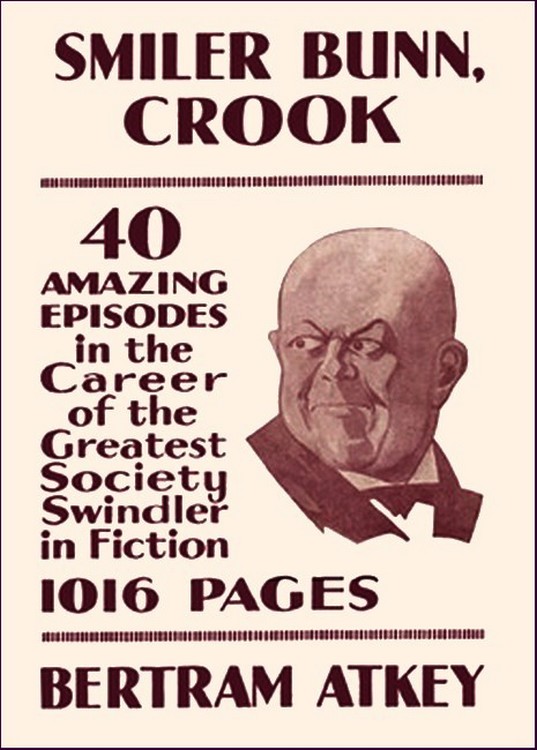
Smiler Bunn, Crook, George Newnes, London, 1929,
with "The Adventure of the Half-Million Legacy"
IT was breakfast-time at the flat, a few mornings later. But although Mr. Bunn had taken his seat, eaten a preliminary peach and commanded Sing Song to bring on the red mullet, it was obvious that he was not breakfasting with his customary vim and enthusiasm.
Evidently he was himself well aware of this, for as the Chinaman entered with the fish, Mr. Bunn turned with an appearance of serious concern to Lord Fortworth, who was sitting by the window staring sulkily at a liqueur glass of old brandy on a small table beside him.
"It's a hundred thousand pities to let anything destroy your appetite, Fortworth," said Smiler in a worried voice. "It isn't as if it were only your breakfast you're spoiling, mind. A man who goes without his breakfast not only loses it for life, but risks the danger of eating his lunch more like a wolf than a man, and so hasn't got time to appreciate it. Then, later on, he probably gets a few wireless signals from his digesting apparatus, that knocks thirty per cent, off his chance of enjoying his dinner. In fact, he ruins his day, Fortworth."
But the ex-money captain finished his brandy with a ferocity and carelessness which was little short of an insult to the extremely costly liqueur, and did not reply.
Mr. Bunn shrugged his shoulders slightly, turned to his red mullet, began and finished it in silence. Every now and again he bestowed upon his gloomy, glowering partner a look of infinite sympathy and compassion.
Apparently Fortworth observed and was irritated by the glances, for he suddenly looked across with a scowl.
"What a damned nasty noise you make over your food, Flood," he snapped, very offensively indeed.
Mr. Bunn sat up, stiff and rigid with surprise. If Fortworth had suddenly transfixed him with a shaft of forked lightning he could not have seemed more completely " buffaloed."
"Nasty noise—me make a nasty noise over my food?" he murmured to himself as though to make quite certain of the words. Then he flushed slowly and returned his partner's glare with interest.
"Coming from a man who shears his way through a twelve-course dinner about as silently as a ten-horse-power sausage-meat chopping machine, a remark like that is the limit," he replied, and then, recovering his temper as quickly as he had lost it, he rose and went over to his fellow-crook.
"All right, old man. I understand. Say no more," he said. "I don't know exactly why you're not eating any breakfast this morning, but it must be something pretty stiff. Ain't you—"
Fortworth picked up the copy of a morning paper, a brief glimpse of which before breakfast had sufficed to change him from a healthy, hungry man into an appetiteless liqueur receptacle, re-perused a paragraph, and turned to Mr. Bunn, his face clearing a trifle.
"Flood, I apologise. I shouldn't have said that. It was wrong—you are a silent eater.
I've got a sore head. It's fierce, Flood, fierce, and I got it square in my lamps the minute I looked at the paper this morning."
He tapped violently at the offending paragraph.
"Wouldn't that sting you—wouldn't that jolt you, Flood? D'ye know what it is? Just a little old paragraph announcing that Mrs. Ross K. Hubberd has died in N'York, leaving her divorced husband, Lord Fortworth—me, Flood—the whole of her fortune. Twenty-five hundred thousand dollars, Flood—half a million pounds odd. Lord Fortworth. Me, Flood. Where's your appetite now, Flood, hey? I guess that's sent your appetite up into the air."
And indeed it had. Mr. Bunn, as white as his naturally rich colour would allow, walked over from the dining-table, put down the napkin he was holding, ordered Sing Song to bring another liqueur glass, and agitatedly selecting and lighting a cigar, sat down facing his half-demented-looking partner.
"Ain't she a daisy? Wasn't she a peach, Flood?" demanded Fortworth, with wild sarcasm, the American twang which some years' residence in the United States had given him, coming strongly to the fore. "She didn't know how to jab a skewer in through my old hide, I guess, did she? Half a million, Flood! And sends a lawyer over to London to find me—he's here now at the Astoritz—waiting to hand me half a million of money the minute I drive up in a chariot and ask for it. And every detective in London waiting on the step to pull me as I come out! Wouldn't that get your goat, Flood?"
Mr. Bunn nodded slowly and thoughtfully.
"It's hard to believe a woman would play a trick that size on any man," he said. "It ain't only kicking a man when he's down—it's pegging him down through the liver before starting to kick him. Half a million... of money. Fortworth, it's horrible. Torture's a fool to it!" And, indeed, it was.
They had long known that when Lady Fortworth left the fallen money-captain on the occasion of his smash, she had promptly divorced him on the ground of incompatibility—presumably the incompatibility of his bank account with her financial requirements—but that was all they knew of her subsequent career. For instance, they were quite unaware that, probably because she had treated him badly and knew it (an uncomfortable kind of knowledge, be it said), she had hated him bitterly until she married a wealthy rough diamond from Galveston, Texas, one Ross K. Hubberd. Having married Ross, it was not long before she discovered that, regarded as a husband, he was decidedly inferior to Fortworth. This embittered her still more. Later, Ross K., revisiting old Texan haunts, succumbed to the logic of a swift-tempered cowboy's 45-Colt, leaving Mrs. Hubberd widowed but wealthier. Then her thoughts had turned to. Fortworth who, as has been shown, had disappeared, merging himself in the identity of Mr. Henry Black, and she had advertised for, and otherwise sought him. But , he had not responded—he was happy as he was. Mrs. Hubberd presently gave up advertising, and a few months prior to the appearance of the appetite-destroying paragraph, had died, leaving a cocaine-inspired revenge on Fortworth behind her—namely, a will giving him every dollar she possessed. She had known perfectly well that he would never dare to leave the friendly shelter of his alias,and new identity, to claim the money as Lord Fortworth, for the police of from two to four countries wanted Lord Fortworth, in order that he might explain certain matters of deficiency connected with his smash.
Briefly, then, that is the unenviable position in which Lord Fortworth found himself—owner of, roughly, two and a half million dollars, which he had only to ask for, and, having proved his identity, receive. But he dared not prove his identity, and he knew it—just as the late Mrs. Hubberd had known it.
It was a torture of Tantalus brought up to date—merely that and nothing more....
Sing Song, moving about the dining-room with less noise than a rubber-soled ghost, as he cleared the table, wondered what had smitten the partners—but, not without tact, strictly confined himself to wondering.
Never before had he seen them hold their heads in their hands and stare at each other in such a helpless-hopeless fashion.
It was uncanny, and even the wire-nerved Chink was glad when his indomitable owner broke the silence.
"Fortworth, we've got to get that money. Got to. We need it. Why, old man, it'll put us on Easy Street for life—when we get it."
"Yes," gloomed Fortworth, "when!"
"Well, let's talk it over, anyway," said Mr. Bunn—and so they began to grope for ideas....
Two days later there arrived at that world-famous hotel near Piccadilly, the Astoritz, a prosperous gentleman of well-nourished appearance accompanied by his valet, a slant-eyed person of Chinese appearance. He drove up in a Rolls-Royce limousine that, used though the Astoritz main-entrance staff were to elaborate cars, caused even that wealthy man, the chief hall porter, to infuse into his gait a shade more alacrity than he was accustomed to exhibit.
But Mr. Wilton Flood, it appeared, was a plain man, who did not care for a lot of fuss. He explained that immediately and carefully to the manager of the hotel.
"You know me here. I'm a man with simple habits and tastes," he said. "I don't want a lot of bother. Give me the best of what you've got and say no more. Let me have a note of the dinner menu every day, as soon as the main chef has planned it—that's all I ask. Then, if we differ about any dish, I shall have time to arrange about a proper substitute."
And, so saying, he moved to the lift.
"I hope Fortworth will get on all right at Purdston," he muttered to himself as he was swiftly hoisted up to his room. "Mrs. Bloom ain't by any means a bad cook, though not in the same class as Sing Song. However, two and a half million dollars is worth suffering for, though I'm glad it's Fortworth that's doing the suffering and not me."
For while Mr. Wilton Flood, which is to say Mr. Smiler Bunn, proposed cultivating the acquaintance of the American solicitor, or " attorney -at-law,"as our good Trans-Atlantic friends have it, ex-Lord Fortworth had retired from their London flat to the secluded little country house which they owned at Purdston.
Fortune, it would seem, favoured Mr. Bunn at once, for he made the acquaintance of the representative of the late Mrs. Ross K. Hubberd's executors the first evening. He had followed the man—one Mr. D. Bean—into one of the smaller smoking-rooms, and from commonplaces over cigars had gradually worked Mr. Bean into a vivacious comparison between Anglo-French and American methods of cookery. Mr. Bean was a New-Yorker of the lean and lantern-jawed type. His eyes, steel-grey and hard as diamond drills behind his pince-nez, his chin jutting out like the corner of a marble mantelpiece, and his rat-trap mouth, advertised him as being a "bad-'un" to come up against as a foe, and one that it would be as well to.approach cautiously even as a friend.
But, like many lantern-jawed men of his age—forty, or thereabouts—he was almost always ready to discuss two subjects—namely, food and money.
It was tolerably evident, from his mission in England, that the man knew about money, but compared with Mr. Bunn, he was a novice when it came to gastronomical wisdom. He understood a few elementary points, but about the finer, the more delicate and subtle arts of cookery, Smiler speedily recognised that Mr. Bean knew nothing.
Working upon that, Mr. Bunn took Mr. Bean in hand, and during the days that followed, delighted him with a succession of meals that staggered a man who had only recently arrived at the age and affluence when it occurs to the average American business man that there may be a better way of eating lunch than standing at a quick-lunch counter and snapping fiercely and swiftly at pie.
Smiler and his car were also of great assistance to Mr. Bean, who, it seemed, was far more anxious to see all the sights of England than to discover Lord Fortworth.
The acquaintance developed into intimacy, and bit by bit Mr. Bunn gleaned the vexing knowledge that Bean's visit to England was more in the nature of a formality than anything else. He had no hope, nor expectation, of finding Fortworth, and he was completely sure that the ex-financier would never take the risk of claiming the money nor of answering any of the numerous "Lord Fortworth will hear of something to his advantage" advertisements which Mr. Bean had out. But the necessity of making some effort to find the heir to the Hubberd millions had fitted in well with Mr. Bean's desire to see England at the expense of some one other than himself, and so he was killing two birds with one bill of costs, namely, that which would ultimately be plunged to the hilt into the resources of the Hubberd estate.
And Mr. Bunn felt a chill of despair flutter like a sudden draught up and down his spinal column as he learned this-—even if Lord Fortworth did turn up, he hadn't the remotest chance of getting the money. The will was being contested by a relative of the late Mr. Hubberd, and undoubtedly would be broken. "It was not likely that any judge was going to award two and a ,half million of good American dollars to a bankrupt fugitive from justice hiding somewhere in England," explained Mr. Bean—and Mr. Bunn, with slightly blood-shot eyes, agreed.
It began to look as though the Combine might as well bid a long farewell to any chance of linking up with any of the Hubberd money when Lola Berlyn arrived at the Astoritz.
At eleven o'clock on the morning on which she arrived nobody in the hotel had heard of her, but by two the same afternoon practically every one there knew of her. From the electrical gentleman with the tool-bag who seemed to be playing spiders all by himself in the telephone and various wires over the hotel roof, down to the quick-eyed seedy sportsman who was hanging about by an obscure door in the region of the back basement waiting to take the bets of the lesser scullions to the bookmaker he represented—they all knew that a beauty of the most dazzling variety had taken up her abode in the hotel; For Lola was of the stype which attracts men like a dog fight. There was nothing of the meek violet of the dell, the coy lily of the valley, or the tender rosebud about Miss Berlyn; nothing of the cold, marble-white, statuesque beauty; nothing of the pert, pretty mignon,the pink and white darling. Not so. If one thought of roses in connection with her it was the cabbage variety—full blown, gorgeous, at the zenith of life. She was tall, with a figure perfectly proportioned to her height, lithe as a python and as closely sheathed. She had a head of ink-black hair that would have given any man on earth a headache, but which some inspired hairdresser had built up into a coiffure which killed criticism stone dead; great, shining, Spanish eyes, with lashes like silk curtains; a complexion that defied arc lights; colouring that would have caused any rouge pot and lip-dope-box incontinently to fall off their perches and hide their futility under the dressing-table, feet and hands in keeping, and, above all, an air. She went through the entrance hall with an effect hardly less deadly upon the gentlemen therein than a shell. She saw every man there, and favoured each one with a look that made the place-where "his heart and conscience should be turn a hand-spring, left the small but businesslike man who accompanied her to attend to details, and vanished into the lift.
Messrs. Bunn and D. Bean, who were in the hall, looked at each other thoughtfully, then at the disappearing lift, then at the little man at the desk.
"Spanish—kind of," said Smiler. "No, mostly American," replied Bean, not without pride.
"Ah!" said Mr. Bunn, "she's the style I admire. Full-blooded—bold—challenging. Fine style!"
"Yes—sure," answered Mr. Bean, suddenly absent-minded.
"D'you know her?"
"Not from Eve."
"Ah, well, she ain't Eve, anyway," said Mr. Bunn good-humouredly, and they went out to see Westminster Abbey, which they enjoyed—but were not late for lunch. Lola was there, beautiful enough to hypnotise an astigmatic myope....
But evidently Miss Berlyn or her brother—for such was the small-sized gentleman—were sufficiently well-versed in the ways of the world to be able quietly to choke the life out of the fond hopes of many admirers, for at the end of two days the only people she and her brother seemed to know in the whole hotel were Messrs. Smiler"Bunn and D. (for Daniel) Bean.
It was Bean who had introduced her to Smiler, though how Bean made her acquaintance Mr. Bunn knew not, nor cared—neither at the time of the introduction nor two days later, when the pleasing idea first occurred to him that, of the two, Lola vastly preferred his company to that of Bean. She, too, claimed to be an American "doing" Europe, and as Bean introduced him as an expert Londoner possessing a particularly recherché car, the solicitor only had himself to blame when he discovered that Mr. Bunn swiftly evinced a marked tendency to split their various expeditions into two parties thus: Party one—Bunn and Lola Berlyn to inspect Tower of London; Party two—Bean and brother Earl Berlyn to fade away to the Zoo.
But it was Lola herself who gently, and kindly, but very firmly, squashed Mr. Bunn's unselfish plans.
She told him why one afternoon at tea in a secluded corner—looking the smooth old rascal full in the face with those wonderful eyes.
"I like you, Bill," she said, in her rather full, alluring voice that, thought Smiler, made " Bill," which, for no reasonable reason on earth, was what she called Mr. Bunn, sound fine—" I like you, Bill, an awful lot better than I like Beans—but it's Beaney's side of the fence that I've got to keep. Never mind why, Bill. Some day, perhaps, you'll know why. It's Beans I've come over here specially to see. So be good, and when Beaney. begins to get restless and sees green, remember it's up an alley for yours."
Meaning, presumably, that when Mr. Bean, who was very obviously ears-under in love with Lola, seemed jealous, "Bill " was quietly to drop out. It was a pity, but that was how Miss Berlyn talked, in spite of her beauty.
It puzzled Mr. Bunn a little, but it did not puzzle him quite so much as an item of news which, later on in the evening, Sing Song, the Chink, gave him.
Sing Song's information was brief, but to the point.
"Mister Bellyn entel Mister Bean's room velly clever allee same thief this aftelnoon," he said quietly when Smiler went up to change for dinner.
"Bleak in with false key, Master savvy—velly quick and clever. Stoppee long time—twenty minute, pelhaps. Come out angly allee same like man lookee for findee and not findee."
The Chink's eyes glittered meaningly.
"What's that? Berlyn got into Bean's room with a faked key, was in there twenty minutes and came out looking sour—as though he hadn't found what he's after, eh?" asked Smiler.;
He thought for a moment, then nodded, deciding that it was about time to consult Fortworth.
"All right, Sing. You're a good lad—and Berlyn a dashed smart crook if he can play games like that in this hotel. Keep a lamp out on all the party, Sing, and let me know if you notice anything. Now, tie this tie and quick about it. I shall run down to Purdston to-morrow morning early—and might arrange a dinner-party there for the following night, if Lord Fortworth thinks it's safe for him to face Bean—which, with his temper, I doubt."
Then he went down to dinner.
"She's a nice girl and handsome," he mused as he Went, "and if I could afford it and my habits were different and my tastes more domestic, I could settle down to married life with her without shouting for help. But at the same time it won't do any harm to watch her. It would be interestin' to know what it is Bean has that she and Earl want. She's a little too noticeable to be a private inquiry agent or it wouldn't be unreasonable to put her and Earl down as acting for the party that want to break the Hubberd will, and are after some papers or other that Bean's got. However, I'll talk it over with Fortworth. There's a time for all things and just now it's dinnertime...."
It had never been the habit of the late Mrs. Hubberd at the period when she was Lady Fortworth to encourage Lord Fortworth to take the least interest in, or notice of, her private fortune. She had considered herself—not without reason—perfectly competent to attend to the spending of her money without aid from any one. To do Fortworth justice, he had never shown or felt any wish to touch or know about his wife's affairs save on the one occasion when, on the edge of his collapse, he had frankly offered to borrow a few hundred thousand from her, and frankly failed.
For these reasons Fortworth had never met any of his wife's New York legal advisers. And as, naturally, he had never met any of the late Ross K. Hubberd's, there was, he informed Mr. Bunn, on the morning following Sing Song's interesting discovery of one of Mr. Berlyn's idiosyncrasies, no reason on earth why he should not meet Bean.
"In fact," he went on, rather sullenly, "I think I ought to meet the man. It's like living in a deserted chapel down here, anyway, and if you ask this push down to dinner, it will make a change for me and may do us good. If Bean can be got full, nobody knows what he mightn't give away. And I like the sound of this Lola. I'd like to see her—she sounds my style. All I've got to do is not to give myself away—and I have had enough practice at that to feel pretty confident. Have 'em down, Flood, by all means. You seem to be having a very useful time at the Astoritz. If it wasn't for the 'tecs that are hanging about there on the chance of my trying to sneak in and interview Bean I'd join you all there myself."
So it came about that, on the following afternoon, the great car of the Combine rolled smoothly away from the Astoritz with the Berlyns, D. Bean, and Smiler Bunn on board, en route to dine with Mr. Henry Black at Purdston.
It had never seemed to occur to Bean that Mr. Bunn could have any motive in being so extremely hospitable to him—probably he attributed it all to his own personal charm, as Lola undoubtedly did, and, in her case, correctly. Mr. Earl Berlyn's views on the subject were not apparent—he was a silent individual and consumed his own smoke. But, as a matter of plain fact, the Bunn-Fortworth Combine had not arranged for the dinner-party with any special object in view, beyond the hope of somewhat soothing Lord Fortworth's desolation with company—especially Lola's—and the doubtful possibility of extracting knowledge of value, or at least some sort of guidance, from the loquacity which they felt moderately confident their champagne, or madeira, or old brandy, would inspire in Mr. Bean, and, conceivably, the silent Earl Berlyn. At any rate, it would give Fortworth an opportunity of forming an opinion of Bean.
So, casting dull care to the winds, it was a reasonably high-spirited company that at half-past seven sat down to deal with a dinner which had cost Messrs. Bunn and Fortworth some few minutes of careful thought and the Blooms some few hours of sustained labour.
From the first it was abundantly clear that Fortworth and Miss Berlyn were going to be good friends-—a fact so pleasing to Fortworth that he gave his celebrated imitation of a hearty, hale fellow, no heel taps, everything-in-the-house-is-yours old English country gentleman, with such verve and sincerity as to captivate completely t he sharp-eyed Bean and, incidentally, to set a pace which called upon any comparatively amateur diner-out to draw on his reserves of stamina and nerve.
For the food was superb and the wine noble. Mr. Bean lost his head a little—a mishap perhaps excusable in an amateur epicure—and like a young hunter began to go at his fences a trifle wild. Where Smiler Bunn and Lord Fortworth knew by sheer practice that it was time to stop at such and such a course or at such and such a wine, Mr. Bean did not. The natural result was that Bean forged ahead of the two partners in the matter of personal consumption—and no man on earth could do that without paying the penalty.
Lola, on the other hand, dined by instinct well, but moderately, and her brother, though appreciative, seemed a naturally abstemious man, compared with Bean. Nevertheless, he did his share.
But Bean was a business man and a man of the world, and it was not until the closing epoch of the meal that he gave the least sign of being likely to respond to the questioning treatment.
Curiously enough it was the brilliant Lola who started the process.
"Oh, I'm not like Danny Bean," she said, in reply to some question of Fortworth's. "I am just a small-part actress over there and have to earn every cent I spend. You don't want to run away with the idea that every American that comes over here has got a present of two and a half million dollars for a good little lord, Mr. Black. Does he, Danny?"
"Danny" finished his port.
"That little lord won't see enough of the Hubberd money to buy himself a beer with," said Mr. Bean, rather flushed.
"But it's his, ain't it?" asked Smiler. "It was meant for him, I mean?"
"Well, in a way, yes. But he'll never ask for it. Why, he's a crook. The police have wanted him for years. His wife knew that when she left him the money. He's no good anyway—down and out and a dead-beat. He tried to be a financier, but at the first real trouble that came along he went up in the air like a hot-air balloon, bust, and came down in some other county. He's never been seen since, and never will."
Mr. Bunn shot a glance at Fortworth upon whose forehead the veins were beginning to swell alarmingly.
"But who will have the money, then?" asked Lola lightly, as Sing Song deftly filled Bean's glass.
Had the lawyer been himself he would have noticed the extraordinary tenseness which, thinly concealed by their air of playfulness, sat upon the whole four.
"Oh, they'll break the will and the money will H«» to some of Mrs. Ross Hubberd's relatives, I guess," said Bean offhandedly. "Anyhow, that English shyster won't get it."
Fortworth gulped at his wine to choke himself from comments.
But Lola followed up the lawyer.
"Has she got any relatives?"
"Relatives? Sure. In fact, I'm one myself. Cousin," said Mr. Bean, a trifle thickly. "Mrs. Ross Hubberd was cousin of mine."
Mr. Earl Berlyn broke in, a tingling sharpness in his voice.
"But, say, I always heard the Hubberds didn't have a relative in the world," he said.
"That's qui' correct," smiled Bean, "all except one. That's me. I'm the o'ly relative Mrs. Ross Hubberd ever had. Cousin o' mine, that dame was."
"Then you're the guy at the back of the bunch that's out to break Mrs. Hubberd's will," said Mr. Berlyn, his voice rising a little, but with one needle-keen eye cocked across the table at Fortworth, who seemed to be struggling for breath.
"Qui' correct. It's me for the millions," said Bean, emptying his glass.
Lola leaned across to him, her great eyes blazing strangely.
"And you've got the crust to kid folk you're hunting for this Fortworth guy?" she said, a shade hoarsely. "Knowing you'll grab the dollars whatever happens."
"Surest thing you know," said Bean, rather pleased with himself, fiddling with his empty glass. "Those dol's good as in my pocket."
"Ah, finish your dream!"
The words were snapped out viciously by Mr. Berlyn and—Mr. Bean discovered himself to be gazing bewilderedly into the dark, inquiring eye of a most business-like-looking " gun that was gripped in the hand of Mr. Berlyn.
At the head of the table Fortworth, black with fury, was making strange noises in his throat and was reaching out towards Mr. Bean. He seemed to be trying to say something like—
"Rob me, would you—rob me—rob me!"
"Quiet, Black," demanded Smiler desperately, but Lola, her face wrung with a strange and curious excitement, had heard and already turned on her host.
"Rob you—who are you?"
"Why, ain't I Fortworth? It's my money that thief's planning to pinch," roared the ex-financier, reckless with rage.
Mr. Bunn heard, like a man in a sudden nightmare, the low malignant voice of Mr. Earl Berlyn addressing the swiftly sobering Bean.:
"Why, you wolf, Mrs. Hubberd didn't have a relative in the world. She was Irish and started out from an orphanage."
"That's true," said Fortworth—who knew.
Lola, ignoring Fortworth for a moment, turned to Bean, who was squinting a little as he kept his fascinated gaze upon Mr. Berlyn's unwavering "gun."
"And the first relative she ever had was Charlie Van welt—her first husband," she said.
"That's true," growled Fortworth.
"And Charlie Vanwelt was a soft-hearted, easygoing, trustful sort of guy," continued Earl
Berlyn. "And he had some poor relatives—kids. And he'd left those kids' mother a cold million dollars. That's true, und'stand, for those kids' mother had seen the will. But when Charlie died where was the will—with those kids' names in it? Gone. Mrs. Vanwelt had burnt it—there's a man, friend of mine, saw her do it. And who d'you think those kids were, you Bean? Lola there and this little man with the gun, Bean. Lola and little Earl here, Bean. Und'stand, Bean? And that's why those millions have got to be swung our way, Bean. We need that dough—and we've called,for it. And we're going to have it if we've got to shoot it out of you!" Fortworth broke in again.
"All right, Berlyn. Vanwelt left his wife a million and a half—she told me that before I married her. I'll see you get it. But the Hubberd money's mine."
"Guess again," sneered Mr. Berlyn. "The Hubberd coin is interest on the Vanwelt dough. It's me and Lola for the lot. You get yours when the police have done with you."
Then Mr. Bunn nodded sharply-—and Sing Song, who behind Mr. Berlyn had been watching his master like a dog, shot a yellow hand over Berlyn's shoulder, twisted it upwards, so that the bullet embedded itself in the ceiling, and a second later Sing Song was the only man in the room with a weapon. Berlyn wheeled with an oath, but something in the grim yellow face and glittering, snake-like eyes of the Chink steadied him, and he sat again.
Smiler took the pistol.
"And now, if everybody will have the sense to keep their hair on," he said blandly, "we'll smooth things out."
But Lola jumped up.
"Ah, Bill, don't you get fresh," she said. "This isn't your funeral—or your fat friend's either. He says he's Lord Fortworth. Well, if he thinks the money's his, all he need do is to call on Bean to pay it or slip over to little old New York and claim it, and keep on claiming it till he's black in the face. He's where he started at—down and out. We've wondered all along why you stuck so tight to Beany there!"
"That's right," contributed Bean, now very completely sober and chisel-edged. "Do you claim or don't you? Let's see where we stand, anyway. If you claim I'll have to ask you for proof that you are Lord Fortworth, and you can hand in your proof with your claim."
The two partners looked at each other very seriously. Then Smiler jerked his head towards the door, and Fortworth, ugly with wrath, rose.
"Very well, you herd of sharks," he said civilly, "I'll consult with my friend, Flood. Meantime, Sing Song, keep an eye on the silver."
Then he and Smiler went out.
In the smoking-room they faced each other gloomily.
"Nothing doing, old man—you've got to climb down and do it quick. You can't risk it."
"The money'll pay every cent I failed for and leave a balance," Fortworth said sullenly.
"Very likely. But you'll still have to do time anyway. And you'll never get the money. Bean and the Berlyns between 'em will break the will in an American court as easy as eating fruit. It's hard luck, but here's where the road to Easy Street ends for us. Think it over for yourself. And, anyway, Mrs. Hubberd never really meant you to have the dollars. Come on, old man, forget it. Let's get back to that bunch and withdraw. I'll tell 'em you were drunk."
"Drunk! What d'ye mean, Flood?" roared Fortworth, boiling up.
"Oh, not drunk—delirious, then. Excited, anything. Come on."
And, their very brief consultation finished, the partners returned to the dining-room, where to their surprise they found the three Americans chatting quite amicably. Smiler understood.
"Ah, so you've decided to cut it up equally," he said bitterly. "Bust the will and share and share alike."
Bean snarled at him, Berlyn grinned, and Lola nodded, toying with an apricot. Smiler put up his last bluff.
"Very well, sports," he said, "Lord Fortworth will call on you to-morrow, Bean, with formal proofs."
"That's right," said Bean cheerfully. "I'll have a couple of men from Scotland Yard round to witness his declaration."
"Yes, do," responded Smiler easily. "Cigars, Sing Song. I might as well tell you that Lord Fortworth has decided to face his trial and chance his sentence. He'll get the money, and the money will pay off his debts—and that's all he cares about. He's sick of this everlasting dodging and hiding from the police, anyway. Ain't you, Fortworth?"
Fortworth, lurid-eyed, nodded with extraordinary sullenness and ill-concealed insincerity.
The bluff went with the Berlyns—Lola looked unhappy, and Earl scowled and muttered.
But Mr. Bean, quite himself now, never turned a hair.
"Right, that's settled then," he said cheerfully. "If the man wants twenty years let him have it." He lighted a cigar with perfect equanimity. "But he's stood us a very good dinner, and I'd hate to think of a host of mine in jail costume all for nothing. So I'll tell you, quite frankly—and I know the law—that whether he claims or not he will never see the money. With the help of our friends here I can get that will broken like this "—he snapped off a match between his fingers—" just like that."
There was a long and very painful silence, while Mr. Bunn's eyes searched those of Mr. Bean.
And then he gave in, suddenly, completely. He had not the least doubt that Bean was right.
"All right," he said, with a sad sigh. "It's your money. This gentleman ain't Lord Fortworth. He never was. He admits it. He was always Henry Black—and can prove it. You'll hear no more from him. And now you can pull your freights. Sing Song, fetch their clothes and hats and shove 'em out of the house!"
The beautiful Lola laughed.
"Hark at Bill. He loved me once," she said and, crossing over to the window, pulled back a curtain. "What a lovely night for a walk. Look at the moon. Hurry up those coats, Bill. I'm dying for a stroll."
Smiler signed to the Chink, who fetched their hats and coats, and a few minutes later the Berlyns and Mr. Bean shook the dust of Purdston from off their feet for ever and aye.
The partners watched them as they went down the lane.
"You wouldn't think to look at 'em that Berlyn held Bean up with a gun a few minutes ago," said Fortworth sourly.
"No." Smiler Bunn shook his head. "It only shows you what money will do. Some men'll do anything in the world for it—they've got no feelings, no pride, no morals. Well, well—this lets us out. Come in and finish one of the best dinners ever spoiled."
"D'ye think they'll give me away?" asked Fortworth uneasily, as they returned to the table.
Smiler shook his head.
"Why should they? If you are found, the law, before putting you away, might make some awkward inquiries for the Hubberd money which was left to you—might even make an international job of it if only your creditors bawl out loud enough. No—Bean won't risk that...."
And Bean didn't.
Roy Glashan's Library
Non sibi sed omnibus
Go to Home Page
This work is out of copyright in countries with a copyright
period of 70 years or less, after the year of the author's death.
If it is under copyright in your country of residence,
do not download or redistribute this file.
Original content added by RGL (e.g., introductions, notes,
RGL covers) is proprietary and protected by copyright.