RGL e-Book Cover©
Roy Glashan's Library
Non sibi sed omnibus
Go to Home Page
This work is out of copyright in countries with a copyright
period of 70 years or less, after the year of the author's death.
If it is under copyright in your country of residence,
do not download or redistribute this file.
Original content added by RGL (e.g., introductions, notes,
RGL covers) is proprietary and protected by copyright.
RGL e-Book Cover©
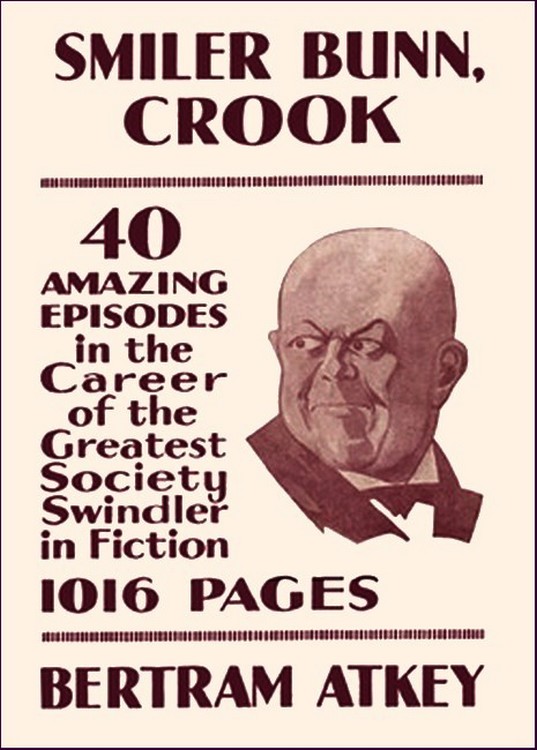
Smiler Bunn, Crook, George Newnes, London, 1929,
with "The Adventure of the Half-Million Legacy"

The Blue Book Magazine, May 1926, with "The Rajah-Protectors
MR. BUNN looked up from his writing with a somewhat all-be-flustered look on his face and addressed himself to his friend and fellow-wolf, Fortworth.
"How d'ye spell 'nourishment,' Squire—is it with two 'r's ' as well as two 's's' or only one ? It's gone clean out of my mind."
"It never did," said Fortworth, chuckling robustly.
"What d'ye mean, it never did?" inquired Mr. Bunn.
"Nourishment—never went out of your mind—you think of it night and day!"
"Yes," said Smiler, rather warmly, "and it's a thundering good job for you that I do. Why, if it hadn't have been for me the other night when you were mooning you'd have put salt in your champagne and drunk it with your cheese!"
Fortworth flushed.
"For pity's sake, talk sense, Flood," he snapped. "If you mean that accident on Monday night—as I suppose you do—why, you know perfectly well that I was absent-minded. I was thinking about money and did it quite accidentally."
"Yes, that's just what I do know. And I say that when a man's got no more sense than to start thinking about money in the middle of dinner then he don't deserve to have any—of either. It's an insult to the food—and no compliment to the money. However, how do you spell 'nourishment'?"
The ex-financier thought for a moment. He was an expert at figures, but had never won any prizes for spelling.
"One 'r,'" he said cautiously, at last.
"Ah, thanks—I thought I had it right," replied Mr. Bunn, and quietly crossed out the second 'r' he had written.
Fortworth grinned a little.
"How's the book going, old man?" he asked. "You've been sitting there an hour. Have you done the first chapter yet?"
Mr. Bunn glanced suspiciously at his partner, realised the insincerity of the question, and suddenly slammed down his pen.
"No, I haven't—and never shall. I've only done half a dozen lines. The fact is, Fortworth, this book-writing ain't in my line, and I own up to it. I know about diet—and I thought I could write my ideas about it. Well, I can't somehow. It's harder than it looks. I don't know what sort of diet those poor devils of authors manage to scratch together out of book-writing, but they earn it, whatever sort of garbage it is. Where they get the words from beats me—rob one another, I s'pose."
He frowned in a puzzled sort of way, and Fortworth endeavoured to cheer him.
"Why worry about it—who cares about these books or their measly authors, anyway? Let 'em go to the devil and take their books with 'em. That's what, old man. You don't want to get catherine-wheels in your head trying to do author's work. There's plenty of those shiny-elbowed, frowsy-headed, ragged-heeled stiffs runnin' in and out of the county courts only too willing to attend to the writing, without you fretting yourself into the horrors trying to write books. Leave it, Flood, and have a whisky and soda, and forget it."
"Yes, you're right, Fortworth," said Mr. Bunn, brightening up. "What's the good? I'm no author, thank the Lord, and never shall be. I admit it—I'm glad of it. In fact, I'm proud of it. Pass the whisky. Amen."
Fortworth passed it, and Mr. Bunn promptly drowned his last lingering literary ambition in an alcoholic grave.
It was while he was engaged upon this pleasing occupation that Sing Song entered softly to announce a caller—one, Mirza Khan.
The Chink's eyes were bright and eager, for no man knew better than Sing Song that when Mirza Khan called upon his master it was an infallible sign that in the immediate future certain people were going to be prised apart from certain sums of money.
"Mirza Khan is it, my lad?" said Mr. Bunn. "Bring him in—and another glass, too."
"Yes, master."
The Chink disappeared, and a moment later Mirza Khan momentarily blocked the doorway as he came in.
"Hello, Mirz, how're they running?" greeted Mr. Bunn. "Come in, old man. How's the Rajah? Still rich?"
Mirza—a tall, heavily-built native, much too fat and glossy to look really chic in the frock coat he was wearing—came forward with a soft and noiseless tread and an amazingly expansive smile.
"I wish you good morning, sars," he said in his queer close-clipped English. "There iss gereat terouble att Gerosvenor Square—gerave difficulty has cropped up in unexpected fashion."
"Well, have a drink, and tell us about it," invited Smiler—quite unnecessarily, as Mirza Khan, who knew the Combine's whisky of old, was already reaching for it.
"Noa ceremony among such good friends ass uss, ha-ha! Assuredly I will partake off quantity wiskisoda!" responded Mirza, tipping himself out one of a size that would have bull-dozed a brewer, had it not been of perfect quality.
"I will say that for old Mirz," said Mr. Bunn to his partner, "he knows good whisky when he gets near it. Look what he's splashed himself out for a starter."
Mirza, however, accustomed to the refreshing relaxation of the rules of strict politeness which usually obtained in the vicinity of Messrs. Bunn and Fortworth, merely smiled his abundant smile, sopped up his whisky and soda, and poured himself another preparatory to settling down to conversation.
"And there's another thing about Mirza—it makes a man thirsty only just to watch him," said Smiler. "Pass it here, Mirza."
"What's the trouble with the Rajah?" asked Fortworth.
"He iss suffering extreme enamouration off most beautiful lady," said Mirza. "If thee cigars are same as last occasion off visiting I will give you gereat pleasure off smoking couple."
Smiler passed him the box.
"No hurry, old man, of course," he hinted. "But when you've settled down we'd like to hear about the Rajah's illness."
"Yess, sars," began Mirza, as, surrounded by every luxury he needed at the moment, he set out to explain, "His Highness has conceived violent infatuation for lady. He iss att point off secret marriage—which iss serious matter."
Mr. Bunn nodded.
"To a white man, yes," he said, "but one more or less oughtn't to make any very desperate difference to a party who isn't considered a gentleman in his own country unless he's got about 'steen wives. What's worrying you about that, Mirza?"
"Marriage is always serious, Flood," said Fortworth. "It don't make any difference what colour the party is."
Mirza looked from one to the other and took a pull at the whisky.
"But if thee-husband-to-be iss Rajah of Jolapore and the lady iss Russian secret service spy thatt iss another pair off shoes," he said. "Jolapore iss frontier state and Beritish Government are not delighted to extend welcome to Russian lady-spies in India—to say nothing off importing wives for Rajahs from Russia. They will make strong objection to procedure off marriage—and His Highness will make the painful discovery when he iss married to that lady thatt he will lose his job."
"Lose his job—how d'ye mean lose his job?" demanded Mr. Bunn.
"Beritish Government thatt watches soa kindlee over welfare off native kings would kick His Highness out of Jolapore—oah, yess, in polite fashion, off course, for thee public's sake—but the effect would be the same. His Highness would be sent to live att other end of India and successor would be appointed to rule Jolapore—with kind assistance off British Political Resident, ass usual. And, off course, thatt would be end off financial transactions for uss all. Oah, yess, indeed. I will now partake additional supply off whiskisoda, which iss excellent quality."
Messrs. Bunn and Fortworth looked a little worried. For some years past they had lived with the comforting knowledge that, when, if ever, times became hard, and the wolf came up in the lift and prowled about the door of their flat, Smiler could always draw down a further "reward" from the Rajah, to tide them over and to abolish the aforesaid wolf. But if the misguided potentate were permitted to do anything so foolish as to lose his "job," and, naturally, the revenues of his job, it was painfully clear that the Combine would as surely lose what might be termed their "reserve"—a contingency to be most earnestly avoided.
"He really means it, Mirza?" asked Fortworth.
"There can be noa question as to thatt. His Highness iss veree strenuously enamoured thiss time," responded Mirza Khan, looking distinctly uneasy.
"Who is the lady? What's her name and where does she live? Has she got any money? Is she a lady or a shady or what? How d'ye know she's a secret service party?" Smiler suddenly fired off the questions at Mirza, like an irritated maxim.
"Does she love the Rajah for himself or for herself? " added Fortworth.
Mirza Khan smiled as he noted how the two old wolves had suddenly woke up.
"Ah, thatt iss in thee old style, sars," he said. "You are now taking gereat interest. I shall proceed to explain thee love affair in detailed manner for your satisfaction. After thatt it would be good plan for us all to call att her flat and take tea."
They looked a little jolted at that.
"You seem to know the lady pretty well, Mirza," commented Mr. Bunn. "Friend of yours?"
Mirza Khan looked as sad as a man behind a three-shilling cigar can look.
"I pay her gereat compliment of loving her," he said dully.
The partners smiled. Nobody knew better than they that the only soul on earth Mirza Khan really passionately loved was Mirza Khan.
"Ah, well, you'd better forget it, Mirza," said Smiler kindly. "There's no 'like master like man' about this. If Madame likes the master then the man is going to figure as one of the also-rans, old chap."
"Oah, yess, I understand veree well thatt I shall partake off thee knock. It iss sad thing, but"—he brightened up—"it iss not so sad ass losing my job."
They nodded their profound approval of this piece of plain, old-fashioned common sense, and then Mirza described the lady.
She sounded attractive, and the partners listened attentively.
Her name, they learned, was Olga Popetrolinski, though she was of French nationality, and she was undeniably beautiful. Her style was the tall, thin, fair, slender style. Her hair was honey-coloured; her complexion double cream; her lips, naturally, strawberry-tinted; her eyes, vio—
"Oh, call 'em mulberry-coloured—and teeth like lumps of sugar——" interrupted Smiler Bunn cynically. "She sounds like something nice for tea."
"Sure," said Fortworth, "and we can pick out the rest of the menu when we go round there presently. Come to the money, Mirza. A man can't live by fruit alone!"
Mirza, his rhapsody thus abruptly dislocated, explained that he had gleaned the knowledge that Olga was one of the pillars of the Bolshevist Secret Service from the perusal of certain letters, carefully purloined by an underling of Mirza's from Monsieur Santoin, the discreet European valet and "Hey, Bill" of the Rajah.
"Oh, so Santoin knows the lady, too, does he?" asked Smiler.
Mirza Khan's eyes glowed. Between him and Santoin existed a hatred and jealousy that nothing hut death or life-imprisonment could subdue.
"Oah, yass, indeed, what iss it thatt dam' creeping crocodile and snake-in-the-dust does not know? " he said. "Paris gutter-insect! I warn you, misters, thatt iss veree highlee treacherous man."
"Ah, well, forget him, and go on with Olga—she's a Russian spy—does it for a living, say. What next?" said Smiler sharply, the enmity between Mirza and Santoin not interesting him.
"Next? There iss not anything next, sar—except onlee the veree important fact to stop thee marriage."
"Ah, well," said Smiler, rising, and glancing across at his partner. "Then we'd better pop round and stop it." He rang for Sing Song.
"Car, my lad. Slip into it," he commanded briefly.
Sing Song "slipped," as usual.
Mr. Bunn, thinking deeply, sopped up his whisky and soda.
"Of course we can't dictate to the Rajah about his future missus, and we can't persuade him that she's not quite his best choice, either. We'd better leave him alone. He knows as well as we do what he'll find himself up against if this wedding comes off. We'll leave him alone and let him think. The thing is to make a few inquiries about Olga Popin-some-petrol or whatever her name is. Hey, Fortworth?"
Fortworth agreed, and accordingly it was to Olga they went.
Only, Olga was not at home.
"Is this the correct dope you're handing out?" demanded Fortworth bad-temperedly, of the rather lumpy-visaged, middle-aged English servant who answered Mirza Khan's knock.
"It is," she replied sharply, and abruptly closed the door at them, evidently annoyed.
But Mirza's ample smile reassured them.
"It iss all right," said Mirza. "Madame Popetrolinskee iss certainlee on short visit att her country cottage."
"And where's that?" asked Smiler.
"It iss place called Stanmore, not far."
"Never heard of it. Near London? Get there and back by dinner-time?"
"Oah, yess—it iss onlee few miles."
"Well, let's pull out, then."
They instructed Sing Song, who was driving, took their seats, and pulled out.
It was nearly dark by the time they arrived and a trifle late for tea, being nearly six. But that did not discourage them half so much as the sight of a gentleman who emerged from the small drive leading up to the cottage which Mirza informed them was Miss Popetrolinski's.
He was a gentleman of vaguely French appearance—neat, dapper, with a pale, dark, pinched, rather lined face.
Both Mirza Khan and Smiler Bunn recognised him instantly, in the light of a lamp outside the gates, and it was with evident relief that Mirza, peering through the back window of the limousine, announced that he had turned the corner and had not seen them.
It was Monsieur Santoin.
"Thee scoundrel," muttered Mirza, as the car came to a standstill outside the extremely comfortable-looking "bijou" residence of the Secret Service lady. "I susspect thatt weasel veree bitterlee, sars—he iss polecat and cobra at thee same time."
"What's he doing out here at Olga's anyway?" demanded Mr. Bunn.
Mirza Khan gritted his teeth.
"Thatt would be interesting subject off discoveree, sar," he said, with a jealous glare.
Mademoiselle was at home, announced a maidservant, pretty and trim enough to warrant a fatherly pat on the shoulder from Lord Fortworth, who, despite his somewhat gnarled views upon marriage, was no stand-offish churl with the damsels—and a moment later they were shown into the drawing-room.
Olga was not there—indeed, had she been, Mirza Khan would never have been permitted to enter that room, for the only occupant was a young gentleman of old oak complexion, at the sight of whom Mirza stopped short just inside the door, with a suddenness most disconcerting to Smiler Bunn and Fortworth who were following him.
Reminded by the collision that he was not the only visitor entering the drawing-room, Mirza advanced a few paces.
The dark-hued individual, who was sitting on a couch smoking a cigarette, stood up abruptly, returning Mirza's stare with interest. Then he spoke—in a manner so extraordinarily imperious as to be something more than offensive.
"I have not the pleasure of your acquaintance," he said. "I do not desire it. This room is most private. Leave it instantly. Take those men away. Get out!" He waved his arm like a man waving away a dog that is a nuisance.
Mirza stared in a dazed fashion.
But Smiler Bunn and Fortworth were by no means dazed. Fortworth lurched forward, his shoulders humped, jaw out, scowling like an Apache.
"Why, you black-featured little pup, are you speaking to me?" he demanded, Mr. Bunn at his side, looking like a plump but irritated bull-dog.
The stranger ignored them—tactfully—and addressed Mirza Khan again.
"Do you know me?" he said sharply, his eyes fixed very penetratingly upon the Rajah's handyman. There was a fractional pause, then Mirza evidently decided that he did not know the youth.
"Oah, noa, I have not pleasure off your measlee acquaintance, sar, and I am veree glad of thatt," he said, with such extraordinary insolence in his voice and manner as to make the plain straightforward statement sound an insult of a peculiarly vivid variety. It was, as Smiler said afterwards, "very clever" of Mirza to convey so much in so few words.
The face of the dark youth cleared a little.
"Are you lying to me, animal?" he said, still fiercely.
"I would do you gereat honour of punching att your head, sar, but I have not gloves on today," returned Mirza—and, curiously, the face of the youth brightened up completely.
He smiled—though the trio noticed that he edged aside, keeping his back to the light as much as possible—and, apparently quite good-tempered again, spoke to Mirza in a tongue strange to the partners.
Mirza Khan answered, the stranger smiled again, nodded and Mirza withdrew, the partners following him.
The pretty maid-servant was coming down the stairs. She gave them a neatly-worded message from Mademoiselle Popetrolinski conveying the lady's regret at not being able to receive them as she was about to leave for the theatre.
Mirza Khan nodded and they left.
"Who is the coon, Mirz?" asked the partners simultaneously as the door closed behind them.
The fat rascal glanced warily round him before answering. Then, shaking with excitement and speaking in a whisper, he informed them that the gentleman in the drawing-room was no other than the nephew of his master, the Rajah, who would in the course of time succeed the Rajah as ruler of Jolapore.
"Hasn't the man got any sons over there in India then?" asked Smiler.
Mirza shook his head.
"Well, that duck is a pretty tough party to become a Rajah," said Fortworth. "Did he know you? What is he doing there, anyway?"
"Thatt is thee joke," replied Mirza. "He knew me, yess indeed, and he was in thee possession of gereat doubts thatt I knew him. But thatt would have been bad job—iff he had guessed thatt I knew him. I will explain thee reason presentlee. Thatt is reason I was insulting ruffian to him and insolent and peromise to punch his head. For, off course, he knew veree perfectlee thatt, if I recognised him ass thee Prince, I should certainlee not insult him. Thatt was undoubtedlee proof thatt I did not know him, and when he saw thatt he wass stranger to me, he wass not annoyed. Oah, he wass clever, too. When he spoke to me in our tongue he used dialect that iss never used in Jolapore. Thatt wass to put me off scent, ha, ha! He iss undergraduate att college off Oxford Univarsity."
"Well, now you know him and he don't know you know him, what about it?" asked Mr. Bunn. "Where do we come in."
Mirza Khan became very serious. "There iss gerave plot, I suspect, sars." He glanced back at the lighted windows of the little house behind the shrubbery.
"It would be veree valuable to learn what thee Prince and prettee Madame Popetrolinski are talking off," he said.
"Well, Sing Song's here," Smiler reminded him. "If anybody in the world can wriggle into hearing distance, Sing Song can."
He turned to his Chink, who had been craning from the driver's seat to hear the conversation, and was now looking at his master with his mouth open like a wistful dog:
"Go to it, Sing Song, my lad," said Smiler, and the Chink was out of the car like a flash. Smiler pointed to a window.
"That's the room. We'll wait half an hour round the corner. After that, come on by train. Lively, now."
"Yes, master." The Chink disappeared up the drive, silent as a lynx. He was gone in an instant—the darkness received him like the son of darkness that he was.
Smiler ran the car down the road a hundred yards or so, and there stopped, got into the back with the others, and they lighted cigars.
But they had not been there more than five minutes before a neat and very silent electric brougham slid stealthily past and stopped outside the house they had just left.
Smiler peered through the back window, and a moment later announced that Olga and the Prince had entered the electromobile—the lady, in evening panoply. He had hardly spoken before the silent car stole past them again, evidently bound London-wards. The partners caught one glimpse of a beautiful face crowned with a mass of fair hair as the car passed.
"She's a good-looker, all right," muttered Fortworth.
"No doubt—no doubt," agreed Smiler, "and here's where we run through her house. I'll slip along and join Sing Song. You two wait here until you see me come out and beckon. I'll stand under the lamp. It won't do to have a crowd there at first. I've got an idea that I can spot the scheme all right."
He moved along to the house, listened a moment at the gates, then stepped quietly along the drive, keeping a look-out for Sing Song. There were no lighted windows in the front now. Evidently t he servants had banked the fires in the front rooms, switched off the lights, and retired to their own regions to amuse themselves in their own way.
It was pitch dark immediately under the walls of the house, and everything was very still. There were no other houses within a hundred yards, and Olga's was well masked by shrubberies and a few trees.
Mr. Bunn, trampling the few winter blooms that remained in the flower beds under the windows, groped quietly for the catch of the French window of the room in which the Prince had been awaiting Mademoiselle Popetrolinski. He located it, and was on the point of manipulating it, when he stiffened suddenly at a sound which proceeded from just round the angle of the house—a sound that was something between an oath and a grunt, followed immediately by a thud as of wood against skull. Somebody uttered a soft, hissing ejaculation, rather like the spitting of a startled cat—and Mr. Bunn smiled. That was Sing Song using language—Chinese variety.
Smiler stepped quietly round the corner to them.
"Sing," he whispered. "What's wrong?"
A dark shadow that had been crouching low to the ground rose sharply.
"Master. Spy cleepee come sneakee up allee same quiet like me. Thinkee him detective—stun him. Look!"
The Chink cautiously flashed a thin ray from his electric torch. It was gone again in a fraction of a second, but not before Mr. Bunn had seen the white face of an unconscious man who was lying on the ground at his very feet.
"Who is he? What are we going to do with him?" hissed Smiler anxiously. "Have you killed him, you yellow goat? What was he after? Breaking into the house?"
Then the man at his feet began to mutter. Mr. Bunn dropped on his knees, listening to a hoarse incoherent babble in which the words "Olga" and "wife" predominated, and it flashed into Mr. Bunn's head that here was a man who might conceivably be most valuable to them.
He gripped Sing Song's arm suddenly, whispering fiercely.
"We've got to get this guy back to town, Sing. Understand. He might be worth thousands to us. Slip out and tell Fortworth to bring the car quietly up to the gates. Then see if there's anybody about, and if not, come in and help me carry him out to the car. Quick, now."
"Yes, master."
The dark shadow that was Sing Song vanished soundless as smoke, and Smiler crouched low by the side of the man, waiting. It was tense work, for there was always the possibility that at any moment a servant might come out or some one come in.
But, a minute or so later, the whisper of the Chink sounded at Smiler's shoulder.
"Allee ready, master."
"Quick, then."
Between them they lifted the man like a feather and hurried down the drive. The car was waiting, ready, with the engine running and door open.
Five seconds later, Sing Song was shooting her London-wards, while Smiler was administering brandy from a flask to the pale wreck of a man who was sitting supported by Mirza Khan and Fortworth.
"Well, you've got him all right," said Fortworth. "But what's he for?"
Mr. Bunn smiled.
"I'm not sure yet, old man, but I've got an idea this party and the Prince between 'em practically represent our Old Age Pension."
The captive regained complete consciousness almost at once, but he was apparently suffering from something besides Sing Song's blow with the butt of the motor screw-driver. And that was either drink, drugs, or privation, they decided, as they looked him over—with the odds in favour of privation.
He was good-looking—indeed, properly dressed, barbered, and so forth, he would have been an unusually handsome man of the artistic, pale, fair-bearded, blue-eyed type, and even as he was there was something interesting about him.
But he was not in any state for conversation.
"It's all right, old man," said Smiler reassuringly to him. "Take it easy. No one is asking you to make speeches until you've gouged your way through a decent dinner and a few glasses of wine, and have got your teeth on a decent cigar. You stay there just as you are."
The man nodded faintly, closed his eyes, and lay back in his luxuriously upholstered corner.
"And now, Mirza, old man, let's see what sort of a puzzle the whole thing looks like when we fit the pieces together."
The three heads of the trio came together and an urgent low-voiced conversation followed—a conversation which boded well for their bank accounts, if the wide and toothful smile of Mirza Khan as they dropped him near the Rajah's house in Grosvenor Square was anything to go by.
It was a vastly changed man from the wreck they had brought from Stanmore that, four hours later, concluded a story to which the partners had listened with an attention so profound as to be little short of amazing in a pair so self-centred as Messrs. Bunn and Fortworth.
It had been neither drink nor drugs which had emaciated him—but hunger. Hunger of a kind that had turned the partners pale with horror.
The tale the man told had no bearing upon the affair of the Rajah and Olga Popetrolinski, save only in one very important feature—to wit, that this starved wight was Olga's husband, and better still, that Olga (he thought) would be glad to have him back.
For she thought him dead.
She had loved him three years ago, he said, with a wistful confidence... and, somehow, he thought that she would love him still, when she knew.
They looked at him where he sat, clean and spruce, with trimmed hair and beard (thanks to the deft Sing Song), and clear-cut, refined features, the thinness of which now gave him an arresting appearance of delicacy, and they decided that if the Rajah, brown, prematurely old, baggy-eyed, with the signals of excess flying free upon his every feature, stood any chance at all against this genuinely distinguished-looking man from the abyss, it was but a dog's chance—despite his jewels, his wealth, and his really rather sporting temperament.
Popetrolinski, it appeared, had been an artist in Petrograd, and at the same moment that he had made Olga his wife he had made an enemy of a gentleman in the Secret Service who had hoped to marry Olga himself. Less than a year after the marriage, Popetrolinski found himself in Siberia—sentenced, with a cohort of other unfortunates, for imaginary complicity in a Soviet plot against the lives of the bosses. So unwise is it to possess an enemy in high, though secret, places in Russia.
And a month after that the news came back to his wife and relatives that Popetrolinski was dead. It came through the customary channels—the enemy had seen to that—and was believed. But it did the enemy no good—for Olga promptly disappeared from Petrograd, and had since made a living as an artist's model in Paris, and later, London. Popetrolinski had escaped, and, with infinite labour and privation, had slowly tracked her from country to country, finally locating her in London, where he had (not without a species of shrinking terror) discovered that she seemed to have become prosperous. And it was in order to discover whether she was happy in her prosperity t hat he had been prowling about the house at Stanmore, before disclosing himself to her.
"If we hadn't turned up and you had decided that she was really happy and prosperous, what would you have done?" asked Smiler curiously.
The man looked across, a sudden, queer boding in his eyes, and, after a pause, shrugged his shoulders like a man in pain.
"I—I—cannot tell," he said. "I have nothing to offer her—I am penniless—but I love her—my wife. To drag her back to poverty and despair -—or to leave her happy? Gentlemen, I—cannot—tell."
His hands trembled a little.
Then, suddenly, the telephone bell on the small table gave tongue metallically, sharply. Fortworth answered.
"Who?" he said curtly, for midnight callers were not cherished by the partners.
The others watched his face change as he listened.
Then, suddenly, he put back the receiver, and looked up, his jaw jutting out.
"Mirza rang," he said. "There's hell at Grosvenor Square. The Rajah's on to the game. He saw Olga and the Prince at the theatre. And he's out for blood. We're wanted—all three of us—if Popetrolinski can stand it. Your wife's there," he added.
"Stand it?" said the Russian in a breaking voice. "Come, let us hasten."
A taxi whirled them round to the house of the Rajah, and Mirza was waiting for them in the hall.
"It iss delicate situation, sars," he said agitatedly, pouring out a stream of whispered information.
But Smiler was no novice at dealing with the Rajah. He had done him several services. Now he was about to beat his own record. Mirza Khan need not have been anxious. The two smooth old rogues were already flexing their "hooks" for a grab at the treasury which should make all previous grabs look insignificant in comparison.
"All right, Mirza, my lad. Lead on," said Smiler.
And, at Mirza's suggestion leaving Popetrolinski in an outer room, pro tem, they entered unto the Rajah.
It was with a surly brow that the Rajah looked up as the partners, most respectfully ushered by Mirza, went in, but the heavy frown of the potentate relaxed a little almost immediately, for Smiler Bunn was a favourite of his, and he had a certain respect for the grim Fortworth.
He was half-sitting, half-lying in a monstrously "easy" easy-chair, with a table beside him, upon which stood a half-empty decanter of extremely stylish brandy, a bottle of gone champagne, and a tall glass.
Standing close by was Monsieur Santoin looking about as merry as a skinned cat on hot, hard-boiled bricks.
The "Prince" was there also, and his face was cheerless. There was something about him vaguely reminiscent of a toad under a harrow—half-way under, and with a goodly portion of harrowing yet to come.
Sitting facing the Rajah was one of the most beautiful women the partners had ever seen—and they had a roving eye. Evidently Madame Popetrolinski. She looked a little worried—and a little frightened—and a little defiant—very attractive, in fact.
For a moment there was grim silence while Mirza Khan locked the door.
Then the Rajah spoke.
"How do you do, Mr. Huish? " he said, for that was the name by which Smiler was known to him. "How are you, Black?" (Fortworth's favourite alias.)
"Quite well, Rajah—quite well," Smiler answered in the breezy, friendly, unaffected way he wore when visiting the Rajah. They sat.
"Mirza Khan says that you have something to tell me, Mr. Huish," began the ruler of Jolapore in his practically perfect English.
"Lies—lies—lies!" burst in the Prince in a startled way. His voice was shrill.
The Rajah favoured him with a glare so tigerish, that the partners realised, with a sensation of shock, that perhaps, all things considered, it was just as well they were all in England and not Jolapore.
"Be silent, jackal!" snarled the Rajah in a voice that was hoarse and shaking with rage. Smiler cut in.
"Something to tell you, Rajah? Haven't you heard? I sent you a message by Mirza. Do you want details or what?"
"The message has been given," said the Rajah. "By God, Mr. Huish, my servants would not dare to keep any message from me!" He shot a glance at Santoin—a glance of such menace as to turn the man stone-pale.
The Rajah turned again to the partners.
"This was the message as it was delivered. That I would do well to beware of a marriage—a marriage that should leave my throne vacant for my successor. My successor!"
The black stare swung round to the Prince again and back to Smiler.
"You are a bold man, Mr. Huish, to send me such a message. Would you have sent that message—that and the rest of it—to my palace if we were in India?" There was a touch of curiosity in the deep voice.
Mr. Bunn smiled.
"I would, Rajah," he said cheerfully. "I'm not exactly a court sharp, and no doubt I don't put it the way a court sharp would hand it out, but, as a matter of fact, Rajah, I like you—you're a man of the world as well as a Rajah, and Mr. Black and I look on you as a friend, understand. And when we hear of folk trying to sharp any friend of ours it's our habit to give that friend the tip. Ain't it, Black?"
"Sure," corroborated the ex-financier.
"I don't know that it matters much how we got on to it, Rajah, but as we're here we may as well come to an understanding. I'm going to be plain spoken with you, Rajah, because I don't mind admitting I'm trying to do you a pretty big service—and I want it put right. Shall I go on?"
The Rajah nodded, his smouldering eyes on the Prince.
But first of all Smiler turned to the lady.
"I am afraid I shall have to ask Madame Popetrolinski to answer a few questions first," he said, "if she has no objection."
"None, monsieur," said Madame.
"You are a member of the Bolshevist Secret Service, Madame?"
"Yes, monsieur," replied the lady, composed.
The Rajah rang out a bitter oath of amazement, starting up.
"Easy, Rajah," warned Smiler. "It's my act, you know."
The Rajah subsided.
"But Secret Service work doesn't pay the whole hill, Madame? You have borrowed money?" She nodded.
"From that party?" Smiler indicated the Prince.
"Yes."
"Why did he lend it, Madame?"
She stood up swiftly.
"Ah, please don' mistake that, monsieur," she said most earnestly. "I beg of you, that you don' misunderstan' that. I will explain—"
>"Don't trouble, my dear madame," said Smiler. "Let me explain. You were an artist's model when you met the Prince, weren't you, and—well, to put it bluntly, starving at it?"
She bowed her head, and the Rajah snarled. Evidently that touched his pride.
"Sorry, Rajah," said Smiler. "But facts are facts—and it's for your sake I'm asking."
"Proceed, Mr. Huish," returned the Rajah.
"There is not anything to conceal—I am not ashame' that I have work' for my bread," said the lady, with a thrill in her voice. "I—have suffer' too much to be ashame' for work hones' to live."
"I know, my dear," said Mr. Bunn, very kindly, even paternally. "But your turn's coming, believe me."
"Well," he continued, "you met the Prince and he helped you out of pure friendship, as you thought—we all understand that. Presently he introduced you to the Rajah—and His Highness took a great fancy to you. Then, so that you should earn some independent money, the Prince got a friend to get you a post in the Bolshevist Secret Service."
"Yes, monsieur," she agreed.
"Am I to blame if His Highness loves a lady that I have promised to help—?" began the Prince.
"Silence, dog! By God, am I to have my likes and dislikes discussed before my servants!" foamed the Rajah.
The Prince was silent.
Madame flushed, holding her beautiful head high.
"Oh, I am victim of an intrigue," she said, in a dear, sweet voice that was not far from tears, "hut there is not a reason why I mus' be ashame'. 11 is Highness has been kind—so kind to one unhappy woman who has known only but little kindness. I should not have permit' even that kindness—I see that—oh, yes, I see that mos' clearly. I know all that time. His Highness has love for me—but I was weak an'—an'—hope' some day perhaps to love him also for that kindness. Was that foolish? I am woman, remember that, an' I love' the jewels, the silks, the magnificen' gifts. I have love' those thing' but I did not mean any harm. I did not suspec'—treachery. I accept' that Secret pos' only to try an' fin' news of a dear—frien'..." Her voice broke, and the Rajah leaped up flaming with anger at sight of her pain.
"For God's sake, get to it," hissed Fortworth.
"D'ye see, Rajah," bellowed Mr. Bunn excitedly, "she knew nothing. He," his finger stabbed the air towards the shrinking Prince, "he—was the gink that planned it. You would have married her—that's what he wanted—that's why he started her afresh—and that's why he swung the Bolshevist job for her. But the moment you married her you were carted—carted for fair. The Government wouldn't have stood for it. You'd have been on the kerb in a month—and he would have been on the throne! He'd have kept the marriage secret—about as secret as a gramophone! D'ye get the idea—Hell! Snatch it—snatch—"
Mirza Khan, leaping like a panther, was just in time to snatch a pistol from the Prince. In another second he would have shot himself. He struggled like a cat—squealing with fear as the Rajah strode across to him.
Smiler turned to Madame Popetrolinski, beckoning her. She followed him, bewildered, to the anteroom wherein her husband sat.
Smiler opened the door.
"You wait in there, Madame," he said strangely, "and if you want help—why, just shout for it!"
He gently urged her in, and shut the door, and listened.
And, indeed, she cried out—but it was a cry of wonder and half-incredulous joy....
Then Mr. Bunn went back to the big room. But he met Mirza Khan and Fortworth halfway.
"Thee Prince has nicelee ruined himself and has now quit establishment, sar," purred Mirza, with his overflowing smile.
"Good," said Smiler. "How about the lady?"
"Mister Black exhibited necessaree courage to break the news of previous marriage to His Highness. His Highness iss wise man and appreciates gerave difficulty of continued flirtation. He will send gereat extravagant farewell gift to lady in few days, and that will be end of affair. So there is only uss left for reward!"
"How about Santoin? He was the Prince's main spy and go-between. Did he get what was coming to him?"
"Santoin has went rapidly also," said Mirza, forgetting his grammar in the fierce joy of conquest over his now demolished enemy. "Thatt reptile iss now out off job."
"Well, I don't suppose the Rajah will want to see us any more to-night, Mirza, but we'll look round again soon. Telephone us when he's in a generous mood and we'll hop round. Tell the Popetrolinskis we'll call at Olga's flat for a chat to-morrow."
"Yes, sar. I will perfectlee arrange everything including generous reward for uss gentlemen!"
And he did.
Roy Glashan's Library
Non sibi sed omnibus
Go to Home Page
This work is out of copyright in countries with a copyright
period of 70 years or less, after the year of the author's death.
If it is under copyright in your country of residence,
do not download or redistribute this file.
Original content added by RGL (e.g., introductions, notes,
RGL covers) is proprietary and protected by copyright.