RGL e-Book Cover©
Roy Glashan's Library
Non sibi sed omnibus
Go to Home Page
This work is out of copyright in countries with a copyright
period of 70 years or less, after the year of the author's death.
If it is under copyright in your country of residence,
do not download or redistribute this file.
Original content added by RGL (e.g., introductions, notes,
RGL covers) is proprietary and protected by copyright.
RGL e-Book Cover©
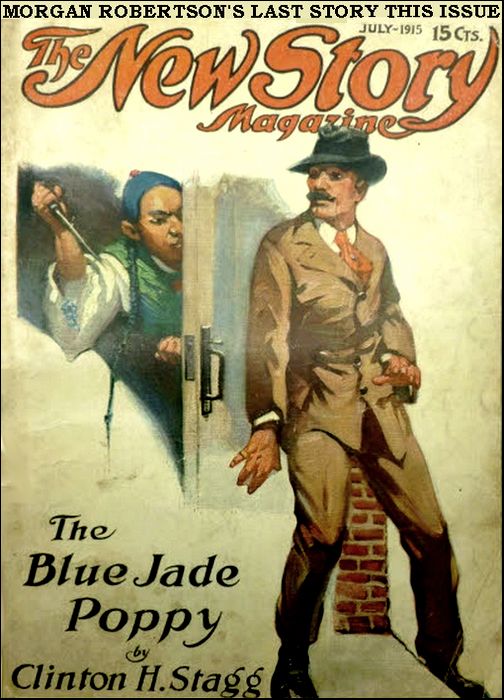
The New Story Magazine, July 1915,
with "The Rajah's Mascot"
"I MAY be wrong," said Mr. Smiler Bunn one morning as he sat solemnly down to breakfast, "in fact, I'll go so far as to admit that I probably am wrong, but all the same I must say that I consider red mullet to be the king of fishes. I know all about salmon and sole—and, speaking for myself, I reckon they are overrated fish, especially sole. A nice pound and a half sea trout is a very delicate and eatable fish—very suitable to women, I should say—and, of course, there's a good word to be said for a picked turbot, properly cooked and served. But when all's said and done I put my money on a two-pound red mullet, tenderly baked in papers and served with strips of anchovy and some of Sing Song's patent sauce. I don't know where he learned to cook 'em, and I don't particularly care. But he's a wonderful man in a kitchen, Sing Song. What do you think, Fortworth?"
Ex-Lord Fortworth unfolded his napkin.
"I agree with every word you say, Flood." (Mr. Bunn had long ago become Mr. Wilton Flood, gentleman of private means.) "I've only got one fault to find with the way Sing Song serves red mullet."
Mr. Bunn looked surprised.
"Oh—what's that?" he asked.
"He's such a long time about it! We've been waiting here the greater part of two minutes," complained Fortworth.
Sing Song entered with a tray just as his master's partner finished.
"Solly take long time, master," he said. "Postman baling legist let tel. I take—sig nee name for take. Wastee time."
He brought a letter to Smiler and deftly began (o serve breakfast.
Mr. Bunn stared at him sternly, and the Chinaman observed instantly that something was wrong.
"Master? " he asked apologetically.
"Is this a time for correspondence, you banana-coloured blackguard?" said Mr. Bunn very severely. "Have I got to read letters at breakfast now? What's wrong with you, anyway, Sing Song? Have I been a bad master to you for you lo try to put me off my breakfast like this? What's the matter with you this morning?"
Sing Song hastened to remove the offending letter, and the important function of breakfast got safely under way.
About an hour later, when the two friends were comfortably settled down with cigars in easy-chairs by the big window of the flat—they were spending a few days in town—Smiler leisurely broke the seal of his letter, and proceeded to read it with all the attention he could spare from his cigar. It was from Smiler's brother, Tony "Bohun," of New York. Tony, in the days of his youth, had been something of a "crook" himself. But when he met Fanchon Grey, a certain attractive lady detective who was engaged in watching an American adventuress, one Kate the Gun—whom for reasons of their own both Tony and Smiler had been watching too—he had given up living on his wits, and, incidentally marrying Fanchon Grey, he had settled down in New York to work for Westerton's, the great American detective agency, with whom his wife was employed.
Tony was writing now to inform his brother that he and Fanchon had just "arrested" a very fine boy—who sent his love to his Uncle Smiler; that he, Tony, was sufficiently well appreciated, financially, by Westerton's to render it unnecessary for Fanchon to employ herself with any other but her home duties; and, finally, after giving the news generally, to repeat a message from Kate the Gun to Smiler. Tony wrote:
Kate is, as you know, in gaol for life, or, at any rate, the next twenty years. Anyway, she is out of the 'crooked' game for fair. I was working up a case the other day and found it necessary to see her. I visited her and had a talk. She's pretty cheerful, and somehow or other has qualified for the enjoyment of most of the 'privileges' to good little convicts included in the regulations, as well as, from what I could gather, a good many privileges that are not mentioned in the regulations. She's got the unique gift of looking well in prison clothes—about the only person I ever heard of who could do it— and she makes the most of it. She's a clever bird, and I believe she was speaking the truth when she said she looks on prison as an interesting sort of 'club.' She asked me how you were getting on, and said the worst mistake she ever made in her life was in working against you when you clashed in England. She said that she could see now that she ought to have married you, even if she had to chloroform you to do it, and take a wife's place—second—in the household. You would have made half a million between you, she reckoned. Then she gave me a message for you. I'll tell you frankly, Jack (Smiler's full baptismal name, if ever he had been baptized— which was doubtful—was John Bunn), that it sounds fishy to me, and I advise you to keep clear of it. Don't forget that ninety-nine crooks out of a hundred land in the salad-basket sooner or later, no "matter how smart they are. Still, here's the message. Kate said: 'Tell him from me that the Grand Smoke from India who lost his memory wears on his body most of the time a kind of charm which is a mascot. If he happened to lose the mascot he'd pay hundreds of thousands to get it back, for it's an heirloom that's handed down from one Smoke to the other, and it's a belief in the family that when the mascot is lost the Throne of the Smokes will pass out of the family. The mascot is a big, flatfish emerald with a Chinese dragon carved on it. They call it the "Key of the Kingdom" in India.' That's the message. I don't say I know just what it means, but I can guess near enough. Take my tip, Jack—leave that 'Smoke' alone. There are keys to other places than kingdoms."
And with further expressions of warning Tony's letter concluded.
Smiler re-read the message from Kate the Gun.
The Grand "Smoke" from India obviously meant the Rajah of Jolapore—a gentleman with whom both Kate the Gun and Smiler, especially Smiler, had come into very close contact some years before.
Kate the Gun had made a determined attempt to kidnap the Rajah, who had been saved by Mr. Bunn, much, it may be added, to Smiler's profit. Since that time Mr. Bunn had conducted one or two remarkably expensive failures for the Rajah, but of late years they had not met. Indeed, Smiler did not know whether the Rajah was now in England or India.
He handed the letter over to his partner with a few words of explanation, and rang for Sing Song.
That bland Celestial was able instantly to set his employer's mind at rest on the point.
Interrogated in Mr. Bunn's briefest and most pointed manner, he did not engage in his occasional propensity to beat about the bush, but answered as he was requested to do, "fully and freely and very quick about it." So that by the time he was dismissed and Fortworth had finished the letter, Smiler was pleasantly aware that the Rajah of Jolapore had arrived on one of his periodical visits to England a month before, and had taken up his residence in a furnished mansion belonging to the wealthy descendant of an old Scotch family named Stuart-Levy. Further, he was assured by Sing Song—who seemed uncannily familiar with the movements of the Royal plutocrat and his satellites—that the Rajah's favourite and confidential attendants, Mirza Khan and M. Lucien Santoin, were with him, and apparently still in high favour. Both of these gentlemen he had encountered before—indeed, he had once been reluctantly compelled to share a portion of certain plunderings from the Rajah with Mirza Khan.
Fortworth handed back the letter.
"Clever woman, that Kate the Gun," he commented.
Smiler nodded.
"Clever, but inclined to be a bit severe," he agreed. "Left a poisonous snake in a purse for me to open once."
"Gee! " Fortworth looked surprised. "Did you open it?"
"With the tongs," said Mr. Bunn, smiling gently at the recollection.
"Kill the snake? "
"Sure—flattened the animal out with the shovel, and returned it to her with thanks." Fortworth laughed.
"How about this mascot?" he asked. Smiler rose.
"I've got an idea. You take it easy for a bit while I call and see the Rajah. Half a minute, though."
He rang for Sing Song.
"Master?" inquired that worthy as he entered briskly.
"Look here, Sing Song, if you found a jewel with a dragon carved on it, which do you reckon it would be—an Indian jewel or a Chinese jewel?"
Sing Song considered.
"Pelhaps India, pelhaps China jewel. Not know. How can tellee?"
"What sense is there in that, you yellow image?" demanded Mr. Bunn hotly. "You're Chinese, ain't you? Do you mean to tell me dragons are as popular in India as they are in China? I don't want lies, my lad—truth is what I want from you, even if it dislocates your jaw. Come on, now, let's have the truth. If you knew of an Indian man who wore round his neck a very valuable emerald with a dragon carved on it, wouldn't you know for a fact he was wearing a bit of Chinese property?"
Sing Song's beady eyes brightened up as he saw now which way the wind blew.
"Yes, master! " he said.
"If it was an elephant carved on it, then it would be an Indian jewel, and probably belong to the man. But, being Chinese—which is proved by dragons being Chinese animals mostly—then it stands to reason that he's wearing stolen property round his neck, don't it?"
Apparently neither Fortworth nor Sing Song saw anything shaky about this rickety piece of logic, for they both agreed.
"Well, this jewel being valuable, it must have belonged, in the first place, to a very rich and powerful Chinese gent—or family, say. That's correct, ain't it?"
"Yes, master."
"And this Chinese gent, being a bad parter, like all you Chinks are, he'd naturally try to recover his jewel, wouldn't he?"
"Yes, master."
The gleam in Sing Song's eyes was brightening, and Fortworth was looking very interested.
"Well, how would he set about it, Sing, my son?" asked Smiler. "You get off to your work and think it over. There's no hurry, so don't explode your brain over it. We'll hear your ideas when I get back. You can hook it now."
SOME fifteen minutes later the big, luxurious Bunn-Fortworth motor pulled silently up outside the Rajah's residence in Park Lane, and Smiler alighted therefrom, unusually well groomed and prosperous-looking.
He was shown into a small but elaborate reception room; it occurred to him that a door closed softly on the other side of the room as he entered.
"Same old game," he said to himself. "Now, was that one of Mirza Khan's spies spying on Santoin, or one of Santoin's spying on Mirza Khan? Or both spying on me, damn 'em!"
He had barely propounded his little problem before M. Santoin entered—a discreet, middle-aged Frenchman, with rapid eyes and the slightly-hooked nose that is characteristic of people who hold on to what they have and are usually on the look-out for somebody else's.
M. Santoin recognised Smiler instantly. He had only seen him two or three times in all his life, and not at all for over five years, but M. Santoin never forgot a prosperous face.
"No—but, yes—indeed, it is the distinguished Mr. Coomber Huish," he said, with a pleased cordiality that to Smiler was only a little less sincere than his smile.
"Coomber Huish " was the name by which Mr. Bunn was known to the Rajah.
"Correct, Santoin. How are you? I've just come to pay—"
"Pay!" Santoin dropped his voice. "Not so loud, I implore you, monsieur. I am authorised to receive payments on behalf of—"
"To pay my respects to His Highness," said Smiler loudly. "Respects, not money, Santoin," he added.
"Pardon!" said Santoin eagerly. "But it is so difficult. Listen to me, Mr. Huish. This house is half filled with the spies of that barbarous yellow rat, Mirza Khan—I warn you most earnestly and sincerely to avoid that villainous one—he is traitorous and cunning. Now I, you will see very well, am a simple man, and very honest—"
The door opened softly and a large fat native in English dress came in. It was Mirza Khan—who had once accompanied Mr. Bunn on a mission across the Atlantic on behalf of the Rajah.
"Oah, thiss is Mister Huish!"—like Santoin, he pronounced it "Ouees"—"I am delighted to see you again, sar. I hope thatt you are in the enjoyment of good health."
Smiler responded fittingly, and they shook hands gravely.
Santoin disappeared unostentatiously, and Mirza Khan smiled.
"That crocodile has crawled away to announce your name to His Highness," he said blandly. "Beware of him, Mister Huish. He iss a bad man—so veree treacherous. He iss snake and jackal att the same time. Whatt do you contemplate on thiss occasion, my dear Mister Huish?" (Mirza Khan had helped Smiler rob the Rajah before, and it seemed that he took it quite for granted that Mr. Bunn's presence heralded another coup, in which, as before, he would be invited to participate.)
Smiler shook his head.
"Call and see me to-night, old friend," he said, giving his address, and Mirza Khan faded quietly out of the apartment as Santoin, all smiles, entered.
"His Highness has not forgotten you, Mr. Huish. He is pleased that you are here." He dropped his voice again. "To me also it is a great pleasure to make your acquaintance. You will not forget that I am your true friend, Mr. Huish; but beware of that bloated, devouring vampire, Mirza Khan."
"Oh, give it a rest, Santoin!" said Smiler impatiently, the complex intrigues of the two palling on him. "You look after me and I'll look after you, see. Come on!"
Santoin gave a twisted smile, and ushered the visitor in to the Rajah.
The five years which had elapsed since their last meeting did not appear to have vastly improved His Highness.
Never what Kate the Gun would have called a "good-looker," he had aged considerably. He had grown stouter, and he seemed tired and bored. He had pouches like martins' nests under his eyes, and looked dissipated. He was alone, except for a quart bottle of champagne and a bottle of liqueur brandy—but, on the whole, he seemed satisfied with his company.
He brightened up a little when he saw Smiler, and waved him to a big, baggy chair.
"How do you do, Mr. Huish?" he said in his precise English. "My memory has not left me again, you see."
"No, Rajah. I congratulate you on it." Mr. Bunn smiled. "I doubt if you've had another adventure like it since," he added.
The Rajah laughed.
"You are right, Mr. Huish. I have not. I have enjoyed many little adventures since then but not another like that. I find things dull."
"Well, most rich men do," said Smiler—reflecting that if he did not considerably liven things up for the Rajah he was several kinds of Dutchmen. "Have you explored London yet? Or is Your Highness one of the fair-weather birds?"
"Fair-weather birds, Mr. Huish?" repeated the Rajah, puzzled, and indicated the refreshments. Smiler rose.
"That's it, Rajah," he said, pouring about a gill of the liqueur brandy into a large glass, and filling it up with champagne—the pleasing blend (according to the thirst and capacity of the blender) known as the "King's Peg" resulting. "That's it a fair-weather bird, by which I mean a gentleman of leisure, who takes things easy. Or are you one of those who like to see things? Mix with people incognito, sort of, you understand."
The Rajah looked interested.
"Something new is what I want to see." He made a gesture of weariness. "Mr. Huish, I have travelled a great deal, and I think I have seen everything there is to see. Just now I am persuading myself to believe in the occult; but it is slow work. I like change—adventure—new experiences. But as yet I have not found it in the occult."
"Occult be blowed!" said Mr. Bunn politely, and added hastily, "if Your Highness will permit me to say so. Nix on the occult, Rajah!" Then he had an inspiration. "Have you ever been to a highbinders' ball?"
The weary eyes brightened.
"A highbinders' ball?"
"That's it, Rajah. Of course, I don't mean an aristocratic affair—but a plain, straightforward Chinese secret criminal society's festival. I tell you frankly that's what I'd recommend to a gentleman in search of a new experience."
The Rajah pondered for a moment. Then he said:
"It should be amusing, Mr. Huish. Perhaps you could show me one. You understand that I despise these yellow dogs, and cannot permit myself to approach them too closely. But—if it is amusing—no doubt you could arrange for me to witness the festivities without mixing too freely with the animals. Will you see to it, Mr. Huish? Arrange it with Mirza Khan," he said lazily, touching a bell, and Smiler perceived that the interview was at an end. He rose briskly.
"Very well. Glad to oblige—any little thing like that any time, Your Highness. Good day!" he said, and permitted Mirza Khan, who had appeared, to conduct him from the apartment.
Mirza Khan seemed perturbed.
"You have been overheard by at least three people, Mister Huish," he whispered, in the corridor outside. "Thee bloodsucker Santoin, he has overheard you, and certainly thee Madame Zeliny has listened. I, myself, heard every word thatt you said to His Highness. Thiss iss a rabbitt warren—there have been constructed spy-holes att all corners."
Smiler gazed placidly at his companion.
"Oh, has there?" he said. "I'm glad to hear it, Mirza, old man. Nothing like having a few witnesses about when you are honest and straightforward and mean well. Take it from me, my lad."
Mirza Khan looked puzzled.
"Oah, yess," he said vaguely, and saw Smiler into his motor.
"I shall be att your flat att nine o'clock," he said, noted the address, and, with a florid bow, stood clear.
It may be explained without tedious delay that to Smiler Bunn a "highbinders' ball" meant very much the same thing as a pickpockets' soirée or a burglars' Cinderella—he had never heard of any of them. But neither he nor his partner, ex-Lord Fortworth, were the men to let a detail like that distress them. On the other hand, they smiled understandingly at each other when Smiler had finished his account of the interview, and rang for Sing Song, who came expectantly.
"Now, Orange Blossom," said Smiler cheerfully, "pull yourself together and get ready to think. Are you going to the highbinders' ball on Thursday night?"
For once in his life Sing Song's imperturbability was jolted.
"Highbinders' ball, master?" he said, utterly at a loss—and not without reason, for the habits of the highbinder are not pronouncedly adapted to use in England, and, consequently, the true highbinder is not to be found in large quantities in this country. Briefly, "robbery with violence" may be described as the backbone of the highbinders' penile art. The highbinder is a man who will collect a number of kindred spirits and form them into a society which he calls a "tong," and which, in reality, is a limited liability company which depends for dividends on the successful carrying out of crime—violently if necessary. There are many different criminal "tongs" in China—and a pleasant feature about the policy of each "tong" is its fixed determination ultimately to wipe out of existence all other "tongs." The profession of highbinding being practically confined to China and cities which are unfortunate enough to possess a very large Chinese quarter, naturally Sing Song was astonished to learn of the forthcoming highbinders' ball. He himself was a member of a "tong" whose headquarters were in Canton.
"Highbinders' ball, master?" he repeated, perplexed, knowing that there was no highbinder "tong" in London.
Smiler wagged his head.
"That's it," he said. "Master of ceremonies, the well-known and popular Mr. Sing Song." Then suddenly dropping his playful tone, he gave the Chinaman his instructions.
"We've invited a friend of ours to see a highbinders' ball, d'ye understand, and your job is to provide one—see? And a good 'un, my lad. We don't want any silly excuses. You've got to collect your friends together and make a ball of it. We'll foot the bill, and we shan't scrimp you. Any expense in reason we shan't mind, but we shan't have any mercy on any funny business. I pay you a good salary—your business is to earn it, not put forward a lot of difficulties. I understand all about the shortage of genuine highbinders, but we don't want the genuine article at all. Wouldn't have 'em at any price. Get a few Chinese dock-labourers, or laundry men, or stokers, or any of the stiffs you're so friendly with—we don't care, we'll leave it to you. See about it, my son. You can slip it now. We'll give you further instructions to-night."
Sing Song "slipped" it, as requested, and the two partners proceeded to plan certain details.
PUNCTUALLY at nine o'clock Mirza Khan arrived and was admitted by Mr. Bunn in person—Sing Sung being absent, presumably arranging for the forthcoming activities.
With a large, bland disregard for the prohibitions of his religion—if he had one—Mirza accepted a liqueur brandy, a somewhat hefty cigar, and a very easy chair. Then, comfortably settled, he turned to Smiler and asked him what his "plan" was.
"Well—have you ever heard of a jewel called the 'Key of the Kingdom,' Mirza?" asked Mr. Bunn.
Mirza looked a little staggered. This was high-flying, even for him. But he pulled himself together manfully.
"Oah, yess, indeed. But thatt is impossible, I tell you. It iss the Good Fortune of the State, you understand," he said anxiously. "It iss very impossible to steal thatt. It iss killing the goose that lays thee golden eggs, I can assure you, Meester Huish. Itt iss very well-established thatt if His Highness loses the Good Fortune of the State he will lose his throne. Oah, yess, I tell you there iss no question as to thatt. I have gone into it long ago .very closely. It would be better to let sleeping dogs lie."
Fortworth stood up with his characteristic gesture.
"Oh, that be damned for a tale!" said he freely. "You're superstitious, Mirza Khan. We don't want to keep the jewel. We want to borrow it until the Rajah offers a thundering big reward for it. See? We daren't lose it, or we lose the reward. D'you get that?"
The face of the native lighted up.
"Oah, thatt is horse of another colour," he said. "Thatt is much simpler. It iss not proposed to break the luck of the kingdom "
"Break it! Not likely—only to bend it a bit," threw in Smiler jocosely. The three drew together, and were about to smooth things out a little when the door bell rang.
Without a sign of hesitation, and without flurry or haste, Mirza Khan rose softly, pitched his cigar in the fire, took his glass, and passed through the door into the dining-room. It was all done in absolute silence—but the silence was as eloquent as many words.
Smiler Bunn went to the door and admitted the caller. It was Professor Vahana—the occult merchant and faker who had almost stolen Lady Fortworth's jewels on the occasion of her flight from the Park Lane mansion when Lord Fortworth was ruined—the palmist and phrenologist whom Smiler had met many years before under the name of La Touche.
"Come in!" said Smiler, and Vahana came softly in, his quick, famished eyes taking in the room and its contents at a glance.
"Greeting, gents!" he said, in his glib, hurried way. It was only when talking with lucrative clients that he took pains with his speech and grammar. "All alone, I see." He sat down with his secret, wolfish smile. "I thought it was about harvest time for a talk with you two gents." His voice rose a little, like that of a man with a grievance.
"Talk on, then," said Smiler, pushing the cigars over to him. Mr. Bunn was ever hospitable.
"Well, now, you two are gonna git your hooks unto my Rajah some way, and I wanta ask you how you make out that to be the right thing to me. You two, you stand in my way every time. I don't stand in your way. I don't come snoopin' round your clients when they's gettin' woolly for the shearin'. You two, you done me outa Lady Fortworth's jools; and you"—he turned bitterly to Smiler—"you threw me down over them Suffragette jools, years ago—and now you're layin' out your traps for my Rajah. And I wanta tell you it ain't the right dope. And I wanta know what you're gonna do about it. You oughta let me in with, you, or you oughta stand back until I've got my wad outa the Rajah. I'm gettin' my occult dope in lovely, and he's fallin' to it like ripe fruit. Gimme a week with him and I'm done. I don't know what kind of gold brick you're fixin' for him, and I don't care. But it ain't the occult stuff, and so he'll fall for it after I've soaked him just as well as he would before I get my simoleans safe in the bank. That's fair, ain't it?"
He looked at the partners with a touch of anxiety in his eyes.
Fortworth was already looking at the door, and his lips were opening, when Smiler cut in.
"I don't see where we clash, Vahana," he said. "You go your way—we'll go ours. First come, first served. We ain't out to spoil your business. Do what you like—only keep out of our way."
He stood up. Vahana nodded doubtfully.
"All right," he said. "I gotta trust you, I suppose—but it's a strain."
He took his hat and slid out of the flat, a living picture of mistrust.
"That's a nasty, cunning crook," said Fortworth. "I don't like him any more than a snake. He'll queer us if he can."
"Oah, yess," said Mirza Khan from the doorway. "But I do not think that he can do much harm. I will keep watch upon him and his wife, Madame Zeliny."
"That's all right, then," said Smiler. There was a modest tap on the door, and Sing Song entered. "Here's the master of the ceremonies. Did you fix it, Sing?"
"Yes, master." The eyes of the Chinaman twinkled. "Velly nice fix it."
"Good lad. Listen now, Mirza," said Smiler, and the four conspirators drew close, talking in quick whispers.
THREE nights later a big motor slid from the entrance to the Rajah's house and rolled quickly away towards the docks. Inside sat the Rajah, Lord Fortworth, and Mr. Bunn. It was nearly ten o'clock, and each of them was a trifle "lit up " with the Rajah's favourite beverage.
Next to the driver sat the large, dark-hued Mirza Khan.
All were in good spirits—especially the Rajah. Quite apart from the bottled exhilaration he had consumed, the Rajah was delighted at the prospect of seeing something really new—of enjoying a fresh experience. Mr. Bunn had explained to him in detail exactly how a highbinders' ball usually finished. Starting quietly, even tamely, the festival was likely to proceed rather in the style of a traction engine out of control proceeding downhill—softly at first, but finishing with a bump. The thing that interested the Rajah most was the possibility of seeing one or two fights. The average highbinder, Mr. Bunn had explained, is very ready to fancy himself offended or insulted, and when this is the case he invariably makes a point of showing his insulter where he is wrong—with his knife. On these occasions nobody interferes—it would not be considered good taste. The two are left to settle it between themselves. The best carver wins. And it is to be feared that the Rajah looked forward to witnessing a combat or so. Outwardly he was extremely civilised; but he came from a long hue of ancestors to whom "blood" in one way or another was a necessary part of the scenery.
Not even Mirza Khan noticed that the car was followed by a silent, stealthy-running, black electric car, containing M. Lucien Santoin and Professor Vahana and Madame Zeliny, the spiritualist couple who had been attracted to the Rajah.
Once beyond the city, Mr. Bunn piloted the driver through a maze *of vague, gloomy streets, and eventually the car was pulled up at a tall old house on the edge of the river. This was the residence of a friend of Sing Song's and Smiler's, one Chung Loo, who used it variously as a boarding-house for Chinese, an opium den, a fan-tan club, and doubtless for any other purpose that exigency demanded. To-night, apparently, it was to be the scene of the highbinders' ball. Few people who did not know the place would have dreamed of its vast, warren-like extent. It took in several houses on either side of it, and was catacombed below with cellars. Despite the hive that it was, there existed in the region of the docks no house more quiet or respectable—from the outside. Chinamen, quick, absorbed, quiet, streamed in and out at all hours of the day and night. Now and then a couple of detectives might go unostentatiously in and, after a while, appear with or without a victim, but these were very rare occasions.
The Rajah and Fortworth stepped into the house, and Smiler, waiting only to direct the chauffeur to the place at which he was to wait, followed them. Mirza Khan brought up the rear.
Chung Loo, the proprietor, an aged scoundrel with a veil of wrinkles, received them, bowing to the ground, mumbling of the overpowering honour which was being done his poor house. He deputed Sing Song, who appeared to be a total stranger to Smiler and Lord Fortworth, to show the distinguished visitors the sights, and retired to his everlasting account-books in a recess at the side of the entrance "hall."
The party went downstairs in search of the highbinders.
Hardly were they out of the hall when the electric car that had followed their motor stole to a standstill outside, and Vahana, Santoin, and Madame Zeliny came in. Chung Loo stepped hastily from his recess with outstretched hand. But it was not for a friendly grip that he extended his hand—it was for something white and crinkly, that rustled as it passed from Vahana to the Chinaman. He counted the notes, nodded, put them somewhere in his clothes, and beckoned them to follow him. He took them upstairs and ushered them into a sort of dressing-room. Then he went away.
When, a quarter of an hour later, he returned, an excellent imitation of two Chinamen and a Chinawoman awaited him. Professor Vahana was expert in the art of making up.
Now, what we gotta do is to separate and keep our lamps open for the Rajah and those grafters that brought him here. You two can mark off the fats—Mirza Khan and Flood—and I'll keep me gimlets on the Rajah and Flood's pal. They got him here on some plan of their own—I don't know what it is, but mebbe we shall spot it. Keep circulating about the house, and don't talk more than you can help. Perhaps there'll be nothing doing-—all the better for us if there ain't. You go first, Santoin."
Without frantic enthusiasm the Frenchman shrugged his shoulders and moved away down the stairs.
Vahana whispered to his wife as they watched him disappear.
"Keep an eye on him, too, Belle," he said. "And I'll watch all of you."
Madame Zeliny laughed and followed Santoin. Vahana allowed her a few seconds' start, and then "pottered along also," as he expressed it.
Meantime, East and West, represented by the Rajah, his companions end attendant, were discovering for themselves the joys of a highbinders' ball, with Sing Song—whose role was that of guide, philosopher, and friend—pointing out and explaining. No one would have imagined that he was the same Chinaman as the deferential man-of-all-work at Smiler's flat. He, too, had done a little making-up.
Highbinders, it would appear, required about forty small rooms for a "ball" and half a mile or so of stairway, instead of the more usual eighth of an acre of polished floor with a buffet within easy reach and supper-room round the corner.
In the first room to which Sing Song introduced the sightseers a man was juggling gravely, watched by a dozen or so wooden-faced Celestials who resembled laundrymen more than highbinders. They watched him for a moment, until it became clear that he should have been driving a dust-cart rather than breaking crockery.
"He's too petrified about the funny-bone to struggle," said Lord Fortworth, and with one accord they moved on to a room where two yellow toughs were wrestling. This couple were not particularly skilful, but they were very much in earnest. Just after the Rajah's party entered the larger of the two got his opponent down and, putting a hand like a ham across his face, held him for a moment and glanced round for approval. It was a mistake, for as he looked up the under man took a mouthful of hand between his teeth and chewed on it passionately. The big Chinaman let out one yell and wrapped himself about the biter like a crazy octopus. His friends began to help him, and the friends of the under man sailed in to do some biting on their own account.
The Rajah brightened up a little.
"What comes next?" he said gaily, as they backed out from the yellow peril and left them to settle it among themselves.
Sing Song led them in quick succession through an apartment where a girl was dancing what was described as an "opium dance," which seemed to consist of spinning like a top on one foot and moaning like wind in a keyhole as she spun; through another, where a dozen biggish men were doing a hatchet dance—these were what Sing Song described as the "hatchet men" of the highbinder "tong," and did the killing. They looked as though they were more accustomed to handling coal-shovels than hatchets—and it is probable that they were, for the hatchet of one of them slipped and half-stunned another of them. That appeared to conclude the entertainment, but Sing Song pointed out that this was a part of the programme—not an accident—and the Rajah brightened up still more. They stepped out on the stairs into the middle of real trouble. Two Chinamen had been sitting in a landing corner, gambling, and one, it appeared, had lost fourpence and was ruined. He accused the other of cheating, and had taken him by the throat and one ear to prove it. The "cheat" had clawed an ugly knife out of his clothes, and was on the point of using it, when the rotten, age-old stair-rail broke under their weight and let them down a storey or two with a crash. They got up dazed and looking foolish, and slid away to get whatever they had broken attended to. The Rajah, who had evidently left a good deal of his civilisation at home, laughed immensely. His sense of humour was a development of that sense of humour which makes people laugh when a comedian carefully explains on the stage how he drowned his mother-in-law, or how his landlady gets kicked by a horse.
Nevertheless, Smiler decided that Sing Song had not done so badly, considering his brief notice to prepare the "ball. He had fixed up enough novelties to convince the Rajah that evidently some sort of festival was in progress, and that was all Mr. Bunn cared about.
AFTER an hour of the huge, swarming rabbit-warren they adjourned to the refreshment room—a big, underground place with curtains and lounges. There were several Chinamen there, and they cleared out as the party entered, in response to a sign from Sing Song. Two others came in while Sing Song was attending to certain bottles. He made them a similar sign, but they ignored it, and sat down on a lounge in a corner, stolid-faced.
Into the beady eyes of Sing Song as he furtively watched them came a sudden gleam, and for a moment he grinned to himself. The light was not good—but it was good enough for Sing to see their make-up, Mr. Bunn had warned him to look out at all times for Vahana and Santoin. He did not know who these two imitation Chinamen were, but that did not disturb him. He intended to take care of them in case of accidents.
So, having placed champagne and liqueur brandy before the Rajah and the two partners—Mirza Khan's duty, it seemed, was to carry the Rajah's coat and keep in the background—he proceeded to do the same for the two in the corner. He did not speak to them—merely set out the refreshment and left them.
"Well, Rajah, does it amuse you?" asked Smiler, raising his glass.
"For one evening, yes. It is a new experience," said the Rajah, and drank deep.
Smiler and Lord Fortworth followed his example and the two men in the corner did the same. Never the kind to refuse what looked like free refreshment—Sing Song, they imagined, had mistaken them for members of the Rajah's party—and noting that both Mr. Bunn and Fortworth had drunk from the same bottle, they emptied their glasses with the air of men who appreciated a free drink.
Two minutes later five men slid gently off their seats to the floor sound asleep, and Sing Song stole across to them, smiling blandly.
"No tastee, no smellee, makee sleepy quick—velly good dlug," he said softly, dropped on his knees by the Rajah, and slipped swift fingers under the coat and waistcoat of the drugged man.
There was a moment's pause—then the Chinaman passed something to a pocket, something that shot out a brilliant green ray as for the fraction of a second it caught the light.
Some one stole into the room, and Sing Song turned swiftly, looking over his shoulder like a startled cat.
It was Madame Zeliny, and she had a neat, nickel-plated repeating pistol in her hand.
"If you touch any one of those men," she said, "I will shoot."
And it sounded truthful.
Sing Song rose slowly from his crouching attitude. There was a moment's pause—both were thinking—but the Chink thought quickest. He did not know who this woman was, but he guessed her to be the Madame Zeliny Mr. Bunn had warned him to look out for. If that were so, he thought like lightning, she was the wife of one of the two uninvited guests he had drugged. He decided to test her—to lure her away from between him and the door. Sing Song noted that the little pistol was held very steadily, and he somehow felt a longing for that door. There was a look in the eyes of the woman that made him think of doors—of going through them. He seemed to picture himself taking the threshold in his stride. And so he pointed to the sleepers.
"These gentlemen all velly ill," he said very gravely; these two gentlemen"—his finger indicated Vahana and Santoin—"dead."
"Dead!"
The woman darted across to Vahana—there was a streaking flicker at the door, and the company was one short. Sing Song was well on his way out and home—and the Key of the Kingdom was with him.
But Madame Zeliny was calling upon her husband to wake. He did not wake—but he began to snore. She rose wearily—she recognised the snore. It was the snore that Professor Vahana used after what he himself would have termed, variously, a "jag," or a "souse."
She looked at the champagne and brandy—and thought she understood. She had missed her confederates an hour ago while watching Mirza Khan, and had only just discovered them. And she knew what her husband could do in half an hour if the wine was red.
She did not know what the rival group had been after—for even Santoin did not guess that Messrs. Bunn and Co. would soar as high as the Rajah's mascot—but she knew that they were all out of action for the next few hours—drugged, drunk, or merely tired. They slept like a chorus of car-hooters.
A bland, large voice spoke from the doorway.
"Oah, dear me, thiss is veree bad indeed, there can be no question ass to thatt, Madame. Soa veree intoxicated—"
Mirza Khan—she had forgotten him—strode statelily into the room. Waiting outside for his master, he had met Sing Song taking the stairs like a yellow rocket, and got a fact or two from him.
He shook his head.
"His Highness will attach blame to me, madame. Thee champagne is Chinese brand, I suspect."
He sniffed at the glasses, nodded, and took a water-bottle and glass from a table. He poured a few drops of water, and added to it the same quantity of a colourless fluid from a phial he produced. This he deftly insinuated between the Rajah's teeth.
In less than a minute it was obvious that if Sing Song knew the right drug for the affair he knew also the antidote. He had handed the phial to Mirza Khan on the stairs.
The Rajah sat up.
"Now the others," said Madame Zeliny.
But Mirza Khan ignored her. It was important that the Rajah should see with his own eyes that the others were drugged. That was the keynote of the whole plan.
He saw them satisfactorily—-indeed, with his own black but royal hands he helped bring them round.
Air was what the Rajah and Mr. Bunn and Lord Fortworth desired—fresh air and at once, cubic miles of it. And leaving the two "Chinamen" reviving under the ministration of the "Chinawoman," they went upstairs after it.
Not till they were all three in the motor—with Mirza Khan on the box—did the Rajah miss his emerald mascot. Then he went frantic—he demanded the police, the army, anything, everything! Whatever happened, the Key of the Kingdom must be recovered! He would give lacs of rupees for it back—of pounds—fortunes! They managed to quiet him without it I meting the police; and, looking him firmly in the eyes, Mr. Bunn spoke:
"Rajah, as man to man—listen to me. Your jewel—why ever did you wear a jewel like that to-night?—your jewel is back in that Chinese Paradise somewhere. One of 'em's got it. But which? There are hundreds of 'em there, and they all look alike. Put the police in and they scatter all over the globe, and your jewel is gone. Now I've got a pull—I've got influence over those Chinks—and I guess I can get it back—with time and money. I say to you earnestly, as one man in another, leave it to me and I'll guarantee that if it's possible for a human being to get the stone hack I—am—the—man—who—will—get it! Rajah, I'll find that man if it costs a million! It's your only chance! Will you take it? Leave it to me and I'll find that man; refuse, and I wash my hands of the whole affair. Yes or no, Your Highness—as man to man!"
The Rajah stared into Smiler's eyes, hesitated, and finally nodded.
"Yes," he said. Smiler stiffened.
"Right!" he said. "Stop the car. I'm not losing any time on this. I'm going to find that man before I sleep." He looked at Fortworth. "I shall need you, comrade," he said.
They alighted.
"I shall call to-morrow and report progress, your Highness," he said, in the cold, firm voice of a man embarking on a hazardous adventure. Then, more cheerily, "Good-night—and don't be downhearted. I shall run that man down."
The car rolled on.
The partners watched it disappear—and then, by side streets, made their way to the place where taxi-cabs were to be found.
"It's all right," said Smiler. "We pulled it off. I had six words with Mirza as we came up the stairs. That Chinawoman nearly spoiled the whole scheme—she was Madame Zeliny—but Sing Song was too quick for her." He lighted a cigar. "That's a fine drug. I feel fit to eat a horse. I didn't much fancy taking the dope myself— but it was the only way. The Rajah can't suspect us, for he saw us unconscious. But now for tracking this jewel thief to his lair."
They got their taxi and proceeded to "track" in the direction of their flat.
Sing Song was there—in his lair, the kitchen—preparing a brilliant supper. He handed over the mascot as though it were no more than a potato.
"Thank'ee, my lad," said Smiler, taking it. "Get ahead with the supper—we're starving." He patted the Chinaman on the shoulder. "You're a good lad, Sing," he said affectionately. "I'll take care of you, old man—and don't forget it. Meantime—supper's the word."
"He's a useful cuss," said Smiler as they went h> the dining-room. "Only it don't do to spoil him. I suppose the Rajah'll be good for about twenty thousand cold coin when we return this stone. And Mirza'll be satisfied with five thousand—he'll have to be, in fact."
AND, when the subsequent settlement took place, he was, notwithstanding the fact that the Rajah proved more generous than the partners anticipated. But then no doubt he slightly over-rated the danger and difficulty of getting it away from the agents of the powerful Chinese family to whom (explained Smiler) the jewel had belonged some hundreds of years before it had passed into the hands of the Rajah's ancestors. As for the cheque which the Rajah sent them later, it was so large that it made them laugh. They always had a rare sense of humour, the Bunn-Fortworth Combination.
Roy Glashan's Library
Non sibi sed omnibus
Go to Home Page
This work is out of copyright in countries with a copyright
period of 70 years or less, after the year of the author's death.
If it is under copyright in your country of residence,
do not download or redistribute this file.
Original content added by RGL (e.g., introductions, notes,
RGL covers) is proprietary and protected by copyright.