
RGL e-Book Cover
Roy Glashan's Library
Non sibi sed omnibus
Go to Home Page
This work is out of copyright in countries with a copyright
period of 70 years or less, after the year of the author's death.
If it is under copyright in your country of residence,
do not download or redistribute this file.
Original content added by RGL (e.g., introductions, notes,
RGL covers) is proprietary and protected by copyright.
RGL e-Book Cover
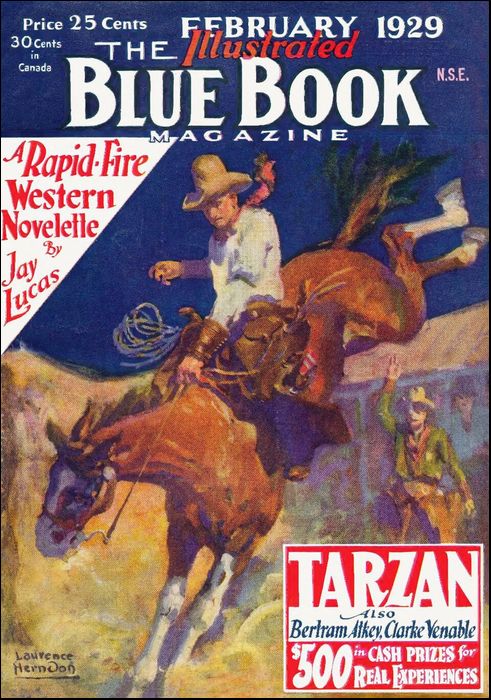
The Blue Book Magazine, Februay 1929, with "The Assegai"
A specially interesting adventure of those two jovial companions in crime and gourmandizing known as the Easy Street Experts.
IT is practically certain that neither of those two portly old rascals The Honorable John Brass and his partner Colonel Clumber would ever have heard of that dangerous, pink-faced, plus-foured party who called himself Mr. Guy Gaunte had it not chanced that on the evening they made his acquaintance they happened to have in the secret safe installed at Purdston Old Place (their secluded country-house on the Surrey-Hants border) about fifteen thousand pounds' worth of very high-class jewels. If one had been so vulgarly inquisitive, so coarsely tactless as to ask whose jewels these were they would have replied urbanely, if laconically, "Ours."
The two adventurers were sitting over a glass or two-or-three of the rare old liqueur brandy with which it was their custom to "steady" their natural digestions after what they regarded as a natural dinner and, in his friendly way, the Honorable John was warning his partner that unless he shortly began to diet himself in no uncertain fashion he would almost inevitably become so bulk-some that he would find his feet completely inadequate to the task of supporting him in an upright position on the face of the earth.
"They will flatten on you, Squire—your arches will go and you'll get duck-footed. I've known cases of it. It's awkward for you. But I don't see what else you can do about it but grade down on your meals. You like good food—I know it. So do I—I admit it,' said Mr. Brass comfortably
from behind his expensive cigar. "I like it good, I like a lot of it and I like it often. But I can carry my food better than you, Squire. What I eat—and I eat hearty, always shall—turns to pure bone, first-rate sinew and high-class brains with me. It's the natural way I am, and I'm glad of it. What I eat does me good, whereas what you eat turns to pure fat. It's nothing to be ashamed of—though I'll say honestly that I'm mighty glad it's not that way with me. Yes—pure fat. Well, say, plain fat. It's not for me to criticize the way you have unfortunately been coating up with it the last year or two—"
He broke off, almost disconcerted by the lurid glare which his simmering partner suddenly fixed on him.
"Hey, what d'ye mean, coating up? D'ye think you're talking about some kind of a pig—or an agricultural show bullock or something?" bawled the Colonel furiously.
The Honorable John stared, evidently amazed at the outburst.
"What's the matter? What are you shouting that way for? Anybody would think I was trying to hurt your feelings! You ought to know by this time that I would not hurt anybody's feelings, a man of my sensitive nature and natural delicacy. I merely observed, with thoroughly good intentions and a certain amount of genuine, friendly anxiety that it would scare me if I were coating up with plain fat the way you are—"
"Well, transfer your anxiety to yourself," snarled Colonel Clumber. "You say your food turns into brain! Great Scott, if it did that you'd need a skull the size of a five-thousand-gallon circular cistern to hold the brains that would result—but haven't! Man, can't you see things as other human beings see 'em? Stand beside a mirror with me any day you like and if you can't see the plain fact that I have hollows where you've got humps; that—"
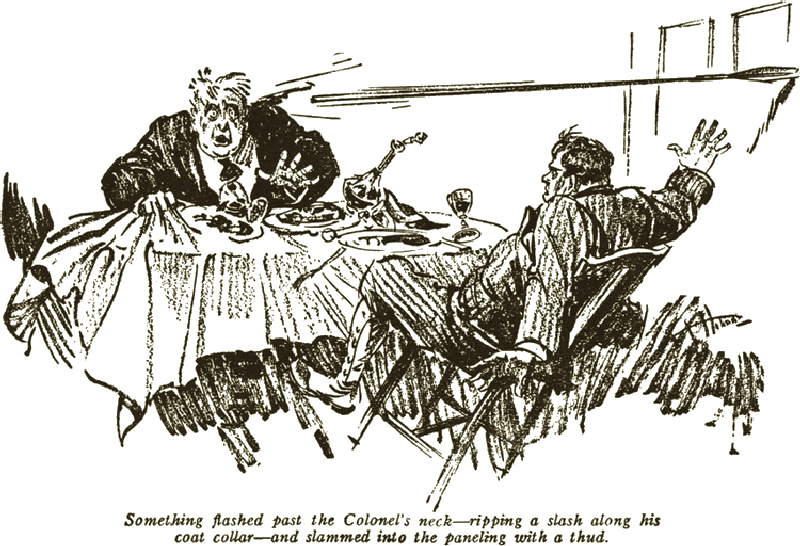
But here something came humming in out of the dusk through the open window, flashed past the back of the Colonel's neck, ripping a slash along his coat collar as clean as a knife-cut, and slammed itself into the paneling on the other side of the room with a thud that sounded rather like a great draft horse landing an impatient kick against the side of a wooden barn.
MR. BRASS glanced at it.
The thing was an assegai—the broad-bladed spear which the gentle Zulu formerly was accustomed to use for a variety of purposes such as destroying his enemies, skinning elephants, shaving, or smacking his wife, all according to his taste and fancy and the needs of the moment. The weapon was standing out from the tough oak as stiffly as if it were a long steel spike belted into the wood with a sledgehammer.
The Honorable John rose, and moving very much more swiftly than one would have expected a man of his great bulk to do, snapped up an electric switch.
Through the black darkness of the room his voice came soothingly.
"Duck, you damn' fool, duck! And put out that cigar. They wont miss that fat carcass of yours twice in succession!"
That, of course, was pure common-sense. But the mulish Colonel Clumber chose to take it differently from the way his partner meant it.
"Carcass! What d'ye mean, carcass?" he snarled through the darkness. "Duck! Me duck! Duck be damned! I'll ask you to have the decency to speak to me in a very dif—"
But there the slam of a sharply closed window and the rattle of curtain rings half-drowned his heart-felt voice.
Mr. Brass waited a second, then switched on the light again.
"They could spear you in at one ear and out at the other while you were discussing the odds, old man," he said, more in sorrow than in anger, crossed the room and dragged the completely ugly weapon out of the paneling.
He peered at it, handling it with great care.
"May be poisoned—but it's such a walloping big blade that I fancy the owner would build on the blade doing its job without assistance," he muttered, and laid it carefully on the table. "I guess that little affair would have let daylight through your brains—if possible—if it had been a trifle better aimed!"
The Colonel glared at it, fingering the cut along the collar of his dinner jacket.
"Who threw that?" he growled.
Mr. Brass smiled.
"You're late with the cross-examination, Colonel," he responded good-humoredly. "The merchant who hove that thing left here some time ago—if I am any kind of a judge!"
His heavy brows suddenly knitted as he stared down at the assegai, and he pressed the bell.
Instantly and silently there appeared the Honorable John's private slave Sing, the Chinaman whom, many years before, he had purchased for the very respectable sum of five shillings—from a tired homeward-bound policeman who did not at all desire the job of carting to the hospital a semi-dead Chinese whom he had resurrected from the end of a dark alley. Far more years ago than Mr. Brass now cared to figure about he had successfully trained Sing to be a perfect one-man-power machine. Sing was a faultless valet, a fine cook, a first-class motor-driver, and, when called upon, he could , swing, among other things, a mitt that made chloroform, anaesthetically speaking, look slow and unreliable.
"Just bring me in those two assegais that are hanging up in the hall with our bouquet of plain and fancy snickersnees, will you, my lad," commanded the Honorable John.
SING departed—to return a second or two later, saying that there were no assegais now hanging among the trophy of blades decorating the hall.
"Humph!" said Mr. Brass, his hard eyes a trifle flintier than usual. "That's so, is it? Two assegais abstracted from that collection! Hah!"
He was fingering the blade of the one which had been so very abruptly returned to them through the window.
"How were the blades of the spears, Sing? Sharp, would you say? Or blunt—like those show-swords and things you see hanging on folks' walls? Think, now—use your brains. It's important! Would they cut?"
Sing shook his head in a decided negative.
"Huh! Feel the edge of that, will you, Colonel." Mr. Brass passed the assegai to his glowering partner. "Man, it could all but cut your head off! Mine too!"
The Colonel, gingerly scraping a cautious thumb along the edge, agreed, with every symptom of disgust.
"Well, what are you going to do about it? You're a bit of a superman at this stuff, according to your own version of yourself, so I assume you'll be taking some steps in the matter," he demanded.
"Yes, I'll be taking some steps," said Mr. Brass and, lifting his eyes from the polished blade, he studied Sing pensively.
"I may be wrong," he said, "though I very rarely am; I may be wrong, but I'm feeling pretty certain that if anybody had photographed this Zulu affair for fingerprints a few minutes ago—before we began to paw it about, Colonel, they'd have got a few first-class specimens of Sing's prints, left there when he cleaned and polished it last. The man who threw it would wear gloves!"
"Well, what of it?" demanded the Colonel.
The Honorable John beamed indulgently on his partner.
"There's more in this than meets your eye, Colonel," he chuckled.
Then he took an old brandy, and instructing Sing to listen very carefully, proceeded to explain his "theory."
"With any luck at all the man who threw this would have killed you instantly! Make no mistake about that! Figure it to yourself, if you can. Picture yourself falling forward across the table with half the blade of that thing embedded under your ear. Picture me, now, naturally getting up and coming to your aid—stooping over you—and receiving the other assegai for myself. They'd have got us both, practically without noise. Well, there we are—dead over our dinner-table! But what's Sing doing all the time, you might be asking yourself. Well, as I see it, Sing would soon have been helpless somewhere in the kitchen or cellar. Not hurt—but a prisoner—locked in, maybe, behind wedged doors. I judge they —the folk behind the spears—didn't want Sing hurt at all.
"Well, there we are, dead as plucked spring chickens, and Sing shut up. The gentlemen with the gloves on, having attended to Sing, then take what they're after, and quit for good. Sing, being a capable sort of cock, soon releases himself—they'd have made it easy—comes snooping around, finds us, drags out the assegais, assures himself there's nothing to be done for us, looks around for a few minutes to see what can be done about catching the murderers, and by the time he's decided to telephone for the police (none of us, mind, are ever in what you might term a frantic hurry to call 'Police! Police!') he's too late. For, unless I miss my guess, somebody else would already have telephoned the police and they would be here. If Sing hung around too long, fussing and fretting over me,—as he more than likely would,—it's pretty nearly certain that the police would have found him standing over us, quite likely with a very dirty assegai in his hand, or if not in his hand, then with two stained spears lying on the floor—both well finger-marked by Sing. There would be blood on his clothes—our friends with the gloves would have seen to that—and so, on the whole, friend Sing would have found himself in a position so devilish awkward and with such a feeble explanation that I figure he would only get out of it through a trapdoor operated by a professional hangman.
"He might have got off with twenty years. It would depend on what they found in his box—no doubt the lad has got some queer bits and pieces, picked up here and there, in his box. And the folk who threw these things would have vanished into thin air without leaving a trace; and with their plunder."
Mr. Brass refilled his glass, doubtless feeling it was due to him.
But Colonel Clumber merely looked stubbornly unconvinced.
"It looks to me as if you ought to have been one of those fiction fakers," he grumbled. "I don't see where you get it all from, anyway. These mystery guys with the gloves on—what would they be after—"
The Honorable John stared.
"You ask a question like that?" he said. "Why you poor old quarter-wit, what is there in our little safe at this moment?"
Colonel Clumber scowled—then understood and nodded reluctantly.
THE Colonel reflected.
"Huh! Well, what are you going to do about it?" he demanded at last. "What does it all convey to you, anyway?"
The Honorable John's face was serious as he replied without hesitation that it conveyed so much to him that it gave him a pain in his note-wallet.
"It means that somebody knows we have got that grand little collection of jewels—and means to get them for himself. And there's more than one of 'em—maybe a whole gang. Their little effort mistimed tonight, certainly—but it was almighty instructive. For it shows us plain enough that, whoever they are, they would have just about as much hesitation in blotting us off the scroll of life as three black beetles. Dangerous, desperate, crafty crowd, evidently. Must look into it."
"How could they tell we have any jewels here? Everybody likely to know that the Vandermonde jewels have—um—changed hands, is in jail—except, of course, old Whitney Vandermonde and his niece Patricia, who both believe the things were stolen by the gang we had the pleasure of mopping up and landing in jail. And they're both back in America again—so glad that Patricia is still alive and safe, thanks to us, that they are not likely to bother us, the men who saved Patricia's life, about any missing jewels—a small thing to a multi-millionaire the size of old Vandermonde, compared with Patricia's life, anyway. So how could these assegai guys know about the jewels?"
Mr. Brass laughed.
"Well, it's staring you in the face, Squire—but as you don't seem to notice it I'll mention that evidently some of that jailed gang have got word out to a gang not yet jailed. It seems pretty obvious—that! However—"
He broke off as Sing entered silently; he came across to the Honorable John and laid on the table at his owner-driver's elbow a small red woolly tassel—one of those decorations which many golfers, for unknown but probably excellent reasons, wear at the tops of their stockings nestling, so to speak, like modest scarlet violets of the dell, in the shadow of their plus-fours. To the tassel he added a shred or two of fawn-colored cloth.
Mr. Brass brightened up.
"Where d'ye find these things, Sing?"
Sing explained briefly that he had gone out to see if anything was wrong with Corporal, the house-dog—that heavily built mixture of boar-hound, bloodhound and Airedale which the Honorable John, some years before, had first encountered in a gipsy camp and, charmed with his air of sheer truculence, had bought forthwith.
He was a silent beast, a magnificent guard-dog, and he had a finer power of scent than most pure-bred bloodhounds. He rarely barked—but he bit, enthusiastically if silently, at any stranger that passed his way at night.
Sing had found the tassel near Corporal's food dish.
"Evidently one of our callers was a bit of a golfer," said Mr. Brass, studying the tassel. "Wore the raiment anyway. He must have been prowling round—got too near Corp and pretty nearly had his plus-fours pulled off his body. Don't see that this helps us much, Sing. However, we—"
A trill of sound from the electric bell checked him. He jerked his head toward the front door and Sing departed, to return a few minutes later with the caller—a tall, fat, pale-faced, puffy-cheeked, extraordinarily young-looking person with a permanent bright pink flush, ash-blonde hair and a peculiar falsetto voice, who introduced himself as Mr. Guy Gaunte.
HIS mouth was red and tiny, like a pretty girl's, and his eyes were pale but pinkish like a pretty ferret's.
And his laugh was like a side-slip in C alt.
The dour Colonel took a look at him and turned to the decanter; but kindly, tolerant old Mr. Brass shook him warmly by the hand and spoke civilly to him.
But, then, only that hawk-eyed old rascal had noted instantly that Mr. Gaunte's left plus-four was slightly frayed at the knee and that while the own brother to the scarlet tassel in Mr. Brass' pocket was correctly in position just under Mr. Gaunte's right knee, the left tassel was missing!
"I'm very sorry to come rushing in like this—but my old car has broken down close by," volunteered Mr. Gaunte. "My driver says the make-and-break spring has broken, and as a forlorn hope I've run back to ask if by a hundred-to-one chance, you good Samaritans might have a spare to lend me!"
The Honorable John released the hand which he had shaken steadily throughout this extraordinary speech.
"A spare make-and-break spring?" he said. "No doubt but what we can find you a small matter of that kind. Unless I'm very much mistaken there's a spare pair of 'em in this drawer. Is your chauffeur here?"
"He's outside now."
"That's good!" He turned to Colonel Clumber. "You put those small magneto spares in here, didn't you?" he asked.
The Colonel, watching his partner's face, rose and went over.
"I did—they're in the left-hand corner," he said.
"Well, that's extraordinarily lucky," began Mr. Gaunte as, with his hands in his pockets, he loafed across to Mr. Brass who was reaching for the drawer.
"Yes—we're a lucky pair," said that sportsman; and absolutely without warning, he swung an arm like the forepaw of a grizzly to Guy's jaw.
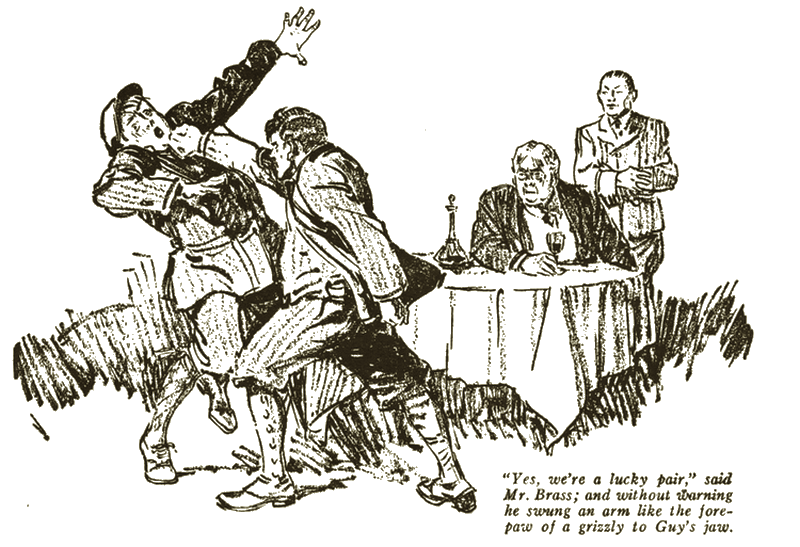
The great fist connected with a thud as of a slammed door, and Mr. Gaunte went down like a man who has been struck by lightning, thunder and an unpleasant idea.
"Look out, Sing!" shouted the Honorable John, grabbed two pistols from the "motor spares" drawer, passed one to the Colonel and edged across the hall towards the door.
"Watch that man, Sing," he said, deliberately fired into the dark through the open front door, and a second later flung that heavy door to with a crash.
"There's too much of this rough stuff going on to please me," he said. "See that all the ground-floor curtains and blinds are drawn and lights out except in here, Sing—and be quick about it! Hold the man down, Squire," he added to the Colonel, "while I see what he carries in his pockets."
Mr. Gaunte wriggled once, then, realizing that the massive hand at his throat was capable of squashing his windpipe without much effort, lay still, while Mr. Brass, with conspicuous deftness, searched him.
IT was quite a little heap of salvage that he collected out of his victim's clothes. There was a pistol of a very modern, efficient and expensive make, a peculiar example of the gentle daggermaker's craft—a singular, slightly curved steel blade, appallingly sharp, that would either cut like a razor or stab like a needle; there was a distinctly nasty-looking flask covered with a strong netting of steel wire and secured with a heavy, metal screw-stopper.
The Honorable John's eyes went hard at sight of that flask.
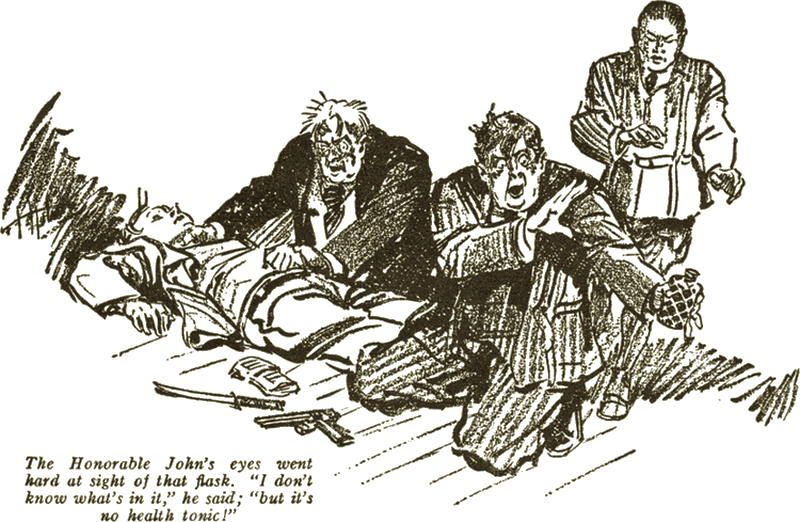
"I don't know what's in it," he said. "But it's no health tonic! Handle it as if it were hot, Squire!"
There was a note-case, bulging with perfectly good money, a few letters, a combined card- and cigarette-case, and some harmless oddments of that kind.
Mr. Brass explored the card-case.
Every card in it bore either the following inscription:
Captain Fitzroy Moormark, D.S.O.
Metropole Mansions, London, W.
or this—
The Regency Private Enquiry Agency
299 Regent St., London.
Mr. Guy Gaunte.
Mr. Brass studied the cards carefully, looked over the rest of his loot, then turned to his partner.
"He can get up—but keep a sharp eye to him, Colonel, when he's up. For I mistrust him. I mistrust him like hell!"
With a rather groggy air of nonchalance the pink person arose—aided considerably by the Colonel's grip on the front part of his neck. Colonel Clumber, like lots of us, was always angry with things and folk he did not understand.
"This is indeed a hospitable reception," said Guy, smiling rather Iopsidedly. "Do you know, I really believe you have loosened every tooth in my head."
Mr. Brass returned the smile.
"I'm sorry about that, maybe," he responded, genially. "They'll set in solid enough after a bit—you've got youth in your favor. Take a seat. No—better warn off your pal or pals outside first. Then you can take a drink and tell us who you are and why you have come here acting rough like this."
THE captive stared at Mr. Brass for a few seconds. He still smiled and his eyes remained friendly. In spite of his slightly fatuous manner he was quite evidently a person with iron self-control.
"Oh, quite, quite," he said. "As you wish. There has obviously been a mistake."
Mr. Brass whispered something to Sing who silently disappeared as Gaunte moved across the room, drew back the curtains, and threw up the window.
Two people were standing outside. The captive—with Mr. Brass markedly behind him—spoke quietly to them.
"There's been a mistake, dearest Sylvia. I owe these good gentlemen an explanation and an apology. Will you go back to the car with Hollis and wait for me? I will join you very soon."
The Honorable John and his partner were looking with keen interest at the lady addressed. She was plainly visible in the light pouring out from the well-lit room and she was undeniably attractive in a dark, brilliant Spanish sort of way. She was what Mr. Brass had frequently stated to be "just about my style"—a fine, upstanding figure of a woman. Her companion was obviously a chauffeur.
"Pardon me," said the Honorable John. "It is not our custom to shoo ladies or chauffeurs away from our door at this hour of the night. If there has been a mistake maybe the lady can help put it right. I hope, Madame—er—Sylvia will join us over some refreshment, the explanation and the apology."
The lady flashed him a truly brilliant smile.
"Why, that is too charming of you," she said. "Do I enter through the window?"
"Nunno," exclaimed Mr. Brass hastily, and turned to the prisoner.
"Who is the lady, my friend?" he inquired.
"My cousin—and fiancée—Miss Sylvia Noreen Chetsworth," said Gaunte.
"Humph! A very attractive girl," said the Honorable John. "Is she armed?"
The pink-faced one shrugged.
"Oh, probably—a small automatic or so," he said indifferently.
Mr. Brass grinned.
"I see—just ordinary everyday ladies' bric-à-brac—keeps her little guns with her lipstick and powderpuff, hey?" he said satirically. "Just ask her and the chauffeur to hand their battery over while we enjoy our little friendly talk with you. You see, those big Brownings of ours are too heavy to keep comfortably trained on you all the time we're talking."
"Why certainly—a pleasure, I assure you," Gaunte agreed.
NEITHER the lady nor the chauffeur made any objection to so reasonable a proposal. They passed in to the hand which Mr. Brass extended from behind Mr. Gaunte no fewer than four rather efficient-looking automatics of varying calibers. When these were unloaded and thrown out into the pitch-black shrubbery, Mr. Brass, leaving Gaunte well and truly covered by his partner, admitted them. The girl was arrayed in a very trim-looking suit that was neither a riding-suit nor a motor-cyclist's kit but a smart blend of both. Very natty she looked in her breeches and shapely stockings, and her face, framed in a rather chic motor-cyclist's helmet of leather, was quite extraordinarily charming.
The chauffeur looked like—a chauffeur.
"I am sure you wont feel mortally offended, my dear hosts, if I say that you have a most original way of responding to a request for motor first-aid," she observed.
The Honorable John chuckled.
"That will be all right, my dear," he said. "But we've had a little trouble here tonight—and we were under the impression that you three had returned to complete your program of blotting us out with the decorations off our own wall—the assegais!" he explained.
The blank stares with which this simple inquiry was received would almost have satisfied the astute old rascal who made it—if he had not had the little scarlet tassel in his pocket. He questioned them carefully and patiently in his friendly conversational way for some minutes, but could glean nothing remotely resembling an admission that they had ever heard of such things as assegais in the whole of their lives.
"You know nothing about that, I see," said the old adventurer. "Let it go. Why worry about trifles, anyway? What's an assegai or two, after all? But what's your name, friend? Are you Guy Gaunte as well as Fitzroy Moormark—both or neither? And if so, why?"
RATHER stiffly the pink youth smiled, while fingering his swelling jaw.
"Oh, Guy Gaunte, of course," he said. "Those other cards are just business cards. Sylvia and I are the Regency Private Enquiry Agency. I've half a dozen other names—on cards—for that matter. One needs them in the private inquiry business, you know."
Mr. Brass nodded, with some interest.
"Yes, I know. How's business?"
"Oh, not too good—is it, Sylvia?"
"It's utterly vile—the wretched office is eating away all our stupid little capital," declared Sylvia.
The Honorable John wondered why, in that case, she wore a diamond engagement ring that, if a diamond, was worth a small fortune, also why they traveled in such an expensive model of a car as that for which they had needed the spring.
"But why the battery, the dagger and the armored scent-bottle?"
"Surely that's quite obvious," said Mr. Gaunte, with great readiness. "We are after a blackmailer—a bad, dangerous brute who carries bombs. He is perfectly prepared to blow himself to bits before he is arrested—together, of course, with those who try to arrest him. In the ordinary way our agency would give him a severe miss in baulk—but times are hard and we have had a really huge reward offered us, privately, by a wealthy victim—if we can nail him."
MR. GAUNTE grinned a semi-dislocated grin.
"If we can contrive to get that bottle opened quietly in any room in which the blackguard is sitting he'll doze off like a butterfly in a cyanide bottle—and wake up in jail. There's an odorless gas in that bottle, my friend, that would put a church congregation to sleep more quickly than the Vicar himself. Harmless, swift, efficient—very good gas. It cost us nearly eighty pounds, that gas."
"Where is this dangerous man?" asked the Honorable John.
"Not five miles from here," said Gaunte, and straightened up. "Look here, gentlemen," he said eagerly, "would you care to accompany us? It's a risky business—but I'll pay you a quarter of the reward, if we get him, and—" he laughed, "and, dash it, I'll forgive you that one on the jaw. What do you say?"
It sounded as interesting as genuine. It was a really clever bluff.
But Mr. Brass had not forgotten that little red tassel.
He shook his head.
"Nunno—not at our age," he said, half regretfully. "Once upon a time we'd have sooner gone rake-helling around at night than eat! But not now. No."
Under protection of Colonel Clumber's trained battery he supplied them with refreshments.
"I'm sorry," he said. "You must fight your own battles as we've got to fight ours. But we'll wish you luck—you deserve it perhaps."
He smiled benignly upon them
Then the party proceeded to accept with some avidity the Honorable John's invitation to be on their way. In reply to a reminder about the make-and-break spring the chauffeur declared blandly that he had just remembered there was a spare one tucked away in an old spark-plug box in a corner of the tool-case.
So that was all right.
The trio left without further reference to their sequestrated arms. "Evidently in a greater hurry than they seem," observed Mr. Brass dryly to the Colonel, who had been regarding the termination of the affair with black disapproval.
"Well, I suppose you know what you're driving at," answered the junior partner. "But I'll say here and now that I don't and never shall. There's not a shadow of doubt in my mind that they were the people who slung those assegais in at us, and when their plan went wrong waited a bit, then came back planning to finish us off the best way they could, then to collect the jewelry and quit, leaving us cold. It doesn't take three armed folk to call for the loan of a magneto spring," he concluded as Sing entered, smiling yellowly.
"Correct," beamed Mr. Brass.
"Then why let 'em go scot free?"
"What else was there to do? Murder 'em? Or send for the police? You want to use your brains when you're dealing with sharks like these, Squire. It's good enough for us to know that they know we've got something worth having here—the jewels. We'll have to get them turned into cash."
He turned to Sing. "Well, Sing, did you look over the car?"
"Two cars, master! No spling breakee—all good."
The Chink handed over a dispatch-case.
"Findee—fetchee," he said laconically.
Mr. Brass took the case.
"One of the best little retrievers I ever owned, aint you, Sing?" he said. "Go on with your report."
THE yellow all-rounder's report was soon finished. In compliance with his astute old master's whispered order he had quietly slid up the road to take a look at the car and, generally, to see whatever might be visible. He had found two cars waiting by the roadside. With his customary deftness he had examined the make-and-break springs of both magnetos and found nothing wrong with either. He had noted the makes, colors, tires and numbers of both, and he had neatly but effectively "swiped" the dispatch-case, which he found packed away in one of the roomy pockets, together with several other small loose goods of a character which, while valueless to his master, appealed to his simple Chinese nature.
Then he had retired into the shadows in which he was so much at home, had witnessed the hurried departure of the trio, and had returned to the house.
The Honorable John warmly approved the action of his retainer and, forcing the lock of the case, proceeded to examine the contents.
"I don't suppose you've found us a fortune, my lad," he said, "for that class of party isn't in the habit of leaving a fortune in their cars while they pop off for a few seconds to commit a little murder or so. But we'll just see what—"
He ceased abruptly, his face hardening as he concentrated on the papers with which the case was filled.
"Here—take a look at this, Colonel!"
They went through the collection like a lawyer going through a deed containing a valuable flaw.
Presently Mr. Brass poured himself a cheerful-sized drink, lit a cigar and, beaming in every direction, observed to Sing:
"Well, my lad, I shouldn't be surprised if you've made a shilling or two for yourself this evening; might run to as much as a couple of pounds. We'll see about that."
He turned to his partner.
"You see what Old Reliable has found and brought into the house, Colonel? At any rate I do. It's the whole of the documents on which Gaunte & Co. have been blackmailing Lord Callantyre. And that letter there—the one on the blue paper—explains the whole evening's work to me."
"Huh! I'm glad of that," grunted the Colonel. "It's fairly obvious! Let's hear your idea."
But Mr. Brass was reaching for the telephone.
"Presently," he said, and put in his call.
It was to Callantyre Hall—one of the big show country-houses of the district—about five miles away.
He talked into the instrument for a few moments, then hung up, smiling.
"Get out the big car, Sing, as quick as you can slither yourself down to the garage," he commanded.
Sing slithered.
ABOUT twenty minutes later the adventurers were facing, in a magnificent library, that almost unnecessarily wealthy financier, Lord Callantyre—a rather handsome though slightly worn man of perhaps fifty-five. He was in a dressing-gown and, on the whole, looked as if he should be in the place he had just left—bed.
With his usual hearty aplomb Mr. Brass briefly introduced himself and partner and passed Lord Callantyre the dispatch-case.
"I'm not a believer in turning a tired man out of his bed—nor a hungry man away from his dinner, Lord Callantyre," he said. "But a glance or two at these documents made it clear to me that the sooner they were in your hands the better. Run your eye over them and see if you can bring yourself to agree with me."
Gravely the rich man took out the collection. A photograph fell from among the papers and he started and flushed a little at sight of it. A look of relief began to dawn on his rather thin face.
He sat down and ran through the papers with the swiftness and precision of a man who knew them by heart—knew so exactly what should be there that a mental picture of each paper must have been indelibly engraved on his soul. And his face brightened, and the haggard look seemed strangely to leave him as his eyes flashed over the documents. Finally he put down the last one with a sigh.
"Yes. Complete—complete!"
He touched a bell and to the manservant who entered he said:
"Bring some champagne from Bin One!"
He smiled faintly at his visitors.
"It is said to be the best champagne in the country," he observed. "I should be interested to have your opinion of it."
"We should be interested to give it," said Mr. Brass civilly.
"Well, gentlemen, how much am I to give you for these papers?" His Lordship asked.
The Honorable John waved his hand.
"Nunno—nunno," he said. "They're your property already. We aren't blackmailers—everything else, maybe—ha-ha!—but not that. We have just looked in to return your own property to you in the ordinary way."
"May I ask how they came into youi possession?"
Mr. Brass shook his head.
"Why bother to go into details?" he said. "There they are—they're your own—they deal with an accident in your past which could happen to any man—and is nobody's business but your own. They were sleeping dogs that you weren't allowed to let lie! They are now dying dogs that you'd better let die. Take 'em, My Lord, tear 'em up, burn the bits and forget 'em. Take the advice of a man who has a natural gift for wise decision—"
The Colonel snorted.
"The man who was holding these over my head was a dangerous and incredibly cunning scoundrel. How did you contrive to outreach him?" asked Lord Callantyre.
Mr. Brass yawned slightly.
"Why, he wasn't much—just needed handling the right way. Maybe we know a little more about that kind than you do."
LORD CALLANTYRE looked penetratingly at the rough-hewn features of the partners, realized that for all the bland and easy amiability on their faces now, Mr. Brass was probably right. He nodded, thought for a moment, and then asked:
"May I ask if you gentlemen are familiar with Stock Exchange transactions? You are? That is good. Will you do me the favor to note that the ten-pound ordinary shares in my Company, Central African Gold Areas, Ltd., now stand at four pounds? In three weeks' time they will stand at not less than twenty-two pounds each. That is quite definite. You should not find it difficult to get an option on a fair number—through these stockbrokers."
He scribbled a name.
"One good turn deserves another," he said. "You need not permit yourselves a single second of doubt about the sure and certain profit which will accrue from a deal in those shares. I guarantee that. And now, wont you try this wine, gentlemen?"
They tried it like the stanch old wine- triers they were...
IT was perhaps one o'clock that night when Mr. Brass, just a shade blurred in his speech, paused on the landing just outside his bedroom and buttonholed his partner with his left hand. In his right he was carrying a pair of very large and shabby old soft brown leather slippers.
"Yes, Squire—as I said before, so I say again. This is what happened. Gaunte and his pal and his gal set out tonight to kill two birds with one sto—; one stone, I mean. The gal Sylvia was to call on our friend Callantyre and c'lect—an' collect—an installment of blackmail, while Gaunte and mo'r-driver called here and did us in with our own ass—asseg—ass—" He hissed like a serpent in pain—champagne. "Assessegais and stole our jewelry. Callantyre was in bed an' declined to see her—she came on to Gaunte here—jus' in time to reinforce him for second attempt on us. See that, Colonel? Perf'ly simple to any man natural gifts! Probably Sylvia went prepared to sell documents outri' if Callantyre offered enough. Time not ripe—cerrainly not. Maybe the woman failed handle thing in tactful manner like me. Great genius, these marrers, me, Colonel. See? I consider I've saved all our lives twice over s'evenin' an' made small fortune into the bargain. Tha's wonderful tip Lord Callantyre gave us!"
(Mr. Brass was right. They bought all the shares they could get and, a month later, sold out for a profit of nine thousand pounds odd.)
He stared blearily at his partner.
"You stick to your ol' partner, Colonel, an' he'll stick to you—hey?"
"Hie," said the Colonel.
And so to bed.
COLONEL CLUMBER it was, who, on the following morning, noticed first that the door of the secret safe in their smoking-room was slightly open.
"Hey—look there!" he snarled. "Gaunte and his crowd came back again last night—and got the jewels."
Mr. Brass looked up at the safe.
"Yes, Gaunte's a persevering hound, Colonel," he said calmly. "It's pretty evident they've been over the house in the night, though they left us alone—probably afraid of that bottle of gas—or had enough of the rough stuff for one night. Maybe they hadn't missed their dispatch-case—or if they did, put the theft of it down to some tramp or poacher or night-bird."
"Yes, but what about the jewels, you idiot!" bawled the Colonel. "Can't you think this morning? They're gone. And it's your own fault—you go out late and get tight—and here's the result!"
"Hey, Sing, fetch down my brown slippers," Mr. Brass said over his shoulder; then he moved over, peered into the empty safe and snicked the door shut.
"Huh! Drilled the lock to fragments," he observed, turned away, and took his shabby old slippers from Sing. He upended these large vessels on the table. A multi-colored stream of flashing gems scattered themselves over the polished oak under the Colonel's gaze.
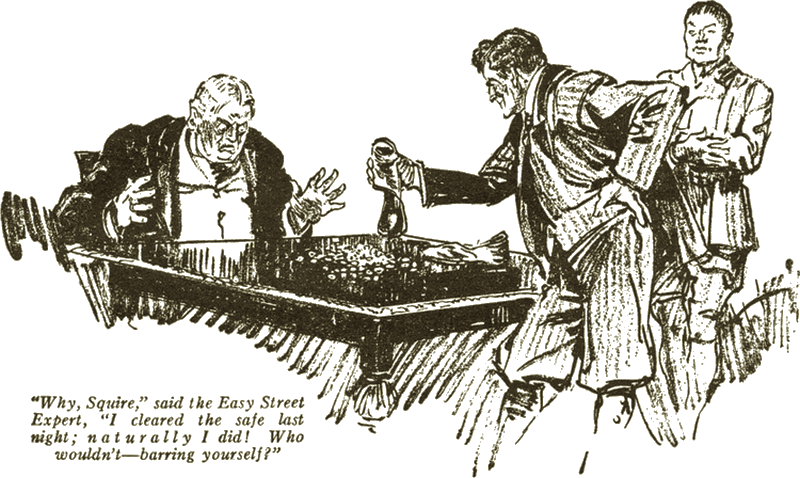
"Why, Squire," said the Easy Street Expert, "you must be getting old in your head, if you have arrived at the stage where you can believe that a few glasses of good champagne can get a man of my caliber into such a careless state that he forgets to take care of his own—and his poor buffalo-witted partner's! I cleared the safe last night while you were struggling with your tight boots out in the hall. Naturally I did. Who wouldn't—barring yourself?"
Roy Glashan's Library
Non sibi sed omnibus
Go to Home Page
This work is out of copyright in countries with a copyright
period of 70 years or less, after the year of the author's death.
If it is under copyright in your country of residence,
do not download or redistribute this file.
Original content added by RGL (e.g., introductions, notes,
RGL covers) is proprietary and protected by copyright.