
RGL e-Book Cover
Roy Glashan's Library
Non sibi sed omnibus
Go to Home Page
This work is out of copyright in countries with a copyright
period of 70 years or less, after the year of the author's death.
If it is under copyright in your country of residence,
do not download or redistribute this file.
Original content added by RGL (e.g., introductions, notes,
RGL covers) is proprietary and protected by copyright.
RGL e-Book Cover

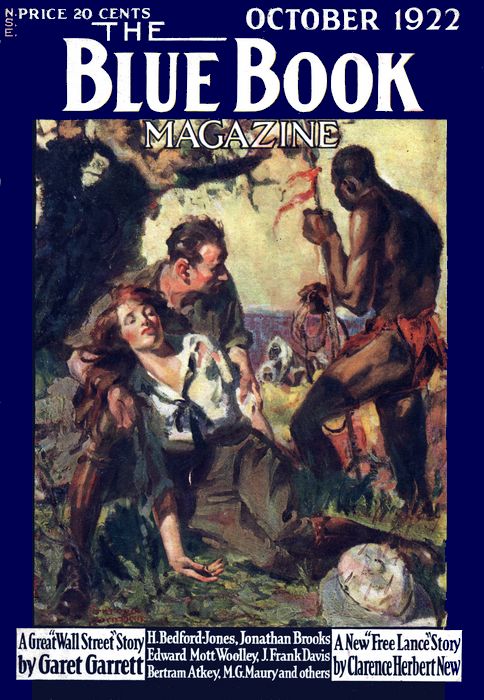
The Blue Book Magazine, October 1922, with "The Hide of the Wolf"
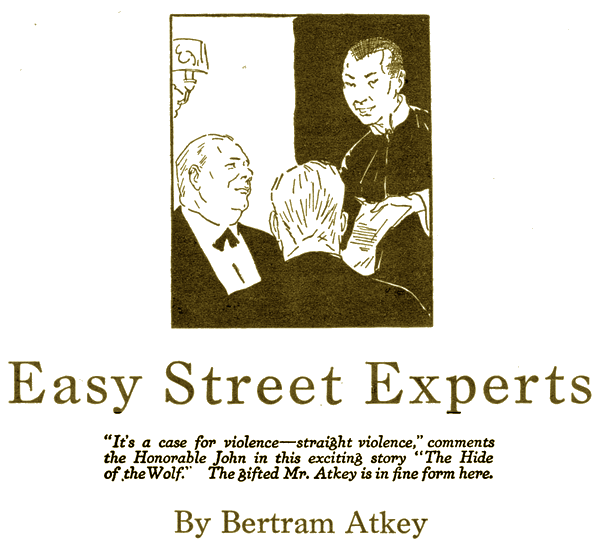
"It's a case for violence—straight violence," comments the Honorable John in this exciting story "The Hide of the Wolf" The gifted Mr. Atkey is in fine form here.
GLANCING back at the habits and customs of those notable adventurers the Honorable John Brass and his partner Colonel Clumber, as veraciously set forth from time to time in these pages, one is compelled to admit that the partners were prone to dwell too weightily upon thir pleasures of Food in Large Quantities; and lest this should convey a false impression of these remarkable men, it may be said, as a species of counterblast, that they never neglected to take as much exercise as they could make it convenient to take. It was with this object that they invariably arranged to rent yearly an extremely good and by no means inexpensive bit of rough shooting.
It was while they were enjoying a quiet month's shooting over a couple of thousand acres they had rented one season upon Salisbury Plain, that they felt themselves impelled to intrude, versus Mr. Homer Steelhall of New York. With the shooting they had taken the house of the owner, who, a man of restless but sporting temperament, had sallied forth to Monte Carlo with the avowed intention of either breaking the bank outright, or bending it to an extent which would render him wealthy beyond the dreams of the delirious for the rest of his natural life. With them to Stone Hollow Manor—so the little estate was named—the partners took Sing, the cook-valet-chauffeur and human miracle, sole property of the Honorable John, and Mr. Ferdinand Bloom, valet-butler to the Colonel and general man-of-burden at Purdston (the quiet little country corner of the partners), together with Mrs. Bloom.
The general staff of Stone Hollow Manor were given a holiday until either the end of the shooting season, or until their master had bent the bank at Monte Carlo sufficiently to pay them some of their arrears of wages.
Hence it chanced that the Brass-Clumber combine was, so to speak, in the theater of war in strong force, when the Bandmann-Steelhall matter first obtruded itself within the range of their vision.
IT was the gentle Sing who first brought to their ken the fact that there might be the possibility of a little shearing of wool to be accomplished during their holiday, and he made them acquainted with the fact one evening after dinner.
John had just passed him a small compliment upon a dish of partridges which, of the various courses the industrious Chink had prepared for dinner, had pleased the partners most, and it was in an atmosphere of general self-respect, satisfaction and well-being, the whole illumined by some of the remarkable old brandy which the pair had brought to Stone Hollow with them, that Sing said:
"Please, master, they keepee plisoner in that house Gallops!"
The Honorable John removed his cigar.
"Keep a prisoner at Gallops, do they, my son? Who told you that?"
"Me watchee, me see, master," said the Chinaman quietly.
"When?"
"Allee same night-time. Me likee walkee at night-time all about downs and watchee Gallops."
"Oh, that's it, is it? Been gaddin' and prowlin' about at night, keeping your eyes open, hey? Just tell us what you know about this prisoner at Gallops."
Sing's narrative was brief but interesting.
It was during one of his moonlight prowls across the wastes of Salisbury Plain that he had approached the small mansion known as Gallops, presumably because it had once been the home of a gentleman who was passionately attached to the turf and had in his heyday bred and trained many a beautiful thoroughbred failure in the stables attached to the house. Unfortunately the sportsman had passed from his heyday to his pay-day, and when he had finished paying, the occupancy of his big house had become quite out of the question. Consequently he let Gallops furnished and lived on the proceeds. Many tenants had occupied the place, but it is only with one of these that this story has to do—namely, Mr. Max Bandmann, who was, at the time Sing made his discovery, entertaining a house-party there.
The partners had seen Max Bandmann. He was a dark-complexioned, stoutish person, not without jewelry, who looked rather like a money-lender on the point of retiring. The partners had not been very interested in him or any of his friends—he looked, they thought, like a person who knew how to take care of what he had, and was profuse but careless about food. A man, in short, the partners had no earthly use for at all.
It was, then, while prowling on his nocturnal rambles round the house of this charming individual that Sing had observed, and been observed by, the owner of a white face at a window on the second floor. This one had opened the window— barred inside—and called out softly the following words:
"For God's sake, help! I'm a prisoner here—catch—Homer—" and abrutly vanished, evidently pulled back by some one in the room—some one who had craned and peered out from the same window for at least five minutes after, endeavoring to see who it was the prisoner was addressing.
But Sing was standing as still as a graven image in the shadows and did not move until the second face disappeared. Then he had glided across to the white fragment of paper which the prisoner had dropped, culled it, and retired.
"I see," said the Honorable John, reaching for the paper, "and does he tell us how to catch Homer?"
He studied the scrawl upon the scrap of paper, and his attitude suddenly changed.
"Sure! Why not? Very sound scheme!" he muttered. "Certainly! But five hundred be damned! Too cheap!"
He passed the paper to Colonel Clumber with a gleam in his eye.
"What d'ye make out of that?" he asked. "It looks as though there's something doing even in these mangel-wurzel sections."
THE Colonel read, first in silence, then aloud as follows:
"Five hundred pounds reward will be paid to the person who first, informs the police that in this house—occupied by Max Bandmann—Mr. Homer Steelhall, financier, of New York, Paris and London, is being held prisoner by the said Max Ban—"
The document finished there—evidently, if it was genuine, Mr. Steelhall had been interrupted and had to conceal his message.
The Colonel looked at his partner, and his eyes were suddenly lighted with a significant gleam.
"D'ye know who Homer Steelhall is?" he demanded.
"I seem to have heard of the lad—who is he, anyway?" inquired Mr. Brass.
"He's about the fourth richest money-monument in America," snapped the Colonel. "He's 'Multi' Steelhall—the Wall Street Wolf."
"Is he so!" exclaimed John. "Then he'll have to be rescued. But—five hundred!"
IT was at precisely nine o'clock on the following evening that the motor of Mr. Brass and Colonel Clumber broke down, by an odd chance, just outside Gallops. The reverberent backfirings produced by the ingenious and persevering Sing at length attracted the attention of Mr. Bandmann and his guests—and one or two of them strolled out to watch. Of these Bandmann was one, and a fair, military-looking sportsman with blurred blue eyes and a whisky-and-soda complexion was another. The third of the party was a tall, slender, good-looking woman.
The fourth of the little group was a pale youth with long hair, dull eyes, and extraordinarily beautiful and delicate hands. He might have been a poet, a painter, a forger, a safe-lock expert, a musician or a card-sharp.
A brief exchange of comments on motors and their habits revealed to Mr. Bandmann and Company that these two stranded strangers seemed to have much in common with the Gallops house-party, and an invitation to enter the house and take what the military-looking man tersely described as a "mild snort" was extended by Bandmann.
"Can't see neighbors perish of thirst on our own doorstep, eh, Bandy?" playfully said Captain Fitzjustin—for so the military man called himself.
All agreed, and a move was presently made to the house, where the frankly and openly—almost too openly, indeed—delighted partners made the acquaintance of two more ladies.
"Had no idea you had such a delightful party here, Bandmann," said the Honorable John. "Great pleasure to meet a bit of civilization out here. Very handsome woman, that Mrs. Anstruther—all delightful, but she's specially so, hey?" He referred to the slender woman who had come out at first.
"She is," said Bandmann, not without a certain enthusiasm. "Have another whisky?"
"Sure," replied Mr. Brass, who appeared to be getting a little garrulous—like his partner, who in a far corner was talking quite vivaciously (for him) with an orange-haired queen by the piano.
Mr. Vyse-Jones, who was "Eddie" to his friends, it seemed, the person with the flexible fingers, suggested a game of cards—poker. Captain Fitzjustin recommended billiards. The guests of the evening whiskily declaring themselves agreeable to aught which might befall, Bandmann—or "dear old Max," as the orange-tipped siren put it—voted for cards.
Cards therefore it was, with the ladies looking on. It was all very pleasant and jolly. Mr. Wilton Flood and Mr. Henry Black (for the partners were using their favorite pseudonyms) had shocking bad luck, poor dear boys, and were losing rather heavily. But there was plenty of whisky to cheer them up and lots of light conversation; and when presently Sing reported—via a manservant with a yellowish face, like that of a habitual convict—that the car was hopeless that night, a unanimous cry was raised to the effect that the partners must stay the night.
"Certainly, dear chaps, you must stay—motor you over first thing in the morning, eh, Bandy?" insisted Fitzjustin.
"Sure, boys—can't take any refusal," said Bandmann. So the partners allowed themselves to be persuaded, and the fun waxed fast, furious and—expensive.
It was in the small hours when Messrs. Brass and Clumber, pleading extreme fatigue, broke off the game. They had lost something like four hundred pounds between them, and were both comfortably "lit up."
The whole party saw them to their rooms, where the capable Chinaman, waiting to "valet" them safely into bed, bade them good night and left them to their slumbers.
"Two pretty decent old soaks," said Mr. Vyse-Jones casually. "But dead easy. It's a shame to take the money. And ain't that a red-hot thirst of theirs!"
Everybody agreed, took their share of the plunder, and with the exception of Bandmann, presently dispersed to their rooms—as plain and palpable a set of swindlers and adventurers as ever lived.
Bandmann disappeared in the direction of the attics. He was there a quarter of an hour, then made his way softly downstairs to a large and comfortable bedroom on the first floor, and a click of the lock announced that he too had retired for the night.
BUT it is highly probable that had he been able to take a glance into the room of the Honorable John, he would not have entered so tranquilly into slumber-land—for he would have had somewhat wherewith to occupy his mental horsepower.
The two "decent old soaks," in soft-soled shoes taken from their capacious overcoat pockets, were sitting quietly in the Honorable John's room, apparently lost in revery. Sing was seated in a chair by the table, doing nothing, in absolute silence.
The trio appeared to be waiting for something, and the partners were most uncompromisingly sober.
Occasionally they exchanged a brief, low-voiced comment.
"Yes—as crude a crowd of crooks as I ever saw," said Mr. Brass. He seemed rather pleased with his description, for he repeated it: "A crude crowd of crooks."
"Sure," agreed the Colonel. "But I could forgive that little orange-tipped dame a lot. She's a bright little ray of sunshine."
John did not quite agree.
"Oh, I don't know, old man. She was short on the brains, I thought, and wasn't she a trifle too plentiful? If she was another six inches taller, she'd be more in proportion. Now, Mrs. Anstruther—Elline—is in another class. She's got that little round blonde defeated from the last look in the glass onwards. Not my usual style, I'll admit, but interesting—clean cut, stylish, got nerve and breeding—well-bred woman, I should say Elline was. Should like to see more of her."
And surprisingly enough, his wish was instantly gratified. Some one tapped softly at the door.
SING slid over and looked mutely at his master, who hesitated, frowned, then nodded. Sing opened the door, and the graceful Elline, engagingly clad in a kimono, entered.
She looked sharply at both partners, nodded unconsciously, smiled slightly, and said:
"Ah! I thought so!"
She sat down. "Pure instinct!" she said, not without pride. "If those conceited, self-satisfied idiots were really first-rate crooks, they'd have guessed you too."
She smiled, well-pleased with herself, and took a cigarette from a little gold case.
"Tell me, friends, what are you after?"
For a moment the partners were too surprised to speak. Then, realizing that whoever they may have misled into believing them not wholly compos mentis that evening, Elline Anstruther was not one of them, they did the only possible thing and met her on her own grounds.
The Honorable John smiled friendlily.
"Not two minutes ago I said you were the brightest of the whole bouquet, my dear," he said. "And if this doesn't prove it, what does?"
He leaned forward.
"I think we'd better have a little chat, Mrs. Anstruther—or may I say Elline?"
"That," said the raven-haired Elline, "is what I've come for."
The Colonel stirred impatiently.
"Well, if that's the case, and as it's about half-past three, supposin' we get on with the conversation instead of beating about the bush."
IT was not a long conversation which followed, but it was very much to the point. The delightful Elline spoke first, and by the time she had finished, extremely little remained to be said.
The great Homer Steelhall was being held by the Bandmann gang—or rather, the portion of it at Gallops—until such time as information was received by Bandmann, from the part of the gang working in America, to the effect that "things," meaning the stock-market and other markets, were in such trim that the sudden suicide of the Great Shark would have a startling result upon them—a result that could be reckoned in millions. In other words, when the manipulators in New York and elsewhere were ready to take the fullest advantage of the inevitable result of Steelhall's death, word would be sent to Bandmann, and Steelhall would commit suicide —have it committed for him.
"You mean Bandmann and Company will kill him?"
Mrs. Anstruther nodded. "I do."
"But that's called murder, not suicide," said the Honorable John, his face hardening.
The fair Elline smiled slightly.
"I know—that's why I'm going to prevent it—and why you're going to help me," she said coolly. "And by the way, who are you, and why are you coming into this affair?"
Mr. Brass waved an airy hand. "Oh, we knew you had him here boxed up, and we're just browsing round—prospecting. It ought to be worth a trifle to set Homer Steelhall free! He's some Homer when he's loose." John pondered, frowning, then went on: "But look here, Elline my girl, what are you doing in a gang like this? Killers—that's what they are—and cold-blooded killers, at that."
The woman laughed rather bitterly.
"I'm not one of the Bandmann gang, except for the fact that I'm the jail-widow of one of the worst husbands that ever happened," she said. "When he was sentenced, Bandmann decided that I knew too much about the Steelhall plot to go free. So I'm here—because Bandmann and Company can't trust me—though they pretend that it's because they want to treat the wife of my husband squarely.
"I don't know why it was, but somehow I suspected from the start that you two weren't quite so simple as you looked—and you don't look very simple. I wondered for a while whether you were detectives—but they don't often hand over four hundred pounds' worth of notes even to get the confidence of people they suspect," continued the lady. "Anyway, you're not, and I'm very glad of it. Now, about rescuing this Wall Street wolf: are we partners?"
"Sure," said the Honorable John. "Sharing in threes."
The Colonel readily agreed.
"Very well," said the jail-widow. "Let me give you one word of warning. You—we're going to try to upset the plans of a gang which has worked on this scheme for three years."
"Three devils!" said Mr. Brass, amazed.
"No—years," corrected the graceful Elline. "And they've spent—oh, nobody knows how much—perhaps a hundred thousand dollars."
SHE leaned forward, her cheeks flushing, her eyes glowing.
"I've heard Bandmann say this: During the week following the announcement of Steelhall's suicide, anything from forty to a hundred million invested dollars will turn over in their sleep. And if we've got our nets spread right, a mighty lot of those dollars will turn over into our nets—we'll only have to pull the string.
"So, for God's sake, don't underrate the crowd. They're out after the big stake—and they'll kill anybody who seems to be standing in their way, without a nicker of the eyelid. You've got to believe that—for it's true. No doubt you're thinking that this is just a casual hold-up of a rich man for ransom. It looks casual, I confess. But it's been more carefully thought out than a big battle—" She stopped abruptly, listening.
"Sit still," she hissed sharply, then glided across and switched off the light. Instantly the room was dark and still as a grave.
For a moment nothing happened. Then very slowly and softly the handle of the door turned. With a faint creak, the door opened. All knew that somebody, prowling stealthily in the utter darkness, was standing on the threshold listening. And here the Honorable John did a brilliant thing. He was sitting next to the bed, and he began to breath heavily, almost stertorously. A few seconds dragged by. It seemed, to all there, literally impossible that that person could stand there and yet be unaware that within a few feet of him sat four people, keyed up to the rigidity and tension of overwound banjo-strings.
He had only to switch on the light for a fraction of time. But he did not. Over by the bed the Honorable John breathed deeply, noisily, steadily. Once he risked a queer little gurgling snore.
Then, just as the tension grew unbearable, a faint draught fanned through the room and the door clicked.
Whoever had stood there was gone—and probably his excess of caution had saved them. Rather than run the least shadow of risk of the guest suspecting anything odd, the prowler had not switched on the light. He had heard the Honorable John breathing, and that had satisfied him.
They sat in silence for another ten minutes. Then Elline switched on one light—that of a reading-lamp—only. In the dim and shaded light her face was deadly pale.
"That was Bandmann—creeping about—like a snake—a viper!" she whispered. She rose.
"I'll come and see you tomorrow or next day if I can slip away. I might manage. Don't hurry things. Nothing will happen for a fortnight, at least. They're not ready over there, yet. Don't go to the police—they're clumsy—and these men will fight like tigers if they can't get away. Every one of them has been in prison—and will die rather than go again."
She moved quietly to the door, opened it without sound, listened a moment and was gone.
Neither of the partners spoke for a moment. They were looking thoughtful—very thoughtful indeed.
It was the Honorable John who spoke first.
"Well?" he said, and added characteristically: "What are we going to do about it?"
"We're up against a pack of real wolves," said the Colonel slowly. "And they're up against a bigger wolf than the lot of us put together. It's wolf eat wolf—and do we need the money badly enough to butt in and gouge it out of the game?"
"Old man," said John solemnly, "we always need money—every may always does. It may be a case of wolf eat wolf. I don't doubt it is. And the Bandmann wolves can eat as much of the Steelhall wolf as they can get—bar his hide. That's reserved—for you and me and Elline! How's that?"
He looked expectantly at his partner, and the Colonel did not fail him. "That goes," said he. And it went.
IN the light of the morning sun (and of overnight events) Messrs. Brass and Clumber saw things even more clearly on the following morning than they imagined.
They saw, for instance, with translucent clarity of vision, the shiftiness—almost controlled but not quite—in the eyes of Bandmann; they observed that he had the bulging jaw-hinges and the short, thick, spatulate thumbs of the brute. They perceived in the square face of the man Fitzjustin the unconquerable and fatal obstinacy of the well-bred man who has gone wholly and irretrievably to the dogs, and lives only to acquire the means of satisfying his elaborate desires.
The dull eyes of Vyse-Jones told them nothing. But they perceived that their dullness was akin to the blank and lidless stare of the serpent. The orange blonde and the other "lady" were the sort of wives these men marry.
Elline Anstruther, thinnish, clear-cut, steady-eyed, although probably the eldest of the women, and about to be passée, stood out alone from that sinister company.
It was significant of a well-hidden discipline that the whole crew put in an appearance at breakfast. They were the type of people who, after a "night," usually breakfast all over the morning in dressing-gowns. It was a good breakfast, and the partners did surprisingly well for men who had been so thirsty overnight.
But on the whole they were glad to get away. They took their shooting very seriously, they said, and were anxious to get to work. Nobody made any violent effort to persuade them to stay, and at about ten o'clock, after a not too obviously insincere invitation to come and have their "revenge" on an early evening, they rolled away in their repaired car.
Bandmann watched them out of sight, thoughtfully puffing at a cigar.
"Anything wrong, old man?" asked Elline carelessly.
"Eh? No. I was just wondering why that man Flood allowed his Chink to sleep on the couch in his room," said Bandmann.
"Why, didn't he say at breakfast that he gets those sharp recurrences of malaria and likes to have the Chinaman with him?"
Bandmann nodded.
"Yes. I was just wondering—got to keep your eyes open, you know, Elline."
The momentary doubt left his face as he stared at her.
"About that other matter," he said. "Your Clyde's in for life. I had it in this morning's mail. You'll divorce him and make a good wife to me yet." His eyes gleamed. "Eh, kid?"
She shrugged her shoulders.
"I can't get romantic while this business is on, Max," she said. "Let it lie till you've made your—kill."
"And then what?"
He moved nearer, perfectly self-controlled but avid.
"Then—why, then we'll talk it over— if you still want to," she said, and laughing, she went indoors.
Bandmann smiled slowly, shot a heavy-lidded glance up to a window, invisibly barred, behind which sat the mute millionaire with a guard who never slept until relieved, and nodded to himself.
"All the money I shall need—all the health I can use—and the woman I want to crown the pile! Good enough? Well—it's worth three years' work, aint it?" he mused as he too went inside. He had plenty to do.
OTHERS also had plenty to do—the Honorable John Combine, for instance. In spite of their urgency at Gallops, the partners did not shoot that morning. They were too absorbed in discussing ways and means concerning the rescue of Steelhall.
"We're up against a bad, ugly crowd, old man," said John with profound gravity. "A bad, ugly crowd—who've got their bolt-holes all ready, clear from here to New York."
"Sure," nodded the Colonel.
"I kind of gathered from Elline that this highbinder Bandmann was inclined to be rather stuck on her—but if she banks on that to any extent, she's banking on a delusion. Bandmann may like her—don't doubt he does—like her myself, in fact—charmin' woman; but Bandmann likes Bandmann better. What news about Steelhall she gets, she'll get in spite of Bandmann—yes."
John pondered.
"Let's look: there's a guard always with Steelhall—we can take it he's armed, always awake and can be trusted by Bandmann," he went on. "But we've got to get Steelhall. We've got to convey to him that rescuing the Wall Street Wolf works out at a higher figure than any five hundred pounds. Multi-millionaires come high. As a matter of fact, we might be doing the world a very good turn if we allowed Bandmann's bunch to blot him off, as they've arranged."
Colonel Clumber nodded.
"The cheap press says he's a shark, a wolf, a man-eater and a blood-sucking vampire," said the Colonel, "and if that's true, I for one could cheerfully let him die. But probably it isn't, and anyway, we can't afford it."
"No," agreed his partner; "we need the money. We ain't getting any younger, squire, and we've an old age coming to us which has got to be provided—"
HE broke off as Sing slid in, followed most unexpectedly by Elline Anstruther. That she was in a hurry was evident from the fact that she began speaking even as she began to cross the room.
"I have exactly one minute," she said, and then swiftly added:
"Ignore the note your servant picked up. Steelhall knows the danger he's in—to a fraction. He only put five hundred on the note for fear ten thousand should seem exaggerated and the whole thing be dismissed as an absurd practical joke. He'll pay ten thousand to get out."
The partners stiffened.
"He can consider himself out," said John rather hoarsely. "How do you know?"
She slid back the sleeve of her loose tweed coat. Round her lower arm was a bluish-black bruise.
"That's where the guard gripped me when he saw I was near enough to whisper to Steelhall. I'd taken a written message to the guard from Bandmann, who had to go to town. I stole a few words with Steelhall while the guard was worrying it out. That's all. It's up to you to get him out. Good by."
She turned and was gone.
The partners faced each other.
"There's no opening here for any fancy work," said John deliberately, "no opening —no time. It's a case for violence— straightforward violence. Hey?"
Without waiting for an answer, he went to the door and bawled for Sing, who appeared like a lemon-tinted wraith.
"Listen here, my lad," said the Honorable John, "I want eight Chinks—eight of your highbinder pals—and each of 'em has got to be a sandbag-sharp. Slugging experts! Understand?"
"Yes, master."
"Can you get?"
"Can do, master."
"How much a head?"
"Ten shilling, master."
"Tell 'em ten pounds apiece and all expenses. Sandbaggers, mind—no hatchet men, no knife conjurors, no stranglers. Just good plain sandbaggers—and if you can't get eight, get as many as you can."
He dropped a fistful of notes into the Chink's hand.
"Go to London by this evening's train, collect 'em and report here after dark tomorrow night. Understand, my son?"
"Yes, master."
"Right. Pull your freight. Bloom'll drive you to Salisbury Station, but you'll walk your men out across the Plain after dark tomorrow. Do this little job well, my son, and I'll remember to look after you. Now, slip it."
Sing "slipped it."
"Yes," said the Honorable John absently, "it's a case for violence—and violence is cheap enough, hey?"
"Sure, sure," replied that man of few words, his partner.
"Eight first-class devils from Chinatown, Sing, you and me—what's the odds on violence for the Steelhall Stakes?" said the Honorable John playfully.
"I hate violence myself," he added regretfully, "but we've got to face facts."
THE following day was normal. The partners saw nothing of Elline Anstruther, nor of the Bandmann crew. They had just finished their second liqueur brandy after dinner when Sing returned.
"All velly good, master," said the yellow conjuror. "My men allee waiting in galage."
"In the garage, hey, son? All right. We'll take a look at them."
Together they went off to the garage, where they inspected their forces—eight of the scaliest toughs that ever left Canton for sake of their hides.
"Humph!" said the Honorable John. "Handsome-looking lot! Friends of yours, hey, Sing? Well, tell 'em this in their own tongue—and then I'll tell 'em again in mine. We want no mistakes."
He delivered his instructions—the Colonel and he had worked out a very complete plan of campaign that afternoon.
They were a silent, sinister-looking lot, but they understood precisely what was required of them, and what was not, by the time the Honorable John and the Colonel had finished with them.
"Give them one medium drink apiece, Sing," said Mr. Brass, referring to his watch. "And while we get ready, they can have ten minutes for food. Feed 'em."
And the partners retired to gird themselves for the fray.
A QUARTER of an hour later a little file of shadows moved away from Stone Hollow Manor, across the turf to where, some three miles away, the lights of Gallops glowed yellowy through the darkness. They went with the silence of red Indians, save for the two leading shadows, who muttered occasionally to each other concerning the discomfort of night operations.
But as the company approached Gallops, there were no more mutterings. Treading as lightly as wolves, the crowd approached the house. Two, with one of the leaders, Sing, went round to a back door; two, with the Colonel, went to a side door; and four, with the Honorable John, went to the front door. There was a big porch, in pitchy blackness here, and in the shadows, two on each side of the door, Mr. Brass posted his two brace of sluggers.
Then he knocked.
"Ready, you highbinding blackguards," he growled.
The door swung open, the glare of the light from the hall revealing the Honorable John apparently alone on the doorstep.
He leaned to the manservant and in an admirably agitated voice inquired if Mr. Bandmann was at home.
"If so, tell him I must have a word with him—on desperately urgent business. No, no, I wont come in—no time! Quick, now!"
The man started and without hesitation darted out of the hall.
Almost immediately Bandmann appeared, rather white, his face hard and set, and one hand most suggestively clutching something in the pocket of his dinner jacket.
The Honorable John was beckoning him from the porch.
"Hurry up, old man," he said softly but most urgently. "I've heard that—that—"
"Hello," said Bandmann, recognizing him. "You've heard what?"
The Honorable John stepped back off of the porch, starting away from the house toward the road.
"Listen for yourself."
Bandmann stepped onto the porch. There was a soft, muffled thud, and Bandmann toppled over without a sound. Clutching yellow hands caught him as he fell, and in an instant he was out of the zone of light from the hall.
The manservant came into the hall just as the Honorable John reappeared. John's hat was on the back of his head, and he seemed fearfully excited.
"Hey, you," he roared, "send Fitzjustin and Vyse-Jones out to Bandmann—there's a motor waiting in the road!"
THEY must have been listening for it— as all criminals at all times listen for dangerous or ominous sounds—for the two men appeared swiftly.
"What's wrong?" gasped Fitzjustin, running across the hall, a pistol openly in his hand.
"Bandmann, by God! Down the drive!" stammered the Honorable John.
"Eh? Where—what's wrong?" snarled the Captain, running through the porch, Vyse-Jones at his heels. A black object whizzed, like a bar of iron, past Fitzjustin's head, just missing him, but that mattered nothing, for almost in the same instant the Honorable John's fist crashed to his jaw and he went down with a sob. The sluggers did better with Vyse-Jones, who was felled at the second pace he took onto the fatal porch. The manservant slipped out of the hall like a gliding eel, and the Honorable John, with two of his Chinks, went in. But before he could cross the hall—and he was not slow—he halted abruptly.
The orange-haired lady was standing in the doorway through which the jailbird had slipped, and she too had an automatic. She screamed an epithet and flung up her hand. But even as she did so, something like a black boomerang shot past John, and seeming almost to encircle her head, sent her reeling down. One of the "experts" had flung his sandbag.... A queer, flashing little thought that he owed his life to Sing's unerring eye, for the best—whether sauces or sandbaggers—went writhing swiftly through John's brain.
A man came plunging toward the hall from the back regions of the place. He fired as he came, missed, and was beaten senseless by the hardest blow the Honorable John was capable of. He was a big, burly brute—evidently one of the guards.
A woman began to scream in the room from which Bandmann and his friends had come, and Elline Anstruther looked out, very white.
"You—oh!" she said, and went back. The screaming stopped. Evidently Elline had the whip hand over the hysterical Mrs. Fitzjustin.
Then the Colonel appeared, followed by Sing.
"Got both the menservants and one of the guards," he said. "No more outside."
"They're all out here," said John. "Now for upstairs." He grabbed one of the sandbag men and steered him into the room where the two women were.
"Watch her," he said, pointing to Mrs. Fitzjustin. "No hurtee, you savvy? You keep plisoner—no lettee loose. Can do?"
"Can do!" said the highbinder. John turned to Elline. "How many upstairs?" he asked.
"Just the guard and Steelhall. This way."
They followed her—John, the Colonel, Sing and two Chinese, leaving the others to guard the gang.
AT the top of the stairs leading to the attics the last guard was awaiting them, a big, black forty-five caliber pistol in his hand.
This one was the coolest of the gang— he had had more time to collect himself.
He stared down at them, menacing them with the ugly weapon.
"You don't get me alive," he said in a casual, almost friendly tone to the Honorable John, who was leading. "The sleuth don't live that railroads me again."
John recognized the type.
"Oh, you! Who're you? It's Steelhall we want, not you!"
The man grinned queerly. "Steelhall? Oh, take him!"
He stepped back quickly and vanished through a door which he banged behind him.
"Not that way," said Elline Anstruther to John, who would have followed the guard. "The door on the left."
Together, the Honorable John, the Colonel and the woman entered. After the odd invitation of the guard, the partners were half expecting to find that Steelhall had been tricked out of their reach.
But they need not have feared.
Homer Steelhall was there. The attic was comfortably furnished as a bed-sitting-room, and the multi-millionaire was sitting on the bed.
He stood up as the Honorable John and his retinue entered.
"Is this a rescue?" he said in quiet and completely passionless tones.
"It is that, Mr. Steelhall—in accordance with your offer. And between ourselves it wasn't any amateur's job," said the Honorable John cordially. "It's cost you ten thousand, I'm afraid, but I take it that you're about the last man to call that a fancy price, hey?"
He laughed very cheerfully indeed. But he was watching the multi-millionaire very closely, for Mr. Steelhall was a gray and quiet man, completely without enthusiasm. He wore a chilling air of reserve and a hard face—a very hard face.
But John need not have worried.
The Wall Street Wolf reflected silently for a moment. Then he spoke.
"I am a man of few words," he said in a level emotionless voice. "You tell me you have rescued me and claim the reward I mentioned to that lady—" He indicated the fair Elline. "Very well. When I find myself in a first-class carriage on the London express, a perfectly free agent, I will give you an order on my London bankers for ten thousand pounds."
He stopped for a moment, then added:
"What has become of the toughs who brought me here?"
"Prisoners downstairs," said the Honorable John. "They're for sale—cheap."
A faint smile flickered over the face of the multi-millionaire.
"You are a business man, I see. But I am no buyer," he said. "I shall sail for New York by the first boat. I can't be bothered. Every day I waste in this country waiting to see them convicted will cost me more than I care to lose. Oblige me by holding them until I am in London. Then dispose of them as you wish."
"Sure," said the Honorable John, who like all the others present had no desire to be mixed up in a big and sensational trial. "That goes with us, hey, Squire?"
COLONEL CLUMBER agreed, and the Honorable John became busy.
"We can run you over to Salisbury in time to catch the last train up," he said. "Are you ready?"
"I am waiting," said Steelhall.
John gave a few swift instructions to Sing, and a minute later he and the Colonel with the millionaire and Elline Anstruther were walking quickly back to Stone Hollow Manor.
In the coach road they had found the guard who had eluded them upstairs. He had jumped from an attic adjoining that of Steelhall, and broken his leg. John shouted to Sing, and the Chink took the man into the little fold of prisoners.
Three-quarters of an hour later the quartet stood at the door of a first-class carriage on Salisbury platform.
"Here is a sheet of paper—or will you write it on a check?" said Mr. Brass hintfully as Steelhall settled down in a corner. The Wall Street Wolf smiled.
"Thank you—a sheet of paper will do."
He wrote a few seconds and passed the sheet to John.
"I will confirm that at my bankers before I sail," he said. "Are you through?"
They stared.
"We are," said the Honorable John stiffly.
"Then good night. I needn't detain you." And so saying, Homer settled down in a corner and took out a cigar-case.
"Oh, sure—as you wish. Good night," replied the Honorable John, and with his partner and Elline, he turned away to seek another carriage, for they too were going up. They had an appointment, practically speaking at Steelhall's bank as soon as it opened next morning.
"A very cold-blooded man, Homer is," said the Honorable John as they settled down for their journey. "As chilly as a fish—d'ye notice that he didn't even thank us?"
The Colonel grinned. "But he paid us."
"Oh, sure," admitted John grudgingly.
THEY cashed the order without difficulty next morning, and spent the remainder of the forenoon at their flat—Elline having retired to a quiet hotel with her share—awaiting, not without anxiety, the arrival of Sing.
But all was well. At half-past two their big Rolls-Royce, with the Chink at the wheel, rolled up, heavily laden with guns, gear and all the innumerable accessories to comfort without which they rarely traveled. For they did not propose to return to Stone Hollow Manor that season.
"All right, Sing, my son?"
"Allee light, master. Blooms allee same coming by train, house locked, me givee keys to agent. All finished."
"What about Bandmann's gang?"
"They allee packing up, velly much hully, allee night long. All gone flom that place five o'clock this morning, master."
"And how about your bunch of stiffs, my lad?"
Sing grinned.
"Me payee them and send them home by train, too, master. All finished please." He fumbled in his pocket and produced a solitary ten-shilling note.
"Ten shilling, please, master—you givee me too much for payee Chinamen."
John took it, looked at it, pondered and finally decided. He handed it back.
"You've been a good lad, Sing—a very good lad. Take the half-quid, my son, for yourself. You don't want to get a swelled head, but at the same time you can depend upon it that if you're a good lad, I'll look after you all right. Now get the things indoors, put the car away, and see what you can do in the way of a decent dinner. Slip into it, Sing, that's a good lad."
And the good lad "slipped" forthwith.
Roy Glashan's Library
Non sibi sed omnibus
Go to Home Page
This work is out of copyright in countries with a copyright
period of 70 years or less, after the year of the author's death.
If it is under copyright in your country of residence,
do not download or redistribute this file.
Original content added by RGL (e.g., introductions, notes,
RGL covers) is proprietary and protected by copyright.