RGL e-Book Cover
Based on an image created with Microsoft Bing software
Roy Glashan's Library
Non sibi sed omnibus
Go to Home Page
This work is out of copyright in countries with a copyright
period of 70 years or less, after the year of the author's death.
If it is under copyright in your country of residence,
do not download or redistribute this file.
Original content added by RGL (e.g., introductions, notes,
RGL covers) is proprietary and protected by copyright.
RGL e-Book Cover
Based on an image created with Microsoft Bing software
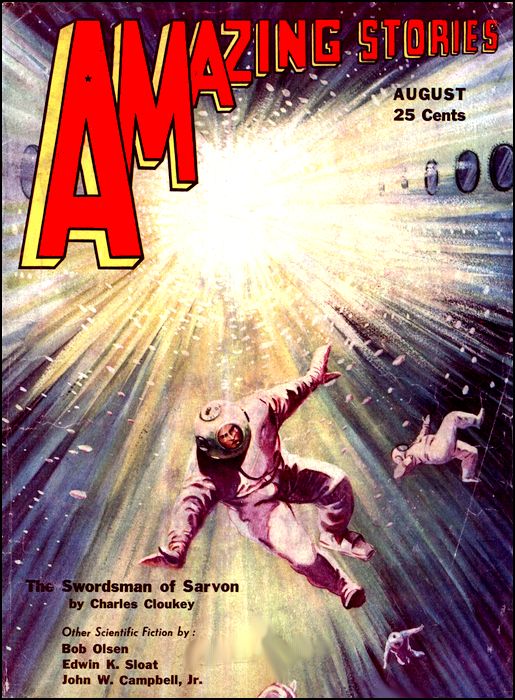
Amazing Stories, August 1932, with first part of "Swordsman of Sarvon"
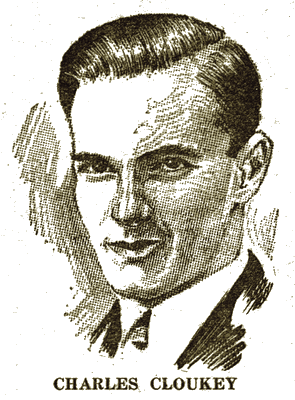
Scientists and laymen alike are now less and less inclined to make any definite statement about the absolute impossibility of any seeming "pipe dream" that is offered as a possibility for the future, because so many "absolute impossibilities" have recently become practical working realities. This engrossing new serial, which, incidentally, is the best story, by this author, we have thus far published, contains a surprising number of potential scientific ideas that are very convincingly set forth.
IT was in August, 2180, that Robert Huston, first vice-president of United Utilities, sought for professional services of his former college chum, Burton Boyd. Boyd met him at the University Club, and they sought a secluded corner. Huston explained the situation that confronted him.
"Since the year 2009, Burt, United Utilities has been the largest and most powerful corporation in the world. I won't pretend that there haven't been shady spots in its history, but for the last few decades the business has been honorably managed. It has prestige and the good-will of most of the millions of consumers in this world today.
"You know as well as I do that one man is responsible for its present position, and that he is Eugene Chilton, the richest individual in the world. He owns outright fifty-one per cent of the stock of the corporation.
"He was found dead three hours ago.
"Neither the press nor the television news-agencies know of his death yet, but it will not be possible to keep the secret for very long.
"His will disposes of the greatest accumulation of wealth the world has ever seen. I'm not interested in what happens to the billions of dollars. Most of it goes to charity. The important thing is what happens to the controlling interest in the corporation. The will is clear and concise. What's more, it is genuine and can be proved genuine.
"Laugh if you care to, but it's a fact that that hard-headed business man was three-fifths a poet. He ran that business, not for the profit in it, but sincerely as a means to benefit humanity. Perhaps its greatest asset is the reputation for fair dealing which it possesses. You would expect such a man to leave large sums of money to charity.
"You know that three months ago Chilton's air-yacht went down in flames three hundred miles north of Hawaii. His life was saved by the three Dornn brothers of Vienna, who were cruising near by. They own jointly many European business interests, which have been losing money steadily. Our financial bureau tells us that the three Dornns just about have their backs to the wall. Chilton knew this, and as a reward for their saving his life, he lent them large amounts of money, which they seem to have lost also. To crown the whole situation, he left the controlling majority of United Utilities stock to the Dornn brothers. He was truly grateful for his rescue.
"But there was another factor that influenced him to draw such a will. His only relative is his nephew, Lee Chilton, a youngster of twenty-one or-two, clean and straight, but wild. He's a daredevil; takes chances for the fun of it. You've heard of some of his wing-walking exploits. And he's every bit as hot-headed and idealistic as the older man. They had a quarrel just before he left on that Hawaiian trip. Eugene Chilton wanted his nephew to settle down and take some interest in the business. The boy wanted to be free, had no interest in the business whatever, and said so, with the result that he was disinherited immediately. After the accident and the rescue, a new will was made, ignoring the boy, and giving the whole thing to the Dornns.
"That was three months ago. Eugene Chilton died before his anger toward his nephew had cooled, and the will stands. It is absolutely valid.
"For the present, at least, I am the acting head of United Utilities. Vice-president is more than a name in this organization."
Robert Huston smoked a while in silence before he continued. Burton Boyd had been taking notes on his companion's talk. He looked up and frowned, puzzled.
"I follow you," said Burton Boyd, "but so far I don't see why you want me."
"I want you, Burt, because you combine ideally two professions. You are a detective and a lawyer. You not only track down your criminal, but you take him into court and convict him. Your reputation speaks for itself. On behalf of the directors of United Utilities, I want to retain you both as an investigator and as a lawyer.
"TO come to the point, there are circumstances connected with the death of Chilton that seem to indicate murder. I am inclined to suspect that the Dornn brothers have something to do with it. If you could prove that, the will would be nullified and the company would become the property of the natural heir, his only nephew.
"I told you that the Dornns were losing money. It hasn't been the fault of their business enterprises, though they would like to make it appear so. That money has gone into politics—crooked politics. The three brothers have been spending freely, too freely, perhaps, and they are the power behind Confederated Europe today.
"You are certainly fully aware of the critical international situation. You know that there is a threat of war on the horizon. If war comes now, it won't last three days, and I doubt if ten per cent of the world's population will escape death—ugly death at that. Aircraft, horrific explosives, virulent disease germs, the power ray; efficient scientific murder by the hundred million.
"So, as a business man. as a humanitarian, as an American, I will do anything I can to prevent the control of this corporation from passing into the hands of Europeans, our potential enemies; particularly, the three who are the hidden cause of a great part of the bitterness between United America and the European Confederation. The Chino-Jap combine, United Mongolia, under Dictator Howard Fu-Zhse, holds the balance of power. If they decide to aid Europe, America hasn't the ghost of a chance. And Fu-Zhse is ambitious.
"I am not particularly interested in Lee Chilton, but he is the one who should inherit United Utilities, for the good of the world.
"To maintain their control, the three brothers need more money, and they need it now. Eugene Chilton's last loans to them have melted. They decided to kill him before he found out their real business. If he had ever seen through them, that will would have been torn up immediately. I myself only received this information about the Dornns earlier today from an investigator in Russia. I was on my way to lay it before Chilton. If he had lived a few hours longer the three brothers would have lost their chance at unlimited wealth. I believe they killed him just in time to keep him from changing that foolish will, and just at the time when they needed funds to further their political ambitions. But I could never prove such accusations.
"If, as a lawyer and an investigator, you can keep the corporation in American hands, you may write yourself a ten-figure check and United Utilities will cash it for you ten minutes after it's written. More, if you want it. As a lawyer, will you not be able to employ various legal delays to prevent the will from going immediately into effect? Meanwhile your secret staff can be carrying on its investigations. I come to you because I've known you from college, and I have more confidence in you than I possibly could have in anyone else. And you operate on a large scale. Do you accept the proposition?"
"Yes. You may consider me retained. We'll fight in court and out of court, at the ends of the earth if necessary, through heaven, hell, or both. From what I know personally of the Dornns, I think most of the fighting will be outside of court. Watch out for attempts on your life, Bob. I think they intercepted the report of your Russian investigator, and so were able to act barely in time. If they did, they know that you know, or suspect, entirely too much. I'm not trying to scare you, but it's possible that you, or perhaps both of us, may be marked for death right now. Sudden death, at an early date. But I'm glad you came to me. It's a privilege to be in on such a fight."
The speech was important because it was so utterly characteristic of the man. Burton Boyd had attained his position at the head of his professions because he was preeminently a fighter; one of that Anglo-Saxon breed that positively never quits. Perhaps he guessed that the greatest fight of his career was before him, but he certainly never guessed where it would lead him, and he could not have guessed the secret of the Dornn brothers. But when Burton Boyd had the chance to help his friend of United Utilities, he made the decision that eventually led him to the Swordsman of Sarvon.
"Consider me retained," he said.
Huston continued: "Thanks. Let me tell you about Chilton. I received the message from my Russian agent in code 4387b, at twelve o'clock noon today. I was in Philadelphia. Rather than phone, I came to New York at once by fast plane. I was here at twelve thirty-five, to learn that Chilton was dead. He had been seen to enter his enormous private office at twelve fifteen, and was found dead at twelve twenty-nine by his trusted secretary, who was ushering in a visitor who had an appointment with Chilton at twelve thirty. You see how small the time-limit is. Between twelve fifteen and twelve twenty-nine no one could have entered his sanctum from the outer office, which was filled with busy stenotyping machines under the control of six reputable employees. No one could have entered even the outer office unless he had business there, and no one did. The only other way the killer could have entered the private office is through the windows, which are a sheer one thousand feet above the highest street level. The office is on the hundredth floor of the new Utilities Building, and it is inconceivable that anyone could have climbed to those windows from the floor above or the floor below. The outer wall of that building is as smooth as polished marble, and there is nothing that would give a handhold even to an ape. Also, the windows were securely bolted from the inside, and they have not been opened, I am told, since the building was put up. The breeze is a trifle too strong for real comfort at that altitude this time of year, and fresh air is supplied by the building's very fine ventilating system."
"How do you know he was murdered?"
"He was lying face down, near the side of the desk. There were no signs of violence in the room. Nothing was disturbed, but the side of his skull was crushed in as if someone had hit him with a heavy sledge hammer. It is unexplainable. There is no trace of a bullet or missile of any type, no hint of this object that shattered the arched bones of the brain case in such a horrifying manner. Not a visible clue.
"The secretary thought that he might have slipped and hit his head against a corner of the desk as he fell, but he withdrew that suggestion when he had examined things. Such an accident might render a man unconscious, would probably raise a lump, might cut the skin or even fracture the skull, but it wouldn't crush in the side of the head. We examined the desk, but it was undisturbed. There was no blood on it anywhere. All the blood was on the thick rug. Those are all the facts I know. I don't see that they indicate anything, except that death wasn't accidental. And it could not possibly be suicide. That man had nothing to hide, nothing to fear. He was honored and happy, and he enjoyed life.
"I ORDERED that a strict secrecy be kept. Besides ourselves, the only ones who know of the death are the secretary, the six clerks in the outer office, and the visitor, who is United Utilities' manager of the Hudson Bay power district. All of them are absolutely above suspicion—I can swear to that. They understand a little of the seriousness of the situation and agreed to keep the death secret for a little while. We had the body removed by undertakers, who are not aware of his identity. His name was much better known than his face was, and the face was unrecognizable anyhow. The undertakers don't know of the scar on his wrist, which I have seen many times, and which will prove the identity of the body should it ever become necessary to do so. There were no identification marks on his clothes. He dressed plainly. He has no relatives except that nephew, Lee, who is somewhere in Europe at present. That will help us keep the death under cover for a little while. I want to give you time to establish some legal delays, if possible. We don't intend to hand over this corporation to the Dornns until we have to, and not then, if there is any way out of it."
"If you are right about the innocence of the clerks, secretary, and that manager, and if there is no access to the office through the windows, I might be inclined to think that the assassin had mastered invisibility. It's hardly probable that such a process is perfected now, but we can't tell what some scientist may have been able to do secretly. You know about the recent experiments at Ontario University, reproving the photonic character of light. There is no telling where those experiments may lead," mused Boyd. "Can you get me a set of photostats of the plans of the Utilities Building?"
"Certainly, Burt, but there's more to tell. I've outlined the situation to you as well as I can, and it's complex and critical. There is another set of circumstances that further complicates matters, but I haven't the time right now to tell them to you, as I have an appointment in five minutes with Harrison Ives, the scientist. If you would care to accompany me to his laboratory on Long Island, you will be able to find out for yourself the other set of influences at work. Unless you're in a hurry, come along."
As the lawyer-detective, Boyd, and the vice-president, Huston, made their way toward the subway that was to speed them to Jamaica, their discussion-continued to absorb them, and they did not notice the small man, undoubtedly a south-European, that followed them at a discreet distance. Even Boyd, with all his experience, never suspected the shadow.
"What kind of a man is this Harrison Ives whom we are to interview?" inquired Boyd in the precise tone he always used when seeking information.
"Ives is a C. E., a Ph.D., a F. R. S,, and several other things. He is a perfect example of the abstract scientist, the man who performs experiments, investigates phenomena, collects data, invents and discovers, merely because he wants to. Many of his discoveries and investigations have no practical value whatever. He has done remarkable work in all branches of optics. He spent three years investigating the physical and chemical properties of the rare element, europium, and those of samarium which closely resembles europium. He is the greatest authority on those elements, as well as on ytterbium, scandium and the various other rare earth elements—all of which is totally useless, practically speaking. The average man, even the average scientist, would spend his time investigating something useful, something in which there might be profit. Ives is the pure scientific type. He has all the money he needs, and he is really interested in knowledge for its own sake. When he announces some scientific fact, even if it's something like the exact fusing temperature of praeseodymium chloride, the scientific world knows that that fact is right, even if it is useless.
"So when he told me that he had perfected that elusive process that has baffled scientific men since the first part of the twentieth century, the liberation of atomic energy, _under control^, I knew he meant just that."
"Nothing impractical or abstract about that."
"You bet your life there isn't. It means this: Within the next few years, atomic energy is going to supply all the light, heat, and power used in the world, either directly, or converted into electricity. All the natural petroleum known to exist in the world was exhausted fifty years ago. All our liquid fuels are synthetic and costly, comparatively speaking. Our coal supply is diminishing, and even with the most modern processes there is a terrible percentage of wasted power when you transform coal into electricity. Besides, it is expensive. We are obtaining tremendous amounts of power from hydroelectric plants, but even water-power is limited and costly. We have harnessed the tides and drawn power from the sun. But all of these will be out of date when Harrison Ives' process comes into use, and it will soon. It's so cheap and limitless! There is an unbelievable amount of power locked up in the atoms of a pebble. For centuries wise men in laboratories have been trying to get at it and put it to work. A small glass of water contains more than enough atomic power to drive one of our enormous air-liners across the Atlantic at record speed, and water is cheap. Furthermore, Ives' invention is not complicated or costly. It is practical, a rare quality in the scientific work of Harrison Ives.
"Ives wants a lot of money so he can purchase large supplies of the rare elements, which are costly. He is convinced that somewhere among the rare earth group, somewhere between 58 and 73 of the scale of atomic numbers, he can find the key to transmutation. At the same time, he doesn't want to worry over such a detail as the patenting of the priceless process that he has stumbled into while searching for transmutation. So he offered to sell it to United Utilities. He knows that the corporation will deal with him squarely, will buy the atomic power process and attend to the necessary patent protection, pay him two hundred million a year or whatever his price is, and leave him free to play with his rare earth elements and worry over the intricacies of extracting some electrons and a single proton from an atom of mercury and making an atom of gold out of it.
"He knew that he could deal with this tremendous corporation, even to the selling of an unpatented, stealable scientific process of uncalculable value, with complete safety. He laid the proposition before me yesterday. I've known him and his sister for a number of years, so he came to me. I told him I would bring out the contracts today. Eugene Chilton backed me up.
"BUT you know what has happened since then. If the Dornns, the power behind the organized, insidious publicity and propaganda that is steadily leading this civilized planet into a war of ultra-scientific horror, are to inherit United Utilities, _they must not have this secret.^
"You recognize, as Eugene Chilton did, that without this process, United Utilities would collapse. We own, among other things, four-fifths of the power supplies of the world. Hydro-electric plants, coal, tide machines, synthetic fuels, and all the rest of it. Light, heat, and power. But intra-atomic power is fundamentally so much cheaper than any of these that the corporation's business would vanish if in competition with it. Atomic power could be sold at one-tenth what it would cost to produce any other form of power.
"In order to continue to exist, United Utilities must have this process. Chilton wasted no time when he had the chance to buy it. The contract was to be closed today.
"But Chilton's death has changed the situation. I'm going to lay the whole situation before Ives, and I'm fairly sure he'll cooperate. He must take immediate steps to secure ironclad patents in every country of the world, or else he must deposit that secret in cipher (and it is mathematically possible to make a cipher mathematically impossible of solution without the key) in the safest safe-deposit vault in the country. The secret, and even the fact of its existence, must be carefully concealed, or else invincibly protected, until we see what happens to the corporation. If it stays in American hands, it can take over the atomic power process, paying Ives handsomely for the delay. If the Dornns get the company, it will not be hard to get financial backing for a new power trust and put United Utilities out of business. The only trouble is that the Dornns could cash in for billions as soon as they got the control, before the crash. It would also be possible to form the new company now, and crash United Utilities anyhow, but we don't want to disrupt this two-hundred-year-old organization. It can fight hundreds of times more effectively as a unit, for it is the biggest commercial organization in the world. It has power and above all, prestige."
The two men stepped off the subway car at Jamaica and took a taxi to the skyscraper in whose upper floors was the extensive laboratory of Harrison Ives. Their trailer was behind in another taxi. Boyd continued his questioning as they rode up in the elevator.
"What kind of a man is Ives, personally?"
"Interesting, in a quiet way. Modest about his achievements, which are remarkable for a man twenty-nine years old. He has a younger sister who lives with him and keeps house. She is one of the few girls I have ever met who is utterly charming, almost fascinating, without being beautiful or physically attractive in the least. Her brother is like her, not much looks, for they're both rather awkward and ungainly, but with a quiet and penetrating personality. Shy, both of them, particularly he. But you'll meet him in another minute, and you can judge for yourself."
Huston rapped on the door of Ives' laboratory. At the second he did so a throaty cry of pain, human enough to make their hearts jump, came from behind that door. There was a crash as of a heavy object falling, and then supreme silence, unmarred by the faintest suspicion of a sound.
There was no bell. Their repeated knocking brought no answer. Finally Burton Boyd turned the knob. To their surprise, the door gave inward, and they stared into the room.
Harrison Ives lay crumpled in a heap, face downward. On the floor were blood and brain. His skull was crushed in as if someone had hit him with a sledgehammer.
IN every age and in every country there are a few immortal "damfools" who take chances merely for the fun of taking them: who play with death for the fun of the game. They usually die young.
Lee Chilton was such a man.
Mentally he was quick and brilliant, though practical he was not. Physically he represented the predominating type of twenty-second century American. Wider at the shoulders than at the hips, though his whole body was deceptively slender, not hinting at the wiry strength and panther-like quickness he possessed. His face was wider at the forehead than at the chin, though the chin showed determination and recklessness.
Lee Chilton was returning to America from the Azores. It was night, and the controls of his monoplane were locked. Lee was flirting with death again, up on the wing of the speeding skyboat, not because he had to, but because he liked it, sticking there somehow in spite of the tremendous force of the air currents.
The moon was hidden by thick clouds, and Venus was the only bright object in the heavens.
A large meteor came very close to the plane, tracing out a brilliant path. It screamed by a few hundred yards to one side of the plane, and then burst a few hundred yards below. The concussion threw the plane upward at a sharp angle and hurled the wing-walker off his feet. Clutching wildly at space, he rolled over the edge of the wing. His outstretched arms found the cabin door that he had left open, and he clung there. Then he pulled himself in through the door and forced it shut, taking his place at the controls and unlocking the automatic control lock. He was smiling.
The meteor aroused his curiosity. He knew it must have been large to have penetrated so far into the atmosphere, and it was far from usual for a meteor to explode. His eyes caught sight of a sizeable object that was slowly sinking through the air toward the ocean below. Closer observation showed it to be partially supported by a parachute. He turned his spotlight on it, but could not distinguish what it was.
He put his amphibian into a steep dive, passing the mysterious object. When it was above him he maneuvered carefully into position, shut off the tractor propeller, and started his helicopters just enough to keep the plane hovering motionless. Then out that door in the side of the fuselage, and up on the wing again. He got the thing as the parachute let it down, held it by the lines of the parachute and managed to swing it in through the doorway. Then he climbed down again, using that convenient sliding door. In the lighted cabin he examined his prize, wondering idly what it had to do with the meteor. He had not seen it before the explosion. He had a half-formed theory that the meteor was artificial, a rocket of some sort, and that this thing had been inside it, released by the explosion.
It was a black metal box, kept shut by a simple clasp. He opened it. Inside was a panel ten by nineteen inches, apparently a radio set of some sort. Connected to it was a curious leather headgear lined with thin metal. Inside the headgear were two earphones and a small lump of polished copper that would come right at the back of the neck when the headgear was put on.
After ten minutes of consideration, Lee's curiosity got the better of his caution, which had never been very pronounced anyhow. He took a chance. He donned the odd arrangement to see what would happen, and wondered what to do next. There seemed to be no switch of any kind on the panel. He decided that the whole arrangement was a dud, and started to remove it.
Then in a tenth of a second the whole world went black, and the man who took the chance plunged into oblivion.
NOWHERE in the known universe is there such an anachronistic mixture of civilization and savagery, of science and superstition, of culture and primitiveness, as there is upon the Hot Planet, Venus. There, great cities of steel fight the impenetrable jungles that hide still undiscovered monsters; there, men who fight with the sword obey their rulers, the aristocratic class of scientists and builders; there the two rival city-nations, Sarvon and Cor, flourish and prosper, surrounded by the swampy jungles and covered over by the planet's heavy blanket of clouds; there life is abundant and consequently cheap, and death is sudden and violent. And there lay the hidden key to the mystery that surrounded Eugene Chilton's death.
A large airplane left the city of Cor and hurtled through the Venerian night, low above the fetid jungle, toward a rocky high plateau in the distance. A tiny silent skyship darted down out of the cloudy upper atmosphere and cautiously approached the larger plane. Finally, the three disk-shaped pads that occupied the place of the landing gear of the small plane, touched the top of the large plane's fuselage, and clung there. The pilot of the parasite left its motor running in order not to give away his presence to the occupants of the larger ship, and climbed daringly out on its fuselage. He was a herculean bronzed man, clad in a sort of short tunic that did not hinder his movements. At his waist was a triplicate scabbard wrought in steel and gold, and it contained three swords—swords that were short, straight, and heavy, and that were accurately balanced to the fraction of a gram. Moving carefully in the darkness, he attained the point of junction of the fuselage and one wing of the large ship. Here he attached another suction pad, much smaller than those on his plane, and to which were attached wires that led to the metallic helmet on his head. Other wires led to a small box strapped to his chest. Making adjustments on the panel of the box, he listened attentively to the conversation of the large plane's passengers, who had not the slightest suspicion that they were overheard.
The two inside were conversing in the patois of Cor, but the listener, a Sarvonian, had no trouble in making out what they were saying.
"Why is it necessary to go so far from the city?" asked one.
"I do not know," replied his companion. "I am not a man of science. But I think it is because of the steel. Cor is built of steel, and this process that the council has perfected is very intricate and delicate, involving all the varied studies of astronomers, physicists, psychologists, and engineers. Very delicate currents of electricity are used, and the system must operate over great distances. I am told that this thing would not be successful in a place where there is much steel. In the cave in the cliffs there is no steel near, and there is no steel in this airship. It is made wholly from alloys of light metals which will not interfere with the electricity that is used. Even the slightest interference may be fatal to the operator."
"What are we to do?"
"We are executioners. We are to kill, after the transfer has been completed. This, I believe, is the ninth transfer, and the Council is angered by the failure of the appointed executioners in most of the former cases. We must not fail, for perhaps the fate of all Cor rests upon our shoulders. The Council has good cause to be angered."
"Why have all the others failed?"
"Meriden! Many Sarvonians can use the sword, but there is only one Swordsman of Sarvon. No one on Venus can stand against him. Somehow he has penetrated our plans every time. Each time he killed the appointed executioner, and those who should have been executed are living in Sarvon now, because of Meriden. This time, I hope, he has been beaten. That was the reason for such secrecy about this nocturnal takeoff. The Council is taking precautions. But they are not sure of themselves! There are two of us this time, and we are champions. I know of your reputation, and you know that I am no sluggard. Between us we should be able to take care of Meriden, should he appear. There will be rich rewards if we kill him."
"Why do they not send many, instead of one or two each time? Then we could be sure."
"They do not dare. That would be an act of war against Sarvon, and the Council is not ready for that yet. It might be disastrous. It all goes back to the great delicacy of the process, and that cave is the only really suitable place we can find for performing it, but it is in neutral territory. Sarvon would know and be suspicious if we took troops there. The Sarvonians would want only such an excuse to start war, and the Council does not want war until our scientists have perfected a new device for dealing death. Then we will crush Sarvon and be free to carry out our other plans, those plans that we are starting to carry out now, and which are always interrupted by Meriden. The Swordsman of Sarvon? He deserves that title!"
"It would seem cowardly for the two of us to attack him, were the nation's interests not at stake. And though it pains to admit it, one of us could not last two minutes against him."
"The question of cowardice does not enter into it. If he appears again, he must be killed."
The listener detached his device and re-entered his plane, smiling grimly. The parasite detached itself and shot silently upward, leveling out to dart ahead, racing for the distant cliffs. It left the larger plane behind as it hurtled through the clouds.
The little skycar maintained its headlong rush for almost two hours. Then it circled down to land upon the wide ledge half-way up the cliff-side, the ledge upon which the cave opened. The pilot knew the place, had landed there before, but he was careless and disaster fell upon him.
Perhaps the night _plus^ the thick clouds was to blame. At any rate his searchlight did not disclose the jagged rocks on top of the cliff in time for him to avoid them. He crashed with terrific force on top of the cliff, not halfway down it.
Blood oozed from wounds on his thigh and his temple, but the bronze giant started to climb down the vertical cliff in spite of them. The night was black, but he could see the beam of light that showed where the illuminated cave was. He cursed at the pain of his wounds and redoubled his efforts, climbing downward through the pitch blackness. Four times he almost fell, only to save himself by luck and those great muscles. The triple scabbard with the three heavy swords was still at his waist.
He was still fifty feet or more above the cave entrance when he saw the large plane land easily on the ledge. As the two below got out of their airship, the giant scrambled recklessly down what remained of the cliff above the ledge, acquiring another wound—a cut on the left arm—from a jagged rock.
The two had entered the cave. The giant drew two of his swords and stepped into the entrance. The Venerian fights with two swords, always, and he carries a third in case he throws or loses one of the first two. Sword-throwing was never practiced to any extent on Earth, but the warriors of Venus could hurl their heavy, accurately balanced weapons with incredible accuracy and deadly results.
One of the two Corians seemed to have vanished utterly into thin air. The other turned and opposed the giant with a startled gasp of recognition.
"Meriden," he cried, as their swords met.
The Swordsman of Sarvon was grim. His wounds were hindering him. The battle was exhausting what remained of his strength after that fatiguing climb. He was laboring for breath.
He could see a form recumbent upon a bench. The one who was to be executed! Was the other Corian going to plunge a sword through the heart of the sleeper, while the first one kept him occupied? Meriden made a supreme effort and managed to pass his adversary at the entrance. Now the Sarvonian giant could back toward the sleeper and protect him. Still he could not see any trace of the second occupant of the plane. He noted subconsciously, while he was fighting, that the sleeper's head was encased in a helmet of leather and copper, from which wires led to a gigantic array of apparatus in the rear of the cave. Where was the second Corian?
The mysterious personage in question was hidden in a dark niche in the cave, concealed in shadow. The broad back of Meriden was toward him. The wounded giant was fighting for his life now. His breath was coming in gasps, and one of his adversary's swords had gashed his shoulder.
The hider selected the one of three swords that he knew to be the most perfectly balanced, and smiled as he lifted it slowly to hurl at the giant's back. He had the Swordsman of Sarvon at last!
THE body of Harrison Ives was still warm as the executive and the detective bent over it. There was no one in the room, and there was no entrance to it except the door by which they had entered. Huston ran to the window. It was bolted. The side of the building was sheer, and the street was hundreds of feet below. Suddenly Huston gasped, and the detective joined him at the window. It was late in the day, but there was still light.
A tube went through the wall close beside the window. An arrangement of lenses and prisms gave it the effect of a combination telescope and periscope. Looking into it, one could see plainly what was transpiring on the street below.
Huston saw their waiting taxi, and behind it another. A tall figure emerged from the building and was met by a slight, swarthy individual. With a start, Huston recognized the former as Laura Ives, that girl, sister of the scientist, who, though she was handicapped by her lack of good looks, was the possessor of a fascinating personality, Huston knew. There was something incongruously furtive about her bearing, and she was carrying a thick black volume. She talked for some seconds with the small man; they both entered his taxi, which moved away. Huston turned back toward the room, staring at a shelf high on the wall by the single door. On it was a row of heavy black books of the loose-leaf type. He counted them rapidly. There were only eleven. The twelfth was gone, and in it, he knew, were the careful notes of Harrison Ives, his mathematical researches, the results of his experiments, the details of his investigation of atomic power. Gone!
Burton Boyd had acted. He knew from the color-plan, what company the taxi belonged to, and he had been able to make out the individual number of the car. His trained mind had secured those facts the second he had glanced through the tube. He picked up the phone, called his offices in Manhattan, and gave orders that all the bridges and vehicular tunnels be watched, and that the taxi, if found, should be trailed. He told his subordinate to ask the cooperation of the police, and in three minutes, thanks to the police headquarters broadcast to all the men on duty, there was a thick network of watchers all over Greater New York. Then, after he had finished these arrangements, he turned to his companion for explanation.
"It seems impossible that she could be guilty," said Huston. "She has always seemed to be perfectly devoted to her brother. She knew he was a genius, and she was interested in his work. She was no mean scientist herself. I've known her too long to believe that she is guilty. Something is wrong somewhere. I can't explain her actions."
"What was the book?" asked the detective.
The other shook his head hopelessly. "That secret of atomic power. Ives always kept the results of his experiments in bulky notebooks. Those eleven on the shelf contain all his earlier work. He didn't care for typing machines, but wrote everything out in his flawless, beautiful handwriting. Now the important one has been stolen, apparently by Laura Ives. Ives himself is killed under circumstances that make murder seem impossible, yet he certainly didn't die naturally. There's something wrong, somewhere, about the whole situation. It seems flatly impossible that anyone could have crushed Ives' skull with us outside in the corridor, and then have disappeared from this room, unless we take the theory of invisibility. Even then—"
"It may be that. I've seen too many scientific impossibilities become established facts to risk saying that invisibility is impossible in this age. There's nothing more to do here. There are no material clues. I'll arrange to have the body removed. The next thing to do is to locate Laura Ives. I hope some one spotted that taxi."
The two men descended in the elevator and went out to their own waiting cab. A short talk with the driver verified what they had seen through Ives' periscope. As they drove back to Manhattan, Huston asked, "Do you think it probable that your men have found the taxi?"
"There's no reason why they couldn't. We both saw the identification number, required by law, painted on top of the hood so as to be visible to the police in the traffic towers. It was 37K3, wasn't it?"
"Yes. It was plainly visible."
"Unless the driver covered it quickly, some one of my men or of the police would be sure to spot it. And if the police saw it covered they would immediately be suspicious."
Night was falling as the two men reached the detective's office. After several short conferences with some of his staff, Burton Boyd turned to Huston.
"No results yet. Would you mind phoning for those photostats of the Utilities Building plans? Also, see if you can get in touch with Eugene Chilton's secretary, those six clerks who were in the outer office, and that visitor. I think you said he was United Utilities' Hudson Bay District Manager. Have them come over here right after supper, if possible. Get a bite to eat yourself, old chap. We're not done yet tonight." And Boyd plunged into some routine work with renewed energy. The executive stood admiring his apparently tireless friend and then went to a phone on a near-by desk to make the necessary calls.
AN hour later the clerks, secretary, and manager arrived at the office of the detective. They voluntarily underwent a psychological examination, and the sensitive psychometers and delicate sphygniomanometers indicated that the men were innocent of any share in the death of Eugene Chilton. The psychomechanical evidence could not be taken as absolutely conclusive, but Burton Boyd knew that the scientific soul-machines were usually right, if competent psychologists interpreted the charts and records. Boyd's staff expert assured him that the evidence was entirely negative.
Later, in the conference-room, Boyd questioned them, though he learned nothing significant from clerks or secretary. Then he questioned the Manager of the Hudson Bay Power District.
"Mr. MacAndrews, will you please tell me the purpose of your intended conference with Mr. Chilton, the conference that never took place?"
"Certainly, but it will require a little explanation. It concerned one of the latest projects of United Utilities, one about which strict secrecy has been kept until yesterday, when we let the public know about it. You know that three years ago, unusual cosmic disturbances took place, and astronomers, due to the timely invention of the hypertelescope by Harrison Ives, were able to increase greatly our knowledge of the universe. I may say that Ives' work in optics is of incalculable value; in fact I believe it to be the only one of his scientific achievements that has any practical value."
Boyd smiled dryly. "Perhaps. The general consensus of opinion seems to be that Ives' work is totally impractical, but the more I hear about him the more I am inclined to think he wasn't such an impractical sort of scientist after all. But please continue Mr. MacAndrews."
"During the period of the cosmic disturbances I referred to, the thick, ever-present blanket of clouds that has always obscured the planet Venus and prevented astronomers from learning anything about the planet, was lifted for a considerable time, and with the hyper-telescope observers were able to detect absolute proof of intelligent life upon the planet. As to the nature of this proof, I am not prepared to say anything, for I am no authority on the subject. If by any chance you should want to know about it, I refer you to Professor Riccardo di Bargi, who made the discoveries.
"You remember di Bargi's attempts to get into radio communication with the planet. In spite of the tremendous amounts of power he used, the attempts were failures.
"The professor was far from discouraged. He went, a couple of years ago, direct to Eugene Chilton and asked for the company's cooperation in financing and building a rocket spaceship. Twenty-second century mechanics and engineering are so far advanced that interplanetary travel is perfectly feasible from the purely engineering point of view, and twenty-second century physiological research has shown that it is possible for human beings to withstand the terrific acceleration and the weightless condition that would prevail in outer space. The professor wanted to build such a rocket and take it to Venus, the only planet in our system where living conditions would be enough like ours to permit a man from Earth to exist there. The professor is obsessed with the tremendous idea of establishing communication somehow with that highly intelligent life which, as he is convinced, exists on Venus.
"Eugene Chilton helped him, in return for the exclusive rights to all mineral wealth discovered on, or imported from, the planet Venus, provided that such a process should prove feasible, and that the theoretical inhabitants of the planet would permit the removal or purchase of such minerals. United Utilities has covered the world, but there is still room for expansion in the universe, and Chilton had foresight enough to realize that sooner or later interplanetary commerce would be a fact.
"As Mr. Huston knows, Mr. Boyd, we have been constructing the rocket in the Hudson Bay District, near Fort Severn. It is under the supervision of Riccardo di Bargi and myself. The plans call for ordinary airplane propulsion as high as that will take the rocket, and from there on the motive power will be provided by the reaction or recoil from the explosion of liquid hydrogen, as in the several experimental rockets that have reached the moon (*) in recent years. But early yesterday I received a radiophone call from Mr. Chilton asking me to come to New York along with the professor, but di Bargi didn't want to lose time on the rocket and so asked me to make the trip alone. I understood from Chilton that he wished to discuss with me the possibility of using intra-atomic power to propel the rocket, for it seems that United Utilities was on the point of acquiring the process from some inventor. That's all I know."
* In trying to present a truly scientific solution of the problem of reaching the moon, the author has purposely refrained from all mention of the Millikan Cosmic Ray, because so comparatively little is known about this subject at the present time. The reader may assume, however, that Javis' large staff of scientists, backed by a billion dollars, was able to discover some suitable method of neutralizing or counteracting the probably harmful effects that this ray might have upon human beings.
"Thank you. The inventor, by the way, was Harrison Ives. He has recently been killed in the same manner that Chilton was, and the description of the atomic power process is missing."
The district manager's eyes opened wide. At that moment the conference door opened, and one of Boyd's operatives stepped in. At a word from Boyd, he made his report. The others listened attentively.
"Operative Fisher and I spotted taxi 37R3 at Mineola, and followed it a mile. At a subway entrance it stopped and a little man, European, got out with a tall girl. She carried a black book. We followed them down the subway escalator and Fisher, I think, got close enough to hear what they were saying. I didn't. The girl gave the book to the little man, who immediately boarded a train bound for the flying field. Fisher managed to get on, too.
"I stuck near the girl. She took a train back to Manhattan, got off at Fifth Avenue, and walked to the Metropolitan Hotel. She may have been on to me, but I don't think so. She walked into a dark alley at the side and went around to the back of the hotel. I followed just in time to see something you won't believe, but I'll swear it's true. There wasn't much light at the rear, but I saw her plain enough. Boss, she stood there a moment and then walked into that hotel through the brick wall! She just seemed to melt into it. There was no other way she could have gotten out of that space behind the hotel, and I saw her go through that solid wall as if it was air."
"She would have had to pass you to get back out the alley?"
"Yes, and I know she didn't. I hung around for quite a while. I tell you I saw her go through the solid wall. I examined the wall myself. Solid brick and mortar. No trick to it. She went into it just as if it wasn't there. I don't see why, even. The hotel has several doors. She didn't want anyone to know she was in the place, I guess."
"All right. You're finished for today, Richards," said Boyd as he turned back toward the others. "I was wrong not to order immediate arrests on suspicion as soon as the taxi was spotted, though I thought that might have given us away to whoever it is behind this whole affair. I might mention that Richards is thoroughly reliable and that I see no reason to question his statements. Either that girl went through the brick wall, or else Richards is thoroughly convinced that she did, or he wouldn't say so. Just what—"
AT this moment Fisher arrived, eager to impart what he had learned. His story checked Richards' up to a certain point.
"—and we followed them into the subway. I got close enough to hear what they said. Mr. Boyd, I've been a detective for seven years and my memory is good. I can tell you word for word what they said, and I'm not mistaken—or lying either.
"It was the girl who did the talking. She said, 'Take this to the flying field and send it registered express to the Dornn brothers at Vienna. They have the meteorockets and will attend to sending it to the Hot Planet. Of course they will make copies, too.' It was the book she was talking about, because she gave it to him. I followed him to the field, and he had the book carefully boxed and sealed and sent it registered express to the Dornns in Vienna. I was standing next to him in the line at the express window and I saw every detail. I had a faked errand and he never noticed me.
"Then he did a fool thing, Mr. Boyd. He tried to cut across the landing field, instead of going around the walk to the subway station. I don't know why, unless he was in a terrific hurry or else was entirely unacquainted with the field. Some mechanics and guards shouted to him in warning, but they couldn't seem to make him hear. The field was brilliantly lighted, for it was getting late, but nevertheless he was killed by a monoplane which was landing. Either the pilot didn't see him in time, or else the pilot did see him and, losing his nerve, couldn't act in time. The propeller chewed up the little man just as the plane touched the earth, a few seconds after the pilot had cut off the power. Damned ugly accident.
"Now here's another queer thing. The pilot of that plane was Lee Chilton, the daredevil wing-walker. It's hard to believe. Young Chilton never took chances with anybody's life but his own, and it's impossible for that fellow to lose his nerve. The field was perfectly lighted. Chilton could have avoided the accident if anyone could. He should have seen the man, but he says that he didn't. That's all I can tell you."
"Chilton was returning from Europe?"
"Yes. By the Azores."
"Good. That's all, Fisher."
Boyd's face gave no outward sign of his feelings, but, experienced detective though he was, his voice could not help but betray some of his inner emotions. "Gentlemen," he stated slowly, "we're up against something big, and I think I'm beginning to see light. I'm not sure, or I'd tell you.
"Mr. MacAndrews, you heard the reports. Get back to Hudson Bay with Professor di Bargi and rush through the completion of that rocketship. Mr. Huston, here, is now acting head of United Utilities, and he will give you the fullest cooperation—money, men, materials. The atomic power secret is gone, so use your liquid hydrogen. With the money Mr. Huston will place at your disposal, double your staff of scientists and engineers and have them check and recheck every detail. Get a very strong guard of men you can trust and permit no unauthorized person to come within miles of the place. Watch out for spies, bombs, and above all, sabotage. If we have to go to Venus, we will. The rocket may be infinitely priceless. Keep this office advised constantly, and they will see that I am informed. The rest of you here understand that nothing you have heard is to be repeated outside, or even discussed between yourselves. Good evening. I should like to speak to Mr. Huston privately."
When the rest had left, the detective turned to his friend. "Bob, I'm going to Vienna. If I act quickly enough, I might even be able to intercept that book before it gets to the Dornns, but I doubt if I can. Robbing aerial express or aerial mails is just about impossible. If I got caught at it in Europe, with the present state of hard feelings toward all Americans, my captors would make things hot for me. If the Dornns get that secret, there is almost the certainty of war soon, and what chance have we got against Europe—Europe armed with atomic power?
"Europe wants war, and it is the Dornn trio that is behind it all.
"You heard that reference to the hot planet? That could only be Venus, and we know life exists there. The Dornns have something to do with Venus, and they intend to send the book—"
A whistling note sounded from the news-machine in the corner of the room. The whistle signified that an event of particular importance was being broadcast. Burton Boyd snapped on the sound and vision controls. As no image appeared on the screen of the set, it was evident that the event was not of a type that could be photographed or broadcast over the television system. The clear, precise, even voice of the unseen news-announcer filled the room.
"We regret deeply that we are obliged to announce to the people of the United States that Secretary of State Jones, who has done so much in these trying times to preserve peace, has been murdered by assailants unknown.
"The Hon. Secretary has been stopping for several days at the Metropolitan Hotel in New York, where he occupied a suite on the ground floor. The doors and windows of his rooms were locked and barred, and no evidence of their having been disturbed can be found. The Secretary's trusted valet was sleeping in the room next to the Secretary's chamber, and states that he, the secretary, had retired early in the evening. It is the valet who has disclosed the death of Mr. Jones, whom he found a few minutes ago lying prone on the floor of his chamber, with the side of his head crushed in completely. We are informed that the Chief of Police has stated that a very heavy, blunt instrument, such as a sledge hammer, would be necessary to make such a wound. The police appear, at the moment, to be launched on their most baffling case in years."
LEE CHILTON regained consciousness as suddenly and as completely as he had lost it. His first perception was that something tight was around his head. It was a heavy helmet fastened on by a chin strap. Almost automatically he loosened it and removed the helmet. Then he saw that he was lying on a bench in a lighted cave, the back of which was filled with strange apparatus from which led a cable, made of several insulated wires twisted together, to the helmet he had just removed.
Now his attention was immediately attracted by what was taking place before him. A bronzed giant was battling, a heavy sword in each hand, with a slightly smaller adversary similarly armed. In a niche in the cave wall, plainly visible to Lee Chilton, though hidden from the fighters, was a third man, in the very act of lifting a sword to hurl at the giant's back.
It was cowardly, thought Lee, and of all things he despised cowardice the most. His mind and his muscles worked together; he leaped for the man in the niche. He was not in time to prevent the sword from being thrown, but he seized the man's shoulder at precisely the right second to deflect the course of the sword. It hurtled through the air for a short second, and embedded itself up to the hilt in the breast of the bronze giant's adversary.
Chilton felt himself hurled heavily to the floor. Livid with rage, the sword-thrower drew another shining steel sword from his triple scabbard and lunged toward Lee. Even as he did so, a thrown sword transfixed his heart. He fell backward, and Lee Chilton saw for the first time, on the hilt of the crimsoned sword, the head of a jaguar, wrought in steel and gold—the device of Meriden, the Swordsman of Sarvon.
It had all happened in a few seconds. The giant was dressing his wounds with the contents of a small pouch he carried slung over one shoulder. He addressed a few unintelligible words to Lee. The daredevil shrugged his shoulders and spread his hands in a way that showed plainly his lack of comprehension. The Swordsman smiled, disclosing strong white teeth and a red mouth in a face that was intelligent, friendly, even-featured, and honest. Lee smiled back in order to show his friendly intentions, and the Sarvonian extended his left hand. Lee Chilton took it, and thereby established a comradeship that did not need words.
For the first time the Earthman looked at himself. He was wearing a light tunic, a garment such as he had never seen before, and it suddenly dawned on him that his body was strange. He had been tall and slender, with that wiry strength that depends on the quality of muscles, not on their size. Now he was yet tall, but broad and heavy also, with big-boned smooth muscular arms that showed at a glance the terrific power of their possessor. He had been white, Nordic; he was still a white man, beyond all possibility of a doubt, but he was deeply tanned, as though he had spent years in the tropics. He did not understand it; neither did he understand the swordsmen, the cave, or any other detail of the circumstances in the midst of which he found himself. The last thing he remembered, he had been alone in his monoplane, high over the Atlantic.
Meriden had recovered his jaguar-hilted sword, and was nonchalantly wiping it on the tunic of the man he had slain. He sheathed it and motioned to Lee to follow him. They went out of the cave, and the Earthman saw that it opened on a broad ledge on the side of a mountain. The cliffs above were almost vertical. Those below were more so, in places overhanging. The heavy odor of a jungle, of decaying vegetation, came up to his nostrils from below. Over all were thick clouds. On the ledge was an airplane that resembled those that Lee was familiar with, and yet was different in many respects from any he had ever seen. He did not know it, but it was the plane of the two Corians who were lying dead in the cave.
Meriden seemed to be struck by a sudden thought. He turned and reentered the cave, and Lee soon heard the smashing of glass. Looking into the cavern, he saw the giant systematically wrecking all the apparatus in the cave. His bewilderment, his feeling of mystery, was stronger than ever, but the Earthman was not afraid; to the contrary he sensed that there was adventure ahead of him, and his brain was supernormally alert, tingling with anticipation.
The Sarvonian returned, carrying the scabbard and the three swords of one of his late antagonists. He gave them to Lee and showed him how to strap them around his waist.
Then they entered the plane. The Swordsman took the controls, and the skyship taxied off the broad ledge into the black night. They rose a thousand feet or more, and crossed the range of mountains. On the other side was more jungle, but the clouds seemed less dense. They flew on in silence for many moments, when suddenly Lee felt the other pulling at his arm. The giant pointed out through the window at the left, and Chilton gazed out at the blackness. At first he could distinguish nothing, but then he saw a space of darker blackness in the cloudy sky. Several stars were visible, and one of them shone with a splendor and brilliance that astonished the Earthman. Meriden pointed at Chilton, then at the brilliant body in the heavens, and held up three fingers. Then he pointed at himself, at the ground below, and held up two fingers.
REALIZATION came to Lee Chilton. He was on Venus, witnessing a rare phenomenon—a rift in the Hot Planet's cloud-blanket. The brilliant star was the earth. Then he remembered the meteor, its explosion, and the apparatus supported by the parachute. In some incredible manner, when he had donned that headgear in the cabin of his plane on earth, he had been overpowered and rendered unconscious by someone on Venus, who had interchanged identities with him. That much he understood. He was enough of a scientist to realize that there was nothing impractical about the process. The human brain is almost infinitely complex, but not infinitely so; it is an electro-chemico-psychological machine of great delicacy. Our memories, our ideas, our reasoning powers, perhaps even that we call soul, in the last ultimate analysis, are all matters of chemical changes, reaction; so if the changes could be produced artificially, cell for cell, the identity, the memory of the individual so treated would utterly change. That was what had been done. Chilton had seen coming from Venus the meteorocket, and by chance he had discovered the apparatus it contained. Then over the void of dozens of millions of miles of space, two identities, two beings, had changed bodies. Lee Chilton had come to the Hot Planet, the world where civilization and savagery were united in the great city-nations of Sarvon and Cor; but Lee Chilton would never have wakened to learn of the transfer had it not been for the giant swordsman who was called Meriden.
During the few minutes that the clear starlight lasted, Lee could make out the thick, green vegetation below. One place there was a rift in the trees, and a wide, sluggishly moving river was visible. For a short moment he saw some of the animal life of the Hot Planet. A great herd of a variety of wild, long-horned cattle was surrounded in the open space by the river by a snarling, wary pack of jaguar-like cats whose dimensions far exceeded the largest of terrestrial tigers. Miles farther on were two great lizards, drinking at the river.
Then far in the distance, myriads of lights appeared and rapidly came nearer. The colossal city of Sarvon towered out of the jungle. It was not a collection of steel structures, but rather one great unit, one great building of steel, thousands of feet tall, stretching miles in all directions, containing millions of men, women, and children. It had been centuries in the building by this great city-nation, and it was built to endure for centuries. Its higher levels are often in the midst of great, wet clouds, and its foundations are sunk deep in the jungle mire. Lee Chilton was not astonished at his first sight of the city. His astonishment came later, gradually, as he came to know the place. The Venerian city of Sarvon is too big to understand all at once; a unified mass of steel that can be measured in cubic miles.
Meriden landed in a great open space on the highest level of the city. Other planes were standing around, and two were taking off. A group of five armed men met Meriden as he stepped out of the cabin. He spoke with them at length while Lee Chilton stood silently at his side, comprehending not a word. Finally they seemed to be satisfied, and turned to leave. The Swordsman of Sarvon turned to Chilton with a reassuring smile and motioned him to follow.
The group of five made their way to a small structure at one side of the wide expanse of steel; Meriden led the Earthman down a long ramp that led to a lower level, and stopped at the intersection of two wide corridors.
Each corridor seemed made for one way traffic only. One-half of the way was used by pedestrians only, and was crowded with Venerians, who wore, regardless of age or sex, the light tunic that was essentially dictated by the ever-present heat of the planet. Legs and arms were bare, and sandals, some ornately decorated with gold and jewels, completed the costume.
The other part of the corridors was used by three-wheeled vehicles with sedan-like bodies, approximating the terrestrial motorcar. Two of these drew up at the intersection at the same moment, and their occupants emerged, greeting the Sarvonian pleasantly.
The driver of one of the cars was a smiling tunic-clad girl, who held out her left hand almost shyly to the giant. She was slender, dark-eyed, bronzed, and erect, and she possessed that perfect symmetry that is so large a component of beauty. And as Meriden took her hand in his for a moment, Lee Chilton noticed the broad belt of finely tanned leather about her waist, and saw that it was fastened by a large buckle, upon which was a jaguar's head, skillfully wrought in steel and gold.
The girl's eyes met Lee's for a moment, and he was aware of something in his inner mind trying to rise to the level of consciousness—like something he had known long before, and knew he ought to recall, but could not quite remember. He was aware of the girl's beauty, but he was absorbed by the mystery that deepened every second he regarded her. Something was trying to manifest itself to Chilton's conscious brain, but this utmost concentration did not disclose that tantalizing fact. It was in his mind, but he did not know what it was.
The occupant of the other car was an older man than any Lee had noticed in the corridors. His skin was not so tanned as that of the others, and he was not a muscular individual. His eyes were bright and alert, and his forehead was very high. Chilton judged him to be a man of wisdom, a scientist; but he did not know that the man was the head of the aristocracy of scientists and builders, the supreme ruler of Sarvon. If Lee had known, he would have been puzzled as to the reason that such an individual should take the trouble to meet him and Meriden at a street corner.
Meriden had greeted him quietly and respectfully, and the other had issued a few instructions. Then the giant, with a friendly wave of his hand, had entered the girl's car with her, and the car had moved away. Chilton found himself alone with the scientist.
The latter first smiled solemnly to himself, and then quietly addressed Lee.
"Will you step into my automobile?" he said in English, chuckling at the effect his words produced upon the other.
"You speak English," gasped Lee.
"Yes. I like it better than any of the other earth-languages. It is the tongue you are accustomed to, is it not?"
"Yes. But I don't understand—"
"Let that wait, if you please. There are many things you do not understand now, but all necessary explanations will be made soon. If you will enter the car—"
Chilton hastened to obey, and the vehicle was soon threading its way through a maze of wide corridors, occasionally descending a long ramp to a lower level, but never going up. Lee became aware of a real respect and liking for this man, who spoke his own language, and seemed to be aware of all that had happened to the Earthman, and promising explanations.
"Meriden tells me that you saved his life in the mountain cave."
"I am glad to have helped him. While he was fighting one man, a coward attempted to throw a sword at his back. I do not know how you consider such practices here, but on my world such a thing would be despised."
"It is a dishonorable practice on this world also, my friend, but the thrower knew that in no other way would he conquer Meriden. He has no equal with the sword in all Venus."
"I do not doubt it. If I may ask, who is the girl who came to meet him? His sister?"
The elderly Sarvonian looked shrewdly at the young man, who had crossed the void from an alien world. After surveying him for a few moments, he replied pleasantly to the question.
"No, my young friend. She is the girl he loves, and whom he intends to make his wife before long. He has vanquished all of her other suitors."
BURTON BOYD snapped off the news-machine as the announcer's voice finished telling about the death of the Secretary of State. For a moment he remained lost in thought, then he turned to Huston. "Bob," he said, "there's a lot to be done here, with that killer at large, but my decision stands. I'm going to Europe tonight to try to intercept that black book before it gets to the Dornns, for that is the most important thing. They want war, and with that process in their possession, they can wipe out America in a day. I don't know how, in fact I don't even know that it's possible, but I'm going to rob the aerial express and get that book."
"You're taking a terrible chance."
"I know it. What time is it?"
"Ten forty-five."
"That means the aerial express left Mineola for Le Bourget just five minutes ago. I can't intercept it this side of Paris. There's no plane faster than an express plane, and I'm working outside the law."
"You can get to Paris before it does."
"Yes. The passenger-rocket makes the transatlantic trip in two hours; the express takes four and a half. But I can't catch the rocket. It leaves Halifax in five minutes. It's too late, Bob."
Huston picked up his friend's phone. "Give me Halifax," he said to the operator. "Connect me with AA-3-1000. Thanks."
While waiting the few seconds necessary for his connection, Huston turned again to the detective. "You forget," he said, "that the Rocket Transportation Company is one of United Utilities' many subsidiary corporations.... Hello. Mr. Dugan? This is Robert Huston on the wire from New York. Hold that London rocket until a Mr. Burton Boyd arrives and presents credentials. Yes, you heard me.... Cable and make immediate arrangements for a fast plane to meet him at London and take him to Le Bourget, Paris. Yes, you heard me, Dugan, get busy."
BURTON BOYD beat the express to Paris by ten minutes, thanks to a fast plane to Halifax, to the rocket, and to another fast plane to Le Bourget. He realized fully that he was playing the most desperate game of his career. If he were caught robbing the express, the European authorities would see to it that he paid the penalty, particularly since he was an American, but Burton Boyd was determined that the Dornns should never have that all-important black notebook. He knew only too well that there had been only one successful express robbery in thirty years, that all others who had tried it were dead; but it has been stated before that Burton Boyd never quit. He was not excited as he stepped upon the Paris field; in fact, he was very calm. He walked casually past the row of waiting express-planes reading the destination of each, and its number, painted in French text on the fuselage and wings of each. _Soixante-dix, Leningrad,^ _Soixante onze, Berlin^. _Soixante-douze, Vienne^. Seventy-two, bound for _Vienne!^ It was two-thirty in the morning, and the brilliantly lighted field was almost deserted, except for armed guards and the expert mechanics, who were tuning up the engines of the waiting planes.
The express plane from Mineola landed in a cloud of dust. Boyd knew that the express consignment had been sorted on the trip over the Atlantic, and that in a very few seconds it would be distributed among the waiting planes. He had few seconds to lose. When the eyes of the guards were on the landing of the plane from Mineola, Boyd hurled a small object he had been holding in his hand, as far as he could in the direction of _Soixante-dix,^ the plane bound for Leningrad. The object was a repeating torpedo, a totally harmless little piece of fireworks, but when it hit the ground it started a long series of staccato explosions, whose sound resembled that of a machine-gun. It created a diversion at the critical moment, and the guards, drawing their guns, ran in the direction of the sound.
Burton Boyd, a pistol in each hand, had entered the open door of the control-room of _Soixante-douze^, whose pilot was leaning back in his chair, smoking a cigaret, snatching a few seconds of relaxation before the flight to Vienna. He saw Boyd and made a mad attempt to reach the alarm switch of his radio apparatus, but a bullet from Boyd's silent automatic put the radio out of commission.
Then Boyd pulled the trigger of his other weapon. It fired no projectile, but a long greenish flash seemed to reach out and touch the pilot, who crumpled in his seat. Boyd had no intention of killing a clean-cut, innocent pilot, who was only performing his duty; the pilot was not permanently hurt, but it would be hours before he regained consciousness. Working with the utmost haste, Boyd removed his own coat and put on the leather jacket of the pilot, donning, as well, the face-concealing leather helmet and goggles. There was a small washroom at the rear of the pilot's compartment, and Boyd placed the unconscious pilot there, slamming the door and regaining the pilot's seat just as a man on a motorcycle drew up beside the open door and handed in a paper. Boyd took it. It was, he knew, the pilot's final instructions and last minute weather information. Other weather information was continually being broadcast and received by the planes in flight.
The next second the motor truck with the express for Vienna pulled alongside and unloaded its contents into the plane. The clerk and the guard entered the mail and express compartment and closed their door. Boyd closed his, snapped on the light in his compartment and read the orders. They were in French, but Boyd was acquainted with seven languages, so they presented no difficulty to him. Noticing on his wrist-watch that it was precisely the minute stated for the take-off, according to the orders, Boyd put the heavy plane into flight. So far, so good!
For ten minutes he followed the beacons below, running over in his mind the events of the past few hours. Only a little more than twelve hours ago had Eugene Chilton met his death, then Ives, the scientist, shortly after. Then, by means of that optical device in Ives' laboratory, Laura Ives had been spotted with the black book, and had been followed. The book had been sent to Europe, and Laura Ives had been seen to walk into and through a solid brick wall at the hotel, and Secretary Jones had been the third to have his skull crushed in. Burton Boyd wondered who would be next.
Rousing himself from his semi-reverie, Boyd decided that it was time to act. That all-important black book was on board the plane now. He locked the controls of the plane and stepped to the washroom, removed the pilot's emergency seat-pack parachute, and donned it himself. Then, stealthily, he edged open the door into the other compartment, the one that held the guard and the clerk.
The guard suspected nothing, expected no trouble. His back was toward Boyd.
The plane was flying steadily through the blackness, controls locked.
Summoning all his strength, Boyd leaped at the broad back, tripped the man, and hurled him to the floor, where he lay as if stunned. The gigantic clerk turned around and stared at the intruder with an utterly stupid expression on his sheep-like face. Seeing the guns in Boyd's hands, he slowly raised his own hands above his head. The guard was not stunned, but was faking. He slowly reached for his own revolver and raised it to fire. At the critical moment, Boyd noted his movement and dodged. The explosive bullet missed him by a yard and struck the lock of the outside door of the compartment. It demolished the lock and the door swung open.
Meanwhile Boyd's spark-gun had spoken and the prone guard sank back again, genuinely unconscious this time. "Mon Dieu," muttered the clerk, apparently terrified. But Sheep-face was not quite such an imbecile as he looked. It was he who wrecked Boyd's plans.
With a movement incredibly fast for one of his bulk, he seized both of the detective's wrists, twisting each of them inward in such a manner that Boyd had to drop the guns. The two locked in hand to hand combat as the plane hurtled blindly on its way. They soon fell to the floor, the clerk on top, and rolled diagonally toward the open door. For a few seconds they struggled on the edge, then rolled away from it. With a supreme effort, the clerk broke loose and seized the guard's gun.
Boyd saved his life by rolling through the open door. A stream of explosive bullets missed him by inches. For ten seconds he fell before pulling the ripcord of his parachute. By that time the plane was so far away that no stray bullet could hit the great billowing silken chute, and the clerk had enough on his hands with the pilot unconscious and the radio smashed.
Boyd was only human, but he was a detective, and his defeat rankled in his heart as he sank downward toward the soil of eastern France. He cursed bitterly. He had failed.
LEE CHILTON reclined comfortably in a wide-backed chair. He was in a spacious chamber whose walls, floor, and ceiling were of steel—the chamber of Xavian, supreme ruler of Sarvon, who was reclining in another chair. The elderly Venerian addressed him earnestly, and Chilton listened with the utmost attention.
"You know, of course, that you are not in your own body, Lee Chilton. The body you possess now was formerly the property of a Venus-man, an inhabitant of the city-nation of Cor, which is about as far on the other side of that range of mountains as our city of Sarvon is from this side. Between Sarvon and the mountains, and between the mountains and Cor, are impenetrable jungles. Sarvon and Cor are the only two civilizations on this planet.
"To explain what has happened to you and why it has happened, as well as the danger which is menacing your world now, it will be necessary to make a brief excursion into history, incredibly ancient history.
"You have perhaps been wondering at the fact that human beings, precisely like those on earth, exist also on Venus. Your scientists have said, and they are right, that there is only one chance out of hundreds of billions that life should develop in the same form on two different worlds. Let me tell you, then, that the human race now existing, both on your world and mine, had a common origin. We are the same race, not parallel ones. If the latter were true, you could not exist in an alien body.
"Intelligent life, by which I mean humanity, developed on Earth before Venus was habitable. For centuries the civilization of Yatlan flourished, only to be buried forever beneath the waves. The rest of your world was just emerging from savagery when the cataclysm occurred, and in a very few old myths and legends, I am told, you have records of Yatlan, which you call Atlantis.
"But Yatlan was wiped out, and the world went on as if that great race had never existed. Before the disaster, colonies had been made on Venus, and ages ago an interplanetary commerce existed. The only survivors of the nation of Yatlan were those who were on Venus when Yatlan perished. The last space-flyer returning from Venus was lost some place in the universe, and the little group isolated on this world degenerated rapidly until they were no better than savages.
"But the human race has an unquenchable tendency to climb, always. Through the centuries we have regained some of the ancient culture and science, developed and increased on this world as you have on yours. Long ago we divided, and a fierce rivalry sprang up between the nations of Sarvon and Cor.
"In some ways Sarvon is superior. Honor, fair play, and courage are inbred in every Sarvonian—more than in the Corians. There is less crime here and there. But the city of Cor has much more scientific knowledge than we have.
"There have been many wars between us, though at present a sort of truce exists. Some years ago they suggested to us that we join forces, and conquer the Earth—your world. Sarvon refused.
"When our ancestors first came to Venus, they swore by all they held sacred that there would never be war between the two worlds. Even if we wanted to conquer Earth, we Sarvonians felt ourselves bound by honor to observe the ancient pledge of our forefathers. The Corians have no such honors. We refused to join forces with them in their evilly ambitious plan to conquer your rich planet, so they went ahead alone, armed with their science, which is greater than that of Sarvon, and greater than that of the Earth.
"They sent meteorockets to the Earth, containing the receiving ends of machines they possessed, which were somewhat like the radio, but through which they could interchange identities with anyone on Earth who put on the headgear by chance or out of curiosity. Meanwhile they started to build great rocket spaceships to carry them to the earth. But they are cunning, my friend, cunning as the long-tailed rodent you call the rat. They knew that they could not conquer the hordes on earth, so they formed a clever plan. They would interchange identities with a few earthmen, said some of their leaders, and use every possible means to hurl the world into war. Each of your wars has been more terrible than the previous one, and they knew that if they could instigate another war among you, the world would literally bleed to death. Your great cities would perish, your world would be utterly disorganized. You would be decimated, perhaps annihilated. Scientific methods of warfare would eliminate ninety-nine per cent of you, and the world would be easy to conquer. It would not have a chance against the extra-terrestrial invaders. Such is the plan of Cor.
"Perhaps you do not understand fully Sarvonian honor. Our forefathers swore that there should never be war between the worlds, and we feel bound to prevent Cor from breaking that bond. We are mobilizing our forces, and in twenty days, twenty Venus-days, we shall declare war on Cor, though the outcome is doubtful. We have more men, but they have more science. At least, we are doing all that we can to keep the oath that the pioneers swore to follow."
The old Venerian paused a moment to judge the effect of his words upon his listener. Then he continued:
"The first attempts the Corians made at interchanging identities were not successful. Cor, like Sarvon, is an immense structure of steel, and the metal in some way interfered with their process, which had to operate across millions of miles. So they searched for a place which had no steel near by, and located that cave in the range of mountains between Sarvon and Cor. The range is in neutral territory, and it contains no ferrous ores. It was an ideal location, and there was no iron or steel near it, but to take many men there, would be to invite war with Sarvon, which they do not want while they are carrying out their other plans, so they took only a few, and set up their apparatus there in the cave, sent more meteorockets to the earth, and were successful in transferring identities with Earthmen.
"But their actions were not unknown to us. The giant Meriden, who saved you and was saved by you, had been playing a desperate lone game as a spy in Cor. The Corian process could not take a Corian identity to Earth without at the same time transferring the terrestrial identity to the body of the Corian, and the plan was to kill the body as soon as the transfer was completed, to prevent the Earth man from living on Venus. Meriden, the Swordsman of Sarvon, arrived at the cave, not in time to prevent the first three transfers from being made, but in time to prevent the execution of the three Earth-men in Corian bodies. He saved them and brought them here. They are living in Sarvon now. Meriden also destroyed the apparatus in the cave, which delayed the Corians until they could construct a new set.
"They did so immediately, and this time Meriden managed to prevent the transfer. They made another, and Meriden foiled them once more. In the next attempt, they were completely successful. Meriden was too late. Then they again managed to make a transfer, but Meriden saved the Earth-identity and brought it to Sarvon in its Corian body. And so on. Sometimes Meriden prevented the transfer, and sometimes he saved the Earth-man after the transfer was completed; that is how you were saved. Meriden has been able to do this because they never dare to send many Corians to the neutral cave at one time. As I said, they do not want a war with us on their hands while they are carrying out their plans of conquering the earth. On the other hand, we are preparing for war, and will be ready in twenty days. Meriden is to be in command.
"Our scientists have been trying to penetrate the Corian secrets, to duplicate this machine for interchanging the chemico-physiological structure of the brain cells in two different human bodies, but they have not been successful. However, while trying this, our scientists have developed a brain-machine hardly less wonderful, a machine whereby knowledge, even though of an involved and complex kind, can be imparted with incredible rapidity and precision to another person. That is how I learned the English language, and several other Earth-tongues, with such polished fluency. I am going to have you treated with this machine so that you may speak and understand Sarvonian easily. Also, I shall teach you the Corian tongue, which is a corrupted patois of the pure Venerian as spoken in Sarvon.
"You will then be able to pass as a Venerian of either city quite easily."
"You learned English, through your machine, from some Earthman whom Meriden saved?"
"Exactly. The first three Meriden saved were three brothers, Aloysius, Albert, and William Dornn. They are very fine men, and are in this city now."
Xavian, the ruler of Sarvon, did not fail to note the expression of astonishment that appeared on the face of his listener.
"You have heard of the Dornn brothers before?" he inquired.
"Yes. They saved the life of my father's brother, Eugene Chilton, who is the head of the world's largest and most powerful corporation. They saved him when his air-yacht went down in flames in the Pacific Ocean, north of Hawaii. He had quarreled with me, had no other heir, and had disinherited me and willed all his property to them. It includes fifty-one per cent of the stock of United Utilities."
"It must have been shortly after they saved him that they found a Corian meteorocket, and one of them was led by fatal curiosity to don the headgear. After one was transferred, it was easy for the Corian in his body to influence the others to put on the helmet. If your uncle should die now, all of his money would go to three Corians, would it not?"
"Yes," said the Earthman. "And with the power of his money, it would be easy to lead the world into war. War ... with the diabolical Corians chuckling as we kill ourselves off and waiting to overrun our depopulated Earth. Damned clever, those Corians.
"But they haven't won yet.
"There's no war on Earth now, at least."
For Lee Chilton did not know that his uncle had already been killed, his skull crushed in as if by a sledgehammer; that the three who were in the Dornn brothers' bodies on earth had already filed their claim to United Utilities; and that in Vienna those same three would soon receive the secret of atomic disintegration, in that black notebook Harrison Ives had written before he was killed—his skull also crushed in. Intra-atomic power!
It could have been a blessing to mankind, yet as a weapon of scientific warfare, it could be more terrible than any other the brain of man could produce, or even imagine.
LEE CHILTON was the guest of Xavian that night, and while he was asleep, Xavian had a heavy cabinet moved near his couch. Delicate disks were clamped over his ears, and small electrodes were applied to the base of his skull and to his forehead. He slept for thirteen hours, but when he awoke, he knew perfectly the languages of Venus. He could speak, read, or write them as well as any Venerian.
He was served with fruit, roasted meat, and tasty condiments. Then Xavian appeared and invited him to another chamber. There the girl was waiting—the bronzed, beautiful girl, who wore the device of Meriden at her waist. Lee Chilton found himself wishing that she didn't. She smiled winningly as Xavian introduced the Earthman.
Meriden entered, his triplicate scabbard that held the three jaguar-hilted swords still at his side. He bowed gravely to Xavian, took the girl's left hand in his for a moment, then repeated the ceremony with Lee.
It was Meriden who spoke first when they were all seated. He used the Sarvonian language.
"I learned while I was on my way to the cave, where we met Lee Chilton, that we Sarvonians are in error in one particular concerning Cor. We have been thinking that they feared fighting with us, while they were trying to conquer the earth, and therefore are being careful not to send more than a few men to the cave at a time, to avoid provoking us to war. As a matter of fact, they want war with us, too, but they are merely avoiding it temporarily to give their scientists time to perfect a new device by which they hope to destroy us easily. The conversation I overheard seemed to indicate that this weapon was near completion. We intend to strike in nineteen days, but we may be too late. Cannot the mobilization be speeded, so that we may strike in time-to prevent their scientists from using a new weapon?"
"Have you any knowledge of the nature of this weapon?" asked Xavian.
"No. And not knowing it, we will be unprepared to withstand it, whatever it is. Therefore I say that we should strike at once, and not be caught by surprise."
The old Sarvonian ruler smiled knowingly. "You are young, Meriden, and eager for battle. There is truth in what you say. But we must not be rash or foolish. Perhaps, if I order that preparations be rushed, we can be ready in seventeen or even sixteen days, but that is the best we can do. You must be content to let me, an older man, make the decisions. It would be suicide to declare war in our present unprepared state. Glorious, perhaps, but nevertheless suicide. Your valor will lose nothing by the waiting, Swordsman of Sarvon."
Meriden did not protest Xavian's decision. The ruler of Sarvon was usually right, but right or wrong, his word was law.
"Would it not be possible," suggested Lee Chilton, "for clever and daring spies to penetrate the city of Cor and learn about this weapon?"
Xavian considered. "Possible, but not probable," he replied.
Meriden jumped at the chance. "Nevertheless, with your permission, my ruler, I am going to make the attempt. Earthman, I know your valor. Will you join me?"
The daredevil from the Third Planet needed no urging. "I'm with you," said Lee Chilton.
Xavian looked at them and made his decision, perhaps against his better judgment. "You may make the attempt," he said. "May luck be with you, and take care, Meriden. You are perhaps becoming a trifle too well known in Cor, and I should not like to be forced to choose another leader for our army. Return in sixteen days, if you are alive."
The giant swordsman was voluble in his thanks to his ruler for the permission to undertake the mission. Lee Chilton was tense with the anticipation of adventure. Then, for a second, his eyes met those of the bronze-skinned girl, and he sobered. He didn't want to die yet. He wanted to come back to Sarvon.
"I am going, too," said the girl.
"No," said Meriden. "Stay here, Izanne. We shall be facing danger, perhaps death."
"You are not my master, Swordsman. I am not afraid of danger, and I shall go."
Meriden looked imploringly at Xavian, who came to his aid. "I shall ask you to stay in Sarvon, Izanne," said the ruler. "The work you are doing is very important. Remember, I am keeping your secret for you—perhaps for that reason you owe me obedience."
Izanne said nothing, but her beautiful face betrayed her disappointment.
An electric buzzer, concealed in the arm of Xavian's great chair, sounded insistently. Xavian threw a tiny switch, connecting a loud-speaker telephone mounted in the wall of the room.
"This is the Third Laboratory," said a low voice. "Scientist Grantolon requests the presence of Albert Dornn, an Earthman, and the girl Izanne, if Xavian can spare them at this time."
"Albert Dornn is not here," stated Xavian. "Izanne will shortly arrive at the Third Laboratory."
The girl extended her left hand gravely to each of the three men and left the chamber.
Lee Chilton became aware once more of a sense of mystery surrounding the girl. Something about her was trying to force itself into his conscious mind, but, try as he would, he could not quite make out what it was.
ROBERT HUSTON, acting head of United Utilities, looked up in surprise as Burton Boyd entered his office with a heavy brief case. "Were you successful?" he inquired.
"No. The book got to Vienna. I narrowly escaped apprehension by the European police, but I managed to get back here about seven hours ago. Since then I've been busy, and I can clear up some of the points that have been worrying us. The first thing I did was to go through Harrison Ives' other eleven notebooks, the ones that contained the results of his previous work. They contained quite a lot. That man was a genius. I've brought a few pages from the notebooks with me.
"The first notebook has to do with his work in the science of optics, and gives all the dope about his hyper-telescope, which di Bargi used in 2177 when he discovered that there was life on Venus. It also mentions that little periscopic arrangement he had in his laboratory, the thing that showed us Laura Ives with the twelfth notebook.
"The next three are about his investigations of the rare earth elements, and their effects upon iron and steel alloyed with them. I waded through an enormous amount of the stuff just to be thorough.
"Then I came across something really important. I'm going to read you a little from one of the later books. This, plus that set of photostats you gave me, clears up many details about those murders. I have the pages here. Listen to this for a minute:
"'... and we find that the atom is composed of two things, the proton, and the electron, in varying numbers. The number of electrons and protons in an atom determines what element it is. Electrons resolve about a central nucleus as planets about a sun, at great distances when the size of the electrons and nuclei is considered. If it is true that an electron has only about 1/1800 or less of the mass of a proton or if it is true that electrons and protons are nothing but charges of electricity, as some assert, then the thinking physicist soon reaches the conclusion that there is no such thing as "matter," and that even the heavy elements, such as platinum or uranium, are not really dense at all, but that there is an immense percentage of open space between the electrons and protons that make up matter—as much open space, in proportion, as there is in our universe not occupied by suns and planets.
"'We know that when sugar, for instance, dissolves in water, the molecules of sugar go between those of the water, and the bulk of the solution is not proportionately increased, though its density is.
"'I see no fundamental reason why the law of impenetrability of matter cannot be refuted, no fundamental reason why two things could not occupy the same space at the same time. A piece of iron may be supposedly occupying a certain space, but the electrons and protons that make up that iron only take an infinitesimal amount of that space. Why could not a brick occupy the same space at the same time, its electrons and protons between those of the iron? It is not so impossible as it first seems. I feel that it is not impossible,,in the light of twenty-second century science, for a man to walk through a stone wall. It is only a matter of finding the right method, a matter of detail. Radio was never impossible, but it was thousands of years before men found the _method^ of sending messages through the ether.'
"That's all I'm going to read you. From there on, he gets technical. I don't understand it, and I don't think you could, Bob. The dates in the notebook showed that he was working on this thing for fifteen months."
"Does he mention success?"
"You bet he does. He found the method. I don't know how, but he found it. You understand now that my man Richards wasn't lying when he stated that Laura Ives walked right through the brick wall of the hotel. Ives walked through walls himself, experimentally, when he had perfected the thing. It is electrical in nature, but requires a surprisingly weak current, which can be supplied by a small portable battery. The device itself only occupies about thirty-six cubic inches, and can be easily carried, strapped around the waist. In operation, it produces a field of influence, which can be directed either horizontally or vertically by the user, which it surrounds. The person surrounded by the field can walk directly through any obstacle without feeling it, if the field is directed horizontally. If directed vertically, the person would sink through the floor, and, unless it was shut off quickly, would continue to sink into the earth, from which he could never emerge.
"The process is dangerous if the machine is left in operation for more than three or four minutes, as there is danger of a permanent 'dematerialization' of the subject. It is also accompanied, Ives stated in the notebook, by a transient feeling of extreme nausea. However, there seem to be no permanent bad effects, if the user does not permit the device to function more than three minutes, which is ample time to walk through a wall.
"Ives said at the end of his notebook that he did not see how such a device could benefit the world. On the contrary he thought it would make crime easier, and in his opinion there was enough crime already, so he decided not to disclose the invention, retaining only one model for himself. Now, of course, it's gone, and Laura Ives is running wild, an agent of the Dornn brothers."
"She entered Chilton's office through the wall?"
"Certainly," replied the detective. "The office next to Chilton's was vacant, and those photostats show nothing but a thin wall between them. The layout of the hundredth floor of the Utilities Building is ideal for her purpose. She entered his office, killed him, and left it without being seen by anyone in the main office. In the same way she killed Harrison Ives, probably the scientific genius of the century, while we were in the hall outside. She just vanished through a wall as we entered the only door. We know how she entered the hotel to kill Secretary Jones, but I dare say no one in the hotel saw her and she left no trace. It's only by luck that Richards saw her, though Richards is a clever shadow if there ever was one. She probably never knew he was on her trail. But he couldn't follow her into the wall, and he had no knowledge of her purpose, so he returned to report. It wasn't until several minutes had passed that we learned about Jones' death. The only remaining problem is what weapon she used to crush in the skulls so horribly. Meanwhile, we've completely lost track of her. She may still be here, or she may be in China, for all I know, but so far there have been no additional killings."
"What is the motive, Burt?"
"War, obviously. She is connected with the Dornns, we know positively, and the Dornns want war. She killed her own brother to keep him from disclosing the secret of atomic power to anyone, stealing that twelfth notebook and sending it to Vienna. Damn that sheep-faced clerk! She killed Eugene Chilton, the richest man in the world, so that the Dornns could inherit United Utilities. The great wealth and the power of your enormous corporation would be of a great aid in inciting the world to war. Finally, she killed Jones, whose diplomacy was tending to prevent war and recreate a good international feeling."
"Yes. You must be right. The Dornns have already demanded that I turn the corporation over to their New York representatives. They sent me a radiogram to that effect as soon as I informed the public of Chilton's death. I told the newspaper and radio men three or four hours ago. Then I managed to locate Lee Chilton at his apartment and asked him to come over for an interview. He'll be here in ten minutes. I think he'll join us in fighting the Dornns. He is the logical heir, but that freak will—"
Robert Huston did not know that the real Lee Chilton was millions of miles away, on the Hot Planet, or that a Venerian from Cor occupied his body now. Huston did not know that the one who was to visit him was an ally of the sinister three in Vienna. He went blindly ahead, fighting in the dark.
The Venerian had found from the Earthman's baggage that he, the Venerian, was occupying the body of Lee Chilton. Arriving at New York, he had looked up Lee's residence in the city directory, entering the apartment just in time to receive Huston's call.
When he arrived at the latter's office, Huston and Boyd explained to him as much as they knew of the situation, while the Corian could hardly suppress a satisfied smile. Then he astounded the executive and the investigator by his reply.
"No," he said calmly, "I will not be a party to any legal battle to keep the Dornn brothers from obtaining their rightful property. I advise that you turn the control of this organization over at once to its new owners. Good afternoon, gentlemen."
"But you don't understand, Mr. Chilton. The Dornns are steadily leading the world into war—"
"I understand perfectly. Good afternoon."
Once out of their sight he neglected the English he had learned by machine before leaving Cor, and relapsed into his native tongue. "Success is near," he remarked to himself. "This silly planet will soon cut its own throat, led on by the triumvirate at Vienna, and we shall leave the steaming atmosphere of Venus and come here where life is pleasant, back to the planet the Ancient Ones left, ages ago. _Yo maku e yo pento!^"
Robert Huston and Burton Boyd sat staring incredibly at each other as their visitor left.
"Just what do you make of that?" inquired Huston.
Boyd never answered. A bell rang thrice, paused, rang thrice again, calling Huston's attention to the receiving apparatus of a code cable system used by the corporation. Anyone tapping United Utilities' private wires would have been able to learn nothing whatever from the scrambled messages the wires carried, but the decoder in Huston's office put the message into intelligible form. The words formed themselves rapidly on a moving paper tape as the two men read:
"FT SEVERN K HUDSONBAY DISTRICT K8 22 2180 K URGENT KKKK LIQUID HYDROGEN PLANT EXPLODED K BOMB IGNITED HYDROGEN K MACANDREWS KILLED K OTHER PLANTS DAMAGED K ROCKET ITSELF DAMAGED K MEN DISORGANIZED AND LEAVING KKKK RICCARDO Di BARGI"
"SHALL we leave for Cor at once?" asked Lee Chilton of Meriden as they left Xavian's chamber.
"Yes," said the swordsman. "I should have liked to see Izanne again before leaving, but it would delay us too long to go to the Third Laboratory. We shall use the airplane I brought you here in—it is a Corian plane, and will not arouse suspicion when we land there. Let us go at once to the upper levels."
He hailed one of the passing automobile-like vehicles which was for hire, and they rode through the maze of passages in the enormous structure of steel that was Sarvon. As they reached the higher levels, they were surrounded by wet fog; at the highest level, they could hardly see three feet ahead of themselves, but Meriden was well-acquainted with his city and quite used to the fog. After they had dismissed the vehicle, he led the earthman easily to the station where the five men, who had met them when they landed the day before, were on duty. Meriden produced a written order from Xavian and after several formalities, was permitted to depart with Lee in the Corian plane. Before he left, he obtained a set of plain swords from one of the men, leaving his own in the officer's custody. The jaguar-hilted swords of Meriden were known in Cor; they would have betrayed him. His face was also known, but to few.
Lee Chilton had the swords Meriden had given him the previous day. He put his hand on the hilt of one of them and smiled uneasily as he recalled the little bit of fencing he had done in his college days. What chance would the fifth best fencer at Yale have against the trained swordsmen of the Hot Planet? Lee was glad he was with Meriden. Perhaps, he reflected, he was a fool to undertake such an errand, even in the company of the giant Sarvonian, but Lee Chilton had never hesitated to risk his life on the Earth, and it was not in his gloriously impractical soul to start being cautious just at the time when a scientific miracle had transferred him to a world where adventure awaited on every hand.
As Meriden piloted the plane through the fog, apparently with no difficulty whatsoever, Lee recognized that Venus was hot indeed. Though the clouds were ever present, the sun was so near that Lee could easily understand why Venerians were so deeply tanned. The thick clouds of Venus could not keep out the ultra-violet rays of the sun—twenty-five million miles closer to Venus was the sun than to the Earth. The Earthman, however, did not seem to be inconvenienced by the heat. The body he was occupying was Venerian, acclimatized to the warmth and wetness of the jungle-covered planet.
Meriden was flying blind, guided by instruments only. The flight to Cor took more than four hours, and during that time the giant told the Earthman many things about the two rival city-nations, the custom and habits of the people of Venus, and other topics. A little of that conversation will be set down here.
"You remember, do you not," said Meriden, "the machine in the cave?—the instrument I destroyed?"
"The one that transferred my brain, so to speak, to this body? Yes, I remember the instrument, though I did not have much opportunity to examine it."
"Thirty days ago I managed to capture one of those instruments and take it to Sarvon. Our scientists, under Grantolon and Izanne, are trying to find out how it works, but they are not meeting success as yet. They think that some vital part may be missing, and they were disappointed when they heard that I had destroyed the one that transferred you here. They wanted another one to compare with the one they have. Of course, I did not know. My purpose was only to delay any further transfers if possible, because now the Corians will have to make another before they can attempt another transfer. I know now that they are trying desperately to find some other location as suitable as that cave. I have been able to completely prevent several transfers, though in some cases I have met with only partial success. I did not prevent your transfer but I saved you. Several hours before your transfer, I visited the cave and no one was there. The scientist must have come in a plane, shortly after I left, with the apparatus. The rocket had been sent to earth several days before. You found it by chance, and your identity was transferred to his body. Those who should have been with him, the executioners, were late. Therefore you are now alive."
"I understand most of this from Xavian. Izanne is your sweetheart?"
Meriden hesitated a moment. "I love her," he stated, "and I have reason to think she cares for me. But she is not in my class. She is of the aristocracy, and I am an ordinary swordsman. True, I am in the confidence of the rulers. I have more education than most soldiers, but there is yet a great span between us. It has been thought for a long time that the upper classes have been wrong in keeping their knowledge and science to themselves, that all should be educated. But that is not my affair. Izanne is my friend. I have hopes, but I know that it would be a sacrifice for her to be my wife. At least, I have no rivals. I killed quite a few of them and the rest withdrew suddenly and have not been seen lately."
"You fight to the death for a girl on this planet?"
"Certainly. You seem amazed. But on Earth, I suppose, there are many girls. Our scientists cannot explain it, but for the last several centuries there has been an increasing preponderance of boys born on this planet. Marriageable girls are scarce; we fight for our mates here. And even then," he concluded, "we cannot be sure. I, a warrior, could not carry off with impunity a girl of the ruling classes. If she were a girl of the warrior breed, she would be mine, because I conquered those who might claim her. But all I have now is the chance that she might care enough to voluntarily marry outside of her class. I do not know—sometimes I think—well, she wears my symbol at her belt."
"Were those you killed of the aristocracy?"
"No. They were aspiring warriors, like myself. They fought fiercely, and died like men. I would not kill an aristocrat. If I have rivals in that class, I am not acquainted with them."
"If you kill warriors with such ease, what is the aversion to killing an aristocrat?"
"You do not understand completely, Lee. I kill only in fair, honorable fight. All must die sometime, and a warrior's death is no disgrace in this world. A soldier dies with his sword in his hand. But the scientists are not trained with the sword. It would be cowardly to kill a man unskilled with the sword, and a true Sarvonian is not a coward. Besides, if I did such a thing there would be punishment. The scientific class are our rulers; they possess weapons against which no one could stand. They could kill me at a great distance, and with certainty, if I killed an aristocrat. There is no revolt or conflict between the classes here. They rule us well and fairly. There is no bad feeling. Xavian, supreme in Sarvon, is my respected friend. It is the scientists who provide us with food and dwellings, with the means of living, and in return, we protect them from the hordes of Cor.
"To kill an aristocrat would be revolt and cowardice. To kill one of my own class in a fair duel is my own private affair; a matter of honor. The best lives.
"If Izanne wishes to marry one of the ruling class, I will not touch him, nor ever again see her; but no warrior shall have her, unless I am the one. It is not uncommon for a girl to marry outside her class. It is not a disgrace. But, Earthman, I am sincere in my love for her. I do not want to make her unhappy as the mate of a warrior. If she wants an aristocrat for a husband, I shall not speak a word, yet if she did want one, I do not think she would wear my steel and golden jaguar at her waist."
The giant's idealism impressed Lee Chilton, but he had little time to reflect, or even to reply. Down through the mist the plane circled, and landed upon the highest level of the great steel structure, whose dimensions were measured in miles, whose teeming millions of inhabitants hated Sarvon and planned to overrun the Earth, whose scientists had accomplished the miracle of transferring two beings, two identities, across the void of airless space—the great steel structure that was Cor, a nation, yet concentrated within a city.
Meriden brought the plane skillfully to rest, showing no lights. The fog was thick, but the giant knew the alien city well. He was not lost, but had picked an unfrequented place to land. The two left the plane, and the swordsman led the way through the fog, one hand on the hilt of a sword. They moved in silence for a distance that seemed to be miles. Then Meriden spoke.
"We are lucky, Lee. We managed to pass the guard without being detected. Before us is a ramp leading to the lower levels, and we can make our way toward the laboratories to see if we can find out what the Corians are planning for us. Walk calmly through the crowds, and do not forget to use the Corian tongue if you want to say anything. I do not think we will be challenged."
The warm, foggy mist was thinner now, and Lee saw that they were near to an entrance that led down below. Ten feet to the left was a sheer edge of steel; beyond it was nothing but space, a drop of hundreds of feet. In a moment's glance around him, as the fog lifted, the Earthman saw the plan of the city. It was built in the form of a square, with four edges, a continuous, high structure. The interior of the square was also built up, but was not so high as the outer portions. The two spies were on one of the four sides, looking out over the interior section. Far across they could see dimly the other built-up outer edge of the stupendous structure; below them was the highest level of the inner section. Tiny figures and diminutive vehicles moved around below. The city was active, alive.
There were many cables stretching from side to side of the city, over the lower section. Others slanted down from the top of the great outer wall to points below. Lee did not know their purpose but he knew that they must be very strong in order to support their own weight, strung across the immense city with no supports except at the ends.
In reality they were the antennae, the projecting end of a radio-power device that could make it impossible for any plane to exist in the air above Cor. Meriden knew this. Almost a decade earlier, the Sarvonians had tried to conquer Cor by a surprise attack from above, and had met with no success. A similar device at Sarvon kept the balance of power and prevented air raids from Cor. At a moment's notice either city could make the air above it an electric hell in which no one could live, and no remote-control plane could be operated.
As the two stood for half a minute looking at the lower part of the city, they became conscious of approaching footsteps. They turned and saw three armed men approaching. Three more came out of the opening leading to the lower levels. Meriden realized that they had not passed the guard without detection, but the guard had sent for reenforcements before attacking. Two of his swords came out of his triplicate scabbard; Lee drew two of his, and the six approaching did the same with theirs.
"Surrender. You are known, Sarvonians," called one.
For answer, Meriden hurled one of his heavy swords with all the force in his body. It accounted for one of the six men, and five thrown swords answered the giant's defiance. Meriden knew that at the beginning of Venerian battles each warrior usually hurled his third sword, and the Sarvonian was expecting the five thrown weapons. He stepped aside, and three of them passed him harmlessly, though very near. He fended off another with the swords in his hands, and the fifth, aimed at Lee Chilton, missed its mark. Four of the swords went over the edge; Meriden sent the other one back, but the warrior for whom it was intended sidestepped. As the five closed in, driving Meriden and Lee back to the edge, five more came up the ramp. They did not throw their swords for fear of hitting their comrades, but they ran to their aid.
After thirty seconds of fighting, Lee Chilton knew that he was no match for one Corian, let alone five or six. The two heavy sabers were not at all like the foils he was acquainted with; he fought blunderingly, by instinct, but the immense strength of his body helped him. Meriden had accounted for three men when Lee acquired his first wound, a trivial wound on one shoulder. His adversary stepped back and rushed at him to finish him, but Lee Chilton ducked and tripped the man. Perhaps this method of fighting was not ethical, but it was effective against odds. The warriors hurtled over the edge, and from then on the others were wary about rushing him.
Meriden was in his element now; his two swords were red. At advantageous moments, the giant would hurl a sword and stoop to take one from one of his fallen adversaries. More often than not he eliminated a Corian by this method, while the swords thrown at him usually went over the edge, or else were stopped by his clever parrying of his own. No shields are used on Venus, but the Venerian's two swords are not only weapons of offense, but also of defense.
Realizing immediately that Chilton was no swordsman, Meriden had put himself between the Earthman and the enemy, and Lee Chilton learned why Meriden was called the best swordfighter on Venus. Also, while watching his giant friend, he resolved that he would learn the Venerian art of throwing the sword.
HE had few seconds to rest, however. A warrior circled around Meriden and attacked Lee, who threw one of his swords on the spur of the moment. He was not successful. The warrior fended it off easily. Lee took the offensive, made a rush at the fellow, slashing wildly. His strength and desperation counteracted his lack of skill. Surprised and driven back, his opponent went down before him. A sudden primitive joy of battle surged through Lee Chilton; he found that he could really use the swords to some advantage, and he pressed forward to aid Meriden.
Five of the eleven opponents were left, and suddenly one of them recognized Meriden, calling out his name. The others backed away. They knew the giant's reputation, and had just witnessed a proof of his prowess. One of them ran toward the downward-leading ramp to summon more men. The other four kept their distance. Lee Chilton glanced around him and the daredevil in his soul showed him a way of temporary escape, at least; escape before the reenforcements would arrive and make the situation hopeless. Even Meriden was not superhuman. Lee told his friend to follow his example, sheathed his swords, rapidly removed the belt that encircled his waist and supported the scabbard, ran to the edge of the steel, and strapped the belt around one of the great cables that slanted downward to the level of the inner section of the city, holding the belt with one hand. Meriden understood immediately. Watching the guards, he backed toward the edge. Lee reached up to the giant's waist with his free hand and removed Meriden's belt also, strapping it around the cable as rapidly as he could, while Meriden stood in front of him ready to fight any who opposed.
The four guards were frantic. They realized what was happening, but they did not care to attack Meriden again without reenforcements. They had seen too much of his sword play, and his reputation was too great. As a score of men came up the ramp, Lee seized his belt firmly in both clenched fists and went over the edge, sliding with terrific speed down the cable. The four guards saw their help coming and leaped to stop Meriden, but he had slid the two swords remaining to him in their sheaths on the belt, had seized it and slid down the slanting cable. As he did so, a shower of swords came after him, but failed to reach him. One of the guards put a small instrument to his mouth and blew.
It was a supersound whistle. It produced a tone so high-pitched that the human ear did not hear it. In the guard stations below, it affected an instrument tuned to frequencies higher than the ear detects, notes above audibility, and the instrument in turn actuated an alarm signal. It had been in this method that the first guard, detecting the two from Sarvon, had whistled for help without betraying his presence to them.
Like several others, the cable down which they slid with terrific acceleration led to a small round structure in the center of the space below, and was anchored in its wall. Lee crashed against the wall with great force, though he had swung his sandal-shod feet in front of him to take up some of the shock. Meriden smashed into him a few seconds later. Neither was seriously hurt, but both were out of breath. Unfastening the belts from around the cable as rapidly as possible, they prepared to fight again.
Of course, they had been seen coming down the cable, and the supersound whistle had warned all the guards of the lower level. Meriden took command. "This way," he shouted to Lee, and threw open the door of the round structure, entering and slashing down the one man who appeared inside. Slamming the door, he went to a hole in the floor through which a ladder led to the level below. Down this they clambered, to find themselves at a junction of two corridors. No one seemed to be in sight, but they heard pursuers entering the circular room above. Meriden went a short distance down one of the corridors and pressed a hidden catch in the wall. A section of the wall swung inward, and they stepped through, Meriden pushing the hidden door shut.
The swordsman smiled. "We are in the midst of the laboratories," he said. "The reason those corridors were deserted is that storerooms comprise all of this section of Cor. Here they store the supplies of their various laboratories. This room we are in is secret; known only to some of the scientists. I have hidden here several times before. It is rather dangerous, in a way, to hide in this room. In those cabinets you see at the rear, are dozens of fragile glass bulbs containing cultures of many kinds of bacilli—it is a storeroom of disease and death."
Meriden said all this in a whisper, and for minute after minute they continued to hear searchers in the corridor outside. All the storerooms were being searched except the secret one. The scientists who knew of its existence, did not think it possible that the refugees should be in there, yet a month before, Meriden, spying in Cor, had seen one of those same scientists entering the room, and had remembered. Meriden knew many things about the city of Cor, and to this knowledge the two owed their temporary safety. After two hours, that seemed like twenty years, they decided to venture out. If they could only once reach the traffic corridors and mingle with the crowds, there would be small chance of their discovery. Among the teeming millions of the great structure's inhabitants, they would be practically secure, and could take their time about planning the task they had set themselves.
They had heard no sound for almost an hour. Meriden located the spring that caused the door to open, and they stepped out, swords ready. There was no one in sight. The giant shoved the door shut and led the way down one of the corridors.
The corridor made an abrupt, right-angle turn. Around the bend were a dozen guards. One of them caught sight of Lee as he looked around the corner. The whistle went to the guard's lips, notifying all of the guards within a radius of a mile. The group made a rush for the two. Lee, looking back the way they had come, saw another group approaching. There was no retreat. They were trapped in the corner of the corridor. The Earthman began fending off thrown swords with his own blades, Meriden easily sidestepped them, picking up one now and then to send back with all the strength of his magnificent body. They heard the war-cry, or threat, of the Corians—"Yo maku e yo pento"—"We come and we kill."
The guards closed in as Meriden hurled back the last sword that had fallen within his reach. Fortunately, only a few at a time could oppose them in the corner. Meriden fought superbly, outdoing himself. Lee Chilton found himself opposed, for the first time, against a really good swordsman. His adversary was not a common soldier, but one who had had long experience, a giant warrior second only to Meriden the Sarvonian. The man drove him back rapidly to the wall and would have finished him, had not a thrown sword penetrated the Corian's lungs. Lee glanced at Meriden, a few feet away, and saw that the giant was using only one sword now, fighting desperately his crowding enemies. Lee Chilton realized this. The Swordsman of Sarvon had saved Lee Chilton's life by sacrificing one of the two swords left to him. Meriden was fighting against odds with only one sword—overwhelming odds.
A warrior took the place of the slain giant, and again Lee Chilton was opposed by one who could well be called a champion.
A SILVERY monoplane landed at the airdrome near Vienna. A heavy limousine drove up to it, and a party of men left the plane and entered the car. One of these men was Howard Fu-Zhse; the others were his bodyguard and servants.
Fu-Zhse was small and slender, a Sino-Japanese who had been educated in the western world. He was dictator of millions of people and thousands of square miles. He ruled the entire yellow race. His father had been Chinese and his mother Japanese. His predecessors had cemented friendly relations between China and Japan and Fu-Zhse had gained the respect and love of both great nations, combining them in the nominal republic of United Mongolia, of which he was in reality the absolute ruler. Perhaps no other man, in 2180, had so much power, as an individual, as had Howard Fu-Zhse.
The limousine took his party to the mansion of the Dornn brothers, just outside of the city, and a few minutes later he was being greeted by the triumvirate of Corians who were on the earth for the purpose of wrecking its civilization and wiping out its peoples. Yet, at the same second, millions of miles away, the real Dornn brothers were showing Grantolon, the Sarvonian scientist, the principles of firearms and explosives, weapons unknown to Venus.
The Oriental and the three at Vienna dispensed with several formalities and took seats around a table in the immense drawing room. Fu-Zhse was the first to speak.
"I understand," he intonated precisely, "that you wish to discuss with me the project of making war upon United America?"
He who occupied Alfred Dornn's body was the spokesman for the three. "Yes. Am I correct in assuming that you have a particular reason for wanting war?"
"Yes. It is a racial matter. I am of the yellow race, and the yellow race is crowded. We are naturally more prolific than Caucasians. We must have territory so that our people can reach the desired state of culture and prosperity. If we join with Confederated Europe, we shall demand one-half of the territory conquered—one-half of the western hemisphere. There is no use wasting words. United Mongolia holds the balance of power."
"Then, under those terms, you would join us if Europe should declare war upon America."
"Under those terms, I shall do so."
"Consider it agreed. We shall not worry about formalities at this time. That can be taken care of in the course of regular diplomatic correspondence. I and my brothers are in control of European politics at present, and we intend to declare war within a month. How many men can you mobilize at that time?"
"Between three and four millions, adequately equipped, fifty to sixty-five thousand airplanes, and a large number of battleships. Many more at later dates."
After half an hour's discussion of details, Fu-Zhse and his retinue left. One of the three turned to the spokesman. "It will be so overwhelmingly easy to crush America with the Mongolian's aid, and with unlimited atomic power, that we shall not really be accomplishing our purpose of decimating this world. Is it not so?"
"But that is not all," was the reply. "When America is eliminated, we shall have Europe refuse to carry out its part of the agreement. We shall claim all of the territory for Europe, excluding Orientals from conquered America. Fu-Zhse is a hard man. This will lead to another struggle, Europe against Asia, that will eliminate much more of the population, for in that case the opposing forces will be more evenly matched. It is not one war I plan, but two."
"I see."
"But do not be too sure that we will have that atomic power process. I did not say anything to Fu-Zhse because I was not sure. True, we received the book, but that inventor, Harrison Ives, had written the whole thing in code."
"But we hired the greatest expert on ciphers, offering him an enormous amount if he could penetrate it—"
"He will be here shortly to report. In fact, the servant is showing him in now."
The person who was ushered in was of the intellectual type, his keen eyes and high forehead proclaiming the highly-trained scientific mind. He was carrying the twelfth black book that had been the property of Harrison Ives.
"You were successful, sir, with the deciphering?"
"No, Mr. Dornn, we were not. The writings in this book are not any transposition or substitution cipher in any language known. So much I can state positively. There is so much of the cipher that any ordinary code could be detected. The solving of cryptograms is an exact science, and very complex codes can be solved by applying certain mathematical principles to them. But, gentlemen, the writing in this book, if it is a code at all, is not any code, or code-system, known. All codes are not decipherable. There are mathematical methods, such as, for instance, the employment of three dimensional key-charts to encode four or more letters at one time, combined with the roulette-code principle, which are absolutely unsolvable by anyone not in the secret. The original key-chart would have to be procured, and even then it would be a long and tedious process to decode unless the exact mathematical processes used by the coder were known to the solver.
"This document may be in that type of code. If so, neither I nor any other mathematician could solve it for you unless we possessed the key. There are dozens of other possible methods of encoding a message so that it will be undecipherable. The originator of this document, whoever he was, was a mathematician and scientist, was he not?"
"Yes. You mean to say that in spite of the fact that we offered to you one million American dollars for the solution to this thing, you are not able to do it?"
"We are not able to do it. I did not work alone. Experts on every language have tried it. Of course, I have retained photographic copies and shall continue to devote time to it, but I return the original now with the statement that there is hardly one chance in a million that it could be solved without the key. There are combinations— if you were a mathematician you could understand—that show right away that the thing is not a cipher solvable by ordinary means. Nevertheless we have tried everything, and shall keep on trying, though in fairness to you, my employers, I must state that we are not expecting success."
"Very well, Mr. Ecclestone. I shall keep the manuscript. If you solve the cipher, from your copy, our offer of one million dollars still holds good. We have reason to believe—as we told you before—that the document contains a new scientific process of great value. The inventor, unfortunately, died before he made his discoveries known."
"So you told me, Mr. Dornn. Good afternoon."
When Ecclestone had left, the three looked at each other with dismay. One of them spoke.
"There is one person," he said, "who can solve that code, and that one is on Venus. You understand me?"
"Yes. We shall send the book to the Hot Planet."
THE quintimotored monoplane UU-7, flagship of the United Utilities airfleet, roared northward over Canadian snows toward Fort Severn in the Hudson Bay District. Two grim men occupied its luxurious cabin, and a trusted pilot was at the controls. The UU-7 flashed through the heavens at better than four hundred per, making a straight line for the northern city.
Three red lights flashed simultaneously on a panel in the cabin. Burton Boyd picked up a phone. "Yes?" he said.
"Mr. Boyd? This is Richards, at the Manhattan office. We just received a code message from C-3. Shall I read it to you?"
"No. Someone may be listening. Scramble it. I'll get it off the tape."
"O. K., Mr. Boyd."
Boyd made several adjustments on the radio receiver. Through the air in a mess of mixed frequencies, came the message from New York. Paper tape slid along before the eyes of Robert Huston and Burton Boyd.
"KKKK? KKKK? KKKK?"
Boyd touched the keyboard of a typewriter-like machine before him. "KKKK," he sent back.
The paper tape suddenly became intelligible.
"KKKK MESSAGE FOLLOWS KKKK VIENNA 8 23 2180 K OBTAINED ORIGINAL OF IVES NOTEBOOK ALSO PHOTOGRAPHIC COPIES K SUBSTITUTED FAKE IN ORIGINAL COVER AND RETURNED TO DORNNS K FAKE CAREFULLY DONE K RESEMBLES ORIGINAL BUT MEANS NOTHING K HAVE NOT YET SOLVED CODE KKKK ECCLESTONE"
"We're getting results," said Burton Boyd.
ABOUT an hour later the UU-7 arrived at Fort Severn and the two men in the cabin saw the icy waters of Hudson Bay to the north and east. The pilot circled down to the United Utilities airport. Below them was a long semicircular row of comparatively low thick-walled buildings. There was nothing but the foundation left of the one that had been on the extreme north. The four nearest it had been demolished, and those farther away were damaged more or less, but not seriously. At the south of the great airport was an immense hangar, more than large enough to accommodate the greatest dirigible in the world of the year 2180. Huston got in touch with di Bargi by using the plane's radiophone, and when the UU-7 touched earth, the professor was waiting for them. They stepped out of the cabin, and Huston introduced Boyd. Di Bargi was anxious to tell his story.
"We do not know where the bomb came from. Of more than five hundred men in that building, two escaped by a miraculous chance. They said, when the doctors managed to restore them to consciousness, that the bomb came horizontally through a supposedly unbreakable shatter-proof window. There must have been terrific force behind it. I do not know exactly how much liquid hydrogen we had ... it was almost five tons a week ago, and this week's report would have been in today if this accident ... no, it's not an accident ... hadn't occurred. You know it's difficult stuff to keep indefinitely in the liquid form. Its critical temperature is —234o centigrade, and the critical pressure is a trifle better than twenty atmospheres. We have not been permitting any evaporation, but have been storing it in hundred pound units, in drums, using the admirable process perfected in 2169 by Massimiliano of Naples. The explosion of the bomb wrecked one of the drums and pouf! ... tomorrow the astronomers will tell us how many microns we have kicked the earth out of its orbit. The shock must have been felt, or at least detected, for thousands of miles. About sixty drums ... of liquid hydrogen, remember ... exploded in the same second."
"Sixty drums ... six thousand pounds ... that's only three tons. I thought you said you had five tons of the stuff."
"The other two tons, forty units, had already been installed in the rocket, in one part of the vacuum sealed tail-section. As neither oxygen nor fire can reach it, it cannot explode. The liquid oxygen that will be necessary for the combustion of the hydrogen in outer space is not to be installed until the last moment, to minimize the already improbable danger of a premature explosion."
Boyd half-smiled, ironically.
"Let's hope it's an improbable danger," he commented. "This recent explosion seems to be a bit premature."
"How badly was the rocket damaged ?" asked Huston.
"Not very badly. My message this morning was perhaps a little panicky. The greatest losses are perhaps the death of Mac Andrews ... I liked the man ... and the disorganization of the workers. Most of the men in the nearby buildings were killed, and half those not killed were injured—many badly. Doctors have been coming from everywhere in response to my call for aid. Many of the men were killed merely by the concussion, poor devils, and several hundred others have nothing the matter with them except burst eardrums. Modern medical science will soon fix them up."
"How long will this delay the rocket?"
"You've taken one load off my chest, Mr. Huston. I was afraid United Utilities was going to stop work, and it's been the dream of my life to go to Venus since I discovered there was life there."
"We have other reasons for wanting to go to Venus," said Boyd. "We are fighting an organization that is trying to drive the world into war, and in some way that organization is connected with Venus. Pardon me, Mr. di Bargi, but you haven't answered the question Mr. Huston asked."
"WE had intended to finish within a month, sir, but now, I don't know. In a way, we have been lucky. All the shops and factories that were destroyed were the ones we were nearly through with. We have been building the rocket more than a year now, and it is almost complete. You know that from the fact that we were installing the hydrogen, which is the next to the last big job. In six weeks we can be done, still in time to take advantage of this year's astronomical advantages, if we rush. The liquid oxygen factory ... the farthest to the south ... has been very efficient. We have nearly all the liquid oxygen we need, and we got it much sooner than we expected. With a few radical changes, we can convert the oxygen plant into a hydrogen plant, for the process of liquefying a gas is about the same, no matter what gas it is. We can continue the job, if we can get men who will work in the vicinity of hydrogen after what happened this morning. I can tell you one thing. From now on we are going to redouble precautions. If it's humanly possible to store liquid hydrogen safely, we'll do it."
"Doesn't it tend to gasify, producing pressure?"
"Yes. Quite a terrific pressure, if it gets a chance to gasify. To prevent it from doing so, we have to do one of two things. Either we have to keep it very cold, not more than 20 or 30 degrees, absolute; or else it must be kept under very great pressure, pressure great enough to overbalance the pressure it produces while vaporizing. We do the latter; keep it in the closed Massimiliano drums. You understand the radical principle of their construction, which permits them to withstand pressures as great as ten thousand or more atmospheres from the inside?"
The two men nodded. Di Bargi continued seriously.
"I wish they could withstand that much sudden pressure from the outside. If they could, the bomb could never have wrecked the first drum; even it couldn't have set off the others."
"What do you need?" asked Huston.
"Money and men."
The vice-president replied gravely. "Perhaps, before many more days, this corporation will be in the hands of the three Dornn brothers of Vienna ... the ones we are fighting, di Bargi. They are already asking the Supreme Court for an injunction forcing me, and the Board of Directors, who are in sympathy with me, to hand over at once the control of this world-wide organization to them. And we have good reason to think that it is the Dornns who are responsible for the bombing today. If you'll reflect a moment, you'll see what you're up against. But within an hour, there will be fifty millions of dollars at your disposal, and I'll try to obtain men for you. As long as I'm at the head of United Utilities you are to go ahead with your plans at top speed, and you will have ample cooperation from the main office."
"All right, Mr. Huston. I hope you stay in control."
"At present, it doesn't seem probable. Mr. Boyd's legal staff is trying desperately to find some valid legal delay, but courts are not so slow as they were a couple of hundred years ago. We still have one card to play. As soon as Mr. Boyd gives the word, his lawyer in New York will file an accusation that the Dornns were responsible for the death of Eugene Chilton. We know that it was an agent of the Dornns who did the actual killing. It will be difficult, perhaps impossible, to establish legal proof of that. Probably we won't be able to, but at least there will be delay. I tell you this so that you can see exactly what we want. Rush this rocket. Get it done before I am forced to give over the control of the corporation."
"I'll do my best, Mr. Huston," replied di Bargi. Then, to a large man in overalls who had just approached, "What do you want, Benson?"
"One of the foremen wants to see you, sir."
"I shall come presently."
During the entire conversation, the three men had been walking along the edge of the airport toward the brick structure that was United Utilities' Hudson Bay Office Building. Di Bargi led the way inside and asked the other two to wait for him. Before he went to see what the foreman wanted, he gave Huston a copy of the partially completed report, and Huston read it with close attention while di Bargi was gone. Burton Boyd seemed to be lost in thought. Then he heard the hum of an airplane. He recognized it, leaped up, and dashed out of the building. His ear had been good. The plane was what he thought it was.
It was a heavy biplane, painted crimson. The color seemed to have been chosen to get the most conspicuous effect possible. It was impossible to mistake a plane of the Universal News Company. They were on the job with television and radio units, to show the world what had happened at Fort Severn. Boyd was surprised at their lateness. The Universal News hounds were usually present when the news was happening or shortly after ... not hours later.
The crimson plane landed. As it touched the ground, a crimson truck ran out of a compartment of the fuselage, whose door automatically let down to form a runway to earth. The whole thing was an efficient unit. The radio and television apparatus was in the truck, which could travel anywhere on land, or could drive right into the plane and take wings. Boyd waved at the truck. It drew up to him. He noticed the number on it, a large white "13," and a sudden plan came to him. He was well acquainted with the newsmen, and he knew well Benny Jacobs, the captain of Unit Thirteen.
Boyd leaped on the running board. "Shut off the mike, Benny," he shouted commandingly. "I've got to speak with you before you broadcast this news."
"But Mr. ... Mr. ... Mr. ... Boyd, the whole world is waiting for the television ..."
"The world can wait. Tell your radio audience to stand by."
Benny snapped a switch. "As you say, Mr. Boyd, but what are you doing here? And why shouldn't I broadcast legitimate news?..."
"I'm asking the questions, Benny. You seem to be late. What kept you?"
"We didn't know anything had happened. We thought it was an earth tremor; in fact, we broadcast that it was. Then a couple of seismographists said it wasn't and gave us the dope on the location. Just then we got news from our local men and the main office sent me up here. I'm the nearest television unit. And I bet the office is swearing at me now for not ..."
"Will any of the other news-services be around?"
"No. The companies agreed to syndicate this event. I'm covering it for all the world. But you're wasting my time. I'll be fired. Why can't I..."
"I'll see that you're not fired. Did you broadcast any aerial views of the disaster?"
"We tried to, but you see that flurry of snow. The main office, on the radio check-back, told me that they weren't clear at all. I said I'd go right down and get close-ups that wouldn't be blurred."
"BENNY, I'm wrecking your job because this is a matter of great importance. This was no accident. Somebody tossed a bomb through a window. The explosion came off sooner than that person calculated, and I think he's among the dead. But I want the people who are really responsible to believe that they were successful. I have no right to force you, but we've worked together before. You are going to deliberately falsify this news. Exaggerate it. This snow flurry is getting worse.
"Benny, you see that place there where the hydrogen plant used to be? There's nothing left but a little of the foundation. With this snow, it will be easy for you to make the world believe that that is the ruin of the hangar. Show some of those twisted masses of metal from the factories that were ruined, and say that they are fragments of the rocket. Make the destruction seem complete, and state that United Utilities is not going to continue its project of reaching Venus. Avoid shots from angles that will show the undamaged shops and the hangar. Talk it up big. You can get lots of human-interest stuff. They're still recovering bodies from the wreckage ... the bodies that are all in one or two pieces ... and in a few cases they may find and save some who are still living. You can get plenty of news. Make this thing bigger and worse than it is, and say that the corporation is quitting. Do this for me now, Benny, and when the rocket really leaves, I promise you that you and your gang will be the one news-unit to go with us. You'll have the biggest scoop that any news-gang could dream of.
"Are you with me?"
Benny turned to the other two of his unit, who had been listening intently. The driver nodded his head, and the announcer agreed volubly. Benny cut his flow of words short.
"We'll do it, Mr. Boyd. I know Bill, our pilot over there in the plane, will agree, so that makes it unanimous. We'll do an artistic job for you. While the televisor broadcasts the scene, it also makes the sound-movies from which the newspaper stills are made. The theaters use the talkies, and the newspaper syndicates take the story from our announcer's broadcast and print it for the people who weren't listening in, so you see you have every line of news stopped. All right, gang, let's do a good fake."
The imperturbable announcer clicked a switch and talked into his mike. It was easy to see that talking was his strong point.
"Ladies and gentlemen, this is unit thirteen of the Universal News Company, broadcasting over a worldwide television syndicate. We regret that an unfortunate accident to our televisor has caused you this bothersome delay of five minutes, but we are now ready to shoot, and will soon show you the most terrific accidental disaster in modern times. Our truck is now moving toward the ruins of the immense hangar of Fort Severn, where the ill-fated rocket was being kept. We regret the thickening snow-fall, but we shall do our best to secure clear images..."
And so on as the truck moved away from the hangar toward the ruins of the liquid hydrogen factory. Burton Boyd smiled. He knew that the Dornns were probably listening in to see what success their plan had obtained, and he knew that the clever Benny Jacobs and his gang would make the world believe that the damage was fifteen to twenty times as bad as it really was.
Di Bargi and Huston approached him. Di Bargi's face did not show any unusual excitement, but Boyd was startled at the expression of horror on the countenance of the vice-president.
Huston spoke:
"Come with us, Burt. We've found something."
FIVE minutes later the three men stood near a gang of workers who were taking the bodies from one of the damaged factories, the factory just south of the liquid hydrogen plant.
Under a twisted steel girder and a mass of masonry was the body of MacAndrews. Burton Boyd glanced at it first, then looked again and swore under his breath.
The side of MacAndrew's head had been crushed in precisely as if someone had hit him with a sledgehammer. Otherwise his body was not much injured by the wreckage.
"He was dead before the explosion, Bob," said the detective slowly. "It wasn't the explosion that did this. I know that ghastly trademark too well. I wonder...."
A shout from one of the men working twenty feet away interrupted his conjecture. Followed by the others, he ran over to the group of solemn-faced workers. They had just removed enough debris to uncover another body. The legs were crushed horribly to the hips, but the torso, arms, and head had in some manner escaped mutilation.
It was the body of a tall girl. The face was not feminine or attractive, the features were plain almost to the point of homeliness, but the face showed intellectual power, brain-force.
Boyd looked at Huston inquiringly.
"Yes," said Huston, "it's she. Laura Ives."
Boyd saw a trace of color in the face. He stooped and flexed her arm, felt for a heart-beat. "Call one of the doctors," he commanded the foreman of the group of workers. "No rigor mortis, and she's warm yet ... warm in this cold. She hasn't been dead long."
The doctor arrived and glanced at the body. "I'm afraid there's no hope," he stated.
"Doctor," said Boyd, "you are familiar with the use of adrenalin?"
"Yes. But in this case even that could not avail..."
"To restore life, no. But to restore a few moments of consciousness, yes! This girl has knowledge, evidence, upon which may hang the fate of millions of individuals. It is supremely important that we have a statement from her. If, by the injection of the maximum dosage of adrenalin, you can stimulate her heart to activity for a few fleeting moments, and bring back consciousness for a short period, you will be performing a great service to humanity."
The doctor stooped over the girl, made a tiny incision. "By Jove, it's possible. The blood's all right. She hasn't been dead long. She's not really dead yet. The chance that she will recover consciousness, however, is not large. Some of you men lend a hand with a stretcher."
They took her to the factory, which was being used as an emergency hospital. While the doctor, assisted by some of the relief workers, was trying to revive the girl, Burton Boyd prepared a recording instrument, based on the principle of the telegraphone, to take down whatever she might say. Then there was a period of impatient waiting.
"Her heart is beating now, Mr. Boyd."
He went to the side of the table where she had been strapped. There was color in the cheeks, the bosom rose and fell slightly. The miracle happened. Groaning with pain, she opened her eyes. Boyd felt a surge of pity, but steeled himself to his task.
"Laura Ives, did you kill Eugene Chilton?"
For a long second she looked at the man. "Yes," she said suddenly. "And Ives and Jones and MacAndrews. I threw that bomb. There you have it all, and what good will it do you, fools?" From her lips came a long, hysterical laugh ... a laugh of triumph and unhidden hate. The doctor bent over her to try to quiet her. None of the watchers saw exactly what happened. One short cry of pain came from the medical man. He sank down in a crumpled heap. His skull was crushed in. Laura Ives sank back. Her laugh ceased. The drug had done its work.
One of the doctor's assistants sprang forward at the same moment that Burton Boyd did, and the two men collided. The telegraphonic instrument was knocked out of Boyd's hands. It fell near the doctor's crushed skull and was fouled with his blood. Boyd recovered it with a sinking heart. The jar it had received had dislocated the spool of fine copper wire, but had not stopped the electromagnet. As a result, the magnet had erased its own work, had destroyed the evidence in a few seconds. Evidence! With the testimony of his operatives and that of Ecclestone, Boyd needed only that statement of Laura Ives to invalidate Eugene Chilton's will; now he had only the unsupported statements of himself and Huston and the few workers at the emergency hospital. Perhaps that would be enough to prevent the Dornns from obtaining the company, and perhaps it would not. If only the thing hadn't fallen...
After a trial of the telegraphone to be sure that it was worthless, he gave his attention to the tragedy that had just taken place before his eyes. He saw something he had noticed before when he had first seen the girl's body, but to which he had paid no attention. On her right hand was a half-glove of vanadium steel, jointed and flexible, covering her knuckles. It was bloody. Apparently, she had just hit the doctor with her mailed fist, yet Boyd knew that such a blow, even by the strongest of men, could not crush the skull so completely. And she had been weak ... brought back to life for a few moments by the drug, and lacking the power to hold on to that life. Boyd shook his head. Something was still unexplained. With no more evidence than he had, he could see that the court would not credit his explanation of the deaths as due to Laura Ives. He could establish her connection with the Dornns, but how was he to prove her guilt, even though he had actually seen her strike the doctor with the "knuckles" and had seen the crushed skull? Yet the others had been killed in the same way ... skulls crushed in. Laura Ives had admitted killing them ... Eugene Chilton, President of United Utilities; Harrison Ives, her own brother; Jones, Secretary of State; and MacAndrews, the Corporation's district manager, and the doctor. Why had she killed the doctor? Boyd could understand the murders of the others, but she had killed the doctor merely as a taunt, a defiance ...
ANOTHER thought came to Burton Boyd. If she could possess the muscular power to so kill a man, she could also throw a heavy bomb with enough force to carry it through an "unbreakable" glass window. Yet it was impossible. He flexed the slender arm again. No trace of superhuman strength here. Boyd gave it up.
Something fundamentally important was still lacking. He could not understand.
He searched the girl for that instrument her brother had made, the marvelous portable device, product of the genius of Harrison Ives, that disturbed for a short period atomic and molecular structure sufficiently to allow two solid objects to occupy the same space at the same time, the device with which Laura Ives had walked through solid walls to commit the killings without being seen.
It was not to be found.
The bodies were removed by the workers, who had enough on their hands with the injured workmen continually arriving on stretchers, some to live and some to die in spite of the medical science of the twenty-second century. Boyd and Huston left, just as Benny Jacobs and his gang brought their television unit and their mike into the emergency hospital to provide the news-hungry world with some choice "human-interest material."
Benny took Boyd aside, out of the range of the mike.
"Everything's fine, Mr. Boyd. If the guy responsible for this is listening in, he's patting himself all over the back and wearing out his ears with congratulating himself on the completeness of the damage he's done. Remember, when you pull the sensational surprise announcement about the rocket, News Unit Thirteen is the gang that's going with you."
"Aren't you afraid, Benny?"
"Was I ever afraid of anything, Mr. Boyd? What a scoop we'll have! The first interplanetary voyage; television, radio, newspaper, and talking picture effects by Benjamin Jacobs. Remember, we get the exclusive rights..."
"Don't worry, Benny. Mr. Huston, here, is the big boss. What he says goes, and he'll keep my promise all right."
"Thanks, Mr. Huston. I better get back to the unit. The main office congratulated me on the check-back about my quickness in repairing that damage to the 'visor,' and my thoroughness in covering this terrific accident with only one unit. All the others were too far away to be sent in time, and after we got started, the office decided that we didn't need any help. I never put over a bigger or better fake."
Benny left to rejoin his "gang," and Boyd and Huston walked through the thickening snowfall past the crimson news-plane toward the silver-gray UU-7. They entered the plane's heated cabin, threw off their electrically-heated overcoats, and sank down in the luxurious chairs. The pilot took off smoothly, rising at an angle better than forty-five degrees, and the flagship of the corporation's air-fleet was soon roaring southward to New York. Burton Boyd took the radio-phone and got in touch with his office.
"Hello ... Connect me with Brownestone, please ... Hello ... Brownestone? ... This is Boyd speaking. Prepare at once a formal statement that Aloysius, Albert, and William Dornn are responsible for the death of Eugene Chilton; and, secondly, that they are therefore not entitled to inherit his property, the controlling interest in United Utilities; and, thirdly, that the actual murder was done by Laura ... L-a-u-r-a ... Yes, Laura. The full name is Laura Ives. I-v-e-s, yes, Ives. Got that? ... Goodbye."
He turned to Huston. "We may not be able to establish all of that," he said, "but we can at least throw a shadow over the Dornns' claims. They had him killed. She did it. How? Hit him with her fist and a steel glove. Believe it or not ... It does sound fishy, doesn't it?"
"You saw what I saw."
"Neither of us knows what we did see, Bob. The whole thing's queer. Chilton disinherited his nephew because of a quarrel, and willed the company to three Europeans because they once saved his life. Then they have him killed to get his money to make war on America. The girl kills her own brother, steals his atomic power process and sends it to them so that it will be a nice thorough war."
"We had some luck there."
"Yes. Harrison Ives wasn't so impractical or careless as everybody seemed to think. He knew the value of that thing, so he coded the invention. The Dornns went to Ecclestone to get him to solve it. Luck! Now Ecclestone has it and they haven't, though they think they have ... It must be some code if Ecclestone can't solve it."
"I've been thinking, Burt. We know the Dornns are connected with Venus in some way, and that they intended to send the process there. Why should they want to destroy the rocket? It's not exactly clear. I wonder if they're afraid that we'll go to Venus and find out something..."
THEY fought in the corridor with the strength born of desperation—Lee Chilton with two swords and beside him Meriden the Sarvonian with only one. They were cornered in the L of the passage between the storerooms and the laboratories of the steel city of Cor, surrounded by dozens of their enemies, Corian guards armed in the Venerian fashion, with a sword in each hand, but no shield or armor. Neither the earthman nor the mighty Meriden was yet wounded, yet the unequal combat could have only one end.
Then the two suddenly became conscious that there was a third between them. A shrilly commanding voice bid the attackers stand back, nor did the Corians hesitate to obey when they saw what was in the upraised hand. Lee Chilton looked, and saw Izanne, the girl Meriden had bidden stay in Sarvon ... Izanne, cheeks red through the deep tan. She held a fragile sealed globe half the size of a man's head, and filled with a cloudy white liquid.
"It is bacillus three-four hundred," she said in Corian. "Stand back, warriors, lest I should break the flask." The Corians eyed the girl in awe. They knew not whence she came, but they knew of bacillus three-four hundred, a micro-organism developed in the laboratories by the scientists, carrier of a hideous flesh-consuming disease that knew no cure. The germ was active, virulent, hard to kill. Even floating in the air it was deadly. The warriors knew that the girl would endanger herself and the other two if she released the germ, but they were afraid that she might possibly carry out her threat. They did not fear death by the sword, but the disease was a different matter. They stood restless, uneasy.
In her other hand she held two leather straps, each of which was attached to a large black metal case. She gave one to Lee and the other to Meriden. They noticed a third strapped about her waist, and lost no time in strapping theirs likewise.
"Push the stud," said the girl. Wonderingly they looked closely at the cases and saw a tiny stud on the top of each. They pushed these as directed.
A horrible nausea overwhelmed Lee Chilton as he took his hand from the stud. A deep ruby red light seemed to be before his eyes. This changed slowly to orange, and to yellow; then more rapidly to green and blue and violet, meanwhile increasing in intensity until it was blinding. Then it disappeared. He saw Meriden and the girl beside him, the warriors a short distance away, everything as it had been previously, but reversed in shade like a photographic negative. The effect was weird, almost unnerving, but Izanne's reassuring voice came to Lee's ears. "Come," she said, "there is no time to lose."
And she turned and walked directly through the solid wall. Hesitatingly, Meriden and Lee followed her. When they reached the wall, they could not feel it, but as they entered the space where it was, they were suddenly in thick blackness. They saw nothing but continued to walk straight ahead. In a few seconds they were again in the light, in a deserted room. At a word from Izanne they pulled out the depressed studs.
The overwhelming nausea returned, and their eyes were blinded with violet light. It changed to blue and green and on down the spectrum to disappear in the infra-red. The sickness passed, and vision was again normal ... the reversal of black and white was gone. They had walked through a solid wall of steel.
The girl stooped and picked up something from the floor. It was a sword-belt; from it hung the triplicate scabbard that held the three swords of Meriden. On the hilts were jaguars, carefully wrought in steel and gold. "I traced you," she said to the swordsman. "You left these in Sarvon. I brought them, in case you have need of them."
Meriden threw down the plain sword he had been holding and took the three weapons he knew so well. Exactly balanced were the swords of Meriden; he could hurl one of them a hundred feet and split a sapling. Heavy and keen were they; no three men on Venus could stand against the giant when he had one of these swords in each of his enormous fists.
A door of the room opened and one man entered. Seeing them, he drew a pair of swords. Meriden took two of his and leaped forward, but Lee Chilton, who had been nearer the entrance, had acted more quickly.
He was not a Venerian sword-fighter. He acted by instinct. Before the man could effectively bring his swords into use, the earthman had landed a crashing wide-arm swing on the Corian's temple, and had stepped back, amazed.
His fist was gory. The skull of the Venerian had been crushed as though it were an eggshell. Lee Chilton stood stupefied with amazement at his own muscular power.
Izanne went to the door and locked it. "This room is not much used," she said. "I think we will be fairly safe here until the search for us dies down."
Lee was still bewildered. The girl noticed it, and undertook an explanation. "On your world," she said, "there is an animal called the baboon, a kind of ape. This animal, I am told, weighs less than a man, but it has from eight to ten times the strength of a strong man. Why? Its muscles are not superior to those of a man, but the ape is able to use them more completely. Here on Venus some of the scientists, my associates, say that the muscles of a man have many times as much strength inherent in them as the man is able to use; the man has not sufficient nerve-force to make use of the true force of his muscles. You, Lee Chilton, were transferred from Earth by the Corian scientists. Your identity is now occupying the body of a Corian, and his identity is on earth, trying to lead the earth into war, I suppose, as are the other Corians who have made the cosmic transfer. Though we Sarvonians have not penetrated all the secrets of the Corian scientists, we know that their device for interchanging the structure of the brain-cells, and thereby the identity of the two using it, also has a peculiar effect upon a certain section of the brain and the spinal cord. As a result the nerve-force of the two individuals in each other's bodies is greatly increased, which in turn increases the muscular force. The body that is now yours is by no means a weak one, and your fist was traveling much faster than you could possibly realize when it hit this unfortunate's skull."
Lee actually paid little attention to the girl's explanation, but he gave a lot of attention to the girl. There was something almost out of place in the scientific explanation from the lips of a young girl so beautiful. That tantalizing fact, that had been in the back of his; mind ever since he had first seen the girl, was very close now. He knew that something in his subconscious mind was trying to come to the surface. There was something about her that was trying to force itself on his consciousness, particularly when he saw her eyes. What was it about her eyes that was different ...? What was the mystery about this girl of the scientific aristocracy of Sarvon that tantalized him...?
SUDDENLY he knew. He looked up and caught her eyes again, and he was sure. She was an earthgirl. She had been transferred the same as he. Meriden had gone momentarily to the door, was peering out to see if anyone was in the corridor. In a low voice Lee accused Izanne in English of her alienship. She started, looked at him with searching eyes, and he was more sure than ever. The earth-brain, the earth-identity behind those eyes, had betrayed itself.
"I am," she said simply. "But please don't tell him." She indicated the giant swordsman.
"I won't," replied Lee, "if..."
"If..."
"If you'll tell me your real name. Izanne sounds very nice, but I'd like to know you by an earthgirl's name."
"Laura Ives. But remember, now, you've promised to keep my secret. I'm Izanne of the Hot Planet now."
"And the Laura Ives on earth is a Venus-girl?"
"Yes. I'm terribly afraid that my brother ... that she may have harmed him ... but here comes Meriden. I'll speak to you later, Lee."
Their conversation had been in English, so the giant could not have understood it. He reported that the corridor seemed clear, and his knowledge of the alien city again served them well.
"We are not far from the council room," said Meriden. "It is very spacious, and there are large steel girders near the ceiling. If we could enter it when no one is there and in some way get up on those girders out of sight, we could spy on the meeting of the council, and perhaps find out about the weapon they are planning to use to wipe out our Sarvon and your earth, Lee Chilton."
"How can we get up on the girders?"
"That is the problem. There is no other place in the council room where we could hide, and perhaps no other place in all Cor where we would have so great a chance to overhear the plans of the rulers. Seven hundred paces down the corridor to the left is an electrical storeroom. If I could get a coil of unused wire, and if there were no one in the council room, we could take the wire there, throw the coil up over a girder, and climb, pulling the wire up after us. Then we should have to wait, perhaps many hours, until the Council met."(*)
* All through this account English units of time, space, etc., have been substituted for the confusing Venetian system.
"Where is the council room?"
"Less than half a mile down the corridor, to the right. I shall first have to go in the opposite direction for the wire."
"If you walk through the wall to get the wire, Meriden," cautioned Izanne, "be sure not to leave the stud down for more than a few moments."
"I'm going too," said Lee. "Two will be better able to cope with the guards you will probably meet than one."
"No," said the giant. "One of us must protect Izanne."
The girl was about to say something, but thought better of it, and was silent. Meriden cautiously opened the door and left. He had not proceeded far when a guard at an intersecting corridor saw him and hurled a sword. Meriden did not fend off the flying weapon with his own sword, but merely pressed the stud on the device at his waist. The field of the machine's influence surrounded him. The guard saw his sword pass completely through Meriden as if the latter were a ghost. As the guard was not one of those in the other corridor who had seen the three pass through a solid steel wall, he was stupefied for the moment that was his undoing. Meriden pulled out the stud, fought off the nausea, and hurled one of his own swords with all the force in his muscles. The astounded guard did not even gasp as he fell, so clean was his death, so accurately had Meriden's heavy weapon penetrated his heart. The Swordsman of Sarvon smiled ironically and recovered his sword, carefully using the guard's tunic to wipe the blood from the blade and from the snarling jaguar's head wrought on the hilt by some artisan of former days. Then he proceeded to the room where he knew the electrical supplies were kept. He did not try the door, but walked through it.
As Meriden had left the room where they were now hiding, Lee Chilton had turned to Izanne.
"Do you think there is much chance that we will be found here?"
"I don't know. When we went through that wall they lost track of us, and there are so many seldom-used storerooms and laboratories in this part of Cor, so many places where we might be hiding, that they may not get around to this one until we have already reached the council-room and hidden on those girders. Meriden knows much more about this city than I do."
"It's a queer civilization, isn't it?"
"You see, Lee, we look at it from the earth's point of view..."
"I MEAN this: These Venerians are so incredibly far ahead of us earth-people in some sciences, and are so far behind us in others. For instance they can interchange identities over millions of miles of space by interchanging the chemical structure of the most complex and highly-organized form of matter known—the human brain-cell. To do this, as they did in the cases of you and me, they went into the infinitely complex chemistry of thought, the chemistry of protoplasm, the chemistry of the soul itself. And yet, because they apparently never discovered gunpowder, a simple mixture of three common substances, they still fight with swords. I've been expecting to see bows and arrows, but apparently that has never occurred to these scientists either. It's not consistent with common sense. How could they accomplish what they have and yet be so far behind otherwise? You can't do advanced algebra unless you have mastered simple arithmetic."
"It's not so impossible: On earth, who were the greatest builders and mathematicians of ancient times? The Aztecs, the Mayas, the vanished races of Central and South America. Their mathematical system was astoundingly complex and advanced; their calendar was much more accurate than the one we use. It measured time accurately over periods of thousands of years. They knew much of astronomy; their great buildings, stupendous works of architecture still astound scientists, yet we know that they never discovered the simple principle of the arch. In all the amazing, mysterious ruins they left when they vanished, there is not one true arch.
"Or another thing, Lee. The greatest shortcut in mathematics, logarithms, so indispensable in astronomy and all forms of engineering, depends directly upon the theory of exponents. Logarithms are exponents, and we can understand and use them because we know the laws governing exponents. Logarithms have been a very great aid to science. Yet it is an historical fact that logarithms were discovered and used by mathematicians years before exponents were even thought of. To anyone with a fair knowledge of mathematics, this seems almost incredible, but it's true.
"So you see, this civilization isn't unbelievable or exceptional. They are, it is true, lacking in the science of inorganic chemistry, yet their metallurgy, their physics, and their organic and protoplasmic chemistry are highly developed. Also, on earth, science is the property of everyone, but here the social structure is different. The scientists and the builders, whose predecessors built these two unified city-structures of steel, form an aristocratic class who keep their science to themselves, both in Sarvon and in Cor. Xavian, who gave Meriden permission to come on this errand, is an aristocrat; Meriden is not. He is a swordsman, one of the lower class, though he is exceptionally intelligent and has been educated far more than the average swordsman. He is in the confidence of Sarvon's rulers."
"Their peculiar scientific development still seems incredible. This thing that you brought, for instance. It must involve science tremendously advanced ... principles of atomic and molecular physics greatly in advance of science on earth...."
"Wrong, Lee. This device refutes the law of impenetrability of matter; it allows two things to occupy the same place at the same time. And it was invented on the earth by Harrison Ives, my brother. Because I remembered what he had told me about it, I was able to help the Sarvonian scientists duplicate it here on Venus. You remember when Grantolon sent for me, just before you left Sarvon? He had completed six of these instruments, and they were successful. He sent for me so that I could see what our cooperation had accomplished. I came to Cor, alone. I wanted to be in on this adventure, and in Xavian's hasty decision he didn't consider the fact that in order to spy upon scientists, a spy should have more scientific training than either you or Meriden possesses. So I came. It was easy to escape everyone who challenged me by merely walking into a wall.
"I led a number of them a merry chase. I located you by overhearing conversation between some of the men from whom you had escaped. I guess that explains everything."
"For a young woman so beautiful, you are much too scientific, Miss Ives. Or Izanne, rather. Here comes Meriden."
Meriden appeared coming out of the wall near the door. He pulled out the stud of the metal box at his waist and stood still for a moment while the nausea lasted.
"I expected to see a set of flashing colors," said Lee.
"They only appear to the person using the apparatus," said the girl. "It does some queer things with light as it temporarily changes the atomic structure of the retina. The change is only in the eye. That was the one thing my brother could not predict from his calculations, when he invented the device. I can't explain it exactly...."
"I have the wire," said the giant, approaching them with a smile of success. "There seem to be a few guards in these corridors at present. We may be able to get to the conference room."
Half an hour later, after they had traversed about half a mile of the seldom-used corridors among the storerooms, and Meriden had killed a couple of unfortunate guards before either of them could whistle an alarm, they reached the locked and deserted council room, entering through a door with the nonchalance born of their mastery over matter. At one end of the room was a raised platform on which was a semicircle of nine chairs. The rest of the large room, the part with the lower floor-level, seemed to be a combination machine-shop and laboratory. Here the council of nine could watch while the scientists demonstrated some new device or machine. Here was the receiving end of the interplanetary radio with which they kept in touch with the three Corians who possessed the bodies of the Dornn brothers. Delicate instruments and ponderous machines were here. Girders running horizontally from side to side of the room supported some fixed pieces of apparatus and also movable cranes by which large objects could be lifted and carried from one part of the room to another.
Meriden removed a coil of wire which was slung over one shoulder, retained an end, and hurled the coil toward the lofty ceiling of the room. The wire passed over a girder. The Sarvonian secured the other end, and, holding both of them firmly, climbed hand over hand until, with an audible grunt, he reached the girder and clambered upon it. Lee followed easily with the supernormal strength that was the possession of those who had traded bodies. Meriden called to the girl and told her to tie the wire under her arms so that she could be lifted. Instead she ascended the wire with the same ease as Lee. They pulled up the thick wire a moment before the door below opened to admit two men of the scientific class of Cor ... slender, almost delicate in physical build ... running more to brain than to muscle. They crossed the room to the recording radio receiver and examined several disks inside its cabinet. Then they sat down on a low bench and conversed in tones too low to be heard by the three lying flat on the girders above. They were obviously waiting for someone to arrive, and it seemed to Lee that they were waiting an eternally long time.
THE mystery of Izanne still puzzled him. Why didn't she want their friend, Meriden, who loved her, to know that she was an earthgirl? And the Corians, who were responsible for the transfers, killed the earth-identities that were transferred to Venus, except those which had been saved by Meriden as he and as the Dornn brothers had been saved. Yet Meriden was ignorant of the fact that she had been transferred, thinking her one of the aristocracy of Sarvon. The Corians didn't want earth people on Venus. All they wanted was Corians on the earth. Xavian of Sarvon had told Lee that all of the earth-identities on Venus had been saved by Meriden from death at the hands of the Corians. Yet Laura Ives had been transferred to Venue at the time when a Corian girl had taken her body on earth, had obviously escaped death at the hands of the Corians, yet this was unknown to Meriden, to whom she was posing as a Sarvonian aristocrat. How had she escaped Cor and come to Sarvon in the first place without Meriden knowing about it? Xavian, ruler of Sarvon, evidently knew. He had said that he was keeping her secret. Yet at another time, when Izanne had not been present, he had told Lee that the girl was the future bride of Meriden. Meriden himself had little hope of winning her because of the difference in their stations, yet the girl wore his device ... the steel and golden jaguar ... and on the buckle of the broad finely-tanned belt that encircled her, waist. Something, decided Lee, needed to be cleared up.
The door opened again, and nine blue-robed men entered, surrounded by a strong guard of swordsmen. Three of the men were very old, and none of them were young.
A number of other scientists followed the guard. The nine took their places on the platform, with the soldiers standing behind their chairs. The scientists busied themselves with uncovering a large electrical instrument on a heavy, solid, low table, almost directly beneath the three watchers.
Wires led from this instrument to a projector which looked to Lee like a small searchlight, and was mounted so that it could be turned in any direction. The scientist adjusted it in the direction he desired and then turned a thumb-nut that locked it rigid. Some of the others set up a solid black screen of unusual thickness fifteen feet in front of the projector. The arrangement permitted the nine on the platform to see both the projector and the screen.
One of the nine spoke:
"You are ready, scientists?"
"We are ready," they answered.
THE scientist who seemed to be in charge explained his device to the council. "We have here the means of producing a ray, invisible, that has no effects upon the human body, but has very peculiar properties. If the Council will command a warrior to give me one of his swords, we can make an immediate demonstration."
At a word from one of the Council, a guard handed one of his three swords to the speaker, who placed it in a clamp which he attached to a movable stand. He put the stand between the projector and the black screen. Another man, at the instrument, moved a rheostat. Apparently nothing whatever happened, but after three minutes the current was shut off, and the first scientist approached the stand and tapped the sword lightly with a small ruler he held. The steel sword snapped like brittle glass. Several fragments fell to the floor and smashed into smaller bits. With a smile, the scientist continued his explanation.
"For many years we have been trying to find out what causes metal fatigue. From time to time some part of Cor would collapse, apparently without cause. This happened only at rare intervals, and the damage has not been great. But we were afraid that some day the entire city would collapse, so we have made careful investigations of this phenomenon. We have not yet found out what causes this to happen to steel after it has been in use for several years, but we perfected a way of artificially producing a metal fatigue many times as great as that which occurs naturally.
"That screen is made of a material that prevents the passage of the ray; I used it so that this demonstration would not injure any part of the steel room we are in.
"You know that Sarvon is a city like Cor—one vast structure of steel—and with this weapon we can destroy it. If we can project this ray on the lower levels of the city, the foundations, the whole immense nation will collapse, literally speaking. We are now working, Members of the Council, on a projector to be mounted on a large airship. Of course, it will be a much more powerful device than this demonstration machine—"
It was with difficulty that Lee Chilton, above, suppressed a gasp. He knew that on earth, once in a great while, a bridge or structure of steel would collapse, for no apparent reason. He knew of metal fatigue and of the attempts of scientists and engineers to find the cause of it, but it was nothing like the demonstration he had just witnessed. The master scientists of Cor had produced metal fatigue to the nth degree. Practically speaking, their ray destroyed most of the cohesion between the molecules of the steel. It produced microscopic cracks and breaks in the metal. If the immense girders that supported Sarvon were subjected to it—
But it was a double-edged weapon. If they could secure it and use it on Cor—
One of the two men who had first entered the room now approached the platform. "I also have news for the Council," he stated grandiloquently.
"Speak."
"My group of scientists has perfected the instrument with which we made the transfers. We can now operate it anywhere successfully, and we will not be forced to take it out of the city to that cave in the mountains. The steel in the city does not interfere with its operation in the improved form. It was because we had to take it to that cave, far from the steel that always interfered with the ether waves, that we had such poor success with the transfers. At the cave the Sarvonian Meriden could find us and interfere, sometimes preventing the transfer and sometimes saving the earth-identity after the Venus-identity had been transferred to earth. That is why there are now several Terrestrials in Corian bodies living in Sarvon and aiding them. That has been changed. We are confident that we have overcome the interference caused by large quantities of steel, and from now on can transfer Corians to earth-bodies without danger of interference, and we can make sure that the earth-identity does not escape alive. We are still not able to transfer a Corian identity to earth without at the same time transferring a Terrestrial identity to Venus."
"When will the next transfer be made?"
"That we cannot tell. Six meteorockets, each containing the other half of this apparatus, were sent to earth about seven days ago. We always send the rockets in groups of six, and one of them is usually found by someone on the earth. It's a matter of chance exactly where they finally land. Some of them fall into the ocean, others at the frigid poles. A few, let down by the automatic release and the parachute, are found by earth-people. If the individual succumbs to curiosity and dons the headgear, the interplanetary circuit is closed. It takes a few minutes for the signal to get here, even at the speed of light, because of the great distance between the two planets. Then we render the person unconscious, determine the sex by our indicator, and transfer a suitable Corian identity to the earth. As from now on we will not be interfered with, we can immediately execute the earth-identity as soon as the transfer has been completed."
"Very good."
The scientist spoke again. "My associate, Eenedar of the meteorological department, has a request to make."
The spokesman of the Council nodded.
"Speak, Eenedar."
The other of the pair that had been first to enter spoke with an air of sureness.
"As I understand the Council's plan," he said oilily, "the identities we transfer to earth are to do everything in their power to stir up war there, so that the Terrestrials will decimate themselves, leaving the earth in a condition that will make it possible for us to conquer it when our great spaceships are completed."
"That is correct," said the spokesman. "The plan is working out very well. War is impending on earth at present, and there will be few of the earthmen left when they get finished wiping each other out. We could not conquer the terrestrial hordes now. There are too many of them. The war will eliminate most of them."
"As I thought. I, Eenedar, have been making a very close study of atmospheric conditions upon the earth, as far as I can determine them with the greatest telescopes and the most accurate photometers and spectroscopes used by my friends of the astronomical department. I believe I have discovered something, but I cannot he sure yet. It will be necessary for me to go to the earth and continue my investigations there. If the condition of the earth's atmosphere is as I suspect it to be, I assure you that I can wipe out the population of the planet in one week's time, and yet leave it in perfect condition to be occupied by Venerians. I do not wish to disclose my suspicions until I am able to confirm them. I therefore request that I be selected as the next identity to be transferred to earth, as soon as some one of the six rockets is discovered by some curious Terrestrial. But I do not want the earthman who will be in my body killed. Keep him alive, under heavy guard. Whether or not I find what I expect to find, I shall want to be transferred back to Venus to my own body, so keep it alive. In an earth-body, I, too, would be killed when the population of the world was wiped out. In a Venus-body, I would be secure. As a reward for my possible service to Cor, I want to keep on living. You are having war stirred up to annihilate the earth-races, and I may be able to do that, to pave the way for our conquest, much more easily and quickly. However, I would advise that you go on with your other plans, in case I fail. Will you give orders to that effect?"
THE spokesman considered. "You deserve our trust, Eenedar. I, therefore, command that you be the next to be transferred, and that your body be kept alive so that you may return, whether or not your investigations are successful."
The others nodded. Eenedar bowed. "Thank you, Council of Nine." Meriden stirred uneasily on the girder, but none of those below perceived the giant or the girl or the other man who were spying on their secrets. Lee wished the meeting would disperse. It was becoming increasingly uncomfortable to lie flat on his stomach atop the girder without stirring an inch for fear of betraying himself and the others. They seemed to be taking their time below, however.
A soldier entered and stood respectfully at attention. The spokesman bid him speak.
"We have completed the search of the storerooms and laboratories, and can find no trace of Meriden and the two who were accompanying him. They are somewhere in Cor, however, and it would be best for the Council to always have a large guard near by."
"Spread the alarm to all Cor to be on watch. Meriden, the Sarvonian, is dangerous, and that accursed girl has something that permits them to walk through solid walls. They must be somewhere near here, for those guards we saw were only recently killed. Search again all this part of the city. I will send you a scientist who knows the secret storerooms. Search those, under his direction."
The soldier nodded. One of the scientists went out with him. The guards standing behind the Council fidgeted uneasily. They were truly brave men, but they had heard so much about Meriden that they would much rather not meet him. Stories of the prowess of the Swordsman of Sarvon had lost nothing in the telling.
Still another scientist approached and waited to be heard. He gave the report of the latest news from earth sent by the three in Vienna who occupied the bodies of the Dornn brothers.
"The three report both success and failure. The rocket being built by Terrestrials to investigate Venus has been destroyed. They promise war within a month, as they have gained political power. They have obtained a book containing instructions for liberating unlimited energy from matter, a process recently perfected by a terrestrial scientist. They have—"
Lee Chilton heard a stifled gasp from the girl. He guessed, correctly, that the scientist was her brother, the same who had made the device in the box still at each of their waists.
"—and the man they employed was not able to decode the message in the book. They are sending it here by a meteorocket, which we expect in forty or fifty more hours. Our observatories will be on the watch for it, and will take care to locate its fall so that we can obtain the book."
"Why do they send the book here, if the message it contains could not be decoded by the greatest terrestrial cipher-experts? We do not know their languages well enough to undertake the task of decoding it. Even our greatest mathematicians and philologists would have little chance of solving a complex cipher in some one of the dozens of earth-languages."
"I can explain, Councillor. The person who invented this process was Harrison Ives, greatest of terrestrial scientists. Ever since we started to carry out our plans it has only chanced once that a woman happened to put on one of our helmet-like devices. We have only transferred one girl to the earth, and she obtained the body of the sister of this scientist. And—"
"I understand," said the spokesman of the Council. "We preserved her body under guard as we intend to do for Eenedar, so that she could return to Cor. But the girl in her body contrived to escape and go to Sarvon, in some manner unknown to us. The girl on earth cooperated with the 'Dornns' as we instructed her to do. The sister of the scientist is the only one who might know his code-system, and she is on Venus now, so they sent the book here."
"Yes. I have kept the three acquainted with all that has happened here. Our interplanetary radio uses frequencies never dreamed of by Terrestrials. The three at Vienna assure me that there is no chance of anyone listening in."
"Yet she is hidden in Cor now, with that swordsman! We must take her and force her to talk! No one else in the universe can tell us the secret of the book except her brother."
The rapid breathing of Izanne was audible to both Meriden the Sarvonian and Lee Chilton. There was a fear amounting almost to certainty in her heart.
Meriden had taken in every word, and was almost dazed by the knowledge that Izanne was an earth-girl.
"Her brother," said the scientist below, "is dead."
In spite of herself a sob burst from the lips of Laura Ives.
Everyone in the room looked up, and the three reclining figures were seen. "There they are," shouted the spokesman. "Kill the men, but above all, take the girl alive."
At that moment a detachment of one hundred and fifty swordsmen, summoned by an alarm button in the arm of the spokesman's chair, entered the room.
AN ominous silence filled the courtroom. The Chief Justice of the Supreme Court of United America was about to render the decision of the Court. "Inasmuch as the evidence of the operatives of Burton Boyd, the evidence of Boyd himself, the evidence of Robert Huston, and the evidence of the witnesses of the deaths of Laura Ives and the doctor who was mysteriously killed by her, though it is only circumstantial, indicates that Laura Ives acted as an agent of the three Dornn brothers in the murder of Eugene Chilton, and inasmuch as the Dornn brothers' representatives have not been able to disprove these assertions, the court judges that a reasonable doubt of the innocence of the said three brothers does exist, and until such a time as they can prove that Laura Ives was not connected with them, or that she did not commit the murder, they cannot inherit the property of Eugene Chilton, that was willed to them, namely, fifty-one percent of the stock of United Utilities, which property is here awarded to the only living relative of Eugene Chilton, his nephew, Lee."
One reporter nudged another and whispered, "Good for him! That decision isn't legal in the least, but there's nothing the Dornns can do about it! This is the Supreme Court, and the justices must have decided that whether or not they had him killed, this isn't the time to give such power to any Europeans! It looks too much like war is some place in the offing. They can object all they want to, but, strictly legal or not strictly legal, United Utilities stays in American hands, at least until the international situation clears up. And I bet it won't."
"It won't," said the other with positiveness.
Huston spoke to Burton Boyd. "We've won."
Boyd shook his head. "No, Bob, we were licked before we started. Watch Lee."
The Corian in the body of Lee Chilton rose to his feet and looked steadily into the televisors and cameras.
"I, Lee Chilton, not being convinced of the fairness of the honorable judge's decision, and having no desire to own the corporation of my late uncle, do hereby declare that I voluntarily give and transfer the property in question, fifty-one percent of the stock of United Utilities Corporation, to Albert, Aloysius, and William Dornn; this transfer to take effect immediately."
The unusualness of the action created a sensation. As the people of the earth, a large percentage of whom were listening in to the trial, were totally ignorant of the alien identity in the body of Lee Chilton, they could not understand the motive for such a stupendous gift. No American could understand the action, and most of them considered it little less than treason.
"If war comes," whispered the talkative reporter to the pessimistic one, "the government will confiscate the corporation."
"Yes," said the other, "that's so."
Boyd and Huston left the courtroom. Outside they were accosted by Riccardo di Bargi. "The rocket is completed," he said. "We have provisioned it, and have finished the installation of sixty tons of liquid oxygen which will be necessary for the combustion of about seven tons of liquid hydrogen. Jacobs and his news-unit is aboard, as are the selected men. Every man is brave and trustworthy. The news gang is itching for the moment when we can spring the surprise on the world. They love sensation, and this will be a big one. Are you going with us?"
"I am," said Boyd. "I'm going to find out what Venus has to do with the Dornns; why they want war. I've been afraid all along that Venus is the thing we're fighting. I'm going to confirm that suspicion or kill it."
"I'm going, too," said Huston.
"No! The trial delayed the Dornns too long to let them profit very much by their possession of the company. As soon as this damned war is declared, United America is going to confiscate United Utilities, and there is no one who can run it as you can. You're indispensable here. I may not be able to get back, old man, but I might send you information that would greatly help the world in the hell that's coming. You've got to stay here."
They had entered di Bargi's plane, and were flying north. The professor spoke. "You might be interested to know that at last I have solved the problem of radio across empty space. Years ago, when I first tried to communicate with Venus, I had no success. My waves never reached even the moon. I know, because I got no reflection. But I find that by using undreamed-of frequencies, I can get a reflected signal from the moon! I can get signals through the 'heaviside layer.' This indicates that we will have no trouble keeping in touch with the earth. Benny's televisor will function all right with a few radical changes in the apparatus and circuits."
"Fine professor. I was afraid that—"
There was a news-machine in the plane's cabin, and its whistling note sounded to indicate that news of exceptional importance was being broadcast. Boyd snapped on the receiver. There was no television image, but the news-announcer's voice was loud and clear.
"War has been declared on United America by Confederated Europe and United Mongolia. Dictator Fu-Zhse is mobilizing three million men, and is sending sixty thousand planes with bombs, death-rays and disease germs across the Pacific. They will reach Hawaii in one hour and the western coast in two hours more."
"What was the purpose of Lee's gift?" asked Boyd analytically. "If he is working with the Dornns, it would have been better for them if he had kept the control."
SEVERAL minutes later the private call of Robert Huston came over the radio as the plane roared northward. It was from the Secretary of War. Huston replied, and the order from Washington rang in his ears.
"The Federal Government of United America has confiscated United Utilities. You will retain control of the Corporation."
Huston turned to Boyd-with a worried and yet hopeful countenance. "You said that you were prepared to stall off this war, Burt."
"I am. Ecclestone and I have been making preparations."
"You mean Ecclestone has solved the cipher? And United America will have the advantage of atomic power in——?"
"Unfortunately not. But let me have the instrument. I'm going to put through an attention call to Hongkong."
Huston moved out of the way, and Boyd took the seat by the radio. Di Bargi was busy with some calculations. Time after time Boyd sent out the personal attention call of Howard Fu-Zhse.
The United Mongolian Government answered, time after time, but the detective ignored the signals. After fifteen minutes, one of Fu-Zhse's secretaries responded, but still Boyd ignored the responses. Finally Fu-Zhse himself responded. If he was nervous about the war he was starting, he did not betray it as he spoke impatiently over the ether.
"Who are you and why do you call?"
"Am I speaking to Howard Fu-Zhse, commander of the east?"
"Yes. Who are you and why do—"
"I am Burton Boyd, an American. I wish to tell you that your son has been abducted from his boarding-school at Budapest. You can quickly verify this by getting in touch with the officials of the school. This is to warn you that we are holding the boy as hostage. Unless you immediately recall every one of the attacking planes, he will be killed. You must also prevent the Europeans from making any hostile move. You have the power to do this, and you must act quickly. If you continue with your plans, you will lose your son. We can speak later of the terms upon which we will consider his release."
Fu-Zhse did not reply.
"Did Ecclestone take the boy?" asked Huston.
"Yes. The day before yesterday. The officials are frantic, but they haven't dared tell Fu-Zhse. All's fair in war. We won't have to carry out that threat, Bob."
"How do you know? A ruthless Oriental with the ambitions of Fu-Zhse might quite conceivably sacrifice his son and then be more determined than ever to conquer us and wipe out the nation in a hideous revenge."
"A ruthless and ambitious white person might. But, Bob, we are dealing with an Oriental, and we must consider the oriental, not the occidental, point of view. The most important thing in the world to Fu-Zhse is to have a son, a successor to carry on the glory of his name. You know that. If it was his daughter, he would sacrifice her readily. But a son, his only son, never. I think you understand how the eastern mind works yourself. The Cult of the Man-Child, we call it. One must have successors to honor one's memory. Fu-Zhse is ambitious, yes, but also he is proud."
"I hope you're right."
"I'm quite sure. I've had exhaustive psychological studies made of the Dictator, and the best analysts of America agree with me. By threatening the life of his son we can save, at least temporarily, the lives of thousands upon thousands of Americans and more thousands of perfectly decent Orientals carried on by the ambitions of their leader. Without the aid of United Mongolia, Europe will be wary of attacking America. A state of armed truce will exist, and it will continue indefinitely. They will not dare attack for fear of provoking us to kill the son, and we will not dare release him, for as soon as he is safe or dead, Fu-Zhse will attack. If we can hold off this war until Ecclestone has solved the coded notebook left by Harrison Ives, United America will have the tremendous advantage of atomic power, effective and under control. As our government has no desire to conquer more territory or to murder a few billion enemies, we will be able to force a real peace. If we had atomic power plans locked in federal vaults no nation would even consider war against us. The present move is to give Ecclestone time. He must penetrate that cipher."
"Does your decision to go to Venus still stand?"
"Yes. You understand my plans. Fu-Zhse's son is safely in charge of the government. You must stay here and manage the corporation. I'm going. When will the rocket leave, di Bargi?"
"Four hours from now will be the most advantageous time this year," said the professor, looking up from his calculations. "We are almost at Fort Severn. Last minute preparations are being made on board the rocket. Its secret has been kept remarkably well, though a few rumors have gotten out."
Below they saw the lights of the immense field at Fort Severn. The three-hundred-ton rocket was being slowly hauled out of the hangar by squads of powerful tractors. Its great wings, designed to support it while in the atmosphere, were being extended from the recesses into which they fitted when the rocket was out of the air. Preparation for the great adventure! The disclosing of United Utilities' secret. The Interplanetarian, would-be conqueror of the void of space. The consummation of the lifelong dreams of di Bargi.
A monoplane, black except for the white under-surfaces of the wings, flashed by. A short burst of explosive bullets came very near to di Bargi's plane, commanding attention. A harsh voice spoke over the radio, the receiver being on. "Permit me to board or I will shoot you down."
Di Bargi's plane was not armed, and it could not hope to outmaneuver the other. Boyd spoke into the speaking-tube to the pilot. "Let him board us," he said calmly. The plane slowed and stopped in midair, supported by helicopters. The monoplane took a position close above, to one side, and let down a rope ladder. Its controls were locked, and its helicopter propellers supported it firmly. A tall figure came down the rope ladder, holding a heavy pistol in one free hand. The rope ladder was very near to the cabin door. The figure motioned with the pistol and Boyd, obeying the gesture, opened the plane's door. Daringly the intruder swung to the open door and entered. Boyd spoke calmly.
"Mr. Lee Chilton, "is it not?"
WHEN Fu-Zhse had heard Boyd's statement, he had immediately confirmed the fact that his son was missing from Budapest. Then, by coded radio, he had communicated with the triumvirate at Vienna, explained the situation, and demanded cessation of the preparations for the attack on America. The three, knowing that without Asia's help Europe would have little chance against America, called a halt in the mobilization of Europe. Fu-Zhse recalled his sixty thousand planes five minutes before they reached Hawaii, and sent messages to his secret staff in America to locate the place where his son was hidden. Beneath his calm exterior, Howard Fu-Zhse was humiliated and mad. He had been tricked, outwitted.
The sinister three at Vienna, the three from the unearthly nation of Cor, were angry also. At once they got in touch with the other Venerian, he who possessed the body of Lee Chilton, and exchanged code messages with him.
"Why did you turn over the corporation to us?"
"Was not that the plan? I thought you wanted control, to use the business to incite war."
"It was the plan. But we did not need the added influence of United Utilities to make war. We had enough money and political power already, and we were starting the war early. Didn't you receive our message yesterday?"
"No. It must be on the recorder."
"It is. We told you to keep the company, pretending loyalty to America. You could work with us secretly. The corporation has great influence and power. Now, neither of us has control of the company. Your gross carelessness in not reading the recorder and learning of our change in plans has cost us a great advantage."
"I am sorry. Can I atone?"
"Yes. The son of Fu-Zhse is in the power of America, and therefore our Asiatic allies refuse to carry out the attack. We cannot succeed unless he is rescued. His hiding-place is known to Burton Boyd, now in an airplane bound for Fort Severn, near Hudson Bay. Catch Boyd, and make him disclose the place."
"I have a very fast plane. I will atone for my fault."
SO it was that Huston and Boyd and di Bargi were faced by the tall man with the gun. He replied to the detective's question sourly. "Yes. You know I'm Lee Chilton. I will give you three minutes in which to tell me where the son of Fu-Zhse is hidden, or else I will kill you."
"If you kill me, what good will it do you?"
"I do not know. But it will do you even less good, Burton Boyd. I am waiting for your reply."
THE three on the girder near the ceiling of the Council room of Cor looked down upon nearly two hundred people, most of them soldiers, and all of them enemies. One of the warriors hurled up a keen-edged sword. The weapon struck the box at the waist of Izanne, wrecking the delicate apparatus within. She lost her balance and fell into the closely packed mass of soldiers beneath. The voice of one of the Corian scientists rang out commandingly.
"Do not harm the girl! The fool who threw that sword should have a thousand lashes! She must live! But kill the men!"
Izanne had been stunned by the fall. Her body had struck the shoulders of a warrior and had knocked the man down, underneath the girl. She was not injured. Three of the soldiers carried her carefully up on the platform and placed her in a chair. The scores of other warriors who filled the great room were hurling swords at the two men still on the girder.
After ten seconds of dodging swords, Meriden the Sarvonian decided that he was in a place where he couldn't fight back conveniently. Without hesitation he jumped into the crowd below, bowling over two men and scrambling to his feet in two seconds. Then his great strength and his great skill combined to give him a few minutes of surprising victory. He was completely surrounded by crowding enemies, yet he was slashing and carving his way through the mass toward the girl on the platform. The recently acquired knowledge that Izanne was in reality an earth-girl did not lessen Meriden's love for her in the slightest. His mind and his muscles had a greater incentive than mere self-preservation.
The very crowdedness of his enemies hindered them and helped the giant swordsman. The Corians could not throw their swords, as it was almost a certainty that they would hit some of their comrades instead of the one lone Sarvonian. Meriden's reputation once again stood him in good stead; many of the closest Corians would rather let some one else actually oppose him while they stood around and gave their moral support. The exhibition of desperate bloody swordsmanship he was giving did not increase their eagerness to oppose him.
With a sword in each hand he was holding off three of his most pressing adversaries when a bearded Corian lunged for his back. Lee Chilton, though he was not a trained swordsman, did not hesitate a second. He jumped from the girder, where he had been momentarily forgotten, and his heavily shod feet struck the bearded one on the head and shoulder, felling him unconscious.
The lust for battle flowed through the veins of the earthman. He forgot the great superiority of the Corian forces. He placed his back against Meriden's for mutual protection, and furiously attacked the nearest enemies.
Lee Chilton was observant. In those few seconds he had stayed on the girder after Meriden had jumped, he had learned one thing; the Venerian technique of sword-play consisted mostly of slashing, not thrusting. The Venetians used the edges of their swords, not the points. The fencing he had learned at Yale served him well on the alien planet. The Corians were not prepared for his feints, his thrusts, his parrying, and it was in the very nature of Lee Chilton to take the offensive, to make his adversaries play his game, not theirs. They soon learned that the smaller companion of Meriden the giant was no slouch with the sword, either.
But the situation was ultimately hopeless. They might take a great toll, but very soon they would be overcome by mere numbers. Meriden redoubled his efforts to move toward the girl, gaining several feet. He and Lee were now near the heavy black screen that had been used in the demonstration before they were discovered, and the two comrades backed up against it, sensing a momentary advantage.
But the enemies were not all soldiers. One of the scientists saw the two from Sarvon and moved toward the projector to turn on the steel fatigue ray. Lee Chilton and Meriden were in its range; between the projector and the massive black insulating screen that prevented the ray from disintegrating the steel of the room. Lee saw the scientist's move and guessed his purpose. If the ray was turned on, thought Lee, his swords and those of Meriden would become brittle and fragile, useless, as had the sword which had been used in the demonstration they had witnessed, spying from the girder.
With swords disintegrated by the steel fatigue ray they would be utterly defenseless. Lee Chilton met brains with brains. As the scientist snapped the switch that turned on the projector, Lee hurled down the screen. Now the ray was not insulated; it would disintegrate part of the room and part of the immense structure of steel containing that room—the unified city-nation of Cor. So the Corian scientist was very prompt in snapping the ray off again. Lee Chilton and Meriden both engaged in battle with their crowding enemies, and their steel swords were sound, not fragile. They concluded that the ray had not been on long enough to affect the swords. It never occurred to either of them that there might be another explanation.
Meriden was very tired, but he was yet unwounded. Lee Chilton had acquired three trivial scratches. The men fought in silence; their enemies shouted, boasted, jeered at them, and encouraged one another. The surrounding circle became tighter, the fighting more severe, more purposeful. The roomful of warriors, scores of them, had been put to shame by two lone swordsmen. Lee Chilton knew that they could not hope to hold out many minutes longer.
IZANNE recovered and took in the situation just as Lee hurled over the black insulating screen. Before one of the Corians guarding her could clamp one of his heavy hands over her mouth, she had shouted in Sarvonian to her two companions:
"Fools! Don't try to rescue me! I will not be harmed. Escape to Sarvon. Tell them what we have learned. Quick! Through the wall!"
They realized suddenly that she was right. The earth-girl, who was called Izanne, was the only person in the universe who could solve the code of her dead brother, Harrison Ives. The coded notebook containing the secret of atomic power was on its way to Venus in a meteorocket sent from the earth by the three Corians in the bodies of the Dornns. At least, the Corians thought so. They could not afford to harm Laura Ives!
Meriden pushed the stud on the box strapped around his waist. Lee did the same for his box. The thrown sword that had knocked Izanne off the girder had demolished the box at her waist and the instrument inside it. This saved her life, but her means of escape were gone.
Chilton and the giant fought off the horrible nausea as the field of the machine's influence surrounded them. They were the masters of matter. They were not invisible, but intangible. After a few seconds in which they accustomed themselves to the mystifying reversal of light and darkness that accompanied the process, they walked through their recent adversaries, and out of the room through its solid wall of steel. The weapons which were thrown at them by the Corians while they were escaping went through them harmlessly. They walked on through several rooms and several walls before they shut off the instruments, to throw pursuers (who could only follow by means of the corridors), off their trail.
They could not let their instruments function more than a few minutes at a time, for there was danger of complete dematerialization and death, so they made their astounding journey in short instalments, through any and all obstacles. The nausea and the flashing set of colors of the spectrum, that seemed to appear before their' eyes each time they pressed or released the stud, became less severe as they became used to them. They soon reached the corridors of the city which were used for traffic, and mingled with the crowd of soldiers and civilians. Everywhere they noticed preparation for war—war with Sarvon as soon as the large steel-fatigue ray projector was prepared to wreck the immense single structure that was Sarvon. If its foundations were disintegrated, the entire city would collapse and Sarvon would be wiped out—Sarvon, friend of the earth. Meanwhile, as the Corians planned, the war, instigated by their efforts upon the earth, would decimate the rich Third Planet, and they could conquer and overrun it. Their three gigantic space-ships were nearing completion in a space outside the city-structure—a space cleared from the dense jungle.
Meriden's intimate knowledge of the city of his enemies helped the two adventurers to a great extent. They were not suspected or apprehended after they had finally reached the traffic corridors, which had been their first objective when they came to Cor. They passed unnoticed in the crowds, coming eventually to the highest level of the city, its immense roof-drome. There, after patient waiting, they seized a favorable opportunity and stole a plane, killing two of the occupants, who were about to start on a journey. The third escaped, made his way to a communication instrument, and informed the Council. The demonstration steel-fatigue ray projector was quickly mounted on a plane which set out in pursuit. The Council sat back to see the results of this practical test. The pilot of the pursuing plane kept in touch with the Council, and finally announced, over the radiophone circuit, that the steel engine of the plane containing the Sarvonians had been disintegrated, and that the plane had crashed in the dense jungle midway between Cor and Sarvon, near the range of mountains which was between the two cities. To return to Cor, the two men would have to penetrate mile after mile of swampy jungles, insufferably hot, thick with interwined vegetation, swarming with deadly reptiles, carnivores, and insects. That is, if they were alive. The Corian pilot said he did not know, that he dared not go down low enough to find out for certain. He had little fuel left. To go to Sarvon, they would have to surmount the tremendous mountain barrier and then penetrate even more dozens of miles of the jungles of the Hot Planet—a feat literally and unqualifiedly impossible, even for a superman like Meriden of Sarvon.
The Council breathed a sigh of relief simultaneously. The Councillors ceased to worry about Meriden. Their spokesman ordered that a fatigue-ray apparatus big enough to wreck Sarvon be immediately constructed and mounted on a giant plane. They had Izanne imprisoned under heavy guard to await the arrival of the meteorocket containing the notebook—the meaningless notebook that Ecclestone had faked when he had taken the real cipher document. The Councillors were blissfully innocent of the knowledge that they had been deceived—that the real secret of atomic power was in the hands of an earthman, even though that earthman himself couldn't read the cipher.
A number of hours later an interplanetary circuit was closed by some unfortunately curious earthman who was investigating one of the meteorockets sent from Venus, and the Corian meteorologist Eenedar was transferred to earth to carry on his investigations of the earth's atmospheric conditions. The earth-identity in the body of Eenedar was imprisoned, but treated well.
FIVE hours after their plane crashed, Lee Chilton and Meriden had penetrated three hundred feet through the swampy forest. The insects were horrible, but as yet they had not seen any large animals. It was lucky, they agreed, that the fatigue ray that had wrecked their plane had not chanced to disintegrate their swords, for without keen swords to hack their way through the packed, tangled vegetation, they could never have come as far as they had. Sweat rolled off them in streams, their garments were torn and dirty, their bodies covered with muck. The only water they could find to drink was stagnant, sickening. Occasionally they could look up and find an opening in the foliage above them. Five miles ahead they could occasionally glimpse the steep, almost vertical rock walls of the mountain barrier. If they could reach it, find some place to scale it—at least they would be free from the insects for a while. Then, on the other side, more than a hundred miles more of thick, forbidding, savage jungle. Lee estimated that a thousand feet a day would be the limit of their progress, unless they should happen to find a navigable watercourse in the direction they wanted to go, and could make some sort of raft or boat, or unless some other lucky accident should happen to favor them. There was scant hope, but they did not despair. Barring a lucky accident, they could never reach Sarvon in time to warn the city of the steel fatigue ray.
"And even if we could," said Meriden bitterly, "there is no defense against it. Our scientists would not have time to devise any means of counteracting the ray. The city is built of steel. Even if they knew of the danger now, there would not be enough time to insulate the steel by a protective covering. Some of it perhaps, if they might know what could be used as the insulator, but the city is too immense to protect entirely. Sarvon's only chance would be to capture and destroy the projector—or better yet, to use it on Cor—and to capture and kill the scientists who know how to produce other projectors, and to capture and destroy all records and descriptions of the thing. All this would have to be done before the Corians had one chance to direct that ray at Sarvon." Profanity is not common on Venus, but Meriden gave vent to his feelings with an outburst of original invective that quite astounded Lee Chilton. The earthman was quiet. He knew that all the curses of two planets would not alter the situation, and he suddenly realized that he was thinking much more about Izanne than about the hypothetical fate of Sarvon.
Darkness was falling, and the jungle was awakening. The prowling flesh-eaters of the Hot Planet were faring forth from the lairs where they had slept out the day, bellies full. Lee recalled the great pack of jaguars he had seen from the plane that first night on Venus. Devoutly he wished that conditions on Venus were as astronomers had previously thought them to be—half the planet an arctic waste where night was eternal, and the other half eternally hot and always facing the sun. He wished particularly the feature of everlasting day—he was no coward, but he had the common sense to fear the jungle night.
He divided the time with Meriden so that each could sleep a little, while the other watched. They mounted a tree they had found that bore a fruit not unlike a pear, but extremely sweet. They ate their fill of the fruit and passed the night in the tree, one of them always awake.
They survived the night. The Venerian beasts of prey were quite capable of climbing trees, but the scent of man was new and unfamiliar to them and they were inclined to be wary. Good food could be had elsewhere, so they did not attack the strangers.
The next day the going was the merest trifle less hard—they were able to go farther than they expected. Meriden had even found a sort of trail, though poorly defined, that some of the beasts used. It led to a spring of clear, cool water that the two men appreciated in spite of its small size. Refreshed and with the gummy mud and sweat washed from their bodies, they pushed on. When night approached again Lee estimated that they were almost an entire mile from the wreck of the plane; that much closer to the cliffs. They kept on going until the night was black. Then, ahead of them as they crossed a small, comparatively open space, they saw a snarling pack of jaguars.
The Venerian jaguar must not be confused with the terrestrial animal. On the Hot Planet, the great cats possessed the herd instinct that on earth is more generally, though always—consider wolves, etc.—confined to the herbivores, such as horses and cattle. Though characteristically feline, the Venerian jaguar is not primarily a tree-climbing cat. And he is bigger by far than an African lion in his prime. His conformation and his markings—dark spots on yellowish-brown—are almost identical with those of his smaller cousin, the terrestrial jaguar.
The two men turned to flee, only to find more gleaming eyes directly in their path, more dim forms completely surrounding them. Meriden took one of his three swords—on each of which a jaguar's head was wrought-in steel and gold—and lifted it to throw.
BURTON BOYD was not afraid of melodramatic threats, but something in the smouldering eyes of the man who opposed him convinced the detective that the intruder actually intended to kill him unless he disclosed the hiding place of Fu-Zhse's son. The oriental dictator had worked fast, thought Boyd. Already he had agents trying to locate his son. The thing that amazed Boyd was that Lee Chilton was an agent of Fu-Zhse. Boyd knew that something was wrong, but he could not account for or analyze the actions of Lee Chilton. Nor could Robert Huston. Huston had been acquainted with Lee before the cosmic transfer had taken place, and the identity now occupying Lee's body was so utterly different that the vice-president had formed the opinion that Lee Chilton was demented, a monomaniac, since his uncle's death. But Boyd, his mind more accustomed to judging men, was instinctively doubtful of this assumption.
As the intruder had entered the cabin of the hovering plane he had covered Huston and Boyd with his gun. He had paid scant attention to di Bargi, who had finished his calculations and was trembling in his seat. Di Bargi was a man of science and a man of peace, not a fighter or adventurer.
But the professor was no physical weakling, and his brain was always active. Far below, on the field of Fort Severn, was the immense Interplanetarian, the achievement of his life, the culmination of his years of untiring work. This stranger, thought the professor, is likely and capable of killing us all, whether or not he learns what he desires.
The man with the gun greatly underestimated the scientist. Di Bargi was trembling with fear—but it was not physical fear. If di Bargi had been a coward he would never have planned to jump off the earth in a transvoidal rocket. He feared that at the last minute he would be deprived, of the glorious adventure, the achievement that would place his name indelibly among the great men of history. He had worked a lifetime, spent a fortune, with one end in view, and now, at the last minute, he saw the possibility that after all he might be deprived of his great achievement.
Di Bargi acted. First, with his brain. He was near the speaking tube to the pilot's compartment. Silently he edged toward it in his seat, took it in his hand, and brought it close to his lips. With infinite care he whispered, while the intruder was threatening Boyd, to the pilot. "Bank suddenly to your left, and dive for a thousand feet."
The pilot heard the whisper and understood. Suddenly the hovering plane tilted violently and shot downward. Boyd, Huston, and the intruder were jerked off their feet, but di Bargi was prepared for the shock. The second the plane lurched he leaped for the one who was called Lee Chilton. He had seized the gun and twisted it out of his adversary's hand. He used it to beat the man unconscious as the plane dived. When it leveled out the unknown Corian in the body of Lee Chilton was quite harmless and had a cracked skull. Boyd and Huston were shaken up, but totally unharmed. Di Bargi was exuberant. Above them the intruder's empty plane was still hovering motionless in the air, controls locked. Below them the tractors were still hauling the immense space-flyer from the hangar where it had been hidden from the world, thanks to the clever work of Benny Jacobs.
They descended to the airport, turned over their prisoner to the police, who sent two men up in a plane so that one of them could board and bring down the empty, hovering plane.
Last minute preparations were being made on the rocket. The immense, efficient motors that were to propel the rocket while it was in the atmosphere were being inspected and tuned. The last of the thousand and one different kinds of supplies and provisions were being stored within. The last of the liquid hydrogen units had been installed hours previously.
"Why the motors?" asked Boyd of di Bargi, "Couldn't you have used the rockets entirely? Rocket-airplanes can start from the ground. I'd think the addition of motors almost useless."
"The answer is maneuverability. We want to be able to explore Venus after we get there, to go wherever we want. I also have several small planes, dismantled, on board."
DI BARGI went on to explain in detail the principle of space navigation by the reaction produced by the explosion of a rocket. He pointed out some of the salient features of the ship's construction. "The entire outer shell is double. A vacuum protects us not only from the cold of interplanetary space but from the intense heat of the sun also. A fine astronomical observatory occupies the first division of the rocket, at its very nose. Immediately behind is the control room, from which the Interplanetarian is guided both while in the atmosphere and while out of it. A duplicate set of controls is provided so that it may be flown from the observatory room. Periscopes and telescopes arranged according to the principle established by Harrison Ives give the pilot ample vision, however, from the control room proper. Behind it is the combination dining and recreation room; behind it the quarters, and still farther back the kitchen, placed so as to be near to the food supplies, which are behind it. Then come hundreds of kinds of other supplies, such as cigarettes, airplanes, games of various sorts to pass away any idle hours, books, microscopes and scientific instruments, portable shelters and collapsible boats, powerful machine guns and explosive bullets—everything for the preservation, amusement, protection, and benefit of the voyagers.
"Behind these are the liquid hydrogen and oxygen and the electrical devices for exploding various quantities of them when desired. As each unit is exhausted, its section of the rocket will be automatically dropped off by a very small explosion from the next unit. Thus each successive unit will have a smaller rocket to propel, and can therefore propel it farther.
"At the start, due to the horrible acceleration we shall need to overcome gravity, we shall have to endure great pressure, perhaps enough to render every man aboard unconscious, so we have devised a very complex robot, almost a thinking machine, built strongly enough to function correctly under pressure three times as great as we are expecting. The machine will control and direct the ship until we regain consciousness. If the rocket fails to develop precisely enough speed to leave the earth, or if it should get out of its proper course, or if any other irregularity occurs, it would be detected by some one of our instruments, operating an electric relay and causing our robot to remedy the defect by increasing the explosions or by taking whatever other action may be necessary.
"Out in space, free from the earth's influence, we should tend to float around in the inside of the rocket in an inconvenient manner—that is, while our speed is constant. If we accelerate positively or negatively, the acceleration will reproduce the effective of gravity.
"The floors of the rooms are steel, however, and if one is doing some work and is handicapped by his tendency to float around the interior of the rocket at the slightest push, one can turn on the electromagnets in his shoes, operated by small compact batteries in his pockets, and one can stay put wherever he wants to be." Di Bargi smiled whimsically. "We shall all be very sick," he predicted, "when our bodies are freed from gravity. Space-sickness, due mainly to the releasing from gravity of the liquid within the three semicircular canals of the inner ear—the human organ of balance—will be a new sensation, and I doubt if it will be pleasant. We'll perhaps become accustomed to it in time."
"I suppose," said Burton Boyd, "that the earth and Venus are approaching inferior conjunction? You intend to take the shortest route across the void?"
"No. Inferior conjunction will not occur until slightly more than a month from now, yet we are leaving immediately. The object is to arrive on Venus before inferior conjunction, so that if conditions of atmosphere, etc., are inimical, if we should not be able to exist there indefinitely after all, we can take the shortest way home. The return trip is the more doubtful of the two, so I want to make the return at inferior conjunction. We can afford to go farther on the outward trip in order to save millions of miles should we be forced to return immediately. Even now, we do not absolutely know how conditions are on Venus."
"What is absolutely known at present?"
"That's hard to say, right now. In 2177, using the new hypertelescope, I upset many of the commonly accepted theories about the planet. I established definitely that it did not always keep the same side toward the sun as astronomers believed in the twentieth century, but that it actually revolved on its axis, with a day almost identical in length with our own. I saw enormous structures and even identified airplanes in its atmosphere during that period when its cloud-blanket, which is almost always present, was temporarily lifted. My remarkable photographs proved my contentions.
"Of course, it is very hot. Also very wet. The conditions of gravity must be quite similar to those on the earth, but you will find that you will weigh a little less and be able to jump a little higher. As far as we can definitely tell, you will be able to breathe the foreign atmosphere without bad effects. Of course, we shall see; but I think you may accept what I've told you as facts." (*)
* NOTE. I owe the reader both an explanation and an apology, yet it is with some hesitation that I give them. What I have to say is difficult to understand, and I do not want to be called a fool for saying it. I ask the reader to keep a scientifically open mind.
There is no such thing as time. This narrative is not a fantastic prediction, but a cold record of interesting facts and events, pieced together and reconstructed from the accounts of such persons who survived them. These events took place, or will take place, as you prefer—in the year 2180 A. D.
Time—like the three dimensions of space—is a conception of the mind, enabling it to understand and correlate events, in the same manner as the dimensions of space enable the mind to understand size and position.
I am associated with certain scientists who, in the first months of the year 1930 succeeded in penetrating time—the fourth dimension—and actually traveling through it in the same manner as we can travel through space. They started their researches several years ago, using Einstein's theories as the bare foundations of their work. They are not yet quite ready to disclose their experiments to the world, but such disclosures will undoubtedly be made when all the evidence is prepared and collected to enable them to prove their assertions. This may quite possibly be before the end of the present year. In the meantime, in return for some small aid I have given them, they have given me this chapter in the history of two worlds. It is true. I would not make such a statement unless I was confident that I could prove it within a year or so, to the satisfaction of any scientist or any doubter. I have merely revised the history, humanized it as much as is consistent with the truth, and presented it in narrative form.
At present it is thought that Venus always presents one side to the sun—that it is half arctic waste upon which the sun never shines, and that the rest is a fiery desert. I will not argue with authoritative astronomers—yet. Di Bargi's statements, as quoted, are nearer correct. Venus does revolve on its axis.
C.C.
Less than four hours later the doors were sealed, the motors roared into action, the immense craft took off smoothly, and smoothly did the trusted pilot take the rocket as high as its combustion motors would carry it. Its ceiling was even higher than di Bargi had calculated, and the professor was elated.
In Cabin R were Burton Boyd and the four members of Benny Jacobs' news-unit. Young, likable, noisy, clean-cut fellows they were, proud of the tremendous scoop that was theirs, and eager for adventure. "We're ready, Mr. Boyd. Shoot, fellows."
The technician of the gang was at the controls of the radiovision unit. The announcer had his mike in his hand. The visorman was focusing his lens for an interior shot. Benny Jacobs hovered around, directing the gang efficiently. Six minutes after the take-off they were ready—Boyd nodded, releasing them from their promise of secrecy. It was time to let the world know that after all the Venus-rocket had not been destroyed.
The technician, alert, flipped the necessary switches and twirled his controls. In ten seconds they were connected with the main office of the Universal News Company, who in turn relayed their speech and images to the thousands of radio-television units in the world. The news was spread while it was being made.
THE announcer, a being blessed with the gift of spontaneous loquacity, made the most of the situation.
"Ladies and gentlemen of the world. This is News-Unit Thirteen of the Universal News Corporation, speaking from Cabin R of the Interplanetarian, the first passenger carrying vehicle to venture into extraterrestrial space. The rocket was not destroyed by the explosion of the liquid hydrogen factory, as was broadcast several months ago. Universal, of course, is pledged to strict honesty in the presentation of news events, but on this exceptional occasion we greatly exaggerated the damage done by the explosion in order to make the criminal, who was undoubtedly listening in, believe that his plan was successful. We apologize to our public for this justified deception.
"We are now in the earth's atmosphere. The television views we present now show in detail the interior of this cabin with our elaborate furnishings. Everything is fastened down. Our remote-control televisor—" (click-click-snap-buzzzzz from the technician's control board,) "—will show you the landscape as seen from the rocket now. The large body of water is Hudson Bay. We are approaching the ceiling of the rocket, that is, with the internal-combustion motors. In a short while we will begin to use the terrific energy of exploded liquid hydrogen to lift us beyond gravity.
"We have made arrangements so that our visors and mikes will be cut off the regular transmitter as soon as we leave the earth, and automatically hooked up to a transmitter capable of sending voice and pictures across the void. News-Unit Thirteen will be in constant communication with the earth, serving you as Universal has always served the public. We will now cut in on the mike of Professor di Bargi and ask him to say a few words from the control-room."
Click-snap. BUZZzzzzz ...
"I am very busy at present, and will have no time to explain the rocket. In a few minutes I will press the alarm signal, so that everyone on board will tie himself in a very strong hammock. The acceleration will probably render everyone aboard unconscious. I have just re-checked for the last time the exceedingly strongly constructed robot that will handle the controls while we are unconscious."
Click!
"Our interior televisor now shows one of the hammocks which will be used as Professor di Bargi has just told you. We want to show the public as many interesting details as possible about our life aboard the rocket. You notice the strong supports for the hammocks. If we tied ourselves in solid chairs, for example, we might be crushed against them. The elastic hammocks will give under the pressure, and minimize the danger. If we have time, we will also show you a view of our air-purifying apparatus before—"
BRRRRRRRRRNNNNNGG!
"You have just heard the alarm signal. We must tie ourselves in the hammocks at once. While we leave the earth, of course, no announcements can come through to you, but we shall leave the remote-control televisor on, and we hope you will be able to see the earth dropping away from the rocket."
Click-click-snap. Click.
Below, in United Utilities' Hudson Bay office, Robert Huston was listening to the news report, and watching the receiving screen of the news-machine. Without moving from his seat he could see the searchlights outside that were trained upon the great ship. He went to the window and looked up in time to see a brilliant blue flash at the rocket's tail. Another. Three more. The rocket was moving fast now, very fast. Five more flashes, and then a steady stream of blue flame. In a few seconds it had dwindled to nothing, disappeared. Burton Boyd was on his way to Venus. Huston was home, with a terrific war threatening. Bob Huston shook off the thought of war and returned to the instrument, staring at the clear, sharp picture it presented of the earth falling away rapidly. The convexity of the pictured scene was apparent. The earth dwindled until all of it could be seen on the screen. A globe, with the outlines of the continents upon it.
Click! The picture vanished. A voice came through the loud speaker. "This is the main office of Universal News. We are now out of communication with News-Unit Thirteen. As soon as a further message comes through, we will broadcast the words and pictures to all the world. The public will notice that again Universal is the first to present a news event of exceptional importance; again we lead the field. Through Universal you will be placed at the receiving end of the first interplanetary television circuit. Universal is always the first—"
Robert Huston snapped off the news-machine, left the office, and made his way toward the UU-7. The big quintimotored monoplane was soon roaring southward to New York.
IF it is true that "it takes six scars to make a man," Meriden could have qualified as a male quartet by a safe margin; yet in all his battle-filled life he had never been so close to death as he was when he hurled his sword at the nearest of the surrounding pack of jaguars, and the Swordsman of Sarvon knew it. Lee Chilton knew it too. He had looked death in the face more than once, and he had laughed. Now, he didn't laugh. Danger had lost its allure; life had become precious to him since he had met the lovely Izanne. Lee Chilton wanted to live. Meriden had the same desire, and the same dark-eyed girl was enshrined in the heart of the Venerian warrior.
It was vain to spend time regretting that the devices Izanne had given them had been wrecked utterly by the crash of the plane. They could not dematerialize and walk through the snarling cats; they had nothing with which to defend themselves except their muscles and their swords and that thing that mortals, knowing no better, call Fate.
Meriden's hurled sword made a clean kill, cleaving the animal's skull. With Lee at his side, the swordsman leaped toward the slain beast and seized the sword while the jaguar was still writhing in its short death agony. Precious, that sword! For a fraction of a split second not one of the pack of carnivores moved, and in that instant Lee Chilton, trying to follow Meriden's example, hurled one of his swords with all the strength in his Venerian body. He failed; the heavy sword did not touch the tawny beast he had thrown it at. He was not a warrior of Venus, trained from infancy to throw the double-edged blades.
His action goaded the flesh-eaters into action. With one accord they charged the two who stood in the clearing, in almost total darkness. The great cats did not need light. The jaguar-pack hunted at night.
It seemed to Lee Chilton that above the roaring, snarling screams of the charging jaguars, a higher scream was heard, and then a crash. Light flooded the universe for a brief second, and then there was nothingness. He was falling through an eternity of blackness—and even that sensation faded, leaving only a dim semiconsciousness of infinite pain—
XAVIAN, supreme ruler of Sarvon, was worried, far more than appeared on his earnest intellectual countenance, as he spoke with his advisors.
"In three or four more days the army will be ready for the attack, and we have no leader. Nothing has been heard from Meriden since he left to spy on the new weapon of the Corian scientists. The only thing that influenced me to let him undertake the journey at this important time was his intimate knowledge of Cor. Now, if he has been captured or killed, our army is without its leader. The soldiers adore that giant champion. He is worth thousands of men on the battlefield. And we have no word from him concerning the nature of the weapon with which Cor intends to wipe us out. We are unprepared to withstand their surprise. The loss of Meriden is serious indeed; to say nothing of the Earthman, Lee Chilton, and the foolish girl who followed them there."
"We have some new weapons too," said Grantolon, the scientist. "The Earthman Albert Dornn and his brothers, who are living now in Venerian bodies in our city-nation, have acquainted the scientists of Sarvon with the principles of terrestrial fire-weapons—guns, rifles, revolvers, are the strange words they use to signify these weapons. In a few days we will be able to supply the army with firearms, and then perhaps the battle will not be so unequal. Our new weapons will give us a certain advantage, though their use requires skill attainable only by practice. We have been having some difficulty with what are called 'sights' in the English earth-language. Albert Dornn was familiar only with the sighting adjustments for weapons on earth. On our planet the gravity is slightly different, and we had to calculate for the necessary corrections."
Albert Dornn spoke in the Sarvonian tongue. "I am not by nature a militaristic person, but weapons were my hobby on the earth. I am disclosing the information I possess to the scientists of your city-nation, because you are making war on Cor to prevent that nation from invading my earth. I thank Grantolon for his assistance."
THE main office of Universal News, in New York City, was usually a bedlam, but an organized and methodical one. There was the gigantic clearing house, where the radiovision images from the television units all over the country were received, canned permanently, and at the same time relayed to the hundreds of thousands of subscribers to Universal News, who saw news as it happened, or else had the words and pictures preserved for them until they had leisure to learn of the happenings all over the world.
A visitor entered the office of the general manager. "I represent the Eurasian News-Syndicate," said the stranger. "Your company and the various associated companies I represent serve practically the entire world with radio and television news. We are losing prestige and business because we were not on the inside about the United Utilities rocket, as you were. The public is tremendously interested, as you know very well, in this attempt at interplanetary travel, both from the scientific and the human-interest and achievement points of view. Therefore I have been instructed to make negotiations for the syndication of this news, if your price is at all reasonable. Combined, Universal and the Eurasian Syndicate will cover the entire world, keeping everyone informed up to the minute."
The general manager reflected for a brief moment, and then made his decision. He was paid to make decisions. "We have cooperated many times before with your syndicate, and I have no objection to cooperation this time, at the usual fee of $10,000 per minute of television images, plus a charge of $50,000 to partially reimburse us for the great expense of developing the interplanetary television transmitter under the direction of Professor di Bargi. Ordinary radio waves will not cross the void."
"I have here a certified check for half a million. We can proceed at once to sign the contract—"
The manager took his desk-phone and gave a few rapid orders. "In thirty seconds your main office will be connected with this office, and when, as, and if any further messages from the rocket come through, you may distribute them to your public. If none come through, your deposit will be refunded, except the fixed fee of fifty thousand."
"Thanks. My employers expected you to be very difficult to deal with. You have an ironclad scoop. It's impossible for us to send a unit where your Unit Thirteen is. We appreciate your cooperation greatly—"
"That's all right. We're not trying to gyp you for all we can get. There is another thing to be considered however. This strained truce that America has forced on Fu-Zhse is not liable to last long. The only thing that is keeping America out of war with Europe and Asia, the territory served by your syndicate, is Fu-Zhse's love for his son. Europe does not attack without the aid of the Mongolian; we are staving off the actual war, but secret preparations are being made for the inevitable hour when war will come. Our country's bureau of Psychological Intelligence certainly analyzed Fu-Zhse correctly. Nothing else in the world could have stopped him for a minute. The point is this: War is coming sooner or later, and war will automatically prevent Universal from cooperating with any Eurasian news company."
"My employers understand that perfectly. At present, however, there is a technical peace, although strained, and we are using the opportunity to obtain the news our public is demanding, before they throw us down. The best we could do previously was to broadcast views from observatories that had the rocket under observation."
"We're doing that now, as nothing is coming through from the rocket. The astronomers report that the rocket is proceeding to Venus, and has been observed to deliberately alter its course several times, showing that intelligence is directing it, and we expect to hear from Benny Jacobs at any minute."
"I see. Well, that finishes my business here. I won't take up any more of your valuable—"
"Your employers understand that in case of war we will disconnect them immediately?"
"Yes. As a matter of fact, in case of war I will be out of a job. I'm an American and proud of it, though I represent a foreign organization that has prestige and a long record of service."
"Let's hope that damned hell won't come for a long time yet. It will take the scientific militarists about three days to wipe out ninety-five percent of the world's population, and the, rest will die from the stench."
"You're right. I'll be leaving now. It's been a pleasure to deal with your company. Between the two organizations, we can cover the world with Benny Jacobs' television images and radio announcements as soon as they come through. The whole world will be listening in."
THE Council of Nine was meeting in the city-nation of Cor, planet Venus, and the Spokesman was doing the talking.
"The first of our space-ships will be done in time to take advantage of the inferior conjunction of the two planets. When Earth and Venus are at their nearest approach, approximately one-third of our population will then embark—the first wave of our invasion of the earth. But it is absolutely necessary that we utterly destroy Sarvon before we try to cross the gap. With only two-thirds of our population here, Sarvon could easily overwhelm this city. We have realized all along that unless Sarvon is wiped out, we can not hope to be successful in our conquests.
"Furthermore, Council of Nine, we cannot hope to conquer the earth in its present state. The noble three we sent to the Earth-city of Vienna, occupying the bodies of the three brothers Dornn, who, in the Corian bodies of the nobles, are now safe in Sarvon—the noble three told us over the ether what was impending on earth. With their terrible engines of destruction, it would take a very few days for the terrestrials to wipe each other out, literally. We could easily conquer the remnants, shattered, disorganized, lacking men and in no condition to withstand us.
"But the later messages from the three in Vienna tell of a truce. The world is armed and waiting. If we should appear now, they would forget their own planetary disorders and turn at once to join against us. We should have no chance. Our only hope is that this truce can be broken up before the inferior conjunction. If it is not, we shall have to wait more than a year (*) until the next inferior conjunction occurs, because our space-flyers are only planned to make the journey when the two planets are at their closest approach.
* That is, a Venus-year—224.7 days.
At any other time the voyage would be extremely hazardous. But if we wait too long, the world is liable to have recovered from the effects of its war, partially at least, and we should not have so great a chance of success. Therefore I sent a message to the three in Vienna showing them the paramount importance of inciting war at once, so that we can strike when the majority of the terrestrials have wiped each other out. I have also ordered the scientists in charge to rush construction of the monster projector of the steel-fatigue ray, with which we will wreck the steel city of Sarvon and crumble it to dust. The tests of the ray shows that it disintegrates steel in a second. The projector has a range of several miles—we can go high enough above the city in the giant plane carrying the projector so that there will be no danger of our being discovered, in the night, by the Sarvonians. The ray is invisible, and also invincible. They will never know what happened. The city will fall and the jungle will cover it, and we shall be free to devote our attention to the rich planet. The rich planet—"
The Spokesman paused. One of the younger members of the Council spoke. "What of Eenedar's plan?"
"I do not know what it is," replied the Spokesman, "but Eenedar is a scientist of the first class, the most distinguished meteorologist and atmosphere-expert that Venus has ever seen. We transferred him to the body of an earthman so that he could investigate the condition of the earth's atmosphere. He had some plan in connection with our conquest, but he did not wish to disclose it until he was sure of the correctness of his theory. The earthman in his body is still imprisoned—whenever Eenedar wants to return there is nothing-so far as we know, to prevent him, but we have not heard anything from him."
"How about the meteorocket that the Three at Vienna sent here, containing the secret of atomic power?"
"Our astronomers were on the watch for it. Several of the observatories got good photographs of the luminous streak it made when it fell, and from the accurate pictures we at once calculated its exact location, determining the spot by triangulation. These small rockets we use are constructed to explode when they reach a certain depth in the atmosphere, releasing unharmed whatever is inside them, and a parachute that lets down the cargo to the ground. The detachment of men we sent to find it has not yet returned, or even sent us a message, but they will find it soon. The girl is carefully guarded—she will not escape us this time. She is the only one who can solve the code of her brother. We will make her reveal the secret of the book to us, and then we shall have yet another weapon."
THE earth-girl Laura Ives, sister of Harrison Ives and a scientist in her own right, paced her narrow cell impatiently, waiting, waiting. She knew that the greatest scientific achievement of her brother, martyred genius of the earth, was being sent to Venus so that the Corians could force her to reveal the secret of Harrison Ives' intricate code. She had heard that the greatest experts of the world had been hired by the Three in Vienna and that they had not read the secret of the notebook. She knew that when the Corians got it, they would resort to every form of torture, if necessary, to force the key of the cipher from her, and she was afraid, afraid that the pain would make her yield, and furnish the enemies of her world with a weapon with which to destroy it.
She thought of her brother, shy, retiring, but possessing the greatest mind the earth had produced in centuries, and she thought of the Venerian girl who had taken her own body from her and had killed the brother she loved. She brooded over the possible fate of Meriden the Sarvonian and the earthman Lee Chilton, and who shall say which one was uppermost in her mind—or in her heart?
She planned escape. She had escaped once before. The Corians seemed to be ignorant of, or to underestimate the supernormal strength that was the possession of all who had crossed the void and entered an alien body. The machine that made possible the transfers had peculiar effects upon certain nerve and brain centers of the two individuals whose identities were interchanged. She could easily have torn the steel bars from their sockets. She had done so the previous time she had been imprisoned. But now there were dozens of armed guards outside. An attempt to escape would be unsuccessful, she judged, and would only reveal her great strength, with the result that the cell would be strengthened. She hoped always for some let-up in the vigilance that always kept scores of men in the corridors outside. At least, she thought, they were decent enough to give her good food and clean clothing, and to allow her a degree of privacy.
But not for a minute were the many alert guards absent from the corridors. She could break through the bars; but unarmed, it was hopeless to expect to get past the warriors.
IN Vienna, the three who had the bodies of the Dornns were holding a conference. Their tones were quiet, but in each of the alien minds was suppressed excitement and unsuppressed hate.
"You warned Venus of the terrestrial rocket-ship?"
"Yes, just now. They will be prepared for it, should the secret operative we managed to get aboard at the last minute when we learned that the rocket hadn't been destroyed months ago be unsuccessful in carrying out our orders to kill everyone aboard and take the ship on to Venus. As no further messages have come to the news-syndicates from the newsmen on board, it is possible that the Corian who got aboard has already killed the earth-men and is in control of the ship. This will greatly aid Cor. Only one of the three ships being built on Venus can be completed in time to take advantage of the conjunction occurring within a month. By using the earth-built rocket, twice as many of our countrymen can come in the first invasion. They have probably already subdued Sarvon."
"But," protested another of the three, "the recent messages from Cor stress the necessity of our breaking up this truce. Even if we could count for certain on twice as many Corians in the first invasion, we are no match for the earth."
"True. We ran into bad fortune because we did not know enough of the psychology of the various races of terrestrials. To an Oriental, it is a curse and a disgrace to be without successors. By abducting the son of Dictator Fu-Zhse and holding him as hostage, the American government succeeded, in the only manner possible, in keeping Fu-Zhse from overrunning the western hemisphere. Our agents, however, are on the trail of the kidnaped boy.
"You know the orders I have given them?"
"No. What are the orders?"
"As soon as they locate him, they are to kill the boy. America has promised to let him live as long as Fu-Zhse refrains from war. As soon as he is killed, we will inform the Dictator of that fact; you may be sure America won't! Fu-Zhse will believe as I want him to believe, that America broke her word and executed the boy. Then the yellow horde will descend upon America. The two halves of the world will battle to death. The war will be short. The earth scientists can wipe out nations in a day. Those who are left, if any are, will not be able to oppose the hordes from Cor. Nobles, we are on the verge of success!"
"Success. We are conquering a world. What is that phrase the soldiers use? We come and we kill, or something like that."
"Yo maku e yo pento!"
ROBERT HUSTON, Acting President of United Utilities, entered the study of Brad-Henson Ecclestone, mathematician and cipher-expert. Ecclestone was slumped forward over a table, asleep. His hand clutched a black notebook—the notebook that contained the secret of intra-atomic power, in cipher—the notebook he had taken when he had substituted a cleverly done, meaningless imitation for the real thing, the meaningless imitation that had been sent to Venus. Huston shook the man. Ecclestone awoke, straightened up, and looked at the executive with bloodshot eyes.
"You look doped, Brad. What's happened?"
"I fell asleep. I've been concentrating on this cipher for seventy-two hours, using drugs, hoping to find the solution so that America can manufacture atomic power weapons. Otherwise we haven't a chance against United Mongolia. This war is coming sooner or later, and a delay of a few hours in the solution may be fatal to us. The job is hopeless, Bob. Hopeless."
"Hopeless?"
"Yes. It's no form of cipher known. It's new, and subtle beyond words There are almost exactly ten thousand characters in the notebook, Bob. Even taking the very doubtful assumption that each of time characters represents some letter in the 'clear'—"
"I don't follow you."
"I mean that every letter in every group in the notebook represents one letter of a word in the solution. Of course, entry 'a' in the code doesn't mean 'r' in the- solution—-If it were as simple as that I'd have had it long ago—but the fourteen 'a's' in the first line represent quite probably each a different letter, obtainable by some intricate mathematical process depending upon its position, or the letter preceding it, or on some other combination of circumstances.
"Even assuming that the code is not padded with meaningless characters, and that single characters represent only single letters and not groups of letters or whole words, which assumptions are very doubtful, it follows by a simple mathematics that there are a number of possible interpretations equal to the ten-thousandth power of twenty-six, which may be approximately represented by the figures 5012 with 14146 zeroes after them. Of that unimaginable number of solutions, one is correct."
LEE CHILTON saw a slender, dark-eyed girl close at his side. She was stretching out a hand to take his, her eyes were tender, lips parted and very red. Her hand touched his, and the world of reality broke in on his dream. Light dazzled his eyes.
"We were saved from the jaguars," said Meriden the Sarvonian.
"How?" asked Lee, remembering the snarling pack
"One of the Corians' meteorockets burst above our heads. The explosion frightened the beasts, in fact, fragments killed two of them, and wounded me slightly. We were both unconscious." There was a curious lack of color or emotion In the giant's voice.
"How did you learn what it was?"
"I recovered long before you. In the rocket, which was undoubtedly sent from earth, was a parachute, which opened as the rocket exploded, and floated down. The winds carried it about a half-mile from here, and it caught in the top of a tree. I saw it from the top of another tree. As near as I could make out, the parachute supported a book."
"The process sent from the earth! The cipher that only Izanne can solve!"
"I thought so," said the giant coolly. "Some Corians came in planes and got it. I could have reached it before they arrived."
"Why didn't you, Meriden?" The impersonal tone of the warrior was getting on the earthman's nerves.
"I could not leave you alone, unconscious, lest the jaguars return after their fright had worn off. I could not carry you so far. I started to, but then I saw the Corian planes, and knew I would not have time to reach it"
"You should have left me. Now they will torture her until she tells them how to read the code, and they will have another weapon with which to fight Sarvon and the earth. You should have left me."
Meriden turned away. Inadvertently, Lee had insulted him. Meriden, the Sarvonian, would never leave a comrade in danger. Then the swordsman thought of the earth-girl imprisoned in Cor. Had he been wrong to leave her there? Though he knew now that she was an earth-girl, Laura Ives, he thought of her always as Izanne, of the Hot Planet. He turned to Lee.
"You were calling her name before you came back to consciousness. You love her, earthman?"
"Yes," stated Lee.
"You know that I love her too?"
"Yes," stated Lee. He knew now why Meriden was cool. He remembered that on Venus suitors fought to the death for the hand of a girl. He remembered that the Swordsman of Sarvon had killed all the other warriors who had dared make love to Izanne.
"Only one of us can have her," said Meriden calmly.
"So I understand," said Lee Chilton. "When would you prefer to kill me—now, or later?"
"I am puzzled," said the giant with a frown. "I do not think it would be honorable to kill you now. You have had only a few days' experience with swords. Besides, we are comrades in this undertaking. Perhaps you will withdraw your claim?"
"Certainly not. I love her."
"I knew you were not a coward. But—I would have no chance fighting with earth-weapons, would I?"
Lee thought of the Orgies automatic he was accustomed to handling on earth, and smiled.
"Not at all," he said.
"And you could not oppose me with swords. It is very puzzling. I do not wish to kill you dishonorably, but—"
"Suppose we take our quarrel to her and ask her to choose between us. That would leave bloodshed out of it—"
The swordsman regarded Lee closely. The earthman's point of view was interpreted differently by Meriden's mind.
"That would be the agreement of two cowards," he said coldly.
"Or two friends," said Lee Chilton. Then, as the Sarvonian warrior did not reply, "At present it would do neither of us any good to kill the other. We have a common purpose—to warn Sarvon, and indirectly aid in saving the earth. Cannot we continue as comrades until that is accomplished?"
"Yes," said the Sarvonian suddenly. "Though I am afraid that we will never accomplish it in time. We must surmount the mountain barrier and penetrate a hundred miles of jungle to reach Sarvon. If we are fortunate we can make a mile in five or six days. And the ray-projector will be ready any minute, to wipe out Sarvon. It is hopeless. The city of my fathers is doomed," continued the warrior moodily. "Probably we shall not live to see Izanne again. She may not live to see us any more in our lives—"
"We were wrong to leave her."
"Yes. They will torture her, until she explains the code—Yet, at the time, it was the best we could have done. It would have been suicide to remain, and if things had gone as we planned, she would have been rescued by Sarvon before now. Xavian would have ordered the attack at once, before the Corians could finish the projector. Let us push on toward the cliff."
The jungle was less swampy as they approached the mountainous region, but the undergrowth was no less impenetrable. After five days of hardship, they reached the base of the cliff and rested before starting the climb. They had spoken often, but never about the girl who was prisoner in Cor.
Then they started to scale the diff. If they could cross the barrier in ten days, thought Lee, it would take more than two Venus-years to penetrate the jungle to Sarvon. The ray-projector of Cor would be ready in a few days at the most, mounted on a giant plane that could travel from Cor to Sarvon in hours. There was no hope that they could warn Sarvon in time, yet a thousand feet a day through the jungle was better than standing still and waiting for death. They pushed on. After hours of strenuous climbing, they found a ledge where they could rest. Night was falling again.
"I TELL you again that even if I should desire to reveal the contents of that book to you, I could not do so," said Laura Ives to her inquisitors. "It is true that my brother invented a complex mathematical cipher, but the writings in this book are not in that cipher. I am not able to tell you what you want to know." She added, calmly, "And if I could, I wouldn't."
The Corian scientist, who had been cross-examining her, matched her casual tone. "We will give you one day's time to reconsider. Tomorrow at this hour, the plane will leave for Sarvon. It will be dark when it arrives at the city. They will not see the projector of the ray that will destroy the city. They have no chance. If you disclose the secret of this book before the giant plane leaves for Sarvon, we will give you your freedom. Sarvon and the earth will be destroyed. Why not join the conquerors? We will give you property and power. If, on the other hand, you should be so foolish as to defy us, our scientists will find means of learning what we want to know—to put it very, very bluntly, we can torture. It is not torture that kills, but torture that makes death a desired but unattainable release. You have until tomorrow at this time to reveal the scientific secret in that notebook. Your noble brother, who made the invention, would prefer that you disclose it rather than be tortured, would he not?"
"It was a Corian who killed him," said Laura Ives, tight-lipped. "Could you give me the universe, I would not aid you."
"Perhaps you will change your mind, before tomorrow. We must have this secret, though it would be a pity to torture one so beautiful."
*It will be useless to torture me. Even if I wanted to tell you what the notebook says, I could not do it."
The possibility that the girl might be telling the truth did not occur to the Corian. "You have until tomorrow," he repeated "Tomorrow we shall destroy Sarvon."
Laura Ives laughed
In the middle of the night she rose from her couch and moved silently toward the barred door of her cell. There were guards in the corridor outside, but so silently did she move that they were not disturbed. The one to the left of the doorway was asleep. His negligence had been observed by the girl several nights previously. Fifteen paces to the right of the cell door was another, a giant warrior standing motionless and alert. So much could the girl see from behind the barred door of the cell. She grasped one of the steel bars in her slender hand, braced herself, and pulled.
When the earth-identity Laura Ives had been transferred to the Venetian body of Izanne, she had gained supernormal strength, as had the Venus-girl who had taken her body on earth and had slain her brother. The heavy steel bar bent as she strained at it Three minutes of effort—effort that drenched her with sweat, and she had torn the bar out of Its steel sockets. The noise awakened the nearer guard, but before he could gather his senses, the girl had swung the heavy bar on his skull and stepped out through the gap. The warrior to the right of the doorway ran up in a second, followed by those beyond him in the corridor. The girl raised the bar above her head and flung it at the feet of her nearest pursuer. It struck across his ankles, breaking them both. He went down and the one nearest behind him fell over his body. As she ran, a strange exultation seized her, giving wings to her feet and redoubling her already superhuman strength. In two seconds she saw her way blocked by another guard, lifting his sword to throw. She had carefully planned her escape, and in the fraction of a split second she acted.
She leaped completely over the astonished guard, but, quick of mind and muscle, the warrior turned in an instant and hurled a gleaming weapon after the fleeing Izanne. It all but missed her, yet cut a sharp, clean wound in her shoulder as it hurtled by. Painful, but not serious; and it left a trail of blood drops behind.
Before any of the outwitted guards could follow, Laura Ives had reached a junction of two corridors, had turned into a transverse passage. In five minutes she had outwitted and outrun the warriors, and had gained the traffic corridors. Here, feeling herself momentarily safe, she had paused to gain breath, and she first noticed the wound. Few Corians were abroad at this hour, yet occasionally a citizen passed without giving her more than a casual glance. Conscious now of the throbbing pain, she made her way toward the upper levels, walking laboriously up the long ramps.
After half an hour of fruitless search, the guards had found the blood trail. An alarm was broadcast to all Cor. Slowly the guards followed the trail of blood-drops, but they were few and far between. By dawn the entire city was on the watch, and the trail had been followed all the way to the topmost level. Here the searchers lost the trail. It was suggested that the girl might have managed to elude the guards and steal a plane. Yet every skyboat was in its place, and the guards of the upper level denied the possibility of anyone eluding them and reaching a plane.
She could not have left Cor, therefore she was still in the city, said the officials, but, unfortunately, they could not find her. Sooner or later, they assured the Council, she would be discovered. It was only a matter of time. If the Council would be patient.
Late that afternoon the ten-ton warplane carrying the projector of the steel fatigue ray left the city. The scientist in command expected to reach Sarvon after dark and finish the work of destruction before daybreak. Sarvon would be out of the way, and the city of Cor would feel safe in sending its picked warriors to the earth in the first completed space-ship. It was three days before the inferior conjunction of the Earth and Venus.
Laura Ives was aboard that plane, wedged in the narrow triangular space between three cylindrical fuel-tanks. She had contrived to bandage her wound with a strip torn from her tunic-like dress, and she had slipped by the half-asleep guard at the plane's hangar, opened the unlocked door of the plane with the greatest caution, and had selected her hiding place.
She had not been able to provide herself with a weapon.
BURTON BOYD floated down from the ceiling of his stateroom in the Interplanetarian as Riccardo di Bargi pushed open the door and floated in.
"Spacesick, Mr. Boyd?"
"No, Professor. I got over that a long time ago, though I never can get completely used to this weightless condition. How about the stowaway?"
"Most peculiar case. The man was in rather poor physical condition, and the spacesickness hit him much harder than it hit any of the crew. We found him raving incoherently, and I'll swear that he was speaking some foreign language, though I don't know what one."
"I'm not such a bad linguist myself, Professor, but I never heard anything like that gibberish of his. One of the crew just told me that he regained consciousness and tried to kill you."
"He did." The Professor half smiled as he relaxed comfortably near the ceiling. "I had taken the precaution of unloading the gun he had with him. The muscular effort of drawing it and pulling the trigger was enough to confuse the man's balance again. He wasn't used to weightlessness, and had another fit of spacesickness. He's tied in a bunk now. I believe he intended to kill us all and capture the rocket. Demented, I guess. He's quite evidently cursing us roundly now, though we can't understand any of it."
Benny Jacobs entered the room, swimming awkwardly through the air, aiding himself more efficiently when he happened to come in contact with a wall.
"What news, Benny?"
"Not much, Mr. Boyd. We've had to completely rebuild the television unit. The sudden acceleration shattered it terribly, and it's deuced awkward to do electrical repairs without gravity. I've been dodging hot drops of solder for what seems like eternity. They float around the room in the most annoying manner, and burn like hell when they touch you. It's so hot in this rocket now that the solder stays molten for a long time, you see. The technical fellows in the news-gang are spending every minute in repairing the unit as well as they can, but even the most modern televisors are complicated and delicate things. The announcer and I have been trying to make ourselves useful by taking any little discarded box or any other container we can find in one hand and a lid in the other hand and floating around the room trying to capture some of the stray solder. It'll never be my favorite indoor sport, Mr. Boyd, but Joe, that announcer of ours, has developed quite a technique at it. He's got to the point where he corners some solder almost as often as some solder corners him."
"How long do you think it will be before your gang can establish communication with the earth?"
"That's been worrying me. Universal News and all the people it serves are depending on News-Unit Thirteen to give them the radio and television news, and we're falling down on the job. The world must think we're all dead. If we work steady, we might finish in sixty hours, Mr. Boyd. I hate to fall down on the biggest scoop in the history of radio news-service."
"In sixty hours," said di Bargi, "we shall have arrived on Venus."
"Yes?"
"Yes, You'll begin to feel her gravitational influence very soon. You'll probably be sick again as weight returns, but it will make your work easier. I should have taken more precautions to protect our cosmic radio. Are you repairing the receiving apparatus?"
"We're concentrating now on the transmitter and the televisor, Professor. We want to have at least voice, and maybe voice and vision when we arrive. I bet the main office is swearing at us now for not sending any news through, but I couldn't help it."
Benny wiped his forehead with a handkerchief already so wet that it would have dripped if the conditions of gravity had been favorable to dripping, and managed to leave the room, audibly wishing that he had a propeller and rudder attached.
Boyd recaptured a notebook that had floated out of his pocket "Where are you going to land on Venus?" he asked curiously. "Have you any plan?"
"I have. When I photomapped Venus a few years ago with the hypertelescope, I located two immense centers of activity—cities, we may as well call them, though each is enormously larger than any terrestrial city—even New York. During the limited time, I was able to observe them before the temporarily removed cloud-blanket of the planet returned to stay, I saw and photographed airplanes moving from one to the other. Each one is surrounded by jungle, they are some two hundred miles or so apart, and there is an enormous mountain barrier between them, with a plateau, that, as far as I can tell from the photographs, would be an ideal landing place for the rocket. It could not land in the thick jungles, and I don't think it advisable to try to land too near either of the cities, even if that were feasible."
"You intend to land on the plateau?"
"I think it the best plan, I can easily calculate its location from the maps and the accurate chronometers on board the rocket. We can drop through the clouds confident that we will land on the plateau, not in the jungles."
"We've made exceptionally good time, haven't we?"
"Yes. About 35,000,000 miles, more or less, in one full month. For a short time, about the fifteenth day, we were making almost 500,000 miles per hour, and from that point I slowly decelerated. At present we are moving slowly, not more than a mile a second, and as soon as we begin to notice the gravity of Venus, I shall slow down to 100 miles an hour. The negative acceleration, plus the Venus-gravity, will give you back your weight rather suddenly."
"Will you slow down as violently as you speeded up when you left the earth?"
"No. It won't be necessary. The radio apparatus will not be wrecked this time."
"If it is, Benny will go crazy."
"I don't doubt it."
It was sixty hours later, almost to the minute, when the Interplanetarian came to a cautious landing on the plateau, just below a thin layer of cloud. It was late in the day when the rocket's enormous propellers ceased to beat the foreign atmosphere. From the thick windows of the observatory, the rocky mountain top, barren and rough, was eagerly surveyed by the interplanetary pioneers. The sun could be dimly seen through the clouds, yet, because the planet was so much nearer to the sun than the earth was, there was none of the depressing gloominess that characterizes cloudy days on earth. Even when the cloud blanket is thickest, the sunlight, brilliant though diffused, illuminates the Hot Planet intensely.
Some of the atmosphere was taken into a test chamber. After a short wait the bespectacled chemist of the party proclaimed it breathable, though it contained a greater percentage of carbon dioxide than had been expected or detected from earth, and in spite of the profusion of plant life to take in the dioxide and liberate oxygen, the percentage of the latter was a trifle smaller than on earth. The order to unseal the door, a process requiring some ten minutes of work, was given.
No one can blame John Carton very much for his ambition; he paid dearly enough for it.
Carton was a member of the crew. Since the rocket left the earth he had cherished a secret plan—to be the very first earthman to set foot on an alien planet. While the chemist was testing the air, Carton was unsealing the door, unknown to di Bargi. All except Carton were in the chemist's laboratory or the near by rooms; Carton was alone in the main storeroom, to which the outer door gave access. With an oxy-hydrogen blowpipe Carton cut away the seal of alloy that made the rocket truly airtight. After the seal was cut he swung back the circular door on its massive hinges, and stepped out into the sunlight.
After the air-analysis was finished, they found John Carton moaning with pain on the ground just outside the door.
Burton Boyd leaped forward to pick up the sufferer, yet before the detective reached the door on his errand of mercy he felt hard fingers grasping his shoulder. With a strength remarkable for a middle-aged scientist, Professor di Bargi hurled the detective back. "If you value your life, stay inside."
Wondering comprehension dawned in the mind of the chemist.
"Actinic rays!" he gasped, and darted out the door. Working as fast as was humanly possible, he half lifted, half dragged Carton into the rocket. Di Bargi pushed the balanced door shut.
"Why could he go out, if I couldn't?" asked Boyd of di Bargi, who was busy directing the chemist to place Carton on a bunk. Di Bargi replied over his shoulder.
"You mean the chemist? He took an awful chance, but at least he was wearing glasses."
The chemist appeared with a hypodermic, and Carton was drugged to relieve his pain. The distorted face relaxed, and Boyd saw that the man's eyes were literally burned out. Boyd and the others turned away, leaving the chemist and the doctor and di Bargi alone with the patient. The chemist emerged from the room twenty minutes later. Boyd questioned him.
"What happened to the man?"
"He was exposed to the direct sunlight too long."
"Not more than seven or eight minutes!"
"Too long. The sun sends out light rays of all wavelengths. Above visible light are the ultra-violet waves vital to life, and above them are other invisible light-rays that are extremely destructive. These do not penetrate the earth's atmosphere, but Venus is so near the sun that even its thick cloud blanket can't keep out the actinic rays. Actinic light means light, not necessarily visible light, that has power to produce or cause chemical changes. I never dreamed it could be so terrible on Venus. When he stepped into the glare of the sun, even though the clouds diffused the light somewhat, it got his eyes right away. Caused them to oxidize—burnt them out. He stumbled and fell with the pain—blind, poor devil, and exposed his whole body to them until I got him in. Clothes are not much protection. I took a chance. My eyes were protected by these goggles I wear—the glass is opaque to the rays. We're safe inside the rocket, but if we ever go out, it will be at night. Carton's body was burnt, too. A few more minutes would have been fatal. I didn't expose mine very long, and I'll tell the world I didn't look at the sun."
"Could anything live on the planet?"
"Probably. A matter of acclimatization. They would have to have bodies sufficiently different from ours to resist the effects of the unfiltered sunlight. Ordinary light doesn't hurt us, yet it might quite conceivably kill a being who had lived all his life in a place where there was absolutely no light. We could probably live here if our skins were tough enough, and a few other little details of our anatomy were changed. Even on earth, some people tan readily, and others are painfully and even seriously burnt from imprudent exposure to the sun. It's a matter of degree."
The doctors came out with the news that John Carton was dead.
HOWARD FU-ZHSE, the Second, though he was far too proud to show it outwardly, was very much afraid. An intelligent boy of sixteen, he knew that America was holding him as hostage because America was desperate. America knew it could not hope to withstand the onslaught of the yellow hordes. For a century America had known it. Fu-Zhse the Younger knew it too. He hated America because it was keeping him prisoner. Of course they were treating him well, as well as a prisoner could he treated, but he could not communicate with anyone. He did not know where he was. As a matter of fact, he was in a building in a small town in Kansas, a building that looked perfectly innocent.
The boy often wondered if the Americans would really carry out their threat of death if his father attacked the country. They were afraid of his father, these Americans! Would they dare really to kill a helpless boy. Certainly they were very worthless and cowardly people if they would kill a boy. Musing, and trembling a little. Howard Fu-Zhse II turned over in his bed, snapped out the light of his soundproof cell, and fell into a restless slumber.
LEE CHILTON was wanted by the police for jail-breaking. At least, so said the notices and so said the television announcers. Of course, the real personality Lee Chilton was on Venus, in a Venus body. The Corian possessing his body had broken out of his cell at Fort Severn quite easily, and after a month was still at large. A very dangerous man, said the police, and they were right. If they had known just how dangerous this individual was, everyone in America would have been doing nothing else except searching for him.
It was he who discovered the place where the boy-hostage was concealed. With stolen phosgen he gassed the house before the guards were aware of trouble. Masked, he entered the house. Perhaps he knew that he was throwing his life away; perhaps he thought he had a chance to live. The gas-detectors in the house sounded alarms at Army Camp 5509, just outside the town, and in seconds motorized troops were on their way to the house. The plain-clothes guards in the house, masking themselves as soon as the detector gave the alarm, soon found that each of their masks was defective. The alien brain had managed to bring that about, also, by a clever interception and exchange of packages when the new masks were being sent to the house. He had planned his course of action very carefully.
In the seconds before the troops arrived he took the keys from the dying guards, entered the cell, and stabbed the boy to be sure of his death. He did not take the chance that his victim might survive. The troops caught him and killed him while the knife was still in his hands. There was a gun in his pocket, they found later, yet he had killed the sleeping scion of Fu-Zhse with a knife. They also found the stolen canisters, each with its little red label "CARBONYL CHLORIDE." But it did them no good. The boy was dead. As soon as Fu-Zhse heard about his death all restraint would vanish. The Dictator of United Mongolia would strike to revenge. America would be erased. All this and more ran through the mind of the commanding officer, yet he was human. He looked down at the bleeding body of the pitiful yellow-skinned boy, and turned away.
"I'm sorry for the kid. The little chink got a tough break." And he proceeded to report the matter to Washington, probably knowing quite well he was to be court-martialed. The problem of guarding the boy and yet keeping secret his whereabouts bad been delegated to him, and he had failed.
One should not fail, if the life of a nation depends upon success.
There was another who reported to superiors, a spy in Camp 5509, and the Three in Vienna were roused from their slumber to learn that the hostage was dead. They looked at the harmless-appearing cable containing the code-word they had agreed upon, and smiled. Then they put through a call to Pekin, where the Dictator was in retirement The three Corians at Vienna waited impatiently for the connection. This time there could be no further delay. The first step of the Venetian plan to wipe out the terrestrial population was under way. Fu-Zhse held the power to eliminate America, and Europe would soon join against the western hemisphere. The three from Venus knew that. They were still in political control of Europe.
Howard Fu-Zhse answered the radiophone call.
Brad-Henson Ecclestone opened the door of his apartment to admit the commanding general of the New York Defense Region. The general wasted no words.
"Have you solved the cipher?"
"No. Have any of your staff solved it?"
"No. I guess this is the end. The boy was killed an hour ago. Our last chance to hold back Fu-Zhse is gone. Now that the boy is gone, he will attack immediately."
"We could not hope to withstand Mongolia without atomic power, could we?"
"I doubt it. And Fu-Zhse will show no mercy now. It will be war, and we're on the losing side."
"I'm sorry that cipher eludes me."
"It can't be helped. We know you've been trying to solve it. If it contains what we think it does, we could put up a real fight You do not see any hope for us?"
"I've made no progress, except to eliminate certain possibilities."
"Too bad. We'll make what preparations we can for defense."
At that second, the Dictator of United Mongolia was making preparations for offence. His chief of staff told him that it would take precisely forty-two hours to wipe out America if they could attack by surprise. The air fleet made ready. There would be no recall this time. The Americans were to be annihilated before they could resist. Through the Mongolian army circulated the story that America had deliberately killed the son of the dictator after guaranteeing that be would not be harmed if peace continued. The Americans had broken their word. They were to be destroyed.
LEE CHILTON and Meriden, the Sarvonian swordsman, scaled the rocky ascent and found the Interplanetarian just about the time Benny Jacob's gang finished repairing their instruments.
The two were admitted by Burton Boyd with Riccardo di Bargi, each of whom held a pistol at the ready. Then came the surprise of Lee's English, and during the next two hours, the whole story of the plans of Cor was unfolded.
Benny Jacobs completed the interplanetary radiovision circuit; again the announcer spoke into his mike, but not for long. He relinquished it to Lee Chilton and Burton Boyd.
The people of the earth, served by the millions of news machines under the control of Universal News and the great Eurasian Syndicate, learned from across space that it was Venus that was responsible for the impending war on earth; the secret agents of Cor had played the earth-nations against each other, had worked up festering hate.
The earth's reaction was instantaneous. The intelligent people of both hemispheres had not wished for war, because war was no longer hell; it was infinitely worse than any hell.
Almost on the second when Fu-Zhse was to order the start of hostilities, his grip was broken. The greatest mob-psychologist since Napoleon was Fu-Zhse. Hundreds of thousands of men had been willing to meet certain death for him, but the interplanetary circuit of Benny Jacobs broke his power. His own soldiers killed him, and sued for genuine peace. The Three in Vienna were destroyed almost as soon as Lee Chilton and Burton Boyd told the earth of their identity and their plans. The people of the world, released from the impending threat of war, established peace and friendship based on mutual understanding. Each race realized that the others were human like themselves. They immediately got together and made plans to resist the possible future arrival of Corians. The fighting power of the earth, as one unified defense system, was terrific, and the earth knew it. White man and yellow man and black man were no longer afraid of each other, and, together, they decided that they weren't afraid of Venus either. Let the Corians come if they dared 1 The splendid war-machines of the earth were ready and waiting ... not to destroy the peoples of the earth, but to defend them.
Two hours after the news-circuit was established, the announcer took his mike again. The technician checked his careful adjustments.
"Ladies and gentlemen of the earth, you have just been seeing and hearing the earthman Lee Chilton, in a Venus body, and Burton Boyd of the Interplanetarian. This is News-Unit Thirteen, which will be in constant communication with the earth from now on. As soon at arrangements are perfected, we will show you the landscapes of Venus. At present we will turn the mike over to Professor di Bargi, who will talk for a short time on the scientific aspects of our trip. Even here on Venus, Universal News is serving the world with popular and technical news...."
EVERY word that issued from the Interplanetarian was intercepted in the City of Cor. The Council of Nine gave way to futile rage and hate. No hope to conquer the world, now that it was warned and prepared! What to do? The plane with the fatigue-ray projector was on its way to Sarvon. In desperation the Spokesman of the Council ordered his radio-operator to get in touch with the giant war-plane. They could at least take some revenge. This rocket from the earth was steel, too, and steel they could destroy! Of course, it would delay their destruction of Sarvon a little, but not for long. The hated steel city of their enemies would come next.
A messenger entered. "A cosmic radiogram has just been received from the earth. The scientist Eenedar wishes to be re-transferred immediately to his own body. It is now very dangerous on earth for any Venus identity. Eenedar has made some very important discoveries about the earth, which he will report when he it returned to his own body here on Venus."
"Tell the scientists in charge to affect his return immediately," snapped the Spokesman.
THE Swordsman of Sarvon fidgeted uneasily in the rocket while Chilton was discoursing over the radio. Meriden knew that the earth must be warned, but he was also anxious for the safety of Sarvon. Chilton had translated the welcome of the earthmen to him, and had then, of necessity, left the giant to his own resources. Shortly after the radio news-unit was through with Lee, Meriden, in tremendous agitation, called him, pointing out the open door of the rocket. The sun was almost setting, but there was light to spare. In the distance they saw an immense war-plane crossing the plateau a scant three hundred feet above it, and they recognized the plane for what it was ... the carrier of the ray that made steel more fragile than glass. It was half way to Sarvon. It would reach the city after dark, and the city would collapse and carry its inhabitants down to death, unless ... unless they could prevent the plane from reaching Sarvon. Sarvon was not warned; even if it had been, it had no way of protecting itself from the ray. Sarvon was built of steel!
In a few seconds Lee Chilton had outlined the situation to Boyd, who gave swift orders. One of the tiny two-seated planes was brought from the cargo-room, in pieces which were rapidly uncrated. The sun was still low in the sky. None of those in the rocket except Lee and Meriden could dare to venture outside, but Lee Chilton knew terrestrial airplanes. With the giant's help he carried the uncrated units outside, and set to work assembling them. Inside the rocket the highly-trained crew, eager to assist, assembled the motor on a testing block they had brought along, checked every adjustment, tuned it up to perfection plus. And Meriden of Sarvon walked into the rocket, picked up the efficient power unit that three terrestrials could hardly have moved, and calmly carried it out to the almost assembled plane. When they were done and ready to take the air, the sun was yet lower in the cloudy sky. In an hour or so it would be dark.
Lee waved to the watching crew and gave the ship the gun. It disappeared in the clouds almost immediately in the direction that the feared plane from Cor had taken.
"You see," said the bespectacled chemist to Burton Boyd, "that the Venerians are immune to their destructive sunlight—a matter of acclimatization through the centuries."
Boyd hardly heard him. "A flyer and a fighter," mused the detective. "I wish I were with them."
A fierce exultation gripped Lee Chilton. He was again flying an earth-plane, a sleek little hawk with fangs. Delicate directional sound-detectors enabled him to locate and follow the enormous Corian plane in spite of the fog. The indicators told him that he was gaining on it ever so slightly. He opened the throttle to its ultimate; the propeller seemed to bite into the fog; he was gaining on the monster now, but it was still twenty miles ahead, and making almost as good time as he was. Could he catch it before its batteries and generators and projectors flashed that disintegrating ray on the helpless structure of Sarvon? He looked at his indicators again, and asked Meriden some questions about the relative location of Sarvon. Yes, if nothing went wrong, he could catch the Corian plane.
Concisely, he instructed Meriden in the use of the gum. The Sarvonian was quick to learn; but he had never handled any bullet-projecting weapon in his life. Lee explained how to use the automatically self-correcting sights, how to start and stop the deadly hail of explosive bullets from the Marvite machine-guns. Two were concealed in each wing-tip; others were mounted on the rim of the cockpit, controlled by hand. Lee regretted that he himself could not take over the guns, but he knew that he would have his hands full handling the plane. It would take some clever stunting to dodge that beam of invisible rays. If it once touched the plane, said plane would fall to pieces right out from under them. Lee only hoped that the Corians would send a visible light-beam along with the other. If they did, it would be perhaps a little easier for them to aim at the terrestrial ship, and it would also be easier for Lee to dodge. He fingered his parachute to reassure himself, and instructed Meriden concerning his ... needlessly, for the giant was fully aware of the functions of a parachute.
The indicator needles of the sound-detecting apparatus suddenly jumped. Lee had not altered his course, and be was already making his maximum speed. There was only one explanation; the other plane had altered its course. It took Lee about thirty seconds to discover definitely that the warplane was doubling back on its course. He warned Meriden to be ready for immediate combat. The needles were approaching the limits of the dials; the other plane was getting close. Then the directional apparatus showed the Earthman that the returning monster was not coming exactly towards him, perhaps was not even aware of his existence It was going toward the rocket.
The sun was just setting. The fog was getting darker gray. Blindly, Lee altered his own course to intercept the Corian plane. In a few minutes he thought he saw it, dimly, through the foggy mist. A short burst of bullets from one of Meriden's guns exploded against the armored side of the warskyship from Cor. Beginner's luck! It was several minutes before any of Meriden's other attempts were successful, yet he was doing his best to make his shots count, to wreck his enemy's plane, to save Sarvon. Meriden's first burst had injured the big plane only slightly. If it had hit the tail or wing-surfaces, things would have gone differently. It inflicted only minor injury on the armor that guarded the vital parts of the ray-generator.
But Meriden's shots came close, and the Corians soon began to realize that they were coming closer with every second. The unwieldy Corian ship could neither outdistance nor outmaneuver the terrestrial hawk.
Only at intervals was either plane visible from the other. Lee flew with seeming recklessness and with incomparable skill, darting up to give Meriden a chance with the guns, flashing out of sight, literally flying circles about the other. Meriden succeeded in getting in another direct hit that jarred the Corians, but did not wound the big ship. It held steadily on its course to the rocket. They were close to it now.
A brilliant beam of light shot out from the Corian plane, seeking the small attacker. It seemed to be manipulated with incredible speed by some skilled operator. A burst of bullets from the grim giant in the front cockpit went wild. Meriden cursed his luck, for neither he nor the cool Chilton knew, as they tried their level best to bring down the armored war-plane, of the unconscious stowaway wedged between three fuel-tanks. Meriden's first burst had jarred the plane, and the dark-eyed girl had struck her head against one of the tanks, and had slumped down between them. She was momentarily safe from discovery, yet if one steel-jacketed explosive bullet had penetrated one of those tanks....
Lee banked suddenly to avoid that disturbingly quick, shifty, brilliant beam of light, and circled around to give Meriden another direct aim. The beam beat him to it, framed the little plane in brilliance for one second. Nothing happened; evidently the steel-fatigue ray was not being projected along with the searchlight. A continuous stream of bullets was flashing from one of Meriden's guns ... somehow he had jammed a trigger. Lee swung around again toward the weird beam of light that pierced the blackness. That stream of bullets shouldn't be wasted. Apparently Meriden couldn't stop the gun. As he swung into an advantageous position the supply of cartridges gave out Lee cursed from exasperation, yet that circumstance had saved Izanne's life, at least for a while. Lee Chilton didn't know that she was aboard the enemy ship....
The great searchlight beam was pointing downward, now. Suddenly Lee got a glimpse of the immense Interplanetarian, plainly revealed in spite of the fog, outlined by the penetrating light. The character of the light changed; an unpleasant metallic bluish tinge imbued it now; and the great steel rocket suddenly collapsed. The steel had been rendered more brittle than glass by artificially produced steel-fatigue, a thousand times more severe than the natural weakness that very rarely occurs in steel structures after long use, the weakness called metal-fatigue for lack of a better name or a better explanation. Sometimes it seems as if the steel had just grown tired. The master scientists of Cor had learned to produce that same phenomenon, many thousand times as complete. Their ray destroyed not the steel, but the cohesion between the molecules of steel, so it crumbled like dust.
Lee Chilton saw red. He was no longer a cool daredevil trying scientifically to obtain advantageous positions for Meriden's guns. He was a madman determined to revenge the destruction of the rocket. He flashed through the fog within fifteen feet of the other plane. Meriden's guns were continuously going staccato, and it was having some effect on the big plane. One wing was damaged....
The searchlight found the little comet again, and this time it had that alien bluish tinge. The earth-plane flew to pieces just as an explosion rocked the Corian plane. Lee pulled the ripcord of his parachute as he had planned to do in case of emergency, devoutly hoping that Meriden had remembered to pull his as per instructions. Meriden had kept his nerve, however, and Lee saw dimly another billowing white mass close by. The two men were falling in almost the same path. Before he expected it, Lee was bruised by sudden contact with hard rock, Meriden was close, and the earthman realized that they had landed on the plateau. Perhaps they could join the rocket-crew, if any had escaped alive when the space ship had disintegrated. Di Bargi and Boyd would be desperate. The Venus-day would come again before many hours, and to terrestrials not actually possessing Venerian bodice, sunlight meant death.... They had no shelter.
Meriden gripped his hand. Their comradeship had grown deeper during that battle.
"At the very last," queried the giant, "you heard the explosion?"
"Yes. Your last shots must have been effective. It sounded like one of their fuel-tanks exploding. They probably crashed somewhere below the plateau, in the jungle. I saw a sheet of flame surround their plane."
"I am sorry about your friends, Earthman, but they will know the gratitude of Sarvon for that plane they gave us. At least we have saved my city from the Corian ray."
But Meriden, the Sarvonian, and Lee Chilton of the Earth were too blindly optimistic. To be sure, some fuel-tanks had exploded, some of the Corian crew had been killed, yet the giant plane had not crashed. It was a warplane, built for battle, built to withstand damage. There was enough fuel left, and the ray-projector was unharmed. It was limping toward Sarvon, and aboard it was a bleeding girl....
"I, EENEDAR, can wipe out the population of the earth in three days," said the Corian meteorologist to the Council of Nine. "It is indeed fortunate that your plan of warfare was not successful, for warfare would have wrecked and destroyed the great buildings and the great works of the earth, damaged that which we wished to conquer. When my plan is put into execution, none of the earth-structures will be destroyed. We can take possession of the untold wealth of the planet at once. Furthermore, my plan is safe; it cannot fail."
The nerves of the Spokesman were on edge. "What is your plan?" he snapped. "Tell us at once." The other councillors leaned forward tensely. Surely Eenedar would not speak so confidently if he were not sure of himself. He had been to the earth, in an alien body, to investigate conditions there. He was known as a great and reliable scientist, so certainly his plan was worth hearing.
"Human life on the earth," (Eenedar commenced) "has developed for ages under a very delicate cosmic balance, a very exceptional combination of circumstances. The skins of terrestrials are very thin and delicate, in comparison to those of Venetians, and their tissues are also more delicate in composition. We, on this planet, are accustomed to an intensity of sunlight, even in spite of the clouds, that terrestrials could not endure. Certain actinic rays which have only a beneficial effect upon us would be deadly to terrestrials. These rays are always present in sunlight, but they do not reach the terrestrials because of a peculiar circumstance—the presence of a small percentage of ozone in the upper atmosphere of the earth. This ozone acts as a filter, straining out or eliminating the rays harmful to terrestrial life, it is a very delicate balance. If there were more ozone in the earth's atmosphere, it would filter out the ultraviolet rays, which are essential for life to exist, and if there were a little less ozone in the atmosphere, it would fail to screen out the destructive actinic rays of the sun. By increasing or decreasing the ozone content of the earth's atmosphere, we can insure the death of every terrestrial. It will be easier and quicker and more sure to destroy all ozone in the earth's atmosphere, rather than try to add some. In three days the earth will be cleared of inhabitants. We can take possession forever of the undamaged rich planet, and I assure you I have seen some of its incredible wealth. Our bodies are used to the rays which will destroy the terrestrials...."
"Just how do you propose to bring this about?"
"It is very simple. Ozone is nothing more or less than a variant or allotropic form of oxygen. An ordinary molecule of oxygen consists of two oxygen atoms. A molecule of ozone is made up of three oxygen atoms. Oxygen is the more normal or stable form. Oxygen atoms, under most circumstances, tend to pair off in twos, forming oxygen molecules, rather than combining in threes to form ozone molecules. All that we need is a device to cause ozone molecules to spilt up, dissociate, and then they will naturally recombine to form mere oxygen, which does not have the ability to shield from the particular rays of the sun which are destructive to earthmen."
"But how can we change the earth's ozone to ordinary oxygen?"
"I perceive that the Council has not been kept well informed. When our scientists were developing the steel-destroying ray, which was so successful in destroying the terrestrial rocket, as has just been reported by radio, the ray which is soon to destroy Sarvon forever, their first successful step was the production of a ray that would break the valence of gases, causing gaseous molecules to dissociate into gaseous atoms. That ray is in use even now, in our electrical factories and shops. Electrical machinery often generates quantities of ozone. Its odor is pungent and disagreeable, so even now in Cor we are using this ray to destroy ozone. Freed from the influence of the ray, the dissociated oxygen atoms recombine to form ordinary oxygen. It was later developments and modifications of this ray that we found to have the ability to disintegrate steel in a similar manner, by destroying the very cohesion between its atoms... We have the method. Our first space flyer is almost ready. All we have to do is to circle the earth as a satellite, changing our course whenever necessary, exposing all its atmosphere to our ray. Of course whenever we destroy the ozone in some particular section of the atmosphere, the remaining ozone will tend to diffuse, to distribute itself equally throughout the atmosphere. But it will not be long until we will have destroyed so much, that the remaining amount, evenly distributed, will be insufficient to screen out the actinic rays...."
"I hereby order that you, Eenedar, be given full authority and command over the forces of Cor. Proceed to carry out your plan with the greatest possible speed."
The Spokesman of the Council of Nine signaled that the meeting was at an end.
ALL that remained of the Interplanetarian was a heap of impalpably fine steel dust, rapidly oxidizing. The warm night-winds of Venus were scattering it in all directions.
A group of anxious men stood nearby on the plateau. Benny Jacobs was alternately crying and swearing. The ray from the Corian plane had destroyed only steel, but certain vital parts of his radio and television apparatus were steel.
Burton Boyd and di Bargi conferred for several minutes and called the men together. Di Bargi outlined his plan.
"Before day we must erect some shelter from the sun, or we'll all die horribly, like Carton, The glass windows of the rocket were not destroyed, though some of them were shattered when the racket collapsed and let them fall. There was some wooden furniture aboard, and some collapsible shelter-shacks. We shall have to dig these out of the dust immediately. Try not to get any more of the dust in your nostrils than you can help. Everyone get busy at once...."
Two newcomers appeared in the blackness. "You will hardly have time to recover your shelters and erect them, Professor," said Lee Chilton. "Meriden and I can guide you to a cave not far from here. It's some hundred of feet down the cliff, and there is a broad ledge in front of it. If you men have the nerve to climb down the vertical cliff...."
Before dawn they were all safe in the cave in which Lee Chilton had first met the Swordsman of Sarvon. Lee and Meriden had gone down into the jungle beneath them in search of food.
BEFORE dawn the Corian warplane had passed over Sarvon time and time again, and the invisible ray had flashed down to the magnificent single structure of steel, miles in each dimension, that was the city of Meriden. The Corians did not send a visible ray this time with the ray that destroyed. They did not need to see. Delicate magnetic indicators enabled them to locate the City accurately, and they checked the needle's readings with charts of the city's location. Six million tons of steel cannot be hidden by darkness from a magic needle. Down through the warm fog stabbed the steel-destroying ray, and the murderous plane from Cor departed in the darkness. Then a member of its crew discovered Izanne.
She was bleeding from a jagged cut received from a fragment of the fuel tank that had exploded. The fragment had gashed her left shoulder deeply from the front, coming very near to the subclavian artery. It had miraculously missed damaging any bone, but the girl was deprived of the use of the arm.
The commander of the Corian plane, knowing how anxious the Council was to recapture the girl, ordered the surgeon of the warplane to give her the best of care. He treated the ugly wound carefully, but he was unable to bring her back to consciousness. The disabled plane continued toward Cor at half speed. News of its success was radioed to the Council of Nine. Planes were sent from Cor to meet it with fuel and to take the girl to Cor as quickly as possible. The plans of Eenedar were materializing with lightning speed. It would be a matter of hours only before he would be ready to leave with a few men in the one completed rocket, fully equipped to navigate space and to destroy the ozone of the earth. The other two space-ships would be ready to carry the bulk of the Corian population to the earth after the terrestrial hordes had been killed by the rays above the violet. It was a matter of hours before Eenedar left; and the Council intended to torture Izanne until she divulged the secret in the notebook. Atomic power would be useful to Eenedar, if they could obtain the key to the cipher before the rocket left. The surgeon worked unceasingly over the girl as the warplane headed toward Cor. She was breathing normally, but for some reason Izanne did not return to consciousness. Outside it was dark with the darkness that comes before dawn.
She was clever, Laura Ives. As a matter of cold fact, she was quite conscious for half an hour before the surgeon knew it, and he only lived to know it for a few insignificant seconds. Her good right fist crashed into his skull with the uncanny superhuman strength she possessed, strength and power acquired with her transfer of bodies. She had patiently waited for her chance to strike; the surgeon had come too near, and had died without even a gasp. Izanne rose from the table on which she had been lying and washed the blood from her fist in the surgeon's basin. She did not look again at the man whose skull she had crushed.
Single-handed, literally single-handed, she set about to capture the ten-ton warplane. Cold fury possessed her. She had five men to deal with; the surgeon and one of the crew were dead. The commander, the radio operator, and three of the crew were left. She sought the radio-room first; it was nearest to the surgeon's cramped quarters. As she entered the room, the operator wheeled to face her. As he leaped, his hand on one of the three swords always carried by Venetians, the girl leaped too, avoiding the keen blade by inches, and with one blow crushed the operator's skull. He fell against her bandaged shoulder, bruising the wound, but in spite of the pain, she took one of the swords and smashed the instruments, cutting off all communication.
The noise was heard outside the radio-room. A few moments later the commander and another Corian entered with drawn swords. Instinctively Izanne hurled the heavy, balanced blade from her hand. It buried itself to the hilt in the breast of the second Corian. Almost at the same second the commander threw his sword with the uncanny skill of the trained Venetian sword-fighter. It did not wound her; the commander had not intended to touch her; but it passed so close to her side that it pinned her clothing to the hardwood wall. Before she could disengage the torn tunic-like Venetian garment, the commander, with an inscrutable smile, was holding the point of another of his swords at her throat. She was captive again.
Or at least, so the commander thought. He didn't live to think anything else. The anger that possessed Izanne was not passionate; it was deliberate and cold and calculating. She knew of her supernormal strength, and she knew that the commander was in all probability ignorant of it She permitted him to bind her, broke the cords and killed him when be was expecting no resistance at all. She found the remaining two of the Corians together in the control-room, and killed one as he left. She entered the room and used the point of her sword to demand obedience from the one remaining Corian. At her direction, he headed the plane toward Sarvon; but told her that there was not enough fuel left to reach the city, and that it had been destroyed with the steel-fatigue ray; whereupon she ordered him to land on the plateau between the two cities. This he did. As the damaged plane jolted to a stop on the uneven rock, its lurch jerked the frightened Corian pilot forward upon Izanne's already-reddened sword. For a few seconds she sat frozen, looking at the dying Corian. Then the reaction came, and she covered her face with her good arm and burst into hysterical sobbing. She seemed to see her slain brother's face. "Harry, old chap, I guess... I guess you're avenged, now."
JUST before dawn, Meriden had killed, with a thrown sword, a fine buck of a species of Venerian antelope, nocturnal in its habits. In the pale light he and Lee were carrying the venison toward the cliff when they saw the immense Corian plane pass overhead and descend toward the plateau. It had seemed about to land.
Eagerly they climbed to the cave with their burden of meat, left it there with the cook of the Interplanetarian's crew, and continued up the cliff to the top of the ascent. It had been a fatiguing climb, even to them. The sun was well up in the always-clouded sky when they saw the plane, motionless. Cautiously, swords ready, they approached it. There were no signs of life on board the plane. They recognized it as the one they had been fighting in the early part of the night. They entered it and found Izanne, crying a little in her weary sleep.
She was very beautiful to the two men who loved her, beautiful in spite of her torn and blood-stained garments. Each of the men stepped forward instinctively to lift her in his arms, and their eyes met coolly. Meriden and Lee Chilton knew that they were rivals, and, according to the Venus-code, rivals fought to the death. Yet they were comrades....
Four fast planes landed skillfully near the motionless large one... the planes sent from Cor with extra fuel. The commander of one of them had orders to bring the girl to Cor. The twelve Corians from the planes were suspicions. The warplane had suddenly ceased to communicate with Cor, and they had had a difficult search before sighting it here on the plateau. They approached it captiously, swords drawn. Then Meriden and Lee Chilton, attracted by the noise of the Corian planes, appeared in the fuselage door of the large plane, and three of the Corians recognized the Swordsman of Sarvon.
Then began the greatest fight of Meriden the Sarvonian. Before that battle was over, each of his three jaguar-hilted swords had drunk deep of blood, and his own blood stained the rocks. One of the Corians had re-entered his own plane and radioed to Cor; the other eleven had attacked the two in the doorway of the larger skyship. And Meriden had leaped to the combat. Always at his side was the earthman Lee Chilton, hardly a less formidable opponent than the giant, for Lee fought with the fencing-technique of earth, unfamiliar to the Corians, who, except when throwing them, were accustomed to using the edges of their swords rather than the points ... unfamiliar and deadly.
The Corians did not force the combat. They had plenty of time, and they were numerically superior. Working systematically in shifts of four, they undertook to exhaust their twin enemies. Twelve of them there were, and when four were tired, four fresh and rested swordsmen took their places, but the two who were protecting Izanne had not a minute's respite. Nevertheless, the Corians made one fatal mistake. They jeered at Meriden and boastingly told him of the fate of his city. It drove the giant mad. In a minute and a half he killed three of his opponents. The others retreated toward their planes.
As they did so, they used the opportunity to throw swords, which they had not dared to do previously for fear of hitting their own comrades. Meriden could hurl swords too. In this way he wounded another Corian enough to keep him out of the battle, and he acquired his third wound of this particular battle. Lee Chilton had five, but only one of them was at all serious.
But the Corians were succeeding. It was easy to see that Meriden needed a rest desperately. The eight Corians determined not to give him a second to recover, and crowded around the two to finish them. Lee and Meriden backed toward the warplane. A scratch on the giant's forehead was bleeding freely, and the blood was getting into his eyes. His breath came in enormous choking gasps. The eight enemies were confident now that they had won. Meriden took a second to wipe the blood from his eyes with the back of his hand, and in that second Lee, with a sword in each hand after the Venerian fashion, stepped in front of the giant and protected him until he could see again; then for a while they were fighting back to back, for protection against the surrounding circle of warriors. One more of their opponents was disabled now, but the unequal battle was going to the Corians. Meriden was practically blind, and bleeding from a dozen wounds; Lee was weak from loss of blood, suffering more physical pain than he had previously believed possible for a man to endure, but he could yet see. Blood from his wounds had not blinded him.
Suddenly he saw Izanne in the doorway, motioning the two men to retreat toward the warplane. Lee took Meriden's arm and drew him swiftly back. The move was unexpected by the Corians, and for a second they were alone in a group of seven.
In that second Laura Ives exposed them to the steel-fatigue ray, and every one of their swords disintegrated into impalpable dust. Meanwhile Meriden had again wiped the blood from his eyes. The seven men stood motionless a moment and leaped toward their planes. Meriden leaped to forestall them. Lee shouted to Izanne to turn the ray-projector on the planes. She shook her head and snapped off the ray. Wondering, Lee rushed to Meriden's aid. Two of the Corians managed to take off in one of the planes. The other five were held at bay by Lee and Meriden. The Corians knew that it would take little provocation indeed to cause Meriden to run them through.
The girl had snapped on the ray again, and had turned the projector, mounted on top of the fuselage of the war-plane, so that it caught the escaping Corian plane. It disintegrated, and the two men in it were wearing no parachutes.
Then, after a short conversation with the girl, Meriden and Lee forced their prisoners, at sword-points, to refill the tanks of the warplane with the fuel which the smaller planes had brought In a few moments Lee had disabled the Corian planes, and then the warplane rose with Meriden at the controls. Lee stood by, intending to relieve the giant when he tired, and Izanne watched the two men furtively, sensing the coolness between them. None of the three said anything. The giant and the earthman needed medical attention badly. It soon became evident that Meriden intended to land on the broad ledge in front of the cave. He did it well considering that he had lost several pints of blood, was suffering from upwards of ten open wounds, and was blinded by the blood that persisted in flowing into his eyes.
The staff of the Interplanetarian treated their wounds and attended to the wound of Izanne. Her real identity was revealed to the group from the earth. Benny Jacobs was beside himself with grief. Here was startling news-material, and his beloved news-unit was out of touch with the earth. Benny burst into genuine tears, and the technical staff of the news unit redoubled their efforts at improvising a usable cosmic radio from the material at hand, which wasn't much. It was evident that to reopen communication with the earth, new motors and generators and instruments would be necessary.
Meriden took the first opportunity he could to speak to Izanne. "Is it true that... that they were successful in destroying Sarvon with that ray?" he asked haltingly.
The girl did not reply, but he read the answer in her eyes. It seemed to crush the giant His city-nation destroyed. It had existed for centuries, that proud city, that one great structural unit with its foundations deep in the jungle mire and its upper levels among the clouds. Destroyed. Meriden was not quite able to comprehend completely that idea. Izanne held out her hand to him and he took it gratefully, tried to tell her a little of his grief, but choked on it, and turned away. The Swordsman of Sarvon was ashamed of tears. There was something else he wanted to tell her, too, but somehow he could not speak freely to this earth-girl.
He left her and sat by himself in the cave opening, brooding, wondering if he were the last of the Sarvonians alive. Thousands of them must have been killed when the structure collapsed, ran his thoughts, but certainly thousands must have survived. But, with no tools of steel, with nothing to protect them from the beasts of the jungle, they could not exist long. He decided to go to Sarvon in the plane. At least, he had some swords left, good swords, wrought of tempered steel and burnished gold. Perhaps he could help.
It was not until he ceased to brood and started to think that he thought of the perfectly good projector of the steel-fatigue ray, mounted in that little fenced-in enclosure on top of the fuselage of the Corian plane. In a few seconds it could be lowered into the fuselage itself, and projected downward through an opening in the floor. It was a two-edged weapon. Cor was built of steel, too. There was plenty of fuel in the plane, both for the motors and for the generators that supplied the power for the ray. He had a means of revenge, but two men would be necessary, one to pilot the plane and one to operate the projector. Meriden went in search of Lee Chilton.
Upon learning of her identity, Burton Boyd had obtained from Laura Ives the key to the intricate code her brother had used. She carefully detailed to him the mathematical processes by which the complex cipher could be made to yield its secret.
Burton Boyd was more than anxious to send this knowledge to the earth. There was no longer any danger of war on the earth, and the secret of the liberation and control of intra-atomic energy would be of tremendous value to the earth. But it did not seem possible to accomplish communication across the void. Burton Boyd was irritated by his inability to get into communication with Robert Huston and Brad-Henson Ecclestone, but be did not realize how vital to the world that communication would shortly become.
After his wounds had been dressed, Lee Chilton sought out Izanne, finding her just after she was through speaking with Boyd, who had wandered back toward the interior of the cave.
Very gently, because of her injured arm, Lee Chilton took her in his arms and kissed her upturned lips. He was startled a little at the fervor with which she returned the kiss. Her slender body was suddenly very limp against his, and she started to cry softly, burying her face in his shoulder.
And so it was that Meriden found them.
Meriden was very calm now. His face betrayed no emotion. In a low voice he asked Lee to go with him in the plane, to avenge Sarvon, to destroy the city and the immense rockets with which the Corians intended to invade the earth.
Lee went with Meriden in the warplane of Cor, and left behind him a starry-eyed girl....
Neither of the two men spoke as the plane hurtled toward Cor. It was very hot in the plane, in spite of the speed they were making and the wind which it produced in the well-ventilated skyship. Meriden handled the controls, always climbing. Lee adjusted the projector to point downward and waited, thinking of Izanne. He was sure she loved him, though she had not said so, nor had he himself confessed his love, in words. Words weren't necessary. They understood each other. But Meriden ... How would the giant take it? Lee knew that the Swordsman loved the girl sincerely, and that Meriden considered Lee to have a right to her love only if a duel proved Lee to be the better man. He was not a coward, Lee Chilton, but he hated the thought of fighting the giant swordsman with whom he had shared so many adventures.
The sudden appearance of half a dozen Corian planes, (sent to investigate the mysterious silence of the first four) snapped Lee out of his meditations. He had discovered what were evidently sights for the accurate aiming of the ray, and he had disintegrated the six planes almost before they were aware of the large plane above them. The skyship roared on toward Cor.
A series of tremendous explosions, at intervals of three seconds, rocked the plane. Far ahead, Lee saw through the observation windows of the fuselage a tremendous object shaped like a dirigible without motors or cabins. It was rising vertically at tremendous and accelerating speed. Brilliant flame emerged from its lower end. In the few seconds it took for the object to disappear completely in the clouds, Lee realized that it was the first of the rockets leaving for the earth, but he did not know that aboard it was Eenedar, meteorologist of Cor, with fuel equipped for destroying the vital ozone of the earth's atmosphere.
He and Meriden were some five minutes too late; if they could have prevented the going of that rocket they would have rendered an incalculable service to the earth, but by the time they reached Cor, the rocket was already out of the atmosphere of Venus.
So unexpected was their attack on Cor, that it was entirely successful. The ray flashed down invisibly, end through the sights Lee saw the immense city crumple into dust as it was exposed to the ray developed by its own scientists. It was slaughter, the earthman realized, but only in that way could the power of the earth's greatest enemy be broken. They had shown no mercy to Sarvon; they had calmly laid plans to decimate the earth, which they did not need, because they coveted its wealth and power; they were reaping precisely what they had sown. It was like magic to see the structure crumple and collapse and dissolve into powder, and it was horrible, yet the City of Cor would never again threaten the earth. There was no chance to organize resistance. The ray brought down the few planes that managed to take off. The survivors, thought Lee grimly, could take up again the age-old fight with the jungle. If the race survived, perhaps the hardship would make it cleaner and better.
It seems to be true that a great nation falls when it seeks wealth and power and luxury, which it does not need.
Cor was destroyed, yet that one rocket that escaped was speeding toward an unwarned, defenseless earth....
YET Cor was not dead yet. Near the city was an enormous cleared space in the jungle. The two incomplete rockets of the Corians were being built there, and the third had just left its berth between the other two.
Perhaps half of the Corians had gone to this enclosure to see the rocket leave. Myriads of little planes were parked near the rockets. Besides the citizens who had come to watch the rocket's departure, there were also thousands of workers in the great and busy enclosure.
Lee had not attacked the rockets with his ray. He remembered the group of marooned earthmen in the cave who could not endure the sunlight of Venus because of its actinic rays, and he decided that the rockets should not be destroyed. At least one of them must be saved for di Bargi.
And so, while the warplane passed and repassed over the crumbling city of Cor, a swarm of little planes took off from the enclosure. Most of them were armed, though few possessed the recently developed steel-fatigue ray. They were armed with the Corian heat-ray and an electrical ray that paralyzed the engines of planes it touched. Venerian planes had always fought with rays, the use of projectiles had never been developed on the Hot Planet.
And so the big warskyship was surrounded by innumerable little planes, every one of them bent on revenge. For a moment it seemed that the big plane could cut its way out of the swarm. Plane after plane suddenly fell to pieces in the air as Lee manipulated the big projector, but there were too many of them. Heat rays were striking the armored walls and making the interior temperature intolerable.
Then the motors missed and stopped dead. One of the Corian rays had short-circuited every electrical connection on the big plane, including the generator that provided the power for the steel-fatigue ray projector. Lee threw the battery switch desperately. Perhaps the projector could be operated for a while on the batteries. No results. It was evident that the Corian ray was short-circuiting the storage batteries too.
The plane was falling erratically. Meriden was trying to volplane down, but the skyship was too heavy, and the wing, that had been disabled by Meriden's bullets the previous night, rendered a smooth descent impossible.
Suddenly the motors caught on again. The unknown Corian had not been skillful enough to follow the erratic fall of the plane with his short-circuiting ray. It was almost a perfect conductor of electricity, that ray, and no electrical device exposed to it could operate. But once out of its field of influence, the plane was not permanently damaged.
Instantly Lee reversed the switch and disintegrated the nearest little plane. Then the conducting ray stopped the engines again, and the warplane dropped. The temperature was intolerable. Lee looked at one of the windows in the fuselage and saw that the glass was fusing under the influence of one or more of the heat rays. He stepped aside, just as a beam of unendurable heat struck the projector which was pointing downward through the opening in the fuselage floor. In a vain attempt to save the projector from the effects of the heat ray, Lee threw the switch that lifted the projector up through the top of the fuselage to that fenced-in enclosure from whence the projector could be pointed upward. In his frenzy he forgot that the power was off again. The hoists did not work, and the projector itself was fusing from the heat.
Meriden, in the pilot's compartment, strove to keep the plane under control. Both he and Lee realized that he was not doing so, but the earthman was powerless to help. In a terrestrial plane. Lee Chilton could have maintained control, but he had never learned anything of the controls of a Venerian airplane.
The plane landed, smashing its undercarriage, in the space between the two nearly-completed rockets. Meriden and Lee leaped out, each with a sword in each hand. Hundreds of Corians ran toward the plane, all armed with heavy swords of good steel. The enclosure where the rockets were being built had not been exposed to the ray that had destroyed the city of Cor.
Once more Lee Chilton found himself at the side of the Swordsman of Sarvon, fighting for life itself against odds. It looked rather hopeless to Lee. Their wounds of a few hours ago were still painful, in spite of the care they had been given by the surgeon from di Bargi's crew of earthmen. Never before had the odds against them been so great. Well, all had to die sometime....
"No," said Chilton suddenly, a second before the nearest of his enemies reached him, "Not I'm going to live. She'd be sorry if I died."
For one second Meriden looked at him with steel-gray eyes. Then they gave their attention to the fighters that were crowding around. Both their backs were against the fuselage of the wrecked plane and they were side by side. Lee fought with desperation, but the giant swordsman was very cool. An enigmatic smile flickered on the Sarvonian's lips. With the efficiency of a scientific machine, be dispatched the first unfortunate individual who opposed him, seized the man's swords, and hurled them at three Corians who were near. The range was short, and the giant's aim was perfect. Each of the three Corians died a clean painless death, before realizing that he had been struck. This seemed to give the Corians an idea; at a shouted signal, they all drew back and devoted their time to throwing swords. With such overpowering numbers, perhaps it would be better to fight the two hated Sarvonians at long range. They had plenty of swords; the two by the plane lad only six to begin with, and would have to pick up any others that they used.
There are two ways of dealing with an accurately thrown sword. It can be dodged, or it can be fended off by clever, very clever, manipulation of the defender's sword or swords. Meriden stood planted, turning aside the swords of his enemies with those jaguar-hilted swords of his own. Lee dodged; he had had no practice in turning aside swords, and he wished devoutly for armor, the heavier the better, to say nothing of a shield. A peculiar, anachronistic civilization indeed; it had aircraft, heat-rays, and many other modern achievements, but the scientists of Venus had apparently never thought of inventing a shield. Lee side-stepped another sword, which clanged against the plane's armor plate. Planes were armored against heat-rays, yet no Venerian warrior ever wore any armor. There was some reason in that, at least, ran the earthman's thoughts. The damned planet was hot enough for a man in a tunic, let alone trying to run around in a suit of tin. Lee dodged another sword. The Corians seemed to be stalling now, playing for time. Three more swords came close, yet Lee escaped unscathed. They would have to get busier, he thought, if they intended to kill him within a month or so.
Before they could run for their lives, a flaming plane crashed into the group of Corians. Its fuel tank exploded. Lee had one second's glimpse of Meriden falling under a flaming piece of the wreckage, and then something knocked him cleanly into the blackness of unconsciousness.
The swarm of planes that had brought down the warskyship had not been able to follow up their advantage. Before they could land, a second swarm approached rapidly through the clouds, and the startled Corians recognized them as Sarvonian planes.
The two swarms met and fought. It was not one large battle, but rather tended to break up into thousands of duels. And the Corians soon realized that the Sarvonian planes were faster and more flexibly maneuverable, and that they had weapons which were new to Venus. The steady tot-tot-tot-tot-tot of the Sarvonian machine guns spelled out the final doom of Cor.
For every plane brought down by the heat ray or the short-circuiting ray of Cor, a dozen fell to the bullets of Sarvon ... steel-jacketed, incendiary, explosive bullets. Every few minutes one of them would penetrate a Corian fuel-tank....
Lee Chilton was not unconscious more than three minutes. He regained his senses to see Meriden leaning over him with that same unfathomable smile. And close to Meriden's side was another, whom Lee recognized as Xavian, supreme ruler of Sarvon.
IT had been short and decisive, that battle. The Corian planes had fallen by scores, and those that were left soon showed the green signal of surrender. Some of the Sarvonian planes had caught sight of the two standing by the wrecked skyship and had recognized the giant Meriden. At radio orders from Xavian, who was personally commanding the expedition, the nearest Sarvonian pilots had looped low to let their gunners strafe the Corians by the two immense rockets. They were aided by the accident of the flaming Corian plane's fall in the group threatening the two comrades. Landing immediately, the Sarvonians in Xavian's plane had thrown aside the fragments of flaming wood and twisted steel that had almost buried Meriden, who was stunned and burned, but not seriously hurt; and in a minute more they had brought Lee Chilton back to consciousness.
Then Meriden addressed his ruler. "I am glad you escaped the destruction of the city."
Xavian looked dumbfounded. "The only city that has been destroyed is the city of Cor, and you destroyed that," he stated. "I do not understand you."
"Sarvon was not destroyed?" The giant's voice was incredulous and trembling. Xavian hastened to reassure him.
"Certainly not. But we had given you up as lost. When you did not return, we decided to strike at once. These new weapons were made by Grantolon and his staff under the direction of the three brothers Dornn, of the earth, whom you saved from death at Corian hands. They are with us now, in one of the planes. Their weapons have saved your life in turn. You are well repaid."
"I do not understand," said the bewildered giant. And he proceeded to inform Xavian of the Corian plane that had passed over Sarvon in the darkness with the steel-fatigue ray. He told of the effectiveness of that ray in all the other instances they had seen it operated, and indeed Xavian himself could see by the most casual glance at what had once been the proud city-nation of Cor that there was no doubting the destructive effect of that ray upon steel. Nor could Lee Chilton offer any explanation of the ray's failure to destroy Sarvon. They discussed it as Xavian's plane flew homeward, surrounded by the air-fleet of Sarvon, deciding that either the Corians had made a mistake as to the location of Sarvon, or else had been amiss in some way about the projection of the ray.
Neither of these suppositions was true.
At the suggestion of Meriden and Lee Chilton, Xavian ordered his pilot and about a dozen others to stop with him at the cave containing the party from earth. The broad ledge of the cliff gave ample room for the skillful landing of planes. The rest of the fleet returned to Sarvon, except those who had been stationed in the enclosure near Cor to supervise the prisoners.
It was again late in the day when Xavian's plane approached the immense mountain barrier that rose out of the jungle between Sarvon and Cor. Through the plane's telescope Lee saw the cave opening on the ledge. All the earth party were out of sight in the interior, for the sun was still in the clouded sky, but Laura Ives had nothing to fear in her Venerian body, and she was outside watching the heavens anxiously. Lee saw her jump up and wave at the plane. He leaned out of the circular window of the cabin and waved beck. As the plane landed, he noticed again the cool smile of Meriden.
Xavian was surprised to see Izanne, but said little. Meriden, Xavian, Izanne and Lee entered the cave. Meriden introduced his ruler, and Lee Chilton presented the earth party.
Upon learning of the disaster to the earth-rocket, Xavian promised to have the Sarvonian scientists and builders complete the Corian rockets, one of which he presented to the earth. Professor di Bargi accepted joyously. Then the old Sarvonian, expressing the hope that soon interplanetary commerce and friendship, such as had existed in the pre-Hellene days of Atlantis, would soon be reestablished to the benefit of both worlds, asked the earth-party to be his guests in Sarvon. At di Bargi's request, the chemist of the party explained that the earth-men could not endure the Venerian sunlight, and it was decided to wait in the cave the few hours before nightfall, and to embark then for Sarvon, which would be reached before morning.
The conversation had been in English, which Xavian spoke fluently. Suddenly the girl gave a startled exclamation in the Sarvonian tongue. "Sarvon was not destroyed after all," she said. And then, to Meriden, by way of explanation, "I was almost sure that it hadn't been, but I didn't dare tell you until I knew. I was almost sure...."
Xavian and Meriden and Lee Chilton listened intently to her explanation. Later she gave it in English for the benefit of the terrestrials.
"My brother, Harrison Ives, was the world's greatest authority on the rare earth metals, such as dysprosium, yttrium, luteum, samarium, and so on; he spent years investigating their physical and chemical properties; and among the things he discovered was this: Certain of the rare metals, if alloyed with steel in sufficient quantities, make it immune to what is called steel-fatigue.
"For centuries steel-fatigue had been known. It was first investigated seriously back in the first part of the twentieth century. It occurs at rare intervals. Sometimes a steel bridge or building would suddenly collapse while under non-unusual strain, for no assignable reason; It seemed as if the steel had become tired, and the phenomenon was called steel-fatigue.
"My brother's fatigue-proof alloy was steel with a high vanadium content, plus almost three percent of ruthenium and small quantities of samarium and other elements of the "rare earth" group. The alloy was not at all practicable commercially. Sixty pounds or more of rare-earth metals to each ton of steel was far too costly; most of the metals of that group are most difficult to obtain and cost far more than gold or platinum. Steel fatigue was such a rare and negligible occurrence that it was not worth the immense amount of money necessary to guard against it. Seldom would it manifest itself over an entire structure, anyway. Such cases were rare, though they were known to have occurred. But once in a while some vital part of a machine will break when there seems no logical reason for it to do so. My brother patented this process, for he was working on the problem of transmutation. Had he succeeded, the rare metals might have become cheap and the process would automatically have become commercially feasible.
"When I was working in the metal laboratories with Grantolon. I learned a lot about the steel of Sarvon. The entire structure is built of steel made from ore mined at one place, the mines of Crokan-Venn, I believe they are called. Upon analyzing this ore, I found it to contain a very high percentage of ruthenium compounds, with vanadium and tracts of samarium and palladium. Rare on earth perhaps, and very costly, but these metals seem to be common in the ores of Venus.
And I also learned that the Sarvonians seldom took the trouble to get rid of these impurities. For most purposes, they did not in the least impair the quality of the steel.
The Corians' ray produced an artificial steel-fatigue thousands of times more complete than that which sometimes occurs naturally on the earth, and I did not know whether Sarvonian steel would withstand its effects, but it did.
"I was almost sure that it would....
"Corian steel, on the other hand, is all produced from ore mined in another place, some locality where the rare earth elements do not occur associated with ferrous ores. In every case where their ray proved effective, the steel that was disintegrated was Corian steel, or else steel from the earth."
She was a scientist in her own right, Laura Ives. Lee checked back in his memories of that ray and saw that she was right. No Sarvonian steel had ever been affected by the ray.
Quite obviously, Sarvonian steel must be immune.
There was a momentary lull in the conversation. Once Benjamin Jacobs seized eagerly his chance to ask a question.
"Say, Mr. Xavian, er... Your Majesty ...would I be able to obtain electrical equipment in your city? Enough to repair a cosmic radio and television outfit?"
"Certainly. We have finely equipped radio laboratories, and all types of metal-working and electrical shops.
"Our engineers will be glad to help you."
Benny tried to express his gratitude, but his heart was too full. After all his troubles in trying to keep the news-hungry earth informed, he realized that at last there was little probability of further interruptions. The greatest scoop in the history of newsgathering was to be afforded on his unprecedented, if successful, interplanetary voyage.
Benny already visualized himself, with a mike before him, talking to all the world.
IT was not until the embarkment, after nightfall, that Lee Chilton got a chance to see Laura Ives alone. Two bloody, disheveled figures they were, but if anyone cared, it wasn't Lee Chilton or Laura Ives. The wounds of that battle-filled day, carefully bandaged though they were, ached continually, but Lee paid no attention to them. The girl's wound, more serious than any single one of Lee's, was badly in need of attention and clean bandages, but Izanne didn't seem to notice it. While the possessions of the earthmen were being loaded in the Corian planes, Laura and Lee walked a short distance along the ledge in order to be alone. Sheer vertical cliffs rose above their heads and fell away beneath their feet.
"I don't like this darn planet," said Lee Chilton in a manner intended to be abstract.
"Why not?"
"It hasn't got a moon. We're entitled to a moon. Lovers have had moons since the earth began, and all we get is a fog."
Their conversation suffered a slight interruption, very sweet, and Laura Ives replied:
"That's not the biggest difference between Earth and Venus."
"What is?"
"Just this, Lee. No one on this planet ever heard of a kiss. If Meriden had kissed me once, I guess it would have been he and not you...."
She was silent for a minute.
"You see, Lee, on earth I was always a wall-flower. No fellow ever paid any attention to me. I just wasn't attractive, no matter how hard I tried to be charming. The only one that ever cared for me was my brother, Harrison, and I was devoted to him. I just had to have something to love, even if it was only my brother and his science.
"And then this cosmic transfer took place, and I woke up to find I had a beautiful body. It was too wonderful to believe. The Corian girl Izanne, who took my body on earth and killed Harry, had intended to be transferred back to her own body after she had done her bit for the Corian plans, and I was kept imprisoned in Cor so that the body would be ready when she radioed. But Meriden was spying in Cor and he helped me to escape and took me to Sarvon. I was a guest of Xavian and I helped Grantolon in the laboratories. I helped a lot in the scientific work, because lots of things I had learned from Harry weren't known on Venus. In many lines their science is way behind that of the earth.
"I used the name Izanne. Even Meriden didn't know I was really an earth-identity in a Venus-body until that day in the Corian council room when I betrayed our presence and you and Meriden had to fight your way out.
"While I was helping Grantolon in the laboratories, some of the Sarvonian gallants started to court me. Sarvonians are awfully strict and formal in their love-affairs. Then they started to kill each other over me. They fight to the death for their mates here. There are so few girls compared to the number of men. I didn't want them to kill each other on account of me, but I couldn't do anything about it. By a sort of unwritten law or custom, it was almost compulsory for me to marry the survivor, and he was Meriden.
"I liked him better than any other, too, and for a white I thought I was in love with him. He was awfully nice, but sometimes I wished he wouldn't be so formal. I wanted him to kiss me, but it seems that no one on Venus had any idea of what a kiss is. Sometimes I wonder how they do show their affection.
"Meriden gave me that beautiful belt. It's in the cave now. I wore it for him; I'll have to give it back now; it's the Venerian equivalent of an engagement ring.
"But I've been realizing that I could never be happy with a Venerian, Lee. I want an earth-man, with his virtues and his faults. They're far more human than Venerian swordsmen. And you might give me a genuine osculation, such as are dispensed on the earth, moon or no moon."
"What? More?" ejaculated Lee Chilton softly. "What a greedy girl!"
They were startled a little by Meriden's cough. The Sarvonian was standing near them in the darkness. They could see that he was holding a broad belt of beautifully tanned leather, with a buckle beautifully wrought in steel and gold to represent the head of a jaguar. It was the device of the line of Meriden, that steel and golden jaguar.
Izanne took a step toward him. "I'm sorry to return it," she said, "but I could never be happy with a Venerian mate, nor could you with an earthgirl, Meriden..."
She hesitated, not knowing what to say, and held out her hand toward the giant He did not seem to notice it. The belt fell out of his hand, and he did not notice that either.
"I will not give up my claim to you," said Meriden of Sarvon, "nor will I ask my comrade to relinquish his."
He spoke to Lee.
"About a month from now, Earthman, when your wounds have completely healed, I will meet you in a duel to the death."
There was a shout from the direction of the loaded planes. The entire party was ready to leave for the flight to Sarvon, and the absence of the three had been discovered.
Izanne stood motionless. Lee Chilton shrugged his shoulders. "Old Timer," he remarked, "I'll take you up on that proposition." He felt the girl's body tremble as, without a word, the three of them turned and walked toward the planes.
The same inscrutable smile played about Meriden's lips, but in his eyes was pain ... and it was not physical pain.
THE next few days were joyful ones for Benny Jacobs. With the equipment available at Sarvon, he had reestablished communication with the earth. Six hours or more each day News-Unit Thirteen broadcast from Venus. The entire world listened in on the re-broadcast from the stations of Universal News and the Eurasian News-Syndicate. The entire story of Cor's plan to conquer the earth was told over the interplanetary circuit. The earth was eager to see Venus, and each day the televisor showed interesting scenes in the city of Sarvon or in the Venerian jungles. Through the cooperation of the news companies, treaties of friendship and commerce were drawn up between the planets, and signed, di Bargi being given the right to act for the newly-formed Federation of Earth-Nations. Scientific news and discoveries and data were exchanged to the benefit of both worlds, and supervising it all was Benny Jacobs, in the eighth heaven of joy.
The earth was told of the Corian rocket that was on the way, but that caused little concern to humanity. As there could be no reenforcements from Cor, the earth was quite sure that it could handle the situation when the rocket landed. They did not know that Eenedar did not intend to land when he reached the earth, but planned to allow the rocket to be caught by the earth's gravitation in such a way that it would revolve around the earth as a small satellite, expending none of its limited fuel. They did not know that Eenedar had any plan to destroy the ozone of the earth. Nor did they realize that every word of the interplanetary broadcast was received aboard the rocket.
Eenedar knew of the fate of Cor, and the knowledge only made him more eager to wipe out the earth, utterly and completely. No one on either planet knew about Eenedar's plan except a few of the Corian prisoners, who were careful to keep their knowledge to themselves, hoping that after all the earth might be conquered by Cor, or at least that the population of the earth might be wiped out to avenge the destruction of the city-nation of Cor.
Eenedar was insane now in his lust to kill. He drove the rocket through space at an always-increasing speed, though with a constant rate of acceleration that was close to the limit of his men's endurance. It is not great speed that produces dangerous pressure on the human body, it is the great acceleration, the rapid change of speed, necessary finally to obtain great speed.
As soon as Benny had established communication. Burton Boyd got in touch with Robert Huston of United Utilities. They spoke across the void. There were gaps of more than four minutes in their conversation because of the distance between the planets and the fact that radio waves only travel some 186,000 miles per second.
"Well, Bob," said Burton Boyd, "the war-clouds have rolled by. We're starting for home in about three weeks. Tell Ecclestone that the Ives cipher is a double-substitution roulette, using the English system, with the keyword 'praseodymium." The joker is that the original message is in German instead of English. No wonder Brad couldn't crack it.
"Laura Ives tells me that her brother destroyed most of his notes, and the cipher gives only the bare essentials of the process of converting atomic energy into usable electricity. Your engineers will have to work out the details."
A four minute pause.
"Fine. Ecclestone was listening in with me. He's just rushed off to get the notebook. Tell Miss Ives that United Utilities is buying all rights to the process for the price agreed upon in a verbal agreement with her brother, the day before he was killed. She's rich. It amounts to two hundred million a year for thirty years, plus a block of sixty thousand shares of preferred stock in United Utilities.
"If you think you can break the news gently, you might also tell Lee Chilton that the courts have finally decided about that freak will of Eugene Chilton. It's thrown out. Lee is the sole heir. He now possesses outright fifty-one percent of the stock in the corporation. The cash value of his holding is just under one trillion dollars. I wish I were that man. He enjoys himself on Venus, while I'm back here running his business for him at a measly fifty thousand dollars a month.
"Incidentally, Burt, you're discharged with thanks. You've accomplished what I hired you for, besides being instrumental in preventing a hellish war. When you get back to Earth I'll be quite glad to hand you a certified check for one billion dollars, plus $6,403.19 for expenses."
A four minute pause.
"Thanks. Lee Chilton was listening in with me, and he told me to notify you, that starting next month, your salary was tripled. And now let's get down to something important.
"You undoubtedly remember that Eugene Chilton financed di Bargi's rocket in return for the exclusive rights to all mineral wealth imported from Venus, in case contracts could be negotiated with the inhabitants. Lee and I and di Bargi have just made some contracts quite favorable to both the City of Sarvon and United Utilities. It seems that such rare and costly metals as praseodymium, ruthenium, rubidium, and others of the rare-earth group are common here. Considering the prices some of these metals are bringing on earth, the corporation should make quite a neat profit. There are also some uranium, radium, and thorium ores here obtainable at about half the current price on earth, and furthermore, Venus will provide a steady market for copper and silver. You might take steps to corner a portion of the market there. You can buy a lot here with a pound of pure copper."
After the conversation was over, Lee Chilton turned to Burton Boyd. "I may be the richest individual on earth," he said, "but it amounts to precisely zero on this planet. I can't marry the girl I love unless I kill Meriden in a duel to the death. In the first place, I'm no match for him, and in the second place, I like the man. It's not his fault; he's just living up to his code of honor, and I suppose it did hurt him when Laura refused him.
"I've made a will, Burt. If Meriden finishes me. Laura gets everything, even if she marries him."
"How is she getting along?"
"As well as might be expected. That shoulder wound of hers is uglier than we realized. They've cleaned out the infection. It ought to heal now. She's worrying terribly about this light, and it's not helping the healing process any."
"Do you really intend to go through with this duel?"
"I can't back out without being branded a coward, and I'd hate to give the Sarvonians such an idea of the terrestrial race."
"But you haven't a chance, man! That giant was born to the sword, and you never handled one until you woke up on this planet."
"I fenced a little at Yale, Burt. And Meriden has no idea of the thrust and parry. He slashes exclusively at close quarters. All Venerians do. These heavy swords they use are nowhere near as easy to handle as foils, but the one thing that gives me a chance is my knowledge of fencing technique. It's new to Venus. By the way, they follow the same customs as the earth about having seconds and a judge, except that they use three judges. You'll be my second?"
"Certainly. When is the duel?"
"Twenty-seven days from today."
"A lot can happen in twenty-seven days."
EENEDER and the Corian mathematician carefully checked, their calculations. At the speed the rocket was making, they calculated that it would, if not further accelerated and if its course were not changed, plunge by the earth at a distance of slightly more than twenty miles. But it did not have enough speed to past the earth that closely. Instead of continuing off into space, it would be captured by the earth's gravitational field and drawn into an orbit, the plane of which would be almost perpendicular to that of the earth's equator. On each of this artificially-produced satellite's revolutions about the earth, it would pass near the poles, and, because of its proximity to the earth and its comparatively small mass, its revolutions would be very swift, more than thirty in each twenty-four hours. Each time it shot around the world, at an altitude of approximately one hundred and twenty-five miles, it would pass over a different section of the rotating earth. Its speed would be slightly better than ten miles a second, they figured, and they would be high enough above the atmosphere, so they would not be slowed down by friction, and yet close enough so that their ray would destroy the ozone in the earth's upper atmosphere.
It was an intricate calculation, taking into consideration the masses and orbits and velocities of the earth and the rocket, the resistance of the atmosphere when the rocket first plunged through it, and dozens of minor factors, but at last Eenedar was satisfied. The great speed of the rocket would make it practically impossible for earth artillery to score a direct hit with a projectile large enough to harm the rocket, and Eenedar knew that one hundred and twenty-five miles was an extreme range, even for the most powerful guns of the earth, though it was practicable for the projector of his dissociating ray. One of the most beautiful features of his plan was the lack of visible evidence of the splitting up of the ozone molecules. The ray was invisible, the dissociated oxygen atoms reassociated into ordinary oxygen molecules with no violent show of energy or any other visible evidence of the occurrence. The inhabitants of the earth could not see what was going on; but as soon as the already extremely small percentage of ozone in the air became smaller, no terrestrial could endure the light of the sun. Those who were not killed by exposure to the sunlight would have to remain in shelter, and could not prevent the landing of the rocket. Once on earth, the steel-fatigue ray, employing almost the same principles as the other, would make easy the conquest of those who escaped the sunlight.
But Eenedar did not intend to let any of them escape the sunlight. If his plan was successful, the ozone of the atmosphere would be removed before anyone on earth realized what was happening.
When the earth was reached, it was seen that the calculations had been so near correct that the expenditure of a little hydrogen perfected the rocket's course. It had become very hot in its plunge through the earth's air-blanket, but no harm was done. It started its rapid circling of the earth, and its invisible ray was thinning out the ozone of the earth's atmosphere, removing the protective filter of the extreme ultra-violet rays, destroying the balance of conditions under which life had grown up on the earth.
There is a tremendous difference between a molecule composed of three oxygen atoms and a molecule of only two oxygen atoms! Astronomers of the earth followed the rocket's swift course. They could detect no signs of life or activity aboard it. Apparently it was a freely revolving body, a new satellite of the earth. Perhaps the heat of the first plunge through the atmosphere had killed the Corians. Statements were published, claiming that when the rocket had passed within twenty miles of the earth, the heat generated by its friction with the atmosphere had killed its occupants, and that when it had passed the earth and had been drawn back to its present orbit, it no longer constituted a menace.
But there were others who doubted that mere chance was responsible for the fact that it paused over practically all of the earth in less than one day. Its orbit seemed to indicate brains, not chance. It was neatly calculated, the more wide-awake astronomers maintained, and it did not seem to be chance, either, that was responsible for the fact that the orbit was just outside the most extreme limits of the atmosphere.
No one on the earth could see how the rocket could do any damage from its present position. The earth sat back to await some move on the part of the Corians, if they were alive.
On the last day of October, 2180, after a round of golf in spite of a chilly wind, Robert Huston, Acting President of United Utilities, was astounded, as were his three companions, to see that every one of them had a severe case of sunburn.
The same day nearly every child under three years of age that was exposed to the sunlight was blinded with terrible suffering. Everyone who had been exposed to the sun was burnt to a greater or less degree, and the burns were not confined to outdoor people, for ever since 1950, health-glass, permitting the passage of ultraviolet rays, had been in almost universal use, and the powerful actinic rays at the extreme ultra-violet end of the radiations was not filtered out by the health-glass. Ordinary glass, opaque to ultra-violet light, had gone completely out of use, except for such things as drinking glasses and electric bulbs.
But if conditions were bad in New York, they were infinitely worse in the equatorial regions and in the southern hemisphere, where it was spring instead of autumn. It was blindness and death, in the tropics, to stay in the sunlight for ten minutes, and many died before they were well aware of trouble.
Always blindness came first, accompanied by horrible burns. Then came death.
On that last day of October nearly a million people died, all of them in torturing pain. Eenedar's thinning of the ozone in the atmosphere had reached the crucial stage.
"LEE, dear, please don't fight Meriden. He's determined not to give me up, and he'll kill you. Di Bargi is leaving for the earth tonight. We can go with him. Meriden won't know until tomorrow. I'm getting well, now. Let's go back to Earth, together."
"We can't, Izanne. You know very well that you're in no shape to withstand the acceleration of an interplanetary voyage. Even if you could, I couldn't let Meriden think I was a coward. Could you respect a coward?"
"I could love him."
"But that's not what I ask you, Izanne. We'll play the game out to the end. By the way, your nurse told me that Meriden was visiting you today."
"Yes. I sent for him. No Sarvonian of the warrior class will ever attack one of the aristocrats. It's considered dishonorable. And I told him that you were an aristocrat of the earth. You're the earth's richest man, and—"
"What did he say to that?"
"He told me that Xavian had raised him to the rank of an aristocrat because of his part in the destruction of Cor. He was awfully relieved to find that you were an aristocrat too. That made it quite proper for him to fight you. Lee, I'm afraid ... afraid ..."
"Don't worry, Cosmic Sweetheart. You must hurry up and get well so that the next time di Bargi comes, we can go home with him ... together."
"PROFESSOR di BARGI, you're wanted on the earth-phone."
"What seems to be the trouble, Benny?"
"I don't understand exactly. Something about ultraviolet light that is killing people on the world."
"All right, Benny, I'm coming."
When he reached the radioroom of the completed rocket that had been taken from Cor, the professor paused a moment to give his right-hand man some instructions concerning the launching of the rocket. Then he got in touch with Robert Huston on the earth. He listened to what the executive told him about the menace that was threatening the earth, and he worked out a plan. It was four hours later that he left the radio-room, and the rocket was already on its way back to earth, without Lee or Laura or Burton Boyd.
Since the year 2009, United Utilities had been the largest and most powerful corporation on the earth, and only that immense organization could have carried out the plan that di Bargi had outlined. The next twenty-four hours were the busiest of Robert Huston's life.
Astronomers were put to work calculating the exact orbit of the rocket for hours and days in advance. When these calculations were finished, Huston could tell by a glance at a chart just what locality the rocket would pass over at any given second up to a week in the future. While these calculations were being made, the great factories of United Utilities were producing, as if by magic, the various apparatus being designed by United Utilities' engineering staff. Ten minutes after a blueprint of any part was finished in the drafting-rooms and telephotoed to a factory, that part was being produced by suitable manufacturing machines.
Working in the night in order to avoid the deadly sunlight, skilled engineers and willing workmen erected two immense projectors of the Venerian conducting ray, details of which had been radioed from Sarvon, The projectors were half a mile apart, in a spot in southern Illinois over which the rocket would pass next morning. The rays were tested: they were perfect conductors of electricity, like two immense wires running up into the heavens.
The Bureau of Weather Control was ordered, through the cooperation of the government of United America, to furnish a clear, cloudless day.
Atomic disintegrators were manufactured and hooked up in series so that they could furnish electric power in quantities never before employed, using an electrical pressure of trillions of volts.
Supervising all of the work was Robert Huston. A speedy plane took him to Illinois before dawn. Astronomers checked the rocket's orbit and verified their former conclusions. Dawn came, with its searing, burning light. Six seconds before the rocket, traveling ten miles per second, was due to pass over the two stations in Illinois, Robert Huston pressed the buttons that operated remote-control switches which hooked up the two conducting rays to the long series of atomic disintegrators. The disintegrators, converting atomic power into electrical power, built up a difference of potential in the two vertical rays of trillions upon trillions of volts.
Then the Corian rocket closed the circuit.
The terrific discharge of electricity through the immense rocket all but liquified it. Eenedar and his colleagues never realized what had hit them. The enormous momentum of the rocket carried it past the electrical trap that had been set, but it was a lifeless, twisted piece of metal now, and it was slowed down to a speed not sufficient to keep it from falling. In a few minutes the astronomers, from observations of its new motion, had calculated, with their efficient mechanical and electrical mathematics machines, that it would fall in the Pacific Ocean, five hundred miles north of Hawaii, in about three days' time. Ships were warned to keep away from the danger zone.
Huston got in touch with di Bargi over the cosmic radio, and told him of the success of the plan.
Di Bargi grinned, wondering idly what Huston would say when it was discovered that the tremendous discharge of electricity, even though it had taken place just outside the atmosphere, had produced an enormous amount of ozone, which would gradually distribute itself throughout the upper atmosphere.
"WELL, Lee," said Burton Boyd, seriously, "this is the day. How do you feel?"
"I'm in perfect condition. I'm sorry your offering to be my second prevented you from going home with di Bargi."
"That's all right. He'll be back in six months. Besides, I like this planet, even though I can't go out in the sunlight. Did you see the pretty nurse Izanne has?"
"Watch your step, Burt. There are about sixteen aspiring young Sarvonians on the trail of that nurse. You had better start taking lessons in swordsmanship right away if you intend to last until the semi-finals."
There was a knock on the door of their chamber. Lee opened it and took Laura in his arms.
"When did they let you get up, sweetheart?"
"They didn't, Lee. I... Well I slugged the nurse and got dressed and came to see you. I wanted one last kiss ... in case you didn't... didn't win. The nurse told me that I couldn't have any visitors, because I was too weak, and I wanted to be sure of seeing you again. And you're terribly brutal, Lee. I want it so much. Won't you give it to me before I faint?"
Lee gave it to her, and she fainted away from weakness. Tenderly he carried her back to the section of Sarvon that was used as a hospital. A frantic young Sarvonian nurse was nursing a lump on her he?d that had been caused when Laura had skilfully caressed her with a heavy glass carafe, but the nurse grinned when her truant patient was brought back, apparently not much the worse for her escapade.
Because of the fact that Burton Boyd could not withstand direct exposure to the Venerian sunlight, the duel was scheduled in a large artificially lighted chamber on a lower level of the immense structure that was the City of Sarvon.
It was by no means a public affair, but rather a private matter of honor. Xavian, supreme ruler of Sarvon, was in the chamber with one trusted bodyguard when Lee and Burton entered, Boyd carrying the three gleaming swords that Lee had borrowed three weeks previously for the purpose of practicing.
Meriden entered, with three men behind him. Lee recognized them as Aloysius, Albert, and William Dornn, earth-identities in Venerian bodies. They surprised Lee. Just where did they fit in the picture? When, back on earth, his uncle, Eugene Chilton, had disinherited him, the three Dornn brothers had been made legatees of the immense corporation. Now that will had been set aside, and Lee was the recipient of United Utilities. Were the three brothers hoping that he would be killed, so that once back to earth, they could claim the controlling interest of the company?
At Meriden's waist hung his triplicate scabbard, with the three jaguar-hilted swords. The giant was smiling. Xavian called them together as two other Sarvonians, who with Xavian were to be the judges, entered the spacious room. The doors were locked.
Lee and Meriden shook hands, after the earth-fashion. There seemed to be no corresponding Venerian custom.
"The duel," said Xavian, "will be fought with pistols." Lee started. Meriden smiled.
"It was I who challenged," said the giant "I did not think it fair to you to choose swords. I have handled swords from infancy."
"I am perfectly willing to use swords."
"I refuse, Earthman. It is knowledge, not pride, that makes me say I could slaughter you with a sword in fifteen seconds, and I would be a coward if I killed you with swords, particularly since I challenged you to this fight. These men," continued the giant calmly, indicating the Dornn brothers, "have introduced firearms on this planet. I have been practicing with a pistol. I like the weapon, and I know how to use it. If we use pistols, we are equally matched. My superior size and consequent strength do not then give me an advantage. You told me once that you were accustomed to handling a pistol. If that statement it true, I call upon you to prove it."
There was a hint of coldness in the giant's voice, as if he thought that Lee had lied about his ability to use a pistol. Lee shrugged his shoulders. "Very well, if you wish. I shall have to be furnished with a pistol."
One of the Dornns produced two pistols, not at all unlike the automatics of the earth. They were identical in appearance. He gave one to Meriden and one to Lee.
"You will stand at opposite sides of the room," said Xavian. "Each pistol contains three bullets. No more should be necessary. We, the judges and witnesses, will be in the adjoining room, watching you through a window of unbreakable glassite, which enables us to observe you in safety. I shall fire one blank shot which will be audible through the glassite. After that you may fire at will, observing this condition! The walls are forty zots apart, or in earth-measure about seventy feet. Neither of you is permitted to go more than four zots, or about seven feet, from his respective wall, unless the pistol is dropped to the floor, signifying that no attempt to shoot will be made.
"The walls are of steel. The bullets, of lead, will flatten against them. There is little danger of a bullet rebounding or ricocheting. If either of you should happen to be wounded as a result of such an accident, the other is obliged to cease firing. May you conduct yourselves with honor!"
Lee walked to his wall, taking a position about six feet from it. Meriden established himself at the other end of the room, directly opposite. The judges left the room, soon becoming visible though the large glassite panel in one side-wall. Xavian was seen speaking a minute with Burton Boyd and the three brothers who seemed to be Meriden's seconds. Then he raised his pistol and fired the blank cartridge. The report was plainly audible through the glassite.
Immediately Meriden raised his automatic and fired one shot.
Never in Lee Chilton's life had anything come so close to him without actually touching him as did that first bullet of Meriden. It passed within one inch of his head, just above his left ear, to flatten on the wall behind him. Lee heard it strike and drop to the floor.
Lee admired the giant's fine sportsmanship. In spite of the fact that he had never seen a pistol a month before, the giant was trying to inflict a clean, painless death by a shot through the brain, rather than take the easier aim of a body shot, that, unless it were actually through the heart, would bring death only after suffering. The head is a small target at seventy feet, compared to the body.
Lee did not return the shot. There was no hurry. The giant was aiming again, more carefully. Instinctively Lee sensed the second that Meriden was to pull the trigger, and stepped aside. The bullet missed him by three feet, this time. Meriden had one shot left. Lee could see that same half-smile on the giant's lips. One shot left. Very slowly, without the least emotion or nervousness, Meriden was lifting his pistol again. Lee had not lifted his.
Suddenly the vision of Laura Ives rose in Lee's mind. For the first time in his life Lee Chilton understood what real fear was. He struggled to prevent his fear from manifesting itself to the giant and the watchers. Meriden had one shot left, and the giant was so devilishly cool about it!
Behind the transparent panel, Burton Boyd gasped. Chilton was calmly taking three chances with death. If he won, the giant would be at his mercy. If he lost....
Meriden fired again, and missed, by a very small fraction of a zot. Lee Chilton dropped his loaded pistol and walked toward the giant. The watchers did not move. Meriden's expression did not change. Lee came close to him.
"I have my code of honor, too," said Lee Chilton of the Earth. "I cannot shoot you. If you would like to continue with swords...."
The others were entering. Meriden's half-smile grew deeper. "You are worthy of her, Lee Chilton. Never before have I seen a man take three such chances with death for the sake of friendship, however great. I wish you happiness."
The giant held out his hand. Lee took it without a word.
Burton Boyd had picked up the gun that Lee had dropped, had brought it with him as he approached the two. The giant spoke again, to Lee.
"I told you once, Earthman, that I was sincere in my love for her. The realization that she could not be happy with me came slowly. It hurt me. But it was her happiness I wished, above all. I trust you to make her happy. For the sake of friendship, do not fail me."
The same inscrutable smile played around the giant's lips. He took Lee's unused pistol from the hand of Burton Boyd. At the opposite end of the room, seventy feet away, were three tiny marks in the steel wall, where Meriden's three bullets had hit. Three marks, each the site of a thumbnail, at seventy feet.
Without apparent aim, the Swordsman of Sarvon lifted the pistol in his hand and fired three shots in as many seconds. Each of those three bullets struck the exact center of one of the three marks.
Roy Glashan's Library
Non sibi sed omnibus
Go to Home Page
This work is out of copyright in countries with a copyright
period of 70 years or less, after the year of the author's death.
If it is under copyright in your country of residence,
do not download or redistribute this file.
Original content added by RGL (e.g., introductions, notes,
RGL covers) is proprietary and protected by copyright.