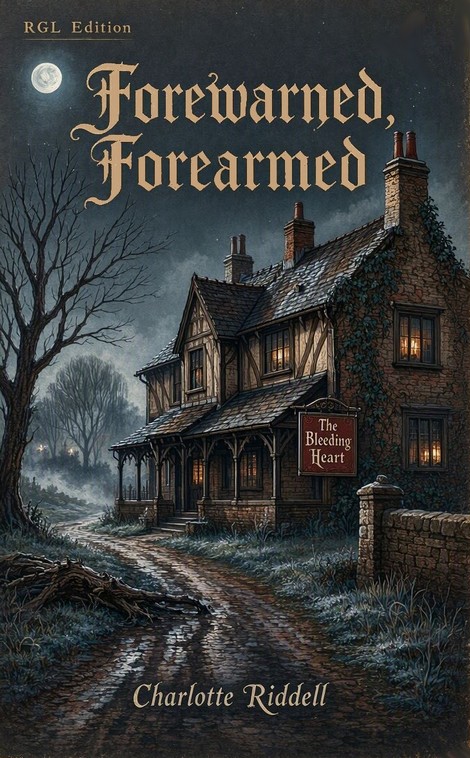
RGL e-Book Cover
Based on an image created with Microsoft Bing software
Roy Glashan's Library
Non sibi sed omnibus
Go to Home Page
This work is out of copyright in countries with a copyright
period of 70 years or less, after the year of the author's death.
If it is under copyright in your country of residence,
do not download or redistribute this file.
Original content added by RGL (e.g., introductions, notes,
RGL covers) is proprietary and protected by copyright.
RGL e-Book Cover
Based on an image created with Microsoft Bing software

Mr. Dwarris' childhood fascination with a family friend's eerie tale becomes the doorway to a chilling adventure of his own, as a vivid recurring dream—complete with a frantic midnight coach ride, a sinister stranger with red whiskers, and a lonely inn swinging its ominous sign, The Bleeding Heart—begins to unfold in waking life exactly as he dreamt it. What starts as a supernatural warning turns into a desperate struggle to save Sir Harry Hareleigh from a murderous enemy who seems to stalk him across countries and years, culminating in a revelation as startling as the dream itself.
THE story which I am about to tell is not a chapter out of my own life. The incidents which go to furnish it were enacted years before I was born; the performers in it died forty years ago, and have left not son nor heir to inherit the memory.
I question whether the man lives (the woman may, seeing women are more enduring than men) who could identify the names of the persons concerning whom I shall have hereafter to speak, but the facts happened, nevertheless.
Many a time I have heard them rehearsed, many a night I have sat on the hearthrug fascinated, listening to how Mr. Dwarris dreamt a dream, and many a night I have passed through the folding doors that led from the outer to the lesser hall, and walked to bed along the corridors thinking tremblingly of the face which continually re-appeared—of the journey in the coach and the post-chaise—all the particulars of which I purpose in due time to recount. Further, it is in my memory, that I was wont to place a pillow against my back in the night season, lest some vague enemy should enter my room and strike me under the fifth rib; and I went through much anguish when the Storm King was abroad, fancying I heard stealthy footsteps in the long gallery, and the sound of another person's breathing in the room beside my own.
But in spite of this, Mr. Dwarris' dream was one of the awful delights of my childhood; and when strangers gathered around the social hearth, and the conversation turned upon supernatural appearances, as it often did in those remote days in lonely country houses, it was always with a thrill of pleasure that I greeted the opening passages of this, the only inexplicable yet true story we possessed.
It was the fact of this possession, perhaps, which made the tale dear to me—other stories belonged to other people; it was their friends or their relatives who had seen ghosts, and been honoured with warnings, but Mr. Dwarris' dream was our property.
We owned it as we owned the old ash tree that grew on the lawn. Though Mr. Dwarris was dead and gone, though at the age of threescore years and ten he had departed from a world which had used him very kindly, and which he had enjoyed thoroughly, to another world that he only knew anything of by hearsay, that in fact he only believed in after the vague gentlemanly sceptical fashion which was considered the correct thing about the beginning of this century, still he had been a friend of our quiet and non-illustrious family.
In our primitive society he had been considered a man of fashion, a person whose opinions might safely be repeated, whose decisions were not to be lightly contradicted. He was kind enough in the days when postage was very high (would those days could come back again) to write long letters to his good friends who lived far away from Court, and craved for political and fashionable gossip—long letters filled with scraps of news and morsels of scandal, which furnished topics of conversation for many days and weeks, and made pleasant little breaks in the monotony of that country existence.
By my parents, and by the chosen friends who were invited to dinner when he honoured our poor house with his presence, he was looked up to as a learned and travelled man of the world.
He had read everything at a time when people did not read so much as is the case at present. He had not merely made the grand tour, but he had wintered frequently abroad, and the names of princesses, duchesses, and counts flowed as glibly off his tongue as those of the vicar and family doctor from the lips of less fortunate mortals.
The best china was produced, and the children kept well out of the way while he remained in the house.
The accessories of his toilette table were a fearful mystery to our servants, and the plan he had of leaving his vails under his bolster or the soap dish, a more inscrutable mystery still.
He did not smoke, and though that was a time when the reputation of hard drinking carried with it no stigma—quite the reverse indeed—he was temperate to a degree. While not utterly insensible to the charms of female beauty, he regarded the sex rather as a critical than a devoted admirer, and he was wont to consider any unusually handsome woman as practically thrown away on our society.
He used to talk much of the "West End," and, to sum up the matter, he spoke as one having authority.
Looking back at his pretensions from a point of observation which has not been attained without a considerable amount of acquaintance, pleasant and otherwise, with men of the same rank in life and standing in society, I am inclined to think that Mr. Dwarris was, to a certain extent, a humbug; that he was not such a great man as our neighbours imagined, and that the style in which he lived at home was much less luxurious than that in which my parents considered it necessary to indulge when he honoured us with a visit.
Further, I believe the time he spent with us, instead of proving irksome and uncongenial to his superior mind, were periods of the most thorough enjoyment. Looking over his letters—which still remain duly labelled and tied up—I can see the natural man breaking through the conventional. I can perceive how happy a change it was for him to leave a life passed amongst people, richer, better born, cleverer, more fashionable than himself, in order to stay with friends who looked up to him, and believed in their simplicity that it was an honour to receive so great a man.
I understand that he had no genius, that he had little talent, that he loved the world and the high places thereof, that he had no passion for anything whether in nature or art, but that he had acquired a superficial knowledge of most subjects, and that he affected a fondness for painting, music, sculpture, literature, because he considered such fondness the mark of a refined mind, and because the men and the women with whom he associated were content to think so too.
But when he recalls with words of pleasure the journey he and my father made through the wilds of Connemara, when he speaks with tenderest affection of his old friend Woodville—(my maternal grandfather's name was Woodville)—when he sends a word of kindly remembrance to each of the servants, who have been always happy to see, and wait upon him, I feel that the gloss and the pretension of learning were but superficial, that the man had really a heart, which, under happier auspices, would have rendered him a more useful and beloved member of society, instead of an individual in whose acquaintance we merely felt a pride, who was, as I have before said, one of our cherished possessions.
He was never married; he had no near relatives so far as we ever knew, and he lived all alone in a large house in a large English town, which, for sufficient reasons, I shall call Callersfield.
In his early youth he had been engaged in business, but the death of a distant relative leaving him independent of his own exertions, he severed all connexion with trade, and went abroad to study whatever may be, in foreign parts, analogous to "Shakespeare and the musical glasses" in England.
To the end of his life—long after travelling became a much easier and safer matter than it was towards the close of the last century—he retained his fondness for continental wanderings, and my mother's cabinets and my father's hot-houses bore ample testimony to the length of his journeys and the strength of his friendship. Seeds of rare plants, and bulbs from almost every country in Europe, found their way to our remote home, whilst curiosities of all kinds were sent with the best wishes of "an old friend," to swell that useless olio of oddities that were at once the wonder and admiration of my juvenile imagination.
But at length all these good gifts came to an end. No more lava snuff-boxes and Pompeian vases; no more corals, or fans, or cameos, or inlaid boxes; no more gorgeous lilies or rare exotics; for news arrived one morning that the donor had started on his last journey, and gone to that land whence no presents can be delivered by coach, railway, or parcels company, to assuage the grief of bereaved relatives. He was dead, and in due time there arrived at our house two of the most singular articles (as the matter appears to me now), that were ever forwarded without accessories of any kind to set them off, to people who had really been on terms of closest intimacy with the deceased.
One was a plaster bust of Mr. Dwarris, the other a lithograph likeness of the same gentleman.
The intrinsic value of the two might in those day have been five shillings, but then, as his heirs delicately put it, they knew my parents would value these mementoes of their lamented friend far beyond any actual worth which they might possess.
Where, when the old home was broken up, and the household gods scattered, that bust vanished I can form no idea, but the lithograph is still in my possession; and as I look at it I feel my mother's statement to have been utterly true, namely, that Mr. Dwarris was not a man either to be deluded by his imagination, or to tell a falsehood wittingly.
Perhaps in the next world some explanation may have been vouchsafed to him about his dream, but on this side the grave he always professed himself unable to give the slightest solution of it.
"I am not a man," he was wont to declare, "inclined to believe in the supernatural;" and indeed he was not, whether in nature or religion.
To be sure he was secretly disposed to credit that great superstition which many persons now openly profess—of an universe without a Creator, of a future without a Redeemer—but still this form of credulity proceeds rather from an imperfect development of the reason than from a disordered state of the imagination.
In the ordinary acceptation of the word he was not superstitious. He was hard-headed and he was cold-blooded—essentially a man to be trusted implicitly when he said such and such a thing had happened within his own experience.
"I never could account for it in any way," he declared—"and if it had chanced to another person, I should have believed he had made some mistake in the matter. For this reason, I have always felt shy of repeating my dream—but I do not mind telling it to you tonight."
And then he proceeded to relate the story which thenceforth became our property—the most enduring gift he ever gave us.
This is the tale he told while the wind was howling outside, and the snow falling upon the earth, and the wood fire crackling and leaping as a fit accompaniment.
I did not hear him recite his adventures—but I have often sat and listened while the story was rehearsed to fresh auditors—almost in his own words.
The first time that I went abroad, (he began), I made acquaintance with Sir Harry Hareleigh. How our acquaintance commenced is of no consequence—but it soon ripened into a close friendship, which was only broken by his death. His father and my father had been early friends also—but worldly reverses had long separated our family from that of the Hareleighs, and it was only by the merest chance I resumed my connection with it. Sir Harry was the youngest son—but his brothers having all died before their father, he came into his title early—though he did not at the same time succeed to any very great amount of property.
A large but unentailed estate, owned by a bachelor Ralph Hareleigh, would, people imagined, ultimately come into his hands—but Sir Harry himself considered this doubtful—for there was a cousin of his own who longed for the broad acres, and spent much of his time at Dulling Court, which was the name of Mr. Ralph Hareleigh's seat.
"No one," Sir Harry declared, "should ever be able to say he sat watching for dead men's shoes;" and so he spent all his time abroad—visiting picture galleries and studios, and mixing much among artists and patrons and lovers of art.
It seemed to me in those days that he was wasting his existence, and that a man of his rank and abilities ought to have remained more in his own country, and associated more with those of his own standing in society—but whenever I ventured to hint this to him, he only answered that—
"England had been a cruel stepdame to him, and that of his own free-will he would never spend a day in his native country again."
He had a villa near Florence, where he resided when he was not wandering over the earth; and there I spent many happy weeks in his society—before returning, as it was needful and expedient for me to do, to Callersfield.
We had been separated for some years—during the whole of which time we corresponded regularly, when one night I dreamt a dream which is as vivid to me now as it was a quarter of a century ago.
I know I was well in health at the time—that I was undisturbed in my mind—that especially my thoughts had not been straying after Sir Harry Hareleigh. I had heard from him about a month previously, and he said in his letter that he purposed wintering in Vienna, where it would be a great pleasure if I could join him. I had replied that I could not join him at Vienna, but that it was not impossible we might meet the following spring if he felt disposed to spend a couple of months with me in Spain, a country which I then desired to visit.
I was, therefore, not expecting to see him for half a year, at all events—and had certainly no thought of his arrival in England, and yet when I went to bed on the night in question, this was what happened to me. I dreamt that towards the close of an autumn day I was sitting reading by the window of my library—you remember how my house is situated at the corner of two streets, and that there is a slight hill from the town up to it—you may recollect, also, perhaps, that the windows of my library face on this ascent, while the hall door opens into King Charles Street. Well, I was sitting reading as I have said, with the light growing dimmer and dimmer, and the printed characters getting more and more indistinct, when all at once my attention was aroused by the appearance of a hackney coach driven furiously up Martyr Hill.
The man was flogging his horses unmercifully, and they cantered up the ascent at a wonderful pace. I rose and watched the vehicle turn the corner of King Charles Street, when of course it disappeared from my observation. I remained, however, standing at the window looking out on the gathering twilight, and but little curious concerning a loud double knock which resounded through the house. Next moment, however, the library door opened, and in walked Sir Harry Hareleigh.
"I want you to do me a favour, Dwarris," were almost his first words. "Can you—will you—come with me on a journey? Your man will just have time to pack a few clothes up for you, and then we shall be able to catch the coach that leaves 'The Maypole' at seven. I have this moment arrived from Italy, and will explain everything as we go along. Can you give me a crust of bread and a glass of wine?"
I rang the bell and ordered in refreshments. While he was hastily swallowing his food. Sir Harry told me that Ralph Hareleigh was dead and had left him every acre of land he owned and every guinea of money he possessed. "He heard," it appears, added Sir Harry, "that my cousin George had raised large sums of money on the strength of certainly being his heir, so he cut him out and left the whole to me, saddled with only one condition, namely, that I should marry within six months from the date of his death."
"And when do the six months expire?" I inquired.
"There's the pull!" he answered. "By some accident my lawyer's first letter never reached me; and if by good fortune it had not occurred to him to send one of his clerks with a second epistle, I should have been done out of my inheritance. There is only a bare month left for me to make all my arrangements."
"And where are you going now?" I asked
"To Dulling Court," he returned, "and we have not a moment to lose if we are to catch the mail."
Those were the days in which gentlemen travelled with their pistols ready for use, and you may be sure I did not forget mine. My valise was carried out to the hackney carriage; Sir Harry and I stepped into the vehicle, and before I had time to wonder at my friend's sudden appearance, we were at the "Maypole," and taking our places as inside passengers to Warweald, from whence our route lay across country to Dulling.
When we had settled ourselves comfortably, put on our travelling-caps, and buttoned our great coats up to our throats, I looked out to see whether any other passengers were coming.
As I did so, my eye fell on a man who stood back a little from the crowd that always surrounds a coach at starting time, and there was something about him which riveted my attention, though I could not have told why.
He was an evil-looking man, dressed in decent but very common clothes, and he stood leaning up against the wall of the "Maypole," and, as it chanced, directly under the light of an oil-lamp.
It was this circumstance which enabled me to get so good a view of his face, of his black hair and reddish whiskers, of his restless brown eyes, and dark complexion.
The contrast between his complexion and his whiskers I remember struck me forcibly, as did also a certain discrepancy between his dress and his appearance.
He did not stand exactly as a man of his apparent class would stand, and I noticed that he bit his nails nervously, a luxury I never observed an ordinary working man indulge in.
Further, he stared not at what was going on, but persistently at the coach window until he discovered my scrutiny, when he turned on his heel and walked away down the street.
Somehow I seemed to breathe more freely when once he was gone: but as the coach soon started I forgot all about him, until two or three stages after, happening to get out of the coach for a glass of brandy, I beheld the same man standing at a little distance and watching the coach as before.
My first impulse was to go up and speak to him, but a moment's reflection showed me that I should only place myself in a ridiculous position by doing so. No doubt the man was merely a passenger like ourselves, and if he chose to lean up against the wall of the inn while the horses were being changed, it was clearly no business of mine.
At the next stage, however, when I looked out for him he was nowhere to be seen, and I thought no more of the matter, till on arriving at Warweald I chanced to put my head out of the window furthest from the inn, when by the light of one of the coach lamps I saw my gentleman drop down from the roof and walk away into the darkness. We went into the inn parlour whilst the post horses were put to, and then I told Sir Harry what I had witnessed.
"Very likely a Bow Street runner," he said, "keeping some poor wretch well in sight. I should not wonder if the old gentleman who snored so persistently for the last twenty miles, be a hardened criminal on whom your friend will clap handcuffs, the moment he gets the warrant to arrest him."
The explanation seemed so reasonable that I marvelled it had not occurred to me before, and then I suppose I went off into deeper sleep, for I have only a vague recollection of dreaming afterwards, how we travelled miles and miles in a post chaise, how we ploughed through heavy country lanes, how we passed through dark plantations, and how we stopped at last in front of an old-fashioned way-side house.
It was a fine night when we arrived there, but the wind was high and drifted black clouds over the moon's face. We alighted at this point and I remember how the place was engraved on my memory.
It was an old inn, with a large deep door-way, two high gables, and small latticed windows. There were tall trees in front of it, and from one of these the sign "A Bleeding Heart" depended, rocking moanfully to and fro in the breeze. There were only a few leaves left on the branches, but the wind caught up those which lay scattered on the ground, and whirled them through the air. Not a soul appeared as our chaise drove up to the door. The postilion, however, applied the butt end of his whip with such vigour to the door that a head was soon thrust from one of the windows, and a gruff voice demanded, "what the devil we wanted."
Just as he was about to answer, moved by some sudden impulse, I turned suddenly round and beheld stealing away in the shadow, my friend with the dark complexion and the red whiskers.
At this juncture I awoke—always at this juncture I awoke, for I dreamt the same dream over and over again, till I really grew afraid of going to bed at night.
I used to wake up bathed in perspiration with a horror on me such as I have never felt in my waking moments. I could not get the man's face out of my mind—waking I was constantly thinking of it, sleeping I reproduced it in my dreams—and at length I became so nervous that I had determined to seek relief either in medical advice or change of scene—when one evening in the late autumn as I sat reading in my library—the identical coach I had beheld in my dream drove up Martyr Hill, and next moment Sir Harry and I grasped hands.
Though I had the dream in my mind all the while, something withheld me from mentioning it to him. We had always laughed at warnings and such things as old wives' tales, and so I let him talk on just as he had talked to me in my dream, and he ate and drank, and we went down together to the Maypole and took our seats in the coach.
You may be sure I looked well up the street, and down the street, to see if there were any sign of my friend with the whiskers, but not a trace of him could I discern. Somewhat relieved by this I leaned back in my corner, and really in the interest of seeing and talking to my old companion again, I forgot all about my dream, until the arrival of another passenger caused me to shift my position a little, when I glanced out again, and there standing under the lamp—with his restless brown eyes, his dark complexion and his red whiskers—stood the person whom I had never before seen in the flesh, biting his nails industriously.
"Just look out for a moment, Hareleigh," I said, drawing back from the window, "there is a man standing under the lamp I want you to notice."
"I see no man," answered Sir Harry, and when I looked out again neither did I.
As in my dream, however, I had beheld the stranger at different stages of our journey, so I beheld him at different stages with my waking eyes.
Standing at the hotel at Warweald, I spoke seriously to my companion concerning the mysterious passenger, when to my amazement he repeated the same words I had heard in my dream.
"Now, Hareleigh," I said, "this is getting past a joke. You know I am not superstitious, or given to take fancies, and yet I tell you I have had a warning about that man and I feel confident he means mischief," and then I told Sir Harry my dream, and described to him the inn upon our arrival at which I had invariably awakened.
"There is no such inn anywhere on the road between here and Dulling," he answered after a moment's silence, and then he turned towards the fire again and knit his brow, and there ensued a disagreeable pause.
"If I have offended you," I remarked at last.
"My dear friend," he replied in an earnest voice, "I am not offended, I am only alarmed. When I left the continent I hoped that I had put the sea between myself and my enemy; but what you say makes me fear that I am being dogged to my death. I have narrowly escaped assassination twice within the last three months, and I know every movement of mine has been watched, that there have been spies upon me. Even on board the vessel by which I returned to England I was nearly pitched overboard; at the time I regarded it as an accident, but if your dream be true, that was, as this is, the result of a premeditated plan."
"Then let us remain here for the night," I urged.
"Impossible," he answered. "I must reach Dulling before tomorrow morning, or otherwise the only woman I ever wanted to marry or ever shall marry will have dropped out of my life a second time."
"And she," I suggested.
"Is the widow of Lord Warweald, and she leaves for India tomorrow with her brother the Honourable John Moffat."
"Then," said I, "you can have no difficulty in fulfilling the conditions of Mr. Ralph Hareleigh's will."
"Not if she agrees to marry me," he answered.
At that moment the chaise was announced, and we took our places in it.
Over the country roads, along lonely lanes, we drove almost in silence.
Somehow Sir Harry's statement and the memory of my own dream made me feel anxious and nervous. Who could this unknown enemy be? had my friend played fast and loose with some lovely Italian, and was this her nearest of kin dogging him to his death?
Most certainly the man who stood under the lamp at Callersfield had no foreign blood in his veins; in spite of his complexion, he was English, in figure, habit, and appearance.
"Could there be any dark secret in Sir Harry's life?" I then asked myself. His reluctance to visit England, his reserve about the earlier part of his existence, almost inclined me to this belief; and I was just about settling in my own mind what this secret might probably be, when the postilion suddenly pulled up, and after an examination of his horses' feet informed us that one of them had cast a shoe, and that it was impossible the creature could travel the nine miles which still intervened between us and the next stage.
"There is an inn, however," added the boy, "about a mile from here on the road to London; and if you could make shift to stop there for the night, I will undertake to have you at Dulling Court by nine o'clock in the morning."
Hearing this, I looked in the moonlight at my friend, and Sir Harry looked hard at me.
"It is to happen so," he said, and flinging himself back in the chaise, fell into a fit of moody musing.
Meanwhile, as the horses proceeded slowly along, I looked out of the window, and once I could have sworn I saw the shadow of a man flung across the road.
When I opened the door, however, and jumped out, I could see nothing except the dark trees almost meeting overhead, and the denser undergrowth lying to right and left.
It was a fine night when we arrived at our destination, just such a night as I had dreamed was to come—moonlight, but with heavy black clouds drifting across the sky.
There was the inn, there swung the sign, the dead leaves swirled about us as we stood waiting while the post-boy hammered for admittance.
It all came about as I had dreamt, save that I did not see waking as I had done in my sleep a stealing figure creeping away in the shadow of the house.
I saw the figure afterwards, but not then.
We ate in the house, but we did not drink—we made a feint of doing so; but we really poured away the liquor upon the hot ashes that lay underneath the hastily replenished fire, though I believe this caution to have been unnecessary.
We selected our bed chambers, Sir Harry choosing one which looked out on what our host called the Wilderness, and I selecting another that commanded a view of the garden.
There were no locks or bolts to the doors, but we determined to pull up such furniture as the rooms afforded, and erect barricades for our protection.
I wanted to remain in the same apartment with my friend, but he would not hear of such an arrangement.
"We shall only delay the end," he said stubbornly, in answer to my entreaties, "and I have an ounce of lead ready for anyone who tries to meddle with me." So we bade each other good-night, and separated.
I had not the slightest intention of going to bed, so I sat and read my favourite poet till, overpowered by fatigue, I dropped asleep in my chair.
When I awoke it was with a start; the candle had burnt out, and the moonlight was streaming through the white blind into the room.
Was it fancy, or did I hear someone actually try my door? I held my breath, and then I knew it was no fancy, for the latch snicked in the lock, then stealthy footsteps crept along the passage and down the stairs.
In a moment my resolution was taken. Opening my window, I crept on to the sill, and closing the casement after me, dropped into the garden.
Keeping close against the wall, I crept to the corner of the house, were I concealed myself behind an arbor vitae.
A minute afterwards the man I was watching for came round the opposite corner, and stood for a second looking at the window of Sir Harry's room. There was a pear tree trained against the wall on this side of the house, and up it he climbed with more agility than I should have expected from his appearance.
I had my pistol in my hand, and felt inclined to wing him while he was fighting with the crazy fastening, and trying to open the window without noise, but I refrained. I wanted to see the play out; I desired to see his game, and so the moment he was in the room I climbed the pear tree also, and raising my eyes just above the sill, and lifting the blind about an inch, looked in.
Like myself, Hareleigh had not undressed, but he lay stretched on the bed with his right hand under his head, and his left flung across his body.
He was fast asleep, his pistols lay on a chair beside him, and I could see he had so far followed my advice as to have dragged an ancient secretaire across the door.
By the moonlight I got a good view now of the individual who had for so long a time troubled my dreams. As he stealthily moved the pistols he turned his profile a little towards the window, and then I knew what I already suspected, viz., that the man who had travelled with us from Callersfield was identical with the man who now stood beside Sir Harry meaning to murder him.
It was the dream in that hour which seemed the reality, and the reality the dream.
For an instant he stooped over my friend, and then I saw him raise his hand to strike, but the same moment I took deliberate aim, and before the blow could fall, fired and shot him in the right shoulder.
There was a shriek and an imprecation, a rush to the window, where we met, he trying to get out, I striving to get in.
I grappled with him, but having no secure foothold, the impetus of his body was too much for me, and we both fell to the ground together. The force of the fall stunned me, I suppose, for I remember nothing of what followed till I found myself lying on a sofa in the inn, with Hareleigh sitting beside me.
"Don't talk! for God's sake don't talk!" he entreated. "We shall be out of this in five minutes' time if you think you can bear the shaking. I have made the landlord lend us another horse, and we shall be at Dulling in two hours' time. There you shall tell me all about it."
But there I never told him all about it. Before we reached our next stage I was far too ill to travel further, and for weeks I lay between life and death at the Green Man and Still, Aldney.
When I was strong enough to sit up with him, Harry and Lady Hareleigh came over from Dulling to see me, but it was months before I could bear to speak of the events of that night, and though I never dreamed my dream again, it left its traces on me for life.
Till the day of his death, however, Sir Harry always regarded me as his preserver, and the warmest welcome to Dulling Court was given by his wife to one whom she honoured by calling her dearest friend.
When Sir Harry died, he left me joint guardian with Lady Hareleigh of his children. So carefully worded a will, I never read—in the event of the death of his children without issue, he bequeathed Dulling Court to various charitable institutions.
"A most singular disposition of his property," I remarked to his lawyer.
"Depend upon it, my dear sir, he had his reasons," that individual replied.
"And those... " I suggested.
"I must regard as strictly private and confidential."
The most singular part of my narrative has yet to come (Mr. Dwarris continued, after a pause).
Many years after Sir Harry's death, it chanced I arrived at a friend's house on the evening before the nomination day of an election, which it was expected would be hotly contested.
"Mr. Blair's wealth of course gives him a great advantage," sighed my hostess, "and we all do dislike him so cordially—I would give anything to see him lose."
Accustomed to such thoroughly feminine and logical sentiments, I attached little importance to the lady's remarks, and with only a very slight feeling of interest in the matter, next morning accompanied my friend to the county town where the nomination was to take place.
We were rather late in starting, and before our arrival Mr. Blair had commenced his harangue to the crowd.
He was talking loudly and gesticulating violently with his left hand when I first caught sight of him. He was telling the free and independent electors that they knew who he was, what he was, and why he supported such and such a political party.
At intervals he was interrupted by cheers and hisses, but at the end of one of his most brilliant perorations, I, who had been elbowing my way through the crowd, shouted out at the top of my voice—
"How about the man you tried to murder at 'The Bleeding Heart?'"
For a moment there was a dead silence, then the mob took up my cry—
"How about the man you tried to murder at 'The Bleeding Heart?'"
I saw him look round as if a ghost had spoken, then he fell suddenly back, and his friends carried him off the platform.
My hostess had her wish, for his opponent walked over the course, and a few weeks afterwards I read in the papers—
Died—At Hollingford Hall, in his forty-sixth year, George Hareleigh Blair, Esq., nephew of the late Ralph Hareleigh, Esq., of Dulling Court.
"He married a Miss Blair, I presume," I said to my host.
"Yes, for her money," was the reply, "she had two hundred thousand pounds."
So the mystery of the "Bleeding Heart" was cleared up at last; but on this side the grave I do not expect to understand how I chanced to dream of a man I had never seen—of places I had never visited—of events of which I was not then cognizant—of conversations which had then still to take place.
Roy Glashan's Library
Non sibi sed omnibus
Go to Home Page
This work is out of copyright in countries with a copyright
period of 70 years or less, after the year of the author's death.
If it is under copyright in your country of residence,
do not download or redistribute this file.
Original content added by RGL (e.g., introductions, notes,
RGL covers) is proprietary and protected by copyright.