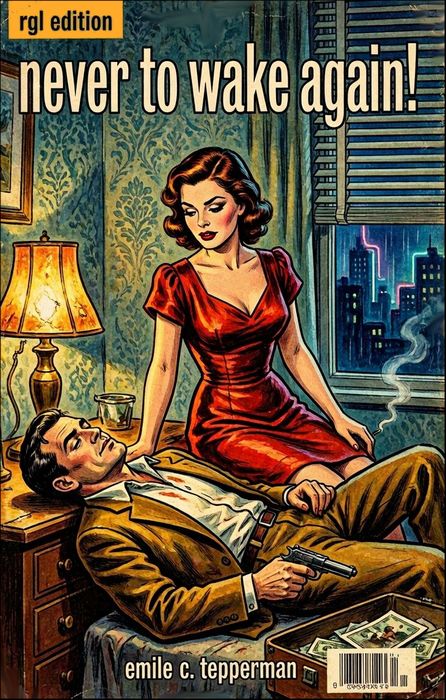
RGL e-Book Cover
Based on an image created with Microsoft Bing software
Roy Glashan's Library
Non sibi sed omnibus
Go to Home Page
This work is out of copyright in countries with a copyright
period of 70 years or less, after the year of the author's death.
If it is under copyright in your country of residence,
do not download or redistribute this file.
Original content added by RGL (e.g., introductions, notes,
RGL covers) is proprietary and protected by copyright.
RGL e-Book Cover
Based on an image created with Microsoft Bing software

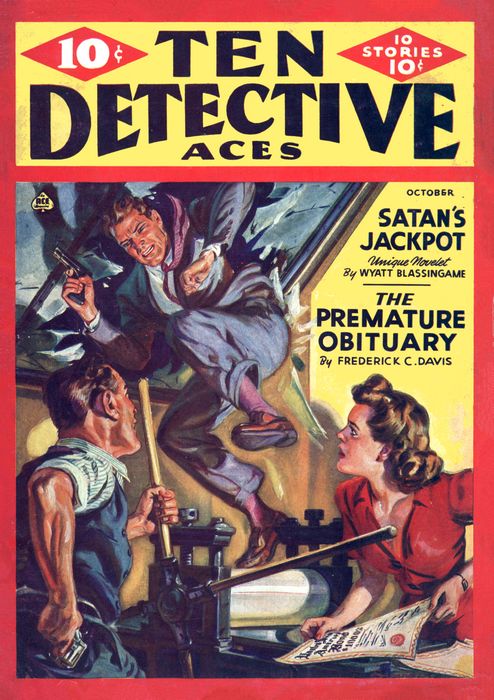
Ten Detective Aces, October 1941, with "Never To Wake Again!"
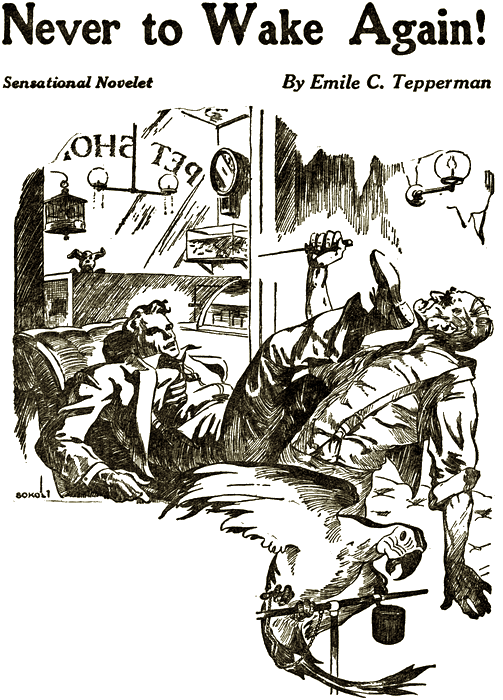
One after another, the victims of a vengeance-ridden killer were attacked by a strange malady before meeting their ultimate doom. And when Pete Alexander, famed mystery writer, sought to unravel the baffling enigma, he found that the enfolding arms of Morpheus were tightening around him in a lethal embrace.
AT SEVEN-THIRTY in the morning on the seventh of May, Amos Beckett stepped out of his cold shower. He was glowing with vitality.
He rubbed himself down briskly with a huge Turkish towel. Then he shaved and dressed. His wife was waiting for him at the breakfast-table.
Amos Beckett was a prosperous business man, and a hearty eater. He had hot cereal, two medium-boiled eggs, four strips of bacon, three slices of toast, and two cups of coffee.
He looked through the morning paper while he ate.
His wife nibbled a piece of toast, and read her own copy of the paper. "Did you see that headline, Amos?" she asked. "Luther Wiggins died in his sleep last night. They say it was his heart. Weren't you in business with him many years ago?"
Amos Beckett was reading the very news item to which his wife referred.
"Ahem," he said. "Yes." He went on reading intently.
"There seems to be an epidemic of heart cases," his wife persisted. "I think you ought to go and see a doctor, Amos. You're getting on toward fifty, you know, and a health examination wouldn't hurt you."
"Er—what's that? Oh, yes. Health examination. Certainly, dear. I'll think about it."
Mr. Beckett appeared to be somewhat absent-minded. He put down the paper, yawned, and reached for the mail which the maid had placed alongside the plate.
MRS. BECKETT looked worried. "I declare, Amos! You're yawning! And you went to bed before ten last night. You shouldn't be sleepy. You work too hard, dear—"
She broke off at a sudden exclamation from her husband. He suddenly crumpled a letter he had been reading. His face was very white.
"Why, Amos! What's the matter?"
"Nothing. Nothing to worry about. Just an impertinent fellow." He thrust the crumpled sheet, and its accompanying envelope, into his pocket.
However, in spite of his reassurance that it was nothing to worry about, Mrs. Beckett watched her husband worriedly from the window as he hurried down the street toward the subway station.
He waved to her from the corner, and descended into the subway kiosk. The downtown platform was heavily crowded. Beckett put a penny into one of the slot machines and extracted his daily package of gum. He then inserted two more pennies for two extra packages. He chewed gum after each meal, as it was his belief that this aided digestion.
Then he made his way through the crowd to the edge of the platform, alongside the magazine stand. He went through this routine performance every morning, five days a week. He always stood at the same spot on the platform, because it would take him out near the exit at the Wall Street station where his law office was located.
The rumble of the approaching train was audible in the tunnel, but Beckett was preoccupied. Several times he brushed his hand across his eyes as if he were sleepy. With his other hand he kept fingering the crumpled letter in his pocket.
His eyes kept closing, and he kept forcing them open. His face was gray. There was terror in his eyes. He swayed a little on his feet, and stumbled against the man beside him. His head drooped. Then his body sagged in the middle, and he fell forward.
Later, some one in the crowd said that Beckett had been pushed.
But whether he fell or was pushed, the result was the same. He struck the track just as the southbound express came roaring into the station. The motorman saw him too late. Brakes squealed. Women screamed. Chaos followed. But it was all the same to Amos Beckett.
It took almost an hour to extract his crushed and mangled body from under the train. Service on the East Side subway was completely disrupted....
AS a result of this traffic tie-up, Lenore Simpson did not get to work at the offices of Wiggins & Carter until nine-fifty. She hurried breathlessly from the station, because Arnold Wiggins, the senior partner of the old private banking firm, was a stickler for promptness. She knew that the death of Luther Wiggins, Arnold's cousin, would not keep her employer from the office. For there had been no love lost between the two cousins.
She reached the entrance to the Traders' Building on Wall Street and hurried through into the ornate ground-floor banking offices. She saw that Mr. Arnold Wiggins' big limousine was parked at the curb, which meant that her employer was already there.
The bodyguard who always accompanied Arnold Wiggins from home to office would come out soon, and be driven to the home of the junior partner, Eric Carter, whom the bodyguard would then escort down to the office.
The same procedure was followed in the evening. In this way the two partners of Wiggins & Carter economized by using only one bodyguard.
As Lenore Simpson looked back to the curb where the limousine was parked, she saw something else, which caused her, for no particular reason, to feel highly uneasy.
It was the sight of another car, just behind the limousine. This car was all black, and there was a chauffeur at the wheel who sat stiff as a ramrod and stared straight ahead. Upon the chauffeur's right cheek there was a dark round blotch about the size of a quarter.
She saw all this in passing. The thing that made her shudder was the momentary glimpse she had of the man who sat within the car. She couldn't see much, but she got the impression of a huge, repulsively fat man—of a face so round and padded with flesh that it was impossible to distinguish the eyes;.and of a pendulous under-lip and a pair of pudgy fingers plucking at it.
This fat and repulsive face was close to the window, but when the man saw that Lenore Simpson had glimpsed him, he withdrew hurriedly.
Lenore crossed the banking floor and mounted to the balcony where the executive offices were located. Several of the clerks greeted her almost fawningly, because she was the private secretary to Mr. Arnold Wiggins, and they entertained the notion that she might have some influence with him as to promotions.
Lenore opened the door of the private office. She had a little anteroom here, and at the left of her desk was the door to the president's inner sanctum. She rapped at the door, then pushed it open to report to Wiggins the cause of her lateness.
She looked into the room and frowned. Mr. Arnold Wiggins was asleep at his desk, with his head on his arms. But what was even more astounding was the sight of Joe Kleeber, the bodyguard—asleep on the floor!
The two men were in such natural positions that it never entered her head that they were not merely asleep. But where did Joe Kleeber get the nerve to go to sleep on the floor? If Mr. Wiggins woke up first and saw Joe, there would be a new bodyguard on the job tomorrow. And she wouldn't like to see Joe fired, because he was a married man and needed the job.
So she tiptoed in and bent down and shook Joe Kleeber softly.
"Wake up, Joe!" she whispered. "What's the matter with you—"
And then her voice broke and changed into a scream. Because when she shook him, Joe's head lolled back, with the eyes closed. And his hands flapped limply on the floor.
Horrified, she sprang up—and inadvertently bumped into Mr. Arnold Wiggins' chair.
Mr. Wiggins' head slid off the desk.
His body slid off the chair. And he fell to the floor with a thump.
Lenore Simpson's second scream was still echoing when the clerks came running in.
It was not till the police came that the actual cause of death was discovered. There was a tiny hole in the back of each man's coat, just above the heart. There had been virtually no bleeding.
"It looks," said the medical examiner, "as if they were stabbed with a hatpin. Only I haven't seen a hatpin in five years. They don't wear them any more."
"And they were stabbed," said Lieutenant Nimrod of Homicide, "while they slept. Now ain't that a dandy? Any one of fifty people coming in and out of this place could have walked in and given them the works— just two quick jabs. But why the devil should they have gone to sleep like that, in the middle of the morning?"
SIX blocks away from the offices of Wiggins & Carter—and eight blocks from the office of the defunct Mr. Amos Beckett—is the Chronicle Building.
At the moment when the police lieutenant was asking that question, the clerk at the classified advertising desk of the Chronicle was raising his eyebrows as he read the form which a girl with copper-colored hair had just handed him. It read as follows:
WANTED—young man who suffers from INSOMNIA. Must be unmarried and have no family ties. Dangerous work, but good pay. Apply at once. Brenda Carter, Penthouse, Park Vale Towers.
"Insomnia," said the clerk. "You ought to ask in a hospital—"
"When will this ad appear?" Brenda Carter demanded.
"The first edition of the evening paper goes on the stands shortly after noon," the clerk told her.
She paid for the ad, and left quickly. Outside, she climbed into a blue sport roadster at the curb, and drove swiftly uptown to the Park Vale Towers. She ascended in a private elevator to the duplex penthouse apartment, and was admitted by a maid.
"Your father is in his study, Miss Carter. He has the door locked, and will admit no one till you return."
Brenda Carter nodded and hurried up the short flight of stairs, and knocked at her father's door. There was a shuffling step within, and then a hoarse voice demanded, "Who?"
"It's I, dad."
There was a grunt. A lock clicked, a chair slid over, and the door opened.
Eric Carter, the junior partner of Wiggins & Carter, was ordinarily a tall and handsome man. This morning he was unshaven and bleary-eyed from lack of sleep. He wore a wrinkled smoking jacket over his suspender's. He was tightly gripping a Smith & Wesson thirty-two in his right hand.
He admitted Brenda and closed the door quickly behind her.
"I've put the ad in the paper, dad!" she said breathlessly. "If we can get some one who won't fall asleep—"
She stopped, seeing the hopeless look in her father's eyes.
"What's the use, Brenda? I just got a phone call. Arnold was just killed in the office. And Joe Kleeber, too. They were asleep when they were killed. And Amos Beckett, also. He was crushed by a subway train!"
Brenda Carter's eyes opened wide. "Then—then we're next, dad?"
Eric Carter met his daughter's level gaze, and nodded. He motioned toward a serving table in a corner.
"I had an electric stove put in here. And I've stocked up with coffee and canned goods—and caffeine tablets. We'll sit here and take turns at staying awake—and fight off the sleep with coffee."
"But what about the police, dad? Why not call them?"
Eric Carter laughed hollowly. "After you left this morning, Brenda, I called police headquarters. They sent me a plainclothes detective."
He took her by the arm and led her to a small alcove where there was a folding bed. A man lay on the bed, sound asleep. He was breathing deeply and regularly. His coat was hanging loose, revealing a badge pinned to his vest.
"There's the detective," Eric said grimly. "He went to sleep fifteen minutes ago. I haven't been able to wake him up."
Brenda gasped.
Eric Carter's voice grew shrill as he rushed on.
"It's ghastly. Dreadful! He doesn't threaten, he doesn't bargain. After all these years, his hate must be a terrible thing. He'll kill us all in our sleep. And all we can do is sit and wait, and drink coffee to keep awake. If only I could get in touch with him somehow—I'd offer him everything I own in the world—"
Carter broke off with a sob. "If he'd only spare you, Brenda, I'd be willing to die. But to know that we'll both fall asleep—"
She pressed his arm. "Chin up, dad. Maybe someone will answer the ad. If we could only get someone who can't fall asleep..."
PETE ALEXANDER fussed around in bed, tossing from one side to the other. At last he reached for a cigarette on the night-table beside his bed, and lit it. His eyes were red-rimmed, and his cheeks were gaunt and shrunken.
He kicked the sheet off him, and got up. There was a fifth of rye on the dresser, about three-quarters empty. He lifted it to his mouth, and took a terrific gulp.
Then he went and looked at himself in the full-length mirror on the bathroom door. The pajamas hung in folds from his body. He looked terrible.
"If I could only get some sleep!" he muttered. He looked at the wrist watch on the dresser. It was after noontime, but it was quite dark in the room, for he had the Venetian blinds tightly shut to keep the sun out.
Suddenly he snapped his fingers and picked up the phone.
"Get me Doctor Menzies, please," he told the hotel switchboard operator.
In a moment, he was talking to the house physician.
"Menzies, you've got to do something for me. I haven't slept for a week. I stayed out playing cards all last night, and went to bed at nine o'clock this morning. I've drunk two cases of rye whiskey, and an assortment of cocktails. But I'm still awake. Damn it, isn't there anything else you can give me?"
"You're certainly a unique case," said the doctor. "I was talking about you with a friend of mine on one of the big hospital staffs. He gave me a new drug that he's perfected, for insomnia. Come on down and I'll administer it."
Pete showered and dressed hastily, and hurried down to the second floor, where the house physician's office was located.
Doctor Menzies had a hypodermic ready.
"This is a damned powerful drug, Mr. Alexander," he said. "In an ordinary case, I'd hesitate to administer it. The effects have been terrific in all the experiments. One man slept for eight days after an injection of fifty cc. That's the dose I'm going to give you."
He swabbed off Pete's arm, thrust in the hypo needle, then drove home the plunger.
Pete sighed. "Boy, would I like to sleep for eight days! How much do I owe you, Doc?"
Menzies waved the checkbook away. "Let's see how it works, first. It should begin taking effect within five or six hours. If it's successful, you can donate five hundred dollars to the clinic in my friend's hospital."
"I'll double it!" said Pete Alexander."
He dressed and went out.
"Better see that you're near your bed in about five hours," Menzies called after him. "You may keel over in sleep, without any notice."
Pete walked down the flight of stairs to the lobby, feeling like a wreck. He was dead tired, but wide awake.
Alec, the doorman, said respectfully, "Hello, Mr. Alexander. Can't you get to sleep yet?"
"I'd give ten grand for twenty-four hours' sleep!" Pete growled.
He started to get into a cab at the curb when Alec, who was holding the door open for him, said facetiously, "It's too bad you don't need a job, Mr. Alexander. Here's one you'd qualify for."
He had a paper folded over at the want ad section, and he put his finger on one of the insertions.
Pete scowled, but stopped and read it:
WANTED—young man who suffers from INSOMNIA...
Pete's eyes began to glitter.
"Take me to the Park Vale Towers!" he ordered the cab driver.
Few people knew just how Pete Alexander made his money. He lived well, spent well, and seemed to have plenty of leisure. All sorts of rumors were rife about him. Some said he had inherited a small share in the Kimberley Diamond Mines, others said that he was tied up with the policy racket.
Only Pete's intimate friends knew that he made fabulous sums of money by writing mystery novels. He had begun writing when he finished college, and through some perverse idea he had chosen the pen name of Jacob Jones. Ten best sellers under that name had swept the public off its feet, and all had sold to the movies for fantastic sums. And only a very few intimates connected Pete Alexander with Jacob Jones, the writer.
But there was one unfortunate situation which had resulted from Pete Alexander's success. It was this insomnia. He had contracted the habit of working at night. Five nights a week, between midnight and dawn, he would work at his typewriter. This had become a habit, and now he found that he couldn't sleep at night at all. What was worse, he suddenly discovered that it was impossible for him to sleep in the daytime, either.
So here he was, a confirmed insomniac, on his way to answer a fantastic advertisement.
At least, he thought sourly, if he couldn't sleep he might be able to pick up material for another mystery book.
TWO blocks from the Park Vale Towers, it suddenly occurred to Pete Alexander that a young man in need of a job would not be driving up in a taxicab. So he got out and paid off the driver, and walked the rest of the way.
This was a mistake which he later regretted.
Upon approaching the solid and imposing building where Brenda Carter lived, he expected to see a long line of applicants. In this, however, he was mistaken. There were, as yet, no seekers after the job. One of the reasons for this was that the newspaper had only just come out, and whereas others might have to use the subway, Pete had come in a cab.
He was about to turn into the entrance of the Park Vale Apartments when he was stopped by a man standing near the door. This man was dressed in a chauffeur's uniform. His face was bleak and forbidding, and he had a discolored blotch on his right cheek, the size of a quarter. The chauffeur glanced at the newspaper folded under Pete's arm, which he had taken from his doorman, and said:
"You answering the ad?" Pete nodded.
The chauffeur took a card from his pocket, and gave it to Pete. "You'll have to go to this address. I'm Miss Carter's chauffeur. The management of this building objects to having applicants coming through here, so you'll have to be interviewed at this other address. Have you got car fare?"
"No," lied Pete.
The chauffeur took out a nickel and gave it to him.
Pete looked at the nickel in his hand and said, "Suppose I don't get the job? How will I get back downtown?"
"That's your worry."
Pete didn't like that chauffeur at all. He shrugged, and turned away. As he did so, he noticed the black limousine which was parked a few feet back from the entrance. There was no particular reason why he should have noticed it, except that he caught a glimpse of an enormous, revoltingly fat man within it. The fat man was plucking at a pendulous lower lip with a pair of pudgy fingers.
Pete got only a swift glimpse, and then the fat man moved back in his seat.
The whole thing was only an impression, to which Pete -attached no significance at all. As he moved away from the building, he was almost on the point of chucking the idea. But he knew that if he did so, he would only remain miserably awake.
So, for lack of anything else to do, Pete walked around the corner till he was out of sight of the chauffeur, and caught a passing taxicab. He gave the address on the card the chauffeur had handed him. It was: 1028 East 110th Street.
Going uptown in the cab, he opened the newspaper and glanced at the headlines on the front page. He saw there the item about the death of Amos Beckett in the subway station, and he read also about the strange death of Arnold Wiggins and his bodyguard.
Suddenly, as he read that last item, he sat up straight, with a new surge of interest. Wiggins and his bodyguard had been murdered while they slept!
Continuing, he learned that Arnold Wiggins' cousin, Lather, had also died in his sleep. And he saw the bit of information that Wiggins had been a member of the banking firm of Wiggins and Carter.
Carter!
Then this girl, Brenda Carter, who had inserted the want ad, was not acting through mere whim. It was something that was touching her closely— with the finger of death!
Pete Alexander's mind was already racing with a plot for a book. This would make a knockout mystery novel. He would call it: Never To Wake Again!
What a title! And what a theme! All he had to do now, was work out a good motive—a reason why some one should want to kill these people in their sleep. Pete had already forgotten his insomnia.
It was with keen and lively interest that he left his cab at 108th Street and walked the two blocks to the address on 110th.
When he reached it, he was more puzzled and intrigued than ever, for the place turned out to be a small, dirty pet shop on the street floor of a tenement house.
There could be no doubt that this was the place, for the name on the dusty window read:
EDGAR SALMON
That was the name written on the card which the chauffeur had given him. Just to make sure, Pete dug into his pocket and took out the card. Then he stood there in the street, staring blankly at it.
THERE was absolutely nothing on the card. He turned it over. The other side was blank, too. If there had been anything written on it, the ink had disappeared.
Pete had used that stunt of disappearing ink in one of his mystery books. But this was the first time he had ever had it tried on him in real life.
He put the card back in his pocket, and entered the pet store of Mr. Edgar Salmon. There were three puppies in the window, all asleep. Inside the store there was a cage with a sleeping canary, and a glass-enclosed box with six kittens in it. All the kittens were sleeping, too.
A man with a gaunt face and very deep-set eyes came out from the rear. His hair was all white. He might have looked like a venerable patriarch out of the Bible, except for the sharp malevolence of those deep-set eyes.
"Yes?" he asked, eyeing Pete's rumpled clothing and the weary stoop of his shoulders. "Yes? What is it?"
"I was sent here by Miss Carter's chauffeur," Pete said, "to be interviewed for the job."
"What job? What are you talking about?"
"This ad," Pete said, folding the paper back to the classified page, and pointing out the item. "Miss Brenda Carter sent me."
The white-haired Edgar Salmon waved the paper away irritably. "I know nobody by that name. What sort of nonsense is this?"
"I'm sorry," Pete said. "This is the address I was told to go to. Perhaps I've made a mistake."
"I'm sure you have!" Edgar Salmon told him sourly. "Good-bye!"
Pete looked the picture of dejection as he turned to leave. When he was almost at the door, the white-haired man called after him harshly.
"Wait! Come back here!"
Pete turned and came back.
The white-haired man was studying him with what was supposed to be a sympathetic smile.
"You're broke and looking for a job, aren't you?"
He said it in a kindly manner, but Pete sensed at once that this old man's solicitude was phony. Nevertheless he acted up to it.
"Yes, sir," he said. "I was counting on getting this job. You see, I suffer from insomnia, and this ad is right up my alley."
"Tsk, tsk," Edgar Salmon said. "It's probably a hoax of some kind. You can see that by the fact that they sent you on a wild goose chase."
"I can see that now," Pete said. "But it doesn't help me any."
"It's a shame." The old man's voice was more kindly than ever. "Perhaps I can help you. I might be able to give you some sort of job in here. I need an assistant to take care of the pets, and clean up. I couldn't pay you much —say eighteen dollars a week—"
"That would be wonderful!" Pete Alexander said.
"All right, then, you're hired. You look as if you could use a drink—to your new job."
"Well—"
"Tut, tut. I like a drink once in a while, myself. Come here!"
The old man went behind the counter and produced a bottle of rye and a glass. He poured a stiff three fingers, and handed it to Pete.
"Drink that. I just had one."
Pete took the glass and downed the contents at a gulp. It was good rye whiskey, but there was a sort of smoky flavor he didn't like. When he put the glass down, he saw that the old man was watching him keenly out of those deep-set eyes.
"Feel better now?"
"Yes, sir."
"Fine. Now you can go in back and lie down awhile. I'll call you when I need you. You look as if you could use a little rest Aren't you tired and sleepy?"
"Yes, I guess I am," Pete lied.
He allowed the old man to lead him into the rear room. It was dirty, and the paint was cracking off the walls. There was a closed trapdoor in the center of the floor. At one side was a filthy-looking cot, and beside it a table.
"Lie down," said the old man.
Pete lay down. He saw the old man watching him as if he were some kind of specimen on the dissecting table.
"You said you suffered from insomnia?"
"Yes, sir," Pete said, stretching out.
"How long since you've slept?"
"A week."
"Well, don't let that worry you. You'll sleep now."
PETE didn't feel the least bit sleepy. He was aware that the drink the old man had given him must have contained knockout drops of some kind. But they weren't having any effect on him. He could have told the old man that Doctor Menzies had dosed him with enough knockout drops to fell a bull, but that they hadn't even made him wink an eye. However, he refrained from saying anything, and closed his eyes.
He heard the old man chuckle, and go out. He heard a bolt click on the outside of the door.
He lay very still, breathing regularly. He feared that Edgar Salmon might be watching him through a peephole of some kind.
A minute passed, then two. The telephone rang, out in the store.
A moment later it stopped ringing, as the receiver was removed from the hook. This was Pete's chance, for the old man would be answering that phone. He jumped up from the cot, and sped stealthily to the door. He pressed his ear against the panel and heard the old man talking.
"That you, Vilgus? Yes, he's here. It was very easy. He's sound asleep in there. Any more coming? No more, eh? I guess this one was the only fool. All right, I'll dispose of him. I'll wait here, yes. Phone me if you send any more up."
Pete hurried back to the cot, and lay down. The bolt slid on the door, and Pete heard the old man's feet pounding across the floor toward him.
Pete waited until he judged the old man was standing directly above him. Then he opened his eyes.
He had not done so a moment too soon. He uttered a gasp of surprise. Edgar Salmon was gripping an odd-shaped weapon in his right hand. It looked like a hatpin. It was some eight inches long, of glittering steel. But it was set into a handle which afforded an excellent grip.
Between the handle and the blade there was a metal shield of some sort, round and about three inches in diameter. If the hatpin were driven into a person's body, the metal shield would come down flush against the wound and seal it up, so that the blood could not escape. The bleeding would be internal, and would leave no nasty mess.
Pete glimpsed all this in a flash. The old man had the weapon poised above Pete's heart, and was in the act of driving it down.
Pete rolled over desperately, into Salmon's legs, and the old man's knife-hand came down viciously, missing Pete's body by inches, and driving into the cot. Pete took advantage of the old man's position by twisting around on his back again and driving both knees against Salmon's jaw.
Salmon was leaning down just far enough to be within reach of those lashing knees. Bone struck bone, and there was a cracking sound. Salmon's lower jaw telescoped into his upper jawbone, his eyes glazed, and he fell prone across Pete.
Pete shoved him over unceremoniously, then scrambled to his feet. Now he knew what he had to do, and he knew he had to do it quickly. He left the old man on the cot, not touching the deadly hatpin dagger, which was still quivering in the mattress. He hurried out of the back room, bolting the door. In the store all the animals were asleep, just as they had been when he arrived.
Pete picked up the telephone, and dialed police headquarters. "You must send detectives to Miss Brenda Carter, at the Park Vale Towers!" he said urgently, as soon as he got the homicide department. "I have reason to believe an attempt will be made on her life at any moment!"
"Who's this talking?" the sergeant at the other end demanded.
Pete gave his name. "I'm up here at 110th Street in Salmon's petshop. I've just broken the proprietor's jaw—"
"Oh, you have, have you? Well wait right there—"
"Never mind about me. I tell you, Miss Brenda Carter is in danger. They're going to kill her just as they killed Beckett and the two Wiggins cousins—"
"Don't you worry about Miss Carter," the sergeant said. "We've got a man detailed up there. You wait for our radio car."
"But I tell you, one man won't be enough. They'll put him to sleep—"
"Forget it. You've got your own troubles—breaking a guy's jaw—"
"But I tell you, he's in this plot. He's working with the murderers of Beckett and Wiggins. They sent me up here."
"They did? Who sent you?"
"A chauffeur with a blotch on his face. He wrote the address on a card, but it disappeared—"
"Oh, I see. It disappeared. Did the man disappear, too?"
"Listen," Pete said desperately, "maybe I sound crazy, but I'm telling you the unvarnished truth."
"Sure, sure. You just wait there—"
Pete hung up in disgust. He fairly ran out of the store and hurried toward the corner. Just as he reached it, he heard brakes squealing behind him. He turned and saw a radio car pulling up at the door of Salmon's Pet Shop. The sergeant had just been trying to keep him engaged on the phone, while he had sent out the signal for the radio car.
Pete ducked around the corner, walked a block, and found a cab.
"I want to get to the Park Vale Towers—as fast as this thing will go!" he gasped. He flung a ten-dollar bill at the driver. "Ten more if you do it in ten minutes!"
"Hang on!" said the driver.
IN EIGHT minutes they reached the building. From way down the block, Pete spied the chauffeur with the blotched face, still standing in front of the door. He leaned forward and said urgently to the driver:
"Don't stop. Drive past slowly and go around the block. I'll use the service entrance."
The driver nodded. As the cab crept past, Pete spotted that same black limousine which he'd seen there earlier. But this time the fat and repulsive man was no longer inside.
Pete's cab swung around the corner and stopped at the service entrance. He gave the man another ten-dollar bill and hurried inside.
There was a short ramp leading down into the basement, where the service entrance was located. Pete swung into it, spotted the service elevator shaft. The cage was upstairs, and the door of the shaft was closed. But a man, in the tan service coat of the Park Vale Apartments, was lying on the floor, sleeping.
Pete swore under his breath. Perhaps he was too late.
He had never met this Brenda Carter, who had advertised. But he understood now the error which had impelled her to advertise for a man who suffered from insomnia. She must dread falling asleep, just as much as Pete dreaded staying awake. He felt deep sympathy for her, without ever having seen her. He wanted very much to keep her alive. And he had to get upstairs somehow.
He made his way through the basement, passing the sleeping figure of another man, near the oil burner. This was the fireman. Pete shivered. He had heard old Edgar Salmon address someone over the phone as "Vilgus." This Vilgus, then, must be preparing to make his attack upon Brenda Carter. He was clearing the way by putting all the building employees to sleep.
Pete found a stairway which led up into the lobby. As he stepped in at the rear, he glimpsed the figure of the grim chauffeur, standing outside, in front of the door. The chauffeur's back was toward him.
Pete made his "way swiftly across
the lobby, treading on tiptoe. The passenger elevator was at the other end, and alongside it was a sort of information desk. He peered behind that desk and saw the sleeping figures of two more uniformed men. These must be the doorman and the elevator operator.
The passenger elevator was at the main floor here, and the door was open. Pete did not hesitate. He stepped into the cage and pushed the door shut. As he did so, he glimpsed the chauffeur, turning around at the noise.
Pete pulled back the lever, and the cage shot up. He kept the lever back until the cage reached the top, and stopped. The lettering on the door said Penthouse. This would be where Brenda Carter lived.
Pete slid the door open and stepped out into the hall. He half expected to see some one lurking there, but the hall was empty. There was only one door on this floor.
Pete rang the bell and waited. For a long time no one answered. Then he heard soft movement inside, and a girl's voice asked, "Who is it?"
"I've come in answer to the ad, Miss Carter," he said. "Let me in. Quickly. I've found out who's trying to kill you!"
There was a long period of silence. Pete thought the girl had gone away from the door. But then he heard the faint murmur of voices on the other side. She was talking to a man, in undertones. At last the man's voice was raised.
"You, out there. What's your name?"
"Peter Alexander. I've come in answer to the ad."
"You say you know who's trying to kill us?"
"I just discovered his name. It's Vilgus."
"Vilgus! You know, then! How did you find out?"
"Please let me in," Pete begged. "Every minute counts."
"How do we know that you're not from Vilgus? How do we know you won't attempt to kill us when we open the door?"
"You've got to believe me," Pete said urgently. "For Heaven's sake, let me in!"
Once more there was a low colloquy. Then the girl's voice, decisively: "I'm in favor of letting him in, dad. He sounds honest and sincere. We have to take the chance."
There was a sliding of bolts, and then the door came open.
PETE saw Eric Carter standing in the open doorway, with the heavy Smith & Wesson in his hand pointing straight at Pete. Then Pete saw Brenda Carter. His eyes grew wide with admiration. He liked copper-colored hair, anyway. But in combination with Brenda's lovely face and figure, it got him down for the count.
He started to come in, but Eric Carter thrust the revolver forward and snapped, "Not so fast! You've got to convince us you're on the level!"
"You must believe me!" Pete pleaded. "I have no way of proving my honesty, out here in the hall. But you can keep that gun pointed at me every second I'm inside with you, until I do prove it."
"Hah!" said Eric Carter. "And what if we fall asleep while you're in here? We'll be at your mercy!"
Pete shrugged hopelessly. "I know how you feel. I'd be just as suspicious. But I can only tell you that you haven't much time. I think that man, Vilgus, has already come up by the service elevator. He may be at the service door right now."
"Come in," Brenda Carter said suddenly, her frank eyes meeting his openly. "I trust you."
Pete smiled. He came inside. The girl closed the door and double-locked it, then turned to face him.
Swiftly, then, Pete told everything that had happened.
"You can check on me," he finished, "by phoning Doctor Menzies at my hotel. He'll confirm who I am, and that I suffer from insomnia."
"We couldn't call anyway," Erie Carter said, bitterly. "Our wire has been cut."
"Where is the detective who was supposed to guard you?"
"Asleep in the next room," Brenda told him. "And so is the maid. There must be something in the air of this room, or else it was in something they ate or drank. Dad and I probably got it, too, but it's taking longer to get us, because we dosed ourselves with caffeine tablets."
Brenda's father shrugged hopelessly and let himself down into a chair. He let the Smith & Wesson hang between his knees.
"We're done," he said. "I don't care for myself. It's Brenda—and now you."
"I wouldn't be out of it for anything!" Pete said looking at Brenda.
"It doesn't change the situation, though. This man, Vilgus, has nursed hatred for dad, and Amos Beckett and the two Wigginses, for twenty-five years. It goes back to when they were all young and starting in business. The five of them were together in a new corporation, and they got all their friends and relatives to invest in it.
"Then this Vilgus embezzled every nickel in the treasury and ruined the corporation. Dozens of dad's friends were ruined, too, as well as friends and relatives of the others. Vilgus was prosecuted, and he went to jail for ten years. He has hated, his former partners ever since. When he got out of jail, he disappeared, but he kept sending each of them a letter, once, a year, promising to come back. Well, now he's back. And dad and I are the only survivors:—so. far." She turned to her father. "Show Pete the letter you got yesterday, dad."
She choked back a cry of dismay. Eric Carter was dozing in his chair. His head was hanging down, the revolver slipping from his fingers.
"It's creeping up on me, too!" Brenda cried desperately. "I can hardly keep my eyes open!"
Pete carried Eric Carter over to the davenport. By the time Pete turned around, he saw Brenda swaying on her feet.
"Brenda!" he whispered in her ear. "Brenda darling. Don't worry. Go to sleep. I'll stay awake. You'll be all right."
She smiled, then her head sagged. She was asleep, too.
Pete lifted her up and carried her over to an easy chair. Gently he set her down in it, then got a cushion off the sofa and placed it under her head. She was beautiful in sleep.
Grimly Pete gripped the Smith & Wesson, and pulled a chair over to the wall. He sat thus, with his back protected, facing the rear door, through which Vilgus would eventually come.
HE SAT there that way for five minutes, his thoughts in a turmoil. There must be some way of communicating with the outside world. It was preposterous that they should be cut off, here, in the center of the city, from all help. He dared not leave the room, lest Vilgus enter and find Brenda and her father asleep and defenseless.
He spotted a small radio near where he sat. He reached over and turned it on. It was two o'clock, and the news was just coming in—every hour on the hour—over WNYC.
"It has been established," the announcer was saying, "that a serum known as hypnotoxin* was introduced into the organs of Amos Beckett and Arnold Wiggins, as well as of the bodyguard, Joe Kleeber.
*Author's Note: For the nature and effects of hypnotoxin, see Encyclopaedia Britannica. Fourteenth Edition, Volume 20, page 798.
"Hypnotoxin is a toxic serum produced in small quantities in the body of every active person. It acts to soothe the nerves, so that the human body is ready for sleep at the end of the day. In the case of Beckett and Wiggins, this serum was introduced in such large quantities that it induced immediate sleep.
"Two slices of chewing gum were found in Beckett's pockets. These, upon being analyzed, were found to contain hypnotoxin. The machine from which Beckett purchased the gum has been inspected, and it has been found that some one substituted the serum-treated gum in place of the regular merchandise ordinarily vended by the machine. This must have been done during the quiet hours of the early morning, when there are comparatively few commuters on the subway.
"It is assumed that Wiggins and his bodyguard were also fed the hypnotoxin, by introducing it into some food or drink which they were known to take regularly. A detective has been assigned to guard Eric Carter, the partner of Arnold Wiggins...."
Pete laughed bitterly. If the police department only knew that their detective was sound asleep at this very moment....
He started up abruptly, with a jerk. A spasm of sudden terror ran through him, for he realized that he had just-been dozing!
He sprang up from the chair in sudden frantic desperation. His eyes were beginning to feel heavy. He was experiencing a sudden deep lethargy, which seemed to creep up upon his entire body and to envelop his brain in a mist.
In a panic, he realized that Doctor Menzies' drug, plus the hypnotoxin which he must have been fed in the drink by Edgar Salmon, were finally taking their effect.
He would soon be sound asleep like Brenda and her father!
It was at that moment that he heard the stealthy footsteps in the next room.
He was drowsy. Terribly drowsy. Through a mist he saw Brenda on the chair, sleeping quietly like a fairy princess. But in a moment he—Pete Alexander, whom she had trusted—would also be asleep, and there would be nothing to protect her from the sharp thrust of the hatpin dagger.
He gripped the gun tightly and forced his eyes to bulge open. A terrible stupor was assailing him. He fought it madly. He was as terribly eager to remain awake now as he had been to fall asleep a couple of hours ago. But now his wish was being granted—with a vengeance.
Dimly, he heard slithering footsteps in the next room. He could barely see the doorway. Voices became audible, speaking low.
"I think they're asleep all right, boss." It was the voice of the chauffeur with the blotch on his face.
Then the other voice—it could be only that of Vilgus—that sounded fat and slimy like its owner. "These are the last. They fell asleep, knowing that I would come. They must have suffered, eh, Botts? They must have suffered every second while they were fighting the sleep, knowing they'd never awaken!"
And then the slimy voice was raised in laughter.
"Let's go in and finish it!"
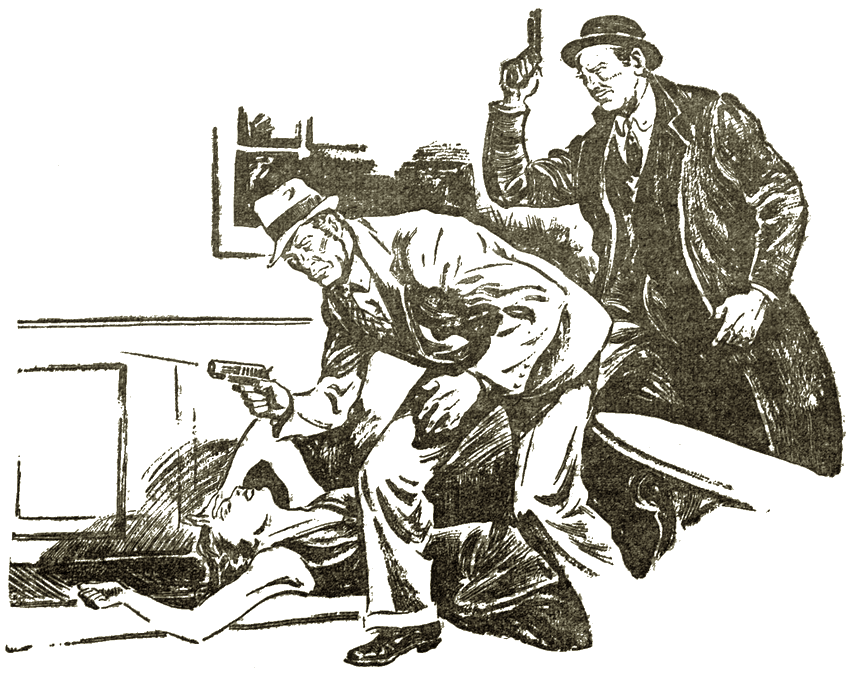
Pete Alexander was down on his knees now, alongside the chair. He couldn't keep on his feet. He couldn't see the doorway clearly. He had to put both hands on the gun to hold it steady.
The doorway loomed large and weird, its proportions all awry. It floated and took queer shapes. The steps came closer, and then he saw the blurred images of two shapes stepping into the room.
The fat man was gripping one of those vicious hatpin knives, and the chauffeur had an automatic. At least, that's what he thought he saw. In a moment, he knew, he'd be seeing nothing, he'd be sound asleep.
He threw every ounce of strength and will power into his two hands. He squeezed the trigger again and again.
The slamming explosions of the heavy gun shocked him awake for a brief instant. It was long enough for him to see the chauffeur clutching at his stomach and falling forward, and the fat man standing high up on his toes, with an expression of stunned astonishment on his jellyish face. Then the chauffeur dropped to the floor on his face, and the fat man fell over him. Neither moved.
That momentary shock passed, and the heavy lethargy descended once more upon Pete Alexander.
Through the fog that enveloped him he whispered: "It's all right, Brenda. I—didn't—fail you...."
Then he dropped the gun and slid down on the floor and went to sleep. There was a smile of beatific pleasure upon his face.
Roy Glashan's Library
Non sibi sed omnibus
Go to Home Page
This work is out of copyright in countries with a copyright
period of 70 years or less, after the year of the author's death.
If it is under copyright in your country of residence,
do not download or redistribute this file.
Original content added by RGL (e.g., introductions, notes,
RGL covers) is proprietary and protected by copyright.