RGL e-Book Cover
Based on an image created with Microsoft Bing software
Roy Glashan's Library
Non sibi sed omnibus
Go to Home Page
This work is out of copyright in countries with a copyright
period of 70 years or less, after the year of the author's death.
If it is under copyright in your country of residence,
do not download or redistribute this file.
Original content added by RGL (e.g., introductions, notes,
RGL covers) is proprietary and protected by copyright.
RGL e-Book Cover
Based on an image created with Microsoft Bing software

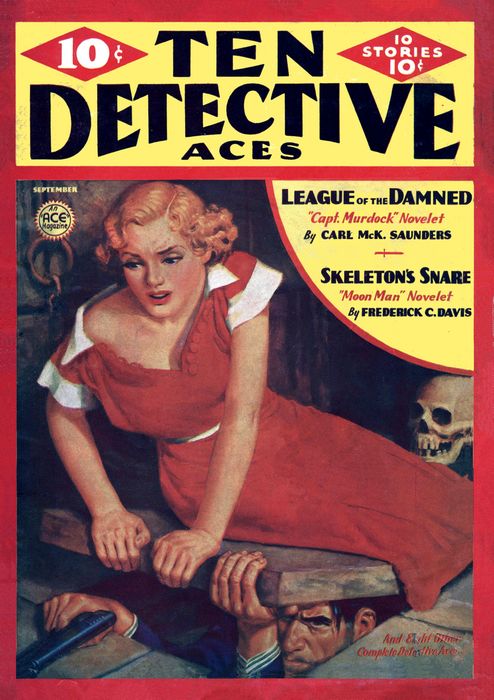
Ten Detective Aces, September 1936, with "Bullet-Battle Treasure"
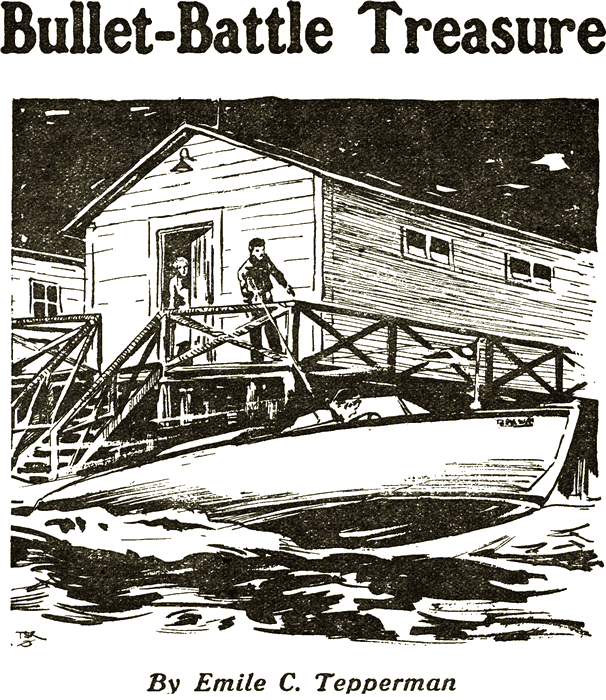
Death plucked at Marty Quade, the quick-thinking New York sleuth, with a murder-fraught message. And Quade was quick to grab up the challenge of a sharpshooter's trigger-timed setup, eagerly catching the gunpowder-gauntlet tossed by the Devil himself—who was chuckling when he flung the dick that fool's lure to a....
IT was a hot night, and the Miami Beach Dog Track was jammed to capacity. The crowd was noisy and sweaty, and the greyhounds hadn't been running to form at all tonight. By the end of the sixth, Marty Quade was out forty dollars, and his collar was wilted, and the holstered automatic under the left armpit of his Palm Beach jacket was beginning to feel uncomfortable.
Marty had bet on the number-one dog, which always has a bit of an edge on the rest, because it runs on the inside of the track. But the number-one dog had come in fourth, which was as good as last. He tore up his mutuel ticket in disgust, and was pushing his way through the crowd toward the kennels, with a view to inspecting the dogs as they were weighed in for the next race. It was at that moment that the loud speaker over the field blared a message:
"Call for Mr. Quade! If Mr. Marty Quade is here at the track, kindly come to the main gate. There is an urgent message for him!"
Marty frowned. The clerk at his hotel knew he was at the dog track tonight, and might very well have relayed a call to him here. But Marty couldn't imagine what sort of message could be that urgent. He had come down to Miami a few days ago on business, had finished the job, and was now wholly pleasure bent for the next week or so.
Reluctantly he turned away from the kennels, made his way toward the main gate. A skinny little man was standing there, beside the gate attendant, looking anxiously around. He was sweating profusely, and he carried his jacket over his arm. His tie was pulled open at the collar, and he was wiping his neck with a handkerchief which was sopping wet.
The loud speaker on the field began to repeat the call for Mr. Quade, and Marty said to the attendant: "Get them to turn that thing off. I'm Quade."
The skinny little man exclaimed: "That's good! I'm the one who's looking for you." He gripped Marty's sleeve, started to drag him out through the gate.
Marty jerked his sleeve out of the man's grip. "Hold everything, mister," he said irritably. "What's the gag? I'm out forty bucks here, and you want to drag me away. If this is a practical joke—"
"No, no! My name is Schaeffer. This is no joke. Listen to me. Here—" eagerly he dug into his pocket and pulled out a wad of money, peeled off a bill carelessly—"here's a hundred dollars. That'll make up your losses, and to spare!"
Marty took the hundred grudgingly.
"Well, if you're handing out centuries, it can't be a practical joke. What's the angle?"
Schaeffer was again dragging him out. "Let's go, I'll tell you on the way. I phoned my lawyer in New York—Michael Scanlon—and he told me to find you. He said you were down here, and that you were the best man he knew to help me. It's my daughter I'm worried about, not myself. Please come. I'll tell you all about it on the way, and I'll pay you well—anything you ask."
"If Mike Scanlon sent you," Marty conceded, "I guess you're all right." He allowed himself to be pulled out into the street. "Just what are you worried about, Mr. Schaeffer?"
Schaeffer kept on mopping himself. "It's like this: I bought a parcel of land on the ocean front, and now they're going to kill my daughter. You've got to contact them, make them lay off. You know how to do those things, where the police would only mess it up."
"Wait a minute," Marty broke in. "What has buying a parcel of land got to do with your daughter's getting killed? And who wants to kill her?"
Schaeffer was pulling him across the street toward the parking lot. "Let's get in my car, and I'll explain while we're driving. Luckily, we're staying at the Palm Gardens Hotel, where you're staying. You can—"
His voice ended in a high screech as a car without lights darted out from the parking space, gathering speed and swerving directly at them. Marty caught a swift glimpse of two men in the front seat, with set, hard faces. He heard the roar of the motor being accelerated in second speed, saw the heavy auto rushing straight at them. In another instant the front of that machine would smash them, hurl their broken bodies into the air. He acted instinctively, with the speed of perfectly coordinated muscles.
QUADE'S left hand moved forward in a straight-arm jab that sent the diminutive Mr. Schaeffer stumbling headlong across the gutter, out of the path of the roaring juggernaut. At the same time he himself leaped backward to the curb. The auto raced on between him and Schaeffer, hitting neither. Its brakes screeched raucously, and the car slowed up, fifty feet beyond them.
A head appeared out of the side window, and beside it was the muzzle of a sub-machine gun. The gun began to chatter, and lead pellets gouged the concrete of the street, marching swiftly along toward the spot where Mr. Schaeffer stood. The little man screamed, and began to run. But the hail of slugs sped after him, caught up to him, and fairly cut him in two.
Marty Quade had moved swiftly, his automatic coming out of his shoulder holster almost before the Thompson began to stutter its bloody message of death. He was pumping lead at the car in unison with the sub-machine gun, but he could not get a clear shot at the gunner, who was at the far window, on the other side from him. Marty shot through the rear window of the car, but the gunner was crouching low over his Thompson, and Marty's slugs couldn't reach him.
By the time Marty had fired three shots, the Thompson had emptied its entire clip, and Schaeffer's body was nothing but a bloody mass of quivering flesh in the gutter. Marty's eyes were bleak, and his lips drawn in a thin, tight line, as he leaped toward the car, running to the side window, through which he could get a straight shot at the man behind the machine gun. But the killer's work was done. Suddenly the car's motor roared, gathered speed, and shot away down the street, almost running over a uniformed policeman, who had appeared from inside the dog track.
Marty stopped running, raised his gun at arm's length, and coldly, deliberately, emptied his clip at the speeding auto. He shot for the right rear tire, and he hit it. The car swerved violently, but its driver was an expert. He brought it out of the skid, braked it to a stop and the doors on both sides opened. Two men leaped out, started running in opposite directions. In a moment they had disappeared around the corner at the end of the street, one going to the right, the other to the left. The uniformed cop was shooting at them, but he missed, and the killers were gone.
There was pandemonium in the street. Men and women had come rushing out from the track. The women stood there, screaming at sight of Schaeffer's lifeless, bloody body, which lay pitifully in the gutter. In a moment a thick crowd had gathered. The cop was waving his gun wildly with one hand, and blowing sharply on the police whistle in his other hand. He was tied up in the milling mass of people at the track gate, and couldn't push out.
Marty, however was clear of the crowd, and he launched himself toward the corner—after the two fugitives. There was nothing to be done for Schaeffer. The little man was as dead as he would ever be, and Marty had his hundred dollars. That hundred dollars he considered, had established the relationship of Schaeffer to himself as a client; and he was going to earn it.
He rounded the corner into Commerce Street, taking after the man who had turned right. He was feeling in his pocket for an extra clip for his empty automatic, and he cursed under his breath as he remembered that he had not provided himself with any when he left the hotel that evening. He hadn't been expecting to be launched into any such fantastic gun battle as this.
The sidewalk along Commerce Street was cleared, and people were pressing back against the fronts of the concession booths which lined the way. Marty saw that the reason for this was that the fugitive killer had just passed that way, waving his gun in the air. He caught a glimpse of his man racing through the wide entrance of the new, million-dollar amusement pier, which jutted out into the ocean from the foot of Commerce Street. Down at this end of Miami Beach were all the concessions, slot-machine booths, gambling casinos and rifle galleries, à la Coney Island, where tourists came to spend their money every night. People were shouting wildly, pointing at the fugitive gunner. From behind, there came more shouts from the crowd in front of the Dog Track. Police whistles were screeching shrilly from every direction.
Marty was racing after his man, when the fugitive stopped just within the arcade of the amusement pier, raised his gun and fired. The slug whined over Marty's head, and the man set himself for another shot. It was evident that he wanted to get rid of the immediate menace of Marty, so that he would have time to slip in among the thousands crowding the pier, and lose himself. He might even be able to escape by diving off the end of the pier and swimming back to shore.
Marty threw himself to the ground, just as the killer fired again, and the man missed once more. But his slug, whistling above Marty's head, caught the bluecoat who was turning the corner into Commerce Street. The lead pellet smashed into the cop's chest, whirled him around, and slammed him back, almost around the corner. Once more the killer aimed at Marty.
Marty cursed, dived toward the concession booth in front of which he had dropped. It was a rifle gallery, in front of which a customer at the counter was holding in his hand one of the automatic rifles, with which he had been about to try his skill on the clay pigeons. Slugs from the fugitive killer's gun were screeching in the air. The man was intent on killing Marty before he got going again. Marty seized the rifle from the customer's hand, pushed the man out of the way, and jumped up on the counter of the rifle gallery, lay prone on the board, and sighted at the killer. It was the only way he could get a shot at his man, because the muzzle of the rifle was chained to the counter, so that it was impossible to swing it in order to aim at anything in the street.
THE killer was standing with feet wide apart, pumping lead at Marty. A shot crunched into the wood of the counter beneath Marty's head, sent splinters flying upward. Marty sighted coolly, pulled the trigger of the rifle. The distance was more than twice that for which the rifle was intended to be used, and there was a bit of breeze. He fired high, at a spot two inches above the man's forehead, and considerably to the left. He held his breath, hoping his wind allowance was correct.
In the act of pulling the trigger for a fourth shot, the killer's hand suddenly opened, and nerveless fingers allowed his weapon to drop. A small black hole appeared directly above the bridge of the man's nose. He crumpled to the ground.
Marty grunted, put down the rifle, and rolled of! the counter. And a heavy hand descended on his shoulder, gripping it hard. A harsh, authoritative voice ordered: "Stand still, you!"
Marty swung his eyes, frowned at the heavy-set man in the uniform of a Miami Beach Police sergeant, who was holding him with one hand, and covering him with a service revolver in the other. "Gun-fighting in the street, huh?" the sergeant growled. "We'll show you New York gangsters that it don't pay to start nothing like this down here!"
Marty's cheeks flushed a dull red. "You damn' fool!" he said hotly. "I just bagged the murderer of that little chap around the corner—that man over by the pier, who also just shot one of your own patrolmen. His pal got away, in the other direction."
"Yeah?" The sergeant was cynical. "I just got here in the squad car. All I seen was you and this other guy shooting at each other." He let go of Marty, backed away a step, still keeping him covered, and picked up Marty's automatic from the ground, where he had let it drop when he dived for the rifle. "This your gun ?"
Marty nodded. "Yes, it's my gun. Instead of wasting time here, why don't you get out an alarm for the other killer? And there's danger to the daughter of the little fellow who was shot in front of the dog track. Get some men over to protect her."
"Listen, you!" the sergeant barked. "Don't you tell me how to run my business. First, you give an explanation of yourself. You ain't talkin' yourself outta this killing. I saw you drop that guy with the rifle!"
Marty shrugged resignedly. "My name is Quade," he said patiently. "I'm a private detective from New York. I was at the track when Schaeffer—that's the chap who's lying in the street around the corner—had me paged at the track. He started to tell me his daughter was in danger, and just then the fireworks began. That's all I know about it. These people—" Marty waved to the crowds pressing in close about them—"will tell you that we were attacked."
"Sure, sure, that's your story. But you'll have to be held on a homicide charge. You got a license as a private dick in Florida?"
"No. I wasn't down here on business."
"Then you got no business carrying this automatic. You just stand still, right here, till the homicide detail comes."
"But I tell you," Marty insisted, "there's a girl likely to be killed while you're fooling around here. It has something to do with a parcel of land."
The sergeant guffawed. "Parcel of land! You think you can pull gags on me? What's a parcel of land got to do with a triple shooting? Nix, mister. I only know what I see. And I seen you shoot this guy between the eyes. So I'm holding you."
"But the girl—"
"Where is she?"
"In Miami. You've got to get some protection for her."
"Sorry, mister, but you ought to know we got no authority in Miami. Miami Beach is a separate city from Miami, and we got a separate police department. After you're booked, maybe homicide will phone to Miami and have 'em bring in this girl. What's her name, an' where's she staying?"
Marty said tightly, restraining himself with an effort: "Listen, sergeant, why don't you use your head? This man Schaeffer was killed. Some one means business. If that some one was willing to knock a man off in public, right in front of the dog track, there must also be danger for Schaeffer's daughter. If the girl should be killed, her blood would be on your conscience."
Somebody in the crowd called out: "He's all right, Sergeant Green. I saw the whole thing. This man was attacked."
Sergeant Green turned to the interrupter, growled: "Mind your own damn' business! I'm holding this guy."
He didn't get any farther than that, because Marty took advantage of the second in which Sergeant Green's eyes were not on him. His bunched fist came up in a short arc that caught the sergeant behind the ear with a terrific thwack. The sergeant grunted, started to buckle, and Marty twisted the service revolver out of his fingers, launched himself through the crowd. A cop who had come with Green, and who was down at the pier looking at the dead body of the killer, shouted, "Hey there, stop that man!" and started to run toward them.
Marty jumped over the counter of the rifle gallery, raced toward the rear. The crowd was shouting, milling in the street behind him, and the cop was running and blowing his whistle shrilly. Marty had seen a back door, behind the swinging target in the shooting gallery, and he made for this, his foot slipping on spent shells which littered the floor. He knew that the backs of these concessions along Commerce Street opened on the ocean; so he was prepared for a cold swim in order to escape from the clutches of the obtuse Sergeant Green. He wanted to do something about the immediate danger which he was convinced threatened the daughter of the man who had been murdered in front of the dog track.
He slipped through the back door, just as a shot from the pursuing patrolman's gun spanged into the swinging target alongside his head. He slammed the door shut, found himself on a small open platform, against which the ocean lapped gently. He was already shucking off his coat, when his eyes lighted on something that made him grin widely.
Directly opposite the platform, was the pier of the Miami Beach Kennel Club, and tied up at the pier were half a dozen speedboats, in which people had come to visit the track.
Travel, by speedboat, is quite popular in Miami, because the broad expanse of Biscayne Bay, lying between Miami proper, and Miami Beach, offers a perfect stretch of water for aquatic speed enthusiasts. It is on Biscayne Bay that the famous Gar Wood hangs up new records every year. And the yacht basin is always full of speedboats, house boats, and palatial launches. The half dozen speedboats tied up at the Kennel Club pier begged Marty to take them.
MARTY kept his coat on when he dived off the platform, holding Sergeant Green's revolver in his teeth. A few powerful strokes carried him over to the nearest of the speedboats. Over its side he pulled himself, just as the rear door of the shooting gallery opposite was burst open. The patrolman appeared, gun in hand, and spotted Marty throwing off the rope which secured the boat to the pier. He called out: "Stand still!"
Marty yelled, "Wait—don't shoot!" and slid into the seat under the wheel of the boat. In the second that patrolman stood, undecided, Marty stepped on the starter—and the motor turned over, humming sweetly. The boat was a beauty, and she answered at once when he threw the stick into forward. She purred, shot out from the pier. Marty twisted the wheel in a tight sharp curve, almost under the feet of the patrolman If he could have been sure that the police were headed by Captain Slocum, whom he knew well, he would have taken the chance of landing there. Slocum would not be as bull-headed as the Miami Beach sergeant. Captain Slocum was a veteran of the New York Police force whom Marty had known when he pounded a beat. But Marty wasn't taking any chance, right now, of falling into unsympathetic hands.
At the Royal Palm dock all was quiet. An attendant threw him a line, saluted him on the platform. The bluecoat fired pointblank, and the slug smashed into the polished mahogany of the boat. Then Marty was out from under, feeding her gas to the limit, racing out around the wide curve of the Beach Island, with the spray eddying out behind him, and the wind whining above the top of the narrow windshield. He was cutting across the breakers, instead of riding them, and the boat throbbed perilously, until it seemed that the engine would be torn from its moorings. But Marty held the course, grimly, zigzagging sharply, so as to avoid the slugs that poured after him.
The cushion-banked motor pulled the boat bravely. It reached thirty, then forty, fifty, sixty miles an hour. Marty kept it at that around the wide curve of Miami Beach, which brought him directly into the ship channel alongside the County Causeway across Biscayne Bay, connecting the Beach with the City of Miami.
The shots had died away. Ahead of him, the skyline of Miami glowed, brilliantly alive with its row of tall hotels, gayly lighted, suggestive of a miniature New York skyline. Marty paid little attention to the skyline, however. He held the wheel hard, guiding the boat along the ship channel, keeping as far from the palm-lined causeway as he could.
It was a three-and-a-half mile run in along the ship channel across Biscayne Bay—five minutes in time, at the most. He wondered if the telephone wires weren't crackling with requests to the city police to pick him up as soon as he landed. His eyes strained keenly for any sign of unusual activity around the municipal docks at the foot of Bay Front Park. Under the lamps on the dock, he thought he could discern shadowy figures moving, grouping near the water. If those were police waiting to welcome him, he would have to avoid them somehow. He veered sharply to the left, stood away from the municipal docks, and pulled in half a mile further down, at the private docks of the Royal Palm Club, at the mouth of the Miami River.
Here, all was quiet. A dock attendant threw him a line, saluted him respectfully. Then the attendant's eyes widened at sight of the heavy service revolver, and at sight of Marty's clothes, which were dripping-wet from his short swim. Marty hastily pocketed the gun, said to the attendant: "Look. Can you use this?"
The man gasped, fingered the hundred dollar bill which Marty pushed into his hand.
"Get me a dry coat from somewhere. Forget you saw me, and you can keep the bill."
The attendant gave him a queer glance, went to a locker, and came back with a blue coat. "It belongs to one of the members, sir. But I guess you can have it—for a hundred!"
Marty hastily discarded his Palm Beach jacket, donned the blue one. "Now, remember, you forget about me, or I'll come back and wring that hundred out of you!"
The man nodded wordlessly. Marty pushed swiftly through the spacious grounds of the Royal Palm Club, and went out into Brickell Avenue. He walked swiftly to East Flagler Street, passing Bay Front Park, where the municipal dock was located. He grinned to himself tightly, as he saw the cordon of police stretched across the entrance of the park. They were still waiting for him to land from the bay. In a little while they would wake up to the fact that he might have gone around to the Royal Palm Dock. Marty hastened up Flagler Street, putting as much distance between himself and the police cordon as he could. He turned north on Biscayne Boulevard, crossed the street, and entered the Palm Garden Hotel.
He was watching warily as he went in, to see whether the police had set a trap for him here. That was unlikely, for he hadn't said where he was staying, and it would take them a little while to trace the original call to the dog track—if they even thought of doing that. Anyway, they wouldn't be looking for him here so soon. Nevertheless, he did not relax his vigilance.
Quade saw the tall man at the far end of the lobby, who turned away quickly and went into the elevator, but he gave no sign that he noticed. He went over to the desk, across which the clerk said: "Did you get the call at the Dog Track, Mr. Quade? Mr. Schaeffer is one of our guests, and he was very anxious to find you."
"Yes, I got it," Marty told him grimly. "What room did Mr. Schaeffer have?"
"Did he have, Mr. Quade? He still has it. He hasn't checked out that I know of. His daughter's up there now, waiting for him, and two gentlemen just went up to see her. Is—anything wrong?"
"You don't know the half of it," Marty said. "What room number?"
"Four-eleven, sir.
"All right. Don't announce me. Now, get this—have your switchboard operator get me Michael Scanlon, the attorney, in New York. If he's in bed, I want him routed out. If he's playing the night clubs, I want him traced. But I want to talk to him! When she gets him, connect me at Schaeffer's room."
"Certainly, Mr. Quade. Michael Scanlon, the lawyer, in New York."
"And one more thing." Marty took out a ten-dollar bill, slipped it across the desk. "Mr. Schaeffer has been murdered—never mind the hysterics—" as the clerk grew pale, let his lower jaw hang slack—"and I shot it out with one of his killers. The police will be coming here pretty soon looking for me as a material witness or something. I need a little time before I talk to them. Could you—er—forget that I went up to Mr. Schaeffer's room?"
The clerk looked doubtfully at the ten-dollar bill. "Well—"
Marty sighed, took out two more tens and slid them across. "Still doubtful?"
The clerk smiled. "Not thirty dollars' worth, Mr. Quade. Depend on me. You've been with us before. I know you're on the square."
Marty left him, hurried into the elevator, which had just come down. While he had been talking to the clerk, he had noted that the elevator, into which the tall man had gone, had stopped at the fourth floor, as shown by the indicator. He put his right hand in his borrowed jacket pocket when he got off at the fourth floor, kept it there when he knocked at the door of 411.
There was no answer.
FROWNING, Marty rapped harder. A faint stirring sounded inside. Marty knew that slight rustle of motion behind the door was not meant for him to hear.
But the doors and walls of Miami buildings are notoriously thin, and he could distinctly trace by sound, the faint movements of those within—could tell that someone had come up close alongside the door.
The knob turned slowly, and Marty quickly stepped to one side. Suddenly the door was flung abruptly open, and a hand gripping an automatic was jabbed out at the spot where Marty would have been standing, if he hadn't moved.
Marty grinned thinly, and brought the barrel of Sergeant Green's service revolver down hard on the hand. There was a squeal, and the automatic dropped to the carpeted floor. Marty reached over, gripped the hand, and yanked hard. A squat body followed the hand, and Marty struck at the surprised face of the body's owner. His barrel caught the man on the forehead, and the man slumped. Marty shoved, fell inside the room.
There was a commotion in there, and Marty quickly picked up the fallen automatic, pocketed it. He stepped inside the door, kicked it shut behind him, stood astraddle the one he had knocked down, facing the man and the girl in the room. His service revolver was leveled at the man, who also had a gun in his fist—pointing at Marty. The man was the tall one who had left the lobby to come upstairs, only a few moments before.
The girl was not standing. She was pretty, young, with blonde hair and wide blue, frightened eyes. She was sitting on the bed near the bath-room door. Her hands were tied behind her, and she was gagged. Her pretty gingham dress was torn and rumpled, showing soft white skin here and there. Marty's eyes dropped to her feet. Her shoes and stockings had been removed, and beside her feet there was a pitcher of boiling, hot water, from which the steam was rising with a hissing noise. The girl's bare, right foot was raw, red and blistered about the toes.
Marty's eyes were cold and bleak, as he swung them back to the tall man, who still had his gun pointed at him. Marty said through clenched teeth: "You always were a rat, Lister. I saw you down in the lobby. I didn't think you'd get down to boiling a girl's feet, though!"
Lister kept brittle eyes on Marty. His lips parted in a grin. "So what, Quade? We know each other from New York. I'm sorry you got pulled into this, but it's damn' big—so big that we wouldn't let a little thing like a murder rap stand in our way. You ain't tied in this business, Quade. I always let you alone in New York, and you always let me alone. Do it now. Step outta here, and don't mix. It ain't nothing out of your pocket."
"Sorry, Lister," Marty murmured. "Mr. Schaeffer gave me a hundred dollars before." He stopped, letting his eyes flick to the girl. She did not know, maybe, that her father was dead. "Well, he gave me a hundred dollars. That makes him and his daughter my clients. Understand?"
Lister's thin face grew pale. "So what, Quade?" he blustered. "I got the drop on you, and you got the drop on me. We're both tough. Who's gonna shoot first?"
Marty's lips tightened. "I'm going to shoot when I count three," he said steadily. "You can shoot any time you want. But the way your gun is pointing, it won't stop me from shooting, too. So maybe we'll both kick in. Have you got the guts to shoot, Lister? Are you really tough?"
Lister's eyes shifted desperately. "Wait—" as Marty said a slow "one"—"for the love of Mike, Quade, don't be a sap. Can't we settle this some other way?"
"Marty said: "Two!" Then he added: "Sure, we can settle it some other way—by you dropping your gun before the next count."
Marty's lips started to form three, when Lister groaned, his face haggard. With frantic desperation he opened his fingers, let his gun drop to the floor. "Don't shoot, Quade!" he begged.
Marty let out a sigh of relief. "I thought you were going to play at being real tough, that time, Lister!" He kicked the other's gun under the bed, nodded reassuringly to the girl. "Now," he ordered, "untie her, and take off the gag. And if your foot slips in that pitcher of boiling water, I won't be sorry!"
Lister threw a furtive glance toward his unconscious partner on the floor near the door, then another behind him toward the bath room. He looked as if he were contemplating a dash into the bath room, but Marty said curtly: "Don't be too wise for your own good, Lister. I'd just love to shoot down a guy who burns girls' feet!"
Lister was about to reach for the girl's wrists, when the telephone rang. Marty backed to it, picked it up, and said: "Well?"
"Mr. Quade?" It was the clerk's voice.
Marty said: "This is Quade. Got that call yet?" His eyes left Lister for long enough to look down at the telephone table, upon which lay an open fountain pen and a long legal document. Marty caught the typewritten words:
And all that certain parcel of land situated and lying 262 feet and eleven inches northwest of Grant Avenue, adjoining and abutting upon the Ocean Front of the City of Miami Beach in the County of Dade which is in the Stats of Florida....
The Clerk's voice announced: "We've got Mr. Scanlon for you, Mr. Quade. Here he is."
MARTY welcomed the voice of Mike Scanlon while he kept his gun pointed at Lister. He saw the girl struggling frantically against the gag in her mouth. Her eyes were wide, and she seemed to be trying to convey some message. Marty grinned at her, said: "We'll have you out of this in a jiffy, Miss Schaeffer." Then, into the phone: "Mike, you old son-of-a-gun, what's this stuff you wished on me? Who told you I wanted business down here? Who's this Schaeffer?"
Scanlon chuckled at him from New York. "Did you meet him?"
"Did I! Say, he provided some first-class excitement. What's the lowdown?"
"I'll tell you, Marty. He's got some queer idea that a brother of his—you remember Arty Schaeffer, who was hanged in Florida for mail robbery?—well, Arty Schaeffer is supposed to have buried a million dollars of loot from the Boca Raton holdup. It's buried somewhere in Miami Beach, and Joey Schaeffer, the fellow I sent to see you, claims to know where it is. He's crazy, because nobody would bury stuff like that right in Miami Beach. He bought the lot where it's supposed to be. Now he says that a couple of Arty's pals are trying to get hold of that land, so they can dig for it. He called me up, all excited, and said they would knock him and his daughter off, if he didn't turn over the land. So I sent him to you, figuring he'd hand you a laugh. Did he?"
"Yeah," Marty said drily. "He handed me a laugh all right—on a slab. Those were no hallucinations he had, Mike. It was the goods."
"Holy mackerel!" Scanlon exclaimed. "Do you know what that means ? There's a reward of a hundred thousand dollars for the recovery of that loot. Say, Marty, don't forget to cut me in on it when you break the case!"
"How does a guy named Lister figure in it?" Marty asked. "Or don't you know?"
"Come to think of it, Schaeffer mentioned Lister over the phone. He said that Lister and a man named Dwyer—Marvin Dwyer—were trying to get that land away from him."
"Marvin Dwyer!" Marty exclaimed. The name was a household word in the underworld of New York. Marvin Dwyer was known to be the man who financed all the outstanding raids. It was he who had furnished the funds which had put Trokis back in business when he was forced to flee from the G-men, without money or guns, one night. It was Dwyer who had financed the surgical operations which had changed the faces of a dozen public enemies. It was entirely understandable how a man like Marvin Dwyer would know about the hiding place of Arty Schaeffer's loot.
Marty said softly: "Thanks for the information, Mike. I'll let you know how I make out." He cradled the phone, looking inquiringly at the girl, who was struggling in her bonds, and at Lister, who was shifting from one foot to the other. "What's the trouble, Lister?" he asked. And in that instant he knew ....
A gun was jabbed in his back, and a cold voice said: "The trouble is that you didn't look in the bath room, Quade. That's what the skirt was trying to tell you."
Marty put his revolver down gently on the table, without being told to do so. He knew the voice. He sighed, turned around slowly, and said: "Hello, Dwyer. Since when do you go out on your own kills?"
THE man was very thin, with black, oily hair parted in the middle. His complexion was sallow, his eyes narrow and set close together. He had an automatic jabbed in Marty's ribs. "I'll tell you, Quade," he said. "This is a real big thing—a million dollars."
"Then that stuff is really buried on the land that Schaeffer bought?"
Dwyer nodded, his sharp little eyes fixed on Marty's face. "It's there Quade, and we can't get at it—except if we buy the land. We don't know exactly what part of the lot it's in, or how far down. We'd have to turn the whole thing over; and you can't do that in Miami Beach, without a permit—and you can't get a permit, unless you own the land. So I'm set on owning the land. Get the picture, Quade?"
"I get it," Marty said softly. "You were burning Miss Schaeffer's feet, to make her sign over this deed. You killed her old man—" Marty saw the girl start, and shudder when he said that—"and you wanted to make her sign because the property becomes hers by law."
Dwyer smiled thinly. "You always were fast on the uptake, Quade. Now the question is: Do you be good while we get this signed, or do we be bad ?"
Marty grinned. "That's a nice way to put it." He shrugged, "If Miss Schaeffer is willing to turn it over, it's okay with me."
Dwyer's small eyes gleamed. He motioned to Lister. "Take off the gag!" He wiggled his gun at Marty. "Stand away from the table, Quade. I don't want you near that gun. That's right, all the way-over on the other side of the bed." He grinned. "Now, you ain't so dangerous," Lister had taken off the gag. The girl turned her wide eyes to Marty. "My father!" she said throatily. "He's—dead ?"
Marty nodded grimly. "I'm sorry, Miss Schaeffer. I did the best I could. I got one of his murderers. The other one was either our friend Lister, here, or maybe Mr. Marvin Dwyer himself. I'll get them both for you—before the day is over."
The girl closed her eyes for a moment, and gulped. Then she opened them bravely, forced herself to talk. "About that deed—" her eyes indicated the document on the telephone table—"I'll never sign it. I guess I'm not too dumb to realize that they'll never let you or me live, after what we know about them. They—they didn't have to kill—dad. The deed is in my name. Dad bought the property in my name because he didn't want to have anything to do with the money. He was going to excavate, and if he recovered the loot, he was going to turn it in to the insurance company for just enough of the reward to pay for the expense of excavating. Then he was going to build an apartment-hotel on the land. Dad—has enough money. He—didn't need the reward. He—just wanted my uncle Arty's name to be clear with society."
Dwyer sneered. "That's too bad, Miss Schaeffer, because we're going to have that property. You're going to sign the deed. Understand?"
Her eyes flashed. "And then be thrown in the bay with a hundred-pound rock around my neck? I heard you and Lister talking about it when you thought I'd fainted! I won't sign!"
"You'll sign—" Dwyer leered—"if your feet get boiled a little more. Nobody can take that treatment for long!"
"No!"
Dwyer motioned to Lister, who knelt at the bedside, seized her left foot, and raised the pitcher, to pour some of the boiling water on it.
Dwyer said: "Take the pitcher in the bath room. I just got the electric heater going. You can boil up some fresh water. That's kind of cooled down a little."
Lister grinned, got up.
Marty said quickly: "Wait a minute. Miss Schaeffer, I think you ought to sign this deed. You take my advice—and sign it!" He moved over toward the telephone, upon which the deed lay, under the revolver he had put there.
Dwyer snarled: "Get away from there!" He had backed off, and was standing astraddle the man whom Marty had knocked out, and who lay near the door. Marty shrugged. "All right, get the paper yourself, if you're scary."
Dwyer edged around suspiciously, put the service revolver in his pocket, picked up the deed, and handed it to Marty. He said with a faint sneer: "If you want to talk her into signing, it's okay by me. I need a good, reputable witness. I could cut you in."
Marty said: "You sap, I'm doing this to save our lives!" He saw Dwyer's lids lower over his eyes and he knew that Dwyer was thinking him a sap, because what the girl had said was true. Dwyer would never allow them to leave the hotel alive. Marty took the deed, went and stood in front of the girl. His back was turned to Dwyer, and to Lister, who was just coming in with a pitcher of steaming-hot water.
"Miss Schaeffer," he said, "you should take my advice—sign this." He allowed his right eye to close in a significant wink, and the girl caught the signal, began to breathe fast. He went on: "You won't gain anything by holding out, except to get your feet badly burned. Now, if Dwyer will promise to let us leave here, we'll promise to keep quiet about this whole thing."
"Sure, I'll promise," Dwyer said eagerly. "You give me your word that you won't blab—both of you—and I'll let you walk out of here."
Marty still kept his back to Dwyer, but his ear caught the note of wonder in Dwyer's voice at the fact that Marty Quade, whose name carried plenty of weight in New York, should have become such a sap. He repeated his wink
to the girl, and said: "Certainly Miss Schaeffer. It's the only thing to do. Will you sign?"
The girl was a good actress. She sighed, said: "I'm afraid I couldn't stand any more of that hot water. I'll—sign."
Marty said over his shoulder: "Untie her hands."
DWYER came around behind her, kept Marty covered steadily while he fumbled at her bonds with his free hand. He was plainly suspicious, and Marty could see that he thought this too good to be true. However, Dwyer could hardly see anything wrong with the girl's offer to sign the deed. He got her hands free, and Marty, giving her the deed, was conscious of Lister standing behind him. He moved around a little, so that he could get a view of both Dwyer and Lister.
The girl took the deed, waited, and Marty said: "Here—you want a pen, don't you." With the greatest of natural ease, his hand slid into his jacket pocket. "Here—" His hand closed over the automatic he had taken away from the man at the door. His thumb slipped off the safety catch, and he fired through his pocket at Dwyer, who didn't know what hit him. Dwyer collapsed on the bed, with a hole in his forehead.
Lister uttered an alarmed shout, but before he could pull the trigger of his gun, the girl had sprung into action. She seemed to have read Marty's thoughts. She dived off the bed against Lister's legs, and the tall man was knocked backward momentarily, his aim spoiled. His slug went high, and Marty shot him through the heart.
"That," he said coldly, "is for old man Schaeffer."
The girl looked up at him from the floor. A wan smile illuminated her features, and she said: "Daddy! I hope you saw it!" Then she fainted.
Marty murmured: "Good kid...."
He became conscious that some one was knocking at the door. The force of the blows increased. A bull voice called: "You want us to shoot this down?"
Marty laughed. "Don't shoot, sergeant, at this old gray head!"
He opened the door, and Sergeant Green, with a dozen Miami police, burst into the room. Green aimed a blow at Marty, shouting: "There's the guy who took my gun!" But Marty ducked, came up behind a grizzled man, in plain clothes, whom he knew well. It was Captain Slocum of Miami Homicide.
Slocum said to Green sternly: "Remember, Green, you're only here by courtesy. You belong on the other side of Biscayne Bay. Behave yourself. I've known Quade for a long time. If he took your gun, you must have been naughty."
Green glowered, stepped among the bodies on the floor, disregarded the fainting girl, and picked up the deed, which she had not yet signed. "What's this?" he growled.
"That," Marty said brightly, "is worth one hundred thousand dollars."
"What?"
"Did you ever hear of buried treasure?"
"You nuts?"
"That's where Schaeffer's loot from the Boca Raton robbery, of three years ago, is hidden. The reward, my good sergeant, is one hundred grand. There—" he indicated the bodies of Dwyer and Lister—"are the birds who killed Schaeffer. Miss Schaeffer here will testify that they admitted it before we started the fireworks. If you're a good boy, sergeant, and if you apologize for the rough way you talked to me, I may buy you a nice cigar out of my reward money."
"Well," said Sergeant Green, "I'll be sunk—to the bottom of Biscayne Bay!"
Roy Glashan's Library
Non sibi sed omnibus
Go to Home Page
This work is out of copyright in countries with a copyright
period of 70 years or less, after the year of the author's death.
If it is under copyright in your country of residence,
do not download or redistribute this file.
Original content added by RGL (e.g., introductions, notes,
RGL covers) is proprietary and protected by copyright.