RGL e-Book Cover
Based on an image created with Microsoft Bing software
Roy Glashan's Library
Non sibi sed omnibus
Go to Home Page
This work is out of copyright in countries with a copyright
period of 70 years or less, after the year of the author's death.
If it is under copyright in your country of residence,
do not download or redistribute this file.
Original content added by RGL (e.g., introductions, notes,
RGL covers) is proprietary and protected by copyright.
RGL e-Book Cover
Based on an image created with Microsoft Bing software

William Morrow & Company, New York, 1947

William Morrow & Company, New York, 1947
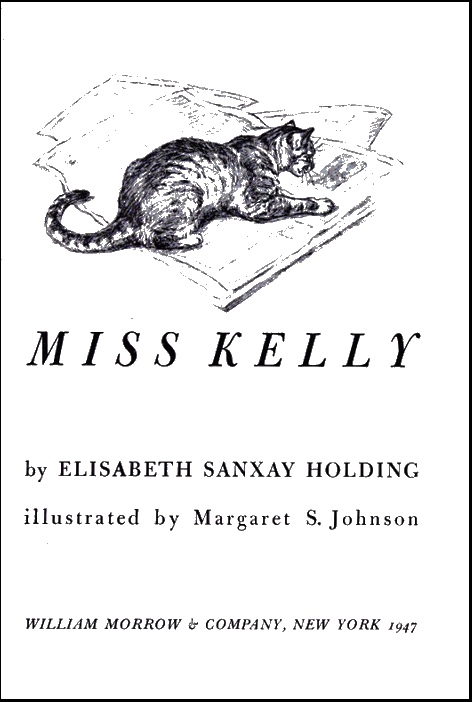
William Morrow & Company, New York, 1947
"Miss Kelly" is a warm, witty, and surprisingly philosophical children's novel about a highly intelligent young cat who can understand—and secretly speak—Human language. Miss Kelly lives with the Clinton family, who adore her but have no idea she can understand everything they say. She is ambitious, curious, and lonely, longing for meaningful work and someone who can truly converse with her...
THE Family was sitting at breakfast—Mr. and Mrs. Clinton, Frankie, who was ten, and Amy, who was eight. Miss Kelly, the cat, lay on the window sill, listening to their talk and sometimes sleeping a little in the warm spring sun.
She was tired, for she had been up late the night before, giving a lesson to Minnie, the next-door cat. They had sat in the cellar, and Miss Kelly had tried, with the greatest patience, to teach Minnie to understand a few simple words of the Human language. After weeks and weeks Minnie was beginning to understand a little.
If I've been able to get this far with such a stupid cat as Minnie? thought Miss Kelly, I could do wonders with a really intelligent pupil.
It was loneliness that had driven her to Minnie. Miss Kelly herself was remarkably intelligent and she was ambitious, too. She wanted to do something useful and important in the world. But what chance did she have? She was two years old, which for a cat means eighteen, and she had never yet met one single other cat who could both understand and speak Human. She had come across several dogs who understood Human fairly well, but not one who could say so much as "Good morning." She did not see how she could find any really interesting work, young as she was and so very much alone in the world.
Miss Kelly's mother had been thoughtful and sensitive. She had taught all her kittens to understand the few Human words most important to know. The first was cat, so that they would know if they were being talked about, then milk and fish and mouse and like and don't like, and others. Miss Kelly's mother had never said anything about learning to speak the words, though, and when one day her daughter, after long, secret practising, said very proudly, "Like fish," she was greatly alarmed.
"Never do that again, child!" she had said. "It's extremely dangerous."
"Well, why?" the kitten had asked her.
"Never mind why," her mother had answered. "Just do as I tell you. Never let the Humans know you can understand them, and never, never let them hear you speak one single word."
But even as a kitten, Miss Kelly had wanted to understand about things, and she had kept on asking questions until she got an answer.
"Why?" she went on asking her mother. "Why is it dangerous?"
"Very well!" her mother had said with a sigh. "I suppose I'll have to tell you. If the Humans knew you could understand them, they'd feel worried and uncomfortable, and they wouldn't want you around. And if they ever heard you speak, even one word—"
"Then what?" the kitten had asked.
"Then they'd be frightened and they wouldn't let you live with them," her mother had said.
"I could live by myself," the kitten had said boldly.
"I hope with all my heart you'll never have to try it, you silly young thing," her mother had said. "Your father had enough of that. I only wish he were still alive, to tell you what it's like. He thought surely someone would offer him a good position. He was clever and strong and willing, and he was very handsome, too—mostly tiger, like you. But he walked the streets, day after day, in the rain and the snow. He'd sleep in a doorway, always in danger from dogs or from somebody stepping on him. All he had to eat was some miserable little bit he could pick up here and there, and the worst of it was that he couldn't get a drink anywhere. Often he'd have to drink out of a nasty mud puddle."
"I certainly shouldn't like that," the kitten had said.
Miss Kelly, now that she was older, did feel thankful for a nice warm home and food and her own saucer of milk, and she was very fond of the Clinton family and of Janet, the cook. But the more she studied and thought about things, the lonelier she grew. She was young and really beautiful—a slender, graceful tiger cat, with clear, glowing yellow eyes, and a white front and white paws that she kept exquisitely clean.
Frankie was talking now, and she turned her head to listen. He's such a nice boy, she thought. If only I could ever just have a talk with him...
"Daddy," Frankie said, "I'll look after Amy. We'll be perfectly all right."
"No," said Mr. Clinton. "No, Frankie, I don't believe in children going alone to such places. No. You've seen the circus once, and I'm afraid that'll have to do until it comes back next year."
"Listen, Daddy! I'll pay for Amy and me out of my own money I've saved up."
"No, Frankie, I'm sorry."
"Mother, won't you come with us?" Frankie urged.
"You know I have to go and see Aunt Ethel in the hospital, dear."
"Couldn't you put it off? Today's the very last day for the circus," Frankie said.
What is this circus thing they talk so much about? Miss Kelly wondered. She knew that they read about it in the newspaper, and after the family had left the dining room, she clawed the paper off the table on to the floor and turned the big pages as well as she could, hoping to find some pictures that might give her an idea.
She wished above all things that she could read. I'd learn like lightning, she thought, if I could only get a start. She had learned a little spelling, from listening to the family; she knew, for instance, that C-A-T spelled cat. But she had no way of finding out which letter C was.
She managed to get a page of the newspaper turned, and she was pleased to find a picture from a movie she had seen. She went quite often to the movie in the village, quietly slipping in at the fire exit door and standing close to the wall in the darkness. But she had no one to talk the pictures over with, for she always went alone, since Mr. Rover refused to go with her.
Mr. Rover was a handsome young dog, a bachelor, and quite out of the ordinary. He had been brought up in a kindly, broad-minded family, and he had no silly, cruel ideas about cats. He admired Miss Kelly very much and he was not ashamed to show it. Miss Kelly could not help being rather proud to be seen by other cats and dogs, taking a stroll with him. He could not speak Human, but he understood it perfectly, and one day she had suggested their going to the movies together.
"'No Dogs Allowed,'" he had said, with a bitter little smile. "Just another of those places."
"I can get you in," Miss Kelly had said.
"Thanks," he had said, "but I don't much care about going where I'm not welcome."
Miss Kelly was trying to turn the page of the newspaper again, when Janet came in to clear the table. Janet was the colored cook, and an extremely nice Human. She was kind and generous, and she talked to Miss Kelly more than anyone else did. The only trouble was that sometimes she talked down to her, as if she were only a silly kitten.
"Now what are you doing?" she said, with a laugh. "Reading the news, pussy?"
That's just what I would be doing if I'd been to school, like you, thought Miss Kelly. It's not very nice to laugh at people for what they can't help.
"Want your breakfast, pussy?" asked Janet, and she spoke in such a friendly way that Miss Kelly no longer felt hurt.
They went into the kitchen together, and Janet picked up Miss Kelly's two saucers and washed them well, in good hot water. There had been other cooks who never did that, cooks who would pour Miss Kelly's milk into a grimy, gritty saucer, who would even give her scraps of meat on a piece of newspaper.
"You like things nice, don't you, pussy?" said Janet.
"And you ought to have them nice, because you keep yourself so clean and neat and pretty. There!"
She set the two saucers on the floor, one filled with scrambled eggs and bacon, the other with milk.
"I've got to hurry with my work," said Janet, "because I've got the afternoon off, till six o'clock. Mr. and Mrs. Clinton said they'd treat me to the circus this afternoon, but I don't like it. When I hear those lions and tigers begin to roar, it sends cold shivers up my back, and I dream about them afterward."
Go on! Go on! thought Miss Kelly. What is this circus?
"Do you know what a tiger is, pussy?" asked Janet. "It's a great big cat, a hundred times bigger than you, with great big glary green eyes, and it's so fierce and wild it eats up people!"
I don't believe it! thought Miss Kelly. I don't believe there are any cats a hundred times as big as me. I don't believe there are any cats who eat up people.
AFTER she had finished her breakfast and carefully washed her face and her paws, Miss Kelly went down the street to see Mr. Rover. He was sitting outside the dog house, enjoying the sun, and when he saw
Miss Kelly he got up politely and wished her good morning.
"Won't you come in?" he asked.
"Thank you very much," said Miss Kelly, "but it's so nice outdoors in this weather."
To tell the truth, she did not like the inside of Mr. Rover's house at all. It was gloomy and dark, there were often bones on the floor, and the basket in which he slept had a very shabby brown pillow in it. A typical bachelor's house, she thought it.
She sat down on the grass beside him and purred a little, as her mother had trained her to do when making a visit. It was a way of showing that you were pleased to be where you were.
"I'm getting very curious about this circus thing," she said, after a moment. "I wonder if you can tell me anything about it, Mr. Rover."
"I'm afraid not," said Mr. Rover. "My people go to it every year, but they've never taken me. I suppose it's another of those places with that sign—'No Dogs Allowed.'"
"I'm sorry you're so upset by those signs, Mr. Rover."
"You can't understand it, Miss Kelly, because apparently there aren't any signs anywhere that say 'No Cats Allowed.' No, you're allowed everywhere."
"Well, I'm not exactly allowed in places," said Miss Kelly. "I simply go where I please, at my own risk. I've had plenty of unpleasant experiences, Mr. Rover. I've had water thrown on me, and I've been chased
She stopped herself, just in time, from saying "chased by dogs." Mr. Rover felt very strongly about that. He believed that cats and dogs could and ought to get on politely and pleasantly together. "When they don't," he often said, "it's the fault of the Humans they live with. A young dog can easily be taught to be friendly to cats, and not disgrace himself by acting like a savage."
"Then you can't tell me about this circus?" asked Miss Kelly, changing the subject.
"Well, no, I'm afraid I can't," said Mr. Rover. "My people talk about it, but I've never paid much attention. But wait!"
He thought for a few moments.
"By Jove!" he said. "I believe that poodle over on Elm Street worked in a circus once! Would you like me to bring him over to your place?"
"Well..." said Miss Kelly. "Is he—has he nice manners?
Mr. Rover knew what she meant. She meant, was the poodle likely to bark at her or chase her?
"Beautiful manners!" he assured her. "He's rather fond of showing off, and once he starts talking it's hard to get a word in, but he's a very well-educated, well-behaved dog."
"Then I'd like to meet him," said Miss Kelly, and after chatting a little longer she went home.
Amy was reading on the veranda swing, and Miss Kelly jumped up on her lap. She was fond of the little girl, and also she enjoyed swinging, as long as it was slow and gentle. She stretched out her neck and let her head move from side to side with the motion of the swing, and she purred while Amy sang a little song.
Then she caught sight of Mr. Rover strolling up the street with a black poodle, and she jumped down and went to welcome her guests.
"Miss Kelly," said Mr. Rover, "allow me to introduce Mr. Zuzu."
"Mr. Zuzu," Miss Kelly repeated, with a slight bow. "Suppose we go round to the back. It's shadier."
She led them behind the garage to a spot that was really not very pretty. She chose it because it was hidden from view, and she knew that if Frankie should come home and see two dogs there, he would at once want to play all sorts of games with them, throwing a stick, or something of the sort.
Mr. Zuzu was no longer young, but he was still handsome and he had a great deal of style. He was smoothly shaven, except for a ruff round his neck, frills round his ankles, and a fine tassel at the end of his tail.
"Rover tells me you're interested in the circus," he said. "Well, you've come to the right person, Miss Kelly. If anyone can tell you all you want to know about circuses, it's me. I was with the Bensky Troupe for four years—Bensky's Marvel Dogs, starring the Great Zuzu."
"How interesting!" said Miss Kelly.
"It really was," said Mr. Zuzu. "Humans were always coming to Bensky and begging to be introduced to me. Bensky was very firm about that, though. He knew that when I'd finished my act, I couldn't stand a lot of Humans around. I'm very high-strung, and when I went backstage I had to eat a light meal, and rest. We were all on our hind legs all through the act, and you can imagine what a strain that was."
"Yes, indeed, I can," said Miss Kelly. "But tell me, Mr. Zuzu, did you ever have much to do with tigers?"
"Tigers?" he repeated, looking at her in a strange way. "No. Certainly not."
"They must be rather interesting," said Miss Kelly.
"There's nothing interesting about them," said he. "They're the most ill-mannered, ignorant creatures you ever met. Speak to a tiger, in a nice, pleasant way, and all you get is one of their—their roars. No. They're rude, and they're... dangerous."
"To Humans?" asked Miss Kelly.
"Miss Kelly," said Mr. Zuzu, "I don't much care to talk about this, but if you really want to know, I'll tell you. A cousin of mine was killed by a tiger. He lived in Hartford, and when he found out that we were playing there, he came around to see me. The most harmless, good-natured sort of fellow.... He was passing a tiger's cage, and he stopped. He'd never seen a tiger before. He spoke, and the only answer he got was a snarl. He couldn't understand such behavior, so he went up close to the cage. And the tiger reached out and killed him, with one blow of his paw."
"But why?" cried Miss Kelly, shocked.
"Because that's what tigers are like," said Mr. Zuzu. "Savage, ignorant, dangerous creatures. I wish you could have seen their act in the circus—if you could call such a thing an act. There were five of them, Royal Bengal tigers, and they'd come slinking out into the ring. There were five high seats there, and the trainer stood in the middle, cracking a whip and trying to get them all up on their seats at the same time. Five dogs would have sat down as soon as they came in, but not those tigers. First one and then another would jump down and run around, snarling, hitting out at the trainer."
"Perhaps the trainer was unkind to them," said Miss Kelly.
"The trainer," said Mr. Zuzu, "is the man who feeds them, who looks after them when they're sick, who tries to teach them to earn a decent living. Yet time after time you hear of a trainer being knocked down, bitten, clawed, even killed, by one of his own tigers!"
They were all silent for a time. Miss Kelly was too shocked to continue the subject.
"Well, if you'll excuse me," she said to Mr. Zuzu and Mr. Rover, when she had recovered herself, "I believe I'll go along now."
THAT Night, after Janet had given Miss Kelly her supper, she spoke to her in the nice way she had. "Mr. and Mrs. Clinton have gone out to dinner," she said, "and the children are still eating their supper in the dining room. They're certainly taking their time!" She laughed and pushed open the swing door. "Now, children! I want to get that table cleared some time tonight!"
"Nearly finished, Janet!" Frankie called back to her.
Janet left the swing door pushed back while she went on washing up the pots and pans. Miss Kelly had now finished her supper and was giving all her attention to making herself thoroughly clean and tidy. Outside the rain was falling softly, and that made the warm, bright kitchen seem more homelike than ever; Miss Kelly purred while she washed over her ears. I think I'll go and sit on Amy's lap presently, she thought. She's a dear little girl. And I'm very fond of Frankie, too, and Janet and Mr. and Mrs. Clinton. I couldn't have found a nicer family to live with. I don't feel at all lonely tonight. I feel very happy and rather sleepy.
Something landed on the back porch with a heavy thud that shook the walls.
"Mercy!" cried Janet. "What's that?"
Something came plunging against the screen door; something broke through it, hook and all. Something stood in the kitchen, a creature a hundred times bigger than Miss Kelly, and so beautiful and so terrible that for a moment she could hardly breathe.
What Janet told me is true, she thought. This is a tiger,
A great wonder filled Miss Kelly; she felt humble before this creature, more splendid and powerful than anything she had ever seen. She looked up at the fierce head, the glowing yellow eyes, at the bold black and orange stripes, and her heart swelled with admiration.
Oh, to be like that! she thought. So powerful and strong, never afraid of anything. To be so beautiful and so proud!
Then, for the first time, she noticed the strange silence in the house. The tiger stood there, not moving, except for the restless twitch of his tail; Miss Kelly turned to look at Janet, and found her leaning against the wall, looking limp and boneless as a rag doll; the children in the dining room were motionless in their chairs, their faces white as paper. The tiger lowered his great head and slowly raised it, and from his throat came a sound such as Miss Kelly had never imagined. It was the voice of a master, a king, and she trembled before it, and shrank back under the sink.
A queer little sound from Janet made her turn again, and she saw Janet slide down the wall on to the floor and lie there. The tiger crossed the kitchen in one bound that shook the house, and put his mighty paw on her shoulder.
Tigers eat Humans.
It seemed to Miss Kelly that she could not move, could not speak, could not draw the attention of this terrible creature to herself. But she remembered all Janet's kindness; she thought of the two children in the dining room, and, no matter how great was her fear, she had to try.
"Excuse me, sir," she said, "but these Humans belong to me."
The tiger glanced around but could not see her, and she had to come out from under the sink. There she stood, feeling so tiny, so helpless.
"What are you?" asked the tiger roughly.
"I'm a—a cat," she answered.
"What's a cat?" he asked.
"It's a kind of animal."
"You mean you're a baby animal," he said.
"No," said Miss Kelly. "I'll never be any bigger than I am now. And it's quite a good size, for a cat."
"Ridiculous!" said the tiger. "I never saw such a silly-looking object. Now go away and don't bother me."
"Please," said Miss Kelly, "please take your paw off that Human."
"Don't bother me," said the tiger briefly. "I know how to handle Humans. I hate them!"
He snarled and turned back to Janet, lying very still on the floor.
Miss Kelly ran forward and stood beside Janet. Her heart was pounding against her furry sides; her mouth was dry. But she was going to do all she could.
"Please!" she said. "You and I—are really cousins, you know."
The tiger gave a loud, short laugh, like a cough.
"All right, Cousin!" he said. "One touch of my paw, just one touch, and that would be the finish of you."
She knew it, but still she went on trying.
"These Humans belong to me," she said. "They're very kind and good—"
"No Humans are good," he said. "I hate them all, every one of them. When I managed to escape from that circus, I made up my mind to kill as many of them as I could. And here's where I start."
"Look here!" said Miss Kelly. "If you're hungry, I'll get you some food."
"I'm not particularly hungry just now," he said.
"But you... eat Humans?" she said, timidly.
"Eat them!" he cried furiously. "I wouldn't touch them if I was starving. You may not know it, my good madam, but I was a prince in my own country, and princes don't eat things like this."
He gave Janet a push with his paw.
"If you got away from the circus," said Miss Kelly, "the Humans will be coming after you to get you back."
"Oh, I know that!" he said. "But I'll kill as many of them as I can."
"They'll get you, in the end," she said. "Because no matter how strong and brave you are, they have guns...."
"Stop!" he shouted. "I know all about them. When I was only a child they caught me in a pit. They dug a deep hole in the path my family always used to go to their drinking place. And let me tell you, my good madam, when we went to drink, we had the place to ourselves. My mother or my father would give the warning." He raised his head, and again the house echoed with his roar. "When we got to the pool, all the other animals had run away. We could hear them crashing about through the brush. We could hear the monkeys rustling about in the trees. Sometimes we could see a buck, leaping away in the moonlight. But : drank alone." He was silent for a moment.
"The water in the pool had the taste of moonlight," he said. "It was so cool and sweet." He shook his great head, as if in pain. "The pit they dug in the path was covered with leafy branches," he said, "and I fell into it. I don't know what they did to my father and my mother and twin brother. I called and called, down in that dark hole, but none of my own people came. In the morning the Humans came and they dragged me out in a net. They tied my legs. They put me into a cage, and I've been in one cage or another ever since." "That's a dreadful thing," said Miss Kelly. "I'll have no more of it," he said. "They can kill me if they like, but they won't get me back to the circus alive."
"I'm afraid they will, though," said Miss Kelly. "They can be very tricky, you know."
"They'll never get very far with me," he said. "They've tried all their tricks. They've tried coaxing me with food, when they knew I was hungry. They've tried to frighten me with guns and fiery sticks and cracking whips. But I never would do what they wanted. They never dared to bring me out with the others in their circus to jump up on a stool when the Human cracked his whip. At least they never got any good out of me."
"What do you plan to do now?" asked Miss Kelly. "I'm going home," he said, "and I'll kill as many Humans as I can on my way." "Is it far?" she asked.
"It's very far," he answered. "We came here on what they call a ship and on what they call trains. It's a very long way. But I'll walk day and night. I'll swim across rivers. I'll go across the hot deserts and not care how thirsty I am. I'll go through the dark jungles and even up in the hills where the snow is, that bites your feet. I'm going home."
For the first time, Miss Kelly felt a great pity for the tiger. Because when he left this house he was not going into deserts and jungles, but into streets and roads, where Humans would surely see him and, in the end, would surely catch him. She knew he couldn't get home.
"Mr. Tiger—" she began. "Prince," he said.
"Prince," said Miss Kelly, "I'm afraid you don't quite understand how things are. You see, you're in the Humans' country here." "I'll get out of it."
"I'm afraid you can't," said Miss Kelly. "You see, you haven't been around much in the Human world. As soon as the sun comes up, there won't be any place where you can hide."
"I shan't try to hide," he said. "I'll walk through the jungle and if they don't keep clear of me I'll kill them."
"There isn't any jungle here," said Miss Kelly, "and they have guns and nets and ropes, and things you've never seen. You'll be caught, Prince, as soon as the sun comes up. Unless I help you."
"You?" he said. "A thing your size?"
"I can take you to a place where you can hide," she said. "You'll be safe there."
"No," he said. "I don't need a silly little imitation tiger to help me. I'll kill all the Humans and I'll go home."
"Look!" said Miss Kelly. "Look at what?"
"Come over to the window, Prince, and look." He gave Janet another push with his paw and went to the window. Miss Kelly jumped up on the sill and he stood beside her, great, fierce creature, looking out with his gleaming yellow eyes. There before them was the quiet tree-lined street, the light on the corner showing through the green leaves; they could see the lighted windows of other houses; cars went by; four Humans came along, laughing together.
"It's their world," said Miss Kelly. "There are thousands and thousands of them all around you. Look at the lights in their houses, miles and miles of them, as far as you can see. Look at their cars, that can go farther and faster than any animal that was ever born. They have their telephones, to tell one another where you've been seen. They have their planes up in the sky, to see wherever you go. It's their world and you can't get out of it alone."
"Be quiet!" he said. "Or I'll kill you."
He scooped her off the window sill with one paw, and for a moment she lay huddled on the floor, trembling. Then she stood up, unsteady on her feet, but looking straight into his eyes. And there was in her such pride and dignity and such wisdom that he was confused.
"I'll forgive that," she said, "because you don't know any better. Come! I'll show you a place where you'll be safe for the night."
She went to the broken screen door and pushed it open, and after a moment the tiger followed her out of the house.
BE very quiet here!" she whispered. "Keep in the shadow."
He followed her across the garden to the fence. She began to climb it, but he leaped over it in one easy bound. Miss Kelly looked up and down the road to see if any cars were coming; then she ran across, and he bounded after her, and they entered the wood.
"But this is a jungle!" said the tiger.
He lowered his head and began slowly to raise it as she had seen him do before.
"Don't roar!" she said.
"I must," he said. "I always do. It's to let all the other animals know their lord and master is coming."
"You mustn't roar here," said Miss Kelly, "or you'll be caught at once. And you mustn't frighten the other animals. You'll need their help."
"What animals live here?" he asked. "Elephants? Cheetahs? Monkeys?"
"There's a nice family of rabbits," said Miss Kelly, "and some muskrats and moles and chipmunks."
"Never heard of them," he said. "How big are they?"
"They're not at all big," said Miss Kelly. "The moles and the chipmunks, for instance, are smaller than me. But you can't judge everyone by size."
"If they're so small," said the tiger, "how are they going to help me?"
"By not letting the Humans know you're here," she explained. "If you frighten them and they all go running out of the wood, you'll be caught at once."
"Well, all right!" he said. "Tell the silly little idiots not to be frightened."
"They're not idiots," said Miss Kelly. "They're hard-working, nice family people who get on very well together."
A long, long shivering cry came through the dark wood.
"What's that?" asked the tiger.
"That's the owl," said Miss Kelly. "I think I'll speak to him first. He's very well-educated, and he never loses his head. If you'll please keep very quiet... Professor Owl!"
"What's that with you?" cried the owl.
"It's a tiger," answered Miss Kelly, "a tiger prince. He's in trouble. The Humans are trying to catch him, and" he wants to stay here quietly for a while."
"Impossible!" said the owl. "He's simply enormous. You never could hide him here. Humans come into this wood all the time, as you know very well."
"I thought of those very thick bushes down by the brook," said Miss Kelly.
"Impossible!" said the owl again. "And what's more, such an enormous creature must want an enormous amount of food. What's he going to eat?"
"We'll manage," said Miss Kelly.
"Impossible!" said the owl, and now his voice was quite disagreeable. He was very learned and highly educated and he had been a teacher for a long time. He did not like anyone to disagree with him. "I have a great respect for you, Miss Kelly, and I'd like to oblige you, but you can't possibly hide that enormous and very odd-looking animal in our small wood. It will only make trouble for all of us."
"Silence!" roared the tiger.
For a moment there was silence in the wood. It seemed to Miss Kelly that even the leaves no longer rustled, as if spellbound by that mighty voice.
But then the owl recovered himself.
"I certainly shall not be silent," he said. "It's plain to be seen that you're a foreigner of some sort and don't know our ways. Well, my good sir, you can't bring your high-and-mighty foreign ways here. You don't own this wood and you can't give orders here. I'm not at all sure that we want you here, anyhow."
"Don't roar again!" said Miss Kelly anxiously to the tiger. "Come with me and we'll see what we can do."
She set off toward the brook, but the tiger was too big for her path. He could not get between the trees as she did, and several times she had to go back and find another way for him. It was still raining softly, and she felt chilly and sad. She wished very much that the owl could have been at least a little friendly and hospitable toward the prince. He was high-and-mighty, but he did not know any better/
"Well, here we are!" she said at last, as cheerfully as she could. "I thought you could crawl into those high bushes and be quite safe and comfortable."
"I don't call those bushes high," said the tiger. "I'm going to be very crowded in there."
"Well, try it for tonight," said Miss Kelly, "and tomorrow we'll see what we can do."
"I haven't had anything to eat today," said the tiger, "and I'm hungry. What time shall I be fed?"
"Be fed?" Miss Kelly repeated.
"Why yes," he said. "You get fed, don't you?"
"Yes..." answered Miss Kelly. "But the animals that live in this wood feed themselves, you know."
"But you say they're all so small," said the tiger. "If I ate a dozen of them, it wouldn't be a decent meal."
"Oh, you mustn't think of such a thing!" cried Miss Kelly. "It's dreadful! The animals who live here all get on so well together. It's such a nice, happy wood. Promise me you won't even think of anything like that."
"Very well," he said. "But what can I do?"
"I'll see a friend of mine," said Miss Kelly. "We'll talk things over, and I'll be back tomorrow morning."
"You mean I'll have to stay hungry all night?"
"I'm very sorry," said Miss Kelly, "but I'll come as early as I can tomorrow."
"Cat..." said the tiger, and there was a change in his voice. "I haven't slept outdoors since I was very little, and then I had my parents and my brother with me. But tonight... It's raining, and this place is strange to me. I'm tired and I'm hungry and—" He paused. "I'm lonely," he said. "I wish you'd stay for a while, Cat, and keep me company."
Miss Kelly was silent, standing on a stone by the brook that went running and gurgling past her in the dark. She herself was worn-out. She had done what she set out to do; she had got the tiger away and saved Janet and the children. I don't see how I can do any more, she thought. I'm too tired. I want to go home.
But she could not do it. She simply could not walk off and leave that tiger. For, strong and fierce as he was, he was helpless as a kitten. He had been born to live in jungles, and he had been taken away from that wild life to live shut up in cages. There was no place for him in this world that was ruled by Humans.
"Cat," said the tiger.
"My name is Kelly," she said.
"Kelly," he said.
"Miss Kelly," she corrected, mildly.
"Miss Kelly," he repeated, with a sort of humbleness. "You're tiny and you have a tiny little voice, yet there's something about you... Something that's more like a tiger than anything else I've met. I like talking to you. I never would talk to those slavish tigers in the circus that did those tricks. I despised them. The other animals were a pretty stupid lot, too. For all this long, long time I've really heard nothing but the jabber, jabber, jabber of those cruel, stupid Humans."
"All Humans aren't cruel, Prince," said Miss Kelly, "and certainly they're not all stupid. I find their conversation very interesting and very, very useful to me."
"But you can't understand that jabbering, can you?"
"Yes, I can," said Miss Kelly.
And if you could understand it, she thought, life would be very different for you.
"I'd be very pleased to stay and talk to you for a while, Prince," she said. "Maybe, just to pass the time, you'd like to learn the meaning of a few Human words."
"Not I!" said the tiger. "I hope I'll never see another Human. If I do I'll kill him."
It was not possible to leave him like this. All through the rainy night Miss Kelly sat with the tiger prince, and she was so witty and amusing that before he knew it he was learning to understand quite a few Human words. He was wonderfully quick-witted; he was the most intelligent animal Miss Kelly had ever met. The trouble was that he had never learned to use his fine mind. He had been alone far too much and he had been brooding too much.
Miss Kelly was a born teacher and now she had found a pupil worthy of her. The squirrel family, who lived in a near-by tree, were surprised to hear them laughing in the bushes. The father of the family, a clever and lively creature, came out onto a branch to listen, and he became so fascinated with Miss Kelly's lesson that he stayed there, trying to learn all he could.
"Do come in out of the rain!" called his wife rather crossly.
"No," he said. "I'm learning things that will help the children all their lives."
In another tree sat the scornful Professor Owl, and he too was listening to every word. All through the rainy night Miss Kelly's gay, tired little voice could be heard in the dark wood, until the morning came and the rain stopped, and the sun came up in a pale blue
"You'll come back to me, won't you?" cried the tiger. "I'll come back to you," said Miss Kelly. "Will you promise?" he asked. "I promise," said Miss Kelly.
SHE Was thankful to feel the sun, warm on her wet fur. I must look like a perfect fright, she thought. I hate to be seen like this. But there was something she felt obliged to do before she could go home. She went past her own house, where she so longed to be, and on down the street to Mr. Rover's.
"Mr. Rover?" she called softly.
He came bounding out.
"Miss Kelly!" he cried. "Good heavens!"
"I know I look very untidy," she said. "But—"
"But, Miss Kelly, we've all been so worried, wondering where you were. Everyone's talking about you, Humans and animals. Miss Kelly, you're a heroine!"
"I never dreamed of such a thing!" said Miss Kelly, in great surprise. "How does anyone know?"
"The children in your family and the cook, why, they can't talk of anything else. My own family were up half the night talking about it. About the way you stood up to that tiger, the way you looked him straight in the eye and frightened him so that he went slinking out of the house."
"He didn't slink," said Miss Kelly, "and he certainly wasn't afraid of me. I just reasoned with him, that's all. That's how I got him to leave the house."
"It's the bravest thing I ever heard of," said Mr. Rover. "You risked your life with that horrible monster—"
"He's not a monster," said Miss Kelly, "and he's not horrible. It's simply that he hasn't been educated."
"I can't tell you how much I admire you, Miss Kelly," Mr. Rover went on. "So does everyone else. Mr. Zuzu came over here late last night, in the rain, to talk about you. He was very much upset; he really was. You see, he knows tigers, and he said that the thought of anyone so young and charming and polite as yourself facing one of those ignorant, savage—"
"Mr. Rover," said Miss Kelly, "this special tiger happens to be a prince. He is rather ignorant, because he hasn't had a chance to learn much, but he's very intelligent and—" She paused. "I think he has a fine character, and I'd like to help him. That's what I've come to see you about. The Prince is hungry, Mr. Rover, dreadfully hungry, and I want to get him something to eat."
"Do you mean he's around here somewhere?" asked Mr. Rover, looking hastily over his shoulder.
"I'd rather not tell you where he is, just now," said Miss Kelly. "He's sure to be caught, sooner or later, but if I can keep him hidden, even for a few days, I can make things so much easier for him, by explaining more about Humans and their ways. If you'll just help me... You told me some time ago that you knew how to open your icebox doOr. Please do that now, Mr.
Rover, and see if there's a piece of meat I can take to the Prince."
"Miss Kelly," said Mr. Rover, "I'd do almost anything in the world for you, but I can't do that. I cannot steal—from my own family."
"But, Mr. Rover!" cried Miss Kelly. "The Prince will starve!"
"As far as I'm concerned," said Mr. Rover, "I'd rather die than do such a thing." His brown eyes were sad, but his voice was steady and firm. "I can't tell you how much I hate to refuse you, Miss Kelly, but my first duty is to my family."
"I'd never dream of asking you to do anything to harm your family," said Miss Kelly. "But you see, when animals live among Humans they're so helpless. We can't buy anything, because we never have any money, and we can't earn any. Even the horses, who work harder than any of us, never get a penny. If I could buy food for the Prince, I should. But that's out of the question, and I won't let him starve. No. I'm going to get it for him."
"Miss Kelly!" said Mr. Rover, alarmed. "What are you going to do?"
"First I'll go home and get some breakfast," said she, "and then I'm going down to the village, to the butcher's."
"Miss Kelly! You mean you're going to—to take meat from the butcher's?" "I'm going to try," she said.
"If only I could ask my family," said poor Mr. Rover, "I know they'd give me anything I wanted. But there's just no way to make them understand."
I could make them understand, thought Miss Kelly. I could ask them.
But that was the one thing she must not do. If ever you speak one word in Human, her mother had told her, your family won't keep you. They'll be afraid of you, and they'll send you away. Or even worse things might happen. They might sell you to a show.
When she had first heard that, Miss Kelly had been only a kitten and it had not meant much to her. But now, after she had listened to Mr. Zuzu and to the Prince, it seemed to her the worst thing that could possibly happen to her. If it did happen to me, she thought, I certainly shouldn't be like the poor Prince, hating all Humans the way he does. But I shouldn't be like Mr. Zuzu, either, walking on my hind legs and doing silly tricks to amuse Humans.
She went up the back steps, walking more slowly than usual. She was very tired and very troubled, and it seemed to her as if she had been away for weeks. I wish 1 could just go into the house and rest and rest, she thought. I dread the idea of going to the butcher's. I don't see how I'm going to manage that.
She mewed, rather absent-mindedly, and Janet opened the screen door, which had already been mended.
"Here she is!" cried Janet. "Mrs. Clinton! Mr. Clinton! Children! Here she is!"
They all came hurrying out of the dining room and into the kitchen.
"Pussy!" said Mrs. Clinton. "I was so ? d we'd never see you again. We thought that ho e tiger had killed you."
Frankie picked her up, which was something he seldom did, and while he held her Amy stroked her head.
"She ought to have cream, Janet," said Mr. Clinton. "Or what does she like?"
"Likes cream," said Janet. "Likes salmon "Mew!" said Miss Kelly, suddenly feeling very hungry.
Janet opened a whole new can of salmon for her, and put cream into the saucer that had pink flowers painted on it, and all the family stood watching her while she hastily cleaned her paws and began to eat. She would have felt wonderfully happy, if only she could have forgotten the tiger even for a few moments. But she could not.
Here I am, she thought, eating this fine breakfast, and he's so dreadfully hungry. I have all my family here, and he's so lonely. I've got to go back to him and I've got to bring him food. But I don't see how I'm going to manage. He'll need a big piece of meat—and how am I going to get it?
"You're a fine, brave little cat," said Mr. Clinton. "For the rest of your life you'll get everything you want from this family. You can be sure of that."
Oh, if only I could ask him to get me some food for the tiger! thought Miss Kelly. They really do appreciate what I was able to do for them. They're really fond of me. Maybe Mother was mistaken. Or maybe Humans have changed since her days. Maybe they wouldn't turn against me if I spoke to them in Human.
But she could not bear to try it. Not now, when they were all so extra-loving and admiring. It would be heartbreaking, she thought, if I had to lose them now, after all these years. No. I'll have to try to manage things alone. I'll have to go to the butcher's.
The doorbell rang and Janet went to answer it. She came back to the kitchen.
"It's three men from the newspapers, ma'am," she said to Mrs. Clinton. "They want to know if they can take pictures of our pussy."
She spoke with great pride; indeed, the whole family showed the greatest pride in Miss Kelly. Amy carried her into the dining room, and the men set up cameras. They took some pictures of her in Amy's arms.
"Now I'd like to get a picture of the cat alone," said one of the men. "If you could get her up there on the window sill, in the sun—"
Miss Kelly jumped down from Amy's arms and up on to the window sill, where she settled herself in a pretty position.
"Well, look at that!" said the man, laughing. "You'd think she understood, wouldn't you?"
The third man, who had no camera, took out a note book.
"Now, if you'll tell us just what happened last night..." he said. "We heard that your cat drew the tiger's attention away from your maid, just as he was going to eat her."
"That's true!" said Frankie. "And then she led him right out of the house."
"I wonder where he is now," said Mrs. Clinton.
"Oh, they've got him," said the man.
"Where did they find him?" cried Amy.
"In the wood, near your house," said the man. "They found him asleep in the bushes, and they threw a net over him."
"What will they do with him?" Frankie asked. "Take him back to the circus?"
"The circus doesn't want him back," said the man. "They say he's a very stupid animal. They never could teach him any tricks. They've sold him to the new zoo in Whitebrook."
Miss Kelly listened, with a heart like lead. They caught him with a net, she thought. They've taken him away. And I promised I'd come back to him. He trusted me. Very well, I will get back to him somehow. Somehow I'll find him and keep my promise. He doesn't trust anyone else, and if he thinks I've been false to him I don't know what he'll do. Something desperate.
"Where's Whitebrook?" asked Frankie.
"It's about an hour from here by train," said the man. "They're just opening a zoo there, and I imagine this tiger will be a big attraction. The tiger that was fooled by a cat."
I didn't fool him! thought Miss Kelly. I only tried to stop him from doing a dreadful thing because, he didn't know any better. He's not wicked. He's not stupid. He's only ignorant. And now they've caught him and put him into this zoo. What is a zoo?
She would have to get to the Prince somehow and talk to him, but the thought of a train dismayed her. She had tried once to take a little trip by train; she had got to the station without much trouble and when a train had come in, she had run lightly up the steps and had stood back in a corner of the platform. But a conductor had seen her at once and had pushed her off, and she could not forget the dreadful, dizzy feeling of that; she could remember the roar of the train and the rush of wind as it sped by her. It was hopeless; she would never be allowed to travel by train.
And, for all she knew, a zoo might be a place she could not get into, no matter how she tried. The newspaper men were leaving now, and the Clintons sat down again to their interrupted breakfast.
"Come, kitty, kitty, kitty!" called Janet. "You've hardly touched your nice breakfast."
But Miss Kelly did not move. She sat on the window sill, very straight, her front feet side by side, her tail curled around them, her eyes closed.
There's only one way I can get back to the Prince, she was thinking. I promised him, and I'm going to keep my promise. I'll have to speak, in Human.
SHE thought it out with great care. If her mother had been right, she was going to lose her family and her home, that were so dear to her, but she had made up her mind to take that risk. The problem was which one to choose.
Amy? she thought. No. Amy was the youngest of the household and probably the most easily frightened. Janet? Frankie? Mrs. Clinton?
Mr. Clinton is the one, she thought. He's the one who gets around the most, and he's very easygoing and quiet. I can't imagine his being frightened, especially of anything as small as I am. I'll speak to him alone.
Now she began to worry about getting a chance to see him alone. Sometimes he sat at the breakfast table after the others had left, reading the newspaper, but very often he talked to his family until it was time for him to walk out of the house and get into the car. Miss Kelly sat on the window sill watching them, and this morning they had more than ever to talk about. They went over and over the story of the tiger, until she grew too nervous to sit still. She jumped down and walked around the table, switching her tail with impatience.
At last Mr. Clinton looked at his watch.
"I've missed my train!" he said. "Well, I've got ten minutes or more before the next one. I'll just take a look at the newspaper."
"You may leave the table, children," said Mrs. Clinton, and she herself went into the kitchen to speak to Janet.
Miss Kelly jumped up into Mrs. Clinton's chair and sat there silent for a moment, quite cold with dread. But it had to be done.
"Excuse me, Mr. Clinton..." she said.
He looked up at her.
"Excuse me, Mr. Clinton," she said again, and she knew that her voice was a little faint and unsteady because she had had no practice in speaking Human. "Please take me to the Whitebrook Zoo."
He pushed back his chair and rose.
"Lucy!" he called, in such a strange voice that Mrs. Clinton came hurrying in from the kitchen.
"Lucy," he said, "that cat—spoke!"
"Spoke, dear?" said Mrs. Clinton.
"It spoke!" he cried.
"Probably you heard the children outside the window."
"No! It was that cat! It spoke!"
Everything Miss Kelly's mother had said was true. Mr. Clinton was not pleased to find that this household pet could talk to him; he was pale and alarmed.
"But Arthur, my dear!" said Mrs. Clinton.
"I tell you it spoke!" he said. "It sat there in that chair and it talked."
"This dreadful thing about the tiger has upset you, dear," said Mrs. Clinton. "I think you'd better stay home from the office today—"
"You don't believe me!" said Mr. Clinton.
He turned to Miss Kelly.
"I'd appreciate it," he said, "if you'd speak again, just a few words, so that my wife won't think I'm out of my mind."
His manner had a cold politeness that hurt Miss Kelly bitterly. She could not bear the thought of seeing Mrs. Clinton change, too, of feeling herself a stranger here in her own home.
"Arthur, dear," said Mrs. Clinton, "I'm afraid that maybe you have a little fever. I'll send for the doctor—"
"See here!" said Mr. Clinton, looking down at Miss Kelly. "If you absolutely refuse to speak again, my wife is going to think I'm crazy." He ran his fingers through his hair, making it stand on end. "And I'll think so, myself!" he cried.
Miss Kelly sat up straight in the chair and laid one white paw on the table. No matter what happened she could not cause this trouble in her own family.
"I did speak," she said, gently and sadly. "I asked you please to take me to the Whitebrook Zoo, as soon as possible, to see the tiger."
She jumped down from the chair and went to the closed door. She waited a moment, and then she mewed, in her usual way.
"But—but, kitty..." said Mrs. Clinton. "Won't you please explain, just a little?"
Miss Kelly looked up with her shining yellow eyes, and mewed again, and this time Mrs. Clinton opened the door for her. What her mother had told her was true, all of it. Mr. and Mrs. Clinton were afraid of her.
Amy and another little girl were playing in the boat-swing with their dolls, and Miss Kelly slipped past, too heavy-hearted to join them. In the back garden she found Frankie all by himself, making a ship out of a piece of wood with his Scout knife.
"Hello!" he said, and as she sat down beside him, he stroked her head for a moment, and then went on with his work.
This was just what Miss Kelly wanted, this quiet companionship. She thought for a while of the pale, dismayed faces of Mr. and Mrs. Clinton; she thought of the proud, fierce tiger, caught in a net. Then Frankie stroked her head again, and she fell asleep.
A little before lunch time, she went back to the dining room, to sit on the window sill as was her habit, and she was surprised when Mr. Clinton came into the room. He glanced nervously over his shoulder before he spoke.
"Er—kitty," he said, "I stayed home, so that I could take you to the Whitebrook Zoo this afternoon." He waited, but she said nothing. "You—understand, don't you?" he asked anxiously. She nodded her head.
"I'll bring the car round to the house after lunch," he went on. "I'll leave the back door open, and if you'll please slip quietly in and hide on the floor—"
Miss Kelly nodded again.
"I thought—" he said, coming closer to her, and speaking very low. "I think it's just as well not to tell the children. I mean, if they knew, they'd feel so proud of you that they couldn't help telling other children. And once the cat was out of the bag—Excuse me! I mean, once it was known that you could—er—talk, there'd be no end of trouble. People would be coming here in crowds all the time, bothering you. They'd want you to go into a show. In fact, there's already been one man after you this morning. Wanted to advertise you as the Tiger-Taming Tabby. But Mrs. Clinton and I sent him away."
Again he waited.
"Unless, of course, you'd like to be in a show?" he asked. "Maybe you'd enjoy being on the stage?"
Miss Kelly shook her head quickly.
"We're anxious to do anything we can for you," Mr. Clinton went on, "to show you how grateful—"
"Daddy!" cried Amy from the doorway. "Are you talking to the cat?"
"Why not?" he answered with a laugh. "This is a very remarkable cat we have, Amy."
But in spite of the laugh, he was embarrassed and anxious,.and all through lunch he and Mrs. Clinton were uneasy.
"Grace's canary got out of its cage," Amy said, "and poor Grace is so afraid a cat might—" "Hush!" said Mrs. Clinton.
"But why, Mother?" Amy asked, surprised, and Mrs. Clinton hastily changed the subject.
Miss Kelly saw that Mr. and Mrs. Clinton could never again feel comfortable while she was in the room. They felt that she was listening to every word; they were afraid of hurting her feelings; they could not imagine how she thought or felt about anything. They knew she could speak Human, but still she was like a foreigner to them, from some land they knew nothing about. She went out into the kitchen to Janet.
"Hello, honey!" said Janet. "I haven't seen you all morning. I've got some nice chopped meat that Mrs. Clinton ordered specially for you. There! Isn't that tasty?"
As Miss Kelly began to eat, she thought that surely the Prince must have been fed by this time. If Humans wanted him so much that they had taken the trouble to catch him in a net, they would surely see that he was not hungry or thirsty. They had taken him away to the zoo—and what was a zoo? Is it something like Mr. Rover's house, only much larger? thought Miss Kelly. I do hope it's clean and comfortable.
When she had finished lunch, she mewed for Janet to let her out of the back door, and she went to the front of the house and sat under the veranda until Mr. Clinton drove up the car. He left the door open, as he had arranged, and she got quietly in and lay down on the floor. Her heart was beating fast with excitement; she could scarcely wait to see the Prince again and show him that she had faithfully kept her promise.
Mr. Clinton came out of the house, carrying the basket in which Miss Kelly had travelled out here. He had just got into the front seat when Frankie came running down the steps.
"Daddy, will you let me ride down as far as Jimmy's house?" he asked.
"I'm sorry. Not today," said Mr. Clinton.
"But, Daddy, you've got to go right past Jimmy's—"
"No!" said Mr. Clinton.
"Daddy!" said Amy, from the top of the steps. "Why have you got the cat basket?"
"Don't ask so many questions!" said Mr. Clinton.
He was not in the habit of speaking so sharply to the children, and they were startled and hurt. It's all on my account, thought Miss Kelly. I'm causing trouble in my own family. What can I do?
WHEN They were out of sight of the house, Mr. Clinton slowed down the car.
"Would you like to sit up in front?" he asked. Miss Kelly climbed over the back of the seat and took her place beside him. The windows were open and it was delightful to ride along looking at the countryside, while the breeze ruffled her fur. They went through the village and along a road by the sea. The smell of the fresh salt wind brought Miss Kelly a great restlessness. I mustn't spend all my life just being a pet, she thought. No matter how fond I am of the Clintons, I ought to do something useful in the world. Here I am, over two years old, and what have I accomplished?
"I brought along the basket," said Mr. Clinton, "because I'm afraid I can't get you into the zoo any other way."
They were coming now to a large and handsome park. Mr. Clinton stopped the car before the stone gateway, and took the lid off the basket.
"If you'll step in, please," he said.
Miss Kelly settled herself on the bottom of the basket, and Mr. Clinton put on the lid. She tried her best not to mind it; she dug her claws into the basket as she felt him get out of the car and begin to walk. She tried not to mind the stuffy darkness and simply trust to Mr. Clinton.
She had seen Humans riding on horses and she tried to pretend that this was very much the same thing. I'm just taking a little ride, she told herself, and tried to sway in time to Mr. Clinton's steps. But when Humans went riding they could look around them. They seemed very happy and free, and they controlled their horses, while she was completely helpless.
On and on they went; then at last Mr. Clinton stopped, and the cover slid halfway back.
"Here we are!" he said, and she sat up to look straight into the burning yellow eyes of the Prince.
"Oh, it's you!" he said. "You cowardly little traitor!"
"I'm not," said Miss Kelly. "I've come back, as I promised."
"So you have," he said. "So you have. After you'd told the Humans where to find me."
Miss Kelly could not feel angry with him, no matter what he said; she was too sorry to see him where he was. This was, she thought, a dreadful place, a dim, gloomy building with a stone floor, lined on both sides by cages with heavy iron bars.
"I didn't tell the Humans," she said gently. "I went home to try to find you some food, but before I could do anything I heard that you'd been caught."
"You're a liar!" said the Prince.
Even that did not make her angry.
"Don't you get any sunshine or fresh air?" she asked.
"I could if I wanted," he answered. "There's a door in the back of the cage that opens into another cage outside, and I can push it open whenever I like. But I don't like."
"That seems rather a mistake," said Miss Kelly. "It's not very—cheerful in here."
"I'm not very cheerful," he said, with a smile like a snarl. "I'm simply going to sit here until I've thought out some way to get home."
"Do they feed you well?" asked Miss Kelly.
"Yes," he answered. "I can't complain about that. But that's nothing. I won't stay here! I'm going to kill all the Humans and go home."
He raised his fierce head and gave the mighty roar that made Miss Kelly shiver. Then, close at hand, came another roar, even more terrible, echoing through the gloomy building.
"That's the lion," said the Prince. "The King, he calls himself. I'd show him who was king, if I could get at him."
"Do you want to see the lion?" asked Mr. Clinton, and when Miss Kelly nodded her head, he moved along to another cage.
A great, smooth-skinned yellow beast stood there, looking at her with wild clear eyes,, lashing the floor with his tasseled tail. Miss Kelly looked back at him, fascinated. He has long hair, like little Amy's, she thought. It looks very strange and rather wonderful.
He raised his head and roared again, and the tiger roared after him. As Miss Kelly shrank down, she saw in another cage a great sleek black creature moving back and forth and back and forth, in a crouching haste.
"That's a panther," said Mr. Clinton. "It—"
Suddenly he pushed the cover back over the basket with such haste that he scraped Miss Kelly's ears.
"You mustn't disturb the animals," said a man's voice, near by.
"I'm not disturbing them," said Mr. Clinton.
"And you're not allowed to feed them," said the man.
"I'm not feeding them," said Mr. Clinton.
"I'd like to see what you've got in that there basket," said the man.
"Well, you're not going to see," said Mr. Clinton. "I have a perfect right to come here, and to carry a basket, if I wish."
"Not if you got something funny in the basket," said the man.
"Well, I haven't," said Mr. Clinton, coldly.
How kind he was, thought Miss Kelly, how patient and faithful, to put up with all this simply on her account! She was glad to hear the man's footsteps going away. Presently Mr. Clinton pushed back the cover of the basket.
"I'm afraid I can't stay much longer," he said.
Miss Kelly nodded her head. She wanted very much to be taken back to the tiger's cage, but she was not going to ask Mr. Clinton in Human if she could help it. The lion sat with his head turned away, his wonderful long hair flowing down his back, and opposite him the black panther was still going up and down, up and down, slinking close to the ground.
"Getting some exercise?" asked Miss Kelly pleasantly.
"Shut up!" said the panther.
"There's no reason for you to be so rude," said Miss Kelly. "I just spoke to you as one animal to another."
The panther stopped her prowling for a moment and faced Miss Kelly. Black as night she was, with clear yellow eyes, a beautiful creature.
"You're not an animal," she said. "You're a toy, just a toy for Humans to play with."
"You're mistaken," said Miss Kelly. "I'm—"
"You're a toy!" cried the panther. "I hate and despise all you dogs."
"But I'm not a dog!" said Miss Kelly.
"Oh, yes you are!" said the panther. "You can't fool me. I know that you dogs come in all sorts of different sizes and shapes, but you're all alike. You're in with the Humans and against us. But just you wait! All day long and every day I walk up and down, trying to remember the magic I heard my mother use when I was little."
"Magic?" Miss Kelly repeated.
"Yes!" said the black panther. "My mother was a witch, and she could make animals and Humans, too, turn into trees, by using her magic. Oh, if only I could remember what it was that she did or said! I'd turn all these Humans who come to stare at me and all these other animals here, all, all into trees!"
She began prowling up and down again and Miss Kelly watched her, shocked and saddened by such ignorance and such unkindness.
"Panther," she said, "you must be very lonely."
"I want to be lonely!" cried the panther, almost hysterically. "Nothing in the world is any good but panthers."
"I think—" Miss Kelly began.
"Aha!" cried a Human voice, and she turned her head, to see an elderly gentleman with a neat little gray beard and eyeglasses on a black ribbon, standing beside her.
"Aha!" he said again, addressing Mr. Clinton. "Now I've caught you, my good sir!"
"Nothing of the sort!" said Mr. Clinton. "I have a perfect right—"
"My good sir," said the other, "I'm the curator of this zoo. I started it and I'm responsible for it. I intend to make it, as time goes on, the finest zoo in the world and I'm not going to have my valuable animals annoyed by cranks or criminals."
"I'm neither a crank nor a criminal," said Mr. Clinton sternly.
"Then what are you doing here with a cat—in a basket?"
"I thought it might amuse her," said Mr. Clinton.
"My good sir, that's nonsense!" said the curator. "Nobody takes cats around to amuse them. No. Personally, I believe you brought this cat here for the purpose of annoying my animals. The guard told me that you started them roaring. I don't allow anything of that sort in my zoo. Take your cat and your basket and leave the zoo at once, my good sir. And never attempt to come back. If you do, the guards will recognize you and stop you."
"Look here!" said poor Mr. Clinton. "I have a right—"
"No argument, sir!" said the curator. "Be good enough to leave at once, or I'll call a guard."
"Very well," said Mr. Clinton, after a moment.
He began to push the cover back over the basket, but Miss Kelly stopped that with her front paw.
"I'm sorry," he said, and went on pushing the cover.
Miss Kelly climbed up to the top of the basket and jumped to the ground. She ran to the Prince's cage and leaped up; she squeezed through the bars.
"Quick!" cried Mr. Clinton. "Call a guard! Quick! Do something! She'll be killed!"
"No!" said Miss Kelly, in Human language. "Don't call anyone, please. I'm perfectly all right. Let me explain, please."
THE Curator turned furiously upon Mr. Clinton. "None of your tricks, sir!" he cried. "I know perfectly well it's you I hear talking. None of your hocus-pocus!"
It's not!" said Miss Kelly. "Do please listen—"
"Call that—that trick cat of yours!" said the curator. "Get it out of my tiger's cage at once!"
"My cat is in great danger," said Mr. Clinton, very angry himself, "and she's far more valuable than all your animals put together. Please come out!" he said to Miss Kelly. "I beg you!"
"Let me explain first," said Miss Kelly. "I'm not really in any danger at all, Mr. Clinton. This tiger knows me and trusts me. Look!"
She went over to the Prince and sat down, leaning against one of his great front paws; she rubbed her head against him, and from his throat came a loud purr.
"Merciful powers!" said the curator.
"You see, Mr. Clinton," Miss Kelly went on, "I really couldn't let myself be taken away without having a talk with the Prince. Especially when I might never be able to get back. He's lonely and unhappy and all mixed up about things, and I can help him. Mr. Curator, I believe I could help all your animals."
"I don't believe in you," said the curator, in a strange voice.
"Test me, any way you like," said Miss Kelly. "Tell me something you'd like the tiger to do, and I'll ask him to do it."
"Tell him to switch his tail hard," said the curator, in the same strange voice.
"Will you switch your tail, please, Prince?" asked Miss Kelly. "Quite hard, please."
"If you want," said the Prince. "But it seems silly to me."
He switched his tail back and forth furiously, and hit the floor with it, raising a little cloud of dust.
"You mean—you can talk to them?" said the curator. "And to me?"
"Yes," said Miss Kelly. "I could tell you whenever they didn't feel well or had a toothache. I could tell you things about them that you'd never be able to find out for yourself, no matter how much you studied. If you really want this to be the best zoo in the world—" She paused, and sat up straighter. "I can make it so."
"Merciful powers!" said the curator. "I believe you're right!"
"And what's more," said Miss Kelly, "I can teach them to understand Human."
"To talk—like you?" cried the curator. "Why, I'd have such a zoo as was never dreamed of! People would come from all over the world—"
"I'm sorry," said Miss Kelly, "but I shouldn't care to teach them to talk Human. I'll teach them to understand, and that will make their lives much easier and more interesting to them. I can't promise that every one of them will learn. Some of them may be stupid or obstinate. But I can try."
The curator turned to Mr. Clinton and held out his hand.
"My dear sir!" he said. "Forgive me for anything I may have said. I can never thank you enough for bringing this truly marvellous cat here. Just think of it! I'll have a talking zoo—"
"No," said Miss Kelly. "I'm sorry, but that I'll never do."
"Just begin in your own way," said the curator, delighted, "teaching them to understand Human, and later on we'll discuss the rest of it. Tell me, Miss—?"
"Kelly," she said.
"Tell me what your terms are, Miss Kelly."
"I'd like to see the rest of your zoo first, if you please," said Miss Kelly.
"Quite right! Quite right!" said the curator, more and more pleased with every word she spoke. "We'll go through it at once."
"I'll be back, Prince," said Miss Kelly, rising.
"You promise?" he asked anxiously. "I promise," she answered, and squeezed out between the bars.
"I think," said the curator, "that it would be better if you got back into the basket, Miss Kelly. I mean, in case we met somebody... I mean, it might look a little odd..."
"Yes," said Miss Kelly with a sigh.
To talk Human was a heavy burden. Even the curator, delighted as he was by the prospect of the help she could give him in his zoo, was embarrassed and alarmed at the thought of other Humans catching him talking to her. Even Mr. and Mrs. Clinton, who were so kind and so fond of her, had been so uncomfortable about her talking that they did not want the children to know. She sighed again as she got back into the basket. The Prince would never know what a sacrifice she had made for him.
Mr. Clinton took up the basket, and they set off to the next house.
"These are the monkeys, Miss Kelly," said the curator.
Miss Kelly looked at the four large cages with astonishment. Never had she seen creatures so active, so nimble, so clever at getting about. She saw them run, sometimes on four legs, sometimes on their hind legs; she saw them climb, and swing from one branch of their tree to another; she saw them make such great leaps that they seemed to be flying.
"They're very intelligent," she said.
"They're pretty disappointing," said the curator. "All they do is to imitate Humans."
A slim young gray monkey came up to the bars, and Miss Kelly spoke to him. "Good afternoon!" she said. "You seem to be quite busy in there."
"I'm on dooty," said the young monkey. "I don't know if I ought to talk to youse."
"What duty?" asked Miss Kelly.
"Sentry," he answered. "We take toins. Got to watch dem Humans. Dey're bad. Always lookin' for a chance to kill us."
"I'm sure you're mistaken," said Miss Kelly.
"Youse don't know nuttin'," said the young monkey. "Look what dey done already. Took all dose houses and cars and airplanes away from us."
"But you never owned them," said Miss Kelly.
"Sure we did!" he said. "We invented 'em and made 'em and dey stole 'em."
He talked very fast and very ignorantly. He really believed that everything in the world around them had been invented by monkeys and belonged to them, and that the Humans had robbed them and now came to the zoo only to make fun of them in their misfortune.
"Dey imitate us," he said.
"Do you understand their language at all?" asked Miss Kelly.
"Dey haven't got no language," he said. "Dey just try to talk like we do, but dey can't."
Two other monkeys came and joined in the conversation. They were very clever, but they held fast to the ignorant ideas they had been brought up to believe.
"A great deal could be done here," Miss Kelly said to the curator. "Only it would take time."
They went on to the next house, where the birds were. As soon as Miss Kelly's head showed above the basket, the smaller birds began a frantic twittering and fluttering that made conversation impossible.
"I'm only making them nervous," Miss Kelly said to the curator. "Perhaps we'd better leave."
"You're too impatient," said a deep voice, and she turned, to see a big bald eagle sitting on a rock.
"What do you want here?" he asked. "Are you trying to sell something?"
"Oh, no!" said Miss Kelly. "I just came for some friendly conversation."
"Then you shouldn't bother with those hysterical little creatures," he said. "You should have spoken to me first. I'm extremely old and I know everything. I can tell you anything you wish to know."
"Do you understand Human?" Miss Kelly asked very politely.
"Well, no," answered the eagle. "But I dare say I could pick it up in an hour or so if I cared to. Only I'm not interested."
Miss Kelly could see that he really was interested, though, and simply too proud to admit it. She saw, too, that he had a great influence with the smaller birds, for while they were talking, he suddenly called out to them: "Stop making so much noise!" and at once they were quiet.
"If I can get the eagle to work with me," she told the curator, "I think I can do some good here." They went on to the next building. "The snakes," said the curator. The monkey house and the bird house had been so full of sound and motion that this building seemed strange and rather dreadful. Not one of the snakes was moving. Some of them lay stretched out, some of them were coiled up, and all of them were silent. Miss Kelly spoke to several of them, but got no answer or any sign of interest. She was almost ready to give up, when a pretty little emerald-green snake spoke to her.
"We no understand good," she said. "We no talk to animal. Only to snake. We got own snake-talk."
She herself could speak a little of the language used by all animals, and she was able to make Miss Kelly understand something of the queer and lonely life of the snakes.
"Everything hate us," the little snake said sorrowfully.
No animals had ever wanted to talk to them or make friends with them; they had to live all by themselves and this had made them bitter and hopeless. Life was very dull for them.
But I can make it better! thought Miss Kelly. They really do need a little attention, poor things.
"Now here," said the curator, "is the last house we have at the moment. J expect to add greatly to the zoo, as time goes on. I want an enclosure for deer, a cave for bears, a pool for sea lions, and a great many other things. But just at present... These are what you might call, roughly, members of the dog family, Miss Kelly."
There were two wolves, a fox, and a wild dog, and they were all very easy to talk to. They all had a lot to say.
"We're planning to get out of here," said one of the wolves. "We don't like it."
"I could get out, if I chose," said the fox. "But I'm waiting..."
"My brothers will come and get me out," the wild dog said. "They won't let this go on."
They were full of wild, impossible schemes, but they were all so quick-witted and so observant that Miss Kelly felt it would be easy to work in this house, easy to give them new ideas and interests.
"Well, Miss Kelly?" said the curator. "Now that you've seen my zoo, what are your terms?"
They were in the open doorway, with the rain falling steadily on the fine, well-kept park. Miss Kelly was slow in answering. When at last she did speak, it was to Mr. Clinton.
"I hope you'll understand," she said. "I've been very happy with you and all my family and I'll never forget any of you. But—I must stay here."
"You want to leave us?" asked Mr. Clinton, deeply hurt. "There's nothing we wouldn't do for you."
Miss Kelly stood up in the basket, resting her front paws on the edge.
"I must!" she said. "Here is where I belong. This is the work I was born to do."
Mr. Clinton looked down at her for a moment.
"I think I understand," he said. "And if you feel that this is the right thing for you to do..." He laid his hand on her head. "Good-by, Miss Kelly, and thank you for what you did for us."
He handed the basket to the curator and set off in the rain. Miss Kelly looked after him. She thought of her home, of Janet and the children, of Mrs. Clinton, of Mr. Rover. She thought of the bright, cosy kitchen and her two clean saucers, one with pink roses painted on it. All gone. She had nothing now but these gloomy stone buildings filled with animals in cages, all strangers to her. Such sadness came over her that she could not help giving a long, loud miaow.
Mr. Clinton heard her and stopped. He looked back and took off his hat. Then he went on, out of her sight.
THE summer was coming to an end. As Miss Kelly went across the park to the zoo that morning, the sky seemed a different sort of blue; every tree and bush seemed extra-clear. The sun was hot, but the breeze had a tingle in it, and as she drew near the north door, one little yellow leaf blew across the path.
The wolves had felt the change and they were in high spirits.
"The snow is coming!" said Grim. "Not for a long time," said Miss Kelly.
"We can smell it!" said Gram, his twin brother. "Even if it's a long way off, we can smell it. The great wind is blowing it down, over the ice fields."
They were both so young that they had only lived through one winter, but they remembered everything about it.
"We ran with the pack," Grim said, "in a forest, with the tall trees all covered with snow."
"The snow came spinning so thick and fast that you couldn't see," Gram said. "But you could hear the others breathing, all around you. Friends, all running together."
They were excited by the very idea of snow. The wild dog had never seen snow, but he was sure he understood, and they were all very talkative. Miss Kelly was sorry that she could not stay a little longer with them. They were good pupils and they took a great interest in Humans.
"On our way here in the train," Grim had told her, "we caught sight of several Humans, leading little wolves around on strings and treating them very nicely."
Miss Kelly had explained that these were dogs, but Grim and Gram had not understood what she said.
"Tell the curator to let us out," they asked her, again and again, "and we'll be dogs. We're perfectly willing to go around like that, with strings on our necks." '
Miss Kelly had persuaded the curator to bring a dog to see them, early one morning when there was nobody around. He was a kindly middle-aged Saint Bernard, who had spent an hour or more telling them about dogs. But even that was no use.
"We'll be dogs, if we get a chance," they had said eagerly.
Nothing could get the idea out of their heads. But, wrong as it was, it made them happy and hopeful. Another great interest of theirs was their wish to learn all they possibly could about Humans, their language, and their ways.
The fox was a little too bright. He lay on his side as if asleep, but he opened one eye as Miss Kelly stood before his cage.
"Good morning, my dear," he said, in Human. 102
"Please!" said Miss Kelly.
He was the only one of the animals who had ever tried to learn to speak Human. He had picked up quite a few words, but unfortunately he used them to play tricks. When visitors were standing before his cage, he would say something in Human, something mischievous.
"My dear!" he would say. "How ugly you look today!"
The Humans would turn to each other. "Did you say that?" they would ask. "Well, who did say it?"
Sometimes this had led to loud, angry quarrels, and the fox would go into a corner of his cage to hide his laughter.
"It's not kind to start quarrels," said Miss Kelly.
"It's not kind to shut me up in a cage," said the fox. "It amuses them to stand staring at me. Very well, I'll amuse myself with them a little."
It takes time, Miss Kelly thought. I must be patient.
The snakes were, as usual, pathetically glad to see her. They were learning to understand Human, simply because she had asked them to, but sometimes she feared it was a mistake.
"Yesterday," said the python sadly, "a young Human girl had to be led away by her young man. She said it made her feel faint just to look at us."
"Lots of people won't look at us at all," said the moccasin, "and when they do stop they say, 'Ugh! What horrible creatures!' "
"It's always been like that," said the pretty young green snake, "and it always will be. My mother warned me. Everything—Humans, horses, dogs, birds—they all hate us. They all say how ugly we are."
"But not you, Miss Kelly," said the python. "You can't imagine what good it does us for you to come here every day and talk to us in this kind, friendly way."
"I'll tell you what I'll do," said Miss Kelly, after thinking for a few moments. "There's a school coming this afternoon to visit the zoo—children and their teachers. I'll get into your cage, and when they see how pleasant and friendly we are together, it will give them a new idea."
The snakes were so grateful that she felt embarrassed, and hurried off to the house of the birds. They no longer began to flutter and twitter with fear when she came in; they were used to Miss Kelly now and they trusted her. But she could not get very far with them. They took absolutely no interest in Humans or in any other animals.
"Really, they all seem like worms to us, you know," said a lovely rose and white parakeet.
"But not you, Miss Kelly," said a polite little hummingbird. "I'm sure you could learn to fly. I'd be glad to help you."
She was going away, quite discouraged, when the eagle stopped her.
"Be patient," he said. "You've heard the Humans talk about creatures being 'featherbrained.' Well, that's what they are in here. But you're beginning to make an impression. Sometimes after you've gone I talk to them about things you've said. Of course, I put it into poetry, because birds love poetry above everything; They're learning. But you must be patient with them."
That made her feel much better and she went off to the monkey house in a cheerful mood.
"But whatever is the matter?" she cried, as she entered.
For they were not leaping and jumping and climbing and chattering; they all sat huddled in gloomy silence.
"We're cold!" said the young gray monkey. "We can't stand the cold. We're miserable."
"Exercise would warm you up," said Miss Kelly.
"We're too cold!" they said. "We're too miserable."
Miss Kelly had heard Humans talk like that on cold, bright days, and it had always made her wonder. You never see a cat moping like that, she thought. But she did not wish to be conceited or unkind.
"I'll speak to the curator," she told them, "and I'm sure he'll see that you have some heat in here. You know how anxious he is for you to be happy and comfortable."
"Thank you," they said miserably, and she went on, into the building where her greatest trouble and worry lay.
The lion roared at the sight of her.
"Come and speak to me first!" he cried. "I'm the King!"
"Is that so?" said the black panther, with a disagreeable little laugh.
"You wouldn't look much like a king if / could get at you," said the tiger. "You and your silly long hair and your silly tail with a tassel on it."
"Silly?" roared the lion.
"Please!" cried Miss Kelly. "Can't you all be polite and friendly?"
"No!" said the tiger. "I hate that lion. I like to hate him."
"I hate everyone!" said the black panther.
"I'm the King!" roared the lion. "Obey me, or—"
"Mr. Lion," said Miss Kelly.
"Say 'your majesty!' " said the lion.
"We're all equal here," said Miss Kelly. "We all have to make the best of things."
"Equal?" said the lion. "A wretched little thing like you my equal?"
"Stop talking to him!" called the tiger. "You're my friend. You come here to see me. I'm lonely! I want you to come here!"
Miss Kelly had made up her mind in the very beginning that she would have no favorites. She was here to help all the creatures—the beasts, the birds, the snakes—to make their lives pleasanter and more interesting. She treated them all with perfect fairness. But the three creatures in this building were especially dear to her. They were so fierce, so mighty, so beautiful, and so troublesome. They were more worry to her than all the rest of the zoo put together.
Sometimes she almost felt like giving up, because, as far as she could see, she had done no good at all with these three creatures. Day after day she found them roaring and snarling and quarreling. They hated one another; they hated the Humans who came to look at them and who always admired them and spoke of their beauty and grace. They even hated the Humans who brought them food and water and cleaned out their cages. As for the dentist...
Miss Kelly had felt really ashamed of them when the dentist had come to look at their teeth. Miss Kelly had tried to explain to them how important their teeth were to them, how a wild animal without strong teeth could not live, but they would not listen. They had had to be tied up like bundles, snarling and spitting; they had worked themselves up into such a fury that they were almost ill.
"Last night in my dreams I nearly remembered my mother's magic," said the black panther. "It will come back to me any day. Then your fine king and your wonderful prince will be just two trees."
"Won't you try to forget about that magic?" asked Miss Kelly. "It does you so much harm. Get out in the sunshine. Take an interest—"
"I won't," said the panther. "I'll stay right here till I remember the magic."
"I've got some magic of my own," said the tiger, with a short, barking laugh. "If you'll just step into my cage, I'll show you!"
"Prince," said Miss Kelly, "I'm disappointed in you. I really am."
"I don't care," he said.
She jumped into his cage.
"There was a time," she said, "when I thought you really wanted to learn."
"Come in here!" roared the lion. "I'm the King! I come first!"
He roared, and the tiger roared, and the panther gave a strange howl. In the midst of this Miss Kelly saw two figures in the doorway. She saw them come forward slowly in the dim gloom that was filled with the great, confused roaring of the beasts. It was Frankie and Amy, hand in hand.
As they came nearer, the panther thrust out a paw between the bars of her cage. She could not possibly reach them, but they could in some way feel the savage hate that reached out to them. They drew back and turned toward the door.
Miss Kelly leaped out of the tiger's cage to the ground and ran after them with a wild, happy mew. Amy stopped and saw her.
"Oh, kitty!" she cried, and catching up Miss Kelly in her arms she ran out of the building.
MISS KELLY struggled to get free, but Amy held her tighter.
We're going to take you home, pussy," she said and started to run down the path. Miss Kelly struggled still harder.
"Frankie, take her!" said Amy. "I can't hold her."
"She's frightened," Frankie said, taking the desperate little creature from his sister. "She doesn't understand that we're just taking her home."
He stroked her, trying to soothe her, as he hurried along the path.
"There, there, kitty!" he said.
He was stronger than Amy, and Miss Kelly could not get free. If she had been willing to use her claws, she could have got away, but that she would not do. I must get free! I must get free! she cried to herself, trying to think of a way out which would not hurt these dear children. Now they had reached the entrance of the park, and a car was waiting a little way down the road. They'll take me in that, she thought. They'll take me so far away that perhaps I can't get back.
Then out of the car jumped Mr. Rover and ran to meet them.
"Mr. Rover! Help me!" cried Miss Kelly. "I must get free!"
Mr. Rover jumped up on Frankie, pretending to be clumsy. He pushed him so that Frankie had to put out one arm to balance himself, and Miss Kelly escaped. She darted across the road and up a tree.
"Oh, come down, kitty!" called Amy. "Please, please come down!"
There were tears in her eyes, and Frankie, standing beside her, looked pale with disappointment. I'll have to do it again, thought Miss Kelly. I can't possibly let them be so hurt.
She loved them so much that she could scarcely bear the thought of seeing them change as Mr. and Mrs. Clinton had changed, growing embarrassed or alarmed or perhaps so frightened that they would run away before she had a chance to explain. But she had to try. It was too dreadful for them to think that she no longer cared for them.
"Dear children," she said, "I can't go home with you."
"Well, why not?" asked Frankie. Certainly he did not seem frightened or even surprised.
"Because I have work to do here," she answered.
"You don't have to work," said Amy. "Not ever. We'll give you everything you want."
"We've been looking and looking for you," Frankie said. "When we saw your basket in the car that day, we were sure Daddy had taken you away. And he said, yes, he'd taken you some place where you were very comfortable and happy, and that you'd be better off there until all the excitement about the tiger had died down. But then—he didn't bring you back."
"When Daddy came back that night," Amy said, "he told us he'd been to the zoo here, and Frankie and I felt sure that this was where he had left you. We kept begging and begging him to take us here, but he always put us off. And you know he doesn't do that. If we really want to go anywhere, he takes us. We knew there was some mystery."
"So when we heard Mr. Humbert, the carpenter, say he was going to Whitebrook this morning," said Frankie, "we asked him to take us, and he said yes. Mother didn't mind that; she trusts Mr. Humbert. Once we've got you home everything will be all right."
"Dear children," said Miss Kelly, "I can't go with you. I can't leave my work here."
"What are you doing, Miss Kelly?" Frankie asked.
Miss Kelly climbed a little higher, so that she could rest comfortably on a forked branch.
"Well, you see," she said, "I live in the curator's house."
"What's a curator?" asked Frankie. 116
"It means someone who's in charge of things. This curator's in charge of the zoo. He lives in that nice little house you can see there, just down the road, and he treats me with the greatest consideration. I have a room of my own with a lovely basket to sleep in and a clean pillow cover every day. There's a little lamp on the floor, with a pink shade, and a chain I can pull with my teeth, on or off. The curator's had a special little door cut in the kitchen door, a flap that I can push and come in and out as I please. His cook is a man from China and he cooks delicious things for me." "We'll get you a pink lamp," said Amy, with tears running down her cheeks.
"I know Father will let me cut a little door for you," said Frankie.
"It's not that, dear children. I was very happy with you. I miss you and I always shall. In a way I'd love to go home with you now. But my work means too much to me."
"What work?" Frankie asked.
"It was just by luck that you found me today," said Miss Kelly, "for I very seldom go out in the daytime. I stay in my room and sleep or I work with my blocks—"
"What blocks?" asked Amy.
"The curator's teaching me to read," said Miss Kelly. "He's bought me some big, light blocks with the alphabet on them and I work at them every day. Then, when it's dark and the zoo is closed to Humans, I go out to the animals. I stay with them all night, talking to them and teaching them to understand Human."
"Oh!" said Amy. "Will they all learn to talk, like you?"
"Not to talk," said Miss Kelly. "Just to understand."
"But couldn't you teach them to talk?"
"It seems to me better not," said Miss Kelly, "far better not. If even one of them talked, there'd be such crowds of Humans coming here that the curator would have to call in the police to help. And—well, you know how fond I am of Humans, but there's no use pretending that all of them are as good as they might be. If it became known that the animals could understand and speak, I'm afraid there would be some Humans who would try to give them wrong ideas, Humans who would tease them and think it funny to hear them say rude, silly things. You see, most of my animals haven't had much education. Some of them are quite ignorant and, I'm sorry to say, rather savage."
"Then you can't be happy with them!" said Amy. "You're so dainty and sweet."
"But they're learning," said Miss Kelly. "They listen to the Humans now, and they pick up a word here and there. It makes their lives so much more interesting for them, shut up in cages, poor things. And they tell me their complaints, and I tell them to the curator. I try to settle their quarrels with one another. I try to explain away some of their foolish notions."
"Why were the lion and the tiger roaring so when we came in?" asked Frankie.
"Ah!" said Miss Kelly. "That's why I was here this morning. Because of their ridiculous quarrel. They're wearing themselves out with it. The lion insists that he's the king of beasts, and he won't answer unless he's called 'your majesty.' The tiger is a prince himself and he says that he's every bit as noble."
She was silent for a moment.
"He really is," she said. "He's so intelligent and so honorable and so eager to learn. I can't leave him."
"Time to be starting home now!" called Mr. Humbert from the car. "You'll never get that cat, children. If you want a cat, I can give you a kitten. There are certainly plenty of cats around." He laughed, and opened the door of the car.
"Better come along now."
"Good-by!" said the children, looking up at Miss Kelly.
"Good-by, dear children. I hope you'll come again soon," she said. "If I'm not in the zoo, you'll find me in the curator's house. I'll always be very happy to see you."
They turned away, hand in hand, a little sad, but both of them sure that Miss Kelly had chosen the best way. Mr. Rover stood underneath the tree.
"I made up my mind that I'd see you again, somehow," he said. "I've been over to your house every single day since you left, Miss Kelly, rain or shine, trying to find out something about you. When I heard the children say they were coming here today, why, I'm afraid I rather forced my company upon them. They lifted me out of the car twice, but I jumped back. I've worried so about you, Miss Kelly. Sometimes I couldn't sleep."
"You're a true and faithful friend, Mr. Rover," said Miss Kelly, much touched. "Now you won't worry any more, will you?"
"No," he said. "But I'll still miss you, Miss Kelly. I've never met anyone like you."
"Come and see me!" said Miss Kelly.
"I can't come into the zoo," said Mr. Rover. "There's one of those signs there—'No Dogs Allowed.' "
"Then come to the curator's house," said Miss Kelly. "Just bark and I'll come out at once."
Miss Kelly sat up in the tree until the car was out of sight. Her heart was heavy as she saw those three she loved going away. She felt very lonely and small. Then, faint and far away, she heard the roar of the tiger and the mighty roar of the lion and the strange cry of the black panther. She jumped down from the tree and ran across the road.
I'm not doing any good here, she thought. They're quarreling again. I might just as well give up.
As she drew near their building the noise was dreadful to hear, echoing and re-echoing, savage and terrible. She thought of the Clintons' house and her two clean saucers and all the peace and comfort and affection there. It seemed to her that she could not go on. But she entered the building, and at once the dreadful noise stopped.
"I thought you'd gone!" said the tiger, in a strange, choked voice.
"When I saw that awful little Human pick you up and run out..." said the panther.
"I tried to break the bars of my cage and save you," said the lion. "I shook them. I bit them. I hit them so hard that I've hurt my paw."
"Oh, I'm sorry!" said Miss Kelly.
"We didn't know what we'd do without you," said the tiger. It was the first time he, or any of them, had ever said "we" about themselves.
"We promised—" said the panther, "we promised one another that if ever we got you back, we'd be different."
"You needn't call me 'your majesty' any more," said the lion. "I can remember that I'm a king and I can behave like a king, without any outside help."
Never had he looked so noble as now, sitting very straight, his wounded paw raised.
"I'm not going to think any more about that magic," said the panther. "I don't really remember ever seeing my mother turn anyone into a tree. Maybe she didn't mean me to take it so seriously."
"We'll try your way," said the tiger.
Miss Kelly was silent for a moment, her heart overflowing with pride and happiness. Here was where she belonged. Here a useful and fascinating life lay before her. She knew that she could never leave these great, strong, terrible creatures.
"I'll tell you what," she said. "There's a school coming this afternoon—children and their teachers—and of course they'll want to see you. Why don't you all take a little nap now, so that you'll be rested when they get here? Then you'll be feeling and looking your very best."
"Very well!" said the tiger, and lay down on his side with a thump.
They were all lying down, close to the bars. The black panther's beautiful fur stuck through here and there. The building was quiet now—no snarls, no roars. They all lay with their eyes closed, in that limp quiet that Janet had used to call a "cat nap."
Miss Kelly walked up and down for a time, until she was sure that they were all asleep. Then she went out into the park, to get her lunch in the curator's house.
Another little yellow leaf blew across the path, and so happy was she that she pounced on it like a kitten, tossed it up into the air, and ran after it as it blew across the grass.
Roy Glashan's Library
Non sibi sed omnibus
Go to Home Page
This work is out of copyright in countries with a copyright
period of 70 years or less, after the year of the author's death.
If it is under copyright in your country of residence,
do not download or redistribute this file.
Original content added by RGL (e.g., introductions, notes,
RGL covers) is proprietary and protected by copyright.