RGL e-Book Cover
Based on an image created with Microsoft Bing software
Roy Glashan's Library
Non sibi sed omnibus
Go to Home Page
This work is out of copyright in countries with a copyright
period of 70 years or less, after the year of the author's death.
If it is under copyright in your country of residence,
do not download or redistribute this file.
Original content added by RGL (e.g., introductions, notes,
RGL covers) is proprietary and protected by copyright.
RGL e-Book Cover
Based on an image created with Microsoft Bing software

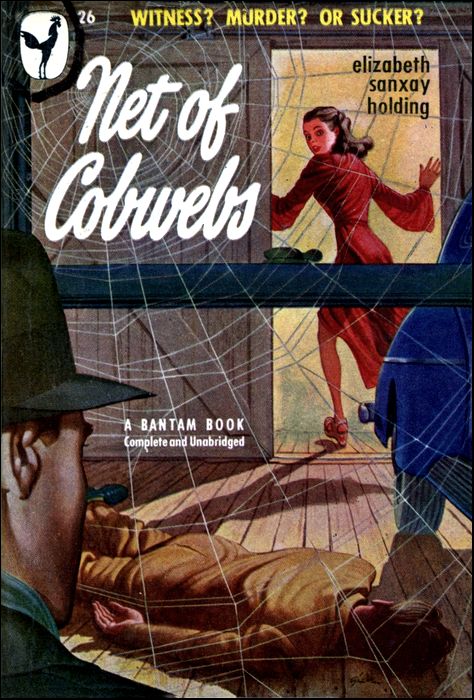
"Net of Cobwebs," Bantam Books, New York, 1946
"Net of Cobwebs" is a psychological suspense story centered on Malcolm Drake, a former merchant seaman who has returned home after a traumatic voyage that left him emotionally shattered. Malcolm now lives in his brother Arthur's orderly suburban household, surrounded by people who seem to want to help him: Helene, Arthur's refined and anxious wife, obsessed with propriety; Virginia, Helene's strong-willed sister, who tries to shape everyone's life to fit her plans; Aunt Evie, outwardly sweet and decicated to "bringing joy."
When Aunt Evie suddenly collapses and dies at a party, rumors begin to swirl that Malcolm may have been involved. The police start asking questions, and Malcolm—already unstable—finds himself trapped in a tightening web of suspicion, manipulation, and psychological pressure.
MALCOLM DRAKE waked early that morning; a little after five. It was a fine September morning and he felt fine, simply fine; he went into his bathroom and took a cold shower, and then there was the thermos bottle of hot coffee on the table. Virginia left it there every night; she was always trying to help him.
He sat down at the table, in nothing but jaunty candy-striped shorts, and poured out a cup of coffee, black and steaming, plenty of sugar in it. I feel fine, he said to himself, and he looked fine; he could see himself in the mirror set in the bathroom door. He was brown and hardy, neatly built; only he did not like his face so much, with dark curly hair growing too low on his forehead, and little, deep-set dark eyes, and two vertical creases in his lean cheeks that made him seem to be smiling, in a sad, doggy way.
He lit a cigarette with the second cup of coffee and leaned back comfortably in the chair. His windows faced the west, so he could not see the sun, but the sky was clear and pale blue. A fine day for a little exercise, that's the idea. I'm coming out of this, all right. Getting better every day.
Coming out of what? What was it he had got into, what dim little hell, like a trap of cobwebs? Never mind. Never mind. He felt fine now. The only thing that bothered him was to see the bed unmade. It would be a long time, hours, before the housemaid came around, and who wanted to sit in a room like this?
He made the bed himself, very carefully; he turned the mattress, made the sheets and the blanket smooth and taut, tucked in the corners of the white spread, laid the pillow exactly straight. He took the two overflowing ash trays and emptied them in the bathroom; he got yesterday's shirt out of the hamper and dusted with it. I like things tidy, he thought. My cabin was always—
Never mind about cabins. He was living on shore now, a new life. The thing was to get started, get going. Get dressed, that's the first step. He put on a clean blue shirt and a dark suit and his well-polished shoes; he lit another cigarette and stood by the window, looking out at the wide green lawn that ended in a belt of trees. He liked the neatness of this landscape, and the different shades of green, the pale-green birches and the dark-green pines. I might go out and take a walk, he said to himself. I think I will.
He finished his cigarette, standing there, and he lit another. Might do a little reading, he told himself, and turned back to the table, where a couple of nice books lay, picked out for him by Virginia. Wonderful girl, he thought, and still standing he opened one of the books.
He could not read. He tried. He read the first paragraph over and over, and his hands began to tremble, his mouth twitched. No... I'll go out, get out in the fresh air, he told himself.
But he could not go out.
The whole thing was coming back, like a towering wave rushing at him. He stood facing it, breathing fast, and out of the wave came a bony wrist and a thin hand. That was Alfred. Jump, you damn fool! he had yelled to Alfred.
Now... No! Look here! he said to himself. This is the bad time, early in the morning. Nobody else awake in the house. In the world.
He went like a blindfolded man, lifting his feet too high, to the closet; he opened the door and fumbled among the clothes hanging there, and in the back, in the pocket of his winter overcoat, he found his little bottle.
It was hard to get the top unscrewed, and it was hard to shake out a capsule into his hand. Bright, vivid blue they were; very fine little pills. If you took four at night, you slept; if you took just one, times like this, the whole thing slowed down, that shaking stopped; you could feel yourself coming together again.
Drake, Dr. Lurie had said, I don't want you to take any more of those capsules. Yes, I know the doctor in Trinidad gave them to you, and I consented to give you a prescription when you first came here. But you've been here six weeks now and it's time you made an effort. I'm not going to renew your prescription, Drake, and you can't get the capsules without it. Personally, I don't care for these sedatives, in a case like yours. Dangerous.
Doctor in Trinidad told me you could take a whole bottle of them and never turn a hair, Malcolm had said, and he had been pretty proud of himself for thinking that up on the spot. It had been a pleasure to see Lurie sort of foam up. A bottle of those capsules would kill you, Drake.
Just what he wanted to know. He had ten bottles now. He had called up the druggist in the village. Send over a couple of bottles of those capsules, will you? he had said. I'll give your boy the new prescription when he comes. Then when the boy had come, Malcolm had said he would send the prescription by mail. Not so good; every time he did it, it made him nervous. But the druggist didn't seem to care, and Malcolm bought everything else he could dream up from the man. And the great thing was to get perhaps fifteen bottles and hide them, and be safe.
He put the bottle back into the overcoat pocket and was going to the bathroom to get a glass of water when there was a knock at the door.
"Just a moment?" he called.
But the door opened, and in came Aunt Evie, trim and dainty in a flowered print dress, her blue-white hair all in little curls about her rose-pink face. Her blue eyes flickered at his clenched hand that held the capsule; her cupid's-bow mouth smiled.
"Malcolm boy," she said winningly, "let's go out and take a little walk in the nice fresh air, shan't we?"
"Th-thank you," he said. "L-later."
He was stuttering, and that always worried him.
"Oh, let's go now!" she said, advancing toward him in a faint cloud of perfume. "Right now!"
She thought she was helping him and saving him, and it was all wrong to feel like this about her. Only if she doesn't get away from me, I'll be sick. I'll heave. I'll go crazy. Get out! Get away from me....
"Malcolm boy," she said, and laid her hand over his clenched one. "You're not—taking anything, are you?"
Make her go. Please make her get out.
"Malcolm boy, Dr. Lurie doesn't want you to take anything now. Not anything."
He jerked his hand away and popped the capsule into his mouth. He could not swallow and he was going to choke. But he did swallow it.
"Oh, Malcom!" she cried.
"I'm sorry," he said. "I'm sorry, but would you mind.... D'you mind going away—just for a few moments?"
"Oh Malcom!" she said in a stricken voice. "You want to get rid of me!"
He did; indeed he did.
She went toward the open door and in the hall she paused and looked back at him with a piteous and forgiving smile. Over her shoulder Malcolm saw the silly gaping face of Ben, the butler/handyman; he closed the door on both of them and looked around his big, comfortable room in desperation.
Don't know what to do. Don't know what to do, he thought. He locked the door and got out the jigsaw puzzle Virginia had given him. He cleared off a table and dumped all the pieces out on it; he drew up a chair and set to work on it with his hands, his broad shoulders hunched. He tried, breathing hard, and when he fitted two pieces together that made half a lamb, he felt better. He got interested in the puzzle, only the sky was difficult; all those clouds.
The doorknob rattled; that was Arthur.
"Come in! Come in!" Malcolm cried and jumped up, knocking the puzzle all over the floor. He unlocked the door and his brother stood there, pale, gloomy, his light hair ruffled on the crown of his head, his tie crooked. Yet somehow he had a look of the greatest elegance, with his long, sharp nose and his tall, lean body.
"Malcolm?" he said. "How's everything?"
"Everything's fine," Malcolm answered, and they went along the hall and down the stairs together. Funny thing, Malcolm thought, but I always feel better with Arthur. He's not calm, not any of those things they say are good for you. But I feel better when he's around.
They went into the dining room. "Ah! Aunt Evie's not down!" Arthur said very low. "Maybe she's sick. Maybe she's laid up."
"She isn't," said Malcolm. "She came into my room this morning."
"To bring you joy."
"Oh, yes. Y'know, I wish the old girl didn't think I needed quite so much saving."
"She thinks everyone's a drunkard and a gambler and a lecher," said Arthur. "It makes her very serene and happy. Hi, Lydia!"
"Yes, sir?" said the little housemaid.
"This it, Lydia? This the new brew?'
"Oh, yes, sir!" she answered, with a dimpled smile. "Mrs. Drake told me specially, sir."
"Try it, will you, Malcolm?"
Malcolm took a sip of his coffee.
"It's a new account," Arthur said. "I've thought up this name for it—Don Carlos Coffee. Not too bad! Only I haven't got an angle. I mean, why should anybody buy it! Don Carlos, the Coffee That Is No Different.... Switch today to Don Carlos—just for the hell of it."
"Good morning, boys!" said Aunt Evie.
She was standing behind Malcolm; as he tried to rise she laid her hand on his shoulder.
"Try to eat, Malcolm boy," she said.
Her sweet perfume enveloped him; appalling things to say came into his head, things that would have made her blue-white curls rise up on her head. "I will," he said. "I will." Get out. Go and sit down. Get away from me.
"Such a lovely, lovely day," she said. "You will get out in this wonderful sunshine, won't you, Malcolm?"
"Yes, I will," he said. "I will," and at last she moved away.
Arthur pulled back her chair for her with the formal and elegant courtesy that was natural to him. He seemed so distrait and preoccupied, yet he never neglected little things like this; he never overlooked anybody.
"And this is the new Don Carlos, Arthur?" she asked.
"How did you know about it?"
"But I heard you talking to Helene, dear. It must be very, very hard to have to praise a thing you really despise in your heart."
"Despise Don Carlos?" said Arthur. "Not I."
"Money makes us do such strange, unlovely things," said Aunt Evie gently.
"Aunt Evie," said Arthur, "this is the best brew you ever set tooth to. Try it."
"I don't notice what I eat or drink, dear boy."
"But you notice aroma," said Arthur. "Just get a load of that aroma, Aunt Evie. You can help me infinitely if you'll tell your many friends about Don Carlos."
"I will, dear. But I did think, from the way you were talking to Helene, that it made you just a little heartsick to have to sing the praises of something, just for money, that you really—"
"You're mistaken!" said Arthur gravely. "My only worry is how to get people to try this king of brews. How to arouse curiosity."
"Curiosity killed the cat," said Aunt Evie with a silvery laugh. "Satisfaction brought it back. How would that do for your slogan, Arthur?"
"It's very punchy," said Arthur. "Only I'm afraid it's not quite realistic enough. I mean, with all the scientific knowledge now available, I'm afraid the consumer won't believe that cats are killed by curiosity."
Aunt Evie laughed again.
"Aren't people funny, with their poor bits of so-called scientific knowledge?" she asked. "Oh, they are," said Arthur.
She began upon her breakfast now, and Malcolm sat stirring and stirring his cup of Don Carlos, and thinking about her. About her awfulness.
When Arthur had married Helene, two years ago, he had accepted the necessity of long and frequent visits from Helene's and Virginia's Aunt Evie. After all, she had brought up the two orphan sisters; they were used to her.
The home life of Aunt Evie was something Malcolm could never imagine. She was well-to-do and lived in an apartment hotel in New York; she talked of the little parties she gave there, in the roof garden. She belonged to a cult which was called, quite simply, Joy. The motto was Joy Now, and when you waked in the morning you stretched up your arms and Accepted Joy. It came, if you did the thing right, flooding all your being, and you were able then to give it out to others. She got it, all right. She was never tired; she was radiant from morning till night, and helpful.
She explained that she could not help people unless she knew things. And she found out everything. She had a sleepless, unwearying curiosity, and great skill in putting two and two together. She believed in candor, too; what she found out she told.
"Good morning, people!" said Virginia.
She was a notable handsome girl, tall and broad-shouldered, with fine dark eyes and a fine color in her olive cheeks, a serious, quiet girl with an air of distinction in her gray flannel suit and blue blouse.
"Where's your naughty sister?" asked Aunt Evie.
"She went to sleep again," said Arthur. "That's not naughty." He pushed back his chair and rose. "I'll have to hurry," he said. "It's my day to taxi the neighbors."
"The good-neighbor policy!" said Aunt Evie, with a merry laugh, and Arthur gave a polite and spasmodic grin and went out of the room.
"Helene is a very, very fortunate young woman," said Aunt Evie. "So many men would resent it, if a young and healthy girl wouldn't come down to breakfast. But in Arthur's eyes, Helene can do no wrong."
There was no response to that.
"Ah, well—" Aunt Evie began, when Lydia came in.
"Mrs. Foxe to speak to you on the telephone, Mrs. Chatsworth," she said, and Aunt Evie rose. She was very fond of telephoning.
"Malcolm," said Virginia, "would you like to come with me this afternoon to see someone about the new bond drive?"
"Oh, certainly!"
"I called up this Mrs. Kingscrown and she seemed very nice. She asked me to come to tea and bring anyone I liked."
"That'll be very fine," said Malcolm.
"Then let's start around four...?"
She was cutting a slice of toast into neat strips; she looked downcast and troubled.
"I hope I don't really hate Aunt Evie," she said.
"You don't hate anybody," said Malcolm.
"But, Malcolm, suppose I hate her subconsciously?" she asked with anxiety.
She worried altogether too much about things like that, about her motives, about her duties, and she had a way of asking Malcolm for advice that made him unhappy. God knew he didn't have any advice to give her or anyone else.
"Well, that kind of hate couldn't do any harm," he said.
"It could do me harm, Malcolm. Hate can warp your whole nature."
"Your nature isn't warped," he said. "You're as good as gold."
"D'you know what she did, Malcolm? I heard her. She called up Dr. Lurie, and she asked him to come in this afternoon and just have a look at you without your suspecting anything. She said she thought you were slipping back. She said you had some sort of queer hostility toward her. She told Dr. Lurie she thought you were dangerous."
He gripped the handle of his cup, to stop the shaking of his hands. The handle broke, and the cup turned over, and a brown stain like mud went running over the clean white cloth. Dangerous, he said to himself in despair. That was what he dreamed in his ghastly nightmares, that was what he dreaded, all the time. Being dangerous.
"BUT, Malcolm!" Virginia said. "You don't mind anything she says."
"No, no," he said. "No... no... no. Excuse me, Virginia. Got to—got to—write some letters."
He had to get into his own room, quick, and shut the door. All right, he thought. I'm crazy. And she knows it, Aunt Evie does. 'Shock,' that damn doctor calls it. People like me don't get 'shocked.' I went through a bad time, yes. But so do plenty of other people, and they get over it. But me...? Two days in a lifeboat, forty-eight hours; what's that? Look at what other people take. Women, children.
But some of them go mad. You hear about that. Raving mad, try to jump overboard. Some people go through with it all right—and some don't.
As he reached the top of the stairs Helene opened her door and came out, tall and exquisite, in a black taffeta housecoat fitted in to her tiny waist.
"Oh, Malcolm!" she said. "I thought it was Arthur."
"Well, no..." he said seriously.
He felt a profound respect for Helene, but he was never at ease with her. She was very courteous to him, and she was kind, but there was a dainty formality about her. She was beautiful and perfect and, to Malcolm, not quite human. She smiled at him, and he smiled at her, and she sought for something to say.
"Ivan Jenette's coming out this afternoon," she said.
"Oh, is he? Fine!" said Malcolm.
"You remember him, Malcolm?"
He didn't know whether to say yes or no. Was this Jenette someone he ought to remember, and possibly did, or could remember if he tried? So he tried.
"It's a lovely day, isn't it?" said Helene.
Her gentle, friendly words did something horrible to him. She had seen, of course, that he didn't know whether or not he remembered this Jenette, and she had tried to make things better for him. But what she really did was to point out to him her own quiet, controlled sureness and his deep confusion.
"Lovely day!" he said with great heartiness. "Lovely!"
He went into his room and locked the door and stayed there until lunchtime. He had plenty to think about.
He went down and had lunch with Helene and Virginia and Aunt Evie. He was the only man; other men went to work. Only he didn't, because he couldn't.
"Shall we start about four o'clock, Malcolm?" Virginia asked.
"Start? Oh, yes!" he said. "Yes. Four o'clock. I'll finish my letters now, if you'll excuse me."
At ten minutes to four he opened the door of his closet. There were three hats on the shelf, two felt ones and a Panama; he stood looking at them, trying to make up his mind, and sweat came out on his forehead.
Now, see here! he told himself. It doesn't matter a damn which hat you wear. Just take one of them—any one—and get going.
He could not. So he closed his eyes and reached up and his hand touched one of the felt hats. He picked up his stick and he put a fresh pack of cigarettes into his pockets and went downstairs. Virginia was standing in the hall below and Aunt Evie was with her.
"Going out, children?" she said. "Don't let Malcolm overdo, Virginia."
She fluttered away, and they went out of the house and down the drive.
"She's been after Helene," said Virginia. "Telling her she ought to learn to cook, so that she could do with one servant. And she had a booklet for me, about teaching physical fitness to girls. Malcolm, maybe she's right."
"Maybe she is," he said.
He tried to think of some way to change the subject and avoid any talk about what was right and what everybody ought to do, but he could think of nothing.
"I've got to do something!" Virginia said. "Only I don't know where I'd be most useful. I wish you'd give me some advice, Malcolm."
"Virginia, I—wouldn't know..."
"Malcolm," she said, anxious, a little hesitant, "maybe if you'd try to help me, it would help you, don't you think?"
Poor kid! So that was why she kept pestering him for 'advice.' To help him. If you can get your mind off your own troubles, Dr. Lurie had said. How do you get your mind off a nightmare?
The air was thin and clear as crystal; the leaves were falling everywhere, and walking through them on the roadside made him think of the days when he and Arthur used to go scuffling through leaves like this on their way to the Military Academy. Fine snobbish little school, fancy uniforms, capes, white gloves.
Alfred had never had anything. He had grown up in a Brooklyn slum; when they signed him on, he was sixteen. I guess I'll study and be an officer, he had said to Malcolm. That was what he had been told. Fine chances for promotion with this line, my lad. Work hard, study hard, take your examinations. Only he hadn't had much time to study. Ten days at sea was all he got.
"You're awfully quiet, Malcolm."
"Yes, I do seem to be," he said apologetically.
"Malcolm, do you think Dr. Lurie is helping you, really?"
"Oh, yes! Sure. You bet!"
"I don't know if I like him much."
Virginia, don't talk any more. Please. You're such a nice kid, such a nice, good, beautiful kid, won't you please shut up and just walk along beside me?
The road was lined with stone walls and wire fences, enclosing big, well-kept estates. People with money, he thought. Like Arthur. I never bothered much about money. When they made me Purser, I was satisfied. And now... Never mind. Someone was burning leaves and that was a fine smell. Halloween, he thought. Mother used to make lanterns out of pumpkins. She was a quiet woman. Happy— but quiet about it.
They were coming to another high wire fence and he was tired of them.
"Quite a long way, isn't it?" he said.
"It's only three miles. Why? Are you tired, Malcolm?"
"Oh, Lord, no! I just thought it was quite a long way."
"I'm afraid you are tired. Oh, Malcolm, I'm worried about you!"
"Well, don't be," he said.
But that wouldn't do; that wasn't good enough. He took her hand and smiled at her, a grin from ear to ear; he kept her hand in his and they went on like that. This is better, he thought. He liked to hold her hand, balled up inside his, warm, soft as velvet, with nice little bones. A good kid, she was, quiet now.
"Here we are, Malcolm. This must be the place."
They turned into a gravel drive that led to a three-storied wooden house with a cupola and a lot of fancy scrollwork.
"Who's this we're going to see?" Malcolm asked.
"I've never met her, Malcolm. Only, at the last wardens' meeting, someone said she'd be a good person to get for the drive. Kingscrown... That's a funny name, isn't it?"
As they came to the steps that led up to the veranda, he loosened his hold on her hand. But her fingers closed around his. Well, nothing you could do about that. If she wanted to go calling hand in hand, very good. He rang the bell, and then she let his hand go. The door was opened by a pale, red-eyed maid.
"Will you please tell Mrs. Kingscrown that Miss Chatsworth is here?" said Virginia.
"She's out," said the maid. "But she was expecting me!"
"Well," said the maid, without much interest, "you could come in and wait."
She led them into a sitting room furnished in a modern style, very low white leather armchairs, a low couch with a cover of brown and blue tweed, a glass-and-chromium table at each end, a bare floor with a rug striped black and white, all airy and sunny and, to Malcolm, very agreeable. Then, as he sat down and looked around, he saw other things. On each step of a zigzag bookcase there were little things; he saw a glass cart drawn by two silver llamas; he saw a plaster replica of the Taj Mahal, a tiny Persian rug, a carved gourd in a silver stand, and other things of that sort, interesting as a toyshop. On a white leather chaise-longue that stood by the open window he saw a purple velvet doll with blond hair and extremely long legs.
"Look!" said Virginia in a low voice.
She was pointing to the iron doorstop. It was made in the form of a short lamppost, and beside it sat a lump of a black dog, winking one eye. It made Malcolm laugh.
"Do you think it's funny?" Virginia asked, surprised.
"Well..." he said apologetically.
Someone was coming up the veranda steps; the door opened and a woman came in, red-haired, tall and limber in dark slacks and a black sweater that outlined a fine full bosom.
"Sorry to be late," she said in a good clear alto voice. "Did Gussie explain?"
"No," said Virginia. "But it doesn't matter a bit, Mrs. Kingscrown. I'm Virginia Chatsworth, and this is Malcolm Drake, my brother-in-law."
"I'm Lily Kingscrown," said the hostess, "I'm sorry Gussie didn't explain, but sometimes she forgets, and sometimes she gets sort of contrary."
"Maids are so terribly hard to get, these days," said Virginia, "I suppose it's only human nature for them to take advantage of it, a little."
"Well, Gussie was just born to be taken advantage of," said Mrs. Kingscrown. "I told her to tell you they might keep me a little late at the asylum. I go there most afternoons, to help out."
"Oh, an orphan asylum?" asked Virginia.
"Lunatics," said Mrs. Kingscrown. "Mental hospital is what they really call it."
She opened a door and spoke to Gussie; then she sat down, crossing her long legs; her red hair curled up like petals from her strong-boned face with a big, beautiful good-humored mouth.
"What do you d-d-do there?" Malcolm asked.
"Well, I help out with the occupational therapy," she said. "Of course, I'm not trained, but still there are a lot of things I can do."
"But isn't it terribly depressing?" Virginia asked.
"Not as much as you'd think," said Mrs. Kingscrown. "For one thing, quite a lot of them get well. And then there are quite a lot of them who don't realize how they are. You can do a lot for them. We make gardens, and weave, and rainy days we do jigsaw puzzles."
"I think jigsaw puzzles are fascinating," said Virginia quickly. Too quickly.
Gussie was coming in now with a very lavish tea, hot buttered muffins, two kinds of sandwiches, a big layer cake.
"My husband was English," said Mrs. Kingscrown. "He was always crazy for his tea, and he got me in the habit. It is cozy, isn't it?"
She looked straight at Malcolm, with her big jolly smile, and he felt instantly and completely reassured. She knows, he thought. She knows all about things like that.
He felt very hungry now, and this was the best food he had ever tasted; he drank three cups of tea and he ate and ate. Virginia and Mrs. Kingscrown were talking about the bond drive; he did not listen to their words, but he liked the sound of their voices; he felt unbelievably happy and relaxed. This Mrs. Kingscrown, he thought. If she works in a place like that, she knows. Lots of people get well, she said.
A portly yellow cat came into the room, with the observant yet aloof air of a policeman on patrol.
"Hello, Skipper!" said Mrs. Kingscrown.
The cat winked at her, and jumped up on the chaise-longue beside the purple velvet doll; he made himself comfortable there, and purred for a while, staring at Malcolm with clear topaz eyes. Then, as if satisfied, he closed his eyes and went to sleep, in a bar of sunshine.
"Malcolm, I'm sorry..."
That was Virginia's voice, very close to his ear. He opened his eyes and looked into her eyes, dark and anxious.
"Malcolm, I'm sorry, but we'll really have to be going."
So he had fallen asleep, at Mrs. Kingscrown's tea party. He rose quickly, dazed and unsteady with sleep, and horribly ashamed of himself. The big room was shadowy; the cat was gone; the scene was chilly and strange.
"I'll drive you people home," said Mrs. Kingscrown.
"Oh, don't bother!" said Virginia.
"It's no bother. My car's right out there, and I've got plenty of gas."
Malcolm was deeply relieved to think that he did not have to part just yet from Mrs. Kingscrown. He could not bear to be parted from her; he hated to leave her house.
"Is—is S-s-skipper gone?" he asked. "That's a nice name."
"He's a seagoing cat," Mrs. Kingscrown explained. "He belonged to my husband, and he was a skipper, you know."
My God! thought Malcolm, overwhelmed.
"What line?" he asked.
"The Bell Line."
"No!"
"Why?" asked Mrs. Kingscrown. "D'you know anybody in that line?"
I did, he thought. That was my line. But not now. I'm not going to talk about that now.
"If you're ready...?" Virginia suggested, and they all went out of the house.
The sun was gone; there was a lemon-colored light in the west and the trees looked black against it; the autumn landscape seemed vast and sad. Malcolm felt cold. Arthur's house looked sad, too; he hated to go into it.
"Come in and have a drink?" he said to Mrs. Kingscrown.
"I'd love it!" she said.
Ben, tall and bony and gangling, in a clean white jacket, opened the door.
"Mrs. Drake is in the library, sir," he said, "and Dr. Lurie—"
"Let's have some Scotch, Ben, and ginger ale. In the d-d-drawing room."
The drawing room was the coldest room he had ever been in in all his life. The lamps had white shades, frosty; the carpet was pale; the sun was not coming in here.
"Malcolm," said Virginia, very low, "don't take a drink. Please, Malcolm."
"One won't hurt me, Virginia. I'm—cold."
"Please. Malcolm! Dr. Lurie told me it was the worst thing in the world for you."
"He could be wrong, Virginia."
She looked at him and then moved away, across the long room; she stood at the window, looking out. I've hurt her, he thought. I didn't mean to do that. He wanted to go after her, but he did not know what to say. He did not know what to say to Mrs. Kingscrown, either. She was sitting on a sofa, and he sat down beside her; he hoped she would talk, and she did.
"Did you read in the papers about the two French sailors in the Brooklyn subway?" she asked.
"No," Malcolm said. "I—don't seem to read the papers."
"Well, it doesn't matter," she said. "There's no law about it, is there?"
Ben came in then with a tray, and Malcolm got up at once to mix the drinks.
"Virginia?" he said. "L-little drink?"
"No, thank you," she said, without warning.
It was growing dark in the room; Mrs. Kingscrown's face looked pale in the dimness.
"After all," she said gravely, "there's nothing like Scotch, is there?"
"Nothing!" Malcolm said. "Nothing!"
The drink was beginning to help; the blood was running warmer in his veins, the numbness in his heart was thawing.
"Malcolm boy!" cried Aunt Evie.
She was coming toward him, in a lavender chiffon dress with floating sleeves and a purple jet butterfly in her blue-white curls.
"Oh...!" she said, peering at Mrs. Kingscrown; then she turned on the lamp and her smile.
"This is Mrs. K-K-Kay—" said Malcolm.
"How do you do, Mrs. Kay," said Aunt Evie. "Are you a neighbor of ours?"
"Yes, I live a couple of miles down the road."
"Have you lived here long, Mrs. Kay?"
"Only since April."
Aunt Evie's curiosity was not subtle; many people resented it. But not Mrs. Kingscrown. She seemed perfectly willing to answer questions.
"Are you a New Yorker, Mrs. Kay?"
"I'm from Brooklyn," said Mrs. Kingscrown.
"Oh, are you? I have friends in Brooklyn, very dear friends. They live on the Heights. Malcolm dear, what are you drinking?"
"Scotch."
"Dear boy, put down that glass, won't you? Alcohol is poison for you." She turned to Mrs. Kingscrown. "Malcolm's been ill, you know," she said. "So very, very ill. Dr. Lurie—"
Shut up! cried Malcolm to himself, and finished his drink quickly, so that she couldn't get it away from him.
"Why don't you try a drink, Aunt Evie?" he said. "You'd be surprised."
That made her angry; her blue eyes glittered.
"Dear boy, I've never touched alcohol. I never feel the need for artificial stimulants. Or drugs."
She was looking straight at him, and he knew what she meant. She always called those capsules 'drugs.' If she says anything to Mrs. Kingscrown about my taking drugs, he thought, I'll have to choke her, that's all.
"You ought to try some of this alcohol," he said. "Just to see what it could do to you."
"Very well!" she cried. "I will! Fix me a drink, Malcolm."
He poured a glass almost full of ginger ale and added a dash of whisky; he was handing it to her when Helene came into the room, followed by two men.
"Here I am, tippling!" cried Aunt Evie.
That fell flat, because Helene had caught sight of Mrs. Kingscrown and came toward her with the look of delight she had for guests. Malcolm said nothing, and Aunt Evie took charge.
"Helene, dear," she said, "this is a Mrs. Kay. From Brooklyn."
"I'm so glad," said Helene. "This is Dr. Lurie."
"Mrs. Kingscrown and I are old friends," said Dr. Lurie, stepping forward, a slender, straight man, with a trick of carrying his head thrown back and his square chin out; he wore his gray hair in a sort of pompadour over his broad brow and he had a look of proud suffering.
"And this is Ivan Jenette," Helene said.
This Jenette was a stocky, broad-shouldered young fellow, black-haired and sallow, with sad, bilious dark eyes. He gave Mrs. Kingscrown a foreign-style bow, heels together; then he looked sidelong at Malcolm, with considerable distaste.
"Ivan, you and Malcolm know about each other," said Helene.
"Oh, yes," said Malcolm politely, but with no truth, and Jenette said nothing at all.
"Everybody's drinking whisky in here," said Helene, "while we were so nicely having tea. Will you have a drink, Dr. Lurie and Ivan?"
"I'm taking a drink, Dr. Lurie!" cried Aunt Evie. "My very firstest one—and who knows what will happen? I do hope I shan't talk too much and say the wrong things."
Malcolm glanced quickly at her, and their eyes met. God! he thought. That's just what she means to do.
The amount of whisky he had given her couldn't, he thought, have any genuine effect upon her or anyone else. But if she chose to put on an act, to start babbling, saying the 'wrong things'... About me, he thought. About my pills and all that. I wish she'd choke.
"Good gracious!" she said, coughing and gasping. "It's like liquid fire!"
Ivan Jenette took her glass from her and set it down on a table while she went on coughing.
"But I will finish it!" she said. "Every drop! Ivan, where is my dreadful drink?"
He handed her the glass and she sipped and choked again. "Aunt Evie," said Virginia, coming across the room from the window, "don't take any more."
I agree with Miss Virginia," said Dr. Lurie.
"I'm going to be naughty!" said Aunt Evie. "Malcolm poured it out for me and he wouldn't let me have too much. I'm going to finish every drop of it!"
"I'm afraid I'll have to be going now, Mrs. Chatsworth," said Mrs. Kingscrown.
"Oh, don't hurry away!" said Aunt Evie. "I wanted a little chat with you about Brooklyn."
"Come and see me some time, why don't you?" said Mrs. Kingscrown, with perfect good humor. "Good-by, Miss Chatsworth."
"Good-by," said Virginia briefly.
"I'll go out to your car with you," said Malcolm.
For he couldn't bear to see her going away.
They went out on the terrace together and it was full dusk now.
"It's nice," she said.
They stood side by side, looking out over Arthur's peaceful domain. Her car stood there, and she was surely going to get into it and go away. There was so little time.
"Thing is..." he said. "I made—an error of judgment."
I called out—jump, you damn fool! And Alfred jumped. Like that joke about the volunteer fireman. He called out to the fellow in the burning house—jump into the net, and the fellow jumped. And cheese it, I had to laugh. There wasn't no net.
"I gave bad advice," he said.
His mouth twitched, the bridge of his nose twitched. God, if I could tell it! If I could say it!
"I gave bad advice," he said. "He was only a kid. Only sixteen. He was frightened sick, right from the start. I told him—nothing to worry about. I told him everything would be all right."
I killed him. The others on the deck—the ones who didn't jump—they were all taken off, safe and sound. Only Alfred... I told him to jump and he did. He landed flat against the thwart of the lifeboat and it caught him on the chin and broke his neck.
"The fellows on deck," he said, "they looked like gnomes. They were on deck in their life belts and they looked—very small. They looked as if they didn't have any necks. He was only sixteen."
Oh God, let me tell it, let me say it, this once....
"It was cold," he said. "It was a cold day."
She had not spoken at all; he could scarcely see her now in the gathering dusk. But he knew she was listening. "I g-gave him bad advice," he said.
"And he died?" she asked.
Her voice sounded gentle and far away. But she was standing beside him, near him. We couldn't keep the kid in the lifeboat. He was dead. We had to put him overboard. If I could tell you—.
"Mr. Drake!" said Lydia's voice, high and urgent. "Mr. Drake, are you there, sir? Mr. Drake!"
"Yes, I'm here," he said.
"Oh, Mr. Drake, sir!... Mrs. Chatsworth is dead!"
"What?" he asked, puzzled.
"She fell right down dead on the floor, Mr. Drake."
"EXCUSE me, just for a moment, please," he said politely to Mrs. Kingscrown, and followed Lydia into the house.
The drawing room was empty; he looked into the library and saw nobody there.
"Where are they all?" he asked.
"The doctor and Mr. Jenette, they carried poor Mrs. Chatsworth upstairs, and Mrs. Drake and Miss Virginia—they went up, too, sir," Lydia answered eagerly.
"I'd better go up, don't you think?"
"I don't know, sir," said Lydia.
"No. No, of course you don't," he said apologetically. "What shall we do, sir?"
"Well, who?"
"Ben and me and Mrs. Jordan, sir. What did we ought to do, sir? Go right on about—" She lowered her voice. "About dinner, and all, sir?"
He looked at her blankly.
"L-l-later," Malcolm said. "I'll l-let you know l-later."
So he was in charge. He was to tell people what to do. He stood in the hall, and his knees felt weak. I've got to take charge. Give orders. What'll I do? You tell me. Where shall I go? Where do we go from here? Upstairs. Only, when he looked at the stairs, they were so extremely steep and long he could not start climbing them. Lydia was looking at him, waiting.
"You'd better—better—better tell me—exactly what happened," he said.
"I was just going into the room, sir, with some fresh canapes Ben made, and Mrs. Chatsworth, she sort of sunk down right on the floor, and then Dr. Lurie he knelt down beside her, and you could see by looking at him that it was terrible serious."
She was crying a little, but she could not help relishing the drama of this.
"Right while I was standing there," she said, "she must of died."
"Well, why?"
"Why, sir? Well, the doctor didn't say. But don't you guess it was a kind of stroke, like?"
"Must have been. I'll get along upstairs now."
He could not start climbing those stairs. Arthur must be on his way home now, he thought. Arthur'll know what to do when he comes. Only, right now... If Aunt Evie falls down dead, you have to do something. Be helpful. Go on! Begin!
Dr. Lurie was coming down the stairs and Lydia went away.
"This is a shocking affair!" said the doctor sternly. "Yes, it is," said Malcolm. "It is."
"And reprehensible," said the doctor.
Reprehensible. Reprehensible, Malcolm said to himself. Sounds like an Amos 'n' Andy word.
"Mrs. Chatsworth had had a heart condition for some time," the doctor went on, with the same sternness. "It was not unduly serious, but at her age—she was well over seventy—"
"Over seventy, was she? Didn't know that."
"No doubt someone thought it highly humorous to give that elderly woman with heart trouble an extremely strong drink," said the doctor.
"Oh, no," said Malcolm. "Nobody. What she got wouldn't have hurt a baby."
"Mr. Drake, there's no use telling that to me. I'm a physician. This attack of Mrs. Chatsworth's—this fatal attack —was induced by an excessive dose of alcohol."
"M-mistaken," said Malcolm.
"What d'you mean by that? Are you implying that my diagnosis is incorrect?"
"Only mean that the drink I gave her wasn't excessive. Tiny, it was."
"And what's your idea of a 'tiny' drink, Mr. Drake?"
"It wasn't more than a couple of teaspoonfuls."
"I can assure you Mrs. Chatsworth had a good deal more than that."
"Well," Malcolm said, "I suppose she could have poured herself out another drink, not knowing."
"I doubt it," said Lurie. "I was observing her fairly closely, and I should almost certainly have noticed it if she'd poured any more liquor into her glass. I should have protested, very strongly, against any such thing. As it was, I had accepted your assurance that the drink you gave her was extremely small."
"Yes, it was," said Malcolm.
"I'm signing a certificate," said the doctor. "Mrs. Chatsworth was my patient, and I was present when she died, so I can properly do so. But if it wasn't for the high regard I have for your brother and his wife, I should put down alcohol as the contributing cause."
"Look here," said Malcolm. "I didn't give her a big drink because I thought it would be funny. I know what I gave her."
"Mr. Drake," said the doctor, "I understand that you've been taking some medicine—some drug—on your own responsibility. You've chosen to disregard the advice I—"
"Oh, go lay an egg!" said Malcolm.
"What!" said Dr. Lurie.
Malcolm felt very happy about saying that and about the outraged look on the doctor's noble face. It was a long time since he had felt even an impulse to hit back at anyone and it did him good.
"I said—" he began, very willing to repeat. But a key was turning in the lock; the front door opened, and Arthur came in.
"Hello," he said amiably. "How's everything?"
"Drake," said Dr. Lurie, and laid his hand on Arthur's shoulder. "I'm sorry, Drake, very sorry. Mrs. Chatsworth—" Malcolm did not want to hear any more of that; he wandered off into the library and there he found Jenette, slouched in a big chair, smoking a pipe. He looked up at Malcolm with his cloudy, dark eyes.
This is a hell of a thing to happen, isn't it?" he said. Yes, it is," said Malcolm.
"It gets on my nerves," said Jenette. "A death in the house—"
She's dead, Malcolm thought in a sort of astonishment. She's lying upstairs, dead. Poor old girl was hopping around, so lively, and now it's finished for her. It's damn pathetic. I mean, it's all right for some people to die. They can take it. But Aunt Evie...
His thoughts were growing confused and miserable. Thing is, he thought, she was so little. Hopping around...
Mrs. Kingscrown! he thought suddenly. She's gone home, I suppose. She wouldn't still be out there, would she?
"Excuse me," he said to Jenette, and went along the hall and out on the terrace. It was dark now, and only Dr. Lurie's car was standing there; she was gone, and he missed her. I'd like to say au revoir, he thought. Don't like to leave it this way. I just walked off and left her out here. I'd like her to know...
He went back into the library, where there was a telephone, and he was glad to find Jenette gone. He looked in the telephone book. Kingscrown, Mrs. Lily. There it was. He dialed the number, but nothing happened. Virginia came into the room.
"I don't get any answer," he said, frowning.
"Who are you trying to get, Malcolm?"
"Mrs. Kingscrown," he said. "I want to speak to her but I don't get any answer."
"Probably she's not at home."
"But the house ought to answer. Ought to be a servant-somebody around."
"You can try later," said Virginia. "We're going to have dinner now, Malcolm."
"Dinner?" he repeated.
"Things have to go on, Malcolm."
"I'll try the number again," he said, but still there was no answer. "This worries me," he said. "The house ought to answer."
"Well, you can try again after dinner."
"I think I'll go over there and see if everything's all right."
"But dinner's ready, Malcolm!"
"I don't seem to feel like eating, Virginia. Worries me, y'know, not to get any answer."
"Malcolm!" she said. "That's really rather silly. That Mrs. Kingscrown certainly knows how to look after herself."
"I can't help it," he said. "You know how you get these ideas."
"No, I don't," said Virginia. "Malcolm, please come and eat your dinner. Please don't be so obstinate." He was sorry about being obstinate.
"I mean, there ought to be somebody in her house. I mean—the maid—somebody."
"I wish I'd never taken you there!" Virginia cried. "But I didn't know she'd be like this."
"Well, like what?" he asked anxiously.
"So common—"
"She's not common, Virginia."
"She is! A big, red-headed wench. What's more, she's at least thirty-five."
"Well, why not?" he asked. "I mean, what's that got to do with anything, Virginia?"
"Malcolm," she said, "I'm pretty upset and unhappy about Aunt Evie. After all, she brought us up. Malcolm, I ask you as a favor to me to come in to dinner now."
"V-V-Virginia," he said, desperately anxious to explain to her. In his mind was a picture of Mrs. Kingscrown's house, dark and solitary, and it worried him; it more than worried him. It frightened him. He was in a hurry to get there. "I—I'll come right back, Virginia, if everything's O.K. I'll just t-take a look."
"All right," she said, turning away. "You've let me down, just when I need you."
Her voice was unsteady; he thought she was crying. Going away from her, hurt, disappointed, let down. I let everybody down, he thought. That's what's wrong with me.
But he had to go and see about Mrs. Kingscrown. He did not bother with a coat; he simply walked out of the house and down the drive. It had been a long time since he had gone walking in the dark alone, and it was strange. It was strange to hear the insects chirping in the grass, and the rustle of the trees; it was strangest of all to look up at the sky, it was so unexpectedly wild, pallid, with thick black clouds streaming across it. He didn't like it; it reminded him of something.
The long-haul trucks were moving along the highway with dim lights. All this going on, he thought, war or no war. Things have to go on, Virginia said. All right, but I don't. I stopped.... Never mind. I'll get in the Army when I've got over—this—this.... The Army. Not the Navy. You don't have to go to sea again. Don't have to go near the ocean again. Don't have to think about it.
He walked fast; he was in a hurry. Damn queer that the house didn't answer, he said to himself. I last saw her out on the terrace, and how do I know if she ever got home? Plenty of accidents.... A truck went by, and his heart began to beat too fast. If her house is dark... he thought.
When he turned into the driveway, he saw a lighted window at the side of the house. He was afraid the light would go out before he got there, and he turned off the drive and ran across the grass.
The shades were up and he could see her. She was sitting alone at a table spread with a lace cloth, with four candles in silver holders; she wore a green dress and her red hair glittered. She looked lonely, but she looked all right.
He felt tired, but he felt pleased; he felt as if he had done something for her in return for some immeasurably greater thing that she had done for him. Anyhow, she's all right, he thought. All by herself in that house. That nice house.
Now that he was going back, he slowed down, he took it easy. And the nearer he got to that other house, the less did he want to go to into it. I'll be late to dinner, he thought, and that's not quite the thing, in the circumstances. Better get a bite on the way.
The thought made him sweat with anxiety, even fear. I don't know any place to go, he said to himself. Don't like to walk into a place you don't know anything about. It might look queer.
My God! he thought. I used to do it. Went in anywhere, any port, even where I couldn't speak the language. I mean, if I could do that now. Just once?
He walked on to the village, and near the railroad station he saw a restaurant, white-tiled glaringly bright; he saw two waitresses in bright green uniforms moving around. He stood outside, and he did not see how he could do this. I might stumble, trip, fall down, he thought. It's been a long time....
A man went by him, in through the revolving door, and Malcolm started after him, fast. He got in, all right; it was done; he was in a restaurant alone. He sat down at a table and picked up the menu. It was a very faint purple and very blurred, and he could not read it. Something wrong with my eyes, he thought. It couldn't be that bad. A waitress was standing beside him.
"Wh-what's good tonight?" he asked.
"That depends," said she.
"On—on—on what?"
"Quit your kidding," said she, with mechanical coquetry.
"Veal!" he said suddenly.
"Tea or coffee?"
"Coffee and p-p-pie."
"Prune, custard—"
"Apple!"
He felt proud of himself; he felt strong and masterful, capable of quick and vigorous decisions. He enjoyed his dinner; he left a quarter for the waitress, and there was absolutely no trouble getting through the revolving door. Maybe it's over, he thought.
Maybe from now on he could go freely about in the world, talking to people. That was the supreme happiness. And maybe that was coming back now.
There were lights upstairs and down in Arthur's house and that bothered him. He felt so fine that he did not want to think about things, he did not want to talk to anybody. He went to the side door, and it was not locked; he went in quietly.
But Helene came out of the drawing room. "Malcolm," she said in a low voice, "could I speak to you just a moment?"
"Certainly!" he said. "Let's go up to your room."
He knew something bad was coming, and he rebelled against it. Only not against nice little Helene. He went up the stairs ahead of her and turned on the lamp in his room; he stood waiting, and as she entered the room she smiled and he bowed a little. She sat down in a chair by the window and he stood facing her.
"I thought I'd better tell you," she said. "It's not really serious, but I thought I'd better tell you."
"Oh, certainly!"
He saw her hands moving restlessly. She's nervous, he thought. This is something bad.
"I'm going to send Ben away," she said. "I don't like him. I don't think he's reliable."
I'm not understanding this, Malcolm thought. I don't know what she's talking about.
"He came to me and told me. I told him not to mention it to anyone else, and he promised he wouldn't."
"Tell? Tell?"
Her pretty little smile looked contorted. "He told me he'd seen you pour a drink out for Aunt Evie—a very big drink. Almost a whole glassful."
"I did not! I did not!"
"Malcolm," she said, anxiously and earnestly, "please don't mind. Whatever happened was nothing but a mistake. There was a bottle of ginger ale open there; it looks so much like whisky. And you'd had a drink yourself—"
"One! One jigger. One!"
"I know, Malcolm. But you hadn't had anything for a long time, and—"
"I did not!" he said. "I did not!"
"Anyhow, Malcolm, you didn't know Aunt Evie wasn't supposed to drink anything at all."
"I didn't do it," he said. "I did not."
"Well, Ben could easily have been mistaken," she said. But he could tell from her face and from her voice that she did not believe that. "Anyhow, Malcolm, it doesn't matter. Don't let it worry you, Malcolm; please don't. I only told you so that in case there was any silly gossip...."
"Arthur...?" he said. "What does Arthur say?"
"I haven't told him," she said slowly. "I'd rather he didn't know, Malcolm. He's rather worried about his business just now, and I'd rather he didn't have anything more." She looked up at him, a steady and almost stern look. "You know what he's like. So high-strung, and so terribly loyal. I'll get rid of Ben. It'll be easy enough for him to get another job, and probably the whole thing will blow over. But Arthur shouldn't be worried about it, Malcolm."
Now she was not vague and sweet, but very definite. She had welcomed him here with the kindness of a sister; she made him feel completely at home. But now she let him see beneath that pleasant surface.
"There's nothing Arthur wouldn't do for you," she said.
Look now at what he has done for you. Taken you in here, to stay week after week, with no plans, no talk of any future. Look at your fine big room. Everything done for you, everything given to you. By Arthur. Because he's so terribly loyal. And now you've gone and killed Aunt Evie. That's what she means, he thought.
"Don't let it worry you, Malcolm. No matter what happened, it was simply a mistake."
Another mistake. Another error of judgment. Dangerous, Aunt Evie had called him. You're damned well tooting I'm dangerous.
Helene went on talking.
"I'll get rid of Ben at once, and we'll just forget the whole thing."
He could not talk, because he had to keep his teeth clenched so that his jaw should not tremble. He nodded his head, in a sage and thoughtful way.
"Only, I did think I ought to tell you, Malcolm."
"Um-mm," he said, nodding his head again.
She rose. "Good night, Malcolm," she said, smiling and holding out her hand.
He took her hand in a quick grasp. "Night!" he said.
As soon as she had gone he locked the door and got out the bottle of capsules in a hurry. Two at bedtime. Repeat in half an hour if necessary. Sez who? The hell with you!
IT was half-past five when he waked, but maybe it had been early when he went to bed. He felt completely rested and ready to think. He lay stretched out flat on his back, trying to remember how many of those capsules he had taken last night. More than four?
I think I remember taking four at once, he said to himself. I was standing in the bathroom by the washbasin. I think I remember that. Then I got into bed, and I left the bottle on the table here, and a glass of water. Well, the water's gone. Did I take any more of them?
He was deeply interested in this, and a little anxious. Thing is, if you took too many, would it do anything to you? Make you—queer, any way?
He shook all the capsules out of the bottle and counted them. The bottle held fifty and there were twenty-eight left. But I don't know how many there were to start with last night. I've got to get this straight. This was important.
No. He knew what he had to think about and he started on it. It was clear now, clear as crystal.
Yesterday morning, he thought, Aunt Evie came in here. Into this room. She stood there, where I'm looking. She said, you want to get rid of me. And I said, yes. Not out loud, but I said it.
She told Lurie I was hostile to her. I didn't mean to be. But Virginia talked about hating people subconsciously. Could be that way, couldn't it? Aunt Evie told Lurie I was 'dangerous.'
All right. I don't know. But I'm not taking any more chances. I'm going.
He took a cold shower and dressed with his usual extreme neatness. Then he got his checkbook and figured his balance. Very little left, after those payments to the hospital and the doctors and all that. Only some four hundred dollars. He had gone to sea at seventeen, straight from boarding school, and he was now twenty-eight. Four hundred dollars to show for eleven years of work. Why didn't I try to save?
Because I'm a fool. Right and good. Now I'll get a job. Lots of things I can do. Keep books—accounts. I can type. I can speak Spanish, and a little Portuguese. Strong, too. Good muscular tone, one of those doctors said. Strong and willing. Only...
He went and stood before the mirror, and his face, he thought, with the deep-set little eyes and the long vertical creases in the lean cheeks, had a look of monkeylike anguish. Dumb animal pain. Not human.
"Shut up!" he cried aloud, and then he was afraid. He was afraid someone might have heard him and would come to see what was wrong.
He waited, very still, but nobody came. It was early, not six yet. But there was no time to lose. He started to pack a suitcase, and he did it beautifully, everything folded just so. Don't want to forget anything. And now, how about a note? A note to Arthur?
No, he said. I can't write a note. I'll call him up in his office later. Now...! He put on his light overcoat and a felt hat and unlocked the door. The sweat broke out on his forehead. His hands were damp and cold. This was the last time. Suppose somebody met him now? Sneaking out, with a bag? Lydia, maybe, or the cook or Ben?
Ben had been standing in the hall, and he saw me fix that drink. Ben's an oaf, a clumsy lubber. But he wouldn't make that up, would he? He's got nothing against me. No reason.... If I met Ben now? Or Helene?
Helene would be glad to see me going. On account of Arthur. Doesn't want Arthur all upset by his brother getting in trouble. How much trouble could it be?
It was dark in the hall, and he went carefully, cautiously down the stairs; he heard his own breathing, loud and fast. Like an animal panting. He took the chain off the front door, and his fingers fumbled and it rattled. But he got the door open, he got out into the incredibly sweet fresh morning air. He went along the drive, walking as quickly as he could, and now he had got away.
Now he was out in the world, alone. It was a very bad feeling. No roof over his head, no walls around him, no corner to back into. The long-haul trucks were rolling along, into the city; they moved slowly and shakily, he thought, as if they were weary. They made him nervous; he thought they would tip over. The suitcase was heavy and he had to go so fast.
"Want a lift, mister?" someone called.
It was the driver of a car labeled Merry's Paint and Varnishes. Merry is a nice name, he thought.
"Hop in!" said the driver, and Malcolm climbed up beside him. "Going to New York?"
"No, no," Malcolm answered. "Just down the road a little."
"You're around early," said the driver.
He was a big burly fellow with a blue stubble on his jowls; he was a tough guy. But he seemed happy. "Selling something?" he said. "Me? No," Malcolm said.
"I thought when I seen that bag maybe you were selling something."
I must seem pretty damn queer, Malcolm thought. Walking along the road this hour of the morning, with a suitcase. All right, I am pretty damn queer.
But he was extremely anxious to talk to this tough guy, to explain himself, to be friendly.
"Thing is," he said, "I've been at s-s-sea."
"You can have it," said the driver. "You can have it. Only thing I got against this war is you got to take a boat ride to get to it. I'll be going next week."
"Oh, you will?"
"Yep," said the driver. "And that's O.K. by me. What I mean is I haven't got no wife or kids or anything. As for the girls, well, I guess there's girls everywhere you go, hey? How's about it, sailor?"
I can't talk any more, Malcolm thought. Not like a man. Sailor, he called me. I'm not a sailor any more. He made himself laugh.
"Sure!" he said with loud heartiness. "You bet!"
The man laughed too, and it was better.
"Well, there it is," he said presently. "Well, better be on the outside, lookin' in, hey?"
"What? What is it?"
"There," said the driver. "Up on the hill. The loony bin."
"The l-l-loony bin," Malcolm said.
"That's right," said the driver. "Say, y'know they say they got a lot of guys—women, too—they get put in there that aren't any more crazy than you or me. What I mean is, to get their money, d'you see. They get them shut up there and then they can't make no will."
The subject interested him; he went on, and Malcolm looked back at the big red brick building on the hill.
"Oh!" he said suddenly. "Let me off here, will you? Thanks for the lift."
"Nothing to it," said the driver benevolently.
Mrs. Kingscrown's house looked lovely this morning. Malcolm remembered the little village his grandfather had used to set up around the Christmas tree when they were kids—a fence, a lot of arsenic green grass, sheep with a shepherd, cows, barns, white square house, like this one. She shouldn't live so near the loony bin, he thought.
He crossed the grass to look in at the windows, and the big room was empty. That stopped him. Now he didn't know what to do. It's too early to ring the bell, he thought. I thought she'd be there. I can't ring the doorbell.
Then he heard some little kitchen sounds, little clinkings of metal and china, and he went around to the back of the house. Mrs. Kingscrown was in the kitchen, with the back door wide open; she was wearing blue pajamas, her red hair curling up like petals from her clear, strong-boned face.
She turned her head at the sound of his steps on the back porch.
"Hello!" she said, unsmiling. "Come in; I'm just getting breakfast. Eat with me?"
He felt prodigiously strange, in his hat and overcoat, bag in hand; he set down the bag and took off his hat. She paid little attention to him; she was frying bacon, making toast and coffee, but he was satisfied that she was glad to see him. She just does one thing at a time, that's all, he thought.
She began carrying things into the other room, and he wanted to offer to help her, only he felt strange and clumsy in his overcoat.
"I like a big breakfast," she said. "It's my favorite meal."
He stood in the middle of the kitchen watching her.
"All ready?" she said. "Don't you want to take off your overcoat?"
"Thank you," he said, and laid it over the back of a chair.
She had spread a blue linen cloth on a round coffee table drawn up before the couch, and set it with gray pottery; everything cool and quiet. They sat down side by side, and she poured out two cups of coffee.
"Are you going away?" she asked.
"Yes," he said. "I'm going to get a job."
"Where?"
It bothered him for her to ask that. Because his idea was to take his bat; and go on, until he got somewhere that seemed right, or something definite came into his head. It would. It would. Only not yet.
"I'll get a job," he said, polite but evasive. "Work.... That's the answer, I guess."
"Sometimes," she said. "But sometimes it's not such a good idea to go off all by yourself."
"Yes," he said.
He would have given anything he had to tell her what had happened. What he had done, or maybe not done. But Helene didn't want him to tell anyone.
"I suppose these things—wear off," he said. "Shock, they call it. I don't know—I can't see why it happened to me."
She was looking at him with her bold blue eyes. She wanted to hear what he said.
"Let's eat now," she said.
Two fried eggs, crisp bacon, toast, coffee, orange juice; all so very good.
"The thing is..." he said. "The worst thing was those fellows in the U-boat. I mean, they were standing on deck, and one of them chucked a pack of cigarettes into our boat. I mean—d'you see...? There was that boy Alfred, with his neck broken, and the ship going down—standing on her nose—and they did that. I mean, it wasn't a battle—a fight. It was—"
He was making a frightful effort.
"It was—assassination," he said. "No fighting. And then they chucked cigarettes to us. I mean—if they're devils, for God's sake, let them be devils and not—like that." He put his finger inside his collar.
"You know," he said. "I could see them. See their faces. Well... One of them looked like Alfred. Same age, I should say. There they were—looking at me—and us looking at them. I mean..."
They should not have looked with human eyes, with curiosity.
"—don't seem to get over it," he said. "I don't know why. Other people do."
"You will," she said.
"Thing is, you don't know what to do. How to fight it."
"I don't think there's much fighting you can do," she said. "Just take it easy and try to look at things as straight as you can. You just get over things. I had pneumonia once—about the only time I've ever been really sick—and I used to think a lot about that. About how I just got better, day by day, without doing a darn thing, not even trying."
This idea puzzled him and fascinated him.
"But the thing is," he said, "you don't always get over things."
"Just mostly," she said. "I guess that's good enough." Without trying too much? Without such a weight of guilt because you didn't fight more?
"I telephoned you last night," he said.
"I heard the phone ring," she said. "But Gussie was sick and I was busy with her and I didn't answer it."
"Is Gussie better now?"
"Oh, yes! Have some more coffee?"
"Thanks," he said, and she poured it out for him.
This is peaceful, he thought. This is what I want. A good breakfast in this nice little house. Not necessary to be fighting all the time. Take it easy. Take it easy.
Lily Kingscrown rose and went into the other room and came back with a little box, which she set on the table before him. It had a snow scene painted on the lid in bright, clear colors.
"Cigarettes," she said. "Help yourself."
As he raised the lid, the box began to play For He's a Jolly Good Fellow in a gay, confused little tinkle. It made him laugh, and she laughed too, standing before him, tall and limber and easy in her blue pajamas.
"It's cute, isn't it?" she said.
"Darn cute," he said. "Mrs. Kingscrown—"
"Make it Lily," she said.
"Thank you," he said, pleased beyond measure. "My name's Malcolm."
"I know."
He felt so fine and so happy; only, he wanted her to understand how things were.
"I just stopped by..." he said, and then could not get on with the explaining.
"I'm glad you did," she said.
"But I mean—maybe you think it's—it's queer..."
"To come and see me?" said Lily Kingscrown. "Well, no, I don't." Her bold blue eyes rested on his face. "I've had other people that liked to come and see me," she said serenely.
"I can believe that," said Malcolm. "You wouldn't kid me?"
"Me?" said Malcolm.
How he loved this! This was the way he knew how to talk. They sat facing each other, both smoking; he raised the lid of the little box again and again it began to play For He's a Jolly Good Fellow, and again they both laughed, looking into each other's eyes.
A car was stopping before the house, and he sprang to his feet in wild alarm.
"It's probably Dr. Lurie," said Lily. "He said he'd stop in to see Gussie this morning."
It seemed to Malcolm an unimaginable disaster for Lurie to come now, at this moment. It seemed to him that he had been on the verge of saying something of vital importance.
Lily went to open the door. And it was not Dr. Lurie; it was Virginia; much worse.
"Oh, I'm sorry," she said, "but I was looking for Malcolm..."
"Come in!" said Lily.
Virginia was wearing a black skirt and a white blouse with long sleeves; her black hair was pushed back from her forehead and she looked tired and worried and very handsome. I just walked out on her, without a word, Malcolm thought. Nothing I can say to her.
But Lily could say something. Lily could save him. Virginia's a wonderful girl, but I can't go back with her. It was for Lily to save him.
"Come in and have a cup of coffee," Lily said.
"Thank you, but—things are rather upset, just now. Aunt Evie's lawyer is coming and—there are so many arrangements to make. We really need Malcolm—"
And Lily said nothing. She did not try to save him; she did not explain to Virginia...
"Will you come now, Malcolm?" asked Virginia.
"All right," he said, and came toward her. He stopped in front of Lily. "Thank you," he said.
"You're welcome," she said seriously.
He went out of the house and got into the car beside Virginia. She's done a lot for me, he told himself. She's been very kind and loyal. But she shouldn't have done this.
He sat still, looking steadfastly ahead of him. He was struggling not to feel—the way he did feel about Virginia. I owe her a lot, he thought. But by God, she doesn't own me. She shouldn't have come after me—like this.
"Malcolm," she said, "could you possibly lend me five hundred dollars?"
Startled, he turned his head to look at her. But she kept her eyes on the road.
"Afraid I haven't got quite that much," he said. "But if four hundred will do...?"
"Well, I..." she began, and stopped. "Thank you, Malcolm," she said. "Can I have it as soon as we get back to the house?"
"Certainly!" he said.
Then, when it was too late, when he had committed himself, he saw what he had done. He was giving away his chance to be free. He saw now how desperately he wanted —and needed—to be free. They turned in at the drive, and there was the house, and it was like a prison. He was going back to all that, going back to Aunt Evie.
HELENE was sitting at the breakfast table, alone, in a black sweater and skirt; she looked elegant and pale and tired. And she looked surprised to see Virginia and Malcolm come in.
"Oh, you've been out early, haven't you?" she said, with her charming and meaningless smile. "I'll tell Lydia..." Malcolm sat down at the table. There was death in the house, and it would not be correct to say that he had already had breakfast. That he had tried to run away.
"Arthur's making arrangements to have the funeral tomorrow," Helene went on. "Virginia, is there anybody else we ought to notify?"
It was a curious thing, which Malcolm had noticed before, that in spite of her dignity and poise, Helene couldn't run things, couldn't manage things. She turned to Arthur, and very often to Virginia.
"Well, Cousin Julia—" Virginia said, and Helene wrote down that name, in the little book she had near her.
Lydia brought in another breakfast for Malcolm, and while he drank his coffee, he watched the two sisters. Helene was twenty-two and Virginia was twenty-four; they were lovely girls, fine girls.
But they bore me, he thought.
He was astounded at such a thought; he was ashamed of himself. The trouble is, he told himself, I've never lived on shore since I was seventeen. Not used to a normal, quiet life like this. All right. Maybe I'd better get used to it. Because what else...?
"Mr. Pond will be here for lunch," Helene said. "You won't mind sharing your bathroom with him, will you, Malcolm?"
"Oh, no! No. Not at all. If you'll excuse me—some letters to write."
I always say that, he thought. And it's crazy. Everybody knows damn well I haven't got all these letters to write. I never write any letters. I don't know what to do, that's the truth.
As he went up the stairs, he wondered about Aunt Evie. Still here? he thought, looking at the closed door of her room. You couldn't very well ask anybody about that. He went into his own room and closed the door and looked about him in despair. Arthur doesn't need me, he thought. Nobody does. Nothing I can do. She shouldn't have brought me back.
A knock at the door, and there she was.
"Malcolm, I'm terribly sorry to bother you, but if you could give me a check..."
"Certainly!" he said, and sat down at the table to write it. Signing away everything he had. All right, I owe it to her, he thought.
"There's a bill I—want to settle," she said.
No, he thought. You wouldn't have any bill for five hundred dollars. Couldn't have. You just want to get my money away from me. For my own good. All right. Here it is.
"Here you are!" he said, rising.
"Thanks ever so much, Malcolm I'll pay you back—in a little while."
"Very glad to be able..." he said.
But you're not going to keep me here. I'll get away somehow, money or no money.
She stood there with the check in her hand, and he stood before her, with his head bent. Because he did not want to look at her.
"I hope this doesn't put you out, Malcolm," she said.
Oh, no! Keeps me in, he thought, and forgot to answer her. And in a moment she went away.
He sat down in a chair by the window and lit a cigarette. Could borrow some money from Arthur, he thought. Just enough to keep going until I find a job. Could go to the company's office, and see about a shore job. No. They might think... No. Somewhere else. Look in the newspapers.
Later in the morning, when he was working on the jigsaw puzzle, he heard someone go into the bathroom, his bathroom. Mr. Pond, that had to be. It made him unhappy; he didn't like to see new faces. He went down to lunch with reluctance, but he was cheered by finding Arthur there.
"My brother, Mr. Pond," Arthur said.
"How d'you do?" said Mr. Pond.
He looked like an Indian, Malcolm thought, lean and impassive, in a gray suit with a white pin stripe; flat cheeks, a coppery skin; black hair parted on the side. He was pleasant, but he was mysterious.
There were six of them at the table, and Ben came in to help Lydia. This was an innovation. Helene seemed surprised to see him, in his white jacket, waiting on people with great style.
Malcolm studied him with absorbed interest. So he thinks he saw me do that, fix that drink, he mused. That's a queer thing...
Very, very thin, Ben was, with knobby wrists, and a big nose, and a worried, woebegone face. He stooped to pass the dishes; he almost cringed. He's always like that, Malcolm thought. Servile. Tries to please—too much. You see that type in a ship now and then. A steward... And you don't trust 'em. Because they'll say anything, do anything they think will please you.
Did he tell that story about the drink to please somebody? But please whom? It was Helene he told, and it certainly didn't please her. Is there anybody, who'd want to believe I did that? That I killed Aunt Evie?
And did I kill Aunt Evie? That sickening doubt and panic came back over him in a wave; he had to get away. Quick... Everyone was nearly finished, just drinking coffee, and Jenette still eating his dessert.
"If you'll excuse me, Helene," Malcolm said. "Letter I— I—I've got to finish."
"Mr. Pond's going to read the will, Malcolm," said Arthur.
"Oh, now?" said Virginia.
"Unfortunately I can't stay. I shan't be able to attend the— ceremony," Pond said. "I have to go to Washington tonight."
Where's Aunt Evie? Malcolm thought. Upstairs, is she, the poor old girl? Or did they take her away? I don't want to hear her will. But if it's the proper thing...
The two girls went out of the dining room, and Pond and Arthur and Malcolm went after them. And Jenette. Jenette shouldn't come, Malcolm thought. This is a family thing. But Jenette did come; he sat in a chair beside Helene, and crossed his legs, one ankle on his knee. He looked impudently at home.
"I, Evelyn Rounsay Chatsworth..." Mr. Pond was reading, holding the document well away from him. Far-sighted, Malcolm thought. Keen Indian eyes.
"To my niece Helene, wife of Arthur Drake, the sum of five thousand dollars..." And the same to Virginia. Poor old girl wasn't so well off, after all.
"To Malcolm Drake, at present residing in Willow Bridge, Connecticut, the sum of twenty thousand dollars—"
"Hold on!" said Malcolm.
Mr. Pond glanced at him, and went on reading.
"In consideration of his handicapped condition, and to mark my confidence in his ultimate rehabilitation—"
She's got no right to talk like that! Malcolm thought. Handicapped and rehabilitation... No!
Mr. Pond was still reading. Malcolm heard Arthur's name, and then:
"To my beloved friend and teacher, Marian Jancy Foxe, the sum of ten thousand dollars in recognition of her invaluable work in forming Joy Now..."
Did he say twenty thousand—for me? Malcolm thought. It's—it's a trick. He wants to see what I'll say, how I'll act. Wants to see if I'm all right, normal, and so on. Aunt Evie thought this up, and it's a nasty trick. All right! All right! Nobody's going to get a rise out of me.
He lit a cigarette and leaned back, and Mr. Pond ceased his reading.
"Is that all?" Jenette asked.
"Oh, yes. Yes, that's all, Mr.—"
"Jenette is the name. Ivan Jenette. Nothing about me?"
"Why, no, Mr. Jenette. No."
"The damned old bitch!" said Jenette.
"Look here!" said Arthur.
Jenette rose.
"Good-by, Helene," he said, standing before her and giving her a stylish bow, heels together. "Oh... Must you go, Ivan? Now?"
"Oh, yes."
"I don't know about trains," she said. "Ben will drive you—"
"I don't care about trains," said Jenette. "And I'll walk, thank you."
Helene was plainly trying to keep this from being a scene.
"We'll see you soon, Ivan?" she said earnestly.
"No," he said, with a smile. "You certainly won't, Helene. Good-by, la compagnie."
He went out of the house, leaving behind him a blank, stiff silence.
"Ivan's a musician, you know," said Helene. "Very artistic. Very high-strung."
Her attempt to adjust the situation was a failure; her pretty, forced little smile was a failure. Mr. Pond looked at his watch.
"I'm sorry to hurry away, Mrs. Drake, but—"
"Have a drink?" said Arthur.
"Oh, thanks..."
Malcolm got up and walked out of the room and up the stairs, making for his own room. Jenette's door was open and he was in there packing a bag. He turned his head and looked at Malcolm.
"Brother, can you spare a dime?" he asked.
"Well, how d'you mean?"
"I haven't got any money," said Jenette. "If you could lend me a hundred dollars—or a thousand would be better...."
"Well..." Malcolm said, not knowing if this was a joke.
"I haven't any money," said Jenette. "No train fare. I can't get back to New York and my stinking little room."
He was strangely tranquil about this; he moved around the room, putting things into his suitcase, and Malcolm stood in the hall, watching him.
"How much can I have?" Jenette asked.
"Thing is, I'm pretty broke," said Malcolm.
"You're going to get my twenty thousand dollars," said Jenette.
"How is it yours?"
"That damned old bitch—"
"Don't say that again."
"Aunt Evie promised to provide for me," said Jenette. "She's been 'providing,' you know, for the last two years. In a very niggardly way, but better than nothing—"
"You mean, she's been helping you out?"
"Yes. You know how she helped people. She'd pay my room rent, but not every week. Sometimes it would run two or three weeks, and my landlady would start bothering me. You see, it isn't as if I could go out and look for a job.
"No?"
Jenette looked at him in gloomy surprise.
"I'm a singer," he said. "A concert singer. And there are damn few concerts, these days. I've tried radio, but for some reason my voice isn't right. My personality doesn't get across. Not obvious enough, probably."
It was a funny thing, thought Malcolm, that Jenette didn't seem to have any personality at all. He now observed that the cuffs of Jenette's shirt were frayed, his trousers were shiny; he thought that Jenette was not so young as he had been, not so slim, not so handsome.
"Aunt Evie got me a few engagements," Jenette went on. "Musical afternoons for club-women—things like that. My God! How I had to cringe and fawn and kiss hands! My God! And she liked to choose my programs. She called me her 'protege.' And she hasn't left me one damned cent."
He was gloomy and bitter, but not exactly angry; it was as if he had been disappointed for so long that he now expected very little.
"You've got that twenty thousand," he said. "You might lend me what you can."
"I haven't got it yet. In fact, I'm pretty broke, just now."
"You've got something," said Jenette, annoyed.
Malcolm put his hand into his pocket, but that was pure impulse and habit. He didn't know how he felt about this fellow.
"I've got a ten-spot," he said.
"Well," said Jenette, with a sigh. "I'll take that, then."
I'D like to know where Aunt Evie is, Malcolm thought, sitting at the table in his room and working away at the jigsaw puzzle. Here, is she, in her room?
He was very much bothered about that. It seemed to him that if he knew where she was, he could think about her; and it was obviously the right and decent thing to think about her. But when you want to think about someone, you have to have some sort of picture in your mind.
And he had none of Aunt Evie. She had drifted off like thistledown; he had stood near her in the library—and then he had never seen her again. Only, you don't like to ask about a thing like that, he thought. Shouldn't like to ask even Arthur. Oh, by the way, where is Aunt Evie?... No...
Maybe they take people away, to funeral parlors and so on. It's better at sea. No waiting«.But on shore, I don't know what people do. If she's there, in her room, I'd like to go and take a look at her.
Here was a good idea, a good way to find out. He got up at once and opened his door; he went quietly along the corridor to Aunt Evie's room. But there he stopped. Anybody in there with her? he thought. Maybe they keep somebody there all the time. Trained nurse, maybe.
So he knocked at Aunt Evie's door.
"Malcolm!" said Virginia's voice.
He gave a violent start and turned his head, and Virginia was on the stairs. Their eyes met, and he saw, or thought he saw, a sorrowful compassion in hers.
"We're going to have cocktails," she said. "I came to see if you wouldn't like one."
"Why, thanks! Yes, I should," he said, but with shame and wretchedness.
That looked crazy all right, he said. Knocking at a dead person's door. And maybe she's not there at all.
It made things worse to find Dr. Lurie in the library, and a woman he had met before, but whose name he did not remember—a thin, pretty woman with an air of fervent sincerity. She treated Helene like an invalid; if there's anything I can do for you, darling... any errands in the village tomorrow? I'll bring you a frightfully interesting book I've just found; it will take your mind off things.
And all this was done for Arthur, you could see that. She would look at Arthur, with a curious significance, and he would look back at her, a steady, steely glance.
Ben brought the materials on a tray, and Arthur began to mix the drinks. He rose and handed the first one to the woman.
"Sibyl," he said, and bending, he spoke to her very low. She listened with her lashes down.
It's nothing, Malcolm thought, and stopped thinking about them. I don't know... Maybe I'd better explain to Virginia. I mean, how I thought maybe there was a nurse in there. Only, if they've taken Aunt Evie away... It must seem queer for me not to know that...
"Telephone, Mr. Malcolm, sir!" said Ben, and Malcolm sprang to his feet.
It's Lily! he thought, delighted.
"I put the call on the extension in the hall, sir," said Ben. "And, Mr. Malcolm, would you be wanting me to stop at the drugstore for you this evening?"
"No, I wouldn't," said Malcolm curtly, and sitting on the edge of the hall table, he took up the instrument.
"Malcolm Drake?" asked a man's voice. "Oh, Jenette here."
"Where?"
"At a place called the Tavern Something."
"I know. The Willow Tree Tavern. But why are you there?"
"I stopped in for a drink and I liked it. I took a room for a week, but I haven't the money to pay for it. I'd like to see you, Drake."
"Well," said Malcolm. "I'm afraid I couldn't manage that just now."
"Yes, you can. Bring along another twenty or so, and I'll tell you something."
"I'm sorry, Jenette—" Malcolm began.
"Oh, is that Ivan?" said Helene's voice beside him. She and Virginia were standing there hand in hand, in a way they had. The Sibyl friend was in the doorway of the drawing room, talking earnestly to Arthur.
"If that's Ivan," said Helene, "won't you ask him if he'd like to come back here to dinner?"
"I'll tell you something about Aunt Evie," Jenette was saying.
"Thanks, but—"
"I met Dr. Lurie," said Jenette, "and he gave me a lift. And we got talking about Aunt Evie. Bring me along a little more money and I'll tell you exactly how and why she died."
"You mean you—you—you've got information?"
"Yes, I have. I didn't realize until I got talking to Lurie. But I didn't tell him what I know."
"I'll come," said Malcolm. "Right after dinner."
He hung up the instrument.
"You didn't ask Ivan?" said Helene.
"Well, no... I'm sorry. No. I didn't."
The two sisters moved away, and he sat where he was, on the edge of the table, in the dimly lit hall.
What does Jenette mean? he thought. Does he mean he saw me fixing that drink? But he didn't, because I didn't fix her a big drink. But if he thinks he did... This could be blackmail.
But what if it's something else? If it is—if I could be—absolutely sure I didn't—make any sort of mistake...
"Wel-ll..." said Dr. Lurie. "Are you meditating on your extraordinary good fortune, Drake?"
"No!" said Malcolm.
"Oh, merely not feeling sociable?"
"Tired."
"I shouldn't give way to that sort of mood, if I were you, Drake," he said. "It's a very bad, a dangerous thing, to withdraw into yourself."
"If I knew how to do it," said Malcolm, "I'd be doing it now."
"I'm sorry you've chosen to adopt this attitude of hostility, Drake. It's bad for you. I'm your physician... and naturally concerned with your welfare. I can help you—"
"Don't bother," said Malcolm.
As always, these brushes with Lurie gave him a great sense of well-being and happiness. He was pleased to see the dark flush in Lurie's face.
"And the day will come," said Lurie, "the day will come, Drake, when you're going to need my help very badly."
"I'll—" Malcolm began, but Arthur's voice checked him.
"Sorry you can't wait and have dinner, Doctor."
"Thank you, Drake," said the doctor. "Another time."
He put on his overcoat and took up his hat and went out of the house, and the two brothers remained in the hall.
"Take it a little easy, Malcolm," said Arthur.
"There's something about that fellow—" said Malcolm.
"There's plenty about him," said Arthur. "But compromise is the art of living. There's no sense in getting his back up."
"He won't let me alone."
"Nobody gets let alone," said Arthur somberly. "Just take it a little easy, Malcolm. Come on back now and have a little drink."
That feeling of almost joyous excitement remained with Malcolm. Jenette's going to tell me something, he thought. It has to be something new, something I don't know about the poor old girl. If I can know—for sure—that I didn't make any kind of mistake...
I think I'll be all right again if I know that. I'll be able to walk out and get a job, start living again.... It was nice in the drawing room; it was cozy; the voices of the three women were light and sweet. He glanced at Virginia and found her looking at him; he smiled at her and her answering smile was warm and infinitely kind.
The Sibyl woman took her leave and Helene went out into the hall with her.
"Could I use the car after dinner?" Malcolm asked Arthur. "Just for an hour or so?"
"Well, but it's Ben's night out, and you don't drive."
"I'll drive you, Malcolm," said Virginia.
"Thanks, Virginia, but it's..."
Back came the feeling of being trapped in the house and not able to get out. He was expected to explain, if he wanted to get away, and he could think of no explanation with any sense to it.
"B-business," he said.
"All right," said Arthur. "I'll send for a taxi. What time?"
"Eight-thirty," said Malcolm, with immeasurable relief. And in a very low voice: "Could you lend me some money?"
"I've only got forty bucks," Arthur said. "Here..."
Arthur never bothered him; never asked him questions. Never seemed to think he was queer. Arthur seemed to think he had as much right as anyone to come and go and not explain. That made dinner all right. A nice dinner, two sisters and two brothers, all friendly and cozy.
It was a very fine thing to get into the taxi and set off— alone. I ought to go around alone more, he thought. It was a sweet night, mild, a little misty, and he felt fine. I'm damn well sure I didn't—do that, he thought. Make that mistake about the poor old girl. But once I—I hear it, definitely, from somebody else...
The Willow Tree Tavern looked very nice, a long, low, red brick building flush with the street, the lighted windows rosy. He went into the lobby and it was attractive; chairs with chintz cushions, red-shaded lamps. It would be nice to stay in a place like this, by myself, he thought. Just for a while.
He went up to the desk; there was no clerk there, only a woman with dyed red hair at a switchboard.
"Yes-s-s?" she said, with a cross hissing.
"Mr. Jenette, please," said Malcolm.
"Mr. Jenette has checked out."
"Well, no—look here! Try his room, will you, please?"
"Mr. Jenette has checked out," she said angrily. "It's right here, on my list."
"But just try him, won't you?"
She plugged in, angrier than ever.
"No answer," she said.
"Well—maybe there's a note for me? A message?"
"What name?"
"Drake," he said. "Malcolm Drake."
"There's no message for any Mr. Drake."
"Can you tell me when he checked out?"
"No, I cannot. I just came on at eight o'clock."
"Well... Who was here when he left?" She answered an incoming call, and he waited. "If you could tell me who was here when Mr. Jenette checked out—"
"Mr. Price, I suppose."
"Can I speak to him?"
"He's gone home. Willow Tree Tavern. Good evening!"
Something wrong about this, Malcolm thought. Jenette wanted me to bring along some money; he said he didn't have his fare into New York. Some mistake. He's got to be here.
There was a bellboy sitting on a bench, an elderly bellboy, growing bald, with an anxious face.
"Look here!" Malcolm said to him. "I had an appointment with Mr. Jenette, and they tell me he's checked out. They—if you could find out whether he's left a note in his room for me... And if his bag's gone."
"His bag's gone, sir, because I saw him take it. Because when he came off the elevator and I asked him if I could take his bag he said no."
"When was that, about?"
The elderly boy mused.
"About six o'clock, sir," he said. "Around then."
"Take a look in his room for a note, will you?"
The elderly boy went up in the elevator and came down again.
"No, sir," he said. "There isn't any note."
Malcolm gave him a dollar, and went out to the taxi. He felt nothing but an unbearable fatigue, a leaden weight on his heart. He was not thinking, he did not want to think; he wanted to go home and go to bed. The fog was thick around him now, and he was helpless, stupefied, lost.
Maybe I misunderstood Jenette. Maybe he didn't say any of that. I don't know... Maybe I don't get things right. Maybe I don't remember things. Anything... I don't know. I could take a couple of those little pills and go to sleep.—I don't want any of those pills, he thought. I want a drink. Only not here. I don't like this place. The bar here is the darkest little hole I ever saw. Sissy place, with tables and electric candles. Like a tearoom. No, I'll find a nice little bar in the village, and I'll get talking to someone.
It was only a mile to the village and he walked it fast. He was in a hurry to get talking to someone. I wanted to hear what Jenette had to say, he thought. I never wanted anything so much as that. Because if he knew something that would make me sure... Only, God damn it, I am sure.
He found a place with a red neon light and there was a jukebox playing inside. It was a fine tune, loud, brisk, and martial; it made him feel good. He went up to the bar and ordered a straight rye and a glass of water.
There was a man sitting on the stool next to him, a middle-aged man in spectacles, with a round face. He looked like the kind of man you get talking to.
"What's the latest news?" Malcolm asked.
"It's pretty bad," said the man. The loud music stopped and it was very quiet. "People don't realize," said the man sternly. "You look around you and you see all these people— they don't know what war is. I was over in France, in the other war, and I happen to know. But these people, they don't know a thing."
"N-n-no..." said Malcolm.
"These people," said the man, "don't know what sacrifice means. They make me sick."
"Y-y-yes," Malcolm said.
He finished his drink quickly and paid for it and went out. I can't talk to people like that, he thought. A fool, he thought. I wish I had somebody of my own. I mean, somebody who'd be there... I don't know what to do...
He didn't want to go in any more bars. Loneliness made him almost desperate; he called up a retired ship's captain he knew in Brooklyn.
"Come along over," the man said. "The wife and I—we'll be happy to see you, Drake. Come right along over, and we'll have a glass of beer, and talk over the old days, the good old days. Take the Eighth Avenue subway, get out at..."
"Yes, yes," said Malcolm earnestly. He was not able to explain that he was not in New York.
"Then you get a trolley and—"
"Yes, I see!" said Malcolm. "I'm going to try to make it first thing next week."
"Come along now," said the old man.
"Thank you, sir," said Malcolm, "but I can't make it tonight."
He came out of the telephone booth in the drugstore, and a franticness seized him. I don't know what in hell to do. I don't know where to go. Too early to go to bed. Unless I took some of the little pills.
That's not a good idea. And why isn't it a good idea? I might go home and take a double dose of them, and sleep till morning. I might take more than that—and sleep longer than that.
No. I'd rather get drunk. That's better. You're around with other people, and you can get talking to someone, and you feel good, after a few drinks.
So he set off to get drunk and get talking to somebody. Only he didn't seem to get drunk, only cold and sick. He didn't get talking to anybody, either; he sat at the bar in this place, wherever it was, and nobody spoke to him. Every time he looked up, he saw his own face in a mirror, and I look like a monkey, he thought. A sick gorilla. This stuff might as well be water. I can't get drunk.
Cold and sick, that was all. He got up and left this place, wherever it was, and when he stepped out into the street, into the raw damp air, he began to stagger. No, this is all damn nonsense! he told himself. I'm not tight.
But just the same, he couldn't walk straight, and as he went weaving along the street, he gave a loud hiccup. He was ashamed of that. There was a taxi standing near the corner; he got into it and gave the address of Arthur's house. He realized now that he had left his hat behind, in that bar, whatever the name of it was; he hiccuped again, and the whole thing was disgusting and beyond measure wretched.
He stumbled going up the steps and fell on his face. He picked himself up, and there was a cut on his forehead; he wiped off the blood with his handkerchief and he remembered he had no key. If the side door is locked. I'll have to ring the bell, he thought.
The side door was opened, and there was Virginia.
"Oh, God!" he said.
She didn't say a word, just took his hand and drew him inside; she closed the door and helped him off with his coat. She took his hand again and led him up the stairs to her room; she sat down on the divan beside him, and put her arm around his neck, and laid her cheek against his.
The room was infinitely tranquil in the light of the shaded lamp, and she did not make him talk. She took her own handkerchief and wiped the little cut on his forehead; she kissed his cheek, very gently.
He was cold and drunk and horribly lonely, and she said, "Malcolm, I love you." He laid his head on her shoulder, and closed his eyes.
VIRGINIA had been saying Malcolm, Malcolm, Malcolm for a long time, hours, but he was miles away and could not answer.
"Malcolm, dear, honestly you'd better wake up and get back to your own room."
He opened his eyes, and she was sitting on the bed beside him; she was wearing a wine-red house coat and her dark hair was loose on her shoulders. She gave him a serious and very kind smile.
But, oh, God! he said to himself. He was in bed, in her bed, wearing his shorts, and covered up with a sheet and a blanket.
"Do you feel all right, Malcolm?"
This was awful, so awful that he was stunned. He wanted to look at his watch, but he could not bring himself to take his bare arm out from the covers.
"If you could—lend me a dressing gown...." he said.
"Here's your own, Malcolm."
He sat up in bed and put it on, with all possible modesty. He could not get out of bed because she was still sitting there.
"Virginia..." he said. "Did you—? I mean—how did this h-happen?"
"Well, you were a little bit tight," she said, smiling again.
"But, Virginia, why didn't you boot me out?"
"Why should I? You said you wanted to stay here."
"But, Virginia...! Virginia!"
"There's nothing to be so upset about," she said gently. "You were just dazed and miserable and you didn't want to go away. So I helped you to get to bed, and I lay down on the couch and went to sleep."
This was awful.
"I—I apologize," he said.
The color rose in her olive cheeks.
"I wish you wouldn't," she said. "I wish you'd think of me as if I were a trained nurse—someone who just wants to help you. I'm only glad you came to me."
But I didn't. You came downstairs and got me. And you're not a trained nurse. He tried to remember everything about last night. He remembered how he had felt when he had come in at the side door and had met Virginia. Pure panic. But he had come up here with her; he had sat with his head on her shoulder.
He remembered that she had said, "I love you, Malcolm." My God! Get me out of this! he thought.
"Malcolm, don't be upset," Virginia went on earnestly. "I'm not shocked at your drinking too much. Only sorry, because it's bad for you. I'm honestly not narrow-minded, Malcolm."
"No! Certainly not!" he assented. "Thing is, I don't know—I don't remember if I—said anything..."
"You said sweet things," she told him with a half smile. What did I say? he thought.
"Listen!" he said, in an attempt at a matter-of-fact tone. "I'd better clear out now, Virginia."
But she did not get up, so he could not get out of the bed. He sat up straight, with the dressing gown buttoned across his chest and spread out around him. "Wh-what did I say, Virginia?"
"I don't think I'll tell you," she answered. She looked beautiful; her dark eyes were soft. "It wouldn't be fair. You'd been drinking, and you said things that maybe you'd never have said otherwise."
Oh God, get me out of this! This is the worst...
"Wh-what did I say, Virginia? I—want to know."
She did not answer for a moment. Her dark lashes were lowered; she looked grave and a little tired.
"You said you needed me. You said I helped you. You said sweet things, Malcolm."
He had said sweet things to other girls, and it had meant little enough to him, or to them. But Virginia was different, so utterly different from the careless, laughing girls you met in one port or another. Had he come into his brother's house, Helene's house, and talked in any light, any wrong way to Virginia?
There was a knock at the door.
He seized her wrist and they were both motionless. The knob turned, and Helene came into the room. "Oh!" she cried in horror.
"It's nothing," said Malcolm in a loud, harsh voice. "Absolutely nothing."
Helene moved backward toward the door.
"Wait! Wait!" said Malcolm. "Please... Thing is, I got drunk last night and Virginia—Virginia looked after me. I—couldn't get to my own room. I fell down. So you see..."
Helene had grown very white; she stood there, in a long negligee of pale blue silk; she looked like a stern angel, or a doll, with her shining hair tied back by a blue ribbon. She looked outraged, and she had no business to look like that.
"Why didn't you call Arthur?" she said to Virginia.
"Because I didn't want to," Virginia answered. "You haven't any right to act like this, Helene. I'm not a child."
She was giving a wrong impression.
"I was drunk," said Malcolm. "Virginia—"
"You ought to go away," said Helene, looking straight at him.
"Helene!" cried Virginia.
"You ought to go away at once," Helene repeated.
"If Malcolm goes, I'll go too," said Virginia. "And you're not to talk as if he'd done anything wrong. You know he's not well."
Helene turned away.
"Wait!" said Malcolm, but she did not wait. She went out of the room, closing the door behind her.
Virginia rose and went over to the window, and Malcolm sprang out of the bed and belted the dressing gown snugly about his waist.
"V-Virginia...!" he said.
She did not answer, and when he went to her side, he saw that she was crying, quietly.
"You poor kid," he said. "It's a damn shame... Whole thing's my fault entirely."
She gave him a wretched misty smile, but the tears were still running down her face. Poor kid! He laid his hand on her shoulder, and she nestled her wet cheek against it.
He could not pull away his hand; he could not escape. He forced himself to stand still and to speak in a quiet and reassuring voice.
"I'll fix this up with Helene," he said. "Don't worry, Virginia."
She raised her head to look at him, and he got his hand away. "How, Malcolm?"
"Leave it to me," he said. "I'll be seeing you."
He got back to his own room. He took a shower and dressed, with great attention to detail. I've got to find a way out of this, he thought. A decent way out. Any way out.
Certainly he could not go down to breakfast with Arthur and Helene—and Virginia. He did not know where he could go, what he could do, how he could carry on any sort of existence. I'll go to that place where I had dinner, he thought, and I'll get some breakfast. The walk will be a good thing. I can do some thinking.
He wanted to wear his light overcoat this cool, rainy morning, but he could not find it. Then he remembered that he had left it at Lily Kingscrown's house, and a wave of relief came over him. Got to stop by there and get it, he thought.
YOU do everything over and over again. Just the same. Going cautiously through the house, getting out into the fresh air. Only this morning it was gloomy outside and a light drizzle was falling. He walked down the drive, just like yesterday; the same thing over and over again, and nothing came of it.
Too early to go to Lily's, he thought. I'll do something different, this time; I'll go along to the village and get some breakfast. It was a good, fine thing to start off along the highway, not as he had gone yesterday, but in the opposite direction. When you do something different, you feel better. Today was not like yesterday. It was different.
The trucks were rolling along, but they were different trucks. The headlights were blurred in the rain, and they were going slower. He was going slower, not hurrying, as he did yesterday. No reason why things shouldn't change.
"Hey! Want a lift, brother?"
He stopped, and looked up into the face of the man who spoke. All right. It wasn't that man. This was an older man, with a scrawny neck, and a face like an eagle's.
"I was looking for a place where I could get something to eat," said Malcolm.
The eagle stared at him for a moment.
"Well... O.K.," he said. "Hop in."
Malcolm climbed up beside him and they started off, rattling and jolting.
"What's your trouble?" asked the eagle. "Trouble? My trouble?"
"All right. All right!" said the eagle. "Take it easy." That was what Arthur had said.
"Why the hell should I take it easy?" Malcolm demanded. "I want something to eat, that's all. I'm hungry."
"All right," said the eagle. "If you're hungry, I'll stake you to a feed."
"Stake me?"
"Don't you know English?" asked the eagle. "Yes, but I mean—why?"
"I'm like that," the eagle said with simplicity. "Anybody's hungry, all right. I'll stake them to a feed and no questions asked."
But it was not going to be that easy.
"You'd ought to get you some kind of a coat," said the eagle. "And a hat, or a cap, or something."
"I've got a coat."
"Well, you'd ought to wear it, then. It looks noticeable, like, going around in the rain without no hat and coat."
"What do I care?"
"All right! All right! Only giving you good advice, that's all. I thought maybe you didn't want to be picked up—"
"Picked up?"
"My Gawd! Don't you know English?"
"Mean you thought I was—running away?"
"It don't matter what I thought," said the eagle. "I'm not asking you no questions."
Very good. That's how I look to everybody. Queer. Crazy. Strolling along in the rain, this time of the morning.
"We'll stop at Pete's Diner," said the eagle, "and I'll stake you to a good feed..."
"Well—thank you," said Malcolm.
"I would do it for anyone," said the eagle briefly. "It's my policy."
The inside of Pete's Diner was strange, filled with a blue haze of smoke through which the lights twinkled. Three men sat on stools at the counter; they did not speak or look up; behind the counter stood a man with an old-fashioned big black mustache.
"How are you?" he asked quietly.
"O.K., and how's your good wife?" the eagle replied politely. "Listen, Pete, look after this here friend of mine. A good feed."
He put fifty cents down on the counter, and he was gone, without a word of thanks from Malcolm.
This was a dream, and everything in the dream was hazy. Malcolm ate; he had coffee, fried eggs, muffins, more coffee, and nobody spoke to him. More men came in.
"You would be entitled to a piece of pie," Pete said. "Apple, cokernut, or rhubarb."
"Apple, thanks," said Malcolm.
When he had finished eating he was at a loss.
"Mind if I stay here awhile?" he asked.
"I don't mind," said Pete. "You can sit over there. Want a cigarette?"
"I've got some, thanks," said Malcolm.
He sat on a chair, in the corner; men came in and out, and he watched them for a while; he had a couple of cigarettes, and then he went to sleep.
It was after nine when he woke and found the diner was empty; even Pete was no longer behind the counter. He went down the steps, and it was still raining, still a gray twilight. He walked to the railway station and got a taxi and gave Lily's address. He was well aware now of how strange he looked, hatless, his hair damp, his expensive dark suit damp.
All right, so I look funny, he said within himself to the taxi driver. Want to make something of it? But the driver said nothing.
I don't want to go tooling up to the door in a taxi, Malcolm thought. I'd rather be walking. So he got out of the cab at the entrance to the driveway, and paid the man and started off toward the house. I'll just get my bag and my hat and coat, he thought. I'll just say good-by to Lily.
She would be there in the big room where they had had breakfast yesterday. She would ask him to sit down for a few minutes, and then he would.
Somebody came flying around the corner of the house, a tall, thin, gawky figure in a pink kimono, carrying a paper bag under her arm. He stopped to watch, and he saw her go running to the garage. Then she did a queer thing. She pushed back the sliding door and threw in the paper bag; she closed the door and went racing back, around the corner of the house, never having glanced in his direction.
I'll have to tell Lily about that, he thought, and hastened his steps. He rang the doorbell and waited. He thought it was a long time, but maybe it wasn't. He rang again, and he couldn't hear any sound within the house. He kept his finger on the bell, and after a while he began to knock. But nobody came. Nothing stirred within.
That girl in the pink kimono must have come out of here, he thought. No other houses near. She must have gone back in here. There's something wrong.
He banged on the door, and a window upstairs opened.
"Mrs. Kingscrown ain't home!" screeched a voice.
"All right. When will she be home?"
"Lunchtime."
"Let me in. I'll wait for her."
"I'm not allowed to let in nobody!" screeched the voice.
"I'm a friend of Mrs. Kingscrown's. You can let me in."
"No, I can't! I'm sick in bed."
"Well, you've got to," said Malcolm, "or I'll break down the door."
There was a moment's silence.
"Come on," said Malcolm, encouragingly.
"You got to wait till I dress," said she.
"All right. I'll give you fifteen minutes," said Malcolm.
And in the meantime, he thought, I'll just take a look, just see what Gussie threw in at the door.
It worried him. A very queer thing it was, for the girl to come running out in the rain in a kimono and throw a paper bag into the garage. He went across the wet grass that felt spongy and springy underfoot; he reached the garage and pushed open the door. He saw the paper bag lying on the floor; it had burst open, and he saw slices of bread, and a chicken leg, and a big bone.
Does she keep a dog in there? he thought, and after a moment he whistled.
But no dog appeared. No dog had come after the bones.
Nothing here, he told himself, and took out his handkerchief to wipe his face. Nobody here.
But he knew he had to do better than this. He would have to go in there and look around. He pushed the door back as wide open as it would go, so that the gray light of the rainy day came in, and he stepped forward.
Jenette was sitting on the floor in a corner, leaning against the wall.
"For God's sake!" said Malcolm, "what are you doing here?"
But Jenette only stared at him and said nothing. Malcolm tried to make his breathing more even. "You're—dead, aren't you?" he asked. Jenette did not deny that.
IN this hot, damp place Jenette was very cold. Malcolm touched his hand and his forehead, and then he felt sick. But he got the better of that. He looked carefully at Jenette, and he could not see any sort of wound, any blood, anything wrong with him except being dead.
He went out, closed the big door after him, and went to the house, almost running. The door stood open, and he went in.
"Gussie?" he called, but she did not answer.
There was a telephone on a stand in the hall; he looked in the book for the number of the asylum, and dialed it.
"Is Mrs. Kingscrown there?" he asked.
"Oh, yes," said a bright little voice. "I'll call her—"
"Never mind, thanks," he said, and hung up.
She was safe, and that was all he wanted to know. Nothing he could tell her on the telephone. No reason to make her hurry home. He had to make up his mind now what to do. He could not make up his mind, but he had to, just the same.
Arthur, he thought. I'll call up Arthur.
No. Arthur had nothing to do with this. It's a matter for the police, Malcolm thought. You notify the police at once if you find a body. But I'm not going to do that, not until I've seen Lily. There may be some special way she'd like this handled.
You could not reasonably expect anyone home for lunch until noon, but it was after ten now. That would not be so long. He rose, and then he saw his bag standing in a corner, his overcoat on a hanger, and his hat over it.
Very nice of her, to put my coat on a hanger, he thought. She's considerate. I want to be considerate toward her, want to do whatever she'd like, about this. About Jenette.
He walked up and down the big room, smoking, taking good care not to drop any ashes on the floor. Very queer, for Jenette to be sitting there dead. But the worst part of it was that girl, throwing bones in at the door. Like some kind of savage rite. Give Jenette a bone to keep him quiet.
I'll never hear now what he was going to tell me, Malcolm thought. And then, unexpectedly, his brain began to work in a nimble way he had almost forgotten. Well, could it be that? he thought. Did Jenette know something about Aunt Evie's death that was dangerous to someone, and did he get killed to keep him quiet?
It was not a very startling idea to him. Long before the war he had encountered violence in many forms, he had seen men killed in many ways, in brawls and accidents. He had seen a man killed with a broken bottle in Guadeloupe; in Rio one of the crew had come stumbling on board to die of a knife wound. He had often enough had to deal with the police; he knew that murders happened.
The thing is, he said to himself, what could Jenette have known about Aunt Evie? She died of a heart attack, brought on by taking too big a drink. All right. Nobody forced the drink down her throat. Nobody. Not me or anyone else. Whoever had made that long drink couldn't be convicted of murder. Jenette couldn't have been dangerous enough to kill, just for knowing that.
Well, what if she didn't die the way Lurie thought? Or the way Lurie said? You don't have to believe Lurie. Maybe he was mistaken, and maybe he lied.
With an immeasurable delight he felt his brain working, concentrating, weighing, examining. No haze in it now. The first thing, he thought was to make sure that Jenette had been killed. If he had died from natural causes there was no case.
But every circumstance of his death seemed unnatural. He had asked Malcolm to bring him money at the Tavern, and he hadn't waited for it. And what natural, possible reason could he have had to go into that garage to die, alone?
The bag of bread and bones had to mean something, too. Gussie—
A car was coming up the drive; he looked at his watch and saw that it was eleven-thirty. She was coming early. I'll have to tell her carefully, he thought. Not upset her. He went into the hall, opened the door, and there was Dr. Lurie coming up the steps with his little black bag.
"What are you doing here, Drake?" he asked sternly.
"I can't see that that's any of your damn business," said Malcolm. "What are you doing here?"
"I have a patient here. Stand aside, please, and let me in—"
Malcolm did not move out of the doorway. Suppose Gussie tells Lurie? he thought. Then he'll notify the police, of course. I wanted to wait for Lily, but after all, why? There's no keeping the police out of it. No way to prevent a lot of worry and bother for her. I can't very well stop Lurie from seeing his patient.
He stood aside and Lurie went past him and up the stairs. He stood in the hall, waiting for Lurie to come down again. If Gussie tells him, he thought, then Lurie'll go out there to see for himself, before he calls the police. And then it will begin, all the questions, all the headache. I wish it didn't have to be like that for Lily.
He waited, and Dr. Lurie did not come down. And now another car was coming; he went back to the door again, and this time it was Lily Kingscrown. He watched her getting out of her car, tall, unhurried and nonchalant, in a belted white raincoat and with a blue bandanna tied over her red hair. She knows what she's doing, at the time, he thought.
"Hello!" she said, with her big smile.
"Hello!" he answered.
"Have you come to lunch with me?" she asked. He had to tell her now.
"Something's happened," he said. "I'm sorry you have to be worried about it, but I'm afraid it can't be helped. You remember Jenette, that you met at my brother Arthur's house?"
"Yes."
"He's out there, in your garage."
"What's he doing there?"
"I'm sorry, but he's dead."
Her brows drew together in that fierce little way.
"Dead?"
"I'm sorry."
"Did you find him?"
"That's a queer thing about it. I was coming along the drive, and I saw your maid Gussie come running out in a pink kimono. I saw her go up to the garage and throw something in. After she'd gone back to the house, I thought I'd better take a look, and I found Jenette there."
"What did Gussie say about it?"
"I haven't spoken to her."
"What did she throw in?"
"A paper bag," he answered. "It had some slices of bread in it, and a chicken leg, and a bone."
She was silent, her blue eyes fixed on him.
"That's Dr. Lurie's car," she said. "Does he know?"
"Gussie may have told him. He's upstairs with her now."
"Listen!" she said. "Keep him in the house for a minute. I want to go and see—"
"Don't do it, Mrs. Kingscrown. Don't go there alone."
"I'll be all right, Malcolm," she said. "I've got to see. Just keep Lurie till I come back, will you?"
He did not want her to go, to see Jenette sitting there. But he did not think that she would faint, or scream, or be too greatly frightened. And anyhow, he could not stop her.
"All right," he said, and she set off across the grass.
Lurie was coming down the stairs. Malcolm turned back to meet him in the hall.
"I heard Mrs. Kingscrown's car," said Lurie. "Where is she?"
"Stepped out. She'll be back—"
"I'll go after her," said Lurie. "I want to speak to her."
"I'd like a word with you, please," said Malcolm.
"Mr. Drake, I have no inclination to talk to you," said Lurie. "You've been consistently antagonistic and offensive to me—"
"Let's talk it over," said Malcolm.
He did not care what he said to Lurie; anything to hold him for a few moments.
"There's nothing to discuss," said Lurie. "You've obviously made up your mind to dispense with my services, although you've never had the courtesy to notify me. You have disregarded all my advice. You've made a deliberate effort to discredit me—"
"No, I haven't."
"I say you have! I know for a fact that you've maligned me."
"That's a mistake. I never talked about you to anyone."
"You're not speaking the truth, Mr. Drake."
"Who d'you think I maligned you to?"
"I'm not going to discuss the matter. But when the proper time comes, I shall take action, Mr. Drake—very vigorous action. I consider you completely irresponsible, and a very dangerous man."
Lily was coming up the steps, and Malcolm turned his back on the doctor. She did not look pale or agitated in any way.
"Morning, Dr. Lurie," she said.
"I'd like to speak to you about Gussie, Mrs. Kingscrown," he said.
"Just a moment, Malcolm," she said. "Come into the living room, Doctor."
Malcolm lit a cigarette and waited in the hall. I don't think Lurie knows, he said to himself. Lily wants me to wait until he's gone before we notify the police; and that's rather a mistake. We've got a doctor here, and his report could be useful.
Before the cigarette was smoked, Lurie and Lily came out into the hall.
"Then you'll let me know, Mrs. Kingscrown?" he said.
"Yes, I will," she said. "Good-by, Doctor."
"Good-by," he said. He glanced at Malcolm and conceded him a stiff nod, and out he went. They stood in the hall until his car started.
"Do you want to call the police?" Malcolm asked.
He had never before seen her hesitant, as she was now.
"Well, no," she said.
"I'm afraid it's got to be done," he said.
"No," she said again. "You see, Jenette isn't there. There's nobody there."
"D'YOU mind if I take another look?" he asked.
"Of course I don't. But, honestly, there's no one there."
"I'd just like to take a look," he said, and she went with him.
She had left the door open, and he went straight to the corner where Jenette had sat. He was not there. "The bag," he said. "I'll show you." But he could not find the bag.
"Lily," he said, "I don't know... I don't see..."
"Jenette must have been just ill, some way," she said.
"He was dead. He was cold."
"Perhaps there are things that make people cold, Malcolm. Chills and fits. I don't know."
"He was dead. Not breathing. And—you can tell... There's a look..."
"There's a cataleptic trance that's like death, Malcolm. Perhaps that was it. Then he got over it and went away."
"But-but-but—the b-bag...?"
"Let's go back to the house, Malcolm, and talk there." The rain fell, steady and fine; a little stream ran down the drive.
"Mrs. Kingscrown... has Gussie got a pink kimono, anything of that sort?"
"I don't know. But I'll find out, if you want."
"Yes, I—I do want. Is—is she too sick to be asked questions?"
"We'll ask her questions, Malcolm." They mounted the steps again.
"You ought to have a doormat," he said. "My feet are muddy."
"I'll get one."
"There's just one thing—" he said.
"Yes...?" she waited. "Yes, Malcolm?"
But, after all, he could not ask her that. Do you believe I saw all that? Even if she were to hesitate, or if she were to answer yes in the wrong tone, it would be beyond his enduring.
"We'll go and see Gussie," she said, and he followed her up the stairs.
She knocked at a door. "It's me," she said, and a shrill voice answered, "Come in, ma'am!"
Gussie was sitting up in bed, wearing a light blue sweater, her dull yellow hair loose on her shoulders. She was pale, her eyelids were red, but she had a certain washed-out prettiness to her.
"Oh, my goodness!" she cried at the sight of Malcolm, and pulled the sheet up higher.
"We'll only stay a minute," said Lily. "Why did you go to the garage, Gussie?"
"Me?" Gussie cried. "Why, I never did!"
"Don't upset yourself, Gussie," Lily said quite gently. "I don't care if you did. I'm sure you had a good reason."
"Mrs. Kingscrown, I been lying here in this bed the whole day, excepting when this here gentleman made me open the door for him."
"Gussie, do you mind if I look at your shoes?"
"No, I don't! Go on, ma'am, and look at anything here! I don't know what kind of a story somebody's cooked up against me—and I don't care, neither!"
"Nobody's going to do you any harm, Gussie. I'll just take a look in your closet—"
"Well, look there. Look! I s'pose you think I got your silver spoons in there, or something. It's mean! It's just wicked to come up here and act like I was a thief!"
She was growing hysterical, and that alarmed Malcolm. But Lily went straight ahead; she looked into the closet; she picked up all the shoes and looked at the soles.
"All right!" Gussie screeched. "And what did you find to use against me, ma'am? What did you find?"
"Nothing, Gussie. Thank you for letting me look."
"What have I done for you to bring this gentleman right up in my room, and look at all my shoes and clothes and all? I been faithful and true to you—and look how you treat me!"
"Malcolm," said Lily, "will you please go downstairs and get a glass of sherry for Gussie?"
"I wouldn't touch it!"
"Wait for me downstairs, will you?" Lily said, and he went down.
But as he reached the bottom of the stairs Gussie began to scream, to shriek. He went back, and stood outside the closed door. Gussie screamed and screamed, but he could not hear a sound from Lily. Not a word of soothing, of remonstrance, not a sound from her, only that frantic, crazy screaming. What was Lily doing? Just standing there looking down at that girl?
That troubled him, and he ran down the stairs. Now what? He said to himself. Now what? What can I do? Now how can I make her believe me.
And do you believe yourself? something inside him asked. Jenette sitting there dead, and the bones. The bones. Completely irresponsible, Lurie had said. That means not to be believed, not to be trusted. How do you know you saw all that monkey business? You're irresponsible. You're—
He knew exactly what was happening to him. He was going to pieces. You hear people say that, and here it was. All the little cells that made him were pulling away from one another; all the little flickering images in his brain that made thoughts were flying apart. Gussie was shrieking and screaming, and it wasn't such a bad idea. He rather liked hearing her.
There was one thing that hadn't gone yet. It stood like a rock, with everything else whirligigging around it. If he could put his mind on that... He thought it over and over— his name. Malcolm Drake, he said to himself. I'm Malcolm Drake. I can stop this.For a minute, you have a choice. You can either go to pieces, which would be easy, and much more fun. Or you can tell all this whirling and swirling to stop. Stop! he said.
He sat down on the divan, and he noticed that Gussie had stopped screaming. Everything was quiet. Very quiet. So he sat quietly, until he heard Lily coming down the stairs, and then he rose, and waited for her, standing.
"Dr. Lurie upsets Gussie," she said.
He upsets me, too, Malcolm thought.
"She's very romantic," Lily went on. "She's always looking for what she calls Truelove. She's been jilted twice, poor girl; she had a trousseau all ready in a trunk. There's no sense in Dr. Lurie's telling her to live for others and forget her troubles."
She's trying to make things easy for me, Malcolm thought. Talking about Gussie, not Jenette and all that. And he made up his mind that he would meet her on her own ground. He would not ask her that question: Do you believe what I told you? He felt that he knew the answer now, and he was not embarrassed or distressed in any way.
"I'll get some lunch for us," she said. "And then we can talk."
"Oh, thank you," he said. "Thank you, Lily, but I'm afraid I can't stay. I'd like to, very much, but I've got to go."
"Can't you have lunch first?"
"Thanks. No, thanks. Thanks very much."
She was very nice, very kind. But she doesn't believe me, he thought, and who would? That about Jenette sitting there dead, and Gussie and the bag of bones.
But as long as I believe it, I'm all right. It's only if I start thinking that maybe I didn't see that.
I did see that. Just the way I told it.
"Well. G-good-by," he said.
"You left a coat here, Malcolm," she said. His coat was there, on a hanger.
"That's—that's very kind!" he said. "That's extremely kind..."
"What is?"
"To put my coat on a hanger."
"Well, I'm glad you think so," she said. "Malcolm, come again soon. You're welcome, any time you feel like coming."
She put my coat on a hanger, he thought. She said, any time you feel like coming.
He walked home in the rain, trying desperately to concentrate on his personal problem. I told Virginia I'd fix things up with Helene, he thought. All right, and just how?
You wouldn't expect Helene to behave like that. She's generally so damn polite and formal. But she ordered me out of the house.
And why the hell don't I go? It's what I want, and it's what I need. Arthur'd understand. And Virginia? Tell Virginia I'm going to look for a job, and that she'll hear from me. In the end it's got to come to that. The right and honorable way is to say things to people. Look here, Virginia! I'm no good to you. I'm sorry, Virginia, but you don't help me. You try, but you don't. I'm sorry, Virginia, but no puedo mas. You're young and you're beautiful and you've got some money. You can do better than trying to help me.
Good. That's just what I'm never going to say to her. I couldn't. And I won't. I'm going to run away, and write her a letter. I'm sorry, but that's all I can do. I'll tell Helene I've decided to go away.
He rang the bell, and Lydia opened the door, unfamiliar and incredible in a short tight little black dress and a saucy black hat with a veil. She looked very pretty.
"You look very pretty," Malcolm said.
"Oh..." she said, pleased. "Well, you see, I haven't had a chance to change yet, Mr. Malcolm. This is what I wore to the ceremony."
"C-ceremony?"
"Well, the funeral," she explained.
"I'll be damned!" said Malcolm.
Is that still going on? he thought. It seems as if the poor old girl had died weeks, months ago.
"It was just beautiful!" Lydia told him. "Such a lot of flowers, and there was a lady preacher or something, all in white. And Mrs. Chatsworth looked just exquisite."
I am a peculiar character, Malcolm thought. I never showed up at the poor old girl's funeral. I just walked out of the house and didn't come back.
"Where are they all?" he asked, very low.
"They're just sitting down to lunch, Mr. Malcolm."
"Lydia, could you possibly bring me up a sandwich and a cup of coffee?"
"Why, yes, of course, sir. Don't you feel good?"
"Not very," said Malcolm. "Toothache. Will you tell Mrs. Drake I have a toothache? Big double tooth."
"Oh, there's nothing as mean as a toothache!" said Lydia with warm sympathy.
"Nothing," Malcolm agreed, and ran up the stairs.
He found a white silk scarf in a drawer, and standing before the mirror, he tied it round his jaw, with a knot on the top of his head. He could still talk, but nobody would expect it of him.
"Mrs. Drake says she's terribly sorry about you having a toothache, Mr. Malcolm," Lydia said when she brought up his tray.
There was only one sandwich and he wanted a good deal more than that. But there was nothing to be done about it. When Lydia had taken away the tray, he got out the jigsaw puzzle. This is what they like, in the loony bin, he thought. Why not, indeed?
But you ought to leave it out, Malcolm, Virginia had said. I'll get you a bridge table, and you can just leave it there and work on it when you feel like it. She was trying to help him, but he had not wanted it that way. He liked to start all over again each time. There were two corners he could do quickly now; he liked doing them. He sat working at it, having a little bother with cigarettes because of his tied-up jaw, and presently there was a knock at the door. It was Helene.
"I came to ask how you were feeling," she asked politely. "Well... Tooth not so good," he mumbled. "I'm sorry. Is there anything I can do for you?"
"No, thanks. No."
"Virginia said you wanted to have a talk with me," she said, and her tone was very chilly.
"Well, yes. But just now..." He touched his bandaged jaw and smiled anxiously.
He could tell nothing from her charming little face. If she doesn't believe in this toothache, he thought, I hate to think how I must look to her.
"Would you rather have your dinner up here?" she asked.
"Tell you the truth, I would," he said. "Big double tooth."
"That's too bad," she said, and went away.
He knew Virginia would come. He pulled down the dark shades and lay down on the sofa, and she did come.
"You poor boy!" she said. "Don't try to talk if it hurts. Do you think you'll be able to eat anything, Malcolm?"
I could eat a horse, he thought.
"I wouldn't know..." he said.
"I'll fix a little tray for you," she said.
She believed in his toothache. She's so kind, he thought. She's such a fine, wonderful girl. What's the matter with me?
She brought up his dinner herself; a very little dinner, it was. She came back later, with a hot-water bottle, and she had some raisins in a little covered pot of boiling water.
"This was one of Aunt Evie's remedies," she said. "Try putting one against your gum, Malcolm."
He put a raisin fiercely hot, and soft, into his mouth; he lay with his cheek against the hot water bottle. He felt ashamed of himself, and at the same time he felt triumphant and wanting to laugh.
"I've brought up a bottle of brandy, Malcolm," she said. "Arthur told me it was the best thing for a toothache."
"Well... So they say."
"I'll leave the bottle here," she said. "You'll know how much is good for you."
Showing confidence in me, he thought.
"Do you think you'll be able to sleep, Malcolm?"
With a bottle of brandy and ten bottles of capsules?
"Why, yes, thanks, I do, Virginia. Thanks, Virginia, for everything."
"Good night, Malcolm, dear."
"Good night, Virginia, dear."
The door closed softly after her. For a time he lay perfectly still, with his face on the hot water bottle; he quietly chewed up the raisin. She had left one lamp lighted, the bed turned down, the thermos bottle of hot coffee ready for the morning. He hated the look of the big, airy, tranquil room. Like a sickroom, he thought.
It seemed safe now to get up and lock the door. Then he took off the scarf and sat down by the open window, to cool his burning cheek. This is contemptible, he thought. This is the worst thing I've ever done. The meanest, cheapest, stinkingest thing.
If I don't get out of here, I'll do more things like this. Because I can't fight anyone here. I can't fight Helene. Or Virginia. I can only lie and cheat and hide. Oh, Virginia! I'm honestly damn sorry...
I don't want to think tonight. Not about Virginia. Not about Jenette. I'll take some capsules and get a good night's sleep, and perhaps tomorrow I'll have the courage to run away.
He went to the closet to get the current bottle from the pocket of his heavy overcoat. It was not there. O.K., I suppose I forgot to put it back. There was another bottle in one of his shoes. It was not there. All right. There was one in the little leather box where he kept studs and cuff links.
None there.
Nine of the bottles were gone. He took out a key and unlocked a drawer of the desk. There were three bottles in there; he stood looking down at them with a feeling of nausea.
Somebody had taken the others. Somebody knew the shameful and ludicrous secret of the little hidden bottles. Well, who? Virginia? Helene? Lurie? Hardly worth living, if people knew things like this about you.
He shut the drawer and locked it. Scarcely worth sleeping, if it cost this much.
There was a spot of shaving cream on the bathroom mirror. He cleaned that off, and he tried to polish the glass, but it did not get bright. All right; it had to. He tried some brandy on it, and that was better.
Twelve o'clock. Four o'clock is the zero hour. Baloney! He had some very fine shoe polishes he had got in England; fine creams; he had chamois cloths, brushes, everything. He spread a paper on the table and set all his shoes on it and went to work on them. One o'clock and all's well. But four o'clock is the zero hour. That is when your vitality is at the lowest ebb. Ebb tide, when life is going out; when people die. All right, then die at four o'clock, and be done with it.
He set the jigsaw puzzle up again, but it bored him. He tried to read, but the books were terrible. Three o'clock is certainly a quiet hour. What the hell is the matter with all the little crickets and things? Too late in the year? Or is it the rain? Or is it because I—can't hear them?
Four o'clock is the zero hour. Then let it be. You've got to be dead or alive, one or the other. Not like this.
I'll lie down, he thought. But he could not lie down, because then he could not breathe. His heart gave a horrible leap, and he was choking; he put his hand to his throat. The thudding of his heart shook him; sweat ran down into his eyes, so that he was blinded.
Take it easy. This has happened before. All right, but how do I know—this isn't it? Let it be. Go ahead and get it over with. And see if I care...
A KNOCK at the door made him jump. He got out of bed and went to unlock the door, blank with sleep.
"Looky!" said Arthur. "There's a cop here."
"Oh, a cop?" said Malcolm.
Virginia opened her door and came out into the hall, fresh and neat in a blue-and-white checked gingham dress.
"He wants to ask all of us some questions," said Arthur. "It's about Jenette."
"Ivan?" she said.
"Yes. The poor devil's dead."
"Ivan?" she said. "I don't believe it!"
"Oh, yes," Arthur said. "It happens."
"But how?"
"They found him in a field, in the rain—"
"Arthur, how did he die?"
"I don't know," Arthur said. "One of those things, I suppose. One of those things life-insurance agents tell you about. Stroke. Heart attack, something of the sort."
"What field?" asked Malcolm suddenly. Because he was beginning to think and to remember a little.
"Who cares?" said Arthur.
"I'd like to know."
"A field behind the Johnsons' house. Their gardener thought he'd take a short cut home that way last night, and he found the poor devil."
"Stroke?" said Malcolm. "But wasn't he too young—?"
"No, no!" said Arthur. "Anybody can have a stroke at any time. Then your little son becomes a newsboy and your wife spends the rest of her life looking out the window at the rain with sad gray eyes. She has a bit of sewing in her lap, but I bet she never touches it. Just a prop, that is, for the newsboy."
"I don't believe Ivan is dead!" said Virginia.
"You sound a little like Aunt Evie," said Arthur. "It may be a hoax, but personally I think the cops know. Looky, Malcolm! This cop is waiting. Better get dressed and come on down, won't you?"
Malcolm was awake now, but even a cold shower did not bring him the feeling of alertness he wanted so badly. The thing is, he thought, there are too many threads. The Virginia thread—which is the worst—and the Jenette thread. And the pills. And the bag of bones. And last night... If you think you're going crazy, you'd better keep your mind on that. It's like a cobweb.
Cobwebs are pretty. I've looked at them. I saw a bee caught in a cobweb once. It was getting dragged along, by the littlest spider in the world. Dragged into the web. The bee could break one thread, and another thread. But in the end there were just too damn many threads. Each one of them is so little, you think, well, I'll bust out of this. But then there's another. And another... The bee looked enormous, furry, like an animal. I thought I'd do something about it. But then something happened; I don't remember what. When I came back, the bee was dead, finished. But the little tiny spider.
No. It doesn't have to be like that. You don't have to be a damned, stupid, furry bee. You can be a fine, bold bee.
But he did not feel fine and bold when he went down the stairs. Arthur was in the dining room with the cop; almost at once the two girls came in.
"This is Captain Rutgers," said Arthur. "Captain Rutgers, this is Mrs. Drake. Miss Chatsworth. My brother, Malcolm Drake."
The way he said that was good. As if his brother was something special.
"I'm glad to see you all together," said Captain Rutgers. "I won't take any more of your time than I can help."
He was a slim fellow, not in uniform, but in a neat dark suit with a bow tie; he had a bright and happy face, with arched black eyebrows, and ears that stood out. He stood, with a pleasant smile, until the two girls were seated side by side at the table; then he sat down himself on the arm of a chair.
"We're making an inquiry into the death of Mr. Ivan Jenette," he said. "Now, if anybody can give me any information—"
"Of course, I've known Ivan for years," said Helene.
"Can you give me the names of any relatives or close friends of his?"
"He didn't have any relations in this country," Helene said. "Only some cousins, in France. And he didn't have close friends. He was a rather detached sort of person."
"I see," said Captain Rutgers with sympathy. "Now, I'm sorry to put these questions to you, Mrs. Drake, but you'll understand that under the circumstances... When did you last see Mr. Jenette?"
"The day before yesterday."
"And what was his—well, his mood, Mrs. Drake? Would you say he was in good spirits—or not?"
"But why...?" Helene asked. "Why are you asking me that, Captain Rutgers? Is there something—something queer about Ivan's death."
"He died from an overdose of some barbital preparation, Mrs. Drake."
"In a f-field?" said Malcolm. "Out in a f-field?"
"We don't know where he took this dose, Mr. Drake, and the doctor says there's a certain amount of variation in the time the drug takes to act. It depends on several factors. For instance, if Mr. Jenette was in the habit of using any such preparation—"
"He was," Virginia said. "He told me so."
"If you could tell me about that, Miss Chatsworth, in a little more detail...?"
"He showed me some little blue capsules, and he said he took them to make him sleep."
"Did he say he took them frequently?"
"Almost every night," she said.
He thought this over for a moment, with a look of bright, alert consideration.
"Miss Chatsworth," he said, "do you know if Mr. Jenette had had any recent trouble—financial trouble—anything that disturbed him seriously?"
"Yes," she said.
"Can you tell me the nature of this trouble?"
"I'd—rather not," she said.
"I understand how you feel, Miss Chatsworth," he said gravely and gently. "But we've got to arrive at some verdict."
She sat there with her dark head bowed; she looked so young, so gravely troubled, it seemed a shocking thing to press her.
"Ivan was sure that my aunt was going to leave him some money," she said. "When he found that she hadn't, he was—" She paused. "He was—in despair. He told me—"
"Yes?"
Captain Rutgers said, still more gently. "He told me—he didn't think he—could go on. He said he was going to—"
"Yes, Miss Chatsworth?"
"He said he was going to kill himself."
"For God's sake...!" said Arthur mildly.
"But he'd said that before Arthur, often. I didn't take it seriously."
"You're willing to state, then, that Mr. Jenette had threatened more than once to commit suicide, Miss Chatsworth?"
"Yes," she said reluctantly.
"I've heard him, myself," said Helene.
Malcolm looked at them, sitting there side by side. And they're lying, he thought. Lying like hell. They never thought of suicide until just now. I don't believe Jenette killed himself. I don't believe he took sleeping medicine. Blue capsules, she said, same as mine. No. He wasn't that type. Not nervous or jumpy. Resigned, he was. He was mad enough about not getting anything from Aunt Evie, but I'll be damned if he was suicidal about it. No.
"You'd be willing to sign a statement to that effect, Miss Chatsworth? That Mr. Jenette threatened to commit suicide?"
"If it's necessary, Captain Rutgers."
"And you can corroborate, Mrs. Drake, that Mr. Jenette had threatened suicide at other times?"
"Yes," said Helene.
Hold on, now, thought Malcolm. I mean, this is pretty hard on Jenette. I mean to say, to call the poor devil a suicide and just shove him out of the way. When he's been murdered.
"The thing is," he said, "why does it have to be suicide?"
"You mean it might have been inadvertent, Mr. Drake?"
"Well... no," said Malcolm. There was a silence.
"You suggest he was given this dose, by force, Mr. Drake?" Rutgers asked.
"I mean, it could be that way."
"Well, of course, in a case of this kind, we always consider that possibility, Mr. Drake. But in the case of Mr. Jenette, there's been nothing to suggest foul play."
"Ivan had never been out here before, Malcolm," said Helene. "He didn't know anyone here."
Both she and Rutgers spoke with a sort of kindly protest, as if trying to reason with someone pathetically unreasonable. As if he were a stubborn and troublesome fool.
"If we come across anything," said Rutgers, "anything at all that suggests foul play..."
I could tell you something, Malcolm thought. I could tell you plenty.
ARTHUR had time only to swallow a cup of coffee; then he hurried off to catch a train, leaving Malcolm to breakfast with the two sisters. He did not relish this; for a few moments he tried to devise wild little ways of escape, but they were no good. The toothache was absolutely out; no one had mentioned it, not even Virginia.
I'll have to tell Rutgers about Jenette, he thought. But not until I've warned Lily. I don't exactly mean 'warn'; I mean, she ought to know what's coming before she gets mixed up in a murder case.
I don't know why Helene and Virginia told that suicide tale. They're mighty quiet now; not saying a word. So much the better. I want to think.
He thought about Jenette with a curious resentment. Fellow can't simply be shoved aside like this, he thought. Can't be murdered, and then be made to take all the blame for it. When Rutgers hears my story, he'll take a different view of it. But I can't tell Rutgers without letting Lily know. It's bound to involve her, to some extent, when I found the poor devil on her premises.
I'm sorry to cause her any trouble, he thought. But she can take it. She'll understand that I've got to tell the police now. It would be a damn shame to let Jenette be buried as suicide.
And what made the two girls lie like that? Well, I don't know. To smooth things over some way? That's what Helene always wants to do. She doesn't like scenes, doesn't like anything awkward or embarrassing. He glanced at Helene, sitting at the foot of the table, and it occurred to him how very much she would dislike having anything at all to do with a murder.
Oh, what is the use of bringing all that up, Malcolm? she would say. Let's not discuss it, please. No, he thought, she'd throw Jenette to the wolves rather than have a scene.
I'm very fond of Helene. And I'm very fond of Virginia. But I'm going to break out of this. I'm not going to stay here, and I'm not going to see Jenette shoved away as a suicide.
"I think I'll walk down to the village and buy some magazines," he said.
"I'll drive you down, Malcolm," said Virginia.
"I'd like some exercise, thanks," said Malcolm.
"It would be a nice morning for a walk," said Virginia. "I'll come with you, Malcolm."
"Why, thanks, Virginia," he said. "But the thing is, I'm going to the barber's, to get a haircut."
Lily didn't exactly believe me, when I told her what I saw, he thought. But she will now. And the reason she would believe him now was that his confidence in himself was complete. He was happy, moving along the road in the cool, breezy morning. Some little animal I read about, he thought. Forgotten which one, but it'll bite its feet off to get out of a trap. That's me.
All right. The thing is not to make any more mistakes. I want to tell Rutgers exactly what I saw in that garage. Get everything clear. With Rutgers. With Virginia. The way things are now, it's like being caught in a net.
He thought that maybe Lily would be in the kitchen again; he hoped so; he wanted everything to be exactly as it had been before. He took the gravel path at the side of the house, and as he neared the back, he heard a loud titter. Rising on his toes, he looked in at the kitchen window, and there he saw Ben sitting in a chair, with Gussie sitting on his knees.
"You're crazy," Gussie said archly.
"You like the purse all right, don't you?" Ben asked.
"Oh, I've seen better," said Gussie.
"Twenty bucks I paid for that purse."
"Go on!"
"I did!"
"Go on!"
Malcolm moved away. They were, he thought, as unattractive a couple as you could find, the tall, gawky Ben, the pale, red-eyed Gussie. He did not like the sight of them there in Lily's nice house. He went to the front of the house and rang the bell, and presently Gussie opened the door.
"Mrs. Kingscrown in?" he asked.
"Oh, no!"
"Know when she'll be back?"
"No."
"Back to lunch?"
"I guess not."
It came into Malcolm's head now that this might be an opportunity. He had never believed Gussie's frantic denial of her visit to the garage. What if he could trap her into some sort of admission before he went to Rutgers?
He took a folded dollar bill out of his wallet and handed it to her. Artlessly, she unfolded it and looked at it and did not seem enthusiastic. He took out another one.
"Well, thank you," she said. "She'll be back to dinner."
"Will you tell her I'll stop in this evening, then?"
"She might have company," said Gussie.
"Well..."
"She has lots of company," said Gussie. "She likes a gay life."
"Who doesn't?" asked Malcolm.
"Oh, well!" said Gussie. "Even if she ever gets married again, I don't have to worry. After my mother killed my father, Mrs. Kingscrown she said to me I didn't have to worry because she'd always look after me."
"T-tough luck—about your parents," said Malcolm, profoundly impressed.
"Yes," said Gussie. "My father'd been drinking, and he came home and he picked up my little baby brother by the leg and Mommer went for him with a big heavy milk bottle. You couldn't blame her. She got let off. It was only natural."
"Were you there when—it happened?"
"Oh, yes!" said Gussie. "And did I holler! I couldn't stop. I been hysterical ever since."
"That's too bad," said Malcolm, fascinated.
"Yes," said Gussie with pride. "Right to this day, I get spells. I holler and scream. But all the doctors say I'll outgrow it."
"How old are you?" he asked.
"What would you guess?"
Thirty, he guessed.
"Twenty-three?" he said.
"I'll be nineteen in November," said Gussie. "If I live that long."
Such a blurred and faded eighteen.
"Oh, you'll live—" he said.
"You never know," said Gussie. "Anyways, if I had to die right now, I'd have a clear conscience."
"That's certainly something," said Malcolm.
He remembered now that this conversation had been begun with a purpose, and here was an opening.
"Still," he said, "I suppose everyone does something a little wrong, now and then."
"Not me," said Gussie.
"Never even told a little fib?" he asked, with a crafty smile.
"That's not what I mean," said Gussie. "I mean I never did anything wrong, and I never will. I don't know if I'll even get married."
"Oh, you're sure to get married," said Malcolm gallantly.
"I'm not sure," said Gussie. "I've had plenty of chances, but I don't know if I want to. You never can tell about men. You marry a man and he starts drinking and he might kill you."
"That doesn't happen very often."
"I don't know... A girl we knew, she married a policeman and one day he took out his gun and shot her dead. I don't know as I feel much like taking a chance on that happening to me."
"Still most husbands don't," said Malcolm. "Well, there's plenty that do," said Gussie. "Believe you me!"
There was a silence, which Malcolm did not know how to break. He looked at Gussie, negligently leaning against the newel post, and he had admitted to himself that he had no idea how she could be trapped.
"Well," said Gussie, "I'll tell her you said you'd be in tonight."
This was a dismissal and he accepted it and turned homeward. The police will know how to make her talk, he thought. She's certainly in this thing, up to her neck. She knew Jenette was in the garage, dead. She probably knows who took him away.
Of course, he thought, Helene and Virginia don't know it's murder. It would never come into their heads. No... I suppose they had some idea of—smoothing things over. I don't quite get the idea, and I don't like it. Pretty low, I call it, to try to pin a suicide on the fellow, no matter what reason they have. Damned if I can see what reason they could have. Only, women have reasons you'd never figure out. Anyhow, it's something respectable.
Helene was sitting on the terrace, knitting a dark-blue Navy sweater that looked enormous in her small hands; she looked delicate and lovely in a dark wool dress.
"Hello, Malcolm!" she said, glancing up with a smile.
Malcolm forgot to answer. I told Virginia I'd talk to Helene and fix it up. Fix what up? Say what to Helene? You ought to go away at once, she told me, and she was right. But it's got to be done with tact. You have to be very tactful with girls like Helene and Virginia.
"I-I-I—" he began, and was dismayed by the stammer.
"Sit down and smoke a cigarette," she said. "There's plenty of time before lunch."
Her polite tone, her softly rounded little face that was so completely unreadable, almost frightened him. She had turned on him with amazing hostility in Virginia's room, had judged and condemned him and told him to go; she had looked at him with something like horror. She must still feel like that, he thought.
"Been thinking over what you said. And I'm g-g-going—"
"Oh, are you?" she asked with bright interest. "Where, Malcolm?"
"N-New York. Best place to find a j-j-j—"
He clenched his teeth and sat down on the stone balustrade, sweating with humiliation and fury. Stop this! he said to himself. You can talk, you fool.
Helene went on knitting. "Malcolm," she said presently in a low tone, "I'd like to tell you something. But please promise not to tell Arthur."
"Wh-wh—"
"Will you promise, please, not to tell Arthur?" He was not going to promise that, and she saw it in his face.
"Then I'll trust you not to tell him," she said. "I can't think you'd want to worry and distress him."
She waited, but Malcolm said nothing. Arthur was unalterably his friend, but very definite in him was the feeling that Helene was his enemy; he had to be on his guard again her.
"Virginia's paying blackmail," she said. "To protect you."
He stood up; he looked down at her, and their eyes met squarely. No doubt she was his enemy, striking at him without pity.
"She's been borrowing from me," Helene went on, "but I can't lend her any more. This can't go on."
"Who's getting the blackmail?"
"Ben," she said.
"Very good," said Malcolm. "I'll put a stop to that."
"How?"
"I'll have a talk with him."
"I've had a talk with him. I gave him a month's pay and sent him away. But Virginia meets him somewhere."
"Very good. I'll find him. If I can't make him shut up and clear out, I'll turn him over to the police."
"And let him tell about Aunt Evie?"
"I've no objection."
"I wasn't thinking of you," she said. "I was thinking of Arthur."
"Arthur wouldn't give a damn if Ben told that tale all over the place. It's a lie, you know."
"Have you really thought about it?" she asked. "Do you think you'd be allowed to inherit Aunt Evie's money, if there were a rumor that you'd killed her?"
"Helene!" he said.
"Can't you see what a horrible, disgraceful scandal it would be? In the newspapers—everyone talking. Arthur would stand up for you, through thick and thin. But how do you think he'd feel? You know that he's always trying to protect you—"
"I don't need to be 'protected,'" he said shortly. That hurt.
"If you'd go away," she said, "there's be no object in Virginia's paying Ben anything more, and she'd stop. Nothing would happen."
"Did Virginia tell you about this blackmail?"
"Yes. But I'd suspected it before, when she borrowed from me. She never borrowed before. There's nothing she wouldn't do for you."
"Does she believe Ben's story?"
"Yes," said Helene.
She was an enemy without pity.
"Everybody would believe it—a little," she said. "Everybody would say—there must be something in it. You know that. And the police would have to investigate it, if they heard a rumor. You see, there's no way for you to prove you didn't give Aunt Evie that drink."
"Very good," he said. "I'll go. Now. I'll start to pack."
"You'd better wait until after lunch," she said. "And you'd better not pack. Virginia would notice. You're not going to tell her you're going?"
"No. I'm not going to tell her."
"I'll send your things after you, as soon as you're settled," she said.
"Very good," he said, and wondered why he said that. Like a butler. Very good, madam.
As he went toward the door, Helene took up her knitting again; model of a charming young wife. And that's what she is, he thought. He could feel no anger against her. She was fighting for the peace and the grace she had made here for Arthur; he could not blame her.
She had told him, in effect, that he must run away, making no attempt to defend himself. I'll go, all right, he thought. But I'll see Ben first. With a gun.
Arthur's got a gun; I'll borrow it. I'll run Ben out of town. He won't bother Virginia any more, and he won't go to Lily's house again.
He caught sight of Virginia in the library, writing at a desk; he went past with stealthy haste and up the stairs. When he got to the top he looked down; nobody in the hall below. He opened the door of Arthur's room—and Helene's. It was a fine room, large, exquisitely neat; there was a faint perfume in it. It was an outrage for him to be here.
He opened a bureau drawer, and closed it at once, seeing neatly rolled silk stockings, veils, a little blue satin envelope. His heart was beating fast now; it would be a bad business if Helene should come in now. Very bad. You're a criminal lunatic! she could say. What are you looking for? A gun? You—with a gun! Help! Help! Malcolm wants to get hold of a gun.
He opened another drawer and saw things of Arthur's in it; he felt through them, set them neat again. Sweat came out on his forehead; he saw for himself that certainly he would look crazy, if anyone saw him.
He went all through the bureau; nothing there, he started on a chiffonier; he opened the middle drawer, and then he could not close it. He tried lifting it a little, pulling it down; it would not go back. It was impossible to search the drawer beneath until he got this one back. It had to be done, and it could be done, with patience. Only, his hands were damp, he was breathing hard; there was no time for patience. If Helene should come in...
He gave the drawer a tug, and it fell out on the floor with a loud thump. She would hear that downstairs, and she would come up. In a sort of fury, he started groping through the drawer below.
"Looking for something?" asked Arthur's voice. He was standing in his dressing gown, in the doorway of the bathroom, and maybe he had been there a long time. "Y-yes," Malcolm said.
The door into the hall opened, and Helene came in. All right. Now they were both looking at crazy Malcolm rummaging through their private effects.
"Oh...!" Helene said. "It's that drawer. I thought I heard something fall."
The two men said nothing.
"Are you feeling any better, Arthur?" she said.
"Worse," he said. "Much worse. I'd like a whisky-and-soda and a ham sandwich."
"Oh, but that couldn't be good for a headache!"
"Who knows, after all?" said Arthur. "Who knows whence cometh a headache? Probably the price you pay for an almost superhuman intelligence. See you downstairs, Malcolm, in half an hour?"
And now will they talk about me? Malcolm thought. It's kinder not to say anything to poor Malcolm when he does these peculiar things....
He went into his own room and stood beside the closed door. I'll have to see Ben without a gun, he thought. I'll have to run him out of town—some other way. I can. He doesn't look like what you'd call a formidable character. And you don't expect a blackmailer to be heroic.
Something else was coming into his head. But if Ben's been hanging around Lily's house? Now, take it a little easy. Ben's been blackmailing Virginia. On account of my giving Aunt Evie the big drink. All right. Jenette said he'd tell me something about how she died. But he didn't. All right. Who'd be interested in seeing that he didn't tell me?"
The blackmailer.
There was a light rap on the door; it opened a little, and Arthur put in his hand, holding a small automatic. "This what you wanted?" he asked.
He handed it to Malcolm, and went away, closing the door behind him. He handed me his gun, Malcolm thought. He doesn't think I'm too crazy to have a gun. That makes you feel pretty good. Pretty fine.
ARTHUR did not come down to lunch, and that was not so good. Not so good to sit here with the two sisters.
Virginia was quiet; she looked pale and tired and very serious. But Helene was incredible. There was no trace of hostility in her; she was amiable and easy, making conversation. Malcolm responded as best he could, and he tried not to look at Virginia and not to think of her.
Yet he was aware of her all the time, as one is aware of some great pain dormant beneath a drug. Maybe I'll never see her again, he thought. She thinks I killed Aunt Evie, and she doesn't care. Only stands by me, tries to help. Paying blackmail to help me.
And now I'm walking out on her. But God knows there's nothing else I can do. I'm no good to her, that's all. She'll get over it. She'll forget. Only it's sad. So damned sad.
After lunch, he went up to his room. After half an hour, he thought, I'll just walk out of this house, and never come back. If she sees me, if she asks me where I'm going, I'll tell her another lie. And then it's finished. I'm sorry. Here's this jigsaw puzzle she got for me, the books, the thermos. I'm sorry.
"Malcolm!" she said, knocking at the door. He was frightened; he did not want to see her. But there was no escape; he opened the door and she came in. "Malcolm, Captain Rutgers is here, to see you."
"M-me?"
"Yes. Malcolm, you must be careful what you say."
"Well, no," he said gently and anxiously. "I haven't done anything, Virginia."
He wished that he could make her believe that before he went away.
"Don't say anything about Ben to him, Malcolm. Please promise you won't."
"I don't expect to," he said curtly.
It would be unbearable to discuss the blackmail matter with her. It's damn good of her, he thought, loyal and all that, but...
But she wouldn't be paying blackmail to Ben unless she believed his story. No, he thought. I'll deal with Ben myself.
"Virginia," he said, "I want you to know this. Before I go away. I didn't give Aunt Evie the big drink."
"That's not the point, Malcolm—"
"Virginia, it is the point—for me."
"Malcolm, you see you couldn't prove that you hadn't. You'd say you hadn't, and Ben would say he saw you. And Dr. Lurie would say—"
"The hell with Dr. Lurie!"
"Malcolm, please think. If you say anything to make Captain Rutgers suspicious of Ben, he'll begin to investigate, and that might be—horrible."
He was sorry for her in her anxiety and distress, but he was exasperated, too. She brushed aside his assurance of innocence without even a pretense of interest.
"I'd better not keep Rutgers waiting any longer," he said.
"Promise you won't say anything about Ben?"
"Couldn't promise, my dear girl. I'll have to answer his questions the way they come. But I shan't volunteer anything. Don't worry," he added perfunctorily, and went down the stairs.
He was pleased to observe that he was not in the least nervous about this interview. He felt well able to hold his own; he felt nonchalant, even jaunty.
"Afternoon!" he said.
"Good afternoon!" said Rutgers, with a nice smile.
They both lit cigarettes and sat down.
"I won't keep you any longer than I can help," said Rutgers. "Just a few things to clear up. You'd met Jenette before he came here, hadn't you, Mr. Drake?"
"We-ell..." Malcolm answered, "I'm not quite sure about that. There was some talk about our having met, but I don't remember it, and he didn't mention it."
"You don't recall any former conversations with him?"
"No. If I ever did see him, it must have been at some party. You know how it is."
"Certainly!" Rutgers agreed cordially.
He looks like Reddy the Fox, Malcolm thought. Only I don't remember whether Reddy is one of those good animals or a little rascal.
"I understand, Mr. Drake, that you went to the Tavern to see Jenette the night before his body was found."
Powie! thought Malcolm. I'd forgotten about that.
"Yes, I did. But he wasn't there."
"Did you want to see him for any particular reason, Mr. Drake?"
How much do you know?
"Well, he called me up and asked me to come."
"Did he give any reason for this request?"
"Well, yes. Yes. He asked if I could lend him a little money."
"Did you agree to do so?"
"Yes. Yes, I did."
"You had a drink in the bar with Jenette?"
"No, I didn't see him at all. He'd checked out."
"When you left the Tavern, Mr. Drake, where did you go?"
"I w-went to a bar."
"What bar was it, Mr. Drake?"
"Didn't notice the name."
"And when you left this bar, where did you go, Mr. Drake?"
"I—I went to another bar."
"Did you notice the name of this second bar?"
I don't like this, Malcolm thought. I mean, I'm not making a good impression. I don't like it.
"Well, no," he answered. "I mean to say, you—often, d-don't look at the n-names of b-bars."
"That's true. Mr. Drake, had you been abstaining from all alcoholic beverages for some time?"
You are very smart, Reddy, and I see where you are heading.
"Yes. More or less."
"Was this on your doctor's advice?"
"Doctor in Trinidad said I might as well lay off for a while."
"Did your doctor here advise you that you might resume?"
"I haven't any doctor here."
"I see! You've been ill for some time, Mr. Drake?"
"Not ill. J-j-just—run-down."
"I've heard about your experience at sea, Mr. Drake. I'd like you to know that I have every sympathy with a man who's been through what you've been through."
Every sympathy? All right, then, shut up and let me alone.
"But we have to follow through with these things. You understand that, Mr. Drake."
"Sure! Sure!"
"I'll ask you to consider the following questions very seriously, Mr. Drake."
Malcolm was not nonchalant and jaunty now. He was sweating now; he was considering a lot of things seriously.
"Returning to the evening when you went to the Tavern. Are all the events of that evening perfectly clear in your mind, Mr. Drake? Or are there certain periods about which you are—let's say, hazy?"
"No!" Malcolm said. "All c-completely clear."
Except after I got home. And that's not your business.
"It's often the case that, after abstaining from alcohol for some time, even one or two drinks will have a pretty marked effect."
"That so?" Malcolm asked brightly.
"You entered only two bars?"
"Yes," Malcolm answered.
Or was it three? This sort of thing—bothers you.
"Did you talk to anyone?"
"I said a few words to one man."
"Could you identify him, Mr. Drake?"
"I'm afraid not. He looked—he looked—like a l-lot of people. I mean, a lot of other people."
"I see! Mr. Drake, at any time during your illness, did you take any barbital preparation?"
I don't want to talk about that. I won't talk about that.
"The doctors gave me a lot of stuff. They never tell you what it is."
"Were you given any sleeping medicine, Mr. Drake?"
"Yes," Malcolm said after a moment.
"Have you any of this medicine now, Mr. Drake?"
How the hell can you answer, when you can't tell how much Reddy knows? He may have found out from Lurie, or the drugstore, or someone in the house. This is the one thing I—don't like.
"I don't know," he said.
"Will you take a look, Mr. Drake? We'd very much appreciate it if you'd give us a sample of whatever sleeping medicine you have in your possession."
We? You and who else?
"You already know, Mr. Drake, that Jenette's death was caused by a barbital preparation. We're considering the possibility that the drug may have been stolen from this house."
My God! thought Malcolm. But that could be it! Ben could have stolen those bottles.
"Will you see if you can find me a sample of this medicine, Mr. Drake?"
"L-later."
"I'd very much like to have it now, Mr. Drake."
"Look here, Reddy—Oh God! Captain... I don't know whether this is quite fair. I mean to say—I don't have to do this, do I?"
"No. Mr. Drake, you don't have to. Simply, you'd be assisting the police in the performance of their duty."
"Anyhow, you said it was s-suicide."
"I don't remember saying that, Mr. Drake."
"You seemed to think so."
"The circumstances—at that time—seemed to point to suicide."
"Any new circumstances?"
"Yes. We have a witness now, Mr. Drake, a waitress at the Tavern, who can testify that she saw Jenette being helped into a car by a man in the lane behind the Tavern at approximately eight-thirty that evening."
"What does that prove?"
"We don't know yet, Mr. Drake." He paused. "It would make a very favorable impression, Mr. Drake, if you'd give me a sample of this drug. Now."
It's not a drug. Just a little capsule. I don't take drugs. I don't imbibe alcoholic beverages. Once in a while I take a drink, and I used to take some little pills. Only not any more. I'm not going to talk about all those little bottles. It—makes me sick.
"Will you get one for me now, Mr. Drake?"
"No," said Malcolm.
There was a moment's silence; then Rutgers rose. "I'm sorry," he said, pleasant as ever.
But he had something up his sleeve; you could see that. He was going away without the capsule, and without the favorable impression. Another mistake? Another error of judgment?
"WHAT did you tell him, Malcolm?"
"Why, nothing, Virginia. He asked if I'd seen Jenette the night he must have died, and I hadn't, so there you are."
"What did you tell him about Ben?"
"Name wasn't mentioned."
"Malcolm, are you sure you remember?"
"Yes, damn it, I am sure!" he shouted, and then was ashamed. "I'm sorry, Virginia. Very sorry."
"It doesn't matter, dear. I know how wretched all this must be for you."
"No worse for me than for anyone else. Nobody likes to be b-bothered."
"Of course not!"
All wrong to feel like this about Virginia. Only, she's talking as if I had to be humored. As if I—well, never mind.
"Would you like a cup of tea, Malcolm?"
"No, thanks. Thanks very much. I think I'll take a little stroll."
"Would you like me to come with you, Malcolm?"
"Why, thanks, Virginia, but I'm going to the barber's." I said that before.
"I told the barber I'd start some treatments today. Scalp treatments. I mean to say, my hair is—needs—treatments."
"Back in time for a nice cool drink?"
"You bet!"
He was never coming back. She was such a damn good, dear, faithful girl; a beautiful girl, too, and he was treating her like this. They were standing in the upper hall, where she had been waiting for him; she had been anxious; she was anxious now. She looked like a kid, in her blue-and-white-checked gingham dress, and he was very fond of her. He bent and kissed her on the temple, and that was a mistake. She put her arms around his neck and kissed him on the mouth, a kiss that made him gasp.
"Malcolm! Malcolm!" she said in a fierce whisper.
"T-take it easy, dear."
"All I want in the world is for you to be well and happy."
"I am well and happy. Absolutely."
"No! You—"
Lydia was coming up the stairs now and Virginia let him go. He went into his room and got a hat, laid his light overcoat over his arm. His arm was shaking, and his knees. I'm never coming back. I don't care if I haven't got a cent, or a roof over my head. I'll never come back.
When he was out of sight of the house, he stopped to count his money, and he was pleased to find that he had nearly twenty-seven dollars. It was only four o'clock and he did not know where to go. He left the road and went into a little wood; he lay down on a bed of pine needles and lit a cigarette. He smoked for a time and then took a little nap, and then it was five o'clock. He lit another cigarette and lay watching the clouds that were gold where the westering sun touched them. He was not thinking about anything. I'll stop in to see Lily after dinner, he told himself. But certainly he was not thinking about Lily. In a way, you couldn't think about her. She was simply there, that was all. She existed, as independent as a tree.
He got up presently and walked to the village, to that same cafeteria. He had the same waitress, but she did not seem to remember him. Maybe he had the same menu, too, blurred and faint purple, so he ordered veal and apple pie again.
"Tea er cawfee?" the waitress asked.
"Cuper cawfee," he said.
He made the dinner last as long as he could, and it was dark when he went out into the village street. The little lighted shops looked very cozy; the railroad station looked like a nice little house all lit up for a party; he stopped on the bridge for a while, looking down at it. No reason on God's earth why I shouldn't get on a train and go somewhere, he thought. I'll see Lily and tell her what I've got to do. Then I'll telephone to Rutgers. I'll go to New York and telephone him from there. I'll tell him what I saw in the garage. I'll tell him anything, only not about all the little bottles.
No. Hold everything. I've got to see Ben. I can't leave here until I've settled with Ben. I can't leave Virginia with that worry. But if I could make Rutgers see things the way I do, he'd put Ben in jail and that would be very fine. Only I don't feel like talking to Rutgers. I don't like the way he talks. About alcoholic beverages. Drugs. Silly.
No. Oh, no. He's not silly. He's an excellent fox. What do foxes go for? I don't know. I am not smart. I am—pretty mixed up... I am not quite absolutely well and happy.
Very good, sir. One step at a time. See Lily. Telephone Rutgers. What was it our French nursery governess used to teach us? Petit à petit, l'oiseau fait son nid... Very good. Very fine. But that oiseau knows what she's doing, when she puts in all those little twigs and what not. And I don't know what I'm building.
When he turned into the driveway, there were a lot of lights in Lily's house. And he was startled by a loud burst of music. Excerpts from The Gondoliers, played on the piano by a great virtuoso. Could she play like that? he thought, and he thought that he would not be too surprised if she could. She had that air of ability. If she played at all, she would play like this.
He rang the bell, and Gussie opened the door.
"She's got company," said Gussie.
"Did you tell her I was coming?"
"Yes, I told her."
"What did she say?"
"Nothing," said Gussie.
"Well, will you tell her I'm here now."
"All right," Gussie said reluctantly and went away, leaving him standing in the hall.
The loud, brilliant music ceased, but in a moment it began again; Pinafore this time. Maybe she doesn't want me here just now, he thought, and a cold depression came over him.
He could see that the sitting room and the dining room were empty. Then where's the party? he thought, and it depressed him still more to realize that there were parts of her house he had never seen and knew nothing about.
She came through a door at the end of the hall, with her easy, limber walk; she was wearing a long black taffeta skirt that made her look taller, and a sheer lavender blouse with a ruffle down the front. Her red hair sprang up from her temples; she was so young, good-looking, and alive, so glad to see him, that he gave a long sigh of relief. Everything was all right.
"Hello!" she said.
"Hello!" he answered.
"You'll be surprised when you see who's here," she said. "Come on in!"
"If you don't mind, I won't... I won't go in."
"Why?"
"I'll tell you why I stopped in." He paused for a moment, to get it straight. "The thing is—Why are you smiling?"
"The way you're always saying that. "The thing is..."
"Go on!"
"You know Ben?"
"Gussie's boy friend?"
"Yes."
"He told—people I'd given Aunt Evie a very big drink. Enough to kill her, with the weak heart she had. I didn't, but he said he'd seen me do it."
"The son-of-a-gun!" said Lily angrily.
"Well, there was that. The next point is, the evening Jenette died, he called me up from the Tavern and asked me to come and see him. He said he'd tell me how the poor old girl died. He never did, because he got killed."
"But I thought he'd committed suicide. That's what the local paper said."
"No. Not suicide. Rutgers doesn't think that any more. He came to see me today." He paused again, wanting to avoid anything to do with the capsules. "He said he had a witness who'd seen someone helping Jenette into a car behind the Tavern. He asked me if I didn't have a drink in the bar with Jenette. Well, I didn't. He'd gone when I got there; I didn't see him at all. But Rutgers seems to think—I don't know..."
"He thinks it's a murder?"
"That seems to be it. I thought so, anyhow, from the start. But what I'd like to do now is tell him what I saw in your garage. I'm sorry to get you mixed up in this, but I think it ought to be done."
"Yes. Certainly," she said.
"I'm afraid they'll come and ask you questions."
"Well, I can bear it," she said. "Only, it won't be so good for Gussie. She's a hysterical little thing."
"She must know something. She ran out there with that bag."
"If it was Gussie that you saw."
"It was Gussie, all right. And I think it was Ben who brought poor Jenette there and later took him away."
"You think Ben killed Jenette?"
"It makes sense," Malcolm said. "I didn't tell you before, but Ben's been collecting blackmail from—my family, to keep quiet about what he said he saw. I—don't want to tell Rutgers that, if I can help it. You can see, it's pretty complicated.... I think I'll be getting along now."
"Going home?"
"No," he said. "I'm going to New York."
"Does Captain Rutgers know that?"
"Why, no."
"You mustn't do that, Malcolm," she said. "It's the worst thing you could possibly do for yourself."
"You mean guilty-looking? I hadn't thought of that."
"You'd better go back to your brother's—"
"No," Malcolm said. "Then stay here," she said.
"Lily! Look here! I mean, people—"
"Malcolm," she said, "I'm a widow, and I'm twenty-nine. I've got what's called independent means, and I'm damn independent. If you'd like to stay here, I'd like to have you. I've got a cute guest room all ready."
"Lily..." he said, "Lily..."
"Listen!" she said, "You come in and meet my friends and have a drink, and after they've gone, we'll talk the whole thing over. Right?"
"R-right," he said.
"And who d'you think I've got here?"
"I don't know, Lily."
"MacQuail!"
"N-not T-Tom?"
"None other."
"Not-the B-Bell Line...?"
"Yes! I told him you were coming, and he said he'd be very glad to see you again. Come on!"
"Wait, just a minute. Lily, did you—fix this up—for me? I mean—arrange for me to meet him?"
"I did not," she said. "I've known Tom MacQuail for years, and he knew my husband even before we were married. And I wasn't trying to help you. I never thought you needed such an awful lot of help."
"But you—you can see—I'm not—"
"No, I don't see," she said. "You went into a tailspin, but you're straightening out." She paused a moment. "You know, in the work I've been doing, I've seen the real thing."
"Mean my troubles are— imaginary?" he asked in great anxiety.
"No, I don't," she said. "It's like having a nightmare. You can't help it. You can't wake yourself up out of it. Something happens to you that's too much for you. But after a while you digest it, and you wake up and it's over."
"If—if you make an effort."
"No use making much of an effort about a nightmare," she said with a sort of rough good humor. "You try to run, and your feet are stuck. You try to call out and you can't make a sound. But after a while you wake up, and it's over. Come along!"
He followed her down the hall and through the door at the end that opened on a veranda enclosed in glass and furnished with wicker chairs with brilliant chintz cushions. At one end was a player piano, and seated on the bench before it was a short man, bald as an egg, dressed in a snug-fitting dark suit. He was pedaling away, to unwind a roll, so busy that he did not notice their entrance.
The great MacQuail was leaning back in a chair, glass in one hand, his ankles crossed, his face like weather-beaten stone, his thin gray hair neat on his hollow temples. He rose.
"Oh, Drake, is it? And how are you now?"
"F-fine, thanks," Malcolm answered.
"Then you'd better come back with us," said MacQuail. "We need every man we can get. Did you hear we'd lost poor Maillard? And Johnny Parr."
The man at the player piano had risen and was looking up at them with an appealing shyness.
"D'you know Captain O'Hare? O'Hare, this is Drake, one of our pursers. He was on the White Tower."
"Ah!" said the little Captain, shaking his head.
"Drake, you'll have heard plenty about our James O'Hare here. Our first and only skipper to ram a submarine."
"Hush! now! Hush!" said the Captain.
"Why, James, they're going to have it in all their booklets, after the war," said Lily. "Cruise the Caribbean with the great O'Hare—"
"Hush, now, the two of ye!" he cried. "I'll find some more music. It's that I came for, and not this sort of talk."
He went over a stack of music rolls in a cabinet and bent over to inspect them, hands on his knees. MacQuail lit a cigarette. General manager of the line, he was now; manager of the Bell-Brazil Line he had been when first Malcolm, at seventeen, had met him. It's a grand line to be with, my lad. A fine future....
"D'you know, Drake," he went on, "we've been combing the whole of Brooklyn, digging out the old fellows who thought they'd swallowed the anchor and 'settled down.'" This made him smile. "Old Captain Peterson," he said. "You could hear him roaring a mile away. What! he says. Go back to sea and risk my life to line your pockets? But he came. He came."
"Another drink, Tom?" asked Lily.
"A wee one, and the last. You know, Drake, we've put the old Badger back in commission. That's what I have in mind for you. She's refitting now. You can go to see Captain McLane next week, and he'll tell you as much as it's fit for you to know."
Malcolm lit a cigarette for himself and looked at MacQuail in a secret rage. The old Badger... Go and see Captain McLane and arrange to go to hell....
"Is Vesey still with you, sir?" he asked.
"Oh, yes! He lost that young brother of his, you know. In the Pacific."
Isn't it all just fine and dandy?
"Things have changed now, Drake. The Badger'll carry two guns now. Yes... We fight 'em now."
Sure. A poor little old tub like the Badger will fight the Luftwaffe and the U-boat packs. Bring 'em on. Let them all come. The ship's insured, and the cargo, and you can always get more men. Fine career. Chance of a lifetime.
But I'm going back, he thought, in wonder and anger. I don't know when, and God knows I don't know why. But I'm going back.
"Drink, Malcolm?" Lily asked him.
"Thanks," he answered.
She had sandwiches, too, and they were very good.
"Here's a good one!" said O'Hare. "Southern Medley."
"Sam was crazy about that one," said Lily.
There they were, O'Hare putting wonderful expression into the Mockingbird and Massa's in the Cold, Gold Ground, Lily and MacQuail, each with a glass of whisky and soda, soft-eyed and half smiling about the Swanee River. Three tough guys—and look at them. Carry Me Back to Old Virginny, that got them. For God's sake, why? They all brightened up for Dixie; Lily began to sing, and MacQuail tapped it out with one foot.
"Well, Skipper?" said MacQuail, when that was finished. "We've each got a wee wifie waiting. What about it?"
"Mine's not so wee," said O'Hare. "But you're right. Time to be off."
"A wee doch-an-doris?" said Lily, and they both laughed indulgently. They liked everything she said; they liked to be here in her house. You felt good here.
But I've got to go, too, Malcolm thought in a panic. It wouldn't look right.... He rose when they did.
"Malcolm," Lily said, "will you stay just a few moments? I want to ask you about something."
She made it as simple as that. Now they were all saying good-by.
"You'll see Captain McLane next week?" said MacQuail, and it was scarcely a question. "Good luck to you."
The telephone rang, and Lily went along the hall and took the telephone out of some sort of box.
"Oh... Miss Chatsworth?" She looked over her shoulder; her bold blue eyes met Malcolm's. He shook his head. "I'm sorry, Miss Chatsworth, I haven't seen him.... Sorry."
When MacQuail and O'Hare were gone, Lily went into the sitting room; she sank down into one of the low white armchairs, clasping her hands behind her head. Malcolm sat facing her, frowning, filled with a deep and vague anxiety.
"Who told you about Ben's story?" she asked.
"H-Helene. My brother's wife."
"She doesn't believe it, does she?"
"Well, you see, the thing is..."
"Does that Virginia believe it?"
That Virginia?
"Well, you see, I mean to say—"
"Your brother?"
"He doesn't know about it. But he wouldn't. I mean to say, if I said not."
Very anxious, he was. There were a good many thing he would not and could not tell Lily. When he telephoned to Rutgers, there were things he was not going to tell him. Nothing was plain, clear, straight. Before you answered a question, you had to do a lot of thinking. He was not doing a lot of thinking.
There was one definite thing, though.
"I've got to find Ben," he said. "I've got to have a talk with Ben."
"Gussie can tell us where to find him," Lily said. "Listen, Malcolm, Let's not talk any more tonight. In the morning we can go over everything, and I'll work on Gussie."
"She's a queer sort of girl."
"She's got reason to be," said Lily. "I'm very fond of Gussie, and she's fond of me. She's not too bright, but—I don't know —she's got something."
"Yes..." Malcolm agreed.
"I'll show you your room," said Lily. "Just wait, will you, till I see if the back door's locked."
But he rose and followed her when she went, her long skirt rustling. The back door was locked, all right. Then he followed her upstairs, and she showed him the room.
"Good night, Malcolm," she said. "Sleep well."
You did not have to talk to Lily; you did not have to say anything. He closed the door and leaned against it. This was a nice room; the wall-paper had a lot of little Chinese scenes on it: men carrying buckets on a yoke, women crossing bridges; a nice, clean, cheerful room.
I haven't got a thing, he thought. No razor, no toothbrush, no pajamas. Not a damn thing. I don't live anywhere. If you asked me, I couldn't give any address. It makes you feel queer.
No jigsaw puzzle here, no book to read. It makes you feel sad....
He wandered around the room, and on the chest of drawers he found a silver porcupine, very sturdy, with a pad of green velvet in its back, where pins were standing upright. That's a regular Lily thing, he thought, and he liked it.
She has a good time, he thought.
I'VE been over all this before about not sleeping, Malcolm said to himself. So you can't get to sleep? So what?
There was a lot of air, though, and that was a good thing; a cool stream of air, with the smell of autumn in it. I'd never want to live in the tropics, where there's no autumn, he thought. You can have the spring. It's lovely, and all that, but, for me, autumn's always been the time when things started. School started, and you saw your friends again. Football started.
Harvest festival. Thanksgiving. You see? It's in the autumn that you give thanks, not in the spring. Christmas somehow starts in November.... My God! What couldn't Lily do with Christmas?
I did do some sleeping, he thought. But how could it be only eleven o'clock?
It was only eleven o'clock because his watch had stopped at that hour. He got out of bed, naked as a worm, and went to the window; there was a gray mist outside, but it was day. He could see the garage. And that made him remember all of it. Murder, blackmail, grief. Who wouldn't sell a farm and go to sea?
He went stealthily along the hall to the bathroom, and his own image in the mirror there upset him badly. I've got to get a shave somehow, he thought. I look like a gangster. A gorilla.
He did not want to turn on a bath; it made too much noise. He washed his face furiously with the green pine-scented soap he found, but he could not rub away the bluish stubble. I can't look like this, he thought. But that was the way he did look.
If I only knew the time, he thought. Maybe there's a barber open somewhere. This is the big day, and I want to look decent. This is the day when I telephone to Rutgers, and the day when I have that talk with Ben.
It wouldn't upset me too much to shoot Ben, he thought. I mean, I'm not setting out to do that, but if it happened... If he jumped at me, for instance... They don't come any lower than Ben. Holding up Virginia like that. Telling that lie about me. Finishing off Jenette that way. Anyhow, Ben's going to talk. When I see him, I'll know how to make him.
There has to be a clock downstairs, he thought, and he dressed and went very quietly down the stairs. In the kitchen, he thought, but there was no clock in there. It was a nice, neat little kitchen with a good smell, coffee, he thought, and cinnamon, maybe. Only it was stuffy; he opened the back door and stepped out into the thick mist. The gravel underfoot was wet and gritty, the little bushes were wet; there was no sound of traffic from the road, no sound anywhere. It must be early, he thought.
He stopped short. The kitchen door wasn't locked, he thought. I simply turned the knob and walked out. It was locked last night, but it isn't now.
His heart began to race. I'll take a look at the front door, he thought. He went on along the path and up the steps of the veranda.
The front door was locked, all right; he moved to the window and looked in. There was Ben, taking a nap on the chaise-longue.
Damn him! thought Malcolm in a fury. Drunk, is he? All right. I'll sober him up. He tried the window, but it was locked; he moved along to the next one, nearer to Ben.
Ben was stretched out comfortably in the chaise-longue, on top of the purple velvet doll; its platinum-blond hair hung over the edge of the seat. His mouth was open and his eyes were a little open.
Malcolm went running back along the path and in at the back door, to Ben. He touched his hand and it was cold. He's dead, Malcolm thought.
Now what? he thought, and a black and crushing despair rushed over him. This is the finish, he thought. I cannot cope with this. He could not think of anything to do. This is too much, he thought, and sat down in a chair, facing Ben.
This was the end of everything, the end of the one plan he had had. He had been going to see Ben, and settle things, and now Ben was dead. First Jenette was going to tell him something, something of immense importance, and when he found Jenette, he was dead. And now Ben. It's too much, he thought.
This will make trouble, bad trouble for Lily, he thought. He was sorry about that, but he couldn't help her. He couldn't lift a finger. He sat looking at Ben's vacant silly face, and it was too much.
Someone was coming down the stairs. He was so tired and heavy that it was an effort to rise; he turned his head as Lily came into the hall. She was wearing a white terry robe; she looked marvelously clean, gay, and bright.
"Hello!" she said. "I thought I heard someone running along the path."
"Yes," he said, standing between her and the chaise-longue. "It was me."
"Like some coffee?"
He did not know how to tell her about this.
"Malcolm," she said, "is there anything wrong?"
You don't know how to begin. He could feel her blue eyes fixed on his face, but he could not look at her; he stood with his head bent; he felt beyond measure clumsy and helpless.
"What's the matter?" she asked coaxingly, and when he did not answer, she came forward and looked over his shoulder.
"Well, for God's sake!" she said. "What's Ben doing here? Is he drunk?"
"No," Malcolm said.
"Let's have a look."
"No, don't!" he said. "Lily, he's dead."
"Let's see," she said, and went past him. He could not stop her; he could not do anything.
"I'll send for Dr. Lurie," she said.
"No use. Too late. He's dead, Lily."
"I don't think we'd know, Malcolm. People get queer attacks—fits."
"Ben—and Jenette?"
"Well, let's leave it up to Dr. Lurie," she said.
"All right," said Malcolm.
He didn't care. He sat down again, facing Ben; he was not sorry about Ben, not astonished, not really interested. He heard Lily's clear voice telephoning, but he did not hear the words. Nothing else could happen, because everything had happened.
"I'll make some coffee," said Lily. "I guess we could do with some. Malcolm, if Gussie comes down, don't let her see Ben, will you?"
"All right," he said.
He heard a foghorn somewhere; a dull roar that buzzed in the heavy air. Ships were moving out in the Sound. The convoys. We didn't have a convoy, that trip. We went out alone. Things have changed now.... I could do with a cup of coffee. I'm very tired. Drowsy.
Gussie began to scream. There she was, standing in the room behind him, in her pink kimono, her light hair long and dank; she screamed and screamed and it made him wince.
"Gussie," said Lily, "you'll have to run upstairs and scream. Go on! You can't scream here. The doctor's coming, and we can't have this."
"Ben! He's dead!"
"We don't know yet. Go on upstairs," said Lily, perfectly matter-of-fact, "and you can yell your head off if you like."
Gussie was staring at Ben with fascinated intentness.
"I didn't ought to have left him here," she said in a hushed voice.
"Well, why did you?" Lily asked.
"Because he got fresh!" Gussie answered. "I told him I wouldn't stand that from anybody. I told him to get right out, and he said he wouldn't."
"How did he get in?"
"He threw pebbles up at my window and I came down and let him in. He never tried to get fresh before, and I didn't know his true nature. He was always a perfect gentleman, other times, and he brought me nice presents, and all."
"Did you ever let him in like this before, Gussie?"
"Just once. Just one time. He came and he said there was a friend of his dead drunk and he wanted to put him in our garage to sleep it off. He asked me for the key and I didn't want to give it to him, but he said if he didn't kind of protect this friend of his, he'd lose the new job he just got, and he was going to give me a watch."
She was speaking louder now and faster.
"Take it easy," said Lily.
"I never said if I'd marry him, I wasn't so crazy about him. And if I'd known his true nature, I'd of told him right at the start where he got off. But I didn't know. He was always a perfect gentleman till last night. And then in he marched, with a bottle of whisky! I've got no use for that. When they start drinking is when they lose their heads and kill you."
"You're all right now, Gussie. Tell me, did you help him put his friend in the garage, that other night?"
Gussie began to cry.
"No! I didn't! I didn't want anything to do with any drunk. I didn't even see him. Only the next morning I went to see had he gone and he looked funny in there. Kind of weak, he looked, and I thought I'd give him something to eat. So I gave him some food I didn't think you'd ever miss. I wanted him to get back his strength so he'd go away."
"It's all right now, Gussie. Nothing to cry about."
"Well, anyhow, that drunk did go away, right while Dr. Lurie was here about my nervous digestion. I looked out the window and I saw Ben go in the garage, and I guess he sort of argued with the drunk to make him get up and go away. I just can't stand drunks! I told Ben last night, if you're going to drink any out of that bottle, you can get right out of here."
"Did he say why he came?"
"He said he was looking for Mr. Drake, and I said he was right here. I told Ben to throw that bottle out the window or I wouldn't speak to him, and when he wouldn't, I just walked off into the parlor. I didn't think he'd have the nerve to come in there after me, but he did. I said, 'You've got a nerve, coming right in Mrs. Kingscrown's parlor,' and he said, 'Don't worry about her. She's not going to kick about anything you do,' he said. He said, You can shake her down for plenty, on account of how she's got this Mr. Drake here.' I got mad then. I said, 'Mrs. Kingscrown is a perfect lady and she wouldn't ever do anything wrong. And even if she did,' I said, 'I would be the last one to shake her down, after all she's done for me.'"
"Don't hurry, Gussie. Take it easy."
"Well, but it made me mad for him to talk like that about you. Then he sat down in that chair and he began to drink out of the bottle and he talked sort of mumbley-jumble and I got scared of him. I went upstairs and I locked my door and I put the sheet over my head."
"You could have called me, Gussie."
"I didn't want to. I didn't want you to go down and get arguing with Ben. I was afraid he'd kill you."
Nobody thought about calling me, Malcolm said to himself. Just as well. I couldn't have done anything. He stood leaning against the wall with his hands in his pockets, watching Gussie and listening to her with great interest. It had nothing to do with him, but it was a damn interesting story.
"What happened to the pink kimono?" he asked.
"Oh, yes!" said Lily. "What ever did happen to your kimono and your wet slippers after you came back from the garage, Gussie?"
"That was kind of funny," said Gussie. "I didn't wear any slippers, just rubbers, that I left in the hall closet downstairs. And my kimono got muddy, so I put it in the washtub to soak out. When you brought Mr. Drake right in my room, it made me nervous. I get nervous about men if I don't know them."
A car had stopped before the house, and Lily went to open the door.
"Come in, Doctor!" she said.
He came in, with his proud, noble face and his crest of white hair; he looked at Malcolm with stern astonishment. "What—?" he began.
"Here's the patient, Doctor," said Lily, and he went over to the chaise-longue.
He did not take long about that. "Madam," he said, "this man is dead."
"Is he?" said Lily.
"My goodness!" said Gussie.
"You run up and get dressed, Gussie," said Lily. "I've started the coffee."
"Mrs. Kingscrown," said Lurie with increased sternness, "I shall have to call the police."
"Certainly!" said Lily. "Go on Gussie!"
After all, Malcolm thought, it's none of my business. Nothing I can do. I'm tired. Lurie was telephoning in a low, important voice. Being the physician, Malcolm thought. He's enjoying himself—but he bores me.
"Mrs. Kingscrown," said Lurie, "who found the body like this?"
"Let's wait for the police," she said. "Let's all have some nice hot coffee in the kitchen."
"Thank you, no," said Lurie stiffly. "I'll wait here."
"Come on, Malcolm!" she said.
He went into the kitchen with her, but he did not want any coffee. The smell of it made him sick; he had a moment of horrible nausea, and when that was gone, his teeth began to chatter a little. He sat down at the table, because he was too tired to stand up, and Lily set a little glass before him.
"Wh-wh-what's this?" he asked, looking trustfully up at her.
"It's whisky, honey," she said. "I thought maybe you'd like it."
He didn't like it or not like it; he drank it. And then Gussie came into the kitchen, wearing a funny little black dress with a lace yoke.
"All dressed up," said Lily.
"Well, it's respect for the dead," said Gussie with complacency, and sat down opposite Malcolm.
Too bad about Lily, Malcolm thought. Nobody around but Gussie and me. Two zombies.
"Well, we're all in for a bad time now," said Lily.
"Why?" Malcolm asked.
"The police just aren't funny," she said. "I've been through this before."
"How—how come?"
"It was after Sam died, and I had a little apartment in New York. I came in one night and I found a friend of mine there, with her head in the gas oven. Dead. She'd left all her money to me, too, and that made it worse. There was a detective who nearly drove me wild. He said he could see marks where her wrists and ankles had been tied. Well, nobody else could see them, not even the doctor, and the whole thing blew over. But it wasn't so good while it lasted."
I can't help you, Malcolm thought. I wish to God I could, but I can't. I'm too tired.
"The thing is," she said, and looked at him with a half-rueful smile, "just answer their questions, all their questions, just the way they come, and never mind what they seem to mean."
"Oh, yes! Of course!" he said politely.
Because she seemed to be worried. But he wasn't. She took away the little glass and brought it back full. "But I mean to say..."
"It won't hurt you, honey," she said.
More people had come into the house; there were voices and footsteps.
"I'll have to go, Malcolm," she said. "Just stand by for orders."
He swallowed the drink and then he put his feet up on another chair. Might as well be comfortable, he thought. Nothing I can do.
He lit a cigarette and he was very careful to get every fleck of ash into the little glass. He liked everything nice and neat.
HE heard the resonant and pleasant voice of Reddy the Fox from the sitting room, and then he heard Lily's voice, always very clear.
"All right," she said, "if you want to be responsible. But he's in shock."
"I don't agree with you," said Lurie. "I saw him when I first came in, and I consider him quite capable of answering questions, Captain Rutgers."
Me, that is, Malcolm thought. Rutgers had come to the doorway of the kitchen now, and Malcolm brought down his feet and sat up straight.
"I'd like a little information, Mr. Drake," Rutgers said in his nice way. "I understand that you were the one who found the body?"
"Yes."
"If you'll tell me the circumstances—"
"I looked in the window," Malcolm said, "and I saw him, in that chair."
"At approximately what time?"
"I don't know. My watch had stopped."
"Mr. Drake, did you come here this morning in a taxi or by bus?"
"He stayed here all night," said Lily.
She shouldn't have said that, but it made things a lot simpler.
"In that case, Mr. Drake, if you were staying in this house, how was it that you first saw the body through a window?"
"I was outside," Malcolm explained. "What were you doing outside?"
"I don't know... Wait! Wait a minute! I came down to see if there was a clock in the kitchen. There wasn't, so I went out."
He paused. He was very anxious to get all his answers straight, so that Reddy would shut up and leave him alone. He had a headache, only it was one that did not hurt. "I went out—to get some fresh air. The back door wasn't locked, and I thought I'd go and s-s-see if the front door was locked. I happened to look in the window, and there he was."
"What did you do then, Mr. Drake?"
"Went along to the back door and into the house."
"And then?"
"Then? Then I sat down, in the room where he was."
"You summoned Mrs. Kingscrown? Or Miss Reedy?"
"Who's Miss Reedy? Oh, Gussie? No. No, I didn't. I sat down—to think things over."
That sounds queer. That sounds crazy. But I can't help it. I don't care.
"Captain Rutgers," said Lurie, "I feel obliged to give you certain information about this man—"
"Let's not bother with him," said Malcolm.
"You can see for yourself, Captain," said Lurie, "he's extremely hostile to me. That's the reason—or one of the reasons—why I gave up the case. I explained that to his brother, Arthur Drake. I advised his brother to get another physician at once. I told him that, in my considered opinion, Malcolm Drake was dangerously irresponsible."
"Look here!" Malcolm said. He knew what was coming. The one thing he did mind.
"Captain," Lurie went on, "it's come to my knowledge— from a source I prefer not to divulge—that Drake had obtained a very large supply of a certain barbital preparation— without a prescription. I had refused to renew a prescription for him."
"What effect does it have?" Rutgers asked. "Mental haziness, general lack of responsibility—"
"My God!" said Lily. "I know people who've taken that stuff for years, to make them sleep, and they're not irresponsible."
"You're not a physician, by any chance, madam?" Lurie asked with cold scorn.
"No," said Lily. "Just one of the public, with a little common sense. Malcolm's not irresponsible and he's not drugged. He's in shock."
Lurie caught sight of the little glass; he picked it up, emptied out the ashes, and sniffed it.
"Drake has been drinking again," he said.
"I gave him a little drink," said Lily. "Why not?"
"Captain Rutgers," said Lurie, "I warned Drake against drinking anything at all. It is my considered opinion that while intoxicated, or semi-intoxicated, he gave Mrs. Chatsworth the drink that was directly responsible for her death."
"You didn't report this, Dr. Lurie."
"I did not. Out of regard for Drake's brother and his wife, and Miss Chatsworth. Moreover, I thought at the time that this excessive drink had been given by mistake."
"You've changed your opinion, Doctor?"
"In view of the circumstances, yes."
"What's your present opinion, Doctor?"
"I believe that Drake deliberately gave Mrs. Chatsworth a drink which he knew—or hoped—would be fatal. I also believe that he killed Jenette. And it is my considered opinion that he killed this man Ben."
Malcolm wanted to laugh. He turned to look at Lily, to see if she was laughing. And he saw her so pale, so deadly serious, that his heart grew cold.
"But that—" he said. "That's just damn silly."
"Captain Rutgers, Drake had in his possession a large supply of the drug which caused Jenette's death. I believe than an autopsy will disclose that this man Ben died from a dose of this drug."
Reddy the Fox was looking at Malcolm; Lurie was looking at him, and so was Lily. He got up, because it was better on your feet. Because this was danger.
"Drake left his brother's house without a word to anyone," Lurie went on. "Miss Chatsworth was greatly disturbed. He took nothing with him, no bag, nothing at all. I should say it was very likely that he had had a rendezvous here with the man Ben."
"Is that the case, Mr. Drake?"
"No," said Malcolm.
"Both Jenette and the man Ben must have taken the drug from someone they knew and more or less trusted," said Lurie. "Certainly it wasn't forced down their throats."
"What was your object in coming here last night, Mr. Drake?" asked Rutgers.
"I just stopped in. There were some people here—a man I knew. We played the piano, talked, so on."
"Had you intended to return to your brother's house?"
I can't answer that, Malcolm thought. I can't say Helene told me to go.
"Did you notify anyone in the household that you would not return?"
"I—no, I didn't." He paused. "I was drunk," he said. "Can you corroborate that, Mrs. Kingscrown?"
"No," she said. "He wasn't drunk."
He glanced at her, and he thought her blue eyes looked steely.
"It's better to get things straight," she said. This was danger. The real thing.
"What was your object in coming here last night, Mr. Drake?"
"You asked me that before."
"Tell him," said Lily. "Tell him about seeing Jenette in the garage."
Malcolm told him.
"What was your reason for withholding this information from the police, Mr. Drake?"
It was difficult, it was almost impossible, to answer these questions, to try to remember all his past confusions, his delays, his evasions.
"I was going to tell you today. Had it planned like that."
"Why didn't you tell me when I went to see you yesterday."
"The thing is—I felt pretty sure Ben had killed Jenette. And I wanted to find out a bit more—have something definite, d'you see, before I talked to you."
"How did you expect to find out anything definite, Mr. Drake?"
"I thought I'd have a talk with Ben."
"Did you have a talk with Ben, Mr. Drake?"
"No. I didn't see Ben—alive."
"Why did you assume that Ben had killed Jenette?"
That was another questions he could not answer.
"Oh, some little things," he said.
"Tell him," said Lily. "You've got to."
"No!" he said, looking straight at her. But she was relentless.
"Then I will," she said. "Ben was blackmailing Malcolm's family."
"Why, Mr. Drake?"
"No," Malcolm said. It was all he could say.
"Ben had a tale that he'd seen Malcolm give Mrs. Chatsworth a big drink of whisky. The family was paying him to keep quiet."
"Good God!" said Dr. Lurie.
"Then Jenette called Malcolm up from the Tavern," Lily went on. "He said he had some information about Mrs. Chatsworth's death."
Now it was complete. Now she had handed Rutgers the whole case complete with motives. Motive for killing Jenette, motive for killing Ben. Anyone could find the motive for killing Aunt Evie.
It seemed to Malcolm as if, for a long time, he had been heading straight for this. It was as if everything he had said and done, for a long time, had spun another thread for this web. He was caught now.
"Have you any of these capsules on you now, Mr. Drake?"
"No."
"I'll have to search you now. Raise your arms, please."
"No. I won't."
"Malcolm," said Lily, "you've got to."
She too was helping to weave the net around him. He couldn't fight. He raised his hands, and he felt utterly helpless, humiliated, darkly, obscurely menaced.
"Where did you get this, Mr. Drake?"
It was Arthur's gun that Rutgers had taken out of his pocket.
This was the last straw. This was the finish. There was no way for him to explain why he was carrying this gun. He had never quite known what he meant to do with it. He had not been quite clear about any of these things Rutgers asked him about. It was the very vagueness of his acts that had made the net.
"Why were you carrying this gun, Mr. Drake?"
"He ought to see a lawyer before he talks any more," said Lily.
"I think you're right," said Rutgers. "We'll get along now. Ready, Drake?"
He had been heading straight for this for a long time. He had no address, no bag, he belonged nowhere. But he was going somewhere now, all right. To jail.
Out of this world, Malcolm thought, sitting on a cot in the cell. Detained, they called this. Detained on suspicion. You feel—surprised, very much surprised that anyone believes you're a murderer. Sort of thing you don't expect.
This surprise, this astonishment, was about all he felt. You can't do this to me, he thought. It's preposterous.
It was a clean little cell, and there was a tree in the yard outside the barred window. From time to time a little breeze stirred the thick mist, and the leaves, red and yellow, fluttered down. It was very quiet here.
An amiable guard came and asked him what he wanted for lunch.
"I didn't know they did that in jail," said Malcolm.
"This is just the police cells," said the guard, "And you haven't been indicted yet. You can get anything you want, long as you got the money to pay for it. Only, no likker."
He was a big, slow-moving fellow with a red neck and thick hair that seemed to grow in three layers, each a different shade of yellow. Malcolm liked to talk to him.
"What kind of people do you get here?" he asked.
"All kinds. All kinds. Some of 'em make trouble, yelling, acting crazy. Some of 'em won't say a word, just sit around like wild animals. Some of 'em are sociable, like you."
Yes, Malcolm thought, I'm sociable. Always have been. I don't like being in jail. It's too quiet. It's lonely. The guard brought him cigarettes and magazines, but he could not read. Arthur'll be along any minute, he thought. And some lawyer.
He had been allowed to call up Arthur in his office.
"Look here, Arthur!" he had said. "I'm sorry about this, but the thing is, I'm in jail. For murdering Ben."
There had been a moment's silence.
"All right!" Arthur had said. "Take it easy." And had hung up.
Time drags in jail. Every time you hear footsteps or voices, you think it's for you. You think something is happening. This isn't a real prison. In a real prison it would be quieter than this, maybe. And you would know, absolutely, that footsteps and voices were not for you.
In a real prison you would damn well have to settle down, knowing that nothing was happening, or going to happen. In a movie I saw a fellow suddenly go haywire, begin to yell, shake the bars. You can see how that could be. How it could come over you, the feeling that you can't get out. It starts in your stomach and comes up into your throat. I want to get out....
No... Look here! Suppose I got sick? Got a heart attack— a fit. Nobody would know. Nobody would come. I feel damn queer... Choking... I can't take it. I've got to get out....
He stood up, and his knees were shaking, sweat was ice-cold on his forehead, and he was choking. He could not swallow. Nobody was coming. Not Arthur. No lawyer.
Horror closed over his head like a wave and he was drowning in it. He stumbled back on the cot and sat with his hands at his throat, choking. Only, something in him was fighting. He was not yelling. I'll die before I yell.
No little pills to help now. No likker. No nurses and doctors. Nobody at all. Just me—alone. Sink or swim. Alone.
He was not choking now, so he lay down and stretched out, exhausted. Well, I didn't yell, he thought, and a calm, fatigued pride rose in him. I can take it.
This is a funny thing to happen to me. It used to make me laugh, those things you have to fill out. Have you ever been in prison? All right. Here I am. This is real.
He was immeasurably tired, but with none of the stupor he had known before. This was the fatigue of a victor at the end of a violent struggle. I didn't yell, he thought. That's over.
All of that was over. He had broken out of the net of cobwebs, and a prison cell was infinitely better. The thing is, he told himself, to think it out, get everything straight before this lawyer comes.
Tell me in your own words how this happened, Mr. Drake. How the hell did you get yourself locked up for murder? Dr. Lurie did it; he pinned it on me. And why?
But, good God! he thought. Somebody did it. Somebody killed Jenette and Ben. Put that in your pipe and smoke it. If you didn't do it, who did?
I never thought of that. Never tried to figure it out. All right, I'd better start. Because that looks like the only way I'll get out of here. To find out who did do the killing.
Somebody gave Jenette and Ben a lethal draught. And who's the one who has lethal draughts handy all the time? One person. Dr. Lurie.
Who tried to pin it on me? Dr. Lurie. Who's got a damn venomous disposition? Same party.
Motive? I wouldn't know. Maybe he's loony. Psychopathic case, ha-ha. But there could be motives. When Jenette said he had something to tell me about Aunt Evie's death, maybe it was something about the Doc.
If Ben was blackmailing Virginia—poor Virginia—maybe he was blackmailing Lurie, too.
He lay on the cot, thinking about this with great wonder. He lit a cigarette, and when it was finished he got up and wandered around the cell. His watch was still stopped, and there was no sun for a clue, only the gray mist. But there was the feeling of late afternoon. I've been here a long time, he thought. I came in the morning, early. I had lunch—long ago. Queer that Arthur hasn't come, or this lawyer. All day long in the oubliette, where they forget you.
Only that's not so damn funny. Something could go wrong. They might have forgotten to write it down when they locked me up. No record. Maybe Arthur came and they said sorry, no record here of any Malcolm Drake. Sorry, somebody must have been kidding you.
Things like that don't happen. Oh, don't they? This happened. Everything happens.
He lit another cigarette and took up a magazine; he made himself look at the pictures. That made him remember a little girl he had seen on the deck of a ship, a very little girl with long bright hair. She had been sitting in a deck chair with a book, pompously turning the pages as if she were reading, only so very fast.
There were footsteps again now. That may be for me, he thought, and it may not be. In any case, here I am, nonchalantly reading and smoking. In my cell. What I care, hein?
It was Captain Rutgers, with a young policeman. "Drake," he said, "I'm going to take you along to listen to some new evidence."
"What's that mean?" Malcolm asked.
It seemed to him that Reddy looked definitely less pleasant. But maybe you just think things like that when you're in jail and anyone can push you around.
"Miss Chatsworth says she has important information, and she insists upon giving it in your presence. I don't see any objection to that. But we're not releasing you, Drake."
"All right," said Malcolm briefly.
His dread of facing Virginia outweighed anything else he could feel, relief, even curiosity. She knows now, he thought, that I simply walked out on her last night. Without a word. He had injured her cruelly; he had not meant to or wished to, and even now he could not see quite how it had come about that she believed he loved her. But, one way or another, he had done that. And one way or another, at some time or another, she would have to know the truth.
Rutgers went along the corridor ahead of him and the policeman followed; it seemed a long way, with many turnings. He did not remember having come this way before. Rutgers opened a door, and they were at the top of the steps that led to the courthouse. It was raining; a girl went by with a red umbrella, and she looked so nice, so gay and free, it gave him a pang. It was as if he had not seen anything like her for years, or anything like the wet, glistening streets, the cars, the people. Across the road was a cigar store and the lights were on there, this dark afternoon; it looked fine in there, shelves and shelves of bright boxes.
"How about stopping to get some cigarettes?" Malcolm asked, because he wanted to go in there.
"Your brother's waiting in the car," said Rutgers.
There was Arthur sitting in the car, leaning back, his arms folded, his soft hat pulled low, his face pale, sharp, almost wolfish. He watched them come down the steps, and then he opened the door.
"Hello!" he said somberly. "I've got you a fine lawyer. Coming any minute. Pond doesn't handle criminal cases."
The young policeman took the wheel and Rutgers sat beside him; Malcolm and Arthur sat together in the back. The window beside Arthur was wide open and the fine rain blew in.
"We're going to Mrs. Kingscrown's house," Arthur said.
"Well, why?"
"Because she doesn't mind, and I wasn't going to have this in my house, that's why."
"Not going to have what?"
"Whatever this is. Great revelations. Virginia's very pompous about her 'information,' but I don't see what she could know about anything. Anyhow, I didn't want Helene around." He paused. "She's been damn miserable about all this," he said in a lowered voice. "She thinks Virginia's been rushing you a bit."
Malcolm said nothing.
"All this blackmail hocus-pocus," Arthur went on. "If either of the girls had said a word to me... Because, y'see, I knew all the time who'd given Aunt Evie the big drink."
"Who?"
"Jenette. He told me so himself."
"But why, for God's sake?"
"He didn't think there was any harm in it. He told me before he left for the Tavern. He didn't know the drink had had anything to do with her dying. He just thought it would be funny to see the poor old girl tight. 'Ironic, wasn't it?' he said to me. 'Just, when she might have started to be amusing, for the first time in her life, she fell down dead.' I didn't say anything about it. What was the point of getting him in trouble?"
"Maybe that was what he was going to tell me," Malcolm said.
"Must have been. Y'see, when Jenette left our house, Lurie gave him a lift, and Lurie talked. He says himself that he probably talked a little too much. About the party with the perverted sense of humor who had given Aunt Evie the fatal draught. And he probably let Jenette see he thought it was you."
"I don't see why Lurie's got his knife into me this way."
"You could almost be sorry for Lurie," Arthur said.
"Not me."
"He's so crazy about Virginia."
"He is?" said Malcolm. "I never thought of that." He was silent for a moment. "Then, look here! If that's the case—" He lowered his voice to a whisper. "He'd want to stop Ben from bothering her, wouldn't he?"
"Could be," said Arthur. "Anyhow, I wish to heaven Virginia wouldn't do things this way. If she's got any information—which I doubt—why the hell couldn't she tell it to Rutgers quietly? What worries me is that she'll make a big, dramatic accusation, and it'll be wrong. Because—I don't know whether you've noticed it—but Virginia is always wrong."
"I hadn't noticed. No."
"She never gets people right. Never anything right. Look at this Ben thing. Here she's been paying blackmail to Ben, to keep him from telling his tale, and it never came into her head that maybe you hadn't done it. I'd have known you hadn't. You couldn't. If you'd been as drunk as a fool, it wouldn't have been your idea of a good joke to get Aunt Evie tight."
"Well, no," Malcolm said.
"But Virginia believed it, without any trouble."
"And Helene."
"I dunno. I don't think Helene cared much about it, one way or the other. All she wanted was to get you out of the house before there was a shotgun wedding."
"Well..."
"Helene's very fond of her sister, but just the same she didn't think Virginia was giving you much of a break. Helene talks to me, you know. Not to anyone else."
The car turned a corner, and Lily's house was in sight.
"I don't know what to do about Virginia," Malcolm said very low.
"What you do is run," said Arthur.
"I can't run when I'm in jail."
"This fine high-priced lawyer is going to get you out of jail."
"I could bear it," Malcolm said. "I don't like jail."
As the car stopped, Lily opened the door. She was wearing a black dress that made her skin look very fair; in the gray light her red hair was misty. She looked different, Malcolm thought, and maybe a little queer. Maybe she didn't like this meeting in her house, police and all that.
She led the four men into her sitting room, and Malcolm turned his head toward the chaise-longue. It was gone. Then he caught sight of Dr. Lurie, leaning back in an armchair, his knees crossed, a look of haughty aloofness on his face. All right, Malcolm thought, anybody who likes can be sorry for him, only not me.
Then he saw Virginia. She had risen and stood waiting for him; she was wearing a dress he had not seen before, gayer than was usual with her, a small-figured pattern of blue and red and black, with a square neck and short puff sleeves. She looked desperately anxious, poor girl; her dark hair was ruffled, as if she had pushed it back from her forehead. I'd forgotten how upset she'd be about all this, he thought.
"That's a very pretty dress," he said.
He had said that to her often enough before; he knew it pleased her, and he was sorry for her now and wanted to please her. Her eyes filled with tears.
"Oh, Malcolm!" she said. "What a horrible thing for them to do to you!"
"Perfectly all right," he said hastily. "When you've been so ill—"
"Miss Chatsworth," said Rutgers, "I understand you have some information for me. If you'll sit down—"
But she remained standing, and it was Malcolm to whom she spoke, not Rutgers.
"It's going to be very hard to tell all this," she said. "Try not to let it upset you, Malcolm."
Lily and Arthur and Rutgers and Lurie were all seated, but he and Virginia were standing, facing each other. It's— embarrassing, he thought.
"When I heard that Tom—Dr. Lurie had accused you of all these things, I saw that I'd have to tell everything, all of it. But it's hard... I'd always meant to tell you, privately, later on. But now it's too late. Tom said he was sure you'd given Aunt Evie that horrible drink. Well, of course, I know you didn't. I'd have seen, if you had."
"But, Virginia, you did think—"
"Never, Malcolm! Never for a single moment!" she said, her brilliant dark eyes fixed on his face. "I wanted you to think you'd done it because I thought that would help you. I thought the shock of believing that you were responsible for poor Aunt Evie's death would keep you from slipping back."
"You mean—you tried to make me think—I'd done that?" he asked, frowning in his effort to grasp this and all that it implied.
"Yes, I did, Malcolm. I was so worried when you started drinking with Mrs. Kingscrown—"
"I didn't drink with anyone."
"And that evening, after poor Aunt Evie had gone... I knew why you were so anxious to get back to Mrs. Kingscrown's that you wouldn't even wait for your dinner. I knew you felt ashamed to drink anything more in our house—in the circumstances, so you wanted to get back to her house—"
"Look, Virginia, please!"
"I'm not blaming you, Malcolm, or Mrs. Kingscrown, either. She couldn't know that you shouldn't drink anything. And after you'd had one drink, you had to go on. I understood—"
"Why did you pay Ben blackmail if you didn't believe his tale?" asked Arthur sharply.
"Because Ben kept threatening to tell Malcolm what had happened. You see, I paid Ben fifty dollars to tell Helene he'd seen Malcolm pour out a huge drink for Aunt Evie. I was quite sure Helene would tell Malcolm, and I thought it would be better that way. More convincing. I thought that if I told him myself he might suspect it was some plan to help him."
Help me? Malcolm said to himself. My God! My God! He looked at Virginia, but her earnest glance did not falter.
"Did you know who did give that drink to Mrs. Chatsworth?" asked Rutgers.
"No. I thought it was probably a mistake."
"Miss Chatsworth, have you any information relative to Jenette's death?"
"Yes," she answered. "Although I don't understand how it happened. If Ben had done as I told him—"
"Let's have this from the beginning, please," said Rutgers.
"You see," she said, "I was in the hall when Ivan telephoned to Malcolm, and I heard Malcolm say, 'Oh, you've got something to tell me about Aunt Evie's death?' or something of the sort. I thought then that Ivan probably did know what had happened, and I didn't want him to tell Malcolm. I honestly thought it was very important for Malcolm to think he was responsible. I thought that would keep him from slipping back and drinking with—well, drinking. So I had a talk with Ben. I pointed out to him that if Ivan told what had really happened, Ben might get into serious trouble for going to Helene with a lie. All I wanted was to stop Ivan from talking just then."
"Smith!" said Rutgers, and the young policeman standing in a corner sat down and took out a notebook and a pencil.
"Miss Chatsworth," said Rutgers, "you understand that anything you say will be taken down in writing and may be used in evidence?"
"Yes," Virginia said without hesitation.
"Virginia," said Arthur, "you'd better not talk any more until this lawyer comes."
"Drake is absolutely right," said Dr. Lurie. "Don't say any more now, Virginia."
He was frightened, and Arthur was uneasy. Only Virginia was untroubled.
"I don't need any lawyer, Arthur," she said. "I'll simply tell Captain Rutgers exactly how things were." She turned to Rutgers now and Malcolm saw her face in profile, serious and handsome. "I didn't want Malcolm to find out just then whatever it was that had really happened to poor Aunt Evie. I thought it might make Malcolm lose confidence in me, and then I couldn't do anything for him. What I planned was to give Ivan just enough of that drug—"
"Virginia!" cried Lurie.
"Please let me alone!" she said with a little frown. "You told me two of those capsules would be perfectly harmless—"
"Virginia! No doctor could say such a thing! There are any number of circumstances—idiosyncrasies—"
"I asked you once. I asked you if two of those capsules would kill anyone, and you said no."
"You gave this drug to Jenette?" asked Rutgers.
"I emptied the powder from two capsules into an envelope and gave it to Ben. I told him to go and see Ivan and give him some money from Helene and me and treat him to a drink. Ivan would let anyone treat him. I told Ben to slip the powder into Ivan's drink and as soon as he got drowsy to get him into the car and drive him to New York. There's no telephone in his horrible house, and Ivan never had any perseverance. I felt sure that if Ben left him in his room, with some money, he wouldn't bother about trying to tell Malcolm anything. Anyhow, not for a while. And Malcolm might get back on his feet—"
"What did you think when you learned that Jenette was dead, Miss Chatsworth?"
"I was shocked," said Virginia.
"What did you think was the cause of his death, Miss Chatsworth?"
"I thought probably he'd taken something else."
"Did it occur to you that Ben might have given him more of those capsules?"
"Yes. I asked Ben, and he swore he'd only given Ivan just what I'd put into the envelope. He said he'd easily persuaded Ivan to get into the car, but that almost as soon as they'd started, Ivan toppled over and Ben saw that he was dead. I don't know how he got him into that field; I never asked him. It was just sad and horrible."
Malcolm sat down heavily in a chair and left her standing there alone.
"I can assure you, Miss Chatsworth, that Jenette had had a good many more than two of those capsules."
"He could have taken more himself," she said.
"Miss Chatsworth, did it ever occur to you that you were responsible—"
"Don't answer, Virginia!" said Lurie.
"I wasn't responsible," she said with spirit. "I wouldn't have done Ivan any harm for worlds."
"You were paying blackmail to Ben so that Malcolm Drake should not learn the truth about Mrs. Chatsworth's death. If Jenette were to make the facts public, the man Ben would no longer be able to extort money from you. Didn't it occur to you, Miss Chatsworth, that Ben had a stronger motive than you for keeping Jenette silent?"
"No."
"It never occurred to you that possibly you had instigated a murder?"
"That's enough of this," said Arthur. "Here's where we quit."
"Miss Chatsworth is under no compulsion to answer. I simply put the question. Miss Chatsworth, have you any information as to Ben's death?"
"No," she said.
"Have you any theory, Miss Chatsworth, as to why he died here in this house from an overdose of the same drug that killed Jenette?"
"No," she said again. And there was some sort of change in her now; she was defiant.
"Miss Chatsworth, we found an empty whisky flask beside the body. We've already ascertained that the whisky had been heavily drugged with a barbital preparation. Have you any idea where Ben got this drugged whisky?"
She did not answer at all.
"Nothing further to say, Miss Chatsworth?"
"No. Nothing," she said.
"Smith!" said Rutgers. "Handcuffs. We'll get going, Drake."
"You can't take Malcolm back to jail!" cried Virginia. "I've told you about Jenette."
"It's Ben I'm interested in just now," said Rutgers.
The young policeman approached, and Malcolm rose; the handcuff snapped around his wrist.
"Don't!" said Virginia. "You don't realize what you're doing to him! You don't know how ill—"
"Look here!" Malcolm said. "I don't care. Please don't— bother."
He did not care. He longed with all his heart to get back to his cell. Away from Virginia. Away from hearing anything more.
"Virginia," said Arthur, "this is a trick. Don't talk."
"Very well," said Rutgers. "If you haven't anything more to tell me, Miss Chatsworth, we'll be going." He waited a moment.
"Well, I've got something," said Lily in a curiously flat voice. She leaned back in her chair, looking at the wall about her.
"Let's hear it, Mrs. Kingscrown."
"Ben told Gussie who gave him the whisky," said Lily. "And Gussie told me."
"Who was it?" There was a silence.
"I gave it to him," said Virginia.
"Virginia!" cried Lurie in despair.
"It couldn't have hurt him," she said. "There must be at least ten drinks in a pint and I only put in two capsules for each drink. Even three drinks wouldn't have really hurt him. He was hounding and tormenting me for money from morning till night and I had to get away. I had to have a little peace—and I knew he'd never let me get away. You couldn't possibly expect anyone to drink a whole pint!"
She spoke with indignation, as if Ben had betrayed her. Her inner defenses were complete, unbroken; she did not know what she had said, what she had done for herself.
"Maybe this was just a mistake," said Lily. "But Gussie said Ben told her the whisky was a present for me."
"I had to tell Ben that," said Virginia. "It would have looked too queer—suspicious—for me suddenly to give Ben a bottle of whisky. I knew he'd never dream of giving it to you."
There was another silence.
"Miss Chatsworth," said Rutgers with no expression at all, "we'll have to detain you for further questioning."
"Yes," she said. "I expected that. I knew there'd be trouble when I told the truth. But after all, just keeping out of trouble or danger isn't the chief thing in life."
Aunt Evie... thought Malcolm.
The young policeman unlocked the handcuffs, and Malcolm was free. Virginia stood with Rutgers on one side of her and the policeman on the other. Her dark face was a little pale, but there was no shadow of uneasiness on it. She still didn't see, didn't know; she felt no compunction, and no fear.
"Captain Rutgers," said Lurie, "as—as an old friend of the family's—may I accompany Miss Chatsworth?"
"Sorry," said Rutgers. "No."
Nobody could accompany her where she was going. She looked back at Malcolm.
"Try not to worry, Malcolm!" she said.
Lurie stood by the window with his back to the room.
"They can't possibly—" he said. "I don't think there'll be any—very serious penalty. She—acted for the best."
Arthur gave a loud snort. Maybe it was a laugh, only that this wasn't funny.
"I don't know what'll happen to her," he said. "I don't think she'll be convicted of murder. Not deliberate, premeditated murder. She just went ahead, acting for the best, as you said. And if people got killed, it was their own fault."
"In my considered opinion," said Lurie unsteadily, "the person responsible for all this tragedy and suffering is Malcolm Drake."
"Shut up!" said Arthur.
"He was the one who first suggested that Mrs. Chatsworth should take a drink. He's led Virginia on—"
My fault? Malcolm thought. Lurie went out, slamming the door behind him. My fault? Did I lead her on...?
Arthur was moving about the room in the dusk, fingering things, picking up things.
"Nice news for Helene," he said. "Poor kid! Poor kid."
He was standing at the mantelpiece; he touched something on it, and gay, delicate little music came. For He's a Jolly Good Fellow.
"Oh God!" said Arthur. "I like that."
Lily got up and turned on a lamp and then another one. Malcolm sat leaning forward, his hands clasped between his knees, looking up at her. Her face looked tired, and sad, and wise, he thought. She knows about things, she understands about things. All right, what do you think, Lily? My fault, all this?
Their eyes met, in a long, long look. He waited, with a mounting anxiety, for her to speak. What she said would be wise, and just, and right.
She sighed a little.
"Well, boys," she said. "What about a drink?" Not my fault, Malcolm thought. Not guilty!
Roy Glashan's Library
Non sibi sed omnibus
Go to Home Page
This work is out of copyright in countries with a copyright
period of 70 years or less, after the year of the author's death.
If it is under copyright in your country of residence,
do not download or redistribute this file.
Original content added by RGL (e.g., introductions, notes,
RGL covers) is proprietary and protected by copyright.