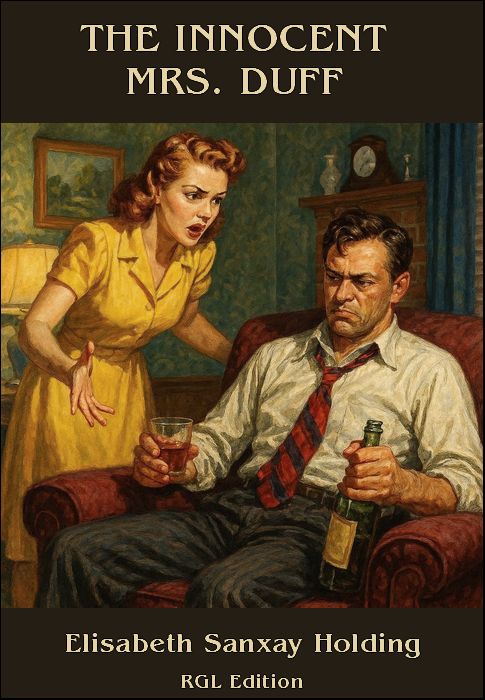
RGL e-Book Cover
Based on an image created with Microsoft Bing software
Roy Glashan's Library
Non sibi sed omnibus
Go to Home Page
This work is out of copyright in countries with a copyright
period of 70 years or less, after the year of the author's death.
If it is under copyright in your country of residence,
do not download or redistribute this file.
Original content added by RGL (e.g., introductions, notes,
RGL covers) is proprietary and protected by copyright.
RGL e-Book Cover
Based on an image created with Microsoft Bing software

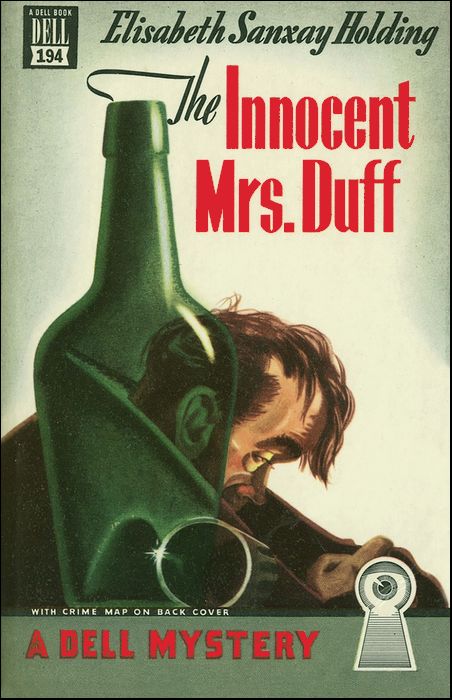
"The Innocent Mrs. Duff," Dell, 1946
"The Innocent Mrs. Duff," Simon & Schuster, New York, 1946
"The Innocent Mrs. Duff" is a psychological crime novel that explores the unraveling mind of Jacob Duff, an alcoholic widower who remarries a much younger woman. His paranoia, resentment, and self-destructive tendencies lead him into a spiral of delusion, manipulation, and ultimately murder...
"MY GOD!" Jacob Duff said to himself, standing stripped before the bathroom mirror. "I'm putting on weight!"
He was a big man, and very well-built, with broad shoulders and narrow flanks; it shocked him to study that thickening around his middle. And his ruddy, handsome face showed a sagging about the jowls. My God! he thought. I'm only forty-two. There shouldn't be anything like this...
Reggie began singing in her bedroom. Oh, shut up! he cried in his heart. You can't carry a tune. You know that; you know how it gets on my nerves, and still you keep on. Shut up!
He opened the door into his own bedroom and closed it behind him with a slam. That stopped her. But she'll do it again, he thought. There's nothing, absolutely nothing I ask her not to do that she doesn't keep on doing.
He began to dress, and this morning he admitted what for some time he had been trying to ignore: that the waistband of his trousers was tighter, was too tight; his back bulged a little between the shoulders. This made him miserable. It's her fault, he thought. She doesn't have the right sort of meals. As far as that goes, she doesn't have anything right. We've been married nearly a year, and she hasn't learned one damn thing. She never will, either. She doesn't even try.
He heard her come out of her room into the hall. She knocked at his door.
"Ready, Jake?"
"Not yet," he answered. "You go ahead."
He knew exactly how it would be. She would go running down the stairs and into the dining-room, and she would say "hello" to the housemaid. That was another thing he had asked her, again and again, not to do, but she kept right on, saying hello to everyone. To the chauffeur, to the cook, to the doctor, to anyone he was Fool enough to invite into his house. Oh, hello!
I'm ashamed of her, he thought. I admit it. That time I brought Copeley in for a drink, she said "hello, hon", to me. I caught him grinning. Everybody—servants, everybody laughing at her behind her back. And at me, for marrying her.
He hated the thought of going downstairs. I never have any appetite for breakfast any more, he thought. I used to look forward to breakfast, when Helen was alive. Good God! After being married to a girl like Helen for four years, how could I have married Regina Riordan? The name ought to have been enough for me. Reggie. A photographer's model.
He had to go downstairs. She was sitting at the table, and she was wearing another of those negligees she fancied: blue satin, with a little scalloped cape.
"Oh, hello, Jake!" she said, with that dazzling smile. A model's smile, he thought.
"Morning," he answered. "Reggie, I've asked you time after time if you'd kindly get dressed for breakfast. If you can't make the effort, then have your breakfast in your room."
"I know," she said, anxiously. "I've been trying to get some nice little porch dresses, but I honestly haven't seen anything worth buying."
"Porch dresses? What are they?"
"Oh, little ginghams, you know. Little checked dresses, or percales, things like that."
He knew they would be wrong. Helen had never had things like that.
"Why can't you wear your ordinary clothes?" he asked.
"Oh, I got it so drilled into me not to sit around in my good clothes," she explained. "At the studio we always—"
"Hush!" he said, as the maid came in through the swing door.
"The cook was able to get some bacon yesterday, Jake. You like bacon and eggs—"
"None for me, thanks. I'm going on a diet."
"Oh, Jake! Did the doctor say—?"
"Yes," he said, to keep her quiet. "Only black coffee and orange juice this morning. Where's Jay?"
"Oh, Miss Castle said he got something in his eye. They'll be right down. Honestly, Jake, I hate to sit here eating when you're not taking a thing."
"Thanks," he said.
Anyone else would see that I don't feel like talking, he thought. But not Reggie.
"Aunt Lou asked me to stop in and see her this morning," she went on. "I thought I'd take Jay."
"You'd better leave Jay to Miss Castle. That's what she's here for."
"I know. But—"
"I'd very much rather you didn't drag the child around with you."
"Well, I always consult Miss Castle, Jake."
I'd rather you never had anything to do with my son, he thought. I don't like him to go anywhere with you. I don't like him to see you here in that tawdry thing. He glanced at her across the table. She's beautiful, he thought, with distaste.
She looked taller than she was, being so slight. Her face was thin, with faint hollows under the high cheekbones, but heaven knew she was healthy enough, never sick, never tired. Like a peasant. Her eyes were dark-blue, with thick black lashes, her hair was black, her skin had a delicate rosy glow.
Jacob Duff, junior, came clattering down the stairs and into the dining-room, a thin little boy of seven, with neat fair hair and a debonair manner.
"Hello, Daddy!" he said. "Hello, Reggie!"
"I've told you not to say hello," said Duff, angrily.
"Well, good-morning," said Jay, without interest, and drew back Miss Castle's chair for her.
"Good-morning!" she said, with a smile and a slight inclination of the head.
She was an Englishwoman of thirty-five or so, handsome in a calm and disinterested fashion. She wore no make-up but a little powder; her thick light hair was cut and waved in unbecoming scallops; her white blouse with an artless little round collar did not suit her strong-boned face. But she's not interested in being 'alluring' and 'glamorous'—and cheap, Duff thought. If she chose to use lipstick and all the rest of it, she'd be a damn sight better looking than Reggie. Better figure, too. More womanly.
"I hear Jay's going to visit his auntie this morning," she said.
"I don't want to go!" said Jay, loudly.
"Don't shout like that!" said Duff. "And don't say things like that, either."
"Well..." said Jay, sulkily, and he pronounced it "wull".
"None of that," said Duff. "None of your 'wells', when you're told to do something."
"Told to do what?" asked Jay.
"Jay!" said Miss Castle, in mild rebuke.
"Well, he didn't tell me to do anything," said Jay. "I just said I didn't want to go and see Aunt Lou. Is that anything so bad?"
"Leave the table, sir!" said Duff.
"All right—sir!" said Jay, and jumped up nimbly.
"Go up to your room and stay there until you've learned some manners," said Duff.
"Learn 'em out of a book?" asked Jay; then, at the sight of his father's face, he giggled and ran scampering up the stairs.
Miss Castle went on quietly eating her breakfast, but not Reggie.
"It's just one of his wild fits," she said. "He's such a high-strung little fellow."
"Thanks," said Duff. "Thanks for explaining him to me."
"Well, I didn't mean it like that, Jake. I just meant he doesn't really mean to be rude. He's always as good as gold with Aunt Lou."
"Yes..." said Duff. "If you ladies will excuse me, I'll just glance at the news."
He was glad to put up the newspaper, to block out Reggie's face. Aunt Lou! he thought. The idea of a girl like Reggie being in a position to call her that. It's my fault. I realize that. But what was I thinking of, to do a thing like that?
His aunt, Louisa Albany, was a figure of overpowering importance in his life, and always had been. He was her heir; he would someday inherit a very nice little fortune from her, but her importance, to him, was not derived from that. It was her personality, her character, her tradition. His respect and admiration for her were beyond measure.
She could have stopped this, he thought. When I first brought Reggie to see her, if she'd said one word... Of course, she'd never met anyone like Reggie; you couldn't expect her to understand that type. She simply thought I'd be happier if I married again. She was simply thinking of my welfare.
But if she'd only realize now... I don't like to say anything out-right to her, but if she'd only see for herself. She knows me; she knows what my life with Helen was like. I don't know how she can help seeing. It's beginning to affect my health. I'm sleeping badly—and putting on weight like this isn't healthy.
"Couldn't you have one little corn muffin, Jake?" asked Reggie. "They're as light as feathers."
"No, thanks. To tell you the truth, I don't think all this heavy, starchy food is a good thing for anyone."
"I can't eat them," said Miss Castle. "I think your hot breads are delicious, but if I start the day with them, I'm quite dull all morning."
Duff glanced at her, and their eyes met for a moment. Then she smiled and looked away, but Duff had already got her message. She understands! he thought, with a sort of wonder.
"Look!" said Reggie. "I'll just run up and put on a dress and drive to the station with you, Jake."
"I'm sorry, Reggie, but I've got to pick up three or four men this morning."
"Oh, well...!" she said. "Then how about Jay and I meeting you for tea somewhere, after we leave Aunt Lou's?"
"Jay is to stay in his room all day," said Duff.
"Oh, Jake, honestly—!"
"My dear girl, I happen to be the child's father. I understand him better than you ever could. I'm not going to have him behaving like a common little brat."
"But, honestly, Jake, he didn't do anything—"
"If Miss Castle thinks I'm being harsh or unreasonable—" he said, and again he glanced at Miss Castle, and again she smiled at him.
"Suppose we wait and see what Jay has to say for himself, later on?" she suggested. "I'll go up and have a talk with him presently."
"Very good idea," said Duff.
We speak the same language, he thought. God, what a relief. She's got some sense and breeding and dignity. She's a handsome woman, too; knows how to carry herself. Reggie looks like a rag-bag in that thing.
He pushed back his chair and rose, and now was the time for him to kiss Reggie. He did not want to. It's a silly, meaningless habit, he thought.
"Well, au revoir!" he said.
"Hi! Wait!" cried Reggie, and jumping up, she ran to him. She put her hand on his arm and looked up into his face with her wide, gay, model's smile.
"You forgot to kiss me good-bye!" she said. "I guess the honeymoon's over."
And you think that's a joke, do you? thought Duff.
THE car was waiting; Nolan, the chauffeur, opened the door for him.
"Good-morning, sir," he said.
"Good-morning," said Duff. "Well stop for Mr. Vermilyea, that's all."
"Yes, sir," said Nolan.
Duff lit a cigarette and leaned back. This car-pool business was a nuisance, he thought. And Johnny Vermilyea's a nuisance, too. If he weren't so lazy, he'd walk to the station.
The three other men who had gone into the pool with him were pretty well eliminated, now that he had begun taking the nine-twenty. They had to go earlier. Only Vermilyea didn't care what train he got. Any time that suits you, old man, he said. Any time, any time. He was sauntering across the driveway in front of his big house, very dapper in his dark suit, which was, according to Duff's standards, too snugly fitting to his muscular body. With his red face, his big nose, his little bright eyes, he looked like Mister Punch.
"Hello, hello, hello" he said. "Here we are." He got into the car. "Wonderful weather for April."
"Yes," said Duff, without enthusiasm. "But this commuting business gets me down. I'm not used to it. To tell you the truth, I don't like suburban life. Born and brought up in New York."
"I couldn't live in the city," said Vermilyea, earnestly.
He was certainly close to forty and he lived, Duff thought, a ridiculous life, with his aged parents, in that big old house. His father had retired at seventy, and Vermilyea had become president of the Vermilyea Steamship Company. I'm more or less a figurehead, he would tell anyone, candidly. I've got some first-rate fellows there who do all the work.
Three nights a week he served as an orderly in the Vandenbrinck Hospital, and his leisure time was chiefly given up to Drives, drives for the Red Cross, the Community Chest, and so on; he was forever appearing at your house, trying to collect money. Duff found him boring, but after all he was a Vermilyea of Vandenbrinck; he had gone to a very good prep school, and, though not to Harvard, to Princeton.
This was the wrong sort of suburb to choose. Duff thought. I should have gone to one of those flashy new places—where Reggie might have fitted in. But I was thinking of Jay. I was thinking of Jay when I married her, too. I thought she'd be good for him, make a home. She's ruining the boy. She's making life hell for me. I'm putting on weight...
I want to get weighed, he thought. I want to see... He answered Vermilyea absently, while he tried to think where he had seen scales. At the club, of course, but he had not been there for months; people would ask him questions, make jokes about his marriage. In drug-stores? he thought.
The car stopped in the circular drive behind the railroad station.
"Five-twenty, sir?" Nolan asked.
"Yes," said Duff, and crossed the platform with Vermilyea.
"Dam good-looking fellow," Vermilyea observed.
"Who?" asked Duff.
"That chauffeur of yours. Mrs. Laird was speaking about him the other day."
"Speaking about Nolan?" said Duff.
"Yes," said Vermilyea. "She was saying it was a pity she couldn't get him for this play she's putting on for Overseas Clothing."
"Can't she find anything better to gossip about than other people's servants?" Duff demanded.
"Wasn't gossiping, old man. Just—well, here we are! Here we are!"
They got into the club car, and there were a couple of fellows Vermilyea knew. They wanted to play gin rummy.
"Sorry," said Duff, "but you'll have to count me out. I've got a head this morning."
"Oh! Big night?" one of the men asked.
"Could be," said Duff.
A big night, he thought. That's a good one. Directly after dinner he had gone into his study; he had sat there all alone all evening, reading, or trying to read, his late uncle Fred Albany's book, Big Game and Small. He had two or three whiskies, or maybe four, simply in order to get sleepy. He did that every evening now; he had to do it, or he could not sleep.
But it's not a good idea, he thought. I mean to say, drinking alone. Not good for morale. Not good for your health. I don't feel well, and that's a fact. But what the hell can I do in the evenings? I can't sit there talking to Reggie; there's nothing to talk to her about. Nobody ever comes to see us; there's no place to go. If I could take a room in a hotel in town...
Duff and Vermilyea and another man were all going downtown; they shared a taxi. Once I've started working, I'll feel better, Duff thought. But, unfortunately, there was little or no work for him to do that morning. He was the junior partner, as his father had been, in the firm of Hanbury, Martin and Duff, Surgical and Dental Appliances; they were working almost entirely on Government contracts now, and Duff left all that to Hanbury. I don't like all this red tape, he said. I don't like all these regulations, all this red tape.
There's no need for my coming in to the office five days a week, he thought, and I wouldn't do it, except for the sake of getting out of that house. But if I stay home, there's Reggie, trailing around in a wrapper, and the servants doing just as they damn please. No order, no system, no peace and quiet. When Helen was alive, everything went like clockwork. If I called up and said I'd like to bring someone home to dinner, I could absolutely count on everything being exactly right. But now...!
They had taken in so many new people that his secretary had to work in his private office half the time. She began to type, and the noise was exasperating.
"I'm going to step out for a cup of coffee. Miss Fuller," he said. "Back in a few moments."
He wanted to find a pair of scales. Funny, he thought, that you always say a 'pair' of scales. You couldn't ask anybody where to find scales; simply calling attention to the fact that you'd gained a few pounds. So he went into the drug-store in the lobby of the building. There were scales there, two kinds, the old-fashioned reliable kind with weights on a bar, and the other kind, that gave your weight printed on a ticket, in privacy. He chose the privacy. He put in a penny, and out came the little ticket.
"My God!" he cried to himself. "It's not possible." He stepped upon the trembling platform again and put in another penny; out came another ticket with the same figure on it.
No matter who might be watching him, he had to try the honest old-fashioned scales. He set the weights for what he had last weighed; five pounds more, ten pounds more, fourteen.
Fourteen pounds more than he had ever weighed in his life. It made him feel actually sick. I need a drink, he thought. Then I'm going to turn over a new leaf. Diet, exercise, and so on.
There was a bar down the street where he sometimes went after five for a cocktail. He had never entered it at an earlier hour; he could not remember ever having taken a drink at eleven o'clock in the morning, and he was ashamed to be seen going in there.
But there were plenty of men at the bar, and they looked all right, prosperous-looking fellows, well-dressed; they seemed perfectly matter-of-fact about an eleven o'clock drink. He ordered a straight rye, and drank it standing at the bar. It wasn't quite enough, and he ordered a second.
That turned out to be just what he needed. Sitting on the stool, in the dim, quiet bar, his mind began to work, quickly and clearly. This weight, he thought; I can get rid of that, easily enough. Go to one of these gyms, sweat it off in a couple of weeks. No. That's not what's worrying me. It's the whole setup. Reggie. I don't see why I should sacrifice my whole life for her. She married me for money and social position; nothing else. For all I know—
A thought came to him that was like a flash of light. Dam good-looking fellow, Vermilyea had said. Mrs. Laird had talked about Nolan's good looks. Had everybody in the neighborhood been talking about his handsome chauffeur?
I'll just put on a dress and drive down to the station with you, Reggie had said. Then she would have driven home alone with Nolan. And she had done that, a dozen, a score of times. He began to remember other things now. The way she said 'hello' to Nolan, with her wide, dazzling, model's smile.
I've been sleeping in that other room for nearly two months now, he thought, and she hasn't said a word. That simply isn't natural— unless there's somebody else. That would be absolutely typical of her, to disgrace me—with a chauffeur.
But she's not a bad girl, he thought.
On the contrary, he had found her altogether too good, too innocent; it had been like marrying a schoolgirl. He remembered the miserable embarrassments of their honeymoon. When the bellboy had opened the door of the hotel suite in Montreal, she had given a squeal of delight. Oh, Jake! Isn't this grand?
Helen had felt as he did; they had both determined that no one should know they were a honeymoon couple, and they had gone to Havana, and nobody had known. But not Reggie. Reggie had told people. She's absolutely insensitive, he thought. She doesn't realize that she's killed all the love I ever had for her. But she's not a bad girl.
Not yet. At least, I don't think so. But she could behave in a way to make a hell of a scandal with that fellow Nolan.
Anyhow, I can't stand any more of this, and I'm going to tell Aunt Lou so, frankly. I'll provide for Reggie, of course. Generously. I'm not interested in a divorce, either. I simply want to get away from that setup. I cannot stand it any longer.
WHEN her husband died, Mrs. Albany had sold his house on Ninth Street, and she lived now in an apartment-hotel not far from Washington Square. She lived, as always, with old-fashioned stateliness, combined with her own particular dash. When Duff rang the bell of her suite, the door was opened by a colored maid in a trim uniform, who led him into the sitting-room filled with the hideous Albany furniture, pictures and ornaments.
"I'll see if Mrs. Albany is at home, sir," said the maid, and withdrew.
It made no difference that he was Mrs. Albany's nephew and heir.
He would have to wait, like anyone else, and if Mrs. Albany were taking a nap, or if she were engaged with the manicurist, or if she were not disposed to receive guests, he would be dismissed, like anyone else. I have no regular hours At Home, in war time, she had told her nephew. If people want to see me, they must telephone ahead, or take their chance.
Rose, the maid, came back.
"Mrs. Albany is At Home, sir," she said, and went away, without a smile.
Louisa Albany came in promptly, a tall and very thin woman, with frizzy hair dyed a strange, pale red; she had rouge on her hollow cheeks and on her thin lips; she wore a blue satin blouse with a high collar, and a short black skirt. You could say, with truth, that her face in profile was like a camel's; you could say she was a hag. But it was none the less undeniable that she had an air; she had style, even elegance.
"Well, Jacob?" she said, in her clear, superior voice. "Sit down! I haven't seen you for some time."
"I've been rather busy. How are you keeping. Aunt Lou?"
"Very well indeed, thank you. You're putting on weight, Jacob."
His face grew hot.
"I'll soon get rid of it," he said. "I've started on a diet."
"Then I shan't offer you a cocktail," she said.
"That won't do me any harm."
"It will," said she. "You can't touch alcohol when you're reducing. Your Uncle Fred often had to go without a drink for weeks, when his weight got up. He had a perfect horror of getting fat."
"Naturally," said Duff. "Look here. Aunt Lou, I'd really like a cocktail. I'm a bit upset."
She looked at him for a moment.
"Then you shall have one," she said. "I'll make it myself."
He watched her as she crossed the room to the kitchenette across the hall.
"Ice, Rose," she said.
"Yes, madam," said Rose, who never smiled.
There was a strange, and, to Duff, an irritating harmony between Mrs. Albany and Rose. They worked together now like two professional bartenders.
"Martinis," said Mrs. Albany.
On a shelf there was a fine array of bottles, with jiggers of two sizes, swizzle sticks, glass mixers. Rose washed a lemon, and cut curls of peel; Mrs. Albany moved about neatly. Rose put a glass mixer and two glasses on a tray and brought it into the sitting-room.
"What are you upset about, Jacob?" Mrs. Albany asked, when they were alone.
"I simply can't go on like this," he said. "My life is hell."
She took a sip of her cocktail. "Light a cigarette for me, Jacob," she said. "Thank you. Is this all about Reggie?"
"Yes. I don't know how to make you understand. You're absolutely blind about that girl."
"No, I'm not," said Mrs. Albany, simply. "She has her faults. I was telling her today—you knew they came in to lunch?"
"They?"
"Yes. Reggie and Jay."
"Jay?"
"Don't shout so, Jacob."
"I said the child was to stay in his room—"
"Well, probably your Miss Castle didn't think that was a good idea."
"When I give an order, in my own house—"
"Pooh!" said Mrs. Albany. "That's no way to talk. No... I was speaking to Reggie about her housekeeping. I told her she'd better go and take one of those courses. I told her about this finishing-school—junior college, they call it now—where she could learn how to do things properly."
"It's a lot more serious than a matter of housekeeping. She doesn't care a damn for me."
"Yes, she does. She's very fond of you, and very anxious to make you happy."
He had finished his cocktail. He set the empty glass on the table and glanced at Mrs. Albany, but she took no notice.
"Mind if I help myself?" he asked. "They're excellent. Excellent. Aunt Lou, I'll tell you something that may make you realize. For nearly two months we've—" He hesitated. "We've been occupying separate rooms."
"Reggie didn't mention that. What was the quarrel about, Jacob?"
"There wasn't any quarrel. One night I didn't feel at all well, and I went to sleep in one of the guest rooms. And the next night, it was simply taken for granted. Bed turned down in there, my pajamas laid out. And it's been that way ever since. Reggie's never said a word."
"It's for you to speak of it" said Mrs. Albany, severely. "That's no way to treat your wife."
"No..." he said. "There's nothing left of our marriage. No companionship, no home life, no social life, nothing."
"Jacob," said Mrs. Albany, "Reggie is young, very young, and she has not had advantages. But she's an affectionate, loyal, good girl. She's devoted to little Jay. If you'll give her the help and guidance it's your duty to give her, she'll make you a splendid wife."
"Not she! She won't do a single thing I ask her. She doesn't learn anything."
"That's unjust. She's learned to dress in very good taste."
"That's because you buy her clothes for her."
"No. She gets things for herself now. And she's always reading little articles, about etiquette, and so on, and keeping up with the new books. And she works faithfully as a Nurse's Aid in the hospital."
"Mind if I finish up the cocktails?"
"Yes, I do mind," said Mrs. Albany. "I only made two each, and I want that for myself."
"Then d'you mind if I get a drink from the kitchen?"
"Yes, I do. You've had plenty."
"I'm upset!" he cried. "The whole thing is hell. And when I think of Helen—"
"You never cared so very much for Helen."
"I respected her."
"She saw to that," said Mrs. Albany. "Helen knew how to hold her own. And Reggie doesn't."
"Look here, Aunt Lou, I really need another drink."
"Don't ever let me hear you say you 'need' a drink."
"Well, I do!" he said. "I can't go on, with things as they are. I'll have to get away, take a room in town—"
"Out of the question!" said Mrs. Albany. "You can't desert that poor girl for no reason at all."
"All right!" he said, rising. "Suppose I told you I'd heard some very unpleasant talk about Reggie?"
"What sort of talk?"
"She's pretty free and easy with Nolan—"
"Jacob," said Mrs. Albany, "you ought to be ashamed of yourself for listening to gossip about your wife. What's more, you know as well as I do that there's not a word of truth in it. You know Reggie's absolutely incapable of anything of that sort."
"Good God!" he cried. "You have no sympathy for me whatever, no understanding. Reggie is 'incapable' of anything wrong, but I'm —I don't know what. A monster. I never knew you to be so utterly unjust."
That disturbed her.
"I don't mean to be so," she said. "I know Reggie has a great deal to learn, "and I know you're not happy, Jacob. But—to be frank, Jacob— I don't think you ever could be happily married."
"What? Why not—if I found the right woman?"
"You don't know how to be married, Jacob. You don't like it. You're not domestic. A man's man, as they say."
"And what about Uncle Fred? He didn't spend—didn't want to spend four months of the year at home."
"He wanted me with him, wherever he went," said Mrs. Albany. "He was—very companionable."
"And I'm not?"
"I don't mean to be carping and fault-finding, Jacob," she said, and she was a little anxious now. "But I'm sure that, if you'll try, you can make this marriage a success. Reggie does everything she can to please you—"
"That's where you're wrong," he said.
"No..." she said. "Jacob, give her a chance. To- to make her happy—"
"Good God!" he cried. "When you think of what I've given that girl—!"
"Jacob," said Mrs. Albany, "that's sheer vulgarity."
Their eyes met.
"I think I'd better be going," he said, coldly.
"Perhaps..." said Mrs. Albany, with a sigh.
When he went out into the little hall, she followed him.
"I dare say it's hard," she said. "But now that you're getting older, it will be easier to settle down. As time goes on." She hit his shoulder with her bony hand. "Think of Jay," she said. "Try to make the best of things, Jacob."
He stood waiting for the elevator, sunk in a bleak depression. If she'd stood by me, he thought, I might have been able to stand it, to go on. But she's hypnotized by Reggie. Now I can't stand it. Now I can't go on.
HE stopped in at a bar and got a drink; only one—that was all he wanted.
The bartender set a plate of cheese crackers and pretzels before him.
"Not for me, thanks," said Duff. "I'm on a diet."
"Well, there's plenty of us on diets now," said the bartender, somberly, "so many things you can't get."
"Compared with the rest of the world," said Duff, "we're damn lucky. The thing is, some people say alcohol puts weight on you. What do you think?"
"Well, it does with some," said the bartender. "With others it don't. It all depends on what constitution you got."
"That's probably it," said Duff.
He felt somehow reassured by this little talk. I know people who drink, he thought, drink excessively, and they're thin as rails. He knew he was going to need a few drinks at bedtime, to get some sleep, and he did not want to think that that might undo the benefits of the day's dieting. Black coffee and orange juice for breakfast, a lamb chop and a salad for lunch—nothing else. It won't take long, at this rate, he thought. And after all, fourteen pounds isn't so much, on a big frame.
He missed the five-twenty. Won't hurt Nolan to wait a while, he thought. God knows he has little enough to do these days, with no gas to run the cars. I don't know about Nolan and all that gossip...
He sat in the smoker, in a front seat, hoping not to see anyone he knew. He wanted to think about Nolan. Where did I first hear that gossip about Nolan and Reggie? he thought. But he could not remember. It's probably all over the place, he thought. You can't deny that Aunt Lou's a woman of the world. She travelled everywhere with Uncle Fred, met everybody. But she doesn't know anything about a girl like Reggie. Never met that type.
Well, he thought, with a sigh, there's nothing to do but wait. In the course of time she's absolutely certain to do something that will make Aunt Lou realize... Or she'll get sick of living like this, and she'll leave me. That would be the perfect solution.
The sun was low when the train stopped at Vandenbrinck; the river was pearly grey under a sky without color. The whole scene had, for him, a desolate look. I've had some of my happiest hours alone, he thought. In the North Woods, the Adirondacks, sailing. It's either that, or the big cities. But this suburban setup makes me sick.
The car was waiting, and Reggie was in it. Her beauty surprised him, for when he thought of her, he forgot that: the delicate loveliness of her thin young face, the grace and fineness of her body. She looked entirely right, too, in a navy-blue linen dress, her shining black hair brushed back from her face. She looked like a quiet, well-bred young girl. But who knew better than he that she was not?
Nolan was standing in the road, smoking; he threw away his cigarette and hastened forward to open the door of the car. And for the first time Duff really looked at him. Why, he's like a damn movie actor! he thought, outraged. Black, wavy hair, Nolan had, that sprang up from the temples, fine black brows over deep-blue eyes; he was of medium height, and slender, but in his very upright carriage, the set of his head, there was a vitality a little aggressive.
"Hello, Jake!" said Reggie.
He gave her something like a smile and got in beside her.
"The chairs have come!" she said.
"What chairs?"
"Why, don't you remember, Jake? You said I could order those dining-room chairs, over four months ago?"
"That's nice," he said.
"I went in to lunch with Aunt Lou, Jake, and she had an awfully good idea. About me taking a Homemaker's Course. I went to the Haverdean Junior College about it. Of course, it's sort of late in the year, but Mrs. Haverdean said that if I started right away, I'd get a good two months, and I could take some private lessons. And next year I could start when the school opens."
"Do you want to do that?" he asked.
"I'm crazy to."
"You would be," he said.
"How do you mean, Jake?" she asked.
"I think you would be crazy, to go to a school like that—with young girls."
"Well, I'm not so terribly old, Jake. Twenty-one."
"It's not that."
"But then what, Jake? You mean because I'm married?"
"That's one reason."
"But Mrs. Haverdean says they've got other married girls—"
"Please don't talk about 'married girls'. I'd rather not go on with this. If you can't see for yourself how unsuitable, how—damn ridiculous it would be for you to go Haverdean—"
"You mean, about them being society girls?" she asked. "Well, Aunt Lou said that would be all right, Jake. She said I'd make some nice friends."
"Do you want to have schoolgirls for friends?" he asked.
"Well..." she said, with a doubtful smile.
They were both silent then. It's all very well for Aunt Lou to say that I didn't love Helen, he thought. I wasn't infatuated with her; I admit that. But we got on together. We spoke the same language. Helen was a woman, not an ignorant, childish—ninny.
They had turned into the driveway: the burgeoning trees threw long shadows on the lawn, the windows had a fiery dazzle from the setting sun. It seemed to Duff that the place had a strangely deserted look. Not like a home at all, he thought. The housemaid opened the door, and they went in, to a blank silence. Never any stir here, no preparations for guests, no telephone calls.
"Where's Jay?" he asked.
"Miss Castle sent him to bed early, because he was rude to you at breakfast."
They went up the stairs together, and, without a word, separated, going to their separate rooms. If she was human. Duff thought, if she was a woman, shed ask me to come back to her. But she never says one word. Good God, what is she?
There was nearly an hour to fill before dinner. Duff washed, and went quickly downstairs. He was pleased to find Miss Castle in the sitting-room, and he thought she was pleased to see him. She-looked very nice, he thought, in a long-sleeved white blouse, her hair so neat. A handsome woman; a real woman.
"I thought a cocktail wouldn't come amiss," he said. "Will you join me, Miss Castle?"
"Oh, thank you!" she said.
He rang for Mary, and told her to bring ice cubes, gin, French vermouth, and bitters.
"And be as quick as you can," he said.
That needed explaining to Miss Castle.
"When I do take a cocktail," he said, "I like it fifteen or twenty minutes before dinner. Not right on top of the meal."
"I'm sure that's more artistic," she said. "Do you know, when I left England, six years ago, I'd never had a cocktail? Sherry, sometimes, before dinner, and once in a great while, a brandy afterward."
"If you'd rather have sherry—?"
"Oh, thank you, but I quite enjoy a cocktail now and then. If one's at all depressed or out of sorts..."
He did not like to think of Miss Castle being depressed; he wanted her to be serene and happy under his roof.
"I hope Jay doesn't give you too much trouble," he said.
"Oh, no! He's a very interesting child. But there is one thing... I don't think Nolan is a good influence, Mr. Duff."
"Nolan?" he said, startled. "Does the boy see much of Nolan?"
"He's always running off to the garage. He's quite devoted to Nolan. Of course, it's easy to understand. Nolan tells him these stories of his life in the Marines."
"I didn't know he'd been a Marine."
"Oh, yes! He was two years in the Pacific islands."
The clock on the mantel struck half past six; Duff frowned and rang again for the housemaid.
"What's your opinion of Nolan, Miss Castle?" he asked.
"Not very high, I'm afraid."
"I'd like very much to know just why."
"It's difficult to put these things into words..." she said. "I don't think Nolan is—trustworthy."
"Have you had any trouble with him? Has he been impertinent to you?"
"Oh, no, never!" she said. "I shouldn't quite call Nolan impertinent. It's simply that he's so—" She hesitated. "So extremely independent," she said. "Or perhaps cynical would be a better word."
"Have you forbidden Jay to go to the garage?"
"No," she said.
He rang the bell in the wall again, kept his finger on it.
"I'd like to know why not," he said.
"I have the greatest admiration for Mrs. Duffs ideas," she said. "She's truly, sincerely democratic. I wish I'd been brought up with a little more of that, myself. I think that spirit is increasing at home, in England. And really it's not because Nolan's a chauffeur that I object to him. It's because of his—character."
"And Mrs. Duff stands up for him?"
"I shouldn't put it quite that way," she said. "It's simply that Mrs. Duff is so very honest—"
The housemaid came in now with the tray.
"You've forgotten the bitters," said Duff. "Hurry up with it, will you?"
"I didn't see any bitters, sir. I read the names on all the bottles—"
"Let me get it!" said Miss Castle, rising.
"No, no!" said Duff. "Sit down. Miss Castle. You come with me, Mary, and I'll show you..."
He got the bottle from the pantry, and when he returned to the sitting-room, Reggie was there.
He remembered that when he had first seen her the thing that had most charmed him had been her look of exquisite cleanliness. Flower-like, he had called it. Very well; she was flower-like now, in a black-and-white checked evening dress with a long skirt and a prim little bodice buttoned up to the neck, her black hair soft about her pale, clear face; her blue eyes brilliant.
But it failed to charm him now. He knew how it would be to take her in his arms. She would nestle against him, feeling boneless; there would be a faint scent of talcum powder about her; she would be pleased with his love-making, as a kitten may be pleased at being picked up. And, like a kitten, she was happy when let alone.
Does she let Nolan make love to her, in that same way? he thought.
He mixed the cocktails and poured out two; none for Reggie. "I've never had a drink in my life," she had told him in the beginning, "and I guess I never will. I've seen too much of it, right in my own family." She had told him a tale about an Uncle Vincent, who had begun to drink and had ruined himself. It was just the saddest thing, she had said.
"Dinner is served, madam," said the maid.
"Can you put it back ten minutes, Reggie?" Duff asked. "We'd like to finish our drinks in peace."
"Oh, yes!" said Reggie. "Mary, will you tell Ellen, please?"
But the drink was spoilt now; there was none of that pleasant feeling of relaxation.
"There's a dividend here for you, Miss Castle."
"Oh, no, thanks! One is just right for me."
So he had to finish up what was in the shaker, and much too quickly.
"Well, is it all right to have dinner now, Jake?" Reggie asked.
"Certainly," he said.
He had no appetite at all. But that's all to the good, he thought, with this new diet. Reggie and Miss Castle went past him into the dining-room and he followed them.
"What do you think of them, Jake?" Reggie asked. "The new chairs?"
He thought they were terrible: a sort of bogus Windsor style, with cane seats and cane insets in the backs.
"Very nice," he said.
He drew back her chair for her; Miss Castle was already seated, and he went to his end of the table. The new chair was not only ugly but uncomfortable; the seat was too narrow, the arms constricting. He did not like the soup set before him.
"It's a meatless day," Reggie said, "but we've got some nice creamed sweetbreads—"
"Not for me, thanks," he said. "I'm on a diet. I told you so, this morning."
"Well, what can you eat?" she asked, anxiously. "Scrambled eggs, Jake? Or—"
The cane seat of the chair gave way. As he seized the arms and tried to rise, he fell over sideways, caught in the chair. Reggie came running to him.
"Oh, Jake!" she cried. "Oh, gosh! Are you hurt? Oh, Jake, I'm terribly sorry!"
Now he hated Reggie.
"No, thanks," he said. "I don't want anything more."
"But, Jake, you haven't eaten a thing—!"
"Nothing more, thank you. I've brought home some work to do. Good-night, Reggie. Good-night, Miss Castle."
He went off to that study, a ridiculous room, and locked the door. He took up Uncle Fred's book, but his hands shook so that he could not hold it. He had a bottle of whiskey in a drawer of the desk; he brought it out and poured himself a drink.
All right! All right! he told himself. I'm going to put the whole thing out of my mind. It's nothing.
Only, Miss Castle had seen him. Very well. She wouldn't think anything of it. A little—contretemps. Could happen to anyone. It's nothing. Simply, if you're a little overweight, you're—sensitive about a thing like that.
Damn those chairs! It takes Reggie to buy such flimsy, tawdry stuff. Damn. All right! Damn Reggie. Everything's finished between us, as far as I'm concerned. Even Aunt Lou could see that now, if she were here. I've got to get out.
There was a knock at the door.
"Yes?" he said.
"It's me, Jake."
"I'm very busy just now, Reggie."
"Just a minute, Jake! Please!"
He put away the bottle, and hid the glass under the desk, and unlocked the door.
"Jake, I'm so terribly sorry about what happened."
"It's nothing. Absolutely nothing, my dear girl."
"Jake, I'm so sorry. I guess those chairs just weren't any good."
"It's nothing. Let's not talk about it."
"Jake, could I sit in here with you for a while, and just read?"
"Thanks, but I have some rather important business papers."
"Could I type for you, Jake?"
"No, thanks. No typing to be done."
"Jake..." She laid her hand on his arm. "I just hate for us to get like this."
Then do something about it! he cried in his heart. Do something to stir me, to make me care again. Don't stand there-like a damn flower...
"Haven't you been feeling so well lately, Jake?"
"Never better," he said.
"I've been worried about you, Jake."
"And why?"
"Well, you hardly eat a thing, Jake." She paused. "I was talking to Aunt Lou today, Jake. About when you were a little boy. She said you always were terribly hard to—amuse. She said you always got bored so easily." She paused again. "I thought maybe you were sort of bored now, Jake," she said.
"Oh, certainly not!" he said, with bleak politeness.
"Because if you are, Jake, couldn't we do something about it?"
We? You could. You could be even a little exciting, a little seductive.
"Could we go out more, maybe? To shows, or night-clubs, or whatever you like?"
"Thanks, Reggie, that's a very nice idea. Later on, perhaps."
"Jake... We used to love each other..."
"Certainly. We do now. But at the moment, I'm pretty busy. If you'll excuse me—"
"Well, good-night, Jake," she said, and kissed him on the cheek.
One of her damn flower-kisses, he thought. I'm not going to go on like this. I can't stand it, and I won't.
HE waked in the morning, feeling strangely ill. When he got out of bed his legs were so weak he could scarcely stand. There was a grinding pain in the pit of his stomach.
This is no hangover, he said to himself. Anyhow, I didn't drink so much last night. No. This is something else. Something serious.
He was afraid to take a cold shower, feeling like this. He dressed as quickly as he could, but his hands trembled horribly. When he brushed his hair, one of the brushes somehow twisted in his hand and hit him a whack on the head. He had a very bad time with his necktie.
This is no hangover, he thought. I've had plenty of them in my day, and this isn't one. I'm going to take a drink, but it won't help me much. Not with this thing, whatever it is.
He had the good luck to get downstairs without meeting anyone. He remembered that the bottle in the study was empty, and he had to go to the cellarette in the dining-room. That was almost too much. Mary might come in, Reggie, Miss Castle, Jay, anyone, and see him taking a drink—before breakfast. The thought of it made him sweat with fear and dismay.
But I've got to! he cried to himself. I can't go on this way. He opened the cellarette in the sideboard, he unscrewed the top of a bottle, and he had poured himself a generous drink before he noticed that it was gin instead of whiskey.
"Oh, damn!" he said, aloud.
But then an idea came to him. He put the bottle back and filled up the glass, already half-full of gin, with stale water from the carafe; he carried it into his study and closed the door. He scribbled some meaningless figures on the pad before him; he sipped his drink, and lit a cigarette. He knew Reggie would come knocking at the door, and she did.
"Come in!" he said, absently.
"Oh, Jake! You shouldn't smoke before breakfast, hon!"
"Just a minute..." he said, in the same absent tone, and wrote down some more figures. He lifted the glass and took another swallow. "I'll be with you in a moment, Reggie."
Anyone would take it for granted that what he had was a glass of water. You don't expect to see a man drinking gin at eight o'clock in the morning. Normally, he thought, I'd say it was a pretty bad sign, pretty serious. Only I'm so damn sick...
Only he wasn't. That strange weakness, the pain, the trembling, were all passing away. His brain became clear, and he remembered the plan he had made the night before. It was a good plan, and he intended to carry it out at once.
He went into the dining-room, and for the first time he noticed that it was raining outside; there was a grey, dull light in the room. Reggie was wearing a black dress with long sleeves; she looked, he thought, like a shop-girl.
"Jay...!" said Miss Castle, and Jay stood up.
"G'morning, Daddy!" he said, and sat down again, so hard that his chair slid back a little.
"Good-morning," said Duff. "Good-morning, Miss Castle."
"Good-morning, Mr. Duff."
He liked all this good-morning good-morning ritual; he liked the looks of Miss Castle, in her white blouse and grey skirt, with the healthy color in her cheeks. And Jay, he thought, was a rather remarkable child. Not exactly handsome, but even now, at this age, he looked like Somebody.
"You can eat plain boiled eggs, couldn't you, Jake?" asked Reggie.
"No, thanks," he said. "I'm a little off my feed. Need a change, probably. Tell you what, Reggie. If you haven't any engagements, suppose we go out to the shack for the week-end?"
"Oh, I'd love it!" she said.
"Good! You can drive out this afternoon, and I'll come straight from the office. We can eat dinner at the Yacht Club, to save you trouble."
"Oh, let's eat home! I'll get things on the way. I love to cook, Jake."
"Nolan can wait there until I come," he said. "I don't care to have you there alone. It's pretty deserted, this time of the year."
"All right, Jake," she said.
He drank a cup of coffee and ate a slice of toast.
"Kin I go now?" Jay asked.
"No," said Duff. "You're to stay at the table until other people have finished."
Jay leaned back in his chair and folded his arms.
"Unfold your arms," said Duff.
"Well, why? What's bad about that?"
"Do as you're told," said Duff.
Jay stretched out his arms straight from the shoulders, and looked at his father sidelong.
"Sit properly!" shouted Duff.
"Well, how? I don't know how you mean!"
"Then I'll teach you. You need a good thrashing."
"I do not!" said Jay, and began to cry.
"Come, Jay!" said Miss Castle, and taking his hand she led him out of the room.
"Honestly, Jake, he doesn't mean to be naughty," said Reggie. "It's only—"
"Would you very much mind not explaining my own son to me?" he said, pushing back his chair. "I know exactly what's wrong with Jay."
And it's you, he thought. He used to be a very well-behaved child; people spoke of it. But you encourage him to spend his time with the servants; you send him out to the garage. To Nolan.
I've got to get rid of Reggie, he thought.
He did not care for the thought in that crude form. I mean, he said to himself, that I want a separation. We're not suited to each other in any way, and it is ruinous for the child. She can't be so very happy, herself. Perhaps if I simply went to her and proposed a separation, she'd agree. But Aunt Lou would make such a hell of a row about it. Give Reggie a chance. The poor girl. All that. She won't see.
So I've got to go through all this unpleasantness, he thought. His plan of last night was indeed detestable to him. It's not the sort of thing a gentleman does, he thought. But what else can I do? I haven't been into her room for nearly two months—and that doesn't seem to bother her. I never bring anyone here. I never take her anywhere. If she wasn't so damn stupid and common, she'd have seen... And, at that, maybe she does see. It's a nice life. Plenty of money, plenty of clothes. Mrs. Jacob Duff...
He hated the house and was glad to get out of it, but he hated the office too.
"I'm just stepping up for a cup of coffee," he told Miss Fuller at eleven o'clock.
He went to another bar this time, so that this little pick-me-up would not look habitual. And in this place he came across a fellow he knew, Sammy Poole.
"Hello!" Duff said, with an air of immense surprise. "What are you doing here, this time of the day?"
"Oh, I come every morning," said Sammy.
He did not seem to see anything out of the way in it. He seemed very healthy, too; he played golf, he went to a gym, and so on. Duff did not make the explanation he had been ready to make. If Sammy could take this for granted, so much the better. He had two drinks, just two; he was never going beyond that. Then he went back to the office.
I don't know, he thought. Maybe I'll cut lunch out entirely. You're bound to lose weight that way.
He dictated some letters, he saw two or three people, he talked to Hanbury.
"Mr. Duff," said Miss Fuller, "will it be all right if I go out to lunch now? It's after two."
"Oh, certainly, certainly!" he said. "Go right ahead. I didn't realize the time."
When she had gone, he had nothing to do, and he felt very sick again. He went out to the first bar, and it upset him. I can't go running in and out of bars all the time, he thought. It doesn't look well. I ought to keep something in the office, in case I want it. Plenty of fellows do that. Only Miss Fuller's in and out, all the time.
He felt a little better when he got back. At four o'clock he called Vermilyea.
"Don't hesitate to turn this down, old man," he said. "But here's the setup. My wife's gone down to our place on the shore, and I want to join her. But the garage people can't fix me up with a car. Can't—or won't. It's a hell of a trip by train, with those two changes, so I thought that, if you had enough gas, maybe you'd drive me down and stay overnight."
"Very pleased to, Duff," said Vermilyea. "What time?"
"I can't get away very early," Duff said. "I'm up to my ears in work. About seven, say?"
"There's a train leaving Grand Central at six-twenty-two," said Vermilyea. "How would that do. Duff? I could meet you at the Vandenbrinck station."
"Fine! Fine!" said Duff. "I appreciate this, Vermilyea."
Then he called up the shack, and Reggie's voice answered.
"I'm sorry, Reggie," he said, "but something's just turned up. This man's coming from Washington, and I've got to wait. I'll take a room in a hotel for the night, and I'll be out early tomorrow morning."
"Oh, I'm sorry, Jake!"
"And tell Nolan to stay," he said. "I don't want you out there alone."
"All right, Jake," she said. "Take care of yourself, and I'll see you tomorrow."
He disliked his plan more and more. But if Reggie's behaving properly, there'll be no harm done, he thought. And if she isn't... then I needn't have any compunction.
He knew Reggie well enough to feel almost sure she would be doing something that would look wrong. Something that would shock Vermilyea. For she had no dignity, no discretion.
Pictures came into his mind. Suppose they were to find Reggie and Nolan sitting side by side on the front steps, talking and laughing? Drinking soft drinks out of bottles! He imagined himself telling this to Mrs. Albany. You can realize how I felt, he would say, arriving there with a fellow like Vermilyea, and finding my wife and the chauffeur...
If they'd only be making love...! he thought. No matter what I find, I shouldn't make use of it. I'd still let her get the divorce. I'll provide for her decently. It's simply that I want somebody to realize what she really is. Aunt Lou, above all.
Vermilyea was waiting for him on the Vandenbrinck station.
"You're looking a bit seedy, Duff," he said.
"I'm dog-tired," said Duff.
"Take a little snooze, on the way out," said Vermilyea. "Nice night, after the rain this morning."
Duff leaned back in the dark car and closed his eyes. There couldn't, he thought, be a better witness than Vermilyea, a man of honor, a gentleman, who would understand all the implications of what he was going to see. Mrs. Duff and the chauffeur, sitting on the steps, drinking pop out of bottles, his arm around her shoulder.
It was worse than that, though. There was a merry-go-round on the lawn outside the house, and Reggie sat on a coal-black horse, with Nolan behind her, holding her round the waist; they went round and round, laughing, to very loud music. Fortunately Aunt Lou was with him, and she could see for herself how it was.
"The whole neighborhood's complaining," he told her. "But she doesn't care."
He opened his eyes and they were in the main street of the village, with a radio playing loudly somewhere.
"Oh, look here, Vermilyea!" he said. "Mind going back just a couple of blocks? I want to stop at the liquor store. There's nothing in the house."
The man in the store knew him well, from the days when he used to come down here with Helen.
"You're starting early," he said. "There isn't anybody else has come down yet."
"I've been working pretty hard," said Duff, "and I thought I'd like a little sea air."
"Nothing like it," said the man.
"Might as well stock up. Two bottles of rye—and I might as well take a couple of bottles of gin. A lot of people seem to like gin drinks, Martinis, Tom Collinses, and so on. Personally, I don't like gin."
He wondered a little why he had said that and why he was talking so much. It's because I'm upset about this thing, he thought. He got back into the car with a big paper bag, and Vermilyea started off again. They turned in to the Shore Road, and there was the sea, pale under the starry sky. Some ten feet below the road and fronting the ocean was that solid and comfortable little bungalow which he and Helen had always called 'the shack'. It was the only lighted house to be seen.
"I hope Reggie got my wire," said Duff. "I couldn't get her on the telephone, so I sent her a wire to say we'd be along."
"Certainly hope so," said Vermilyea. "I shouldn't like to cause Mrs. Duff any inconvenience."
"Better leave the car up here," said Duff. "Nolan will take it down to the garage. It's a rather tricky bit of road."
Vermilyea parked the car at the side of the road, and Duff led the way, down a flight of wooden stairs to the beach. His knees felt weak; he felt cold and wretched. Suppose we find something—outrageous? he thought. Suppose she's got Nolan in her room? Well, Vermilyea would never talk. Nobody else would know.
He mounted the three steps to the veranda and looked in at the sitting-room window. Nolan, in his shirtsleeves, was doing something to the radio, a cigarette in the corner of his mouth. Reggie sat in a wicker armchair, with Jay on her lap.
"OH, hello, Jake!" cried Reggie.
"Hello, Mr. Vermilyea!"
"Hello!" Vermilyea answered, smiling broadly.
"Nolan, get Mr. Vermilyea's car into the garage," said Duff. "Jay, you ought to have been in bed hours ago. What's the child doing here, anyhow, Reggie?"
"Well, he wanted to come," she said.
Duff was struggling against a furious anger that was beyond his understanding. Anger against Nolan, who was leisurely putting on his jacket, against Reggie in her black dress, even against Jay.
"Go to bed at once. Jay," he said.
"Well, I'll have to change him in to the guest room, Jake," said Reggie. "I didn't know you were coming, and I was going to keep him in with me."
"Didn't you get my wire?"
"Why, no, I just—"
"Don't change your arrangements," said Duff. "I'll share a room with Vermilyea. Only get that child to bed."
He was very nearly shouting, and that wouldn't do. He must get himself in hand.
"Sit down, Vermilyea!" he said, with great heartiness. "Sit down! Sit down! We'll have a drink. What's yours, gin, or rye?"
"Rye, thank you. Duff."
"Personally, I don't care for gin," said Duff.
No sense in saying that all the time. He went into the kitchen, and there were no ice cubes in the refrigerator; no soda. He opened a bottle of gin and poured himself a drink, and put the bottle back in the paper bag. Then he opened a bottle of rye and brought it, with two glasses, into the sitting-room.
"Sorry to say there's no ice, old man, no soda."
"That doesn't bother me," said Vermilyea.
"I'll get some water," said Duff, and returning to the kitchen, he drank the gin and rinsed out the glass.
"Cigarette, old man?"
"I'll use my own, Duff, thank you. They're worth their weight in gold, these days."
"Here! Here! Take one of mine!" said Duff. "I've got plenty, at the moment. My aunt, Mrs. Albany, gave me two cartons last week. Remarkable woman."
"So I've heard. Roger and Elly Pendleton know her."
"Remarkable woman," Duff said. "Sixty-five years old, and still-remarkable. Used to do a lot of big-game hunting with her husband, y'know, and I believe she could do it now. Y'know, when I was a kid, I used to like it better than anything when she'd come out to see me in school. She'd bring a souvenir—from Africa, India, wherever she'd been, and she'd have stories to tell that were better than any book you ever read. The other kids would all gather round... A thorough sportswoman. Thorough."
"Very interesting, Duff."
Duff told a story about Mrs. Albany and a rhinoceros.
"Well, by Jove...!" said Vermilyea.
"My uncle used to say he'd rather have her beside him in an emergency than any man he'd ever met."
"That's certainly a fine compliment," said Vermilyea.
"Yes. True, too. Another spot, old man?"
"Just a small one, Duff. You're not taking any?"
"Well, no," said Duff. "To tell you the truth, it's apt to make me wakeful if I take a drink around bedtime."
"It's just the other way with me," said Vermilyea, seriously. "It's a very rare thing for me not to go to sleep as soon as my head touches the pillow, but if it ever does happen that I can't sleep, a jigger of whiskey will always send me off."
"You're lucky," said Duff.
He was waiting for Reggie to come back. At least she'll have manners enough to say good-night to Vermilyea, he thought. But eleven o'clock came, and Vermilyea was politely covering a series of yawns.
"Shall we turn in now?" he suggested.
From his overnight case Vermilyea brought out pajamas, dressing-gown, slippers, a few toilet articles, a razor, everything of the best quality and absolutely right. God, what a relief to be away from Reggie, with her flimsy things strewn all around!
Vermilyea was breathing calmly in his bed in the dark room, asleep already. And what had he thought of that scene, that nice, cozy, domestic scene? Mrs. Jacob Duff, and the chauffeur in his shirtsleeves and a cigarette in his mouth.
Why did she bring the child here? he thought, his anger rising and rising. She's ruining him. Encouraging him to hang around with the servants all the time. God knows what he's picking up.
After a while he rose and went barefoot into the kitchen. He poured himself a drink of gin, a good one, too. I've got to get some sleep, he thought.
He went back to bed, and now he was able to sleep, in the cool breezy dark.
When he waked in the morning, Vermilyea's bed was empty. He heard voices near, he heard Jay laughing, and Reggie. She's turning the child against me, he thought. When Helen was alive, he'd run to meet me, as soon as I came into the house. Only four years since Helen died? I can't realize it... Aunt Lou could have stopped this—disastrous second marriage. Only time I've ever known her to use poor judgment.
He felt sick, very sick, but he had expected to be. I was a damn fool not to bring a bottle in here last night, he thought. Now if there's anyone in the kitchen, I can't get a drink.
Yes, I can, he thought. He got out of bed and put on his dressing-gown and slippers. He went straight to the kitchen. In the dining-room Reggie and Vermilyea and Jay were all sitting at the table.
"Good-morning, everybody!" said Duff.
"Jay!" said Reggie, in nervous imitation of Miss Castle, and Jay stood up.
"Mrs. Duff's giving us a wonderful breakfast," Vermilyea said. "Wonderful! I only wish I had more time. But for a wonder I've got to show up at the office fairly early."
The big paper bag was on the sink-board. Duff picked it up and carried it into the bedroom; he did not explain, he did not have to explain. He had a drink of gin poured out and standing on the dresser when Vermilyea came in to get his bag.
"I've enjoyed this very much, Duff," he said. "You're a lucky man."
"Oh, very!" said Duff.
No sooner had Vermilyea gone than Reggie came knocking at the door.
"Come in!" said Duff, with a sigh.
"I just wanted to know if you'd like some little sausages, Jake," she said.
"No, thanks, I shouldn't."
"Jake," she said, "now that we're down here—now that we've got more time together—couldn't we have a good long talk?"
"About what?" he demanded.
"About—whatever it is that's gone wrong between us."
She had never taken the initiative before, never had questioned him. He was not prepared for it; he did not know how he wanted to answer her.
"I'm afraid we haven't much time," he said. "I've got to go in to the office this morning."
"Oh, I thought we were going to stay here over Sunday. I told Jay so. He'll be disappointed, poor little fellow."
"I'm sorry," said Duff, briefly.
Why didn't she go away? She was obviously nervous, one hand picking at her dress, a warm color in her cheeks; she did not look at him. She's guilty! he thought.
"Jake..." she said. "Jake, honey, what's happened?"
"What d'you mean? What are you talking about?"
"Things seem to have gone—all wrong between us," she said, and there were tears on her cheeks. "I guess all married people have their ups and downs—but I thought that if we could just clear things up— if we could have a good long talk, Jake..."
"My dear girl," he said, "this is hardly the time. I haven't had so much as a cup of coffee, and—" He paused. "I'm not feeling any too well," he said.
"I knew that!" she said. "For quite a while I've thought you seemed queer."
"Tactfully put," he remarked.
"I didn't mean to be tactless. It's only that—"
"D'you mind if we postpone this?" he asked. "I'd like to finish dressing and get some coffee."
She went away then and he finished his dressing and his drink in haste. But instead of going to the dining-room, he went out of the house, to the garage. The door was open, and Nolan stood there, smoking.
"Morning, sir!" he said, alertly.
"Good-morning," said Duff. "We'll be leaving in an hour. And after you've driven us home, I'll pay you whatever is due you, and you can go."
"And why is that?" asked Nolan, with interest.
"I don't care for your manners," said Duff. "I don't care to find my chauffeur in my drawing-room, in his shirt-sleeves, smoking a cigarette."
Nolan drew on his cigarette.
"I know a frame-up when I see one," he said.
Everything in Duff drew together against this blow.
"What are you talking about?" he asked.
"I've been around," said Nolan. "You tried to frame me and your wife."
"Keep quiet!"
"For the time being, I will," said Nolan.
NOLAN'S going to blackmail me, thought Duff. Or try to, anyhow. But he can't prove anything. Can't prove I didn't send a wire to Reggie—or anything else. Only I don't want him putting any ideas into Reggie's head.
That thought made him sweat with dismay. If Reggie should turn on him, accuse him of this contemptible thing... I couldn't stand that, he thought. It was a mistake, anyhow. I'm sorry I ever tried it. It's not like me.
And if Vermilyea ever knew...? All right. Duff thought. I'm sorry. It was a bad idea, the sort of thing a gentleman doesn't do, or even think of. But I don't see how Vermilyea ever could find out. Who'd tell him? He wouldn't believe it, anyhow.
But Reggie might believe it, if Nolan told her. She and Nolan, no doubt, spoke the same language. Very likely they both knew of instances like that, a suspicious husband coming home, when he had definitely said he would not be home. It was such a damn vulgar thing for me to do, he thought.
"Is the coffee all right, Jake?" she asked.
"Very good. Very good indeed."
That pleased her.
"I'm terribly glad you like it, Jake," she said. "I honestly think I could get to be quite a good cook. I know I'd love it. Only, living around in furnished rooms the way I did before we were married, I never got a chance."
"No, of course not. Can you be ready in half an hour, Reggie?"
"I'll just wash up the dishes, Jake—"
"Don't bother. Mrs. Anderson comes in once a week to air the place. She'll attend to them."
"Honestly, I'd rather, Jake," she said. "I'd hate to go and leave dirty dishes. It'll only take a moment."
"Well, if you'd rather—" he said, and his indulgent tone brought out her wide, dazzling smile.
I'm going to behave differently, he thought. Not going to be irritable. And if Nolan does try to put any ideas into her head, she won't believe them. Anyhow, it wasn't a frame-up. I simply wanted to see if that fellow was too familiar and free-and-easy when I wasn't around. Very well. I did see.
He went into the bedroom to pack, and as he took the three bottles out of the paper bag, he frowned to see how much gin had gone since last night. Of course, the stuff evaporates, he thought, but even at that, it's too much. I'm cutting down.
Reggie was still in the kitchen and Jay was with her, drying the dishes.
"Soldiers dry dishes!" Jay said. "Reggie's a trained nurse, and I'm a soldier."
Duff very much disliked the child's calling her 'Reggie', but he had never been able to think of a reasonable substitute. He didn't like to see Jay drying dishes, either; the whole atmosphere was displeasing. When he and Helen used to come here, they had always brought a maid along; everything had been informal, but not like this.
"I've nearly finished, Jake," she said. "I just want to leave things nice and neat."
"I see! I've been thinking, Reggie... I'll be finished early at the office. Suppose you come in to town by train with me, and Nolan can drive Jay home. You could do a bit of shopping, and then we could meet somewhere for lunch?"
"Oh, I'd love it!" said Reggie.
"I want to go to New York, too," said Jay.
"Not today," said Duff.
"But I'll bring you a surprise," Reggie told the child, and he seemed satisfied.
Nolan drove them to the station and they got on the train.
"I want to speak to you about Nolan, Reggie," said Duff. "You don't realize how insolent the fellow is."
"Honestly, he's never said anything—"
"I was shocked," said Duff, "when I saw him there in the sitting-room."
"But he was just fixing the radio. I asked him to, Jake."
"I don't suppose you asked him to take off his coat and light a cigarette, did you?"
"Well, no. But I don't think he meant to be fresh."
"He's a good deal more than what you call 'fresh', my dear girl. I'm going to let him go."
He watched her covertly, to see how she took that, but he could see no emotion in her thin, gentle face.
"Well," she said, "I guess he can find another job, easily enough."
"That doesn't interest me," said Duff. "He'll certainly get no reference from me."
"But, Jake, that seems kind of hard on him."
"My dear girl," said Duff, "he's a dangerous man."
"Dangerous, Jake?"
"Yes," said Duff. "I don't want to go into details, but he made an attempt to blackmail me."
"Oh, Jake, how could he? What about?"
"Let's not talk about it, Reggie. Fortunately, I knew how to deal with him."
"But, Jake, what could he possibly try to blackmail you about?"
Duff was silent for a moment.
"I'm not going to tell you, my dear girl," he said, presently.
"Jake! Was it something—about me?"
"I'm not going to talk about it any more," he said, and patted her hand. "It's finished."
"Jake, if I did do something that looked wrong some way, I'm terribly sorry."
"Don't worry, Reggie," he said, with his hand over hers.
All right! he thought. Now let Nolan go to her with his tale about a frame-up—and see where it gets him.
He saw Reggie into a taxi at the Grand Central, and went off, in another cab, to his office. Eleven o'clock came, and he was pleased that he had not the slightest desire for a drink. I certainly shouldn't want to make a habit of that, he thought.
He was to meet Reggie at one, in a midtown hotel; he got there a little early and stopped in the bar for a double Martini. A cocktail doesn't hurt you, he thought, as long as you eat directly after it. Although, if I'd been having lunch alone, I shouldn't have wanted a drink. Only, it's so damn hard to talk to Reggie. She has nothing to say for herself. She's never been anywhere, never seen anything.
When he entered the restaurant, Reggie was waiting for him, and he felt a slight shock at the sight of her beauty and her air of distinction. She was wearing a new costume, a grey suit that brought out the long fine hues of her body, a blue blouse, a blue turban with a white band that encircled her broad and candid brow like a coif; grey gloves, a blue pocketbook. Dressed so, with her head set so well on her slender neck, her straight back, her way of sitting so quietly and easily, she looked aristocratic.
This irritated him, and so did her smile when she caught sight of him.
"Hello, Jake!" she said. "How do you like my outfit?"
"Extremely nice."
"I telephoned to Aunt Lou and she came with me."
"Well, you did a very fine job together," he said.
The headwaiter led them to a table with which Duff could find no fault. He took up the menu and studied it.
"You order for me, Jake," she said, "You know what's nice."
"There's nothing nice here," he said.
"Why don't you have a cocktail, Jake, to give you an appetite?"
"It's not a good idea, to drink in the middle of the day'."
"Well, but just for once—?"
"All right!" he said, with a good-humored laugh. "A dry Martini, waiter. Or you'd better make it a double. That saves time," he explained to Reggie. "As long as you're not drinking, You naturally don't want to sit here and watch me."
"I don't mind, Jake. Jake, Aunt Lou was asking me how things were."
"What things?"
"I mean, if we were—sort of settling down better. And I told her yes.
"Oh, did you?"
"Yes. You were sweet to me, Jake, about whatever it was Nolan tried—"
"You didn't tell Aunt Lou about that, did you?"
"Oh no! I just said I thought things were going better, and she was terribly pleased."
"I see!" he said, absently.
I did the right thing, he thought. It's better, in every way, to have things pleasant and friendly between us. If Nolan goes to her now with his fantastic tale, she wouldn't believe a word of it. Only, I'm not going in for any love-making.
"Reggie," he said, "if I haven't seemed very lover-like recently, it's because I haven't been well."
A burning color rose in her cheeks.
"Oh, well, but, Jake..." she said. "Marriage isn't just—that. I mean—that..."
Good God! he thought. It's revolting. She's like a sixteen-year-old girl in a convent. It's impossible to talk to her about anything.
"We'd better order now," he said. "I told Nolan we'd get the two-fifty."
He had a little nap on the train, and when he waked he felt greatly refreshed. Nolan was waiting on the platform, handsome and alert. As they drove to the house. Duff kept his eyes upon the fellow's strong young neck, kept his thoughts upon the fellow's insolence.
"I'd like a word with you, Nolan," he said, when the car stopped.
"Very well, sir," said Nolan, and followed him into the study.
"Close the door," said Duff. "Now, then. I'll pay you whatever's coming to you, and you can clear out."
"Very well, sir," said Nolan.
"And don't use me for a reference."
"That suits me," said Nolan.
His bright composure nettled Duff. Somehow this interview was not going as it should.
"What's more," he said, "if I hear of your repeating that slanderous lie to anyone, I'll take steps."
"What steps?" asked Nolan.
"I've warned Mrs. Duff, so that if you make any attempt to repeat that lie to her—"
"If I was going to tell anyone about that frame-up," said Nolan, "it wouldn't be Mrs. Duff."
I must not ask him who it would be. Duff told himself. As if I were anxious.
But he had to know.
"Is that so?" he said, with a scornful smile. "The tabloids, I suppose."
"No. Mrs. Albany," said Nolan.
That was like a blow in the midriff. Now he had to fight.
"D'you imagine you could collect money from Mrs. Albany on the strength of a preposterous he like that?"
"We weren't talking about collecting money. The point is," said Nolan, "if I wanted to find someone who'd believe that story, I'd choose Mrs. Albany. Once she heard the facts, she'd see just how it was."
"You're trying to blackmail me, eh? Threatening to tell Mrs. Albany—?"
"I haven't made any threats," said Nolan, "and I haven't asked for any money."
"But you intend to later. That's obvious."
"To tell you the truth," said Nolan, "I'd never thought about blackmail until you brought it up. I thought the whole thing was rather funny."
"Funny?"
"Comic. So damn crude, telling me to stay there till you came, and then calling up to say you weren't coming. And then coming, late at night, with your witness. And finding the kid there. I thought it was funny. I still do."
"You're insolent!" cried Duff.
"Could be," said Nolan, easily.
Duff could think of no way to cope with this behavior. There were no demands made, no menaces to parry, nothing here to fight.
"I'll write your check," he said. "But remember, if I hear anything more of that lie of yours—"
Nolan said nothing. He didn't smile; there was nothing to be read in his alert face. He took the check Duff held out to him.
"Thanks," he said, and turned away.
And where was he going? What did he intend to do?
If he does go to Aunt Lou with that tale, Duff told himself, she'll make short work of him. I don't see her listening to servants' gossip.
No ... he said to himself, with a dreadful sinking of the heart. She'd believe it.
He was sure of that. She was completely loyal to him, she was fond of him, but, better than anyone else, she knew his weaknesses, his potentialities. If she heard this story, plainly told, all the facts provable, she would believe it, and she would forever despise him.
He could imagine no greater misfortune than to lose her approval. She was his conscience. Whatever she said was right; what she condemned was wrong. Since his childhood, her opinion had been the important one. His parents had left little impression upon him. He had respected them, he had been grief-stricken at their funerals, hut he had almost completely forgotten them. It was his Aunt Lou who had completely captured his imagination, that spare, energetic woman, back from jungles and veldts. The presents she gave for birthdays or Christmas had an almost mystic value. Above everything else on earth he was proudest of being her heir.
He knew nothing about poverty, in any degree; he had always had enough money, and he had now. He was not extravagant, nor ambitious. But the money Mrs. Albany was going to leave him represented The Future for him. It was the fortune he was going to leave his son; it was the thing that was going to make him a man of importance. Mrs. Albany's lawyer had pointed that out to him on his twenty-first birthday. You'll want to understand something about the science of investment, he had said. You are going to have considerable responsibility one of these days.
If Nolan goes to her... he thought. It's the sort of thing she'd never forgive. Never. To set a trap for my wife; to bring Vermilyea along...
But is Nolan going to her? I don't know. I can't make the fellow out at all. He's got something up his sleeve, that's certain. But what? I didn't handle him properly.
He went up to his bedroom and, locking the door, got the bottle of rye out of the bag. I shouldn't have fired him, he thought. That was a great mistake. No... I should have taken the whole thing lightly, laughed at him. I should have made him see that I had perfect confidence in Reggie.
His brain began to work well now; now he could see what he ought to have said, the turn he ought to have taken. I acted like a fool, he thought. Gave myself away completely. I can't let that fellow loose in the world with that idea in his head. No... I'll tell him I've thought things over, and I've decided to let him stay.
Then I'll go to Aunt Lou myself, and tell her about Nolan's idea. Tell her I thought it best to keep him on. Tell her I talked it over with Reggie.
He locked up the bottle and went downstairs. He rang for the housemaid.
"Tell Nolan I'd like to see him after dinner, please," he said. "Half-past eight."
Then he went into the sitting-room, where Miss Castle was drinking tea. She made a charming picture, with the late afternoon sun shining upon her smooth hair.
"May I join you?" he asked.
"Oh, do!" she said. "I'll ring for another cup. It's nice to see you home so early. Mrs. Duff's quite worried about your overworking. She's so anxious for you to see a doctor."
"I have seen one," said Duff, pleased by her interest. "I'm a little run down, that's all."
"You've no appetite," said Miss Castle.
"No, I haven't," he admitted. "But I've got a tonic for that."
How much he liked this! Her pleasant well-bred voice, the little ritual of pouring tea, the calm assurance of her manner were balm to him.
The room was growing shadowy; the air that came in at the open window was cooler.
"The nicest hour of the day, don't you think?" said Miss Castle.
"I do," said Duff. "Are you going. Miss Castle?"
"It's time for Jay's supper," she said, "and I've promised to read to him. That quiets him before bedtime."
She made everything so peaceable and decent. He lit a cigarette and leaned back in his chair, thinking wearily of all the trouble before him, the talk with Nolan, with Mrs. Albany. All this damn fuss and bother—and all on account of Reggie.
"Hello, Jake!" she said. "Don't you want a light on? It's so dark."
"Not for me, thanks."
"I've been addressing envelopes for old Mrs. Vermilyea—"
"Very nice," he said.
"It's that appeal I told you about. For the fresh-air children."
"Oh, yes. That's very nice."
Everything she said bored him and irritated him. We have absolutely nothing in common, he thought.
"Old Mrs. Vermilyea is just darling, don't you think, Jake?"
Old Mrs. Vermilyea was Mrs. Charles Vermilyea, and that was enough.
"Yes," he said, rising. "I'll go up and get ready for dinner now."
He was resolved to be very courteous and kind to Reggie, always, but he could not stand much of her company. At dinner he made an effort, a great effort, to talk to her, and with Miss Castle's help it went well enough. But after dinner he wanted time to prepare for his talk with Nolan. When they went into the sitting-room for coffee, he excused himself.
"Doctor advises me to cut it out for a while," he explained, and went upstairs.
Ridiculous to go upstairs every time I want a drink, he thought. It looks queer, too, I ought to keep something in the study. But the problem was, how to get it there unnoticed. He could not walk along carrying a bottle. He sighed, exasperated by these incessant petty annoyances. He took a small drink of gin; then he put the bottle into a little suitcase, and the bottle of rye into a dresser drawer.
It was necessary, of course, to explain the suitcase, and he stopped in the doorway of the sitting-room.
"I'm moving some papers," he said. "I thought I'd do it all in one trip."
"That's a good idea," said Reggie. "Would you like to play gin rummy, Jake?"
"If I finish in time," he said. "But there's quite a bit of work to plow through."
He went off with the suitcase to his study; only ten minutes. Nolan, he would say, I've been thinking this thing over, and it's a tempest in a teacup. You're a good chauffeur; we've been perfectly satisfied with you. I've talked it over with Mrs. Duff, and she agrees... Or maybe I'd better leave her out.
Nolan was taking his time; it was well after half-past eight. At quarter to nine, he rang for the housemaid.
"You gave Nolan my message, Mary?"
"Yes, sir, I did."
"You told him half-past eight?"
"Yes, sir."
"Thank you," he said, after a moment, dismissing the idea of sending her after Nolan.
But at nine o'clock a sudden fury rose in him, and he rang again.
"Just run out to the garage, will you," he said, "and tell Nolan I want to see him at once."
He put a little gin and water into a tumbler, and sat waiting. Damn that fellow! He's doing this on purpose. But I've got to keep my temper. I've got to handle him. It's important.
"Nolan's gone, sir," said Mary with an air of surprise.
"Gone? Gone where?"
"I don't know, sir. I called and called, and then I went up in his apartment and all his clothes were gone and he wasn't there."
"Thanks," said Duff.
He was in a panic. I'll call up Aunt Lou, he thought. I'll warn her that this fellow's coming to see her with some cock-and-bull story. No, I can't. Because maybe he isn't. I don't know... I can't see my way... I can't stop him, if he wants to tell her. And she'll believe him. I couldn't fool her.
I don't give a damn how much I drink now, he thought. I'm sick of the whole thing.
THIS time I've gone too far, he thought. Oh, my God! This must be it. I've got DT's. Oh, God...
He was trembling all over, his hands, his legs, his mouth. A deadly nausea swept over him in waves. This is it... I don't dare to take a drink now. Not in this state. I might start yelling...
What am I going to do? How am I going to face anyone? He remembered that last night he had stumbled on the stairs and Reggie had run out. She had tried to take his arm, to help him. Maybe I was rude to her, he thought. I don't remember. I need a doctor. But I can't let anyone see me. I wish I could die. Now. Let me die.
He was losing all control of himself, he was going to pieces. Aspirin ... he thought, and staggered into the bathroom. But the aspirin made him sick. He went back to the bedroom and took the bottle of rye out of the drawer; he took a drink out of the bottle and it strangled him. Oh, God, he groaned, and poured a drink into a glass, with his shaking hand. He added some water and sat down to drink it. It's too late. I've gone too far. This won't help me now.
No, he thought. A lot of this is psychological. I feel guilty because Reggie saw me last night when I was pretty tight. All right, I'll admit I'm ashamed of that. It's the sort of thing a gentleman doesn't do. Sit drinking all alone at home. I'll admit I'm ashamed of it, and it won't happen again, and that's the end of it. I've got a whale of a hangover this morning, but it's not as serious as all that.
His hands were fairly steady now, his lips no longer trembled. He took a cold shower and dressed, and by that time he felt fairly good. He went to knock at Reggie's door.
"Who is it?", she asked.
"Me."
"Oh, come in," she answered.
She was barefoot, in a pale-blue satin slip, her dark hair loose about her shoulders; she looked beautiful and delicate as an angel.
"Reggie," he said, "I'm very sorry about last night."
"Oh, that's all right," she said, "I just was worried about your health."
"That's nothing, compared with the question of morale. I want to tell you I'm sorry, Reggie, and it won't happen again."
"Jake," she said, "please don't mind about me knowing. I know how little you drink. And if it's just once, when you were extra tired, or worried, if you took a little too much—I mean—" She sought for a word. "Please don't feel sheepish or anything."
'Sheepish,' he said to himself. What a word to use! Typical of her.
He patted her bare shoulder.
"You're very kind and patient, Reggie," he said.
"I'll be right down to breakfast," she called, as he went out of the room.
He nearly ran down the stairs, with a desperate hope that he might be finished and out of the house before she came. Miss Castle and Jay were at the table. Jay rose.
"Good-morning, Daddy."
"Good-morning. Good-morning, Miss Castle."
The ritual did not please him this morning. I want to think, he said to himself. I've got to think. I've got to find out where that fellow Nolan's gone. I can't go on like this. Suppose he's already seen Aunt Lou? Well, if he has, I'll hear from her, all right. But why should he do that? He'd have nothing to gain by it. Unless it's sheer malice. Class hatred.
Reggie came into the room, and he had to pay some attention to her. He had to talk, at least a little, when he wanted time to think.
The taxi Mary had ordered came, and at last Duff could get away. I'm going to act, he thought. I don't intend to wait in this misery, to see what that fellow feels like doing.
When he reached Grand Central, he telephoned to Mrs. Albany.
"I'm going to be uptown today," he said. "How about your having lunch with me?"
"I'd like to, Jacob, but I'm taking a Citizenship Class to the Museum. If you're free at five or so, come in for a cup of tea."
"I'll certainly try. Aunt Lou," he said.
He was sure she had heard nothing from Nolan, for not only was she incapable of any pretense, but she was incapable of wanting to pretend anything. Yet this gave him little relief. At any moment Nolan might approach her.
He called up his office and said he would be delayed. He went into the bar of a big hotel and ordered a double rye, while he looked through his newspaper for something he vaguely remembered. Information. Private inquiries. Dependable Agency.
The address was on Forty-Second Street. When he had finished his drink, he set out resolutely. I am going to find out what that fellow's up to, he told himself. Very fishy, the whole thing. First he makes this preposterous accusation, practically threatening blackmail, and then he simply disappears.
Walking along the busy street, in the clear spring sun, he was assailed by a sudden and dreadful loneliness. He had no confidant in this wretched affair, no friend to stand beside him. He was going, alone, on this fantastic errand, to a private detective agency. Jacob Duff.
They'll be pretty tough, I suppose, he thought. They might even be blackmailers themselves. I'm taking a big chance, to go to these people I don't know anything about. I should have asked someone to recommend a good firm. Ask who? No. I've got to take the chance, that's all.
But suppose they find out too much? He began to sweat, his lips began to tremble; he stopped and looked in a shop window. Suppose they find Nolan and he tells them? No... Better drop this, here and now.
But in a moment he rebelled against this. Good God! he told himself. I haven't committed any crime. There's nothing anyone could blackmail me for, if they wanted. It's simply that I want to know where that fellow Nolan is. I may want to see him, give him a final warning, or I may not. Simply, it makes me uneasy not to know where he is.
On the directory board in the small old-fashioned building he found The Dependable Agency, fourth floor, and he got into the elevator. There was a mirror there, and his own image reassured him, his ruddy face, his impeccable grey felt hat, his well-cut light overcoat, his excellent tie. He looked prosperous, dignified and confident, and so he was, so he was. He was Jacob Duff, wishing to make inquiries about a discharged servant. Why? Nobody's business why.
The anteroom was perfectly ordinary; a nice-looking girl sat at a desk.
"I'd like to see the—manager," said Duff.
"Yes, sir," said the girl, and spoke into the telephone fitted with a device which made her words unintelligible and turned her voice into a peculiar quacking. Quack, quack, quack, she said, and waited. Quack, quack, she said, and hung up the instrument.
"Mr. Fearns will see you, sir," she said. "This way, please."
He followed her down a short corridor, and he was pleased that she had not asked his name. Very discreet, that was. She opened a door and he entered an office a little shabby but in no way sinister. The man sitting at the desk rose, a stocky, square-shouldered man, with a pale face, pale eyes, and yellow hair parted on the side.
"What can we do for you, sir?" he asked.
"I'd like somebody found—traced," said Duff. "A chauffeur I discharged."
"Sit down, sir," said Fearns. "Now, if you'll give me the details... Your name?"
"Duff. Jacob Duff. This fellow was very insolent, threatening, in fact. I discharged him, but I told him I wanted to see him before he left. He didn't come, though; he simply disappeared."
"Take anything?"
"His own clothes. Nothing else, as far as I know now."
"Collect his pay?"
"Yes. Yes, he did that."
"Cash?"
"No. I gave him a check."
"D'you want him followed, Mr. Duff, or just located?"
This gave Duff a new idea.
"I'd like to know exactly what he's done since he left my place, if it's possible."
"Yes. After he's located, d'you want him followed?"
"Yes," said Duff, after a moment.
"I'll tell you our rates," said Fearns, and they seemed to Duff very high.
Fearns then started questions about Nolan: age, height, weight, color of eyes and hair; any special gestures, way of walking? Duff's answers were not good and he knew it. He could not describe Nolan, yet in his mind he could see him with unpleasant clarity.
"Okay," said Fearns. "Want us to notify you by phone, or not?"
"You mean instead of by mail?"
"By mail, yes, or we can send a man along, soon as we get anything."
"That would be better," said Duff. "At my office."
The whole thing had been very much easier than he had expected. He had not had to give any reason for wanting Nolan found; it had all been entirely business-like and matter-of-fact. And this idea of having the fellow followed, he thought, that's excellent. Now I'll know.
He went out to lunch at a quarter to twelve. And I'm going to have a drink, he thought. I want it, and there's no reason on earth why I shouldn't have it. He had a double Martini and then a single, and then he tried to eat. But he had no appetite and he felt tired and depressed. If I could take a nap, he thought, even fifteen minutes...
He lit a cigarette and leaned back, looking away from the untouched food before him. It's a damn queer thing, he thought, the sort of civilization we've built up. Absolutely no place where you could take a nap for fifteen or twenty minutes. That's all I need. I had a very poor night. I don't know what time I got to bed.
His drowsiness had become a misery. But he couldn't close his eyes here, in the restaurant; he had to go back to the office. And why the hell shouldn't I go to sleep there, if I want? he asked himself, angrily. I've got to do it, that's all. I can't keep my eyes open.
He went into his own office and spoke quietly to Miss Fuller.
"I don't know what's wrong with me," he said. "I can't keep my eyes open."
"Spring fever," she said. "I get that way myself."
"I suppose that's it," said Duff, pleased with the girl. "If you'll just see that I get fifteen or twenty minutes without being disturbed—?"
"I will, Mr. Duff!" she said, heartily.
He put his feet up on the desk and made himself as comfortable as he could. He closed his heavy eyes.
"Mr. Duff! Mr. Duff!"
"Oh, what is it?" he cried. "I told you I didn't want to be disturbed for fifteen minutes."
"But it's over half an hour, Mr. Duff, and there's a man here to see you. He says it's personal. Here's his card."
The card was in a sealed envelope. Mr. Martin McGinnis. The Dependable Agency.
"Oh... Show him in, please," said Duff, with that feeling, now growing familiar, of dread and confusion.
McGinnis was a lean and wiry young man with thick black brows and black hair that grew low on his forehead.
"Well, sir," he said. "I've located your man for you."
"Pretty quick work," said Duff.
"Yes. I didn't waste no time," said McGinnis. "I located this here Nolan for you."
"Where is he?"
"Why, he's just about next door to you, out in Vandenbrinck."
"What do you mean? I know the neighbors—"
"You know that road that runs back of your place? Well, there's a little house there, and that's where he is. You could even see the house from your windows."
"What's he doing?" Duff asked.
"Drinking is one thing he's doing," said McGinnis. "He's sent out three times already to the liquor store. He hasn't left the house since he got there."
Duff was silent for a moment.
"I'm going away for a day or two," he said. "Doctor's orders. Here's the telephone number where you can reach me. Keep an eye on Nolan and let me know when he makes any move."
"IT'S out of the question, Jacob," said Mrs. Albany. "I'd like very much to pay you and Reggie a little visit, but there are any number of things..."
She leaned across the tea-table and put her hand on his arm.
"But it's a nice idea, Jacob," she said. "I'm glad you're going down to the shore alone with Reggie. I hope it means you're going to lead a proper married life again."
Her light-grey eyes, clear as water, were fixed upon his face, and he flushed with irritation.
"Oh, yes..." he said. "But the thing is, I'm not feeling any too well."
"You drink too much," said Mrs. Albany.
"You're mistaken," he said, curtly.
"No, I'm not," said Mrs. Albany. "There was liquor on your breath when you came in this afternoon, Jacob, and you're overweight and puffy."
"I'm not well!"
"You're the type that could very well take to drinking," Mrs. Albany went on. "Like your Uncle Eugene. You're like him, in a good many ways. So easily bored."
"That's hardly a crime," said Duff.
"Yes, it is," said Mrs. Albany. "The Church used to call it so, in the middle ages. Nobody has any right to be bored, and if you don't watch out, Jacob, if you don't take more exercise, if you don't lead a fuller, more active life, you'll take to drinking alone at home. And that's the beginning of the end."
"Very well!" he said, rising. "If that's your opinion of me—"
She rose too. "There!" she said. "I was only warning you, Jacob. You're much more sensible than your Uncle Eugene. He never married, you know. If he'd had a sweet, pretty young wife, as you have, I dare say he'd never have got into such a state. I'll tell you what I'll do, Jacob. I'll come out to the shack tomorrow as early as I can and stop for lunch."
"It's a tiresome trip, just for a few hours' visit."
"Nothing is tiresome to me," said Mrs. Albany. "That's what I'll do, Jacob. I'll take a train around nine, and I'll get a taxi from the station."
"It's very good of you. Aunt Lou," he said.
But it was not what he had wanted. He had wanted both his aunt and his wife down there in the shack for a few days, where Nolan could not reach them. Just until I get this settled, he thought.
For the thought of Nolan, in some little house just outside his gates, Nolan drinking, was unbearable. As soon as McGinnis had gone, he had called up Reggie.
"Look here, Reggie!" he had said. "I've been able to fix things up in the office so that I can take a few days off. Suppose we go down to the shack tonight?"
"Oh, tonight, Jake?"
"Why not?"
"Well, I mean, we only just got back, didn't we? Jake, we haven't got enough gas to drive—"
"I know that. Well go by train. If you'll be good enough to pack a bag for me and bring it along I'll meet you in Grand Central. We can have an early dinner and then go along. And don't bring Jay, please."
He had thought that he could persuade Mrs. Albany to come with them, and he was bleakly disappointed by his failure. Nothing to stop Nolan from getting at Mrs. Albany now. And if the fellow's drinking. Duff thought, he'll be absolutely reckless. God knows what he'll do.
He had almost forgotten what it was that Nolan might do; his dread of the man was formless, but far more acute now. I've got to think things out, he told himself. Got to find some way to dispose of that fellow, once and for all. I can't go on like this.
He could scarcely stand the sight of Reggie, looking so happy.
"This is fun, Jake!" she said, when he met her.
Fun, was it?
"Jake, what's that funny little bag?"
"I bought it this afternoon. I'm taking some papers with me."
"Oh, I hoped you wouldn't work, Jake! I thought we might make it sort of like a picnic. I'll cook nice little meals for us, and we can sit out on the beach, and take walks, and all."
I couldn't dream up anything worse, thought Duff. I don't know how I'm going to stand being shut up down there with her, anyhow.
"Aunt Lou's coming out for lunch tomorrow," he said.
"Oh, that's nice!" said Reggie. "She's the grandest person, isn't she?"
He didn't have to answer her idiot remarks; she didn't even notice. He took her to a restaurant, and she liked it; she liked her dinner, she liked every damn thing. Absolutely no critical sense whatever, he thought.
"Sort of like another honeymoon, isn't it, Jake?" she said, when they were on the train. "I mean, just you and me—"
"Unfortunately, no," he said. "I'm taking this time off from the office because I'm not well. It's not a pleasure trip, for me. I'm doing this because I can't afford to break down."
"I'm terribly sorry, Jake, dear," she said.
He regretted this trip bitterly. Without Mrs. Albany it was pointless. Nolan could still strike. All he had done was to make for himself a nightmare of boredom. Nightmare was the right word. The train was curiously dreamlike, dimly lit, filled with a strange dank smell; the other passengers looked pale and hopeless. He closed his eyes, so that Reggie should not talk to him, but it seemed to him that he felt a radiation of life and energy from her; she sat quietly enough, but she was too alive.
The little station was deserted; one taxi stood there, and he thought it was lopsided, like a crazy painting.
"Oh, you can smell the sea, can't you?" said Reggie.
"Yes," he said, with a sigh.
The main street of the little village was forlorn; only one or two shops lighted.
"They go to bed early here, don't they?" said Reggie. "It's only about nine o'clock, and look at it!"
"I'm going to bed early myself," said Duff.
"Yes. We've got enough left in the icebox from Saturday for our breakfast, anyhow, and tomorrow I can go to market."
The shack itself was unbelievable. It was horrible, with a bonelike whiteness under the starry sky; the sound of the sea was like a beast panting faintly. Duff unlocked the door and turned on the switch, and the taxi driver set down the bags.
"Thank you, sir," he said, pleased with his tip.
The door closed after him.
"I have about half an hour's work to do," said Duff, instantly. "I'd rather do it now, and get it over with."
"Would you like to work in the dining-room, Jake? There's the table and a good light—"
"I'll work in the guest room, thanks," he said.
He locked the door and opened the new little bag, which snugly held the three bottles he had bought that afternoon. He poured a drink and then unlocked the door. Because if Reggie did come to bother him, it would look queer to be locked in. He spread out the papers, which he had taken at random from the office; he picked up the drink, and set it down again, overcome with nausea. I hate the stuff! he thought.
Puffy, he thought. Well, it's possible. I was pretty high last night. But after a good night's sleep... There won't be any more of that. Now, about Nolan.
Nolan bored him, and that wouldn't do. He began to sip the gin, to start his brain working. Oh, the hell with Nolan! he thought. These agency fellows will tell me if he makes a move to see Aunt Lou, and then I can act. Do what I planned to do. Well, what was that? The hell with it. Nothing's going to happen tonight. What I need is sleep, and plenty of it.
He had a magazine with him; he began to read it and he felt a great deal better. In the morning, he thought, after I've slept off last night's jag, I'll be able to cope with anything that comes up.
There was a knock at the door.
"What is it?" he called, hiding the magazine under the papers.
"It's me, Jake."
"I told you I had work to do."
"But you said half an hour, Jake, and it's much more. I just feel worried about you getting enough sleep."
"I'll look after myself, thanks."
"Would you like a cup of cocoa, Jake?"
"I would not, thanks."
She came into the room, to his side.
"I'll get you some fresh water," she said, taking up the glass.
"Put that down, please!" he said. "I don't like to be waited on."
She raised the glass to her nose.
"Jake!" she cried.
"Put that down!" he shouted. "Now will you mind your own business, please, and let me alone?"
"Jake..." she said, very unsteadily. "Jake... Couldn't I help you?"
"I don't want any help," he said. "I want to be let alone."
He glanced up at her, and their eyes met, in a long look; then she turned away and went out of the room. He sprang up and locked the door; he got the bottle out of the bag. I'll drink when I please and as much as I damn please, he told himself. I can't stand her. She'd drive anyone to drink.
I hate her, he thought.
He had been bored by her, exasperated, utterly tired of her. But this was hatred. All right! he thought. Maybe she'll realize that now, and get out. He took another drink and lay down on the bed, frantic to go to sleep, and stop thinking. But his heart was pounding; he began to cough, so violently that he had to sit up. I've got to get some sleep, if I have to drink the whole bottle, he thought.
There was something the matter with him, something frightful. A heart attack? Something frightful... He finished the drink in the glass, but it did him no good. And if this did not help him, where could he turn?
The doorbell rang.
"Good God!" he cried, aloud.
This was urgent. He unlocked the door and went lurching down the hall. Reggie was standing in her doorway, in that blue satin negligee; he went past her, and tried to slide the chain off the door. The bell rang again, and it vibrated in his head. This was urgent. Something had happened. He got the chain off and opened the door.
"Mr. Duff?" said a voice. "I want to speak with you."
The light from the hall showed Duff a spare elderly man with close-cropped white hair, very neatly dressed in a dark suit.
"What d'you want?" Duff asked. His heart was still pounding; his anger still shook him. "What d'you mean by coming here at this hour?"
"I want to speak with you about Gerald," said the other.
"Who the hell is Gerald?"
"Gerald Nolan," said the other.
Duff stepped out on the porch and closed the door behind him. That name meant danger to him.
"Mr. Duff!" said the stranger, sternly. "You have set police after Gerald."
"Nothing of the sort!"
"It is very surely you. You have kicked Gerald from your house— and I know why."
"Shut up!" said Duff. "Get out!"
"I shall not shut up. You shall put in writing to take off this police, or I shall beat you."
The light from the window showed him with a riding-crop in his lifted hand.
"You damned old fool...!" said Duff, astounded, "Get out!"
"No! Gerald is telling me you have already made him a frame-up. Now comes this police, asking questions of me and of others. You shall put in writing what I say, or I shall beat you."
Duff gave a short laugh.
"Oh, the hell with you!" he said. "I can't be bothered with a maniac like you. I'm going to bed."
He turned to open the door when the crop struck him on the temple, a stinging blow. He spun around, and struck at the man; the flailing blow caught him on the chest and sent him falling back down the steps to the ground.
"Now maybe you'll get out!" said Duff.
The other was struggling up on one knee. Duff went down the steps after him. His slippered foot felt the riding-crop, and he picked it up.
"You're not going to hit me in the face and get away with it," he said. "Stand up!"
More light came streaming out; Reggie had opened the door.
"Get up!" said Duff. "Stand up—like a man!"
He took the man's arm and pulled him to his feet. He held him by the collar with his left hand, and struck him with the crop, somehow, anyhow.
"Now get out!" he said, and turned away.
"Jake!" cried Reggie.
"Get back in the house."
"Jake, he's fallen down!"
"Let him stay down. Damn maniac!"
"Jake, it's Mr. Paul—"
He pushed her aside and entered the house.
"I don't care who he is. He came here—he hit me in the face—here. D'you see?"
"Jake, I've got to go out—"
"You're not going out," he said, standing against the closed door.
"Jake, please... I've got to see—"
"You can see this," he said, touching the cut on his temple. "That's enough."
She started down the hall, but he caught her arm.
"You're not going out of the back door, either," he said. "You're not going out of the house, d'you understand?"
"Jake, I've got to see if he's hurt. Jake, please—!"
I mustn't hit her, he told himself. You must never hit a woman. No matter how you hate her.
"Jake," she said, "I beg you please to let me go and see if Mr. Paul's badly hurt."
Her tone was different, steadier; she had got hold of herself, and she was very much more dangerous to him now. He must be steadier, too, quieter.
"Reggie," he said. "I can't let you go out. The man's drunk."
"No," she said.
"I tell you he is. Come in here and sit down."
"I can't. Please let me go."
He pushed her, as gently as he could manage, into the sitting-room; he pushed her into a chair.
"Don't be so—silly," he said. "The man's gone, by this time."
"Let me look—"
"No!" he shouted. "I will not! Good God! This man—this drunken maniac comes here and hits your husband in the face—and all you can think about is whether he's all right."
"Let me look..." she said again.
Anger so shook him that his lips and his chin were trembling. This won't do, he told himself.
"I'll go and look," he said. She rose. "Sit down again," he said. "Stay where you are, or I won't look, and I won't let you look."
When she had sat down again, he went to open the door, he looked out, he closed the door and put on the chain.
"Of course he's gone," he said, scornfully.
"Let me see..."
"You think I'm lying?"
She looked up at him and then lowered her black lashes; her face was white as paper.
"I'll get you a drink," he said.
"I don't want a drink. I never—"
"You need one," he said. "After all this hysterical nonsense..."
The bottle of rye he had opened for Vermilyea was in the dining-room. He poured half a tumblerful and filled the glass with water and brought it to her.
"I can't, Jake. I—"
"Drink it!" he said. "I've had enough of this."
"Is it—strong?"
"Naturally not. I know what I'm doing."
She took a swallow and choked on it.
"No more, please—"
"Finish it!" he said. "And then for God's sake go to bed and let me have some peace and quiet."
She sat for a time with the glass in her hand; then she began to sip the drink, slowly and steadily. She looked, he thought, as if she were drinking poison and knew it and did not care. Well, it isn't poison, he thought. It won't hurt her. It'll do her good.
"Now get to bed," he said.
"I can't," she said.
He lit a cigarette and sat down opposite her. He took out his handkerchief and touched the cut on his temple; it was still bleeding;. She saw that, but she said nothing. Because she doesn't care, he thought. She wouldn't have cared if that damn maniac had killed me.
She just sat there, in that tawdry blue satin thing, pale and still. She pretended she had never had a drink in her life, yet she could put down half a tumblerful and never turn a hair. The room was cold, very cold, and he was ill, but he had to stay. He couldn't leave her here, to open the door and look out. He lit another cigarette. How long...?
"I'll—go to bed..." she said, thickly.
She could scarcely walk; he put his arm around her and helped her to her bed. She lay back on the pillows and looked up at him with glazed eyes. In a moment she was asleep.
He went back to his own room and took a drink; he got a flashlight out of a drawer, and went quietly along the hall. He did not fumble with the chain now; there was no tremor in his hands, no haze in his mind.
The man still lay there on his back on the sand. Standing at the top of the steps, Duff turned the flashlight on him. His hair glittered like silver, his eyes were closed, his mouth a little open. Dead? Duff thought.
He had to go down the steps and look. He knelt beside the man, opened his coat to listen for a heartbeat, and heard none. He lifted the man's hand, and it was chilly and damp. Well, I've done it, he thought. This means the police.
It was in self-defense, he thought. There's no doubt about that. I've got Reggie for a witness, and I've got this cut on my face.
But I don't want the police here. This fellow had something to do with Nolan. I don't want that story to come out. He turned off the torch and rose; he stood still in the dark, trying to remember what the Nolan story was. But he could not. He could remember only that Nolan had threatened him with something horrible, ruinous.
No, he thought. I'll go back to the house and leave the fellow here. Somebody else will find him. I'll say I didn't know he was here. I'll say he threatened me, hit me, and then he went away. I'll say he must have come back. I don't want to get mixed up in this. I couldn't face—
Face things, Jacob. That was what Aunt Lou was always saying. Face things, Jacob. Whether it's a rhino or a lion, or a visit to the dentist, face it. If you face things, you have a chance. All you can ask or expect in life is a chance, Jacob.
All right, he thought. I've got a chance. If I take it. But not if I sit down in the house and simply let things happen. Let the police get into it. Let Nolan talk.
I'm cold sober, he thought, and thank God for that. It's the shock, I suppose. Whatever it was, he felt a vigor, a quick-wittedness, a feeling of power such as he had not known for a long time. We'll take Mister Paul for a little ride, he said to himself. Nobody asked him here, and nobody wants him here. I'm damned if I'll get into a nasty scandal for that maniac.
He took hold of the man's ankles and began to drag him down the beach. He was light; he came along fairly easily; the chief trouble was, having to bend over so far. The tide must be out. Duff thought, it was such a long way to the water's edge. But he got to it.
It was not until the water reached halfway up his shins that the cold of it struck him, the bitter cold. But he went on, walking backward, dragging Mr. Paul along. If he wasn't very, very dead, thought Duff, this would rouse him, all right. His face and his white head were under the icy water. Only I want him to float. Duff thought. I want him to float the hell away from here.
He was crying now, waist-deep in the icy black water, and Mr. Paul just lay there on the bottom, not floating. How does it go? They float after three days? Or it's unconscious people that float? Or dead people? How does it go...? O God! If I can get him into some current that will carry him away...
He dropped the man's ankles; he waded back, behind him. He stooped and lifted him under the shoulders and dragged him farther out. But there was no current; only the gentle wash of the tide. He was growing numb with cold; the water was up to his chest. Get out! he cried, and gave Mr. Paul a shove. But Mr. Paul sank like a stone.
He had to get him up. He wasn't going to have Mr. Paul drifting up in front of his house, when the tide turned. He kicked off his slippers, and plunged down into the bitter water, and pulled the man up by one arm. He looked around him in despair; only one little light in his own house and the stars in the sky and the illimitable black water. What'll I do with him? What'll I do with him?
I can't swim with my clothes on, he thought. But he could if he had to. He began to swim, pulling Mr. Paul by the arm. Until he was gasping, freezing, perishing, in the middle of the ocean. He gave the man a push, and turned back toward the shore. But his strength was gone; his arms and legs moved feebly. This is it... he thought. He sank under the water, and then he began to fight. He kicked out wildly, and his foot touched bottom. In all this nightmare stretch of time, with all this monstrous effort, he had not got out into six feet of water.
He waded out, panting, his teeth chattering, and he became aware that he was making some kind of noise, groaning, sobbing, something of the sort. That had to be stopped. He came out of the water, and the wind froze him to the marrow. The light in his own house was a dull, hazy orange, incredibly distant, incredibly lonely. Freezing and shivering, he toiled up the beach, so exhausted that he walked like an ape, and sometimes stumbled, his palms flat on the ground.
If she hears me... he thought, in terror. He got up the porch steps, bent nearly double, but without stumbling. He opened the door. Suppose her door opened, and she stood there, pale and still? Don't let her come now, he cried in his heart, because I couldn't stand it.
Water was dripping from him all along the hall. Never mind. Only let him get into his own room and lock the door, without seeing her. Just keep her away.
He got in there; he locked the door. Now let her come. Let her knock at the door, let her bang. Let her call, let her yell. I'm safe now.
SHE was knocking; she was calling.
"Jake...!"
He was sure, from her voice, that something had happened. He sat up in bed.
"What is it?" he shouted.
"It's after nine," she said. "What train is Aunt Lou coming on?"
The sun was streaming into the room; it caught the bottle of gin and made it glitter like a diamond. He looked at it for a moment, breathing fast. Damn bad thing to be waked up this way out of a sound sleep...
"She'll be here around nine-fifty," he said. "If you'll be good enough to make some coffee—"
"It's all ready," she said.
Duff got out of bed and poured himself a drink. I opened the other bottle last night, he thought. Well, God knows I needed it. He stood drinking, leaning one hand on the dresser, and remembering last night very well. He had taken off his wet clothes and thrown them into the closet; he had locked them in and taken out the key. There were damp patches on the floor, but that was nothing; that could be a spilled glass of water. He put the newly-opened bottle and the empty bottle back into that bag he had bought yesterday, and began to dress. I've got to pull myself together for Aunt Lou, he thought, and he did.
When they find that old maniac washed up on the beach, he thought, very well. Nothing to do with me. If I'm asked any questions, I'll simply tell the truth. He came here, drunk. Or maybe they'll find out that he wasn't drunk. Simply crazy. He demanded money. He attacked me, and I knocked him down, and went into the house. I don't know what he did, where he went, after that. Don't know who he is, or anything about him.
He examined his face critically as he made ready to shave. Puffy? he thought. A little, maybe. But the welt on his temple was healing very nicely. I must be in pretty good shape, he said to himself, when you think what I went through last night...
He had clean underwear with him; he had a second suit of clothes hanging in the closet; he was able to make himself very neat and presentable. He locked the closet door again upon the heap of sodden clothes. I'll have to do something about them, later on, he thought. Otherwise, there's absolutely nothing to prove, or even suggest that I put that old maniac into the water. If I'd been able to get him far enough out, it would have been a very sensible move. Now, of course, he'll be washed up on the beach when the tide comes in. But even at that, it's better than having him found just outside the house.
Only, he wished that Mrs. Albany were not coming out today, the day on which the old maniac would be found and the questions asked. It would have been easier without her. Moreover, she was going to complicate his routine, seriously. She would notice it, if he locked himself into his room every now and then; she would want to know what sort of 'work' he was doing. And he could not have his little drink of gin and water out in the open any more. Not after last night.
If Reggie would mind her own damn business, he thought, with a surge of anger. She had no right to come in here and pick up that glass. If she'd let me alone, I wouldn't want so many drinks.
He put the key to the closet into his pocket and looked around the room. The wet clothes were locked up, the bottles were locked up; let her snoop as much as she pleased. He went out of the room, leaving the door wide open, and went along the hall to the kitchen, where he heard Reggie moving about.
"Good-morning," he said.
"Good-morning," she answered. Not hello.
She turned toward him, away from the sink, and he was startled to see her so pale, with dark circles under her eyes, no smile.
"Don't you feel well?" he asked.
"Not very," she answered.
"Why? What's wrong?"
"Nothing much, I guess," she said. "Shall I make you some toast?"
"No, thanks," he said.
She would have to stop looking like this and acting like this before Aunt Lou came.
"After all, I should like some toast, if it's not too much trouble, Reggie," he said. "I'll just get my watch..."
He had to hurry, to get in another little drink before Aunt Lou came. He didn't want it; it made him feel sick, but he had to have it, if Reggie was going to behave like this. What's the matter with her? he thought, angry and alarmed. He rinsed his mouth with peroxide and returned to the kitchen.
"Oh, thanks, Reggie!" he said. "That looks good. Aren't you eating anything?"
"I've had my breakfast, thank you, Jake."
"Well, sit down with me while I eat," he said.
She sat down at the end of the dining-room table.
"Tell you what," he said. "I'll get a taxi later on, and we'll all drive over to the Yacht Club for lunch. You look tired. You want to take it easy. Not do any cooking, and so on."
"Thank you, Jake, but I like to cook."
"You ought to get out in the fresh air, Reggie. The sunshine. You're pale. See here, Reggie! Why don't you put on a little rouge?"
"I haven't got any rouge, Jake. I've never used it."
You mean you've never been pale, like that. Well, what the hell's the matter with you?
He reached across the table and patted her hand.
"I dare say we both need a little rest and change," he said. "I'll try not to be irritable, Reggie. I'll try to make things pleasanter for you."
"Thank you, Jake," she said, passive, utterly unresponsive. He had never seen her like this. She would have to stop being like this, before Aunt Lou came.
"Reggie—" he began, but it was too late; the taxi had come.
Mrs. Albany was dressed for travelling; she wore a grey suit with a shoulder cape and small black hat tilted forward in a point on her forehead; with her high-bridged nose and her heavy-lidded eyes she looked, thought Duff, rather like Sherlock Holmes. Reggie took her into the bedroom, already made neat for her reception, and presently she joined her nephew in the sitting-room.
"No, thanks," she said, when he offered her a cigarette. "I'll have one of my own."
He lit it for her and she leaned back a little, crossing her bony knees.
"What's the matter with you two?" she asked, briefly.
"Why, nothing. What makes you think—?"
"You both look—" She paused, seeking a word. "Ghastly," she said. "What's that on your temple, Jacob?"
"I slipped."
"Drinking?" she demanded.
"No," he said, resentfully. "Good Lord, Aunt Lou, you're getting obsessed with the idea that I'm a drunkard."
"I didn't mean it that way, Jacob. Only I do worry about your taking more than is good for you. I hope you're not taking up this habit that seems to be growing on people, this taking a cocktail before lunch. Your Uncle Fred always said—no drink before sundown."
Now how am I going to manage? thought Duff. If we go to the Yacht Club to lunch, how can I get into the bar without her noticing?
"And if you've quarreled with Reggie," she went on, "it might very well be from one drink too many. It makes you irritable, Jacob. I've noticed that."
"But I haven't quarreled with Reggie."
"Then what's wrong with the poor child?" she asked. "She looks wretched."
"I don't know what's wrong with her," he said. "And I don't see why you take it for granted it's my fault."
"She has a very happy nature," said Mrs. Albany.
He had known that he would have to explain Reggie's queerness; he ought to have had something prepared.
"Suppose we take a little walk?" he suggested.
"I'd like that," said Mrs. Albany. "But get a hat, Jacob. The sun's quite strong now."
"I very seldom wear a hat down here."
"Well, you ought to," said Mrs. Albany. "You're a heavy man, and full-blooded, and you shouldn't go out in the sun without a hat."
He went to his room to get a hat, and Reggie was there, making the bed. He could not unlock the closet while she was here.
"Reggie," he said, "would you mind looking in the dining-room for my wallet? I think I must have dropped it."
She went without a word, and he unlocked the closet and got a hat. He was relocking the door when she returned.
"I didn't see it, Jake," she said.
"Never mind. It can't be far. I'm just going to take a walk with Aunt Lou. You'll join us in a few moments, won't you, Reggie? We'll be on the upper road."
"All right, Jake," she said.
"I wish you'd smile, Reggie," he said, anxiously. "It—it upsets me to see you like this."
"I'm sorry," she said. "Only I can't."
Better not ask her any questions now. He found Mrs. Albany in the sitting-room, with her hat on.
"We'll walk along by the sea," she said.
"Oh, no!" said Duff "The upper road is much better. Trees, and so on."
"I'd rather walk by the sea," said Mrs. Albany.
All right! All right! he thought, in a rage. Walk along by the sea, then, and you'll be the one to find that old maniac. You asked for it. Then I'll say—Good God! Why, that's the old fellow who came bothering me last night! Drunk, or crazy. As a matter of fact, that's how I got this welt on the forehead. He hit at me with the riding-crop he was carrying.
Where is that crop? Still lying in the sand outside the house? I forgot it. That's a definite clue.
Here, here! Take it easy. Clue to what? There's been no crime committed, and anyhow, I never intended to deny that the fellow had come to the house. If the subject ever came up. There's nothing to worry about, absolutely nothing. Only I've got to have a drink before lunch. After all I went through last night.
"Now tell me," said Mrs. Albany.
"Tell you what?" he asked, startled.
"Tell me what's wrong with Reggie."
He lit a cigarette, and his mind began to work on that; it had to.
"You won't like it, Aunt Lou."
"Let's hear it, Jacob."
"Very well. I fired that fellow Nolan, and she's been like this ever since."
"Nonsense, Jacob!"
"I knew you'd say that,"
"Jacob," she said, after a moment, "I dare say you've made yourself believe that. But it's not true. It's simply an excuse for your own unfaithfulness to Reggie."
"I've never been unfaithful to Reggie," he said, curtly.
"The worst sort of unfaithfulness there is," said Mrs. Albany, "is to get tired of people, as you do. You're fickle, Jacob. Where are the friends you had in prep school and in college?"
"I used to see them, when we lived in New York."
"You used to go to your clubs," she said, "and you'd talk to anyone who happened to be there. But you didn't care who it was. No. You haven't kept up any faithful friendships, Jacob."
"You can't say I've been fickle toward you," he said.
She put her hand through his arm.
"No, you haven't," she said. "You haven't, Jacob. But I'm getting old. I shan't be here—"
"Don't talk like that!" he cried.
"There's no use blinking facts," she said. "There's—"
He did not hear what else she said, for he had caught sight of one of his red leather slippers lying in the sand, not red any more, but black and sodden with water. Where the slipper had come, the old maniac would also come, he thought, borne by the same currents. He looked along the beach, but as far as he could see there was nothing like—that. But it might be floating.
"Let's sit down and wait for Reggie," he said.
They sat down side by side on a great log half-buried in the sand. If we go to the Yacht Club, he thought, I don't see how the hell I can get a drink. I can't get away from them...
"There she is!" said Mrs. Albany.
In dark-blue slacks, she looked taller; the light wind blew her hair back from her pale face; she came on steadily, inexorable, and, watching her, he felt a stir of fear. What did he know about that girl, anyhow—about her thoughts, her feelings?
He saw her stop and look down at something in the sand. He knew what it was. It was his slipper.
"I'LL make Scotch scones for tea," said Mrs. Albany. "I make them with soda."
"Oh, I'd like to watch you!" said Reggie.
"Have I got time for a snooze?" asked Duff. "Fifteen minutes? The sea air always makes me sleepy."
"Yes," said Mrs. Albany.
He locked the door very quietly, and got a bottle out of the bag. But he had an angry suspicion that they both knew what he was doing. Probably they were going to talk about him, in low, grave voices, making plans for his welfare. He had had a horrible day, boring beyond endurance. Mrs. Albany and Reggie had preferred home cooking to the Yacht Club; they had got a taxi to take them into the village, and Mrs. Albany had asked him to come, too. To help. They had come back with huge bags; they had talked about prices, about ration-points.
Mrs. Albany had lived in hotels since her husband's death, over ten years ago, and during his lifetime they had spent most of their time traveling. But she believed herself to be an experienced and excellent housekeeper and cook. I could get up a nice little meal anywhere, she liked to say. In a ship's galley—on the veldt—in a jungle.
I don't believe she ever did anything of the sort. Duff thought, for the first time with irritation. Uncle Fred's expeditions were always done in style. But if she likes to think so...
He swallowed his drink quickly, put the bottle back into the bag, unlocked his door, and lay down on the bed. They say it's a bad thing to drink so quickly, he thought. Well, I wouldn't, if I could help it. If I could have had a couple of cocktails this afternoon, in a decent, civilized way, without being called a drunkard...
He was not in the least sleepy; he lay on the bed with his eyes closed, and examined the situation. That slipper... he thought.
Reggie couldn't possibly know it was mine. Nobody could identify it, in that condition. Unless she came snooping in here, to see if my slippers are missing. And that wouldn't do her any good, either, because the closet's locked.
When they find that old maniac... he thought. I wish to God they would find him, and get it over with. Makes you nervous, waiting like this. Coming out here was a mistake, in every way. I can't stand being shut up here with Reggie.
He frowned, trying to get it clear in his mind why he had come here. It was on account of Nolan, he thought. Yes ... I got those agency people to keep an eye on Nolan. That old maniac said he knew why I'd fired Nolan. That means that Nolan's already started to talk. All right! Let him talk. I'm getting sick of all this. What was it he was going to talk about? Oh, yes. That preposterous story about my trying to frame Reggie.
Anger made his face burn, gave him an odd and very unpleasant feeling of fullness in his head. It's disgusting, to be involved in a lot of petty chicanery of this sort, he thought. Not like me. All these details... My slippers, and those wet clothes in the closet... I'll pack them in the big bag and take them home. But then what'll I do with them? Good God! I have to behave like a criminal, plotting and planning—simply because I can't trust my own wife.
The riding-crop. I'll have to get that, after dark. There's no end to this thing.
"Jacob!" called Mrs. Albany. "Five minutes till tea!"
He got up at once and washed in cold water, but his face was still darkly flushed; he still had that feeling of pressure in his head; he loathed the thought of sitting there and drinking tea, and talking. If I could be let alone, he thought, I'd quit drinking. It's affecting my health.
He accepted one of Mrs. Albany's scones, and when he began to eat it, he was surprised to find it like a stone.
"Very nice. Aunt Lou," he said.
"No," she said, with a sigh. "They didn't turn out right."
A silence came down upon them. He resented that. He was not much of a talker himself, and all his life he had taken it for granted that women would keep a conversation going. It was their business to do so; they never sat like Reggie, not even making an effort.
"My taxi will be here in half an hour," said Mrs. Albany.
"I wish you were going to stay longer," said Duff.
But still Reggie said nothing. What's the matter with her? Duff thought. I tried to be friendly and nice with her this morning. I told her I was sorry if I'd been irritable. But there she sits...
The telephone rang, and Reggie went to answer it, an old-fashioned wall telephone in the hall.
"It's for you, Jake," she said.
"Who is it?"
"He just said it was personal."
"Mr. Duff?" said a man's voice. "McGinnis speaking. Your party hasn't made any move. Still in the house, and still seems to be drinking. But there's one thing might be of interest. The party that rents the house where your party is seems to have disappeared."
"What's his name?"
"He's got one of those big long Russian names, but he don't use it. Paul, he calls himself, Mr. Paul. Now, what occurred to me is, it might be of interest to find out is there any tie-up between Nolan living there in that house and this here Mr. Paul being missing. I could start—"
"No," said Duff. "Just drop it."
"You mean just keep an eye on Nolan?"
"Not that, either. Just drop the whole thing. You'll hear from me tomorrow. Don't do anything more."
"Well..." said McGinnis. "Okay!"
Duff hung up the receiver and went back to the sitting-room.
"Business thing," he said. "I'll have to go back to New York tomorrow."
The taxi came for Mrs. Albany, and Duff helped her into it; then he strolled off along the beach. He might find that slipper and bury it; he might even come across the old maniac. But his chief object was to keep away from that house and from Reggie.
We'll be there all alone now, he thought, in dismay. It was as if that had never happened before, and he did not know how to deal with it. The sun was low; after a while it would be dark, and they would be shut up together in there. By heaven, I feel like simply walking away and never coming back, he thought. My lawyer could arrange for her to get an adequate income. That's probably all she wants, anyhow; all she married me for. She hasn't the sense to care for social position, or anything of that sort. Just money. Very well; she can have money.
If I could only get rid of her, he thought, I'd move back to New York, get away from this damn suburban life. Then if I wanted a cocktail before my dinner, I'd have one, without all this locking doors and hiding bottles. It's degrading. And it makes me take more drinks than I normally would.
He reached the log where he had sat with Mrs. Albany, without having seen the slipper, or anything else to worry him. He sat down there, looking out over the pallid water, with a great sense of loss in his heart. I used to be happy, he thought. But now I never am. I used to feel well and happy. Used to like to go fishing, used to enjoy swimming. But now I don't enjoy anything. Not with Reggie around.
He was physically tired; it was a wretched effort to get up, to plod through the sand, back to the house he hated and the woman he dreaded. It was dusk now, and there was only one light in the house, in the kitchen. He went round the side and looked in at the window, saw Reggie at the stove, an apron around her waist. She had a submissive and humble look that disgusted him. You'd never have caught Helen alone in a kitchen with an apron on, he thought.
He watched her go into the dining-room and turn on the light there; she was beginning to set the table. We'll be eating there alone, he thought. Nothing to say to each other. And all evening—and tomorrow. And after tomorrow, how long?
I want to go home! he cried to himself. He had a vision of Miss Castle pouring tea, so beautifully easy to talk to, composed, cheerful, adult. A real woman, he thought. I want to go home.
Even with Nolan just outside his gate? It came into his mind that Nolan must almost surely have known that the old man was coming out here; perhaps Nolan had sent him. I shouldn't have called off the agency, he thought, in a panic. Now, if Nolan starts to come out here, I shan't know anything about it. He may be on his way here now. He might—I don't know what he might do. He might accuse me of killing that fellow.
And I did kill him, he thought, in great wonder. Of course, it was entirely an accident, but I did kill him.
He straightened his shoulders. And all through the whole thing, I never turned a hair, he thought. This fellow suddenly appearing in the middle of the night, threatening me, attacking me—and I was perfectly cool. I made up my mind what was the best thing to do, to avoid a lot of gossip and trouble, and I did it. Entirely alone.
When the emergency arose, I met it. I don't see why I should be afraid of Nolan.
He stood in the twilight, thinking. You must face things, Jacob... Why not face Nolan, instead of running away from him? All right, he thought. If Nolan comes tonight, I will face him, just as I did that Paul.
Very suddenly, he remembered the riding-crop, and he went to the front of the house and found it lying in the sand. He picked it up, stuck it through his waistband and buttoned his coat over it. I shouldn't mind using it on Nolan, if he tries to make trouble, he thought. That's the way to handle a fellow like that. A discharged servant. A blackmailer.
As he opened the door, Reggie called out to him.
"Dinner's ready, Jake."
"Ten minutes," he said. "I want to wash up."
He locked his door, he unlocked the closet and got out the bag and put the riding-crop in there. Good God! he thought, taking out a bottle, what a way to live! Skulking around, keeping everything under lock and key...
It was Reggie's fault, all of it. He had to take his drink far too quickly, dreading a knock at the door. He had to lock up the bag again, unlock his door; no end to all this locking and unlocking. He went into the dining-room and Reggie came in from the kitchen.
What's the matter with her? he thought. Why doesn't she smile?
"I hope you'll like this," she said. "I couldn't get anything but some breast of lamb, so I made a little sort of stew."
"Very nice," he said. "The trouble is, I haven't got my appetite back yet. The tonic's supposed to look after that but it hasn't done much good so far."
"I'm sorry," she said, and fell silent.
She is thinking about that slipper, he told himself. Very well; why doesn't she say so? Why doesn't she say—that looked like one of your red slippers, down on the beach. My dear girl, I didn't bring any slippers. No. She packed my suitcase herself. My dear girl, those slippers are in my closet at this moment.
He was ready and eager to face things now, but what could he do when she sat there in silence? He ate a few mouthfuls of food, and his mind was working fast.
"Did that damn dog wake you up last night?" he asked.
"No, I didn't hear anything," she answered.
"Waked me," he said. "Howling, just outside the window. I got up and heaved one of my slippers at it and it ran away. But it came back, and I let it have the other one."
"Did you?" she said.
"The funny part of it is," he went on, "that both the slippers are gone." He glanced at her, and her black lashes were down, her face unreadable. "Dog must have carried them away," he said.
He waited.
"You're not very talkative," he said. "Not very civil."
"I'm sorry. Only—"
"Only what?"
"Jake," she said, "I could send Ellen out here to cook for you, and all."
"What are you talking about?"
"I'd—like to go back to Jay," she said. "I'd like to go tomorrow."
He could not understand this, and he must. It was dangerous.
"Why?" he asked, after a moment.
"Well, I miss Jay—"
"No. Why do you want to go?"
"I—just do, Jake."
"By all means!" he said, pushing back his chair. "By all means. Go to hell, if you like."
Locked in his room, he lay down on the bed and fell asleep at once. He waked with a start, in a flame of anger against Reggie. She wants to leave me here, does she? All right. Let her go. Let her go to hell.
He could hear faint sounds from the kitchen, the clink of china, the rattle of a drawer closing. She was still working in there, toiling, in an apron, like a maid-of-all-work. Let her. It was what she liked. Mrs. Jacob Duff.
He heard the switch click off in the kitchen, and Reggie's footsteps, light and slow, coming along the hall to the room next to his. The door closed, and he heard a key turn in the lock; he heard that plainly. He sat up straight in the dark.
Why was she locking her door? She never did that. What was she afraid of? It made him shiver.
HE could not forgive Reggie.
"There's a train at nine-forty," he said, as they sat at breakfast. "I'll telephone for a taxi to get us there in time for that."
"I'm afraid I couldn't get ready by then, Jake."
"I'll pack my own things. You can certainly pack your own bag in an hour, can't you?"
"Yes, but there's the dishes and—"
"My dear girl," he interrupted, "I'd appreciate it if you'd stop this talk about your dishes and your kitchen and so on. You're not a laborer's wife."
"All right, Jake," she said.
He telephoned for a taxi and then he locked himself into his room, and unlocked the closet where the wet clothes lay on the floor of the closet. They had to go into the big suitcase, and it was an infuriating job. He was not used to packing. He had long ago lost the key, so he put a leather strap around it. What's more, he thought, I've got to lug that empty bottle all the way back to New York. I can't so much as throw away an empty bottle in my own house without all this criticism.
When his bags were closed, he took them into the sitting-room, and there he found Reggie, in her hat and coat, her bag beside her. Through the open doorway he could see the breakfast dishes still on the table. What's wrong with her? he thought.
He was no longer worried about Nolan, nor about the old maniac. All that was past. He was going back to the house in Vandenbrinck, to a normal life, under the roof with normal Miss Castle. I'll simply ignore Reggie, he thought. Anyhow, until she's got over this fit of sulks, whatever it is.
They spoke scarcely a word on the way in to New York. Then he took her to the Grand Central and to the gate of the train.
"I'll be home to dinner," he said, briefly.
He had a minor but annoying problem before him. In the small new bag he had an empty bottle, one that was quarter full, and a full one. He wanted to buy two bottles to take home with him, but the bag would hold no more than three, and he could think of no way of disposing of empty bottles.
Preposterous! he thought. Here I am, in a city like New York, and there's absolutely no place where I can leave an empty bottle. He sat down in the waiting-room, frowning in bitter resentment.
By God, I'm going to leave them here, in the men's room! he decided, and rose. He locked himself in; he got the empty and the almost empty bottle out of the little bag and set them on the floor in a comer. But then panic overwhelmed him. When he opened the door, he might come face to face with someone he knew. Or, far worse, he might meet someone unknown to him who would recognize Jacob Duff, who would go around telling people how Jacob Duff left empty bottles in the men's room in Grand Central. Like an old souse.
He put the bottles back into the bag and returned to the waiting-room. He sat down, and glanced at his watch, and he saw that it was nearly twelve. I'm wasting my whole day over this damn nonsense! he cried to himself. I'd better get some lunch, and then I'll see...
He checked both the bags and crossed the street to a hotel bar. It was jammed; he had to stand and wait to get near the bar, and he was beginning to feel sick; his hands were shaking again. When he at last found a place, he ordered a double rye, straight, with water on the side; he drank it, but it didn't help him. The drinks here, he thought, were extremely small.
"Make it another double," he said to the bartender.
"Hel-lo, Duff!" said a voice beside him.
It was Vermilyea.
"Martini," he said to the bartender and then turned his ruddy, serious face toward Duff. "Bad business about old Mr. Paul, isn't it?"
"What is it? I haven't heard," said Duff.
He felt remarkably cool and alert now.
"Why, the poor old fellow's disappeared," Vermilyea told him. "Left his house a couple of nights ago, took a train to New York, and he's never been seen since."
"I don't think I know him," said Duff, frowning thoughtfully. "Paul...? Paul?"
"Riding-master," Vermilyea explained. "Your wife took lessons from him. Very decent old boy. Personally, I think it's one of these cases of amnesia. You know. Forget your name, and so on."
"Yes, I'd think that was very likely," said Duff.
"My mother's very much upset," Vermilyea went on. "Paul was a sort of protégé of hers, y'know. She met him two or three years ago in New York; he was giving Russian lessons, hardly making both ends meet. In fact, she was the one who got him out to Vandenbrinck, found pupils for him, got him on his feet. Have another drink, Duff?"
"No, thanks," said Duff. "To tell you the truth, I don't go in much for drinks in the middle of the day."
"You're right!" said Vermilyea. "I don't either. Not once in two or three months. But today I happened to find myself in this neighborhood, with time on my hands... Y'see, I told my secretary I shouldn't be back until two-thirty or so. I thought this thing would take more time. But the people seemed very efficient. My mother's idea, this was. She doesn't think the police are taking enough interest in poor old Paul, so she found this agency."
"What agency?" asked Duff.
"Forgotten the name. She saw it advertised in the newspaper. Wait... Here's the card. Dependable Agency—right here on Forty-Second Street."
"Vermilyea," said Duff, "I happen to know something about those people, and I advise you to have nothing to do with them. They're very good people to keep away from."
"How's that. Duff?"
"It was told me in confidence, by a friend," said Duff. "Those people make a business of blackmailing their clients."
"Whew!" said Vermilyea, whistling. "However, they certainly couldn't find any possible excuse for blackmailing my mother. At the worst, it'll simply be a waste of money, and at the best, they might find the poor old boy." He finished his drink. "Had your lunch. Duff?"
"Yes," Duff answered, looking at his watch. "I'll have to get going now. See you soon!"
He went back to the Grand Central and stood in the rotunda, smoking. This is too much, he thought. What am I to do? If that McGinnis comes out to Vandenbrinck again...
Take it easy. Take it easy. What if he does come? I hired him to watch Nolan, and Nolan happened to be living in this Paul's house. That doesn't incriminate me. Involve me, I mean. I mean, why should I care?
For a paralyzing moment, he was aware of the frantic confusion in his own mind. He felt himself threatened on every side, and knew himself to be helpless. Nolan, McGinnis, Paul, even Vermilyea, all dangerous to him, and he could not think why.
I need food, he told himself.
When he moved, his knees were weak. I can't get across the street, he thought. There's a place here... Food, that's the thing. I've got to quit this drinking, or it'll get me down. Got to keep my wits about me.
He went into a restaurant, and looked and looked at the menu.
"Scrambled eggs and sausages," he said to the waitress. "Toast and coffee. And oatmeal," he added.
"Oatmeal?" she said. "We don't have oatmeal for lunch."
"This happens to be breakfast, for me," said Duff, with an amused smile.
He forced himself to eat as much as he could stand; then he lit a cigarette. I'll go home, he thought. I'll get a nap on the train and that'll help. I'm absolutely cutting out the drink. But I'm not going to be stuck out there without a couple of bottles in case I want a shot. I may find it's better to taper off, instead of quitting cold.
There was a liquor store opposite the restaurant; he bought two bottles of gin there and carried them away in a paper bag. He got his two bags from the checkroom, and thus loaded down, he went back to the men's room. He put the empty bottles into the paper bag and replaced them with the full ones. He left the paper bag in a comer. I don't give a damn if anyone does notice, he thought. I'll say it isn't mine, I don't know anything about it.
Boarding the train early, he got a seat by a window, and at once closed his eyes. If anyone who knew him came along, they could damn well let him alone. It was hot in here; no air, and he felt, miserable. He grew drowsy, and then came awake with a start, thinking that his big suitcase was toppling over on him. But it was quite safe, up in the rack. With those wet clothes in it.
Another problem, another worry. He could not dry them anywhere without being noticed. He could not take them to a cleaner's without causing talk. Absolutely Reggie's fault, he thought. She's made it impossible for me to confide in her. I can't simply go to her and ask her to look after these clothes. It's her fault about these bottles. All of it.
He slept for a time, and waked, greatly refreshed. There were windows open now, and cool air blew in; he sighed and looked out at the river. And he felt in some way purged of error, he felt tranquil and innocent. At the Vandenbrinck station he was lucky enough to get a taxi to himself, and he looked with a certain indulgence at the green Spring world. It may be better for Jay, out of the city, he thought.
He thought of Jay with somber affection. A handsome child, very intelligent, too. It was his irrevocable misfortune to have lost his mother so early in life. But if he goes to a good school. Duff thought, if he makes the right friends... If he marries the right sort of girl... That's of paramount importance. A girl with breeding, loyalty, poise...
He went into the house and, to his delight, he found Miss Castle alone in the sitting-room.
"How are you?" he said. "I'll be down in a moment."
He hurried up to his room, locked the two bags in the closet, and descended again.
"Is Jay around?" he asked.
"Mrs. Duff took him for a walk," said Miss Castle.
"It seems to me he's rather old to be 'taken' for walks," said Duff.
"Oh, he likes it," said Miss Castle. "He's a very companionable child. Will you have tea, Mr. Duff?"
"Thanks, yes. My aunt's as fond of her tea in the afternoon as you are. Miss Castle."
"Oh, I'm a creature of habit," she said.
And all her habits, he thought, were well-bred, quiet, civilized. She was wearing a grey wool dress and a small string of pearls, and with her neat shining hair and the pretty color in her cheeks she looked, Duff thought, like some healthy and happy royal person.
"It's a shocking thing about poor old Mr. Paul, isn't it?" she said.
"Oh, yes!" said Duff. "But as I never set eyes on him—"
"He was a very fine old man," she said. "I do hope they'll find him."
Find him? thought Duff. Where is he, anyhow? Why doesn't he get washed ashore somewhere, and be done with it?
"It's too bad you couldn't have had a longer time at the seaside," said Miss Castle.
"It's rather a cheerless place, that shack," said Duff.
"Oh, is it? I've heard such glowing accounts of it from Jay."
"Well, he used to go down there with his mother," said Duff. "Very different, of course."
"Poor little boy!" said Miss Castle.
She understands, thought Duff. She can see what the child's lost—and what we've got here, in Helen's place. If I could talk to her frankly, some time—
"Mr. Duff," she said, "if you wouldn't mind my suggesting it—?"
"No! Certainly not! Please go ahead!"
"I know you have Doctor Staples and, of course, he's excellent. He was so good when Jay had the measles, wasn't he? But sometimes another opinion, don't you think...? This doctor in the village. Doctor Hearty—Mrs. Vermilyea recommended him to me, and I liked him very much. He's rather old-fashioned, but he is so sensible."
"Doctor Hearty, eh?" said Duff.
He liked this conversation, yet the gravity of her tone made him a little uneasy.
"It seems to me I'm improving," he said.
"Oh, yes!" said Miss Castle, but convincingly. "It's simply that I thought Doctor Hearty might have some quite simple, old-fashioned tonic... It's only a suggestion."
At that, thought Duff, he might be a damn sight better than Staples. I can't see that Staples has done me much good, with his pills and so on—
But I haven't consulted Staples, he thought, with a faint shock. I never got that medicine I talked about. It's all very well if I want to tell Reggie things like that, to stop her from nagging, but I've got to keep things straight in my own mind. I haven't seen a doctor for the last two or three years.
Mary came into the room.
"Nolan's here, sir," she said. "He says could he see you a few minutes, please?"
"Yes," said Duff. "Take him in to the study."
He rose; for a moment he hesitated, not sure whether or not he should make Miss Castle some sort of explanation. But, after all, he didn't know what she had heard about Nolan,
"If you'll excuse me, please..." he said. "I'll just see what he wants."
I'll go upstairs and have a drink first, he thought. But at the foot of the stairs he stopped. No, I won't, he thought. I need a clear head, to deal with that fellow.
Only the worst of it was, that a few drinks gave him a clearer head, made his hands stop shaking, made him steadier in every way. That's bad, he thought. This can't go on. It's dangerous.
He had his drink; he went through all the irritating locking and unlocking process, and then he went down to the study. Nolan was standing by the window, very straight and still, with the stillness of a strong, wary animal. His handsome face in profile had an almost brutal vitality, with the dark hair springing up from his temples, his blunt nose, the sharp angle of his law.
"Well?" Duff asked, curtly.
"I just wanted to ask if you'd seen old Paul," said Nolan, speaking just as he always had spoken. You could not call it an impudent tone, although it was certainly not respectful.
"Paul...?" said Duff. "Oh, the man who's disappeared? No, I never set eves on him in my life."
He turned, to close the door upon this interview, and, in the short passage outside stood Reggie, hand in hand with Jay.
Duff slammed the door with a crash that shook the walls. But it was too late. He was sure Reggie had heard what he had said.
"WHY should I have seen this man?" Duff asked.
"Well, to tell you the truth," said Nolan, "I don't remember what I told Paul about you."
"About me? And what do you think you've got to tell about me?"
"If I'd told him the whole tale," said Nolan, "he'd have been plenty mad. And he was absolutely fearless, poor old boy. Nothing he wouldn't do for a friend. But I can't remember what I told him."
"Why can't you remember?"
"I was drunk," Nolan explained. "Blind. Sometimes, when I'm not working, I feel like drinking for a couple of days."
"You'll get yourself in trouble that way," said Duff.
"Could be," said Nolan.
Suppose Reggie were to walk in now, still holding Jay by the hand? Suppose she were to point at her husband, accuse him—?
Of what? Duff thought. The man attacked me. He hit me, and I struck back. Reggie knows that; she saw that. The man was crazy, anyway, and it's very probable that he has got amnesia.
Stop this. You know where he is. Don't try to fool yourself, ever. He's in the sea.
But suppose he isn't? Suppose he wasn't dead? Suppose he got out—and now he's coming home? Suppose he's here now? Outside the window—dripping water—white hair—white face...
I'm going crazy, Duff thought. Like that fellow who wrote the stories about people being buried alive and coming out of their tombs. Poe, that's the one. Edgar Allan Poe. He drank. Maybe drinking...
He had to have a drink.
"Have a drink, Nolan?" he asked.
"Thanks," said Nolan.
Duff got the bottle of gin out of his desk drawer.
"Oh, gin?" he said, with a look of surprise. "That's not so good, without the fixings."
"It suits me all right," said Nolan.
Duff poured out two moderate drinks, one into a clean glass and one into a dirty one.
"Water?" he asked, and poured it from the carafe, water full of bubbles and coated with dust.
"The great thing," Duff said, "is, never to take a drink before five o'clock."
"I don't think it matters what time you take a drink," said Nolan.
"It does matter," said Duff. "Anyone who starts drinking in the morning has got the skids under him."
"Could be," said Nolan, without interest.
"Personally," said Duff, "I don't think that anyone who really starts drinking is ever cured."
"I've known plenty that were," said Nolan.
"Actually known them?"
"Sure. My father was one. He drank like a fish, and then one day—I don't know why—he quit cold. Never touched another drop."
"Maybe he never drank very much."
"Quart a day," said Nolan.
"He must have gone through hell when he quit," said Duff, after a moment.
"If he did, he never said anything about it. And, drinking or not drinking, he never fell down on his job."
"What job was it?"
"Captain of a cargo steamer."
"Even when he was drinking a quart a day?"
"Even then," said Nolan.
"It's a curious thing..." said Duff. "What makes a man drink?"
"Makes you feel good," said Nolan.
Feel good? thought Duff. You fool.
"It's a great problem, for many people," he said.
"Not for me," said Nolan. "If I feel like going on a binge, I do. But I never drink when I don't want to, or when it's going to do me any harm."
There was, thought Duff, something rather likeable about Nolan. It was hard to give it a name, to define it. Normal, Duff thought, very normal. When you came to think of it, it was hard to place Nolan in any category. He had no sort of accent; in fact, he spoke very well. His grey suit was well-cut; his tie in good taste. You wouldn't take him for a chauffeur; he might have been anybody.
"You've had a good education..." said Duff.
"Two years at Yale," said Nolan.
"Didn't care about finishing?"
"Uncle Sam wanted me," said Nolan. "I was drafted."
"I see!" said Duff. "You could certainly get something better than a chauffeur's job, Nolan."
"I like being a chauffeur," said Nolan.
"Would you like to come back and work for me again, Nolan?"
"Why not?" said Nolan.
"Another drink?"
"Why not?" said Nolan.
Duff felt a great relief; he was almost happy at getting Nolan back. He knew about the frame-up, and still he was willing to come back. He couldn't be dangerous.
"I'd certainly like to know what's happened to Paul," said Nolan, thoughtfully.
"Mr. Vermilyea thinks it's a case of amnesia."
"I think a lot of the old boy," said Nolan. "I could always go to his place and stay as long as I wanted, do whatever I pleased. Once he liked you, everything you did was okay."
"The police are sure to find him before long," said Duff.
"A good many missing people are never found," said Nolan.
How about drowned people? Duff thought. But Paul wasn't drowned. He was dead before he went into the water. In that case, do they float, or not? Do they always come ashore somewhere?
He thought they did. Always. Very well. Very well. There was nothing to connect him with Paul. Nobody would suspect anything —except Reggie. God! She looked—horrible, standing out there in the hall. What was she doing, anyhow? Eavesdropping?
"You could call off your sleuth now," said Nolan.
"My 'sleuth'?" said Duff, as if bewildered.
"He's still around," said Nolan. "Still snooping. I don't like it. I'm trying to hide."
"To hide?"
"I've got a mother and a father and two sisters and a fiancée up in New Haven," said Nolan. "I don't want them to find me."
"Oh," Duff said.
"When I got back from overseas," said Nolan, "I was in a hospital for a while, and they all came to see me. As soon as I got out of the hospital, I disappeared. I wrote them some nice letters. I said I'd have to have time to work things out before I came home to settle down."
"I see!" said Duff, a little confused.
"What I hope to do," said Nolan, "is, never to set eyes on them again."
"Oh... I see!"
"It's a new neurosis," said Nolan. "Home-fatigue. I don't want any part of home, sweet home any more. I don't want anyone helping me, or looking after me, or checking up on me." He picked up his hat. "You might tell your bloodhound he's barking up the wrong tree. I'm not the man."
"What d'you mean?" cried Duff. "You mean you know someone...? Nolan, see here! If you have any information, I'll—make it well worth your while—"
"Not for sale," said Nolan, rising.
Duff rose, too. He could not be quite sure what Nolan meant, and he was afraid to commit himself. But 'I'm not the man...'? Did he mean that there was another man in Reggie's life?
"Nolan," he said, "give me just a hint...?"
"All right!" said Nolan. "Try looking at check-books."
BEYOND good and evil," Duff said to himself.
That was how Nolan impressed him; a man, he thought, without conventional scruples, a man who did what he felt like doing. A genuinely free man.
If I could be free, he thought, sitting; at the table with Reggie and Miss Castle, if I could get out of this situation and start over again, I'd do very differently. None of this damn suburban life. None of this—this slavery. I can't do anything I want.
He thought of the wet clothes and the empty bottles, locked in his closet, and it made him sick with rage and frustration. How could he get rid of those clothes? Simply walk off with them in a bag, walk off somewhere, into the country, until he found a place to bury them. That's fine, in a book. But, in real life, somebody asks you where you are going with a bag. Somebody asks you, whatever has become of that blue suit, Jake? And, in real life, where do you find a place lonely enough, and how do you dig without a spade?
All right! All right! he thought. It must have been Reggie's check-book that Nolan meant. I may find something there that will settle this whole business. I'm not the man, Nolan said. He must have meant there was another man.
He glanced at Reggie, saw her still with that mask-like blankness, that pallor. If Aunt Lou could see her now, he thought, she might change her mind. She might believe now that Reggie isn't quite the naive, sweet girl she's built up in her own imagination. If only I can find something in her check-book, something I can show Aunt Lou...
"I'll have to work this evening," he said, when they were drinking their coffee.
"Oh, that's too bad!" said Miss Castle.
"Well, in war times..." said Duff, rising. "I'll say good-night now, ladies. Don't wait up for me, Reggie."
He went along to the study and locked himself in, but no sooner had he lit a cigarette and settled himself with a book than there was a knock at the door.
"Who is it?" he called, sharply.
"It's me," Reggie answered.
He unlocked the door and she came in, like a ghost in her black dress.
"Jake," she began at once, "Jake, I want to go away."
"What are you talking about?"
"I want to go. I've got to go."
"D'you mean leave me?"
"Yes," she said.
"You mean permanently?" he asked. "You mean, break up our marriage?"
"Yes."
He was stunned.
"You mean you want to walk out of my house? Desert me?"
"Yes," she said.
The shock made him cold sober. This was dangerous.
"May I ask what's your reason for this sudden decision?" he asked.
She did not answer.
"What reason are you going to give other people? Aunt Lou, for instance?"
"None," she said. "I'm never going to tell anyone."
His heart was beating too fast.
"Tell—what?" he asked.
She had lowered her lashes making her face into that mask again, and it was beyond bearing. He rose.
"I will not—" he began, when she looked up at him, and in her eyes he saw something incredible. He saw a fear, a horror of him.
It took him a moment to quiet his breathing.
"Very well," he said. "We'll discuss it tomorrow."
"I'd like to go now. Tonight," she said.
She heard me tell Nolan I'd never set eyes on that old Paul, he thought. She can't go away, run around telling people...
"If you'll have the goodness to wait, at least until tomorrow..." he said. "After all, I'm a man with a certain standing in the community. I don't think it's too much to ask you to manage this thing with a little decency, a little dignity. Unless you enjoy humiliating me.
"No. I don't," she said.
She was stupid beyond belief. Nothing to say for herself. He had, at one time, thought it a virtue in her that she never fidgeted, but now, seeing her there, straight, her hands hanging easily at her sides, her head a little bent, this quietness seemed to him moronic. She was a fool, and a very dangerous one.
"We can talk this over in the morning," he said. "Have you told Miss Castle yet?"
"I haven't told anyone anything," she said.
"What is there to tell?" he shouted, and when she did not answer, he caught her by the wrist. "I'm sick of these veiled hints—threats—whatever they are. If you've got anything to say, say it!"
"I won't say it," she said, and she did not flinch from his shouting, his furious face; her voice was entirely steady. "I won't say it to you, or even to myself. I took a vow to stand by you."
"And you're running away from me. You call that standing by me?"
"It's the only way I can," she said. "I've got to go."
"Good God!" he said, and dropped her wrist. "You're crazy."
He turned away toward the window, and in a moment he heard the door close after her.
He locked the door and poured himself a drink. He had intended not to take any drinks this evening, but after a scene like this... You read all these Cinderella stories, he thought, the prince marrying the kitchenmaid. King—what was his name—Cophetua, and the beggar-girl. But you never hear the truth about it. The beggarly kitchen wench doesn't change. Doesn't appreciate anything, never understands...
Now, on top of everything else, she wants to make a fool of me, publicly. Probably it'll get in the tabloids. Certainly it'll be common gossip in the locker-rooms. Poor old Duff! That common little nobody he married has walked out on him. Twenty years younger than he. Maybe he wasn't so good. He-he.
And there was more to it than that. He remembered her standing out there in the passage, eavesdropping... She threatened him with something more than humiliation. She was the only one who knew.
He opened his door and looked out, and the sitting-room lights were still on. He looked out, at intervals, for nearly two hours, sweating with furious impatience. Once he went along the passage for a few steps, and saw Reggie and Miss Castle in there, talking.
But at last the lights went out. He waited for half an hour by his watch before he went in there, and turned on a lamp. He knew where Reggie kept her check-book; it was in an unlocked drawer, because, until she had married him, she had never had anything worth locking up. He got it out and took it into the study.
It was a big check-book, three checks to a page. He had shown her how to keep it, and it was neatly and carefully done. He had given her three thousand dollars for a wedding present, and for a while he had given her an allowance. But she didn't seem to care about it, and it had long ago become a matter of a check every now and then. He had never asked her what she did with the money.
This book began two months ago; the stubs were painstakingly filled out. Drug-store for cosmetics and first-aid. Red Cross Fund. Weber for shoes. And then came Captain Wilfred Ferris $250.00. Duff lit another cigarette, and went on. Weber for scarf and gloves. Advance to Mary for family illness. Watch repaired. Captain Ferris $500.00. In two months Captain Ferris had got a thousand dollars.
Now I've got her! Duff thought. Now she's not going to walk out on me, make a fool of me. Now she's going to be turned out, disgraced.
I DRANK very little last night, Duff thought. But I feel as godawful as if I'd had a quart. I wonder if it isn't something else, after all? Liver? Heart?
A formless dread possessed him. There's something wrong with me, he thought. Maybe I'm going to have a stroke... I don't drink enough to account for feeling like this. No appetite. No strength. I'm as weak as a kitten. No... Something's wrong. I've got to check on this Captain Ferris thing, and I haven't the physical strength. My mind's all right—which it wouldn't be if this was all-drinking.
Puffy, he thought, and, lying in bed, he held out his shaking hands. They were puffy. "That's physical!" he cried to himself. Kidneys—or heart. I've got to get some sort of medical advice, because I have a lot to do today. When you come to think of it, I never feel well any more. That's why I take more drinks than I need.
A doctor, he thought. Doctor Hearty. Sensible, Miss Castle had said, and a little old-fashioned. All right! That's just what I want. I need help.
As soon as he got up, nausea swept over him; he staggered into the bathroom to be very sick, and even then, in his extremity of misery, he had to make desperate efforts to be quiet. Nobody must hear him being sick, above all, not Miss Castle. When he went back to his room, he was trembling from head to foot; he had every symptom of a violent head-cold. I can't go on...
But I've got to check this Captain Ferris affair, he thought. I've got to go on. That means I'll have to take a drink—and I don't want it.
He took it. Then he bathed and dressed; he even managed to shave. He went downstairs, and there at the table sat Reggie and Miss Castle and Jay. He gave them all a brief good-morning and sat down; it was impossible for him to talk, and he was not going to try.
"The car's here, sir," said Mary, and he pushed back his chair. He did not want even a cup of coffee this morning.
There was Nolan, the same as ever, the man beyond good or evil.
"Nolan," said Duff, "ever hear of a Doctor Hearty?"
"Oh, yes!" said Nolan. "Maple Avenue."
"Well, I think I'll stop by there. I think I've got a throat infection," said Duff.
"All right," said Nolan.
Duff got into the back of the car and lit a cigarette. And he had to begin, no matter how he felt.
"D'you know anything of a Captain Ferris, Nolan?"
"Yes," Nolan answered.
"Well...? What about him?"
"I hate his guts," said Nolan, with simplicity.
"Well, why?"
"I hate all captains," said Nolan. "All officers. All Englishmen."
"Oh... Ferris is an Englishman?"
"Couldn't be more so," said Nolan.
"Where did you meet him?"
"Taking him to and from your house."
"How many times?"
"Five or six."
Duff was silent for a time.
"What made you think about—checks?" he asked, at last.
"I heard Mrs. Duff say to him once—'I'll send the check tonight, Wilfred.' He said—'Two-fifty?', and she said—'No; it's five hundred this time, Wilfred.'"
"D'you happen to know where he lives?"
"A little hotel in New York."
"How do you know?
"I saw the address on a letter Mrs. Duff gave me to post."
I've got to be careful. Duff thought. I mustn't give myself away. Must not let Nolan see how eager he was.
"You did right to warn me about this, Nolan," he said.
"The idea was, to get Ferris in trouble, if I could," said Nolan. "I'd thought of writing to his wife, but she's away somewhere, and I couldn't get hold of her address."
"He's a married man?"
"Oh, yes."
It seemed to Duff prudent to remain silent for a time. As if stricken.
"This—" he said. "Naturally, this is very disturbing to me. But there's no reason to think there's anything—wrong, really wrong about it, Nolan."
"Well," said Nolan. "She gives him money. And she went to his hotel to see him."
"How do you know?"
"I went there. I made friends with the desk clerk, and I asked questions."
"Why didn't you tell me all this before?"
"We never used to be so pally," said Nolan. "I didn't use to understand you. Didn't know how you'd take it."
Duff was startled and alarmed.
"I take it the way any decent man would take it," he said.
"But after that frame-up—" said Nolan.
"There was no frame-up."
"Have it your own way," said Nolan. "After what I thought was a frame-up, I began to change my mind about you."
I've got to be careful. Duff thought, extremely careful with this fellow. I must not let him go too far. He's—I don't know what to call him.
"So," said Nolan, "after the episode that I thought was a frame-up, I got the idea you might be interested in fixing a genuine frame-up."
"I certainly should not!" said Duff.
"Well, here we are," said Nolan.
He stopped the car before a big, old-fashioned frame house on a tree-lined side street; in a front window was a sign. Alexander L. Hearty, M.D.
"I don't know..." Duff said. "I don't know if I'll bother..."
But he wanted, he needed to feel better than this. There was thinking to be done, action to be taken; he needed to be at his best. If this doctor was one of the kindly, old-fashioned sort, he might help him. He got out of the car and went up the steps to the veranda. He rang the bell and presently the door was opened by a stout grey-haired woman in a green print dress.
"Is Doctor Hearty in?" asked Duff.
"Well, his office hours don't begin till eleven."
"My name is Duff," said Duff, and his tone impressed her. "I'm on my way to my office in New York, and I'd hoped I could see the doctor for a few minutes."
"Well, I'll see..." she said, and went off, leaving him in the hall.
She returned promptly.
"The doctor'll see you, Mr. Duff," she said. "Step right in."
This is a mistake. Duff thought, looking around him with distaste at the ugly, shabby waiting-room. A doctor with a place like this couldn't possibly be successful.
"Come in, sir! Come in!" said Doctor Hearty from the doorway of his office.
He looked. Duff thought, like a country doctor on a calendar, lean and grizzled, with spectacles before his deep-set grey eyes, and thin lips rather oddly pursed.
"Sit down! Sit down!" he said. "Now, then, sir, what do you complain of?"
Queer way to put it, Duff thought.
"It's nothing very definite," he said. "It's what you might call a general malaise."
"Let's see your tongue," said the doctor,
A mistake, ever to have wasted time over this preposterous old hick, thought Duff. He felt like a fool, sitting there and sticking out his tongue.
"How's your appetite, sir?"
"That's one of the things that bother me," said Duff. "I have practically no appetite."
"Sleep well?"
"No. Poorly."
"Now take off your coat, sir, and open your shirt," said the doctor.
He did the usual things with a stethoscope; he took Duff's blood pressure.
"Hold out your hands, sir," he said.
Duff did not move.
"Hold out your hands, sir. Arms' length."
"Well, they won't be very good," said Duff, with a laugh. "I took two or three drinks last night to get some sleep."
"Hold 'em out, sir," said the doctor, patient and inexorable.
Hot with resentment. Duff did so.
"All right," said the doctor. "You can put your coat on, sir. What's your age?"
"Forty-four," said Duff, curtly.
The doctor leaned back in his chair behind the desk.
"How much d'you drink, Mr.—?"
"Duff is my name. I've been taking a few drinks lately at bedtime, to get some sleep."
"How many?"
"I don't know. Three, perhaps four."
"It hasn't done you any good," said the doctor.
Damn fool! thought Duff. He hasn't even written down my history. Doesn't make any attempt to understand my psychology.
"Are you under any particular strain just now, Mr.—?"
"DUFF. Yes, I am. Big contracts. Surgical and dental instruments."
"Not Hanbury, Mardin and Duff?" cried the doctor.
"Yes," said Duff.
"Upon—my—word...!" said the doctor.
Wonderful, isn't it? thought Duff.
"Well..." said the doctor, coming out of a trance, "I'll tell you what I'm going to do for you, Mr. Duff. I'm going to prescribe a sedative, for a short period. One capsule at bedtime. But no liquor. I want you to remember that, Mr. Duff. If you take any liquor at all, along with this sedative, you'll be worse off than ever."
"What's wrong with me?" asked Duff.
"Nothing to worry about, if you'll follow my directions. I want you to eat six light meals a day.—Married man?"
"Yes," said Duff.
"Well, you give your wife this list," said the doctor, taking a mimeographed paper out of a drawer. "Get all the exercise, all the fresh air and sunshine you can. Take one of these capsules at bedtime. And no alcohol."
Damn horse-doctor, thought Duff. Absolutely no understanding of anyone who isn't a phlegmatic yokel.
"I want to see you in three days, Mr. Duff," said the doctor. "After you've had three good nights' sleep—and no alcohol."
They both rose, and the doctor put his hand on Duffs shoulder.
"Carry on!" he said. "You did a fine job in the war, Mr. Duff."
Like a Boy Scout leader, thought Duff. Use your willpower and eat six meals a day. Be good and you will be happy. It was a relief to see Nolan, standing beside the car and smoking a cigarette. At least Nolan was not a Boy Scout. He drinks, Duff thought. He said so. He'd have some idea... Not like that blasted horse-doctor.
"How did you like old Doc Hearty?" asked Nolan.
"Not at all," said Duff. "Still, I might as well try his damn pills. Take this to the Modern, will you?"
He watched Nolan, straight, strong and alive, going into the Modern Pharmacy on Main Street. Remarkable fellow, in many ways, he thought. You can't exactly call him impertinent. He's— natural, that's all. He's free. No inhibitions.
It was fifteen minutes before Nolan returned.
"We've missed a couple of trains," he said. "They could have given me this stuff at once. Standard brand. But they like their hocus-pocus. I see you've got some knockout drops."
"What d'you mean?"
Nolan mentioned a brand name. "They gave me that in the hospital," he said. "I liked it. Put me to sleep in half an hour. Now, whenever I go on a binge, I take that stuff for a couple of nights, and it straightens me out."
"You can't get it without a prescription," said Duff.
"I can," said Nolan.
"Well..." said Duff. "When is the next train?"
"Thirty-five minutes."
"I suppose we haven't enough gas to drive down the line to the next station?"
"I can get gas," said Nolan.
"You haven't any too many scruples, have you?" said Duff.
"Oh, plenty," said Nolan.
He stood there, still smoking, and he plainly didn't care whether he got gas or didn't get it.
Duff leaned forward in the car, miserably irresolute. He did not want to go to the railroad station and sit there waiting, alone. He wanted to bring the conversation back to Captain Ferris, yet, in a way, he dreaded the idea. He could not quite remember what Nolan had said, but he knew it was dangerous, all of it. He had to remember; he could not tolerate this haziness in his mind.
"Look here!" he said, suddenly. "D'you know any place around here where I can get a glass of beer? A—quiet place. These damn doctors upset you."
"Sure," said Nolan, and got in behind the wheel.
He drove for fifteen minutes or so, through the village, and out on to a highway unfamiliar to Duff, a flat and desolate road. He stopped the car before a one-storied wooden building with a broken windmill thrashing slowly about on the roof. Olde Dutch, the sign said.
"Come in and have a drink, Nolan," said Duff.
It was a bleak place; nobody in it, nothing but chairs and tables around the four walls, leaving the center empty. A thin, insolent dark girl with a Dutch cap on the back of her head came in through a door at the back.
"Yes?" she demanded, fiercely.
"I think I'll have a straight rye," said Duff, frowning and thoughtful. "Better make it a double, and water on the side. What's yours, Nolan?"
"Coke, thanks," said Nolan.
This distressed Duff.
"I suppose you think it's a pretty bad idea, to take a drink at half-past nine in the morning," he said.
"If I wanted it, I'd take it," said Nolan.
The insolent girl brought the drinks and went away again; they were alone in this barnlike place with all the empty chairs and tables. The sun shone in at one end, and the dust seemed to rise there like a fog.
"What you told me about this Ferris..." said Duff. "It's upset me very much, Nolan."
"That's too bad," said Nolan.
"I'd like to hear anything more you've got to say about the man."
"I haven't got anything more that you could use," said Nolan.
"What d'you mean 'use'?"
Nolan gazed down into his little glass and said nothing. He looked young, healthy, and happy, nothing more.
"You said you'd like to see this man in trouble," said Duff. "Well, did you have any ideas about how that could be done?"
"Yes, I had ideas," said Nolan. "But I couldn't work them out, alone."
"Well, what ideas?"
"You'd be surprised," said Nolan.
"I can't quite see why you've got it in for Ferris, this way," said Duff.
"I'll tell you," said Nolan. "The last time I saw him, this was. I was talking to Mrs. Duff in the driveway; we didn't notice Ferris come out of the house until he stood behind me. 'Nolan!' he said, in that damn parade-ground voice of his. He told me he didn't like my 'tone'; he said I needed a 'sharp lesson'. He went on like that."
"What did you do?"
"Nothing," said Nolan. "That's what three years in the Army did to me. I'd got so damn well trained in taking that sort of talk that I took it that time, too. If I'd knocked him down, I'd have forgotten the whole thing in a couple of hours. But I didn't. And I haven't forgotten it."
"I have no use for violence, in any form," said Duff.
"Then you're lucky you weren't drafted," said Nolan. "There was quite a lot of violence around, in those Pacific islands."
We're getting nowhere, thought Duff, and a great impatience came over him, almost desperation. It was as if this were his last chance, and he could not seize it. He could not even seize upon the idea that had been forming in his mind before he had gone into the doctor's office.
"Think you could get hold of that girl, Nolan?" he asked. "I'd like another drink. A double. They're very small here."
Nolan rose promptly and went off to the door through which the girl had come. He stood there, speaking to someone invisible to Duff, and presently he came back to the table, with two little glasses of whiskey.
"Thanks," said Duff. "Sorry you won't take anything."
He took a few sips of neat whiskey, and he was beginning to feel better; his head was clearer. No more after today, he thought. I'll start on those pills tonight. Knockout drops... Of course, that's just a figure of speech. But there is something they call knockout drops. They put it into drinks, for sailors, and people like that.
"A man like Ferris..." he said. "Skulking into another man's house, behind his back. Hanging's too good for a fellow like that."
"I'd settle for hanging," said Nolan.
"I'd like to see him disgraced," said Duff, hotly. "Publicly disgraced. Ruined. I'd like to see him caught in some compromising situation. Trapped."
Now it was said. His hand was shaking, and he started on the other little glass.
"That wouldn't be so easy," said Nolan.
"Why not? In his hotel, for instance..."
"I don't like the hotel," said Nolan. "Too many chances for a slip-up. And they might meet downstairs in the lounge. That happened before."
Duff finished the drink.
"There's the shack," he said.
A great relief came flooding through him, as if at last, after a long and desperate effort, he had remembered a forgotten and vitally necessary fact.
"That would be better," said Nolan. "Only that has drawbacks, too. We'd have to get both of them out there."
"Yes," said Duff. "That's almost impossible."
"Not impossible. Just hard."
"How could it be done?"
"Letters, maybe."
Duff's mind was cool and alert now.
"No," he said. "That means making two perfect forgeries."
"Forgeries don't have to be perfect," said Nolan. "It's not so hard to imitate anyone's handwriting, and you can count on the fact that it's not going to be studied. People don't notice much. Didn't you ever forge an excuse for absence or tardiness, when you were in school?"
"Never!" said Duff. "Never thought of such a thing."
"Plenty of kids get away with it," said Nolan. "Or there could be one letter and one telephone call."
"Disguised voice? No. That wouldn't work."
"Could work," said Nolan.
The dust looked golden in the shaft of sunlight; it was very pretty. Duff thought. He felt quiet, strong, relaxed, here with Nolan.
"Who'd get the note?" he asked.
"Ferris."
Gazing intently at the shimmering dust, Duff had something like a vision. He could see the shack, in the setting sun; a taxi drew up, and Reggie came out on the porch, not pale and strange, but happy, with her wide smile.
"It wouldn't be too hard to get them there," said Nolan, thoughtfully. "The trouble is, to keep them there."
"What?"
"As soon as they start talking, they'll know it's a frame-up."
"Of course," said Duff, stricken.
"But it could be worked," said Nolan. "Those pills of yours—"
"No!" said Duff, mechanically.
"If there was some whiskey left out..." said Nolan, as if talking to himself. "If it was well loaded... The Captain would never pass it up. He could be sound asleep when she got there."
"Then she'd leave, at once."
"Maybe she couldn't."
"What would stop her?"
"If the telephone didn't work, and she couldn't get a taxi—?"
"She'd walk. She'd see that something was wrong with the man, and she'd walk, to get help."
"Why wouldn't she just think he was drunk?"
"She wouldn't stay there with a drunken man. She feels very strongly about things like that."
He remembered that scene in the shack, when she had come into his room and picked up the glass of gin. Oh, Jake! she had cried.
Anger rose and rose in him. Absolutely inexcusable meddling, he thought. She's always interfering, always knocking at the door... Now she wants to leave me, desert me, make a fool of me. Absolutely unwarranted. She's been giving my money to this man. She went to his hotel. And now she thinks she can walk out and leave me, for everyone to laugh at.
Well, she won't. She's not going to walk off, like a blameless victim. Only, my God, how complicated this is!
"It won't work," he said, bitterly.
"Oh, I think so," said Nolan. "It takes about two hours to drive out to the beach. If she took a little dose before she left the house, she'd be too sleepy when she got to the shack to go right out again."
"But don't you see—?" said Duff, angrily. "If they're to be found there together, they can't be drugged. How d'you think that would look? No. It's no good."
"I could turn on the gas," said Nolan.
"Good God!" cried Duff. "What are you saying?"
Their eyes met for a moment.
"I could turn on the gas," said Nolan, "and ten minutes later— before any harm was done—you could come along and find them, and turn it off. Suicide pact."
"They'd deny it."
"Who'd believe them?" asked Nolan.
"No," said Duff. "I couldn't do a thing like that."
"All right," said Nolan. "Look here! You've missed your train. The next one's at ten-twenty."
I can't go to the office, Duff thought. I'm sick. I've had too many drinks. I'll go—
Where? Home! he said to himself, I'll say I was taken ill, and I'll go to bed. I'll make her let me alone. I have every right in the world to go home, to my own house, whenever I feel like it.
But that white-faced, secret girl would not let him alone; he was sure of that. She wouldn't believe in his illness. She would come mocking at the door. She might even send for a doctor, without consulting him. Doctor Hearty, even.
And what if he was really ill? He would be helpless then, and she would find the empty bottles; she would find the wet clothes. She would disgrace him, ruin him. She would tell everyone that he had killed the old maniac and dragged him into the sea.
I'd like to drive out into the country somewhere," he said. "Stop somewhere for lunch, and take it a little easy. If you've got enough gas—"
"I can get it," said Nolan,
Duff took up a paper napkin from the table and wiped his face.
"All right," he said, coldly.
AT five o'clock he had a few more drinks. He had them, sitting at a little iron table, on the lawn outside a roadhouse fronting the Sound. Nolan sat with him, drinking another coke.
"No whiskey, thanks," Nolan said. "After a binge, it takes me two or three days to dry out, and then I'm all right."
"Two or three days?" Duff repeated. "I suppose they're pretty unpleasant...?"
"Well, no," said Nolan. "But then I'm in pretty good shape."
"I'm not," said Duff. "Not at all. Along with this new diet I've got, I've been thinking of cutting out drinks. Or anyhow cutting down. One cocktail a day, maybe, before dinner."
Nolan said nothing. Duff glanced at him, to see if he was disapproving, but he looked as he always looked, vigorous, handsome and lively. No... Duff said to himself. I'll try that. I'll 'dry out,' as he calls it for three or at least two days, and just see...
"We'd better be going," he said.
"All right," said Nolan. "D'you want me to go ahead with the plan?"
"Well... I suppose so," said Duff.
"I've got to have the green light," said Nolan. "I couldn't be left holding the bag."
"Very well," said Duff. "Mind you, I don't think it will work. I don't think either of them will go to the shack."
"We'll see," said Nolan.
They drove home, through the fresh Spring countryside, and Duff went to sleep in the back of the car. He waked, with the sweet cool air in his face and he felt sad, very sad, but resigned.
When he entered the house, Reggie and Jay were coming down the stairs, hand in hand. There's entirely too damn much of that, he thought. Why doesn't she let the child alone?
"Jay, go and kiss your daddy," said Reggie.
"I think we'll shake hands. Jay," said Duff. "You're getting a bit old for this kissing and holding hands and so on."
He held out his hand, but before Jay took it, he glanced over his shoulder at Reggie, as if seeking her approval. She's got the child entirely away from me, he thought. We never have any good times together any more, no little jokes, nothing of that sort.
"You run along and see if your nice supper's ready, honey," said Reggie.
With all his heart Duff resented her air of authority, and his son's ready acceptance of it. Still in his hat and light overcoat, he stood looking at Reggie, the woman he had put in Helen's place. She was wearing a sheer black blouse with long sleeves and a design of gold leaves round the collar.
"Why are you wearing so much black lately?" he asked. "It doesn't suit you."
"Aunt Lou picked this out," she said.
"I've got to call Aunt Lou at once," he said, and went in to the telephone.
Mrs. Albany was at home.
"Aunt Lou," he said, "can I see you tomorrow afternoon?"
"Yes, yes," she said. "I'll be here from four o'clock on. Is it anything special, Jacob? You sound—upset."
"Yes," he answered. "It is something special. Aunt Lou."
He hoped that Reggie was still in the hall and could hear him; he hoped that his portentous tone would worry her. When he hung up the telephone, he saw her out there. It seemed to him that he was always seeing her like that, standing in a hall, waiting, pale and secret.
"Jake," she said, "can we talk about my going away?"
"Now?" he demanded, outraged. "The moment I set foot in the house?"
"I know. But there never seems to be a time—"
"I've been trying to make certain arrangements today," he said. "If you can endure your sufferings a day or two longer—"
"Couldn't I go and stay in a hotel while you're fixing things up?"
"Regina," he said, "I happen to be rather ill. I saw the doctor today—again. I'd intended to go to bed at once and have a tray sent up. Unless you insist upon it, I'd like to postpone this discussion."
"All right," she said. "I'm sorry you don't feel well."
But there was a look, an air of indifference about her he had never seen before. She doesn't care whether I live or die, he thought, and it frightened him.
"Is there anything for me to read?" he asked, briefly.
That was another thing Helen had done; she had got him books out of the lending-library; she had taken the trouble to learn what he liked.
"Well, I got two books out yesterday," Reggie said. "One's about the Japanese, and one's about famous operas."
"Scarcely what I want at the moment," he said, with a faint smile, and went up the stairs.
Damned hypocrisy, for her to get books like that, he thought. I doubt if she even tries to read them, but if she does, she couldn't understand them. She'll never improve in any way. She'll never learn how to behave, how to speak, how to dress.
He locked his door and stood near it, frowning, wondering if he should take a drink. He felt depressed beyond measure, sick with weariness and sadness. A drink might help me, he thought, but it doesn't always. Not by any means. You—can't count on it.
That was a bad thing, a serious thing. He used to be able to count on three or four drinks making him feel good, but now—
There was a knock at the door.
Damn it! he cried to himself. There she is again!
"What is it?" he shouted.
"I've brought you some books," said Miss Castle's voice, and he unlocked the door.
"Mrs. Duff told me you were looking for something light to read," she said, with a nice air of concern. "I'd just bought some paper books to send to my nephews overseas. Perhaps there'd be something here to amuse you."
She had six little books with her; she wanted him to be amused; she was concerned about him. She looked charming, he thought, in her grey dress, with her shining hair, her fresh color; there was a hint of some clean, artless perfume about her.
"This is very kind of you," he said. "Very!"
"I hope you'll have a good night's rest, Mr. Duff," she said.
She left him with a feeling of great solace, of being cherished and valued. He did not want a drink now; he took a shower and got into bed; he felt like a convalescent in his clean blue pajamas. It gave. him a sense of blamelessness to leave the door unlocked.
Mary brought him a tray. Helen would have brought it herself, he thought. So would Miss Castle. But not Reggie. Reggie doesn't care whether I live or die.
One of the little books was an anthology of short stories such as he had never read, stories about men getting to other planets by rocket, stories of strange new races with new powers, stories of people projected into other eras, other dimensions. He was enthralled. Leisurely, and reading all the while, he ate a better meal than he had for weeks and weeks.
And no drinks, he thought. This is what I need. Peace and quiet. He got out the bottle of yellow capsules the doctor had prescribed. One at bedtime. Repeat in one hour if needed. He had never taken anything of this sort in his life, and it interested him profoundly. I mean to say, he thought, what will the symptoms be? He had read about people taking opium and floating into blissful dreams. It might be like that, he thought. But, on the other hand, it might be unpleasant. Dizziness? Or they might not work at all, for him.
I'll wait until ten o'clock, he told himself. Mary came to fetch the tray, and he went on reading those curious stories. This was, in its way, the most curious evening in his life. Nobody came near him; he heard no voices, no footsteps. There he lay, clean, innocent, not drinking, not wanting to drink, waiting to take the strange yellow capsule.
At ten o'clock he got a glass of water and swallowed the thing. I'll go quietly on reading, he thought, until something happens... He went quietly on reading, and nothing happened. He was growing drowsy, but not in any unusual way. At eleven o'clock he took a second capsule, and within ten minutes he was yawning until tears ran down his face.
It certainly works, he said to himself, laughing, and turned out the light.
It was eight o'clock when he woke. Good God! he said to himself. Nine hours' sleep. I haven't had that much for years. I feel—wonderful. Never felt better in my life.
It was the beginning of a new era for him; he knew that. Now that I've cut out drinking, he thought, everything will be very different. Two or three days to 'dry out'... Four o'clock today will be twenty-four hours. Four o'clock? What's about four o'clock? Oh, yes. Aunt Lou.
The burden descended upon him again, all the complexities, the menaces. It was even worse now, when he felt so well and clearheaded. If Reggie chose to tell about the old maniac, it would mean very serious trouble. Why didn't I call the police myself? he thought, appalled. I couldn't have done a worse thing than—what I did. Now, if the body's found and if Reggie talks, it will look—It would look like murder. What he had actually done was perfectly simple, justifiable, and right. The man had attacked him, and he had defended himself. I think I hit him twice, but that doesn't matter. What does matter is, that I—disposed of him in that way. I acted like a guilty man. Like a murderer.
There were still the wet clothes in the bag, and the riding-crop, and this morning he could see clearly the danger they were to him. Someone else might turn up, he thought. Somebody might have turned up already, somebody who knew Paul had been going to the shack. Then the police would come, to ask him if the old man had ever got there. And if he said no, there would be Reggie to say yes. They would search the house, and they would find the wet clothes and the crop.
How can I explain? he thought, in growing panic. Good God! Everything I've done is what a murderer would have done. Good God! That's what drink does for you... I've got to handle this properly, or it means—absolute ruin.
If it wasn't for Reggie, he thought, I could manage. I'd get rid of the clothes and the crop, and then I'd deny everything. Say I'd never set eyes on the man. After all, I'm not simply a nobody. I have a certain standing in the community. My word would mean something. But if my own wife goes back on me...
That's what she intends to do. And she knows I know that. That's why she's afraid of me. Locks her door. Wants to go away to a hotel. And then tell the police. She's afraid of me, because she knows I know she's going to betray me. Well, how can I stop her?
His hands were shaking, sweat broke out on his forehead, back came the nausea, all the old cycle, all over again. Just when the new, bright, hopeful life was about to begin.
If I could have this one day free and clear, he thought, I could manage. Nolan will have to arrange that thing for tonight. Then by tomorrow she'll be so thoroughly discredited that nothing she says will matter.
If she tries to betray me then, everyone will think it's sheer spite and malice. Which it is. But I haven't got today free and clear. Suppose the police come today—before I've got rid of that bag? Oh, God! I didn't want to take any more drinks. I was feeling so well... But I've got to.
He took only two jiggers, and it helped him. I'll take that bag to the office, he thought. And if I can get Reggie out of the house... But she's got to get the telephone message. All right. She'll get the message early; that can be fixed. Then I'll get her away from the house, so that if the police come, she won't be here, and the bag won't be here.
His brain was working well. He brought out the direful bag, he locked the closet door on all the bottles, full and empty, and went downstairs. There was the usual group at the table: Miss Castle and Reggie and Jay.
"I hope you had a good night's rest, Mr. Duff," Miss Castle said.
A damn fine woman. A real woman.
"Thanks, yes," he said, smiling at her. "And it's such a fine day... Reggie, how would you like to make a little excursion to Rio Park? There's some sort of circus there, I understand. Nolan could drive you down; he says he has enough gas. You could have your lunch at the Casino and then he'd pick you up, you and Miss Castle and Jay."
"Quite a treat!" said Miss Castle.
"Thank you, Jake," said Reggie. "Only it's my day at the hospital."
"Can't you postpone it?"
"Reggie, postpone it!" cried Jay. "Reggie, please! I want to go to the circus!"
"You can go with Miss Castle, honey."
"I want you," said Jay. "Pos'pone it, can't you, for goodness sakes?" He jumped up from his chair, with that feverish excitement so distasteful to Duff. "Reggie, please!"
"Well, all right, honey," she said, reluctantly. "I guess I can go to the hospital tomorrow."
Oh, no, you won't, thought Duff. I know you're an angel of mercy, and a saint. But you won't be, tomorrow.
"Good!" he said. "Then Nolan will come back for you in—say an hour?"
"Quite a treat!" said Miss Castle, again.
She was pleased; she appreciated it when he planned a little outing for his household. He gave her another smile as he rose, but the smile stiffened on his lips at the thought that came to him. If she ever knew... he thought. In the hall he picked up that bag, and it seemed to him that forever and ever he had been carrying a bag filled with something shameful and dangerous. Forever and ever he had been going from one place to another, in search of rest, of peace.
Nolan was waiting for him in the driveway.
"Can you see to it that she gets the telephone message before ten?" he asked.
"Why not?" said Nolan.
"But suppose you can't get hold of Ferris, to give him the note?"
"I'll find him. You want it fixed for tomorrow?"
"Tonight."
"Tomorrow would be better. Give us more time."
"It has to be tonight," said Duff, curtly.
"Why?" Nolan asked.
Even Nolan would turn against him, Duff thought, if he knew what was in that bag.
"I might have to go to Washington tomorrow, on business," he said.
"Well, I guess we can manage," said Nolan. "Got the pills?"
"I forgot them," said Duff. "I'll have to go back."
"You can leave your bag here," said Nolan. Duff pretended not to hear him. He dared not leave that bag with Nolan, with anyone. He went back into the house, past the dining-room where those three still sat at the table, up the stairs to his own room. Everything he had to do was laborious and painful; his body felt heavy as lead.
He got into the car again and Nolan drove off.
"I said you'd come back in an hour and drive them to Rio Park," Duff said.
"What did you do that for? I've got to get that note to Ferris, and all the rest of it."
"I didn't realize..." said Duff. "Jay was very anxious to see the circus they've got there."
It seemed to him the final misfortune that he could no longer be easy and safe with Nolan. When they had been talking yesterday, he had never once thought of old Paul, but now, with the bag at his feet, he realized that Nolan too could be a menace.
"Well, I dare say I can manage," said Nolan. "But I'll have to have more money for gas."
Duff handed him three ten dollar bills and the bottle of capsules.
"Take what you want and give me back the bottle," he said.
"I will," said Nolan, and put the bottle into his pocket.
"You might as well give me the bottle now."
"I can't carry the things loose in my pocket. I'll give you the bottle later."
He drove on for a time.
"I'll leave them at the Park," he said, "and then I'll call at your office for the note.
"What note?"
"The note you're going to write to Captain Ferris."
"I can't do that!" said Duff. "You'll have to do it, Nolan."
"I've got an envelope here that she addressed to Ferris and threw away, and here's part of a letter she started. It's an easy hand to imitate."
"I tell you I can't do it! You'd make an infinitely better job of it."
"Well, no," said Nolan. "I don't want to."
"Why? I thought it was understood that you'd do it."
"I'll tell you why," said Nolan. "I don't want to be the guy who does it all, the fake telephone call, the note, the pills, all of it. We've got to be in this together."
"I can't do it."
"All right. We'll call it off."
I can't call it off, Duff thought. I've got to see that Reggie's thoroughly discredited, before the police come. It doesn't matter how I much I don't like this, how tired I am, how damn sick I am. I've got to go through with this.
"Nolan," he said, in a sort of heavy desperation, "I'm simply not able to do this. I'm—not very well. My hand isn't steady."
"Then we can wait."
"All right," said Duff, after a time. "Give me the envelope and go on. I'll try."
Nolan reached the papers back to him.
"You're going to put a couple of those pills in a whiskey bottle out at the shack..." Duff said. "But how are you going to manage I with the—other?"
"You'll telephone and say you won't be home tonight. She'll have got Captain Ferris's telephone message, and she'll jump at the chance. She'll get me to drive her to the station for the seven-forty, and on the way I'll stop and get a couple of cokes."
"Suppose she doesn't want one?"
"She'll drink it anyhow, out of politeness, if I bring it to her."
"Have you ever done that before?"
"Plenty of times," Nolan answered.
That's my wife. Duff thought. He could picture her, at some roadside stand, drinking out of a bottle through a straw. With his chauffeur.
"Suppose she goes to sleep before she gets to the shack? On the train?" he asked.
"Someone will wake her up. She's only going to get one pill. That won't knock her out. Only make her drowsy, too drowsy to go out of the place, once she gets there."
"Are you sure?"
"Sure enough."
"If anything goes wrong..." said Duff.
"Then they can talk about a big plot against them," said Nolan. "But nobody's going to believe them. And even if you admitted it was a frame-up, it wouldn't be too bad for you. You wanted to be sure they were meeting each other, that's all. The injured husband always gets sympathy."
Only Nolan doesn't know about old Paul, Duff thought. He doesn't know what Reggie could do to me, if she wanted.
HE bought a pint of rye and put it into his overcoat pocket; he went to a hotel near the Grand Central and got a room for twenty-four hours. He registered as Harold Carlton, from Buffalo, without thinking at all about it. He tipped the bellboy and locked himself in, to write that note.
But he could not use the hotel letterhead; he had to go out again at once, to buy some plain paper. Every detail was so laborious, so painful. He bought a box in a drug-store and, coming back, he laid out the envelope and the letter Nolan had given him.
Dear Wilfred,
I am so sorry about
"I cannot do this!" he cried to himself. "I don't know what to say. I can't do it!"
All initiative, all power, mental and physical, had drained away from him. He could not think. He could scarcely move his heavy limbs. He put his head down on his folded arms and cried.
But if this thing did not happen tonight, the other thing would happen. The police would come, or Reggie would go to them. I've got to get rid of this damn bag! he told himself, with a sob. I've got to get out of this. I've got to be done with this.
He hated and dreaded the thought of a drink, but he had to try one, to see if it would give him a little strength and clarity. It nearly made him sick, but he got it down, and in a few moments he felt surprisingly better. I'll have to have courage, he thought. And it would have to be quick courage. He could not count on it; it might go, as fast as it had come. He made a draft first.
Dear Wilfred:
Something has happened that I have got to talk to you about. I have fixed things so that I will be alone in the shack at Driftwood Beach tonight. Please come by nine o'clock. It is honestly terribly important.
In haste,
Reggie.
That'll do, he thought. That sounds like her. 'Honestly terribly important.' He was pleased with himself. Then he tried to copy it, in writing like hers, even a little like hers. He could not. His unsteady hand made an almost illegible scrawl.
He tried again and again, but he could not.
She knows how to type, he thought, suddenly. I'll take it to the office and type it.
He got into a taxi, with that damn bag. Every detail so laborious, so painful.
"Going away?" Hanbury asked him.
"Oh, no!" he said. "Just some things my wife wanted me to get. Easiest way to carry them."
He went into his office, where Miss Fuller sat typing.
"I'd like to use your machine for a few minutes, Miss Fuller," he said.
"Can't I do it for you?" she asked.
"No, thanks, just a little personal note," he answered.
He had to do this, with Miss Fuller in the room. He didn't know how to type. He made mistakes. And when he pulled a sheet out of the machine, he dared not throw it away; he had to put it into his pocket. He sat there, sweating, pecking at the keys, horribly aware of his queerness in the eyes of Miss Fuller.
"Your chauffeur is here, Mr. Duff," she said.
"Tell him to wait," said Duff.
He got the thing done. He addressed an envelope, and spoiled it, a second, a third; his pockets were stuffed with crumpled paper.
"Send Nolan in, will you, please, Miss Fuller?" he said.
There was something unhuman, he thought, about Nolan's alert vitality.
"Oh, you typed it?" Nolan said.
"I couldn't manage the other way."
"Let's have a look," said Nolan, and took it out of the envelope. "Well, you signed it, anyhow," he said. "Now then. He'll be there by nine, and she'll get there around ten. That gives him time to take his little drink. A little after ten, I'll turn on the gas. Ten minutes later, you'll come by, and you'll look in the window. Then you'll drive somewhere, fast, and call the police. Say there are two people in there, apparently unconscious."
"How will you turn on the gas?"
"I'll just reach in the kitchen window. The stove's right there."
"Nolan... The gas might—"
"Not in that short time. And they'll probably have some windows open."
"But if they're not asleep?"
"They will be."
"You're damn sure of yourself," said Duff, angrily.
"I have a right to be," said Nolan. "I haven't had many failures in my life."
"It's a dangerous thing, to be so cocksure."
"Could be," said Nolan. "Now there's this. Are you able to drive yourself for a few miles?"
"What d'you mean 'able to'?" Duff demanded.
"No offense," said Nolan. "You could rent a car at the filling-station at the beach and you could park outside the railroad station, until you see me go by, in your car. I'll give you a signal." He made a V with two fingers. "You give it back to me. Then you'll know I'm on my way, to turn on the gas. Give me ten minutes' start, and then you drive along to the shack. Right?"
"But if they're not asleep, and you don't turn on the gas?"
"Then you'll meet me coming back and I'll tell you."
"I ought to meet you anyhow."
"No. Because when I've turned on the gas, I'll go on past the shack and back to Vandenbrinck by the new highway. I don't want to be noticed."
"When I telephone the police, I suppose I'll have to say that something had made me suspicious...?"
"God, no!" said Nolan. "Don't say who you are. You're just someone passing by. You've lost your way, and you saw a light in the shack, and you stopped, to ask for directions. When you look in the window, and smell the gas, you're worried, so like a good citizen, you call up the police."
"Where can I telephone from?"
"Filling-station, drug-store, anywhere."
It was disgusting, to be obliged to turn to Nolan for advice all the time.
"You're sure there's no danger from the gas?"
"Not if you come along, ten minutes after me."
Miss Fuller came in and out, but that did not trouble Nolan. Nothing troubled him. All the monstrous burden lay upon Duff, with his damn bag, his shaking hands, his misery and fear.
"Would you like to clear up this WMC thing, Mr. Duff?" asked Miss Fuller.
"Not now," said Duff. "I'm going out to lunch now."
"You're early today," she said.
He looked at his watch and it was only quarter past eleven. Everything he did was queer. He knew that... And his worst ordeal still lay before him—his visit to Mrs. Albany. I've got to pull myself together for that, he thought. Only, could he pull himself together better by taking more drinks, or by not taking any? I don't know... he thought. I don't know.
He was sure enough that he could not eat any lunch. He did not know where to go, or what to do with himself, until four o'clock. Back to the hotel room, which was still his? No, he thought. I couldn't stand it. Couldn't sit there alone. I want to be where there are people around.
The only places where there were people around, yet where you were not bothered and questioned, were bars. I could have a beer, he thought. That's nourishing.
He had to take the damn bag with him and, to his dismay, tears came into his eyes while he was riding down in the elevator. This won't do! he thought. I'm in a bad state. This whole thing is a strain. He put his hand into his pocket, for a handkerchief, and there was all that crumpled paper. It's—just too damn much! he thought, compressing his quivering lips.
He walked, carrying the bag, downtown, at random, until he came to a bar he had never seen before. He had two double whiskies there, and then he took a taxi uptown to the hotel. When he got out of the cab, he was very unsteady on his feet. He knew that, for the first time in many years, he must appear obviously, grossly drunk. And yet—I'm not! he thought. I can take twice— three times that much, and not show it. It's—this other thing...
When he got into the bleak, neat hotel room, he lay down on the bed, still in his hat and light overcoat; he buried his face in the pillow and cried for a time, and then he went to sleep.
When he waked, the magic refreshment had taken place again. He turned over on his side, and felt for cigarettes in one pocket after another, and met with all that crumpled paper. That could be coped with here, in peace and quiet. He lit a cigarette and looked at his watch, and he was shocked to find that it was after four.
He got up; he tore the papers into small scraps and flushed them away. He washed in cold water, combed his hair; he looked narrowly in the mirror at his tired, ruddy face; then he picked up the damn bag and went downstairs.
A thin rain was falling as he came out into the street.
"Taxi," he said to the doorman.
"I'll do the best I can, mister," said the doorman.
Duff did not like to be called mister; he felt a strong dislike for this man. There was something impudent in his swarthy face; in his light-blue overcoat, much too big for him, he had the look of a swaggering old soldier from a Napoleonic campaign. A stream of traffic was rushing past, one taxi after another, dozens and dozens of taxis. But none of them stopped and all that fellow did was to blow his silly whistle.
"Go up to the corner," said Duff, frowning. "Then you can get them coming two ways."
"It isn't no better at the corner," said the doorman.
"Of course it is!" said Duff. "When the cabs come past here, they're running on a light. Go up to the corner. I'm in a hurry."
"Well, you're not the only one," said the swarthy doorman.
"What!" said Duff. "Don't talk to me like that."
The man shrugged his shoulders inside his big coat, and blew his silly whistle. Duff stood rigid, struggling against the fury that shook him. He wanted to knock that fellow down, to kick him, to yell at him. No! he told himself. No! You can't do that. It's—not a good thing, to feel like this. Upsets you. Take it easy.
A taxi drew up before the hotel and two women got out. As the doorman came toward them with his big umbrella. Duff got into the cab and slammed the door. He gave the driver the address of Mrs. Albany's hotel. If only she'll understand... he thought. If only she'll take my side, wholeheartedly.
A black anxiety filled him. Her approval was vital to him, indispensable. And she's so damn stubborn, he thought. She's got it into her head that Reggie's an angel, and facts won't bother her. Just now, when I need her, she's as likely as not to be pig-headed and critical and utterly unsympathetic.
She opened the door of the suite herself.
"Well?" she said, looking at him with bright sharp eyes.
"Well..." he echoed, with a sigh, and set down the bag.
"Are you going away, Jacob?" she asked.
"No," he answered. "I had a lot of papers and so on to carry, and this seemed the handiest way. I'm sorry I'm late, Aunt Lou."
"You didn't mention any special time, Jacob. Sit down and light a cigarette. There'll be tea in a few moment. You look tired."
"I've had a shock," he said.
"Some friend overseas, Jacob?"
"No," he said. "No. It's Reggie."
Glancing at her, he could see her inward resistance expressed in the set of her thin lips, and a sort of desperation came over him.
"It's no use!" he cried. "I wanted to tell you... I'm so damn miserable, I don't know which way to turn. I've been through... I couldn't tell you. It's no use, anyhow. You've made up your mind already not to believe anything against Reggie."
"No..." she said. "It's simply that you're not just and fair toward her, Jacob. You've got tired of her—and when you're tired of people, you're inclined to be ruthless, Jacob."
"'Ruthless'... That's a nice word," he said, somberly. "I can't recall that I've ever injured anyone in my life."
"You've hurt a great many people, Jacob."
"All right!" he said. "It's no use. I'm 'ruthless'. Anything you like. No good."
"I never said that, Jacob."
"You think it. You don't believe I'm capable of any feeling. You don't believe I could be hurt—miserable—just about at the end of my tether."
"Tell me about it, Jacob."
"It's no use!"
"Come now!" she said, with a sort of kindly severity. "The only thing I don't like and don't believe is the nasty, spiteful gossip you listen to about the poor girl. If there were anything serious—"
"Probably you won't think it's serious. It's simply that she's been seeing this man under my roof while I'm in the office. And she's given him a thousand dollars—of my money."
"Jacob! Are you sure?"
"I'm so sure that I looked at her check-book stubs. I suppose I shouldn't have done that. I should have had 'faith' in her."
"Who is the man?"
"Some Englishman. Ferris."
"Oh... Captain Ferris?"
"Why? D'you know the name?"
"I've heard Jay speak of him. An Army officer, isn't he?"
"So I've been told. I haven't had the pleasure of meeting Captain Ferris. He doesn't call when I'm at home."
"Have you spoken to Reggie about this, Jacob?"
"I have not. She'd deny everything. There'd be a scene."
"She must have a chance to defend herself, Jacob."
"I'm going to give her a chance," he said.
Rose came in with the tea.
"Muffins," said Mrs. Albany. "With real butter. You like muffins, Jacob."
"Thank you," he said.
Mrs. Albany and Rose exchanged a glance of infinite complicity; they looked, Duff thought, like two underground workers communicating, and he did not believe in the real butter.
"How are you giving Reggie a chance, Jacob?" she asked, when Rose had gone.
"In a way you won't like," he said. "You won't think it's gentlemanly."
"Tell me, Jacob."
"I'm telephoning her that I won't be home tonight. But I am going home, later, and I hope to meet Captain Ferris."
"Oh, Jacob! Jacob! In your own home, with your son there? An open scandal, Jacob?"
"That's what I want," he said. "I've gone through such hell... You wouldn't believe it. No one would. But I've known, for a long time, what she is. She's a cheap, slovenly, lying little tramp."
"Jacob!"
"That stands," he said.
"Eat a muffin, Jacob, with real butter."
"Sorry, but I can't. I haven't been able to eat anything for days. I saw another doctor this morning—but doctors can't help me, in a thing like this. Don't tell me it's all my own fault. I know it. I know I shouldn't have married a little tramp I picked up in a cheap restaurant. But she looked like a saint, and I believed she was one. So did you."
"Jacob, try not to be so bitter."
"What else could I be? I suppose the whole neighborhood's known about this Ferris for weeks, months. They've been laughing at me."
"But don't do it this way, Jacob. Get a lawyer. Get Harold Mallinger. He'll advise you. But don't have a scandal in your own house."
"It'll be a lesson for Jay. When he's old enough to marry he'll think twice before he picks out a girl like that."
"Jacob, stay away from home. I'll go out there, and I'll talk to Miss Castle—"
"No," he said. "I'll handle this myself, my own way."
She was greatly distressed, and that was balm to him. That made him feel strong, quiet, confident.
"I don't like it, Jacob," she said. "Setting a trap—"
"Don't you think I have a right to set a trap for the man who's stolen my wife—and my money?"
"Well..." she said, and was silent for a time, her thin hands clasped in her lap. And she's not blaming me, he thought. She can see for herself it's the right course for me to take.
"Of course," she said, presently, "in a way, you've brought it on yourself, Jacob. You've neglected Reggie—"
"And that justifies her for this?" he cried.
"No..." said Mrs. Albany. "No. But give her the benefit of the doubt, Jacob. If you don't find this Captain Ferris in the house—"
"Then I'll see a lawyer. All I want is to feel that you're standing by me."
"I wish you'd do this another way," she said. "Especially on Jay's account. But—Yes, I'm standing by you, Jacob."
"That's all I want," he said, with a deep sigh.
He rose, and she rose, too; he kissed her on the temple. She was his conscience, and when she gave her approval, the whole weight of dread and wretchedness was lifted from his spirit.
"You won't use violence toward this Ferris, Jacob?"
"I don't promise not to kick him out of my house."
"Whatever you do, Jacob, think of Jay."
"I will."
"You're forgetting your bag, Jacob."
Suddenly he thought of the solution.
"May I leave it here for a while?" he asked. "There are some rather confidential papers in it, and so on."
"I'll look after it," said Mrs. Albany.
So that burden, too, was gone. It was the one right thing to do; she was the one person to be trusted without reservations. If he had left it half open, she would never even have glanced into it. I've got the green light now, he thought, as he left her. I'm all right now.
HE bought newspapers and magazines and took them to the hotel room; he ordered his dinner from room service. He ate fairly well, and he took no drinks and wanted none.
When he had finished eating, he sat in an easychair under a lamp by the open window and read. He felt quietly composed and resolute. I've got the green light, he told himself. Aunt Lou saw that. I'm doing the right thing. The only thing.
He had left behind him all that wretched life of empty bottles, of fearsome bags, all that confusion and suffering. He was free now, a man of dignity and independence. It's possible, he thought, in fact, it's very likely that I'll never see Reggie again after tonight. I certainly shan't allow her to come back to the house where my son is.
He was not nervous, not impatient. He kept track of the time, and when the moment came to go, he rose. The pint bottle of whiskey was half-empty, and he decided to leave it, and buy a new one. It was a splendid symbol of his new freedom that he could do this, simply walk off and leave a bottle here; no more of that hiding, locking bags and doors.
He got into the train for Driftwood Beach. It was almost empty at this hour and this time of the year, but it was possible that the conductor or some of the passengers might recognize him. Let them. Let them observe how very grave he was, a man upon a stern errand.
I had received information, from a source I don't care to divulge, that my wife had arranged to meet her lover in my house at the beach. I went there, with the intention of either proving or disproving the rumors I had heard. But no, he thought. No, A gentleman wouldn't admit that.
He envisaged himself standing before a judge and jury, and speaking, gravely and sternly. Mr. Duff, said the judge, or a lawyer, or someone: up to this time, had your marriage been a happy one?
A. My marriage was at no time a happy one.
Q. You mean that there were frequent quarrels?
A. There were no quarrels.
Q. In what way was your marriage unhappy, Mr. Duff?
A. I prefer not to answer that question.
Q. Were your marital relations with your wife normal and satisfactory?
A. (reluctantly) We had not lived together as man and wife for some months.
Driftwood Beach! Driftwood Beach! called the conductor, and Duff opened his eyes. Automatically he looked up at the rack for that bag, and again sighed with relief to realize it was gone.
When he got out at the dim and quiet little station there was a wind blowing from the sea, cool and salt, a tonic for the spirits. He walked leisurely across the road to the filling-station and into the brightly-lit room with a lunch counter. A man in shirtsleeves sat there, reading a newspaper.
"Yes?" he said, looking up.
"I'd like to rent a car for a couple of hours," said Duff.
"Couldn't do it," said the man, a young man with a broad turned-up nose.
"My name is Duff," said Duff.
"Well, I can't help what your name is," said the other. "We don't rent cars no more."
"Where's the owner of this place?"
"Home."
"Get him on the telephone. He knows me."
"Hasn't got a telephone."
"See here!" said Duff. "I own a cottage here, and I want to drive out there to see about something."
"You could get a taxi."
"I want a car to drive myself."
"We don't rent them out no more."
"Look here! I told you my name was Duff. Jacob Duff. I'm a property owner here. Everyone knows me."
"Well, I don't," said the young man. "You could get a taxi."
"Look here! I want to hire a car for a couple of hours. I've got the money to pay a proper deposit and I've got gas coupons. I'm a responsible person; anyone here will vouch for me—"
"Well, I don't see why you'd want a car," said the young man. "A taxi—"
"I'm not accustomed to being questioned," said Duff.
"Ain't that a shame?" said the young man, tilting back in his chair.
Damn scum! thought Duff, struggling with his rising fury. But he could not afford to be angry; the time was getting short.
"Look here!" he said. "I'll buy one of your damn cars, and sell it back to you in a couple of hours."
"Couldn't do it. You got no priority."
"If you know anyone who'll rent me a car for two hours," said Duff, "I'll pay you a commission. Twenty-five dollars." He saw no interest in the other's face. "Fifty dollars," he said.
"You must want it bad," sad the other.
"Oh, go to hell!" cried Duff. "I'll borrow a car—from the druggist —the grocer, someone."
"You go to hell yourself," said the other. But he was wavering. "You got the cash to pay?"
"I'll give you a check. That's good enough."
"Says you."
The effort to control his rage had given Duff a sharp headache. His hands were beginning to tremble, all that precious composure was going, all of it. The details were so laborious and painful. Better to give it up ...?
"If Mr. Hilley will okay your check," said the other, "I'll leave you take my own car."
"All right. Get Mr. Hilley."
"I can't leave here. You go see him."
"Who is he?"
"Thought you knew everybody here."
"I don't remember the names of the local people."
"Well, he's the druggist, on the opposite corner. You go see him, and he could give me a ring."
The whole thing had started again, the shaking, the nausea, the intolerable tension. Duff walked round to the side of the filling-station, and, in a dark spot, took the new pint bottle he had bought out of his pocket.
But he put it back again. If I smell of whiskey, he thought, maybe that fellow won't let me take his car. I've got to truckle to him. But this Summer, when we come down here to stay, I'll see that he gets what's coming to him. And a little over.
There was small comfort in that. He wanted direct action now. I want to knock him out of that chair, he thought. I want to teach him a lesson. But he had to forego that; he had to fight down his fury, and sickness, and walk quietly across the road.
Mr. Hilley, the druggist, was soothing. His pleasant, sheeplike face was not familiar to Duff, who was not in the habit of observing people carefully, but he knew Mr. Duff, and greatly admired him. He telephoned at once to the man in the filling-station.
"So you're worrying about Mr. Duff's check?" he said. "That's a good one! Why, Elmer, Mr. Duff's check's as good as United States greenbacks. Mr. Duff's been coming down here Summers for five, six years and he's—What say? Certainly! Any amount."
Duff had to go back to that Elmer, had to pay him, had to take his car. It made him sick. God! What a world we live in! he said to himself. When a reputable citizen like myself has to truckle to a fellow like that...
It was a cheap, shabby little sedan, a make he had never driven before. And now he was nervous about his driving. He had not driven himself for a long time, and it seemed to him that his eyesight was not what it had been. The wheel was stiff, and his hands seemed curiously weak. He wanted a drink.
He drove the car across the road and parked in the circular drive outside the railroad station. The wind blew steadily, and the village had a queer look, too empty. The thing is, he thought, would a drink make me better—or worse? He did not know the answer. It might make him better, it might make him sleepy, it might make him sick. He didn't know. I'll wait, he thought. Later on, if it gets too bad...
And then Nolan went by, slowing up a little under the arc light; his arm came out, he raised two fingers in a V-sign, and Duff returned the signal.
This is it. Duff said to himself. He looked at his watch, kept his eyes on it. Give Nolan ten minutes' start. No more. Then I'll follow. I'll look in the window and see them lying there, and I'll telephone the police. Then it will be over.
The ten minutes went by, and he started the car. It's a straight road all the way, he told himself, and very little traffic. Nothing to be nervous about. Except that it's a stinking little car... But just drive straight ahead, and in a few moments it will all be over.
It would not be over. Reggie could talk. She could tell about the old maniac. Let her. He would deny that he had ever set eyes on him, and there would be nothing against him but the word of a guilty, discredited wife.
And if she told about the bogus telephone call? If Ferris produced the bogus letter? All right! Let them! Let them. If I'm forced to, I'll admit I set a trap for them. When a man has good reason to believe that his wife is deceiving him, he's completely justified—
It was as if a light came on in his mind, a cold white glare. He did not believe that Reggie was deceiving him. If she was in that house with Ferris, it was only through a cruel trick. She had only to speak and everyone would believe her. Everyone.
He could see her, standing before Aunt Lou.
"I saw him kill that poor old man. He struck him down, and then, when he was struggling to get up, he held him and struck him again.
"He hated me, but he would not let me go free. He forged my name to a letter. He gave Nolan a drug to make me helpless. He wanted to destroy me. He wanted to kill me."
The car swerved wildly, and nearly smashed into a tree. Duff shut off the engine and leaned forward, coughing. He was choking; he could not draw any air into his lungs. His neck swelled; there was a frightful pressure in the back of his head. O God... This is it...
This is dying, he said. He tried to get the bottle out of his overcoat pocket, coughing, choking, shaking from head to foot. He got it out, and he could not unscrew the top. With those horrible, uncontrollable hands, he knocked the neck of the bottle against the window-frame, but too feebly. He tried again, and broke it; he took a swallow and coughed and threw it up. He took another swallow and he kept that down. He was still coughing, but between the spasms he could swallow.
He leaned back, gasping, taking a sip from time to time. I've got to hurry, he thought. Got to get over this. Got to hurry.
But he could not move, just yet. The budding trees rustled overhead, and he could hear the sea running up on the sands and draining back, with the labored sound of his own breathing.
He drank, and waited; he drank, and waited. Then at last the thing that had seized him let go. With a great, loud sigh, he threw the broken bottle out of the window and started the car.
How long had that thing, that attack lasted? Never mind. Go ahead, do the best you can. Heart attack? I don't know. I feel very weak, very cold... It was a dreadful thing, whatever it was.
He did not dare to drive fast, with his hands so weak and unsteady. But he got there. He stopped the car and got out; he started down the wooden steps to the beach. He could not hurry here; he had to go carefully, holding tight to the rail.
When he got down to the beach, he was shocked to see no light anywhere. He had expected to look in at a lighted window. Why was the house dark? What were they doing in there?
He took out his flashlight and turned it upon the sitting-room window. It was empty, the breakfast dishes still on the table. He moved on, close to the house, and turned the beam into the kitchen. There he was, face down on the floor, a fair-haired man with a white muffler round his neck. He was there, all right. The smell of gas came leaking out through the walls, strong and sickening, making Duff cough again.
He smashed the window with the flashlight, and turned away. He ran to the steps and clattered up them, pulling himself along by the railing. He got back into the car and drove, steadily and fast, back to the village. He was sorry to see Mr. Hilley's drugs-store closed and dark. The one bright spot... he said to himself. The one bright spot.
Elmer was still sitting reading in the filling-station. He looked up.
"For Crissake, what you done to yourself?" he cried.
"What d'you mean?" Duff asked.
"Your mouth's all blood."
"That's nothing," said Duff. "I've got to telephone—quick—to the police."
"What's the matter?"
"Get me the police," said Duff.
"Here you are," said Elmer presently, and Duff took up the receiver.
"Police?" he said. "There's been an accident in one of the houses on the beach. There's a man lying on the kitchen floor unconscious. There's a very strong smell of gas. I broke a window. I understand it's Mr. Duff's house."
"Where are you at now?"
"That doesn't matter," said Duff.
"What's your name and address?"
"I prefer not to give them," said Duff, with simple dignity.
THE trip home was effortless. He got a train almost at once from the Vandenbrinck station; he had only a few minutes to wait in the Grand Central. An immeasurable stretch of time was going by, but he did not mind that. He was not exactly tired; he felt quiet, his thoughts were quiet.
It's out of my hands now, he thought, over and over. I've done all I can, and now it's out of my hands.
He got a taxi to himself at the Vandenbrinck station and lit a cigarette, leaning back in a comer. It's out of my hands now. It's unfortunate, more than unfortunate that I had that attack to delay me, but there's nothing I can do about that now.
The police would certainly get in touch with him, sooner or later. Someone would identify Reggie. Then he would simply tell the truth. I was the one who reported the accident, but naturally, I was most reluctant to tell anyone... Naturally, the shock...
It was queer, he thought, that he did not feel any shock. Even the sight of the fair-haired man on the kitchen floor had been no shock. He had felt only a sense of recognition. Captain Ferris was there, all right.
The lighted windows of his house looked beautiful to him, tranquil and welcoming. Home... he thought, with a sigh. I must remember to get those pills from Nolan. I need a good night's sleep.
He paid the driver, and as he mounted the steps. Miss Castle opened the door.
"Oh...! Mr. Duff!" she cried.
"Good-evening!" he said, entering the hall.
"Mr. Duff..." she said. "What's happened?"
He was terrified. Was there something in his face, his eyes...?
"Your mouth, Mr. Duff ..."
"Oh, that? I cut myself. In the taxi. Driver swung around a curve and threw me against the window."
"Let me dress it for you, Mr. Duff."
"No, thanks, don't bother,"
"Please!" she said. "It looks—"
"No, thanks," he said, "I have other things to think about. I'm going to have a drink, Miss Castle. Will you join me?"
"Thank you, yes. I'll fetch it, Mr. Duff'."
"No," he said. "No. Sit down. Miss Castle."
He wanted to pour out his own drink. He went into the dining-room where, in a locked partition of the sideboard, the public supply of liquor stood. He seldom touched those bottles, which could be checked on, even measured, by anyone. He poured himself a drink of gin, a large drink, and colored it with whiskey; he poured a small whiskey for Miss Castle and filled the glass from the carafe.
My God, it's good to be able to sit down and have a drink in my own house, openly and decently, he thought. No locked doors, and all that nightmare nonsense. Miss Castle is a woman of the world. She doesn't see anything criminal in a man's taking a drink in his own home,
"Mr. Duff, your mouth is bleeding,"
He patted his mouth with a handkerchief, and he was a little surprised to see the crimson stains. He was pleased by his own fortitude.
"Mr. Duff, you don't look at all well," she said.
For a long time, he thought, nobody had cared how he looked, how he felt; nobody had noticed. The whole story would be out tomorrow, about Reggie being found there dead, with Ferris, There was no risk in talking, a little, to this sympathetic and sophisticated woman.
"I've had a shock," he said, sipping his drink, "Miss Castle, do you know anything about a Captain Ferris?"
"Well, yes..." she said.
She was alarmed, poor girl. Always loyal to Reggie,
"I have good reason to believe that my wife was—is carrying on a love affair with him," he said.
"Oh, no, Mr. Duff!" she cried. "You're quite wrong."
"I happen to know that she's given the fellow money."
"But that was sheer kindness, Mr. Duff."
"Odd sort of kindness."
"Really, it wasn't. Really, she did it on my account."
"What?" he said. "You mean—you were interested in this fellow?"
"He's my half-brother," she said. "I'm quite fond of him, but I'm afraid he's—a bit of a rolling stone."
"What?" said Duff.
"He'd got himself into debt," said Miss Castle. "It did worry me. Mrs. Duff noticed that, and when I told her, she insisted upon helping Wilfred to get on his feet."
Duff slouched down in his chair and stretched out his legs. He felt tired, crushed by fatigue. It was a blow, to hear this about Ferris. But I—am—not—going—to—worry, he told himself. What's done is done. And if it's true that Reggie was simply playing Lady Bountiful-with my money-it's certainly going to look like something else. Nobody on God's earth could blame me for being suspicious.
And anyhow, he thought. Miss Castle is too honest and upright herself to be suspicious of anyone else. Too loyal. Reggie could have been carrying on an affair with this fellow under her nose, and she wouldn't have seen it, wouldn't have admitted it, even to herself. No. What she's told me hasn't made any real difference.
"Mr. Duff...?"
"Yes, Miss Castle?"
"I'm very sorry to trouble you when you're so tired..."
"Why? Is there anything wrong?"
"I'm afraid there is, Mr. Duff. Mr. Duff, Jay—isn't here."
"What d'you mean?" he asked, carefully.
"Jay has gone, Mr. Duff. He went out with Mrs. Duff after lunch."
"Stop!" said Duff. "Stop! I don't understand you!"
"Mrs. Duff and Jay went out after lunch—"
"You had lunch at Rio Park."
"No, Mr. Duff, we didn't. When we got there, we found the circus had closed, and everything seemed quite dreary. We took the first train home. We had lunch here, and after we'd finished, Mrs. Duff and Jay went out. They didn't take the car. Mrs. Duff didn't leave any message. I saw them strolling across the lawn, hand in hand. And that's all."
"I don't understand you," said Duff, flatly.
"I called the Vermilyeas, and they weren't home. I called your office, Mr. Duff, and they said you'd left early. Then I called Mrs. Albany. She's on her way out now."
"I don't know what you're talking about," said Duff.
"Please, Mr. Duff!" she said, in dismay. "I think that perhaps we ought to get the police."
"And why? Because my wife chooses to desert me?"
"She wouldn't do that, Mr. Duff."
"As a matter of fact, she told me she was going to."
"But she wouldn't take your child, Mr. Duff."
She took my child with her before. Duff thought. And now she's taken him again. And now my child is dead. My son is dead.
IT'S after midnight, Mr. Duff. Don't you think the police should be notified?"
"No," he said.
"Mr. Duff, I realize it's a shock to you, but—would you rather leave it to me?"
"No," he said, with an effort. "We'll wait."
He was waiting to feel this. He was waiting for something to stir his dreadful apathy, for his numb spirit to wake to pain. The shack was dark, he thought. Jay was asleep before the gas came on. No suffering.
Miss Castle struck a match, and he glanced up, to see her lighting another cigarette. She too was waiting, only she didn't know. They'll bring Jay back here, he thought. Any moment now. Everyone at Driftwood Beach knows him. He's been going there since he was a baby.
He was a fine baby. I was very proud of him. He was my son. Dimly, and with astonishment, he remembered days at the beach with his son. They used to go in a sort of royal progress from the house, first the chauffeur, carrying a beach umbrella, a steamer rug, a folding canvas chair for the nurse, who did not care to sit on the sand. Then the nurse, carrying the baby, and then Mr. and Mrs. Duff, in bathing suits and terry robes.
He remembered how well and alive he had been then; two or three swims a day, sometimes one before breakfast, always a dip in the late afternoon. Youth... he thought. But he had still felt like that four, even three years ago. Youth did not vanish so quickly, did it?
Drinking? he thought. No! I used to drink in those days, whenever I felt like it. We always had cocktails before dinner, and I used to drink at the club. Plenty, too. And when there was any special occasion, I certainly could hold my own. Only never a drink in the morning. Never this...
A car was coming up the drive.
"That's probably the police," he said.
"But we didn't notify the police, Mr. Duff," said Miss Castle.
He rose as the doorbell rang.
"I'll go," he said.
There would be endless formalities to go through, but he didn't care. He didn't care about anything, or feel anything, only a vague worry about what sort of face he ought to have when they told him about his son. As he stepped into the hall, he raised his eyebrows very high. What? What are you telling me...?
He opened the door, and it was Mrs. Albany, in a sealskin jacket and a small white flower hat.
"Any news yet?" she asked.
"Not yet," he answered.
"I brought that bag of yours," she said, setting it down on the floor. "I didn't like to leave it in the hotel when I was away. Oh, Mary? Good-evening. You'd better take Mr. Duff's bag up to his room."
She went into the sitting-room where Miss Castle stood waiting; she held out her hand.
"Mrs. Albany," said Miss Castle, "don't you think we'd better notify the police?"
"Let's talk it over first," said Mrs. Albany. She sat down and began to peel off her gloves; she blew into them and rolled them into a ball. "You're sure there isn't a note or a telephone message that's been overlooked?"
"I'm very sure, Mrs. Albany. I've asked the cook and Mary, and we all looked everywhere."
"What about Nolan?"
"He's gone."
"Gone?" said Duff.
"Yes. He drove the car back here, and then he said good-bye. He was very much upset about poor old Mr. Paul. He'd had to go this morning to identify him."
"What about old Mr. Paul?" asked Mrs. Albany.
"He was found this morning, you know. The police told Nolan he'd been caught under a pier, a few miles from Driftwood Beach."
"Fell in?" said Mrs. Albany.
"I'm afraid not," said Miss Castle. "Nolan said the police told him the poor old man had been hit on the head and was unconscious before he fell into the water. They think he may have been thrown off the pier."
Duff sat motionless, leaning a little forward, his hands on his knees. The numbness had left him utterly; his stillness was a fearful animal wariness. That damn bag is back in the house, he thought. I've got to get rid of that—quick.
"Gangsters," said Mrs. Albany. "Or possibly foreign agents, in his case. Well, the police will find out."
She was done with old Mr. Paul now, a stranger whom she had never seen.
"Now, tell me, Miss Castle, about Reggie's leaving the house," she said.
There's nothing now but the bag, thought Duff. That's the only danger now. But, after all, there's no reason to think the police are going to search the house. No reason on God's earth why they should ever think of me in connection with—that case.
Unless Nolan told them something. But he doesn't know anything. Nobody did, but Reggie. If I keep my head, don't say anything, don't do anything, don't make any mistakes... This will blow over. The whole thing was nothing but a most unfortunate accident. I took every reasonable precaution to make sure the man was dead. I'm extremely sorry. Extremely.
"Jacob!" said Mrs. Albany. "You look worn out. D'you think you could get a little sleep?"
"No, thanks," he said. Then he thought of the bag. "I might he down for a few minutes," he said. "Until the police come."
"I've just been saying to Miss Castle that I can't see any point in sending for the police, Jacob. They always cause a certain amount of unpleasantness. If there'd been an accident, you'd certainly have been notified by this time. And if there hasn't been an accident, it's better to wait."
"I don't like to suggest such a dreadful thing..." said Miss Castle. "But—kidnaping...?"
"Two of them?" said Mrs. Albany. "I've never heard of that being done. But if they were kidnaped, there'd be a note, or a telephone call. Ransom, y'know."
"But where could they be? Where could they have gone?"
"Reggie is careless sometimes," said Mrs. Albany. "Young."
"She wouldn't be careless about letting people worry so," said Miss Castle.
"No," said Mrs. Albany. "No, I agree with you. But she might have sent a message by some unreliable person. Have you got in touch with her family, Jacob?"
"She hasn't any family. Only a brother overseas."
"She has a father in Alaska," said Miss Castle. "She's shown me letters from him."
"We must think," said Mrs. Albany. "Did she ever speak to you. Miss Castle, about any particular friends in New York or nearby?"
"She hasn't been in New York very long, you know," said Miss Castle. "I do remember her speaking of a Mrs. Williger, who has a lingerie shop in Brooklyn."
"We'll get in touch with Mrs. Williger, first thing tomorrow morning," said Mrs. Albany. "And if she doesn't know anything herself, she can tell us the names of other people Reggie knows. I feel sure the whole thing will turn out to have been a mistake of some sort."
"I think I will lie down for a few moments," said Duff, rising.
"That's the best thing you can do, Jacob. Have you had any dinner? Eaten anything?"
"I—think so," he said.
"I'll make you a cup of cocoa, Mr. Duff," said Miss Castle.
"No, thanks," he said.
They were very sympathetic. As soon as he had got rid of that bag, he would be able to rest here, in the house with these two kindly and understanding women. He smiled at them both, and moved toward the door, when the bell rang again.
Mrs. Albany moved with surprising quickness, past him, and out into the hall. It's Jay, he thought. They've brought Jay back.
"Jacob," said Mrs. Albany, returning, "it's a policeman."
"What does he want?"
"He says he wants to ask you some questions."
"What about?"
"He didn't tell me. Jacob, this is a great strain, and I'm very sorry for you. But you must face things, Jacob. Come, my dear boy, pull yourself together."
"I think I'll have a drink," he said.
"Well..." said Mrs. Albany. "Perhaps, in the circumstances..."
He went into the dining-room and poured out a drink of gin; plenty. He drank some of it, and refilled the glass, and put in enough whiskey to give it the look of a very mild highball. He carried this back to the sitting-room.
"Jacob," said Mrs. Albany, "this is Lieutenant Levy."
Lieutenant Levy was a tall young man, with big hands and feet and big ears that stood out a little, and fine dark eyes, grave, even a little sad.
"I'm from the Horton County police, sir," he said.
"Horton County?" Duff repeated.
"That includes Driftwood Beach, sir."
"Oh, I see!" said Duff. "Sit down. Lieutenant. Will you have a drink?"
"No, thank you, sir. Not on duty. If there's some other room...?"
"We'll leave you," said Mrs. Albany. "If it's necessary."
"I thought Mr. Duff would prefer to see me alone."
"No," said Duff. "Let them stay."
He wanted them here; he needed them. Is this about old Paul? he thought. Or about Jay? If I only knew that... He swirled his drink round and round in the glass, and he wondered why it looked so oily. Fusel oil...? he thought. Very bad for you.
Lieutenant Levy sat down opposite him, in a somewhat hierarchal attitude, in a high-backed chair, his big feet planted side by side, his big hands flat on the arms of the chair. He looked, Duff thought, like a young Egyptian king, sitting in judgment. He looked sad. Maybe he was stupid.
"Mr. Duff," he said, "I was given your name and address as that party who notified the Horton County police of an accident at Driftwood Beach tonight."
"Yes," said Duff, with an inward sigh of relief.
This was not about old Paul. These questions were going to be the ones for which he was prepared. He lit a cigarette. I know all the answers, he thought.
"After you notified us, Mr. Duff, you came directly back here?"
"Yes."
"Will you describe this accident, as you saw it, Mr. Duff?"
"Yes. When I reached the shack—the house—it was dark. 1 turned my flashlight on the kitchen window, and I saw a man in there, lying on the floor. There was a very strong smell of gas escaping, so I broke the window with my flashlight, and went at once to report the matter to you."
"You believed that this man was overcome by gas, Mr. Duff?"
"Naturally. Anyone would."
"You made no attempt to rescue this man?"
"I told you I smashed the window."
"You own that house, don't you, sir?"
"I do."
"But you didn't attempt to enter it and turn off the gas?"
"I did not," said Duff.
This was going exactly as he had pictured it. He was answering the questions quietly, and with dignity.
"When you reached the Driftwood Beach station, Mr. Duff, I understand that you went to a good deal of trouble and expense to rent a car for two hours."
"I did."
"I understand that you were advised to take a taxi. Will you explain why you didn't care to take a taxi, Mr. Duff?"
Here it was. The big moment. It was unexpected good fortune that he should have Mrs. Albany and Miss Castle for audience.
"I preferred to be alone," he said.
"Did you expect to find something wrong at your house, Mr. Duff?"
"I'm sorry," said Duff. "I can't answer that question."
"You're not obliged to answer it, sir, but I'd advise you to do so. For your own sake."
Very civil, this fellow was; almost gentle.
"No," said Duff, quietly, "It's a personal matter."
"Are you willing to make a statement and later to sign it, to the effect that when you reached your house, you noticed a strong smell of gas, that you saw a man lying on the kitchen floor, that you then broke the window and telephoned the police a report?"
"Yes," said Duff.
"Do you wish to reconsider that, Mr. Duff?"
"I do not," said Duff.
He noticed then that, if Lieutenant Levy's dark eyes were sad, and even gentle, his mouth was like a steel trap.
"The man on the kitchen floor was dead, Mr. Duff," he said.
DUFF took a sip of his drink.
"I had no means of knowing that," he said, still quietly.
"You have keys to that house, Mr. Duff?"
"Naturally."
"It didn't occur to you to enter the house and turn off the gas?"
"I thought it was better not to disturb anything until the police came."
"What was your reason for that, sir? Did you think a crime had been committed?"
"No. I thought this man, whoever he was, had tried to commit suicide."
"Why did you think that, Mr. Duff?"
"Anybody would, seeing a body—a person lying on the floor of a room filled with gas."
"Why did you go to the house, sir?"
"That's a personal matter."
"Why did you refuse to take a taxi, sir?"
"I told you before. I wanted to be alone."
"Mr. Duff, I understand that you left the filling-station in the car you had rented at approximately five minutes to nine. Is that correct?"
"I dare say. About then."
"The drive to your house from the filling-station takes approximately fifteen to twenty minutes?"
"About that."
"Mr. Duff, I understand that you returned to the filling -station at approximately ten minutes after ten. Is that correct?"
"I don't know. I wasn't watching the time."
"We have witnesses to that, Mr. Duff. Are you prepared to admit that you returned to the filling-station approximately an hour and twenty minutes after you left it?"
"It's possible. I don't know."
"Can you account for the interval of at least fifty minutes not occupied by driving to and from your house?"
"I can. On the way there, I had an attack. Heart attack. I tried to take my medicine, but I broke the bottle. That's how I cut my mouth. Then I blacked out."
"Are you subject to these attacks, sir?"
"Recently, yes."
"What is the name of the doctor who prescribed this medicine, sir?"
"Doctor Parrot," said Duff.
He was surprised by his own readiness, his instant invention of this odd name, his lack of any alarm or dismay. When Aunt Lou learns the truth, later on, he thought, when she realizes that I went through this ordeal, knowing I'd lost my son, she may be a little less critical in the future.
Miss Castle, too. When this ordeal was over, when she knew what Reggie had done to him...
"What is Doctor Parrot's address, Mr. Duff?"
"I couldn't tell you offhand. Somewhere in New York. I'd have to look it up in my office."
"Mr. Duff, what was your reason for leaving the scene of this accident without waiting for the police?"
"Why should I have waited? I reported it."
"Has the man been identified?" asked Mrs. Albany.
"Yes, ma'am. He's a Captain Ferris."
"Oh...!" cried Miss Castle. "Oh...!"
"Do you know him, ma'am?"
"He's my half-brother. O... He's dead?"
"I'm very sorry, madam. If I'd known, I wouldn't have been so—abrupt."
"He's dead?" she said. "He killed himself?"
"I'm very sorry, madam. I'm afraid this will be a shock to you..."
"Will be?"
"He didn't kill himself, madam."
She looked like someone in a play, her eyes dilated, her hand against her heart.
"Then—what?"
Levy was watching her carefully.
"I'm very sorry, madam. He was strangled."
She said 'Oh!' again; her hand went to her throat, her eyes were blank. Mrs. Albany rose and went to her side.
"Do you mean—murdered?" she asked, after a moment
"There's no doubt about it, madam," said Levy, grave and gentle.
There was a startling silence.
"Then what about the gas?" Duff asked.
"There was no gas turned on in the house, sir."
"There was when I got there. I smelled it, very strongly."
"We were there within eleven minutes of your report, sir, and there was no gas turned on then."
"Then someone had turned it off."
"There was no odor of gas whatever, Mr. Duff."
"That's because I broke the window. Let the air in."
"The smell would still have been perceptible, sir."
Confusion was beginning in Duff's mind, like a little puff of fog in one corner. It must not spread. This was dangerous.
"I think I'll have another drink," he said, rising.
"No," said Mrs. Albany. "Better not, Jacob."
"Sit down, please, sir," said Levy. "Perhaps one of the ladies would be kind enough to get you a drink."
But neither of the ladies responded.
"I'm afraid I'll have to see Mrs. Duff for a few moments, please," said Levy.
"What?" Duff asked, frowning.
"I realize it's very late," said Levy, "but I'll have to see Mrs. Duff for a few moments."
"But—didn't you see her?" asked Duff.
The fog was rushing out, blanketing everything. He was stupefied.
"You mean she's here, downstairs?" Levy asked.
"No," Duff said. "Get me a drink, Miss Castle. Bring the bottle."
"May I ask one of you ladies to get Mrs. Duff?" asked Levy.
"She's not at home," said Mrs. Albany.
"Where is she, ma'am?"
"We don't know," said Mrs. Albany. "We're very much worried."
"I want a drink," said Duff.
"Mr. Duff," said Levy, "I'm afraid you don't realize the situation."
"Pull yourself together, Jacob!" said Mrs. Albany.
"Your account of this evening's actions is not satisfactory, Mr. Duff."
"Just how isn't it?" Duff demanded.
"We'll want a better explanation as to why you went to that house at just that time, sir."
"I told you it was a personal matter."
"And why you reported a smell of gas."
"I told you I thought I did smell gas."
"And why you made no attempt to rescue this man you state you believed to be overcome by gas."
"I told you. I thought it was suicide, and I thought you people liked things to be left undisturbed."
"And why you went to a lot of trouble to rent a car."
"Good God! I've told you all this!"
"Your account is not satisfactory, Mr. Duff."
"Why the hell isn't it?"
"I'll have to ask you to come to the Horton County Station with me, sir."
"What d'you mean? D'you mean you think I did that? Walked into the house and strangled that fellow? You're accusing me?"
"I'm not accusing you of anything, Mr. Duff. It's simply that we want a better account of your movements that evening."
"You'll never get it. I've told you everything, exactly as it happened."
"I'm afraid it isn't good enough, Mr. Duff. I'll have to ask you to come with me now—"
"All right! All right!" shouted Duff. "I don't care where I go. But I want a drink first."
"No, sir."
"You can't tell me that, in my own house, I'm going—"
"Jacob!" said Mrs. Albany.
Nobody was showing him the least consideration or sympathy, nobody. He was sick; his hands were beginning to shake; the fog had come into his eyes. If I go with this fellow, he thought, they may lock me up overnight, even longer. And I won't be able to get a drink. I feel—so damn queer...
"We'll get going now, Mr. Duff."
"No..." he said. "No. I'll tell you who killed Ferris."
"Do you want to make a statement, sir?"
"Yes. But I want a drink first."
Levy turned to Miss Castle.
"You might get him one," he said, in a low voice.
"Bring the bottle," said Duff.
The doorbell rang, and they all turned their heads like a herd of deer.
"I'll go," said Levy. "Don't leave the room, please."
The moment he had gone. Duff moved toward the dining-room.
"Jacob!" said Mrs. Albany. "Don't—"
He went on. He poured himself a drink and swallowed it, and refilled the glass with gin.
"Jacob," said Mrs. Albany, "you must keep a clear head. This is serious."
"No, it isn't," he said. "I had no more to do with that man's death than you had."
He lit a cigarette, and then Levy came back, with a grey-haired policeman in uniform.
"Sergeant Mack will take down your statement, Mr. Duff," he said. "You wish to state that you know who killed Captain Ferris?"
"I do," said Duff. "It was my chauffeur, Nolan."
"Why do you think that, sir?"
"I don't think it. I know it. I saw him on his way out to my house."
"Where were you when you saw him, sir?"
"Parked outside the station."
"Why were you there?"
"Because I wanted to be."
"Why do you think he was on the way to your house, Mr. Duff?"
Duff took a swallow of gin.
"Because we'd arranged it," he said.
"What was this arrangement, Mr. Duff?"
"I'm afraid it's necessary, Mr. Duff."
It is necessary, Duff thought. I have no intention of being locked up in a cell.
"I had reason to think that Captain Ferris was going to use my house for—a rendezvous," he said.
"A rendezvous with whom, Mr. Duff?"
"I'm not going to answer that."
"What was your arrangement with Nolan.''
I wish I could get drunk, thought Duff. So that I couldn't speak at all.
"Nolan was to go there first," he said, "and see if what I thought was correct. If it was not, he was to drive back and meet me on the road. If I didn't meet him, I was going on to the house myself."
"What did you expect to find when you reached the house, Mr. Duff?"
"Nothing. I simply wanted to see—what was going on there."
"Mr Duff," said Levy, "had you arranged with Nolan that he was to turn on the gas?" Duff glared at him.
"Damn it, no!" he cried.
"How did Captain Ferris enter your house, Mr. Duff?"
"I don't know. It wouldn't be hard."
"You went to the house, expecting to find Captain Ferris. What reason do you suggest for his going there?"
Duff turned his head from one side to the other, as if looking for a way out. These questions goaded him intolerably, and they were beginning to frighten him no.
"Mr. Duff, have you any evidence that Noland actually went to your house?"
"I told you I saw him on his way there."
"You stated that you saw him drive past you. Have you any evidence that he actually went to your house.''
"Damn it, he must have! Somebody certainly went there. What's the sense of all this quibbling? You're not a lawyer."
"Well yes, I am a lawyer," said Levy.
"Mean to say you're not a policeman?"
"I'm a member of the police force, yes, sir. You state that you had reason to believe Captain Ferris had a rendezvous in your house. With a woman, Mr. Duff?"
This was getting bad, very bad.
"I simply wanted to—make sure," said Duff. "I'd heard rumors..."
"What woman did you expect to find there, sir?"
"I refuse to answer," said Duff.
There was a moment's silence; then Levy went to the open doorway.
"Mrs. Duff," he said, "will you step in, please?"
So she was here. And how long had she been here, and how much had she heard? How much had he said? He could not remember. She came in from the hall, shocking to Duff as a ghost. She was pale, her black hair a little untidy; she was wearing; a black cardigan much too large for her; she looked like a waif. She kept her brilliant dark-blue eyes fixed upon Levy's face, and looked at no one else.
He took a paper out of his pocket.
"Mrs. Duff," he said, "this letter was found on Captain Ferris. Will you look at it, please?"
She took it from him and glanced at it and then raised her eyes to his face again.
"Have you ever seen that letter before, Mrs. Duff?" he asked.
"Yes," she said. "I wrote it."
"You wrote this letter asking Captain Ferris to meet you at that house?"
"Yes," she said, again.
I wish to God I could get drunk, Duff thought.
"Did you go to the house to meet Captain Ferris, Mrs. Duff?" Levy asked.
"Well, no..." she said, "I didn't."
Nolan never called her, Duff thought. Never meant to.
"Why didn't you go, Mrs. Duff?" asked Levy.
"I couldn't."
"Why not?"
"We've been stranded on a little island, ever since three o'clock this afternoon."
"Who was with you, Mrs. Duff?"
"My husband's little boy, and Mr. Vermilyea and his mother and father."
"Quite a family party," said Duff, loudly.
He did not quite know why he said that, or what bitter resentment and envy stirred in his mind.
"Had you intended to meet Captain Ferris, Mrs. Duff?"
"Yes," she said. "I wrote him that letter."
"Mrs. Duff, have you ever had reason to believe that your husband was jealous of Captain Ferris?"
"No," she said, "I'm sure he wasn't."
Her voice was low and pretty, but with little inflection; not in her tone or in her face was she ever able to express whatever emotion she might be feeling. And heaven knew she was not eloquent. Yet Duff understood her now.
"You didn't want your husband to know of this proposed meeting with Captain Ferris, Mrs. Duff?"
"He wouldn't have minded," she said. "It was just a sort of business thing."
"Mrs. Duff, have you any information about Captain Ferris's death?"
She was silent for a moment.
"I hate to say it..." she began. "But I guess I have to. Nolan just hated him."
"Why?"
"He knocked Nolan down once, in front of me. Could I say what I think happened?"
"I'd be very glad to hear it."
"Nolan had a terribly mean streak in him," she said, in her always inadequate words. "I think he told my husband there was something wrong going on in the shack. I think he went there and killed Captain Ferris, and I think he fixed it so that my husband would come along later, and get all the blame."
"Is this the case, Mr. Duff?"
Very well! Duff said to himself. She's got me out of this very neatly. By lying about the letter. Very well, I didn't ask her to lie for me. And I don't want her to.
"Is this the case, Mr. Duff?"
"Yes," he said. "More or less."
"What did Nolan tell you to expect to find in the house?"
"Ferris and a woman. Some woman."
"Was there any arrangement for Nolan to turn on the gas?"
"No! I told you before. No!"
"If you had found Captain Ferris there with a woman, what did you intend to do?"
"Nothing. I didn't have any plans. I simply wanted to see..."
"When you saw Captain Ferris on the floor, what did you think had happened?"
"I didn't know. I didn't care."
"Did it occur to you at that time that Nolan might have killed him?"
"No, it didn't," said Duff. "For one thing, I didn't know he was dead."
And for another thing, it had never once come into his head that Nolan might double-cross him. Never. He could see now how. smoothly Nolan had arranged matters, with everything devised to point straight at Duff, the jealous husband. The tale about turning on the gas, about giving the capsules... All he had wanted was, to get Ferris there alone, and he had made Duff do that for him.
I believed everything. Duff thought. I did everything—to ruin myself. That letter... The police would have traced it to me, with no trouble at all. Written on my typewriter. I was a cat's paw. A dupe. Such a fool...
"The point I don't understand, Mr. Duff," said Levy, "is your reporting this strong smell of gas."
Duff was as quick as any goaded animal to notice the change in his tormentor. Levy was different. Not ominous now. I'm out of it, he thought.
He had gone willingly, even eagerly, into a situation that might well have been fatal to him. If he was out of it now, it was only by Reggie's sufferance. If she had not acknowledged that letter, if she had not spoken of Nolan's hatred for Ferris... She must know the truth, know what he had meant and had tried to do to her, and still she had saved him. And that made his freedom almost worthless to him.
"About the gas, Mr. Duff?"
"I'm afraid I can't explain that," Duff said. "Unless it was some sort of hallucination. I'd had that attack—heart-attack, y'know. I wasn't feeling at all well."
Somewhere in the house somebody screamed, or squealed, like a terrified horse.
"Oh...!" cried Miss Castle, with her hand at her heart again.
"BUT who was it?" asked Mrs. Albany. "There's no one here..."
She'got no answer. Levy had left the room; they sat there, Mrs. Albany and Miss Castle and Duff and the grey-haired Sergeant Mack; only Reggie in the big black cardigan, was standing. There were no more screams, no sounds at all.
"Where's Jay?" asked Duff, looking straight at the wall before him.
"Mrs. Vermilyea put him to bed at their house," Reggie answered. "He was sort of overtired. He just loved the whole thing. I mean, we made a sort of adventure out of it."
There were footsteps coming down the stairs now; again like a herd of deer they all turned their heads toward the door. Mary came in, and after her came Lieutenant Levy. With that bag.
"I'm sorry, ma'am," said Mary, weeping.
"Wait!" said Levy.
He opened the bag and brought out the jacket, sodden and crumpled.
"Is this yours, Mr. Duff?" he asked.
"No," said Duff, mechanically. It was no use; he knew that.
"Mrs. Duff, do you recognize this garment?"
"No," Reggie said. "Oh, well, yes. I guess I do. It's an old coat of my husband's I threw away months ago."
"Mrs. Albany...?"
"I don't care to examine it," she said, her head averted.
"I'm sorry, ma'am," said Mary, tears raining down her face. "I couldn't sleep till we heard about Master Jay, and I thought I'd unpack for Mr. Duff. And when I opened the bag, a kind of a lizard or a little snake thing ran out, and I let out a yell. I didn't mean—"
"Wait!" said Levy.
He brought out the riding-crop.
"Whose property is this?" he asked.
"It's mine," said Reggie.
"Mrs. Duff, there's a small metal plate in the handle, with initials other than yours'"
"Someone gave it to me," said Reggie.
"The initials are P.I.K, the initials of the man whose body we found under the pier this morning. Why were you carrying this in your bag Mr. Duff, with an outfit of clothes, all of them wet?"
Dufft did not answer.
"Mr. Duff, when did you last see Paul?"
"I never saw him."
"Mrs. Duff," said Levy, "did you see Paul while you were at Driftwood Beach?"
"No, I didn't," Reggie answered.
"I'll have to have an explanation for the contents of this bad, Mr. Duff."
I knew that bag would finish me, Duff thought. I've known a lot of things—for a long time. Maybe he had not known them in his mind, but he had felt them. He had been walking through a thick fog along a strange road, but he had known, or felt, where it would end. This was that end.
"Duff," said Levy, "Paul was stunned by blows on the head with some instrument and thrown into the water unconscious."
Duff, he said. Not sir. Not Mister Duff. Never Mister Duff, never again.
"He wasn't thrown in," said Duff. "I dragged him in. I thought he was dead."
Miss Castle made some choking little sound, but he did not look at her.
"Mr. Paul fell down," said Reggie. "Jake thought—we thought he was dead. We thought—"
"No," said Duff "I did it. I hit him twice, I think. Later on I dragged him into the sea. I wanted to get rid of him."
"Jacob!," said Mrs. Albany
That was a direful voice, the voice of his conscience, rejecting him, abandoning him.
"Mr. Duff," said Levy, "it's my duty to tell you—"
"I know! I know!" said Duff, impatiently. "I'll finish my drink and then I'll come along."
He drained the glass and set it down; he rose, and confronting him was his image in a long mirror. This was Jacob Duff, with a cut and bleeding mouth, dark stains under his eyes, a sagging weariness in his face.
"Jake..." said Reggie. She touched his hand, but he drew away. "Jake, I can swear—I can go in court and swear you had too much to drink that night. You weren't responsible."
"No, thanks," he said. "I was responsible. Thank you, Reggie, for all you've done. You've been very kind."
He looked down at her, and their eyes met. He was sure that what he saw in her pale desperate face was love, but not the kind of love he had ever wanted. Her love was almost illimitable, almost impersonal; it embraced God knew how many people. He didn't want that. He turned to look at Miss Castle, and she was nothing to him now. His last look was for Mrs. Albany, the most important figure in his life, and she was an old woman now. There was nothing left at all. He never wanted to see Jay again. Mister Jacob Duff had gone, forever.
"Jake," said Reggie, "we'll do everything—"
"Please don't," he said, with a quick frown. "It doesn't matter.
And really there's nothing to wait for. Really, he thought, I'm sick and tired of everything.
"I'd like to go up to my room," he said.
"Sergeant Mack will go with you," said Levy.
Then I'll have to make another plan, Duff thought. I'll have to be quick about it, too. I've had too much to drink tonight, and pretty soon it will begin.
He knew all about that. Pretty soon, very soon, he would begin to grow sleepy. They would ask him questions at the police station, and he would not be able to answer; he would not be able to keep awake. Then they would put him into a cell, to sleep it off. That's what they called it.
But it was not like that. You slept yourself into something. Into that nausea, that shaking, that unnamable dread and wretchedness. The horrors, they called that.
"You'll have to leave the bathroom door open, sir," said Mack.
"All right," said Duff. "I suppose I can take a toothbrush along?"
"Yes, sir," said Mack.
Duff dropped the toothbrush behind the washbasin.
"Look here. Sergeant," he said, "Would you be good enough to pick that up for me? My knees aren't so good."
"Okay," said the sergeant.
While he stooped, Duff took a razor blade from a package on th' shelf and put it into his pocket. Really, there's nothing left, he thought. After this, everyone will know about... About everything.
Of course, it's nothing but manslaughter, he thought. Aunt Lou will get in touch with Harold Mallinger at once, and maybe they'll arrange bail. But I don't want that. I mean, where could I go? Not back here, with Miss Castle, and Reggie—and my son. Not where I'd ever see Aunt Lou again.
He went down the stairs with Mack, and Lieutenant Levy was sitting in the hall. They went out of the house, to the car that was standing in the drive.
"I hope you catch Nolan," said Duff.
"We'll do our best," said Levy.
Mack got in behind the wheel and Duff and Levy sat in the back together. It seemed to be very dark.
Manslaughter isn't so serious. Duff thought. After it's all over, I could go away. Rio, or some other pretty place. We got enough money to live on. I could go off by myself, and start all over again.
Only, there's tomorrow morning, he thought. I'll wake up, and I'll have it. The horrors. And they won't let me have a drink, that's sure! I can't stand that.
They might get me out on bail very soon, he thought. Even to-morrow. But not early in the morning. Not soon enough. He could not wake up to that tomorrow morning. And other mornings. Anyhow, there was nothing left. He was sick and tired of everything.
Not my wrists, he thought. That takes too long. Petronius—who was the fellow we had in prep school? Hours... It has to be my throat. The double-edged blade cut his fingers, but he did not feel it at all. Alcohol is an anesthetic, he thought. He flinched from the idea of a cut straight across his neck. Under each ear, he thought. There's something there. Some vein.
It was not hard, not painful. Glad to be finished, he thought. After all, I did kill that old maniac. And Jay, and Reggie. And somebody else... Who else?
"What?" asked Levy. "Did you say something?"
There was no answer, and he turned his head in the dark to see Duff lolling back in the corner, his chin on his chest. Heard something, Levy thought. Snoring, maybe. The man's half drunk.
It's not going to do much good to question him now, in the state he's in. Levy thought. Unless he's frightened enough to sober up all at once. They do that, sometimes. I don't think we'll charge him. Not tonight. Maybe never. He knows something, that's sure, but it doesn't seem likely that he actually—
The car swung round a curve, and Duff lurched forward, on to the floor.
"Stop a moment. Mack!" called Levy, and turned on the light.
He took Duff under the shoulder and lifted him back on the seat. Then he saw what Duff had done.
"Mack," he said, "drive to the hospital—as quick as you can. Use the siren."
They went along the dark country roads as if floating on the wailing stream of sound. Duff, supported by Levy, leaned back in the corner, his eyes opened to slits, his breath bubbling softly.
In the hospital they gave him blood from some unknown fellow-creature, but it was too late. He lay in a glaringly-lit white-walled room, and fainted into death.
But why? Levy thought, in great wonder. Things didn't look too bad for him. He certainly had a fighting chance. He had everything to live for, money, good name, beautiful young wife.
He must have been guilty as hell, thought Levy.
Roy Glashan's Library
Non sibi sed omnibus
Go to Home Page
This work is out of copyright in countries with a copyright
period of 70 years or less, after the year of the author's death.
If it is under copyright in your country of residence,
do not download or redistribute this file.
Original content added by RGL (e.g., introductions, notes,
RGL covers) is proprietary and protected by copyright.