RGL e-Book Cover
Based on an image created with Microsoft Bing software
Roy Glashan's Library
Non sibi sed omnibus
Go to Home Page
This work is out of copyright in countries with a copyright
period of 70 years or less, after the year of the author's death.
If it is under copyright in your country of residence,
do not download or redistribute this file.
Original content added by RGL (e.g., introductions, notes,
RGL covers) is proprietary and protected by copyright.
RGL e-Book Cover
Based on an image created with Microsoft Bing software

"Too Many Bottles," Simon & Schuster, New York, 1951

"Too Many Bottles," Simon & Schuster, New York, 1951
"The Party Was the Pay-off," Mercury Publications, New York
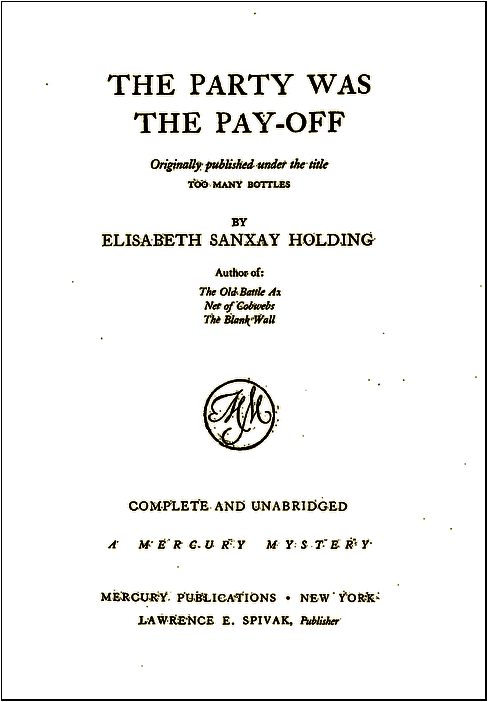
"The Party Was the Pay-off," Mercury Publications, New York
JAMES BROPHY was a writer, a mild man and hardly homicidal, but as he gradually realized that his wife, Lulu, was little more than a self-pitying shrew, there were times when his inclinations became slightly murderous. Life in the Brophy household was far from placid and something was bound to happen. The something happened on a Sunday afternoon when Lulu gave a cocktail party—the party that was the pay-off. For Lulu grew more and more frenzied and more and more pallid, and by morning the party was over and Lulu was dead. That was when James Brophy, writer, became James Brophy, suspect, a man without an alibi. He concentrated desperately on the party. Wasn't it possible that something suspicious had been said there? Couldn't that something have been overheard? Now, if only he could find a person with a clue, if only that person would stay alive long enough....
THIS party is the pay-off, James Brophy said to himself, as he began to shave. The buzz of the electric razor seemed to him unusually loud this afternoon, like an angry bee shut into the stifling bathroom with him. The afternoon sun made the opaque window blaze like a diamond; the mirror was misted from the hot water he had run, distorting his image a little.
God! he thought. It's hot in here. But the damn window won't open, and if I open the door, Lulu will come in. She'll sit on the edge of the bathtub—"perch" is what she'll say. And she does "perch." On railings, on the arms of chairs. She'll want to talk about this party, and it will be a damn mistake. It's the pay-off. That would make a good title. The Party Was the Pay-Off, This woman would be giving a cocktail party, and somehow she asks the one person in the world she's afraid of. Blackmailer? No. Someone who wants to murder her?
He was growing interested in the idea, almost excited. Someone brings this fellow, he went on. She's been hiding from him—changed her name. Thinks—Oh, Lord! Here she comes! Lulu!
A door had opened, along the hall; he heard the sharp tap of high heels. She always sounds as if she were walking very fast, he thought. But she isn't. She's like a little wooden horse, prancing up and down in the same spot. The knob turned; she was trying to open the door.
"Let me in, Jimmy—Jim," she called.
"Can't, right now, Lulu."
"Yes, now! I want to get some medicine."
She rattled the knob hard, and that was a thing that irritated him.
"In a moment," he said.
"Now!" she cried, rattling the knob again. "I want to take my medicine before the people come!"
"In a moment," he answered. "You have plenty of time."
That made her very angry. Once more she rattled the knob, she gave the door a kick, and then he heard her sharp heels prancing away. Couldn't let her in, he thought. Couldn't have her opening the medicine cabinet right in my face while I'm shaving. Lord, what a lot of medicine she takes!
He was not angry at her, or even seriously annoyed. That's married life for you, he thought, and that was his custom. The things that wearied and exasperated him he blamed married life for, and not Lulu in particular. His parents had been forever bickering; he had married friends who were like that; you saw and heard such couples on the radio, in the movies, in comic strips—the wife stamping her foot, ordering her husband to mow the lawn; the husband cringing up the stairs, shoes in hand, after a poker game with the boys. He had never wanted to marry, and to this day he could not quite understand why he had done it.
He had met Lulu on a West Indies cruise, the first time he had ever been aboard a ship. She was a pretty little woman, and very popular; he was flattered that she should single him out. And he had thought then that she was sophisticated, a woman of the world. She had lived in Paris and in London; she knew people in New. York, well-known, even famous people; writers, artists, musicians. Yet she had shown so great an interest in his work.
"But I'm no celebrity," he had explained. "So far, I've worked mostly for the pulps. I'm just beginning to break into the slicks."
She had wanted to know what the pulps were, and what the slicks; she had wanted to know what he was working on then; she had listened with an interest he had never before encountered.
"I think artists ought to be taken care of," she had said.
Brophy believed that he was a pretty good writer, and that someday he would be a very much better one, but he was not inclined to think of himself as an artist.
"I want you out for a week-end," Lulu had said. "You'll have a room and bath to yourself, and the sun-porch, to work in, and absolute peace and quiet. My sister Norma will be there, for a chaperone."
Well, he had come out here, to this very house, and it had been as Lulu promised, peace and quiet for his work, and, in addition, the company of the two pretty, gay sisters, wonderful meals, sweet, sunny spring weather.
He had gone home to his gloomy little hotel room in New York, and, as soon as he had enough money, he had called up Lulu and invited her to dinner and a show.
"Oh, that's awfully nice of you!" she had said. "But I'm simply morbid about coming into New York in the summer. Couldn't I get you to come out here again? Come Friday, and make it a nice, long week-end."
"Well, but..."
"Do come!" she had said. "We'd love it."
Me had accepted, and it had even been better than the first time; the peace and quiet for his work, the delicious meals, the good drinks, the cheerful companionship of two young and pretty women. Norma was the younger and the prettier of the two, a slender girl, with chestnut hair and beautiful dark eyes; she was very quiet, with a slow and gentle smile, and she played the piano in a way that seemed to his uncritical ear remarkable and charming. There had been a time when he had thought he was more attracted to Norma. But not for long. She was too hard to talk with; indeed, if he had not been so fond of her, he would have called her a first-class bore.
And Lulu had never bored him. She would tell him little incidents from her former life, about trips she had made with the husband she had divorced. He had been pleased that she never said a word against the man, never complained of him; she would just mention him casually. When Mel and I were in Rome—something like that. She did not use his name, and Brophy did not know what it was, or care.
There had been days when she had been pale and fatigued. I couldn't sleep, she would say, or it's this migraine. I'm no good to anyone. Then she would not try to talk; she would sit in the garden with him, or in the living-room, and turn the pages of a magazine; sometimes she would lie back, with her eyes closed, and he knew he could either stay with her, or stroll off to find Norma. She never bothers you, he had thought. She's too independent.
They had had very little company; only now and then a few local people in for cocktails. I like to entertain, she had told him; dinners, everything. But two women alone, two sisters... It's rather ridiculous. Anyhow, I can take people, or leave them.
"You're pretty independent, altogether, aren't you?" he had asked.
"Thank God my father left me so that I could be," she had said.
Well, he had learned now, after a year of marriage, that she was not "independent," but desperately clinging. He had learned that she had no scruples about complaining of her former husband. And he had learned how she really felt about people, about entertaining; he knew now of her almost frantic desire to be "popular."
"I used to be!" she had cried. "I don't know what's the matter now. Maybe it's because I've been dragging Norma everywhere with me. Or—"
"Or if it's me?" he had asked, and she had made no answer to that.
Brophy himself had never thought about being popular; he had friends, old and greatly valued friends; there had been girls who had certainly shown no aversion to him. When he wanted company, he could always find it. But for the greater part of his time he was alone, and had to be alone, to do his writing. In the beginning, he had thought Lulu exaggerated the situation; he could see no reason why people shouldn't like them. But little by little, he had to face the truth. They almost never got an invitation; they were left out of things; Lulu would read the little local newspaper and point out to him that this neighbor or that one had given a garden party, a dinner, a Sunday lunch at the Country Club. And not asked the Brophys.
What really and sharply brought it home to him was the episode at Mrs. Wylie's garden party, to which they had been invited. Two girls had been standing on the lawn, facing the house; they had not seen or heard him coming up behind them.
"Oh, Lord!" one of them had said. "Isn't that the awful Brophy's car parked there?"
"Yes," the other said, and he knew her: Biddy Hamilton. "But I haven't seen the gorilla around, have you?"
He had moved away then, in haste, to prevent Lulu coming any nearer and hearing anything like that. But he could not forget.
He unplugged the razor and dried his face, and for a moment stood contemplating his image in the mirror. He was stripped to the waist, a sturdy young man of thirty-five, his broad chest tattooed with a green and blue mermaid. Such a hateful, vulgar thing, Lulu called it, from time to time, but he was rather fond of that mermaid; it reminded him of his three war years in the Merchant Marine. He was of a good enough height, five feet ten; he was straight, strongly built, only his arms were too long. He had, naturally, known since he was a kid that they were long, but it seemed to him now that they were—grotesque. He looked at his face, and it seemed different, almost unfamiliar. The map of Ireland, one girl had called it. But now—he didn't know.... The dark, curly hair that grew low on his forehead, the deep-set dark-blue eyes, the long upper lip... Gorilla?
Biddy Hamilton was one of the people Lulu had invited, sending out bright little cards. "Cocktails—6-8. Don't bother to answer. Just come!" She sent out over forty of these, many to New York; she had liquor enough for thirty-five, canapés of all kinds from a caterer, an extra maid.
I wish to God she hadn't done this, he thought. She'll be badly upset, miserable, if only a handful of people come. Now, in this story, the Party Is the Pay-Off, the hostess will be very popular. Has to be. Woman of the world. She's happy, pleased with herself. Until she sees this man arrive, brought by somebody else. She's been trying to avoid him, changed her name, and so on. He's a blackmailer? No.... I don't like that.
He unlocked the bathroom door and stepped out into the bedroom. Lulu was sitting at the dressing-table, putting on her make-up by the special light over the mirror, a fierce, white light, very unflattering. It's meant to be, she had told him. It shows up even the tiniest blemish.
"Hurry up and dress, Jim," she said, frowning, "Someone might come early."
"I will," he said.
Not a blackmailer..., he thought. No! No, look here! It's,not a man that comes in, to make all the trouble. It's a girl. I'll make her very nice, pretty. And the man the hostess thinks she's got hooked has been looking for this girl for a year. He's in love with her.
"There!" cried Lulu. "The doorbell! Fix my medicine for me, Jim, quick!"
"What medicine?"
"It's a new bottle that hasn't been opened, quite a small one."
"What color?"
"Oh, it hasn't any color! Do hurry up! It takes a little while to act, and I need it. I feel wretched today."
"I'm sorry, Lulu."
"A tablespoon in half a glass of water," she said.
He found the unopened bottle in the bathroom cabinet, and the spoon she kept there; he measured out the dose and brought it to her.
"Just put it down here on the dressing-table. I can't stop now...."
She was darkening her lashes, one eye tightly closed, as if in a painful squint; he watched her while he dressed.
"I'll go down now," he said. "Don't hurry too much, Lulu. I'll look after things, if there's anyone there."
"It's very likely someone you don't know."
"Well, even at that...," he said, smiling a little.
"Try not to be too Bohemian," she said, and picked up the glass of medicine.
That was a word she used often, and it irritated him; when she had first begun calling him "Bohemian" he had protested forcibly. But not any more. There's never going to be another quarrel, he had said to himself, long ago, and he had held to it. The quarrels they had had, in the early days together, had been intolerable to him. She would become hysterical, screaming at him in a voice that rang in his ears long after: twice she had rushed at him, pounding his broad chest with her fists, calling him anything, everything. I hate you! I hate you! Get out of my house!
But she did not hate him, and certainly she did not want him to leave her. He knew that. She could not master these frantic outbursts. He had heard her screeching at Norma, and a colored maid; sometimes when she was driving the car, some other driver would do something that enraged her; her olive-skinned face would flush darkly; she would begin to drive recklessly, until he had to take over the wheel. She would go on and on about that other driver, calling him—or her—the ugliest names she knew. Then, in time, the fury would ebb away, leaving her exhausted, pale, yet somehow relieved.
He had realized, months ago, that this was a most unhappy and unfortunate marriage for him. The "peace and quiet for your writing" that she had used to promise was lost; he had trouble enough to get any time alone. He never asked a friend of his to come here; he very seldom went in to New York. But he had his work, after all; he saw his old friends when he did get to the city; he was healthy, unexacting, and he had, in his mind, an unreasoned hope that somehow, at some time, things would get better.
As he stepped out into the hall, he saw that the door of "his" room was open. It was not his any longer; it was the one he had used to have, when he had come here as a guest; his own bathroom opening out of it, a little balcony. Norma was in there now, arranging flowers in a vase.
"This is the Ladies' Powder Room," she said, and smiled a little. "There's going to be a maid in a uniform. Does it look nice, Jimmy?"
"Very. And so do you."
He did not entirely mean that. She was always pretty, with her fair skin, the sweet color in her cheeks, her shining chestnut hair; she was well-made, too, with a fine, proud bosom and long legs. But he did not admire her clothes; nor the rose-pink dress she was wearing now, with a flowered silk sash in a big bow at one side, fancy short sleeves, fancy low neckline in scallops, a white bead necklace and a bracelet to match. Too fancy. She had nothing of Lulu's style and taste, poor girl. Always looks like a hick, he thought, a village maiden.
"Come in and have a cigarette," she said.
"I'd better go downstairs," he said. "Lulu thought she heard the doorbell."
"It's not quite six yet," said Norma. "But maybe you'd better go and just see...."
He went on down, and in the big living-room he saw Biddy Hamilton sitting in a chair, all alone. Now, why did she come, he thought. You wouldn't think she'd want to visit the Awful Brophys. The gorilla.
She was, he thought, a remarkably attractive girl, very tall, with red hair that she wore brushed flatly back from her thin face and done in a funny little knob at the back of her neck; long blue eyes under straight sandy brows, and an air of almost insolent assurance.
"Hello!" she said. "I didn't mean to be so early. My watch was slow."
"You couldn't be too early," said Brophy. "I'll get you a drink."
"Two different maids brought me drinks," said Biddy. "But I refused. I didn't think it would be mannerly to sit here drinking alone."
"My presence makes it absolutely correct," he said. "Cigarette?"
While he was lighting it for her, a maid came in with a tray of cocktails, followed by another maid with canapés.
"Ah...!" said Biddy. "How beautiful!"
She helped herself to four canapés, and at once bit in two something like a tiny pie.
"Ho! she said, with pleasure.
The girl in my Party story could be her type, more or less, thought Brophy, sitting on the arm of a chair and watching her. She's been avoiding the man the hostess wants, but she loves him. Why has she been running away from him? Because she thinks he's guilty of—something? No. That's the pulp touch. It's got-to be more psychological. No, She thinks—
The doorbell rang, and a maid ushered in a couple Brophy had not seen before, a stout blonde woman in a tailored black linen suit, and with her a dark man, black eyes popping out of his head, a half-open, astonished mouth.
"Are you possibly Lulu's husband?" cried the blonde. "My dear, I'm thrilled! A real, live author, Froggy! I'm Billie de Paul, and this is my little playmate, Jack Lord."
Her exuberance was agreeable to Brophy. Cocktail in hand, she walked all round the room, looking at the pictures, her long, white jade necklace bouncing up and down on her plump bosom.
"I'm crazy about Art," she explained. "Whenever I go into a strange room, I can't settle down until I've looked at the pictures on the walls. Oh, isn't that utterly charming! Froggy, come here and look!"
"Later," said Froggy, in a deep mournful voice.
Then in came Mrs. Wylie and one of her daughters; the young man who ran the lending library in the village came, an old, old couple from the neighborhood, a lively young girl, escorted by a boy, a tall, bony woman in a black hat with a peaked brim that almost touched the bridge of her hose, a fattish young man in a short-sleeved yellow shirt and no jacket.
One, two, three, four, five, six, seven, eight, nine, ten, eleven, twelve, Brophy counted. Well, that's something, anyhow. Only, what's the matter with Lulu? Why doesn't she come down? And where's Norma? The party was getting on very well, making a good, cheerful noise; nobody was left out, or sitting in a corner; plenty to eat and drink. But he was uneasy at Lulu's absence.
"Where's Lulu?" Billie asked him, three or four times, and, a little later: "Suppose I just scamper upstairs and drag her down?"
"No!" said Brophy, hastily. "It's—probably a long-distance call. She'll be along in a few moments."
She was coming now; he could hear the sharp tap of her heels on the stairs; she was coming fast, too, faster than he ever heard her come. She almost plunged into the room.
"Billie!" she cried, in a sort of scream. "And Froggy!"
She snatched a cocktail from the maid's tray, and swallowed it, and hurried forward, both hands outstretched.
"It's been such ages!" she said, in that same high, loud voice. "Tell me everything—about everybody. Maid!"
She took another cocktail, and stood there between Billie and Froggy, and Brophy thought she had never looked better, never had been more chic. She wore a new dress, of thin black material, with narrow white ribbons threaded in and out round the neck; sandals of crossed black ribbons; her shining black hair was waved close to her fine little head; her dark eyes were brilliant.
He waited, reluctant to interrupt her talk, but at last he felt obliged to go to her side, and touch her arm.
"Better say hello to Mrs. Wylie and the others," he murmured.
"The hell with them!" she said aloud, and did not move, or even turn her head.
"Lulu... The Jobsons are here—"
"Let me alone!" she cried. "You go and talk to them. These are the only people I want to see."
She staggered a little, and caught Froggy's arm to steady herself.
"Jimmy...," said Norma's voice at his side, very low. "Perhaps you'd better—let her alone."
He turned, and at the sight of Norma's face his brows drew together. "What's the matter?"
"I don't quite know.... But she's—so keyed up.... If you could just get her not to drink any more, Jimmy."
"She never drinks much. You know that, Norma."
"Yes. But... She had a bottle—an opened bottle of whiskey on her dressing-table, Jimmy. I saw it when I went to tell her to hurry."
"She was pretty nervous about this party," he said. "Maybe...."
Mrs. Wylie had come up to Lulu.
"Good-night, Mrs. Brophy," she said, very distinctly and very frigidly. And no wonder, thought Brophy. Lulu had not spoken to her, or even once glanced at her.
"Don't go now!" she said, loudly. "There'll be a crowd of people coming out from New York any moment, and I want you to be here."
"I'm sorry," said Mrs. Wylie, "but we really can't stay. Good-night!"
"All right then!" cried Lulu. "Get-out, and stay out!"
The elderly Jobsons now approached, obviously nervous.
"I'm afraid—," Mrs. Jobson began.
"No!" said Lulu. "I don't want you to go now."
"But I'm afraid—"
"No!" cried Lulu. "Go and sit down and have another drink. I want you to wait."
They retreated to a corner, where Mrs. Jobson sat in a big, high-backed chair, and her husband stood beside her; they shook their heads when drinks or appetizers were offered to them.
"We might sit down ourselves," said Lulu. "Come on, Billie and Froggy."
She started across the room, glass in hand, and no one could fail to see how she staggered. She half-fell onto the sofa where Biddy Hamilton was sitting.
"Move, will you?" said Lulu. "Sit somewhere else. I want my friends here."
"All right!" said Biddy, amiably, and picked up a glass from the coffee table.
"That's my glass!" said Lulu. "Put it down!"
"All right," said Biddy again, and taking the other glass from the table she moved leisurely away, followed by the fattish young man in the sports shirt.
"She's a bitch," said Lulu, for anyone to hear. "Look at her! If she can't get a real man, she'll take—"
"Lulu!" said Brophy.
"Shut up!" she shouted, and kicked him on the shin, hard.
He stepped back, out of reach, and tried to think of a way to end this. I can't carry her away, he thought, and I'm not going to leave her here. I don't know.... My God! I don't know what to do. A maid came up to her.
"New York on the telephone, madam," she said.
"I'll take it!" cried Lulu. "Tell them—I'm coming!"
She could not get up until Froggy helped her; when she tried to cross the room, Brophy took her arm. She pulled away from him, and fell on her knees.
"Get out!" she screamed. "Let me alone!" -
Biddy Hamilton took one of her arms and Brophy the other; they got her on her feet, and out into the hall. Norma was waiting there.
"My call! My New York call!" she shouted. "Let me go!"
"Take the call in your room, Lulu," said Norma, and in a whisper, "Can you carry her up, Jimmy?"
She struggled frantically in his arms; she screamed and swore at him; she began to claw his face, and he hitched her up over his shoulder and began to mount the stairs.
He wondered if Biddy were still in the hall; maybe there were other people, too, watching.
"Lulu...," he kept saying to her, in a whisper. "Take it easy, Lulu."
HE carried her into the bedroom, and when Norma had followed them inside, and shut the door, he set Lulu down and turned the key in the lock. She rushed at him, and he dropped the key into his pocket.
"Don't," he said, absently, watching Norma take the bottle of whiskey from the dressing-table and lock it in the closet.
Lulu stood turning her head, her eyes glaring; then she ran lurching over to the telephone, and, trying to lift the transmitter, she knocked the instrument to the floor.
Norma picked it up, and Brophy caught his wife as she reached an open window,
"Norma," he said, "call Doctor Griffin."
"Oh, Jimmy, no! Let's not get anyone else into this. It's bad enough."
"She ought to have a sedative, something. She's... Maybe it's the D.T.'s."
"People don't get D.T.'s unless they've been drinking a long time, Jimmy."
And has she been drinking a long time? he thought. Was that the cause of her hysterical outbursts? He had never seen a whiskey bottle in their room before; he had never noticed any smell of liquor about her; he had never known her to take anything more than two cocktails before dinner, or at a party. But he had heard about the slyness of secret drinkers.
"Get Doctor Griffin, Norma," he said. "This might be serious."
He and Norma had both become curiously numb to Lulu's screams and struggles. Brophy held both wrists in one hand; she tried to kick him, but she could not, and he no longer heard anything that she screamed at him.
"Jimmy, no! Jimmy, let's wait, and see if she doesn't quiet down."
"No. Call him now, Norma. She'll exhaust herself—to the danger point—like this."
"Jimmy, please! Jimmy.... He might—send her away."
"What d' you mean?"
"She's been so—so queer, lately. Oh, Jimmy. Give her a chance! She's had—so much trouble in her life."
"What d' you mean?" he asked, again.
"Just wait, Jimmy, and see if she doesn't—quiet down."
"Norma," he said, holding fast to the struggling, screaming creature, "she needs medical attention. She's—"
There was a violent drag on his,hand; Lulu had sunk to her knees. He raised her, and she was limp, her eyes half-open.
"You see!" cried Norma. "She'll go to sleep now, Jimmy. This is all she needs."
He laid her on the bed, and stood looking down at her.
"I don't know...," he said. "She looks—I don't like her color. I'd rather call in Griffin."
"Oh, Jimmy, don't, please! She'd hate it so. I can look after her now. I've done it before."
"You've—seen her like this before?"
"She just needs to be let alone for a while, Jimmy. Shell wake up in two or three hours, and I'll give her a glass of milk, and two pills."
"What pills?"
"Sedatives. Then she'll go to sleep again, and it'll be a good, restful sleep."
"Norma, d'you mean that she—she often...?"
"Not often," said Norma. "Leave her with me now, Jimmy. Hadn't you better go downstairs and see—if everyone's gone?"
He stood silent at the bedside for a time. I can't do it, he thought. But he had to do it. Perhaps they were all still there; perhaps more people had come, and they would all be eating and drinking and laughing, and whispering about Lulu.
Lulu's got allergic to alcohol, he thought. That's what I'll say. Just within the last few weeks. Can't touch it without bringing on one of these attacks. The thing is, that she couldn't quite believe it, and this afternoon, she was so pleased to see everyone....
That was the best he could think of; he unlocked the door and went slowly along the hall, elaborating his story. She'll probably be laid up now for two or three days, after just those two cocktails. The lucky part is, she won't remember a thing. If anyone calls her up tomorrow, say what a—good time they had ...
If I say that, he thought, then maybe some of them will call her up. That would help her. But maybe she will remember. Some of it, anyhow. Poor girl! Poor devil!
As he went down the stairs, he heard no sound of voices; when he came to the doorway, he found the living-room empty. The windows were open, and the flowers in bowls and vases stirred in the light summer wind. Everything was in order; the plates and glasses removed, the ash-trays emptied; each chair and table in its proper place. The party's over, he said to himself, with a sigh of relief.
The Party Is the Pay-Off, he thought. I'll have to have a scene at the end of that, of course. Dramatic. But I'm going to keep it a little understated. It'll all be there, hatred, violence, shock—
Why, shut up! he cried to his own mind. This is no time to think about your damn story. The real thing that's happened here is a tragedy. That's no exaggeration. I don't know how Lulu'll get over it, poor girl. Maybe other people came—
Their own housemaid, Regina, had come up behind him.
"Excuse me, sir, but will there be anybody extra for dinner?"
"No...," he answered. "Mrs. Brophy's not well. You might take a tray up to her room for Miss Crockett."
"Then there'll be just yourself at the table, sir?"
"Only me," he said.
He went upstairs to knock at Lulu's door.
"Just a moment!" Norma answered; and presently when she said, "All right, now, Jimmy," he found that she had got Lulu undressed and into a pale-blue nightdress and bed jacket. She lay back against the pillows, her lashes inky-black, in contrast to her dreadful pallor, her mouth still a vivid red from her lipstick.
She doesn't look right, he thought. She doesn't look—real. He went over to her, and laid his hand on her chest, and he was glad to feel the very gentle rise and fall of her breathing.
"But anyone who's been drinking generally breathes heavily," he said.
"Not everyone, Jimmy. Try not to worry."
"Regina's bringing you a tray. After dinner I'll come up and stay with her, Norma, and you can get some rest."
"I'd rather stay with her tonight, Jimmy. You see, I—well, I've done this before, and I understand just what to do."
"Stay here all night?"
"Yes. You can sleep in your old room, Jimmy. If I should need you, I can get you in a moment."
"Thanks, Norma, but I'd rather stay with her."
The gold-shaded bedside lamp was turned on, but Norma stood outside its orbit of light.
"Jimmy," she said, in her quiet, even voice, "we've got to think of Lulu. And when she wakes up, I'm sure she'd rather—find me here."
You never knew about women, he thought. Never! Maybe when she wakes up, she'll be sick— wouldn't want me to see her. God knows.
"Suppose we just get Griffin to take a look at her," he said. "See if her—breathing is all right, and so on."
"Oh, think how she'd hate that! Jimmy, let's wait. We can call him first thing in the morning, if she isn't all right."
"You've seen her like this before?" he said. "I mean—so pale. I mean—this shallow breathing?"
"Yes."
"More than once?"
"Yes, Jimmy. More than once."
Of course, he thought, Norma could be wrong. Lulu might want it to be me here when she wakes up. But then she'll send Norma for me,
He went down to the dining-room and sat at the place that was laid for him. The dinner was excellent—bluefish, baked with anchovies—and he was a little ashamed that he had so good an appetite. Lulu never seems busy, he thought. You'd never know she lifted a finger. But she runs the house perfectly; all the meals are fine, and served on the dot; everything is clean and comfortable. Well, could she do that if she was a "secret tippler"? "More than once...," Norma had said. A bottle of whiskey in the bedroom; those hysterical scenes....
All right! he thought. If it is that way, something can be done for her. Maybe she and I could go away for a while, take a trip. Or move out of this neighborhood altogether and start all over again, somewhere else. That would be the best thing. She'll never be happy here again.
If she remembers. She's sure to know that something went wrong, and she'll want to know who was here. That would be of paramount importance to Lulu, sick or well. Out of the more than forty people she had invited, how many had come? Twelve.
Unless there were some more later, who went away when they heard something was wrong. She'd like to know if anyone else—especially those New York friends—had come. It would make her feel better, poor girl.
He did not like to ask the maid; nor the Jobsons. The affronted Mrs. Wylie had left while he was there; the scholarly library owner was out of the question, and he did not know the names of the lively girl and her escort, or the fellow in the sports shirt. He would not have wanted to ask them, anyhow. There was nobody but Biddy Hamilton, and somehow it seemed easy and simple to ask her,
He went, after dinner, to the telephone in the small library and looked up the number listed under her father's name. President of the local bank, Slowe Hamilton was, a benign and portly man with a handsome wife, two pretty daughters, and a handsome son. Brophy knew their house very well—from the outside; an old-fashioned sandstone house, like a little castle with two turrets, set well back from the street behind a wide lawn. Driving past it in the afternoon, he had seen people on the terrace that was decorated with massive stone jars filled with trailing ivy, or sitting out on the lawn in deck-chairs; one time, driving past it in the evening, he had heard someone playing a piano inside, had seen the ground-floor windows lighted, a light in one of the turrets. He imagined a family life, going on in there, old-fashioned, the mother taking the daughters shopping, two sisters on the window-seat in a bedroom, talking secrets, the father coming, home to a hearty dinner, young men in the evening, old-fashioned beaux, bringing a bunch of flowers, a box of chocolates. There was certainly nothing in any way old-fashioned about Biddy, but that was the way he chose to imagine the Hamiltons' life.
A maid answered the telephone.
"Will you ask Miss Biddy, please, if she can speak to Mr. Brophy for a moment?" he asked, and Biddy came, promptly.
"Sorry to disturb you—," he said.
"You're not," she said. "Anything but. Somebody else has just dropped in to teach me to play canasta. I don't know why I feel I have to keep on trying. I hate card, games, all of them."
"I can play Bingo," he said.
It was so easy to talk to that girl, who was so easy herself, so casual.
"I mustn't keep you from your lesson," he said. "I only wanted to ask if you'd happened to notice anyone else...? I mean, any more—guests, after I—went upstairs."
"No, I didn't," she answered. "But, you see, I left, almost right away. I asked the whole crowd over to my place. Some of them came, and some didn't, but anyhow we all went flocking out together,"
"Thank you," he said, and after a pause, "thank you."
"Well... Au revoir!" she said.
He went upstairs then, and knocked at Lulu's door. Norma opened it.
"Sound asleep!" she whispered. "Get a good night's rest, Jimmy dear."
He turned away, to the room where he had used to sleep, and he found the bed turned down, pajamas and dressing-gown laid out, slippers side by side. There were magazines and books on the bedside table, a thermos jug of ice-water, cigarettes, matches, an ash-tray. Norma must have done all this, he thought. The way Lulu used to do. Very kind of her.... But the comfort and peace of the room had no appeal for him now; he sat down in an armchair and lit a cigarette, and a black cloud of anguish came down upon him. Lulu will sleep it off, he told himself. She'll be all right tomorrow. Tomorrow and tomorrow and tomorrow.... There's some poem like that, isn't there?
His easy-going optimism had left him; he could no longer think, This will pass, things will get better. If what Norma implied were true, if Lulu was, in fact, a secret drinker, things would, inevitably, grow worse. There would be more and more "scenes." I can't help her, he thought. I couldn't make her happy. I—couldn't even pretend ...
He could never again, he thought, take her in his arms without remembering the screeching, clawing hell-cat he had carried up the stairs. He put his hand to his cheek, and when he withdrew it, there was a little blood on his fingers.
All right, he thought. She wasn't herself. She didn't realize... You've got to be decent. You've got to have pity....
After a time, he went back to her room again, and again Norma opened the door. She was still wearing the fancy pink dress, but she had taken off her shoes, and her rich chestnut hair was disheveled.
"Still sleeping, Jimmy," she said. "Do try to get some rest."
She kissed him on the cheek, as she had done often before, a thistledown kiss. He patted her shoulder and went off, back to his room. He undressed and got into bed, he turned out the light and fell asleep at once.
The sun was up when he opened his eyes, and Norma had her hand on his shoulder.
"Jimmy!"
Her quiet voice seemed to him ominous.
"Is it—Lulu?" he asked.
"Yes, I'm afraid—"
"She's worse?"
"I'm afraid—"
He got up and put on his dressing-gown and slippers; he was in a hurry to get out, but Norma caught his sleeve.
"Jimmy, dear, before you go... Jimmy, she's—gone."
"Gone?" he repeated, and frowned, "Where?"
"She's dead, Jimmy."
That made him angry.
"I don't believe it," he said. "It's impossible."
"Jimmy, the doctor's here."
His frown deepened; he looked at Norma with a sort of stupid amazement. He felt stupid; not able to understand the words he heard.
"The doctor? You sent for the doctor—without calling me?"
"Jimmy, I wasn't sure. I thought perhaps I was."
"She got worse? But you didn't let me know?"
There were tears running down Norma's cheeks, but they did not move him at all.
"Why didn't you call me when she got worse?"
"You see—it wasn't like that. I went to look at her every hour or so—and the last time I looked—" A sob made her pause. "I was—afraid. So I called up the doctor."
"And not me. Why didn't you tell me?"
"I thought that if it wasn't—serious, after all—"
"All right!" he said, curtly. "Let me go, Norma. I want to see...."
The bedroom door was open, and standing by the window was a man he had never seen before, a tall, thin, black-haired young fellow with his hands in his pockets. He took them out as Brophy entered; he put on a grave expression, like a transparent mask over his cheerful, blunt-nosed face.
"Mr. Brophy? I'm Doctor Binder. I'm looking after Doctor Griffin's patients while he's away at the convention. This is a very sad thing, Mr. Brophy."
Brophy went over to the bed and looked down at Lulu. She's gone, Norma had said, and that was the right word. She was not greatly changed in appearance, but you could see that she had gone.
"Why should she be dead?" he demanded.
"Well, that's a question we can't answer. Mr. Brophy," said the young doctor. "Very sad thing, at her age. She came to see me twice, you know, about what she believed were heart symptoms. I strongly advised a cardiogram; but she wanted, to postpone it for a while. My examination, in the office, didn't point to anything very serious, but these cases—"
"She died of a heart attack?" Brophy interrupted.
He was being rude, and he meant to be. He didn't like this doctor; he didn't like anybody. He was hostile, and angry.
"And all that alcohol was the worst thing possible," said Doctor Binder.
"What d'you mean by 'all that alcohol'? You don't know...."
He bent over, and, as he had done before, he laid his hand on Lulu's chest. Her skin was cold. And there was a reek of liquor about her.
But it wasn't like that before, he thought, startled. Did Norma give her anything more to drink? He straightened up and looked at Norma, and he was angry at her, too. One of the shoulder-pads in the pink dress had slipped down her back, giving her a hunched, lopsided look; her thick hair stood out in a bush; her face was mottled by tears. He turned toward the doctor.
"Well?" he demanded. "What are you going to do about it?"
The doctor was somewhat disconcerted.
"I'm afraid there's nothing further I can do, Mr. Brophy," he said. "I'll make out a certificate, and—"
And that was all. He was going to walk off and leave Lulu—like that.
"Have you tried anything? Done anything to—to revive her?"
"Jimmy...!" said Norma. "Jimmy, dear...."
"The patient had ceased breathing before I arrived," said the young doctor, stiffly. "About two hours ago, I should say."
Brophy drew the sheet up over Lulu's face, and stood back, leaning against the wall with his arms folded, while Norma and the doctor went out of the room. She's dead, he said to himself. She died, and no one told me. They were in here together, those two, like two damn buzzing flies, and they didn't tell me. If I'd known... If we'd got a doctor earlier... A different doctor.....
It seemed to him that this death was his fault; the guilt of it made his heart like lead. If I'd stayed with her, myself..., he thought. Not left it all to Norma.
He heard Norma coming back along the hall, shuffling in her mules.
"I called Regina," she said. "If you'll get dressed now, Jimmy, we'll have breakfast."
"What? Just leave her here?"
"I've—made arrangements, Jimmy. The undertaker will be here at ten, to talk to you. And Doctor de Peyster, from St. Andrew's, a little later." He was silent for a moment.
"Norma, look here...!" he said. "I—if you wouldn't mind—I wish you'd—put some perfume on her."
"Perfume, Jimmy?"
"Yes. Sort of—sprinkle it around. The thing is—" He paused. "There's such a damn strong smell of—liquor."
"I didn't notice it, Jimmy. But anyhow it would evaporate, dear."
With an effort, he went over to the bed and drew down the sheet; he bent over the rigid little doll that lay there, all in blue silk and satin and lace.
"No!" he said. "It's enough to knock you over."
"But I don't think perfume—" Norma began. "I think that would be worse."
He went to the dressing-table. There was an empty atomizer there and beside it a tiny bottle labeled Amour du Diable. He took out the stopper and sniffed it, and it seemed to him overpowering and horrible. But Lulu knew about those things; she always bought the best. He filled the atomizer and brought it to the bedside; he sprayed her hair, her neck, her nightdress, the pillow.
"Jimmy!" cried Norma. "Oh, don't! No more!"
The whole room was filled with the intolerable perfume; it was like a mist, like the smoke of some ancient erotic incense. A wave of nausea swept over him; he put his hands into his dressing-gown pocket, so that Norma should not see them clenched.
She drew the sheet over Lulu again.
"Jimmy, you'd really better get dressed now," she said, and for the first time since he had known her there was a kind of coldness in her tone.
All right! he said to himself. All right! I don't like the idea of this—undertaker fellow finding the room like this any more than she does. But it's better than the other.
He went out of the room reluctantly, and in his dazed mind was a feeling that some monstrous wrong had been done to Lulu. Why should she be dead? he kept asking himself.
HE had breakfast alone with Norma, and Regina waited on them, sniffling, giving a suppressed sob from time to time.
"She must have been fond of Lulu," Brophy said, when the girl was out of the room.
"I don't think so," said Norma. "It's just a servant-girl theatricalness."
Brophy did not agree. Thin and flat-bosomed, with pale, dust-colored hair, a pale face with a big bony nose, Regina seemed a creature without age; you could, thought Brophy, easily imagine her going off to school, in a middy blouse, and dark skirt, and long black stockings, with this same face and figure and hair. But she had always seemed to him entirely honest and guileless. When she broke anything, she had come to him, or to Lulu, weeping, making no excuses. I dropped it. I knocked it off the table.
She was fond of Lulu, he thought. And who else?
"We ought to send telegrams," he said.
"I telephoned a notice to the New York papers," she said, "and the local paper."
Her chestnut hair was smooth now; she was pretty again, in a black cotton dress with a white embroidered collar.
"Thank you," he said. "But aren't there any relatives?"
"No," Norma answered. "None that she'd want here. And her friends will see the notice in the newspapers."
She was distrait this morning, exhausted and hollow-eyed; she was strange, as everything else was strange, and unreal. She went off to the kitchen after breakfast, and Brophy did not know where to go, or what to do with himself. He had put on a dark suit, too heavy for the warm weather, and a black tie, left over from a war-time funeral; he felt clumsy and foolish, entirely at a loss. It didn't seem right, he thought, to read the newspaper; he walked up and down the sun-porch, hands clasped behind his back, until the undertaker came."
Caulish, his name was, and he was a very decent fellow, quiet, serious, with none of the maudlin sympathy Brophy had dreaded.
"Miss Crockett tells me that Mrs. Brophy wished to be cremated," he said.
"Well... Brophy said. "I don't know. We never discussed it."
"I suppose her sister would know."
"Yes...," Brophy said.
"At three o'clock tomorrow afternoon, isn't it?"
"Tomorrow? Too soon," said Brophy.
"I understand that's what will be in the newspapers, Mr. Brophy."
Norma's taken too damn much on herself, Brophy thought, with a flash of annoyance. But it passed off at once, and he felt a little ashamed of it. After all, he thought, I didn't do a thing, didn't make a move. And somebody had to take charge.
"Miss Crockett tells me you want everything very simple, quiet," Caulish went on. "She mentioned a sum.... I don't like to mention it now, but it's always better, Mr. Brophy. Better for the family to know exactly—"
"What sum?" Brophy asked. ,
"Miss Crockett said five hundred dollars."
Brophy had no idea whether that was a high price, or a low one, or simply average. Better leave it to Norma, he thought.
"Yes," he said.
Then, for the first time, he began to think about money. He did not like it; it seemed a sort.of cruelty to Lulu. He knew, of course, she had an ample income; the house was in a good neighborhood, there were always two servants, the food and the liquor were of the best quality; she had plenty of money for clothes, anything she wanted. He had known, from the beginning, that she had much more than he had ever earned, and he had been glad of that; indeed, he would never have asked her to marry him otherwise. She couldn't have lived on his average of four thousand a year. Whenever he sold a story, he gave her a check, keeping out enough for his taxes, his clothes, his small personal expenses.
"Someday you'll make a fortune!" she used to say. "You'll write a bestseller."
She had, he thought, been extraordinarily tactful and decent about money matters. No matter what "scenes" they had had, they had never been in any way connected with finances. He had never asked her for money; he had had enough of his own to buy what he needed, and he had felt independent. Only now, after Caulish had gone, did he face the situation squarely.
She supported me, he said to himself. My God! And she's probably left me money—a lot, maybe. I can't take it. I've been... My God! A kept man.
And why did I ever get married, anyhow? I didn't mean to. I'd made up my mind I never would. I suppose that was because of my parents. They didn't give me a very rosy view of—domestic life....
His father had been a captain in the Merchant Marine, on the South American run; he had been away eight weeks at a time. His mother had been a stylist in a department store, a tall, handsome, full-bosomed woman; she had made a good salary, she had a lot of friends. They had both been kind to him, and interested in him, nice people; he still didn't know why they had not liked each other, why they had lived apart and never seen each other.
Well, it didn't matter any more. Only that now, when he tried seriously and honestly to examine his own marriage, he could understand it. He had found Lulu attractive, but not more so than a dozen other women; he would never have thought of marrying her if he had not come here for those weekends.
And that, he had thought, was Home. The order, the grace, the quiet, the companionship—when he wanted it—of the two pretty, cheerful women.
If she's left me enough money, he thought, I could keep this place on; I could work here; I could ask Matthews to stay here. No!
He walked up and down the sun-porch, up and down, sweating in his heavy suit, trying to think things out, trying, in his fashion, to think out himself. Some writers, as he well knew, were autobiographical; they could look inside themselves and dredge out a passion, a grief, a joy; the heroes in their books were themselves, and the villains but another facet of themselves....
But Brophy knew little or nothing about himself. He was purely and simply an observer. He was interested in other people; he noticed how they acted, how they talked; in his writing, his characters had an excellent appearance of being real. But they haven't any insides, Matthews had told him. You've never even tried to understand what makes people tick.
It's true, he thought. I never understood Lulu. Did she—love me? And did I love her? Ever?
Regina came to the doorway.
"Doctor de Peyster's here, sir, and Mr. Jones."
Oh, Lord! thought Brophy, in a panic. Doctor de Peyster was the clergyman who had performed the marriage service for Lulu and himself; he had made little impression then upon the nervous bridegroom, and he had, since then, become obliterated. I don't know how to talk to a clergyman, he thought. He'll—I suppose he'll try to comfort me, and all that.
He felt obliged to go into the living-room, though, and there he found two clergymen, standing side by side, one small and elderly, with a thin and fine-cut face, the other taller, a weedy young fellow.
"Mr. Brophy," said the older man, "this is my curate, Mr. Jones."
Mr. Jones took Brophy's outstretched hand in a limp grip.
"Miss Crockett telephoned me this morning," Doctor de Peyster went on. "She asked me to conduct your wife's funeral service, and, naturally, I assented. I did not know, at that time, that it was to be a cremation."
"I see ..., said Brophy.
"I am sincerely anxious to avoid bigotry in my form, Mr. Brophy, and I can assure you I have given the matter long and serious study. I can come to but one conclusion. The burial service established by the Episcopal Church is not and cannot be adapted to cremation. Moreover, a conscientious reading of the Scriptures confirms my view. I cannot officiate at this cremation, Mr. Brophy."
"I'm sorry," said Brophy. "We can change it, then, to—"
"Miss Crockett assures me her sister was very strongly in favor of cremation. Very strongly. She had, in fact, exacted a promise from Miss Crockett to see that this wish was carried out. Had she—expressed this wish to you, Mr. Brophy?"
"We never talked about it," said Brophy.
"No? That's rather unusual, I think. Most of us, I think, take an interest in deciding upon our final resting-place."
He went on, and Brophy tried to listen.
"My young colleague, however," said Doctor de Peyster, "doesn't see eye to eye with me in this matter, and he will, if you wish, conduct the services tomorrow afternoon."
"Oh, thanks!" said Brophy.
"I wanted, however, to come and explain in person to you and to Miss Crockett my reasons for not fulfilling her request. If you'll extend her my deepest sympathy...?
"Oh, I will!" said Brophy, and shook hands with him and with Mr. Jones. As he went to the door with them, he realized that he had not asked them to sit down; the serious conversation had been conducted standing. Damned oafish! he called himself, displeased.
He and his mother had always lived in second-rate hotels; he had gone to boarding-school at an early age, and to summer camps; he seemed out of place in a house, a home. Mine? he thought. Well, I don't want it. I'll sell it.
They took Lulu away; he heard the men go upstairs, and then he went into the library and shut the door; he heard them come down again, slowly. Poor girl! If I'd stayed with her, if I'd got a doctor earlier....
There was a knock at the door, and he opened it.
"Jimmy," Norma said, "do you mind having lunch alone, dear? Because I—think I'll take a nap."
"Of course!" he said. "Only—"
She gave him a smile, and turned away, but he put his hand on her shoulder and turned her back.
"Norma...," he said. He found no right words in his mind; he used what came naturally. "Norma, you look like hell."
"I'm tired," she said. .
She looked as if grief had clamped a brutal hand against her face, bruising her healthy and delicate skin; there were deep purplish rings under her eyes, the lids were discolored and half-closed, her lips were parted as if it were difficult to breathe.
"You shouldn't stay alone," he said.
"I want to. I must."
"Norma... Doctor de Peyster told me to give you his—deepest sympathy. Norma, d'you want him to come back and—talk to you?"
"No. Nobody. Please."
He let her go then, but without knowing whether this was right or wrong. Her face haunted him; he closed the library door and lit a cigarette, and he felt ashamed of this. His chief and overwhelming-emotion was this miserable shame; he was ashamed that he did not feel more grief, more sense of loss, ashamed that he enjoyed his cigarette, that he felt a certain hunger for his lunch.
Above all, he felt ashamed that he should profit by Lulu's death. I hope to God she's left everything to Norma, he thought. But he knew it couldn't be so; the husband had some sort of legal right or share. I don't want anything! he cried to himself. As soon as I can, I'm going to get out of here. Out of this house; out of this town. I don't want anything, not a damn cent.
Little as he liked to face it, he knew why. It was because he had not loved the dead woman. He had never understood her, or tried to do so; even his lovemaking had had a casual quality. Like a sailor in a strange port, he thought. Sometimes when he sat here, in this very room, reading, she would come down the stairs in a gauzy negligee; she would put her arms round his neck, there would be the scent of some new perfume....
Perfume...! he thought. I hope that perfume I used on her did the trick, so that the undertaker and his men didn't notice—that other. But I can't understand it. When I left her, when she was asleep, there wasn't that smell of alcohol on her. I know that, I could swear to it. But when I came back, she was reeking of it.
All right! She got something more to drink, after that time I saw her asleep. It's got to mean that. Well, how? Maybe she got up when Norma was asleep and found the bottle in the closet. That could happen. Or maybe Norma left her for a few moments, went to get something from her own room. However it was, however it happened, she got some liquor. And maybe that was the last straw. Maybe that was the pay-off.
The Party Was the Pay-Off. Shut up! Never mind about your damn story now. The thing is, if I ought to tell the doctor? All right; why? Lulu's dead. Any sense in suggesting that Norma slept through her getting up, or left her for a while? When Norma did—what I ought to have done. Stayed with her. And I went to bed, and slept. Like a hog.
A gorilla, Biddy Hamilton had called him.
"Lunch, sir," said Regina, with a sort of scratch at the door.
It disturbed him to see the table spread with a linen cloth, a bowl of flowers in the center, the usual silver service at this place. These were Lulu's things, she had provided them; it seemed to him wrong and petty to be using them; to be sitting here alone in luxury, gross to have an appetite for the meal before him
"Mr. Melton's here, sir," said Regina,-in a whisper.
"Who's that?" he asked.
Her eyes filled with tears of embarrassment and distress.. "It's him—it's Mrs. Brophy's—first, sir," she answered.
"Oh, yes!" said Brophy, as embarrassed as she was. He knew the name, of course, he had heard it often, had seen it written in books and so on. But Lulu had resumed her maiden name after the divorce; he had never heard her called Mrs. Melton, never had thought of her so. I don't want to talk about him or about our three miserable years of marriage. It was a mistake; we ought to have known from the first time we met that we could never, never get on together.
Norma had been more talkative. Just the sight of them together was enough, she had told Brophy. Gilbert was so gross-looking and Lulu was so delicate. No, I never liked Gilbert. He was always trying to "kid" me as he called it, and I—wasn't amused.
What's he come out here for, Brophy asked himself. It seemed to him that politeness, or correctness, required that he should go out to meet this unwelcome guest in the living-room and not eat lunch in his presence, or invite him to partake. He had not finished his meal; with great reluctance, he pushed back his chair and rose.
I don't think the fellow's "gross-looking," he told himself with a certain surprise. On the contrary, he thought Melton remarkably handsome, tall, a little heavy about the chest and shoulders, with neat silver hair and a ruddy face. Type I'd use for a millionaire yachtsman. I'd make him the trustworthy type; a gentleman.
"Mr. Melton?" he said.
"And you're Brophy? I've heard about you—read some of your stories."
Certainly there seemed nothing in the least hostile about Melton, no sign of the jealousy he might have shown toward a man considerably younger than himself,, who had supplanted him with a possibly much regretted woman.
"If you have no objection, Brophy," he said, "I'd very much like-to—attend the ceremony tomorrow."
"Well, you see," said Brophy, rather at a loss, "I've left things pretty well in Norma's hands... I mean to say—"
"Oh, she won't want me," said Melton. "But she'll be reasonable, Brophy. And if you don't object—"
"No—"said Brophy.
He was not entirely sure how he felt about this. It might, he thought, be a little unseemly, even ludicrous, to see two husbands at Lulu's funeral....
"And now that we're alone, for the moment...," said Melton, lowering his voice, "I'd like to speak about the financial set-up, Brophy."
"I don't know anything about it," said Brophy. "I don't know what Lulu had, or how she's disposing of it."
"She didn't have anything but her alimony—"
"Alimony!" cried Brophy.
Melton paused a moment, obviously ill-at-ease.
"She—well, she certainly gave me to understand that you—well, understood the situation. I mean to say, legally, of course, the—the alimony would stop when she remarried. But she asked me—she explained the situation.... She said you intended to pay back every penny, when the book came out."
"No," said Brophy, and walked over to the window, stood there looking out over the smooth lawn, at the road where cars went by in a stream, at the tree-shaded street that ended before the red-brick public library. I've been living on this fellow's money, he thought. That's the hardest thing to take....
"Lulu wrote about you, several times," Melton went on. "Said you were very generous to her with whatever you did make. And she seemed to feel sure that this book you're writing would make a fortune."
"What book?"
"Afraid I don't know the details, Brophy. But some new book you're writing."
"I don't write books," said Brophy. "Just serials and shorts, mostly for the pulps."
"Pulps.... Ah, yes!" said Melton, obviously entirely at sea. "Very interesting, Brophy. In the meantime, I'd be glad to—to share the—extra expenses—"
"No, thank you," said Brophy in a louder tone than he was accustomed to using. He had never felt so utterly sunk and depressed.
"No...," he said. "As soon as the funeral's over, I'll leave here. Tomorrow."
"But, my dear fellow! You'll need to see about subletting the house. And moving out Lulu's things."
"I'll find someone to arrange all that."
"Tell you what," said Melton. "Billie de Paul's very good at that sort of thing. If she's still here in the house—"
"No. She went home yesterday, after the—party."
"She was here this morning. Called me up from here."
"Not here. Not in this house."
"Well, she said so. Called me at some unearthly hour, before it was daylight. She was the one who told me about the—tragedy. Said she was calling, from your house."
"She wasn't," said Brophy.
"Told me she came back after the party. Said she was worried about Lulu, wanted to talk to you. But she said she found you—sort of tied up with some girl, so she waited out on the sun-porch, and presently she fell asleep, and when she waked, you'd gone upstairs. She said she didn't feel in any shape to drive herself back to New York that night, so she went into the kitchen and got herself a snack, and went back to sleep until this morning."
"She says she was here in the house all night, and no one saw her or heard her? The doctor coming in and out, and Regina—That's hard to believe."
"It's been done, Brophy."
"Yes. I've used things like that in stories. But this girl she says I was 'tied up with'... Does she mean Norma?"
"Lord, no! If she'd meant Norma, she'd have said so. No.... Billie's one of the best; very fond of her. But she's certainly outspoken. Maybe a little too much so. Well..." He paused, and glanced at Brophy sidelong, a glance Brophy could not read. Was it reproach, or was it a sort of pity?
"Want the picture in Billie's own words?" he asked. "A snooty red-headed bitch—"
"All right!" said Brophy curtly. "I wasn't 'tied up' with anyone, and I don't believe the de Paul woman was here all night. It doesn't matter, anyhow:"
"You're right!" said Melton, earnestly. "It doesn't matter. Well, Brophy, I'll shove off now. And with your permission, I'll see you tomorrow at the—"
"The ceremony," said Brophy. "You'd better get in touch with Norma about the details."
"I'll do that, Brophy. And later, perhaps, we can discuss... eh?"
"Thanks," said Brophy.
From the open doorway he watched Melton climb into a fabulous roadster, with a chauffeur at the wheel, and go spinning down the drive. I've been living on his money. Alimony....
He went to the telephone and called Matthews' number. An understanding sort of fellow, Matthews was, an old and greatly valued friend, a commercial artist.
"Find me a room—a cheap one—for the day after tomorrow," he said. "Or, if you can't, let me stay with you while I look around."
"Sure," said Matthews. "But—anything wrong, Jimmy?"
"Plenty," Brophy answered. "I've got to get out of here."
NORMA came down to dinner, and it was an ordeal. She made an effort to talk; Brophy made an effort to respond. But he could not endure the sight of her stricken tear-stained face.
"I thought we'd have the service here, Jimmy, instead of in the church," she said. "I was sure you wouldn't mind—and I think Lulu would like it better."
"Oh, yes! Certainly!" he said.
"It'll be at half-past two," she went on. "They'll bring Lulu here at one—so that everyone—can see her."
"Norma...," he said. "Try to take it a little easy, dear."
She tried to smother her sobs with her napkin.
"I want—I want everything—to be as lovely—as possible. For L-Lulu."
"I know it, dear."
"There are a few people—from New York. I've asked them—to an early lunch—so that they—can see Lulu...."
"That's—very nice. Very thoughtful."
"And Gilbert. You don't mind, Jimmy?"
"No. Only, who's Gilbert?"
"Gilbert Melton. Oh, Jimmy, I haven't hurt you, have I? Have I, Jimmy?"
"No, no!" he protested. "No, Norma, you haven't."
But she was sobbing so desperately that he got up and went round the table to her; he put his hand on her shoulder and she laid her cheek, wet with tears, against it.
"Jimmy...," she said. "Did you love Lulu—very much?"
"Look here!" he said. "I don't think this sort of talk is good for either of us, Norma."
"But I—I must know that. If you—loved her—very much."
"Certainly," he said.
And what is love? he asked himself. I don't know. I don't know. I don't know why I married her. I was attracted by her; I liked her. But—all right. What really got me was her way of living. I liked coming here more than I'd ever liked anything. The peace and quiet that I had for working. Then; not afterward. The house seemed to me the way a home ought to be. Everything cheerful and cozy, everything running so smoothly. I thought it was what I'd been wanting, all my life.
Yah! Poor, lonely young fellow, weren't you? Wanted a home, and probably kiddies, did you? So you married a woman who certainly wasn't likely to have kiddies, and you lived in a home that was paid for by another man's money. And you didn't do this wonderful work you thought about. Three stories to the slicks, in two years. Otherwise, the good old pulp stuff. "Death Shakes the Dice." "Murder Wears a Muffler." All done on alimony. O God...!
"Jimmy... I ordered flowers. Beautiful flowers...."
"Norma, let's not talk any more. I—let's not. Have you got anything that will help you to sleep?"
"I don't want to sleep, Jimmy. I want to give this night—to Lulu."
"Norma, that's—I mean, it can't do poor Lulu any good, and—"
"How do you know it can't?" she asked, raising her head. "How do you know she's not here with us now?"
He had a hard time to get her up to her room. Then he went to the bathroom he had shared with Lulu, and opened the cabinet, to look for some kind of sedative. He had opened that cabinet at least once, and usually twice every day for over two years, but always casually, to get out his toothpaste, shaving lotion, iodine for a cut, perhaps. He had never before really looked at it. And now, when he did, he felt a slight shock. The four glass shelves held row after row of bottles, liquids and pills of varied colors, vivid greens, ruby red, bright-yellow capsules and bright-blue ones. Almost all of them had prescription numbers, from Larsen in the village; many of them had blue stickers. This prescription cannot be repeated, or a copy given. He saw labels that read: One teaspoon at bedtime. One capsule at bedtime. Sleeping stuff, he said to himself, in deep distress.
He had friends, fellow-writers, who took goof-balls, got them in the black market at fantastic cost. He had often enough argued with them. Those things slow you down, he would say. Better to stay awake all night. Maybe you're all right now, but in the end, they'll catch up with you.. Sure as fate.
He looked at all those bottles. He remembered the nights when he had stayed downstairs to work, and then come up, never very late, to find her sleeping so soundly she did not hear him when he came in, did not stir when he got into bed beside her.
Dick Johansen committed suicide with those damn pills, he thought: And Alice Baker.... They saved her, the first time she tried, but the second time she brought it off. I don't know why. She was a pretty girl, with lots of friends; she made plenty of money; she had Charlton waiting to marry her... I don't understand these things. Taking drugs, killing yourself. I couldn't write a psychological novel. I wouldn't know how to motivate my people. I'm too healthy. Or maybe too dumb.
He closed the cabinet. Nothing there for Norma, he thought. Well, I'm sorry. I didn't realize how much she cared for Lulu. He went downstairs and poured himself a moderate drink of whiskey; then he went up again, to that old room he had used to have; he undressed and got into bed. All those damn bottles..., he thought. If Lulu-had kept away from doctors, and drugs....
Had she—taken something, last night? Or was it just liquor? The doctor would have known. Almost every drug has pretty definite symptoms. I know that. I've used a lot of them in stories. I've looked them up. Poor girl! Poor Lulu! I never knew she had a bad heart. I thought—well, to be frank, I thought she was pretty much of a hypochondriac. I didn't listen very carefully to all her—symptoms....
He waked at seven, which was his habit, and went down to breakfast, served to him promptly by the still red-eyed Regina. I want to finish that story quick, he thought. I'll need the money.
He felt it would be improper to work in the sun-porch, where he could be seen; he sat in that guest-room, and so well did the writing go that the. time flew past.
"Lunch is served, sir," said Regina, knocking at the door.
He made haste to wash and comb his hair, and go downstairs. And what he saw dismayed him. The two big living-rooms were filled with white flowers, masses of them; he had never seen so many. At one end of the front room was a sort of bower, and there she would lie, he thought.
Norma was there, in a sheer black dress; Melton was there, and two people he didn't know.
"Mr. and Mrs. Revell, Jimmy," Norma said. "Old friends of Lulu's."
Mrs. Revell was a thin woman with a blotched face and fair hair worn very long; her husband was big and burly and bald, and the marks of dissipation were on them both. They all followed Norma into the dining-room; they sat at the table in pompous silence, and the air was heavy, almost sickening with the perfume of the white flowers. I suppose it's the heat, Brophy thought. Even if I don't pay the rent. But not a word came into his head. Melton and Norma were the ones who carried the burden. Melton said it was a sultry day; Norma said the farmers needed rain.
"What do they grow around here?" Melton asked.
A car was coming up the drive; in a moment the doorbell rang, and Regina went to answer it. She came to Brophy's side, and leaning down, she whispered :
"It's the police, sir."
Brophy pushed back his chair and rose.
"Excuse me just a moment...," he said, and went into the front living-room.
Doctor Griffin, whom he knew well enough, was there; a portly little man with a high crest of gray hair, like a cockatoo, and somewhat the figure of one, with his chest thrust out, his short legs and in-turned toes.
"Here's Lieutenant Levy," he said, in his irascible way. "Horton County Police. We've come to stop this funeral, Brophy."
"Now, just a moment...," said the man with him, a tall and lean young man, black-haired, with a big nose, big ears, big hands.and feet. He was, Brophy thought, like an Egyptian monarch in some ancient frieze, but his long, dark eyes were gentle, his voice was mild. "We're very sorry to intrude just now, Mr. Brophy, but Doctor Griffin has lodged an objection against Doctor Binder's—certificate and we're obliged to investigate."
Doctor Griffin had lost every trace of bedside manner; he was bristling.
"Binder certified that Mrs. Brophy died of endocarditis. I—" He checked himself, with an effort. "I have no wish to—belittle a colleague, but I am sure Binder was misled. The day before I left for the convention that is, exactly nine days ago—I completed a thorough check-up of Mrs. Brophy. There were no symptoms of endocarditis. A cardiogram showed nothing wrong with the heart. The circulation, blood pressure and so on were excellent. As soon as I learned of this certificate, I went immediately to the police."
"Doctor Griffin's our County Medical Officer," said Lieutenant Levy.
"I demanded an autopsy, before this woman was hurried off to be cremated. In my examination of her, exactly nine days ago, I found nothing, nothing whatever that might cause this extraordinarily sudden, death. I make no claim, mind you, to being one of your heart specialists. But neither is Binder. And I'd had Mrs, Brophy under my care for nearly four years. I know her condition."
"Then what do you think caused her death?" Brophy asked.
"Poison."
"What?" said Brophy. "What? You think someone—poisoned her?"
"Not necessarily," said Doctor Griffin, irritably. "She might very well have done it herself."
"Suicide?" cried Brophy.
"No!" said Doctor Griffin, angry now. "It's simply that Mrs. Brophy was very indiscriminate, very rash in her use of drugs. I've always been aware that, instead of keeping to the prescriptions I gave her, she was in the habit of visiting other doctors, quacks, charlatans, buying patent medicines. I don't know what she'd taken before this party—"
"I gave her some medicine," said Brophy. "She asked me for it."
"What medicine?"
"I don't know. A new bottle she told me to open."
"Let me see it."
"I wouldn't know it now from the others, now it's been opened."
"Let me see all the bottles you have."
"You're welcome to go upstairs and look in the medicine cabinet," said Brophy, curtly. "You know the way."
"You'll accompany me," said the doctor.
"No," said Brophy.
"We'd better all go," said the Lieutenant, amiably.
The doorbell rang, and Regina came hastening to open it; she admitted two women, all in black, and led them at once into the library. Brophy saw them standing there, surrounded by all the white flowers; he saw Norma come out of the dining-room to meet them.
"All right!" he said, quickly.
Half-way up the stairs he stopped Levy with a hand on his sleeve.
"Look here!" he said. "What am I going to tell all these people? What in God's name can I tell my sister-in-law? She'll be—I don't know how she'll stand this."
"I'll tell her, Mr. Brophy," said the Lieutenant.
"Couldn't we just have the ceremony—and then you could take her away.
"I'm sorry, Mr. Brophy, very sorry. But the deceased has already been removed to the hospital, and we couldn't take her out until after the p.m."
"This is a damned brutal thing for Griffin to do."
"It's no more than his duty, Mr. Brophy. Mrs. Brophy was his patient, and if he had reason to believe that the certificate issued was incorrect—"
"Brophy!" called Doctor Griffin.
He was standing before the open medicine cabinet, looking at the incredible bottles.
"Be good enough to identify the bottle from which you poured medicine for Mrs. Brophy," he said.
"I told you I couldn't," said Brophy.
"No wonder," said Levy. "Now, if you just have some recollection of the size of the bottle, the color of the liquid in it, anything like that, it might help us."
"It was colorless—like water...," Brophy answered, trying to concentrate. "At least, I think it was. What I do remember is, that it had a screw top—black—and I had to whack it against the basin a few times to make it turn."
Then he remembered something else.
"I chipped it!" he said. "If that's any help. I knocked a little piece out of that top."
Doctor Griffin was already examining the bottles, taking down one or two and setting them on the basin.
"Levy," he said, "I'll want all this trash—everything, without exception—taken down to the laboratory and analyzed."
"I'll see to it, Doctor."
Brophy looked at the Lieutenant with a certain exasperation. He's a booby, he said to himself. Nice fellow, very civil and all that, but he's letting that pompous ass of a Griffin run the whole show. It's Griffin that stopped the funeral,.Griffin that says it's poison; Griffin gives the orders.
"I'll be off now," said the doctor. "Calls to make. See you later, Levy."
He gave Brophy a curt nod, and went past them, down the stairs.
"My sister-in-law will have to be told," Brophy said. "And all the rest of them. It's—"...
"It is," said Levy. "I'll do it for you, if you want."
"But—how will you do it?"
"I'll find someone with authority, some sort of standing, and I'll tell him to get everyone out, quietly. I'll tell him the doctors have disagreed about Mrs. Brophy's heart condition, and that has to be settled before a certificate's issued. I'll make it very medical. Big words. Coronary occlusion. And nothing about poison."
"Thank you," said Brophy, after a long moment. "But I think I ought to do it myself."
"I see! I'd advise you, Mr. Brophy, I'd strongly advise you to say nothing—to anyone at all—about the theory that Mrs. Brophy may have taken something injurious."
"Why not?"
"That's my advice, Mr. Brophy."
"All right."
"And just a moment. Before you go downstairs, will you give me a list, or a partial list, of the people at the cocktail party?"
"The local people, yes."
Levy wrote down the names in a little book.
"Anyone else, Mr. Brophy?"
"There were two people from New York, but I don't know where they live."
"Their names, please?"
"There was a woman called Billie de Paul, and a man called—" He thought a moment. "Jack Lord."
"Thank you," said Levy, putting away his little book.
"When will you know about—my wife?" Brophy asked.
"Sorry, but I can't tell you. We might get a full report tomorrow, and it might be a week or more, if Doctor Griffin makes them analyze every tablet in an aspirin bottle."
"He's a damn bad-tempered pest," said Brophy. "What does it matter if the poor girl took some medicines that didn't belong together, or something of the sort? He might think a little about the living—about her sister, for instance.
"Mr. Brophy," said Levy, "everyone in a community can be thankful for a doctor who is vigilant."
There was a dignity in the Lieutenant that impressed Brophy, against his will.
"Sorry, but I'm not thankful for this fellow's interference," he said. "Well, I'll be going now...."
As he began to descend the stairs, it seemed to him that he could not do this, that it was beyond him. Find somebody with some authority and standing, to go around and tell people... ?
It occurred to him that Melton would be very good for this, but he dismissed the idea, a little shocked at himself. The perfume of the flowers reached him now; he heard a rustling and murmuring, as if from an enormous crowd. My God! he thought. If there is a big crowd—come to her funeral... And when she was alive, and wanted a crowd, at her party....
The Party Was the Pay-Off.... What made me think of that for a title?
He had come to the foot of the stairs now, and from the hall he could look into the living-room. There was not a big crowd, as he had imagined, but there were certainly twice, probably three times as many people as had come to her party. Some of them were seated, but most of them were standing in small groups, talking in low voices, or whispering. Susurrant..., he said to himself. That's a word I like. Only not good for pulp stories....
The young clergyman stood with a group of ladies around him, Norma among them; a rather weedy young man he was, with a thin neck rising from his clerical collar, and he wore a pince-nez. All right! Brophy thought. He may not be much good at it, but he's the one.
As Brophy crossed the room, people drew a little aside; he looked neither to right nor left, feeling this to be correct; he touched the clergyman's sleeve.
"Excuse me...." he said. "Just a moment, please."
They moved back into a corner, almost on top of the white flowers, and Brophy began his tale. The doctors had disagreed about Lulu's heart condition, the permit had been withdrawn. Endocarditis, one of them said. Coronary occlusion, said the other.
"Shocking!" said the young clergyman. "Shocking! Then the ceremony will not be performed today?"
"No. And I thought that if you'd let them know... Get them out of the house."
"My dear Mr. Brophy, I'll do anything—anything at all that might help you in this most distressing situation."
"If you'll just get them all out of here."
"At once," said the young clergyman. He stepped forward, and cleared his throat.
"My good friends," he said, "if I may have your attention for a moment, please..."
His voice was resonant; he had exactly the right air of authority, of leadership. After all, thought Brophy, he's been trained. Trained to take charge, when there's trouble, trained to handle people.... Levy's been trained; Griffin's been trained. They know what to do. Only not me.
"You will all understand what an ordeal this is for the family," the young clergyman was saying. "Let us all join in a brief prayer, and then leave them, to be sustained...."
"Heart condition, my eye!" said a whisper near Brophy. "I know what killed her."
Brophy turned his head, and it was Billie de Paul.
"Hush!" whispered Melton, standing beside her.
THEY were all going away, all facing the open door by which the first couple had departed. They went very slowly, in a sort of polite herd; grave faces, black gloves. But when they get home...! thought Brophy. My dear, there wasn't any funeral. It's been postponed. Something about Lulu's heart, they said. But, my dear...!
She never said anything about her heart, he thought. Her migraine, her sinuses, her allergies, her chest, her eyes, her strep throat.... Now, shut up. Don't think about her like that, poor girl. She must have been sick, to die that way.
The young clergyman came and took his hand.
"If you want me, Mr. Brophy," he said, "day or night...."
Everyone had gone now. Except Melton, and Billie de Paul, and Biddy. Billie de Paul, he thought, was the type to hang around; Melton, he thought, might feel he had some right to wait for further information. But Biddy... He looked at her; their eyes met, and she came straight across the room to him.
"Look here!" she said. "Shall I take the flowers to the hospital? Now? The chauffeur's outside with the station-wagon, and we could take them. All of them."
"Yes!" said Brophy.
She went out of the front door, and returned in a moment with the chauffeur. He began taking up the big wooden tubs, Biddy filled her arms with the pots, and they moved toward the door.
"What are they doing?" cried Billie. "Taking away Lulu's flowers...!"
"To the hospital," said Brophy. He found it curiously hard to speak a word; he stood leaning against the doorway into the hall, and did not want to move.
"Well, I want some of them!" said Billie, beginning to cry. "For a—souvenir—of my sweet Lulu...."
She picked up two pots of white flowers, and held them against her heart.
"Isn't she going to have any funeral?" she demanded. "Ever?"
"Hush!" said Melton. "I'll take you to the station—"
"When I go," she said, "I'm going to the police station." '
"Oh, hush!" said Melton. "Keep quiet, Billie."
Norma had come in through the dining-room.
"What does she mean?" she asked Melton.
"Nothing," he answered. "Don't pay any attention. Hysterical."
"I'm not! I'm not! Last night, when I was in that sun-porch I saw a woman, in the garden. I saw who it was, and I saw what she was doing. She was burying something, and I know just where, and I fully intend to tell the police. Because I know what it was. It was the weapon—"
"What weapon?" asked Brophy, with a sort of idiot interest.
"Hush!" said Melton, in something like a shout. "Don't encourage her, Brophy. She's—"
"But, dear...!" she said, her blue eyes swimming in tears, looking at Brophy over the flowers she held. "Dear, you know and I know, don't we? It was a murder—"
"Hush!" said Melton, and this time he gave her a hard shake that made her drop one of the flower-pots, to smash on the floor.
"Oh, it's an omen!" she screamed.
Biddy and the chauffeur were working quietly and quickly, without a turn of the head or a glance at what went on about them. Billie rushed at the chauffeur and tried to seize a tub he was carrying, but it was too heavy for her; she ran to Biddy and snatched at a pot of white carnations. Biddy relinquished it at once, and went off to get another.
I ought to do—something, Brophy thought. I shouldn't just stand here, like this. Only—it isn't real. It's—
"Come, Billie!" Melton was saying, trying to push her toward the front door.
"I don't think she's really fit to go, just now," said Norma, quietly. "Billie, wouldn't you like to go upstairs and lie down for a while?"
"Yes, I would!" said Billie. "You're a sweet, sweet girl, Norma. You always were."
"Good-bye!" said Biddy, standing in the doorway. "I guess we've finished now."
"Thank you!" said Brophy and Melton, and she went out, followed by the chauffeur.
"There's a bitch, if you like," said Billie, so loudly that it must have been heard outside.
"Hush!" said Melton.
"I wish you'd stop saying that," Mel," said Billie. "That's all I hear. Hush, hush, hush. But there's one thing I want to know, and I'm going to know. Did anyone else see what she did at poor Lulu's party?"
"What she did?"
"She changed glasses with Lulu! I saw her!"
"That was nothing, Billie. Everyone saw that. And they changed back."
"Doesn't anyone else see what that girl's up to?" Billie demanded. "She's hell-bent on getting Jimmy. Even before poor Lulu—"
"Come on, Billie!" said Norma, soothingly, and taking her arm, she led Billie, still clasping the flower-pots, up the stairs.
"Drinking...?" Brophy said.
"Oh, yes. But it's hard to tell, with her. She's the most flighty, irresponsible creature.... As soon as she says something, she believes it."
"She could start a hell of a scandal, in a small place like this."
"Not about a girl like that. You can see that girl is—well, I mean to say—"
"Yeah," said Brophy, because Melton made him feel like that, "Quite. But if she goes to the police—"
"My dear fellow! What in God's name has she got to tell the police? She looks out at the garden—in the dark—and she sees a woman trying to hide the murder weapon! When there's been no murder. Then she says the girl changed glasses with poor Lulu—when there's been no question of anything wrong with any of the drinks. No... I'll give you the clue to the whole thing, my dear fellow. Billie's all right, except for one thing. She's—well, I don't have to tell you that she's—not quite out of the top drawer. And she's inclined to be resentful toward any women who are."
The top drawer, no less, thought Brophy. Now, my bottom drawer is good. Nice folded pajamas, and shorts, and sweat-shirts, and so on. But my top drawer... A bottle of pills some doctor gave me, a lot of loose paper clips, a lot of bills, some old socks that don't match, newspaper clippings, a fancy comb a girl gave me....
"She's all right with Norma," he said.
"Yes, but... But, of course, you know, Norma and Lulu—poor Lulu—charming girls.... But tHeir father was a dentist."
"My God!" said Brophy.
He wished he could laugh; he wished he had someone to laugh with him. But maybe he was never going to laugh any more.
"I think I'll push off now, old chap," said Melton. "What about your coming to the Inn for dinner tonight? I'm stopping, you know, until—"
"Thanks," said Brophy, "but I don't like to leave Norma alone."
"Quite!" said Melton. "Well... Keep in touch, eh?" ' : -
"Quite!" said Brophy.
When Melton had gone, he went out on the sun-porch, and sat down before the long table Lulu had put there for him. I've got to work, he thought. I've got to make some money. He looked for the pages he had written of The Party Was the Pay-Off but he could not find them, and, anyhow, he did not want them. I'll do a serial, he thought. More money. Mystery. Allison said they were in the market for spy stuff, but I can't do it. They like the hero to be a spy—a super-spy—and I don't like spies. You make friends with a beautiful blonde, or a swarthy man with a black mustache, or a fishy-eyed Kommissar, just to turn them in. No... I'd rather be a Bad Man in a Western, stamping up and down the street with a gun in each hand. Then everyone knows what you're up to. No... A mystery... Beautiful blonde? No. Tragic brunette. She's saving her brother—or she thinks she is, only he never did it....
"Excuse me, sir," said Regina, "but cook says, would you mind an early dinner, because her grandson's got a virus, and he's only four, and she wants to get home."
"I don't mind. But did you ask Miss Crockett?"
"Yes, sir. She doesn't mind."
And whose house is this, anyhow? he thought. Who's paying the rent now? All right. All right. Let it go. I can't leave tomorrow, the way I told Matthews. I suppose there'll be another funeral. More flowers. Thank God, Biddy took those away, I don't know how I could have sat down to dinner, with the place like that.... What a girl! You couldn't use her in a story, very well. Couldn't get her across. She's beautiful—but it's in a quiet way. It's—thank you, Mr. Melton—it's aristocratic. Of course, you could get in the good old touches. How the lamplight made her hair a red-gold glory. How she stretched out her delicate hand.
She stands by; that's the wonderful thing. She sees the thing you want most, and she gets it done. She's quiet....
Norma was coming down the stairs now. She was quiet, too, but he was aware of the tide of pain that ran beneath the surface, that some most trivial thing could force into a wave that almost engulfed her.
"I hope I didn't commit a sin," she said. "I gave Billie some soup and sandwiches this afternoon—and, then, just now, I let her have some more drinks. She certainly didn't need them, only I wanted her to go to sleep—and shut up."
"Never heard of a better idea," said Brophy. "I can't understand her popularity."
"She's kind-hearted," said Norma.
Not about Biddy, she isn't. "That girl is hell-bent on getting Jimmy...." God! I'd nearly forgotten that garden party, when she told the other girl I was a gorilla.... Very, very tame gorilla.... In the jungle, they beat on their chests, make a big boom-boom. Maybe it's a love-call—but maybe it's just showing off.
"You don't mind if—I go upstairs now, Jimmy?" Norma asked, her dessert untouched before her. "I'm—rather tired."
"It's the best thing you could do, poor girl," he said.
He went to the foot of the stairs with her, and patted her shoulder.
"Try to sleep," he said.
He went back to the sun-porch then, and standing by the window, he saw the cook coming round the house from the back door. Dora was her name, a middle-aged woman, and very stout; her sparse, pale hair was pulled back into a tiny knot; as she went waddling away, it seemed to him that even her walk was cross and aggressive. She didn't live in the house; she came in after breakfast, and if she were late, the lunch was late; everything in the household was disrupted. But nothing could be said to her; she was too temperamental.
A cook, and a maid, and a gardener three times a week he thought. But, when I lived in that stinking little hotel, it was, really, the same thing. Somebody made my bed and tidied my room; somebody cooked the food I ate; somebody saw that there was hot water and steam heat. Somebody, somewhere, makes my shoes and my suits, and my hats. Very good. And my job is to amuse these people—if they ever read anything. There have always been people like me. The minnesingers, standing outside of castles, with the songs they made up, and long before that, long before, there was old Homer, blind. He'd strike his lyre; he gave them the Iliad, and the Odyssey. And how many listened? I can't get the scene. I've never been in Greece. A hillside, maybe, in the dusk. There'd be couples making love. There'd be people who had too much dinner, too much wine; they'd be dozing. There'd be politicians, thinking of their next speech; generals and admirals, thinking about the next war.
But there was someone, maybe a professor, with a gray beard, maybe some kid who wanted to make stories. Anyhow, somebody cared; somebody wrote it down. Any time you write anything, maybe it hits someone....
He wrote until late; then he went up to that guest-room, and thought about the next day's work until he fell asleep. You could do that, often, and in the morning you could start to work as soon as you opened your eyes.
It was raining when he waked, a wild wind, the trees tossing. He liked that. He got up and took a shower and began to dress, and then in an instant, without warning, all the pain and dread and dismay came down on him.
Will there be another funeral today? he thought. My God! I'll have to see Caulish. He can't charge double, because yesterday... But he'll charge more, and I've got so damn little in the bank.... I'll have to tell Norma I can't afford so many flowers.... Poor Norma.... Poor Lulu.....
When he went downstairs, Norma was at the table.
"Regina overslept," she said. "But I made some coffee, Jimmy."
"Fine!" he said.
It was the worst coffee he had ever tasted, weak, horrible. "I knocked and knocked at Billie's door," she said, "but she didn't answer. So I thought I'd better let her alone."
"Much better," he said.
Regina came in, with a fresh pot of coffee; she brought orange juice, and toast, bacon and eggs.
"You're not eating anything, Norma," Brophy said.
"I can't," she said. "It doesn't matter."
It made him a little ashamed to be hungry, but he ate, and she sat with him.
"There's a car coming up the drive!" she cried.
He could understand how she felt. Everything that happened now, the ring of the telephone, or the doorbell, the sound of a footstep, everything could mean shock and distress.
"I suppose," Norma said, "they'll bring her home?"
"Oh... I suppose so...." Brophy answered.
He had not thought about that, and it was another embarrassment. Things like that shouldn't be embarrassing, he thought. They ought to be tragic. But—well, it's me. I don't have the right feelings.
"It's Lieutenant Levy, sir," said Regina. "And he says if you haven't finished your breakfast, not to hurry, because he can wait."
They both rose at once, and went into the front living-room. The Lieutenant was in uniform this morning, and it did not suit him; it seemed, Brophy thought, too big for him, giving him somehow a helpless look; his black leather belt with a holster sagged, his dark hair bushed out a little behind his large ears. Maybe he's not much good as a policeman, Brophy thought, and that worried him.
With him was Doctor Griffin, the bristling cockatoo, all alive, neat as a pin.
"Well, sir!" he said. "We worked all night, the County Medical Examiner and his staff and myself. We're prepared to state definitely—definitely—the cause of Mrs. Brophy's death. She died, sir, by atropine poisoning!"
"Well," said Brophy, unstartled, "you told me yourself, some time ago, you thought she'd taken too much of some of her medicines."
"She didn't have any atropine!" said the doctor, with an air of triumph. "Not prescribed by me, or by Doctor Binder. And she couldn't get it without a prescription. This was no mistake, Mr. Brophy!"
"HOLD on!" said Levy. "Not so fast, Doctor. We don't know—yet—anything about how Mrs. Brophy obtained this medicine, and we're not making any unsupported statements."
"I state," said the doctor, "and I shall continue to state that atropine is not a constituent of any medicine prescribed by me or by Doctor Binder, nor is it a constituent of any patent medicine known to me. With the exception of certain preparations for the eye."
"Do you use eye-drops, Mr. Brophy?"
"Why, no," said Brophy. "I had some stuff once—boric acid, that was it"
"And you, Miss Crockett?" She did not answer.
"Miss Crockett," asked Levy, "do you use any sort, of eye-drops or lotion?"
Brophy turned, in surprise, to look at her, in her strange silence, and he was frightened by her look. Her cheeks were sucked in, her eyes were staring; she was white as never before.
"Norma!" he cried, springing to his feet.
"Sit down, Mr. Brophy," said Levy, curtly. "Let her alone, please."
"She's going to faint."
"No. Take your time, Miss Crockett:"
"Do you—want to see them—the drops—the bottle?" she asked, falteringly.
"Presently, Miss Crockett. Where is this bottle?"
"In—my bathroom, I think. Has that got—has that got—the poison in it?"
"We'll look into it, Miss Crockett."
"But—I didn't know.... I didn't know—"
"If you're upset, Miss Crockett, we'll wait," said Levy. "Perhaps you'd like to lie down for a while?"
"No," she said. "No, thank you. Only... You see... I didn't know...."
"We'll wait, Miss Crockett," said Levy.
He did not look now like a paternal Egyptian ruler; he looked, thought Brophy, like a policeman, cold, and steady, and inhumanly patient. "I—didn't know...," Norma said.
"Yes, Miss Crockett."
"It was the day—the day..."
"The day of the party," said Levy.
"Yes!" Norma said, as if relieved. "And that day, Miss Crockett—?"
"My sister came to my room. She said—her eyes hurt. She asked me—if I had anything...."
"And did you?"
"Yes!" Norma answered, with a sort of fury. "I had some eye-drops—Doctor Griffin prescribed."
"Had you yourself used these drops?"
"Yes. Once. Anyhow, I thought they'd be perfectly safe to give to Lulu."
"Did she take them, Miss Crockett?"
"Well, yes."
"Did you see her use them?"
"No... I gave her the bottle—and then I went to speak to the cook. But I told her. It's one or two drops in each eye. I told her...."
"You still have' this bottle, Miss Crockett?"
"Well, I—I think so. I mean—I didn't see it—in the room. I—I think Lulu would naturally have put it back in the bathroom."
"Suppose we just take a look?" said Levy.
They went up the stairs and into Norma's room; Brophy stayed there while the others went into the bathroom. But almost at once she gave a cry.
"The bottle's empty!"
"How often had you used it?" the doctor asked. "Once. Just once. And Lulu used it once."
"Was there enough in that bottle...?" Levy asked the doctor. "Lethal dose?"
"There was," said the doctor. "You'll notice the label. Marked Poison. For External Use Only." .
"But Lulu wouldn't!" cried Norma. "I know Lulu wouldn't—"
"I understand that Mrs. Brophy was in a very nervous state, just before this party," said Levy, "Very much agitated—"
"Hold on!" said Brophy, in a sudden burst of anger. Things are, bad enough, as they are, he thought. The party was such a damn disappointment to the poor girl.... And if they're going to hint now that she killed herself... "If you're trying to insinuate—," he began.
"No, sir," said Levy, at his mildest. "I'm not insinuating.anything at all, Mr. Brophy. I don't need to, you know." He paused for a moment, after this gentle but unmistakable reminder of his authority. "A maid may have upset the bottle and put it back without saying anything about it. Or Mrs. Brophy herself might easily have upset it, especially if she was nervous and apprehensive—"
"Why should she be 'apprehensive'?" Brophy interrupted.
"Worried," said Levy. "Some people get like that, when they're giving a party. Too anxious for everything to be exactly right."
"Well...," said Brophy. "Yes. But I don't want it suggested that my wife was in any sort of—abnormal state of agitation, or whatever you want to call it." He remembered Lulu coming down to her party, remembered her wild, even insensate behavior, and a violent pity seized him, and shook him. "She was—a little nervous, that's all. Absolutely all."
"Then you don't think she could have taken that stuff by accident?" asked the doctor.
"No. I do not," Brophy answered. "Lulu wasn't insane, and she wasn't a fool. She wouldn't have drunk a bottle of eye-drops."
"So!" said the doctor, and his eyes looked brilliant in his white-crested cockatoo's face. "So! If you rule out accident, rule out suicide, then what have you got left?"
They all stood silent in Norma's tranquil and orderly room.
"All right!" said Brophy. "Amen. That's it."
"No!" cried Norma. "I don't—I won't... Anyhow, in any case, whatever happened—I'm responsible. I gave—poor Lulu—the eye-drops."
"Why don't you try to get a little rest, Miss Crockett?" asked Levy. "Perhaps you could sleep for a while, or if not, you could lie down and read a nice book...?"
What's a Nice Book? thought Brophy. It's not the same as a Good Book; that I know. When a customer in a lending library asks for a Good Book, the librarian knows just what's expected. But you hear plenty of people ask, What's a Nice Book for me to take to the country this week-end? What's a Nice Book for my husband? He's laid up with a cold. Well, the librarians seem to know the answer. I wish I did. Maybe I could make a good living, by writing Nice Books.
Levy seemed to be having some trouble with Norma. She was in tears again, and she had got hold of the empty little blue bottle and held it in both hands, against her breast.
"I'll have to have that bottle, Miss Crockett," Levy was saying, patiently.
All right; let them carry on for a while, thought Brophy. I'm sorry for Norma, I'm sorry for Lulu. Maybe I'm sorry for everybody, for all of us, poor naked worms that we are.
Suddenly Norma held out the bottle to Levy.
"Fine!" said Doctor Griffin. "A fine lot of fingerprints you'll get from that now. Lieutenant."
"I'll manage," said Levy. "Thanks, Miss Crockett. Now, if you please, I'd like to see Miss de Paul."
"I'm sorry," said Norma, "but she's not up yet."
"It's after ten. I'm afraid we'll have to disturb her."
"I did knock on her door, but she didn't answer," Norma said. "So I thought.... You see, she had quite a lot of drinks last night...."
"Let her alone! Let her alone, Levy," said the doctor. "Nothing more hopeless, nothing worse than an intoxicated female."
"Sometimes it's a help," said Levy, musingly. "Well! I'm afraid I'll have to see Miss de Paul, Miss Crockett, even if she's not feeling very fit. Y'see, she sent for me."
"What!" cried Norma.
"She telephoned me twice last night. Asked me to come first thing this morning."
"Last night? But why?"
"She said she had important information to give me."
"But—about what?"
"I'll have to see Miss de Paul,"
"But—I told you. She'd been drinking, Lieutenant."
"That was pretty obvious, on the telephone."
"I wouldn't have thought she was able to telephone," said Norma. "Not when I left her."
"She managed," said Levy. "Twice. The first time around midnight, and the second time she got me at home, at three o'clock this morning."
Why are people so keen about telephoning, when they've got a load on? Brophy thought. Is it because they feel lonely? Probably. The same thing that makes them insist on talking so damn much in bars and so oh. She may have forgotten all about her crazy story now, the woman running through the garden, to hide the "murder weapon." About Biddy changing the glasses.... I only hope to God Biddy doesn't get dragged into this. Or even be mentioned....
"Miss Crockett," said Levy, "will you ask Miss de Paul if she'll see me now?"
With obvious reluctance Norma moved away, but not toward the hall. She opened a door at the side, and went through it, closing it after her.
"What's that?" Levy asked.
"Bathroom," Brophy answered. "Between this and the guest-room. There! You can hear her knocking now."
For a moment the muffled sound of knocking went on, then it stopped. Levy went out into the hall, sauntered a few steps, and halted by Miss de Paul's door.
"My God!" said Billie's voice, hoarse and wretched. "Am I sick!"
"I'll help you," said Norma. "If I run a nice tepid bath for you...?"
"All right!" said Billie, dolefully.
The sound of running water drowned their voices; there was only a low murmur.
"Lieutenant," said the doctor, sharply, "do you want me to stay, and straighten out your customer? If I can."
"No, thanks," Levy answered. "I like her the way she is. She'll be feeling remorseful this morning, guilty. Just right."
"If you believe a word you hear from a woman in that condition, Levy—"
"Lies are just as good," said Levy. "Sometimes even better. That could be a maxim for one of these famous sleuths. Encourage your man—or woman—to lie. Pretend to accept what you hear. Because once you find out what a man lies about, you know what he's afraid of, and when you know that—"
"Pish and tush," said the doctor. "When my patients start lying, I pin 'em down. Well, I'll be off, then, By the way, we'll get the burial permit by tomorrow morning, Mr. Brophy. So you can make your—arrangements for the afternoon."
"What were the findings?" asked Brophy.
"What I expected. Atropine poisoning. No organic heart trouble. And—you might be interested to know—a very small trace of alcohol. Your wife had not been drinking heavily, Mr. Brophy."
"I... She never had," said Brophy.
"The very strong smell of whiskey about her I explain in this way," the doctor continued. "I think that, in her extremity, Mrs. Brophy attempted to give herself a drink, in the hope that it might relieve her condition. Her tremor, however, caused her to spill the liquor from the bottle, drench herself with it."
"Yes...," Brophy said. "That's how it must have been." And, after a moment: "Thanks," he said.
He believed that the doctor was trying to be reassuring and friendly, and he was grateful for this. "You can make your arrangements," he had said. He must mean another funeral, Brophy thought.
The doctor was going down the stairs now, and Levy stood in the hail, with his wonderful patience. His big hands hung easily at his sides; he never shifted his feet, never made any sort of restless gesture. The bath-water had long ago stopped running, but there was no sound of voices from the room.
The door opened suddenly, and Norma came out into the hall.
"Oh, dear!" she cried. "Now she's gone back."
"What d'you mean, Norma?" Brophy asked.
"I'd just got her clothes together—they were scattered all over—and she said she'd have to take a hair of the dog, before she took her bath. Lots of people think that's a good idea. Anyhow, I couldn't get her out of bed without it. So I poured her out just a medium drink, and I left her there sipping it while I went into the bathroom to collect the things she'd left there. Of course, she might have got up and poured herself more, but I don't know.
She was still lying in bed when I came back, and she had her eyes closed. I reminded her that you were waiting, Lieutenant, and she kept on saying, 'Just a moment. Just a moment.' At last I told her she'd have to get up, and she didn't answer at all. I spoke to her again. I shook her. But I can't—I cannot wake her up."
"I'll just step in...," said Levy.
"No...!" Norma protested. "The room isn't done, and Billie—"
He went past her into the bedroom, and Norma followed him, with Brophy behind her. Miss de Paul lay on her back, breathing heavily, her lips parted. She wore a dainty white bed jacket tied with a pink ribbon, but that did not help her; she looked years older, and, Brophy thought, pitiably helpless, without that bouncing vitality like a light within her. The blonde hair straggling over the pillow was very sparse; there were lines at the corners of her eyes, and the lids were wrinkled; with her mouth open, her double chin was obvious; her rosy skin was unbecomingly flushed.
"Miss de Paul?" said Levy, and then, more loudly: "Miss de Paul!" She did not stir.
"See if you can catch the doctor," Levy said to Brophy. "Quick!"
Brophy ran down the stairs and out of the house. The doctor was already in his car, sitting behind the wheel and studying a little memo book.
"The lieutenant wants you to come back, Doctor!" Brophy called.
The doctor came, without a word; he went stamping up the stairs, and into the bedroom.
"Everybody out," he said, curtly.
But Levy remained; they were shut in there together for a few moments; then they came out into the hall. The doctor went down the stairs again, still without a word. Levy closed the bedroom door, and stood leaning against it.
"Out like a light," he said, sighing a little. "The doctor's sending for the ambulance—"
"Oh, why?" cried Norma,
"They can straighten her out quicker, in the hospital."
"No!" said Norma. "After all, she's our guest, and I don't see why she should be—disgraced. No! I really couldn't allow her to be taken to the hospital."
"There won't be any disgrace about it, Miss Crockett."
"She'd hate to have strangers see her like this. No! Do let the poor thing alone, to sleep it off."
Levy lowered his glance, displaying long, thick black lashes that gave his bony face a modest and demure expression.
"Well, you see," he said, "the doctor thinks she's taken something.§
"Taken what, for God's sake?" Brophy demanded, in a sort of exasperation.
"He thought he smelled chloral hydrate," Levy answered.
"And what's that?"
"Used as a sleeping medicine," said Levy. "Also used in a Mickey Finn."
"What's that?" Norma asked. "A—Mickey Finn?"
"Knockout drops," Levy explained. "If you take it along with alcohol, it knocks you unconscious."
"I don't believe it," said Norma flatly. "I don't believe she took anything—except too much whiskey. I think your nasty old Doctor Griffin's simply obsessed, with the idea of everybody taking something."
"Could be," said Levy, rather absently. "We'll know, later." He smiled at her and it was an absent smile, without meaning. "I'll be going now, Miss Crockett. You'll let me know if you want to see me, at any time?"
"Thank you," said Norma.
"Mr. Brophy, if you'll come downstairs with me...?"
It's a funny thing, Brophy said to himself, as he followed the Lieutenant down the stairs, but Levy's got me bothered. Very much bothered. You can't tell what he thinks, about anything. You can't tell who he likes, or who he doesn't like. He thinks there's been a murder committed here, in this house, but he doesn't ask any of us a lot of questions, but he doesn't seem to do any snooping. Well, is that because he's not much interested? Or because he thinks he knows already? I know who committed the murder! Billie had said. Murder... You can't realize it. You can't believe in murder.
"I'm sorry to trouble you," said the polite Levy, "but I'd be much obliged if you'd just show me where Miss Crockett's garden is."
"Don't understand you," said Brophy, puzzled. "I suppose you could call the whole place hers—in a way."
"Can you think of some spot that Miss Crockett's particularly fond of? Some flower-bed, for instance, that she looks after?"
"Oh, there's the rock garden!" said Brophy. "I know Norma designed that, bought all the plants for it, goes to look after it all the time."
"If you'll point it out to me...."
A uniformed policeman jumped out of the police car that stood in the driveway; Levy made some sort of loose-wristed gesture, and the man saluted, and stayed where he was.
"If you'll just give me directions, Mr. Brophy...?"
"I'll take you there."
"No need for you to bother, Mr. Brophy. Just tell me."
"Oh, no!" said Brophy. "I'll take you there."
Because he wanted to see for himself.
It was a long time since he had seen the rock garden; not since his first visit here, before his marriage. Norma had taken him there, proudly, and he had expressed a warm admiration for it, because the poor girl had obviously taken so much trouble with it. It was a pile of rocks, heaped loosely in a corner of the back wall; there was cactus growing there, and snake-plant, and others he did not know, small things, growing close to the ground, and, he had thought, all ugly and a little sinister. Half-way up the rocky hill was a miniature bridge, lacquered black, and in it stood two tiny Chinese figures, mandarins, in blue and yellow robes. She had bent down, to turn on the tap of a pipe, and in a moment a trickle of water began, running from the top of the rocks and down, under the bridge, to the grass below.
It was just as he remembered it, even uglier in the blazing midday sun. There was a big green china frog now, squatting under a tuft of pulpy leaves.
Levy stood contemplating this display, hands clasped behind his back; after a moment, he walked round to one side of it, and bent down. He remained so for some time, hands on his knees; then he stood erect.
"Mr. Brophy," he said, "will you be good enough to speak to all the members of your household, and tell them not to come here until further notice? Better not come to this part of the grounds at all."
"I will!" said Brophy.
But I'm going to see whatever it was you saw, he said to himself. He passed quickly behind Levy, and bent over, where Levy had been.
There was a sort of tunnel there, where the water-pipe ran; the sun struck through the loosely piled rocks, giving what lay there a diamond glitter. There were dozens of empty beer bottles, bits of broken, jagged glass, and nothing else. Nothing that he could see.
When he straightened up, he found Levy looking at him, with a dark, unwavering glance he could hot read.
"I'll station one of my men here," he said.
WHAT did he mean by that? thought Brophy. That he doesn't trust me to keep myself and the members of my household away from the rock garden? Who are they, anyhow? Norma, of course, and Regina, and What's-Her-Name; the cook. What's there, anyhow? All I saw was a lot of beer bottles and broken glass. Did Levy see—something else there? Or did those bottles mean something to him?
But, when you come to think about it, it's a bit peculiar. Because who drinks beer in our house? Lulu never would touch it; she thought it would make her fat. Norma doesn't like it, and neither do I. Regina, and the cook? Could be. I've never noticed Regina smelling of beer when she was waiting on the table.
But, my God! What do I notice, anyhow? Practically nothing. If I were more observant, I'd write better. Far better. Now, about Levy? He doesn't look like any gimlet-eyed sleuth. To be frank, he looks like a dope. Nice dope; I like him. But what did he see there behind the rock garden that I didn't see?
If I were going to do a story about it...? he asked himself, and an idea came, like a flash. The sun is shining on a heap of broken glass, he thought; it's glittering, dazzling. The other people in the story won't see anything else, but my detective-hero will, all right. He'll see the missing diamond necklace, glittering like the broken glass. That ought to give me a good tag-line. He smiled, quietly. You'll find diamonds in the broken glass of a good many lives, he said. No! Too corny. But I can do something with that.
He went slowly up the steps and opened the front door that was left unlocked during the daytime. And as soon as he stepped into the hall, he faced extremely unpleasant reality. Norma was standing in the living-room, speaking in a low voice to Caulish, the undertaker, who stood before her. She turned her head at the sound of the door closing.
"Mr. Caulish is just leaving," he said. "We've made all the arrangements, Jimmy...."
"This is a terrible ordeal for you, Mr. Brophy," said Caulish, in a tone of grave, manly sympathy. "I can well understand—"
"Yes, I don't doubt it," said Brophy, and went past the room and up the stairs. In a moment, Norma came running up after him.
"Oh, Jimmy!" she cried. "You mustn't mind, dear—"
"I do mind that damn ghoul prowling around here. He could have waited until I sent for him."
"But, Jimmy, I sent for him. I thought if I could just take that off your shoulders—"
"No," he said. "I'm sorry, Norma, but I'll have to do the arranging."
Because I'll have to do the paying, he thought. He thought of funerals at sea, and resolutely put that out of his head. He thought of his mother's funeral, and a familiar guilt and remorse came over him. He had done his best to play the part of a stricken son, and it had been false. He had not loved her or his father, or anyone but friends he had known, in school, in the war, in his writing life. He thought of a pulp magazine editor he had known, and he knew, very well, that he had respected and admired the man far more than his father; that this man had advised and helped him as his father never had. And I didn't love Lulu, he thought. I admit it now, to myself.
"I thought—," Norma said, "that you'd be relieved, Jimmy."
"Well, I'm not," he said. "I'll call up that ghoul. We'll have it in a funeral parlor, or temple, or whatever they call it."
"Jimmy, no! Lulu has to come here, to come home."
"Here? Again? No!" he said. "I won't have it that way."
"Jimmy.... You want it to be—the way Lulu would want it, don't you r
"Have you had a telegram from Lulu?" he asked. "Or a dream? Or a vision, where she told you what she wanted?"
"I'm her sister!"
"All right. I'm her widower."
"Jimmy!" Norma said, and tears were running down her face. "I only wanted to.—help you. And to do—" A sob interrupted her. "To do—what Lulu wants. And I know. I know she'd want her funeral here, in her own home."
"Look here!" said Brophy. "This isn't the old homestead, where she was born and reared. It's just a rented house she had for—what is it?—three or four years. We can't have—all that, over again!"
"All what?"
"All those—those flowers!" he cried. "The whole thing. It's nothing but sentimentality. A quiet, decent little service, in one of those chapels, or whatever they call them, that's what we'll have."
"No!" said Norma. "She's coming here. Coming home."
"I say no.
"You can't keep her out of her own home!"
"It's not her own home," said Brophy. "I'm going in to town presently, to see Caulish—"
"Jimmy, you can't! When I've talked to him and made all the arrangements.... I've thought and thought—just what Lulu would want—every detail—"
"Oh, hell! All right, then," said Brophy.
He turned to the window and stood there until he heard Norma go out; he waited, and heard her door close. Then he went, very quietly and cautiously, along the hall and down the stairs to the sun-parlor. I'm going to work, he told himself. I've damn well got to, with these two funerals to pay for. Utter nonsense. Criminal nonsense. It's—I don't know how I can go through it again.
Very well! I didn't have to give in to Norma. But I always do. I always gave in to Lulu, too. And to Mother. Women get so noisy, and so clamorous, and you know they're never going to stop till they get their own way. They keep on.... My God! All of them!... He thought of girls he had known before he was married. Nice girls, some of them. But there was always that chance of a scene; tears, foot-stamping, clamor.
He sighed, and went over to his table. There, beside the typewriter, lay the few pages he had done on that story. The Party Was the Pay-Off. No, he thought. I can't work on that. I'll start another pulp serial, and maybe I can get an advance.
He leaned back, put his feet up on the desk, and lit a cigarette. And that thing started inside his mind. He could never have explained it, even to himself; it was some extraordinary mechanism that would start working when he needed it, and deliver what he ordered. I want an idea for—a short-short, he would think; an idea for a one-shot, about twenty-five thousand words. No, he thought, I want about forty thousand words. A mystery. A murder. A diamond necklace in with a pile of broken glass. It belongs to the one who gets murdered, and who's she? A rich dowager? Well, no. A blonde. A sort of floozie. She lives on men. She's poison to men. There's the title, I think. Elaine Was Poison. No, not Elaine. No.... Angela Was Poison. That's—"
The doorbell rang, kept on, in an insistent, annoying way. Oh, shut up! Brophy said, half-aloud. Who are you? We'd like you to try our laundry service.... I'm working for a college scholarship, selling subscriptions to your favorite magazines....
He could hear Regina hurrying through the living-room. She was thin, but, as Lulu used to say, she tramped like an elephant; she walked bent forward from the waist, her bony face contorted by a frown of desperate anxiety. Take it easy! he had often told her. But that she couldn't do. She opened the door.
"Tell Mr. Brophy I want to see him," said Doctor Griffin's imperious voice.
Brophy got up in haste and went out into the hall. Everything had become disturbing now; he had a feeling of uneasiness, even dread, of what might happen, what he might hear.
"Mr. Brophy," said the doctor, "I'd like to take a look at your late guest's room."
"Mean Miss de Paul?"
"Yes. She's gone, y'know."
"Gone where?"
"I'm not prepared to say," said the doctor, with a thin smile. "She died five minutes after she reached the hospital."
I don't want to hear any more about this, Brophy thought. I want to—be let alone.
"Not surprised?" the doctor asked.
"I'm not surprised to hear that people die," said Brophy. "I don't know anything about Miss de Paul. For all I know, she might have had any sort of serious disease."
"We're doing an autopsy," said the doctor. "But I can tell you here and now, what killed her."
He waited, for an exclamation, for a question. But Brophy was silent, standing before him, big and stalwart in his tan shirt and brown slacks, looking over,the doctor's shoulder at the wall beyond.
"You'll be hearing from the police soon enough," said the doctor. "Your guest was poisoned, Brophy."
"I knew you were going to say that, "said Brophy. "Eye-drops?" he asked, politely.
"Not this time. No. A massive dose of chloral hydrate, combined with an excessive amount of alcoholic liquor."
"Doctor!" came Norma's voice from a distance.
She was leaning over the staircase railing, on the floor above; as the two men looked up, she moved, and was about to descend.
"Stay where you are, please!" said the doctor. "I'm coming up."
"Just a moment!" said Brophy. "After all, you're not the police. And I don't know whether you're entitled to the free run of my house."
"Legally, no, I'm not," said the doctor. "You can make a complaint about me, if you like. Later on. But I just about broke my neck to get here before Levy, and unless you've got your own reasons for not wanting the case solved, you won't object to my taking a look at that room."
"I do object," said Brophy. "I'm going to leave the solving to Levy."
"Jimmy, why not let the doctor come up?" Norma asked.
"No," said Brophy. "If he tries it, I'll pull him back by the coat-tails. And if he keeps on bothering me, who knows? I might get annoyed."
"But, Jimmy, dear! Don't you see how it's going to look, if—"
"I don't care how it looks," said Brophy, "or how it smells. I never obstruct the police in the performance of their duties, but I don't mind obstructing doctors, especially when they're not minding their own damn business."
"You'll regret this, Brophy," said the doctor, running his finger round the inside of his collar, as if he were choking. "Your wife was my patient, and as I see it, my obligation is still to her, and to no one else. Her death is officially recorded as 'death by misadventure.' Levy advanced his remarkable theory. He suggested that Mrs. Brophy had had a few drinks, that she was highly nervous about the party, and that, without realization of what she was doing, she poured the contents of the eye-drops bottle into the drink she had there. I attempted to point out the fantastic improbability of this, but he countered by saying—and, mind you, he said it with the purpose of discrediting me—he said that Mrs. Brophy had been so habituated to taking pill's, liquids, all sorts of medication, that it was natural for her to swallow anything in a druggist's bottle."
"Could be," said Brophy.
"A physician sometimes has a patient who benefits, psychologically, by medication. I deny that I ever gave Mrs. Brophy, or any other patient, a placebo. I prescribed certain drugs which were undoubtedly beneficial to her, and at times I prescribed half to be put up in liquid form, and half in tablets or capsules. I would order one to be taken before meals and one after, and the two combined made the dose I considered indicated. But, as we saw in examining that medicine cabinet, in addition to the medicines prescribed by me, she had bought herself a lot of rubbishy, dangerous patent medicines. She was a very nervous, high-strung- patient, and quite unduly worried about her health. But she was not a fool, who'd drink the contents of a bottle labeled 'Poison,' and I am convinced, I am entirely convinced that she was not suicidal. However, they got this man from Albany for the p.m., and—"
The doorbell rang, and Brophy went to answer it. It was Lieutenant Levy, and two policemen in uniform.
"Sorry to disturb you," he said, and his face and his voice made this convincing. "But, of course, we've got to make the routine inquiries. Hello, Doctor!"
"Good-day," said Griffin.
"Found any clues?" Levy asked.
"I have plenty of what you'd call 'clues,' " the doctor answered. "But I don't feel disposed to present them to you and your colleagues. You brush aside all my experience, all my knowledge and understanding of the persons involved. You—"
"Never meant to, Doctor," said Levy. "Suppose you make the rounds with me?"
He started up the stairs, and Brophy could not object to Griffin's following him; after a moment, in spite of his secret rebellion, he went after them. Norma was waiting for them; they all went into the room Billie had occupied. Levy glanced around it, with a slow, mild gaze, but the doctor went over to the chest of drawers, opened a bottle of toilet water and sniffed it, stooped to look under the bed. The room was in perfect order now, with a bare look.
"Miss Crockett," said Levy, "did Miss de Paul ask you to give her any sleeping medicine?"
"Why, no, Lieutenant. I thought she went to sleep almost as soon as I'd left. I heard her go into the bathroom once, but after that there wasn't a sound."
"Have you any chloral hydrate, Miss Crockett?"
"I'm sorry," she said, "but I don't know what that is."
"It's a sleeping medicine, Miss Crockett, a liquid; it's colorless, like water."
"Yes; I did have something like that," she said, with a sort of eagerness. "I've had it for ages. I only took it once, because I have a sort of horror of drugs. Doctor Griffin prescribed it," she added.
"What!" said the doctor. "Oh, yes. Yes. You came to my office, said you couldn't sleep, couldn't eat, couldn't rest. This was at the time of your sister's wedding, I believe."
"Yes. They'd gone away, on their honeymoon, and I was here alone. I'd never been all alone before, and I'm afraid I was very silly about it."
"I'd like to see the bottle, Miss Crockett." '
"Oh, I'm so sorry! But I threw it away months ago."
"When you threw the bottle away, was it almost full?"
"Oh, no!" she answered, shocked. "I'd never do that. I always empty bottles before I throw them away, I rinse them, too; even polish remover and things like that."
"Very sensible. Now, Miss de Paul had a lethal dose of chloral hydrate last night, Miss Crockett"
"Yes. I heard you telling Jimmy."
"Can you suggest any way in which she: might have got it?"
"Well... Yes," Norma answered. "She could have had it with her."
"You think that likely, Miss Crockett?"
"Well... Of course, it's not a crime, only I do think it's dangerous, and—rather dreadful. But poor Billie always took some sort of sleeping medicine. Even years ago. She used to have capsules in her purse, red ones, and yellow, and green. Then when she couldn't buy them any more without a doctor's prescription, she got them in some sort of black market, and she had to pay a simply fabulous price. Why, she told me—"
"That's the way it goes," said Levy. "Miss Crockett, will you send for the maid who did this room today?"
"Regina? I'll rundown—"
"I'll get her," said Brophy.
He found Regina and the cook sitting at the kitchen.table, each eating half a cantaloupe. He felt a sudden and acute desire for a good, ripe melon himself, but he banished it.
"Regina," he said, "Lieutenant Levy wants to see you, upstairs."
"Ah...! The policeman?" she cried, standing with her hand on the back of her chair. The cook, by the way, had not risen; the only concession she made was to stop eating and lay down her spoon.
"There's no call to mind the police," she said. "They're public servants, is what I say, and I've told them so, to their faces, more than once."
"They put words into your mouth," said Regina, unsteadily.
"That they can't do," said the cook, "for nothing is any good at all to them till it's been done on a typewriter, and you've read and signed it your own self."
"There's nothing to worry about," said Brophy. "But come along, Regina. He's waiting."
She came tramping along behind him; going up the stairs, she was breathing hard....
"Don't be nervous," said Brophy, sorry for her.
"Ah.... But the police is the terror of the world," she said. "Haven't I heard my grandmother tell how it was in Ireland, in the old days? And in the movies—"
"It won't be that way,.Regina," he said, and took the frightened girl's arm to lead her into the bedroom.
The three in there were all standing, and close together, and Norma was speaking. .
"I didn't want her to tell me. I tried to stop her—"
"We'd better wait a bit," said Levy, and turned to Regina.
"Thanks for coming," he said. "I hope I didn't interrupt your schedule?"
"No, sir."
"You tidied up this room, after Miss de Paul was taken to the hospital?"
"I did, sir," she said, and looked about her fearfully, to see if she had done anything strange and shocking.
"Empty the waste-paper basket?"
"I did, sir."
"Were there any bottles in it? Any medicine bottles?"
"No, sir, there was none."
"You're sure you'd remember?"
"I would, sir, the way we put bottles separate from the papers, for there is an old man comes to buy paper."
"Did you see any bottles in the room?"
She looked anxiously at Norma.
"Tell Lieutenant Levy everything, Regina," Norma said, "Even if you don't like to."
"There was a bottle, sir," said Regina. "Only it was a whiskey bottle, and it was standing on the floor by the bed."
"Partly full?"
"Empty, sir. I didn't mean any harm, but I took it downstairs, the way I—I didn't think it looked—good."
"Quite right," said Levy. "Now, can you remember if there were any medicine bottles in any of the wastebaskets you emptied this morning?"
"There was not, sir."
"If you come across any medicine bottle, in some hole, or corner, or any unusual place, pick it up carefully, with a cloth, keep it safely, and call me up, will you?"
"I will, sir."
"That's all, then, and thanks," said Levy, and she went out of the room, stumbling a little. They were all silent for a time, and Brophy said to himself, They're thinking what I'm thinking. About that missing bottle and all that it implies.
IF there was no medicine bottle in the room, it implied that Billie had brought none with her. Then where did she get the stuff? Brophy thought. Norma? Norma admitted she'd once had a bottle of it. But she wouldn't have volunteered that, if she'd used it. No.... But who else, in God's name? There's no one else in the house but me. And Regina. There's the cook, of course, but she never comes upstairs. And why would she want to murder Billie, anyhow?
"Yes," he heard Norma say, "she had an overnight case."
She opened the closet door, and brought out a bag. Levy looked through it.
"Any purse, pocketbook?" he asked.
Norma brought him a big handbag of blond leather, and he looked through that.
"But there are still lots of places to look!" she said.
"Oh, yes!" Levy agreed, politely. "But I shan't bother with that, just now. It doesn't seem very likely that Miss de Paul would take a lot of trouble to hide the bottle, especially after a dose like that."
"But she must have brought it with her!"
"We can go into all that later," said Levy. "Now I'd like to hear your account of your talk with Miss de Paul. Are you willing to make a statement of it, Miss Crockett, to be taken down, and later read and signed by you?"
He's changed, Brophy thought. He's more formal, less friendly. And why?
"Well, yes...," said Norma. "Only it seems—I don't know—sort of terrifying."
"I have a man here who'll take it down," said Levy. "If there's some room where we can be alone...?"
"Couldn't I tell you with Jimmie and Doctor Griffin here?" she asked. "I mean, I'd feel so much—easier. I mean—"
"Very well, if you'd rather," said Levy. "But it's to be understood that there's to be no interruption of any sort, no comment from them. Agreed?"
"Yes," said Brophy.
"You scarcely need to ask me that," said Doctor Griffin. "You know that I'm familiar with police procedure, Lieutenant."
Levy said nothing to this. He went out into the hall, and he called, in a loud, ringing voice, surprisingly different from his usual mild tone. "Ka-linsky! Up here!"
Kalinsky came running up the stairs, a fresh-faced young policeman, with light hair slicked down on his head as if painted; with his staring china-blue eyes and his pursed mouth, he looked owlishly surprised, but happy.
"Sit down," said Levy. "Take Miss Crockett's statement."
Name. Norma Crockett. Age. Twenty-six. Residence.
"Well, here, I guess. I don't know where I'll go next."
"Here," said Levy. "Continue, please, Miss Crockett."
"Well... I went in to see Billie last night—to see if she wanted anything. And she started talking about calling the police. I—well, I couldn't help knowing she'd been drinking, and I didn't pay much attention."
"You didn't know that she called me twice, in the night and then early this morning?" Levy asked.
"No, I didn't. She told me first about seeing Biddy Hamilton change cocktail glasses with Lulu. I didn't want to hear any more. I tried to stop her, to get her quiet. But I couldn't. She told me how she'd stayed here, slept in the sun-porch, the night of—of—of—"
"Don't hurry," said Levy.
"The night of—my sister's death. She said she saw a woman run along the path—toward the back of the house. She had a lamp turned on, and she said—"
"Yes?" said Levy.
"She said she could see—who it was."
"Yes? Who was it she thought she saw?"
"Oh, I don't want to say it."
"It's necessary, Miss Crockett."
"She said—it was Biddy Hamilton. She recognized the red. hair, the dress, everything."
"Did she have any theory to account for Miss Hamilton's running around your garden at that hour?"
"But—that isn't evidence, is it, Lieutenant?"
"No, Miss Crockett. It isn't. But I'd like to hear it."
"She thought—she's always thought—that that Hamilton girl—poisoned Lulu. I don't want to tell you. What poor Billie thought couldn't be important,"
"I want to hear it, Miss Crockett."
"Well, she thought—the Hamilton girl wanted to get rid of—of my sister. So that she could marry Jimmy."
"Did she adduce—bring forward any reasons for this suspicion?"
"Oh, I don't want to tell you! It's only what Billie said. I didn't believe it."
"We won't put this into the statement, Miss Crockett. Don't take this, Kalinsky. If you'll just tell me, Miss Crockett. It's not official."
"She said she saw them—"
"Who, Miss Crockett?"
"Jimmy and that Hamilton girl. She said she saw them one night in New York, going into one of those horrible little midtown hotels—and they both had bags. She said she saw them here, the day before my sister's party. They were in a little lane, off the main road—and she was in his arms. I tried to make her keep quiet, but she insisted she was going to the police. And she said—"
"Yes, Miss Crockett? Go on."
"She said—she'd called up Lulu—the morning before the party—and told her."
So that's what slander is, thought Brophy. Someone starts a lie about you, without any truth in it at all, and the people that hear it believe it. And what can you do? You simply say it's a lie, and that doesn't convince anyone. If I was accused of this in court, what would I say? It's a lie. I never met Biddy in New York, or in any lane. No? Well, So-and-So says she saw you.... This one thought you looked at each other in a certain way.
"What did Miss de Paul say she was going to tell the police? Take this, Kalinsky."
"I don't want to."
"It may be helpful to us, Miss Crockett. Even if it's not true."
"She said—Biddy Hamilton, poured something into Lulu's cocktail. She said she saw her do it. But I don't believe it."
"Would Miss de Paul have had any particular reason to make trouble for Miss Hamilton?"
"I don't know."
"What reason did she think Miss Hamilton would have for going through your garden late at night?"
"Billie thought she was going to the side door, and up the back stairs, to—"
She stopped, and Levy did not ask her to continue.
"And she said—Billie said—she'd told Mel—Mr. Melton, that is, my sister's former husband. She said she told Mel, and he was furious. He said she'd driven my sister to suicide, by that story. But then he's—"
"Thank you," said Levy. "I'll be in touch with you, Miss Crockett. Good-afternoon. Afternoon, Mr. Brophy."
He went out of the room, followed by Kalinsky, and it seemed to Brophy that he had left everything unfinished. Why didn't he ask me any questions? he thought. Why didn't he give me a chance to tell him that tale about meeting Biddy was a lie?
I'll tell him now! he thought, and went quickly into the hall. But an immense depression came over him there, a despair, a lethargy that kept him motionless. If I tell Levy that, he thought, he'll only think I'm trying to protect Biddy. That I'm in love with her.
He went along the hall to the room he now occupied, and, closing the door, he sat down by the window. I can't protect Biddy, he thought. I can't help her. Anything I try to do will make things worse. No. I'll just clear out, and not see her again. And never see her again. I'd like to clear out now, he thought.
He didn't care where he went. He could not imagine any sort of future. It would be enough, he thought, simply to leave this house, walk along the road, any road. Forget it! he told himself. You've got to be at the funeral tomorrow. Lulu's second funeral. And you've got to pay for both of them.
It was dusk now. I ought to think about Billie a little, he told himself. When people are dead, you ought to do that, ought to give them a little time. Poor devil, I'm sorry about her. I don't know why she told those lies about Biddy and me, but maybe she's one of those people. They make up fantastic lies, and after they've told them a few times, they believe them. Aunt Alma was like that. Don't deny it, James! I saw you picking at that cake. And she believed she had.
It was queer, he thought, that he felt little or no resentment against Billie, but a great irritation toward Norma. If she'd only kept quiet..., he thought. Of course, she's so damn conscientious, she'd think she had to tell the whole thing, but, after all, what was it? Nothing but lies, malicious lies and tittle-tattle. It might do Biddy a lot of harm. The gossip about her, I mean. I don't think there's any chance of her being accused, or even suspected, of murder.
If this was a story I was writing, who'd be the murderer? He thought about that for a while. Me, of course, I'd have motive, and opportunity. I kill my wife, so I'll be free to marry Biddy. Then I hear that Billie's going to tell the police she saw Biddy coming to visit me, and I kill her, to protect Biddy. Otherwise, if not me, then Norma? I wouldn't choose her type for a criminal. I'd have to change her, a lot, to give her an even half-way plausible motive for killing her own sister. In actual life, with the real Norma, it's impossible. She was genuinely fond of Lulu, and Lulu of her.
But who else? Regina? She'd be very good, for a story. The housemaid who seems so faithful and devoted. She'd have plenty of opportunity, too. I could make her very sinister. But the motive? That would take planning. Of course, in every instance, Billie gets killed so that she can't tell the police something she'd seen, or thought she'd seen. But she wouldn't have motive for killing Lulu. Nobody would.
And probably nobody did. But I don't believe in the suicide verdict. It was a mistake, an accident of some kind. Of course, in a story—
There was a knock at the door, Norma's knock,
"Come in!" he said, with a sigh.
She opened the door, and he saw Regina standing behind her, her white afternoon cap pushed forward on her forehead in a sort of peak. She looked cross, and anxious,
"Jimmy," Norma said, "we ought to find that bottle."
"I'm tired!" he said.
"I'm sorry. But if we all go together to look, no one can say that the one who found it had put it there."
"It's not important," he said. "As long as it wasn't in her room—"
"But maybe it is! I think it is. She couldn't have gone out of the room, to wander around, in the state she was in. And she must have brought the stuff here with her, Jimmy. If we can prove that—"
He was obliged to admit that it would be a good thing to prove.
"But I'm afraid it's too late, Norma. If we do find a bottle of that stuff, who's to know one of us didn't plant it?"
"I want to find it!" she said. "I want to know.... Regina, you look in the closet, on the floor, on the shelves. I'll take the chest of drawers, and, Jimmy, if you'll look under the mattress—"
"I turned it this morning, ma'am," said Regina.
"We were all so upset...," said Norma. "It's easy to overlook things when you're in that state."
"I wasn't in a state, ma'am, and I cleaned—"
"Well, never mind," said Norma. "We'll just look. Turn on the light in the closet."
"It's out, ma'am. I was going to tell you. I tried it, when I swept in there this morning."
"Take one out of a lamp and put it in there, will you, Jimmy?"
He obeyed her, feeling the same irritation that he imagined Regina felt. It's damned unfair, though, to feel like that, he thought. Norma's trying to do something, take some steps. I suppose we're both under suspicion; we must be. But I don't do anything.
When he had screwed in a bulb to light the closet, he went over to a chair upholstered in chintz, and lifted the seat cushion.
"Here's a bottle!" said Regina.
She was on her knees, and she hitched herself round in that position, holding up a bottle half-full of a colorless liquid.
"Put it down!" cried Norma, almost in a scream, and Regina, her mouth half-open, let the bottle fall to the floor where it smashed to splinters.
"Oh, you—" Norma began, and stopped herself. Her breast rose and fell rapidly; for a moment she was silent, while Regina, on her knees, looked stupidly up into her face. "The policeman told you to pick up any bottle you found with a cloth. So that you wouldn't get fingerprints on it. And now—"
"Never mind," said Brophy.
He got a piece of cardboard from his own room, and brushed the glass onto it with a clean towel. "There's a label," said Norma.
It was the usual sort of label; the name of a pharmacy in New York, a prescription number, the directions, one teaspoon in a little water. Repeat in an hour if necessary. But the name of the patient was given as Mrs. Yaller, and the prescribing physician was Doctor Bones.
"A phony," Brophy observed.
"Yes, I told you.... What a horrible smell!"
"It is pretty strong. Better cover these scraps so that the stuff won't evaporate."
"I'll call up Lieutenant Levy right away," Norma said. "You needn't wait, Regina. Thanks for finding it."
Norma sat down on the bed and took up the telephone from the night table. Brophy stood near the door, listening to Regina's heavy steps descending the stairs. Clumsy? he thought. Startled, when Norma yelled at her?
Or did she do it on purpose?
A POLICEMAN came promptly and took away the broken glass. At seven o'clock, as usual, Brophy and Norma sat down to dinner, and Regina waited on them. It was a calm, bright evening, a golden sun sinking in a lemon-colored sky, a breeze blowing in at the open window; birds were twittering and rustling in the trees outside. But inside the house, Brophy found no peace. He and Norma talked in fits and starts, and it was an obvious effort for each of them to find any topic.
The telephone rang, and they both looked up, startled and disturbed. A telephone call, a ring of the doorbell, a car coming up the drive, a footstep, anything could mean trouble now.
Regina came back to the dining-room.
"It's for you, Mr. Brophy, sir," she said.
"Who is it, Regina?" Norma asked.
"I don't know, ma'am."
"You must always ask who's calling," said Norma. "Let her find out first, Jimmy. It might be one of those newspaper people—"
"I'll come," he said, pushing back his chair.
"Brophy speaking," he said.
"Biddy Hamilton answering. I know it's dinner time, but I've been busy with the police until just now."
"Did they—worry you?" he asked.
"They were—rather exhausting," she said. "But they didn't knock me down, or even hit me. I shan't keep you now, Jimmy. I just wanted to ask you this. Tomorrow, after the—ceremony, would you like to come to dinner with us? We thought perhaps it would do you good to get away from the house for a little while."
"Yes!" he said. "I should like to,"
"Come any time," she said. "And Mother and Father send their best regards, and their sympathy."
"Oh, thanks!" he said, and was silent. He knew that Norma could hear everything he said.
"Good-night, Jimmy!" she said. "See you tomorrow."
"Yes. Good-night—and thanks," he said. .
Norma was sitting at the table, hands in her lap, waiting, for him.
"Unexpected bit of luck," he said, "That was Edith Eccles." Because she could find out from Regina that it had been a woman's voice. "She's assistant editor of a pulp I've done a lot of work for. She happened to come out here, on a business matter, and she wants to see me about a story I suggested."
"When?"
"She's going out to Hollywood day after tomorrow, and that might mean something for me, too. She wants me to have dinner with her tomorrow at some little inn she's found."
"Tomorrow?" said Norma.
"Yes. Going back to New York on a late train."
"Tomorrow?" Norma repeated.
"Yes!" he answered, irritated again.
"You didn't mention to this woman that it was the day of your wife's funeral?"
"I did not. This is entirely a business thing, and—"
Norma rose and went out of the room, leaving her dinner half-finished.
Now, why did I go into that song and dance? he asked himself. I'm under no obligation to account to Norma for where I go and what I do. I'm sorry for her, but still... Funny, how that lie came along so smoothly. I don't often tell lies. I don't like them. But this one... Edith Eccles, that's a pretty good name. I might use it sometime. A thin, dark woman with spectacles; she has dimples when she smiles; she's pretty then.
Look here! How about an editor doing a murder? Edith Eccles, we'll say. Very good! One day, a young man comes to her office, a kid, nineteen or so. He's been drafted, and he's going to be shipped out to Korea any day. He hasn't time to write this story before he goes, but he wants to ask her if she thinks his idea is any good. Of course, she gets plenty of this sort of thing, all the time. But, because he's, being shipped out, she listens to him. His idea, his plot is a knockout. She's always wanted to write a book, and this idea of his is just what she's been groping for. He goes, leaving her an outline, and eight or ten pages he's written. It's hopeless; he can't write, just has ideas. And she can write—or so she thinks—only she doesn't have ideas. So... She decides to kill him, and use his idea.
He finished his dessert, and took his cup of black coffee into the sun deck. Thrilled by Miss Eccles? That's not bad.
He began that serial at once, with zest; he worked until the zest was gone and it. was half-past eleven. He stacked the pages he had done into a neat pile fastened with a paper clip; he put out the lamp and went upstairs, still thinking about Edith Eccles, whom he could now see clearly. She looked a little prim, schoolteacherish, but she dressed very well; she was somehow attractive. Smoldering, he thought.
As he reached the top of the stairs, Norma's door opened; she stood holding the knob; she was wearing a purple flannel dressing-gown with pale-blue lapels and pockets, a cord tied snugly around her neat waist.
"Jimmy," she said, "I'm sorry. I—couldn't go to bed till I'd told you I'm sorry I was—disagreeable."
"My dear girl...," he said, and laid his hand on her shoulder. "I'm the one to apologize. I've been bad-tempered all day. I'm sorry, too."
In haste, as if he were trying to escape, he withdrew his hand and went on, into his room. He locked the door and stood there in the dark, listening—for something. But the enemy was not locked out, but locked in here with him.
I can't just walk out of here tomorrow and leave her, he thought. I'll have to talk to her and find out what plans she has, where she's going, an so on.
I'll have to help her pack up here. Lulu's things and so on. There'll be any number of details, little things to settle. It may be days, even weeks, before I can get out.
In his younger days, when his mother had been living, he had had no sense of responsibility about her. Her husband had supported her; she had friends to whom she could tell her troubles; she had in no way needed her son. They had been fond of each other, after their fashion, but curiously independent; during his school days, he had seldom, if ever, known where his mother was in the afternoons, nor had she known his whereabouts, They had not asked each other questions; in fact, they had not been interested. When he had gone into the Merchant Marine, before the United States went to war, she had cried a little. But she would manage; she would get on all right.
He had had little sense of responsibility for Lulu, either. She was, he had thought, a mature woman, experienced, traveled, one marriage already behind her; he had thought that she had plenty of money of her own, plenty of friends. He could certainly earn enough for his own clothes and other expenses, and there was always in the background that hope, strong as a belief, that in time he would do better than that, a lot better. In the meantime, so he had thought, he and Lulu would live a cheerful and interesting life, side by side, but parallel to each other, making no demands upon each other.
He began to see now how greatly he had feared any emotional demands upon him, how, almost instinctively, he had fled from them. He could like a girl, and make love to her, and be happy with her and generous. But if she said, I need you, Jimmy, I just couldn't go on without you, then he would find some way to escape her.
Now he was faced with what was for him an inexorable demand, a responsibility he could not deny. I've got to get Norma settled somewhere, he thought. She's always lived with Lulu, never alone. I don't know how much money she has, but I know she's never worked, never had a job. Well, that would be the best thing for her; a nice job. I'll see people about it. She'd make a nice receptionist; she's pretty, nice manners, good education.
He turned on the light, took up a book, and sat down to read. But he was afraid, and he knew it. After I've paid for these funerals, he thought, I'll have damn little left. I'll find out from Caulish how much his bill is; I'll do that first thing in the morning. Then I'll talk to Norma, see what plans she's made....
And if she hadn't made any? If she were just waiting...? I'm not going to brood about it, he told himself, impatiently, and got up to turn on a bath. While the water was running he began to sing, without making a sound, which was his habit while the water ran.
A wand'ring minstrel I,...
A thing of shreds and patches,
Of ballads, songs, and snatches
and dreamy lullaby.....
Well, that's me! he thought, surprised. It was a song he liked, but he had never before given it a personal application. I mean, that's what I'd like to be. He went on with it.
My catalogue is long,
Through ev'ry passion ranging—
And that's not me, he thought. I've never loved anyone—very much. Never hated anyone—very much. Never wanted anything very much, except to write something—something valuable, someday.
After the bath, he turned out the light and went to bed. He had always been a good sleeper, but this night was very poor. He waked, again and again, and always with a start. He thought of things he did not wish to think of, and he could not, as always before, dismiss them. Little things grew and grew, to become enormous. He envisaged the new funeral as being exactly like the other, the same people, the same mass of white flowers, and his one overwhelming concern as how he should talk to the young clergyman: And what'll he say to me? The same things? Well, no. The first time, he hadn't heard that she's been declared a suicide. Now that he has heard it, maybe he won't be allowed to take on the funeral. I wouldn't know.... Didn't they use to bury suicides and criminals, with a stake through their hearts? Or was that just for gallows-birds? I wouldn't know.
Only she wasn't a suicide. Look at all the things she had planned ahead. And she wasn't the type.... No! He fell asleep again, and waked again. Well, how's about getting a bottle of sherry, and giving the clergyman a glass, in private? Or is that wrong?
He waked and dressed in haste, hoping he could get his breakfast, or at least a cup of coffee, before Norma came down. Regina was crying again, with wretched sniffles, as she waited on him. I'm not going to say a word to her, he thought. I won't ask her any questions, because I don't want to hear any of her answers.
But she burst out with her grief, when she had poured his second cup of coffee....
"Oh, Mr. Brophy, sir! If she'd only let me come—to the funeral! The other time—I sent a little wreath, white asters, it was, and you'd never know it was there at all, the way it was hid behind them big flowers. This time I got lilies-of-the-valleys. It is a small wreath, but—it was beautiful, and it was tied with a white satin ribbon."
"Did Miss Norma say you weren't to come to the funeral?"
"She did, sir! She told me to leave here before noon, the way she'd only have to pay me for a half a day."
"Leave? You mean—?"
"She fired me, sir."
The doorbell rang, and, she went to answer it. Well, that's Norma's business, Brophy thought. Maybe the girl's done something I don't know about. The sound of footsteps in the living-room made him get up to see who was there. And it was the flowers, coming back.
"Where d'you want 'em put?" asked one of the men.
"Oh, anywhere...," said Brophy, and went upstairs, to the telephone extension in his room, to call up Mr. Caulish.
"Will you let me know what my bill is—for everything?" he asked.
"There's no hurry about that, Mr. Brophy," said Caulish.
He was shocked; that was plain.
"I hope you'll find everything satisfactory, Mr. Brophy," he said. .
"Sure I shall," said Brophy. "But I'd like to know what I owe you."
"We can take that up later, Mr. Brophy, at your convenience."
"I want to know now, please," said Brophy.
"Well...," said the unhappy mortician, "as you know, we were asked to attend to the. flowers, and two limousines, to meet the train from New York. And that, with the—other matters... I understand what an ordeal this is for you, and I've done my best, Mr. Brophy, to keep everything moderate. But there were certain expenses connected with the—the first arrangement—"
"What's the total?"
"I'll mail you a bill tonight, Mr. Brophy."
"For God's sake, come out with,it now!" cried Brophy.
There was a silence, as if Caulish were not able to speak.
"Twelve hundred dollars," he said, in a moment. "I can itemize—"
"Never mind, thanks," said Brophy, and hung up the telephone. I've got nine hundred and twelve dollars in the bank, he thought. And I have those Government bonds that girl made me get. Very neat, I ought to be able to keep the twelve dollars. But it did not disturb him much;.he had known times when he had had less than twelve dollars. It's enough to get me in to New York, he thought, and pay for a room and food for a couple of days. Then I can borrow from someone until I sell a story....
Norma knocked at his door, and he called, "Come In!"
"Jimmy," she said, in a low tone, "Lulu is coming."
"What!" he cried. "Oh, I see... Well, I'll go downstairs—"
She came with him; they stood side by side while Caulish's men brought in the casket, and set it down on the black-draped trestles at the end of the room, where it had been before. Not so many flowers this time, Brophy noticed. They left, walking quietly, looking at no one, and now Brophy noticed that the casket was closed. He did not know what to say, what to do, where to go.
The doorbell rang again, and this time he answered it. It was Melton, hat in hand, looking very hot in a dark suit.
"Oh, Norma...?" he said. "Very hard on you.... Try to take it easy. Now, if you don't mind, Norma, I'd like a few words with Brophy."
"Out here," said Brophy, and led him out on to the sun deck.
"First, Brophy," he said, "I'd like the bill for these two—ceremonies—to be sent to me, in my New York office."
"I'm arranging for them," said Brophy.
He spoke curtly, because he didn't like the way Melton spoke. He remembered a time when he had taken a girl out in a canoe, somewhere in Connecticut on the Sound. She was a nice girl, pretty and well-bred; she worked in Macy's. Just a selling job, she had said. But I'm going to rise in the world, Jimmy. They had seen a little crescent-shaped beach with very few people on it, and, on one horn of the crescent, a woodland of fine old trees. Perfect! said the girl. Let's stop here for a swim, Jimmy. So he had beached the canoe and they had got out.
They had had a swim in the calm water that was unexpectedly cold; they had come out to sit in the sun, in the blazing sun. A tall, lean man in white flannels had come quickly along the beach, a middle-aged man, deeply sunburnt, rather handsome, with a big nose. He had stopped beside them. Sorry, but are you members of the Mackasenny Yacht Club? When Brophy had answered no, he had looked away, as if the sight of them was intolerable. Sorry, he had said, but this is a private beach, y' know. Sorry, he had said, but I'm afraid I'll have to ask you to leave."
"I'm sorry, myself," Brophy had answered. "I hope we haven't done too much harm. But you could get the beach, and the water decontaminated. By planes. Department of Agriculture."
"Oh, let's go!" the girl had cried.
The man in flannels had wanted to help Brophy launch the canoe, but Brophy had declined the offer.
"There's a very decent little beach, just around the headland there," the man had said.
"Public?" Brophy had asked. "I'm afraid that wouldn't do. We need a quiet place, y'know; where we can do our plotting, about overthrowing capitalism and private ownership, and the Mackasenny Yacht Club."
It's like that now, he thought.
"I understand, from poor Lulu's letters, that you weren't any too well-fixed, Brophy," said Melton.
"I'm not fixed at all," said Brophy. "I don't want to be."
"Now, look here, Brophy!" said Melton. "I'm offering to help you, because Lulu believed you had—" He paused. "Talent," he said. "She felt that that excused your treatment of her—"
"What 'treatment'? What d'you mean?"
"When the police interviewed me," said Melton, "I felt—you might say, morally obliged, to show them one of her letters."
"About me? Did she write you many letters about me?"
"She wrote me fairly often. She seldom mentioned you; she simply wrote whatever was uppermost.in her thought, in, you might say, her heart. She knew she could trust me, and, as she used to say, the one thing she couldn't stand was—isolation. In one letter she wrote, in a rather remarkable way.... That's my creed, she wrote. I want to live with people, she wrote. I want to share with them, all, all my thoughts and feelings."
"Yes," said Brophy. "Is that what you showed the police?"
"It was not," said Melton, obviously nettled. "I showed them a recent letter. I'm sorry they haven't returned it to me, as yet, or I'd have shown it to you. But I remember most, if not all of it. She wrote to me of her loneliness—'desperate loneliness,' she wrote. Said you locked yourself into your room, to write, most of the day and half the night."
"All right. This is where I wrote. When I did write, which was damn seldom. There's no key, and I've never seen a key in those glass doors. She could come in, whenever she wanted. And she did."
"That's beside.the point," said Melton. "She knew you wanted to be alone. That was what depressed her. Then she said you hadn't made any friends here. Nobody dropped in. No invitations. She felt isolated."
"She wrote," Melton went on, "and I believe I'm quoting her exact words—she wrote: 'Tonight I feel desperate, Mel. I'm sitting here in our room, but I'm all alone, and it's raining outside, and the doctor was worried about me this afternoon. As you know, I haven't been well for a long time. My heart isn't at all good; I can't sleep, I can't eat.' She wrote—"
He made one of those pauses which Brophy had grown to think were characteristic of him, and designed to give weight to his words. "She wrote, I'm not intellectual, as you very well know, Mel; I can't lose myself in books, or good music on the radio.' Then she wrote a phrase that seemed to me—rather remarkable. She wrote: 'I'm like a butterfly, Mel, with wet wings. I was meant to fly, for my little time out in the sun, among the flowers. But now I'm in a dark, cold place, where there isn't any sun. I shan't last much longer, Mel. I don't want to.'
Brophy's neck muscles were tense; his feet had a curious feeling of lightness, as if he could rise on his toes and leap. These were signs he knew very well, and distrusted, and wished to repress. He was, in general, amiable, easy-going, a little reserved. But not always. More than once he had been in what his father, that dour and rigidly disciplined man, had called "brawls." His eyes traveled over Melton, calculating his weight, his reach.
"I don't seem to enjoy your coming and telling me all this," he said. "I don't seem to like you. Get out!"
"Brophy!"
"You'd better get out, or I'll heave you out," said Brophy.
"Brophy, I showed the police that letter, for your sake."
"So they'd see what a hell of a fine husband I was, and how happy I made my wife? I see. Now get out."
"Brophy, I was trying to bolster up that suicide theory."
"All right!" Brophy said. "And I'm trying to tear it down. I call it a damn cruel slander against Lulu."
"But don't you know, Brophy, that a good many of the police officials don't agree with the suicide verdict? They say—I'm going to be blunt—they say it's murder, Brophy."
"All right!" said Brophy. "I like that better."
"But, man!" cried Melton. "Don't you realize that you're the chief suspect?"
"WELL, I don't believe it," said Brophy, frowning.
"You can take my word for it. You'd have been in jail before this, Brophy, except that they couldn't find any possible reason why you'd have done—that. They found out that Lulu wasn't leaving you any money; they questioned me about that, too, y'know. In fact, they had to see that you'd be a damn sight worse off, financially, without her. Then they tried another angle. Tried to make out that you were insanely jealous of me. But that didn't work. Then the Police Captain—forgotten his name—he began at me. He'd heard—probably from Norma—that Lulu wrote to me and he asked me if she'd ever written anything about your having some other woman. I told him no. He went on and on. Asked if either Lulu or Norma had ever written or said anything about some little red-headed bitch, I told him no. Well, when the Captain came to talk to me this morning, he was as pleased as Punch. Purring. He didn't tell me anything, of course, but I could glean a lot. I mean to say, in a business like mine, I learned, long ago, to size people up, to—well—get into their psychology. I could tell that he thought he'd got the hooks into you. That's why I showed him Lulu's letter. Wanted to show him that she could have been suicidal, d'you see?"
The tension went out of Brophy's neck, and the lightness out of his feet; he felt heavy as lead, and dull, and tired.
"I see!" he said. "Then you're willing to let that stigma stay—rest—lie. That stigma remain on Lulu's name?"
"Personally," said Melton, "I don't think suicide is a stigma. We didn't ask to be born, Brophy—"
"Maybe we did," said Brophy. "Who knows?"
"Well...," said Melton, a little taken aback.
He's an ass, thought Brophy, and his knowledge of other people's psychology is astounding. He insults you and hurts you like hell; he drives splinters under your fingernails, but it's all meant to make you feel good. He's not cruel, not arrogant; just, the fool of the world.
"They can suspect all they like," said Brophy. "They can't prove anything."
"They can prove opportunity, Brophy, and they're pretty sure now they can prove motive. They'll say you wanted to marry this little red-headed bitch."
"No reason to call her that, even if she doesn't exist," said Brophy.
"Sorry," said Melton, "but that's how I feel about a girl who tries to come between husband and wife, Brophy."
"Well, for your information, there's no girl I want to marry, and no girl that wants to marry me."
"Well...," said Melton. "That's not what the police think."
"I don't give a damn what the police think."
"Now, look here, Brophy. You don't know what you're talking about. I had a friend who was indicted for murder. He had this floozie out on his yacht, and she disappeared. And simply because he was a man with money, and social position, they got after him. Called him a 'wealthy playboy,' and so on. I went to his trial, every day. And it was..." He made one of his pauses.
"You simply don't know. The prosecuting attorney brought up everything they found from his past, a college escapade, anything. Made him out in court as—as someone despicable, capable of anything. He was acquitted, but he never got over it. I'll tell you this, Brophy. Nobody gets over it.
"You're in a pillory, people throwing rotten eggs. You're acquitted, but for the rest of your days, people are buzzing. The police must have had something. There must be something in it. And in your case, they'll say you married Lulu, so that you could be supported by her. They'll make you out the meanest, lowest cur you ever heard of. You'll be in jail for weeks before you're tried. The whole thing... Brophy, if you do know this red-headed girl, don't go near her until everything is settled."
His earnestness made its impression upon Brophy. I shouldn't want to go on trial for murder, he thought. I've done things.... That night watchman I knocked, out, on the pier.... It was too dark to see him; I didn't know he was so old, and so frail. Things like that... The time I missed my ship, in Tunis... A lot of things.
But I'm going to see Biddy tonight, come hell or high water. I want to talk to her. I want to explain why I can't see her again.
That made him think of Norma, whom he would have to leave, "About Norma...," he said. "Has she got any family, any relations to go to? Any money?"
"Brophy," said Melton, "I'm not worrying about Norma. She's been nicking me for plenty, ever since Lulu died. Flowers, for the funeral; bills, all sorts of things. If those girls had any relatives, they kept them under wraps. All the time Lulu and I were married, she lived with us, and every now and then Lulu would say, Norma needs a new dress, or hat, or coat, and I came across. I don't know how much money she has, but I'll tell you this, Brophy, I'm not taking her on." He paused again. "Why should I?" he asked.
"No reason," said Brophy.
"And there's one more thing, Brophy. I'm—not coming to the ceremony, this afternoon. Fact is, I couldn't take it."
"No reason why you should,".said Brophy. "I'll be glad, very glad to pay—"
"No, I'll pay," said Brophy. "You can call on me, Brophy, any time."
"Thanks," said Brophy.
He opened the front door for Melton, then he closed it, and went back to the sun deck. Can't take it? he thought. But me, I can take it. I can take the quotes from her letter. She was miserable with me, lonely, unhappy. I didn't know it. I thought that was just her disposition.
He could not work, and he wandered idly about, and found Norma in the kitchen, cooking something on the stove.
"I thought we'd better have an early lunch," she said.
"Where's the cook?"
"I let her go," said Norma.
"No servants?"
"Well, I can't pay them," said Norma. "Can you?"
"Norma, have you made any plans?"
"No," she answered. "I'm not thinking of anything but Lulu, just now."
He stood in the doorway for a moment, and then he wandered off, out of the house. He went down toward the rock garden, slowly, looking all the time to see if there was a policeman. But he saw no one, no one stopped him. He leaned to look at the little tunnel behind the stones, and all the broken glass was gone. A cat was sitting there, in a fat and portly attitude, white front paws side by side, a black tail curled neatly around them.
"Hello pussy!" said Brophy. "Come on out, and I'll give you milk, or sardines, or salmon, whatever you want. I like cats. I'm your friend."
The cat gave him a glance from its clear amber eyes, and turned away its head. Nobody..., he said to himself. There isn't anybody....
He was ashamed of that, of being hurt by a cat, an animal notoriously capricious and independent. He went back into the house, and, as he closed the door, Norma called him.
"Lunch, Jimmy!"
She had made some sort of a casserole dish; he did not relish it at all, but he ate it because his appetite was good. He praised her, too. "Fine little chef!" he said.
And why hasn't she got married, long ago? he thought. She must be close to thirty. She's pretty, and she's well-bred, and all that; she likes to cook, and she can sew. She'd make a good wife. Why hasn't she got a husband,and a home of her own?
She couldn't make coffee, though; what she gave him was miserably weak.
"I don't want to hurry you, Jimmy, but it begins at two o'clock...."
She carried out the dishes, and when he heard her rattling out in the kitchen, he went to ask if he could help her.
"Oh, no, thank you, Jimmy! I'd really rather do things alone."
It was curious, he thought, how empty and desolate the house seemed, without Regina and the cook. Norma'll have to do everything, he thought. Of course, I'll help her, but....
At two o'clock, the young clergyman came, and the elderly couple from next door, and the librarian.
"If you could possibly wait...?" Norma said to the clergyman. "Until the cars come back from the station with the New York people."
But they never came. Two Helen Hokinson-type women came, stout, in flowered dresses, and all agog. It was plain that they had simply crashed the gate.
The young clergyman did not do more than shake hands,´firmly and earnestly, with Brophy. Then, after a half-hour of waiting, he began the service. Our dearly beloved..., he said. Only he didn't know Lulu, thought Brophy. He couldn't have loved her; I don't know if they'd ever seen or spoken to each other.
The clergyman, the elderly couple, and the librarian went away, after shaking hands with Norma, and longer and more fervently with Brophy. Yes, he thought, I'm the chief mourner.
"Now," Caulish said, "I'll drive you out to the crematorium."
"No," Norma said. "I went once, when my mother died. It was... I can't do it. Don't go, Jimmy."
"We like someone to represent the family, if possible," said Caulish, and Brophy went with him, in his gleaming black limousine.
"Here!" said Brophy, handing the check he had written but for twelve hundred dollars. "Better cash it quick."
This was what he often said about his checks, but he regretted it how. This was not the time.
"Thank you, Mr. Brophy," said Caulish, gravely and a little sternly. "There was no need to hurry with this. I'll send you an itemized bill, receipted."
He had felt dazed, incapable of caring about anything further, not even interested. But it was not so. He was shaken and sick when he got back into Caulish's car.
"An ordeal...," said Caulish. "But they make the ceremony very impressive, I think."...
Yes, I'm impressed, all right, Brophy thought. Caulish stopped the car in front of his house, and he got out.
"Thanks," he said.
Norma was waiting for him in the hall, with a look of despairing anxiety.
"Jimmy," she said, "tell me all—"
"No," he said. "D'you want a cocktail, Norma? I'm going to have a drink."
"I'll take one with you," she said, and sat down on the sofa in the living-room.
She looked exhausted, Brophy thought; she looked ill.
"Look here," he said. "Suppose I telephone to Griffin, and get you a sedative?"
"No, thanks, Jimmy ;T don't believe in them."
"Just to tide you over this night."
"This night won't be so different from the others that are coming, Jimmy.
He went into the dining-room and unlocked the cellarette. He went into the kitchen for ice, and it was neat and empty. No cook in there now, beginning to get dinner; no Regina.
He mixed a cocktail for Norma, and poured himself a drink of whiskey, a generous one, considerably more than he was in the habit.of taking. He had felt bad enough when he came in, depressed, so heavy in spirits that he felt almost unable to speak, and now an idea was forming in his mind that made his outlook much worse, gloomier, more burdensome.
He took in the drinks, and sat in a chair, facing Norma. The flowers were still here, masses of them; the tepid breeze stirred them, wafting that scent he so disliked.
"I was surprised—," Norma said, unsteadily, "that so few people came. Practically nobody. And I telephoned yesterday—to so many...."
"Well, you see, Norma, I suppose most of them came—the first time. And maybe they—couldn't make it."
"There are some flowers," she said. "There's a really beautiful wreath from Mel, and peonies from the Hamiltons."
He took a long swallow of his drink.
"Norma," he said, "I'd like very much to hear what your plans are."
"They're pretty vague, Jimmy."
"Because, you see, I'd like to close this place up in a few days, before we run into another month."
"The autumn is lovely here, Jimmy."
"Yes. I know it is. But, you see, Norma, I couldn't pay the rent here."
"Not for two months, Jimmy? Such a good place for your work."
"Not for one month. I'm broke, Norma."
"But where will you go, Jimmy?"
"Back to New York for a while," he answered. "Until I can find a ship."
"Find a ship? I don't understand, Jimmy."
"I want to go to sea again. For a while, anyhow."
"But, Jimmy, your writing!"
"It'll be good for my work, in the long run. But never mind about that. I want to hear your plans. I—if you'd care to give me some idea how you're fixed...?"
"I spoke to Mel," she said, "and he won't help me. He won't do—anything for me."
"Well, but after all... I mean..."
"I thought he'd help me—for Lulu's sake."
"So what else have you planned now, Norma?"
"I'll get a job," she said.
"What sort of job? Office work?"
"No. I don't know anything about offices. No. There's an agency I know in New York; it's where I got Regina. It's a Domestic Employment Agency. I don't think I'll have any trouble getting a place as a housemaid."
"But, Norma! That doesn't seem—"
"It will give me a roof over my head," she said, "and three meals a day. And I'll save my salary, all of it, when I can, for the time when I'm too old to work."
He was silent for a time.
"There's another cocktail all ready in the shaker," he said. "How's about it?"
"Thanks. I'd like it."
He poured it out for her, and another whiskey for himself; he stood before her, with a glance at her weary face.
"I'm just going upstairs to telephone," he said. "Be right down." He moved away, with the glass in his hand. "I'm going to call Edith Eccles," he said. "I'm going to put off our date."
"But, Jimmy, if it's important, to your work—"
"That can wait," he said. "Then presently you and I can cook some sort of little dinner for ourselves."
"Oh, Jimmy! Oh, Jimmy! There never was anyone so kind and dear—"
"Pish-tush!" he said.
"Oh, Jimmy! We'll make a little game of it. It'll be fun."
"You bet!" he said, and went upstairs to his room, still carrying his drink.
He took a long swallow before he dialed Biddy's number.
"This is the Hamilton residence," said a voice that sounded very familiar.
"Look here!" he said. "You're not—Regina, are you?"
"I am, sir!" she answered, joyously. "They took me on, this very afternoon. There is three in help here, and there's a fine little radio in my own room."
"Good!" said Brophy. "Miss Biddy home?"
"She is, sir! I'll—"
"No! After all—never mind. I'll give you the message. Tell her, will you, that Mr. Brophy is extremely sorry, but he can't come to dinner tonight."
"I will, sir!" said Regina.
"You might say that I—I don't feel that Miss Crockett ought to be left alone, just now."
"I'll tell her that, sir!" said Regina, still so joyous.
That's a happy house, he thought. He had no warrant for thinking that; he had never set foot in it, nor ever met anyone who had described it. But he believed it. A happy house, a happy family, mother and father, two pretty daughters, a boy of fourteen. He imagined it, he saw it, as if it were a scene in a play; all of them sitting at dinner, Biddy facing him.
He finished his drink and went downstairs, to Norma. I couldn't leave her tonight, he thought. And when can I leave her? Soon! he told himself. Damn soon.
NORMA was gayer than ever Brophy had seen her, while they prepared their dinner. And he tried to be. Like many another man, he believed that he could scramble eggs in a remarkable way; Norma made toast and covered it with butter and with anchovy paste.
"I'll start the coffee," she said, but Brophy put a stop to that; he did it himself.
"I honestly love to cook," she said, when they were sitting at the dinner table. "And I like to sweep and dust and polish, and make a place look really nice. I'd be perfectly happy in a tiny little cottage, without a bathroom, or running water, or anything. Or I'd be happy in an even tinier apartment, one of those queer walk-ups in Greenwich Village, over a loft."
"There would be rats," he said.
"I'd get rid of them!" said Norma. "And I'd go to an Italian market and get heavenly things for next to nothing!"
Why haven?t you got something like that? Brophy thought. Why didn't you get married, years ago? You're a pretty girl, a nice girl; why haven't you any beaux?
I don't know..., he thought. She's pretty—but she isn't attractive. Don't ask me why. She's got a good figure—and that isn't attractive, either. It's—He sought for a word. It's stodgy, he thought. And, of course, she's not interesting. Never!
It seemed to him wrong to be thinking of her like that, under her very eyes. He was trying to devise a nice.compliment when the telephone rang.
"I'll go!" she cried, springing up....
It doesn't necessarily have to be Biddy, he told himself. Regina won't have forgotten my message, or garbled it, either. She never did that. And if it is Biddy, she won't give me away.
"Then do bring her!" he. heard Norma say. "In about an hour? Good! We'll be expecting you."
She came back to the dining-room, smiling, her dark brows raised.
"Well!" she said, her hands on her belt. "Better hurry up, Mr, Brophy! We're going to have company."
"Who?"
"That Hamilton girl asked if she could come, and bring along someone whose name sounded like Vanderbilt. So I said, why, certainly!"
"But, Norma!" he said, startled. "You seemed... When you told the police that tale—"
"I only told them what Billie had told me. I didn't say, ever, that I believed it."
"But you—well, you certainly don't like her."
"I asked her for you, Jimmy," she said. "I thought that after we'd had such a very pleasant dinner, it might be nice for someone to drop in. I like company, I think it's part of home-making to have people running in and out, don't you?"
He said yes, but he thought no. He had often felt angry and irritated beyond the possibility of concealment when someone, some old and valued friend, even, came knocking at his door, unexpected. Why the hell don't you telephone? I was just finishing a chapter, the work was just going well.... Now and then there had been a girl, obviously thinking he was going to be delighted by her surprise visit. And if he wasn't.... One girl would pout, one would be furious, one would pretend to be indifferent. One, he remembered, said she would come and sit as quiet as a little mouse while he went on writing.
"I couldn't work," he had told her, "if I had a mouse sitting in that chair, watching me. I kill mice. With traps, and the grocer's cat, and with poison."
"Do you want me to go, Jimmy?" she had asked, forlornly, and, as the harm was done now, he had let her stay.
But Norma was never doing any thing in particular; she was never even absorbed in reading a book, and Lulu, too, had been like that. Maybe, he thought, that was the chief reason for their frantic desire to: be "popular."
Tough luck, he thought, because since I've known them, they've been pretty unpopular.
He helped Norma to clear the table; she washed the dishes, and he dried them.
"Now!" she said. "You'd better get out ice cubes, Jimmy, and put them into the thermos bucket, so you'll be ready to mix drinks for them. I'm going to make some little sandwiches."
"Don't bother, Norma. They won't want anything to eat, so soon after dinner."
"But it looks so much more hospitable, Jimmy, for guests to see you've taken a little trouble for them."
"Maybe it does," he said, sorry for her.
She made so many sandwiches, opening little tins of fillings, cutting off the crusts, spreading on softened butter, a big platter heaped with them. He had a vision of Biddy and whoever she was bringing along, both declining them, and it was too painful.
"They look so darn good," he said. "I'm going to steal one."
She was delighted by this, as he had expected. Smiling into his eyes, she began untying her apron.
"Oh, it's got knotted!" she said. "Will you untie it for me, Jimmy?"
It was, he thought, a pathetically old-fashioned little trick. With another girl, he would have gone close to her, face to face, and put both arms around her waist, and pretended to fumble with the quite uncomplicated bow. But not Norma.
"Turn around!" he said, and untied the apron and hung it over a chair.
A burning color had risen in her cheeks; he hoped it was anger at him, and not humiliation at the failure of her coquetry. He was trying to think of some suitable compliment when the doorbell rang, and she went off, quickly.
He stayed in the kitchen for a moment. I don't know if I want to see Biddy, he thought. I've built her up in my own mind to be something wonderful. Heroine, in a story I've made up. But, of course, she's come here to see me. Certainly not Norma. I've got to go in there.
All right. Biddy looked nice. Looked very nice, in a gray skirt and a sleeveless black blouse, so like a princess, with her red hair done high on her proud head. Maybe she was beautiful, with that delicate skin, those long bright-blue eyes, that slender neck....
"Hello, Jimmy!" she said. "Mrs. Vanderbilt," this is James Brophy. Jimmy, Mrs. Vanderbilt."
Mrs. Vanderbilt rose and strode toward him, holding out her hand; a tall and bony woman in a gray suit too big for her, and gray hair pulled tightly back into a bun.
"Vanderbilt by name only," she said, holding his hand in a firm grip. "Nothing Vanderbilt about my bank account."
She laughed, and so did Brophy. She released him and sat down again; she picked up a lighted cigarette from the ash-tray on the table beside her.
"I never knew, until Biddy told me, that we had a real, live author here," she said. "If I had known I'd have been after you, long ago! Then she lent me those magazines with your stories in them—your name right on the cover of some of them! I read one last night. 'Beauty Girl's Last Trip' about that yacht in the Caribbean. Corking!"
"Thanks!" Brophy said. "It's very nice to hear that."
"Corking!" she repeated. "Good, clear storyline, good style, plenty of tension. You certainly know, the tricks of the trade, don't you?"
"Well...," said Brophy.
"You're just what I want," she continued. "You've heard of my little enterprise, I suppose? The Vanderbilt Craft-Clinic?"
"Oh, I've heard of it," said Brophy, out of politeness, for he never had heard of it. "But no details, you know."
"All we attempt to do," she said, "all we want to do is, help people to make a good living. We have courses in typing, and shorthand, and filing and bezeling—"-
"What's that?" Brophy asked.
"Mr. Orlo has charge of that," she said, and smiled, a little nervously. "I dare say I don't pronounce it properly. It's some sort of very fine work, I do know that. Engraving, or chasing, I think."
Yes'm, Brophy said to himself. Ah'm jes' an ole bezeler, always chasin'. Yipee!
"Of course," Mrs. Vanderbilt went on, "any work can be creative, typing, even filing. But we have a department of what we call Creation."
Oh, come, come! thought Brophy. I knew those ole bezelers were up to no good.
"Painting, both oil and water color, and we're looking for someone to teach drawing. We have a poetry class. Poesy, we call it. And then—" She paused, with her twinkling little eyes fixed upon him. "And then—we have Logos."
"The Word, isn't it?" Brophy asked.
"Yes!" she said, pleased. "We deal with the spoken, and the written word. It's my own special method for training people to be writers. I think that before a writer writes a story, he ought to be able to talk it. To tell it."
"Oh, they do, some of them," said Brophy. "They do."
"Then you agree with me?"
"I'm sorry, but it wouldn't work for m e. f used to do it. I'd hang some faithful old friend up by the toes, and tell him, with great enthusiasm, all about some story I was going to write. But after a while I had to realize that those stories were the ones I didn't write."
"My dear," said Mrs. Vanderbilt, "I know. I know writers who talk themselves out. But that's because they don't understand my method. Now, for instance, a baby has to go through all the stages of development before it is born. It has to be a tadpole, a snake, and a bird—simply all sorts of things, and after they're born, they have more and more stages. A baby twenty-four hours old can swim perfectly, you know, for hours—"
"No," said Norma, clearly. "They make swimming motions, but they would drown very quickly, because their heads are so very heavy for their bodies."
"You may be right, dear," said Mrs. Vanderbilt. "But let's return to our mutton, as the French say. I want to take my writing students all through the history of writing, the minstrels, and Homer, and, you know, Aucassin and Nicolette, and the others. Once a week, each student has to tell a story he's created. And once a month he has to hand in a written story."
"Have they got on, in the writing world?" Brophy asked. He was very much entertained by Mrs. Vanderbilt; he wanted her to keep talking.
"My dear!" she said. "Two of my students—when I was teaching the class myself—two of them had stories in Mammalia. You know that mag, don't you?"
"Oh, yes, I once knew a fellow who wrote for it. Thirty-five dollars for a story."
"And one sold a story to Écoutez! That was a wonderful little mag, but it went under."
"He didn't make much-out of that, I'll bet," said Brophy. "They didn't pay for what they published. They couldn't. They couldn't compete with the powerful advertising mags. But, to make a long story short, I gave up the class after three years. I saw that what we wanted was a commercial angle. So ever since then, I've had a commercial writer for them. I mean, someone who writes for money."
"You'd be surprised," said Brophy. "All the writers I know—except the ones in the looney-bin, or drying out somewhere—want to pay their rent and taxes; they want something to eat, and cigarettes, and so on."
"My dear, I know!" said Mrs. Vanderbilt, seriously. "That's why I gave up the class. Ever since then, I've had commercial, or, I should say, writers who have been published. I had Hugh MacHugh for three years. I've had wonderful people. The one I had last semester was Kimberly Isaacson. But then he sold one of his books to the movies, and he resigned. If you can call it 'resigning,' One Monday he didn't turn up, and he didn't come Wednesday. I telephoned the address he'd given me, and a horrible woman told me, in a screech like a parrot, that he'd gone away. And I've never heard another word from him."
"That was pretty low," said Brophy.
"My dear," she said, "it was stinking. And I've advertised my new Creative Writing course, in my catalogue, to start in two weeks."
Now he knew what was coming.
"I bet you could do it, yourself," he said.
"My dear, no!" she said. "I've found out that what pupils want, is someone who's had things published. They seem to think that that's the test. Selling something."
And it isn't? Brophy asked himself. Then what is? I've met plenty of people who'd written a lot of stuff, and never sold any of it, I haven't worked it out, but I'd say that anyone who's written ten short stories and sent them around, and never sold one of them, had better try for a job in the Department of Sanitation. With books, three would be the absolute limit.
"When Biddy told me about you, said Mrs. Vanderbilt, "I knew you were the one. So many writers are weird, remote creatures, who can't teach. But Biddy says you're very normal."
"No," Brophy said. "I'm very weird, and very remote."
"Oh, Jimmy!" said Norma. "You're not. You're such a kind, helpful, sweet-tempered person—"
"I knew it," said Mrs. Vanderbilt. "Now, then, if you take the class, you're guaranteed five dollars for each class, and that's three times a week. And in addition, you get one dollar each week, for every pupil, after the first three. Isaacson made fifty dollars a week, and, because they're evening classes, he had his whole day free, for his own work. I'm sure you'd get lots more pupils. He was rather old, and he was hideous. Once the girls see you, they'll all want to take your course."
"To teach writing?" said Brophy. "I'm sorry, but I don't think it can be done. You could teach grammar—and a lot of writers need that. The latest horror is to use 'fit' instead of 'fitted.' Even newspapers, which, except for the tabloids, are pretty good on grammar, they'll print, 'She had not fit into his life.' There are a lot of things like that. I've seen 'stridden' in a magazine; I've seen 'trodded' in a book."
He had a lot more to say; he would have gone on, only that Mrs. Vanderbilt stopped him, by pointing a long forefinger at him.
"Will you take that class, Mr. Brophy? I'm sure you could make fifty a week, and probably more. I think, when the girls have seen you, we could run up to perhaps seventy-five."
Brophy was silent, looking down at his shoes.
"Will you, Jimmy Brophy?" Mrs. Vanderbilt asked.
"I'm sorry...," he said. "God knows.I'd like to get the money, anything steady. But... Well, you see, I don't think writing can be taught. If you have it in you, you'll teach yourself. And if you haven't.—well, better drop it."
"But you know how Flaubert helped de Maupassant."
"De Maupassant would have got on, without any Flaubert. You mean, to describe the corner grocer as a typical corner grocer, and then show how he was different from someone else? All right. De.Maupassant just didn't do it."´
"Lots of well-known writers have taken courses, even correspondence courses."
"I never met any," said Brophy.
"Now, listen here! I know you could be a lot of help to young people who want to be writers."
"I couldn't," said Brophy. "People keep coming up to me and asking me where do I get my ideas? I don't know. I finish a story. Almost always I've got another started, but if I haven't, I light a cigarette, and I tell myself, I'd better try a one-shot. Thirty-five hundred words, or maybe more. All right; it comes along, and I start it."
"Listen, Jimmy Brophy! All you'll have to do is, tell these kids to write stories, and you'll criticize them. You can do that—"
"I couldn't," said Brophy, earnestly. "I should puke."
"Well, you think it over, and call me up, or drop in to see me in my office." She rose, and Brophy, too. "You're what I want," she said. "I've interviewed lots of writers, but nobody like you. There's just nothing bogus in you." She held-out her hand again. "I just love you to death."
"I love you;" said Jimmy. "Couldn't you just stay for a drink?"
"Well," she said, "I ought to go down to my office. But a drink... Oh, baby!"
"Scotch, rye, gin?"
"Rye," she said. "Tall and dark."
"Biddy?" he asked, and she shook her head.
When he came back with the drink, Norma was there, with her great platter of sandwiches.
"No, thanks," Biddy said.
"My dear!" said Mrs. Vanderbilt, "I've just finished an enormous dinner at the Hamiltons'. I couldn't eat."
"I'll have one," said Brophy.
Mrs. Vanderbilt swallowed her long drink very quickly.
"Pure heaven!" she said. "Now I've got to rush. We're registering now, for the fall classes. I'll hear from you, Jimmy Brophy. You'll change your mind. Good-night, Miss Brophy."
"Miss Crockett," said Biddy.
"Oh, I thought you were brother and sister," said Mrs. Vanderbilt. "I just thought you were. Well, I'll see you both soon."
Brophy opened the door for Mrs. Vanderbilt, and she patted his cheek.
"You'd like a nice sixty, or seventy-five a week, up to February," she said. "Call me up."
"I'll call you up," he said. "And I'd like to see you. But I don't like the job."
"Chump!" she said, with a smile like a shark, and went down the drive to her little sedan.
When he went back to the living-room, Biddy was there alone, leaning back comfortably on the sofa and smoking a cigarette.
"Norma's gone upstairs to bed," she said. "She said she had a terrific headache, and asked to be excused. I didn't object. I can't stand her."
"Why?" Brophy asked.
"She's one of those self-righteous busybodies," said Biddy 'She's a terrible liar, and she doesn't even know it. And she's so neurotic. I knew that Billie—" She was silent for a moment. "Poor Billie...," she said. "She was a tramp, but I liked her. I'm sorry... I'm—awfully sorry about her. Because she liked to be alive, and that—well, that's endearing to me."
"Yes, I like it, too."'
"I don't believe she told Norma that tale. About seeing you and me going into a hotel in New York. About seeing us embracing, in a lane. Norma made it up."
"Why would she?"
"Because she knows I want to get you away from her."
"What?"
"She wants to keep you, and marry you."
"That's nonsense, Biddy!"
"It's not. I do want to get you away from her. I thought that maybe Laura's job would be nice for you. But I loved the way you talked about it. You're a swell guy, Jimmy."
"One time, at a garden party," he said, "I heard you tell another girl I was a gorilla."
"I dote on gorillas," she said.
"You do think I'm one?"
"No," she said, looking squarely at him. -
He looked back at her; he liked to do so.
"The police came to visit you?" he asked.
"They did not. They sent for me to go to the Chief's office, and I hated him. He said he had a statement that concerned me. He wouldn't say who'd made it, but it was easy to guess. He said it couldn't be used as evidence, because it was second-hand, but it would be to my advantage to answer his questions. He had a policeman there, taking it all down, but I didn't mind. I couldn't imagine what questions he could possibly want to ask me; I thought it would be something about poor Billie, whether I'd heard that she took sleeping pills, something like that.
"What he led off with just about stunned me. How often had I been in your house, without your wife's knowledge? I said never, except at her funeral.
"But he didn't believe me. He asked me what was my purpose in entering your garden that night? I said I never had. He kept on and on. He asked me if I had frequently used the back stairs to go up to your room. I said never, and I'm afraid I began to yell a little then. He warned me not to be hysterical, and I said I wasn't; I was just mad. He kept on, about my going to hotels,in New York with you. He asked me, right out, Is Brophy your lover? and I said no, unfortunately."
"You said—what?"
"You heard me," said Biddy. "Anyhow, he didn't mention Billie, or ask any questions about her. He just wasn't interested in her case."
"Then what was he interested in?"
"It's rather hard, to go on from here," she said, "I hope I shan't seem blunt and rude. If I do, please know I don't mean it."
"Yes. I'll know that," he said.
She was looking downward, and her long ginger-colored lashes looked, he thought, as soft as feathers.
"I'm not diplomatic," she said. "Father tells me I'd be simply awful, in any sort of business. It's—well, I'll do what that nasty Chief said. Just tell me, in your own words, he kept saying. I asked him whose words I could find to use. That made him worse. He wanted an account—in my own words—of Mrs. Brophy's cocktail party. I said it was the ordinary thing, people dropping in, having drinks and nice little canapés. He asked if I stayed after Mrs. Brophy had gone upstairs, and the others had left. I said no.
"Then he asked me... Well, I'd better tell you. He asked me if I thought Mrs. Brophy had—drunk too much. I said I was no good at judging that in people. I said she seemed excited about the party,"
"Did you think she was drunk?" he asked, curtly.
"Yes," she answered, as brief as he.
"I don't," he said. "I never knew her to drink too much. She—wasn't like that."
"Well, you see, I didn't really know her," Biddy said, and paused for a moment. "Then that—that old goat, the Chief, began some sort of rigamarole, about my changing glasses with Mrs. Brophy. I did sort of vaguely remember picking up her cocktail glass by mistake, but it hadn't made much impression upon me. I told him yes, I thought I had. And then...."
She looked straight at him again, her light brows drawn together in a frown. Like a little lion, he thought. And she's mad, like a lion.
"Then he said," she went on, "you're not obliged to answer this question. But if you did something that turned out to be very much more serious than you had reason to expect, your best policy is frankness. Then he. asked me, What did you put into Mrs. Brophy's drink, while you were holding her glass?
"Even then I didn't know what he was getting at. I said I had put nothing into anybody's drink, and he said two persons had seen me empty a little vial or bottle into the liquor before I returned her glass. And that time, I began to understand. Only I couldn't grasp it, I couldn't believe.it. I asked him, right out, I said, Are you hinting that I poisoned Mrs. Brophy?
"He said he wasn't 'hinting' anything, but that it was simply his duty to collect all the information he could. Then he went into a sort of lecture about how it wasn't essential to establish motives. He said plenty of people were convicted of crimes, where no motive was ever found. But he said that he personally considered motive very important. He said he always asked himself, first thing in a case, Cooee bony. That's the way he said it, honestly, and I didn't understand, and I told him so.
"He gave a superior smile, and spelled it for me, and I was silly: enough, and I guess pretty rude, to pronounce it for him the way we learned in school. He was good and mad, then. He said he supposed I knew what it meant, and I said yes. All right! he said. I'm going to find out who wanted Mrs. Brophy out of the way. So far, he said..... Then he leaned back and folded his arms and gave me what I'm sure was a piercing look. So far, he said, I've found—just two—possibilities. Well, you know what he meant, Jimmy."
"Well, not exactly...."
"You're pretty dumb," she said, "for someone who writes mystery stories."
"I'm not so dumb," he said. "Rather clever, in fact. Only, in a story everybody has to do what I say. And, of course, in the end, the murderer is, or ought to be, the one person you never suspected."
"It doesn't work," she said. "I can always spot those people. The bedridden old aunt, or the taciturn Scots gardener, or the mousy little school teacher."
"Not in my stories, you can't," said Brophy. "Because I always have three or four mice. And you don't know, until the end, about the fifty thousand dollars hidden in the book or Limoges china."
"Oh, yes, I do!" said Biddy. "The moment the scholarly old gent, who's appointed to be murdered, lays his hand lovingly on the book on his desk, I know all about that. You have to plant your clues ahead; that book crammed with money can't just pop out at the grand finale. A smart cookie can call all the.plays."
"And you're a smart cookie?"
"It's not for me to say."
"Very good!" said Brophy. "I'll dig out some of my best—" He stopped short.
"Go on!" Biddy said.
"I get letters from publishers and editors, and so on," he said. "They say, this is for your files. All right. My 'files' are an old orange-crate someone sent me, long ago. Everything goes in there; tax notices, bills, stories I couldn't finish, letters, everything."
"My God, Jimmy! What a slovenly way to carry on!"
"Mebbe," he said. "When I was a kid, somebody gave me Slovenly Peter. It was translated from the German and it had two or three pictures on every page, all in very sickly colors. I loved it, and the moral lessons never worried me.
'See Slovenly Peter, here he stands,
'With his dirty hair and hands,
'See, his nails are never cut,
'They are grimed as black as soot
'And the sloven, I declare,
"Not once this year has combed his hair," said Biddy. "We had that book, too. But I did think the punishments were pretty severe."
"I liked them," said Brophy. "Remember Augustus? And on the fifth day he was dead."
"I liked 'Old Dog Tray is happy now. He has no time to say bow-wow.' I used to say that to poor Mother. I used to say to her, I have no time to say bow-wow."
"Yes, but... Biddy, we've got to talk about this thing."
"I know."
"You understand who his two suspects are?"
"Sure!" she said. "You and me."
"They haven't any evidence against us," he said. "They've only gossip. But we've got to be careful."
"Not me," said Biddy. "I never have been 'careful' in my life, and I never shall be. I hoped you'd like Vanderbilt's job, but if you don't I'll make Father find you something else."
"Thanks, but no. I've always looked after myself, and I'll keep on."
"You'll think," she said, "that to protect' me, you'll never, come to see me. All right. I'll come to see you, practically every minute."
"Biddy, don't!"
"I will!" she said, rising. "Now I'm going home, to cry for a while. But tomorrow morning, I'll be on deck. I took fencing in college, and maybe I'll come out tomorrow, with a sword. I'll fight policemen, and lawyers, and spiteful old maids."
"You can't fight City Hall, Biddy."
"I think I can," she said. "Jimmy..."
"Yes!"
"Jimmy, count on me."
"I do. I'll see you home."
"Nope. The chauffeur's waiting for me. Jimmy?"
"Yes?"
"Well, nothing. Just good-night."
"Good-night, Biddy."
He opened the door for her, and closing it, stood leaning against it.
THERE'S no proof, he said to himself, over and over. No proof of anything, against either of us. No proof of this love-affair between us. I could love Biddy, all right. I don't, and I'm not going to. But I could.
I'm going away from here, probably tomorrow. The police aren't likely to stop me. It wouldn't make things any better for Biddy if I stayed here. It might very easily make it worse. And I can't help Norma, with my twelve dollars. Less than that after I've paid my fare into New York. She must have an aunt, a cousin, a school friend, somebody she can stay with. Or, if she doesn't like that, there are plenty of little hotels in New York where she can live, even if her income is damn small.
Me, I haven't any income. I write something, and after it's done, I get paid. Except the things that everybody turns down. I haven't done anything like enough work since I got married. I—don't think I ever could do much in this house. I want to get out of here, get to work, earn a living.
"Jimmy!" called Norma's voice, sharp and loud.
He looked up, and saw her at the top of the stairs, in the purple flannel robe.
"I'm frightened!" she said. "Jimmy, there's someone here, in the house."
"Couldn't be, Norma. The back door and the side door are locked, and I've had the front door in sight all the time."
She was coming down the stairs now, and he could see that her hands were trembling, her face very white.
"I heard someone walking, up in the attic," she said. "At first I thought it was a rat. They can sound so loud, when they're galloping. But after a while, I got out my umbrella and climbed on a chair, and knocked on my ceiling. And the noise stopped, at once. Rats would have started up again."
"Not necessarily," he said. "I could tell you some very strange things about rats, and how—"
"And then," she said, "when I was in my bathroom, I heard someone go by, along the corridor. The walls always shake a little, when anyone walks just there. Lulu often said she was going to get in a man to fix the floor, or whatever was wrong. Then I heard a door open and close, very quietly, and I heard a key fall on the floor. I'm frightened."
"All right! Here you have Ain't Afraid of Nobody: I'll search the house from top to bottom."
"Jimmy, no! This—this person may be armed—"
"I've got a gun myself," he said.
"But, Jimmy...!"
"You sit here for a little while, and I'll—"
"I'm coming with you," she said.
He felt sure he could not stop her by anything but physical force, and, as he did not believe there was "somebody" in the house, or any danger, he let her have her way.
"I wish you wouldn't," he said. "I could do it much quicker and better without you."
"I'm coming with you," she said.
"All right! We'll start at the top, and work down," he said, with a sigh.
They went up to the attic, which he had not seen before. And he was amazed by the immense accumulation there. He saw, in a first glance, a big and clumsy wooden cradle, he saw wax flowers under glass bells, he saw fine Dresden figures, two fat and leering little boys in blue tailcoats, two fat and simpering little girls with wreaths of flowers; he saw a large cage, equipped with a sort of treadmill, for some luckless animal; he saw trunks, boxes, bags.
"Was this here when you took the house?"
"No," she answered. "It's ours, Lulu's and mine."
"But, Norma... Do you want all this, want to take it, wherever you go?
"I do," she said. "I always have."
One other thing he had noticed at his first glance; he did not mention it to her. There were footprints, on the dusty floor, and they were, he felt sure, new ones. Old ones made long ago would have been covered by the sifting dust that had covered everything.
"Come on," he said, and they went down the steep stairs to the floor below.
"Lulu's room is locked," she said.
"I have a key," Brophy said.
They looked in there, in the bathroom, in all the closets.
"Come downstairs, now," he said.
"But I'm not dressed, Jimmy," she said. "If anyone should drop in..."
"That's not likely," he said, and added quickly: "It's too late."
She refused another drink, but she accepted a cigarette, and leaned back on the sofa.
"Norma," he said, "you'll have to make some plans, dear."
"I can't," she said.
"You'll have to, my dear girl. Haven't you some relations, some old friend you could visit? Or who'd come here to stay with you and share expenses?"
"No," she said. "I haven't anyone."
"Norma, I'm going to New York tomorrow and—"
"For how long?"
"I'm going to settle down, try to work."
"And just leave me?" she cried. "Leave me here, in this horrible house, alone?"
"There's no reason for you to stay here, Norma. As soon as I get to New York, I'll start looking for some little hotel where you could live very reasonably."
"On what?"
"Well, I don't know how much you have, Norma, but—"
"I have nothing, only two or three dollars in my purse. I have no income, no bank account. I never did have them. I have nothing. No money, no place to go."
She took another cigarette from a nearby china box, and he rose, to light it for her. Poor girl! he said to himself. She's in a spot, all right. I'm sorry for her. But he was not. Looking down at her, pale, wretched, bleakly alone, what he truly felt was not pity, but an almost frantic irritation, and a vague fear.. And what am I supposed to do about all this? he thought. Why am I the one who's responsible for her?
He went back to his chair, and sat on the arm of it.
"Look, Norma...," he said. "As soon as I get to New York, I'll try to borrow some money for you—if I can. I'll send it to you by wire—"
"No!" she said, her pale face set and implacable. "I won't stay here—alone. This house is haunted. No! You've got to take me with you."
"Norma, I haven't any place to go, myself. No money, either."
"You can find some place to take me."
"It's impossible. I'll have to find some friend who'll take me in."
"You've got to take me with you," she said, evenly.
"Norma, I want to help you. I'll do anything I can but—
"But you mean to leave me. If I haven't any home or any money, it's your fault."
Her fair skin had suddenly become mottled with red patches; she looked ugly, and menacing, as if she had been stricken by a plague.
"Sorry, but I can't see that," he said, briefly.
"You can't?" she said, with a shadow of a smile on her lips. "Haven't you even tried to think this thing out? I know how you hate to face anything, how you always try to run away, or just forget about things you don't like. But, in the beginning, I really thought you didn't know; I thought it was really a mistake that you didn't even know you'd made. That's why I helped you out, without any hesitation. But then, when I happened to see your story, I knew—"
"Knew what?"
"It was lying there, by your typewriter. You've always made such a silly fuss about how nobody must ever even touch your sacred 'papers,' as if you were Shakespeare.... I suppose you thought no one would ever look at them. But I did! And then I knew."
"Knew what?" he asked her again, not especially interested in this new tale of hers. What astonished and shocked him was the spite, the malice in her words and her tone.
"There was your story," she said. "The Party Was the Pay-Off. The woman giving the party was like Lulu; and the hero was like you. All your heroes are like you, or what you think you're like."
"Norma,", he said. "Don't let's go on with. this. You're tired, and it's getting late. Why don't you go up—?"
"Oh, no!" she said, with a laugh. "I'm not going to let you out of my sight. If I went upstairs, you'd run away. That's what you want to do, run away and leave me here absolutely destitute. After you've murdered my sister."
"Norma, you're going too far."
"I thought it was a mistake, a criminally careless thing you'd done, but an honest mistake. That's why I switched the bottles when Lulu began to behave so queerly, at her party. As soon as I looked in the bathroom cabinet, I knew what you'd done. The young doctor's tonic had never been opened. You'd opened the big bottle of eye-drops the New York oculist gave her. I saw the whole thing, I saw you pour out a big slopping tablespoon of it for her. And I noticed then that the eye-drops bottle said Poison. For External Use Only."
"That's a lie. I saw the bottle myself, later on. The tonic had been opened, and a dose poured out."
"I did that," said Norma. "I hid the eye-drops, and I poured a table-spoonful out of the other bottle. If I hadn't done that, and done it fast, you'd have gone to jail, my lad, and you'd still be there. But you put on a fine act. I was sure you didn't know you'd killed Lulu, and I hoped you never would know. I thought it would be more than you could stand. I did everything I could, to help you. I poured whiskey on poor Lulu, because I thought that might put that young doctor off the track. I lied, right and left, to everyone. And then, when I saw that story, when I knew you'd done it on purpose... I don't suppose anyone like you, so heartless, and with no sense of honor, could ever imagine what my struggle was like.... Lying awake at night, saying to myself, Don't you care anything about justice? Are you going to keep on protecting the man?"
"You tried to shift the charge to Biddy Hamilton."
"When I realized that you'd killed Lulu deliberately, I kept asking myself why? Why? It wasn't for money, because she had nothing to leave. The only other motive I could think of was some other woman. I thought you wanted to get rid of poor Lulu, so that you could marry someone else. I didn't think of Biddy, at first."
"Then who did you think of?"
"It's none of your damn business!" she cried, and threw her lighted cigarette at him.
It fell far short of him, on the rug, and he stretched out his leg and crushed it under his heel.
"It was Biddy," she said. "Probably she asked you to do it, begged you to do it."
"You invented the story of Billie de Paul's, didn't you?"
"No," she answered. "Certainly not."
"Yes," he said. "She didn't see Biddy out in the garden, because Biddy wasn't there. You didn't want Billie to tell the police what she really had seen, so you fixed that up. You—" He stopped short, turning his head to hear better. Something was coming down the stairs, bump, bump, bump. He sprang up, and crossed the room; he turned the switch that sent a glaring flood of light from the ceiling. Half-way down the stairs he saw a grass-green sandal. ;
"It's Biddy's!" cried Norma, in a scream. "She's been—listening...."
Brophy went running up the stairs. He turned on all the lights, wherever he passed. He had left the door to the attic locked, when they had come down, and it was still locked, with the key on the outside. He went into each of the bedrooms, into the three bathrooms; he opened the door of every closet; he looked under the beds. But he found nobody, saw nothing out of order. He left all the glaring lights on, and went down the back stairs. The side door was not locked. He went through the kitchen and along the hall to the living-room.
"Whoever it was has got away," he said, and sank into a chair.
"I told you who it was!" said Norma. "This is one of Biddy Hamilton's shoes. I remember—in the lending library—Miss Leslie began to rave about Biddy's green shoes in that stupid, gushing way she has. Heavenly! she said. Like little emeralds. Biddy told her she'd got them by mail from some place—Dallas, I think. And when Miss Leslie said, But do you mind if I ask how much? Biddy said, Twenty-eight-fifty. I was so disgusted. To pay all that tremendous sum—for a thing like this.
She was holding the green shoe on her knees, running one finger up and down the strap; like a mad-woman, he thought, who imagines she's holding a baby. "
"I suppose she's got a key to the side door," Norma said, "so she can get in whenever she pleases."
"You suppose wrong," said Brophy.
He sat slouched back, in a sweat that seemed to enervate him; he pushed back the thick hair from his temples.
"It's a hot night," he observed.
"I don't think so," said Norma. "Maybe you're nervous."
"The sweat runnin' off me head like wahtah..." Brophy sang to himself without a sound. That was from a Calypso record he had bought long ago, in the West Indies. "Pam-palam, pam-palam," he sang to himself. "The temperature was so damn hot, Dat I stop in a rum shop...." But some of the words I never get straight. "So they carry Brother Nickie down to—" Glen Gairy, is it? "He sat up all night 'cause he wasn't sleepy... No wonder! "He hang dat mahning.... Pam-palam, pam-palam...."
He forced himself to rise.
"I'm going to call up Levy," he said.
"About this—person that got into the house? I can identify that shoe."
"No," he said. "I don't care about that. No...."
It was very hard for him to speak at all. "Brother Nickie lock up an' he ain' do not'in', Pam-palam, pam-palam." Once it's done and over with, I'll be all right, he thought.
"What are you going to say to Lieutenant Levy?" asked Norma. "I've got to know."
"I think," he said, very slowly and politely, "I think I believe what you told me. I didn't do it purposely; I didn't even know I had done it. But I think I did kill Lulu."
"You mean you thought you'd tell Levy that?" She threw the green sandal on the floor. "Don't you realize what it would do to me?"
"I don't intend to mention your name."
"Then how are you going to explain about the bottles?"
"If I'm asked, I'll say that as soon as I realized my mistake, I tried to cover. I'll say I hid the bottle of eye-drops, and fixed up the other bottle."
"But why? Why are you going to tell him?"
"I wish to God you'd let me alone!" he said. "I don't—feel like talking—explaining."
"Except to Levy."
"I'll simply tell him that I gave Lulu that poison by mistake."
"Fine! And I saw you, and I protected you. That puts me in a fine position. I'm an accessory after the fact. I've committed perjury, I'll be publicly disgraced—even if I'm not sent to prison. The girl who stood by her own sister's murderer."
"Murderer...," he said, half-aloud.
"Killer, then, if you like it better. Maybe you can get away with that story about its having been just an innocent, absent-minded mistake. That is, of course, if I keep on protecting you. If I don't mention your nice new story. The Party Was the Pay-Off. You were all wrapped up in your work, and you didn't see that the bottle was labeled 'poison.' Your Honor, I didn't know it was loaded."
"Norma... The only thing is, to tell the truth. To get the.whole-thing straightened out—clear. If I did that to Lulu—and I believe I did—it was criminal carelessness. It's no excuse to say I never thought about poison. She had such a lot of medicines.... I never thought any of it was dangerous."
"So you've decided," said Norma, "that as long as you got rid of one sister, by what you call criminal carelessness, you might just as well kill the other sister, in just about the same way. By criminal carelessness, by neglect. Only, I think Lulu's way of dying was a good deal easier than mine's going to be."
"What d'you mean by that?"
"You can't tell your story to Levy without getting me involved. I'll be questioned, probably in court. I'll be disgraced, despised by everyone for shielding you; I'll be left utterly alone in the world, penniless, homeless.... D'you think I'm going to enjoy that life? No. This case is going to have another bottle in it. A little bottle I've been keeping for quite a while. It's a very easy way out. You just go to sleep, and you don't wake up."
"You're threatening to commit suicide, if I do what I think I ought to do?"
"It's scarcely that," she said.
The mottled look had gone from her face; she was pale again, and handsome.
"Ever since I was a tiny child, I've always dreaded this," she went on. "Dreaded being left all alone. When Father and Mother used to go out in the evening, I'd wait for a while, and then I'd get out of bed and go downstairs, barefoot, to be sure one of the servants was in the kitchen. And one night, the kitchen was empty. I called for Maggie, and for the other girl, and there was no answer. I—what I felt was sheer panic. I went flying up the stairs again, in terror. I thought things were running after me. I went into our room, and I shook Lulu and made her wake up. She said I was like a wild thing. I kept saying, They're gone! They're all gone, and left me alone. She said, Don't be silly. You've got me. You're not alone."
She was crying now, very quietly; her eyes were closed, and tears clung in her lashes and rained down her cheeks.
"She said she'd never leave me. But now—she has. Now she's gone."
Yes, Brophy said to himself; And I did it. I don't know. I used to think Lulu was the temperamental one, and that Norma was placid. But tonight... Good Lord! She's turned on all the stops. Scorn, fury, and misery and loneliness.
I think her story's true. I think I'm responsible for Lulu's death. And then—am I responsible for Norma's being left alone, with no home, no money, no more help from Melton, nothing? If she did commit suicide.... My fault? I don't know.
"Norma," he said, "I—won't telephone to Levy just now. I won't do anything tonight. I'll—sleep on it, and in the morning, we—can discuss it again."
"All right, Jimmy," she said, and rose. She went past him without a glance, tears still running down her cheeks. So tall in her long robe, with her thick hair loose, her face so grief-stricken, she looked, he thought, like someone in a classic drama.
She did so much for me, he thought. She did all she could. Can I just leave her flat? Oh, God! Can't I get away?
HE did not want to go to bed, or to go upstairs. He lay down on the couch, with one ankle on his raised knee; he lit a cigarette, and tried as best he could to think, to reason.
I killed Lulu, he thought. I believe that. I didn't mean to, but I did it. The psychiatrists would say I did mean to, unconsciously. They'd say that I did see, or had seen, the label on the bottle, but I blocked it out, because I wanted to get rid of her.
And maybe I did. I was wanting, more and more, to get away from this place, and from Lulu. I wouldn't admit it, but that's how it was. And the—other thing could have been there, too, in my mind, even if I didn't admit it, didn't even know it consciously. The death-wish.
Forget all that! The psychiatrists don't know and can't know all that was in my unconscious mind, and I don't, either. All that matters is the fact, the accomplished fact. The fact that Lulu's dead, and I killed her. I slopped that medicine out of the bottle without even looking at it. If I had cared enough, I'd have seen there was something seriously wrong with her, at the party. Poor girl! That party of hers would have been a flat failure, even if I hadn't done that.
The Party Was the Pay-Off, Norma thinks that's proof that I killed her deliberately. But Norma is not very reasonable. And not very truthful. When you come to think of it, I don't believe anything much that she says. That green sandal, for example.... If she ever got into court, any lawyer, even a stupid one, could make a fool of her. She'd get up on the witness stand, and swear that that was Biddy's shoe. She wouldn't say that it looked to her exactly like one she'd seen Biddy wearing. She'd swear it was the one.
I don't want to see her in court, after all she's done for me. She doesn't realize what she's done. She saw me give that stuff to her sister, yet even after she thought I'd done it on purpose, she stood by me. I can't walk out on her.
She poured whiskey on poor Lulu, when she was dying or dead.... Maybe I'd better get drunk, and sleep for a while, and forget the whole thing. Lulu, I didn't mean it. I didn't have a death-wish.
But I have had it. In the war when I was in the Merchant Marine, I was damn pleased if we thought we'd hit a submarine. I didn't care how many Germans were killed, smothered, drowned. Sons, fathers, brothers—okay with me. I was trained to kill "the enemy."
All right. Never mind all that. I've got to think about my own affair, nothing else. Norma said that was Biddy's shoe that came bumping down the stairs. I don't believe it. Biddy wouldn't come here and sneak around, trying to spy, to overhear. Maybe nobody was here. Maybe Norma fixed the shoe some way, to make it fall down the stairs. Norma said she heard someone in the hall, in the attic. There were footprints there, but maybe Norma made them. I don't trust her. I don't like her. Only I believe what she said about my killing Lulu. I did it, and I'm ready to pay for it. If the police, and the judge, and the lawyer, and the psychiatrist all decide I did it on purpose, all right. If I die in the chair, all right. I don't care. I don't want to go on living, if I killed Lulu. And I don't want to take on Norma, for ever and ever. And ever. She's a good-looking girl, nice girl. Why hasn't she got married? Why hasn't she got beaux? Why is it me, to look after her? Why the hell can't she get a job, and support herself? These two sisters never thought about that. But Lulu managed to get herself married to Melton—and Norma just strung along. Let her get out, and get to work. Or let her find a man. She could. Only not me.
Maybe there was someone here, to drop that shoe. Maybe there was someone who heard Norma tell how I killed Lulu. All right! I don't give a damn. I'm going to tell Levy myself. Norma says she'll be involved in it, if I do. She says she'll kill herself. Well, I'm sorry. But even if I didn't tell Levy, I couldn't take on Norma for the rest of my days.
He closed his eyes and slept for a few moments; he waked with a start, with a new and dreadful thought. But is that what I ought to do for Lulu? The only thing I can do for her now? To look after Norma? Lulu always did that. "You're not alone. I'm here."
He thought of that story with pain and dismay. That's what Lulu would want, he thought. My telling Levy the truth is only for my own sake. It's because I don't want to endure that burden by myself. But if I want to do anything to atone to Lulu, there's only one thing. To look after Norma.
He was growing sleepy again, and, to his surprise, tears came into his eyes and ran down his face. That's nothing, he told himself. I saw plenty of men cry, in the war. Better men than me. I killed my wife—and I can't get away from Norma.... "He-sat up all night 'cause he wasn't sleepy. He knew, Brother Nickie did, that he was going to hang in de mahning." Well, that's not going to happen to me. I'm healthy; T might easily live another thirty, even forty years. With Norma. Will I have to marry her? No, by God, I won't!
A loud sob startled him. Shut up, he told himself. If she hears you she'll come down again. To comfort you. To help you. She switched those bottles, hid bottles, she's got a little bottle now, to kill herself. Bottles, and Bottles...
All those bottles behind the rock garden....
The Party Was the Pay-Off, he said to himself. Norma thought that "evidence." Maybe she thinks I write a story about everything I do. I don't know.... Lulu, I'm sorry. Lulu, forgive me—if you can. I'm sorry.
He fell asleep again, with the tears on his face; he waked this time with a jerk that hurt his neck. I thought I heard the doorbell, he told himself, and turned on his side.
But it was the doorbell, a long, loud ring. He got up, and went staggering, only half-awake, to answer it. Levy was standing outside, with two policemen.
"Well...?" Brophy said. "Yes? Well, what...?"
"I'd like to see Miss Crockett," said Levy.
"Gone to bed," said Brophy.
He thought he saw someone else there, in the shadow of the trees. A woman?
"A woman?" he asked.
"Miss Corrigan," said Levy.
"Never heard of her," said Brophy. "Come back tomorrow, will you?"
"I'll have to see Miss Crockett now," said Levy.
"You don't want to wake her up, poor girl. What time is it, anyhow?"
"Three o'clock, more or less," said Levy.
"She'll have to be waked, Mr. Brophy. I'll do it, if you'd rather."
"No, but—but why?"
"I have a warrant for her arrest, Mr. Brophy."
"For Norma? She hasn't done anything."
"Will you call her, Mr. Brophy, or shall I?"
"I'll call her," said Brophy, "but it's all wrong."
It was, he thought, like a scene under water. In the dazzling headlights of the police car, the grass was arsenic green; some little tree was caught by the light; its branches, growing stiffly at right angles, were the palest green; the three men standing there had, he thought, green faces. And the woman didn't move. A nun, he thought, swathed in black. The Inquisition? he thought. Torture, and death.
"Come back tomorrow morning," he said, and tried to close the door.
"Pull yourself together, Mr. Brophy," said Levy. "This is a serious matter."
Brophy looked at him carefully and decided just where he would hit, to make him fall backward down the steps. Then the smaller and slighter policeman, and then the big guy. When he had them all lying there, in a row, he would lock the door and go to sleep again.
But no, no, no! cried another voice inside him. You've already committed a murder....
"Come in!" he said, opening the door wide.
That threw more light upon the drive, and he saw another police car, with three men in it. This is it, he thought. But what is it?
Levy's mildness had gone; he was curt and cold.
"Get Miss Crockett down here," he said. "Or I'll go up and get her."
Brophy went up the stairs and little by little the confusion in his mind was clearing. They've got a warrant—for Norma? he thought. I don't know what for, but I hope to God she'll behave herself. I mean, be quiet, dignified, all that.
He knocked at her door, and she opened it at once.
"I heard the bell," she said. "And I wondered—"
"Look, Norma! Levy wants to see you."
"I'll get dressed then—"
"I wouldn't bother about that, Norma. He's—he seems to be in a hurry. Seems to be pretty short-tempered. Norma, be careful what you say. If he asks you a lot of questions, tell him you want to see a lawyer first."
"And just what will I pay a lawyer with?" she asked. "My virtue?"
"We'll arrange it some way. Come along!"
She came down, in her purple flannel dressing-gown, and she was, as Brophy had hoped, quiet, dignified, almost regal.
"Miss Crockett," said Levy, "I have a warrant here for your arrest on a charge of homicide."
"Really?" Norma asked. "And who am I supposed to have killed?"
"That on the evening of August twenty-sixth and again on the morning of August twenty-seventh you did feloniously and with malice aforethought administer poison to Miss Billie de Paul, causing her death later, in the Addison Memorial Hospital."
My God! Brophy cried to himself. I'd forgotten poor old Billie. It was only Lulu I thought about.
"You are not obliged to answer any questions put to you," Levy went on, "and it is my duty to warn you that any thing you say may be taken down in writing and later used in evidence against you."
"Heavens!" said Norma. "You didn't say all this before I made that other statement that your policeman wrote down."
"In the first place," said Levy, "you had not been charged at that time. In the second place, the statement then made could not be offered in evidence against you. It was merely an unsupported account of an alleged conversation with a person already deceased."
"Heavens!" Norma said again. "You make me sound so—sinister. Is it all right for me to smoke, Lieutenant?"
"Certainly!" he said, and Brophy struck a match for her.
She's overdoing it, he thought, in dismay. Her air of faint amusement, of nonchalance, was not convincing, and not at all attractive. She might, he thought, show some trace of regret for Billie, some surprise or anger at the charges made against her. And the word she had used in irony about herself ( could, he thought, be well applied to Levy. He's sinister, all right, Brophy said to himself. Entirely different. He's on the job now; he means business. When he sits there like that, with his hands spread out on his knees, he looks like—which one was it? Osiris, judging the dead?
Judging.... I've never admired that. Finding out a few facts about a man or a woman, and then pronouncing them good or bad, damned or blessed.
"Do tell me why I killed poor Billie de Paul?" Norma asked. "I'm dying of curiosity."
"It's not requisite for the police to establish motive," said Levy. "It's always very much more satisfactory, though, if it can be done, and I'm prepared to suggest a motive. Miss de Paul had sent for me, to make a statement. I suggest that you didn't want her to make this statement."
"But I told you all those things she'd meant to tell you!"
"What you told me, Miss Crockett, was not supported by evidence or corroboration of any sort."
"So you think it was all a lie?"
"I haven't said that, Miss Crockett."
It was a lie, Brophy thought. She was trying to fasten suspicion on Biddy, because she hates her. Or...? No! Norma didn't do—that to Billie. She couldnt—she's not—
"You saw the bottle we found in poor Billie's room?"
"Yes. The fragments were examined, and traces of chloral hydrate were found, but in an extremely diluted form. One of our men interviewed the pharmacist at the address printed on the label. He said, and he is willing to support this by the records, that they have never had a customer with the name written on the label."
"Billie told me she never used her right name when she got these drugs in the black market."
"This pharmacy is entirely reputable. Not a 'black market.' The pharmacist also said they had never issued a prescription bearing that number, or ever received one from a doctor by that name."
"And what has all this rigamarole got to do with me?"
"It would have been possible for you to have written that label, Miss Crockett. And to have planted that bottle where it was later found."
"Certainly it would have been possible," she said. "For me—and for other people, too."
"For instance—"
"I can't tell you," she said. "Billie's door wasn't locked. Anyone could have got in. Anyone could have given her that—whatever it is—that poison, and left the phony bottle there."
"Can you suggest anyone who would have had the opportunity to do this, Miss Crockett?"
"I could," she said. "But I'm not going to."
"I understand," Levy went on, "that chloral hydrate has a very strong and unpleasant odor. Burns the mouth, throat, and stomach unless it is properly diluted."
"People who are drinking a lot don't care. They don't even notice. Look at the way those girls in bars give a man a Mickey Finn, and he just swallows it down."
She pretended before that she didn't know, Brophy thought. She asked Levy what a Mickey Finn was. Maybe he won't remember that—but I don't think he misses much, If she'd only stop lying... She'll get snarled up in her lies. It's dangerous.
"In your former statement," said Levy, "you said Miss de Paul told you she'd seen a woman go past a window downstairs, carrying a bottle. We found an extraordinary number of broken glass bottles there: We've had the. whole lot examined and tested, and some curious things came to light. For instance, a considerable quantity of atropine."
"Well, do you think that maybe I'm an atropine addict—if there is such a thing?"
If Levy seemed changed, so did Norma. She took another cigarette, and leaned back, crossing one leg high across the other, showing a long stretch of bare, slender leg; the dressing-gown had gaped open, in a very low neckline. Her tone was flippant; she looked disheveled, almost wanton.
"Last night," said Levy, "two women were standing on the corner below here; one was waiting for a bus, and the other was keeping her company. One of them states that at this time, Miss Hamilton and Mrs. Vanderbilt were talking to you in this room."
"How could they know that?" asked Norma.
"One of them was your former maid, Regina
"Last night?"
"She came back here, and entered the house through a window in the kitchen—"
"She had no right to come in here!"
"No right at all," Levy agreed. "I told her so. I told, her she had committed a trespass and could be so charged."
"She will be, too," said Norma. "I'll see to that. Sneaking around my house, dropping a shoe—I'll take it to court."
Biddy's shoe, Brophy thought. I suppose she gave them to Regina. But Norma... Doesn't she realize...? Levy's got a warrant to arrest her, on a murder charge, and she's talking about taking Regina into court.... Is she so completely innocent she doesn't realize...?
"These two witnesses," Levy continued, "both state they saw a woman leave this house by a side door, and run along the path to the rock garden. They both state that this woman was carrying a bottle, and that she threw it behind the rock. Perhaps she did not know that the pile of glass formerly there had been removed, and she was disturbed by hearing no crash. In any case, both the witnesses state that they saw the woman lean over the fence and take several beer bottles from a refuse container in the street, the property of the people in the next house. These bottles she threw down on the one already, there, and there was a crash of broken glass. She returned to the house, and shortly after, Regina followed her. She hid for a time in the attic, and. later concealed herself behind what she called a 'garment bag' in the late Mrs. Brophy's closet."
"And of course, she recognized me in the garden, in the dark," said Norma.
"The bottle the aforementioned woman threw out had contained chloral hydrate. It was a prescription given by Doctor Griffin, and made out for Miss Norma Crockett."
"I told you about that. I said I'd thrown away the bottle. Very well. Maybe Regina found it and kept it. Why should you believe every word that clumsy, stupid servant, says, and never believe me? Why are you so sure that she didn't put that bottle there herself, and just invent the rest of it?"
"There were two witnesses, you know, Miss Crockett."
"And they both recognized me, in that garden, with all those trees? Why, your whole case against me is nothing but nonsense—servant's gossip, a lot of far-fetched talk about bottles."
Brophy was glad to see her grown angry. It was a sign, he thought, that she was beginning at last to understand, to see the danger that faced her. He thought himself that everything so far brought against her was flimsy enough, but there might be more.
"The second witness stated that she would not be able to identify you."
"Then it's just Regina!"
"The two witnesses are both in agreement on one point, Miss Crockett. The light from the open side door gave them both a clear view of her costume."
There was a silence, and it worried Brophy. He glanced at Norma, and she no longer seemed angry. She was smoking, her eyes were lowered. How does she look? he thought. It's not so easy as writers make out, to read people's faces. Is she exhausted, sick of the whole thing? Or thinking, about something that's just occurred to her? Anyhow, she doesn't look nervous, or at all frightened.
"Well!" she asked, in her usual quiet voice. "What was this mysterious woman's costume, Lieutenant?"
"Both witnesses agree that she was wearing a purple robe," said Levy.
The two uniformed policemen stood near the doorway, carefully not looking at anybody; Levy sat, leaning forward, in an armchair facing the sofa; Brophy sat on the edge of a table. And among those silent and almost motionless men sat Norma, in her purple robe.
"Officer Bascom rode to the hospital in the ambulance with the Tate Miss de Paul," said Levy. "He is prepared to make a sworn statement of what Miss de Paul said to him, or in his presence. Officer Bascom!"
A young policeman with a freckled face and neatly sleeked-down red hair stepped forward a few paces and saluted.
"Officer, kindly repeat what you heard Miss de Paul say, in the ambulance."
"It was sort of mumbly-like," said young Bascom, "and a lot of it you couldn't make out at all. But she said, a lot of times, 'A purple robe,' she said a lot of times. Running in the garden, she said, a lot of times, and carrying a bottle, and she had on a purple robe."
Norma had risen; she stood there, with her hand on the back of the couch, facing them all in her purple robe.
"There was an interne in the ambulance who will corroborate Bascom's statement," said Levy. "Go on, Bascom."
"Well, there wasn't much more," said Bascom. "Only a kind of moaning noise. Then she'd put her hand on her throat, and she'd say—it burns me; and she put her hand—" He could not, apparently, find a word sufficiently delicate. "Here," he said, stretching his big hand over his midriff. 'It burns me,' she'd say, and then she'd say, 'She said take some more whiskey; and you'll feel fine in a few moments.' But she didn't talk long; she was out cold, before we ever got to the hospital."
"All right, Bascom," said the Lieutenant. "Send in the matron."
He turned to Norma. "The matron will go up with you while you dress, and pack a bag—a small bag."
"You—you're arresting her?" cried Brophy. "No! Wait! Look here! Wait, and I'll get a lawyer. I'll have bail for her. Don't—Look here! Don't take her to jail!"
The matron came into the house, stout and pale, with a crow-like smile. "Norma, look here!" said Brophy. "I'll—find out what to do."
"They can't do anything to me, Jimmy," she said. "I haven't done anything wrong, ever."
She spoke in a tone that was almost preposterously lofty. But that's the way she feels, poor devil, thought Brophy. Anything she does is right. Has to be, because she can always bring out such a noble motive.
"So don't worry, Jimmy," she said, with a pleasant social smile, and turned away to mount the stairs, followed by the matron.
"How does it look for her, Lieutenant?" Brophy asked, when the door upstairs had closed. "I mean, d'you think she'll come out of this all right?"
"I think we have a pretty strong case, Mr. Brophy."
I think so, too, Brophy said to himself. I think she killed Billie, and I think she'll be convicted of it. And certainly she'll make the worst impression anyone could make on a jury.
"And," Levy went on, "if this charge doesn't stick, we'll bring up the other one. In fact, I'd have had the warrant made for that one, if I'd had Regina's story before tonight."
"What—other one?"
"Your wife's murder, Mr. Brophy."
"Good God! You mean you think Norma...?
"We don't often get an eyewitness in a murder case, Mr. Brophy. But if we're going to believe this girl's story—and she seems like a decent, honest girl—"
"Let's have it."
"She says that just before the cocktail party she saw you prepare a dose of medicine for your wife."
"Regina wasn't there. She was downstairs, helping."
"You can only say that you didn't see or notice her upstairs, Mr. Brophy. She is willing to attest under oath that she saw you prepare the medicine, and then go downstairs. She further states that directly you were gone, deceased's sister Norma Crockett entered the room, and knocked the cup off the table. Miss Crockett apologized and offered to prepare another, and deceased gave her permission. The girl Regina states that Miss Crockett carried the cup and saucer into the bedroom, and a few moments later returned with it, filled with the liquid, which deceased drank."
The aforementioned Regina was not upstairs, thought Brophy. And there wasn't any cup and saucer. Just a medicine glass. Why, for God's sake, did Regina tell him that lie?
Now I'll have to tell him the truth. I can't let Norma be accused of that. But she will be, unless she's acquitted of Billie's murder. No. If I tell Levy now, it'll only make it worse for Norma. How she switched the bottles, tried to help her sister's murderer....
"I didn't suspect Miss Crockett, at first," said Levy.
"Well, then... Who?"
"You," Levy answered, amiably, "
"But why?"
"I had quite a lot of reasons," said Levy. "But after I found out that your sister-in-law seemed rather addicted to poisoning, and breaking bottles, and after I'd heard Regina's story, I felt I'd been mistaken." He smiled. "I'm very glad I was, Mr. Brophy;" he said. "Good-night, sir."
It was growing light outside, the sky a dark violet. The night is over, Brophy thought, but he did not know how it had passed, whether he had slept, or whether he had simply sat all the while, in this chair. It seemed to him that he never stopped thinking, and always the same thought.
Norma's in jail. And Levy thinks she killed Lulu, but I know she didn't. It was me. I've got to tell him. Get it off my chest. You can't do a thing like that, and just go oh living, without a word. You have to speak the truth. And Norma's in jail.
All right. The truth won't help her now, won't get her out of jail. And I don't think they'd believe me, if I told the truth. I mean, about its being an accident. They'd find plenty of people to say Lulu and I hadn't been happy together. Plenty of people who's heard some bit of gossip about Biddy and me.... Biddy'd be dragged through the mud, and me—I might even go to the chair. Nothing in my favor, except Regina's story.
And why did she tell that story? Why was she here in the house?
A bird, which seemed to him enormous, went flailing past the window. Making a lot of effort, he thought. Well, that's because it's extinct. It seemed to be dark-blue, with gold linings to its gigantic wings. It's the Roc, he thought. The Roc that Sinbad rode on, to get out of the Valley. Full of jewels, wasn't it? I don't remember whether Sinbad got any of them....
He opened his eyes and the sun was high now. Regina was coming toward him with a tray; he smelled coffee.
"You shouldn't be here," he said.
"Miss Biddy sent me, sir, and she said that she and her mother are coming over later, to see if can they do anything."
The giant Roc and the Valley of Jewels drifted out of his mind, and he thought of Lulu; he had some of the hot, strong coffee, and then he thought of Norma in jail.
"Why did you come here last night?" he asked.
"'Twas to get my little fur jacket, sir."
"Why did you have to creep around, like a ghost? You could have come, perfectly openly, in the daytime to get anything that belonged to you."
"No, sir, I could not. If Miss Norma seen that little fur coat, she'd have took it off me."
"She wouldn't, Regina, if it belonged to you."
"Indeed and it did belong to me, for didn't Miss Lulu herself give it to me? But she done told me before, sir, Miss Norma did. It was a fine little necklace that Miss Lulu gave me and Miss Norma, she took it off me. If Mr. Melton gives my sister a nice present, she says, you've no right to take it from her. She took it, and she never give it back to Miss Lulu. It's up in her dressing-table drawer, this moment, and I've seen it there, with my own two eyes. Last night, oh, it was a terrible temptation.... I'd be saying to myself, it's mine, and I've a right to it. But then I'd remember it would be no better than stealing, and that I'd not do, even from her."
So that's if, thought Brophy. She heard what we said last night, and she twisted it into that tale of hers.
"Regina," he said, and stopped.
"Nothing," he said. "I'd like another cup of coffee, thanks."
Roy Glashan's Library
Non sibi sed omnibus
Go to Home Page
This work is out of copyright in countries with a copyright
period of 70 years or less, after the year of the author's death.
If it is under copyright in your country of residence,
do not download or redistribute this file.
Original content added by RGL (e.g., introductions, notes,
RGL covers) is proprietary and protected by copyright.