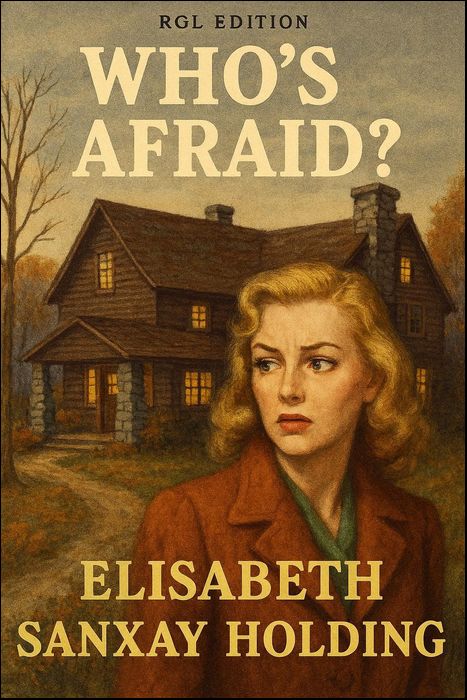
RGL e-Book Cover
Based on an image created with Microsoft Bing software
Roy Glashan's Library
Non sibi sed omnibus
Go to Home Page
This work is out of copyright in countries with a copyright
period of 70 years or less, after the year of the author's death.
If it is under copyright in your country of residence,
do not download or redistribute this file.
Original content added by RGL (e.g., introductions, notes,
RGL covers) is proprietary and protected by copyright.
RGL e-Book Cover
Based on an image created with Microsoft Bing software

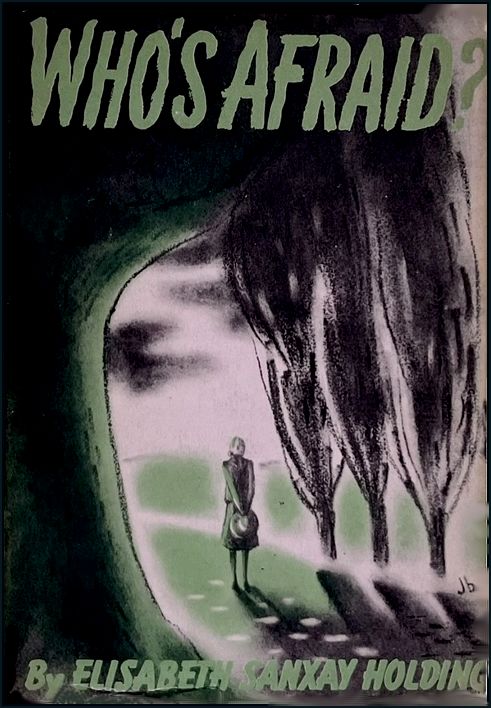
"Who's Afraid," Duell, Sloan and Pearce, New York, 1940

"Trial by Murder," Novel Selections, Inc., USA, 1940
"Who's Afraid?" is a tightly constructed psychological suspense novel centered on Susie Alban, a young woman traveling through New England as a sales representative for Gateway's "culture program," a dubious charm-school-style enterprise.
What begins as an ordinary business trip quickly turns sinister. At her very first appointment, the husband of her prospective client reacts violently upon hearing the name "Chiswick," Susie's employer, and slams the door in her face. Later that evening, Susie discovers this same man's dead body on the path leading to her lodging house...
THIS is life! Susie thought, leaning back in the Pullman chair. She stretched out her long legs and crossed her ankles modestly, she looked with satisfaction at her new shoes. Nice shoes, she thought, and nice feet. Far from small, but narrow. Aristocratic, I dare say.
Mr. Chiswick had put ideas like that into her head. A month ago she had seen his advertisement in a New York newspaper.
Wanted: Young lady, with unquestionable social and cultural background. Experience not essential. Write stating qualifications. C. C. Box 907.
Bogus, she had thought; just another of those things, selling from door to door on commission.
But you never know. She had registered at three agencies, but they had told her July was a bad month, they said there were so many young people just out of college, and indeed she saw them with her own eyes. She had studied those other girls, her competitors, and sometimes she had been depressed. The little cute ones get the breaks, she thought.
She knew better than to make any attempt at cuteness. She was too tall for that, a thin young creature, limber and nonchalant, with a dark, serious, good-humored face. She had dressed as magazine articles advise applicants to dress: she had worn an immaculate white blouse, a black skirt, colorless nail polish; her hair had been neat. She looked all right; but so did practically everybody else.
Only Mr. Chiswick had found her superior. He had liked her letter, and he had arranged an interview, he had told her she was exactly the type he had had in mind. He was perfectly satisfied with her Social Background; a father who was a professor of English in a smallish upstate college, a grandfather who had been mayor of that smallish city. He admired her culture as no one else ever had. She had a good scholastic record, but nothing brilliant, no travel either; she had felt a little nervous when he had given her a list of names to read aloud.
Madame de Maintenon. Madame du Barry. Cleopatra—"There!" he had said. "Now, nine out of ten of the young ladies I've interviewed have pronounced that 'Clear-patra.'" He liked the way she spoke, and he had liked her appearance. "You've got distinction, Miss Alban," he said. She liked that. She liked Mr. Chiswick. Only she was not altogether sure about Gateways.
It was a correspondence course. It offered to the Women of America a system for developing the individual charm that lies dormant in each of you. Through the Three Gateways of the Spiritual, the Physical, and the Mental.
Well, Susie thought, some of those exercises are good, darn good. All that about the care of the skin, and about diet is perfectly sound. And the great women of the past are pretty interesting. It couldn't hurt anyone to take the course, and it might help a lot, in some cases.
Let us analyze Charm, one of the folders said. Susie, as was her duty, had seriously studied all the literature of Gateways, but she did not find the Chiswick description of Charm satisfactory. I think he's too fond of the mysterious and the subtle, she thought. Personally, the kind of charm I'd have, if I could, would be a lot more obvious. I'd like to knock them cold. I'd like men to lose their heads completely the moment they set eyes on me.
She sighed. Or even one man, she thought. All my beaus have been pretty dingy—and they never seem to have any trouble at all in keeping their heads. Here I am, twenty-one, and there's never been anyone really exciting. I've always picked the right boys to fall in love with, the handsome, debonair ones. But the men who fall for me are very otherwise. Some plump, and several with spectacles. Well, will it be always like that?
No, she said to herself. It won't. I've got the nicest outfit of clothes I've ever had in my life, and I'm going to be traveling around, meeting new people all the time. If I can't get some results, I'm hopeless. Or I wonder... She looked out of the window dreamily. I wonder if I could try the mysterious line myself... A veil, and mascara? The Egyptian women lengthened their eyes with kohl...
"Pardon me, madam," said a man's voice at her elbow. "Would you care to look at this magazine?"
She had had a glimpse of him before, sitting at the end of the car, a jaunty fellow growing bald, dressed in a brown belted jacket, gray flannel trousers, and brown-and-white sport shoes; he looked, she thought, like a neat, clean tramp.
"Oh, thank you!" she said, taking the magazine he held out. This was done without any thinking, it was pure instinct to be friendly when someone else was friendly. But when he swiveled the empty chair beside her, and sat down facing her, she did begin to think. Maybe I'd better not encourage him.
She opened the magazine and began turning the pages. It was a trade journal devoted to hardware; there were photographs of windows full of tools, photographs of men at dealer's conventions. Well, what's the idea? Susie thought. Is it something subtle, to show me that he's some big hardware man?
"Does it interest you?" he asked.
She glanced up at him, determined not to encourage him. But he had a look that surprised her, a look that was somehow familiar. His underlip was thrust out, his little blue eyes twinkled in his ruddy face. Obviously he thought this was a joke. You can discourage a man if he's trying to flirt, Susie thought, but it's pretty brutal to discourage anybody's jokes. Especially when he's not young.
"Well, maybe it's very instructive," she said.
"It is," he said. "It's good to know that there are thousands of men thinking about hardware, night and day, planning to develop it. Thinking up new ways to display can-openers."
Something familiar about you, she thought, glancing again at him. Have I met you before?
"What's a 'ricer'?" he asked.
"It's a thing you squash potatoes through," she said. "To make those little squiggles, you know."
"Now that's it!" he cried. "That's the spoken word." He leaned forward. "If you'd been asked to write a definition of a ricer," he said, "it would have been something like this: A ricer is a kitchen implement by which potatoes are forced through a sieve. Wouldn't it?"
"I guess so," said Susie.
"I'd be willing to bet you can't write a decent letter," he said.
"Well, you'd win," said Susie.
He brought a package of cigarettes out of his pocket. "Confound it!" he said. "I forgot. No smoking in here. Shall we go into the smoker?"
"All right!" Susie said, starting to rise. But she sat back again. After all, she thought, even if he does seem familiar, I don't know anything about him. If it wasn't for Mr. Chiswick, I wouldn't care. I mean he seems like a cheerful little guy, and I'd be willing to talk to him, and no harm done. But Mr. Chiswick was very earnest about appearances. Remember, Miss Alban, he said, that you're representing Gateways not only while you're actually interviewing prospective clients, but all the time.
"Well?" said the man. He was standing, looking down at her.
"I don't know about going in a smoking car," said Susie. "I never have."
"Then it's time you did," he said. "You don't want to travel through life in a sissy Pullman."
"I know. But...?
He brought a wallet out of his breast-pocket, and from that he took a card and handed it to her. Dr. Valentine Jacobs, was engraved on it.
"A doctor?" Susie asked.
"Of philosophy," he said.
"Oh, of course!" she cried. "You're a college professor!"
"You've heard of me?" he asked. "Maybe you've read or seen one of my books?"
"Yes, I probably have," said Susie. I'm certainly not going to tell him he's typical, she thought. Nobody likes to be typical of anything. But that's why he seemed familiar. He's got that special professor's way of being up-to-date. She rose, "I will go in the smoker, thanks," she said.
Not even Mr. Chiswick, she thought, could object to her going with a Ph. D. This is fun, she thought. This is the way traveling ought to be. Meeting new people.
They went through the car, Dr. Jacobs first, jaunty and slight in his belted brown jacket, and the tall young Susie behind him, a pleased look on her serious dark face. They went through a second car, and a third, then he opened the door of the fourth, and they stepped into a gray haze.
"There's a seat," he said, leading the way down the aisle.
There were no other women in here, only men, and they all seemed so subdued and gloomy; the floor was bare and the lights seemed dim. Queer, thought Susie; a ghost train.
"Well, fellow travelers!" said Dr. Jacobs. He had stopped, and stood resting his hand on the back of a seat where two men were sitting, both of them young, and both good-looking. One of them smiled, and one did not; then the doctor went on to a vacant seat, and waited for Susie to settle herself by the window.
"Two interesting young fellows," he said. "One of them's quite a radical, and the other's a die-hard conservative." He offered her a cigarette, and lit it for her, and one for himself. "It's very instructive—for me," he said. "I continue to learn."
Yes, thought Susie, Father talks like that. I learn from my students, more than they suspect... I like Dr. Jacobs. He's cozy, and you can see that he likes Youth.
"And do you lean toward the Left?" he asked.
"Well...? said Susie. She had been asked that question before, and she had an answer. "This is a transition period...? she began; but he laughed, which was something other professors had not done.
"That's fraudulent," he said.
"I know it," said Susie. "I really haven't any opinions, much."
"You're...? he said, and stopped, because one of his interesting young fellows had risen and come to his side; a slim fair-haired boy with gray eyes.
"Excuse me!" he said, "but if you'll give me the address of the boarding-house you mentioned in South Fairfield...? She looked up, and found him looking sidelong at her. They both glanced away.
"Just tell your taxi driver to take you to the Brett house," said Dr. Jacobs.
"I see," said the other. "Thanks...? He lingered a moment, but nothing more was said. "Well, I think I'll get a breath of fresh air," he said, and went off down the aisle.
"He's the radical," said Dr. Jacobs. "His name is Carroll. He seems to be a very decent sort of young fellow, but of course I don't know anything about him. Would you like to talk to him?"
Susie thought about it.
"That was why he came, of course," said Dr. Jacobs. "He hoped to be introduced to you."
And now, thought Susie, you're just letting me use my own Judgment. You're waiting to see what Youth will do. "I'm going to South Fairfield myself," she said. "Only I'm going to stay at the Fairfield Arms."
"Don't!" said Dr. Jacobs. "Take my advice, and don't. It's one of the most depressing little hostelries I've ever met in a very extensive experience. At Mrs. Brett's you'll get excellent food, a good bed, a big, clean room, and for considerably less money."
"But it's been sort of arranged for me," Susie said. "I'm on a business trip, you know, and I've got a list of what is supposed to be the best hotel in each town."
"The supposition is erroneous for South Fairfield," he said. He did not press the matter, though; they finished their cigarettes chatting affably enough. "I think I'll go back to the sissy Pullman now," Susie said. "It's pretty thick here."
The doctor escorted her back to her seat, and sat down opposite her. "Would you mind telling me," he asked, "what kind of business trip you're making? It's nothing but rank curiosity on my part...?
"Well, no, I don't mind," said Susie. But she did. She told him in a sketchy fashion about Gateways. "I think," she said, "that any sort of culture is better than none."
The doctor listened; he looked at one of her booklets, and put it into his pocket. He rose. "I hope you'll decide to come to Mrs. Brett's," he said. "But in any case, I'll see you, Miss—?"
"Susie Alban."
"Miss Susie Alban," he repeated. "I'll leave you the magazine, to study."
With a smile he went off, and it was flat and dull without him. If I were a man, Susie thought, I'd wander around in the train like that. Talking to everybody. That Carroll boy was rather attractive. Did he really want to be introduced to me? Did he like my looks when he saw me going past him? Or was he just bored? I'd feel so differently about everything if even one man would be smitten by me at first sight. Of course, it's nice for a man to learn to care for you as he knows you better; but just one sudden, violent conquest would help.
The six or seven people in the car with her were either reading or sleeping. They did not look interesting. She was growing restless and faintly worried. Suppose, she thought, that that Carroll boy is somebody I would have liked, and now I'll never meet him? There must be lots of things like that in life. Your whole future is changed by turning a special corner at a special moment...
I'm going to Mrs. Brett's, she thought.
"South Fairfield!" said the conductor in a confidential tone. "Next stop, South Fairfield!"
He took Susie's two bags out to the platform, and Dr. Jacobs joined her there.
"I think I'd like to go to Mrs. Brett's," she said.
"Excellent!" said he. He descended nimbly to the platform, and helped her down. As the train slid quickly away, young Carroll approached them. "Miss Alban," said the doctor, "this is Richard Carroll—also going to Mrs. Brett's."
Carroll took off his hat, and they looked at each other.
"The fellow I met in the smoker is coming too," Carroll said. "Name is Loder."
This Loder was standing a little way off; big, dark, somewhat sullen, but handsome. Carroll made a signal to him, and he came up to them, bag in hand. "We can share a taxi," the doctor said. "Miss Alban, Mr. Loder."
He gave her a dark look, no smile, they all crossed the platform of the sunny little station. "Doctor! Doctor!" cried a voice. A thin man with a neat little straw-colored mustache was hurrying toward them.
"Well, Brett, how are you?" said the doctor.
"We have a new car, y'know, Doctor," said Brett. "So I came to fetch you."
"Excellent!" said the doctor. "And I've brought you three more victims, Brett."
Brett gave a smile like a spasm. "This way, please?" he said, and they went in a little troop. This is fun! Susie thought. The open road, and meeting new people. This is the life!
I'LL have to get rid of this girl, one of the four men in the car was thinking.
The rich stillness of midsummer lay on the world; the grain was ripe in the fields, the trees marched up the hills, pale-green and emerald-green and yellow-green, here and there a dark spruce and a copper beech, all unstirring against the pure blue sky. It made him sick to look at that unbounded peace, and to think of his danger.
I could manage Eve, he thought. Eve! God! what a name for her! I remember that book of Bible stories we had when we were children. The Angel driving Adam and Eve out of Paradise. She had long hair down to her knees, and a little dress made of skins, and she was holding Adam's hand. My Eve never had any idea of leaving her snug little garden hand in hand with me. No. She was going to stay right there, and I was to be driven out.
But she liked me, the first moment she saw me. More than liked me. She loved me... She won't admit it. She's too damn respectable and prudent, but I could see... Even now, if I had money, or prestige. Or anything. Look at the risks she took, coming out to meet me, with that husband of hers, half-crazy anyhow with suspicion... Even now—if I had anything...
Her letter's in my pocket now. I'm afraid you've misunderstood me... Better for us not to meet again. Only, we're going to meet again, Eve darling, and I never misunderstood you. Not for one little minute. You're frightened, now, that's all.
"Oh, yes!" said Susie. "I have to send Mr. Chiswick a report every night."
I could be put in jail, the man told himself. I could be locked up like a wild animal. This girl could do that. She set the pack after me, with one word. I've got to stop her. I can manage Eve, all right; but this girl.... Is she a fool? Or does she know already?
God! In another two weeks, or less, I'd have been all right. I admit I made mistakes, took too many chances. I admit I lost my head—a little—over Eve. But I could have fixed all that. Unless somehow he's found out. Unless he's sent this girl to spy on me. To get the facts. The evidence. I could be put in jail. I could be locked up.
But I'm not going to be put in jail. If old C. had any facts, he wouldn't have sent the girl. He'd have sent a policeman. So he can't be sure. If he suspects anything, he's sent her to check up, get information. I've got to stop that. I've got to get rid of her.
Is she a fool? Did she say she'd come from Chiswick because she doesn't know anything, or was it a trick? While I'm studying her, is she studying me? That friendly air—that could be a good line. But I've got to know—and know quick. And whatever it is, whether she's a fool or not, I've got to stop her.
"Oh, yes!" Susie said, answering a question he had not heard. "I've got the name of at least one prominent woman in every town; and I'm supposed to get other names through her."
Why is this other fellow asking her all these questions? What's his interest? Suppose I ask a question now? Then I'll know. However she answers it, I'll know. Only I've got to take the right tone. Casual...maybe...better not ask just now.
But he did ask. "Is your list confidential?"
"Oh, no!" Susie answered. "In fact, I'm supposed to get a line on people before I see them, if possible. Maybe one of you knows the woman I'm going to see here? Her name is Mrs. Person."
There was a silence so complete and so strange that she looked from one face to another.
"Did I drop a brick?" she asked.
Somebody laughed with heartiness. "I wish you luck!" he said. "I suppose you'll be starting off to see Mrs. Person first thing in the morning?"
"Ah reckons Ah will," said Susie.
You won't get there, thought the man. I'll stop you—somehow.
THE car turned up a gentle hill on the summit of which stood a fine old house, badly in need of repair, with tall white pillars up the front. It was unfenced, no garden, only a wide stretch of grass growing high and rank, and here and there a noble old tree; there was a look of neglect about the place, but it was in no way depressing.
"Queenie'll be a bit surprised," said Brett. "She wasn't expecting anyone but you, Doctor. If you people will make yourselves comfortable on the veranda for a moment...?"
He stopped the car, and they all descended. On the veranda was a row of rocking-chairs. Susie sat down in one; the doctor sat on one side of her, and the fair-haired Carroll on the other. Loder walked past them to the end of the veranda and stood looking out at the horizon. Insects were chirping in the grass, but that cheerful chorus was part of the golden peace; the shadows of the trees were long, the blue of the sky was paling a little.
I've been in the city so long, Susie thought, I'd almost forgotten how lovely the world is. I'm so glad I came here instead of going to any hotel. I like this. I'm so thankful I got this job instead of a job in an office. I wish I could travel for—let's say four years, until I'm twenty-five. Then I'll be ready to get married and settle down.
Suppose nobody very attractive ever wants to marry me? I know the Gateways idea is that every woman can have charm, but I'm not so darn sure about that. And if it was true, and they all found out how to be charming, think of the competition! I honestly could do more, though, about developing a spot of charm in myself. Which would be my quickest way, I wonder? The physical, the mental, or the spiritual? Study Your Self, the course says. Observe how others react to you.
She turned her head quickly toward Carroll to see if he was looking at her. He was not. He was staring straight ahead of him with a tired look on his fine-drawn face. She glanced toward Loder, and he was still gazing at the horizon. Handsome, she thought, contemplating his pale and rather sullen face. I like that sort of haunted, bitter type.
The house door opened and a woman came out; the doctor sprang to his feet.
"My Queen!" he cried, and approaching her, he took her hand and raised it to his lips.
The woman laughed, leaning against the doorway, a slender deep-bosomed young woman in a blue cotton dress, with a blue bandanna tied over her untidy copper-colored hair. She had a wide gamine mouth, a turned-up nose, narrow blue eyes; she was slatternly, she was impudent, and she was fascinating.
"This is Miss Alban, Mrs. Brett," said the doctor. "And the Messieurs Carroll and Loder."
"Which is which?" asked Mrs. Brett, turning her head.
"Oh, you're Mr. Loder?" she said, and her blue eyes looked him up and down. "Well, I hope you'll like it here, Mr. Loder." Then she turned to Susie. "I'll show you your room," she said amiably. "If things aren't so nice you can blame my husband. He had a right to phone up from the station and tell me to expect you." She opened the screen door. "But if there's any way to do things wrong, trust Percy to find it," she said.
She led the way up a broad and beautiful stairway, and opened a door on the floor above. "If you want anything," she said, "just go out in the hall and call me. Dinner'll be kind of late, I'm afraid, but I'll do my best."
She went off, and Susie closed the door. It was a big room, filled with the bright dazzle of the setting sun; the sweet air came in at the open windows; it was bare, very bare, only a little day-bed, a chest of drawers, one chair, one small rag rug on the polished floor, but it was clean, and to Susie, indescribably charming.
This is the life! she said to herself. All these new places and new people. You feel so darn light and carefree, just coming in casually like this for a night or two... But I probably shouldn't feel so joyous. It's not business-like. I ought to think about my work. They were all stricken when I mentioned Mrs. Person... Something queer there. Well, I'm sorry, but I like there to be something queer.
She strolled up and down the big room, glad to stretch her legs after the journey. Maybe Mrs. Person is evil. The local Lorelei. In that case she won't want our course in how to be charming, but she might give me the name of someone else. Anyhow, I look forward to meeting Mrs. Person. I like a touch of mystery.
She stopped to look at herself in the mirror over the chest of drawers. I'd like either Carroll or Loder to fall for me, she thought. Or both. Nothing serious, but just enough to build me up. The doctor said that Carroll wanted to meet me. He may be liking me more than I know. He may have come here simply on my account. They say a woman always knows when a man's attracted, but I don't. I never suspected that Carter boy of being smitten until he began that frightfully embarrassing stammering.
Well, do I like Carroll? I think I like Loder better. More intense. And that's typical of me. I always fall for the boys who don't pay any attention to me. This—
A door banged downstairs, and Mrs. Brett's voice came up to her, low and husky but distinct.
"You're a brute!"
"Less of it, if you please," said Brett's voice curtly.
"There's going to be a lot more of it," said she. "You're a brute! Four people. Four people—for me to cook and scrub for!"
"Queenie!" he said. "Be reasonable—"
"I won't!" she said. "You're not going to make a slave of me, Mr. Percy Fancypants Brett. I won't put up with it, and I don't have to, either. I could walk out on you right here and now; and there's somebody who wouldn't expect me to scrub and slave."
"Very well!" said Brett.
"What do you mean, 'very well'?" she demanded.
"You'll see!" he said.
"Percy—"
"Let me alone!" he said. "I know damned well what you're hinting at, and I've had enough. Stand aside there!"
The door banged again and there was silence.
Pretty sordid, thought Susie. Pretty horrible to think of people tied to each other when they felt like that. I thought Mr. Brett was rather nice; polite and gentle. He's very different from Queenie, better educated, more civilized. But she's an attractive hussy in her way, no doubt about it; and more vital than he. A remarkably ill-suited couple, I should say.
There was a great tramping of feet outside, as if a regiment was coming upstairs.
"Same room you had before, Doctor," said Brett's voice, cheerful now. "Mr. Loder and Mr. Carroll, you can choose between these two to suit yourselves."
"I'll take this one," said Loder, instantly; and a door closed almost with a slam.
"Well, I'll be damned...!" said Carroll with surprise.
"Seems to be nervous," the doctor observed. Two other doors closed, and then there was a knock at Susie's door. It was Brett with her two bags.
"Everything all right, Miss Alban?" he asked, with a gentle apologetic smile.
"Oh, yes, thank you!" she said.
"I'm just driving down to the village, Miss Alban," he said. "I wondered if you'd like to come along? I could take the road by the lake, and you could see something of the countryside."
"Why, yes, thank you, I'd love it," said Susie.
He seemed to be waiting.
"You mean, right away?" she asked.
"Well y'see, I have a lot of errands to do," he explained.
"All right!" she said, and put on her hat again. They went down the stairs and out of the house to the car that stood in the driveway.
"Complicated," he said, "this business of being an innkeeper. But very interesting. Meet all sorts of people." They sped off down the hill, and Brett kept on talking in a pleasant, but not very entertaining fashion. "Not much going on in South Fairfield," he said. "Prosperous little town, though." He told her the population, the number of churches, he told her about a new bus route. He was driving fast and he kept his eye on the road, so that she did not feel obliged to look at him, or to listen very attentively. She said, "I see!" from time to time, and enjoyed the scenery.
They turned into a long straight road, lined with fields behind stone walls, all empty in the golden sunset light, no buildings, no traffic. "Quite lonely," Susie observed.
"Well, y'see," said Brett, in his apologetic way, "it's a new road. People haven't got into the habit of using it much yet. Now, then, here's the lake."
It looked like a flooded meadow, a quiet sheet of water fringed with reeds; it had no beginning, no end, no definite outline, it simply spread out with tongues of still water stretching across the fields. "I see!" said Susie politely. She didn't like this lake, or this road; it seemed to her a melancholy scene. They were coming now to a wood.
"Now, there, just beyond those trees," said Brett. "There's the old road. You can see the roof of the hotel."
That put an idea into her head. "If it's not taking you out of your way, Mr. Brett," she said, "could you stop at the hotel? There might be a message for me, and anyhow I'd like to give them my address in case Mr. Chiswick wanted to reach me."
"Mr. Chiswick...? Brett said. "Oh, yes! Certainly, Miss Alban." He drove steadily on. "Suppose I leave you there, Miss Alban, while I do my bit of shopping? Might be tiresome for you, stopping at all these shops and so on."
She agreed to that, and he turned into a side street of little wooden houses, each with its front yard and its fence of palings. There was no daylight saving here, and it was twilight now under the fine old trees; here and there a light twinkled in a kitchen window. I wonder...Susie thought. I wonder if this would be a good time to see people. Better than the morning, maybe. You'd be almost sure to find the women at home now.
"Does Mrs. Person live near the hotel?" she asked.
He took a long time about answering. "I believe she does," he said at last. "But—" He paused. "If you won't mind my offering advice...?" he said. "Thing is, I've lived here for some years, and naturally one gets to know something about the natives, what?"
"Oh, yes!" Susie agreed.
"If I were you," he said, "I'd see Mrs. Green tomorrow. President of the Women's Club here. Quite important. Very nice woman. If I were you, I'd skip Mrs. Person."
"Oh, would you?" said Susie. "Why?"
"Waste of time to see her," said Brett, and began telling her how important, how popular Mrs. Green was. "I'll be coming into town tomorrow morning," he said. "I'll be very glad to drive you in, any time you like."
What is all this about Mrs. Person, she thought. Everybody seemed queer when I mentioned her, and Mr. Brett obviously doesn't want me to see her. Well, I'm sorry, but that makes me all the more anxious to see her.
They were in the main street of the little town now, and Brett stopped the car before a small, neat building of red brick. South Fairfield Arms, the sign said. "I shan't be long," he said. "Half an hour or so, that's all."
"Oh, I'm in no hurry," said Susie.
The lobby of the South Fairfield Arms was a subdued and forbidding place. In enormous high-backed chairs against the wall, each with a staring light behind it, each within range of a brass spittoon and a brass ashstand, sat four or five men reading newspapers. In a vague and wandering way, she approached the desk.
"Excuse me!" she said to the clerk. "Any mail or message for Miss Alban?"
"Alban?" he replied. "No, madam. Nothing."
"Well, if there should be, will you please send it on, in care of Mr. Brett?"
"Mr. Brett," he said, and wrote it down on a card. Rather a nice-looking boy, Susie thought, if only his hair wasn't so long. He glanced up to see why she lingered.
"I wonder," she said, "if you could tell me where a Mrs. Person lives?"
"Mrs. Alexander Person?" he asked.
"That's it," said Susie.
"Well, about two blocks from here," he said. "You walk straight along in the direction of the Town Hall till you come to Oak Avenue, and it's the first corner on the right."
"Thank you!" she said, and turning away, she re-crossed the lobby and went out into the street. It had come into her head that she would go to see Mrs. Person now.
It can't do any harm, she thought. If she's busy, I'll come back tomorrow. I've got some of our literature in my purse, enough to go on with, and I've got some application blanks. It would be pretty nice if I could make a sale now, the very first day. That would certainly impress Mr. Chiswick.
She walked briskly in the cool and pleasant dusk, she came to Oak Avenue and turned the corner. And a completely unexpected and panic fear seized her. She stood still, looking up the quiet tree-lined street of small houses. I—can't...she thought. I can't just walk up to the house and ring the bell. I don't know what to say... I couldn't possibly say that introductory speech. It's awful. "I've been asked to call on you, Mrs. Person, as the outstanding woman of your community—" No! I can't! It's so bogus. Nobody would let me go on with that. Nobody would ever dream of buying that course—for seventy-five dollars. It's—
Listen! Get hold of yourself. Mr. Chiswick's paying my expenses and I've got to try. I will try. Only the morning is the best time, definitely. This is not a good time. People are getting their dinners. Tomorrow... No. Now.
She started forward at a snail's pace. I've been asked to call on you, Mrs. Person... Suppose she's hostile and horrible? All right! Let her be. Probably lots of people will be. I'll have to do this dozens and dozens of times. Here we are.
This was the house on the first corner to the right, but it was a very small and humble house for the outstanding woman of the community. Susie stopped again with her hand on the low gate. There was a dim glow visible through the glass of the door, but otherwise the house was dark. Probably out, thought Susie. She drew a long breath, and pushed open the gate, she walked along the path and up the steps. Her knees felt weak. She rang the bell and waited.
Everyone's out, she thought. Oh, if only nobody comes...!
But somebody was coming, stumping along the hall, the door was flying open with a crash, and a frightful little old man stood there, with a pompadour of white hair above a brick-red face, with glittering little blue eyes. He glared at her, and then began to grin slowly.
"Young gal," he remarked. "Young and pretty. Well, my dear?"
"Well, I—does Mrs. Person live here?" Susie asked.
"What's the matter with Mr. Person?" he asked gaily. "City gal, ain't you?"
"Well, yes, in a way," said Susie.
He laughed loudly. "Ah!" he said. "That's what I like. A city gal. I like 'em dark, too. Big—black—eyes—mmmm-mmmm...?
Is he trying to be funny? Susie thought. Anyhow, I don't like him. She drew back a little. "Well, I'll look in again," she said uncertainly.
"Here! Here! What's your hurry?" he demanded. "If you want to see the missis, why, step right in!"
"No, thank you," said Susie. "I'll come back—"
"Come in! Come in!" he said, coaxingly. "Step in and have a chat—"
"Alexander!" said a low and beautiful voice.
A woman had come into the lighted hall behind him, a slight woman in a limp, dark dress, and black hair pinned in a heavy knot at the nape of her neck.
"Alexander!" she said again, moving forward. "You wanted to see me?" she asked Susie.
"Well...Mrs. Person?"
"Yes," said the other gravely.
"Well, I've been asked to call on you"—Susie said in an unsteady voice, looking fixed past the old man to Mrs. Person—"as an outstanding woman in your community, Mrs. Person—"
"Yes," said Mrs. Person. "Who asked you to call?"
That was an unorthodox question. "Well," said Susie. "Mr. Chiswick—"
"Chiswick!" yelled the old man. "Chiswick!"
He came at Susie with his fist raised, his thin old mouth in a tight line, his blue eyes blazing. "Get out!" he screamed. "Get out!"
She turned and ran down the steps, and he stood in the doorway shouting after her. "Your Chiswick... Tell your blank blank Chiswick to come here himself. Tell the blank blank blank I'm waiting for him...?
Some of the words he used she had never heard, but they were unmistakable, and intolerable; she ran from them as if they were poisoned arrows.
"I'll kill your blank blank Chiswick!" he yelled. "Tell him...?
The house door closed with a slam, and Susie stopped; she leaned against a tree, sick and shaken.
ONE of the four men she had met that day was standing on the other side of the street in the shadow of a tree, listening to old Person.
God! he said to himself. How did he find out?
"I'll kill your blank blank Chiswick!" yelled old Person.
God! the man cried to himself. Then he was afraid he had cried it aloud, and he looked over his shoulder. The street was deserted, the house behind him was dark. The sound of footsteps made him turn back, and he saw the girl going toward the corner. She looked tall, and very slight in the dark; she went leisurely, and he thought that was because she was satisfied. She told old Person, he thought. That's what she went there for.
It shocked him. It's the one thing I never thought of, he said to himself. It's the worst thing she could have done. That damned vindictive old savage... I'd rather have the police. I'd—well, I'll have the police, too. My God! I only needed two weeks, or less, and I'd have been all right. I'd have been safe. I wasn't even worried, this morning.
A sort of anguish seized him when he thought of this morning. He had eaten his breakfast with relish, he had felt wonderfully well, vigorous, confident, because his plans had been good ones. And then she came...
He started after her, keeping to the strip of grass beside the pavement on his own side of the street. He had nothing definite in his mind, nothing but a feeling that he must not let her out of his sight. Where's she going now? he asked himself. To the police?
He remembered old Person's voice cursing and yelling. That was the first hound baying. But that wasn't enough for her. She wanted the police after him, too. The whole pack, to hound him down. And why? He had never injured her, he had never heard of her, never imagined before today that anyone like her existed. There she was, strolling along, so damned nonchalant. Pleased with herself.
It came into his mind that she was smiling to herself in the shadow, and he hated her. She wants to see me hunted down like an animal, he thought. And he went after her, perfectly silent on the grass. He quickened his steps; his heart quickened, too. There was still nothing definite in his mind, only a curious excitement. He wanted to catch up with her, that was all.
She had almost reached the corner of the deserted street. He wanted to catch up with her before she reached the street light on the corner. So he began to run.
Suddenly there was a clatter of horses' hoofs, and he stopped in terror. The hunt is up. The Four Horsemen... You don't—you—can't be hearing galloping horses... That's a sound out of a play. Out of a nightmare. The Valkyrie. The witches after Tam o' Shanter. The sheriff's posse after the killer.
She reached the corner. He saw her clearly under the street lamp. So damned nonchalant in her dark suit, her hat on the side of her head. He knew she was smiling to herself. Or laughing.
Around the corner came a big, heavy, gray cart horse, ridden by a boy in overalls, who was leading another big gray horse. They went past him with a clatter, and when he turned his head, the girl was out of sight. He went after her, but she had gone into another world, not a tree-lined, deserted street, but a street with little shops, and people, and traffic. She could afford to laugh at him now. She was safe.
She's going to the police, he thought. For God's sake, why doesn't she hurry? Because she was enjoying this; taking her time. Laughing at him. He had to go sauntering along the street on the other side. I've got to make a plan, he thought. When she goes into the police station, I'll...I'll what? Get a train to New York? Or to Bassville? Or is it safer here? Easier to hide than to run? I need time. I need time to think. I need time, I tell you.
She went into the Fairfield Arms.
He stopped where he was, before a very small shop with a newsstand outside it. If she's not going to the police...? Maybe I'd better wait and see. Only the one thing he could not do was wait. A dreadful sense of urgency possessed him. Wait? he thought. Just hang around and wait until she's good and ready to take the next step? I won't!
Someone coughed, and he turned his head to find a man standing at his shoulder, staring at him. He took some pennies out of his pocket and picked up a newspaper, and turned back along the street.
I'll see Eve, he thought. And you're going to keep me out of this, my dear Eve. You can keep that damned old savage quiet, if you try. And you're going to try. If I can shut him up, I've got a chance. No matter what that girl does.
That sense of excitement came back to him. I've got a chance, he thought. I'm not a fool. I can deal with this if I keep my head. I don't have to be hunted.
He lit a cigarette, and he smiled to see how steady his hand was.
SUSIE sat in one of the high-backed chairs against the wall waiting for Mr. Brett. Don't be silly! she told herself. In work like this, I'm sure to run across some unpleasant people. This was really nothing—all in the day's work. When you analyze it, what was it but a nasty old man swearing? I don't understand though, why the very mention of Mr. Chiswick's name started him off.
She thought of Mr. Chiswick, thin, elderly, with his pince-nez, and his trim little gray beard; Mr. Chiswick, so polite and correct. Nobody could call him names like that, she thought. Unless the old man was crazy. That seemed rather probable when you think how he behaved the moment I got there.
She sighed and glanced again at the clock. Mr. Brett was very late. Well, she thought, I certainly can't go back to see Mrs. Person, ever. I'll have to see this Mrs. Green tomorrow. I wonder if I ought to put all this in my report to Mr. Chiswick? Tell him how the old man made threats. I don't know... Maybe it isn't important. I am silly, to be so upset. Only there was something about that old man—something pretty horrible.
She moved restlessly, and then an idea came into her head, and she rose and went to the desk.
"Do you know Mr. Brett by sight?" she asked the clerk.
"Yes, madam," he said, coldly.
"Well, when Mr. Brett comes in, will you please tell him that I've decided to walk back."
"Very well, madam," he said.
"And can you tell me how to get to that new road by the lake?"
He looked as if this were almost more than he could bear.
"You go straight along to Oak Street," he said, "and you take the first turning to the right—"
"Oh, by Mrs. Person's house?"
"Yes," he said. "Right next to that house you will see the entrance to Woodmont Park. You can go straight through there to the New Road."
"Thank you!" said Susie.
She was very reluctant to go near that house again, but she despised the reluctance. I need a good brisk walk in the fresh air, she thought. I haven't had any exercise all day. I haven't had very much to eat, either, she thought, as she set forth. Just a sandwich and a cup of coffee before I got on the train. I hope Mrs. Brett is a good cook.
Oak Street looked better now, there were more lights in the houses. It's just an ordinary street, she said to herself. And probably what happened was ordinary, too. I wonder how I ought to report that interview? As a failure? I wonder if an experienced and very good salesman could have coped? Or would it have been hopeless for anyone? I wish it hadn't happened the very first place I went. It sort of undermines your self-confidence. If this Mrs. Green is hostile...
There were lights in the Person house, lights upstairs, and as she turned the corner, she saw a very bright light in the back of the house, shining out over the grass. Very quiet neighborhood, she thought, not even a dog barking. I wish I had a nice cheerful dog along with me. Now, where's the park?
It was not at all hard to find. Half-way along the block there was a signboard with a glaring light over it.
WOODMONT PARK DEVELOPMENT
CHOICE HOME SITES
LAKE SHORE LOTS
IMPROVEMENTS
APPLY TO A. PERSON, SOLE AGENT
Beside the sign was the entrance to a macadam road lined with woodland, but straight and broad and well-lit; she could see the roofs of houses ahead. It's not lonely, she thought. The lights were strung on a wire, and each one made a bright circle among the leaves, with massed darkness behind. Quite a thick wood, she thought.
The houses had no lights in them, and as she came abreast of them, she saw that they were empty and unfinished. She saw the stone walls of a foundation like a ruin. The trees rustled with an unceasing sound. Very quiet neighbors, she thought, going a little quicker. I hope there aren't any owls. I—wouldn't like it if an owl started to hoot.
The road was downhill now, and the lights, she thought, were farther apart. She thought that she could see through the rustling branches, the pale gleam of water below her. The lake, she told herself and remembered how it had looked, spreading out formless and still over the meadows. Well, then I must be getting near the New Road.
She stumbled over something, and looked down. It was a foot in a white sock and black shoe.
Someone was lying among the trees at the side of the road. Someone hurt? Someone—more than hurt? I'll go and get a policeman—I'll go—
She stopped herself. You can't run away. You have to see...She moved closer, but it was dark in the shadow of the trees. "Is there—anything wrong?" she asked aloud.
No answer. She opened her purse, and took out a book of matches; she struck one, and bent down. She had a glimpse of old Person's scarlet face and staring blue eyes; then she dropped the match, and stumbled backward.
He's dead, she thought. Don't run. That's a horrible thing to do. He's dead... I'll have to get somebody. But I won't run. I'll walk. The trees were making a strange sound—as if they were rushing after her. Don't look back. Just go ahead, quietly.
But there was another sound, a soft crackling. She had to look back over her shoulder, and she saw a little pile of leaves blazing at the foot of a tree. I did that, when I dropped the match, she thought. She had started the fire, and she would have to put it out. She had to go back.
It was a small blaze. But it was only a few inches from old Person, and that made her give a sob like a gasp. She trampled out the blazing leaves in a sort of frenzy in her desperate haste to get away.
Then almost at her shoulder, a voice spoke. She sprang away from that dark form, she knocked her shoulder against a tree, and leaned back with no strength left in her.
"It's me," said the voice. "Charles Loder. Anything wrong?"
She could not speak for a moment, so overwhelming was her relief.
"Yes," she said. "Yes. It's something... It's a man. Right—there. He's—dead."
"I've got a flashlight here," said Loder. "I'll take a look." She closed her eyes, so as not to see that figure again. But with her eyes closed, she saw even more vividly that scarlet face, and the staring blue eyes.
"Dead drunk," said Loder, in a moment. "Let's get going."
"Drunk?" she repeated, still with her eyes closed. "Do you honestly think so?"
"Sure of it!" said Loder. "Let's go."
He took her arm, and she opened her eyes and moved forward mechanically.
"Oh, but not that way!" she said. "We've got to go back to the village and get help."
"He doesn't need any help," said Loder.
"We can't just leave him there."
"Why not? It's a nice mild night."
"His wife might worry...?
"Maybe she's used to it," said Loder. "He doesn't look like anyone you'd miss very much."
He tried to draw her away, gently enough, but she stood still.
"I think—we ought to do something about him," she said. She spoke in a nice, reasonable way, but her teeth were chattering.
"I think you'd better come along to the house and get your dinner," he said. "Come on, you poor kid."
His voice was very gentle; when she did not move, he put his arm around her shoulders. "Come on, Susie!" he said. "We'll go along the road a little way, and then we'll sit down and have a smoke until you're—rested."
"That's a good idea," she said.
He kept his arm around her shoulders, and it was a comfort to her. He was young and friendly and kind, and she liked him. They started down the hill under the rustling trees; she drew a deep breath and felt steadier.
"It was sort of startling to come across him like that," she said. "And I'd already had trouble with him."
"Trouble?" asked Loder.
"I went to see his daughter, or his wife, or whatever she is," Susie said, "and he opened the door. He flew into a frightful rage, and yelled at me."
"But what about?"
I guess I'd better not tell that, she thought. It's not right to talk about Mr. Chiswick's affairs. "Goodness knows!" she said. "I suppose he was drunk then, or anyhow beginning to be."
It was reassuring to think that old Person had been drunk, so that what he said didn't count. She was beginning to feel cheerful again. They went on down the hill, and there beyond the trees was the lake. They stopped, looking at it, a pale sheet of water stretching out over the fields, perfectly still.
"If it is a lake...? Susie said, half to herself. "It looks like the Deluge. It hasn't any banks."
"There's a little path here," he said. "Let's go along it for a way, and see what it's like."
"Let's not," she said.
"Come on, Susie," said Loder. "We'll find some place to sit down and have a smoke."
She liked Loder, and he was, she thought, being as nice as he could be. But she didn't want to go in among those dark trees, or any nearer to the lake.
"We'd better—" she began, and stopped at the sound of whistling. Brisk and lively whistling that was coming nearer; it was the Priests' March from Aida, pepped up.
"Look here, Susie!" said Loder, almost in a whisper. "Let's... Come on, Susie! I want to talk to you."
He tried to pull her toward the wood. "No!" she said. "No, thanks. I want to see...?
"Susie!" he said with a certain urgency. "Please—"
Footsteps rang out, two figures appeared at the top of the hill, marching in step to the brisk whistling.
"Susie!" said Loder. "Don't say anything. To anybody."
"Why not?" she said, startled and uneasy.
"Because it might lead to a lot of trouble," he said. "Villages like this often have very strict laws about drunkenness. If the police pick up that fellow, and they know you've seen him, you'd have to go to court as a witness. You might have to stay here for days. The whole thing would be in the newspapers. It wouldn't do your business any good."
"They couldn't—"
"The old Blue Laws," he said. "It's against the law to get drunk, and it's a criminal offense not to report it, if you see a drunk."
"I honestly don't think—"
The two figures were marching smartly down on them. "Then keep quiet on my account," said Loder. "I don't want any trouble with the police."
The two figures passed under a light, and Susie recognized the doctor with young Carroll.
"Hello!" she called, very glad to see them.
Loder let go of her arm; he got out a cigarette and lit it.
"Hel-lo!" cried the doctor. "It's never Miss Alban. Well! Well! And who's this? Loder? Allons, mes enfants!"
He was in high spirits, in very high spirits; and it did not seem to trouble him that the two young men were completely silent. He took Susie's arm, and began to sing. "Glo-ry and love to the men of old...?
"Sing!" he urged her.
"I can't," said Susie, and he went on alone in a surprisingly good tenor voice. He started one song after another. "Mine eyes have seen the glory...? All along the road by the lake, and on to the highway. Then he started Sambre et Meuse, in French, excellent French.
When he stopped for breath, Susie said politely: "You have an awfully good accent."
"Why not?" he said. "I was in France three years."
"Oh, were you? Studying?"
"Oh, no!" he said. "Killing."
He made a lunge with an imaginary bayonet. "Comme çi!" he said. "Comme ça!"
"Don't!" cried Susie.
He laughed cheerfully, and began singing again. "There'll be a hot time—in the old town—tonight." All the way up the hill, up the steps of the veranda; he was still caroling when Percy Brett opened the door for them.
IT was half-past seven when they all sat down at the table.
"Seven o'clock is the regular time," said Queenie Brett. "But I didn't know there'd be four extra, so I had to send Percy to the village to get some things, and the car broke down." She paused. "Anyhow, that Percy's story," she said.
She had put on a long dress of black lace with a big, white artificial flower on one shoulder; her coppery hair was done high on her head; black mascara made her long blue eyes strangely vivid. Hussy, thought one of the four men at the table. But she can cook.
And I can eat, he thought. I'm not even nervous. My hand's perfectly steady now. I've got a good appetite. It's damn queer, but I feel—better now.
Well, he thought, that's natural. I mean I've proved that I can think fast and act. I admit that I was nervous before. But when the time came, I was absolutely cool and collected. I didn't make a single mistake. And no matter what happens in the future, I know that I can deal with it. I like the way that hussy cooks. I'm hungry. I didn't know I was like this.
Nobody here knows it. They think I'm an ordinary, commonplace man.... If they had any idea... He put his napkin to his lips to hide a grin. I didn't mean to smile, he thought. I'm not callous. I wouldn't have done that if I hadn't been driven to it. Hounded. I had to defend myself; and I did.
Eve will know what's happened. It'll do her good. She'll be frightened. She certainly never thought I had it in me to—defend myself that way. It'll be a lesson for her. She's treated me like a dog—but she won't in the future. I don't need to worry about Eve. She'll never say a word, naturally. But she'll know. I'll go to see her tomorrow, and it'll be very different. You won't be quite so condescending now, my dear Eve. You never dreamed I was like this.
Yes. I feel better. My worries aren't over, not by a damned sight. But I can cope with them later. This is a breathing-space, and I need it. A good dinner, and a good night's sleep, and then I'll be ready for whatever happens. It's a mistake to try and make long-range plans. You have to be guided by circumstances. You have to be flexible. What happened today, for instance, was completely unexpected, but when it happened, I was able to handle it. I seem to have the type of mind that works best in an emergency. The thing for me to do is to get a good night's sleep, and wait.
"And how do you like South Fairfield, Miss Alban?" asked Queenie.
"Well, I haven't had a chance to see much of it," Susie answered.
He glanced up at the sound of her slow and amiable voice. Yes, he thought, you're still here. And I may have to do something about you later on. But not now. You're not dangerous. You're simply a fool. A colossal fool. You don't know anything. If you'd ever suspected anything, you wouldn't have gone home that way. Alone, in the dark. No, he thought, I was mistaken. I'll have to watch her, in case she finds out anything, or suspects anything later on. But I don't have to bother about her now. I'll get out of here early tomorrow, and settle things in Stonebridge. All I need is twenty-four hours' start ahead of her. She can't do me any harm here.
"It's a beautiful town, so Percy tells me," said Queenie. "Not as big as New York, maybe, but better. More trees, and more caterpillars. We've got everything here. There's the Palace Theatre, only twenty-five cents to see a picture a year old, and so cut it don't make sense. We've got Society, too. We've got the grand Madame Alexander Person. I suppose you'll be seeing her bright and early in the morning?"
"Well, no," said Susie. "I guess I'll change my plans a little. I'm going to take an early morning train to Stonebridge—"
God! the man cried to himself. That was the one thing he had not expected; the one thing that must not happen. Here! he thought. Take it easy. It's only chance. It doesn't mean anything. She's just a fool.
But he had to be sure.
"I used to know somebody in Stonebridge," he said. "A Mrs. Burke. I wonder if she's on the list of your prospects?"
"No," she said. "It's Mrs. Malter I'm going to see there."
All that vigor and confidence, that sense of well-being drained out of him; he felt collapsed. But he sat straight in his chair, and he thought, he hoped, that his face did not betray him. This could not be chance. This was—what? A threat?
It must be a threat. And he would have to meet it. There was to be no breathing-space. No good night's sleep. Back came that horrible feeling of urgency and haste, that swirling confusion in his head. He had to make a plan now, instantly. While he sat here at the table.
He couldn't rest, even for a few hours. Because he was hounded. And if one of the snarling pack was silenced, others were coming on; God knew how many others. A silent and invisible pack, to hunt him down and destroy him.
He had to look at Susie again, and this time she smiled. He had never seen anything so horrible as that smile of hers, slow, subtle, triumphant. She's enjoying herself, he thought. She wants me to know she's going to Esther's. She thinks I can't stop her.
She knows what's happened here. Maybe other people know now. The police. A cold sweat came out on him and that physical nausea returned. He wanted to push back his chair and go. Run. Run...
Take-it-easy. You can't run.
"It's hot in here, isn't it?" said Queenie.
She was looking at him. He was afraid to wipe his forehead. She noticed everything; that damned hussy...
"Let's go into the other room," said Queenie. "And maybe we could have a game of poker."
"I don't know how to play poker," said Susie.
I do, he thought. I've always been lucky. Look at the whole thing that way. Like a poker game. Bluff. Watch her. Be ready. What if she does know what's happened? She can't prove anything. Nobody could. I didn't make any mistakes. Not a single one.
My brain's beginning to work again, he thought. I'll find a way to stop her from going to Esther. I'll find a way to stop her from smiling like that.
WHEN dinner was finished, they went, all except Queenie, into the next room which was in every way a Front Parlor, a big handsome room, but filled with shiny furniture upholstered in a sickly green, and lit only by a chandelier in the ceiling.
Brett brought in a box of chips and two decks of cards, he set up a folding table in the center of the room. "Let's see," he said. "Five of us—"
"Thanks, but I'll just watch," said Susie.
"Oh, no!" said Dr. Jacobs. "You must sit in."
"I don't know how—"
"I'll teach you," he said.
"Well, thanks," said Susie, "but I don't think I will. Not tonight, thanks."
"Oh, come on!" said the doctor, and took her arm.
Somehow, she did not like that. "No, thanks!" she said.
Then he tried to pull her toward the table. Just as Charles Loder had wanted to pull her back from the road by the lake. "No!" she said, trying to free her arm.
The doctor began to laugh, silently; his shoulders were shaking, his mouth was stretched wide, it seemed to her as if he were panting like a dog. She looked at him with strange uneasiness.
"Let me go!" she said, sharply.
He released her arm at once, and he stopped that laughing.
"Please join us!" he said. "I'll stake you to a dollar's worth of chips, just for the pleasure of your company."
A phrase was running in her head, picked up Heaven knows where. Certainly it was not advice that her parents or her teachers would have thought necessary to give her. Never play cards with strangers. It seemed to her of singular importance.
"No, thank you!" she said very distinctly.
There was a complete silence. And it occurred to her, for the first time, that she was the only woman among four men. Well, what of it? She asked herself. But her uneasiness was growing again. The doctor stood at her shoulder, not stirring or speaking. She glanced at Brett who was bending over the card table, and she thought he was watching her through his blond lashes. In haste she turned her head to look for Charles Loder, the one she liked best, the one who had been kind and nice. He was sitting on the sofa with his legs stretched out and his arms folded; she smiled at him but he stared back at her with a dark unwinking stare.
They were strangers, and she was alone. She knew nothing about them, and she could guess little or nothing. They were not only strange, but they seemed hostile. "I think I'll go upstairs...? she said and turned toward the door.
Carroll was standing there, and he smiled in a way that touched her. He looked tired, a little shabby in his gray suit; but so young, so understandable, so nice.
"Will you stay and look on for a while?" he said. "You might bring me luck—and I need it."
"All right!" she said.
"Now then!" said the doctor. "Loder?"
Loder didn't answer; he sat there with his arms folded, staring straight ahead of him.
"Hey, Loder!" said the doctor, and he came to with a start.
"Yes?" he said, "What?"
"Are you sitting in this game?" the doctor asked.
"Why not?" said Loder, rising.
He had been nice in that park; he had put his arm around her, he had spoken in a very kind and friendly way. But now he was queer. Susie sat down on the sofa as the four men took their places at the card table, and she thought that the doctor and Brett were queer, too. Maybe that's just because I'm tired, she thought. My first working day—if you can call it work.... I hope it isn't a sample of how things are going to be. I hope I'll never come across anyone else like that old man. But I've got to put him out of my head. He was drunk, that's all. That's why he yelled those things about Mr. Chiswick. He just seized on that name. Mr. Chiswick told me this was entirely new territory.
Of course, she thought, frowning, it's possible that the old man had met Mr. Chiswick somewhere. They might have met in New York. It might have been years ago, and Mr. Chiswick may not have been so nice then as he is now. Maybe he's not nice now. I'll kill Chiswick, the old man said, and he meant it. He meant he wanted to. People do kill people. When I first came across the old man lying there by the road I thought he'd been killed. I thought... I've got to stop thinking about him, lying there, staring. He's probably home in bed now, with his eyes closed. It's morbid, to keep on thinking about him. I must be tired—only I'm certainly not sleepy. I might try to take an interest in this poker game. It's probably a typical scene. Typical of traveling salesmen. Only the doctor's not a traveling salesman. I don't know why he's here. I don't know whether Richard Carroll and Charles Loder are salesmen, either.
She looked at Carroll's thin, tired young face, and he seemed to feel it, for he glanced at her and smiled again. She looked at Loder, and as he took no notice, she stared at him. His face in profile was very handsome but with something ominous in the straight black brows, the out-thrust underlip, even the quick way he moved his smooth dark head. He looked like a fighter, she thought.
It was a very quiet game. Someone would say—Pass-Raise you one—Raise you two... Not very interesting, she thought. "I'll see you, Brett!" said the doctor. There was complete silence while he and Brett looked at each other. Then they laid down their cards, and Brett raked in all the chips.
Carroll shuffled the pack with virtuosity, and dealt a new hand. Loder took his up, glanced at it and laid it down. "I'm out!" he said, and pushing back his chair, he rose and came over to the sofa. "Cigarette?" he asked.
"Thanks!" said Susie.
He bent and lit it for her, and remained standing before her. "Sit down?" she suggested, but he didn't answer. That seemed to be a habit of his. He lit a cigarette for himself and went back to the table; he sat there, pale, dark and somber.
"All right! It's yours, Brett," said young Carroll; and again Brett raked in all the chips. "I guess that's finished me. I'm too hard up to lose any more."
"I'll stake you," said the doctor.
"Thanks," said Carroll, "but I guess my luck's out tonight." He came and sat down by Susie.
"I didn't bring you luck then," she said.
"It wasn't that," he said, "but—" He lowered his voice. "The doctor's—a bit high," he said. "I never like that, in a game."
"High?" Susie said. "You mean that's a way he has of playing?"
"Don't you know what 'high' means?" asked Carroll, surprised.
"Oh, that?" she said. "You mean you think he's been drinking?"
"Who's been drinking?" asked the doctor, turning round in his chair, and as Susie's face grew hot, he began to laugh again. "That's set me thinking," he said. "If you've got a drop of anything in the house, Brett...?"
"Beer, Doctor," said Brett.
"Then—" the doctor began, when the doorbell rang, and Brett pushed back his chair. But footsteps were already going along the hall, so he waited.
"Well, for the love of Pete!" said Queenie's voice from the hall. "And what do you want?"
"I want to see Mr. Percy Brett," said a man's voice.
"Why?" Queenie asked. "What about?"
"Ask Mr. Brett to step out here, if you please," said the man's voice.
"I won't," said Queenie. "I won't have cops coming here, spoiling my business."
"A cop...? said the doctor in an undertone.
"Get Mr. Brett out here, or I'll go in and get him," said the man.
Brett rose, and went into the hall.
"Well, Sergeant?" he said in his pleasant voice. "What can I do for you?"
"I'll have to ask you to come along to the station, Mr. Brett."
"He will not!" said Queenie. "What about?"
"Now, Mrs. Brett—" said the sergeant.
"Queenie...? said Brett. "Why do you want me, Sergeant?"
"Captain Catelli wants to ask you some questions," said the sergeant.
"What about?" cried Queenie. "You've got to tell him what about. This is America, and you're not going to pull him in—"
"Wants to ask you a few questions," said the sergeant, "in re this here accident to Mr. Person."
"What accident?" asked Brett.
"That's what we want to find out," said the sergeant. "Now, Mr. Brett...?
"Don't you go, Percy!" said Queenie.
"I'm perfectly willing to answer questions," said Brett.
The doctor moved to the doorway, and Susie followed him.
"Mr. Person's accident serious?" the doctor asked.
The sergeant looked at him calmly. A blond man, he was, portly and erect.
"A fatal accident," he said.
"My God!" cried Queenie. "Murdered—"
She checked herself, and there was a complete silence. Looking over the doctor's shoulder, Susie saw how very white Brett was. He was looking at his wife, and she looked at him, her lips parted.
"I just thought that...? she said, "because he was so unpopular.... I just thought that maybe somebody...?
"Perfectly natural," said the doctor. "The sight of a policeman puts ideas like that in anyone's head."
"Yes, that was it," said Queenie.
There was another silence. "Well, Mr. Brett—" the sergeant began.
"Are you arresting Mr. Brett?" asked the doctor.
"Nope," said the calm sergeant. "Captain Catelli wants to ask him some questions."
"I don't know whether it's a legal requirement," said the doctor, in an affable, apologetic way, "but it's customary, isn't it, to give a witness some information as to what he's being questioned about?"
"I'm not trying to put anything over," said the sergeant. "Not on nobody. Old—that is, Alexander Person was killed this afternoon between around five-thirty and seven; and the Captain wants to know where Brett was at that time."
"Excuse me!" said Susie, and everyone turned to look at her. "Was...is it all right for you to tell me how Mr. Person was killed?"
"Knifed," said the sergeant.
She had to go on. She had to know.
"Was he—did it happen in his own house?"
"Nope," said the sergeant. "By the roadside."
Then he was dead when I found him, she thought. He was murdered when I saw him there. Murdered. Knifed. With his eyes open... She felt a little sick for a moment; she waited for that to pass, and then she turned back into the sitting room to Loder. He stood near the table, and he looked at her, a dark narrow look. Someone outside closed the door into the hall.
"Look here!" she said, going close to him and speaking very low. "We've got to tell about finding—"
"Sit down!" he said, and almost pushed her onto the sofa. "Don't say one word!" he whispered. "I'll explain later."
"But—"
He was looking down at her, still with that dark, narrow glance. "If you say anything," he told her, scarcely moving his lips, "you'll ruin two innocent lives."
He turned on his heel, and walked off into the dining room, and she sat on the sofa, paralyzed. I'm the one who found the body, she thought. It's a serious thing, to keep that from the police. Even if my telling did get some innocent people into trouble... And I have only Charles Loder's word for that.
A new thought came to her that made her eyes widen. But did he know then? she thought. He had a flashlight. He could see better than I. He bent over him and had a good look. Then he said, "dead drunk," and he told me that tale about Blue Laws. I don't know why I believed him—except that he seemed young and nice, and there weren't any reasons for suspicions. But if he did know...
And where did he come from, anyway? I was stamping out the fire, and he was there. I didn't see him on the road. I didn't hear him until he spoke. It was so dark under the trees... I couldn't have seen him if he'd been there all the time.
It was horrible to think of that. Horrible to imagine Charles Loder standing there in the dark, under the rustling trees... "Knifed?" she said to herself. That could be done in silence.
"You look pale," said Carroll. "Don't you feel well?"
"I'm all right," she answered.
"I'm sorry you're so upset," he said. "You didn't know the man, did you?"
"No," she answered. "Only—"
Charles Loder was coming back with a glass of water. "Like some whiskey?" he asked. She shook her head and took a sip of water, and glanced up cautiously at Loder. Oh, no, she thought. He's not a murderer. I know that. Maybe it's instinct, or intuition, but, anyhow I know it. She gave a long sigh, and he stood smiling down at her; they smiled at each other.
The door opened and the doctor came in holding Queenie by the arm. She was as white as paper, but she was smiling in a dazed, almost idiotic way; she sat down on the sofa beside Susie, and turned the smile on her. Then in came the sergeant walking proudly, his back curved in, his front curved out, his head a little on one side.
"A few little questions...? he said, persuasively.
The doctor seated himself on the arm of the sofa beside Susie.
"Where's Mr. Brett?" she whispered.
"They took him to the station," he murmured. "But don't worry. Don't worry about anything." He laid his arm along the back of the sofa behind her shoulders.
"Been having a little game, I see," said the sergeant, looking down at the cards on the table, with a sly smile on his pink-and-white face. He's the first policeman I've ever seen inside a house, thought Susie, and studied his profile, a rather sharp nose, a short upper lip. Like an Easter rabbit, she thought. I hope he's stupid. Because I'm nervous, or something.
"Now, miss!" he said. "Just a few questions."
No! she thought, in a panic. I haven't made up my mind yet whether to tell, or not... I need a little time... I'm not ready...
Name? Age? Address? Occupation? She answered in a vague and hesitant way, and he wrote down the answers in a note-book.
"Now, Miss Alban," he said. "I understand you were in town this afternoon. If you'll give me an account of your movements between five-thirty and seven...?"
"Well," she said, "Mr. Brett drove me in to the hotel."
"Yes?"
I'm not going to make up a lot of lies. I can't. I won't. What "innocent lives" could be ruined? I don't believe that. I hate this! I hate this!
"Mr. Brett drove you to the hotel," said the sergeant. "And then—?"
"I walked around."
"Around where?"
"I don't know."
"Take it easy," said the doctor, and his hand was on her shoulder with a firm and steady pressure. "The clerk at the hotel—"
"Here now!" said the sergeant. "That'll do, Doctor."
Thank you, Doctor! Susie cried in her heart. Of course, the hotel clerk would tell, or had already told, how she had asked the way to Mrs. Person's house. And he would tell how he had later told her the way home—through Woodmont Park. I can't lie, even if I wanted to, she thought.
"I don't remember the names of the streets," she said. "I went to call on Mrs. Person, to sell her one of our courses, but I didn't get a chance to talk to her."
"See anybody at the house?"
"An old man opened the door."
"Did you have a talk with him?"
"Well, not exactly," said Susie. "He was—disagreeable. He told me to go away."
"In what you would call an abusive way?"
"Yes," she said. "He yelled at me."
"Did he threaten you, miss?"
"No," she said.
"Did you see Mrs. Person again when you went back to the house?"
"I didn't go back to the house."
"You didn't go back to Oak Street?"
"Yes, but not to the house."
"You went through Woodmont Development on your way home?"
Now it's come! she thought. I'm sorry, but I'm not going to lie. "Yes," she said.
"What time was that, miss?"
"I don't know. But it was dark."
"Now, after Mr. Brett left you at the hotel—when was the next time you saw him?"
"When we got back here. He opened the door for us."
"Did you meet anybody you know in Woodmont Development?"
"Yes," she said, and again she felt the pressure of the doctor's hand on her shoulder. "Mr. Loder, and Mr. Carroll, and Dr. Jacobs."
And now he'll ask me—
"Thank you," said the sergeant, and he turned to Carroll. He had finished with her.
Robert Carroll. Age, twenty-six. Address, River Turrets Hotel, New York City. Occupation?
"Salesman," said Carroll.
"What's your line, Mr. Carroll?"
"I can't see how that matters," said Carroll, briefly.
"I don't, either," said Queenie, suddenly. "I don't see why you have to come here and pick on my guests."
"Now, then, Mrs. Brett...?
"What do you think this is?" Queenie demanded. "A special excursion from New York, to bump off old Person? And if you think they did it, why did you go and pull in Percy?"
"That's enough, Mrs. Brett," said he.
"It's a damned sight too much, if you ask me," said Queenie. "You live here, and you ought to know who's the likeliest one to knife old Person."
"You'll have to leave the room, if you won't keep still," said the sergeant.
She laughed. It was a clear and a pretty laugh, wonderfully insolent. The sergeant's face reddened.
"I know who killed old Person with a knife," she said.
"You'd better be careful what you say—" he began.
"Want to make something of it?" said Queenie. "Because I don't care. I'll say it to anybody."
"Any more interruptions, and out you go," said the sergeant.
"Really?" said Queenie, resting three fingers elegantly on the crown of her tawny head.
There was something magnificent about her, something in her defiance that changed the very air. So that they no longer seemed like puppets, helpless before an impersonal force. They were people now. And the sergeant, still red, turned back to Carroll.
"I'm a salesman," said Carroll.
"If we want more information on that later," said the sergeant, "we know how to get it. Now let me have an account of your movements between five-thirty and seven."
"I drove into town in a taxi with Doctor Jacobs and Loder. We went to the hotel and had a drink, and then I went out and took a walk. I don't know where I walked, and I don't know what time I started or what time I got back to the hotel."
"All right! Who did you meet when you took a walk?"
"Nobody I knew."
"Ever been here before, Mr. Carroll?"
"Yes."
"When?"
"Two or three months ago."
"Still being a salesman?"
"Yes."
They were frankly hostile, curt and wary. Carroll's tired young face was tense, and somehow happy as if he enjoyed this.
"When you went back to the hotel, who was there?"
"Doctor Jacobs. We had another drink."
"Mr. Loder there?"
"I don't know. The bar was crowded. I didn't see him; but that doesn't mean he wasn't there."
"And then?"
"And then we walked home."
"Your name, Mr. Loder?"
"Charles Loder. Age twenty-two."
"Occupation?"
"I'm on a holiday," said Charles.
"What's your occupation when you're not on a holiday?"
"I'm an author."
"Mean you write books?"
"Short stories," said Charles.
"Address?"
Charles lit a cigarette.
"I'm not settled anywhere," he said. "I move around, looking for material."
"Where's your mail sent to?"
Suddenly Charles changed his manner; his brusque and almost sullen air turned to a confidential bonhomie.
"That depends on who's writing to me, and where I happen to be," he said.
"I've got to put down some address," said the sergeant.
"Well, what's the matter with this place?" asked Charles. "I've got a room here and a bag."
"Do you want to give this house as your address?" asked the sergeant.
"Why not?" said Charles, airily.
"It's up to you," said the sergeant, and wrote in his book. "Now, about this afternoon?"
"I drove into town with Doctor Jacobs and Carroll. We went to the hotel and had a drink. Then Carroll said he was going to take a walk, and after a while I thought I'd do the same. So I went out, and I walked around."
"At what time, and where?"
"I didn't notice the time," said Charles with a brilliant smile. "You don't, you know. I simply went out and walked. And when I came to the Park, I strolled into it. I didn't keep to the road. I like to walk on grass. It feels nice. I strolled around under the trees, and when I caught a glimpse of water, why, I went in that direction. When I got to the lake, there was Miss Alban just coming from the direction of the highway."
A mistake! Susie cried to herself. That's just dragged in by the heels. The whole way he's talking is a mistake. The way he's smiling. Why is he telling these lies? I don't like it. I want to tell the truth and get it over with. I suppose it does make plenty of trouble and bother, to be the one who found a body. They might keep me here. They certainly would ask questions. Hundreds of questions. It would probably be in the newspapers. All right! That would be better than feeling like this. Even being falsely accused would be better than feeling like this.
Charles Loder was going on in a garrulous and utterly unconvincing way. About how he and Miss Alban had sat down and had a smoke. I want to tell the truth! she cried in her heart. It was as if she were enmeshed in a spider's web, bound by something fragile, almost intangible. She could break free by a word; but she could not say that word. Because, if I do, she thought, I'll get him in trouble.
How much trouble and how serious? I don't know, she thought, but I can't do it without warning him. She looked at him lying, she watched him smiling with that unconvincing bonhomie, and the strangest pity filled her.
"All right!" said the sergeant.
But nothing could still Loder's volubility. "We were chatting about this and that," he said, "when we heard somebody whistling, and along came Doctor Jacobs and Carroll."
"All right!" said the sergeant. "That's all I want."
He closed his note-book and put it back into his pocket.
"Don't you want my pedigree?" asked the doctor.
"Why, no, thanks, doctor," said the sergeant.
"Are we free to come and go as we please?" the doctor asked.
"I'll let you know," said the sergeant.
"What I want to know is, what you're doing with Percy," said Queenie.
"If he can give account of himself, he'll be home in a little while," said the sergeant.
"Well, he probably can't," said Queenie. "He's got that English way—sort of mixed up. He's stubborn, too, stubborn as a mule. It would be pie for you smart cops to frame him. But you're not going to do it. I'll get a lawyer, and I'll turn your police department inside out. Percy wouldn't hurt a fly."
"That's for Captain Catelli to say," the sergeant answered.
"No, it isn't," said Queenie. "Frank Catelli better let Percy go, or I'll tell how he made passes at me at the Columbus Day Outing."
"You'd better look out what you say," the sergeant warned her, with a looked of shocked amazement.
"Then you tell Frank Catelli to send Percy right straight home," said she. "Or I'll tear the whole town wide open."
She was superb. The sergeant looked at her sternly, but he could not face those blazing, steady blue eyes. "If anybody—" he began, when the telephone rang. Queenie sprang up, but the sergeant moved fast; he reached the telephone in the hall.
"Yes... Yes...? he said. "Dorfer speaking. Yes... Yes... Why...? Yes... Yes, I'm starting now—Yes, I've got two men here... Yes... Right!"
He stayed in the hall, and Queenie went out after him. "Was that any news about Percy?" she demanded.
"Yes," he said, looking past her. "You can pack a bag for your husband if you like, and I'll take it."
"What d'you mean?"
"They're holding him."
"For what?" she asked.
"It seems he's been charged," said the sergeant, and after a brief pause, "with the murder of Alexander Person."
Queenie leaned back against the wall, and closed her eyes. There was no defiance in her now. In a moment she opened her eyes again and moved toward the stairs.
SUSIE was left with the doctor and Carroll and Loder in the sitting room with the harsh overhead light.
Perhaps if I told about finding Mr. Person, it would make a difference, she thought. But she had no way of knowing whether it would be a favorable or a disastrous influence. Or who might profit, or who might suffer. She had a respect for the law, for truth and order, and discipline. But for the first time in her life she thought of the processes of the law not as an impersonal working of justice; but a hunt. Powerful, inexorable forces moving upon a terrified and helpless creature. If you see dogs after a rabbit, you don't think about the damage rabbits do to the fields, she thought.
"Try this," said the doctor. He was standing before her with a glass.
"What is it?" she asked.
"Water," he said. "Tinged with whiskey. Merely tinged."
"No, thank you," she said.
"Take a little," said Carroll, sitting down beside her. "You look pale."
"No, thank you," she said again.
"It'll help you," said Carroll.
"No, it won't!" said Loder. "Will you come into the dining room for a moment, Susie?"
She rose. "The sergeant is still in the hall," said the doctor. "I'd strongly advise you against any little private conferences."
"To hell with him!" said Loder. "Come along, Susie!"
Carroll rose, too. "Susie," he said very low. "For God's sake, be careful. You're getting into deep water. You don't realize...?
"Meaning?" said Loder.
"You know what I mean," said Carroll, briefly. He crossed the room and closed the door. "You're using the girl as a shield. She doesn't realize—"
"Come, come!" said the doctor, hastily. "Sit down everybody. This won't do!"
"I want to speak to you, Susie," said Loder.
"There's no reason why I shouldn't speak to him," said Susie to Carroll and the doctor. Because there was something about Charles Loder that alarmed her. She went toward the dining room, and he followed her. There was no door, only an arch with ugly green curtains drawn back on a rod; they stood at the far end of the room, by the big sideboard in full view of the other two, but out of hearing if they spoke quietly. Charles picked up a red china lobster that was hollowed out to make an ash tray; he stared at it with a frown.
"Yes?" Susie suggested after a moment.
He remained silent and downcast. And she noticed how long and how thick his black lashes were; he was so very handsome that he was almost theatrical. And she noticed how nervous he was, turning the scarlet lobster over and over in his thin, strong hands.
"Yes?" she said again, gently. Sorry for him, unreasonably, almost unbearably sorry for him. He's only a boy, she thought, and he's so sort of blundering...
"Susie," he said, looking at her. "I love you so darn much—I don't know what to do."
She looked toward him in stunned silence.
"It hit me like a ton of bricks," he said. "As soon as I saw you on the train. You came along into the smoker with the doctor. You looked so gay and brave... You looked so happy... You looked so sweet. That's why I got out here. I thought...? He got a pack of cigarettes out of his pocket, he took one out, and dropped it on the floor, and kicked it with the toe of his shoe. "I thought that if I felt like that, possibly you did, too. I—mean. I thought that maybe it was—one of those mutual things."
"Well," she said, and began to cry. She quickly turned her back to the archway.
"I mean...? he said. "I know we only met a few hours ago, but I mean—when it happens like this... I mean, I know you. I know exactly what you're like. I mean—" His mouth twitched. "I'd trust my life to you," he said. "Maybe you'll marry me."
"Well, Charles," she said. "You see...this is pretty unexpected...?
"Is it?" he said. "I thought it was pretty obvious."
She shook her head and dried her eyes.
"Could you give me any idea how you feel about me?" he asked.
She shook her head again, not able to speak.
"Well," he said, "if you can't, you can't."
He moved away. When she looked up, to say something, or at least to smile, he was going through the archway into the sitting room. The sergeant stood there looking straight at her, and she felt her face grow hot. It's none of your business, she said in her heart. Maybe her talk with Loder was not his business but everything else was. As she entered the sitting room, Queenie came running down the stairs and appeared in the doorway. She had changed her clothes; she wore a dark suit and a green straw hat like a large halo at the back of her head; in her white-gloved hands she carried two suitcases.
"I'm ready!" she said.
"Sony," he said, "but you can't come."
"I will come!" she said. "I don't believe it's the law for you to take a man out of his own house and lock him up in jail, and not let anybody see him."
"He can see his lawyer."
"He hasn't got any lawyer. I can see him. I'm going to see him. I just want to stand out in the hall and say hello to him."
"You can't come," said the sergeant. "You can see him tomorrow, if you get a permit, but not now."
Queenie was defeated. "I can ring him up, can't I?" she asked, suddenly gentle and winning.
"No," said the sergeant.
"Let's go upstairs," said Susie. "Let's have a nice cozy chat together."
For a moment, Queenie did not answer; then she set the bags down on the floor. "Take this to Percy, then," she said to the sergeant. "And I hope that one of these days you get treated just the way you've treated Percy and me."
"I'm doing what I'm paid to do," said he.
"I wish to Gawd I could get paid for treating you the way I'd like," said Queenie, and turned to Susie, and took her arm. They went up the stairs together.
"Let's sit in your room," said Queenie. "It drives me crazy to go in our room and see all Percy's th-things... Oh, Gawd! I wonder why you do mean things—to people you love?"
She closed the door and stood against it; her eyes were glistening with tears, her coppery hair glittered, she looked strange, resplendent, and infinitely touching. "All of this is my fault," she said.
"I don't think it could be," said Susie. "Won't you sit down and have a smoke?"
"I've got to talk," said Queenie. "It's—I feel as if my heart'd burst. You're a woman. You know how I feel. I've been so mean to Percy...picking on him, and goading him... I let that old bastard hang around here—"
"What old bastard?" Susie asked.
"Old Person. I let him give me a watch. And Percy took it and threw it on the floor and put his heel on it, and just scrunched it... Then he put it in an envelope and sent it back to old Person. I was glad he did it. Only I pretended... I kept at Percy all the time—about not having a fur coat, and all... Oh, Gawd! I'd give my eye-teeth now, if I could get him back. If I could only, only go and tell him what a lot I love him...?
"Do sit down, Queenie," said Susie, and put her arm around her. "Try to take it easy, won't you?"
"Yes, but when I think of him locked up in a cell... And he doesn't know how I love him."
"Yes, he does," said Susie. "And you'll see him tomorrow."
"He not the kind of person they—ought to put in jail," said Queenie, weeping. "He's so fastidious. Little things mean such a lot to him. Suppose they don't give him those bags? Maybe they won't even let him have a smoke. Maybe they're still asking him questions. One of those bright lights in his eyes, and not even a glass of water."
"They won't do that," said Susie. "Come on, darling. Sit down. That's the way. Now! You'll be more comfortable without your hat. Here's a cigarette. I'll light it for you."
"Listen, Miss—"
"Susie."
"Listen, Susie. If this was an accident... I mean, not done on purpose...if I could tell them how I'd sort of goaded Percy...? If I told them how that old bastard used to hang around the back door...? I could go and tell Catelli right now."
"Yes, and you might do all the harm in the world," said Susie. "I know it's hard, but you've got to wait. You've got to keep quiet until you know what's the best thing to say."
"Percy wouldn't ever use a knife," said Queenie. "Only sometimes the cops say things like that for a trap. I mean they'd say it was a knife, so that somebody would look surprised."
They sat side by side on the bed, and Queenie was smoking now, and growing quieter.
"One time, in New York," she said, "a girl friend of mine got in trouble with the cops. She hadn't done a thing. Only this fellow she knew, a playboy he was, a millionaire, he committed suicide in her place. She wasn't even home. She was out with another fellow, and when they came back, she couldn't get in, because the door was locked on the inside. But that didn't help her any. The cops had her down at headquarters, day after day. They dug up things—everything."
She was silent for a while.
"They could do that to me, too," she said. "Not that I'd care. I never did anything to worry about. Only Percy'd hate it like poison. He doesn't like anyone to know I used to be a hostess in a dance hall, and a lot of things like that. I don't mind people knowing. I'm glad I did a lot of different things. Only I wish I'd had more education. More culture. I thought maybe I'd take piano lessons, or French, maybe. Only twenty-eight is too old to start, maybe."
"Lord, no!" said Susie. "Mr. Chiswick told me about people who started our course, who were fifty and older."
"I've heard about Gateways," said Queenie.
"From whom?"
"Oh...around," said Queenie. "Hooey, isn't it?"
"I don't think so," said Susie, in a tone that would have upset Mr. Chiswick badly. "I think there are good things in it. If you'd like to look at the literature...?"
Queenie said that she would, and Susie brought her the elegant brochure with the pictures of Madame Récamier, Du Barry, Cleopatra, Ninon de Lenclos and, strangely enough, Mata Hari. The Three Gateways to Enduring Charm. The Spiritual, the Mental, the Physical.
"The Mental is what I mean," said Queenie, deeply interested. "Now here, where it says how to develop poise and learn the art of conversation...?
She read, turning the pages, frowning a little. "Listen!" she said. "If I took this course, do you think I could get to be—sort of more like Percy? You know what I mean."
Mr. Chiswick's instructions provided an answer to that question. But Susie said, reluctantly, unhappily, "I don't know."
"I could try," said Queenie. "I'd sort of like to."
"It's seventy-five dollars," said Susie.
"Well, it says you only have to pay ten dollars down," said Queenie.
She wanted the course. She would have it. She filled in the application, and she gave Susie a ten-dollar bill.
"I feel better," she said. "Now, if they keep Percy for a while, I can be sort of improving all the time. I always got on all right with men, only it was like it says here. Physical. You got to have more than that to keep a man...? She turned back to a certain page, and read aloud, "'The French call the sheer physical loveliness of youth, beauté du diable. Pronounced bow-tay doo dee-a-bel. Beauty of or from the devil. And, indeed it can be that, a sudden and devouring flame, that flickers out into ashes if there is not behind it the alabaster lamp of the Spirit, shining steadfast and glorious.' That's true."
She went off to her room then, calm and fortified, with all the sample lessons Susie had. Susie lit another cigarette and went to the window; she stood looking out at the sweet summer night, thinking over this strange day. She thought about old Person, she thought, with a shiver, of the lake.
But she thought about Charles Loder more than about anything else. She had, in these few hours, come face to face with murder, with violence. She was confronted with the ethical problem of Gateways in a stark form. She had felt the thrill of adventure, the confusion of doubt, she had known fear.
But she thought more about Charles Loder and his words, I love you—
SUSIE undressed in a daze. Famous firsts, she said to herself. The first time I've even seen a dead person. The first time I've ever been questioned by the police. I've made my first sale today. And I've had my first proposal.
She got into bed, and turned out the light. It was good to be in bed in the breezy dark. I'll sleep well tonight, she thought. Then suddenly she remembered the report she should have written to Mr. Chiswick, and she turned on the light and sat up, worried and displeased with herself.
Too late to mail it tonight, she thought, but anyhow, I'll write it. Her fountain pen was feeble, but she began with élan. "I have sold a course to Mrs. Percy Brett, and received a ten-dollar deposit." All right! But shall I put in any of the other things? Mr. Brett being in jail, for instance? No, I'm not mixed up in this, thanks to Charles, and I'd better not say anything.
How was it that Charles felt like that, as soon as he saw me? Here I've been, all these years, and nobody else ever felt like that. I know I'm not hideous. I have nice eyes. Nice legs and feet and hands. But he said, I love you so darn much.... It makes you cry to think of that. He said he came here just for me.... It makes you want to be rather gentle and lovely...
All right, but I'm taking Mr. Chiswick's money. I've got to remember that. He asked me to write every night and tell what I'd done, and where I'm going. I suppose I'm going on tomorrow to Stonebridge. Why not? I mean I've got to. Well... I don't suppose he'll come along. That would be a little too much to expect. Of course, if he's an author, he can go anywhere he wants, he can work as well one place as another. But he won't go following me all around.
It would be—rather sweet. In a way. But maybe he thinks I don't want him. I wonder if I was discouraging? I wonder if I want to be discouraging? I'm not in love with him. I do know that. But I like to have him around. I like him to say I love you so darn much... It's a pretty wonderful thing. It makes you feel like crying.
But Mr. Chiswick isn't paying me to sit here, weeping, "I am sorry I haven't got more names here in South Fairfield; but I was unable to interview Mrs. Person." Yes, and his instructions about that had been definite. Always give the reason, if you fail to see a prospect. Susie thought about that. "And I will not be able to try Mrs. Person again, on account of domestic trouble," she wrote. She addressed an envelope, put the letter into it, and got back into bed. I'm terribly sorry for Queenie Brett, she thought. And I'm sorry for Percy. But on the whole, I'm sort of happy. And she fell asleep.
She waked in a sterner mood. This whole thing has been upsetting, she thought. Exciting, and so on. But now I've got to think about my work. It was a brisk, cool day; a good day for traveling, she thought. But I won't be likely to meet three more people as interesting as the doctor and Richard and Charles.
She found Queenie in the kitchen, cooking and singing. "I'm not going to let this get me down," Queenie said. "They'll have to let me see Percy today. And all the spare time I've got, I'm going to be studying that sample lesson. The one about that Greek woman."
She stood by the stove with her hands on her hips; a creature warm and glowing with life, clean in her green cotton dress as a growing plant.
"I used to think culture was hooey," she said. "And maybe, when you're real young, you don't need it. But I'm twenty-eight, now. If I'm going to keep Percy, I've got to be more sort of subtle. That's where that damned Eve is smart."
"What damned Eve?" asked Susie.
"Person. Gawd! If you could see the way men fall for her! When I first came here, I thought she was a joke. That long hair, and no make-up, so old-fashioned. But then Percy talked about her. He used to meet her—just by the merest chawnce, don't you know. And he'd tell me how he'd seen her in the drug store, or somewhere, and how remarkable she was. And then, one time when there was a dance for the Veterans, I met her. I watched her working. I hated her—I guess because Percy admired her so much. But what I ought to do is, try to be more like her."
"Is she cultured?" asked Susie.
"Yes," said Queenie. "Speaks French, and plays the piano, and everything."
"She didn't pick out a very attractive husband."
"He's one of the richest men in South Fairfield," said Queenie. "Mean and stingy as they come. He wouldn't even let her have a girl to help in the house, or a car, or anything. But he was twenty-five years older than her, and she's one of the patient kind." She paused. "D'you know," she said, "I sort of liked that old billy goat."
"Did you?" said Susie, interested.
"Yes, I did," said Queenie. "He was a bad old man, all right, and he was a terrible landlord. He wouldn't do a thing for you; and if you were a week back in the rent, he'd raise Cain. But there was something about him... I don't know... Percy couldn't stand him, but Percy's very fastidious. I used to sort of like talking to him sometimes. He'd come and sit on the back steps and have a cup of coffee and a cruller I'd been baking, and—well, he made you laugh. He was—I don't know the word for it, exactly, except that he liked being alive. And he didn't give a hoot about anyone. Independent, he was."
She turned her head and looked out through the screen door at the back steps, where old Person had used to sit.
"I'm sorry he's dead," she added, simply.
Susie was quiet for a while, impressed by that honest requiem. After a moment: "Can you tell me about trains to Stonebridge?" she asked.
"But you're not going today?" Queenie asked startled.
"I've got to."
"But Doc said you were going to wait, and go with him."
"What did he mean by that?" asked Susie.
"He said he was going to buy a car, and drive you. He said you'd be here two or three days."
"That must have been a joke," said Susie. "Anyhow, I've got to go this morning."
"I'll miss you," said Queenie. "I wanted to get to know you better. I like you."
Susie liked her. Moreover, she felt she had learned a great deal from Queenie. The knowledge was not yet sorted out, not yet digested; only she knew that she had met someone who knew more than she did. The breakfasted alone together in the kitchen, an excellent breakfast, and Queenie brought out a timetable.
"There's a train at eight-fifty," she said. "I'll drive you to the station, if you've really got to go. Only I wish you could've stayed until Percy got out."
"I'll call you up tonight from Stonebridge," said Susie.
"What I'm going to do today," said Queenie, "is find out what they've got on Percy. He told me he was held up that afternoon by engine trouble. But you never know. He might have been hanging around Eve's house. And if the cops have found out how he threatened old Person... It wouldn't be hard to find out. One time when they met in Schulte's garage, Percy went at him. Told him he'd shoot him if he found him around here. It didn't mean a thing, and Percy hasn't even got a gun, but it's just the kind of thing Frank Catelli would like. He thinks he knows all about psychology. He's got it into his head that Percy's dangerous. He told me so once."
"Dangerous?" Susie repeated.
"Yes, some sort of psychological way. Frank Catelli's stubborn, and he's got funny ideas," said Queenie. "Only he's kind of smart with psychology." She sighed, and finished her coffee. "Well...? she said. "Doc said he'd lend me some money, if I needed it, to get Percy out of this."
"When...?" Susie began, and checked herself.
"Mean, when did I get a chance to see Doc?" said Queenie with a smile. "When I came out of your room last night, he was hanging around in the hall. We went down and had a drink, and a chat. Funny guy, he is, isn't he?"
"I don't know much about him," said Susie.
"Well, he seems to know plenty about you," said Queenie. She pushed back her chair. "I'll get the car," she said. "You better step on it, Susie, if you want to make the eight-fifty."
While Susie packed her bags, she left the door into the hall open. She thought if there were any people around, they could see her. They could say good-by. But all other doors were closed. Nobody came.
I suppose I could have taken a later train, she thought. But after all, I've got to think of my work. I'd have liked to stay here a while longer, to see how things came out. I'd have liked to say good-by to the doctor and Richard Carroll. And Charles. But it can't be done.
She took her bags downstairs, and Queenie was waiting for her.
"It's a lovely day," Queenie said. "I only wish Percy was out in it. I've been mean to him about living in the country. He just loves it. But I never would admit there was anything nice about it."
She started the car; the windows were all open, and the fresh air blew her bright hair; her face in profile was grave, and very handsome.
"I'll be at the Jefferson Hotel," Susie said. "In case anyone wants to reach me."
"Doc will," said Queenie. "He's crazy about you."
"No, he isn't," said Susie.
"He certainly is," said Queenie. "You ought to hear him. He's nice, and I think he's got plenty of money. But, Gawd! To marry for money is about the worst thing... Well, here we are...?
She drew up to the station which was almost deserted. "You got about six minutes," said Queenie. "I'll wait with you."
Susie went in to buy a ticket, and the sergeant was there.
"Good morning!" he said.
"Good morning!" said Susie, and would have gone past him to the ticket office, but he moved into her path.
"Just a minute," he said. "Do you mind telling me your middle name, miss?"
"Why, no," she said. "It's Louise."
She moved sideways, but so did he.
"I'm sorry, miss," he said. "But I'll have to ask you to come along with me."
"Where to?" she cried.
"Captain Catelli wants to see you."
"But I'm going on business...?
"You can explain that to Captain Catelli," said he. "This way, please."
"But, why?"
"Listen, Susie," said Queenie. "Don't argue. You go along with Buck. And just you remember you got friends here. If they try to frame you, don't worry."
"This way!" said the sergeant, again, and Susie went with him, to a little sedan, with a policeman in uniform sitting at the wheel.
She got into the car, her hands like ice, her heart like lead. If they ask me about Mr. Person...? she thought. I don't want to lie. But if they ask me—if I tell them the truth about finding him, and if Charles sticks to that story he made up, he might get into serious trouble. Oh, if only I could talk to him first! Because if I tell the truth...about Charles being suddenly there...
It may not be that at all, she told herself. The sergeant asked my middle name. It may be just something for their record. The thing is, to keep cool. "Ruin two innocent lives," Charles said. He had some good reason for not telling the truth...
Some good reason—or some bad reason? What if he knew who killed old Person? No! He wouldn't have let them arrest Percy Brett. Unless Percy did it and Charles knows. Oh, if I only knew what was going on! I suppose what I ought to do is, to think of truth and justice, and not care about consequences. I would, if I could only let Charles know. But how can I, now? I'll have to put them off somehow.
The car stopped before a big old wooden house in a back street. A tree-lined street, and a fancy house with scroll-work and bay windows, so that the sign over the portico, which said POLICE STATION, seemed very unsuitable. They entered a hall, and went into a room at the right, a large high-ceilinged room with a bay window and a fireplace, and there at a desk sat a neat grave man with a little black mustache. "Here she is, Chief," said the sergeant.
"Good!" said Catelli. "Sit down, Miss Alban."
She sat down on a kitchen chair, directly opposite to him, and the sergeant stood beside her. A shaft of sunlight came in at the window, and dust shimmered in it; she thought that the room smelled of dust. Captain Catelli was very quiet; he was very serious.
"What is your complete name, Miss Alban?" he asked.
"Susan Louise Alban."
"Then your initials are S. L. A.?"
"Yes, they are," she answered, more and more alarmed.
He opened a drawer of the desk and brought something out; he leaned forward, and opening his hand, revealed a little watered sick pouch.
"Ever seen this before?" he asked, his brown eyes fixed upon her face.
"Well...yes," she answered.
Of course, she had seen it. It was a strange little thing, made for her last Christmas by rich, stingy Aunt Myra. There was a powder puff inside it, too hard to use, and her initials were embroidered on the back of it. But she could not remember having taken it with her anywhere, ever.
"Is it yours, Miss Alban?"
"Well, it seems to be," she said. "But I don't know where it could have come from."
"You don't?" he said.
What did it signify? "Well," she said, "it might have got in with some letters—I mean, I brought a letter from my aunt along to answer when I had some spare time, and it might have got in with that."
"When did you last see this—?" He did not know what to call it, and neither did Susie. "This article," he said.
"I don't remember seeing it since last Christmas," she said. "Maybe it isn't mine."
He turned it over, and there were the initials S. L. A.
"Do you identify this as your property, Miss Alban?" he asked.
She felt a confusion that was worse than fear. She could not imagine what this meant. Where this was leading. Suddenly she remembered what the doctor had said last night.
"I think you ought to tell me—why you're asking me these questions," she said.
"Not at all," said Captain Catelli. "I'm asking you whether or not you identify this as your property."
"Well," she said, feeling her way, "I don't think I have to answer."
"You couldn't find a worse line to take," said he. "I'm asking you a simple question that any respectable citizen would be willing to answer—frankly and freely. Is this—this article yours, or is it not?"
"For all I know," said Susie, "this could be a trap. I want to know where you found it."
He was silent for a long time, and that also was a trap, she thought. Maybe he thought she would break down.
"This was found," said Captain Catelli, "under a heap of partially burnt leaves. Approximately one yard from the body of the deceased."
"Oh, I see!" she said. "That's a queer accident. I struck a match, and I didn't put it out properly, and it set fire to some leaves. I suppose I pulled this—article out of my purse when I got out the matches."
"Why did you strike a match, Miss Alban?"
"To get a light," she said, coolly enough.
"Why did you want a light?"
"For a cigarette," said she.
And now she had done it. Now she had crossed the Rubicon. She had told a lie. But I can get out of it later, after I've seen Charles, she thought. As long as I don't go any further.
"What did you see when you struck this match?"
"Nothing much," she said.
"Miss Alban," he said, "this is a very serious matter. This is a case of murder, and it is your duty to assist the police to the best of your ability. I want a free and honest account of what you saw when you struck that match."
If I say I saw old Person...? And just walked off? I can't do that. And I won't say Charles was there. He told that lie, about my coming from the main road. They'll want to know why he said that. And why did he, anyhow? Was it to help me, to keep me from getting mixed up in this? If I knew—if I only knew. If I could only speak to him for five minutes...if I only had a little time...
"Come, now!" said Catelli.
All your life you are trained not to say indiscreet or injurious things. If you know something to somebody's disadvantage, you are supposed to keep quiet about it. And now I'm to tell everything, without knowing what harm it could do. Well, I won't, she thought. I'm not going to tell a lot of lies, and I'm not going to tell the truth until I know what it's all about.
"Come," said Catelli, "I'm waiting."
She sat with her lashes lowered, and a vague, gentle, young-girl look on her face.
"I haven't any more to say," she answered.
"Miss Alban, this article was found within a few feet of the body. When were you there? And what time did you light this fire?"
"I only lit it by accident."
"At what time?"
"I'm sorry, but I don't know what time."
"You left the hotel for the second time at approximately ten minutes past six."
"Did I?" she murmured.
"You aren't doing yourself any good by these evasions," said he. "I'm going to ask you a direct question, and I expect a straight answer. What were you burning up in that fire?"
"Nothing!" she said, amazed. "Honestly, nothing. I dropped the match, and it set fire to some leaves. It was an accident."
"Miss Alban," he said, "we've found charred paper among those leaves."
"I didn't burn any papers. I—give you my word I didn't."
"We found this—article lying beside the leaves. And we found...? He paused. "A portion of an envelope, with your name on it."
"Well, then, it fell out of my purse. It was an accident."
"Mr. Loder said last night that he saw you coming toward the lake from the direction of the New Road. How did you get there?"
"I don't know. Anyhow, it doesn't—it can't matter. I didn't have anything to do with—what happened. I never was here until yesterday. I don't know anything."
"Do you want to make a statement?" he asked.
"Well—about what?"
"Do you wish to give a statement of your movements after arriving at the Fairfield Arms?"
"I have. I've told you...?
"As soon as you reached the hotel," said Captain Catelli, "you asked for directions to Mrs. Person's house. I have a witness to the fact that you quarreled violently with Mr. Person—"
"I didn't quarrel with him."
"We have the evidence of the article and the envelope to show that you were on the scene of the murder at a certain time. We've got to have an explanation, Miss Alban." He paused again. "And it's got to be good," he said.
"Well...? she said. "I didn't quarrel with Mr. Person. I didn't burn anything, unless it was by accident. I don't know anything about the—murder. That all I can say."
"Then we'll have to hold you, Miss Alban."
"Wh-what does that mean?" she said.
"We'll have to hold you as a material witness."
"You mean—in prison?"
"That's exactly what I mean," said Captain Catelli.
THIS isn't serious, she said to herself. It's...it's pretty horrible, but it's not serious. I mean I can get out of this any time I want, by telling the truth. It's not like being falsely accused, and not being able to explain. It's because I don't want to explain. Just yet.
"This way," said the sergeant, and she went with him out of the house and down the steps and along a path beside the house. It all looked so cozy, with shrubs and green grass. Behind the house stood a square cement building, whitewashed, like a garage. Only that it had barred windows.
"Is this—where I'm going?" she asked.
"County jail," said he.
"Can I telephone to anybody?"
"One call," said he.
"Can I make it now?"
"Yep," he said. "Who's it to?"
"Do I have to say?"
"Yep."
"Can't it be private?"
"Nope."
"Then I'll wait a little while," she said. Because this had to be thought out. I can't ring up Charles, she thought. That would look much too queer. A man I only met yesterday. It would drag him into it right away. I've got to let him know, of course, but it will have to be done more intelligently. We'll both have to tell the whole story. Only I want him to be warned.
The sergeant was unlocking the door of the square, little, white building. This is a jail, she thought. Once you get in you—can't see anybody. You can't even know what's going on. Suppose they built up an elaborate case against me? That's nonsense. Charles wouldn't let them. He's sure to find out in a little while, even if I don't call him up. And then he'll get me out.
There was another door directly behind the first door. It's a jail. It's—suppose it gets in the newspapers? What will poor Father and Mother think? And Mr. Chiswick? No! This won't do. I don't want to get Charles in any trouble, but I've got to think of my family. This won't do!
"I'll make the call now, please," she said.
"Okay!" said the sergeant. "Who's it to?"
"Mrs. Brett."
"Well," he said. "I suppose that's all right. But if I was you, I'd get hold of a lawyer."
"I don't need a lawyer," said Susie. "I haven't done anything."
"I've heard that one before," said the sergeant.
They were in a sort of office, with nothing in it but a desk and one chair; whitewashed walls and bare floor. And a barred window. It was light, it was airy, but it was horrible. Horrible because it wasn't human. It was a place where you were shut up, locked in, and left. Nobody cared...
"There's your telephone," said the sergeant. "Brett's number is 907."
She sat down at the desk and dialed the number, and in a moment Queenie's warm contralto voice answered, "Hello!"
"It's Susie. They—they're holding me."
"For Gawd's sake! They still got you there?" asked Queenie, understanding without any explanation.
"Yes," Susie said.
"What's the charge?"
"I'm a material witness, they say."
"Listen," said Queenie. "I know you can't say anything much. You answer, yes or no; I'll understand. Have they got anything on you, Susie?"
"Well...in a way," said Susie. "It's complicated. And, of course, I'm a stranger here, and I don't know anybody. Will you please tell the others. The doctor, and Richard Carroll, and Charles Loder?"
"Loder's gone."
"Gone?" Susie said.
"Yes. He came to the station in a taxi, just after the sergeant took you away. I told him; he said he was sorry. But he said he had to get the train."
"Do you know where he went?" Susie asked.
"I didn't ask him. I was upset, with the sergeant taking you away like that. I came right home, and I told Doc and he said not to worry. He said they wouldn't hold you."
Susie was silent.
"Listen, darling," said Queenie. "Don't worry. Just take it easy. Doc will fix it."
"Thank you," said Susie. She could not go on.
"You take it easy, darling," Queenie said again. "Doc's on the war-path. He'll get you out. Don't worry."
"Thank you," said Susie.
"Did you happen to hear anything about Percy?" Queenie asked.
"No," said Susie. "I'm sorry." She hung up the receiver.
The sergeant was waiting. He led her out of the office to a corridor lined with four doors with little square gratings in them. He unlocked the one at the end, Susie entered it, and he went out, and locked the door after him. She stood looking at the door; after a minute she went to look out through the grating. She couldn't see anything.
Suppose I wanted something. Suppose I felt sick...? Well, I'm not sick. I'm young and healthy. This is nothing. I won't be here long. There was a cot, a wash-basin, and a shelf; there was a window, barred, and so high she could not see out of it. She sat down on the cot.
I shan't be here long. Take it easy. Only—I don't know exactly what to do... I'm locked in. If I called, I guess nobody would hear. But I'm not going to call. It's perfectly clean here. There's plenty of air. I don't really feel as if—I was smothering. Take it easy.
Charles has gone. He knows the sergeant brought me here to ask me questions, and still he went away. Without a word. He got me into this. He stopped me from telling the truth. And then he just went away. So that now if I do tell, he can't be here to back me up.
He said I love you so darn much. And then he left me in this jail. All right! I guess he said he loved me, just to keep me quiet. That happens. You read about things like that. You read about men who make love to women and then get all their savings. Things like that. Women believe them. I believed him. I liked him. I tried to help him out of trouble. And he just went off and left me holding the bag. I guess I'm just one of those women. Those fools.
But if I liked him—why not have faith in him? When I remember how he looked, and how he talked—I can't think he's mean and cowardly and hateful. Why should I think that? Why shouldn't I give him the benefit of the doubt? I liked him. Maybe it was an instinct. And your instincts—are right.... I don't care if I'm crying. Nobody can see me or hear me. I feel like crying. I'm in jail...
After a while they'll ask me questions again. And this time I'll tell the truth. I've got to. I can't—get convicted and really sent to prison. I'm afraid—if they get really serious... I'm afraid I'll have to say that Charles was there. Beside the body. It will look bad for him. But he can get out of it. Because he didn't do that. I absolutely know that. He'd no more stick a knife in anyone than I would. He had some reason for going away. It—wasn't—because he was afraid.
I think I'd feel better if I walked up and down. Only—it's awfully small. It's awfully quiet here.... Of course, after a while somebody will come and bring me something to eat. They never just leave people...
This is pretty bad. This is worse than you'd think. But I can take it. It's not like really being in prison. There are other people now—this minute—locked in cells—and they know it's going to be for ages. Some of them—for life. For life... We shouldn't do that to people. Shut them up for life...think of it...
I haven't thought enough about anything. I've just gone around enjoying myself. Glad to be alive. I had the whole world to go around in. And now I'm in jail. I want to get out. I don't know what—to do with myself. I want to get out. If I call...? If I bang on the door...? I'll tell them the whole story now, and they'll let me out... I've got to get out.... I can't stand—being shut up.
Listen. Take it easy. I'm not a coward. I can stand this. I can have a little dignity and pride. I can sit down and think. I can think about—something. Not myself. About books I've read. I can think about Gateways... There was that list of French phrases that cultured women must know. Qui vivra, verra.... I don't care if I'm crying. That's all right, as long as nobody can see you.... If they don't let me out pretty soon, Father will do something. Mother... Mother, I want you...
That's only natural. Even soldiers—called for their mothers. When they were wounded... I do wish—Mother were here. When you're locked up like this you feel—as if everybody'd forgotten you. But Mother and Father would never forget me... It's only—for a little while...
If I go on walking up and down, I'll get tired enough to go to sleep. That will make the time go... Charles asked me to marry him. The only kind of marriage I'd ever want would be like Mother and Father. That loyalty. That—that kindness... Charles went off and left me...
It hurts to cry so much. It hurts your ribs. I think I'll try a cigarette.... If you're really in prison, you can't have cigarettes.... An envelope with my name on it? I must have pulled it out with the—article... Poor Aunt Myra! I wonder what name she had for that thing? Of course, it does look bad, finding that article and the envelope, right there. They couldn't think I killed Mr. Person. But they might think I knew who did it...accessory after the fact... You go to prison for that.
Am I an accessory after the fact? Am I helping the murderer? Where did Charles come from? I don't know. But I know he didn't kill Mr. Person with a knife. Not Charles. He's—too young. He's not the type. I'd know. Something would tell me if I met a murderer... Murder. It's a horrible thing, to be locked up. But what is it like to kill? To take somebody's life? Old Person liked to sit on the back steps in the sun. The sun is still here; but he's dead.
What are some more of those phrases? Revenons à nos moutons... Queenie will be learning them. Queenie loves Percy. Really loves him. But she can be hateful to him. It's not like Mother and Father. It's a different way of loving. And maybe Charles—cares about me—in another way...or maybe—I'm only a fool...
MY God! What a fool she is! thought one of the four men, with a sort of delight. I didn't realize what a fool she was. Things aren't so good for me just now. I'm in a spot, just now. But I can get out of it as long as she keeps this up.
As long as she doesn't get to Stonebridge for a couple of days, I'll be all right. She's the only one who could really have made troupe for me. Serious trouble. But now she's done for herself. Nothing she says now will carry any weight.
They'll let her go in a few days. Her people will hear about this, in the course of time. Highly respectable people. And the girl's highly respectable. They're the easiest to handle. I remember that respectable girl on the ship. Thirtyish—a very good job. A good background. But she'd have thrown it all away—chucked everything, if I'd gone a little further. I didn't because I'm not a cad. There's no harm in a little flirting, a few compliments, a little love-making. But I've never treated a woman badly. I never will.
As long as little Susie can't get to Stonebridge in time to spoil things for me, I'll never bother with her again. I have nothing against her personally. I rather like her, in fact. Only, when I thought she was meddling in my affairs...
She was, too. That was undoubtedly what she came here for. To spy on me. To get me locked up. But now she's locked up, herself. Women...my God! Women will believe anything. You can't lay it on too thick. Except Eve. She didn't believe anything.
But Eve won't do any talking now. She can't. She's got to mourn now. For Alexander. She can't give even a hint about me. How she loves her respectability! The Duchess of South Fairfield, Queenie calls her. Poor Queenie! She's attractive enough. She can get all the men she wants. But she'd never know how to exploit a man, like Eve. How to get everything, and give nothing.
When I've got my little affair in Stonebridge cleared up, maybe I'll blackmail Eve. She's a wealthy widow now. Anyhow, she's going to pay me back that money I gave her. All of it—with interest. God! When I think of the risk I took...! Even now...
But I'm fairly safe now, as long as young Susie's locked up. That was a bad moment when she said she was going to Stonebridge to see Esther. As long as I can get there first, I'll be all right. I can manage Esther. But if Susie had started today, I'd have had to stop her.
It's queer, he thought. You don't care. No nightmares, no cold sweats. After all, it's the most natural thing in the world. Instinctive and natural as eating, to get rid of someone who threatens you. They suspect me, but that's nothing. They've no proof. There never will be any. I did the thing quickly and neatly; humanely. I'm not cruel. If I'd had to get rid of Susie, I'd have done it decently.
It's queer what confidence it gives you, to know that you can protect yourself. I've been inclined to be a little shy and lacking in self-confidence, up to now. But now that's finished. It was foolish, very foolish, for me to get into this mess. I did it for Eve, of course. And it was the worst way to behave, with a woman like her. The more generous, the more chivalrous you are toward her, the more domineering she is. But she'll be very different now. She'll be afraid of me now. Gentler. A little cringing, maybe.
It made him smile, to think of that. And when he thought of Susie, he nearly laughed aloud. If Susie had any suspicion... He thought. Susie thinks I'm nice. She liked me from the very beginning. But if she knew I'd thought seriously of wringing her neck... Nice little neck... I'm rather fond of Susie. As if I were a king, and she were one of my subjects. Power of life and death....
Eve, too. By—God! Eve, too. I could wring her neck. And she knows it! She knows now what I'm capable of. When I see her she'll be so damned frightened... The tables are turned now, my dear Eve. I'm the master now. Because I'm afraid of nothing. Nothing! There's only one little detail to clear up. I've got to see Esther Malter, and arrange it so that she'll never talk. After that, I'm free. It was foolish to get into this mess. But the way I'm handling it isn't foolish.
I never knew I had it in me to act with this decision. I've killed a man, and it doesn't bother me one bit. I slept well, last night. In spite of worrying about Susie. I'll never worry again, because now I know. Now I know how to cope with any problems that come up. I've never felt so well. I could lick my weight in wild cats. I heard Queenie say that once. Poor Queenie...handsome wench...
And Susie sat on the cot, with the clean, peaceful exhaustion that can come after tears. It was as if everything were finished, all feeling, all thought. She leaned her head against the wall, not caring how long she sat here, or what happened. A pleasant breeze blew in and stirred her hair. Her ribs felt a little sore, so she breathed gently. Her eyes felt sandy, so she closed them.
Then someone was at the door, rattling with the key. The door opened and the sergeant was there.
"Okay!" he said. "You can go."
"How do you mean, go?" she asked, dazed.
"Sign the book, and go," he said.
"Go—anywhere I want?"
"That's it."
"Well, why? What's happened?"
"Captain doesn't need you, that's what."
"But why?"
"You don't have to worry about that," said the sergeant. "You can take your train and go anywhere you want."
He spoke, she thought, with a sort of calm triumph, and it worried her.
"Well, doesn't anyone want to ask me any more questions?"
"Nope," said he. "Come along now, Miss. I've got work to do."
"I don't understand it!" she cried.
"No," said he. "I guess you don't."
QUEENIE was there, sitting in the bare, dusty room, alone. Bareheaded, in the fresh green cotton dress, she looked strangely domestic.
"They rang me up and said they were letting you out," she explained. "So I came. I just wondered if you happened to hear anything about Percy?"
"I'm sorry," said Susie.
"Well," Queenie said, "Doc's got me a lawyer, and he'll be here any minute. The Doc says they've got to let me see Percy."
They went out into the sunny street together. It was very strange, to be free. To walk along under the trees with Queenie.
"Doc's sending this lawyer," said Queenie. "And he said, tell you he'd be seeing you. He's certainly crazy about you."
"I think you're mistaken," said Susie.
"Here we are!" said Queenie, stopping beside the car. "The sergeant carried out your bags. You won't mind if I sort of hurry you, will you, Susie? I hate to be away from the house on account of the lawyer ringing up, or maybe Percy."
"Of course not," Susie assured her.
"You'll have about half an hour to wait at the station," said Queenie. "But I bought a magazine for you to read."
"I'll call you up this evening from Stonebridge. I hope by that time you'll have good news."
"They've got him framed," said Queenie. "That's why they're acting this way. Trying to keep anyone from seeing him. Not telling him what they've got against him. But this lawyer is smart. He'll get Percy out. And then I'll go for Frank Catelli bald-headed."
The drew up to the station—for the second time that day. Susie looked at her watch. "Only eleven-thirty," she said.
"The time must seem terribly long, shut up in jail," said Queenie. She took Susie's hand, and leaning forward, kissed her on the cheek. "I hope I'll see you again soon," she said. "I like you, Susie."
"I like you!" said Susie, fervently. "Now, you go along, Queenie. I know how you feel about being away. Good luck, Queenie!"
"Good luck to you!" said Queenie. "I'll work hard on the course, too. Maybe the next time you see me you won't know me."
Susie sat on a bench on the platform; and it was all so very strange. And sad. I feel as if they were old friends, she thought. Queenie, and the doctor, and Richard Carroll. And probably I'll never see any of them again. I suppose this was just an episode. Charles, too.
Maybe I'll meet other men like that. Men who'll make love to me and not mean a thing. Or maybe mean something disgraceful. I never thought of that with Charles. It's certainly a thing that happens often enough. Men talk about marriage to lead girls on. Queenie thinks the doctor is smitten with me. Could I possibly be that type, the type it spoke about in Gateways? "The woman who, consciously or unconsciously, awakens lust in men...?
It was a curious and completely novel idea. It could lead to a lot of complications, she thought, traveling around and having men feel like that as soon as they see you. Of course, it would be hateful, and as it says in Gateways, it's nothing but a misfortune for a woman, and you have to learn to make a different kind of impression if you want any true and lasting happiness. But it would be dramatic. Suppose I met someone on the train—
I ought to be ashamed of myself. I am. And it's not true, either. I'd certainly have noticed it before this. The real explanation probably is, that when you're traveling you meet men who are at loose ends, and they make love pour passer le temps. If I'm any good, I'll stop thinking about love and what not, and keep my mind on my job.
It's been a queer beginning, but now it's all over. From now on, it'll be humdrum. And if any other men try to make passes, I hope I'll have some sense and dignity. The train was coming now, and she rose. And if she was sad and troubled about many things, still there was in her heart the sense of adventure. Of going on to a new place.
She had not got a Pullman seat for the ride of two hours; she got into the day coach and sat down. And waited. Stupid! she said to herself. There's nothing to wait for. Nothing is going to happen.
"First call for luncheon in the dining car!" called a porter.
I guess I'll eat now, thought Susie. And while she went through three cars, while she stood looking for a vacant table, she was waiting for something to happen. She had lunch and went back to her place. There was an old lady, knitting. There were two girls—college types, reading. There was a bald man, asleep. They won't let you in the Club Car without a Pullman ticket, she thought; and I haven't the nerve to go into the smoker, all alone. Anyhow, it's only a little while longer.
I hope Percy's home by this time. Do they really frame people? I wasn't framed. I really looked very suspicious, what with the article and the envelope; and being evasive. I wonder why they suddenly let me out. They must have found out something.
Something about Charles? Or have they arrested somebody else? Well, suppose—? A new idea came to her, that turned her cold with dismay.
Suppose that if I'd told the truth, it would have cleared Percy?
That, she thought, was possible. If she told the police that she had found old Person dead, it would establish a time; and that might be the one essential fact for Brett. I know now what it is like to be in prison, even for a few hours. Am I letting Percy Brett go through that, letting poor Queenie suffer, because I've concealed important evidence? It was a mistake. It's always a mistake to lie. It always hurts someone; if not other people, then yourself. I'm going to set this straight. If Charles hasn't done anything stupid, or wrong, it can't do him any serious harm. And if he has, let him pay for it.
I have done something stupid and wrong, she thought; and I'll have to pay. I'll have to go back and tell Captain Catelli. Maybe I'll have to be locked up again. Is it perjury to tell a lie, if you're not under oath? I don't know. But I hate lies. I'll certainly lose my job. Maybe it will get in the newspapers, and Mother and Father will see it. They'd be sweet and dear about it, but it would hurt them horribly. She had a vision of her father sitting at the breakfast table. "What a tangled web we weave," he would quote, "when first we practice to deceive." Or something like that. He's so good and kind.
I owe something to Mr. Chiswick, though, she thought. After all, he pays my expenses; and I can't use all my time for this personal thing. I'll go and see Mrs. Maker, and I'll try and get an order from her. And then I'll go back. I'll tell Captain Catelli the whole thing. If it makes trouble for Charles, I'll be sorry but that can't be helped.
I'll be sorry if I have to be locked up again. Well, I won't think about that. I'll concentrate on making a sale. If this is the end of my job, and my traveling, all right. I'll try to make it a good end.
"Stonebridge!" said a conductor, in a brief, cold way. "Stonebridge, next stop! Stonebridge."
He took her bags from her out to the platform; the train came to a stop at a nice station with flower-beds. The conductor took her bags down the steps; when she thanked him, he raised his eyebrows as if amazed, and got back on his train that glided away.
Susie picked up the bags and moved toward the two or three waiting taxis.
"Miss Alban?" a voice asked.
It was a compact, burly man, with a very crooked nose who spoke, a queer-looking man, she thought, with yellow shoes, and a straw hat, and bow tie.
"Well...yes...? she said.
"Leave me carry your bags," he said.
But she kept hold of them. "Are you from the hotel?" she asked. Although how could he be, when she had forgotten to wire for a reservation?
"No," he said. "No. I'm just an acquaintance like."
"How do you know who I am?"
"A little boid told me," he said.
This was disturbing. "Never mind, thank you!" she said briefly, and moved forward. So did he.
"I'm an operative," he whispered.
"What?" she asked. "What's—that?"
"An operative!" he replied in a more explosive whisper. "I bin told to keep an eye on you."
She set the bags down, and he instantly picked them up. "Do you mean you're some kind of policeman?" she asked.
"No, miss," he said. "Private operative."
"But then why—? But then who said to keep an eye on me?"
"That's confidential," he said. "It's for your protection, see?"
"Well, I don't need any protection, thank you," she said, uneasy and puzzled. "If you'll put those bags down, please—" For she did not like his face, with the nose all on one side and the deep-set little greenish eyes. She wanted to get away from him.
"Listen, miss," he said earnestly, "this party is paying me to protect you."
"What's the party's name?"
"Confidential," he said again.
"Well, it's a mistake," said she. "I don't want to be protected."
"Listen, sister," he said, "this is serious. You're in a spot. You got an enemy."
"You're mistaken," she said. "I've got to be going along, now—"
"Sister," he said. "Please cooperate! This is serious. There's someone that's in a hurry to get rid of you."
It was sheer fantasy to hear these words on a sunny afternoon in this cheerful little station with flower-beds. She looked at him with a faint frown, and there was a look of distress on his ugly mug that made her a little sorry for him. "Honestly, you're mistaken," she said, more kindly.
"Listen, sister!" he said. "Were you locked up without being charged?"
"Well...?
"Yes—or no?" he demanded. "Were you locked up without no charge being brought against you? The answer is, yes. All right. Were you framed with some phony evidence? Yes, or no?"
"No."
"No?"
"I mean, I don't think so."
"Well then, this party does think so; and this party's engaged me to see it don't happen again. That, or worse."
"But, you see—" said Susie with her customary politeness. "Nobody's mentioned this to me. And if I don't know who you are—"
Setting down one bag, he took a card out of his pocket. Hobart Minck was printed on it, and in the lower left-hand corner: Bridges' Agency. Registered. And an address on Lower Broadway.
"Just cooperate!" he pleaded. "I got no one here to relieve me."
"Well, cooperate how?"
"Just keep me informed where you're going," he said. "Let me know any unusual letters or phone calls or any strange visitors. And here's the chief thing. Don't take no taxi or private conveyance whatever without letting me know."
"I'll have to think it over," Susie said. "You see, I'm here on business—"
"I won't interfere with your business, sister. Just tell me where you're going now. And when you're going out, tell me where you're going. I'll be sort of hanging around the hotel you're at."
She reflected seriously.
"No," she said, at last. "I'm sorry, but I can't possibly do that. I can't imagine who told you to do this, but it's either a mistake or some kind of joke. I haven't any enemies. I'm not in any danger."
"Okay!" said Hobart Minck, somberly. "I'll just put your bags in a taxi for you."
"Then what will you do?" she asked.
"I'll do my job," he said. "You'll just make it harder for me, that's all."
He set off with the bags and put them into a taxi; he stood by while she got in, and said, "Hotel Jefferson" to the driver. As they drove away, she looked back, and she saw Hobart Minck standing there in his blue suit, and his straw hat, and his yellow shoes, and fear came over her. It was Hobart Minck himself she was afraid of; she kept her eyes fixed upon his face until the cab turned the corner.
Then they were in a pleasant tree-lined street; she saw a young woman in a summer dress driving in a car with three little children, she saw a small boy with a dog, she saw a baker's shop with cakes in the window. This was real; and Hobart Minck was a fantasy.
The Hotel Jefferson was attractive; the lobby was furnished in modern style with low blue leather chairs and sofas; there was a cheerful atmosphere.
"Room and private bath, three fifty, and up," said the desk clerk.
"How about one for four dollars?" asked Susie. Because Mr. Chiswick has said it was not advisable to take the cheapest accommodation. "Front!" said the desk. "Show the lady six-o-nine. Will you sign the register, please?"
She filled out the card, and she felt a little important. A business woman, she thought. The room itself was very nice indeed, and she was pleased at finding a corkscrew set in the bathroom door. That's a cute idea, she thought. She looked out of the window at the street that was bright and animated as a scene in a musical comedy.
But then she remembered what lay behind her; and before her. I'll go right away and try to see Mrs. Malter, she thought. I'll try to sell her. And then I'll go back and tell Captain Catelli the whole thing. It may get Percy out. Or it may not. But the thing is to be honest and straightforward, and not try to figure out the consequences. Like Father says. Hew to the line; let the chips fall where they will.
But suppose the doctor or his lawyer has already got Percy out, and nobody else has been arrested? Or suppose they've caught the real murderer by this time? Then I'd just be an imbecile to go back. Good Lord! What a confusing business this is! And there shouldn't be any confusion. There ought to be just simply a right thing to do, or a wrong thing.
Well, it isn't like that. Anyhow, now I'll get on with the job. She washed and brushed her hair, she put on a clean blouse of blue linen, she put her big, square purse under her arm, and went out of the room. I've been asked to call upon you, Mrs. Malter, as an outstanding woman in your community.
I don't think that's so hot. Mr. Chiswick says that the whole sales talk was gone over by a psychiatrist. Mebbe so, but even at that, could there be one approach that was right for every type? When I see Mrs. Malter—if I ever do—something better might come into my head.
The elevator came, and she got into it. Mr. Chiswick's got women sorted out into three types, she thought. I think there ought to be different approaches. I might work that up a little. Now, for the Queenie type, for instance... The elevator stopped and she got out. And standing in the lobby was Hobart Minck.
She stood still, startled, worried, and a little angry. He gave no sign of recognizing her. He was smoking a cigarette; he glanced casually at her and then looked away. I won't have this, she thought. I'm not going to be followed everywhere by Hobart Minck. Whoever hired him, anyhow? The doctor, out of kindness? Or could it be Charles?
Or is the whole thing a lie? she thought. Hobart Minck inspired no confidence in her. He may be a crook, she thought. The only thing is, why should a crook bother with me? I'm not rich or important. Nobody'd get up a plot about me.
She went past Hobart Minck to the desk, and in a low voice she asked the clerk if he could direct her to Mrs. Henry Maker's house. She spoke too low; the polite clerk could not hear, and she was obliged to ask again a little louder. Oh, yes! He could, and did tell her. Mrs. Maker lived a little outside the town, in the Breezy Point section. You could go by bus. By taxi? Oh, fifteen minutes, maybe ten.
Mr. Chiswick had said taxis when possible. "And try," he had said, "to produce an appearance of leisure. Make your call seem personal, rather than business-like." She went out of the hotel, and a taxi stood there; she got into it and off they set. They turned the corner, they crossed a bridge over the railway tracks, they were going good and fast. She looked out through the rear window, and she could see no one following.
When I get back to the hotel, she thought, I'll ring up Queenie. And if Percy's still in jail, I'll go back. I'll have to, even if it means jail again. But in the meantime I can hope for the best. I can hope the case is solved, and Percy's home.
Several times she looked out through the window in the back of the cab, but she did not see Hobart Minck. I wish I never would see him again, she thought. It worries me, having him around. It—almost frightens me. I dare say that's foolish, because who on earth would have any plots against me? But I don't like him. And I don't want anyone following me.
"Here you are!" said the taxi driver. "Will I wait?"
"How much for waiting?" she asked, looking up and down the empty country road.
"Two dollars per hour," said he.
"That's out," said Susie. She paid the sum which he told her was customary and proper for this trip, and off he went, leaving her standing before a rather foreign-looking wall, painted a pale yellow. She pushed open the arched door and went along a path toward the house, which was also foreign-looking, long and low with a terrace before it, and a trellis upon which vines were trained. Her knees felt weak; she frowned at this and rang the bell, and a thickset little maid in yellow chambray and ruffled cap and apron opened the door.
"Is Mrs. Malter at home?" Susie asked.
"I'll see, ma'am," said the maid, and presented a little silver tray. This was a contretemps. The only cards Susie had were business cards, and the theory of the thing was not to mention business or Gateways, until there had been a little introduction, all about culture.
"Oh...just say it's Miss Alban, please," she said.
The maid thought the less of her for having no cards, but she ushered her into a drawing room, and left her. It was a nice room, airy and gay, bright with flowers, although very arty, and she saw hammered brass and Japanese prints, and a pretty quaint fireplace, and ash-trays purloined from Paris restaurants.
I ought to be able to get a line on Mrs. Malter from this room and the house and the maid, Susie thought. But I can't. She's apparently been to Europe; and maybe she's already got enough culture.
"Yes?" said a low, cultured voice.
A woman had entered the room, a stout lady of middle age, well-corseted, in a dark green chiffon garment that was not quite a dress or quite a negligee. She had a fine head of hair, of somewhat suspicious auburn; she had a haughty bearing, standing straight on her tiny feet in high-heeled sandals.
Oh, Gawd! thought Susie. I wish I was Queenie.
"I've been asked to call on you, Mrs. Malter," she said, quickly, "as the outstanding woman of your community. I think that if you can spare me a few moment of your time, you could give me some information—"
"I don't think I have the pleasure of your acquaintance," said Mrs. Malter, coldly.
"May I talk to you for a few minutes?" Susie asked, with a winning smile. "I think you'll be interested—"
"It's not likely," said Mrs. Malter.
I quit! thought Susie. I will not do this again. But now that I'm here...
"I should imagine," she said, in a serious tone, "that there are a good many women in your community, Mrs. Maker, who ought to be interested in what I have to say. The ones who are not traveled and cultured."
"Yes, there are," said Mrs. Maker. "What is it? Books?"
"No," Susie answered, encouraged. "It's a course for self-development."
"Physical culture?" asked Mrs. Maker, with a spark of interest.
"Yes," said Susie. "That's included. There are eight lessons on care of the skin and hair, diet, figure, flexing—"
"What's that?" asked Mrs. Maker.
"It's an individual method for improving contours."
"Sit down, won't you?" said Mrs. Maker, but still not smiling, and Susie did sit down, and from her purse brought out a sample lesson.
The Figure.
"But—!" cried Mrs. Maker. "This is the Three Gateways!"
"Yes, it is," said Susie, surprised. "Have you heard of it?"
"Of course! Mr. Chiswick was here himself a few months ago."
"Mr. Chiswick...?" Susie repeated, staring at her.
"He explained that the course wasn't quite ready then," Mrs. Maker went on, "but he told me that when it was, he would come back, in person."
Susie was astounded. Never did Mr. Chiswick mention making any such call; on the contrary, he had given her to understand that he had never been in this part of the country, had never set eyes on any of these Prospects.
"It's odd that he didn't tell you he'd been here," said Mrs. Maker.
"You—you saw Mr. Chiswick?" Susie asked.
"Saw him?" said Mrs. Maker. "Naturally I saw him. He came here twice. On his horse."
"No...!" said Susie. It was not possible to imagine Mr. Chiswick on a horse.
"Why do you say 'no'?" Mrs. Maker demanded.
But Susie neglected to answer. She was thinking hard. Mrs. Maker was also thinking; there was a prolonged silence. "Kindly describe Mr. Chiswick," said Mrs. Maker.
"Certainly," said Susie. "He's quite thin, with a gray mustache—"
Mrs. Maker rose.
"You're an impostor!" she said. "And I suspected it from the first. I knew there was something queer about you."
Susie had risen, too.
"There's some mistake—" she began.
"Yes. There is," said Mrs. Maker. "And the mistake was for you to come to me. I don't make mistakes in judging people. I knew as soon as I saw you. I could tell by your eyes."
The whole thing was so fantastic that Susie felt like laughing.
"I can easily prove—" she began again.
"You march yourself right straight out of this house!" said Mrs. Maker.
This was not funny. Susie put the literature back into her purse. "I'm going to find out—"
"You march yourself right straight out of here!" said Mrs. Maker. "And if I hear of you trying any of your tricks on anyone else in Stonebridge, I'll have you locked up."
Susie was slow to anger; she was friendly, easygoing, always more inclined to walk away from unpleasant people than to dispute with them. But Mrs. Maker's words, and her tone, were intolerable.
"That's nonsense!" she said, briefly.
"Is it, indeed?" said Mrs. Maker. "You won't think it is nonsense if I set the police after you, you imposter!"
"As far as that goes," said Susie, very white, very cool, "I think I'll go to the police myself. About you. I think I'll sue you for libel."
"I never heard such impudence! Out you go! Marie! Marie!"
"Yes, madam?" said the maid, appearing with curious quickness.
"Put this person out!" said Mrs. Maker.
"I'm going," said Susie. "But I'll be back."
She opened the door and went out onto the terrace.
"Marie!" called Mrs. Maker. "Never let this person set foot in the house again! She's a swindler!"
"You'll hear from me," said Susie.
She went along the path slowly; she opened the gate and went out into the road. She did not know where she was, or how to get back to the town; she set off at random. In the course of time she was sure to come to a filling station, a shop, some place where she could make enquiries; find a taxi or a bus. She kept to the side of the road, well away from the cars that sped past; and she was still walking slowly, absorbed in her own grim anger.
A car slowed up beside her.
"Hop in!" said Hobart Minck.
HE sat at the wheel of a little coupé; his straw hat was pushed back on his head, and his curly hair was matted and damp on his forehead; his face was flushed.
"No, thanks!" said Susie. "I feel like walking."
"I know what that dame said to you," he remarked.
"Do you?" said Susie, and began to walk. But he drove along with the utmost slowness beside her.
"'A swindler,' she called you," Hobart Minck went on. "And then you said to her, you said, 'You'll hear from me.'"
"That's right," said Susie, keeping her head turned away.
"Listen!" he said. "Why not let me handle this? I can fix her. Look at the experience I've had! Every kind of crook. Every kind."
"She's not a crook," said Susie, briefly.
"I know that. Just a mere doop is what she is. But somebody's soitenly been putting ideas in her head. You been framed again, sister."
"I don't think so," said Susie. "And, anyhow, I don't feel much like talking about it, thanks."
"If you'd only cooperate!" he cried. "Here I am, getting paid to help you, and you won't let me do a thing. Why is it you haven't got confidence in me? Want to see credentials? I got plenty. Want to ring up the Agency in N'York?"
"Thank you," said Susie, "but there's nothing you can do for me."
"I can give you a lift back to the hotel. I can do that, anyhow."
"Look here!" she said. "I don't want to be rude, but I'd like to be let alone. I have a lot of things to think over, and I feel like walking. By myself."
"There's one thing is obvious," said he. "You haven't got confidence in me. It's the first time I was ever put on a job like this, when the party I was protecting didn't have confidence in me."
Well, it's true, Susie thought. I wouldn't get in that car with you for a hundred dollars. I don't know whether it's an instinct or just a notion; but that's the way I feel. I don't trust you, and I don't like you.
She was not prepared to say that to his face though, so she said nothing.
"Won't you get in?" he asked.
"No, thanks!" she said with energy.
"All right! All right!" said he, and drove off.
And she forgot him in a moment. She thought, very steadfastly, about Mrs. Maker, and what she could do to her. She's going to eat those words, she thought. I'll make her take back what she said, if it's the last thing I do. I never felt like this before. So vindictive. It's sort of nice to feel as mad as this. I could walk for hours and not be tired, as long as I think about Mrs. Malter. Put this person out! Maybe it's funny, but I don't feel like laughing.
As soon as I get back to the hotel, I'm going to call Mr. Chiswick. And he'll have to call up that Malter woman. He'll have to tell her that I'm the right one. The accredited representative of Gateways. There must really have been an impostor here before me, pretending to be Mr. Chiswick. All right! That's his headache. He can tell the police, or do whatever he wants about it. But first, I've got to make that Malter woman see that she's nothing but—a mere droop. I'd love to bring a libel suit against her. Calling the maid to put me out—calling me a swindler.
The road went on and on; nothing but private houses and lawns and gardens. But Susie was satisfied to go on walking. She turned a corner at random, and she came to a garage. A taxi had just come in there, for gas; she got into it and drove to the hotel; she lit a cigarette and leaned back, planning exactly what she would say on the telephone to Mr. Chiswick. It's his duty to back me up, she thought. If I'm insulted and turned out of places where he's sent me... He's got to tell this Malter woman that I'm his representative...
The taxi stopped before the hotel, she paid the driver and got out and went into the lobby still absorbed in her plans for revenge. She went to the desk to get her key.
"Hello, Susie!" said Charles Loder.
He was standing there, smiling. And when she looked at him, the tide of her anger rose and rose, and swept over him.
"Nice seeing you," she observed, equably. "You certainly got out of South Fairfield at the right time."
"I had to go on business," he said.
"I had to stay," she said. "In jail."
"Susie," he said. "You look—you look like the devil—"
"And that's just how I feel," said she.
"I mean—you're as white as a ghost," he said. "Look here, Susie. Come and have a drink—"
She was seized by a peculiar and dreadful feeling of breathlessness, as if that anger were throttling her. "That's a cute little idea," she said, "only I'm afraid I don't feel very friendly just now. Maybe I'm just a little bit sick and tired—of what's been happening...?
"Susie," he said. "Come and sit down."
"Oh, I've been sitting down such a lot today, thanks," she said. "In jail, to begin with."
She thought of all that had happened. Old Person had yelled at her. Captain Catelli had suspected her of Heaven knew what, had locked her up in a cell. Mrs. Malter had put her out of the house. She had come out into the world yesterday, friendly and good-humored, to meet with this reception. And Charles Loder was the worst of all. He had betrayed her, utterly.
He was speaking, but she did not hear him. She put her hand to her throat, because of that unbearable feeling of suffocation; she looked at him blankly, and turned away. He moved so that he faced her.
"I was going back to South Fairfield," he said. "Only when I rang up, Queenie said you'd gone here. So I came. It's—the way I told you last night... I'll go wherever you go."
"Stop!" she cried in a sort of horror.
She had not really looked at Charles yet; she did now. He himself was pale, his eyes were narrowed, his mouth was set in a tense line.
"I won't stop," he said. "Come and sit down somewhere, and listen to me."
"I think I listened to you once too often," she said, not very steadily. "You asked me not to tell the police—and I didn't."
"This is no place to talk—"
"This is the place where I'm going to talk," she said. They were both speaking in low voices; there was nobody near enough to hear them. "I didn't tell—and I went to jail for it. And you ran away."
"I knew you weren't in serious trouble—"
"It was serious to me," she said. "I'm ashamed of it. I was a fool—worse than a fool—not to tell the truth to the police right from the start. I don't like telling lies, and I'm not going to tell any more. I'm glad you're here, so that I can warn you. I'm going to tell Captain Catelli now."
"Look here!" he said. "No."
"I've warned you," she said. "So that you can run away again."
He didn't like that. He looked as if she had hit him.
"Susie," he said. "Just one minute... Susie, haven't you any faith in me?"
"That's a rather strange thing to ask."
"Can't you tell?" he went on. "Don't you know I'm not a cheap cowardly rat, who'd just run off, and leave you in a spot?"
"You did! That's what you did do."
"I went home. I hadn't any money. I had to get some."
That was not a convincing reason. And yet he did not seem to her like a cheap, cowardly rat. He seemed to her like somebody young, and blundering—and honest. I'm not going to be a fool again, she thought.
"All right!" she said. "Now you're back. And you can come with me to Captain Catelli, and tell him the whole thing."
"What's the sense of that?" he demanded.
"Percy Brett's in prison," she said. "Maybe if we tell—"
"That won't help Brett."
"How do you know?" she asked.
"How could it, if they've got a case against Brett? What we have to tell couldn't make any difference."
"It could. It might establish a time, or something. Anyhow—" She paused. "Anyhow it's what I want to do. It's what I've got to do. We'll take the next train back to South Fairfield."
"Susie," he said. "I want to do whatever you say. But... Susie, let's talk it over first. Come up to my room—"
"No."
"Your room, then," he said. "Let's talk it over, dear. Darling. Susie, you know how I feel—"
"I'm sorry...? she said, and turned away. Because she wasn't that much of a fool. It's the same technique, she thought. He made love to me before, to keep me quiet. That time it worked. This time—it doesn't. I'm sorry.
"I'm sorry," she said again. "But—no. I'm going to call up Captain Catelli now."
She could not say any more; she shook her head.
"Susie," he said, "if you tell Catelli, you'll get me in a hell of a lot of trouble."
She stood before him, sick at heart.
"You want me to tell lies—to help you out?" she asked.
"There's no need to tell any lies. Just—drop it, that's all."
"Miss Alban! Paging Miss Alban! Miss Alban!" a boy began calling.
"Here!" said Susie.
"Telephone, Miss Alban."
She looked up at Charles; one quick glance. He was handsome, something likeable in him, something touching. But he wasn't admirable, he wasn't straightforward. He wasn't any hero. Then she moved away, she followed the boy to a telephone booth. She went in it, and closed the door halfway.
"Miss Alban?" said a mellifluous voice, vaguely familiar. "Oh, Miss Alban, this is Esther Malter. I—really must apologize for being so hasty.... I just wondered, Miss Alban, if you couldn't come to dinner tonight?"
Susie stared at the telephone with the bridge of her nose wrinkled, her lips parted.
"I'll send the car for you," Mrs. Malter went on. "Would six o'clock suit you? Then we can have cocktails before dinner, and talk about Gateways."
"Well...? Susie said.
"Please!" Mrs. Malter said, cajolingly. "I'm so interested in Gateways."
"Thank you! said Susie. "I'll come then, Mrs. Malter."
For that was undoubtedly her duty. She owed it to Mr. Chiswick. I don't understand this, she thought. I can't imagine what's made her change her mind. But I don't feel like thinking about it now. I don't feel like thinking about anything too much. Too many things are happening, too fast. I guess I'll take a nap until six o'clock. I guess I'm pretty tired.
ONE of the four men she had met yesterday saw her in the telephone booth, and heard her say, "I'll come, Mrs. Maker."
He was frightened to feel his teeth chattering; when he clenched them, the muscles in his cheeks twitched. He went out of the hotel, and along the street, looking for a place to get a drink. A place to be alone.
I mustn't walk too fast, he thought. But when he walked slowly, he thought that was more conspicuous. They notice strangers in a little one-horse place like this. I need a drink. A drink will steady my nerves, and then I can think.
This is serious. This is—this could be—dangerous. This needs strong nerves and a clear head. Only it's been a bad day.... I feel—pretty well shot to pieces... They're after me now, all right. They're almost up with me. I wish to God I could find a bar somewhere.... I don't like to ask anyone. It would look queer, to come out of a hotel with a bar in it, and to wander around looking for another bar. I have to be careful what I do.
They're almost up with me now. The whole pack. And this time it's not just prison. It's—What do they do in this state? Hang you? A black bag over your head...? Get hold of yourself! This won't do. Nobody knows about that. Only, if they get me for the other thing, they'll start thinking... Asking questions. You wouldn't think that just being asked questions was so bad. It's a sort of torture.
Don't they have any places in this damned town where you can get a drink? I'm sick; that's what it is. Flu? Something I've eaten? God, if I do really get sick...if I have to go to a hospital... Suppose I got delirious...? I'm not sick. Tired, that's all. Worn out. I've been through hell. And when I heard that girl say, "I'll come, Mrs. Malter...? Esther rang her up. Sent for her. What in God's name does that mean?
I was afraid she'd seen Esther already. But if she hasn't...? If she hasn't, I can stop her. Somehow. I can think of a way. I've got to think of a way.
He saw a bar now, on a corner. Henry's Café and Gardens. He opened a door and entered a room with little zinc-topped tables and green-slatted chairs. There was nobody here but the bartender.
"Double Scotch, straight," he said.
"Soda on the side?" the bartender asked.
"No. Yes. No," he answered quickly. That frightened him. That was queer. "Plain water," he said with a smile. When he got his drink he carried it to a table and sat down and lit a cigarette. I've got to think of a way to stop that damned girl, he thought. And stop her for good. He sipped his whiskey. As soon as I get one thing settled, she comes along and makes some new complication. Again and again. I'm sick of it. I'm going to—
He swallowed half the drink. All right! he said to himself. I'm going to kill her.
All the horrible nervousness, the chattering of his teeth, the trembling indecision left him at once, the instant he put that thought plainly to himself. I'm going to kill her. I've had enough of this. I don't care whether she knows what she's doing or not. She's a nuisance to me. A danger to me.
The question is, how I'll do it. Some way that will look like an accident.... I might take her for a drive. He laughed to himself. Take her for a ride, he thought. She said "six o'clock" to Esther. All right! I'll be there at six o'clock, and I'll drive her—
"How's about a drink?" said a voice, and with a violent start he looked up, to see a man standing before him, a villainous-looking fellow with a crooked nose and a thin mouth.
"No!" said the man at the table, curtly.
"You could be polite, couldn't you?" said the man with the crooked nose, greatly aggrieved. "I didn't ask you any favors, did I? What I did say was, how's about a drink?"
"All right! No thanks, then."
"I only thought," said the man with the crooked nose, "that you looked like a stranger here, same as me. If there's one thing I don't like, it's to have a drink alone. It's not good psychology, either."
Oh, get the hell out of here! the man at the table cried in his heart. Not aloud, though. He mustn't get into any sort of row. He mustn't lose his temper.
"Thanks," he said. "I'm just leaving, though."
"There's time for a quick one," said the man with the crooked nose. "This is on me, mister. My name is Minck."
The damn fool's been drinking, thought the other. I can't afford to argue with him now. Not now. Only I need this time—to think...
"My name is—Parsons," he said.
"Well, I'm pleased to meet you, Mr. Parsons," said Minck, and sat down at the table. "I saw you around up to the hotel. What's yours?"
"Scotch," said Mr. Parsons in a sort of despair. "But it will have to be a quick one."
"Two Scotches, brother," said Hobart Minck to the bartender. He lit a cigarette. "I'm noivous," he remarked. "I don't mind saying so. I just come off the kind of a job I don't like."
"What's that?" asked Mr. Parsons, one hand clenched in his pocket.
"Well, it's got to do with a strike," Minck explained. "Up in one of them mill towns. You take chances, in work like that, and the pay is lousy. Fellow I know got his arm broke on him in two places, only last week it was."
The bartender brought over the drinks.
"Is it—police work?" asked Mr. Parsons.
"Private work," said Hobart Minck.
"Just in connection with—strikes?"
"No. It's varied like," Hobart Minck explained. "I do about everything—" He raised his glass. "Here's to crime!" he said.
Mr. Parsons smiled and drank that toast. But he was worried about himself now, seriously worried. I'm going crazy, he thought. This is what it must be like. I'm—going to pieces.... I can't stand this one more minute.
"I do anything I get paid for," said Hobart Minck, with a sigh. "What a life! What a life!"
"Are you here on a job?" Mr. Parsons asked, for the sake of saying something.
"Sort of," said Minck. "But I think it's a phony."
"A phony?"
"Don't you know English?" asked Minck, troubled.
"Yes, yes! I understand the word. But I mean—what's phony in this job of yours?"
"I don't talk about work I'm hired for," said Minck. "No matter how lousy the pay is. What I say, I'll do, and I keep my mouth shut."
It's damned nonsense to think that everything's got something to do with my affairs, Parsons thought, that's what crazy people think. Delusions of persecution.
"I just remarked, I thought it was a phony," Minck went on. "And I wish I had a bigger job on hand, and more pay. I have done bigger jobs, all right. You'd be surprised."
"Now you must have a drink on me," said Mr. Parsons. "And then I'll have to be going." He paused. "I have an engagement," he said.
"If you ever come across anyone who wants anything done by somebody that knows what it's all about, and that can keep quiet," said Minck, "think of me. Anything at all, if the pay is right."
"I will," said Parsons, and told the bartender to bring them two more. That's four for me, he thought. But it hasn't helped me. If I could have been let alone, to think things out...It's too much, having this drunken gargoyle forcing himself on me... Only I can't afford to have a row.
"Anything whatsoever," said Hobart Minck.
It seemed to Mr. Parsons that his voice sounded strange. He glanced at him; he met those deep-set little eyes looking straight at him. A cold shiver ran up his spine.
"I'll remember," he said, forcing himself to smile. "Sh-shadowing, for instance?"
"That's a fancy name for it," said Minck. "Not much used. And it's work that there is not much money in."
What are you getting at? Parsons thought. He was cold all over now, and that was a strange thing, after three whiskeys. The man can't mean...
But when he looked at Hobart Minck, he thought he might mean anything.
"You're—practically the same as a policeman, I suppose," he said.
Minck smiled, with his lips tight together.
"You'd be surprised, Mr. Parsons," he said.
What did he mean? How much or how little? There are people like that. People who can be hired... What does he mean?
He glanced at Minck, and there was a glitter in his little eyes that was horrible. My God! he cried to himself. This man's a criminal! A murderer. That's what he means. A hired killer. I've got to get away from him. I'm sitting here drinking with a criminal.
That put him in a rage. What right has this damned criminal to come forcing himself on me? I'm not going to put up with it. Only I can't afford to have a row.
He gulped down his drink, and rose.
"It's late...? he said. "Sorry, but I'll have to be going."
"Oh, I'll be seeing you," said Hobart Minck. "So long, Mr. Parker!"
No, you won't! thought Mr. Parsons. Anything—anything at all would be better than getting into the clutches of a fellow like that. No. I'll look after my own affairs. There's no time left for thinking. I've got to act, and act at once. Susie's not going to Esther Maker's. I'm going to take Susie for a ride.
He thought he was sure of a way back to the hotel. But he erred. He lost himself. He was not cold any longer, but hot and sweating, hurrying up and down strange streets, stared at by strange people. Everybody looked hostile. That's the way it is, too, he thought. You have to fight your battles alone in the world, and if you slip, if you're down, even for a moment, the whole pack is on you. There's not one soul who'd help me now. Not one.
He was completely lost now, and he stood still, wiping his forehead. He would have to ask directions. He would have to accost one of these hostile strangers. All right! If the world was against him, he was against it. He was cornered, and he would fight.
Six o'clock, Susie said. I've got to get back to the hotel before six, and stop her. I mean, stop her for good and all. If I'd done that before, it wouldn't be like this now. No time for thinking. I'll offer to drive her. I'll get her into a car; and then an idea will come to me.
He stopped a workman and asked how to get to the hotel. He was nearer than he thought, and that was a good thing, for it was near on six o'clock. I wish there was a mirror somewhere, he thought. I hope I look all right. He straightened his tie, and wiped his face again. He did not want to walk too quickly now, as if he were in a hurry.
He entered the lobby; and there she was, coming out of the elevator. She didn't even turn her head; she walked straight past him, tall, cool, arrogant. She was arrogant. He hated her so. He wished he could choke her.
She went out into the street, and he had to follow her.
"Susie," he said, but she did not hear him. A chauffeur in uniform was holding open the door of a car, and she got into it.
He stood in the street and watched the car drive off. It was Esther's car; he recognized it. Esther would turn against him now, like all the rest. He didn't have one friend. Not one soul in the whole world, he could trust. He was harried, hunted, sick with fatigue and misery.
It's her fault, he thought, all of it. I'd never have done what I did in South Fairfield, if it hadn't been for her.
What he had done in South Fairfield could never be undone. He would never be free from it. Never be safe again. And it had been utterly useless.
Her fault, he thought. She's going to pay for it. By God! Even if I have to hang, I'll finish her.
He could not live in the world, if that tall, cool, arrogant girl went sauntering around, free.
MRS. MALTER was inordinately hospitable. She took Susie upstairs to leave her hat and coat in a bedroom.
"What a sweetly pretty blouse!" she said.
She herself wore a black dinner gown with a broad green sash, her henna hair was done high on her head; she had green sandals on her tiny feet. It was not a becoming outfit, and the eager hospitality of her manner was not becoming either.
And yet, instead of enjoying her victory, the girl felt sorry for Mrs. Malter. Someone's said something, or done something to her, she thought. I'd certainly like to know what it was, but I can't ask her. Mrs. Malter tripped across the room and opened a door, and turned a switch to illuminate a pink and white bathroom.
"What a pretty bathroom!" said Susie.
"This is my guest room," Mrs. Malter said. "My cousin is coming tonight... Would you like to try some of this face powder? It's something quite new."
Susie said she would, and sat down at the dressing-table.
"Your—friend, Mr. Minck, came in and explained," said Mrs. Malter.
Susie turned round and stared at her.
"He explained," Mrs. Malter repeated.
"Well...what did he explain?" asked Susie, cautiously.
"He told me who you were," said Mrs. Malter.
"Well, but who am—" Susie began, and stopped herself in time.
"He told me about your connections," Mrs. Malter went on. "My dear, if you'd only mentioned the Ambassador and the Commissioner... You do understand, don't you, that I have to be careful? With my husband president of the bank, and altogether so prominent in Stonebridge; I do have to be just a weeny bit suspicious... But now, of course, I see what a mistake I made." She laughed a little. "We were simply talking at cross-purposes, weren't we? I mean, you were talking about one Mr. Chiswick; and I was talking about the other."
Two Mr. Chiswicks, Susie thought? I'd better go slow. I don't understand this at all. I don't see why this Hobart Minck got into it. Or why Mrs. Malter, or anybody else, would believe what he said. The Ambassador and the Commissioner... What's the idea? Why did he tell her all these lies, and why did she believe him?
She took a little powder puff from a big glass jar, and put some of Mrs. Maker's powder on her face. It was a pinkish powder that did not go with her olive skin. But I'm sorry for her, she thought. She's frightened.
"Are you ready, my dear?" asked Mrs. Malter. "Henry's mixing cocktails...? She laughed again. "Imagine!" she said. "Henry actually took lessons from a bartender! But he says that if a thing is worth doing at all, it's worth doing well."
Henry doesn't sound very exciting, thought Susie. I'd much rather have stayed home. I have a lot of things to think out. But this is business. My job is to get Mrs. Malter to buy a Gateways course. I'm sorry if Hobart Minck has intimidated her, or blackmailed her, or whatever he has done, but if I'm going to be a business woman, I can't be squeamish. Business means competition. The law of the jungle. Kill or be killed.
I don't like that. That's exaggerated. She followed the stout erect figure of Mrs. Malter down the stairs and into the drawing room, and there Henry Malter was presented to her. "This is Miss Alban, Henry." As if she were very choice.
Henry was a square, sturdy man, growing bald; he had a solemn round face and a deep voice. "Very pleased, Miss Alban," he said. "You'll try one of my cocktails? In times like these, we all need a little relaxation."
He picked up a big silver shaker from a table and began shaking it; like a baby with a rattle, thought Susie.
"If the pound is pegged...? he said. "A good deal depends upon that. D'you agree?"
"Well, yes," said Susie.
"We're watching the fluctuations with considerable anxiety," he continued. "As a man was saying to me just the other day, a man who knows what he is talking about, too—the modern war is fought behind the lines, as well as on the battlefields."
"Henry, don't talk about the war!" said Mrs. Malter. "It's too distressing."
"We might just as well face things," said Henry Malter. "I was reading an article the other day. It mentioned what the author called an 'ostrich-complex.' Very well put, I thought. He said that too many of us put our heads in the sand—figuratively speaking, of course. His meaning was—"
He had now finished with the giant rattle, and he poured out foaming drinks while he explained fully, very fully, what the author had meant by an ostrich-complex. He then offered Susie a cigarette, and he told her about exchanges, and how the war was affecting the market and several ways in which it might affect it in the future.
I shouldn't take a cocktail, thought Susie. I'm pretty sleepy already, and it will make me worse. But the time for refusing had passed, and she had to accept it. The maid brought a tray of very interesting canapés, and Susie took two of them; she enjoyed the cocktail, and listened to Mr. Malter; and there was no doubt that she was growing drowsy.
I mustn't! she told herself. I'm here on business. But, how queer—when you think that only this morning I was locked up in prison. And a very little while ago, Mrs. Malter was calling me a swindler...
"If you have any foreign investments...?" said Mr. Malter.
"Well, no," said Susie, "I haven't."
"Or commitments?" said he.
"No," she said. "No—commitments, either."
He sat down to enjoy his drink and his cigarette, also his conversation. But Mrs. Malter had other ideas.
"I think we can get some Wagner on the radio, now," she said. "I adore Wagner, don't you?"
"Well, not very much," said Susie.
Mrs. Malter looked disappointed, but Mr. Malter looked pleased. "Six-forty-five," he observed, looking at his watch. "We could just get the end of Gramma's Rocking Chair."
"Henry, nobody wants to hear that."
"On the contrary," he said, "by actual checkup, they have eighty thousand—"
All right! thought Susie. If you get Gramma's Rocking Chair, it's the end of me. She forced down a yawn that made her throat ache and brought tears to her eyes. I'm tired, she thought. And sort of blue. I'll be glad to get away from here tomorrow. Away from Hobart Minck. And Charles Loder. I'm sorry I couldn't say good-by to the doctor and Richard Carroll. Maybe I'd have liked Richard Carroll if I'd got to know him.
Mr. Malter was busy at the grand tall radio of black wood, richly carved. Howls and screams came. "Static!" he explained; perhaps in case she thought it was witches. "There's a thunderstorm hovering around."
"Miss Alban will have another cocktail, Henry," said his wife.
Susie said, No, thank you, but nobody paid any attention to that. She got her glass filled, and Mr. Malter returned to the radio. Peep-peep-peep-peep, came an intolerably high note.
"Henry, stop!" cried Mrs. Malter. "There's the doorbell."
He would not stop; with a passionate concentration he went on. Crack! Crack! Crack! Peep-peep-peep... Something snarled, something whined, something cracked, something banged. And in the midst of this infernal noise, Mrs. Person came into the room.
She stood just inside the doorway, looking at Susie. She was all in black; she looked tall, thin, pale, and passionate, like the Belle Dame sans Merci.
"Henry!" cried Mrs. Malter in a rage. "Here's Eve!"
He turned off the radio immediately; he grew red with embarrassment.
"Eve...? he said in a hushed voice, and went toward her, holding out his hand. She took it, unsmiling. "Come and sit down," he said.
"Eve wants to go upstairs first," said Mrs. Malter, and she took Eve Person's arm and led her out of the room.
"Tragic...? Mr. Malter said to Susie in a low voice.
"Yes," Susie agreed.
"Her husband, y'know," he went on. "Only yesterday. She's a cousin of m'wife's, and she rang up. Said she'd like to stay here for a day or two. Until the inquest. She said the publicity—newspapers, and so on... Well, you can understand that." He sat down beside Susie. "These tabloids have got up some sensational yarn about his being murdered. There's not a word of truth in it."
"Are you—sure there isn't?"
"Certainly!" he said. "How could there be? Mrs. Person's a cousin of m'wife's. Old Person owned a good deal of property in South Fairfield. I've been there in his house, a dozen times."
I know how you feel, thought Susie. You just think it's some other kind of people who get murdered. Not the people you know.
"What probably happened is," said Mr. Malter, "a stroke. Person was well on to seventy, or more and—" He stopped. "He smoked too much," he said, putting the thing politely and kindly. "It'll all blow over. But it's very unfortunate for Eve. She's an extraordinarily reserved woman. Dignified. Quiet. Old-fashioned, m'wife calls her. But in my opinion, if we had more of these so-called old-fashioned women today, the world would be a better place."
He looked rather severely at Susie, and took another sip of his cocktail.
"Eve doesn't drink, doesn't smoke. Doesn't play cards. Her interests, she told me once, lie in her home. Very musical, too. Sings and plays, and so on. A remarkable woman."
"I see," said Susie.
That stopped the conversation; and before either of them had found anything else to say, Mrs. Malter returned still holding her cousin by the arm.
"Eve, dear, this is little Miss Alban," said Mrs. Malter. "She's just passing through Stonebridge...?
"How do you do?" said Eve, in her low, beautiful voice.
Beautiful altogether, when you studied her. Beautiful rich mouth, dark arched brows, black hair smooth and shining. And that's a beautiful dress! Susie thought, surprised. Eve held out her hand, and as Susie took it, she felt a little piece of paper being pressed into her palm.
She gave a start but she mastered it. She kept her fingers closed over the paper, and when they were all sitting down, she opened her purse and took out a handkerchief, and put the paper inside.
"How are you feeling, Eve?" asked Mr. Malter, gravely.
"I hardly know, Henry," she said. "The whole thing is such a nightmare."
"Naturally," he said. "Yes. Naturally. But Time—the great healer...?
"The police are doing absolutely nothing," she went on. "They arrested a man, but they let him go this morning."
"Try not to think about it, Eve," he said, obviously shocked that she was able to speak about it.
"Nonsense!" said Mrs. Malter. "It's the best thing in the world for Eve to talk about it; and not repress anything. It's repression that leads to breakdowns. Eve, my dear, I think you're so right."
"Dinner is served, madam," said the maid; and they all went into a dining room that looked somewhat like a torture chamber of the Spanish Inquisition. Four pale green candles burned in tall silver holders on a heavy black refectory table covered by a lace runner; about it stood four black chairs with towering backs; on the giant sideboard an electric chafing-dish glowed.
A bad silence came. And, through a gap in the heavy green curtains that hung over the window, Susie saw a flash of lightning in the sky.
"I'm so glad you came here, Eve," said Mrs. Malter.
"Thank you," said Eve. "I had to get away from South Fairfield. It was ghastly." She took a little soup. "And I wanted to see about the cottages here," she said.
"Er—in what way, Eve?" asked Mr. Malter.
"There's only been one of them rented this season," she said. "People wanted to look at them; but they all said the furnishings were too shabby and miserable. Alexander had his own ideas about that. He insisted that the furniture was quite good enough. But I'd like to see for myself."
"Well. Yes. Later, of course."
"It's June already," said Eve. "Almost too late; if they're not put in order, and rented immediately, they'll stand empty all summer."
"You're quite right, Eve," said Mrs. Malter. "It's much, much better to find something to do now, in a time like this. It takes your mind off—other things."
"Yes," said Eve, going on with her soup.
It was a good enough dinner, and Susie was hungry. But impatience consumed her. What could she write me a note about? she asked herself. If I could only read it... Poor Queenie hates her...but Queenie wouldn't be very subtle about judging people. Why did she write a note to me? And when, and how?
I must say I like things like this. Mystery, and adventure. I like to be in things. I'm frantic to read that note. Suppose it's something appalling? "I know that you murdered my husband." She glanced at Eve Person, and she had-a vision of Eve in court, in her beautifully-cut black dress, pointing her finger at Susie. "I accuse her—"
That's just plumb silly, Susie told herself. Things like that don't happen in courts. Anyhow, she wouldn't write a note to me about it. She'd go to the police. No. Maybe she wants me to help her find the murderer. Or maybe—I'll have to quit this. I'm getting too excited. I can feel my cheeks simply burning. Maybe the cocktails were extra strong. Or maybe it's because I was tired. Everyone says you feel drinks much more if you're tired.
No, I'm not tired now! I could do anything, go anywhere. I want to know who killed Mr. Person. So they let Percy go? If I'd told them the truth about finding Mr. Person, would it have made any difference? Charles Loder...never mind about Charles Loder. I don't feel like thinking about him.
But if he's the one? How would I feel about helping to get him hanged? I wouldn't do it. I may be a fool. Just like those women you read about. It may be just because he's handsome. They say men juries hardly ever convict a beautiful woman. Well, if I was on a jury, I'd hate to convict Charles Loder. If I saw him standing there in the dock... All right! Maybe that's quite base; but that's the way I am.
Don't let the note be about Charles Loder! she cried in her heart.
"Shall we have our coffee in the drawing room?" and Mrs. Maker's cultured voice, and they all rose. I wish I could think of something clever. Some way to read that note now, Susie thought. I might say I wanted to go upstairs, and powder my nose. But that wouldn't be very clever, I must say. Slightly vulgar. I've got to sit here and listen to Mr. Maker tell about pegging the pound. I don't know what that means; but Eve does. Or anyhow she looks as if she did. Well, I'll drink all the coffee I can, so that I can think...
Mr. Maker talked.
"Miss Alban," said Mrs. Maker with benevolence. "I was thinking perhaps Eve would like to see your little Gateways books, and so on."
"No, thank you," said Eve. "Not tonight."
There was a rumble of distant thunder; and Susie in desperation took advantage of it.
"Will you mind if I go?" she said. "I'm nervous about thunderstorms. I'd like to get home before it breaks."
"Oh, not at all!" said Mrs. Maker. "I'll send for the car at once."
Susie said she would take a taxi; but both the Malters rejected the idea. Mr. Malter rang up the garage; and Mrs. Maker went upstairs with Susie.
"You must come again tomorrow; and let me see all your little books," she said.
"Thank you," said Susie. Then with a dazzling smile, she went into the pink bathroom, and closed the door and locked it, and took the note out of her purse.
I will manage to get away from here at eleven, and will come to your hotel. Will you slip out quietly and meet me on the corner by the drug store, at about eleven-fifteen? There is something you ought to know. I don't want to frighten you; but it is very dangerous for you not to know.
Eve Person.
Mrs. Malter escorted her down the stairs, and into the drawing room. Mr. Malter shook hands, and so did Mrs. Person. And Susie looked at her; their eyes met.
"Au revoir!" Susie said. She was sure Eve understood.
YOU'RE in danger, Susie told herself, leaning back comfortably in the Makers' fine car.
She wanted to take this in a cool, intelligent way. She wanted to grasp the situation; to consider it quietly. But what she really felt was an excitement that was rather agreeable.
Now, look here! she told herself. There's been a murder committed, and I was mixed up in it, in a way. There's this Hobart Minck thing, and the two Mr. Chiswicks—a lot of very queer things. Mrs. Person wouldn't have written me a note like that for nothing. This is serious.
But she did not, and could not feel serious. She felt almost violently alive in every inch of her tall young body. She felt able to cope with danger. Once I know who it is, she thought. Or what it is. Of course, I'll be sensible. Not take any foolish risks.
Only it was in her nature to take foolish risks. She had done so in the past. Beneath her amiable and easy-going air there was a considerable recklessness that sprang partly from sheer youth and health and partly from her immense zest in life. She liked things to happen. She remembered how, only a few years ago, she had dared herself to go into Uncle James' field, where the bull was. She had planned it out, she had kept close to the fence, and when the bull advanced in her direction, she climbed over in time.
And she remembered making up her mind to beat a squall, in her canoe, up at the lake. Well, she had done it. Just done it. She remembered how she had climbed out of the attic window at home, with a rope. Just to see if you could do it.
All these things were done alone, and never talked about afterward to anyone. She was, in a way, a little ashamed of them. It's one thing to take chances to save somebody's life, or for a cause, she thought, but to run risks—just for the hell of it...nothing admirable in that...
But still she looked forward with an undeniable thrill to meeting Eve Person, to hearing about this danger.
They were in the town now, and a new worry seized her. Should I give the chauffeur a tip? she thought. I read in that etiquette book that you tip servants if you spend a week-end in somebody's house. This chauffeur's driven me both ways. Is it the customary thing to give something? Well, how much...?
Mother and Father never taught me about that sort of thing. I don't believe they know. They never spend weekends anywhere. If they visit, it's somebody in the family. Of course, we have people visiting us. Professors and what not, lots of them foreigners. I bet you they don't leave tips for Katie. We're nearly there, now. Should I give him something or not?
She looked at the back of his head, a lean and reddish neck, short, light hair under his cap. Put yourself in his place, she thought. That's always a good rule. All right, then! I'd like a dollar. The hotel was now in sight; she opened her purse in haste and got out a dollar. The car stopped, the chauffeur sprang down and held open the door for her, and she handed him the dollar, with a nervous smile.
"Thank you, miss!" he said and touched his cap. No telling by his tone or his face whether he was pleased, surprised, or disappointed. Or maybe he thinks it's a five, she thought, and hastened into the lobby and toward the elevator.
"Susie!" said a voice.
It was Dr. Jacobs, coming out of the bar, holding out both hands.
"Hello!" she said, and she was delighted to see him. So neat and clean in his brown belted suit and a purple tie, his ruddy face beaming.
"We just missed you," he said. "I wanted to get up a little dinner party, but when I called your room, they told me you'd gone out."
"But what are you doing here?" she asked.
"You embarrass me," he said. "You'd think I'd know better, at my age, wouldn't you? But I came here—because you're here. How are you, anyhow, after your incarceration?"
"Do you know why they let me go?" she asked.
"I do," he said. "I'm happy to say I had a hand in that. I went to see Catelli, and I told him who you were."
"But I'm not anybody. I mean not anybody special."
"You belong to the Brahmin caste," he said. "Your father's a professor. Your uncle's a mayor. You have an aunt who is the widow of a highly esteemed clergyman."
"But how on earth do you know all that?"
"I made it my business to know," he said. "I was interested in you directly. I saw you on the train. And after we'd chatted for a while, I was still more interested."
"I'd love to know why," she said, half apologetically.
"I wonder whether you'd understand, if I told you...?" he said. "It's that look you have, that air of adventure, of faith in life. Of being ready and able to take what comes." He paused. "I've met so many young people lately," he said, "who wanted to be safe. Trying to plan how to be safe up to the age of sixty-five and after. I don't think you're very much interested in being safe."
"Well, that may be stupidness," she said.
"It may," he said. "Or it may be something else. However...will you have a glass of brandy or port or a liqueur?"
"Thanks, ever so much, but I've had cocktails."
"Lemonade, then," he said. "That's full of vitamins. We can sit down over here in a corner."
"Well, thanks...the only thing is, I can't stay long, I—have to write a letter."
"Go when it suits you," he said. "Now! Here we are."
They sat down in two big leather chairs; and he leaned forward, his hands on his knees.
"There's one disturbing feature," he said. "Young Carroll is here, too."
"Oh...!" said Susie. "Well...?"
"We came together," the doctor went on, "in a car he bought second-hand. As I couldn't stop his coming, I thought I might as well accept his invitation."
"Why did you want to stop him, Doctor?"
"No idea?" he asked.
"No...? she said, after a moment's thought.
"Young Carroll's interest in you is becoming—a little excessive," said the doctor.
The color rose in her olive cheeks.
"But—even at that," she said.
"Susie," said the doctor, "I advise you to avoid that young man—like poison."
"But why?" she cried, startled.
"Here he comes," said the doctor, and leaned back in his chair with a sigh.
Susie watched Richard Carroll as he crossed the lobby, and she saw nothing sinister about him. A slim, good-looking boy, a little tired, a little shabby in that gray suit, but with a nice smile.
"Would I be in the way?" he asked.
"Yes," said Dr. Jacobs.
"I'm only staying five minutes, then," said Carroll. "I just want to ask you how you are, Susie."
"I'm fine, thank you!" she answered.
He lit a cigarette and sat down on the arm of another chair.
"I had to come out this way on business," he said. "And I thought—"
He couldn't seem to get any further. There was a complete silence.
"It seems like a nice town," Susie observed.
"I thought so," said Richard.
The doctor leaned forward and beckoned to a waiter inside the bar. "A lemonade for you, Susie!" he said. "Mine's a rye. And how about you, young Carroll?"
"Er—nothing, thank you, sir."
The doctor took a cigarette from his pocket. "Match?" he asked Carroll. Carroll handed him a book, and it was empty. "I've got some," said Susie, and took them out of her purse.
If the doctor was serious about Richard Carroll, she thought, he wouldn't invite him to have a drink. Was it one of his jokes, to advise me to avoid him—like poison? Professors, as she well knew, were rather fond of jokes about romance.
Her father himself said things like, "Why not put this unfortunate youth out of his misery?" and so on. She glanced sidelong at Richard, and caught him looking at her; they both looked hastily away.
So you take an excessive interest in me, do you? she thought. Pretty interesting—if true. Pretty interesting if Richard Carroll and Charles Loder both came here on my account. And the doctor, too. But it's strange, when you think I've lived twenty-one years without causing a ripple... Have I got much more attractive all of a sudden? Or is it because I never met my type of man before? Or am I just a conceited idiot? Well, time will show.
Time! she said to herself. I've got to keep track of the time. I mustn't be late meeting Eve. And it's going to be hard now, with the doctor and Richard here. If I say I'm going to the drug store, one of them will offer to come along. I'd better go up to my room, and then perhaps they'll go back to the bar. If they don't...? I wonder if there's any other way of getting out. There must be. Only, how can I find out? It would be very suspicious and disreputable to ask at the desk at this time of night. This needs thinking about.
She was glad that her two companions were silent. She glanced at her wrist-watch. Ten-forty. But it could be wrong. She moved in her chair, and looked around a pillar, to consult the clock over the desk. And there was Hobart Minck standing there.
He looked back at her with a blank, unsmiling regard. And a little chill ran through her. She began to drink the lemonade, which had just come, in such haste that she choked.
"My dear child!" said the doctor, rising, and hitting her between the shoulders. "Relax! Relax the diaphragm...?
She choked until tears came to her eyes. She got out her handkerchief and dried them. "I'm sorry," she said, "but I just remembered—about—a letter I've got to write. A report. I'll... Thanks, ever so much, Doctor." She rose. "I'll be seeing you both tomorrow?" she said.
"Yes," said Richard, briefly. He walked with her to the elevator. "I've got this little car now," he said. "I can take you around tomorrow."
"Well, won't you be busy?" she asked.
"Not very," he said. "I—would you like to take a drive now? I mean, get a breath of air before you turn in? It's quite a nice car."
"Thank you," she said, gently, "but I can't, tonight."
"Good night, Susie," he said. "Sleep well."
He smiled, an unhappy, tired smile, and she smiled back at him. Then she got into the elevator. Excessively interested in me? That's rather touching—if it's true. I rather like him. He may be much nicer than Charles Loder. In fact, I haven't any reason at all for thinking Charles Loder is nice. On the contrary. I have plenty of reason for disliking him. What is there to say in favor of Charles Loder, except that he's so darn good-looking?
The elevator stopped at her floor, and as she got out, she ceased to think of Charles Loder or Richard Carroll. She had to think of some way to get out of the hotel unobserved, and not only by the doctor and Carroll, but by Hobart Minck.
And if he's here on purpose to watch me, it won't be easy, she thought. It gives you a very uncomfortable feeling to be watched. I don't like Hobart Minck. He worries me. He complicates things. If I go out, he may simply walk out after me. I've got to find out if there's another entrance. Let's see...shall I call up the desk, and ask?
She rejected that. The clerk might be heard answering her, or he might think it was so strange that he himself would send somebody to watch her. Shall I ask the elevator boy? she thought. I don't like to. It will seem so—leering and queer. No...the night-maid?
She called the desk, and asked for the night-maid to be sent to her room; then she sat down to wait. It was eleven-fifteen, wasn't it? she thought; and opened her purse to re-read the note.
The note was not there.
It's got to be there, she told herself. She turned the pocket-book upside down, emptying everything out onto the bed. She felt in all the compartments. She felt in the pockets of her jacket. The note was not there.
Now, think! she told herself, exactly what have I done? I opened the pocket-book in the car, to get out that dollar. I opened it in the lobby to get out matches, and again to get out a latchkey. I could have pulled it out any of those three times, and dropped it, without noticing.
Anyhow, it's gone. I hope it doesn't matter much. I hope it won't make any trouble for Mrs. Person. It's—unfortunate...it's worrying...
There was a knock at the door; the night-maid had come before Susie was prepared.
"Yes, miss?" said the maid, stout and comely in black and white.
"You'll understand," said Susie in an earnest and confidential way. "I want to make a telephone call—and not in the hotel. I was going to run out to the drug store—but then these people I know came. And they're sitting in the lobby. I can't go out by myself. And they'd tease me so...?
The night-maid smiled benevolently.
"Is there any way I can get out without going through the lobby?" Susie asked.
"Yes, miss," said the maid. "You can go out the service entrance. Only there's a storm coming up."
"Oh, it's only a step," said Susie. "Will you tell me how to find the service entrance?"
"Yes, miss," said the maid. Certainly she saw nothing amiss with Susie; she seemed in no way suspicious, or leering. "They say the operators don't ever listen in...? she observed, smiling again.
"I know," said Susie. "But you know how it is."
The maid was not only completely trusting; she was pleased with what she no doubt believed to be a romantic episode. She looked up and down the corridor. "This way, miss!" she whispered. "You can take the service elevator, if four flights is too much...?
Susie said four flights were nothing. "You just go straight down, miss," said the maid, "and then there's a little hall, like. It's where the timekeeper sits, daytimes, but he won't be there now. You go out that door, and it leads you in an alley, like. And right up at the corner you'll see the drug store!"
Dimly lit these stairs were, and on the first landing Susie nearly stepped on a tray of glasses. There was a small window here, and through it she saw a white streak of lightning; she heard the mutter of thunder. On the next landing she stubbed her toe against a bucket. It was very quiet here, and there was a moldy smell. If a waiter, or another maid, met me...? she thought. Well, what of it? Nothing illegal about coming down the backstairs, is there?
She saw by her watch that she was going to be too early. If it starts to rain, I'll wait inside the drug store, she thought. She had reached the ground floor now, and the hall was before her. She suddenly wanted to run. Because she imagined that Hobart Minck might appear. But she forced herself to go at the reasonable pace; she opened a door and stepped into the alley. A flash of lightning revealed no sinister figure; the thunder was drawing closer, but no rain fell yet. She could see the bright lights of the drug store only a few yards distant. I can even lurk here in the alley until Mrs. Person comes, she thought. It's lucky I'm not nervous about anything much, except Minck. If I only didn't imagine that he was coming right along behind me...
She reached the end of the alley, and it was disconcerting to see three youths standing outside the drug store, smoking. Well, I've got twenty minutes to wait, she thought. Maybe they'll go away by that time. She leaned against the wall of the hotel in the shadow, and she looked back down the alley to see if anyone were coming. Only a cat.
Another flash of lightning, another crash of thunder, very close now; and a raindrop fell on her face, cold and heavy. The three youths yelled, "Hey, come on, fellers...! Hey...!" They started off up the street and a little convertible coupe came along, and drew up at the curb; the door was opened.
Susie came out of the alley, peering at the car with a frown, and Eve Person looked out. Susie ran across the pavement and got in beside her.
"I came early on account of this storm," Eve said. "I don't like thunderstorms."
"Do you want to come into the hotel?" Susie asked. "I know how to get in by a side entrance."
"No," Eve said, "there's somebody there I—don't like. I meant to ask you to come to my cottage; but we can't now."
"Why?"
"There are too many trees. It wouldn't be safe in a thunderstorm; I'll drive to the corner of the boulevard, and we can talk there."
The rain was coming down hard now, drumming on the roof of the car; lightning glared in at the windows, the thunder was very loud.
"These damned storms get on my nerves," Eve said unsteadily.
"I'll drive, if you like," said Susie.
"I would like," said Eve. She stopped the car, and they changed places. "Straight ahead for eight or nine blocks."
A quivering sword of lightning seemed to stand on end across the road, a crash of thunder came, and Eve seized her arm.
"Don't!" cried Susie, as the car skidded a little.
"I'm sorry...? said Eve, and drew away, and kept silent until they came to a broad boulevard where the rain swept along in a sheet, silvery, across the blurred lights.
"Shall I stop here?" Susie asked.
"Yes," Eve said. She gave a violent start as the thunder crashed again. "They're doing an autopsy tonight," she said. "Now."
Susie's spirit rebelled against this; she closed her lips stubbornly.
"It's ghastly!" Eve cried, as the lightning flashed in at the windows. "It's like hell!"
"You're making it ghastly," said Susie briefly. "If you'll pull yourself together—"
"I had to go and identify him. He—stared at me."
"Would you like a cigarette?" asked Susie.
"Yes," Eve said.
They remained silent for a time. Susie slouched down in the seat, looking straight before her, trying not to think about old Person. Long-haul trucks came by at intervals, going slowly on the wet road, huge, impersonal, like giant beasts on a trail.
"Well?" Susie said. "Let's have our talk."
"What I told you is true," said Eve. "You are in danger."
You didn't bring me here to tell me that, thought Susie. You're afraid, yourself.
"Did you see Percy Brett today?" Eve asked.
"Today? No."
"He's here," said Eve. "I saw him on the street. Frank Catelli let him go on purpose—What's that?"
"The roof seems to be leaking badly," said Susie. Drops of rain were falling on the crown of her head, sometimes one struck her hand.
"I wish to God I had a drink!" said Eve.
"I thought you never drank or smoked."
Eve was silent for a while. "I'm cold," she said.
The rain was leaking in faster; Susie felt it on her shoulders now, she heard it patter on the leather seat.
"Is Percy Brett the one you think is dangerous?" she asked.
"You don't know about Percy," said Eve, and her teeth were chattering; Susie could feel how she shivered.
"Look here!" she said. "We can't stay here and get soaked. Where is your cottage?"
"No! We'd have to go through a wood. It's too dangerous under the trees—with this lightning."
"Tell me how to get there," said Susie. "Then you can close your eyes."
"All right," Eve agreed, after a moment. "It's the first turn to the right, straight ahead. There's a road—a lane, and the cottage is at the end."
She took off her coat and put it over her head. They put something black over you when you're going to be hanged, Susie thought, and was angry at herself for thinking that. She started the car, and for a while drove along beside a truck. She saw the driver with another man beside, him, both of them young, sitting together up there, as if in a dimly lit house. It made her feel lonely.
There was a street light at the entrance to the road, but the road itself was dark, black under the trees; the wheels slipped and churned in mud. All Susie's attention was concentrated on driving, upon getting away from the rain and the dark. Under the headlights the muddy road glistened like a brown river; the lightning came and made the leaves a vivid green, tossing in the wind. Eve was quiet, shivering, with the black coat over her head.
"Here's a house!" said Susie. "If it's the right one...?"
Eve slipped back the coat. "That's my house," she said, and at a crash of thunder grasped Susie's arm again.
"Give me the key," said Susie. "I'll unlock the door, and you can make a dash for it."
"No," Eve said, and sat there holding Susie's arm.
"Oh, let's get on with it!" said Susie. "We're getting soaked here."
"All right!" Eve said, and got out of the car. Susie followed her, running up a sort of boardwalk that led from the street to the house. Eve got out a bunch of keys, but as the lightning flashed, she dropped the bunch with a scream.
"They attract lightning," she said.
Susie bent and picked them up, and tried one in the lock, and then another; the fourth one fitted, and she opened the door upon darkness and a smell of mold. Eve went past her and turned a switch, a light came on and Eve closed the door.
They were in a wretched little sitting room with rotting cocoanut matting on the floor, a couch bed with a flaming red cover, two old rocking chairs, and in the center of the room, a rickety square table. The shades were drawn down, and they might have been down for years, keeping out all air and light.
"This is what Alexander advertised as a 'Summer cottage furnished. Ready for occupancy,'" said Eve. "I haven't seen this house for three years. He wouldn't let me come. He wouldn't give me the train fare. He never would let me have a car."
But you've got a car, thought Susie. And you know how to drive it.
"He wouldn't let me have anything," Eve went on in a low voice. "No money. No clothes. No friends. For twelve years...think of it! The twelve best years of my life, given to that horrible drunken—"
"He's dead," Susie interrupted, sternly.
"Everybody has to die," said Eve. And sat down in one of the rocking chairs. "It was an easy way to die. He bled to death, the doctor told me. He just lay there."
"Look here!" said Susie. "I don't like this."
"I want to talk," said Eve. "I haven't said an honest word to anyone for twelve years. And now—" She paused. "Now I've come to the breaking-point," she said. "This evening, with Esther and Henry... I had to get away from them, or I'd have screamed at them, sworn at them. I told them I'd feel better—alone, in one, of the little houses Alexander had built himself... They seemed to think that was quite natural. So I took my bag—I'd never unpacked it anyhow—and got out of their damned house...?
"Yes...? said Susie. "Do you mind if I open one of the windows a little? It's stuffy in here."
"Go ahead!" said Eve.
Susie tried to pull up one of the shades; but almost as she touched it, the whole thing fell down upon her. She let it lie on the floor, and opened the window a little; rain blew in, but a stream of cool, clean air came too. Eve had put on her black coat, and buttoned it up to her chin; she had taken off her hat, and rested her dark head against the back of the chair.
"Nobody knows what my life has been like," she said. "I've never had anyone to talk to."
Susie lit a cigarette, still standing.
"I don't want to seem unsympathetic, or anything," she said. "Only it's late, and I'm pretty wet. If you'd mind telling me about the—the danger you mentioned...?
Eve smiled faintly.
"Yes," she said. "Naturally you're interested in yourself, not me."
Susie flushed a little; but she let that pass. As a matter of fact, she thought, all I want is to get away from here. I suppose she has had a bad time of it, but—all right! I can't seem to feel very sorry for her.
"You are in danger," Eve went on. "But, of course, you must have known you were taking certain risks in coming to South Fairfield."
"No, I didn't," said Susie.
"Can't we talk with some sort of honesty?" asked Eve, with impatience. "You must have known there was a risk in coming to track down a criminal."
"I?" Susie said, staring at her.
"You've been rather clever," said Eve. "That bluff about being arrested, and put in jail. But you've made mistakes, and some of them are serious. They could be very serious."
Susie was speechless, and motionless, waiting for more.
"I can help you a lot," Eve said. "If you'll help me. I have money now. Quite a lot of money. I'm willing to pay quite a lot to keep this Chiswick thing quiet."
"What—Chiswick thing?"
"I wish you wouldn't act like such a fool!" said Eve. "We can help each other, if you'll be frank and a little bit decent. After all, you're responsible for Alexander's death."
Susie sat down on the couch that sagged and creaked beneath her. Now I'm going to know, she thought. For a long time she had been aware of ugly and menacing things submerged beneath the surface; and the first faint intimation had come when she had first mentioned Eve Person's name, in the car, driving to the Bretts'. Now she was going to know. She was going to see those things beneath the surface.
I'll have to be careful, she thought; I mustn't let her suspect that I don't know anything.
"Do you really consider me responsible?" she asked.
"You—" Eve began, and stopped. "What's that?" she said in a whisper.
"Nothing! The thunder," said Susie.
But it sounded very like a step on the veranda. Eve was staring at the blank window; she turned her head to look, too. There was a knock at the door.
Eve got up and came to her. "Be quiet!" she whispered. "Don't answer!"
There was another knock. "Go upstairs!" Eve said, close to her ear. "Lock yourself in one of the rooms, I'll—"
Susie shook her head.
"For Gods sake, go!" said Eve, seizing her by the shoulders. "Don't you realize...?"
There was a rap on the windowpane now. There was a man standing out there, with his collar turned up, and his sodden hat brim turned down; his face looked unnaturally white and unfamiliar.
"Who's that?" asked Susie, jumping to her feet.
"It's me," answered Richard Carroll's voice.
"You can't come in...? said Eve, unsteadily.
He began to push up the sash.
"No!" she cried. "You can't! Susie! Susie! Run for your life!"
"Susie," he said, "stay where you are."
He had a revolver in his hand, and he kept it aimed at Eve, as he climbed over the sill. He was drenched, and he came with a cloud of rain behind him.
"Susie," he said, "don't be frightened. I've come to get you out of this."
"Susie," said Eve. "He's going to murder you!"
He gave a sigh, as if he were almost exhausted.
"What shall I do with her, Susie?" he asked. "After all, it's up to you. Shall we take her along to the police, or just leave her?"
"Why...?" Susie said. "What—has she done?"
"Susie!" Eve cried. "Listen to me!"
Susie turned to her. And Eve disintegrated before her eyes. Her beauty and her grace vanished; she sat down on the couch with her hands clasped between her knees and her shoulders hunched; she looked ungainly, defeated, somehow battered.
"Yes," said Susie, "I'm listening."
"Nothing to say," said Eve. "Let me alone."
"Someone's got to explain," said Susie, briefly.
There was a moment's silence.
"I'm afraid you walked into a trap," said Richard, reluctantly. "I don't want to upset you, but we'd better get out quick, Susie, while there's still time."
But Susie hesitated, looking at that defeated and most miserable woman.
"Eve...?" she said. "If you have anything to say—anything at all...?"
"I haven't," said Eve. "Let me alone."
Still Susie couldn't bring herself to go.
"Eve," she said, "if you'll just tell me.... Was this—a trap?"
Eve looked up at her, and laughed.
Susie turned away from her, cold and sick.
"WE'VE got to hurry," said Richard.
"Why?" Susie asked.
"Before—somebody else comes. I don't want to upset you; but we've got to hurry."
"All right!" she said, after a moment. "Have you got a car?"
"Just down the road."
In the doorway, she looked back, and Eve was still sitting there in that hunched, ungainly attitude, defeated, guilty. Guilty of Heaven knew what; but it was a burden that crushed her. "Come!" Richard said, and he opened the door. The thunder was trailing away, the lightning flickered on the horizon, but the rain still fell steadily.
"Sorry to have to go through this rain," he said. "Can you run?"
"Sure I can run," she said, briefly.
He took her arm, and they ran together down the boardwalk, past Eve's car, and along the muddy road to a little sedan.
"Here we are!" he said, opening the door.
She did not want to get into that car with him. She did not trust him; she could not trust anybody now.
"Please!" he urged.
"I'd like to drive, if you don't mind," she said.
"Certainly. But don't you want me to turn the car for you?"
"I can do it, thank you."
It was hard to turn the car in that narrow road lined with trees, with the wheels slipping in the mud. But the difficulty of it did her good; it did her good to be in control of a car again.
"Now," she said, when they were started back down the lane. "Now, please tell me. Please explain."
"No," he said.
She turned her head, startled, but she could not see his face in the dark.
"I hope you'll never find out," he said.
"I will," she said.
"Not from me," he said.
"How did you know where I was?" she asked.
"I'll tell you that," he said. "A telegram came for you, and I heard the desk-clerk calling your room. I was in the lobby, you know. He called for five minutes, and there wasn't any answer. I heard him say to the messenger boy, 'That's queer. She sent for the night-maid just a little while ago.' Then he signed for the telegram, and the boy left. I was worried about you."
"Why?"
"For a lot of reasons," he said. "I didn't know what the devil you could be doing out in a storm like this. So I called Mrs. Maker's house. I knew you'd been there to dinner—"
"How did you know that?"
"I made it my business to know," he said. "I've been worried about you for quite a while. I asked for Miss Alban, and Mrs. Maker didn't understand me. She said—'Mrs. Person? She's gone to stay in one of her little cottages.' So I went after you."
"Why?"
"I'm not going to tell you, Susie. You're out of that house safely; and that's all that matters."
"No," she said. "I'm going to know it all."
They had reached the boulevard now, and the feeling of horror and isolation was leaving her. There were trucks going along, and now and then a private car speeding through the rain.
"It was nice of you to come," she said, without any great animation.
"I did something else you may not think was nice," he said. "Before I thought of ringing up Mrs. Maker, I got a copy of that telegram that came for you."
"How did you do that?"
"I went into a little restaurant, and got the waitress to call the telegraph office and say there seemed to be a mistake in the thing, and would they read it back. They did, and I wrote it down. It was a night-letter from your Mr. Chiswick."
"What did it say?"
"I've got the copy here, if you'd like to stop the car, or let me drive...?
"I'll stop, thanks," she said, and he turned on the light in the roof.
ALBAN HOTEL JEFFERSON
SERIOUSLY DISTURBED REPORTS OF IMPOSTER PLEASE LEAVE STONEBRIDGE IMMEDIATELY ON NO ACCOUNT REMAIN THERE OVERNIGHT WILL MEET YOU EARLY TOMORROW MORNING GENEVA HOTEL BASSVILLE IF POSSIBLE AVOID ANSWERING ANY QUESTIONS UNTIL CONFERENCE
VICTOR CHISWICK
This surprised her and disconcerted her.
"I don't intend to leave Stonebridge until I know what it's all about," she said.
"Suit yourself," said Richard. "You'll have a visit from the police tonight, if you stay."
"How do you know I will?"
"Because I'll send for them," he said.
She glanced at him, and his face was grim.
"Well, why?" she asked, more mildly.
"Because I'm going to see that you're protected," he said. "You're the most stubborn, pig-headed girl I ever came across, and I won't trust you out of my sight, unless you have a cop outside your door."
"Nothing could be safer than a hotel like that."
"You may think so. I don't."
"If you'll be reasonable...? she said. "If you'll tell me who's dangerous...?
"No," he said. "It wouldn't do any good. You wouldn't believe me."
"And why should anyone want to do me any harm?"
He did not answer at all, and he did not look at her. He sat with his arms folded and a perfectly blank look on his face.
"I should think you could understand how I feel," she said. There was no response to that. She waited; thinking hard.
"Well?" said Richard. "Which is it? Are you going to drive to the station and get a train to Bassville? Or are you going back to the hotel—to wait for the police?"
"Neither!" she said, with spirit.
"I see!" he said. "You're going to stay here all night. Very good!"
She really did not know what to do. If it weren't for Mr. Chiswick, she thought, I'd rather see the police right away and get it over with even if I had to be locked up again. But if he wants to talk to me first... I suppose he has to protect his business... How did he hear about the impostor, I wonder? I don't know anything. If I did, if I had a few facts, I could decide.
She looked up at Carroll, and it seemed to her she was treating him rather badly. He had worried about her. He had come to save her from a trap—or what he believed was a trap. I could be nicer to him, she thought. Only...she frowned to herself and the thought that came into her mind. I don't trust him, she thought. I just didn't like the looks of him when he came climbing in at the window with that gun.
He did not have that look now, that haggard and even desperate look. He was a good-looking boy, his clear-featured face was intelligent. Maybe he's right...she thought. Maybe I am being simply pig-headed. I wish there was somebody else to consult.
She said that aloud.
"Suppose we talk it over with Doctor Jacobs?"
He looked straight at her then.
"Did you read what your Mr. Chiswick said?" he asked. "Hasn't it occurred to you that this impostor could be someone you've met?"
"It couldn't be Doctor Jacobs. Not possibly."
"D'you think you know, by instinct?" he asked. "D'you think you're such a good judge of human nature? Or d'you think that maybe you've made a few mistakes? About Eve Person. And others."
"You think I ought to go to Bassville?"
"I've stopped thinking," he said. "It's obvious you think I'm some sort of dangerous character. I don't know why, but you do. You'd better get rid of me. I'll get out here, if you like."
"That's silly."
"I'm silly, all right," he said. "I'm a fool. I was a fool to come here after you. I was a fool—to get out at South Fairfield. Now I quit. I'll get the police to keep an eye on you, and I'll drop out."
Why am I treating him like this? she asked herself. What on earth have I got against him? Maybe he's just saved my life.
Pig-headed, stupid, confused. She thought of that scene, of Richard climbing in at the window of Eve's cottage; of Eve's horrible laugh. I don't know...she said to herself. Perhaps the one thing to think of is Mr. Chiswick. I'm working for him, taking his money. He tells me to leave here, and go to Bassville. That ought to be clear enough.
"I'll go to Bassville," she said.
"Good!" he said, his face lighting. "Do you know the way to the station?"
"I can't go without my bags."
"Can you get them without being seen?" he asked.
"Why? Do you think he might be hanging around?" she asked, quickly.
It was a trap.
"Sure to be," said Richard.
"Do you think he'd try to stop me?"
"Certainly not. But he'd follow you. If you can't get your bags without being seen, you'd better go without them."
"I can get them out of the side entrance," she said, and started the car. "How long does it take to get to Bassville?"
"About three hours by train," he said. "Don't drive up to the hotel, Susie. Get out a couple of blocks—Look here. If you're not afraid I might steal them, I can go in and get your bags. It would be a lot better that way."
"Thank you," she said. Then she felt that she was not half nice enough. "Thank you, Richard!" she said.
He turned out the light, and she started the car; they drove on along the boulevard in the steady rain. She was thinking; or rather she was trying to think. About the impostor, about Eve, about old Person. About Doctor Jacobs and Charles Loder.
What's the matter with me? she cried in her heart. I keep on trusting Charles Loder when there are real, definite things against him. And I go on not trusting Richard Carroll, when there's nothing against him. Maybe it's because I'm tired. Very tired.
She reached the corner of the main street, and turned off the boulevard. "Better wait here," Richard said.
"You'll have five blocks in the rain."
"I guess I can bear it," he said with a smile. "Got your room key?"
She gave it to him, and he got out; she watched him walk off quickly down the empty street, and she remembered his smile, boyish and gentle. She cried a little, from fatigue and distress and a certain remorse. She lit a cigarette to quiet herself.
She remembered sitting in almost this very spot, in Eve's car with Eve beside her, trembling, her head covered with the black coat. I don't know what she's done, or what she meant to do; but I'm sorry for her. Even if she meant to do something horrible to me, I'm sorry for her. I never saw anyone so wretched in all my life. She said, "He's going to murder you...?—Well, he had a good chance. We were all alone in that dark lane, and he had a gun.
She finished the cigarette, watching the empty, rainswept street for Richard. She glanced at her wrist-watch. Five minutes to twelve. She leaned back and closed her eyes, not sleepy, but tired and depressed as she had never been before. I always knew there was evil in the world, she thought. But I hadn't come across it. Murder. That's what I'm not going to think about.
The thunder was growing louder, the flashing lightning more brilliant. The storm's coming back, she thought. I wonder if Eve's alone in that ghastly little house. Or if somebody else has come. Who else...? Charles Loder said he came here on my account. Will he pop up again in Bassville? And the doctor?
Richard's taking a long time, she thought. I'll have another cigarette.
She didn't want it. Her throat felt dry. But she lit one, doggedly. It was a measure of time. If he hasn't come when I've finished this, she thought, I'll—I'll what? I don't know. Drive along to the hotel? Something may have happened to him.
The storm was prowling closer. It's a bore! she thought. The cigarette was done; her watch said twelve-twenty-seven. At half-past, I'm going to the hotel, she thought.
At half-past twelve she started the car, and drove down the street very slowly, giving Richard every chance to appear. I'll wait outside that drug store, she thought. I won't go in—yet.
She came abreast of the hotel, and there standing on the steps under the lighted portico, stood Hobart Minck, smoking a cigar. She accelerated, shot past, turned a corner, and drove back to her previous waiting-place. That's why Richard can't come, she thought.
Because Hobart Minck was on the watch. At half-past twelve, there he stood, square and burly. As if he never would, never could be tired. I don't exactly know what to do, she thought. If Minck stands there all night...? Richard won't want to go past him with my bags. Mr. Chiswick wanted me to go to Bassville tonight. I'd go now, if I could let Richard know some way. If I leave his car at the railway station, he'd be almost sure to get it, wouldn't he? He'd understand what I'd done. I think I'll have to do that.
A dazzling sheet of lightning lit up the scene, and she saw Richard coming, not up the main street, but down the boulevard, carrying three bags, one of them under his arm. She opened the door of the car, and he got in.
"I had to come around another way," he explained. "Somebody was watching in the front of the hotel."
"The one's who's following me?" she said. "The dangerous one?"
It was another trap, and he fell into it. Not knowing, of course, that she had driven past the hotel, and had seen who had waited there.
"Yes," he said, briefly. "Well, anyhow here we are. I left money in your room to cover your bill."
"Oh, thanks!" she said. "I hadn't thought of that."
"And I did the same for myself," he said. "Because I'm going to Bassville, too. You needn't see me, or speak to me, if you don't want to. I'll sit in the smoker. Only—" He paused. "I can't let you go alone," he said.
You are nice! she thought. Nobody's ever been nicer to me. He was putting aside all his own business, his own affairs; devoting himself entirely to her. Doing everything he could.
"I'm glad you're coming, Richard," she said. "We can have a nice talk on the train."
She couldn't see in the dark, but she imagined he smiled again.
"Which way to the station?" she asked, and he told her; they got there within five minutes. "What about your car?" she asked.
"I'll lock it, and leave it here," he said. Ready to leave his car, anything and everything, to go with her.
They went into the station and the ticket window was closed; there was no one around. "I'll find someone," he said. "There's an owl-diner across the road."
If he gets a bad cold from all this running around in the rain, Susie thought, I'll be responsible for it. Suppose he gets pneumonia? She sat on a bench in the waiting room, and presently he came back.
"Next train at four-fifty," he said, and sat down beside her. He stretched out his legs and stared at his shoes that were wet and muddy.
"That's quite a wait," said Susie.
"That doesn't matter," he said. "As long as this fellow doesn't find us here."
"What could he do?"
"He'd get me locked up," said Richard, "and he'd arrange to take you back to South Fairfield. You're wanted there. But—"
"But what?"
"Susie," he said, "don't go with him. Don't go anywhere with him. No matter what happens. Make a row. Make a scene. Insist on being taken to the police station here. Never mind if he has a warrant. Don't go anywhere with him."
"Is it—really dangerous?"
"I'll shoot him, if I get the chance," said Richard, and put his hand in his pocket.
"No!" cried Susie.
"I'd enjoy it," said Richard. "Only he's no fool. He's not likely to come alone, and he's absolutely certain not to come unarmed. If I could think of a way to get him alone somewhere; off guard—"
"Don't think of things like that," said Susie. "The thing to do is to go to the police, Richard. Tell them what you know."
"I can't," he said. "Well...try to get some sleep now, Susie."
Sleep? she thought. While you sit there with a gun, and ideas like that in your head? She sat still beside him, and the storm broke overhead. The thunder came crashing and rolling, the rain was dashing against the windows. You could never hear anyone, if anyone came now. She turned her head to face the window. If I saw Hobart Minck looking in, I'd scream, she thought.
Or if that door opened—very slowly...?
Not one o'clock yet. Four hours to wait. It's not possible! she said to herself, and turned from the window to Richard.
"Can we drive to Bassville?"
"Yes," he said, looking up. "But I didn't think you'd want to."
The color rose in her cheeks. "Let's go," she said.
She was ashamed of the suspicion she had felt toward this boy who had done nothing at all to merit suspicion. He had helped her in every way he could, he had been signally patient with her obstinacy, her perfect plain distrust. Here he sat tired, drenched, all in her service, with his hand in his pocket where he had the gun he was ready to use—in her service.
"Sure," he said. "Would you rather take the car by yourself?"
She shook her head, and bit her lip.
"My feelings wouldn't be hurt," he said. "I know how it is. I mean you must be so damned nervous and upset...?
She shook her head again. "Let's go," she managed to say.
They went out again into a raging storm; they got into the car again.
"Do you know the way, Richard?" she asked.
"No, I'll have to ask, later on," he said. "But I know you take the boulevard in the beginning."
Again they passed that corner where she had sat with Eve, where she had sat alone waiting for Richard. I hope I'll never see it again, she thought. I hope I go on with my life after this.
He drove into the teeth of the rushing wind; the rain streamed across the windshield, the lights they passed were blurred and sad.
"How far is it by road, Richard?"
"I don't know, Susie. I'll ask later."
He drove fast. Very fast for this weather. The lightning seemed to run ahead of them, glaring out across the road; the thunder seemed to roll along over their heads. It had grown cold, Susie thought; she shivered.
"We'll stop somewhere and get some hot coffee," he said. "After we're well away from Stonebridge."
He drove fast. The car made a rushing sound. I'm cold, Susie thought. Like Eve. Very well; the night won't last forever. The morning will come, and I'll be in a plain, ordinary hotel. I'll be talking to nice matter-of-fact Mr. Chiswick. This will be over.
It was an endless boulevard. They went on and on, and still it stretched before them, straight and almost always empty. There were marshes on both sides where the lightning showed the reeds and rank grass.
"Want me to drive for a while, Richard?" she asked.
"Not unless you especially want to," he answered. "I like this."
They were running out of the storm, only the rain was always there. Richard's shoulder touched hers, bony and hard beneath his thick damp coat; she heard him whistling very softly.
"I'm glad you're whistling," she said.
"It's because we're getting away from Stonebridge," he said.
On and on. Before them was a violent dazzle of lights, a big filling station, with a sort of café beside it; loud music was coming from it. And the lights and the loud music were forlorn in the rain without a car or a human creature anywhere in sight.
"I think I'll stop here," Richard said. "I'll get directions—a road-map if I can. And we'll have some coffee and hot dogs."
As he drove the car into the circular driveway, a man in a raincoat came out. "That restaurant open?" Richard asked.
"Brother," said the man, "we've lost the key."
"I'll leave you there, then," said Richard. "Order me something, will you? Anything! I need gas, and I want to have a look at the oil."
He stopped the car at the foot of the steps, and Susie ran up them and into a vast room with a bare floor with tables ranged around it. There was one blue-jowled waiter standing beside a phonograph. "Five cents more music," he observed.
"It can rest," said Susie, and sat down at a table. "We'd like two pots of coffee, please—"
"No pots."
"Well, two cups then, to start with. Have you got any hot dogs?"
"Hot dogs, Western sandwiches, Ham. Har' boiled eggs. Anything!" he said. "Except no cold dogs."
She laughed out of politeness, and that pleased him. "I'll give you another tune," he said. "On the house."
A rhumba began, incredibly loud, gay, insolent. When the hot coffee came, and Susie began to sip hers, her spirit stirred, her cold heart warmed a little.
After all, she thought, some day when I look back on this, I'll think it was pretty exciting. Half-past two in the morning, sitting here—I don't know where. Escaping from Hobart Minck. With Richard.
"Another cup of coffee, please," she called.
"Absolutely!" said the waiter.
Richard came in then, and sat down at the table with her.
"I've got full directions," he said. "But I'm afraid we won't get to Bassville much before five."
"Well, we can take turns driving and sleeping," said Susie. They had more and more coffee, hot dogs, sandwiches and doughnuts.
"Ready?" asked Richard.
"Yes," Susie said, and yawned.
"Poor kid!" said Richard. "You sleep for a couple of hours."
"If you'll promise to wake me in an hour and a half."
"I promise," he said.
It was nice in the car with the rain pattering outside; she felt drowsy and peaceful after the hot drink and the food. Richard drove faster than ever, but he was a good driver. They shot past an old barn; she saw the dark swell of hills against the horizon; they went clattering across a bridge. "Promise to call me?" she said again, with a yawn.
"I promise."
I will go to sleep then, she thought. I can hardly keep my eyes open. I'll move the bags, so that I can be more comfortable. She leaned forward to shift the bags, and they weren't there.
"Richard!" she said. "My bags are gone!"
"They can't be," he said.
She switched on the light, and he slowed down. There was only one bag in the car, and that was not hers.
"My bags are gone!" she said. "We'll have to go back."
"We can't go back, Susie."
"But I can't lose all my clothes! And all my Gateways literature!"
"I'm darn sorry, Susie, but we can't go back. It's too much of a risk. Put the light out, will you? I can't drive."
"But somebody at the filling station must have taken my bags! And why not yours?"
"I don't know," he said. "I'm very sorry."
On and on in the rain, driving fast.
"But it is queer...? Susie said.
QUEER? thought Richard Carroll Chiswick, smiling to himself in the dark. You'd think it was a damned sight queerer if you knew where your bags were. In the marsh behind the filling station, jammed down into the mud there. They've disappeared.
And you've disappeared, Susie. You went out of the Hotel Jefferson, and you never came back. If anybody saw you when you left, they saw you with Eve. And Eve is not talking. No. You've just disappeared; bag and baggage.
That stop at the filling station was all right. Nobody saw me with my hat off except that waiter. It would be my word against his, and I'll have a good enough alibi. I paid my bill and checked out of the Jefferson soon after dinner. And tomorrow I'll be in my room in New York. Nobody can prove I wasn't there all night. Nobody can prove I drove North, a little way. We must be passing Stonebridge now. Not on the way to Bassville.
Eve was wonderful. What a woman! Beneath all that high-minded dignity—what a woman! She knew, all right. She knew where her little friend Susie was going. And she let me take her.
That was a bad moment, when she called that out. He's going to murder you. If she'd said it once more, Susie'd have believed her. But she didn't say it once more. She shut up. She let me take Susie for a ride.
An immense exultation flooded him, a sense of glorious power. I've got myself out of this, he thought. The rest is easy. The other time wasn't planned. I had to act on the spur of the moment. But, even at that, it was done without a single mistake. Nobody connected me with it at all. Except Eve, and Eve isn't talking. This is much easier, because I've had a little time to plan.
I'll get this over with, and then I'm free. Eve will help me out. She's rich now. I can pay Uncle Victor this money I was able to clean up on his racket. I only got a few hundred, after taking all that risk. If I pay him back, he'd keep quiet. For the same of the family name.
The family name! It's enough to make a cat laugh. If I hadn't been able to pay him back, he'd have junked the family name fast enough. He'd have seen me in jail, for a few hundred dollars. Damned old hypocrite! He'd probably have said that a few years in prison would do me all the good in the world. Look at the way he talked about my going back to college! I went to college from that rather second-rate boarding school. I didn't know the ropes, naturally. I didn't know how to get in with the right crowd. Coming from a school like that. I didn't even know who the right people were. And just because I flunked, that first year, he wouldn't give me another chance. I was only nineteen, and he made me take a job as an office boy.
I've never had a break. I've never had anything. My dear Uncle Victor likes to talk as if he saved me from the horrors of an orphan asylum. I'd have been better off in an asylum, instead of those second-rate schools where everyone had more money than me.
Now I'll have money. I don't want much. Just enough to make a start. I'll drive down to Mexico; and later, Eve can join me. I've never really traveled, never seen very much. Mexico... Some place by the sea...blue sea and a hot sun... I'm chilled to the bone.
Asleep now, are you, Susie? Leaning against me, sound asleep while I do all the work. My God! What I've been through with that girl! I'm worn out. For a moment, I thought she knew. Out there in Eve's cottage, the way she looked at me... And afterwards when she said she wanted to drive...for a while, I felt like giving up. I thought I'd quit—run away.
But I didn't! I kept on, and in the end, I won. God, it was hard! Making up answers to her questions, thinking up reasons... The thing that worried me the most was, how I looked. I've felt like that before. I didn't know whether I was grinning from ear to ear. I tried not to, but then my face felt stiff. Queer. I was afraid she'd see.
I've been through hell these last two days. And it's all her fault. She evidently doesn't know, even now, who this "impostor" was, but she must have been sent to find out. That telegram from Uncle Victor... She's a fool; but she would have found out before long. Eve would have given it away, without meaning to. Eve thought she knew, and she was going to bribe her. That was another bad moment, standing on that veranda in the rain, hearing Eve start to talk.
I haven't had anything but bad moments. That time with Minck. Thank God, I didn't take up Minck's offer to do this job for me. If I had, I'd be in his power. He would blackmail me—anyhow. But I've done it myself, and I'm free.
Well, I haven't actually done it yet. It's not finished. There's still a lot of bother and annoyance. That's because she's so damned stubborn. This, for instance, this stretch of road would be just about perfect. Only I know I couldn't make her get out of the car, and walk a little way. Well after all... He grinned. I've got to admit that would seem a little phony to anyone. Let's take a little stroll in the woods, at half-past three in the pouring rain... No, I'll have to stick to my original plan. I'll have to be patient. My big fault is impatience.
But if I could do it now... I've never fired a gun, but if I put it up to her head, it couldn't fail. Right now. This moment. Out of the question. I can't do it in the car. There mustn't be any traces—of anything—in the car... No. I've got to be patient and follow out my original plan. It's the only way to get her out of the car. We're nearly there now... It ought to be all over inside an hour; and in two hours I'll be home in bed.
But it's this last hour that's so hard. After all I've been through... Now I'll have to start all the wheedling and lying and answering questions all over again when I'm so tired... If she makes any trouble I'll have to use the gun. I don't want to. I have a sort of dread of that noise... I've always hated noise and violence.
It's all her fault. If she hadn't come out to South Fairfield to hunt me down... I never wanted to do any harm to anyone. Only, all my life, I've been treated like a dog. Everyone against me. Except Eve. She's stood by me all through this. She's been loyal. She knows what happened to her husband, and she knows what was going to happen to Susie. But she shut up.
We ought to be just about coming to the place now... If I remember correctly, that is. I generally do. I have a remarkable sense of direction—locality—whatever it is. Let's see... I turn here...hell of a road this is. It'll wake her up—and then I've got to start.
The car stubbed against something, a root or a stone, went over it with a tremendous jolt, skidded a little in the mud.
"Oh, Lord!" said Susie. "What's that?"
"I'm afraid we're lost," he said.
She sat up straight.
"I must have taken the wrong turn," he said. "Well, I won't try to turn here and go back. Better to go ahead, and see...?
"I'll drive now, Richard."
"No. Let's wait a while. This worries me. I want to get you to Bassville."
"What time is it, Richard?"
"I don't know."
"This road might be a dead end, Richard."
I can't help laughing at that, he thought. A dead end. "Yes, Susie, it might be."
They skidded again in the mud, and nearly ran into a tree.
"This is the worst road I ever struck," she said.
"Never mind," he said. "It can't last forever."
But he was beginning to be worried now. More than worried. Suppose I've made a mistake? he thought. Suppose this is the wrong road? It'll be light in an hour and a half...
And he thought, suppose the daylight came and found him still with Susie. Miles and miles from Bassville. Somewhere on the outskirts of New York. Then she'd know, he thought. Then it would be too late."
If I don't strike that other road in ten minutes, he thought, I'll have to use the gun. I'll ask her to get out and hold a flashlight for me while I look at the tires. Then I'll leave her here. The way I planned was better, but this would do.
His wrist-watch had radium hands, and he could keep track of the ten minutes. I'm—nervous, he thought. I hate the idea of a gun. That noise... I don't see how I could have made a mistake like this. I always remember a route... I tried to plan this thing very carefully.
Eight minutes, and nine minutes, and ten minutes. He stopped the car.
"I think I felt the left rear tire go," he said. "I'm sorry, Susie, but would you mind holding the flashlight for me while I check?"
"I don't mind," she said.
He opened the door of the car, and they got out into the chilly, steady downpour. It was entirely dark here. It was very quiet. The rain made a hissing sound, the wet leaves stirred. He turned on his flashlight and handed it to Susie; the clear narrow beam showed the narrow road like a stream of lava. He put his hand in his pocket.
"I hear a brook somewhere," Susie observed.
He stood still.
"A brook?" he repeated.
"Yes. Don't you hear it? It sounds pretty."
He looked at the tire.
"It's okay," he said. "I'm sorry I got you out in the rain for nothing."
"Oh, it doesn't matter," she said, cheerfully, and they got back into the car. "You'd better let me drive, Richard. You must be dead tired."
"I'll wait till we got off this stretch of road," he said. "Then we'll see...?
For if there was a brook, it was the right road. He remembered that brook, running through the woods, the clear water under the bare February trees, a bright blue sky. He had strolled along beside it, and he had felt happy.
If I could go back! he thought with a sudden anguish.
But he could never go back. He had to go forward. It's her fault! he said to himself.
IT'SIT'S nearly over, Susie thought. It will be daylight soon, and this will be over. I'll be in a little hotel room and take a hot bath. My bags...! I haven't anything, not even a pair of stockings, or a toothbrush.... I don't really care; I only want it to be day again, and this to be over.
All her drowsiness was gone and all sense of fatigue. What she felt was an almost intolerable impatience, a desperate longing to be out of this shadowy nightmare and into the daylight world again. It's been raining for so long...she thought. It's been confused and horrible for so long.
"Can't I drive now, Richard?" she asked.
"Wait a minute," he said. "I see a house there. I'm going to ask them how to get to Bassville."
"You can't wake them up at this hour!"
"Why not? I'm sick and tired of this!"
"Well, there might be a farmer with a shotgun," said Susie, "or a dog."
"I'll take a chance," he said. "Wait here, will you, Susie?"
I've spent plenty of time tonight waiting in cars, she thought. I wish I could get out. I'd rather walk miles in the rain and the mud than sit shut up like this anymore. She opened the car window and the rain blew into her face. Let it! I'm burning with—I don't know what—impatience-something.... I never felt like this before. So on edge...
She could see Richard walking quickly across an unfenced lawn; then he turned the corner of the house. Going around to the back door, she thought. It seems like rather a lot of nerve, to wake people up at this hour, just to ask directions. I couldn't have done it. I'd just go on and on until I got somewhere.
It was a big house, or it looked big against the rainy sky. It looked enormous. She waited to hear a dog bark, a window open, a voice call. But there was nothing but the steady hiss of the rain on the ground, the patter on the roof of the car, the purling of that brook.
Maybe it's an empty house, and then we'll have to go on. But this road looks better. Even if we're lost, we'll get somewhere. And the daylight will come soon. I never longed for the daylight so much. I never felt like this before. So restless, and so—sad.
Sad—about Eve. I don't know why. Except that I know she's done some dreadful thing, and never can forget it. Sad about Charles Loder. I'll admit it. I wanted him to be different. It's good to feel the rain. My face is burning, but my hands are cold. Richard's been gone a long time, hasn't he? Only everything seems a long time tonight. It's been dark so very, very long...
Now she saw Richard coming back, slender and light-footed, across the lawn. He came up to the open window.
"I've gone completely wrong," he said. "Miles out of our way. It would take us four hours at least to reach Bassville."
"Well," she said. "Let's get started."
"This place happens to be a tourist camp; and I've taken two cabins from the woman in charge."
"No! Let's go on!"
"There's no sense in that, Susie. We'd better get a few hours' sleep and a wash. I told the woman to call us at six. We'll have breakfast, and then start."
"Let's not," she said.
"Susie," he said, "I'm sorry but I'm just about all in."
"Oh, I'm sorry!" she cried. "Are you ill, d'you think?"
"Only tired," he said. "I've been under a pretty heavy strain. I'll tell you tomorrow."
"I'm sorry...?
"I'm through," he said. "A couple of hours' sleep in a decent bed will set me up. I'm afraid you'll have to take another walk in the rain, Susie. The cabins are down there where those trees are."
"I'll drive as near as we can go."
"No. The woman asked me not to. It wakes up the people in the other cabins. I'll leave the car here."
"But we needn't make any noise."
"Look here!" he said. "If you only wouldn't argue so about every little thing. You don't realize how hard you make everything. I told the woman I'd leave the car here. Why d'you have to argue?"
"All right, Richard," she said.
He reached into the car, and got out his bag. Then he turned out the lights, and the world was very dark.
"Where's your flashlight?" Susie asked.
"Don't want to burn it out, we may need it," he said, taking her by the arm. "Never mind! I can see pretty well in the dark. Come on!"
"Not so fast, Richard!"
"Sorry!" he said.
They went along a drive toward a grove of trees, and she could see a line of cabins. Looking back over her shoulder, she could see that big house all in darkness. The woman must have gone back to her bed, she thought. I wish there were a light somewhere.
Richard stopped before the first cabin; he stood still for a while, and then he knocked.
"Why are you doing that?" she asked, surprised.
"The woman forgot to tell me which two cabins were ours," he whispered, and waited again. Then he put the key in the lock and turned it, and opened the door. They stood side by side in the dark; she heard him breathing quickly. "Where's the light?" she asked.
A switch clicked, but no light came. "Bulb must be burned out," he said. "Never mind. I have a flashlight here in my pocket."
A little silver circle of light shone out; he stood the flashlight on the chest of drawers, and the bright circle was on the ceiling, ringed with black.
"Can't you ask the woman in the house for a bulb, Richard?" she said.
"I can't bother her now, Susie. It's too late. You can manage with this, can't you?"
"I guess so."
"Keep the shades down, Susie," he said. "Sometimes there are tramps around these places."
"I'll remember," she said.
"Got everything you want now, Susie?"
Glancing at him, she saw how ill and feverish he looked; and she answered with a certain gentleness:
"But I haven't anything, Richard. Can you lend me a pair of pajamas?"
He didn't answer; he stood leaning against the closed door staring beyond her.
"I'm sorry," he said, after a moment. "I haven't any pajamas or dressing-gown along with me. Nothing much but some shoes, and some books and...? He paused again for a long time. "I've got a sweater," he said, suddenly. "It's a good warm one."
He knelt beside his bag, and opened it; he brought out a gray sweater and re-locked the bag. "This will keep you warm," he said. "You'll be all right now."
"Where's your cabin, Richard?"
"Oh, probably the next one. I'll try the key. Good night, Susie."
"Good night, Richard! Sleep well!"
He went out with his bag, and Susie went to the door to lock it. The key was not there. She opened the door to see if it were on the outside. It was not.
In the middle of the road, outlined against the sky, Richard was standing with his back turned to her. Standing there in the rain. As if he were waiting. Then she knew.
All fear left her. Her strong young body, her brain, her nerves, fused together into a perfect unity. She was entirely matter-of-fact. This was a problem.
She closed the door, silently.
He's waiting to kill me, she thought. Waiting until my light goes out. Eve warned me. There have been plenty of warnings. My bags... I didn't take the warnings, and here we are. Now, let's see... If I could get to the car? If I could get it started before he could reach me? No. He has a gun.
Is that big house empty? If only I knew that...! If I could get into it anyhow... I think that's what I'll try to do.
She lifted the shade and opened the window. It was a very small window, but big enough. She climbed out of it, and ran a little way to the grove of pines. It was dark there, but the trees were far apart. He could find me here easily, she thought.
He was still standing there in the middle of the drive, but he was facing toward the cabins now. I've got to get behind him somehow, she thought. Only there's such a wide space there to cross; the road and then the lawn. If he saw me, even if I were near the house, he would shoot. If these weren't pine trees, I could climb up one... She went back a little, and looked up at the branches, but the rain made her close her eyes. She dried them with her sleeve; and looked up again at Richard.
He held a lighted flashlight in his hand now. If he comes looking for me here with that, she thought, he'll find me at once. Isn't there anywhere to hide?
She looked around her, not in any panic, only with a tingling alertness. This is a bad spot, she thought. Let's see... Then she thought of something. She ran down the hill, and climbed in at the window again, a little bothered by the rattling noise the shade made. She pulled the little white chest of drawers out from the wall and across to the door. I hope he doesn't hear this, she thought. Because then he'd come straight around to the window. Maybe he's there now. Maybe, when I climb out, he'll be standing there.
I've got to try, anyhow, I'll look—carefully. If I don't see him, I'll have to take a chance. She pushed the shade aside cautiously and looked out. The light from the window showed nothing but an empty square of ground, with the rain falling steadily. He could be standing in among the trees, she thought. He could come suddenly around the corner of the cabin.
I've got to chance it, that's all, she thought. But it was a bad moment, running up the little slope to the trees. They weren't much good, but it helps to feel something at your back. He was still there in the driveway, and as she watched him, she heard him sneeze. But he's a human being! she thought. How can it be like this?
Only it was like this. He swung the flashlight in a circle close to the ground; the beam came down to the trees. She moved backward; she could hear the pleasant purling of the brook. A few steps brought her to the edge of the grass, and beyond that lay a field, flat and empty and vast. No cover there, no chance at all.
Then, just beyond the field, she saw the lights of a swiftly moving car. She almost cried, to see it. There was a highway there; and she could not get to it. There was the world; and she was held here in a nightmare, with only herself and Richard. That big house was in darkness.
But we're on a road here, she thought. It's unlighted and deserted now, but this is a tourist camp, and cars must pass by sometimes. If I could hide in the car...? The car and the house were almost equally distant from the grove of pines, and to reach either, she would have to get behind Richard, and she would have to run across an open space. There might be someone in the house, she thought. Someone asleep, who'd help me. There might be a telephone in there.
But if it was an empty house...? Well, even then, it's so big I might be able to hide. Lock myself in a room. I could break a window to get in. With a stone. She bent and groped on the ground for a stone; she found one, cold, slimy with moss. She wiped it off on her skirt. I'd be glad to get into the house with a roof over my head. And doors. She tried to put the stone into her jacket pocket; it was too big, but she jammed it in, tearing the flap. Mr. Person was killed with a knife, she thought. A knife would be better. You'd have more chance to fight, or to get away. But a gun... I don't know how far his gun can shoot...
He was coming. Coming very slowly. Waiting for my light to go out? she thought. What will he do? Go first to the door? If he goes behind the cabins to the window first, that—won't be so good. He'll be very close to me there. He'll have to go past me. And if he swings that flashlight around again, he'll see me here.
I'm going to run for the car, she thought. Not the house. If the shutters were closed, I couldn't get in. I'll hide in the car—if I can get there. He's coming... She stood among the trees, her heart beating furiously. He was coming slowly in the rain, his head bent, hands in his pockets. He said he could see well in the dark...
He had almost reached the row of cabins. Will he turn and come this way? So—close to me? Or will he go on to the door?
He went on past the corner. The moment he was out of sight behind the cabin, she left the shelter of the trees and began to run. The flat, empty space stretched before her interminably. She ran, ran fast, but she made no progress. She never got any nearer to the dark bulk of the car. Is he running after me? I wouldn't know. I couldn't hear him on the wet grass. Or will a shot come...?
I am running fast...but not getting anywhere...and I—can't breathe. He's coming after me.... I hear him—running... Suddenly the car was there, just before her. She slipped in the muddy road and fell, and got up, ran to the far side of the car and tried to open the door. The car was locked.
She sat down on the running-board to get her breath. I can't stay here. I'm not—going to sit here—and wait—to be shot... I'll get under the car—when I hear him coming. Only—I couldn't hear him—in the rain. He may be—almost here now...but you don't want to be shot—lying—in the mud, under the car.... If I can stop breathing—so hard—I could listen.... If my heart wouldn't beat so loud—right in my ears, I could hear better...
Is he coming? Could I—crawl along the road to that lane? Too far. No cover. I'm going to get up on the roof of the car. He might never think of looking there.
The stone fell out of her torn pocket as she rose and she felt in the mud for it and put it back. Somehow it was important. I'll have to get up on the hood; and if he's looking he'll see me. But I've got to chance it.
Then she saw the headlights of a car, coming from the main road. She made a queer sound, a sob, or a gasp. She sat down on the running-board again, because she could not stand. She waited.... It was really coming, some sort of light truck; the headlights streamed along the road. She sprang up and shouted:
"Stop! Stop!"
The car was abreast of her. "Stop!" she cried with all her might. "Let me—get in!"
A flashlight was turned full on her face for an instant. Then the truck went on. "Stop! Please!" she cried.
The red tail-light vanished around the bend. And the shot she had been waiting for crashed out, so near, so shattering. Her hands flew to her ears; she leaned back against the hood of the car. There was a great roaring in her ears; she could see nothing.
But the roaring ebbed away, and looking up, she saw Richard standing in the road facing her. Nowhere to run now, nowhere to hide. Nothing to do but wait. She put her hands behind her on the hood, to steady herself, and now she heard him crying in the dark.
Crying? she thought. Is he sorry...? Or is he—crazy? Could I speak to him? If he'd answer, if he'd speak, he couldn't do this... Only it was hard to speak. She tried once, and no sound came. She moistened her lips.
"Richard...?" she said, faintly.
"Shut up!" he shouted.
She looked horrible, bent over that way backward. Is she dying? he thought. I shot her. Why isn't she dead? I can't—this can't go on. This is awful.... I never fired a gun before in my life. It's—too loud. It—it makes me nervous... I'm cold... I'm sick. I left her in there; and she got out... This is—is awful. Running around in the dark and the rain—and she won't die... She's been torturing me—for days. Playing with me, like a cat with a mouse. It's—too much. If she speaks again, I'll shoot. I'll finish her.
"Richard...?" she said, in the same tone of strange, faraway wonder.
He raised the revolver and fired again. She went down in the mud.
Now I'm going to get out of this place, he told himself. She can stay where she is. My bag's here in the car, that's a good thing. He brought out his keys to open the car. And she was getting up! She was trying to pull herself up. She wasn't dead.
He got out the knife he had in his belt. He had carried a knife since he was twelve and used to play Indians. It was in every way better than a gun. A gun didn't kill. That was obvious.
A brilliant light came streaming into his face. He looked up, because he thought it came from the sky. But it was the headlights of a car, coming closer to him. He had to move a little. If that dying thing in the mud would keep quiet, the car would go past...
The car stopped, the door opened, and a man got out.
"Charles!" said Susie. "Stop! He's got a gun!"
She saw Charles Loder raise his head like a deer, looking for her. Then he found her.
"Don't!" she said.
But he came straight toward her until a shot stopped him, and he fell. He lay face down and he did not stir.
Susie let go. She dropped down into a spiraling blackness, went sliding round and round, down and down.
SHE opened her eyes, and there was nothing but the dark and the rain. She felt sick and dizzy, and she closed her eyes again, listening to the patter of the rain that had been going on for ever and ever. She tried to sink down into that blackness again where there was no feeling and no thinking.
But you can't do that. The numbness was going. She tried to open her eyes again. And she was in a car with her head on a man's shoulder. What man? What car? Going where?
She was afraid to stir. Before her she saw a windshield wiper, moving with a click; the headlights showed a muddy road lined with trees. All as it had been before. A nightmare that did not end when she awoke. What man?
Charles was shot, she told herself. He was lying there, face down in the road. And there was nobody else but—A paralyzing terror ran through her. This is Richard Carroll beside me, she thought. I've got to begin again. This numb and frozen creature would have to stir, to think, to struggle. For an instant, temptation seized her; the temptation to give up, to perish rather than struggle.
But she was too strong and too sound for that. She drew a deep breath, and raised her head.
"Take it easy," said Hobart Minck's voice.
So, it's you, she thought. The man she had been afraid of, the man she had tried to escape.
"Is Charles—was Mr. Loder shot?" she asked.
"Well, he's not dead yet," said Minck. "You better lean back, and relax."
"Where are we going?"
"I'm taking you to Doctor Jacobs," said Minck. "That's what I'm being paid to do."
"But why?"
"He hired me to keep an eye on you," said Minck, grimly. "But it seems I slipped up. Now I'm taking you back to him and I quit."
"Did you—just leave Charles Loder there?"
"Mister Charles Loder is not my headache," said Minck. "If he feels like walking right up to the muzzle of a gun, that's his business."
"Where—what happened to Richard Carroll?"
"He's all right," said Minck. "You better take it easy now, and not talk."
"I've got to talk," she said.
"Well, I haven't got to answer," said Minck.
"Are we nearly there?"
"Nearly where?"
"Wherever we're going."
"Thirty-forty minutes," said Minck. "If we don't have any trouble."
She was silent for a moment, trying to steady herself.
"Can't you—stop a car—and sent somebody back—to see about Charles Loder?"
"I'm in a hurry," said Minck. "I want to get finished with this job. It's the worst job I ever had. I never had anybody who treated me like you have. Absolutely no confidence in me whatsoever. All right! Look what it led to."
"I—didn't know...?
"I told you," said Minck. "I told you I was hired to protect you. I soitenly did everything I could. I phoned up Mr. Chiswick in New York, and I got him to wire you to quit. I went out of my way to be helpful. I went to this Mrs. Malter, and I fixed her up so's she'd ask you to come back. That hadn't any object whatsoever but to kind of make you feel good."
"Yes, you did."
"I did. And what is the result?"
"Why did Doctor Jacobs get you?"
"One thing is, he knows me, and he's got confidence in me. When they locked you up, he calls me in New York. There is a situation here that soitenly smells, he says. There is this girl will not give the police a straightforward account of her actions, he says, and that has got to mean she's covering somebody. Come up, and keep an eye on her for a while, he says, because she's young, and hasn't got much sense—much experience."
The fear of sudden death had left her; all fear for herself. Minck was hostile, but she was no longer afraid of him. She was thinking of Charles Loder lying face downward in the road.
"Will you let me telephone—about Charles Loder?" she asked. "Please... I won't take long. I won't—even say where I am... Just to—send help...?
"When I had you over safe to the Doc," said Minck, "like I'm being paid to do, all right. You can do whatever you like. Just now I'm in a hurry."
Thirty or forty minutes...
"Didn't you even arrest Richard Carroll?"
"I'm not a policeman," said Minck. "I'm a private operative."
"He—tried to kill me," she said.
"I could of told you he'd do that," said Minck. "I knew it. I had a talk with him this afternoon. Only it did not occur to me that you'd sneak out of the hotel and go for a ride with him."
"I didn't know. I couldn't know. Even now... Why should he want to—?"
"You'd be probably better off if you'd relax, and take it easy," said Minck, "but if you will talk, all right. He got this idea of killing you because he thought you were going to make trouble for him."
"But how could I?"
"His name," said Minck, "is Chiswick."
"Chiswick?" she cried.
"Nephew of your boss, Mr. Victor Chiswick. It seems Uncle Victor brought him up, gave him everything—"
"That's a lie!" said Richard's voice just behind her.
"Shut up!" said Minck.
"That's a lie!" Richard said again. "He's always treated me like a dog. He wouldn't give me—"
"Either shut up," said Minck, "or I'll stop the car a minute, and shut you up."
Susie turned around in the seat to face him. But he was only a shadow in the dark. A shadow so horrible that she felt it hard to breathe.
"Take it easy," said Minck. "He's tied up good. He can't hurt you."
But she sat sideways in the seat, for she could not turn her back upon that shadow.
"It seems our friend Richard Chiswick wasn't getting as much as he wanted. So, before Uncle Victor has got this proposition ready, Richard gets hold of some of the little books and the list of people to visit and all, and goes out on the road, same route you had, of course, and sells the courses, and puts the money in his own pocket. His idea is, that when the thing is ready to sell, Uncle Victor will ask him to do it. Only Uncle Victor gets ahold of you, instead, without telling our friend Richard. He got a shock when he found that out. When he heard you were going straight to Mrs. Person, where he'd already been, and cleaned up."
"Trying to make out that I'm a thief?" said Richard with a laugh.
"No," said Minck. "Oh, no! Only saying you stole."
"It's a damned lie! I had every reason to think my uncle was going to give me the job of selling Gateways. He practically promised it to me. It was simply a matter of collecting the money a little earlier."
"Well, don't talk anymore," said Minck. "This young lady don't want to hear you."
They went on in silence for a while, in the everlasting rain and darkness.
"Eve betrayed me," said Richard, suddenly. "It must have been Eve."
"It was a mean, low-down trick, wasn't it?" said Minck. "If she'd kept quiet, you'd have got away with this. Maybe. Only she told Brett."
"Why Brett?" he asked, sharply.
"Well, maybe because Brett was there on the spot. He went out to this little cottage of hers to see her; and he was mad. Mad that he'd been locked up, and Mrs. Person never said a woid to get him out. Course, they never should've locked him up, is my opinion. No case. However, he was plenty mad, and I guess Mrs. Person was just about ready to talk, anyway. She felt sort of upset about letting you go with Carroll."
"She betrayed me," said Richard again.
"That's it," said Minck. "Now shut up!"
"Let him go on!" Susie whispered in Minck's ear, and she felt him shrug his heavy shoulders.
"She told you where to find me," Richard went on. "It couldn't have been anyone else. Very well. She'll be sorry for that. Damned sorry."
"Oh, I don't know," said Minck. "I don't think you're going to do such a lot of harm in the future."
"Don't you? Eve won't like what I'll tell the police."
"Women are funny," said Minck. "It seems she was brooding over the little trip you were taking with Miss Alban. Upset about it, she was. So she told Brett, and he came to the hotel, and told me."
"What was—that place?" Susie asked.
"It was a tourist camp a while ago," said Minck. "And it seems young Chiswick stopped there one time, and he heard they were closing up. Too out-of-the-way. So it seemed to him a good idea for him to steal the key to one of the cabins. He thought it would be a nice quiet place to go back to someday. Mrs. Person knew about his having that key, and she thought it would be a likely place to find you." There was another silence.
"Mrs. Person knew other things, too," said Richard.
"Nope," said Minck.
"Yes," said Richard, "she knew what—happened to her husband."
"Nope," said Minck, again.
"You mean she's trying to deny it?" said Richard. "She won't get away with that. By God! I'll see that she doesn't. I went to see her to explain about selling Gateways a little in advance; and that damned old savage threatened me. Said he'd kill me. He followed me into Woodmere Park. He attacked me. He tried to kill me."
"And with what?" asked Minck.
"With a gun."
"And you took his gun off him."
"Person was insane. Insane with jealousy. He happened to catch sight of me when I was here the first time—talking to Eve in the Park. And when he saw me the second time... I tell you he followed me. He tried to kill me, I tell you!"
"This is not getting you nowhere," said Minck. "Person was an old man, and he was drunk. And what's more, he got the knife in his back."
"He threatened to kill me, Susie!" His voice sounded eager and boyish in the dark. "You heard him threaten me, Susie."
"Thinking of calling Miss Alban as a witness in your defense?" asked Minck, slowly. "That's pretty good."
"Why not?" said Richard. "I didn't do her any harm. I never touched her. She came with me of her own free will. You'll have to admit that, Susie. I can prove it. We stopped at a restaurant and had something to eat together. Does that look as if I was kidnapping her? Susie, you haven't—there isn't anything against me."
"What about Charles?" Susie said.
There was another silence. She thought of Charles lying in the rain. I called out to him, and he came...she thought.
"Susie," said Richard, "you've made a big mistake about Loder. He was a crook. And that can be proved. I happened to see inside his suitcase, and it was half full of silver spoons and forks; all sorts of silver. Susie, remember he was the one who got you in jail—and then he ran away and left you there. Susie, they'll examine his bag now, and they'll see all that silver. Susie, he was a crook."
She listened to him in stunned amazement. In an instant he went on again, in the same eager, quick way.
"You really haven't anything against me, Susie! I never did you any harm. Susie, be fair about it. I—we got on very well together."
She listened, staring at him in the dark.
"Susie!" cried Richard. "For God's sake, be fair! Don't let anyone turn you against me. Don't—"
"This is where you have to shut up," said Minck, and stopped the car.
"I don't care what you do!" said Richard.
"You might, though," said Minck.
"Please!" said Susie. "Please, Mr. Minck, let's go on."
"But he makes me sick," Minck explained. He started the car again.
"Susie," Richard went on, "if you'll stand by me, I can get out of this, Susie, you don't want to see me—accused of—of something I didn't do...?
She turned away, and the eager loud voice stopped.
"Listen, sister," said Minck. "Take it easy and don't cry." He patted her arm. "You had a kind of a wild night, and you ought to rest."
"What about me?" cried Richard. "What d'you think this is like for me? Susie, remember that—that I'm young. I've been decently brought up. I can't stand being shut up—being locked up—like a wild animal... You'll tell them, won't you, Susie, that I didn't do any harm?"
She made no answer, and he stopped; and she heard him breathing hard.
"Women are soitenly funny," said Minck. "Now, take my wife."
"Have you a wife, Mr. Minck?"
"Yes, why wouldn't I? I got two little boys, too," he said with dignity. "I may not be any Clark Gable, but there was never anybody else that took the—abhorrence to me that you did."
"I'm sorry, Mr. Minck."
"Think nothing of it," he said, kindly. "Only—"
"Susie," Richard began, "for God's sake say you'll stand by me! Eve's turned against me—my uncle—everyone. I haven't a friend on earth. If you—"
"Shut up!" bellowed Minck. "And I mean it. If I hear another word out of you, I'll shut you up, and in a pretty rough-and-ready kind of way, too."
"Susie! He's taking me to the police station! Susie, for God's sake stand by me. Help me!"
They were driving up to the old house where she had seen Captain Catelli. Two green lights burned outside it, looking big and blurred in the rain. Minck blew the horn loudly.
"Susie!" said Richard "You can't let this happen to me! Susie!"
"Take him away," said Minck. "I'll be back in a while. He's the one who did in old Person. Here's the knife. I saw him drop it."
"You better come in and see the Captain," said one of the men.
"I'll be back in half an hour," said Minck. "I'll be back by the time you wake up your Captain, and he gets around here. Just hold this baby; and hold him good. He's about the lowest skunk I ever met."
"Susie! Susie!"
She heard that voice calling until they turned the corner.
"Listen, sister," said Minck. "Pull yourself together now, that's a good girl. The woist is over. Of course, you'll have to answer questions and all, but you'll get a little rest before that."
"All right. I'll try," she said.
But they were going up the drive to the Bretts' house now. The rain still fell, but the sky had grown lighter. She remembered driving up here for the first time, and it was infinitely remote. It was like a bright little picture from childhood. And she had been so happy, so excited, sitting in the car with Brett and the doctor. And Charles, and Richard. It was only yesterday, she thought. But there was an abyss between yesterday and today; and there was no bridge back.
"Come, now, sister!" said Minck.
He got out of the car, and helped her out. Her legs were shaking, as if she had not used them for weeks; she was glad that he held her arm as they mounted the steps. He rang the bell, and somebody came running along the hall.
"For Gawd's sake!" said Queenie's voice. "Come in, you poor kid, and—"
She gave a strange little sound like a squawk.
"It's nothing," said Minck in a tone of displeasure. "Once she gets rested up, she'll be all right."
Susie tinned toward the mirror in the hall; and she saw a ghastly little face streaked with mud, wet hair plastered around the forehead and temple, huge, sunken dark eyes.
"Susie!" cried Charles from somewhere. He caught her in his arms, and she held him tight.
"Oh, Charles! Oh, Charles!" she cried. "But I thought—"
"Come in and sit down," he said. "You must be tired."
She looked up at his pale and desperate face; and she began to laugh.
"Stop that!" said Queenie, sharply. "Here! You come upstairs, and get yourself washed and fixed up. Stop that, Susie!"
She tried to stop, but she could not banish the wide and wavering smile on her face, she could not stop her shoulders from shaking.
Queenie led her upstairs, sat her in a chair, and brought her a drink. "Stop that now, while I run a bath for you," she said. "A nice hot bath, and I'll put my good bath-salts in it. Drink that whiskey."
The bath was run, fragrant with perfume. An entire outfit of clothes was set out for her, underclothes, very fancy, a pink taffeta house coat, black satin mules. She stayed in the hot bath a very long time, and she was crying. She washed her hair, still crying; she put on the outfit, and by that time she felt warm and much quieter.
Queenie was waiting in the hall for her. "Minck wants to see you," she said. "In here."
Minck was standing in one of the neat and empty bedrooms, and she was surprised to see that it was daylight there. A gray and rainy daylight; but the night was over. He closed the door.
"One thing I want to say," he said in a low tone. "That gun that young Chiswick took off of old Person...loaded with blank cartridges, that was."
"But—"
"I knew it," he said, "hoid it from Mrs. Person. Seems that the old man always loaded it with blanks. To scare dogs and cats, and so on. That's why I let Loder get out of the car alone, and walk right up to that gun."
"But he fell—"
"That's just what happened. He stumbled on a rock, and he fell. What I want you to remember is, Loder didn't know," said Hobart Minck. "He thought he was facing the real thing."
"But, Mr. Minck...?
"I'm tough," said Hobart Minck. "You got to be, in a job like mine. But I got a whole lot of sympathy for romance. I feel sorry for that guy."
"For Charles?"
"Yes," he said. "Why, it was pitiful, the way he did everything wrong. Making you keep still about old Person, so you wouldn't get in trouble. This about saying he was an author. He thought that would make him interesting. The truth is, he's the son of Hamly Loder, the silver-plate manufacturer. Millionaire. But that poor guy doesn't think it's interesting to have a millionaire father."
"Well, I don't know if it is," said Susie.
Minck compressed his lips and shook his head.
"I see," he said. "Well, you're romantic, too. However, this poor guy was traveling for his father, and he was not supposed to get off at South Fairfield at all. He was supposed to go right on to Boston, where there was money waiting for him. Instead of which, he gets off the train when you get off, and he doesn't have any money. He rings up his old man in New York to wire some, so that he can get a beauteous damsel out of jail, and the old man does not see it. So the poor young guy goes in to New York and he gets some money. All for your sake."
There was a knock on the door.
"Breakfast is ready!" called Queenie.
"Good enough!" Minck called back. And he said to Susie out of the corner of his mouth, "Just remember he didn't know it was going to be a blank cartridge."
"Yes, I will," said Susie.
There was the doctor waiting for her in the dining room, and Percy and Queenie and Charles. They all sat down at the table, Minck with them. Queenie brought in eggs and bacon, and griddle cakes with maple syrup, and beautiful, strong, clear coffee.
"Susie," said Charles, sitting beside her. "Try to eat a little, won't you—dear?"
Yesterday she might have laughed. She might have told him she was almost frantically hungry all of a sudden.
But today she thought that wasn't what he wanted from her. She raised her eyes to his face, and for the first time in her life, she knew how pretty she was.
"I'll try, Charles," she said, gently.
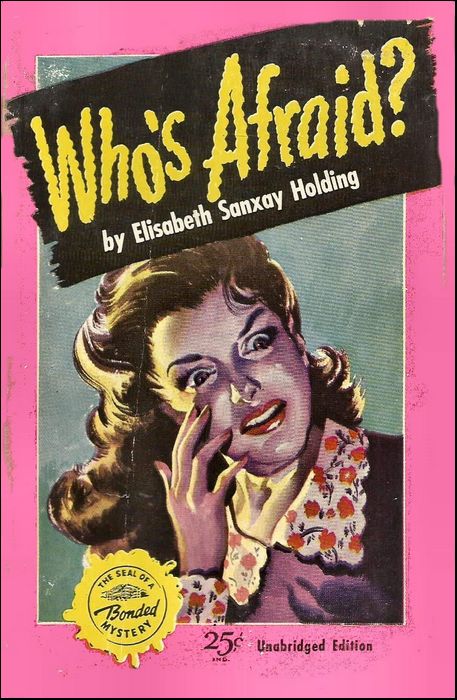
"Who's Afraid," Bonded Mystery Paperback #14, 1946
Roy Glashan's Library
Non sibi sed omnibus
Go to Home Page
This work is out of copyright in countries with a copyright
period of 70 years or less, after the year of the author's death.
If it is under copyright in your country of residence,
do not download or redistribute this file.
Original content added by RGL (e.g., introductions, notes,
RGL covers) is proprietary and protected by copyright.