
RGL e-Book Cover
Based on an image created with Microsoft Bing software
Roy Glashan's Library
Non sibi sed omnibus
Go to Home Page
This work is out of copyright in countries with a copyright
period of 70 years or less, after the year of the author's death.
If it is under copyright in your country of residence,
do not download or redistribute this file.
Original content added by RGL (e.g., introductions, notes,
RGL covers) is proprietary and protected by copyright.
RGL e-Book Cover
Based on an image created with Microsoft Bing software


The Munsey Magazine, Dec 1925, with "As Is"
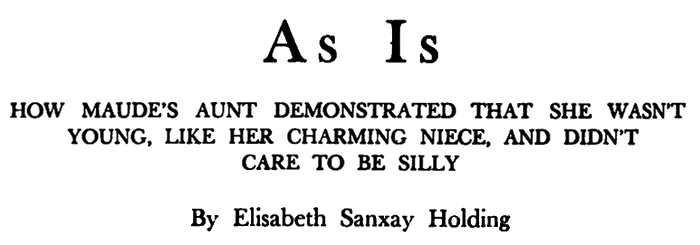
MISS CARTER fished out the last doughnut from the kettle of bubbling fat, laid it on a sheet of brown paper, and sprinkled it with powdered sugar.
"They're extra good this time!" she said to herself.
She stood looking down at them. There they lay in rows and rows, feathery light, richly crisp and brown.
"Oh, my!" she cried. "I do wish I could eat just one!"
But even one doughnut would be treachery to Maude.
"You'll ruin your figure and your digestion by eating between meals, Auntie Sue," Maude had said. "Promise me you won't!"
Miss Carter had refused to promise, but she had said that she would try, and she did try. She turned her back upon this temptation, with a faint sigh, and gave a last glance round the kitchen.
Nothing more for her to do here! It was as spotless as a chemist's laboratory. Indeed, that was what Maude wanted it to be like. She said that a kitchen ought to be a home laboratory, and she wanted it all white and bleak and stern.
Even a high white stool had been provided for Miss Carter. She found it very convenient for many purposes, but she did like a rocking-chair, and she had apologetically brought one down from the attic. To please Maude she had painted it white, so that it also had a somewhat severe look; but when there was nobody else in the house, Miss Carter always got out that nice, downy old red silk cushion from the hall cupboard, put it into the chair, and sat down and rocked comfortably while she shelled peas or hulled berries, and so on.
The cushion always disappeared before Maude got home, because it would distress her. If she were to see it, she would surely go out the very next day and buy a scientific, up-to-date one—perhaps one like those hard, shiny things that dentists have in their chairs.
Maude disapproved of old, soft, comfortable things, and called them "slipshod." She hated all that was not exact and efficient. It was misery for her to hear Miss Carter talk about putting in "a pinch" of cinnamon, instead of one-eighth of a teaspoonful, and the mention of "a lump of butter the size of an egg" appalled her.
She had bought Miss Carter glass measuring cups, quart measures, pint measures, scales, and sets of spoons of all sizes; and yet, in the making of these very doughnuts, Miss Carter had used that old blue teacup for measuring, and she had put in many "pinches" of things. It made her feel guilty to think of it, but she really couldn't help it. At forty—
Now there was another treacherous thought! Maude never allowed her to be forty.
"Never think of yourself as forty," Maude often said, "and you won't feel forty."
But in her secret heart Miss Carter wished that she could just comfortably be forty. It seemed to her a remarkably nice age to be. Indeed, she felt proud of it. When she went to buy a hat, and the saleswoman said something nice about her splendid head of hair, Miss Carter liked to say:
"It's not bad for a woman of forty, if I do say it myself!"
She didn't say this any more, because it worried Maude, but there were times when she defiantly thought it. It gave so much zest to life. For instance, that evening when they came back from the picnic, and every one else was so tired, and she wasn't, one bit, even if she was for—
As she left the kitchen and the tantalizing aroma of the doughnuts, another perfume came floating in at the open front door. It was the scent of those dear little pinks and verbenas in the garden.
"I guess I'll go out and sit on the porch for half an hour," thought Miss Carter.
So out she went, and the very sight of the garden on this summer day made her so happy that tears came to her eyes. Maude had improved the house a good deal, but she had been satisfied to leave the garden to her aunt, and it was just as it had always been—a gay, careless sort of garden, with a lawn shaded by fine old trees, and a rebellious crowd of bright, old-fashioned flowers. The sweet alyssum was foaming over the borders of the largest bed and marching down to the path, just as it had done when she was a little girl. There were the rosebushes that her mother had planted, and the privet hedge that had seemed so tall and dark and impenetrable to a child's vision. It was indeed a dear and wonderful old garden!
With a sigh of content, she sank into a chair—and almost at once jumped up again. She mustn't sit out here in her gingham house dress, wearing these old shoes! Somebody might see her, and Maude would never get over it if anybody should see her aunt looking really comfortable; so she went back to the house, and up to her own room.
This was, in Miss Carter's eyes, the most charming room in all the world. The things in it were old, and some of them were not very beautiful, but she liked them—all of them, even the two old calendars on the wall and the French clock that had not ticked for years and years. The dark shades were pulled down against the afternoon sun, and a limpid green light filled the room. The mahogany bureau shone like dark water, and the big four-post bed, with its old-fashioned bolster and the ruffled spread, looked exquisitely restful.
"Upon my word," said Miss Carter to herself, "I believe I could take forty winks! Such a hot afternoon! And there's nothing much I ought to do for the next half hour."
Now the naps of housekeepers are different from the naps of other people. There is always a faint feeling of guilt about them, no matter how much work has been done, or how well earned the rest—always a consciousness of all sorts of other things that ought to be done. Even Miss Carter, whose house was a model of cleanliness and order, had this feeling of guilt, and was quite human enough to enjoy her nap all the more for it.
She settled herself comfortably on the sofa, and closed her eyes. One of the shades flapped softly in the breeze, and she thought that it was like a sail, and that she was floating off somewhere—floating off—
The telephone bell rang.
Miss Carter sat up, frowned a little, yawned, and went downstairs; and over the wire came the voice that was dearer to her than any other voice in the world.
"Auntie Sue, darling, would it bother you if I were to bring some one home for dinner?"
"Bother me?" cried Miss Carter. "Why, of course not, child! You can bring a dozen people, any time you've a mind to!"
"I just thought I'd ask Mr. Rhodes," said Maude.
A very odd sort of feeling came over Miss Carter. She smiled graciously, as people do who wish to hide their emotions from the watchful telephone, and said:
"I'll be very glad to see him, child."
But this was not quite true. She had never heard of Mr. Rhodes before, yet she had been expecting him for five years, ever since Maude was eighteen. She had known that somebody was bound to come and take Maude away, and this was the man—she was sure of it! The way Maude said she would "ask Mr. Rhodes" was enough.
"Well, why not?" Miss Carter demanded sternly of herself. "You couldn't expect a girl like Maude t-to s-stay—Pshaw, I've left my handkerchief upstairs!"
She went upstairs hastily, and lay down on the sofa again for a little while, but she did not go to sleep.
After awhile she got up and washed her face in cold water, and began to get ready for Maude's guest. Naturally Maude would expect her to wear the crêpe de Chine dress she had given her aunt as a birthday present, so Miss Carter opened the cupboard door, and there it was—a dark and elegant stranger, hanging there with a sort of disdainful air among the sensible, sturdy linens and cottons.
She brought it out, took off her loose, comfortable house dress, and struggled into the crêpe de Chine.
"A slip-on-dress," Maude had called it.
"A squirm-on dress, I should say!" thought Miss Carter.
She did not like herself in that dress. She looked at her image in the mirror, and she did not like it. A sturdy little woman she was, straight as an arrow. Her face, with its small, clear, regular features and healthy color, and those very blue eyes of hers, was quite as pretty as it had been fifteen years ago—perhaps even more so, because of the patience and the compassion she had learned; but she had long ago forgotten to think about being pretty. She noted nothing except the dress, which didn't suit her.
"Specially designed upon long, slender lines," Maude had said.
"And I'm not!" thought Miss Carter. "What's the sense in a dress being long and slender, if the person inside it is short and"—she paused—"and roly-poly," she added firmly. "That's what I am!"
She covered up all this magnificence with a big checked apron, and went down into the kitchen again. The dinners that she prepared for Maude every night were so good that it was scarcely possible to improve upon them, but this evening she intended to try. She intended to outdo herself for Maude's Mr. Rhodes.
From the garden she picked enough early June peas to make cream-of-pea soup. The chicken, which she had intended to roast, was not, she thought, quite large enough for three, so she made it into a fricassee, with dumplings beyond description. Then she had a dish of wax beans, and a dish of asparagus, cooked to perfection and seasoned only with plenty of butter, and potatoes most marvelously fried, and she made fresh strawberry ice cream. When you consider what it meant to crack ice and turn the freezer, in that dress with long, tight sleeves and floating things that hung from the shoulders—
She didn't dare to take it off, though, for fear of their coming by an early train, because she knew that even more than a superb dinner Maude would want to see her aunt in all her glory.
Then she laid the table with her finest tablecloth and her grandmother's china, and with every rose in the garden in a bowl in the center. She really was pleased with the result.
AS it happened, they came by a late train, so that Miss Carter was sitting on the veranda, looking very calm and leisurely, as they approached. She did not feel so, however. When, around the corner of the hedge, she saw Maude's familiar gray hat, which came down almost to the tip of her niece's pretty little nose, and beside it a most unfamiliar straw hat on a tall head that bent deferentially, she was anything but calm—and, for a moment, anything but hospitable. How could she be glad to see this man who might take Maude away from her?
"He'd never appreciate her!" said Miss Carter. "Not in a month of Sundays!"
Perhaps this might seem a little unjust, when Miss Carter hadn't even seen the man yet; but what she meant was that neither this man nor any one else in the world could know the Maude she knew. He had never seen and never would see the remarkable infant Maude, the neatest baby that ever was, who used to lie out in a basket under that elm tree, her long white dress pulled down perfectly straight, her little dark head exactly in the center of the tiny pillow, her clenched fists lying one on each side of her round, serious face.
How Maude's mother used to laugh at that neat baby of hers! And how she used to laugh at the slightly older Maude who went, every day for weeks, in a pink sunbonnet and a pink dress, to try to open the garden gate, and each time sat down unexpectedly upon the path!
When there was no mother to laugh any more, Miss Carter had taken on the job. At first she had thought that without her sister she never could laugh again; but it proved easier than she had expected. She found that when the person you love wants anything, you can do impossible things. When figured out on paper, she had seen that it was impossible to send Maude to college; but she had sent her. And now, when she realized how impossible it would be to let Maude go, she knew in her heart that she could and would do that gladly.
"If he's anything like good enough for her," she stipulated.
She felt pretty sure, though, that Maude would never look at a man who was not admirable. She had seen that this Mr. Rhodes was tall, and she expected him to be marvelously handsome, with knightly manners and a commanding intellect. Maude was so very particular, and so intelligent herself—a private secretary at the age of twenty-three!
The garden gate opened, and there they were. Miss Carter rose with a welcoming smile, but—
"Good gracious!" she cried to herself. "The man's old!"
He carried himself well, this tall man. His face, in its way, was a fine one, kindly and strong and trustworthy; but Miss Carter saw the tiny wrinkles at the corners of his eyes, and the touch of gray in his dark hair, and she was cruelly disappointed. If she had seen him alone, she wouldn't have dreamed of calling him old, for he wasn't more than forty-five; but with Maude beside him he was a Methuselah. Maude was so pathetically young! Her very earnestness was such a young sort of thing! She hadn't really learned to smile yet.
"Auntie," she said, "this is Mr. Rhodes."
Over the telephone her voice had sounded very happy, but now there was a note of portentous solemnity in it. She spoke as if she were bidding her aunt gaze upon one of the wonders of the world; and this did not please Miss Carter.
"I'm very glad to see you, Mr. Rhodes," she said.
She said it pleasantly enough, but in a tone that Maude had never heard before. She looked different, too. No one would have dared to think of her as roly-poly now. Her dignity was such that she actually looked taller.
"Dinner," said she, "will be served in ten minutes."
From the way she spoke, there might have been a butler and two footmen to serve dinner. It was hard to imagine that this Miss Carter knew what a gingham apron was. Nevertheless, she put one on as soon as she entered the kitchen.
Almost at once Maude appeared in the doorway.
"Auntie!" she said. "Auntie, do you like Mr. Rhodes?"
"My dear, I don't know him!" answered Miss Carter, as if surprised.
But Maude, though young, was also a woman, and she knew what a deceitful answer this was.
"Yes, but—" she said, and paused. "You know, auntie, he's a very remarkable man," she went on briskly.
"Oh, indeed, is he?" replied Miss Carter pleasantly.
Well, she didn't think so. When called, Mr. Rhodes came in from the veranda, took his place at the table, and ate his dinner. He said yes, the weather was cool for this time of the year, and no, he hadn't been in this part of the State before, and yes, thanks, he would have a little more of the fricassee, and the roses on the table were very fine, and he liked roses. Remarkable, was he?
"A wooden Indian!" said Miss Carter to herself.
It hurt her to see Maude sitting there, with shining eyes and flushed cheeks, fairly hanging on the man's words, and to see that he never looked at the girl in that way. When he did look at her—which was not often—he wore a kind, grown-up sort of smile which Miss Carter thought detestable. He did not appreciate Maude. Miss Carter was sorry she had made ice cream, and she wouldn't let him have a single doughnut.
When dinner was over, they all went out on the veranda. Dusk had settled over the garden, and the stars were out, faint in the violet sky. A breeze stirred in the leaves of the old trees and swayed the gay little flowers, which, scarlet or blue or orange, all looked white now. It was a lovely night. Even the disapproving and indignant Miss Carter yielded a little to its softening influence, and was silent, thinking of the old, dear things that haunted her garden.
"Do you mind if I smoke?" came Mr. Rhodes's deep, quiet voice from the dark corner where he sat.
"Oh, no!" said Miss Carter, somewhat frigidly polite.
Nobody had smoked a cigar on this veranda for a good many years. Miss Carter's father used to smoke. How the smell of the smoke drifting through the dark brought back the memory of that big, jolly man, who used suddenly to chuckle aloud when something amusing crossed his mind! She smiled to herself, thinking of the days when the house had not been the silent, orderly place it was now—the days when she and her brothers had been young, and the house alive with voices, and laughter, and youth.
"And that's what poor little Maude ought to have," she thought. "Young people—silly young people—music and dancing. She shouldn't be sitting out here with me and this wooden Indian!"
She made up her mind that at least the man should be made to talk, and in a firm and resolute manner she set about the task of drawing him out. Perhaps, in her heart, she hoped that he would reveal himself as dull and pompous; but he did not.
He was a shipbuilder, the descendant of a long line of Massachusetts shipbuilders. To Miss Carter there was romance in that business, and Mr. Rhodes evidently had the same feeling. He had a sort of reverence for ships, and an inexhaustible fund of interesting tales about them. Not that he was at all eloquent. He was rather a shy man, and halting in his speech, and he needed a good deal of drawing out; but Miss Carter did it.
He talked, and Miss Carter, leaning back in her chair, enjoyed hearing him. She liked the sound of his quiet, careful voice, and liked the fragrant smoke of his cigar. She intended to go into the house presently, to wash the dishes, leaving him and Maude by themselves for awhile; but a dreadful thing happened. There was a pause in the conversation, and suddenly the clock in the hall struck eleven.
Mr. Rhodes got up hastily. He apologized for having stayed so long. He seemed conscience-stricken, and wouldn't even wait while they looked up a train for him. He said good night and set off hurriedly.
"You must come again," Miss Carter told him.
"Thank you," he replied earnestly.
"Soon!" cried Miss Carter, still more earnestly.
"Thank you!" answered his voice, from halfway down the path.
"He never will," thought Miss Carter, in despair. "Never! I've spoiled everything! I never even gave him a chance to speak one single word to Maude. Of course he'll never come again!"
And it did not add very greatly to her peace of mind to see that Maude was unusually silent and pale.
"You get right to bed, child," she said. "I'll do the dishes."
"No—I'll help you, auntie darling."
"But you have to get up in the morning," Miss Carter protested.
"So do you," returned Maude.
"But you have to go to work."
"I don't work as hard as you do," said Maude.
This startled Miss Carter, because somehow she never thought of her work as work. It touched her, too, very much, and if she had not been a Connecticut Carter she would probably have cried; but she was one, so she couldn't do that. She couldn't even hint to Maude how sorry she was for her wicked, selfish conduct. All she could do was to be very, very brisk and cheerful, and to fly around the kitchen like a bee.
And there was Maude, drying the dishes, her lovely young face so pale, so grave!
"A meddlesome old maid!" thought Miss Carter. "That's what I am!"
At last she had to say something.
"I think Mr. Rhodes is—very nice," she observed, in an unexpectedly loud voice.
"Do you, auntie?" said Maude. "Well, I—I think so, too; but"—she turned away, to put some glasses up on a shelf—"but I'm afraid that he doesn't consider me very interesting."
"Nonsense, child!" cried Miss Carter.
"Well, I'm not," said Maude. "I just don't know anything!"
Miss Carter was on the point of telling Maude that she was a college graduate and a private secretary, and probably the most intelligent young woman alive; but something stopped her. Instead, she said that she must wind up the clock while she thought of it. In passing behind the girl, she laid a hand on her shoulder.
"My dear!" she said. "My dear!"
Their eyes met—those two pairs of blue eyes that were so much alike.
"Good night, auntie," said Maude.
"Good night, Maude," said Miss Carter.
And in those six words they said more than some people could have expressed in an hour's conversation.
MISS CARTER, lying awake in the dark, had before her eyes the image of Maude, so pale and grave and so very young, standing there in that dazzlingly white, highly efficient kitchen. The night wind blew in at the open window, fluttering the curtains, and outside in the dark garden a little owl gave its tremulous cry. A great loneliness came over her. She thought of this old house, with all those rooms, so neat and orderly—and empty, standing in the dark, quiet garden, and with herself and poor lovely young Maude all alone in it. Two spinsters all alone!
"No!" said Miss Carter, aloud.
Miss Carter's forefathers, three hundred years ago, had kept themselves alive on the "stern and rock-bound coast" of New England because of their grim determination; and though Miss Carter had inherited very little of their grimness, she certainly was determined. Then and there she made up her mind; and, what is more, she was positively artful about it.
"I was wondering," she said to Maude, the next morning. "Didn't Mr. Rhodes say that his business was up in Massachusetts? How did you come to meet him, child?"
"Oh, he's a great friend of Mr. Lawrence's," said Maude, very, very casually. "Mr. Lawrence's firm are shipowners, you know, and we write all their insurance for them. Their office is on the same floor with us, and I often—I often have to run in there. Whenever Mr. Rhodes comes to New York, he always stops in there, and I've met him there several times."
"I see!" said Miss Carter brightly.
What she saw was the wave of color that rose in Maude's cheeks. She also saw how a letter could be addressed to Mr. Rhodes, in care of Mr. Lawrence, in the same building where Maude worked.
After Maude had gone, she wrote the letter. She told Mr. Rhodes that she and her niece would be very pleased to see him next Sunday afternoon, and she said that the "best" train was one that arrived at their station about three o'clock.
How could the truthful Miss Carter write such a letter? How could she say that Maude would be glad to see Mr. Rhodes when she never told Maude a word about his coming? How could she call a train a "best" train that stopped at every tiniest station, and that arrived, moreover, at a time when Maude would not be at home? But she did say all this, and was not even ashamed of it.
And then, right under Maude's nose, she prepared a supper which utterly surpassed the previous dinner; and when the poor, unsuspicious girl had gone off to the Sunday school where she taught a class, Miss Carter flew upstairs, put on the crêpe de Chine dress, arranged her hair in a new fashion, and just had time to get down to the veranda when Mr. Rhodes appeared.
She kept on in the same deplorably artful manner. Although she was still a little out of breath from her struggle with the dress, she pretended to be so deeply absorbed in the magazine she had just that moment snatched up that she didn't hear him coming up the path. There she sat, looking calm, serene, almost queenly.
As he mounted the steps, she glanced up with a mendacious air of surprise, and rose, smiling, very polite, but still queenly.
"Oh, Mr. Rhodes!" she said. "This is very nice! Sit down, won't you?"
He did so, and Miss Carter began her campaign. She said she was sorry Maude wasn't at home, but nothing could induce that girl to miss her Sunday school class.
"She's so conscientious!" Miss Carter said, and told him several anecdotes about Maude's conscientiousness.
Then she told him how devoted the children in the class were to Maude. There was no pretense about Miss Carter now. She was speaking from her heart, telling him what she knew to be the truth about her dear girl, pleading Maude's cause with dignity and sincerity. This man, this wooden Indian, must be made to realize what Maude was!
Miss Carter watched him pretty closely, but it did her no good, for it was impossible to tell from his face what impression she was making. He just listened. She waited for him to ask questions about Maude, but he did not. After awhile she grew indignant, and spoke no more. He, too, fell silent, and there they sat.
He was one of those persons to whom the sunshine is becoming. In spite of his age and his exasperating silence and his shocking lack of curiosity, Miss Carter was obliged, in justice, to admit that she liked his face. It was honest and keen and strong. She remembered, too, that when he had talked about his ships he had been really interesting. Well, he wasn't going to talk about ships this time. He had been brought here to be taught appreciation of Maude, and taught he should be.
"Your garden—" he began.
"Maude's making a little rock garden," Miss Carter said. "She had the prettiest violets this spring!"
"I like those bright-colored things that grow in the sun better," said he, with a gesture toward the glowing bed of pinks and phlox and verbena. "My mother used to have those things in her garden."
Miss Carter didn't say that she wasn't interested in his mother's garden, but she looked it, and he seemed a little taken aback. He glanced at her anxiously. He felt that somehow he had said the wrong thing, and that he had better start another topic.
"I'm going up home next week," he observed.
Miss Carter made no sort of reply to this. She could not. Going home, was he? Going away? She thought of Maude's pale, grave young face, of the odd little note in her voice when she had said that she was afraid Mr. Rhodes didn't think she was very interesting.
"He's a—a selfish beast!" thought Miss Carter.
This thought, too, was reflected in her honest face, and Mr. Rhodes saw that once more he had said the wrong thing.
"You see," he explained, still more anxiously, "I'm obliged to go there. My business—"
Miss Carter raised her eyebrows with a toplofty expression never before seen upon her face.
"Indeed!" she said.
The unhappy man could not imagine in what way he had offended her, but he had no doubt that she was offended. He felt that he must go on explaining.
"You see," he said, "it's this."
From the pocket of his coat he brought out an advertisement. Miss Carter glanced at it, and saw that on the 8th of July, at Rhodes's dock, two schooners were to be sold "as is where is."
"Indeed!" she said again.
He gave up then, and relapsed into total silence.
"Very well!" said Miss Carter, but not aloud. "Go home, then, and stay there! I wish you'd never left your home! Maude was happy before you came. Oh, you ought to be ashamed of yourself!"
She looked at him, and to save her life she couldn't help feeling just a little sorry for him. He had such a bewildered and miserable air.
"After all," she thought, "he's a guest."
So she went into the kitchen, took six doughnuts out of a stone crock, put them on a plate, and brought them out to the veranda.
"Maybe you'd like one," she said.
It was a mistake. While the man was eating a doughnut, he did not look in the least old, or like a wooden Indian. Indeed, his enjoyment was positively boyish, and Miss Carter could not help feeling a little touched. She invited him to take another and another.
"Did you make them?" he asked.
"Yes, I did," replied Miss Carter, with modest pride.
"I never tasted anything like them—never!" he declared.
"Well, I like to cook," said Miss Carter.
"You know," he went on, "your niece told me a good deal about you, and—"
"Maude makes the most delicious soda biscuits!" cried Miss Carter, suddenly recalled to her duty.
"She told me all you'd done for her," he continued. "I—I wanted to meet you. I"—he paused—"I knew you'd be—like this!"
It was Miss Carter's intention to greet this statement with an amused, indulgent smile; but she could not. There was something in the man's straightforward glance, in his quiet voice, that filled her with confusion. She turned her head aside, feeling her cheeks grow hot.
"You don't know what I'm really like, Mr. Rhodes," she said.
"Yes, I do," said he. "When I came this afternoon, you didn't see me, at first, but I—I saw you." His face had grown red, but he went on sturdily. "You—you don't know how you looked, sitting there—in your own home!"
Miss Carter understood his speech only too well. She understood, by a sort of instinct, that he was one of those men who see all the romance and glamour of the world about the head of a woman in her own home. She understood, too, that he was very lonely and very homesick; and she made another mistake.
"Tell me about your home," she said. "Your mother's garden—"
He was silent for a moment.
"Well, you see," he said, "when my father died, my elder brother got the old place; and he and his wife—well, they've made a good many changes."
Miss Carter felt a sudden and most unreasonable indignation against Mr. Rhodes's brother and sister-in-law.
"I hate changes!" she said. Then, feeling that she had been too vehement, she smiled. "That's a sign of growing old," she said. "I'm—"
"Old!" he cried. "You!"
Now this was the sort of thing almost any chivalrous man would have said in the circumstances, but the way he said it—the way he looked at her—
A most curious thing happened. Suddenly Miss Carter saw the Miss Carter that he saw—not the practical, brisk, busy woman who was simply Maude's aunt and a good housekeeper, but the woman who had bidden farewell to romance fifteen years ago, when the man she was to have married died. No—this Miss Carter was a charming and gracious woman, and a pretty one. She positively felt the lovely color in her cheeks, the soft tendrils of her brown hair about her temples, and even the clear blueness of her eyes; and all her heart was filled with an innocent and beautiful joy that it should be so.
She sat very still, almost afraid to breathe, for fear of breaking the enchantment. She was so happy!
The garden gate clicked, and, looking up, she saw Maude.
MISS CARTER was a wonderful hostess that evening. Maude was amazed. Never in her life had she seen her aunt so lively and amusing, with such a fine color on her cheeks and such a light in her eyes. She herself was a serious and quiet young creature, as a rule, but this evening Miss Carter made her talk and made her laugh—and Mr. Rhodes, too.
There they sat at the table, a most cheerful little party, with a most delectable tea set before them—a cold baked ham, a salad of tomatoes stuffed with celery, corn muffins, little custards baked in brown cups, strawberries and cream, and a superb three-layer chocolate cake; but Miss Carter didn't seem to be very hungry. It was all dust and ashes to her. Every minute was a penance to her, and every smile she gave was a little stab of pain.
"Maude!" she cried, in her heart. "Oh, Maude, my dear, beautiful girl, talk to him! Laugh, my darling! Talk to him, and make him see! I do truly believe he is a good man—almost good enough for you! Oh, Maude, my darling, laugh, and talk, and be young! Make him see your beautiful, blessed youngness!"
Poor serious Maude was always trying to turn the conversation toward business, always bringing up charters, and marine insurance policies, and so on; and Miss Carter was forever turning her skillfully aside from these dangers, making her talk about dances and picnics and frivolous and entertaining episodes from her college days. Miss Carter understood the man, and Maude didn't. Miss Carter knew only too well what things pleased and touched him, and she was fiercely determined that he should discover all those things in Maude.
It was very hard, though. Every time she got a chance, Maude began again about business. Her interest in shipping matters was prodigious.
"Do you think those two schooners you're going to sell will bring—" she began, but again Miss Carter intervened.
"I saw the advertisement," she said. "For sale 'as is where is'—that's a pretty high and mighty way to do business, I must say! Here they are—take 'em or leave 'em!"
"Well, you see—" Maude began again.
Miss Carter felt sure that the girl wanted to explain to her aunt exactly how schooners were sold.
"Oh, can't she see?" she thought, almost in despair. "He doesn't want to talk business! Oh, why can't she just be young and—silly?"
In the end, for all her gallant efforts, she was defeated. Maude got the conversation where she wanted it, and she and Mr. Rhodes talked gravely about charters.
Miss Carter left them on the veranda, and went into the kitchen to wash the dishes. She wished that there were twice as many. She wished that there were enough dishes to keep her busy all night long, so that she needn't go to bed and lie there in the dark.
She had failed—she knew it. Mr. Rhodes was very courteous and kindly to Maude, but nothing more. All her youth and loveliness were wasted on him. She was trying so desperately hard to please him, and she couldn't!
"Oh, it's so cruel!" cried Miss Carter to herself, alone in the kitchen. "Never mind, my dear little Maude! I'll sell this house, dear, and we'll go and live somewhere else, where there are more young people—more life for you. You mustn't mind—you mustn't care. Just forget all about him! He's going away, and we'll never think about him again—never!"
She heard Maude's light footstep coming along the hall.
"Auntie," her niece told her, "Mr. Rhodes is going."
"Oh, is he?" said Miss Carter.
She dried her hands, took off her apron, and came out to the front door.
"Good night, Mr. Rhodes," she said.
"Good night," he answered.
She could not see him. It was dark out there. She hoped she would never see him again, never remember his face, never think of the words that he had not spoken.
The front door closed, and he was gone. Miss Carter and Maude stood alone in the dimly lit hall, and for a time neither of them spoke or stirred.
"Well!" said Miss Carter briskly. "Time we were in bed, child."
"Yes," replied Maude, just as briskly. "It's late."
Then they looked at each other and smiled. With their arms about each other they went up the stairs and through the dark house, with all its orderly, empty rooms; and at Maude's door they said good night, both of them still smiling. That was their way.
IT was the stillest afternoon. The sun blazed on high in a blue sky without a single cloud, and all the growing things stood patient and motionless in the fierce heat. Miss Carter was down on her knees, weeding a flower bed. She wore an immense blue sunbonnet and a gay blue and white calico dress. Grubbing down there among her beloved flowers, she somehow had the air of belonging to them—a sort of flower nurse.
"I don't know," she said to herself, "whoever decided which were flowers and which were weeds. Why are the dear little dandelions weeds, when the big, staring sunflowers aren't? I guess it's the same with a good many other things. People look at children, and then set to work to weed them—to uproot all sorts of brave little dandelion qualities in them, and water and tend the big, showy sunflower traits."
Her reflections were interrupted by the sound of the telephone ringing inside the house. She rose, clapped her hands vigorously together to get rid of the clean, warm dirt, and went into the hall to answer the summons.
"Auntie!" said Maude's voice.
"Well, child?" asked Miss Carter.
"Would it bother you if I brought Jack Rhodes home to dinner?"
Miss Carter did not answer for a moment; but when she did speak, it was with all her usual affectionate heartiness.
"Of course it won't bother me, my dear!" she said. "Any one you want, any time!"
But when she had hung up the receiver, she stood there in the hall with a great weariness and dismay upon her face. All the peace of the hot, still day was shattered—all the peace that she had won through the long, long week. He was coming back!
It seemed to her that she could not bear it. She could not watch Maude, with her shining eyes and her flushed cheeks, looking at the man who returned only a kindly, grown-up smile—the man who did not find Maude's sweet youth "interesting," but turned to herself instead. She remembered how he had looked at her, how his voice had sounded, speaking to her; and that look and that tone should have been for Maude.
"I won't have it!" cried Miss Carter aloud, in an angry, trembling voice.
She felt a tear warm on her cheek, and she dashed it away, leaving a smudge under her eye.
"There I was," she said, "all dressed up, sitting on the porch as if—well, it won't be like that this time! It was that dress—I always hated that dress! Oh, Maude, my dear!"
She felt other tears in her eyes, but she ignored them.
"It won't be like that this time!" she repeated with a grim smile. "You'll see!"
She went out into the back entry and opened the ice box.
"Plenty good enough!" she said. "It won't take me half an hour to get it ready. Now I'm going to finish that weeding!"
Certainly Mr. Rhodes wouldn't bother her. He could come if he liked. There was plenty of good, wholesome food in the house for him to eat; but not one extra touch would she give to the dinner, and not one extra touch to her own appearance. She would have to wash her hands and face and put on a clean dress, but not until after he arrived. First he should see her just as she was.
"As is where is!" said Miss Carter.
So, when she thought it was about time for him to be coming, out she went again, and down on her knees by the flower bed. The garden gate clicked, but she did not raise her head until Maude spoke. Then she rose, dusted off her hands, and turned.
"Good after—" she began.
But who was there? Who was that nice boy standing beside Maude, hat in hand, with such an anxious, appealing smile on his young face?
"This is Mr. Jack Rhodes, auntie," Maude explained.
"Oh!" said Miss Carter.
Then, recovering her senses, she held out a somewhat grimy hand, and the young man seized it in a hearty grasp. His face was scarlet, but his eyes met hers very honestly.
"I—I—it's—" he said. "I—I hope—"
Miss Carter beamed upon him, to reassure him, but he turned an imploring glance toward Maude. No help did he get from her, however. Never had Miss Carter seen that serious young woman so confused. She actually frowned at the poor fellow.
"I told you auntie wouldn't mind!" she said reproachfully.
"Yes, I know you did," said he; "but such short notice—"
Miss Carter could scarcely believe her eyes; for Maude shrugged her shoulders and turned her head away, and upon her face there was an expression very like a pout. Now at last Maude was being young and silly, and it was all most thoroughly appreciated.
"There's not much use my telling you anything!" she observed.
"You know it isn't that," said Jack.
They had both entirely forgotten Miss Carter. Maude looked coldly at the young man. Then her eyes fell, and a faint smile appeared on her lips.
"Yes, I do know," she said.
Again she looked at him and he looked at her, and it was the most touching and absurd and beautiful look that Miss Carter had ever seen.
"I'll have to go in and look after the dinner," she murmured; but they didn't even hear her.
She was in too much of a hurry, just then, to trouble her head about the mystery of this second Mr. Rhodes. It was enough for her to know that for Maude he was the right and only Mr. Rhodes; and therefore he must have a dinner such as had never been equaled. She flew about the kitchen like a little whirlwind, and presently enchanting odors began to float out from the oven and from the bubbling saucepans. She rushed down into the cellar, and brought up her best preserves. She rushed out to the ice box, and brought in a box of eggs, a crock of butter, a basket of peaches, and a bottle of cream. As she hurried about, she was inventing a dessert that should have freshly baked sponge cake and peaches and strawberry preserves and cream in it.
She had just begun to whip the cream when she was interrupted.
"Isn't it a pretty hot afternoon for you to be doing all this?" asked a voice from the doorway.
It was the first and original Mr. Rhodes.
"Good gracious!" cried Miss Carter. "What ever are you doing here?"
Suddenly she was aware that she was very hot and tired and flustered, that her hair was untidy, that she was wearing a rumpled and unbecoming calico dress. She also remembered that she was sternly displeased with Mr. Rhodes, and had intended him to see her like this; but she was still more displeased with him because he did so see her.
"If you'll go out on the veranda," she said, "I'll have the dinner ready in a—"
"I want to help you," he told her.
"Certainly not!" replied Miss Carter. "Please go out on the veranda!"
But he did not go.
"They're out there," he said. "They don't want me."
Miss Carter faced him squarely.
"Who is that young man?" she demanded. "I can't understand—"
"He's my nephew," said Mr. Rhodes. "Perhaps I can explain. You see, he's in Lawrence's office—doing very well, too; and your niece—well, the first time I saw them together, I knew how the land lay."
"Nonsense!" said Miss Carter.
"No," he insisted. "It's not. It's the real thing."
They were both silent for a moment.
"I'm fond of the boy," he went on; "and—of course I saw what sort of girl she was, but I wanted to see you." He smiled. "It was a pretty mean trick," he said. "She telephoned to Lawrence's office and asked for Mr. Rhodes, and I happened to be there. I knew she meant Jack, but I answered; and when she asked if Mr. Rhodes would like to come to dinner, I said yes. We arranged to meet at the station, and"—he smiled again—"there I was! Poor little thing, she made the best of it, but—"
"I see!" said Miss Carter.
She took up the egg beater and began to turn it vigorously, so that the noise of it drowned whatever the man was saying. She didn't want to hear, anyhow. A strange and unreasonable alarm filled her. If this man wasn't Maude's Mr. Rhodes—no, she wouldn't think about that. She wouldn't think at all, but would simply turn that egg beater with a prodigious clatter in the earthenware bowl.
A large, strong hand was laid upon the handle of the thing, and the noise ceased abruptly, leaving the kitchen amazingly quiet.
"Miss Carter!" said Mr. Rhodes.
"No!" said she, though she couldn't have explained just what she meant.
"You know you wrote and asked me to come last Sunday."
"That," said Miss Carter, "was due to a misunderstanding."
"I know it was, but I thought—well, you see, I came again. I—I wanted to see you."
Miss Carter left the egg beater and faced him squarely. She stood where the golden light of the setting sun fell upon her soft, untidy hair. She stood there, in her unbecoming dress, with her flushed, tired face, and defied Mr. Rhodes. She thought that when he really looked at her, when he realized what the true Miss Carter was like, a great change would come over him.
"I couldn't go away until I'd seen you," he said. "And now—"
And now that he had seen her "as is," of course he would never want to see her again!
"Now it's harder than ever to go away," he said. "Now I never want to go away. You don't know how you look—how—how lovely!"
"Lovely?" she cried.
"Yes!" said he. "You do! I mean it."
His steady eyes were fixed upon her face, but Miss Carter would not look at him—not she! It was very well for Maude and that young man to stand and stare at each other, but she wasn't young, and she wasn't going to be silly.
"If you really do want to help me—" she began briskly.
"That's what I want more than anything else in the world!" he told her.
Then she did look at him, and she gave a smile which she believed to be a very sensible, noncommittal, grown-up smile; but it didn't seem like that to him.
Roy Glashan's Library
Non sibi sed omnibus
Go to Home Page
This work is out of copyright in countries with a copyright
period of 70 years or less, after the year of the author's death.
If it is under copyright in your country of residence,
do not download or redistribute this file.
Original content added by RGL (e.g., introductions, notes,
RGL covers) is proprietary and protected by copyright.