
RGL e-Book Cover
Based on an image created with Microsoft Bing software
Roy Glashan's Library
Non sibi sed omnibus
Go to Home Page
This work is out of copyright in countries with a copyright
period of 70 years or less, after the year of the author's death.
If it is under copyright in your country of residence,
do not download or redistribute this file.
Original content added by RGL (e.g., introductions, notes,
RGL covers) is proprietary and protected by copyright.
RGL e-Book Cover
Based on an image created with Microsoft Bing software


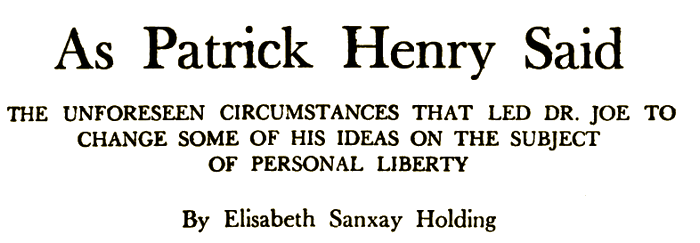
The Munsey Magazine, Oct 1925, with "As Patrick Henry Said"
"MEAN to tell me she won't let you go?" demanded Dr. Joe, in his big voice.
"No," said young Bennett stoutly, "I don't mean to tell you anything of the sort. Of course she'd let me go; only, if I did, there'd be no one—well, no one to look after the furnace or—"
"Merciful powers!" said Dr. Joe, staring at his friend in pity and wonder. "So that's what it's done to you!" he thought. "Can't take two weeks off for a hunting trip with your old friend! Can't call your soul your own!"
He was determined not to say a word of this, though.
"If the man's happy," he thought, "the thing for me is to be tactful."
And no one could have convinced him that he was not tactful. He got up, a formidable figure of a man, more than six feet in height and stalwart in proportion. He was under thirty-five, yet no one ever spoke of him as a young man, any more than people called him a handsome man, in spite of the fine regularity of his massive features. He was simply Dr. Joe. There was no one like him.
"Well, my boy," he said, in a soothing way, "I'll be off now. Got half a dozen calls to make before lunch. See you—"
"Look here, Joe! I want you to come to dinner with us on Sunday."
"Can't do it!" replied Dr. Joe, in alarm.
"You've got to do it, Joe. She wants to meet you, and I want you to see—what she's done for me."
"Seen that already!" thought Dr. Joe, but, true to his policy of tactfulness, he kept the thought to himself. "Some other time, old man," he said.
"You know you can come on Sunday if you want to," insisted Bennett.
Dr. Joe did know that. What is more, he knew that Bennett knew it.
"And I'll have to go some time," he thought ruefully, so he said: "All right, old man—Sunday it is!"
It was a genuine sacrifice. Although Sunday was six days off, the thought of it recurred to him from time to time during the morning, and bothered him. He hated to be pinned down to a definite engagement. His day's work was always heavy, and, when it was done, he liked to go home. If no calls came for him in the evening, he was glad to drop in to see a friend, for he was a sociable sort of fellow, but he very much disliked feeling that he had to go, that he was expected somewhere at a definite time. He liked, in short, to feel free.
"Breath of life to me," he reflected. "As Patrick Henry said, give me liberty or give me death. There's Bennett—married—tied down like that—dare say he's happy, but it wouldn't suit me. No, sir! I've got to have my liberty. Come and go as I please—meals when it suits me—come home tired—put on an old coat and light my pipe—that's the life for me!"
Leaving the enslaved Bennett in his office, Dr. Joe drove off about his business. He flew along the quiet country roads in his little car. He would stop before a house and run up the steps. He never rang bells. If a door was locked, he knocked vigorously upon it. If it was not locked, he flung it open and walked in; and he had never yet failed to find a welcome inside. His step was by no means light, yet no one, not even the most querulous and nervous patient, had ever complained of that. He was Dr. Joe. He expected every one to be glad to see him, and every one was.
Things went well that morning. All the patients he visited were doing nicely, and the weather was superb—a cool, bright October day. He drove home for lunch in a very cheerful humor. He was contented and hungry.
As he neared his own house, however, a faint cloud came over his satisfaction. He hoped that Mrs. MacAdams, his housekeeper, would not give him that stew again to-day.
"Don't like to say anything to her," he thought; "but seems to me we're having that stew pretty often these days. It's not—well, it's all right, of course, but—"
He went up the steps of the veranda and burst open his own front door with a magnificent crash. That was his signal to Mrs. MacAdams to put his lunch on the table.
He did not turn his head in the direction of the waiting room, though he knew that people were in there. His office hours were from two to four, and patients had no business to come at one o'clock. He often said, with vehemence, that he would see no one—absolutely no one—before two o'clock; but he did. He said he would eat his lunch in peace; but he didn't. He always had to hurry.
So he was going sternly toward the dining room, without even glancing in at the waiting room, when an extraordinary sight arrested him. There was some one sitting in the hall!
This was altogether too much. Bad enough for patients to come long before office hours, and haunt him while he ate his lunch, but to come out into the hall to waylay him!
He gave this person a severe glance. He got in return a glance which somehow disconcerted him—a cool, amused, very steady glance. He stopped short. The intruder was a woman. She was sitting in a high-backed chair, her hands lying extended on the arms, and her feet planted solidly before her, side by side. It was an Egyptian sort of attitude.
There was nothing else about her, however, to suggest old Egypt. That wrinkled, weather-beaten face with the long upper lip, half doleful, half humorous, and those twinkling little gray eyes, were unmistakably Irish; and Dr. Joe had rather a weakness for that race. Moreover, she was shabbily dressed—a thing difficult for him to resist—and her hair was gray. His just resentment vanished.
"See here!" he said reproachfully. "You ought to be in the waiting room. Patients aren't allowed to sit out here."
She rose.
"I am not one o' thim," she said. "It's business I've come to see ye about."
"Selling something?" asked Dr. Joe.
If she was, he meant to buy it.
"I am not," she answered calmly. "I came to see ye about the bye."
"Buying what?"
"I mean the young bye—the lad—" she began, when Mrs. MacAdams appeared in the doorway of the dining room.
"Your lunch is on the table, doctor," she announced, in a faint, sad voice. "I told that person—"
"I'll wait," said the person.
Dr. Joe waved his hand toward Mrs. MacAdams, and, as if he had been a wizard, she vanished. It was never her policy to argue with her employer.
"I don't understand you," said Dr. Joe to the Irishwoman. "What is it you want?"
He spoke almost gently, for something in this shabby, gray-haired stranger touched him. He didn't care to eat his lunch and leave her sitting in the hall.
"Come here, Frankie!" said she.
From a shadowy corner, where he had been standing unobserved, came a small boy—a very small boy, thin and wiry, with red hair and a pale, freckled face; a sulky-looking little boy, very neatly dressed in a sailor suit and a cap which proclaimed him as belonging to the United States Navy.
"Take off yer cap, me lad," said she, "and say good day to the doctor."
Frankie snatched off the cap, but speak he would not.
"He's a fantastical bye," she explained. "Ye'd never believe the notions he has. What's in his mind now is he wants to be a doctor; and I've come to see will ye make a doctor of him?"
Dr. Joe began to laugh, but he stopped when he saw the woman's face.
"But you see—" he said. "A child of that age—how old is he?"
"He is eight."
"He can't know what he wants!"
"He knows," she asserted tranquilly. "It's a doctor he wants to be. I've been told yourself is the best doctor in it at all, and I've brought the bye to ye to see will ye lave him study with ye."
The doctor struggled against another outburst of laughter.
"I'm afraid—" he began.
"His father'll be paying whativer is right for the larnin'," said the woman. She paused a moment. "His father is a grand, rich man," she went on. "Him an' his wife is travelin' in foreign lands, and they've lift the bye with me. It's his nurse I am. Katie is me name."
"See here, Katie!" said Dr. Joe, very kindly. "The child's far too young. Later on, perhaps—"
"Doctor dear!" she interrupted with intense earnestness. "Will ye not lave him try? He's to school in the mornin's. Will ye not lave him be with ye in the afternoons, to be watchin' the way ye'll be healin' the sick? Ye'd not know by lookin' at him all that's in his head. If ye'll talk to him, drawin' it out of him, ye'll see!"
"I'm sorry, but it's out of the question," said Dr. Joe firmly. "When the boy's parents come back, I'll talk to them, and—"
"The one day!" said she. "Lave him stop here with ye the one day!"
"I can't do it. I'm sorry, but—"
She came a step forward, with a look of piteous entreaty on her wrinkled face.
"The one day, doctor dear!" she cried. "Ye'll do that for an ould woman! He's fed. He'll need no more till I'll come for him at six o'clock. All o' thim tellin' me what a grand, kind man ye were, at all—and me ould enough to be yer mother!"
"I can't!" said Dr. Joe, very much distressed. "It's ridiculous!"
"Sure, what trouble will it be for yer honor?" she pleaded. "An' Frankie only the small young child he is—just wantin' to watch ye! Lave him come with ye the one day, doctor dear! His father'll—"
"No!" shouted Dr. Joe. "Sorry! Can't!"
He made a rush for the dining room and closed the door behind him.
THIS was the most absurd and unreasonable request that had ever been made of him—which was saying a good deal, for his generosity was well known, and full advantage was taken of it. And yet, somehow, the incident touched and troubled him. He couldn't forget the passionate earnestness of the old Irishwoman.
"Nonsense! Nonsense! Nonsense!" he said half aloud, and sat down at the table.
Before him stood a plate of that stew. He tasted it.
"It's—cold," he observed, in an apologetic tone.
In his heart he was afraid of Mrs. MacAdams. She was such a resigned, subdued woman, and always so completely in the right, that he felt vaguely guilty every time he saw her.
"I thought you would be in a hurry, doctor," she said faintly. "I had no idea you would stay out in the hall so long, talking to that person."
"No, no, of course you didn't," Dr. Joe hastily assured her. "Quite all right, Mrs. MacAdams. Many of 'em in the waiting room?"
"I believe I opened the door six times," she answered, with angelic patience.
He felt guiltier than ever. The feeling that he was a tyrant to Mrs. MacAdams mingled with a wretched conviction that he had been unduly abrupt with the poor old woman in the hall, until he saw himself as an utterly heartless bully. He couldn't bear it.
"I just want to see," he murmured, with an ingratiating smile, and, getting up, opened the dining room door.
Katie was gone. The high-backed chair was occupied by the little red-haired boy, who sat there with his head thrown back and his eyes fixed on the ceiling.
"Now see here!" said Dr. Joe indignantly. "Did she—did your nurse go off and leave you here?"
"Yes, she did," answered Frankie.
"Well, you can't stay here," the doctor told him.
Without a word Frankie rose, took up his cap, and walked off down the passage.
"Here, wait a minute!" called Dr. Joe. "You can't go off like that!"
Frankie stopped and turned.
"You told me I couldn't stay," he said.
The child's manner was not in any way defiant or impertinent, but he certainly was not abashed. He stood, cap in hand, looking straight into the doctor's face; and though he was by no means a handsome child, being slight, pale, and undersized for his years, there was something in that straightforward glance which Dr. Joe found very attractive.
"See here, my boy!" he said. "What put the idea of being a doctor into your head, anyhow?"
"It just came," said Frankie. "When I was in the hospital. When I had pneumonia last winter. In New York. The internes used to talk to me. And I liked it."
"Didn't like the pneumonia, did you?" asked Dr. Joe.
"I didn't care," said Frankie. "I liked to be there. I liked—" He paused. "I liked the smell of the hospital," he continued earnestly.
"You're a funny kid!" said Dr. Joe, laughing.
Frankie did not seem to care for this. He turned away again and made for the door, and this time Dr. Joe stopped him with a hand on his shoulder.
"I don't care!" said the boy.
Now the words themselves had very little significance; it was the spirit behind them that conquered Dr. Joe. The boy was obviously frightened by that heavy hand on his shoulder. He was only eight, and he lived in a child's world. He had no understanding of these all-powerful grown people, who laughed or flew into tempers for no reason at all. He thought Dr. Joe was angry, and he was frightened—his eyes showed that; but his mouth set in a firm, sulky line, and once more he declared that he didn't care.
"By Jove!" cried Dr. Joe. "I will take you!"
IT was the first time Dr. Joe had ever been alone with a child. Of course he had visited innumerable sick children, and had been very popular with them, but he was ashamed now to remember the sort of things he had said to other children of Frankie's age.
"Talked about bunnies and pussy cats!" he thought. "Must have made a regular idiot of myself. This child's exceptional, though."
That comforted him. He was convinced by this time that there was not and never had been another child like Frankie. He couldn't have explained this, and he wouldn't have tried.
He firmly believed that he was a notable judge of human nature. He often said that he could read a character at a glance; but, as a matter of fact, what he really felt was usually a sudden and vehement prejudice, and it was a prejudice he felt now, in favor of Frankie. He had talked to him—"drawn him out," as Katie had suggested, and he found the child not only intelligent, but an independent, clear-sighted, honest, sturdy little spirit.
"We'll go home now," said Dr. Joe. "We'll step on the gas, too. It's going to rain."
He looked up at the sky. The brightness of the autumn day had vanished long ago, and the clouds were driving up fast before a steady, bleak wind. He tucked the rug carefully about Frankie. A very little fellow he was, after all, for all his cleverness—a queer little fellow.
"Mustn't let him get chilled," he thought.
With that in view, he drove at breakneck speed along the roads that lay white before him in the stormy dusk, past houses where warm little lights were beginning to gleam in the windows. It was the hour of home-coming—and it suddenly occurred to Dr. Joe that he and Frankie hadn't much to go home to. Frankie had only a nurse waiting for him, and the doctor had only Mrs. MacAdams.
"Nonsense!" said Dr. Joe to himself.
The storm couldn't be dismissed as nonsense, however. Before they were halfway home it came upon them, a fierce downpour, drumming on the leather top of the car, dashing against the wind shield, crushing down into the mud the last valiant green things by the wayside. The headlights shone mistily into a world all darkness and confusion.
It was no new thing to Dr. Joe. It was simply a storm, and he was accustomed to being out in all weathers; but Frankie was of an age when one is, unfortunately, only too carefully protected from the elements, and he was thrilled. He wriggled joyously under the rug.
"The grand time I'm havin'!" he said.
Dr. Joe smiled to himself at the touch of brogue—picked up from the boy's nurse, no doubt; but he had to keep his mind on his driving.
There were many turns in the road, and the mud was slippery. He was glad when at last he turned into his own driveway. He hustled Frankie out of the car and up the steps, burst open the front door, and entered his own hall.
And there was a girl.
Now, if Dr. Joe had been the sort of man to be overcome by the sight of a pretty face, he would never have been a bachelor at thirty-three; but he wasn't that sort of man, and it was not the prettiness of this girl that made so great an impression upon him. It was the look on her face.
He had never seen quite that look on a woman's face before, that magical and beautiful look of welcome. She came hurrying down the hall, and her step was eager, her eyes were shining. She was smiling and holding out her hands; and Dr. Joe felt that he had, for the first time since he could remember, really come home. He didn't know or care who she was, or how she had got there, but only that she seemed somehow familiar and dear, and he was happy because he found her here.
He would have taken her outstretched hands—but the boy was ahead of him. Frankie ran up to the girl.
"Hello, Molly!" he said casually.
Dr. Joe saw then that the smile and the welcome and all the magic had been for Frankie, not for him. The girl turned to him, and she was a different girl—a polite, composed young creature.
"I've come to take Frankie home," she said. "Thank you very much, doctor."
For a moment he was too disappointed, too dejected, to answer. He was only a doctor; people were glad to see him only because they thought he could make them well. Nobody had ever looked at him as Molly looked at Frankie, and nobody ever would. What was there waiting for him when he got home? A lot of patients who wouldn't give him time to eat his meals, and Mrs. MacAdams. His house was dark and dusty and cheerless, and the aroma of that stew still lingered in the air.
"Don't mention it!" he said gloomily.
She waited a moment, holding Frankie by the hand. If he had looked at her, he would have recognized her expression, for it was the expression worn by mothers, aunts, and all female relatives of young children, and it meant that she was waiting to hear what a unique and wonderful child Frankie was; but Dr. Joe was lost in his unusually dismal thoughts. He was roused from them only by the sound of her voice.
"Well, thank you again!" she said. "Come, Frankie! We'll have to hurry."
Then he remembered what the weather was.
"No!" he said. "You can't go out in this storm. No—I'll take you home in my car."
Perhaps, on Frankie's account, the girl would have accepted this offer, but just at this moment the dining room door opened and Mrs. MacAdams appeared.
"Your dinner is on the table, doctor," she said, in a severe and deeply wounded tone.
"In a minute," said Dr. Joe. "I'm going out first."
"Oh, no!" cried the girl. "No, please! No, we really won't let you! We'll sit here till the rain lets up. I have an umbrella. Please, doctor, don't keep your dinner waiting!"
"I don't care about my dinner," said Dr. Joe.
Mrs. MacAdams coughed.
"Doctor," said the girl, "if you let your dinner get cold, after you've been so good to Frankie, I'll never forgive myself!"
He couldn't help smiling at her tremendous earnestness, yet it pleased him. He looked down at her and she looked up at him, and he was still more pleased. Hers was the sort of prettiness that he liked best of all—not the fragile, exquisite, rather alarming kind, but the simple, honest, gentle sort—the home sort.
She was little and slender, but she looked strong. She had blue eyes, and they were beautifully kind; she had black hair that curled, and a mouth that was generous and firm. What is more, Dr. Joe remembered the look she had given Frankie when he came in. He knew what she was capable of; he thought she was a wonderful girl.
"See here!" he said. "Stay and have a bite with me—you and Frankie—and I'll take you home afterward."
Mrs. MacAdams coughed again. Goodness knows what meaning she intended to convey, what warnings and reproaches, but certainly the effect was very different from what she had wished. That cough awoke in Dr. Joe a firm determination to ask whom he pleased, when he pleased, to his own board. It also caused the girl to make a curious remark.
"Dr. Joe," she said, "Frankie's nurse, that you saw this afternoon—she's my grandmother."
Now no one had ever heard Dr. Joe mention the word "democracy," and he never thought about it, either. If you had questioned him, he would have told you, with considerable vigor, that he did not believe all men to be equal. He saw human beings at all the crises of their lives, and he knew that they weren't equal. He saw people who were heroic in suffering, and he admired them; he saw people who were not heroic, and he pitied them, and that was about as far as he went in judging his fellow creatures. As for dividing people according to their wealth, or their social standing, or their education, that never entered his head; so that he hadn't the faintest notion that he was being tested, or that the girl was being plucky.
"I see!" he said cheerfully. "Now, then, Mrs. MacAdams! Can you scratch up something for these two young people to eat?"
Mrs. MacAdams did not like being asked to "scratch up" anything, and she did not like these young people.
"I shall do my best, doctor," she promised in a rather chilly tone.
It is regrettable to be obliged to say that she didn't keep her promise. Even Mrs. MacAdams could have done better, had she tried.
Dr. Joe didn't notice this, though. He was filled with delight at his dinner party. He bustled about, pulling chairs up to the table, and turning on more lights. His big, hearty voice was plainly audible to the patients in the waiting room, and they wondered how he could be so cheerful when they were not.
"Now, then!" he said.
He was sitting at the head of the table, and Miss Ryan—that was her name—was at the foot, with Frankie between them, and the whole thing seemed to him extraordinarily jolly. There was something on his plate, and he was about to eat it, when he observed Miss Ryan lay her hand on Frankie's arm and whisper to him.
"I don't care!" said Frankie, aloud. "I'm hungry!"
Miss Ryan's face grew scarlet, and Dr. Joe frowned.
"Come now, my boy!" he said. "This won't do!"
"I'm hungry!" said Frankie, with something like a sob. "Bread an' butter isn't enough!"
"But hasn't he got—what has he got, anyhow?" inquired Dr. Joe, puzzled.
"I don't know," said Miss Ryan; "but—I'd rather he didn't eat it."
She was terribly distressed, but she was resolute.
"It is cold sliced pot roast," said Mrs. MacAdams, in an awful voice.
A painful silence ensued.
"I'm hungry, Molly!" cried Frankie at last, in a most mutinous voice. "I don't care what it is! I'm—"
"Frankie!" said she. "You shan't eat it, and that's all there is to it." She took away the child's plate. "I'm sorry," she explained to Dr. Joe, in an unsteady voice, "but we have to be very careful about what he eats; and all that fat—"
"See here, Mrs. MacAdams!" said Dr. Joe entreatingly. "Can't you rake up something for the child—milk—oatmeal—something of the sort?"
"Doctor," said Mrs. MacAdams, "I can neither rake up nor scratch up anything else. This is the dinner I had prepared—for you. I was not informed that there would be"—she paused—"a party of guests."
Then Dr. Joe had a bright idea—the sort of idea that would never have occurred to any one else.
"Tell you what!" he said. "Poor kid's hungry. You know what suits him. Perhaps you could find something if you looked around in the kitchen, Miss Ryan, eh?"
He didn't realize what he had done, but Miss Ryan did. She looked at Mrs. MacAdams with the nicest, most friendly sort of smile, but she got from that lady a look that roused all her native spirit.
"All right!" she said. "Thank you, Dr. Joe—I will!"
And she rose and went into the kitchen. Mrs. MacAdams did not follow, nor did she make an offer to help Miss Ryan. Perhaps she felt that this girl was one who did not require much help; perhaps she had other reasons. Anyhow, she stood there in the dining room, perfectly silent. Frankie was silent, too, and very sulky. Dr. Joe was silent, and no longer happy. His dinner party was not successful.
He wondered. He wondered why he had so many dishes made from roasts, and so seldom the roasts themselves. He wondered why the tablecloth was neither dirtier nor cleaner. If it was never changed, it would certainly have been worse than it was. It must, therefore, be clean sometimes; but he couldn't remember having ever seen it so.
IT seemed a long time before Miss Ryan came back, but the delay was justified. Upon a tray she bore three plates. What there was in two of them Dr. Joe never knew, but what she set before him was a miracle. Cheese and eggs and toast were part of it, but there must have been other things.
His spirits revived, and so did Frankie's. He made jokes, and Frankie laughed at them. So did Miss Ryan, but in a different way. Dr. Joe suspected that something was amiss with her, and later, when he was helping her on with her coat, he felt sure of it. The light in the hall was dim, and he bent nearer. It was true—there were tears in her eyes.
He said nothing at the moment. He waited until he had got them snugly stowed into the car, Miss Ryan beside him, with Frankie on her lap.
"What's wrong, Miss Ryan?" he asked, in his blunt way.
"Why, nothing!" she answered brightly.
He knew there was, though. She wasn't the sort of girl to have tears in her eyes for nothing. He thought about it for awhile, and then he came to a conclusion.
"Miss Ryan," he inquired, "what do you do?"
In his wide experience of other people's troubles, he had learned the terrible and pitiful importance of jobs, or the lack of them.
"Well, doctor," she replied, "I play the piano in the music department of the Novelty Bazaar."
"In the basement," said Dr. Joe. "That's not much of a job."
He was acquainted with the Novelty Bazaar and its system of ventilation.
"Oh, it might be worse," she returned cheerfully.
"Not very much," said Dr. Joe.
Again he was silent, thinking of Miss Ryan at work in the basement of the Novelty Bazaar.
"I'm going to get you another job," he announced abruptly.
"I wish you'd get yourself another housekeeper!" she cried, with a vehemence that startled him. "I never saw—anything so—awful. It's a sh-shame!"
"See here!" said he, astounded. "You're not crying about that?"
"I'm not c-crying at all," replied Miss Ryan, with dignity. "Only—when I saw that kitchen—and that dinner—it's cruel!"
This made him laugh.
"Cruel?" he said. "Mrs. MacAdams cruel? Poor old soul! She's—"
"It is cruel," said Miss Ryan, "when you're so busy and so—wonderfully kind and good."
He had been called kind and good often enough before in his life, but it had never sounded like this. He looked at Molly Ryan. The interior of the little car was well lighted, so that he could see her clearly, sitting there beside him, with Frankie in her strong young arms, and those blue eyes of hers misty. Kind? He wasn't the only one.
"It's down this street," she told him. "There—that's the house—with the white fence."
He stopped the car before the house—such a poor, forlorn little house it was—and Miss Ryan tried to set Frankie on his feet; but Frankie would not stand. Limp and dazed with sleep, he sank down on the floor of the car.
"I'll carry him," said Dr. Joe. "Come on! We'll make a dash for it."
So they did make a dash for it, through the pelting rain, to the veranda of the poor little house, and Miss Ryan rang the bell. Nothing happened. She waited a moment, rang again, and then opened the door with a latchkey.
Dr. Joe followed her inside, still carrying Frankie. She had lighted an oil lamp on the table, and, as he came in out of the stormy darkness, there was a picture he did not soon forget. It was a very little room, and a very humble one; it was not tastefully furnished; indeed, regarded in detail, it was quite the contrary; but it was a home. It was clean and neat and blessedly tranquil in the lamplight. It was a house with a heart—and Molly Ryan was in it.
Frankie came to life now.
"Where's Katie?" he demanded.
"She's left a note," said Molly. "I don't understand. She's never gone out so late before; but perhaps some of the people she works for sent for her."
The girl looked perplexed and troubled. Dr. Joe was perplexed, too.
"People she works for?" he repeated. "Thought she was the boy's nurse."
"She is," answered Molly; "only while he's at school she—she does other things."
"What other things?"
For a moment Molly looked dignified, and as if she would not answer, but she thought better of it. She looked up at Dr. Joe with the straightforward glance that he liked so well.
"She does day's work, Dr. Joe—scrubbing and cleaning."
"But see here—I don't understand this! Do you mean to tell me that the boy's parents have gone off and left him with his nurse, and haven't given her any money to look after the child?"
"She does look after him!" cried Miss Ryan hotly. "He goes to the Lessell Academy. He's getting the best education and the best care—"
"I'm sure of that," interrupted Dr. Joe. "What I don't understand is why his nurse has to go out scrubbing by the day. Why does the child live here? Why don't his parents—"
"They can't help it!" said Miss Ryan. Her cheeks were flaming, her blue eyes alight. "They've done the best they can. They're the—the finest, most splendid people in the world. They—they just are!"
Dr. Joe respected her loyal defense; but he didn't agree with her. He felt pretty sure now that Katie and this girl were burdened with the entire support of the boy, that they went shabby while he was well dressed, that they worked, scrubbing floors and playing the piano in the Novelty Bazaar, while Frankie went to an expensive private school. To his thinking, there was no possible excuse for parents who would do such a thing.
"See here!" he said. "I've got to go now—patients waiting for me. Send Frankie to me again to-morrow. No trouble to me. Fact is, I rather like to have him."
Miss Ryan held out her hand, and Dr. Joe took it. He didn't know what to say to her. He couldn't very well ask her to come to see him, and he didn't quite know how to suggest coming to see her; so he only gripped her little hand and said nothing, and it made him very unhappy. He wanted to see her, not just some time in the indefinite future, but the very next day and all other days. Going away from her was going away from home.
THE next day was a dismal day by nature, and Mrs. MacAdams did nothing to make it better. She gave Dr. Joe the worst breakfast he had yet had, and she presented a curious and disturbing appearance. She had a bandage around her throat and another around her left wrist, and a plug of cotton wool in one ear. Time was when Dr. Joe would have made kindly inquiries about these matters, but not now. He had learned that her troubles were all due to opening the door for patients, to answering the telephone, or to going up and down the stairs; and as he couldn't remove the cause, he was obliged to ignore the symptoms.
Nevertheless it disturbed him and made him feel guilty, and he set off to make his rounds in an unusually downcast mood. He did not forget that he had promised Molly Ryan to find her another job. Indeed, he forgot nothing at all about Molly—not even the way her dark hair curled above her ears; but his morning was too busy and hurried, and he had no chance to serve her. And this made him feel worse.
When he came home at lunch time, he did not run up the steps. He walked, and this gave him an opportunity to observe that the glass in the door was grimy and the curtain covering it limp and spotted. He was about to fling open the door when, to his surprise, it was opened for him. It was opened by Miss Ryan, hatless, and wearing an apron.
"Lots of people in the waiting room," she whispered. "Your lunch is all ready."
"See here!" he cried, astounded, but she had hurried off down the passage.
He followed her into the dining room. There was a clean cloth on the table, and its radiance dazzled him. There was a wonderful aroma in the air.
"Sit down!" said she, and vanished into the kitchen.
He did sit down, dazed and helpless. In a minute back she came, with a broiled steak such as no man had ever eaten before, and fried potatoes, and tomato salad, and other things.
"Please eat it while it's nice and hot," she said.
"See here!" cried Dr. Joe again. "What are you doing here?"
"Begin to eat, then!" she insisted sternly. "Well, you see, you must have dropped your notebook out of your pocket last night. I found it on the veranda this morning, and I thought I'd better bring it to you. When I came, that Mrs. MacAdams—well, she marched upstairs and got her hat and coat, and she said—"
Miss Ryan paused.
"Well, what did she say?" the doctor asked.
"All sorts of nasty, silly things," answered Molly, growing very red. "Anyhow, she went out of the house and said she was never coming back if—"
"If what?"
"Oh, nothing!" said Miss Ryan hastily. "Only—she went. Some one had to get your lunch, so I stayed."
"You—stayed!" Dr. Joe repeated, as if stunned. "You—stayed!"
Miss Ryan grew redder than ever.
"It wasn't anything to do," she said. "I couldn't go to work, anyway, on account of Frankie, because grandma hasn't come back yet." Her face changed. "I can't help thinking it's queer," she went on anxiously. "I can't help worrying. She never did such a thing before. She just left a note."
The girl hesitated for a moment. Then from the pocket of her apron she drew out a piece of wrapping paper and handed it to him. On it was printed, in pencil:
I HAVE TO GO AWAY A WILE—GRAN.
Miss Ryan watched Dr. Joe while he read it; then their eyes met.
"She's the finest woman God ever made," said Molly quietly. "She's done everything in the world for me. She's worked and slaved so that I could have an education—and all the things she's never been able to have."
Dr. Joe understood all that she meant him to understand, and he loved her for it. Yes, he admitted that he loved her. He knew it wasn't the proper time to love her; he had only seen her twice. But he did, just the same.
"Molly Ryan!" he said.
Even the tips of Miss Ryan's ears grew red.
"I—I can't think about anything but grandma just now," she said. "I'm—I'm so worried about her!"
"I'll look after her," said Dr. Joe. "I'll see that she doesn't go out scrubbing any more. I'll look after Frankie, too; and if you'll only let me—"
"There's the doorbell!" cried Molly.
"I'll go!" said Dr. Joe.
"Oh, do please eat your nice hot lunch!" said she.
"Won't have you waiting on me!" he returned.
They both reached the doorway at the same instant, and there was not room there for the broad-shouldered doctor and any one else; so he turned, and they faced each other.
"Won't you let me help you?" he said. "I don't know how to explain—it has come so suddenly. Of course, I know you don't—of course, you can't—but—"
"It's the lunch," said Miss Ryan. "You're so glad to get a decent meal."
"It's not!" he denied indignantly. "It's—if you'd only just come here twice a day, and stand in the hall and smile when I come in!"
Then they both began to laugh.
"It's not a joke, though," said Dr. Joe.
"I know it," said she. "I didn't mean to be silly and horrid; only, until grandma comes back—"
The doorbell rang again. This time Molly got ahead of him, and ran down the passage.
"Grandma!" she cried, as she opened the door.
Katie entered with a bland smile.
"Good day to ye, doctor!" she said.
Dr. Joe was remarkably glad to see her again.
"Well!" he said, with a smile. "You've been causing a good deal of anxiety—"
"It's sorry I am for that," she broke in; "but it couldn't be helped at all."
"But where—" Molly began.
"Whisht now!" said Katie. "It's about Frankie I've come. Ye had the bye with ye yesterday; and what did ye think of him, doctor dear?"
"I was talking to Miss Ryan about that," replied Dr. Joe seriously. "I'd just told her that I'd be glad to look after the boy, and—"
"D'ye mean it, doctor dear? D'ye mean ye'll make a doctor out of him?" she cried.
"If that's what he wants when—"
Katie looked steadily at him for a minute, then she turned toward the door.
"My work's done," she said. "Ye've tould me ye'd make a doctor of him, an' ye'll do it. Good day to ye, doctor dear!"
"Here! Wait a minute!" he called. "I'd like to speak to you. Come in and have lunch with me."
Katie stopped and faced him again, and he was aware of a fine dignity in her.
"Ye'd ask an ould woman like me to sit down at the table with ye?" she inquired gravely.
Dr. Joe flushed a little.
"I have asked you," he said.
Her keen little eyes were still fixed on his face.
"Then ye're not one o' thim that—then ye'd not think the worse of Frankie if his parents wasn't the grand, rich people they are?"
"See here!" said Dr. Joe. "You have some mighty queer ideas!"
"It is not myself has the queer ideas," said she. "It's others has thim. I'm an ould woman, an' I have seen a lot. If Frankie's parents wasn't Mr. and Mrs. Mortimer Depew of New York, he'd niver have been took into that academy; but they writ a latter, the two o' thim, and he is there."
"Granny!" cried Molly.
"Whisht now!" said the other. "I know well what I'm doin'. Didn't I see the way it wint with me own bye? If Frankie was to be the greatest doctor that ever lived, he'd niver be the equal o' that bye. He come here from the ould country, and not a penny in his pockets. It was in his head he'd be a doctor; so he worked in the days and studied in the nights. Thim that had money had all their time for the studyin', and they wint ahead of him. Five years he took for that they'd do in two, him workin' in a garage in the days. Thin what does he do but get married? A fine girl she was, too—a fine girl. 'She'll help me,' says he, 'for she's had a grand education.' A school-teacher she was, a fine girl. Thin Molly was born, and the two o' thim schemin' and plannin' the way she'd be a doctor's daughter, and the grand time she'd have of it. Thin the war came and he wint, like the rest o' thim, and in the end of it he was kilt; and it wasn't so long before the poor girl died, too." Katie was silent for a moment. "But it's different with Frankie," she said. "He'll have a grand chance!"
"He will," said Dr. Joe. "He would, even if his parents weren't Mr. and Mrs. Mortimer Depew of New York."
She gave the doctor a startled, sidelong glance.
"But they are!" she insisted.
"Certainly, if you say so," agreed Dr. Joe; "but I can't help thinking that it's rather a pity. A father like that boy of yours, for instance, would be some one he could be proud of."
"And an ould grandmother that scrubs floors?"
"I couldn't think of a much better one," said Dr. Joe, pretending not to notice that she was hastily wiping her eyes.
"Whatever way it is," she said, "I had me mind made up Frankie should get his chance. And now ye've promised me, doctor dear, and I can go off home to me brother in the ould country."
"Granny!" cried Molly. "But what about me? You can't—"
The old woman laid her hand on Molly's shoulder.
"Ye'll get on, acushla," she said gently. "I want to go back to the ould country, and to what frinds is left me there. You'll get on, you and Frankie, the both o' ye. Where is the bye?"
"He's in the kitchen, eating his lunch. But, granny—"
"Lave him come here," said she, "so I can have a word with him."
When Molly had gone, she turned again to the doctor.
"Studyin' music, she was, and goin' to be one o' thim—thim that gives concerts an' all," she told him; "but I couldn't go on with it. Frankie's a bye, and it's a bye has to have the chance."
"You may be sure that if there's anything I can do for her," said Dr. Joe, "I will."
"Well, there might be something," said Katie judicially. Then Dr. Joe was astounded to see a grin on the old woman's face—not a smile, but a broad grin. "Doctor dear," she continued, "didn't I pick ye out, the day I saw ye in the clinic, an' me there with Mrs. O'Day? Didn't I know if ye once set eyes on the two o' thim—Frankie and Molly—ye'd be a frind to thim? I'm an ould woman. I cannot do much more for thim. I wint off to Mrs. O'Day's last night, the way ye'd get better acquainted with thim. Sure, ye're not angry with me, doctor dear?"
He was not.
On Sunday morning Mrs. Bennett telephoned to Dr. Joe, to remind him that he had promised to come to dinner that night. She knew by his tone that he had forgotten all about it.
"But—yes, of course," he said. "I—yes; but see here! I—I'm sorry, but I'll have to ask Molly."
"Molly, Dr. Joe?"
"Yes," he answered, with immense pride. "Girl I'm going to marry next month. Can't very well make any arrangements without consulting Molly, you know!"
Roy Glashan's Library
Non sibi sed omnibus
Go to Home Page
This work is out of copyright in countries with a copyright
period of 70 years or less, after the year of the author's death.
If it is under copyright in your country of residence,
do not download or redistribute this file.
Original content added by RGL (e.g., introductions, notes,
RGL covers) is proprietary and protected by copyright.