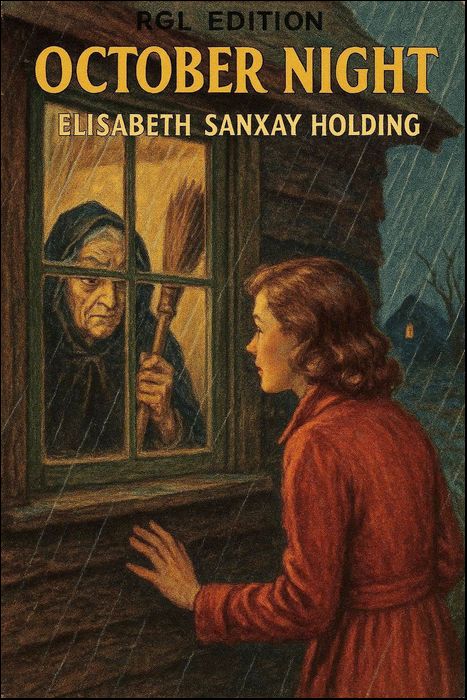
RGL e-Book Cover
Based on an image created with Microsoft Bing software
Roy Glashan's Library
Non sibi sed omnibus
Go to Home Page
This work is out of copyright in countries with a copyright
period of 70 years or less, after the year of the author's death.
If it is under copyright in your country of residence,
do not download or redistribute this file.
Original content added by RGL (e.g., introductions, notes,
RGL covers) is proprietary and protected by copyright.
RGL e-Book Cover
Based on an image created with Microsoft Bing software


Who was this old woman with straggly white hair?
A little old house hidden in trees; strange people living in it, one a student of witchcraft—an excellent background for weird and fearful happenings.
A WILD, gray morning, with the rain dashing against the windows and the trees rocking in the wind: the last leaves, like valiant little banners of russet and yellow, being torn from the branches and sent to flutter and lie dead on the sodden earth.
"Nick won't come today," said Lou to herself.
That was a good thing. It would be better if he never came, if she never saw him again. Better still if she never thought of him again. What good was there in these meetings which always ended in bitterness? He was a young third officer on a passenger steamer, with no likelihood of immediate promotion and she was a girl with an expensive and useless education, left alone in the world now, with no money but her salary as Mr. Deal's private secretary. It was the first Job she had ever had, and she was never likely to get another as good as this.
"We could manage," he was always telling her. "You could have practically all my pay. We could get a little flat."
And she was to stay in the little flat, and do the best she could with his pay, and he would be home with her three days every month.
"I'm sorry, Nick," she told him. "but I'm just not like that."
"You mean you don't care enough?"
"I'm afraid that's the way it is," she had said a little unsteadily. "Not quite enough, Nick."
Not enough to be poor and anxious and lonely. But she did care, more than he was going to know; she cared enough to lie awake on nights when a great wind blew, and think of him at sea, with tears, with cold fear in her heart. He last said he was going to drive out this Saturday afternoon in that shabby little car a friend lent him, and take her out to a place he had heard of, where they would have a shore dinner. But he wouldn't come in this weather, and that was a good thing.
Mr. Deal was taking a long time over his breakfast this morning. Certainly she didn't much relish her work; the very thought of his precious book: "Some Aspects of Colonial Culture," filled her with boredom; but it was better to work than to think about other things...
Millie, the nice little housemaid, came into the library with her duster.
"Good morning, Miss Craigie! Isn't it a mis'able day?"
She liked Millie, the one creature in this dour old house who was young and cheerful and alive.
"Better not disturb Mr. Deal's papers, Millie."
"I hate to go near 'em. Miss Craigie! Those pictures he's got of them witches
"But you don't believe in witches, Millie!"
"O, no, Miss, 'course I don't. Only, a old house like this—there's such queer noises at night... Look, Miss! The way that rug's going up and down...!
"It's the wind coming under the door, Millie."
"I know, Miss. But it looks like something alive was under it, don't it. Miss?"
"Not to me."
"And Mrs. Craw... She's so kind of gloomy, Miss. Waiting all the time for a telegram that her brother-in-law's dead... If it wasn't for you. Miss Craigie, I don't think I could stand it here. It gets on my nerves like..."
That wasn't hard to understand. This old little cottage, with its dark, low-ceilinged rooms and the old furniture, the trees that pressed too close, the neglected garden... Mr. Deal was coming now, and Millie hurried away. And Mr. Deal was strangely excited. A little elderly man. he was, with plump cheeks like a chipmunk.
"A most interesting letter. Miss Craigie! You recall, perhaps, Professor Welcome's book on witchcraft? An authority—the authority... He writes that he has read my little article on the Salem trials and he wishes to discuss the matter with me. He proposes to come over here this afternoon by the 4:40 train, and if I don't telephone him to the contrary he will stop over Sunday. The authority!"
Stupid to feel a sort of pity for Mr. Deal, because he was growing old, alone. In this old house. He had money: no doubt he got what he wanted from life
"I believe you were to have a holiday this afternoon, Miss Craigie... But in the circumstances... A visit from a man of such distinction... If, you would defer your holiday, I should greatly appreciate it..."
His appreciation wouldn't take the form of proposing any extra pay. Very careful of his inherited money, was Mr. Deal. There was no reason why she should give up the first holiday in a month just to oblige him. No reason except that he was growing old, and his enthusiasm was, somehow, a little pathetic...
"Very well, Mr. Deal!"
"I really appreciate this, Miss Craigie! And you'll go to the station to meet Professor Welcome? In this weather, my throat..."
"Certainly, Mr. Deal."
THE perfect secretary. Miss Craigie; a slender girl, a little pale, with long, dark blue eyes and ash-blonde hair, smartly dressed. Intelligent, marvelously self-possessed.
"We must organize matters. Miss Craigie. First, I should like all my notes on the witchcraft chapter typed before Professor Welcome arrives. Then, Mrs. Craw must be consulted... If you're ready... You recall that I was commenting upon what is popularly known as the witchcraft of delusion In Salem? Properly speaking, this was not a delusion. Witches actually existed. They did not, of course, possess the supernatural powers attributed to them, but many of them believed that they had these powers. They confessed to them with pride. And undoubtedly they were actively engaged in doing all the evil they could."
The subject charmed him; he dictated with zest. Lunch hour came and he was still full of it.
"No..." he said. "Witchcraft was not a delusion. Indeed, I should not hesitate to declare that there are witches alive In the world at this moment."
Millie dropped her tray with a crash, and glancing at her, Lou saw that the girl's face had grown white.
"He's forgetting her," she thought. "I wish he'd stop. Because if Millie goes..."
It would be hard to live in this house without Millie, with only the detached Mr. Deal and Mrs. Craw.
"Nick wouldn't have come, anyway," thought Lou. It didn't matter... Only, she must keep Mr. Deal talking about the weather, which was his favorite topic, next to his book.
But he was unmanageable today. Even questions about his cherished aneroid barometer could not deflect him from the subject of Professor Welcome's visit. "Anyhow, it's a relief to get him off the Witches' Sabbath," thought Lou, "Millie wouldn't have stood much more."
So with a resignation which was half duty and half innate courtesy she listened to Mr. Deal's views about the distinguished guest's comfort.
"He must have the west room." said Mr. Deal. "A fire can be lit there to supplement this not entirely adequate furnace. And blankets... And It occurs to me that possibly the window curtains ..."
Mrs. Craw and I can get up there and see, Mr. Deal..."
"Quite," said he.
Mr. Deal took out his after-lunch cigar and Lou rose.
"I'll see Mrs. Craw," she said.
MRS. CRAW was in the little dining room off the kitchen, her own private domain; a black cotton stocking was drawn over one hand which showed through the web like a ghostly window. There was no hole to darn. She took it off and looked up at Lou.
"I've got to be prepared." she said, sombrely.
These words, spoken so portentously by this melancholy woman in her room filled with the gray light of a rainy autumn afternoon filled Lou with an unreasonable alarm.
"Prepared?" she repeated.
"I'm expecting a telegram at any moment," said Mrs. Craw. "My brother-in-law's just lingering... just lingering..."
It seemed to Lou that there was a horrible relish In Mrs. Craw's tone. She was very anxious to hear no more.
"I'm so sorry..." she said, with polite sympathy, and at once began to speak of blankets, curtains and food for Professor Welcome. Mrs. Craw evinced a professional interest. Of course there was nothing in the house; there never was anything in the house, and she made a long, slow list of eatables. Even this list, somehow, was tinged by Mrs. Craw's sombreness: mutton, rice, candles...
MUTTON, rice candles... The words made a dismal refrain in Lou's mind as she sat in one corner of the big car; there was something a little horrible in them.
"Like a funeral feast," she thought.
And even the car seemed like a hearse, so big, so dark, running so silently and smoothly. Weeks, the chauffeur, looked like a wooden figure with his square shoulders, a little point of fair hair growing down his sturdy red neck. The rain was coming down in sheets; one might imagine it had washed all the color out of the world .... Mutton, rice, candles ....
"That's like a very modern poem about my life," she thought. "The mutton and rice are my daily bread. And the candles are the miserable, feeble light of my drowned soul. I'm glad I'm not going to see Nick today. My whole nature is out of curl."
She stopped in the little town and did her shopping, according to Mrs. Craw's list; a big and unseemly package was stowed in the front seat beside the wooden chauffeur. Then they went to the station.
IT was dark as night now. The overhead lights shone down upon the empty platform where the rain went dancing in a sort of mist. Two or three taxis stood there, their headlights illuminating the muddy road. A train whistle sounded, dismal beyond measure.
It seemed to Lou her duty to get out and welcome the important guest. On the platform she was under cover, but the slanting rain drove across it. She felt it, cold as ice on her ankles; she could almost fancy it chilled her heart. The train came in; through the lighted windows she could see the passengers lively, strangely at home and comfortable. It was as if they were going somewhere, and she alone was left behind in the chilly, rainy night...
Two or three people descended. One of them, directly in front of her, had an appearance which seemed to her what might be expected of Professor Welcome: a slight little man with a big. drooping, black mustache and a most extraordinary plaid overcoat. He looked, she thought, like an old tin-type come to life.
"Professor Welcome?" she asked.
He took off his derby hat, revealing a head of very black hair, parted in the middle.
"From Mr. Deal?" he asked. "His secretary, I take it? He has mentioned your assistance in the most flattering terms... Most flattering..." He smiled gallantly, revealing glittering gold teeth. "My bag," he said, indicating an enormous cowhide portmanteau which the conductor had set down on the platform. "I don't like..."
The rest of his words wore lost in the noise of the train pulling out. Waiting politely to hear the rest, Lou glanced about the platform. And a few feet from her, directly under a light, she saw Nick, his soft hat pulled down over his forehead, the collar of his overcoat turned up. He was looking at her, a steady, unsmiling, miserable look; somehow, today he seemed so young, so faithful, just standing there. He had come, after all. And he might only have this one day ashore...
"The car's over there. Professor Welcome," she said. "I'll tell the chauffeur to come and get your bag. And will you excuse me just a moment. Some one I know has come on the train..."
"Certainly, my dear young lady!" said Professor Welcome gallantly, and as Weeks approached in obedience to her gesture, she turned to Nick. He came to meet her, hat in hand, and now he smiled.
"Hello, dear!"
"Hello, Nick... Nick. I'm so sorry... I didn't think you'd come in this weather... Mr. Deal's got this cherished professor and I said I'd help to get him installed. I didn't think you'd come."
His disappointment was plain enough; for three weeks he had been looking forward to this day. He had come all the way out here and for nothing. She could not blame him if he reproached her bitterly.
"Well, of course," he said, "if it's your job."
She looked at him with a sort of wonder: it seemed to her that no other words ever made such an impression on her, That was really his way of looking at life. "If it's your Job" then you did it. Perfectly simple.
He wanted to marry her, and if she had consented, he would have taken on that job, too, in the same spirit. He didn't at that moment seem to her an ordinary, rather good-looking fellow by no means distinguished in this world. He seemed to her transfigured; so superior to herself and her ambitions that she felt abashed and sick at heart.
"Lou," he said, "any chance of seeing you later in the evening? After you've got this fellow installed?"
"I don't know, Nick. Perhaps. But don't waste your time on the chance. There's a down train in ten minutes. Take that and look up some one you know. Do please have a good time this evening! If you don't, I'll feel—like a brute."
"I couldn't have a good time without you, Lou," he said. "Now, look here! I'll go out to that hotel across the road, and if there's a chance later on of your getting off, ring me up there."
"I don't want you to waste your evening, Nick."
He looked down at her with a smile, but there was a shadow of reproach and pain in that smile.
"I'd wait longer than that on the chance of being with you," he said. "It's—what's that fellow doing, Lou?"
She turned and saw Professor Welcome talking to a taxi driver.
"He's going astray!" she said, and held out her hand. "Anyhow. I'll call you up. Nick. He held her hand tight, for a instant, then she left him and hurried up to the professor.
"Mr. Deal's sent his car for you. Professor."
"He should have known better!" cried the professor in a high, furious voice. "I told him... I refuse to get into that car!"
"But—"
"I shall take a taxi. And I shall have the top down. This driver is singularly obtuse..."
The taxi driver winked at Lou and tapped his forehead significantly.
"Only said to the gentleman I got to get extra fare it he wants the top down in all this rain, getting my cab wet."
"I am prepared to pay within reason," said the professor. "I insist upon fresh air. I will not enter that closed car."
"We can have the windows open," said Lou.
"No!" he cried, stamping his foot. "Nothing will deter me... And Mr. Deal should have known... I shall accede to this fellow's preposterous demands. I shall pay. Lower the top!"
"But you'll be—"
"Don't argue!" he cried, "My decision is final. If you wish to take my bag with you, very well..."
THE driver got the top down with difficulty. The professor entered the cab. closed the door with a slam, and off they went into the downpour. For a moment she stood looking after them, puzzled and uneasy; then Weeks appeared at her side and took the professor s bag.
She glanced back to see if Nick were still there. But the platform was empty; it was hard to believe he had ever been there. Weeks held open the door of the big black car for her; he seemed more wooden, more unreal than ever: he made no comment, asked no question about the professor's strange repudiation... It really was like a hearse, this smooth, silent, black car, and now she had with her the mutton, rice and candles...
She thought of Professor Welcome driving unprotected through the wind and rain. She thought of the sombre Mrs. Craw, of Mr. Deal and his witches and she thought of Nick, with a queer emotion that made her throat contract. Was she glad that he had come, after all, or was she sorry? Sorry—for everything... Sorry that he cared too much, and she not quite enough... ?
The car stopped with a jolt, and leaning forward she saw by the headlights an overturned truck lying across the road, completely blocking it, no lights, no people, not a sound. Weeks began backing the car.
"But you must see if any one's hurt!" she cried.
"Better not," said Weeks. "With these hijackers and all, better not to get mixed up."
She insisted upon seeing if any one was lying under or near the truck and Weeks with his imperturbable calmness descended and made a search with his torch.
"Nobody there," he said. "But now we got to make a detour."
When the car stopped again she was startled.
"What is it now?" she asked.
"We're home," said he.
It was part of this queer nightmare evening that he should say they were "home" when she could see nothing but a stretch of muddy road gleaming in the headlights.
"Got no lights in the house." he observed without interest.
"I guess the wires are down in the storm."
He opened the door of the car and, taking the bundles, went leisurely after her as she ran along the path and up the veranda where he set them down.
"Good-night, miss!" he said, and was off.
She rang the bell and waited, wondering why they hadn't lit a lamp.
"It's idiotic!" she cried to herself with a strange little outburst of anger. And why didn't some one come to the door? She rang again and heard the bell sound shrilly in the house. But no footsteps.
"It's idiotic," she thought again. "It's ridiculous!" Prof. Welcome must have got here—we didn't pass him on the road. And Mr. Deal's here and Mrs. Craw and Millie... What's the matter with them all?"
She knocked on the door, banged on it. And no one came.
FOR a moment this sense of unreality paralyzed her. The rain came pouring down, the wind blew and there wasn't any one but herself. Then she recovered her cool energy. They must be in there and she must find them. She knocked once more on the front door, once more rang the bell and, getting no response, went down the veranda steps to the path.
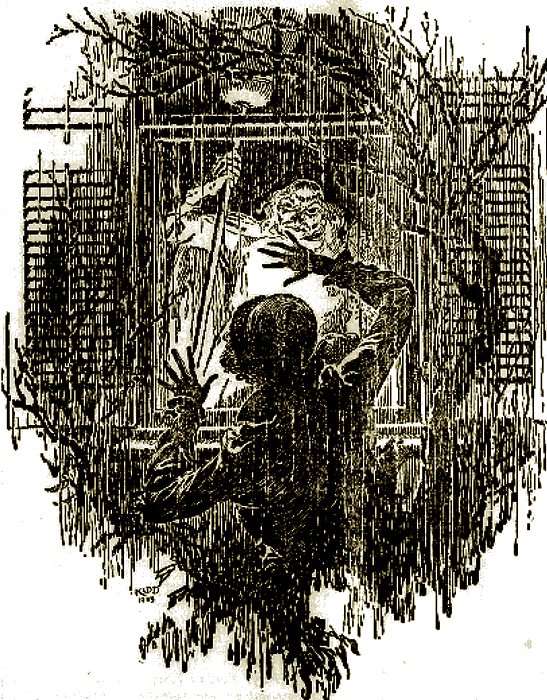
The rain was cold as ice driving in her face and did her good. She followed the path round the side of the house to the back and there, in the kitchen, she saw a dim light. Her relief gave the measure of her fear, her knees trembled, she gave a long sigh and hurried to the window. And as she stood on tiptoe to look in she looked directly into a strange face pressed against the inside of the window.
It startled her immeasurably. She drew back, staring with dilated eyes. Who was this, this old woman with strangely white hair and dark eyes that glittered? This old woman with a broom in her hand?
There came into her mind a sudden and wild recollection of all that Mr. Deal had said. Nights like this when the witches are gathered—sailing through the windy sky on their broomsticks... A witch who had frozen all the occupants of the house in some horrible enchantment, a witch evoked by Mr. Deal.
"Here," she said aloud, "don't be quite such a fool. I shan't know who she is or how she got here. But that's Mr. Deal's kitchen and she's a human being ... "
Approaching the window again, she smiled, but the old creature only glared at her. Then she went to the back door and knocked, banged, rattled the handle with a mounting terror.
"I will get in," she cried. "Let me in!"
She ran back to the window and there stood the woman glaring at her. She rapped at the window and the old woman raised her broom menacingly.
"Stop it!" cried Lou.
SHE was wet to the skin now and shivering with cold. She could not get into the house. She tried to raise the window, but it was locked. She knocked on it again in a sort of fury and the old woman ran up, pressed her face against the glass, saw that Lou was gazing straight in those wide, blank eyes.
She sprang back, her foot slipped In the muddy path, and she fell. When she rose to her feet she felt tears warm on her cheeks.
"This won't do," she said aloud with a sob. "I'm not going to lose my nerve. I'll go and get Weeks."
And she would not run to the garage.
"Walk, do not run to the nearest exit." she said to herself with a shaken laugh. "Only—its the darkest night there ever was."
And the garage was dark, too, and locked. She knocked loudly on the door, but she expected no answer.
"There's nobody else left in the world," she thought, laughing again.
"Perhaps I've been asleep like Rip Van Winkle—for twenty years—and every one's dead—even Nick."
This, surely wouldn't do. She mustn't laugh again. She mustn't think things like that. There was some perfectly natural explanation for all this. She would go back to the house and she would get in whether the old woman liked it or not. The dim light was still shining from the kitchen window. She had never realized before what it meant to be in darkness... There was something white fluttering wildly at the window. Nothing to be afraid of—nothing but a curtain.
"And that means the window is open," she thought. "I'll climb in if I have to knock down the witch. Of course, she's not a witch... And if she were, I couldn't knock her down..."
HER foot struck against something on the path and for a moment her heart seemed to stop. This was the supreme horror, the unbearable thing... Some one was lying there...
But there was nothing unbearable; there was nothing one really couldn't endure and couldn't do. It was possible to kneel down in the muddy path beside that thing...
Her groping hands touched a man's short hair, soaked by the rain. Weeks—? Her fingers moved slowly down a cold, wet face. No—that was not a uniform... What she felt was the soft roughness of a heavy overcoat. An overcoat like Nick's... She reached for the hands, flung out in the mud. They were ungloved. That was Nick's seal ring.
Nothing was impossible any more. Everything that used to be real had gone now; light and warmth and human voices. Nick was lying here, cold, soaked by the driving rain, perhaps he was dead. One went on. There was no one else to help Nick now.
"I'll have to telephone for a doctor," she said aloud. "And I'll get something to cover you with, Nick. I shan't be long."
She climbed in at the open window. The telephone was in the library. She went through the kitchen into the hall and found it black as a pit. She turned the switch but nothing happened. She groped her way to the library and the door was locked. She knocked and hammered on it, but in this nightmare world all doors were locked, no voices ever answered.
"If I'm any good at all," she said to herself, "I'll keep my nerve and get help for Nick. There's nobody but me. It doesn't matter if I can't understand."
She had to wait a moment, her knees trembled so. Then she felt her way toward the stairs. In her bureau drawer there was an electric torch. She would get that. She would use the steamer rug from the shelf in the wardrobe to cover Nick and she would walk to the village if there were any village... Perhaps she would walk and walk in eternal rain and wind and never again see a lighted window.
"Shut up!" she said to herself. "Keep your nerve and just go on."
"SHE gave me a crack on the head with her broom."
She reached for his hand. "That's not the right answer, Nick. You ought to say: 'There aren't any witches... Because if she's true, then Professor Welcome was true."
His fingers tightened over hers.
"Want me to tell you, dear girl? The doctor will be along presently to see you. He's in the house now... Perhaps you'd feel better if I told you... You see, the housekeeper got a telegram as soon as you'd left. Some one was ill. And when she went she stopped in the village to get a friend of hers to take her place. An old woman, called Mrs. Angel. And the housemaid didn't like her. Mrs, Angel's deaf and dumb, but the housemaid had another idea. She was afraid of Mrs. Angel and she left."
"Mrs. Angel's that witch, Nick?"
"That's what the girl thought. So, she cleared out and Mr. Deal was badly upset. So, he got a taxi and went to the village to get another housemaid from an agency. His cab ran into a truck. He wasn't hurt, but he was delayed. And when Professor Welcome arrived, there was no one here but Mrs. Angel."
"I rather wish that part wasn't true, Nick..."
"Real things are better than nightmares. Lou."
"Go on!"
"You'll have to remember that the poor old woman couldn't hear a word he said, or speak to him, and she'd never seen him before. He is a queer-looking bird, too. He was very much annoyed when he got here. He was wet through, wanted to change and she couldn't even tell him which room was meant for him. She told Mr. Deal, he can read her fingers, that she thought he was a foreigner, and when he wandered into your room, looking for his own, she thought he was a thief. So she opened the wardrobe door and beckoned him over and shoved him in. and locked the door."
"And he smothered..."
"He's alive, dear girl. He'd have been all right if it hadn't been for the trouble he has. I've forgotten what the doctor called it... Fear of small, enclosed places."
"I'm a secretary, Nick. I know lots cf big words. Claustrophobia."
"That's it. That's why he would not even get into the closed car. And when he found himself shut up in the wardrobe, he... The doctor thinks he'll get over it."
"Then he's not dead? Nick, you don't mind if tears of relief run down my pale face?"
"No," he said. "I've never seen you cry, Lou."
"Nick, you were really here? Lying out in the rain?"
"Yes. You see, I tried to ring you up and the telephone was out of order. And—I don't know how it was—I didn't like the looks of that professor fellow. I didn't like your going off alone. I came after you in a taxi. I couldn't get into the house, and I thought you were in it... And Mrs. Angel didn't help much... I smashed the kitchen window and she thought I was certainly another thief and she gave me a crack on the head with her broom. Knocked me out for a while..."
"You worried me a little. Nobody would like to find a friend lying on the garden path—in the rain. I'm afraid I was..."
"Lou." he said. "I think you have more courage than any one I've ever known."
"Not when you see me crying ..."
He made no answer; only held her hand fast.
"You must have heard me saying very extraordinary things when I didn't find you there..."
"No," he said, "It wouldn't be fair to hear what you said when you were about at the end of the tether."
"But if I said it again...? Suppose I learned something just in that moment? Suppose I found out—the only thing that matters...?"
She raised herself on her elbow and he put his arm about her shoulders.
"Lou... I've always known you were the only thing that matters ..."
"Nick. I must tell you what I said that you didn't hear... Nick, darling, I can't go on without you."
Roy Glashan's Library
Non sibi sed omnibus
Go to Home Page
This work is out of copyright in countries with a copyright
period of 70 years or less, after the year of the author's death.
If it is under copyright in your country of residence,
do not download or redistribute this file.
Original content added by RGL (e.g., introductions, notes,
RGL covers) is proprietary and protected by copyright.