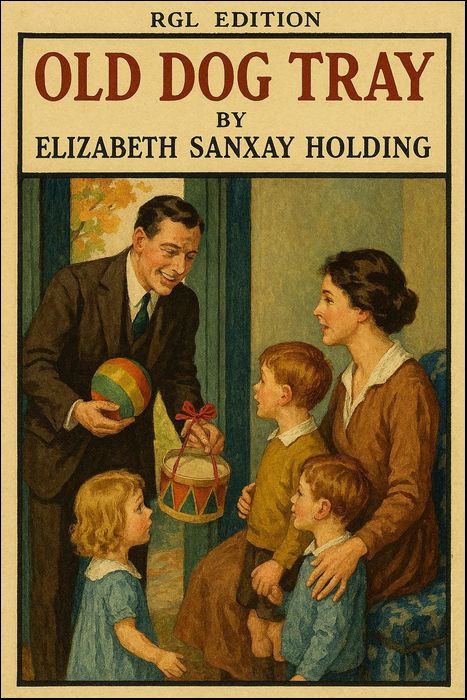
RGL e-Book Cover
Based on an image created with Microsoft Bing software
Roy Glashan's Library
Non sibi sed omnibus
Go to Home Page
This work is out of copyright in countries with a copyright
period of 70 years or less, after the year of the author's death.
If it is under copyright in your country of residence,
do not download or redistribute this file.
Original content added by RGL (e.g., introductions, notes,
RGL covers) is proprietary and protected by copyright.
RGL e-Book Cover
Based on an image created with Microsoft Bing software


The Munsey Magazine, May 1923, with "Old Dog Tray"
Robert Murchison visits Gina every Saturday, bringing gifts for the children and Scotch kisses for Gina, believing the routine represents his long, patient devotion. The children jokingly call him "Old Dog Tray." Gina, intending the nickname affectionately, even encourages the idea with a song about "Old Dog Tray" being faithful, gentle, and kind. But Murchison is deeply offended and tormented by the implication: he insists he isn't being seen as "Old Dog Tray," and he especially resents the suggestion that he's merely a loyal, domesticated presence rather than a man with dignity and feeling....
MURCHISON ascended the hill to the house that Saturday afternoon as usual, his pockets filled with presents for the children, and under his arm a box of Scotch kisses for Gina. His obstinate, lantern-jawed face showed all the satisfaction possible to it. This was always one of his happy moments, when he could fancy that he was coming home.
He had nothing else but Gina and Gina's children. It would not be true to say that he could not have lived without them, for he was not that sort. He would tenaciously have gone on living if he were translated among savages.
But the welcome he got at Gina's house was ineffably dear to him. From a distance he saw them all on the lawn. His face would have brightened, had that been possible to his dour visage, and he would have hastened his step, if he had not been already striding as fast as he could. Then one of the small boys saw him, and came rushing out of the gate.
"Here's Old Dog Tray!" he shouted joyously.
Gina called him back sharply, and came herself to welcome Murchison; but let her be ever so sweet and friendly, it was obvious by her overanxious manner and her flushed cheeks that she knew he had heard, and that she felt guilty.
Murchison was by no means delighted with the name. Quite the contrary—he was deeply affronted. He distributed the presents, but instead of handing the invariable box to one of the children, with the invariable joke—"Here are some Scotch kisses for your mother. You'd better give them to her"—he merely set down the box on the bench. He would have been glad to destroy the offensively arch object. He made up his mind never to bring another such box; and his mind, when made up, was an imposing thing.
"Old Dog Tray!" he thought. "That's how she sees it, eh?"
It rankled; it galled.
He conducted himself as usual. He played "red rover" with the children, dodging miraculously, lean, solemn, dignified even in his agility. He sat down to tea on the veranda, and when offered a slice of lemon he asked little Rose, according to precedent:
"Now do you think it would do more good to my complexion than harm to my disposition?"
There was his customary plate of buttered toast, and he ate three slices, as usual. No one but Gina, who knew him so well, would have suspected that he was hurt and angry.
She knew, though, that the only way to deal with Murchison was by rough outspokenness. He both dreaded and adored plain speaking. He was never happy until a thing was made clear and explicit, yet he shied away from any attempt at intimacy. He had, so to speak, to be seized by the neck and forced to listen.
She waited until the children were all in bed, and they had the sitting room to themselves, before she tackled him.
"Robert," she said, "I suppose you heard the silly thing Roddy said?"
"Aye!" said he, and at once began to sheer off. "Roddy's getting to be—"
"I'm sorry you heard it," she said gently. "It was just my own little name for you, and I wanted to keep it to myself."
There was magic in the woman, sewing in the lamplight. Even the few gray hairs in the shining flood of brown were dear to him, and so was the uncertain quality of her voice.
"Never mind it," he said.
"But I do mind it, Robert," she protested. "I'm sure you don't understand."
He looked nothing less than mulish, and she saw with despair that he intended not to understand. This must not be. The unclouded admiration of her faithful Robert was the breath of life to her. She looked long at him, but he smoked his pipe, refusing to raise his eyes, and at last she rose.
He glanced up quickly enough when he heard the piano. He liked nothing better than a song. Never did Gina touch his heart more surely than by her music. She was a slender, gracious little woman, still pretty. She often fancied that it was Robert who kept her young, that his sturdy refusal to admit any change in her arrested the course of time. She smiled over her shoulder at him, and began:
"Old Dog Tray, he is faithful;
Grief cannot drive him away.
He is gentle, he is kind,
And you'll never, never find
A better friend than Old Dog Tray."
She sang it touchingly.
"Don't you see, Robert," she said, "that it's really a beautiful thing to think of you?"
"Yes, Gina, I've no doubt it's as you say," he answered, and she was satisfied.
She didn't know that she had made a terrible mistake, that she had done irrevocable harm. All the time she sang, he had endured torments. Suppose the children heard, or the servants? He was not Old Dog Tray! He would not be!
ALL the way over on the ferry Murchison deliberated the matter, and his slow wrath mounted high. He was not angry at Gina, for he could not be; what enraged him was his own position. He firmly believed that he possessed a fine Scotch sense of humor, but he was utterly incapable of laughing at himself. The idea of being sweetly sung to as Old Dog Tray had for him no comic appeal. On the contrary, he was obliged to admit that to some extent he was Old Dog Tray, and it was intolerable. "Kind" he was pleased to be, but "gentle" he was not, and "faithful" was no word to apply to a man.
He looked back over this affair. He had met Gina when she was a young girl, a lively, witty young thing. He had fallen in love with her, and had set to work in a decorous way to court her. He had come over to Staten Island twice a week. This had seemed to him sufficient evidence of devotion, but when he observed that other young men brought her presents, he did likewise. Books and music were what he preferred, and he was willing to go as far as candy, but he would rather have died than be seen carrying flowers.
Privately he thought this American lavishness very foolish. His idea was to save up to get married; but he realized that if he wished to marry Gina, he must please her. So he tried, but while he was engaged in the process, she married Wigmore.
It was then necessary for Murchison to show that he didn't mind that in the least, for he was horribly proud and sensitive. Obstinately he kept on coming twice a week with books and sweets, and Wigmore became attached to him. He was really more interested in Wigmore's conversation, and in the children, than he was in Gina, although he didn't know it.
Gina had changed astoundingly. She had ceased to be lively and witty, and had grown sweet and a little vague. Murchison was too obstinate to admit any change in her, however—or in himself, either. He refused to think at all.
When Wigmore died, and poor Gina had so much trouble about money, and was so ill and grief-stricken, she became real for Murchison again. He had felt a passionate tenderness for her. He had done everything in the world for her, though well knowing that such disinterested devotion might make him appear ridiculous.
After a seemly interval of three years he had suggested marriage. Gina asked for time to make up her mind. He thought that quite reasonable and proper, but it occurred to him this evening that five years was longer than necessary, even to the most cautious woman. It wasn't as if he were a stranger. She had seen him twice a week for nearly twelve years.
He was suddenly convinced that he was a fool. Other men came to see Gina when he wasn't there. He heard the children speak of Dr. Walters, for instance, as if he were a familiar friend. The same thing would happen again.
No, it wouldn't. Perhaps grief could not drive him away, but other things could.
When he returned to his boarding house, he wrote a grim letter to Gina, in which he said that she must make up her mind at once either to take him or leave him. At once, mind you; he refused to wait for an answer longer than six months.
He appeared again on his usual evening, and didn't mention the letter. Gina knew that he never would mention it until exactly six months had passed. He was quite as usual, and only one small incident perturbed her. After dinner, when they were alone, he said:
"Will you not sing 'Old Dog Tray' for me, Gina?"
"But—" she said.
"I'm thinking it does me good," said he.
While she sang, he sat there in wooden silence, smoking his pipe.
"Well!" he thought. "It's a queer world, to be sure! Who'd think that at my age I'd come courting, and the object of my affections a woman thirty-eight years of age? I'm forty-one, and here I come courting like a lad!"
This made him grin. It seemed to him a very humorous idea, and when, later in the evening, it recurred to him, he was obliged to grin again.
"Why do you smile, Robert?" asked Gina softly.
"Well—well, it's nothing, as you might say." But he could not banish the grin.
"Do tell me!" she implored. "It's so seldom you find anything funny. Please share it with me, Robert!"
"I'm thinking you might not like it," he said, with a chuckle.
"Oh, but I shall, Robert! Tell me!"
He burst into a shout of laughter, so that his lean face was creased with long lines.
"What will you say, Gina," he said, with difficulty, "to Old Dog Tray going courting, and you a woman of thirty-eight?"
She sprang to her feet.
"Robert!" she cried, quite pale with anger.
"It's the funniest thing—that's come to my mind—this long time," he said, almost helpless with laughter. "Think of it!"
"How dare you?" she said. "How dare you insult me like this?"
His jaw dropped.
"Insult you!" he repeated. "What's this, Gina? Insult you! Why, my dear—"
"You think—" she began, but sobs choked her. "You're laughing at me because I'm thirty-eight!"
"But I was not, Gina, my dear! Only it struck me comical for two old bodies like us to be courting."
"I'm not courting!" she cried. "Don't dare to say it! And I'm not old!"
"Of course, properly speaking, we're not old," said he. "But—"
"Every one else thinks I'm a young woman!" she sobbed.
"Don't you believe it, my dear," he said earnestly. "They may say so to your face, but behind your back no one would call a woman of thirty-eight—"
"Stop!" she cried hysterically. "Don't call me a woman of thirty-eight again!"
He was very much distressed.
"Don't be thinking I mean anything against your—your personal attractions," he said. "You're one of the neatest, best-looking women of your age—"
"I hate you!" said Gina.
"That's an ill-considered remark," replied Murchison, growing red, "to a man who's been your true friend for twelve years and ten months. I was only trying to tell you that I think as much of you to-day as I did when you were young and pretty."
"You needn't go on, Robert," she said, frigidly. "I appreciate your friendship, but I have never known a man so lacking in tact."
"I don't doubt you're right, Gina," he observed, also frigidly. "It didn't occur to me that a mature and sensible woman couldn't endure to hear her age mentioned."
"It's the way you did it—laughing like that."
"I wasn't laughing at you—only at myself, for courting you."
"Please say nothing more," she interrupted sharply. "There are other—other people who don't think it's so absurd to—to like me."
Now, well as Gina knew him, there were certain traits in her Robert which had eluded her. She never knew that by this simple remark she had mortally insulted him. She was comparing his twelve years and ten months of devotion to the false flattery of that Dr. Walters.
"Aye!" said he. "I've no doubt it's as you say."
And with that he took his leave.
ON the last day of the six months Murchison presented himself before Gina, and without embarrassment, and also without fervor, requested to know his fate. He was greatly displeased with Gina's conduct on this occasion. She wished to be indefinite; she wished neither to take him nor to leave him, but to keep him in reserve.
"You know how fond I am of you, Robert," she said.
"No," he replied, "I don't. My question was just, as you might say, to determine that point."
"Sometimes I think that, on account of the children, I shouldn't marry again," she said tentatively.
"That's for you to say. You ought to know," he remarked.
"I suppose at my age, I ought!"
He bowed stiffly. There came to Gina the recollection of what Dr. Walters had said. He had assured her that she was like a young girl.
"You've never grown up," he had told her. "You never will."
"I'm afraid, Robert," she said, "that I never could make you happy."
He turned away, and was silent for some time.
"That's for you to say," he repeated. "You ought to know your own mind."
His chief purpose was to avoid showing how horribly wounded and bereft he was. So valiantly did he conceal his hurt that Gina herself was offended and angered by his high spirits.
"I believe he's glad!" she thought. "He's delighted to get out of it!"
She forgot entirely how she had lain awake at night, planning some way to tell Robert that she couldn't marry him. On that night she lay awake marveling at his treachery. She had decided that he didn't really care.
On the evening of his next visit she had Dr. Walters there. She had the doctor's superior devotion on exhibition, and encouraged him to be incredibly gallant and tender. He did his part admirably, but Murchison failed her. He was pleasant, unusually pleasant and talkative, and he gave no more sign of being a disappointed suitor than if he were her grandfather. He made a most favorable impression upon Dr. Walters.
Before he left, he did something which enraged Gina.
"Will you not sing 'Old Dog Tray'?" he asked blandly. "It is a great favorite with me."
She refused, but Dr. Walters joined his entreaties to Murchison's, and she had to yield. So she sang the simple old ballad with burning cheeks; and while she sang it, there sat Robert, smoking his pipe in wooden silence.
HE went home that night in a queer mood. He was hurt and he was angry, but depressed he was not. He went up to the room he had occupied for years and years—a room which, like his face, showed no trace of the spirit that possessed it. He sat down to unlace his boots and put on his slippers. When that was done, he filled another pipe.
"Perhaps it's just as well," he reflected, with a philosophy Gina would not have appreciated. "A wife's a very unsettling thing. Now I'll go on just the same!"
And, if you will believe it, the next Saturday afternoon he bought a box of blocks, and a doll's cradle, and the familiar package of Scotch kisses, and with perfect composure set off for Staten Island.
"There's no reason at all for a quarrel," he thought. "To be sure, I've nothing against the poor woman. I'm not one to change."
There was a heavy fog, and the boat was late. He stood downstairs, close to the gates. He was in no sort of hurry. Indeed, he rather enjoyed the little stir of excitement caused by the fog.
He heard people about him saying it was the worst they had seen in years, that a small boat had been run down a few hours before, that steamers were held up. He liked the din from the bay, the whistles low or shrill, the clamor of the bells, the blasting wail of a great foghorn.
There was, unfortunately, no way in which he could verbally express his scorn for this excitement, and his own miraculous coolness and detachment. He could look it, however, and more than ever he assumed the aspect of a wooden image. For some reason this inspired the confidence of a fellow traveler.
"Do you think there's any danger?" asked an anxious voice.
He turned, intending to answer somewhat loftily, but he was utterly disarmed at sight of the questioner. Indeed, he at once felt that there might well be danger. He removed his hat with ceremony.
"Nothing to worry about," he assured her gravely.
She was a tall and rather thin girl, very dark, with a wonderful rich color in her cheeks and great, serious eyes. That seriousness was the thing which first attracted him—that, with her sober dress. It took a second glance to reveal that her dress was shabby and her seriousness tinged with something forlorn; to say nothing of her being very young and very pretty.
Now Murchison was a cautious and practical fellow, by no means given to talking to strangers; and he decided that he would not look at the girl again. A boat had just come in, so that he really had something justifiable to stare at.
There came first the inexplicable persons who run and sometimes shout; then motor cars, and streams of people, and drays and trucks with vociferous teamsters. It was what happened every half hour or so, all day long, yet it had the thrill there always is at the end of a journey, no matter how short. And now, belated and fog-haunted, the incoming ferryboat might have returned from the Antipodes.
The traffic, the shouts, the procession of people, ended abruptly. Then the gates were pushed open, and the new swarm crowded forward, as eager to be carried south as the others had been to rush northward. Murchison was perfectly aware that the girl kept beside him, although he didn't turn his head. He could lose her easily enough by crossing over to the smoking cabin; but he had to let a truck go by before he could do so, and, without quite turning his head, he saw her, hesitant and dismayed, looking after him.
Long after he was settled with his pipe he remembered her dark face, her troubled eyes, something alien and tragic in her, and he felt uneasy, almost guilty. He knew it was nonsense, the particular sort of nonsense that he most disliked. He was sorry he had not bought a newspaper to distract his mind.
A bell clanged; the boat slowed down, and the throb and jar of the engines stopped. A great many people rushed to the windows, as always happens, and this gave Murchison the chance for being most notably Scotch, and not stirring. His sharp ears caught all the wild and confused rumors and surmises of those about him. He felt incipient panic in the atmosphere. He was grimly amused, until it suddenly occurred to him how silly women were—how very, very silly a young girl would be, with no Scotsman beside her!
He got up and crossed to the other cabin. That was not ridiculous; it committed him to nothing. He entered the cabin and sauntered through it, looking with an eye casual but very keen at the backs of the people crowded two deep at the windows.
That girl wasn't there. Perhaps she had rushed upstairs. If so, she might stay there, for he had gone quite far enough.
He pushed open the door, and stepped out upon the forward deck. No denying that the fog was unpleasantly thick, and that ominous and immense shapes appeared half hidden behind it. The bells and whistles on every side made a diabolic clamor. The boat was drifting silently, and the fog concealed even the water on which it floated; and yet, with nothing visible, he was in a crowded and noisy world, menacing, incomprehensible.
He saw her out there, one hand on the railing, her young face in profile. She had, he thought, such a forsaken air! She was so lovely and young! She put him in mind of the beloved and half forgotten creatures in the romances he had read in his young days—heroines brave, gentle, and beautiful, for whom a man could die gladly. She was shabby, she was frightened, she was alone, as a heroine should be. There was a halo of romance about her dark head.
But still Murchison was entirely Murchison. He could have leaped overboard and saved her from the sea more easily than he could address one single word to her. He was eager to speak to her, to reassure her, but it was not possible.
Her anxious glance, turning in his direction, fell full upon his face.
"Do you think anything's going to happen?" she asked, as promptly and simply as if he were an old friend.
"No, no!" said he. "But with these crowded ferries they're very cautious."
He came over to the rail and stood near her. He had an absurd desire to remove his hat and to stand bareheaded before her innocent youth; but he resisted this preposterous impulse, and spoke in his driest way. He gave her facts about the shipping in this stupendous harbor, quoting figures, reports. He had an uneasy feeling that he was tiresome, and probably making mistakes in his statistics, but he was so desperately occupied in not looking at her that it distracted his mind.
"I find it an agreeable trip," he ended abruptly.
He was obliged to look at her then, to see if his talk had wearied her, and he observed a strange expression upon her downcast face.
"I'm so afraid of the sea!" she said faintly.
"But this is only a bay—" he began.
She glanced up.
"My father was a captain," she said. "He was drowned when I was a baby; and my brother was drowned in the war. So—you see—"
"Yes," he answered gravely. "I see!"
He did not try to express sympathy, he did not speak one reassuring or consolatory word. He stood silently beside her, neither seeking nor evading her attention, simply being his own uncompromising self. Never in life had he tried, never in life would he try, to make a favorable impression upon any one. He took it for granted that she knew all the compassion, interest, and respect he felt; and she, on her part, accepted him without question.
"Do you think we'll be kept here long like this?" she asked.
"It's impossible to say; but there's nothing to be alarmed about."
"I'm late," she said anxiously. "You see, I've come all the way from Philadelphia this morning, and I got a little mixed up. I was expected for lunch, but it's much too late now."
"Won't the people—your friends—wait?" asked Robert indignantly.
"They're strangers," she said. "I've never seen them. I'm going as a governess. I was recommended to Mrs. Wigmore—"
"Mrs. Wigmore!"
"Oh, do you know her?" the girl asked.
"I am acquainted with the lady," said Robert, in so curt a manner that she was abashed.
She fancied that he regretted having been drawn into conversation with the governess of some one whom he knew. She flushed a little, and turned away her head. She expected him to make some excuse and to leave her; but he did not. He stood where he was, filled with the most unaccountable chagrin and disappointment.
She was going to Gina! She would see him there, see him as Old Dog Tray! He felt as if some ineffable happiness had been snatched from him. He felt suddenly middle-aged and preposterously unpleasing.
An instant ago he had really believed that this marvelous girl was interested in him, friendly toward him, even glad of his company. Well, only let her see him climbing the hill with his arms full of bundles, only let her see him playing with the children, being treated with slightly condescending affection by Gina, only let her see Old Dog Tray in his natural habitat, and he would never again be anything but that in her eyes!
"I'll not go," he decided. "I don't doubt they'll do well enough without me."
But, thought he, what good would that do? He knew so well Gina's fatal lack of discretion, her shocking habit of confiding in every one. It was impossible to believe that she could have a governess in the house twenty-four hours without telling—even boasting—about her Old Dog Tray.
"The devil!" he said, dismayed at the prospect.
Then he realized that he had spoken aloud, and he apologized earnestly to his companion. He was surprised and relieved to see her smile—not plaintively and sweetly, like Gina, but with a wide, youthful smile that was almost a grin. With a faint shock he realized that while she was undoubtedly an angel, she was also a delightful human being.
They were suddenly upon a new footing. They began to talk with miraculous ease. They exchanged names. She said she was Anne Kittridge, and instead of being, as he had half imagined, an isolated phenomenon, she had a mother and a home in Philadelphia.
"I've never been a governess before," she said. "I've never even been away from mother. I hope—do you think I'll get on with Mrs. Wigmore's children?"
"Aye," said he, "I've no doubt you will."
"But I'm not beginning very well," she said, "being late like this."
"And no lunch!" said he. "I'd forgotten that. It's—let's see—it's nearly three o'clock."
"I don't care," she said stoutly.
He did, though. He was greatly worried.
"Well," he said, after much thought, "I've a box of sweets here. Very poor things they are for the teeth and the digestion, but I dare say they're better than nothing."
He set to work to unwrap his neat package. As he did so, the box of blocks fell out upside down, and the contents scattered over the deck.
"Oh!" said she. "Were they for your little boy?"
He did not answer until he had picked all the blocks up. Then he straightened himself, with a slight frown.
"I'm a bachelor," he said. "They were for the child of an old friend." And he added resolutely: "A very respectable, middle-aged body."
The boat had started again, but they didn't notice it. Miss Kittridge was steadily and happily consuming Gina's Scotch kisses.
IT would be impossible to any chronicler to describe all that took place in Murchison's soul during that brief trip. The easiest way is to say bluntly that he fell in love, and for most readers that will go a long way toward an explanation; but one must bear in mind the character of the man, his frightful obstinacy, his outrageous pride, and the matter-of-fact romanticism of his secret heart.
He was amazed, delighted, awed. He knew that he was in love; he knew that this was the real thing, for which he had always been waiting. Lack of self-confidence was not among his faults. He hoped, he believed, that if he could have a clear field, he would have a fair chance with this matchless girl. She liked him, she trusted him, she was amused by his jokes, interested in all the information he had to give. If he could keep her from seeing him as Old Dog Tray!
"I won't have it!" he thought fiercely. "I won't have this spoiled by such a thing!"
The boat bumped its way into the slip, and a lurching procession of people came up to the gates. Miss Kittridge wished to join them. She glanced anxiously at Murchison, but he didn't stir. The gates opened, and the crowd began to hurry off.
"Hadn't we better go?" she said.
"Very well," he answered absently, and off they went.
"Mrs. Wigmore told me to take the North Shore train," she began, but Murchison grasped her arm firmly and led her to the waiting room.
"Miss Kittridge," he said, in a peculiar voice, "you'd better not go there."
"But why?" cried the startled girl.
"Well," he replied, "well—mind you, I've nothing to say against Mrs. Wigmore. I've a very high opinion of her. She's a very pleasant, respectable woman; but I advise you not to go there."
"But I must! She's expecting me; and where else can I go?"
"Go back to your mother in Philadelphia," said he.
"I can't, Mr. Murchison. It was my own idea to go out and earn my own living, and I'm certainly not going home before I've even tried."
"There's a train every hour," said he. "I'll go with you, and I'll explain to your mother."
"Explain what?" she protested, overwhelmed with astonishment.
"It'll be better explained to your mother," he told her. "You're too young."
The doors were opened, and a new crowd was pressing through them. Murchison joined the stream of people, leading his reluctant and protesting companion back on board the ferryboat.
GINA was shocked and hurt beyond measure. She had thought it very strange of Murchison to write to her from Philadelphia, to say, without explanation, that he would be there for a week or two on private business. How unfriendly of him to have private business after all these years!
After that he didn't come near her for three months. He telephoned now and then, and said he was very busy; apparently he did not notice how grieved was her manner.
And then, after all this, what happened? A thing incredible—he telephoned to her one afternoon and told her that he had been married that morning. She could never, never forgive such brutality. He might at least have given her a chance to marry Dr. Walters first!
"Where are you now, Robert?" she inquired sternly.
"We're in New York for—"
"Then you must come to dinner to-night with your—bride," she said.
"But—" he began.
"It seems to me that is the least you can do," said Gina, and he was defeated.
Naturally she had Dr. Walters there for dinner, and naturally she was charmingly gracious and kind. No denying that she was impressed by the youth and prettiness of Robert's wife. The fact that a well bred, lovely creature certainly not more than twenty-one or twenty-two had been willing to marry him forced her to admit that she had not appreciated him.
"You have a wonderful man in Robert," she gravely assured his wife.
"Isn't he?" said Anne. "There's no one like him!"
Then, of course, she had to look at him, to see if he was still there and still as wonderful. He was. He met her glance, and they smiled at each other with sublime confidence and understanding. Gina found it a little hard to go on talking.
"Do you know," she said brightly, "such a curious thing happened! A friend of mine wrote me about a girl in Philadelphia, and I sent for her to come as governess for the children. She told me that she'd arrive on a certain day, but she didn't come, and I never heard another word from her. I wonder if you know the name—Kittridge?"
"Philadelphia's quite a large place," said Anne hastily.
"Of course," Gina assented. "Now do tell me about yourself and Robert. Was it romantic?"
"Oh, very romantic!" said Anne, in no little confusion. "It was—I think it was—unique!"
There was a pause, and Robert came directly toward them.
"Will you not sing, Gina?" he asked blandly.
"No, thank you, Robert," said she.
But Dr. Walters came to entreat also.
"Please do, Gina!" he said, with all his honest admiration reflected in his beaming face.
"Sing 'Old—'"
"No!" said she, so vigorously that he was startled.
He turned to Anne.
"You should hear her sing 'Old—'"
"Please don't ask me!" she cried.
"Of course not, if you don't wish to," he said gently; "but upon my word, Mrs. Wigmore's rending of 'Old Black Joe' is—"
"It was 'Old Dog Tray' I had in mind," observed Robert.
"That's a hateful, silly song!" said Gina. "I can't endure it. It's—the whole sentiment is false. There are no Old Dog Trays!"
Robert's hand fell lightly on her shoulder, and she turned to look at him. Something that she saw in his face brought the tears to her eyes.
"There are old friends, though, Gina," he said, "and nothing drives them away!"
Roy Glashan's Library
Non sibi sed omnibus
Go to Home Page
This work is out of copyright in countries with a copyright
period of 70 years or less, after the year of the author's death.
If it is under copyright in your country of residence,
do not download or redistribute this file.
Original content added by RGL (e.g., introductions, notes,
RGL covers) is proprietary and protected by copyright.