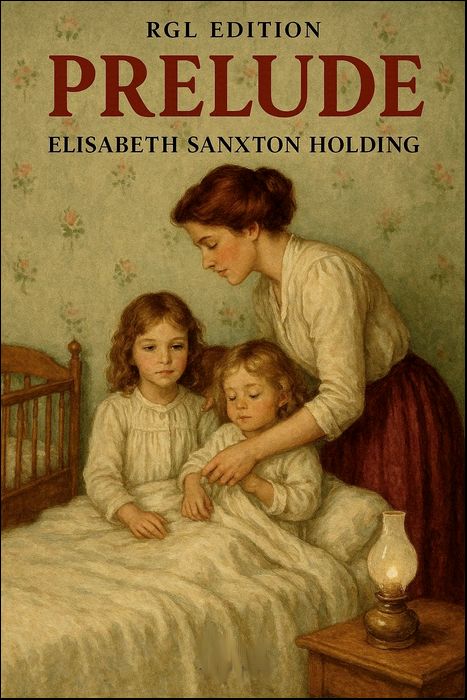
RGL e-Book Cover
Based on an image created with Microsoft Bing software
Roy Glashan's Library
Non sibi sed omnibus
Go to Home Page
This work is out of copyright in countries with a copyright
period of 70 years or less, after the year of the author's death.
If it is under copyright in your country of residence,
do not download or redistribute this file.
Original content added by RGL (e.g., introductions, notes,
RGL covers) is proprietary and protected by copyright.
RGL e-Book Cover
Based on an image created with Microsoft Bing software


Delineator, September 1929, with "Prelude"
YOUNG Mrs Powers was gay, even a little arch, when her husband came home. She ran into the hall to meet him, and tried to help him off with his overcoat, laughing at the great weight of it.
He liked this. He was a grave, dignified man with a heavy, dark moustache; he was 15 years older than his wife, and he showed a sort of paternal indulgence for her petty follies.
"And what's the little woman been doing with herself to-day?" he asked.
"Oh, I've been so busy," she answered. "In the morning the upholsterer's men were here, and in the afternoon mamma and I went shopping."
"Shopping, eh?" he said, with a pretense of dismay.
But she knew he really liked her to go shopping; he liked to see the absurd and charming things she bought, liked to hear the preposterous cost of a little hat.
"I thought this was the afternoon for the literary society?" he said.
"I know." she said, guiltily. "But I did so want to see those new silks at Journay's."
He smiled and patted her cheek. He liked her to put off the literary society and be passionately interested in silks. Then, leaving her in the hall, he went upstairs to his mother's room. Old Mrs Powers was sitting there, waiting for him—a thin, little, white-haired woman in black silk, with a watch pinned at her breast. Her son bent and kissed her cheek, made inquiries about her health, and proceeded to his own room. His mother heard him walking about in there, as if he were a little restless tonight.
At the right moment he came back for her, offered his arm, and escorted her downstairs to the dining room. There was a good dinner, well served, and eaten in an atmosphere of polite amiability. Young Mrs Powers was very bright; quite a pretty woman she was, with a slender, neat little figure and curly brown hair and a sweet mouth.
"This pudding is excellent!" said Powers.
His wife glanced up, pleased. And suddenly, through his eyes, she had a glimpse of something horrible. His smile seemed to her a grimace, his face seemed convulsed by some spasm of pain. She turned pale; she was about to cry out, to ask if he were ill, but he had begun to talk again in exactly his usual way, and she thought she must have been mistaken.
She admitted to herself that sometimes she was "fanciful." Sometimes she had a notion that quite near her was a door that would some day swing open, revealing to her things she did not want to see.
"Nerves," she thought.
When dinner was finished they rose from the table.
"I'll run up and say good night to the children," said young Mrs Powers, with an apologetic smile at her husband. Naturally, when he came home tired from the office he was not in the humour for the companionship of two lively children. It had been his custom to go upstairs with her and kiss them good night, even to play with them a little in a sedate fashion. But for the last two or three weeks he said he was too tired.
"Has he—changed?" she thought.
And the thought frightened her. She glanced at him, and she was still more frightened, because he was a stranger to her, and had always been, because his grave face was a mask and his soul a mystery to her.
"I must not be so fanciful," she said to herself, and went out of the room, the train of her pale grey dress rustling softly over the carpet.
In the hall a gas-lamp on the newelpost burned dimly under a green shade; all the house was dim and very quiet; she could hear nothing but the rustle of her own dress. But when she reached the second flight she began to hear all sorts of sounds—Sharley's excited little laugh, the sad sweet tinkle of a music-box, the break of Katie's rocking chair—and she hastened her steps, almost running, so eager was she to reach that other world.
She opened the nursery door, and there it was—the other world. The gas was singing faintly in a frosted globe, filling the room with cheerful light; the air was warm, a little close, the blinds down, the curtains drawn. No one had heard her enter; Katie sat in the rocking chair with a basket of mending, and Sharley and Lilian in their woolly dressing gowns were on the foot of the bed. Lilian was turning the handle of the music-box and Sharley lay on her back, staring at the ceiling.
"Well, chicks?" said Mrs Powers.
"Mother!" cried Lilian, and scrambled to her feet at once.
Unfortunately she dropped the music-box, so that the corner struck sharply , against Sharley's ankle-bone, and like a flash Sharley sprang up and pulled her hair.
"Children!" said Mrs Powers severely. "Aren't you ashamed—two little sisters?"
"I'm sorry," said Lilian promptly.
She was always sorry, ready to apologise for her own faults or any one else's, always in a hurry to get rid of any unpleasantness and see every one happy again. She stood on the foot of the bed, holding out her arms, and Mrs Powers picked her up and held her tight. Then she turned to Sharley.
Sharley's lovely little dark face was implacable. She was a tall, finely-formed child, so much more beautiful than poor little Lilian, with her funny little pigtails and her freckles and her wide grin.
"Sharley," she said, "you never admit your faults. You're very stubborn."
Sharley looked more stubborn than ever.
Mrs Powers sat down on the edge of the bed and took Lilian on her knee; this was to be a lesson for Sharley.
Sharley's lip trembled. "All right, if you don't want to love, you needn't," she said.
Mrs Powers reached back and took the outcast's hand. Sharley at once flounced down on her knees and nestled close to her mother, and Katie smiled, a subtle and ironic Celtic smile. She reflected that Sharley had not said she was sorry, and she rejoiced in her favourite's triumph.
As for Mrs Powers, she refused to know that she had been conquered. What did it matter? She held close to her those two yielding, warm little creatures; the faint clean scent of tar soap came from their hair—everything about them was clean and innocent and adorable. She closed her eyes, she felt rising in her a great tide of feeling that was rapture and pain, and a strange, unreasoning fierceness.
"God bless and keep my babies!" she prayed, and not in humble petition, but with a sort of defiance, as if, holding them close, she would defy heaven itself.
Then her vigilant conscience warned her that this was not quite nice, it was "queer" to feel like this about one's children; it would be "queer" to stay too long up here with them when her husband was downstairs, rightly expecting her society. Every one she knew would have told her, without hesitation, that her husband must come first; she accepted this law. She heard their prayers and tucked them snugly in; then, as Katie turned out the light, she bent and kissed them. As she reached the head of the stairs, she heard the children begin to whisper to each other, and a great longing seized her to go back there, to the warm, dark, room, to sit down on the floor beside the bed and rest her head against one of those little velvet hands, to listen to their talk, just to be with them.
Holding up her dress, she went on down the stairs hastily, ashamed o£ her queerness.
Her husband and his mother were in the back parlour. He was smoking a cigar and reading a newspaper; the old lady was reading a novel. Young Mrs Powers sat down beside the centre table and took up her embroidery. The clock ticked, Mr Powers's newspaper rustled, the aroma of his excellent cigar drifted through the room.
"I must try those tiny chicken sandwiches for the euchre on Wednesday," thought young Mrs Powers. "And an orange ice.... It's really not too soon to be thinking of our summer clothes... I suppose we'll go to Lake George again—though Monty hasn't said anything yet."
Mild and agreeable little thoughts were quite enough to occupy her while the centrepiece grew under her fingers. It was nice to have this quiet time. She got up every morning at half-past 7, dressed and got downstairs a little before the others, because this was her duty—to "see about breakfast." though there had never yet been anything amiss.
After breakfast her husband went off to his office and Katie took the children to the little private school. Young Mrs Powers consulted with the cook; sometimes she had laundry to look over, or mending to do. and at 11, if the weather were good, she and the old lady went out in the carriage; they stopped at the grocer's and the butcher's, and the tradesmen came out to the curb to take her orders. At one the children came home, and there was lunch. In the afternoon there were calls to make, or callers to receive, and every Wednesday the euchre club met at the house of one of the members—always a pleasant afternoon, with delicious refreshments and quite nice prizes.
And before you realised, it was half-past 6 and time to go and dress for dinner. There really seemed to be no time for thinking, yet again and again young Mrs Powers felt that odd little qualm, as if there were something she ought to think about and never could quite grasp.
She threaded her needle and frowned anxiously.
"Mamma," she said, softly, so as not to disturb her husband, "don't you think that perhaps after all I'd better pad these scallops?"
Old Mrs Powers laid down her book at once and took up her daughter-in-law's embroidery.
"That shading is so pretty," she murmured. "Really artistic, my dear. Yes—yes, I think I should pad the scallops."
Powers laid down his paper and rose. "I'll just step out to the club," he said. "Don't wait up for me. I may be a little late. There's a man there I want to see."
He stooped and kissed his mother and went out into the hall, followed by his wife.
"Get to bed early, and don't miss your beauty sleep!" he said. "An hour before midnight is worth two afterward."
She stood smiling up into his grave face, such a bright, pretty little woman, with her curly fringe and her clear grey eyes. He patted her cheek and opened the door.
"Why; it's raining, Monty!" she protested. "Shan't I send for a cab?"
"No," he said. "Just a spring shower. Good night!"
The door closed behind him and young Mrs Powers returned to the back parlour.
"The wind's rising," observed the old lady.
"Yes. I do wish Monty bad taken a cab."
But they did not really worry about him. They could not. He was so grave, so dignified, so strong; the earth belonged to him. They sat talking together with a pleasant inconsequence. They had both borne children, they had watched at death beds, they had seen, both of them, the stark realities of life. But they never spoke of them.
There was a great love between them. Young Mrs Powers had lost her own mother five years ago, and she had found in this elderly woman her great solace. Old Mrs Powers met with somewhat indifferent treatment from her own daughter, and had found in her son's wife a nature immeasurably dear to her. But they had never mentioned their affection.
"I believe I'll go to bed," said the old lady.
"I'll come too," said young Mrs Powers. "Monty's never really late."
They went together and parted outside the old lady's door with a kiss. Young Mrs Powers ran up to the nursery for a look at the children; they were breathing quietly in the dark and still nicely covered up. She kissed them and went down to the bedroom.
She undressed, put on a dressing gown, brushed and braided her curly hair in plaits; then she got into bed and opened a book of Marion Crawford's. But her mind wandered.
The rain was dashing against the windows. She had never in her life walked in the rain; she had hurried through it to a carriage, she had even, once or twice, been caught in a shower and had to take shelter in a shop. But the idea of being out in a downpour was incredible to her. She didn't like the sound of the rain. She thought of Monty in his club, and wondered what clubs were like inside. Her book was about Rome; she wondered a little about Rome, and hoped she would see some of those charming foreign lands one of these days. She decided that before they went away Katie must have new aprons.
There was a dreadful leak in the bed-room ceiling and the rain was pouring in. She put up her new black silk umbrella and the rain drummed loud on it. Sharley and Lilian were trying to take up a great pool on the carpet with their little tin spades, and she noticed suddenly that they were barefooted and in their night dresses and she was sure they would catch terrible colds.
"Katie!" she called, in distress, and the sound of her own voice wakened her. She lay for a time in the spell of the dream, still distressed and anxious. The gas was lighted, her book lay beside her.
"Monty hasn't come home yet," she thought. "It can't be late. I must just have dozed for a few minutes."
She took her watch from under the pillow and looked at it. Her eyes grew wide.
"No! It can't be!" she said, half aloud.
One o'clock? He never had been so late, never once in the ten years they had been married.
"I must not be so silly!" she said to herself. "The rain has delayed him. It's often 'so hard to get a cab in this weather."
But she could not turn down the light. It was bad enough as it was. The stairs creaked—then she heard a loud snap. What was there that could make a noise like that? A rat? She stared with dilated eyes at the doorway, in terror of seeing a great grey rat. A burglar—?
"Perhaps it's Monty, trying not to wake any one," she thought. And that would be worse than anything. An icy flood of fear rose in her at the thought of him, stealing up the stairs with his face like a mask, with a secret smile.
"Monty!" she called faintly, for if he were there, she wanted him to answer in a voice she knew.
There was no answer, no more creaking. It might be that the thing out there had stopped, and was waiting.
"The children!" she thought.
She sprang out of bed and ran into the hall. There was a dim light there from the hall below, and it was empty. But this gave her no comfort. The thing might already have gone upstairs. Then she would go after it. She ran barefooted up the stairs and into the nursery.
The children were still breathing calmly in the warm dark room. She touched Sharley's cheek with her fingertips, groped for Lilian's rough little head.
"I can hear Monty when he gets in," she thought. "I'll stay here for a little while."
She curled up at the foot of the bed, her head on her curved arm, a spare blanket covering her. She was not afraid any more.
She fell asleep almost at once, and waked cramped and cold. The room was filled with a pale, grey light; it was morning.
She got up cautiously, stood for a moment looking at the children, a little pale in their sleep, so calm, so aloof. She went downstairs; the bed was empty,the room was empty.
"It's happened," she thought, in chill despair. As if she had known all her life that just this hour would arrive.
Old Mrs Power sat up in bed, like a little fairy godmother with her ruffled nightcap tied under her chin, and another little ruffle about the high neck of her night dress.
"So—he hasn't come back," she murmured.
She had very much the same attitude as her daughter-in-law; she was appalled but not at all incredulous. It was as if they had both been waiting, helpless, for a disaster.
For both of them knew, and had known all their lives, their own helplessness. Their destinies had been always in the control of some one else; they could do nothing but trust, and they had always known how terrible it is to trust.
"What had we better do?" asked young Mrs Powers.
"I don't quite see, my dear," said the old lady. "We can't very well keep it from the servants, I'm afraid, but of course we don't want any—" she paused "—any. fussing," she said. "Monty does hate fussing. No doubt we'll hear from him very soon now, and he would be annoyed if—things were upset."
"He may have stopped at the club all night," said young Mrs Power. "On account of the rain. And perhaps he couldn't get a messenger."
"Those boys are so busy this weather," said the old lady. "Or he may have sent a telegram and it's miscarried. We'll hear very soon. Because, of course, if there were anything—wrong, we'd have heard long ago."
"Oh, of course!" said young Mrs Powers.
She sat on the edge of the old lady's bed and did not want to move. She saw before her a situation of vast dimensions, and she did not know where to assail it. She felt that perhaps she was expected to do something. And that was unjust. If there had been an accident, surely somebody else ought to do something? Ought to take charge?
"We'd better have breakfast. I think," said the old lady. "And then, if we haven't heard anything—"
She spoke with mild dignity, but young Mrs Powers knew that the old lady had no more notion than herself what should be done. Only that it was essential to preserve that dignity. Nobody else must know that they were helpless and bewildered.
They dressed, each shut in her own room with her own awful dread and confusion; they met in the dining room at exactly the usual time. There was his place set quite as usual, too, and the sun shining pleasantly on linen and silver. The old lady went to her potted plants in the bay window, bent over them, plucked off a withered leaf. And her daughter-in-law saw that her mild old eyes were staring out of the window with a terrible look.
The children were coming down the stairs. Katie could not keep them quiet; their voices drifted down, loud, a little quarrelsome as they were inclined to be before meals; poor, arrogant little voices, demanding more than the greatest love could give them. As they came nearer, young Mrs Powers's heart seemed to stop heating; everything grew black before her; she thought she was going to faint. But she did not: she smiled and kissed them.
"Where's daddy?" asked Lilian. "The storm kept him away last night," said her mother, and realised that she could have said anything, could have said he had gone to seek the golden apples of the Hesperides, and the children would have been satisfied. They thought they knew everything.
When they had finished breakfast, she went out into the hall with them and buttoned up their coats, and put on their hats, with the elastic under their chins.
Katie stood by, in her long, fitted coat that made her look like a wooden Mrs Noah, and a crushed black hat pinned to her knot of grey hair, and round her neck that mysterious fur animal with glaring yellow eyes. She opened the door, took a hand of each child, and set off down the steps.
Young Mrs Powers re-entered the house and closed the door, and now the moment had come. The old lady was in the hall waiting.
"Ellen, my dear," she said. "I thought perhaps we might send to make inquiries at the office—"
"But, mamma! He wouldn't go to the office without having sent us any word!"
Then they were both silent, for they did not know, could not imagine what he might do, or what he had done.
"Ellen," said the old lady, "don't you think you might consult your brother?"
That had been inevitable all the time. With a brisk, businesslike air the old lady turned the handle of the blue box on the wall, to summon a messenger boy, and Ellen wrote a note.
Dear Robert:
Montague has not returned since he went to his club last night. Will you please make inquiries? And please don't mention this to any one.
Your affectionate sister,
Ellen.
This was given to the messenger boy when he came—and the affair was out of their hands; there was nothing they could do. The old lady went to her room, leaving the door open, in proof that she was not disturbed, not brooding. Ellen went into the kitchen and spoke to the cook about lunch. The cook had to go to the market that morning, for the ladies did not care to go out. A little after eleven the door-bell rang and young Mrs Powers hastened to the old lady's room. They listened; they heard the housemaid go to the door, then a deep masculine murmur; then Theresa came upstairs.
"It's Mr Harrington, ma'am," she said.
The two ladies went downstairs together, and Robert Harrington was waiting for them in the hall, a very big man and looking still bigger in his heavy overcoat; an overwhelming man, with his big bold nose and his heavy jaw and his keen, narrowed eyes.
The ladies smiled, anxiously.
"Step in here!" he said, ushering them into their own parlour and closing the door.
"Sit down!" he said, and-they did.
"Now!" he said. "I know you're both going to be sensible about this."
"Robert!" said his sister, faintly.
"And not make things harder for every one," he went on curtly. "Montague has—gone away—"
"He's not injured?" asked the old lady.
"Oh, no!" said Harrington, and was silent.
"There's been—" he began—"there's been—business trouble. been down to the office. I daresay we can arrange everything satisfactorily in the course of time, but just at present—"
They were looking at him in sheer terror.
"Isn't Monty coming back?" asked Ellen.
"Not just at present," said Harrington.
At least the two ladies understood enough not to ask questions. They knew that by business trouble he meant shame and disaster. They sat quite still.
"In the meantime," he said, "you'd better come to us, Ellen."
"The babies!" she cried.
"They'll come with you, of course," he said, frowning at this folly.
"And the nurse, Mrs Powers!"
"Yes? " said the old lady, with polite attention.
"I've seen your son-in-law. Your daughter will be here any moment now, and she'll take you home with her."
"I see!" said the old lady.
She was old and fragile, she had no money of her own, she was beyond measure helpless and obliged to do as she was told. But her mild dignity did not desert her. She rose, and with a pleasant little smile went out into the hall and up the stairs to her own room. But when she got there, she did not know what to do.
"Why, Monty," she whispered. "Why, Monty! How can this be?"
Ellen still sat in the parlour.
"Robert," she said, "what shall I tell the servants?"
"The less you say, the better," he answered. He spoke curtly, because of his own anger and trouble. He had had a horrible morning, and this was only the beginning. If the thing got into the newspapers—
"Robert," said his sister, unsteadily, "is—Monty ever coming back?"
"My dear girl!" he cried. "He can't come back. Don't you understand? He's got himself into trouble—serious trouble. I don't, mean to speak harshly," he added. "Later on, of course—Now! How soon can you get yourself and the children ready?"
"Is there—is it necessary to hurry?"
Her hesitating voice, her inept questions, seemed to him almost intolerably stupid. He mastered his irritation, though, and spoke kindly.
"Be as quick as you can. I'll wait."
She sent Katie to fetch the children from school and went upstairs. She had just reached the first landing when the door-bell rang, and Robert opened the door. As if he expected—what?
But it was only Mrs Barron, her husband's sister, and Robert sent her upstairs. Ellen watched her coming, a handsome woman, tall, stout, and regal. She had never cared much for Charlotte Barron, never met with any affection from her. Indeed, she did not believe that Charlotte had any affection for any one.
"I've come for mother," she said in a whisper, and somewhat out of breath. "Is she ready?"
"I'll see," said young Mrs Powers, and knocked on the old lady's door. It was opened promptly, and the old lady stood before them, with a little gilt clock in her hand.
"I'm ready. Charlotte," she said, "I'll just put my things on."
She had a satchel open on the sofa, packed full of neatly rolled clothes, and she tried to fit the clock, into it.
"Mother!" said Mrs Barron. "You don't need that! We have plenty of clocks!"
"Yes, of course," said the old lady, and meant to set the clock on a table. But her hand trembled, and it fell to the floor.
Ellen ran forward to pick it up; for a moment she and the old lady stood looking at each other.
"Mamma!" said young Mrs Powers.
The old lady reached for her hand, held it in one of her own, and patted it.
"There! There!" she said. "My dear Ellen! My dear Ellen!"
"Please, mother!" interposed Mrs Barron. "I must ask you to hurry!"
Ellen turned away towards her own room, with tears streaming down her cheeks. She packed her own bag; she ran up to the nursery and packed a bag for the children, and all the while tears were raining down.
"If I could just have stayed with mamma," she thought. All those ten years together; the tranquil evenings, the little shopping expeditions, the long, pleasant, casual talks; ten years of faithful friendship—
"And—Charlotte—won't be—nice to her." she thought, sobbing. She put on a veil so that her tears could not be seen, and went down to her brother.
"I've spoken to the servants," he said. "And here's the nurse. See that she's quick, Ellen."
The little girls came into the parlour, subdued, a little frightened by the inexplicable upheaval in their ordered life. They kissed Uncle Robert and sat down on the sofa, side by side. And all the time Robert kept glancing out of the window. What did he expect?
Katie was quick enough to please any one. She appeared in the hall, carrying the cracked old imitation alligator satchel that had carried bottles of milk and boxes of graham crackers and the less seemly items of babies' wardrobes summer after summer when they went to the country. Perhaps she had some things of her own, too.
Harrington opened the door and led the way to the waiting coupé. The door closed behind them.
They were crowded in the coupé; Harrington sat there in his bulky overcoat, his long legs drawn up, surrounded by these women and children whom he had rescued. Nobody spoke all the way up town from Montague Powers's narrow, old-fashioned house to Harrington's very superior new house near the park.
The carriage stopped and they all got out; he opened the door with his latchkey and they all entered. Young Mrs Powers sat down in the elegant drawing room, with her children standing beside her, and Katie waited in the hall. Still no one spoke, and Ellen could hear the sounds of a table being laid, of water running in a sink, sounds of another woman's home, another woman's life. Her own home and her own life had simply vanished in an hour.
There was a rustle on the stairs, and through the open doorway she saw Robert's wife coming down. She did not run, because she was not permitted to just now, but her face was charmingly eager.
"Ellen!" she cried. "My dear!" She was really very pretty, in an odd, pathetic way, tall, too thin, with fluffy dark hair and large, bright brown eyes that filled with tears as she kissed her sister-in-law. Ellen gave her hand a tight squeeze.
"If you'll come upstairs, I'll show you your rooms," said Mrs Harrington, and the little procession followed her with the bags.
"Will these do, Ellen?" she asked. "And Katie can either sleep with the children or share a room upstairs with Rosie."
Mrs Powers looked at the two rooms, large and light, both of them, and furnished according to Robert's advanced, cosmopolitan ideas.
"Oh, they're very nice, Marianne!" said Mrs Powers.
"Will lunch at twelve suit you, Ellen dear?"
"Oh, yes! Please don't put yourself out, Marianne."
The door closed behind her, and Mrs Powers was shut in here with Katie and the children.
"Katie," she said, "if lunch is at 12, you'd better get the children ready. The bathroom is at the end of the hall."
"Yes, ma'am," answered Katie, subdued and cautious in this strange house. She took the two children out, all of them walking softly.
Mrs Powers took off her veil and hat, and looked at herself in the mirror, and, without warning, something horrible flew at her, a thought so vague, so black, so menacing that she gasped. It was as if that door had opened at last, and she saw behind it a vast, trackless desert.
"What's going to happen to us?" she thought. "Where are we going to live? How?"
Then she heard the children coming back, and she recovered herself.
"I must not be silly!" she told herself, and meant that she must not think about anything. She made herself neat, and nice for lunch, and when the gong sounded, went downstairs with the children. It was a little odd having lunch so early, and Marianne had things that Mrs Powers never had; veal croquettes there were to-day, and spaghetti with such a queer, foreign sort of sauce, and salad—sophisticated food such as the children had never tasted.
"I might give them a little milk of magnesia to-night," she thought. But she had brought none with her, and it suddenly occurred to her that she had only eight dollars in her purse, and she had better be careful how she spent it. She felt a little sick; she could not eat any more. When that eight dollars were gone, where was she to get more?
"Oh, no!" she thought. "It can't be this way. I'll hear from Monty—I mustn't be—silly."
"What would you like to do this afternoon, dear?" asked Marianne.
Mrs Powers realised that she had absolutely nothing to do, and it frightened her.
"Whatever you like, dear," she answered.
Marianne said, apologetically, that she had been ordered to lie down after lunch and not even talk, and Mrs Powers said that was the very best thing for her, and went up to her own room.
"Children, dear," she said, "you must play very quietly. "Aunt Marianne is resting."
"But what can we play?" asked Lilian. "Mother, there isn't anything to do here!"
"I'll ask Uncle Robert to see if some of your toys can't be sent." ´ "But, mother! Are we going to stay here?"
"For a little while, my pet."
"But I don't like it here!" cried Lilian, her eyes filling with tears. "Please let's go home, mother!"
"We—can't just now, my pet. It wouldn't be polite."
"Then will you send for my kitten? Please, mother! I miss my kitten so!" said Lilian with a sob.
"You think more of your old kitten than you do of mother!" said Sharley, in a loud, stern voice.
She stood squarely before her mother, a figure of righteous indignation, yet her eyes too were filled with tears.
"Can't you see?" she demanded of her sister. "Mother's all worried and misabel?"
"Oh, no, I'm not, sweetheart!" said Mrs Powers. "Not one bit!"
As she looked up brightly, she caught sight of Katie in the doorway. Their eyes met, and Mrs Powers saw in that lined, middle-aged face a fidelity, a compassion, that touched her to tears.
"I was thinking I'd take them out in the park, ma'am," said Katie. "There's animals, and a lake. If they'd be good children and not leave holt of my hand, I might take them there."
They were immediately interested, and in ten minutes they were out of the house. Mrs Powers tried to take a nap.
"It's no use attempting to make plans," she said to herself. "Until I know how things are."
She could not sleep. There was nothing to do here, but she must not go downstairs. There might be callers, and though Mrs Powers was uncertain about a good many things, she did at least know what she ought to do in this case. She knew, positively, that she was not to be seen. She was under a cloud, and she understood the etiquette of the situation. She waited as best she could until Katie and the children came back.
"Mrs Harrington hasn't said anything about the children's supper, Katie," she said. "Did the cook mention anything?"
"No, ma'am," said Katie.
"Then probably they'll come down with me."
The prospect was not pleasing. They were accustomed to a light and early supper in the nursery, and they might not be at their best if they were hungry and tired.
She went to the window, and pulling aside the blind, looked out. Dusk had fallen, the street lamps were just lighted; there were lights behind the curtained windows of the house opposite. She saw a man mounting the steps of that house; he opened the door with a latch-key and entered. A desolate, unbearable sorrow swept over her. She wanted her husband to be coming to her now, to their own warm, lighted home. She wanted, longed to feel once more the immense security of his presence. It seemed to her as if last night she had been in heaven, so gay, so happy—in her own home, with the dear companionship of the old lady, with her little girls safe in their nursery.
"Oh, Monty!" she cried in her heart. "What can I do without you?"
She realised that he had done something disgraceful; she read newspapers, she knew that things like that really happened. But there was so much that she could only imagine. She pictured her husband with the lower part of his face hidden by a handkerchief, with a black satchel in his hand, hurrying along a dark country road. Where could he go? She imagined that he would take another name, go and live in a strange city.
"I want to be with him!" she thought. "I'm his wife. I ought to be with him, and the children, too. We could all start a new life somewhere else. It's got to be that way."
The idea took a curious hold upon her; she could think of nothing else. She must take the children and join her husband; it did not matter where, it did not matter how poor they were. She saw, as if in a vision, a tiny cottage, lighted in the dusk, she saw her husband coming home after his day's honest labour; the children would run to the gate to meet him. Inside, in a poor but cosy room, she and the old lady would be sitting, while Katie in the kitchen prepared a simple, wholesome meal.
"Oh, I shouldn't care how poor we were!" she thought, beginning to weep, "If only we were all together in our own home—and mamma there—"
She was ashamed of her unappeasable longing for the old lady. It wasn't nice. She ought not to miss anyone but her husband.
Katie put clean white dresses on the little girls, and at 7.30 Mrs Powers took them downstairs.
Robert was home now, tired and worried and irritable, and the sight of his sister and the two dressed-up little girls did not soothe him.
"Good lord!" he thought. "They've got to curl their hair and put on their ribbons, if the skies fall."
Marianne came down, in a more elegant tea gown, and they went into the dining room. The table was set, the dinner was served in a style that impressed Ellen.
"Robert is really very clever," she thought. For all this was his doing. He told Marianne what he wanted; he was training her out of her bourgeois ways, making her into the sort of wife he needed. He had travelled in Europe for his firm; he spoke French; he had the idea of a more liberal style of life. He was restless, ardently ambitious, and very much more clever than his sister could understand.
She exasperated him. Powers's disgrace was a cruel blow to him; he had been all day busied about that affair, and the sight of her helplessness was maddening. And Marianne made it worse by being ridiculously attentive to Ellen and the children; evidently she was delighted to have them here. She should not have been delighted. A bride should want only her husband.
Ellen saw this; she saw his bold, clever face growing more and more disagreeable, and she tried her best to divert Marianne's attention toward him.
"Don't you like the wine jelly, Lilian pet?" asked Marianne. "Don't they care for jellies, Ellen?"
"Robert always used to be so fond of oranges," said Ellen.
She knew very well how inept was this remark; she made it solely to direct Marianne's attention to Robert. But the effect was bad. The conversation of the two women seemed to him contemptible, intolerable. Here they were, involved in a family disaster, and even that could not temper their puerile levity.
"Sharley isn't eating it, either," said Marianne anxiously. "I'd—"
"They'll eat what's put before them, or go without," said Robert.
Sharley pushed aside her plate, and gave him a narrow, side-long look. Her lovely little face was pale with fatigue at being up so late, with the strain of this trouble which she divined without understanding.
"Eat your jelly!" thundered Robert.
"You said I could go without!" said Sharley.
Ellen rose.
"Come, children!" she said.
"They're overtired," she explained to Marianne, with a polite smile, and went out of the room with them. She heard Marianne begin to cry as they left.
When the children were asleep, she came down again. Marianne was playing the piano, and Robert sat back in his chair smoking, with his eyes closed.
This was their home, where they were happy and contented together, and she had to disturb them with her disgraceful and troublesome affairs.
"May I speak to you, Robert?" she said.
"I'll just go," said Marianne, and left them.
"Well?" asked Robert.
She made a great effort to speak quietly, but her voice was not quite steady.
"Robert," she said. "I—want to join Monty. My place is—with my husband."
He rose, and coming over to her, laid his hand on her shoulder.
"My dear girl," he said. "That's—not possible."
She looked up at him, her lips parted, her eyes dilated with a sort of terror.
"But isn't he coming back, Robert? Ever?"
"You see," he explained patiently, "he can't. It's—altogether a deplorable situation. I'm doing everything possible. The full extent of the—" He hesitated. "The loss can't be ascertained yet, but it is considerable, and Mr Owens is—very much upset."
She understood vaguely that the "loss" meant robbery, that somehow, unimaginably, incredibly, Monty had wronged the august and kindly Mr Owens, president of the company in which he had been treasurer.
"But—Robert!" she faltered. "Can't I go to him? Robert!" Her voice grew sharp. "Robert! Shan't I ever?"
He was gentle with her; he tried to console her with further vagueness about "hoping to make arrangements," but she knew. She was accustomed to seeking some buried little truth among vague phrases. She thanked her brother and went away, bereft of her last hope.
Robert told Marianne about this. He thought it an edifying thing for her to hear the story of a wife's devotion, how Ellen was willing to join her husband in his disgrace. Marianne wept to hear it. Later, when she went upstairs, she stopped outside Ellen's door; there was a light in there, and she knocked. Ellen opened the door and Marianne put both arms about her. "I want to tell you," she said, with a sob, "that I think—a love like yours is the most wonderful thing in the world."
Those words gave Mrs Powers a profound consolation. A love like hers the most wonderful thing in the world? Very likely it was. She undressed and sat down at the dressing table to brush her hair in this neat, strange room. Her face, reflected in the mirror, was pale, changed, she thought; perhaps ennobled. She was too tired to weep. The brush slipped down on her knees and she sat still, thinking of her husband with austere sorrow. She could not go to him, he could not come back to her. Everything was finished, and already he had grown a little remote.
She had earnestly tried to be a good wife, she had studied to please him, she had looked after his clothes, had seen that he had the dishes he enjoyed.
"I have tried to be a good wife!" she thought, and felt a little surprised that it had been so easy. He had been so very kind a husband.
"We never had a quarrel," she thought. There had been nothing to quarrel about, no discussions, no differences of opinion. Whatever opinions he had had, he kept to himself, and she had had none. It had all been so pleasant; Monty coming home, often bringing gifts, giving her money for new clothes. What money?
"Did he do—that—for me?" she thought, in awe.
She wondered if she had been in any way remiss, not noticing things, not foreseeing and perhaps preventing this calamity.
"No," she thought, "I don't see what I could have done "
Her tranquillity was disturbed by an image of her husband, strange, secret, his face like a mask; fear grew upon her. She began to braid her hair in haste, glancing about the strange, elegant room with nervous apprehension.
She pattered in to look at the children, then, coming back, she turned out the gas, pulled up the blind, and got into bed.
"My children—" she thought. "Poor little Sharley and Lilian—what's going to happen to them?"
She began to tremble, in a sort of nervous chill. She felt the full extent of her own helplessness, and for the first time it occurred to her that there was something very wrong about this, that she who loved them so could do nothing for them.
"I must trust in Providence!" she cried to herself. "And, Robert will always look after them. If only they weren't little girls!" she thought. "If they were boys, they could go to work and earn their own living—"
She clenched her hands, and stared before her into the dark. And then, in her anguish, the most fantastic notion came, to console her. She remembered something Robert had said at dinner. In five years a new century would begin—the twentieth century.
"I expect to see remarkable changes," he had said.
"Oh, please God!" she prayed. "Let things be different—for my little girls."
Roy Glashan's Library
Non sibi sed omnibus
Go to Home Page
This work is out of copyright in countries with a copyright
period of 70 years or less, after the year of the author's death.
If it is under copyright in your country of residence,
do not download or redistribute this file.
Original content added by RGL (e.g., introductions, notes,
RGL covers) is proprietary and protected by copyright.