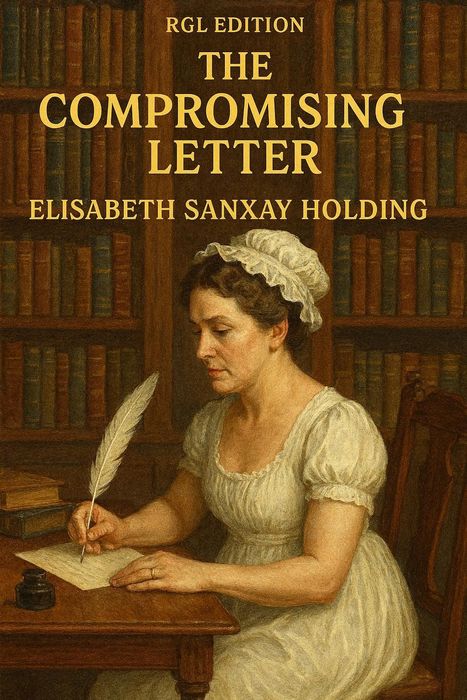
RGL e-Book Cover
Based on an image created with Microsoft Bing software
Roy Glashan's Library
Non sibi sed omnibus
Go to Home Page
This work is out of copyright in countries with a copyright
period of 70 years or less, after the year of the author's death.
If it is under copyright in your country of residence,
do not download or redistribute this file.
Original content added by RGL (e.g., introductions, notes,
RGL covers) is proprietary and protected by copyright.
RGL e-Book Cover
Based on an image created with Microsoft Bing software


The Munsey Magazine, July 1926, with "The Compromising Letter"
"The Compromising Letter" is a comic-satirical study of delusion, vanity, and modernity colliding with nostalgia. Holding uses the figure of Cousin Ronald—an antiquarian obsessed with an 18th-century heroine—to expose how self-importance and historical romanticism distort real life. The story's emotional core, however, lies with Lucy and her mother, whose kindness and practicality ultimately puncture Ronald's fantasies and restore a more humane balance.
MR. RONALD PHILLIPS was an authority upon Mme. Van Der Dokjen; indeed he was the greatest living authority.
He was also the sole authority. His fellow countrymen knew little about Mme. Van Der Dokjen, and seemed to care less. He was not sorry for this.
He had written a book called "Mme. Van Der Dokjen and Her Milieu," in which he gave as much information as he thought suitable for the public; but he had a large collection of her letters and so on. He was thankful that there were no other authorities to go snooping around and finding out the things he did not choose to publish.
Not that the lady had any guilty secrets in her life. She was perfection. Only, there were little things, what you might call trifling inconsistencies, things pardonable, even charming in themselves, but foreign to her austere and energetic character.
For instance, that letter written to her sister in 1777, in which she described, with such unexpected enthusiasm, a certain young captain in General Washington's army. Mme. Van Der Dokjen was at that time forty-three years of age. No doubt her interest in the young soldier was pure patriotism.
But Mr. Phillips preferred not to publish that letter; so squeamish was he, that he did not even make use of the recipe it contained for quince conserve, which illustrated her splendid housewifely talents.
Indeed, he grew nervous about Mme. Van Der Dokjen. He lived in dread lest some one should discover new documents concerning her. It was for this reason that he went to live in the historic cottage on the banks of the Hudson, in which she had ended her days. He thought that perhaps there were documents hidden in it.
It was as historic a cottage as one could wish to see. There were in it a spinet, a frame for making candles, a spinning-wheel, and other interesting objects. He set to work at once upon a new book to be called "When Home Was Home," which would depict Mme. Van Der Dokjen living in this cottage, making conserves and candles, playing upon the spinet, and entertaining the illustrious men of the age.
Mr. Van Der Dokjen was there, too, but Phillips did not care much for him. A dull dog, he must have been.
In this book, Phillips was going to kill two birds with a pretty heavy stone. He was going to give more highly valuable information about Mme. Van Der Dokjen, and he was also going to show how lamentably had the home declined since that day. Home life had degenerated, and home life was the very foundation of morality.
And the foundation of home life was—thrift. There was no virtue he admired more. There was a great deal about thrift in his book.
In the meantime, though, he had to eat to live. He could not himself make conserves and candles; there must be a womanly spirit to look after all this. So he invited his Cousin Winnie to become his housekeeper.
She said that life could hold no greater joy, but that she could not leave her only child. This was natural and admirable, and, as the child was a daughter of twenty, who would not be likely to scratch the furniture or steal the conserves, he said to bring her.
In that branch of the family, Ronald Phillips was supreme. Not only was he rich, but he was rich in the correct way—mysteriously. Everybody knew exactly how much he had inherited from his father, but nobody knew how much he had now, or how much he spent—or how he intended to leave his fortune. Cousin Ronald's money was one of the best and brightest topics in the family.
Also he was literary. He was rich, he was literary, and he had great natural distinction. He disapproved of more things than any one else in the family. He was tall, and handsome, in a distinguished way; he had gray hair parted in the middle, a gray goatee, and a fine voice. Cousin Winnie admired him profoundly.
Her child, though, the young Lucy, belonged to a more critical generation. She saw certain flaws. But she said nothing. She came with her mother to the historic cottage, prepared to do her best.
She had studied domestic science; she was energetic and healthy, and she thought that she and her mother could make Cousin Ronald very comfortable. She wished to do so; that was her nature. She was a kind little thing.
She was a pretty little thing, too. Cousin Ronald admitted it. Not in the Mme. Van Der Dokjen style, but she was young yet. The years might bring her more of the dignity, the calm of that matchless woman.
And, as it was, she had her good points; she had clear, steady blue eyes, and very satisfactory light hair, and she had a pleasing sort of gayety about her. She sang while she was working. It was agreeable to hear her.
She had faults, undoubtedly, but they were, Cousin Ronald thought, more the faults of her deplorable generation than anything inherent. He thought they might be cured. He interpreted Mme. Van Der Dokjen to her, also the significance of home life.
"Yes," she said. "Yes, Cousin Ronald, I know it's lovely. But, you see, I don't have much time during the day, and in the evening I do like to read or write letters."
"Mme. Van Der Dokjen wrote letters," he pointed out. "An astounding quantity of letters, when one considers her unflagging devotion to her domestic duties, and her truly brilliant social life. There is no doubt but that many of these letters—models of the epistolary art—were written by the light of candles, Lucy."
"Yes, I know!" Lucy agreed. "But she was different."
"I concede the point," said Cousin Ronald, with a trace of severity. "Where, I ask, in the modern world, can one find a woman who is not different—deplorably different? But I should like to point out to you, Lucy, that this habit of continually saying—'I know!'—gives a quite false impression of your character. I do not believe you to be one of these intolerable modern young women who fancy they 'know' everything."
"Yes, I know!" said Lucy. "I mean—I know that what you say is right, Cousin Ronald. Only, I thought that just one oil lamp—"
He told her that even one oil lamp would utterly destroy the "atmosphere" of the historic cottage.
"All right!" Lucy replied.
He remembered how Mme. Van Der Dokjen was wont to reply to the requests or commands of her elders. "You must be assured, Hon'd Sir, of my pleasure in conforming to y'r lightest wish." "All right!" That was the modern way. He sighed.
"And now your dinner's ready," Lucy announced. "Something awfully nice, too."
He sighed no more. These meals which Cousin Winnie and her child prepared for him were charming; he had never enjoyed anything more. They had the real old-fashioned homeliness; plain food, but beautifully cooked, and plenty of it. Cousin Ronald had spent his life in modest hotels; and this was his first experience, since childhood, of home life.
"You have been here one month to-day, Cousin Winnie," he remarked, as he finished his fried chicken. "I must thank you. It has been—for me, that is—a most delightful month."
"I'm sure, Cousin Ronald, it has been a pleasure," said Cousin Winnie. Tears came into her eyes. It was so touching to see Cousin Ronald grateful.
By common consent they omitted Lucy from the compliments. Like most persons of middle-age, they knew that it is not wise to praise the young; they remember what you say, and use it against you later on. Cousin Ronald knew this by instinct, but Cousin Winnie knew from experience.
She was a thin, worn little lady, with a gentle and pretty face. It was the general opinion in the family that she had been the helpless victim of a cruel fate, and certainly she had had many undeserved misfortunes. But she had survived them. She had kept upon the surface of the stormy sea, like a cork. She could stand a good deal.
This was a good thing, for fresh trials were approaching.
IT was a superb September morning, warm and still. The windows of the dining room were open as they sat at breakfast, and Cousin Winnie saw white butterflies out in the neat little garden. Most lovely perfumes drifted in, fresh-cut grass and pine needles, and the very last roses; and from the kitchen came another current, warmer, like a Gulf Stream, and less romantic, but beautiful, made of the aromas of pancakes, maple sirup, bacon, and coffee.
The sun shone in; everything was good, and right, and Cousin Winnie was happy. Her mail, too, was satisfactory. She had a letter from a jealous and spiteful cousin in California, who insinuated that Cousin Ronald was growing old, and falling prey to certain unscrupulous relatives.
The injustice of this really flattered Cousin Winnie. Nobody could have been less designing than she. The arrangement was entirely of Cousin Ronald's making; he had sought them out, in their cozy little flat in New York, where they had managed well enough with the aid of Lucy's salary as an assistant librarian.
They had been glad to come, but it was nothing like so dazzling a situation as the spiteful cousin in California imagined. The financial compensation was very modest. Very! Cousin Ronald was no spendthrift.
And there was a great deal of work to be done in this cottage which was so charmingly old fashioned. Still, Cousin Winnie was glad she had come, because, for all Cousin Ronald's distinction, his literary attainments, she thought he was pathetic. She glanced up from the spiteful cousin's letter, to enjoy the heart-warming spectacle of the poor man eating buckwheat cakes.
But he was not eating at all. He was staring before him with unseeing eyes.
"Is anything the matter, Cousin Ronald?" she asked, anxiously.
"Er—no, no," he answered. "That is—nothing wrong with this most excellent breakfast, my dear Winnie. But—er—but—er—"
"Did you say 'butter,' Ronald?"
"No, no, thank you. I have received a letter. I fear I must ask you to excuse me, Winnie." He arose. "I—I am perturbed!" he added. "I must be alone for a time."
He gathered together his letters, most of which he had not yet opened, and went out of the dining room, into his study. He locked the door, and sat down before his desk.
"Merciful Powers!" he murmured.
The blow had fallen. Mme. Van Der Dokjen was most hideously threatened.
Again he read the fatal letter.
Dear Mr. Phillips:
Having heard of your interest in Colonial history, and particularly in Mme. Van Der Dokjen, I feel sure you will be pleased to learn that I have discovered a letter written by her to an ancestor of mine—a certain Ephraim Ordway, captain in General Washington's army.
Apparently Mme. V. took a pretty lively interest in Captain Ordway, and the letter may provide an amusing sidelight upon the lady's history.
If you would care to see it, I shall be glad to bring it to you some day.
Very truly yours,
Stephen Ordway.
"This," said Cousin Ronald to himself, "is blackmail. 'An amusing sidelight—!' Merciful Powers!"
On a shelf before him stood a copy of "Mme. Van Der Dokjen and Her Milieu," chastely bound in gray and gold. As frontispiece there was a portrait of her, smiling; but how dignified, how superb! "An amusing sidelight!"
"Of course I shall write to this fellow, and bid him bring his letter," thought Cousin Ronald. "But I'll have to pay. Heaven knows what I shall have to pay!"
It was a truly horrible situation, for it combined the two greatest fears of his soul; the fear of injury to Mme. Van Der Dokjen, and the fear of spending much money. Because, as was mentioned before, Cousin Ronald was no spendthrift.
It was with the object of obtaining temporary relief from these painful matters that he opened his other letters. But instead of relief, here were more blows. It was the beginning of the month, and all the other envelopes contained bills—for groceries, for meat, for vegetables, for laundry. He added them together, and was appalled. He knew what it had cost Mme. Van Der Dokjen to run this house; this was five times as much.
For a moment, a sort of desperation seized upon him. He saw his hard earned—by his father—money being squandered and dissipated upon all sides. He saw himself paying these bills, and buying the compromising letter, and being left a ruined man.
"Merciful Powers!" he cried, with a groan.
Then he arose, and went to Cousin Winnie, and told her that he was a ruined man.
In that chapter on Mme. Van Der Dokjen "During the War," he had written with a certain eloquence about her benevolence, and about womanly sympathy in general; he had praised it, but not before had he encountered it. And he found it even sweeter than he had believed.
He and Cousin Winnie had a long talk. He assured her that he was confiding in her. To tell the truth, he told her nothing, but he spoke of his "troubles" in a large, vague fashion, he begged her to help him to economize. And she pitied him.
Lucy pitied him, too. But she was of a somewhat more practical nature.
"If he's ruined," she said, "it seems to me that we'd better go back to the city, and I'll get another job. And at least we'll have hot baths, and electric lights, and enough to eat."
"I could not leave your Cousin Ronald now," her mother declared, solemnly. "He says that any day now he will know. And then we can decide."
"Know what?" asked Lucy.
"Know the worst," her mother replied.
"Nothing," said Lucy, "could be worse than this."
Indeed, matters were bad, very bad. A black shadow lay over the household. Every morning Cousin Ronald came to the breakfast table, with a stern, set face, opened his letters, looked at Cousin Winnie, and said "Nothing!" She knew not what fateful news he expected, but she dreaded it, and yet wished it would come, that the blow would fall, the suspense be ended.
In the meantime, she did her utmost to aid the stricken man. Her economies were heroic. No need to detail them here. She grew thinner and paler, but she did not falter. Cousin Ronald told her frequently that he did not know what he could do without her coöperation, and that was a spur to the willing horse.
She did not like her child to endure all this, though. Again and again she urged Lucy to go back to the city, but Lucy refused. She would not leave her mother, and she, too, was sorry for Cousin Ronald; quite as sorry as her mother, though in a different way. In her eyes he was not the distinguished and admirable figure Cousin Winnie thought him; he was simply a "poor, funny old darling." So, she remained, also waiting for the blow.
But no one suffered as did Cousin Ronald. He had written at once to this Stephen Ordway, requesting him to bring the letter at his "earliest convenience." No answer came; days went by, and Cousin Ronald wrote again. He waited and waited, in growing anguish. What, he asked himself, could be the reason for this silence? Awful fancies came to him.
His publishers wrote, asking if they might expect the manuscript of his new book in time for their spring list. He knew not how to reply. He dared not publish anything further about Mme. Van Der Dokjen while that letter was at large.
One night he had a dream. He dreamed that he went into Brentano's, to look at his book—"A Historic Cottage"—which had just been published, in gray and gold, like the former volume. He was, in his dream, examining this volume with justifiable pleasure, when his eye fell upon another book beside it—a slim little book in a scarlet jacket—"The Lady and the Soldier—An Amusing Sidelight Upon Mme. Van Der Dokjen."
It was a frightful dream, from which he awoke, cold and trembling.
"Whatever he asks, I'll pay it!" he thought. "But—Merciful Powers! It may be a sum beyond the very bounds of reason."
Still, he would pay. He would not see this noble woman held up to the world's ridicule. Whatever the cost, he would pay.
And, until he knew the cost, every cent must be saved. Very well; every cent was saved. Cousin Winnie assisted him in this. He waited. They all waited.
THE summer ran its course, and the great winds were beginning to blow. The leaves were falling fast. And, in the city, janitors were informing tenants that the furnace was being repaired; who so sorry as they for any delay in getting up a fine sizzling head of steam in the boiler these chilly mornings?
In the historic cottage there was, of course, not even a hope of a furnace. Cousin Winnie spent most of her time in the kitchen, where there was a coal stove, and Cousin Ronald took long, healthful walks. So did Lucy; often they went together, but not on this especial afternoon. If they had, if Lucy had accompanied Cousin Ronald this afternoon, all might have been different.
Cousin Ronald, however, had remained in his study, communing, so to speak, with Mme. Van Der Dokjen. It was growing late when from his window he saw Lucy coming back from her walk. Her hair was blown about, her cheeks were glowing, she looked the most alive, warm, radiant creature imaginable.
And he was chilly and dispirited, and, seeing her, he thought that perhaps a walk might do all that for him. So he put on his hat and overcoat and took up his stick, and set forth. Not ten yards from his own gate he passed the man he so anxiously awaited, but he knew him not. He went on, in one direction, and the man went on in the other.
The man knocked at the door of the cottage, and Lucy opened it. She was still flushed from her walk, and in that dim, low-ceilinged room she seemed to him, with her fair hair that shone, her clear blue eyes, her scarlet jersey, almost impossibly vivid.
"I beg your pardon," he said. "Does Mr. Phillips live here?"
"Oh, yes!" Lucy answered. "But he's just gone out. You might catch him if—"
"I'd be sure to miss him," the stranger declared, firmly. "If it won't bother you, may I wait? I'll just sit down out here." And he indicated a very historic settle which was built into the porch. All the winds that blew, blew here; an eddy of leaves whirled about his feet, now, and Lucy could scarcely hold the door open.
"You'd better come in," she suggested.
"Well, thank you," said he.
Fresh from the stir and color of the windy day, the sitting room seemed to him unpleasantly chill and dark as Lucy closed the door behind him. The fire was out, for economy's sake, and the tiny panes in the historic window did not admit much light.
"This is a pretty old house, isn't it?" he observed.
"Awfully!" said Lucy. "Sit down, won't you? That chair's a hundred and fifty years old. And it's one of the junior set, too!"
"I've heard about this place. Belonged to Mme. Van Der Dokjen, didn't it?"
"It still does!" said Lucy, grimly.
The stranger glanced at her.
"My name's Ordway," he explained. "I wrote to Mr. Phillips, and he asked me to come. I've been away—on my vacation—or I'd have come before."
He wished that he had. He wished that he had come weeks ago. He felt that he had lost priceless time. And he looked as if he thought that.
Lucy had always liked red hair, and noses that turned up a little. This young man had red hair and that sort of nose; he was big, too, and broad-shouldered, and he looked cheerful. She asked him if he would care to look over the historic cottage and its antiques.
"Well—no, thanks," he said. "Tell you the truth, I've had all I want of historic things. My aunts, you know—they've got ancestors, and documents. If you don't mind, I'd rather just sit here and—"
He said "wait," but what he meant was "talk to you." The girl knew this. They did sit there, and they talked. The room grew dark; a very fine sunset was going forward in its proper place; indeed, at that moment Cousin Ronald was standing upon a hilltop, admiring it. But the laws of nature kept it away from the sitting room.
In the course of time Cousin Winnie was obliged to call for her daughter's aid. She came into the doorway; Mr. Ordway was presented to her; she spoke to him graciously, and gave him a candle, then she took away the radiant Lucy.
Candle or no candle, the room seemed darker than ever to Ordway. He began to walk about, but he knocked his shins against too many historic objects, and at last he paused, in a spot where he could see into the kitchen. He saw Cousin Winnie and Lucy preparing dinner by candlelight.
And he did not find it picturesque. He saw Lucy vigorously plying the pump beside the sink. He was not reminded of the old days, when home life had been so much finer. He thought:
"Good Lord! A pump! Candles! It's a shame! It's a darned shame! A girl like that! It's a darned shame!"
He blamed Mr. Ronald Phillips for all this.
When Cousin Ronald came home, he found a Stephen Ordway even more sinister than he had feared; a stern and very reticent young man, a very large one, too. By the light of the one candle in the sitting room, he loomed, in the dictionary sense of the word—"loom: to appear larger than the real size, and indefinitely." His red hair had an infernal gleam.
"Mr.—er—Ordway?" said Cousin Ronald. "Yes—yes—I had—er—a communication from you?"
"You did, Mr. Phillips."
"Er—have you brought it with you?" asked Cousin Ronald, very low.
The young man said "Yes," but made no move to produce any document. He was thinking of something else.
"This house is old," he remarked; "but it seems pretty solid."
"Yes, indeed!" Cousin Ronald assented anxiously. "Yes, indeed!" He saw that the young man was leading up to something. "Suppose we step into my study?"
The young man was looking about him, at the walls, up at the ceiling.
"Yes," he asserted. "The place could be wired."
"W-wired?" said Cousin Ronald. "I don't—"
"I'm an electrical engineer," said Ordway. "I've been looking around here. Think what electricity could do for you here! Light—plenty of light—electric water heater—pump—dish washer—vacuum cleaner—percolator—stoves. You could have decent comfort!"
Cousin Ronald could not fathom the motives of the stranger, but he felt sure that they were profoundly subtle, and inimical to Cousin Ronald's welfare. Again he said:
"Will you—er—step into my study, sir?"
Ordway stepped, and when he got in there he loomed worse than ever.
"See here!" he said. "Let me do this job for you—wiring the house."
Cousin Ronald felt a sort of illness, a sort of faintness. He believed that he could comprehend the plot now. Instead of bluntly demanding a certain sum for Mme. Van Der Dokjen's letter, he was going to demand this job—this impious, this vandal job, of "wiring" the cottage. And the price—the price—
"I—er—fear it would be a somewhat costly undertaking," said Cousin Ronald.
Ordway thought of the wonderful girl, groping about in this dismal house, cold, forlorn, captive to an ogre relative. He was perhaps a little obsessed by electricity—a good thing for one of his profession. He thought it the great hope of the modern world. And he could not endure the idea of a wonderful girl deprived of its benefits. He said:
"The question is—if anything can be too 'costly,' when it's a matter of human dignity and welfare."
A shudder ran along Cousin Ronald's spine. The moment had come. Very well; he was ready. He admitted, in his own heart, that nothing could be too costly where Mme. Van Der Dokjen's dignity was concerned. He was silent for a moment; then he raised his distinguished head.
"Mr. Ordway," he said, "name your price, sir!"
Ordway stared at him with a faint frown.
"I didn't mean that," he explained. What he had meant was that he would be glad to do this job for nothing. But he feared to affront Mr. Phillips. "It's—I'd enjoy doing it," he said earnestly.
Cousin Ronald could not endure the suspense any longer.
"Mr. Ordway," he said, "let us be direct, sir. That is ever my way. I have long been prepared for this eventuality. I am ready, sir, to consider the purchase of this letter. Be good enough to name your price."
LIKE many another man before him, Cousin Ronald was ill-served by his own impatience. Ordway had come, intending to hand the letter over as a gift of no importance, but being asked to name his price put ideas into his head. He reflected. He reflected so long that Cousin Ronald grew still more impatient.
"I have been practicing the strictest economy," he announced. "I may say that I have endured something not short of actual discomfort, sir, in order that I might be in a position to meet any—er—reasonable terms—"
There was a knock at the door. It was Cousin Winnie.
"Your dinner!" she whispered. "It's ready!"
Cousin Ronald did some quick reflecting himself. If the young man could observe their strict economy for himself—
"Mr. Ordway, sir," he said, "will you favor us with your company at a very simple meal?"
"Thank you!" Ordway replied. "I'd be pleased to."
This dinner had, in Cousin Ronald's eyes, a sweet, old-fashioned charm. A fire burned now upon the hearth; the board was set out with Wedgwood and with Sheffield plate. And Cousin Ronald positively recreated Mme. Van Der Dokjen, describing her just as she had been, here in this very room.
But Ordway was not moved. He did not give the Wedgwood or the plate anything like the attention he gave to the economical dinner, and the late Mme. Van Der Dokjen was, to him, of very inferior merit to the living Lucy. All the time Cousin Ronald discoursed, Ordway was thinking of Lucy, deprived of electricity and of all the other privileges she so richly deserved.
"It's a darned shame!" he thought. "The old skinflint thinks more of that letter than he does of his own family. A darned shame!"
When the meal ended, Cousin Ronald suggested that Lucy sing, accompanying herself upon the spinet—an art she had recently acquired. He believed that this would soften the heart of the rapacious young man.
It did. It did, indeed. To the sweetly jangling spinet she sang some gentle old song. In firelight and candlelight—
The young man, watching her and hearing her, was quite as much moved as Cousin Ronald could have desired—but in the wrong direction.
Her song ended, Cousin Ronald and Ordway withdrew to the study, Cousin Winnie and her child to the kitchen. Twenty minutes passed; then Ordway reappeared. With a curtsy almost old-fashioned, Lucy went with him to the door, even across the threshold.
The wind slammed the door behind her, and for a few minutes she stood in the porch, talking to the young man. Cousin Winnie, in the kitchen, heard them; they were discussing a new play. Lucy said yes, she did like the theater, but she didn't go very often now. And she had heard "The Maddened Brute" spoken of as a wonderful play—a really big thing. Cousin Winnie missed a little here, owing to her duties; the next thing she heard was Lucy saying good night to Mr. Ordway.
It had been a very brief conversation, but Ordway, as he walked to the station in the windy dark, imagined that she had said a great deal. He thought, somehow, that she had told him what a miserable existence she led in the historic cottage. What a darned shame!
LUCY was sitting at a small table by the dining room window. She had bought a tube of cement, and with it she was mending a varied assortment of antique china she had discovered in a cupboard. It was raining outside, a chill, steady downpour. And the room was dim and cold, and it was a dismal world.
"I wish I was thirty!" she thought. Because at that advanced age she believed that one could be content to live in a historic cottage, and not mind dullness, or rain, or anything, very much. At thirty she would be content to devote her life to the ruined Cousin Ronald and her heroic mother. Yet, in a way, she disliked the thought of being thirty. She disliked all her thoughts this afternoon.
"As far as that goes," she reflected, pursuing a certain familiar line, "I don't have to wait for anybody to invite me. I can take mother to see 'The Maddened Brute' this very Saturday, if I like. I've got enough money for that. Only, mother wouldn't like that sort of play. Anyhow, I don't care!"
Carefully she cemented a handle on an ancient sugar basin; then, setting it down to dry, she looked out of the window. The postman, in a rubber coat, was coming along the muddy road.
"I don't care!" she said again. She was not the sort of girl who waited with the slightest interest for letters that people had said they were going to write a week ago. Let them write, or not write; what cared she?
The postman came up on the porch and whistled, and the door opened—like a sort of cuckoo clock—and Cousin Winnie took in the letters. But what a long time she was in the hall!
"I suppose she's got another letter from a cousin," thought Lucy. "If there was anything for me—But I don't care, anyhow."
At last Cousin Winnie came into the dining room.
"A letter for you, Lucy," she said, handed it to her child, and vanished. With the utmost indifference Lucy opened her letter. It contained two tickets for "The Maddened Brute" for Saturday afternoon, an explanation of the difficulty of getting them, and a very civil request that she and her mother meet Stephen Ordway for lunch at the Ritz before the play.
Not yet being thirty, the girl was pleased.
"Mother!" she called. "Isn't this nice? Listen—"
No answer. She got up and went into the kitchen, and found her mother standing by the window—just standing, doing nothing. This was alarming.
"Mother!" she said. "What's wrong?"
"Lucy—" said her mother. "Oh, Lucy! Oh, think of it! You can travel! You can have really nice clothes!" She was actually in tears.
"What is the matter?" cried Lucy. And then: "What's this?"
It was a check for five thousand dollars which Cousin Winnie extended in her trembling hand.
"Your—your Cousin Peter—left it to you!"
"Cousin Peter! Who's he?"
"You wouldn't remember," said Cousin Winnie. "A—a second cousin of—your grandfather's. Oh, Lucy! My dear, good child! Now you can go away!"
"But the check's made out to you, and it's signed L. B. Grey—"
"A legal form," Cousin Winnie explained. "I myself shall be well and amply provided for. This check is entirely for you, Lucy."
SOMEHOW, "The Maddened Brute" was a disappointment. It was truly, as the advertisements declared it, a tense and gripping drama of life in the raw, but the characters were all so very violent that it was rather a relief than a tragedy when any one of them was silenced by stabbing, drowning, and so on.
Mr. Ordway was a little tense himself. When Cousin Winnie had seen him in the historic cottage, he had appeared such a cheerful young man, and now he was so odd, so silent. He ordered a superb luncheon at the Ritz; he provided them with an unparalleled box of chocolates; he was, in material ways, a most satisfactory host.
But spiritually he was depressing. In the theater he sat on the aisle, next to Cousin Winnie, and whenever the curtain went down he kept asking her about her plans, in a low and alarmingly serious voice.
"You won't stay in that house all winter, will you?" And he spoke of pneumonia, of bronchitis, of rheumatism, with a horrid eloquence. He said that candles often set houses on fire. He pictured such a disaster on a bitter midwinter night.
He spoke of thieves. He went on to escaped lunatics; and when the curtain rose on the third act and showed the Maddened Brute gibbering in a cellar by the light of one candle, she gasped.
"I must speak to Lucy!" she thought. "She's got to go away!" It was her policy not to interfere with her child, and she had waited very patiently for some word as to what Lucy meant to do with the check. But now she would wait no longer; she would speak to her about going away.
She had no opportunity, though. The young man insisted on taking them all the way back to the cottage.
It did, indeed, look sinister that evening, so small, so lonely under a stormy sky. Mad things could so easily be hiding behind those bushes. Of course they weren't, but they could.
"You must come in, Mr. Ordway," said Cousin Winnie.
"Thanks," he replied. "But—thanks, but I've got to go. Only, I wish you'd tell me first that you've decided not to stay here this winter."
"Oh, dear!" said Cousin Winnie, mildly. "I'm sure I can't."
"Why don't you go to Bermuda?" continued the young man. "Or Florida? You—both of you—look pale."
Although a little tiresome, Cousin Winnie thought the young man's solicitude rather touching. But Lucy answered him bluntly.
"We can't afford things like that. We're going to stay here—"
"But five thousand dollars ought—" he began, vehemently, and stopped short. There was a blank silence.
"Mother!" said Lucy, reproachfully.
"My dear!" said Cousin Winnie. "Naturally, I never mentioned—"
There was another silence.
"Mr. Ordway," Lucy began. "What made you say 'five thousand dollars'?"
"Oh! It—it just came into my head," he replied.
"It couldn't," said Lucy, coldly. "I'd like to know. Will you tell me, please, why you thought I had five thousand dollars?"
Another silence.
"Because," said Ordway, "I sent it."
"Oh!" cried mother and daughter.
"But—listen, please!" said the young man, in great distress. "It's—if you'll just listen. You see, I had a letter written by this Mme. Van Der What's Her Name—and Mr. Phillips wanted it—badly. And when I saw how—what it was like in the cottage—and he seemed to have all he wanted to spare for that darn fool letter. I made him pay five thousand for it. Please! Just a minute! It really belongs to you. You're his relatives."
"But—Cousin Peter!" cried Lucy.
"I made him up," said Cousin Winnie, faintly. "The letter said—from an anonymous friend—and I thought—perhaps your Cousin Ronald himself—But now, of course, Lucy will return it to you at once, Mr. Ordway."
"I can't," said Lucy, with a sob. "You told me this Cousin Peter yarn—and you said you were amply provided for—and I'm young and healthy—and the poor thing did look so wretched—"
"Lucy! What 'poor thing'? Oh, Lucy, what have you done?"
"You told me he was ruined," said Lucy. "And he did look so cold, and wretched, and dismal—and I rather like him."
"Lucy! You didn't—"
"I did!" cried Lucy in despair. "I gave it to Cousin Ronald!"
"He accepted it?" asked Ordway, in a terrible voice.
"He had to," Lucy replied. "I put it in an envelope and wrote—'from an admirer of Mme. Van Der Dokjen'!"
No one spoke for a time.
"I know it was foolish," said Lucy, finally. "But the day I got it, I felt so—I can't describe it—so—well, so healthy, you know, and able to do anything I wanted. And he was sitting in there, writing his poor silly old book, with one candle. And his gray hair, and his funny little beard—and the way he clears his throat—sort of baaing—like a lamb. And I thought he was ruined."
"Foolish!" repeated Cousin Winnie, and with that she walked briskly up the path.
"I really am a little bit sorry," Lucy remarked.
"Sorry for what?" inquired Ordway.
"Well," said she. "For you, I guess. You must feel pretty flat, just now."
"Thank you," said he. "I do."
"It was a nasty, condescending thing."
"It wasn't meant like that," he declared. "What I—"
The door of the cottage opened, and Cousin Winnie called:
"Don't stand there in the cold!"
"Mother says—" Lucy began.
"I heard her," said Ordway. "Thing is—what do you say?"
"Well, I'd—I'd like you to come," said Lucy.
THEN they went in. They found Cousin Winnie standing by a console in the hall, with a strange look on her face.
"Really!" said she. "This is—Look at this!"
And she held out to them a check for five thousand dollars, drawn by Cousin Ronald to her order.
"Listen!" she said, and began to read:
"My dear Winnie:
"An unexpected stroke of good fortune enables me to tender to you this small token of my profound appreciation of your kindness toward me in a dark hour. I beg that you will honor me by accepting it.
"Furthermore, it occurs to me that this cottage, hallowed as it is to me by its associations, is scarcely suitable in its present condition for a winter residence for ladies accustomed to modern conveniences. I shall endeavor to arrange for the installation of electricity, and I am this afternoon going into the city to consult with an expert upon the advisability of a small furnace.
"I shall be somewhat late in returning. Indeed, my dear Winnie, I should prefer that you read this in my absence, and to consider—"
"That's all that matters," said Cousin Winnie, hastily, folding up the letter.
"No! Read the rest!" her child firmly insisted.
"No," Cousin Winnie asserted. "I—I prefer not."
"But why?" Lucy began, and then stopped, staring at her mother.
"Mother!" the girl exclaimed.
"Don't be silly!" said Cousin Winnie, severely.
"Merciful Powers!" Lucy remarked, with a shocking mimicry of Cousin Ronald's manner. "I fear this is another compromising letter!"
"It is not, at all!" Cousin Winnie declared indignantly. "Nothing could be more honorable and—"
Then suddenly they all began to laugh. Cousin Ronald, coming up the path, heard them. He thought it was an agreeable thing to hear, suggestive of that fine, old-fashioned home life.
Roy Glashan's Library
Non sibi sed omnibus
Go to Home Page
This work is out of copyright in countries with a copyright
period of 70 years or less, after the year of the author's death.
If it is under copyright in your country of residence,
do not download or redistribute this file.
Original content added by RGL (e.g., introductions, notes,
RGL covers) is proprietary and protected by copyright.