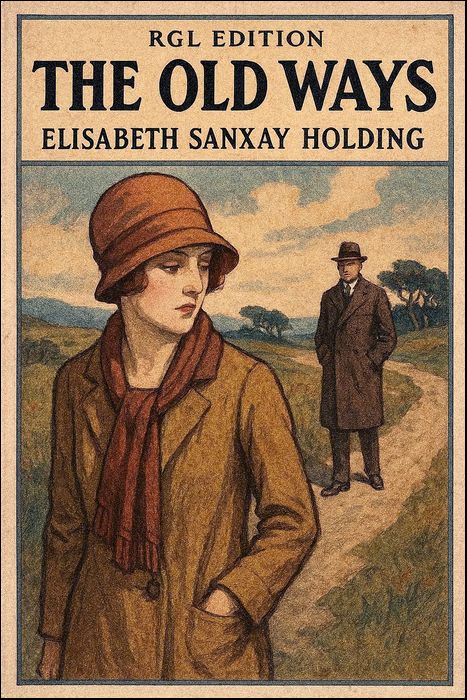
RGL e-Book Cover
Based on an image created with Microsoft Bing software
Roy Glashan's Library
Non sibi sed omnibus
Go to Home Page
This work is out of copyright in countries with a copyright
period of 70 years or less, after the year of the author's death.
If it is under copyright in your country of residence,
do not download or redistribute this file.
Original content added by RGL (e.g., introductions, notes,
RGL covers) is proprietary and protected by copyright.
RGL e-Book Cover
Based on an image created with Microsoft Bing software


A young Danish-American man, Gunnar Jespersen, becomes entangled with a humble immigrant girl, Ingeborg, whose dignity and goodness force him to confront his own pride, ambition, and moral confusion. Their relationship becomes a test of character—one that ultimately challenges Gunnar to choose between corrupt ambition and the "old ways" of integrity.
IT was bitter bread they had to eat, Mrs. Anders and her daughter.
"You deaf, hey?" bellowed Oscar Anders. "Don't you hear that bell, hey? No! Ingeborg, you stay where you are! Marie, you go!"
The sight of them standing there, so downcast, filled him with anger.
"You two dumb ones!" he shouted. "Marie, you go!"
Mrs. Anders went. Ingeborg turned to the stove again, and lifted the lid of a saucepan; but she could not see through her tears. From the hall upstairs she could hear her mother's voice, faltering out her broken English; then the front door slammed. Some one else had gone away, impatient and annoyed, unable to understand her.
Outside the snow was falling—the first snow Ingeborg had seen. It was not like the snow her mother had told her there was in Denmark. There were no sleigh bells here, no dark fir trees to catch and hold a glittering burden, no blazing fire within. This snow was sorrowful and faint, vanishing as it touched the pavement, and through it monstrous trucks thundered by, and people were passing, all hurried, all strangers, never a familiar face.
It was growing dark in the basement kitchen. The gas stove burned with a clear blue flame in its shadowy corner. Mrs. Anders, coming into the room, was almost invisible, but Oscar saw her.
"Well?" he demanded.
She answered him in Danish, and that made him so angry that he banged down the legs of his tilted chair.
"Speak American!" he shouted.
"He don't vant a r-room," said Mrs. Anders. "He vent avay."
"Yes, and everybody's going to 'vent avay,' if you don't learn some sense! I give you your food, and a nice room, and a pair of shoes last week! A hat, even, for the girl! Everything you take, and bring nothing. The two of you—ach, Gott, so dumb!"
They said nothing, Mrs. Anders and her daughter. They had to endure this, and they did endure it.
"Oscar is a good man," said Mrs. Anders to herself. "He gives us a home—that I won't forget. It is a home for me and Ingeborg."
Six months ago her husband had died. The poor man had been ill a long time, and he left very little. A very bad time that had been, even though the neighbors had been so kind. Then Oscar Anders, her husband's brother, had sent her the fare to New York, and had written that she and Ingeborg could come to live with him, and maybe could help a little in the rooming house he had just bought.
"That was kind," said Mrs. Anders to herself. "Oscar is a good man."
So they had left St. Croix, where Ingeborg had been born, and where Mrs. Anders had lived for twenty years, and they had come to New York; and Mrs. Anders had tried to repay Oscar's kindness. From six in the morning until perhaps nine at night she worked, keeping the big, old-fashioned house clean and neat, and cooking meals for Oscar. It was hard work, but she did not mind that. What she did mind was any contact with the alien world outside.
She had led a sheltered life in the West Indies, just with her husband and his people. She had never troubled to learn English, and now nobody understood her; and her timid air and poor clothes won very little patience for her. She was sick with dread when she had to enter a new shop to buy anything. She would return from one of these expeditions and shut the door of Oscar's house behind her with a long sigh of relief.
Inside the house there were Oscar and the lodgers, all so cross! Well, let them be; she knew she did not deserve it. She was a respectable woman, and the mother of Ingeborg, and that was something to be proud of. Such a neat little woman, too—small and spare, with a long nose and a thin face with two spots of red on the high cheek bones; but only Ingeborg looked at her kindly now. Her man was gone, and she had nobody but Ingeborg, who was still a child to her mother.
"Oh, thou dear little one!" thought Mrs. Anders, looking at her daughter. "Thou little Ingeborg—so dear!"
Ingeborg was making the coffee. Oscar was a good man, but he ought not to call Ingeborg "dumb." That was not right. Just think what the girl could do in the house—so clever and quick at cooking, fine ironing, sewing, anything you wanted done—
"The bell!" shouted Oscar. "Ach, Gott, she grows deaf now, the dumb old woman!"
"Ach, I don't hear dot," said Mrs. Anders hastily. "I go, Oscar!"
She hurried up the stairs, whispering to herself the English words she might need. She opened the front door, and there was another young man. So many of them came!
"Room?" he asked curtly.
"Nice room," said Mrs. Anders. "Top floor. Seven dollars. I show you."
"Seven?" said he. "Well, I'll take a look."
Mrs. Anders had already begun to mount the stairs, and he followed her. On the top floor she opened a door and showed him a bare little room, very clean.
"Seven dollars?" he repeated.
Mrs. Anders was terribly anxious to let the room, because Oscar said it was her fault that nobody had taken it yet. Perhaps seven dollars was too much for it. She knew nothing about such matters; only she did so want to let it.
"Ver-ry goot room!" she said, and looked about for advantages to praise. "Heatness!" she said, touching her worn shoe against the register, from which came a tepid current of air. "Vater!" And she turned on the tap in the wash basin.
Still the young man did not seem impressed.
"Well, see here," he said. "What about—"
The rest of his question Mrs. Anders could not understand.
"Excoos?" she said, straining every nerve to catch his meaning. She saw that he was growing impatient. A formidable young man he was, big and blond, with eyes like blue ice, and a dogged jaw.
"Vait, plis!" she cried. "Yoost a minoot!"
"No!" he said, but Mrs. Anders was already hastening down the stairs.
He called after her, but she paid no attention. Down the last dark flight she stole, and looked into the kitchen, and behind Oscar's back made a signal to her daughter. Ingeborg came out into the passage. They dared not even whisper, for fear of their tyrant; but Mrs. Anders pointed up the stairs, and Ingeborg followed her like a shadow.
The young man had not waited. He had come down into the hall, and was about to let himself out of the front door, when Ingeborg spoke.
"Is there something you want to ask about, please?"
He turned and looked at her. The hall was dim, with only a single gas jet high overhead, but he could see her well enough. She was small, and looked very slight in her plain, dark dress. Her dark hair was wound in braids about her head. Her face was pale and wide-browed, with clear, dark eyes that looked back at him steadily. A colorless, quiet little thing; what was there in her to catch at his heart?
"Yes," he said curtly. "I wanted to know if I could get my breakfast here, and what you'd charge."
Ingeborg explained the question to her mother in Danish, and then told the young man:
"I'll find out, if you'll please wait a moment."
His blue eyes followed her as she moved away. Then he turned his head and looked out through the glass of the door. Mrs. Anders watched him, terribly anxious.
"Such a fine young man!" she thought. "So tall, and such a beautiful, rich overcoat! I only hope he'll take that room!"
Now there came a great bellowing from downstairs. She could understand those words. Oscar was angry, and shouting at little Ingeborg.
"Excoos!" she cried. "Yoost a minoot!"
"No!" he said with a frown. "Never mind, anyhow—I'll take the room, without breakfast. I'll be back later."
He opened the door and let himself out. Mrs. Anders stood in the hall, with tears in her eyes. She had not understood what he said. She thought he had gone away, as so many others went away, angry because she was so dumb.
As a matter of fact, if the young man was angry with any one, it was with himself, for his own folly. He ran down the steps and set off along the street as if he were in a hurry to get away from that house.
He had to wait at a crossing for the traffic to pass. On the opposite corner he could see the snow swirling about the street lamp in a little tumult; and it reminded him of something he had loved when he was a child. His mother had had a glass ball with a paper landscape in it, and when the ball was shaken a fierce snowstorm would fill the tiny world inside it. He remembered it so well, and somehow the thought of it made him recall other memories of his boyhood days, faint and sad and beautiful—the jingle of sleigh bells, a glimpse of the lighted window of a little house among the snow-covered hills, the long hoot of a train speeding swiftly through the dark.
He did not want to think of the past. He walked faster, but those thoughts went along with him, and in them, all the time, was the face of little Ingeborg. He had never seen her before, yet she seemed familiar to him, like a figure from his own past, or from a dream.
That pale face of hers, with its steadfast eyes—it was like a picture in his old fairy tales of a snow queen, dressed in fur, driving off in a sleigh shaped like a swan, and looking back sorrowfully over her shoulder. It was like a face he had seen long, long ago, at some window. It was the face of the beloved maiden who is always waiting, in every tale, in every dream—waiting her deliverance.
Not for him! He would not have it so. He had chosen another road, and nothing should stop him. What did he care for that girl—a little, shadowy, humble thing like that?
He thought of Mabel, with her pearls about her throat, and her red lips, and he laughed aloud. Who, seeing Mabel, would look again at that other? Not he!
He went back to his old room and packed his bag; then he walked over to a little Italian restaurant for his dinner. He had minestrone and ravioli—queer food for that blond son of vikings; but he was used to things like that. He had eaten stranger food in more unlikely places—in Naples, in Calcutta, in Marseilles. He had seen the world—the beauty of it and the worst of it.
He took his time over his dinner, and it was nearly nine o'clock when he ran up the steps of Oscar Anders's house and rang the bell. Nobody came to open the door. The young man set down his heavy bag, and frowned impatiently. He was cold and wet, he was tired, and for some reason he did not feel happy. He rang again.
Then she came. She opened the door, and he entered and threw down his bag. He did not want to look at her, but he could not help seeing her. She was wearing a white blouse with a funny little plaid bow at the collar, and a long, dark skirt. She was altogether foreign in those clothes, with her dark braids about her head, and her subdued air—foreign, and yet in some way familiar to him, and dear.
"Well!" he said, with his masterful smile. "Here I am!"
"Oh, I'm so sorry!" she replied.
"What about?"
"My mother didn't understand you. She thought you weren't coming back."
"I told her I was."
"But she doesn't understand English very well. She thought—I'm so sorry—but just a little while ago we let the room."
"What?" said he. He was angry now. "I should have paid, eh? Somebody came along with money—"
"No," she said. "It was a mistake."
"Ingeborg!" shouted a great voice.
The girl started a little, but she did not turn.
"I'm very sorry," she said.
As she spoke, she looked straight at the young man, and she let him see that she really was sorry—as if she were his friend, and really anxious about him. Though she was so young and slight, there was a fine dignity about her.
"All right—I don't care," he said. "I can find another room."
"There's a telephone here," she suggested. "You could—"
"No!" he interrupted roughly.
"Ingeborg!" shouted the voice again. From the basement stairs there appeared a great, fierce old head with grizzled brows and mustache. "You!" cried Oscar. "What you doing here, hey? Who's this?"
"He came to see about a room," said Ingeborg.
"Well, we have no room for him."
"All right! Your daughter just told me—"
"Daughter? She's no daughter of mine. You, Ingeborg, get downstairs! When there comes a man, you shall call your mother. You hear me? Get downstairs!"
The girl turned away, toward the stairs; and at sight of her mute submission a great anger rose in the young man. Not even a glance over her shoulder for him, not a smile at that old bully! She was just one of those foreign girls, with no pride.
HE went out of the house, banging the door behind him. No pride—what was a woman without pride? If she set no value on herself, how was a man to hold her dear?
He thought of Mabel, of all the American girls he had known. There was not one among them who would have bent her head humbly to that old fellow—not one; only this Ingeborg, this little alien with the dark braids about her head.
Halfway down the street he remembered his bag. He turned and strode back, ran up the steps, and rang the bell violently. Perhaps she would come again. What did he care?
But it was Oscar who opened the door.
"My bag!" said the young man.
"Well, there it is," said Oscar. "In this house we are not thieves."
The young man took up the bag, and for a moment the two of them looked at each other.
"So was I a fine fellow when I was young," thought Oscar. Aloud he said, with a sort of mildness: "Too bad that that dumb one didn't keep you your room! If you had come to me, it would have been different."
"A nice thing for me!" said the young man. "A night like this—and I gave up my old room. A fellow I know told me to come here—name of Nielsen."
"Nielsen?" repeated Oscar, staring thoughtfully at him. "Well, maybe I find something. One room I have, but that's not for a young fellow like you—a fine room, with a piano in it. Maybe I let you have that room for one night at the price of the other, because that dumb one—"
"Oh, I'll pay you for your fine room with a piano!" interrupted the young man. "You can charge what you like—I don't care!"
Oscar Anders accepted the challenge.
"Pay nothing at all—I don't care!" he said.
He threw open the door of the fine room, the front parlor, and lit the gas.
"Make yourself at home," he said carelessly; for he would not let the fellow see how much he thought of this parlor.
The young man brought out a wallet, and again he and Oscar looked at each other; and there was the same pride in both of them.
"What's your name, hey?" asked Oscar.
"My name? Jespersen's my name."
Oscar began to laugh.
"Jespersen you call it?" he said. "Yespersen, I guess! That's a name from the old country."
"Well, I'm not from the old country. I was born here."
Oscar spoke to him in Danish.
"Forget it!" said Jespersen curtly.
"That's right!" agreed Oscar. "I'm an American, too."
"Oh, you're a squarehead!" said Jespersen.
They both laughed at that. They sat down on two slender chairs covered with faded tapestry, and began to smoke in the dim and chilly parlor.
"Gunnar Jespersen—that's my name," said the young man. "My father was a Dane and my mother was Swedish, but I was born here."
"Twenty-five years I am here," said Oscar slowly. "It is a good country, but some of the old ways are good, too." He smoked for awhile in silence. "You been a sailor," he remarked, looking at the other's hand, with an anchor tattooed on its back.
Gunnar did not answer that.
"Better for me if I were a sailor now!" he thought.
For there would come across him, without warning in these days, terrible fits of bitterness and gloom. At the bottom of his soul there was a stern austerity, born in him and bred in him. He could laugh as much as he liked, he could swagger in his triumph, but in his soul he was sick and ashamed.
What was it that he had done?
Six months ago he had been at Long Beach, strolling along the sands, in his best shore clothes. He had been all alone, but he didn't mind that. There was plenty to look at. Now and then some girl would smile at him, and he would smile back scornfully and go on his way.
And then he had met Mabel. At first he could not believe that it was he that she was looking at like that, out of the corners of her long black eyes. Heaven knows Gunnar was proud enough, but he could hardly believe that. The way she was dressed! The air she had!
She was with another girl, and it was the other girl who had dropped her purse almost at Gunnar's feet. He had picked it up, and had spoken to them arrogantly; but the more curt and scornful he was, the more did Mabel smile on him, she with her pearls and her gloves and her drawling voice. Ignoring her friend, she had walked close beside Gunnar.
"It's a shame," she had said, "for you to be just a sailor!"
That made him angry. He was studying navigation, he was going to take an examination and get his mate's ticket, and some day he would be master of a ship.
"My father's the superintendent of a factory," she said. "I know he'll give you a job."
"I don't want any more jobs," declared Gunnar.
But, all the same, he went to her father the next day, and he did get a job, and after two months he was made foreman. Now he had a little car of his own, and two suits of clothes, and a fine watch. He was making good money, and he wanted more. He had never thought much about money until he met Mabel.
Sometimes she came to the factory to drive her father home, and always she stopped to talk to Gunnar. She didn't care how much the men stared.
"Gunnar," she said one day, "I want you to come to the house to dinner."
"Not me!" said Gunnar.
But he went, and he could not forget it. In the factory, grimy, in his rough work clothes, he would remember how he had sat at table in their fine house that night, with the girl opposite him, in a glittering low-cut dress, and her mother and father making much of him. They wanted him for their girl—he knew that. They would help him along in the world, for her sake, and to his ruin—he knew that, too.
For she waked everything that was worst in him. Sometimes in his heart he called her a devil, yet he could not escape from her. Waking and sleeping, his one dream was to conquer her, to make more money, to have a house such as she lived in, to have a place in her world, and to be his own master in it.
"WELL, Gunnar Jespersen," said Oscar, getting up, "your breakfast you can have downstairs at seven o'clock."
"Good night!" returned Gunnar briefly.
But he did not have a good night in that fine room with a piano in it.
He got up early the next morning—too early. With the shades pulled down and the gas lighted, the parlor had a jaded look, as if it were tired and sullen, like himself. He dressed and went out into the hall, and downstairs to the basement.
At the kitchen door he stopped and looked in, and there he saw Ingeborg cooking the breakfast. She was as neat as a pin in her dark dress and white apron, and with her smooth coronet of braids. She was pale, and her eyes were red from weeping. A sad, quiet little thing she was, but so dear to him, all in a moment! How good she was, he thought, like a dear little angel! If only he could turn to her as his refuge!
He saw everything so clearly now. Here was his good angel, to save his soul from ruin. He had terrible need of her, of her goodness and gentleness and patience.
He went into the room. She turned at his footstep, and he came close to her and stood before her, looking down into her face. Her eyes, shining with clear truth, were lifted to his, but she did not smile. It was as if she knew how desperate was his case.
"Ingeborg!" he said, very low. "Dear little thing!"
She turned away her head, and a faint color rose in her cheeks.
"Such nice herrings for your breakfast!" she said.
It was part of her blessedness that she could think of things like that—safe and homely things. She was the innocent little handmaiden, destined to make a home for his stormy spirit. He caught both her hands.
"Look at me!" he commanded.
But she shook her head, confused and smiling.
"Ingeborg!" he began, but just then there came a stamping and a great voice calling out:
"Hey! You Ingeborg! I'm ready!"
She ran to the stove and looked into the coffeepot. Then she began to put the breakfast on the table, and Oscar and Gunnar sat down together.
"I'll keep the room," said Gunnar.
"That room's for a married couple," objected Oscar, "not for a young fellow like you."
"I can pay for it," said Gunnar.
"I guess you want to play on that piano!" cried Oscar, with a shout of laughter, and Gunnar laughed, too, because he was happy.
The sun was up when he left for his work. It was a sharp March morning, with a wind that blew the sky clear and clean.
"The spring is coming," thought Gunnar. "On Sunday, if it's a nice day, maybe I'll get out my car and take Ingeborg for a ride."
He thought about that with a masterful joy. She was a little angel, but she was human enough to falter beneath his bold gaze. He was a conqueror again.
It was late in the afternoon when Mabel came in. She came like a queen, for wasn't she the daughter of the superintendent? She beckoned to Gunnar with her gloved hand, and he left his work and came to her; but not like a subject to a queen. He stood before her with his blue shirt open at the neck, his fair hair damp with sweat, his hands blackened, but he was as cool and easy as she.
They stood apart in the great room that trembled and throbbed with the beat of machinery, and the men looked at them sidelong; but she was not abashed. She could do as she pleased.
"Gunnar," she said, "I'll wait for you by the bridge and drive you part of the way home."
"You'll have a nice long wait, then," said Gunnar. "I won't be finished here for another hour."
"Perhaps they can manage to get on without you, if you leave a little early," she suggested with a slow smile.
"Maybe they could," said Gunnar; "but I'm not coming."
It was just this insolence that she liked in Gunnar. It was a challenge to her.
"I want to talk to you, Gunnar," she told him.
"There's a rush order to get out," replied Gunnar, "and I can't leave early."
At any cost she had to humble him—at any cost!
"Gunnar," she said, "after all, if it wasn't for me—"
"Some day I'll pay you what I owe you," he interrupted.
They looked steadily at each other.
"You're a fool!" she said. "If it wasn't for me, you wouldn't be here at all."
Gunnar laughed.
"Do you think I'd starve if I wasn't here?" he said.
She wished it were like that. She wished she had the power of life and death over him. She would conquer him!
She was silent for a moment, thinking how she could do it. He watched her; and, for all his scorn, his heart beat fast at the sight of her vivid beauty. She was a tall girl, thin, with a dark, narrow face, rouged and powdered, her cruel mouth reddened. She was dressed in a fur coat and high-heeled shoes, with her pearls about her neck. She was for him the very symbol of the new world of money that he so fiercely desired.
"Gunnar!" she said.
"Well?" returned Gunnar.
She was not looking at him now.
"Sunday evening I'm going to be all alone."
A sort of fear seized them both, for they saw a crisis coming near. Either she must win or he must win.
"What about it?" asked Gunnar.
"You can telephone me on Sunday afternoon," she said, "if you want to come."
"Well, I don't," declared Gunnar.
She smiled, but it was a queer smile, and she said nothing. Perhaps she herself did not know what she meant.
Gunnar spun around on his heel and went back to his work.
"Let her wait!" he thought, and laughed aloud. "Here, you, Kelly! Get on the job there!"
He slept well that night, and the next morning, when he came down into the kitchen, he was swaggering a little. Mrs. Anders was there, and he had no chance to talk to Ingeborg; but he looked straight into the girl's face, and she smiled at him.
"I'll marry her!" he thought. "Yes, that's what I'll do!"
"What you laughing about?" asked Mrs. Anders.
"Oh, nothing!" said Gunnar.
As a matter of fact, he was laughing at the idea of his getting married. Gunnar Jespersen a married man! It was funny, but it made him very happy.
"Such a fine young man!" thought Mrs. Anders. "The best room in the house he takes. He must be rich; and so handsome and strong, and his people from the old country! If there should be a man like that for the little Ingeborg—"
THE next morning was Sunday. Gunnar took his bath, put on his Sunday clothes, and came down into the kitchen, smiling with a secret happiness. It was a mild, bright day; he was going to get his car and take Ingeborg for a drive.
All morning he was busy in the garage where his sedan had been stored for the winter. Then he took off his overalls, scrubbed his hands, got some lunch in a dairy, and drove to the house. He let himself in with his latchkey, and went downstairs to the basement. In the kitchen Oscar was sitting alone, reading the newspaper. Not caring to disturb him, Gunnar went quietly away, looking for Ingeborg. He heard Mrs. Anders down in the cellar, shaking up the furnace.
Going upstairs again, in the front hall he stopped to listen, and he heard quick little footsteps overhead. He ran up the stairs to the next floor, and there he found Ingeborg, carrying a pile of clean towels.
"I've brought my car," he announced. "I'm going to take you out."
"Oh!" said Ingeborg.
"Come on!" said Gunnar. "Get your hat and coat. There's a heater in my car."
"I've got to ask Uncle Oscar—"
"No, you haven't," interrupted Gunnar. "None of his business! You're working all the time. You can go out on Sunday afternoon if you like."
"I can't go without asking."
He was not angry now at her old-fashioned, foreign ways. Indeed, they pleased him.
"Well, I'll ask your uncle," he said.
He went down into the basement, but before he got to the kitchen he passed the open door of Ingeborg's dark little room, and in there he saw her hat and coat lying on the bed.
"He might say no, that old squarehead," thought Gunnar; so he took the hat and coat, and ran upstairs again. "It's all right," he assured the girl.
If there was a row when they got home, he didn't care. By that time he would have told Ingeborg that they were going to be married, and Oscar could say what he liked.
Ingeborg did not doubt his assurance. She put on her hat and coat, there in the hall.
"I don't look so very nice," she said.
"You'll do," replied Gunnar.
He could have caught her in his arms that moment, she was so dear and so funny in that hat and coat!
"When we get married," he thought, "I'll buy new clothes for her—stylish clothes. She's pretty—prettier than any one else."
He was in a hurry to get her out of the house, before any one could stop them.
"Hurry up!" he said.
She got into the car beside him, and they set off.
"Oh, how fast you go!" she said.
"Haven't you ever been in a car before?" asked Gunnar.
"Oh, yes—Uncle Oscar brought us from the ship in a taxicab."
"This is my own car," said Gunnar. "In the summer I use it every day."
He knew where he wanted to go—out of the city, and across the bridge to Long Island. It was not a pleasant neighborhood, but the rush of wind against her face, and Gunnar beside her, made her heart sing. He turned down a street gloomy and empty, lined with shuttered warehouses, and at the end of it he stopped the car.
"Here!" he said. "This is where I work."
"Oh, what a big place!" said Ingeborg.
"I'm a foreman," said Gunnar.
Then, even as he spoke, he saw what was going to happen. If he married Ingeborg, he wouldn't be a foreman much longer. Mabel would see to that. He would lose his job. He would have to give up his car, give up the fine room, the good money. He could find another job in another factory, but not as foreman. That wasn't so easy. He would have to go to work under another man.
For a time he sat staring before him, his blue eyes grown hard. He had not thought of this before. To give up so much, and of his own free will! He was terribly downcast.
Then Ingeborg stirred beside him, and he turned to her with a queer look. His eyes were narrowed; he stared and stared at her. She glanced at him, and then, with an uncertain little smile, bent her head. There she sat, with her small hands folded—patient, a little confused; and she was so dear to him—dearer than anything else in the world! He was glad to give up all these things for her. He would give his life for her, his beloved maiden, his little angel!
He looked up and down the empty street. There was no one in sight. He caught her in his arms, held her tight, and kissed her pale cheek.
"Don't!" she cried.
He paid no attention to that. He laughed, because he was so proud and so happy; and, putting his hand under her chin, he turned her head and kissed her mouth.
"You're my girl!" he said.
"Gunnar Jespersen!" she said. "How dare you treat me like this?"
Her eyes were looking into his, and he was astounded by the stern anger in them. She was not gentle now, not patient. Such a hot color there was in her cheeks, such a light in her eyes!
"Dare?" said Gunnar. "Do you think I'm afraid of you?"
But he let her go; for he was afraid, and ashamed, and terribly hurt.
"Gunnar Jespersen!" she said. "Take me home!"
"You came out with me quick enough," argued Gunnar.
"Take me home!" repeated Ingeborg.
"You can't talk to me like that," said Gunnar. "I'll go when I'm ready."
But, just the same, he had to obey her. He turned the car and started back. He was sick to the soul with shame and disappointment. He had offered her everything, and she returned him only scorn and anger. Never before in his life had any woman been able to hurt him so. Whether it was anger or pure sorrow that he felt, he did not know; but it seemed to him that he could not endure it.
He wanted to say something that would hurt her; but when he looked at her, he could not. She had grown pale again, and sat very straight, looking before her, so stern and cold, and still dear to him. He could not endure it.
He stopped the car before a drug store.
"Going to telephone," he said.
When he came out again, he felt that he had paid her back.
"You're not the only one. If you don't want me, all right! There's somebody else that wants me—somebody who's rich, with a fine house, and pearls. What do I care for you?"
In his heart he said this to Ingeborg, but not aloud. He dared not. For all his great anger against her, there was something in her, some strange dignity and power, that checked him.
He took her to the corner of his street.
"All right!" he said. "Now I'm going somewhere else."
He did not want to look at her again, but, as she walked off, he had to look. There she went, so slender and little, so unattainable!
"What have I done, anyhow?" he asked himself, with a sort of amazement.
He did not know, and yet a terrible sense of guilt oppressed him; and because he would not be humbled, not by any human creature, not by his own soul, he would go to Mabel. He was reckless now.
Unfortunately, Mabel would not be expecting him for several hours. He drove about at random. At first he made up his mind that he would never go back to the house where Ingeborg was. Never mind about the clothes he had there! Let them go—what did he care?
As the dusk came, and his bitterness still grew, he changed his mind and turned back there. He was going to tell Ingeborg, going to tell all of them. He wanted to do some reckless, arrogant thing, to show them what a fellow he was.
The most extraordinary ideas came into his head. He thought that perhaps he would go down into the basement and tell Oscar that he wanted to buy that piano. He must do something to show them, and something to give rest to his inexplicable pain.
He strode up the steps, unlocked the door, and opened it with a violence that sent it crashing back against the wall. What did he care if he broke it? He could pay for it.
As he entered, a shadowy little form came up the stairs.
"Ach, Gott, what have you done?" whispered Mrs. Anders.
He closed the door and stood leaning against it.
"What d'you mean?" he asked.
She spoke to him rapidly in Danish, but he had long ago forgotten the language of his fathers.
"Speak English!" he said. "I don't understand that stuff."
"Ach, what a spectacle!" said Mrs. Anders. "Her Uncle Oscar, he finds she is vent out, and she will not say who vas it. Ach, so mad is he!" She wiped her eyes on her apron. "It is a badness dat you do so, Gunnar Jespersen!"
He wanted to laugh, but he could not. Something of the same fear he had felt for Ingeborg he felt now for Mrs. Anders—the mystic reverence for a good woman that was in his soul.
"Well, I'll tell the old squarehead," he said. "What's the harm if she does go out with a fellow?"
"Hush!" said Mrs. Anders sternly. "It is a badness when you speak so of the Uncle Oscar. He is a goot man. He gifs us a home."
Gunnar had to understand that, for in his own heart there was an echo of that simple fidelity. Let him try to laugh if he would, the old austerities were deathless in him. He stood before a good woman, and he was abashed.
He thought no more of going boastfully and arrogantly to Oscar Anders. Anders was the master of this house, as Gunnar's father had been master of his. He was not to be affronted.
"Where's Ingeborg?" asked Gunnar, speaking very low.
"You shall not tr-rouble my Ingeborg!" said Mrs. Anders.
"I can speak to her, can't I?" he inquired sullenly.
Mrs. Anders looked at him in silence for a time.
"She sits up on the stairs," she said. "Her Uncle Oscar is too mad, so he yells that she cannot come downstairs for it."
Gunnar set his foot on the lowest stair. He did not want to go to Ingeborg. What had he to say to her? But he had to go. He went unwillingly, slowly.
"Well, what have I done, anyhow?" he asked himself.
UP at the top of the house he found Ingeborg sitting on the stairs, in the twilight. She was leaning her head against the wall, and her hands were folded in her lap. He stood looking down at her for a long while, but she paid no heed to him.
"Well!" he said, with a rough affectation of carelessness. "What you doing here?"
"Nothing," she answered coldly.
Pain came over him like a wave, because of that coldness.
"Ingeborg," he said, "what makes you so mad at me?"
"Go away, please! I don't want to talk to you."
He could see her only dimly, and he dared not go a step nearer to her, or even stretch out his hand.
"Ingeborg," he said, "if I told you I was sorry—"
Such an effort it was to say that!
"It wouldn't make any difference," said she.
"What?" cried Gunnar. "If I'm sorry?"
"No!" said Ingeborg.
It was like a blow to him. He could not speak for a time. He had humbled himself again, and still she was cold and stern—and still so dear to him!
"She's right!" he cried, in his heart. "If she knew—"
Suppose she did know? He was ready to believe that her clear and innocent glance had a terrible penetration. He could not understand her. Perhaps, in some way of her own, she did know all the wrong things he had done.
"Ingeborg!" he cried. "I—I'm sorry I did that! I—"
Despair and pain choked him. In his blind need for her kindness, he came close to her, sat down on the step below her, and buried his head in his hands.
"If you would marry me, Ingeborg," he said, "then I'd be different!"
"Marry you?" she said. "Do you think I am like that? Do you think I would marry the first man who comes along? Why, I don't even know you, Gunnar Jespersen!"
"Ingeborg!" he said.
And that was all he could say. He could not tell her what he meant—that for her sake he would give up all his pride, that for her sake he was sick and ashamed. All he could do was to speak her name.
She made no answer. He waited and waited for even one word, but in vain.
"Are you—mad at me, Ingeborg?" he asked unsteadily.
"No," replied Ingeborg quietly.
He sat up abruptly.
"I think I'll—lose my job," he said. "Maybe I'll have to go away." He thought that somehow she would understand all that he meant by that, all that he renounced. "If I have to go away somewhere, to get a job," he went on, "promise not to marry some other fellow!"
"I don't want to marry any one, Gunnar Jespersen."
"Just promise to wait!"
"No!" she said; but her voice was not cold now.
"Ingeborg!" he cried. "Do you like me?"
"I don't know you, Gunnar Jespersen," said Ingeborg with dignity.
He rose, chilled and hopeless.
"Well," he said, "I'm going."
Her clear little voice came to him through the dark:
"Maybe I will like you when I know you, Gunnar Jespersen!"
He spun around. She had risen, and was standing close to him. He put out his hand, but she drew back, and his arm fell to his side. He must not touch her. He must wait. She had given him hope, and that was all.
And it was enough. He had found at last the beloved maiden who must be won. It would be hard, but it was good; it was what he wanted. It was a challenge worthy of him.
"All right!" he said. "You'll see!"
He ran down the stairs again, and his heart was light now. He was so proud of the little Ingeborg who made him wait!
Roy Glashan's Library
Non sibi sed omnibus
Go to Home Page
This work is out of copyright in countries with a copyright
period of 70 years or less, after the year of the author's death.
If it is under copyright in your country of residence,
do not download or redistribute this file.
Original content added by RGL (e.g., introductions, notes,
RGL covers) is proprietary and protected by copyright.