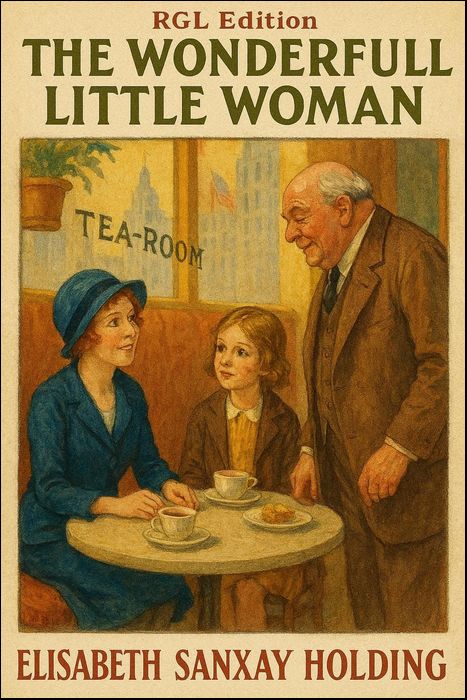
RGL e-Book Cover
Based on an image created with Microsoft Bing software
Roy Glashan's Library
Non sibi sed omnibus
Go to Home Page
This work is out of copyright in countries with a copyright
period of 70 years or less, after the year of the author's death.
If it is under copyright in your country of residence,
do not download or redistribute this file.
Original content added by RGL (e.g., introductions, notes,
RGL covers) is proprietary and protected by copyright.
RGL e-Book Cover
Based on an image created with Microsoft Bing software


The Munsey Magazine, September 1925, with "The Wonderful Little Woman"
The story follows the energetic, self-confident Mrs. Evelyn Fremby, whose impulsive attempt to kidnap a child—meant to help her friend Judith win custody of her niece—spirals into farce, misunderstanding, and ultimately an unexpected alliance with the child’s grandfather...
THE clock struck midnight, but Mrs. Fremby did not even glance up from her work. She had an old skirt, stretched over the transom, so that the landlady could not see that the light was still on. The door was locked. She was safe, and very snug.
Outside, a preposterous storm raged. It was almost the beginning of April, yet it snowed, and the wind howled. Let it! Mrs. Fremby had a forbidden electric heater glowing richly before her. It could not warm the vast and dingy front parlor that she inhabited, but it could and did keep her feet warm. The flame of righteous indignation in her heart helped, too, as she wrote:
At last the American woman has definitely rebelled. She refuses any longer to accept unquestioned the dictates of Paris as to what she shall or shall not wear. This season it is plain to any impartial observer that the influence of the French capital is distinctly on the wane.
Heavens, how she hated Paris! For years and years she had been fighting its insidious influence upon American modes. Even when, in order to earn her daily bread, she was obliged to describe what milady had worn at the Longchamp races, she always managed to get in some clever bit of propaganda—something like this, for instance:
A certain American woman of unimpeachable social standing attracted considerable attention by her costume of this and that, made in New York, and showing in every line a skillful adaptation to the American type.
What if this independent American woman of unimpeachable standing was an invention of Mrs. Fremby's? Never having been within thousands of miles of Longchamp, she was obliged to invent a little, and this mythical creature was very real to her, and dear. She could absolutely see that "American type," tall, proud, and beautiful, completely dominating all the Parisiennes.
Mrs. Fremby herself was small. That was her misfortune; but she made the most of herself. Even now, in an old and faded dressing gown, she was a mighty smart, trim little woman, and, if she was not pretty, she had the wit to know it, and to behave accordingly. Her good points were her miniature figure, which was excellent, and her crown of glittering, wiry red hair, which she arranged with much skill. The very foundation of style, she often said, was individuality, and she had it.
"The modes of this season will be marked by—" she was writing, when there was a knock at the door.
Mrs. Fremby got up. Swiftly and noiselessly she detached the heater and thrust it, still red-hot, into a cupboard under the washstand. Then, with a lofty expression of annoyance, she went to open the door; but it was not the landlady—it was Judith Cane.
"My dear!" cried Mrs. Fremby. "Come in!"
Judith came in. Snowflakes were melting upon her furs, her eyelashes were damp, and there was a fine color in her cheeks. She was indeed a superb creature, tall, dark, and beautiful, the physical embodiment of that "American type" who should have attracted considerable attention at Longchamp. Unfortunately, however, she lacked a certain vital quality—animation, Mrs. Fremby would have said, but in the office of the Daily Citizen they called it "bean." They said in that office that Judith was beautiful but dumb.
Mrs. Fremby, however, was not one to pick flaws in her friends. She was loyal, even to the point of prejudice. She was devoted to Judith, and she acknowledged no faults in her.
"Sit down, my dear child," she said.
As Judith did so, she locked the door again, and hastened about, making hospitable preparations. She connected the heater again, and also a small electric grill. The light grew perilously dim.
"They ought to put in a larger meter," observed Mrs. Fremby, with the air of an electrical expert. "I can't make coffee, my dear. It smells; but we'll have tea and rolls, and some perfectly delicious Bologna. Isn't it wretched weather?"
"Yes," said Judith. "And there I sat, rewriting and rewriting that article about smoking accessories for Mr. Tolley, and in the end he killed it!"
"Beast!" said Mrs. Fremby.
She remembered how Mr. Tolley had once described Judith.
"She is," he had said, "a space writer—which means that she fills blank space in a blank manner."
"Never mind!" she went on. "I've got a thing here that ought to run to a column, if you pad it a little. We'll fix it up, and you can turn it in to-morrow. Now, my dear, do tell me!"
"I've lost," said Judith.
"I knew it!" cried Mrs. Fremby. "I felt it all along! What an outrage!"
It was a question here of an orphan child. The child's mother had been Judith's sister, and upon the sister's decease Judith had put in a claim for the custody of the infant. According to all the laws of justice and humanity—as interpreted by Mrs. Fremby—Judith should have got the infant, but another woman, a sister of the mere father, had likewise put in a claim; and as this woman had a very wealthy husband, and a home, and other things which surrogates deem advantageous for infants, and Judith had none of these, the other claimant had triumphed.
"It's an outrage!" Mrs. Fremby repeated. "You'll fight it, of course?"
Judith shed a few melancholy tears.
"I don't know, Evelyn," she said.
"Don't know! You must!"
"It's so expensive, Evelyn. Even if I got the poor little thing, I don't know what I could do with her. I only made twelve dollars last week."
Mrs. Fremby recognized in her friend a mood which exasperated her—a large, vague despair and resignation.
"You ought to know that I'll always help you till you get on your feet," she said sternly.
"I do know," said Judith, shedding more tears; "but it seems to take me so long to get on my feet! All I do is—to get on your feet."
"Nonsense!" said Mrs. Fremby.
She had, in her heart, no very great illusions about Judith's ability to earn money, but what did that matter? Judith wanted her niece, and what Judith wanted she ought to have. That was nothing more than justice.
"Judith, I'm going to handle this," she announced.
"Don't do anything—awful," said Judith. "You know, Evelyn, you're so—"
Mrs. Fremby smiled as if she had received a compliment.
"Leave it to me," she said. "Just drink your tea, my dear child, and don't worry."
So Judith, with a sigh, let slip the burden from her magnificent shoulders.
IT was a riotous sort of day. The wind went rampaging about Central Park, and the sun laughed down upon the gay confusion of tossing branches, just beginning to grow green. In sheltered spots traces of snow still lingered, but it was melting very fast. The ground was soft, the iron thrall of winter was loosed.
It was not quite the sort of Sunday that Miss Mackellar could approve of. The wind disarranged her hair, and the promise of spring troubled her spirit. Her feet hurt, too. She sat down upon a bench and buttoned her voluminous plaid coat tightly about her, and, as the young child whose governess she was ran around and around the bench, she said "Woo!" each time the child appeared before her.
She did this with all the fervor she could command, for she was fond of the little girl, and she was a conscientious woman; but she knew that she failed. The child was generously giving her every chance to be entertaining while sitting still, and she was not being entertaining. Before long she would be obliged to rise and limp off in quest of ducks and squirrels, who could do better.
"Woo!" she said once more.
"What is it 'at says 'Woo'?" asked the child. "Bears?"
"Yes, pet—bears. Big, brown, woolly bears."
"Do bears run after you?"
"No, pet. They sit in their dark, dark caves and say 'Woo.'"
"I don't like bears," said the child flatly.
Miss Mackellar could think of no other retort than a fresh "Woo," but it was not accepted.
"I like tigers," said the child; "tigers 'at pounce."
"Look out, then!" cried a gay voice. "I'm a tiger! And I pounce! Gr-r-r!"
It was a trim, brisk little red-haired woman who had just come around the turn in the path. In fact, like a real tiger, she had been lurking there in ambush for some time, watching and waiting unsuspected.
"Gr-r-r!" she said again, moving forward with gleaming eyes and outstretched claws.
The little girl was delighted. With shrieks of joy she ran behind the bench, pursued by this wholly satisfactory tiger. Around and around they went, the brisk little woman as indefatigable as the child.
But the dejected Miss Mackellar had a conscience which hurt her even more than her shoes. She believed that life was very hard and painful, and that if it wasn't, then you were certainly doing wrong. She felt that she had no right to sit there and be comfortable.
"It's very kind of you, I'm sure," she said to Mrs. Fremby—for the tiger was that lady; "but really I shouldn't let you. I ought—"
"It's a pleasure," Mrs. Fremby assured her. "I am very much in harmony with children. Gr-r-r!" She disappeared around the bench again. "In fact," she continued, when she reappeared, "I wrote a series of articles once upon 'Scientific Play.' Play is really work, you know."
"Indeed it is!" Miss Mackellar agreed, with a sigh.
"I mean for the child. It is in play that a child develops those qualities of—aha! Gr-r-r!" And again she was gone. "Now then!" she said, addressing the child. "The tiger's going to hide around the corner, by those bushes, and you'd just better not look for it!"
Miss Mackellar could not help feeling glad that the lively game was now a little removed from her bench. She did not, however, believe in luck, unless it was bad, and she wondered earnestly why this little interlude of peace was granted to her. Perhaps it was to give her a chance to think about serious things. She did so.
But wasn't it almost too quiet? Hunter and tiger had vanished around the corner. That had happened half a dozen times before, but this time it seemed so long—
Miss Mackellar rose to her feet with a worried frown.
"I shouldn't let that child out of my sight," she thought. "I am failing in my duty! They'll have to come back and stay where I can see them, or"—she sighed—"or I suppose I'll have to follow where they go."
She walked around the turn of the path. No one in sight!
She walked on a little. She stopped to listen. Not a sound!
Then she went back to the bench and called:
"Natalie! Natalie!"
It is strange what a sinister effect may be caused by calling a person who does not answer. As soon as she had called, Miss Mackellar grew really frightened. She actually ran up the path, and, meeting a nursemaid with a perambulator, she cried:
"Oh, did you see a little girl with a tiger? No—I mean a little girl in a pink hat and a red-haired woman?"
"Er-huh," said the nursemaid, staring hard at her. "Just a minute ago—goin' up that way, to the entrance, walking terrible fast."
"Oh, Heavens!" cried Miss Mackellar, ashen white. "Oh, stop them, somebody! The child has been kidnaped!"
The nursemaid also turned pale.
"Oh, my!" she exclaimed. "I never! Then I'd better get this baby home, quick as ever I can!"
And she set off with her perambulator at a dangerous rate of speed.
The luckless Miss Mackellar stood in the middle of the path, clasping her trembling hands, and trying in vain to make her panic-stricken brain function lucidly. What she really wanted to do was to scream.
"No, no!" she said to herself. "I must keep calm. Oh, there's a policeman! But I don't know—perhaps that's the wrong thing to do. It might get into the newspapers, if I tell a policeman, and Mr. Donalds is always so angry at newspapers. Oh! Oh! If they had only come to me and told me they were going to steal the child, I'd have been glad to draw all my money out of the savings bank and hide it under a tree for them! That's what they always seem to want some one to do. Of course I know I wouldn't have enough, but—oh, my precious Natalie! Oh, Mr. Donalds! Oh, my poor darling Natalie!"
She began to cry.
"I'll go to Mr. Donalds this instant," she thought. "I don't care what happens to me. Let them put me in jail—that's where I ought to be! It's all my fault!"
Off she went, as fast as her shaking knees and her fluttering heart permitted; and this is her last personal appearance in this story, for any account of her interview with her employer would be too painful to set before a humane reader.
Only let it be said that she survived—that when Mr. Donalds rushed out of his house on East Seventy-Fourth Street, Miss Mackellar was still breathing. He had at first intended to take her with him, to identify persons and places, but even he could see the uselessness of doing so. She was in no condition to identify anything. She was beginning to rave about the child's having been carried off by a tiger; so he left her behind.
Like a stone from a catapult he shot out of his house and down the street toward the park. He had no intention of allowing the police to interfere with his private affairs. He believed he knew very well who had stolen the child, and why.
"Very well, madam!" he said to himself. "We shall see!"
MR. DONALDS knew that the child would suffer no bodily harm, and he was confident of his ability to snatch her away from contaminating moral influences before serious injury to her character could result. Mr. Donalds never failed. If he did not always accomplish exactly what he set out to do, at least he did something else which seemed to him just as good.
He knew that in this case he would succeed, as usual, and therefore he was able to devote his mind to being angry. His fury rose within him like steam, actually seeming to inflate him, so that he bounced rather than walked. A short, stoutish man he was, with a pale Napoleonic face and a piercing glance—a man of tremendous energy and determination.
Sometimes, however, he was a man of too little patience and deliberation. This morning, for instance, although he had thought to take his hat and his walking stick, he had forgotten to change his slippers. He was wearing red morocco slippers that came up over the ankle, and not only were they conspicuous, but they were too thin for outdoor walking.
However, it was not his way to turn back, and forward he went. He entered the park and proceeded direct to the spot where Miss Mackellar said she had last seen the child. He looked for clews. There were none.
He followed the course which the nursemaid had pointed out to Miss Mackellar, and in due time he arrived at another entrance. There was a cab stand here, in which stood one taxi, with the chauffeur standing beside it, leisurely surveying the world in which we live. Mr. Donalds approached him.
"See here!" he said. "Did you happen to see a red-haired woman and a child in a pink hat come out of the park near here?"
"Yep," replied the man, without interest.
Mr. Donalds had not lived some fifty years for nothing. He knew how to inspire enthusiasm. He put his hand into his pocket.
"Yes, sir!" answered the driver promptly, in a brisk and earnest tone. "They came out here. I noticed 'em because she was in such a hurry. I thought there was something queer about it. Anyways, she took Wickey's cab."
"Where did they go?"
"Couldn't tell you that, sir. They started up the avenoo; but they might 'a' bin goin' anywheres."
"Where can I find this Wickey?" inquired Mr. Donalds.
"Well, I don't know, sir. He'll prob'ly come back here before long. Him and me are buddies, an' we gen'rally eat lunch together, if we can. O' course, lots o' times we can't. F'r instance, I might have to go out any minute now."
"What's the number of his cab?"
"Don't know, sir—didn't notice. You see, we don't always take out the same one. Some days the one you're used to is laid up."
Mr. Donalds reflected hastily.
"I suppose I could find out by telephoning to the garage," he suggested.
"Yes, sir; but they wouldn't know where he went. Wouldn't do much good, unless you want to set the cops after him."
"No," said Mr. Donalds. "I'll handle this myself. You're fairly certain, then, that this Wickey will return here before going to his garage?"
"Expect to see him any minute now, sir."
"Very well, then—I'll wait here. I'll engage your cab. I'll pay you for your time until this Wickey comes," said Mr. Donalds.
He climbed into the cab, but he was very restless in there.
"Be sure Wickey doesn't pass by!" he called out of the window.
"Oh, he'd gimme a hail," the driver assured him. "Don't you worry, sir."
But time was flying. At least, time was undoubtedly flying for the nefarious red-haired woman, but for Mr. Donalds it passed with leaden foot. The chauffeur was smoking what Mr. Donalds was wont to call a "filthy cigarette," and though he had often declared that such things were not tobacco at all, still the aroma of this one put him painfully in mind of cigars. He had none with him. He grew more and more restless.
At last another cab came up, and its driver descended.
"Is that Wickey?" cried Mr. Donalds.
"No, sir," answered his especial driver. "'Nother fellow."
"Ask him to go somewhere and buy me half a dozen cigars," said Mr. Donalds. "Tell him to get Havana perfectos."
This was soon done, and as he began to smoke, Mr. Donalds felt calmer; but a new and more serious craving now assailed him. He was in the habit of lunching promptly at one o'clock, and it was now half past one. The cab was hot with the sun blazing down upon it, and this, combined with the bad effects of boiling rage, sizzling impatience, and fast growing hunger, were impairing Mr. Donalds's health. He felt positively ill. He threw away his third cigar half finished.
The driver approached the window.
"I'm going to get a bite to eat, sir," he said. "This here fellow knows Wickey. He'll stay till I get back."
"Just a minute!" said Mr. Donalds. "I—er—"
This was intensely distasteful to him, but he knew that without food he could not be at his best.
"Bring me back something to eat," he said; "something—er—small and not conspicuous, if possible."
Thus it was that Mr. Donalds, eminent business man and mirror of respectability, might have been seen eating a "hot dog" in a taxicab on Fifth Avenue on a Sunday afternoon. He had pulled down the blinds, had taken the first bite, and was discovering that he had never tasted anything so exquisite, so zestful—when the door was opened and a policeman looked in.
"Now, what's all this?" asked the policeman reproachfully. "This won't do, you know!"
Mr. Donalds managed to convince the officer that his presence was perfectly legitimate; but the incident disturbed him. He felt himself an outcast from society. He no longer relished the "hot dog," but he finished it.
Then he was assailed by a fearful thirst, and there is no knowing what might have happened next, if the elusive Wickey had not appeared.
"There he is!" cried Mr. Donalds's driver. "Hey, Wickey! Come here!"
Wickey approached.
"Yes," he said, in answer to Mr. Donalds's questions. "I took 'em out to a place on the Boston Post Road—long run. I jest got back—empty to City Island; then I picked up a fare."
"Take me to the place where you left the woman," said Mr. Donalds.
"Sorry, sir," said Wickey, "but I can't afford to take the chance of comin' back empty."
"Oh, I'll pay!" shouted Mr. Donalds. "Don't waste any more time!"
In dust, in gasoline fumes, in an endless procession of cars, Mr. Donalds proceeded on his way. They stopped for gasoline, they stopped while Wickey investigated a knock in the engine, they stopped again and again because the procession stopped. Signs told them to "go slow," and they went slow, until Mr. Donalds was on the verge of frenzy.
He tried to be calm. He reminded himself that he was a relentless human bloodhound, never to be eluded, and that no matter where the criminals went, were it to the very ends of the earth, they could not escape him. Even these thoughts could not appease him. He was hungry, he was extremely thirsty, and he was displeased with his red morocco slippers.
It is fortunate that he did not know how streaked with dust and perspiration his face was, how rumpled his stubby hair. As it was, when he caught any one staring at him, he believed it was because of the ruthless determination of his expression.
At last Wickey turned off the Post Road and stopped halfway down a lane, before a little old-fashioned cottage which bore this sign:
YE BETSY BARKER TEA HOUSE
"Here's where she went," said Wickey.
Mr. Donalds sprang out, and, bidding the man wait, opened the garden gate and advanced up the path. The cottage door was unlatched, and he entered, to find himself in a dim, cool little room, filled with small tables and high-backed settees.
There was no one else in the room. He had come in so quietly, in his slippers, that no doubt he had not been heard. He waited a moment, and then he rapped vigorously upon one of the tables.
Almost immediately there entered a thin little white-haired woman wearing a chintz apron.
"Tea?" she asked in a little bleating voice.
She was such a very respectable sort of little woman, and the atmosphere of the place was so very tranquil, that Mr. Donalds felt somewhat abashed.
"No, thank you," he said. "I'm looking for a woman with red hair and a child in a pink hat."
Suddenly the whole thing seemed to him so fantastic that he was almost apologetic—until he observed that the woman's face grew very pale.
"Ha!" he cried. "I see you know something of this! Then—"
"I—I—I—" she faltered. "You must be mistaken. I—I never heard of them. They've gone away."
"You contradict yourself, madam!" said Mr. Donalds sternly. "Come, tell me what you know—at once!"
"I—I—I—" said she, trembling with an alarm which he could not but think guilty. "Oh! Please go away!"
"Go away!" he repeated, affronted and amazed. "I have come here for the purpose of—"
She began to cry. Mr. Donalds had not been an employer of great numbers of female stenographers for years and years without learning to withstand tears. In fact, he had formed the notion that women generally cried whenever they had made a mistake, and that it was a feminine way of apologizing.
"Come, come!" he said. "Tell me where the child is—immediately!"
But all she did was to back into a corner and go on crying. Mr. Donalds was not profoundly moved. On the contrary, he was irritated.
"I shall search the premises," he announced, and made for the door.
The woman came after him, calling in a loud and terrified voice:
"Evelyn! Evelyn! Evelyn! Quick!"
This was undoubtedly a warning, and Mr. Donalds went forward very rapidly. He reached the foot of a narrow, boxed-in stairway, and had his foot on the bottom step, when, with a rustle of skirts and a click of high heels, down rushed a little human whirlwind, with such impetuosity that he had just time to spring aside.
"What do you mean by this?" the whirlwind demanded. "What's he been doing, Betsy?"
"He—he—he—" bleated the other.
Mr. Donalds was silent, staring at this new one. She had red hair. She had, moreover, the air of one who is capable of anything. He felt absolutely certain that she was the kidnaper; and he decided that he would confute, abash, and alarm her by a sudden onslaught.
"Come!" he shouted. "Where is the child? Quick! No nonsense! Where is the child?"
"Do you imagine I'm going to tell you?" said she.
He was very much taken aback and shocked by this unaccountable display of effrontery.
"Then you do not deny it?"
"Certainly not!" she replied calmly. "I admit it."
"Then stand aside! I shall search the house!"
"By all means," said she. "The more time you waste over it, the better for me."
Now, there might be some truth in this. He hesitated, scowling, staring at the criminal, who returned his stare without flinching. He saw that he had no ordinary person to deal with. This was a master mind.
"I shall call the police," he said, but he didn't mean it.
"Pray do!" said she.
It was Mr. Donalds's belief that those who could not be bullied must be bribed; so he changed his tone.
"Madam," he said, "my sole object is the recovery of the child. To accomplish this, I am willing—"
"Come into the tea room, Mr. Henderson," she interrupted, "and we'll discuss the matter. I can assure you that the child is quite safe and happy, and that you will accomplish nothing by violence. No, Mr. Henderson—the best thing you can do is to come to terms with me."
"My name is not Henderson," he began, but she had gone past him into the tea room, and he followed.
"Tea, Betsy dear!" said she. "For two, please!"
"No!" said Mr. Donalds. "I do not want tea!"
"And sandwiches," went on the red-haired woman, unperturbed. "And cake, if you please, Betsy dear. Sit down, Mr. Henderson!"
"I shall stand," said he, and stand he did, with his arms folded.
The woman sat down, and she said nothing. Mr. Donalds appreciated the cleverness of this silence. By saying nothing at all she had him at a disadvantage, for she did not mind waiting, and he did. He was obliged to begin.
"Well?" he demanded.
"Well!" she returned briskly.
There was another silence—quite a long one.
"I suppose," said Mr. Donalds, at last, "that you have some sort of terms to suggest. Let me hear them!"
"Certainly," said she; "but here's our tea. How nice! Thank you, Betsy dear!"
Mr. Donalds remained silent until the timid Betsy had set the tea out on the table and once more retired.
"Now!" he said grimly. "The terms, madam—the terms!"
"Mr. Henderson," she replied in a grave tone, "I wish you would sit down and take a cup of tea—and a sandwich. They're very nourishing sandwiches. I made them myself; and you need nourishment and refreshment. You are tired, and in an extremely nervous condition."
This was almost more than Mr. Donalds could bear. He struggled with his indignation for a moment, and then gave a short laugh.
"No doubt my pitiful condition distresses you very greatly," he observed, with biting sarcasm.
"It does," said she. "I am a good judge of character, and, since I have actually seen you, I am inclined to believe that you are not really a bad or heartless man. I feel now that what you have done, you have done more through lack of understanding than from deliberate cruelty."
"Upon my word!" said Mr. Donalds.
He was dazed. He sank heavily into a chair opposite her, and stared at her; and she actually smiled at him—smiled gravely but kindly.
"Good!" said she. "Now we can talk like two reasonable human beings. Milk and sugar?"
"It doesn't matter," said he, as if in a dream. "I don't want it, anyhow."
"I don't care much for tea myself," she told him; "but it is refreshing. A sandwich? If you don't like cheese, I'll get you—"
"I do like cheese," he admitted.
"Most men do," said she. "My poor husband was so fond of it! He was a newspaper man, and when he came home late I would make him a nice little Welsh rarebit, and he'd have that and a glass of beer. That was years ago, of course, when you could get beer."
She sighed, but Mr. Donalds understood that the sigh was only for her late husband, not for any other vanished joys.
"I do like to see a man comfortable!" she suddenly remarked.
He believed her. Extraordinary and preposterous as it was, he believed that she really wished him to be comfortable. She had prepared a cup of tea for him, and she watched him while he drank it and ate a sandwich—yes, two or three sandwiches—with the air of a solicitous hostess.
"Another cup?" she asked. "And now won't you smoke?"
"Thank you," said he.
He lit a cigar and took a few puffs. He really felt very much better now. The tea and the sandwiches had done him good, and the atmosphere of the place was most restful. The sun was sinking. Already the corners of the room were shadowy, and a shaft of mellow light from the window illumined the woman's glittering hair in a singular fashion. Seen thus, and through a faint haze of tobacco smoke, she looked not exactly pretty, but certainly attractive, so straight was she, so trim, so smart, so self-possessed.
Mr. Donalds came to his senses with a start.
"The terms, madam!" he said—not savagely now, but firmly.
"Mr. Henderson," she replied, "I shouldn't like you to misunderstand me. Perhaps it is a weakness, but I shouldn't like you to think that my motives were unworthy."
"I—" he began, and stopped himself just in time. "I don't think so," he had been about to say, but that would never do; so he said nothing.
"I give you my word," she continued, in a voice almost sorrowful, "that I personally have nothing whatever to gain by this. My only object has been to secure justice for others."
"Justice!" repeated Mr. Donalds. "You call it justice to—"
"I do," said she. "Now please listen. First"—she paused—"first, that poor creature—that governess—"
"Ha!" cried Mr. Donalds. "Miss Mackellar! So she is a party to this!"
"No, she isn't. She's simply a victim, and I don't wish her to suffer for what isn't her fault. Any one could see what she is," the red-haired woman went on with great earnestness. "She's perfectly helpless. She's a victim of life—of man."
"I'm sure I—" he began indignantly.
"I'm sure you've frightened her. I'm sure you've discharged her."
"Naturally!"
"Well, then, the first article of our agreement must be this," said she. "Miss—Mackellar, you said? Miss Mackellar is to have an annuity of one thousand dollars a year."
"No!" shouted Mr. Donalds. "No! I refuse!"
"Then it's a deadlock," said she, and poured herself another cup of tea.
A silence.
"You assure me that the woman is absolutely innocent of any participation in the kidnaping?" demanded Mr. Donalds.
"Absolutely! Any one could see that. She's only a poor, muddled, tired little woman who does her best. She needs help, and you can very well afford to do this for her."
"Very well!" said Mr. Donalds. "I agree to this—outrage!"
To tell the truth, the red-haired woman's description of Miss Mackellar had rather touched him.
"Will you write it down, please?" said she. "Just say that you will provide an annuity of one thousand dollars a year for Miss Mackellar, as from the 10th of April, 1925."
She spoke in an efficient, businesslike tone, which somehow gave an air of plausibility to this incredible proposal, and he obeyed. He wrote on a page of his notebook, signed it, and put it on the table before him.
"And now," she went on, "you will agree to settle upon Judith, for life, an income of—"
"Judith!" he cried. "This is too much!"
"Write this," she said calmly, "and I shall at once take you to the child."
"This is blackmail!" he cried. "This is extortion!"
"Mr. Henderson," she replied sternly, "don't you think, in your heart, that you ought to do this for Judith? Think, Mr. Henderson! Think of all that poor Judith—"
"Who the devil is Judith?" he roared. "I never heard of her!"
"Mr. Henderson!"
"My name is not Henderson—I told you that before! My name is Donalds—William Donalds, importer. Here! Here's a card!"
From his pocket he pulled not one card, but many, and they fell all over the table.
"Donalds!" he repeated. "Now you know with whom you have to deal. This farce must end! This—"
He stopped, because such an extraordinary change had come over the woman. Her face had grown alarmingly white, and she was staring at him with a sort of horror.
"You—you must be Mr. Henderson!" she said faintly.
"I will not be!" he shouted. "I refuse! Nothing can induce me to assume a false name! You have kidnaped my grandchild—"
"Your niece, you mean."
"I don't! I mean my grandchild. I have no niece. I—"
"Wait a minute!" she interrupted. She rose to her feet and stood, holding the back of the chair. "I'm afraid," she said, "that there's been—some terrible mistake!"
"You mean—the child? Quick! Something has happened to the child?"
"No," she said. "No—it's just—me."
Criminal though she was, he could not help feeling sorry for her.
"Madam, you are ill," he said. "Sit down again!"
She shook her head.
"Mr. Donalds," she said. "I—I must apologize. I'm afraid—it's the wrong child!"
"The wrong—"
"Yes. Please come!"
She went out of the room, and he followed her up the stairs. She opened the door of a room, and there, on a bed, he saw his grandchild, sleeping peacefully.
"No!" he whispered. "No—it's the right child!"
"It isn't the one I meant," said she.
He looked at her.
"Then you are not acting on behalf of my scoundrelly nephew, Masterton Donalds?" he said.
"I never heard of him."
"But I thought—he has made certain threats that he would attempt to force me to make him an allowance. I thought—"
"No," said the red-haired woman in a very low voice. "Take her! I'm sorry. It was all a mistake!"
Judith was waiting in Mrs. Fremby's room. She had been told to come there at six o'clock, in order to hear some news. She had come, and had found the room empty. Judith's nature, however, was not an impatient one. She waited, full of a calm confidence in her friend. She ate the entire contents of a bag of chocolates that she found on the table, she tried on Mrs. Fremby's hats, and then she sat down to read Mrs. Fremby's latest article, which began thus:
Paris no longer reigns undisputed over American modes. There is a distinct tendency—
The door opened, and Mrs. Fremby entered. As was her habit, she locked the door behind her. Then she smiled. It was a pretty sickly smile, but Judith was not observant.
"Hello, Judith!" she said.
"Hello, Evelyn!" answered Judith. "What is the news you said you'd have for me?"
Mrs. Fremby took off her hat and coat, and sat down.
"My dear," she said, "I'm sorry, but I can't tell you to-night. Later on—"
Judith's beautiful eyes filled with tears of disappointment.
"Oh, Evelyn!" she said. "I did hope there'd be something—something about little Doris, or at least an order for an article. I only have two dollars, Evelyn!"
"I'll lend you a little money," said Mrs. Fremby.
She spoke absent-mindedly, for she was calculating. The cost of that taxi had been terrific—and all for nothing! She was tired and downcast and miserable; but it was not her way to allow others to know such things. She reflected that after Judith was gone she could be as miserable as much and as long as she liked, but in the meantime—courage!
It was never a difficult matter to divert Judith's mind, and within a few minutes Mrs. Fremby had got her to talking about the spring costume she wished she could buy. It was scarcely necessary to listen. Mrs. Fremby was able to indulge in her own far from cheery thoughts.
There was a knock at the door. Mrs. Fremby rose and opened it promptly. It was the landlady. Let it be! There were no surreptitious cooking or heating processes going forward just now.
"There's a gentleman wants to see you, Mrs. Fremby," said the landlady, with perfect affability. "He's waiting down in the hall."
"I'll see him," said Mrs. Fremby. "Just a minute, Judith!"
With a firm step she left the room. At heart, though, she was by no means easy. She felt sure that this visitor was Mr. Donalds, and she was not very anxious to see him again.
It was Mr. Donalds. As she descended the stairs, she saw him standing, hat in hand, in the dimly lit hall, and her heart sank still lower. He was not a man to be trifled with. He was—
"Not a handsome man at all," thought Mrs. Fremby; "but distinguished-looking."
He came toward her. Their eyes met. They did not smile.
"Madam," said he, "I obtained your name and address from the—ah—person in the tea room."
"She ought to have known better," observed Mrs. Fremby.
"I succeeded in convincing her that I intended no harm," he went on; "and I wish to assure you that I bear no ill will."
Mrs. Fremby softened.
"I gave you a great deal of quite unnecessary trouble and anxiety," she said. "I regret it very much; but—perhaps I ought to explain. You see, there is a friend of mine—Judith Cane—who has a little niece, her own sister's child; and the father's people have taken the little girl away from her. It's shameful! Judith loves the child so much!"
"But surely the law might be resorted to in such—"
"The law!" said Mrs. Fremby scornfully. "They've got the law on their side; but what I wanted was justice—for Judith, I thought I'd steal the child, and force them to do something for Judith."
"But the risk!" cried Mr. Donalds. "Did you realize the risk you—"
"I don't care about risks," said Mrs. Fremby calmly. "Nobody would dare to do anything to me!"
Mr. Donalds knew well how absurd this statement was, yet he was impressed. The dauntlessness of this little woman!
"Judith knows nothing about it," she continued; "and I don't intend her to know until the thing's done."
"Madam! Mrs. Fremby! You don't mean that you propose to do this again?"
"Certainly I do."
"No!" he protested. "That must not be! You don't realize—"
"Yes, I do," she interrupted. "It's the only way; and this afternoon I saw that you—even a man like you—you were willing to make all sorts of concessions. Oh, I do wish!" she exclaimed. "I do wish you had been the right one!"
"Er—why?" asked Mr. Donalds, with a modest, downcast glance.
"Because we got on so well. I could discuss things with you. You were so reasonable—about that poor Miss Mackellar, for instance."
"Mrs. Fremby," he said solemnly, "I consider that you were in the right about Miss Mackellar. I mean to carry out your wishes in that matter."
"No!" she replied incredulously. "You can't mean that, after I caused you so much worry and—"
"You did me good," said he. "I don't mind admitting it. The example of your—your heroism—"
"Oh, no!"
"Your heroism," he repeated doggedly, "and your unselfish devotion to the interests of others—What is more, my grandchild is—is enthusiastic in your praise. Mrs. Fremby, allow me to say that you are a wonderful woman!"
Mrs. Fremby was deeply touched.
"Mr. Donalds," she said, "for you to say that—after what has happened—is magnanimous!"
"I mean it," said he; "but I most earnestly implore you not to do it again. The risk is—appalling! It is possible—it is highly probable—that I can be of some assistance to this friend of yours, this—er—Miss Judith. Whatever I can do, Mrs. Fremby, I will—anything authorized by law," he added a trifle anxiously.
"Mr. Donalds!" she cried. "Oh, Mr. Donalds! This is—oh, this is really too much! I never—I never in my life—"
He thought she was going to cry. She thought so too, for a moment, but with a pretty severe effort she recovered herself. She smiled. That smile completely finished Mr. Donalds.
"Mrs. Fremby," he said, "one thing more. I believe I told you that I was an importer—"
"I know. I've heard of your firm."
"Mrs. Fremby, I should be honored—it would be a favor to me—if you would come to our showroom to-morrow morning and pick out for yourself any one of the new model gowns from Paris—"
"Paris!" cried Mrs. Fremby. "Never!" Mr. Donalds was startled by her impassioned tone. "I wouldn't wear a Paris gown—not for anything!"
"Wouldn't wear a Paris gown!" he repeated, overcome. "I never before heard of a lady—"
Mrs. Fremby held out her hand, and he took it.
"You mustn't think I don't appreciate your generosity," she said. "It's just a matter of principle."
Again their eyes met.
"Wonderful little woman!" said he.
It was amazing, the difference that one word of six letters made in that phrase. Mrs. Fremby became quite confused.
"What can I do," continued Mr. Donalds, still holding her hand, "to mark my profound appreciation?"
Appreciation of what? Of Mrs. Fremby's kidnaping his grandchild? Strange that so practical a man as Mr. Donalds should become so curiously obtuse about the clearest moral issues! Mrs. Fremby was undeniably a lawless, reckless, dangerous sort of creature.
"Mrs. Fremby," said he, "will you do me the honor of dining with me to-morrow evening?"
"Thank you, Mr. Donalds, I will," she replied, grave but very gracious.
And you may believe it or not, but neither of them doubted for a moment that it was an honor which she conferred upon him.
Roy Glashan's Library
Non sibi sed omnibus
Go to Home Page
This work is out of copyright in countries with a copyright
period of 70 years or less, after the year of the author's death.
If it is under copyright in your country of residence,
do not download or redistribute this file.
Original content added by RGL (e.g., introductions, notes,
RGL covers) is proprietary and protected by copyright.