RGL e-Book Cover
Based on an image created with Microsoft Bing software
Roy Glashan's Library
Non sibi sed omnibus
Go to Home Page
RGL e-Book Cover
Based on an image created with Microsoft Bing software
"The Secret of the Shining Mountain,"
Cassel & Co., London, 1919

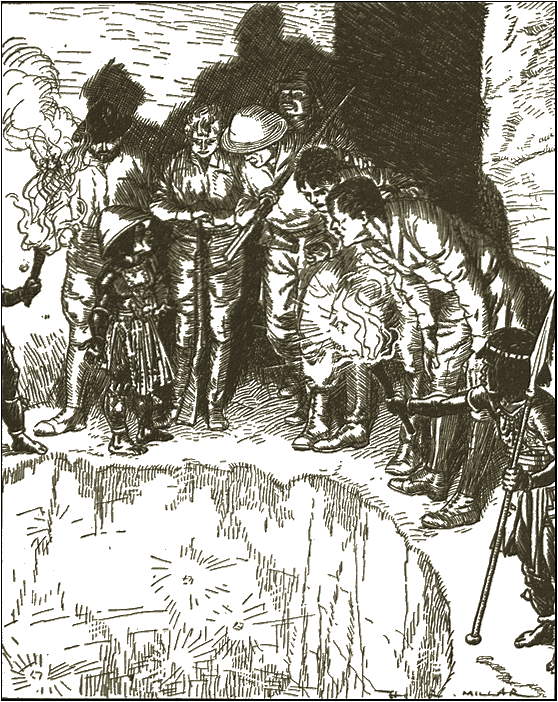
CONKY'S TREASURE HOUSE.
The great question in the pygmy's mind
was: Were the white men to be trusted?
"MY hat, Jimmy, but we've done it! Pull like fury! We must get her round!"
And Rod Dixon dipped his paddle deep into the swift-flowing waters of the "feeder" of the Amazon, while Jimmy Feltham, sitting in the bow of the big native canoe, did likewise. Like fury indeed they pulled, for from in front of them came the roar of tumbling waters booming like big guns, fair evidence of the fact that the fall was sheer and deep. The current, which they had noticed a mile up-river had been growing stronger—for which they had been thankful, since it meant so much less hard work for them—had now assumed alarming speed. Suddenly this had happened, as the banks, low before and palm-laden, closed in and towered above, with long lianas hanging from the trees and trailing in the water.
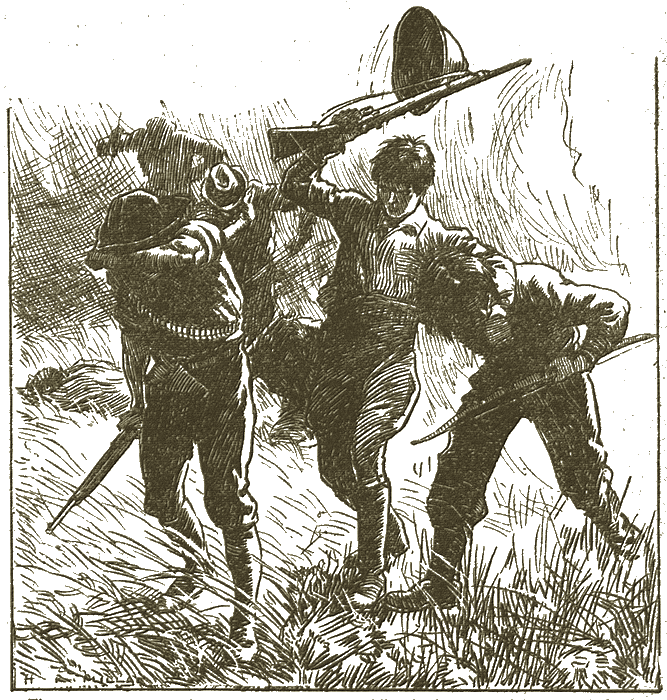
The storm was a suprise to everyone...
Like the booming of big guns it began.
"We'll—be—smashed!" jerked Rod, as, try though he did and try though his companion did also, the canoe refused to answer to their efforts to slew her round; she seemed to be held as in a travelling vice that allowed no change of direction.
Jimmy did not answer; he was staring ahead, wondering what was to show when once they rounded the bend, wondering what the end of this mad escapade might be. He and Rod, blood-cousins and nephews of Stark Dixon, manager of Menezes Rubber Company Depôt at Manaos, had been learning what there was to learn about rubber during the last eighteen months, and they thought they knew enough to take care of themselves in most of the emergencies that might arise in that wonderland of the Amazon. A few days before they had struck off on their own to do a little shooting, had met with fairly good success, the only unfortunate incident being the loss of Gigo, their native servant and guide, who had fallen a victim to a jaguar, whose skin now—poor compensation!—lay in the bottom of the canoe.
They had, when they ran into the bank, hauled the canoe ashore, because Gigo had assured them that if they man-hauled through the jungle by way of a native track they would eventually come to a new branch of the river which was certainly worth exploring. So, midway, they had pitched camp, after dragging the canoe, and gone out on their hunt, which finished with the death of Gigo; whereat the youngsters, filling their canoe with the skins and pelts of the game they had bagged, had tossed for it to see whether they should go back the way they had come or push through the jungle for the few miles that the dead man had assured them would bring them to the other tributary. The new way won, and so, after several hours of hard going, they had come to the bank of the river, which was fairly broad, had embarked, and were making good progress when that ominous booming warned them of the falls that Gigo had said nothing about.
And now—well, it seemed that the end was come.
"Can't do it!" panted Jimmy at last; and at that moment the canoe shot round the bend with a swirl, and before them they could see the creaming waters where they tumbled over the edge.
"If we could only ease her off one side or the other!" rapped Rod. "Those lianas! Try it, Jimmy—try it. Ready?"
"Ay!" breathed Jimmy, and with a couple of hundred yards between them and the spot that might mean the end of all things they strove with all their might against the current's urge—strove to turn the little canoe askew. Now the bows did swing to their powerful strokes, only to be drawn back again.
"Can't—be—done!" groaned Rod; and then, above the booming waters came a voice—the voice of a white man, and of an Englishman to boot—a voice that made them look toward the bank from which it came.
"Back paddle, youngsters—back paddle. It'll steady ye. I'll get you out!"
And there on the right bank stood a man who was frantically uncoiling a rope from his belt; he finished doing that even as the boys, diving their paddles in, found their forward movement retarded somewhat. They saw through filmed eyes the man's right arm go shooting up into the air, saw the coiled-up rope hang suspended for a moment, and then, as the hand jerked out, there came a whizzing sound, and something struck the canoe with a crack like a rifle-shot.
"Sit tight, kids!" the man shouted; and, realising what the seeming madman was intending, Jimmy and Rod, the moment the rope hit the canoe, gripped each with one hand at the side. Came then a jerk that almost pitched them out, but a jerk that nevertheless had this in its favour: it hauled the canoe almost to a standstill, even as it was within twenty yards of the yawning depths.
"Saved!" shouted Jimmy; but for all that Rod could hear above that tumult of the waters he might have kept silent. With staring eyes they saw what this stranger had done. By a throw, amazing in its skill and deadly in its aim, he had lassoed the bow of the canoe and drawn the loop tight, and now, having by tremendous effort, brought the craft broadside on to the current, he was standing behind a tree-bole as though to prevent himself from being drawn off the bank, and was hauling the canoe across stream. He was shouting something, as they knew by his face, yet they could not catch one single word of what he said because it was drowned in the roar of the cataract.
The youngsters clung to the sides of their craft, dull wonder in their minds as to who this man who had come in the nick of time might be. There was little time for them, however, to think of that; at each haul of the rope the canoe rocked, and they had all their work cut out to maintain their places in it. Now and again they looked down towards the cataract, and shivered as they thought of what they were escaping from—foot by foot—almost inch by inch, yet surely, if so slowly. . . .
For a moment or so the man held on the rope, as though to take breath, but his head turned to the right, as though he were looking or listening to something. As though drawn against their own will, the boys followed his gaze. A gulp of fear welled up into Jimmy's throat, a howl of dread rang from Rod, for what they saw was enough to make any man tremble even were he on dry land and with a loaded rifle in his hand.
Swinging down from a branch within a few feet of where the stranger stood as though turned to stone was a huge snake, with ugly swaying head thrust up almost at right angles to its swaying body. . . .
The rope that held the canoe steady trembled a little, the man gripping it shouted something that brought the boys back to life, as it were. Down into the river went Jimmy's useless paddle, and his hand caught up the heavy sporting rifle that lay at his feet. Rod dived for his at the same instant, and
simultaneously two shots rang out above the thunderous roar; and when the smoke had cleared away from before their eyes they saw—no longer the darting head, but the limp, though still writhing, body of the snake hanging from the tree.
Jimmy laughed hysterically; Rod dropped his rifle into the bottom again, and sat there weak and blubbering like a baby. The man on the bank, however, tossed his head in a laugh and began once more to haul in the rope—hauled until at last the canoe was beneath the bank from which the lianas hung.
"Grab one, Rod!" shouted Jimmy, and without more ado Dixon had reached out a trembling hand and clutched a liana that, stronger than many a rope fashioned by man, would hold ten times his weight. He had not been the best rope climber in the school way back in the Old Country for nothing, and he went hand over hand up the wet, slimy liana—to come to the top of the bank and scramble over the edge exhausted. A few moments later Jimmy Feltham emerged from the depths and tumbled down beside his comrade.
"Want to save your dug-out?" the stranger's voice came; and they sprang instantly to their feet, rushing towards him.
"I say—thanks—" Jimmy began, but the man cut him short.
"Lay hold o' this rope, kid—here, both of you!" and as the boys obeyed he whipped out a big hunting-knife and began slashing at trailing lianas, which he quickly fashioned into a stout rope. "Hold it like—like fury!" he said, as he went to the edge of the bank, and then disappeared over the side, to come back in a few minutes dragging one end of the rope with him.
"Can you two haul hard enough, d'you think?" he asked, planting himself behind a tree close by them.
"You bet!" Jimmy said, laughing a little shakily. He realised what the stranger's intention was.
"Then put your backs into it, kids!" And the stranger began to heave at his rope, the boys following his example and his occasional instructions of "Steady!" or "Again!"
And at last, wrapped about by twining lianas, the canoe appeared on the end of the bank.
"Another haul and she's up!" snapped the stranger; and with a "Heavo!" from him the three laid back on their heels and hauled. The canoe, crunching on the hard rocks, slithered at last over the edge, and the haulers went tumbling backward.
Jimmy laughed gaily now, while Rod, picking himself up and rubbing the back of his head where he had crashed it against a tree, grinned at the stranger, who was standing up again and reaching out a big hand to him.
"Shake, kid!" he said; "shake, both of you! Dern fine shots those of yours! That ugly water boa nigh had me and—"
Rod took the stranger's hand, only relinquishing it when Jimmy pressed forward to grip it.
"If those were good shots on our part, stranger," Rod said, "then they were nothing to yours with the lasso. Reckon you got us on the second!"
"Tit for tat, then, youngsters," the man said, with a laugh. "Forget it! Say, who are you? Where d'you come from? What you doing here? Tell us the whole yarn—I'm dying to hear a white voice. Get it over!"
Jimmy laughed again as he shook his own hand that still tingled from the stranger's grip.
"We're out on a little sporting trip and—"
"Alone?" the man asked, with an uplift of the brows. "Say, but—"
"No—well, we weren't alone," Jimmy told him, and then explained what had happened to Gigo.
"You kids want your daddies with you, sure thing," the man said, with a grin. "But get on with it."
He squatted down on the ground. "Now, a smoke along with it—"
"Thanks!" he said, as Rod handed him a cigaro. "D'you know, kids, that's the first thing like that I've seen for three years and—but, there, that's my yarn some other time. Let's have yours. I'm a giddy old gossip, but that's because—Well, get on!"
Jimmy went on with his yarn, and the stranger listened intently.
"Going to Manaos, you say?" he put in. "Know anybody up there name of Dixon—Stark Dixon?"
The boys burst out laughing, and the man looked from his smoke to them.
"Don't get you, kids. There ain't anything funny about Stark Dixon as I know of. What's the doggone joke, eh?"
"Why, stranger," said Rod, "I thought I said who we were. See here, this chum of mine is Stark Dixon's nephew, Jimmy Feltham, and I,—well, I'm Rod Dixon, another nephew."
"Well of all the—the doggone strokes o' luck as ever was," the stranger cried, leaping to his feet. "Here I've been travelling miles—thousands o' miles it seems, kids—to get 'way up to Manaos to see Stark Dixon, an' wondering whether I should ever get through, and, if I did, whether the old chap was alive, and then I plump into you two. Put 'em there agen, kids!"
They shook hands again, thrilling with excitement, throbbing with wonder at what this stranger, whoever he was, could have to do with their uncle.
"I feel better already," the man said. "And by—"
"I reckon it's your turn to show your passport," Jimmy said, grinning. "Who are you? What do you know of Uncle Stark?"
"Who am I?" the stranger said, rubbing his chin. "Well, kids"—he stopped short, puffed once or twice more at his cigaro, which was evidently to him like a gift from the gods—"well, kids, I reckon you kin put me down as—as the White Man from the Jungle!"
"Which doesn't tell much," Rod said. "Get it over, as you said to us. Do you mean to say that you've come those—er—thousands of miles alone and—"
"By the Lord Harry," cried the stranger, "but I quite forgot old Copperface. Come on, let's go see him!"
"ALL right, youngsters, you kin leave the c'noe!" shouted the man from the jungle over his shoulder, as Rod muttered something about the craft. "We'll come back for it later. Get on!" And he shoved his way through the entangling growth, which showed plain evidences of the fact that that was the way he had come down to the river bank. After him the boys went, wondering who on earth Copperface might be and where he was.
"Our luck's in, Rod!" Jimmy said, laughing. "Don't know who this chap is, but I'd bet quids that he's got a yarn to tell that'll make us open our eyes and our mouths water."
"A man who'd come—what'd he say, thousands of miles?—a man who'd come thousands of miles to see another man ought to have something to tell," was Jimmy's reply. "But, man alive, d'you see that he must have come from farther in the interior? He hasn't come up the Amazon, else he'd never have got to here without hitting on our show; and he can't have come down, or he'd have had to pass Manaos. G-r-r-h!"
The boy upflung a hand that carried a heavy hunting-knife: experience had taught him, and Rod, too, that the jungle was no place to push through without a weapon at hand. And in that fleeting moment the wisdom of it was proved, for with a growl a puma, disturbed in its slumber on a tree bough, reached down a vicious-looking paw that just missed snarling across Jimmy's face. As he stepped back and well-nigh sent Rod sprawling, his hand descended, followed a scream of pain and anger as the knife slashed deep into the paw.
"Shoot!" cried Jimmy; and Rod, recovering his balance, drew his big revolver and, scarcely taking aim in that moment when all depended upon speed, fired point blank at the snarling mouth, the lips drawn back and showing the wicked teeth. A swift movement, all unexpected, on the part of the beast, rendered that shot unavailing, and the next instant the sleek form had leaped from the branch. Jimmy had a vision of something hurtling over his head, brushing him down as it went, following which came a loud cry from Rod, and when Jimmy and the stranger—who, hearing the shot, had turned in his tracks and pushed his way back through the clutching growth—covered the few feet between them and Rod, it was to see a struggling, writhing mass of kicking legs and clawing hands and scratching feet of the beast, and to hear the heavy breathing of the unfortunate boy as he fought with all his strength to hold off those gleaming teeth that were so near his throat. Rod had managed to get his hands clutched at the brute's throat, but although he was able, for how long he knew not, to keep the brute from fastening upon him, he could do naught against the clawing paws that were tearing his shirt to ribbons and slashing his breeches to shreds.
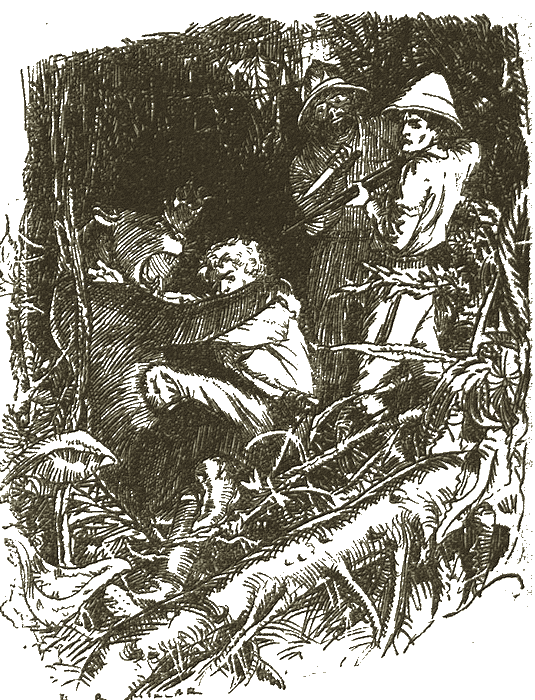
Rod had managed to get his hands clutched at the brute's throat.
For all that he was only eighteen, Rod Dixon was tall and strong, and his arms had the strength of a full-grown man in them, while it was a byword up at the factory that once you got into his grip you might just as well hope to get away from a bulldog's maw.
He was putting all his trust now in that grip, despite the fact that as he squirmed about he could see both Jimmy and the stranger standing as though waiting for the opportunity to send in a shot that should finish the puma, or leap with flashing knife and bury it deep in its side. Rod knew, knew with a fullness that would have taken the heart out of anyone with less courage than he had, that he could expect little help from them, eager as they might be to assist, since it was impossible to hope to put in a shot that should be sure of killing only the puma. So Rod fought, fought with every ounce of his strength, and though the hot breath of the beast sickened him and the scratching paws tore at his very skin now. Tighter and tighter he gripped, and as he did so the puma's writhings increased. Rod felt the swelling of the throat as the brute fought for breath, felt the heaving body pressed hard against his own; and suddenly, with amazing dexterity, he had hunched up his legs, freed for the moment from the hind feet of the puma, and then, as he felt his feet pressed under the beast, he shot out his legs with the force of a spring, and as he released the deadly grip of the throat the puma, with a howl of rage, went flying upward, the while that Rod, rolling over, scrambled to his feet.
It had happened all in a second of time, happened so quickly, so suddenly, that neither Jimmy nor the stranger had time to realise anything but the wonder of it, before the puma plumped to earth again, crouched back, with blazing eyes and snarling mouth, with heaving body, as though it were waiting to regain breath. The stranger's hand shot out then, seized the revolver which Rod had dropped, and the next instant the weapon went off with a crack that reverberated through the jungle, mingling with the death-scream of the puma as it leapt into the air again—but this time to come down a dead, helpless thing, for the man's aim had been true, hitting the brute clean between the eyes.
"Oh, good shot—good shot!" cried Jimmy, while Rod, sagging limply at a tree trunk for support, muttered something that neither of the others heard.
"Well, not so bad!" said the stranger coolly. "An' kersiderin' I haven't seen a shooter fer somethin' like three years, I think I oughter be proud o' myself! But, by cracky, youngster, that was some fight! A clean-shot goal, eh?"
Rod laughed weakly and shuddered involuntarily. He wiped his hand across his face, and when he took it away it was wet with something red and sticky.
"My word, Rod!" exclaimed Jimmy, "but the brute's pawed you well." But Rod shook his head.
"It's the beggar's own blood—from that paw you slashed at the first. His skin'll help to pay for a new suit!"
"Which you'll want, kid," the man butted in. "You feel fit to come erlong with us or—?"
"I feel fit enough to go anywhere rather than be left alone here!" snapped Rod. "I say, Mr. Man from the Jungle, thanks for that shot, which, as Jimmy said, was a top-holer!
"Cut that out, kid!" the stranger said. "Cut that out—some day you'll p'haps have a chance to put one in for me. You never know! Leave that carcass where it is for now. While we're doing big-game hunting, or being big-game hunted, old Copperface may be dying. Come on!"
And once more the trio went crashing through the jungle, Rod stepping over the inert puma with a shudder. During those few minutes he had lived years, it seemed, and in a way he was a little piqued at the stranger's apparent nonchalance. He treated the matter as a quite small affair, as though a fight for life with a full-grown puma were something not to be worried about.
"If it had been him he might have felt different," Rod growled; but that only goes to show that Rod did not know yet that the white man from the jungle had seen too much in the depths of the wild jungle to be scared at anything that might happen.
"Here we are, kids!" cried the stranger at last, after they had pushed through for something like two hundred yards to come to a space which had been cleared of its trees by the fall of one of the mighty giants of the forest that had swept down its neighbours in its fall crash.
And there, lying on the ground, was a huge native, who turned mute eyes toward the stranger as his voice rang out. He jabbered something unintelligible to the boys, but something that the man evidently understood, for he answered him in a muddle of words. The white man bent down over the native and lifted up a rough pad, evidently made out of his own shirt, revealing an ugly wound deep cut into the chest.
"Got anything that would do for this wound?" the man said, half turning to the boys; and Rod, hunching his kit-bag from behind him, undid it, and diving in his hand pulled out a little medicine case. "It's antiseptic I want," the man said; and Rod quickly produced a little bottle, which he handed him.
"It's pretty strong," he said.
"Which it'll hev to be, youngster," the man answered laconically; and, tenderly as a mother tending her child, he wiped round the wound, and muttering something to the native, who nodded grimly and set his ugly face hard, he poured in a few drops of the liquid. It was plain to see that Copperface—for the boys had no doubt that this was he—was suffering intense pain, though the only signs were the drawn mouth and the staring eyes. Not a sound came from his lips.
"The pluck of the old man!" growled the stranger, with a break in his voice; and the boys sensed immediately that it was no ordinary companionship this between the white man and the red. "Do y'know, kids," he went on, "Copperface lay like a lamb and never murmured when I cut that hole in him after a poison dart had stuck in him. But there, I'll tell you that yarn later on. Seems to me that you come up just about in time to save Copperface's life, an'—an' I wouldn't know how to live without him, the great big red tough!"
He fell to speaking again to the native, whose rolling eyes showed gratitude.
"Says he feels better," the man told the boys. "So, if you're ready, I think we'll start. You see we've no goods and chattels to hike along with us. 'Fraid you'll have to pitch out some o' them pelts yew've got, but don't suppose yew'll mind thet, eh?"
"What do you think?" Jimmy asked him. "How do we get Copperface along? Can he walk?"
"Walk!" exclaimed the man. "He hasn't walked for these seven days. I'll show you how he's travelled!" And he stooped down and picked up the native in his strong arms and hoisted him on to his back. "That's how!"
"Here, I say!" cried the boys simultaneously. Jimmy finished what they wanted to say. "We'll help you." And he drew off his shirt, while Rod did the same, and out of these garments, by fastening the arms together, they fashioned a rough hammock. "Put him in that!"
"Well, youngsters, I'll not be saying no," the stranger said, and gently deposited his burden. Rod and Jimmy took the ends, and with the man bringing up the rear they pushed through the jungle again by the track that they had made a little while before.
"Want to take this ugly beast's hide, kid?" the man asked Rod, when they came to the dead puma.
"No, leave it where it is; we'll want all the room we've got," was the reply. And so they went on toward the river bank, where they fell to discarding a portion of their hard-earned cargo of skins.
"Put Copperface in the canoe, and we can haul it along past the rapids," Jimmy suggested; and the white man agreed. So, using his rope for hauling, with Jimmy holding on to the stern of the canoe, Rod and the stranger pulled it along the edge of the bank. For over a hundred yards they hauled it, passing the cataract down which the boys had been so nearly hurled, and farther than that, until they came to comparatively quiet water, where the bank was low enough to enable them to shove off into stream.
"An' that's that!" exclaimed the man, as the canoe slipped out and, caught by the current, went rapidly down-stream. "How far to your hangout?"
"About three days' journey," Rod told him, "which should give you plenty of time to tell us things, Mr. White Man from the Jungle," he suggested slyly.
The man laughed.
"Ever heard your uncle-man talk about Steve Jackson?" he asked.
"You bet!" cried Jimmy. "You don't mean to say—"
"You've said it, kid!" the stranger said. "I'm Steve Jackson—or I was before I went down to the City of Diamonds and—"
"The what?" exclaimed the boys.
"Oh, lor," groaned Jackson; "an' I've lost the gift o' my native tongue. City of Diamonds, I said, plain as a pikestaff. If you let me go ahead you shall hear the yarn, but—"
"Let it rip," laughed Jimmy over his shoulder.
"Here goes, then," Steve said. "Three years ago—I'm only guessing at the years, 'cos I've had to keep a sort o' reckoning by notchin' on a stick, an' I lost that when I packed me kit—three years ago, more or less, I an' my mate, Nick Turner—hold hard, I'll tell yew 'bout him later—set out of Manaos with half a hundred natives to do a little prospectin'. Was only goin' a matter o' a hundred miles or so, an', as a matter of fact, when we were fifty miles off, and half our crush had either deserted or gone down with fever, we were on the p'int of givin' up when, droppin' into a village for a night's camp, I heard a queer tale from a chief as old as Noah—looked older, I reckon—of a place where every hut had a star on the top of it and every woman dressed in yellow metal. Yarn said something about the yellow metal being so common that the folk had a new dress every day, strippin' the old garb off at night when they bathed! 'Course, I took that with a grain of salt, but you can always bet your last dollar that there's some truth in all these native yarns. So we whipped up our crowd, though we said nothin' o' what we were intendin', and we held on fer a matter of another two hundred miles! It was some trip—hard goin', hard fightin' too, sometimes: you'll know how hard when I tell you that when we had the last scrap that put us out of business for ourselves, we had just ten men left. Still, none o' these little affairs mattered, really: if we'd been alone we'd have gone on. So, with those ten we went on, always, by artful ways, succeeding in getting little tit-bits o' knowledge about the gold folk as I called 'em to myself—though never managin' to get guide-book directions.
"'Mighty bad devils!' seemed to be the general opinion of the fellows we met, and I believe that they sensed that we were going ahead for the purpose of finding those same bad fellows, for, when I tried to engage some o' them to come with me, they refused, or, if they didn't refuse right out, when I woke up in the morning, they had vamosed. Well, as I was saying, we came down to ten men: and for a week we trudged through jungle without coming across a single native or a sign of habitation. I found out afterwards that for miles around the place was taboo among the natives for a jolly good reason: those gold folk were a tough lot, and there wasn't a native—except some giant fellows—within a hundred miles who wasn't scared stiff at the mention of 'em. Still, we didn't know that then: perhaps we'd have known better than go ahead if we had, and then we shouldn't have been caught like we were. It happened thusly: we pitched camp one night in a little clearing—here, keep paddling, kids!"
For the last few minutes Rod and Jimmy had ceased working their paddles, and they were half turned to watch the narrator of a story that was holding them spell-bound.
"By glory!" exclaimed Steve Jackson. "Anybody'd think I was a Nick Carter dime novel. Get to it!"
"You're pretty near it!" laughed Jimmy, dipping his paddle again. "But for goodness' sake don't knock off in the middle of a chapter!"
"Then I've got a job for life!" said Jackson.
"However I'll simmer it down, 'cos I ain't no talker much! As I was sayin', we pitched camp, built a dern big fire. I kept watch the first few hours. Must have dozed, for the next I knew was that all the devils of Hades were dancing round that fire and chucking things at us. I up with my .44 and plugged a fellow in the neck, which scared 'em a bit, but they only came back. I think that fight lasted about two hours, and it would have lasted longer only the beggars had blowpipes and poison darts which put an end to all but one of my men. There he is, and he indicated Copperface. "Well," he went on, "they got us—him and me an'—an' Nick—got us trussed up like hens all right: they lugged us through the jungle, though I don't remember anythin' 'bout that, 'cos a chap had put one across me with a sapakana, a whacking big wooden sword with sharp edges that'd cut a man in half almost if it got him right. When I come round I found myself, with Copperface an' Nick lying beside me, in a sort of big hall, which had caves in it, all 'round its sides an' high up. And, would you believe me, kids, every one of them caves had the biggest diamond over it that you ever saw!"
He paused for a moment or so, fumbling with his shirt.
"There—'case you don't believe me!" he said abruptly: and the two boys swung round, to the peril of the canoe which rocked ominously.
"My word!" cried Rod.
"Gee!" almost howled Jimmy.
"They're a sample," said Jackson excitedly, fingering the two big glittering stones that lay in the palm of his hand. "A sample—I tell you—an'—Hello there, you'll have us out in a jiff, kids!"
He thrust the diamonds back in his shirt as the canoe crashed into something: the boys, diving their paddles into the water again, tried to steer clear of the log-like obstruction against which the unguided canoe had smashed: and then that seeming log came to life—a great long tail lashed the water to foam while the other end of it opened and revealed a jaw full of ugly teeth.
"A cayman!" shouted Rod, and, without thinking that his action might cause the canoe to overturn, he lashed out at the brute with his paddle, which splintered to a hundred pieces as it crashed down on the cayman's head.
ROD DIXON wellnigh pitched out of the canoe as he lashed down at the cayman, and it was only Jimmy's outstretched hand that kept him from doing so. As the big brute felt the thud of the paddle its jaws shut with a snap, just missing the bows. The next instant the current had swept the craft along a little way, so bringing it broadside on to the animal. That was Jimmy's opportunity. He did not know what Steve Jackson was doing behind him, but he heard the man's intake of breath. For himself, Jimmy raised his heavy hunting rifle to his shoulder, there was a crash that rolled in Rod's ears, and, almost before Dixon had time to notice the plash of the bullet in the water within a foot of the cayman's head, there was a second crash—the wide open jaws of the brute stretched still wider, and then dropped to again, the lashing of the tail ceased, and the long body gave a convulsive shudder; then it was still, for all the world like the log for which the men had taken it at first.
"Nicely planted, youngster!" cried Jackson's voice. "Must have gone from the throat right down to his tail, I reckon!"
Jimmy shivered, and his face was as white as death.
"It was sheer luck, Mr. Jackson," he said shakily.
"It was—sheer luck for us, sonny," growled Jackson. "And—by gee, younkers, let's hope we've as good luck now. Look!"
He drove the spare paddle into the water as he spoke, and the canoe spun round, heading for the bank: the while that the two boys looked out to where he had pointed. And saw two more caymans slicing through the water for the canoe as though they were intent on wreaking vengeance for their fellow who even now was floating log-like on the surface with a widening spread of red around it.
"Loaded?" rapped Jackson as he plied the paddle. "Shoot if ye are—an' don't miss!"
Neither boy answered in words, but two rifles spoke instead, two bullets flung up waterspouts within a few inches, it seemed, of the approaching brutes, inches that meant the caymans were gaining yards. Both boys fired again, with as little result, and Jackson, looking over his shoulder, groaned.
"Keep yer heads, kids! Don't go wild!"
They did not hear what else he said, because for a third time they fired, but still the brutes came on. Subconsciously, as they reloaded, they knew, although they were staring at the caymans, that the canoe had altered course, and they wondered why. Jackson enlightened them with a few crisp words that made them realise how serious was their position.
"Can't get—to—bank—time 'nough—" he said. "We'll—charge 'em!"
A thrill of wonder and of admiration for the man surged through the boys, who, entirely in Jackson's hands, could do nothing but prepare for what might happen. They shifted so that they sat no longer back to back with Jackson, but facing the caymans. It was necessary for them to kneel in order to fire over Jackson if need be, and their movements made the canoe roll perilously.
"Steady, younkers!" growled Jackson.
It did not need his words to make them careful: they realised with a shiver what it would mean to be flung out. They steadied themselves and, rifles in hand, waited tensely for the chance to get in shots that should not this time be thrown away. Jackson had turned the canoe not directly towards the caymans, but a little obliquely, to test, as he called over his shoulder, whether the brutes would change course to follow them. The answer came swiftly: with great lashings of their tails the caymans swerved, and headed straight for the canoe. Jackson tacked again, and this time he was driving the canoe straight for the broadside of the nearest reptile.
"Give it 'em, boys!" he shouted; and Rod and Jimmy fired simultaneously. They wanted to shout with the sheer joy of it as they saw what they had done: both shots must have found their mark, for the cayman nearest them came to a sudden halt, there was not even the furious flurry of tail to tell of death agony. The brute died on the instant, shot, no doubt, through the heart, and the second cayman found an obstacle in its progress that it had not expected. As the canoe swerved again the brute crashed into its dead companion, and, as it were, took the obstruction as a personal affront by an enemy, beginning to fight, snapping with its great jaws and lashing with its tremendous tail, until, finding no opposition, it gave up in disgust. Despite the seriousness of their situation the two boys could not refrain from laughing, and Steve Jackson chuckled a little to himself, the while he paddled swiftly, away from the cayman now.
"That's given us a chance, boys," he said.
"And—hello!"
Without warning the thing happened; up from below the surface swept a scaly form, the tail portion showing on the starboard, and the next instant the gaping jaws showed on the other. For one brief second Rod had a glimpse of it, and then as he started back, still in his kneeling position, he grabbed Jimmy for support. Jimmy, for his part, was wildly swinging his rifle at the cayman's head, and the sudden grasping by his comrade overbalanced him: he jerked out of Rod's grip, and before the latter could snatch at him again, he was overside with a great splash and a cry that made Steve turn round.
"By hookey!" was all that Jackson said; but he did something. He slewed the canoe round so that it moved swiftly, although it seemed to crawl in fact, from above the cayman, and so lay between Jimmy and the brute. "Shoot, Rod—climb in, Jimmy!" Jackson barked his orders, and as he did so Rod's rifle spoke angrily at the nearer cayman. He was nearly thrown out, however, by the sudden snatching hold of the canoe by Jimmy, as the latter, justifiably terrified, laid hands on the frail craft and tried to haul himself in.
"Steady, lad!" warned Jackson; but Jimmy was insensible to the caution, and the canoe rocked perilously.
Rod missed his shot, and as he recovered himself came to the resolve to help Jimmy and let the brutes do their worst. He dropped his rifle into the bottom of the canoe and laid hold of Jimmy.
"Heave up, Jimmy!" he shouted, and turned and looked apprehensively over his shoulder as he heard a terrific splashing. He imagined that it was one of the caymans come to the attack, but instead, to his great relief, he saw that it was Jackson churning up the water with his paddle in the hope of keeping off the brutes. Meanwhile Jimmy was hauling himself up, to the imminent risk of capsizing the canoe despite the steadying hand of his comrade. Actually, however, he was lying half overside, and a moment later would have been right in had not something happened that undid all that had been done. Despite Jackson's frantic splashing, the caymans, probably infuriated by the scent of the blood of their fellow, made a concerted attack. One came on the port side, the other on the starboard. Rod, trying to drag Jimmy in, was horrified to see the rushing form of a scaly brute within a couple of yards of Jimmy, whose legs were dangling in the water. That vision scared him so much that for a moment he was petrified and unable to do anything but hold on to Jimmy. Then, before he could regain his self-control, the cayman was there. Rod gasped with horror and let go in his fright. Jimmy hung helpless, and then, kicking out as he realised what it must have been that had made Rod lose his presence of mind, created a disturbance behind him, although in doing so he almost overturned the canoe. At the same moment Jackson, who, from slashing at the water, had begun to smash his paddle down at the cayman who had come directly at him, was knocked off his feet by the tail and crashed on to the side of the canoe to which Jimmy was clinging. Jimmy let go—let go with a howl of fright that made Rod, who had seen him go, imagine that the end had come. For he had a vision of Jimmy and the cayman mixed up inextricably, it seemed, and the terrified youngster, who had grabbed up his rifle again, realised that he could do nothing to help for fear of injuring Jimmy.
But out of the seeming muddle came order, and such an order that made Rod gape and gasp and made Jackson, who was now up again, express his amazement with a "By hookey!"
For there was Jimmy astride the cayman!
As the youngster dropped from the canoe he felt himself seized, as his frenzied mind told him, by the cayman. He hit out with his feet, and somehow knew that he had the brute's head between his legs.
Instinctively, then, Jimmy realised that if he could but maintain his seat close behind the snapping jaws, the beast could not get at him, and he brought his knees close in, wrapped his legs under the cayman, and, with no very clear idea of what he was doing, made a grab at the short forelegs of the brute. As he got them he wanted to laugh hysterically as he realised that he had turned the cayman's legs into reins. Yet, despite the fact that he was close behind the cayman's head, where he was safe from being knocked off by the lashing tail that was churning up the water behind, Jimmy knew that it could not be long before the brute would get him by plunging beneath the surface. Besides, there was that other cayman, though where it was Jimmy did not know at that moment.
He shouted for help—a shout that was not needed, for even then Rod was crouching at the side of the canoe taking a careful aim at the gaping jaws of the monster, while Jackson was doing something that Jimmy could not understand just then. Jimmy's one thought was: Would Rod aim true, or would the shot get him instead of the cayman? He looked fascinatedly at his chum all the time that he was striving to maintain his grip on the cayman's legs. Then—crack! came the rifle—Jimmy shut his eyes. He felt his strange steed shiver, and the grim dread came to him that he was to be pitched off into the water to fall a prey to the cayman; but nothing of the kind happened. When he opened his eyes again he saw Rod kneeling in the canoe still, taking aim once more, and there was a widening circle of red on the surface, evidence that the bullet had struck the brute, although it had not put him out of action. Indeed, it seemed only to have infuriated him, and, slewing round, it dashed off for the bank, almost wrenching Jimmy from his hold. Grimly the boy clung on, tugging at the legs. The cayman swung round again, at the same instant that Rod's rifle spoke. Jimmy ducked instinctively as he heard the bullet whistle by, then gasped as something struck him.
Jimmy imagined in his confused state of mind that a bullet had got him instead of the cayman. The truth was very different from that, however, as he discovered a second afterwards. For that which had struck him was nothing else than the rope that Steve Jackson had flung—for the second time in that eventful day—and on this occasion it had been thrown no less skilfully than before. It whizzed past Jimmy, who the next moment saw its coils twine themselves around the open jaws of the cayman; he saw the quick tug that pulled the noose tight, and then—the brute's mouth shut.
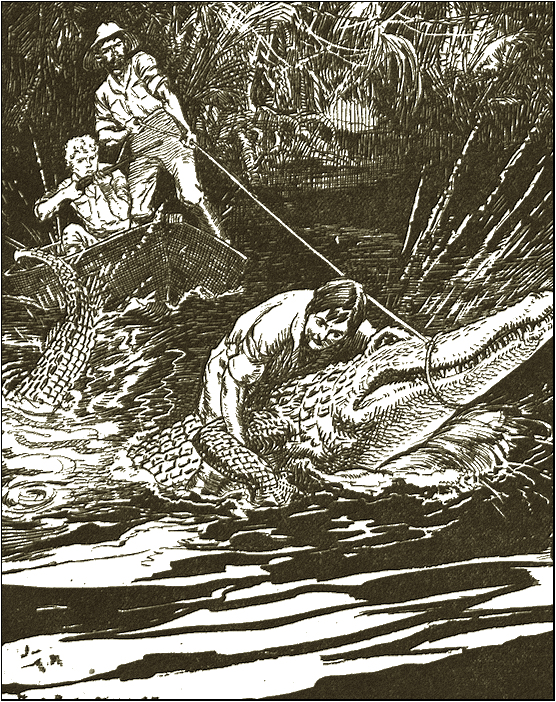
It whizzed past Jimmy, who the next moment saw its coils
twine themselves around the open jaws of the cayman.
"My word!" breathed Jimmy, as he realised that this meant his salvation, for the time being at any rate, if he could but do the right thing next. What that was he did not well know until he heard Jackson's voice come, hoarse, rasping, but incisive:
"Hang on, Jimmy—we'll pull up to ye!"
How they were going to do the feat miraculous Jimmy did not know, but he took Jackson's word for it and clung to his precarious perch, never relinquishing his grip on the cayman's legs. It seemed to him that the animal, now that its mouth was clasped tightly, was only capable of lashing the strong tail. The rope trailed alongside Jimmy taut and straight, and held like a guiding rein as the cayman moved forward making for the bank. Jimmy realised that it was Jackson's intention that the animal should go thus, and that his own opportunity was to come when the cayman drove into the bank. So Jimmy waited tensely. He had forgotten everything except his grim situation—had even forgotten that there was another cayman, and goodness really knew how many more! lying behind him somewhere. He was reminded of its existence as he heard the crack of a rifle, and a yell from Rod that he interpreted to mean that the shot had gone home. With the realisation that that enemy was done for, Jimmy's relief was tremendous, and he bent all his efforts to keeping his steed steered for the bank, now about ten yards away. Glancing over his shoulder, he saw that Jackson had hold of the rope, and as the cayman drove forward was hauling the canoe to closer quarters with the beast. It was tricky work, as Jimmy understood, for the cayman might at any moment endeavour to swing round in answer to the tugging of the rope, in which case there would be little chance of getting it to the bank.
There was no use in meeting trouble before it came, however, and Jimmy dug his knees into the cayman's side while the brute worked his forelegs as much as the boy would allow him, Jimmy, of course, realising that unless the brute could use them it could not make progress. Those ten yards seemed to Jimmy like so many miles, but at last they were covered: the cayman slithered into the mud. Jimmy sprang from its back, going knee-deep into the mud, He sloughed away from the cayman, which lay a lashing fury that sprayed up filth that smothered the fleeing boy, who, when at last he clambered on to solid earth, turned and saw that the canoe was run aground about twenty yards along the bank.
Jimmy pelted off in its direction, but had not time to reach the canoe before Rod's rifle fired twice in quick succession, and since Jackson, still holding the rope, had the cayman head on, the boy had a fair mark in the brute's head. Jackson and Rod worked in excellent agreement in those few moments. The latter had told the boy that when he called out "Now!" he was going to relax his taut rope, so that the cayman should feel released and so would probably lie still, for a few seconds at any rate, which was to be the time to fire.
The plan worked well. Jackson's "Now!" came. The cayman dropped almost to inertness,
except that it opened its mouth, the relaxed rope allowing it to do that. Rod fired his two shots, and after the final plunging agony the cayman lay quite still, dead.
As he saw that happen Jimmy, realising that all the danger was past, sagged badly at the knees, blubbered like a kid, pulled himself up sharply, and staggered the rest of the distance to the canoe.
"Hold up, younker!" cried Jackson, stepping up to him. "You played a big game all through—don't crack up now. It's over!"
"It—is!" stuttered Jimmy, drawing a clammy hand across a sweating brow. "It—is—thanks—to you and—and Rod!"
He held out a hand, which the others took and shook for him. For his part Rod was shaking with the dread of what might have been, but he knew that unless something was done to cheer up Jimmy after his terrifying experience the boy would likely enough suffer a pretty bad nerve strain. So, although he felt far from doing so, Rod laughed—although a little forcedly.
"What's the joke, younker?" asked Jackson; and Jimmy stared as though he thought his chum had gone mad.
"Can't you—laugh—too?" spluttered Rod. "Can't you laugh when you remember how—how funny Jimmy—looked—"
"Funny!" cried Jackson, catching the flicker of Rod's eyelid. "Funny, by hookey, yes! But I didn't want to hurt his feelin's by grinnin' about it, though as he don't seem to mind—" He burst out laughing himself when he saw the smile hovering about Jimmy's mouth, to end in a good hearty laugh that eventually shook him back to a normal frame of mind.
After another delighted shaking of hands Jackson strolled over towards the dead cayman, to come back with his rope which he had taken off the brute.
"That rope's been pretty useful, kids!" he said. "And I think we'll take it with us, though I hope we don't want it any more and—"
"I hope not, Mr. Jackson," said Rod. "If we do—"
"Now look here, Jimmy, and you too, Rod," broke in Jackson. "Understan' this: I'm Jackson, or Steve, or both, but it's so long since I was Mister that I'll sure never get used to it again. Savvy, kids?"
"All right, Mis—Steve," Rod laughed. "And, say Steve, now the paddle's broken, we'd better stay here and make another, in case we need a spare one before we get home. Besides, a rest won't be any misfortune."
"Just so," agreed Jackson, and having seen that the canoe was fast and that Copperface, who had lain in the canoe all the while, was all right, the three walked a little way among the trees. Jackson chose the tree that he wanted, and fell to cutting it down with a good sized knife of which he seemed very proud.
"Yes, I got that in Diamond City," he told the boys, when Rod mentioned the knife. "That is, I made it myself. Diamond City is a mineral city really; there's iron and gold and silver and diamonds and the sakes know what. In their own lingo the folk call it the Shining Mountain, 'cos it—well, I'll tell ye that some other time. The people make knives of a sort, but they don't know how to temper steel. I do, and this knife's a beauty. See." And he showed them that it was, as it felled the tree in half the time that their own knives would have done the work. He cut the trunk rapidly, and soon had the new paddle fashioned, the while that Jimmy and Rod prepared a fire and a meal.
"Tea?" breathed Jackson, licking his lips as a pannikin of tea was handed over to him. "Gee—but I never thought I'd taste the stuff again. Say, kids, civilisation's got something on the other sort o' thing, I guess!"
"Well, perhaps it has," Jimmy laughed, "although you seem anxious to get back to the other sort of thing, as you call it. You talk of going back to this wonderful Diamond City, wherever that may be, and—"
"I'd go to Diamond City rather than to any other place on earth," said Jackson quietly, and the boys looked up sharply at him, sensing something more than he had yet told them. There was something in his voice too that made them hesitate to ask what it was he meant, but of one thing they felt confident, although they could scarcely explain it to themselves, and that was that the man had no feverish desire to go and bring back some of the treasures that he hinted at being in Diamond City.
Jackson tapped the pannikin thoughtfully and his eyes stared straight ahead as though they were seeing things far beyond the immediate surroundings. Neither of the boys spoke, preferring to wait for him to speak if he wanted to. Jackson merely grunted quietly, lifted the pannikin again, and emptied it.
"Good stuff, me boys!" he said then, holding out the pannikin for a second supply. "Thanks!" as Rod handed it back. He lifted it to his lips, but instead of drinking, stared hard at the seemingly impenetrable forest in front of him. Instinctively the two buys turned their heads to follow his gaze, but Jackson breathed quietly. "Sit still," and they turned back again, wondering what was the matter. For a few seconds Jackson remained silent and still, the pannikin still before his mouth; then, quite calmly he drank the tea, put down the utensil, and stood up, with his fine knife in his hand. At that instant something whistled past the boys and struck Jackson's knife, and then the man sprang, with a shout of rage, at the wall of undergrowth.
Instantly the two wondering boys were on their feet, Rod with his rifle in hand, and Jimmy, who had lost his rifle, having to make do with his revolver. They plunged after Jackson, who had pushed a way into the undergrowth, and as they reached him they heard sounds of someone or something else who, evidently having been startled, was now making off at top speed.
"What is it, Steve?" Jimmy asked. "I heard nothing and—"
"A Tukul!" rapped Jackson; but for all that the boys understood he might not have spoken. Nevertheless they sensed that it was something or someone that presented a danger, and as Jackson went forging through the forest they followed. The sounds they had heard had now ceased, and the boys at any rate had begun to imagine that there was no use in going farther, since whatever it was that Steve had heard could easily lie concealed and never be seen—indeed, could quite easily make a sudden attack or spring that would bring certain disaster to the pursuers.
"Seems to me we ought to go back," Rod suggested quietly, but at that moment the thing happened that he had imagined might. That is to say, the danger materialised in the shape of half a dozen small arrows that whistled through the air, coming directly from in front of the three whites.
"DOWN, for your lives!" shouted Jackson, as the arrows pinked into the trees behind them; and the boys followed his example of dropping to the ground, where they lay concealed for a few moments, waiting for the man's instructions as to the next move.
Presently Steve spoke in low tones.
"Those fellows are Tukuls—sure thing," he said. "I know those arrows—and they're poisoned. Old Copperface got one, you 'member. You fellows got your shooters? Good. I reckon those little men are not far away, an' ef you both fire straight ahead quick—don't empty your magazines—it'll scare 'em, for they're sure frightened o' shooting irons. Ready? Well, let 'em have it!"
One shot Rod sent sweeping into the forest, and while Jimmy was firing three Rod reloaded to make up his full magazine. But as he was doing it the three men realised that the firing had had the result Steve had suggested, for loud shrill screams came ringing through the forest, and there was a crashing us of men forcing a way through.
"Again—one after t'other," Jackson ordered; and the two boys, this time having some indication of the direction in which to fire, blazed away, holding some shots, because they knew that Jackson's idea was that if there were many enemies, and they decided to make a rush attack, it would be fatal for magazines to be empty.
The screams of the fleeing natives took on new tones now. There were cries of pain mingled with the rest, sufficient token that some shots at any rate had gone home; but as to whereabouts the wounded men were neither of the whites could tell, for they had caught no single glimpse of their mysterious foes.
"Some more for luck!" shouted Jackson. "Same as before!" and the boys obeyed. This time they had better luck, inasmuch as following one of Rod's shots there came a yell and a clatter as of a falling body, and looking a little way beyond they saw a small brown body tumbling over and over from down the trunk of one of the giants of the forest.
"What is it?" breathed Rod. "It looks—"
"A Tukul, by hookey!" cried Jackson, springing to his feet and dashing off to the spot where now the figure lay. "Stay where you are, boys."
So, although they scarcely knew how to contain themselves, the two chums remained lying on the ground, reloading their weapons in case they were needed again. They watched Jackson stoop down over the fallen man and turn him over, saw him straighten himself and swing round to them.
"He's dead, sure thing," Steve called out. "Give another volley to make certain the rest have hiked it!"
He dropped beside the dead native, and the boys fired as instructed. Then, as no sounds came in answer to the shots, Jackson got to his feet again, and while the boys were reloading he dragged back the Tukul.
"That's one of the little fellers!" growled Jackson. "He was a straggler, sure thing, an' if we hadn't got him he'd 'a' got us."
The boys shuddered. It was an evil thing to know that a shot fired by one of them had been the undoing of this man, but they realised that it had been a case of either they themselves being killed by the attackers or else the other way about. And they had seen the awful wound in Copperface caused by one of the poisoned arrows, and, moreover, they had sufficient faith in the stranger—they scarcely looked upon him as a stranger by now—to know that he would not have told them to fire at all had it not been absolutely necessary. Nevertheless they looked their concern, and Steve, seeing their faces, spoke to them like the man he was.
"Don't blubber, kids," he said. "You ain't done no wrong, 'cos, b'lieve me, those Tukuls would 'a' had the lot of us if they could; an' when they catch prisoners they ain't always partic'lar how they send 'em out. When a man's fightin' for his life he don't have to use gloves. If that feller hadn't been knocked off his perch—my word, he ain't dead!"
The boys almost jumped their own height as he rapped out the words, and then sprang back as, with a bound, the little man who a few seconds before they had imagined to be dead jumped to his feet and went, off with a bound into the forest before either Jackson or the boys could do anything to stop him.
Rod laughed a little hysterically, not a little relieved, despite all the arguments that he and Jackson had used to justify what they had thought had happened.
"He looked—dead!" he said jerkily.
"An' felt dead too," rapped Jackson; "and, by hookey, oughter been dead, if only for the fall from that tree. Must 'a' knocked him senseless; but it licks me how he could recover so soon and be able to nip off like that. Anyway, kids, p'haps you don't mind, and—"
"Not a bit," was Jimmy's quick interruption. "But what's next?"
"The next thing, my boys, is to get back to the canoe and make a bee-line for Menezes Factory. That bunch o' Tukuls'll probably do some more following—and we don't want to be caught ashore in the night. Come on!"
They went on after him, and reaching the bank, found the canoe where they had left it, and Copperface sitting on the bank near by. As they plunged through the undergrowth neither of the boys had asked Jackson any questions, thinking it was up to him to volunteer some information; but until they reached the bank—indeed, until they were once more in the canoe and going along stream at a good pace, propelled by Jackson himself, the man did not say anything about the thing that was, to the boys, most important of all: Who were the Tukuls?
It was when they were about a mile along the river that Jackson spoke about them.
"What d'you think of the Tukuls, sons?" he asked, without looking over his shoulder at them.
"Seeing that we only saw one for about two or three moments we can't have much of an opinion," Rod said slowly. "Who are they, anyway?"
"Lordy, an' of course I haven't told you!" growled Jackson.
"You don't seem to have told us much at all," suggested Jimmy, with a short laugh. "Perhaps it's because you've got so much to tell, and—"
"You bet your next pannikin of tea—most valuable thing in the world next to a smoke," said Jackson, with a chuckle, "that there's plenty to tell. But see here, kids, the Tukuls are the people of the Shining Mountain."
"Phew!" breathed Rod and Jimmy together. "Pigmies!"
"You're right. Little fellers who know how to fight—little fellers who've got enough treasure in their old mountain city to make millionaires as common as cayman on the Amazon—like fellers who've got one o' the world's secrets in their neighbours' gardens, an'—an'—who've got one of the best—"
"Go on, Steve," Jimmy said breathlessly. "What else?"
But at that Jackson dried up like a desert stream, and not all the pumping on the part of the boys could make him say any more about the Tukuls except that they were "a bloodthirsty lot of villains," and that one day he was going back to tell them so. Therefore the boys had to content themselves with believing that in his own good time the stranger would tell them what they wanted to know.
In which they were right, though his own good time did not come until, three days later, the canoe slipped up to the little wharf affair on which the Menezes Factory was built.
"Hello, boys!" Mr. Dixon called out, as he saw the canoe coming along. "You've been a long time and—where's Gigo? Who's that with you? And who's that in the bottom?"
The string of questions tumbled out as the big, bluff figure of Stark Dixon bounded down to the river edge and laid hold of the canoe, hauling it in quickly.
It was Steve Jackson who answered first:
"Say, Stark, old man, but you ain't altered any!"
"Who—" began Dixon; and Jackson laughed
uproariously as he sprang ashore and stretched out his big hand, which, almost automatically, Dixon took and shook.
"Who on earth should I be but Steve Jackson!" that worthy cried; and when he spoke the name Stark Dixon grabbed the hand afresh and well-nigh wrung it off, large as it was.
"That's enough," yelled Steve. "I'll want that list some day, I reckon!"
"Dash it all, man!" cried Stark. "Dash it all I thought you were—were gone for ever. Fellows came back and swore they'd seen you killed and—"
"They lied!" Jackson assured him easily. "Here I am. Didn't know me, either, did you? Well, well, I suppose a nanny's beard does alter a man somewhat. What? The story—oh, later. I want to see to Copperface first. Got any medical knowledge up at this show?"
"What's the matter with him?" Dixon asked; and when Steve told him the rubber factor helped to lift the native up into the wooden bungalow near at hand, and with hot fomentations and antiseptics was soon attending to the wound, after which he gave the patient a sleeping draught.
Meanwhile Rod had been rousing up the native servants and making them prepare a meal, to which the company sat down, Steve and Stark looking at each other and shaking hands across the table a dozen times as though they were two schoolboys met on holiday.
"A smoke?" queried Dixon, with a twinkle in his eye, when the feed was done, and he tossed a cigar over to Jackson, whom he watched light it with keen satisfaction.
"The kids gave me one," Steve said, with a sigh, as he blew the smoke in blue rings; "but it was their last, an', hang me, Stark, but when you've been without a weed for years, and then get one, and only one, you feel that you want to smoke all day long!"
"Well, you can here, if you'll not be stopped telling a story by doing so!" Dixon laughed. "Is there a story?"
"Is there indeed!" cried Rod excitedly. "Why, uncle—"
"Hold hard, youngster," said Jackson. "You don't know it all, you know. An'—well, I'd like to tell it, sure thing!"
The three others laughed and settled themselves down to listen. Jackson recounted what he had already told the boys and much more besides.
"That's the story, so far," he said, when he had reached the point at which he had stopped before. Neither the boys nor Stark Dixon had interrupted him, although the latter had many questions he wanted to ask. He knew his man, however, and if there were things that Jackson was leaving out it was for some good reason. Now, however, Dixon could not keep back the one question that had come up for asking several times.
"What became of—of Nick Turner?" he asked. "I was coming to him," Jackson said. "Nick he's down at Diamond City—if he's alive!"
He paused again, and the boys, looking from him to their uncle, were amazed at the signs of emotion that showed on their faces. Eighteen months they had been at Manaos, and never a word had their uncle said to them about either Steve Jackson or the man they referred to as Nick Turner, and they were wondering why that should have been. They did not know then, though they knew soon after, that Steve Jackson and Nick Turner were Dixon's greatest friends, and that their loss had been a heavy blow to him, so heavy that he had locked the memory of them in his heart as a thing to be treasured and spoken about. The three men had knocked well-nigh all over the world together, had faced death in a hundred situations, and had snatched one another from its grinning jaws. It had been only the fact that the Menezes establishment had been rocky at the time that Jackson and Turner set off for the interior that had kept Dixon at his post. He refused to leave it while the business was in Queer Street, determined to haul it out of the pit if it were possible.
"Well," Stark Dixon prompted, and Jackson jerked himself out of his reverie.
"Nick and I and Copperface were the only three survivors after the fight," he said quietly. For nigh on three years we were kept prisoners in the City of Diamonds, absolute slaves. We were made to work in the mines the people had dug, for they have a passion for decorating their places with the gewgaws. We tried half a dozen times to escape, but were hauled back—and, by hookey, we got it in the neck for trying. Then, that last time, we tried a new dodge. We had got to know the country round about fairly well, and we arranged that the three of us should take different routes to meet at a certain Sugar Loaf Mountain. I got through, and Copperface did too, though he got that arrow in his chest doing so."
"And Nick?" Dixon said, as Jackson stopped again.
"Nick got nabbed again," was the reply, after a moment's hesitation. "It was Copperface who saw him taken, and he told me afterwards that Nick put up a splendid fight, but was overpowered. Why didn't I go back? Oh, I know you haven't asked almost stood still at what they saw on his face. They knew instantly that those last words of Jackson's had struck a chord in Stark Dixon's heart, and they hung upon the words they felt were coming.
"Steve," Dixon said slowly, and he reached out his hand, which Steve took—they stood on either side of the table and looked into each other's eyes—"Steve, when you promised Nick Turner you'd go and fetch him, if he lived, you made a promise for me!"
"I did—I knew I did!" was all that Jackson said.
THE words of Steve Jackson seemed to snap the tension, and immediately, as the two men sat down, the boys began to speak, one against the other, until the men clapped their hands over their ears in mock dismay, and Stark Dixon cried:
"Stop it, you young clowns! A man can't hear himself think in that clutter!"
"Well, uncle, I think you might answer," said Rod, flushed of face. "If you're going, can we come with you?"
"Hark to 'em," laughed Steve. "Hark to 'em. Two kids not yet out of long clothes wantin' to go to the City of Diamonds, where—Oh, lor!"
The clamour began again, and was only put down by Stark Dixon assuring the boys that if they didn't leave off at once the matter was settled—against them right away. That sobered them, and Dixon, looking at Steve, said:
"What do you say, Steve? Could they come?"
"Well," said Jackson very deliberately. "Well, I seen those two kids handle a knife and a gun an' a revolver thing; I seen one of 'em put the kybosh on a puma an t'other put paid to a cayman, and—"
"They've told me nothing about that!" jerked Stark Dixon.
"Fer a very good reason why," Steve told him. "You've been too taken up with my yarning to listen to 'em. But it's a fact, Stark, and as true as I've come from the City of Diamonds, there's nothin' I'd like better'n to hev them with us when we go down there. If you're willing—"
"You know what there is waiting out there," Dixon said, waving a hand vaguely towards the jungle, "and if you say they may come—well, they may. That's all there is to it!"
Jimmy smacked Rod a resounding blow on the back. Rod, spluttering, let out a jab that caught Jimmy in the pit of the stomach and doubled him up, and when they extricated themselves from the muddle they danced around the table and made the glasses jingle and the two men roar with laughter.
"Maybe you'll dance another tune afore we're through," said Steve. "But—it's the right spirit, kids! I was like that once; I'm sobered now, though."
When the boys had got "sobered" down too, Steve Jackson and his friend began to work out their plans for the trip they had in mind. Jackson was for starting as soon as possible, because it was the best season for travelling, and his inquiries were as to how many men Dixon could procure and what stores and arms.
"We'll want a decent crowd," he said. "The Tukuls—that's what the people there call themselves in their lingo—an', s'far as I kin make out, it means the People of Bright Things—the Tukuls can fight; they're as bloodthirsty as pumas. Though, mind you, Stark, I'm not for going to fight 'em, except it be to get Nick away. I don't want their derned diamonds or their gold—I don't want anything but Nick and—"
"That's all I want too," said Stark Dixon gravely. "I believe in not meddling with the natives. Do business with 'em if you can, but if you can't, let 'em alone."
"My policy too," said Steve. "You know I went well stocked with trade goods, but I lost them the day before we were set upon through a smash up on a falls. We'll go stocked as well as we can manage, eh?"
"We will," Dixon agreed. "In a fortnight's time I've got a steamer coming down with a new consignment of goods, and there are a couple of chaps out from England who were coming for some big-game shooting around here—chaps I used to know in the Old Country. What do you say to askin' 'em to stand in with us?"
"If they will, let 'em," Steve agreed. "Two white men are worth a dozen darkies any day when it comes to a scrap. Them two and us two and the babies"—this with a grimace at the boys—"and about a hundred natives ought to be enough. We can live on the country as we go, and all we'll want to carry'll be trade goods and arms, in case we want 'em, as I calc'late we shall! So we've got a fortnight to wait anyway, eh?"
"Yes," was the reply. "We must wait for the trade goods to come down. Meanwhile I'll choose the best 'boys' to come with us. One thing I'm glad about, Steve, and that is that the show is paying now, an' it wasn't when you and Nick went away. I don't mind leaving it, though even if it were going to the dogs I'd come just the same—since Nick wants me. Steve, old man, I'm glad to see you!"
It was the fiftieth time he had said it since Jackson set foot on the bank of the river, but it lost none of its warmth and sincerity through that; and as for the boys, their excitement was acute, and remained so during the next fortnight while they waited for the coming of the steamer. The more Jackson told them about the Tukuls and their city the more keen they became, and when the steamer did arrive they were in a state of mind that bordered almost on hysteria.
There was bustle and hustle at unloading the cargo and reloading the ship with rubber, and during that time Stark Dixon was too busy to do anything except introduce his two new friends to Jackson and the boys.
"This is Harry Hensley and this is Dr. Farrar," he said to Jackson. "I leave you three to introduce yourselves, and—say, Steve, you can tell 'em the yarn and see what they say!"
Within half an hour of their arrival the newcomers had sworn friendship with the boys and Jackson.
"Will we come?" quizzed Hensley, a man of about thirty-five, who had a big name as a hunter. "Mr. Jackson, we'll come, and we'll share expenses. What say you, Ted?"
Dr. Farrar laughed like a schoolboy, and for all his nearly forty years he was pretty much of a schoolboy, despite the fact that he had been round the world twice and had been in some tight corners with pearlers and wild animals, in shipwrecks, and goodness knows what.
"I'm in on anything that promises as well as this does," he said. "Besides—why, man, I knew Nick Turner; he saved my life once down in Hawaii when we ran foul of a lot of Kanakas."
"Then you're the Farrar he used to speak about!" exclaimed Steve. "Lor', what a world it is—what a world! No need for me to tell you how dead keen I am on getting Nick out of his mess—if he's there to be got out of it. Heaven send he is! By the way, Dr. Farrar, there's somethin' up around Diamond City that'll interest you."
"What's that?" Farrar asked.
"Oh, a little nut that the Tukul fellows grind up an' cure malaria with. Tried to bring some away with me, but couldn't. I'll tell you about it later."
Farrar was highly interested and was keener than ever on the expedition.
"If it's a sure cure," he told Stark Dixon, "and I can bring good supplies away, I reckon my fellow-doctors will bless me for it!"
Three days later, during which time a warm friendship had sprung up between the whole band of white men, the rescue company set out on its long trek through the jungle. There were a hundred natives, every one of them armed with a rifle, besides currying the native bows and arrows and blowpipes, and each man of them carried also a bundle of goods, or, rather, there was a bundle ready for each man to carry when the river had to be left, for the first stage of the journey was by water. A long line of canoes sped down river and up river, the one by which the boys and Jackson had come, and when at last they reached the end of that they drew the canoes up on to the bank, and left them hidden in the jungle against the time when they would return and need them.
"You'll be knowing the quickest route, Jackson?" Hensley asked, as they sat round the camp fire that night.
"You bet, and what I don't know Copperface will."
The native had by now quite recovered from his wound, and looked a different man from what he had been when the boys first saw him. He seemed to regard Rod and Jimmy as his rescuers, and what devotion he had to spare from Steve Jackson, whom he absolutely worshipped, he bestowed upon the boys, who found him a really remarkable specimen of South American native.
"Me no man's slave," he said proudly one day as he sat in their canoe; "but me your friend. White boys saved Copperface!"
The boys had not laughed at him; they had known that the red man was in earnest, and they knew that they had indeed found a friend, as they were to prove shortly after. It was after a fortnight of the drive through the jungle—a tremendous task in itself, seeing that a way had to be cut through the clinging undergrowth, relays of natives having to take it in turns to do the hacking, and the others bringing up the goods as they did so. Jimmy and Rod and Stark Dixon were in the van—that is, immediately behind the natives who were hewing the track. Copperface was about five yards behind them. Stark and Rod had turned back and gone a little way down the pathway already made, leaving Jimmy sitting on a bundle of goods waiting for its carrier to resume his journey with it. Suddenly there came a terrific roar from Copperface, followed a rush of feet, a scurry as he floundered into the dense undergrowth, and after that a howl of terror that died away as though whoever had given vent to it was being slowly choked; and then Jimmy, who had sprung to his feet, was crashing through the jungle in the wake of the native, whom he could hear panting heavily.
He came upon him as Copperface was stumbling back, dragging something behind him, something that Jimmy could not see, but which he could hear kicking and struggling, though ineffectually, in the strong grip of the native as the latter hauled him along.
"What is it, Copperface?" Jimmy gasped.
"Him snake!" growled the native; and for a moment Jimmy forgot that howl of fear and really imagined Copperface meant a snake. He knew better, however, the next moment, for the native heaved at his captive and dragged him into sight, lifting him bodily and holding him out towards Jimmy, who stared at the apparition, scarcely able to believe his eyes.
For what Copperface held was a man—that it was a man and not a boy there was no doubt—but he was diminutive enough to have been taken for a boy at first glance. Little more than three feet in height, but thick-set with it, he looked for all the world like a refractory youngster who had been picked up by his father for spanking, as he hung suspended in the air, and Jimmy knew without being told by Copperface that he was another Tukul—one of the tribe into whose country the expedition was going, one of the men, no doubt, who had made that attack in the jungle just after the fight with the caymans.
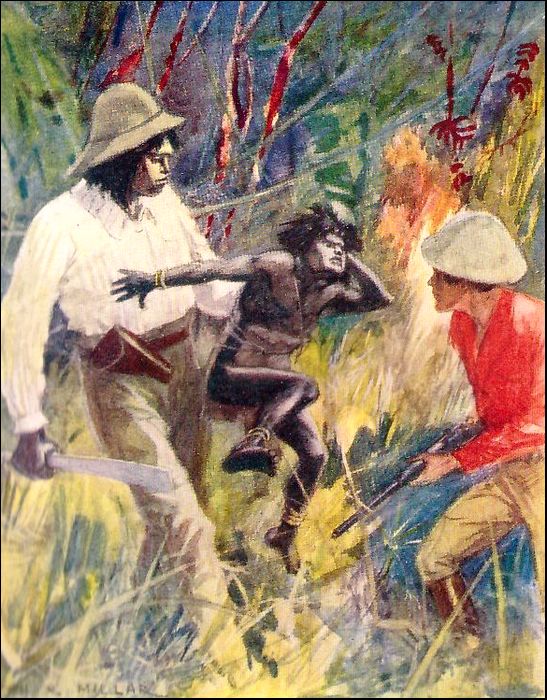
What Copperface held was a man—that it
was a man and not a boy there was no doubt.
"Boss Jackson like see him!" said Copperface imperturbably; and he yanked the little captive up by his neck and flung him over his shoulder. Jimmy struck off for the path again, followed by the native and his prisoner, and together they emerged into the clearing, to find Stark Dixon and Rod and Steve rushing up to see what was the matter. Some of the workers had gone tearing down for them when Copperface had sprung for the jungle, and the white men, sensing trouble, had whipped out their revolvers and swung off up the path.
If ever men were astonished it was they as they saw what Copperface held out to them, as though he were offering them a doll for sale. Stark Dixon opened his mouth to speak and then shut it again, because Steve Jackson, with a bound, seized the prisoner, who was showing signs of fear at the fate that awaited him.
"By hookey, Stark!" Jackson cried, "that's a Tukul—one of the pigmies of the City of Diamonds!"
"What's it mean, Steve?" Stark managed to get out at last. "We're over a hundred and fifty miles from the city, and—"
"That doesn't mean that the Tukuls aren't nearer!" snapped Jackson. "Sure as fate some of 'em are abroad and—and—crakey, Stark, those beggars whom I and the boys scored off must 'a' tracked us all the way, till we outstripped 'em. But we'll soon know," he said grimly. "This chap'll talk before I'm through with him! How'd you catch him, Copperface?"
"Him was blow at Boss Jem," the native said, pointing to Jimmy. "Me see him, me jump; he run, but me follow, me catch him!"
He produced from his drill trousers pocket a long thin piece of tubing which all present knew for a native blow pipe, and Jimmy, to whom this was the first intimation of the danger he had been in and of the escape he had had through the swift action of Copperface, trembled a little, then sprang forward and gripped the native's hand.
"Thanks, Copperface," he said shakily. "You saved my life, I reckon, and—"
"Me know; me please," said the native simply, but laughing all over his great red face.
"Oh, oh, Mr. Tukul!" exclaimed Steve. "So that's the game, is it? Bet you the first diamond we get, Stark, that this fellow's only a scout for another lot, and that they know what our plan is. Come on, let's find out. Here, you big dark toughs, get that path cleared quick!" he yelled at the natives, who had ceased their work all this time, "an' keep a watch out; we're not through with trouble yet."
The natives fell to work instantly, though some of them stood on sentry while the rest worked, and the white men went back down the path to where Hensley and Farrar were sitting smoking.
"Hello, what you found, Jackson?" Hensley asked. "A new-born babe or—"
"No; it's a full-grown man, Hensley," said Steve, plumping down the little chap, where he sat trembling and looking from one to the other of the white men with fear in his little gleaming eyes. "Tell you some more 'bout him soon."
Then, to the astonishment of all, he fired his revolver and brought down a beautiful hummingbird that was flitting between the trees. The creature dropped almost at the feet of the pigmy, who started up in alarm.
"Thought that 'ud interest him," Jackson said grimly. "Y'see, boys, it ain't all them Tukuls know what white men's arms are like, an' those who don't might just as well know what can be done! May be useful to us later on!"
Then without another word to his companions he began to jabber away at the captive, who, while he was speaking, kept shifting his glance from the white man to the dead bird at his feet on the ground. Now and again Jackson deliberately jerked his revolver into evidence, and once or twice poked it into the ribs of the pigmy, who at such times jabbered back something at his tormentor. This kind of thing went on for some while, during which the white men found it difficult to keep straight faces. Once, indeed, Hensley burst into a laugh, but Jackson swung round on him and said:
"Stop that, Hensley. This is no joke!"
Hensley subsided instantly, and Steve went on with his queer talking to the captive, who seemed more willing now, or at least more impelled, to answer the questions that the other white men sensed Jackson was putting to him. At last Steve pulled up and said to Copperface:
"He's your prisoner, Copperface. Keep him!"
It was evident Copperface considered this an honour, and, if the white men had known all that he had suffered during captivity at the hands of the Tukuls, they would have appreciated the satisfaction of the native at being made the gaoler of the pigmy. They watched him cut a stout liana, with which he cleverly fastened the captive's legs so that, while he could walk, yet he could not run. Then he did the same with his hands, securing them behind his back. After which Copperface bound a liana round his own waist, and the other end he fastened round his captive. Then he made him walk a little way—to the unconcealed amusement of the white men, who realised that this was to be his method of guarding the prisoner.
"Him right now!" Copperface said with a broad grin. "Him no go if Copperface no go!"
Hensley roared with delight and slapped Steve on the back, nearly knocking the breath out of his body.
"Cut it out, Hensley," gasped Steve. "I—"
"A film, man, a film!" cried Hensley. "Think of it: native method of holding prisoners and—"
"What on earth's the stunt?" growled Steve, and the others also looked their astonishment. "Think this a bloomin' kenemar?"
Hensley laughed again and seemed in the seventh heaven of delight.
"My little secret," he said at last. "I've brought my kenemar camera with me and—"
"You dern fool!" exclaimed Steve good-humouredly. "I wondered what all your traps meant. If you think—"
"I don't think, I know," said Hensley, more seriously now. "Why, man, there's thousands in this outfit, or there will be before I'm through with it. The greatest films of the age: natives and adventures in the unknown forests of Brazil. Thousands, I tell you. When I came out with Farrar here it was as much to make films as to hunt: he's the hunter, but I— Filming is my hobby. I was going to film the hunts. But this—oh lor, this is IT."
Steve could not help laughing, and neither could the others, at the man's enthusiasm; and, moreover, they realised that he was right, though Jackson and Stark Dixon looked at each other with a grin, as if they were both thinking that before the business was done with there might be some very grim pictures to take.
"Oh, all right, Hensley. I'll come to your first show. Should rather like to see myself fighting about ten thousand Tukuls—I do not think! But why on earth d'you keep it secret?"
"Oh, it wasn't that," Hensley said. "'Smatter of fact, I've got none too many films, and so haven't wasted any on just the ordinary things we've seen so far. Reckoned there were going to be some pictures worth taking later and—"
"You lay your last dollar on that, man!" grinned Steve. "If what this prisoner johnnie has said is true, there'll be some pictures worth taking and some you won't have time to take."
"What's he say, Steve?" Stark asked quietly.
"Pretty much what I thought he'd say when I got him on the go," Steve told him. "When Copperface and Nick Turner and meself hiked it from Diamond City half the Tukul warriors set out after us. Nick they got: Copperface and me they missed, as you have plain enough evidence! But ever since there've been trackers after us, and somehow they missed us, and were going back when we blew up here. This chap"—indicating the captive—"spotted us, but he swears that none of the others did, though maybe he's a liar. All Tukuls are liars: born in 'em, I think, an' I ought to know! There were only half a dozen of his pals with him; but, if they've seen us, they'll be enough to make things pretty jumpy for us. What? No, they won't attack this outfit on their own, but they'll hike it back to the City of Diamonds and have the whole caboodle out to meet us. Guess you're going to keep on, though?"
There was an emphasis in the comprehensive "you" that made the other whites look at him sharply. It was Stark Dixon who voiced the thoughts of all of them, and his words made Rod and Jimmy thrill even more than they had done while Steve was speaking.
"Did you say anything about Nick Turner?" Dixon asked quietly.
Steve's eyes lighted up at that, and he grabbed Stark's hand as though he had been waiting for that question: Rod, young as he was, realised that Steve Dixon had a fine sense of the dramatic. He evidently believed in working things up to a climax and enjoying it to the full.
"He did, Stark," Jackson said fiercely. "He did. And he says that Nick Turner's alive. So—"
"I'm keeping on, Steve," was Stark's interruption, and Hensley and Farrar, who knew the real motive behind this tremendous venture, sprang to their feet and shouted that they too were keeping on, while Rod and Jimmy, not to be outdone, yelled "Hurrah!"
"You'll hurrah maybe another old way, some time," said Steve with a wry smile. "But it's the spirit, kids. It's the spirit. An', b'lieve me, if any man's worth going through all the jungles of South America for, it's Nick Turner. Also, and moreover, if any man—"
His words were drowned in a terrific burst of shouting and yelling, of screams of men as though attacked by all the beasts of the jungle, and for just an instant the little band of white men stood as though rooted to the spot, while the captive looked up at them with wicked, gleaming eyes, and grinned.
"HERE'S your first film, Hensley!" roared Steve Jackson, leaping to his feet. "Come on, the lot o' you!" and he went tearing up the none too wide track made by the natives. Instantly the rest of the whites followed him with rifles hitched off backs, or revolvers whipped out of belts. Copperface, with his captive—lost now was the grin of triumph, and its place taken by a look of fear—still fastened to him, sped in their wake, and the pigmy was literally dragged over the ground as the long-legged native ran without a single thought of him. The uproar was still raging, and mingled with the shouts of men came ever and anon the crack of a firearm as natives, armed with rifles, fired at whoever had attacked the expedition. It took but a few moments for the white men to reach the spot, and when they did for a second or so they were almost too astounded to do anything; for instead of finding themselves witnessing a terrific hand-to-hand conflict, as they had expected, what they saw were their own natives crouching behind trees or slithering into the jungle depths from which flights of arrows sang up into the surrounding trees, answered by other flights from the trees—flights of arrows and whistling darts that were so small they could not be seen.
"Keep under cover!" roared Steve at last, and he set the example by dodging behind a tree. The rest scattered, and Jimmy and Rod found themselves behind a bole of a jungle giant.
"My word, what's it mean, Jimmy?" Rod gasped. "What's happened?"
"It's what's happening," rapped Jimmy; and he spoke better than he knew, for at that moment he felt a sharp tap upon his sun pith helmet, and, looking up, was just in time to see a red, greasy face disappear among the foliage above. Without a word Jimmy fired with his revolver, and the answer to that shot was a scream, followed by the hurtling of a man from the tree. The figure, arms a-sprawl, dropped at the boys' feet, and with astonishment, they saw that he was a pigmy, like the captive.
"Tukuls!" jerked Rod. "That means the prisoner lied: the few he mentioned wouldn't dare to have attacked us and—"
"What's you got, boys?" came their uncle's voice at that moment. "Who's hurt?"
"A—a Tukul!" cried Jimmy, swinging round and seeing his uncle peeping from behind a tree some distance away. "Shot me with a dart, I guess, but I got him all right!"
The clatter that was still going on as the natives, seemingly, espied Tukuls amongst the trees, and the Tukuls apparently caught sight of some unwary enemies, Steve Jackson's voice shouted out orders.
"Blaze away for all you're worth into the tree-tops!" he yelled, and instantly the natives' cries and screams were drowned in the roar of sporting rifles and revolvers all going off at once. Rapid fire it was that took place, and between the scarcely perceptible lulls Rod heard the yap of men as, evidently, shots got home. Then, too, there were heavy thuds as though pigmies had been brought down from their concealment. Fewer poison darts and fewer arrows flew about now, and, after the rifle firing had been kept up for several minutes, the shooting of the primitive missiles ceased altogether, though in the sudden silence it was plain to hear the rustling of leaves and the creaking of branches which, although Rod and Jimmy did not know it, told Steve Jackson at least exactly what was happening.
Yet for a few minutes that worthy remained silent, and to Rod and Jimmy the tension was almost unbearable. It had been Steve's orders that the firing cease, and they wondered what he had in his mind.
"Don't know what the game is, Jimmy," said Rod, as he filled the magazine of his revolver again. "Sounds as though there are scores of birds flitting in the tree-tops."
"I don't know either," breathed Jimmy. He was staring at the dart that he had plucked from his pith helmet, and, with the recollection of the terrible state of Copperface when they had first set eyes upon him, he shuddered at the thought of what would have happened to him if the vicious-looking little missile had found a mark in his body. "Narrow squeak that, Rod!" he muttered grimly.
"I should say so," Rod agreed. "Hello, there's Steve at it again."
"It's all right now, you fellows!" came Jackson's voice, and he issued boldly from the shelter of his tree. "Those beggars have been springing through the trees for the last five minutes, and I reckon those of them who can are slicking it through the jungle for all they're worth. Tukuls don't like firearms, by George! Hee-oo-eee!" he shrilled, and in answer to the weird call the natives, who had been taken by surprise when the Tukuls sprang upon them, also emerged from their concealment. With sapakanas in hand they leapt for the unfortunate pigmies who had been brought down, and it was so quick that neither Jackson nor Dixon were able to prevent them putting the finishing touch to several of the wretches. But at last Stark Dixon's voice brought the natives out of their fury of vengeance and sent them scurrying into the jungle near at hand to see how many other Tukuls there were lying wounded. After a while they returned, bringing several other of the pigmies, who were promptly put with their companions in distress; and, to their surprise evidently, the white men began tending to their wounds.
"Seems to me, Jackson," said Hensley with a grin, "seems to me that it'ud be best to knock the beggars on the head instead of patching them up."
"Maybe it seems so to you, Hensley," said Steve; he was tolerant of Hensley because he was a tenderfoot and he knew that the youngster was not at all unwilling to profit by the experience of such men as he had come into contact and partnership with in this venture. "Ay, dessay it does seem so to you, Hensley. But it don't to me. Why? Oh, because, as I told you right away down at Manaos, this ain't a—what you call it?—punitive expedition. If the Tukuls'll give up Nick Turner when we get to the City of Diamonds, that's all I want."
"And all I want too," put in Stark Dixon. "They can keep all the diamonds in South America."
"And they can get all the pleasure they can out of the rec'lection of what they did to me and Nick," continued Jackson. "It's Nick I'm after, and Nick I'm going to get, if Nick's alive. That derned prisoner o' Copperface's lied about the number of Tukuls who were up here, and the odds are as he was bluffin' about the number of Tukuls who were up here, 'slikely as not he's bluffed about Nick. Well, so be; we're goin' to call their hand, since we've said we're going on. No good trying to get any more out of these fellows: we'll have to risk it. One thing, Stark"—he turned to Dixon—"we'll push off a few of these chaps when we've patched 'em up, and they'll make their way back to the City; and they'll sure tell their pals we treated 'em handsome like, which may help us some old time. You never kin tell!"
"It's your shout, Steve," Stark Dixon said. "Here, what you doing, Hensley?" he bawled, as he saw the man setting up a tripod.
"Goin' to take my first film, Dixon!" Hensley told him with delight. "Just hiked the jolly old thing up. Great film this one. White men attacked by pigmies attend to the wounds of the defeated! What!"
Hensley's sangfroid it was that rubbed off the raw edges of the temper of Jackson and Dixon, who, but for that, might have often been annoyed with him; while his joviality, shown a thousand times since they had left Manaos, had made him a favourite with the boys. They all laughed gaily at his words now, and his comrade, Dr. Farrar, went over and dug out the camera for him.
"Pick your patients, gentlemen!" Hensley said when he had rigged the machine up; and, entering into the fun of it, the white men fell to work good-humouredly, while some of their natives, who were relieved from work on cutting the path because they were sentries, formed a grim background to the first cinematograph picture taken in that jungle of Brazil.
"Oh, beau-utiful, beautiful!" cried Hensley as he turned the handle. "Hi—what's the giddy game?"
Rod had started back with a sharp cry as the pigmy whom he was binding up—his arm had been broken and his little face was bleeding badly from a bullet wound—sprang up and drove full into the white boy's face with his uninjured hand, sending Rod stumbling backward, amazed at the strength of so small a man. Then, before either of the white men or their natives could pull themselves together, the pigmy had gone leaping into the jungle.
"Let him go," snapped Steve. "We don't want the beggars, really."
"Besides, that's made a jolly fine scene," put in Hensley, still turning the handle for all he was worth.
"Well, when you've finished, we'll have some grub an' get on again," said Steve.
It was about an hour later that the expedition moved forward along the trail blazed by the pioneers, who still cut and hacked while others of the natives kept guard and the white men brought up the rear.
"We're goin' to camp out in the open to-night!" Steve Jackson said after a while. "If I ain't lost my bearin's—you never can tell to a goodish bit in this jungle, which grows thick in a week, and I've nothin' except me bump of direction to guide me—unless I'm all wrong we ought to strike a stretch o' open country in a while. It's about twenty miles across, and t'other side o' it the jungle's denser'n ever."
"You're guide, Steve," Stark Dixon said. "We leave it to you. Anyway, I'd prefer to sleep in the open with those Tukul chaps around!"
"An', say, Jackson," put in Doctor Farrar, "if you could arrange a little bit o' sport it'ud be pleasing to yours truly. Hensley'll be pleased too to get a film of a hunt, I reckon."
"All right, Farrar, we'll have a deer hunt tomorrow," said Steve. "That plain's alive with them. The South American deer make good sport too."
"Good egg!" cried Jimmy.
"Egg?" quizzed Stark Dixon. "Meat, you mean. We could do with a nice bit o' venison, I guess."
The words had scarcely left his lips before there was a terrific yell from the front, and down the track came many of the natives, crushing the others back.
"Cebado—cebado!" was the cry they yelled; and Rod and Jimmy knew immediately what had taken place. Somewhere out there one of the Indian scouts had caught sight, or had seen the spoor, of a jaguar, whose Indian name was cebado.
"Likely enough they've seen one!" snapped Jimmy, and instinctively he unslung his rifle and bounded off up the path.
If he had expected that the natives would pause in their flight at sight of him and of the others, whom he knew were hot-pacing after him, Jimmy was disappointed. They merely squeezed themselves into the undergrowth and allowed him to pass by.
"Come back, you young ass!" yelled Stark Dixon, and Jimmy, realising that his uncle was right, came up with a jerk. He swung round to find Copperface at his heels, with his long bow—to which he was wedded, refusing to have anything to do with firearms—ready for action. Somehow Jimmy wanted to laugh at this primitive weapon, but the next instant he had little inclination to laugh, for there came a sound of a heavy body crashing through the undergrowth to the right of him, and immediately afterwards he had a vision of a long lithe spotted figure springing through the air.
"Look out!" he snapped at Copperface, for whom the jaguar was making; and he swung up his rifle to his shoulder. Copperface stepped aside a yard and slipped an arrow into his bow; but he was not quick enough. The jaguar landed with clawing paws upon his chest and hurled the red man to the ground. A howl of fear went up from the scared natives behind as they saw what had happened, and they scurried back farther, impeding the approach of the white men. Even as he looked across at the struggling pair on the ground Jimmy saw that which made him want to laugh, despite the seriousness of the situation: there was Hensley calmly setting up his tripod while a quaking native held the camera ready for him.
"My hat!" muttered Jimmy; and then promptly forgot all about Hensley and his mad enthusiasm because there was grim work to be done. Copperface was still on the ground and beneath the clawing jaguar. His bow, smashed in half, lay beside him, but Jimmy caught sight of the gleaming arrow that he had been holding, gleaming now with the red blood of the jaguar which was snarling now in its angry pain as Copperface again and again drove the sharp barb into its chest. Back went the jaguar, back and down, and Jimmy was just about to drive in another blow when something sprang forward, and he saw Rod, a big hunting knife in hand, slash swiftly at the brute.
"Get back, Rod!" cried Jimmy as he saw the ugly wound his comrade had made; he brought his rifle round again and up to his shoulder, and, as Rod fell away, he fired point blank, at about two yards distance, full at the gleaming eyes of the jaguar. The heavy shot found its mark, and there was not a move of the jaguar afterwards. It lay there on the ground, its head shattered, and its once beautiful skin smothered with its own blood.
"Some shot!" cried Steve Jackson, who had dodged behind a tree as he saw Jimmy's levelled rifle.
"Some picture, by gad!" cried Hensley excitedly, and his words eased the tension, even the natives, who had for a long time been scared of the kinema camera until it was explained to them, sensing that there was something really worth while laughing at as they saw the white men grinning.
As for Jimmy and Rod, they stood looking at their prize and from that to each other, to be interrupted in this business of mutual admiration by the thumping whack that Copperface gave on each of their backs, wellnigh knocking their heads together.
"Brrrr-rr!" growled Jimmy with a gasp. "Copperface, you red fiend," he said when he swung round and saw the native grinning all over his broad face. "You do that again and—"
"Copperface on'y say t'ank!" roared the native, to the amusement of the white men who were standing around.
"Well, don't say thanks so heavily another time," Rod warned him.
Steve Jackson's voice now sounded again, and in answer to its commands the native track makers fled back to their task, some of them looking not a little shamefaced at having run away, even although they knew that the cebado was no mean adversary and that he always seemed to have preference for black men over white, one of the strange facts noticed, indeed, by most travellers in the jungle that was infested with jaguars.
Strenuously as the natives worked, it was some hours before the three miles that stretched between them and the wide savannah where Jackson was resolved to camp that night, were passed. The deeper the expedition went into the jungle the more impressive it became.
Jackson and Stark Dixon, who knew the jungles well, naturally did not feel the same interest as the two boys and the two hunters: even Jimmy and Rod, accustomed to venturing in the fringe of the jungle now and again, took things more as a matter of course than Hensley and Farrar, who in the first few days had been mildly interested and curious at all they saw, but to whom the mile on mile of giant trees—some of them over two hundred feet high, their tops invisible in the gloom, no sunlight being able to penetrate—gave rise to an awed wonder. Then the thick undergrowth that tangled and impeded progress, rank vegetation, profusion of wild fruits and gorgeous blooms, provided cause for interest, and, but for the advice of Dixon and Jackson, the two hunters would have forthwith made a collection of wonderful specimens.
"You fellers don't want to carry half creation about with you," Dixon said laughingly when one day Hensley had deposited a whole heap of specimens in camp. "Take my advice; you'll wait until we come back. The stuff'll still be there, never fear! There's always something growing and blooming and fruiting in this jungle!"
"And, sure as fate," put in Steve, "it may be, sons, that when we do come back we'll have to get a hustle on. We ain't out of the nasty muss yet by a long chalk! If we ever git to Tukul City, you bet your—your derned picture machine we'll hev a war-rm time!"
So the pair had resisted the temptation to collect, contenting themselves with hunting whenever the opportunity came. The first weeks in the jungle were enthralling ones both to them and to the two boys, who, for their part, could but marvel at the sure, confident way in which Steve Jackson led the party on. True, he had a compass to which he constantly referred, but even at that it seemed a miracle that any man could be sure where he was going.
"Son," said Jackson to Jimmy soon after the affair with the jaguar, "that compass thing's the only thing I saved out o' all my kit when the Tukuls got me. An', by hookey, if it hadn't bin for thet, why, old Copperface an' me'ud never have struck the Amazon agen. Nick Turner an' me tossed to see who should hev it—and I won: so, y'see, son, I reckon as how Nick got hauled back 'cause he missed his way. 'Course, old Copperface, like all the blamed natives, never lost his way; no native ever does even in the thickest jungle. Seem to hev a compass in their think-boxes; perhaps they hev!"
Jimmy laughed, and Rod joined with him.
"Don't know, Steve," he said after a while, "whether you've told Uncle Stark much about the Tukul country—but you haven't told us much! What sort of place is it?"
Steve looked at him for a moment without speaking, then rubbed his stubbly chin.
"Say, boys, I don't think it'ud be well for me to tell you too much about that theer country!" he said at last. "Why?" he answered the mute question in their eyes. "Why? Well, because if theer's any rougher show in the whole continent, then I got to find it, and I've been to most parts! No, sons, I'm leavin' it for yew to find out, which you'll do well enough for yourselves. I don't want to scare you stiff, do I?"
"Don't rag us, Steve!" exclaimed Jimmy with a grin.
"Crakey!" snapped Jackson. "Rag, you call it. See here, sons, if I had the tongue o' the johnnie who wrote those Arabian Nights thet used ter give me jim-jams when I was a kid I bet I couldn't spin a yarn that'ud come anywhere near being true about Tukul country. So there!"
And there the boys found he was adamant, and, naturally, their curiosity was only increased. Although they tackled their uncle on the matter he was as reticent as Steve Jackson, all he would say being:
"Steve's right, lads. Tukul country's not a pleasant place from all his accounts, and he doesn't believe, and neither do I, in making a heap of trouble before you reach it. If you two understand this, that when we do get to Tukul country you'll maybe have to fight for your lives, that maybe the whole expedition may at some time depend upon how you act up, you'll be knowing as much as you need to know now. If Steve described to you all the tricks of the Tukuls maybe he'd put such a draught up your back you'd be too scared when the time came to play your part! Hello! That looks as though the men have hacked a way into light!"
A loud shout from the foremost of the toilers had given rise to Dixon's exclamation, and, in a very little while afterwards, the whole expedition had filed out of the jungle on to the stretching savannah that Steve had assured them was there. The natives, after having hewn the path, came up by relays with the stores, and very soon there were three or four huge fires burning merrily, over which there cooked the remains of some deer that had been shot and a few birds that had been knocked down in the forest. Then, with swift suddenness, the sub-tropical night fell.
"Don't know whether those Tukuls are hanging about or not—though I wouldn't mind betting they are," said Steve Jackson to his white companions as they sat round their own particular fire. "If they are, it's only because they hope to catch us napping; so we'll have double guards to-night, an' one of us shall be in each watch. What d'you say about it, Dixon?"
"Right's what I say," was Stark's reply. "An' I'll be the first white sentry."
"Per-haps!" growled Steve. "Per-haps—not! We'll ballot for it, though it ain't nothing more than a question o' who has to keep awake a little longer first go off after those last few miles of hard going. Come on," and he pitched into his helmet a little pile of papers that he had been tearing up while he spoke. "Draw your fates, mates—like castin' lots at a Nihilist meetin'!"
With a general laugh the five whites dived their hands into the helmet, unscrewed the twists of paper that were in it, and—it was Rod who got what he called the winning note.
"There's six natives goin' to keep you company, Rod," Steve told him. "So you won't be lonely. But don't go to sleep. These dark johnnies ain't really a great deal o' good—they've gone out o' practice since they ain't had to fight for their living! Good night—for the time!"
And he rolled himself into his blanket and was soon fast asleep, an example quickly followed by the rest of the white men, while, with the exception of the half-dozen natives whom Rod could see thrown into relief by the fires which they kept feeding, the carriers who might at any time have to turn warriors had long since dropped to slumber, tired out with their labours.
ROD sat beside the fire, with his rifle at hand, listening to the voices of the jungle; there were the squeakings of birds, the howling of prowling beasts, the chattering of monkeys, the screams of some poor beast in its death agony as a hunter caught it for its supper. It was the first time that Rod had been on sentry-go so far in the jungle, although during his trips abroad with Jimmy and Gigo he had kept watch sometimes. Here, in the depths, where the proximity of man had not driven the wild beasts farther afield, as was the case near Manaos, there was something awesome in the very thought of what might be happening in the gloom outside the circle of light flung forth by the fires. And although there were the white men sleeping within touch of him, although there were the scores of natives too, and those few wide-awake watchers also, Rod somehow found himself occasionally shivering with an indefinable dread as some wilder, terrifying scream rent the air. At such times he got up and went the rounds of the sentries. The camp was in the form of a circle, and while the natives lay in blankets on the ground in the open air, the white men were sleeping in bell tents, of which there were three. These were in a little bunch together, and between them and the first crowd of natives was a gap of about twenty yards. It was at this bunch that Rod, finishing his rounds, jockeyed the sentries to keep the fire going, since they had allowed it to die down. Instantly, while he waited there, the men scrambled together arms full of twigs and brush which they flung upon the fire.
"Don't let it go down again!" were Rod's parting words as he moved off toward the tents, in the centre of which the fire that was his own especial care was placed. The fuel thrown on the other by the natives for a few moments only served to stifle it, as it were, and the twenty yards that Rod had to go was dark. Therefore it was with a start that he heard a slight sound out in the denser darkness, and came up with a jerk. He listened intently, finger on trigger; then, as he heard nothing more, he dropped his rifle to his side and—nervousness it must have been—clanked the butt on the ground. As if that dull thud had been a signal, the night seemed filled with wilder, louder cries: and, scarcely before he had realised it, he heard a pounding as of small feet on the ground, while from behind him, where he had left the natives nursing their fire, he heard a voice shouting in terror:
"Peccary—peccary!"
That word struck cold terror into Rod on the instant, for he new what a fierce, relentless, terrible foe the peccary was, especially if he came in herds. Recovering from a startled dread that had seized him, Rod, shouting at the top of his voice, went dashing toward the tents, the while that the native sentries all about the camp took up the cry, and the sleepers awoke, grabbing their weapons as they unrolled from their blankets.
"Peccaries!" snapped Stark Dixon as he sprang to his feet. "Then we're in for it, by jingo!"
Steve Jackson, bawling at the top of his voice, called the natives to line up about their fires, thinking that the peccaries would probably hesitate to charge in the face of the light. In that, however, he was wrong, for, hardly had his call died away, than a score or so of dark forms flashed into the camp, their vicious-looking tusks gleaming in the firelight.
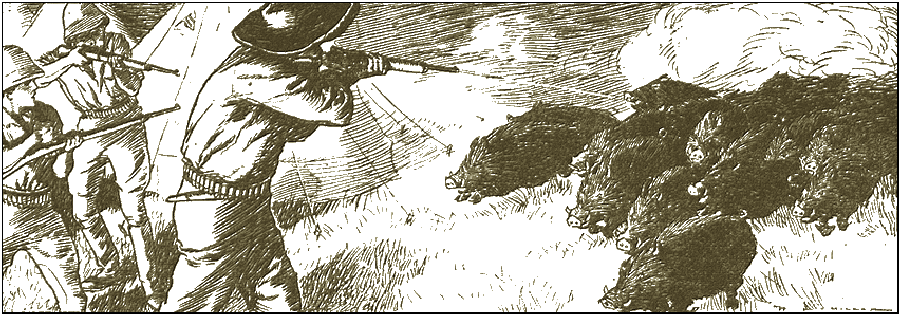
A score or so of dark forms flashed into the camp,
their vicious-looking tusks gleaming in the firelight.
The band seemed to hesitate for a second or so, and then, splitting up into parties, went rushing for various parts of the camps. Their sharp cries of anger, mingled with the cries of dread on the part of the natives, who, however, knowing that it was useless to flee, stood to their posts and poured in a sharp volley of bullets that laid several of the peccaries low. The portion of the herd that was making for the tents was larger than the others, and although at the first volley a few of them went screaming down, the rest poured on, and, bursting through the various openings between the tents, went gnashing their tusks and slashing them hither and thither in an attempt to bring down the men.
Rifles were useless now, and it was a case of revolvers: and even then there was little chance of taking aim. The vicious little brutes dodged about and twisted and twirled with lightning-like rapidity, so that it was more by luck than anything else if a shot got home. It was a case of dodging and firing until there were no more shots left in their revolvers, whereupon the hunters resorted again to their rifles, using them butt-ended.
Little was said in that wild quarter of an hour, during which every man there fought as he had probably never fought before, since once one was brought to earth there would be little hope of escape from those slashing tusks. A dozen peccaries had already been accounted for there, and one or two more had gone pelting off somewhere else, no doubt to join their companions in an attack on another point.
"Stick it, Jimmy!" yelled Rod at that moment; and they were the first words he had spoken since he had pelted back to the tents. His upswung rifle fell and crashed upon the white lips of a peccary which fell squealing away: another rushed for him, and a side swing of the rifle sent the brute spinning away. It recovered its balance with amazing dexterity, and its gleaming tusks sliced at Jimmy, who, fortunately, side-stepped smartly enough to allow the peccary to slither past. He was not quick enough, however, for a second brute rushed for him, and, although his wide open legs let the animal go through, it was not without overturning him. Down Jimmy went with a cry, bouncing upon the back of the peccary, which squealed with fright and rage. Then Jimmy rolled off to the ground, yelped with the pain of a burning hand, as he pressed upon a stick, one of the many that had been scattered from the fire as a peccary had trampled through in its fright; yelped again with real fear as, his head raised a little from the ground, he saw a peccary coming pelting toward him. In that moment Jimmy gave himself up for lost, since he had no time to spring to his feet, and, even if he had had time, his rifle was lying yards away, where it had gone hurtling when he tumbled back.
"Rod!" he cried, as he rolled aside; and then, with a howl Rod came leaping through the air, planting himself before Jimmy and bringing his rifle down with a full-strength swoop that caught the peccary in the middle of the back and doubled it up—while Jimmy, managing to scramble to his feet, dashed for his rifle, and, without loss of time, rejoined the fray, which lasted for yet a while until, although not a man of the whites had been touched, there were piles of the peccaries lying around the tents which had been slashed and hacked and brought tumbling to earth.
It was Hensley who gave the last of the peccaries there its coup de grâce. He had seen the brute emerge from the tent in which he had been sleeping and where his precious picture-taking machine was housed: rage seized the enthusiast, who had somehow found time to reload his revolver. With a roar of rage he broke from the other whites, and, advancing until he was within half a dozen feet, so that Steve Jackson, resting pantingly on his rifle, yelled out to him to come back, he fired point blank at the beast just as it had seen him when it issued from the tangled and torn canvas. Once, twice, three times he fired, and it was the third shot that arrested the peccary in its stride: and then Hensley sprang for his tent, kicking the peccary as he went. He tore away the ribboned canvas, seeking his machine, and finding it, to his great delight, uninjured.
All over the camp now there was silence, that is, silence instead of the shouting of the natives as they fought, and the white men knew that the battle was at an end. Jimmy flung more fuel upon the almost dead fire, and a leaping flame shot up simultaneously with other uprising flames as the natives fed their fires.
Grim was the sight revealed by those fires: all over the camp were the bodies of the peccaries, and the stench of blood and of the strong-smelling gland that is such a feature of the vicious little brutes was nauseating. Here and there, when Steve and Stark Dixon went on a tour of inspection, they found some of their men dead or dying, literally slashed to ribbons by the sharp, razor-like tusks of the peccaries. Altogether, no fewer than ten natives had been killed, and twice as many injured in varying degrees. The medicine chest was quickly put to use, and the wounded men made as comfortable as possible for the night, after which, with white men on guard, the camp went back to bed, though not to sleep as soundly as before. Those of them who were alive knew that they had had a remarkable escape, for the peccary herd had been a large one, and, as all knew, the little brutes were among the fiercest of the inhabitants of the Brazilian jungle.
Rod and Jimmy, lying in the tent set apart for them, tried hard to sleep, but could not, and at last they gave it up as a bad job.
"To think that a lot of pigs like that should upset a camp of a hundred men," grunted Jimmy. "Why, Rod, I think I'd rather face a jaguar than a peccary!"
"You bet!" Rod answered, laughing shortly. "I've heard Uncle Stark say that even the jaguar steers clear of them when they're in a herd, although he'll cut off stragglers, and even then he's pretty cute to kill his victim sharply and give it no time to make a squeal or a cry, 'cause the whole bunch'd come to his assistance. Ugh!"
Which ejaculation summed up the feelings of Jimmy as well on the subject of peccaries.
"Think I'll go over and yarn with Steve, or rather let him yarn to me," he said presently, as he realised that there was to be no more sleep for him that night; and Rod unrolled from his blanket to go with him. They found Jackson cleaning his rifle, with his revolver, ready loaded, at hand.
"Well, kids!" the American drawled. "Nightmare?"
"Very near," laughed Rod. "They're nice little fellows!"
"Little, but not nice, by hookey," grunted Jackson. "And, say, boys, there's a little tit-bit of information for you: up in the Tukul country the peccaries are twice the size of any o' these chaps, sure thing."
"Phew!" breathed the boys in chorus as they stared at him.
"It's the truth, kids," Steve assured them. "Fact is, the won'd'ful thing about the country is that the on'y small things in it are the people. They're pigmies, like these prisoners of ourn, but all the animals seem to hev been reared in hothouses and swelled out. Honest injun, that's so, kids!"
"Pulling our legs?" Rod grinned.
"Not a bit of it, son," Steve told him. "I've seen wild cats that you'd think was tigers, an' rats as big as rabbits. You wait and you'll see, sure!"
There was something in the man's manner, despite his flippant tone, that convinced the boys that he was speaking the truth, although they allowed that he might be exaggerating to some extent. They remembered that many travellers who had put in at Manaos for a rest before continuing their journeys had often spoken of weird sights and scenes and strange animals in the depths of the jungle. Wise in their ignorance, they knew that there might well be all manner of things hidden away in Tukul country, wherever it might be, seeing that, so far as they knew, and according to Steve Jackson himself, he was the only white man who had ever got away, if, indeed, any but he and Nick Turner had ever succeeded in reaching it.
"Tell us some more, Steve," Jimmy implored; but Steve, who had seen the staring eyes of his hearers, shook his head.
"Guess I broke my own word to myself," he said glumly. "Vowed I wouldn't tell you onything about the blamed country, didn't I? An' here I've been an' blabbed some! You'll know all about the show soon—perhaps too soon. But don't worry about it, sons; we're a pretty strong band—strong enough with our guns to scare the Tukuls stiff, I reckon, when once we show up; and I reckon we ought to be able to take care of ourselves against the mammoths of Tukul country. There's this much about it, younkers, I've got a tidy little stunt to play up when we do get there that may help us out. It's that dude of ourn as put it in my head. Hensley's a queer chap—like a kid, ain't he?"
"Well, if you put it that way, he is," Jimmy laughed. "But he's all right; got some pluck."
"Gee, yes," Steve agreed. "Well, seems to me he came on his huntin' trip as though he was goin' on a picnic and wanted to amoose himself. Look at that photo-machine of his'n. I've allus been content to do my huntin' without takin' pictures of it. An'—I never took 'lectric torches wi' me, and who'd think o' yanking a talking machine along into the jungle?"
"What on earth d'you mean?" Rod demanded. "You don't mean that Hensley's got a gramophone in his kit somewhere?"
"That's just what I do mean!" Steve said with a grin. "But I oughtn't t' have told ye, 'cause he wanted to keep the blame thing a secret. Ses he, 'Yew never know, Mr. Steve Jackson'—that's how he spoke them days—'yew never know: I heard once of a man who scared a lot of wolves away through playing on a violin, an' surely if a violin 'ull do that to a pack of wolves a gramophone that speaks in the natural voice'll do something for a lot of uncivilised natives?' Them was the words he used: and—well, kids, I reckon Hensley, for all he's such a baby, was right. Maybe that gramophone 'ull put the fear of the very devils he worships into the heart of old King Conky of Tukul land."
Jimmy and Rod laughed at the seriousness in Steve's voice.
"He hasn't brought a whole cinema outfit with him and a screen, has he?" Rod asked quizzingly.
"Nope; that is, he ain't told me yet," Jackson answered. "Maybe he has, though. That would send old Conky into fits, I bet!"
"Keep on talking, Steve," Jimmy said with a short laugh. "Sure thing, by hookey—and by any other old thing you use when you want to cuss—you'll be telling us a good lot about Diamond City before you're done. You know, you never gave us His Majesty's name before and—"
"Cut that out, kid," Steve barked at him. "An' here, my time's up. Just go and rouse Stark Dixon from his sleep; it's his turn to mount guard. I'm for sleep—an' I reckon you two oughter get I here too!"
Rod went over to his uncle's tent and awakened him, after which he went back to where he had left Jimmy.
"You two tumble into blankets again," Stark said when he came yawning to the camp fire, but when the boys assured him that they couldn't sleep a wink he agreed to let them remain where they were.
"Though I might as well have kept asleep," he growled, "if you're going to sit up. Anyway, I dare say directly you were left alone you'd fall asleep."
For the next two hours the trio kept watch, taking it in turns to go the rounds of the camp to see that everything was all right; and, as this was the last watch, they were sitting around the fire when dawn crept up and showed them the dark forest all around the savannah.
"Go and rustle Copperface and tell him to get brekker on the way," said Stark Dixon, and Jimmy went off to arouse the native, who had been appointed steward to the white men. It was just as he came back to his uncle and Rod that he caught sight of something that detached itself from the forest line a long way off—so far off indeed that for a moment or so he believed his eyes were deceiving him. Then, as he noticed the tiny black dot was moving, he came to the conclusion that it was some wild animal on the prowl for its breakfast. Then something about the figure made him unsling his field-glasses. Without saying a word to the others as to what he was looking at he raised them to his eyes and stared at what was causing him interest. For a few moments he looked, adjusting the focus, and then, still staring, he cried out:
"Uncle—there's a man—out there—and—"
"Here!" snapped Stark, springing forward and taking the glass from his nephew. "Let's have a look—go rouse the camp in case of— By Jove!" He paused and remained looking through the glass as though petrified.
"Fetch Steve here, quick!" he jerked, and off like the wind went Jimmy, to come rushing back with Jackson, who, quick to understand that something of importance was happening—Jimmy had merely told him, in the hustle and excitement, that his uncle wanted him—gave one glance out towards the jungle line, saw the figure, which was now moving so quickly that even at that distance it was possible to see that whoever it was he was running, and then, as Stark Dixon held out the glasses, Steve took them with shaking hands, though he could not have told himself why he should have been so concerned. After all, it might be quite an ordinary occurrence in such places to see natives issuing from the forest.
But the first look through the glasses told him that was no native, and, as he looked, his breath came in short gasps. He kept the glasses levelled, but half turned his head and looked at Stark, a strange light in his eyes.
"A white man?" Dixon jerked. "A white man—there!"
"Yes, a white man—there!" echoed Jackson. "And, by hookey, it's Nick Turner!"
"I TELL you that man's Nick Turner!" roared Steve Jackson as Dixon and the boys stared at him in amazement and incredulity. "D'you think I don't know him and— Come on, out after him!"
With a bellow that brought every Indian dashing up, wondering what was afoot, and Hensley and Farrar tumbling out of their tents, Steve was swinging off across the savannah, the rest of the company trailing after him.
As he went Jackson, as excited as a schoolboy, shouted as loud as he could, though he must have known that the moving figure out there could not possibly hear him at that distance. It was evident, however, that Nick Turner, if it was he, had realised that the crowd of men approaching were intending to get into touch with him, for, suddenly, he stopped and waved his arms frantically in the air, then cupped his hands, as Jimmy saw through his glasses, seemingly shouting out something that was not, however, heard. Then he started off on the run again, if it could be called a run, since it was quite apparent that he was having difficulty in making progress, stumbling and limping along as if one of his legs were injured.
"We're coming, Nick!" howled Steve, madly spurting forward.
Even as Steve spoke there issued from the jungle behind the fleeing man a swarm of smaller dots, which moved at a rapid pace, following hard in the wake of Nick Turner, and spreading themselves out in a wide crescent.
"The pigmies!" cried Rod with a jerk.
"Ay, the Tukuls!" gasped Steve, and the Indians, when they realised that those moving figures were the dreaded pigmies who had attacked them so relentlessly a few days before, showed signs of trepidation.
Stark Dixon, swinging round in his tracks as Steve raced on, with the boys hard at his heels, showered scorn upon the natives who were hanging back: he whipped them with a lashing tongue, promised them all manner of rewards if they but took heart of courage, and at last he intrigued them to set forward again.
"Go on, Steve!" Stark bawled, but Jackson needed no urging. He was pounding across the spongy plain, fuming, imprecating all and sundry, and spending all his energy to reach the man whom he had promised, no matter what might be the danger, to rescue from the clutches of the pigmies.
"They've got him!" cried Jimmy a moment after his uncle's voice had sounded.
The swift-footed pigmies had overhauled Turner who—whether he was armed or not none could tell at that distance—had turned about and faced the enveloping enemies. His would-be rescuers saw him lunging wildly and terrifically into the mobbing Tukuls, and they wondered whether he would be able to keep up the unequal battle until they reached him.
Then came the disaster.
There had been no hint of what was coming. The sky was cloudless and the air still, with a scorching sun, despite the early hour. Away in the trees near the camp the monkeys and birds were chattering and chirping as noisily as ever. So, when it came, the great wind storm that burst with shattering force upon the savannah was a surprise to everyone in the party, even the Indians. Like the booming of big guns it began, and the blast of the air as it swept across the plain flung the running men to the ground or knocked them into one another.
As often as the men tried to pick themselves up they were hurled down again, bruised and battered. Even as they lay on the ground they were picked up as the wind, increasing in strength and volume, caught them and flung them whither it would. Howls of fear surged from the natives, and even the white men knew the terror of this implacable enemy. Steve Jackson and Stark Dixon were passing through an inferno of torment, since they realised that this wind-storm had probably robbed them of all chance of rescuing Turner, even if, in his evidently weak state, he survived it. It was true, they reasoned, that the storm would affect the pigmies as well, though, seeing that they were nearer the forest belt, they might be able, when the storm had spent itself, to get away with their prisoner, if they had succeeded in taking him or if he had been rendered unconscious when he had got flattened to earth. Several times the two men tried to raise themselves up, but were knocked down again. Then Steve, with firm-set mouth, began to crawl along the ground, or, rather, to wriggle. For a few yards he went, but it was at terrible cost in strength, and at last he gave up, knowing the hopelessness of it all.
For three hours the scattered, scarred and half-choked company lay there on the ground with the thunder of the wind in their ears. Above them the sun still shone, and there was not a spot of rain. All was as clear as before—only that furious gale blew and boomed, while ever and anon, above the roar of it, there came the sharp staccato crashes that told of mighty jungle giants uprooted and swept down into the tangle of the forest.
With heads buried in the ground, the unfortunate men, red and white alike, lay there waiting. . . .
And then, as suddenly as it had arisen, the storm died down; and the effect was weird in the extreme. Above them, where they lay, the roar ceased, but they could still hear the thunderous sweep of it as it spent itself among the trees afar off, seeming like the sound of retreating guns, firing as they
went.
It was Rod who first sat up and stared across the plain.
"The pigmies are there, Steve!" he cried excitedly, pointing to little dark heaps lying far out on the savannah.
Jackson and Stark and Jimmy hunched themselves up from the ground and followed the direction of his pointing hand. They watched for a few moments, and seeing no movements on the part of the tiny heaps they knew that there was more in the fact than Rod had guessed. It was Stark Dixon who voiced the feelings of the others.
"Those fellows are probably dead," he said grimly. "The others—"
"Have got away somehow into the jungle—and poss'bly with Nick!" put in Steve tensely. "Come on, the lot of you; we go see!"
A loudly shouted command brought the Indians to their trembling legs, and with Hensley and Farrar—both of whom looked very woebegone and torn—sticking to their heels, the other white men sprang forward, followed by their band of natives.
After the terrific buffeting they had all received it was difficult to make rapid progress, but at last the two miles or so were passed, and they stood staring down at the grim blotches that once had been living men, but were now choked, suffocated, battered corpses. There were quite a dozen of them, and beside them lay their blowpipes and bows and other weapons which evidently their companions had not troubled, or had not had time, to gather and take away.
For a few moments the white men stood staring at one another as though not daring to ask the question that lay ready for asking. At last Rod broke the silence.
"Nick Turner's not here!"
It was the obvious that he spoke, and even those who, like him, had never seen the missing man, knew that neither of those dead forms was that of Nick Turner.
"What's become of him, then?" Jimmy jerked, shivering a little: it seemed a thing to wonder at that a man could disappear so completely. "There's no trail to show how he—"
"Of course there isn't, son," Stark Dixon broke in. "That wind-storm was strong enough to wipe out every single trace of footprints. Here's the fact: Nick Turner has gone, and with the exception of those poor devils, the Tukuls have gone too. They've gone into the jungle, and it's into the jungle after them we've got to go!"
"As sure as we're here, that's so, Stark," Jackson said. "An' it's no good goin' like a bull at a gate at it. We must go ahead as we were intending. Seems to me Nick must either not have been captured, as that skunk of a Tukul told me, or else if he did, he escaped again, and the hull nation come out agen after him. Poor ol' Nick; it's a dirty trick for the gods to play on him after lettin' him git so far an' then be hauled back. But—we'll get him!"
If was with that resolve or promise, call it what you will, that the white men led their natives back to camp—to find it in a state of confusion—and worse. The bell tents had been picked up and flung far away; everything else had been scattered in a hundred directions. Some things were smashed and torn, tinned goods had been banged against each other and smashed open, and poor Hensley was in a frantic state of mind over his precious kinema machine and his gramophone and records. It was only because he insisted upon having the strong case, in which the records were packed, opened to see if they were all intact that made him reveal to the other whites, who had not known, with the exception of Steve, the fact that he had brought the gramophone. Fortunately for him and—as it was to turn out—for the whole expedition, both his kinema and his musical instrument were uninjured, and to celebrate that he put a record on his gramophone to the tune of which the natives, who were not a little amazed, if albeit a little scared at this strange device of the white man, put in good work at gathering the scattered goods and getting the camp something like ship-shape. The while that Copperface, after dancing a war-dance, reminiscent, no doubt, of his days of savagery, fell to at preparing the white men's breakfast in which he had been interrupted.
"Look here, Farrar," Steve said between mouthfuls, "you've done a tidy bit o' huntin' since we came out; s'pose you cry off that, and we push on all we can until we get to Tukul Land? Do the huntin' coming back—if we do come back!"
"Put it there, Steve," Doctor Farrar said grimly. "I reckon I'm as dead keen on getting your friend Turner out of the Tukuls' hands as you are now. You and Stark here are the sort of pals a man should want to have!"
"Thanks," Jackson said, with a wry smile. "You're a hunter, Farrar, as well as a medicine man, an' you ought to know what it is to have a mate the kind o' mate who'd yank you out of the jaws of a lion. That's the sort o' fellow Nick Turner is, ain't it, Stark?"
"It is, Steve," Dixon replied; and the other whiles realised more than they had ever done how strong were the ties binding these two with the man they had vowed to fetch out of bondage.
NOW that the white men had made up their minds to press forward with all possible speed to the Tukul country, it was a case of forced marches—if one can call such progress as theirs forced when it was a case of still carving a way through the virgin forest. The havoc that the wind storm had made was appalling, and, accustomed as Steve and Stark were to scenes of destruction in the jungle, they were just as much astonished as the boys and the other two men. Great tall trees, wide girthed, had been wrenched from their footholds and lay locked in among the trees that still stood; these were too densely growing to allow the uprooted giants to fall to the ground, so that they were hanging, as it were, with their heavy heads caught in trunks, and seemingly ready to tumble down upon the men who were forced to pass beneath them. Here and there dead beasts, smashed by being crashed against trees, were found, and where once, no doubt, had been gorgeous blooms there were now almost denuded vines.
"Some storm that," quoth Farrar. "Say Stark, I've been in typhoons in the South and blizzards up in the North, but I reckon this is as nasty a mess as any I've seen!"
"These wind storms are about the worst things you can meet when they are real ones," Dixon told him. "I've seen whole villages simply picked up and scattered, and when a storm like that sweeps across any of the big lakes that are knocking about the country—well, you'd think you were in Biscay or worse."
"How far d'you think Tukul Land is from here?" Hensley asked Steve. They were sitting down waiting for the trail that was being blazed for them by the natives. "I'm keen on seeing that show."
"If we make as good progress as we have done this last week," Jackson said, "we ought to get there in about another week. Of course, those Tukuls who nabbed Nick again may give us a little scare yet, but I somehow don't think they will. You can bet they've hiked it for their old mountain—you'll see their Mount of Olives when we get there—to give the warning of our coming. When we've worked our way through for a few more miles we'll have an easier journey, 'cause we'll have the river to go on. These natives'll carve us some canoes out of trees, and it won't take long. What gets me is that we haven't seen a trace of the way the Tukuls went—though perhaps it ain't so s'prising since you could lose an army in this jungle if you didn't spot the last man trailing in!"
It needed no words of Jackson's to convince his hearers that he spoke the truth, and it was because of the ease with which one could get lost that it had been agreed that there should be no straggling behind, no wandering away from camp alone, for fear of not being able to find a way back. The trouble was that, since it was the rule that all should keep together, everyone was so accustomed to expecting it to be observed that on that day for over an hour neither of the men had noticed the absence of Rod and Jimmy, who had been last seen up toward the band of workers, the second shift of labour. It was only when the time came for the third shift to take up the work that Dixon, who had strolled up to send back the second, while Steve superintended the loading of the first shift, who were to carry up the goods to the point to which the path had been cut, remembered seeing the boys somewhere near there, although they were not there then. He knew, too that they were not down at the "base."
"Where are the young bosses?" he asked the foreman of the shift that was going back to rest. "They were up here with you a while ago."
"Yah, boss, them were," Jose answered. "Them see big butterfly—bu-ful butt'fly. Them go for eet."
"The young fools!" snapped Stark angrily. "Hi, Steve," he called out as he hurried back, "blow that old bugle of yours." And Jackson, who had brought a bugle with him for such emergencies, blew a terrific blast that swept through the forest and echoed and re-echoed. The whole party listened intently for an answering hail, but none came, and though the bugle was blown time and time again still there was the deathly silence of the jungle and only that.
"What're we to do about it?" Stark said anxiously, after about ten minutes of this kind of thing. "If we started from the spot they started from we'd probably never find 'em; these lianas fall back like curtains and leave as little trail as one does swimming. Yet we can't waste time by waiting; we've got to do something!"
"Sure thing," Steve answered, with no less anxiety. He had come to love the two youngsters, who all through had proved themselves hard workers and fearless in everything. But it was left to Copperface to reach the limit of concern.
"What, young bosses them lost?" he roared when they told him. "Then Copperface him die!" and the big hulking native broke into tears.
"That won't find 'em, Copperface," Steve said quietly, while Stark Dixon felt a lump in his throat as he realised the sincerity of the native's emotion.
Copperface pulled himself together at the words, and his shiny face was set firm and his big eyes blazed.
"You'm right, boss," he said. "Copperface go find young bosses. Show me where them go." And Steve, who knew from of old that his native servant and friend was a good tracker, went with him and Dixon up to the place from which the two boys had suddenly darted off after the elusive butterfly.
"You're not going alone, Copperface," Stark Dixon said firmly; but the native shook his head.
"Me no get lost," he said. "Two in way; one mebbe lost."
"What d'you say, Steve?" Stark asked; and Jackson, albeit it went against his own inclinations, told him that Copperface was right.
"He'll probably do much better alone," he said, "than if any of us went with him. I'll let him take the bugle so that he can keep in touch with us. One thing, the kids haven't been gone above an hour, and they can't have got far in this tangle."
"That's what I can't understand," Stark said nervously. "They oughtn't to have got so far they couldn't hear the bugle. Suppose some of those Tukuls were lurking in the jungle and trapped them?"
"That's what I've been thinkin', but didn't like to say," confessed Jackson. "An' for that reason, Stark, Copperface'll do better alone. One feller can go quieter 'n two. An', Stark, if the Tukul's hev got 'em—alive, I mean—then, s'long as we make good progress, we kin p'haps catch 'em, 'cause I here's a river to cross, and there's on'y one place that I know of where it kin be crossed: that's where I'm steering for. Here, you nip off, Copperface," he turned to the still waiting native. "If you find the boys, come back to this place; we're going to keep on, but we'll leave Boss Farrar and some o' the carriers with him to pick you up. If anything's happened to the boys, an' you can't help 'em—say, if the Tukuls hev got 'em—you'll come back jest the same, only you'll hurry some!"
"Sure, boss," said Copperface, and he disappeared in among the tangle of the jungle.
"Carry on, you black chunks!" Steve told the workers, and while the path was being cut farther he and Dixon, sitting in camp, were telling Farrar what they were planning.
"You never know what may have happened," Stark said, "so Steve's scheme is that we push on as ordinary, and if you're willing, Farrar, we'll leave you here with twenty natives and—"
"Willing?" Dr. Farrar burst out; and the others knew that he was ready to do anything.
"Thanks," said Dixon simply. "Of course, everything may be all right and the young fools turn up O.K., but if Copperface comes back to you and we're far away, send the slickest of the natives after us with the news. Steve says that the Tukuls must cross the river—that's about five miles from here—at a particular spot, so he and I and twenty of the natives are going to push straight ahead, since Steve knows the way better than I do, and get to that ford."
The plan of operations was forthwith put into execution, and meanwhile out there in the jungle strange things had been happening. When Rod had caught sight of the most beautiful butterfly that he had ever seen, even in that breeding ground of butterflies, he had darted off with Jimmy, who was no less enthusiastic on the capture of the insect, close upon his heels. The butterfly was as elusive as a will o' the wisp and led the boys a pretty dance, and in the excitement of the chase neither of them realised that they were pushing their way into the depths of the jungle and losing all sense of direction. It was only when, by a smart piece of work, Rod had managed to catch the insect by clapping his pith helmet over it, and having placed if carefully in a small tin specimen box, that they looked at each other with fear written large on their faces.
"Gosh!" exclaimed Jimmy, "we're lost, Rod! I haven't the least idea of direction."
"Nor I," Rod told him with a quavering voice. "And there's nothing to guide us. We can't see even the sun through this tree curtain."
"Maybe we can pick up our trail—we must have made a mess of things generally the way we smashed through," Jimmy suggested; and they both began to follow the snagged-off twigs and so forth that indicated their progress through the forest. For half an hour or so they did this, shouting at the top of their voice the while, but at last they realised that, running not always one behind the other, they had made more than one trail, which, getting mixed here and there, had effectually rendered it an impossible feat to extricate themselves from their situation.
They sat down from sheer weariness, feeling that they hadn't another spurt left in them and that their legs would not carry them another yard.
Rod shuddered, though the day was hot and he was wringing wet with perspiration.
"Jimmy—if—we're lost," he said shakily, "do you think—they will—find us?"
"I—don't—know!" was all that Jimmy could say with hope in it. "We were fools to come, Rod. If we had brought one of the bugles it might have been different, but—there you are, we didn't."
"We'll try again soon," Rod said, licking his dry lips with a parched tongue. "We daren't stay here and trust to them finding us or—"
"I don't know that we ought to try to find ourselves," said Jimmy haltingly. "Oh, hang it all, Rod, what's the good of trying to bluff ourselves. You know the old legend about forest madness, how people who're lost go chasing round in a circle and get more lost than ever. We're in a rotten fix, and that's the truth of it."
The boys looked at each other, biting their lips as though trying to keep back the display that they felt they wanted to make. For a while they were silent, and suddenly Jimmy sprang to his feet and shouted through cupped hands. His hail went throbbing through the jungle, only to come back to him in an echo that was maddening.
"Shall we try again, Jimmy?" Rod suggested, but Jimmy shook his head.
It was at that moment that from afar off—to their sensitive minds it seemed miles and miles away—there came the weak toot of a bugle, and never were boys so pleased to hear a sound as they were to hear that.
"We're all right!" cried Rod excitedly, getting upon his feet. Together then they howled and raved, positively exhausting themselves. They made no movement, however, to go to find their comrades, because, as they knew, the sound of the bugle was too elusive to serve as a guide.
"We'll stay here and yell," Jimmy said between a chorus of cries. "Uncle and Steve'll find us for certain."
So once more they broke forth into a chorus, pausing now and again to catch the bugle call. At last, however, that stopped too, and though they listened intently for some time it did not come again.
"What's it mean?" Rod asked; and all that Jimmy could suggest was that their calls had been heard and the seekers were coming. "Then they'd jolly well be blowing as they came," Rod rapped. "I don't like it, and—"
He stopped abruptly, or rather his words were drowned in a chorus of cries, and both boys, spinning round at once, saw that which caused them to snatch up their rifles from the ground. But before they could lift them to fire they were borne to the ground by sheer weight of numbers as a swarm of pigmies flung themselves on them, yelping their strange cries. Small though the Tukuls were, they were possessed of amazing strength, and despite all their struggles the boys realised that they were impotent because of the numbers opposed to them. True they flung the little men in all directions, but their rifles lay upon the ground, knocked from their grasp when the Tukuls had leaped upon them, and they had no time to pick them up again before the herd was on them. Down to the earth the boys went, tripped up by the little men, who wriggled along the ground and jerked their legs as they were pummelling into attackers; and at last, after a fight lasting for something like five minutes, Rod and Jimmy lay senseless on the ground, rendered so, not by the hand-to-hand combat, but by heavily knobbed arrows shot from bows—arrows that they knew .were used by many South American tribes for the purpose of stunning when they did not want to kill.
ROD DIXON opened his eyes painfully and stared about him, tried to throw out his arms as though to steady himself, as his half-gathered wits suggested that he was tumbling down some precipice that had yawned suddenly at his feet. Then the sight of brown, greasy pigmies brought back recollection of that struggle for life against the little men who had attacked them just at the moment when they had thought themselves in the way of being found. Before him was a long line of the tiny natives hauling at ropes, by which he knew in an instant they were dragging him along the bumpy ground—a motion that, in the first second of consciousness, gave him all the sensations of sea-sickness, and he realised that he could not move his arms because they were bound to his sides by lianas. He could see too that he was lying on a roughly made mat constructed of branches and leaves, and a quick glance to the right showed him that Jimmy Feltham was being transported in a similar way.
"Well I'm hanged!" he muttered.
"Not yet, Rod," came Jimmy's voice; and Rod, who had imagined from the way Jimmy was lying that he was still unconscious, started slightly. At the sound of Feltham's voice several of the pigmies turned round and looked at him, while others, who seemed to be acting as escort, closed in around the imprisoned pair.
"Anyway, we're in a nice pass, Jimmy," Rod growled, and somehow there was not nearly so much fear in his voice as there had been away back—how long he could not tell—when he had known they had lost their way in the jungle. Jimmy sensed the spirit behind the tone of his comrade's voice and grinned a little wryly.
"Not much of a finding, Rod," he said. "These fellows are Tukuls, sure enough, and you can bet they haven't bagged us for the fun of the thing."
"No-o," Rod agreed haltingly. "Say, Jimmy, why didn't the beggars—er—kill us right off? They could have done; there are enough of them to have done what they liked."
"Which I reckon is what they have done!" was Jimmy's reply. "Rod, old chap, somehow I feel that they wanted to take us alive; they're going to hike us off to their beastly city, wherever it is. You remember Steve told us how—anxious, let's say—they were to keep him and Nick Turner, because of what the white men could do and did in the country? Well, why shouldn't they want to get us there? Natives are queer cusses, and when they're like these, who've seen no white men before except Steve and Turner, they often almost worship them."
"Perhaps you are right, Jimmy," Rod agreed. "But I don't fancy being the Tukuls' god! Only thing is, our crowd's making for their country, and I'd back all I ever owned that Steve and uncle, at any rate, 'll get there."
"And a lot of good two of 'em alone would do!" Jimmy grunted. "However, Rod, it's no good grousing. We're in the cart. It's for us to play the game artfully, and maybe we'll manage to get away somehow, though goodness knows how we'd ever find our way through the jungle. We haven't a compass, as Steve had!
"Anyway, we'll trust to luck. And, say, Rod," Jimmy went on, "these fellows don't seem to want a compass. Look, it's a regular trail they're following!"
Rod saw that Jimmy was right. The pigmies were going at a tidy pace without having to do anything more than push aside a curtain of lianas, and both boys realised that if only the expedition had hit upon that trail the work would have been nothing like what it had been and the progress would have been considerably quicker.
"Evidently this is a trail the Tukuls take when they go out on their occasional raids that Steve told us about," Rod said. "Hallo—here's his nibs!"
For the life of him Jimmy could not help joining in the spontaneous laugh that slipped from Rod at the sight of the queerest looking little man one could ever hope to meet. He was not an inch taller than four feet, but pot-bellied with it, and a head like that of a strapping six-footer. On top of that massive head was a pith helmet, sadly soiled. In his hand he carried a big Colt, at which the boys stared for a moment or so, trying to puzzle out where he could have obtained it. Then the thought came to them: both that helmet and the revolver were no doubt the property either of Nick Turner or Steve Jackson, and they wondered whether "his nibs" could use the weapon, whether, indeed, there were any cartridges left for it. In his other hand the pigmy carried a sapakana, and slung on his back was a five-foot blowpipe, besides a bow and a quiver full of arrows.
"Some warrior chief!" said Jimmy beneath his breath.
"King—or prime minister at least!" Rod said, as the pigmy strutted down past the still hauling lines of his fellows. He had evidently been well in advance among the score or so of little men who were the vanguard of the "army," and no doubt word had been sent along to him that the white youths were awake. It was really laughable, despite the serious situation of it all, to watch him as he came. He fingered the Colt and wagged it about, clicking the trigger at almost every step, and as he got nearer the boys realised, to their relief be it said, that the weapon was unloaded, or else half the little man's fellows would have been knocked out! He also waved the sapakana over his head, and it was apparent that he wanted to impress the youngsters. He failed, however, although the boys, realising that it was no game they were engaged in, managed at great effort to keep straight faces. They lay where they were, being drawn along to the dire suffering of their bodies as they were snagged against tree trunks and bumps in the ground, and waited for the weird creature to reach them. He did so at last, and, swinging round—or, rather, prancing round—he dropped into step beside them.
He jabbered and chattered, twirled his revolver, shook his broad, flat sword, doubled himself up, straightened out, lifted his hat and waved it, the while he danced about—to the confusion of his captives, who wanted to burst out laughing, but dared not. That this pigmy was a Tukul they had no doubt, since now and again amongst the unintelligible tangle of gibberish that he was mouthing they caught a distorted English word, and once "Neek!" which they knew he must have caught from Steve.
After the pigmy had been carrying on in this way for some time, and exhausting himself, Jimmy, who was nearest to him, shook his head several times, indicating his ignorance of what was being said, and the little man promptly shut up. He still remained walking by them, however, and the boys were amazed at the speed with which the pigmies covered the ground, despite the fact that they were hauling them.
"Wonder who's got our guns?" Rod said presently; and Jimmy could but shake his head.
"Let's hope the beggars who have don't try his nibs's tricks with 'em while they're near us," he said. "Every time his dusky majesty wags that Colt I shiver down my spine. Hallo, what's up now!"
The haulers came to a sudden halt, and raising themselves as much as they could, being securely bound to their mat sledges, the boys saw that all the pigmies had halted as well. The pigmy chief, or whoever he was, hastened on up to the vanguard, and for a few minutes there was an animated conversation, at the end of which the haulers began dragging the boys along again, the other little men opening out, pressing back into the fringing jungle to allow them to pass. Wondering what was about to happen to them, whether, indeed, they had reached the Tukul country—although a moment's reflection told them that that could not be, unless they had been unconscious for days!—the boys stared about them as they went, and when they reached the front of the line they understood what was to take place. Before them lay a river, and as several pigmies were already wading through it, the water reaching up to their chins, they realised that it was fordable at that point. What amazed them most of all, however, was the sight of a tall man striding through the water, his hands tied behind his back and something drawn over his eyes to keep him from seeing, while in front of him and behind him were a dozen pigmies, each one of whom held a liana rope, evidently for the purpose of preventing their prisoner from escaping.
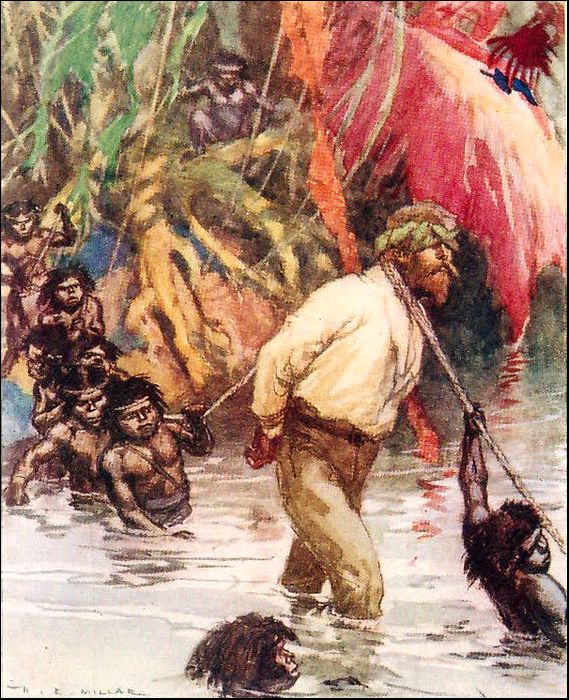
A tall man striding through the water,
his hands tied behind his back...
"Nick Turner!" snapped Rod instantly; and at his voice the man, albeit he was unable to see, turned round—to the consternation of the pigmies, who held on to their ropes with main force, those in front hauling at them so that Turner, who had a rope round his neck, was compelled to look forward again or else be choked!
"Who are you?" the man shouted.
"Friends!" howled the boys together, and with a rush the pigmies were upon them, smashing at them with their broadswords. By the time they had finished this Nick Turner, for the boys had no doubt that it was he, was on the farther bank of the river, and Rod and Jimmy saw the pigmies hurl themselves upon him, trip him up, truss his legs, and fling him upon a mat similar to that on which they themselves were lying.
"My word," gasped Rod, "these little chaps are businesslike, whatever else they may be."
"And they can use those wretched swords of theirs," groaned Jimmy. "Here, I say!" he bawled at half a dozen of the little men who fell upon him and began fastening ropes at all parts of him. "What's the game?"
The pigmies merely jabbered unintelligibly in reply, and Jimmy, grinning a little, said:
"They're going to serve us the same as they have done Nick Turner—that's the game, Rod!"
In which surmise he was right, for after binding up his eyes with broad leaves and fixing lianas upon Rod, the pigmies unfastened his legs and signed to him to get up. Knowing that it was useless to do anything else but obey, the boy did so, and got upon his feet, whereupon a strong group of pigmies went in front, another lot hung behind, and at a sign from the chief they moved forward, those in front dragging Rod on. He went splashing into the water then, and presently found himself on the farther shore, where he was treated exactly as he had seen Turner treated. The leaves were then taken from his eyes, and the first thing he saw was Jimmy being led and driven across stream. The next thing he saw was—Nick Turner staring at him from where he lay on his mat.
"Well I'm derned!" the man said, with a gasp. "White boys! White! Who are you—where have you come from?"
For some reason, now that he was over on this bank, the pigmies did not seem to mind the boy talking to the white man, for when Rod began to speak they took no notice—did not fall upon him and thrash him with their swords.
"Are you Nick Turner?" he asked quickly.
"You bet—glory, but to bear a white man's voice, and English too!" was the shouted reply. "Out with it, sonny—out with it. Who are you?"
"We're two of a party led by Steve Jackson," Rod began; but pulled up short as Turner broke forth into a roar of laughter. Rod looked at him in astonishment, wondering what there was funny in his statement—whether, indeed, the man had gone mad. He soon knew, however, what it was that had caused Nick to laugh.
"My word, younker, won't King Conky be mad!" he said. "Tell you why later on. Get on wi' yours!"
In brief words Rod told Turner what had happened, and when the man heard that his old friend Stark Dixon was coming, and that the boy who was speaking to him was Dixon's nephew, he nearly went wild with delight.
"Knew Steve 'ud come back," he bawled. "Knew it as sure as the sun rises. But, lor, never dreamt my old pal Stark 'ud come with him. Where are they?"
It was Jimmy who told him that—Jimmy, who by this time had been landed and was being trussed up again. He talked while this was being done, making no attempt to struggle or free himself.
"So you are Nick Turner?" he wound up. "Well, uncle and Steve will be mighty glad to see you. You don't know how mad they were when that wind storm stopped them from reaching you. The thing is, will they be able to do anything now? There's two less whites, you know."
"Steve 'ud do it alone, don't you fret!" was the confident reply of Turner. "Snakes, but to think of it. To think of it. Glory, kids, but if you are prisoners, what's it matter? We're all together; we're company—you don't know how much I wanted white company—and besides, Steve and Stark will come along some old time, and then—well, then we'll show these Tukuls something, and old King Conky'll lose his hat!"
There was something infectious about the man's spirit that the boys caught, and they roared with laughter with him. He seemed so utterly oblivious of the dangerous situation and did not appear to look forward to any trouble. The fact that Steve Jackson and Stark Dixon were coming seemed to be all sufficient for him.
"From all that Steve told us," Rod ventured after a while, during which more of the pigmies were coming over, King Conky, however, still remaining on the other side—"from all that Steve told us, Tukul land isn't a joke, Mr. Turner."
"Mr. Turner be hanged!" growled Nick. "Nick I've always been to Steve and your Uncle Stark, an' Nick I'll be to you. Remember that. Well, boys," as they laughed joyously, "Tukul country ain't what you'd call the promised land, but by glory it holds some things worth having. Sure, an' I'll bet Steve told you about the diamond an' the god and the fever cure, eh?"
"He did that!" Jimmy said, "though, honestly, Nick, it wasn't with any thought of that sort of thing that our crowd came out and—"
"Don't I know it?" bawled Turner. "Don't I know you've come out for me? Forget it. I'd rather get away from Tukul country without a blessed stone or a dust of gold than stay there with all the lot of it at my feet—though, kids, I will say this: that when I go I'd like to carry along wi' me as much of that fever cure as I can; it 'ud be the makin' of things in some parts of this wonderful old continent. Anyhow, we'll see; we ain't out o' it yet, and—by glory, what's that?"
That was the report of a rifle that rang loud and clear from across the river and rolled in echoes. Simultaneously with it there had come the scream of a man, and the three captives, looking across the river, saw one of the Tukuls throw up his arms and go sagging to earth. Then came another shot, followed by several more, whereat the whole crowd of pigmies on the other side began to rush down into the water, screaming, yelling, splashing, striving their utmost to get away.
"You bet that's Steve got here!" bawled Nick Turner. "The fun's begun!"
A VOLLEY of shots followed the pigmies as they splashed into the water, and several of them went slumping down. Those on the bank with the captives seized their weapons and sprang for cover, leaving the prisoners where they were; but, since there was no sign of the white men and their followers, the pigmies could do little.
"Steve's keeping doggo an' hopes to knock off as many o' the little men as he can first go off," Nick Turner said. He was struggling in his bonds as he spoke, and the boys, seeing him, began to do the same. They tugged and twisted till the lianas bit into their skins, but they could not get free; the pigmies knew how to tie knots!
The first batch of the fugitive pigmies that reached the bank saw them struggling, and King Conky, who was with them, evidently realised that it was not at all impossible for them to free themselves, barked out something that sent the scared men to the long ropes attached to the mats, and beneath the fire that still kept up across the river they hauled away at them and dragged the captives into the shelter of the trees.
By this time the rest of the natives had crossed the ford and scuttled to shelter with their chief, who now displayed some sort of strategy in warfare. The three prisoners had been wondering what the pigmies would do once they were all over, and they soon knew. It was Nick who told the boys what the natives' plans were.
"Conky's goin' to keep his men tucked in among these trees," he said, after listening to the gibberish of the chief. "You see, sons, this is the only place where the river is fordable, and Steve's crowd must come this way, unless they waste time makin' rafts or canoes, which they won't do, you bet. Conky's lot can shoot 'em down as they come across. That's the idea!"
"Let's hope Steve'll understand!" Rod exclaimed. "Can't we tell 'em? They'll perhaps try to get across, and then—"
Rod's words were choked back in his throat as, with a rush, a number of pigmies flung themselves upon him, at the same time that others fell upon Jimmy and Turner, muffling them with leaf gags. It was quite evident that the natives had realised that it would be possible for their prisoners to warn the coming foe, and to prevent that they were taking necessary steps. The boys grasped now, if they had not done so before, that there was a deal of truth in what Steve Jackson had told them about the cunning of the Tukuls.
After they had thus dealt with their captives the pigmies settled down to wait for what might happen next, and for a while there was silence, except for the chattering of birds and monkeys and the occasional scream of a wild beast somewhere in the jungle. The sentries, posted so that while they themselves were concealed they could see across the river, remained stationary, and the rest, scattered among the trees, stood all ready for battle. The prisoners were where they could see nothing, and they were tense with excitement and anxiety. They knew that not only were their friends in danger, but that they themselves, if their friends were defeated, were doomed to captivity among the Tukuls. It was not a pleasing prospect.
Then suddenly a sentry standing close by Jimmy made a curious clicking noise with his mouth, and instantly dozens of the little men sprang from their hiding-places and slipped to the edge of the jungle fringing the river. Followed silence again, though, had the prisoners only known it, the natives were speeding arrows across the river at a band of Indians—the white men's band—that was splashing through the water, while on the bank behind them Steve Jackson and Stark Dixon, together with Hensley and Farrar, were standing behind trees watching their company's progress. Watching, that is, until the first flight of arrows had come; and then the rifles of the white men and of several of their followers, concealed with them, spoke, and bullets whistled among the trees.
"They've tumbled to it," Rod breathed to himself, and as he heard several heavy thuds on the ground he knew that some of the shots had gone home, although they had been fired at random.
Pandemonium now reigned. The pigmies yelled their war-cries, the natives trying to cross the river shouted shrilly, and the sharp barking of the rifles mingled with the other noises. How the battle was going on the captives could not tell, except that they judged that if their comrades were making any progress at all they ought to have been over the river by now. They did not know, however, that the shower of arrows and poison darts sped over by the pigmies had been thick enough to cause the expedition's natives to hesitate, then to fall back a little, finally to break. It was only when the three heard the faint sound of Stark Dixon's voice, and then that of Steve's, urging the natives on that they realised how the tide of battle was going, and confident as they had been beforehand, they now began to doubt. Turner especially was gloomy, because he knew the difficulties of that ford when defended by determined enemies, and he also knew the fighting qualities of the Tukuls.
For a while longer the fight went on, and apparently the attackers were not getting the best of it, until suddenly a number of the Tukuls made a rush for the guide-ropes of the mat sledges and began to pull at them, going into the forest.
"Glory!" muttered Turner. "Our chaps are coming across—sure!"
The same thought was running through the minds of the two boys, who believed that this frantic haste on the part of their haulers, while the rest remained behind still fighting, betokened the fact that their friends were making headway and that the Tukuls were anxious above all things to retain the prisoners. On and on through the jungle the pigmy transport party went with little concern as to the comfort of their burdens, and the captives, instead of being downcast at this precipitate flight, knew a fresh sense of joy, since it meant that their friends were getting the victory.
That was indeed the case, for when the natives had fled Steve and Stark had rushed from the shelter of the trees, where they had been doing good work in keeping the pigmies harassed, and behind them the rest of the Indians pounded, right down to the water edge. Then the whole company waded in, and those who had been compelled to turn back swung round again and joined in the fording. They pressed on through the shower of missiles—those of them who did not go slumping into the water, either dead or to drown, or maybe to crawl back to die of the poison that tipped the arrows and darts. Those who had rifles had ceased firing, concentrating all their efforts on getting across and then joining issue with the enemy.
It was impossible to spread out far because the ford was not very wide, but with amazing courage the red men, set a splendid example by the whites, plunged on, and at last had gathered in a group on the other side.
"Fire!" yelled Steve, and a volley swept into the jungle, from which a much weaker fire of arrows had been kept up—apparently, as Steve Jackson worked it out, because the Tukuls had gone, leaving the rear-guard to do the harassing as long as possible. A few cries and groans told that the fire had taken some effect, and then, after another rapid volley, followed by a dozen arrows from the Tukuls, there was no more firing, though there came the sound of crashing figures passing through the jungle.
"Good biz!" shouted Farrar. "Come on; let's follow them and get those two boys or—"
"Easy, Farrar!" Stark said. "It's no good makin' a dive into the jungle after those fellows; they'd cut us off in no time. We'll have to go on a system."
"Sure thing," Steve Jackson agreed. "No, boys; we'll go ahead down this trail—wish to goodness I'd known the trail on the other side, instead of having to cut one. I know this 'un, however, and it leads right to the river down which we've got to go to Tukul land. Them two boys 'll be all right. Old Copperface told us that King Conky wasn't goin' to kill 'em."
Copperface, who was at hand, grinned agreement. When he had gone alone into the jungle after the boys he had with amazing skill picked up their muddled trail and followed it, arriving on the scene just as the Tukuls fell upon Rod and Jimmy. Knowing that it was hopeless to try to help them against such a crowd of enemies, he had lain in hiding listening to what the pigmies were saying, since naturally during his captivity with Steve he had picked up sufficient of the language to understand them. He had heard the chief tell his followers not to kill the white youths, and when the little men had moved off with their prisoners he had followed them a distance in order to see which way they went. He understood at once that they were making for the river, and, hurrying back to where Stark Dixon was waiting, he told him all that he had discovered. Immediately the company had begun to move forward, leaving a few of their men to guard the stores; the rest had pushed a way through the jungle, where they would not have been able to go if they had been carrying their stores. After a while they met a messenger whom Steve Jackson had sent to them with the news that the first batch of pigmies had arrived at the river, and that they were to hurry up. Needless to say, they had hurried on, with the result that they had arrived just as Jimmy had been got across the river, while Steve, knowing it was useless with his score of men to attack, had waited the coming of the others, though it had been a great temptation. Naturally he had been overjoyed to see Nick Turner, and it was only because he knew that to reveal his presence would have brought the whole lot of the pigmies upon him that he restrained himself from shouting to his old comrade.
Steve and Stark, now that they had crossed the river, quickly made their plans. They counted up the men they had left, and found that, all told, there were seventy, including the few left at the last camp, though there were ten of those injured who would not be of much use for fighting at present; and that there would be more fighting neither of the men had the least doubt.
"Best thing we can do, Steve," said Dixon, "is to send back the wounded men with three or four others to stay with the few at the camp. Then the rest of us can push on, and the quicker we go the better, for maybe we'll be able to stop the Tukuls at the river, and that'll save us the trouble of making boats!"
"We'll have our work cut out to do that," Steve told him. "But it's worth trying. We've got enough grub in our knapsacks to keep us going, with what we can shoot if we want more. It's not more than three days' journey, travelling light like this."
They lost no time then in getting on, having sent back the wounded as arranged. Steve, who knew the trail, was in the van; Stark Dixon brought up the rear, and Hensley and Farrar held places in the line between them, with the natives stretching out single file.
Not a sign of Tukuls did they see during all those three days, and it was not until the morning of the fourth, the journey having taken longer than Steve had reckoned, that they came within sight of the river. It was Steve—who had all through held the foremost post, acting as guide—who saw the river first, and something else that made him hold up his hand and bring the men behind him to a standstill.
He passed down the line to the other whites and quickly told them, in a whisper, that the Tukuls were even then embarking in their canoes.
"Nick and the boys have been sent on," he said, "with the first batch, who are a good way upriver. There are about fifty Tukuls still on the bank. If we rush 'em we can nab some of their canoes, though the whole lot wouldn't carry us all as they're small 'uns. But it'll save us making some, and while we're doing the others we can send back for the stores. If we have luck we shall perhaps be able to catch them pigmies up, but I doubt it; they travel fast on water."
"You're bossing the show, Steve," Stark Dixon told him. "What you say goes."
"I say, come on then," Steve said, and he led the way silently along the trail, knowing that the Tukuls, who in their warfare were peculiar in that they never used scouts, would be taken by surprise. When the party came at last to the end of the trail, and spread out according to Jackson's instructions, they saw the Tukuls busy getting their canoes out of the overhanging foliage down by the river bank, and Steve's disposition of his party was so excellent that he had the Tukuls surrounded, except from the water side.
He gave the signal for attack—which was a shot from his rifle that bowled over the pigmy he aimed at—and instantly the other whites and the natives fired.
King Conky, who was sitting down waiting, apparently, for his state craft to be got out, jumped to his feet, and his men, leaving their tasks, sprang to arms. But before they had realised what was happening the attackers were out of the trees and bearing down upon them, firing as they went, and when they reached the pigmies fell upon them with clubbed rifles and sapakanas. It was a mad, wild fight in which the pigmies, for all their tininess, put up a stern struggle and laid many a native low. Farrar, tall fellow as he was, met a valiant foe in King Conky, who swirled in upon him wielding his great broad sword and a heavy club. Using both at once with amazing dexterity, the pigmy left Farrar but little chance of getting in a blow with his rifle, and the fight was too hot, and it needed all Farrar's skill to prevent the chief getting home on him to allow of drawing his revolver.
Back step by step the white man fell before the desperate attack of the pigmy, and then a sudden sideways swipe caught Farrar in the ribs and literally knocked him over. It was only the swift action of a native that prevented Conky from dispatching his victim; and, as it was, the chief himself found he had a stiff proposition in trying to save his own life, for the native attacked with a sapakana and knew how to use it. He wielded it so well that, being considerably taller than Conky, the chief had his guard broken down and his head well-nigh smashed in by the terrific whack which the native gave him after a few moments' hard fighting.
The fall of Conky seemed to dispirit his followers, and those who were able fled precipitately after a few minutes' further fighting. They scattered into the jungle or dived into the river, leaving their canoes behind them and the wounded who were unable to get away.
Only two fighting pigmies remained, and these were putting up a valiant defence of their fallen chief. Steve it was who was opposed to them, Steve and Copperface who had been together all through the battle.
"Don't want to kill 'em, Stark," Jackson shouted between his thrusts and parries. "Rush 'em!"
He had seen the flight of the rest and knew that his own men were free to overwhelm the gallant pair, which they did, coming at them in a body and literally forcing them to the ground, where they secured them, obeying Steve's orders not to do them any more harm than was necessary. Their capture brought the battle to an end—a battle that had cost the attackers dearly. Farrar was badly wounded in the shoulder, besides the blow that had floored him. Hensley had a nasty cut on his face, Steve and Stark both had several wounds, fortunately not poisoned ones; and ten of their followers were dead, while a dozen or so were injured more or less. The battleground was a grim sight, and a large number of the pigmies went to make it so. The wounded, both friend and foe alike, were tended carefully, the pigmies taking their gentle handling as a matter of course—because, as Steve told his comrades, they remembered, no doubt, how he and Nick Turner, when they had been captured, had done the same for their captors, much to their surprise at the time.
As for King Conky, it was some time before he came back to consciousness, and when he did it was to find himself beautifully trussed up and sitting with his back against a tree.
Steve spotted him the moment he opened his eyes, and strolled over from attending to Farrar's wound.
For a few moments the two glared at each other, then Steve burst out into a hearty laugh which seemed to infuriate the little man, who struggled against his bonds.
"What's the matter with him, Steve?" Dixon asked, coming up.
"He's wild, you bet!" said Steve. "If he's any sense of humour he ought to laugh, however; it's the last thing Conky ever expected to have me as his captor. I'll just have a few kind words with him," and he fell to jabbering away at Conky.
For a while Conky listened in sullen silence, and then he burst out into a torrent of gibberish, to which Jackson listened in turn, with a smile on his face, however.
"Demands to be set free," he told Dixon at last. "I've told him we want Nick and the boys, but he says he'll see us—to wherever pigmies go when they die, before he'll give 'em up. Offered to let him go free as soon as we have them, but he's a plucky guy—all Tukuls are, and he won't hear of it."
"Then it means we'll have to go ahead as before," said Dixon grimly. "Only it'll give us a pull with the Tukuls when we get there now we've got their chief, what?"
"You bet!" said Steve. "And—"
He stopped as Conky began to speak rapidly again, and he listened to him for a while without interrupting. When the chief stopped, for want of breath as much as anything, Steve turned to Jackson and said:
"Seems he's comin' round. Says as how, if we promise not to do any more killin', we can go down to Tukul land—kind of him to invite us since we're going anyway. Still, we may as well take his invite; we don't want to kill, and we don't want to be killed. We'd not have smashed 'em up if they hadn't tried their tricks on us. What do you say, Stark?"
"Guess we'll go as guests," said Dixon dryly. "What do you two say?" He turned to Hensley and Farrar.
"I've had enough of fighting Tukuls," said Farrar with a wry smile.
"So have I," put in Hensley, rubbing a nasty bruise on his forehead where a ball-tipped arrow had caught him. "This beastly scrapping and hurrying hasn't given us a chance of a decent hunt or—or let me take more than one dern picture. I'm all for peace—at any price!"
"At any price except the two boys and Nick," Steve corrected him simply. "Conky here won't promise us them, but he says he'll see what his people say. Although Conky's king, he can't do all that he likes; they've got something like a Parlyment that rules the king. He's going to put it to them that they let our pals free, else they've got to lose their own dear Conky. When we get near the city I'm going in with one of those two who tried to save the dusky potentate and parley with the Parlyment in his name. What d'you say? Shall we go on those terms?"
There was no dissentient voice to doing as Conky had suggested; though if they had been able to read what was in his mind the white men would have been much more careful and Steve would not perhaps have been willing to place his head in the Tukuls' den.
IN order to prevent any accidents happening to the three white captives Steve made Conky dispatch one of the uninjured Tukuls up river in a canoe to tell his people that on no account was any harm to befall the two youngsters and Nick Turner. While the chief was giving these instructions Jackson listened intently lest the native should try any treachery, and, as Conky did not attempt to give more orders than those on which Steve had insisted, Jackson felt fairly safe in delaying departure a little.
"Look here, chums," he said to the three others, "we can't afford to go without plenty of ammunition for one thing; there may be ructions, you never know. So I suggest I go back to camp with some of the men and bring up what's necessary."
"There's two things very necessary, Steve," Hensley said. "One's my camera, and the other's the talking-machine."
"If you think I'm going to turn myself into a side-show caravan you've made a mistake," Jackson said with a grin.
"Now come off it, Steve," Hensley retorted. "These things'll be worth their weight in gold to us—you see before we're through. I don't ask you to bring along all the records for the gramophone—bring a selection. I'll leave them to you."
"All right," Steve agreed at last. "I suppose you ain't got a wireless turn-out with you, have you?"
"Ah!" Hensley sighed. "If I had I'd have been setting the world alight by now with special correspondent's stuff in all the newspapers. Why didn't I think of it? Why didn't I know when I left the Old Country what I was coming to. And once I was a cub reporter on our local rag. Hard luck!"
They laughed at his wry face.
"Anyway, there'll be a book to write when it's all over!" he said. "What've we got to do while you're away, Steve?"
"Any old thing you like, so long as you don't go straying and get lost!" was the reply. "Chief thing, Stark"—he turned to Jackson—"chief thing is to take care old Conky doesn't give you the slip. Now I'd best be off," and, having picked out the men he was taking back with him, he dived back into the jungle. While he was gone the new camp had no adventures to perturb it, and the prisoners, being carefully trussed up, could naturally give no trouble, so that the work of fashioning extra canoes proceeded without delay. This was not difficult, the work calling for little more than the peeling off of barks and making them watertight with, resin extracted from other trees, and then binding the ends to shape with some of the stoutest lianas available. The natives were adepts at the work, so that two mornings after Jackson returned the expedition was ready to set off up river.
Conky was placed in the foremost canoe with another pigmy and Steve and a couple of the natives, and, since the only way by which he could effect an escape was by flinging himself overboard whilst in mid-stream, his arm bonds were taken off, consideration which seemed to touch him as much as it pleased him, for he beamed at Steve—the first time he had smiled since capture.
The rest of the canoes followed at close intervals, Stark Dixon being in the last one, and, with the natives working the paddles vigorously, the long procession of craft went sweeping upstream at a good speed, despite the current.
"What river is this, Steve?" Dr. Farrar called out from the fourth canoe down.
"You've got me theer, Farrar," Jackson told him. "It ain't much of a river—reckon it's on'y a feeder to a bigger one, though I don't know where it comes from, nor what river it feeds. Guess it's one that ain't been hit on by any afore us. It's a rum affair altogether, though Tukul country is really a mountain—a dern big 'un, not just a spike runnin' up'ards, but more like a ridge, and pretty nigh all hollow inside. This old river runs right through that hill and out t'other side, goes on fer a mile or so, an' then dodges underground. Some river, sure!"
"And you're some yarner, Steve," laughed Farrar. "You're the queerest cuss I've struck. Here I've been with you for weeks and this is the first time you've said anything about what Tukul land is like."
"An' didn't mean to tell you then," came the reply. "I'm all for letting fellows find out things for 'emselves. Y'see, Farrar, I know what Tukul land is like—and it's some show—and I tell you I nigh went mad with delight, although I was a prisoner there, when I first saw it. Now if I tell you everything aforehand I guess you'll lose half the pleasure. You're like them two fool boys; they wanted to know everything. An' you're like them, you'll have to wait an' see. Get me?"
"I get you, Steve, and I suppose you're right," said Farrar. "What they call dramatic sense you've got, what?"
"Don't know what they call it, but it seems to me that sums up what I am," said Steve.
Conversation that has to be carried on at the top of the voice soon peters out, and after the first few hours of journeying and shouting at one another as they went the white men dropped into comparative silence as regarded speech among themselves, though Steve entered into an animated conversation with Conky, who seemed to be trying to be friendly, as though the compact they had made together had wiped out all memory of the hitherto fierce enmity of the pigmies for the white men and their followers. Jackson, anxious to know what had happened to Nick Turner during his absence, elicited the information that Turner had, as he imagined, been caught the day the three of them had made their bid for freedom. That although numbers of the pigmies had endeavoured to track down Jackson himself and Copperface they had not been able to discover them, with the exception of the pigmy who had shot the poison dart that had wounded Copperface and who, caught by the huge stone that the Indian had flung at him and injured severely, had just managed to make his painful way back.
Within a little while of being brought back to captivity Turner had made a second attempt to escape, and although Conky had himself led a large band of his men out into the jungle, the Englishman had eluded them for several days. It was while they were tracking him that some of them who had gone a roundabout way after crossing the ford had come across Steve's expedition, set upon them, and, being compelled to fall back, had hurried with the news to Conky, who, however, rather than lose his prisoner, decided to continue the quest for him. They had at last come up with him as he issued on to the savannah, and realised that they were in danger of losing him when they saw the expedition coming to his aid. Then the wind-storm had played well for them, with the result that they had seized Turner and, rather than stay behind to join issue with the newcomers, were intent upon getting away and setting their house in order against the day when, as Conky realised, the white men and their followers should arrive.
"That is all changed now," was the effect of Conky's words as he leered up at Steve, who, overjoyed at the prospect of soon seeing Turner again and getting him away, failed to catch the sinister look in the pigmy chief's eyes. "We are friends, and if my people say yes, the white man's brothers shall be free. And my people will say yes when I, their king, say yes!"
"Let's hope so," Steve said as he threw up his arm to tell the others that he was for running ashore to feed and rest the paddlers.
While they were doing this Steve told Stark Dixon what he had learned, ending up with:
"I think the little chap means well, and I don't s'pose we'll hev much more trouble, if any at all, Stark."
"Think you can trust him?" Dixon queried. "You told me they were a cunning bunch, y'know, Steve."
"I know—but they'll hev to be pretty smart to catch us napping, I think," was the reply. "As far as I could tell, Conky didn't say anything to the messenger he sent off beyond what I told him to. However, we'll keep alive, and if the old rascal is playing the dirty on us, why I'll knock him on the head as sure as his name's what it is!"
Whatever suspicions Stark Dixon may have had, there appeared to be little ground for them, for, during the next two days and nights and all through to the forenoon of the next day, everything went well; and, good progress having been made, Steve told Dixon when they went ashore, that evening ought to bring them within sight of the Tukul Mountain, into which the river ran.
Conky, as they neared his domain, seemed very pleased, and sat in the canoe when they resumed their journey, rubbing his tiny hands and beaming all over his shiny face, and, in Tukulese, he jabbered to Steve, "Now we shan't be long!"
As the river neared the mountain its banks closed in, and, being overhung with trees, the tops of which touched overhead, it was as gloomy as could be conceived.
"Look out behind there," Steve shouted through cupped hands. "The river takes a bend here, and the mountain's right bang in front then. Get a bit closer up!"
The ten canoes, following promptly, paddled a little closer together, and then, after a while, Steve's canoe swept round the bend and for a moment or so was out of sight. Even as the second canoe swept round the corner there came a yell from Jackson, followed by a scream from Conky, and as Farrar, who was in the second canoe, looked through the gloom he could just see the paddlers in Steve's boat sagging over the canoe side, the craft rocking perilously, the while Steve Jackson grabbed the pigmy chief and shook him like a rat.
"Treachery!" shouted Jackson. "Look out!"
But the incident had happened so suddenly and so unexpectedly that Farrar's canoe, eased up quickly, was crashed into by the following one, and so right down the line they were a mingled muddle of craft knocking into each other, confusion becoming worse as the paddlers tried their utmost to extricate themselves, the while that arrows and darts sped through the air and put an end to the efforts of some of them.
Yet not a sign of a foe was there. Whoever they were they were hidden among the overhanging boughs with the newcomers at their mercy, with the result that after about ten minutes, during which the utmost turmoil raged, there were only the white men and Copperface alive, and, strangely enough, they were not even wounded. Steve, it is true, had nearly come to grief because Conky, in his struggles to get away, had well-nigh capsized the canoe; but Jackson hung on to him like grim death, although by doing so he would have found it impossible to take a part if the concealed enemies had revealed themselves. Steve had not the slightest doubt that the fears expressed by Dixon had proved only too well founded; somehow Conky had managed to send word that had brought an ambush into being. One thought throbbed through Jackson's mind, and that was that, whatever else happened, Conky must be kept somehow. Therefore, as Stark Dixon's canoe swirled up to his, he called out to him, and in answer Dixon scrambled aboard; and, even while the massacre was going on, he bound up the dusky chief, Steve at the same time linking him up with himself as Copperface had linked up that first captive so long ago.
"A real mess!" rapped Steve, and Stark could only look mutely at him. "But so long as we hang on to this rogue," Jackson went on, "we'll have something to barter with. It's evident the pigmies had orders not to kill us—old Conky here wants us as well as the others. Well, he'll have us, and a fine handful we'll prove to him."
"What are you going to do, Steve?" Dixon asked. The fight, or what was worse than a fight, had ceased, and the canoes were drifting about, cumbered with the dead Indians and the trussed-up pigmy captives; Hensley and Farrar and Copperface were busy pitching the bodies out and wondering what was going to happen next. They looked across at Stark and Jackson as though asking for guidance, and they got it.
"The Tukuls'll show themselves soon," Steve said, "and try to haggle with us. I'm going to tell them we'll give up Conky if they give us our three mates. They've got us at their mercy, remember. Do you all agree to what I suggest?"
"Carry on," came the chorus from the whites, and Copperface bawled out: "You'm boss!"
"Good!" was Steve's exclamation. "Say, they don't seem in a hurry. Think I'll try a stunt." He jabbered something at Conky, who lay glowering in the bottom of the canoe, but the chief was sullen and would not answer. Steve calmly and quietly yanked out his heavy revolver, fingered the chamber significantly, lifted the weapon and fired full into the trees overhead. There came a chorus of yells immediately, and Steve grinned as he shoved the revolver into Conky's ribs. "That's just to show you it ain't like that old Colt you took from me," he said in the chief's tongue. "If you don't do as I say I'll shoot you!" Conky was evidently certain that the white man meant what he said, for, shaking a little, he began to speak.
"That's better," said Jackson. "Now tell your people; and remember, any moi-e tricks, I'll kill you!"
In a quavering voice the pigmy began to shout out, his voice rising louder every time that Steve, just as a reminder that treachery would mean death, prodded the revolver butt into him. The effect of the chief's words was remarkable. The white men, looking up, saw a number of figures appear like so many monkeys on the branches, hanging down by one hand, and then, slithering down lianas and doing their very best to get into the drifting canoes.
"What's the idea, Steve," Dixon asked.
"I've told Conky that unless he gets his fellows to come down and offer us no harm I'll shoot him right away," was the reply. "Also I've told him that we're going straight to his old mountain city, taking him a prisoner, tied to me like this, and that the first time anyone tries to get him away before we have got our chums—he's got to come with us, he and only half a dozen others on our return journey, until we cross the ford—I'll plug him full of lead! He's reasonable—and derned sensible. He knows that I mean it!"
At this moment Steve's voice was drowned in a terrific wail that swung up and down the river and gathered in force at every second. Several seconds passed before Steve and Jackson realised what it was, and certainly the pigmies had no idea; they must have imagined it to be the very furies of their gods burst upon them, for those who had been hanging down from the lianas trying to catch the canoes went scrambling hand over hand into the trees, those that had managed to drop into canoes promptly flung themselves overboard, and poor Conky, with staring eyes, struggled against his bonds and presented such a pitiable figure that Steve and Dixon simply howled with laughter, despite the seriousness of the situation.
"Oh, Hensley, Hensley!" roared Stark as he realised what was happening; there was Hensley sitting in his canoe, with Farrar at his side, and the gramophone between them blaring out the strains of the "Cock o' the North!" on bagpipes.
It was a good record, there could be no doubt about that, and it was so good that it seemed as though there were a whole Scottish regimental band wailing out the tune. Hensley looked as pleased as a schoolboy, and the tears ran down Dr. Farrar's face.
"As good as a machine-gun this!" he cried, and the other two white men agreed. They sat calmly in their canoes waiting for the record to end and enjoying the fear that was written large on Conky's face.
"Another one?" Hensley queried when the end came. "Let's try 'em with a whole brass band!"
"Fire ahead!" said Jackson, and the youngster put on a rousing march that sounded like an army going into battle. "That's enough for a trial," Jackson said at last. "Let's see what Conky thinks of it all. My word, boys, Hensley was right. I take back all I've ever said about that instrument!"
It was with great difficulty that he managed to control his face as he spoke to the pigmy chief.
"That's white man's magic—and it can do all sorts of things," he told the quaking Conky, and the pigmy certainly looked as though he believed him. "Call your men back; tell them to come and paddle us into your city, and that if one of them touches any of our goods the white man's magic will work; and if you try to get away it will start too. We can make the white man's magic soothing and gentle when we will," he went on. "Say, Hensley, got a nice quiet thing—nothing scarifying!"
Hensley, who had been sorting over the dozen or so records that Jackson had brought along, put on a pleasant little melody the while that Steve said to Conky:
"Listen: this medicine of the white man won't hurt. There's no need to be frightened. We've got him in hand."
The chief looked doubtful, but after the first few bars of quiet music his face cleared, and he tried to sit up and look. Steve helped him up, and the little man stared over to where Hensley and Farrar sat swaying to the rhythm of the tune. There were sounds on the river bank, while overhead there was the rustle of leaves.
"They're comin' back, boys," Stark said quietly. "Shut it off, Hensley!"
The music ended abruptly, much too abruptly for Conky, apparently, for he wagged his head as though demanding more.
"Get your men together," Steve told him, and the little man raised a squeaky voice that brought numbers of the pigmies out of their hiding-places. It needed a lot of persuasion on the part of their chief to convince them that so long as they did not attempt treachery the white man's magic would not hurt them; but at last he succeeded, and a couple of pigmies deposited themselves in each of the canoes, seized the paddles, and began to drive the craft up river.
"Some music box that," Stark grinned enthusiastically. "There's only one thing to put the cap on, and that is for you to set up that camera of yours; they'll think it's something to blow them to Kingdom Come!"
"We'll save that for another time," said Hensley simply. "Maybe you're right. Hallo—is that the mountain?"
"That's it," said Steve, as they swung out of the overhanging trees of gloom and into a little less dense part of the jungle. Down the long vista the avenue seemed to be solid, though as they drew nearer they saw that it was a yawning opening, black as the very night.
"I say, what about the darkness there?" Stark asked. "Will they try any tricks?"
"Oh, we'll see to that," said Jackson. "We've each got our electric torches, and we'll use 'em. One at a time though. We must conserve their power, as we may want 'em seriously before long. I'll use mine first!"
The white men could hear the pigmies swinging along from branch to branch on the bank, chattering away as they went like monkeys, and the great hole in the mountain yawned bigger and wider. Suddenly, however, there burst out a terrific glare, followed by another, and the white men saw, to the astonishment at any rate of three of them, two big fires blazing away, one at either side of the tunnel.
"It's all right, boys!" shouted Jackson. "These chaps have learnt the art of getting a light. Those fires are to show the way through. There are caymans and heaven knows what in this river under the mountain! I advise you not to tumble overboard!"
"Guess it would sound nice and pleasant to have a record going," said Hensley. "Sort of play the conquerors in, eh?"
"Shove one on if you like," Jackson told him. "But let it be a quiet thing—fancy we're in Venice, eh? But about that conqueror business, Hensley: don't be too cocksure! If I know anything about Tukul land, our troubles are likely to be only beginning."
WHEN the pigmies who had been fighting pounced upon Rod Dixon and his two white comrades and began to drag them through the forest again the three of them knew what was in the minds of the little men: they were determined whatever happened to prevent their rescue. The captives were absolutely helpless, bound as they were and muzzled. They were half stifled too, and it was a great relief to them when, several hours later, the pigmies removed the gags. The pace had been very swift, and after a breather and a little food the Tukuls started off again, this time, however, not gagging the prisoners, who during the meal—none of which had been offered to them—had been speaking in low, whispers.
The two boys were utterly downcast, but Nick Turner, who seemed to possess a fund of optimism, buoyed them up.
"Don't throw in your cards, boys!" he advised. "While Stark Dixon and Steve Jackson live we'll be all right. And you can back 'em both to get through to us if it takes 'em months, which it won't. You see, sons, I know that old Conky's dead anxious to get a few whites around him, as I said. I'll show you some fine things I've made and built for him—that is, Steve and me. Once too—that was while we had a few shot left—we helped him and his rascals drive off a band of big fellows—giants—that invaded his domain. He'll not have those chums of ours killed; he'll do all he can to bag 'em, you see. Honestly, boys, that's what I think. And he'll not have us harmed, though there's a risk that if he himself gets popped off the chap who'll take his place—he's named Ok-Tal, and is a deadly rival of Conky's, and hates me like p'ison—may decide to get his own back for a good lickin' I gave him once. I'll tell you the yarn another time."
"Then I hope Uncle Stark won't put a bullet through Conky!" said Rod. "P'haps Steve'll tell him, though Steve don't tell much!"
"Steve never did," was Turner's reply. "Anyway, don't worry; we'll get through with this business somehow, don't you fret!"
It was in this way that during the journey, that lasted nearly four days, Nick Turner managed to keep up the spirits of the boys. Several times stragglers from the main body of the pigmies came in and joined the band, and it was pretty plain from their manner that there had been a disastrous defeat of the pigmies at the river. King Conky was among the last to join up, and it was with a sense of relief that the whites saw him, for they had been fearful lest an unlucky bullet had put an end to him.
"Then everything's all right, boys!" Turner assured them. "I can catch enough of the mutterings of the beggars to know that they got a good hiding and are feeling very sorry for 'emselves. That means that your uncle and the rest'll be comin' along soon."
But though he spoke so cheerfully he could not conceal his anxiety when the river was reached and they had not arrived.
"It's our turn to be hopeful," said Rod. "Uncle Stark can't travel as light as the pigmies; the party's got stores and so on to carry, and I'll wager that Hensley won't budge without his gramophone, or at least without his camera thing—what? We didn't tell you of them? Well, it's a fact; he's got both, and he's wedded to 'em. Thinks they're going to act like native medicine men!"
"Dern good idea too," said Turner, with a laugh. "Hallo—here we go," as some of the pigmies came along and began to drag him to the water edge, where they bundled him into a canoe. The same thing was done with the boys, and, a couple of pigmies paddling, the canoes were soon going off upstream. It was when they were something like half a mile along that they heard the first shot that Steve Jackson had fired as a signal to the rest, and the three men could have howled with rage as they realised how near they had been to being rescued.
It needed much more than Turner's optimism now to cheer up the boys—in fact, his own spirits flagged a little for some time, during which the canoes pelted along as the paddlers realised that they might at any moment have the white men's party on their track. Something over a score of other canoes were by now sweeping along as well, but the sounds of firing told the captives that there were a number left behind to fight or, perhaps, a number who had been prevented from taking to the canoes.
After a while, however, the distance became too great for them to hear anything of the turmoil, and they gave themselves up to their thoughts, which were none too pleasant.
It was only after they had been travelling for a considerable time that they realised that there were no more canoes joining them, and Turner voiced the thoughts of his two young companions when he said: "Seems to me Steve and his crowd have probably given the Tukuls another hiding. Old Conky ain't up here with us; let's hope he's been bagged! That'll make it fine an' easy later on!"
But though they lived on with this hope, and even when they went sweeping along the river to enter the yawning hole in the mountain—which Nick Turner had warned the boys about and told them not to be scared at—they had not given up all idea of a rescue.
Then their spirits dropped again, for even while the canoes were slithering along in the glare of light thrown up by the huge fires that blazed away in the tunnel a cry went up from far behind them—a cry that Turner interpreted for the boys.
"My word, sons," he said glumly, "we're in for it now. That's a message from a fugitive who's escaped from the place where the fight was, and he says that King Conky's been killed. It's a rum look out for us!"
"Ok-Tal!" breathed the boys.
"Yes, Ok-Tal, who'll jump at the chance of having me in his power," said Turner. "Here's where we go ashore, kids."
The canoe in which they were ran into a fairly well-built wharf, one which, as Nick told the boys, he and Steve had built for Conky. The captives were made to get up and go ashore, after which they were led down a narrow tunnel, with a guide going before them with a flaming torch, and so out into a wide chamber, cut, as they discovered afterwards, in the mountain. All around the sides were torches, the lights from which shed a flickering glamour over everything. In the very centre of the circular chamber there was a pulpit-like structure carved out of solid rock, and all over it were stuck shining stones, such as seemed to be dotted everywhere about the place.
"They're diamonds, boys!" Turner volunteered the information to the gaping youths, and they remembered instantly that Steve Jackson had called the place Diamond City!
"But, Nick," gasped Rod, "they must be worth millions!"
"They are, youngster," was the reply. "But they're worth not a cent to you and me! Look there—that's Ok-Tal!"
The boys followed his gaze and saw, with wide- staring eyes, a pigmy come strutting out of a doorway cut in the wall leading by ropes a couple of monster pumas, while behind him came a crowd of little men, every one of them armed. The captives were led straight up to the centre, reaching it just before Ok-Tal did, and there they stood, wondering what was to happen.
They soon knew.
With a bound Ok-Tal leaped upon the throne, for that is what the boys took it to be, the pumas crouched down at the foot of it, and the vast concourse of pigmies who had been filing in from dozens of doors threw themselves down on the ground with loud cries, which Ok-Tal allowed to go on for some while. Then he stood upon the throne and shouted as he raised his puny arm. Instantly there was silence, broken by the voice of the chief.
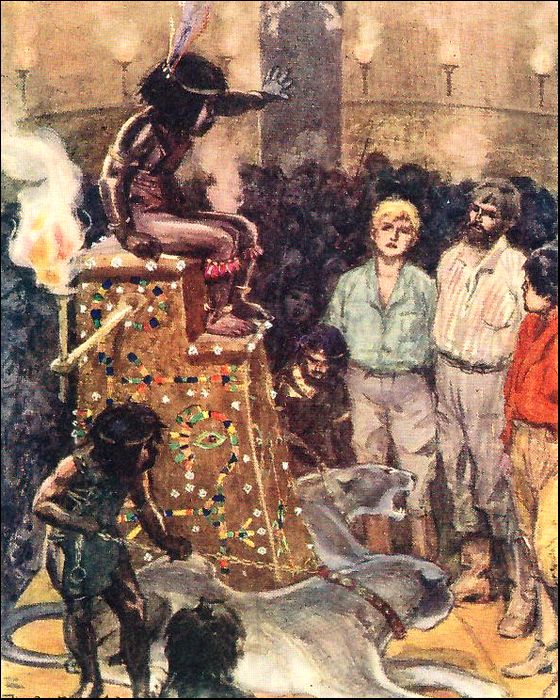
Ok-Tal leaped upon the throne, the
pumas crouched down at the foot of it.
Everyone in the place listened intently for a while, and then suddenly they burst into a loud roar, danced wildly, brandished their weapons, and seemed about to fling themselves upon the three captives. Even the pumas at the foot of the throne bristled up, and their eyes, catching the light of the torches, gleamed balefully.
"What is it?" asked Rod, with his mouth almost in Turner's ear.
"That?" Nick said simply. "Oh, that's my friend Ok-Tal telling these toughs that their dear King Conky has been killed by your friends and mine, and proclaiming himself king over all of 'em. Also, nice man that he is, he has informed his subjects that you and me are to be flung into the private menagerie that the Tukul kings have provided for them by their loyal and faithful subjects!"
The boys stared at him with fear in their eyes, and Turner, who had spoken flippantly, or had tried to, although it was plain enough that he was none too easy in his mind because he could see no way out of this situation, tried to cheer them up.
"Don't give way—we're not lost yet!" he said. "They're going to have the show to-morrow afternoon, and all sorts of things may happen afore then. Why, Uncle Stark may turn up. Who knows?"
Even as he spoke a pigmy, showing signs of hard usage and evidently having come on a journey, for he was panting and blowing, was seen to spring from the mass of the writhing little men, and, approaching the throne, he fell down before it. Kneeling down, he threw up his hands and seemed to implore to be heard. Ok-Tal looked down at him scornfully for a moment or so, and then held up his hand for silence again. When it came he told the pigmy to speak.
Whatever it was that he said seemed to send a thrill through the gathering. Ok-Tal shook like a leaf on a tree, the pigmies on the ground went wild with delight, and Nick Turner, turning to the boys with a wry smile, said:
"What did I tell you, boys? That little chap is a messenger from Conky, who's not dead, and who has sent a message to say that we are to be taken care of, as that's the condition on which he's being kept alive! Here, hold hard; don't go mad," as the boys shouted, to the consternation of the pigmies near them. "It's not all good news he brings; though it saves us, it means trouble for Uncle Stark and the others. Conky's playing the traitor, the dog: he's asked for an ambush to be laid at the mouth of the tunnel to cut up the expedition, although the white men are to be saved!"
DOWN through the long fire-lit tunnel swept the canoes containing the white men and the pigmies—prisoners, as it seemed, one of the other!—and Hensley's gramophone churned out its gentle melody that rolled in and out of the recesses. Dixon and Steve sat upright in the leading canoe, with Conky lying glowering between them. It was when they had been going for about two hundred yards that Steve leant forward and threw a noose over the chief's head, to the surprise both of the pigmy and of Stark.
"You'll choke him, Steve!" Dixon said.
"No, I shan't, Stark," Jackson told him, with a grin; "that is, not unless he or some of his little villains turn nasty; then I'll yank that rope and make his tongue hang out of his mouth, sure thing!"
"Go ahead," Stark said, laughing. "I'd like to see the little wretch dancing at the end of the rope. How far's this tunnel run?"
"We're very near where we'll be going ashore," Steve told him. "By George! we're there," as the canoe shot in to the shore and ran up the little quay. "My work, Stark," he said, waving his hand; "mine and Nick's. We've given this old rascal almost a new city, sure. Now the fun begins, I reckon!"
"All right," Stark said, fingering his revolver and seeing that the spare one was ready to hand, "I'm ready for it," and sprang ashore. Steve got out more leisurely, making Conky precede him, which the chief did, showing signs of no little indignation at being subjected to such treatment before his subjects. Hensley, who had stopped the gramophone, called out to him to commandeer a sufficient number of the little men to carry the instrument, and by dint of persuading Conky that so long as the men behaved themselves the white man's magic would not hurt them, he managed to get the required number, who picked up the heavy thing and struggled with it. Farrar and Hensley then fell into step just behind Steve and Dixon, and with a pigmy leading them they made their way up into the central hall of Diamond City, which was, as Jackson told his comrades, the great assembly hall of the pigmies who lived in the mountain kingdom. As they went on they were met by more of the little men coming down the tunnel bearing torches. The sight they saw seemed to stagger them, and for a while they stood as though petrified. For none of the pigmies who had gone out to ambush the white men had yet returned with the news of the dire straits of their chief, and all that the people knew was that he was a prisoner. But the sight of him being led like a slave into his own domain roused the frenzy of the natives, and when the full truth of it all burned into their brains with one wild cry they made a rush
"Hold them off, Conky!" shouted Steve, and he gave the little chief such a jerk with the rope that the pigmy came tumbling backwards, choking and spluttering, and as Jackson loosened the tension Conky righted himself and yelled out in fear, to the downfall of his last bit of dignity.
The onrushing pigmies pulled up in amazement and stood staring at their scared king, who jabbered away at them so that, sullen and angry, they opened out and the procession passed through, and so to the central hall.
And there, standing beneath the throne, was Ok-Tal, with hundreds of pigmies ranged round, all eyes looking at Conky and his captor-captives. A murmur of wonder that rose to a crescendo of rage went up and round the hall. Conky looked round woefully, gloomily, from the man who was proclaimed by all to be his successor in event of death, and from him to the assembled people, from them again he looked appealingly at the white men, shifting his gaze at last to the rock throne beneath which crouched the big pumas.
"No, Conky," Steve said firmly, answering the unspoken question. "You can't be cut free to sit on your throne. If you want to sit on it you'll have to have these ropes around you."
Though Jackson's companions did not understand the words he spoke, yet they sensed the meaning of them as they saw him jerk the neck rope and saw Conky shiver a little and then begin to speak. Steve, however, shook his head and signed to the throne, up to which at last Conky marched, Jackson following him.
"That fellow's Ok-Tal, Conky's rival, Stark," Steve told Dixon in a low voice. "Look at his face!"
Ok-Tal's face was indeed a picture: he seemed to be triumphing in the extremity of the king who had been brought to such a pass, and a smile of scorn wreathed his ugly mouth, and his eyes gleamed wickedly in the light from the thousand torches. "He's likely to be trouble for us!"
"What about the boys—and Nick?" Stark queried. "Don't see 'em!"
"Ok-Tal'll have 'em somewhere, you bet!" Steve said. "And—there, Conky looks happier now he's on his roost!"
But although the chief, now that he was sitting on his throne with the trailing ropes still about him, certainly did not look so woebegone, he was still nevertheless a sorry-looking king; and the murmurs of the people gradually died down and deathly silence reigned.
Then, even as Conky got upon his feet and seemed to be about to speak, Steve shouted out to him.
"Before you say anything," he said, "you'll get Ok-Tal to send for the three white captives."
A gentle tug of the rope nearly caused Conky to tumble from his perch, and also reminded him of all the dire threats that Jackson had made. Ok-Tal, who had heard Steve's words, grimaced up at his chief, but offered to do nothing, waiting, no doubt, for Conky to take responsibility for whatever was to happen. Conky, for his part, looked imploringly at Ok-Tal, who only grinned more; and at last the chief snapped out an order which Ok-Tal, with a shrug of the shoulders, passed on to half a dozen pigmies near him. They went across the hall and began to ascend a long flight of steps cut in the solid rock. The white men watched them go through a doorway; and when they descended they were preceded by Nick Turner, and behind him Rod Dixon and Jimmy Feltham.
They were bound, those three, but their mouths were free; and with a bellow of joy Nick Turner greeted Steve and Stark.
"'Lo, there, mates! I knew you'd come, by hookey!"
His voice reverberated throughout the cavern, mingling with the joyous laughter of the boys as they recognised their comrades down below. None of them needed urging down the stairway, and at last they stood beside the white men at the foot of the throne, where the pumas, startled by Turner's roar, were now growling fiercely.
"Can't shake, mates!" Turner said cheerfully. "Not yet—can't you get 'em to cut these ropes, Steve?"
For answer Jackson signed to Stark, who stepped forward boldly and slashed the bonds—to the rage of the pigmies, and especially of the lowering Ok-Tal, who sprang forward as though to stop him; and but for the sharp command of Conky, Ok-Tal, who pulled up sharply, would have felt the weight of a good British fist on his chin.
"Now put it there, boys!" cried Nick, flinging out his great hand which Stark Dixon, with tears in his eyes, took and gripped long and hard; and then, while Turner and Steve were congratulating each other, Dixon released his nephews and shook hands with them.
Neither of these five had noticed what was happening behind them, though had it not been for the murmuring of the pigmies they would have heard the sharp click of a racket as Hensley, who had compelled the pigmy carriers to deposit his camera and had rigged it up, proceeded to take a film of the scene, although he must have known that the lighting was decidedly imperfect!
"Great reel this, Farrar!" he grinned at his companion. "Reunion, and all that sort of thing, what?"
"Get on!" laughed Farrar. "You—you young fool!"
Hensley looked at him as though despairing of him as a financier, and continued to turn the handle until Steve happened to look at him, and from him to the cowering natives round the hall, who, seeing the white man at the queer instrument, imagined it must be destined to do them harm.
"Good for you!" bellowed Steve with a laugh. Who's the hero? Keep it up if you can—for there's goin' to be some show before we're through with this!"
He turned to Conky at that.
"Tell your people that the white men are to be left alone and no harm come to them," he said. "If any harm is attempted then you—their king—shall die!"
Conky shuddered, for he believed that the man who not so long ago had been his captive meant what he said, and he began to speak to his people, who, after the first mutterings, listened to him intently.
When he had finished a howl of rage went up—a howl that was led by Ok-Tal, and the white men noticed that it came chiefly from one part of the hall.
"Ok-Tal's followers," Steve grunted. "We'll hev to stop that!"
He shouted out something to Conky, who for a few moments hesitated, and then, brought back to reality by the jerk of the rope round his neck, told the pigmies what Jackson had ordered him to, how that the white men vowed to kill him, their king, if what they demanded was not done. When Conky had finished this time Ok-Tal stepped forward and, standing between the two pumas, waited for Conky to obtain silence. When it came the rival chief said something to Conky, who glanced at Steve before replying, and, receiving a nod from the white man, told Ok-Tal that he could speak to the people.
And Ok-Tal did speak. Whatever else he may have been he was a born orator, not even his size making him look ridiculous as he stood there and jabbered forcibly, working himself into a very frenzy of enthusiasm.
"These white men come to Tukul land," he said, "to take the Shining Stones—to take them and to bring other white men who will carry the sticks that kill without touching. Tukul land will know no more peace if these white men are set free to go their way. See! One escaped; has he not brought others with him? Do they not look upon the Shining Stones? Shall the Tukul people let them go?"
A great roar went up at that which lasted several minutes, during which Ok-Tal, calmed down now, stood glaring at Conky and the white men as though confident that he had triumphed. He had said nothing against Conky directly, but there had been sufficient suggestion in his manner, as Steve and Nick Turner had grasped, to make the pigmies feel that if the white men were allowed to go away unharmed the evil consequences predicted would be the result of Conky's cowardly weakness. It was evident too that the people realised what Ok-Tal meant, and Steve Jackson knew that something serious would have to be done.
"Got that noiseless automatic with you, Farrar?" he asked quickly.
"Yes," the doctor said, and his hand strayed to his belt. "Why?"
"Yank it out—shove it in your breeches pocket—and fire it from there—shoot one of those pumas!" was the reply; and Farrar, with a quick series of movements, obeyed. One of the pumas, which had got upon its feet at the tumult of noise and was walking to and fro impatiently, suddenly stopped dead, opened its jaws in a terrific scream, and then dropped to the ground, writhing a little, and finally lay still. The cry of the beast had sounded above the shrill voices of the pigmies, who, ceasing, stared in wonder at what had happened. They had seen nothing of what preceded that swift sudden death of one of their sacred beasts. If Farrar had used an ordinary revolver or his rifle they would have understood, and, although they would have been scared, they would not have been awed as they were now; death had come unseen, unheard.
Quick to seize the right moment, Jackson, still holding the rope round the luckless Conky's neck, sprang forward and began to address the now silent crowd in their own tongue.
"See!" he cried. "See what the white men can do! They kill if they but raise their hand." He broke off suddenly from the native dialect, and in English said quickly to Farrar: "Shoot again when I raise my right hand next time and kill the other brute." Again he spoke in the Tukul language. "Let but one white man be harmed and the fate that has come to that puma—the fate that is coming to this one, because I, the white man who was once your captive, lift my arm"—and he raised his right arm ever so slightly. Farrar fired on the instant, and the puma in its death agony sprang into the air, then fell back to the ground dead.
The silence was dreadful in its tension; even Ok-Tal was impressed, and cowered away as Steve seemed about to lift his hand again. Jackson was reader of men sufficiently well to bide his own time; he allowed that grim, dread silence to last long enough to allow the full sense of the power of the white men to fix itself in the minds of the pigmies, and then he spoke again.
"That man lies!" and he swept his right arm, all unintentionally, towards Ok-Tal, who, with a howl of fear, turned and fled pell-mell, mingling with the crowd of natives; he had been taken unawares and really believed that the uplifted arm meant death for him. It was with great difficulty that the white men restrained from laughing; and Rod Dixon grasped Jimmy's arm and murmured:
"What a stunt that is of Steve's, by jove!" There was no time for Feltham to answer his cousin, however, for Jackson was speaking again.
"He—the man who flees from the unseen death," he said, "he, Ok-Tal, lies! The white men do not come to Tukul land to take away the Shining Stones! The white men have more Shining Stones than all the Tukuls have. See!" and with a sharp movement he produced his electric torch, calling out to the others to bring out theirs and switch them on. Streams of light went flashing across the cavern, darting hither and thither, blazing upon the faces of the pigmies and seeming almost to blind them. "Does Tukul land know Shining Things like these?" he cried. "Your Shining Stones—do they blind men—can you blind your Shining Stones?" This as he shut off his own light, the rest, keyed up to take his cue in everything, doing the same; and then, following his example, switching them on again. "Ok-Tal lies!" he said again. "We want not your Stones; nothing do we want, nothing will we take but what we pay for. We come to fetch my brother," and he indicated Nick Turner, "my brother and my sons!"—he pointed to the boys, who were thoroughly enjoying themselves, playing their torches upon pigmies who tried to escape the vivid rays as though fearing they too held some hidden form of death. Rod, indeed, had two torches, since Hensley, refusing to miss such a golden opportunity, had thrust his into the boy's hand and was grinding his camera handle for all he was worth, his eyes almost as radiant as the Diamonds that the Tukuls seemed to set such store by.
"Shall the white men be free to go when they please, or must they kill to go?" was the last shot that Jackson hurled at the still scared pigmies. And then stepped away from before the throne, leaving Conky to clinch matters: and Conky looked as though he would willingly have parted with every gleaming diamond in Tukul land so long as he got rid of these dangerous white men. He got unsteadily upon his feet, and stood swaying a little before he could muster up sufficient confidence to sneak again. Then he burst out into a perfect torrent of words which Steve later on interpreted for them when he told them what he himself had been saying to the pigmies.
In effect, Conky agreed with every thing Jackson had said, and appealed to his people to believe in the white men, who were such terrible men to have as foes; and so earnest was the chief that at last he succeeded in winning over his people, who had indeed been almost won over by Jackson himself. Conky finally turned to the white men and, addressing Jackson, said:
"The white men are free—free to stay, or free to go as they will. No harm shall come to them; the Tukuls promise. I, Conky, their chief, promise for them. I, Conky, their king, say that the Tukuls are grieved that they ever tried to do the white men hurt!"
Steve said nothing, but, pulling out his hunting knife, he slashed the ropes that bound Conky, and then, as they dropped on to the throne, he threw out his arms, knocked the neck off a bottle of spirits that he had brought with this purpose in mind, and poured it on the carcase of one of the dead pumas. Then he set a match to it, and stood watching the blue flickering flame that presently died away, leaving the carcase unharmed!
"That's to put the fear right down into their souls!" he said grimly to his companions; and it evidently did so, for the pigmies had drawn back in alarm, wondering at the coolness with which Steve passed his hands to and fro in the flames.
It was at that moment that something whizzed past Steve's head, and, turning quickly, he saw one of the pigmy's poison darts sticking in the body of the other puma. "Friend Ok-Tal on the warpath!" he said grimly. "The trouble's not over, mates!"
KING CONKY, when he saw that dart in the puma, flew into a furious rage and called upon his people to find the man who had dared to break the pledged word of the Tukuls. The gathering, as they saw the white men surge together and then swing round and encircle the throne on which Conky stood, a pitiable figure enough, sensed imminence of peril, and a loud uproar went up as they demanded the traitor to step forth!
For answer, there came a mocking laugh from high up in the cavern roof, and a thousand eyes stared upwards—to see Ok-Tal poised on the gallery that ran round. As Rod heard that laugh he was reminded of the day when he had visited St. Paul's Cathedral and stood in the Whispering Gallery.
Then Ok-Tal spoke, but what he was saying only Steve Jackson and Stark Dixon of all the white men knew, but Stark, with a sharp movement, took the noiseless revolver from Farrar, who was standing by his side; while the eyes of the pigmies were set upon Ok-Tal, who at that moment put his blow-pipe to his mouth, Dixon fired, and a gasp of amazement surged through the cavern as the pigmies saw Ok-Tal's arm drop and his blow-pipe twirl over and over as it fell to the bottom.
The next instant Ok-Tal, with a howl of agony, had gone.
"Oh, a great shot!" cried Steve; and Jimmy and Hensley, who had been on the other side of the throne and had not seen what was happening, had their first intimation of the meaning of that scream of pain. "That's Ok-Tal's declaration of war," Jackson went on. "But—we've got Conky with us, and that's to the good, 'cos he has the majority of the people with him."
He swung round on the trembling chief—trembling not wholly with fear, though he was afraid of what the white men might do in revenge—but mostly with rage at the treachery of Ok-Tal.
"I, Conky, King of the Tukuls," the pigmy said, "in the name of my people, cast out Ok-Tal from among us. The white men are our friends!"
Very graciously Steve Jackson accepted the assurance and the promise, and then said:
"We would eat, O Chief, and we would rest!"
Instantly Conky issued a hundred orders, so it seemed, and the pigmies dashed off to obey him, the while that Conky himself, stepping off his throne and, very gingerly avoiding the pumas whose death was still a matter of wonder to him, led the white men across the floor of the cavern and up a flight of rock stairs, down a long tunnel in the side, until at last they arrived in a wide chamber, hung with skins of wild animals, decorated with blazing diamonds, and, to the amazement of all except Turner and Jackson, lighted from above by a wide opening.
"Conky's palace!" Turner told the others. "They're his happy family," as a number of women and children, tiny things all of them, crept out of bunk-like holes round the sides.
"What on earth is this place—a volcano?" Farrar asked Jackson.
"Guess you've hit it, Farrar," Steve replied. "Reckon the whole ridge was shoved up centuries ago, an' I shouldn't wonder if the place went higher one o' these days."
"But the volcano must be extinct," Hensley said. "These little chaps wouldn't pitch their homes in it if within memory of any of them or their great-great-grandfathers there'd been an eruption."
"That's so," Turner agreed. "I've asked 'em whether the show was ever on fire, and they thought I'd gone addled, I guess. It's extinct, sure enough, and—"
"But these extinct volcano things do sometimes bust out again," Jackson persisted.
"Then all I hope is this one doesn't while we are here!" growled Stark Dixon, and Rod and Jimmy, who knew enough from their reading to understand what a volcano eruption meant, even when you didn't live in the bowels of the volcano, shuddered a little at the thought of it all and echoed their uncle's sentiment.
However, gloomy thoughts of that kind slipped away when the appetising smell of a good, if roughly served, dinner came, and they all sat down to roast deer-flesh, washed down with pure water, though, when the meal was at an end, Copperface busied himself at making a pot of tea—much to the delight of Conky and his numerous family who had never tasted the beverage before.
"Don't be too easy with that tea, Copperface!" Stark said with a grin. "It won't go far if we undertake to keep Conky and his family on it!"
"Copperface be very careful, boss," the native answered. "One day me make it very salt so Conky no like it!"
The whites laughed at Copperface's ingenuity to conserve their tea supplies, and then fell to discussing their plan of operations.
It was Rod who started it.
"I suppose we're going to stay here long enough for us to see the place?" he asked. "You know, Steve, you bucked us up no end with your little hints of it all, and we wouldn't miss it for worlds!"
"Don't you worry about that, kid!" Jackson told him. "We'll be here a while, I guess. 'Fact, despite all Conky says, it's not unlikely we'll have trouble to get away. There's a crowd of folk who side with Ok-Tal, and you can bet he's not lettin' things slide much. The very day we say we're goin' back we'll hev 'em round us! No, kids, we're sticking a bit, anyway. An'—we're going to be on the safe side. It won't be easy to hack a way back on our own, an' Conky would prob'bly hev diff'culty in gettin' any of his crowd to escort us fur on the road. Theerfore—theerfore, we're goin' to send up for those men we left at the last camp. Conky's got to send fer 'em; we may want more ammunition stuff'n we got. When I fixed thet up we'll go to sleep; but from now on one of us has gotta keep watch while the others sleep. I'm takin' first sentry-go."
Steve and Nick Turner had a heart to heart talk with Conky then, with the result that the chief, without making any demur, gave orders for a band of his best warriors and carriers to go out into the jungle and bring in the white men's followers and as much of their equipment as was detailed on the scribbled note Steve gave the leader of the pigmies—which note was a matter of wonder to the natives and seemed apparently to savour of more white man's magic.
After that Conky led them to another chamber, lighted like his own from above, which he told Jackson was to be their quarters while they honoured Tukul land with their presence.
"Say, Steve," said Nick Turner when Conky had gone, "this is a leetle different, eh, from how the beggars treated us afore?"
"You've said it," Jackson agreed.
"An introduction to all these people'll be nice, you know," Turner suggested with a grin, knowing that it was only a formality, since he knew every one of the men.
"Introduce yoursel'es!" laughed Jackson, "an' then get to sleep!"
For an hour longer the white men were in conversation, during which Turner only once referred to the matter of gratitude for rescue.
"Know you chaps don't want me to say thanks," he said. "Steve promised for himself and Stark to come an' fetch me outer this hole, an' well I knew they'd come. 'Course, I didn't expect you fellows"—sweeping round a hand that embraced the two boys and Hensley and Farrar—"but I'm very much obliged to you."
"And I reckon you're welcome," said Farrar with a laugh. "I've enjoyed myself!"
"So have I," confessed Hensley. "And, by gee, I reckon I've made half a fortune already. Those films—my word—those films!"
"Sure, those films!" laughed Turner. "As true as I'm here, I thought you'd be the death o' me—to see you grinding that handle as though you were grinding coffee—an' all the time the Tukuls were gettin' madder'n madder! But, say, fellows, guess you came just about in time. Ok-Tal was getting nasty; I know he'd been tellin' the pigmy people that it was all lies about Conky being alive, an' he wanted to get us out o' the way sharp afore Conky had time to get us out o' here. If you had not come right this very afternoon we'd 'a' bin dead meat by now; he was going to chuck us into the pumas' den!"
"The devil!" roared Stark; and Jimmy and Rod, who till that moment had not known how narrow a squeak they had had, shuddered again.
"Why didn't you tell us, Nick?" Rod demanded shakily.
"D'you want to die twice?" growled Turner. "If I'd told you, maybe you'd 'a' bin quakin'! No, don't get rissoled; anyone would. I did! It ain't nice to think o' being feed for pumas, not even for a grown man! Ok-Tal had gotten all our weapons, an' trussed up like we were an' kep' in that hole up aloft, we couldn't do much fer ourselves, could we? 'Member when he came in yesterday an' leered at me an' jawed a lot? Well, that was when he told me what was goin' to happen to us to-day! Guess that's why he's so wild now."
"What will happen to him now he's outlawed by Conky?" Jimmy Feltham asked. "Where will he go?"
"How do I know?" answered Turner. "This old ridge's got a lot of shows o' this kind in it and Ok-Tal'll go to one o' 'em, an' gradually those who want him for king will filter through to him. If he's got enough he'll maybe play old Harry with Conky, and that's why I'm glad Steve's all for staying a while, 'cause, after all, Conky's played up trumps for us, dirty rascal as he was before."
"Now get to sleep," growled Steve. "I'm tired, an' as I'm goin' to keep first watch I want Nick to hurry up and get his dose of sleep in to relieve me! Shut eyes!"
They shut eyes, and, tired out, slept soundly until, one by one, they were awakened to take their part in the round of watches, though that night, at any rate, nothing happened, and there seemed to be little need for any precautions of the kind. When morning came, however, Steve would not entertain the idea of relinquishing the duty.
"It's early yet," he said. "And when we least expect it the trouble'll come; you see. Hello, here's grub!"
Conky was certainly of a mind to treat them well as regards food, and when breakfast was over he came in and invited them to go with him to look round his domain.
The whole of the day was spent in that task, and the boys, no less than Hensley and Farrar and Stark Dixon, were amazed at what they saw. It was very evident that the ridge was of volcanic origin, but the remarkable thing was that for hundreds of years probably it had been inhabited by men, evidently the pigmies, since inquiries by Turner and Jackson had elicited the fact that as far as tribal memory went only Tukuls had lived there. The caverns, of which the white men visited no less than a dozen that day, were certainly naturally formed in the first place, but great improvements had been made, improvements which showed a decided skill and craftsmanship. Dwellings had been cut in the sides, and the walls were decorated with diamonds—those that had been first noticed in the large assembly cavern being, like all the rest, placed there in decorative order by the pigmies. Gold, too, there was in abundance, and the pigmies' utensils were of the yellow metal. Connecting tunnels between one cavern and another had been cut, some of them having certainly taken scores of years to make. The caverns that had open roofs were the surprising feature to the newcomers, who, however, were enlightened on this matter by the two erstwhile captives.
"We gave 'em those skylights," Turner said, not without a certain amount of pride. "Y'see, we got tired o' being shut in here and livin' by artificial light—for though the Tukuls go out on hunts an' raids, they never let us go outside the place except once, which was because we went an' they didn't know it till we were there. We came across a hole in the roof and nigh went mad 'cause there was daylight above us. We clambered up and—and—well, they got us down agen. But not afore we'd realised that some o' the caves 'ud bear skylights. We suggested it to Conky, who gave us an army of pigmies for workers, and we got 'em to cut away the solid rock and earth so that light was admitted. The pigmies don't like rain-storms, however, so we had to devise slidin' roofs—like theatres at home; an' the on'y metal we'd got was gold, so we made 'em out o' gold. See that?" and he drew a long liana which was fastened to the wall and led up, although the others had not noticed it before, to a roughly-made pulley. When he set it moving a sheet of yellow metal slid across the open roof and covered it in. "I tell you, chaps, that stunt got the Tukuls goin' mad with joy! The on'y thing about our stunts was that the more we gave 'em the more they were determined to keep us. Ain't that so, Steve?"
"Ab-so-jolly-lutely," said Jackson. "Old Conky was good to us—we were treated fairly well, but he was determined we'd never get away. We're done makin' improvements from now on, what?"
"Not a single one," growled Turner.
"Will Conky show us where he gets the gold from?" Hensley asked, and Steve looked at him quickly.
"Not thinkin' of any stunts in that line, are you, Hensley?" he asked. "If Conky or any o' his crowd get an idea you are—well, we'll never see the outside o' this place!"
"You know what you're speaking about," the hunter said. "And what you say goes! But it seems a great shame that all this wealth should be lying idle here!"
He was fingering a fine golden bowl as he spoke, and Conky, noticing him, said something to Steve that made the latter stare with amazement.
"Lawks, fellows," he said, "the little fellow says he's willin' to show you where it all comes from—which is more'n he ever did fer Nick an' me! But for goodness' sake don't look so covetous!"
With a laugh the rest dropped into step behind the chief, who led them down a long flight of stairs to the floor of the largest cavern, and then, with a number of Tukuls bearing torches, dived into a tunnel that ended abruptly, and when the torch-bearers halted and ranged themselves in a half circle the white men saw a deep pit yawning before them—a pit from the sides of which scintillated gleaming metal in as pure a state as any of them had ever seen it, except in coin and jewellery.
"The real goods!" Hensley jerked shakily. "The real goods!"
Conky looked up at him sharply as he spoke, and then at the other whites, whose faces, however, were imperturbable, although it was only with an effort that they disguised their real feelings.
Casually Steve and Nick, as by one impulse, turned away as though to go back, and evidently the significance of it impressed Conky, who looked greatly relieved at the nonchalance of the white men.
"Conky show white men the Pit of the Shining Stones!" he told Steve, who merely nodded; and in a low voice, as they followed the chief, warned his companions to keep up the attitude of indifference.
"Maybe the little feller'll make us presents ef we're kind to him!" he said with a grin.
Suddenly out of the gloom, for the torches were now almost burnt down, there arose a silent figure that followed the party as it went along the tunnel—followed it until it turned abruptly into another one, the torches being replaced by new ones. Still the figure slunk in the darkness behind—and at last the white men and the pigmies halted beside another yawning gulf where a great glare of wondrous light showed in the torches' gleams—a light from diamonds in the raw.
Then the great thing happened. Conky, standing on the very brink of the hole, with the white men arranged on either side of him, would have gone hurtling to his death—since the hole was at least fifty feet in depth—but for the lucky fact that at that moment Rod Dixon turned as a slight movement caught his ears, and with a cry he sprang full upon the creeping figure that had its slim hand outstretched to seize the chief's leg.
A howl of pain and of fear slipped from the man on the ground as Rod dropped upon him with a force that almost shook the breath from his body, and then the white man and the pigmy rolled about, locked in a deadly embrace of death, while the rest stood staring, wondering what it all meant.
ROD knew from of old the strength of the pigmies and realised that he was matched against one who would give him a stern struggle for victory. The native wriggled and writhed like a snake, his greasy body slipping through the boy's hands so that Dixon was compelled to simply twine himself, legs and arms, around the little man in those first few moments during which his full attention was taken up in trying to roll from the dangerous brink of the pit. Instinctively, when the opportunity came for them to do so, the other men ranged up on the lip of it to prevent the wrestlers from hurtling over, and Rod, catching sight of them as he was rolled beneath the pigmy, looked at them with understanding eyes.
The little man's hands were gripped upon his throat, and their strength was amazing; the boy felt his breath going, and, try though he might to shake them off, he could not do so. He hunched up his knees, but the pigmy, snarling horribly, sensed the meaning of that and lifted himself so that when the knees went up with a sharp jerk he cleared them and then came down with his feet on the boy's chest, thumping the breath from him. Fortunately for Rod that marvellous manoeuvre of the pigmy had caused the latter to lose his balance, and, before he could regain it, Dixon's hands, which had been tugging at the native's arms, let go, and first one and then the other fist landed with a crash upon the leering face. Back went the pigmy at that with a howl of rage, as, hitting the ground, he sprang to his feet again, and in his right hand he held the spear that he had dropped when first the white boy fell upon him. Upraised, the spear, glistening in the torch-light, seemed about to go spinning towards Rod when there was a shout that served the purpose that Jimmy had meant it to—for the pigmy hesitated and half turned to see whence it came. And then Feltham had leaped, and once again the spear went harmlessly to earth, and the pigmy followed it. Jimmy's right arm descended, and the heavy revolver that he had whipped from his belt fell upon the pigmy's head—and he lay still as death itself. Almost at the same instant there came the sharp crack of a revolver that echoed through the tunnel; a man screamed with pain, and Rod Dixon, picking himself up, swung round in the direction of the cry and saw a pigmy throw up his arms and drop to the ground.
"Got him—got 'em both!" snapped Stark Dixon. "That was another little brute, Rod, and he'd have had you, sure!"
"Thanks, Uncle!" Rod said shakily, and the next moment stepped back with alarm almost as Conky dropped at his feet and clasped them in his hands, muttering something that the boy could not understand.
"Tell him to get up, Rod!" Steve Jackson said. "He's thanking you for saving his life. Don't let him grovel!"
Rod stooped and helped the little man to his feet again.
"Tell him any old thing you like, Steve," the boy said quietly, and Jackson, quick to seize the opportunity of welding the friendship that Conky had professed for them all, told him that the white boy, and indeed all the whites, would do anything to prevent harm from coming to the king of the Tukuls!
"For are you not the friend of the white man?" he said impressively, and Conky assured him that he was. "So will the white man protect the king of the Tukuls against all his enemies!"
The little chief was duly grateful for the promise and, as if to prove it, shouted out orders to his few followers there, with the result that the whole party began to move back along the tunnel and so into the central cavern where golden gongs sent forth their rich melody and called the people to assembly. Conky, ranging his white companions round the throne, mounted it and began to harangue the pigmies, telling them, as Nick Turner informed his friends afterwards, that traitors had tried to kill him—him, their king.
"Ok-Tal has done this thing!" he cried. "Ok-Tal who is cast out from among us. Therefore, it shall be war!"
Steve, looking round the assembly, noticed that there were fewer pigmies than on the previous day, and he confided his fears to the others sotto voce.
"Ok-Tal's crowd have joined him, I bet!" he said, and then his words were drowned in the roar of the pigmies as they brandished their weapons and vowed that it was war between them and the traitors.
"It was the white men saved the life of your king!" Conky told them, and at that the enthusiasm was intensified; and Nick Turner, turning to Rod, muttered: "Guess you did us all a good turn just then, son! Except for Ok-Tal an' his toughs we're as safe in Tukul land as we would be in London town!"
What happened then, however, amazed even Nick Turner.
Conky, continuing his harangue and gradually getting more heated, threw out his arms excitedly, and what he said seemed to cause the pigmies the greatest pleasure. A large number of them broke away from the crowd and went darting off into the recesses in the sides to come back again after a while, laden every one of them with ornaments and utensils of gold which they placed at the foot of the throne, off which Conky, in an access of joy, very nearly overbalanced.
"He wants you, kid!" Steve told Rod Dixon. "Guess that's a little present fer ye," he went on dryly; and Rod wonderingly approached the little man's throne. Conky waved his hands toward the piled heap, and the amazed boy stared at it, then shook his head.
"Don't be a fool, Rod!" snapped Nick Turner. "You'll offend his august dusky majesty if you don't say thanks an' take 'em. Lor! Conky thinks his life very valuable!"
The other white men almost burst out laughing as they heard his words, but no doubt fortunately for them all, they refrained from doing so, the while that Rod Dixon, turning to Steve, asked him to "say thanks," as Turner had put it. Jackson did so, and he evidently clothed his thanks in high-falutin terms of kindness towards Conky, for the little chief beamed with pleasure and said something that caused Nick and Steve to groan inwardly.
"That's done it, Steve," said Nick. "Confound Conky and his wretched life too!"
The other white men stared at him in amazement, but it was not until they were once more in their own quarters, after the assembly had dispersed and Conky had gone to his "palace"—no doubt to congratulate his wives on the fact of their still having him alive—that Steve related to his companions what had happened.
"The little beast's as cunning as any of the monkeys in the jungle!" he said. "D'you know what he said. 'Course you don't since you can't read his dern lang'age. He's told the Tukuls that the friend of Conky—meaning our esteemed baby, Rod—and his white comrades will stay in Tukul land until Ok-Tal and his crowd are wiped out! That's what he's done; and, by hookey, he'll see that we do!"
The rest stared at him in astonishment.
It was Hensley the irrepressible who broke the tension.
"We're in the cart," he said simply, and the rest laughed.
"We're in something—but it ain't a hearse yet!" said Nick Turner dryly, "though it may turn out to be a hole in Tukul land 'fore long! Dern Conky!"
"But hang it all," said Farrar, "can't we insist on going when we want to? All I want is to get a good supply of that fever nut and then—"
"Think you can give Conky the slip, eh?" Steve said. "Not on your life, Farrar! The place is a honeycomb o' tunnels, and we'd be stopped 'fore we got t' the t'other end of one o' 'em. Besides, you've seen what the pigmies can do when they cop you in the jungle. Not for me, son; we'll hev to stay till Conky says go!"
"Well, I've not much love for Ok-Tal," Stark Dixon said quietly. "He started the row; he'd have done Nick an' the boys in, sure thing. So if Conky's goin' to hev civil war, and we're to help his side, I guess we may as well do it willingly."
"You're right, Stark," Nick said. "Lor! look at that gold an' them diamonds! I bin here nigh on three years an' Conky never gave me so much as enough to make a ring for my missus, if I ever get one!"
"I'll give you enough for that, I reckon," said Rod laughingly. "I guess that what I've got is ours, not mine alone. But—"
"I say, Uncle," Jimmy chimed in. "If we do help old Conky out, likely enough we'll eventually break down his fear of white men coming to Tukul land and—and—well, you know, there's enough gold and diamonds here to make a few scores of millionaires!"
The others looked at him and laughed as though they had been thinking the same thing. They had been looking at the pits whence the gold and diamonds were taken, and while they had gazed upon the fortunes in gold and precious stones plastered all about the whole mountain city they had realised that there was wealth enough to make men take the trail and to inaugurate a gold rush that would probably break all records; and there was sufficient to make it more than worth while to cut roads through the jungle.
"Goin' to stake a claim, Jimmy?" Steve said with a wry smile. "Got the gold fever, eh?" Jimmy nodded and knew from the light in the others' eyes that they too had the fever.
"Look here, mates," Stark Dixon said quietly. "We gave our word to Conky that we'd take nothin' out o' Tukul land that he didn't give us or sell us, an' we told him we'd tell no white men back yonder about his city. We've got to keep our word. I know what gold rushes mean when it's a case of natives livin' in the rich district. The poor devils get wiped out pretty soon."
"That's right," said Nick. "I ain't got no love for the Tukuls, but, by hookey, I'm not goin' to be the one to fetch all the scum o' th' earth down on 'em! If Conky an' his little men invite us back an' tell us to bring others as well, we'll maybe come; maybe we won't. That'll be different. Let's play fair, fellers!"
And the whole band of white men registered a vow among themselves that they would play the game with Conky if Conky played the game with them.
"It would be a pity," said the doctor, "if anything happened to make it impossible to come back, because—because, well, that fever cure's worth more than all the gold and diamonds put together. The world ought to have it, and I only hope nothing will prevent it doing so. Anyway, we'll see. What on earth's that?"
The sound as of a dozen great bells ringing and booming came up through the tunnel leading to their cavern, and the volume of it was increased because of the course it had taken. It drowned every word that the men tried to say and then died away as suddenly as it had come. Meanwhile Steve and Nick had leapt to their feet and stretched out hands for their weapons, a procedure followed by the others who saw their lips move but could not hear what was being said.
Instinctively they realised that these two knew from of old what was happening, and, whatever it was, it portended trouble.
When the clangour died away Turner's voice came flung back over his shoulder as he sprang for the exit.
"That's the signal for battle!" was what he said, and his comrades went after him wonderingly. They soon discovered, almost to their dismay, what was the cause of the commotion. Gaining the central cavern, they found the Tukuls gathered, every man fully armed, and Conky perched upon his throne and wearing the old pith helmet and snapping the useless Colt which, good-naturedly, the rightful owners had allowed him to keep. Silence reigned among the crowd as they listened to their chief, and Steve translated, in staccato, what he was saying.
"Ok-Tal's on war-path—got two hundred Tukuls —made friends with the Fumas—(they're the people of the valley—giants—hold every exit—Conky's going to give battle at once."
FOR some time Conky continued his harangue, and the more he spoke the greater became the enthusiasm of the Tukuls, while the white men, listening to the translation of Steve Jackson, also began to lose their more or less detached interest in the business.
"Reckon it's on account of us, Steve," Jimmy Feltham said presently as the bunch of them stood on the top gallery looking down upon the scene. "Therefore we ought—"
"To take a hand, eh?" Jackson answered. "You're right, son. What d'you say, fellers?" and he turned to the others. "Conky hasn't yet suggested to his folk that we'll help 'em, but I guess he'll be mighty pleased if we offer—and to offer's a sight better than to be press-ganged into it, what?"
"Sure," was Nick Turner's answer; and it was clear that the others were just as willing.
"Then come on, fellers!" Steve said, and the little band began to descend the stairway, Jackson the while shouting out to Conky, who, looking up and seeing the white men coming, armed with their dread weapons, simply danced with delight. He realised what their coming and the manner of it meant, and it was not long before that whole tribe of gathered Tukuls were surging round the cavern, waving their arms and generally going wild with joy over this accession of strength which they told themselves might make all the difference between victory and defeat. Reaching the floor of the cavern, the white men passed through an avenue that opened for them, and came to rest before the throne.
"We are willing to fight for our friends the Tukuls!" Steve said simply. "Command us, O Conky!"
The chief, when he had recovered from the over-plus of pleasure, lost no time in commanding both the whites and his own people. As far as Rod and Jimmy could judge, Conky was a born general, or at any rate he seemed to possess a good deal of initiative. He had gathered some half-dozen or so of his chief men around him, and they received their orders to go back to their own "regiments." To each of these white men were detailed. While this was going on Rod and Jimmy, at Steve's instructions, had gone off to their quarters to bring down a spare revolver apiece and a supply of ammunition. Rod carried the revolvers and Jimmy staggered down the stairs under the weight of a small box of cartridges, which were distributed among the half-dozen of them. Then they all filed off, and it was Rod who had what was evidently the post of honour, in that he was attached to Conky's own "regiment," which marched down the tunnel via which the white men had entered on their first coming to Diamond City.
What was worrying Rod all this time was that although a great deal was being said about Ok-Tal having attacked the Tukuls, there were no signs of it, and he wondered what was the manner of the traitor's tactics. True Steve had said that Ok-Tal held all the exits, but the boy, not knowing the disposition of the place, could not understand the situation, otherwise he would have realised that the Tukuls were doomed to starvation if they could not within a very short time force those exits and clear away the enemy. There was also the puzzle of the Fumas—the giants of the valley, as Steve had called them—and it was the first time that either he or Nick had referred to these mysterious people.
"Guess I'll know all this in due time, however," Rod told himself; and that due time, as he discovered, was not far distant!
Far off, down at the end of the tunnel, he saw as he marched by Conky's side a ruddy glow that he knew must be one of the fires that lighted the way in, but as Steve had told him that these were only set going when there were large parties of Tukuls out, and he knew that none were out, he came to the conclusion that this fire must be one lighted by Ok-Tal's crowd. Yet, as he drew nearer to it, he could see no signs of the enemy; there was simply the fire on the right side of the exit and the river flowing between the banks on its way through Diamond City. The banks on either side of the river were solid rock and only a couple of yards in width, and Conky had divided his force so that half was on each side. It was when they were within about twenty yards of the exit that Rod saw the signs he had been looking for: lying in the crude quays that Steve and Turner had fashioned for the Tukuls were numbers of canoes smashed and useless, and on the banks were several dead pigmies, around whom were a few men about four times their size.
"Fumas!" was the word that leaped to Rod's lips, and Conky, hearing his voice, glanced sharply at him questioningly. Rod, however, was stumped at that, and could do nothing but point to the huge figures, whereat Conky shrugged his small shoulders and seemed to shudder a little, only to brace himself up as though refusing to show the white feather before his new friend.
He issued sharp orders, and several of his men detached themselves from the main body and sidled down the banks, carefully picking their way, and finally emerging from the rock tunnel. Instantly there came howls from the jungle outside, and before any of the men could dart back they were transfixed with arrows and went tumbling headlong into the water.
Cries of dismay went up from the pigmies in the tunnel, but Conky quelled the rising dread, and Rod found himself admiring the little chief for his courageous handling of his men.
It was fairly evident to Dixon that as long as the huge fire blazed, which, judging by the amount of fuel that had been heaped upon it, it would do for a considerable time, there was little chance of the pigmies succeeding in getting out to join issue with their foes; and, unable to tell Conky in words what was in his mind, he had to resort to actions. He took off his pith helmet and began to fling water upon the flames, looking up every now and then at the chief, who, instantly divining his meaning, shouted out orders that sent his men running for bowls and all kinds of utensils, with which they threw water after the boy's example.
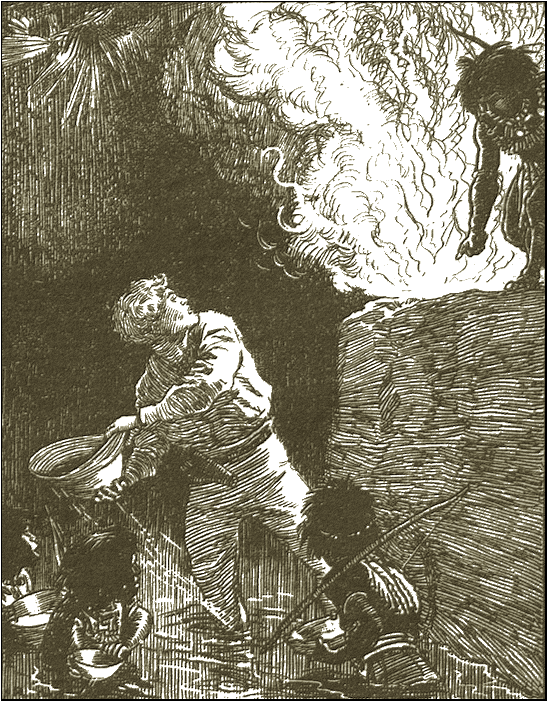
He took off his pith helmet and began to fling water upon the flames.
For some time this went on, and at last the fire was extinguished. All then was darkness, and as it was now night, whatever glint of light might have penetrated the tree canopy was missing, so that if Conky wanted to lead his men out to the attack he could do so without running the risk of having them all picked off as they emerged.
In the darkness Rod felt his arm gripped and heard Conky's voice saying something he could not understand, except that he sensed the meaning of it as the chief began to move forward. Rod knew sufficient of the entanglements of the jungle outside and the multitude of opportunities for the enemy to hide and spring out at will or to snipe the pigmies to make him wonder at what he considered the fool-hardiness of Conky in leading his men out. Knowing that to attempt to make the chief do aught else would be to give him the impression that he, Rod, was afraid, he went on as calmly as he could in the circumstances, glad that he held the heavy revolver, and perhaps more glad that in his other hand he carried his electric torch, because with that, at any rate, he could when he liked dispel the darkness, which in itself was terrifying. What Rod did not know, however, and Conky could not tell him, was that the chief had sent whispered orders among his men that caused about fifty of them to stay behind to carry out a little stratagem that was to be tried on the enemy.
Dixon was to know very shortly, however.
As silently as the puma prowling after its prey the pigmies slithered along the banks and so out into the dense growth. Rod, who knew something of native ability to slink unheard up to the very feet of the quarry, could but marvel at the skill of these pigmies, whom, although they were at his very heels, he could not hear. And he felt that he, at any rate, must give warning, that the very beating of his heart must be heard by the lurkers in the undergrowth.
They went on for something like twenty yards—no more, yet they seemed like so many miles to the tense-nerved boy, then Conky stopped dead. Rod did likewise, and though he did not know how the pigmies behind had received the warning, he knew that they also had come to a halt.
A moment later Rod felt Conky raise himself; there was just the merest twang of a bowstring, and the boy wondered what was about to happen. He learnt afterwards; all that he knew then was that suddenly the still silence was broken by a tremendous shouting that came booming out of the tunnel. The arrow that Conky had sped had splashed into the river, and was the signal for the pigmies left behind to play their part, which was to make as much noise as they could, as though they were engaged in a grim hand-to-hand encounter, and then some of them were to shout victorious cries while the rest yelled in fear and broke and fled.
The pigmies who were out of the tunnel with Conky made no movement, no noise; they remained quiet and silent in the undergrowth, waiting for what they hoped would take place. It took place. The enemy, evidently deceived into thinking that one section of their party had ventured into the tunnel and had driven back the defenders, suddenly sprang into action, and there came the sound of men rushing through the jungle as quickly as they could for the impediments they met. Even then for a while Conky gave no signal; he remained silent and the jungle itself was still, until the only sounds that came were the shouting of men in the tunnel. Then a whispered command went here and there among the lurking pigmies, Conky clutched Rod's arm as if urging him to follow, and the band, without a word and with scarcely a sound, slithered through the forest back into the tunnel they had so recently left. A few were left at the entrance, but the rest pattered along in the wake of running footsteps, which they knew for those of their enemies. At a low cry from Conky dozens of arrows went speeding up the tunnel, and it was at that moment that Rod understood the trick.
"By jove!" he muttered, "a fine stunt!" and he blazed away into the inky darkness, the crack of his revolver echoing and re-echoing and the bright stab of flame from it for the moment serving to startle the pigmies for whom he was fighting.
A terrific uproar in front told him that the enemy had been caught not only by that flight of arrows, but also by the men they had supposed to be fleeing from them. No more arrows were shot, and Rod fired no more, but raced along beside Conky, grasping the broadsword that the chief had thrust into his hand. Then came the thudding of running feet, and he knew that the enemy were trying to get away. He wondered how in that darkness friend would know friend; he felt that he would be doing a better service to Conky if, instead of joining in the fight, he threw some light on the scene, and without a word to the chief he darted to one side and switched on his powerful torch.
What he saw staggered him.
Racing down the tunnel toward the advancing pigmies were scores of men, some of them tiny Tukuls, but others immense brutes, ugly, strong-limbed, gaudily arrayed men, whom, he told himself, must be the Fumas of whom Steve had spoken. They were at least three times the size of the pigmies, and the immense wooden swords that they carried—some of them had clubs too—were sufficient to wipe out half a dozen Tukuls at one blow. Rod shivered, and the piercing ray of his torch shook and trembled weirdly. It served an unexpected purpose, however. Rod had thrown it on solely to assist the pigmies in their battle by allowing them to pick out their foes, but when the beam shattered the darkness and almost blinded the onrushing Tukuls and Fumas, it brought them up with a start and a howl of fear. Those on the bank opposite Rod crowded back into each other, and the Tukuls behind them, knowing that their white friend's light was intended to help and not to harm them, bore down upon the frightened crowd and wrought terrible damage in their ranks. Meanwhile the enemy on the bank on which Conky and Rod were hesitated as they saw the light reveal their unfortunate comrades; and their hesitation cost them dear, for although the direct beam was not upon them, yet the radiance of it was sufficient to allow Conky and his men to take advantage of the momentary pause given their foes, and they sprang in upon them with their swords and clubs.
It was a grim, wild battle ,while it lasted, but it did not last very long. The enemy, shaken to the very heart by the unexpected glare that they took in their simplicity for magic, were beaten before it began, despite the fact that there were something like a hundred Fumas among them, who of themselves ought to have been able to account for all Conky's men.
Rod's light flitted from bank to bank for a while, and then there was no need for it to play upon the farther bank, because the enemy, Fumas and pigmies alike, had either been killed or wounded or, to escape the fury of their antagonists, had flung themselves into the river. Some of them, as Rod knew by the screams, found still more relentless a foe in caymans that had rushed like vultures to the scene. There was little time to think of their fate, however, for there were still some on the nearer bank putting up a fight, and among them, as the boy's light showed him, was Ok-Tal himself, standing between two Fumas, whose gaily be-feathered head-dresses waved and bobbed as the men swung their huge swords round in wide down-sweeping spreads that crushed many a luckless Tukul to the ground or swept them off the bank into the flowing river. Ok-Tal and his two companions seemed to bear charmed lives, and slowly yet certainly they were hacking a way through the press of the Tukuls, until at last they were right through, and, turning round, fought a rear-guard action.
And Rod Dixon was behind them, and unsupported by any of the pigmies. He realised that presently Ok-Tal and the two Fumas—three solitary men who had survived from the mêlée—would be passing by him and that he might be at their mercy, because it was impossible for him to fire lest he injure his friends. He knew that he could perhaps save himself if he switched off the light, but in that case Conky, who was in the forefront of his followers, would lose Ok-Tal, whom it was evident he was bent on capturing. So Rod stuck to his self-appointed task of torch-bearer and kept the light streaming steadily upon the three heroic figures.
Suddenly they changed their tactics: instead of retreating before the Tukuls, the three of them made a rush forward, and the attack was so unexpected that the pigmies fell away—all except Conky, who, with a long spear in his right hand and his broadsword in the left, stood waiting for them. With a cry that evidently the Fumas understood, though Rod did not, Ok-Tal sprang from between his two champions and hurled himself on Conky, the while that the Fumas swung round and made a rush for Rod.
The attack took the boy by surprise, and for a moment his light, jerked by his trembling hand as he drew out his revolver to fire at the foremost Fuma, who went down with a yelp of pain, left Conky and his rival, then settled upon them again for a brief second. It detached itself from them a second time, and then lay on the ground, where it had dropped when the huge sword flung by the Fuma caught Rod on the thigh and sent him tumbling to earth—with the Fuma but a dozen feet from him.
JIMMY FELTHAM, detailed to go with a chief named Nag-fan, who also had Hensley in his company, moved off down one of the small tunnels in the Shining Mountain. The company marched in silence and in darkness, led by the chief and the two white men in the van, a couple of pigmies well in advance with instructions to see if any of the rebels and the Fumas had penetrated into the tunnel. No alarm was given by them, and the band marched on without incident until, turning one of the bends in the tunnel, they saw the glare of the fire that was burning there, made at the time when the news had spread that the siege had begun and that the investing armies might at any moment attempt to force a way in.
Nag-fan's men were disposed along both sides of the tunnel in little alcoves which were just sufficient to hide the men from anyone who might be passing by, and constructed so that their occupants could withdraw to a corner and remain hidden even if the passers-by carried torches. Nag-fan insisted on Jimmy entering an alcove with him, while Hensley occupied one about five yards away. That distance did not prevent Hensley carrying on a whispered conversation with Jimmy.
"Say, Jimmy," he said, "if Mr. Nag-fan gets a chance, I think he'll make a good show. He's a ferocious-looking little brute, but what I'm wondering is how the pigmy fellows are going to stand a chance against the Fuma folk, who, so Steve says, are hulking great brutes who could eat us, leave alone the Tukuls, and never know they'd done it!"
"Which doesn't seem pleasant," Jimmy answered him. However, what's the use of worrying about it? Tukuls and Fumas have had many a scrap, Nick Turner says, and it isn't always the Fumas who win. Now they've got us the Tukuls ought to stand even a better chance and—"
"That's so," said Hensley thoughtfully. "Only thing I'm sorry about is I haven't got my camera with me, so that—good lordy, what a stunt! What a stunt!"
"What is?" Jimmy asked him, sensing that the irrepressible sportsman had hit upon some idea that he considered likely to be of value in the circumstances. He had, indeed, given up wondering at anything Hensley did.
"Magnesium powder!" exclaimed Hensley. "Make the beggars hop, you bet!"
"It will indeed!" Jimmy agreed, understanding at once what was in Hensley's mind. "But where are you going to work it and how?"
"H'm," breathed Hensley; "I don't know. If we could only talk like rational beings to Nag-fan, we might—what d'you say?"
"Magnesium powder's no good with a great fire going like that," Jimmy was saying; and Hensley agreed with him. The fire that the pigmies had lighted was going merrily, and would have taken away all the effect of any magnesium flash. For a few moments Hensley was silent, and then when he spoke again it was to ask Jimmy to suggest somehow to Nag-fan that no more fuel should be heaped on the fire, and that, if possible, it should be put out.
Jimmy found himself up against a serious proposition in trying to make the pigmy chief understand what he meant, and although he tried for a long time he failed. Then an inspiration came to him, and clutching Nag-fan's arm to make him understand that he was to watch him, the boy dashed out of the alcove, and taking a rapid glance behind him saw the chief standing there watching him all right.
Jimmy rushed off just as a couple of pigmies issued from a cave near the fire bearing arms full of twigs which they were going to throw on the blaze. Jimmy, without a word, sped towards them, stood there and waved his arms at them, trying to make the astounded natives understand what he meant. Evidently they did not, and so the boy snatched the twigs from one of the men and threw them on the ground away from the fire. Then, at the risk of burning his hands, he seized some of the branches that were on the fire and threw them aside, stamping on them and extinguishing them. He did this several times, and at last succeeded in driving into the pigmies what he meant. The result was that in a few moments they too were pulling the fire to pieces, so that in a short time it was practically extinguished. Then, with his torch streaming before him, Jimmy went back to where Nag-fan was standing, looking with wondering eyes at the boy and his handiwork. It was impossible to explain, but the chief's face, on which Jimmy's torch was fixed as they stood together in the cave, told Jimmy that he was quite content to leave the affair in his hands; the white men had evidently proved themselves masters of sufficient magic to warrant confidence.
"Pretty good, Jimmy," Hensley said, as he appeared in the cave where Nag-fan and the boy were. "Now you'll come and give me a hand at distributing this stuff."
"What's your plan?" the boy asked him.
"Oh, I think the best thing is to put little patches of the powder outside half a dozen caves on either side, and get Nag-fan to make the occupants of them set fire to the heaps, as we'll show them how to, when the right time comes—that is, if we can make them understand."
"We'll never do it," said Jimmy, "and, besides, if we could make them understand, they wouldn't dare play with white man's magic. It only needs us to make one of those heaps flare up, and they'll be too scared to have anything to do with such a thing."
"What then?" Hensley asked.
"You and I must work the bluff," Jimmy told him. "Put the stuff down outside half a dozen caves on each side if you like, then you take up a station on one side, and I'll be on the other. When the time comes we'll set a match to the first heap and make a rush for the next and so on. How will that do?"
"Pretty well, I dare say," growled Hensley. "Here you are," and he handed Jimmy a little tin which the boy opened and examined. "We won't need much in each heap, and I think there's enough to go round, although I fancy it will take all the powder I've got in my outfit, which consisted of these two tins. Anyhow, we've got to use it. Mr. Ok-Tal's men must be scotched, and, besides, my little camera may come in handy for a few pictures."
"If you get a chance," laughed Jimmy, as Hensley went away. Then the boy went from cave to cave placing his tiny heaps of powder, and the pigmies in the caves were not a little alarmed as they saw the radiance of the electric torches. However, they realised no doubt that this was some form of the white man's magic, and they did not make any trouble. When this work was done, Jimmy went back to Nag-fan, and had scarcely reached him when there came a howl from somewhere near the entrance of the tunnel.
Nag-fan said something that Jimmy naturally did not understand, and then stepped outside. Jimmy followed him, and as he did so heard scuffling. Nag-fan shouted something else, and a chorus of yells came from all parts, which Jimmy realised were the cries of the concealed pigmies. He expected to hear them rush forth, but they did not, and he imagined, rightly, that the chief had been commanding them to stay where they were.
Meanwhile the sounds down at the entrance continued, indeed increased, and gradually came nearer. Jimmy knew that there were a few of the Tukuls on guard, and gathered that the Fumas, when the fire had been put out, had made a sudden and immediate attack, imagining probably that the fire had gone out on its own. As the sounds came quite near, Jimmy could tell by the movements of Nag-fan that he was getting restless, and presently the chief broke out into a torrent of words which were all a jumble to Jimmy. The little man clutched the boy's hand, and, as it happened, Jimmy had there the tin which had contained powder. The convulsive actions of the chief when he felt it and knew it for the tin with which the white men had been doing strange things was quite sufficient for Jimmy, who realised that Nag-fan wanted to know when the magic would begin.
"Ready, Hensley?" Jimmy shouted across. "Nag-fan seems to think we ought to be!"
"Righto!" came Hensley's voice. There was a splutter of light as he scraped a match, a tiny flame, and then a vivid flash which turned the darkness into brilliant light; and by its aid Jimmy saw a number of figures fighting down at the entrance of the tunnel. Some of them were huge monsters, it seemed to him, and he knew they were the Fumas. Grim, ugly-looking brutes they were too, as he saw in the glare of the magnesium powder, at the upflash of which the struggling ceased and the yells of anger gave place to cries of fear—both from the Tukul defenders and their enemies. The companies broke away and ran, yelling their terror, and when Jimmy touched off his own first heap the confusion became worse. To heighten it he lighted another pile, and stood shaking with laughter, despite the seriousness of the situation, for the hulking Fumas were tearing off down the tunnel, pursued by a number of little men, who, at a shouted command from Nag-fan—no doubt reassuring them of the safety to them of the white man's magic—were taking advantage of their enemies' confusion and were intent on hastening their departure. Many a Fuma went down in that chase, while the magnesium flares went up in rapid succession, Hensley, however, taking the precaution of reserving his own and allowing Jimmy to fire.
And there, outside a cave, stood Hensley, snapping with his camera every time the light went up and grinning all over his bronzed face.
"Some pictures," he bawled gleefully. "But, heavens, don't I wish it was the cinema!"
"Perhaps you do, but I wish the show was over!" shouted Jimmy; and as he spoke there fell a silence, followed by a chorus of triumphant yells. He set light to the last pile of his powder and saw a number of Tukuls returning up the tunnel bearing grim trophies of their victory. . . . They clustered around Nag-fan, with the lights of the white men's torches making circles of brilliance, and the chief yelped his joy as they told him (Jimmy learned it afterwards) that the Fumas and their rebel allies had gone plunging through the forest outside, evidently having had enough.
While the exultation was going on a figure came sweeping down the tunnel from Diamond City. He gasped out something to Nag-fan and handed a note to Hensley, who, taking it, tore it open and read.
While he did so Nag-fan was issuing quick orders, and Jimmy slipped over to Hensley.
"What is it?" the boy asked.
"Note from Steve Jackson," Hensley told him. "Says a large body of the enemy is attacking in his tunnel, and that if we can spare any men we're to send them. Guess one of us will go and—"
"May I?" Jimmy asked instantly; and Hensley agreed that he should.
"Seems to me that we've scared the enemy here all right," the man said, "and Nag-fan seems to realise it. See!"
Jimmy did not need telling that, for the chief had marshalled over half his company and, placing them under command of a sub-chief, was evidently sending them off in answer to the messenger's appeal for help. Jimmy snatched the note from Hensley and waved it before Nag-fan, signed after the retiring men and made the chief understand that he was wanted as well. For a moment or so the chief did nothing but stare, and it was evident that he did not want to part with one of the magicians. Then, as Jimmy continued his gesticulations, he nodded his little head, and the next instant Jimmy was running after the relieving party, flashing his torch as he went. On up the tunnel they marched, Jimmy by now in front with the leader, on and on into the central hall, whence they dived into another tunnel. When they entered it Jimmy could hear the sounds of furious fighting. It was evident that the invaders had penetrated deeply and that the defenders were having a stern time of it. Torches were ranged along the tunnel when the newcomers swung round a bend, and Jimmy saw the grim hand-to-hand fight that was going on. He caught sight of Steve Jackson wielding his clubbed rifle against a number of Fumas who, having forced a way through the crowd of Tukuls, would no doubt soon have brought the battle to a decision but for the fact that Jackson had ploughed through after them and kept them so busily employed that they could not attack the rear-guard of the Tukuls, who had sufficient to do to hold their own. The rifle went sweeping round in wide circles, and the sound of it as it thudded against the hard skulls of the Fumas rose above the babel of voices.
"Coming, Steve!" shouted Jimmy; and he sprang forward in front of his own company. Rifle in hand, he reached Steve's side, and together they belaboured the enemy until the Tukul relief party came up. Then the little men sprang, the dozen Fumas found themselves in a tight corner, and after about ten minutes' grim, hard fighting they were all knocked out.
But the battle was not over by any means, for the success of the invaders at that point had evidently been notified to other quarters, and men who could be spared had been flung into the fighting, with the result that had not Jimmy's little band come when it did, there would have been no hope. As it was, the additional strength gave the defenders renewed courage, and they pressed their counter-attack strongly.
Jimmy found himself still by the side of the untiring Jackson fighting two men, one a rebel Tukul, and the other a Fuma. Both were armed with the broad wooden swords, and for that Jimmy was thankful. He dreaded the long spears of the wild men, against which he knew he would not be able to cope with his clubbed rifle. His back was against the tunnel side, and he was making a valiant fight for it, though the natives were getting in heavy blows that almost knocked the rifle from his grasp.
He got the Tukul first—got him with a blow that sent him staggering back into a heap of others who were wounded, friends and foes alike; and then the Fuma came at him, his ugly face blazing with anger in the torchlight. Jimmy had scarcely recovered his balance after the blow at the pigmy when the Fuma was over him, his great sword lifted ready for the crash. But it never came. Instead, the Fuma went tumbling backward, caught by the butt of Jackson's rifle.
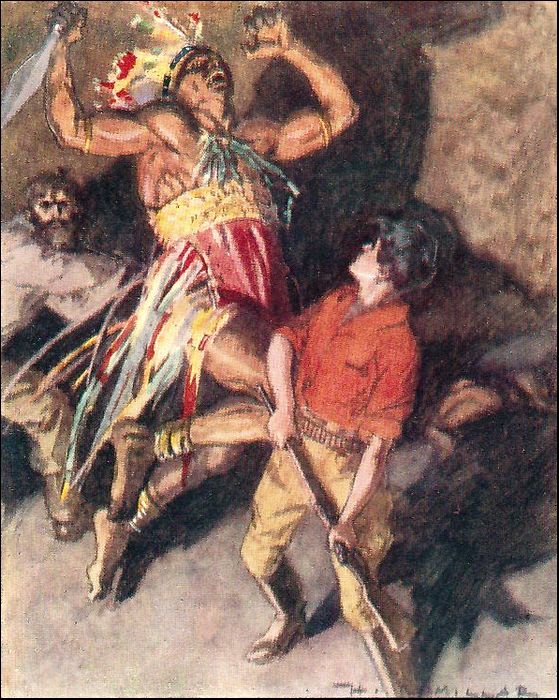
Fuma went tumbling backward, caught by the butt of Jackson's rifle.
"Thanks," jerked Jimmy, straightening himself.
"By hookey, kid, but he nearly had you," barked Jackson. "And—you're hurt, son!" as he saw the blood streaming down Jimmy's face, where a sword had grazed him. Jimmy had not known it, but he put up his hand and felt the warm blood flowing. He dived into his pocket for a handkerchief, and shouted with joy. Instead of bringing put the handkerchief he pulled out the tin that Hensley had given him, and which he remembered held a little of the powder—not much, it is true, but sufficient, as Jimmy hoped, to play the bluff that had sent the other party of invaders bolting for their lives.
Rapidly he worked while the others fought, and Jackson, realising that the boy was up to something important, though he could not understand what it was, stood guard over him and knocked out a couple of Fumas who came up against him. It took Jimmy but a few moments to make a couple of heaps—tiny heaps they were—but he decided that two were better than a large one, because of the cumulative effect.
Then having told Jackson to shout to the fighting Tukuls that there was nothing to fear for them, he touched off one. The result was instantaneous. The light given off by the torches, which were now dying down, was not sufficient to interfere with the flash of the magnesium, and the brilliance of it and the suddenness made both friends and foes yelp. Quick to seize any opportunity that presented itself, Jackson shouted out something in Tukulese to the pigmies—something, as he told Jimmy afterwards, that was a warning to the invaders and a reassurance to the defenders.
"Give 'em the other dose, kid!" Jackson cried; and when the flare had died down Jimmy touched off his last heap. Immediately the defenders went hard at their foes, who, believing that the white man's magic, powerless against the white men's friends, was yet potent to do them damage, turned tail and bolted. Jackson risked a shot or two then from his quickly reloaded revolver, and one or two Fumas, towering above the Tukuls—the man had been careful to aim high—went down. There seemed to the untutored minds of the Fumas some connection between the light and the shots, and it added to their terror. To keep up the bluff Jimmy switched on his torch, and Jackson continued to fire high and take toll. The result was that within half an hour of the arrival of the relief force the battle, which had been all against the defenders, assumed a different aspect, and the Fumas were striving their utmost to get out of the enchanted tunnel.
Some of them succeeded, many of them did not, and those who did were chased as far as the defenders dare go. Jimmy, faint with loss of blood and tired out, could not follow the victorious pigmies. Jackson, however, went with them, and he it was who headed the returning warriors, who, shouting with joy, thronged about the white boy, whom they looked upon as their saviour.
"Let 'em do it, son," Jackson shouted, as Jimmy tried to make them understand he wanted no thanks. "Let 'em do it. It'll serve us well later, no doubt!"
So the orgy of gratitude went on, and in the course of it a messenger came from Conky telling of what had happened in the main tunnel and also that the enemy had been routed at every point.
"Where's Rod and the others?" Jimmy asked Jackson; and immediately Steve questioned the messenger. A gabble of words came from the Tukul, to which Jackson listened in silence for a while; but suddenly he shouted wildly at the messenger, who cringed away in fear.
"What's the matter?" Jimmy asked.
"Matter!" exclaimed Jackson. "By hookey, matter enough. Young Rod's been captured. The rest are all right, but—but— Say, son, we've got to get back Rod even if we take all the Tukuls out into the valley and smash every rebel and Fuma there!"
ROD'S torch, by a remarkable and, as it turned out for the pigmies, a fortunate chance, had gone into the river upright and stuck in the mud at the bottom, and the light of it spread in a weirdly wonderful manner as the water acted as a sort of magnifier to it. Even Rod, as he tried to raise himself from the ground, and found he could not for the injured thigh, wondered at the glow, and it was a second or so before he realised what had caused it. The Fumas and Ok-Tal, however, had seen it and paused in their stride: Ok-Tal poised on one foot as he had reached Conky, and the Fuma's great sword hung suspended in the air as he was in the very act of bringing it down upon the white boy.
That hesitation gave Rod the minute's grace he wanted. He rested on his left hand and fired his revolver full at the looming figure of the Fuma. A sharp cry of pain told him that he had found his mark, but he was unprepared for what happened after that. The Fuma, as though it had needed only that stinging wound to bring him back to action, bellowed with anger, and before Dixon realised it he had picked up the white boy in his strong arms and lifted him bodily from the ground, and then went pounding down the bank.
Rod kicked and struggled, tried to get his hand free to use his weapon, but could not, since the Fuma had thrown his long arm right round him, binding the boy's arms to his side. For all the notice that the giant took of Rod's struggles the boy might well have spared his energy; all that happened was that the grip became tighter and threatened to squeeze the breath out of his body.
Then it seemed to Rod that the end of things had come in one great crash. Though he did not know it, what had happened was that as the Fuma emerged from the tunnel mouth one of the Tukuls, lying in wait for any fugitive, had fired into the darkness, and the knobbed arrow had caught the boy full on the head. He had a sensation as of a hammer-blow, lights danced before his eyes, his head swam, and then he knew no more until he opened his eyes to find himself lying on a couch of leaves in what his gathering wits told him must be a native hut, since round about were a dozen of the giant Fumas, whose
faces looked terrifying as the light from a fire in the centre of the hut glinted on them; and sitting on his haunches was Ok-Tal, grinning all over his ugly face as he looked at the white boy.
For a moment or so Rod lay there in silence watching the circle of enemies and wondering what fate awaited him and how it came about that he was there.
He did not know, though he guessed that that might be the case, that the Fuma had fought an homeric fight through a number of Tukuls, and that many of his own people, brought up by the one or two who had managed to escape from the trap that Conky had laid for them, had arrived just in time to send the few Tukuls fleeing, and that in the confusion caused by their rushing into the tunnel Ok-Tal had managed to make his escape, much to the chagrin of Conky.
For Rod it was sufficient, in an evil way, that he was a prisoner again, and, if he had appraised Ok-Tal's character rightly, he knew that he would stand little chance of life unless his uncle and the rest of the whites found some speedy means of rescuing him. Meanwhile, the only thing to do was to wait and see what Ok-Tal intended to do with him. He watched the crafty pigmy closely through half-open eyes, and then suddenly made as if to get up, only to find that he was bound hand and foot. But the effort was sufficient to cause Ok-Tal and the Fumas to jump up as though in fright.
"That's enough to show me they're jolly well scared of me, in case I've got some more white man's magic!" Rod muttered. "I wonder if—" his thoughts were broken in upon by Ok-Tal who, as he came to his feet, yanked out a revolver which Rod recognised as his own; and for a second or so the boy was in deadly fear lest it go off and by some unlucky fluke the bullet bury itself in him. Then he could have laughed aloud—in fact, did laugh; and possibly that did more to discomfit Ok-Tal and his big friends than anything else Rod could have thought of doing. For the laugh sounded above the crack of the revolver and at the shot that had gone whistling up through the roof of the hut. Ok-Tal, who had evidently expected to see his enemy lie still in death, dropped the weapon as though it had been red hot, because the report of it and the sharp recoil had scared him, and because the bullet had not harmed the white boy.
"Heaven send it hasn't any more cartridges in it; another mightn't be so lucky for me!" the boy breathed; but whether it had or not he could not tell for Ok-Tal's fright had been complete. He made no attempt to remove the revolver from where it was lying, and took good care to avoid it when he moved about the hut, a procedure which the Fumas also followed.
After a few moments they recovered their equanimity and sat down again to jabber at one another the while they constantly glanced over at their prisoner who knew that they were discussing what they should do with him. Presently Ok-Tal got up on, his feet and made a long speech, during which the Fumas swayed back and forth and clapped their huge hands as with delight. Then they got up and moved out of the hut one by one. Ok-Tal was the last to leave, and before he went he moved across to where Rod lay and gave him a kick in the ribs with his bare foot. The kick did not hurt physically, but Rod registered a vow that if ever he got free he would make the pigmy pay for it.
"I'll—I'll spank him like the pater used to leather me!" he grunted.
He lay in the flickering firelight for a while alone, listening to the uproar that had arisen outside, sensing that in some way it had to do with him. Suddenly his heart almost stood still as he heard a slight rustle behind him: he was lying so that he could not turn, and it was the fact that he could not see who was coming that for a moment or so frightened him. It is a very different thing being able to see your foe from just knowing he is creeping upon you unseen and almost unheard. And that it was Ok-Tal coming to taunt him, or perhaps to kill him out of hand, Rod had little doubt.
Then, just as he felt he must scream aloud with the terror of the suspense, he heard that which sent a thrill of joy through him and made him almost shout.
"Boss Rod all right?" a voice said; and the boy knew it for the voice of Copperface, though how he should be there he could not imagine. "Ok-Tal fool—Ok-Tal rogue," the native went on quietly, slashing the bonds that held Rod's hands. "He's goin' send messengers to Conky: 'Kill white men an' I stop war,' him say. Messenger to Conky's wise men: 'Turn Conky off throne—put me on, or me bring all Fumas in.' Messenger to white men: 'Conky play trick; him 'range all this, means kill white men.' That's what Ok-Tal goin' do, young boss!"
"Well, I'm hanged," Rod muttered as he reached out and took up the revolver that Ok-Tal had left on the ground. "He's a cunning rogue. Gee! but there are three cartridges left in it! And—"
Copperface, who was busy at the foot bonds, suddenly clapped his hand over the boy's mouth, and then, before Rod realised it, the native had slipped away, leaving him alone again. The youngster grabbed up the knife that Copperface had dropped, and stood up, facing the hole in the hut that did for a door.
Waiting for what might happen, and wondering what had caused Copperface to run away in that mysterious manner, it was small consolation to have had rescue so near at hand and then to be left in the midst of his foes.
He could hear the thud of feet approaching nearer, and realised that the native must have gone because of that sound, and for a moment Rod found himself thinking bitterly of Copperface for having been scared off so easily. Then he shook himself as though to throw off his unworthy thoughts of the native.
"Copperface wouldn't bolt for fear!" he said firmly. "I am certain there's something more than that behind it. And, anyway, I've got this knife and my shooter. I'll make Ok-Tal squirm, the little rascal!"
And Ok-Tal did squirm when a few moments later he walked boldly into the hut, stood for a brief space staring at the threatening figure with the revolver pointed full at him, and then with a howl of fear he went tumbling head over heels as Rod stepped forward. He picked himself up, and the Fumas and pigmies behind were thrown into utter confusion by the impact of the little man among them. Rod, thinking quickly, decided to stay where he was, since he could at least account for some of the foes as they tried, if they did try, to get in by the door, whereas if he went on and tried to force his way through, he would be open to attack by arrows and poison darts, quite apart from a sudden rush of overwhelming numbers.
Despite the seriousness of his situation he wanted to laugh at the dismay that had been written on Ok-Tal's face, and then blamed himself for a fool for not having fired at him, if only to wound the pigmy traitor.
For several minutes the confusion reigned outside, and then there was silence which held for a little while, followed by a shrill call from Ok-Tal, which was interpreted for Rod by a cloud of arrows that came winging through the door. Fortunately for him he was not standing in the direct line, and the arrows did no harm. Rod made no answer, reserving his cartridges, of which he had a goodly number in
his bandolier, for the time when he could see his enemies.
Then, as the shooting continued, and a number of arrows pierced the mud hut, Rod realised that it was time he did something. He slipped across to one of the holes made by the arrows, and, peering through, saw the crowd of Fumas and pigmies dancing madly and yelping with rage. With his knife he enlarged the hole a little, and a moment or so later his revolver spoke, to the terror of those outside, who simply broke and ran. Rod fired at them as they went, and laughed grimly as, through the hole immediately above the one through which his weapon was sticking, he saw Ok-Tal lying on the ground kicking up his legs in ludicrous fashion. It was evident that he was not hurt, but only scared; and Rod did not waste any shots on him, because it was impossible in the circumstances to take accurate aim. Ok-Tal presently got up and went scurrying off out of the clearing, which was now deserted, except for a few grim heaps lying on the ground.
Rod was left in his hut unmolested for an hour or so; he did not dare emerge because he knew that the enemy would immediately shoot at him if he did, and, for their part, the Fumas and pigmies were scared of the white boy, who could shoot to kill without even seeing his foes—for that is how the untutored minds of the natives read what had happened.
While he was sitting just beside the door, ready to fire if anyone showed in the opening, Rod was trying to puzzle out what had happened to Copperface and whether and when he could come back, and how.
"He'll probably bring a bunch of Tukuls along with him and our party," was the conclusion the boy reached, and the very thought of that served to cheer him up as he sat in the darkness, for the fire that he had not been able to feed for lack of fuel had long since died out.
As the time sped, however, and there was no sign of Copperface or the rescue party, Rod grew a little despondent and seriously considered the question of making a bold dash for it. Then a new thought came to him: until that moment he had forgotten all about Ok-Tal's cunning intention of sowing discord among the Tukuls and the white men. It was quite likely that the traitor had already dispatched his messengers and that that might account for what Rod considered was the undue delay in the arrival of the relief party which he believed would duly come. He argued, too, that the presence of Ok-Tal in the Fuma village—for he had no doubt that that was where he was—suggested that the attackers had been badly defeated and that what was not possible by arms was to be attempted by craft.
In this Rod was right, as he was to discover later. There had been great concern in Diamond City. Steve Jackson and Jimmy had gone back into the central cave and met the returning warriors and learned all that had happened.
"By jingo, we'll go fetch Rod back!" Stark Dixon had roared when the fighting at Diamond City was over, the attackers fled, and Conky had learnt of the capture of the boy. "Tell Conky to round up all his pigmies, Steve!"
"We can't go at the business like that, Stark," Jackson said quietly. "We'll have to adopt cunning methods, for sure! These Fumas will trap us all in the jungle outside. One of us'll have to go find out where the kid is and—"
"Copperface go," said that worthy. "Me know where People of the Valley live."
"I know you do," Jackson told him. "D'you think you can manage it, Copperface?"
For answer the native grinned and said:
"Copperface find Boss Rod anywheres!"
So he had been allowed to go and, emerging from the main entrance, had picked his way carefully and silently through the jungle, his native sense of direction enabling him to go unhesitatingly towards where he knew that the village lay. He had arrived just in time to see Rod, carried by the giant Fuma, flung into the hut; and a little while later had watched stragglers from the attackers arrive, Ok-Tal among them. There had been much bewailing among the natives, and Copperface grinned and chuckled to himself as he saw that the debacle had sent Ok-Tal down in the estimation of his allies, who were only brought round to friendliness again by the crafty pigmy promising them huge spoils from Diamond City when he became its king, as he vowed he would.
A number of the Fumas had followed Ok-Tal into the hut, which was on the edge of the village, and Copperface crept nearer to it. Lying full length on the ground, he had cut a small hole near the bottom, at which he listened, and had heard Ok-Tal explain his scheme for sowing discord in the enemy's camp.
Then when at last the Fumas and Ok-Tal had left the hut to inform the assembled crowd outside what was going to be done, Copperface, risking a great deal, had wormed his way round the hut on his stomach and slipped in—slipping out again when he realised that the enemies were likely to come back.
And while Rod waited for he scarcely knew what Copperface made his way towards Diamond City, but before he reached it a Tukul appeared at the entrance to the white's men's quarters.
He seemed nervous and ill at ease, but with some difficulty managed to stutter out that he had come from Ok-Tal.
"Guess this is the tough's emissary," Nick Turner said. "What you want?" he asked the Tukul, and the little man had begun a long harangue which resolved itself into an indictment of Conky, who was held up as a monster playing the traitor with the white men whom he wished to get out of the way and could conceive no better method than that of arousing the anger of the Tukuls as a result of the trouble that had been brought by them to Tukul land.
"Mr. Conky, Esquire, seems a nice sort of villain," Stark Dixon said when Nick Turner had translated the pigmy's story. "What are we going to do? Better wait, I s'pose, till Steve comes back from his confab with Conky."
"Guess you're about right, Stark," Nick Turner said.
"Look here, I don't know what the pigmy was saying," put in Jimmy Feltham, "but I somehow don't believe what he was saying! He looks too shifty for me, and—"
"A whole lot too cunning for me, too!" said Dr. Farrar. "I didn't like Conky when I first met him, but I believe the little chap's right enough. Besides, this yarn's a pretty tall one; it's a long way round and a risky one, as I judge it, to do what a poison dart neatly blown would do!"
For a moment or so there was silence, broken at last by Stark Dixon, who thumped a golden bowl and made it clang with a clang that caused the pigmy emissary to jump almost his own height from the ground.
"By hookey!" he said, "but there's something in that idea, Doctor. I think we'll hold this chap as hostage and then beard friend Conky and tell him what we've heard. Hello! here's Steve. Any news of Copperface, old chap?"
"Not a word," was the reply. "And Conky has not had any news from the various entrances. Everything's quiet. But what's this feller doin' here?"
Stark explained the pigmy's mission, and Jackson glowered at him.
"Did he say anythin' about Rod?" he asked. "You can cut out that yarn o' his. Ok-Tal always was a liar and far too cunnin' for Conky. But what about Rod?"
"Didn't ask him—thought that perhaps it'ud be best to let him think we hadn't missed the boy," Nick said. "But you can ask him if you would like to do so."
"No need to let the rascal go back, is there?" Steve suggested, "unless we send him with an ultimatum to Ok-Tal and his Fumas threatening to wipe 'em out with white man's magic if they don't give up the younker."
"Go ahead!" said Stark, and Steve began to question the pigmy so fiercely that the little man quaked where he stood and finally blurted out what he had evidently been holding as a trump card, namely, that Ok-Tal would kill the captive unless the white men agreed to help him depose Conky and set the pretender on the throne.
"Guess that's about enough to queer Ok-Tal's pitch!" said Nick Turner quietly and grimly at last. "By gum, there's a holy row goin' on out there!"
He darted out of the cavern along the little tunnel leading to the gallery round the central cave, and presently his companions heard him calling back to them.
"Come on, boys! Here's trouble! Half the Tukuls are climbing the giddy stairs armed to the teeth, and they're crying 'Death to the white men!'"
WHEN Stark Dixon and his comrades heard Steve Jackson's voice shouting his warning news they grabbed up their weapons and went rushing along the tunnel towards him. Arrived on the gallery, they saw that he had spoken the truth. The thousand torches flickered their gleams upon the shining bodies of the climbing pigmies, and up the main stairway came Conky, looking fierce, angry, and, it seemed, considerably hurt. He appeared to be having great difficulty in restraining the passions of his followers, for every now and again he halted in his progress and held up his long spear, waved it, and shouted above the roar of the rest.
"Tellin' 'em to keep calm!" Steve said with a short laugh that had nothing of mirth in it. "There's a mighty heap of trouble waitin' for us, chaps!"
There was indeed; for at the sight of the white men the fury of the pigmies increased tenfold, and Conky for a time lost all control of them. Arrows came whistling up and pinged against the rock face, narrowly missing their mark and causing Steve to bawl out for his comrades to go hide in the tunnel while he dealt with the matter. But they refused, and each man drew his revolver, and Jimmy, with sudden inspiration, whipped out his torch, flashing it full upon Conky who, when the light fell on him, yelled with terror and wellnigh toppled off his stair, his pith helmet going tumbling down and bouncing from head to head of his followers in its descent.
"Oh, good lad, good lad!" cried Nick Turner, who drew out his own torch, the others following the example also. "Dern me, but these things are better'n guns, an' don't make so much mess! Talk to Conky Esquire now, Steve!"
Jackson stepped on to the very edge of the gallery, and calmly sat down with his legs dangling over. For a few moments he said nothing, but contented himself with playfully sweeping his torch round the climbing crowd, causing considerable perturbation among them and making large numbers hurry down the stairs.
"Got 'em into a fit frame o' mind to talk to 'em, boys!" Steve said at last; and then, springing to his feet, went dashing down the stairs, causing Conky to fall back very hurriedly and in a very undignified manner. Steve caught him up, however, and yanked him back.
"What's the trouble, Conky?" he demanded. "Why do your people come in arms against us, we who have sworn friendship with you and who have fought your foes?"
Trembling, Conky answered, and Steve and Nick, the only two of the whites who understood what he was saying, listened in amazement and with no little wrath, combined with forebodings.
"The white men swore friendship," Conky said. "But the white men spoke not the truth. They came not, they said, for the Shining Things, nor the Gold Yellow Metal, yet to-day have my people learned that they set eyes upon these things to take back with them to the Land of the White Men. And my people are angry—they cry for the blood of the white men!"
"Set that dern gramophone of yourn goin', Hensley!" Steve called out over his shoulder. "The bagpipes, I reckon"; and when Hensley hurried off to the cavern to wind up his instrument Jackson spoke, to Conky forcibly, angrily and convincingly.
"Look here, Chief!" he said. "The white men spoke the truth; they did not lie; they are the friends of the Tukuls and of you. They want not the Shining Things nor the Yellow Metal—" and as a thought came to him he shouted back to Stark Dixon to fetch out the heap of golden ornaments that Conky had given Rod. "Pitch 'em all down at Conky's feet," he said. Then he went on to the Chief: "The white men give back to you all that you have given them—" and the first golden bowl went clinking down at the Chief's feet. This clearly impressed Conky and his people, who were looking on, standing as silent as death. The impression was greater when the whole bunch of ornaments was piled up before their Chief. "Those, your free gifts to the white boy who saved your life, are yours again!" Steve cried, and the mention of the rescue in the Pit of Diamonds touched Conky on the raw. Steve gave him no chance to speak, however, but continued: "I know, we all know, Conky, where you got your news from; it is Ok-Tal who has tried to poison the minds of your people against the white men!"
It was a shot in the dark, but Steve had made a guess as to the source of the trouble; and he saw confirmation of it in the pigmy's face.
"Is not that so, Conky?" he demanded, and the Chief nodded his head in sullen silence, though it was evident that he wondered how the white man had come to know the truth.
"And you believe the man who tried to kill you against the word of your white friends?" Steve went on. "And—" The rest of his words were drowned in the sudden surging, wailing scream of the bagpipes; Hensley had set his gramophone going, and, coming through the tunnel, which acted as a monster trumpet, the noise was terrific. The whole crowd of pigmies rushed off in terror, all except Conky, whom Steve grabbed and held captive—and the little men scuttled into the numerous caves around the central cavern. The sound was awful, and even Dixon, who loved the bagpipes because he hailed from Scotland, told himself that he never wanted to hear them again, but Hensley, standing in the tunnel mouth, looked down and grinned like the big boy he was.
"Some music, eh?" he bellowed above the drone and the wail, then darted back to wind it up again. Steve let him go on and allowed the record to run its course a second time, during which Conky trembled in his grasp.
"Go an' tell Hensley to cut off, Jimmy!" Jackson said at last. "But he might as well hold it ready to start agen when I give the word! Now look here, Conky," he told the native. "The white man's magic will bring harm to the Tukuls if the white men say so. We are willing to be friends again—if you will be friends! Or shall we be foes of the Tukuls? Remember the unseen death that killed the Tukuls' pumas!"
Evidently Conky did remember it; and he seemed to be wondering why the white men had not called upon their magic to take vengeance for the threat that the Tukuls had made. That fact probably did as much as even Hensley's bagpipe record to convince Conky of the kindly disposition of the white men, and he was launching into a fierce denunciation of Ok-Tal and a definite assurance of his faith in the white men when a band of Tukuls, dressed in weird clothing, fashioned out of native cloth, came into the cavern and stood before the throne. "The giddy cabinet, in other words, the medicine men!" shouted Nick Turner. "And those fellows only come when there's trouble brewing—and 'sfar as I've heard they only stand by that throne when there is to be a sort o' coronation. What's the game, I wonder. Ask Conky, Steve!"
Jackson asked, but Conky was as much in the dark apparently as the white men, and it seemed that he did not like the appearance of his medicine men standing there by his throne.
He was not left long in doubt, however. One of the men stepped forward, and through the puma head that covered his own he shouted out words that made Conky tremble with fear and anger.
Steve, sotto voce, translated it all for the benefit of his comrades, who were utterly aghast at the muddle of things that had taken place in so short a time.
"Ok-Tal again?" grunted Stark Dixon.
"You can bet your last cartridge that's so," said Steve. "Lor, but he's a crafty cuss. Tries to bluff us that Conky's playin' us the dirty; tries to bluff Conky that we're playing him the dirty; and then tries to bluff the medicine men that Conky's playin' the Tukul people dirty by promising us as much gold and diamonds as we can carry, whether the Tukuls agree to our takin' it or not! Result: the medicine men decide to depose Conky and set up Ok-Tal in his place! What a mess! What a mess!"
Before the others could answer, Hensley had set his bagpipes droning again; he had unbounded faith in them! And the sight of the medicine men, whom the Tukuls never for one moment thought would be affected by the white man's magic, going helter skelter for the shelter of the caves, was ludicrous enough to make a cat laugh, let alone the white men, the while the Tukuls, who had crept out of their caves, showed, before they dodged back, that they had lost a good deal of faith in their witch doctors.
"Bloodless victories, if you like!" Farrar laughed. "I forgive Hensley for his rotten taste in records. Any need to go to the end of it, though, Jackson?"
"Not a bit," and Steve called out to Hensley to stop it. Then he turned to Conky again. "Now you can see how true Ok-Tal's words are," he said. "Call the medicine men and your people out and let me tell them the truth!"
Conky obeyed, and, a few at a time, the pigmies crept out of their holes again, and the medicine men, now that the music had stopped, stumped back to the throne with something of their old puny swagger. Whereupon Jackson for ten minutes or so was busy expounding the gospel of Ok-Tal's treachery; and it was plain, as he got Jimmy to haul out the emissary who had come to the white men, and made him, trembling, quaking, tell his story, that the pigmies and the medicine men were at any rate partly convinced. Then Conky ordered up the plenipotentiary who had come to him, and he too was compelled, under threat of torture, to confess, after which, at Steve's suggestion, the medicine men produced their informant. The whole story was laid bare, and there was a terrific uproar in the cavern, which, after allowing it to rage for a while, Steve silenced and addressed the crowd once more.
"Who then shall be your king?" he demanded. "Ok-Tal the traitor, or Conky the man of truth?"
"Conky is our king!" roared the pigmies, and the Chief smiled his gratitude at Steve and in the excitement of the moment insisted upon shaking hands, white man's fashion, with his guests.
"But," he said after that, "what of the white youth who saved King Conky's life?"
"He," said Steve, "is a prisoner in the hands of the People of the Valley! I know because— Hello! boys," he broke off into English, "here comes Copperface."
The big native was panting and blowing as he raced across the floor of the cavern and sprang up the stairs, but he managed to gasp out his story to the white men.
"You're just a little too late, Copperface, old sport!" Nick said, and told him briefly what had happened. "Still, it's good to know the kid's alive, though from what you say he won't be much longer! Say, Stark, we'd better get a move on, eh?"
"I think so," Dixon told him. "Steve, rouse up old Conky to make his men go and attack the Fumas, if you can. We simply must save the youngster, whatever happens!"
"And we simply shall!" vowed Jackson. "Listen, O Tukuls," he cried to them. "The white boy who saved your king's life is a prisoner in the hands of the People of the Valley. He is to die before the big light dies again—unless you, his sworn friends, fetch him from captivity! The white men go—alone if the Tukuls, their friends, will not come with them and—"
A great shouting arose at that, and Conky was loudest in his cry of assurance that where the white men went the Tukuls would go.
"The way out is clear for you," Jackson went on. "You know the way to the Fumas' village. Therefore let us go now!"
A yell of assent arose, and Conky went down the few stairs that were between him and the floor. The white men followed him, and the pigmies began to array themselves for battle. Farrar and Hensley and Jimmy went up into their cavern to bring down as much ammunition as it was possible to carry, and they distributed it among the whites, near whom, about a dozen yards away, in fact, stood the three emissaries from Ok-Tal, glowering with rage at the turn events had taken.
Conky was standing with his back to them talking to the now friendly witch-doctors, when suddenly and without a sign of what was coming the three renegades made a rush for the chief. No cry came from their lips, and they reached the chief before any of the pigmies, or any of the white men, except Jimmy Feltham, realised what was happening. Jimmy, however, who had been stooping down to pick up a dropped clip of cartridges, was just straightening up when he saw the swiftly moving figures within a yard of Conky. Instantly he divined that all was not well, and the flashing of a knife—it was a white's knife, as was discovered afterwards, and had evidently been dropped in the excitement—for a second held him fixed. Then, with a yell of warning, he had leaped, swinging his heavy rifle above his head. The butt of it caught the hindmost pigmy and sent him tumbling to earth; the other two, with a roar of rage, swung round and went for Jimmy like wild beasts. One of them had the knife, but the other was unarmed. Unfortunately for himself, the latter was foremost, and he felt the weight of the rifle as it crashed upon his thick skull. Down he went, but the force behind the blow had almost overbalanced Jimmy, and before he could recover himself the knife-armed pigmy had slipped in under his half doubled up body; the knife flashed as the little man's arm went up and came—never, however, to bury itself in the white boy's body, because at that moment the pigmy squealed with terror and pain. And as Jimmy fell away he saw his foe jerked right off the floor by the right leg, swung up as a man swings an Indian club, and then Copperface, who had sprung in and seized him, flung him high into the air and let him fall where he would.
A shout of joy went up at that, as the pigmies, who at Jimmy's yell had sprung to attention and had watched the whole scene, realised that once more a white boy had saved the life of their king. Conky, for his part, could hardly contain himself, and Jimmy, who was calmly binding up the ugly flesh wound that the pigmy had inflicted, got Steve to tell him that he was delighted to have been of service to the king!
"Wants to make you a millionaire, Jimmy!" Steve grinned back at him.
"Tell him that'll wait," said the boy. "We must get along after Rod!"
Conky, beaming gladly, assured Steve that he was of a similar mind, and seeing that his warriors were ready, shouted out orders that sent them marching out by the main tunnel; and the pigmies, armed and reinforced by the handful of white men, went marching out to the rescue of Rod Dixon.
THE grim silence prevailing over the Fuma village became almost unbearable to Rod Dixon after about two or three hours of waiting. There were no signs of men or women or children; they had all bolted into the fringing forest. Yet the youngster knew that a thousand eyes were watching his hut. The great fire burning in the centre—the common fire of Fumas—began to die down for lack of fuel, and Rod shivered a little with apprehension of the time when the light would have gone entirely, for he realised that it was then that his danger would come, since the natives would be able to slink up to the hut and, perhaps at a cost of one or two lives, force a way in and recapture him.
"I'll make the beggars pay for it!" he gritted. "If only Copperface would get a move on!"
It was at that moment that the hut shook as though it had been in an earthquake tremor, and, swinging round to face the side where there had come a tremendous crash, Rod saw that it was bulging in and cracking. Then, before he realised what was taking place, the whole hut collapsed about his ears, and as he went down to earth, his revolver knocked out of his hand, half a dozen Fumas, whom he just caught sight of in the last dying flickers of the fire, were upon him.
Rod had his knife, it is true, and he used it to grim purpose as a couple of the giants knew when they went staggering back with gashed legs that made them howl with pain. But the odds were too great, and after a mad five minutes, during which several of the Fumas had felt the thrust of the white boy's weapon, Rod Dixon found himself once more a prisoner, bound hand and foot, and being carried over to where the fire burnt more brightly as the result of the feeding it had received during the struggle among the ruins of the hut.
The Fumas now swarmed out of their concealment and surged around the captive, who was tied to a stake placed something like half a dozen feet from the fire. Ok-Tal came strutting up towards him, and Rod whipped him into a furious temper by laughing at him. The pigmy knew why the boy laughed at him, and was angry that he should have been able to scorn him for his cowardice in remaining out of sight until the white youth was securely trussed up again. Ok-Tal raised his spear as though to smite the boy, but a Fuma—the Fuma who had carried Rod out of the tunnel—sprang in and wrenched the spear away. Rod at first imagined that he had found a friend, but he quickly discovered that it was not friendship that had caused the Fuma to save his life, for with much gesticulating and jabbering the giant made it pretty evident that he and his fellows were not going to be robbed of the joy of watching the torture of their captive through the personal hatred of their little ally.
"Nice beggars!" grunted Rod. "Only hope Uncle Stark and the rest'll come in time!"
He looked across to the ruined hut and saw how it was that it had been smashed; a long tree-trunk had been used as a battering-ram, which had been crashed into the rear of the place, and the boy was angry that he had been caught napping. A few shots at the ramming party would have been sufficient to scare them if he had only known what was happening, and he could have easily found that out by a little closer vigil at the various arrow-holes in the hut walls.
"Can't be helped," he thought. "They've got me and My word! That's the game, is it?"
He could not avoid the chilling dread that bit into him as he saw a Fuma, looking hideously large in his medicine rig-out, seeing to what the boy took for a spear head, which he was tending as a blacksmith tends a piece of iron in his forge. While this was going on other Fumas were gathering the several bodies of Fumas who had been accounted for during the fight at the tunnel, and others, hobbling and generally showing signs of severe mauling, limped into line behind their dead comrades. Then the medicine man, holding his red-hot spear aloft and waving it towards the line of dead and wounded Fumas and then towards the captive, droned something that the boy could not understand except by implicated inference; and Rod Dixon trembled for what he knew was going to happen, for the medicine man was evidently accusing him of being responsible for the calamity that had fallen on the Fumas and informing him of the punishment that was about to be inflicted upon him.
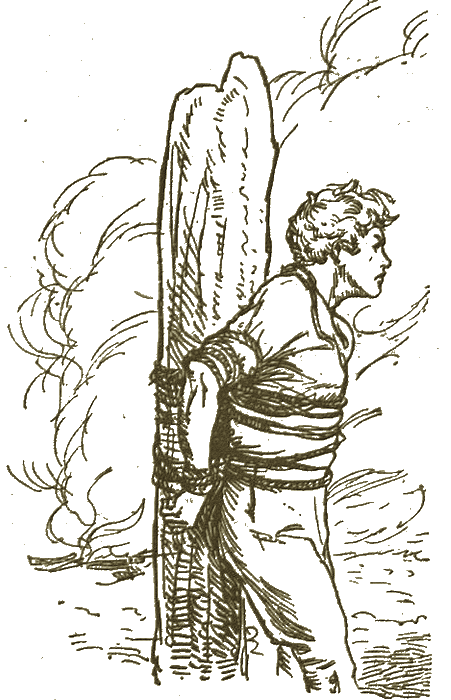
Rod Dixon trembled.
He advanced towards the boy, who, pulling himself together, resolved that he would show no fear, though he knew, that there was a terrible ordeal before him. Right up to him the medicine man came with the glowing spear-head. As he did so Ok-Tal lifted up his voice and cried joyfully, and a great uproar arose immediately as the Fumas took the hint.
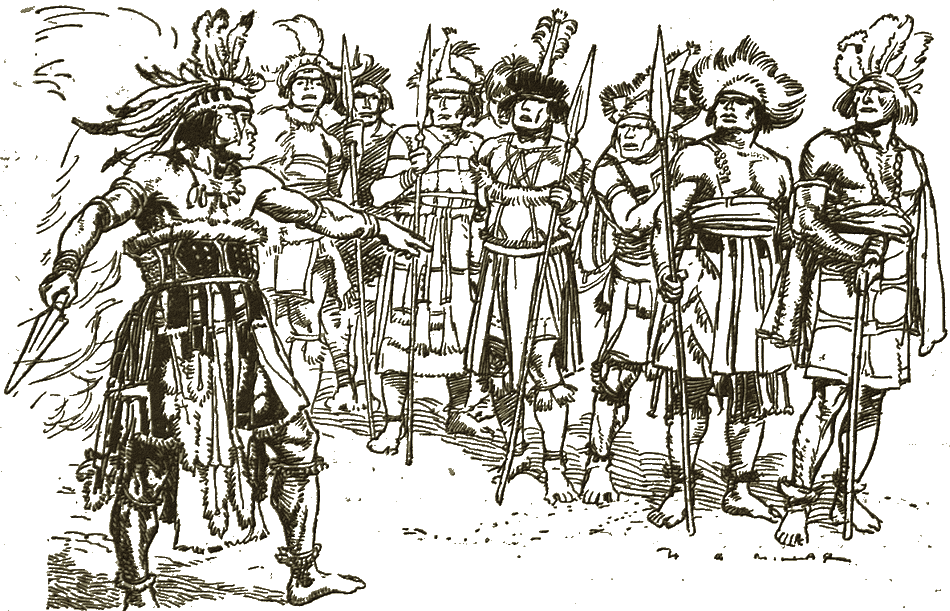
The medicine man came with the glowing spear-
head; as he did so Ok-Tal lifted up his voice.
Rod held his breath; he shut his eyes as though to hide the sight of that grim instrument of torture, then he opened them again to find the red hot thing within a foot of his face. Human endurance reached its limit then, and the boy let out a terrific yell that made the medicine man jump.
"Help—oh, help!" Rod cried, and his voice echoed in the forest. He had no hope that he would be heard; he had indeed reached the point where he believed that whatever help Copperface was intending to bring would come too late, and it was fear rather than hopefulness that had made him cry for assistance. The assembled natives, although they did not understand his words, knew what the boy was calling for, and Rod could have bitten his tongue for having given them the opportunity of gloating over his fear. Ok-Tal rushed up to the medicine man and shouted something to him, whereupon the Fuma went back to the fire and thrust the spear into the flames once more, where he left it a few moments, only to pull it out and advance with it towards Rod again.
"Going to drag it out!" Rod breathed. "But they'll not get me to shout out this time!"
Fearlessly now he looked at the grim, forbidding figure of the witch-doctor, who approached leisurely, the glowing red spear held straight before him.
He reached the captive, and the spear was within six inches of Rod's face when, without any warning, it went crashing to earth, followed by the thudding of the Fuma, who had given a convulsive shudder and then dropped the spear.
The uproar that had been raging snapped off as the Fumas and the few pigmies there saw what had happened to the witch-doctor. There had come no sound, they had seen nothing; no arrow had sped on its deadly flight, no poison dart showed upon the figure of the fallen man; he had dropped as though struck by some unseen sword, and there was an ugly hole on his naked chest—a hole which Rod knew, if the natives did not, was made by one of the shots from the soundless revolver of one of his comrades.
For the space of half a minute or so the silence reigned, a silence that was broken by Rod himself who yelled out:
"Hurry—boys, hurry!"
As though they had been waiting for something to galvanise them into action, the Fumas came to life then, but, above the clamour of their voices, there sounded what was to Rod Dixon the finest music in the world, the bagpipes droning out the "Cock o' the North."
Simultaneously there broke from the fringing jungle swarms of pigmies, and among them were Stark Dixon and his friends, who were firing into the mass of the Fumas.
"Coming, Rod!" yelled Jimmy Feltham, and Rod saw his friend, side by side with Nick Turner, break away from the circling Tukuls and race across the clearing towards him. Immediately a dozen Fumas and Ok-Tal sprang from the fighting crush and circled round the boy at the stake. Stark Dixon, with a cry of rage, picked up a pigmy and flung him full at the "bodyguard," crashing him in among them and so enabling Nick and Jimmy to reach them without suffering harm. Then, with Stark Dixon at their side, they set about the Fumas and Ok-Tal, who put up a gallant fight but, for all that they outnumbered the white men, could not withstand the fury of the attack.
One by one the Fumas went down, and at last there were only two of that party left and Ok-Tal. Nick Turner was opposed to one of them and Stark Dixon the other Fuma, leaving Jimmy to deal with Ok-Tal. All the white men had long since emptied their revolvers and were relying upon the broad swords that Conky had given them when they set out from Diamond City. Jimmy swung his in wide, sweeping slashes, and the crash of it as it met Ok-Tal's sounded like the report of a gun. Feltham gave the little man no respite, but pressed the attack, and he must surely have given the pigmy the coup de grâce had not a Fuma, driven back from the main fight by Steve Jackson, cannoned into the white boy from behind as he stepped back foot by foot before the pressure of Jackson. Ok-Tal, quick to seize his chance, sprang in and caught Jimmy a terrific blow on the thigh with his sword. Jimmy went down with the Fuma tumbling on top of him, and, when he wriggled free, he saw Ok-Tal rushing back towards Rod Dixon, his sword uplifted.
Jimmy sprang to his feet in a moment, and, knowing that he could not hope to catch up Ok-Tal, he flung his sword at him; it twirled through the air and fell with a thud upon the head of the pigmy, who went crashing to earth.
"Good shot, Jimmy!" yelled Rod as he struggled in vain against his bonds; and then Steve Jackson was upon Ok-Tal, pinning him to the ground, and threatening to break the small body as he bent it in his two great hands.
"Cut Rod free, Jimmy!" panted Steve, and Feltham's knife slashed the bonds and gave Rod his freedom.
"Here, Rod, take this," and Jimmy thrust his revolver into Dixon's hand. "The scrap's not over yet. Come on," and side by side the pair went dashing across the clearing to where Stark and Farrar were putting up a gallant fight to save Hensley, who was lying on the ground between them, where he had been knocked down by a knobbed arrow that caught him on the side of the head. And while Nick Turner was sweeping foes before him with a butt-ended rifle, while Conky matched himself against giant Fumas, the three whites held off the encircling pigmies and Fumas who were pressing the fight in a vain endeavour to put an end to the white men, who, now that their guns no longer spoke—since they had no time to reload—did not hold such terror for the natives. But the attack had been so unexpected and the surprise so complete, while the numbers of Conky's men were so much in excess of the defenders, that the end was foregone, despite the disparity in the size of the combatants. The Fumas' losses had been very heavy in that encounter in the tunnel, while the toll taken by the white men before they had come to close quarters had still further depleted the ranks of the giants and their allies.
Rod and Jimmy, resting after the full fury of the fight had died down and there were but a few knots of struggling men here and there, saw through bleared eyes that which made them shout with alarm, and instantly the other whites, with the exception of the still unconscious Hensley, sprang forward to them, while Conky and those of his men who were merely contenting themselves with driving off a few Fumas here and there, turned from their labours—at cost of life for some of them—and, seeing what the white youths had seen, went racing towards the group, gathering discharged arrows as they ran.
"The Guardians of the Valley!" cried Conky, and Steve repeated the cry in English so that his comrades knew that this was no mere attack by prowling animals seeking food, for there, leaping down the avenue that led into the clearing, were no fewer than ten of the largest pumas any of them had ever seen, together with as many jaguars; behind them, with flaming torches, which they thrust into the hindmost animals or else threw into the roaring band, were several Fumas, evidently men who had made their escape from the battle and, as a last resort, had released these brutes and set them on to their enemies.
Fortunately for the pigmies as well as for their white allies the whites had by now reloaded their weapons; and the flight of arrows that sped across the clearing into the mass of wild beasts was accompanied by whistling bullets that found, most of them, good marks. Time and again the men fired both bows and rifles, and at each volley one or more of the animals went down, until at last but two, fine, big brutes, remained alive—and these had gone slinking off into the jungle.
"Load up, fellers!" roared Nick. "Those brutes have smelt blood and they'll hang about! Keep your eyes open and don't get separated!"
The pigmies also, apparently, realised what Turner had realised, for during the time that they remained in the Fuma village, collecting booty and gathering their own wounded, they took good care to keep together, none venturing too near the verge of the forest.
While this was going on Conky and his chief men, together with the whites, were in the centre of the clearing round which the Fuma huts were ranged; and before them were several Fumas who, as Steve explained to his comrades, were chiefs, and Ok-Tal. All of them were unarmed, and Conky, with all the pomposity of a victorious general, stood, an almost grotesque figure in his now tattered pith helmet, and denounced Ok-Tal for his treachery.
"It is many moons," he said, "since the Tukuls and the Fumas met in battle; and but for this jaguar there would not have been this battle, in which, thanks to the white men's magic wands," and he waved his hands towards the rifles and revolvers, "the victory came to the Tukuls. I, Conky, and my people, desired nothing more than to live at peace; but, since war was forced upon us, we fought—and there are few Fumas left."
He paused a while to take breath, during which Steve translated for the benefit of his fellows.
"I say, Steve," said Rod, "old Conky looks as though he's going to have this lot wiped out. Can't we do something to stop it?"
"Try, kid, if you can!" growled Jackson. "Conky's sure made up his mind—it's too good an opportunity for him to miss. Fumas and Tukuls have been at loggerheads for centuries! Hello! there he goes again!"
Conky broke forth into speech again, and went on for some time, and, as Rod had realised, the end of his harangue was that he called upon the chiefs to pronounce the punishment that should be meted out to Ok-Tal and his Fuma friends. When Steve explained this Rod stood watching the Tukul chiefs for a few moments, and then impulsively he sprang forward and began to talk impassionedly, forgetting altogether that neither the Tukuls nor the Fumas could understand a word that he said!
When he stopped for want of breath Conky, with amazement written on his face, turned to Steve and demanded that he should explain what the white youth had been saying.
"He says, O Conky," Jackson informed him, "that even as he has thrown down his magic wand"—pointing to the rifle that Rod, in a moment of enthusiasm had flung on the ground—"so would he that the Tukuls and the Fumas should throw down their weapons and have done with war! Why should not the Tukuls and the Fumas live in peace? That is the message of the white youth who saved the life of Conky, king of the Tukuls!"
For a while there was deathly silence among the assembled Tukuls and the few surviving Fumas; and then, as Conky's face broke into smiles—a great change from the passion that had been written on it previously—there came a loud shout of approval as his people understood what their king was going to say.
"It is a good word that the white youth who saved the life of Conky speaks!" he said, Steve translating quietly as he went on. "The Tukuls would have peace"—and he flung down his long spear as he spoke—"if the Fumas would have peace!"
At that, one of the captives stepped forward, and, giant that he was, he looked dignified despite the scars and wounds he bore and the red streaks of blood down his brown, shiny body.
"Of all the chiefs of the Fumas," the giant said quietly, "I, Tonka, live—and I am king of the Fumas as by right. But where are my people? There—and there!" He swept his arms round the clearing where the grim forms of the Fumas lay and then out towards the jungle into which the survivors had escaped. "These, our foes and the foes of our fathers, are the victors, and the words of Conky, king of the Tukuls, are wise words. We, because we were beguiled by this jaguar into making war, have been defeated, and death is the portion of the defeated. Yet, wise are the words of the white youth: in peace would the Fumas and the Tukuls flourish. And I, Tonka, say for those of my people who live: 'If the Tukuls, once our foes, will have us for friends, then will we be at peace!'"
Every one of Tonka's comrades stepped forward and ranged themselves by him, shouting out their agreement; and, as they called out, there came from the forest answering shouts, followed presently by a number of Fumas who appeared between the trees. Tonka, at sight of them, called for them to come, telling them they could do so safely, and the Fumas advanced to the circle, which opened to admit them. Then Tonka explained what had happened, and one and all declared their agreement with the proposed treaty, whereupon Conky, rising again, snapped his spear across his knee and flung the pieces into the air. Tonka, picking up a discarded spear, did the same; and immediately the jungle rang with the cries of Fumas and Tukuls rejoicing in their new-found peace.
During this conclave Ok-Tal had been standing, glum, sullen and silent; and once or twice Jimmy Feltham had noticed the clenching of his hands. Taking the signs for those of regret, he said nothing to his comrades, and after a while forgot all about the renegade. As Tonka and Conky stepped forward in the ratification of their peace treaty, Jimmy, however, had a vision of a rushing figure—Ok-Tal was dashing full pelt towards Conky. Like lightning Jimmy jumped to his feet, threw himself in front of Ok-Tal, upswung his clubbed rifle and sent Ok-Tal staggering back as he caught him in the pit of the stomach, the knife, which somehow the renegade had managed to obtain, flying from his hand as he fell. The next instant Tonka had bounded forward, and the snapped-off spear-head was buried in Ok-Tal's body.
"So die all jaguars!" cried the Fuma chief.
And knowing all that Ok-Tal had done, there was not one of the white men who could find it in them to utter a protest against the judgment meted out to the little rogue.
"Seems to me it's a good time for us to get the rights of whether we'll be allowed to go away without trouble, Steve?" Stark Dixon said quietly. "What d'you think?"
"Reckon you're right," Jackson answered. "I'll try it!"
For the next five minutes he was engaged in a very forceful speech which, as he progressed, evidently impressed both Conky and the Fumas.
"My brother," he said, pointing to Nick Turner, "and I were prisoners in your hands, O Conky—perhaps we deserved to be, since we came, we confess, to seek the Shining Stones and the Yellow Metal. We know that because of this the Tukuls would not let us go, yet they know that when, moons ago, we and our servant"—Copperface grinned happily at the title—"escaped from their land, we tried not to take anything with us. These brothers whom I have brought back with me—they came only to claim their brother and his servant. They want nothing, no Shining Stones, no Yellow Metal; they know that the Tukuls would not have them take back to the Land of the White Men news of the Tukuls' treasures. We go soon and we take with us nothing that belongs to the Tukuls or the Fumas and—"
"For goodness' sake don't forget those fever nuts!" put in Dr. Farrar quickly. Nick Turner had been explaining what Steve was saying sentence by sentence, and Farrar was afraid that the thing that he treasured most, the thing that he realised was of far more importance to civilisation than all the gold and diamonds of Diamond City, seemed likely to be unobtainable unless Jackson made a bid for it.
"Leave that to me, Farrar!" Steve said quietly. "I guess we're goin' to come out all right on this stunt!"
In Tukulese he went on:
"The white men rejoice that their young companion should have been the means of bringing peace between the Tukuls and the Fumas; and, since Conky has promised that we may go our way, taking with us the two who were once prisoners, we go when the big light comes again!"
"As the white men wish, so shall it be!" cried Conky when Steve had finished; and the natives shouted their agreement. "The white men promise," he went on when the uproar had died down, "the white men promise that they will tell not to their brothers in the lands far off of the treasures of Tukul Land; and the Tukuls know they speak truth. Yet shall they not go empty-handed back to their own people, for, do not I, Conky, king of the Tukuls, owe my life to the white youths, my brothers? And have I not once made gifts to one of them," and he turned to Rod, "though when he who is now dead tried to make enemies friends that which I gave was given back. It lies there still in the heart of the city of the Tukuls—and with it there shall lie much more, the gift of the Tukuls to their white brothers. I have spoken!"
As he ceased speaking Tonka stepped forward before Steve could make suitable reply.
"Listen, O friends!" the Fuma said. "The People of the Valley have no Shining Stones, no Yellow Metal, to offer to the white men, but they have that which has been the secret of the Fumas!" He clapped his hands and one of the men raced from the gathering, to come back presently carrying a wicker basket full of round brown nuts, at the sight of which Dr. Farrar's face lighted up.
"Jackson's worked it, boys!" he said under his breath.
"That is the secret of the Fumas," Tonka went on, trickling the nuts between his fingers. "When the shaking sickness comes, the secret of the Fumas cures. The white men have brought peace between the Fumas and their old foes, and the Fumas thank them for it. Here are their thanks—as much of the sickness-healing nuts as they can take away, so much shall the white men carry with them, and I, Tonka, king of the Fumas, will show them how to make the medicine!"
"The white men thank you, O King Conky and King Tonka!" cried Steve, trying his best to keep under his excitement at the turn of events. "What more can they say or do? Hold!" as the natives shouted enthusiastically. "Hold! in the canoes of the white men, that lie broken in the great river, there are many things that they would give to the Tukuls and the Fumas; all that are there are yours!"
A great shout of joy went up at the words, and when the noise had died down Conky, rot to be outdone in generosity, invited the white men and the Fumas into Diamond City to a feast. Before they went, however, Dr. Farrar sent a number of Tukuls into the city to bring back his medicine chest, and when it was brought to him he attended to the wounds of the men who were still alive, and then a move was made back to the city under the hill.
There a great feast was spread, which lasted all through that day and part of the night. While it was in progress the white men distributed among their hosts the greater part of the contents of the canoes—knives, blankets, trade goods of every kind, which pleased the natives probably a great deal more than even the gold and diamonds, which the Tukuls heaped before their guests, pleased the white men, though when Tonka, after showing Farrar how the nuts were ground and mixed into a paste, told him that in the morning he should have as much of the powder as could be carried away, the doctor's delight was greater than either that of the natives or of the other white men.
"I reckon we've struck lucky! Rod said when the little company was once more in its quarters in the cavern after the feast was over. "We're as rich as—as—well, goodness knows how rich we are! How we're going to get all the stuff away I don't know. If we'd only got our poor carrier chaps with us."
"Don't worry about that, youngster," Steve grinned across at him. "I've fixed up with friend Conky that his little chaps shall come with us up the river and then man-haul the canoes through the jungle and paddle 'em for us a good distance down the other river, leaving us well before we come to the populated parts. There we're going to cache what we can't carry with us, and come back for it."
"A good idea, Jackson," said Farrar. "You see, boys, we've promised the Tukuls and the Fumas we'll never come back and that we won't tell where ,we got the stuff. That means, you know, that the only supply of these precious nuts I'll ever get will be what I take with me this time, and I want to take as much as possible. Seriously, that gold and those diamonds aren't worth half as much as this stuff—I mean it as regards money values, leave alone the good that will come and—"
"I'm content," said Stark Dixon quietly, "to take all the nuts I can get, even if I have to leave most of Conky's present. I know—I've seen it—what malaria can do, and anything that will cure it as those nuts will ought to be got to civilisation."
"Seems to me," said Hensley, lifting his bandaged head, "seems to me that I'd better scrap that camera of mine—so long as I can take what films I've made. That'll make more room for nuts, Farrar, eh?"
"It will," said the doctor. "And—er—why not make Conky a present of that wretched gramophone? That'll be so much less to carry too!"
"Good idea!" Hensley agreed. "Anyway, I'm going to sleep now. Goo'-ni—"
In a very short time the whole company of whites were fast asleep, utterly worn out with all that had happened. They slept till nearly noon the next day, and when they awoke it was to find that the Tukuls and Fumas had simply loaded the canoes with the gifts they had made them; and when Steve, at Farrar's suggestion, proposed to Conky, in Tonka's presence, that they would rather take more nuts than diamonds, Tonka refused to have it so, and insisted on lending them extra canoes which he had filled with already ground nuts.
Then, with about fifty canoes trailing behind them, the white men set off down the river, the Tukuls and Fumas who were not coming with them standing at the tunnel exit, shouting lustily as they swept down the river; while behind there came the strains of a triumphal march which Hensley had set going on the gramophone to please Conky.
"That's a fine instrument, you know," Hensley said ruefully. "Hanged if I like to leave it after all!"
His comrades laughed, and Rod, with a broad grin, said:
"One thing about it, Mr. Hensley, we won't hear those bagpipes again!"
"Won't we, or won't I, rather?" retorted Hensley. "I'll tell you, my boy, when I get back to civilisation that's the first record I'm going to buy; I reckon it saved our lives more than once!"
And there was not one of the white men there who did not realise that he spoke the truth, and when, after a journey that lasted several weeks, they paddled up to Manaos, having cached their treasure when the pigmies left them, they could have shouted with glee. Indeed they did so when they heard a copy of that record being played at the Menezes factory.
"The very next time I go out into the wild places a gramophone's going with me, and that bagpipes record, sure thing!" laughed Hensley. "And I don't think it'll be long, for I'm turning cinematograph-hunter right now, and if anyone likes to come in with me, why, they're welcome!"
But that is another story, and so is that of Dr. Farrar and the fame that came to him when, in due course, he gave the world the great cure for malaria. It is another story, too, how Stark Dixon and his two nephews left the Menezes factory and set up in business for themselves on the banks of the great Amazon, with Nick Turner and Steve Jackson as their "bosses" of other factories. While the story of Nick Turner and Steve Jackson, and how, with Copperface, they succumbed after a few months to the call of the wander spirit, would in itself make a whole book.
But it is safe to say that Rod Dixon and Jimmy Feltham never experienced more adventures during all the rest of their lives than they had met in their journey into the heart of the great jungle when assisting in the quest for Nick Turner, "the whitest man who ever held a gun!"
Roy Glashan's Library
Non sibi sed omnibus
Go to Home Page
This work is out of copyright in countries with a copyright
period of 70 years or less, after the year of the author's death.
If it is under copyright in your country of residence,
do not download or redistribute this file.
Original content added by RGL (e.g., introductions, notes,
RGL covers) is proprietary and protected by copyright.