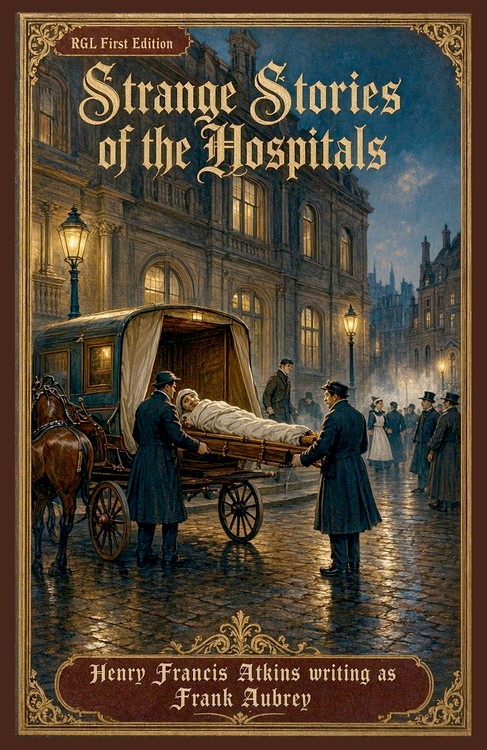
RGL e-Book Cover
Based on an image created with Microsoft Bing software
Roy Glashan's Library
Non sibi sed omnibus
Go to Home Page
RGL e-Book Cover
Based on an image created with Microsoft Bing software


"Strange Stories of the Hospitals,"
C. Arthur Pearson Ltd., London, 1898
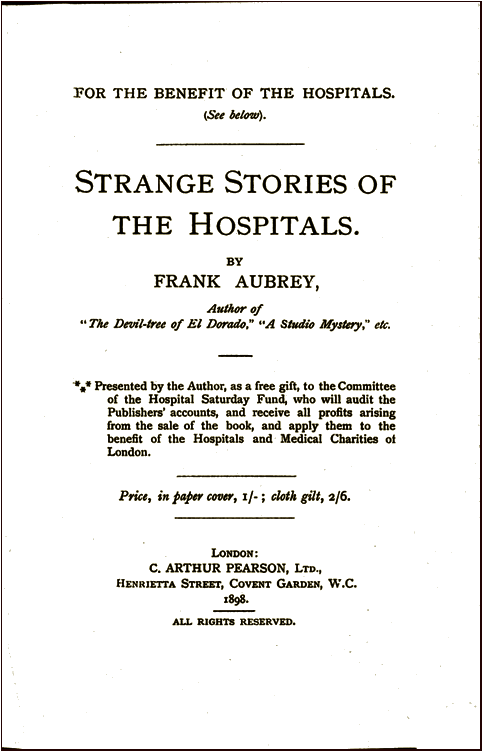
"Strange Stories of the Hospitals,"
C. Arthur Pearson Ltd., London, 1898
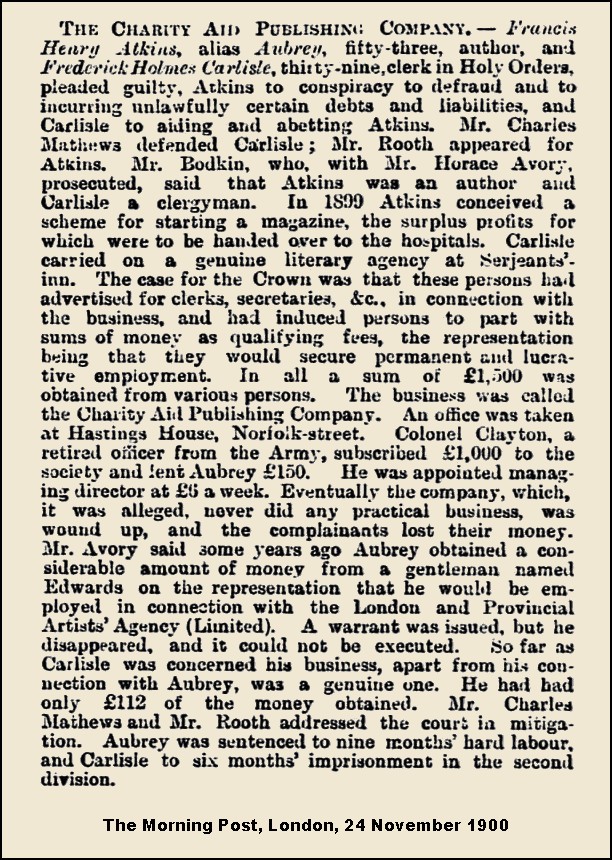
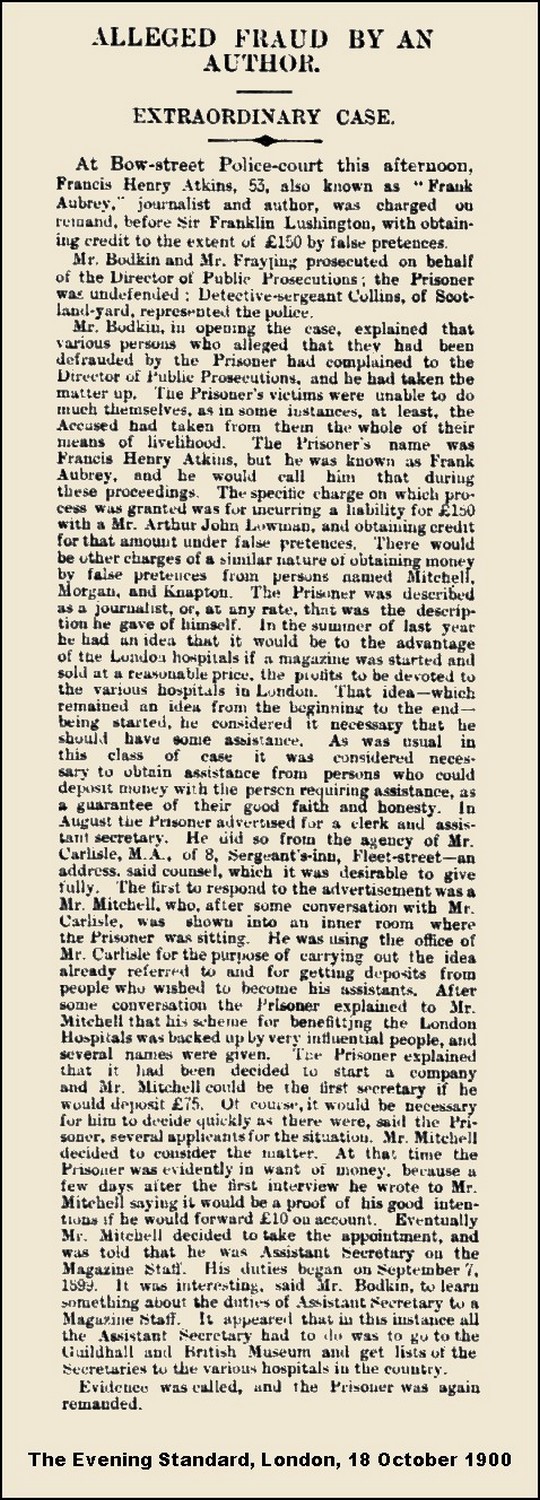
In 1900, two years after the publication of this book, the Francis Henry Atkins (aka Frank Aubrey) was arrested and tried for conspiracy to defraud in connection with a money-raising scheme related to his Charity Aid Publishing Company, the ostensible purpose of which was to raise money for hospitals. He was found guilty and sentenced to nine months' hard labour.
The following comptemporary newspaper clippings provide an overview of the case.
IN perusing the appeals put forward from time to time on behalf of the Hospitals the idea has frequently forced itself upon my mind that much more might be made of the opportunities for arousing public sympathy and interest which are constantly presented by what may be justly termed the Picturesque and Romantic side of Hospital Work.
That such a phase exists is certain; and it is equally true that it is crowded with extraordinary incidents and remarkable "happenings" replete with romance, and full of human interest. "Cases" occur daily which would yield, to those who chose to follow up their previous and subsequent histories, tales as prolific in strange developments as ever suggested themselves to the most imaginative writer of fiction. And it seems but a reasonable suggestion that if some of these were made known and brought under the notice of the general public, they might very materially increase the interest of possible donors and so become the means of gathering much larger subscriptions than would otherwise be the case.
Thus many, perhaps most people, when asked to contribute to a Hospital Fund, have in their minds merely a vague idea that these institutions are places where the poor can find refuge in case of illness, from which they return, if cured, to every-day life—and there the matter ends.
But this is not the whole case for the Hospitals. There is far more to be told than is included in so limited a view, as may be easily enough seen from the following brief summary of only some of the incidents that occur almost daily in these institutions:—
Here take place strange meetings and reconciliations between longsundered friends and relatives, or erstwhile enemies; marriages are often brought about that would never otherwise have taken place, and many a betrayed, heart-broken sufferer has thus been made "an honest woman." Strange and startling confessions, too ,are poured out occasionally; crimes that had been planned prevented; others that had been committed partly atoned for; and many a drunkard's reformation dates from an enforced visit to a Hospital. With too many poor creatures it may be their first experience, alas! of human kindness, of cleanliness, of neatness and of order. Finally, it is often the turning-point for good in a career of vice.
These and similar beneficent results are aided by other Charities and Missions, the Workers in which visit the Hospitals and make friends with the lonely patients, afterwards following them to their homes and so continuing the influence for good.
Of the above and countless other "happenings" that are constantly met with in Hospital work, I have here been able to find room for only some half-dozen; but these are of a kind that appeared to me to present, in each case, some special feature of interest. In the hands of an abler writer they might, doubtless, have been turned into narratives of fascinating attractiveness; but if, to the eyes of the critical, they should appear to be wanting in literary merit, it may still be open to me to hope that there may be found in them sufficient human interest to please the general reader, and assist the avowed object of the work. Even, perhaps, they may meet with a reception sufficiently kindly to encourage the issue of another little series, having a similar aim, in the future . In the same spirit, I would point out that if the connection of the "Story" with a Hospital appear, in some cases, to be slight, that is precisely one of the chief purposes in view. It is part of the intention underlying these "Sketches," to illustrate the proposition that the indirect benefits conferred by our Hospitals equal, and may even, perhaps, exceed in value to humanity, that more direct good—the care and cure of those suffering from illness, accidents, or crimes of violence—which is always so much more prominently in evidence.
Possibly these considerations have not occurred to the majority of those asked to "give"; and possibly, again, now that they are brought before their notice, those who have already given may be led to give more. If the perusal of the following pages should have that result, even to a small extent, I shall have good reason to be satisfied; and if, in addition, the sale of the little book should yield a profit to be added to the general Fund, then I shall feel only too well pleased with the outcome of my work. —Frank Aubrey.


"TELL me the truth, sir, oh, tell me the truth! Do they think at the Hospital that Daisy won't get well?"
"I can only say what I have been charged to tell you, Mrs. Maguire. I am truly sorry I cannot add of my own knowledge anything likely to comfort you; but it would be wrong of me to mislead you. I will not therefore disguise the fact that they have grave fears about her case. Everything possible is being done for her—that I know; the rest is in the hands of God."
The speaker was Mr. Weston, a Worker in one of the London Missions that combine District Visiting amongst the dwellings of the poor and lower middle class, with ministration to the sick in the Hospitals. A spare, elderly man, with pale face and anxious, but kindly, expression of countenance; to-day, he looked even more grave and anxious than usual, as he sat talking in Mrs. Maguire's little parlour in Battersea.
He had just come from the Hospital in which Daisy Maguire, a little girl of some ten years of age, had been lying for four or five weeks. Every day he was at the Hospital for a few hours, and on those days when neither the mother nor the father could call to make enquiries, he seldom failed to look in on his rounds to bring the parents the latest news.
He had known Mrs. Maguire in the country many years ago, when she had been a happy, cheerful, rosy-faced girl, and had met her again accidentally some months before at the Hospital—for this was the second time the child had been laid up there. Since that accidental meeting he had regularly visited the house, though he was but coldly received by the husband, William Maguire. The man was inclined to be sullen and unfriendly, but he never openly objected to Mr. Weston's visits, because they pleased his only child, Daisy, who had all his love. The mother now was very different from the maiden Mr. Weston had known years before. The daughter of a schoolmaster, and fairly well educated, she was now a sallow-faced, unhappy-looking matron, soured by the unhealthy conditions and sordid surroundings which fall to the lot of most of the workers in this great metropolis. She had that listless, half-vacant, half-absent look that tells its own tale of disappointed hopes and disillusion; of distrust of the future, mingled with dreamy memories of a brighter, but now fast-fading past. Even her care for her child, the pretty, bright-eyed, laughing Daisy, seemed unable to lift her out of the despondency that had become habitual to her. As a consequence the child was more drawn towards her father, who freely showed his love for her at all times. This preference on the child's part was an additional cause of complaint with the mother, who shut her eyes to the fact that in this matter what she complained of was mainly her own fault.
To-day the thought that the child's life might be in danger had the effect of rousing in the mother a greater thrill of natural affection than she had perhaps been sensible of for many a day past. And Mr. Weston, feeling sure that it was so, noted the fact with gladness, mixed with both sadness and compassion.
"She wants to see her father," he said, after a pause, and with some hesitation. "She was moaning and crying for him when I left, and they said that, in the circumstances—if he went round at once—he would be allowed to see her as a special favour. Otherwise, as I suppose you know, they are expecting a visit from the Princess there this afternoon, and he would not be admitted in the ordinary course till after she had gone."
The mother flushed.
"'Moaning and crying for her father,'" she repeated, plaintively. "Does she not want to see me, too?"
"I am sure she does," Mr. Weston answered, kindly. "But, you see, it was her father she asked for more particularly, and—seeing who is expected in the afternoon—they have already gone out of their way to give me permission for him to go at once. I could not well ask them to do more. Will you not go yourself in the evening? I feel sure they would let you see her then."
Mr. Weston," said the unhappy mother, "this seems like a judgment on me! I feel I must have done wrong somewhere—though I scarcely know how or where—when it has come to this, that my only child, who is, God knows, dearer to me than anything else in the world, asks, not for me at such a time, but for her father. Always for her father. Yet he it is who has made my life unhappy, and estranged from me my child's affection. But I ought not to have let him do it. I fear—I begin to see, to feel, it has been a good deal my own fault. But it is not now the less bitter!" And she burst into tears.
Her visitor waited awhile for the fit to subside somewhat before he made reply. Then he said, gravely—
"I will not hide from you that I have noticed with pain that little Daisy has not seemed to regard you with the same love that she shows so freely towards her father. That it is her fault I can scarcely believe, for she is evidently a child with strong affections. I have not ventured to speak of it before, because I did not wish to seem to interfere. Now, however, that you have referred to it, I will only say I pray it may please God to preserve the child to you, and to give you both the opportunity of understanding each other better in the future."
The mother continued to sob, and it was some time before she spoke. Then she looked up, and through her tears, replied—
"You have spoken truly, sir, and that shall be my prayer from now, so long as there is a hope left. Yet I have not been without some excuse. You do not know the load that is on my mind about my husband. I have been afraid even to breathe a word about it before. But now, as things are, I may tell you that I live in constant dread and fear. I have even—God help me—sometimes thought it might be better if—our—poor—Daisy—were—taken from us—than that she should live to know the trouble that I fear is too surely coming upon us."
Mr. Weston looked at her in surprise.
"Why," he exclaimed, "What can you mean? Your husband is not unkind to you, is he?"
She shook her head.
"Not directly unkind," she said, "though there has long been coldness, estrangement, between us."
"H'm. But—he does not give way to drink?"
"No; oh, no."
"What then?"
She looked at him doubtfully, as though debating how to answer. Then, seeming to make up her mind, she said, finally—
"I cannot tell you now. Perhaps another time— if I dare. But I expect him in every moment now. When he comes I will give him your message, and he will, I know, go to our darling instantly. Please leave me now; I do not feel able to talk any more."
And Mr. Weston rose, and with a word or two of comfort and encouragement, took his leave, shaking his head, however, gravely and sadly, as he left the house.
BESIDE a bed in one of the wards of the Hospital William Maguire sat holding the hand of his sick child. He was a handsome man of some five-and-forty years of age, with features that were not unpleasing, albeit they bore generally a stern, unsympathetic look. To-day, however, those who knew him best would have been surprised at the change in his expression, so tender and full of love was it now, while he bent over little Daisy. But when a nurse came up and touched him on the arm, whispering that he must come away, "as the Princess was coming," he received the message, kindly and gently spoken though it was, with a look so forbidding that she almost started.
"Are these great people," he said to the nurse, in growling tones, as they passed together along the corridor, always to have their own way like this, do you think? May not a father sit by the side of his dying child but he must be ordered off, for fear his presence should pollute the atmosphere when Princesses or Princes, or some others of the rich and great choose to come here to make even a Hospital into a show place?"
"You shall come back later on," replied the nurse. She thought grief for his child had made him scarcely responsible for what he said. And she led him into a waiting room, and left him with a few kind words, and promising to come back for him shortly. And there Maguire sat down, resting his elbows on his knees and his chin on his hands, gazing on the floor with scowling looks, and brooding over his troubles and his enmity against the world. To be thus ordered away from the bedside of his child at the bidding of a Princess was, in his view, one more drop in the cup embittered by his hatred of the rich and great, that he had been steadily filling up for years.
In the ward he had just quitted, little Daisy, after watching her father wistfully so long as she could see him, closed her eyes wearily, and lay hugging to herself his solemn promise to return almost immediately. Meanwhile two or three ladies had entered quietly, and, all unknown to her, were now standing gazing pityingly at the young pallid face, so full of childish beauty and yet of suffering, that rested upon the snowy pillow. Something pathetic in it touched the heart of the gracious lady who looked upon it, and she went to the head of the bed and bent over it. Soon little Daisy felt her hand gently taken and another hand passed softly over the back of her own with light caressing touches. And then, looking up, she saw, to her great astonishment, a beautifully-dressed lady gazing at her with eyes that were full of tenderness and compassion, and a face that seemed to her more loving and lovable than any she had ever seen before. The poor child's heart went out at once to that sweet look, and, innocently responsive to its attraction, she wound her other arm round the neck of the strange lady, and with a soft happy smile she murmured, "Kiss me." And the face bent down and kissed her. Then her hands were gently replaced on the coverlet and a kind voice said, "There dear, now go to sleep, and try all you can to get well—to please me." And Daisy contentedly closed her eyes, and for some time tried to go to sleep, but could not for wondering who the kind lady was—whether she was a fairy—or whether she had been only a lovely dream. Presently this latter query grew upon her so, that she opened her eyes and looked round wonderingly. The beauteous lady had vanished, and in her place now stood the nurse, who was regarding her with a quiet smile.
"Please, nurse, did a fairy come to see me and kiss me, or did I dream it? She told me I was to get well—to please her. And I will too. I mean to," said Daisy, with more animation than she had exhibited for many days.
The nurse sat down by her and took her hand.
"That's right, Daisy—you must try all you can to get well, to please the nice lady. But it wasn't a fairy, and it wasn't a dream, child. It was a very great lady indeed—a Princess—and you ought to be very, very proud to think she kissed you."
"A Princess!" said Daisy, her large dark eyes opening in wonder. "Was that a Princess—a real one?"
"Yes, a real Princess. Very few children have such reason to feel proud as you have now. And I do believe she's done you good, you look better already."
"Yes," Daisy answered," I feel better, too. But that is because she told me to, you know. I would do anything—try all I can—to please anyone like that. Has she any little children? How nice it must be to have a mother like that! How I wish my mother was like her! But mother never looks at me that way. And yet"—she broke off with a puzzled air—"how can a real Princess be so nice? Father always declares that all Princes and Princesses, and Queens and Kings are bad, naughty people, that ought to be—" Here she stopped and gave a half-frightened look at the nurse, and seemed to shudder.
"Where is father?" she presently went on.
"He will be here soon, dear. Now lie quiet, and remember how glad and happy and proud you are to think the Princess kissed you—the only one she kissed, you know."
"Is that true?" asked Daisy, with a pleased smile.
"Quite true, child? Never forget it all your life."
"I won't," said Daisy—and she said it in a tone that showed she meant it. "She's my Princess now," she added softly, after a moment or two of thought. "I shall always call her 'my Princess.'" And the nurse laughed good-naturedly and went away.
Three days later the father and mother came together, and were surprised to see Daisy sitting up in bed and appearing already almost convalescent.
"The Doctor says she will get on now," said the nurse, looking kindly at the child. "I think you need not be anxious about her any longer."
Somewhat to the mother's surprise, Daisy stretched out her arms to her, instead of welcoming her father first, as was her wont.
"Kiss me, mother," she said, putting her arms round her mother's neck. "Kiss me, and look at me as 'my Princess' did. You remind me of her now, somehow. I don't know why, but your eyes are like hers, and you look at me more like she did. You never used to do that, you know. Did she teach it to you? Have you seen her?"
The mother scarcely replied, but kissed the child passionately, and a grateful sigh went up from her heart—a thanksgiving for this fulfilment of the prayer uttered but a few days before.
"You are going to get well now, my darling," she sobbed.
"Why, of course," Daisy replied, with prompt decision. "Didn't 'my Princess' tell me to—to please her? And didn't she kiss me on purpose to try to make me well? It would never do to keep ill after that, you know," she added, shaking her head sagely.
"And now," she went on, after she had been kissed by Maguire, "I want father to promise me he will never say unkind things about 'my Princess' or the Queen, or any of them again. Because they are not true, you know. Promise me, father dear."
"Very well, my child," Maguire answered. But there was no heartiness in his tone, and the child was quick to notice it.
"Say you mean it," she said stoutly, "or—or—or—" She hesitated, and then, with a playful smile, added wilfully, "or else I won't get well."
And the father pressed her hand, and repeated his promise, but at the same moment the eyes of the two parents met. And each turned away, that the artless Daisy might not see the terrible pain and distress that were too plainly written in that brief glance.
"WHY, Daisy, what are you looking so thoughtful about? You used to be all smiles and gaiety; now you look as though you had the care of the whole world upon your shoulders. Soon I shall have to dub you 'Daisy the Thoughtful' instead of 'Daisy the Playful,' as I used to call you."
It was Mr. Weston who spoke. He had surprised the child sitting with an open book in her lap, apparently in a deep reverie. It was some weeks after her return home, and she had quite recovered her health, but not altogether, Mr. Weston had several times observed, her former spirits.
Daisy glanced up with a bright smile, and rose to greet him. Then the smile vanished, and she looked thoughtful again.
"I hardly know, sir," she replied, "whether I ought to tell you what I was thinking about. But—perhaps I may." Then, in a lower tone, "I am sorry about father and mother, sir."
"Why; they are kind to you; they are very fond of you?"
"Oh yes, sir. And mother especially; she's so kind now—kinder than she used to be before I was ill. But I know she troubles about father—I don't know why—and it makes me unhappy, too."
"By-the-bye, Daisy, what about your coming to our Sunday School? Have you got your father to consent yet?"
She shook her head gravely.
"No, sir—not yet," she said slowly. "But," she went on hopefully, "I think I shall soon. I mean to try all I can to coax him to let me."
Then Mrs. Maguire came in and told the child to go away, saying she wished to talk to their visitor; and Daisy tripped off, but not without a playful show of reluctance.
"I want to talk to Mr. Weston, too!" she declared, with a pout. "He's promised several times to tell me all about 'my Princess,' but you always send me away when he comes. And I know why, too," she added, saucily, "you want to talk about father, and don't want me to hear."
Mrs. Maguire watched her leaving them, with a look in which motherly pride and pleasure were strangely blended with pain, and then, turning with a sigh to her visitor, said, in reply to his enquiring look—
"I have discovered nothing further, and seem as far off as ever. But this I know—or rather feel—that things are coming to a crisis somehow. William seems more troubled from day to day. He seems to have something dreadful on his mind, and he talks and mutters, and tosses about in his sleep, but what he says I cannot understand. Only one expression have I heard that I could repeat with certainty, and that seems to have no meaning in it. More than once I have heard him mutter something about 'Daisy's Princess,' and then he sighs heavily. Of course you know that, since her illness, Daisy is constantly chattering, child-like, about the Princess who spoke so kindly to her. But what has that to do with William's talk in his sleep? One would almost think the Princess filled his thoughts as much as she does the child's. But, by day, he never mentions the subject—and—besides—why should it seem to trouble him?"
"I wish with all my heart," she went on, after a pause, "that he had never taken it into his head to invent anything. It has always seemed to me that all the mischief came from that. True, we are better off now; he brings home more money, and that has made things better for us at home here, and for Daisy, poor child. And he says it is all due to his inventiveness. Yet he does not explain how, and I have horrible doubts and fears that I dare not, as I have often said before, even hint to you. When he was at Mr. Duncan's, working regularly, he got less money, it is true, but he was a different man, and we were happy together. When he threw that up in a fit of temper, things went wrong, and we had a terrible time. And, now that things are better in one way, they are worse in another, for he is altogether a changed man. Oh, Mr. Weston, what am I to do? Could you not suggest anything to help me?"
In the end this talk came to nothing, as had been the case many times before, for Maguire guarded his secret too carefully for his wife to be able even to guess at it. So she could not tell Mr. Weston anything upon which he could advise. He left her, therefore, feeling more perplexed than ever, and full of misgivings.
"But, Mary Maguire," he said solemnly, at parting, "do not lose your faith and trust in God. When you were a young girl in our village, and I used to teach you at our Sunday School, you were one of our most earnest scholars, afterwards one of our most zealous assistants in our parish work. Have you forgotten the lessons you then learned? Have this London life, and your trials and troubles, crushed all these out? Try to bring back the state of feeling of those old days, act as you would then have acted, keep up your trust in God and never cease to pray to Him for help and light and guidance, and I feel sure all will yet be well. When your child lay ill at the Hospital,
I gave you the same advice, and—"
"I know, sir," Mary Maguire answered, humbly. "And I prayed then, and have ever since, as I—I confess with sorrow and shame—I had not done for many a long year."
She seemed on the point of bursting into tears, and seeing this, Mr. Weston said no more, but nodding his head approvingly, left her.
And now to tell what was the secret that Maguire concealed so carefully from his wife. He was indeed in a position of deadly peril, and he knew it—knew it but too well—and he was struggling in the toils in which he had become enmeshed, striving despairingly to find some way of escape. He was in the power, because in the pay, of the Anarchists; was involved in one of the cruellest, most diabolical plots that even those reckless conspirators ever conceived. And this is the stranger, in that he himself was very far from being a badly-disposed man. As a matter of fact, William Maguire was an honest, good-hearted specimen of the better class of British working men; a mechanic, clever and skilled above his fellows; educated beyond their average—chiefly through his own persistence in attending evening classes of instruction—and, withal, industrious and hard-working He was, too, sober and truthful, and incapable of a mean action—at least, apart from the plot he had become entangled in. How, then, came such a man to be mixed up in schemes that had for their object the wholesale murder or wounding and mutilation of fellow-creatures individually unknown to him, and against whom he had not even the excuse of personal enmity? It may be worth while to trace the causes that led to such an apparent anomaly; the more so that there is only too much reason to fear that his case is, in some measure, a representative, rather than an exceptional one.
Mrs. Maguire, in stating that his inventiveness had brought him trouble rather than advantage was partly right; others who knew him would perhaps have blamed his hot and hasty temper, and these, too, would have been partly right. But the origin of the mystery lay farther back.
Maguire's father had been one of those people who are the friends of everybody in the world, save those they ought to think the most of—their own wives and children. He spent much of his time in getting up and attending meetings of working men, at which it pleased him to join with other agitators in declaiming against capital, wealth, and the upper classes generally. Their aim was to persuade their listeners that they were down-trodden slaves, whose duty to themselves and their fellows was to "rise in their millions against the few thousand of their oppressors, and seize upon the land they had been robbed of, and the wealth that had been wrung out. of the vitals of the people," and so on. A well-meaning, but ignorant and uneducated man, who neglected his work and made his own house an unhappy, poverty-stricken home for his wife and children, that he might persuade others to turn the world upside down, in order to experiment with the crude theories and imaginings of his own undisciplined mind.
Naturally the son, William, brought up in such an atmosphere, imbibed many of his father's notions, and, in particular, his hatred and distrust of those above him.
A relative of his mother had come forward and found the money for his schooling, and to have him apprenticed to a firm of mechanical engineers, and here he exhibited such aptitude and application, that when his term expired, he found himself able to earn more money than any other workman of his own age in the place. But he could put nothing by, for all his earnings were required to keep the home together and find food for his father and mother and several younger brothers and sisters. William submitted to this, and manfully, too, but under protest as it were; and in the end it became a burden that soured him and filled him with a sense of injury. He was too shrewd not to see that his father was thrusting upon him an unfair load for a youngster to bear, and all because he—the father—had wasted his own time and opportunities in trying to manage other people's business. If he, William, was able to earn more money than his fellows, the fact was due, not to his own father, but, firstly, to money found by a distant relative; and, secondly, to his own perseverance in attending classes at the Polytechnic. And, when he went on a visit to his mother's relations in the country, and saw and fell in love with pretty Mary Blake, his present wife, and awoke to the knowledge that he could not himself marry for some years by reason of the burden he had already on his hands, then he felt there was something rotten somewhere. Conscientious and industrious, he postponed his own marriage for years; but he did not do so willingly or cheerfully. Henceforth he was a man who had a grievance. And, whereas he had been taught in his youth to hate capital and wealth, he now went farther, and distrusted the whole fabric of society high and low. There seemed to him something wrong about a state of things that had compelled him to bear, while still young, an unfair share of the burden of life: therefore, in his view, all society, as at present constituted, was wrong, and ought to be reformed from top to bottom.
However, in the course of time his father and mother died, the younger members of the family were able to shift for themselves, and William went down and married Mary Blake and brought her up to London. Then all went smoothly for a few years, till he fell under the influence of the inventing fever. He passed much of his spare time in making small working models of engines and other machines, and, in the course of this work, an idea struck him that he subsequently worked out and patented. His employer, Mr. Duncan, thought well of it, and promised to aid him in getting it brought forward; and doubtless would have succeeded in doing so, had he been allowed reasonable time. But in such matters progress is nearly always inevitably slow: nor could a busy man be expected to put all current business matters aside to devote his time and attention exclusively to the exploiting of a new and untried invention. Moreover, Maguire's expectations and demands were absurdly inflated, and he exhibited the impracticable spirit that inventors so frequently become imbued with. Finally, the unhealthy principles that had become implanted in his mind during his earlier life now exercised their malign influence, rendering him suspicious and impatient. He had formed extravagant notions of the value of his invention, and, when offered reasonable terms, refused them with indignation, believing that, as a poor working man, he was being treated with injustice, and ground down by the force of capital. At last, in a burst of passion, he quarrelled with his well-intentioned employer, threw up his situation, and insisted upon liberty of action to do what he pleased with his own invention.
Then came the usual results. He neglected to get another place, and devoted his time to hawking his invention about in all sorts of likely and unlikely quarters. His savings disappeared—for he had been thrifty, and had put a little by—first one thing, then another, was pawned or sold, and still he went on, ever fatuously believing, from day to day, that he was on the eve of making a fortune. And ever, at each succeeding disappointment and failure, he grew more soured and more embittered, laying the blame of his troubles, not on himself, but on society at large.
It is scarcely needful to say more. When, in time, he drifted against some Anarchist refugees who were carrying on their deadly plottings in London, he fell an easy prey to their persuasions. They were shrewd enough to see the use they could make of his mechanical ingenuity, and, by flattery and pretended sympathy, soon converted him into a compliant tool. Having money enough for their purposes—it is strange that it should be so, but these wretches never seem to be in want of funds—they were able to bind him to them the more irrevocably by supplying him with means enough to lift him out of the slough of poverty in which he had been struggling.
And this is how William Maguire—an industrious, clever, thrifty mechanic—had come to be mixed up with some of the most bloodthirsty miscreants of our time. But now, at the eleventh hour, he had suddenly come to a sense—vague, perhaps, as yet, but growing—of the wickedness of the schemes in which he was engaged. The great plot his employers had in hand was against the lives of the Queen and others of the Royal Family on the occasion of the Jubilee Procession of 1887, then but a few weeks distant, and what had happened at the Hospital on the day of the visit of the Princess had upset all his previous ideas and filled him with uneasy throes of conscience. Daisy quite believed that she owed her recovery to the Princess, and he himself felt that there was good foundation for her belief. It had been a turning point in her illness, and the pleasure and freshness inspired in the child's mind—perhaps even her touching belief that she ought to get well, if only to obey and please the Princess—all these things had worked together for good at a critical time; and Maguire knew it. But it all came as a revelation to him. He saw how absolutely, cruelly wrong he had been in his notions and conceptions of this particular member of the Royal Family. Could he then be sure he was not wrong in other directions, in his opinions of the upper classes—possibly even of the much-abused capitalist? These thoughts set up a contest in his mind, of which the concrete result was that he was now casting about despairingly for some way of separating himself from those he was associated with, without incurring the vengeance with which he knew too well they would pursue him. But he was too surely entangled; and the more he thought about his position and the difficulties of escape, the more steadily, from day to day, the conviction forced itself upon him that he had gone too far to retreat. And what this meant to him, when he reflected upon the consequences that must fall upon his wife, and the innocent child upon whom he had for long centred almost all his love, may be more easily imagined than described.
ONE warm sunny morning in June, Daisy set off to carry a letter to her father. It had arrived after he had left home, and being marked "immediate," Mrs. Maguire had decided to send it on to him at once. Daisy knew the way, having been sent on similar errands before. She started off in high spirits, well content at the prospect of seeing her father, and receiving from him a kiss and a caress. Her way led through Battersea Park, which, as those who are familiar with it are aware, is one of the most charming of London's open spaces. Then she went across the river by the graceful Chelsea Suspension Bridge and along the Embankment towards Vauxhall. On a crowded river steamer she heard music, and, after listening to it for a few minutes, she tripped lightly on her way again, singing the refrain of the popular song they had been playing on the boat. Finally, leaving the riverside, she turned into some narrow roads running through ground but partially built over, and stopped outside a closed gate in a narrow street in a poor neighbourhood. This gate had painted on it, "William Maguire, Engineer and Machine Fitter," a sufficiently respectable, if somewhat vague, description; also the words "No admittance except on business. Please ring." Daisy, though she had been there many times before, had never been inside; her father always came out to her when she rang, and sent her away again—sometimes walking part of the way home with her—without ever gratifying her curiosity as to what was to be seen inside that closed gate. To-day. however, for a wonder, the gate was ajar, and Daisy, prompted by the wish she had long felt to see beyond, pushed it open and went in. Inside, she found herself in a yard, at the far end of which was an old stable that had been converted into a workshop. Seeing no-one about, she entered this—the door being open—and looked round. There were benches and a lathe, an anvil and forge, and other usual fittings of a mechanic's workshop. On one of the benches were two curious, complicated-looking machines, somewhat like the works of a clock. Passing on through another door, she entered an inner room where were many glass bottles and jars, and chemical apparatus. On a bench there was a strong open box, fitted with what looked like little nests lined with soft wadding, and in each space, reposing like an egg in its nest, was a round glass ball, filled with a coloured substance. On one side was a step-ladder that led up to an open loft extending across one end of the room. Running along the edge of the loft, as a protection, was a rough railing, over which two or three horse-cloths were thrown. Just when Daisy had noted these and other details, she heard voices in the yard, and, peeping cautiously through the window, was greatly alarmed to see, not her father, as she had expected, but two strange men. They were rough-looking men, and Daisy did not like their looks. Thinking they might be angry at her coming in without permission, she hastily made up her mind to hide, until her father came. Then she knew she would be safe; he might be angry with her, perhaps, but would not hurt her; and these men looked so rough and fierce, one could not tell what they might not do. Thus thinking, Daisy crept noiselessly up the ladder into the loft, and hid behind the horse-cloths that hung over the railing, peeping out between them at the men who were now entering the room. She could see the whole room plainly, without much fear of being seen herself. Here she waited, panting with fear and hardly daring to breathe.
The men went first to the box with the glass balls. Here they stood silent for half-a-minute, regarding the box apparently with great interest and curiosity. Certainly they were not prepossessing in appearance, and it was not surprising that the child had felt afraid of them. One was a tall brawny fellow, with red hair and beard unkempt, and not too clean. As to his nationality it was doubtful. From his speech he might have been either an Englishman or a foreigner. Perhaps, originally, a desperado from the States, or one of the South American Republics. As a matter of fact he was an ex-Communist. The other, a shorter, thick-set man with fair hair and moustache, was somewhat cleaner and neater in appearance, but he had a sinister expression that was too obvious to escape the notice of the observant, albeit the man was less aggressively fierce-looking than his companion. He was probably a Russian exile, but, like the other, spoke English well, as was evident when the two began to talk.
"So!" said the shorter man, looking at the glass balls, "these are the pretty playthings, are they? Humph! They look innocent enough, too. They've taken some time to make; however, it's a good thing to know they are ready in good time. Sure they're all right, Legrand?"
He stretched out his hand while he spoke, as though to take one up. The one addressed as Legrand stepped forward hastily, and interposed.
"Am I sure, say you? Oui, mon ami, I am so sure, that I don't want to see you touch one. If you were to drop it do you know the consequence? Poof! Away we all go to 'Kingdom come,' as the children say. Only bits of you or of me, or of this place, would be found here one minute after. Do not be rash and foolish, mon ami. Leave them alone; I am almost afraid to touch them myself."
Then ensued a long talk. The Russian seemed to be in some sense a stranger to the place, or had been away some time, and the other showed and explained everything to him, going at length into the details of the fiendish plot that had been elaborated. And though their language was interspersed with foreign expressions here and there, and many fierce oaths and coarse words that need not be reproduced, they spoke principally in English, and with sufficient clearness for Daisy, horrified and trembling, to understand the drift of what was said. She grasped the fact that it was intended to attempt the lives of the Queen and those with her on the occasion of the Jubilee procession, and comprehended, above all, that "her Princess" was among those threatened.
Presently the two went into the outer room, and Daisy found she could still hear plainly what was said. The loft, in fact, ran back without any partition over the first workshop, and there were wide cracks in the boards through which she could both see and hear.
"These, friend Karanoff," said Legrand, pointing to the mysterious-looking small machines on the bench, "are the two 'death clocks' I told you about. They've taken a long time to get out; had to make special moulds and patterns first, and all that; but there they are now, loaded up and 'ready for use,' as the window-tickets say. You see that pointer and those figures there? You set that, and, according to the figure you set it at, it will go off in so many hours. Then you dig a hole in the ground at the foot of the wall of any place you want to send up skywards, put a lot of dynamite cartridges in it, and this machine in the middle of them, cover them up, and leave them. A few stones or branches strewed about will suffice to hide the fresh earth, and—there you are; you can retire in safety and without hurry, knowing that, at the appointed time, your little 'flare up' will come off—when you yourself are far away."
"So!" grunted Karanoff, approvingly. "Mais—how do you know it will go off punctually?"
"I've tried 'em both—many times, before they were 'loaded'—and they never failed."
"Let us see now, mon ami. I turn this—"
Again the other interposed.
"Don't do that, for, if you do, it will have to go off in due time, and we don't want that, you know. Once started you can't stop it or unload it."
"So! But that seems to be a—what do you call it? a weak point, does it not?"
"It can't be helped; it would have taken ever so much more time to make them so that you could stop them. At least so Maguire says; he made them, you know. Besides, where is the use? You could not use them a second time, you see. You only want to use them once. Once will be quite enough for those anywhere in the neighbourhood, I guess." And he gave a brutal laugh.
"Oui, oui. C'est vrai. Mais, you speak of Maguire. Is he quite safe, do you feel sure?"
Legrand hesitated, and drummed with his fingers on the bench, before he answered. Then, in a lower voice, he said:
"There you've hit it. I do not trust him, especially of late. Somehow, I hardly know how, he seems altered. With us, as you know, to doubt is fatal, and means but one thing. We must make him safe before the time comes. You understand?"
"I think so, mon ami. We've been through too much of this sort of thing together for me to misunderstand. Still, there may be risk in that. If he is getting what you call lukewarm only, perhaps a little more money, eh? He's too deep in now to be likely to risk his own skin?"
Just then the outer gate opened and swung to, and a step was heard crossing the yard.
"Sh—. Here he is! Be cautious what you say. If it has to come to my plan, do not forget that we can do without him now. He has done all we want."
Maguire threw the door open and came in. He looked pale and haggard. There were dark rings round his eyes, as though he had had no sleep for many nights. The man called Karanoff greeted him effusively, but Maguire responded but coldly, and, though he seemed to smile, there was something in the lines about his mouth that gave him an expression of grim determination.
"Ah! I'm glad you've come, friend Karanoff," he said in a hard, low tone. "I've been hoping to see you, for there is something that I wish to say."
"Mais, that is all right, my dear friend. I am only too delighted. What is it you would say to me?"
"To put it shortly, this. I am going no further in this business!"
A fierce oath broke from Legrand, but the other only held up his hand, and said quietly:
"So! And why, if I may ask, my dear friend?"
"Because I am sick of it; and for reasons of my own."
"So! Very thoughtful of you; very frank. Mais, why this sudden change? You had even more of zeal than we ourselves not long ago. Is it that you want more money?"
"No! I wish to heaven I had never taken any of your filthy, bloodstained money."
"Ha, ha! Perhaps all the same you do want a leetle more, and do not know it. See here now, let us talk this over."
He pulled a roll of bank notes out of his pocket.
"Look at these, now," said the tempter, "you know they are good, you have had plenty before, and know we do not deal with bad money. Now come! You are out of sorts to-day. There is nothing like the money to put one in a good humour. See here are notes for one hundred pounds. You will take them, will you not? and all shall go on well."
But Maguire, to their surprise, firmly refused; and even when the offer was gradually increased up to five hundred, he showed no sign of yielding. Then ensued arguments and discussion, slowly but surely working up, through threats and counter-threats, to a heated quarrel.
"I say to you both, go!" Maguire exclaimed, fiercely. "If you like to clear out you shall be safe from me, provided you leave all these infernal devil's hatchings of murder machines behind. You shall have plenty of time to get safe away out of the country. You have money; I want none of it. I say go! Let me see the last of your hateful faces!"
"You infernal traitor!" hissed Legrand, through his clenched teeth, but stopped when Maguire turned upon him savagely.
But this brought him with his back to Karanoff, and that suave, but ruthless ruffian, raised his arm in the air, and in it was a gleaming poignard that he had for some minutes had concealed up his sleeve, watching for his opportunity, while outwardly appearing to control his temper.
A blow—a groan—a fall. Fierce oaths and expressions of malignant triumph from the two men that drowned a low, smothered, sobbing cry from the unseen spectator above. Then, for a space, a horrible, deadly stillness.
"Ugh!" the assassin exclaimed, stretching his arms, and yawning, and looking with a cruel smile first at the prostrate man and then at his confederate. "That was sharp work! I'm glad it's over and done with. Help me to push him out of the way—under that bench."
When this had been done, the two scoundrels sat down unconcernedly to discuss what next to do.
"This puts an entirely new face on things," observed Karanoff reflectively. "He will be missed—sought for. Ma foi! It upsets matters badly! We cannot stay here! I begin to fear perhaps, after all, I have been too hasty. It appears to me, mon ami, we must clear out."
"I'm afraid it is so," returned the other, gloomily. "But what can we take with us? Only these two 'death clocks.' We dare not risk carrying those glass things. It's lucky the clocks are finished and all ready for action. There are the padded leather hand-cases we had made for them. It's lucky all that part is ready to our hands."
"You'd better pack them up at once," replied the Russian, and his companion forthwith set to work to do so.
AND during this time, on the floor above, a slender, white-faced child was lying on the floor, with wide-open, horror-stricken eyes, gasping and panting for breath, and heroically striving to keep down the convulsive sobs that rose in her throat and threatened to choke her, if she did not give them vent. But suddenly a thought came into her mind—a wild, awful, terrible thought! A thought so dreadful, that at first she would not, could not face it; it seemed only a formless brooding horror. But it grew, and grew, and gradually took shape; and still it grew ever clearer and clearer, till finally it was no longer a mere thought, but a solid, fixed resolve. Then she rose to her knees, and clasping her hands, prayed silently to God, only just breathing the words. - And while she prayed, the look of resolve took an expression such as might have been worn by a Christian martyr facing death in the amphitheatre of ancient Rome. Her eyes were now tearless, but never did they lose that look of stony horror. And this is somewhat how her prayer ran:—
"Oh, dear God, give me strength to do this, and forgive me if it is not right, because I am only a little girl and I do not know—and cannot think of any other way. Father is dead; so nothing can hurt him, and I don't want to live now—only for mother; but I don't mind dying, if it will save my dear Princess that was so good to me, and that made me well. It can't be wrong, dear God, I think, because I read in the Bible about Samson, and it didn't say he was wrong, and I can't think of any other way. And please, dear God, be kind to dear mother and make her happy; she will be so lonely." Then a sob nearly choked her again, and she remained for a while quite still, striving to quiet her emotions and collect all her energies for this last act of her young life. For this poor little would-be martyr, impressed with the belief that the two assassins were hurrying away to use their infernal machines against 'her Princess,' at once, had made up her mind to thwart them by sacrificing at one blow both their dastardly worthless lives and her own! Meanwhile the miscreants were completing their preparations for departure. Suddenly a groan from the prostrate form under the bench proclaimed the fact that Maguire was still alive. Both turned to look at him, and Legrand exclaimed, with a savage oath, "You've bungled it after all! He's not dead!"
"We'll soon settle that, curse him," Karanoff hissed out between his teeth. He gave a snarl, like a wild beast; then he drew out the poignard again, and advanced upon his victim. But at the first step he paused in surprise, for he saw that Maguire, who had raised himself painfully on one elbow, was gazing intently, not at his would-be murderer, but at something behind him; and in his eyes there was an expression that made the assassin start and look round to see what the wounded man was staring at.
In the doorway between the two workshops stood Daisy, and the sight of her nearly made the two hardened wretches before her fall to their knees in terror. She spoke no word, only stood and regarded them with a wild hard look that almost froze the blood in their veins, for they saw that in each hand she held one of the death-dealing glass bombs. Instinctively they divined her purpose, and the two cowards trembled as they realised their awful danger. For a space that seemed like hours no one either moved or spoke. The two hardly dared to breathe, much less to risk any word or movement that might startle the child into dropping one of the terrible instruments of death. So they stood and looked at her and at one another, she all the time seeming like one walking in her sleep, or as one doing unconsciously the bidding of some will stronger than her own. To the two vile beings who cowered before her she seemed like a veritable Destroying Angel, sent for their punishment by an avenging God.
Maguire was the first to speak. He spoke with effort, and scarcely above a whisper.
"Daisy, be careful! Do not drop one of those things."
She shivered and seemed to listen, as though some one had spoken from afar. But her eyes never swerved from their watchful regard of the two villains. And still she gazed vacantly, as one who sees not.
"Daisy, be careful, I say! Listen to me. Obey me. Be careful!"
"Yes, father." The words came in a hurried surprised whisper. But still the eyes never moved.
Maguire understood. Gently, in low, guarded accents, he spoke to her again and again, gradually bringing to her wandering senses the fact that he was still alive, and that it was not, as the child seemed to have imagined, his spirit that spoke to her. And the other two stood and listened the while, and shook with fear and terror, knowing but too well what awaited them all if, when the truth should be borne in upon her, she should start forward and drop one of the deadly bulbs.
Nor was Maguire less terribly solicitous, as well may be believed. Spite of the smarting of his wound, of the exhaustion that was creeping upon him from loss of blood, he spoke on gently, quietly, till at last there appeared in his daughter's eyes a dawning, glad light of comprehension, and, for a moment, she looked at him. Her pale face flushed, and she exclaimed—
"Then they have not killed you, father! But they tried to. Will you get well?"
"Y—yes, I think—I hope so. Be careful, Daisy."
"Yes, father. What shall I do? You told them to go if they took nothing with them. Shall I let them go like that?"
Legrand here seemed to recover his scattered senses somewhat. He noiselessly drew a revolver from his pocket, and was evidently about to aim it at the girl to frighten her, but Karanoff now woke up, too, and seized his hand.
"You confounded fool!" he exclaimed, hotly, but in a low voice. "Would you bring death upon us all! Leave this to me. Let me talk to her."
And he talked and talked, and tried to coax and wheedle the girl, but to no purpose. Instead, she seemed every moment to regard the two with added contempt and disgust, as though she realised their despicable cowardice, and knew that she was mistress of the situation.
"Tell me, father, are they to go?" she asked, without looking at him, but keeping her eyes fixed upon their enemies.
"Yes, Daisy, I wish it."
"Not without these things, though, mon ami" exclaimed Karanoff. He pointed to the two leather cases containing the infernal machines.
"Let them take them, Daisy."
The child stared at him wonderingly. There was, however, a strange smile on his face that reassured her.
"Now, you two, do as I told you at first," said Maguire, his voice full of bitter scorn—"Go!"
And the two anarchists sneaked out furtively. But, when they got outside, they broke into a run, and hustled one another, striving which should get into the street first. Two bullying, boastful cut-throats, belittled, defeated, frightened by the superior courage and loving devotion of a girl of tender years.
"Will they not come back, father?" asked Daisy, doubtfully.
"No, child. Now go and put those things back, very, very quietly and carefully. And then come to me. I have much yet for my brave little girl to do."
"Yes, father."
Maguire waited, in shivering anxiety, till she appeared again with empty hands.
"Now close the door—it shuts with a catch lock."
"And now," when she had closed it, "turn the key and double lock it."
"Yes, father."
"Now come and sit beside me, and tell me what brought you here to-day."
He made her sit by him, not feeling certain yet that their enemies might not steal back, and, if they saw her unarmed, fire at her through the window. Hidden by the bench, however, she was safe from such a danger.
"Hold my hand, Daisy, and do not stir till I tell you," he went on. Now that the strain was relaxed, he could feel himself getting momentarily weaker. "Tell me, how came you here, my child?"
She told him of the letter, and drew it out of her pocket.
"Can you read it, do you think?" he asked. He felt his head swimming and his eyesight growing dim. And she opened it, and read it out—
"I have pondered what you told me, and have arranged a plan that may save you without compromising you. I will be with you punctually at 2.30 to-day, and shall have trustworthy friends with me.—J. W."
"God in his mercy be thanked!" exclaimed the wounded man, faintly and humbly. "Now will my poor child be saved." Then to Daisy, "Look at my watch, child, and tell me the time. I must not move."
"Ten minutes past two, father."
"Only twenty minutes and he will be here. Now, Daisy, listen carefully."
"Yes, father."
"I may fall asleep; but if I do, take no notice. Soon someone will come. I have given him a key of the gate, and he will ask to be let in here. Do not move, or show yourself at the window, till you are quite sure it is Mr. Weston."
"Mr. Weston! Is he coming here?" Daisy exclaimed gladly.
"Yes, God reward him for it! Let him in; then first warn him against touching those glass balls you had in your hands just now; and he will know what else to do."
"Yes, father," came the dutiful answer; and her father, satisfied, sank down into unconsciousness.
Daisy, holding his hand, never moving, waited patiently; and after what seemed a terribly long time, she heard the outer gate open and shut, then footsteps in the yard, and shortly a knock at the door.
"Is William Maguire in?" asked a voice.
Daisy knew it well; she had no need to ask who it was. Springing up, she ran to the door and opened it. There stood Mr. Weston, with three or four men. He started back in surprise at sight of her, but something in her looks alarmed him, and he came hurriedly forward.
"What is the matter?" he asked, quickly.
Daisy dropped into his outstretched arms.
"Hush!" she said. "Father is down there ill— hurt—asleep. You see those glass balls over there?"
"Yes," Weston wonderingly replied.
"They are dreadful things! Let nobody touch them, or you will all be killed. Oh, Mr. Weston, I am so glad you have come!" And, with a soft sigh, the poor, overburdened, courageous child gave way, and fell into his arms unconscious.
AND once more the Hospital doors opened to receive these two—the father nigh to death's door with a terrible wound, his daughter tossing about in an access of brain fever. But Heaven was merciful to the erring father. Thanks greatly to good nursing and attention, he pulled through, and so did Daisy. Indeed, they left the Hospital one day together, Mr. Weston and Mrs. Maguire coming to fetch them.
No steps were taken against Maguire, in commiseration of his sufferings and his timely repentance; and Mr. Weston prevailed upon his former employer to take him back. Mr. Duncan even interested himself once more in the wonderful invention; and since then it has prospered and turned out profitable to all connected with it—the inventor, of course, most of all.
One day Mr. Weston came to Maguire, and showed him a cutting from a newspaper, stating how, in France, two persons had been killed by the explosion of an infernal machine they were carrying. They both lived long enough, though in terrible agony, to give some account of themselves, and it appeared that the names by which they went were Karanoff and Legrand.
"By the way, that reminds me," said Mr. Weston. "I always wondered why you let those villains carry off those two machines."
There came over Maguire's face the same strange smile that Daisy had seen there when he had bade her let the men take them.
"That is the reason," he responded, pointing to the paragraph.
"How—I don't understand," Mr. Weston said, confused. "You don't think this accident was caused by those same machines?"
"Certainly it was. And what's more, I intended it—I planned it," Maguire returned, quietly.
"You—planned—this, the death of these two men!" exclaimed Mr. Weston, aghast.
"Yes, sir; and I'm not ashamed of it. I have rid the world of two atrocious villains, and—I say it again—I'm not ashamed of it. It was their lives— or—somebody else's," Maguire continued, with the same hard smile.
"You see, sir," he went on, composedly, "as soon as I came to a sense of my own wickedness and folly in this business—and that was brought about through the kindness my little Daisy met with at the Hospital —I resolved to have nothing more to do with it, although I felt that most likely I should be sealing my own fate. For I knew the men I had to deal with; that they would try all they could to murder me, or do me some great personal injury. So I made up my mind to play a trick on them that would avenge me in the end, whatever they might do to me. When I designed those infernal machines, I so arranged the mechanism that, if the 'pointer' were turned to the left, they would go off at once, but if to the right, the explosion would not take place till so many hours afterwards, according to the number at which the pointer was 'set.' These two men knew all about this. I was sure that, whenever they came to 'set' the pointer, it would be either when they were alone or in the company of desperadoes as bad as themselves. They knew that, the pointers once set, the explosion must follow sooner or later—for they could not be stopped. Hence they were not likely to attempt to set them frivolously, but only for some definite murderous purpose. Thus I considered I was quite justified in providing for the safety of the persons whose lives were menaced, by sacrificing the plotters. So I took out the pointers and reversed the screws. Then I felt satisfied. I knew their punishment was assured, for they carried with them the apparatus for their own execution. That's all, sir!" And the smile on Maguire's face became very grim when he finished this explanation, and looked, half defiantly, at Mr. Weston.
To-day Maguire and his wife are once more happy together, almost as in the early days of their marriage. And Daisy has younger brothers and sisters for whom she cares in quite a motherly fashion, for she is grown up now—at least she herself thinks so. Indeed, there is quite a flirtation going on between her and a certain well-built young fellow who acts as her father's foreman. For Maguire has now a factory of his own, and many men under him, all busily employed in manufacturing his successful inventions.
It has been truly said that
"Evil is wrought by want of thought,
As well as want of heart."
But if it is the case that there are many in the world who often do evil without intending it, it is also true that there are some who constantly do good without even being aware of it. There are kindly natures filled with their own natural sweetness, who, wherever they go, whatever they do, leave behind them blessings and happiness of which they themselves are as unconscious as is the flower of the fragrance it leaves in the path along which we bear it.
Of such may be reckoned the act of a gracious lady, whose kiss, given in a generous impulse to a poor sick child, carried with it after-results little dreamed of at the time. Would there were more amongst us in the world here below like unto "Daisy's Princess."
"IN a great place like London," remarked a gentleman of my acquaintance, "strange characters of all sorts and kinds are to be met with, and, amongst the class we have most to do with, the unexpected often happens.
"I remember some years ago, being at the Police Court one day, when an Italian was brought up, charged with causing an obstruction by playing in the street, and refusing to move on when requested. The complaint was lodged by an old gentleman, who said he was a literary man, and that street music of all kinds upset him at his work and interfered with the current of his thoughts. The Italian was an old, or at least elderly man, and almost in rags, but more cleanly-looking than street musicians of that nation usually are, and in appearance not by any means, I thought, a bad-looking fellow. He was tall, and had a profusion of dark hair and beard, streaked with grey. His head was certainly finely formed, and his dark eyes were bright and piercing.
"In reply to the charge, the defendant urged, in broken English, that he had not known he was doing anything wrong, and that he had not solicited money.
"I do not ever ask for any mo-nee," he averred.
"What, then, do you play about the streets for?" asked the Magistrate. "'For ze love,' was the unexpected answer; which produced a roar of laughter in Court. The idea of an Italian itinerant musician's playing, not for money, but for love, was too absurd to be accepted as fact by those present. The Italian looked round indignantly, his eyes flashed, and he drew himself up proudly, and took up his violin and bow, which he had brought into Court with him.
"'I am not ze canaille!' he said slowly, 'I am an artiste.' At which there was another outbreak of hilarity and derision.
"'Let me zat I play you someting,' said the musician. 'It is joost zat you let me, to show it is true vat I zay.'"
"The Magistrate consented to humour the man, since he was a foreigner, on condition that he restricted his performance to one short piece; at which suggestion the crowd, seeing the innuendo it contained, indulged in another round of merriment.
"Then the old man began. He played a strange, but exquisitely charming, piece, a wild, curious melody of weird, thrilling cadences, the like of which I had never heard before; and it was executed with masterly skill, and played upon an instrument of a sweet, full tone. When he finished, you could have heard a pin drop; all were hushed and expectant; waiting for, wishing for, more; but slowly, deliberately, the musician put the violin and bow down beside him, and drooping his head with a saddened air, remained looking on the ground in a despondent, troubled manner.
"Then there burst out a roar of applause; no hilarity, no ridicule this time, but hearty applause that could not, would not, be restrained, though the place was a Police Court, and though the ushers called silence again and again, and tried their utmost to repress the unexpected demonstration. The Magistrate himself looked at the player in unmistakable surprise and admiration.
"'Why,' he said, 'surely you have no need to go playing about the streets for money! You could earn good money anywhere, I should say, or I know nothing of music.'
"The Italian shrugged his shoulders, and said again:
"'I do not do it for ze mo-nee, but for ze love;' and this time what he said was received in silence, albeit wonderingly; but there was no ironical laughter.
"He was fined a small nominal sum, which he paid, and, when he was leaving the Court, I accosted him. I said that if he wanted introductions I might be able to help him, and I told him I agreed with what the Magistrate had said—that he ought to be able to do better than play about the streets. I explained, to him who I was, and gave him my address, that he might call on me if he liked.
"He looked at me very earnestly, and at last said—
"'You are ver kind, zare. I tank you much. Yes, yes. I zee what you are, and p'r'hap—p'r'haps—one day you shall help me. I will come to zee you.' And, with a dignified bow, he went away.
"He called on me some time after, not once, or twice, but several times; occasionally, too, I came across him playing in the street, accompanied by a fellow-countryman, who played the guitar, and played it well, too. And always they had a large and attentive crowd round them, and always amongst other pieces, they played that strange, thrilling melody that had heard that day in the Police Court—only, with the guitar accompaniment, it developed an even greater charm. And still they never asked for money; though, if any were offered to the violin player, he would vindicate, by a gesture, that it might be given to his companion, and the latter would take it.
"Sometimes, when the old man called on me, he would seem to be on the point of making some confidential statement; and then he would check himself, and hasten away, as though, afraid to remain. He had offers, through my initiative, of more than one engagement, but he firmly refused them all. He would, however, now and again allow himself to be coaxed into playing before my family, and once or twice permitted me to invite a few friends to listen to him, for there was no doubt his playing was that of a finished master. I have heard many musical celebrities at St. James's Hall, who were, I feel certain, his inferiors. Never, however, would he consent to take money for a performance.
"Now, one day a sudden idea occurred to me that set me thinking. From the first moment I had set eyes on the man, his face had seemed to remind me of someone I had seen before—where I could not recall. Every time I met him this impression grew upon me, but the identity of the person he resembled long eluded me—as so often happens. But, at last, as I have just said, the long-sought recollection flashed upon me.
"Some two or three years before, I had been asked by an Italian to use my influence to get a fellow-countrywoman of his into a hospital. She was suffering from a serious complaint. 'She is a widow,' he said, 'and is striving hard to maintain herself honestly I know; a thing difficult enough for a poor English-woman, but doubly difficult for a foreigner. She has no children, but is handicapped in another way; she is very ill, and, unless something can be done to cure her, must either starve or go into the workhouse. A doctor to whom I sent her tells me he can do nothing, practically she wants rest and quiet, good nursing and diet, and then there must be an operation. After that, if all goes well, she may be strong enough to work again.'
"I promised to see what I could do, and in a short time succeeded. When, later on she came out of the hospital, she was cured, and between us we managed to get her a little work to do—millinery and artistic needlework. She was rather clever—so I have heard—in that way; had all an Italian's taste and aptitude for ornamental work, but she earned only just enough to keep body and soul together. Who she was, or where she came from, she would never say. All we know was that she was Italian; we could see she was still very good-looking, and had reason to believe she had been gently nurtured. I believe, too, that she had a good voice, and could sing; but she refused all counsel of trying for an engagement on the stage—as the Italian who first spoke to me of her told me he had suggested—and seemed satisfied to be able to earn just enough to live quietly and unobtrusively. She had married an Englishman, and her name, she told us, was Mrs. Austin.
"It was of this woman that the street musician's face reminded me; and, when once the idea occurred to me, I wondered I had never thought of her before. A dozen little traits of speech and manner now came to my recollection, besides the likeness, and with them a suspicion that there was some bond of union between the two. After much pondering I devised a plan for putting this suspicion to the test, without speaking of it to either; for the two were curiously shy and proud in their own different ways.
"Exactly how I managed it I need not state. It required a good deal of planning, and the details would be but tedious. It will suffice to say that I induced Mrs. Austin to walk one evening with me past a place where I guessed the strange musician, would be performing just at that particular time. She was thinking only of seeing my wife about a little sewing work that—as we pretended—was required at once; and I suppose the thought of staying to listen to a street musician was about the last that would have come to her.
"I remember it was a mild evening in May; it was after sunset, and overhead was a full moon, that with its pale light seemed to make the street lamps look dull and red. We turned out of a main thoroughfare into a quiet side street, where the din of the traffic could be scarcely heard; and there, a short distance away, we saw a crowd of people, and in the midst the old man and his companion, playing a melody from one of the operas. Immediately my companion stopped, and seemed to listen intently. The moon was shining on her face, which bore a strained, but extremely sweet, expression. The piece the two musicians had been playing came to an end, and after a pause they began the strange theme that had so affected the police court audience. Then my companion gave a start that made me watch her even more closely. She leaned forward, and her eyes seemed almost ready to start out of her head. She swayed to and fro, as though she were going to fall, and, thinking she was fainting, I was about to step forward to catch her if necessary, when she sprang from me, and ran up to the old man, seizing him by the arm, and gazing eagerly into his face. What was said I do not know. It was in Italian, and I could not understand; but a moment after she gave a cry, and next was locked in his arms. I stepped up and helped to keep back the crowd that pressed round them, at which the old musician recognised me, and begged me to call a four-wheeled cab, and this I did. The younger musician gave the address to the cabman, and the three got in and were driven away, leaving a gaping crowd behind, looking at one another in much wonderment.
"I walked quietly home, thinking over what I had seen, and greatly pleased at the success of my little plan; for, somehow, it was borne in upon me that the strange musician had gained his end, whatever it was, and that those who had listened to his masterly playing would hear him no more in the streets of London. And so it turned out.
"A few days after, a hansom drove up to my door, and a gentleman and lady got out came up the steps, and knocked. When they came in, I had some difficulty in recognising, in the faultlessly dressed, stylish-looking maestro, and the neatly, but almost richly attired lady, my ragged musician and the young woman with whom he had had the dramatic meeting in the street. She was his daughter, he explained to me, long sought for, and now found, at last. Little had she suspected while working so hard to maintain herself that her father was seeking her day and night through the streets of this great city. He had feared to find her in, perhaps, shame or disgrace, for she had run away from home years before, and he had no other hope of finding her than that she might, one day, hear and recognise that composition of his that she knew so well, and had heard played many and many a time in her childhood. And he knew that if she were in poverty, or worse, if she could recognise him, the only way to make sure of inducing her to make herself known to him was by affecting to be very poor—so poor as to be reduced to playing in rags upon the streets! Truthfully had he spoken when he had said at the police court that he played 'for love' and not for money!
"They were now staying, they told me, at the Hotel Metropole; and he invited me to dine with them a few evenings later. There I found them installed in a sumptuous suite of apartments, and with them was the younger man who had played the guitar. Ere long I learned that he had once been a suitor for the daughter's hand but she had been wilful, had chosen another, and eloped with him. Now his long devotion was likely, I thought, from what I saw, to be at last rewarded.
"After dinner the old man said—
"'You have seen people give us money in the street, zare. I have never touched any of it. Each day we enter ze amount in a book, and next day we pay into a bank to one separate account. There, zare, is the account. You see it is a good deal—near two hundred pounds. I have kept it, and zaid to myself it shall go to ze poor of my natif town in Italy. But now my daughtare, she tell me zat your good Hospital people zaved her life, and she vish zat I give it to zem. Zey zaved her—zaved her for me. And she but a foreigner, a stranger in ze land! Zat is great—zat is wonderful! Zey shall have it all; yes, and as much more of my own zat I will zend!'
"'And some from me too, in the future. I hope,' said Mrs. Austin, laying her hand on my arm. 'Each year, while I live, I shall send something—whatever I can.'
"'And I, too,' added the other. 'We all owe a debt to your noble hospital, and to those who send money to support it.'
"A few days afterwards they called to say good-bye; but not till they had left the hospital richer by a handsome sum.
"It was about six weeks later that I received a newspaper from Florence, with a paragraph marked, which, being translated, ran thus—
"'There was a grand opera night last Saturday, when almost the whole city seems to have made its way to the theatre to give a welcome to our distinguished Chef d'Orchestre, Signor L—, on his taking up the conductor's baton in his old place once more, after his prolonged tour abroad for the benefit of his health. That the change has done him good seemed to be undoubted, for all declared they had never seen him look better; and he met with an overwhelming enthusiastic reception. The maestro has brought back his widowed daughter, Madam Austin, who married and settled in England some years ago. We understand that he has employed his leisure, while away, in composing another grand opera which is shortly to be produced here. If he repeats the successes his former works have attained, his long holiday will not have been all lost time.'"

AT a lonely cottage lying out on Dartmoor, a party of men halted early one summer's morning, and stood talking for some time with a woman who came to the door in answer to their knock. By their dress it was easy to see that they were warders, or some such officials, from the great convict prison only a few miles distant from the spot. They were out on one of those quests that arise every now and then—the search for an escaped prisoner—and they were questioning the woman closely.
She was pale, thin, delicate-looking, scarce thirty years of age, and had evidently been good-looking; but sorrow was written in each of the many lines with which her face was marked, and the eyes, sunken and circled round with dark rings, had that wistful, pathetic look that, to those who know how to interpret its meaning, speaks all too eloquently of a heart overburdened with affliction.
Yet her expression was refined and pleasing, and her face was that of one who had been gently reared, and very different from what one would have expected in the occupant of a poor cottage on that wild moor, miles away from the nearest habitation. She had, indeed, but recently come to this secluded cottage—from London, it was said, for there had been some talk about her in the little village a few miles away, to which she went now and then to buy groceries and necessaries, and to call on the Vicar, Mr. Godfrey, who seemed to know her.
The party of prison officials entered the cottage and carefully searched in every nook and corner, then looked into the pigsty, and inspected several rickety sheds outside. Finally they left her and walked across the moor.
At the open door the woman sat and watched them till they had gone some distance. Then there came across her face a look of anguish, and she burst into tears.
"A prisoner escaped!" she sobbed out, almost in a whisper, "Great Heavens! it might be he; and, if so—should they take him again—it would be worse for him than before! I must go and see Mr. Godfrey; he may be able to advise me, in case—in case he were to come here. I will start at once."
Then came another thought to her.
"I can't take the child," she murmured anxiously; "and it may be another, not he; in any case he would not know that I am away. No matter who it may be, he is likely to be starving. If he comes here, and finds some food, he surely would not hurt the child."
She went into another room, where a pretty, fair-haired little girl was playing with some toys.
"Polly," she said tenderly, "I must go out for a while and cannot, take you. Do not be afraid if anyone should come while I am gone, No one will hurt you; God will take care of little Polly, I will be back as soon as I can. And now I want you to come and see where I put the things, that you may tell anyone who comes in, in case he should be hungry."
Polly obediently left her toys and watched her mother while she made her preparation; then the latter, after putting on a thin jacket and shabby-looking hat, was soon on her way across the moor.
MR. GODFREY, immersed in thought in his study, busy on his sermon for the following Sunday, was much surprised when the name of Mrs. Royston was brought in to him by his servant.
"H'm! I hope nothing's wrong," he said to himself. "Show her in at once." And shortly there entered the woman from the cottage.
He greeted her kindly with the words: "You usually come on Saturday, Mrs, Royston, and to-day is Friday, and you have not brought the child, I see. I hope she is not ill?"
"No, sir, thank you, But, you see, I had to walk, and shall have to walk back also, I can't look for a lift on the road to-day as I can on Saturdays."
"But you have something particular to tell me," returned the Vicar, eyeing her through his glasses. Then he pushed away his papers, as a sign that he was prepared to give his attention to whatever his visitor had to say.
Years before, Mary Royston had been a happy young wife—for a short, a very short time. But her husband, James Royston, had somehow got upon "the down grade," had lost a good position, and, finally, in the moment of temptation, had committed forgery, for which he had been prosecuted and sentenced to penal servitude.
How she passed through the terrible time of the loss of her home, of the police-court examinations and the trial, she could scarcely afterwards remember; and when, on hearing the sentence of ten years' imprisonment, she fell fainting upon the floor of the court, she came, back to consciousness only to find herself lying in a hospital ward.
Her sole relative in the world was her father, and him her marriage had bitterly offended and estranged. He had ever since refused to speak to her or recognise her in any way; and now, absolutely penniless, only the hospital had saved her from a lonely death-bed or the workhouse.
Her child—but a few months old—she had entrusted during the period of her troubles to a poor woman she had herself befriended in happier days; and now the thought of what would become of it lay heavy upon her mind, and seemed ever with her, while she tossed, restless, weary, yet sleepless, upon her bed of sickness.
It was at this time that Mr. Godfrey heard of her through the medium of a Visiting Sister. With some difficulty he traced her father, Mr. Hauston; visited him, and, after many rebuffs effected a reconciliation, but only on condition that his daughter should never visit her husband, or hold communication with him. To this the unhappy wife, for the sake of her child, agreed, and for some years the three lived quietly together. Then Mr. Hauston died, leaving the daughter what property he had—a matter of a thousand pounds or so.
Free now to do as she pleased, Mary Royston resolved to sell off everything, put the proceeds into some safe and easily realisable securities, and go down to Dartmoor, to be as near as possible to the husband she still loved, while awaiting the expiration of his sentence. She knew that Mr. Godfrey had obtained a living in the neighborhood, and that therefore she could count on one kind friend in her lonely life there.
But when she tried to communicate with her husband she met with a grievous disappointment. His conduct had been so bad in prison that in his case the privilege of receiving occasional letters had been withdrawn.
Thus matters stood at the time of her unexpected visit to Mr. Godfrey this summer's day.
The clergyman eyed his visitor gravely while waiting for her to speak.
Mary Royston at first found it difficult to begin. Her face was hot and flushed. She had walked fast in the glowing sun, and now felt tired and faint. Mr. Godfrey saw this, and, ringing the bell, sent for a glass of milk. When she had drunk it she gasped out—
"A prisoner has escaped!"
Mr. Godfrey started slightly, then said:
"I have heard of it. But, what then? You do not know who it is? Of course you do not. Still I understand—you are no doubt thinking of—"
She sprang forward, and with clasped hands and broken voice exclaimed—
"Thinking? What should I, what could I think, but of one thing? Suppose—oh, Mr. Godfrey, suppose it should be my poor, unhappy husband—suppose—we should meet! Great Heaven above! what should I do—what could I do? As I came along and revelled in the radiant sunshine, heard the humming insects, felt the free play of the breeze of the moor upon my cheeks—I thought what all these must mean to him, to one whom freedom has been unknown for so many years. Oh, Mr. Godfrey—tell me—what could I do—what could I say? Could I bid him renounce them—turn his back on them, and leave me and our child to go back to his awful life in yonder fearful place? And If I did, would he not curse me for a cold, unloving wife? Tell me, sir, oh tell me—in such terrible case what am I to do—to say? Where, oh where does my duty lie to God, and—to—my husband, the father of my child?"
She sank on the chair, from which she had risen in her excitement, and buried her weeping face in her hands.
Mr. Godfrey talked long and soothingly to her, and then went out for a walk to see whether he could learn the name of the man who had escaped. And, while he was away, Mary Royston passed the time in prayer, Then, when he returned—though without any news—she set out on her return journey, feeling, somehow, comforted and less unhappy.
WHEN Mary Royston left the cottage on the moor she was watched, unknown to herself, by one who lay concealed but a few hundred yards away. But not till she was well out of sight in the far distance did the watcher venture to show himself. Then, from a bunch of furze bushes that seemed scarce large enough to hide a cat, the form of a man emerged, first stooping and bent, and finally rising cautiously to its full height.
Some time or other the hunters had here dug out a fox, and had left an excavation large enough to take the body of a man lying down; so, by drawing the bushes closely over him, the man had managed to lie hidden where there seemed to be no possibility of cover, and yet be able to watch fairly well all that went on around him.
It was easy to see by his dress that he was the escaped prisoner the search-party had been in quest of, and he looked, and was, ravenously hungry. In his heart there were black, murderous thoughts, a savage determination to stick at nothing to make good his escape. And he had sworn to himself many vicious oaths that he would never go back to his prison alive, and that, if murder should be necessary to secure his freedom, he would not hesitate to commit it.
"She's gone out and left the child," he muttered. "Why on earth couldn't she have taken it with her?"
He went up to the cottage, opened the door and entered. Within was the child playing with a doll on the chair, and on the table the man saw, with some surprise, that the breakfast was still spread out. There were meat and bread, in a teapot there was tea not yet cold, and he was soon busy at the first meal he had had for two days.
Most of this time he had passed watching the cottage, afraid to approach while anyone was there, and hoping that its occupants would go out and leave the place untenanted. He now ate as only a famished man can eat, but every now and then he went outside and took a cautious look round in all directions.
Meantime, the child took scarcely any notice of him, and certainly showed no fear. He was too much engaged at first to notice this, or to pay any attention to her, but presently, looking up suddenly, he saw her large eyes fixed wonderingly on him.
"I say," she said, "aren't you hungry! You are eating fast!"
He muttered something savagely under his breath, but made no direct reply.
"I say," continued the girl, "wouldn't you like some sugar—and some milk—and some butter? They're up there. You can reach 'em. I can't. That's why they're put up there; to be out of my reach."
The man looked to where she pointed, and, getting on a chair, reached down from a high shelf the comestibles she had spoken of. Then he went on with his meal.
"Humph!" he grunted at last. "That was a good idea of yours, little 'un, I never guessed they were up there."
Then he added to himself in an undertone as a thought struck him—"I wonder why she left some things out and put away the others?"
"Guess she expected you were coming," said the child, who had heard the remarks.
The man started and stared.
"Expected me!" he exclaimed. "What nonsense are you talking? Besides—how could she know—"
"I don't know," she replied, when he broke off. "But I know she left it on purpose, so she must have expected someone, and I s'pose it must be you. An' she told me, if anyone came, not to be afraid, for he wouldn't hurt me."
"I don't know so much about that," growled the man.
The child shook her head again. She had heard what he said, but still showed no fear.
"Mam said you wouldn't hurt me, and that God would take care of me. And I know it's true. I always believe whatever Mam says," she returned sagely.
Soon the man got up, and after another look outside began to hunt hastily in all directions. He was looking for two things—money, and a suitable change of clothes or disguise.
The child watched him with the same undisturbed demeanor. Presently she said—
"If you are looking for the money, it is up there under the candlestick. Mam left it there for you."
The man turned and stared at her more astounded than ever, Then, taking up the candlestick, he found two sovereigns and some silver. Mechanically he let it fall from his fingers, and walked slowly out of the door. Outside, after another keen glance around, he sat down on a log near at hand to think things out a little.
Soon the child ran out to him, and, after looking at him earnestly for a little while, came closer, saying:
"I like you. I'm glad you came. Are you going to stay?" And she put her little hand in his.
He shivered and pushed her away.
"Don't touch me, child," he said huskily. "I'm not one to be touched by you,"
"I wonder," went on the little one, disregarding his speech and the action that had accompanied it, "I wonder whether my father's at all like you? I hope he is, 'cos then I shall like him when I see him."
"Don't you know your father?" the man asked.
"No," returned the little one. "But he's coming to us some day, Mam says, and then we shall be all happy together; so Mam says. And who's taught me how to pray every night to God to bring him to us soon. And she says that will make him come the quicker, But look! Come with me, and I will show you where you can read all about him. Mam writes about him every night after I am in bed, only I can't read it yet."
She took his hand and led him, all unresisting, and walking like one in a dream, into the house, where he remained for nearly two hours. When he came out again he was a different being, His eyes were full of tears, but in his face there shone the light of a high resolve—of a courage that could now endure all hardships till the day of his deliverance should come. And the child was in his arms, strained again and again to his breast with passionate embraces.
Then he set her down and strode away. Almost cheerfully he made his way back to the prison, to the thraldom he had dared so much—and had been ready to dare more—to escape from; and there, to the astonishment of his gaolers, gave himself up submissively.
WHEN Mary Royston returned she found a letter waiting for her in a handwriting she knew well, and it told her what had happened in her absence.
I thought [it ran] that you had done with me for ever. Even so, I could not have complained. Believing this, I hated the whole world, and felt more like a wild beast than a man. But our child—the child you have taught to love me and to pray for my coming, instead of praying against it as I had imagined—led me to where you kept your diary, and now I know all. I know the great love you have cherished in your heart for even such an outcast as myself, and how you have, at the earliest moment that you could, come here to be near me and to wait for my release. May Heaven bless you for it, and give me strength to be worthy of it, as from this moment I shall strive to be. I dare not wait to see you, lest I should falter in the resolution that now nerves me, but I go to do what I believe would please you best, hard as it is to me. I go back to endure my punishment till the time of my release shall come. Better that—for your sake—than to be hunted through the land like the desperate criminal they all think me.
There was much more—but that was the text, and long did his wife pore over it that night with mingled thankfulness and anguish. But to it all was now added hope—hope for that distant future.
"Yes!" she murmured softly, "I may hope now—at last. Now that he has made this great first step I feel that I can trust him and that he will go on well!"
NEXT morning she was up betimes, and this time
taking little Polly with her, sought Mr. Godfrey. Silently
she placed the letter in his hands. He read it, and
comprehended.
"Of a truth," he said, "God's blessing has rested upon your great love and patience, and He has answered your prayer of yesterday. I will go at once to the prison with this letter, and see the Governor."
Thus it came about that Royston met with no punishment for his escape; and his after conduct was such that he was released some time before the full term of his sentence. Needless to say he found a loving wife and daughter waiting for him; and together they went away to a new life beyond the seas.
SOME years after, Mr. Godfrey received a letter from Mary Royston, not the first he had had by any means, but this time it contained money. Here is an extract from it:
James insists on sending the enclosed, with the request that you will forward it as a donation to the hospital that took me in when I was ill, and seemed like dying, saved my life for my child and husband, and was the means of making you our friend. He traces all our subsequent happiness to that, and, being now prosperous, he wishes to send something to show that we do not forget. If all be well, it will not be the only offering we shall make, hoping humbly we may thus assist in helping others who are to-day tasting of the cup of misery from which we drank so deeply."
"Ah!" said Mr. Godfrey, wistfully, "if my loved one had only lived, she would have been, I truly, reverently believe, like this one—a noble woman! It seems a little hard that even one such as Royston should possess what has been denied to me—that help and blessing, the lifelong love of a noble woman!"

ONE pleasant summer evening, a year or two ago, a man sat on the Embankment, near Waterloo Bridge, staring vacantly before him with lacklustre eyes, like one who, having sight, yet sees not.
Poverty was written on his shabby clothes, hunger on the lean, haggard, face, and in the eyes—black despair.
Such a man, with such a look, might well be contemplating self-destruction—and it was so here.
Yet Wilfred Hastings was scarcely thirty years of age; and, up to seven years or so before, he had been used to luxury and wealth, and had his horses and his servants, and—as he thought—a circle of fashionable "friends." At Oxford he had been both popular and successful, alike in study, and in nearly all kinds of outdoor sports. Then had come the crash; his father lost all his wealth and died, leaving his son penniless.
Wilfred, undismayed by this reverse of fortune, had applied himself pluckily and manfully to carve out a future for himself by his pen, but ill-luck had seemed to pursue him. He laboured on through disappointment after disappointment. Gradually he had got worse and worse off, till his friends and such few distant relatives as he had dropped away from him disheartened, their patience exhausted by his numerous "failures." He was like unto him Poe writes of:—
"Whom unmerciful diaster followed fast and followed faster,"
till his thoughts but "one burden bore"—of failure.
And now it had come to this, that he had been turned out of his last lodgings two days before, and had passed two nights sleeping out on a seat on a common in the suburbs. He had had no food for forty-eight hours, save some dry bread. What wonder he was listening to dark thoughts now—thoughts that had often come before, but had always, till now, been driven away!
"A few hours," he muttered, "and it will be all over. When it gets dark—yes—when it gets dark. Let me see that I have nothing in any corner of a pocket that might identify me."
He went through all his pockets, and finally drew out a penny, which he regarded with a half-bitter, half-friendly look.
"My last penny," he mused, "and that a bad one, else it would have been exchanged ere this for bread. But no one would be likely to take it. That's why you've stuck to me, my friend—because you're a 'bad un.' But I don't think it will be to my advantage for you to stick to me any longer. When I'm found, they may as well not find you, so here goes. Good-bye, old man—the last friend that has stuck to me!"
He was about to throw the coin away, when it slipped from his hand and fell on the pavement with a loud ring.
"H'm! That's odd," said its owner, picking it up. "Sounds as if you were good after all! Perhaps you're not a 'bad un,' but, like me, only a 'failure,' and the metal beneath may be good and true for all that may appear to the contrary. If that is the case you shall stay with me to the end. A 'bad un' was different; but a 'failure'! Why, we are fellow-sufferers, and ought to stick to each other!"
He paused, and turned the penny over and over absently in his hand, while from the gardens near came the sound of some gay music that one of the evening bands was playing. It brought memories to him that were too painful to bear; he must get up and do something, he felt, or he should go mad.
First, however, be apostrophised the coin again, before putting it back in his pocket.
"You aught to know, my friend," he said, with a sigh, "anyway you have learnt by this time, I suspect, that there is no place for 'failures' in this world. The thief, the gambler, the drunkard, the violent, the maniac—even the crippled, and the incurable—these all have places for them; but for a 'failure,' an able-bodied 'failure,' like you and me, there is no place; no vacant rung on the ladder for us to rest on. You are only good to toss with, and I do not want to toss, and so—"
He stopped and gave a half-smile; such a smile as might haunt the memory of anyone who had seen it.
"Yes," he said, "why not? I must do something to pass the time. I'll take a 'toss-up' walk. I never did such a thing before in my life; I have heard of it, though, and I'll try it. Now, my friend, you've got to direct me which way to go. Do your best for once in your life; keep me amused, give me something to think about. But first, let us arrange a little plan. I can't stop and spin you in the air at the corner of every street; I can turn you over and over in my pocket, and then pull you out and see which side is up. Yes, that's all clear, and now fire away. Mind, if you direct me into the water, I shall go!"
`Having thus arranged the plan of procedure, he started. The turnings of the penny on the system he had arranged led him to Waterloo Bridge up the steps into and across the Strand, and past Covent Garden Market. Then along Garrick Street, through a narrow court, along another street and round two or three turnings into Shaftesbury Avenue, where it guided his course in the direction of Oxford Street.
"Well," Wilfred remarked to the coin, while he held it in his band, "you seem to know your way about anyhow. If I'd wanted to come here I couldn't have chosen a more direct course myself."
"Ah! I've got you, my man. You scoundrel, I've caught you, have I?"
These words were uttered, in a loud indignant tone, by an elderly gentleman, who seized Wilfred by the collar, and was shaking him violently.
In his present state of mind be cared nothing what became of himself; and even when a crowd collected, and he found himself threatened with being given into custody charged with robbery with violence, he treated the matter with indifference, and scarcely even took the trouble to get out a feeble denial.
"What does it matter?" he thought, miserably. "Well, I don't see what it matters, If it is to be, it will be, and I shall accept my fate, whatever it may be."
But the old gentleman was accompanied by a beautiful young girl, who looked curiously and sadly at Wilfred, and he read in her tender eyes wonder and compassion, mingled with a sort of horror.
Her looks inspired Wilfred with a sense of the misconstruction that might be placed upon his silence; so he turned upon his accuser with a more indignant denial, and a determination to shake off the grasp which was still upon his coat collar. A short, brief struggle ensued, and then Wilfred shook himself free, but, reeling back as he threw the other off, he slipped and fell in the roadway under the wheels of a light van that was passing at the moment.
When he was picked up, he was bruised, bleeding, and unconscious, and—a policeman coming up—he was soon carried away to the nearest hospital. Here his assailant wrote down his name and address—Marcus Newland, No. 10, Queensgate, Kensington, and then left with his daughter.
Their carriage had been waiting for them in Shaftesbury Avenue, and they made their way to it. As they were driving home, the girl hid her face in her handkerchief and cried softly to herself.
"What is the matter, Lucy?" asked her companion. "This is an unfortunate business—for the thief—of course; but I don't see you need worry like that over it. If blackguards like him get into accidents in trying to run away when they are caught, I don't see there is so much to be sorry for. It would be a good thing for the world in general if they all got into similar trouble; unfortunately, they don't, or we should get rid of them at small expense."
"Oh, father," the girl sobbed out. "I can't get the poor fellow's face out of my thoughts. I never saw such an awful look of utter, hopeless misery in all my life! I did not know people could ever look like it. Oh, father I do believe what he said must be true—that you have made a mistake. He spoke like a gentleman, and bore himself like one, shabby as he was. I can't believe he did it. And now—as things are—think what a terrible—awful—thing it will be if you should have made a mistake. Perhaps that poor young fellow may die, or be a cripple for life, and suffer unknown pain and agony, and all, perhaps, though a false accusation. Think of it!" Mr. Newland looked uneasy, but answered testily:
"Why did he refuse his name and address? If I had made a mistake he had no need to try and run off. He should have offered to go to the police station and there have the matter investigated. Can you explain that, if he is innocent?"
TWO or three weeks passed, and Wilfred Hastings still lay at the hospital without showing any sign of recovering health and strength. This puzzled the medical authorities, since his hurts had not been serious. No bones had been broken, no vital part injured, so far as could be ascertained; yet his condition exhibited in spite of all the care given his case but little evidence of improvement. He passed most of his time in a comatose state, scarcely eating or drinking, and nearly always sleeping or dosing.
At last the house surgeon began to have some suspicions that the patient was malingering, and set to work to find out what was at the bottom of it all. He made many endeavours to talk with Wilfred, but, at first, with small success. He found great difficulty in engaging him in conversation, but something in the feeling of abject misery that he thought he could read in his eyes led him to question the sick man in a manner that won his confidence, Then Wilfred told his story, still obstinately refusing to give his name.
"If I am to be taken from here to a police station," he said sadly, "to be accused of an infamous thing, of which I am incapable, I am determined, at least, that none shall know my name. The shame shall not fall upon those who still bear my father's name."
When his clothes had been searched with a view to identification, nothing had been found but a pocket handkerchief, the 'bad' penny, and a bundle of manuscripts. These bore no name or address; or other means of identifying the writer.
After some consideration, the house surgeon determined to call upon Mr. Newland and have a talk with him upon the matter. Punctually at the hour fixed upon, he drove up to the door of Mr. Newland's dwelling in that collection of palatial residences known as Queen's Gate.
But he found the old gentleman far from conciliatory. He stuck to his first position.
"If he declares I have made a mistake," said he, "let him give his name and address, so that we can make enquiries about him. If he is innocent, surely he has nothing to fear. If it had been proved to me that I had been wrong, I should grieve more than I can tell you. I should feel it scarcely possible to recompense him adequately; but, as things are, I maintain that I have no reason to doubt what I consider the evidence of my own senses. A man ran against me, knocked the down in the most cowardly, brutal manner, and stole my watch and chain. He might have killed me. He didn't stop to see, be didn't care. I say that this is the man. Why should I pity him? He had no pity for me—or my daughter. Had she, through his crime, for instance, lost me, she would have been left an orphan. She has no mother, no friend in the world but myself. I must think of her, sir, as well as of men like this scoundrel."
"That is very true," the surgeon replied. "Yet you have not had this man under your observation day after day as I have. I do conscientiously believe that the shame of this thing hanging over him is weighing on his mind and keeping back his recovery. Now that would hardly be the case if he were the confirmed scoundrel you believe him. Besides, these manuscripts were found on him. They are, as I understand, in his handwriting. I have looked them through, and, though I do not pretend to be a judge in such matters, they seem to me to have some merit. At least, they exhibit a desire to earn money honestly. Suppose, even, just for a moment, that this poor wretch yielded to sudden temptation because he had failed to make money by his writings, and was starving, would you, in such a case, regard him as you now do?"
"Well, of course, that would make a difference," Mr. Newland admitted, with hesitation. "But the manuscripts may not be his; he may have stolen those, too. However, as I have said, I wish to be just. Leave the manuscripts to me. I have had much experience in that line; I own five or six well-known publications, in fact, at the present moment. If there is any merit in them, andiIf they should prove to be his work, I should, as you suggest, be inclined to take a munch more lenient view of the affair."
DURING the next two days, spite of the many pressing
calls upon his attention, the house surgeon's thoughts often
reverted to the subject of his talk with Mr. Newland. He
frequently found himself wondering whether he had been
misled by his own feelings to take trouble about an
undeserving case, whether, after all, Mr. Newland might not
be right.
However, on the third day, news was brought to him which placed the question beyond all doubt. A man who had been captured by the police and charged with another offence, when searched was found to have on him a pawn ticket relating to Mr. Newland's watch. Finally, when that gentleman, on being sent for, saw the man, he recognised him as the real thief who had attacked him and stolen his watch. He now acknowledged, with much regret, that he had made a mistake. The two men were, in fact, much alike; still, it was easy to see, to anyone looking upon the two, that one was a shabby broken-down gentleman, and the other a blackleg.
It so happened that morning, Wilfred, for the first time, had sat up in bed. He asked for his clothes, and going over them, missed his manuscripts. Being informed that Mr. S—— the surgeon, had taken charge of them, he made no remark, but went on searching till he came to the unlucky penny which had been the means of landing him in his present plight. This he held in his hand regarding it dismally.
"A pretty thing you have done for me, my friend," he said. "Yet, perhaps, you meant well, and this may be only another of your 'failures.' It may be that it would be as unfair to blame you, as it is to blame me for my many failures, so we won't part company just yet. We'll be companions for a little while longer."
Just then Mr. S—— came up, and with a smiling face told him in a low tone what he had just heard.
"So now," said he, cheerfully, "you've got that matter off your mind, my good friend. That being so, make haste to get well. I've suspected for some time what kept you back. I don't want you any longer on my hands than is necessary, you know."
Wilfred smiled faintly, and spoke a few grateful words, then relapsed into the despondent look that had now become habitual to him, and said, "Of course I will try to leave here as soon as I can, but I have little satisfaction at the prospect."
"Why, my good friend?"
"Because," wearily, "I have nowhere to go to; and not a friend in the world."
"But," urged Mr. S——, "your position will be different now. You will have at least one friend—the man who unjustly accused you, and by so doing caused your accident. He owes you some compensation, and admits as much. He is a millionaire, too, they say, and to him what would be a great help to you would be but a trifle. He is, in fact, downstairs now, waiting to know whether he may come up to see you to express in person his regrets."
At this Wilfred flashed up, and then turned deadly pale. There came to him for the hundredth time the recollection of the look of pitying horror he had seen in the face of the young girl who had accompanied his accuser, when the latter had stopped him in the street. Never had he been able to forget the shame, the humiliation, he had then experienced. The feeling in his mind was that the whole thing had been a shameful affair that nothing could put right for him. And as for accepting money in compensation, the very suggestion seemed to turn him sick. For the first time for many a day poor Wilfred fired up, and spoke in tones full of anger and indignation.
"What!" he exclaimed, "this man dares to come here to insult me in my weakness, with offers of money compensation for a foul aspersion, a wicked calumny, such as no gentleman can ever forgive! Sir, you forget! You have been very kind to me—very, very kind—thus far. You have called me 'friend.' Act the part of a friend still, and keep this—gentleman—from coming here to annoy me!"
Then, his momentary access of strength failing him, he sank back trembling and almost fainting.
Mr. S—— spoke kindly, soothed him and called the nurse, who, after a few words of explanation, brought a draught. The sick man swallowed it obediently, and then lay quiet with closed eyes, while the nurse wiped and bathed his clammy forehead, where were now great beads of perspiration, the effects of his late unusual exertion.
The surgeon went down and explained matters to Mr. Newland. That gentleman's behaviour surprised him almost more than, the other's outburst. Instead of showing anger or impatience, he only meekly bowed his head and said:
"I expected this, sir, I am sorry to say; my daughter told me it would be, must be so. And now Lucy will blame me more than ever. Somehow, she's been right all through this unfortunate affair; always right at every point, while I have been everywhere wrong." He looked at the surgeon with a half comical mixture of perplexity and surprise.
"Well, well, we must hope for the best. In any case my duty is to get my patient well; and if the suggestion of seeing you irritates and excites him, I must forbid it—that's certain," said Mr. S——, with decision. "Leave it in my hands for the present. Perhaps he will come round to a calmer mood ere long."
But he did not, and any return to the subject only served to upset him, to such an extent that Mr. S—— was obliged to drop all reference to it.
So nothing was said about Mr. Newland's repeated visits to enquire after the progress of the unknown patient. Nevertheless the old gentleman patiently continued to call at least twice a week, and generally he was accompanied by his daughter, who often made excuses to have talks with the sympathising surgeon.
AT last there came a time when Wilfred was well enough to be discharged; and on a fine sunny day in August he left the ward and walked with the surgeon, at the latter's invitation, to his private room. Mr. S—— was still ignorant of the patient's name, for he had guarded the secret with a sort of dogged jealousy; and ever since the day on which he had been first asked to see Mr. Newland, he had become again reserved, almost suspicious, towards even the friendly surgeon.
Walking slowly, for he was still weak, into Mr. S——'s sanctum, he stopped short and panted almost painfully, when be saw before him his late enemy, Mr. Newland.
"Mr. S——," he said, turning on that gentleman with reproach in his looks and tone, "I owe you much for your great kindness to me while under your charge, but—you had no right to—"
But there he stopped; for someone had darted forward and laid a restraining hand lightly on his arm. And he saw looking up at him the same face that had been with him in thought day and night ever since it had first met his gaze that day in Shaftesbury Avenue. He could only regard her with surprise, and wait wonderingly for her to speak to him.
"Oh, sir!" she cried tearfully, "can you ever forgive us for this dreadful mistake?"
Then Mr. Newland advanced, and holding out his hand said, with a manly, straightforward look—
"Sir, I humbly confess I have done you a great wrong; a cruel wrong. But it was committed under a misapprehension. Will you not let me second my daughter's pleading for forgiveness?"
Then all Wilfred's natural good nature—long suppressed and almost turned to gall and wormwood by the world's bitterly hard treatment—broke out once more, and he almost burst into tears as he took the proffered hand.
"I am still far from strong, I fear," he said, trying to smile at his own display of weakness. "But I am not ashamed at feeling upset at your kindness. Coldness, slights, insults I have learned to endure—but—a—kind word—" he finished abruptly in broken accents, and turned away.
Mr. Newland left him alone for a few seconds, to give him time to recover himself, and then, laying his hand kindly on his shoulder, said—
"And now—may I ask where you are going?"
"Nowhere; at least nowhere in particular," was the reply, given in a listless tone that told its own sad story to his listeners.
"Then come home with us and have some lunch. My carriage is at the door, and we can soon drive there. I want to have a talk with you—and—er—well, my daughter, here, who feels very strongly about this unfortunate occurrence, declares she will not allow yon to refuse."
Wilfred looked down dolefully at his shabby clothes and worn-out boots.
"Never mind that", said his companion, divining what was in his mind. "We don't trouble ourselves about clothes."
So Wilfred, after taking leave of the worthy surgeon, took his seat in the brougham with the father and the daughter—the first time he had been it a carriage for seven years, as he remembered bitterly.
Arrived at the Queen's Gate mansion, he was ushered into a room where they found luncheon waiting for them, and soon the three were seated together on very friendly terms.
Both father and daughter were eager to put him completely at his ease, and to show their regret for what he had undergone. Looking at the girl's lovely face, and seeing the sweet, tenderly, compassionate look in her eyes, he sighed to himself, thinking how he wished he were in a position to know more of her, and to reciprocate her friendly feeling as he would like. He felt he was momentarily falling deeper and deeper in love with her, though against his will, and was ready to rate himself a fool for doing so.
Presently she left him alone with Mr. Newland, and, after they, had lighted their cigars, that gentleman said:
"Well, now, tell me. What has brought you down in the world? I see from your talk you have been in a good position. Is it betting, speculating, horse-racing, eh?"
Wilfred, shook his head.
"Er—er, drinking?"
Wilfred shook his head again. "Do I look like it?" he asked.
"No," the old gentleman answered, decidedly. "But—then what is it?"
"My father died, having lost his wealth unexpectedly, and left me penniless. Since then, I've been trying to earn a livelihood, and failed. That's all. I'm no blackleg, or thief, or scoundrel. Only a failure," Wilfred replied, bitterly.
"A failure! humph!" The old gentleman paused, and considered for a minute, then said—
"But, Mr. S—— showed me some manuscripts, which he said he thought were your work. Is that so?"
Wilfred nodded. "Yes, but they're failures too. Everything I sent out kept coming back to me time after time, till I had no more stamps left. Then I left them and called for them; but it was always the same thing."
"Humph! Now I reckon myself somewhat of a judge in these matters. I have read your work, and if that's anything like a fair specimen, I consider you have been either very unfairly treated, or uncommonly unlucky."
Poor Wilfred could hardly believe his ears; no one had ever praised his work before. Then the thought came to him that perhaps Mr. Newland was inventing this view of his writing as a cover for the 'compensation' he wished to offer him. And upon that he grew gloomy again, and shaking his head, replied—
"You are only saying that, I fear, to try and cheer me up a little."
"Ah! you think so! But we shall see presently. And now, do you mind telling me your name?"
"No. It is Wilfred Hastings."
Mr. Newland sprang up from his chair.
"Great Heavens! Not—not the son of Mortimer Hastings, of Bristol."
"Yes," said Wilfred in surprise.
Mr. Newland came rushing over to him, and shook his hand violently. Then he went to the door and shouted loudly, "Lucy, come here," came and shook bands again, and fairly danced round him. Then, when Lucy came on the scene, he exclaimed, "Lucy! Lucy! This is Wilfred Hastings."
The old gentleman went to a drawer, pulled out a newspaper, and brought it to him. "Look at that, sir," he said, pointing to an advertisement on the front page of the Times, "and explain how it is you have never answered it. It's been in for months."
Wilfred looked at the paper and read—
"If Wilfred Hastings formerly of Bristol, will communicate with Messrs. Bard and Barrell, Solicitors, Dane's Inn, he will hear of something to his advantage."
"I never saw it," Wilfred said. "People in my position don't take in the Times."
Mr. Newland proceeded to explain.
"Your father failed chiefly through me," he declared. "I owed him £5000 and could not pay him. I failed myself, and that brought your poor father down. I went out to America, and I was fortunate; I made a good pile. Then I returned, intending to pay my debt to Mortimer Hastings, who had been my friend. But found he was dead, and of his son I could get no tidings. I vowed I would not rest till I had found him, if alive, and paid him back the money I owed his father, with interest. So I advertised both in London and country papers, and there's between £7000 and £8000 lying now at my bankers in your name, and you can go and draw it at once if you like."
Wilfred was simply stunned at this unexpected good fortune, but Lucy soon woke him up from his torpor by saying, slyly—
"I do believe, father, Mr. Hastings is thinking how this news will please some fair lady he has in his mind."
"Not I," exclaimed Wilfred, starting from his reverie. "Thank Heaven I am heart-whole—a—at—least," he added, giving a mischievous look at her in his turn, "I was till I came into this house."
SIX months later Wilfred married Lucy Newland, daughter of the millionaire, and possessed of a snug little fortune of a quarter of a million of so of her own; and Mr. Newland's prognostications of his literary talent turned out well founded, for he is known to be one of the cleverest editors of the day.
And the doubtful penny, what of that? Why, it is set in brilliants and gold as a brooch, and it is Lucy's favourite ornament. To relieve its poor battered face, her monogram has been worked upon it in diamonds and pearls, and many and many a time she has taken it off to show it to admiring friends when telling this strange story of her husband and his last penny.

MR. JEREMIAH CURTIS was a bagman—in other words, a commercial traveller. He was a man who always looked upon the bright side of things; wherever he went, whomever he met, he was ever jovial, chatty, and good-tempered. As Chairman or "Mr. Vice" at that important midday function, the dinner in the commercial room, where he was always a persona grata, he was in his element. He did a good business for his firm too, and made a liberal income as things go nowadays. Unfortunately, to this list of his good qualities must be added one great weakness, and that was—drink? No. Joking! Yes, and even worse—punning! It was this propensity that one day got him into trouble, and led to his being carried to the accident ward of a hospital; as will presently appear.
Mr. Curtis travelled in the hardware line—so he himself, perhaps a little ironically, phrased it. He was, in fact, a traveller for a firm of engineers who manufactured locomotives, and this he was wont, when asked what "line" he travelled in, to explain in his own characteristic fashion.
"What 'line' do I travel in, sir?" he would begin, "well, I travel in locomotives, sir—yes, in locomotives. And yet I ain't no engine-driver, nor stoker either. Ha, ha, ha! That's odd, ain't it, sir? And here's another curious thing. Most people can travel only in a railway carriage when they go by rail, but I—I, when I go a journey, I travel in the carriages and in locomotives at the same time. Ha, ha, ha! Sounds what they call a pepperbox—I mean a paradox—don't it? Of course, I don't carry, my samples with me. Fact, I assure you. Ain't got any stored about me in my pockets anywhere. You may search me if you doubt it. Ain't got any in my baggage either. You can look through my bag, and see, if you like. Never travelled with a sample but once, and then the sample travelled with me; man wanted an engine in a hurry, and said he must see sample before he gave the order. Rushed down to my firm, and got 'em to send one along the line. I went on it myself, so as to be on the spot when it arrived. It made me awful seasick, but—I sold it, and booked an order for two more!"
ONE day Mr. Curtis, in the ordinary course of his
business called at the office of the Loco. Superintendent
(Locomotive Engineer) of one of our leading railways; but
found him out, and not expected for an hour or two. Mr.
Curtis, with his usual dogged patience, decided to wait for
his return, and to occupy the interval with a smoke while he
watched the trains go by. The great man's office was beside
the railway, about two or three miles from the London
terminus, at the junction of various converging lines that
run henceforth side by side to the main station. Here the
whole line was very wide, being what is known technically as
a "yard." Lines crossed each other in the most bewildering
fashion; trains kept dashing past, sometimes on one side,
sometimes on the other, and in and out, amongst them all,
single engines crept about, bent on shunting trucks and
carriages, or may be, simply shifting from one line to
another. Crossing a "yard" on foot is at all times risky,
even to those accustomed to it. The metal crossings are so
intricate that it is next to impossible, to tell which line
approaching trains or engines are really making for, and
they often steal up and threaten to run you down in the most
unexpected and surprising manner.
But Mr. Curtis knew the place well; he understood the points and crossings, and watched, not approaching trains, but the signals, which is the only safe way—if you understand them. He made for the green slope of an embankment which flanked the lines on the opposite side, and seemed a convenient and inviting spot on which to sun one's self and watch all that went on around. He crossed over in safety, and was soon seated halfway up the bank enjoying his pipe. There was a drowsiness in the air, and Mr. Curtis was on the point of dropping off into a doze, when a man came down the bank from above and seated himself beside him, with a bluff "Fine day, sir."
Mr. Curtis regarded the newcomer lazily. He was an old man with long white hair, and close-cut snow-white beard. His face was wrinkled, but his eyes were bright—almost too bright some might have thought, for there was a sort of wildness in their glitter. But the man seemed quiet and peaceable enough. As to raiment he was dressed in corduroy of the kind affected by railway porters, and which, by its peculiar odour, so unpleasantly affects most people. He had with him a carpet bag—long in shape, like those used by cricketers—and this he opened, taking from it a book and some biscuits. These last he settled down to eat, at the same time studying the book, and occasionally glancing at Mr. Curtis. Presently, he remarked again, "Fine day, sir."
Mr. Curtis took his pipe from his mouth. "Well," he said, slowly, but with the usual twinkle in his eye, "you can call it 'fine' if you like. I didn't contradict you. Yet, if I were to say, 'of course it is,' you might think I was denyin' it—or else makin' a pun." And be chuckled hugely to himself.
The stranger shivered.
"I hates puns—and—jokes—of all sorts," he said. "'Specially practical jokes."
"Oh, mine are never too practical," Mr. Curtis returned, with a sort of wink. "Sometimes people do say they're rather far-fetched, may be; but that's because I travel about a lot, and they've travelled along with me, you see."
But the other didn't seem to see. In fact he looked annoyed, and relapsed into silence, and the study of his book.
His name was Samuel Wiggins, but he was known generally as "Old Sammy." He had been a porter at the adjacent station, but just at the time when the railway authorities were thinking of superannuating him, he came into a legacy, and was able to retire on a small income of his own. During some years of his employment he had been attached to one of the ambulance classes—or corps as they are called—of which there are now many on all the railways. The object is, of course, that the railway staff shall be qualified to render what is termed "First Aid" to sufferers from accidents of any kind; and the directors give every encouragement to the movement. There are frequent competitions between "corps" from different stations or localities; numerous prizes are offered, and these are distributed by distinguished persons at public gatherings; and amongst a large number of railway employees it is a matter of the highest ambition to obtain a medal or certificate of efficiency, as well as to carry off prizes from competing companies from other districts.
OLD SAMMY had been one of the first to join an
ambulance class, and had worked hard and enthusiastically
throughout. He had his medals and certificates,
and—jointly with others in his "corps"—had won
prizes which had been presented amid the plaudits of select
and appreciative witnesses. He was known up and down the
line as one of the cleverest and most experienced at the
drill, and was correspondingly elated. In fact, he made a
hobby of it; and now that he had little if anything, to do,
he still made it his constant study. Only—Sammy was
getting old and a little shaky—and, sooth to say,
there were those who even called him 'dotty.' Their belief
was that poor Old Sammy had worked at 'First-aid' till it
had turned his brain; that an overmastering longing had
taken possession of him—a yearning to put his
knowledge into practice before his death. And it was hinted
that, having never met with an opportunity of doing this, he
now haunted the neighbourhood of the railway in a sort of
half crazy expectation that one day his services might be
put into requisition.
Be this as it may, it is certain that almost every day throughout the year Sammy was to be seen hanging about the station, or seated near the railway track, with his carpet bag—which it was said contained 'appliances'—and poring over the pages of "The Ambulance Pupil; or First-aid to the Injured."
Presently Mr. Curtis, who guessed that Sammy was a bit of a character, proceeded, by careful advances, to 'draw him out'; and very soon was in possession of nearly all the information above set forth. He listened attentively, and at the end observed:
"Now, suppose I were to 'put on an injured air,' what would you do for my relief?"
Sammy made a gesture of annoyance, and replied in a tone of some disgust: "So long as your 'ead was all right, I shouldn't trouble about your 'air. I ain't a barber."
Mr. Curtis laughed, and suggested another case:
"Well, if one of my locomotives met with an accident, would you know how to treat it? Could you repair damages?"
"Engines ain't like human bein's," answered Sammy impatiently. "What we has to do is to relieve sufferin'. Engines ain't got no feelin's."
"There you're wrong," returned Mr. Curtis, with much gravity. "I've known more than one that had a tender attachment."
But Sammy only sniffed unappreciatively, and, to turn the conversation, pointed to an express that was dashing past.
"There's the new sleepin' saloon carriages," he said.
"Oh, yes; I've heard of them. There's a queer difficulty that has cropped up about them, I have been given to understand."
"What's that?"
"Why, the question has been raised as to whether the company's ordinary bylaws apply to them, or not. Some of the directors are of opinion that they ought to frame special rules for them, and call them by-bye-laws."
Sammy was about to make some very pertinent observation, when his attention was drawn to a workman who had come from one of the workshops. Sammy spoke to the man civilly, but was answered roughly and jeered at in return.
"Who's that?" asked Mr. Curtis, when the man had passed. "Friend of yours?"
"He's a mechanic from the engineering workshops yonder," was the reply.
"Not a very polite sort of mechanic," commented Mr. Curtis.
"No, sir; he's a bit surly at times."
"Ah! a sort of 'uncivil' engineer, I suppose. Eh?"
Sammy made no reply. He did not care for the other's constant joking. He was almost getting out of temper about it. Meantime an engine that was being shunted had stopped near them, and was waiting for the signal to start again! Mr. Curtis looked at his watch.
"I must be going," he said. "I will say, 'good-day,' and many thanks for your entertaining lecture on ambulance work. Shouldn't wonder if they don't make you a sort of Grand Master of the business one of these days; or, at least, a deputy-grand-assistant 'First-aid,' or a lemonade, or a gingerade—or —"
"Now, look 'ere, sir," Sammy exclaimed, firing up wrathfully. "I don't want none of your chaff."
Mr. Curtis had stepped on to the rail, not noticing that the driver in the shunting engine was just touching the 'regulator,' preparatory to starting. He turned round and called out with a chuckle—
"You should never say 'chaff.' All well-brought-up railway men cull it 'raillery.'"
It was the last attempt at a pun he was fated to make for some time, for the engine had begun to move in the noiseless manner of a well-tended locomotive, and the next moment the incorrigible joker was lying beneath it.
When he was pulled out on to the side, he showed no signs of life. The stoker, who had jumped off the engine to his assistance, began shouting to some men in the distance, but Sammy told him to be quiet. The grand opportunity of his life had come at last! and he wanted no interference.
"Leave him to me," he said. "I know exactly what to do." And he opened his carpet bag, and began to turn out its contents.
A wonderful and awesome collection it was! There were splints and bandages and ligatures, and tourniquets and mysterious looking instruments that Sammy had picked up at second-hand shops—for he had been spending his savings for years in this form of 'collecting.' Altogether he had enough, one would have thought, to fit out a small Surgical Aid Society.
He examined the prostrate and unresisting Mr. Curtis. He turned him this way, and that, on his face and on his back, looking very grave and wise the while; the driver and the stoker watching all his movements, anxious and mystified, yet with a touching confidence in old Sammy's well-known aptitude for "First-aid" work. By degrees he bandaged Mr. Curtis up so that very little could be seen of him, then he glanced round him for "bearers" to carry his "patient" to the hospital, about half a mile away. By this time four or live porters had come across from the neighbouring station, bringing a stretcher with them, and, among them, three youngsters who had been under Sammy in one of his instruction classes. Beckoning to them, he bade them range themselves according to the rules of ambulance drill. They knew the proper routine, and quickly took up their positions, while Sammy, holding his book in his hand behind him (handy for surreptitious peeps in case he should, in his excitement, forget the exact words of command), gave out his orders like a drill sergeant:
"Fall in!"
"Ready!"
"Lift!"
"March!"
And the procession started.
A LITTLE later, the senior surgeon at the hospital
was examining with much surprise and in some perplexity, a
rolled-up bundle that had been brought into the accident
ward, said to be a man who had been run over on the railway,
but that quite as much resembled a mummy from an Egyptian
tomb. Round him stood a number of students, all looking
on—for the surgeon had been lecturing when the
"accident" had been brought in, and hastened away at once,
the "class" following at his heels. Sammy stood by, smiling
proudly, and triumphant.
"H'm," said the surgeon. "Splints on right arm—"
"Broken," murmured Sammy.
"Tourniquet on left arm—"
"To check loss of blood," Sammy interjected.
"H'm. Splints and bandages on legs—"
"Fractured thigh—broken knee-cap," sotto voce from Sammy.
"Jaw bandaged. I scarcely understand this. Looks like a gag—"
"Patient was excited, sir," Sammy explained. "Was light-headed, I think, sir. Used strong language, sir." For it seemed that Mr. Curtis had revived, and had protested against the proceedings.
He protested again—and still more strongly—when the surgeon removed the bandages from his face, and so allowed him to speak.
"You great idiot!" he shouted to Sammy; "I'll make you smart for this! It's assault and—and—kidnapping—and—false imprisonment—and—inciting to a breach of the peace—that's what it is! Yes; and I'll have a try at the lot of you for—for—conspiracy—or attempted murder, or something. Let me go! Undo these things! I tell you there's nothing the matter with me! Undo the things, and let me get up and go and settle accounts with that butchering idiot over there. There's nothing the matter with me, I tell you!"
AND so it proved. He had seen the engine coming in
time to try a trick, well known to railway men, of falling
beneath it in the hollow between the two rails. But he had
knocked his head against a sleeper, and that had partially
stunned him for a few minutes; and, in that time, Sammy had
swooped upon him—so he said—"like a hawk on a
sparrow," and skewered him up "like a trussed turkey."
The surgeon, hardly crediting his statements, removed the various wraps with—to Curtis—exasperating deliberation, examining each part carefully, while he did so. Finally he pronounced the patient to have sustained no hurt of any kind.
"Of course not!" exclaimed Mr. Curtis, contemptuously, as he got up amid the laughter of the students. "Now good day, gentlemen. Let me get at that meddling old fool."
But Sammy was already out of sight, and had left no trail behind. In his haste he had incontinently abandoned all the ambulance appliances it had taken him so many years to get together, and he never even came back to claim them; nor did he haunt the railway any more. Whether he was satisfied with his one actual experience of an 'accident,' or feared the ridicule of the railway men, or was afraid of meeting the irate Mr. Curtis, is not known. He left the neighbourhood and disappeared.
THENCEFORTH Mr. Jeremiah Curtis gave up his practice
of punning at every possible opportunity; thus, even in this
case, his enforced visit to a hospital was not without its
influence for good, both for himself and his fellow-creatures.

IF we could trace out the origin of some of the strange "cases" that are treated at the Hospitals, we have often to go far afield. In the following story we must travel, in the first place, to England's colony in South America, British Guiana—a country that, since the time of Sir Walter Raleigh, has ever teemed with mystery and suggestions of romance. And it remains to-day very much what it was then, as regards possible discoveries, a region of fascinating potentialities. Though much has been accomplished of late years in the way of exploration, yet vast tracts of its forest land are still utterly unknown. There are mountains, too, which, being surrounded by belts of primeval forest so dense as to be practically impenetrable, have never yet been ascended, and about these, as well as about the untraversed forests, the Indians have many curious tales to tell, tales of strange, unknown peoples and ancient cities said to be still existing there. And these stories derive additional interest from the fact that travellers have stated that at night they have seen on these mountains lights for which they could not in any way account; and this statement has been made by European explorers and scientists, whose credibility cannot be impeached.
It was in the vicinity of one of these unexplored mountains—near that undefined borderland between British Guiana and Venezuela which have recently threatened to involve us in a dispute with the United States—that a party of travellers, some years ago, made a curious and unexpected discovery. The party consisted of three Englishmen and a few native Indians, the former being respectively, Dr Elderfield, a veteran explorer and antiquarian; Mr Allan Fendal, a botanist; and a friend of the latter, Arthur Meldon, a young man of good family, who had joined the expedition out of pure love of adventure.
The mountain near which they were encamped is called by the Indians 'Maleema,' and they found it to be surrounded by a belt or zone of forest of such dense growth as to baffle all their efforts to penetrate it beyond a comparatively short distance from the edge. But the place teemed with new and wonderful flowers, orchids, and other rare plants, the like of which they had never seen before, and this fact tended to console them for their failure to penetrate to the mountain itself, and for the dangers, fatigues, and privations they had undergone in their journey to the place. And these had been by no means of a light and trivial character. Food of all kinds was scarce, the sole inhabitants being a few tribes of Indians, and these only to be met with in certain districts. Extensive tracts of the country are wild solitudes, given over entirely to nature in its most savage form, and the strange animals, birds, reptiles and insects which flourish beneath the tropical sun. Here one may travel—as travellers have actually recorded—as many as thirty days together, without the sight of a human being, other than those in the traveller's own party; and, naturally, therefore, supplies of food must be included in the expedition, and, when they run short, a fresh stock is difficult to procure.
Fendal and Elderfield's party were in a difficulty as to food, so much so that it was threatening to bring their attempted exploration of this mountain to an abrupt conclusion. Of tinned provisions, flour, and some other necessaries—for themselves—they had a fairly good supply, and fresh meat could be had by hunting. The difficulty was that the "cassava"—upon which the Indians almost exclusively subsist—was running short; thus they would soon be without food for their native guides and carriers. Then a council was held, and it was decided to send their chief guide, Malao, and another Indian, on a visit to an Indian village, said to exist about two days' journey distant, and called Lennamouta, with a view to treating for supplies of the all-important cassava. To this Malao had strongly objected, declaring that the people at this village were reputed to be savage and unfriendly, jealous of all who ventured upon their territory, and fiercely vindictive. But, in the end, his scruples had been overruled, and he had been prevailed upon to start. It was during his absence that the discovery which I have referred to was made.
Elderfield and Fendal, wandering farther afield than usual around the fringe of the forest belt, came, greatly to their surprise, upon a sort of path or track running into the wood, and so clearly defined that it had obviously been much used, and that recently. They returned to the camp for their friend, and then all three set out to explore this most unexpected mystery. The track led them far into the depths of the sombre forest, with its giant trees and tangled undergrowth of gigantic creepers, until they came to an extensive clearing filled with the most extraordinary, most fantastic ruins and sculptures they had ever seen or thought of. Remains of temples, palaces and other edifices, all of solid stone, were to be seen on every side scattered about in wild confusion; but beyond, and occupying a large clearing by itself, was a ring formed of a collection of huge rocks, sculptured with remarkable skill into the likeness of all kinds of men, women, animals and birds. It was, in fact, as Elderfield aptly expressed it, "a sort of glorified Stonehenge"; and the strange mystery of its presence in that gloomy forest rooted the three travellers to the spot. They stood speechless, gazing at the spectacle with awe and wonder. At one end was what seemed to be an altar. It consisted of a large stone block of curious shape; originally, apparently, it had been in the form of a star, with grooves sunk into the stone that led to overhanging spouts, like the lips of a jug. Elderfield at once divined and pointed out their object.
"They were to drain off the blood of the victims sacrificed upon this altar," he explained, "that it might be caught in vessels placed under these spouts."
"Do you suppose the victims were human beings?" asked Meldon, with a shudder.
"I should say yes, almost beyond a doubt," replied the antiquary.
In the course of investigations carried on during the next day or two, the travellers discovered a vault beneath the altar, containing stone coffins and many strange articles of ancient workmanship. There were several vessels and ornaments of gold, and fixed on a stone slab, similar to that outside, but smaller, was a small image or idol, about twelve inches high, of solid gold, with a pedestal of the same metal. The image was of skilful workmanship, but not more so than much that has before been met with in ancient graves, supposed to be those of the Incas, or, perhaps, of some still more ancient race that flourished on the South American continent untold ages ago. But this Gold Idol had one peculiarity of a most extraordinary character—it had golden hair hanging from its bead. This hair seemed to be of fine threads of pure gold, and was very soft and glossy. Dr. Elderfield pronounced it to be unique. "Never have I seen or heard of anything like it," he declared.
DR. L——, the well-known London specialist, was seated in his consulting room in his house in Harley street, to all appearance occupied in looking through some papers before him, but in reality listening for the advent of an expected visitor. From time to time he consulted his watch, rose and paced the room impatiently; then he would sit down again and endeavor to interest himself in some of the various written sheets that strewed his table. Once he talked to himself:
"I wish he would come," thus ran his words. "This affair is getting serious. And, when he does, let us hope he may be the right man, and may be able to throw some light upon it. I confess I do not see my way how to act, or what more I can do."
Then there came a knock at the front floor, followed by a ring at the "visitor's" bell, and half a minute later the expected visitor was ushered in.
It was Arthur Meldon. But he was a very different person from the light-hearted, high-spirited young fellow, whose bold, adventurous spirit had carried him four years before through arduous explorations under tropical suns, through perils and escapes by land and sea; whose dauntless courage had faced death a dozen times when threatened by savage beasts, and still more savage men. Now he looked broken-down and almost decrepit. His tall figure was bowed, and in his eye there was a lacklustre, weary, hopeless expression that was almost piteous to see. Above all, the pallor of his face was unnatural, ghastly. It was as though he wore a mask of dough, through which his eyes but feebly glimmered. Dr. L—— almost started at the sight of him; even in the long experience of the celebrated physician he had never seen a face like this.
"You are Mr Arthur Meldon?" he began. And, when the visitor bowed acquiescence, added, "Pray be seated, sir. I—ah—I rather expected to see—"
"I understand," the other answered wearily, when the doctor hesitated. "You expected to see a very different person—a younger-looking man. Yet, sir, I am only thirty-three; and I know I look sixty!"
The physician started slightly again, then crossing the room, he went up to his visitor and peered searchingly into his face. Returning to his seat, he said curtly:
"I see—the same symptoms."
"I expect so; I am not surprised to hear you say so." Meldon answered. "However, I have not come about myself, as you are aware, but about this advertisement, which I believe, emanates from you." And he took up a slip from his pocket, and read it slowly through. It ran thus:—
"To South American explorers and travellers. Wanted to find the rightful owner of a curious old Gold Idol, believed to have been discovered in British Guiana by a party of travellers about four years ago. Owner can have it on giving correct description and adducing proper evidence in support of claim. Address etc."
"That is my advertisement," said the doctor. "Do you claim the Gold Idol? Does it belong to you?"
"I don't know whether it is the one I know of, or whether or not I can call myself the rightful owner," was the reply. "But I am one of a party who found an idol of gold in British Guiana four years ago—and I wish with all my heart I had never seen it. If it is the one I mean, it has curious golden hair."
The doctor nodded.
"Ah! Well, the other two—my friends—are both dead, so I suppose it belongs to me now. I was to have had a third share of whatever we might obtain for it, and we expected the British Museum would give a large sum for it. But now—the very idea of taking money for it turns me sick."
Dr. L—— raised his eyebrows.
"It is very curious," he said slowly, "but that's the very feeling the man expresses who now has the image. I put that advertisement in, in the hope that someone would claim it and relieve him of its custody."
This time it was Meldon who nodded his head.
"I thought as much," he observed quietly.
"Well, for myself, my sole object is simply to prevent its doing further mischief—creating greater misery. If I get it back I shall just take it out to sea and drop it overboard."
For nearly a minute Dr. L—— regarded him in silence. Then he spoke again gravely.
"There is some strange mystery in all this," he said, "which I confess myself utterly unable to unravel. But I have seen enough to know that, by some means, mischief—a malady that baffles me—is being spread. Somehow, everyone brought in contact with that gold image falls a victim to a mysterious illness that I cannot diagnose. The man who has had it in his possession for the past four years is lying ill at the hospital at which I am the consulting physician; not only that, there are other cases, and they seem to be on the increase."
The speaker uttered these lost words with hesitation, as though making the admission with reluctance. Then he went on:—
"You must know that at this hospital—a large institution at the East End, near the docks—we have frequently very strange and puzzling cases. We get patients from all parts of the world; foreigners from the east, from the west, from every known clime. And at times they bring their own particular diseases with them. I have met with many obscure and mystifying maladies unknown to English physicians. Sometimes—generally—I have succeeded in discovering the proper treatment; but this is the most embarrassing of them all, and what makes it so serious is that it is spreading. It seems almost as though a new form of plague had been introduced to us. Can you throw any light upon it? If the idol, or whatever it is, were of any other material, I should conclude that it carries with it the contagious germs of some disease unknown to modern science. But that theory is not tenable here, for how can a metal such as gold convey contagion? The complaint does not seem fatal; no one has yet died of it, so far as I am aware; it is a wasting sickness that wrecks the constitution of the strongest and sets up what seems to be a lingering process of decay."
Meldon shuddered.
"I know," he murmured, "look at me."
"You, too, are a victim to the same thing then? I thought so the moment I set my eyes on you."
"Yes. But it has gone on longer in me than in the others you have seen I fancy."
"The symptoms point to blood poisoning of a new description. Possibly it affects some constitutions differently from others. I wonder how it will affect me? For I know that I have also contracted it." And when Meldon uttered an exclamation of surprise, the Doctor added, "Yes, it is so, my friend, we are both in the same boat, I fear."
"In my belief that golden image carries a curse with it," Meldon answered with emphasis. "Let me do as I suggest, drop it into the sea. Then the curse may cease to work—at least it will not enfold fresh victims."
Dr L—— looked sceptical.
"That sounds like mere illogical superstition, my dear sir," he said with a superior air. "We scientific men don't believe in that kind of thing, you know. We believe that there is a natural cause for everything—if we can but find it."
"Let me tell you what occurred to us," was Meldon's answer. "Then you will see that I have reason for my belief, even if it is, as you say, superstitious."
MELDON told the physician the history of the finding of the idol as already given here, and then went on:—
"So far our expedition had been in every way successful, but, from the time we brought that accursed image into our camp, we never knew a day free from trouble, or danger, or accident or—death. The next day Malao the guide came back with serious news. The people he had gone to see were furious at our 'invasion of their country' as they phrased it, and threatened all sorts of things. They would come and drive us away in a few days, they said, and even if we went away before they came, they would send the Kaleema after us."
"Kaleema!" exclaimed Dr L—. "Why that's the word Collins—the one who brought the image to this country raves about. What does it mean."
"Kaleema means 'secret poisoner'. When an Indian—or a tribe—declares a deadly feud against an enemy, he engages the services of a 'Kaleema.'
This man—so the Indians state—follows up the intended victim secretly, ruthlessly, relentlessly. Sooner or later in some disguise, he is sure to come up with him and take him in an unguarded moment. They have various methods of carrying out their purpose; have all sorts of subtle poisons; indeed they, are the most expert people going in compounding, and the most skilful in administering their deadly preparations to their victims. Their poisons are of various kinds; they do not, as a rule, kill at once, but inflict some lasting, lingering injury. Sometimes a leg or an arm will gradually decay and drop off; sometimes the victim loses his eyesight; sometimes he lingers on and wastes slowly, as in my case; sometimes the malady is intermittent. It takes the form of a deadly sickness, which yet does not kill; goes away of itself, only to return, with regularity once a year, so that the wretched victim has it always hanging over him, and is yet deluded in the intervals—at first with the hope that he is cured. This was the case with me—at first, and it is so still to some extent. Twice a year I fall into a fearful illness, and get better again; but each time it leaves worse traces behind."
"Ah," said the Doctor, "that was the case with Collins and the others."
"Yes, I expected as much. You see the idea of these fiendish poisoners is not to kill, but to torture—and for long years. To kill at once is too slight a punishment to satisfy their notions of revenge. They aim at rendering the sufferer's life a misery to him for as many years as possible. Even in hunting, when they use poisoned darts and arrows they employ a preparation that only suspends animation and does not actually destroy life. They shoot at an animal, and if they hit it, it falls down stupefied—not dead. I have seen it many times. They can do the same they say, with human beings."
"Horrible! I can scarcely credit it!"
"Ah, but it is so, and in administering these various forms of poison to human enemies, the Kaleema goes to work with the same end in view. He does not give it in food or drink, which might be difficult in the case of one on his guard; he merely pricks the skin with a poisoned needle—probably when the victim is asleep. The prick is so slight that it is scarcely felt, or the doomed man, fancies an ant has stung him, and only turns over and goes to sleep again, if he is waked up.
"Well, such is the horror and fear that these men inspire, that the mere threat of them will always terrorise your ordinary Indian, to whatever tribe he may belong. So, when the Indians at Lennamouta threatened to send the Kaleema after us, our natives were seized with ungovernable panic. It had already been arranged that we should break up into two parties for the return journey, Dr. Elderfield wishing to travel hack to the coast through Venezuela, and Mr Fendal to make the journey through Guiana, the route by which we had come. I went with the latter, and I was the only one who returned alive. Elderfield died on the way down—of fever, it was said; and my poor friend Fendal expired in my arms, of fever also, it was thought, but poisoned, as I feel convinced; though how or when, or by whom, I never could find out."
"But why? What had you done?"
"Oh! it seems that the tribe we had offended still carried on some idolatrous worship at the place at which we found the Golden Idol. Twice a year they met there and held a grand festival, accompanied with human sacrifices. They went to the place just after we had left, and soon found we had removed the idol, and they then pursued us. We had confided the accursed thing to Elderfield, or I think we should have given it up. When a party of the tribe came up to us, after a few shots, which did no one any harm, had been exchanged, they asked for a parley, and begged us to give up their 'sacred god.' We assured them we had not got it. They even offered us gold dust—and plenty of it—for it. They seemed to be rich, those people. Eventually they went away, pretending to be friendly, but, in reality, as I feel convinced, instructing their Kaleema to keep on our trail. He, no doubt, was one of the 'natives' we afterwards fell in with, as we thought, by accident, and joined our party ostensibly as a carrier, but really to carry out his treacherous errand and steal back the 'sacred god' if he could get hold of it."
The doctor drew a long, deep breath. "I see. A nice pickle to he in, truly. And you never heard what became of the precious image?"
"No, only that Elderfield just lived to fall in with a party who had set out from the coast to meet him. I heard that through an Indian; but who they were or what became of the idol, I never knew. I have but just returned to England, and have not yet been able to interview any of Elderfield's friends or relatives. But when I saw your advertisement I guessed that it referred to the same Gold Idol, and a conviction forced itself upon me that it was still creating mischief, else why should its present holder be so anxious to find the 'rightful' one? It must be worth £1,000 for its weight of gold alone."
"But, after all that you have said," observed the doctor, "we seem no nearer daylight."
"I fear it is so," answered Meldon. "But what account does this man Collins give of his possession of the image?"
"Merely that it was confided to his care by a man on board a vessel in which both were sailors. The man was taken ill and died suddenly. He had been up-country—Venezuela, I believe—and had returned, bringing this image and some other curiosities with him. He said they were not his own, but that he had undertaken to deliver them to an address in England that Collins would find amongst some papers in his chest. Collins hunted through it, but could find no directions, so he had to keep the articles. But he declares that it has worried him ever since that he could not deliver them to the rightful owner, and the foolish fellow has got it into his head that this strange illness is a sort of punishment in consequence. And he thinks he will never get well till he has discharged his trust."
"It is all very strange. Is he poor?"
"Yes, very."
"He must be an honest fellow."
"He is. He showed the image to me soon after he left the hospital the first time. He had already talked to me about it, and I felt great interest in the affair. I pointed out that, being so poor, he would be quite justified, in all the circumstances, in selling it. But he would not listen to it. I even offered to find him a purchaser, and borrowed it to show to two or three I thought likely buyers. Strange to say, they are all now patients on my hands, with symptoms similar to his. Would you like to see Collins and question him yourself?"
"I should, very much."
"Can you come now? I am going there myself, and you can accompany me if you like."
This was agreed to, and the two started for the hospital together.
DURING the last few years, the squalor of the East End of London has been relieved by the throwing open of several small public gardens or recreation grounds, veritable oases in the dismal desert of sordid streets by which they are surrounded. Very pleasant to the wayfarer in these parts in summer-time is the unexpected sight of one of these open spaces, with its well-kept lawns and brilliant flower beds, its green trees with their waving branches and cool shady seats beneath. Truly, the money laid out upon these places could hardly have been better spent, and those public-spirited persons who have been the means of bringing it all about deserve more thanks than they are ever likely to receive. To numbers of the poor in these regions the sight of the flowers and the cool green must be as refreshing as water to the thirsty, and can scarcely fail to exercise a humanising influence; and certainly hundreds now flock into these gardens and sit out their evenings there, watching their children in the playgrounds or listening to the bands, who, a short while ago, would have spent the same time in public-houses simply because no other place was open to them.
In one of these gardens one afternoon, a young girl was seated, talking to a good-looking young fellow of about five-and-twenty years of age. The girl was Lizzie Collins, niece of the John Collins of whom Dr. L—— had spoken to Mr Meldon, and her companion was James Watson, her sweetheart. The girl's face was sweet and pleasing in expression, and indeed she was known to be one of the prettiest and most attractive maidens in the neighborhood. But to-day there were tears in her eyes, though her pale cheeks and compressed lips showed she was striving to conceal feelings of distress the tears betrayed. Watson was a carpenter by trade, and was both steady and hard-working; he had courted Lizzie since their childhood, and, till two or three years before had been encouraged by her father; but recently the latter had forbidden him the house, and the only way the two now had of seeing one another was, to meet thus occasionally by stealth in the public garden not far from Lizzie's home.
"I tell you I can't stand it no longer, Liz," said Watson. "I'm going away."
"But why go away, Jim? That will only make things worse, make us both—certainly make me—more unhappy than ever," objected Lizzie.
"Because I can't stand by and see things go on. I shall do something desperate if I stay; punch Tom Benton's head, or something."
"Oh dear!" the girl sighed. "And it used to be so different. I can't make it out at all. Seems like bad luck all round somehow—for such a long time."
"Yes, ever since your Uncle John came home from abroad, three years ago now."
"Hush! Don't put it on poor uncle. You know it is not his doing; and he is ill now—so ill—and lying all alone there at the hospital."
"I don't want to say anything against him; I only say it all began when he came back." said Watson doggedly.
"Yes, so it did. That's true. It seems strange; almost as if he had brought us bad luck, as you say. An' I know poor uncle thinks so hisself, and worries about it. An' he puts it all down to some horrid gold image he brought back with him. He says it's brought him and all of us bad luck. So many things have gone wrong. The place afire once, and we all nearly burnt to death in our beds. Then father's fallin' down and breakin' his leg and having to go to the hospital, and being out of work for so long, and our having to take in that lodger, Tom Benton, and—"
"And he gammoning your father till he wanted you to marry him," Watson growled savagely. "And all because the fellow seems to have a little money and flashes it about like. Though where he gets it from is more than I can make out. He does precious little work, I know that. And then, too"—and here he lowered his voice—"I'm sure I've seen him, more than once, comin' sneakin' out of Job Pitten's. Now everybody knows about Job. Ask any policeman about him, an' he'll tell you. He's a fence, that's what he is; a receiver of stolen goods—only they ain't catched him nappin' yet."
"I don't know," the girl wearily replied, I don't know what he is, an' I don't care. I've told you I don't like him, an' I'll never marry him. But leave the old people to come to you I can't neither—not yet."
"Then I shall go." Watson answered, gloomily. "I can't stand it no longer."
Presently they parted, and the girl went sadly hack to her home, where she shut herself in her little bedroom and burst into a passionate fit of weeping. In this she was surprised by her mother, who wonderingly inquired what it was all about.
"Jim's goin' away," sobbed Lizzie, heartbrokenly, "an' I s'pose I'll never see him any more. He'll forget all about me, and like somebody else—you see if he doesn't. And it's all through father and that horrid Tom Benton, the brute! I hate him! that I do; and I'll never marry him. So there." And she flung herself down on the bed and hid her face in the pillow.
"Speakin' o' Benton," said Mrs Collins, "I wanted to ask yer if ye's seen him. He ain't been home all night."
But Lizzie only stamped with one foot on the floor to signify that she cared nothing what had become of Tom Benton. Just then there was a knock at the street door. Mrs Collins went to open it, and was greatly surprised to see a strange gentleman. He introduced himself as Arthur Meldon.
"I've just come from the hospital where Mr John Collins is lying ill," he said, "and Dr. L—— is coming here directly. I want to have a few words with you. And is your daughter in? I should like to speak to her, too."
"She's in, sir, but I don't know whether she can see you," said the mother, dubiously, remembering her daughter's red eyes and untidy hair—the combined effects of weeping and throwing herself down impulsively on the bed. "She's bin a bit upset to-day."
"Never mind about her being upset," returned Meldon, good-humoredly, "ask her to come in at once. Say I've good news for her."
The old lady opened her eyes and trotted off at once, but soon returned, leading in Lizzie, looking very red and very shy, but withal very pretty.
Before anything could be said, however, the father came in. The introduction made, Mr Meldon went on to say:—
"I have just had a long talk with your brother, Mr John Collins. He is greatly troubled in his mind about his niece, of whom he is very fond, and he has an idea that somehow his coming here to you has brought you all misfortune—bad luck. Of, course I do not see how that can be; but one thing I do know, he, poor fellow, has suffered greatly through taking charge of some articles that I had a hand in removing from where they ought to have remained, and I owe him some amends. I have, therefore, offered him two hundred pounds for those same articles, and here is his written authority to hand them to me. Now, it is his wish to give half this sum to his niece on her marriage, provided you consent to her marrying one named James Watson; and I will myself add another hundred pounds, to set the young couple up in housekeeping. Do you consent, Mr Collins?"
"Certainly, sir, if that's the case," promptly replied the one addressed.
And then there was joy in the Collins family, and much kissing between mother and daughter, and much shaking of hands all round.
"And now," said Meldon presently, "can you give me that Gold Idol? Your brother said you had it in your charge."
"Yes, sir; come this way; it is in an old safe I've got in the other room."
They all went into the next room, and Collins, taking a key from his pocket, opened the "safe," which was a strong but old and rusty iron box. But, when he opened it, it was empty! Idol and everything else had vanished!
"Robbed!" yelled Collins, starting back. "Great Heavens! And now, of course—" He glanced despairingly at Meldon, But the latter, instead of looking disappointed, seemed, on the contrary, relieved.
"Oh, let the pestilent image go!" he cried. "I didn't want it. I was only going to throw it away. I wish joy of it to the thief; if it brings him the same bad luck it has brought everyone else that has had to do with it. I do not envy him. It shall make no difference to what I promised. I shall pay the money all the same."
Then three faces that were beginning to look very glum burst into smiles again.
"It's strange that this good luck," said Lizzie, thoughtfully, "should come to us just when that gold figure had disappeared. But who can have taken it?" Then a sudden thought came to her.
"Mother!" she exclaimed excitedly, "didn't you say Tom Benton hadn't been home all night? I see it! He's the thief!" And she glanced at her father, who, on his side, looked a bit foolish, and turned his eyes from her reproachful gaze.
But Benton had disappeared; nor did they ever set eyes en him again.
Then Dr L—— came up in his carriage to call for Meldon, and the two, after a few words of explanation, drove away to Harley street together.
WHEN Meldon and his companion reached the latter's house, a fresh surprise awaited them—a seafaring man, who had been waiting for an hour or more to see the doctor.
"I be come about that there Gold Idol as you advertised about," he explained, in a bluff, straightforward manner. "It don't belong to me, but I can tell ye who it do belong to, and that's two gentlemen named Fendal and Meldon; that's the names of the parties I was told to deliver it to."
"Then why didn't you do it?" asked the physician mildly. He could see that the man appeared honest enough, though somewhat rough. "This is Mr Meldon."
"Oh—beg pardin', sir. I didn't know ye. Why didn't I deliver it? 'Cos I was copped by the Indians; carried off, sir. An' there I've been kep' a pris'ner all this time. Only got to the old country t'other day. They thought I 'ad the idol hidden somewhere; but I hadn't. Oh no! I was too fly for that! I'd passed it on to a mate when the doctor, Dr Elderfield, died—a mate I could trust. An' he got clear away with it. An' I got away—in the other direction," he added, ruefully.
"Ah, but," he went on cheerfully, "'twas all for the best, gentlemen, all for the best. But for that, I should a bin dead, or near dyin', by now; just as everybody else is as touched that cursed image. Ay, ay, gentlemen, I kin tell yer a thing or two about that there idol as'll make ye open yer eyes. An', what's more," 'he added in a low tone, stepping up to Meldon, "I kin cure ye—I knows the secret."
"What do you mean, man?" Meldon burst out. "For Heaven's sake, don't fool with me! Do you say you can cure me—others, too! You know—you are sure—?"
The stranger winked, and nodded his head so continuously that he looked like a toy Chinese mandarin.
"All right, gents, make yerselves easy. I undertake to do mor'n the Doctor here can do. I'll cure ye all—as many as yer likes. Them as poisons kin cure—and—they've told me the secret. In fact, they cured me first, so I ought to know!"
Presently he told his story, which disclosed at its end the secret of the idol's malevolent, and apparently supernatural power for evil. Certainly it was an extraordinary tale. Put into plain English, for clearness sake, it was to the following effect:—
"My name's Ben Thomas. I went up from Caracas by the orders of the captain of the ship, with a party of Indians, and a mate, Sam Stevens, to meet the poor old Doctor. But he died just when we got to him. He gave the image and the other articles into my charge, with a paper telling me what to do with them. 'Take care of them, Ben,' he says, 'the Indians are after them, and they're not far away.' So I put the things into a rough sack, filled it up with straw, so that it looked like a straw bed, and gave it to an Indian I could trust, and started him and Sam off together. Then, when the enemy swooped down on us, I took up the Doctor's iron box and ran off into the bush with it. That drew the whole yelling pack after me, and let all the rest escape. They only wanted the image, and thought I'd got it, for they had traitors in our camp, and knew where the Doctor usually kept it. And I knew all about that too—the traitors—and so outwitted them. Well, they marched me off with the box, thinking themselves so jolly safe about it. They didn't even trouble to break the box open for two days—while I was laughing in my sleeve all the time. Then we came to where they had left their chief, named Tracoma, and they presented me to him, box and all. He solemnly ordered the box to be broken open very carefully, and then they found they had been done; and they knew the others had got clear away, and that it was now useless to try to catch them up, for by that time they had got to the boats we had left and were well away down the river. Then there was a shindy, I can tell you; I came in for more kicks than ha'pence. But, after the first storm was over, and they had decided not to eat me or roast me alive just then, they settled to carry me back with them—to have a grander affair at home, I suppose. But, by the time we arrived there, I had managed to make myself so useful to the chief Tracoma, that he got quite friendly. Then, one day, I saved his life. He was set upon by two tiger cats, and I chipped in and beat them both off. I had no gun—they'd taken that away, of course—only a hunting knife they'd let me have. The beasts had got him down, and there was no one else near, so I had to do the best I could. I got badly scratched and bitten myself, but Tracoma was very grateful, and, after that, there was no more talk of eating or burning me alive. But they kept me a sort of prisoner; wanted to make me a kind of chief, too. But, in the end, I gave them the slip and got clear away. I had a terrible time though, alone in the wilderness, till I fell in with some friendly Indians journeying down to the coast, and they brought me with them to Georgetown. Then I got a ship. I managed to bring some gold dust away with me—they've plenty there, those people—and—here I am gentlemen."
"But what about the other matter?" Meldon asked anxiously.
"I'm coming to that, sir; only I thought I'd explain all the rest first.
"It was on the way to the Indian settlement of Lennamouta—we had nearly arrived there—and after the adventure with the tiger cats, that I first began to find out that there was something serious the matter with me; and one day I got so bad, I fell down in a sort of swoon. When 1 came to myself, Tracoma was squatting down beside me, and he smiled in a queer sort of way. I had been about in the Indian country years before, and learnt to jabber their language a bit, and I told him I thought I had the fever. But he shook his head, and gave an ugly laugh, and said he knew what it was that ailed me. I had been playing, he said, with the golden image, the 'sacred god,' and the vengeance of the god had fallen on me. 'But,' he said, 'I can cure you. My white brother shall find Tracoma is not ungrateful. But we must wait until we get home, then I shall tell my Kaleema to cure you. and he will do it. The Kaleema is a sort of State prisoner that every chief keeps at hand."
"I know," Meldon said. "Go on."
"Tracoma's Kaleema was an old Indian named Samana, and when we arrived at the settlement he took me in hand. I managed to make good friends with him, and induced him not only to give me the secret of the antidote, but to tell me all about the gold image, and how it poisoned people without their knowing it. The poison is in the hair."
Meldon and the Doctor both uttered exclamations of surprise.
"How on earth can that be?" asked Dr L—.
"In this way, sir. Old Samana explained it very clearly to me. The hair seems to be fine spun gold, but it isn't."
"What is it, then?" the physician queried.
"That no one knows, sir. But you know what spun glass is like? It can be spun so fine as to seem like soft fine silk or hair, but it is glass all the same; and is brittle and will break easily, as thin glass always does. Well, the hair of the image seems to be something like that; but what it is made of, or how it was made, no one knows. It was found in the tomb among the ruins in the forest, by the Indians, about a hundred years ago. So far as I understand Samana's description, each hair has many cutting edges. It is shaped, if you could see it under a microscope, I suppose, like a lot of sharp knives placed back to back, with the blades sticking all round in a circle. The spaces between the blades are filled with the poison, and when you play with the hair, or turn it about, the little sharp edges cut into the skin, or very minute particles break off and get into the cracks of the skin, and in time work their way into it, and so poison the blood. That's how I understand it, sir."
Meldon looked at Dr L—.
"What do you think of it?" he said. "I hardly know; I wish we had the thing here to examine. I wonder what's become of it?"
"In the melting-pot by this time—hair and all, I expect. We shall never see it again; but the thieves will be cruelly punished all the same. I don't envy their case. The main thing now is, can this man's story about his having the antidote and knowing how to employ it be relied upon?"
On this point they questioned Thomas closely, but he adhered confidently to his statements, and was presently sent away with promises or liberal rewards if he could make them good.
When he had gone, Meldon turned, burning with intense excitement, to the physician.
"You don't know what this means to me!" he exclaimed. "I am engaged to be married to a young lady I am passionately fond of, who is shortly returning to England with her father from the Cape. I felt that in my state I ought not to marry; perhaps even she would not have me, if she were to see me now; or her father would withdraw his consent. Besides, how could I marry her?—I—a dying man! I had made up my mind to break it off—somehow—and go abroad and never again return to England. In fact, I was making my preparations when I saw your advertisement."
"Ah!" said Dr L——, thoughtfully. "How much turns at times upon a trifling matter! This more hopeful state of things for us all has been brought about through a mere advertisement!"
Ben Thomas's promises turned out to be no vain boasting, and at the end of a few months Dr L—— had the satisfaction of pronouncing the opinion that all the victims to the Idol's subtle power for evil were restored to health. Meldon called upon him one day to express his gratitude.
"I really feel so strongly in this matter," he said, impetuously, "I wish to do something to show my grateful appreciation. The Collins folk are all right and comfortable now—I've seen to that; Watson and Lizzie Collins are married, and I am going to be married. Now what can I do?"
"Give me a liberal donation to my hospital," was the Doctor's prompt reply.
"Why, yes, of course! It has all come about through that, and through the kindly interest you take in your poor patients there. It has been a revelation to me! Somehow, I never before thought much about these institutions. It never occurred to me that I should ever have any personal interest in them."
"Yet you have plenty of money, and could very well have afforded to subscribe to our hospital fund."
"Well—you see—I never thought about it myself—and no one happened to ask me."
"No." said Dr. L—— with a sigh, "that's just where it is. It is that feeling that makes so many people indifferent, who could give us support if they would, and who really ought to, if you look at it in the proper light. They think hospitals are only of service to the very poor; there never was a greater mistake! Any of us, high or low, may find ourselves in a hospital to-morrow. You leave me now in good health and spirits, but, ten minutes hence, you may be run over in the street and be carried unconscious to the nearest hospital."
"That's quite true."
"Or you may be smashed up in a train—"
"Quite true."
"Or blown up by an anarchist's bomb, or a gas cylinder, or sizzled on a broken electric cable or—"
"Thank you! You can stop there, I think! There can't be anything worse than that to imagine in your cheerful way."
"I'm not so sure," returned the man of science, with a dry smile. "You might even—"
"Well—what?"
"Go out to British Guiana again, and dig up another Gold Idol!"

Roy Glashan's Library
Non sibi sed omnibus
Go to Home Page