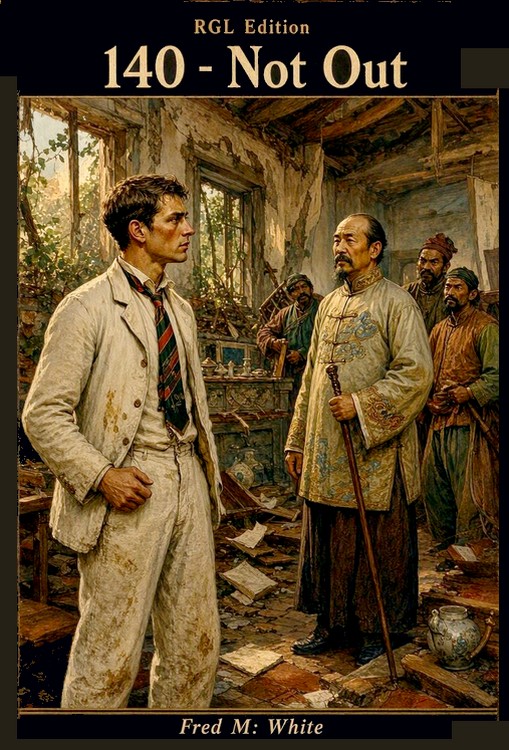
RGL e-Book Cover
Based on an image created with Microsoft Bing software
Roy Glashan's Library
Non sibi sed omnibus
Go to Home Page
This work is out of copyright in countries with a copyright
period of 70 years or less, after the year of the author's death.
If it is under copyright in your country of residence,
do not download or redistribute this file.
Original content added by RGL (e.g., introductions, notes,
RGL covers) is proprietary and protected by copyright.
RGL e-Book Cover
Based on an image created with Microsoft Bing software

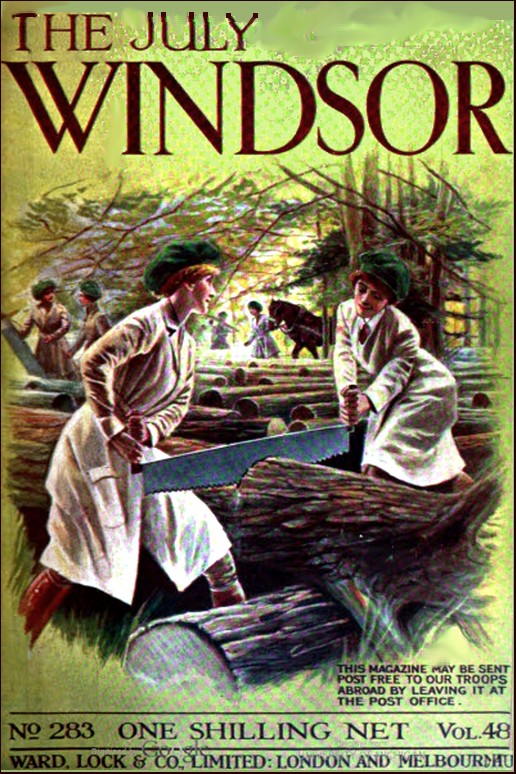
The Windsor Magazine, July 1918, with "104 — Not Out"
Carlin crosses a war-torn Chinese province in a desperate bid to rescue Maisie Clive, the brave governess trapped beyond a river swarming with dacoits and rival troops. What begins as a hopeless mission erupts into a night of chaos, gunfire, and last-stand courage—until Carlin awakens in the hands of a mysterious Mandarin whose motives seem unfathomable. Only when the stranger touches Carlin's faded M.C.C. tie does the truth surface: a forgotten bond from Oxford, a cricket dream, and an innings of "140 Not Out" that now becomes the key to survival.
CARLIN crept cautiously through the brush in the direction of the Mission House. From his point of view, it was a hopeless quest from the first—nothing but a miracle could have saved a single Christian soul there once that red band of dacoits had got out of hand, as they had most effectually.
An hour before he had seen Redmond of the Moravian Mission transformed into a raving lunatic, struggling madly to get away back across the river to those innocent children of his and drag them out of that roaring hell at the risk of his life.
Then they had come miraculously out of nowhere from the far bank of the river to drop into the hands of a company of marines landed an hour before from an English destroyer, a mixed unit that had fallen back to the port a mile or two away under press of superior numbers. Anyway, they were safe now behind a fringe of machine guns.
When he had got a hold on himself, Redmond told Carlin the story. There had been the usual dust-up at the back of the province between straggling bands of Imperial and Revolutionary—so-called—troops, and the Republicans had got the best of it.
But in the doing of it they had more or less wiped each other out, to the grim joy of the marauding band of camp followers that hung on to each party like so many noxious parasites. These had gone off looting on their own, and, incidentally, burnt and pillaged the Mission House and cut the throat of every soul they found there.
By great good fortune, Redmond's wife was down country and the children were being looked after by their governess, Miss Clive, at the first sign of danger, had hurried the two girls down to the river. A friendly coolie had swum them across on his back, only to be shot dead just as he had completed his task, and before he could return for the brave girl who was waiting her chance in the bushes.
A couple of straggling marines attempting a rescue had met with a similar fate, so that, as far as Carlin could gather, Maisie Clive was on the other side of that yellow flood, and, consequently, at the mercy of a gang of the most bloodthirsty ruffians on the eastern hemisphere.
At any rate, this is what he had made out from Redmond, who was half-dead with what he had gone through. The British marines had fallen back on the port now, and on the far bank of the river pandemonium had broken loose. And in the midst of it there, in the centre of those howling savages, was a pretty and plucky English girl who had sacrificed herself to a sense of duty.
"Well, I'm going to see," Carlin said. "As soon as it gets dark I am going to cross the river. She may have returned to the Mission House and be in hiding there. I can't stop here, and I can't take you along."
That was very evident. Redmond was too far broken up to be of the slightest use anywhere. He could only sit on the bank of the river, gazing into space and mumbling something that sounded like thanksgiving for the safety of his children. He was a little, neurotic man, quite unfitted for the work, and Carlin regarded him with something like contempt.
He could, of course, have gone down to the officer in charge of the marines and asked assistance, but it seemed to him that there was nothing to be gained in that direction. He wanted someone who knew China, someone who could speak the language as well as he did himself. And one person for this perilous adventure ought to be all-sufficient. Not that he expected any good to come of it; at the very best, all he anticipated was the recovery of the body of the brave girl who had undoubtedly given her life for her charges.
He crossed the river presently when the moon came up, with the aid of a native boat, and struck out through the brush in the direction of the ruined Mission House. Every now and then he had to hide from little knots of half-nude dacoits searching here and there for rifles; he saw a score of bodies lying there stark, but at length he reached his destination.
The Mission House was more or less intact, save that all the furniture had been dragged out and destroyed, the place was all in darkness, and, as Carlin called out in a hissing whisper, the echo of his own voice came back to him dismally. He spoke again, and then it seemed to him that he could hear a reply.
A moment later, from under a heap of ruins in the back of the dining-room, a figure emerged, and a white face, a little despairing, but still brave and resolute, looked out, and Carlin's eyes met a pair of brown ones that looked steadily into his own.
"Thank God!" he said. "Thank God! I am not too late after all. How did you manage to get back here?"
"I don't know," the girl said unsteadily. "Just blind fortune, I suppose. Those wretches were within a few inches of me over and over again. I should have tried the river, only I cannot swim. Then it seemed to me that I should be safer here once they had finished with the place, and I managed to get back again."
Maisie Clive spoke out quietly enough, but, by the light of the moon, Carlin could see what she had gone through.
"It was splendid," he said. "I hardly dared to think of what would have happened to you if——"
He broke off significantly. Maisie Clive took a little bottle from her pocket, and her lips tightened as she pointed to it.
"I was quite ready," she whispered. "I took this out of Mr. Redmond's medicine-chest. You can guess what it is."
Carlin nodded. He had no words just then to express his admiration for this almost pathetic heroism.
"Now, listen to me, Miss Clive," he said. "We are still in great danger. The woods round here are filled with those scoundrels. I expect we shall have to stay here till morning, and it is just possible that they may come back again. If they do and they find us here, you know what to expect."
"I think I understand," the girl said quietly. "And I shall know what to do in any case. But why did you come? Why do you risk your life for me like this?"
Carlin could have told her in a few burning words, but it was no time for that sort of thing. He would have been there in any case for any woman, but then there was a special reason why he had taken his life in his hands for the sake of Maisie Clive. He had been to the Mission House a good deal lately, not out of any liking for Redmond, whom he rather despised, but because it seemed to him that he had found what he had been looking for ever since he had settled down in the Treaty Port of Tohio.
"I had to come," he said simply. "Oh, dash it! any man worthy of the name would. I don't know what's going to happen with the daylight, but, for the moment, that scum out yonder is out of hand and both belligerents are fought to a standstill for the time being. You see, it's their great chance, and they are making the best of it. Well, I've got a couple of automatic pistols in my pocket, and, if the big trouble comes, I shall know what to do."
Even as Carlin spoke the hideous din outside broke out afresh. Through the broken windows they could see handfuls of men running hither and thither, could hear the sound of shots and the hideous yells of the wounded as they fell.
They were fighting again close round the ruins of the Mission House, every man's hand against everybody else with the grim impartiality of an Irish mob at a fair. Carlin could see uniforms of the Imperial troops mixed up with the trappings of the Republican party, and here and there a handful of dacoits, naked to the waist, and making the night vibrant with their cries. It was like some unreal scene torn from a nightmare, a hideous upheaval of humanity under the peaceful light of the moon, which gave to everything a feeling of unreality.
Carlin could see that his companion had grown more pallid still, but he could read no fear in her eyes except that which the tenseness of the moment had brought. Almost unconsciously he placed his arm around her and drew her into the shadow.
"Courage!" he whispered. "Courage! Not that there is any reason to tell you that. They may come here, but perhaps they won't. If they've got a machine-gun amongst them anywhere they may. This would make a fine cover."
Almost before the words were out of Carlin's mouth the door of the sitting-room became jammed with a mass of men that fought their way into the room. Carlin could see at a glance that they wore the uniform of the Republican party and that one of them was dragging a machine-gun behind him. It was something to learn this at any rate, not that Carlin expected much mercy at the hands of any party just then.
If there was anything to choose between them, the Republicans were the more liberal and enlightened, but at present, when the whole province was in revolt and no man knew whom he could trust, the two fugitives were likely to get little shrift from any body of men into whose hands they fell. They would take him, naturally, for a spy or for an ally of the opposing side.
He drew Maisie to his side and crouched low, but not before he had been seen. Some man in uniform turned to his companions and pointed to Carlin. A moment later there was a rush in his direction. He put Maisie behind him and started to fight for his life. Twice did he empty his pistol into the yelling mob, and twice did the girl hand him clips of cartridges, which, at his direction, she took from his coat pocket.
He was going to make a good fight of it, he told himself grimly, as he had done a score of times on the cricket-field in the good old days when he had not dreamt of world perils like these. And he was comforted strangely by the knowledge that the girl behind him had a weapon which she knew how to use when her turn came.
He fired again and again into the mass before him, fired until the floor was slippery with blood and half hidden with the bodies of the slain. Then, when he had no cartridges left, he dashed his pistols into the grinning faces before him and lunged forward heavily with his fists.
There was one man he wanted to get at, a man dressed in the garb of a Mandarin of the higher class who had come in quite recently and had fought his way to the front. There was something about this intruder that marked him as a leader of these people, though they were too full of the blood lust now to heed what he said. But that was the man that Carlin was aching to kill, with the feeling strong upon him that, once the other was out of the way, he might be able to impose his will upon that murderous crowd. Even in that moment of stress and tension it seemed to him that he had seen that Chinese dignitary before—somewhere, years ago—in different circumstances altogether.
But there was no time to think about that now, for all his ammunition was exhausted. He launched himself at the foe, dashing forward and using his fists like a battering-ram. That this was the last moment of his existence he knew full well, but he was going to sell his life no less cheaply for that.
He turned just for an instant to smile into the eyes of the girl behind him. She smiled back with eyes that were still brave and steadfast, and held up the little bottle so that he might see it. But he did not see, a second later, that the phial had been snatched from her hand, because something struck him on the back of the head and he collapsed on the slippery floor with a thousand stars dancing before his eyes and a sense that he was dropping to the bottom of the world.
He came to himself presently in a room unfamiliar to him, but a room that he could see contained every element of refinement and luxury as it is understood in the Orient. He was lying on a sort of couch with his hands and feet bound and a racking pain in his head that nearly blinded him.
But, broken and suffering as he was, he noted with a certain sense of gratitude that Maisie Clive was seated opposite to him, deadly pale, but still with that undaunted courage glowing in her eyes.
The tall, slim man, dressed as a Mandarin of the higher class, was there with one or two others, who appeared to be subordinates, and they were talking in tones that Carlin found it hard to follow. From time to time they glanced in the direction of their prisoners, and the Englishman could see that these glances were anything but friendly. He was trying to gather from his knowledge of the locality where he was. That he was in the residence of some local magnate he did not doubt; indeed, he could gather that from the luxury of his surroundings. But there was a shell-hole in the painted ceiling and signs of war and confusion were everywhere. Presently the subordinates ceased to speak, and it seemed to Carlin that at length the fate of himself and his companion had been settled. And as to what that fate was, in his heart of hearts he had not very much doubt.
These people were civilised, indeed, highly civilised from their own point of view, but Carlin knew the Tartar that was not to be concealed under the skin of the Chinaman, and the dogs of war were loose in the land. And when men's passions once run rampant, then humanity has a poor chance indeed.
At a sign from the tall man, which had something in it of a haughty gesture of dismissal, the other two left the room, and the Mandarin crossed over to the couch where Carlin lay bound and helpless. His bonds were cut, and he stood up a free man.
This had been done without so much as a word said on the Chinaman's part, and, just for a moment, Carlin was not a little puzzled. His first and natural impulse was to grip the other by the throat and start the fight for liberty afresh. But that was not quite the game as the Englishman would play it, and Carlin decided to wait for developments. He caught sight of himself in a mirror on the other side of the room, and was somewhat surprised to see that he was very little the worse for his recent rough handling. His head still ached consumedly from the blow he had received, but his flannel suit had been brushed, and someone had gone so far as to arrange his tie under his soft collar. With a bow the Mandarin handed Carlin his pistols.
"Your weapons," he said in quite excellent English.
"That is very good of you," Carlin replied drily. "But I might point out to your Excellency that automatic pistols are not much use without ammunition."
"I had thought of that, sir," the Chinaman said gravely. "Here you are. I also have Brownings of that calibre, and have plenty of ammunition at my disposal. And now that we are man to man and you are armed, I would have a few words with you."
What the Chinaman stated was true enough, but, though Carlin was apparently on superior terms now, it would have been little short of madness to attempt a dash for liberty. And besides, there was another life to think about. But, so far as Maisie was concerned, the tall man with the yellow face and the grave air did not seem to be aware of her existence.
"I appreciate your generosity," Carlin said. "But I should like it a good deal better if I could see exactly what it led to. I might shoot you, but, in the circumstances, I should naturally hesitate to do that. There is some price, perhaps? There is something that you want me to do?"
"No," the other said. "It is not that at all. There has been a fight between the Imperialist troops and the Republican party, to which I have the honour to belong, and for the moment we have been successful. How long we shall be so remains to be seen. Meanwhile, we are here in the headquarters of the enemy. Five miles away is the bridge crossing the river that leads to Tohio, and once you are beyond that you and this brave lady here will be safe. Somewhere along the road, at the bend where the rice-fields begin, is a car. That is not more than what you call half a mile away. That car belongs to me. I presume, Mr. Englishman, that you know how to drive a car. It is a Daimler."
"I can manage that," Carlin said, feeling more and more astonished as the conversation proceeded. "Oh, yes, that will be all right. But how do I get there?"
"All that I have seen to," the Chinaman said. "The rest is in your hands. A bold dash along the road across the bridge, and you are safe in the hands of the English marines that your Government has landed there."
"That's really very good of you," Carlin said. "But why are you taking all this risk—because it must be a risk—for the sake of a man who is no friend of yours?"
The Mandarin smiled for the first time.
"I would not make so sure of that, Mr. Carlin," he said. "You see, I know you. I guessed who you were when I came to the Mission House just now, but I was not certain until I could put my hand upon this."
The Chinaman stretched out a long, lean forefinger and touched the sailor's-knot of parti-coloured ribbon that formed Carlin's tie. He seemed to touch it almost reverently.
"What has that to do with it?" Carlin asked.
"The M.C.C., is it not?"
The question came with such startling surprise that Carlin was almost too bewildered to reply.
"That's it," he stammered out. "It's rather a faded old rag, but it is M.C.C. Now, just as a matter of curiosity on the part of a desperately-situated stranger, would you mind telling me what on earth a Chinese magnate knows about the Marylebone Cricket Club? And why should he go out of his way to help a member of that body, perhaps at a great risk to himself?"
"That risk I am prepared to run," the Chinaman said, picking his English with painful distinctness. "But I do know, because I have been there to see. There were people from all over the world at Oxford in your time—and mine—amongst them many of my fellow-countrymen. Can you call to mind a Chinaman who was ambitious to shine in the cricket-field?"
"Oh, Lord, yes!" Carlin said. "Two or three. I remember one who was on my staircase the year that I was captain of the eleven who had big ideas on the subject of cricket. He never realised them, poor chap, but he was a real tryer."
"Do you remember his name?" the other asked.
"Well, I'm afraid I don't. But, so far as I remember, we used to call him Sambo."
"Ah, Sambo!—yes, I had forgotten that. It was Sambo. How long ago it seems! And yet it is only ten years. Sambo was on your staircase. He was just a Chinaman studying Western ways and manners, like thousands of others in the same class, with a view, perhaps, to this very revolution, which is going to save my country in the end and make her, I hope, as great as yours. That was the dream of the Sambo you spoke of, and many others. But there were lots of things that we admired besides your forms of democracy. We saw what sport has meant to England. And some of us tried with poor success to do as you did. There was the man you called Sambo. He worked hard enough."
"Oh, he did!" Carlin exclaimed. "He was always at the nets. His ambition was to be another Ranji."
"Ah, precisely," the Chinaman smiled. "The Jam played for his University and then for England. And because you are a great race with splendidly liberal ideas, the man you call Sambo would have done the same had he been good enough. But he never was, and he found it out after a time. But you were kind to him, you always had a smile and a word of encouragement, and once you spent an hour at the nets; what you call coaching him. That was about the only time you ever exchanged any words, but he never forgot it."
A light broke suddenly on Carlin.
"By Jove!" he cried. "You are Sambo! Oh, I beg your Excellency's pardon!"
"Ah, there's no occasion. Yes, I was the man who had a dream of playing cricket for a great English team; but it was only a dream after all, and I put it aside in the interests of my country. Since then I have never touched a bat, but I get the English papers and I follow the fortunes of my friends, or those that I call my friends, because I know what the spirit of sport does for a country. And do you remember what happened in July of the year I speak of?"
"I can't say I do," Carlin replied.
"You won the University match for Oxford. You went in rather late at a most critical time when runs were needed, and at the finish they were knocked off and you were 140 not out. I was there, and I can see it now. And when you came back to the pavilion through the cheering crowd there was one Chinaman applauding you, and when you saw his face you waved your hand and you said, 'Hullo, Sambo, we managed that all right!' It is as if it were only yesterday."
Carlin smiled. He had forgotten his danger, he had almost forgotten the girl he had come to save, in the recollection of this bygone triumph of his. It all came back to him now; he remembered it as if it had only been yesterday.
"So you are old Sambo, are you?" he said. "Well, our poet says that a touch of nature makes the whole world kin, and he's not far wrong. Just fancy, this bit of rag round my neck being the means of saving my life all these thousands of miles away from home! I suppose you recognised the tie——?"
"I did, Mr. Carlin. And then I recognised you. And that is why I have gone out of my way to try to save you. I wouldn't have done it for anyone else—I couldn't. Even now the loss of my car may have serious consequences to the cause that I have at heart. But, though I cannot play cricket, I have learnt the spirit of it, and I am acting on it now. Will you come this way, you and the lady, and I will see you clear of the house."
As the Chinaman spoke he turned down the lights and offered his hand with a certain dignified politeness to Maisie. Up to this point he had ignored her altogether. But he was courteous and polite enough now, and apologised for the necessity of dimming the lamps. Without another word they passed along from one passage to another till they came at length into the open.
The moon was hanging low in the sky now, so that the world was full of shadows along which they crept, with the Chinaman by their side, until they came at length to a car standing by the side of a rice-field. Into this the fugitives crept, while the Chinaman watched them without the suspicion of a smile upon those grave features of his. The engine cranked up presently and the car began to move.
"Good-bye, Sambo!" Carlin cried. "You won't mind my calling you that for once? And if ever I get a chance to repay you——"
"Do not speak of that," the Chinaman said, his words fading away as the car gathered speed. "140, not out. Ah, it was a great innings! The best that I have ever seen."
He turned his back and faced homewards, while the car hummed down the road until it was lost in a cloud of dust.
Roy Glashan's Library
Non sibi sed omnibus
Go to Home Page
This work is out of copyright in countries with a copyright
period of 70 years or less, after the year of the author's death.
If it is under copyright in your country of residence,
do not download or redistribute this file.
Original content added by RGL (e.g., introductions, notes,
RGL covers) is proprietary and protected by copyright.