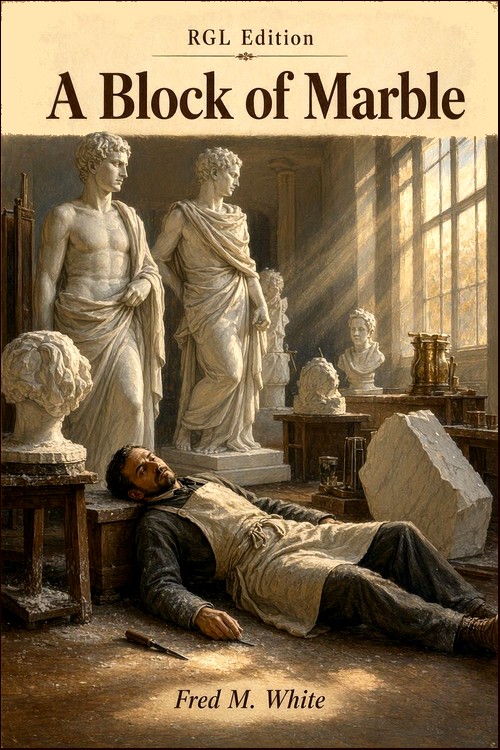
RGL e-Book Cover
Based on an image created with Microsoft Bing software
Roy Glashan's Library
Non sibi sed omnibus
Go to Home Page
This work is out of copyright in countries with a copyright
period of 70 years or less, after the year of the author's death.
If it is under copyright in your country of residence,
do not download or redistribute this file.
Original content added by RGL (e.g., introductions, notes,
RGL covers) is proprietary and protected by copyright.
RGL e-Book Cover
Based on an image created with Microsoft Bing software

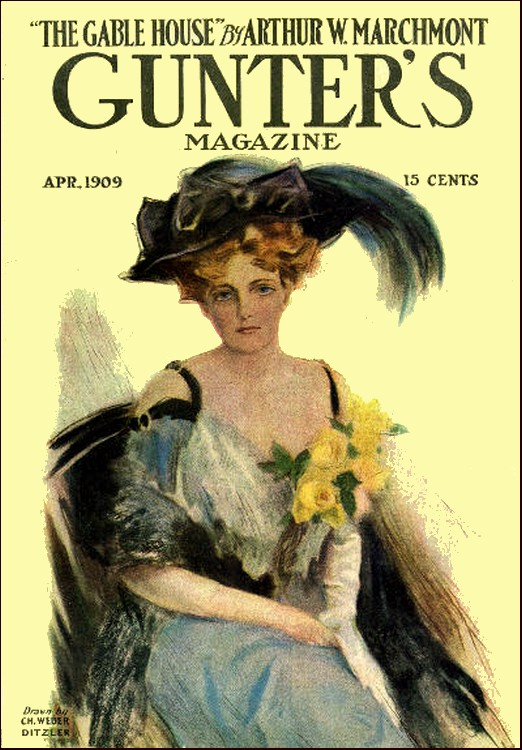
Gunter's Magazine, April 1909, with "A Block of Marble"
In "A Block of Marble," Fred M. White turns a quiet Hampstead art studio into the stage for a chilling locked-room mystery: when sculptor James Collier is found dead with every sign pointing to suicide, painter George Leslie cannot shake the sense that something is terribly wrong. A vanished statue, a flaw in the marble that refuses to leave his mind, and the eerie stillness of the dawn-lit studio all hint at a hidden presence—one capable of immense strength and ruthless cunning. As Leslie follows these threads, the truth he uncovers is more startling than anything he imagined...
THE artist dropped his brush and sat upright, listening. It seemed to him that he could hear the voice of a woman raised in distress. He had been so deeply engaged upon his own work, so utterly lost to his surroundings, that the sound came to him quite in the nature of a shock. For the last hour or two the whole world had been sunk in slumber; it had seemed to George Leslie that he had the whole world to himself. He was about to take up his brush again when the cry was repeated in the next studio.
There had been a time when Leslie's studio and that of James Collier, the sculptor of next door, had been one. They had been built years ago by a famous Royal Academician, but after his death no artist had been found wealthy enough to take Grey Gables, up beyond Hampstead, and so both the studio and the houses had been divided. A common stairway led into the studios, which were situated at the end of a long, elaborately laid out garden, ending in a pond, which at one time had formed part of a moat. From the great casement window Leslie could look out over the fields and across the deep, silent pond, where the carp lay, with the pleasant feeling of being cut off entirely from the world. He had not cared very much for the arrangement at first, but Collier, the sculptor, was a quiet, reserved type of man, and for months at a time Leslie was hardly cognisant of the fact that he had a neighbour at all.
He dropped his brush now on to the stone balustrade at the top of which the two doors lay. Already there was a faint saffron light in the eastern sky, the trees were beginning to stand out a pale and ghostly green against the pearly sky of the early dawn. It was now that Leslie saw that he was not mistaken. A slim little wisp of a woman in evening dress came towards him with outstretched hand. Her pale, pretty face was lighted up by a pair of pathetic eyes. She seemed to be almost beside herself with terror. Leslie had seen little or nothing of his neighbour's wife, though he had heard her spoken of as a helpless creature, whose silly extravagances caused James Collier a great deal of uneasiness. But the woman was palpably in distress now, and Leslie's heart went out to her.
"What is the matter?" he asked. "I thought I heard someone call. Is there anything wrong?"
"My husband," Mrs. Collier whispered. "I have been waiting for him to come into the house. We—we, well, we had a little unpleasantness, and I was very much upset about it. I couldn't go to bed, so I waited for Jim to come in. Then it seemed to me that I heard a shot, and it frightened me. And now for all I have been knocking at the door of the studio, I can get no reply, and I am very much afraid that poor Jim——"
Enid Collier broke down and dissolved into a flood of tears. At any other time Leslie would have made light of her fears, but he had heard the sound of a shot himself, and some foreboding told him that he was on the fringe of a tragedy here. Not that he anticipated for a moment that Collier had done violence to himself, for the sculptor passed as a quiet, level-headed man, with a keen business mind. He had kept himself very much to himself. He was said to have saved money; indeed, Leslie knew from a friend of his that Collier's life was insured for ten thousand pounds. Here was the last man in the world to commit a rash act of that kind.
All this flashed through Leslie's mind with lightning speed. But, careful and self-contained as Collier was, this did not prevent the fact that a pistol shot was fired in the studio, and that the door was locked against all intruders. There could be no suggestion of violence from outside, for the only window in the studio looked out on to the moat, and this way of entrance was only possible with the dual assistance of a boat and a ladder. Besides, Leslie's window had been wide open, and most assuredly he would have heard if anybody had attempted to intrude upon this, Leslie's great arc light in the ceiling would have been more than sufficient to scare any would-be intruders away.
Leslie strode across the stone flags and knocked heavily at the door. There was no reply. It seemed absurd to waste time in ceremony now. Leslie dashed himself forcibly against the door, and at the third assault the lock gave way.
It was still dim and dark inside, for the great blinds were undrawn, and the electrics had not been turned on. The whole of the large studio was littered here and there with casts of figures—half-finished works and masks of all kinds. Near the fireplace stood a draped figure in gleaming white marble, evidently the particular task upon which Collier was engaged for the moment. A cloth appeared to have been thrown over the figure hastily, and nothing could be seen but the feet and one outstretched arm which shone clear and crystalline in the pale, primrose light of the early dawn. Even in that moment of excitement and sickening expectation Leslie did not fail to notice a peculiar stain on the wrist of the outstretched arm, as if a bracelet had been tattooed there. It was a trivial incident for the moment, but it burnt itself in on Leslie's brain almost to his own irritation and disgust. He wondered why he should notice that flaw in the marble, and the peculiar thickness of the sculptured fingers, even at the same moment that the unhappy little wife had cast herself sobbing upon the figure that lay stark and revolting on the Persian rug in the centre of the room.
That the very worst had happened Leslie could see at a glance. Collier lay there on his back, his face turned up to the painted ceiling, a revolver in his hand. There was a small, circular mark faintly outlined in blue upon his forehead which told its own story. Without a doubt James Collier had committed suicide; indeed, there could be no other conclusion. The studio was absolutely empty, and Collier had evidently locked himself in before finishing his distinguished career.
"This is a terrible business," Leslie murmured. "My dear Mrs. Collier, this is no place for you. Let me take you back to the house again. I must get one of your servants to go for the police without delay. I hardly know what to say."
It was, perhaps, fortunate for Leslie that Mrs. Collier's maid had followed her into the studio. The woman seemed only a little less frightened and dazed than her mistress, and in cases like these a woman is generally more helpful than a man, and with a sense of relief of which he felt slightly ashamed Leslie found himself alone a little later. He was still standing by the studio door when the police arrived. The inspector listened to Leslie's story with almost official indifference. Evidently there was nothing here to call for anything more important than the ordinary routine evidence in a coroner's jury.
"Suicide, of course," the inspector said. "I suppose there was nobody here when you broke the door down. No? Well, I would just like to have a look out of that window. Yes, it is quite impossible for anybody to have entered that way. I suppose you are quite satisfied, Mr. Leslie, that this is a case of suicide."
Leslie murmured something in corroboration of the officer's suggestion. At the same time, he felt by no means sure that the theory was correct, knowing that there was nothing to be gained by saying so. On the face of it, it was impossible that anyone could have come in through the window, and, besides, the door of the studio had been locked on the inside. Still, there was no getting away from the impression that Collier was one of the last men in the world to take his own life. He had been in robust health. He was exceedingly successful both financially and artistically, and, despite her frivolity, he was married to a woman of whom he was devotedly fond. There was nothing selfish about the man, either, and, in any case, he would never have dreamt of taking his life and depriving his wife of her insurance money by so doing. To put it bluntly and plainly, Collier was too good a business man for that. These were ideas, which, however, Leslie kept to himself. It was no use flying in the face of evidence produced at the inquest, which went far to prove that it was merely a case of suicide, after all. The unfortunate man had had a dispute with his wife over some bills of hers, and he had gone off to his studio after midnight with the idea of putting in a certain amount of work on the statue of Hercules, which he was executing to meet a commission given him by the authorities of a Colonial city. It came out quite casually in the course of Mrs. Collier's evidence that her husband had lately been speculating in uncut jewels, and that he had some of these in a cabinet in his studio. That the jewels had disappeared had little to do with the course of the inquest, but it set Leslie thinking, all the same. He was sorry to hear, too, that Mrs. Collier would find herself now in straitened circumstances, for, in view of the coroner's jury's verdict of "Temporary insanity," it was quite clear that the insurance company would refuse to pay the money which, on the face of it, became due under the policy granted to the dead man.
"You may say what you like about it," Leslie remarked to Gresham Ward, his brother artist and neighbour, "but I don't believe that James Collier committed suicide at all. I believe that the man was murdered in some mysterious way."
"But how?" Ward asked.
"Ah! that I can't tell you, but I mean to find out. I was on the spot within a minute or two of the fatal shot being fired. I forced the lock of the studio, and I am afraid I shall have to admit that the place was empty. As my light was lighted, and my blinds drawn, I should have known if anybody had come out of the window looking out over the moat. To be perfectly candid, I don't see how anybody could possibly come that way. And yet, here am I, just as unshaken in my belief as ever, despite the fact that all the evidence is against me. However, I have the key of poor Collier's studio, and we will go and investigate there if you like. You may call me sentimental if you choose, but I shan't rest until I prove that I am right, and Mrs. Collier compels the insurance people to pay over that money."
Gresham Ward nodded his head in sympathy. Collier had been by way of being an acquaintance of his, and he was bound to admit that he had seen and heard nothing that pointed to anything wrong in the state of Collier's brain.
"Can we see the studio now?" he asked.
"Why not?" Leslie replied. "I have the key here, and Mrs. Collier is away. As the house is locked up next door, no one will be alarmed if they see lights in Collier's studio. Not that we are in the least likely to find anything, as far as that goes. There is one thing that puzzles me more than another, and that is, where that last lot of uncut stones Collier purchased got to. I have found the man in Bond Street he bought them from, and I know what they cost. Collier brought them back home with him the night before his death. He told his wife where they were, and yet when they came to look in the cabinet, it was empty. But we shall gain nothing by discussing this matter in this fashion. Let us go and thrash it out in the studio next door."
Collier's studio was exactly as it had been left at the time when the body had been discovered. Here were the plaster casts, the half-finished figures, and all the panoply of a sculptor's trade scattered about. Here, too, were the works of art and the quaint old Japanese lacquered cabinet in which, no doubt, Collier had placed the gems which had so mysteriously disappeared at the time of his death. But there was one thing missing, and just for a moment for the life of him Leslie could not recollect what it was. Then it flashed upon him that the nearly completed statue of Hercules was no longer in the room. Here was the massive stand on which it had been placed. Here was the dust-cloth of the figure upon which the sculptor had lavished so much love and pains. But the statue itself was no longer in its place. Leslie turned to his companion.
"What has become of it?" he asked.
"Become of what?" the other demanded.
"Why, the statue of Hercules, to be sure—the work that Collier was doing for one of the Colonial galleries. It was here right enough on the night of his death. Oh, there is no mistake, I assure you. I particularly noticed the outstretched arm under the cloth, and the fact that there was a flaw in the marble by the figure's wrist. It was a most extraordinary flaw, and it impressed itself indelibly on my memory. I was ashamed of myself at the time for noticing such trivial things. But that does not make the fact any the less real. I wonder if Mrs. Collier could tell us anything about it. I wonder if she sold it."
"I am sure she hasn't," Ward said emphatically. "Besides, she is away and has had no time to do anything of the kind. Another thing, she took no interest whatever in her husband's work. She wasn't capable of understanding it. It was rather a sore point with poor Collier. At any rate, his wife never entered the studio, and she never had the least idea what her husband was engaged upon."
"Well, it is very strange," Leslie said thoughtfully. "Statues of that sort don't vanish in this mysterious way. The thing might be worth a lot of money to an unscrupulous artist, who might alter the thing and pass it off as his own. I am going to inquire into this matter, if it is only for the sake of poor Collier's reputation. But let us get back to my studio and discuss the thing there. We are doing no good here, and the place gives me the horrors."
For the next day or two Leslie busied himself over his inquiries. He was negatived on every hand, and yet something was urging him on. He felt that he could not settle down again till he had probed the mystery to the bottom. A week's unsuccessful search left him in the same position as before. He sat alone in his studio at the open window worrying the matter out. It was comparatively early yet, and the rays of a brilliant moon fell upon the lily-fringed pond under the big window in the studio. Leslie sat there smoking his pipe, his body half out of the casement, looking thoughtfully into the brown depths of the pond below. A word or two of irritation escaped him.
"They are at it again!" he muttered. "This is the third time within a month or so that those mill people have drawn the water away from the pond. I suppose they won't be satisfied until I bring an action against them. Why, the water must have gone down at least three feet. To-morrow morning—hallo! What's that? Good Heavens, it is a human body—a body, beyond a doubt!"
JUST for a moment the hair began to rise upon the back of Leslie's head. He was conscious of a cold sensation playing up and down his spine. He stood there for quite a long time watching the receding of the waters in the pond which were being drawn off to feed a mill a little further down the meadows, and which action on the part of the authorities was a constant source of annoyance and trouble to the artist. It was all very well that the water was invariably replenished by arrangement with the local authorities, but Leslie was proud of his water-lilies, which were occasionally imperilled by this action on the part of the mill-owners.
The stream was receding steadily, but Leslie was not worrying about that now. His eyes were fixed upon the stark, gleaming body coming out more and more steadily till two-thirds of it rested on the slimy bank. There was no sensation of horror in Leslie's mind now, nothing but a grim satisfaction and a feeling that he was getting to the bottom of the mystery. He left the studio now and made his way along the garden to a little foot-bridge leading over the stream which fed the moat. A moment or two later he was bending over the still, cold outline lying so grim and terrible in the mud.
"Lucky thing for me I kept my discovery to myself. I should have looked a fool if I had gone down to the police-station and given information to the effect that there was a body in the moat. Why, this is poor Collier's statue, beyond the shadow of a doubt. Now, who threw it here? And why did he throw it here? Whoever did it must be possessed of fine physical strength. And whoever did it, too, could have had very little local geographical knowledge, or else he would have known all about my dispute with the mill authorities and how the moat was half emptied sometimes. My word! I know a lot of fellows who would make a rattling fine short story out of this. However, the statue will be covered again in the morning, and I shall be able to keep my discovery to myself."
Leslie went thoughtfully back to his studio and sat himself down over a pipe to think the matter out. For the present the whole thing was a deep and inexplicable mystery. On the face of it there was a connection between this outrage and the tragic death of James Collier. At the first blush it looked like petty spite on the part of some jealous rival who had taken this course to besmirch the fair fame of the dead man, and deprive him of an added laurel to his posthumous reputation. In the ordinary way it would be an easy thing to throw the statue out of the big window into the moat. But it was quite another matter to lift the solid marble from its pedestal and carry it as far as the window. Only a man of vast physical strength could have done that, and amongst all his artistic acquaintances Leslie racked his brain to find someone who was equal to such a herculean task. There was no one he knew in the least likely to accomplish any such feat.
The mystery seemed deeper still. It was impossible to connect this incident in any way with Collier's death, and yet Leslie could not rid himself of the idea that they were part and parcel of one and the same thing. He could not see any reason now, however grotesque, why anyone should want to get this statue out of the way.
He made up his mind presently to put the thing aside and go to bed. He was just in the act of knocking the ash savagely out of his pipe, when the solution came to him in a blinding flash. He was inclined to laugh at his own theory at first, but the more he thought over it, the more rational and feasible did it become. It was nearly daylight before all the knots in the skein were untangled, and before Leslie took up pen and paper and indited a short paragraph which was intended for the Press. The paragraph was crisp and to the point, and ran as follows:—
"The Sculptor and the Missing Jewels. "It will be remembered that at the inquest held on the late Mr. James Collier, mention was made that certain jewels were missing from the dead man's studio. The police attached but little importance to this matter and were inclined to believe that no such gems existed. It transpires now that Mr. Collier had in his studio an antique Japanese cabinet fitted with secret drawers. It is just possible that the missing stones may be found here, in which case the theory that Mr. Collier met with foul play will be exploded, and the minds of certain newspaper writers put at rest. Mrs. Collier is away from home now, recuperating after the terrible shock she has sustained, and, doubtless, when she returns to Hampstead again, she will take steps to verify the suggestion made, that the cabinet in question should be thoroughly examined."
"I think that will do the trick," Leslie said grimly to himself. "And now I think I have earned my night's rest. To-morrow night I propose to begin a tour of the music-halls. With any luck, I shall know by the end of the week whether my suspicions are correct or not."
For the next two or three days Leslie kept away from his clubs, and such friends as met him casually remarked that Leslie was evidently suffering from overwork and needed a rest. What really was the matter with him no one knew, with the exception of Gresham Ward. They were old allies and companions, and Ward was putting up with what he deemed to be Leslie's eccentricity with exemplary patience. But he did want to know why night after night he was expected to pass the hours in Leslie's studio with the door open, taking a watch turn and turn about, to see that nobody made an attempt upon the studio next door.
"You've got Collier on the brain," Ward said. "How much longer is this going to last?"
"I should say this will be the last night," Leslie replied. "My dear fellow, I am infinitely obliged to you for all your kindness in this matter. If I had not known you to be a thoroughly good fellow, I shouldn't have worried you in this way. But I think you will agree with me that it is worth all this trouble to prove that poor Collier was murdered, and to enable his wife to draw that insurance money. Now, don't you think so?"
"Assuredly," Ward admitted. "But can you do it?"
"Indeed, I can," Leslie replied eagerly. "I can prove it beyond the shadow of a doubt. To a certain extent I am going to take you into my confidence. You saw that paragraph in all the papers as to Collier's jewels and the Japanese cabinet?"
"Oh, yes. But I didn't take any notice of it. I suppose the paragraph type of journalist has got to live."
"My dear fellow, the paragraph journalist has nothing whatever to do with it. That bit of information was invented by myself, and I got it inserted in all the papers. I have never doubted for a moment that the jewels in question were in the studio, nor do I doubt that the thief who came in search for them was responsible for Collier's death. Now, please don't go over the old familiar ground again. Don't remind me that the studio door was locked, and that it was impossible for anyone to get in through the window. I know all that as well as you do. But, all the same, I am quite certain that those jewels brought the thief here, and that he was searching the studio when Collier found him."
"That's all very well," Ward said thoughtfully. "But how could the thief get away when the door was locked!"
"I am bound to confess that it seems impossible," Leslie admitted. "But I can see a way. On the face, the explanation is ridiculous. But, then, you know it is the unexpected that always does happen. Now, you know for the last few nights I have been devoting myself to a round of the music-halls. I have been looking for a particularly strong man who takes part in some gymnastic display—a strong man with a peculiar discoloration in the shape of an old tattoo mark on his right wrist. After a vast deal of pains and trouble I have found him. Once he was found, it was not difficult to find out all about the fellow, and elicit the fact that he earned his money occasionally as a sculptor's model. A sovereign or two invested on a private inquiry agent brings to light the fact that our friend has a shady reputation and that he is exceedingly hard up. I was not at all surprised to find that a copy of the _Telegraph^ was picked up in his rooms with the paragraph relating to poor Collier's jewels cut out. To take you still further into my confidence, this particular individual, whose name is Fry, actually posed to Collier for the statue of Hercules. As he had the run of the studio, doubtless he knew all about those jewels. It is only fair to assume that he failed to get them, and that probably to-night he will come round here and ransack the Japanese cabinet. I picked out to-night because it is Saturday, and it is generally on Saturday and Sunday evenings I am away in the country. If you will come down to me at twelve o'clock this evening, I think I can explain exactly to you how Collier died. You need not come before midnight, because our friend is engaged at one of the music-halls till after eleven. You can walk right into the studio. There will be no light in the place, but I shall be here all the same. And now I shall not tell you any more. It would be a pity to spoil your entertainment in that way."
It was just five minutes to twelve the same Saturday evening that Ward put in an appearance. The studio was all in darkness, but Leslie was there all the same. He laid a strict embargo on Ward's tobacco. He threw the door of the studio right open, so that they could command an uninterrupted view of the place next door. For half an hour or so the two men sat in silence, until there was a stealthy step upon the stair, and a robust figure stood fumbling with the lock of the studio lately in Collier's occupation. The door gave at length, and the figure disappeared inside. The two men listening could hear the click of the lock after him.
"Come along," Leslie whispered. "I have the key which will open that door. My key will push the other one out. There is no occasion to be silent any longer, so the more noise we make, the better. We are not going to have a wasted evening."
Nothing loth, Ward followed. Leslie fumbled with the key in the door for two or three minutes, until at last he managed to displace the key on the other side and find his way into the studio. The place was in total darkness, but it was no difficult matter to find the electric switches and fill the room with light. The whole place was exactly as Leslie had seen it on his last visit, with the exception of the fact that the statue of Hercules was back upon its pedestal again, more or less covered with a big dust-cloth, the gleaming white arm was uplifted under the rays of the electric light, the discoloration about the wrist stood out blue and sinister. Ward saw now that his companion carried a revolver in his hand.
"This is our poor friend's last work of art," Leslie said drily. "This is the figure of Hercules which was to crown his reputation. Observe how lifelike is the pose of that arm. Did you ever see anything more marvellously real? Why, it might belong to a living man. And to make the illusion all the more complete, here is the coat and vest of Hercules, to say nothing of a pair of brown shoes of his which are very much up-to-date. Now, my friend, you will please understand that the game is up. You can step off that pedestal as soon as you like. Do you hear what I say, or shall I bring you down with my revolver?"
With a sudden motion the great dust-cloth was thrown aside, the gleaming arm with its discoloured wrist was dropped, and the well-knit, powerful figure of a man jumped from the pedestal to the floor. There was a savage, almost murderous gleam in his eyes, he was ripe and ready for mischief, but the blue cylinder of Leslie's revolver was within an inch or two of his head, and was sufficient to bring him to his senses again. He staggered back with his arms to his sides, and in a strained, hoarse voice he asked Leslie what he wanted. The great beads of perspiration broke out on his forehead now, his big face was white and ghastly, his heavy lower jaw twitched sideways in a revolting fashion.
"Sit down," Leslie said crisply. "This, my dear Ward, is the man who murdered our friend Collier. You have already seen how the thing was done, and how the mystery of the locked door and the apparently empty studio has been explained. Now, this fellow came here in response to the fly I threw out to him in the shape of that newspaper paragraph. You can see for yourself that he had begun to tamper with the old Japanese cabinet before we came in."
"Get to the point," Ward said impatiently.
"I am coming to the point fast enough. When I heard the shot the other night and Mrs. Collier called for my assistance, this man was in the studio the whole time. To a certain extent he was caught in a trap. Probably Collier caught him there himself and turned the key in the door, whereupon this ruffian probably shot him. He hadn't time to get away, because Mrs. Collier was already at the door, alarmed by the pistol shot and calling for assistance. When I broke the door in, this interesting ruffian had already worked out his ingenious method of escape. He is a man of vast physical strength, which is one of the reasons why I brought this revolver with me. Directly he found himself in a tight corner, he set his wits to work, and a plan occurred to him immediately. Exerting his strength to the utmost, he lifted the statue of Hercules from its pedestal and threw it into the moat. It was the work of a moment to divest himself of his shoes and stockings and his upper garments, to vault on the pedestal and draw the dust-sheet over him. It was one of those audacious schemes which succeed by their very simplicity and courage. As the man is used to posing, he was enabled to stand absolutely still, and thus, whilst I was in the room with the inspector of police, we never suspected for a moment that the murderer was standing before us. We were all the less suspicious because naturally all the evidence pointed to suicide. And now I will ask our friend here to confirm all that I have said. I think he will tell you that I haven't made a single mistake."
The square, well-knit figure in the chair moved his tongue along his dry lips. The perspiration was fairly oozing from his skin now. His hands were quivering.
"Oh, you are right enough," he said hoarsely. "You are a real clever one, you are, and if ever I get the chance to meet you quietly when there is no one about——"
"There is no need to trouble about that," Leslie said. "Indeed, you will trouble no one in future. I am expecting the inspector of police at any moment—surely that was his ring at the bell then. Go downstairs, Ward, and let him in, while I stay here with the revolver."
Roy Glashan's Library
Non sibi sed omnibus
Go to Home Page
This work is out of copyright in countries with a copyright
period of 70 years or less, after the year of the author's death.
If it is under copyright in your country of residence,
do not download or redistribute this file.
Original content added by RGL (e.g., introductions, notes,
RGL covers) is proprietary and protected by copyright.