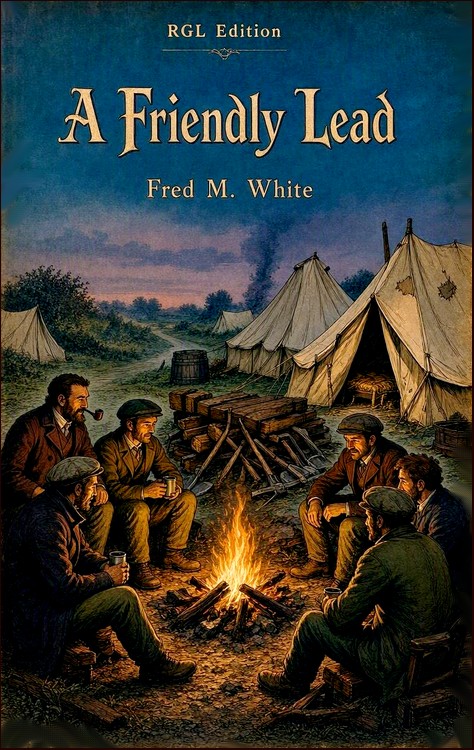
RGL e-Book Cover
Based on an image created with Microsoft Bing software
Roy Glashan's Library
Non sibi sed omnibus
Go to Home Page
This work is out of copyright in countries with a copyright
period of 70 years or less, after the year of the author's death.
If it is under copyright in your country of residence,
do not download or redistribute this file.
Original content added by RGL (e.g., introductions, notes,
RGL covers) is proprietary and protected by copyright.
RGL e-Book Cover
Based on an image created with Microsoft Bing software
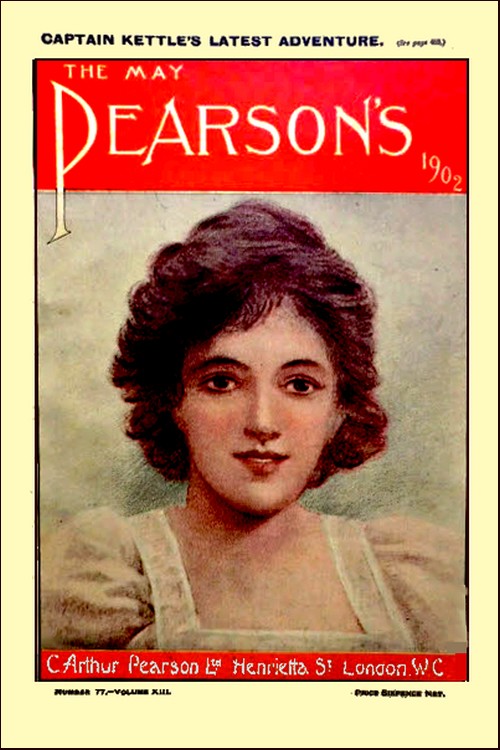
Pearson's Magazine, May 1902, with "A Friendly Lead"
Caught between hunger, mischief, and sheer opportunism, Gipsy, Dandy, and their irrepressible friend Doolan stumble into a scheme that begins as a cheeky dodge of a poaching fine and spirals into a riotous comedy of forged letters, a faked death, and a "widow" who proves far more real—and far more formidable—than anyone bargained for. "A Friendly Lead" is Fred M. White at his most exuberant: a tale of rough-and-ready camaraderie, audacious trickery, and the spectacular consequences of a joke pushed one step too far.
FAR up the head of the Valley of Sweet Waters, Gipsy and the Dandy were getting themselves into trouble. As a matter of fact they had no business there at all; they were far beyond the zone of their legitimate labour, which was to lock in the valley and bring the sweet waters to the big Midland towns, and anyone of those eight thousand navvies down at Cumguilt were objects of dire—and necessary—suspicion at Llangaren. For there were pheasants and hares there, and the woods were the property of Sir James Lewis, of Llangaren Court, a worthy baronet, with a strong prejudice in favour of keeping his pheasants for himself.
Gipsy and Dandy were equally prejudiced the other way. Had the preserves been full of sparrows, they would have been just as keen in their predatory expedition. At the same time, pheasants and hares were pleasing changes in an otherwise routine diet, and tended to thrift as well.
Gipsy and his friend were not alone; Gammon was with them. He had accompanied the expedition because he posed as an authority on poaching, and because there was usually a rabbit hanging in his hut. He was a soft, chuckle-headed, powerful sort of yokel, whose company would have been flouted with scorn at any other time.
But the burly, red-headed Gammon was not such a fool as he looked. For one thing he was familiar with an art to which the other two were strangers—the art of woodcraft. It was he who discovered, almost by instinct, that the two were marching deliberately into the hands of the keepers. Dark as it was he knew this perfectly well. It was he who hurriedly whispered a plan of campaign whereby Dandy and Gipsy should escape scot free; Gammon, as a superior scouter, generously accepting all the risk.
Ten minutes later saw Gammon striding down the valley with a broad smile on his face and two brace of pheasants in his pocket; what time the other two stood side by side listening to the head-keeper's call to surrender.
They could see the swing of a lantern light on dripping fern and sodden leaves, a dozen stalwart men coming forward eagerly. There was some semblance of a fight, an oath or two, then sullen silence.
Thus it fell out that on the following Monday morning an irate gauger was inquiring for Dandy and Gipsy in picturesque language. But the gang was discreetly dumb.
At that moment Dandy and Co. stood facing a small county bench, all game preservers to a man, and all prepared to convict without the formality of evidence. At the same time they were merely men, and the marked penitence of the prisoners left nothing to be desired. Dandy listened with his handkerchief to his eyes; Gipsy was a picture of innocent remorse. They had nothing to say for themselves; they saw no harm in picking up a stray bird or two; they were pained beyond measure to find they had been breaking the law. Gipsy remarked sotto voce that he would never "'old up his 'ed again."
"We're pore blokes as don't know no better," he said.
The magistrates were not insensible to this contrite spirit. On this occasion, said the chairman, there would be no stigma of the gaol for the prisoners. Gipsy wiped his eyes. But the lurid language of his daily tongue was close to his lips when the fact was borne in upon them that a fine of five pounds each, together with two pounds eleven shillings costs, was held to be a merciful solution of the difficulty. Fifteen pounds two shillings, or two months' hard labour.
"We're pore men, your worship," said Dandy when at length he could find his tongue—and felt equal to trusting it, "and them spondulix—I mean the money will take a lot of finding. If we 'ad time, say six months——"
"A fortnight," the clerk remarked. "These men have a fair character from the sub-contractor, your worships. We can give them a fortnight."
The twain departed in a humble and contrite spirit.
"Now what's to be done, Gipsy?" Dandy said bitterly. "What's the good of bein' a clever cully like you if you can't do nothin'?"
"Let's go and 'ave a pint each," Gipsy suggested.
To this amicable proposal there was but one reply. Gipsy sipped his beer slowly with his cap tilted over his eyes. He appeared to be plunged into a profound melancholy.
"Doolan ought to ha' come with us t'other night," he said at last. "Promised to come. Doolan's too popular, that's what the matter with 'im. Not as he ain't good company and sings a good song, eh?"
"That's why 'e wasn't 'long of us t'other night," Dandy said enviously.
"Course. An' he ought to bear 'is share. Still, Doolan 'ud be a sad loss to the valley. If anythin' did happen to 'im—say he got drowned or blown up with dynamite—a friendly lead 'ud rake in a lot for 'is widow."
"Garn. 'E ain't got no widow."
"'E would if 'e was dead and 'ad a wife. An' 'es always good when a poor chap gets into a bit o' trouble. Now if 'e disappeared, and we was to get up a friendly lead for the widow, why twenty quid wouldn't be in it."
Dandy caught Gipsy's eye, then he sank back in his chair and laughed silently until the tears rained down the tan creases of his face.
For the benefit of the uninitiated who know not the navvy and his ways, a "friendly lead" partakes of the nature of a life insurance policy, with the additional advantage that there is no premium to pay. In the case of the decease of a popular "hand," it is no uncommon thing for the widow to find herself presented with a handsome sum, in which case she seldom continues to be a widow long. Small sums of money are collected, threepenny concert tickets command a ready sale, and thus the good work goes on.
In the case of a man like Doolan, the collection was likely to be large—£20 at the least. And Tim Doolan was always ready to oblige a friend. Moreover, he had promised to join in the unfortunate poaching expedition, in which case there would have been no difficulty in collecting the fines, a fact admitted by Doolan with cheery egotism.
The little man with the low comedy face, and the mouth made to make others laugh, discussed the matter in the seclusion of Messrs. Dandy and Gipsy's hut. He was quite prepared to admit the responsibility in the matter.
"You've got a schame, Gipsy," he said. "Out wid it."
"You've got to die," Gipsy explained. "They say the easiest way is drowning."
"Never tried ut," Doolan said drily.
But Gipsy protested that this was no laughing matter, especially for Dandy and himself. Doolan was to disappear for a few days, say go down to Shrewsbury where his histrionic talents would be sure of pleasant recognition. His hat would be found floating upon the flooded Guilt, the body mattered little. Then for the benefit of the widow a "friendly lead" would be instigated and that little trouble with a flinty-hearted bench of magistrates settled to the satisfaction of all parties concerned.
Doolan listened gravely, his eyes twinkling all the time. It was a wild escapade, a colossal practical joke after his own heart.
"Faix, an' you should have been an Irishman," he said presently. "But there's difficulties in the way, me jool. There's a slip of a girl as Gammon introduced me to when we was on that dock job at Cardiff. And there's wan at Barry and another at Exeter. But beyond these little episodes of a congenial nature, I've got no widdy."
"Well, we can make one," said Gipsy cheerfully. "There'll be found in your hut an affectionate letter addressed but not sealed and directed to your widow—"
"Honey, I couldn't write a line to save my life," said Doolan.
"Well, can't I write it for you?" said Gipsy. "It's done, in fact," he added. "Shall I read it to you?"
"Go ahead," Doolan replied. "It isn't every day as a dead man reads his last letter to his widdy, specially when he didn't write it. It's good to be a scholar, Gipsy."
Gipsy replied that literature had its advantages. Then he read the following:
140 B. Cumguilt Camp.
Nov. 19, 19—.
Dear Wife,—
Your last letter I was sorri to get as it filled me with pain. I am sorri as you have had so much trouble along of your sister-in-lore coming to the house and hooked it off with all the little savins as I sent you from time to time to pay up the det on the furnitur of our little ome. I am sending you two pound saturday, and more comes later on. Dont do nothin in the way of poleese, but let the woman as ud stoope to rob you to her own conschence.
Your loving man
Doolan.
Gipsy looked from one to the other with pride.
"And what woman do you mane to send it to?" Doolan asked.
"It's addressed to a false address," Gipsy explained, "and will be posted by your sorrowful pals. As there ain't no Mrs. Doolan, of course the letter can't be delivered, and there's an end of that. What you say?"
Doolan had nothing but admiration for the scheme. The trouble and burden of the morrow had no kind of terrors for him. And not one of the group had the remotest idea of the existence of the Dead Letter Office, and what the future might hold for them through the medium of that institution. There was a magnificent practical joke to be played here, and that was all that Doolan knew or cared.
"And when must I go out and cut myself off from me sorrowing friends?" he asked.
Gipsy had calculated the thing out to a nicety.
"Day after to-morrow," he said. "That gives us four days to make sure you are dead. On Saturday the 'friendly lead' starts in the canteen. With any luck we shall have the spondulix to pay the beak by next Saturday. Likely there'll be a bit over for a spree when you comes back, Doolan."
Doolan remarked with manifest sincerity that he hoped so. His satisfaction was tempered with a mild regret that he could not both disappear and stay to enjoy the fun. But even a popular actor cannot have everything in this world.
The discovery of Doolan's hat and coat by the side of the greasy, swollen Guilt two days later caused a profound sensation in the camp. There were hundreds, thousands of navvies there utterly unknown beyond their own immediate circle. But Doolan was known the whole length and breadth of the valley. Never was there a concert, a "sing-song," or a "friendly lead" where Doolan's services were not in request. He was a whole glittering music hall in himself. Consternation lay like a blight on the camp.
Had Doolan committed suicide? The women discussed this point gloomily and noisily as they stood bare-armed outside the huts. One had heard a death-spider last night; another had sat down to crossed knives three days running.
It was at this interesting stage that Gipsy discovered the letter in Doolan's hut. With Dandy standing by his side as a kind of umpire, Gipsy read the letter to a large and admiring crowd of women. It was a very correct letter, they said, a letter that reflected credit on poor Doolan's nature as a husband. Most of them remarked pointedly that they wished Providence had sent them husbands like that. They had to slave hard enough for nothing, goodness knows.
"Doolan was popular," one of the despised husbands growled. "Lively, but careful. An' he allus got his drinks for nothink. If some others of us——"
"Wouldn't never be sober," a woman suggested unkindly. "Poor Doolan."
Gipsy began to speak with ill-concealed emotion. There was something in that letter, he frankly admitted, calculated to put the average man to shame. He drew a touching picture of the grief of the widow shorn of so brilliant and unique a husband, and at a time when a mistaken generosity had robbed her of her little all!
"It's a case for a 'friendly lead,'" Gipsy cried. "A bumper; a fair knock-out. Lads, Doolan's widow ain't to suffer."
Much applause followed this sentiment. Dandy took off his cap and handed it round in his most ingratiating manner. The result was gratifying. By nightfall a good five pounds had been collected.
Lists were opened amongst the various gangs; the concert hall was engaged for the following Saturday night's entertainment, tickets fourpence each. By Saturday morning Gipsy had the pleasure of announcing to Dandy that the fine difficulty was a thing of the past. Indeed, there was already a small balance in hand.
"We'll run in and pay the quids over this afternoon, case of accident," he said. "It's a sacred duty, Dandy. I couldn't rightly enjoy myself to-night till that's off my mind."
Dandy's conscience was in the same tender condition. As they passed up the valley close on the scene of the poaching affray Gammon joined them.
His thick bullet head was slightly on one side, his red hair flamed in the sun. There was a queer, uneasy leer on his face. He looked like a man who had a joke that he was anxious to share with others.
"Pity about that 'ere fine o' yours," he suggested.
"An' lucky you didn't have to weigh in," said Dandy. "Which way are you goin'?"
This was pointed, but Gammon refused to see it. His face grew more engaging and open, the glance from his eyes expressed admiration, untinged with envy.
"You are blokes," he said. "Talk about genius, why it's bird's nestin' to you chaps. An' a letter an' all. Doolan's last letter to his widder. Oh, Lord!"
Gammon rolled about in an ecstasy of enjoyment. His air was flattering, but it had not quite the effect on the other two he confidently expected.
"I don't see no fun in guyin' the dead," Dandy said solemnly. "It's bad taste, Gammon, and calcerlated to wound the feelin's."
"A better letter was never wrote," said Gipsy.
"Course, an' done you credit," Gammon grinned, "seein' as you wrote it yourself. Doolan never wrote it. Cause why? Cause 'e couldn't write. I've wrote letters to girls for him myself. See?"
They did see. They saw that Gammon had some vague notion of the plot, they saw also that he expected a share in the plunder. But neither of the conspirators made the first advance. That came from Gammon.
"You couldn't lend me a couple of quid?"
"No quids, no, nor pewters, nor browns neither," Gipsy said shortly. "We're pore chaps, and we're in trouble. Where are we goin' to get the two quid from? If you 'adn't got us into trouble poachin', why——"
Gammon shifted his ground swiftly.
"You're a nice lot," he said. "Forgery, now. Writin' letters as dead men never wrote and addressin' of 'em to widders as don't be widders at all. Take me for a fule, likely?"
Dandy remarked that Gammon had guessed it exactly. He was pained by the reflection on his character and grieved to think he had descended to friendship with a man who could stoop to such baseness. Gammon merely smiled.
"If I don't stand in, I give you away," he said with an air of finality.
"Let's punch 'is bloomin' 'ead," Dandy suggested.
Gammon was eager to know who was going to do it. Dandy rejoined that the honour and pleasure would be his speedily. In an instant coats were off and Gammon sailed into the affray with head down and arms swinging in windmill fashion after the most approved rustic style. With a smile on his face Dandy advanced to conquest.
But Gammon's capacity for receiving punishment was amazing. His bullet head was like iron, his body gave to Dandy's blows in the most accommodating fashion. It was seldom that the rustic got a blow in, but it was terribly effective when he did. For once brute strength and endurance were getting the better of science. Gradually it dawned upon Gipsy that his ally was getting the worst of it. The loud plaint of Dandy's lungs could be heard afar.
"Chuck it, Gammon," Gipsy said persuasively. "Can't you see he's 'alf killin' you?"
"No," said Gammon very shortly, "I can't."
Gipsy advanced to the aid of his friend who was staggering wearily. A neat trip brought Gammon to the ground, and before he could recover the lost advantage he was picked up bodily and soused, holiday clothes and all, in a dirty dyke by the roadside. When he emerged, spluttering and swearing, the foe had retreated some way down the road. There is nothing like cold water to cool hot blood, and Gammon confined himself to sundry bellowing threats as to what would happen when he and Dandy met again at a convenient spot where reinforcements were not handy.
Gammon went slowly down the valley buoyed up by the reflection that he had a fine trump card in his hand if he only knew how to play it. He would have his revenge. But how?
The mental process was slow and exhaustive. But gradually the path lay clear. Gammon changed his clothes and proceeded to go over his exchequer. There were four pounds there, more than sufficient for the purpose.
"I'll do it," Gammon grinned. "They'd better ha' given me the two quid. And what's more, I'll go to-day."
He locked his hut and walked away resolutely towards the nearest station.
The Saturday night concert in aid of Doolan's widow was so successful an affair that it was decided to hold another on the following Tuesday. Plus the fines, now happily liquidated, a sum of ten pounds remained in hand pending the arrival of the widow or a communication from her, it mattered little which. Not that Gipsy or Dandy had much uneasiness on that score though the letter of Doolan's had been solemnly posted. Even the much-abused Post Office authorities can hardly be expected to produce a reply from a person who does not exist.
Moreover, there had been no more trouble from Gammon. He seemed to have effaced himself altogether; his hut was locked, probably he had gone off to see some friends in the neighbourhood. Perhaps he was frightened. In their joint hut Gipsy and Dandy smoked their pipes on the following Tuesday night happy in the knowledge that they had spent a pleasant evening, and that they had more than twenty pounds between them. All this gaiety and consumption of much liquid refreshment over a deceased comrade did not strike them as being in the least incongruous.
"There's a lot of spendin' in twenty quid," Dandy said dreamily.
"Doolan ought to be grateful," Gipsy replied. "But for me 'e'd never 'ave 'ad a brown o' this. I dunno as 'e 'as any rights to expect it all."
"I dunno as 'e 'as," Gipsy agreed amicably. "We collected it, and we 'ad all the trouble. Sure to be a lot as'll kick when' Doolan does come back, and make a lot o' fuss over their dirty fourpence. An' who'll get all the blame? We shall. Who'll be expected to fork out? Why, we shall."
Dandy assented gloomily. A little more and he would have had no difficulty in persuading himself that Doolan had done them both a personal injury. True, the blight of those fines had been removed, but Doolan had not found the money.
"I only wants to be fair," said Dandy. "What do you say to a couple of quid for Doolan and the rest to be 'eld by me in case of accidents!"
"I was to be treasurer," Gipsy said hastily. His tone suggested injured pride. "But 'ave it all your own way."
"Let's divide it," said Dandy. "It's nine quid each and money well earned. An' what's the good in 'avin' brains if you can't use 'em? To-morrow——"
He paused, conscious that somebody was moving outside the hut, the walls of which were thin and afforded excellent practice for eavesdroppers. Gipsy extinguished the lamp and proceeded to simulate slumber. The footsteps came nearer and somebody knocked on the door of the hut.
A further and more peremptory summons elicited no response. Gipsy groped his way to the door. After all, there was no reason for this undue modesty, provided always that the people outside had heard nothing of the recent conversation.
"Who's there," Gipsy asked. "What do you want this time o' night?"
There was a suggestion of sleepy virtue in the question.
"It's me," came the unexpected voice of Gammon. "I want ter come in."
With a chuckle Dandy struck a match and lighted his lamp. Gipsy, with a lusty appetite for amusement, opened the door.
"Come in," he said. "'Ow do, matey!"
"I'm not alone," said Gammon, "I've brought a lady with me; come all the way from Cardiff, she do. Name o' Doolan."
A slim, wiry figure in black pushed forward. The woman was dressed in shabby weeds, and a long veil hung over her shoulders. Her black eyes gleamed as she stood contemplating the paralysed partners in crime with a jaunty, easy assurance.
"An' which av' you was it what sent Doolan's widdy that letter?" she asked.
Gipsy modestly pleaded guilty to the charge. Immediately he was carried off his feet by a torrent of overwhelming thanks.
"Good of you was no word for it," she said. "Ay, he was a good man was Doolan, and I shall never replace 'im. A bad day it was for me when that letter arrived, an' me at me wit's end for money. But me friend, Gammon here, tell's me the boys haven't forgotten Doolan's widdy."
"I only did what was right," Gammon said modestly. "When I come to Cardiff to fetch you, I never grudged the trouble."
"It's a matter of nearly forty pound," Mrs. Doolan went on rapidly, "an' Heaven knows as it's welcome. I'm stayin' to-night in the abode of the dear departed, rest his soul. And it's myself that will come round to-morrow to recave that trifle of money, and the saints preserve you."
She swept out of the hut, carrying Gammon in her train, closing the door noisily behind her. Dandy collapsed into a chair.
"It beats me 'ow she got the letter when it was sent to a false address," he said.
"Yer stoopid idiut," Gipsy retorted irately. "She didn't get it; Gammon told her what was in it, before he brought her up here."
"Well, I am——" he said, "well, I am——"
He could say no more. In his own vernacular there were no words for it.
The two conspirators sat in their hut smoking dismally. There was no flavour in the tobacco though that was no fault of the manufacturer. The hut was swept and garnished by the simple method of shovelling all the débris in one corner, and a jug of ragged chrysanthemums stood on the table. The friends were expecting a visitor.
She came presently with a quick vivacity and a hardness of eye that boded ill for the subsequent pleasantness of the interview. If she was sorrowing much for the late Doolan, she had a marvellous control over her feelings.
"About that trifle of money?" she suggested pointedly.
Gipsy smiled in his most ingratiating manner. Dandy scraped his foot nervously on the floor. Both of them would have given much to have been seated in their working moleskins with their grey shirts open at the neck. They would have breathed more easily under those conditions.
"It's been a great responsi——" Gipsy sighed. "You know the word I mean."
"Well, I take all that off the hands of you," Mrs. Doolan said cheerfully. "Gammon and meself have been goin' into the statistics. Forty pound and saxpence 'tis."
"Gammon's figures is correct to a tanner," said Dandy, "though 'ow he managed to learn that, and wot business it is of 'is, I——"
"Let's have the money," Mrs. Doolan interrupted.
The critical moment had come. Dandy was breathing heavily. He knew what a storm was to break presently over his head. There was just a chance that Gipsy might save the situation. He did.
"Mrs. Doolan," he said suavely, "it's not much you know about an engineer's camp."
"Faix, as much as I want to," was the pleasant reply.
"It wouldn't be safe to keep that money in a 'ut. Lord love the woman, we should be robbed and murdered before daylight. There's characters 'ere as the Wild West couldn't hold a candle to——"
"For your sake we couldn't take no risks," said Dandy beamingly.
"So we claps the money in the bank," Gipsy resumed. "Give it to the manager to lock up in 'is safe. Any time you wants it back, says the manager, gimme me three days' notice and it's yours."
"I 'ope you didn't forget to gi' notice to-day," Dandy said suavely. "Mrs. Doolan don't want to stay in a place like this!"
Gipsy scornfully demanded to know what his friend took him for. Hadn't he lost a quarter that very day for the sake of Mrs. Doolan and out of respect for the deceased?
"I should ha' knowed you better, matey," Dandy said humbly.
"I've done it all," Gipsy went on. "The money can be drawn Saturday. An' what's more, I've put it as Mrs. Doolan can get the money 'erself paid 'er into 'er own 'ands."
This last stroke of genius had the desired effect. The gathering storm died out of Mrs. Doolan's eyes, she smiled, she wept in a becoming manner. Pressed a little, she partook of a glass of whiskey, and finally departed.
"She 'ad a good dose," Dandy suggested.
"Well, wot o' that," said Gipsy. "Paid for out of 'er own money, wasn't it?"
"Perhaps she'll deduct eighteenpence when she gets it Saturday," Dandy said ironically.
"She won't get it Saturday or Monday or any other day, mate. She——"
"Seein' as it ain't in the bank, 'ow can she?"
"But she'll know that, come Saturday. Then the band'll play. I come near to chucking it to-night, matey. Never flummuxed like that afore. Then that bank idea came to me like a dream, Dandy. Reg'lar diplomatic, I calls it. What we wants is time."
"What's the good of time?" Dandy asked contemptuously.
"Every good. We've got two 'ole days afore us. Doolan must come back. Doolan's a good pal, but 'e's thoughtless. Fancy forgetting as 'e 'ad a wife all the time."
"'Ow did Gammon know that?"
"Dunnow. Anyway, he's 'ad us over this business. This 'ere is Gammon's revenge. Suppose he found this out when 'im and Doolan was workin' at Barry Docks together. Well, Gammon ain't goin' to score over this thing. Who does this money belong to?"
"Why, Doolan, o' course," Dandy cried.
"Well, Doolan must come back and claim it."
"If 'e knows as that woman is 'ere," Dandy began, "he'll never——"
"But he ain't goin' to know. It's goin' to come on 'im as a jiful surprise. There's no cause to go and break the noose all at onst. I'll take a quid of this 'ere money and go to Shrewsbury and fetch 'im, 'inting, like, at the treat we 'ave for 'im. That'll put 'is missis' nose well out of joint."
Dandy was so overcome that he filled and drank a large measure of whiskey. Then the strong tobacco resumed its flavour, and there was peace again. Gipsy was off duty the next day, and towards evening a report ran like wildfire through the camp that Doolan had not been drowned after all.
The joyful news was confirmed a little before ten o'clock by the appearance of Doolan himself, escorted by Gipsy and a large bodyguard who gave the popular favourite a hearty reception. Doolan had certainly fallen into the Guilt whence he had been rescued, and conveyed to a shepherd's hut, where he had lain at the point of death for some days. That he showed no signs of his recent sufferings he piously attributed to a naturally robust constitution.
In the rejoicings that followed Doolan's return such minor matters as the "friendly lead" were forgotten. On the head of deluded contributors there was nothing to fear. On all hands there was a disposition to treat the matter as a practical joke. It was some little time before Doolan found himself alone in Dandy's and Gipsy's hut.
"Faix, you might have left me in Shrewsbury a day or two longer," he said. "A foine toime I was 'avin' of ut. But what's the sacret?"
"Your wife's turned up 'ere," Dandy said abruptly. At any moment there might come a rude interruption to the softening of the blow. "Tall, thin woman with black eyes."
"Calls herself Melinda?" Doolan gasped.
"That's 'er," Gipsy said cheerfully. "Turned up directly we'd got the money together and claimed it all. We got a matter altogether of——"
"It's all the same," Doolan groaned. "Don't tell me. Five or ten or fifty or a thousand, she'd have it all. An' she isn't me wife, she's a girl that Gammon introdooced me to at Barry three years ago. An' I promised to marry 'er afore witnesses and gave 'er a ring. Sure, it was only brass, but laygally it might have been dimonds. An' I've been dodgin' 'er ever since. It's only natural as she should regard 'erself as my representative with a right to the money. Oh Lor', she's comin'."
She was. Her voice could be heard rising stridently outside the hut. Then she burst in with the torrent and force of a tornado. For a quarter of an hour three strong men bent and tottered before the force of the gale. Scorn, contempt, contumely, invective, glanced from her tongue, but presently she ran down from sheer physical inability to continue. Doolan sat shivering.
"Tell us what you want," said Gipsy. "Say it all again."
"I wish I was your wife," said the punitive Mrs. Doolan quiveringly.
"You ain't anybody's wife," said Gipsy with a temerity that astonished himself. "If Doolan was 'arf a man, he'd tell you so. If I was 'e——"
"No, you wouldn't," Doolan said forlornly. "Oh, no, you wouldn't."
"Well, perhaps not, matey. A man ain't bound to marry a woman when she likes. If you wants to make this lady your wife——"
"Me! Want to marry her!" Doolan gasped.
"Very well, then," Gipsy went on judiciously. "It's a matter o' damages. Question is what will you take to let Doolan go?"
"As if I want 'im," the plaintiff screamed. "I wouldn't marry him if he was the only man left in the world. Me marry that!"
"Then 'e ought to get off cheap," Gipsy said cheerfully. "What do you say to five pounds?"
Doolan's fiancée was not quite disposed to value him so cheaply as that. She was not going to take a penny less than the money in the bank. She had no legal claim to it, but there it was and she meant to have it. Gipsy produced a canvas bag from his pocket.
"The money's here," he said. "It wasn't never in the bank at all. There's twenty pound odd 'ere, and if you care to 'ave 'arf o' that——"
There was a sudden plunge and a snatch and the little bag reposed in the captor's pocket. With a smile of triumph and the glint of battle in her eyes she looked round the hut.
"I've got it," she said, "and I'm goin' to stick to it. If you three blackguards, who's been defraudin' the public for your own dirty purpose, care to foight a lone woman for the money you can do it. Come."
"Let her go," Doolan groaned. "If she'll only go!"
"I'm goin' at once," the woman said. "I'm goin' down to Rhayader this very night to me own good friends there. Good-bye and be hanged to yez."
She kissed her hand, touched her pocket significantly and departed. Doolan heaved a great sigh of relief.
"Good-bye to our spree," Dandy groaned.
"I'm well out of it," said Doolan. "Which is more than Gammon will be when I come across him in a casual way. Pass the bacca."
Dandy did so. He watched Doolan ramming his pipe and stuffing his own pouch with an eye of deep reproach none the less because unspoken. Doolan smiled sadly.
"After all I have suffered for you," he said, "ye can't have the heart to grudge me that."
Roy Glashan's Library
Non sibi sed omnibus
Go to Home Page
This work is out of copyright in countries with a copyright
period of 70 years or less, after the year of the author's death.
If it is under copyright in your country of residence,
do not download or redistribute this file.
Original content added by RGL (e.g., introductions, notes,
RGL covers) is proprietary and protected by copyright.