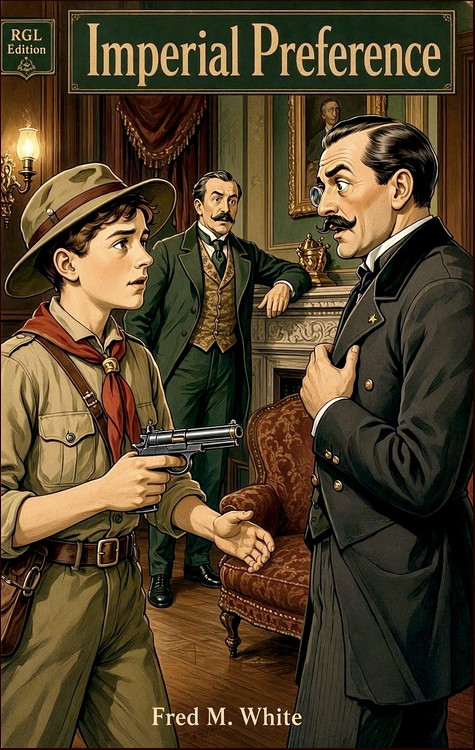
RGL e-Book Cover
Based on an image created with Microsoft Bing software
Roy Glashan's Library
Non sibi sed omnibus
Go to Home Page
This work is out of copyright in countries with a copyright
period of 70 years or less, after the year of the author's death.
If it is under copyright in your country of residence,
do not download or redistribute this file.
Original content added by RGL (e.g., introductions, notes,
RGL covers) is proprietary and protected by copyright.
RGL e-Book Cover
Based on an image created with Microsoft Bing software

Count Herbert von Hammerstein's plot to divert the Great North Belt's red wheat and undermine the Imperial Preference tariff system meets an unexpectedly formidable obstacle in Clarence Boote, a sharp-eyed Boy Scout with a Browning pistol, a rope-ladder, and an unshakable devotion to the Empire; when Clarence's hunt for his kidnapped terrier leads him into a midnight confrontation in Lord Netherton's library, the boy's instincts, courage, and sheer audacity turn a diplomatic intrigue into a thrilling, almost comic battle of wits that decides the fate of British influence abroad.
NOW, Count Herbert Von Hammerstein regarded it as a great and good thing to divert the red wheat of the Great North Belt into Columbia. On the other hand, Scout Clarence Boote, of the Yellowhammer Patrol, didn't. And thereby hangs the tale.
Von Hammerstein was a diplomatist, of course. He held no official post, he was attached by Teutonia to no particular country, and, therefore, was all the more dangerous. His present genial and pleasing occupation was the task of making bad blood between England and Columbia by the simple process of expediting the flow of the red wheat into Columbia instead of Liverpool. It was part of his task to see that the Briton's food did cost him more, and incidentally to weaken British influence in Columbia. The death of Imperial Preference would render his task easier. If he could throw the Great North Belt into the arms of Columbia, the thing was as good as done.
And yet matters were not progressing exactly as the Count could wish. There were vexatious delays and imprudent speeches, a kind of dogged, passive opposition, which is a difficult barrier to overcome. Long and earnestly Von Hammerstein looked for the drag on the coach. It was only after a long cogitation that the truth flashed on him—Lord Netherton! Now, why the dickens hadn't he thought of Netherton before? The mere fact that Netherton had not been out of the country for the past year was suspicious in itself. It was impossible to believe that a man like Netherton had devoted the whole of his great talent and energy to the breeding of a new kind of pheasant. He said he was out of politics for good, but——
Now, with all due deference to the public and the newspapers which educate it, politics cannot be considered only a party game. There are times when leaders are not engaged in flinging personalities across the floor of the House, and when the chiefs on both sides meet in secret conclave for the good of the nation. And the leading politicians of both parties were quite alive to the peril of the matter of the red wheat and the broad bosom of Columbia. And therefore the delicate diplomacy of the matter was left to Netherton, a non-party man, who had handled these problems before. There were very few people indeed who were aware of this, but, unfortunately, Count Herbert Von Hammerstein was one.
Therefore the Count had made up his mind to spend a few days with Netherton at his place in Surrey. There were ways of bringing this about, and the Count used them. He brought it about so delicately that Netherton had no suspicions. It looked as if he were going to do good business in another direction with Teutonia. And now Count Herbert Von Hammerstein was on his way to spend a long week-end with Netherton at Broadmarsh.
So also was Scout Clarence Boote, of the Yellowhammer Patrol.
To be briefly biographical, Scout Boote was the son of Netherton's London chauffeur. He was a youth of singular clarity of purpose. His ambition was to emigrate to South Africa and become a second Cecil Rhodes. Meanwhile, he was a most efficient Scout, devoted to his duties, and possessing a mind that absorbed information as water is absorbed by a sponge. Whatever that boy heard or read, he simply couldn't forget. He had an extensive knowledge of the great world; there was no celebrity he did not know by sight; he would have been cheap to a newspaper gleaner of personal gossip at twenty pounds a week. He was, perhaps, the only Scout in London who possessed a Browning pistol, and he knew as much about the mechanism of that lethal weapon as the inventor himself. Also, he had been ill, and therefore had come down to Broadmarsh to recuperate.
Just at the moment the light of the Yellowhammers was having a bad time of it. With his solemn devotion to duty, his slouch hat and bare legs, and, alas, his spectacles, Clarence had been welcomed at Broadmarsh with a relish and joy unspeakable. Jack and Ronald Netherton, at home from Eton for the summer holidays, regarded him as a special gift from a generous Providence. He had fallen at their feet, so to speak, like manna from Heaven. They admired his pluck, his stolid good temper, they admired his gift for repartee, but it was a "rag" full of infinite variety and unexpected developments. There was balm in Gilead, for in the house Clarence had one firm admirer; but then Dicky Netherton was only ten, and as yet not even initiated into a preparatory school.
Clarence stood doggedly with his tormentors before him. He regarded them with a certain tranquil contempt through his spectacles.
"What yer done along of my dawg?" he asked.
"The faithful hound has been spirited away," Jack Netherton explained. "Redskins have nabbed him. You will never see Ponto again, Clarence. Why don't you trace his little footsteps in the snow? He was last seen on the London road in disrespectable company."
Clarence sniffed. These chaps had done something with his terrier, of course. And "B. P.," as the dog was called, was the apple of his eye. "B. P." could do everything but talk. The trained eyes behind the glasses detected short white hairs on the breast of Ronald Netherton's blazer. The cowering culprit stood there right enough.
"Oh, I'll find him," Clarence said. "You've got 'im in the 'ouse somewhere. Bet yer a tanner as I gets 'B. P.' back before mornin'?"
The bet was taken in two places eagerly. Jack had an inspiration.
"Wager your Browning pistol against a quid?" he asked.
"No use to you if you'd got it," Clarence said pityingly. "It's dangerous in the 'ands of boys. Why, it took me the best part of a day to master it!"
"Hear him talk!" Ronald exclaimed. "Where did you get it from, cully?"
"Pinched from a bloke what was in the Stepney fight," Clarence volunteered, "only I don't suppose as you know what that means."
Jack responded that Eton knew no limitations so far as the wide field of slang was concerned. On the contrary, it was not the least interesting of their studies.
"You go and find your dog," he retorted, "and don't forget that we shall expect you to weigh in with these tanners to-morrow morning. Come on, Ronnie."
Clarence was left alone in the park with his one adoring admirer. For little Dick, the Scout had a fascination that nothing could stale.
"Oh, they've got the dawg all right," Clarence explained. "I twigged the hair on their coats, and I tracked the mark of 'B. P.'s' paws as far as the conservatory. Found 'arf a dog-biscuit on the begonias outside. I'll get 'im—you see."
Dick was properly convinced on the point.
"Are you going to burgle the house?" he asked.
"Well, it might go as far as that," Clarence reflected. "Mind you, I could do it if I liked. I know the way. I know a bloke dahn our way what's been a burglar. Gave me lots of tips, he did. Seen my rope-ladder?"
Dicky hadn't. He pressed eagerly for details. Clarence paused, with finger darkly on his lip. A dapper little man, looking more than usually foreign in a Norfolk suit, strolled past. His black moustache was waxed, he smoked a cigarette jauntily.
"Are you afraid that the Count might hear?" asked Dicky.
"Can't be too careful," Clarence responded cautiously. "Don't like that chap. Ain't got no use for him. Oh, I know 'im! Foreign spy, 'e is. 'As his chauffeur from the garage where our car is kep'. Man that drives 'im told me all abaht it. And pretty queer places in tahn 'e goes to. Shouldn't wonder if 'e's the bloke that's trying to bring about that 'ere Columbia business. Don't know what I'm talking abaht? You ask the old 'un—meaning your father. Tell you what it is—the Patrol's got their eye on that chap."
Dicky looked puzzled. It all sounded delightfully mysterious and thrilling, but what possible connection could there be between it all and the muddling question of the Great North Belt?
Clarence launched out into amazing politics. Evidently he had made a profound study of the Colonies and the desire for Imperial Preference. The shibboleths fell from his tongue trippingly. He certainly was a most amazing boy.
"That chap's down 'ere for no good," he concluded. "He's a bad egg—a regular shop 'un. 'B. P.' don't like 'im. 'E came into the garage one day, and it was as much as I could do to stop 'B. P.' from samplin' his trousers. And, mind you, there ain't no instinct like a dawg's instinct. Tell you more about it some other day."
At this point it pleased Clarence to be mysterious. Loquacity was no part of the armour of Cecil Rhodes; it was just possible that he was saying too much. Besides, he rather wanted to stalk Count Herbert Von Hammerstein. That wily diplomatist was disappearing round a bend in one of the drives through the park, and, from certain fragments of envelopes in the bracken, it was clear that he was reading and destroying letters. Clarence would have given much to obtain possession of those letters. At any rate, there was nothing to prevent him from collecting the fragments of the envelopes. The drive for a little way had the appearance of a paper-chase. In a short time Clarence's satchel was full of the fragments carefully collected from the ferns.
Clarence sat down presently in a grassy hollow and bent over his task. He had a full-flavoured notion that he was doing good work on behalf of the Empire that he loved so well. As a practised Scout, he knew that tremendous results ofttimes spring from the tiniest clues. He obtained gum from the trunk of a wild cherry tree, and a strip of smooth bark from a fallen birch. Upon this crude foundation he began to arrange his envelopes. That the papers represented nothing but envelopes seemed only to confirm his suspicions. In one of the envelopes was a folded corner of a letter, which had evidently been torn off by mistake. There were one or two mysterious words here that looked like a meaningless tangle of letters.
"Cipher," Clarence muttered. "Hullo! If it ain't a code! The plot thickens."
With this excerpt from Scout literature, he proceeded with his task. The spectacled eyes gleamed, a faint dash of colour tinged the Boy Scout's cheek. The envelopes were all decorated with Columbian stamps, and all had the postmark of Columbia's metropolis. Here was proof positive of Clarence's darkest suspicions. Every one of those letters referred to the matter of the Great North Belt and the red wheat thereof. On behalf of Teutonia, Count Herbert Von Hammerstein was negotiating the black business. He had come down to Broadmarsh to ascertain if Lord Netherton had anything to do with the delay which was retarding progress. It was clear to Clarence as the light of day. And it was up to the pride and delight of the Yellowhammers to frustrate this foul plot. The Browning pistol was in his pocket. Should he hold up the Count and demand his papers?
After profound cogitation, Clarence abandoned the idea. Besides, he had to bear in mind the fact that his great model was by no means blind to the material side of things. Cecil Rhodes had a proper appreciation of money and the power it commands. He had always recognised the axiom that even Imperialism cannot thrive without it. Most fortunes have a modest beginning, and most revenues have sprung from the traditional half-crown. And why not from a shilling? And that was precisely the sum that Clarence expected to make at the expense of the Honourables Jack and Ronald Netherton. He was going to get "B. P." back, and win his money at the same time.
That "B. P." was hidden away somewhere in the house, he felt certain. Possibly the boys had smuggled him into their bedroom. "B. P." was an exceedingly clever animal—indeed, one of the grooms had offered a large sum for him. But Clarence had spurned the proffered "two quid," and, seeing that "B. P." could do almost anything but speak, this was only natural.
Broadmarsh was not a difficult house to burgle; it would have presented few difficulties to the talented cracksman. It was a low building, with the bedroom windows not too far from the ground. Clarence took all this in as he patrolled the grounds shortly after midnight. He was rather prone to this kind of thing. A rope-ladder formed an easy way of leaving his quarters over the stables by way of the window. There would be no trouble in entering the house. Once he gained the corridor, he would not be long in finding "B. P.," provided that sagacious hound was on the premises. There were many calls that "B. P." responded to. In his case, the twitter of a sparrow suggested secrecy and the necessity of seeking his master's side speedily and with absolute obliteration of any other human being. Clarence's rope-ladder was round his waist, the grappling-hooks were attached, and the fourth window opening out of the corridor was not latched. Very gently the ladder was cast upwards, and the hooks held.
Clarence drew a deep breath. The situation and a certain nervous fluttering demanded it. There was danger in the proceeding. Nor was Clarence blind to the weakness of his case in the event of his presence being discovered. The situation would take a deal of explaining. Still, he was young, and, as might be gathered, not lacking in the confidence that certain cynics prefer to call conceit. And the desire of getting the better of his tormentors was irresistible.
He climbed firmly up the ladder and entered the corridor.
No light was needed, for the perfect summer night was no darker than a violet shadow. Clarence could make out the crimson carpets on the polished oak; he could see dead-and-gone Nethertons frowning at him from the walls; he caught the glimpse of steel and bronze. The corridor was warm and fragrant; there was an atmosphere about it that Clarence had never breathed before. All this luxury and gracious splendour appealed to him. Cecil Rhodes had scorned delights like these, but, all the same, they had their charm. Just for the moment Clarence had it in his mind to be a Radical. But then it was all so Imperial.
The pride of the Yellowhammers had himself in hand again. He twittered quietly with a note like that of a sleepy sparrow dreaming of worms under the red eaves. Clarence strained his ears for the reply. It came a moment later from a long way off, in a faint ting, like the sound made by a tuning-fork. That shilling was as good as in Clarence's pocket. A mass of brown fur snuggled at his feet, and the dog was raised in the arms of his master. Doubtless even Cecil Rhodes had moments of weakness like these.
"What we've got to do now," said Clarence, "is to clear aht. No use stoppin' 'ere. It 'ud spoil the whole game if anybody came along."
Apparently this strategic prudence failed to commend itself to "B. P." His wiry little body stiffened, he showed his teeth, full and white, in the violet light. Instantly the instincts of the Scout were aroused; financial considerations flew into the background. The faithful hound spoke of danger. There was something radically wrong going on here, and "B. P." was telling Clarence so as plainly as words could speak. "B. P." would not have moved a muscle or shown a tooth for any resident in the house, even if that same person was an utter stranger to him, and "B. P." had too fine an intelligence for rats and other low quadrupeds of that kind. Manifestly there was something wrong here, and it was up to the bright, particular star of the Yellowhammers to get to the bottom of it. Burglars, perhaps, or—— There came an illumination that shook Clarence to the soul.
He took a piece of cord from his pocket and fastened it to "B. P.'s" collar. Then he urged the dog forward. He had only to hold the string, and "B. P." would do the rest. "B. P." proceeded along the corridor and down the shallow stairs with the air of a dog who has a thorough grip of the situation. He emitted no sound, but the short bristles on his back stood up like quills upon the fretful porcupine. They were creeping over the mosaic tiles of the hall presently, in the direction of the library. The door was not quite closed; a thin slit of light cut into the opposite wall like a streak of silver let into the dark oak. Obviously somebody was in the library, and "B. P." was perfectly well aware of the fact. And obviously the intruder had no business there—"B. P." was certain of it. He would have told Clarence so, had he been able to speak.
Clarence felt in his hip-pocket for the trusty Browning. The weapon was there right enough; no Scout of his eminence would have travelled without it. And, moreover, that wonderful boy knew exactly what he was going to find in the library. He was looking for a rather stout, elderly gentleman, with stiff, white hair and a moustache like a tooth-brush. He expected to find the individual in question busily engaged at Lord Netherton's desk, and he was not disappointed. It all worked out exactly as he had expected.
One glance from the eagle eye of his master, and "B. P." crouched in the doorway. Clarence advanced a step or two further and produced the Browning. He spoke in clear, calm tones. In a situation like this it was necessary to drop the English of Cockaigne, and speak with the polished accent of the hour. Clarence could do it on special occasions. He was not a clever student of transpontine melodrama for nothing. If he had only a dress-suit and a cigarette!
"Put up your hands," he said quietly, "or I fire!"
Count Herbert Von Hammerstein wheeled round quickly. Apparently he was a gentleman of decided methods. He made a rush, but Clarence did not move. The Browning clicked ominously, the dog in the doorway growled. The Count changed his mind. Obviously the Browning was a genuine one, so also was the dog, so also were Clarence's white face and glittering eyes. And small boys in heroic situations are apt to become hysterical. And Count Herbert Von Hammerstein was a man of considerable imagination.
"Bless my soul!" he exclaimed. "A Boy Scout! What are you doing here?"
"Point is," Clarence said curtly, "what are you doing here? I know you."
Here was a lapse, and Clarence hastened to amend it.
"Your identity is perfectly well known to me," he added.
"Really! Then disguise is useless. May I beg to remark that I am a guest in this house. If the statement lacks the suggestion of veracity——"
"It does," Clarence replied. "Guests don't hunt over the papers of the chap—I mean the gentleman—what puts them up. I know what you came here for. It's got to do with the Great North Belt and that wheat business with Columbia. His lordship is on one side, and you are on the other, and up to now he's got the best of you. If you want to know who I am, I'm an Imperial Preferencist, and I'm all against the foes of my beloved country. See our oath of allegiance. I guessed what you were after directly I spotted you in the park to-day. My lord, I've tracked you down!"
Count Herbert smiled slightly. He saw the humour of it all.
"You are a good boy," he said, "and a brave boy, and you are no fool, but you are mistaken. I came here to get something that I had forgotten. I am prepared to admit—— But what am I saying? Here are two, four, five golden sovereigns for you. Go away and—and play."
"A bribe," Clarence said contemptuously—"a bribe! Foreign gold! I spurn it!"
"In that case, my young hero, what do you propose to do?"
"Stay here all night," Clarence jerked—"me and the dog. Keep you here, too. Then, when the servants come down in the morning, get them to fetch his lordship. Tell him everything. Warn him of his danger, and have you turned out of the house. See?"
He saw, and he came with a gliding movement followed by a sudden rush. The Browning spoke twice, and the Count lost the top of his left ear. The noise of the pistol was little more than the cracking of a nut, but in the night it sounded like a gatling-gun. Almost at the same instant "B. P.'s" teeth met in the calf of the great diplomatist's leg. He dropped back on a chair with a feeling that the game was up. To be discovered like that by Lord Netherton was bad enough, but there was no occasion for the servants to witness his humiliation.
"Cross over to the fireplace," he said, "and ring the bell on the left. It is attached to an alarm that rings in his lordship's bedroom. It is set at night, and anybody who comes here, and does not know the secret, must set the bell going. I do know the secret. You have got the better of me, and the fewer people who know of this business, the—— You understand? If you ring that bell, Lord Netherton will be down in a few minutes."
Clarence complied. It was the proudest moment of his life. To stand there, as he did a little later, and explain the whole matter to Lord Netherton, gave him a feeling that rendered his voice partially unsteady. He was there in the inner cabinet of the nations. That the secret must for ever be locked in his breast was a drawback, but what of that?
"Well, you certainly are a most wonderful boy," Netherton said warmly. "Now, you go back to bed and say nothing of this to anybody. I don't think you will. Come and see me after breakfast. I've got to do something out of the common for you, my lad. For the present——"
He paused. Clarence saluted grimly and withdrew. Netherton reached for a cigarette and lighted it. He offered the case to his guest. Then he sat down in his chair and laughed silently till the tears rolled down his cheeks. The Count watched him.
"Well," he asked presently—"well, my friend?"
"Boy was telling the truth, I suppose?" Lord Netherton asked.
The Count shrugged his shoulders. There are times when the terminological inexactitudes of diplomacy are best left unsaid, and he had half a century of experience behind him.
"You may put your own construction upon it," he said. "It is all part of the game. I wanted to make sure that you really were my opponent in that North Belt business. Now that you know what I wanted, I had better return to the Continent. Can I catch the nine-forty to town to-morrow?"
"Oh, you shall," Netherton said heartily—"you shall!"
Roy Glashan's Library
Non sibi sed omnibus
Go to Home Page
This work is out of copyright in countries with a copyright
period of 70 years or less, after the year of the author's death.
If it is under copyright in your country of residence,
do not download or redistribute this file.
Original content added by RGL (e.g., introductions, notes,
RGL covers) is proprietary and protected by copyright.