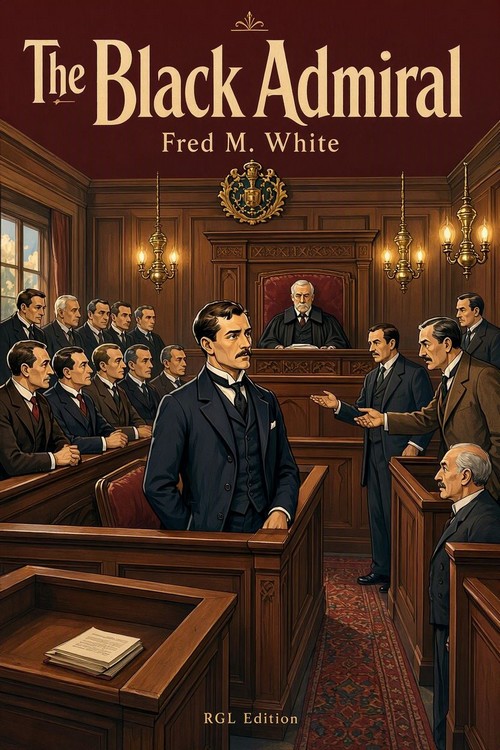
RGL e-Book Cover
Based on an image created with Microsoft Bing software
Roy Glashan's Library
Non sibi sed omnibus
Go to Home Page
This work is out of copyright in countries with a copyright
period of 70 years or less, after the year of the author's death.
If it is under copyright in your country of residence,
do not download or redistribute this file.
Original content added by RGL (e.g., introductions, notes,
RGL covers) is proprietary and protected by copyright.
RGL e-Book Cover
Based on an image created with Microsoft Bing software

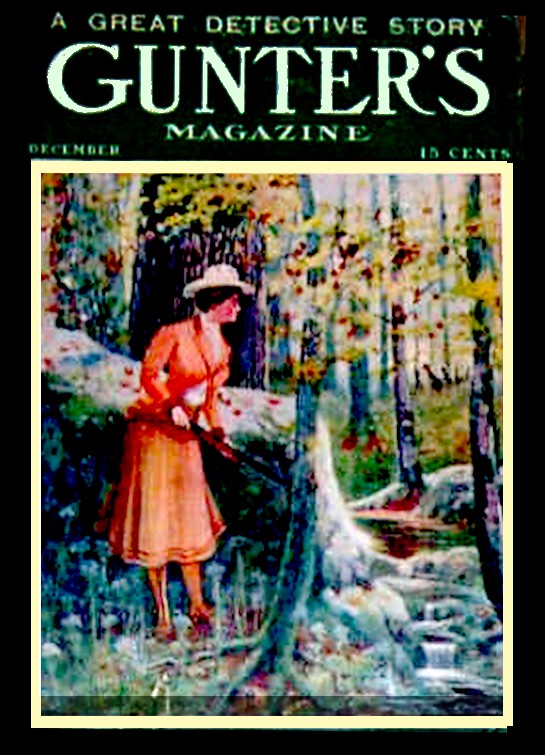
Gunter's Magazine, December 1907, with "The Black Admiral"
Barry Lorimer, a celebrated novelist with a talent for impossible plots, is drawn into a real-life mystery when Mrs. Deeprose begs him to save her innocent husband from the gallows—a man accused of murdering his colleague after a bitter quarrel over a rare butterfly known as the Black Admiral. As the trial unfolds and the evidence seems damning, Lorimer devises a daring, morally dubious scheme that hinges on imagination, timing, and a dramatic twist involving the elusive insect. What begins as a desperate plea becomes a race against time, deception, and fate—leading to a courtroom spectacle, a hunt for the true killer, and a revelation as startling as the butterfly itself.
BARRY LORIMER pushed his writing-pad aside and turned with what politeness he could to his visitor. The popular novelist was just coming to the marrow of one of his most intricate plots—
"Indeed, I know that I ought not to have come," she said. "Everybody knows that you work after breakfast. And you consent to see me without even knowing my name. I came to you as a kind of forlorn hope. I came because something told me that you would help me. I am Mrs. Deeprose, wife of George Deeprose, accused of the Scaw's Tor murder."
Lorimer turned from his notes with a thrill of interest. Everybody had heard of the Scaw's Tor murder; it was going to be the sensational trial of the week. Not that anybody entertained the slightest doubt as to the guilt of the accused. Perhaps Lorimer's face was eloquent of the same verdict, for the lady went on rapidly.
"My husband is absolutely innocent," she said. "I should say the same if I had no evidence to prove what I am telling you. No, I have had no time to mention the matter to anybody else, and I doubt if it would do any good if I did. By Saturday night my husband will be condemned for the murder of Professor Richard Burton, and three weeks from that time he will be hanged. And three weeks later than that the real murderer will be arrested— it will be proved true when it is too late. And that is why I came to you in my despair to find some way to save my husband. You are the most marvellous maker of plots who writes to-day. You detest capital punishment. I want you to think out some scheme whereby the judge and jury may be baffled and defeated. I want you to plot as you never plotted before. If you could only cause the jury to disagree—
"Could you tell me who the real murderer is?" Lorimer asked.
"I can," came the clear reply. "The assassin is my half-brother, Stanley Lynne."
Lorimer rose and paced up and down the room; the thing appealed strongly to his imagination. It seemed illogical, but he believed everything that his visitor said. He was particularly moved by the directness with which the real culprit's name was given.
"This Stanley Lynne," he said. "If you know, why could not his arrest—
"He has gone to Australia in a sailing-vessel. Before the Rosy Cross could be spoken my dear husband will be hanged. You see the difficulty of the situation."
Lorimer nodded. Would his visitor mind if he smoked a cigarette? He generally worked under the influence of tobacco.
"My word, you stimulated me!" he said. "I wish I could have schemed out a plot like that for pure fiction. As things turn out, I could never use it. But, my dear madam, I am pretty sure that I can see the way to gain the time you want; I even see my way to release your husband altogether. Of course, there is a risk, because my scheme involves something very like pure perjury— but there it is. Still, when an innocent human life is at stake—
"The facts are pretty clear," Mrs. Deeprose began. "As you are probably aware, my husband is a distinguished naturalist—
"To begin at the proper place, I may say that my husband has a cottage at Scaw's Tor, a lovely spot on Dartmoor, which he used in connection with his naturalistic researches. An old woman used to come in from a cottage a mile away and do what was necessary. Every spring my husband spent several weeks at Scaw's Tor, and he claimed to have made important discoveries there.
"Mr. Burton was a frequent visitor at the cottage. They were both enthusiastic collectors of moths and butterflies, and my husband was rather taken with a local rumour to the effect that a fly called the 'Black Admiral' was occasionally to be seen there. Now, this 'Black Admiral,' as a matter of fact, is merely the comparatively rare 'White Admiral,' but the dark markings at the base of the wings and down the back had caused the misnomer.
"Professor Burton laughed the idea to scorn, saying that no specimen of the 'Black Admiral' had ever been seen nearer England than Holland. My husband intimated that he had actually seen the insect in question, but he had not been able to capture a specimen. They both went down together to settle the dispute, and on the night of the murder they had had an unusually bitter quarrel. As it happened, the old woman who did the cooking and waiting stayed very late, and she heard a great deal of the dispute. She heard the word "Liar!" "It's false as hell!" and one or two more such expressions, and she also declares that she heard a thud like that of a falling body, followed by silence. After that the old dame went home, returning about six o'clock in the morning. In the sitting-room she found the body of Richard Burton, stabbed to the heart, and my husband's dissecting-knife still in the wound. My husband was not to be found; he turned up in London very late the following night, looking distressed and haggard beyond measure. He told me that he had come to blows with Mr. Burton over the butterfly, and that he was sorry and ashamed of himself. The rest you know pretty well for yourself, Mr. Lorimer. As things stand, the jury are bound to bring in a verdict of 'Guilty' against my husband. The trial begins to-morrow and will probably end on Saturday night. In three weeks George will be dead. And the man who did the deed will still be on the high seas."
"We are just coming to that," said Lorimer thoughtfully. "The point is a most important one. How did you identify your half-brother with the murder?"
"My instinct, to begin with," Mrs. Deeprose went on. "Stanley Lynne is a born scoundrel. He has absolutely no control over himself, and sometimes I used to imagine that he had not his full share of intellect. He hated my husband because George had come between him and a beautiful girl whom he wanted to marry. The girl is a kind of ward of my husband's, and when he found out what had happened, he was in honour bound to expose young Lynne's character to the girl. Of course, she was dreadfully upset and very ill; but she was a reasonable girl, and her duty was clear before her. She broke off her engagement and started off to Australia for a sailing voyage a few weeks ago. Stanley Lynne was almost beside himself; he threatened my husband with the most terrible vengeance. It was to me that he muttered his threats. I asked him if he meant to show personal violence to my husband.
"'No, not that way,' he said, and the expression in his eyes was horrible. 'It shall be worse than death, worse than death for both of you. You will know how when the time comes!'
"The full significance of this terrible declaration did not come back to me till after the tragic death of Professor Burton and the arrest of my husband. Then like a flash my mind went back to the night that Stanley Lynne had proclaimed his vengeance. Here, then, was something that was 'worse than death.' You may laugh at me if you like, but I made up my mind that I had found the culprit. But even if my suspicions were correct, I could not see that they would help poor George very much. I told the lawyers, but they ignored my hints, even after they discovered that Stanley Lynne had also set sail for Australia, beyond doubt in search of the girl who had declined to become his wife.
"But I am not going entirely on supposition. In the forlorn hope that I might discover something, I went down to Scaw's Tor. I saw the old woman who had attended to the wants of the cottage; I found out that there were other cottages not far off, and that from time to time the people there gave beds to solitary pedestrians who were holiday-making on the hills. And I asked questions here and there without effect for a long time till I found this."
From her pocket the speaker produced a small pocket edition of Omar. The book was stained and dirty, and on the title-page was the name "Stanley Lynne."
"That was left in the bedroom of a man who paid for a night's lodging in a cottage," Mrs. Deeprose explained. "No doubt the volume was left behind accidentally. But it tells me one thing—
Lorimer muttered something to the effect that he had thought so from the first. He turned to his writing-table and lighted another cigarette.
"I am going to save your husband," he said. "If ever there was a case in which the end justifies the means, this is one. In the first place, you must obey all my instructions. I see you have a counsel who makes the best of things. You are to see that he does not allow the defence to be closed before four o'clock on Saturday afternoon. It does not give me any too much time, but I think I can manage it. You clearly understand?"
The woman nodded, her burning eyes showed that she had taken the point to heart.
"So far, so good," Lorimer went on. "You will see your husband to-morrow, probably. You will see him in the presence of a warder who will be sufficiently far away not to overhear what you say. By the last post to-night you will get a paper from me, and that paper you will commit to heart and repeat it to your husband. You must make him agree to what I suggest and do exactly as I say. Burn the paper when you have read it. And if your husband agrees, go at once and send a telegram to me simply saying: 'Will do what you require.' There is only one little point on which I desire information. Are those 'Black Admiral' butterflies plentiful in Holland at the present moment?"
The woman looked up with some suspicion in her eyes, but Lorimer was quite serious.
"Of course," she said; "the butterflies are common enough in Holland. But I do not see—
"No, because you are not a novelist," Lorimer said, smiling for the first time. "But the point is of the gravest import all the same. And now, as my time is every minute of it set with diamonds, so to speak, I shall be glad if you will leave me. I pledge my reputation that your husband will be practically a free man on Saturday night."
FOR two days the little town hall of Velverstone had been packed. During that time the prosecution had been engaged in piling up a pitiless case against the prisoner. Witnesses proved that the dead man and the assassin had frequently had bitter quarrels almost amounting to violence. The old woman who looked after the Scaw's Tor cottage testified to what she had overheard. There was no question that the knife with which the crime had been committed was the property of the prisoner.
So far the prisoner had made no sign at all. His counsel did not seem to have any particular line of defence. His casual examination elicited nothing that told the least in favour of the prisoner at the bar. The man was condemned already. He had committed that crime on the spur of the moment—
Deeprose's counsel rose slowly. Evidently he felt that he had a difficult case to answer. He pointed out that so far the evidence for the Crown had been merely circumstantial, and that no witness had come forward who had thrown any real light on the tragedy. The Crown, too, had utterly failed to prove anything like motive; indeed, the speaker wanted to know if he had any case to answer. It was true that the prisoner had given colour to the accusation by his own foolish conduct, but then he was not an ordinary man, and he was sincerely attached to the poor victim of this mysterious tragedy. No witnesses would be called on behalf of the prisoner, who had elected to speak on his own behalf.
The audience thrilled; even the judge woke up and looked interested. A pallid ray of light shone through one of the high windows and fell on the dock. For the first time the prisoner looked around him, as if he had just come out of a dream. His pale, thoughtful face did not look in the least suggestive of a cruel murder. For two days and more he had sat in the dock with his eyes fixed on the floor. Now the court was going to hear his voice.
He spoke quite clearly and distinctly, without any trace of guilt. He began his defence with a personal explanation. He and the deceased had been friends for years, they were old schoolfellows. They were both given to sudden spurts of anger; indeed, they were both passionate men. But their disputes had never seriously interfered with their friendship. Perhaps the quarrels were foolish; all the same, they were never alluded to afterwards.
They had come down to Scaw's Tor together, the prisoner to prove, and the deceased to refute, the existence of the 'Black Admiral' in England. For days the search had gone on, until the prisoner had been lucky enough to secure a specimen. He had not obtained it himself; he had been led to the spot on the night of the murder by a member of a tribe of gipsies camping close by Helen's Head. Then the 'Black Admiral' had been captured, and the prisoner bore the butterfly home in triumph to his cottage. Burton was out at the time, and he did not come in till late. When he saw the butterfly, he immediately denounced it as a species of forgery; he accused his colleague of having touched up the dark portions of the back and the base of the wings. Then followed the quarrel which the old woman who looked after the cottage had told with such great dramatic effect. After that the prisoner had gone out. He went for a long walk to quiet his feelings. He was a good way from home before he met the gipsy who had guided him to the spot where the Black Admiral was to be found. The gipsy was in great pain owing to an abscess at the root of a tooth. He had heard that his acquaintance was a doctor of sorts, and was coming to the cottage for advice.
The prisoner thought that he could extract the offending tooth; he went back to the cottage and fetched a pair of forceps. At that time Mr. Burton was out— perhaps he had been poaching and was lying low for the time. At any rate, no effort had been spared to find him, but without success.
As to what happened after the murder, prisoner admitted that he had lost his head. Really, he had nothing further to say, except that he was quite innocent of the crime. The evidence was given in a low, firm voice, without any attempt at effect or passion. Counsel for the Crown rose to cross-examine the witness.
"You claim to have found an insect that has been extinct in England for years," he said—
"It was the whole source of the quarrel," prisoner said quietly. "I found the insect, and I am quite sure that there are others in the same vicinity. It may be that some local enthusiast had imported the larvæ, but the fact remains that I discovered the butterfly in question."
"Then what became of it after the quarrel?"
"It was destroyed during the discussion. Its discovery upset one of my poor friend's most cherished theories. That is why he accused me of transposing a White Admiral into a black one. He crushed the thing in his hands and put it in the fire."
"That is very unfortunate," the prosecuting counsel answered. "You can see perhaps how the production of one of those insects would tell in your favour."
The prisoner's reply was drowned by a sudden altercation at the back of the court. A tall, thin man, with white hair and clean-shaven face, was gesticulating and saying something. The judge sternly called for silence. Was the intruder aware that he was disturbing a court of justice, and that a fellow-creature was being tried for his life?
"But, my lord," the stranger protested, "I can give evidence. A remarkable coincidence enables me to testify that the prisoner is telling the truth. That butterfly—
"Presently," the judge interrupted. "If you have anything to say, the court will only be too glad to listen to it. The prisoner will have every opportunity—
The tall, thin man pressed his way to the front of the crowd. He had a small, round parcel in his hand which he appeared greatly to prize.
"I suggest," the Crown counsel said, "that the 'Black Admiral' is all a myth. The line of defence is very ingenious, with a flavour of the pathetic about it. I have consulted all the authorities, and I cannot find one that admits the presence of the 'Black Admiral' in these islands at all. It has never been seen."
"It was seen by me on the night of the murder," the prisoner said quietly. "But for the hasty action of my poor friend, I could have proved it to you."
"And I can prove it to you now!" the tall man with the clean-shaven face cried. "I say I can!"
A low murmur followed, a warder appeared with a view to removing the disturber of the peace. He wrenched himself away from the detaining grip and tore the covering off his cylinder. Then he disclosed a round glass bottle in which a tiny cloud of whitey-yellow insects fluttered. The bottle was shaken and the cloud dispersed, fluttering all over the small court-house. The pretty butterflies quivered in the sunshine; one of them, perhaps a little dazed by its confinement, fluttered down on the desk before the prosecuting counsel and lay there with extended wings.
And then, without being told, everybody present knew that the life of a man depended upon those insects. A choking, gasping cry broke from the prisoner, he grew deadly white, his face was wet. He was showing, for the first time, how terribly he had suffered.
"You said that I lied!" he cried. "You said that those butterflies did not exist! Did you ever see a White Admiral like that before? It is white so far as the main body of the wings is concerned, but look at the black body and velvety darkness at the base of the wings. The 'Black Admiral' has come to save my life and vindicate my honour!"
A painful silence followed. The butterfly with undulating wings lay there on the table, others were fluttering, rejoicing in their freedom, in the roof. The judge leant forward with eager curiosity—
"May I see the insect?" he asked. "I— I may say I have a considerable collection of my own. Most assuredly this belongs to the genus in question. I have seen it in Algiers."
"Where did you get them from?" the Crown counsel demanded of the tall, thin man.
"Let me be sworn and I will tell you," the would-be witness responded. "Give me the book. My name is Lardner, of the firm of Frost and Co., Piccadilly. I am an ardent entomologist. I came down here on business to see Mr. Pyke, of the Manor Farm. When I had finished my business this morning, the conversation naturally turned on the murder. Of course, I had heard of the 'Black Admiral.' My idea was to go out and find some for myself. And I did find them; I found the lot you see in that bottle clinging to a nettle. They had evidently just hatched out. I brought them on here with some idea that perhaps I might be able to—
"Where did you get that bottle from?" the prisoner asked eagerly. "Unless I am greatly mistaken, it is the same bottle that I gave the gipsy the brandy in. Is the label on still—
"Why, that is so!" the tall man cried. "No doubt about it. I picked that bottle up close by Helen's Head, by the remains of a camp fire. It was just the thing that I wanted to put my specimens in, and I took it. Here's the label right enough. I dare say the prisoner can prove that he purchased that bottle from Feud of Exeter."
The prisoner nodded, he had no words for the moment. Public opinion had moved round in favour of the accused man. But, as the judge subsequently pointed out, he had merely proved that he had told the truth, and that did not dispose of the murder and the use of the prisoner's knife. The jury filed out presently; for a time there was a painful state of suspense. When they returned at length, nothing could be gathered from their faces.
"Gentlemen, are you agreed upon your verdict?" asked the clerk of arraigns.
"We are not, my lord," the foreman said. "We are divided in proportion of seven to five. There is not the slightest chance of our coming to a unanimous verdict."
THE dramatic surprise of the verdict only served to quicken public opinion as regarded the Scaw's Tor case. Everybody had regarded George Deeprose as guilty. And yet, when the drama was apparently over, it developed a more interesting story than ever.
There was nothing for it but to put the prisoner back for a new trial, which would take place at some date to be fixed. Meanwhile, the prisoner would have certain privileges which were not usual in the case of those charged with the capital offence. From the back of the court Mrs. Deeprose had followed the conclusion of that remarkable trial in a dazed condition. She had begun to be afraid that Barry Lorimer had failed her. She had seen no sign of his hand until the prisoner had practically concluded his testimony. Even now she had but the haziest notion of how the thing had been done and how Lorimer had worked it.
It was two days later before she had the opportunity of seeing Lorimer. She had expected some explanation of the romantic butterfly incident. Mrs. Deeprose was doomed to disappointment. Lorimer refused to discuss the question at all.
"Everything in good time," he said. "An unexpected witness appeared who was in a position to give strong testimony in your husband's favour. That testimony so strongly affected the jury that they could not possibly agree upon a verdict. Mind you, they were not all convinced by what they heard, or there would not have been any disagreement. Still, the object of the division has been achieved, and your husband is safe for the next few weeks. Before a fresh trial is arranged we must lay hands upon the real culprit. Of course, your husband did not murder his friend, but we have to convince everybody of that by finding the real assassin. Scotland Yard is pretty sure to make inquiries as to the identity of Mr. Lardner, of Frost and Co., the businesslike naturalist who came to Scaw's Tor so opportunely. That was the only really weak part of my case. But Mr. Lardner is perfectly safe, so we need not worry about him. What we have to do now is to rake up all the evidence we can against Stanley Lynne. In my own name I am going to write to the papers about this case. You will go to Scotland Yard and tell the authorities there all that you have told me about Stanley Lynne, of his strange threat and disappearance. Don't forget to produce that copy of Omar. Ask for a man to be sent down to Scaw's Tor to investigate."
Controversy was still raging strong over the murder of Professor Burton. Every halfpenny paper had a different theory and a different story to tell.
Meanwhile the authorities had not been idle. Mrs. Deeprose had contrived to impress Scotland Yard, and two good men had gone down to Scaw's Tor. The old woman, in whose cottage the pocket Omar had been found, perfectly recollected the man who had left the book behind him. He had only stayed at the cottage one night; he had lost his way, he said, and wanted a bed. He was a tall man, with a beard, and carried a good-sized knapsack on his back. He had gone to bed early, professing great fatigue; his candle had been put out almost immediately. As the bedroom was on the ground floor, she had an opportunity of knowing that. Still, one thing had struck her as strange: although the lodger had gone to bed with a new candle, which he had almost immediately extinguished, the candle was nearly exhausted in the morning. The pedestrian had had a poor breakfast, being apparently in a hurry to get away. He did not even stay to have his boots cleaned. His knapsack, too, seemed to have decreased in size during the night, and he was wearing a different suit of clothes.
The incident was of greater importance than the garrulous old dame imagined. Starting upon the assumption that here was the real criminal, it became obvious that he had changed his clothes after the murder. Burton had been a fairly powerful man, and his body showed something in the way of a struggle. Deeprose's counsel had made a point of the fact that his client's clothes showed no signs of blood upon them, which was strange, considering that a struggle must have taken place. And here was a man who was very close to the scene of the outrage, a man who had hated Deeprose with a malignant intensity and who had changed his clothes at a house where, in ordinary circumstances, there was no reason for anything of the kind. Also he had not taken those changed garments with him. Why? Probably because they had certain tell-tale marks that might have led to awkward questions.
Therefore it was only fair to assume that the clothes must have been hidden somewhere close by, especially as Stanley Lynne did not take them with him when he renewed his journey. He had taken his revenge in a characteristic way, a way worse than death, as he had promised Mrs. Deeprose. Doubtless he was prowling about the cottage on the night of the murder, waiting his opportunity. The violent quarrel, which presumably he had overheard, gave him his chance as soon as Deeprose had gone out. The thing was growing as clear as daylight.
The great problem now was to find the clothing. A close investigation of all likely spots was made, and on the third day success crowned the searchers. In the heart of a black spinney, half covered with leaves, the clothes were found. So also were the footprints of the man who had hidden them. There was a Norfolk suit with the name of Stanley Lynne on the tag of the collar, also a shirt, stained as to the cuffs with blood, and bearing the owner's name in full. After this there was only one thing to be done, and that was to cable full instructions to the police at Sydney for the arrest of the assassin when he arrived. With the evidence in the hands of the police, it was no difficult matter to obtain a warrant for the arrest of Stanley Lynne.
"We need not trouble any further," Lorimer said to Mrs. Deeprose. "I understand that everything has been cabled to the authorities at Sydney. Long before the date for your husband's trial is fixed, Lynne will be arrested. We have saved the situation."
"And you have saved my husband's life," Mrs. Deeprose said. "If my husband had been convicted by a jury, nothing could have preserved his life. I had abandoned hope; I did not think that anybody would have listened to my story. And now—
It was some two days later that an evening paper announced the date fixed for the re-trial of George Deeprose for the murder of Richard Burton. It was only a few hours after that one of the smartest of the morning papers came out with a proper sensation:—
"SENSATIONAL ARREST IN CONNECTION
WITH THE SCAW'S TOR MYSTERY.
A RELATION OF THE ACCUSED IS DETAINED ON A
SAILING SHIP AT SYDNEY AND CUTS HIS THROAT.
"A new and original light has been cast on this sensational mystery. A certain Stanley Lynne, who is closely related to the accused man George Deeprose, has been arrested in Sydney charged with being concerned with the death of Mr. Richard Burton. According to our Sydney correspondent, this man Lynne was proved to have been present near Scaw's Tor on the night of the murder. It is stated that he had threatened Mr. Deeprose over some affair in which the latter had interfered, and stated that he would have a terrible revenge. It is understood that the police found a Norfolk suit of Lynne's clothes near the scene of the tragedy, and that they were stained with blood. On seeing that the game was up, Lynne took a razor from his pocket and severed the carotid artery before the police could interfere.
"Later. Inquiries at Scotland Yard confirm the above details. The authorities understand that Lynne made a cynical confession of his crime, but full details are still lacking."
Barry Lorimer read the paragraph with a certain sense of satisfaction. He smiled to himself as Mrs. Deeprose was announced and came in with tearful eyes and broken words to the study. She did not know what to say, words failed to express her feelings.
"Then please do not say anything," Lorimer remarked. "Try and compose yourself. I dare say you think that I have brought about a wonderful achievement; as a matter of fact, I have done a great deal that a decent man should be ashamed of. In the first instance, I have conspired to defeat the ends of justice, and I have been guilty of gross and corrupt perjury. But then it was to save an innocent life, and that justifies me. You want to know how it was done?"
"I should be more than human if I did not, my dear friend," Mrs. Deeprose said.
"Well, it is very simple when it comes to be explained. To all appearances your husband stood under the shadow of the gallows. I regarded him as a hero in one of my stories; he had to be saved—
"My idea was to strike hard at the imagination of the jury by means of that butterfly. I assumed that your husband was telling the truth about it. I had not much time for my scheme, and that is why I wanted the trial dragged out— if I were found out, I should get into severe trouble. My only regret is that I cannot use the incident for a plot of a future novel. There is only one thing required to wind up the story perfectly."
"I should like to know what that is, Mr. Lorimer."
"Why, for some local naturalist to come forward and claim the 'Black Admirals' as his strayed property, reared from imported larvae," said Lorimer. "But one can never have everything in this world. And there is nothing rarer than the real artistic finish."
Roy Glashan's Library
Non sibi sed omnibus
Go to Home Page
This work is out of copyright in countries with a copyright
period of 70 years or less, after the year of the author's death.
If it is under copyright in your country of residence,
do not download or redistribute this file.
Original content added by RGL (e.g., introductions, notes,
RGL covers) is proprietary and protected by copyright.