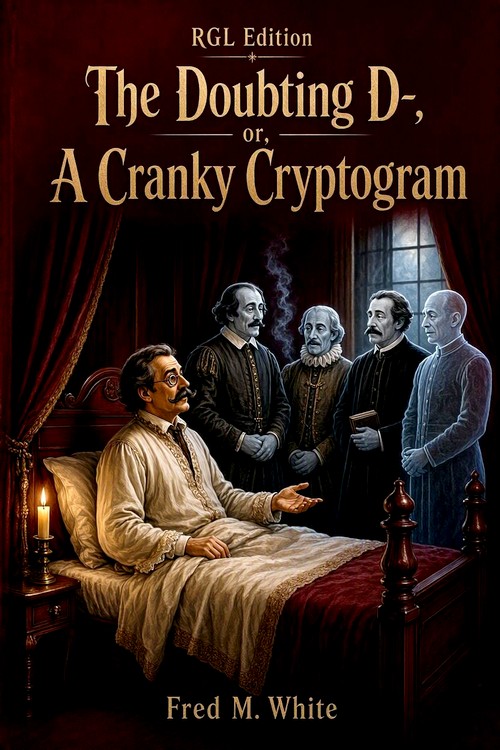
RGL e-Book Cover
Based on an image created with Microsoft Bing software
Roy Glashan's Library
Non sibi sed omnibus
Go to Home Page
RGL e-Book Cover
Based on an image created with Microsoft Bing software
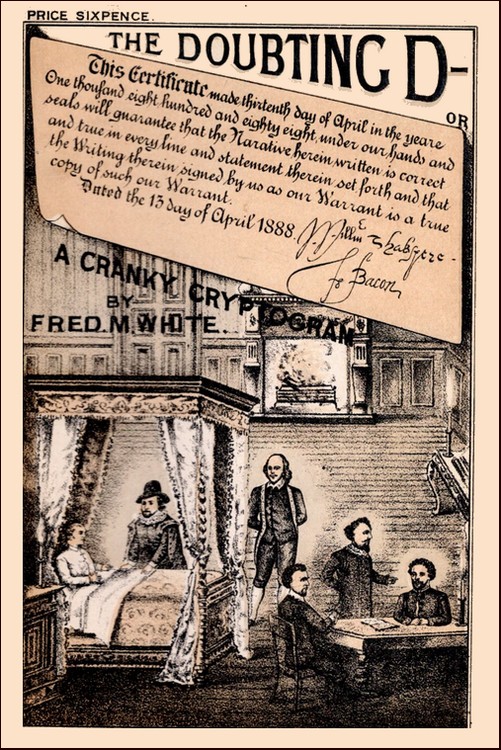
R. Sutton & Co., London, 1888.
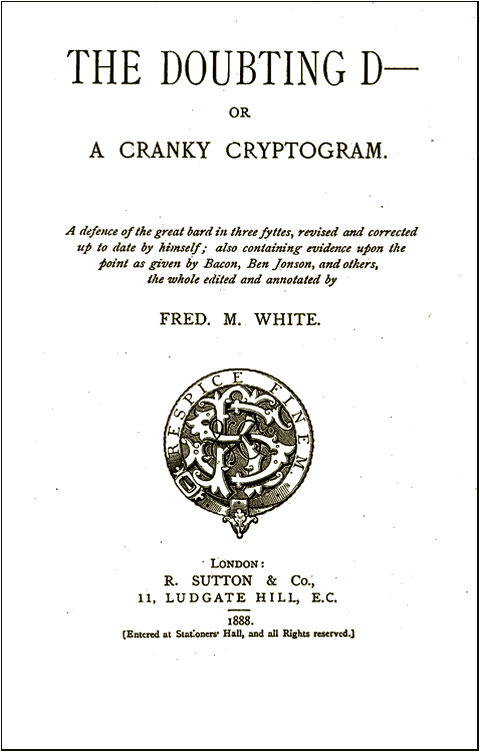
R. Sutton & Co., London, 1888.
A cranky Christmas cryptogram, a haunted country house, and a journalist with more curiosity than caution collide in "The Doubting D—," where Fred M. White turns the Shakespeare-Bacon authorship debate into a riotous supernatural romp. Summoned by a loquacious family ghost in the infamous Red Chamber, the narrator finds himself drawn into a night of increasingly absurd revelations—spectral debates, literary quarrels, and even a midnight visitation from Shakespeare himself—each apparition more determined than the last to settle the cryptogram controversy once and for all. The result is a playful, satirical tale in which ghosts gossip, poets bicker, and the truth (or something like it) emerges from the other side of the veil. —RGL.
A defence of the great bard in three fyttes, revised and corrected up to date by himself; also containing evidence upon the point as given by Bacon, Ben Jonson, and others.
WHY I have been chosen as the favoured individual who was selected as the medium between the unknown world and things established is one of those mysteries beyond comprehension. As Shakespeare said to me while discussing this precious cryptogram—but I anticipate. Let us have everything in its proper order.
It was Wednesday in Christmas week, 1887. Like everyone else I was deeply interested in the Daily Telegraph's letters and criticisms upon Mr. Donnelly's forthcoming work, not that I understood much about it—nor did anyone else for the matter of that—still I was interested as I sat over a cutlet and pint of claret in my chambers in Verulam Street, so much so that I had almost forgotten the letter by my side—nothing less than an invitation to spend Christmas with an old friend of mine in the West of England.
For years past I have enjoyed the festive season at the country residence of my valued friend Sir Godfrey Grimm, of Grimm Hall, Lumpshire. The family seat is a fine old place, and has been in their possession since the time of Griffith ap Grym, who distinguished himself by sundry acts of barbarous cruelty during the border wars in the time of Henry II. This prominent ancestor, whose portrait hangs in the hall, has always had a great attraction for me, also the counterfeit presentment of Gordon Grimm, courtier and friend of George IV. of pious memory. Of course the house is haunted, indeed upon more than one occasion I have seen actual shadowy figures without feeling any of that sensation of fright one is supposed to experience upon meeting a denizen of the nether world.
Now I am particularly fond of a psychological discussion, none the less, perhaps, that like other students of the unknown I know little or nothing about it. In accordance with precedent—it being Christmas Eve—we had been discussing ghostly matters, by way probably of soothing our minds, particularly mine, because, as circumstances fell our, it was imperative that I should sleep in the Red Chamber, an apartment devoted to quite a colony of the most robust and active of the Family Ghosts.
"You can settle the matter," remarked a flippant young barrister, possessing more good looks than brains, "by cross-examination. Fancy a ghost in the box!"
And, as a matter of fact, why not? Such was my mental comment. That in the course of the night I should encounter a spectre, a squad of spectres, not to speak disrespectfully, I saw no reason to doubt. But to get speech with one of them, to question him touching the habits and manners, the—the climate of his mysterious abode. Ah! Turning these things over in my mind, I took up a candlestick and retired to bed.
There was a brilliant fire in my room, the tapestry hangings lent to the apartment a look of extreme cosiness.
Outside, in dismal contrast, a heavy rain was beating upon the windows. I had not been in bed ten minutes before I dozed off into a placid sleep.
I appeared in my dreams to be disturbed by a confused murmur of voices coming nearer, till they seemed to wake me. With a certain sensation, which in some men would be called fear, I looked up. The fire had burnt to a glowing cavern, a faint blue halo surrounded the candles still burning on the dressing-table, before which a stately dame stood, applying something to her face and neck out of a round box, with a puff. Naturally knowing that ladies nowadays despise such artificial arts, I knew myself in the presence of an unnatural being. As I looked round, I felt every individual hair to stand on end with astonished fright.
Being a strictly truthful man, and abhorring exaggeration, I am compelled to state that there were at least fifty of them present, ladies and gentlemen dressed in every style and garb, from the coat of mail of the crusader to the full-bottomed skirt and Ramillies wig of the first George. I lay looking on in fear and trembling. They filed slowly past, coming and going, till at the expiration of an hour there was but one left. As he, too, turned away, his wandering eye caught mine, and without a word of apology he seated himself upon the foot of the bed. Another glance showed me that my visitor was Gordon Grimm, friend of that monarch so humorously designated the first gentleman in Europe. But now that I have come to my narrative the strange story must tell itself.
"MAKE yourself at home," I said, with a ghastly attempt at mirth.
The spectre rose, and taking a toothpick from the dressing table chewed it for some moments in reflective silence. By this time I had entirely recovered from my fright, and felt wakeful enough for a chat upon such psychological matters, as my spiritual visitor should feel inclined to dilate upon. It was an anxious moment.
"Don't you find it very cold?" I ventured again.
Then at last he spoke. His voice was pleasant and mellow, though there was a kind of lisp, by reason of a missing front tooth.
"Hazardous, perhaps," he said, "but a little change of climate occasionally, you understand, is undoubtedly bracing. But really—most extraordinary circumstance—you ain't frightened, you know. This won't do; it won't, indeed."
"But what on earth is there to be frightened about?"
"Stap my vitals, but you carry it with a high hand. This room, sir, is sacred to us, the departed spirits of the house of Grimm. Would you like to have your nerves tested by a spectral murder, or perhaps a woman with hands dripping in blood? We have found the latter very effective with ladies. Only say the word."
"Thanks, I will take your word for it," I hastened to reply. "But what pleasure can you see in scaring out of their wits such poor creatures as have the ill fortune of making this chamber their resting place?"
"Pleasure, sir! Indeed, it is absolutely repulsive to the feelings of a gentleman. But what would you have us do? We can't bring an action for ejectment or appear before a judge in the matter. We must defend ourselves."
"But why do you want to appear at all?"
"Now, there is a question for a sensible man!" said the spectre contemptuously. "How are lost title-deeds to be found without our assistance; who discover the missing will? Then there is the wicked nephew who usurps the family estates; the villain who murders his wife to marry her sister. I dare say you think a ghost's life is all beer and skitt—a bed of roses; it is nothing of the sort, sir. Look at Hamlet's poor old father; what a lot of trouble he had to put things straight."
"But he was a very prosy old gentleman."
"'Pon my honour," retorted the shade, "this is very extraordinary. The man positively isn't frightened at all."
"I don't see how you can expect it. Familiarity breeds contempt—at least—I don't mean exactly that. But without flattery, you are far more amiable-looking than the—ah—shade of Griffith Grimm; he with the rapier and sinister left eye."
"And yet one of the most harmless of our race, I assure you. Dr. Johnson is teaching him his alphabet with the assistance of Joseph Addison, and Griffith is an apt pupil, though he will spell sulphur with an 'f.' Sometimes I think Addison is slow as a teacher," continued the shade patronisingly. "Joseph is a good fellow, but pompous, very."
Need I say that I began to feel interested? Here was I apparently upon the verge of a great discovery. With the assistance of my loquacious friend, the secrets of another world were being revealed to me.
"The Grimms," continued the spectre, "move in the best circles, some of whom have very little pride however— even Richard I. is not beyond long division. Many of them care nothing for the exact sciences. They are always quarrelling; Byron and Milton, and Julius Caesar. There is only one of our set who can make peace between them."
"Who is that?" I asked, breathlessly.
"Hannah More. You look surprised, but it is true, I assure you."
"But how comes she in such exalted company?"
"Well, you see, she's religious, and religion pays, if one is ambitious of social position, almost as well as money. Any way, she is a great power. It was she who brought about the reconciliation between Brutus and Caesar. It was very annoying for those two gentlemen to meet without speaking, and Julius is very uppish—accounts himself a literary man on the strength of his 'De Bello Gallico,' patronises Plutarch, and as for Gibbon, won't speak to him. But when he began to sneer at Wellington and Bonaparte, it got time something was done. Then the mediatress called in Shakespeare. The bard put the matter in a nutshell. 'Call yourself a celebrity,' said he. Julius admitted the soft impeachment. 'Pooh, if Brutus hadn't slit your weasand, and Casca poked a hole in you with his sniker-snee you'd have died of apoplexy, or suppressed gout, and my great historical play would never have been written; I made you, Julius, and you know it!' Marc Antony, standing by at the time, couldn't deny it, and the quarrel was made up. 'Billy was quite right,' he said, 'and I'm glad he took the conceit out of Julius.'"
I pinched myself to make certain that I was awake. The idea of a Roman orator and senator speaking in this familiar, not to say flippant, manner of another celebrity struck me as being singular.
"We must allow a certain amount of latitude, you see," continued my visitor, as if he had divined my thoughts "when so many extremes meet. We have a little unpleasantness at times; for instance, when Byron joined us, and some of the victims of his 'English Bards and Scotch Reviewers' dropped in one by one. Shakespeare's advent was tremendous, I am told."
"But people are saying—"
"Oh! don't imagine we never see the Daily Telegraph. That American fellow is going to prove something stupendous, I hear."
"But did Shakespeare really write those plays?" I asked.
"Can any sane man doubt it? You have not the pleasure of an intimate personal acquaintance with Verulam —I have. Now, can you believe for a moment that Francis, with his state cares, and ponderous unimaginative mind could have conceived Puck and Peasblossom, Flute and Starveling, or even Touchstone and Bottom? No, sir! And to go further, Bacon himself is greatly annoyed that these frivolous writings should be ascribed to him."
"And what does Shakespeare say about it?"
"Regards it as jealousy, of course; though most of us look upon it as a clever money-making speculation, got up between a champion puzzle-maker and a firm of enterprising publishers. I shouldn't like to stand in Donnelly's shoes when he comes down to us. As Artemus Ward says, there will be sad-eyed strife in the sweet by-and-by."
A wild hope sprung up in my breast, so wild and audacious that I did not care to mention it. The idea was to prevail upon my amiable shadow to induce the divine bard to appear for my delectation.
"Would it be possible?" I asked, when the subject had been broached, with fear and trembling. The shadowy Grimm picked his teeth, and regarded me with a cynical but admiring smile for some moments.
"Your stupendous audacity rouses my warmest admiration. In your own vernacular, I like your cheek! Fancy you, an everyday mortal, with an eye-glass and waxed moustache calmly requesting the greatest poet of a decade of centuries to wait upon you! No one but a barrister or a newspaper man would dream of such a thing; but perhaps"—and here the shade frowned darkly—"you are a newspaper fellow."
Not being enlightened as to how much a spiritual being usually knows; I thought it best to admit my nefarious calling, pointing out at the same time the great advantage it would be if the divine bard's admirers could have something tangible to go upon. My argument seemed to strike the spectre favourably.
"Not a bad idea, upon my word," he exclaimed.
"When I go down to-night I will mention it. I shall have to use a little diplomacy of course, and, as a matter of fact, so will you. Now, though I can't promise, I will do my best. Go into the library downstairs and get a copy of William's works, place them in some conspicuous place here, because, you see, even Shakespeare is not beyond the reach of flattery."
"Do you think he will come, then?" I asked eagerly.
"Frankly speaking, I don't. Still, as you know, an invitation to spend the evening at Grimm Hall might fetch him. When we come on earth for business or pleasure social distinctions are strictly adhered to. If I could induce him to accompany me I could get Byron to come, Jonson would accept, and Bacon would turn up as a matter of course, particularly if he anticipated some personal benefit, still—"
Here to my disappointment Courtier Grimm went off into a profound brown study. Already the morning was beginning to dawn, and looking at my watch I saw it was nearly five o'clock. According to tradition at the first cock-crow my visitor would vanish. He sat playing pensively with his toothpick, with the air of a man who is evolving some deep scheme from his inner consciousness.
"I don't see why it shouldn't be done," he exclaimed suddenly. "After all, that American fellow seems to be making a great many converts, and it is hard for a man to be deprived of his own without being able to defend himself. I shouldn't like it myself; besides there is no knowing where the thing is to end. Of course, if I can bring this about you will make a book of it."
"Well, naturally," I replied. "It would be a splendid thing for me and 'go' like wildfire. Look at the thousands cf copies."
"Um! providing you have the ear of the critics. But I forgot, you are a newspaper man and understand how such things are arranged. Still, it would be a mutual benefit."
At this moment the deep silence was broken by a shrill cry of chanticleer in the stable-yard. My friend gave a start, and turned, if possible, a shade paler.
"I had no idea it was so late," he exclaimed. "Goodbye, and remember to-night at half-past twelve."
As he faded away his voice died to nothing, and I was alone. The little rest I obtained was broken by feverish dreams, and throughout the day, my pale face and abstracted air were made the object of many more or less piquant jests. But I cared little for this. I had procured all I wanted, and laid a copy of Shakespeare's works upon a conspicuous spot on the dressing-table. It seemed as if the day would never pass; slowly night closed in, dark and stormy. Eleven o'clock came, and one by one the guests dropped off to bed. Devoutly I blessed the fact that Christmas Day fell upon a Sunday. At length I was free to retire.
The house was perfectly quiet, the fire burnt brightly, twelve clear strokes fell from the clock in the stable-yard, still my guest came not. As the wind rose higher I seemed to hear voices in the gale, coming nearer and nearer; indeed, it appeared to my fancy that I could distinguish words. I listened, they assumed to piece themselves together, running in my head like the remembrance of some forgotten rhyme. Suddenly the room lighted up with a brilliant unearthly glare, and I knew it was no longer fancy,as there fell upon my ears the words—
'Tis well for those
Who, being naked of a gift divine,
Strive with a burglary diabolical
To steal the children of a busy train,
And make a bastard fame.
As I looked up I saw my ghostly friend, a smile of triumph upon his lips, and behind him a tall pale shade with high forehead and deep reflective eyes. Then, with a strange emotion, I knew that I stood in the presence of Shakespeare.
THERE was absolutely no mistake about it—the broad forehead, the pointed beard and small moustache, everything complete to the peculiar Elizabethan ruff around his neck. With unconscious homage and respect I bowed low, and murmured a few incoherent words expressive of the honour I felt at this unexpected and undeserved visit. I had previously rehearsed a neat little speech, in which compliment and courtesy were judiciously mingled; but in the excitement of the moment it altogether escaped my memory.
The illustrious shade acknowledged my humble obeisance, and again broke out in sonorous blank verse—
To be, or not to be (though I have uttered
These famous words at other time and place;—
Whether 'tis nobler in the mind to suffer
The ink-slung arrows of outrageous pedants,
Or taking arms against this cryptogram,
And by opposing end it.—
To sleep,—to sulk,—
No more;—and by a proof to say we end,
The humbug, and the thousand cackling fools
Genius is plagued with,—'tis a consummation
Devoutly to be wished. To die,—to sleep,—
To sleep! Perchance to dream of nightmare;
"Why, there's the rub (I do forget the rest),
But much of this same foolishness is not
Sicklied o'er with the pale cast of thought,
But rather bred of ignorance and the mire;
An intellectual hogwash sourly mixed,
But nourishing for Bacon.
Here the speaker made a long pause, and prepared to resume again, much to the annoyance of my old spectre friend, Grimm.
"Don't be flowery, William," he said; "remember you are not on the stage, and besides, modern dramatic votaries have no sympathy with the barn-storming school. You are a fair poet, but can't act worth a cent."
"Very well then, I won't," returned the divine bard coldly. "Only it is hard that a man cannot quote his own poetry, when—pardon the egotism—he can find nothing better."
"As for that," said Courtier Grimm, picking up the toothpick from exactly the same place he had placed it last night, "you might at any rate have the decency to quote yourself correctly. This gentleman here will tell you that Hamlet's soliloquy has a world-wide notoriety. I wager he could repeat it."
Pleased with the opportunity of showing off my knowledge, I did so. I had scarcely reeled off half-a-dozen lines, when the bard pulled me up short with a contemptuous exclamation, and a wave of the hand.
"Where did you get all that farrago of nonsense?" he asked. "This comes of your infernal commentators, your Whites, and Knights, and Gibbers— 'a weak invention of the enemy,' to quote one who purloins his ideas from me. Surely I should know my own work best! Hamlet's soliloquy as given by me is the correct and only version."
"What! with the allusions to cryptograms and humbugs and—and Bacon? Why, then in that case you must have foreseen—"
"Foreseen?" echoed the bard with a sneer, "why cert'nly (another quotation stolen from me, by the way). The man who could prophesy steam and electricity, and many of your so-called scientific discoveries, might well be allowed to foresee the advent of a jealous Yankee with an impossible system, founded upon some printed folio I never saw! Ah! I see you have a copy of my work here.* Will you kindly hand it me for a moment?"
* Professor Mudwumpen (Oct. 1640), from the text of Jonson.
Von Pump and Soramboli, Berlin.
I did so, and he fluttered over the leaves rapidly until he came at length to the play "Much Ado about Nothing," a smile of grim satisfaction playing upon his face meanwhile.
"Now, take the names of the characters therein—no jugglery there. The first two of the dramatis personae have names beginning with Don. So you will observe begins the name of that Yankee fellow. This is what mortals would call a coincidence. Nothing of the sort! That was a deliberate design; the same as the name of the play, signifying a deal of fuss about nothing. We will take the word 'don' as a key, multiply the letters by three, and again by six, the number of the letters in the two 'dons,' and you have fifty-four. Count down fifty-four lines, and you arrive at the words 'the Don (that is Donnelly) hath an excellent stomach;' again fifty-four lines, 'for the cozening of fools who ask not the why and wherefore.' Now look at the anagram that makes,
'Here lies Donelly,
Let him lie.'"
"It seems rather vague," I murmured, with a glance at the poet. "I much confess that I do not see much in it."
"Come, sir, it can't be more vague than the American's, as you will admit. Mugwumpen, as everybody knows, was one of the closest and most correct of my renderers. Fifty-four, therefore, is the key to go further. Then take every fifty-fourth line, and you will find a medley reading thus—
Give not this rotten orange to your friend—
If half thy outward graces had been placed,
There would have been no lack of ridicule.
O! one too much by thee—an empty plan—
Under the guise of plenteous pedantry,
To make a nation laugh.
Now, if you will read the first letter of each line downwards, you will find the words 'Git out'—the very Yankee vernacular, you understand—'Git out,' a term expressive of disbelief and doubt. Do you call that coincidence?"
I was certainly much struck by the seeming ingenuity of this plan, and, indeed, upon a subsequent test have proved its correctness. As every student of Shakespeare knows, the text of Mugwumpen has been regarded by the schoolmen with suspicion, but in the face of this manifestation one can no longer doubt its correctness.
We were all silent for a few moments, Courtier Grimm contemplating the fire placidly, as if the conversation had no interest for him. But the poet was too full of his grievances to remain long quiet.
"My hints and prognostications are not limited to one play," he resumed. "For instance, turn to the death of Julius Caesar, and find Marc Antony's oration. You know how it reads in the ordinary way. That is all wrong. Originally it was written thus—
I come to bury Caesar, not to praise him.
So the American comes to bury Shakespeare, not to praise him. We resume—
The poetry men write lives after them,
The sense is often interred with their bones,
So let it be with Shakespeare. Noble Donnelly
Hath told you Shakespeare was a spurious,
If it were so, it was a grievous fault,
And grievously shall Shakespeare answer it.
Here, under leave of Don'ly and the rest
(For Don'ly is an hazardous young man).
Come I to speak in Shakespeare's funeral.
He was our friend, his fame was dear to us,
But Don'ly says he is a spurious,
And Don'ly is a somewhat rash young man,
and so on. Read between the lines the thing is as plain as the nose on your face. Now take up that folio again, still bearing in mind the magic 54. You will find that the fifty-fourth line of every play bears some allusion to this precious cryptogram, the first one in the 'Tempest' commencing with a 'D,' the whole word being suggestive—
Donkey who crunches thorns and deems them flowers.
You see the prefix 'Don' comes in again. And, curiously enough, there are only four words in our language commencing with don—donation, i.e., the funds the public is expected to contribute to the author of the great cryptogram; donative, with a like meaning; and last, but not least, the simple but expressive word 'done.' A few more of these fifty-fourth lines in order as the plays run —
This battle shall not henceforth trouble me.
No, it is false, 'tis nothing but a pick-purse.
Now puts the drowsy and neglected act
Freshly on me. 'Tis surely for a name.
But you may find a score of such. Try another method. What do you think of this sentence made out of the titles of my plays :—
It may raise a 'Tempest' of doubt or indignation, but the bold man will get 'Measure for Measure' out of his ridiculous 'Comedy of Errors' and find, when too late, it is 'Much Ado About Nothing,' and his work 'Love's Labour Lost,' a mere 'Midsummer Night's Dream,' written for pay only by a literary 'Merchant of Venice,' who twists his text to fit his ideas, and gives it you 'As You Like It.' But there shall be a 'Taming of the Shrew(d)' ere long, and 'All's Well That Ends Well.' On 'Twelfth Night' they shall tell this 'Winter's Tale' when my maligners are forgotten, and everyone of them is dead as 'Julius Caesar.'
Only another coincidence, you will say."
The Master spoke with the quiet earnestness of conviction. Up to this time I had quite forgotten the fact that I had been promised some other distinguished visitors. The ghostly Grimm seemed to divine my thoughts, and turned from the fire, where he had been toasting his shins reflectively.
"You put the matter very neatly, William," said he; "but what you want now is corroborative evidence. I had forgotten to apologise for the absence of the others—Bacon, John Heywood, Henry Wotton, Drayton, Jonson, Beaumont and Fletcher, et hoc genus omne. But the fact is that, with the exception of William here, they were all engaged. Between ourselves, Thomas à Beckett is giving a reception, and most of the men are there."
"I trust that I may still have the pleasure," I ventured. "Really, the whole thing is so interesting that I am loth to drop it now,"
"There will be no question of that," Shakespeare replied. "I intend to give you all the assistance in my power, and have still a lot in hand. But any evening you are disengaged—"
"To-morrow, pray fix your own time."
"Let it be to-morrow then. Bacon will come this time, especially as he is anxious to know something of your Mr. Goschen's proposed conversion of the government stocks. If I may be permitted to make a suggestion, I would get up the subject in the meantime."
"Certainly I will, and thank you for the hint—touching to-morrow?"
"I will give you further proofs. I want you to understand that Bacon looks upon my plays as so much idle frivolity, and consequently his criticisms are somewhat severe at times. Still—"
At this point a precocious bantam took it in his head to proclaim the dawn still some hours off. The illustrious speaker looked at his companion with a start, there was a kind of flutter in the room, and a moment later I was alone.
IT was considerably past twelve the following night before I could get to my room without attracting attention. I fully expected to find my illustrious visitors had disappeared. You can understand my satisfaction when I found them all seated round the fire in animated discussion, the whole of them I say. There was the massive face and form of Elizabeth's Chancellor, seated gravely in the centre, while to the extreme left sat Ben Jonson, a short clay pipe in his mouth, looking the picture of contentment. Beaumont and Fletcher side by side were arguing over some disputed passage in "The Purple Island." The lesser lights I entirely failed to recognise.
"Well, this is nice conduct," cried Grimm, the first to notice my presence. "Here are two immortals at least, awaiting the arrival of an obscure journalist. It is simply unpardonable."
"Place aux dames" Allison murmured. "Beshrew me, but there were some pretty faces and bright eyes in the hall as I passed through unseen. A bouquet of beautiful flowers in whose presence a man might be pardoned for forgetting even our visit."
"And who might the two immortals be?" Jonson asked jealously. "Perhaps you don't count me the rare one as I am termed; perhaps, after William here, the first poet of the day."
"The egotism that dictates so fine an appreciation of self is dominated in a great degree by a shallow mind," said Bacon, speaking in a low deep voice. "Still we are not here to appraise each other's merits, rather to preserve the reputation of one of ourselves against an unprovoked attack."
"The authorship of our greatest poems," I ventured.
"Precisely; not that these frivolous productions are worthy of the toil, but once this kind of thing begins there is no knowing where it may end. For instance, supposing my Essays and 'Advancement of Learning,' should be put down to Ben Jonson."
"The gods forfend," Jonson interrupted fervently. "Fancy being guilty of giving birth to that cataract of words! No, Frank, my boy; they are all very clever, and so on, but quite out of my line, the same as anything light and fanciful is out of yours. Conceive Francis writing a 'Midsummer Night's Dream'!" There was a roar of laughter in which Verulam grimly joined.
"It is not so much that," he continued, "as the mistakes William constantly makes. Now, can any sane man imagine me, a lawyer, with all my reverence for justice in every form, writing the 'Merchant of Venice'? I more particularly allude to the trial scene. Turn to act four, scene one. A little way down you find the direction : 'Enter Nerissa, dressed like a lawyer's clerk.' The Judge—a Duke by the way—addresses this obscure clerk in the most friendly and affable manner. 'Come you from Padua?' he asks. Shylock appears in person to conduct his own case, and converses more or less noisily with the Court and certain interested spectators. Then again, 'Enter Portia, dressed like a doctor of laws,' a barrister, so to speak, not in the law list. The Judge is still amiable, so much so that he shakes hands, and thereupon goes on to ask her if she knows her way about—that is, if she knows what she has come for. The trial begins. Does the plaintiff open his case in the usual way? Oh, no. The spurious barrister goes off into a long rambling speech about mercy not being strained, as if it were jelly, and such like platitudes. Shylock produces his bond, and, after a lot of really inadmissible evidence, Antonio interrupts the Court in a most disgraceful manner. Is he committed for contempt, or put out? Nothing of the kind. On the contrary he is allowed to go rambling on again in quite a maudlin fashion; then Bassanio chimes in, and another pleasant conversation ensues. The Judge is asked for his verdict, which Portia gives, at which Gratiano fires off a lot of sarcastic remarks at the plaintiff. Really, gentlemen, my feelings overcome me, and I can go no further. Think of the sentence, and the deed of gift drawn up on the spot! I could not have so violated my principles; it would have been impossible for me to write this play."
A murmur of applause went up from the immortals who had been listening intently to this masterly exposure of the flimsiness of the poet's law. He flushed a little himself, and murmured something about poetical licence.
"Still there are other plays besides this," said Jonson, knocking the ashes out of his pipe meditatively. "For instance, a 'Midsummer Night's Dream,'" and with this the poet gave me a sly glance. Bacon groaned and shook his head, as if the accusation was unmerited, and cast a slur upon his spotless reputation.
"Worse and worse," growled Verulam. "Conceive, if you please, me writing verses in the manner of that fellow Gilbert Pyramus, dancing a breakdown and singing after this style—
But stay, O spite!
But mark, poor knight,
What dreadful dole is here?
Eyes, do you see, How can it be?
O dainty duck! O dear!
reminds one of those absurd couplets, commencing—
Oh! foolish fay, Oh! Captain Shaw.
from 'Iolanthe.' Now, gentlemen, I ask you once for all, Can you for one moment imagine Queen Elizabeth's Chancellor writing 'Iolanthe' or a 'Midsummer Night's Dream' for the matter of that? Fancy me designing the vagaries of Puck and Peasblossom, Mustard-seed, Bottom, the weaver, and Starveling. Then might I say in the language of William here,
'Methought I was enamoured of an ass,'"
"That's all very well," Heywood observed; "but you seemed to altogether ignore the existence of The Bacon Society, that gathering of enthusiasts who are anxious to crown you with Shakespeare's laurels."
"And a pretty fine exhibition they are making of themselves. Besides, I don't want to be regarded as a poet. A philosopher if you like, a political economist, a man of learning, but a poet—never."
Shakespeare, who had borne all this tirade with exemplary patience, now began to show certain signs of irritation; and, indeed, I could make every allowance for this, as after all his fame and the value of his works take so much higher a place in public estimation than Bacon's.
"It is one thing to despise my work," he exclaimed, "but Englishmen of taste take quite another view of it. With all your erudition, with your precious society thrown in into the bargain, the 'Advancement of Learning' will never hold so high a place as 'Hamlet.'"
"You are certainly entitled to some credit for that work," Bacon grudgingly admitted; "there your philosophy is sound. As far as 'Hamlet' is concerned, I can quite understand why scholars attribute that to me "
At this point Jonson burst out into a loud derisive laugh.
"Well, of all the boundless egotism!" he cried. "Listen to Bacon, gentlemen, he is actually good enough to admit that Shakespeare's work is equal to his. If it was a matter of collecting public taxes or raising national funds with an ingenious way of benefiting oneself, perhaps—"
"Then you can see something to admire in 'Hamlet'?" I asked, anxious to change the somewhat personal direction of the conversation. Bacon shot a threatening glance at his tormentor, and resumed,
"Certainly, so far as the philosophy is concerned; but again, is it possible to imagine me creating such a character as Ophelia. I never professed to know anything about women; Shakespeare has the advantage of me there. Miranda, Julia, Luciana, Juliet, Viola, Beatrice, and a score of others from Cleopatra to Mrs. Quickly, all of them sketched in a manner I should have found it impossible to achieve."
"But there is another thing," I remarked. "One of your admirers says, alluding to the provincialisms used by our illustrious friend, that your erudition was so great that you were personally acquainted with every dialect known to the three kingdoms."
"And how should he know that?" Bacon retorted with a look of contempt. "Is it likely that a man with my work on his shoulders, to say nothing of literary pursuits, could find time to travel all over England to learn the different ways of pronouncing words and conning phrases. I dare say you are thinking of Justice Shallow and that point about the lucis. Well, what proof have you that I was ever in Warwickshire at all?"
"Anyone would think that you were ashamed of being accused of having written these plays," Beaumont observed. "Is that so?"
"Is that so?" Fletcher echoed, a way they had of speaking together.
"Well, not exactly ashamed. But how those pedants, who profess to have made a study of my life and works, could have so misinterpreted my character, is the thing that annoys me. Besides, I don't mind admitting that if I had written the plays, I should have claimed them as my own. But there, I couldn't have written them!"
"Hear, hear," Allison muttered softly. "Hear, hear."
"For more reasons than one. In the first place, none of my contemporaries would have accused me of being an imaginative man—strictly moral and practical if you like. I have before alluded to some of Shakespeare's blunders, mistakes which, as a sound scholar, I could not possibly have been guilty of. They are to be found in many dramas; slight errors I grant, but I should not have made them."
"It seems hard," Jonson observed after a long pause, "that a man's fame should be assailed in this fashion by a lot of people who can't possibly know anything about it. This precious cryptogram, for instance, might be made to prove anything—it is incomprehensible enough; and once this sort of thing begins where is it going to end? In this case none of us are safe, and every future genius will have to insert some cypher into his works which will stamp them as his own. No one knows better than myself that Shakespeare alone was author of these peerless plays."
"But what need I thus
My well-known body to anatomise?"
Shakespeare remarked, quoting himself. "Which lines you understand come from the induction to the second part of 'Henry IV.' Let me give you another proof of my penetration in this matter; most of you—not to be modest—know my connection with Justice Shallow, and with your permission I will draw a parallel between him and the American: this shallow Yankee who leans upon a Fals(e)staff. Dost see the pun? Is this coincidence?"
"You have forgotten one point," Jonson interrupted; "that is, if you intended to compare Falstaff with Donnelly's great English ally "
"That was certainly my intention. But why—"
"See what this Shallow says, act v., scene i! 'I will use him well: a friend at court is better than a penny in purse. Use his men well, Davy, for they are arrant knaves and will backbite.'"
"That," said Fletcher reprovingly, "is somewhat severe,"
"Not a bit too much so," Shakespeare continued, "and the next line is none the less deserved."
"And what may that be?" asked Jonson.
"'No worse than they are backbitten, sir, for they have marvellously foul linen.'"
There was another laugh at this, though I deemed the jest a none too cleanly one, forgetting for a moment that the age my distinguished guests represented was not so refined as our own. Of course every book published nowadays is a model of purity, thanks to the improvement in our national morals.
"There are other quotations against this Shallow taken from Falstaff's lips. They may be coincidences, gentlemen, but there are enough of them, says he,
I will devise enough matter out of this Shallow to keep Prince Henry in continual laughter the wearing out of six fashions.
Do you see the point?"
"I must confess I don't," Beaumont replied, "unless Henry—"
"Is the prince of Shakespearian actors, known to fame as Henry Irving, the one man who has done so much to bring me home to the hearts of the people."
By the applause following this sentiment I was enabled to observe the popularity enjoyed by our greatest actor in more worlds but one. But with the immortals as with us, there is a certain leaven of selfishness.
"They tell me, sir," Beaumont observed diffidently, "that your greatest actor is meditating a revival of old comedy. Of course I do not allude to Sheridan and Goldsmith who —ahem—have had all their share, but to such plays for instance as 'Love's Cure,' which I can recommend—"
"Come, no touting for advertisements," Jonson interrupted roughly. "You are not the only man in the company who has a drama he wants to gain a little credit for. 'Love's Cure,' indeed! Very well for a lot of amateurs, but when there is such a comedy existing as 'Every Man in his Humour'—"
"Or perhaps 'A New Way to Pay Old Debts,'" put in Massinger.
"Let us have no quarrelling, I beseech you," Shakespeare observed. Even with the best intentions Mr. Irving cannot play them all, and besides there is such a thing as humour being out of date."
"Humour never can be out of date," Jonson answered savagely. "When a man like Heywood gets a chance, and Massinger has a hearing, it seems to be rather hard upon 'rare Ben.'"
"If we once begin this sort of thing there will be no end to it," Bacon interrupted. "Really, you dramatists are as jealous of one another as a pair of school-girls over a recalcitrant lover. We didn't come up here to dispute our claims, but to testify to the fact that I am entitled to no credit for Shakespeare's works."
"I should say that has been pretty well demonstrated," said Massinger. "And though I have no wish to disturb this pleasant company, I must remind them that it is getting late. If you have anything more to say—"
"Of course this thing must stop," Courtier Grimm interrupted hurriedly, and turning to me, "We do not wish to make ourselves too cheap, and after to night there will be no further manifestations. If Shakespeare has any more to say it were better done quickly."
"Only this," remarked the bard, laying a paper up on the table. "It is merely a short memorandum drawn up by Macaulay, and signed by all of us here. As you will perceive, it is a brief statement of certain facts."
As the poet spoke these words I gradually noticed a sleepy feeling creeping over me. Presently the room seemed to increase in size till it appeared to fill the whole universe. There was a drowsy hum of voices in my ears—a falling sensation followed by deep unconsciousness. When I awoke it was broad daylight. The recollections of the previous night appeared like a dream; indeed, I might have thought it so but for the memorandum lying upon my dressing-table. It was written upon a rough yellow paper of some peculiar material, which I have since ascertained to be asbestos, and ran as follows :—
Francis Bacon, erstwhile Baron Verulam and Viscount St. Albans, and William Shakespeare, late of Stratford-on-Avon, Warwickshire, declare jointly to the effect following, that is to say,
1. That the great Cryptogram is a tissue of absurdities founded upon no logical basis, and having no foundation in fact, and further that it is entirely false throughout.
2. That during the whole period over which the plays were written no sort of communication existed between us, and that no suggestion of collaboration or joint authorship was suggested.
3. That at no time or place was any play written conjointly or whilst the parties hereto were in communication one with another.
4. That the said Francis Bacon, speaking upon his sole behalf, absolutely disclaims any share in the authorship, either by inspiration, suggestion, or in any other form, and further that he had neither the time nor inclination for so colossal and stupendous a work.
5. That the said William Shakespeare, on his own behalf, hereby declares his work to be strictly and solely his own.
Given under our hands this 26th day of December, 1887.
Bacon.
Wm. Shakespeare.
To which we the undersigned have subscribed our names as witnesses, under the belief that the foregoing is a true document.
     Richard Allison.        Jno. Donne.
     Geo. Peele.                   Ben Jonson.
     Jno. Heywood.            Philip Massinger.
     Hy. Wotton.                John Fletcher.
     Jno. Harrington.      Francis Beaumont.
     M. Drayton.                Thos. Carew.
A WEEK later, when this narrative was revised and corrected, I placed it one night by the side of my bed. In the morning it was missing. All search was in vain. I had given it up for lost, when (after a violent storm one night) it mysteriously reappeared, smelling strongly of sulphur and considerably blackened; attached to it was the quaint certificate printed upon the cover of this book.
There is nothing more to be said. If Mr. Donnelly persists in publishing his book after this, the consequences be upon his own head. The writer of the foregoing extraordinary narrative will be perfectly willing to display this priceless document to any member of the New Shakespearian Society upon his return to England, he being on a visit to the interior of Africa, where he is at present in search of his friend Mr. Allan Quatermain. Anyone who has the privilege of seeing the document will at once be convinced of its genuineness. So does truth and the right triumph over darkness and ignorance.
Roy Glashan's Library
Non sibi sed omnibus
Go to Home Page