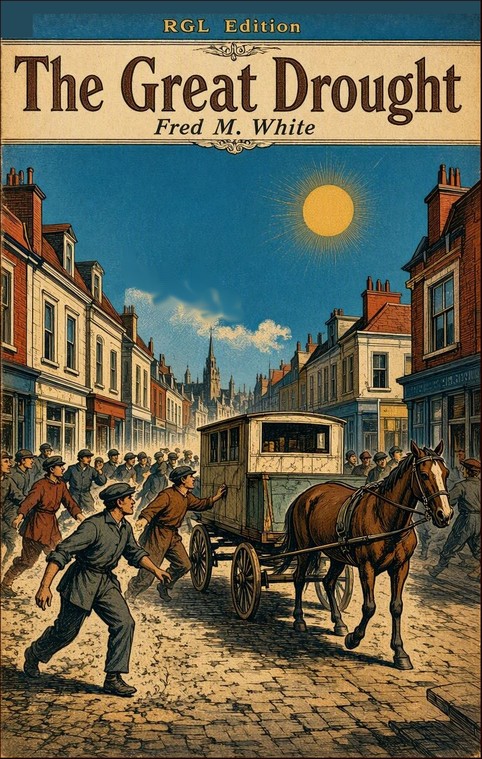
RGL e-Book Cover
Based on an image created with Microsoft Bing software
Roy Glashan's Library
Non sibi sed omnibus
Go to Home Page
This work is out of copyright in countries with a copyright
period of 70 years or less, after the year of the author's death.
If it is under copyright in your country of residence,
do not download or redistribute this file.
Original content added by RGL (e.g., introductions, notes,
RGL covers) is proprietary and protected by copyright.
RGL e-Book Cover
Based on an image created with Microsoft Bing software

London swelters under a merciless sky as Fred M. White's "The Great Drought" plunges the reader into a city on the brink, where sixty rainless days have turned milk into treasure and desperation into riot. Amid rising prices and a transport strike that threatens to choke off the last supplies, young Cynthia Garland—estranged daughter of a millionaire—finds herself swept from quiet compassion into fierce, unforgettable action. In this prophetic tale of heat, hunger, and human resolve, White asks how far people will go when survival hangs by a thread...
LONDON lay panting and breathless under a sky of brass. For sixty days now the greatest city of the world had fused in the furnace without a drop of rain; travellers in the country looked in vain for a speck of green; from all sides came the same tale. How much longer was it going on? Would the sensational records of 1911 be beaten?
The morning papers told of temperatures almost tropical in their intensity, they hinted at famine both at home and abroad. Everything was steadily mounting in price, eggs were threepence apiece, a green cabbage was worth its weight in coppers, fruit was not to be obtained. Milk had long since fetched a shilling a quart. Early in the season as it was, the watering-places were packed to suffocation, the hotels and boarding-houses were doing a roaring trade.
And milk was fetching a shilling a quart!
This was the first great leap in prices. Still, apparently the poorer quarters had the condensed milk, which was practically the staple infant food down East. But the reserve supply was getting perilously low, and more than one of the papers had hinted at a stoppage altogether within the course of the next few days. The East-end had smiled at this gloomy forecast, but the end of the week proved its correctness. There were placards outside the grocers' shops—
The West had taken toll. There was money in the West and money is the magnet everywhere. The West called aloud for the food of the infant poor and the food was there. The East growled ominously—
Still, there were five millions of fretted, perspiring, weary souls in London. There were aching hearts in the East-end despite the fact that the public houses were drawing a roaring trade and the picture palaces were packed twice a night. Nobody seemed to appreciate how near were the clouds of calamity. If the rain held off. . . .
Oh, but there were some. Harold Rashforth's mind was full of it as he crept out of a third-class carriage on to the platform at Victoria. He fairly staggered with the heat, the warm waves beat him down, he gazed bitterly at the chattering, giddy throng hurrying along the platform in pursuit of the phantom of pleasure.
"It will be their turn next," he murmured aloud. "Not that one grudges them their occasional pleasure. Do they ever ask themselves what is to become of the children if this goes on?"
"They think of nothing so long as their pockets are full of money, curse 'em."
The words came in a shrill whisper in Rashforth's ear. He turned to the woman who spoke. She was of the working class; hard-featured, hard-headed, she had the tight lips and the hollow cheeks of one who knows what it is to want. Half unconsciously she rocked a bundle that she carried in her arms. Then she drew back her shawl with a mingled pride and sorrow, gravity and anger, and disclosed the pallid, pink features of a little child, more like a wax doll than a living thing.
"A fine child," Rashforth murmured uncomfortably.
"Ay, she was," the woman said bitterly. She dashed away a tear roughly. "Three months ago. And now she's a shadow. Why? Because she's been ill. Because the doctor ordered her milk. Said she would be as strong as the rest of them if she could get it. Might just as well have ordered her molten gold. A shilling a quart! Gawd 'elp me, that's what I get a day—
It was not a request, it was a demand. Rashforth fished up the little silver coin from his pocket. It would have made no difference if he'd told the woman it was his last—
With a nod half hostile, half friendly, the woman plodded wearily on, leaving Rashforth to his own melancholy reflections. He passed the bookstalls with the flaming placards of the early evening papers. A startling line or two caught his eye:
THREATENED GREAT TRANSPORT STRIKE.
UNIVERSAL DOCK LOCK-OUT NEXT WEEK.
"My God," Rashforth muttered. "It only needed this—
He glanced round unconsciously for signs of excitement near by. But there were none to be seen. Nobody minded, nobody cared. Strikes were a great nuisance, of course, but everybody was used to them by this time.
He made his way slowly and wearily along the streets till the big thoroughfares gave way to meaner ones. He was somewhere in the neighbourhood of Battersea at length, in a long narrow street lined on both sides with tenement houses all grim and grey and silent. There was no noise and bustle in the streets, it was too hot even for the children to be out playing. Rashforth was thinking of the little four-year-old child—
"Cynthia!" he exclaimed as he entered the room, "I half expected to see you here."
The woman smiled. She was young enough in years, her dark, beautiful features were smooth and creamy, her eyes clear, yet they were thoughtful beyond the measure of her youth. Despite the plainness of her dress, she seemed strangely out of place in the little faded room. Her dark head was made to be crowned with diamonds.
"I knew you would not get back till the afternoon," she said. "And I could not bear the thought of little Agnes being left alone."
"That was so like you," Rashforth said gratefully. "Agnes is better?"
"I'm afraid not," Cynthia said. "I asked the doctor to come in. There is nothing serious the matter. The heat and the want of rain, you understand. Keep her on a steady milk diet and—
The girl paused in some confusion.
"Go on," Rashforth said. "You procured the milk yourself. Where did you get it from?"
"I—
Rashforth thought of the woman in Victoria Station and sighed.
"It's coming," he said. "I've seen it coming for weeks. To-morrow or the next day London will realise the hideousness of it all. And on the top of everything comes the great transport strike. Oh, it is no rumour. I have the evening paper in my pocket. A date is definitely fixed. Till it is over nothing in the way of food stuffs can reach the provinces. The live stock will starve. Milk as a staple food will cease this week. A bottle of it will fetch its weight in gold. Cynthia, for some things I wish you were back home again."
The girl's dark face flushed hotly.
"I couldn't," she whispered. "I am so different to Letty. So long as she can get all she wants for herself and her boy it matters nothing where my father's money comes from."
"Your father is a millionaire, and that covers a multitude of sins," Rashforth said.
"Not in my eyes, Harold. Every penny of that money has been sweated out of the employees of Garland & Company. It makes me hot and ashamed even to think of it. Hundreds of little tradesmen have been ruined to make my father's money. I am far happier now on the pound or two a week I earn by my pen."
The touch of carmine stained Cynthia's clear cheeks again.
"I am happier than I have ever been," she murmured. "And you are the man I admire most in the world."
She laid her hand frankly on Rashforth's arm, he took up the slender fingers and kissed them. It was very good to feel that Cynthia, that dark, glorious creature, cared . . . Her eyes were shining dimly, the pink in her cheeks deepened to a dusky red.
"There is nobody but you," he whispered. "And there never will be, Cynthia!"
"Oh, don't . . . not yet," the girl implored. "You know, of course, you must have known for a long time. But there is so much to do first. And we are so dreadfully poor. Harold, you would not like to marry . . . and have children . . . here!"
He leant over a little bed in the corner of the room where a little girl was sleeping uneasily. A mass of yellow curls hung over a tiny crimson face; the skin burned to Rashforth's touch. She opened a pair of blue eyes and murmured something that sounded like "water." Then the weary eyes closed again, and the uneasy slumber went on.
"It's the same story," Rashforth muttered. "Heat and want of air and the atmosphere full of germs. Do you suppose she is any worse, Cynthia?"
"I am afraid she is only one of thousands," Cynthia replied. "But she must have her milk, Harold. The doctor was quite emphatic on that point, especially if she was no cooler when she woke. I'll get it, yes, I'll get it if I have to steal."
Rashforth plunged his hands into his empty pockets. It seemed to him that Cynthia was avoiding his eye. When he turned to her again she had gone.
Cynthia raced on and on with wild thoughts singing in her mind. It came to her presently that she was out on a particular errand. She had just one shilling in her pocket and she was going to spend this to the best advantage. She had reached a locality at length where the shops were clean and prosperous-looking, though here and there loitered an advance guard of the ragged regiment that Cynthia had left at Battersea. There were women gathered in excited groups here and there, muttering and threatening before the clean, white-tiled dairies, all of which bore notices on the windows. They were to the same effect—
Cynthia was conscious of a strange fluttering at her heart. So the black famine was already here. She woke presently to the knowledge that she was no longer alone. Following her was a mob of women from the slums, an excited, angry mob, like her in search of the precious fluid they all so sorely needed. They had come with jug and bottle into the West in the hope of better things. A policeman on the roadway was hustled on one side, there was a frantic rush presently and Cynthia, almost off her feet, was carried along in the raging torrent.
At last! Here was a spick and span dairy with a waggon loaded with milk churns outside it. A hoarse cry broke from the raging mob of women. They poured into the shop yelling and shouting, brandishing their jugs and bottles.
"Get out, or I'll call the police," a burly shopman yelled. "Who do you think you're getting at? Milk for you—
He spoke to the winds. The mob pushed him backwards, the police whistle was torn from his hands, a constable's helmet bobbed up and down for a moment and then rolled to Cynthia's feet. The officer lay helpless on the floor with a score of frantic women holding him.
"Milk, milk," they cried. "Milk for the kids. We've got the money to pay for it."
For a moment nobody moved. The mob was waiting for a lead. Something seemed to grip Cynthia and fill her with the madness that inspired the rest. She grabbed at the prostrate policeman's helmet and waved it about her head. She leapt into the cart and wrenched the head off one of the churns.
"Help yourselves," she cried. "There is no time to hesitate. Before long the police will be here and then you will be powerless. Think of your little ones. Half the stream of life will go into the houses of the rich, half of it will be wasted on sauces and sweets to cosset pampered fools who care nothing for the sufferings of other people. Pull out the churns and turn on the taps. Help yourselves before it is too late."
Cynthia's voice rose to a scream, every precious instant was against herself. She was as a lioness fighting for her cubs. She tugged at one of the churns furiously, the hot little face of Agnes before her eyes. Already a crowd was beginning to collect. Police whistles were going in the distance. There were well-dressed people in the crowd who expostulated, there were others who cheered the women on wildly. In the twinkling of an eye the whole street was seething and boiling like a furnace.
Cynthia forced her way forward with the policeman's helmet still in her hand. She fought as wildly and fiercely as the most degraded of them; her fine youth and strength stood her in good stead now. She stopped before one of the foaming taps and filled the helmet to the brim, heedless of the curses and yells of those pressing behind her. Then she turned and fled up the street, hot and breathless, with her splendid dark hair floating in the breeze.
LONDON suddenly rubbed its eyes and woke to calamity. Surely this hideous thing could not be true! No milk, absolutely no milk!
Why, every suburban platform was strewn with milk churns in the morning; in fact, Suburbia had grumbled at the nuisance. A few provident housekeepers had provided as far as possible for the future, but dealers had been chary of selling with a view to a great rise in prices, and the great rise had come. So far as the poorer districts were concerned, the regular supply had practically ceased. The West-end had riches to buy, but they had to pay at purely famine rates.
There was nothing in it, of course. Still, the topic formed the staple discussion in a hundred suburban houses that morning. The infant mortality even in the suburbs was high, and a great many mourning bands were to be seen. Some rascally Trust was attempting to corner the supply of milk, and the thing would have to be stopped. Government must interfere at once.
It was all very comforting so far as it went, but there was little consolation when Victoria and London Bridge, Cannon Street and Liverpool Street were reached. Early as it was, the evening papers had already come out with two editions. The little spark dropped in Gloster Road had apparently kindled a great fire, for milk riots had broken out all over the country. The disturbance had spread like a plague, spread in that mysterious underground way as if one mind had spoken to another by mental telephony. There were the headings flaunting on the contents bills, the newsboys were yelling them hoarsely:
MILK RIOTS IN THE NORTH.
GREAT OUTBREAK IN YORKSHIRE.
THREE COCOA FACTORIES SACKED AND BURNT.
The damp sheets were snatched up eagerly. The hurriedly printed columns were full of it. It was in the town of Slagford where the riots had broken out most fiercely. Hundreds of children had been carried off by an epidemic which had more or less puzzled the doctors. The most successful cases had been treated entirely on a milk and soda diet. The milk had suddenly failed, and a thousand mothers were in despair. There was absolutely no milk to be had, and yet a constant stream of churns poured daily into the huge chocolate factories of Messrs. Debenham and Messrs. Heaviland & Company. Here was the precious stream being diverted for the manufacture of dainties for the rich. Here was enough milk for the whole city and to spare. The mere sight of the loaded vans of milk awoke rage and fury and desire, the thin veneer of civilisation was stripped aside, and primæval woman looked out with red madness in her eyes. It was no time for prudence.
Rashforth was one of the first to hear the news. It is to Fleet Street that all the rumours fly instinctively. Already the morning papers were getting out special editions. Rashforth hurried eagerly from his office into the street, and grabbed at one of the damp sheets. A handful had been torn from a newsboy, and scattered copies floated on the breeze. It was a "special" of the Daily Express that found its way into Rashforth's possession. He read but a few of the flaring headlines before he turned his face homewards. He wanted to show them to Cynthia. He found her in the little dingy sitting-room waiting on Agnes.
"Is there anything wrong?" she asked.
"Well, I don't know," Rashforth said vaguely. "I can't quite make out yet whether you are going to be a national heroine or a—
"What does it matter so long as Agnes is better?" Cynthia smiled. "I'm glad I stole that milk, Harold—
She looked up with a challenge in her eyes. Her face was drawn, the scarlet of her lips was drawn to a thin red line. The fighting blood flamed in her cheeks.
"Oh, I can get it," she went on. "We all could if we liked. It is a burning shame that the children of the poor should suffer like this so that the rich can have their luxuries. I wish that every mother in the country felt as I do at this moment."
"They do," Rashforth exclaimed. "Cynthia, it was you who put the torch to the faggot. The little spurt of flame in Gloster Road has illuminated all England. There have been riots in Slagford and Bristol and other towns where large supplies of milk are demanded for manufacturing purposes. The big chocolate factories in Slagford are in ruins. The women went mad, and it appears that the men helped them. It's all here in the Express."
Cynthia's face flamed again. The fighting light still blazed in her eyes.
Harold turned the damp sheet back to the first page. He pointed to the black headlines. Then he began to read:
"From Our Special Correspondent. "I have been watching the making of history since midnight. At twelve o'clock Slagford lay peaceful and silent under the misty stars. As I dictate this message, some of the noblest buildings in the city are in ruins.
"Where did it all spring from—
"That is a question I cannot answer, a question that nobody ever will be able to answer. The whole thing is as illogical as a nightmare, and yet the trouble springs from a demand as clear-cut as crystal—
"Whether or not the mothers of Slagford have solved the problem remains to be seen. Whether the young and beautiful heroine of the Gloster Road milk-raid incident is to achieve the halo or the handcuffs, time alone will say."
"I wish they would try and forget me altogether," Cynthia murmured.
"Certainly that spirited affair led indirectly to the destruction of the Slagford factories— the theatres were full and the picture palaces crowded.
"Yet in the early hours— most of them had sick children at home, and milk was as the breath of life to them.
"Half-an-hour later the streets were blocked by a staggering mass of women. A subtle change had come over their minds. They were no longer sadly and patiently suffering. There were men amongst them, too, who were equally determined.
"Shortly after five o'clock the milk waggons began to appear. We knew that there would be a long string of them presently; in fact, the supply would continue till all the early morning trains had arrived. As the carts clattered down the streets there was a sudden silence.
"Who was going to begin? That some modern Joan of Arc would give the signal was inevitable. Out of the mob of women one of them darted, and snatched at the horses' heads. I looked for some sturdy mother of our infant gods, some daughter of the soil blest with thews and sinews; but it was not the leader I expected to see.
"I saw instead a slight, fair, frail woman with golden hair gleaming in the pale sunshine, a woman with bare, white arms and clear skin showing out of her evening dress. The horses plunged and kicked, but her grasp did not relax.
"'You cannot go any further,' she said. 'We all have need of your milk; we are in dire need of it for our children. I have two little girls—
"I should like to meet that woman!" Cynthia cried.
"The carter made a cut at her with his whip. The crack of that whip was the first shot fired in the social revolution. One instant the silent, sunlit street, the sea of white, haggard faces, the gleams on brass and tin; then the crack of the whip, followed by a roar that was like a flame of powder from one end of the street to the other. The carter was in the road with a dozen women tearing at him, the plunging horses were led away, the full churns clattered on the stones, and a second later were empty.
"The roar as suddenly changed to hysterical cheers. Another milk waggon, another, and another appeared at the top of the street, and the cheers went up again.
"'On to the factories!' somebody cried. 'Loot the factories and burn 'em! But for the factories we should not have had this trouble to-day.'
"They needed nothing further; ten thousand people—
"We swayed along like a raging sea pent within rocky walls. In the crush it was almost impossible to breathe. One shuddered to think what might happen to anybody who fell in the rush. In the open space before the factories it was possible to fill one's lungs again. The big buildings stood there grim and silent, waiting for the hour of six to arrive. The great door went down with a crash, and the mob pressed forward. One could hear the rending of wood and the smashing of glass; then a snake-like wisp of smoke rose on the stagnant air. In less than ten minutes the two factories were roaring with purple and yellow flames.
"Try and see for yourselves the roaring background of flames, a white-headed old gentleman in the middle distance imploring peace and quietness, promising anything so long as the tumult will cease, and you have the picture of Sir Arthur Heaviland, one of the most popular and respected philanthropists in Slagford, striving in vain to save his property from the hands of those who yesterday—
"I know him," Cynthia interrupted. "He dined with us once. A noble man!"
"And see, on the other hand, in the foreground, a fretted and tinselled sea of open boxes with fancy chocolates scattered about in all directions. See the luxuries of the rich in the hands of the children of the poor. In a few moments the little ones were satiated with the tempting dainties that are associated with Regent Street shop windows, Christmas Day, and children's parties in the houses of the rich. What they grasped like little wolves' cubs for one moment, a little later they were contemptuously trampling underfoot."
The tears ran very freely down Cynthia's cheeks now.
She placed her hands to her ears.
"Oh, don't," she implored. "I did not like to interrupt you before, but I could not endure any more of it. Harold, Harold, am I responsible for all this?"
She asked the question in a hoarse whisper. Yet as she gave little Agnes a cup of the precious milk—
"It would have come in any case," Rashforth said.
"And yet I am not ashamed," Cynthia went on. "I—
"God knows," Rashforth said quietly. "God only knows."
LONDON sat up wondering and gasping. The scare was no scare at all, but a grim reality. From one end of the metropolis to the other no milk was to be obtained.
Saturday's papers were full of disaster and trouble. Milk riots had broken out like a plague all over the country. In a hundred disaffected areas troops were being hurried to the spot. And in at least two instances soldiers had refused to fire on the mob.
"Who could have foreseen anything quite so terrible as this!" Rashforth said sadly. "Yet the lesson of last year should have sufficed for a better business administration. Thinking men knew what would happen if we had two hot years in succession. From a social point of view Parliament is by no means perfect. All legislation of to-day is too largely philosophical. See how much better they manage these things in France and Holland and Denmark. Those people have enough for their own wants at any rate. They are sending us nothing, it is true, but they are not starving. Huge supplies of food and fodder, roots, ensilage, cake, should have been purchased by the nation and stored in various centres. When the drought came, these should have been distributed by the War Office, our entire transport service should have been employed. The farmers and dairymen throughout the country should have been supplied with food, and the milk taken over at a fair profit. From certain centres it could have been fairly distributed to those in need of it. None of the precious stuff would have been wasted in the preparation of luxuries. Cynthia, it seems to me, that, as a race, we have ceased to think."
"We have become too fond of pleasure," Cynthia said. She was looking sadly into a jug in her hand.
"The child is no better," she said. "And my precious milk is nearly exhausted. It would not have kept so long if I hadn't boiled it. Most of the sustaining qualities have gone, but it's something. And—
She lifted the jug to her face and sniffed at it with quivering nostrils.
"Sour!" she said. "Absolutely useless. Harold, the time has come for me to act."
The afterglare of the sunset was beginning to fade into the dim purple of a hot summer night, but Rashforth could catch the fighting gleam in the girl's eyes. His heart went out to her in a sudden storm of love and pride and admiration. He caught her in his arms and kissed her long and tenderly on the lips. Her arms were round him in a close embrace.
She disengaged herself quietly from his grasp. Her eyes were filled with tears, behind the tenderness of her smile was determination, courage, the desire to be up and doing things.
"I must think of the child first of all," she said. "There is a paragraph in most of to-day's papers to the effect that some ten thousand tins of condensed milk have been collected in Park Lane alone. Probably an exaggeration, but enough to cause a riot in the place if the populace take it in their heads to go there. I'll go there. To my father's house! Strange that the idea should not have occurred to me before."
Cynthia flashed a smile through the gathered diamonds of tears.
"I am going to Park Lane," she said firmly. "And you are going to stay here and look after little Agnes till I return. Promise me that!"
Rashforth smiled vaguely, but made no promise. He waited till Cynthia's footsteps had died away, then snatched up his hat hurriedly. The child appeared to be sleeping peacefully; anyway, she must take her chance. The streets were full of restless mobs, the nighthawks had crept out of the slums and alleys ready for anything. In case of a riot breaking out there was always the chance of loot. For a mile or two Rashforth followed, always keeping Cynthia more or less in sight until the park was reached. Here the crowd gradually grew thicker till Rashforth lost the scent altogether. Before he realised what had happened he found himself wedged in a swaying flood of people, pressed against the rails of the park, with the great mansions, for the most part dark and desolate, opposite to him.
"What is going on?" he gasped. "Has anything happened?"
"It's the same trouble," another man said hoarsely. "They're trying to pull some of the houses down. Lord knows what they expect to get by it. Swiss milk, they tell me. Seem to think that those moneyed swells have filled up their houses with cream and stuff in time. May be so, for all I know. Anyway, I couldn't get a tin this afternoon for love or money."
Perhaps the mob were not far wrong. Rashforth wondered uneasily how Cynthia was faring in the struggling, yelling welter of humanity. But Cynthia had contrived to make her way before the press grew too great; she crossed presently at the door of her father's house, faint and breathless, the glory of her hair in wild confusion over her shoulders. There were no lights in the front of the house, evidently the shutters had been closed inside, but the basement door was open, and a little knot of servants came streaming out. Cynthia darted down the steps and into the house. She heard the door behind her barred and bolted.
"What does it all mean, Destor?" she asked a flurried-looking housekeeper. "Am I wrong, or are all the servants leaving in a body?"
"My sakes, if it isn't Miss Cynthia!" the housekeeper gasped. "Do you mean to say as you've come through all those rioters? One of the maids came in just now with a story as set the rest of the fools in hysterics. Most of them put on their hats and bolted. They say that every house in Park Lane will be looted before morning. But do let me put your hair up, dearie. It's a sight for sore eyes to see you back here again, Miss Cynthia."
Cynthia looped up her splendid tresses carelessly.
"That will do," she said. "Anything will do. Destor, have you any Swiss milk in the house?"
"Lor, bless you, miss, any amount," the housekeeper replied. "Why, Swiss milk has been coming in by the cart-load all day. We've got enough here to feed a garrison. And the same game has been going on all along the Lane. Trust 'em to look after themselves."
"And my father, is he in the house?"
"Your father, miss, and your sister, too. They've got a dinner party on. None of the menservants have left yet. Master and his guests are in the yellow drawing-room."
"I'm glad to hear it, Destor. I'm going up to them."
She swept up the stairs into the hall, half dazzled by the blaze of electric lights showing everywhere. She saw all the old familiar objects, the marble stairs with the statues on the pedestals, the thick rich carpets, the pictures on the panelled walls, the feathery tangle of fern and orchids everywhere. A footman resplendent in orange and silver lace stared at her in amazement. He stammered something as Cynthia pushed by him into the drawing-room.
Here was more of the splendid evidence of wealth—
"So you've come back, my girl," he said harshly. "Had enough of independence eh?"
"Enough to convince me that I cannot live without it," Cynthia said quietly. "How do you do, Lord Aldgate? Sir James Flete, I am very glad to see you—
The atmosphere of the room had changed suddenly. The air was heavy with electricity. A score of conversations ceased; every eye was turned on Cynthia.
"Confound it all, what do you want?" Garland rasped. "What new vagary is this?"
"I came here for some milk," Cynthia said quietly. "I came here to save the life of a little child that I am interested in. If she does not get milk she will die."
"So will a great many more of the little brats," Garland said curtly. "Their parents should look after them. I've got Lucy and the boy to think of. Still, I've no doubt there is plenty to spare."
"Then out of your plenty you will give to others besides me, father?"
"It's impossible to provide for everybody," Garland replied. "Let the other people look after themselves."
Cynthia paused for a moment with her hand held above her head. Despite her dress and her air of detachment from the others, she seemed to dominate the situation.
"Your permission is quite needless," she said. "They are already looking after themselves. Listen.'"
The sound of a great tumult suddenly rent the outer air; there were yells and cries, amidst which the name of Garland was plainly audible. Garland's mouth grew hard, but his face turned just a shade paler. The snarl on his lips twisted hideously as a crashing of glass followed. It seemed as if every window in the house had been smashed to atoms. A score of the rioters were making a mad onslaught on the front door.
Cynthia moved contemptuously towards the door. She swept a glance over the shining satin and diaphanous laces of the women; she smiled at the scared faces around her.
She swept down the stairs and to the great hall door, where a little knot of resplendent footmen stood with faces as pallid as the silver on their liveries. Their knees knocked as Cynthia bade them open the door. She pulled back the bolt and flung open the splintered door herself.
From the top of the steps she looked down calmly on the scene. In the centre of the road she could see a long line of scarlet uniforms. An officer in command sat his horse as rigidly as if he had been a rock in an angry sea. Obviously the soldiers were in revolt as well as the mob. In the front of the press came Rashforth, anxiety and relief mingled in his eyes.
"I couldn't help following you," he whispered. "There are no police here and the soldiers will do nothing. The officer in command gave the order to fire and not one of the troops moved. They knew that their captain did not mean it. By Heaven, he covered his face with his hands as he gave the order! Some of the troops were guarding a cart full of milk tins, and they gave them out to the women as they came along. And the man on the horse looked the other way. God reward him for it!"
The last few words were lost in the howl of the mob. They were yelling for Garland. If he feared to come out they would burn the house; they would take him and hang him to the nearest lamp-post. Let him come out and give them all the milk he had stored that afternoon. Cynthia held up her hand for silence.
"I am Garland's daughter," she said. "Also I am all for you. I am on your side heart and soul. Ask anybody who saw the raid on the milk van in Gloster Road."
A woman's voice rose shrill and clear above them all.
"That's her," she cried. "That's the girl who led us, and God bless her for it! She's the one that put the match to the fire—
A roaring cheer rang all along the road. Cynthia saw the helmets upraised on the rifles of the troops. She saw the man on the horse turn his head the other way.
"You shall have what you want," she said. "You shall have everything in the house as far as possible. A tin each as far as it goes, and no more. Remember, there are other houses in Park Lane besides this. Let the troops make a line and hand the stuff out."
A dead silence followed. The thin red line crept out from the crowd like a scarlet thread connecting the street and the house. Cynthia darted back into the hall and called to her father and his guests.
"Come and help me," she cried. "Come down every one of you. Make yourselves useful for once. At once, I say, unless you want to have the house burnt over your heads."
They came, white and trembling, to Cynthia's call. In their dainty laces and satins they passed up and down the stairs leading to the servants' quarters; hot and weary, they toiled with the tins in their hands; the men in their shirt sleeves below laboured with hammers at the great cases. The supply was exhausted, all but the last case or two, and then Cynthia held up her hand.
"Enough," she cried. "There is no more. Good-night to you all. And remember that there are other houses in Park Lane besides this one."
The noise and tumult outside died away in the distance, the cars of Garland's guests came and spirited them away. Cynthia stood in the hall with her father and sister and Rashforth behind.
"What—
"Help," Cynthia said coolly. "Help with the money you have made."
She moved towards the big doors, Rashforth by her side. Suddenly he caught her hand in his, and looking round she saw a strange light in his eyes. He placed his finger on his lips. Hand in hand they stood in the great hall—
The tumult of the mob had died away, but now the peaceful silence of the night was rent by a new sound. Cynthia's lips moved in a prayer of hope and praise as she listened; for the sound they heard was the slash of rain upon the roof, the swirl of a drenching torrent in the gutters of Park Lane.
The Great Drought was at an end.
Roy Glashan's Library
Non sibi sed omnibus
Go to Home Page
This work is out of copyright in countries with a copyright
period of 70 years or less, after the year of the author's death.
If it is under copyright in your country of residence,
do not download or redistribute this file.
Original content added by RGL (e.g., introductions, notes,
RGL covers) is proprietary and protected by copyright.