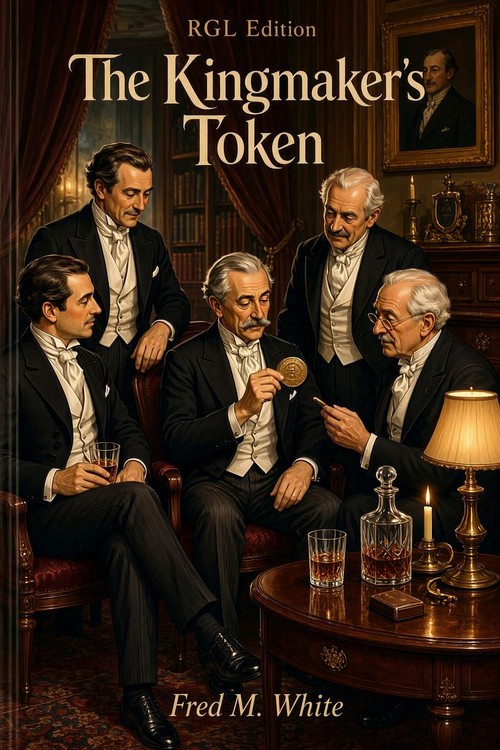
RGL e-Book Cover
Based on an image created with Microsoft Bing software
Roy Glashan's Library
Non sibi sed omnibus
Go to Home Page
This work is out of copyright in countries with a copyright
period of 70 years or less, after the year of the author's death.
If it is under copyright in your country of residence,
do not download or redistribute this file.
Original content added by RGL (e.g., introductions, notes,
RGL covers) is proprietary and protected by copyright.
RGL e-Book Cover
Based on an image created with Microsoft Bing software
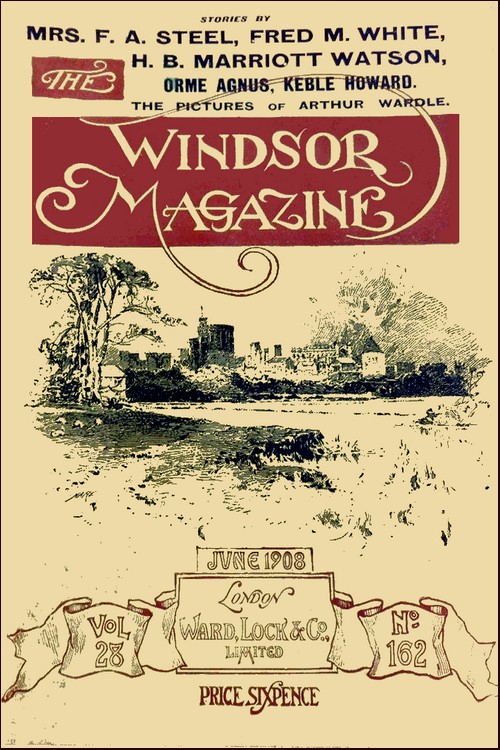
The Windsor Magazine, June 1908, with "The Kingmaker's Token"
A glittering relic of medieval ambition becomes the spark for a modern scandal in "The Kingmaker's Token," where a proud collector's dinner party collapses into suspicion, betrayal, and a desperate struggle for honour. When the priceless gold token vanishes moments after being admired, a young barrister—secretly engaged to the host's daughter—finds himself framed with devastating precision, his reputation shattered and his future seemingly destroyed. In this tale of forgery, envy, and redemption, Fred M. White turns a single coin into the fulcrum of fate...
DINNER was over at length, and cigarettes and coffee were on the table. It was more or less a bachelor party, though, as a matter of fact, Reginald Keene was a widower with one daughter, as most people knew. Miss Mabel Keene figured largely in the "Personal" columns of the popular Press, for she was a beauty and an heiress, and really possessed most of the qualities with which the journalists generally endowed her. She was by way of being somewhat original in her methods, and it was one of the crumpled rose-leaves on her father's couch of down that she had not yet settled in life. Like most self-made men, Keene was looking forward to an alliance with a noble house, but unfortunately his daughter was democratic in her ideas and would have none of these. She divided them vicariously into two classes—and though this was doubtless a libel on a great British Institution, experience had shown the girl that she was not far wrong.
As a matter of fact, she had her father, so to speak, in her pocket, and she knew it. He might fuss or fume or protest, but Mabel was perfectly aware in the long run that she would be allowed to marry the man of her choice. She had really made that choice for some little time, though Reginald Keene was happily in ignorance of the fact, as were most people, though there was one person actually dining at his own table who could have posted him with the last detail of that romantic affair. It is not given even to the modern father very often to entertain his future son-in-law without being aware of the distinction. But that was Reginald Keene's singular lot, if only he had known it.
Walter Holbrook, the young man in question, sat on the other side of the table listening with some interest to his host's talk on art. He had only recently become acquainted with Mr. Keene; indeed, Keene would have been hard put to it to say how the acquaintance had come about. Mabel had managed it in her diplomatic way, and Holbrook was staying under her father's roof down at Mitcham for the week-end. For the rest, Holbrook was by way of being a barrister, and Keene had a vague idea that he was a promising man. This impression also had been inculcated in his mind by Mabel. That astute young lady herself was passing a few days with some friends in the North, and Keene would have been surprised had he known that at that moment Holbrook had a letter from his daughter in his pocket. He had picked up the letter as he came in to dinner from the hall table and slipped it in the pocket of his dressing-jacket. One man was aware of the fact, and this was another guest in the house, in the person of Edward Castle, who himself had had designs upon the hand and fortune of his host's daughter.
Castle was a fascinating man of good appearance. He was an old public-school boy. He had a distinguished career at Oxford, and was supposed to be doing well in the City. To a great extent, men fought shy of him, but the women liked him, and he was very successful so far as they were concerned.
It had been a bitter blow to his conceit to find himself playing second place to Holbrook. He was sufficiently a man of the world to see that he had no chance so long as the game was played fairly. But there were other methods, and for the last two or three weeks Castle had been casting round for one of them. It seemed to him that at length he had a weapon to cut with, and now he was waiting his chance. He knew how to bide his time.
The rest of the party was made up by Sir Simon Scott, the great virtuoso, Arthur Connor, one of the rising lights in the world of science, and three or four other men. For the most part the talk was confined to art matters, for Keene had one of the finest collections in the country, and he was justly proud of it. From time to time the papers chronicled new investments of Keene's, and of late he had figured prominently as the purchaser of what was known as the Kingmaker's Token. This priceless curiosity had come into Keene's hands about a month ago, and he was not yet tired of showing it to his friends. As a matter of fact, Sir Simon Scott had come down on purpose to look at it. He was a brother-collector himself, a man who gave himself up entirely to his hobby; indeed, it was said of him by his friends that the worthy baronet would not have stopped short at murder if he thought he could commit the crime safely and add a treasure to his collection at the same time. There were certain of the cognoscenti who declared more or less openly that they would be sorry to trust Sir Simon alone amongst their treasures.
The old man's eyes gleamed and sparkled now as Keene dilated on his latest find. One or two of the younger guests listened indifferently. They hardly seemed to know what it was that Keene was discussing with such enthusiasm and learning.
"What is the Token?" Castle asked with polite indifference.
"One of the rarest gold Tokens in the world," Keene said enthusiastically. "There is only one known to collectors. It is a gold piece about two inches in diameter, and was issued by Guy, Earl of Warwick, who is known to history as the Kingmaker, at one period of his life when he was supposed to have ambitions towards the Crown himself. Intrinsically the coin is worth about five or six pounds, but from an historic point of view it is almost priceless. It is a work of art, too, in its way. But surely you remember my showing it to you, Castle? You came to my office one day about a month ago."
"Oh, that thing," Castle said with more indifference than politeness. "Really, my dear sir, I beg your pardon. You see, I am so ignorant on these matters. And do you really mean to say that no copy of this Token exists?"
"I do say so," Keene replied emphatically. "I allowed some people in Piccadilly to make a cast of the Token, so that they might reproduce it for the benefit of amateurs. But I can assure you I have the best of authority for saying that this Token was the only one ever struck. From the collector's point it is priceless."
"I am looking forward to a sight of it," Sir Simon Scott said eagerly. "In fact, I came here on purpose. I must get back to town by the ten-five train, Keene; really I must. But I am not going till I have had a look at the Token."
The diners had finished their cigarettes and coffee now, and by general consent a move was made in the direction of the library. Here were cabinets and shelves, with ingenious curtains of steel, something like window-blinds, made to lock automatically, and behind these a number of Keene's treasures were stored. He drew out a tray of shelves filled with all sorts of beautiful things, and from one of these he produced a battered gold disc, which he proceeded to hand round for the inspection of his guests. The Token took the form of a thin coin clipped on the edges and bearing the effigy which was supposed to be the figure of the great Guy of Warwick. Altogether the thing was artistic enough, full of historic interest, and calculated to appeal very strongly to the collector. The fact that Mr. Keene had given two thousand guineas for the coin did not make it any the less attractive in the eyes of his guests. Most of them handled it carefully and curiously, until it came to the turn of Sir Simon Scott, who pored over the thing with all the rapt attention of a mother with her first child. It seemed to stick to his fingers, he seemed loth to part with it; indeed, Keene could hardly drag it out of his hand. Finally the baronet himself laid it carefully upon its bed of cotton wool and pushed in the drawer with a sigh.
"Don't let me see it any more," he said. "I fear the temptation would be too great. And now, my dear fellow, I really must be going."
It was in vain that Keene pressed his friend to stay. He followed the baronet out into the hall, where, for the best part of a quarter of an hour, they stood chatting, whilst the rest of the guests returned to the smoking-room. As a matter of precaution Keene looked into the library once more, when Scott had gone, to see if everything were correct and in order.
A few minutes later he strode into the smoking-room, his face set and fixed, a look of determination in his eyes. At the same time he seemed loth to speak, much as a man would be if he had an accusation to make against some trusted comrade. It was Castle who first noticed the strained expression on his host's face and called attention to it.
"Is there anything wrong?" he asked.
"Well, yes," Keene said, apparently speaking with some difficulty. "Something is very wrong indeed. Not to make a secret of it, I have been robbed of the Kingmaker's Token. I just glanced into the drawer as a precaution, and the Token was gone. I wouldn't have had this happen for ten thousand pounds. It is a hateful thing to say, but the matter lies between you gentlemen here. But perhaps I am alarming myself needlessly. Very likely one of you is playing a practical joke upon me, with the idea of giving me a fright. Without offence, I may say I don't like jokes of this kind. Come, let us put an end to it and forget the matter."
Castle fairly started. Then his face paled just for the moment; so, as a matter of fact, did the faces of most of them there. Holbrook changed colour under his healthy tan, there was something suggestive of fear in his eyes. And yet no one spoke, no one offered to explain the matter, and the hard lines about the corners of Keene's mouth grew more inflexible.
"I am sorry," he said, "to have to carry the matter further, but it seems to me that there is only one thing for it. Gentlemen, I must ask you all to submit to be searched."
THE suggestion was unexpected, but in the circumstances not unnatural. And besides, no one could take offence at it. It was pretty evident to the group now that someone amongst them had yielded to sudden temptation and placed the Token in his pocket. So long as any of the guests were innocent, they could not possibly protest against their host's request. And as everyone lay equally under suspicion, it was quite obvious that the sooner the thief was detected, the better. It was strange how a sudden silence had fallen on the group, and how one man glanced at the other out of the corner of his eye. What had been a pleasant dinner-party a few moments ago now became a sullen and suspicious knot of people. Yet, so far as Keene could judge, no one had changed colour or betrayed any signs of confusion, with the exception of Holbrook and Castle. It was only for a second that the latter's countenance had dropped, then he resumed his easy, smiling manner again.
But with Holbrook the matter was entirely different. It was impossible for him to assume the same indifference as the rest. He began to feel now what a foolish and sorry part he had played in the matter of his secret engagement to Mabel Keene. It was all very well for him to fall in with her idea of coming down there and ingratiating himself in the good books of his prospective father-in-law, but he regretted the girl's romantic idea now from the bottom of his heart. For that unopened letter of Mabel's was literally burning in his pocket. What would Keene say, and what would the guests think, when that unopened letter came to be laid upon the table. The chance that the handwriting would escape Keene's eye was about one in a million. Unless Holbrook were careful and prudent now, here was the making of a very pretty scandal involving the good name of the one person whom he valued above all the rest of the world. Besides, he was innocent enough. He had taken little or no interest in the Token, he had passed it on to his next neighbour at once. Keene might think what he liked. His own reputation might suffer, but he would have to risk all that. He shut his teeth together and shook his head. Come what may, he would see that that letter did not leave his pocket.
"This is an outrage," he said with a pale face. "No gentleman could possibly submit—
"I don't agree with you," one of the other guests said coldly. "This is a very serious matter, and the sooner it is cleared up, the better. This thing is sure to be talked about, and I for one decline to share the responsibility. So far as I am concerned, I shall be only too glad to fall in with Keene's idea."
A murmur of acquiescence went round the room. Already two of the guests had commenced to turn out their pockets. Holbrook's face was very white and pale now. It appeared to some of the others glancing at him that he bore the evidence of guilt strong upon him. But he stood there still and resolute, his mind firmly made up. Come what may, he was not going to be searched.
"I think you are very foolish," Keene said not unkindly.
"Foolish or not, I am going to stick to my point," Holbrook replied. "I will not be searched."
A sudden rage filled Keene. He was a self-made man, and there were times when his feelings were not altogether under proper control. He strode across the room and caught Holbrook by the shoulders. He was quite reckless and beside himself now. The idea that he should be robbed of his treasure filled him with passion. The sudden onslaught took Holbrook quite off his guard. As he staggered and half fell into a seat, he felt Keene's hand in his coat pocket. Castle moved swiftly across the room just as Keene's hand was removed from Holbrook's pocket with a packet of letters in his grasp.
"Steady on, steady on," he said soothingly. "One makes every allowance for your feelings, my dear friend, but, really—
As Castle stretched out his hand, something bright and gleaming dropped from between the bundle of letters and tinkled on the floor. Just for a moment Holbrook did not realise what had taken place. He was only too anxious to conceal the letter which meant so much to him. He was feeling thankful for his lucky escape.
Then it was borne in upon him with a staggering swiftness. He realised exactly what had taken place. Castle had handed him the letters with outstretched fingers, and from the middle of the packet the gold coin had dropped to the floor. Holbrook did not need to be told what it was. He knew that here was the cause of all the trouble. He was too staggered to speak, too paralysed to raise any defence. Fate had dealt him this extraordinary and unexpected blow, and if no plausible explanation could be found, his social career was at an end. He could read his sentence in the faces of his companions. It was easy to see what they thought. Keene had the coin in his grasp now. The look which he turned upon Holbrook was neither friendly nor flattering.
"It is possible," said Keene, "you may have an explanation. If so, I shall be glad to hear it."
Holbrook shook his head sorrowfully.
"I have none," he said. "And I do not choose to invent a lie. How that coin got in my pocket amongst my papers, I don't know any more than the dead. I swear to you that I did not put it there. Oh, I know that appearances are against me. I know what you must all think, especially as I made so vigorous a protest against being searched. I had my own reasons for refusing, but those I am bound in honour to keep to myself. I can say no more."
A long and painful silence followed. It was Keene himself who spoke at length.
"This is very painful," he said. "You must see, Mr. Holbrook, that I have no alternative but one. I will ask you gentlemen to give me your word that you will not mention this matter outside my house. Perhaps Mr. Holbrook would like to explain himself to the servants that he is hurriedly called away to town. Perhaps he would like to go and pack his bag. There is a train a little before midnight, and I will have a cart at the door ready to go to the station."
There was no more to be said and no more to be done. With a pale, set face, and his lower lip caught up between his teeth, Holbrook left the room. It was all over now. His career was absolutely at an end. To all practical purposes he had committed social suicide. He left only one behind him who had any sort of doubt in his mind or pity in his heart, and that was Connor. Long after the rest of the guests had gone, Connor remained seated in the smoking-room with his host talking the matter over.
"You don't seem to be convinced," Keene said testily. "Anybody would think that you were not satisfied."
"Are you quite satisfied yourself?" Connor asked quietly. "Now, confess, isn't your conscience pricking you a bit? Oh, I don't say you were wrong, but, at the same time, I feel that our methods were open to criticism. The end doesn't always justify the means, you know. To be perfectly candid, I believe this matter is still capable of an explanation. I have known Holbrook all my life, and I would have gone bail for his honesty. I have been turning the matter over in my mind, and something like an explanation suggests itself to me. I won't tell you what it is yet, because you will probably only laugh. Meanwhile, I should like, if you don't mind, to have another look at your precious Token."
Without a word Keene handed the gold disc over to his companion, who examined it slowly and carefully. The metal was soft and thin; where it had fallen on the parquet floor after slipping from the bundle of letters, part of the gold had been scratched, leaving a bright line behind. Connor took out a pocket microscope and held it close to the disc. Then a faint flicker of amusement, not altogether unmingled with relief, crossed his face.
"I see my theory is not quite so extravagant, after all," he said. "As you know, I have been dabbling in metals all my life. There is not a single metal known that I have not experimented with. You are aware that diamond experts can tell at a glance where various stones come from. Perhaps you don't know the same thing applies to metal. Now, let me ask you another question. To what country did Guy of Warwick's family originally belong?"
"What nonsense!" Keene cried. "Why, he was an Englishman, of course. What are you driving at?"
"That was my opinion," Connor said drily. "But if this Token tells me anything, the great Kingmaker must have been intimately acquainted with Australia. If he had never been there himself, he must have had friends who knew the Australian continent perfectly well. Of course you will argue that Australia was unheard of in those days, and perhaps you are right. But either my theory is absolutely correct, or your Token is a forgery."
"A forgery!" Keene gasped. "Nonsense! Why, I can verify the Token. I can trace its pedigree for hundreds of years. You may rely upon it that the thing is absolutely genuine."
"You can rely upon it that I am right," Connor said emphatically. "This thing is a forgery, and I am very glad that I have had a chance of finding it out. You see, I shall have an opportunity now of getting the real Token back for you. Now, I am going to ask you to do me a favour. I want you to let me keep this Token for eight-and-forty hours, at the end of which time I will not only return the original to you, but I will prove what I say as to Guy Warwick and his connection with Australia."
"By all means," Keene murmured. "But why are you so sure of your ground over this matter?"
"For the simple reason," Connor said quietly, "that the disc is made of Australian gold."
CASTLE had dined in his own rooms, and was now awaiting the advent of Connor, who had dropped him a line to the effect that he wanted to see him on important business. Castle was not more than half through his second cigarette before the man of science put in an appearance. He seemed to be perfectly cool and collected, but there was a certain grimness about him which Castle did not altogether appreciate. He waved his visitor into a chair.
"What on earth do you want with me?" he asked truculently.
"Well, I rather wanted a few words with you on the subject of Holbrook and the missing disc. As I told Keene the other night after you people had gone, I was not altogether satisfied, though on the face of it Holbrook's guilt was plain and unmistakable."
"I should say it was," Castle sneered.
"Of course you would. So would anybody else, for the matter of that. But, really, Holbrook was as guiltless as I am. You see, I had an opportunity of examining the disc, and I made an important discovery. I discovered beyond the shadow of a doubt that the curiosity was made of Australian gold."
"In that case a forgery," Castle murmured.
"Assuredly a forgery. But that does not prevent the fact that the original Token has been stolen. Now, you will agree with me that it was impossible for Guy of Warwick to have a Token made of Australian gold. We know perfectly well that the thing which Keene bought was not a forgery. What we have to do is to find out where the original Token is, and how that wonderfully clever copy of it found its way amongst the papers in Holbrook's pocket."
Castle glanced uneasily at his companion.
"Have you any theory to advance?" he asked.
"No, sir, I haven't," Connor said crisply. "I have passed the region of theories and come now to concrete fact. I want to know what purpose you had to serve when you turned up at Keene's house the other night with an exact replica of the Kingmaker's Token in your pocket, and what you expected to gain by palming that coin and slipping it amongst Holbrook's letters. Now, don't let us have any bluster and nonsense on your part, because if I go away from here to-night without an explanation, I shall send a full account of the whole thing to the Society papers. This will condemn you to all eternity or force you to bring a libel action against me, which you dare not do. I am quite prepared to let you off as easily as possible, but Holbrook's character has got to be cleared."
"But why put it on me?" Castle protested.
"You will gain nothing by shuffling," Connor went on. "Don't forget that when we were up at Cambridge together, you had a great reputation at amateur conjuring. It was the recollection of this fact that put me on the right track, and when I found that what I might call Holbrook's Token was a forgery, I began to see my way clear. I knew that you would palm that thing off on Holbrook, and I am here to know why. That he had some good reasons for not wishing to be searched was evident, and that you know what those reasons were is patent. The way in which you seized your opportunity was clever, too. Otherwise, the forged Token would have been found in your pocket, and I don't see how you could have lied your way out of it successfully. To go back a little way, when I found out the forgery, I remembered that Keene had told us that a firm of antique dealers in Piccadilly had been permitted to take a cast of the Kingmaker's Token. I began to see my way now where the forgery came from, and I called upon those people in Piccadilly to inquire. Exactly as I had expected, they had made one of the replicas for you. It was an easy matter after this came into your hands for you to search out one of those clever people who make sham antiques, and who could have given your Token the proper appearance of age. Unluckily for you, by an accident I discovered the forgery, hence my visit here to-night. Now, don't you think it would be just as well if you made a clean breast of the whole matter and told me all about it? I don't want to be harsh or vindictive, and I am sure my feelings are shared by Keene himself. All we want to do, before the matter gets talked about, is to satisfy those people who were dining at Keene's the other night that Holbrook is absolutely innocent. If you don't do this, I shall tell Holbrook, who in his own defence will be bound to take criminal proceedings against you. Now, just think the matter over. I'll give you five minutes to decide."
Castle paced up and down the room, smoking furiously. A blue wreath of tobacco smoke trailed over his shoulder. Up to now he had attempted no defence or prevarication. It seemed to Connor that the victory was won. The five minutes of bail had ticked its way off on the clock before Castle resumed his seat again.
"I think you are right," he said quietly. "I'll tell you everything you want to know."
"That is wise," Connor said drily. "Pray proceed."
"I must go back a little way," Castle began. "You see, I am supposed to be doing very well, but, as a matter of hard fact, my affairs are in anything but a prosperous condition. I began to realise some time ago that I could not last much longer unless I made a rich marriage. I cast about amongst the many women of my acquaintance, and finally my choice fell upon Mabel Keene. Her father is a rich man, as you know. She is a pretty and accomplished girl; indeed, if I had the means and she were penniless, I would have married her all the same. It looked as if everything were going smoothly enough till Holbrook came along, when I speedily realised that the times were out of joint so far as I was concerned. Mind you, I believe I should have succeeded but for Holbrook. I felt that if I could get him out of the way, the path would be clear. Then I began to scheme, until I hit upon the idea of stealing the Kingmaker's Token and slipping it into Holbrook's pocket. I knew of that dinner party a fortnight beforehand, so that I had plenty of time before me. As an old hand at conjuring, I recognised the value of having a duplicate in my possession, because you can see for yourself how much easier it would render my task. But there was another rogue in the play, and I hadn't reckoned upon him at all. I am alluding to the man, of course, who really stole the Token."
"Who is he?" Connor asked.
A faint smile trembled upon Castle's lips.
"You are not so clever as I thought," he said. "Why, old Sir Simon Scott, of course. It was cleverly done; in fact, a finer bit of palmistry I never saw. It so astonished me that I nearly betrayed myself at the time. Then I began to see my advantage. Funny thing, isn't it, how unscrupulous these big collectors are. Fancy a man with all that money jeopardising his position in that way, for the sake of a single curio! Yet I am told that such instances are by no means uncommon."
"Hadn't you better keep to the point?" Connor suggested drily.
"Oh, yes, where was I? I recollect now. Sir Simon had stolen the Token, and I was the only one who knew it. I knew that I was safe now, especially as I recollected the forgery in my pocket. I was going to contrive later on for Holbrook to appear to drop it, but I began to see a better way, now that my unexpected ally had given me a lead. But what I did not anticipate or look forward to was the way in which Keene found out that he had been robbed. When he suggested in that blunt way of his that we should be all searched, I felt just a little startled for the moment."
"I can understand that," Connor said drily. "But, then, you had a certain safeguard. You knew that for some reason or another Holbrook would refuse to be searched. Why?"
"Oh, I am just coming to that point. You see, Connor, I happened to know that Holbrook was secretly engaged to Miss Keene, and I happened to know that she was in correspondence with him. There was a letter waiting for him on the hall table before dinner, and I saw him put it in his pocket unopened. Probably the letter was sent by some careless oversight. At any rate, there it was. When it flashed across my mind that the letter was in Holbrook's pocket, I knew he would refuse to be searched, and I was right. Then Keene, in his blundering way, gave me the very opening I was looking for, and I got rid of the forged Token just in the way that you have anticipated. I don't think there is any occasion for me to say more; indeed, I am much obliged to you for coming here this evening and giving me this opportunity of getting out. If you like, I will put the whole thing in writing, only I will ask you to keep it amongst those whom it most concerns. At any rate, be as secret as you can till I can get out of the country, and if there is anything I can do for you by way of repairing matters—
"There is one thing you must do," Connor interrupted. "I don't care how you manage it, but you will have to go to Sir Simon Scott and get the real Token back again. You can post it to Keene. I don't suppose you are particularly anxious to meet him again. And now, I am going down to Keene's place with Holbrook to tell him all about it. We are not likely to meet again."
As it happened, it was the next day before Connor and Holbrook waited upon Keene and explained matters to him up to a certain point. The worthy collector was all the more pleased and delighted, seeing that by the first post the same morning he had received his missing Token back again, with a letter from Castle. Mabel's father absolutely beamed with delight as he shook hands with Holbrook.
"But why," he asked, "why on earth did you refuse to be searched?"
Connor smiled drily.
"I think I had better be going," he said, "especially as Holbrook's explanation is more or less of a family matter. You will appreciate what he has to say when he gives his explanation in the presence of yourself—"
Roy Glashan's Library
Non sibi sed omnibus
Go to Home Page
This work is out of copyright in countries with a copyright
period of 70 years or less, after the year of the author's death.
If it is under copyright in your country of residence,
do not download or redistribute this file.
Original content added by RGL (e.g., introductions, notes,
RGL covers) is proprietary and protected by copyright.