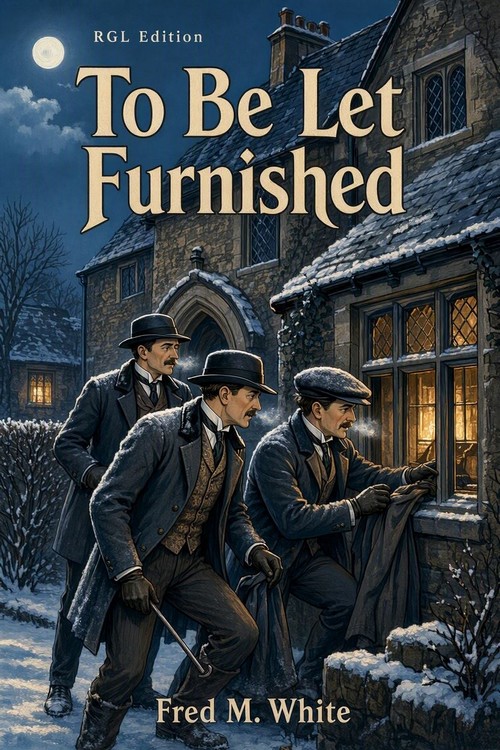
RGL e-Book Cover
Based on an image created with Microsoft Bing software
Roy Glashan's Library
Non sibi sed omnibus
Go to Home Page
This work is out of copyright in countries with a copyright
period of 70 years or less, after the year of the author's death.
If it is under copyright in your country of residence,
do not download or redistribute this file.
Original content added by RGL (e.g., introductions, notes,
RGL covers) is proprietary and protected by copyright.
RGL e-Book Cover
Based on an image created with Microsoft Bing software
Stranded on a frozen country road after their car breaks down, Raymond Paget decides that the only sensible solution is the most outrageous one: to break into a neighbour's furnished, unoccupied house for the night—a lark that spirals into a razor-sharp comedy of mistaken identity, criminal intrigue, and audacious improvisation. What begins as a cosy, illicit supper in a deserted dining-room erupts into a whirlwind of electric bells, secret aliases, stolen jewels, and a master criminal hiding in plain sight, all driven forward by Paget's unflappable wit and appetite for adventure.
THE big car pulled up with a jerk, there was a horrible, jarring snap, followed by an anxious wait for the verdict. Out of the darkness somewhere a voice proclaimed that an axle had gone. One of the occupants of the car threw his furs aside and stepped on to the hard, frost-bound road.
"Shove her into the hedge," he said crisply; "no use wasting any more time. We're not likely to get to the bungalow to-night, and so golf and Sandwich must wait. Get out the grub, Prossor."
"But what on earth are you going to do, Paget?" the other man in the car asked.
"Make the best of it," Raymond Paget responded. "We are miles from nowhere, and it is nearly ten o'clock. In the ordinary course of things, we should be at my Sandwich bungalow, eating our bachelors' supper before midnight. It is some consolation that we've got the supper."
"But we can't sit down and eat it under a hedge, old chap," Anstruther protested.
"We're not going to. The campaign is all thought out. We are exactly half a mile from Capper's place. At Capper's place we are going to spend the night. Pick up the hamper, Prossor."
"Here, steady on! Capper's at Monte with his missis. The house is shut up. It's put in the hands of an agent, to be let furnished. You're a very clever chap, Paget, but—
"One of the most remarkable in the world," Paget said severely. "Always embrace the unexpected, Dick. We are going to burgle Capper's house and spend the night there. If the police interfere, so much the better. Anyway, we can't stay here all night."
Anstruther resigned himself to the inevitable. This was not the first scrape that the eccentric and humorous Paget had led him into. But, wild as Paget's escapades generally were, there was always some ingenious way out. It was uncommonly cold, too, and Anstruther was hungry. They came at length to a charming house, in front of which was an agent's notice board. The blinds were all down, and the place had a deserted air. Paget remarked that there was pretty certain to be a weak spot somewhere in the fortress, and proceeded to find it in the shape of an unlatched pantry window. The rest was comparatively easy. The adventurers stood presently in a cosy dining-room, which apparently had been recently swept and garnished.
"Now, this is very thoughtful," Paget said cheerfully. "Everything in apple-pie order—
As Paget spoke, he snapped one of the buttons by the side of the fireplace, and immediately the room was flooded with light. A cheerful fire soon burnt in the grate.
"We certainly owe old Capper something for this," Paget exclaimed.
"More likely we owe it to some local house agent," said the more practical Anstruther. "It's pretty easy to see what has happened. The place has been let furnished, and the new tenants are probably coming in to-morrow. If our accident had been a day later—
"My luck is proverbial," Paget said serenely. "Audacity and a properly pious trust in Providence are invincible. You were going to say—
"Unless the tenants have already arrived, and are in bed."
"Great Scot, I never thought of that!" Paget, flurried for the moment, exclaimed. "I wish you'd go and make quite sure, old chap; I hate to be disturbed at my meals. Go and have a look round about. Prossor, give me a hand with the supper."
Anstruther departed protestingly. Prossor laid out the supper much as he might have done had the Sandwich bungalow been reached without accident. He had a profound admiration for his employer and his many and brilliant methods. It was bound to be all right in the long run.
"Now you had better go and get your own supper," Paget suggested. "Take one of those pies and a bottle of beer. Get up early, and find the nearest place where you can get your repairs done. I don't want to embarrass the people who are coming here to-morrow; explanations are always difficult directly after breakfast. I dare say you can find a bed somewhere."
Prossor responded that he had already done so. There was a man's bedroom leading out of one of the domestic offices. Paget nodded approvingly. Prossor had better get his supper and return as soon as he liked. Seeing that he had the prospect of a heavy day before him to-morrow, his services might be dispensed with. What the incoming tenants might think of the mess and litter they would find to-morrow was a matter that troubled Paget not at all. An inviting supper was on the table, now flanked by an array of bottles; the room was flooded with light, a cheerful fire roared up the chimney. Raymond Paget was feeling on excellent terms with himself. It seemed to him that he had turned his misfortune to brilliant account. The spice of novelty put a keen edge to his appetite.
With all his coolness and audacity, he was startled a moment or two later by the sound of an electric bell. The bell rang again more persistently, till the purring ripple seemed to fill the house. Paget caught his breath, wondering if Anstruther had blundered into some alarming adventure upstairs. But there was no outcry, no loud clamour of voices, nothing but Prossor, white and agitated, with the announcement that the indicator recorded the fact that somebody was impatiently ringing the front-door bell.
"Shall—
"I think not," Paget said thoughtfully. "You have many excellent qualities, Prossor, but they are slightly too solid for a situation like this. I do not remember that fertility of resource was mentioned by your previous employer as an asset in your favour. You can go off and sleep the sleep of the just, with the comforting assurance that I will see you through. I'll answer the bell myself."
It was not for Prossor to contest the point, neither had he the slightest impulse to do so. He went back to the kitchen, his left eyelid slightly contracted.
"A cool hand, the governor," he told himself—
Paget crossed the hall leisurely enough and opened the door. He was not in the least disturbed now; on the contrary, he was enjoying himself immensely. He caught a gleam of Anstruther's agitated face as he looked over the banister.
"This is a pretty nice mess!" the latter groaned.
"Leave it to me," Paget whispered, "and keep out of the way. Remain discreetly in the background until I give you the signal. I may have to use you as a pawn in the game. Nobody upstairs, I suppose?"
"Not a soul in the house bar ourselves, so far as I can see."
Paget nodded approvingly as he opened the door. A tall, slim man, with a handsome, dark face and a pair of beady, suspicious eyes, regarded him with marked disfavour.
"And so I've found you, have I, Mr. Lawson?" he asked smilingly.
"My dear sir, it would be folly to deny it," Paget said cheerfully. "Come in! This is no night for the exchange of social amenities or compliments. Come in Mr.—
"Just as if you had forgotten Tom Leslie!" the other burst out angrily.
"Of course—
"Oh, you've got your enemies right enough!" the dark man muttered as he followed Paget into the dining-room. "I'm one of 'em, for the matter of that. I know all about you, James, alias Smith, alias Robinson. It's a nice little game of yours, moving from one house to another, with a touch of disguise so as to baffle people. But I'm the one man who knows who you really are, and I'm going to stand no nonsense. What's the good of you writing to me, fixing Thursday for our meeting here, when you know very well that the job's got to be done Thursday night? Said you couldn't get here before Thursday. And why? In order that you could wriggle out of the cheque you promised me. Thought that I should manage to do without, and bring the stuff to you, and so save your fifty quid. That's why I came down to-night, feeling quite sure that I should find you here."
"Are you sure I said Thursday?" Paget asked.
"Here, read the letter for yourself," Leslie grunted. "It's Thursday, all right."
Paget read the letter with a grave face. He wanted a little time to think, to get the hang of this strange business. He had no sympathy with the writer of the letter, but plainly he was the victim of his own caligraphy. So far as Paget could make out, Thursday was the day written in the letter.
"I admit that Thursday is the word," he said. "My dear sir, you must not blame me unduly because my memory has played me a trick. And when you doubt my promise to pay you the money, you hurt my feelings—
Mr. Leslie's features relaxed a little. There was the ghost of a smile in his sinister eyes.
"Well, you can make it another ten, if you like," he said. "One never knows. There are several people to be paid. I can do nothing without the money; but if I can get it in the morning, I shall be all right. The question is, where am I going to see you afterwards and draw the blunt agreed upon? I suppose I'd better come here?"
"Why, of course you must," Paget said eagerly. "What else do you suppose I am here for? Can't you see now that I came down here this evening on purpose to meet you? If you can get back here on Thursday night, however late—
"Oh, I can manage that all right," said the now mollified Leslie. "I shall get the whole thing through with any luck before half-past nine. I've got my motor bike, and I shall be here by eleven easily. I shall be only too glad to get rid of the stuff and draw the money."
"Then that is settled," Paget said. "I can't ask you to stay and sup with me, because I am expecting somebody else, and it would not be prudent for you to meet here. I'll give you a cheque."
Mr. Leslie stared just a little at the mention of a cheque. Paget produced the long pink slips from his pocket, and proceeded to draw a cheque for sixty pounds. Leslie snapped at it suspiciously.
"Name of Paget this time," he said. "What a clever one you are! Personally, I should keep off paper, if I were you, but I suppose you know your own business best."
"I share that opinion." Paget smiled. "Whatever my alias may be, you will find that the cheque will be honoured all right. And I shall expect you here with the stuff on Thursday night before twelve. Have a drink before you go. You may doubt my sincerity, but I am exceedingly glad to meet you, though you know more about me than I care to have known. Still, I can take steps, if I like, to silence your tongue for some time to come."
"Oh, I know that, governor," Leslie said significantly. "I was a fool, perhaps, to say so much, but I'll play the game up to you so long as you play it up to me. Here's luck!"
The front door closed upon Mr. Leslie presently, and Anstruther came into the dining-room.
"Now, what does all the game mean?" he asked. "And why did you give that bounder a cheque? If you've got one of your wild extravaganzas on, let me into the plot. You ought to have been a dramatist."
Paget winked mysteriously and devoted himself to his supper. It was no part of his programme to say any more for the present, except that there was more to follow, and that same speedily. They would put in two days' golf at Sandwich, but they must be back here on Thursday an hour before midnight. As Anstruther was fond of a joke, he was likely to see one.
The car was repaired by breakfast-time, and the golfers set out on their journey, but not before every trace of their visit had been removed, even to the relaying of the dining-room fire. There appeared at Sandwich on the Thursday afternoon, in time for a three-ball match, Inspector Frost of Scotland Yard, who had come down in response to an urgent telegraphic message from Paget.
"Now, I dare say you will wonder why I sent for you," Paget remarked, as the two sat in the bungalow after dinner. "Confess, Frost, you are puzzled?"
"I frequently am," Frost said modestly. "Are you going to help me as you did over that hotel affair?"
"That's the programme," Paget explained. "Now, do you remember, one night at the Variety Theatre, pointing out a certain person to me—
"Caleb Merritt," Frost said, "the fence—
"Precisely. You told me he was quite a rich man—
"I'd cheerfully give a year's pay to do so," Frost said grimly.
"It'll cost you less than that," Paget said. "My price is sixty pounds. But all in good time. I never like to tell a story till I know the end of it. Put yourself in my capable hands, and get a couple of policemen and a cab to be close to Mitton village at midnight. As to the rest, you will see what you will see."
Knowing his man, Frost asked no more. He submitted to being placed in the car a little before nine, and to smoking one of Paget's excellent cigars in silence. It was just on eleven when the big car pulled up in the lane close to Capper's house. Paget led the way into the garden. Behind the dining-room curtains was a thin slice of red light, denoting the fact that the house was inhabited. A little chuckle of satisfaction broke from Paget.
"The cheese is toasting," he said, "and the mouse is in the trap. I left the scullery window-catch in such a position that I can open it without any noise. Your policemen handy?"
"We passed them a moment or two ago," Frost explained. "You would not notice it, of course, but they gave me the signal. I'm all ready."
Without another word, Paget proceeded to enter the house by the scullery window. Frost appeared to be just a little uneasy.
"What about the servants?" he whispered.
"There are no servants," Paget said sententiously. "If this assumption is incorrect, then our game is spoilt. But you may take it for granted that there is no servant. You'll see why presently."
It was even as Paget had said. The kitchen was absolutely deserted. They crept silently into the dark hall, so that they could look into the dining-room without being seen. An elderly man, with a shining bald head and a flowing grey beard, sat there smoking a cigar after an obviously good supper. A litter of silver and glass stood on the table. The man fitted into his surroundings as if he were absolutely part of the picture. There was an air of mild benevolence about him.
"Ever seen that chap before?" Paget whispered. "Does he remind you of anybody?"
Frost was not quite certain. The benevolent gentleman with the beard certainly was a little haunting. He grabbed Paget by the arm excitedly. The latter merely smiled.
"Plenty of time," he said; "we're quite masters of the situation. So far as we are concerned, the fun is only just beginning. Keep your ears open for the front-door bell—
A few minutes later the silence was broken by the ripple of the electric bell. The elderly man rose slowly and pleasedly from his seat and crossed the hall. He waited for the bell to ring a second time before he opened the door. He peered more or less curiously into the darkness.
"Who comes here at this time of night?" he asked. "My servants have all gone to—
"Oh, chuck it!" a voice snarled from the darkness outside. "Do you suppose I don't know? There isn't a single servant in the house, and you won't be here this time to-morrow. As I told you before, I have found out how you work your little game, and I'm going to stand no nonsense!"
Frost grabbed Paget's arm again. He was getting a grip on the progress of events. He might be a little dubious as to the identity of the philanthropist in the grey beard, but he had no doubts on the score of the man who had just entered the hall. Mr. Leslie's voice was sufficient in itself.
"Come in!" the grey-bearded man said. "You've got a pleasant tongue, Tom Leslie."
"I've got something a good deal more pleasant in my pocket!" Leslie growled. "Go on, skinflint! What a chap it is! One day turned out like a swell, with a waxed moustache and manners to match, and the next like one of those pious old coves who take the chair at the Y.M.C.A. annual meetings! Rather different from Tuesday night, I don't think!"
The man with the grey beard led the way into the dining-room. He cleared a space on the table and produced a little wash-leather bag that looked to be heavy.
"Get to business," he said curtly. "How much, and what do you want?"
Leslie proceeded to take sundry cases from his pockets. From these he carelessly dragged out necklaces and chains, ropes of pearls and clusters of diamonds, that dazzled like streams of liquid fire. They lay in a shining heap upon the table—
"There, isn't that a sight for sore eyes?" Leslie said. "That's the lot. Every family jewel that Lady Connington possessed an hour or two ago. They were valued last year for probate at thirty thousand pounds. But you know as well as I do. How much for the little party?"
"A fair lot," the grey-bearded man mused—
"A thousand devils!" Leslie cried passionately. "You miserable shark, what do you take me for? I'm not going to part with any of these stones for less than five times as much."
"A thousand pounds," the other said in the same level tone—
Leslie broke out in a tornado of curses. He swore till his voice grew faint and hoarse. He sank back in his chair exhausted, but still malignant.
"Some day you'll get a knife between your ribs!" he said. "Confound you, you know I can't go anywhere else with the stuff now. I'd have one of your spies on to my track before I reached London. Do you want to deduct the sixty quid as well?"
"What are you talking about?" the other asked.
"Just as if you didn't know! Why, the sixty I had from you on Tuesday night!"
"On Tuesday night? The man is mad! I never saw you on Tuesday night."
"What dirty game are you up to now?" Leslie demanded. "I saw you here on Tuesday night; I came because you asked me to in your letter. It wasn't my mistake that you wrote so badly. You wore a waxed moustache then, and had the air of a gentleman; but I know you, Caleb Merritt."
The man with the beard gasped; the benevolent-looking face grew pale. He grabbed up his little bag and made for the door without another word. At the same moment Paget stepped forward and barred the way.
"There's some mistake," he said. "Mistakes between friends are always distressing. May I be permitted to put matters right? Mr. Leslie, you owe this gentleman an apology. It was I who temporarily accommodated you to the extent of sixty pounds. Always glad to oblige a man in distress!"
Leslie gasped and dropped into a chair. His face turned a shade paler as Frost appeared, so did the bland countenance of Caleb Merritt. With a dexterous movement Frost removed the artistic wig and beard.
"Ah, our acquaintance of the Variety Theatre!" Paget murmured. "Most interesting!"
"You two can consider yourselves my prisoners," Frost said. "My men are outside. Anything to say?"
Merritt took up and lighted a cigarette. He had wilted just a little.
"I'd like to ask a few questions," he said. "How did you manage it?"
"Largely a question of luck," Paget proceeded to explain—
Mr. Merritt smoked his cigarette placidly; he even regarded Paget with some admiration.
"I'm done," he said. "It's hard luck to be tripped up like this because that fool yonder hadn't the sense to be able to correct a little error. Anyway, I'm taken red-handed, and there is no help for it. I've been doing this kind of thing for years. I take a furnished house, as the gentleman says, and pay a month in advance. I never really occupy the house; I only want it for a day or two. A bit of disguise, and there you are."
"One consolation," Leslie said moodily—
Frost stepped to the front door and softly whistled. A few minutes later, securely handcuffed, Merritt and Leslie faded into the darkness. Frost's eyes shone with satisfaction.
"We owe you a heavy debt for this, Mr. Paget," he said. "It was amazingly clever of you. Is there anything else you have to suggest?"
"Yes," Paget said practically, "let's have some supper. By Jove, how old Capper will enjoy this story when he comes to hear it! Anstruther, pass the whisky and soda."
Roy Glashan's Library
Non sibi sed omnibus
Go to Home Page
This work is out of copyright in countries with a copyright
period of 70 years or less, after the year of the author's death.
If it is under copyright in your country of residence,
do not download or redistribute this file.
Original content added by RGL (e.g., introductions, notes,
RGL covers) is proprietary and protected by copyright.