
RGL e-Book Cover
Based on an image created with Microsoft Bing software
Roy Glashan's Library
Non sibi sed omnibus
Go to Home Page
This work is out of copyright in countries with a copyright
period of 70 years or less, after the year of the author's death.
If it is under copyright in your country of residence,
do not download or redistribute this file.
Original content added by RGL (e.g., introductions, notes,
RGL covers) is proprietary and protected by copyright.
RGL e-Book Cover
Based on an image created with Microsoft Bing software

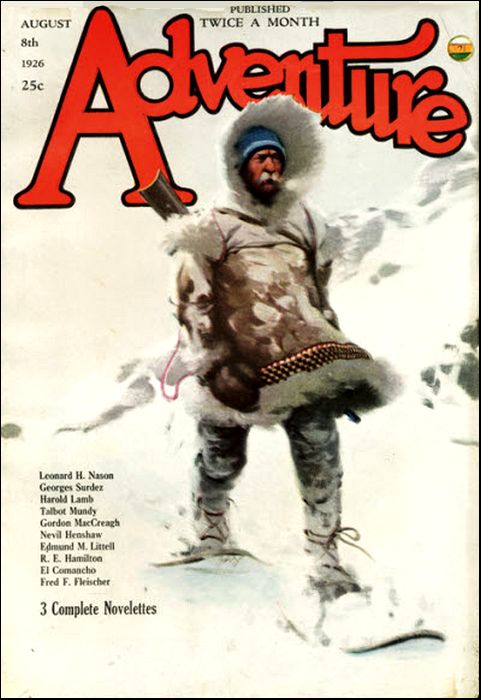
Adventure, 8 August 1924, with "The King Of The Black Water"

BY all means, Senhor Consul, I will tell you of your compatriot, that red-head Americano, whom we of the upper rivers call the "Peloroxo." Not that there is any need, let me assure you, of your good offer of intervention with that governor fellow on his behalf. You are but newly appointed here in Manaos City; otherwise you would know that I, Theophilo of the Upper Rivers, and that crazy compatriot of yours, we do not look for protection from those politicians.
What? You have heard already? Oho, the city remembers us then? And that was two seasons ago. Well, in the cities, of course, nothing ever happens; so that little events stand out the more clearly.
I will tell you the truth then. I make free admission from the outset that we made a stupid mistake. What we should have done was simply to throw those fellows overboard and let the caimans get them; the whole gang of them, Dom Sylvestra included. I, indeed, was in favor of it. I said: "Look, these bandits have tried to steal our whole shipload of tagua and have led us a chase over the half of Amazonas to recover it. And now that we have overtaken them, what then? We have our cargo of ivory nuts, which was ours from the beginning. But is there no penalty for our loss of time and of money and of men? What will it avail us to turn these tripes over to the law and to have them thrown into the calabouço for a year or so? There is no nourishment to our business in that. Besides, process of law is not for us of the upper rivers, who make our own law. No, let us heave them over as a warning to the rest of those would-be pirates; and the rivers will be well rid of them."
But the Red-Head said no. He is more set in his ideas than a peccary boar, is that compatriot of yours. Look now, senhor; this is my observation of beasts as well as of men. Take a jaguar cub of the jungle and train it to live with men. It will adapt itself to circumstance and will be to all appearance a cat; yet hidden in its fiery soul the ineradicable jaguar will persist. So with this Peloroxo. Perhaps you have met others like him.
His cubhood was spent in some curious community in the center of your country where it seems they hold ideas the same as those of their great-grandfathers and are one and all stuffed with the belief that such is the way to live, and none other. He came to us and survived by his luck alone through a period of preaching to us his religion—which was how much better his townlet was than all others. Yet he lived; and presently he learned that there existed whole men also outside of "God's country"; and he grew to become, as you have heard, Peloroxo of the Upper Rivers, worthy to be the partner of Theophilo Da Costa.
Yet, when I said, "Throw this offal overboard," he said, "No; we can hardly do that."
And why, forsooth? For no other reason than that in his particular section of your country it was not the custom.
"Bom," I said. "Very well. Let us shoot them, then, with pistols. For it is well known, mi amigo, that in a single town of your section of the world they kill more men with pistols than we do in all Brazil in a year."
But that, he maintained, was different. We could not in cold blood kill them. Miravel, what an ethic! Would not those pirates have gaily cut all our throats at one stroke while we slept? Does one refrain from killing a snake because one has first caught it, and request of it then please to bear no hostility in the future?
But what use? He overrode us, myself and our three friends who had helped us to capture the gang; and it was his idea that we should make them paddle our batelãos, naked like Indians and sweating like swine, up to Manaos City for all the people to see and to be a warning on the river that Theophilo and Peloroxo were no down-river rats, who could easily be robbed.
Not that it was not a good idea. The town is still talking, you say. Ho-ho; and it was in truth a spectacle, senhor. Never before in history had river-men come in with a crew of white men straining at the paddles while naked Indians looked on and laughed. A fiesta it was for the whole town. There at the floating dock of the Companna Navigazione where all the folk, white and black and breed, waited to meet us, there was a time when for a moment I thought that my friend would have killed the Sylvestra with his own hand. But, alas, he holds his temper nowadays much better than when he first came to us.
The Sylvestra, when he had scrambled up from the batelão to the dock, ragged and lean and with hands bleeding from the paddle; when he felt himself safe at last among the policemen of the wharf, his rage of many days mounted within him like a tornado and he champed his teeth and shook his fist down at the boat and screamed:
"I will pay you for this! I, Dom Sylvestra da Morada Cardozo! Just you wait, you low-bred Americano!"
It was then that I thought my friend would leap on to the dock and rend him from the very arms of the police and tear him apart. His face grew as red as his fiery hair and the veins of his neck swelled while he gathered his legs under him for the leap. But then—pity of it—he slowly relaxed again and shrugged and smiled with a twisted mouth. To Sylvestra of the high-sounding names he said:
"Senhor, you compliment me. You call me by my country. It is the proudest thing you can say to me. I return the compliment. I will wait for you, you highborn mestizo."
At which there was a guffaw from the populace that shook the wharf. For it was an. open whisper in the town that the Sylvestra, for all his proud patronymic, had a dark skeleton in his family closet. As for the dom, he choked on his fury and would have fallen into the water. But his friends took hold of him under the arms and hurried him away.
So the opportunity passed. And at the time we all laughed and we thought that, after all, we had not come so badly out of it. And when we returned up the Rio Negro again to our water above Santa Isabel, where the river steamer goes no farther and there is no more law, there was one law among the nut-gatherers, and that was what we said.
Yet, "when you have a caiman in the net, kill it," is a good rule. We ought by all means to have done away with that Sylvestra fellow and to have told the law that protected him to come and get us in our own water. Even if we spared his hired bandits to paddle our batelãos; for he, as I remember it, with his office-bred muscles, made a very poor paddle man. He was the head of the whole plan; the brains, and, what is more dangerous, the money.
Brains, we ourselves were not without—at all events, not the Fire-Head. He has ideas, has that lad—even though some of them are still provincial—and I give him credit that I am hard put to it to match my experience of the rivers against his wit. But money! That is another thing altogether. Especially when there is a great deal of it. For money in our country here buys the right of the question every time.
Which is where that God's country of the Red-Head's has an advantage; for he avers stoutly that while in the eastern part of your country and in the western fringe it is as with us here; in the central wilderness where his townlet is situated all men who are elected to office are to be trusted. Though we of the rivers say to him:
"If they are men who are elected by votes, they must be politicians, is it not? Well, how then?"
But he insists that those central people—and most particularly those of his home town—are not like us Brazilians. We—that is to say, I—I know him now; and I do not take offense at his superiorities. For his home town is that lad's religion; and who but a fool quarrels with a man's religion? But that is neither here nor there. My argument was that trouble would come to us out of sparing that Dom Sylvestra. As it surely did.
We went up to our own water above Santa Isabel laughing at the position of affairs and well pleased with ourselves; and among the castanheiros there, the nut-gatherers, we were received with deference. Not that my own position had not been well assured from a long time before —I am Theophilo of the Upper Rivers. But among the padrãos of the nut-gatherers there had been a certain element of provincial-minded fellows who had been inclined to regard this Red-Head as an interloper, even though I had let it be known that he and I were partners in a venture together.
And when he explored into the Marauia Creek to which I had given him a hint of possible value, and by using all his wit and his North American energy had opened up his profitable ivory-nut business which had been there all the while under their noses, leaving those indolent fellows to their castanha, which markets under the name of Brazil nuts at one and a half milreis per kilo—then they conceived an active hostility against the "foreigner."
For it must be admitted that we in our own South America regard our cousins of the North as foreigners just as much as they do us—a fact which was a source of continuous amazement to this Red-Head when he first came among us; for it is a strange vanity of his corner of the earth to regard all the other peoples of the world as foreigners.
But now, upon our return after our successful hunt after this gang of the most ruffianly characters on the river, all that attitude was changed. It was Senhor Peloroxo here and Amigo Peloroxo there. He was one of us; a man of the Upper Rivers, and a leader of men.
So we went back to our business with a feeling of security. There was none on the river who would care to dispute our water with us. So secure did I feel that I left my own business of collecting plumes in the hands of a man of mine, a mestizo half-breed by the name of Raimundo, knowing that I need not be present in person to fight off encroachers. Which, let me tell you, was a condition hitherto unknown in the rivers, where, if a man could not very thoroughly hold what he had, others would come like crows picking at the feast that would presently be.
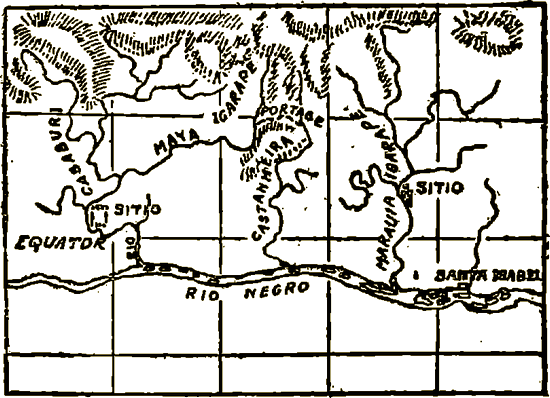
I CAME down to the Marauia igarapé to join my energies with the Red-Head. For this Marauia, while we call it a creek in comparison with the Rio Negro, is considerable of a river itself. It winds back into the low-lying jungles for at least a hundred miles. Which is as far as I have explored; and with its own sluggish tributaries it covers more territory than I can guess.
The Red-Head had already organized some four hundred of the local Indians into a labor force to gather the tagua fruit and to build canoes and sheds and so forth. Yet in order to make the most of this profitable industry much remained to be done. The Red-One's father had gone home in haste to divert a part of his factory to the handling of our product; and there were his machines gaping to transform our nuts into buttons and a dozen other things of "genuine ivory." So it behooved us to bestir ourselves; for it seems that in the manufacturing world to keep a machine idle is a greater crime than to buy the raw material at a fraction of a centavo more than a competitor has paid.
To build up a business in the jungles—any business, from balata to feathers—hinges upon a single element. Labor. Of what value would be millions of tagua fruit in an exclusive tract if there were no labor to collect it? Yet all the available labor seemed to have been organized already. Four hundred men and their families, you must understand, are a considerable populace for a territory of a hundred miles or so square in the jungles; though men of the cities, who do not understand, are surprised, having an idea that in the tropical forest life is prolific.
But this is the natural law and it is very simple. It is farming that permits people to live together in large communities—the planting of grain and the raising of meat. Men who live mostly by hunting can not live in communities any larger than the surrounding jungles can supply with meat. So that, even where a site for a village may be most favorable, it can not be utilized if too close within the hunting range of the next village, which is some fifteen or twenty miles. Our Marauia, therefore, was populated almost to the limit. We were at odds with a natural law, which is no easy thing to circumvent.
But the Red-Head shrugged without a care.
"The question is one only of food," he said.
"Food is easy," said I. "The Black Water above Santa Isabel breeds the hugest pirarucu of any part of the river. If we but announce that we are in the market for it a hundred fishermen will set out to spear and dry great stinking slabs of them. A few canoes detailed to that commissariat transport will easily keep up a steady supply of the foul stuff, enough to feed a thousand men. A few other canoes sent up to Camanaos, where the sauba-ants are not bad, will bring down mandioca or farinha meal; and with the two we will have a food supply which will be a delicacy to these creek-dwellers. But a food supply does not breed men all in one season."
The Red-One only laughed with all the confidence of the youth of North America.
"Good," said he. "If food is so easy, let us immediately send word-to the fishermen and to the manioc-cultivators so that they will be ready for us, and let us go and get a thousand men."
"That is good talking; but let us hear something about the doings," I told him; though I did not jeer as readily as I might have done in the beginning of our acquaintance; for I knew by now that he might produce at any moment the most unexpected of plans.
He chuckled; and I knew then that his quick wit had once again outstripped my experience.
"Who but yourself taught me," said he, "to control my labor through the ipagés? Through my witch-doctor have I organized my force of four hundred and kept them in hand. Let us go, therefore, to that old scamp; for he is a very wise man."
So we went to the chief ipagé and made him a present of a small bag of sugar; and told him our problem. And he said at once, as I had said, that labor was a question of food. But, food was arranged for, we told him; and when he understood our arrangements he marveled and said that the cleverness of the white men was wonderful to behold; never had the jungle Indians, starved though they might be, thought of such an arrangement. And the rest was easy then, said he. If food could be available, men would be no difficulty at all.
So he took our carved sticks and added a pattern or two to them and sent us to the chief ipagé of the upland villages at the far ends of our creeks; and we gave him presents of empty bottles and matches and such stuff and told him our need. And he grinned and said:
"For my brother of the Marauia I will do this thing. But these presents are not enough."
So we gave him a good sheath knife in addition; and he told us to go away for five days so that no blame would attach to us, and then to come back and talk to the people. We dropped down-creek a day's journey to lay up for a while; and we made a holiday of it, which we felt we had well earned after our breathless chase of those bandits.
We went hunting and made wagers on long shots—ten milreis for each pair hit and fifty milreis penalty for each miss; and in this I won money. For while I do not attempt to compete with the Red-Head with a pistol—that being the national weapon of his country—with a rifle it is different. I have lived twenty years with a rifle in my hands; and twenty years of practise count for something.
So I won the price of one of those new German rifles of small bore and unbelievable velocity; much to the chagrin of my friend, who does not like to be beaten at anything.
And in the meanwhile the ipagé up there did—1 don't know what he did. But all those headwater villages fell sick with a griping of the belly; and the ipagé called a big devil-hunting and performed his mumbo-jumbo and what not; and then he and all his lesser witch-doctors made pronouncement that the Jurupari of the jungles was strong against those villages and that the only thing to do would be to abandon that country for a while.
THEN we came back most providentially and told the people that we would be ready to welcome them lower down in the Marauia and that there would be no war with our men on account of food, for food would be supplied to every man who worked. And, basta, that was all there was to it; though that old thief of an ipagé told us that he had promised presents to some dozen or so of his lesser wizards on our behalf.
To transport a whole tribe just to suit our labor requirements sounds like a feat of a powerful king. Yet was it not by the knowledge of how to do it that the great Colombo balanced the egg upon its tail? And again, is it not by holding that superior knowledge that one rules as a king?
So were we kings in our Marauia country. And after all, what is it to move a jungle tribe? Nothing. Given evil spirits enough to haunt them, they move of themselves. The jungles are full of deserted molocas, moldy and overgrown with the wild granadilla, because some devil-devil thing frightened their inhabitants.
These up-creek people loaded their few pots and weapons and ceremonial dancing gear into their canoes and sent them downstream. They themselves followed along the shore. Within a month they were established.
These are a communal people in those jungles, you must understand; and, as such, they have an extraordinary knack for working all together for the community's good and so of making the most of their joint energy. We established them at selected sites along our creeks; and within the month, as I say, they had built their great community barracks of split chunto palm and thatch and were established and ready to work.
We went similarly to two other upland communities at our creek ends, with presents and a good introduction to their ipagés; and in each case the evil spirits of the jungle worked loyally in our favor. Something more than a thousand men with their families we brought down to our tagua grounds and they had no cause to complain.
Our commissariat department was running smoothly and for the first time in their lives those people were sure of their food supply—which, in the jungles, let me tell you, is a precarious question. All those expatriates were living as they had never lived before; and they began asking themselves why they had not thought of this splendid plan long ago.
Yet all that was not accomplished without work and much careful organization on our part—or, I should say, rather, on the part of the Red-Head. For it is my observation that a genius for organization seems to be a heritage peculiar to the Americans of the North which we of the South do not understand so well as yet. The plans were his, and I but supplied out of my experience the suggestions as to how they might be adapted to our environment.
When it was all over; when all the planning and running back and forth and settling of our people was done, the Red-One at last was ready to stretch his shoulders and wrinkle his nose and grin, and to say to me—
"Amigo, do you know what we have accomplished, you and I?" And I said:
"Assuredly. We have imported a labor force of a thousand good men." And he:
"Yes, a thousand men we have; good hunters and good canoe-men and good fighting men; but shiftless Indians all, who do not like steady work. Have you thought how we are to control our labor, now that we have got it?"
And I answered that, of course, we would control, it as he had controlled his four hundred —by making presents to their ipagés and holding the thread of witchcraft over the lazy ones. It was very simple for one who had once learned the trick of playing in with the witch-doctors instead of against them. But he said, yes, it had been simple with his own ipagé of his down-creek people; but with three others, new importations, each jealous of his prestige, who could tell what factions and what intrigues would arise? And he laughed again and told me:
"It is simpler even than that, amigo. For, consider—our promise to them is that there shall be food in plenty for every man who works."
And I, as the weight of this thing broke in upon me and I understood the full power of it, I laughed, too, and shouted out of a full heart and I embraced him; whereupon he condemned me to perdition with the appalling sacrilegious oaths of the gringos; for, though he was now an up-river man, one of us, there remained some of our ways which he could never abide.
But I continued to laugh for a whole day. For we had built up in our Marauia there what had never been on the river before—a great and absolutely dependable labor force. And with labor to be relied upon as surely as the crop which the good God furnished each season, and with a market gaping for our product, what possible thing could stand in the way of an assured and wealthy future? Had we not a right to laugh?
THEN came the missionary. I said—
"Drive him out."
Though this one was not as bad as some. He came, not with a somber face and a breviary and an obsession to put cloth upon the naked heathen and thereby to save their souls. He was of some foreign sect or other; I could not detect by his accent from what land; and he was one of those more sensible ones who believe that the way to a savage's soul lies through his material advancement. So he brought a world of enthusiasm and a canoeful of trinkets and another canoeful of seeds to teach the Indians how to alleviate their lot by growing corn and beans and such stuff.
Of what use to tell such a man that our Indians were well supplied with as much variety of trade-goods as they needed; that they were better fed and generally much better off than a hundred communities who had greater need of his ministrations?
Of what use to tell him that the growing of crops in the Black Water is governed, not by man's industry, but by his own good God, who sends the sauba-ants; that only here and there are places—as at Cananaos—where the ants, for some inscrutable reason, do not prevail in such swarms as to eat up the planted crop as soon as the roots began to show succulence? No use at all; for the reasons that sway missionaries are as mysterious as those that govern the sauba-ants.
So I said to the Red-Head out of my experience:
"Amigo," I said, "experience is the one teacher who is always right. Never was a missionary who did not result in trouble. Let us chase him out of our country."
But the Red-One had his national feeling about missionaries.
"No," he said. "We can not treat a missionary so."
And he proceeded to tell me with a queer twist of his racial pride how many millions of dollars were donated in America every year for the saving of heathen souls by good people who hoped thereby to buy salvation for their own souls. The enormity of the sum gave me a cramp in my belly; it was more than the revenue of the whole state of Amazonas.
"Meu Deus," I said to him. "That is a miscarriage of wealth! Well, you have had opportunity here to see something of the results. At the time of the great war it was told as a wonder to gape at how many thousands of dollars it cost your wealthy North America to kill one man. It seems to me, my friend, that it costs as much to save one soul."
But he insisted only that we must at least show hospitality to this wandering missionary, for they were very good men.
"Assuredly," I agreed. "They are men of great nobility and sacrifice."
In which I was not jeering at him. For I have seen the unspeakable hardships which they, inexperienced men, have endured in the jungles in order to carry out what is their conviction of their duty. But, unhappily, nobility of character does not of necessity carry with it an equal supply of wisdom to deal with practical matters. As I said to the Red-Head:
"They are good men; and without doubt they are good for the Indians among whom they settle. But they are not so good for) us who employ those Indians."
But he launched forth into a long exposition of a doctrine that Indians were also human and that the rights, even of employers, were of no greater importance than those of workers; and that in his part of his country—and so forth, without end.
It was easy for me to understand how a people of so sentimental a frame of mind could supply so many tons of good money for the uplifting of the savage. But I interrupted him.
"I am a man who believes in experience rather than in theories," I told him. "If I have no experience of my own by which I can profit, I am ready to profit by the experience of others. Tell me, then: Is there one instance in the history of your so sympathetic part of your country where one has removed three communities of Indians from their habitation—of their own free will, without violence; and where one has transplanted them to a better environment and has kept faith in all matters of trade-payment and food? If there is, tell me the story of it and let us both profit therefrom, instead of losing our heads over a theory of altruism."
But he knew of no such story, and insisted only that in his country conditions were different.
"Rubbish!" said I. "Indians are Indians and white men are white men, and their ends do not meet. You and I, we know the trick of serving our own ends and of keeping our men satisfied at the same time. All around us are white men and Indians who are at variance with one another. Let us send this missionary packing to some other community that needs him."
He was forced to admit the justice of my stand. Yet, as I have said, it was the heredity of his home town to be as appallingly set in his convictions as a missionary himself; and he argued far into the night that discourtesy could not be shown to a holy man. So the upshot of it all was that the man stayed in our country. And trouble, of course, came of it.
WE DID not see much of him. He was, as a matter of fact, a furtive sort of person who would rather dive into the darkness of the big trees than come forth and make a sociable visit. This one, different to many others, had an obvious experience among the heathen. The suns and the rains and the fevers of the jungles had reduced him down to a leathery covering of sinew over his bones. He was one of those who had survived and was left with nothing for disease to take hold of. A tall, gaunt fellow with a high forehead and hunted eyes. I have met others like him before. Students of books oppressed by their own consciences.
This one refused even the hospitality which the Red-Head offered, and preferred to live, attended by a couple of his faithful converts, in his own two dug-out canoes in the most uncomfortable manner that could be devised. This was the rainy season; and believe me when I say it, a dug-out canoe with a palm-thatch shelter thrown over one end is no place for a human to live in the rain.
We ourselves had not much to do, beyond establishing our newly imported people in comfort; for our crop was but ripening and the labor of collecting could not begin till after the monsoon. So we—even I, who have nothing against such men personally—would have been glad enough to invite him in to our comfortable hut perched high on stilts out of the wet and to play a game of cards or to roll the dice occasionally. But he preferred to go voyaging forth on his mission up and down our creeks, driven always by his fear of his own pernicious conscience.
I was even becoming content to let him come and go at his will. But our ipagé came to us and said—
"Kariwa, give me leave to kill this white spirit-doctor who comes among us with his base magics."
I smote the Red-Head with my elbow in his ribs and said:
"Was it I who told you or was it not?" And to the ipagé, "Before we talk of killing, tell us what evil the man does."
He planted his ghost stick into a crevice of the cane floor and squatted behind it. It was not easy for him to make a charge. But he said:
"How can one make a charge against a wizard before his wizardry is complete? I know only that he deals in the lower magics with grubs and with earthworms as do the foolish tree-dwelling sorcerers of the homeless Maku tribes; he does not use the warmblooded beasts as we do."
The Red-Head laughed and said—
"That is little enough reason to kill a man."
But the old wizard added another and a weightier reason.
"Kariwa, the sorceries of such a man do not matter to us of the higher magic. I am not afraid of them. But among the common people are always ignorant ones who run after any new trickery that is more in keeping with their own monkey understanding. By his running up and down in our jungles and by his scorn of our ways, breaking the tabus of custom and laughing at the things of the dark, that white man is spoiling my influence among my people; and the red Kariwa knows that my influence is necessary."
"Aha!" said I to my friend. "There is the inevitable trail of the missionary. This is my observation out of my experience. The closer they may be to saints and the greater their own capacity for faith, the more incontrollable is their urge to persuade all other people among whom they come to think exactly the same way as they do. And this is a truth out of all the earth's history that the beliefs of no people can be suddenly upset without causing disruption of the community which has grown up in those beliefs. My friend, my judgment out of my experience has given way to your whim out of your sentiment. But it is now enough. This man must go."
The Red-Head scowled ferociously and picked at the seam of his breeches with his big red hands. So clear was it that he was struggling with his inherited convictions that I had to laugh. But he said at last:
"I am forced to agree with your experience, Theophilo. We can not afford to harbor such a source of trouble. But let us at least give him grace till the rainy season shall be past; it is not decent to chase any man out to seek a new lodgment during the rains."
With which I was well enough content. And to the ipagé the Red-Head said:
"Old wise one, let us make an agreement. Do you protect this man from death for a little while yet; and in the meantime, in order to uphold your influence, tell your people that you will make so strong a magic as will compel the two white Kariwas to drive that other white man out."
And with that the ipagé had to be contented too. But he grumbled as he gathered up his stick and his magic bag and muttered that ill luck would come of it.
"Evil will come of permitting this monkey magic with beetles and things," he insisted. "Such an affront to our art should not be permitted. But if the Kariwa protects the man, well, let it be; but ill luck will come of it."
And so, grumbling, he went away. The Red-One looked at me and laughed; and I said:
"They are all alike. Whether white or black or brown, they are all intolerant of another priest of another sect."
But the old wizard was right. Ill luck surely befell us in heaps.
THE first was a sudden information from our commissariat department that the price of fish had gone up. "Gone up?" we wanted to know. "What is the sudden reason for pirarucu to rise in price?"
But our men did not know. All they could say was that other people up the river were buying fish and so the supply was short.
"Qué diablo!" we exclaimed both at once. "What is happening all of a sudden in the outside world?
We had been so busy in there in our jungles with transplanting our new tribes—what with getting them satisfactorily settled and putting them to hewing out new canoes and apportioning the limits of their hunting ground and so on—that we had had no time to go down into the big water; nor had there been need. But this was something else again. That people were buying fish farther up the Rio Negro where there were almost no people was a matter to be looked into.
So we took my batelão and six paddle-men and made the two days' journey to the mouth of our creek and into the discomfort of the big river. Discomfort, you must understand, because there in our creeks, overhung and roofed in by the thick trees, the rain was no more than a drip; heavy enough to beat in the thatch of a house, but after all, straight; for in the jungles, of course, there is no wind. But out on the open river—celestes, what a sheet of water that was for steady hours at a stretch. No place for a batelão which, in spite of its roofed after-half, required to be baled every hour.
However it was clear that this demand for fish meant that something unusual was happening; and it is my observation that he who gets information quickly of unusual happenings thrives best on the rivers. So we accepted the discomfort, as jungle men must, and dropped down another day's journey to Santa Isabel; and there we learned news indeed.
No less than that this Sylvestra fellow to whom we had donated h)s life had leapt about the city of Manaos, gnashing his teeth and swearing that he would run us out of business if it cost him the whole of his fortune. The Red-Head was inclined to laugh. But I said:
"This is not so much of a joke, my friend. For when a man of wealth means to do a damage—few things are impossible for him."
As indeed was the case. For this Sylvestra, as I have said, was no fool. What he had done was this: A little inquiry among those bandits in his pay who knew the upper water elicited a hint or two, which Sylvestra was quick to grasp. A little exploration, sending out those river-rats at his own expense, had discovered tagua again in the Cababuri Creek, some hundred miles or so above us; and, basta, a rival business was to his hand.
Money, of course, made everything easy. Where we had to build up slowly and with care, all that he had to do was to send up men and boats and supplies; and there in the Cababuri he had established a very prince of ladrones to set up an organization of workers who would be ready to begin collecting the nut crop as soon as the rains should cease.
I knew the fellow. One Manduco, who was a famous river-pirate, a bold snatcher of lesser men's goods. His system of robbery was simple. He would descend by night upon some lone batelão with a crew of choice cutthroats, breeds all of them as black as himself and every one of them naked; and they would thoroughly loot the boat and disappear; and in the morning the tale would be that a gang of bold wild Indians had made the raid.
It was a silly trick and all the river knew of it. Yet the fellow was crafty enough so that many feared him. Though I have laid up alongside of him more than once and have slept ostentatiously in a hammock slung between the tree-trunks ashore, hoping almost that he might attempt a coup, for I knew my own crew and my capitão. It appears that he must have known something of their reputation, too, for he always remained a perfectly satisfactory neighbor.
He was a clever enough rogue, was that Manduco, and he had at some time previously played politics with some of the other brigands in the government, so that he had been appointed agente dos Indios, Indian agent for the upper river, which gave him license to conscript laborers whenever they might be required for the public good. Which meant that up there, where there was no one to say him yes or no, he could impound nut-gatherers wherever and whenever he could catch them.
But beyond petty robberies he had never accomplished much hitherto beyond killing a score or so of Indians who were slow to obey him and generally oppressing the jungle folk to further his own aggrandizement. Now, with all the financial support of the Sylvestra behind him, he had expanded like a dead manatee in a stagnant pool.
King of the Rio Negro, he was calling himself; and I could well picture to myself the bloated state that kept up there, surrounded by women and browbeaten attendants and having at his disposal all the Indians whom he could catch and frighten into working for him. It was the makings of a strong organization that the ruffian had in the Cababuri igarapé. Small gratification that our informant told us with a grin:
"But for all that, the talk on the river is that he does not feel himself any too secure when he has Theophilo and the Peloroxo to deal with; for he has.built him a regular fortress with a palisade of pointed stakes at the mouth of his creek and has filled in with tree-trunks so that only a narrow passage remains, across which is stretched a great chain."
Yet the Red-Head shrugged with his eyebrows and laughed, as he was always ready to do, whatever the situation.
"Let him be," he said. "He can't hurt us. Let him organize a working crew. We are ready ahead of him and our men are satisfied, as his will never be. Furthermore, if he perfects an enormous organization and floods the world with ivory nuts, what does it matter to us? Our market is in our own family, and all that we have to do is to keep the machines going in the family factory. Ours is an unbeatable combination, Friend Theophilo."
Which of course, was true; and there was comfort in the thought. Still I cursed myself for a fool. I knew this Cababuri water, though I had never explored it very seriously; and I had suspected before now that there might be tagua in the back creeks; for they must perforce take their rise in the same long range of hills running east to west where our water came from. Yet how was I to know that this Sylvestra would suddenly develop an energy to send scouts through all that country before we would be ready to take it over?
I was reminded of what my good friend the Padre Balzola, who was very wise, had so often told me.
"Hate is a force more powerful than any other, my son, for the devil himself fosters it and helps it along."
And so I told the Red-Head. But he shrugged and said:
"The high-born mestizo, when he threatened like an angry ape' on the wharf, told me to wait and he would get even. Well, let's go home and wait. He can't touch us and it is a teaching of the business college of my home town that a legitimate competition never can fail to be a healthy stimulus to trade."
Well, what was there to do but to go back to our own water and spend the remaining weeks of the rainy season in perfecting our organization; apportioning men and canoes, so many to each; marking out collecting routes for our new men, appointing captains of districts and under them so many men to cover so much ground; arranging storage depots where the canoes would call; sending scouts to observe and mark off the areas where the crop was ripening first; and so forth?
A hundred matters there were which had to be attended to so as to be ready for the collecting; and we were well content; for we knew that with our good start over those rivals of ours and with the good-will of our men we would ship out more nuts than they in spite of the wealth that was behind them; and while, as the Red-One said, we had no cause to fear for our business, it was a matter of pride with us that we should not be outdone.
So we sweated along and had no worry till the rainy season began to thin out and presently passed.
And then the ill luck that our ipagé had prophesied fell upon us like the Amazon flood.
THE first of the nut crop began coming in, and, maldiça d'Deus, it was worthless! A good eighty per cent of it was drilled by borers. Some accursed grub or other had invaded our forests and attacked the fruit while it was yet young and pulpy; and their tunnels went through and through in every direction while their nests filled the outer skin with a webby brown powder.
I, with all my experience had never seen the vermin before. Nor had I anywhere heard of so wholesale damage. One must expect a certain small loss in any jungle produce, of course; though never very much, for it is a simple law of the jungle that only such things persist as have developed an immunity against pests. But this was a plague of the Egyptians. We were infested.
Load after load came in from our collecting depots and we fell upon each fresh consignment with palpitating hearts and split open, not one but a thousand of each, and laid bare by the hundred the work of those demoniac insects. We looked at each other in consternation and what was there to say? Nothing, except to call upon the name of the devil with each new testing.
This was ruin. From whatever end of our jungle the stuff came in, it was all the same; all bored into a filigree by these accursed grubs. We who had flaunted ourselves that we had an unbeatable combination, we were hanged by our very rope of security.
The two of us could well subsist for a season or two on our previous profits; or, if need be, we could turn our hands to a dozen different trades of the river. We could feed ourselves well enough without anxiety. But those machines over there in the family factory that demanded feeding more insatiably than an army; it was on their account that we felt the sinking of our stomachs.
The Red-Head was more desperately hit than I. I had not been on the Black Water for twenty years without seeing my ups and downs; and never so far down that I could not see an up-grade somewhere on another road. But then, I stood by myself, with only myself to care for. With my partner it was something of a more desperate matter. Not that he could not look after himself, he had wit enough to find a dozen new businesses. But those machines at home. They represented a big investment which his father had put in in order to strengthen his son's business out here.
It had been a hard battle to win the old man's confidence; and the old man, in his turn, must have gone through an even harder battle to persuade the patriarchs of the family that the young one who refused to follow in their own well-ordered footsteps was worthy of confidence. And now this last of all expected luck had descended upon us.
It was on that account that his ruddy face went gray and his so-careless eyes were filled with pain. Yet what could we do? Can man fight against the sudden viciousness of nature? The Red-One, however much he might try nowadays not to make a rude comparison, could not hold himself from harking back to the superiority of his home land.
"Back home," said he, speaking hopelessly, "there is an institute of the government which, if an industry is menaced, will send out, free of all charge, men who are experts in all things that grow as well as in the pests that attack them; and they will study the condition and find a remedy."
"Such an institute is also at Para," I told him. "Though not free. At a cost one can import a scientifico who knows the ways and the whys of insect pests. But when a man has once been struck down by such a catastrophe, from where is he to find the cost?"
Cien diabos, that was just our case. We had put all our earlier profits into expanding our business so as to justify the installation of those terrible machines and to keep them going; we had invested in tools and trade-goods and food in advance to build our organization for the profit to come out of the future. This season would have set us, on the firm road; and here had the Evil One himself descended upon this season. All the government institutions in the world could not mend that.
Never had such a prophecy of ill luck come so terribly true. The ipagé came to us, of course, and he was grieved, for I think he loved us as much as a wizard may. But he could not refrain from telling us that he had told us so; and he added with ill-omened conviction that worse would come of it yet; for under our orders he had protected that low magician whom he should have killed long ago; and the man was still alive and was continuing his foul spells with crawling things away up at the head of our creeks now.
On a sudden we looked at one another, the Red-Head and I; and I knew that he could read the thought that was in my mind. Crawling things! Why was our ipagé so insistent with his talk about base magic with insects? We had laughed at his superstitions; but what was this fellow doing up there? Missionizing, he said; but how many of the heathen had he converted? I could think of no immediate connection. But, Sylvestra, was my suspicion. That man was as cunning as a bush viper and a hundred times as vicious; and who knew better than he the weak places of a business?
So I looked at the Red-Head and he at me, and his eyes became narrow and he said to me, speaking softly, as if one might overhear—
"Who other than himself told us that he was a missionary?"
I nodded. That was just what was coming into my mind. And I crooked my finger at my capitão, who squatted in a thin patch of sun before the split-cane veranda of our house.
"The batelão," I told him; and he put his fingers to his lips and whistled like a chicken-hawk; and in a moment the boat's crew were running from their huts and throwing off the lashings.
That is how I like to be ready at all times; for it is my observation that he who remains readiest for whatever call may come in the jungle lives longest. The Red-Head reached his arm within the door for his rifle and pistol-belt and he, too, was ready.
We took the ipagé with us and on the way we questioned him with a very much more respectful consideration of his superstitions about base magic. The man was now ahead of the Murucuri Creek, he said, a day and a half's journey away.
"Where the crop ripens late," grunted the Red-Head with meaning. "The man may be all that he says, and we can not be hasty; but it must be admitted that his mysterious aloofness lays him open to suspicion; and who knows but that this magic stuff may have something to do with the ripening?"
And what about this magic, we wanted to know. What did the man do?
The ipagé threw out his lean hands and spat between them over the side of the batelão. What did he know about such magic, he grumbled. It was not his office to spy upon the crude fumblings of the homeless jungle-dwellers such as that white charlatan.
But this he did know from the reports of his neophytes whom he was training in the higher wizardry. That the man made a magic first with pieces of wood which he clapped together and made an incantation over them, and lo, he had a box; and in such boxes he nurtured the grubs and worms and things which were the fetishes of his religion, exactly as did the wizard of the wandering Maku tribes.
This was all a queer claptrap of a ceremony to me; but the Red-Head grunted and said—
"Those pieces of wood which turn into a box sound like a portable hive or something."
And I added to that—
"Not the paraphernalia of a missionary, amigo, who should deal rather with a portable chapel."
And to the ipagé I said,
"Old Wise One, let the word go out among your people as we travel that no light canoe may go ahead and bring word of our coming to this homeless tree wizard."
And so it was that we came to the headwaters of the Murucuri Creek in our foot-hills without warning. That is to say, without warning to our supposed missionary. Though we had warning enough as we drew nearer to his camp; for at the sight of our ipagé squatted there in the bows of our craft, the few Indians whom we met from time to time came and told us everything.
So when we were still some three or four kilometers below the camp we left our batelão; for a batelão is a heavy boat and it is impossible to propel it without a certain thumping of paddles against its sides; and we lay down in the canoe of one of our outpost nut-gatherers and stole up the creek, the Indians dipping their paddles with no more sound than a fish; which was a most necessary precaution, for in those narrow creeks, walled in by solid jungle on both sides and roofed over by the interlaced branches, sound hangs low and travels along the surface of the water for unbelievable distances.
We came upon the little clearing of the camp all unannounced, ourselves lying most uncomfortably upon our bellies in the wet bottom of the canoe, I for my part with my rifle thrust through a hole in a mat before me; for a man who might be capable of doing what we suspected this one of doing would be no fool and would be a man to be wary of.
A WRETCHED enough camp it seemed to be; poor enough even for a missionary. A lopsided tent stood under a tree and the most meager of gear lay about; some paltry clothing hung from a line and the two canoes were drawn up on the bank. How the man must have survived through the rainy season was a wonder. Whatever he was and whatever he might be doing, it was clear that he was an enthusiast who would sacrifice everything to the furtherance of his work—even as a missionary.
He did not see us at first. He sat upon a box, busied with some writing, till one of his Indians called his attention and pointed silently with his chin at our silent approach. He jumped up, seemingly annoyed at having been surprised, and came down to the bank, demanding bruskly in the Geral dialect what did we want. And then he saw us.
At the same moment I knew that, whatever might be the man's business, he was guilty. His face was already gaunt and haggard from the hardship of the life that he had been living; but it leapt suddenly beyond all emaciation and became a death-mask. But only for a second. The man was no dull wit; he was an intellectual, and he gained control of himself immediately. But it had been enough. I sat up and grinned at him.
"Bons dias, Senhor Missionario," I said to him. "Since you do not come to visit us, you see we come at last to visit you."
He was able to smile like a starved wolf and to return the greeting; though he made no move to invite us to come ashore and accept the small coffee of courtesy. I could see that he was thinking desperately. So we stepped ashore without the invitation and walked toward his meager camp with all eyes open for we didn't know what. There was nothing to see, of course. A box or two which might have held food but which drew our attention on account of our ipagé's denunciation of magic boxes; but that was all.
Yet he saw us look, and I knew that his conscience told him what was in our minds. What was behind his high forehead I could not guess; but never did I watch a man more carefully. As for the Red-Head, he was ever a man of direct action. He walked to the nearest of the boxes and poked at it with his feet.
Then the man found speech and seemed at last to remember the conventions of hospitality.
"Ah," he exclaimed. "I am being most impolite. Excuse a moment, senhores."
He stepped to his tent and stooped under the flap. So easily it was done that for a moment my vigilance relaxed. But, graç' Deus, my ears are trained to fine hearing from many years in the jungles where the ears are more important than the eyes.
I detected a soft click from within the tent, a sound that was too familiar to be mistaken. In the same instant I snatched my friend by the arm and hurled the both of us flat upon the ground in the direction of the nearest tree.
As we rolled the report roared from within the tent and the ball racketed away among the bushes. All in that one second's clarity of thought that comes to one in tense situations, it seemed to me, even as we rolled, that the ball clattered among the branches higher than there was any excuse for at that short distance; and as we gained the shelter of our tree without another shot, I was already saying in my mind that the man was a poor hand with a gun.
Different from the Red-Head. For even as we rolled he contrived to snatch his pistol free and fire. But what could he do? The man was concealed within the tent and we were scrambling in mad haste for our tree. A stout Soleiman it was, of a good meter and a half of girth, and as we rolled over on our bellies behind it the Red-Head turned to me and grinned with the cheerfulness that was his habit when a fight was toward.
"That at least clears the atmosphere," he said to me. "For it is evident that, whatever else he may be, he is no missionary."
"Good," said I. "If your conscience is then clear, do you shoot from that side of the tree and I from this. Low, for he will be lying down on the floor of his tent. In three or four shots apiece we ought to get him."
But the Red-Head held my hand and said:
"No. If we kill him we shall be able to learn nothing. And there is much about this business that we must find out."
That was a good thought, and I immediately agreed.
"Bom," I said. "Let us find out first. Doubtless we shall find a means to make him talk. The question remains how to get him alive."
"That should not be so difficult," said the Red-One.
And it was my turn then to throw myself upon him and hold him down with all my weight, for I knew what sort of a foolhardiness he was prone to commit. He would just as soon have walked forth and demanded a surrender, relying on the speed of his own pistol. And in the open, where he could see the other's movements, I would just as soon have let him. But a man hidden in a tent was another matter. So I threw myself upon him to hold him down. But he pushed me from him, grumbling.
"Get off of me, fathead," he growled. "You give me credit for being as great a fool as yourself."
Well as he learned our ways and manners, he had never outgrown that North American privilege of being insulting toward his friends.
"Well, then," I said to him, without taking offense, "how do you propose to get him?"
"Perhaps," said he with a grin, "he is not so great a fool as either of us and it may be that he will listen to reason."
He thrust his head round the circle of the tree and called to the man:
"You there, insect-worshiper or whatever you are, we give you a chance to live. From here we can rake your tent through and across with ease and safety; and if you think to escape out of the farther side our Indians will give us warning and we can cut you down before you will be out of the clearing. Now then, if you will throw your guns out of the tent first, maybe we can talk."
It was true; the man was not such a fool. He hesitated but.a moment, and then he came out of his tent himself, with empty hands, and slumped down in the uttermost dejection upon one of his boxes. There was no fight left in him. And indeed it had been clear from the first that he was no fighting man. Let me say rather, not a fighter of men; in which distinction there is a considerable difference.
Squatted there as he was, in his ragged clothes, with his long knees drawn up and his head sunken between them, he presented the very picture of a most disspirited adjutant stork. We arose from our bellies and stood before him; I, not without a certain pity for the man's complete breakdown.
The Red-Head pushed his pistol back into its holster and with his hands in his breeches pockets addressed him judicially.
"My most foolish friend," he said, "what we shall do, we do not yet know. Much will depend upon how cleverly you can lie to us. Proceed, then, and talk."
The man slumped yet lower and remained silent awhile. Then he shrugged wearily and spoke—brokenly and in short sentences, as if reviewing his past.
"No lies," he said. "What is the use? I am caught and the evidence is in these boxes. I'm just as glad it is all over; because—¦ It was a foul thing; for you fellows treated me like white men. But—I needed the money. O God, how I needed the money to continue my investigations!"
There spoke the student. It was written all over the man that he was of the breed of enthusiasts who would brave anything and sacrifice everything for his particular study. Forgetting completely our side of the matter; not speaking of the damage he had done to us, he waxed eloquent over all the lifetime that he had devoted to the observance of lice and all manner of crawling things, and about his need to prosecute certain further investigations which would prove to be of the utmost benefit to mankind. But the Red-Head interrupted him.
"Yes, yes," he said. "I begin to understand. I have met such as you before in the colleges back home. 'For the sake of science'. I know. And we—our business here—we are but the pawns to be sacrificed for the greater end. But tell us, rather than your scientific ambition, just where my enemy, Sylvestra, comes into all this."
SO THE man told us without further concealment. He was of that institution in Para, the Museo Commercial; and Sylvestra had sent for him and had bribed him with a certain sum. He hesitated to tell us the amount but finally confessed; and pitifully small it was, yet sufficient to furnish the funds for his future work on some pest or other. So he had sold himself and had brought up to our jungles a crate or two of his cultures of these boring creatures that lived upon the pulp of immature palm nuts and tagua and such fruit.
He gave them a long name which I have forgotten; and he explained that their habits had been well studied on account of their damage to the palm-oil industry of Belem; that they hatched out from eggs with the prolificness of sin itself in the form of voracious grubs that ascended the trees and grew fat upon nut-meat till their time came to turn again into beetles.
All this was a very marvel to me, who had thought that beetles were beetles and grubs were grubs. But such is the miraculous power of science. By a few milreis worth of vermin we had been destroyed. What good did it do us to know that our ruin was not at the hands of nature but of a tame and carefully nurtured insect? And what could we do with this man who had obliterated us in order that he might win the money to save perhaps a million others whom we would never know?
I shrugged and looked at the Red-Head; and he smiled with his mouth all awry and said only:
"A wise old wise one is our ipagé; and we have been fools. We should have paid more attention to his talk about insect magic. The lesson that I learn out of this is: Listen to the priests when they talk; for all of them, whatever their cult, know something of men."
So we stood and looked at the man all humped up upon his box of worms; and it was doubtful whether his misery was not greater than ours. My partner looked at me; and what could I suggest? So presently he shrugged too and told the man:
"Senhor Scientifico, you have done us a foul harm; but I do not know whether you have not done a greater harm to yourself. What can we do to you that will help our case? The prosecution for our quarrel, it seems, is with the Sylvestra animal."
Thereupon the man looked up with eyes like an animal that has been trapped and suddenly sees hope. A full minute he looked so, peering darkly from under his brows; and then he leapt to his feet and swore aloud by God in heaven that we were princes of the earth and the noblest of white men, and a lot more of the complimentary things that people of strong emotions rave when they are overcome by their sentiment.
And he said that, while the damage for the season was done, except for a small portion of our late crop where he had not yet loosed his pestilence, he could cure it for the next season. For, he said, one fought insect pests with other insects and the studies on behalf of the palm-oil industry had disclosed some louse or other that devoured these lice during a period which they must spend in the earth around the roots of our trees before they could complete the cycle of their noxious existence.
Once again he was becoming enthusiastic about his culture of grubs; and I could not refrain from marveling at the wonder of science which could devote such patience to the study of crawling things. It was truly as our ipagé had said—no less than an insect worship. But I reminded the man:
"All very fine, my friend. But there is a cost to be considered; and over and above that is the immediate consideration of this season which goes further than a ruined crop. It extends all the way to North America, where are insatiable machines and exorbitant workmen who can not be fed upon worms."
Whereat he hung his head. But he vowed that if we could by some manner of means survive this season he would sacrifice his year to repair the wrong that he had done; that he would import his pests, the eaters of pests, and would, further, paint our trees with rings of some marvelous poison that would effectually bar such of the latter as might escape the former, and so our forest would be clean again.
And more, he would provide a fertilizer and would teach us methods of cultivation that would make our crop the finest that had ever been. All this restitution he would make—'if only we could survive this season.
Well, what was there to do? We could easily keep the man in our jungles to root about among our trees by the simple process of sending out the word among our people that he must not leave our river. But in order to counteract his damage by scientific wizardry it was first necessary that he should return down to his vermin hatchery at Para. And, besides, as the Red-Head quickly remembered, we must keep faith with our ipagé, who had been promulgating the prophecy among his people that he was brewing a magic which would compel us to drive the other white man from our country. So perforce we took the man at his word.
I would have sent him off with a wholesome reminder of who we were; so that he might ponder upon the thought, when the temptation would come to stay in the security of his far-away city, that Theophilo of the Rivers had a reputation for paying his debts and that the Red-Head was no man to let even Sylvestra protect one from a merited punishment. But my friend stopped me.
"No," he said. "There are some men who must be controlled by threats of what will happen if they fail in their agreements; such men as those river rats and fly-by-night traders. But this man is of a differen t kind. By some twist of a hair's breadth his mind was set upon beetles; had it been upon religion, he would have been a missionary and equally a fanatic. They are all alike."
So he told the man:
"Senhor Scientifico, we take you at your word. Go with a whole skin. And when the season shall be ripe for your insect sorceries once more we shall expect you. But be sure to collect your money from Sylvestra; because you have surely earned it; and presently we shall come and take away from him all that he has left."
SO WE let him go, making a great show of driving him out for the sake of our ipagé's prestige; for it is my observation that it is good to be meticulous in matters of this sort. The old man was much pleased, and he came to us on the quiet in our house and was most professionally interested to know what we had learned about this base magic with worms which the decent dignity of his art did not permit him to meddle with.
We laughed and explained to him as much as we had understood about this beetle lore; because the man was no fool and we regarded him as our important ally in controlling all of our wild people of our jungles. But he remained unconvinced. He nodded sagely and stuffed his cheek pouch with a chew of ipadu leaf.
"What that man says about the ways of crawling things may be true," said he. "It may be that he knows all their comings and goings. But by that very reason it is proof that he is a sorcerer of the lower magic, a priest of insect-worshipers."
Which, after all, was not so far from the truth.
However, scientist or sorcerer, we let him go, and we were left with the problem of saving our wreck which we, with our simple methods of dealing, had thought to be unwreckable. What had we ever known about the ethics of a business when it began to grow big? I said:
"Sangue d'Deus, let us go down to Manaos and let us lay up our batelão quietly in the creek behind the new abattoir; and then on the first dark night let us go to that Sylvestra snake's house, and while you battle with his army of servants with your pistol I will stuff a gun rag into his mouth and we will carry him off to our boat and away, and hold him then till he pays in gold for the damage he has done us."
My partner rose from his despondency as I elaborated my plan and his eyes gleamed at the alluring thought. But he shook his head and said:
"No. To kidnap that carrion would be a most gorgeous piece of work, and maybe we shall do it yet as a lesson to him. But to collect a ransom, amigo, is a more difficult matter. Many people have tried that game and many means have been devised; but they all hinge upon one weak joint. The only argument that will extort a ransom is the fear of death if the ransom is not paid. Sylvestra, may the Green One eat him, knows that we will not cut his throat, and I would doubt that we can frighten him into that belief."
"Picaro," said I. "That is the fault of your principles which you have shown him."
For my observation is this: That when there is a controversy between two sides, that side which has certain principles of conscience is much hampered and fights at a disadvantage. This Sylvestra had long ago in his youth lost the faculty of distinguishing between fair dealing and foul. Hampered by no principles at all, he had wiped out not only our season's crop, but all our careful organization of labor which we had transplanted into our country and which we must somehow continue to feed if we would keep them for our next season's recuperation. So I told my foolish friend:
"Amigo," I said, "listen to me who know. One who wishes to afford the luxury of carrying a principle about on these rivers must bolster that feeble thing with a wit or a courage or a determination superior to his antagonist's in order to place himself at least on even terms. Therefore let us demonstrate the first two by catching this reptile out of his lair and the third by cutting off a limb a day until he pays."
But the Red-Head only laughed at me and told me with his customary lack of respect:
"Cease, old grumbler. Who but yourself taught me that there are certain things which we can not do for no other reason than that certain fellows of the lesser breeds do them? And who has preached to me the faith that the luck of the Upper Rivers will attend those who learn the ways and live by the decent laws of the rivers?"
Which, of course, was true. Though that is not a matter of principle so much as decent pride in oneself as a man. One can not descend to the baser practises of the river-rats or of business any more than a naked witch-doctor can descend to the baser magic with creeping things such as Sylvestra had no compunction in employing. Yet, angels of heaven, something had to be done. Quite aside from our present loss, on the rivers one can not afford to let it be known.that one can not hold one's own. And, moreover, even a limb a day would not feed those terrible machines back home.
Nuts they must have. Nuts by the ton before the store of the last season should all be used up. And of all the nuts of the earth none but tagua would serve; though we talked frenziedly of the hard round fruit of the babassou palm—which alas was hollow with a soft kernel in it.
This way and that we talked, discussing even the tough core of the ironwood tree, which might be adaptable. Yet even that would have to dry, to be well seasoned, before it could be used; and long before that those machines would be hungry.
There seemed to be no way out for us in our dilemma. Till presently the Red-One's wit began to recover from the blow that had struck us and he perked his head sidewise, thinking with face screwed up and narrowed eyes; and presently he began to laugh, silently and with a heaving of his belly, till I cursed him and demanded to know what mirth he found in the predicament of those machines which his father had established for the product which we were to supply. So he ceased his giggling and said at last:
"Nuts they must have? Well, who in all these jungles has nuts but this Manduco pirate whom friend Sylvestra has set up in the Cababuri?"
I looked at him with a sudden understanding of the wild thing that was in his mind; and as I reviewed it, 'cremento, there seemed a possibility.
"Father of saints!" I said. "But that would be a stroke worthy of Theophilo and the Red-Head!"
And I, too, fell to laughing till my belly ached. That would be a poetic justice to play on that pirate. We could muster a fleet of some hundred and fifty canoes now which our men had hewn out for the purpose of conveying our tagua to Santa Isabel to meet the river steamer. And now since they had no tagua to convey, what could be more appropriate than to lay in wait and pirate the cargoes of that arch-pirate as they would presently begin to come down? Santos, that would be a jest that would set all the river to laughing with us.
But the Red-Head was ever impatient of what he scorned as half measures and was eager with the restless hurry "of the North to save time by getting at the root of things. Direct action and a bold stroke while the other man was still thinking, was his creed.
"Why must we wait for these cargoes on the rivers?" said he. "What is to prevent us from going into this Cababuri and taking over the whole works? Since Sylvestra has ruined ours it will be justifiable to take his."
I had to laugh again at his so-typical justification of his principles, even though this was a thing that one might do with all honor; particularly since it would not by any means be easy. That Manduco was the accredited Indian agent of the government, and since he had at no time been a fool, he must surely have impressed into his service a large force of workers whom he would keep well in hand under the control of a considerable gang of his hangers-on, ruffians of all the waterfronts, who would be willing enough to serve this bold king of the Rio Negro. But the Red-Head said coolly—
"In my country we don't think so much of kings."
Which I agreed with him to be a very fine sentiment. Yet it had been in my teaching that kings well intrenched have been hard to dethrone. As I pointed out to my impetuous young friend, the position on the Cababuri was well guarded. There was but the one road, and that was by the river which, so we had been told, was fortified with a chain and which, without any doubt at all, would be garrisoned. To leave the river mouth and to hew a way through the jungles would be out of the question because men crashing about with machetes would be sure targets for men lying silently in wait.
BUT he quoted only the exploit of some general of his own country.
"When Hannibal could not come at Rome by water because of the naval defense he brought his troops all the way round by land."
"Doubtless," I said, "doubtless we can make a war against this king, and it may be that by giving all our remaining store of presents to our witch-doctors and by promising more, we may be able to persuade our men to leave their rivers and to cut a road overland through the jungles to make an attack. But I tell you that no man has ever made a march through the jungles of Amazonas. Still, you and I, Peloroxo and Theophilo, we might accomplish it—and then we would be faced with the same problem of hewing our way with machetes against silent men behind trees. And who but yourself, my friend, holds the principle that no man has the right to sacrifice the lives of other men for his own profit?"
At that he remained darkly silent and muttered only that it was so; that he was no statesman or gold-braided military person to order lesser men to fight for his personal gain. Our men would fight readily enough, he said; for they were good men and we had treated them well. But he would never burden his conscience with stirring up a propaganda through the witch-doctors; that was work fit for politicians through their newspapers, not for us of the rivers.
But at the talk of propaganda we discussed another thought; that it would be easy to send emissaries of our ipagés into that Cababuri country who would hardly need to tell those browbeaten Indians how much better off were our people who worked for us, and thus we would undermine the morale of the whole fighting force.
But we dismissed the plan on the ground that such propaganda would take time and would besides surely leak out, and that, however successful, most of those browbeaten ones could be driven to fighting by the well-paid gang of overseers, just like any other soldiers by their officers.
"No," said the Red-Head. "We must contrive somehow to come at this king fellow by water; and we must come suddenly, before resistance can be organized. And to such of our own people whom we take with us we must make it clear that they fight of their own wills and for their own profits which we will promise them, so much in cloth or cutlery per man."
All of which was a very sound theory; particularly the last; for there is no doubt that men will fight better when they know that they are going to get something for it. The question was how was this so-desirable miracle of falling unexpectedly upon our enemy's kingdom to be brought about? The Red-Head called upon me with impatience to use my wits.
"Ho!" he cried. "Think a while; rattle your brains and let them work. You know these upper waters better than any man in all Amazonas. In all these flat lands is there no creek that connects with some drain that connects again with some overflow into the Cababuri above their fortification?"
But, caralhos, does a man know of every seepage in the jungle floor? Only this I could tell him—that just about half-way between us and the Cababuri was an igarapé, a dark and sluggish water that wound away the devil knew where into the jungles. I had followed it once for a dozen miles or so to hunt manatee for their hides to make boat-lashings; and the ground, so far from showing signs of possible canals, was rather dry and gently sloping.
But for him that was enough. His restlessness at inaction was eating him up like a fire.
"——," he growled. "Let us at least go and see, so we may at all events know what is what. Any water is better than a hundred miles of solid jungle."
And he reached his long arm for his rifle and whistled for his batelão. Well, carramba, while it must be admitted that we of the South are prone to let matters slide, I am no man to lag behind. I was ready as soon as he. But I had this suggestion to make out of my experience: That a brace of dugout canoes were faster and much more silent than a batelão; also much easier to hide.
So we took a couple of long, thin canoes with half a dozen paddle-men apiece and provisions for a few days and went off to explore this half-way creek to look for some sort of possible connecting tributaries, such as are by no means uncommon in the flat lands. Though I had little hope of finding any such; for one reason, owing to the ground which I had observed to be dry and rising; and for another, if there were any such opening into the Cababuri, I gave credit to that Manduco fellow for being clever enough not to overlook the proper blocking of it.
And so it turned out. About fifty miles from our water was this creek. Castanheira, the Indians called it; though for what reason nobody could guess; for no castanha grew anywhere near it. We made the run by night; for we did not want to be seen on the river, and our men bent to it and made the full fifty miles between sunset and sunrise; which, let me tell you, is good going against the Rio Negro currents.
A dark tunnel between the trees was this Castanheira and it wound on interminably into the dimness of the inner jungle, smelling of damp, dead things like a sewer from the roof of which warm drops fell upon us; slow and sluggish and deep brown in color; good water for manatee and for the great black otter of Amazonas, of which we got two good skins.
But for our purpose it was hopeless. In three days the rising ground began to rise more steeply and little runs of fast water began to appear, by which we knew, of course, that we were coming to a spur of the same foot-hills where our own waters took their rise.
But the worse that the country grew, the better the Red-Head liked it; and he urged that we continue yet a while, pretending that he was anxious to note the number and distribution of the great trunks of mahogany and itauba which are always of interest to any man who builds boats in the jungles. Till the rising spur on our left rose to become a regular divide; and then at last he was satisfied.
"Look you now, friend Theophilo," he said. "You who know these jungles, tell me. If this water rises on this side of that divide, what are the chances of another water flowing on the other side?"
I commenced to tell him that surely there would be another water. But he interrupted to continue with his thesis.
"And if there is another water on the other side, and if no creek flows into the black river between Castanheira and Cababuri; why-then, that other water must flow somewhere into the Cababuri."
With that logic he leaned forward and tapped me with meaning on the knee while his eyes glowed like a jungle cat's and he concluded—
"The question then, amigo, seems to be—how far will that other water be from this one?"
I made no answer. I but took up my rifle and stepped ashore; and he, grinning like a boy who is about to embark upon a voyage of discovery, followed suit. Two hours of sweating scramble up the slope with our machetes in our hands brought us up to the top; and from there the ground sloped away again as steeply as it had risen; a good indication that the distance to water would be no farther.
Another three hours of machete work, and then we were fortunate enough to strike a tapir trail which made easier going. Though a tapir trail, for all the bulk of the beast, is no paved boulevard. Over roots and round fallen trees and through cane patches with all the thorns of purgatory it rambled aimlessly in and out, and its only advantage was that we did not have to cut a road with our machetes; though that advantage was almost wiped out by the fact that v/e, naturally, had to shuffle along bent double.
BUT this is to be said for tapir trails: They lead always eventually to water. So we crawled along with aching loins, the Red-Head in the lead and calling appallingly upon the name of the Evil One each time that a liana caught him by the foot and threw him upon his face. But at the twentieth fall, instead of cursing, I heard him laugh; and I came round the bend of the trail and found him lying upon his belly in a foot deep of water and poking with his machete at a small caiman that gaped at him, hissing.
I gave a shout and hurriedly waded on past him; and there, within ten more paces through the dense cane fringe, was a beautiful slimy creek on the surface of which the rotting leaves slowly floated down toward the left.
I came back and dislodged the caiman with my foot, for the Red-Head lay too weak with laughing to fend the creature off; and together we sat in the water and beat each other upon the back and laughed till I let my rifle slip from my grasp and choke its mechanism with mud.
And had we not the right? Diabo, here was a highroad presented to us by Providence leading right into this Manduco's back door. Not so very far from our water either. Between picking the leeches out from his sleeves and his boots and cursing their ancestry, the Red-One asked me what I estimated the distance to be; and I told him:
"We have traveled some six hours and we have plied our machetes fast; and the tapir trail, too, saved time. We must have come a full five miles."
And he said:
"It is nothing, Six men to a canoe will bring them over in half a day with plenty of time to stop and rest."
And at that simple saying we laughed again as at a play in the theater; and presently when we wept we picked ourselves out of the water and set to making our way back to our own side of the divide, and as we went we regaled each other with pictures of the surprise that was going to descend up the kingdom of this loud-mouthed King of the Black Water from the neighboring country which Sylvestra had wiped out.
Return along our path which we had cut through the jungle tangle was much faster than coming, and we reached our canoes just in time before the darkness fell like a blanket. We were tired enough, but we wasted no time; for, as the Red-Head remarked, it was just as well not to expect too many favors from Providence; and I quoted our proverb that—
"Providence helps a wise man while the devil destroys a fool."
To which he added a grunt with a tight mouth.
"And Sylvestra surely works under the auspices of the devil."
So we transferred our small gear to the one canoe and set our men immediately to twisting torches of the andiraba bark so that. we could travel without waiting for daylight; and the other canoe we left there with instructions to the men to clean a path with their machetes wide enough for the passage of canoes with men carrying them.
And we told them that, when they came to the other side, if by any chance other Indians should wander up that creek and should hear them chopping, to take them prisoners and to hold them, so that no warning might find its way down to the Manduco camp.
We left no precaution untended, and in three days, going with the current, we were in our own desolated country again, where it was to weep to look at our piles of collected nuts, all lying worthless. But I told my partner:
"Nut for nut and more, belonging to Sylvestra, will be waiting in the Cababuri. Let us make haste and get our men together."
So we called our ipagé first to put our plan before him; and he squatted before us wrapped in a shapeless parcel of bark cloth and listened with care, and when we had told him all he said:
"This is a good thing that you !do; for under the shadow of the Red Kariwa my people here have grown rich. There is not a man now who does not own his own machete or ax. My people are good people. They will fight; and those new ones from the farther creeks are not so bad. I will talk with their ipagés. I will also send a word to the ipagés of the Cababuri, so that when you come, there will be trouble only with the men from down-river who have followed the shadow of that killer of naked Indians who calls himself the King of the Black Water."
The Red-Head said to me:
"Observe, my friend, how the first thought of this savage is that savage thing, propaganda, of which we were afraid."
But I said—
"There is no cause to fear now." And to the ipagé:
"Old Wise One, that is a good thought you say; but little time for such dealing. Today we gather our men and tomorrow we start; and we shall travel fast."
And he nodded and chuckled and filled his cheek with the ipadu and his shrewd face screwed up into a net of wrinkles as he said to me:
"Heh-heh, Kariwa knows much that other white men do not know and he believes much; but many things he does not believe. Let it be; make your preparations as swiftly as you may, and I will help to make speed. But when you come to the Cababuri my word will be there before you. Have no fear; it will be a good word."
Well, it could do no very great harm now, even if the old crafty one could work some magic of communication, for we would be right on its heels; and this was no time to be fretting about magic. The only magic that we wanted from the old man was the magic of his name and his influence to help us in getting our people together; and in that matter he proved to be a true wizard.
With each fast canoe that we sent hurrying through all the back creeks and channels to summon our fighting men he sent a whispered word with the headman; and in some, to the more important communities, he sent ipagatawurumis, assistant witch-doctors or neophytes of his craft; and the result was that by morning long canoes with six or eight men to each began to arrive and to haul out on the strip of open grass plot in front of our house.
No need to go into the detail of picking our men and explaining what we proposed to do and why, except that we chose as nearly as possible only men who had had some small dealings with trader people and their kind; for it went without saying that not a one who had so dealt but would have a few old scores to pay off; and furthermore, such men would be less afraid of fighting with blancos, under which head they would classify all the breeds and mestizo riffraff of Manduco's following.
WE DECIDED to take fifty canoes, reasoning that this was no war that we were about to wage against the whole population of the Cababuri; but a swift raid upon the headquarters of Sylvestra's hireling, and that the only real fighting would be with the chief and his gang. We had no means of knowing how many there might be in that gang; but ours were good men, willing and well fed, and we relied on the merry ii that we were going to deal out to that ragamuffin crew. Fifty canoes would be enough.
By midday we were ready and the fleet was in the water, waiting the word, when who should appear on the scene but our ipagé himself. No furtive wizard now, wrapped in a poncho of beaten cumare bark; but decked out in all the formality of monkey skins and splendid macaw feathers and accompanied by a following of a dozen ipagatawurumis. The old man held his witch-rattle in his hand; and when he sounded the ceremonial roll upon it, all the chatter and scuffling of the men in the canoes ceased immediately.
Truly did that ipagé have a power over them. Every man sat in silence with his paddle held stiffly upright before his face in direct line with the nose and between the eyes so as to ward off any overlaying by witchcraft.
With his eyes the old man gathered them all to him, as it were, and then he broke into a long speech in their own tongue. I could make out but little of it; for who can learn every jungle dialect of the river? Sufficient is the Geral which passes current among all of them. But I could catch a word here and there beside the much mention of Kariwa and Red Kariwa, and the talk seemed to be that the shadow of the Red Kariwa was about to be extended over the whole of Amazonas and what-not.
Apparently everything was very fine and the auspices of the peccary entrails for the land and the caiman guts for the water were the best that had ever been. Much I could not follow at all; but that was the meat of the talk; and when it came to an abrupt end all our men shouted, "Ulu-lu-lu-lu, awai-angh!" and they dipped their paddles with a great enthusiasm and were away, leaving us to scuttle after our fleet in our own canoe as best we might and with small dignity for the leaders of an expedition.
"Well," said the Red Kariwa, as we began to overtake our men and to get some order into our going, "he sent us off with a blessing anyway."
And so it seemed. We had no trouble of any sort with our men. What we said was done without an argument; which, let me tell you, is not usual when one is convoying some three hundred wild Indians of the community tribes, each member of whom has been accustomed to the right of having his say in council. Nor did we meet with any misfortunes on the road. Our canoes kept together and covered the fifty miles of the big river in a body by dark of night; nor did any one ramble away from the rest to spear fish or any such foolishness.
So the whole fifty of us reached our advance guard on the Castanheira without discovery or mishap. There we found two strange Indians; but they were not by any means prisoners. They had been sent to scout and mark down nut-bearing trees and, as we had thought might be possible, had heard our men; and when they learned who we were they had been glad enough to stay.
For, they said, they received no form of pay in trade-goods for their labor; they were just told to do so and forthwith driven out to do it. The Red-Head and I looked at one another with satisfaction. This was a condition doubtless very unfortunate for the Indians but very fortunate for us.
"That is the Manduco as I know of old," said I. "That is the reason for his success; it is cheaper to beat a man for not working than to pay him for working."
"For a while," said the Red-Head with a hard face. "For a while. But the proof of the gun is in its shooting. We have fifteen hundred men in our Marauia who will fight for us, and how many has he?"
The two Indians, upon being questioned, clicked their tongues and said, promptly, none. If the blancos chose to cut one another's throats, what affair was it of Indians? But they could not tell us how many men were in that country.
The Cababuri with its tributary creeks covered a very large district, and they had never had reason to go beyond their own hunting grounds. Their own village was at the joining of this creek, which they called the Maya,- with the Cababuri, a day's journey down; and another day's journey down was the sitio of the blancos.
It was a big sitio, they told us. A long mat and thatch house upon posts was at the very edge of the water where it was shallow and wide. There were many rooms in this house and some dozen of the chiefs of the blancos lived in it and they tied their batelãos to the posts of the house, ready for immediate use.
"The significance of which," grunted the Red-Head, "is that if their treatment should drive the Indians to an uprising they at once can take to their boats. It means also that there will probably be some sort of a guard."
And I said:
"No matter. What are a dozen river-rats?"
But the Indians told us that that was not all. To the back of this long barrack and on either side of the clearing, forming three sides of a square, were other smaller houses in which lived about forty more blancos, evil men who carried guns and whips and who went up and down the creeks driving men to labor.
Whereupon the Red-Head grinned and repeated my sentiment.
"No matter. What are fifty river-rats?"
And he asked one more question; this with anxiety.
"What about tagua in this Cababuri country?"
The Indians made mountains with their hands. Tagua was everywhere, they said, and at the sitio was a great shed, already piled to the roof with it.
The Red-One laughed then free from care.
"Então vamonos," he cried. "Let us be gone. Those machines back home will be beginning to be hungry."
So we gave the word and our men cut short poles and lashed them with liana ropes athwart their canoes so that they could carry them with comfort over their shoulders; and the portage commenced.
Never had such a journey been in these jungles before. A raiding party transporting its canoes overland was a new history. Indians had made war upon each other throughout the ages, of course. But they went always from one creek to the next and it was at the creek-mouths that the fighting took place.
Why? Carramba, because such was the custom and because so had their grandfathers done; and an Indian, if he ever explored profitless ground and chanced upon a new creek, lacked the incentive to stir his wit to wander and his ambition to go and find out where that water might lead to. Doubtless to other Indians, would be his reasoning, and who could know whether those might be friendly or hostile?
Much chattering passed among our men at this extraordinary procedure and much cheerful prediction that the Kariwas who were clever enough to invent such a plan must of necessity win over those others who made fortifications only at the mouth of their water.
Which was not so far from true.
Half a day sufficed to transport our fleet; and we planned to travel well into the night and then to lay up and to travel again the next day, so that we would come upon the sitio by the following night. Our first lap then took us to the village of those two Indians at the meeting of the creeks, where they assured us their people would be friendly to us and would be glad to give food and shelter to anybody who went to make war upon those blancos who oppressed them.
But it is my observation that only a fool believes everything that any Indian says. So I omitted no precaution, but sent three canoes to keep going before ever we landed and to keep a guard in the creek below the village to see that no messenger should slip down quietly after our arrival under cover of the night.
YET they seemed to be friendly enough. An ipagé met us at the beach with three befeathered ceremonial spear-holders behind him, indicating that we were welcome to make the visit to the council-house and to break the cassava bread into the chili sauce; which was surprising; for it was to be expected that these people would be suspicious of all white men.
As a matter of policy we gave the ipagé a machete, thinking to ii and delight him. He was pleased enough, and succeeded very soon in cutting his hand as he tested the edge; but by no means was he surprised.
"It is true then," said he. "These are Kariwas who give honor where honor is due. Let the warriors from the Marauia land. Cassava bread is ready and the hunters have brought in many monkeys and pigs."
The Red-Head chuckled.
"Our cunning old Wise One seems to have made good his boast," said he. "He must have telegraphed. Yet we heard no drumming."
And I said:
"What matter how? The point is that they seem to know our mission and are well disposed."
And so our fleet landed and found a feast waiting. They would have danced and yelled all night in the moonlight. But we went to the ipagé and told him that our men had traveled fast and far and that there would be men's work to be done tomorrow night after another long day's paddle. So the fiesta was cut short and we drove them to sleep so that we might start fresh with the morning.
Which we did; though the Red-One and I chafed under the delay while we entered into an argument with the ipagé" and the chief councilors of the village. They had had it all made up that some of their young men should come with us. For, they said, those blancos had descended upon them like the jurupari, the evil spirit of the jungles itself, and had driven them to labor without even a pretense of compensation, the only inducement being death or maiming if they refused ; and they produced men without ears to prove it.
The Red-Head was ablaze with indignation; but none of this was anything new to me. It was the old story of rubber over again; only these people were lucky that tagua had not been exploited fifteen years ago when the country was first opening up, when there were real bad-men on the rivers. But we would have none of their proffered help. No, we said. We could control our own men when it came to fighting; but what did we know of these strangers?
So we sped on down alone, and as we went we apportioned out our men under leaders whom we could rely upon; so many to each hut and fifty in reserve to rush in and help where they might be most needed; and we explained to each leader that we were attacking, not naked Indians, but blancos armed with rifles; and that our plan was to rely upon speed and ii to come as near as we could to the sitio without being found out; and then each group, without confusion, was to rush upon its appointed hut and to capture or bind—or, if necessary, knock on the head—every bianco in the place.
Particularly was it to be seen that no house would be left untended to; for two or three men from a single house, armed with rifles, would make a terrible havoc amongst us. What further precaution could we take? What could we think of that we had not done? Nothing. And the Red-Head commented then, wrinkling his nose and stretching his shoulders—
"Guess we'll put up a good scrap anyway."
As if that was all that was to be desired.
"Never fear," I told him. "You will know that you have been in a fight. I know those fellows; they are hard-bitten men, one and all; and they will imagine, of course, that it is an uprising of their impressed labor, and knowing what will be in store for them, will fight like devils."
Nothing further could be done till we reached our objective, except the one precaution that when we met a few canoes on the river we put them behind us; and we ourselves, paddling six men or more to a canoe, were not going to be outstripped by any lone messenger. We had brought an Indian with us who knew the river, and when he told us that another two hours of good paddle work would bring us to the sitio we lay up and rested and waited for the sunset.
Sunset on the Equator is coincident with moonrise; and with that we started again. Keeping late hours is a privilege of men in civilized places where light is available; so, since in the jungle the only light is lanterns and nothing can be done by lantern light, one simply goes to bed to rise again with daylight. In two hours the sitio would be asleep.
And so it was when we arrived. Dugout canoes—even fifty of them—can be as silent as spirits; and like ghosts out of the night we swooped down the black water, our individual canoe some fifty meters in the lead, till a wider place showed us the outlines of houses against the sky.
It was as we had been told. A long barrack of split-cane matting with a wide veranda hung at the very water's edge, and behind it, fringing a clearing of a hundred meters square, the yellow roofs of other huts made square black shadows. Tied to the veranda posts were some fifteen big batelãos, and smaller canoes nosed the bank between them.
The silence of the night jungle hung over everything; which means that the croaks and the squeaks and the whistles of all the night creatures blended into the low hum. that was so silent that any new sound—such as the click of a paddle against a gunwale—would immediately waken one. This was our most critical moment. A single light showed; a lantern suspended from a peg in the end post of the veranda nearest to us, and beneath it leaned a still figure wrapped in a poncho to his very hat brim against the mosquitoes.
"That will be the boat guard," the Red-Head whispered to me; and he raised a paddle in a signal which could be seen by those behind; and immediately the following canoes swept in to the shore at the very edge of the clearing and our men began to hop out and steal forward in their appointed directions.
We went on to deal with the guard.
WE HAD hoped to find him asleep; but he must have been alert enough; for he heard the soft swish of our canoe as it beached twenty paces from him, and he pulled the poncho from his face.
"Hola! Quem vai?" he called gruffly.
"Quem que Eu mesmo?" I answered quickly as I stepped from the canoe. "Who but I myself, amigo?"
"Diabo!" he growled as he reached for the lantern. "Who the thinks himself so important that everybody should know his voice?"
I laughed softly.
"And yet," said I, "you should know my voice very well, Rodriguez the One-Eared."
As indeed he should; for it was through a little business that we had together that gained his name. He called quickly on the name of a holy one and raised the lantern to my face; and the picture of him there, with unbelief in his eyes and consternation in his fallen jaw, was a joy to behold. But the fellow had his wits and he was quick.
"——!" he swore. "It is that devil of a Theophilo!"
And with the words he snatched a pistol from somewhere about his person and leveled it. For an instant I saw its muzzle between my own two eyes and so close that I squinted at it; and in that same swift instant the thought came to me that this time I had let myself be caught unawares to my own immediate undoing. Almost I could see the flame shoot into my face. And then the long arm of the Red-Head flicked over my shoulder and struck.
With the empty fist it was, after the North American manner which we of the South do not seem to be able to master. But the sudden speed and force of the blow were like the stroke of the great anaconda of the swamps. The man's head thudded against the veranda post and he fell limp, the lantern falling from his hand into the water at his feet.
"Picaro," I said to my overzealous friend. "You might have hit him half as hard. That has jarred the whole house."
And from above a voice demanded sulkily what in the name of Beelzebub was the matter. Immediately I swore, abusing the ancestry of the lantern, and growled that it had fallen into the water and that I must come up after another; and forthwith I began tramping up the rough ladder with a great show of grumbling assurance; behind me the Red-Head and a dark silent file of naked Indians.
The subterfuge gained us the veranda; and there we were faced with a dilemma. It was lined across and across with hammocks strung from door to post and back again. And in the shadow under the low roof it was suddenly pitch-dark.
"We must crawl under and cut all the ropes at once," the Red-Head whispered in my ear.
But the man at the farther end who had awakened had seen our forms in the moonlight as we topped the ladder and he demanded to know who was this great figure that accompanied Rodriguez. I was racking my wits for a reply, when away from one corner of the clearing a rifle sounded; and then what further use of concealment?
I hurled myself upon the nearest hammock. The Red-Head, leaping, flying all a-spraddle, passed over me and landed upon two at once; and I saw dimly that his weight broke both ropes. Then a rush of hard, naked feet swept over all of us.
Well, who can describe a fight in which one had been furiously engaged oneself? I know only that an appalling shouting and cursing suddenly filled the air that had been so quiet. Blows thudded. Men yelled. Indians whistled shrilly as they fought. Men grunted and strained body to body and called upon each other to summon help from the other huts.
And all in the infernal darkness of the shadow, I choked my man and scrambled among a million legs to find another, distinguishing friend from foe only by the fact that our Indians wore no clothes. Wherever I found a garment I hit it; or, if I found momentary room, I drove my knee into its stomach. But mostly I fought rolling on the floor; for I was much hampered by reason of the fact that the veranda was built of nothing better than round canes lashed together with liana vines, and my boots slipped foully upon their shiny surfaces.
Presently a flame stabbed in the dark and a gun roared. I ducked, and with the same instinct so did the man with whom I grappled. The move threw us against the frail veranda rail; the man crashed through and fell to the ground and I lost him. Some one shrieked piercingly with each breath. Men yelled more hoarsely. And then the swish and thuck of machetes began.
It was then that my heart stopped. Machetes swinging in the dark in the hands of savage men! That was a business to be well out of. Who would strike whom was a matter for guessing; and it came to me with a qualm that I, like my opponents, wore clothes.
It was Providence that came to our help again. The fight in some way or other heaved and smashed its way to one end of the veranda. I had thought that we had detailed but thirty of our men to follow us; but there seemed to be a hundred. The press of naked bodies about me was so great that I could do no more than hug my man of the moment and curse him.
And then the combined weight and the plunging of many bodies proved too much for the flimsy building. The veranda posts first began to sag in the moist ground, and, once started, they leaned drunkenly. Struggling men rolled to add to the weight.
The building teetered. And then with a smashing and a splintering the whole of that end of the barrack lurched over into the creek; and there we were up to our waists, in the water mixed up with batelãos and canoes and debris. But, thank the saints, at last in the moonlight where we could at least see.
I found myself with two ruffians in my arms who buffeted and bit at me; but, happily, thanks to the ii of having been caught in their hammocks, without weapons.
I wrapped an arm round the neck of each and threw my weight upon them to choke them or to force their heads under and drown them. An Indian youth scuttered to my assistance over floating wreckage like a salamander; and then for the first time I was able to turn my mind to an observance of the rest of the fight.
Among the other huts of the clearing a great yelling was going on and now and then the bang of a gun; and it came to me then that during the fighting in the veranda I had heard other shots from that direction; though many less now than before. Among the yells of our men I could distinguish other shouts and shrieks upon the name of the holy ones; and it was a much needed encouragement to know that those scoundrels would not yell so unless hard beset.
I was in poor condition to observe, however; for in spite of the sinewy Indian lad who helped me, our two fellows fought like imps of the pit, and like river-rats that they were, they would not drown. And furthermore, my sight was veiled by a constant wetness which, when I had wiped away a dozen times, I discovered to be my own blood from a gash in my head that hung over in a three-cornered flap like a rent that one has made in one's clothing on a nail.
Yet the blinding was not such that I did not snatch a glimpse of the Red-Head every now and then as he roared up and down in the melee, and I knew that so far he was safe.
Near us a great man stood up to his knees in the water surrounded by a horde of Indians who bayed at him and whom he kept at their distance by swinging a rifle-barrel from which the butt had been smashed; a terrible weapon in the hands of a strong man.
"To me!" he kept shouting. "To me! Must I win this fight alone?"
It was Manduco, the pirate king himself, and a brave enough fight he was making. Every now and then one of his sweeping blows would fell an overbold Indian, and the man would drop into the water, crushed. Myself, I was in no condition to get at him, but I heard a great voice shouting in reply.
"I'm coming. Just a minute, man-killer, till I deal with this rat."
It was the Red-Head; and in a moment he came into my line of sight, plunging through the shallows. The Indians who bayed the great fellow shouted the name of the Red Kariwa as one might have shouted the name of El Cid and made way for him. He charged on with the ferocity of a red bull in the plaza and Manduco shouted again and braced himself for a devastating blow.
"Deus da Graça!" I said to myself. "Weaponless, he will be crushed like a granadilla!"
But the Red-One, for all his impetuosity, never lost his wit. With supreme cunning, just as Manduco swung his murderous weapon with both hands, he checked himself in full stride for the smallest fraction of a moment till the rifle-barrel had started on its terrible sweep, and then he leapt, flying, as before, in his extraordinary manner, to clutch at the man's thighs.
Manduco was a powerful man; strong enough to recover his balance from his great swing and to strike swiftly on the return. The blow fell on the Red-Head's shoulder. But he was already in mid-air. The weight of the blow was insufficient to stop that flying bulk; though it sufficed to swerve it from its path.
I ceased to breathe. But the good God was with us. One long clutching arm of the Red-One's reached Manduco's waist and held. His flying body swung round in an arc, and the swing of it whirled Manduco off his feet. And then the Indians yelled again and rushed in like hounds and blotted them from view.
And then more Indians began to arrive from all sides. The night just spewed yelling Indians till I found myself most welcomely relieved from my own struggle; and that seemed to be about the last of it. The fighting and the splashing quieted down almost as suddenly as it had started, and I was able to notice then that the other huts, too, were very quiet.
My thought was for the Red-Head. But above the dizziness in my own head I heard his voice shouting orders, and I was glad enough to flounder to dry land and to leave him to build order out of this confusion.
Which presently began to be. Our leaders took their directions and led their men off on their various assignments of securing prisoners and guarding against a counter ii and so forth. Though there remained an uncontrollable element that leapt and danced in the middle of the clearing like all the monkeys of the world in the moonlight and would not be quieted.
"Caralhos!" I said to myself. "I had thought that we brought three hundred men; and of those, some have been detailed to sundry duties and some have fallen; but as many again prance and howl in the clearing."
And then I began to notice, and I caught my breath and called one of our own men whom I recognized and questioned him. And then it came out that we had not been alone in that fight. Some of the bolder spirits of that village had quietly followed us; and when they saw how the fight was being assured in our favor they rushed in to pay off the many things that had been accumulating against this gang; and now they were celebrating.
Enlightenment came to me, and I understood then about those shrieks upon the holy names that had sounded from the huts, and I bethought me of our prisoners. Forgetting my own buzzing head, I hurried to find the Red-One. He knew about it already.
"Yes," he said. "Some of the men whom we captured with our veranda gang are safely trussed. But the others—" His face remained stern, but he shrugged—and winced immediately with the pain of his shoulder—"well, they brought it upon themselves by their treatment of these people."
"Manduco?" I asked.
He shrugged again painfully.
"I haven't had time to see," he said. "But I understand they've torn him into little bits."
I remained silent. Not that I had any qualms about those fellows. The rivers were well rid of such ruffians. But to us jungle men who live among these Indians there comes a feeling of a queer discomfort when one learns that quite a crowd of blancos has been blotted out by them. Yet it was foolish of me. It has been my observation that Indians, like children and animals, grow as they are trained. So I, too, shrugged and crossed myself.
"God rest them," said I. "But we have seen how they have handled these people and may the Green One take me if I can feel a grief on their account."
WELL, what more is to relate? We found this Cababuri to be a much bigger territory than we had thought; and we found, too, that Sylvestra had spent money like water to assure himself of a corner in the tagua business. Under this forced labor that Manduco was so good at exacting, sheds had been built at suitable points on all the back creeks; tools, equipment, boats, everything was there; paths had even been cut through the jungles; all waiting to go into monster production with the opening of the season.
So I left the Red-Head up there to build order into our new territory, at which work he is a very wizard; for, as he maintains with unshakable faith, the business college of his home town taught him that the first requirement of a business is organization.
I brought down that first shedful of tagua to Santa Isabel; a full load for the river steamer; sufficient and over sufficient to keep those tyrannous machines from starving to death till we should be ready to send out more. The steamboat men looked at me with wonder and told me that they had understood from stories that had been current in Manaos that we had gone out of business and that shipments of tagua in future would be from Sylvestra's man, Manduco, the King of the Rio Negro. I laughed and told them:
"My friends, you will presently hear more stories from certain would-be hard river-men who will be coming down after they have labored a little for the good of their souls. You may believe such of them as you choose. But it is time that even you people of Manaos should begin to understand that Theophilo of the Upper Rivers and Peloroxo the Red-Head are not men who go easily out of business. And you are mistaken; the name of the King of the Black Water is not Manduco, Sylvestra's man, but Peloroxo the Red-Head who is no. man's man."
With which I left them mystified. But I fear me that I was overhasty about that title of King. For that Red-Head is a fool. I told him:
"Look you now, my friend. We have a country here as big as your home State, and we have, with our own and these new ones whom you will organize, a force of at least four thousand fighting men—more than the whole constabulary of the state of Amazonas. We control the river. Let us therefore secede and make our own treaties with the government at Manaos."
And he—his eyes danced at the thought as he rolled it over in his mind, and he grinned and swore by Saint Golly that that would be a great adventure. It was a pain to him to let go of that thought. But his prejudices are as ingrained as those of a missionary or of a worshiper of beetles. He became serious and said to me:
"My good friend, the thought is a temptation for the sheer fun of it. But it is experience, as you yourself have taught me, that makes no mistakes. Back home we have had experience that secession is not so good and that kings are not so good. Therefore go you to Manaos and talk with our friends and bully some of those politicos and tell them that my demand is to be appointed Agente dos Indios for all the river in place of the agent who is dead; and then we can twist the tails of some of those trader fellows who swindle them. They are good children, these Indians; and like children they must be looked after."
So, since that flaming head of his can be turned no more than the channel of the Rio Negro, here I am on a double mission. One is to buy trade-goods to take back as compensation for the families of those of our men who have been killed and to pay an advance of a few things to our new people who have nothing at all; and another is to tell those politicos that if that commission of agente is not made out quickly we will come down one of these days with five hundred canoesful of blow-gun men and will talk to them.
And I have a third small hope; and that is that I may perhaps meet that Sylvestra knave in the street; though I fear me that he will keep himself carefully in his house. So I must nail up this placard upon the doorpost of the cathedral where all may read. It is from the Red-Head and is very polite. It sends greeting to the high-born mestizo and thanks him for the several thousands of milreis that were spent and for all the work that his hirelings put in for the opening up of the new tagua grounds of the Cababuri, and it requests him to be good enough to go away from the state of Amazonas before the Red-Head shall be less busy and shall have time to visit Manaos.
Which I think the mestizo will do quickly. So, after all why should I worry whether that Red-Head will take the name of king or no. He has the substance; and there is no one on the rivers who will argue with us now—or for that matter, neither, I think, is there any in Manaos City.

Roy Glashan's Library
Non sibi sed omnibus
Go to Home Page
This work is out of copyright in countries with a copyright
period of 70 years or less, after the year of the author's death.
If it is under copyright in your country of residence,
do not download or redistribute this file.
Original content added by RGL (e.g., introductions, notes,
RGL covers) is proprietary and protected by copyright.