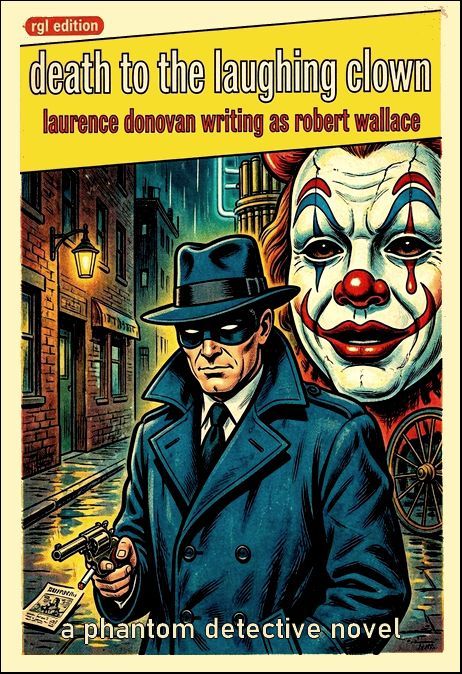
RGL e-Book Cover
Based on an image created with Microsoft Bing software
Roy Glashan's Library
Non sibi sed omnibus
Go to Home Page
This work is out of copyright in countries with a copyright
period of 70 years or less, after the year of the author's death.
If it is under copyright in your country of residence,
do not download or redistribute this file.
Original content added by RGL (e.g., introductions, notes,
RGL covers) is proprietary and protected by copyright.
RGL e-Book Cover
Based on an image created with Microsoft Bing software
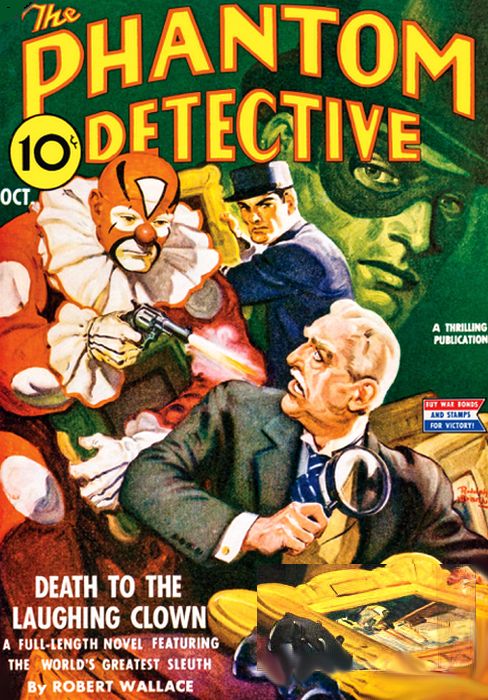
The Phantom Detective, October 1942, with "Death To The Laughing Clown"
The world's greatest sleuth battles to halt a grim carnival of murder! When Death visits the State Fair, the Phantom puts justice on the program!
FROM his private office in the Administration Building, Mark Raines, secretary of the great Midstate Fair, could look out over the Fairgrounds that, barren and deserted the rest of the year, was now a teeming city of thousands. Though official opening would not be until six o'clock the next morning, the streets were jammed with cars, trucks and wagons. Exhibitors, concessionaires, workmen, guards and Fair officials were in a hectic flurry of last-minute preparation. Booths and tents were mushrooming everywhere.
Raines could see the Midway where the carnival was spreading acres of canvas, thrusting the steel skeleton of a Ferris wheel toward the night sky. Everywhere was eager anticipation for the biggest State Fair in all Midstate's history.
Mark Raines grinned a little, proudly, and turned back to his desk. It looked as though Midstate was going to break the jinx that for years had dogged it relentlessly—rain, a premature cold wave, and strikes that had closed the factories in Mid-city, leaving people with no money to spend on fairs.
There had been talk of closing the Midstate Fair permanently, since the State, which sponsored the Fair, was getting tired of making up, huge deficits. But this year the Fair should climb out of the red, if not set a new record.
Thinking pleasantly of these things, Mark Raines riffled through the papers on his desk. His gray head was bent as his slim, strong fingers deftly sorted the notes, selecting those that required immediate attention, pushing aside others for the attention of his assistant, young Charlie Monson. Mark Raines was smiling—
Then suddenly he was starting up, the blood draining from his cheeks, the papers cascading from his lax hands. Swaying, he stared at a single white envelope that remained on his desk.
It was addressed to him in a bold backhand. There was no stamp, indicating that the note had been dropped in the Fair official's private box.
Mark Raines sat down again heavily, picking up the envelope with shaking hands.
"His handwriting," he muttered. "Then he's here—on the fairgrounds!"
AS HE withdrew the single folded sheet, Mark Raines seemed to have aged ten years. His square shoulders were suddenly bowed. Haggard lines etched themselves into his face and something like stark terror peered out of his red-veined eyes. He sat for a moment, as if gathering his courage, then unfolded the letter and read dully:
Mark:
This is your last chance, and proof that I wasn't bluffing. There are two ways of gaining what I want. One of them is peaceably, through your cooperation. The other is by turning your Fair into a carnival of slaughter. Which would you prefer? The choice, my dear sanctimonious Mark, is entirely up to you.
There was no signature. Instead, a rubber stamp had inked a strange device. It was a picture, one familiar the world over as the symbol of laughter and fun—the face of a painted clown with exaggerated laughing lips.
The letter fluttered to the desk. Mark Raines put shaking hands on the rim of the desk as if to brace his sagging body. Perspiration was on his ashen face and his breath made a sharp whistling sound.
"No," he whispered dully. "He wouldn't dare!"
Suddenly he straightened and a look of terrible determination came into his eyes. With fingers suddenly steady, he tore letter and envelope to bits, heaped the fragments in an ashtray and ignited them. His face was like gray granite as he watched the last fragment dissolve into feathery ash, then dipped into a desk drawer to bring cut a small automatic pistol.
Mark Raines cradled the gun in his hands, staring into the shadows.
"It's the coward's way out," he whispered. "But it's the only way—the only escape."
He lifted the muzzle of the automatic to his temple.
At that moment a sound lifted above the rumble of activity outdoors, a dull boom that rattled the open windows and sent a faint quiver of vibration through the floor. An instant later there was a second boom.
Instinctively Mark Raines lowered the gun and swung to look out his window at the twin trails of flame arching lazily up into the black vault of the night sky. His movement was pure reflex, habit. Every year for nine years he had paused at exactly nine o'clock, the evening preceding opening day, to watch the Welcome Shell go up.
It was a Fair custom dating back to the first Midstate fireworks display. Out in the dark infield of the twin race-tracks, where fireworks men were setting up the elaborate framework for the next night's display, a specially-built shell was fired from a huge mortar sunk deep in the ground. For miles around people would see a last invitation to the Fair emblazoned in letters of fire—Midstate's famous Welcome Shell.
But tonight there were two shells leaping upward and, watching them, Mark Raines forgot his dark purpose as his breath caught in his throat.
The first shell burst in a fountain of multi-colored fire, from which drifted, small parachutes supporting the blazing words:
WELCOME TO MIDSTATE FAIR
A ragged cheer went up from outside. Then the second arching shell burst, pouring out a Niagara of crimson fire that painted the buildings and the sea of upturned faces with a macabre tint.
THE red plumes hung in mid-air—and then from their midst drifted a second flaming sign, bearing just three words in letters of blood-red fire:
CARNIVAL OF MURDER
The cheers dwindled into gasps of shocked amazement. Mark Raines stood up so violently that his chair crashed over backward. The pistol dropped from his hand.
"The fiend!" he choked. "He wasn't bluffing—and he can't be stopped!" His eyes were bleak as he dropped the pistol back into the desk and closed the drawer.
"I can't do it," he whispered. "That would—only—make things easier—for him. I'll have to go on." He stumbled to the window, looked out again, and froze.
Across the landscaped lawn that surrounded the Administration Building, a figure was standing by the ornamental iron fence. It was the grotesque figure of a clown—a clown with huge painted laughing lips.
A deep groan welled up from Mark Raines' breast. He stumbled blindly back to the desk. Righting the overturned chair, he sank into it and dropped his drawn face into his trembling hands...
The great Digby Jains was an eccentric and temperamental man. In striped trousers and cutaway coat, with a red carnation in his buttonhole and black satin ribbons flowing from gold-rimmed pince-nez glasses, he resembled a caricature of an underfed English lord. His long cigarette holder and affected Harvard accent heightened the illusion, and the slender, gold-headed cane he twirled constantly was a crowning touch.
Some said Digby Jains was a genius; others called him a screwball.
But unquestionably he was one of the country's foremost authorities on art. The Midstate Fair Board considered themselves fortunate to persuade Digby Jains to fly from New York to judge the art exhibit.
When the Welcome Shell went up at nine o'clock, Digby Jains was in the rambling old ivory-covered stone Hall of Art, studying the hundreds of entries. Following him was a select, invited group of admirers. There were a few reporters, a scattering of wealthy art patrons of Mid-city, and half a dozen Fair board members.
The dull boom of the mortar sifted into the old building but faintly. The board members realized only that the Welcome Shell was being fired, and apparently none of them bothered to look out a window to see the stark blazing threat in the dark sky.
Digby Jains paid no attention. He was busy flourishing his cane toward an alcove filled with paintings of unmistakable quality.
"These," he was saying, "are not entered in competition, of course. They are fine old paintings loaned by art museums for this exhibition. While not in the class of the Old Masters, of course, they are true art."
He turned, pointed his cane at a smaller nook and shuddered dramatically. Everyone stared at four garish daubs of oil color that hung there.
"Those—those atrocities," Digby Jains said faintly, "are the worst I've ever seen in my long career as an art critic. Why they were even permitted to hang here is a mystery to me."
WIN KILMER, the board member in charge of the Fair art department, stared at the four canvases with widening eyes.
"They are horrible," he whispered to John Godfrey, supervisor of gates and admissions. "If I'd seen them before, they certainly wouldn't be here now."
Godfrey shrugged. "I don't know art," he admitted. "Fancy Pants was praising some stuff he called 'modern art' that looked as bad to me."
Digby Jains had entered the nook and was bent down, peering nearsightedly at the artist's signature on each of the immense canvases. Suddenly he whirled around, an angry flush on his cheeks.
"If this is someone's idea of a joke," he said stiffly, "it is certainly in poor taste."
"What's wrong?" Kilmer asked. "What kind of a joke?"
"Wrong?" Digby Jains echoed shrilly. "Some imbecile has signed each of these—these monstrosities with the name of Jules Crinon. It is sacrilege. Crinon could not paint a picture as bad as one of these!"
Win Kilmer scowled, staring at the paintings.
"A reservation was mailed in the name of Crinon and when the paintings arrived, I ordered them hung without bothering to examine them. If these aren't Crinons—"
It was at that moment that the small, tubular light over one of the smaller paintings flickered and burned out. It left the canvas in semi-shadow, lighted only faintly by the glow of lamps from adjoining pictures. The angry words suddenly died on Digby Jains' lips. With a choked cry, he fairly hurled himself toward the picture.
He stared, twisting his head and squinting. When he whirled back his face was white, dewed with perspiration.
"Get out!" he cried wildly. "All of you—every one of you! I've got to be alone in here for while—completely alone!"
A few edged toward the door. The majority simply stood and gaped. The reporters, sensing a story, pushed forward.
"Get out, you imbeciles!" Digby Jains shrieked, waving his cane. "Get—out!"
Muttering, the crowd headed for the nearest exit, certain they were escaping from a lunatic. Kilmer and Godfrey, moving with them, were joined by two more board members—Bromley Kent, supervisor of attractions, and Forrest Sawyer, director of concessions and president of the Fair board.
"What kind of a nut is he?" Sawyer demanded angrily. "He can't order you out, Win. This is your department, your building."
"Forget it," Kilmer said quietly, "I've seen artistic temperaments blow up before. I'm going to see how things are shaping up at the Administration Building. By the time I get back, he'll be cooled off."
The door closed behind them. Bigby Jains turned away, then stopped with a fresh snarl of anger.
Two men had remained behind—big, beefy, truculent men with badges and light clubs. Jains recognized them as the building guards. He had gathered himself for another explosion when one of the guards advised flatly:
"Save it, buddy. We were detailed to guard this building, and we're guarding it."
Unexpectedly, Jains relaxed. "all right. I'll want witnesses, anyhow. If what I suspect is true, this is the most incredible—"
HE BROKE off, darted into the office and rushed out flourishing a pallet knife. He raced to the darkened painting and began to scrape expertly at one corner of the canvas. Then, with a cry of triumph, Bigby Jains whirled and threw up his arms.
"It is true!" he cried shrilly, "It is fantastic—impossible..."
He caught each guard by an arm and hustled them toward the office.
"There's only one person in the world I dare tell about this. You two listen to every word."
In the office, he snatched the phone. "Long distance," he croaked. "Get me New York—Frank Havens, publisher of the Clarion. Hurry, Operator! This is a matter of life and death!"
As the two guards stared at the jittering, perspiring Jains, abruptly the receiver crackled with sounds.
"Mr. Havens!" Jains panted. "This is Bigby Jains, author of that syndicated art column in your papers. Listen, Mr. Havens, I've just stumbled onto the most gigantic, incredible crime in all history! It—it staggers the imagination. You must get in touch with the Phantom at once. No one else could possibly..."
The guards, aroused by his mention of crime, had crowded close. One of them suddenly grunted and fell against Jains.
"Get back, you clumsy ox!" Jains snapped, and pushed the guard.
The light shove sent the burly figure reeling back. The guard bumped into the desk and suddenly pitched to the floor, face down. Between his huge shoulders a dark, spreading stain was on his gray shirt and from the center of that stain protruded the slim hilt of a throwing knife.
Digby Jains stared at the knife with bulging eyes while the telephone clattered from his limp fingers.
With a roar, the second guard whirled, snatching the club from his belt.
Jains heard a crunching thud, then that guard was sprawled at his feet, blood jumping from a gash on his bald head.
Somehow, Digby Jains found the strength to push himself around to face the menace. He saw a huge, bull-necked giant who still gripped the barrel of a pistol. He saw a slender, chalk-faced, rat-eyed man kneeling to retrieve the throwing knife from the first guard's back.
And in the doorway, he saw a laughing clown.
The clown wore a ruff-necked suit of black and white, with a tiny black-and-white cap perched over one painted ear. Around his middle was buckled a huge burlesque imitation of a cartridge belt and shoved in this belt was an immense wooden popgun. From the clown's left wrist, a black balloon was bobbing at the end of a string.
The clown's face was painted a stark white, with two dead-black circles high on the cheeks. But the most hideous and startling feature was the lips—great crimson-painted slashes that encircled the mouth, curving grotesquely into a horrible fixed grin.
The clown moved forward, and suddenly, from the terrible painted lips, came a rising burst of hideous laughter—the laughter of a madman and a fiend.
"So you discovered a gigantic crime, did you?" the clown said to Jains, and laughed again. "Now wasn't that just too bad—for you?"
DIGBY JAINS knew, then, that he was face to face with death. "No," he gasped. "Wait! I can forget what I discovered. It—it's none of my business. I won't breathe a word—"
The clown gurgled with laughter and pointed at the telephone on the floor.
"With your friend Havens practically pouring himself into that phone to hear what's going on?" he chortled. "Don't be a silly ass, my friend. You have to die—now—quickly."
Digby Jains had never considered himself a brave man, nor had he ever entertained ambitions of being a hero. But in the moment of facing inevitable doom, he found some hidden well of supreme courage.
His own life was forfeit. But there were others—and a stain against his beloved Art must be removed.
Suddenly Digby Jains dropped toward the telephone on the floor.
"Mr. Havens!" he shouted frantically. "The Laughing Clown—those four pictures... Ah-h-h-h!"
He never saw where death came from. But death came to him, out of nowhere—a glinting, silvery sliver that flickered toward him and then vanished.
Digby Jains clawed madly at a tuft of gay feathers that seemed to be pinned against his throat. His glazed eyes bulged, and his mouth strained wide to voice a scream that would not come.
Then blood came in a gushing fountain and Digby Jains pitched to the floor.
He did not move again.
The clown stepped across his outstretched body and barked a single mad burst of laughter into the fallen telephone. Then he cradled the phone and turned to the two watching thugs.
"Come on," he said shortly. "We've got to do our job and clear out of here. Havens may be fifteen hundred miles from here, but he'll have this place swarming with cops in five minutes."
He left the office, with the two thugs following. Opposite the four hideous paintings he stopped, and slapped each canvas with the bobbing balloon.
"Take these four," he chortled.
The two thugs hastily unhooked the four fake Crinon's, ripped off frame and stretcher and then rolled the canvases together into a compact roll.
The clown snatched the roll and tucked it from sight up one frilled sleeve.
"Out this way, you," he ordered. "And you too, Boxer."
Without a backward glance toward the office where the dead men lay, the three went out into the night.
IT WAS Muriel Havens' birthday, and her father, Frank Havens, publisher of the New York Clarion and a nation-wide chain of affiliated newspapers, was throwing a gay party for her in their luxurious apartment. The roster of guests read like a social register and there was enough wealth represented to have bought and sold the huge skyscraper and the ground it stood on.
In one corner, surrounded by laughing, chattering debutantes, a handsome young man sprawled indolently on a huge sofa, sipping a highball and listening lazily. He was tall, broad-shouldered, with level brown eyes and a firm bronzed face. But in his attitude of lazy relaxation, he appeared as boneless and lifeless as a jellyfish.
This young man was Richard Curtis Van Loan, wealthiest and most eligible of New York's bachelors, and at once the hope and despair of every blue-blooded, match-making mother in the society whirl. Everyone thought that if bored, irresponsible Dick Van Loan ever got up enough ambition, he would propose to lovely Muriel Havens whose father was his best friend.
But, somehow, Van Loan never seemed to get around to that, something that puzzled Muriel as much as it did the gossip columnists. She was so sure that if Dick Van Loan could be stirred from his lethargy that he would make not only a worthwhile man but a desirable husband.
But Van Loan was almost as great a mystery to his friends as he was their despair. Despite his wastrel existence and apparent dislike of physical activity, there were occasions when he surprised everyone by demonstrating the possession of hard and well-trained muscles. These were at odd times when he exerted himself at polo or tennis. But how he preserved his muscles without ever exercising them was a profound mystery.
No less baffling was Van's unpredictable habit of suddenly walking out on parties without a word of excuse or explanation. And his penchant for vanishing, sometimes for weeks on end, without explaining his disappearance. It was believed that at such times Richard Curtis Van Loan had retired somewhere to sleep.
Tonight, Van seemed to be trying to drink and sleep at the same time, while the lovely debs pestered him.
"Come on, Dick," one of them pleaded. "Say you'll go. We're taking Daddy's yacht and the whole crowd will be there. We'll spend a week or two in the Gulf and—"
"I'll see," Van yawned sleepily. "Call me the day you're ready to sail. If I'm not too tired, I might join the party."
"Tired!" a willowy redhead said scornfully. "Dick Van Loan, I have a good notion to get a specialist on sleeping sickness to examine you. I think—"
She stopped because suddenly Dick Van Loan was no longer listening. He seemed to be watching a gay group, a few feet from where Frank Havens was answering a telephone call.
"Dick!" the redhead snapped sharply. "What are you staring at?"
"A gorgeous blonde, darling," Van said absently and made a shooing motion with one hand. "Run along, kittens. I just remembered that I promised myself to go to bed early tonight. If I hurry I can just make it. 'Night."
DICK VAN LOAN rose, got his coat and hat and vanished in the direction of the Havens private elevator. Muriel Havens watched his retreating back and suddenly stamped her foot.
"Dick Van Loan," she whispered fiercely. "You—you're impossible! I hate you!"
Then her eyes filled with tears. She darted into her own bedroom and slammed the door.
Muriel might have saved some of her tears had she been able to follow Van Loan's movements. Inside the private automatic elevator, Van suddenly threw off the careless, indolent slump his friends thought was natural. His face grew animated. His eyes took on a sparkle of excitement.
From inside his clothing he drew a queer, flat case. Halting the cage between floors, his deft fingers opened the case and moved purposefully through a compact assortment of make-up materials.
Less than three minutes later, the case was again stowed away, but the man who performed this task was as unlike the playboy, Richard Curtis Van Loan, as could be imagined. He was an older man, pouched gray eyes and graying hair. And not even the closest examination could reveal the tricks of make-up that had created the transformation.
During those three minutes in the stalled elevator, Richard Curtis Van Loan had completely vanished. In his place stood the world's greatest detective, the man of a thousand faces.
The Phantom!
Only one other person knew that secret—Frank Havens. It was Havens who had first persuaded the bored and idle playboy Van Loan to try his hand at crime detection, recognizing the latent talents and abilities in the young man. Havens had encouraged Van to go on with this exciting profession, helping him map his course, helping him create the mystery figure of the Phantom who was to become the most feared and the most trusted man-hunter in history.
Hurling himself enthusiastically into his new career, Van had become an authority on laboratory detection methods, on criminal and penal psychology, an expert on such diverse subjects as hypnotism, ventriloquism and lip reading.
It was through reading Frank Havens' lips as the publisher answered the telephone that Van had known immediately that this was a new appeal for the aid of the Phantom.
Reversing the elevator, Van sent it back up, halting it two floors below the Havens apartment. Setting the controls to carry the cage back to apartment level, the Phantom stepped out into a dark corridor. Opposite the elevator shaft was the door to Frank Havens' private office.
Letting himself in with his own private key, the Phantom went through the darkened outer and inner office and through another door that was disguised as a closet. Beyond this, he stepped into a small, lighted inner office that Frank Havens maintained for secret meetings like this.
Havens was already there, pacing the floor. His face lighted at the sight of his visitor.
"Phantom!" he exclaimed. "I thought you were watching and would follow the drift."
"I got enough to understand that murder has struck close to home this time," the Phantom said grimly. "That was Digby Jains, your art expert, calling from the Midstate fairgrounds. He started to tell you of some horrible crime and was struck down before he could finish."
"I heard him die," Havens said hoarsely, dropping into a chair. "But the worst was the fiendish, insane laughter I kept hearing until the phone connection was broken. It must have been the killer."
"How was Jains killed?" the Phantom asked.
"By a short steel dart shot into his throat from close range. I got my call switched from the fairgrounds police and they called back after you left upstairs. They found Jains and one of the building guards dead and a second guard unconscious. He revived and described the killers as two ordinary thugs, led by a clown."
Van nodded.
"A perfect disguise, and one that wouldn't arouse suspicion on a fairgrounds. What else?"
"Earlier, while judging the exhibits," Havens growled, "Jains had stopped to throw one of his tantrums over four paintings he called the most horrible travesty of art he had ever seen. Fakes, I guess. Anyhow, in the midst of his diatribe, Jains suddenly spotted something that got him all excited. He chased everyone but the guards out of the building, made a closer examination of the pictures, then put through the call that undoubtedly caused his death. Whatever he had discovered, it was apparently big. Discounting Jains' own description as exaggeration, it still must have been something terrible."
"What about the four paintings?"
"They're gone. The killers ignored some eighteen thousand dollars' worth of masterpieces and stole those four daubs. That's all anyone knew at last report. What do you think?" He hesitated. "Jains insisted this was something only the Phantom could handle. Still, we have no evidence—" His voice trailed off.
Van laid a hand on Havens' shoulder.
"Of course the Phantom is stepping in, Mr. Havens. Digby Jains was an employee of yours. Jains' murder, intentionally or otherwise, is a direct challenge to the Phantom. And I accept."
"I'm glad," Havens said simply. "Jains was eccentric, temperamental—but I liked him. The world will be the poorer without his knowledge of art."
Suddenly Frank Havens' expression changed. He leaped up, reaching for the telephone.
"Thunder!" he exclaimed. "I completely forgot that I'm probably being beaten on my own story. I'll call my Chicago editor and have a man fly out there at once."
"Wait!" A steel hand closed over Havens' as he started to lift the phone. "Why risk that story with a reporter you don't know? I'd suggest you send your best man there. I'm flying through tonight and he can ride with me."
Havens relaxed, grinning. "I get it. Steve Huston. I'll have him here in ten minutes, Phantom. Chip Dorlan, too, if you want him."
Besides Havens, and on occasion Muriel, only two others had ever been privileged to work closely with the Phantom, enjoying his trust and sharing his risks. One was the Clarion's star reporter, red-haired, devil-may-care Steve Huston. The other was young Chip Dorlan, the Phantom's personal protege.
Dorlan, a product of West Coast slums, had become the Phantom's ardent disciple when Van had saved Chip's brother from being framed to the electric chair. Small, slender and youthful, Chip Dorlan had a mild appearance that had more than once proved dangerously deceptive to criminals. Actually, his small fists were dynamite and his fighting heart and keen brain made him a wildcat in action.
Though Steve and Chip had worked shoulder to shoulder with the Phantom on many a tough case, neither of them knew his real identity. Yet the Phantom had come to depend on their unswerving loyalty and daring.
He smiled warmly, nodding to Havens.
"Send for them both," he said quietly.
SMOOTHLY the sleek, fast private plane circled the Midstate fairgrounds once, then settled down gracefully on the crescent-shaped strip of field between the one-mile and the half-mile race-track. Despite the early hour, the grounds were already swarming with visitors and streams of traffic were converging on the outside gates.
At the controls of the plane, the Phantom cut the switches and stretched luxuriously. Still in the same disguise, he looked as fresh and alert after nearly eight hours of piloting as he had in Havens' office. Behind him, Chip Dorlan and Steve Huston, unable to match their idol's indomitable energy, yawned and rubbed bleary eyes.
"Well, here we are," Van remarked as he opened a small compartment on the instrument panel and stowed various small objects away in his clothing. "But exactly where we are, I haven't decided. Maybe in the midst of a grim crime plot; maybe not. An art critic was murdered and some worthless paintings stolen. That's all we have, and it's about as little as I've ever had to start with."
"From what I hear of that crazy laughter," Steve growled, "it adds up to some homicidal nut on the loose."
"Maybe that's what the law is supposed to think," Van said soberly. "I'd be inclined to agree if Bigby Jains hadn't discovered something mysterious about those stolen paintings."
THEY climbed out and looked over their surroundings. Behind and around them stretched the steeply-banked one-mile racetrack used for auto race events. Before them curved the smaller half-mile horse-racing track. Race cars were thundering around the outer track, tuning up for the afternoon's races. On the smaller track, half a dozen high-stepping trotting horses flashed past, drawing light warm-up sulkies.
In the infield, overalled workmen were setting up frames and stands for the fireworks. In front of the huge empty grandstand and bleachers, other workmen swarmed over platforms and stands. Everywhere were the sights and sounds and smells of a great amusement industry, the foundation of fun and frolic. But underneath the surface gaiety seethed a dark devils brew of violence and murder, all the more horrible because it hid itself behind a mask of carefree laughter.
A man came toward them, a lanky man in coveralls who had been working on the engine of a parked plane.
"I'm sorry, gents," he said apologetically, "but this isn't a public landing field. It's reserved for the stunt planes putting on the afternoon shows. There's—"
"We're here on official business," the Phantom said briskly. "It's important to get our ship serviced and tucked away somewhere out of the way but handy for immediate use if we need it. Can't something be arranged?"
He opened one hand, showing the corner of a folded bill. The lanky man grinned and nodded. He looked up at the Phantom with shrewd eyes.
"You wouldn't be a policeman, would you, here to investigate the killings and that blood-bomb that went off?"
"Blood-bomb?" Van echoed sharply. "Tell us about it. We've been flying all night and out of touch with events."
"Sure," the lanky man said, swelling with importance. "Last night when the fireworks boys shot up that Welcome Bomb saying—'Welcome to Midstate Fair' somebody else shot another one up right after it that said 'Carnival of Murder' in letters the color of blood. I guess whoever done it wasn't fooling, 'cause right afterward the two murders took place. And you can take it from me, mister, whoever done those killings, ain't through yet. Not by a long shot, he ain't."
The Phantom's eyes were suddenly bleak, his face grim.
"That answers some questions," he said tightly. "It tells us we are up against a plot of some kind—and it tells us where to start. Come on. We're going to have a talk with the fireworks crew."
Two workmen were busy setting mortars into deep holes in the ground, packing dirt solidly around each. From these miniature cannon star shells would be flung into the sky.
Standing close to the two workmen was a heavy-set man with a crooked nose. Apparently he was supervising the job. He looked up as the Phantom and his aides approached. His eyes slid back toward the plane and narrowed.
In answer to the Phantom's question, he jerked his head.
"The boss is over there," he said. "In that red car."
The Phantom and his aides moved on. Scowling, the broken-nosed man snapped a word to the two workmen and set off across the infield toward the grandstand at a swift trot.
The Phantom and his aides went on toward a small coupé painted a brilliant crimson and bearing the words "ERROL-DUFFY" on its side. The coupé was parked on the grass beside a red storage shack and a man sat at the wheel, talking to some workmen.
Passing the red shack, Chip Dorlan glanced in and saw row upon row of gigantic shells, bombs, rockets and stars, with piles of coiled fuse, cases of flares and kegs of powder. He whistled.
"Boy, oh boy! That stuff is sure bigger than the firecrackers I used to shoot off on the Fourth of July."
"Slightly," Van agreed dryly. "There is enough high explosive used in one night's fireworks to blow up these fairgrounds if it were set and packed right."
"And if this is going to be a carnival of murder, Phantom," Steve Huston said tightly, "that fact might be something to remember."
The workmen left as the three approached the parked coupé and a small, sandy-haired man inside poked out a worried face.
"I'm the boss," he admitted in answer to Van's question. "Jack Haggerty of Errol-Duffy Fireworks Company. We shoot this show. So what?"
The Phantom hesitated. To identify himself as the Phantom might gain him valuable information. But it also might place him at the mercy of the very mob he had come to smash.
"Maybe you can help me," he said slowly. "A friend of mine was murdered here last night. Digby Jains, the art critic. We flew here to look into his death and heard about some sort of murder threat shot off with some fireworks. Maybe there is a connection."
"Digby Jains, eh?" The small man climbed out of the coupé, frowning. "There might be a connection, at that. I've told my story to fifty cops but I guess I can tell it once more. What do you want to know?"
"Tell me about that extra shell last night."
"I wish I could. I left two men here to shoot the Welcome Shell. They're old hands, have had that job for years. They said a daffy-looking clown wandered out and horsed around about an hour before the shell went up, but they finally shooed him away. They shot their shell and were watching it, when suddenly another mortar went off about a hundred feet away. They caught a glimpse of somebody running off but whoever it was got away. That's everything I know."
THE Phantom was thoughtfully silent.
"Could anyone outside the fireworks business make a shell like that second one?" he asked then.
"If there is such a guy," Haggerty swore gustily, "I'll hire him for life. It took us sixteen months to develop that effect the way we wanted it. The powders have to be exactly right, then there's the job of forming the letters and pinning them to the net that supports them. After that you've got a ticklish job getting the parachutes placed right and the fuses fixed so everything goes when it's supposed to and not before. Then you have to figure how to pack it in a star-shell casing so it goes up instead of blowing your head off when the lift-charge lets go."
"How many other fireworks companies could make it?"
"Not many," Haggerty growled. "And that's what beats me. There were things about that red shell that make me willing to swear it was one of our own productions—little points nobody but a professional fireworks man could notice. But I've checked our plant and I'm positive we never made it."
"Well, thanks anyhow," Van said regretfully. He started to turn away, then paused. "By the way, how about this clown? Have they made any progress toward identifying him?"
Haggerty snorted in disgust.
"Shucks, no! The Johnny Merrick Fun Shows are putting on the Midway attractions this year and part of their bally is to send around thirty clowns to circulate through the fairgrounds and plug the carnival. The cops have been pinching Johnny's clowns, and then letting them go. It's like hunting for one particular snowflake in a blizzard."
"So that's that," the Phantom, remarked a few moments later as he and Steve and Chip went down into the long tunnel leading up into the dressing rooms under the grandstand. "We know there's a plot and a clever criminal. And it's hard to believe that a plot so carefully conceived was meant to begin and end with the theft of four faked paintings, regardless of their true value. We've got to work desperately fast to try to penetrate the scheme and forestall another outbreak of senseless murder."
They went up a flight of stairs, past corridors full of chattering performers and came out onto the grandstand. It was jammed with stands and booths, showing or selling everything from pink lemonade to rustic furniture.
"We'll separate here," Van said. "Chip, you hop a taxi and start checking on fireworks companies. See if you can get any ideas or leads at all on that 'Carnival of Murder' shell. Meet me in the lobby of the Administration Building at six tonight."
"Right, Phantom," Chip grinned and darted off into the crowd.
"You, Steve," the Phantom continued, "go over and wander around the Midway. Try to get chummy with some of the pitchmen or roustabouts or spielers. If there's anything going on under the surface, they'll know about it."
"Can do." Steve nodded. "Where will you be?"
"I want to meet the Fair officials and pave the way for some cooperation," Van said. "Then I want to have a look at the scene of the murders and try to check back on those stolen paintings."
He watched Steve Huston vanish into the crowds, then muttered under his breath:
"And also I want to see what the two men who have been trailing us for the last five minutes have on their minds."
HE HAD said nothing to either Chip or Steve, but his sharp eyes had quickly spotted the hard-faced tailers. They were standing now some fifty feet away, fondly believing that their pose as curious onlookers had fooled their quarry.
The Phantom smiled quietly and began a leisurely trek down the long ramp to the street. Twice he consulted his wrist-watch and each time a tiny silvered mirror in the face showed him that the two were following.
Turning toward the Administration Building, Van increased his pace and his mouth set in a grim line as the two clung doggedly in his own wake. That meant the killer of Digby Jains, knowing Jains had called Frank Havens, had guessed that the Phantom would arrive by air. It also meant that the Phantom's present disguise was useless, and that his life was in deadly danger.
Glancing around, he saw a crowd in front of a green-painted wooden building. He could see an enormous mill-wheel turning and hear the constant rushing splash of water. A sign read:
THE OLD MILL STREAM—
A HONEYMOON BOAT RIDE FOR 10¢
A grin touched the Phantom's lips. Cutting across the street, he paused at the railing as though intrigued. The ride consisted simply of a long artificial canal, curving and winding back across a deep lot and roofed over with tarpaper. Shallow water was kept in motion by the whirling millwheel. Customers rode slowly and silently through this long, dark tunnel in flat-bottomed boats, propelled by the flowing water.
At this time of morning, few were buying tickets, and many of the boats came up to the small rustic dock and were sent on, empty. When a whole string of empty boats crawled into view, the Phantom suddenly flung a dime at the ticket window, snatched his pasteboard and dived into the nearest boat.
There was no other patron waiting. The starter took Van's ticket, gave the boat a shove and sent it gliding away into the dark tunnel.
An instant later, the two hard-faced trailers darted onto the platform, hurled tickets at the starter, and leaped into a departing empty.
"Shove her along, buddy," one of them growled, and the dark tunnel engulfed them also.
"On your toes, Boxer," the smaller of the two whispered, with no slightest idea that he would be overheard. "He may be figuring a getaway in the dark."
"Sure he is, Chuck," Boxer grunted. "But it ain't gonna do him no good. His boat ain't more'n twenty-five or thirty feet ahead, and around the next turn, there's a lighted scene in the wall that'll show the blasted Phantom up like a monkey on a stick. We both blast, and that's the end of him. We scram out one of these tissue-paper sidewalls, collect our dough and live on Easy Street."
"There's the turn," the man called "Chuck" whispered. "Get your rod ready."
They waited, guns half-raised, eyes straining ahead. Suddenly the gliding boat swept around a curve and the tunnel was lighted by a glow from a scenic panorama.
They could plainly see the figure alone on the front seat of the boat ahead, silhouetted sharply against the light.
"Let him have it!" Chuck spat.
The two guns thundered, hurling lances of flame through the darkness. Ahead, the lone figure jerked, then toppled forward to lie motionless.
"We got him!" Boxer yelled jubilantly. "We got the Phantom! He's dead!"
AFTER leaving the Phantom, Steve Huston headed toward the sound of hoarse shouts, thudding drums, the chonk-chonk of music boxes and the towering Ferris wheels. With Chip and the Phantom, Steve had spent part of the time on the flight from New York studying a map of the fairgrounds, learning the location of every street and building and exhibit.
Steve used that knowledge now to cut through behind a parking lot below the ramp and shorten his path to the Midway. He reached it, passed under a high neon-rimmed arch and found himself on a long street lined both sides with the glaring banners of sideshows and filled down the middle with stands and rides.
Hot dog and candy floss stands sent delectable odors into the air, mingling with the smell of gasoline and oil from the Devil's Bowl Motordrome. There were giants and midgets, freaks and trained animals, all the traditional spectacles of the carnival out to entice the dimes of the merry makers.
And there were clowns. Short and tall, fat and thin, capering and playing jokes and bantering with the laughing crowds. Steve counted eight clowns in one block, none of them answering the description of the laughing killer.
"What a job!" he snorted disgustedly.
He bought a bag of popcorn and stood munching it, thinking. To barge up to any clown and start pumping questions would get him nothing. But if a clown was tired and thirsty, and someone offered him a chance to rest his dogs and wet his throat—
Steve snapped his fingers, and looked around. His eyes fell on a fat man in chef's cap and greasy apron, bellowing hoarsely from behind the counter of a hamburger stand. Steve went over and leaned on the rough pine boards.
"Friend," he said to the fat man, "where can a dry man get a little tonsil ointment on these grounds?"
"He can't," the fat man said. "The law won't allow liquor-selling on the grounds. You gotta go outside—and pay to get back in."
"Nuts!" Steve made a disgusted face. He couldn't waste half the day on his plan.
"How come you're thirsty so early in the day?" the fat man demanded, eyeing Steve intently.
Steve shrugged. "Did you ever see the time when a newspaper man wasn't looking for a drink?"
"Reporter, eh?" the fat man said speculatively. "You couldn't by any chance prove it, could you?"
Light began to dawn on Steve. He hid his elation, growled under his breath and dug out a press card.
"I was sent here to cover a special exhibit, then was dug out of bed this morning to cover the killing. Wotta life!"
"You'll do," the fat man said huskily. "Look, friend, I just happen to have an extra bottle of snakebite medicine back in my suitcase. For five bucks, I might be persuaded to part with it."
"Sold!" Steve said promptly, and followed the waddling cook into a small closed tent at the rear.
This was better luck than he had hoped for. A small-time bootlegger might prove a gold mine of information. Most of these stands followed the carnival through the season and knew everybody connected with it.
STEVE sat on a dirty cot and watched the fat man rummage for a bottle of cheap rye. He saw a similar bottle peeping from under some dirty clothing.
"If that bottle has a brother," Steve volunteered, peeling a second five-spot off the fat roll of expense money he carried, "I might buy it just to have somebody to drink with."
"Brother," the fat man said, "you're on. I'm Jake Parsell, friend, and you're a gentleman, whatever your handle is."
Steve uncapped the whiskey and let a few drops trickle into his mouth. He managed to look pleased, although he nearly strangled on the raw, fiery stuff.
Jake Parcell upended his own bottle. Fascinated, Steve watched the fat man's throat move rhythmically, lowering the level of liquor in the bottle. When Jake Parcell finally stopped for breath, the pint of rotgut was half gone.
"Now, my friend," he said genially, beaming at Steve, "we've had a drink and you've gone to a lot of work giving me a phony buildup that didn't fool me one bit. Suppose we cut out the sparring and get down to business. If you're looking for information and got any more of that folding lettuce, maybe you and me can get together. I been running a cookhouse for this carny a long time and I know every monkey on the lot. Ordinarily I keep still but somehow the taste of good liquor and the feel of good money makes me run off at the mouth. What you want to know?"
Steve's first reaction was one of elation. Then a little warning bell in his brain sounded a sharp "alert." This Jake Parcell was too eager to babble to a stranger. The shrewd wariness in his small eyes belied the mask of geniality. The fat man's intention was not to give information but to get it.
Steve realized that he might get a lead, but it would come by accident, not by direct questioning. He was facing a battle of wits, but that very fact indicated that Jake Parcell did know something.
"Swell," Steve said with a show of heartiness. "Looks like I hit the jackpot with my first nickel. I've got to dig up a yarn on this Laughing Clown affair and if I can do it without running my legs off, it's worth dough to me."
The small eyes narrowed. "What makes you think I know anything about that?"
Steve laughed. "Don't give me that stuff, brother. I wasn't born yesterday." His mind was working like chain-lightning, building a plausible theory that the fat man would accept. "Look, the killer wore a clown suit and clown make-up, didn't he? Okay, you don't think he rode out from Mid-city in that get-up, do you? And there aren't any nice convenient hotels on the grounds where he could dress."
"What you driving at?" Jake Parcell demanded hoarsely.
"Just this, pal. The only place the guy could come from in that clown outfit is where all the other clowns come from—this carnival. You don't step around behind a bush somewhere and slap on complicated make-up like that. I'm betting the killer came right out of the Midway—and there must be plenty of guys here who have a good idea who he is. See what I mean?"
Jake Parsell's face was tight. "Yeah, I see what you mean."
Steve thought his story sounded all right, but it wasn't getting him any return information.
"And that isn't all." He nodded wisely and tapped the fat man's knee. "I've got other plenty good reasons for figuring the story I'm after is right down here."
"I'll bet you have, at that," Jake Parsell said softly.
His hand slid under the grimy pillow and came out holding a cheap, nickel-plated revolver. He pointed it at Steve Huston's chest.
"In fact, chum," he snarled, "your ideas sound so good I don't think they're just guesses. And when a guy gets as wise as you, it ain't safe to leave him running around."
Steve's pulses raced. He was less disturbed by the gun than excited by the knowledge that unwittingly he had stumbled onto some real facts. But he had to play out his pretense.
"You can't do that," he said angrily. "My paper will—"
"Your paper," the fat man chuckled huskily, "will have a front-page murder story if you don't sit still and keep quiet."
HE MOVED behind Steve, pressed the pistol muzzle into the reporter's back and used his left hand to pat Steve's pockets. He found Steve's identification folder inside his coat and flipped it open. Steve heard the fat man's explosive breath behind him.
"So-o-o," Parsell grunted, coming around to stare at him through narrowed eyes. "You're a reporter, all right—but you kind of forgot to mention you was on the New York Clarion. Which makes you the monkey who pals around with the Phantom. It's no wonder you had so many bright ideas of our own."
Watching Steve like a hawk, the fat man slid sideward to the tent entrance.
"Oh, Harry?" he bawled to his assistant in the stand. "Beat it over and tell Blackie to come here quick. Tell him I got something for him—something he's gonna love."
HE TURNED back, grinning—and Steve Huston was on him like a clawing, snarling wildcat. He had leaped in that split second when the fat man's attention was turned away.
Big Jake Parsell looked soft and flabby, and Steve had expected to rock him over with the impact of his flying body. But unexpectedly, the fat man turned out to be made of rock-solid bone and steel muscles. Steve felt as though he had rammed headlong into a stone wall and his lashing fists seemed to be hammering thinly cushioned armor plate.
"Why, you fightin' hellion!" Parsell wheezed hoarsely. "You're gonna make me get tough, ain't you?"
One massive fist slashed downward with incredible swiftness, caught and imprisoned both Steve Huston's fists in an unbreakable grip. The other hand caught Steve's neck, clamping down like a vise. Then Steve felt himself lifted from the floor and shaken as a terrier shakes a rat.
His throat was aflame with the agony of that strangling grip, and his lungs felt ready to burst. He tried to break loose, tried to cry out, and could do neither.
There was a dull roaring in his ears and a blinding, soundless explosion before his eyes. There was no strength left in his muscles. He was strangling and was powerless to resist. Then a flame-shot darkness swept down on him and engulfed his senses.
Steve came to quickly, with the sound of voices in his ears. He opened. His eyelids a mere slit.
He was still in the fat man's tent, tightly bound on the dirty cot. Jake Parsell and a massive man with curly black hair were standing above him, talking. From the tone of their voices, it was evident that Jake Parsell was in trouble.
"Heck, Blackie!" he was wheezing apologetically. "I thought I was doing right to nab this guy when I got wise to who he was."
"You thought," Blackie growled angrily. "Now you've tipped our hands to this bird and we can't move him until dark so you've got to stick here all day and see that he don't get loose or yell. If you'd only tailed him, he could have been handled in some safer place. The Clown isn't going to like this a little bit."
The fat man's voice raised in an angry retort.
"So what? Maybe I could tell things about the Clown he wouldn't like. I ain't so dumb."
There was the sound of a quick, shuffling step, then a grunt of pain.
"What do you know about the Clown?" Blackie cried in a low, terrible voice. "Speak up, you greasy rat! Spill it!"
"Wait, Blackie!" Parsell pleaded. "Don't! It—it's just that I noticed things, see?"
"Noticed what?"
"That the Clown ain't always the same guy!"
"Wha-a-at?"
"I'm telling yuh, Blackie. He ain't always Mack. I used to work with Mack and I knew him plenty well. Ever since the accident, Mack walked kind of funny, throwing one foot out, sort of, to one side. It didn't stop his tricks none but you could notice it a little. Twice when I seen the Clown, it was Mack. But last time, it was somebody else. I tell yuh, Blackie, I—"
"Shut up!"
STEVE, his eyes tightly closed, felt a sharp, agonizing pain in his leg. It was so unexpected that instinctively he flinched and choked a groan.
He opened his eyes. Blackie was standing, over him, grinning, holding the long-bladed sheath knife with which he had stabbed Steve in the leg.
"I had a hunch you were awake and taking everything in," the black-haired man chuckled with cold humor. "Oh, well, it only cinches a certainty, chum. You're going to do a lot of nice talking for the boys, then take the long ride. And don't think you won't talk, because I've got some of the neatest little tricks you ever saw for loosening tight tongues."
He swung on the gaping Jake Parsell.
"You, Fathead—sit down in that chair and hold this knife. Squat there and watch this monkey until dark—every minute. And get this, Jake! If he gets away or gets a yell out, it'll be the last chance you ever get to mess up the sweetest racket on this green earth!"
Jake Parsell took the knife and looked down at Steve Huston, a glitter in his piggish eyes.
"I get you, Blackie. And how I get you!" He licked fat lips. "Between you and me, I hope the monkey does try to make a funny move—just once!"
"WE GOT the Phantom! He's dead!"
That shout was still chasing the echoes of gunfire down the dark Mill Stream tunnel when a figure whipped down from the shadows to land in the gunmen's boat. Fingers like steel talons closed on the thugs' necks and tightened mercilessly. Shouts of alarm died into grunts of agony and two guns slipped from nerveless fingers, as the pressure drew exquisite agony from hidden nerves.
"So I'm dead, am I?" the Phantom snarled into the ears of the terrified men. "Then that makes me a very irritated ghost. I don't mind being trailed all over the fairgrounds but it annoys me to have you shoot holes in my coat."
Leaving the two paralyzed and helpless thugs, he stepped overboard into knee-deep water to overtake the boat he had originally occupied. His coat lay on the seat, still roughly outlined in human shape by the wood slats Van had hastily ripped from the boat floor to create his successful dummy. His first move upon entering the dark tunnel had been to set his dummy in place, then leap out, hugging the dark wall until the thugs' boat drifted past.
Now, waiting for their boat to reach him, Van frowned. He had two possibly valuable prisoners but no place to take them for questioning. Already he heard noisy splashing and the sound of voices back along the tunnel. Workmen would be seeking the source of the gunfire. When they caught up to Van he would be endlessly delayed and forced to reveal his identity to any number of strangers.
There was only one alternative. Bending down, the Phantom hastily frisked his helpless victims, finding nothing of interest beyond a sheet of paper in Boxer's pocket which he retained for later examination. Then turning the boat against the gently-flowing current, he wedged it firmly between the narrow walls so that it effectively blocked the stream.
With a last regretful glance at his prisoners, the Phantom slipped silently on down the dark passage. By the time echoing shouts signaled the finding of the boat and its helpless passengers, a chunky dark-skinned foreigner was slipping out through an emergency door at the back of the Mill Stream shed.
In the darkness, the Phantom had taken the time to alter his make-up to this new character. His choice of that characterization was not haphazard. For one thing, his coat was too badly shredded by the slugs of the two would-be killers to be worn without attracting attention. The Phantom was regretfully forced to abandon it, after removing what he wanted from the pockets. As a foreigner, a laborer, he could appear in shirt sleeves without rating any curiosity. It would also give him a better excuse for wandering in places where fair visitors were not ordinarily seen.
Outside, the Phantom moved quietly around the rambling tunnel shed and joined the crowd outside the entrance of the Old Mill Stream. In his new disguise, he was close to the exit when the boats drifted into sight and the two thugs, recovered from their temporary paralysis, leaped onto the platform.
Exchanging a few hasty words with the workmen who had apparently found them, they darted through the exit, and dived into the crowd. Whatever story they had told their rescuers must have been good, because they were permitted to leave without questioning.
THE Phantom set off in pursuit.
The hunters, he reflected with grim amusement, had unknowingly become the hunted.
The chase moved to the huge-domed Horticultural Hall. Inside, the two gunmen loitered past exhibits of seeds and flowers and shrubs as though interested in nothing else. The Phantom frowned and sharpened his watchfulness. There was purpose behind their actions—but what?
The two moved idly down a wing of the Hall, glanced sharply around, and suddenly darted through a door at the end of the corridor. A moment later the Phantom was staring at the door whose panels bore the legend:
SUPPLY ROOM
KEEP OUT
The Phantom brought out two tiny plugs and slipped them into his ears. These plugs, his own invention, were powerful sound amplifiers that served to sharpen his hearing immeasurably. With the sensitive plugs in place, he leaned against the closed door in such an attitude that anyone noticing him would think him a visitor who had stopped to rest.
The pickups brought a variety of sounds to Van's ears, but not one of them came from the supply room. Behind that closed door was only silence. Van scowled. Those thugs certainly had gone in for some purpose.
On impulse, the Phantom gripped the automatic inside his coat, palmed the knob of the door and suddenly slid through, keyed for whirlwind action. As suddenly, his nerves relaxed. Except for a few boxes and some shelves of wire and building supplies, the small room was empty. The thugs had vanished.
Then the Phantom saw a shadowy door across the room. The thugs must have passed on out that door. Van tiptoed forward, then stopped, disappointed, as his ear-plugs picked up the steady drone and shuffle of crowds beyond the thin panels. This was the outside delivery entrance, leading to the street.
The Phantom turned away disgustedly—and froze. The door he had entered was open. In the doorway a chunky, red-faced man wearing the blue-and-gold badge of a Fair official, eyed him suspiciously.
"All right, fellow," he growled. "What are you doing in here? Don't you believe in signs?"
Van spread his hands apologetically and burst into a flow of voluble Portuguese. The speech, coupled with the Phantom's swarthy make-up, drove some of the suspicion from the chunky man's eyes.
"Okay, okay! Skip it! What you're probably hunting for is at the other end of the hall. Savvy? Down that way."
Bobbing and chattering, Van fled. Outside he stopped at a lunch stand and ordered toast and coffee. His body needed the nourishment and his mind needed time to review the morning's happenings.
He had let the two gunmen escape. But his pursuit of them had not been entirely wasted. There was significance in their heading for the Horticultural Hall and in their obvious acquaintance with the supply room and the avenue of escape it offered.
STILL more significant was the fact that the outer door had been locked, after their disappearance. That was clear indication that they possessed a key, and that, in turn, was evidence of acquaintance or even collusion with someone in the horticultural department of the Fair. Was it the red-faced official who had appeared so abruptly?
Van finished his breakfast and sat frowning, thinking. There was a plot of some kind, and a grim one. But he had no idea what type of major crime might be unfolding. He had only skirted the fringe of the mystery, and had to find some way to get at the core and heart of what was going on—swiftly.
The crackle of paper in an inner pocket recalled the paper he had taken from the larger thug's pocket before quitting the Mill Stream tunnel. He drew it out, unfolded it, and stared at his unexpected find.
It was a typed letter on the stationery of the Midstate Fair Association, Department of Grounds and Maintenance. The letter was brief but staggering. Addressed to Burt Myers, at a Mid-city street address, it read:
Sir:
Your application for employment in this Department during the term of the Midstate Fair has been received and approved. You are instructed to report for work at seven o'clock on Friday morning, the day before the opening of the Fair.
R. Deems, Superintendent.
The Phantom digested this new information. If that big thug was Burt Myers, which seemed likely, then he was an employee of the Fair. Burt Myers. But the Phantom had heard the man's companion call him "Boxer," and he in turn had called the smaller man "Chuck." Were both employed here? And did that mean that the crime plot had been hatched and fostered by Fair people, or had men like Myers been planted there to further a plot?
The Phantom realized he might have to revise some of his previous judgment. As an employee of the maintenance department, the thug called Boxer would have ample chance to study the layout of the exhibit halls and even procure keys to many doors. A connection with someone in the horticultural department was still possible, but not essential. The only certainty was that someone had murdered Digby Jains as part of a mysterious crime scheme. And that same killer, flaunting his bloody intentions in the sky, had marked the Phantom for death.
The Phantom realized that he had come here to investigate a murder in the Art Building. But he had been thrown into so many complications that, hours after his arrival, he had not even approached the Art Building or its mysteries.
Joining the crowds, he moved back toward the Administration Building. If the hidden sinister crime pattern were beginning to take tangible shape, the members of the Midstate Fair board should have sensed it and be glad to offer the Phantom the cooperation he needed.
But the Phantom had a feeling of terrible urgency, as if some vast evil was casting a dark shadow over the fairgrounds and that human lives depended upon swiftly striking into the heart of the mystery.
HARASSED and flurried, the switchboard operator in the Administration Building looked the Phantom over and decided that this swarthy, foreign-looking individual could have no real business of importance with the officers.
"I'm sorry," she answered Van's inquiry crisply, "but the Fair board members are tied up in an important meeting, and will be all afternoon. If your business concerns an exhibit or stand, I suggest you take it up with Mr. Monson, the assistant secretary." Van bent across the desk, an imperceptible ring of authority in his voice as he said quietly:
"I imagine they are meeting to discuss the events of last night. I'd suggest you tell them there is a man here who has vital information concerning those crimes."
The operator's eyes widened as abruptly she plugged in a line on her board. Reading her lips, the Phantom knew she was addressing Sawyer, president of the board. She stopped talking, listened attentively, then slanted a quick, furtive glance in the Phantom's direction. When she spoke again, the words on her lips made the Phantom smile quietly.
"I understand, Mr. Sawyer," she was whispering softly. "I'm sure I can hold him until the police get here. No, he doesn't look dangerous. He's rather distinguished, in a foreign sort of way."
Standing a good dozen feet away where it would be impossible for him to hear her low voice, the Phantom lifted his hat and bowed.
"Thank you for the compliment," he said, smiling. "I'll wait here until the police come, if you don't mind."
The girl went white, and her lips fluttered in terror. Probably only the noisy arrival of the police saved her from fainting.
Two beefy plainclothes detectives came slamming through the lobby door and converged on Van.
"You the guy with information on the murders?" one of them demanded. He looked back at the dazed operator. "This the guy, Sister?"
She nodded. Van chuckled.
"I'll go peacefully, Officers. Show me the way."
The two detectives exchanged puzzled glances, then led Van out onto the porch and down a flight of steps to the basement. Though they seemed somewhat mollified by his attitude of willingness, each kept a big hand tight on his arm.
"You're probably okay, fellow," one explained. "But we can't take no chances. When word came that somebody up here had dope, Cap Neilson sent us to bring you down... Here we are."
They marched the Phantom into a small lobby, past an open door with a sign over it that read:
OFFICERS AND THEIR GUESTS ONLY
Beyond, a second door was closed, but the murmur of voices filtered out. One of the detectives tapped on those panels, then pushed through into a small, smoke-fogged room.
HALF a dozen men seated at a long, bare table tilted haggard faces toward the arrivals. One was the red-faced board member Van had encountered at the Horticultural Building. He half-rose, his mouth snapping open. But before he could speak, a chunky, sandy-haired bulldog of a man came over to Van.
"What do you know about those murders?" he barked, and flipped his coat to show a gold shield. "Neilson of Homicide, fellow, so talk up and talk straight. We're in no mood for gags."
"I have some information, Captain," Van protested mildly, "and with cooperation I think we can dig up more. May I introduce myself?" He lifted his hand. Murmurs of surprise swept around the table at sight of the familiar domino badge. The detective flanking Van dropped his arms, gaping. Captain Neilson stared, then snatched Van's hand.
"Phantom!" he exclaimed. "I never expected to meet you. And right now I was never so glad to see anyone in my life."
"I've been out of touch with events," the Phantom said. "Has anything new happened since Digby's murder?"
"New?" Neilson said harshly. "It looks like that was only a beginning. This morning Anderson, the board member in charge of the live stock exhibits beat it down to the cattle barn to find out why all the exhibitors were in a dither. An hour later he was found in a grain bin, killed with another of those little steel darts. My men are running in circles, Phantom—and so am I."
A stocky, gray-haired man came around the table then, extending his hand.
"Forrest Sawyer, Phantom. I'm president of the board and director of concessions and general exhibit space. I want to second Captain Neilson's welcome and add this—that if this chain of death and horror isn't stopped, it will mean the end of the Midstate Fair forever."
"Let's hope that can be avoided," Van said. "I came here originally to solve the killing of Digby Jains as a personal matter. But apparently this is all part of the same job."
"If anyone can stop this carnival of murder, Phantom, you're the man," Sawyer said grimly.
He introduced the rest of the Fair board. A slender, dark man was Win Kilmer, supervisor of the art exhibit. Stocky, bald John Godfrey was supervisor of gates and admissions. A chubby fat man beside him was Bromley Kent, supervisor of acts and attractions. Ben Harris, a big and hearty politician type was director of commercial and industrial exhibits.
The red-faced man was last. He grinned sheepishly and extended his hand.
"Logan Reid, horticulture and agriculture," he said. "You had me fooled plenty, Phantom. But tell me—were you digging into something suspicious in my building? If anything's going on there, I want to know about it."
"Nothing definite," the Phantom evaded. "I may talk to you about it later." He faced the others. "Mystery and murder—in the art exhibit—now mystery and murder in the cattle barn. It would be hard to imagine two fields more remote from one another, yet both seem to be part of the same sinister pattern."
"It sounds insane," Forrest Sawyer murmured, holding his head.
Ben Harris slammed a big fist onto the table.
"It is insane!" he bellowed. "And we all know it. Forrest, tell the Phantom about the Laughing Clown."
Forrest Sawyer—drew a quivering breath. "All right, Ben. You may be right." He turned a haggard face toward the Phantom. "We've refused to believe this, Phantom, until it's been literally crammed down our throat. I'll let you weigh the evidence for yourself."
The Phantom sat down as Sawyer began.
"For years one of our special attractions was the Laughing Clown—a clever entertainer whose name was Mack Howard. We hired him to boost our health show for the children and plug special exhibits. He would wander through the grounds, attracting a perfect parade. One of Howard's eccentricities was the fact that he never removed his clown make-up before anyone. People who worked with him for years never saw his real face.
"But that's beside the point. The year after our secretary, Mark Raines, had his motor accident, something happened. Howard showed up as usual but his act lacked its old fire. He began to get into trouble, quarreling with performers and exhibitors, gambling, drinking. The climax came when one of our police caught him breaking into an exhibit one night, apparently to steal a collection of jewels. Howard pulled a knife on the guard, but was driven off."
"Was he arrested?" Van asked.
"No!" Sawyer shook his head. "We let sentiment outweigh judgment, and now I'm afraid we're paying for our folly. For old times' sake, we simply cancelled Howard's contract and told him to get away and stay away. He made wild threats but we ignored them. Then the story got into Billboard, and other fairs began to cancel Howard out. He wrote, accusing us of deliberately blacklisting him, and swore we'd pay. He sounded insane, and we decided his mind had cracked, and disregarded the wild threats."
"You got such a threat this year?"
"Worse." Sawyer nodded. "We got a mad, almost incoherent letter telling us that unless we paid a hundred thousand dollars for the damage we had done Howard, he would ruin our Fair. He said he would turn Midstate into a carnival of murder. And it looks as though he's making good his threat."
"You think he's on the fairgrounds, playing a sinister version of his old Laughing Clown?"
"He must be," Harris broke in. "He's insane, and this horror is the work of a lunatic. That wild laughter, the method of murder, the theft of worthless property—it's all obviously a madman's scheme."
The Phantom glanced at Captain Neilson who shook his head.
"I put my best men onto tracing this man Howard, Phantom. They followed his movements up to last month when he appeared in Texas. Then he vanished and we haven't been able to pick up the thread again."
The Phantom shook his head grimly.
"I can't accept what's happened as the acts of a madman. I'm certain we're facing a type of organized crime." He described his own experience in being followed and attacked. "That shows organization and clever leadership, the existence of a group of ruthless criminals. Mr. Kilmer, will you give me your account of what happened at the Art Building last night?"
KILMER described Jains' queer actions and his own decision to leave the critic alone until he was ready to talk.
"Then you men were all present?" the Phantom asked sharply, and received nods of confirmation. "Jains, for all his idiosyncrasies, was nobody's fool. He discovered something about those apparently fraudulent and worthless paintings that convinced him of a crime of great magnitude. Unfortunately, he let the perpetrator of that crime, whatever it was, see that he knew. The criminal had to remove Jains before he could reveal his discovery. He was just in time."
The board members were staring at the Phantom in dawning horror. John Godfrey first found his voice.
"Then—then... Phantom! Do you realize what you're implying? That the Laughing Clown was in Jains' audience last night—was perhaps even one of us?"
The Phantom's eyes were glittering as he nodded.
"Perhaps even one of you," he repeated quietly.
NOT long after noon Chip Dorlan left his taxi and paid his way into the fairgrounds. From the flush of excitement on his cheeks and the flame in his eyes it was obvious that Chip had discovered something of importance. As he darted up the sidewalk to the Administration Building he was whispering under his breath:
"I've got to find the Phantom! I know who made that Carnival of Murder shell! And I've got a good lead to the man who sent it up!"
His appointment with the Phantom was not for several hours but Chip was hoping to find him sooner. He felt that his information should have the Phantom's immediate attention. But the Phantom would undoubtedly be in a new disguise, and he might be anywhere.
Chip wandered the length of the Administration Building lobby and peered into several private offices. If the Phantom were in the crowd besieging the office force with queries and complaints, he would spot Chip.
But nowhere could Chip catch sight of the furtive tug at the left earlobe that was the Phantom's secret signal to his friends whenever he appeared in a new disguise. Chip was trying to decide what to do next when a door at the rear of the hall opened and a man stepped out. He was a tall man with graying hair and a finely chiseled face. Normally, this man should walk with a brisk step. But now his shoulders seemed to have caved, his face was gray and lined, his hands trembling and uncertain and his haunted eyes seemed to have looked into the fires of the inferno.
The man shuffled unsteadily down the hall and went into a private office, ignoring several who spoke as he passed. When he reappeared, he was carrying a sheaf of papers in a trembling hand, and he vanished through the back door.
"Poor Mr. Raines," Chip heard a stenographer say. "He's so wrapped up in Midstate that these horrible murders have almost killed him. He should be in a hospital."
Chip turned away, frowning. So that was Mark Raines, secretary of Midstate Fair. He surely looked like a first-class candidate for a hospital bed, all right. But, having looked into the mans' terror-ridden eyes at close range, it was hard for Chip to believe his near collapse was caused by even the violent deaths of strangers or employees.
"Nobody should take those murders that hard," Chip muttered. "Unless he's more personally affected than we know. I'm betting the Phantom will want to investigate Mark Raines."
Chip left the Administration Building and wandered aimlessly down a busy street.
The Phantom might be anywhere, but Chip's chances of crossing his trail seemed slim.
Chip considered how best to aid the Phantom. Chip's mind flashed from the possibility of an organized gang bent on robbing valuable exhibits, which the Phantom had suggested, to possible targets. Only a few exhibits offered any enticement to ordinary thieves. One was the art exhibit with its few rare paintings. A close second would be the displays of precious stones which Chip remembered from his study of the premium list were housed in the industrial arts hall a block away. On impulse, he turned that way.
Here America's major industries had taken space to show the public the dramatic highlights of their operations. Chip wandered past a transcontinental airline booth where model planes hummed across a giant map. Across a wide aisle, crowds watched a television play being broadcast. Next to that, a news syndicate flashed War News on a moving screen.
Chip wandered on, dividing his attention between the exhibits and the throngs that packed the aisles. That was how he happened to see both the gray man and the display he was watching so unobtrusively at the same time.
Chip stopped short, with a gasp of recognition. The slim little man with the exquisitely tailored gray suit, gray hat and grayish complexion sent a sharp thrill rocketing through Chip Dorlan's veins. As part of his training under the Phantom, Chip had spent hours in a careful study of the Phantom's Rogues' Gallery of criminals and their known allies. They were files that were second to none, files that dipped into villages and hamlets as well as major cities to present an astounding parade of society's enemies.
So, although Chip had never seen the gray man before in his life, he recognized him instantly. The man could only be Julian Embonet, a New York jewel expert who had been suspected of acting as a fence in the disposal of stolen gems. Though no formal charge had ever been placed by the police, the Phantom had filed Embonet's record for future verification.
And here was Julian Embonet, expert on rare stones, absorbed in studying a small display of acknowledged fakes. Although Embonet was keeping his interest apparently casual, Chip could see the fixity with which he furtively studied the display.
The booth that was holding the gem expert's attention, Chip saw, had been prepared by the Dutch-American Diamond Association. A neat sign proclaimed this fact, adding that the display of replicas of the world's most famous diamonds was presented to interest the public in diamonds as an investment.
The display was contained in a single showcase. There were labeled imitations of the Koh-i-noor, the Hope, the Cullman, and other fabulous diamonds. The central spot of the display was a reproduction of the latest diamond discovery, the great Mynheer stone of nearly seven hundred and eighty carats.
This was an unprepossessing chunk of dull crystal, looking not unlike fused glass, some three inches by two in irregular shape. Discovered in South Africa, the new diamond had been started for America for cutting, but it had either been seized or lost when a Nazi raider sank the ship. A small card bore a typed account of the original stone's dimensions and history, adding that the piece on display was a perfect replica of the original, though before cutting, no diamond showed its real luster and fire.
Chip had read how many huge stones had been kicked around for years because they were mistaken for common rock.
Watching Julian Embonet, Chip saw that the gem expert was studying the display with an excited interest. Chip was puzzled. According to a card in the poorly-lighted showcase, the entire display, including a handful of small genuine diamonds scattered around for comparison, was worth no more than five thousand dollars.
The single armed guard in the booth sat there sleepily, barely watching the jostling onlookers.
ABRUPTLY the gem expert turned away and scuttled into the crowd. Chip slipped after him, intent on solving the puzzle over which he had accidentally stumbled. In a few moments Chip saw his quarry enter a huge dining hall where hundreds were being served home-cooked meals. Embonet went straight to a small table at the rear where three men were eating.
They greeted him as though he had been expected, and he sat down.
Chip moved around the dining hall, to get a closer look at the three. Then suddenly he stopped, in shocked amazement.
"Peter Simms!" he almost said aloud. "Now, what's he doing here?" The second man Chip had recognized was a well-known jeweler from Chip's home town—San Francisco. The other two were strangers.
"Embonet from New York and Simms from Frisco," Chip muttered. "They certainly didn't travel all that distance just to see the Fair. There's something in the wind."
The four men talked for a while, then rose and headed for the door. Chip reached the street as they started away, absorbed in animated conversation.
In fact, they seemed so wrapped up in it that Chip decided to risk moving up until he was close enough to overhear their conversation. He reached a street corner only a half-dozen feet behind them, and wriggled into the tight mass of people waiting to cross. Jostled and crowded, it took Chip several moments to realize that something hard and round was digging into his back.
"Edge out of the crowd, sonny boy," a soft, deadly voice said, close to his ear. "And don't open your yap or I'll let you have it, right here. Get moving—and no tricks!"
Chip began to edge his way out of the crowd. There was no doubting the lethal character of that lump against his back, nor the deadly earnestness of the unseen man who had whispered. And in that seething mass of humanity, the killer could shoot and be gone while panicky people were still trying to find the source of the disturbance.
Feeling the steady pressure of the gun but unable to catch a glimpse of its wielder, Chip worked his way out into the open. Then a steely hand clamped with apparent friendliness on his arm.
"Well, well! Just fancy running into you out here, Let's go somewhere and have a good, old-fashioned visit." Chip turned his head and saw the speaker, a big, hard-eyed man with a misshapen nose and a broad grin of false geniality.
The big man held Chip's arm in a viselike grip.
"Play up to me," he whispered harshly, "I've got you covered from the pocket, so any time you want to start something—"
"This is a surprise!" Chip managed to cry hollowly. And under his breath he growled: "Okay, Drip! What's the big idea?"
"That's what I want to know," the big man said savagely. "Step along. And be thinkin' up a good reason why you was so busy tailin' those guys. The boss is sure gonna want to hear it."
THE steel grip steered Chip down a side street and to a tent that bore the crude signs of a gypsy fortune teller. An ancient, brown-skinned hag in dirty, multicolored clothing sat in front of the entrance. She turned up beady, birdlike eyes at Chip and his captor.
"Any suckers inside, Mitta?" the big man growled.
The hag shook her head.
"Then keep 'em out," the big man growled, shoving Chip toward the tent entrance. In a voice that carried to a passing group he added heartily: "Go right in and get your fortune told. Maybe you'll find you got something coming to you!"
The flap fell behind them as Chip was shoved into a small, canvas-walled cubicle lined with crude phrenologist's charts, zodiacal signs and palm maps. The arm about his shoulders swung him around. Then Chip stumbled and literally pushed his head into the downward sweep of a gun-butt that felt as though it split his skull as it completely blanked out his senses.
FOR hours that seemed years, Steve Huston lay on the dirty cot while Jake Parsell hunched nearby, whetting the long knife blade and whispering dire threats. The fat man blamed Steve for his being reprimanded by Blackie. And the hatred in his red-rimmed eyes said that he would like nothing better than an excuse to slit the reporter's throat.
Despite the agony of tightly-bound wrists, Steve forced himself to lie quiet. He had no illusions about his chances of coming out of this predicament alive. Besides being an aide of the dreaded Phantom, he had too much personal knowledge of the grim scheme here to be freed.
Still Steve's mind dug furiously at the problem of escape. What he had learned meant almost nothing to him, but in the hands of the Phantom it might go far toward stopping more ruthless murders.
Yet escape seemed hopeless. The fat man valued his own neck too much to relax his constant vigilance. Nor was there any hope of rescue by the Phantom or Chip. He would not be missed until evening and by the time the Phantom could start an intensive search of the carnival grounds, Steve would likely have been taken to some safer place for torture and death.
It was well past noon when the fat Jake Parsell suddenly grunted, laid the knife aside, glanced cautiously out the tent entrance, then waddled across and bent over Steve.
There was a glitter in his piggy eyes as he rolled Steve over roughly and began to prod his pockets. Then with another grunt—one of satisfaction—he withdrew the roll of bills Steve had flashed.
"Not bad," he whispered hoarsely, flipping through the sheaf of bills. He leered at Steve, the money restoring his brutish good nature. " You don't mind if I take it, do you, pal? 'Specially since you ain't gonna have no more use for it."
"Take it, Sucker," Steve said bitterly.
The fat man cuffed Steve with one huge paw.
"Where do you get that 'sucker' stuff? I'm living—and that's more'n you'll be able to brag about soon, Chump!"
"I said you're a sucker and I meant it," Steve repeated levelly. "You think you've made a haul with that little bundle of hay and the few pennies Blackie and his crowd throw you. Huh! You haven't brains enough to know money when you fall over it."
"Yeah?" Jake Parsell was suddenly bending above Steve, his small eyes mocking. "Don't tell me, now. Let me guess. I let you go and you cash a check for two million bucks at the corner cigar store and come right back and pay me off."
Steve played out his hand, no matter how slim the hope looked.
"Okay," he growled. "But if you were so wise, you'd figure out that I'm worth a lot more to my paper and the Phantom, alive, than I am to your crowd, dead."
"I don't doubt it," Jake Parsell said cheerfully. "And my dainty little neck, son, is worth more to me in one piece than in two. Now you be quiet." An endless half-hour dragged past, while Steve's spirits sank. His weary brain absolutely refused to dig up any other ideas for escape. He was actually beginning to doze from sheer weariness when the fat man came over and looked down at him.
"About how much are you worth, friend?" he growled. "Alive, I mean."
"What do you care?" Steve scoffed. "You wouldn't double-cross your dear pals."
"Son," Jake Parsell wheezed solemnly, "I'd double-cross myself if there was enough money in it. How much?"
STEVE'S nerves were tense. He was playing desperately on the fat man's odd character. He knew that direct appeal would be worthless. He had to let Jake Parsell sell himself the idea of keeping Steve alive for ransom.
"Oh"—he shrugged with assumed carelessness—"you could ask for a million. They can afford it."
"And have the Phantom on my neck," the fat man mused.
"Sure," Steve agreed indifferently. "But hooked up with the Laughing Clown, you've got the Phantom on your neck, anyhow. He's here to smash that set-up—and he'll do it."
Parsell, breathing asthmatically, peered out through the tent flaps. When he came back he kept his eyelids low, trying to hide the sharp glitter of decision.
"Look, friend," he whispered. "You might have something, at that. I might not be able to do anything about it, but if you want to take a chance, we'll see what comes." He added, with elaborate indifference: "But you'd have to write notes to the Phantom and your paper, telling 'em you're a prisoner and for them to cough up."
Under other circumstances, Steve might have laughed at the transparent trickery. Once Parsell possessed letters in Steve's handwriting, the fat crook could let Steve be murdered, then try to collect ransom while his body lay hidden. But there was no alternative for Steve.
"Sure, I'll write notes," he said eagerly. "They'll be glad to buy me off for plenty."
Ink and paper were brought and propped on the stool beside the cot. Then, holding the revolver in his left hand, the fat man cautiously slit the cord on Steve's wrist.
"One phony move and you get it," he warned. "It's my neck at stake, as well as yours. Hurry up and write—and remember, I'm watching your hands."
"I hope so," Steve said grimly, and brought up his bound feet in an arching drive that caught Jake Parsell under the chin with a resounding crack.
The fat man staggered back, off balance, and Steve hurled the ink bottle with deadly accuracy. It skidded off Jake Parsell's chin, throwing a sheet of black over his big face and in his eyes. Bellowing, Parsell dropped the knife and clawed at his face. Steve hopped on numb, bound feet to one side of the tent and slammed the folding camp stool onto the back of Jake Parsell's head.
The stool splintered, and the fat man went down like a pole-axed steer. Steve got the knife and freed his own ankles. As he finished, Jake Parsell twitched and grunted. Steve snatched up the fallen revolver, reversed it and struck accurately and firmly. The fat man went back to sleep and appearances indicated he would sleep for some time to come.
Waiting for circulation to be restored to his stinging feet, Steve considered the situation. He could slip out, summon the police and have Jake Parsell hauled to jail. That, however, would probably buy him nothing but a stubborn fat man who finally would be released for lack of evidence. And Steve's interest was still on the higher-ups.
He peered out of the tent flap. The lanky Harry was running the stand with the aid of a frowsy-looking blonde. The Midway was crowded and noisy. As a thought struck Steve, a slow grin spread over his freckled face. "If the Phantom can do it," he chuckled, "why can't I?"
LEANING close to the tent flap, ha spoke in a husky imitation of Jake Parsell's wheeze.
"Harry! Oh, Harry!"
The lanky man swiveled around. "Yeah, Jake?"
"Get Blackie again—as fast as you can. Step on it!"
Harry barked something to the blonde and ducked out of the booth into the crowd. Steve slid the fat man's revolver into the waistband of his trousers, slipped out of the small tent and raced after him.
"I may not find out what kind of a scheme is cooking," Steve thought, "but I'll know an awful lot of crooks connected with it by the time I meet the Phantom."
Harry ducked around a kewpie wheel stand and worked his way up to the ballyhoo platform in front of an exhibition of freaks. Selling tickets was a midget wearing a silk top-hat and smoking an enormous cigar.
Steve saw Harry fire a question at the midget. The midget shook his head and said something, pointing back down the Midway. Looking disgusted, Harry nodded and headed in the direction indicated.
"That's Blackie's headquarters," Steve decided. "He isn't there now, but the midget knew where he was so Harry's going after him. Huh! This is turning into a regular Cook's Tour of the amusement underworld."
Steve grinned and jogged in pursuit of the lanky man, speeding up to get closer.
JUST for a moment, following the Phantom's grim pronouncement, the Fair board members were too shocked to move. Then Win Kilmer sprang to his feet, his face working.
"Phantom, are you accusing one of us of murdering—"
"I'm not accusing anyone—yet," the Phantom answered quietly. "But it was obvious that Digby Jains was killed because of his discovery last night, whatever that discovery was. Since nobody but the visitors present knew of that, the killer must have been present." He turned to Captain Neilson. "If a list of all those at the Art Hall last night is available, a check-up might be worthwhile."
"It was a private invitation gathering so that shouldn't be hard," the officer said.
"How about the pictures that were stolen. Has any check-up been made on them?"
"They were sent by somebody in Miami, Florida," Neilson answered. "We've got the Miami police on it. I'll phone Headquarters right now and see if they got a report."
As he turned to the phone, Win Kilmer said:
"Those paintings were sent by a man named Lacher, Phantom. He wrote first, entering them for exhibition in the name of Jules Crinon, a fairly well-known modern artist. So when the crate of canvases came, I simply ordered a workman to unpack and hang them. I was so busy I didn't even see them until last evening. They were pretty horrible, all right, and Jains swore they were fakes with a forgery of Crinon's signature. I can't understand it, though. What would anyone gain by such a crazy stunt? Those monstrosities couldn't win ribbons, even if they'd had Rembrandt's signature."
"When we know the answer to that," the Phantom answered soberly, "we'll be better equipped to stop further killing."
Captain Neilson rejoined the group, his face grim, his eyes bleak and cold.
"I got my report, Phantom. Otto Lacher was a hophead and bum with delusions of being an artist. He'd spent a week at some art school at one time or another and was spending the rest of his life sponging drinks and nickels around the fringe of the art colony. A week ago, Lacher shocked everybody by suddenly buying his own drinks and flashing a roll. Claimed he'd sold some paintings to a millionaire, which no one believed. Anyhow, Lacher was found last night on the beach—shot twice through the back. The Miami police are working on the kill, and that's about all we can hope for from there."
"That's plenty," the Phantom said, his eyes sparkling. "That little piece of information puts a whole new light on this affair. Did the killers take all the paintings, including frames, Captain?"
"No," Neilson said blankly. "They stripped the canvas off those wooden things they call stretchers and left those and the frames in a smashed heap. We checked them for prints but couldn't find a thing."
"They may tell plenty," the Phantom said excitedly. "Those bits of wood may be the turning point in this case." He turned to the staring board members. "I'll get in touch with you gentlemen early this evening. Meanwhile, keep your eyes open for anything suspicious in your particular departments. And I'd advise staying out in public—just in case your Laughing Clown really is out for personal vengeance."
OUTSIDE, hurrying toward the State Fair police station to look over the smashed stretchers and frames, Captain Neilson gave the Phantom a questioning look.
"You seem to make something of all these dizzy events, Phantom. I wish I could."
"I can see theories," the Phantom answered, "but so far that's all. If I can verify one of them through those broken frames and stretchers, it's an opening wedge. Look around you, Captain. There must be at least a hundred and fifty thousand people on these grounds, and the week's total should hit over a million. A million pleasure-seekers with money to spend! Thousands of exhibits representing perhaps a million dollars invested, maybe far more. A teeming, riotous boom town that springs up overnight and vanishes as quickly. Can you imagine a setting with more opportunities for crime and criminal profits?"
"I see what you mean, Phantom," Neilson said gravely. "If somebody has deliberately set out to loot the whole Fair in one tremendous, bold stroke—" He shook his head. "It staggers the imagination."
They went down a flight of steps to the Police Headquarters in the basement of the State Exhibit Building. This Headquarters, while cooperating with regular city police, was primarily the heart of a vast private police force operating within the grounds. The Phantom was introduced to Colonel Brett, a wiry little ex-Army officer who commanded the force, then taken into Brett's office to see the remains of the stolen pictures.
His face fell as he eyed the heap of splintered wood. Then, with a cry of satisfaction, he snatched out a six-inch fragment of stretcher—the light wooden rectangle over which canvas was stretched and tacked before painting.
"Here's what I was hoping for," he said, pointing to some tiny threads of canvas clinging under the head of a tack. "This may tell the whole story."
While the officers watched, puzzled, he drew out a small but ultra-powerful magnifier and studied the bit of canvas. After a moment he nodded grimly.
"My guess was right," he said, "Those 'worthless' paintings may have represented a fortune in rare old European masterpieces. There are enough threads remaining under the tack to show that two canvases were tacked to one stretcher—one very old type, and one very new. Furthermore, they show two types of oil paint on the older canvas. The top layer is thin and fresh, the bottom layer old and heavy."
He handed over wood and glass for the others to see.
"I see it," Neilson admitted finally, "but I still don't get it."
THE Phantom smiled a little.
"It's an old trick," he explained. "Hiding a rare old painting by slapping a thin layer of new oil paint over it so it appears to be only a cheap modern oil. The new paint scrapes off easily, leaving the old masterpiece beneath intact. In this case, a piece of new canvas was tacked over the back, as well, so that if someone glanced at the back, the unmistakable fabric of a Reubens or Gainsborough or Rembrandt original would not be recognized.
"Someone probably hired this worthless Lacher to smear concealing daubs over fine paintings, then killed him. We don't know what the paintings were, why they were sent here, or why the Crinon signature was forged, unless that was to insure their being hung for at least a short time.
"When I heard how Digby Jains acted, I guessed some such possibility. Apparently when the light burned out over one painting, it let the adjoining lights throw slanting rays across the dark canvas. The oblique lighting evidently showed up the brush strokes of the original painting under the thin concealing layer. They may even have showed enough for an expert like Jains to recognize the original underneath.
"At any rate, he scraped off enough of the outer layer to confirm his guess, then phoned Frank Havens. The killer saw his great scheme being blown up, stepped outside and got his stooges and his costume, and returned to stop Jains by murdering him."
"I begin to see why you're called the world's greatest detective," Colonel Brett muttered in frank amazement.
"It makes sense, Phantom," Captain Neilson seconded. "But what about the rest—that carnival-of-murder shell, the death of Anderson in the cattle barns?"
"I'm going there now," the Phantom answered. "I think we've only touched one facet of a many-sided crime. I hope to get a lead on another down there. Meantime, I'd suggest you comb the country for a complete list of stolen paintings of tremendous value. Somewhere, someone must be missing four pictures that are worth a fortune."
"How about Mack Howard, the laughing clown?"
"I don't know," the Phantom said frankly. "A madman, set on vengeance, would make a perfect red herring for crimes like the theft of apparently worthless paintings, as well as senseless killings—and melodramatic threats flaming in the sky. Except for Jains and a dead light bulb last night, no one would have suspected any value in those atrocious paintings. Still, I wouldn't dismiss Mack Howard without a lot more evidence."
As the Phantom headed toward the livestock section of the fairgrounds his eyes were bleak, his lips grim. He felt little elation. For the plain plot and the brains behind it still remained hidden.
Never had he been so busy and made so little progress. He wanted action, but there was none in sight. He wished he had set his meeting with Chip and Steve earlier so he could send one to trace the vanished gunmen who had tried to kill the Phantom, and the other to check on the board members. He could not escape the feeling that no one was better situated to organize and execute a wholesale looting of the Fair than a member of its own governing board.
He passed a gypsy fortune teller's tent where, oddly, the crone in front made no effort to draw him in. At the corner of the Midway, he passed a hamburger stand, presided over by a faded blonde. Had he known it, his craving for action could have been amply satisfied at either spot.
WHEN the Phantom passed the mammoth horse show building he saw a truck backed up to the doors of the cattle pavilion, hemmed in by a surging crowd. With a quickening of his senses, he hurried toward the center of the excitement.
He saw that a gigantic Hereford bull had been loaded into the truck. A gaunt, weather-beaten man was climbing grimly around the truck, fastening ropes. Several other grim-faced, overalled men apparently were trying to argue with the gaunt man, but futilely. The air of tension and vague expectancy over the crowd made the Phantom's nerves tingle.
He was remembering that Anderson had come here to investigate some unknown terror that was seizing the exhibitors and had paid with his life. The Phantom saw that terror now, stark in the eyes of the overalled men. They were afraid of something, and somehow, the gaunt man on the truck was part of it.
Van edged closer, slipping the amplifier ear-plugs into place with a casual movement. Instantly the murmur of voices around the truck became audible words.
"I tell you, Nels," one of the men was saying earnestly, "you're making a terrible mistake. We had our warning, and after what happened to Anderson, it's plain dumb foolishness to try to defy them."
"I'm goin' home," the gaunt man on the truck growled stubbornly. "I got me a gun and I'm takin' Billy Ladd outa here. You can knuckle down if you want to, but I'm aimin' to kill the first rat that lays a hand on that bull."
The gaunt man slammed the cab door and ground the starter. Fighting his way closer, the Phantom saw on the truck door:
NELSON STOCK FARMS
REGISTERED HEREFORDS
A premonition of violence suddenly touched the Phantom's sensitive nerves. He used fists and elbows in an effort to reach the driver of the truck. Men gave way stubbornly, growling angrily. The overalled men were bellowing, waving their arms at the truck. The gaunt man stubbornly ignored them. The crowd scrambled wildly to clear a path as the big vehicle lurched into motion, heading toward the gate.
"Dang stubborn fool!" a man beside the Phantom cried hoarsely. "He'll get himself or Billy Ladd killed!"
"Who's Billy Ladd?" Van demanded sharply.
"The bull. The finest pure bred Hereford herd sire in the country. Nels has refused fifty thousand for that animal... Look out!"
The last words were a frantic yell, directed toward the departing truck. Van whipped around and his breath caught hard. Murder was happening before his eyes—and there was no way to stop it!
THE racing stock truck had almost reached the exit gate when out of an alley between two stock barns, a second huge truck came roaring, heading straight for the side of the gaunt man's vehicle. A gray monster, bearing the insignia of the Midstate Fairgrounds, the second truck, was closing the gap with relentless speed.
Two men in that gray truck swung open the cab doors, stepped out and struck the ground, rolling. In a flash the Phantom recognized one of them as the bigger of the two killers who had sought to end the Phantom's existence, the man whom, according to the letter Van had found was an employee of the Fair, named Burt Myers, but undoubtedly better known as "Boxer."
Then the two men were up, running madly back between the stock barns. And at that moment the inevitable crash occurred.
The gray Juggernaut of destruction slammed the stock truck just back of the cab, then rode its tons of lethal metal into the wreckage. For moments the din of rending metal blotted out all ether sounds.
Then the terrible echoes of doom were dying, and above them the Phantom heard the most blood-chilling sound that had ever assailed his ears.
The soft, agonizing moaning of the big bull, pinned under the tangled wreckage of the trucks!
EVEN before the trucks met in their Siva's Dance of destruction, the Phantom had gone into action. He was sprinting forward even before the stockmen and onlookers were starting toward the dust-wrapped tangle of tortured steel.
But the Phantom was not heading toward the wrecked trucks. Automatic in hand, he was racing for the passageway into which the two vandals had fled. Only people in the line of fire had kept the Phantom from stopping the fleeing devils with hot lead.
He had witnessed shocking crimes, had fought and smashed ruthless, inhuman criminals. But nothing had ever filled him with more cold fury than had the wanton attack on the splendid animal in the truck.
Reaching the head of the alley, he saw the two men running madly. For the moment, the street beyond them was empty, its brilliance throwing the fleeing hoods into sharp silhouette.
Cold-eyed and grim, the Phantom lifted his pistol. It flamed and thundered twice. The smaller of the running men pitched forward and went down in a limp, unmoving heap. The big Boxer went to his knees but struggled up again, weaving uncertainly.
Van plunged forward. He had tried to shoot only to wound and stop. The capture of those two merciless destroyers alive would be the biggest break yet in this mad struggle.
Suddenly others appeared at the far end of the passage. Before the Phantom could lift his gun, two men darted into view. One, whom Van could see even at the distance, was the small gunman called Chuck. He snatched up the fallen thug. The other caught the wounded man and fairly hurled him out of sight. The Phantom fired in an effort to stop the unexpected rescue but in the space of two heartbeats the thugs were out of sight. A car motor roared and a black sedan shot past the alley and vanished.
When the Phantom reached the street, there was no sign of the thugs or their rescuers. Only a crimson puddle and a wavering trail of bloody splashes remained to attest his marksmanship. Again criminals had struck a ruthless and apparently senseless blow and had escaped.
Apparently everyone in that end of the grounds had rushed to the wreck, for the shooting had drawn no curious onlookers. The Phantom whirled, holstering his gun, and raced back. There was still a chance to accomplish something through the frightened stockmen.
He reached the wreckage and pushed his way through a solid mass of muttering humanity to a cleared space by the smashed cab. Police and an ambulance had arrived and white-coated interns were bending over a figure stretched on the ground. It was the gaunt stockman, Nelson, his face pale, eyes closed, head swathed in bandages.
The Phantom saw the man who had been telling him of Billy Ladd, the bull, at the moment of the wreck. He moved over beside the stockman. "How is Nelson?" he asked softly.
"Smashed up plenty," the overalled man said tensely, "but the docs say there's no real danger." He glanced up at the Phantom and recognition came into his eyes. "Sa-a-ay, you're the fellow who took out after those devils. Did you get 'em?"
"Let's move out of the crowd and I'll tell you about it," the Phantom said.
THE stockman's lips tightened. "Let's stay right here. It ain't healthy to stand around talking with any strangers. Not these days."
"Don't you want all this stopped?" snapped the Phantom.
"Nobody can stop it," the stockman muttered, his eyes bleak. "I saw you shoot at those skunks, so I figure you're all right. But you can't buck this set-up. The cops shot Billy Ladd a few minutes ago—the finest registered herd bull in the country. He was all smashed up. All of us—me, I'm Plank Stevenson, and Bert Jennings, over there, and Sam Howly and rest—we've got our best beef and breeding stock here. We don't aim to lose it."
"So that's it," the Phantom muttered, tight-lipped. "The dirtiest kind of a protection racket. Pay up or lose your prize stock."
"I didn't say that," the stockman said hastily. Then his voice dropped. "And I didn't say it wasn't. But nobody can help."
"Somebody can help," Van said harshly. "Can and will smash the whole dirty racket."
Stevenson shook his head, tight-lipped. "I'm not talking—not with what's at stake."
The Phantom's eyes were cold. He was beginning to get an idea of the fiendish scheme, and he could not blame these stockmen. But meek submission is not a cure for crime. The Phantom's whole soul cried for action.
All around were bleak-eyed stockmen, staring grimly as Nelson was carried to the ambulance. No one appeared to be watching the Phantom and his companion.
Without warning, the Phantom gave Hank Stevenson a hard shove.
"Take your paw off me, Hay-shaker!" he shouted angrily. "I didn't have nothing to do with this and you can't prove I did!"
Stevenson's jaw dropped, his face blank with shocked amazement. Stockmen turned angrily. The Phantom suddenly jerked the stockman's clothes so he stumbled and fell forward. It appeared that Stevenson was struggling with the swarthy foreign-looking stranger.
"So you want to get tough, do you?" Van roared, and swung a short, chopping right that exploded on Stevenson's chin.
The stockman went limp, sagging into Van's arms. A roar of fury rose from the cattle breeders. They crowded in on the Phantom with curses and snarls. A fist swung, rocking his head. Rough hands caught at his coat.
For a moment it looked as if the Phantom were going to be torn apart by an angry mob. He was shouting and cursing, making a pretense of fighting back, but pulling his blows. Then two city police stormed through and seized the Phantom.
"Break it up, break it up, you guys!" one of them bawled. "Now what's going on here, anyhow?"
"He had something to do with the wreck!" a voice roared, and another added: "He slugged Hank and was trying to escape, the dirty—"
Stevenson was coming out of his daze. He caught sight of the Phantom and anger blazed in his eyes. With a cry of fury, he started forward, fists swinging. Van broke out of the grip of a cop and swung a wild haymaker that missed. Swearing, the two cops overwhelmed the Phantom and the raging Stevenson and started dragging them toward a parked sedan.
"You can go down to Headquarters, the both of yez!" roared one of the cops. "Clear out, the rest of you, or I'll run you all in!"
AT THE police station, the Phantom was glad to see there were no visitors. Colonel Brett came out of his office and stopped, gaping at the Phantom.
"Quick," Van said to him. "Get us inside out of sight fast."
A moment later, in the inner office, the Phantom was smiling at the apologies of two red-faced and uncomfortable cops.
"Forget it," he said. "I wanted you to do exactly what you did. A man's life may have depended on it." He turned to the bewildered Stevenson. "I owe you an apology. But it was essential to get you out of sight without arousing suspicion. Getting us both arrested seemed best and safest."
"But I don't see—" the stockman began.
"You will." Van smiled. "What I'd like you to do is tell the police all about this racket—who approached you, the proposition, the threats. Everything you can. If I can use that adjoining room for a few moments, I'll leave the door ajar and listen while I do a little job."
"Go ahead," Colonel Brett said.
The Phantom vanished and Stevenson told his story.
"This morning about a dozen stockmen got letters telling that unless we paid a big protection fee, our prize stock would be killed or crippled. I've got about thirty-five thousand dollars' worth of blooded Guernsey cattle on exhibit and they set my pay-off at ten thousand cash. Some of the others, with bigger exhibits, were told to pay from fifteen to twenty-five thousand each.
"We didn't take it too seriously, at first. Then some stock got sick and we found poison in the feed. Enough to show what might have happened. We were scared, then, but helpless because we'd been warned that any attempt to call in the police or move our stock out would bring trouble. Nels defied them and tried to take Billy Ladd home. You saw what happened. Somehow, a threat to our stock like that was almost worse than a threat to ourselves. It hit us harder, because so much more than the cost price is involved."
"How do you mean?" came the voice of the Phantom from behind the door.
"Well"—Stevenson hesitated—"take the death of an animal like Billy Ladd. His auction value was fifty thousand or better because he was the outstanding sire for a line of blue ribbon beef steers. He's sired half a million dollars' worth of prize stock, started a dozen stockmen on the way to fortune with Ladd calves. But not fifty thousand nor ten times that amount can ever replace him. Generations of breeding and selection wiped out in one minute!"
"How was the pay-off to be made?" Every man in the room jumped. The voice that asked that question came from the room into which the Phantom had vanished. But tone for tone, inflection for inflection, it was the voice of Hank Stevenson.
On the heels of that came more bewilderment. Hank Stevenson himself walked into the room. At least, it was a man with the figure and face and mannerisms of Stevenson, though the man wore the clothing of the Phantom.
"DO YOU see, now, what I wanted to do?" Van smiled, resuming his normal voice for a moment. "I switched Stevenson over to stock-breeding topics to get the strain out of his voice so I could analyze and copy it. And while he talked, I've been doing a little make-up." He came over and sat on an edge of the desk. "You see, gentlemen, you're going to keep that suspicious foreigner in jail for a day or two, but you're going to let Hank Stevenson go—so he can deliver his pay-off to the extortionists."
"You—you're going to try to take my place?" Stevenson demanded dazedly, "Why, you don't know the other fellows. You'd make slips—"
"It will be hard," Van admitted, "but not impossible, with a group of men under strain and afraid to speak normally, anyhow. But the main thing is that it's the only way to locate the devils behind this and all the other bloody mysteries that are obviously part of one super-steal. For my protection as well as yours, Mr. Stevenson, I want you to remain here in jail, incognito, until this affair is settled. Now, if we can exchange clothes, I think my preparations will be complete."
In moments the change was completed and final arrangements made for the Phantom's daring impersonation. Stevenson was fixed up with bunk, table, chairs and bedclothes in the small back room. The Phantom, as Hank Stevenson, would be formally freed and sent back to his cattle barn and associates. The swarthy foreigner, arrested with Stevenson, was being held for investigation.
When the Phantom stepped out under the slanting rays of the afternoon sun, he drew a deep breath. He knew that his impersonation of Hank Stevenson would be one of the most difficult and dangerous of his career. To add to the danger, he had been forced to leave behind his gun and the small defense items he normally carried in secret pockets of his specially-made clothing. He risked clinging only to his make-up case, strapping it to the inside of his leg, above the knee, where it was least likely to be discovered. As Stevenson he must face a totally ruthless enemy with no weapons but fists and brain.
He started away, adopting the loose-jointed outdoorsman's gait of Stevenson. He had only reached the street corner when a man edged up beside him, taking his arm.
"So they let you go, eh?" the man said softly.
The Phantom coldly jerked his arm free and stared at the man, a thin-faced, beady-eyed individual with thin lips and a thin beak of nose.
"I don't know you," the Phantom said, in Stevenson's voice.
"That's right," the thin-faced man agreed. "But we know you. And we want to talk to you—about cows and cops and things like that. Come on this way—and stay smart."
Van looked frightened. "What do you want?"
"Talk," the man said briefly and jerked his head toward a small car parked around the corner. "You won't get hurt, if you've kept your nose clean." He chuckled with brittle humor. "You'll enjoy this, Chum. You're going to meet a real, honest-to-goodness clown."
LANKY Harry was hurrying down a side street that was almost empty of pedestrians. Steve Huston slowed his pursuit and fell back a little, ready to turn-off if Harry seemed suspicious. But the hamburger cook apparently had no thought of pursuit.
He darted down the street and halted suddenly before a tent bearing the signs of a gypsy fortune teller. An old and wrinkled gypsy hag sat hunched beside the tent entrance and Harry exchanged a few brief words with her before vanishing into the tent.
Neither of them had appeared to notice Steve as the red-haired reporter strolled casually closer. He glanced around, saw that no one else seemed to be looking his way, either, so he moved quietly around a small living tent and came up to the back of the gypsy's tent, unseen.
Steve's plan to gain information about the gang's connections had borne plenty of fruit. In one swoop he had connected Jake Parsell's hamburger stand, the wonder show and now the gypsy fortune teller with the deadly Laughing Clown.
For a moment Steve considered locating a policeman and having everyone inside the tent arrested. Then he discarded the idea. The police had their own methods but they lacked the effectiveness of unhampered action. If the men refused to talk, which of course they would, he would be no closer to the Laughing Clown than before.
Close to the canvas, Steve managed to make out some of the low-voiced conversation inside.
"Curse that fat fool!" snapped Blackie's voice. "What's biting him now? I told him to watch the punk until dark. If he can't handle a simple job like that without yelling for help, he's all through being useful to me."
"Gosh," Harry said apologetically, "I dunno what's bitin' Jake, Blackie. He just hollered for me to get you fast. So I run over to the grind and Tiny said you was here. Want me to tell Jake no soap?"
"No," Blackie growled disgustedly. "I'll see him. But it better be important. If we weren't getting ready to do our big job, I'd let the fat slob stew. But we're too near the zero hour for anything to go sour."
"What about this punk, Blackie?" a new voice demanded. "Mitta's gonna raise the roof if we tie up her graft all day."
"He was shadowing the buyers, was he?" Blackie said reflectively.
"Maybe he had his eye on a leather-hoist or something like that. He looks like just a punk kid who ain't been eating any too well."
There were sounds of vigorous slaps, then Steve heard a dazed mumbling. Blackie grunted with satisfaction.
"He's coming out of it," he growled. "Wake up, punk! Listen to me! What was the big idea of freezing onto those guys you were trailing? What's your grift? Who yuh workin' for?"
Then Steve Huston stiffened incredulously. There was no mistaking the voice of Chip Dorlan, saying: "What's the matter with you lugs? Grabbing me and getting rough? If you mean why was I following those four guys, that's easy. One of them was a fellow I used to know back in my old town. I wanted to say hello but he looked busy so I tagged along, figuring I'd get a chance to see him alone. That's no crime, is it?"
"So you knew one of those birds, did you?" Blackie's voice was soft and deadly, sending a shiver down Steve's spine. "Okay, Slick-tongue, just tell us his name."
COLD perspiration dewed Steve's forehead. He thought Chip was only running a desperate bluff. It was with amazement that he heard Chip answer instantly:
"It's none or your business but I'll tell you. I used to live in Frisco and one of those fellows was Pete Simms, who ran a ritzy jewelry store there."
"Can you beat that, Shack?" Blackie barked after a sharp silence. "Maybe the guy was leveling."
"So now what do we do with him?" Shack demanded.
"What can we do? He knows too much to be turned loose. The only thing we can do is knock him off. He can stay rolled up in one of Mitta's rugs until dark, then we can dump him somewhere. It's tough on the punk, but we're too near the big blow-off to mess around. Slip your knife into him and let's get it over with."
Ordinarily, Steve Huston was not given to shoving his red head into danger without careful planning. But the callous death sentence pronounced on the helpless Chip dissolved all caution in a wave of flaming rage. Not even an army in that tent could have stopped Steve then. With a roar of fury, he jerked out the revolver in his belt, tucked his head down and hit the tent wall.
The canvas split with a thunderous report. Steve pitched through into the midst of a frozen tableau of murder.
In one flashing glimpse he saw Chip, bound and helpless, on the tent floor. Standing above him was the grinning Blackie and crouched beside him a broken-nosed stranger was just lifting a long-bladed knife. Harry was staring pop-eyed at the impending murder.
At Steve's precipitate entrance, all faces went slack with shocked amazement. Chip recognized Steve, and yelped in glad surprise. Then Blackie recovered his wits and slapped at his coat pocket, roaring curses. The broken-nosed "Shack" sent the knife whizzing toward Steve with the effortless ease of an expert.
Steve twisted his lithe body aside. He felt the searing caress of the razor-edged steel as it touched his neck, then shot past to thud into the ground. Then everything was happening at once.
Blackie, hurdling Chip's body, tugged his gun free. Chip kicked up his bound feet, tangled Blackie's legs and sent the big man diving onto his face. The gun bounced out of his hand and the stocky Shack snatched it up, his face contorted with murderous triumph as he leveled it at Steve. Chip jerked his bound body in a wild effort to hit Shack and spoil his aim.
Steve, twisting onto his side, lifted Jake Parsell's revolver and squeezed the trigger. Shack grunted and stiffened as the racketing slugs pounded into his chest. His own shot went screaming through the top of the tent as he fell backward.
Blackie made a mighty leap and fell on Steve, crushing him with the weight of his massive body, hammering him with sledge-hammer fists. Steve, unable to shoot again, tried to dislodge the big man and land a telling blow of his own. Dimly he could hear Chip yelling encouragement, the wild voice of the gypsy hag outside, screaming Romany curses. Outside, other voices shouted and a police whistle shrilled above the thud of running feet. Then a hard blow to the side of Steve's head made the sounds blend into a wild swirl in his eardrums.
GUNSHOTS blasted, flaming hotly almost in Steve's face. The crushing bulk on top of him jerked and shuddered, then went limp. Dazed, Steve pushed, and suddenly the weight rolled off and he was free.
"Steve! Steve!" Chip's voice was dinning his ears. "Grab that knife and cut me loose. We've got to get out of here!"
Then Steve's vision cleared. He saw that Chip, squirming his bound body around, had managed to grab the fallen automatic. Although his wrists were bound, he had managed to pour three shots into the giant Blackie. Blackie and Shack lay close together, dead. There was no sign of Harry.
"Snap out of it, Steve!" Chip was pleading. "If the police catch us, we've either got to tip them off that the Phantom's working here, or else land in jail!"
Steve began to throw off the effects of the slugging he had taken. He caught up the knife Shack had thrown at him and sliced the cords on Chip's wrists and ankles. Then, grabbing the stumbling Chip by the arm, he dragged him to the ragged rip at the back of the tent.
They hurtled out through the torn canvas and bolted across the grass. Behind them, a chorus of yells burst out, then shots that whistled menacingly past their ears. Ducking and twisting, they tore for the protection of a row of dining tents, darted through a staring mob, cut in and out of sidewalk throngs like a couple of crazy Paavo Nurmis.
When there was no longer any pursuit, the two cut around the big fenced U where street cars turned in. Here there was a stretch of cool green grass. They flung themselves on it and lay panting, grinning at one another.
Across the street, almost directly opposite, a dark sedan was drawn up at the curb with its motor running and one man seated inside. As Steve glanced idly at the car, he saw two more men approaching from the nearby corner. One was a thin-faced, beady-eyed little rat of a man, a typical small-time crook. His companion, marching stiffly a half-step ahead, was a tall, weather-beaten man whose bearing and clothes proclaimed him a farmer.
Then Steve saw that the small ratlike man kept his right hand jammed deep in his coat pocket. Steve jerked upright.
"Look Chip!" he exclaimed. "That's a snatch, or I'm a monkey's niece."
"Looks like it," Chip panted, staring.
At that moment the farmer man turned toward the parked car, where a door had been swung open. For a fleeting moment he was facing Chip and Steve, across the street.
The weathered man showed no change of expression or interest in them, but for just a moment as he ducked his head to enter the waiting car, one hand brought his fingers in brief contact with the lobe of his own left ear. Then he was stepping into the sedan, the doors were slamming and the car was lurching into motion.
"Chip!" Steve gasped. "That was the Phantom!"
"The Phantom," Chip echoed, leaping to his feet. "And he's being taken for a ride! Come on! We've got to follow them, somehow."
GLIMPSING Chip and Steve sprawled on the grass across the narrow street was almost as great a surprise to the Phantom as was his identification signal to them.
But without a tremor or a flicker of the eyes, he faced them for the brief moment of entering the car and casually gave the signal that always identified the Phantom to his associates when he was appearing in a new role. Without even waiting to see whether or not the gesture was seen and interpreted, he ducked his head and climbed into the sedan.
He had no idea what Steve and Chip were doing there, but from their disheveled appearance he judged they must have seen action. He hoped they would follow the sedan, in case he were to be blindfolded before taken to some secret hide-out, but he dared not risk a backward glance. He could only sit stiffly erect, acting as Hank Stevenson would be expected to act, and await developments.
At sight of the driver of the sedan the Phantom's nerves tingled. He was Chuck, one of the two who had tried to kill him in the Mill Stream tunnel.
The recognition gave the Phantom a strange feeling of elation. Once more he had crossed the same path in the weird maze of criminal activities. He had found a connection between the attempt to kill him, the extortion racket at the cattle barns and the Laughing Clown. Now the reappearance of Chuck gave him further evidence of a single mob. It made him feel, suddenly, that matters were coalescing into something tangible that he could manipulate to a successful conclusion.
He sat stiffly on the edge of the seat, staring straight ahead. The thin-faced man sat beside him as the car moved ahead.
"Where are you taking me?" Van demanded coldly.
"To see the big shot, Chum," the ratlike man said. "The Laughing Clown. And if you ain't heard of him, you're sure going to mighty soon. He wants to give you the pay-off details, see, so you can go back and tell all your moo-and-grunt pals where to lay it on the line. And he wants to find out how come you start a Joe Louis waltz with some ginzo out in the middle of the street, and what you talked about while you was having afternoon tea with the coppers."
"If this—this clown you speak of is responsible for those threats against our stock," Van snapped angrily, "and for the slaughter of that bull this afternoon, I certainly want to see him. I want to tell him just what I think of—"
"Hold it, Sucker," the thin man rapped sharply. "Don't you go sounding off to the Clown about what you like or don't like. It ain't healthy. I'm not kidding you—that guy's poison all the way through. He's right as rain when things are going smooth. But let some little thing throw him off and he blows his top. A guy on one of the other jobs, crossed him up yesterday and do you know what he did? He took a knife and carved on the guy for an hour, all the time laughing that terrible laugh. He's the smartest boss on earth, the Clown is, but he's got a screw loose."
The driver turned his head. "You talk too blamed much, Lou. Shut your gab!"
"Yeah, Chuck," the thin-faced man said. "I—I guess I do. Forget it, will yuh?"
The Phantom's brain was racing. The talkative Lou had supplied him with plenty of food for thought. The casual mention of "a guy on one of the other jobs" seemed to confirm a growing suspicion in the Phantom's mind. He was becoming increasingly sure that the Laughing Clown had several schemes, each with its own objective, each operating in a different department of the Fair.
BUT Lou had also upset one of the Phantom's theories. Mack Howard, the laughing clown who had come back for vengeance had been too pat. To the Phantom it had borne all the earmarks of being a red herring to hide the true criminal operations and divert the police onto false trails.
The Phantom had been sure the real criminal was someone high up in the Fair management who had raked up the old Mack Howard affair. But here was a member of the Clown's gang apparently honest in his belief that the Laughing Clown was a madman.
The Phantom had half expected to be pushed to the floor or blindfolded to keep their destination a secret. But no such attempt was made and he abruptly realized that at no time had he been threatened with guns. Apparently the menace to Stevenson's prize live stock was considered sufficient to keep him in line.
The sedan suddenly drew up beside the Horticultural Building. Twice the Phantom had run across Chuck, and both times the trail had led to the Horticulture Building. The Phantom was certain that more than coincidence lay behind that destination. Chuck cut the ignition and turned. "We go in here," he said tonelessly. "You won't be covered with any guns. If you want to cut and run, nobody'll lay a hand on you. We'll just pay a little visit to the cattle barn to show how we feel. Do you get me?"
The Phantom, his face cold, nodded silent understanding of the veiled threat. It required no acting for him to show rage and disgust at men who would wreak vengeance on helpless animals.
"Good," Chuck said, more briskly. "We'll go in, stroll around a while like pals and when the time comes, I'll lead the way."
The Phantom stepped out and moved with the two into the big domed hall. Here was the most alien setting imaginable for crime and violence. The big aisles were lined with trees and shrubs and flowers that poured their fragrance into the air. Birds sang in the branches of potted trees and an artificial waterfall under the center dome cascaded over mossy rocks, giving the atmosphere the cool dampness of deep woods. Even the voices of visitors thronging the aisles were hushed.
The Phantom and his guards strolled casually down the hall, stopping here and there to watch an exhibit. Every movement was aimless, unhurried, yet the Phantom knew there was grim purpose behind the apparently innocent stroll.
But for all his vigilance, he could see nothing amiss. No one in the crowds gave Van and his guards a second glance. He could see no signals passed, no meaningful glances exchanged. Once he saw the red-faced board member in charge of the building, Logan Reid, and his suspicions sharpened. But Reid vanished and the men with the Phantom appeared not to have noticed the officer.
Their wanderings finally took them into the wing where the Phantom earlier had lost Chuck and Boxer. Opposite the storeroom door, Chuck glanced back sharply.
"All clear," he whispered. "Get in—quick."
The Phantom was hustled through into the storeroom. Chuck locked the door behind them, then pressed a dark spot on a side wall. A section of flooring suddenly tilted upward, revealing steps leading down into a dark basement.
"Well," Chuck snapped. "Get down there, Farmer. The Clown doesn't like mugs who keep him waiting." The Phantom took a deep breath and then went down the steps, the others moving behind him. Chuck touched a hidden spring that closed the trap-door above them.
It struck the Phantom what a perfect trap this hidden room would make. Even if Chip and Steve had been right at his heels, they might hunt for hours without discovering the trap-door or the switch that opened it.
Then Van heard the laughter—a weird, mad cacophony of horrible sound with a sobbing undernote of terrible, mindless desolation. It touched icy fingers to the Phantom's spine, despite his stout nerves.
If that sound was pouring from the lips of the Laughing Clown, he thought, then that criminal leader was, beyond any shadow of doubt, utterly mad. No sane man could ever copy that ghastly travesty of mirth. Only the tortured spirit of a hopeless maniac could give birth to such sounds.
Behind the Phantom, the two thugs gulped, and their footsteps lagged. Unquestionably they feared their leader but were driven on by the greater fear of his wrath.
The Phantom reached the basement floor as the last echoes of the mad laughter were sobbing away into the darkness. Then a light suddenly blazed up and he found himself face to face with the Laughing Clown.
The grotesque, leering figure stood on a raised platform at one end of the room, with the oversized popgun stuck in his belt and the black balloon bobbing gently from his left wrist. There was intense silence as the two disguised men, a master criminal and a master detective, stared at one another. Then the clown broke the silence.
"Hello, Farmer." He snickered, capering forward to slap the light balloon against the Phantom's head. "Are you ready to pay up—you and the rest of the hicks?"
"What else can we do?" Van growled sullenly, looking both frightened and defiant. "But if I had my stock in a safe place right now, I'd show you what stockmen think of a skunk who would injure—"
"Oh, pish-tush! Pish-tush!" The Laughing Clown chortled foolishly. "We'd all do big brave deeds if we dared. I'm the one who dares, in this case. Now be quiet and listen to me. I'll expect you to get these instructions straight, then pass them on to all the others at the cattle barns tonight. Ready?"
The Phantom growled wordless affirmative. He would have gloried in smashing his fists into that evil, laughing face. But if he played his cards right, he might learn more about other facets of the crime plan.
"Here is what you do," the Clown was saying. "Tomorrow afternoon at four o'clock, the clean-up truck will be around to empty those trash boxes by each barn. You'll all get your money in small bills and put it in a black cloth bag. Then, just as the truck stops to empty your trash box, one of you will run out and throw the sack of money in the box. Got that? Just throw the money in the trash box and forget everything. Because if you were to decide to reveal this meeting place or make any kind of trouble, my pitchfork pal, I should be compelled to take care of your fine stock, pay-off or no pay-off."
"In the trash box, just as the truck stops," Van growled sullenly. "Don't worry. Until we can get our stock safe home, nobody's going to talk. After that, I ain't promising."
THE Clown gurgled merrily.
"After that, old Chum, you can talk your heads off—and see what it buys you." Suddenly he lifted his head and stared past the Phantom. "Chuck, is that trap closed tight?"
"Shut and locked, Boss," Chuck answered nervously.
"Good. Each of you take out your gun and hold it in your hand. That's right." He laughed at the Phantom as the thugs obeyed, looking blank. "Now, boys, what do you think of Hank Stevenson, eh?"
The thugs looked from Van to the Clown. The Phantom felt a chill touch his own nerves. The Clown suddenly doubled with laughter, slapping the ground with the black balloon.
"Oh, this is rich!" he gurgled. "You'd all be willing to swear you brought Hank Stevenson, down here, wouldn't you? But you'd be wrong—dead wrong. Hank Stevenson is still in jail. And this, my ivory-skulled aides, is the famous and terrible Phantom. Grab him, you dopes!"
ONE fleeting advantage the Phantom had over the thugs. He had divined, a split second ahead of the words, what the Laughing Clown's revelation was going to be. When the name "Phantom" fell from the Clown's twisted lips, Van was already in motion.
He whirled, and his looping fist completed a half-circle swing with a crack as his knuckles met the side of Chuck's jaw. But because he had whirled and struck more by instinct than deliberate intention the blow was a trifle high for a complete knockout. Nevertheless, Chuck was jarred to his toes. He rocked backward, his eyes glazing, and Van followed him up, struggling to wrestle the gun from the man's hand. The movement disconcerted the others and gave the Phantom a momentary shield.
But the thug clung to the pistol tenaciously, though the Phantom had gambled everything on gaining quick possession of the weapon. By sailing into the pair, turning loose the full fury of his lightning fists, he might have had a chance of scoring knockouts and winning the uneven battle. But he had hoped to secure the pistol and turn it on the Laughing Clown with the dual purpose of capturing that leader and forcing the others to obey.
By clinging stubbornly to his gun, Chuck delayed the Phantom just long enough for Lou to regain his wits, and come at the Phantom's back. A gun muzzle raked stunningly across the back of his skull.
He dropped his hold on Chuck's gun. His fist came up again and Chuck stumbled and went down. But before the Phantom could snatch up the gun, Lou was on him from behind. He dodged the worst force of the murderous gun butt and rocked the thug with a left, crowding Lou, keeping him from getting his gun up for a shot.
The Clown had been circling just beyond the fighters, shrieking laughter and shrill orders. Now suddenly he was silent. Van, fighting grimly against a flank movement that threatened to place either Chuck or Lou in a position to shoot him down, had no time to learn why. His first inkling of the Clown's whereabouts came with the smashing blow of the heavy popgun sent Van pitching face downward to the floor, numbed and helpless.
He was not completely out but his senses swam and his muscles were paralyzed. Dimly he heard the Clown laughing and shrilling orders. He felt his feet and hands being lashed with stout rope and was powerless to resist. Then he saw the leering face of the Clown dancing above him.
"You did very well, Phantom," the Clown tittered. " Very well—but not well enough. You never dreamed that I knew all the time who you were, did you? I gave you the instructions meant for Hank Stevenson, just to see how well you could play your difficult role. And I must say, Phantom, you're everything they say about you... Ha-ha-ha! Everything but invincible!"
The Phantom's face expressionless, but his mind was racing. How had the Laughing Clown penetrated his disguise? Had he made some little slip?
No—he had put in too many years perfecting his use of disguise for some flaw to trip him now. Besides, the sinister Clown had known from the beginning who he was.
But how? There were two possible ways. One was through a leak in the State Fair Police Department, intentional or otherwise. The other was the possibility that someone who knew that the swarthy foreigner at the wreck was the disguised Phantom, had seen the faked fight and arrest, and had guessed its purpose.
AND either of these two possibilities pointed sharply to the conclusion that the Laughing Clown or someone close to him was a member of the State Fair Board. A board member would have free access to the police station. And the board members had had closest contact with the Phantom's earlier disguise.
Three others might have recognized him at the cattle barn. Boxer and Chuck knew the swarthy foreigner was the Phantom, but if they had discovered his trick at the wreck, Chuck would not have been so stunned when the Clown announced the identity of the captive.
Van was sure that if he could check on recent visitors to the police station, his whole problem might be solved. But his ever getting a chance to make that check-up seemed remote. Thugs were covering him with guns, eyeing him with glittering hatred. The Laughing Clown bent over him mockingly.
"You've had a merry time since you arrived at Midstate, haven't you—you and your pals? That redhead and his friend have raised havoc with one of my organizations, killing two valuable men, exposing three of my places and forcing me to execute another man for treachery. You've been plugging along less spectacularly, but more dangerously, working from the inside."
The Phantom's heart warmed. So Chip and Steve, working on some lead of their own, had been striking telling blows at the enemy.
"I don't know how much you've discovered or what traps you may have laid," the Clown continued. "And I suppose there's no use trying to bargain with you or demanding outright that you tell me what you've done."
"Since you know the answer," the Phantom growled, "I won't bother to repeat it."
He was trying to probe the Laughing Clown's make-up, to catch some unusual feature or unconscious mannerism that would identify who was behind the thick grease paint. But he was finally forced to admit he was up against a man too clever to be so easily betrayed. That was the object of the Clown's dancing and capering, his silly laughter and constant nervous movements—to cover any mannerisms with an artificial personality as thick and impenetrable as the layers of black and white grease paint.
"That's what I figured," the Clown snickered. "So I made arrangements to loosen your tongue. They'll delight your esthetic taste, my dear Phantom—and they'll make you talk." He nodded at the waiting thugs. "Bring him along, boys."
Chuck and Lou bent to seize the helpless Phantom, just as there came a faint, intermittent buzzing noise from somewhere back in the shadows. The thugs stiffened. The Clown whirled, listening.
"Something's happened," he snapped. "Something important. Rig is upstairs with the truck. Throw the Phantom back in a corner until we see what's up. Lou, you stand over him and see that he doesn't make a sound. Chuck, come upstairs with me."
The Phantom was roughly kicked and rolled back into a dark pocket under the stairs. Lou drew a thin-bladed knife and stood over him watchfully while Chuck and the Laughing Clown raced up the steps. The Phantom heard the trap-door slide open, heard muffled voices in earnest conversation.
The Phantom's nerves were taut. The Laughing Clown had demonstrated his ruthless cruelty in every move of his mad scheme. Whatever his new plan was for extracting information from the Phantom, it would be anything but pleasant. Escape was essential if Van were to make use of what information he now possessed.
But how?
THE mumble of voices from upstairs grew louder.
"Both Dorlan and Huston, eh?" the Phantom heard the Laughing Clown say sharply. "Then we can stop worrying about getting information from the Phantom. We've got everyone who could possibly block us."
The voice died to an indistinct murmur, but the Phantom had heard enough. Chip and Steve had been captured. When he had signaled his identity to them, he must have unwittingly drawn them into a trap. Probably the wily Clown had had another car following, to guard against the possibility of just such pursuit, since he had already known who "Stevenson" was.
The Phantom saw that Lou, while still crouched above him, knife in hand, was looking away, trying to overhear the conversation from upstairs. For a moment the Phantom was unwatched. Yet, with his ankles bound and his hands tied behind him, with a callous killer crouched above him, what good was that?
To another man, it might have been worse than hopeless. But the Phantom, knowing a slim chance meant the difference between life and death for himself and for Chip and Steve, refused to abandon hope.
In that moment when Lou's head was turned, the Phantom arched his body a trifle, so that his bound wrists touched his bound ankles. And while Lou was still looking toward the stairs the Phantom's fingers touched the heel of one shoe. The pressure allowed a tiny sliver of razor-sharp steel to project.
Through years of facing and fighting the world's wiliest criminals, the Phantom had acquired a personal collection of defense and escape gadgets that would have bewildered Houdini. The knife blade built into his heel was one of these, and had served him well in the past. Now it served him again, as a gentle pressure sent the keen blade slicing soundlessly through the cords that bound the Phantom's wrists.
The whole action had taken no more than ten seconds and had entailed moving only his arms, and those less than six inches. Half-concealed as he was by deep shadows, the movement had not been seen when Lou turned his attention back to his captive.
"Looks like your finish, pal," he chuckled. Then his eyes snapped wide. "Hey, that rope on your wrists is loose!"
He was reaching down as he spoke. And the words died, locked in his throat by steel hands. Lou's face contorted, darkening with strangulation. He struggled to swing up the deadly knife but the Phantom's fingers shifted, probing for a hidden nerve-end.
He found it, pressed, and the threshing figure went limp.
Instantly the Phantom was pushing Lou aside, snatching the fallen knife to hack away the ropes that bound his own ankles. He was free, but the only avenue of escape was blocked by the Laughing Clown, Chuck and one or more additional thugs.
And escape for the Phantom offered no help to Chip and Steve, captives in some unknown hideout.
There was only one slim chance, and the Phantom snatched it. With the conversation drawing to a close up above, he jerked out the flat makeup case from its hiding place against his leg. Fortunately, Lou's facial shape and general coloring was not unlike that of Hank Stevenson. With unbelievably swift, dextrous strokes, the Phantom touched make-up to his face, risking flashes of the tiny lighted mirror in his case to compare results with the face of the unconscious gangster.
IT WAS the swiftest transformation the Phantom had ever attempted. Still his new disguise, while neither close enough for sharp inspection nor put on for permanency, made him near enough like Lou to pass for the time being.
The Phantom applied touches of make-up to the face of the thug, working desperately against time. But in seconds he had given the unconscious Lou a fair resemblance to Hank Stevenson.
Both Lou and the Phantom wore dark trousers. A swift change of coats completed the makeshift exchange of personalities. The Phantom was just rising to his feet, holding Lou's knife and tucking away Lou's gun, when the Clown and Chuck clattered back down the stairs. There was no opportunity to do more than roll the unconscious Lou so that his unbound feet and ankles were not visible.
"His eyes are shut," the Clown growled. "What happened?"
"The crazy monkey," Van muttered, in perfect imitation of Lou's voice. "He tried to butt me with his head. I had to knock him out."
"It doesn't matter," the Clown said. "It won't be necessary to make him talk, after all. Rig and Pete picked up both the Phantom's aides when they tried to follow you. We're going there now. Stick your knife through his heart and come along. We'll leave the body here and later collect a sweet bounty for getting rid of the Phantom. Some of the Eastern big shots have a standing offer of a hundred thousand for his body. Hurry up!" The Phantom's nerves quivered. The Clown and Chuck were watching, waiting for him to drive the long blade of his knife into the heart of the unconscious figure. But to cold-bloodedly stab even a known killer like Lou was something the Phantom would never do.
"Well, slip him the steel," the Clown barked sharply. "What are you waiting for, Lou?"
"Nothing, nothing," Van said hastily. "I was only thinkin' what a break this is—me doing a job a thousand guys would give their right arm to do. Well, here goes Mr. Phantom!"
He poised the knife and drove it down into the limp and unresisting body. To the Clown and Chuck, it appeared that the blade had slid straight into the unconscious man's heart.
When the steel reappeared, stained crimson, they were satisfied.
What the Phantom had done, with a sleight-of-hand swiftness, was to deflect the blade so that it sliced through the mobster's coat and shirt, flicking the flesh only enough to draw blood.
Beyond a shallow cut that would quickly heal, Lou was unharmed but still motionless when Van clambered to his feet.
"Let's go," he said harshly, twisting his lips in a grin of sadistic satisfaction. "I wanna do the same thing to them other two snoopers."
The Clown chuckled and headed for the stairs.
"You may get your chance, Lou. You may get your chance."
QUESTIONING in his own mind how the Clown had hoped to move the bound and helpless captive from the building without arousing attention, the Phantom and his companions came out into the little storeroom. He saw the answer then.
The outside door was open, but backed up against it, completely filling the opening, was a small covered pick-up truck with the end curtains rolled up. A swarthy, dark-haired man with a knife-scarred cheek stood by the truck, showing gold teeth in a grin.
"Did you finish off the Phantom?" the dark man demanded.
"Sure," Van boasted in Lou's voice. "Boy, will I remember this day!"
"Get into the truck and keep still," the Clown said sharply.
The three crowded into the small interior. The Clown let down the rear curtains, and the dark man, probably the one called Rig, climbed into the driver's seat. The truck lurched into motion, and swung out into the street.
The Phantom was busy fitting his new discoveries into the picture. This truck must be one of the light pick-up trucks that hauled supplies and equipment to the various buildings. It could go and come without suspicion. Likely Boxer, now probably recovering somewhere from his wound, and perhaps another thug had been planted in the maintenance department for the very purpose of getting the use of trucks, and easy access to exhibit buildings. It also explained the use of a heavier fairgrounds truck to wreck the cattle truck.
There was no conversation as the truck rumbled through busy streets. This suited the Phantom. So far his disguise, crude as it was, had escaped detection. But if he were drawn into conversation about some phase of the plan about which he knew nothing, his whole scheme to locate and rescue Chip and Steve might blow up.
The truck suddenly slowed, there was an exchange of muttered words, and the rumble of an opening door. The truck stopped and Rig poked his head back, grinning toothily.
"Here we are. Everything's all set for the torch."
The Clown lifted the curtain and jerked his head.
"Come on, and don't waste any time," he snapped.
The Phantom followed and saw that they were parked beside a long, unlighted hall at the extreme north end of the fairgrounds. There were a few lighted stands a block away and nearer were the dark silhouettes of tractors, grain separators and other heavy farm machinery. He realized, then, that the dark building must be the Machinery Exhibit Hall which closed at sundown.
"In here," the Clown barked and led the way through a side door of the long wooden structure.
Following, with Chuck and the other thugs, the Phantom saw that a faint light glowed from the center of the hall. Moving closer, he saw an electric lantern on the floor. By its light he saw Chip and Steve, securely bound and gagged, stretched out like cordwood. Beside them were two other motionless figures, the two regular building watchmen, dead—stabbed. There was a heavy smell of gasoline.
"There was only two guards on the joint," Rig was saying to the Clown. "We bumped, 'em both and hauled 'em in here like you said."
"Good," the Clown snapped briefly, all traces of his earlier silly simperings gone. "The more bodies they find after the fire, the better. Are the fuses all laid and the gasoline spread?"
Rig nodded. "When the button's pressed, all four walls will go up with a poof! Nobody could rescue these lugs even if they got here in time."
The Clown chuckled. "This will throw the board and the police into a disorganized rout. Before they recover, we'll have our master stroke over and be in the clear."
THE Phantom's eyes were cold and deadly. That Chip and Steve so far were uninjured was but little solace. That huge wooden hall had been liberally sprinkled with raw gasoline and wired to be set ablaze from end to end at a touch. Once started, those tinder walls would make rescue or escape impossible.
How could he save his aides? He was hemmed in by Chuck on one side and Rig on the other, both armed killers. Before him was the Clown, even more deadly. And by the door were other armed thugs, standing guard against intrusion. Guns ready in their hands.
The Clown was bending over Chip and Steve, testing their bonds. The Phantom edged back a couple of paces and his hand closed around Lou's gun in his pocket.
Without warning, a harsh voice from the shadows off to one side barked:
"Stick 'em up, you guys. We've got you covered!"
From the opposite side of the hall, another voice boomed:
"One phony move and we'll cut loose with a tommy. You, standing there in the middle! Get their guns and pile 'em on the floor."
For a second the Clown and his thugs were too shocked to move. They would have sworn that unseen guns menaced them from both sides. Yet both strange voices had come from the Phantom's own throat, directed by clever ventriloquism toward the surrounding shadows.
As if in obedience to the order, he stepped forward, cursing, and appropriated Chuck's automatic. He was turning to Rig when abruptly a new voice bellowed from those same shadows. But this voice did not come from the Phantom's trained throat.
It was the voice of one of the door guards.
"Hey, Boss!" he roared. "There ain't nobody here, anywhere."
The words broke the spell. Van made a desperate grab at Rig's gun, but the gangster whirled away as the Clown shrieked:
"The Phantom! He can throw his voice. It must be Lou!"
Inferno broke loose, then. Van was jerking Chuck's gun up as Rig drew his own weapon. The two guns blazed in unison. Lead burned hotly across the Phantom's cheek as Rig's hasty shot missed. The Phantom's answering shot was better aimed. The swarthy Rig went backward. He collapsed, blood welling from his shattered chest.
Instantly the Phantom was whirling toward Chuck, the Clown and the invisible guard. The Clown was shrieking curses, racing toward the door. A shot blasted from the shadows. Van fired and heard his bullet glance from a tractor wheel.
"Get out!" the Clown was yelling frantically. "Clear out of here!"
Chuck raced for the door. The Phantom fired swiftly and saw the gangster stagger but keep on, vanishing among the parked trucks. Running feet indicated that the guard was also fleeing.
Van knew their intention, but he was powerless to stop them. Shoving his gun into his belt, he snatched up both Steve and Chip, throwing one over each shoulder with a heave of his powerful muscles. There was no time to untie them. He had to reach that door before—
Suddenly, with a terrific concussion, a sheet of flame leaped up on all sides of the hall. Following the igniting of the fuse trails, all four walls were roaring barriers of seething flame. The Clown and his thugs had set off the arson trap, cutting off all chance of escape or rescue.
WITH the terrible heat beating at him from all sides, searing his lungs with every breath, the Phantom dropped Chip and Steve to the floor and sliced away their ropes and gags.
"Phantom!" Steve exclaimed. "Trust you to—"
He started up, then fell back with a groan as cramped, numbed limbs refused to support him. Chip was trying to force words through his bruised throat.
"Can't we break a window or smash a door?" Chip finally croaked.
"If we could reach one," the Phantom said grimly. "But with every wall alive with flame, nobody could live long enough to reach a window."
"Won't the fire department rush up here?" Steve panted, strangling on the searing air.
"By that time," Van said, "we'll be roasted to a cinder. If we aren't clear in three minutes, we're done for."
"Then we're done," Chip gasped. "There's no way out."
"We aren't done—yet," Van choked. "Down here, quick."
Gagging on the thickening smoke and scorching air, Chip and Steve followed the Phantom. They were amazed to see him dart into an exhibit booth where a small tractor stood, with a drive belt running from its fly-wheel back to a corn grinder. The floor was littered with corn-meal and unground kernels.
As they staggered up, the Phantom finished jerking the drive belt off and was in the tractor seat, fumbling with the controls.
"There must be gas in this," he shouted, above the roar of flames and crash of breaking timbers. "They've been using it to demonstrate corn grinding. Grab that sign and bring it over."
Chip and Steve plunged through the smoke and caught up a large sheet iron sign at the front of the booth. The tractor snorted and coughed into life.
"Get up behind me and hang on," Van shouted. "We'll use the sign for a shield and try to ram out through those doors."
Crouching on the narrow platform, clinging to the seat with one hand and the big iron sign with the other, Chip and Steve held their breaths while the tractor lurched into motion. Peering over the sign, facing the blistering heat, Van headed it toward the nearest doors and jerked the throttle to its maximum.
A flaming timber landed on the tractor's hood, showering them with sparks. Eyes squeezed tight against the agony of heat and smoke, Steve and Chip clung.
Suddenly there was a jolt that nearly hurled them off, then a rending crash. Sparks and flames spurted. The tractor slowed, growled, then rumbled ahead.
And suddenly cool night air was in their faces and the soft chuck-chuck of the iron cleats digging into turf. In the distance men shouted and a fire siren wailed. Behind them, heavy beams fell with a roaring crash.
Not many minutes later three disheveled figures burst into Police Headquarters and confronted a startled Colonel Brett and Captain Neilson. The police captain nearly swallowed his cigarette when the Phantom addressed him by name.
"MY GOOD gosh!" he exclaimed. "The Phantom, eh? Last time I saw you, you were a Portugee. What's happened?"
"A run-in with the Laughing Clown," the Phantom panted, "that scared the pants off all of us." He described the results of his impersonation of Hank Stevenson. "By the way, is Stevenson still here okay?"
"Hasn't stirred," Brett assured him.
"Then," the Phantom said, suddenly grim, "did anyone discover his presence after I left?"
"Why, no," Colonel Brett answered instantly. "Except, of course, the Fair Board. All of them dropped in shortly after you left to discuss precautions I'm taking to prevent more crimes. I was busy when they came in and before I could stop them, they'd started on through into my inner office where we usually held our discussions."
"Then they all had a good look at Stevenson?"
"Most of them. They apologized and backed right out. I didn't explain who he was, though."
"You didn't have to explain to one of them," Van said grimly. "Did you notice who started the trek through that door?"
"I think it was Mr. Logan, the horticultural man, far as I can remember."
"Logan again," Van muttered.
"You don't think one of the Board Members could be behind these terrible crimes, Phantom?" Colonel Brett demanded.
"I'm getting more sure of it all the time. With almost no concrete evidence to substantiate that suspicion—yet." The Phantom was silent a moment, thinking. "You'd better continue to hold Stevenson. I'm through impersonating him, but his life may be in danger, now. I imagine the whole pay-off method will be changed for the cattle barn extortion and I'm even afraid of some grim reprisals there unless we can smash the whole dirty scheme right away."
"I'm afraid I haven't anything worthwhile for you this afternoon, Phantom." Captain Neilson said harshly. "We can't get any track of the murderer who finished off Lacher, the artist, in Miami, nor uncover the tracks of Mack Howard, the Laughing Clown. We can't even get a report on any really rare paintings that have been reported stolen recently. That beats me, because I was sure we'd find that four priceless paintings had vanished somewhere."
"It is odd," Van admitted, scowling. Then a flame glinted in his eyes. "But there are better leads to follow now. Have your men cooperate with Colonel Brett's men for a quick raid on that room under the Horticultural Building. I'll bet any money all the Fair Board don't know such a place exists. I'm sure it must have been added recently, outside of Fair season when the grounds were closed. I doubt if you'll find anything there now, but it's worth a try."
He turned to Colonel Brett.
"If you have another spare room, Colonel," he said, "I'd like to appropriate it for a meeting with my aides, here. We've been going our separate ways all day and it's about time we coordinated our findings. We may have the answer between us without knowing it. Oh yes, and one more request. Our guns and equipment are in our plane. If you have three guns and some spare ammunition we can borrow—"
"You can have my own private weapons, the best made," Colonel Brett broke in. "You can use that room in there. It's the bull-pen when we have more than three prisoners, but you'll find it comfortable and private. I'll get your guns, then help organize the raid."
"Fine." The Phantom turned to Chip and Steve who had been sitting quietly, waiting. "Let's go put our heads together and see if we can cook up some excitement for the night."
SUDDENLY the telephone rang. The Phantom halted, his eyes narrowing as Colonel Brett, answering it, ground out a muffled curse.
"What happened?" he asked sharply.
"More of the same," the officer growled furiously. "We only have one fire truck here on the grounds but it's enough to handle almost any emergencies. This one was responding to the alarm on Machinery Hill when a light pick-up truck came tearing out of a side street and rammed them. The driver of the pick-up truck jumped and fled. Our fire truck is smashed and two firemen badly injured."
"Quick!" The Phantom's voice rang with sharp authority. "Call town and get all available reserve apparatus out here as fast as possible. Have them park in side streets just outside each gate and be ready to race in at a call."
"Why?" Neilson asked, wide-eyed. "Do you think—"
"I was sure there was more behind that Machinery Hall fire than mere disorganization. It was undoubtedly a combination of that, a murder trap, and a means of leaving the fair grounds without fire protection. It's almost certain we're due for bad fire trouble before the night is over!"
CLOSED in the room with his friends, the Phantom stretched gratefully on a long bench beside them.
"You fellows tell your stories first," he suggested. "Apparently you've done all the real work today. Steve, let's have yours first, from the time we parted this morning."
"Okay."
Steve related his experiences to the moment when, seated on the lawn, he and Chip had recognized the Phantom's signal.
"So, like a pair of chumps," he finished, "Chip and I lit out after the car. There wasn't a cab in sight but the car was moving slowly enough so we could keep it in sight by running along the sidewalk. We didn't know but what you were headed on a one-way ride and it had us scared.
"Then we saw a taxi and dashed after it. Before we could reach it, another car slid up and two very polite hoodlums with very large guns invited us to ride with them. So we did—to where you found us."
"That's a lot of excitement for one day," the Phantom commented, frowning. "And you've given me plenty to think about. For now I don't think we'd gain by attacking the places you discovered to be connected with the Laughing Clown. They're small-time branches of a multiple crime industry. You and Chip seem to have eliminated two enemies and my guess is that the Laughing Clown had Jake Parsell murdered after you got away. He spoke of having to remove a hireling who tried treachery.
"I'm sorry about that. Jake Parsell might have given us our best lead to the identity of the Laughing Clown."
He swiftly sketched the information he had about Mack Howard, the original laughing down who had somehow cracked up and turned criminal after a long and unimpeachable career.
"The answer's there somewhere," he declared, "if we could only hit it. I'm convinced of that. If we're to believe the Board Members and Jake Parcell, Mack Howard is the Laughing Clown. Criminally insane, he's returned to wreak vengeance and gather profit through a mad scheme to loot every major branch of the Fair. The laughter I heard tonight sounded like that of a hopeless madman. No doubt about that.
"But on the other hand, this whole gigantic scheme—and I don't believe we guess its full scope—is too infernally clever for a madman's planning. It has all the bloody ruthlessness and daring of a warped mind, with none of its characteristic evidence of unbalance. And, aside from that first burst of laughter tonight, I saw no signs of insanity in the Clown. I got the impression that all the silly things he said and did were coldly and deliberately staged to create a desired impression.
"No, I'm overlooking something I should see. Nobody who knew the Fair set-up only from playing here as an entertainer could show such profound knowledge and control of so many departments."
"I watched the Clown tonight," Steve mused. "Jake Parsell said this Mack had an accident and after that he walked strangely, throwing one foot out. That didn't mean anything to me then, but after watching tonight, I'll swear the Laughing Clown walks as straight as you or I."
Suddenly the Phantom's fist banged down on the bench.
"Steve, you've given me the answer! The only possible theory that cover the contradictory facts. There are two Laughing Clowns! There's got to be!"
"Two of them?" Chip and Steve barked together.
"Of course. Mack Howard with his fiendish laughter and threats of vengeance, and a completely sane and utterly ruthless criminal who plotted all this and is using Howard for a scapegoat. A clown gone criminally insane would know the worst elements of the carnival and entertainment crowd. He could organize them, hold them. He could also throw in bits of conclusive evidence to convince a terrified board that they were being menaced by the real Mack Howard.
"But the Laughing Clown who plotted this titanic scheme, who supplied the inner knowledge and contacts, who arranged things like the secret basement under the Horticultural Building and who leads the actual gang activities—he's no irresponsible madman. He can only be someone high up in the Midstate Fair management, someone who will cash in, then throw Mack Howard to the wolves."
"It makes sense," Steve said hoarsely. "But it's the most horrible setup we've ever bucked."
"And the mention you heard of some big blow-off about to occur means we've got to work faster than we ever worked before in our lives. Chip, trot out your experiences fast. We'll need every little point."
CHIP told his story, with all unnecessary details sliced away. He began with a minor bombshell.
"This doesn't seem important now, but I think I know the truth about that Carnival-of-Murder shell. It was made by Errol-Duffy—"
Van was genuinely startled. "Are you sure?"
"Fairly, but their skirts seem to be clean. Here's what I believe happened, Phantom. They made a shell for the Texas State Fair containing the message 'Carnival of Melody' in red. Texas had a big music festival in connection with their Fair. Anyhow, this was one of three shells, red, white and blue, that were to be sent up together. But you'll notice 'Melody' and 'Murder' have the same number of letters and both start with M.
"I was checking through Errol Duffy's order files when I spotted that. I made them admit that almost anyone who knew anything about fireworks construction could open that shell, rearrange the red flare stuff to spell 'Murder' instead of 'Melody' without spoiling the balance of the parachutes, and then put it together again so it would work.
"I called the secretary of the Texas Fair on long distance. He said they'd had such a shell but the night before it was to be used, someone had stolen it. They were still waiting for the thing to blow someone's head off."
"That solves a minor puzzle, Chip," the Phantom said. "It may help us tie up the criminal when we catch him. But what else happened."
Chip told of returning to the fairgrounds and his glimpse of the Fair secretary, Mark Raines.
"There's a man to check up on," he added. "Maybe I'm no psychologist but I'll swear he was scared to death of horror—not just upset over the murder of two or three acquaintances."
"And now Mark Raines," the Phantom growled softly. "We've never faced such a case. Usually we have to dig and fight for leads, but here we have them thrown at us so fast and thick we can't follow them all. Sometimes I think we're intended to tangle ourselves in such a net of trails and cross-trails that we lose sight of the main road.
"I'll admit Raines is an ideal suspect for the Laughing Clown part. Board members are appointed for limited terms. They don't see one another or the fairgrounds except during Fair week and for perhaps one day each month when they meet to lay plans.
"On the other hand, the secretary is a full time employee. He keeps the Administration Building open the year around. Eleven months of the year he's the boss of all the building and repair activities and everything else that goes on around the grounds. We'll definitely look into the frightened Mr. Raines. I've promised myself a session with Logan Reid about the use of his building for a criminal hide-out, but a visit with Raines comes ahead of that. Go on, Chip." The Phantom's eyes closed in concentration as he listened to Chip's recital. Suddenly, as Chip described seeing the gem expert, Julian Embonet, his interest in the display of paste stones and his subsequent meeting with Simms and the strangers, the Phantom shot to his feet.
"He was studying those fakes?" he barked. "You're positive of that?"
"Positive," Chip affirmed. "But it doesn't make sense."
"It makes the most sense of anything we've hit yet," the Phantom cried. "And it may be the key to the whole pattern." He groaned. "Why didn't I have sense enough to get your story first, Chip. We've got to hurry—and pray we aren't too late."
"Too late for what?" Steve demanded. "I don't get it."
"No time now. Wash up and meet me outside at the desk in two minutes. Hurry!"
HE DARTED out the door toward Colonel Brett's office.
When Steve and Chip stepped into the office a few moments later, a stranger was standing beside Colonel Brett. He was a middle-aged, heavy-featured man with graying hair and bushy eyebrows.
"Glad you hurried," he said in the voice of the Phantom, as they appeared. "I got my own clothes back from Stevenson, along with my collection of pet gadgets I left here and a borrowed coat. Colonel, you go ahead with the raid as soon as Captain Neilson has his men assembled. We'll handle this end of it and report here afterward."
The Phantom shoved automatics into Steve's and Chip's hands and tucked another away in his own specially-built arm holster.
"Come on," he barked. "It's two blocks to the Industrial Arts Hall. The way traffic is piled up in the streets, we'll make better time on foot than we would by taxi."
Chip and Steve were bursting with questions but the Phantom set them a pace that left no breath for conversation. They could only twist and turn and dart through the surging crowds in a frantic effort to keep from being outdistanced by the Phantom.
They were within sight of the Industrial Arts Hall, though still a quarter of a block away from the big entrance, when pandemonium seemed to break loose inside.
It started with a woman's high, terrified shriek. A man yelled, hoarsely, then came a chorus of shouts. A gun thundered, its echoes multiplying under the high arched roof. People began to pour out through the big doors, a seething mass of frightened humanity, trampling and fighting to get clear of the building. Behind them there were more shots, then a wild cacophony of mad laughter.
At the first sounds of tumult, the Phantom caught at Chip's arm.
"It's started! Quick! Where is the diamond booth located?"
"Left aisle," Chip panted. "Halfway to center, right side of aisle."
"Separate," Van barked. "I'll go straight in here. You and Steve each take a side entrance. Shoot on sight, but shoot to wound and stop, if you can, rather than to kill!"
"Shoot who?" Steve shouted blankly. "Embonet?"
"No! The Clown and his mob!" barked the Phantom, and sprinted toward the bedlam.
He ran furiously, his eyes hot, one hand gripping the gun inside his coat. If he had only heard Chip's story first he might have prevented this fresh outburst of bloodshed and violence!
Nearing the hall, the Phantom saw that he could never force his way in through the solid wall of panic-stricken humanity jamming the doors. The only windows were semi-skylights. There was only one slim hope of reaching the debacle—a flagpole jutting above the entrance.
People fighting free of the bottleneck exit were blocking a wide space before the door. The Phantom bunted his way through the fringe of the crowd and reached a fairly cleared place close to the building. Still, the flagpole seemed an impossible distance away.
Running forward, the Phantom sprang up and out. His outstretched fingers touched the weathered flagpole, slipped, and then tightened. For a moment he dangled, his feet almost on the sea of heads below.
THEN he drew himself up and stared into the Hall. And a snarl of anger rumbled in his throat.
The Dutch-American diamond booth was clearly visible. Inside the booth there was death and destruction. The small showcase that had held the display of paste reproductions was smashed and empty. On the floor beside it sprawled the limp figure of the booth guard, a revolver lying futilely just beyond the outstretched hands, a dark puddle spreading toward it. Out in the aisle were two more sprawled, motionless forms—a man and a woman.
The Laughing Clown was racing toward a distant exit. Chuck and two other thugs the Phantom had never seen before were running ahead, leveling guns at the last of the crowds blocking that exit.
The Phantom's gun lifted, then dropped. Any shooting now would cost the lives of innocent persons, trapped in the line of fire.
But the Clown was escaping through an entrance that neither Chip nor Steve would be near. The Phantom started to swing down, with the thought of running around the building to cut them off. Then he groaned. The crowd had packed in below, leaving no space to land.
There was one slender chance, and the Phantom took it. Hanging by his hands, he swung his body pendulum-like, and then let go.
The momentum whipped him in through the open door, skimming the heads of the crowd. His clutching hands closed over the framework of a booth just inside the door, arresting his plunge. In the same movement, he whipped up, balancing on the narrow scantling of the booth front, and raced along the tops of displays like a squirrel.
Beyond the crowd packing close to the door, the Phantom dropped to the cleared aisle. Gun in hand, he sprinted toward the cross hall where the fleeing thugs had vanished.
He reached the intersection of the halls, and cursed. The ruthless thugs had fought their way out, leaving half a dozen groaning figures behind. But the doorway was clear and through it the Phantom saw the Clown and his cohorts running toward a row of unlighted tents.
Pacing from the building, the Phantom could have blasted the thugs with a hail of lead. But there would be an answering fire, and people still milled around, too close for their safety.
Then, racing toward him came Chip and Steve, guns in hands.
"We climbed a fence!" Steve panted. "Saw over—the crowd—where Clown was—scramming!"
"Come on!" the Phantom exulted. "They can't shake us, now! Get the Laughing Clown—if you have to run his legs off!"
MOMENTS were precious, and the Clown and his four henchmen were too intent on flight to look behind them. Ahead of them lay a small tent city, living quarters of exhibitors, squeezed in between the back of a machinery exhibit and the high fence surrounding the outer race-track. Once in its tangle of unlighted paths and passageways, they could scatter and elude pursuit.
"Concentrate on the Clown!" the Phantom instructed. "The rest can be rounded up later."
One gunman glanced back and saw the three dark figures running grimly in the wake of the escaping criminals. His gun belched flame. The slug hissed between Chip and the Phantom. The others whirled at the sound, and other guns flamed. The shots were wild and none of them struck a target, though one slug tugged at the Phantom's coat.
"Don't shoot," he warned Chip and Steve. "There may be people sleeping in those tents."
Ahead, the Clown was gesturing and shrieking. The thugs spread out, darting from sight between the tents. The Clown ducked around a low sleeping tent and vanished.
"Look out for ambush," Van warned, "but stick to the Clown." They dashed into the tangle of tents. A dark shape burst out on the right and a gun blasted almost in their faces. Steve and the Phantom fired together and the gun flashes lit the face of the hood, contorted with agony. The Phantom felt the warm trickle of blood on his forehead where the thug's bullet had clipped through his hair.
They dashed around the corner where the Laughing Clown had disappeared and saw his darting figure far ahead, silhouetted against the glow of a street light.
"He's cutting back toward the street!" Steve panted.
With the Phantom setting a man-killing pace, they pounded on, cutting down their quarry's lead to a scant fifty yards. Escape seemed impossible for the deadly Clown. Even if he holed up anywhere, the three of them could cut off his escape. It was only a matter of time, now, until the mad chase ended.
Twice the Phantom raised his gun, sighting at the pistoning legs of the Clown, and both times was forced to lower it for fear of hitting crowds on the streets. The Clown was racing behind rows of stands that lighted his path. Suddenly he drove headlong into a press of people on the sidewalk.
For a moment he vanished but the Phantom could follow his flight by the shrieks of surprise and pain. Dashing in pursuit, they saw the Clown dive recklessly in front of a passing car, and dart up onto a wide lawn.
"He's heading for the Administration Building!" Van shouted. "But he can't shed his disguise and give us the slip. He might wriggle out of his suit but he could never remove those layers of grease paint in time."
Suddenly the fleeing Clown hurdled a low hedge and vanished down the stairway leading to the basement dining room and board room. Reaching the steps a moment later, the Phantom hurled himself down and struck the closed door. But the instant before his shoulder smashed the panels, he heard the click of bolts being shot inside, then the scurry of retreating feet. He leaped up beside Chip and Steve.
"We've got him!" he exulted. "There are only two other exits."
TURNING at the sound of shouts, they saw a knot of State Fair police racing that way, drawn by the mad chase. The Phantom felt a surge of elation. Most Fair police went unarmed, except for heavy canes. But these five, detailed to guard the treasury department that occupied part of the Administration Building, were among the few who carried pistols.
As they raced up, grimly watchful and suspicious, the Phantom waved with crisp authority:
"No time to lose," he barked. "The Laughing Clown just ran in there and locked the door. Surround the building and don't let anyone, no matter who he is, get out! Watch doors and windows. We'll go through the building and smoke him out."
Without knowing his identity, the police instinctively obeyed the ring of authority in his voice. They drew guns and ran to circle the building.
Racing into the Administration Building lobby, the Phantom and his aides rushed past the switchboard and a knot of visitors, ignoring yelps of alarm at the sight of their drawn guns. They were halfway down the hall when a man came reeling and staggering out of the doorway leading to the basement stairs.
It was Fair Board President Forrest Sawyer, his face chalk-white, a livid purpling bruise spreading sullenly across one cheek.
"Police!" he gasped. "Get the police! In the basement—"
Van caught at Sawyer's arm.
"I'm the Phantom!" he said quickly. "What happened?"
Sawyer's eyes lost their daze. "Thank God, Phantom! Down there—an intruder! In the file room. I went down to look up some old records. I was reaching for the light switch when someone burst out of the shadows and hit me. I was stunned but not quite out. We wrestled and I remember pushing him and hearing him fall over some boxes. Then I ran up the stairs."
"That's our man," the Phantom said grimly. "Can the basement lights be turned on from up here?"
"That switch—over there," Sawyer choked.
"On your toes, both of you!" the Phantom flung over his shoulder at Chip and Steve as he snapped the switch and raced for the stairs. "Watch every corner and shadow." The Phantom moved down the stairs first, his gun rock-steady in his hand. There was no tremor in his steel nerves as he walked steadily downward, knowing that any moment might bring a hail of lead from the trapped crime leader. Though brightly lighted, the long basement room contained piles of boxes and dark corners where a killer might lurk.
Chip followed the Phantom, then came Steve. When they reached the basement, they moved up beside the Phantom.
"That open door must lead to the records room," he told them quietly. "I'll take that. You two cover this end thoroughly. And be careful."
Pausing only to slip the amplifier plugs into his ears, the Phantom moved steadily forward. At the dark doorway he listened, but heard no sounds. Then, with a quick movement, he leaped through the door, flicked the light switch and sprang aside.
Light leaped up, showing rows of filing cases containing the departmental records, but nothing else. There was no Laughing Clown nor any spot where a man could hide. The Phantom moved out of the room, his eyes narrow with thought, and joined Steve and Chip.
"I'LL swear we covered every inch of the basement," Steve growled, "but there isn't a sign of him, nor a decent hiding place."
"Go over the basement again," Van directed grimly. "And keep a special lookout for a rolled-up costume or cloths covered with grease paint. I can't conceive of his getting rid of all that make-up and costume so fast, but it's a possibility."
Ten minutes later they were faced with the fact that neither the Laughing Clown nor his discarded costume or make-up was anywhere in the small basement. Cold anger seized the Phantom. With the murderous Laughing Clown within his very grasp, once more he had rammed his head into a blank wall. With a sharp jerk of his head, he signaled Chip and Steve to follow him back upstairs.
A crowd was gathered around Sawyer who sat at a desk, his head in his hands. There were half a dozen exhibitors and concession men who had been in the lobby on business when the Phantom's police blockade had been thrown around the building. There were stenographers and clerks who had been working late, men from the treasury office, and the boyish assistant secretary, Charlie Monson. Most of the Board Members were in the group. Van saw Bromley Kent, John Godfrey, Win Kilmer and Ben Harris looking shocked and worried.
Sawyer saw the Phantom approaching and spoke a word of identification to the others. Ignoring their surprise, Van faced them grimly.
"Mr. Sawyer, did you get any glimpse of your attacker at all?" he asked.
"None, Phantom," the Board president answered. "I stepped from a lighted room into a dark one and was struck almost at once. When I got loose, I—well, frankly, I didn't stop to look."
"Tell me this—did you notice anything unusual about your attacker's clothing when you wrestled, in the dark. I mean did you feel the rough texture of his suit? Or did you touch his skin?"
"The devil!" Sawyer exclaimed. "Now that you remind me, Phantom, there was something odd that didn't register at the time. I remember now. I felt some sort of silky clothing, like a woman's dress. That's it! I had an odd flash that a woman had struck me."
"Then he was still in costume," the Phantom grunted. "Are you sure you reached the stairs ahead of this attacker?"
"Positive," Sawyer said instantly. "He was still rolling, floundering in the dark, when I went up the steps."
The Phantom's eyes were cold as he faced the others.
"Think carefully, all of you. Did anyone else come up those stairs within the last twenty minutes?"
One after another, they shook their heads. Charlie Monson spoke up.
"My desk faces the hall, Phantom, and I didn't leave it once during the last hour. I'll swear no one came down the hall during the time."
"Phantom!" Sawyer exclaimed suddenly. "I've just thought of something. The door into Mark Raines' living quarters is right behind the basement stair door. It's barely possible someone could have darted up and through that door without being noticed."
"And Mark's back there alone, sick abed!" John Godfrey cried hoarsely. "His housekeeper had the evening off, and she asked us to look in on Mark occasionally."
AS HE spoke there was a commotion outside. Angry voices and the tread of heavy feet sounded on the porch. Immediately, two police guards entered, pushing ahead of them a tall, gray-haired man whose face was lined with worry, and whose haunted eyes held terror and some deeper inner torment. He walked as if only the support of his captors kept him on his feet.
The Phantom heard an explosion of breaths behind him.
"Mark!" John Godfrey bellowed. "For heaven's sake, what happened?" One of the policemen nodded to the Phantom.
"You said to stop everybody, so we did, I was walking a beat when I heard the click of the back door, then Mr. Raines was slipping down the steps like he didn't want to be seen. I hollered and he started to run. Pete, here, cut in from the other side and we grabbed him. I hope we done right."
Mark Raines stared at the Phantom through bloodshot eyes.
"Since when," he demanded shakily, "has it been a crime to step out my own back door for a walk in the fresh air."
"Since the Laughing Clown took refuge in the basement of this building a few minutes ago," the Phantom answered.
Raines staggered, and put a shaking hand over his face. In one cheek, a nerve twitched jerkily.
"That murderer!" he sobbed. "Loose again!"
"Why did you run?" the Phantom asked, his voice quiet, though his eyes were sharply probing.
Raines spoke without lifting his head.
"With all this—this terror going on, I've been upset. When a strange voice shouted at me from the darkness, I was startled. I—"
"Don't worry, Mark," Win Kilmer said sharply. "If somebody even looked at me on a dark street tonight, I'd sprout wings and fly."
The Phantom looked at the two guards. "Who's watching the back now, while you're in here?"
The bigger guard choked out a curse and went out of the building at a run, his partner at his heels. The Phantom nodded to Chip and Steve.
"We'll go through Mr. Raines' place, in case our man is hiding in there."
Without waiting for permission, he led the way back to the door. They passed through into a long hall. At the back of this hall, an outer door was ajar. The Phantom raced to the door and looked out.
"Did either of you come up here just now?" he called to the two guards outside.
They shook their heads in vigorous denial.
"What is it?" Steve asked sharply. "What's happened now?"
"Our bird probably flew," the Phantom said, with a hot flame of anger in his eyes. "The guard said Raines shut this door when he went out. Now it's open. That can only mean that someone else went out after the guards had left their posts." His eyes narrowed to slits. "If I wanted to clear the way for someone to escape unseen, I'd probably do just as Mark Raines did—draw off the guards."
"You think Raines deliberately helped the Laughing Clown escape?" Chip asked.
"I don't know," Van said grimly. "But I agree with you on one point. Whatever terror is eating the heart out of Raines, it goes a lot deeper than the effect of those murders on the Midstate Fair."
RAPID search of Raines' living quarters revealed nothing. In somber silence, the Phantom led the way back into the lobby. Colonel Brett and Captain Neilson had just arrived. The Phantom drew them to one side.
"How did the raid go?" he asked.
Brett shrugged. "About as you said it would. We got into the basement of the Horticultural Building and found it empty. There were two rooms, connected by a well-concealed door. We didn't discover the second one until we were almost ready to leave."
"Two?" Van asked sharply.
"Yes. The second room showed some evidence of having been used as living quarters. There was bedding and some empty dishes there. We're waiting for a report from print men now. They're dusting everything in both rooms."
"Captain Neilson," the Phantom asked suddenly, "will you check back and see if anybody got Mack Howard's fingerprints at any time?"
"They did," Neilson grunted. "Got a set of beauties this afternoon. They're at Headquarters in town now. I was holding them, waiting for some to check against them."
"Get them out here as fast as you can," the Phantom said. "Check them against any you find in that basement." He hurriedly told of the chase of the Laughing Clown and of his abrupt disappearance. "The Clown could have escaped, but I'm positive he wouldn't risk going out in his costume and make-up. That means he must have mopped off his grease paint and hidden his costume, that huge popgun, and his loot somewhere in this building!"
"Loot?" Neilson asked sharply.
"That Mynheer Diamond display piece from the Dutch-American exhibit. I noticed that was missing as I ran past their booth tonight chasing the Clown."
"If he stole that chunk of frosted glass," Neilson growled, "he is nuts."
The Phantom ignored the remark. "The thing to do," he said, "is to collect some good men and search this building from basement to attic, inch by inch. If you even find a burst balloon, it will show the Clown did dispose of some of his props. The disappearance of that stuff bothers me more than the Clown's escape does. And then, I'm afraid we can't escape a tougher job—a thorough search of every person in the building before anyone is permitted to leave."
"Whew!" Brett shook his head, "Sawyer and the other big shots will probably be tough, but if you say so, I'll do it."
"I've got to follow another trail," Van said briskly, "but I'll check with you later. We're racing against time now. The Laughing Clown is building up to something his men call the 'big blow-off'. Whatever that will be, I'm sure it will exceed anything we've seen yet for sheer ruthlessness. We've got to stop the Clown before the blow-off comes."
OUTSIDE, the Phantom faced Chip and Steve with bleak eyes.
"How did you know the Clown would strike at that Diamond booth tonight—and what on earth does he want with that phony diamond?" Steve complained. "You must see a lot deeper into this screwy mess than I do, Phantom."
"About all I have are theories," Van admitted grimly. "A couple of which worked out in practice. But the loose ends are beginning to draw together a little. So many mysteries were bound to add up to at least a little knowledge eventually.
"First we had four fake paintings that undoubtedly weren't fakes at all—but apparently no one in this country has lost any valuable art. Then we have a wealthy diamond expert intensely interested in another 'fake'. There was no reason for Embonet to stare at a copy of a rare stone—unless that 'copy' was the real thing!"
"The real thing!" Chip exclaimed.
"The Mynheer Diamond?" cried Steve. "A stone worth more than a million dollars stuck out there, almost unguarded, before thousands of people? It sounds incredible."
"Is it, though?" Van asked. "Two feet away, I doubt if even an expert could notice that that stone was genuine. Rough diamonds are simply chunks of a dirty glassy substance."
"How did Embonet find out, then?" Chip demanded. "Who put it there? How did the Clown get wise? Where do Simms and those other two men fit in?"
"I think," the Phantom said grimly, "that the Clown put it there himself—and told Embonet and the others about it."
"What?" Steve exploded. "Am I crazy or does that make sense?"
"Added one way, it makes the only sense in this whole tangle. Think, Steve. Rare paintings that no one in America has lost. A diamond last seen falling into the hands of a Nazi raider. We know the Nazis captured some of the world's greatest art masterpieces when they occupied Belgium and part of France. Others were probably stolen from their so-called ally, Italy.
"We know, too, that the Nazis want desperately to turn those treasures, into cash, to carry on the war. The F.B.I. has balked several plots to use our underworld to fence smuggled pieces to unscrupulous buyers who don't care if their money does go back to America's enemies.
"Suppose the Laughing Clown conceived his whole fantastic scheme to use the Midstate Fair as a market place for smuggled items of that nature. Except for the fluke of a light bulb burning out, those paintings might have hung all week without suspicion. Unscrupulous art buyers could have been slipped into the building at night, given a look at the treasures by means of 'black light' that reveals the under-painting, and permitted to bid for their possession. Just as Embonet, Simms and perhaps other high-class diamond fences were probably invited to view the Mynheer and bid for it. A fluke spoiled the art scheme, and accident interfered with the diamond plot.
"You, Chip, were seen trailing Embonet. When the Clown discovered you worked with me, he must have been frantic, figuring we'd guessed the truth about that stone. He had to get it away fast. A hold-up was the quickest answer. Then if he could get to us and close our mouths, the theft would go down on the police books as another insane and senseless blow by the mad Clown."
"It—it's unbelievable," Chip said, "but as you say, Phantom, it's the only logical explanation. But what about the plan to extort money from the cattlemen? That wasn't any Nazi plot."
THE Phantom shook his head.
"No," he agreed soberly. "That's one of the glaring flaws in an otherwise smooth reconstruction. It nags me because it doesn't fit. The stockmen's extortion is big, financially, but it's a crude, strong-arm type of theft. The other, by contrast, is sleek, kid-glove crime, the product of a shrewd and educated brain. Also, it's a type of crime impossible without contacts in high places. No ordinary hoodlum, no matter what wild scheme he invented, could persuade men like Embonet and Simms to travel halfway across the continent. Yet we have undeniable evidence that both types of crimes are part of the same plan and managed by the same mob."
"It's almost," Steve mused, "as if the two types of crimes were products of two different brains, Phantom."
"That's it!" Van barked sharply, his eyes suddenly aflame with the light of discovery. "Steve, you've given me the key to the whole crazy puzzle. It's the only possible answer."
"Darn it," Steve growled. "If I had the key, I certainly didn't know it."
"Look!" the Phantom said excitedly. "We're already convinced that the original Laughing Clown is out of the picture—except as the red herring for some clever mind. All right. Then don't you see that the extortion, the threats against the Fair Board and the other cruder crimes that have been hinted at but not revealed as yet must have been Mack Howard's ideas?"
"I get it," Steve exclaimed. "You mean the Laughing Clown did start a gigantic but crude scheme to loot the Fair. Somewhere along the line, he fell afoul of some sharper brain with a crime idea of its own—the Nazi treasure displays—and found himself and his ideas 'taken over'."
"Exactly," the Phantom said firmly. "That's got to be the answer. It explains why Jake Parsell missed his leader's limp. This new leader not only took over Howard's cruder schemes but his mob as well. He combined the two, making each scheme bolster and help the other. By donning the Clown's disguise, he apparently even took over leadership of the mob without anyone but Parcell suspecting the switch. That means we can kick aside a lot of issues that previously confused us and cut through to the very heart of the problem—the identity of this fake Laughing Clown."
"How?" Steve growled. "We haven't earned any medals so far."
"Right," Van admitted ruefully. "But we've learned facts that will aid us in getting the Clown—and convicting him when we do. But right now, the minutes are slipping by and we don't know but what tonight is the hour for that unknown big blow-off."
"What's the next move?" Steve asked quietly.
"For you, Steve, a possible wild-goose chase. It's vitally necessary for me to get the background of our suspects. I want you to get a brief biography of Kent, Godfrey, Kilmer, Sawyer, Harris, Raines and Reid.
"Somewhere in the background of our criminal, there must be a spot where his trail crossed that of Mack Howard, the original Laughing Clown. Something deeper, I mean, than casual business dealings. I'd suggest you begin with Raines, our Number One suspect now, then go on to the others. It's a frank shot in the dark, but make what you can of it, Steve, in the short time you have."
Steve gave a sigh of resignation. "Okay," he growled. "But if you see action while I'm sweating in a phone booth, I'll—I'll... And by the way, Phantom, I'd start checking on Prexie Sawyer. Do you realize he was the only man who came up those basement steps right after our Clown did his vanishing act?"
"I do," the Phantom said. "But Sawyer had almost an unshakable alibi—a clean neck. I defy anyone to remove a thick layer of clown makeup in the dark, in less than three minutes, without leaving traces. Sawyer's face and neck were clean. I took pains to examine them at close range. There was no wash bowl and no mirror in the basement, as you probably noticed. Even with my special solvents that are not duplicated, I'd hate to bank my life on being able to get clean that fast."
Steve shrugged. "Well, it was a thought, anyhow. Where will you be, Phantom?"
"At the Horticultural Building. Besides having his building used as a mob headquarters, Logan Reid was the only Board Member not accounted for when we lost the Clown. It's time he answered some questions. I'll take Chip, in case our trails must split, and we'll try to contact you at the Administration Building inside an hour."
When Chip and the Phantom reached the Horticultural Building, guards were shooing the crowds out for the nine-o'clock closing. A door guard succumbed to the lure of a bill flashed in his face and let Van and Chip through, pointing out Reid's office.
As they reached the closed door, the Phantom faced Chip.
"On your toes," he said softly. "We may be facing an innocent man—or a devilishly clever and ruthless one." Without knocking he palmed the knob and suddenly threw the door wide. They started across the threshold—and froze.
"Or a devilishly dead one," Chip added then, softly.
Logan Reid lay on his back in front of his littered desk. His face was upturned, his sightless eyes fixed on the whitewashed ceiling.
The feathered shaft of a steel dart protruded from his throat.
POLICE CAPTAIN NEILSON rose from beside Logan Reid's body, shaking his head. He and Colonel Brett had rushed to the Horticultural Building in answer to the Phantom's phone call. Now they were waiting for the coroner while, outside, some of Neilson's men questioned the building guards.
"My guess is the same as yours, Phantom," Neilson said. "Dead at least two hours. He must have been dead when we raided the basement hide-out here. I wish now we'd stopped in at the office. But we slipped in and out through that side door to the storeroom to keep from starting any panic among the crowds."
"Killed just before the Clown captured the Mynheer Diamond," the Phantom agreed grimly. "The Clown must know we escaped his death trap in the fire, so he knew the basement hide-out was no longer safe. He rushed back without his disguise to destroy any evidence there. Reid probably caught onto something and had to be killed."
"At this rate," Brett said bitterly, "we'll eventually get the killer by the process of elimination. He'll be the one still alive."
"Another stone wall," the Phantom said bitterly. "And some terrible master stroke due to erupt at any moment if we don't stop it! How did your search at the Administration Building come out, Colonel?"
"Nothing," Brett said disgustedly. "No diamond, no clown suit, no grease paint—and we really searched."
"Here's another headache," Captain Neilson interposed, handing over a sheaf of stiff papers. "We got Mack Howard's fingerprints from a contract he signed about eight years ago. And here are pictures of the one set of prints we found all over the inner room of that basement hide-out. There were no prints in the outer room."
The Phantom compared the two sets of prints with a keen eye. Chip leaned over his shoulder, then grunted in disgust:
"They weren't made by the same man at all."
The Phantom shook his head, a puzzled light in his eyes.
"Another hole," he said softly. "I was positive Mack Howard had been held prisoner in that inner room while the fake Laughing Clown took his place. He's got to be kept alive somewhere, if our theory is at all right, to be the scapegoat at the finish. Logan Reid could have caught the mob moving their prisoner to a safer prison tonight and been killed because of that discovery." He slammed a clenched fist onto his knee. "It's still the one logical answer—except for those fingerprints. I wonder..."
"We've had a pick-up out on Mack Howard, but what is it worth?" Neilson growled. "Nobody ever saw his face without the clown make-up. How are we going to identify a face no one ever saw? He could be you or me or any one of the Board Members." He paced the floor nervously. "All I know is he's not one of the carnival clowns. I've had them all fingerprinted and hauled over the coals—" The telephone rang sharply. It was Steve Huston calling.
"I hoped I'd catch you, Phantom. I may have found something."
"Be right over," Van said. He slammed up the phone and nodded for Chip. "This may be the break we've been waiting for."
IN SHORT order they faced Steve in a dark corner of the Administration Building porch.
"This may be anything or nothing," the redhead said. "First I got each Board Member's present background. They're all businessmen. Bromley Kent runs an advertising agency. John Godfrey and Win Kilmer are insurance men. Forrest Sawyer has an optical and camera shop in Mid-city. Harris is a small manufacturer. Logan Reid was a nurseryman and Anderson, a farmer.
"All that added up to nothing. Then I started digging into Mark Raines' past and brought up surprises. Phantom, did you know his mother was a circus acrobat before she married the son of a Southern banker? When the son inherited the bank he began to get ideas that his wife's background was something to be ashamed of, so they tried to cover it up.
"Twins were born—two boys, Mark and Mack. The mother died and the father set out to keep them from ever getting interested in show business. But at sixteen, Mack ran away with a circus. The old man disowned him and as far as I could learn, nobody ever saw or heard of Mack Raines again.
"Mark stayed home and played banker for a few years, then quit the bank to take this job as secretary of Midstate. I guess show business was in the blood. Four years ago, Mark was smashed up in a car wreck. He spent some time in the hospital, but recovered quickly, once he got out and has been doing his job quietly and well ever since."
"Those are some surprises," the Phantom mused, when Steve had finished.
"Plenty," Chip broke in excitedly. "Suppose the original Laughing Clown, Mack Howard, was really Mack Raines. Then that would explain why Mark Raines is so broken up over the Laughing Clown murders. His own brother... Say, I'll bet that's the whole answer."
The Phantom's face was grim. "Except for a couple of gaping holes, our theories are forming an air-tight picture. Mack Howard, the original Laughing Clown, built up a gang of thugs from the worst elements of the carnival world to loot Midstate Fair. Before he could put his scheme into operation, some smarter crook muscled in and took over Howard's identity, his mob and his scheme, adding to it a vaster plan of his own. We're almost sure of that, now.
"Then it follows that Mack Howard was held prisoner somewhere—and the logical spot was that underground den. If so, then the fake Clown had to move him fast tonight, after we escaped. We believe, too, that Logan Reid blundered in while Howard was being moved, so Reid was killed. If, during that rumpus, Mack Howard escaped, where would he go? If your theory is right, Chip, then he would logically run to his brother."
"And that," Steve broke in, "would explain why Mark Raines decoyed the cops away from the back door. He let his brother slip out before we searched the place. Phantom, it fits!"
"All except the fact that the fingerprints in the basement are not those the police took of Mack Howard eight years ago," the Phantom said tightly. "That's the one glaring flaw in an otherwise perfect reconstruction. But we have sufficient to warrant a little visit to Mark Raines. Let's go."
They went around to the outside back door of Raines' living quarters and rang the bell. No one answered, after several rings, supplemented by brisk knocking.
Tight-lipped, the Phantom produced a small kit of specially designed keys.
"I don't like to invade a man's privacy as a general rule," he said. "But we have enough reasonable suspicion in this case to warrant such an intrusion."
A MOMENT later the three were inside Mark Raines' residence. The Phantom halted, drawing out a small flashlight and kit of fingerprint powders.
"If Mack Howard is Mark Raines' brother and was here, fingerprints should tell that story."
He carefully dusted the door-knob with powder, then studied the result by the light of the flash. There were numerous well-formed prints visible on the surface. The Phantom brought out the copy of Mack Howard's prints.
"There it is!" Steve's whisper was vibrant with excitement. "A dead match for Mack Howard's index finger, Phantom. He's been through this door—and recently!"
"You're right." The Phantom carefully wiped the knob clean of powder. "Let's look at something in Raines' library."
"Phantom"—Steve frowned—"why couldn't this be the answer? You're sure Mack Howard is meant to be used by some sane person as the future goat for these crimes. But why couldn't that be his brother? Or maybe Mack isn't as crazy as he acts and is forcing his brother to work with him."
"They're possibilities," the Phantom admitted. "And right now we can't afford to overlook even the wildest theories."
In the library, the Phantom opened the center drawer of a small desk and sprayed the light of his flash inside.
"When we went through this place a little while ago," he said tightly, "there was a forty-five caliber automatic lying here. Now it's gone—and so is Mark Raines. I don't like it at all." He suddenly picked up the telephone. "I want to check up on another theory," he told Chip and Steve.
He made several calls, including one to the Mid-city police and another to General Hospital. When he hung-up, his eyes were glowing.
"We're clearing up one puzzle," he said. "Wait here a minute."
Using his flash, the Phantom raced upstairs to Mark Raines' bedroom. Here he spent ten minutes dusting fingerprint powder on various small items, and studying the results.
Several times he compared fingerprints in the room not only with the recorded prints of Mack Howard but also with those unidentified fingerprints found in the Horticultural Hall basement. As he worked, some of the tension of uncertainty went out of his nerves.
His work, was stopped by a low-voiced call from Steve.
"Phantom, come down here quick!" Down in the library, Steve was focusing his own light on a huge ashtray on the desk. Inside was a crumpled wad of partially burned paper.
"Look here, Phantom. An attempt was made to destroy a note here, but the fire evidently burned out. Take a closer look."
Carefully opening the surviving fragment of freshly burned paper, the Phantom stared at the row of broken lines of writing down one side, all that had survived the attempt at destruction. Only the beginning of each line remained, forming a queer but all too suggestive list of words.
Mack:
I
tonight is
Fireworks
10 o'clock
millions
Big blow-off
slaughter.
Your job
"The big blow-off—during the fireworks show tonight at ten!" the Phantom muttered. "I should have guessed it!—That's the logical background for some new horror. And I think I can guess what it might be. Come on. It's a quarter to ten right now. We've got to hurry!"
A CAB whirled them down the street toward the grandstand. "That note was addressed to 'Mack', Phantom," Steve said, as they sped along. "That means Mark Raines is the big criminal. He gave his mad brother instructions for their master stroke tonight. Now he's gone to supervise it, and—"
The Phantom started to answer, then jerked his head to the window. The cab had stopped at the entrance to the vehicle tunnel leading under the race-tracks and onto the infield where the fireworks display was ready to start. A belligerent gate guard was blocking the way, backed up by a Fair policeman and one of Neilson's city officers.
The Phantom leaned out, his voice ringing with authority.
"Phone Colonel Brett and Captain Neilson," he ordered. "Tell them the Laughing Clown is striking his big blow during the fireworks. They must fill the grounds with every available reserve and post special guards around the treasury office."
The cab swept through the tunnel before the guards could catch their wits. Giant floodlights atop the grandstand poured their white light down on platforms where acrobats and trained animals and jugglers were winding up the evening attractions. A band played. Workmen raced about, rolling up mats, hastily taking down trapeze frames. A shadowy sea of faces filled the grandstand and bleachers.
In the eerie darkness of the infield where the Phantom and his aides got from their cab, loomed the canvas set of an ancient city with a towering mountain in the background. This was the scenery for the fireworks spectacle, the "Eruption of Mount Vesuvius," due to begin in less than ten minutes.
Hundreds of people in ancient costumes were taking their places for the opening pageant. Torches darted everywhere, like erratic fireflies, as workmen laid out pieces for the fireworks.
Beginning with a cannonade and shower of multicolored shells and bombs, the spectacle would shift to a colorful pageant of ancient Pompeii. At the climax, thunder would rumble, the mountain would shake and burst into flame and the whole canvas city come toppling down around the fleeing actors, as every known kind and type of fireworks added noise and colon to the gigantic display, simulating the terrible devastation and holocaust of a mountain in eruption.
"Around the scenery," the Phantom ordered, breaking into a trot. "And have your guns ready. My guess is the Clown has a whole gang planted in the fireworks crew. When the big bombardment starts, all the Clown's other thugs will strike simultaneously all over the grounds. That's the only thing I can think of that's colossal enough for the Clown's way of working."
They were halfway to the canvas city when the lights suddenly flicked out behind them, leaving the infield in darkness. Ahead, the winking torches steadied, dipped, then whirled away.
Where each one had touched, trails of sparks spurted out from hissing fuses.
"It's starting!" Steve groaned.
"Only the initial bombardment," the Phantom said. "I don't think the big blow-off comes until the eruption."
BEFORE the Phantom had more than spoken, the ground under their feet trembled to the concussions of thundering mortars. Sparks went leaping and arching upward to burst in a breathtaking curtain of stars and fire, high overhead. Hundreds of flaming rockets hissed up from stands at each end of the set while noise-bombs burst with heavy detonations that blended into one long roll of ear-splitting sound and fury.
Light from the drifting star shells above showed the crowds massed for the pageant, holding their ears against the noise as they stared upward.
The noise died down. Flares and fuses sprang to life, lighting the whole scene with an eerie glow. Spotlights darted fingers of white from the grandstand, focusing on the massed actors in the silent pageant of Pompeii.
"Phantom!" Steve clutched at Van's arm. "Over there, behind that canvas wall. There's a man crouched there, with a gun. It looks like Mark Raines!"
The crouching man was a hundred feet away, but he was unmistakably Mark Raines, As the Phantom looked, a group of workmen, weirdly lighted by the lurid flares, suddenly rushed from the distant fireworks shack.
A hoarse cry burst from Raines' lips. He sprang to his feet and raced toward the men, waving a heavy automatic.
"Mack!" the Phantom suddenly roared, sprinting after the running man. "Mack, wait! We'll help you!"
If the man heard, he gave no heed. Racing behind the Phantom, guns in hands, Chip and Steve stared at one another in blank bewilderment. That was Mark Raines, but the Phantom called him "Mack" and offered to help.
Across the flare-lighted field, the advancing workmen saw the running men and halted. Suddenly one of them yelled and jerked out a gun. It flamed and slugs whistled past Chip and Steve, who were in direct line with the Phantom and Mark Raines.
Then the Phantom was closing in on Raines, leaving his feet in a headlong tackle. He threw Raines heavily, and fought to hold him down as more shots screamed by. Chip and Steve ducked.
Other fireworks men were racing toward the group, waving guns. Then the Laughing Clown appeared.
He came out of the darkness beyond the fireworks shack, dancing and capering, waving the enormous popgun, the black balloon jutting up from the cord on his wrist. He ran up to the fireworks men, gesturing and shouting shrill orders. The men scattering, and a dozen guns opened up toward the Phantom and his companions.
The Phantom lifted his gun and returned the fire. With yells of delight, Chip and Steve joined the fusillade.
The flares were dying and in the flickering, crimson shadows it was almost impossible to sight a target. That alone saved the Phantom and the three men near him from being struck. Chip and Steve saw part of the fireworks group running back toward the shack, still carrying their burden. A last dying burst of crimson light showed that burden to be the limp figure of a man, but the shadows were too deep to reveal details.
On the other side of the canvas city, the pageant moved ponderously on. The gunfire could have been part of the fireworks.
Suddenly the shrill voice of the Laughing Clown lifted, the words clearly audible.
"Go ahead and blow the show!" he shrieked. "Then let the Phantom try to stop us!"
THERE were yells of approval from his men, now scattered and well hidden in the darkness of the set. A torch burst into flame. A man snatched it, went running a wild, zigzag course toward the snouts of a row of mortars set into the ground.
"Stop him!" the Phantom barked, lunging to his knees. "Pandemonium will break loose if he lights those shells."
His gun flamed. The running man stumbled and went down, the torch dying as it struck the earth.
Instantly half a dozen more torches burst into flame, carried by madly running workmen. The Phantom fired steadily. One workman fell. Another stumbled and went down, then crawled forward, still holding his flaring torch aloft.
Queerly, Mark Raines was on his feet beside the Phantom, his own gun barking, his gaunt face taut with grim determination. Chip and Steve, too, were firing with deadly accuracy as they raced forward. Other torch-bearers fell, some to lie motionless, others to thrash and crawl.
But the torches were everywhere, one being lighted from another. There were too many men carrying them to be stopped. The Phantom groaned as he caught the sudden spluttering burst of sparks from an ignited fuse off to one side. He shot frantically, in an effort to clip that powder trail with a bullet, but his automatic suddenly clicked on an empty shell.
He was reloading, with the din of gunfire in his ears, when the fuse reached its mark. With a dull, earth-shaking whump and a burst of fire, a star-shell went rocketing up from a mortar, painting a flaming trail.
But queerly, this shell was not soaring up into the sky directly above the infield. Instead it was following a low, looping trajectory that shot it over the end of the race-track. His eyes bleak, his face white-lined, the Phantom watched the deadly shell vanish from sight among the lighted towers of the Midway.
Then he saw the quick, hot surge of reflected light and his ears caught the sharp blam of the explosion as the shell burst among the crowded tents and stands. And the Phantom knew, with sharp agony, what screams and groans must be rising from the Midway at that moment. Steve was suddenly beside him, clutching his arm.
"For God's sake, Phantom, what was that? It went right into the Midway and burst!"
"A fire-bomb," the Phantom answered through stiff lips. "A thermite shell. That's the Laughing Clown's big blow-off—and the reason the Midstate fire apparatus was wrecked. His men have taken over the fireworks show. They've set special mortars to throw those shells into all parts of the fairgrounds. The rest of his gang is spotted around to take advantage of the confusion and panic to loot right and left."
"We've got to stop them," Steve groaned.
The Phantom had finished reloading, was already firing with deadly accuracy at the flitting lights.
"Our only hope is to rush them and try to wreck the mortars," he said harshly.
QUICKLY the Phantom was gone, leaping across the dark field toward a group of men hovering over a bank of mortars. Steve and Chip were at his heels, with Mark Raines running beside them, reloading his automatic.
The next few moments were a nightmare of death and destruction. There had been at least twenty of the Clown's gang on the field, each with a torch and a gun. Some were down, but the rest were touching their lights to the fuses of display frames, star-shells and rockets.
Whole racks of giant rockets and banks of shell mortars let go together with an ear-splitting thunder that shook the ground. Concussion-driven air beat at the Phantom, rocking his body, dazing him. He saw Chip and Steve reeling and staggering, numbed by the mad inferno of blazing fire and terrible sound. He saw Mark Raines leaping forward, gun blasting as he raced toward the fireworks shack.
The whole field was alight with the brilliance of bursting shells and flaming displays. The canvas mountain shuddered and thundered and blew off its head, showering the field with flaming sparks and fireballs. By the terrible light, the Phantom saw the Clown's grim strategy.
Before ordering the regular fireworks set off, he had grouped men by each of the thermite mortars. Now, in the terrible turmoil of flame and fury, they were lighting the deadly shells!
But neither the Phantom nor his trusted assistants were given to panic. Fighting beside the Phantom, Chip and Steve plunged doggedly through the inferno, shooting down thugs, rushing the mortar banks, fighting hand-to-hand with thugs who stood their ground.
The Phantom's blazing gun drove back the thugs from one bank of mortars, even as his heel kicked frantically to stamp out a smoldering fuse. Two more shells went off before his gun could clear the mortars.
The three battlers against evil were taking terrible toll of the organized killers. But there were too many men and too many separate banks of loaded mortars. The Phantom found himself hemmed in, fighting furiously with four thugs. Chip and Steve were similarly engaged while the remaining thugs, led by the Clown, darted to set off the thermite.
Time and again the Phantom had tried to get close to the laughing, dancing leader. But always the Clown had fled into the darkness, to reappear at some other point. Now the Phantom literally hurled himself through the human barricade around him, leaping toward the distant figure.
A gun blasted behind him and lead sang past his head. Off to one side, Chip and Steve were breaking free, racing to cut off the thugs who sought to fire the mortars. But the Phantom's whole attention was centered on the desperate need to capture that shrieking, capering, utterly deadly Clown.
He was halfway to his quarry when the Clown saw him. With a yell of rage, the Clown lifted a gun to fire point-blank. But there were no explosions and the Clown hurled the weapon aside. Apparently it was empty. A hard smile touched the Phantom's lips as he threw every ounce of his superb strength into closing the gap between himself and the killer.
THE Clown squawled in fury and whirled to flee. One foot hit on an empty shell casing, throwing him to one knee. Before he could regain his feet, the Phantom swept forward in a headlong dive and smashed him down.
The Clown suit had given the killer a deceptive appearance of pudginess. Under that, the Phantom felt a wiry, hard-muscled body that twisted and squirmed like coiled spring wire. Furious blows rained on the Phantom's face and head. A thumb jabbed at his eyes and a hard knee rammed into his middle.
The Phantom dug steel fingers into the paint-smeared throat. The Clown jerked and twisted and Van's fingers began to slip. The grease paint made a firm grip almost impossible. He dug fingers into the oily mess and felt his fingernails dig through paint and some gummy under-layer into quivering flesh.
Without warning, someone was bending over the struggling pair. The Phantom caught a glimpse of one of the Clown's thugs, swinging a gun barrel in a vicious, murderous arc. Van tried to twist aside, and caught the full impact of the blow down one side of his head.
Stunned, his muscles momentarily paralyzed by the terrific shock, he felt the Laughing Clown jerk free. Through a hazy veil the Phantom saw the thug's gun reverse, saw the muzzle bearing down to pour out death.
Then something happened. Dimly Van heard a chorus of wild yells, oaths and barked commands. Gunfire roared afresh, and suddenly the thug with the gun was pitching across the Phantom's legs with blood spurting from his chest.
Instantly the Clown broke into a frantic run. At the same moment, the Phantom's mighty will broke through the daze of shock. Shoving the dead thug aside, he staggered to his feet.
Around him was turmoil, confusion and battle. The lighted area of the fireworks set was alive with blue-coated police, led by Captain Neilson and Colonel Brett. Thugs were fleeing wildly, going down under grim gunfire or struggling in hand-to-hand battle with burly police.
The Clown was leaping furiously toward the outer darkness in the direction of the fireworks shack. His flight seemed unnoticed by the police, who had their hands full. The Phantom fought off the last clouds of his daze and burst in pursuit, dodging and swerving to avoid running thugs and knots of battling men. The delay was giving the Clown a widening margin of lead.
The Phantom put his head down to fight for greater speed from his pistoning legs—and suddenly earth and sky split apart and vanished in a sheet of unbearable radiance. On its heels came the titanic thunder of an explosion that dwarfed all previous sounds.
Blinded by the intense light, deafened by the sound, the Phantom staggered. Then a terrific blast of superheated air caught him, whirled him around, flung him across the field like an empty sack. On all sides police and crooks were hurled around like tenpins.
The air was full of missiles. Bursting shells and rockets and bombs made a devil's rainbow in the tortured sky.
UNCANNILY, it was over as suddenly as it had begun. In the terrible silence that followed, the Phantom staggered to his feet, forcing every ounce of his superb nerve control into driving away the haze of shock that gripped him.
On the roof of the grandstand, mammoth searchlights flashed on, sweeping out toward the scene of the catastrophe. And the Phantom saw that where the packed storage shack had stood, there was now only a gaping crater in the smoking earth. Nowhere within the radiance of the searchlights could he see a sign of the fleeing Clown.
The Phantom staggered toward the hole where the fireworks shack had stood. Around him, disheveled figures were stirring, reeling to their feet. Those unhurt were shaking off their daze. Police were handcuffing bewildered thugs.
Chip and Steve were staggering toward the Phantom. He saw Colonel Brett and Captain Neilson approaching, faces grim, guns still gripped. Nearer, a blackened figure was crawling forward on hands and knees, Mark Raines!
"Phantom! Over here! He's done for!"
That was Neilson's voice, and Brett and Neilson were motioning to him as they bent over a huddled, shapeless mass on the ground. Van ran to join them as Chip and Steve pounded up.
Neilson's flashlight winked on, pouring a sharp radiance over the shapeless mass, high-lighting its horror.
"The Laughing Clown!" Neilson exclaimed. "A stray shot set off the fireworks in the shack and he got caught in the blast. That's justice for you."
The Phantom studied the tattered figure in the remnants of a black-and-white clown suit. The fury of the blast had blown the man's head to pulp.
"The end of killer Mack Howard," Neilson growled.
Tight-lipped, the Phantom shook his head as he turned and helped Mark Raines to his feet beside them.
"I'm afraid not, Captain," the Phantom said quietly. He turned toward the dazed Mark Raines. "This happens to be Mack Howard, the Laughing Clown—but he's no murderer."
There were stares of bewilderment at the Phantom's astonishing declaration. Only the man they knew as Mark Raines, seemed unaffected. His whole attention seemed frozen on the bloody corpse at their feet.
Before any could pour out questions, the Phantom dropped to his knees and bent over the corpse in the clown suit. He moved one of the dead limbs. That action seemed to galvanize him to new activity. He snatched the flashlight from Neilson's hand and turned it full on the bloody horror that had once been a man's head. For a moment the light pointed steadily. Then the Phantom leaped to his feet.
"I might have known it!" he said tightly. "This isn't the man who led the thugs out here tonight. This is the corpse of the poor scapegoat, the other Laughing Clown. He's been dead so long his limbs are stiff from rigor mortis. And look! You can see a bit of wire where his neck was, still retaining fragments of greased paper. He was murdered, then dynamite was fastened to his neck and exploded to hide his identity."
THE Midstate secretary uttered a cry of anguish and dropped to his knees beside the corpse. Neilson and the others were trying to force out a torrent of questions. The Phantom dropped down beside the grief-stricken secretary.
"Listen to me," he barked, shaking the man's shoulder. "I know most of the story and you're in the clear. But tell me, did the change take place right after the accident?"
The man they knew as Mark Raines nodded dumbly.
"I thought so," the Phantom said crisply. "And the cause was embezzlement, wasn't it? Falsified books?" Again the slumped figure nodded wordlessly. The Phantom leaped to his feet and motioned to a policeman.
"Take care of this man," he barked. "Let him stay here a few moments, then get an ambulance and get him to the hospital. Have him treated for shock and give him every courtesy."
"Dam it, Phantom!" Neilson began. "What is this? First you say the Laughing Clown isn't the Laughing Clown and this guy isn't Raines but Howard. Instead of pinching him, you say—"
The Phantom caught his arm. "I'll explain it in a minute. Where's your car?"
"Beyond that canvas mountain."
"Then come on, all of you—and hurry! I almost missed a bet here but there may still be time to prevent another murder."
With his aides and the two bewildered officers at his heels, the Phantom led the race toward the police car.
"Where to?" Neilson panted, flinging himself under the wheel.
Van hesitated, his eyes cold. "To the Art Building—and pray my guess is right."
Captain Neilson shot a side glance at the Phantom who sat tensely erect, reloading his automatic.
"Let's have this who's-who tangle straightened out," he growled.
"All right," the Phantom said. "The truth has been so obvious we've all looked right past it."
He sketched the theory that the original Laughing Clown plotted the crimes, then lost both his mob and his idea to some more ruthless criminal.
"I was sure the real Clown was a prisoner in that basement den, waiting to be tossed to the law at the climax as the scapegoat. You spoiled that theory by showing that fingerprints in the den did not match earlier prints of Mack Howard.
"Then, by dusting Mark Raines' place for prints, I hit on the truth. We had guessed Mark Raines and Mack Howard were brothers. But what we hadn't guessed was that four years ago, they changed places!"
"What?" Colonel Brett barked. "Why, that's impossible!"
"Not," the Phantom corrected, "for identical twins. Outwardly, they looked as alike as two peas. Inwardly, they were worlds apart. As sometimes happens, one boy inherited all the good in the family—the other, all the bad. Mack, who became a clown and changed his name to Howard in deference to his family's social position, was a fine personality. Mark was crooked from earliest youth. As Midstate's secretary, he embezzled funds and falsified the books to cover the theft.
"Then came his motor accident and weeks in the hospital. He was frantic for fear someone would take over his job and discover the theft. In panic, he confessed to his brother, Mack, who had pulled him out of jams before. To protect the family name, Mack came through again. He replaced the stolen money from his own savings, then took Mark's name and boldly stepped into his job. I think he planned this magnificent masquerade to last only long enough for him to untangle the books but, liking the work, he stayed on and on."
"Then that's why the Laughing Clown suddenly went bad," Neilson barked. "The crooked one took over the role of the good one."
"And carried it through disgrace to the final curtain tonight," the Phantom agreed soberly. "I should have guessed the truth from that abrupt change in character, but I didn't until I compared fingerprints in Raines' home with the earlier prints of Howard. For additional proof, the hospital told me Mark Raines received permanent neck scars in the motor accident, but the secretary bore no such scars. Except for those breaks, the real killer might have escaped with his loot, leaving the dead Clown to shoulder the whole blame."
AT THAT moment they rocketed up before the Art Building and the Phantom leaped out, gun in hand. He raced toward the closed doors, the others blankly following.
Two men, just turning toward the building, jumped aside as the group hurtled past. The Phantom caught a glimpse of the startled faces of Ben Harris and Bromley Kent, and their presence was faint proof that he had guessed right.
With the others at his heels, the Phantom plunged through into the dimly lighted hall and halted. The place seemed empty and the Phantom's face tightened with the strain of uncertainty. Then that uncertainty dissolved in a hot flame of triumph.
There was a swift scurry of startled feet, then a figure burst from Win Kilmer's office—the grotesque figure of the Laughing Clown.
For a moment he froze, his hideous painted face turned toward the Phantom and the men with him. Then with a wild burst of laughter, he whirled to flee.
The Phantom sensed rather than saw the swift movement beside him. He turned in time to see Captain Neilson, his face a granite mask of fury, leveling his gun at the turning Clown.
"Don't!"
In a flash the Phantom knocked that gun aside a second before it roared, sending the slug meant for the Clown's back screaming toward the shadowy ceiling.
"Don't shoot!" Van panted. "We've got to take him alive. We can't be sure—"
Then the Phantom was running, plunging furiously down the echoing hall in grim pursuit of the Clown. The rest, more bewildered than ever, clattered after him.
The chase pounded along the dim hall, skirted a row of statues, and swerved into a wing of the hall leading toward a rear door. The Phantom muffled a curse and increased his speed. He was gaining, but the Clown was still far enough in the lead to reach the door without hindrance. The Phantom lifted his gun, then lowered it, unfired.
The Clown reached the door three yards ahead of the Phantom. It bounded open, then slammed again behind the fugitive, almost in the Phantom's face. As his shoulder struck the heavy panels, he heard the clatter of a key in the lock, the cackle of triumphant laughter.
Abruptly the laughter was choked off, blended into a yell of surprise and fury. There was a scuffle, blows, muffled curses. Then a voice rose shrilly, the unmistakable voice of Forrest Sawyer.
"I've got him! Help me! I've got the Laughing Clown!"
"What's going on out there?" Neilson panted, as he and the others raced up.
"Murder!" the Phantom barked grimly. "Hit that door—hard!"
There was no time to question that ring of desperate urgency in his voice. Powerful shoulders slammed the door with pile-driver force.
With a rending crash, the door burst open, sending men reeling out onto the back lawn, almost against the pair who whirled and staggered through a macabre, panting dance of death. Catching his balance, the Phantom saw the bloody and disheveled figure of Forrest Sawyer holding the Laughing Clown in a grim embrace while his free hand wielded the Clown's huge popgun, beating it furiously at the painted face and head.
The Phantom caught the popgun, twisting it free. Nielson and then Brett and Chip dived in, tearing the two apart, pinioning the Laughing Clown between them as Sawyer staggered back, panting. Neilson swung the Clown toward him, then let the grotesque black-and-white figure sag in his arms.
"You sure got him, Sawyer!" he bawled. "He's out like a light—and no kidding."
In the doorway behind them, Harris and Kent had been joined by John Godfrey. It was Godfrey who, staring at the others around him, suddenly roared. "The rest of us are all here. Then—then that must be Win Kilmer under that paint!"
DAZED and wondering, the whole group moved back inside the hall at a signal from the Phantom. The unconscious Clown was deposited on the floor. The Phantom bent over, scrubbing away the grease paint, his lips a thin, tight line as the face of Win Kilmer, art supervisor, appeared under the heavy make-up.
"Kilmer!" Forrest Sawyer exclaimed.
"The first murder was here in his department," Godfrey said hoarsely. "The pictures were slipped in here. And that night, when Jains chased us all out, Kilmer started away with Logan Reid and me, then excused himself and ducked away."
"Let's leave the murder trial to a jury," the Phantom snapped, rising to his feet. He was holding the Clown's unbroken balloon by its slender thread, letting it dangle. "How did you all happen to arrive here at this time?"
"Didn't you call us?" Sawyer demanded.
"We each got phone calls," John Godfrey explained. "Some man said he was the Phantom and for us to meet him here right away to see the killer exposed."
The Phantom nodded as if that confirmed some theory of his own.
"That much, at least," he said softly, "will be done. Since you're all here for the purpose, we may as well clear this affair up."
"Yes," Godfrey burst out, "tell us just what this was all about! All this about fake pictures and phony diamonds is still a mystery."
"The robberies tonight," the Phantom began quietly, "and the extortion at the cattle barns were part of a scheme to loot the Fair, organized by that same Laughing Clown you kicked off the grounds. The mysterious theft of fake paintings and a paste diamond—all of which were genuine—were part of a totally different scheme to use the Fair as a clearing house for smuggled treasures from Nazi Germany."
In concise words, the Phantom outlined his discoveries. He told how the Clown had been captured by the shrewder criminal who combined both schemes. He told how the killer's plan to use the Clown as a scapegoat had been foiled by the discovery of the switched identities of the twin brothers.
"When we spoiled that," Van said, "we gave the killer a bad set-back. He had to find another scapegoat in a rush. That was why the killer, not I, phoned you all to meet here."
"Why did he have to keep finding scapegoats?" Neilson scowled. "He collected a good wad of loot and got away with the diamond and pictures. Why didn't he just drop the whole thing and skip?"
"He didn't dare," the Phantom said grimly. "Elaborate as it appears, his whole scheme was full of flaws and loopholes. Given a few hours, anyone might have found those flaws and discovered the killer's identity. The whole foundation of his plan was speed—to strike fast, toss his scapegoat to the law and vanish. If he gave anyone time to dig deeply, he'd be lost."
"I don't see any flaws from where I sit," Neilson growled.
THE Phantom smiled.
"You could trace him, for one thing," he said, "through the workmen who dug that basement hide-out under the Horticultural Building. That was done under everyone's noses. You could, with patience, follow the trail of that murder in Miami and the phony Dutch-American Diamond Association and make them lead you back to him eventually. Those trails are too long to be completely covered.
"But your easiest way would be a little matter of alibis. Whenever the Laughing Clown struck, you know that whoever he was had to be absent from his regular routine during that time. Some of the time you'd find other Board Members who couldn't account for their time, perhaps. But by the law of averages, if you check back you'll be bound to discover that at one or another of those times, every member but one had an unshakable alibi for his whereabouts. That one would be your killer.
"Then how do you suppose he contacted and directed the activities of his mob? He couldn't slip on his Clown suit and hunt one of them up every time something altered a plan. If you talk to a certain switchboard operator at the Administration Building, you may find that someone did a surprising amount of telephoning to some unusual place. I'll be willing to bet that you'd find an unlisted telephone in one of the carnival sideshow tents."
"What a dumbhead I am!" Neilson roared, red-faced. "The guy left himself wide open on a dozen counts—and I couldn't even see one!"
"Proving the killer's theory that if he struck fast enough, he could keep everyone so rushed and bewildered they wouldn't realize the flaws in time. When you finally got time to think, there would be the dead Clown who apparently closed your case for you. I was forced to short-cut past those sound leads and try to nail the killer by his own tactics—rushing him. When he's safely in jail, there'll be time to go back and tighten up the net of evidence against him. Agents of the F.B.I. are doing that very thing right now, working back through the Nazi angle."
The Phantom smiled gently at Forrest Sawyer.
"You see, Sawyer," he said softly, "the net is inexorably tightening around you. No matter which way you twist and turn now, you'll only tangle yourself more tightly."
The oblique accusation came so quietly that it caught everyone off guard. Then there was a sharp intake of startled breaths. Forrest Sawyer was the first to find his voice.
"Around me?" he roared in a strangled voice. "Have you lost your mind? There's your Laughing Clown, caught fleeing in his costume. Do you think I could change clothes with Kilmer, remove my make-up and paint his face, all before you caught up after the Clown got out of the building?"
"You didn't change clothes with Win Kilmer," Van said gently. "You already had him knocked unconscious, dressed and made up like the Laughing Clown and hidden in the bushes just outside this rear door. You ran out ahead of us, locked the door, disposed of your own outfit and started that faked fight with an unconscious man. If we hadn't broken through so fast, you'd have finished your plan to kill him by pounding with that popgun."
THE words were drowned in a tumult of shouting. Sawyer was bawling with rage. Neilson was shouting questions, the others babbling incoherently. Steve got his voice through the din.
"But Phantom, you said yourself it was impossible to remove grease paint that fast."
"It is," the Phantom said, waving for silence. "The killer did not wear regular make-up. He wore a thin rubber mask, coated with a plastic. I felt that on him tonight when we fought on the fireworks field. That's how he could make such lightning changes, how he shed his costume and met us at the basement stairs when we thought we had him earlier tonight at the Administration Building."
"If I did that," Sawyer challenged furiously, "find the costume I'm supposed to have taken off outdoors! Go ahead and find it!"
"I shall."
The Phantom smiled and stepped to the door. His hand moved across the rough brick surface of the building.
"Here it is."
He turned, showing a small rubber-tipped hook that had been caught in the bricks, lying almost invisible against the dark wall. From it, a fine black wire extended stiffly upward. Smiling, Van hauled down on this wire and suddenly a dark shadow floated down from above.
"The Laughing Clown's black balloon," the Phantom said softly. "Filled with a powerful lifting gas and sent up out of sight with the missing costume and mask."
He removed a small bundle from beneath the swaying balloon and unrolled a soft silk costume and rubber mask. "A tug of a zipper and this whole outfit slips off in a moment, rolls into a tiny bundle and vanishes into the darkness. The hook can be stuck anywhere and pass unnoticed.
"I noticed that the real Clown's balloon always tugged upward on a fine wire attached to his wrist. The balloon on Kilmer's wrist has no lifting power in it, and is fastened with a light thread. If you will stop trying to hide your hand behind you, Sawyer, everyone can see the red mark of the tight wire still on your wrist, just as it was on your wrist when you staggered out of the Administration Building basement."
"You haven't a particle of evidence!" Sawyer shouted.
"A little," the Phantom contradicted softly. "Your outside business for example—cameras and optical goods. You used to import German cameras. You kept on, long after other importers had denounced the Nazis as aggressors. Nazi agents contacted you with a proposition—to have you dispose of smuggled treasures. They helped you contact buyers like Simms and Embonet, helped you locate trained thugs to act as lieutenants. There will be evidence of that at your store or in some private vault.
"You were the one who suggested the Board Members make a hasty trip to Colonel Brett's office right after Stevenson and I were arrested. And you ducked away right after you saw Stevenson in the inner office."
"You call that evidence?" Sawyer snarled.
"Enough to send you to the electric chair. But at the moment, I can do that simply by cleaning my fingernails."
"What?" Everyone gaped at the Phantom.
"At the fireworks set," Van explained quietly, "I dug through your mask and scratched your face deeply. I, not Kilmer, put those scratches there. And the bits of flesh I dug off are still under my fingernails, ready to tell their undeniable story to any expert with a microscope—that the flesh could have come from no one else but... Watch him!"
IT WAS the final blow to Forrest Sawyer's dream of escape. With an animal snarl of fury, he dived, snatching the huge popgun from the floor.
Before anyone could reach him, he leveled that popgun at the Phantom and pulled the trigger. There was a loud plop. The cork flew out to the end of its string—and something else flew out behind it. A silvery streak of razor-sharp steel, with a tuft of gay feathers at its end.
Driven by a powerful spring, the steel dart sped toward the Phantom's throat.
But fast as the killer had been, the Phantom was a shade faster. He dropped straight down, so that the deadly dart hissed past an inch above his head. His hand was flashing in and out of his coat as he dropped.
Forrest Sawyer was lunging for the open back door when the Phantom's gun snarled. Sawyer kept on lunging, driven by the impact of a heavy slug in his shoulder. He fell then, and Brett and Neilson fell on top of him with drawn guns and clinking handcuffs.
The Phantom holstered his gun.
"That closes the case of the Laughing Clown," he said to the still dazed Board Members. "I've given you clues to a dozen pieces of additional evidence if needed. Your job now will be to straighten out the mess and regain the public's confidence in your Fair. You won't have too much difficulty, I'm sure, if you bear in mind that you still have one of the finest Fair secretaries in the country."
"That's right," Godfrey bellowed. "Mark or Mack or whatever his name is, he's the best there is."
Sometime during the next few moments of confusion, the Phantom and his aides slipped away. Before long a plane droned overhead, moving eastward. The Phantom was going home, back to where he might relax by taking up Richard Curtis Van Loan's role of playboy. But sooner or later that would irk him, and he would, as always, be ready to leap into harness to aid justice when a call came for the Phantom.
Roy Glashan's Library
Non sibi sed omnibus
Go to Home Page
This work is out of copyright in countries with a copyright
period of 70 years or less, after the year of the author's death.
If it is under copyright in your country of residence,
do not download or redistribute this file.
Original content added by RGL (e.g., introductions, notes,
RGL covers) is proprietary and protected by copyright.