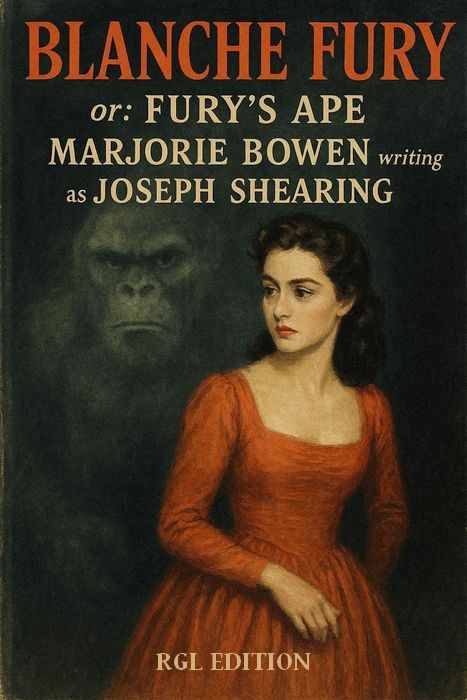
RGL e-Book Cover
Based on an image created with Microsoft Bing software
Roy Glashan's Library
Non sibi sed omnibus
Go to Home Page
This work is out of copyright in countries with a copyright
period of 70 years or less, after the year of the author's death.
If it is under copyright in your country of residence,
do not download or redistribute this file.
Original content added by RGL (e.g., introductions, notes,
RGL covers) is proprietary and protected by copyright.
RGL e-Book Cover
Based on an image created with Microsoft Bing software


"Blanche Fury," William Heinemann, London, 1939
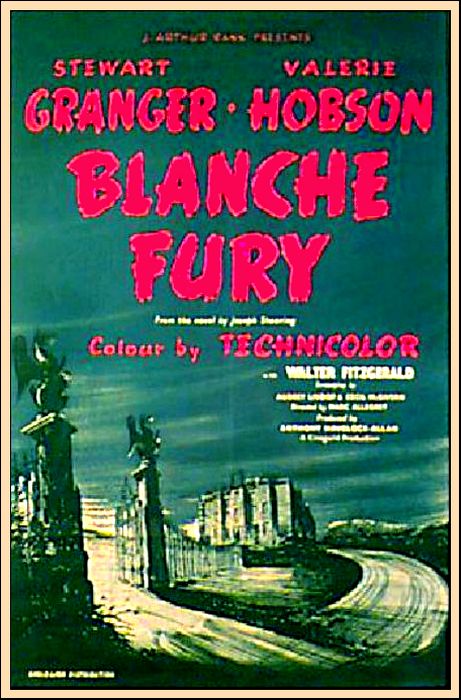
"Blanche Fury," Film Poster, 1948
"Blanche Fury" is a dark, psychologically charged Victorian-era crime novel that blends gothic atmosphere with the slow tightening of a noose around its protagonists. Joseph Shearing (Marjorie Bowen) based the story loosely on a real 19th-century murder case, and the novel reads like a hybrid of sensation fiction, domestic tragedy, and moral fable. Blanche Fury, a proud, intelligent young woman of reduced circumstances, accepts a position as governess at Fury Hall, the decaying Derbyshire estate of her distant relatives. The house is dominated by two men: Simon Fury, the legitimate but weak master of the estate; Philip Thorn, the estate's brooding, illegitimate steward—charismatic, resentful, and burning with a sense of dispossession. Blanche's arrival disrupts the uneasy balance between them....
The novel's alternate title, "Fury's Ape," underscores Thorn's role as the dark, primal force of the Fury lineage—an embodiment of its suppressed violence and thwarted claims.
"You see, my lord, what goodly fruit she seems,
Yet, like those apples travellers report
To grow where Sodom and Gomorrah stood,
I will but touch her, and you straight shall see
She'll fall to soot and ashes."
—The White Devil, Act III, Scene I.
THE man and woman looked at the child who, seated on the grass, was making a daisy-chain.
"I am afraid, my dear," he said kindly, "you must go."
It was an April day of soft airs and pearl-coloured clouds that filled the upper air above the battlemented tower of the flint church and cast, as they slowly moved along, faint shadows over the delicate leafage of the woods beyond the churchyard. The graves were covered with small flowers, celandine, dandelion, buttercups and the daisies that the little boy wove into a chain as his mother had taught him.
The grey headstones that broke the swelling turf with hard lines and inescapable letterings, reminded the passer-by of inescapable death. The path on which the man and woman lingered sloped to the central doorway of the church with Its rich zigzag mouldings above which were the interlaced arches beneath a circular window. The work of the Norman builder, the memorials of the Norfolk yeomen, the sky and the clouds, the grass and the wild flowers were alike pale in colouring as if seen through a milky veil. The woman, at whom the man turned to look with some regretful tenderness, blended with the pale, uncertain hues of this English spring day, so full of transient sunshine, fleecy clouds and faint shadows. She wore a gown of some faded green material and a necklace of old coral; a thin white silk shawl was drawn by a sensitive ringless hand across a bosom hidden by a lawn tucker; her dark hair was uncovered; her slightly hollowed face was without bloom or lustre and her lips had not the freshness, nor her eyes the sparkle of perfect health; her emaciation, however, added to the lovely grace of her tall figure, and in all her person was a gracious beauty like an edging of light.
"Yes, I must go," she said in a careful English that showed she was a foreigner, "that was always understood. And father, also?"
"There is no more work for your father to do," said the man, still looking at her kindly. "There has not been much—for two years now."
"I know. You kept us on—out of compassion." She spoke without bitterness and he made no attempt at protest.
"You will be well provided for," he said gravely. "I hope you will be happy yet, in your own home."
"You know that is a hollow wish, Adam, my life is over;" the words were a statement of fact, not a complaint. "And Henry?" she added, glancing at the child, busy with his little white flowers.
"I have told you," he was hurt by her insistence.
"I want to hear it again," she said, "in this place, to you— I suppose—sacred."
"Well, then, I shall always look after him, he will have a good education, a fair start in life. But, Rosa, think again, if you and Henry and your father would not be much happier together in Rome."
"Happier, yes. That is certain. I am not thinking of happiness. The son should be with the father."
"It is for you to decide," he replied. "I hope you understand what your decision means."
"When you marry again, he will have to leave Clere where he has lived ail his life; I understand that."
"Mr. Bellamie will look after him. That is arranged."
"Come into the church," said the woman. The man followed her down the uneven path bordered by the richly growing turves; he did not often humour her or give her so much of his time, but to-morrow they were to part and it was not likely that they would ever meet again.
The interior of the ancient church was chilly; beams of pale light fell through the aisle windows, in some of which were lozenges of blue and scarlet; from the shadows above showed dimly the stiff forms of angels and cherubim that adorned the double hammer-beamed roof, their wings outspread along the protecting beams, their painted eyes staring down on the worshippers below. Through the gloom the small shields on the cornices showed brightly gilt and freshly tinted.
The woman sat down on one of the backless benches with poppy-head ends; she had pulled a cambric handkerchief from her bosom and tied it over her loose, dark hair.
Everything in the church was familiar to her: the hour-glass on its stand by the pulpit, the rood screen with doors painted with the figures of sixteen kings, the chancel chapel with the bosses of leering faces, the walls with the tablets, hideous with skulls and cross-bones, to members of the family of Robsart, who lay in the vaults beneath. She had spent many pleasant hours there with her father, who had restored and redecorated the church with the help of a local carpenter and a mason from Norwich. She had mixed the colours, cleaned the palettes; polished, gilded and oiled; she had brought cider, baskets of pears and cakes into the church that Mario Spinelli had glorified for the man who now stood silently beside her drooping figure.
Scarlet and azure glistened brightly on the near-by flourished shields that bore the arms of the family that had for so long worshipped in this church. The decrescent moon sinking into the stiff waves of the sea; the crest of a garlanded monkey with the motto: "He that looks at Fury's Ape, Fury's Ape shall look at him," were so familiar to the young woman that she would often see them embroidering her dreams.
As she still sat silent, the man said, with a trace of impatience:
"Why did you ask me to come here, Rosa?"
"That we might be here once more, together. I love the church—the angels and my father's work. I should have liked to die while living at Clere, so that I could have been buried here."
"That is unkind, Rosa. It is only saddening to prolong these farewells. I shall see you at the house presently."
She made no reply and Adam Fury left the church, pausing at the graves where the child had now fallen asleep, the unfinished daisy-chain in his lap, his dark head resting on the sweet grass of the swelling hummock.
The man paused and gazed down thoughtfully at his son, who already much resembled him in warm amber colouring of eyes and hair, in blunt features, and in sturdy limbs; five years of age, the child still wore skirts and pinafore and a coral bracelet; he looked harmless and helpless as he lay curled up in his sleep, tired from his play, but a shade of distrust, almost of dread, passed over Adam Fury's face as he considered him, as if he stared at a sleeping mischief.
The pale clouds like tufts of new wool closed over the sun and a wide, gentle shadow lay over the woods and the rolling pasture-land beyond, as the young man reached the low flint wall that bounded the churchyard.
The Vicar of Clere, Dr. Isaac Bellamie, was coming up the path from the long village street; the two men met in the loneliness of the April landscape, and on either side was a slight hesitation; Adam Fury spoke first, holding open the churchyard gate.
"You are going into the church, sir? You will find Madam Rosa there."
"No, Mr. Fury. I wished to speak with you. I was on my way to Clere Hall."
"Perhaps, sir, we can speak here?" Adam Fury was more markedly hesitant. "I am, forgive me, occupied to-day."
"With the arrangements for sending away Mr. Spinelli and his daughter?"
"Yes."
The Vicar was a hollow-chested man of middle age; nearsighted, with well-floured hair and rusty cassock; sincerity lent dignity to his mean appearance and breeding force to his fumbling words.
"Mr. Fury, I wished to speak to you of the child, young Henry."
"Sir, is not all in order? We are agreed that you shall have him in charge and about the terms of that settlement."
"I have thought further of the mother, Mr. Fury. I have made it a subject of prayer. My earnest advice now is that you send the child away with the Spinellis."
From where they stood they could see the little boy asleep amid the daisies; both looked at him as Adam Fury answered quietly:
"I must respect my obligation. They wish him to remain here. His mother urges that on me, even with passion."
"She must be cutting her heart out in doing so. Passion, you say, sir. What passion is stronger than a mother's affection?"
"She believes that it will be to Henry's advantage to be brought up as an Englishman."
"Do you, Mt. Fury?"
The young man's comely face darkened.
"Sir—this questioning of me..."
The Vicar interrupted, earnestly placing his thin hand on the squire's russet-coloured sleeve.
"In many senses, Mr. Fury, I am your servant. But here I must speak as God directs me. I have to think, not of you only, but of future generations."
"If I did not think of them, sir, I should not put myself about for this second marriage. Indeed, you know that it has only been resolved upon since my brother's death in Flanders."
"Your motive is ambition, Mr. Fury. You do not wish this estate, so long in your family, to pass into other hands. You must have an heir of your body to inherit. Madam Rosa's motive is ambition, too. She will sacrifice her mother's love for the boy's worldly advantage. No good can come from these motives. You both do wrong."
"Nay. If this is to be a sermon."
"I must presume upon your patience." Mr. Bellamie was gently insistent and the young man had not much courage with which to protest, for these words of reproof and warning but echoed his own uneasy thoughts ever since he had been persuaded to keep Rosa's boy at Clere.
"First, you both wrong the child, Mr. Fury. He should take his grandfather's name, return to Rome, become—with the money you shall give him—part of that family and never hear of his birth nor that he has any connection with England."
"Why, so I thought. But I felt an obligation to please her."
"You do her a wrong, too, Mr. Fury. She will die of parting from the child as well as from you, and her last days will be bitter. Sir, I dare suggest that her motive is revenge as well as ambition."
"Revenge?" repeated Adam Fury softly; he had thought of that, too; he gazed across the graves at the church where Rosa still lingered.
"I know this young woman well enough," said the Vicar. "We are friendly. She has given me her confidence without, perhaps, knowing it. She has betrayed no secrets, but I believe there was some Papist ceremony said over you and that she considered herself your wife."
"Perhaps. She was, however, always submissive and never offered to complain."
"She thinks herself your wife and the child your heir—who knows? Perhaps, before God, they are."
"I swear there was no marriage."
The Vicar smiled faintly.
"She is modest and honourable, else I had never allowed her to serve in the house of God. Well, Mr. Fury, you brand her a harlot and the child as base-born. Still, I say, send them away together."
"There is no reason," said Mr. Fury, as if arguing with himself, "why Henry should not be brought up as an English yeoman. I could establish him on the land here, give him, in time, a farm, so that he would not be altogether cheated."
"A compromise—sir, it will not do. This son of yours will grow up and marry—and at your threshold will be the bitterness of the disinherited."
"Henry need not know his descent "
"You cannot hope that yourself, sir. Everyone here knows that you are his father. They feign to credit the tale that he is merely your protege' because they respect Madam Rosa. Have you not decided, too, that he is to bear the name of Thorn because his mother was to you Rosa Spina?"
"Well," Adam Fury still stared at the church, "it is not so uncommon for a gentleman to have a bastard or two among his tenantry."
"There is foreign blood here and you intend to train him and endow him like one of gentle birth. If you send him away he will never know what he missed. Here, it will be for ever under his eyes. Sir, your well-meant actions will sow the seeds of a great bitterness."
"I promised Rosa. Revenge? Is she quick and cruel enough for that?"
"I do not know, Mr. Fury. Have you thought of your bride, sir? Will she be pleased to see this boy?"
"Barbara is a gentle, docile woman," said the squire. "She will soon, please God, have children of her own."
"But if it does not please God?" put in the Vicar anxiously.
Adam Fury was startled into harshness. "Am I likely to marry two barren women?"
"You might, or your children might die. And then Clere would pass into strangers' bands, while your son or his children would be living on your land."
"Sir, that is not my responsibility."
"Is it not? I foresee disorder, hatred, perhaps crime, rising from this action of yours. Sir, I thought of your motto and the old tales of Fury's Ape which destroyed all interlopers—this boy may one day be Fury's Ape in his shame and disappointment."
"Ah, you were always superstitious, Mr. Bellamie."
"One may read destiny in trifles. You call the boy Thorn and a thorn in the heart he may prove to those yet unthought of." Adam Fury laughed shortly.
"I had not thought of that. We lose ourselves in vain discussion. I have promised that he shall remain. Besides," he added quickly, "he is very near to my heart."
"Yes. The eldest, the only child. Fair, gay and strong. The heir of your body, Mr. Fury. You should have married the mother."
"The daughter of a journeyman painter?" smiled Mr. Fury.
"I think too well of my family for that. Besides " he broke off with a slight shrug and was silent, while his shapely hand put back the blown brown hair from his forehead.
"She never stood high in your affections?" the Vicar finished the sentence. "You were lonely and uneasy "
"Let k be, Mr. Bellamie. My decision is taken."
Rosa had appeared in the church porch; both the men looked at her as she stood in the shadows into which her greenish gown merged, her hands hanging at her sides.
"One thing more," urged the clergyman strongly. "If you die childless—to whom is your property to go?"
"It is no secret, sir. To the heirs of my dear wife, Emily Surr."
"Then, cannot you foresee the future, if these strangers inherit with your descendants at their gates?"
"Mr. Bellamie, you are fantastical. Why should my second marriage be barren? Why should that boy yonder found a family? He might never live to manhood."
Rosa Spinelli was crossing the churchyard; she knelt beside the sleeping boy, roused him and pressed him to her breast; while the two men by the flint wall watched her, she came down the dandelion-bordered path, the boy with the daisy-chain round his neck holding her hand, the light, sweet wind blowing her thin dress and fine, dark curls.
When she reached the gate the Vicar greeted her courteously.
"We speak of your little charge, madam. We make provision for his future. We also question, madam, if you are wise to leave him here, to deprive him of your care."
Rosa paused and glanced from one man to the other.
"I have heard all that can be said, sir. The boy remains, as Mr. Fury has promised." She spoke with a hard, painful composure, a stern exercise of that inscrutable feminine courage which makes men suspicious and uneasy. "I have packed all his clothes and toys and lesson-books, Mr. Bellamie, and now I should like to go and see your housekeeper, Mrs. Chestney, to tell her some things about what she must do."
"Go now, my dear," said the squire. "Your father has everything ready and the carriage is ordered for eight o'clock tomorrow morning." He repeated what was well known to both of them in order to let her know, yet once more, the finality of his decision.
She looked at him steadily; he did not like that swelling bosom, that upreared head, and his face darkened. But she turned away quietly enough, leaning on the Vicar's civilly offered arm and leading the drowsy child.
The daisy-chain had fallen to the ground; Adam Fury idly picked it up; the wounded flowerets were already limp and withering, the chain broke as he touched it. He put the sad garland into his flapped pocket and turned away, avoiding the village with the one broad, long street, and taking the path across the fields that led to the manor house, usually called Clere Hall.
The land, as far as he could see, was his, and he loved it passionately; he was of a philosophical turn of mind and had read and travelled much, but he could never rid himself of this unreasoning affection for his own acres or this superstitious terror lest they should pass into other hands than those of his own kin, after his death.
The manor house, the park, the gardens, the orchards, die farms, those miles of pasturage land, the church, the village, the scattered cottages, all, to the smallest detail, were familiar to Adam Fury, part of the fabric of his life and of his dreams.
He had been a happy man until his wife, Emily Surr, died, eight years ago, for he had loved her truly, though she was a plain woman and he had married her for her "wide lands near his own. Her father was a law lord and she his heiress; out of deep affection for her dear memory, Adam Fury had left these estates to the sons of her father's sisters should he die heirless, and the shrewd old judge had made him add the Fury estates to them.
Listless and melancholy he had gone abroad after Emily's death, which had been caused by the blackwater fever that came from the half-drained fens. He had tried to interest himself in art and learning, the things that had once pleased him best, and during three years in Italy had, in these pursuits, regained some tranquillity.
In Rome he had met Mario Spinelli, a painter of modest pretensions, whose quiet personality and elegant craftsmanship had pleased his fastidious taste.
Soon, Spinelli, at a higher wage than he had ever thought of demanding, became one of the attendants on the rich Englishman, his adviser in the purchase of antiques and his guide to the curiosities of Italy.
The painter brought with him his motherless daughter, Rosa; Adam Fury taught her English and soon found in her quiet, tranquil company all that his wounded spirit could accept from a woman.
It had seemed to him inevitable that she should become his mistress. He had submitted to the "priest's blessing" on their union with no thought but of humouring a Papist superstition, and before be brought Rosa and her baby to England he had scrupulously explained to her and to her father that there was no marriage and that Enrico must pass as her nephew and his protegé. The Italians had taken this submissively; Adam Fury hardly knew whether they had been surprised or disappointed; their language was a certain barrier—and they were well trained never to overstep the bounds set between a painter and a landed gentleman.
They had been four years at Clere, and the arrangement had been very pleasant to Adam Fury. He had absorbed himself in spending Emily's dowry on the adornment of the place that she had loved, and in raising in his grounds a fine, brick mausoleum in imitation of the pyramid of Cestus. Her coffin was transferred from the vaults of Clere Church and laid in this pompous burial-place where Adam Fury hoped to lie beside her waiting the Judgment Day.
He had not concerned himself about the succession to his
property, for there was his younger brother, Captain Timothy Fury, and his boys and the sister and her children who could, if need be, take the name of Fury.
But death had played havoc with his hopes and schemes; his sister Phillida had died in child-bed, her children had followed, snatched away by small-pox. Adam Fury had hardly recovered from this sorrow before he received news that Captain Fury had been killed in Flanders and she months later his son had been carried off by some childish ailment even while his uncle was arranging to have him brought to Clere.
So, in the space of four years, Adam Fury had lost all his relatives and stood, stripped, the last of his race.
Reluctantly he had decided to marry again, and his choice had fallen on Barbara Fuller, a considerable heiress, inheriting land at Bayfield and Beeston St. Lawrence.
This had meant the end of his connection with Mario Spinelli and Rosa.
Adam Fury had been sorry that so pleasant an episode was over, but it had seemed to him to come naturally to an end. His orthodox character had been a little irked by the illicit union with the foreign woman and the thinly veiled false position—a position made decorous enough to satisfy the conventions of his caste, yet, as the Vicar had reminded him, clear to all.
To the servants, the tenantry, the neighbours, Rosa was his mistress, though she was so modest, meek and kind that she provoked no spite and but little scandal.
Everyone would feel that it was right that she should leave Clere Hall before the second Mrs. Fury entered it, yet there would be many who would be sorry to see her go.
Adam Fury turned out of his way in order to pass the mausoleum where Emily lay solitary. He had planted a group of cedar round the tomb—both trees and pyramid looked alien in the English landscape—and set a grove of beeches, still saplings, leading up to the mausoleum, in a stately avenue.
"In a hundred years' time," he thought, as he paused to look at the tomb, "it will be mellowed, have an antique air and be more noble."
It was, he thought, skilfully designed and well built and he felt a swell of gratitude towards Mario Spinelli who had served him so well. That patient, eager and humble craftsman was well worth the banker's draft for a thousand pounds that Adam Fury had given him to dower Rosa.
He remembered the money now with satisfaction; the girl was but three-and-twenty years of age and comely; a thousand pounds was a handsome sum in Italy; she would be happy with her own people.
Intense melancholy filled his heart as he gazed at the door in the pyramid that would divide him from Emily until he went in there, a corpse, to join her dark repose.
"Why could she not have lived? Why could we not have had children? Then—I had been the happiest man alive."
He turned through the woods into the high road that wound through the village, past the manor farm, Linton, then past the gates of the Manor Park; he did not often go abroad on foot but Rosa had begged that to-day they should walk, the three of them, to the church together.
The sight of his own gates of fine iron-work with stone apes crowning the pillars, and the decrescent moon cut on the shields they held, lightened his gloomy mood; he tried to think with pleasure of pretty Barbara Fuller who was to give him heirs and be his comfort in his old age, but she had eighteen years to his thirty-three and he knew that he could never love her insipid personality, beside which Rosa, though so tranquil, seemed varied, brilliant and entrancing.
He thought over the Vicar's anxious warnings. He knew that these were based on reason. No doubt but it would be wiser to have done with the whole interlude, no doubt but that the boy had a better chance of happiness as a Spinelli in Rome than as a bastard Fury in Norfolk. And it might well be that to leave the boy here at his gates was to leave a seed of discontent to grow, perhaps, into some poison fruit.
But he had promised Rosa and he loved the child.
As he walked slowly towards his house he turned these issues over in his uneasy mind.
Pride still triumphed; the pride of keeping his word, the pride of having his fine young son with him. Which farm should he—not give him, for that would be to cut up the estates—but let him rent at a nominal figure with many privileges, Godstone, Linton, Chelmere, the three finest of his fat farms? He wished he owned Saltash, on the borders of his lands; he had always coveted that, but the Fastalfs, the yeomen who owned it, had always refused to sell; well, perhaps one day he could buy Saltash and might see Henry Thorn established there.
He came in sight of the manor house and smiled to see it, clear before him in the pale air.
Clere Hall was moated; a Jacobean mansion of red brick, finely faced with stone, reached by an arched bridge over the water; this was guarded by an iron gate set between two ape-crowned pillars.
The house had four gables; in each was a handsome double oriel window; at either end was a squat tower with a leaden cupola; behind, rising against the trees, showed the belfry of the stables with a glittering weathercock. Groups of richly ornamented chimney-pots rose above the tiled roof; between the windows glistened the new leaves of carefully trimmed ivy. In the centre was an arched doorway and there were doors in each of the towers.
The mansion stood on the site of a manor house built in the thirteenth century. The building that Adam Fury looked at was over a hundred years old; the date, 1626, was cut under the arms over the main door, above was the ape again, with the motto in large letters;
"HE THAT LOOKS AT FURY'S APE,
FURY'S APE SHALL LOOK AT HIM."
The place was handsomely kept, even the sharp, critical eyes of the master could find no fault with its appointments.
Yet to the glance of the sensitive stranger it had an oddly gloomy air hard to account for, perhaps the tall trees at the sides and back crowded too closely round the moat which was too wide, deep and dark, perhaps the oriel windows had too cold a glitter, for the place caught no sun save, in the spring, the last gleams from the west, perhaps the ivy rambled too heavily on the red brick, or the situation was too solitary, for there was no other house in sight, but certainly Clere Hall had no cheerful aspect, even now, in the prime of its prosperity and under the spring skies.
But Adam Fury looked at it, as always, with deep satisfaction.
He crossed the bridge, pushed open the heavy door that stood unlatched all day, so safe was he on his own grounds, and entered a large, handsome hall from the centre of which sprang a fine oak staircase with an ape, cunningly carved, crouching on the newel-post; beyond was another room known as the staircase hall.
The large front withdrawing-room opened on the first hall and by folding doors, on the dining-room, a noble apartment facing the back of the house; this led to the library which led again to the staircase hall. To the right of the entrance-hall was a wide passage; on one side opened two rooms with oriel windows, on the other were the servants' quarters. The door in the light-hand tower led to these offices and the kitchen, and that in the left-hand quarter, by a small closet, into the withdrawing-room.
The oriel windows above lit four handsome bedrooms, each with a closet; in the towers in each gable were smaller rooms reached by narrow stairways. Other bedrooms looked on the back of the house, situated over the dining-room and library.
There were no more than twenty rooms in Clere, but they were of noble proportions and handsomely decorated with oak and pine from the estates that constituted the Manor and its appurtenances.
Mario Spinelli had added his graceful art to the solid English workmanship; he had inset painted panels on the staircase, carved the shields set round the dining-hall and the wreath of exotic fruits that surrounded the portrait of Adam Fury above the inlaid marble mantelpiece in that room.
It was before this portrait, that showed him in an olive-green coat before a dull red curtain, that Adam Fury paused., He appeared, he thought, younger and more amiable in his picture than he was in reality. No doubt but that Spinelli had flattered his patron. And in more ways than by rendering him handsome on canvas.
A melancholy came over Adam Fury; he had never been far from that state of mind since his wife's death; he recalled with a sense of foreboding the Vicar's words of warning.
What, after all, did he know of these two Italians? They were suave, flexible, easy to live with as a silk glove is easy to slip over the hand. But the Englishman realised that they were alien to him in everything, blood, faith, code, passions. The Vicar had spoken the dreadful word "revenge." Suppose that under their cool civility the two foreigners did dwell on the thought of revenge?
"For what wrong?" Adam Fury asked himself. He knew the answer though he would not admit as much to himself.
Rosa considered herself, before her God, his wife and the boy his heir. Once he had found in the great Bible that stood in the hall in a fine oak box, an entry in her thin handwriting beneath the marriages, births and deaths of the Furys: Rosa Spinelli—Adam Fury. Rome. October 16, 1733, she had written and be had not had the heart to put his pen through it; but now he must remember to do so.
She was intelligent, she knew that she was trapped and helpless; her father knew that, too, and both of them knew that Adam Fury, according to the code of his class, had behaved very well.
But was there not danger in their very cool submissiveness?
Adam Fury caught himself up; why should he use, even in his thoughts, the word "danger"? Dr. Bellamie had thought that danger might come through the boy; but the good Vicar was a dreamer, a solitary man who meditated too much, a visionary, perhaps. No doubt it would be better if the boy went —if that episode was closed completely, but it seemed fantastic to fear that if be remained, he or his descendants could ever harm the house of Fury.
The young man turned to the window that looked on the garden beyond the moat that Spinelli had helped him to design in the Italian style; with his hands clasped under his wide skirts, he mused, not without some bitterness, in his thoughts.
Emily's death without children had undoubtedly spoiled his life; he recalled uneasily her friendship with her cousins, the sons of her father's twin sisters, her hopes that they might be her heirs. Well, he could leave them something, no doubt, but Clere was not for the Surrs, but for his own blood. Her father had stipulated that the estates, should he die childless, were to go to her family, since Adam Fury would enjoy, during his own life, her considerable property.
What confusion a failure of the direct line and a number of jealous claimants meant! Adam Fury felt weary and sickened; he saw now what Dr. Bellamie had foreseen—a quarrel between two alien families for Clere and the true line excluded by the bend sinister.
"I am becoming affected by the old man's fantasies," he thought. "Oppressed by idle fears. When I have my own children about me I shall think no more of this. And I shall be just to Henry, he shall not suffer."
So he tried to compromise with himself, but his conscience was more deeply troubled than he would admit.
His hand went idly into his pocket and his fingers closed over the crushed daisy-chain; he drew it out and looked at the drooping flowers and the chain was broken here and there.
His uneasiness increased; he was too sensitive to this sad symbol of Rosa's fortunes, of the broken line of his family; he thrust the daisies deep down into his pocket and looked round to see Mario Spinelli bowing in the doorway; Adam Fury wished that there could be an end to their prolonged leave-takings. He had settled all his business with Mario Spinelli, with Rosa, and about the child, too. Everything had been arranged to the last detail.
But the painter said courteously:
"There is one thing more, signor," he bowed again and held out a long envelope. "You must, please, take this again."
The young man knew, even before he had turned back the flap of the envelope, that it contained his draft for a thousand pounds; he was deeply vexed.
"I shall insist," be said with a hardening face.
"No. This time I insist. For what can be paid for, you have paid very well. Of what use is even that large sum for what cannot be paid for?"
Mario Spinelli spoke gently; he was a tall, elegant man with a worn face and tired eyes; he spoke English very well and his manner was subdued without being servile.
"In providing for the child, signor," he added softly, "the money will be better employed."
"We have discussed that. Henry will be fairly provided for. That—paper—was for Rosa."
"She will not need it."
"Very well, then, there is no more to be said." '"Nothing, signor."
The painter withdrew and Adam Fury tore up the draft and thrust it into his pocket with the crushed daisy-chain; he. would be, he told himself, profoundly relieved when they had gone, when Barbara Fuller was his wife, and had given him his heir.
He had business to attend to, bur he put this aside; it was not for to-day; he went moodily through his great rooms; he would have to forget that Mario Spinelli had carved this and painted that, and that Rosa had mixed the colours for him; they were aliens, paid servants, he reminded himself cruelly. Soon they would go and be forgotten.
He did not see either of them again that day; Rosa had lived apart from him since he had told her of his approaching marriage and he never went now into the room with the oriel window above the with drawing-room that she occupied. In the cool, fair morning he was ready by the open iron gates beyond the drawbridge to bid them "God speed."
The servants were sorry to see them go; though outward decorum had been so well kept and it was natural that the painter should return to his own country when his work was done; still it seemed to the women of the household at least, as if one wife was being turned away for another to take her place.
The carriage, drawn by the swift, stout Norfolk hackney, was ready, the baggage in place, they were taking very little with them; Adam Fury feared that he would find in her room everything that she had ever had from him; for a long while now she had worn those clothes that had been hers when he had first met her in Rome.
She had said "good-bye" to her child in her chamber, and she had asked the sympathetic housekeeper to detain him while she left; to Adam Fury her farewells were formal; he, too, was constrained; there was very little they could say to one another.
As she stepped into the carriage he swiftly and deeply regretted her; where would he find again such intelligence, such exquisite tact, such grace, such profound devotion to himself? Her cruel composure disturbed him; it was unnatural that she should show such tranquillity on leaving her child for ever.
She looked at him from the carriage window; Mario Spinelli, seated beside her, raised his broad leaf hat; the coachman touched up the horse and they were gone, across the Park, past the brick mausoleum where Emily Surr lay alone, out on the high road, out of sight, gone and lost for ever.
Adam Fury returned slowly to the house; his first care was to go to her room.
There were her clothes, neatly folded in the press and drawers, there were all the trinkets he had given her, neatly in their boxes, there were the books he had bought her, and the portrait her father had painted for her of himself.
He locked the room, not wishing this to be discussed by the servants, and before he gave the keys to the housekeeper he removed all Rosa's things himself in the quiet of the evenings, up to one of the attic rooms in the gables, and there he put them into an empty chest, not wishing ever to see them again.
The child did not appear to miss his mother; he went cheerfully to the vicarage by the church where Mrs. Chestney, the housekeeper, petted him a good deal.
And Adam Fury set his house in order for Barbara Fuller, his second wife.
Both the Surrs and the Fullers soon brought pressure on him with regard to the disposal of his property should he die childless, but he resisted all of them and declared he would make no will at present. The truth was be could not endure to contemplate the prospect of being the last of his family.
He, however, executed a deed with the help of his lawyer, Nicholas Calamy of Norwich, whereby a handsome sum was settled on Henry, his child, born out of wedlock, and named Thorn; he intended to buy Saltash Farm for Henry if it ever came into the market, or, in default of that, make him life tenant on easy terms of one of his own properties.
Shortly before his marriage he went to see the boy, who asked him: "When am I coming home?"
"This is your home, now, Henry."
"No. Clere is my home. Aunt Rosa said so. She said that I was Fury's ape to keep everyone else out."
The Vicar and the squire exchanged glances over the child's head.
"He will forget," said Adam Fury—and indeed Henry was already busy with the wooden horse his father had brought him, trying to pull off the leathern harness.
"There's but three Furies found in spacious Hell,
But in a great man's breast three thousand dwelL"
—The White Devil Act IV, Scene III.
"She's turned Fury."
—The White Devil, Act III, Scene I.
"IT has a murderous look," said Blanche Fury, putting her head out of the carriage window. Then: "I have never seen anything like it before."
Her words, spoken in a low, steady voice, came clearly on the keen air. The driver of the hired carriage turned his head and looking down stolidly, said:
"It's an old place, miss, there's several moats hereabout."
"A moat!" exclaimed the young woman.
She opened the carriage door and without waiting for the steps to be let down, leaped to the ground, looking about her in a cool excitement for some prospect of romance or adventure.
There appeared to be none. Clere Hall, an ancient Jacobean mansion, stood in a rich woodland. Now nearly all the trees were bare. The clop-clop of the old horse in the hired carriage had startled a pigeon, which flew from one bough to another of a leafless elm, making a graceful moving design against the light-grey clouds.
Blanche, who had quick eyes for beauty, noticed this and was somewhat comforted; she felt lonely and bereaved.
Well, there was beauty here, no doubt—"repose for the body, refreshment for the spirit." Why had she said that the place had a "murderous look"?
The house, of no great size, rose with an embattled appearance from the moat, which it now shadowed darkly. Tall, twisted and finely decorated chimney shafts were dark against the sky and the tracery of naked boughs. From the midst of these a thin twist of smoke drifted, but, to Blanche's eyes, with no cosy or friendly air. All the windows were blank, though it was near twilight.
Then, as Blanche stood at the edge of the moat, hesitant, holding the fur collar of her pelisse around her throat, she saw orange fire reflected in the panes. The house faced westward and the sun had broken through a purple cloud before it sank behind the black lines of the distant horizon.
Four of these windows were large, handsome, of oriel shape, and between them hung a curtain of dark ivy. Above, the facade rose into gables pierced by smaller windows. At either end were short towers surmounted by fantastic leaden cupolas. A double-arched bridge led over the moat and to the entrance above which, squarely set in the bricks, was a massive stone coat-of-arms.
The driver of the hired carriage, slow rustic as he was, began to be a little surprised and amused at the fashion in which the young lady was standing among the broken sedges at the edge of the moat, gazing at a place so familiar to him. And he looked up too and glanced at Clere Hall with a dim, yet fresh apprehension of what the old house really looked like.
The words that his passenger had used stuck in his mind. "Murderous," she had said.
"I had heard it's haunted, miss," he remarked without emotion, "but I never knew of any that saw a ghost."
"I'm not thinking of ghosts," said Blanche Fury. "It is very wild. Are there no gardens?"
"Ah, yes, miss, there ate gardens. Adam Fury spent a deal of money on the place. They're laid out at the back in the foreign style. And there's acres of parkland with statues, and that queer-shaped burying place that's thought a lot of by the gently."
"The pyramid," asked Blanche Fury quickly, "that we passed as we drove from the lodge?"
"Ay, miss. Adam Fury is buried there, and them as came before him—Furys brought from the church."
"Well," said Blanche Fury, with a sudden sharpness as if impatient with herself for speaking with this creature, "it seems there is no one to welcome me. I don't know if you can drive across the moat bridge?"
"It can be done, miss—Mr. Fury takes his gig across. But I'd rather not, with the old mare and the dark coming on, and the turning."
"Well, well, don't make any more excuses—stay there," said Miss Fury. "I will go across and ring the bell. Surely there must be someone within, if only servants."
"Ay, there be that." And the driver, losing interest in his passenger and in the scene, sank back into his many capes and stared dully at the shabby grey horse, which, tired from the five-mile jog-trot from Norwich railway station, stood sagging in the shafts.
Blanche Fury was walking rapidly across the bridge, then suddenly paused in the middle, again looking up at the house, which so deeply impressed her and to which she had taken such a strong dislike. She stood there in the thickening dusk, not irresolute, but with a firm stance as if she wished to impress upon her mind something formidable that she had to face.
She had come from penury and loneliness: she was going to loneliness and dependence, for she had no hope that among the Furys of Clere Hall she would find a friend. The utmost she could hope for from her uncle, who she well knew was a severe, tight-fisted man, was a not unkindly tolerance. And her cousin, from whom she might have hoped something, was married, the affectionate husband of a young and pretty woman. Blanche, an almost penniless relation, would be an interloper on this serene and happy scene. She had been offered the hospitality of the Furys of Clere only on the tacit understanding that she should act as governess to the child and companion of the wife.
As she stared at those blank, inhospitable windows, in which the vivid reflected fires of the setting sun glowed with transient brilliance, she set her shoulders and all but returned to the hired carriage.
She remembered with regret what she had once detested, the apartments in the Abbey Square of Bath where she had nursed, first, an invalid father, a peevish wreck from the Napoleonic Wars and, then, a mother slowly dying of a repulsive disease.
But strong common sense and deep-seated prudence, qualities that had hitherto kept her living a drab, respectable life contrary to her instincts and her nature, prevented Blanche Fury now from doing anything rash or foolish.
The long illnesses of her parents had absorbed their small capital. Her mother's annuity had died with her; Blanche had sixty pounds a year. If she returned to Bath, or if she went anywhere else, she would have to perform some kind of work to earn her bread, and she was fitted for nothing save a post as dancing or music mistress in a girls' school, or a position as a governess. And since she must accept some such servitude, it would be better to take that offered in Clere Hall, where at least she might put in some claim of relationship and possibly force the consideration she would not be able to bring herself to beg.
So she crossed the bridge and stood under the great coat-of-arms of the Furys of Clere, a decrescent moon, a rippling sea, an ape above. Then she passed resolutely under the porch and pulled the iron bell-chain.
She bad not hoped for much, but this was a bad beginning. No one to welcome her, no open door, no lights in the windows. Were they resolved to treat her with contempt?
Blanche had seen her uncle, Simon Fury, the Recorder of Norwich, twice only: once when he had come to the funeral of her father, once when he had come to the funeral of her mother. She had not liked the stern, handsome, grey man. His flint-like glance had seemed to reprove her, or something in her that he did not deign to name. She reminded herself bitterly that she had never been asked to Clere Hall, till it had been necessary to invite her as a dependant.
"Because of the family, I suppose," she thought. "If father hadn't taken the name of Fury, if we'd still been Fullers, I doubt if they would have concerned themselves with poor Blanche."
A manservant opened the heavy oaken door and Blanche was tight-lipped at his stare.
"I am Miss Fury; I am expected. My valises ate in the carriage beyond the bridge."
Without waiting for an invitation she passed into the hall. The man's civility was gratifying to Blanche. He informed her with respect that she had not been expected until a later train; the Recorder, Mr. Simon Fury, young Mr. Fury and his wife, had gone in to Norwich to meet her. Blanche felt a faint glow, not of tenderness, but of pride. Yet it was as soon gone as the false fires in the window-panes of Clere Hall. Of course, they would be forced to show her an outward courtesy. They were the kind of people to keep up appearances before neighbours and servants.
She took some of the scanty hoard of coins in her reticule and gave them to the butler to pay for her carriage.
"It was easy to make a mistake," she explained, coolly. "The journey was cross-country, and I was not sure of the train. Perhaps the housekeeper will show me my room."
The butler, standing In the open door with Blanche's poor coins in his hand and a little disconcerted at the pride and splendour of the young lady, replied that Mrs. Fury was her own housekeeper, but that Eliza Chestney, that lady's personal maid, would show Miss Fury to her room.
He pulled an embroidered bell-rope that hung beside him in the hall.
Again Blanche Fury stood silent and rigid with squared shoulders, as she had stood on the drawbridge, again not with any air of hesitancy or lack of resolution, but rather as one facing a difficulty or an enemy.
She watched the manservant, who seemed, on the surface at least, an ordinary well-trained pleasant fellow, cross the bridge, go up to the waiting carriage, pay the man and take her two shabby valises out of the carriage as if there had been something important in these trivialities.
Then she turned sharply as she heard a footstep and a feminine voice say:
"The mistress will be very sorry for this mistake, miss. Pray come upstairs. The mistress will wish me to do what I can for you. There's a fire in the room and all made pleasant as the mistress ordered."
Blanche smiled in the shadow of her mourning bonnet. Three times in that short speech had the word "mistress" been used! Unconsciously, no doubt, but no one would ever forget who was mistress of Clere Hall. Not she—a Fury, who had a right, surely, to something and had never had as much as a penny piece or a silver spoon—but the young stranger, Olivia Carpenter, who had bad the luck to captivate young Laurence as he left college.
Picking up her stiff, black bombazine skirts, Blanche followed Eliza Chestney up the shallow, well-worn wooden stairs, which were polished to the colour of dark amber.
As she glanced from right to left at her surroundings, she felt deep envy. On all sides were evidences of the wealth and taste that she had always longed to see about bet. The taste she could have supplied herself as well, if not better; it was the money that she had always lacked... with a place like this— what an inheritance after all to step into! Foolish as she was, she had thought it had a murderous look as she stepped from the carriage. But inside—no. Dark and gloomy perhaps, but splendid, rich in associations, with an indefinable air of breeding and power, as if the generations of men and women who had lived there had left a proud, rich atmosphere behind them.
The corridor at the head of the stairs was wide, and hung with a fine tapestry in shades of indigo blue and mignonette green. The oak beams were deep and broad; where they entered the hall, were shields of wood on which the arms of Fury were painted in brilliant colours, the ape above. Between the panels and tapestry were pictures of men and women whose faces, Blanche instantly thought and hoped, were like her own —the dead Furys who had lived their lives in Clere and left it enriched by their dignity and toil.
Blanche feared that she would be taken up the second flight of narrow stairs and given one of the rooms in the gables, the windows of which she had seen from the other side of the moat.
But Eliza Chestney stopped on the main floor and opening a handsome door of richly polished wood showed Blanche into a room, which she instantly recognised as owning one of the large oriel windows. She was not touched nor even pleased. She thought:
"Ostentation! They dare not treat me as a poor relation!" She looked greedily round the room. Eliza Chestney moved about saying: "The mistress did this and the mistress ordered that," and showing the thought of the mistress, all the care of the mistress, as if she begged the young lady for a word of appreciation or gratitude. There could be no doubt where the servant's devotion lay. If Blanche had had any half-formed thoughts of making a party for herself in Clere against Olivia Fury, it was obvious to her that even she, by nature artful and with more than her share of feminine duplicity, would scarcely be able to do so.
The woman, like the manservant, was simple, faithful, well-trained.
"I suppose," thought Blanche, "there is what most people would call a pleasant atmosphere about the house, although it looks so dark and grim from without, and although the carriage-driver spoke of ghosts!"
How wretchedly shabby her two valises looked, when the butler brought them up and placed them in the middle of the shining waxed floor. A wood fire was burning; she stood before it, pulling off her cotton gloves. She was anxiously offered refreshment, but she refused this and closing the door on both of them went at once to the oriel window, which stood out like another room with diamond-paned glass on three sides.
Blanche stared over the misty park. Along the winding road into the distance went cloppity-clop the carriage she bad hired in Norwich. It seemed the last link with the outer world and her old life.
She turned back into the room, letting fall into place the old curtain of a tawny rich velvet, which Eliza Chestney had drawn on the smooth rods where the brass rings made a tinkling sound.
The room was, in a dignified fashion, splendid. A fine stone hooded* chimney-piece sheltered a wide hearth where brass andirons glowed in the light of the briskly burning fire. There were fine Persian tapestries on the floor; there were several large chairs, walnut-framed with needlework and yellow satin upholstery. There was a bed, old-fashioned, with a tester upheld on fluted wooden pillars, but so comfortably and handsomely furnished with hangings, coverlet and exquisitely lavendered linen that it could not be termed gloomy, even in its antiquity.
There was a press that brought a sneer to Blanche's fine mouth. How forlorn her one or two garments would look hanging there!
There was a handsomely moulded Jacobean ceiling, and in one corner where the floor gently sloped there was a bookcase of green-and-gold stamped leather.
The sneer returned again to Blanche's face as she picked out the volumes one by one. Works of devotion and moral stories, and a treatise or two on astronomy and botany for the use of gentlewomen. There were other books on the little table by the bed—a Keepsake for last year, a Forget-me-not for this year, a volume of the Belle Assemblée. Beside them stood a pure wax candle in a twisted silver stick.
The dressing-table, which Blanche had pushed past without noticing it, when she went to the oriel window to gaze with she knew not what yearning on the departing hired carriage, stood in front of the embrasure. There were more candies here, splendidly wrought girandoles, and bottles of cut-glass, and trays and caskets of pierced silver and tortoiseshell, while the mirror, which had been carefully placed with its back to the light, was upheld by two massive cupids of gilded wood and silver.
Blanche Fury went round the room with an air of distrust and suspicion, almost as if she were spying. She turned down the bed and tested the quality of the sheets. She pried into the workmanship of the needlework on the curtains and chair covers. She examined the Persian rugs on the floor; she looked into the details of the housewifery—the glass panes of the window and the mirror were well-polished and all the metal shone. There were no signs of neglect or contempt in her reception there.
And among the caskets and pots on the dressing-table, empty and likely to remain so, for she had neither cosmetics nor jewelry to fill them, stood a bowl of winter roses with their petals like the inside of an oyster shell and hot-house hyacinths with tiny pink-white pearls of bloom above the pale stems.
This intimate gesture of welcome did not touch the hard passionate heart of Blanche Fury.
She put off her mourning bonnet, only noticing then how it had galled her head and forehead. It had been cheaply and quickly put together by one of the least expensive mantua-makers in Bath.
With a gesture of impatience she shook back her long, fine, red-gold hair, which fell with incongruous splendour over her stiff, white linen collar and harsh, tight, black bodice stained with the dust of travel.
Blanche did not trouble to look at herself in the mirror: she knew exactly what she was like. She was now five-and-twenty years of age and from the time she was fourteen she had recognised and valued her charms, and had, indeed, changed little in the last ten years. She had always considered her one asset, this rare physical beauty, with shrewd calculation, but so far it had proved of little benefit to her.
The only homage she had provoked, stares and, perhaps, whispered comments from people whom she passed in die street, had been too mean to please her keen pride. No one whose admiration she valued, whose friendship or affection she wanted, had appeared to have been attracted by her. She recognised herself that there was some flaw in her dower of loveliness that rendered it almost useless. She had long since decided that this flaw was her penury, accentuated by her obscurity.
She had had, as long as she lived at Bath and while she had been at the boarding-school where her parents had scraped to send her, no background. Her father had been a half-pay officer, who had quarrelled with his relations; her mother a clergyman's daughter. There had never been any social prestige, any money—anything whatever to enhance the charm of Blanche Fuller, who had later become Blanche Fury.
Then her life had been further narrowed by the illnesses of her parents, by their peevishness and their moods, by their selfishness, by their.concentration on themselves, by their demands on her as nurse and companion. The few friends whom she might have made, the few entertainments that she might have gone to, the little diversions and trips that she might have enjoyed, had all been out of the question because "Blanche can't leave her father," or "Blanche can't leave her mother."
All her life she had been patiently waiting for a chance. Perhaps it had come now. It was just possible that with the background of Clere Hall she might at last meet with good fortune. Probably in time she would be able to put under review all the bachelors of Norfolk of any position or standing. Would there not be one among them whose head she could turn?
She unhooked the stiff whalebone bodice with a little sigh of relief as her bosom was allowed room to expand. The garment was ill-cut and galled as the bonnet galled. Hideous, black, unbecoming mourning for a woman whom Blanche had never loved, whom, on occasion, she had hated.
When all the detestable black garments had been removed, she stood clad in the white shift that she had taken some pleasure in embroidering, in the glow of the fire and shook out the clinging spiral reddish-gold curls.
Her beauty was that of both line and colour, but it was entirely without expression. Her features were small and exact, her eyes large and of a clear hazel, her complexion had that purity of white and pink known as brilliance. Her nose, nostrils and mouth—particularly the upper lip—had entrancing delicacy of line; her slightly heavy neck, bust and shoulders, added to her long thighs and height, for she was uncommonly tall for a woman, gave her a voluptuous air, which her severe, mask-like face belied.
She had carefully cultivated this impassive look, not only because she did not wish to disturb her beauty with lines or wrinkles or flushings and palings of emotion, but because she wished to hide her feelings from the world. She had no emotions that she wished others to know; she was well aware that most of the passions that she hid behind that smooth exterior would be considered blameworthy by those who surrounded her and whom hitherto she had invariably deceived with her self-control. She roused from her bitter reverie.
"They will soon be back, of course, and I shall be expected to make an appearance, to meet them all, to thank them for their attention. If Olivia Fury thinks so much of me as to prepare this room with such care, why didn't she come to see me in Bath?"
Blanche was aware of her own unreasonableness even as she made this reflection. She knew well enough that Olivia would be completely under the power both of her husband and of her father-in-law and would never have been allowed to make a journey to see a poor relation.
A hard man, the Recorder, a hard man, no doubt, his son... lucky, though, lucky. She tapped her arched foot in the cheap, ready-made shoe impatiently.
"I ought to have married Laurence. What fools my father and mother were! Why didn't they contrive that I met Laurence? He must be about the right age for me—twenty-seven now, I suppose. And no mother to get in the way—only that hard old man, I could have managed that. But no, I must starve and slave in Bath, while this little country miss picks up Laurence."
She was glad that she was in mourning as she unstrapped her valises, her clothes looked so mean in this rich, handsome setting. Besides, there was a dramatic quality about the black; it spoke of grief, of a distinction, of being marked apart from the rest of the world. She was sure that Olivia must be pretty. Blanche hoped that in the dull crape she would make her cousin's wife's colours look vulgar.
And then she thought, in a hostile fashion:
"Perhaps they will be in mourning for mother. I wonder? They should, of course. She was Uncle Simon's sister-in-law."
Her toilet was soon made, she took little trouble with it; her effect was gained with a minimum of care. She had so few materials with which to work—the one black crape dress, the large mourning brooch made of her mother's and fathers hair entwined, and the string of jet beads and the bracelet made of blocks of jet and the jet comb in her hair, a little lavender water on her brow and hands, a black-bordered handkerchief thrust into her reticule.
Then she snuffed out the candle and stepped into the corridor.
As she did so something happened that took her completely off her guard, perhaps for the first time in her life. Some small, bright creature ran down the passage, clasped her round the knees, and exclaimed:
"Oh, how lovely you look! Are you going to stay with us?"
Blanche Fury looked down into the upturned face of a little child, gazing at her with candid admiration and love. She was taken by surprise; indeed, she had forgotten that Laurence had a child and that she was to be its governess, and now, for a moment at least, as she bent instinctively over the warm, lively creature, she remembered nothing else.
"I hope I am going to stay. What is your name?"
"My name is Lavinia. You are very pretty."
Blanche sank on her knees. She had never had such unforced and pure admiration as this before, and for the first time in her life spontaneous tenderness sprang in her heart. She clasped the child to her warm bosom and kissed the smooth forehead.
"Are you going to like me, dear? I am your cousin—yes, I suppose it's that. I'm Blanche, I'm going to stay here—to stay, that is, if you like me."
"Of course I like you. I've been thinking so much about your coming. Mother speaks of you a great deal."
The child, in her china-pink frock, with her prim little curls and round baby face, chattered on with such innocent candour that Blanche remained on her knees, listening, her sweeping black skirts and tight black bodice in contrast with the fairy-like lightness of Lavinia Fury.
The heiress of Clere was a tiny creature, small for her age, which was but five years. She was pretty, with the wistful delicacy of well-tended childhood, lively and intelligent, and full, it seemed, of passionate affection towards all the world.
"She is happy," thought Blanche, "and I never have been, not even was at her age."
Eliza Chestney came hurrying along the corridor, but stopped short with a smile when she saw her charge in the arms of Miss Fury. The simple servant thought what a beautiful picture the lady and the little girl made in the warm lamplight that fell so softly on the polished walls and floors, making tender reflections on that rich, glowing, dark, honey-coloured surface.
At sight of the maid, however, Blanche remembered herself and rose.
"She's your charge, Eliza, but I suppose in future she will be to some extent mine also. I must wait until I see your mistress. Where does Lavinia sleep?"
"With me, miss, along the corridor in the next oriel room. It is her bedtime now, but she was allowed up—she was so excited about your coming and hoping to see you."
The servant seemed to plead for the child, to offer her to the goodwill and kindness of this formidable young beauty who had accepted the reception of the servants with such cold haughtiness. And Eliza's kind heart was greatly relieved to see how the young lady's face had changed and softened, how it glowed with a kind of lustre as she looked at the curious little round-faced child who still clung to her hand.
Blanche was about to say: "Let us go downstairs and wait together for your parents and your grandfather," when her disingenuous mind asserted itself and she thought, bitterly: "They will only think I am doing it for effect, to appeal to their pity. No, I disdain that!"
So she handed the child back to Eliza and went slowly down the stairs, trailing her wide black skirts behind her and watching with some satisfaction the effect of her long, slender, white hands on the black surface of the crape, set off as they were by the narrow white cuffs.
She had scarcely reached the hall when the front door was opened. News of their young relative's arrival in Norwich had soon reached the ears of the Recorder and he had turned back almost as soon as he had gained the town without waiting for the later train.
And there they stood beside the doorway, to welcome then-poor relation—Simon Fury, Laurence Fury, and Olivia Fury. Blanche saw at a glance, and it was the first thing she noticed, how skilfully they had decided the question of mourning. The two men wore black clothes, after all only the afternoon attire of gentlemen, and Olivia was in a grey taffeta with a black scarf.
"How do you do, my dear?" said the Recorder, kissing Blanche's cold forehead. "This is Laurence and this is Olivia; I do not think you have yet met your cousin, circumstances have been against us."
He was a fine, imposing-looking man, tall—like all the Fullers—and upright, with glossy hair and side-whiskers. A thick black silk cravat allowed only the points of his collar to be seen; these flecks of snowy white set off the dark, slightly weather-beaten complexion. He was a man of sixty years of age, but his air of robust health, the dark, thick, grey curls on his well-shaped head and his clear eyes, made him appear no more than middle-aged.
Laurence was a fine young man, of the same type as his father but with a softer mouth and light grey eyes that had not, as yet at least, the steely glint that too often came into the glance of the Recorder. He received Blanche with a good breeding that covered all awkwardness and keeping her hand in his put it with rather a touching gesture into that of his wife.
Blanche, quick and subtle as she was, understood at once that these two young people would have been friends with her before, but had been prevented by the father.
Olivia she measured up at once and despised. This young woman, not much more than five years married, was already beginning to fade. As a maiden no doubt she had had a wild-rose beauty and a harebell grace, but now her figure had thickened and the lines of her face had become blurred. Her eyes were only nearly blue and her hair only nearly yellow. Oh, she was pretty enough, no doubt, thought Blanche, and might easily satisfy some men for years yet, but it could be doubted whether she would for much longer satisfy Laurence. For Blanche could think of nothing that would keep a marriage together once the woman's charms had begun to wither.
But Olivia was lively and affectionate. She broke down the formality of the occasion by throwing her arms round Blanche's neck—she had to tiptoe to do so—and kissing her on both her cold cheeks, and pouring out a stream of charming regrets and apologies.... The mistake about the train, the lack of instructions to the servants.... Had she had everything?—tea, a cup of soup, a glass of sherry, was the room to her taste?
She is not acting, thought Blanche, and she wished in her own hardness that Olivia had been; she would have liked to be able to blame her for something, to feed her own enmity. But no, she was far too clever to deceive herself. Olivia was sincere, genuinely desirous to be her friend.
She thought Laurence was also, and that he looked with pleasure at his wife's attempt to put their visitor at her ease.
But the Recorder, the important person, the man who had all their lives and fortunes in his power, after a few more words of bare civility, turned aside into a room that Blanche had already ascertained was the library.
"Come into the drawing-room," said Olivia, "there is so much to show you, so much to tell you. And presently I want you to see Lavinia."
"I've seen her," said Blanche, with a smile. She felt that here she had the advantage over Lavinia's mother. Without any help from anyone the child had welcomed her, met her and praised her. She did not mention that, but only that she had seen the little girl in the corridor.
"Of course, she is too young for lessons, Olivia," added Blanche. "I'm afraid that was only an excuse to save the pride of a dependant."
"Pray, don't put it like that," urged Laurence. "Livie needs a companion, and Lavie will soon be needing lessons."
"So," thought Blanche, disgusted, "he calls them Livie and Lavie, and I suppose I shall have to do so, too." And she wondered how she would be able to play her part in that sort of silliness.
The evening passed off pretty well, Blanche had been well-trained and well-schooled. She could hold her own, despite her small experience, in almost any situation. She was helped by the fact that she felt superior to both Laurence and Olivia and quite the equal of the formidable Recorder.
During the meal, Blanche thought: "They ate all being charming to me, I believe Laurence and Olivia are sincere. But after all, they don't really count. I think the old man hates me."
She took her part with a decorous ease in the general conversation. Olivia was a little nervous, trying to put the stranger, the intruder, at her ease. Blanche despised her, thinking that she could, in any situation whatsoever, manage her cousin's wife without any difficulty.
She concentrated on the two men—on their home, on their appearance, and from their conversation she gathered much of their lives, all in fact that she needed to know, she thought.
They were busy and contented, their days full of actions that were, to them at least, important. The Recorder was interested in his legal work, in his position in Norwich and in the estate. And Laurence was a keen student of farming and obviously took a great deal of interest in the land that would one day be his.
Blanche wondered why they didn't employ a steward, since Laurence seemed to spend nearly all his time riding over and supervising the estate; the staff was not large: the butler, Preston, and Eliza Chestney waited at table, but they were so well-trained, had so respectable and pleasant an air that more ostentatious service was not missing; then she heard casually that there was a steward-—a Mr. Philip Strangeways—for she heard him mentioned several times, and always, she believed, with rather a reserved air.
While she was listening to the conversation, Blanche, who had trained herself to be observant and quick as well as shrewd and discreet, noticed the room and the furnishings. Yes, everything was fine and even splendid, done with an air of taste and breeding, done very much as she would have bad it herself had she been mistress of Clere Hall. The bright and lively portrait above the mantelpiece pleased her; she read "Adam Fury" on the frame.
When the meal was over and the port and walnuts placed on the table, Olivia rose and with a slight look of embarrassment would have drawn Blanche away, murmuring something about tapestry work or a game of piquet, but the Recorder said at once and, as Blanche quickly discerned, with a note of harshness:
"Laurence and I have really nothing to say to one another, Olivia, to-night, but I should like to speak to Blanche in the library. If you would take her there." And with rather a forced air of kindness he said to his niece: "Perhaps you would like a glass of port, my dear?"
But she shook her head, she found it difficult to control an ironic smile. With her features composed to what she judged to be a correct expression of meekness, she followed Olivia's plump figure in the lilac silk down the corridor to the library.
It was a handsome room, the shelves full of calf-clad volumes with magenta-and-green ties and coats-of-arms stamped in gold upon the spines or sides. Blanche took one or two down and looked at them idly, while Olivia was speaking in her hurried, anxious way.
"Father just wants to get one or two business affairs settled. I don't think he need have chosen to-night, for you must be tired and, of course, sad. But father is like that, very precise and practical."
"Yes, I suppose so," said Blanche. "But I don't know about business, my dear, I haven't got any. I've sixty pounds a year and that's secured in the funds and paid to me by a respectable firm of lawyers."
"Oh, I don't know anything about these things," protested Olivia, slightly flushing at Blanche's tone, "but you know what the men are, they've always got their books and accounts and that kind of thing. I always think that Laurence is far too much absorbed in that. But then, he makes the estates his life work.
Well, draw to the fire, dear, and make yourself comfortable, and don't let father bore you with any tedious talk."
So, quickly kissing her husband's cousin on the brow, Olivia Fury left the library.
Blanche sighed, and leaning forward with her elbows on her knees, propped her face in her hands. How easy for Olivia to take that charming, foolish, feminine tone, to leave the men to their books and their accounts! Yes, delightful for her! She was well provided for, prudently dowered by her father, a good settlement made upon her by her father-in-law, her future secure, mistress of this estate and of others, too, as Blanche well knew.
But for her—the orphan with the sixty pounds a year and very little capacity for earning any mote—these business affairs were of a supreme importance.
She rose dutifully as the Recorder entered the room. He looked composed and handsome, though austere, in the mellow lamplight. He graciously motioned her to her seat again, and stood himself resting an elbow on the low, marble mantelpiece.
"Well, my dear, I thought that you would be more comfortable here, if we had an explanation from the first moment. I hope you are not too tired?"
Blanche replied coldly to this formal courtesy:
"Indeed, sir, I am much obliged to you and should like to bear at once all you have to tell me."
"There is not very much, my dear," said the Recorder, putting his well-kept hand to his closely-shaven chin and gazing at himself with a certain complacency in the mirror on the mantelpiece. "You may think it rather odd that I had no greater concern in your father's affairs. But we had differences in early youth."
"So I've always understood, sir," said Blanche. "Need we go over that ground?"
She had, indeed, since she was a child, heard little but acid accounts of bitter and, as it seemed to her, futile family quarrels.
"Well, he went his own way," said the Recorder, smoothly. "Your poor father, I mean, Blanche. Your grandfather spent a good deal of money on him, more than he did on me-—he was always in the usual scrapes, gambling and the rest of it. He enlisted as a private, and although he rose to be a captain he never did very much for himself. He never earned any money, never made a place in the world."
Blanche did not reply, she sat meekly with her hands folded in the lap of her black dress.
"Then your dear mother—against whom, of course, I am not saying one single word—brought no dowry. Forgive me, my dear, but it was a reckless marriage."
"One of affection," said Blanche. And the irony was lost on the Recorder, who cleared his throat and said:
"Quite so. One of affection. I suppose you know that I helped your parents as much as I could?"
"I know you sent some money, sir, from time to time."
"Your grandfather left your father a little fortune—I believe most of it was squandered."
"Squandered, sir! I don't know. A great deal went on father's illness. He was taken abroad, to Germany and France, for the waters. And then there was an annuity purchased for my mother. What was left brings me in sixty pounds a year."
"Well," said the Recorder, "we will let bygones be bygones. But I hope, my dear child, that you have no grievance against me."
"Why should I have a grievance, sir?"
"Oh, well, these family troubles, you know, Blanche. It is quite likely that your father and mother have spoken of me— and perhaps not altogether kindly. And I don't even know if you are aware what I have done for you."
"No doubt you have been very kind," said Blanche in an expressionless voice.
"Perhaps you wondered," remarked the Recorder, coolly, "why you were never asked before to Clere Hall? I don't wish you to feel hurt or slighted about that."
"Why should I?" said Blanche in the same passive tone.
"Because, of course, it would have been the reasonable thing for me to do. But I could not expect you to leave your parents, or to come into a house where your father was not welcome. And frankly, into my extremely happy family I did not wish to bring a note of discord."
"You think father would have quarrelled with you, and mother railed," said Blanche, lifting her fine eyes quickly.
"Precisely, my dear. I see that you are not slow to understand a situation. Well, we need say no more about that. You will," he added with a magnanimous air, "regard Clere Hall, the manor house, as we call it, as your home. You will be treated in every way the same as I treat my daughter-in-law, Olivia. Her husband allows her a hundred pounds a year for her private purse, and I shall allow you the same."
Blanche had not expected such generosity and for a moment her thoughts were of nothing but the power and pleasure she might procure with this, to her, very large sum of money. The gratitude that she quickly expressed was genuine and brought a response into the hitherto dry tones of Simon Fury.
"Not at all, my dear child, not at all. I am sorry that the money I gave to your parents was not invested instead for you. With your own little means it will be quite a considerable purse for you every year, and out of it, perhaps, you can save towards your marriage. If you make a suitable match "
"One that you approve?" put in Blanche quickly.
"Certainly, my dear!" The Recorder was slightly surprised. "I suppose that under the circumstances you would scarcely think of a marriage that I did not approve. Remember that I shall stand to you in the position of a father. Well, when you make such a marriage—and I do not see why you should not, for you have looks and breeding and a good social background, now— I shall be prepared to consider giving you an adequate dowry. In fact," he added, a trifle pompously, "I am at this moment considering purchasing an estate that I shall probably settle on you or leave to you."
"You are very good indeed, sir. I never expected anything like this."
"Oh, I am thinking of myself too. This estate—it is only a small affair—it's called Saltash Farm and lies between the Clere lands and some others I possess at Hethel, that came to me with my dear wife. Now we will talk no more," added the Recorder with an attempt at lightness, "of these dreary affairs. But I just wished you to know exactly where you stood, and to tell you that you were very welcome, my dear child, my brother's dear daughter, to Clere."
Blanche rose and curtsied, and then said:
"You have told me of my privileges and advantages, sir, but not of my duties."
"Ah, those—they will be light! You will find no difficulty in becoming a companion to Olivia. She is a dear child and, it must be confessed, sometimes a little lonely. Laurence is about the estate a great deal, and I am often in Norwich."
"It will be a pleasure, not a duty, to be a companion to Olivia," said Blanche conventionally.
"You may help her, too, with her little girl, Lavie, who is now, I believe, old enough to take a few lessons. Olivia is passionately attached to the child and will not allow an ordinary nurse or governess to come near her. Yet the task of looking after the lively little creature is often too much for her."
"I shall do what I can there, too. I beg you will excuse me, sir, if I have not been very eloquent in thanking you. I deeply appreciate what you have done and what you propose to do for me."
And so benefits were conferred and received between these two people, outwardly so cold and hard—somewhat similar, perhaps, in temperament. For Blanche, as sometimes will happen in families, had inherited rather her uncle's firm arrogance and resolute character than the qualities of her weak, impulsive and wayward father.
"One or two little things more," said the Recorder, as he escorted his niece to the door, "trifles indeed. But do not be embarrassed, my dear, if you find your wardrobe supplied with clothes. Olivia chose them, but you must not confuse her with thanks, they are my gifts. Not a word, I pray, on such a delicate matter. It is necessary for you to be equipped according to your present position."
Again Blanche's black bombazine swept the shining floor in a curtsy; she kept her eyes downcast as she murmured her thanks.
Then the Recorder said, in the same tone, as if he spoke of a matter equally trifling:
"You may have noticed that we mentioned at dinner a Mr. Philip Strangeways?"
"Yes, the steward," said Blanche, surprised at this sudden turn in the conversation.
"He is a peculiar man and in a peculiar situation; I will tell you more about him to-morrow. For the moment, I must give you this word of warning—the fellow is apt to be very familiar. Do not let him, Blanche, encroach on your good nature. When he comes to the house he goes to the office and there interviews me or Laurence. He is not entertained by Olivia."
"Then, of course, he will not be countenanced by me," said Blanche readily. But she wondered what lay behind this portentous hint.
The Recorder opened the tall, handsome door and, as Blanche passed out, he said:
"Olivia will tell you of another trouble that we have—of a Mr. Tomkis and a Mr. Haggart, who brought a lawsuit against me and even tried to take this place from me by force. Of course, they lost on both counts, but they live in Norwich and spend all their time with a rogue of a lawyer in trying to embroil me. You will understand all these vexations, Blanche, before you are long at Clere."
Blanche had heard some years before from her father about the pretenders to the Clere estates, which had come down through the female line to the present owner.
The original name of the Recorder had been Fuller; he had only taken that of Fury on the death of his father, the Rev. George Fuller. Blanche had once worked out the complicated genealogical tree. She was not, therefore, very much interested in Olivia's rather incoherent attempts to tell her on what the two men, Tomkis and Haggart, based their claims.
"Really, you know," said Olivia, a few weeks later, "we are not Furys at all, but Fullers, and sometimes I feel that it is a little pretentious. Oh, you know, a stupid sensation, but one of really being an intruder here."
"And so you are," thought Blanche, at once. "You are merely here because you married Laurence."
Aloud she said:
"Oh, but that is the case in so many families. The property has to come through the women when there ate no male children as in the case of old Adam Fury."
"He did have a son, you know," said Olivia, with a flicker of a smile, "though neither of his wives did. And that's really the trouble. This Philip Strangeways, the steward, you know, is descended from Henry Thorn, the son of Adam Fury, and thinks that he's the best Fury of us all and that he should be in possession. I believe he thinks that his ancestress, an Italian, was really married to Adam Fury. But he doesn't dare say so."
Blanche instantly remembered the Recorder's warning about the steward.
"Why do you employ such a man?" she asked in surprise. "An illegitimate descendant of Adam Fury, and one who thinks he's got a grievance! Why, your father-in-law warned me against him!"
"Yes," Olivia was still smiling as if the matter was of no importance, but on the contrary, rather amusing; "at one time he used to come and have tea here. But now he is forbidden the drawing-room. He must only go into the office and discuss the accounts with Laurence. You see, it was my father-in-law's father—Mr. George Fuller—who patronised this Mr. Strangeways when he was a boy, indeed, almost brought him up as his own son, he was so much at Clere Hall. That was a mistake, was it not, Blanche?"
"It sounds like it," smiled the other young lady, now interested in this story.
"You see, dear, old Mr. Fuller made Philip Strangeways's father his steward and although this man was very young at the time—I don't suppose he's more than five-and-thirty now—it was more or less understood that he should keep his father's position, though I don't think Laurence's father ever liked him."
"Still, I suppose he could dismiss him," said Blanche, lightly, and not clearly understanding.
"Well, I don't know. There's that feeling of obligation, of his being of the same family and then... Oh, you know, they don't want to make talk! And he's really clever, this Mr. Strangeways, and runs the estate well and knows it better than anyone else could."
Olivia went on chattering and Blanche at last turned this situation over in her mind. It held, she found, a germ of storm and trouble and therefore began to please her, for her active, dominant nature was always looking out for a chance of an intrigue or drama or something in which she could use her hitherto dormant emotions.
Though she had heard so little of Philip Strangeways, she sensed that he was in some way akin to herself—slighted, cast-out, in a menial position, a paid dependant where he felt he ought to be a master. Absurd, no doubt, but men with the bend sinister had inherited even kingdoms before now, and perhaps he was worth the Recorder and Laurence put together. She did not think either that her uncle was the man to deal tenderly with one in the position of the steward.
"What is he like?" she asked suddenly.
Olivia put down her length of sewing and said absently:
"Oh, I suppose you'd call him handsome." And then she added loyally: "He is not in the least like Laurence, and as a married woman I oughtn't to judge, ought I, dear?"
"I suppose not," replied Blanche, controlling her contempt. "But as things seem so quiet here, Livie, it is rather a pity that your father forbids us to meet the only interesting, good-looking man of whom I have heard."
"Oh, don't you think the men who've come here have been interesting or good-looking?" asked Olivia, wide-eyed.
"Well, they are ordinary country squires, I suppose. I used to see plenty of people like them in the Pump Room at Bath." Then, afraid that she had betrayed herself, Blanche added: "Of course they are charming—your friends."
"Oh, I see what you mean," agreed Olivia good-humouredly. "You want something romantic, adventurous, out-of-the-way. Well, I really think Mr. Strangeways is all that. I shall be quite amused for you to meet him. He has been away in Suffolk buying cattle or crops or something and when he comes back..."
"How am I to see him?" asked Blanche impatiently. "Have not you and your father both told me that he is forbidden the house?"
"Oh, but you'll see him—riding about, or in the office, or even in Norwich, where he frequently goes."
"He is married, of course?" asked Blanche negligently.
"Yes, but one never sees his wife, she is always ailing. And there are no children. He lives with his—what would one call it?—stepfather, his mother's husband. His name isn't really Strangeways."
"What is it, then?" asked Blanche.
Olivia opened her pale eyes wide and said:
"Oh, he hasn't got one, dear; you see, he's illegitimate, too. His father was Thomas Thorn, who was the son of Henry Thorn, who was the son of Adam Fury and the Italian girl...." Olivia laughed. "The house that Jack built, isn't it?"
"A direct descent," mused Blanche.
"Yes, but the marriage is lacking." Olivia was glad to have found a subject to interest her husband's cousin, of whom she was, for all Blanche's pretences at meekness, secretly in awe.
"Who was the Italian girl?" asked Blanche.
"Well, she was the daughter of an artist who lived here while he decorated the house and did the gardens—he designed that odd-looking mausoleum, too—Mario Spinelli; and she was called Rosa Spina. That means Thorn, doesn't it?"
"Yes. Mario Spinelli painted the picture of Adam Fury that is in the dining-room, didn't he?"
"Yes, dear. And I feel sorry for that girl. Don't you?"
"Why? She's dead."
"Oh—but she must have been so unhappy. I feel sure she thought she was Adam Fury's wife. She wrote a marriage-entry in the old Bible and then someone put a pen through it."
"Has Mr. Strangeways seen that?"
"I believe he did, when he used to come to the house. When
Mr. George Fuller first came to Clere, when Adam Fury died— sixty years ago, it must be—he found one of the attics locked up and the key lost. When the room was broken into, it was found full of queer, old-fashioned clothes and ornaments in boxes and a woman's picture. Mr. Fuller had them all burnt—a pity, I should have liked to see them."
Olivia paused, breathless and smiling at the thought of this old romance.
"Adam Fury's boy ought to have been sent back to Italy with his mother," said Blanche.
"Yes—I wonder why his father didn't send him?" Olivia sighed sentimentally. "I suppose he was sure he would have children by Barbara Fuller."
"Well, if he had," said Blanche, "neither of us would be in Clere."
"It is rather like a story in The Keepsake, isn't it?"
"Is it? That Italian girl didn't leave a curse, I suppose, that all the owners of Clere were to die without sons, or anything of that kind?"
Olivia detected the sneer in Blanche's smooth voice; her easy colour rose as she wondered if this was a reference to her own lack of sons—Clere through Lavinia would once again pass out of the direct male line.
"No," she answered quickly. "I never heard anything more about her. She went away quietly. Only Eliza Chestney, who is descended from the Vicar's housekeeper who brought up little Henry, has her tales."
"She would! Isn't that how legends always begin—in servants' gossip? What nonsense has been handed down here, my dear?"
"Oh, you mock at me, Blanche! And there is really nothing at all. It is indeed a legend, as you say. This poor Rosa is supposed to have said, when she kissed her child 'good-bye,' that he was to avenge the horrible wrong done to her—he or his descendants—and to be Fury's ape—seeing that no interloper ruled at Clere."
"Very romantic and just what one would have expected!" Blanche gave her little laugh that the other young woman found so displeasing. "And I expect there was, to round it all off, something about a woman's avenging a woman and that Clere should fall at last into the hands of some outcast creature like the Italian girl."
"Why, I believe there was," admitted Olivia reluctantly. "Of course, it is no more than a fairy tale now. But I do think of it when I pass the pyramid and remember Adam Fury lying there between his two wives—and see the tablets to Henry and Thomas Thorn in the church."
"It is unpleasant," said Blanche with sudden gravity. "You must all regret that your name is not really Fury."
"Oh, Blanche, never speak of that! And it is—by deed poll— some twenty years ago now."
"I don't believe our name was ever changed legally. Father just took the name when his brother did. I think I am really Blanche Fuller."
"Don't say so, please, dear! Let us forget about it, pray."
Blanche smiled maliciously; she knew that the Fullers, well placed and rich as they were, had nothing like the pedigree and position once owned by the family whose name they had assumed. They were sensitive about holding Clere only by the will of Adam Fury, which made his second wife's nephew his heir. She knew this because she was herself a Fuller and would have liked to be a Fury.
"I believe," she insisted, probing Olivia's uneasiness, "two wretches in Norwich still plague you with claims to the property?"
"Yes. It is all very intricate."
"But what possible claims can they have?" asked Blanche, who knew very well, but wanted to annoy Olivia.
"They represent Lord Otway's family, dear; haven't you heard? Adam Fury left the property to his first wife's people for years—for he loved her best, they say. Then when he was an old man he -" Olivia faltered and Blanche finished the sentence:
" the Fullers persuaded him to alter his will! I dare say
Barbara was a shrew. She looks it in her portrait in the library —and gave him no peace."
Olivia rose.
"There was a law case, you know, and we were confirmed in possession. These people made a riot and tried to take the house by force." The soft young woman spoke with some agitation and Blanche thought it wise to leave off baiting one whom she despised, so she linked her arm through that of Olivia and suggested that they should find Lavinia.
"Do you know, Livie, your little girl makes all the difference to me! When she is here I feel quite happy."
"Don't you always feel happy?"
"Well, I've just lost both my parents, haven't I? Besides, between ourselves, dear, the house is dark and melancholy—and all those grinning apes! What a hideous crest—and a silly motto, too!"
"It runs through my head," confessed Olivia ingenuously, accepting Blanche's judgment on the house. " 'He who looks at Fury's Ape, Fury's Ape shall look at him.' "
Blanche laughed.
"But you never told me—after all this long talk—about Philip Strangeways's birth."
"I'd rather not, dear. It is just gossip and repeating old scandals."
Blanche found Eliza Chestney less reticent. A few seemingly casual questions and the maid, a pleasant, plump, brown woman, was ready with the history of the steward.
"His father, Mr. Thomas Thorn, held the place before him, miss, as did his grandfather, Mr. Henry Thorn. They were educated above their class, if you understand me, miss. They held Linton Farm on very easy terms from Mr. Adam Fury and from Mr. George Fuller. But from what one hears they were never satisfied. There was a tradition they should have Saltash, a fine property, but the owners would never sell."
"Never mind that," said Blanche gently. "Tell me only about Mr. Strangeways. I want to understand why I must avoid him and I don't want to ask Mrs. Fury. Oh, would you like the scarf of roman stripes? It is a rich silk, but I must not wear colours for a long while."
"Oh, thank you, indeed, miss." Eliza Chestney was very grateful for the gift, which she was too simple to recognise as a bribe. "It is far too fine. Oh, thank you! Well, this Thomas Thorn was a wild one—his mother was a Croft; well-to-do farming people they were and ambitious, too; and he was an only child and pampered. No doubt of that. I remember seeing him when I was a little girl, miss. A great black handsome fellow and quite the gentleman, too. Always in trouble, though good at his work. And always aching after the property. They did say, miss, that he went to Rome to hunt up that foreign marriage, but he found nothing. Different from his father, who was quiet and never complained."
"And this was Mr, Strangeways's father?" questioned Blanche with an idle air, turning over her new clothes as she arranged them in the drawers.
"Yes, miss. He was betrothed to Miss Mercy Branche, who came of a respectable family, and was well educated. She'd been a governess—but at the last he wouldn't have her, and she sued him for breach of promise and got a large sum." Eliza gazed round-eyed at her listener. "And then her baby was born, this Mr. Strangeways."
"He wasn't born that, was he?" smiled Blanche, "but nameless."
"Well, miss, Mercy Branche married soon after a man who had always been after her, Michael Strangeways, and with the Thorn money they leased Godstone Farm and the baby was brought up as a Strangeways. But his mother used to boast to him that he really was the great-grandson of old Adam Fury, and when Mr. George Fuller came in to the estates, he heard the story, and when Thomas Thorn broke his neck coming home roaring drunk from Norwich—fell off his horse, he did, and it kicked him—Mr. Fuller took up this boy and had him trained and then made him bailiff, and then steward."
"He was fortunate. What grievance has he got, base-born as he is?"
"I mustn't stay here gossiping." Eliza Chestney gave an uneasy glance at the bracket clock. "But his mother told the tale that Italian girl told—she said there'd been a marriage in London, though she could never prove it—and that was why she got the heavy damages. So, you see, miss, that's what's always galled the Strangeways—if he could prove those two marriages, he'd be a Fury and master here."
The woman spoke with emotion and Blanche said: "Don't you feel any loyalty to the old line? And even to this man? Wasn't it a Mrs. Chestney that brought up his grandfather?"
Eliza stiffened and replied awkwardly:
"It's nonsense, miss. The real Furys are gone. And I'm happy here. Anyone would be happy with Mrs. Olivia."
"Of course," Blanche smiled blandly. "And with Miss Lavinia. You are a very lucky woman, Eliza, and these old stories are only idle nonsense. We won't speak of them anymore. Just one tiling. Which room did that queer foreign creature, Rosa, have in Clere?"'
"This, miss, so they say. It was shut up in Mr. Adam Fury's time and the servants always called it Rosa's room—but never to the master's face—and I must go now. And thank you, miss, a thousand times for the scarf."
That late-coming spring seemed long and hard to Blanche, though she had to admit the enchantment of the comfort of Clere. For the first time in her life she was lapped in ease and security. The place was run on a clockwork routine that pleased her immensely. She took her place without any difficulty in the exact order of the household. In a few weeks she was part of the pattern that made life at Clere. She had no difficulty whatever in getting on, as long as she chose to do so, with those two simple women—Olivia Fury and Eliza Chestney—and in making herself admired and respected by the servants. She kept on amiable terms with her uncle, who was often at Norwich during the Assizes; of her cousin Laurence she saw very little. For a while she had played with the obvious scheme of detaching him from his wife. She believed she could do this at any moment she desired; she felt sure that her cousin was tired of his rather silly and not very attractive Livie. The only question in Blanche Fury's mind was whether this treachery would be worthwhile. It certainly would not be tolerated by the Recorder, while it would cause a scandal that might do Blanche more harm than good, even if she gained Clere and its master.
Seated in the oriel window of her room or by the fire, looking out over the richly-wooded landscape—budding trees against tossing grey clouds and pale-blue rifts—or into the castles she built in the flames that sprang from the thick logs, she pondered whether it would be worth her while to make Laurence Fury fall in love with her. She believed she could do it without the least difficulty. She had seen him look at her as she sat beside his wife in the drawing-room, dutifully holding a skein of silk. She had heard his mutter of admiration as he had helped her into the saddle. She had learned to ride in Bath—her father, once a cavalry officer, had insisted on that. She looked superb as a horsewoman.
, Ah, yes, she had all the weapons—the beauty, the wit, the control, and above all, the supreme advantage that she was not likely to lose either her head or her heart where Laurence Fury was concerned. He was a well-looking man, amiable and not unintelligent, but he meant to her nothing at all save Clere and money—power.
But, she always reflected, as she dallied with this possible solution of her future, how to be rid of Olivia? Oh, it would be quite easy for her to wound Olivia so that she ran back to her parents and left her husband, but it would not be easy to get Olivia to divorce Laurence or Laurence to divorce Olivia. And if such a thing was possible, there would certainly be a scandal and it might mean that she and Laurence would have to leave the country, married or not married. Besides, from the first her implacable uncle would be steadily against it. Better to wait until he was dead.
"Dead!" repeated Blanche, raising her hand and letting it fall again. "He is not more than sixty-two or -three years old, and how long can I afford to wait? I shall be twenty-six next summer."
There was another facet to this problem. Laurence loved his little girl Lavinia, and Lavinia loved her mother. So far all was simple and natural, but when she came to this part of the puzzle Blanche always laughed ironically at herself. For Lavinia . represented her weakest point; she loved the queer little child. She had not thought ever to apply such an expression to herself, particularly in connection with a little child not more than five years of age, but she did love her, and had loved her ever since that first evening when she had run along the corridor and thrown her arms round her. She would have liked to take the child from her mother and keep her as her own. She did all she could, with all her arts and graces and advantages, to win the child from the parents. Yes, what she actually wanted was to be in Olivia's place, with Laurence as a husband—something to be tolerantly endured—and Lavinia as a child, and Clere and Hethel and all the other estates, and the good sums of money in the bank—the silver and the china and the servants—as a heritage.
She had none of all this; she stood quite outside the circle. And if she were able to snatch the man, she would scarcely be able to snatch the child
"If Olivia goes, Lavinia will go with her," she would think. And then the schemer would laugh at herself again. How surprised all these amiable, placid people would be if they could read her thoughts! She was quite sure that not across the minds of any of them had flashed a suspicion of what she might secretly be planning. How alarmed and shocked Olivia would be if she could glimpse into Blanche's mind! How fascinated and horrified at the same time would Laurence be, if he saw that Blanche was planning to capture him! While if the Recorder had an inkling of Blanche's possible intentions, he would certainly pack her away instantly. She would find herself in Bath again, the only place in England that she knew, or possibly in Bad-Ems, or some wretched German watering-place, trying to eke out a living by teaching English or looking after a nursery. And though she loved Lavinia, Blanche did not love children in general.
So she kept all these stormy thoughts, these crafty designs, in her mind and showed herself pleasant and placid to these pleasant and placid people; deferential to her uncle, friendly to Olivia, and distantly civil to Laurence to whom, however, every now and then she sent a disturbing glance or laugh or gesture, a wave of her hand on leaving the house on the mount he had lent her, a glance of her eyes from the music from which she was playing in the evening, a swish of her skirt when she passed him on the stairs. She was always very handsomely dressed; she used the wardrobe that the Recorder's generosity and Olivia's taste had provided to great advantage. She spent some of her money in embellishing it, and she was soon out of mourning; orthodox as the Furys were, they agreed to this slight lack of decorum, because it did not suit them to be wearing black for a woman whom two of them had never seen and whom Simon Fury had only seen twice and never liked.
So, after a few weeks, Blanche was in lavender or grey or pearl colour, and Olivia in any pale hue she chose, and the two men wore no more than the black cloth band on their right arms. By then she was familiar with her background: Clere with the one long street, the church with the angels on the ceiling, the lush fields with the red-poled cattle, the cottagers making their wooden spoons and spigots, the graves in the pleasant churchyard.
It was on a showery day in April when Blanche had picked the first daisies that she saw Philip Strangeways. She had thought about him a good deal. She was attracted towards his personality and his story—during her stay at Clere both had been frequently spoken of and from the conversation of the three Furys she had been able to put together a fair, composite portrait of the man and, as well, a fairly accurate idea of his history.
He had many of the qualities that she admired in men, but that hitherto she had not found in any of her acquaintances. He was bold and reckless and impulsive and evidently far cleverer and far better-looking than most of the people who surrounded him. He was, like herself, in an odious and false
position, and she sympathised profoundly with all that she imagined he had to endure from the arrogance of the Recorder.
He was crossing the drawbridge when she first saw him. She knew at once that this must be the steward, for the stranger seemed to Blanche more like the master of the place than either the Recorder or his son Laurence, and she thought that it was not fantastic to suppose that his name should not be Philip Strangeways, but Adam Fury.
He was a tall, heavy, handsome man with a formidable air and restless eyes—dressed expensively, above his station, as Blanche knew the Recorder would say. How often she had heard his extravagance discussed! Now she could sympathise with him, from the first, in his misfortunes, almost as if she had been in his heart for years and shared his tempestuous emotions and bitter thoughts.
She came across the bridge to meet him. She noticed that he had hesitated in the centre; nay, not hesitated, but stood irresolute, fixed, staring at the house as she had stood, irresolute and fixed, the first time she had seen Clere and said: "It has a murderous look."
She greeted him naturally and said:
"You're Philip Strangeways, the steward, aren't you? I'm Blanche Fury."
He pulled off his beaver quickly, and looked at her with a wild, uneasy glance.
"I should have thought you had been told not to speak to me, and certainly not to hold out your hand," he said harshly.
"Whatever I have been told, I do speak to you and I do hold out my hand. Are you going to be churlish?"
"Churlish!" replied Strangeways. "I suppose that's the word that's been used to you in connection with me?"
He slipped off his glove and took her band in his. He had the air of a gentleman, he had been bred like his betters, she had been told; she laughed, feeling a certain pleasurable excitement, and said:
"You are important to me, you know, Mr. Strangeways. You are going to bid for Saltash Farm." At that she checked herself, with a touch of her usual prudence. Was she going too far in telling the steward that Saltash Farm was intended for her portion? She supposed he knew, but she would now have it on her account that she had told him. He did not show any interest, so she turned the conversation and said: "You see, I hear these grave affairs discussed at all the meal-times, so I know them by heart.**
They walked side by side across the arched bridge and stood before Clere Hall. Ragged clouds were floating above the gables and the pale trees, and flashes of rain left slow drops upon the gleaming window-panes. A tall, fine man stood beside the tall, fine woman, they made a splendid pair—she fair and he dark, as in some conventionally symbolic picture of womanhood and manhood, as they paused before the old, dark mansion.
She took the daisies from the grey fur muff where she had put them for protection and showed them to him.
"The first of the year, but I don't suppose you're interested. I like making daisy-chains."
"I'm interested in you," he replied boldly, without either flattery or offence in his tone. "I've heard of you, Miss Fury. I've had a pretty good picture in my mind of what you looked like. It's agreeable to find that you don't disappoint me."
This was free speaking from an inferior and a married man, but Blanche liked it; this was the first time that such accents had been used to her and such glances cast upon her. Looks of admiration, of greed and envy, she had noticed before now, but never accompanied with this dashing courage. But she was far too prudent to compromise herself by being seen talking to this man to whom she had been forbidden to say a word.
So she turned swiftly away, not without an inviting backward glance, and said:
"Well, Mr. Strangeways, you must go to your business and I to mine. I'm the governess here, you know, and this is the hour for lessons."
She did not spoil the effect of these words by lingering, but passed quickly into the house. When she had closed the door her speed was gone and she stood rigid and still, looking down at the daisies in her hand, the muff dropping from her fingers.
"Is this the man?" she thought. And then with her habitual irony and disdain of herself and her fortunes: "Ah, he would be married and beneath me! A base-born, landless, luckless wretch. We are too much alike, Mr. Strangeways; we must not know one another."
The steward did not often smile when he interviewed his employers, and therefore the Recorder, who was waiting for him in the snugly-furnished office beside the library, noted his look of satisfaction and said briskly:
"You seem pleased to-day, Strangeways."
"Do I? Well, I've no cause to be."
As he spoke he put down his handsome gloves, and, though no actual fault could be found with his manner, it was far too free to please the Recorder, who always thought that there was covert insolence in everything that Strangeways said and did.
"I want to give you," the lawyer continued stiffly, "my final instructions for buying Saltash Farm. You will not go above five thousand pounds."
"More might be bid, Mr. Fury," said the steward with a casual air. He had not been asked to seat himself and remained standing. He took up his gloves and beat them against the palm of his open hand. "More might be bid, you know!"
"I don't think more will be. After all, the land is not of any particular value to anyone save myself, and as you know, I only want it because it matches with the two estates and I don't care to have another man's property driven like a wedge into mine."
"Well, they'll know that, Mr. Fury, and expect you to bid handsomely."
"I'm not going to bid above five thousand, and that's a hundred or two more than it's worth. I only want it for the reason I've given."
'Whom do you intend to put into residence there, Mr. Fury?" asked Mr. Strangeways, with his cold air.
He had clear, grey eyes and straight dark brows and in his look were always a power and a composure, though sometimes a wildness and a fire, that Mr. Simon Fury found detestable.
"I don't know," he answered dryly, "I dare say I shall let the present tenant remain. Why did you ask?"
"I thought I might like the change," said Strangeways with a smile that made his blunt, clear-cut features very attractive. "You might put me there, Mr. Fury, instead of at Linton Farm; my mother would take on that."
"Are you dissatisfied with Linton Farm?" asked the Recorder, sharply.
"I didn't say dissatisfied. I fancy Saltash, I always have done. It's a finer house and," he added deliberately, "more like a gentleman's."
"Therefore the less fit for you," flew to the Recorder's lips, but he kept the words back. He prided himself on being a just man and he had no just cause to quarrel with Philip Strangeways. The man knew his work well and served him, Simon Fury, excellently. It would be difficult to find another to take his place, but he could not altogether let him go without some rebuke. He knew that a reference was meant to the old promise to give Saltash to the Thorns.
"You're living rather recklessly, Strangeways, aren't you?" he said. "I hear tales."
"Oh, if you've been listening to tales..." The steward spoke with a lightness that further angered his employer.
"You're spending above your income—gambling and racing and betting on boxing matches. You go up to London too often; you're pretty well known at the 'Angel,' Islington, aren't you? You neglect your wife. Oh, I dare say you think these are your private affairs, but they come to my eats and as I employ you it reflects discredit on me and on the estate."
"I've not asked you for any more money, Mr. Fury. You don't pay me so highly."
"I keep you, Strangeways, largely because my father thought so well of you. I don't know that you made the best of all the benefits that he conferred on you and your father. He was sorry for your position and he admired your abilities. Oh, I don't doubt those abilities...."
Philip Strangeways cut short this pompous speech, which promised to be lengthy. Quite good-humouredly he replied:
"Oh, I know what you want to say, Mr. Fury. I'm a man with expensive tastes—vices, shall we say?—and a sick wife. And people talk and I get a bad reputation for very little at all. When you're tired of me, you can dismiss me."
"I don't know that I can, Strangeways," replied the Recorder. "I want to be just, too. You were left to me by my father, as a kind of trust."
"I wish he'd left me a farm of my own—say Saltash—instead of your grudging good-will, Mr. Fury."
"Perhaps, in a way, it would have been better if he had," replied the Recorder calmly, his cool, grey eyes darkening with vexation. "As it is, I have done my best to carry out his wishes. One more thing, Strangeways," he said, as the big man, with a grace that seemed incongruous with his strength, moved towards the door, "and this is rather disagreeable. I've heard that you've been seen with those two villains, Tomkis and Haggart, in Norwich."
"Yes, I've been in their company—drinking with them in 'The Black Swan' or 'The Kett's Head.' They're quite pleasant fellows."
"It won't do, Strangeways. Indeed, it won't do. Nobody who is in my employ must be seen with those two men. You know that rogue of a lawyer, Calamy, is putting them up to make a claim to the Adam Fury estate."
The Recorder's voice was sharper and his face angrier than he knew. Philip Strangeways smiled, as if pleased to see a man whom he disliked in a rage.
"I don't know about that, Mr. Fury. Of course your affairs weren't discussed—or mine. We were merely drinking in the bar-parlour of 'The Black Swan,' as I said, and then I met them in the Cathedral Close and they hailed me."
"You will please not speak to them again. It is a gross impertinence that they dare to remain in Norwich. I shall do my best to have them removed."
Philip Strangeways laughed quietly.
"I don't see how you can do that, Mr. Fury. They've done nothing against the law."
"But their fathers did something against the law when they tried to take this place by force. There were eighty-two people to answer that charge at the Assizes."
"Yes, but that's some years ago. It's blown over and forgotten."
"What are they doing in Norwich?" asked the Recorder with a trace of anxiety. "The two miserable ne'er-do-wells!"
"Oh, they have a little money and they would as soon live there as in another place. Well, no doubt you're right, Mr. Fury. They are looking for a chance to annoy you."
Philip Strangeways took up his hat and gloves; there was, something in his look and gesture that was almost as if he said: "And so am I, Mr. Fury, so am I!"
Glances of animosity passed between the two; the Recorder controlled himself, he was a man who always wished to do the right thing according to his own code. He wanted to respect his father's wishes, he wanted to show some consideration to a direct descendant of Adam Fury, and he did not wish to do anything out of personal dislike. To cool himself he repeated his instructions as to the purchase of Saltash Farm.
"Mind you, not a penny more than five thousand pounds. And you'll get it for that easily."
"I'll do my best, Mr. Fury."
Philip Strangeways left the office, which had its separate entrance in the side of the mansion, and lingered for a moment in the pale afternoon, looking up at those broken clouds behind the tossing tree-tops.
"Blanche Fury," he said, "that's a pretty name. Isn't there an old play called The White Devil? I suppose you might say the same thing—Blanche Fury, the White Devil."
He turned towards the garden, he could hardly be regarded as a trespasser there; he had some right—nay, some duty—to inspect the work in progress. The Recorder was spending a good deal of money in improving his estate; Strangeways did not much admire the taste displayed in restoring the formal garden, repairing the temples and statues; Laurence had been to Italy and had brought back these somewhat out-of-date ideas; he wished everything to be as it had been in Adam Fury's day, a hundred years ago.
But during the last years of his life, when he had fallen into melancholy because of his childless marriages, Adam Fury had let house and grounds fall into disrepair; nor had George Fuller, a prudent man, cautious with money, spent much upon the place. But these new-coined Furys were proving ostentatious and the designs of Mario Spinelli were being rediscovered and refurbished both within and without the house.
Strangeways made a pretence of superintending the men who were cleaning the marble statues- and cutting the ivy from the dark exotics, whose stiff blue-black boughs looked dense and strong against the delicate hues and lightly waving branches of the native trees.
The steward had his own unpleasant thoughts; he never forgot his failures, his sad home with the two ailing, discontented women, his frustrated ambitions and those lusts for power and wealth that had always been cheated.
Sometimes he brooded over his misfortunes until he felt that he was becoming insane. For he would lose a coherent sense even of his own grievances, and wild schemes and plans that had the murky outline of evil dreams would rise in his mind.
As he stood beneath the great Lebanon cedar he considered the young woman whom he had just met—considered her gravely and without rapture. Her beauty puzzled him a little; he had known many women who were, to his taste, as desirable. She was too tall and her features too straight and her voice prim and mincing. Why, then, had she impressed him? He felt drawn to her as if she was his accomplice in some huge design. He defiance of her uncle's orders had pleased him; she had given him her hand, tried to pretend that she was little better than a servant herself. But she was a fine lady, born and bred, and he had never yet met one on terms of equality.
He spoke to the gardener and thought that the man answered sullenly; he was used to his unpopularity, but this evidence of it stung because he detected in it the hand of Mr. Simon Fury.
"While I'm in charge you'll speak civilly," he said sombrely and, turning away, stared at the fountain with Tritons designed by Mario Spinelli on an elegant Italian design. The dead leaves and weeds had been cleared from the basin, which the recent rains had filled. Glancing down, Philip Strangeways saw the reflection of his own face in the water. His appearance was the one inheritance they could not take from him; he bore a remarkable resemblance to the portrait of Adam Fury by Mario Spinelli, though he was finer and more handsome even than the man the flattering painter had represented on his pleasant canvas.
Strangeways grinned at the mirrored image. He knew that pride only kept that picture in its place; the Furys would have liked to remove or even destroy it, as they had destroyed all the relics of poor Rosa Spina. But they were ashamed to do so, as they were ashamed to tear that page out of the great Bible on which the steward, prying eagerly, had seen the entry of the Roman marriage with the pen put through it. They were afraid of their own fear.
For a moment the disappointed, sour man contemplated a struggle with those who were his masters. Often before he had made passionate resolves. Often he had ridden to London intending to trace out the circumstances of the obscure marriage that his mother still swore had taken place; often he had meant to put his case in the bands of a lawyer, as those two young men in Norwich had done. But despair, lack of money, indecision, some deep flaw in himself that made him reckless, extravagant, fond of easy vices, of wasteful debauchery, had always clogged those stem intentions. Now they revived, mingled with vague thoughts of the woman he had just met.
"Blanche Fury," he muttered with an ironic smile. "Blanche Fury and Adam Fury."
With his forefinger he wrote the words on the air as if he were tracing them on a monument or tombstone. He often thought of himself as Adam Fury, when he stood before the pyramid-shaped mausoleum; in grim sincerity he felt himself Adam's direct descendant and that the Recorder and his son, who were born Fullers, and had only taken the name of Fury by deed poll, were intruders.
But the cold fit soon came. Of what use was it? He was cornered, like a trapped rat. And then hatred—a clean, naked passion—leapt up in his heart and he felt ready for any wickedness. But great or useful wickedness is not easy to compass and Strangeways so far had lacked opportunity and courage to work any evil against his employer, and at thirty-five years of age he was as far from achieving that position, property and power which he had dreamt of as a child as was any yeoman of his acquaintance.
He turned away from the fountain with a murderous glance at the house.
Saltash Farm was to be sold at "The Kett's Head" inn in Norwich, and Blanche asked the Recorder if she might be present at the auction.
"I have never been to such an affair before, and it should be a curiosity," she said with an air of lightness.
But her demand brought down on her a severe rebuke.
"It is unheard of," Mr. Simon Fury replied, "for ladies to go to such places." He did not even, he reminded her, go himself; he sent his steward.
At this unexpected harshness, Blanche forgot for a moment her carefully preserved prudence. She cried in a flash:
"It is because Mr. Strangeways is going that I want to go, too. I have seen him once or twice and I think he is a remarkable man."
The Recorder stared down at her coldly. She had come in from one of her rides; she had been abroad a good deal lately and had ridden or driven over most of that part of East Anglia. To-day she had been out of the house for hours and riding down by the marshes where the winter encroachment of water still lapped round the Broadland farms and the thatched, clay lump cottages.
Her hair was disarranged by the winds from the flats and her cravat was open at her throat, her hands were bare. She had not her usual look of genteel decorum.
"I will speak to you, Blanche, in the library," said the Recorder in his most judicial manner.
For the moment she was minded to refuse—those talks in the library, as if she was a forward child! But quickly she remembered her position and followed. It did not take her long to recover from her outburst of defiance. She was even prepared to apologise and excuse her interest in Philip.
But her uncle spoke to her in a manner that made her forget her hard-won submissiveness.
"I've been wanting to talk to you, Blanche, for some time. Your behaviour has not pleased me."
The rising blood heated her cheeks; this was unexpected, she had to be careful....
"I shall be glad to know in what particular I have given offence."
Blanche put her hand on her full bosom—control was difficult. Yet the man had paid even for the clothes she stood up in, the whip she twisted in her nervous fingers, and the fine young horse that gave her so much pleasure....
As always, the Recorder was trying to be just, to be fair to Blanche, as he tried to be fair to Strangeways.
"I don't say offence," he remarked ponderously.
"Has anyone been complaining about me?" Her steady glance searched his sombre face. She was eager for him to come into the open, keen to face his attack. It was as well she should know who her enemies were.
"No, no, my dear! What has there been to complain of? It is something rather subtle—I don't quite know. The people who have come here have—well, they haven't complained, but they've sensed a kind of haughtiness, a disdain in your manner. You've refused a good many invitations where the other young people go—dances, concerts in Norwich, tea-drinking."
"I'm not one of them—of these people—I don't think I ever can be. I feel more lonely when I am with those friends of yours than when I am riding alone across the marshland." She longed to add: "Besides, they are dull, dull! The women envy me and the men dare not take notice of me!" But on these delicate points she was silent.
The Recorder, impatiently tapping the polished table in front of him with his well-kept hand, told her that she was morbid, fanciful.
"You must go about more, take your place among the other ladies of the neighbourhood. After all, you are here as Olivia's companion."
She took this as a reminder that he paid her, but she appeared not to notice what she looked on as an insult.
"You are an attractive-looking woman," continued Simon Fury, "and your dress is a little different from that of the other ladies."
"I don't buy my clothes in Norwich," said Blanche, throwing up her head.
"No, you send for them to London and even Paris. My dear child, when I gave you that handsome allowance, I hoped you'd save a little of it."
"I am saving. But if you think it too much, Uncle Simon, you must cut it down. But pray don't rebuke me about my behaviour or my clothes; I don't think I can well endure it."
The Recorder looked at her shrewdly. He had the merits of his faults; being a disagreeable man he never dreaded making himself unpopular. Therefore he often came by direct means to a truth that a kinder and more courteous nature would have evaded.
"I must confess that Olivia is right," he remarked. "Your being here has made a little difference in Clere."
"Has Olivia been complaining of me?" Blanche was really amazed, for she had thought that she had her cousin's wife completely in her power and that the gentle, rather feeble creature admired and liked her personality and her gifts.
"No, the word is not 'complain,'" corrected the Recorder severely. "Olivia has merely said that there is another influence in the house, and it makes things a little more difficult. I believe you are rather high-handed with the servants."
"Oh, it is not my manner that is so much disliked," said Blanche softly; "they know my position—something between them and you, a paid dependant. Naturally they are not going to take orders from me."
"I don't think they ever take orders from Olivia," said the Recorder. "She knows how to manage without that. I'm not reflecting on your breeding or tact, Blanche. Perhaps you find it dull here?"
This time she could not resist saying:
"Yes, I do find it dull. My duties are, after all, very slight— needlework, a few card games, a few rides, drives into Norwich, a few walks "
"What else," interrupted the Recorder, "is any gentlewoman's life? It is my earnest wish, Blanche, to see you established in a home of your own and while you keep yourself in this reserve I do not see how I can find a suitable husband for you."
"I'm afraid, Uncle Simon," said Blanche, with a slow smile, "that I have not yet seen in your neighbourhood a suitable husband."
"There are several young men," said the Recorder, and he named two or three who had been visitors at Clere.
"They would never marry me," said Blanche, with a deepening of her smile, "even if I would marry them."
"Even if you would marry them!" said the Recorder. "But I suppose, my dear, you would marry any man with a good character and a fine estate."
"Beggars can't be choosers, you mean!" Her tone was touched with wildness. "Well, perhaps I might live and die an old maid."
"This is foolish talk," said the Recorder. "You said yourself you were in a false position here, and it's true. You ought to be mistress in your own home."
"I suppose," said Blanche, with a gentleness in her tone that took the sharpness from her words, "you would like to put the responsibility of me on somebody else's shoulders, eh, Uncle Simon? But please tell me what I have done wrong."
"Oh, I can't be pinned down to that," he replied, with some show of exasperation. "I really can't! And I don't like the word 'wrong'. It's merely that you might make yourself a little more agreeable, a little more—shall we say?—friendly."
"No love has been offered me," thought Blanche, "and yet they expect it from me."
Afraid he had said too much the Recorder added:
"Don't take it hard, my dear; it is only a hint. And you must not make such suggestions as going to auction sales. And I don't think you should ride abroad so long and so far unaccompanied. Unfortunately we have seldom a groom free and Olivia does not care for riding."
Blanche did not answer. She inclined her head and, as her uncle turned with a little gesture of dismissal towards the door that he opened for her, she went out into the passage.
She was really amazed at this turn of events; she had thought herself so clever, and after all she had been quite stupid. She had shown her hand, she had let the Recorder see that she despised him and his family and his neighbours and that she was irked at her position. She had let her pride appear through the mask of submissiveness that she thought she had so skilfully donned.
Even Olivia, poor, meek, foolish Olivia, had said something that could be construed into a complaint. The newcomer, the intruder, had altered the atmosphere of Clere.
Now Blanche Fury knew she had altered it. She had thrown the whole family out of key; she had raised an uneasiness, a wonder, an envy with her looks. The way she wore her clothes, her singing and her playing, and her quick glances of aloof disdain at some of the oafish young squires were not agreeable.
But none of this was going to be any good to her. What good would it do her to rouse dislike before she had gained her ends? And what ends were there to gain?
Her feelings towards Olivia strengthened slowly into dislike. So that poor-looking creature was playing against her, though she pretended to be so warm and loving on the surface? For all she—Blanche—knew, Olivia was trying to get her turned out of Clere Hall.
"Jealous, of course; I might have known that!"
The angry young woman went upstairs, trailing her skirt on the shining, shallow treads. She remembered how often she had roused jealousy before—at the boarding-school, at the small hotels in Germany and France. Always that jealousy from the women, and a kind of furtive admiration from the men that was not any use to her at all. Often they paid her little attentions, but whenever their own women-kind raised a finger they went to heel.
She was ashamed of her own behaviour in the library. She had lacked control, she had said things the Recorder would remember. How stupid of her! And she had not even yet obtained Saltash Farm, that poor-enough dowry, which he had promised her more than once.
"He wants me to be married," she thought, going into her oriel chamber, flinging her whip and hat down carelessly on the bed. "But whom am I to marry? A country curate, a country bumpkin esquire! There's no man of rank or position within miles, and if there were, surely he would be married!"
There was a little scratching at the door and Blanche's whole demeanour changed.
"Come in!" she cried joyously; then, springing to her feet: "No! I won't tease! I know you can't reach the handle."
She opened the door and little Lavinia ran into the room with outstretched arms. As Blanche clasped the child, she felt the love that she had thought of so contemptuously downstairs— "they expect love but they don't offer it,"—well up in her being and overflow until it soothed her and the child like a benediction.
She loved the child truly and often wondered why. The little girl satisfied her in every way. She was gay, she was charming, she was affectionate, she was completely without calculation or design. And she had selected her, Blanche Fury, whom so far no one had really loved, and offered her a candid heart. For the sake of the child alone Blanche would willingly stay on any terms in Clere. How could she have forgotten Lavinia, when she had defied her uncle just now?
"Come," she said nervously, "I will show you some beads I bought in Norwich the other day. A sailor with one eye and a wooden leg brought them to Yarmouth. They are blue and green like the waves, and when you look at them you can see all manner of pictures."
Lavinia laughed with delight. Blanche lifted her on the bed and poured the beads from the cotton thread into the child's white pinafore.
"Why did you go away so long to-day, Aunt Blanche? You missed my lessons."
"Oh, I don't know, dear, I was tired. Tired of being here, I mean. The days are so short, the evenings so tedious that one likes to ride when one can. When are they going to let you have a little pony?" she added.
"Oh, I want one! But father and mother won't let me have one, nor grandfather, either."
"Well, I'll speak to them and see if it can be managed. And then you can come riding with me, too. Oh, I would take good care of you; we wouldn't go very fat. Wouldn't you like that?"
"Of course I should like it. Will you take me into Norwich to-morrow—in the carriage, I mean? There is a puppet theatre in the Town Hall."
To-morrow was the day of the auction at "The Kett's Head" inn, and Blanche's eyes flashed as she kissed the child.
"Well, I dare say it could be managed. I have some shopping to do, and Eliza Chestney could come with us, could she not? Yes, it could be arranged." And then she added with forced humility: "But of course I must ask dear father and mother first."
Blanche never indulged her own feelings when she had an end to gain, and putting all rancour out of her manner she charmingly and submissively asked Olivia's permission to take the child to the puppet show at Norwich on the next day. And Olivia, with her usual air of gentle indifference, gave her consent.
But the surprises and humiliations of that day were not over for Blanche.
Olivia went to bed early, pleading, mechanically, a headache, an uneasy qualm. The Recorder left the room—designedly, Blanche thought. And Laurence, who had just come in and who still wore his riding-clothes, lingered and spoke to Blanche in a tone that he had never used before. Her intercourse with him had been of the most formal nature; she had hardly talked to him alone before. And now, when she saw his serious face, the stem look in his eyes and observed the difficulty that he had in beginning the conversation, she wondered with a bitter amusement if he were going to confess a concealed passion for her.
Her mind worked quickly. Perhaps this was the reason of the Recorder's rebuke and Olivia's languor? Maybe they had observed what she had herself not seen—Laurence was becoming far too much interested in his beautiful cousin.
She scrutinised him quickly under this new aspect'—that of a possible lover. She did not admire him, she hardly even liked him, but she admitted that he was young, comely, and a gentleman, and that it might not altogether be disagreeable to have him enchanted.
She spread her silk skirts either side of her on the settee, folded her long fingers in her lap.
Laurence Fury came out suddenly and awkwardly with what he had to say. He was a man who had reached the age of twenty-seven years without experiencing any deep emotions or having to face any difficult situations. Everything for him had gone smoothly and according to order. He could not recall the death of his mother, which had taken place when he was a child two years old. His education had not caused him any shock or surprise; his wooing of Olivia Carpenter had not been a passionate business; his marriage had been happy in a mild way and so far he had had no cause to analyse or question his feeling for his wife or hers for him. Everything had been as it should be, and that was enough for Laurence Fury. His life was full; he liked his position, he liked his work; he had no ambition beyond that life and that work.
He was not, therefore, well fitted to deal with his cousin Blanche, or indeed with any emotional emergency. But his inner courage and his careful training came to his aid, and it was not without dignity that he finally said:
"Blanche, I want to speak to you about Lavinia."
This was most unexpected and the young woman hardened into instant hostility.
"You see, Olivia was delighted to have you here. She thought, poor child, that you were going to be a woman like herself. Though you're not, are you, Blanche?"
He paused as if he expected her to answer this question. So she said, angry and astonished:
"What do you mean by that, Laurence?"
"Oh, I think you know," he said. "You are quite brilliant and beautiful, and unusual. And Olivia, just an ordinary sweet, kind woman. My wife," he added, quietly.
"Precisely! Your wife, Laurence! Why are you talking of your wife to me? And why did you say you wanted to speak about Lavinia?"
"My daughter," said Laurence, unsmiling. "You have attracted her very much, Blanche. She is becoming very fond of you, almost entranced by you. You have taken a good deal of pains to bring this about, I think."
"I have taken a good deal of pains to make myself agreeable to the child. It was necessary—was it not?—if I was to give her lessons."
"It has gone too far, Blanche. Olivia is becoming hurt. This is perhaps a dreadful thing for me to tell you—that the child is turning from her mother to a stranger. But I think that is happening in this case."
"Oh! Jealous!" said Blanche, with a bitter accent. "How often I have met with this sort of jealousy!"
"I don't think it's jealousy that Olivia feels," said Laurence coolly.
"What feeling is it, then?"
"I'll try to explain, but I think you understand. I've watched you, Blanche, and I don't believe that you care very much how Olivia's hurt. You are very fond of the little girl, that's clear."
"Yes, I am! Didn't you want me to be?"
"Of course; but not in this all-absorbing way. She is beginning to live only for the time she spends with you; to watch from the windows when you go out. She is very much concerned about anything that happens to you. It is difficult to do anything with her. I have seen the change in her myself."
Blanche smiled and her breast heaved with relief. She was glad to hear of the child's affection. She had not known that it was as deep as this, though she had guessed. What did she care what they thought of her as long as she had won the child? Not only for the sake of the child's affection, but because of the hold it gave on them! She thought of that instantly. Never now would they be able to send her from Clere. Why, the child would rage and sicken, and perhaps die. Through little Lavinia she had them all in her power. So she could afford to say casually, almost meekly:
"I am sorry, Laurence. It seems a pity that bad feeling should have been roused by this. I love Lavie, certainly, and I try to be pleasant with her."
"Don't try so much," he said sharply. "I can't have Olivia hurt. There's a question, you know—or perhaps you don't know—she may never be able to have another. So Lavinia will be the heiress. Perhaps there won't be another male Fury."
"Oh, so from that point of view she's important!" interrupted Blanche smoothly.
"From every point of view she's important. But Olivia is more important—I don't want her hurt," he repeated sternly.
"I'll do my best," said Blanche. "I'll keep out of the way."
"Don't do anything sudden or dramatic," he warned her. "Just turn the child again towards her mother, even towards me and her grandfather."
"In other words, keep my place," said Blanche, rising. "Really, Laurence, this is all absurd. I don't think Olivia is very well. She's been putting foolish ideas into your head. Lavinia is just as fond of her mother and of you as she always was. I dare say you don't understand very young children."
"I think I understand you, cousin Blanche," he replied. This startled her, for she liked to think that she was completely inscrutable. She despised all the Furys of Clere and it was most exasperating to think that they had been reading her almost as well as she had been reading them. She left the room abruptly.
Blanche Fury had come to Clere Hall prepared to dislike her uncle, her cousin and his wife, and even to dislike their child. She had been full of hostility and brooding enmity against them, because of her own hard luck and their good fortune, because of the way they had treated her parents, because of ail the old grievances she had absorbed since she was a child, but it was only from this day—the day before the auction of Saltash Farm at "The Kett's Head" inn—that she really hated them. Beneath that cool exterior she had a great capacity for passion, and all this passion was roused now in the form of hatred.
She acknowledged it to herself. She had perhaps before been a little disdainful of admitting that she hated these people. She had even, perhaps, been a little afraid, strong as she was. Hatreds, like chickens, come home to roost, an old nurse had told her once, and the saying had lingered in her mind.
But now she was no longer disdainful, no longer afraid. She did hate them! She hated them because she had not been able to deceive them, because they had all, different as they were, seen through her, and because the men had not in any way been moved by her beauty, by her attempts to be agreeable, nor even by the supplicating graces that she had used from time to time.
Perhaps she hated most of all Laurence, the young man who had not been in the least stirred by her charm, who spoke of her coldly as "beautiful and brilliant and unusual," coldly indeed as if he did not value these attributes in the least; even bitterly, as if he resented her as an intruder on what had been a placid if dull household. She could see that he put his wife high above her, every time. "Hurt!"—how often he had used that word! "I won't have Olivia hurt."
Yes, she certainly hated Laurence Fury. How smug, how complacent was this ordinary young man who had been born with a silver spoon in his mouth, who had found everything to his hand—position, money, a docile wife, an admiring father, an estate. All, all—everything would be his, even to the mirror with the silver cupids into which Blanche Fury looked, even to the bed in which she slept. Her miserable annuity, her hundred a year, would be dependent on his good graces, if she was still unmarried at his father's death.
She hated the old man, too, but not so intensely, because she had not expected so much from him. It would have been pleasant if she bad found him responsive to her dependent femininity; but no, he treated her sternly and from the very first he had put her in her place. But then she had met him before, and she had known that he was difficult and harsh, and her hatred here was not of so lively a quality.
And then she hated Olivia, the woman who had all that she wanted and did not know how to use it; the woman who went whining to her husband, complaining that her child's affection was being taken from her. Why did she not make a fight to keep it if she valued it? How often had little Lavinia lamented that mother was ill, or mother had a headache, or mother was asleep. Olivia was sickly, and Blanche had little patience with sickly folk.
And her mind flashed swiftly and incongruously to another sick woman—Philip Strangeways's wife, to whom she had always heard that odious word "ailing" attached.
That night, the night before the auction sale, she had but little sleep. She put out her candles and her lamp for fear that, in that orderly household, a light in her window might attract attention. She walked up and down in her slippers and shining gauze gown as lightly as a cat, lest she should be overheard in the next chamber.
And there, in the lucent silence of the night, atone in her room, awake in a household of sleeping people, Blanche Fury considered her hatred and how she might make her profit and her revenge.
It would, perhaps, have been graceful and prudent after what Laurence had said to her to forego the visit to Norwich with the child. But she could not afford to do so, for she had a large design in that.
She pressed Olivia to accompany them, very sweetly. And that young woman replied gratefully. She did not know that Laurence had spoken to Blanche. She hardly knew that she herself had spoken to her husband, so vague and faint had been her hinted grief and displeasure. But she saw that her husband's cousin was trying to be kind and pleasant, and her own spirit rose. No, she would not go into Norwich, but she was, oh, glad indeed that Lavinia should go with Blanche. And Eliza Chestney, too. Yes, it would be pleasant to see the puppet show... "pleasant" was a word she used too often; the repetition exasperated Blanche.
Neither of the men was in Clere Hall; the women usually had the handsome mansion to themselves during the day. Olivia came across the drawbridge and settled Blanche, the servant and the child in the neat, smart carriage that Blanche enjoyed riding in because of the crest and the liveried coachman.
"It will be pleasant when the summer comes, will it not, Blanche?" she said wistfully. "The new gardens will be delightful, but there are not many flowers, yet."
"I found daisies nearly a month ago," said Blanche, "but they were in the churchyard."
She took the best place as of right in the carriage, and left the child and the maid to sit with their backs to the horses; she waved a white-gloved hand elegantly from the window at the wistful, rather dowdy figure of Olivia standing at the edge of the moat by the drawbridge.
Lavinia, exquisite in her little bonnet and pelisse, was deeply excited at the prospect of the puppet show and talked of Utile else during the journey across the heath where Robert Kett, the tanner, from Clere had met Warwick's forces in wild battle.
The carriage drew up outside the hall in the Madder Market, where the entertainment was about to begin and there Blanche kissed the child, gave her into the charge of Eliza Chestney, put the money for the tickets into the maid's hand and said:
"I shall come and join you presently. Pray reserve a seat for me. There are some books I must buy and a gown I must have fitted."
Eliza Chestney was a little surprised and the child a little disappointed. Blanche had said nothing of these plans before, and the maid knew she did not buy dresses in Norwich. But she waved them into the hall and turned on foot through the streets of Norwich.
In case the coachman's eyes might still be upon her, Blanche Fury turned at once into the old bow-window-fronted bookseller's shop. But when she had seen the carriage go slowly by to "The Black Swan," where it was usually stabled, she put down the book she was holding, saying that she would consider its purchase and, leaving the shop, went directly to "The Kett's Head" inn, which she knew by the painted sign of the rebel banging from the walls of Norwich Castle.
There was a crowd about the door and several vehicles, carriages and farm carts gathered in the cobbled yard of the old inn. Blanche stood still for a moment, her veil drawn over her bonnet. There were so many people about, among them several women, some being ladies, that she was not for a while noticed. Two properties were on sale that afternoon; also some collections of furniture and silver. Many men had brought their wives with them. The sale of Saltash Farm attracted a good deal of interest; the family that had owned it had always refused to part with the property and now the last of them was dead.
Seeing that she was not likely to be challenged, Blanche entered the inn and ran up the wide stairs through the dark, crooked passage, where there were glass cases with fishes and fox-masks preserved on backgrounds of thin, dried grasses next sporting prints, into the large upper room where the auction was being held.
This apartment was used for dinners, dances and festivals and had, Blanche thought, a gaunt, unfriendly air. Its uncurtained windows looked blankly on the street, the cold north light fell upon the people gathered there on plain chairs and benches.
There were not many to bid for Saltash Farm, but a good many had come to look on. Yeomen husbands and wives who were waiting for the next auction had a keen interest in this particular proceeding, and a few men who might have been stewards or gentlemen farmers watched attentively. The Recorder was sure to buy Saltash—how much would he have to pay?
From behind her thin black veil Blanche's bright eyes glanced about. There in the first window-place was the man whom she sought—Philip Strangeways. She glided through the crowd and touched his arm.
"Am I in time? I thought I should never contrive it! It was to be half-past two, was it not?"
She was gratified to see the electric shock that seemed to run through the big man's frame at her voice. He turned quickly, took her hand with an odd, nervous gesture and pressed it down on the sleeve of his other arm. "Miss Fury," he whispered.
"Hush! I don't want my name heard here. I came up with the child and the nurse—to the puppet show in the Madder Market—and I had a whim, a fancy, to come over to this auction. I might have an interest in Saltash Farm, you know."
"Do you think of bidding for it yourself?" he asked, pretending to misunderstand her. His face was edged with the colourless light that came in from the street; Blanche looked with pleasure at his firm, sombre features, the brows that sprang like wings from the root of his nose, and the firm brown skin against which the close-clipped whiskers showed densely black.
"I've no money," she said. "I'm a pauper. But the Recorder is very set on getting this property, is he not?"
He seemed suddenly to notice that he was holding her cold hand against his rough frieze coat and dropped it. She laughed at his awkwardness.
"Oh, that didn't offend me, you don't know me yet. Answer my question."
"Why, it's plain enough. You see, if he had that farm he would own all the land for—well, I don't know how many miles—as far as you could drive in a day. The biggest estate in Anglia, Clere, Hethel—well, you know, Miss Fury."
"Do you think he'll get it?"
"I don't know. He only gave me a five-thousand limit; I don't believe it will be enough."
"That's a pity, isn't it? Why should he be mean against his own interests?"
"He's sure of himself, I suppose," said Strangeways. They were talking together in low tones as if they were intimate friends.
The auctioneer mounted the rostrum and began to read out a description of the property from the paper he held in front of him, while his withered fingers fidgeted with the little hammer, and the afternoon light gleamed on his bald head.
"Why don't yon buy it?" said Blanche, leaning forward and putting her hand again on the man's sleeve with a little movement that turned him round towards her eager face.
"I buy it!" he said, surprised and yet fascinated by this audacity.
"That would give you power, wouldn't it? Put you into what the soldiers call a key position. I've heard my father use the term. You'd own a fine property, then, a great wedge of land in the middle of my uncle's."
"What made you think of that?"
"Oh, I don't know. I suppose it's dull at Clere and it came to me as a kind of game."
"I thought of it myself, you know," said Strangeways. "I dare say we've the same kind of mind, Miss Fury."
"Well, it would be quite honest, would it not? If you can't get it for the five thousand that he has allowed you as your limit, bid a few hundred more in your own name."
The heavy man's light eyes flashed.
"I'd dearly love to do it, Miss Fury!"
"Yes, I know you would. You'd like the power. And I should like to think I'd suggested it to you. I ought not to be here at ail, you know. I was forbidden to come, as if I was a little girl. 'It's no place for ladies,' said the Recorder."
"I suppose you've been forbidden to speak to me, too?"
"I told you that before, didn't I, or conveyed it? Anyhow, bid for Saltash Farm."
"You're trying to make mischief, aren't you?" smiled Philip Strangeways. "I suppose you dislike them all up there at Clere. And no doubt they've given you good reason."
"Never mind that," she urged. "You take my advice. You may find the whole of your life changed."
"I don't think I've got the money," he muttered suddenly, beginning to edge his way from her through the knots of people scattered amid the empty chairs and benches.
"But your mother's got money, hasn't she? And I suppose you could raise it—a mortgage?"
"Well," he said with a half-smile, "you stay here by the window and I'll see what I can do. But I don't want to make trouble for you, Miss Fury, and if I were you I should get out of this place quickly. You might be recognised any moment."
"I shall be gone as soon as I've heard who the new owner of Saltash Farm is. I rode round it the other day, it's a fine place."
Blanche stood in the window embrasure, fingering her veil and watching the big man as he made his way through the crowd. She rejoiced to see how her words had surprised, inflamed and inspired him.... They certainly were kindred spirits, reckless, unscrupulous, implacable.... She profoundly sympathised with him in his hatred of the Furys. "He can't loathe them more than I do," she thought. "How like he is to the portrait of Adam Fury—that must gall them."
It had hardly occurred to her and certainly did not trouble her that in advising him to bid for Saltash Farm himself, she was acting against her own interests. If the Recorder found out what she had done, he would certainly never forgive her. But up to this point, at least, she trusted Philip Strangeways. It was not likely, whatever was the result of her advice, that he would betray that she had given it to him.... If he were successful and bought the farm, she would lose, too; for it had been more than half promised to her as her dowry.
But what did she care for that—a dowry to marry some slow-wined rustic of the type of Laurence Fury, but neither so good-looking nor so well-bred? She knew them, she'd seen them all, those possible suitors.
Wild schemes that surprised herself went through her mind as she watched Philip Strangeways.... If he had that large property and could keep it, why, he might in time be almost the equal of the Furys of Clere.
He was a clever man, she had heard, able to make money— the first to introduce threshing-machines and to insist on keeping them, although the peasants broke in and destroyed them.... A man who knew how to buy and sell, a man with a mind above those of his neighbours.... Her thoughts leapt into fantasy. Supposing his sickly wife were to die, as people said she was sure to die soon? Supposing he took the name that she felt was his real name—Adam Fury—and she married him and they ruled there in Saltash? Adam Fury, Blanche Fury, gradually buying the acres to right and left. Oh, she knew the Recorder would not sell, but perhaps there might be a chance— other farms at the back of them... and possibly the Recorder would not always be so fortunate. He was spending rather recklessly on the property; the day might come when he would have to mortgage. "I mustn't think so far ahead or so wildly," Blanche told herself. She pressed her hand on her bosom. She almost wished that she had not met this man, for he disturbed and excited her.... Was this what people called love? It was very different from the emotion that she felt for Lavinia Fury. But it was a splendid, if an uneasy passion.
She listened to the bidding. She watched Strangeways, by far the tallest and handsomest man there. She saw the looks that were turned on him. Ah, most people envied and disliked him as they envied and disliked her. She knew! They were set apart—he and she—from all the others and hated because they were superior.
She listened keenly to the bidding. Strangeways bid up to five thousand pounds in the name of the Recorder of Norwich —Simon Fury....
He was over-bid by a slim, pale young man dressed like a gentleman, who seemed to take but an indifferent interest in the proceedings. Then, quietly, with no change of face or voice, the steward bid not in his master's name but in another.
His competitor soon withdrew—and at the price of five thousand five hundred pounds Philip Strangeways became the owner of Saltash Farm.
Blanche Fury did not dally over her triumph. She saw the man turn quickly, looking for her, but she had gone far enough for one day and slipping quickly through the benches and the groups of men smoking and spitting and arguing about the lots yet to be sold, she went down the stairs, out into the street and quickly into the mantua-maker's.
So skilful had she been in her timing, that she was able to order a gown, return to the book-shop and purchase the book, an elegant edition of Parisian fashions for the coming year, and to go to the hall in the Madder Market where Eliza Chestney and Lavinia were sitting side by side in front seats laughing at the antics of the puppets.
Blanche, warm and glowing with triumph and pleasure, slipped in beside the child and pressed her hand affectionately in the half-dark. No one in that audience entered into the spirit of the show with more lively gusto than did Blanche Fury. The maid was astonished to hear her laugh so merrily.... She thought: "What a pleasant laugh Miss Fury has, and what a pity one hears it so seldom!"
Blanche was indeed gay and radiant. She had been bold, achieved something difficult; she had expressed her genuine self, which had been so long suppressed; she had spoken to a man whom she admired and perhaps loved, and she had seen him look on her—a look of astonished delight. She had openly declared herself his ally; she saw a long, perilous and delicious intrigue ahead.
How wrong the Furys of Clere had been to despise her!
"Oh, Lavinia, I am so happy this afternoon. When the
puppet show is over I will buy you a doll—like one of these. Is it not amusing to see them dancing about at the end of strings? I should like to be the person who pulls them."
Philip Strangeways experienced the same kind of sensation of intoxicated delight that animated Blanche Fury. When he left "The Kett's Head" and stepped into the cool twilight of the street, questions half-amused and half-surprised and often wholly envious from the other farmers and stewards there were still buzzing in his ears. Who had really bought Saltash? Why had he bidden against his own employer? And for whom?
He had astonished them and it was good to feel that he had the power to do so. He was known to be a clever man, a man who could be, when occasion arose, shrewd. He was known to have handled two not inconsiderable fortunes—that which his mother had been left by her husband and her lover, and that which had been brought to him by his wife. He was known, too, to have had many opportunities when Simon Fury's father had been alive, of making and saving money.
But it had always been believed that he had been improvident and reckless, the kind of man who would save for a year, make two or three smart business deals, then in a moment of tedium or disgust spend the money in betting or gambling or on the women whom he met when he went to London and stayed at "The Angel," Islington.
But now he had bidden for, and bought, Saltash Farm. Perhaps for himself? The general feeling was: "Well, Strangeways is a deep one after all! He has made enough to spend on his pleasures and save, too. Now he'll be a comfortable person, no longer dependent on the Recorder."
These were the words that formed themselves in Strange-ways's excited mind as he shouldered and elbowed his way through the crowded streets towards Tomblands Alley. No longer dependent on the Recorder, no longer dependent on anyone!
His satisfaction had an added brilliance from the fact that it had been that strange woman—Blanche Fury—who had suggested the wild plan. She had come into the room so silently and it had been so startling to see her standing at his elbow. Her suggestion had come so pat on his angry and reluctant decision to abandon a crazy scheme, that she had seemed to him like an emanation of his own thoughts and wish—his good angel or his evil genius—as one might choose to take it.
How remarkable that this young woman, so far removed from him in all outward things, should have had the same thought as himself—the purchase of Saltash Farm for his own benefit... that she, who had only seen him once or twice from a distance, who had only spoken to him on one occasion, should have taken the trouble to contrive an intrigue to come into Norwich and give him this advice.
He was elated. He had always been successful with women, but this was the first time that one whom he considered a highborn, well-bred lady had looked at him with such obvious favour.
It was some such encouragement as this he had wanted all his life. Ay, he knew he had had chances enough and he knew that people said he had not taken proper advantage of them. But this had always been, so he excused himself, because he had never had a woman like Blanche Fury to smile at him.
Simon Fury's father had been his true friend, no doubt, but he had not been able to raise him from the rank into which he was born any more than his mother's marriage with well-to-do James Strangeways had been able to efface the stain of bastardy from him. Everyone for miles around knew his story and knew that he had no legal right to the name of Strangeways, but only to that of his mother—Branche.
His mother had always told him that if the man had lived he would have acknowledged his marriage. And certainly she had done her best for her base-born son by securing a respectable husband who had treated him with the greatest generosity. And some ceremony there had been, if only a hole-and-corner one. Mercy Branche had called herself Mrs. Thorn and worn a wedding-ring.
But none of this was enough. There was much that was primitive in Strangeways's nature and he dwelt long on the injuries that, to a man of his type, were deep indeed. Twice the lack of proof of a marriage ceremony had mocked him, and he could never forget this.
If Adam Fury had married Rosa Spina he, the old man's direct descendant, would now be the owner of all those wide estates.... If his mother had married his father, he would have come into possession of a tidy fortune and been a respected landowner. As it was, nothing that he appeared to have was really his own, not even his name, not even his position.
True, many people would consider that from a worldly point of view he was fortunate. His mother's husband had been more than kind to him, had had him well educated. Thomas Thorn had left him money. And then there had been the valuable patronage of Simon Fury's father. Indeed he had the patronage of Simon Fury himself with a good position as steward of the Fury estates and the comfortable farm of Godstone, which his mother held on a long, easy lease, and the well-to-do woman whom he himself had married, and these two fortunes to play with. But for all that, his life seemed like a sham.
He paused at the entrance to Tomblands Alley, put his band in his rough frieze pocket and looked up at the sky, as pale as a narcissus flower and covered with light, wind-blown clouds. He believed that Blanche Fury had acted against her own interests in telling him to bid for the farm. He had heard it rumoured that the old man, her uncle, intended it as a dower for her, whenever she managed to capture one of the dull squires who visited Clere Hall.
She muse, he reflected with an ironic smile, have somewhat lost her head. But when he came to think over the situation, he realised that he had lost his head too; that he had acted against his own interests. The truth was that he had not the money to pay for the farm, and now that he had swaggered before his acquaintances as if he was a man of substance, it would be intolerably galling to have to confess the miserable truth. He had not got the money. He believed that he might procure perhaps three thousand pounds from his mother and his wife, and that would mean taking almost all that was left of their capital. He could not sell any of the stock on Linton, the farm that he occupied as Simon Fury's steward, without causing a good deal of attention. The farm instruments and threshing machines that he used were not his own, and of personal property he had very little. He had run through everything that his wife possessed, save a small annuity carefully secured to her, which he could not touch, and a small sum in Government stocks.
Well, he would find a way out. He would have to mortgage Saltash in as private a way as possible or he would lose all the credit he had recently gained in the eyes of his acquaintances. Wild hopes rose in his stormy mind. If he were free from servitude, master on his own lands, he would have the time and the spirit to investigate those two mock marriages, as the Furys called them. Perhaps he would be able to go to Italy as his father had gone before him, and find out something. He would be able to have his claims taken up by a clever London lawyer, and to trace the Spinelli who had disappeared from Clere a hundred years ago, without even, so the tale went, sending a word of enquiry about the child whom they had left in the care of Adam Fury and the Rev. Isaac Bellamie.
Entranced with these great, swelling thoughts, Strangeways paused, staring down, but not seeing the twisted alley, with the timbered, slate-roofed houses and the paved centre-way between the cobbles. He knew Norwich very well, but did not regard the city with affection. Rome or Paris or London, or some such grand place should be his background, he thought. This place, though in a sense it was his native city, oppressed him; he disliked the square mass of the castle prison rising so grimly above the cattle market, the prim sanctity of the Cathedral Close with its overpowering air of propriety as much as, and as unreasonably as, he disliked Clere church and the fantastic brick mausoleum in Clere Park.
And he disliked the cramped, old-fashioned crookedness of Tomblands where the cool shadows now lay thickly. But he had business to attend to before he fetched his brisk cob from the stables at "The Kett's Head" and turned homewards, and so he shook off his sullen mood that was darkening over his exultation and went swiftly on, pausing before an old house of timber and plaster with overhanging windows supported by carved struts. Although old-fashioned and crooked, it was a very precise-looking house with neat white curtains at all the windows, headed by shining brass bands. The steps had been newly whitened; the knocker was a glittering brass mask of an ape that had once been at Clere.
But Strangeways knew that this outward show gave no more than an appearance of decorum and respectability to an active, unscrupulous, reckless and intriguing man—Mr. Nicholas Calamy, Attorney-at-Law, of an old legal family that had somewhat sunk since it had been employed by Adam Fury.
The ground floor was used as his office and it was into this room that Strangeways was shown by the stout and expressionless manservant.
Mr. Calamy was a middle-aged bachelor who did a fairly thriving business and was supposed to have means of his own.
Many of the deed-boxes on the shelves round his office bore the names of well-known families. Both his private and his public character was, as the saying goes, "above reproach," but those who knew him well knew that he would never be more honest than the law required.
He had brought himself into prominence a few years before by espousing the case of the two claimants to the Clere estates and he was supposed to have winked at, if not openly supported, the bold attempt to take possession of Clere Hall by force during the absence of Mr. George Fuller, when Captain Tomkis had gathered together over a hundred persons, peasants and idle men, whom he had hired in Norwich and Colchester. There had been a pitched battle before they were driven off by the tenants of Mr. Fuller and the Norwich police, and at the following Assizes eighty persons stood in the dock. Several of the ring-leaders of the outrage received terms of imprisonment and Captain Tomkis himself passed a few months in Norwich Castle; by solemn decree of the Court, the Fullers were confirmed in their possession of the Clere estates.
Since then, Captain Tomkis had died, an infuriated and disappointed man. He had left a bad, black heritage to his son, Jeremy, who bad employed the rest of his life and his small fortune in schemes to obtain the Clere estates.
Mr. Calamy, a shrewd lawyer, still believed that it might be possible either to make good these claims or to alarm the Recorder into paying the claimants large sums of money "to keep quiet." Even if, however, neither of these hopes was realised, the lawyer did not stand to lose by his patronage of these two young men. Both were possessed of some means and both put a large portion of it into his hands to spend on pushing their claims.
One of them, Nahum Haggart, had been trained by a father slightly more prudent than Captain Tomkis, as a lawyer and he was now articled to Mr. Calamy, who thus got some work out of him, for which he paid very little and had him constantly under his eyes and under his influence.
Jeremy Tomkis had been designed for the army, but being an idle, reckless young man of but small mental capacity, he had been so disturbed by his father's continual harping on the theme of the lost fortunes in the possession of the Fullers, that he had thrown up his commission and led a life empty save for this obsession about the Clere estates. He went to and from London and Norwich, spending his time in lodging-houses and inns. He would stay with such friends and relatives as would endure him, and he had early made a covenant with his cousin Nahum Haggart, that they should go hand-in-glove in their schemes and that if any benefit should accrue to either the other should share it. Nicholas Calamy had been a witness of this pact, and it was his intention and his interest to see that it was kept and that the two young men remained, at least, friends.
Strangeways had to wait in the office, and he employed his time in looking at a large genealogical tree hung from a roller and printed on yellowish paper that hung on the back of the door, there being no space on the walls because of the shelves and book-cases.
Strangeways knew this tree very well and it gave him great satisfaction to gaze at it—or great exasperation, according to his mood.
He was not interested in the earlier, root branches, showing how the Furys had first come to Clere and how they had intermarried with the Robsarts, but his gaze always rested on the name of Adam Fury and on those of his two childless wives, Emily Surr and Barbara Fuller. Their names had been underlined with red ink and beneath them were written the titles of the properties the two women had brought to their husband.
There was no word of Rosa Spina nor of that marriage in Rome nor of Henry Thorn, son to Adam Fury, but a leap to George Fuller, nephew of Barbara Fuller who had inherited all by will—all, even the name of Fury.
Strangeways believed the tale that Calamy and his clients were always putting forward, that Adam Fury had meant the Surrs, the family of his first wife, to be his heirs, but had been nagged and pestered into that second will.
Strangeways's finger went up to the tree and touched the name of Simon Fury, born 1780, educated at Westminster School and Christ Church, Oxford, who had entered Lincoln's Inn, was called to the Bar in 1811 and had selected the Norfolk circuit. In 1810 Simon Fury had married Ann Beeson, daughter of Sir Thomas Beeson of Hethel and Hergham Hall, Norfolk. She had died two years after the marriage, leaving one son, Laurence Fury. The elder Fury had been steward of Norwich in 1826, Recorder of Norwich in 1831. In 1837 the Reverend George Fuller (or Fury) had died.
Nicholas Calamy's neat hand had put beside the Recorder's name, "Chairman of County Sessions and Magistrate of the County of Norfolk." Underneath his name was that of Laurence, who had been to his father's school and college and had married Olivia Carpenter, by whom he had one child—Lavinia, born 1835. So far there was no male heir to this large property and these complicated claims.
Whenever Strangeways had looked at this table before, he had taken no notice of the name of Simon Fury's brother, Captain Charles Fury (formerly Fuller), who had taken the first name shortly before his death.
Yes, there was the name of his only child ending his line— Blanche Fuller, or Fury, as you might be pleased to take it—born 1815 and therefore now, in the year of grace 1840, 25 years of age.
So both the brothers ended in a woman—the half-pay captain in this proud, reckless Blanche; the Recorder in this child five years old.
Philip Strangeways's finger went back to the name of Adam Fury.... Could it be proved that he had married Rosa Spina? Strangeways checked himself, sickened by the monotony of his own obsession.
Why was he concerning himself with these old dead names and dates?
He knew why old Calamy had the tree with its stiff branches hung with neat labels there. The lawyer hated the Fullers, because they had taken their lucrative business from him and given it to a smart London man. Here also were squalid motives. Even Strangeways had moments when he felt the whole business to be as sterile as it was ugly, but he continued to gaze at the yellow, varnished sheet hanging on the door and gleaming in the lamplight.
These women! These light, foolish, silly sensuous women! How they betrayed their trusts. Because of two stupid women, he, who called himself Philip Strangeways, was standing there now, lost, angry and bewildered, misbegotten.
Not all the contriving, not even all the lies or forgery in the world could make him Adam Fury's heir. But the dark temptation haunted him.... Had his father married his mother, why then... Philip turned to see Nicholas Calamy enter the room.
"I didn't expect you to-day, Strangeways," said the lawyer mildly. "Have you any business? Any loans you want raised?" he added, with a humourless smile. He was a large, flaccid old man, tidily and drably dressed.
He seated himself at once at his desk and pointed out a rush-bottomed chair for Strangeways. The lawyer had made a good deal of profit out of this man, who was at once shrewd and reckless, clever and imprudent, but he had decided that in future he would go very cautiously with him. Strangeways, at thirty-five, was a man who stood on the edge of financial disaster and no one knew this better than did Nicholas Calamy, who had handled all his money affairs.
"Perhaps I do want a loan," said the steward, sitting down carelessly and setting his elbow on the table and his chin in his palm. "I bought Saltash Farm to-day."
Nicholas Calamy put on his silver-rimmed spectacles and looked through them mildly.
"That is the farm the Recorder wanted, I thought."
"Yes. And he hasn't got it. He told me to bid up to five thousand. I was overbid at that, then I bid for myself and got it at five thousand five hundred."
"And you haven't the money to pay for it?" asked the lawyer. "Well, well, now what good do you think you've done yourself by that?"
"I can get some of the money," said Strangeways quickly, "and I want the rest on a mortgage."
"What good will that do you? Why did you want to buy the farm?"
"It would take a long time to tell you," replied Strangeways, fixing his clear, uncommon grey eyes on the lawyer. "I don't think I'll bother you with my motives. I suppose I wanted a bit of power and independence—that's one of them. Leave it at that! I'm tired of being Mr. Simon Fury's steward. His father was very good to me when I was a boy, perhaps he took a fancy to me. I don't know why."
"Well, I do," said Mr. Nicholas Calamy, comfortably. "It was because you are the direct descendant of Adam Fury and I suppose he felt a certain obligation towards your father and yourself. I remember that he came to my father and desired that a very earnest search should be made to see if by any chance there had been a marriage between Adam Fury and that poor foreign lady. But you see, you are twice debarred, Strangeways. Could we possibly have proved"—and the way Calamy said "proved" was almost as if he had said "faked"—"a marriage there, we could have done nothing with the condition under which you were born."
"I don't wish to hear this old story again," said Strangeways sombrely. "I'm sick and tired of it. The women are wanton fools and the men have to pay for it."
"Ah, come, Strangeways, your mother has done very well for you. She made a most prudent marriage and her money has propped you up more than once, and I firmly believe that she was deceived and did go through some ceremony with your father. The jury thought so, too, when they gave her those heavy damages."
"It's got to prop me up again. I intend to take what's left of her capital to pay for Saltash. It's not defrauding her; she'll get her interest. She's still a busy woman, though sickly, and she'll be glad to manage Linton by herself."
"Oh, so you intend to live at Saltash! You know, of course, that your position there won't be very pleasant, for the property runs like a wedge between Simon Fury's two estates."
"Maybe it does, and maybe that's why I want it. You'll have to arrange a mortgage for me for the rest."
"How much can your mother raise?" asked the lawyer blandly.
"A thousand or two at a pinch. Most of the cattle and the implements belong to the Recorder."
Strangeways pressed his lips together and looked down at the ground. What a fool he had been, what a fool! Out of carelessness and spite and indifference he had squandered money that now would have bought him what he desired most in the world—power and revenge on an enemy.
"I can earn the money if I apply myself to business, forget my pleasures for a year or two."
"Ah, yes, Mr. Strangeways—a year, or two," said the lawyer. "I understand you want it now?"
"Yes."
"How are you going to square this account with Mr. Fury?" asked Nicholas Calamy.
"I did what he told me to, I followed his bidding exactly. If I bought the property for myself afterwards at a higher price than he would offer, that's nothing to do with him."
"Maybe not! Maybe not! But that doesn't put you and your employer on very good terms."
"I don't want him to be my employer any longer. As soon as I can establish myself in Saltash, I'll leave his employ. He doesn't pay me well. He's cut down my money from what his father used to pay my father, although he was a younger, less experienced man than I am now. I don't get on with Mr. Laurence; I think he's spending too much money on the estate out of vanity and ignorance."
"WelL" said Mr. Calamy, drawing his pale lips together, "whatever money they spend on the estate they may find they've lost. I think my two claimants are going to make good after all."
"You do?" asked Strangeways, suddenly leaning forwards across the desk. "You do?"
"Yes, I do. And I don't care who knows it. At the same time, you need not repeat what I have told you. It means a good deal of work and trouble and expense, Strangeways. Searching the old law papers and tracing the history of the Fury and Surr families. It's about the most complicated case that has ever come into my hands, but I think with a bit of patience we may be able to put young Mr. Tomkis and young Mr. Haggart into possession. It is even possible that we may oblige the Furys to refund all that they have had from the revenues of the Clere estates. Mind you, that won't leave them poor people. They've got Bayfield and they've got Hethel and some other places they've bought. Young Mr. Laurence, too, got a pretty good fortune with his wife."
"Oh, these Furys marry well. The women over and over again! The money comes through the women; the money's lost through the women. Always women, women! Why don't they have sons?"
"Well, there's a son here—young Laurence."
"Yes, but he's got a daughter, just a girl-child. She'll inherit ail that, I suppose?"
"I suppose so, indeed, unless we unseat them," replied the lawyer, placidly, "and then it will go to her husband and pass into yet another family."
"And I suppose some other outsider will take the name of Fury."
"You still think you ought to have it, don't you, Strangeways? You've really got rather a bee in your bonnet there, you know. Your father's name wasn't even Fury, though he may have been the grandson of old Adam."
"This man, this Recorder, isn't a Fury either," said Strangeways softly. "His name's Fuller. It's all shameful."
"It's all within the law, Mr. Strangeways. We have to be careful how we fling these assertions about. I'm working on purely legal lines and slowly but, I hope, steadily. And now to your own business. I'm interested in your purchase of this estate. As I think I told you before, you might be useful to my plans."
"I see what you mean," cried Philip Strangeways, suddenly, bringing his shapely open hand down on the desk, "and I'll do it, too."
"Do what, Mr. Strangeways?" said the lawyer, blinking through his spectacles as if completely surprised.
"Oh, you know what I mean, you needn't beat about the bush! I mean I'll be on your side. There's a good deal I might do to help you. I'd like an agreement perhaps with these two young men, about Saltash Farm. But we'll see about that."
"Agreement! What form of agreement do you mean?"
"Why, that if they came into the estates," said Strangeways deliberately, "they would let it to me at a low rental. They would sell me some of the remaining land, and perhaps pay my mortgage, if the place wasn't mine. I don't know—the plan's not clear in my head, but there's something there."
Mr. Calamy was interested, if cautious. This was not the first time that the steward had hinted that he might be able to help the claimants to the Clere estates.
Now, however, he spoke more freely than he had ever spoken before.
"If I can't have the place myself," he declared harshly—"and it's only natural that I should hanker after it—I'd sooner see your clients masters there than the Fullers. For I won't, when I can help it, call 'em Furys."
The lawyer smoothly checked the thick, angry flow of words. He saw that the big, heavy man was painfully excited, but not with drink. He knew that he would have to be very careful how he dealt with such a fellow; yet the steward might prove useful and so he led him on to disclose how he could serve his clients.
"There are papers," said Strangeways, "in the old man's strong-box that I might get a sight of."
"It is not anything as simple as a missing will we're after," smiled Mr. Calamy. "It has been proved that Adam Fury revoked all his former wills in that last document when he left everything to the Fullers."
"There might be another—hidden away in some of the muniment chests."
"Not at all likely. No, no, we are basing our case on deeds of settlements at the time of Adam Fury's first marriage and on the fact that his first wife was his relation—a distant cousin, you know. If you could ever find any letters referring to his passing the estate to Lord Otway ..."
"I might. I might," interrupted Strangeways impatiently. "I could get the keys sometimes. There are piles of papers there. I wonder he keeps 'em all. I suppose if he lost the title-deeds to the land it would gall him, eh?"
"My dear sir, I couldn't compound with a felony. No, no.
No stealing, forging or destroying of important documents."
The lawyer spoke with an odd emphasis that gave his words the opposite meaning to the sense. Strangeways saw his advantage and snatched it.
"How much will you lend me on the mortgage of Saltash?"
"A thousand pounds, no more."
"It's not enough!" cried Philip Strangeways. And for the next half-hour he argued with the lawyer, trying to get the complete purchase price or at least half.
But Nicholas Calamy would not move from a thousand pounds.
"You'll have to pay something for secrecy, you know, Mr. Strangeways. If you were to take this proposition elsewhere, it would be all over East Anglia in twenty-four hours."
Angry and disturbed, Philip Strangeways left the Tomblands Alley, then in darkness save for a flickering lamp here and there. Overhead the new moon was rising behind the black, crooked roofs.
Strangeways returned sullenly to "The Kett's Head" inn, where he had left his horse. As he rode back along the smooth, straight coaching road from Norwich to Clere, he was debating many things in a tormented mind: whether he should accept Calamy's offer for a loan on Saltash Farm; how much money he might be able to get from his mother; and what Blanche Fury was likely to mean to him. All mingled with vague, bitter schemes against the Recorder and his family.
Luck was against the steward. His mother proved unusually obdurate in handing over to him the rest of her capital, even for the purchase of Saltash Farm.
"You've had everything, Philip," she complained. "Everything but just this, and I want to keep it. I'm not an old worn an yet, or a decrepit one. There's your poor wife to think of, too."
"Don't keep reminding me of your troubles, and don't keep calling Linda my poor wife," said Strangeways, stormily. "She has everything she wants, hasn't she?"
"Maybe she has, but you've spent all her money. And if you spend all mine, who's to keep her? Do you want to see two helpless women turned out of doors?"
"You're not helpless, mother. And you owe me something."
"You've told me that a good many times now," replied Mrs. Strangeways. "I was eighteen years old when you were born. That was a folly, perhaps a crime, but you need not keep on casting it up at me; I've done what I could for you. My husband was like a father to you, ay, and a good, generous father at that."
"I want the money, mother. Don't you see it's for your own good? It will put us in a different position in the county. We shall be landed gentry, able to meet these people as equals."
Mercy Strangeways, a tall, still handsome woman, though haggard and sick, drew her shawl closer over her shoulders and laughed in her son's angry face.
"How you do fool yourself, Philip! Often you seem to have such shrewd sense, such a clear understanding of how things are, and then you say something that shows me you've got your head in the air."
"I'm talking sober sense," said Philip sullenly.
"You're not. Do you think the purchase of Saltash Farm, even the purchase of four or five farms of that type of importance, would make you a gentleman or put you on a level with the people in the county? Why, they all know who you are. They all know my story, more's the pity. Don't tell me," she added sharply, "that you're Adam Fury's direct heir. I've heard that so often."
"I know the objections and what's in the way. I never go into Nicholas Calamy's office and look at that tree but I don't know that," said Philip. "But I say that a man of ability and enthusiasm can work up and take his place with the best. If I were to own Saltash Farm and a bit of land here and there "
"What do you mean—'a bit of land here and there'? The Recorder wouldn't sell an acre. And I think it's a queer trick you've played on him, buying this place, Philip, especially as .you can't pay for it. You're in no position to be holding a pistol to the head of a man like the Recorder of Norwich. Best treat him fair, you're more or less in his power."
"Treat him fair!" muttered Philip. "He doesn't treat me fair."
"I think he does," said Mrs. Strangeways, sharply. "He may not pay you what his father paid your father, but that was too much, and the work's what you like. And when you want to go to Islington you go and there are no remarks made on the kind of life you lead and the way you neglect your wife. And if he has forbidden you the company of his ladies and won't have you in the drawing-room—why, it's what you've asked for yourself with the reputation you've got and the way you behave."
"That's fine, gentle, loving, motherly talk," grinned Philip, with an ugly, coarse sneer.
"It's the truth, and the truth you need, my lad. I've given you my money again and again, or rather, my husband's money. He wouldn't have left it to me if he'd known I was going to hand it on to you. Often he told me: 'You take care of Philip; there's something bad and wild and difficult there.' "
"No more of that, mother. Will you give me the money? Three thousand, at least. I can get another thousand from Calamy—more, maybe." He had to boast, even to his mother.
"Of what use is property mortgaged like that to you? You won't be its master! Supposing my money's swallowed up and you can't pay the interest on the mortgage?"
"But I can; it's a splendid farm! All the equipment goes with it, too. There's everything there down to the tubs in the dairy."
"One thousand then, and no more," said Mrs. Strangeways, sternly. "And that leaves very little between myself and penury."
Philip Strangeways knew when he could move his mother no farther. Two thousand pounds, then, he had secured, but the whole purchase price must be paid within a few weeks.
"You know," said Mrs. Strangeways heavily, as her son, disappointed and angry, was about to leave the room, "that the property in Suffolk my husband left me had to be sold within a year of his death to pay your debts."
Philip Strangeways did not answer this stale reproach. He went slowly up the shallow stairs of the old farm-house. It was a pleasant building and the women kept it pleasantly. Even Linda Strangeways, his invalid wife, the woman who the doctors said could not live very long, did her part in sewing and dusting and polishing, tending the birds and the little toy dogs she loved, arranging flowers and pot-pourri in the bow pots, and making the place sweet and agreeable to the senses.
She was upstairs in her chamber where she commonly was, and where Philip less and less frequently visited her. He did not like Linda and he did not like sickness. Though for a long time she had been patient and long-suffering, with the failure of her strength came failure of her control, and now she often reproached him for her money that he had spent, for the pleasures he took behind her back, for the loneliness and neglect to which he subjected her, and even sometimes, when she was very low and desperate, for the death of the two children who, she declared, would have lived had he been kinder to their mother.
He did not know why he was going up to her now. To leave the railing, unreasonable mother for the complaining, unreasonable wife was a poor change. But some indefinable tie bound him to Linda and something impelled him to visit her now and then, estranged as they were in every way.
As he entered her room he was turning over in his mind the bare possibility that she might have some jewels left that he could sell, something worth a hundred or two like those pearls he had had so soon after their marriage. He was, as his mother had so scornfully remarked, one to nurse fantasies. Part of his mind seemed now and then to become clouded, so that be would believe his dreams were true and even suffer from hallucinations. More than once in his life he had thought he beheld spirits walking and some people imagined that he had second sight.
Linda was seated by the fire, her body shaken by coughs, her pale eyes turned towards the flames.
She was very neatly dressed in a tight-fitting gown of a rose colour, her cat was asleep on the folds of her skirt and on her knee was a length of cambric sewing.
She would not turn when her husband entered, though he knew she was glad he was there.
"Come, Linda," he said, with an air of forced cheerfulness, "why so much gloom? Draw the curtains and have the lights up, for God's sake."
"The firelight's enough for me, Philip," she answered. "What have you come for?" She could not keep the bitterness out of her tone. "It's a long time since you've been here; I suppose you want something."
"I don't think there's anything I want that you can give me, my girl."
He pulled the chintz curtains quickly across the window and jerked the bell. When the housekeeper came he asked for candles. Linda was now crying softly.
"Nothing from me because you've had it all!"
Their eternal quarrel flared up; still the man held to the point, standing heavy and handsome in the candlelight.
The little annuity she had, that now! Would she consent to raising money on it? They might commute it for a lump sum. And he told her of his scheme to buy Saltash, trying to dazzle her with the idea that she could be a great lady there, received by the Furys of Clere as an equal, with her own carriage.
Linda broke out at him as his mother had done, only in shriller tones.
"You're a fool, Philip, for all your boasted cleverness. Nothing's going to make a great lady of me. And as for the annuity —I suppose you say that, because you think I shan't live long!"
"Well, your life's not a very good one," he said brutally, "but I don't suppose you're seriously ill. You'll live for many a year yet. And why do you worry about your annuity? I'll look after you, won't I?"
"You're involving yourself further," she whispered, listlessly falling back into the chair and letting the sewing fall off her lap. "I can't argue with you—it makes me cough and my heart beat. I'm so weak I never sleep at nights...."
He checked her recital of her complaints.
'Will you agree to let me have the money, Linda? It's only your signature to a bit of paper."
"It's all I've got left," she repeated, panting. "No, I'll keep it. It's something for me as long as I live. How do I know that at any moment you might not go bankrupt? I don't trust you and your speculations. Your mother's mid me too much about you—this mortgaged and that sold and the other not belonging to you, and debts as well. Ay, spent on those women you meet at Islington, I suppose. And on them will go my insurance money. Mother told me you'd insured us both with the Union of Norwich. You'll have to wait for that. We shan't either of us live long."
"You're a slut!" he said, sullenly. "A useless slut with no pleasure or profit to be got from you. You should never have married at all, but have been an old maid with your spinning wheel and your samplers. How many lap-dogs are you going to keep about the house?"
He spoke with deep rage, for he was thinking of Blanche Fury and how different life would be if he could come home to a woman like that, a woman who understood him, who encouraged him, who saw his designs even before he had breathed a word about them. Ah, that was the woman for him! How different if he had met her before, when they had both been free, he from entanglements and she from her complicated pride and vanities. He believed that if he had remained there long enough he could have worked the sick woman round to tears, penitence, and, at the cost of a few kisses and caresses, obtained what he needed. But he could not do it to-day, his nerves were on edge and he was angry and disappointed. He left her abruptly and closed the door in the face of her leap from the chair and her yearning cry of "Philip! Philip! Come back!"
So he left them both, with his pale eyes cruel; and he rode again into Norwich to see what could be done with Nicholas Calamy.
"Olivia," said Laurence to his wife, "I think Blanche should
He spoke suddenly, but his words were not unexpected. Olivia shrank from them, as she did from anything that indicated a decision.
"You don't like her, do you, Laurence? I've noticed that. But it's a pity you have to speak of her so harshly. After all," added Olivia, with troubled brows, "she hasn't done anything wrong, has she?"
"I don't know how you define right and wrong, dear," smiled Laurence tenderly, "but my cousin has certainly done nothing that's right. After all, it was foolish of us to expect she would fit into our life. I dare say if we'd had a mother, Livie, someone older and wiser—a woman, I mean—than ourselves, we should never have been so foolish as to have her here. Father, of course, could not understand that part of it. All he thought of was doing the just thing."
"She fits in fairly well," sighed Olivia. "I don't know, it's something one can't define. I suppose she'll get married, won't she, Laurence, go away and everything will be as it was before?"
Laurence winced when he heard the appeal in those last words. That was just the difficulty, and, to his mind, the damnable difficulty. It did not seem as if anything would ever be the same in Clere Hall, even when Blanche had gone, if she could be induced to go.
She had done something to everybody in the house that had made them all uneasy, tarnished, as it were, for them, their little, common, usual habits of life and thought.
"I don't know whether she's likely to get married or not," said young Mr. Fury, going to the window and standing there with his hands clasped behind under his coat-skirts. He had come in from riding and what he had to say to his wife had lain in his mind all the time he had been inspecting his estates.
"She is proud, you know, or vain, I think. Anyhow, she considers herself at a very high value, and I don't think she would consent to accept anybody who is likely to offer for her."
"Who is likely to offer for her, Laurence? Is there anyone?"
"Oh, I don't know. She dislikes them all. It wouldn't be easy to marry her with just the small dowry we could give her. She's got looks and breeding and a background now."
"She is not in a pleasant position," said Olivia, trying bard to be just. She came up behind her husband and put her hand through the crook of his arm and they looked out together on the wide landscape, flushed by the glow of summer. "Think how happy we are, Laurence, and how little she has."
"That's the sentimental view, my dear. She has everything— exceptional looks and gifts, youth and health, and people willing to help her. But she takes a sinister outlook, I'm sure, on everything. There's an evil feeling in her heart, unless I'm very wrong. Father's noticed it, too. She had her hand against us from the first, all our overtures were in vain."
"Oh, I don't know about that, Laurence," said Olivia, sincerely. "She felt she was a dependant and perhaps not wanted."
"Well, didn't we do our best to put her at her ease? You were sweetness itself, Olivia, and how has she repaid you?"
"You're overstating," said Olivia, a little alarmed. "What do you mean—'how has she repaid me'?"
Laurence did not reply, his fine brows were drawn together in a frown.
"Do you know anything that I don't know, Laurence?"
"Perhaps I've observed a little more than you have, and with less kindness and romantic sentimentality, my dear. Oh, I honour you for your good feelings, but with a woman like Blanche.... No, I don't say she's done you any definite wrong. But she's out of place in this house."
"Yes, I feel that," said Olivia, uneasily, bending her head against her husband's shoulder. "She's more dominant than I am—isn't she?—more the mistress. She makes me look dim, doesn't she?"
"My darling! Not in my eyes. You're the sweetest, prettiest creature in the world, and I don't care for her type of hard good looks."
"It's loving of you, Laurence, to say so, but I don't suppose anybody else would find Blanche hard. She's got a perfect face, really, and lovely colouring."
"I don't like her and I don't trust her," repeated Laurence Fury, firmly. "I think if we don't get rid of her she'll bring real trouble."
He braced himself for what he was going to say next, but tried to give it in casual terms.
"There's the question of Lavinia, too, dear. I think she has too much influence over the child."
"Not a bad one, surely!" exclaimed the young wife, shivering and looking as if she were about to weep.
"Oh, I wouldn't say a bad influence, but I'd rather Lavie was more with you and less with Blanche."
"Blanche gives her her lessons, and I can't, you know. I'm not clever enough."
"Blanche's cleverness is of a damnable kind. It seems to me as if she's got the child under an enchantment. It isn't natural for a child of Lavie's age to think so much of a woman like Blanche, about whom there's nothing soft or tender."
But here Olivia could see more clearly than her shrewder husband. Without a touch of jealousy, though with faint sadness, she replied:
"That's not quite right, you know, Laurence. Lavie does see the best of Blanche. When Blanche is with her she is loving and tender, whatever's good and kind and noble in Blanche is brought out by Lavie. And so I don't like to come between them. When Lavinia is older," she added gently, "she'll know who her mother is. She hardly does now, you know—and every-thing will be all right."
"You're an angel," said Laurence, turning a loving glance on his wife. "Most women would have been jealous and got rid of this adventuress long ago."
"Adventuress!" exclaimed Olivia, flushing as if she had been slighted herself. "But that's a dreadful thing to say of anybody staying here—and your own cousin."
"Oh, I don't know anything about her private character, or her morals, or anything of that kind, though I wouldn't trust her. But she is an adventuress, in the sense that she's out to see what she can gain. She's got no life of her own, she's just living off other people. She never considers what she might give, but only what she might take. Olivia, don't let us talk about it any more. Father doesn't like her; I don't like her; and you, although you try so hard to be sweet and generous about it, don't like her either."
"Well, perhaps I don't," admitted Olivia, between a sigh and a smile, "but I'm not going to confess it to anyone but you, and I'm not going to act on it, Laurence, unless you give me a very good reason."
"But still she must go," insisted young Mr. Fury, "and as soon as possible. Father gives her quite a generous allowance. She has a little means of her own and she's well educated. A position might be found for her in a school for girls or as a governess in some stranger's house."
"It sounds horribly harsh to me," said Olivia, drawing her band from her husband's arm and fixing her eyes, which were full of trouble, on the landscape before her, "and I don't see how you can get it done. How would it look to the neighbours? It would mean that she was practically turned out of this house."
"Oh, an excuse could be found, and a gloss could be put, and people would forget. After all, we could say she was staying here for a short while only. No one knows she was supposed to make her permanent home here. She has her wardrobe and all sorts of presents, and I dare say father would make a settlement on her when she got married. But have her here in Clere I simply cannot, Olivia."
As his wife was still silent, he added:
"Don't you really want her to go, Olivia?"
The young woman lifted candid eyes to her husband's earnest face.
"Yes, I do in a way. I should like things to be exactly as they were before, but I don't know if they ever will be."
This was so precisely his own thought that Laurence gave an angry exclamation.
"There," said Olivia gently, "you think so too, don't you?
It doesn't much matter if she's here or away, we should all know she was there—that she existed, I mean. And then," added Olivia bravely, ."I think Lavie would miss her a great deal, cry after her and make herself sick. And that would be worse, wouldn't it, than seeing the two of them together?"
"Lavie can soon be cured," said the young Mr. Fury sternly.
"Oh, not so soon, dear, it isn't so easy. She's part of Lavie's life now, as I am, or Eliza, or you, or grandfather. You can't break it up—not just yet. Besides, when I say I should like Blanche to go, that's not true in a way. I do enjoy her company. She's brilliant, you know, and amusing and always full of ideas and one is never dull in her company."
"I think the more of you for this, but not of her," smiled Laurence Fury.
"Well, you are doing her an injustice. She takes little jobs off our hands, too; things that I rather used to shrink from— about telling the servants or tradespeople of their faults. She'll do all that and do it well. And then, when I feel a little ill or tired—she never has a headache, you know, and never wants to rest—she's always there."
"Don't sing her advantages to me," said Laurence Fury. "I know all about them, Olivia. We'll let a little while go by, then, if you wish it—the summer perhaps. But I shall speak to father and we must all try to look out for something else for her. A pity there's no relation of any kind on either side. These isolated women are a confounded nuisance!"
"She'll get married, surely."
"We'll hope so. But she's fastidious and difficult. I suppose," he added abruptly, "you know she went to that auction in Norwich the other day, when she was supposed to be taking Lavie to a puppet show."
"Did she?" said Olivia, blushing. "She told me she was forbidden to go."
"Why, so she was, of course, but that didn't matter to her.
She went there quite openly—oh, I dare say hoping not to be perceived. She had her veil down, but half a dozen people recognised her, and of course it soon came to our ears. She was talking to that man Strangeways, too. She quite ignores father's requests for her to leave him alone."
"They're something similar, aren't they?" said Olivia. "You can see that, and in their history too. Out-of-the-way, brilliant sort of people."
"I don't know that Strangeways is a brilliant man," said Laurence Fury, dryly. "At least, only when he wants to be. He's a spendthrift and a gambler, at least half the year. But don't you see, Olivia, how impossible it is for him to have any sort of acquaintance with Blanche? He's not allowed in the house and if she meets him, it would have to be in some clandestine way. What an unspeakable position!"
"Blanche would never do that," said Olivia, gravely. "She is a gentlewoman, of course. I have never heard her say anything improper."
"She might do something improper for all that. What was she doing speaking to him at the auction?"
"Oh, I suppose that was because she thought your father was going to bid for Saltash Farm, and there was some talk of its being for her. One can understand she would be interested in that."
"She tried a deception to go there," said Laurence, "she tried to conceal she had been. I believe she told father lies when he questioned her about it. It's no good, Olivia. I tell you, only a few months more and she must go. And while she is here, I must beg you to detach Lavie from her as much as possible." He emphasized this with great seriousness. "Although, of course, I can't expect you to be her guardian, I do want you just to keep an eye on where she goes and whom she meets."
"Why, how can I?" laughed Olivia. "How impossible, Laurence! She is often away from the house for hours together."
"Where she shouldn't be. She should have a chaperon, or an escort. I'll tell father not to lend her a horse, that the carriage must not be at her disposal."
Olivia looked surprised and even hurt and alarmed at so much vehemence on the part of her husband, who was usually so composed and even indifferent to all matters that did not affect his own special interests and work.
"Why, I do think you exaggerate, Laurence. She is not an evil creature and she won't do anything evil. And if it has been rather odd and difficult having her here—well, I will look out for some excuse to send her away. Quite pleasantly, and in a friendly fashion," added the young woman, anxiously. "And as for Mr. Strangeways, why, it's absurd, isn't it? He's married."
"That's what troubles me," said Laurence Fury sombrely.
Olivia pursued this subject no farther. It was altogether abhorrent to her. She asked hastily:
"Was the Saltash Farm bought after all?"
"No, father, unwisely as I think, fixed a limit and the estate went to someone else—we don't yet know who it was. Strangeways acted for him too. A grave impertinence. It is a pity, as it breaks the estate."
The Recorder was soon to know to whom the Saltash property had been sold, though he had not been in immediate possession of this knowledge, for Philip Strangeways, in buying the farm, had given a fictitious name, as if he were acting for a stranger. But the deception could not be long continued and it was only a week or two after the auction at "The Kett's Head" in Norwich that Strangeways waited upon Mr. Simon Fury in his office at Clere. The steward broached this subject boldly and even brutally, for he was in a foul mood and only by the stem exercise of vigilance over his passion was he able to control himself.
"I want to speak to you about Saltash Farm, Mr. Fury. I'm sorry I couldn't get it for you, but, as I told you, I went to your limit."
"There is no more to be said then," replied the Recorder coldly. "You should, perhaps, have exceeded that limit by the few hundreds and paid the price at which I understand the farm was sold."
"You gave me no authority for that, sir," said Strangeways coolly. "I kept strictly to your instructions."
"Who was the purchaser of the farm?" demanded the Recorder, dryly. "There seems to be some mystery about that. I hear you acted for him. Highly improperly, too. I should like to know who it is who'll own this wedge in the middle of my property."
"It is I myself, sir," replied Strangeways. "I bought the farm for myself."
"You!" exclaimed the Recorder with a dark flush. "What did you mean by that?"
"I suppose I had a perfect right to do it, sir. I bid up to the price you told me and then when I found that the other man, whoever he was, was dropping out, I put a hundred or two more to it and bought it for myself. Perfectly legal, I think, and perfectly loyal."
"Maybe the first," returned the Recorder, grimly, "but I don't think it's the last, Strangeways. As my steward, you should have bought the property for me, or left it alone."
"Well, sir, we've all got to think for ourselves," said Strangeways, keeping his light eyes with the dark lashes turned downward so that the expression of his face was blank. "I'm a man of thirty-five and still in a dependent position."
"You're a man who's run through two fortunes—your mother's and your wife's and a good deal you might have had yourself. My father was a good friend to you. You might have saved out of what you made from him."
"All this is beside the point, sir," replied the steward, gaining more control as he saw the Recorder was losing his and feeling himself somehow, though he was in the position of one asking a favour, as dominating the situation. "I want to be my own master."
"Every man does. You'll find even the peasants saving up to buy the cottage they live in and a strip of ground to work in. If you'd wanted to own your own estate you might have done it years ago. This was an ill moment to choose," said the Recorder. Then, feeling that he was losing ground by this display of temper, he knit his thin lips and said: "Well, you have got more substance than I thought you had, Strangeways, if you are able to pay five thousand five hundred for Saltash."
"I've not!" replied the other bluntly, "and that's why I'm here. I can't raise the money. Some of it I've got, but not all. Another three thousand is what I want. Will you lend me that on a mortgage for the place?"
The Recorder's angry brow instantly cleared. A mortgage with a man like Strangeways and he, Simon Fury, would be as good as master of the place. Why, it would be only like letting it to the man!...
"You're a very imprudent fellow," he said dryly, "to make yourself liable for this sum without having it. Who gave you that advice? The attorney, Calamy? ... I believe you see rather too much of him. He's a sharp fellow, too sharp for one of your wits."
"I had no advice," replied Strangeways, sullenly. "I acted on an impulse, a temptation perhaps. Well, there it is. I'm more or less at your mercy, Mr. Fury. If you can't give me the mortgage I shall be sold up."
"And Saltash, I suppose, will go into the market again and I shall be able to buy it."
"Maybe you will and maybe you won't. There're others after it. And I suppose you wouldn't care to do a thing like that. It wouldn't look very well in the neighbourhood, Mr. Fury."
"What you've done, Strangeways, won't look too well in the neighbourhood. Give me a little time to consider."
"I want an answer now, if you please, sir. There are some other people I might go to for the money." And he added with meaning: "There are two clients of Mr. Calamy—I've got some of the money from him—and these two clients might supply the rest. It is Mr. Tomkis and Mr. Haggart I'm thinking of."
The Recorder's face narrowed and darkened in anger again. This was about the last thing in the world that he wished; that these two pestilent fellows, who were always raking up claims against him, should own a wedge of land in his property. He believed that for this purpose they might be able to raise the money between them. So he said, without attempt to disguise his chagrin or his contempt:
"I see now, Strangeways, what you are at. You bought this land to irritate me; you are in league with my enemies. To have a hold over me: is that it? Is that your return for what we've done for you? Is that your gratitude? My father and I made you what you are."
"Before God, sir," said Strangeways, raising his eyes and speaking earnestly, "'that is not true. I had no thought of these two young men, nay of anything, when I bid for the farm. I thought my means were greater than they are, I thought my wife had some more property, I didn't know quite the state of my mother's affairs. Still, rather than give all up and have my furniture sold over my head, I will go to these two men and I don't disguise from you, what you must see for yourself, that out of spite and hatred they'd buy the land. And it wouldn't be pleasant for you to have them there."
"Whereas in you, I suppose, I should have a most dutiful, loyal, and respectful servant."
"You would," said the other. "I'd serve you well, as I always have done, Mr. Fury. I don't think you've had any cause to complain of me. My private life is my private life."
Even while he was speaking, the Recorder's trained mind had been working rapidly. Strangeways had done a cunning, and as Simon Fury thought, a dishonest thing, and if he had had the money, he might have made himself a very formidable person in the story of the Furys. But as he had had to come to him, the Recorder, for a loan, it was more likely that he would end by being utterly in his power.
The lawyer felt that he had been a fool to trust the man as far as he had done and to take lightly the stories that had come to him that Strangeways was rather too often in the office of Nicholas Calamy, and rather too often in the company of those two adventurers who pretended to the Fury estate. He must move skilfully and swiftly with this man. He must also be true to his own clear-cut and firmly held conceptions of equity and justice. Above all, he must show himself master of the situation and the superior of this uncertain and half-educated fellow whom he secretly despised.
So he said blandly:
"Very well, Strangeways, I don't approve of your action, but I'll try to think that it was not done maliciously. I will offer you a mortgage on the farm, and I'll take the whole of it—the five thousand five hundred pounds. That will relieve you from touching what's left of your wife's fortune and prevent you from having any dealings with Calamy. In fact," he added, with a tone of rising authority, "only on these conditions will I take over the mortgage."
"It's reasonable, Mr. Fury, and I agree."
"Very well, then, I'll lend you the money. With a definite understanding that the principal shall not be called up within a less period than three years."
"It's a very short time, Mr. Fury," said Strangeways, uneasily. "I don't know where I'm going to get the money in that time."
"I don't either," smiled the Recorder, still bland. "But a good deal of money does go through your hands one way or another. You might invest some of that which your wife has and which I now tell you you need not touch. There will be money coming to you also at your mother's death, I think. She's an old woman and might die within that time. I have heard, too, that you have both these women's lives insured. And you might be able to raise money on that. However, none of this is my affair. I offer three years."
"Five," said Philip Strangeways, "make it five years, Mr. Fury."
They compromised on four, and so the bargain was written —the principal not to be called up within four years. But there was another clause, absolutely in favour of the Recorder, in which it was stated that if the interest at any time fell into arrears, the Recorder should have power to foreclose instantly. Strangeways had agreed to these terms before he left Mr. Fury's office.
The steward felt to a certain extent relieved of his worst anxiety, but he also wondered if he had not hung a millstone round his neck. He had certainly put himself more or less in the power of Simon Fury.
As he passed over the arched bridge that spanned the moat, he wondered why, in the name of all the powers of darkness, he had listened to a woman—and a stranger at that—who had given him that curious, perhaps fatal advice, to bid for Saltash Farm.
Perhaps if he was very careful and very fortunate, he might be able to save the money within four years and pay off the mortgage. He might also—and this was his brightest hope—be able to get an extension from Mr. Simon Fury. Or, if the old man had by then gone to his account—and Strangeways firmly hoped that he would have so gone—he might be able to deal with Mr. Laurence, whom he regarded secretly as a weakling.
Despite his sense of grievance he had been rendered confident by the good fortune that had hitherto come his way. Ever since the Reverend George Fuller had taken a liking to Thomas Thorn and felt an obligation towards him, because he was a descendant of Adam Fury, no kind of harshness had been used towards father or son by any of the owners of Clere. Nor did Strangeways think that they would begin such a course now, even though they disliked him and even though he had now actually displeased them.
Philip Strangeways was rather in the position of one born into the role of Court favourite. He believed himself firmly established in the good graces of the ruling powers. He was confident of his own ability, too. He was a clever farmer and often made shrewd investments. Yes, he would be able to pay the interest, perhaps get the capital if he were careful, if he didn't let that black devil which sometimes possessed him get the upper hand. If perhaps he didn't see too much of Blanche Fury. Or was she his good angel?
He paused at the edge of the moat and looked back at the house with its crooked chimney-shafts and its oriel windows and the curtain of ivy and the trees, now rich with a summer green, showing behind.
Strongly and sincerely he felt dispossessed. That was his house and he ought to be master there, as his great-grandfather had been master. The owners of Clere seemed to him pretenders. Why, they had not any right even to the name they used! The old obsession rose, almost choking his common sense.
He turned away impatiently, half wishing that he had not made the bargain with the Recorder, but that he had gone instead to Calamy and those two young men in Norwich. He hoped that they would, by hook or crook, gain their ends. It would be good sport to see the straight-lipped Recorder and his priggish son ousted from the place. Haggart and Tomkis would no doubt quarrel over the property once they were in it, and Calamy would pluck them both, but what would that matter as long as the Recorder lost?
As Philip Strangeways went his way he began turning over in his mind some vague schemes whereby he might still keep in favour with the pretenders and secure from them some undertaking that he would be left in possession of Saltash Farm, if and when they came into the estate.
Blanche heard the matter of the mortgage discussed at the dining-table during that evening meal. She always understood, in all their subtle variations, the reproaches and reproofs that the Recorder put into his words and that were meant for her. She had already had one interview with him in which he had reprimanded her most sternly for going, after all, to "The Kett's Head" auction sale.
She could only console herself for this disagreeable experience by the reflection that he had not the slightest suspicion that it was she that had suggested to Philip Strangeways that he should bid for Saltash Farm. She was sure that it would not occur to such a mind as the Recorder's, for it was an action directly against her own interests, and Simon Fury was the last man in the world to grasp that anyone might act on a whim, a passion or caprice or indeed for any reason but coolly calculated self-advantage.
"I shall have to keep an eye on that fellow Strangeways, after this," he remarked to his son. "That was a cunning piece of business, and stupid too. The fellow could not have calculated in the least what the results of his action were likely to be. Of course, if he had had the money, it would have put me in an awkward position."
"It was an infernal piece of insolence," said Laurence Fury. "I wonder you keep him, father! Send him about his business."
"I can't very well now. He's installed at Saltash and it's better to have him as a friend or a servant than as an enemy. He might make trouble with those two villains in Norwich."
"Surely, sir," put in Olivia, weary of these unpleasant subjects, "there's no need for us to concern ourselves any longer about those two young men?"
"Oh, I don't know, my dear. Our case seems watertight, certainly. Our claim has been twice justified in the courts, but one never knows. Calamy is a clever devil and always searching and hunting into old records. I believe those two young men give their entire time to it."
"But we shouldn't be mined if it did happen, should we?" asked Olivia, in an attempt at gaiety. "'After all, you've great means and other estates and money."
"The money wouldn't matter much," said Laurence. "But the blow to one's pride and prestige in the place...."
He glanced up at the large portrait of Adam Fury set above the mantelpiece and he said impetuously words that he instantly regretted: "I wish we were in direct descent. I don't like this inheriting twice through the females and this change of name!"
"Laurence!" exclaimed the Recorder, indignantly. "What extraordinary sentiments!"
"I suppose they are," said the younger man with a slight flush. "But one has heard nothing but this since one has been born. One gets weary of it. That man, Strangeways, too! He is descended from Adam Fury and horribly like. It is not altogether agreeable to have him about the place. Can't you send him away? Find him a position elsewhere? He's an excellent man at his work, I believe, when he chooses to do it."
Olivia glanced at her husband with a look of appeal. He was using something of the tone that he had used about Blanche, when he had suggested, almost entreated, that she should be sent away. He seemed to his sensitive young wife—for though in other aspects rather stupid, she was sensitive when anything concerned Laurence—to be like a man struggling against his fate or doom, and an almost superstitious terror struck her. She thought to herself: "Yes, they ought to go—both of them. Strangeways and Blanche Fury. And I must help my love, I must see they do go."
So she tried to second him now and said to her father-in-law:
"Yes, sir, don't you think that he might go and we have a pleasanter man? It's not very agreeable to think you don't allow him in the house. We meet him, you know, when we're abroad."
"1 hope he's always civil," remarked the Recorder curtly.
"Oh, yes, he's civil, of course," said Olivia eagerly. "I've no dislike for him. But somehow the situation...."
"It can't be altered, my dear. The fellow has got that place now and I must keep an eye on him. I don't suppose he'll have it long. He certainly won't be able to raise the capital in four years. And then the farm will be mine. And then I think I shall get rid of him. He'll probably owe me at least a year's interest on the mortgage money and I shall be able to distrain on his own property—if he's got anything. Though possibly the cunning wretch has it all in his mother's name. Still, I've no doubt we shall be able to get rid of him then."
"It's not very good terms to be on with one's steward, through whose hands all one's money passes," said Laurence, "who looks after one's business."
"I said, keep an eye on him, didn't I?" said the Recorder testily. "Anyway, he's scrupulously honest, that I do believe. He may fool about with his own money, but he wouldn't touch ours. It was my father's unfortunate fancy for that fellow Thorn that has brought us to this awkward pass."
Blanche did not say a word while this conversation was in progress. She fingered the stem of her glass and smiled down into her lap. It gave her pleasure to know that she held the key to the situation. How astonished, and even alarmed, they would all be if they knew that her few quick words to Strangeways had brought about this imbroglio! She got another and more vivid pleasure from the fact that the man had not betrayed her. He had that amount of inner strength, for, as far as she could judge, she had given him bad advice and put him into a difficult and humiliating situation. But he had never put forward as an excuse that Miss Blanche Fury had made him a crazy suggestion.
When there was a pause in the conversation, she shot her shaft and lifting her clear eyes and smiling at her uncle said:
"And what about my poor dowry, sir? Was not Saltash Farm to have been for me?"
"It may be for you yet," the Recorder countered smoothly. "It'll certainly be mine in four years' time, and perhaps, my dear, you will not have married before then."
"Perhaps not by then," echoed Blanche, with a deepening of her smile. Then, taking satisfaction in challenging her uncle's ignorance, she asked: "Was it not an insane thing for him to do—buy this farm for himself? I wish I'd stayed when I went to 'The Kett's Head.' I shouldn't have got into more trouble than I did—should I, sir?—and it would have been interesting to hear it knocked down to Mr. Strangeways."
"Of course it was done in another name. There was a lot of trickery about it," said the Recorder harshly. He was angry with Blanche for so impudently reminding him of her disobedience. Bur she laughed in her heart.
When she found herself alone in the drawing-room, which opened from the dining-room, she did not feel the usual tedium she endured when in the company of her cousin's wife.
She was excited and interested, as she had not been since she first came to Clere Hall.
Picking up a little box of shells that she had bought that day in an old shop in Norwich, she was about to leave the room with the light step and quick movements that gave her so much grace, when Olivia detained her, timidly yet firmly.
"Blanche, where are you going? I want you to stay and speak to me a little to-night."
"Oh, I'm going upstairs to give this as a present to Lavie. She promised to stay awake till she had it. She knew I should bring her something in to-day from my drive."
"I don't want you to speak to Lavie now, 1 want you to talk to me. She will go to sleep if Eliza bids her."
"Nay, but she won't," smiled Blanche, with a look chilling to Olivia. "She always waits for me."
"She must be broken of that habit, Blanche; I don't wish it, and neither does Laurence."
"Oh, Olivia, what a tone to take! What has happened?"
With an air of affected candour, Blanche came to the hearth. A fire still burned, though it was the end of June. The large draughty rooms of Clere were still chilly in the evening; the air from the moat was nearly always cold.
"I don't want to be harsh, and I don't want to be misunderstood, nor am I much good at this kind of thing," said Olivia, who was pale to the lips. "But I've got to think of other people as well as of myself."
"Oh, dear Livie, to what does all this preamble lead?" sighed Blanche. "Sit down. Why, you are trembling!"
And, completely mistress of the situation, she took her cousin's wife and seated her on the large chair by the hearth.
"It's no good, Blanche, I'm timid and afraid of you, I know. But I must speak. You see, dear, we think "
"We! You are the spokeswoman of the family, then?" asked Blanche, lightly.
"No, not a spokeswoman. We haven't been discussing you, Blanche, or anything like that. It's only Laurence that has spoken to me. He thinks for your good "
"Oh, I know that phrase, it always comes before something disagreeable. Still, tell me what you want to say, Olivia."
"Only this, dear, that I've agreed that you should go away this summer. Laurence thinks you ate too brilliant—and, oh, I don't know how to say these things—unusual—for us. It isn't easy to have you here. I think you find it very tedious, you only put up with me. We can't ever be at home together," added Olivia, in a rush, "you must see that for yourself."
She went on talking in a confused, awkward manner, twisting her hands together in her lap and looking uneasily sideways into the flames.
Blanche Fury stood erect, her elbow on the low mantelshelf. This was an unexpected and deadly blow, just as if someone had struck right through her armour to her heart. She could hold her own against the men, if she had Olivia on her side, but if the woman resolved that she should leave the house, she knew she would have to leave. And she had every reason in the world for wishing to stay. Not only was she living more securely and luxuriously than she had ever lived before, not only had she chances, when she chose to take them, of a settlement for life, but she wanted to be near Philip Strangeways, she wanted to see how that intrigue would work out. There she had felt for the first time in her life power over another human being, there she had felt for the first time in her life the first stirrings of a deep passion.
Then there was the child; she really could not endure to leave the child. Passion and affection held her in Clere as well as self-interest.
She stood rigid, listening slightly, not taking any heed of Olivia's words, but dealing with the meaning behind them.
They disliked her, they distrusted her. She had gone too far when she had visited "The Kett's Head." They didn't approve of anything she did. AH her play-acting, clever as it was, had been useless. They were determined to be rid of her as a disturbing element in their orthodox, placid lives.
She believed she knew what to do, but it was not altogether calculation that made her suddenly throw herself on her knees beside Olivia and clasp those two cold, trembling hands in her own and exclaim passionately:
"Oh, my dear, my dear! Don't send me away! I've every reason to stay, indeed I have! This is the only home I've known and if I've offended you I'm sorry, indeed I'm sorry."
She bent her head on Olivia's silken knees and began to sob.
This overthrow of the proud creature of whom Olivia had always stood in awe, completely disarmed that gentle and meek young woman. She knew at once that Blanche would never leave. Utterly humbled, at least in appearance, Blanche poured out entreaties to be allowed to remain, contrition for anything she had done amiss.
"I dare say I've been hard and cold. But that's the way I was brought up*—with parents who were ill and always quarrelling and pouring grievances into my ears. I've never known anything like this before, Livie, never. I've lived so hard, too, making my own clothes, doing my own laundry. You wouldn't believe, I shouldn't care to tell you. Why, those things you put into my press the night I got here—they were the first fine clothes I'd had. I had nothing but what I stood up in."
"Hush! Hush!" Olivia put her hand over Blanche's mouth. "I don't want you to tell me those things, Blanche, it's humiliating for both of us. Of course you must stay, of course!"
"You see, I do love you all." Blanche clung to her hands, put her arms around her neck. "See, I'm not priggish and proud as you thought me. It was only a kind of self-defence because I was so helpless. I'm your dependant, I've nothing. Oh, Livie, just think for a moment of the sort of life that's before me, if I leave Clere. If you don't want me to see so much of Lavinia, I'll stay away from her."
Olivia's pride was stung at that.
"No, why should I fear what you see of Lavinia? Indeed, Blanche, you must stay and we must not have a bargain about it"
Blanche had been badly frightened. When she regained her oriel room, in which she always felt fortified as in a tower against the rest of the house, she vehemently bolted the door; then flung herself on the old-fashioned bedstead and buried her face in the coverlet.
Strong emotion stripped her of humbug. She had lost for a while her natural duplicity. There had been, after all, very little sham in her appeal to Olivia. She was virtually sure now that she was safe. With a passion almost equal to her own, her cousin's wife had promised her that she should stay in Clere, until she was married, or left of her own free will.
For Olivia had met her outburst, her humiliation with magnanimous kindness.
They were two young women, she had said, much of an age and nearly connected, and it was not endurable that they should be harsh, one to the other. She admitted that it was by the merest chance that she had it in her power to do a service to Blanche and there was nothing in her that would allow her to misuse this power. She admitted, too, with a touching candour, that the charges against Blanche had been largely moonshine; a misunderstanding here, a misapprehension there, a little clash of temperament.
Olivia had added that the trouble was largely owing to Blanche's brilliance and superiority to the other members of the family who were, poor Olivia admitted, but ordinary folk, although her Laurence was intelligent and hard-working and the Recorder was supposed to be a clever, shrewd man. But Blanche was more than any of these things. She was unusual, impressive; she disturbed their life like a stone thrown into a pool of standing water.
In brief, before the interview was over it was Olivia that was almost making her apologies to Blanche; it was Olivia that had been on the footstool almost on her knees to Blanche, and Blanche that had been on the settee. Both had been weeping, but Olivia perhaps with a deeper reason. That it should have come to this, with her husband's kinswoman—her guest....
Yes, Blanche could be sure of her, and through her of the two men, because she admitted, though reluctantly and bitterly, that this young woman without either much beauty or much wit had a strong hold not only on her husband but on her husband's father.
Yes, Blanche was safe, but the fear that she might have lost everything still shook her. She still wept with relief, with the aftermath of fear and a certain rage too.
While Olivia had been actually talking to her, Blanche had softened towards her, had tolerated, perhaps even felt a transient affection for the woman whom hitherto she had despised. But now that she conned over the scene, these tender feelings quickly passed and Blanche thought of her cousin's wife again, with enmity, with an added contempt and hatred.
She had had to grovel to her, to appeal to her, and it was Olivia that had been able to play the magnanimous, charitable part—a part Blanche would have liked to have had herself.
And all said and done, their positions remained the same. Olivia had everything—the man, the child, the money, the estates, the position! While she, Blanche, was still a miserable dependant and now in an even worse position, for she had had to appeal for her place, and she would have to take care or she might even lose that place.
She would have to be very careful. She lifted her disfigured face from the coverlet and sat upright, her hands clasped over her splendid bosom. She must do nothing whatever to offend
Olivia. To that end, she would even have to forgo her influence over the child. Perhaps she need not go very far in that direction, because her hold over little Lavinia was also a hold over the Furys. But she would have to be careful and she was tired of being careful. She was tired of acting a farce.
With the two men, however, her position would be even more difficult than with Olivia. For she would know, and they would know that she knew, that she was there on sufferance. She would have to be obedient and deferential to the Recorder, meek with Laurence who, she believed, disliked her intensely.
A bitter smile curved her fine lips, when she remembered how she had thought on her first coming to Clere Hall that she would make of him an easy victim. It was possible, then, for even one of her extraordinary intuitions to be deceived. Well, that was another sour draught to swallow, another grim warning for the future.
She would have to be careful before the servants. They were all faithful followers of Olivia. She would have to look out that she did not offend those stiff rustic neighbours. She would have to—and here she rose to her feet, unclenched her hands and pressed them to her forehead as she walked up and down the room—she would have to forgo that fascinating and dangerous acquaintance with Philip Strangeways which had been one of her reasons for wishing to stay at Clere.
She was not yet so blinded with passion with regard to this man that she could not see her position with him clearly and its sharply-marked dangers.
Strangeways was a dependant, a man in money difficulties, a married man, one at odds with the Recorder and forbidden his house. She could hardly have thought of anyone whom it would be more perilous for her to know.
Yet it cost her a sharp struggle in this instant to prefer her profit to her pleasure. Without the interest that Philip Strangeways was likely to provide, this life in Clere would be dull indeed. Yet she had been distracted at the thought that she would have to leave it.
"Not," she thought harshly, "that life here is so delightful. It's the alternative that is so intolerable. To be turned away now, after I have had a taste of this, to beg my bread or earn it in a menial position. That is what is so galling, so impossible to contemplate."
Well, then, for the sake of this position, poor as it was, for the sake of these luxuries, this security, she would have to forgo whatever an acquaintance or friendship with Philip Strangeways might have meant.
A sickly qualm shook her when she came to this resolution. She was alarmed to think how much the man meant to her already, for it had cost her a harsh struggle to overcome her inclination for him. But she had an inner strength, well able to combat such a situation, and she decided that she would not even see him, for he certainly had a power over her. He had made her do one imprudent thing—that visit to "The Kett's Head" in Norwich. Even to see him might lead her to do other imprudent things. Better to keep away from him altogether.
Blanche did not find this easy to accomplish. For, sent to her one day in the post in the ordinary way and, as far as she could see, without any attempt to disguise the handwriting, was a letter from Philip Strangeways boldly asking her to see him that very day in the beech woods near Godstone Farm. "I am going there about four o'clock and you may take your ride there if you will."
The letter could not have been drier. It was signed "Yours faithfully," and began: "Dear Madam." But to Blanche it was a lover's letter.
She put it with a casual air among her other correspondence —dull letters from acquaintances in Bath, a few bills. She could see by the air of the Recorder and his son that they had not noticed this letter.
"No doubt," she thought with pleasure, "both of them were entirely off their guard." They would not for a moment deem it possible that Philip Strangeways would write to her. It was likely, too, that the servants did not know his writing or had not paid any particular attention to her letter. It had the Norwich postmark like most of her bills.
When she was alone, she put the letter into her bosom and resolved to keep the appointment, though it was only a few days since she had made the resolution never to see this man again. She did not admit that she had budged from that resolution; she told herself that she would see him, and for the last time. Better understand the position and explain, for both their sakes. After her folly in Norwich she owed him that much, no doubt
She thought too, with her cool mind, that it would be wise for her to see this man. Far wiser than allowing him to send her letters and perhaps force a chance of speaking to her, causing discomfort, peril and perhaps scandal.
With her habitual adroitness she made a virtue of the change of plan that this letter necessitated. She was to have taken Lavinia and Eliza to Norwich; now she went to Olivia and said:
"I don't want to go into Norwich this afternoon. I want to leave Lavinia with you. I am greedy with her, you know, and I promised myself I wouldn't be that again."
Olivia flushed, as she always did when this question of Blanche's influence over the child was brought up, and said hastily:
"You mustn't talk like that, Blanche. I don't want to hear anything of that again."
"No, perhaps not, dear, but you have been so sweet, so generous, I must try to repay a little. Of course, Lavie doesn't really think of me at all—not in the same way as she thinks of you or her father or even good Eliza. And I don't want her to associate me with treats and pleasures. You take her into Norwich, Olivia, and buy her the new bonnet and I will stay by myself to-day. I intend to do some painting," she added; "I'm going into the woods to pluck some flowers and leaves."
Olivia was completely deceived, for Blanche had been gentle and considerate since the painful scene in the drawing-room a few days ago, and Olivia was more than eager to meet her on these grounds.
So she kissed her warmly and said, well, she would go into Norwich and buy Lavie the bonnet, and if Blanche picked sufficient flowers, they might press them between two sheets of glass and make a fire-screen such as Mrs. Cosin had. She spoke with kind design, for Henry Cosin was believed to be a possible suitor for Blanche.
That young lady was elated because she had been able so easily to dupe her cousin. When these sly practices were successful, she always felt a glow of satisfaction that made her gay and radiant. This triumph was increased by the fact that the child complained when she heard that her mother and not her auntie—as Blanche was called—was to take her into town. Being a sweet-natured little girl she soon recovered from this disappointment and went off with her mother meekly enough.
But Blanche had seen the child's regrets and noticed how she drooped in the carriage between her mother and Eliza, and the young woman's secret pleasure was heightened. As soon as they had gone, she put on her riding-habit, went to the stable and had out the dark horse Roland that the Recorder allowed her to ride, though on sufferance and often with complaint, and rode towards Godstone Woods.
It was a fair day in July and Blanche was a pretty part of the landscape in a dark-green riding-habit, a round green hat with a black veil and feather so dark that it was almost black. This outfit had been one of her great extravagances. It was not yet
paid for; it had been copied from one worn by the young queen.
Blanche was in a curious mood of exaltation, queerly compounded of rage and happiness. It gave her much pleasure that Philip Strangeways had written to her and wished to see her. She felt well qualified to enter into any duel of wits or passion with that attractive, yet dangerous man. On the other hand, she was vexed because she would have to give up this fascinating play or lose her bread and butter.
She paused with slackened rein as she passed the pyramid-shaped mausoleum and looked at the heavy door that was only unlocked to admit the dead.
Adam Fury lay there—he whose barren wives and chance mistress had caused all the imbroglio in which everyone was now involved.
As Blanche thought of that she felt vicariously humiliated and angry for Philip Strangeways. It was certainly intolerable to be an outcast on the land that but for a chance or a legal ceremony he should have inherited. He was—father to son—the direct descendant of old Adam Fury, and it was unjust that he had not been better provided for, even though old George Fuller had been, perhaps foolishly, generous towards him.
"Generosity isn't what's wanted," thought Blanche, staring at the pyramid. "That's what they don't realise, what Olivia doesn't see. She thinks that if one's given things, it's enough. One wants to have the right! He and I were not born under-lings."
She rode slowly along the road where the low, heavy hedges separated the swelling pasture-land from the ditches full of parsley, fern, sow-thistle and other sturdy weeds. The land had not much altered since Adam Fury had looked at it a hundred years ago, save that many acres had been put under the plough during the Napoleonic wars and there were now fewer cattle and more crops. Godstone Farm lay towards the sea, not far from sheaths, and a small village with a large church at the edge of the pine-woods.
To teach it, Blanche had to take the bridle-path through another wood of oak and beech that joined the lowland pasturages that belonged to Godstone Farm. This property had been leased by the Strangewayses for several generations. On her husband's death Mrs. Strangeways had sub-let it and Blanche knew from the Recorder's talk that the long lease had nearly fallen in and would not be renewed. Moreover, she knew that Mr. Simon Fury was not agreeable to allowing Mrs. Strangeways to remain at Linton, the home or manor farm, when her son removed to Saltash. On every side Philip Strangeways was likely to be checked, thwarted and humiliated.
Blanche thought of this as she followed the bridle-path that led through the wood of beech, oak and larch. A tangle of gold, silver and pale-grey leaves was overhead, and here and there, where the trees were felled, the ground was thick with the bells of foxgloves and the strong-stemmed ferns.
It was in one of these clearings that the steward was waiting for her. He was on foot, though he wore riding-clothes. He came up to her at once, took her bridle, helped her to dismount, took the horse and fastened it to a low bough on one of the beech-trees. Neither of them spoke at first, for both had too much to say. It was Blanche that broke the expectant silences.
"It was bold of you to ask me and foolish of me to come!"
"That's usually said," he replied and she was stung into vexation. She had meant to play the polished woman of the world to his rusticity, and he was treating her like a schoolgirl. No doubt he had the advantage of her, in that he had had a far larger amorous experience.
"But I mean what I say," she said haughtily. "I only came because I did a very foolish thing in speaking to you in "The Kett's Head.' I felt I owed you something—not an explanation, but a warning!"
"A warning?"
They stood side by side—tall man beside tall woman, she fair and he dark, like two figures in a romantic story. But the thoughts behind their handsome countenances were sensual and gross.
"You shouldn't have listened to me," she said rapidly, looking at him steadily, admiring his dark comeliness. "You made a fool of yourself buying that farm. The Recorder means to have it within the four years."
"Why, I know that! Is that your warning?"
"Maybe you do know it, Mr. Strangeways, but I don't think you've taken it to heart. I've heard them talk. I can't be a spy in their house, repeating to you what they say," added Blanche, knowing quite well that it was exactly a spy's part that she was playing, but giving her behaviour the glosses that breeding had taught her. "I can't run between them and you. You are in their employment and not in their favour, but I think I may tell you the Recorder means to have that farm of which he thinks you cheated him. Saltash won't be yours long."
Blanche continued talking in this tone, very precise, ladylike and haughty, but all the while she was completely conscious of the intoxicating quality of her surroundings, the bold, glossy birds flying through the gay summer leaves, the faint perfume of the moss and grasses at her feet, the air of freedom and peace about her. She was acutely conscious, too, of the mounting pleasure she felt in the presence of this dark, heavy man, whom she was trying to rebuke and even to insult with her voice, but whom she was inviting and alluring with her eyes.
Philip Strangeways broke through all her pretences with a brutality that shocked and delighted her fastidiousness.
"Don't mince matters with me, Miss Blanche. I dare say we can read one another pretty well. We're both in the same boat, as far as I can see. You're their paid governess and I'm their paid steward, and we neither of us want to lose our jobs."
"If you're going to be insolent..." she began on a quick breath.
"And if you're going to play the fool ..." he retorted. "Well, what do you want?"
She accepted the challenge. "Let us forget those words."
"Tell me what you want."
"I'll be candid with you, too. It is true that I wish to remain at Clere. I have no other prospects than those offered me there."
"I suppose you trunk you're going to make a good match somewhere in the country?" he asked harshly.
"I don't know," she replied. "If a good match appears I shall take it, of course, and be a great lady yet. A real one, not an imitation!"
He smiled.
"Well, you're all the same—you women, with your little tricks and devices, I wonder you take anyone in. But you seem to have hoodwinked those people up at Clere. And I don't wonder," he added bitterly. "There isn't an ounce of real brains among the lot of them. Olivia's a doll, Laurence is a prig, and the old man's a narrow-minded pedant."
Blanche was delighted to hear her relatives spoken of thus. It was a confirmation of her own secret opinion, a salving of her own conscience for thinking these things. Why, if they were true, should she not admit them?
"They've been kind to me," she said conventionally.
"But you don't really think so," he retorted. "You believe that they're just tolerating you. And so they are, I believe. You put them all in the shade, anyhow. Still, I suppose I didn't ask you here to talk of that."
"No. Why did you ask me here?" she demanded suddenly. "What have you got to say to me?"
"Just this! Stand still a moment, we can't keep pacing up and down."
"Why not? Don't you like crushing the ferns?"
"I want you to listen to me. I don't want you to miss a word I say! Perhaps you've heard things about me—that I'm debauched, reckless, a spendthrift. Well, they're only partly true."
"So much one may suppose," she replied, with a return of her primness, "from any gossip one hears."
"Don't fence with me, we haven't much time. I'm due at Linton in half an hour and I suppose you won't be able to be out long. It would spoil everything if we were seen together."
Blanche remembered that this would indeed be dangerous. It would be difficult, even, to explain it away as a chance meeting. She looked round apprehensively.
"Ah! You're frightened of that, I see," he said with a quick glance. "Well, this is a lonely part and no one's likely to come."
"Tell me what you want to tell me," she invited. She took off her hat and veil and swung them in her gloved hand, her fine threads of red-gold hair were stirred on her forehead by the breeze. She saw his look of admiration quicken. She knew that the scene was fair and that she adorned it.
"I want to tell you this as man to woman. Whatever you've heard of me, I've got it in me to do better things. I've had no encouragement, I was spoilt in one way by my mother's husband and by the Reverend George Fuller. They thought I showed promise. Well, you know! I took advantage of them, and then I made a bad marriage. A sickly, ill-favoured woman —her two children died. Well, she hasn't long to live."
"Poor wretch," said Blanche, disdainfully. Then: "How do you know she hasn't long to live?"
"The doctor told me. She's got consumption. It's only a question of a year, eighteen months, two years at the outside. Well, don't you understand? In a short while I shall be free."
"Free of your wife," remarked Blanche thoughtfully.
"And maybe free of my mother, too. She's not old, but ailing—bitter, worn out. We were fond of each other once, but there's not much love lost now. She did me a big wrong before I was born, you know. She let herself be made a fool of."
"Go on," urged Blanche softly. "What is it you want to say?"
"Just this. When these women are gone, or at least when my wife's gone, I shall be free. When they're both gone I shall have some property and some money to handle—the insurances. I intend to behave differently in the future from what I behaved in the past. I mean to work. I shan't go to London any more. I can make money if I want to. I want to buy Saltash entirely for myself and add to it, buy other lands. I want to make myself a party here against Simon Fury. It's just possible he may be turned out by these law-suits. They're two weak fools, those who would rule, then, and I might make a bargain with them now. Do you understand? So that if they ever got anywhere, they'd help me. It is possible, though a wild dream maybe, that in time I might get Adam Fury's property again."
"A wild dream, indeed," said Blanche Fury unsteadily, "but what is this to do with me?"
"Well, you're in the same position, aren't you? And I like you, and I think you like me. And I've never had anyone to encourage me before. You did encourage me when you came to The Kett's Head' and I did a mad thing because you suggested it. I might do madder things still, as you suggested. I might make a success of it, too."
He looked at her steadily and then turned and paced slowly away.
"You are mad!" whispered Blanche faintly. It was a conventional exclamation. In a flash she had seen the proposal, the temptation, and almost succumbed to it. He and she together! Had not that been her ideal since she was a child? To meet a man who was her own equal in wits, daring and cunning? One who had a streak, like herself, of what she supposed the world called evil. One who would be unscrupulous, resolute, implacable, and stop for nothing....
He seemed to read her thoughts, for he came back to her side and said quickly:
"You and I together! Don't let us waste words. You've been brought up as an outcast, too. You've had your ears filled with family grievances of what was lost before you were born. You've seen others enjoy what you ought to have had yourself. You and I—we were born to rule, I think. That's where I've gone to the bad, to the dogs, if you like. I couldn't endure to be a dependant. Nothing seemed to matter."
"Does it matter now?" asked Blanche.
"Yes, it matters now. You've promised to stand by me, to be my ally and my friend."
"Nothing more?" she asked, goading him.
"There's nothing I can offer to a woman like you, to a gentlewoman, until Linda's gone."
Blanche gave a great sigh. She could see very clearly the part that he would assign to her. She was to wait till his wife died, she was to wait while he patiently scraped together the money to make Saltash all his own. She was to stand by while he released himself from dependence on the Furys. Then, when he had done all this, she was to leave them too—become his wife, rule with him over Saltash and whatever other property he could get. Dispute, inch by inch, the estates, the power, everything with the Furys.
This was a part that suited her. She felt giddy at the very thought of it. All her self-control unsettled.
"How many years?" she asked, moistening her lips.
"Three, I hope. Four at the outside—that's all he's given me .—damn him!—for the mortgage."
Three years of clandestine meetings, of spying for him in Clere, of carrying him news, of serving him in every way, three years of secret love-making.
"It would be too dangerous," was her decision.
"Not with you and me. I trust you if you trust me," he urged passionately. "I know I'm a stranger to you. If there is such a thing as love at first sight—some poets say so, don't they, and I think it's true—I love you. And I think you love me. I'd wait. I've got the strength and I think you have. I'd never even see you unless you wished me to."
"Never see me," she repeated, "for three years?"
"Yes. Why are you so reticent, so cautious? You could trust me, couldn't you?" he reiterated.
She knew that she could. She believed in her power to inspire this man. For her sake he would work and save and probably be successful. It was her own weakness of which she was afraid. Could she play such a game for so long?
"If I allowed myself to love you," she" said, "I could not go for three years without seeing you. And I could not see you without loving you too much."
"You could! You could!" he urged. "We're both young, but not children, not fools. I tell you we could do it. Try it at least, for six months. Let's go our ways as if there was nothing between us, and wait and bide our time."
Blanche sank down on the rough, silver-grey trunk of a larch.
"I'm afraid," she confessed, "afraid of myself. You see, they are already against me in Clere. I'm only there on sufferance because I made a desperate appeal to Olivia."
"Well, doesn't that make you hate them, doesn't that make you want to be free from them? I can't understand why a woman like you should hesitate! Unless you don't like me! And why don't you like me? Why couldn't you like me?"
Blanche stared at the pale purple speckled bells of the foxgloves at her side, trying to think out the situation clearly. Supposing the wild scheme was successful and she became Philip Strangeways's wife? Would she really like that? It would be scandalous. Everyone would point at her as the woman who had married beneath her station, as a second wife whose husband was base-born and had been in an upper servant's position. What would life be like on a farm with this man? She did not really know him, although he attracted her so immensely.
She thought of the two women of whom he spoke with contempt, with whom he was living now. Perhaps she would become the same, ailing, shrewish, bored, neglected. Her aim had always been to go to cities—to London, for preference. And she was used to Clere, with all its luxuries. It would be almost impossible to live as less than a gentlewoman now.
Strangeways was watching her with desperate keenness. He saw the shade of calculation come over her face and exclaimed passionately:
"That's what I don't like in you; I see you think things over. You play for your own advantage. You shouldn't do that. If you promise to be with me, to be mine, I'll make it worth your while."
"Would you? Could you?" She rose, picking up her long skirts. "I don't know. I must think over my answer. You have made me an extraordinary proposal."
"And you've listened," he replied harshly. "Don't forget that!—you've listened! We're of a piece, you and I, as much alike as fox and vixen. And I shall like you all the better, my girl, if you don't try these airs with me."
"He hasn't the manners of a gentleman," she thought, "and I should be stepping down, down."
Yet his very insolence attracted her. He had said rightly when he had said she was his equal, vixen to his fox, but she disliked this truth. Innate pride, severe training, breeding, tradition, all fought against her excited passion. She turned away towards her horse.
He followed then, seeing her irresolute, and pleaded: "You don't know the man you could make of me! You don't know what I'd do for your sake! This is a heaven-sent chance for both of us. There's nothing before either of us if we don't take it."
"Oh, there's something before me, I think," she said. "But you, your life's in your own hands. You boast yourself a man —do something worth while without my encouragement."
He took her wrist and pulled her round so that she faced him. For a moment she thought he was going to strike her: his air of sudden violence frightened her. She wrenched free and hastened to her horse.
"This is a dangerous man," she thought wildly; "I'm mad to have anything to do with him."
"Good day to you, sir," she said aloud. "Pray forget what you have said, for I shall. Don't try to see me, or to write to me, or I shall tell my uncle, the Recorder."
"Childish and weak, after all," cried the steward contemptuously. "I had thought better of you. I had thought—here at last is a woman who is something better than a female or a fine lady. But no, it seems—no!"
"Hold my horse for me, Mr. Strangeways," commanded Blanche, shaking and desperate.
"I'll do that for you," he said, taking the animal's bridle, "and it's the last service I'll ever render you. You've missed mote than most women are ever offered, to-day."
Blanche sprang into the saddle and seized the reins.
"I'm sorry I gave you bad advice in Norwich. That was a caprice, I think. But I don't see why it should do you much harm, Mr. Strangeways. You've said yourself that you can meet your liabilities if you work."
"And I said," he added, sombrely, looking up at her, "that I'd only work if you'd help me. But I see you can't! I see you're only one of those fine ladies who can chatter over a tapestry frame or stare at themselves in a mirror. Well, I've done with you!"
"You've done with me!" cried Blanche. "Why, you are an insolent fellow!"
She turned the horse up the bridle-path and rode away, having the resolution not to give a backward look. Only when she was clear of Godstone Woods did she remember that she had left her hat and veil. They must have dropped from her hand in the clearing.
But she would not go back. Whoever found them there, she would have quite a good tale. She had been riding there, she had taken them off while she picked her flowers, and forgotten them. And then she remembered that she had not picked any flowers and that Olivia would be expecting them.
So she turned again, not into the woods, but along the high road and unfastened the basket from her saddle, and tied up the horse again to a sapling in the hedge and picked industriously and carefully ferns and blossoms.
She was glad of this work that gave her fingers occupation, while her mind raced over her interview with Philip Strangeways.
She was well rid of him, of course. She might so easily have gone too far. He certainly had a power over her, perhaps a dangerous and terrible power. But now she must forget him.
Several times she stood erect, her hands full of neglected flowers and repeated: Forget him! Forget him!
There would be other men. She must force herself to like and take one of them. She must keep in the position into which she had scrambled with so much difficulty, so much cost to her feelings and her pride. She must continue to be a gentlewoman, she must become a great lady, and rule in a place like Clere. And this brutal fellow must be—"Forgotten, forgotten, forgotten!" she said again, arranging her flowers in the basket.
But to a certain extent she must always trust him. He alone knew that she had advised him to bid for Saltash Farm. She did not really fear that he would ever tell the Recorder this, and if he did, she did not think that her uncle would believe him. But it gave her a faint sensation of uneasiness. How dark and formidable he had looked when he had swept up to her in the clearing—like a man capable of great violence. Like a man not quite sane.
She must not think of him at all. Neither good nor bad must she think of him. To her he must be only her uncle's steward.
Her basket was full; without hurry she mounted her horse. She turned her mind from the great matters that filled them to con over the laughing tale she would tell about the lost hat and veil. And despite her own volition the question arose in her heart: Would he find them? What would he do with them? Tear them to shreds, or perhaps cherish them in some secret place, a plume, a veil, a scrap of velvet that she had worn.
Her strength conquered her emotion. She rode home calmly; this time she did not look at the pointed mausoleum where Adam Fury lay. She felt safe and secure. She had mocked, she had reasoned down her own heart, she had controlled her own passions and instincts. There was really nothing of which she need be afraid. She had learned to face humiliation, disappointment, frustration. If she could never now expect happiness, at least she might expect many compensations for lost delights.
"Dost thou imagine thou canst slide on blood
And not be tainted with a shameful hell?
Or, like the black and melancholic yew tree,
Dost think to root thyself in dead men's graves
And yet to prosper?"
—The White Devil, Act IV, Scene III.
BLANCHE FURY stood beneath the April clouds in the graveyard of Clere church and watched Lavinia, who, seated on the turf above a grave, was making a daisy-chain. Beyond the low wall of the graveyard passed Philip Strangeways, slowly making his way down the sloping path that skirted the vicarage and led to the village.
Blanche could venture to look steadily, for she knew that he would not turn to glance at her, even though he might already have noticed her, standing erect among the grey stones and half outlined against the changing clouds.
It was three years since they had spoken to one another any words more important than "good day." She was set in her place and he in his. For all she knew, she was now no more to him than the figure in the landscape, that she would have been had he looked around to see her.
She was well trained in self-control, perhaps in self-deception. Stiffly she smoothed down her gleaming silk skirts, and her face, which had hardened and lost some of its bloom in the last few years, was tranquil. But she was conscious of a thrill of bitter terror as she stared after the diminishing figure of the steward.
Her sense of futility, of frustration, was overwhelming; she turned her head sharply and stared at the flint church as if she hoped, desperately, to find some comfort there. But it seemed to her that she was repelled from even the shadow of the faith in which she had pretended to believe. And her terrible loneliness was increased. Once it had seemed to her a sign of intelligence not to believe in God or devil, now she felt that her incredulity heightened her anguish.
For, she thought, if I have no soul that is struggled for by angelic and infernal powers—of what importance am I? A speck of dust! But I surfer....
She checked her arid speculations; the church would never be other than a charnel-house to her, adorned with the tarnished shields and other carvings put there by the patient skill of Mario Spinelli and Rosa a hundred years ago, where a mural tablet extolled the virtues of Isaac Bellamie, "late Vicar of this Parish," and the funeral diamond shield of Adam Fury still hung in the nave.
She looked at the child and found comfort, her hands shook and her lips trembled as Lavinia looked up and laughed, dangling the daisy-chain from tiny fingers; she was an odd little creature with no great beauty in her pale, smooth, freckled face, but with something touching and appealing in her expression and something frail, even for a child of eight years of age, in her delicate limbs.
"It is time we went home," said Blanche in that tone and with that smile which she used only for Lavinia.
She was not supposed to go to the churchyard and let the heiress of the Furys play there like a village child, but Blanche was fascinated by the old burial-place where Henry Thorn lay beside his wife and Thomas Thorn lay alone.
As Lavinia walked gaily beside her in silence, Blanche was thinking: "The time would be nearly over. If I could have done it—if I could have waited for him—perhaps, by now, I should have been happy—happy?" The word had a strange sound.
She looked down at the child and thought: "Lavinia is happy. I never was, even at her age. Why did I sacrifice my chance? Because I was afraid—because I wanted security and comfort. Because I hadn't the strength to do it—to play that part. I was too proud—and now it is all over."
The ornate, twisted chimneys of Clere Hall began to show through the breaks in the summer foliage of the tall trees. Blanche still envied the people who lived there, but she did not know if she liked or loathed Clere itself—the house—the grounds—the fields; the scene fascinated her and she had become part of it, she did not even want to escape, but she could not tell what emotion held her, like a spell, in Clere.
They entered, by a gate in the fruit-garden wall, the grounds of Clere, and passed into the formal pleasance designed by Mario Spinelli. Lavinia went to fetch her dogs and Blanche sat on the edge of the fountain and looked into the basin where Adam Fury had once seen his anxious face mirrored.
Olivia came slowly across the smooth lawns; she looked dowdy and sickly, but not unhappy, and her honesty and sweet temper gave her great charm; she smiled kindly at Blanche and seated herself on the stone lip of the basin.
"Lavinia ought to go to school," she said vaguely, as she watched her daughter running over the shorn turf with the two little white dogs. "Laurence keeps urging it."
"She is far too young," answered Blanche quietly, for she had heard this subject idly discussed too often. She was not disturbed by it; she did not believe that Olivia and Laurence would ever part with Lavinia.
"We should go to London—or abroad," smiled Olivia. "We ate such stay-at-homes...."
Blanche knew that they would never leave Clere, the place was like a spell over them all.
"Blanche"—Olivia, as usual, was talking at random, trailing pleasantly from one subject to another—"I wish Mr. Strangeways would go—he was up here again to-day and there were angry voices in the office. I suppose he can't pay the mortgage." She mentioned the steward without embarrassment, because she had long since forgotten that Blanche had ever shown any interest in him.
"He'll go, no doubt, if he can't pay. Don't we often hear Uncle Simon talk of it? Why do you concern yourself, Olivia?"
"Oh, I don't know. I am half sorry for him and half afraid of him—with his scowling look. Eliza will tell me tales of him, though I forbid it..."
"Oh, tales!" Blanche smiled as if in self-contempt. "How one is fed on tales."
Olivia, vaguely troubled, continued unheeding: "The situation is so unpleasant. And Mr. Strangeways leads so odd a life... with his wife at Saltash and his mother at Linton, and he moving from one farm to the other. And neglecting them both, Laurence says."
" 'Laurence says,' " repeated Blanche. "How Laurence dislikes him!"
"Yes. You know, dear, I sometimes go to see Mrs. Strangeways, when he is away, and I think she is afraid of him, too. From what I hear, I really believe that sometimes he isn't quite sane." Olivia added irrelevantly: "He hardly ever comes to church now."
"Why do we go?" asked Blanche quickly. "Do you find any comfort there? Don't you think, all in all, that it is a dreary place?"
"Oh, there you go, in one of your wild moods again! As if you didn't believe...."
"In God—in satan—in angels, in demons? I want to believe, else all is void and nothing matters—yet I fear I have no faith, and yet again, if what I do is for mere convenience, I am base indeed, and that I won't allow."
This speech, spoken in low, hurried tones, made Olivia uneasy. She did not understand it and it reminded her of some ranting lines she had heard delivered on the boards of the little theatre in Norwich when she, long ago, had been taken to hear a tragedy there. Yet Blanche seemed to speak with deep sincerity.
"Look at Lavinia," she continued, nodding towards the gambolling child. "There seems a cure for all one's doubts. Yet in a few years she will be a woman and tedium will be on her, too ¦—and who knows what else?"
"Blanche, you speak as if you were unhappy," said Olivia with an effort. "Perhaps you feel wasted here...."
"No. No. I must have my grumble." Blanche easily changed the subject and, as it seemed, her mood.
"The days are long and there is little to do," admitted Olivia; then, in an attempt to find a subject of interest: "Did you hear that there are gipsies camped about twenty miles away? Near the sea? Eliza has seen them wandering about. One of them, Mother Samson, tells fortunes."
"Oh, Eliza and her tales again!"
"I have seen some of them, dear, hawking mussels—Norfolk blues, you know, and the sea lavender root that cook makes candy of—they come here to barter for the pegs and spoons and spigots the villagers make."
Blanche was not listening; she gazed across the sunny garden, the waving trees, the milky air, shot with gold, and her whole being ached with yearning for Saltash Farm, which was to have been her dowry and which she had seen from a distance —a low house, spread between ricks and barns, where the steward lived.
Blanche Fury had been for nearly three years at Clere Hall and it seemed impossible for Olivia to believe that there had ever been a question of her going away—she had become so closely interwoven with the family.
The tone and colouring she gave to life in Clere were so strong and so persistent that Olivia, completely overwhelmed by the other woman's personality, could only with great difficulty remember what life had been like before her husband's cousin came to live with them. Mrs. Laurence Fury was, indeed, like a person suffocated in some underground dungeon who only with difficulty and fitfully could remember what life bad been in the free, clean, open air.
She could not say that anything was definitely amiss, and if she had been able to say so she would have been compelled to add that it was her own fault. The men had wanted to be rid of Blanche years ago, the very summer after she had come. She, Olivia, had been won round to entreat that the intruder might stay.
And Blanche had stayed and been discreet, amiable and tactful; obedient to the Recorder, pleasant with Laurence, friendly with his wife, not too possessive with Lavinia, agreeable with the servants. In fact, everything that she should have been....
But Olivia knew that everything was wrong with the house and that the cause of it was Blanche. Because of this stranger— for a stranger Blanche was to her—Olivia Fury would probably never be happy again, although she had her husband's love, her father-in-law's affection and more worldly goods than she cared about.
She was not clever enough to be able to define to herself in what that evil lay, and she was too loyal to discuss the subject with any friend or acquaintance. So she suffered mutely, trying to pretend to herself that everything was fair and pleasant. She had had, during this period of over three years, one interval of hope. And that was when it seemed likely that Blanche would marry young Henry Cosin of the neighbouring estate of Morton —neighbouring, that was, relatively, for the Recorder's estates stretched so far that this was the nearest large house for some miles.
Blanche had certainly encouraged the young man and she had ably seconded her relative's endeavours to obtain for her a suitable marriage, and young Cosin had been fascinated, if not infatuated; his people had seemed to acquiesce in the possible marriage, though without enthusiasm. There was nothing against Blanche Fury and much that might be said in her favour. But, in the end, Harry Cosin had gone away; his visits to Clere became fewer and fewer and Blanche had been left without an explanation, and the young man had married another girl within a few months of his last interview with Blanche.
The Recorder had been much vexed: there were not many eligible young men to be found. Olivia, more desperate than she liked to admit, had suggested—home-loving creature as she was—that Blanche should be taken for a season to London, or even to Paris. This Blanche passionately and eagerly accepted. But the Recorder was too prudent. He would not spend the money, and Laurence did not want his wife to leave home.
"It might be worth it," said Mr. Simon Fury, "if we were sure that Blanche would find a husband in either London or Paris. I don't know—there's something about her "
The sentence was never finished; it clung to the minds of every member of that household. There was "something about Blanche." Inner evil, Laurence called it bluntly when—as was not often—he spoke frankly on the subject. Olivia could not name it, and the Recorder would not.
All he could do was to watch his niece. "She's acting the whole time," he thought, "acting so well that I dare say the part she pretends is second nature to her now. But one never knows when the real woman will flash out." And before it did, before that iron patience and that cool discretion broke, he wanted to be rid of the young woman.
Sometimes, though rarely, he spoke confidentially of her to his son.
"It is not fair to dislike her quite so much as I do, Laurence. Sometimes I almost wish I had something definite against her, an excuse to send her away."
"She's got round Olivia and Lavinia, too," said Laurence wearily; "there's no dislodging her now. Perhaps we're wrong about her, father."
But the Recorder would not admit that. "Such strong instincts are never wrong."
Then Laurence: "I suppose she's not meeting Strangeways?"
"No! It must be nearly three years since they spoke." The Recorder admitted coolly that he had had the girl watched. He had not been above taking a report from some of the men employed by Strangeways. "No, that was a false alarm, it might have been a mere caprice on her part. Strangeways's interests lie elsewhere. He still often goes to London and puts up at the 'Angel,' Islington."
"The same old story," said Laurence, bitterly. "The man'll ruin himself. I dislike him, too, father, as much as I dislike Blanche."
"Don't let that dislike get the better of you," interrupted the Recorder with a smooth smile. "The term of the mortgage is nearly up; I don't think he can pay, I believe he's down almost to his last shilling. He hasn't been what I for a moment thought he might be—clever and wise. He's made quite a deal of money, but he's spent it, too."
"He's a scoundrel," said Laurence; "the buying of Saltash was a piece of infernal impertinence."
"But one that'll serve us quite as well; it's only a question of patience."
"You intend to foreclose?"
"Yes, of course. I shall keep to the terms of the agreement. I'm only waiting. Didn't I tell you? We'll get rid of the man; we've no longer a shadow of an obligation to him. My father was far too indulgent to him. A providence he has no children."
"I hear his wife's dying."
"She's well out of it, poor woman. He's helped to kill her with his neglect. Yes, I hear some ugly stories."
"And, sir, there's another thing." Laurence spoke to his father earnestly. "Strangeways is a good deal in Calamy's office, even more than he used to be, and with those two men—Tomkis and Haggart. They're still trying to hatch something, incredible as it seems."
Father and son exchanged glances of uneasiness and exasperation.
"Well," said the Recorder, "there's no need to let that trouble us. If they brought the case and won it, we've other lands and other money."
"I should loathe to leave this place, after we've taken the name of Fury, too, and the money we've put into it. Almost too much money, I think, father. The gardens are overfine...."
He did not complete his sentence, for too well his father knew what he meant. They had spent heavily on an estate that would again pass to another family, for Olivia had been disappointed in her last hope of an heir. Lavinia, or rather her future husband, would inherit everything. That gave an air of futility and frustration to all the efforts of these two men. The Recorder would die and Laurence would die and they would lie side by side in the pyramid-shaped mausoleum, not far from the coffin of Adam Fury. And a stranger would inherit all that their pains and money and prudence had got together. The name of Fury, which they had so deliberately kept alive by assuming it themselves, would once more be extinct, unless whoever married Lavinia took it also.
This was not satisfactory. It was not a subject that was discussed. But Olivia knew it; she knew the men brooded over the approaching extinction of their family, and this knowledge was partly the cause of her ill health and constant fits of melancholia. Only that one frail life, the life of a little girl not yet eight years of age—and if she didn't survive, to whom were the estates to go? The chances were that in that case those two men descended from the twin sisters of Lord Otway would have a very good claim. And it might be that within the next generation they or their descendants would be masters of Clere.
The two Furys thrust such thoughts aside, that is, as far as they were able, because speculations like these had continually clouded lives which for many years had been placid, prosperous and content. Laurence, in the first years of his marriage, had been so sure that he would have children, sons. The Recorder had never given the matter a moment's thought. Of course there would be children, male Furys to inherit. But now—he began often to brood over his own ill fortune. One son, no more. Why hadn't he married again? There seemed to be a doom over the whole house.
And this doom was associated in the minds of these men with the personality of Blanche. Since she had come to Clere there had been this sense of ill fortune over all of them. Soon after she had come to Clere the problem of Strangeways had become acute. Yes, it all revolved round her. And what was to become of her? How to get rid of her? Neither of them could think.
She would be there always, as long as they lived, no doubt.... Companion, guardian to Lavinia perhaps.
The Recorder spoke his thoughts out loud when he looked straight at his son and said:
"I'd give ten thousand pounds to see Blanche Fury married and away from here. And so would you, too, Laurence, I suppose. Yes, and Olivia."
"But Olivia won't give way. She thinks it's her duty to pretend"
"There's too much pretence here," said the Recorder. "And there never used to be."
Such secret confidences as these were carefully concealed, not only from Blanche but from Olivia. But both the women sensed them, and Blanche's patience was far nearer breaking-point than anyone realised.
Those years since she had parted from Philip Strangeways in the Godstone woods had been like years of penance to her. At first she had taken a crooked pleasure in her own torment, in pitting her reason against her emotion, in setting her head over her heart, controlling and drilling herself with all her fine resources.
But after a while that bitter exercise had palled She had found it difficult to stop herself from sinking into melancholy. And again she had had periods of rebellion when several times she had packed her belongings and written a note and prepared to be off to Bath, to London, anywhere to adventure on the few pounds she could command.
But never had she put such projects into execution. Love of ease and luxury, her passion for Lavinia, her unconfessed desire not to be too far away from the man whom she never saw and to whom she never spoke, held her where she was.
So she remained, like someone chained to a place of punishment, her heart full of contempt for those whose charity she took, breeding hatred against all of them except the child. She could not, even if she had wished, rid herself of a powerful and poignant interest in Philip Strangeways.
She often heard him openly discussed by the Recorder and his son. She knew nearly all that she wanted to know of him-— from an outsider's point of view; he was making no effort to earn money or to save it; he was neglecting his wife even more flagrantly than hitherto; he quarrelled with his mother and with his neighbours; he went often to London, leading what the Recorder contemptuously termed "a fast life." And even more dangerous—he was keeping up a defiant friendship with Nicholas Calamy and the two pretenders in Norwich.
All this Blanche knew, and she was left with two possible interpretations of such behaviour. Either the man was reckless, worthless and had it not in him to do better, or she had deliberately forced him on a downward path.
She believed the latter theory. She remembered him as he had stood beside her in that wood—so large, so powerful, with those strange eyes almost as colourless as water, the pupils narrowed to pin-points. Surely there had been power and resolution in him. And if she had given him the promise he had asked her, he might have checked his evil fortunes.
Blanche had not done herself much good by refusing with contempt the delight of his love, by rejecting the fascination— so powerful to her—of the long intrigue he had offered her a part in. She had maintained her place—a relative on sufferance, a paid dependant in Clere. She had overawed Olivia into pretended friendship; she had forced Simon Fury and his son to accept her as a part of their household.
But there it all ended. She had not obtained a suitable husband; she could not even achieve a season in a European capital, not as much as a week or two in London. Life was easy and even luxurious, though cramped and provincial. And, worst of all, she no longer wanted to go away. She was part of the tedium of Clere.
She was now nearly twenty-seven years of age, and although her eyes, seeking for the first flaw, could discover none in her precise features and brilliant complexion, still she was conscious that time was flowing away, wasted, Eke the sands in the hourglass or blood from an unstanched wound.
Sometimes she thought—if this is all, why was I ever born? Why given this body and this brain, this beauty and this intelligence? I am no better than a servant.
It was when she was in one of her most despondent moods at the end of summer—a rich October day—riding near Linton Farm, that she saw a funeral procession winding along the road towards the church, which, large for a small village, was visible for a long distance in the flat landscape.
Blanche turned aside. She had no wish to be thus crudely reminded of what was too often in her mind—death, desolation and mourning.
She turned her horse up a side lane, overgrown with bryony and eglantine. A labourer in a white smock, with his dinner tied in a red handkerchief at the end of a stick, was corning across the field. She waited until he had reached the gate, then asked him whose funeral that was, passing now towards the church.
And the man answered that it was Mrs. Strangeways's, who had died a few days ago. He seemed surprised that the ladies at Clere did not know. Blanche was surprised herself. How careful they were to keep all news of that man from her possible interest.
"I've been away," she said, with her instinctive regard for appearances, "or I should have heard." And she added: "I suppose that it was Mrs. Strangeways for whom the wreath was made in the greenhouses this morning,"
The man pulled his forelock and went on his way, staring. There were few among the rustics who did not look twice at Blanche Fury.
She rode away from the funeral, that she might shut the sight out, but she could not close her ears to the tolling of the bell. She had heard the tolling three days ago, but had taken no notice, death seemed frequent enough in that sparsely populated countryside. She had long since ceased to ask who was dead, when she heard the ugly, monotonous clangour of the passing bell.
She felt a curious bitter-sweet exaltation. So it had happened as he had said. His wife was dead and he was free. If she had but trusted him, would it have been worth while?
She could not forbear from thinking of this that evening, when they sat playing piquet together in the drawing-room, all of them for once together and engaged in the same game.
She said:
"I saw Linda Strangeways's funeral this morning. I did not know that she was dead."
"I did not want to sadden you, Blanche," said Olivia quickly, fearing some rebuke from the Recorder. "The poor creature had been ill for so long, it must have been nothing but a happy release."
Blanche thought for once the conventional words were true. The Recorder said harshly:
"The way he has treated that poor woman is scandalous. I believe he has spent every penny of her money."
"And in what a fashion!" added Laurence, contemptuously. "On waste and vices and other women."
"He'll be lonely now, I dare say," said Olivia with a sigh. "I wish things were different with Mr. Strangeways, Laurence. I don't like it, the way he remains in our employ and yet we must not speak to him."
"You don't ever see him, Olivia, do you?" asked Laurence Fury, surprised.
"Well, now and then in Norwich I do, and sometimes on the road."
"Do you ever see turn, Blanche?" asked the Recorder directly.
Blanche returned the challenge with steady voice and eyes as she replied: "Never."
To his daughter-in-law the Recorder said courteously:
"I know, Olivia, it is unpleasant, even distressing. I gave the man another chance, but it seems he's hopeless. He's past reformation now. I should think with the death of his wife the last restraint's gone. His mother's bedridden, too, and hardly ever comes downstairs. You can imagine the kind of life he'll lead at Linton—where he stays more often than at Saltash."
"He doesn't neglect your affairs, I suppose," asked Blanche coolly, "or you scarcely would endure him, sir."
"No, I can't say he does that. He's always scrupulous in his accounts and the work's done somehow. By his underlings, I think."
"I do a good deal of it myself," said Laurence.
"Well, he's had his chance," the Recorder repeated complacently, "and I can do no more for the fellow. He's a born scoundrel, I fear, and once he's left my employment he'll probably go to the dogs."
"Will he leave your employment?" asked Blanche, looking at the cards that she held fan-shaped before her face.
"Yes, he will. I'm going to foreclose the mortgage, sell out his stock at Saltash and what he has at Linton, and tell him to leave. I'll look after his mother—she's an honest woman, and he's pillaged her shamefully."
"Well," said Laurence with a sigh, "we shall have done our duty by Adam Fury's great-grandson, eh, sir?"
"Certainly. Everyone to whom I speak of the matter," said the Recorder, "thinks that we have been far too long-suffering. It's a most extraordinary thing that he tried to buy Saltash. The man must have been demented."
"I wonder what he'll do now in that great farm?" said Olivia, with a little shudder. "It's a lonely, gloomy place at the best."
"And it wasn't made less lonely or gloomy by a dying woman," smiled Blanche.
"Oh, I don't know," protested Olivia. "There was another human being there, and there was the doctor and the nurses. And I believe she had some relatives going and coming. But now—just he and his bedridden mother at Linton."
"It can't be a pleasant life," admitted the Recorder, "but it's one that he has made for himself. He'll drink, I suppose."
"Hasn't he done that already?" asked Blanche coolly. "Isn't that one of his vices?"
"No, I've never known him actually drunk. Drink to excess, he doesn't," admitted Laurence. "One's been surprised, too, because he's been in some vile company."
"You seem very interested in him, Laurence," smiled Blanche. "You know all his vices, if you haven't heard any of his virtues, and you seem to be quite aware of how he spends his time."
"It's common talk," replied her cousin shortly. "There's a great deal else, too, that wouldn't come to your ears that I can't discuss here."
"I don't know why we're discussing Philip Strangeways at all," she said with a short laugh.
"It came up because of the funeral," said Olivia anxiously. "I sent a wreath, poor creature. You wished that, didn't you, sir?" she looked pleadingly at her father-in-law.
"Of course, my dear. Anything that's correct and proper, anything that's correct and proper!"
When Blanche was in her room she found it impossible to control herself. Some of her pent-up passion she had vented by the bedside of Lavinia.
Kneeling there for more than the few minutes she usually gave to the child, and holding the warm, eager little body close to her heart: if only we could go away, she thought, the three of us!
That was the wild, impossible dream—the three of them. He and she and the child—to the Fortunate Isles, to somewhere where they could be free from all these glooms and complications, free from the endless gnaw of the commonplace and the futile.
She loosened her hair and unbuttoned her bodice as if she did not know what she was doing. And then still as if she were acting without her own volition, she fastened the bodice and piled up her hair and put on her bonnet.
It was late, everyone was in bed. But she went down the wide stairs, on which the moonlight lay gleaming from the latticed window, unchained the door and softly crept out, closing the door behind her with the same expert care.
This was not the first time that she had left the house at night. So far she had always taken her solitary wanderings through the gardens or the roads or the fields, satisfying what was wild and desperate in herself with the sight of the lonely landscape, beneath moon or stars. She had never been afraid of such loneliness, and garden and fields were familiar to her under the aspects that they took at night.
She crossed the arched bridge and looked down into the moat where the moon's reflection lay in broken ripples between the wide leaves of the water-lilies. The flowers themselves had withered, but the stems and leaves were strong and fresh on the standing water.
Blanche crossed the drawbridge and looked back at the house. The white fire of the moonshine was now in the oriel windows where, when she had first seen Clere, she had noticed the red glow of the sun. The tall, fantastically designed chimney-shafts rose heavily against a sky the colour of pearl.
She was out on the high road, soon and swiftly. The moon, at its full and shining from an unclouded sky, showed the silver strands of traveller's joy and the dark purple leaves and berries of wild bryony, and glittered in the little pools of water that lay here and there among the broken flags and sow-thistles of the ditch.
Blanche was unafraid of anything save her own wild imprudence. She had suppressed herself too long and it had only taken some outside event, like the death of Linda Strangeways, to shake her rudely from her well-drilled self-possession.
She walked direct and without faltering, save once before the mausoleum, which looked so strange and dark against the English landscape, to Linton Farm. She had never entered the place before, but she had passed it often enough. It was the home farm of Clere and distant from it but a quarter of a mile. Blanche could have reached it by going through the gardens and two little lanes, or lokes, as they were called in Norwich. She had taken this longer way round for fear that someone might be looking from the windows of Clere, who would see her passing across the gardens. But even this way, along the high road and then cutting over the fields and then back again, was not far, and it was not thirty minutes after she had left her bedroom that she stood in the farmyard and looked at the windows of the farmhouse.
They were all in darkness, save one on the ground floor where a light burned dimly through. The place was well-kept; even in her present mood she noticed that with approval. He was like herself, even in that detail, exact and careful in his habits.
She could smell the cows in their stables and the wet straw of the midden heap as she walked, holding her skirts high over the cobbles newly sluiced down.
The farm was an old building of but one story; beside it was a large barn; the shadow of this was cast across the front of the house and the yard; the moon high above the roof and a willow tree beyond.
Blanche stood in the darkness and tapped at the window-pane. She knew as well as if she could have seen through the shrouding curtains that he was sitting there alone. No one would be with him on the day of his wife's funeral; he was not the man to encourage visits of condolence or sympathy; he was not a man to have the kind of friends who would sit with him on an occasion Eke this, and he would be here—not at Saltash, that memorial of his failure.
So she would have reasoned, had she reasoned. But she did not. She was acting on the uncontrollable impulse on which she had once acted when she had gone to "The Kett's Head" in Norwich to attend the auction of Saltash Farm. Her tap at the window was soon answered. She heard the scrape of a chair, a footstep, then the curtain was pulled back and Philip Strangeways looked at her through the small diamond of thick glass, his face dim from the light that was behind him and hers all in darkness from the shadow of the old barn.
They knew each other at once. He unlatched the casement cautiously.
"I though you'd come back," be said, "but you've been a long time. Perhaps too long."
She did not notice his curious phrases. "I thought you'd come back," he said, as if she was returning to a home she had left long since.
"Can I come in?" she whispered.
"There are three people in the house besides myself," he replied in the lowest of tones, "and all asleep, as I suppose. I'll come out to you,"
"I'd Eke to come in, Philip," she replied in an even, steady whisper. "They're all asleep at Clere, too. I often come out at night and I've never been missed yet. I had this desire to come to you to-night and sit with you beside your fire. Let me in."
Blanche moved to the door and heard him again in the passage. The door was neither bolted nor locked and he opened it to her at once. She followed him without making a sound straight into the large kitchen, floored with red bricks and furnished with oak pieces plain and clean. A fire was falling into embers on the wide hearth; in the open fireplace were brass and copper utensils, shining gold and red. In one comer was a spinning-wheel, in another a table with a great Bible with silver clasps in its box, the lid of which was flung back to reveal the Holy Book.
"What do you want now you are here?" said Philip Strangeways.
"I suppose we can't be heard?" whispered Blanche. "It's always the same, isn't it?—this conspiracy, this intrigue."
She was, however, extraordinarily and unreasonably happy. She felt as if she had indeed come home. Here were ease and freedom, here were pleasure and delight, with this man in this place.
"You'd like to be here always, I suppose," he asked, looking at her closely with his clear, colourless eyes, "wouldn't you?"
"I refused all this nearly three years ago, didn't I?"
"Why don't you let me alone, then; why do you come here now?"
"You were expecting me, weren't you, Philip?"
"Yes."
"Well, then, Philip, it hasn't anything to do with you or me. You had to expect me and I had to come."
"Why didn't you have to accept what I offered you three years ago?"
"I don't know—other things were stronger. But as you say, it's too late now." They spoke in disjointed sentences, irrelevantly. "I've got your little hat," he said. "Would you like it?"
"Keep it. What does that matter to me?"
They stood side by side on the wide hearthstone flags before the fire.
"Things will go on as they were, I suppose," said Blanche, "but I had to have this little happiness—just as if I were starving and snatched at a crust."
"I know."
"You've had other things to make it up with, Philip, satisfy yourself with, I mean. Your pleasures, your visits to London."
He did not reply. She looked at him clearly; his features were still clear-cut, not blurred by the years, or by vice, as she had feared they might be. His eyes were bright and steady too. She remembered the Recorder had said he did not drink, his senses were not confused by alcohol or any kind of drugs. What this man did he did deliberately, taking his diversions coolly and perhaps with self-contempt.
*T wonder if you know," she said, "what my life's been?"
"What you chose!" he replied.
"What I had to choose. Don't you understand?"
He answered coolly:
"But you wouldn't pledge yourself to a married man and an underling and one with a bad character. Of course I understood."
"But you didn't think the less of me for that?" she challenged.
"I never thought very much of you, my dear," he smiled. "Not from that point of view. I could understand how you were brought up, the fine lady they had made of you. I was mad to suggest what I did."
"It's the kind of madness I like, and I wish I hadn't been such a fool as to refuse. I can't go on living up there, Philip." She came close to him and put her fine hand on his black cuff: "They torment me! The woman, Olivia, is a fool, and sly too. She only pretends to like me because she thinks it's right. And the men hate me, and I hate them."
"Hate! Ay, that's the word. I hate 'em, too. I shan't be able to pay that mortgage and they'll ruin me. They mean to distrain."
"Uncle Simon does. I heard him say so only to-night." They looked at each other steadily. He asked: "Do you know of a way out?"
They had been whispering very secretly, but Blanche paused suddenly and gripped the man's wrist; she thought she had heard someone moving overhead.
"I'm doing a mad thing," she breathed.
"Your madness comes by fits and starts," he answered sullenly. "First you will and then you won't. If you'd been a little more mad three years ago you might have saved us both."
"J suppose so. I tried to be too clever, too prudent. And now I can't put it through. Odd," she said on a suppressed cry, looking at him earnestly, "how we both seem to be in the same position. I must either stay at Clere and be their slave or go out into the world and sink to a servant's position. And you, you are in their power, too."
He took her hand where it clasped his wrist and put it between his palms and then pressed it to his cheeks and led her to the door. And still he did not speak.
It was dark in the passage and when he opened the front door a wind blew in from the autumn night and in the byre was the shadow of the great barn and beyond that the moonlight playing in and out of the lightly moving trees.
"I'm not in their power," he said. "I won't be in their power! I've got my plans! You wouldn't help me and I was a fool. But I'm free now and perhaps it's not too late."
He put his finger on her lips, forbidding her to reply. She drew her shawl round her shoulders in the shadows, afraid to prolong the moment.
Once she was cleat of the farm and on the road again she walked firmly, for she had now taken her resolution. The last three years were blotted out. She stood emotionally where she had stood when she had met Philip Strangeways in that foxglove-grown clearing. Prudence and self-interest had alike gone to the winds. She would stand by Philip Strangeways, she would intrigue with him, she would manoeuvre with him to better his fortune.
He had ideas, plans, schemes, of that she was sure. And she, she was a born intriguer. And now she would throw aside all scruples. They had never been scruples of honesty, but prudence, and now they would go too. Blanche did not stop to reflect, as she reached the water and stood looking down at it from the arched bridge, that perhaps it was too late; that perhaps in those three years of delay irreparable harm had been done to her plans and future, in as far as these were involved with Philip Strangeways.
She looked up at the windows of the house in which the moon still faintly glittered. She had not been gone more than an hour or so. She moved into the shadows, she had been careful to provide herself for these nocturnal excursions with a dark shawl, bonnet and dress. Only if someone had skilfully spied upon her would there be a chance of her being discovered.
It would have been impossible for her to open the front door. She had no key, but she had long since provided herself with the means of re-entering Clere at night.
Skirting the house lightly, she went to the back premises and took from her bosom a small key on a black ribbon. She had stolen it about a year ago. It had been hunted for high and low and finally abandoned, and Blanche had been left in possession of the means of entering Clere whenever she liked during the night.
She entered now, deftly moving through the dark kitchen premises, regained the hall and bolted the front door as she had found it, and then ran upstairs, very lightly, and so into her own room, where she sat still in her dark shawl and bonnet, staring out of the oriel window at the misty landscape.
"I have a plan, I have a way!" he had whispered, or words like that. And she would follow him, whatever it was. She no longer cared about his subordinate position, the shadow across his birth, his character or reputation. She was weary, and weary for ever of trying to lead a conventional life. She was weary of trying to snare an orthodox husband.
Blanche would, at last, be what she had always been meant to be—bold, intriguing, adventurous, implacable, unscrupulous. And nothing whispered to her those warning words "too late."
The Recorder, as usual priding himself upon his firmness and justice, told Philip Strangeways, when the steward waited on him in the ordinary course of business, that he did not intend to show him any indulgence in the matter of the mortgage.
"You haven't paid this year's interest yet," he reminded him, "and it is my intention to foreclose. I should let you know at the same time that I also intend to seize your stock."
"I know it," said Strangeways through stiff lips. "Will you give me another year, Mr. Fury? Just another year? I came into a little money on my wife's death, not as much as I hoped. The insurance had to go on the expenses of her illness."
"I don't want any excuses or any discussion," said the Recorder sternly. "It really is an end between us, Strangeways. You know what I feel about your purchasing Saltash, you know what I feel about your behaviour. Don't tell me you've served me well. I consider such assertions of the nature of excuses."
"Am I to be condemned, then, without a word?" said Strangeways, rising to his feet.
"I don't want that kind of talk, either," said the Recorder, dryly. "I've done with you, Strangeways. I intend to have Salt ash and my money. You must go elsewhere to earn your living. You're a very experienced farmer and estate manager and you're sure to find work. I don't mind giving you a character as far as I honestly can."
"What is it that you've got against me, Mr. Fury? What is it you've always had against me? Is it my birth?"
"Nothing of the kind," replied Simon Fury harshly. "You know well enough that my father and myself have shown you the greatest consideration on that score. I'm showing you that consideration still. I've said that I will give you a written testimony as to your good qualities. But you should not try to manage two farms and do my work with only the help of a sick woman."
"Well, isn't that enough? That I do perform my work for you? What I do in my own time is no matter to you."
"Indeed it is," said the Recorder severely. "I haven't liked the way you've treated your mother or your wife. I haven't liked these continual journeys to London, I haven't liked half the tales I've heard of you. You know that I deeply resent your continued acquaintance, despite all my protestations, with those three rogues in Norwich."
Strangeways turned his colourless, brilliant glance towards the floor. The Recorder heard him catch his breath with a sound that was like the agony of a suppressed sigh.
The light was failing in the severely furnished room that the Recorder used as an office. His own face, ageing and harsh, showed grey and implacable above his white cravat and black stock.
Strangeways stood bowed, a giant of a man, but one who seemed unaware of his own strength and power. The Recorder thought: "He is breaking up at last. He can't stand the strain of the life he's leading. He's a fool and, I think, a rogue. The neighbourhood will be a better place when I'm rid of him."
"You won't give me another chance?" asked Strangeways at last, still without looking up. The Recorder guessed it had cost him an effort to make this appeal and that his humility was forced, and forced with difficulty. The older man rose to give emphasis to his reply.
"No, Strangeways, nothing more! I shall expect you to have all your accounts ready within the next three months and every business transaction that you are employed in on my behalf cleared up."
Strangeways suddenly squared his shoulders: there was no touch of humility or servility in his manner as he said:
"Very well, Mr. Fury, we'll leave it at that." He emphasized the name with contempt, and the Recorder wished bitterly that the man whom he was dismissing from his employment had not looked so like the portrait of Adam Fury that he had to face daily.
Philip Strangeways rode his grey mare, whose dappled coat was like polished marble, into Norwich. He stabled Kitty at "The Kett's Head" and walked over to Mr. Nicholas Calamy's offices in the Tomblands.
In the prim back parlour he met, by appointment, the two claimants to the Clere estates. Nahum Haggart, the young lawyer, was a precise and proper sort of fellow with a narrow face and shoulders, correctly dressed in bottle-green, his reddish hair brushed back from a pale brow and a fine set of features. He was not by either character or intention an adventurer, but a man who possessed a small means and was prepared to work hard for his livelihood. He was, however, class-conscious and extremely proud of his descent from Lord Otway, the Scots Law peer whose daughter had brought some fine estates into the possession of the Fury family.
This cool, rather vindictive young man was quite prepared to wait patiently and go to some extreme lengths in order to obtain a share at least in the property that he felt was justly his property. He was not over-fond of his cousin and ally, Jeremy Tomkis, who was idle and bold and spent a great deal of his time in London wasting his not inconsiderable substance on gambling and racing.
Dark and not ill-looking, with fine eyes and a weak chin, Tomkis had inherited all the malice that his father had felt towards the Fullers who had inherited Clere. He would have been quite prepared to do what his father had done—raise an armed band and try to take the manor house by force. His sense of injustice, his furious desire to own the place of which he felt he had been dispossessed was far stronger than the emotion that inspired his cousin. And he was reckless where Haggart was always prudent.
Old Nicholas Calamy, a shrewd, good business man, firmly held in check these two very different young clients. He did not trouble himself about the future, though he had quite fair hopes that he might in time be able to dispossess Simon Fury. And then, no doubt, there would be a deal of trouble between the two young men, between the prudent Haggart and the restless Tomkis. The latter would want to marry some bouncing rustic belle and settle down as "lord of the manor," while Haggart would probably want to sell and hoard his share of the money to help him in his career.
Well, that was all for the future and really no concern of Mr. Calamy's, for whatever they did with the estate it would be much impoverished by the heavy charges that he would make upon it....
The old lawyer welcomed Philip Strangeways with sincere pleasure. He believed that in the steward, that odd mixture of strength and weakness, of industry and dissipation, a clever, capable, yet ruined man who seemed touched, sometimes with craziness, he would find a very useful tool.
The matter now in hand had been discussed among the four of them often enough, and always in the end Strangeways had held back, but old Nicholas Calamy's trained glance saw at once that now he was not going to hold back, and indeed Strangeways said as soon as he had seated himself:
"Gentlemen, I mean to go through with this business."
"I'm ready," agreed Tomkis, but with a haughty air as of one addressing an inferior; this young gentleman had always resented Strangeways and his direct, if illegitimate, descent from Adam Fury.
Calamy remarked mildly that he was glad that the affair should be settled, but Haggart, carefully adjusting his silver-rimmed spectacles on his pale, reddish eyes, said:
"I've been thinking the matter over, Strangeways, and though I can see that we guarantee you a good deal, I can't quite see what you are going to do for us."
"I thought that had all been thrashed out before," said Strangeways sullenly. "Still, if you don't want my services, gentlemen ..." He snatched his beaver hat from the table where he had flung it. "Well, good day to you all!"
"Not so hasty! Not so hasty!" smiled Calamy. "This is an intricate affair and it doesn't matter how often we thrash it out as long as we teach a satisfactory conclusion. What precisely did you want to say, Mr. Haggart?"
"Well," said the young lawyer, coolly, "it has always been understood that we were not to promise... anything illegal, and I don't see how Mr. Strangeways can help us in any way that is legal."
"You'll have to leave that to me," sneered the steward. "After all, what you're promising is very much a bird in the bush."
"I think," said Nicholas Calamy, with a glance first at one and then at the other of his two clients, "that you would be well advised, gentlemen, to leave it to Mr. Strangeways."
Nahum Haggart drew in his thin lips; he still made a few difficulties, but more perhaps for the sake of making them and for appearing precise and scrupulous than from any sincere feeling. And in the end a document, already drawn up by Nicholas Calamy, was produced and signed.
It was to the effect that, in consideration of certain services not therein specified, Jeremy Tomkis and Nahum Haggart, if and when they should obtain possession of the estate of Clere now held by Mr. Simon Fury, would lease to the said Philip Strangeways the two properties of Saltash and Godstone on low rentals and would entirely forgo any mortgage there might be on either of these properties.
After this agreement had been signed and witnessed by Mr. Calamy himself, since he would trust none other even to know there was such a document in existence, the two young claimants to the Clere estates—one out of pride and the other because he had his work to do—-took their separate departures, and Strangeways was left alone with Nicholas Calamy in the prim, candle-lit parlour.
The steward then broke out in a passion; he had hitherto controlled himself with difficulty; he now paced about the room striking his bosom and his brow and turning ugly, pale glances on the old lawyer who sat, shrewd, withered and indifferent, in front of his log fire, smoking his clay pipe.
"I have been treated like a dog—worse than a dog, like a vagrant cur. They don't know what they've done to me! They're evil people, Mr. Calamy, they don't deserve the good fortune they've had. Why, when I hear these two young whipper-snappers—God damn them!—here talking of their claims, I think of my own—blast 'em."
"You've got none, Strangeways, remember that," said the lawyer, sharply. "How often have I had to remind you that you've no right even to the name you bear."
"Yes, you do well to remind me. It helps to whip me up. But I'm not so sure about no right. One of these days I might bring you two marriage entries—one of Adam Fury and Rosa Spinelli, one of my father and mother."
"If you did they would be forgeries," said the lawyer, coolly. "Talk sense, Strangeways! Keep within possibilities. I don't know, really, why I persuaded those two young men to sign that document just now. It seems to me very problematical that you will be ever able to help them—in a legal way " He stressed the last four words.
The big man, in his rough frieze coat arid gaiters, came to a stand on the other side of the hearth.
"And it wouldn't do any of us any good if I helped them in an illegal way?" he demanded angrily. "If I were to go in and strangle that old rat of a Recorder and batter the life out of that young prig of a son, and twist the necks of the whining woman and puling child, and wipe 'em all out so they had to be swept up and thrown into that ugly, outlandish burying place they've got there.... That wouldn't help any of us, I suppose!"
He spoke with such deep passion and with such concentrated fury that the lawyer, used as he was to this man's rages, glanced at him in some apprehension.
"You mustn't talk like that, you know, Strangeways, even to me, within four stout walls. You've spoken like that before, in your cups, as I've heard—both at "The Kett's Head' and the 'Angel.' All these tales get about. People go to and fro, and a man like you is conspicuous. Take care, Strangeways. Take care."
"What should I take care of? I'm as good as ruined. I've got three months to pay a debt that I couldn't raise in three years. He means to foreclose."
"You can't blame him," returned the lawyer with exasperating coolness; "he's within his right. You did an exasperating thing when you bought Saltash Farm. I can't think why, Strangeways," he added curiously. "It's been a millstone round your neck ever since."
"Never mind why I did it," replied the big man sombrely. "I did do it and I've got a millstone round my neck, and my feet stuck in a quagmire, too. But somehow I might get free."
'That's your affair, not mine," replied the lawyer. "I've lent you all the money I can afford, and as far as I can see, it will be a dead loss to me. You won't be able to repay me. And there's your unfortunate mother to think of. What's to become of her?"
"The Recorder will look after her, he said so. She'll get all she deserves. She should never have brought me into the world."
"That's a stale and cowardly complaint," said the old lawyer sharply. He rose. "There's no need for you to stay here raving. If you've got nothing sensible to say, you may as well leave. And keep your mouth shut in the public streets and inns. After all, I don't see why you're so angry. You must have expected this. You know he only gave you the mortgage because he was sure you wouldn't be able to keep up the payments."
"I hate him!" sighed Philip Strangeways, with a ghastly simplicity. "And there's someone else who hates him, too, and between us we might..." he broke off, biting his lower lip.
"If you can do anything," urged the old lawyer, pointing his day pipe at the other's broad chest, "in a strictly legal way that will help these two young men to the estate, they will keep to the bargain that they signed with you to-night. I don't mind telling you, Strangeways—indeed, I don't mind telling the whole world—they've got a pretty good chance. I'm on the track of a settlement of Adam Fury's in which he did leave everything to his first wife's family. It's all very intricate and it's no good wasting all these legal details on you, but I think I can prove, in time—though it may take another ten years..."
"Ten years!" interrupted Philip, contemptuously. "We shall all be dead then, and in holy sod—at least I hope so."
When he had, with his cool, worldly air, soothed the big, angry man into at least a sort of shamefaced composure, the old lawyer asked him to tell him frankly in what way he felt he could help to put his two clients into possession of the Clere estates.
But Strangeways assumed a sullen look and refused to answer.
"I don't see why you need concern yourself, Mr. Calamy," he said sombrely. "But if I do nothing, I'll get nothing, and in the summer I'll be turned out—a beggar."
"It will be entirely owing to your own imprudence," replied the lawyer suavely. "A man of your gifts and opportunities should be in a good position by now."
"I've beard that kind of cant before," said the steward. Then he asked, as if a sudden thought had come to him and as if he spoke on a sudden impulse: "Who would be the next heir if the Recorder and his son and his grandchild were to die?"
"I don't think it's of any use speculating on that, Mr. Strangeways," replied the lawyer with a dry smile. "They're all healthy people."
"The wife's sickly," said Strangeways, sullenly.
"Maybe she is, maybe she'll die.... And then young Mr. Laurence will marry again and probably have a large family. In any case, Lavinia Fury is only seven or eight years of age. Even the old man is hale and vigorous. He, too, might decide to marry and beget a family yet."
"I only asked out of curiosity. Supposing something were to happen—a plague, or an accident—and they were all to die, who would be the heir?"
"I suppose," said Nicholas Calamy, "if Mr. Simon Fury left a will, he would leave everything that is not entailed to his grandchild. And if she were to predecease him, or if, as you say, in the most unlikely event they were all swept off by the plague or an accident—such as the roof falling in at Clere Hall" —the lawyer laughed without humour—"probably the property after a good deal of tedious legal disputation, which we lawyers find to our gain"—once more Mr. Calamy indulged in the humourless laugh—"my clients would then undoubtedly come in for at least a share of the property, and so, I think, would Miss Blanche Fury."
"That is all I wanted to know. It just came to me, an odd thought. Good night."
"Good night."
And the big, handsome man was gone from the neat office.
Old Mr. Calamy smiled to himself, then reached up his lean hand and put his churchwarden in the pipe-rack and warmed his crooked fingers before the sinking fire.
It was all a complicated business and it amused his cool mind and hard heart to deal with it.... He had guessed that Blanche Fury was Philip Strangeways's accomplice in some plan to exasperate and even to dispossess the Furys. "There is another who hates them!" the steward had said, and the lawyer thought that this person could be no one but the Recorder's niece.
He had seen the young lady several times when she had been in Norwich, and it was not difficult for a man of his experience to tell her character from her looks. Her position as attendant to the sickly Olivia must be detestable to one of her temperament. It was rather surprising to imagine that she had dared to find the chance of making an ally of the steward. But Nicholas Calamy had no doubt that she had done so. After all, nothing was very astonishing about women—-clever, bold, desperate women like Blanche Fury. It was to his interest to let things run their course.
If Philip Strangeways and Blanche Fury could do no good to his clients' cause, at least they could do no harm. It was very likely that the whole intrigue would come to nothing, and that whatever it was Strangeways fancied he could do to exasperate his employers was a mere delusion on his part.
Well, it was only a question of waiting three months or so, "for I really think that the Recorder means to act and be rid of the man. And I should do the same were I in his place. I should do exactly the same. In fact, I should have been rid of Philip Strangeways and Miss Blanche Fury long ago."
But even Mr. Nicholas Calamy, with his long experience and shrewd opinion of women, would have been surprised indeed could he have seen how Blanche Fury was manoeuvring her intrigue.
As soon as she had discovered that it was an imperious need for her to see the steward, and to see him frequently and secretly, she had seen also that it was absolutely necessary for her to have a confidant; she would not be able, without an ally, to achieve her purpose. She was too closely watched, too much in the centre of a busy, well-organised household. It was useless to think of finding, either by bribes or by caresses, an accomplice among the servants. They were all too loyally devoted to their masters and to their mistress.
Therefore Blanche decided she would do exactly what she had done before. She would appeal to the weakest, most generous member of the family and thus obtain protection from the others. She had to make her decision quickly and could not take long to ponder even over this delicate and difficult move.
It was Olivia herself that gave Blanche her opportunity, one which she had been impatiently and fearfully seeking.
The two women were in the drawing-room together and Olivia had stayed Blanche, when she would have gone for lights. The room was full of shadows and beyond the windows were the rustling darkness, the autumn leaves, the trees, nearly bare now, the night breeze. But there was still sufficient light for them to see each other—Olivia in her dress of grey ruffled silk and her white cashmere shawl folded over her shoulder, Blanche in a blue gown that seemed part of the twilit shadows of the room, her bright hair confined in the black velvet chenille net that she wore to give her elegance and an added decorum.
"I want to talk to you, Blanche," said Olivia.
Blanche stood still by the window, listening, ready to pounce on her opportunity.
"I think we should go to London in the autumn, or Paris. I suppose we ought to have gone before, but we never could make up our minds."
"But it was Uncle Simon that was against it—and Laurence."
"Oh, they were for many reasons, and so was I, too. It seemed like breaking things up, but now I think we might go."
"Now," said Blanche in her heart, "we can't go!" A year, six months, three months ago, she would have been glad of this change of mind on Olivia's part. Now, she could not accept it ... all her interests were confined to Clere and its neighbourhood.
"Why do you want to go, Olivia?" she asked, fencing delicately to gain time, yet firm in her own unshakable resolution.
"I feel uneasy here." Olivia leant forward, put her elbows on her knees and her face in her hands. "I don't know, everything goes well, of course. But... somehow—don't you feel it, Blanche, sometimes? I express it awkwardly, but there seems to be something uneasy about.... But there, I've said too much."
"I hadn't noticed it," said Blanche, smoothly. "What uneasiness could there be?"
"Oh, it's because I'm low in health, I suppose. But those two men and that lawyer in Norwich—one thinks of them too often."
"Oh, they can't do you any harm. I shouldn't concern myself with them. Maybe you have been here too long, Olivia, you've been brooding and fallen into a melancholia. You should go away and stay with your people as you did last year."
"That doesn't seem to help; I take the uneasiness with me."
"Well, then, you'd take it to London or Paris. And, Olivia," Blanche came suddenly into the middle of the room and stood behind Olivia's settee, holding on to the back of this with both hands and looking down at the shrinking woman with an air that was menacing, though her voice was gentle and pleading: *T can't go away just now. I'll tell you, I'll appeal to your pity, to your mercy!"
"Blanche, what are you saying?" ' "Listen, and you'll hear. I love that outcast man, Philip Strangeways."
"Blanche! Don't say any more, this is terrible!"
"Yet I must say a great deal more, and you must listen patiently."
Blanche came round the settee and sank quickly on her knees beside Olivia, clasping the young woman's cold hands in her firm fingers.
"Don't be frightened and cry out. You must promise, you must swear—swear on Lavinia's soul that you won't say a word of what I am going to tell you."
Olivia tried to think quickly and clearly, but she found this impossible. She was much disturbed and excited. Here, no doubt, was something wrong and even, as she had said, terrible. But it was noble and passionate, too, surely. And in her romantic nature, which had been after all but ill satisfied with her commonplace, if happy union with Laurence Fury, were old stirrings, cherished in her girlhood and abandoned on her wedding-day.
Blanche continued to speak rapidly, with an alluring flow of words.
"I've done my duty, Olivia. I haven't seen him for nearly three years. I am attracted to him and he to me. Olivia, I'm telling you my heart's own secret! I must have a friend."
"Stop, Blanche! I entreat you! Is it possible that you intend to marry this man?"
Olivia, as Blanche noted with a smile hidden by the shadows, could think of no other conclusion to a love affair than marriage.
"Yes, I do. We are going to share one another's fortunes. Of course, we shall have to wait."
"Why, his wife has been dead only for such a short tune," stammered Olivia.
"Yes, dead in body. But she was nothing to him for a long while, as you know. It's been no marriage for two years, at least, and during that time we haven't seen one another. We didn't do anything to hurt her, to outrage propriety or convention. Can't you have pity, Olivia, can't you understand what real love is?" Then, cunningly, Blanche added: "Supposing it had been you and Laurence!"
Olivia did not reply. She could not admit that there was no wild tempestuous quality in the serene affection between Laurence and herself.
"I'm sorry for you, Blanche," she conceded, timidly. "I don't see why you shouldn't marry him after all."
"No, why shouldn't we?" said the other woman bitterly. "We're both outcasts, we're both penniless, ruined in a way. I'm no girl now. We want to take our fortunes together, but you see that for a while we shall have to be careful. There's all this trouble that Philip's in—the mortgage."
"Yes, yes, it's going to be very difficult," stammered Olivia, clasping her hands in childish agitation. "Neither Laurence nor the Recorder will...."
"I know, they'll be our enemies. They'll do all they can to thwart us, even to hurt us. That's why I want you to keep my secret."
"But why did you tell me?" exclaimed Olivia, desperately. "I don't want to be burdened with this secret."
"But you must, because you're good and kind and generous. I've told you because I want to see him now and then. Oh, it will be perfectly decorous, I assure you, but I must be able to leave the house without question, and I can't do that unless I have your help."
"You wane me to connive at your meeting Philip Strangeways —secretly?"
"Yes, just now and then in the woods, or—somewhere. I don't know, we haven't thought."
"Oh, Blanche, I can't do it!"
"You must do it! I've confided in you! You're my only friend! If you don't, it will be worse. I'll run away with him, I'll go and live with him without waiting to be his wife. It will be a frightful scandal!"
Olivia was silent, clasping her hands even tighter.
"After all," urged Blanche desperately, "what do you know against him, or against me? There's not a single incident you can bring up against either of us. Even this gossip about him, about his being reckless, neglecting his wife, you don't know, do you, Olivia?"
"No, I don't know," Olivia was forced to say.
"You've just been poisoned by Laurence and by uncle."
"Oh, it's a wretched business!" Olivia rose. "I wish you hadn't told me."
"You'd rather I cheated you! But I can't do that, I've got to be frank. You ought to admire my candour, Olivia."
Yes, poor Olivia admitted to herself, she ought to admire the candour of this strange woman. And in a way she did, and the desperate love-story too. It appealed to much that was sentimental and romantic in herself. And after all, as Blanche had
protested, what harm was there against either of them? Linda Strangeways could certainly have been no wife nor even a friend to her husband for many a long day, and as far as she knew, it was perfectly true that he and Blanche Fury had seen nothing of one another. That must have been a long and difficult penance.
"I promise not to tell anyone, Blanche," she said, rising, and trembling violently. "But I can't go on for long. You must make other arrangements as soon as you can. What do you want to do?"
"You know what I can't do," said Blanche sombrely. "I can't say that I'm going to marry him and stay here. And I don't think he'll find the money for the mortgage in three months or so. So he'll leave and I shall leave with him and we shall start life afresh elsewhere."
An immense, secret, unacknowledged relief flooded Olivia Fury's soul. Blanche would leave Clere, and then perhaps things would be as they had been before. There would be no shadow over the house, there would be no sense of tension or difficulty in the establishment that had run so serenely. She would again be mistress of her servants, in full possession of her daughter's love. She was tempted, as Blanche had meant she should be tempted.
"Well, if it's only for a few months, I'll try to help you, Blanche! Remember, I trust you!"
"I've waited nearly three years, you might trust me. I've done nothing imprudent or undignified. If you don't help me, you'll drive me to despair. There'll be scandal and perhaps tragedy."
"Yes, yes, Blanche, I understand, and I will help you. It is understood that you and Philip Strangeways are to be married. Oh, it's very odd, I don't know what to make of it. But as you say, I don't see there's anything wrong in it...." Olivia faltered and hesitated. "And then, if you're leaving ... I expect my father-in-law will do something for you when you do get married."
"And if you really leave," she added in her heart.
"I don't know, I don't think I could ask him, he will be so furious that I am marrying Philip Strangeways! But let that go, we just want this little help from you for these few months. Then the crisis will come and we shall go. Probably you will never see either of us again. Do you consent, do you promise? On your happiness, on the life of Lavinia!"
"Oh, those are dreadful oaths to take, Blanche, and I don't like it at all. I'll promise you. I'll give you my simple word. But I do know," added the young woman ingenuously, "that a promise like this is intended to mean more. But I've never broken my word in little things. I do promise, Blanche."
"Very well, then." Blanche stooped and kissed the cold brow of Olivia, who now sat limply beside her on the settee. Then, feeling her advantage, she rose and pulled the bell. "We'll have candles in and forget all about it. I shan't plague you, I'll always tell you when I'm going to meet him and you must make little excuses and keep Uncle Simon and Laurence from suspecting anything. That is all."
When the candles were brought in, Blanche looked keenly at Olivia. That young woman was pale, her lips loose, her eyes suffused with tears.
"A weakling!" thought Blanche contemptuously. "She won't be of much use for long. But it was all I could do. And it will help me for at least a little while."
Everything before her was dark, dangerous and difficult. Blanche knew that in obtaining the acquiescence, the reluctant and alarmed acquiescence of Olivia in her designs, she had not solved her problems. She had only, at best, gained a little time. And in that little time much might happen.
She worked quickly, yet with due regard for prudence. She was clever enough nor to alarm Olivia, nor to take advantage of her protection. Her meetings with Strangeways were few and prudently arranged. She would go to Olivia and say: "Olivia, may I meet Philip this afternoon? I shall be gone an hour and a half," and true to time she would return.
That Olivia was anxious and troubled was easy to be seen and Blanche knew that the least false step on her part would cause her to lose a friendship that was loyal and sincere, but also doubtful and alarmed
Nor was her position in Clere Blanche's only difficulty. She had other troubles with Strangeways himself.
They had arranged to put their notes for one another in a tree in Godstone Woods, a tree that had a hollow just the height of Blanche's outstretched hand. And when they could not see each other they communicated by means of these letters. And so Blanche was frequently in touch with Strangeways.
But she could come to no definite conclusions with him. She used all her wits, all her persuasions, the force of her suppressed and bitter passions to persuade him to repose complete confidence in her. But either he would not—and this she could scarcely believe—or else he had no settled plans.
But she began to be afraid of his wildness, and sometimes of his incoherence. He told her, though not in set terms, of his bargain with Haggart and Tomkis, and when she once pressed to know what service it was he hoped to render to the pretenders he would not tell her, but muttered something about "papers" that the Recorder had in his desk and safe at home.
Blanche tried at once to press this point. As they walked up and down in the twilight of Godstone Woods with the damp autumn wind blowing in their faces and the damp autumn leaves underfoot, she used all her arts to persuade him to a complete frankness.
"But what, Philip, what papers could there be that would be of any use to those men? I don't understand."
"You're not asked to understand," he replied sulkily. "Can't you trust me? They have! They've signed a paper, properly witnessed, Mr. Calamy has it. But it's worth nothing unless they come into possession of the estates."
"And how are they to do so? And how are you to help them to it?" She paused, clasping her hand round his arm and forcing him to look at her. Her bonnet was off, hanging to her arm by its strings and the wind blew in the thin wisps of red-gold hair on her shoulders. "Listen, Philip—we're in a desperate, a crazy situation, and we can only get through by being absolutely frank with one another. I've told you my position in the house. It can't go on long; Olivia will be alarmed, some tale will be taken to her. My uncle or my cousin will challenge me with meeting you."
"Well, we agreed to risk all that, didn't we?"
"Yes, we did, and we are risking it, but "
"But what? What do you want to tell me? What do you want me to tell you?"
"It doesn't seem to matter," she breathed, "when we're looking at each other like this."
They stood still and a shining and vast emotion enveloped them, as if from outside a blessing had fallen upon them; the wind and the dark were beautiful, but she forced herself back to the practical issue.
"We've no time for this now, Philip, no time even for a kiss. We must hurry—hurry on!"
"To what?" he asked, stubbornly.
"I don't know. To anything there may be before us!" Touched with a sudden despondency, she added what she had not meant to say: "I'm heart-sick with all the waiting, with all the uncertainty."
"You'll not have to wait long for me. I'll act soon enough."
"But, Philip!—you must tell me! What do you mean— 'papers'?" Then to bribe him, she added: "If you would tell me, I might be able to help you. Remember, I'm always in the house. I have their complete confidence, they think I am honest —in that way at least. I could get the keys."
But even with this inducement he would tell her no mote than that he believed the Recorder had family papers hidden away that would considerably help Nicholas Calamy if he could get his hands on them.
"I can't believe it," muttered Blanche.
They began to walk side by side again along the damp path littered with leaves, the wind in their faces. Blanche argued that if there had been some valuable papers the Recorder would have destroyed them long since.
"Why should he keep anything likely to do him or his family an injury?"
So the twilight faded and the darkness fell and still they walked up and down, angry and impatient with their own violent sense of frustration—the woman, at least, baffled with the man's incoherently conversing in low tones—and parting at length as they had met, tempestuous and unsatisfied.
These meetings, contrived with much difficulty and continued for only a brief time and always with alarmed glances to right and left, before and behind, were not lovers' meetings full of caresses. More often than not they consisted of strange, long, intolerable arguments, a torment of words in which neither could quite come at the meaning of the other. Blanche's cry always was: If you would confide in me! And yet she believed that he did, that in his soul was a wildness that could not be expressed. If he had any design she could not get at it, and yet he often spoke like a man confident in his own fortunes.
She tried to probe him about the money, too. What means had he of paying the mortgage? Did he expect he could pay it? How much would be left when his post and Saltash had gone?
The autumn slipped away and part of the winter, and still he had done nothing, and still she, with as much cleverness as a conjuror balancing three balls at the same time, contrived her meetings with him, contrived to keep him in check, and to keep up appearances at Clere and to justify herself to Olivia. But Olivia knew that the situation could not last long. She warned Blanche of this.
"People are beginning to notice things," she said, nervously. "I suspected they would. Eliza Chestney has said something. She thought she saw you together—you and Philip."
"Servants' gossip," said Blanche, with conventional contempt. But she was angry and alarmed. So it had come, what she had been expecting. People were—in the ugly phrase—"beginning to talk." For all their care they had been spied on. It would be the Recorder's curt reproofs next and Laurence's dry-lipped rebukes.
For a moment she had a sense of heart-aching loneliness, as if the weight of the whole world were against her. She hardly heard what Olivia was saying. When she began to speak, so keen was her own emotion she hardly knew what she said herself.
"Very well, Olivia, very well. Do not press the matter. I shall think of something. As I promised you, I shall go away."
"But that won't do," said Olivia, on the verge of feeble tears. "You mustn't go away like that! In a fashion you are in my charge. Oh, I know you may sneer, Blanche, but I am married. You are my responsibility, and this shouldn't go on. I think I was mad to make the promise I did."
"But you made it!" said Blanche, primly. "On Lavinia, you know. On Lavinia's life and love."
"I wish you wouldn't talk in that theatrical way, Blanche. I didn't want to bring Lavie into it at all. Just because you're fond of her.... Oh, don't let's talk of Lavinia, let's try and get this straight."
"I can't," said Blanche. "I can't get it straight. I don't understand the man myself. I can't be franker with you than that. He's trying to raise the money, he's got some scheme. If he can't save the farm, he'll get enough from his mother, and he and I shall go away somewhere. He talked of rooms in Islington."
"But that's horrible, Blanche! You can't live that kind of life with that kind of man. Your uncle would never allow it."
"He's no power over me," said Blanche. "I've taken his charity "
"Don't use that word, Blanche!"
"I've taken his charity," repeated Blanche steadily, "but that doesn't give him any power over me. All be can do is to stop my allowance. I've got my sixty pounds a year alone, and I suppose Philip could get work if only as a hand on a farm."
"This is all impossible, Blanche; I feel as if we were going lunatic, both of us...."
"What do you want me to do, then? How do you want me to clear it up?" cried the other woman, goaded out of her usual composure. "Can't you see I'm torn between two desires myself?" She did speak now with complete candour, though the other woman did not recognise it as such. "I want to live here, I want to be the sort of woman you are. I want to marry a man like Henry Cosin, I want to have a home like this round me and a child like Lavinia. All those instincts—whatever you will —are very strong in me. But I also want to go away with Philip Strangeways, do whatever he tells me. To be with him—always!"
She turned her back abruptly on her cousin's wife and stood with her elbows on the low mantelpiece and her head bowed on her clenched hands, beneath the portrait of Adam Fury.
Olivia looked at her and with an intensity that was like an agonised prayer wished that she had never come to Clere.
"What are you, Blanche?" she said, with a kind of horror. "It seems to be that I've never known you! Nor the wild, impossible desires you have."
"Desires," repeated Blanche without turning, "ambitions! I don't know! I beg you, I implore you to leave me alone for just a little longer!"
Strangeways had talked to Mr. Calamy as he had talked to Blanche of "papers." He had seen them when there had been the question of buying or selling farms on the Recorder's various estates. There they were, clearly written, done up in packets... old deeds of the time of the Robsarts, old documents belonging to Adam Fury and his two wives.
The lawyer said what Blanche had said. If they were damaging, the Recorder would not have kept them.
Strangeways had insisted, with his sullen powerful air, that he knew quite well there was a good deal in those documents that was damaging to the Fullers' claim.
"You know what men are," he added impressively. "They will keep things that sometimes will put the rope round their necks. I don't know whether it's conscience, or God watching over, or the devil goading—but it happens."
Mr. Calamy knew that it happened and he was almost persuaded against his own common sense that Strangeways was talking the truth, and perhaps knew a good deal more than he liked to say. But he took a cold dry tone and threatened the steward that if he did not soon do something to help his two clients, the document they had signed would be torn up.
"For it's quite possible they may be put in possession of Clere without your help, Mr. Strangeways."
From these futile interviews the steward returned to his lonely, well-kept farm at Linton. When he stood by the dovecote at the back, close to the stable on which was a bell in a little cupola, he could see the lights of Clere showing through the trees now blooming again for another spring. He could see, before they drew the curtains and lighted the lamps, the candlelight in the oriel windows. He knew which room was occupied by Blanche.
And after standing there one night with the cold wind blowing on his face, he went back abruptly to the farm and stood where Blanche had stood on the night of his wife's funeral, when she had obeyed that mad impulse and come to see him. His blood quickened at the thought of it. If she had only been like that three years ago, he might have done something by now. Well, he had till May now. He had kept the Recorder at bay by paying the interest on the mortgage.
He went to the Bible-box, took the Holy Book out and laid it on the table and turned the fly-leaf in which he had written with his own hand the entry of two marriages that had never taken place. That of Adam Fury, that of his father—Thomas Thorn, the man who with no right called himself Thomas Fury.
The steward now kept no indoor servants save old Aggie, who looked after his mother; that formidable woman, who still possessed indomitable resolution, was confined to her bed by a stroke. Philip did not often go to see her. The doctor had told him that another fit would end her life. This forced her son, out of respect for appearances, to live more often at Linton than at Saltash.
When he did go upstairs, the dark stairs leading to the low-ceilinged room with the dimity curtains and rush mats, to see the old woman, propped up in the narrow bed against the clean pillows, she would always begin to scold. He would be reminded of the empty room next door where for so many months he had visited, rarely, another dying woman.... Linda, who now lay in the churchyard, while the stone-mason worked at her altar-tomb that he, Strangeways, had ostentatiously ordered to be cut with the conventional phrases: "Linda, dearly beloved wife of Philip Strangeways..."
He heard her knock on the floor with the stick she always kept as a sign that she wanted him to come upstairs. But Philip took no notice of the stern appeal. In a little while Aggie would appear from the kitchen and she would go up. For himself, he had other things to think of.... He sat down by the fire, not sprawling, for he was always precise in his movements; even when at ease, his large figure never had an air of lassitude but always gave an impression of energy.
Broken dreams came into his mind, which had always been given to strange thoughts and to visions and ideas he could by no means correlate with his actual existence. He was thinking of Blanche and of his feeling for her and was trying to name it —love, affection, desire, lust—he did not know. It seemed to him that they were mates and must always be together—yoked perhaps as much by hate as by love, but always yoked.
He was drawn towards her by a fascination that sometimes seemed to him feverish, as if she were a witch who worked spells. He wanted her every minute of the day and night, even if it were only to quarrel with her, even if it were only to abuse her ... he wanted to watch her, to have her in his home.
With an effort he took his mind from Blanche Fury and all her tangled, glorious background coloured with still childish visions of state; the monotony of toil and the humiliation of servitude eclipsed her image; then he pondered over two things. And these two things on which his mind was sombrely dwelling were things that, if they had been related to his nearest confidante—Blanche Fury—would have puzzled her exceedingly. One was the trouble that there had been lately with poachers on the Fury estates and the other was an encampment of gipsies that had recently been made near the sea, some twenty-five miles or so from Clere. But the vagrants, with their caravans and
ponies, had tramped and driven far afield, and when he had last seen the Recorder he had complained to his steward, who had had to undertake to keep the estates clear of these vagrants.
He had plans, he had schemes, but he could not get them clearly in his mind. After sitting heavily, sullenly, yet with an energetic air by the fire, he rose and, taking a small lamp, went out into the night.
It was moonless and there was a thick mist over the stars, but to Strangeways's Inner eye the entire landscape was visible. He moved with a rapid step, with a deliberate aim in the direction of Godstone Woods, with the shutter over his lantern. Only when he reached the trees did he open this and use the light to guide him to the hollow beech in which he and Blanche put their letters.
There was one there now. He hung the lantern on a low bough, while he leaned against the smooth grey-green bole and read the letter. Always cautious, Blanche did not sign her name, and the handwriting was strange. These details did not exasperate Strangeways nor lower Blanche in his estimation. Such tricks came to him naturally; candour in anything was foreign to his nature.
He read the letter and a dark flush came into his smooth cheeks, while brows and lips tightened with a wicked look.
She had written:
"If you have any scheme, if you are going to do anything—make haste! My position has become intolerable. I was spoken to to-night—you can guess by whom: we have been seen, and from now on we shall be spied upon. You must not expect any mercy. You will understand what I mean, leave your answer here. I shan't fail you... I am ready to risk anything!
"Are you, my girl? Are you? I wonder!"
Strangeways thrust the note into the pocket of his green jacket, took the lantern off the tree-trunk and with a brooding air returned to Linton Farm.
The next day was a Thursday, the day of the week on which the steward waited upon Mr. Simon Fury, to do his accounts, to talk business with him. He was composed, more than usually master of himself, and made no reference to his private troubles or to his impending dismissal, even though the extended time was nearly up—a matter of six weeks at the most.
The Recorder looked at him very sharply. It had been Laurence to whom Blanche had referred in her letter, it was he that had spoken to her so harshly about the tales going round of her meetings with Strangeways. But the Recorder, though his son had not spoken to him on the matter, had heard a whisper and he, too, had resolved that Blanche and Strangeways must go —either separately or together. He was at that point in his feelings towards both of them that he would not have cared if Blanche had married the man, outcast and ruined as he might be, as long as he could be rid of her altogether. He was not prepared for Strangeways's words, which were:
"I've had a good deal of trouble with the gipsies, sir, and with the poachers, too. I was out all night after 'em, with a lantern and a gun, in Godstone Woods."
The Recorder was vexed. He detested anything of the nature of lawlessness or vagrancy. The question of these pestilent vagrants, as the Recorder termed the gipsies, who had been for some time, despite all the magistrates' efforts to dislodge them, encamped on the dunes near Dunwich, soon distracted the Recorder even from the unpleasant problem of Philip Strangeways and Blanche Fury. That, after all, was settled in his orderly mind; both the man and the woman would go; in a few months he would, no doubt, at the cost of some scandal and unpleasantness, definitely be rid of both of them.
But the vexatious question of the gipsies and the poachers that had been tormenting him intermittently for years had still to be dealt with.
"It is amazing," he said severely, "how these people dare to trespass on my grounds."
"Well, they do," said Strangeways, coolly. "They are armed, too—I heard shots in Godstone Woods the other night. I was out after them, but they'd escaped."
"What were they shooting at, and at night?" demanded the Recorder.
"Who could tell? At me, very likely," replied Strangeways, sullenly. "They know I'm severe on them, and quite willing to pepper them if I get a chance."
The Recorder was silent. He did not want just then, anyway, to express approval of his steward, but he knew that in these matters Strangeways was a good servant. He had never shown himself lax or timid when it was a question of guarding his master's property.
Without changing his attitude or his tone, Strangeways proceeded:
"Those gipsies are plagues, too. Some of them have got guns, old-fashioned blunderbusses, but effective enough."
"Two have been arrested," returned the Recorder; "they are now in the Castle awaiting trial."
"But there are a number of others," insisted Strangeways, with his colourless glance on the ground, "and having two of them arrested makes the others more vicious. There's an old woman, and I'm not sure that she's not the worst of them all. Mother Samson, they call her. She's had some of my poultry and some of my pots and pans, too. Moreover, they foul the water, these people, trample the crops and leave gates open."
"You needn't recite their offences to me," said the Recorder, "I know them only too well. I'll make an end of them—and of these poachers, too. Have you any idea, Strangeways, who they are? Not all gipsies, eh?"
"No," replied the steward, slowly. "Maybe I have an idea or two, but not enough to speak on. They probably come from Norwich, and it's not easy to find all the rogues in a big city. They aren't, of course, any men known round the village or your estates. They are all accounted for. These are strangers, in a manner of speaking, at least. They may come from farther afield than Norwich."
"What do they come after—rabbits?" demanded Simon Fury.
"Ay. The rabbits and the hares and the foxes, too, sir. And you know how scarce those are becoming. You'll need to import some more next year."
The Recorder controlled his wrath.
"Why should poachers be after foxes?" be demanded shrewdly. "That looks as if they belonged to some of the big farms round here. Vagrants from Norwich would have no interest in foxes."
"I don't know," replied Strangeways woodenly, "but I've found the foxes both trapped and shot. As you say, sir, it looks as if they came from some of the farms beyond your estate. You know, preserving for hunting is not popular save with the gentry."
With an effort the Recorder brought his mind back to the business of Strangeways. He said bluntly:
"You know the limit of time you've got? You know how I propose to deal with you?"
"And nothing can soften your mind, I suppose, sir?" asked Strangeways, without expression, as if he spoke as a matter of form.
"Nothing whatever. You'll find the money, mind you, or you'll go! I've been too indulgent as it is."
"Very well, then, it's understood." Strangeways turned to the door and there paused with his fingers on the handle. "And I think I can promise you, sir, that before the end of May you'll be paid—paid in full."
The Recorder spoke to his son about the gipsies and the poachers.
"This nuisance is becoming intolerable!"
Laurence agreed. He too was a man with a keen sense of law and order and property. He found it insufferable that these petty wrongdoers should so boldly trespass on their estates, in which a great deal of money—too much money, in fact—was being sunk.
"I saw the old woman—Mother Samson, they call her—myself, as I was riding through Godstone Woods," he told his father. "She looked like a bundle of old clothes and had an old-fashioned high hat on and a red handkerchief tied under her chin. An alarming-looking figure—I shouldn't like Lavinia or Olivia to see her."
"She's a thief and worse," said the Recorder angrily. "She has an evil reputation. It's a pity those good old-fashioned punishments of the stocks and the ducking-stool have gone out."
"I suppose we could have her arrested as a vagrant and lodged in Norwich Castle with the other rogues?"
"I don't know," said the Recorder. "They were caught stealing poultry, but she's done nothing but trespass as far as I know. But I'll ride down to the camp myself. Perhaps you had better come with me, Laurence, and we'll take a groom and see if we can't put some fear into these rogues."
This proposal was mentioned in front of Olivia, and she begged her husband and her father-in-law not to go down to the wild heathland by the sea.
"They are really dangerous people," she said. "It's just as well not to incur their enmity. I believe they hate you already, because you have had two of them arrested."
The Recorder replied calmly that all this was womanish nonsense. But Blanche, who could hardly have been suspected of either timidity or feminine superstition, added her pleas to those of Olivia.
"I've seen them when I've been abroad," she said, "and I do think they look evil, fierce people and ought to be left alone. One shouted threats after me, another had a gun."
"Everyone seems to have seen these gipsies but myself," said the Recorder angrily. "I've never come across one of them, and it's worse than if I had. Where have you seen them, Blanche?"
She answered coolly that she had seen them in Godstone Woods and close to Linton Farm and even creeping round the hedges of Clere gardens. She added that she had frequently passed young, sturdy, dark-browed men carrying guns, but whether they were gipsies or poachers she did not know. They had come up from the broad marshland. When she had been out riding, once she had seen some of them in a boat.
The Recorder interrupted to say testily that she rode too far afield and too often.
"You must have gone a long way to come to the marshes, Blanche?"
"Why, so I did. Sometimes I'm out all day."
Olivia looked at her anxiously, as if she feared their common secret might be touched on. But Blanche brought the subject round again to her fears for the safety of the two men, showing an anxiety for their welfare that she had not discovered before.
The Recorder grimly bid her mind her own safety, especially how she went abroad unescorted. He and Laurence made no alteration in their plans to visit the gipsy encampment.
That night the anger of the Recorder was further roused and his suspicions confirmed by the sound of three shots ringing out from the woods beyond the gardens at the back of Clere Hall.
Within half an hour of being roused by these sounds the Recorder, his son, and the male servants were dressed, armed and out in the woods themselves. But they found no stranger, no one, indeed, at all, save Philip Strangeways who, fully dressed, was patrolling the woods with an alert air. The Recorder reluctantly expressed his appreciation of his steward's activity.
"There were two men," said Strangeways, raising his dark lantern. "I saw them from my window. I came down and followed them. They must have seen me, for one of them turned and fired. But I ducked, and when I had got to my feet again and pointed my piece at them they ran away. Just then the moon was obscured."
The Recorder knew that this was true. A large cloud had overspread the sky as he had left Clere Hall, and now the moon was out again and shone with its colourless light on the steward's hard, excited face.
"Well, go back to bed now, Strangeways," said Mr. Simon Fury. "I don't suppose they'll try anything more to-night. And to-morrow I'm going to visit their camp."
On the following afternoon Blanche met her lover in Godstone Woods. Their first anxious whispered words were all of the dangers that encompassed them. Their paths seemed to become darker and more perilous as they proceeded, till there was nothing at the end but a swamp or a precipice.
"I wish you'd confide in me," said Blanche between hurried breaths. "The strain is becoming more than I can endure. My uncle says that you talk of paying him by May. How can you? Have you any money? Have you any hope of it?"
"I told him I thought he'd be paid in full. And the less you ask me as to the meaning of that, the better I'll like you."
"You ought to tell me what you mean, what's your secret," she urged. "I've risked a good deal for you, after all."
"I didn't ask you to risk anything!"
"Don't let's argue, don't let's talk of that. These poachers and the gipsies.... They went down there, you know, to-day— Laurence and my uncle. They weren't back when I left the house."
"No, it's a long way," said Philip Strangeways, sullenly.
"My uncle seemed very much concerned about it," said Blanche, hastily, in a low and broken voice. "They kept on talking about the poachers and the gipsies and the shots. Last night he met you—with a gun. Were you really out after poachers, Philip?"
"What else should I be doing?" he asked, indifferently.
"I don't know. I believe we understand each other without words. When my uncle spoke of these people I said I'd seen them. Olivia was afraid for them—for her Laurence and her father-in-law, of course, silly fool that she is. And I pretended that I was afraid too. And I spoke of ugly looking people I'd seen and the old gipsy woman—and the truth is, I've seen nothing."
"Good girl!" smiled Philip Strangeways. "But why did you pretend? I didn't tell you to, did I?"
"No, but I felt that somehow you wanted me to. You seem to have started the story."
"Oh, there are gipsies, and there are poachers, you know, and I'm often out after them with a gun. Leave it at that."
"But it would be better for both of us if you would confide in me," urged Blanche. "I don't know where I am or what I'm doing and sometimes I feel I shall go mad."
"Listen to me," he said, taking her wrist and drawing her from the faintly defined path under the trees. The wind was blowing damp and low through the April leaves, the winter had been long and hard. "Wouldn't it be an end to all our troubles if an accident should happen to Mr. Simon and another accident to Mr. Laurence? Supposing they ran out after these poachers and were shot, and the poachers escaped in the dark! That would be very well, wouldn't it, for you and me?"
"I suppose," whispered Blanche, "it would be very well for you and me. But only, Philip, if you were somewhere far away."
"I understand what you mean. But such a deed would never be put down to me. Not when there're vagrants about—and thieves. Mr. Simon Fury and his son will be well hated for their visit to Dunwich to-day, there'll be curses and threats. He's a severe man."
"Yes, don't put all these things even into words. I seem to understand without your saying it. And now, after all, I don't want your confidence."
"That's what I thought," he said. "What you don't know you can't say. Leave it to me."
They walked together for some time in silence. Then he asked her brusquely:
"Do you know who inherits after those two men?"
"Why, the child, Lavinia, of course. I suppose they've left everything to her by will."
"I suppose so," replied Strangeways. "And who would be guardian for the child?—you, perhaps."
"I! I don't think my uncle would leave me anything. But what are we talking about? I feel as if I were in a mist, a nightmare."
"But you've got to be in neither. You've got to keep your head clear. I don't think you're right about your uncle."
"I am right. He's suspecting something about me and you, and I'm going to be turned off like a servant. They're only giving me a little while just as they're giving you only a little while. We're both to go, in humiliation and disgrace, by June at the latest."
"That may be," he replied stubbornly, "but you're a Fury— or what passes for a Fury. And I think your uncle would rather you had Clere than that it went to a stranger."
"But there's no purpose of its going to a stranger. We're talking at cross-purposes. There's the child, and Olivia would be the natural guardian of the child, even if "
"Even if," he finished quietly, "anything happened to Mr. Simon Fury and Mr. Laurence Fury. Well, let's leave it at that. I suppose you wouldn't weep a good deal, would you, Blanche, if those two joined Adam Fury in the family mausoleum?"
"I detest them," she replied quietly, "and you know it!" Then she added, before he had time to reply: "I must go now. It becomes more and more difficult for me to stay. Perhaps it would be better that I should not see you again for some while."
"Well, go then," he said sullenly, taking her hand and throwing it from him. "Don't even kiss me," he added angrily. "If you won't stay with me, leave me alone."
"We must be patient," she whispered humbly. "Patient, Philip. It's going to be worthwhile in the end."
"Is it?" he said. "I don't know. I mink I'm too much alone and I've been too unfortunate. Those three years you kept me waiting, Blanche. If you'd said 'yes' before——"
"Don't go over all that ground, Philip. I too feel baffled! I don't understand you, I don't know what you mean to do!"
"Oh, I believe you do! But let that go, that's not it!"
"We see so little of each other," she complained. "Meeting like this—it's horrible!"
"That's not it, either," he said, "but let that go too. I get broken and odd thoughts. I've had a life that's been wrong from the beginning, as a tree tied in a knot when it's a sapling can never grow straight."
He was turning away and then, as if on a sudden reflection, called her back as she was hurrying through the damp, half-dark woods.
"I'm going away, up to London. I shall stay at the 'Angel.'"
At first she was angry. Furious words were on her lips, then she checked herself and whispered:
"Very well, Philip. Shall I say so to Olivia?"
She saw him nod, shadowy as he was.
"Yes. Tell Mrs. Olivia Fury, whom you had to take into your confidence, as you say, that I've gone to London and I shall stay at the 'Angel.' "
Blanche had no difficulty in hearing particulars of the Recorder's and Laurence Fury's visit to the gipsies.
They had proved to be, according to the indignant account of Mr. Simon Fury, a horde of ugly, ill-conditioned ruffians living in filth and poverty in a camp that they bad made in the ruins of an old Franciscan monastery on the cliffs above the few straggling houses that were all that was left of the lost city, long since devoured by the sea that crept inland across the low heaths.
The gipsies had received the Recorder's severe rebuke with such insolence that on his own authority he had had two of them arrested at once and taken to Norwich in a farm cart, where they had been lodged with their fellows in Norwich Jail... and he had given them a week to leave the district.
"I think they do all the mischief that's done," he declared, when he had given this account to his son. "I hardly believe there are any poachers at all. They ate shooting and trapping the foxes merely to spite me. Of course, they denied having guns. But I found some old blunderbusses when I searched the camp and no doubt there were others hidden."
Laurence put in that that very morning he had heard a quantity of poultry had been stolen from the Home Farm.
"I can't understand," exclaimed the Recorder, "their daring... how do they venture to come all that distance, and how is it that they cover up all their tracks?"
"Maybe it's poachers and they don't come as far as the coast. After all, it's fifty miles there and back."
"Oh, that's only their headquarters," replied Simon Fury shortly; "they've got other places where they play hide and seek with us. They're on the marshes, too. I'll have the whole place combed clean, I won't stop until this pest has been got rid of."
He then warned the two women for whom he was responsible to be careful how they went abroad. He absolutely forbade Blanche to go on her lonely rides, and he told Olivia that she was to take a second man on the box when she took the carnage into Norwich or paid visits to neighbouring houses.
"There's no doubt these fellows are dangerous. There're not only the men, but the women, too. I saw the hag whom they call Mother Samson, muttering curses like a proper witch."
The Recorder then, after his manner, seemed to turn the subject abruptly, and told Blanche that he would like to see her in the library.
The young woman rose at once, and so did Olivia, who convulsively clasped her friend's hand and gave her a tearful, appealing glance.
Blanche guessed what she wanted to say. "I haven't betrayed you, but it's all been discovered!"
Blanche Fury was more or less armoured against the ensuing interview. She knew that she had no hope of any advantage save that of gaining time.
Flatly, and without much courtesy, the Recorder accused her, as soon as the door was closed on them, of secret meetings with Philip Strangeways.
"Though it's incredible that a woman of my family "
Blanche cut him short.
"You've never treated me as a woman of your family, but as a dependant, as almost a servant."
"That's not true!" he said indignantly.
"Oh, it's quite true. You've been just, or tried to be, sir, but you've always resented my presence here. Especially when you discovered that you could not find me—-what you called a suitable marriage."
"We'll have no recriminations, if you please," said the Recorder coldly. "It has been fortunate for you, Blanche, that I had a strong family feeling and wished to do the best I could for my brother's only child, the sole relative that I have apart from my own son and granddaughter. I wish to do what I can, now, but your behaviour is astonishing."
Blanche lied mechanically.
"I've only met Mr. Strangeways now and then by chance. I know you've forbidden him the house and forbidden me to speak to him. I suppose I was wilful and tiresome, but after all, I'm a grown woman and it's not easy to behave like a spoilt schoolgirl and go past with one's head in the air. The man knows me and spoke to me, and I spoke to him."
"That's very glib, Blanche, but I've heard you've been with him in Godstone Woods in the evenings. I've spoken to Olivia about it and she seemed confused, embarrassed, as if she knew more than she dared say."
"There's no more to know," said Blanche, smoothly. "And need you torment me, sir? I thought it was understood I was leaving Clere quite soon?"
The Recorder was a little taken aback by the directness of her question, but he was not a man to hesitate and he said at once:
"You'll certainly have to leave if you're going to create this sort of scandal, but you might stay if you could behave yourself. Because by June Strangeways himself will have gone. I haven't the least expectation he can pay the money on the Saltash mortgage."
But Blanche's ignominy was not yet complete. Not only had she been virtually dismissed by the Recorder and given but a few weeks to remove herself with as little acclaim and scandal as possible from Clere, but Olivia, on whose protection she had been relying, contrived to find the courage also to tell her husband's cousin that she must leave.
"This is a poor kind of friendship," said Blanche wearily.
She was seated in the window-place looking across the moat, the arched bridge and the gates to the fields beyond. In her fingers was the little pinafore she was making for Lavinia. She hoped that Olivia could not guess how much she cared for the child, what it was going to cost her to have to leave her.
"I'm sorry," said Olivia, rising and forcing her character, her hands clenched nervously on her breast and her glance downcast. "This is making me quite ill. You don't know the sickly qualms I have. But Laurence and my father-in-law insist. And oh, Blanche, you have not been true to me!"
"True to you? What promises did I make?" Blanche replied with the same disdainful air of fatigue.
"I don't blame you," replied Olivia Fury with increasing agitation. She sank on the settee and Blanche looked at her in intense irritation; everything about this feeble woman exasperated her, even to her tight, plum-coloured silk bodice with the padded sleeves and her shivering air of chilliness in this sweet day.
"I must blame myself," repeated Olivia. "I shouldn't have trusted you! It was a mad, a crazy thing! I don't know how you overcame me. How could I have consented to your meeting this man?"
"But you did consent. You promised—promised on the body and soul of Lavinia!"
"Don't remind me of all that play-acting stuff. I was wrong, and you were wrong, too. You're stronger than I am, Blanche," added Olivia with much dignity, "and you shouldn't have forced this from me. Anyhow, I give you warning it's got to end. You see, you have taken advantage. You've seen him too often, you've given me no explanation, I believe, as to what you really intend."
"Yes, I did, Olivia. I told you," Blanche put down the child's garment and crushed it tightly in her fingers, "I told you that I wanted to marry Philip, that all our affairs were in a confusion."
"And so they always will be with a man like that," interrupted Olivia, raising her dim eyes. "Oh, Blanche, how can you! But if you will, if you are infatuated with this man, or he with you, then you must go. We cannot have you! We cannot!"
"Very well then," said Blanche, in a still voice. "I've been dismissed by Uncle Simon, and now I'm dismissed by you."
"Don't put it in that cold, hard way, Blanche. You know what I mean."
"I don't think you know yourself, Olivia, you're weak. You're just like a feather in the wind. One moment you're my friend out of terror, another moment you'll be your father-in-law's friend out of terror. And then you'd bow to Laurence."
"I was happy all you came!" Olivia put her thin hands in front of her face, and the tears wet her palms.
"Well, I suppose you'll have every chance of being happy again when I am gone."
"I don't know!" Olivia sobbed faintly. "It's all so wretched! I tried so hard to make some happiness come out of it."
"It's not," said Blanche, rising, "a person like you, Olivia, who can make anything so rare and difficult as happiness."
Even now Olivia Fury tried to get some order into what seemed to her the wild and desperate schemes of her cousin, the woman whom she could not understand but whom she dreaded and feared.
"I could still help you, Blanche, if you would be frank with me."
"Oh, that word 'frank'—what does it mean?" asked Blanche contemptuously. "Tumbling out one's soul for some fool to turn over! I shall do very well, do not concern yourself with me. After all," she added, with a slow smile, "Philip Strangeways may pay off the mortgage and in that case we shall be your neighbours, Olivia, and live at Saltash Farm."
But when Blanche reached her oriel chamber she had to admit with an unutterable pang that she had no such confidence as that she had presented to Olivia. There did not seem one chance in a million that Philip Strangeways would find the money for the mortgage, Some sort of wild and improbable scheme he had in his mind, but what it was she could not guess, save that it was a plan that she half believed he intended to put into action, and that she at least would do nothing to hinder, for it combined for both of them profit and revenge.
But whichever way she looked at it her strong common sense, her clear judgment, could see no brilliancy in the future. If she went with him she would gratify her passion, a passion that she had kept in subjection for three years, at the expense of everything else that she valued—position, comfort, prospect of money, and the affection of Lavinia. She could not endure to contemplate separation from the child. Her only hope in that direction was that Lavinia would fall ill and she would have to be recalled to tend her, for she knew the child returned her love.
She believed Philip Strangeways to be as unstable as he was reckless; all his life showed him to be a man who had never yet taken a decisive step in a crisis. It was not likely at thirty-five years of age that he would alter. For all his vague threats and incoherent plans, for all his mutterings of vengeance and defiance, he would probably do nothing and they would be turned away—the two of them—like leaves upon the wind.
With her fingers on her lips she stood in the oriel window, staring across the moat at the still landscape and trying to imagine what their lives would be, with her poor pittance, and what he could save from the wreckage of his fortunes.
What would they do with it? There was the old woman, too, to be considered. Through sheer decency they would have to provide for her. But had not Simon Fury said that he would look after Philip Strangeways's mother?
"Why am I tormenting myself with these things?" said Blanche. "It can't come to it! It can't! Surely he will do something! How shall we live? I suppose he will take rooms in Islington; isn't that the place where he's always going? And he will drink and I shall fret! And maybe his feeling for me is merely gross and sensual, and maybe mine for him is no better! Where shall we be when these passions are sated?"
She began to put her possessions together hurriedly; pride urged her to leave behind in the press all the clothes die Furys had given her, but when she saw how scanty this left her wardrobe she began, with a sneer at her own greed and pride, to pack these clothes too. She laid them together in neat piles, tying them up with different coloured threads and ribbons ready for the trunks and boxes that would soon enough, she knew, be placed in her rooms. How glad they would be to be rid of her—Eliza Chestney and the butler and the other servants —for though she had been so smooth and careful they hated her, all of them. How detestable it was that she should be judged so clearly by these people!
And then she thought of Philip Strangeways with a great rush of relief and delight. He knew her, he knew her as well as they did and he did not despise her; he treated her as an equal, loved and desired her. She must be with him, she must! She must try to preserve her self-respect, to feed her own self-esteem. She needed to be with one who would feed her with admiration. She had none of it here, none! These people had starved her. Had it not been for the affection the child had given her, she would have had to go mad or go away.
Go away! The words echoed in her mind. Had he gone yet to Islington? He had spoken of it. She would go down—-what did it matter now whether she was seen or not since she was under dismissal?—and discover whether or not there was a note for her in the tree in Godstone Woods.
As she passed over the bridge she looked back at the house, and there was Olivia's pale face staring down from Lavinia's oriel window.
Blanche Fury gazed back without smile or gesture. The two women stared at one another like two ghosts meeting, then Blanche hastened on, down the road, over the fields, now turning green for the harvest, into the woods and to the hollow tree.
It was as well she had come; there was a note for her. As she read it, she found that it was a line asking her to come as quickly as she could to Linton Farm.
Within half an hour she was there, breathlessly tapping at the door. She never could stand there without remembering the first night that she had visited him—the night of his wife's funeral.
The yard and farmhouse front were in sunshine now, but Blanche felt as if the shadow that had enveloped her in that first visit was over her still.
It was early in the afternoon and she thought that he might be abroad on his work.
But no, he answered her knock immediately. He was there and had been waiting for her. She noticed that his face was set, his eyes wild, his green coat and ruffled shirt open at the throat.
He took her by the hand into the kitchen and showed her where on the table a document lay, a double sheet of paper weighed down by a goatskin dice-shaker.
"See," he said. "I've paid my debt, I've paid off the mortgage!" And he pointed to where, written with a thick quill, was the signature—Simon Fury. "That's my discharge!"
Blanche was astonished and alarmed, but she did not lose her head for a moment. With a finger pointing to the signature she looked up at him, her face shadowed by her deep bonnet and said:
"There are no witnesses!"
He laughed.
"An oversight on his part and not on mine. I want you to sign as a witness, Blanche. Write your name there."
"A witness to his signature," she whispered; "but you know I'm not. I didn't see him sign."
"That won't prevent you from putting your name there, will it? If there's trouble you can say I tricked it out of you."
He had read her nature and her thoughts; even for him she would not make herself liable for punishment. He was excited by his action, but she believed now that he was not so incoherent in his projects as she thought.
"Give me pen and ink," she said. "You'd better get someone else to sign it, too. Hide out the rest of the paper—make some excuse—one of the men or servants."
"Oh, I've thought of all that," he said, "you needn't concern yourself."
She wrote her name some distance below that of her uncle's with the thought that if need be she could say the rest of the document was hidden from her.
"Well, you've made yourself safe," he said as he put sand over the name "Blanche Fury," folding the paper up and thrusting it into his deep pocket. "Have you seen the gipsy, old Mother Samson, lately?"
"Yes," replied Blanche, "I've seen her."
"Well, look out, you may see her again. Those vagrants and the poachers are a worse plague than ever round here."
"I don't know what they've got to do with us," she said, leaning against the table. She took her bonnet off and swung it by the strings—even that light weight seemed more than her brow could endure. "I'm almost at the end of everything, you know. You make me do crazy things, like signing that paper just now. Well, I've been dismissed by both of them, by Olivia too. She thinks I've profaned her immaculate household. What's the good of railing, what's the good of abuse? We shall have to go, and together, I suppose—millstones round one another's neck."
"Leave it all to me," he said, sullenly but with a sparkling light in his eyes. "Did you hear that young Tomkis and his cousin, Nahum Haggart, were down here?"
"Yes, that angered my uncle very much. Why did you do such a foolish thing? You brought them right up to the house as far as the moat."
"Did he see them?"
"No, but Laurence did. He talked about it a good deal. They say these two men are to be warned off their grounds, and never to approach again. What else could you expect?"
"He sent his men after us," said Strangeways, with an accent that sounded to Blanche like satisfaction. "Tomkis lost his tern* per and cursed and swore. It was quite a pretty scene."
"It's ruined you—perhaps me, with them," said Blanche, throwing her shawl over her bosom. "And now I must go, it's broad daylight, and though we've little else to lose we can't be too crazy. I only came because I found your note."
"Will you kiss me?" he asked, looking at her sideways. "Will you put your hands on my shoulders and kiss me?"
"No, I won't. I've had enough to endure without that. I won't see you again, either, until you've got something definite to propose. I shall be leaving there, I suppose, in a fortnight's time. If you want me you must come and take me. You say you've paid your mortgage, you're a free man then."
"I'll let you see whether I'm free or not," he replied, with an ugly grimace.
She pulled her thin cashmere shawl tightly over her bosom, her nerves were almost at breaking-point but she would not give way. She turned towards the door and was surprised to find in the flagged passage, dark and cool now in the late afternoon, Aggie, the old farm servant, waiting nervously.
"It's the mistress, madam," said the woman, dropping a curtsy, "she wants to see you."
"How did you know I was here?" asked Blanche, with such cold anger that the old woman drew back, frightened. "Have you been spying?"
"I don't know about spying, ma'am," said Aggie, shrinking together, "but when folks do odd things, other folk are likely to notice them."
"Well, what do you want with me?"
"It's Mrs. Strangeways, ma'am, she wants to see you. She can't get down the stairs, as you know. She thought maybe that you'd go up to her."
Blanche stood silent with that air of resolution, untouched by hesitation, which marked her when she was debating a problem. She was entirely absorbed with the question of her own advantage. It would probably anger Philip if she saw his mother; on the other hand it was possible that she might learn from this woman, whom she had always understood to be a person of character and independence, something that would help her both in her relations with Philip and in her relations with the Furys.
"Very well, then," she said, lowering her voice, "I'll see your mistress. Take me upstairs, and don't say anything to your master."
The two women, with natural feminine duplicity, fell at once into a tacit understanding. Aggie went upstairs herself with her usual heavy, creaking footfall and Blanche followed her lightly.
The sick woman occupied the room next to that in which Linda Strangeways had died. This fact was told to Blanche by Aggie who, with a grin, pointed at the closed door.
"That's where the master's wife, young Mrs. Strangeways, died. The old mistress don't fancy the room."
"One room's the same as another," said Blanche, coolly. "There are few rooms that someone has not died in or been born in, either. These are silly superstitions."
Aggie knocked at the next door and a voice still strong said: "Come in!"
The servant entered and holding back the door allowed Blanche to cross the threshold.
The chamber was humble, but clean and cheerful, a large bow-pot of roses stood on the window-sill, the dimity curtains were newly laundered and strewn with sprigs of red and yellow flowers. The plain furnishing made the simple bed gay and Mrs. Strangeways wore a quilted bed-jacket and a cambric cap, neatly fastened under her chin. Her face was yellow and there were the brownish stains of ill health under her eyes and round her lavender-tinted lips. But for all that her spare form had an air of vigour. A Bible and some medicine and an oil-lamp stood on the round table by her bedside.
"Good afternoon, Miss Fury," she said. "I've not had a good look at you before."
"Nor I at you," replied the lady, seating herself without invitation on the chintz-covered chair by the cleanly-swept hearth. "What have you to say to me, Mrs. Strangeways? I should have thought there could be very little to be discussed between us?"
"There's a great deal that might be discussed," replied the old woman, "but I don't think you'll take it very kindly from me, Miss Fury."
"I don't suppose I should," answered Blanche. "My destiny's in my own hands just now, advice is of no use to me."
"Perhaps this might be—take care of Philip,"
"Do you mean look after him?" asked Blanche, purposely misunderstanding.
"No, I don't. I mean—beware of him...."
"That sounds like play-acting," said Blanche, resting her white fingers under her round dun. "I suppose you think that we are lovers?"
"I think you're likely to be."
Blanche smiled. This woman could take no air of virtue with her; she had borne a base-born child herself and then turned that disgrace to mercenary advantage by bringing a breach-of-promise suit. And though she might have lived it down by years of respectability, Blanche knew and everyone else knew, and Mrs. Strangeways could hardly assume the air of the wise and spotless matron.
Nor did she endeavour to do so. What she said was:
"I suppose I'll never know what there is between you and Philip. You may be intending to marry him for all I can tell."
"It's possible," said Blanche. "But it won't affect you. We shall go away, but you'll be provided for."
"I'm not thinking of that," replied the old woman, grimly. "I've still got a little money put away that I wouldn't let Philip get at. And if they came to distrain here, they'd find that a lot of the cattle and machinery belonged to me. I haven't asked you here to talk to you about worldly matters."
"Surely not of heavenly," smiled Blanche, pulling her gloves out of her reticule and beginning to fit them on her lovely hands, finger by finger.
Mrs. Strangeways ignored this sneer. She said:
"I don't know if you've any influence with Philip. I've none, and never had even when he was a boy. It was old Mr. Fuller* who got hold of him and spoiled him, just because he thought something was owing to him as a descendant of Adam Fury. That was all wrong and led to evil—at least with the kind of man that Philip is."
"What do you want me to do?" asked Blanche, with a show of interest, "if I have influence over Philip?"
"He's out every night with a gun. This has been going on for a fortnight. Night after night he goes out with a gun."
"Why shouldn't he? He's looking for the poachers and the gipsies."
Mrs. Strangeways, pulling at the end of the sheet, ignored this question and continued with what she had to say as if it were a set piece that she had learned by heart.
"Every night, I say, he goes out with a gun. Old Aggie tells me, I hear him go down and come up too. His room's one away from me, he sleeps in the little closet since his wife died. Several times I've called him and he had to come in just to keep me quiet—and there he stood with a gun in his hand. And I've said: 'Why do you go out, night after night?' And he told me: 'Poachers.' I've heard the shots, too."
"Yes, we've heard shots up at Clere. The poachers fired at him one night."
"Did you see them?" asked Mrs. Strangeways with a peering look.
"How could I? I never went out of the house. I don't know if the men saw anyone. My uncle and my cousin went out. Why are you asking me all this? What does it have to do with any influence I have over Philip?"
"Tell him to be careful, that's all. He had those two young men who were claiming the Clere estates up here, too, and that rogue lawyer with them. They are evil people, those, with a foul reputation."
"Oh, your terms are too emphatic. Those young men are not so ill thought of in Norwich, and Mr. Calamy is quite a respectable lawyer."
"I don't want him here."
"Well, I dare say it would be imprudent," agreed Blanche, "if Philip were to remain in the service of the Recorder, but as be is leaving..." She paused to see the effect of her words on the old woman. Did Mrs. Strangeways know of that document she had signed downstairs—a receipt for the mortgage money? It appeared not, for she said:
"I don't know if he's leaving or not. I'll find a cottage somewhere for myself and Aggie. If I did him any evil by bringing him into the world, I've made up for it."
"No doubt," said Blanche, "no doubt."
She rose, shaking out the folds of her shining green silk dress. "Still I don't quite know, Mrs. Strangeways, what you wanted to tell me."
"Don't you? I can't put it into clearer words—not about my own son." She added earnestly: "I'm alone here a good deal of the day, Miss Fury, but Aggie brings me the news."
"I dare say she does, and a good deal of the gossip, too."
"One can learn a good deal from gossip," said Mrs. Strangeways, drawing her thin brows together. "Even evil tongues often speak the truth."
"I quite understand that," said Blanche. "But you want me to realise that you know what's going on. Well, what else?"
She stood with outward coolness and defiance, even with a slight contempt on her fine features, but inwardly her soul and heart were tempestuous with doubt and fear. What did the old woman know? What was she warning her of? Blanche could guess, but would not admit even to herself that she could.
"Take care of Philip," said the old woman, drawing her shawl round her shoulders and huddling together. "I tell you he's an evil man, although he's my own son—I think he's mad, too. I remember in the old days the tricks he used to play and the things he used to do. But we were able to hush it up, my husband and I, because we had money and position and old Mr, Fuller behind us. And then he ran straight for a while. But Linda couldn't hold him and the children died."
"I don't want to hear his family history; it's been wretched enough, like mine," said Blanche. "You can't tell me anything about him I don't know or can't guess. Good day, Mrs. Strangeways, this talk will make us both ill."
Without a further word, with no more than that, Blanche left the clean, neat bedroom and went hastily down the stairs and out across the farmyard and so into the fields without giving Philip Strangeways a chance of following her.
Blanche found the house empty when she returned home, and silent save for a cheerful murmur of voices from the servants' quarters. She went into the dining-room and looked at Mario Spinelli's portrait of Adam Fury. The likeness to Philip Strangeways was impressive and painful. The living man was far better-looking than even the flattered portrait, but he had none of the air of breeding, of serenity and poise, of melancholy that the painter had given to Adam Fury. Although such pains had been taken with his education, Philip Strangeways did not look a gentleman.
Blanche Fury's face hardened into an unpleasing expression as she stared at the smooth canvas with the flat, pale hues set in the ornate frame with the crest and motto above and the coat-of-arms below.
That old story, of Adam Fury and Rosa Spinelli and the possible marriage in Rome often nagged at Blanche's fancy. Probably there had been some priestly ceremony—would it not be possible, even now, to prove it legal? And the mock marriage of Philip's parents—why had not the old woman told her something of that instead of warning her against Philip?
She must have been deceived or she would never have been awarded those breach-of-promise damages that had nearly broken Thomas Thorn—"the fool," thought Blanche. "A clever lawyer could have done better for her than get the money. Witnesses disappeared, and Registry torn, and clergyman dead—all in a short time—it was queer."
It seemed, also, monstrously unjust; she shared the steward's rage, jealousy and bitter sense of frustration. Yet she could detach herself from the man's moods and fear them. He was dangerous, with his passions and his glooms, his unsteady talk, his wild schemes, his lack of decision, his secrecy.
The paper he had signed—that now! Blanche stared at the ape that grinned above the portrait. And this talk of gipsies and poachers.... She had read some years ago of a gamekeeper shot by poachers who were never caught. Supposing that Laurence and his father ran out one night when the shots were heard and were killed? Blanche posed the question grimly —such accidents might occur.
It would leave the feeble Olivia whom she could overpower and the child, whom she loved, as sole owners of Clere. "Then I could do what I liked here—and no one could disprove that Philip had paid the mortgage. Olivia would probably soon die, and I..." she dared to finish her thoughts. "... I should have what I wanted from the first—the place, the man, the child."
"But it won't happen," she said half aloud, lulling her own hopes and wishes. "Instead, we shall leave—in disgrace. We shall have nothing and we shall come to hate one another."
That night shots sounded again in the woods, and Blanche awoke and heard them with an agony of fear. It was as if she had been lying all night waiting for this signal and had not slept at all. Cold and weary, yet desperately alert, she rose from her handsome bed, pulling back the curtains, and stared with horror at the neat piles of clothing lying ready on the floor waiting to be packed.
Within a moment she was in the space of the oriel window, peering out on that familiar scene. The moon was showing fitfully between quickly-racing clouds and the moat was now glittering with silver light, now engulfed in shadows.
A knock at Blanche's door and Olivia came running in, a shawl over her shoulders and her hair hanging in disorder.
"Laurence has gone out and I am frightened! I saw the old woman—oh, Blanche!"
"Feeble, timid creature," thought the other woman, "have you forgotten that I am in disgrace, dismissed?" for her cousin's wife was clinging to her as if for protection.
"An old gipsy! Surely that's nothing to be afraid of?" she said, but her own heart was beating quickly.
"Oh, I don't know, I think it's old Mother Samson, the witch! Everyone's afraid of her!"
"The witch! Don't be so foolish!—there are no such things. What could an old woman do?"
"But there were shots. She's got some men with her, I suppose. I did see her, quite clearly, and so did Laurence. She had her cap on and a pipe in her mouth, and a shawl—red, I think —and dark petticoats. She was there, by the edge of the moat."
"There's nothing," sighed Blanche, letting the curtain she had raised with one hand fall over the prospect. "A pleasant night, too, though chilly. I would rather be abroad than here, trying to sleep."
"Haven't you been able to sleep?" asked Olivia, with some wistful sympathy. "Poor Blanche! I wish it had all been different!"
"I suppose we both dreamed it differently," said Blanche. "That's a common lamentation, isn't it, Olivia? Go back to your bed; indeed I'd rather be alone. If you're frightened you can wake Eliza Chestney and Lavinia."
"Oh, I don't want to wake the child, she'd be alarmed."
"Why should she be? She's not seen anything or heard anything, I suppose?"
"There might be some more shots," said Olivia doubtfully.
Blanche lit the small oil lamp by her bedside. "Take this, it's a better light than the candle for you."
"I've not even lit a candle. I came running out in the dark."
"Well, I will see you back again."
Blanche took her cousin's cold arm in hers and led her down the corridors to the large room that she shared with Laurence Fury. Beyond that was the bedroom of the Recorder, looking on the back of the house.
Light came up the well of the staircase; Blanche could hear the voice of the butler, then that of the Recorder. The men had soon come back from their fruitless chase; no old woman, no poachers had been found.... Blanche did not listen to their explanations and their discussions.... Before Laurence Fury could return to his wife with reassurances his cousin was in her room again.
She quenched her lamp and lay in the dark, her soul floating away on clouds of evil dreams.
The next day the Recorder announced at the breakfast table, with a good deal of asperity, that Philip Strangeways had gone to Islington without even asking for permission.
"I suppose you could hardly expect that he would do so," replied Laurence, "seeing that he knows he is leaving at the end of the month."
Blanche remembered the document to which she had put her name in the kitchen of Linton Farm. Mrs. Strangeways, then, was justified in her warning. Philip was half-crazed, and she crazed, too, to involve herself so desperately in his affairs. If he had paid the mortgage, then the men would mention a fact so surprising.
She heard the Recorder's harsh voice as if it came from a long distance.
"I suppose we must endure this kind of behaviour a little longer. Oddly enough, his work's not to be complained about."
"He's a good steward," agreed Laurence, dryly, "but it will not be impossible to replace him. Cosin has recommended a man to me, who I think will do very well."
Olivia rose, thus generously giving Blanche a chance to escape. But Blanche lingered, quite indifferent to what these two men might say about Philip, or even about herself, absorbed in her own uneasy thoughts.
The Recorder demanded protection for Clere from the Norwich police, basing his demands on the outrages committed almost daily by the poachers and the vagrants encamped near the coast, whom he had been unable to dislodge, and on the threatening demeanour shown by the two young men, Tomkis and Haggart, when they had visited his estate.
Simon Fury spoke openly and roundly of these two young ruffians and scoundrels, as he termed them, and pests to society. And he did not have to remind his listeners of the outrage committed by the father of young Tomkis some years before, when, with a rabble of eighty people at his back, he had endeavoured to take possession of the manor house by force.
The Recorder was, indeed, thoroughly roused; he intended to take severe action. He promised himself a certain amount of peace only when Philip Strangeways should have left his employment—the steward's invitation to the two young men to Linton Farm had been an unparalleled piece of presumption, in Mr. Fury's opinion. Without this encouragement it would have been impossible for either of the pretenders to have gained a footing on Clere estate ... as it was, they had been seen, and harshly turned away, but not before there had been a vulgar scene ... a groom and an ostler hustling Mr. Tomkis and Mr. Haggart, the latter being only with difficulty restrained by the steward from striking one of the gardeners.
"There'll be no more of this," Simon Fury told his son when he had come back from Norwich. "The police have promised me some constables to station about the grounds to-night. We shall soon find out who it is that fired those shots. I have my strong suspicions."
"So have I, sir," agreed Laurence. "I think that Tomkis—at least, I'm not so sure of Haggart—he seems a prudent sort of fellow—is up to his father's tricks. He means to torment us here."
"But what in heaven's name does he hope to gain by that?" exclaimed the Recorder angrily. "It will only put him in ill odour with the neighbourhood, and it may lead to his arrest. I'm surprised," he added, "that with a shrewd rogue like Calamy behind him he should resort to such tactics."
"Well, I hope the constables will be here to-night," said Laurence Fury, "for, Strangeways being in London and they knowing it, it might make a difference. One must admit," he added reluctantly, "that Strangeways has behaved pretty well. He's been out night after night with his gun and narrowly escaped with his life, as far as I can hear."
"Strangeways is an odd fellow," admitted the Recorder; "he has many good qualities and I should like to keep him in my employ. But there's no doubt that since his wife's death he's gone to pieces. Well, I'll see if I can get the constables for tonight. There's a grand concert on in Norwich and they may need all the men, they say, for regulating the carriages."
"Well, I suppose we shall not really need any protection," and Laurence reminded his father that with the groom, two coachmen, the two boys and the ostler and the two gardeners there were eight outdoor servants who might act as guards for the house if they were ordered to remain in the stables instead of going to their cottages as usual.
But the Recorder would not hear of the upsetting of the routine of the household. Besides, he had promised some of these servants that they should go to the concert in Norwich.
"That's what I'm linking of," said Laurence. "This concert seems to be drawing everybody away from the neighbourhood, and we shall be isolated to-night."
The Recorder disliked the note of apprehension in his son's voice.
"Well, if you don't care about staying here, Laurence, you too can go to the concert," he said dryly, and the conversation closed.
It was a heavy day in late May, with a hint of thunder in the sultry air, a distant rumbling beyond the woods, and the spring leaves looked livid and unnatural against the dense purple of the clouds that slowly rose in solid form behind Clere Hall.
Blanche kept herself apart from the entire household; she had now no more to do with any of them. She had but to bide her time before her departure—or her release. She knew that the Recorder had applied for constables from Norwich to protect the house. She knew that several of the servants, including the cook, the groom, and one of the boys, were going to Norwich for the concert and she sensed the feeling of apprehension that settled on the inmates of Clere during that thunderous afternoon when the storm seemed drawing nearer.
She remained in her room, not knowing what to expect, but prepared to meet with resource and courage almost any event. Yet beneath her fortitude was a dull conviction that nothing extraordinary would happen. She would merely go away, in a dull fashion; she wrote to her friend, the landlady in Bath— the only lodging she knew of—and asked if her rooms were free for the end of the month; she would have to go there. Would Philip follow her? She doubted even this; "good-bye" to Clere might be good-bye to him, too.
She dressed herself carefully for dinner, trying not to think of Lavinia. She did not know how she could find the fortitude to leave the child. "Lavinia will be ill and they will send for me," was her one consolation. When she came downstairs she looked keenly and with a sick regret at the place she knew so well. She wandered restlessly over the ground floor, through the vast withdrawing-room, past the oriel window that looked on the moat, into the closet in the tower, then through the folding doors into the large dining-room where hung the portrait of Adam Fury, and that looked into Mario Spinelli's gardens, then into the library where her uncle had so often interviewed her, and then into the halls, the staircase hall and the entrance hall.
She paused there, by the passage that tan between the lobbies and closets and the other oriel-window room to the kitchens; that way, past the butler's pantry and the servants' parlour, was very familiar to her, for by that way and the back door, the key of which she had long ago stolen, she used to return to the house when she left it at night.
She stood irresolute now in the shadows; she wanted to go to Linton and to Saltash to discover for herself if Philip was at Islington or not; she longed to see him, to ask his plans; to quarrel with him, to weep in his arms; to force him to disclose himself to her; she controlled a rising panic with difficulty when she heard a mutter of distant thunder.
"There is nothing I can do," she told herself. "I must not attract attention."
She took her place with the family and sat facing the portrait of Adam Fury; she stared at this so fixedly that the Recorder said in unusual exasperation:
*T shall have that old stiff painting removed. It quite spoils the room."
"We could put it upstairs in the attic," suggested Laurence. "I hate them," thought Blanche wearily, "and I thought hate was a kind of stupidity, and I thought myself so clever." She raised her glass as if toasting the portrait—a meaningless gesture of defiance for which she despised herself.
" 'He who looks at Fury's Ape, Fury's Ape shall look at him.' What an odd motto we have," she smiled.
No one answered; they were all very constrained. Just enduring her, she knew; counting the hours until she had gone; the two men talked together in a conventional way; Olivia made some half-frightened remarks; Blanche was irritated by her inanity, her pale-blue over-ruffled dress, her clumsy tucker, her untidy hair.
The thunder rolled away; the windows, which had been opened for the air, were closed.
Lavinia came down for dessert and Blanche stared greedily at the odd, little heart-shaped face, covered with freckles like a thrush's egg; the tiny thin figure in the frilled white dress that she had made herself.... She had made nearly all Lavinia's clothes; she was quick and clever and they could not stop her from doing that. Lavinia, eating her hot-house peach, chattered at her father's knee. Blanche thought: "If I ever have a child, shall I love her so much?"
Everyone was silent save the little girl; Blanche glanced from the slack features of Olivia to the stem, yet weak face of Laurence, then to the grey harsh countenance of the Recorder... how stiff and ugly they looked in their prim, provincial, black clothes; they were tolerable in their frieze jackets and gaiters but ungainly in this formal attire. "Yet Philip in such attire would look even more ill-bred," she thought.
Lavinia teased for another peach and the Recorder began to moralise; at the first pause Olivia rose and timidly suggested that, as usual, they should go and make tea in the drawing-room. Blanche rose, too, and the men got to their feet but remained talking by the table, while the women went into the drawing-room and Olivia, who complained feebly of one of her usual headaches, began to make tea in the silver equipage that had been set ready on the handsome inlaid table.
Blanche tried to amuse Lavinia with a book of pictures of shells and the child curled up contentedly beside her on the low velvet settee. Now and then Blanche raised her head and listened.
"Are you nervous?" asked Olivia. "Do you think they will come again—the poachers, or the gipsies or whatever they are?"
"No, I don't think that at all," said Blanche, "though I do-believe I saw the old woman—Mother Samson—loitering about the garden to-day. I was thinking, Olivia, that this is my last time in Clere. Perhaps in a week or so I shall be gone forever."
"You mustn't talk about it, please," begged Olivia, lighting the spirit-lamp underneath the silver kettle with a trembling hand.
"They're talking about it, aren't they—my uncle and Laurence? Why did they remain behind in the dining-room?"
"Why, to smoke, of course, as usual."
"Oh, no. To talk about me and, I suppose, Philip Strangeways. That's why he went to Islington—to get out of the way, so that he shouldn't compromise me."
As she spoke Laurence Fury entered the drawing-room and suggested to his downcast wife that they should play a game of piquet.
"Isn't it time that Lavinia went to bed?" he asked, glancing with obvious resentment at the child's affectionate attitude, as she curled up beside Blanche Fury's voluminous silver-grey skirt.
"Yes. Yes. Eliza Chestney will be coming for her quite soon."
"I saw her go down to the housekeeper's room," said Laurence discontentedly. 'Why doesn't she come? There seems to be something wrong with this household, as if everything was; getting out of order."
"Perhaps your routine will return to what it was before, when I have left," said Blanche.
"Ate you leaving? Is that decided?" he asked keenly, setting a chair for his wife beside the little extra table on which he had laid out the piquet-board.
"You know it's decided, Laurence. I'm going away—probably with Philip Strangeways."
"You're going to marry him!" exclaimed Laurence, really startled at this sudden confirmation of so many ugly rumours, gossipings and suspicions.
"I suppose so. What else?" said Blanche indifferently. She looked up at the handsome ormolu dock; it was then a quarter to nine. What caused her to glance at the time-piece she never knew, but it was as if she had been waiting for a signal, for at that moment three shots rang out; they sounded quite close to the house. At the same instant the Recorder appeared at the drawing-room door as if he was about, as usual, to join his family round the tea-table. As soon as he heard the shots he disappeared into the entrance-hall and they could hear his steps hastening towards the porch.
Blanche saw the scene as if by unexpected brilliance of lightning: the open door through which the grey-faced angry man in his formal clothes had disappeared, the familiar drawing-room, Laurence getting out the piquet-table, Olivia in her frilled slate-grey frock behind the tea equipage, and the child at her side with a book full of plates of shells open on her knee.
"It is the poachers! Confound their insolence—they knew all the men were away!" exclaimed Laurence.
"Whom are they shooting at—with Strangeways not here?" Laurence put the little table down and turned to the door; Olivia sprang up and caught his hand. "Don't go, don't go!"
He replied hastily: "I must. What do you fear? Why doesn't father return?"
Two more shouts of startling loudness, which seemed to be simultaneous with a wild cry, brought the women to their feet as Laurence ran from the room; seeing the terror in their faces the child leapt into Blanche's arms and began to cry: "Father! Father!"
"Olivia! Don't go out—pull the bell!" cried Blanche. "It is only the poachers!"
Olivia stood in an attitude of agony as the shots sounded again.
"They are in the house!" she shrieked and ran through the open door into the hall.
Blanche hardly knew what she saw or heard; it sounded like a blaze of musketry with the smoke slowly curling into the room; she snatched up the child and dragged her into the window-space behind the heavy curtains; Lavinia struggled in her grip; she felt the thin body through the fine frock that was tearing in her fingers; she peered out through the diamond panes, but she could see nothing, for the night was still dark, though the thunder had ceased. "Be quiet! Be quiet!" she sobbed. "It is only the poachers—your father has gone to send them away!"
She kept her eyes on the dark beyond the window; the child was screaming so loudly that Blanche was not sure if there were other screams outside—thin shrieks like echoes of Lavinia's terror; then everything was lulled and muted for Blanche, not only this movement but light itself seemed very far away; she swayed and loosened her grip on the struggling child, who instntly darted away with her piercing screams of "Mother! Father!"
Blanche pulled the curtains apart, the lit room wavered before her as she lunged forward and caught the flying child in the doorway; the air was tainted and dulled by acrid smoke that was being stirred by the warm air gushing in through the open porch door.
The large lamp set at an angle of the wall showed Olivia on her hands and knees and grinning beside Laurence; she looked ugly, inhuman; close to the open front door was the Recorder.
It was grotesque to see these two men sprawling on their backs. Simon Fury lay as he had fallen when shot after he had opened the door, flat on his back and still; Laurence was on his side and his limbs twitched; the smoke wreathed away over them and there was blood on the floor and on Olivia's slate-coloured dress; the child broke from Blanche again and threw herself into her mother's clutching embrace; Blanche dragged in vain at the demented woman's stiff shoulders, crying:
"Get up! Get up!" Then she found herself saying in a loud insistent voice: "The poachers, the poachers—an accident!"
She was aware of the parlourmaid standing cowering in the passage that led to the kitchen; her face was like dough and she was making feeble passes in the air; behind her stood the cook, her sleeves rolled up, her arms wet and red; pushing past their static fear came Eliza Chestney, the white wool she had been knitting clinging to her black gown.
"There's been an accident," stammered Blanche stupidly. "Poachers! Get a surgeon, the police, quickly!"
"I saw the foul, murdering old hag again to-night!" screamed Eliza, and kneeling down she tried to pull her mistress away from the body of Laurence Fury.
"The old woman," sighed Blanche stupidly, "the old woman..."
She could no longer stand; she sank down coughing from the smoke and dragged at Lavinia; a horrid cry from Eliza Chestney and that woman's stare over her shoulder made Blanche look round. But Olivia would neither move nor stop shrieking.
Blanche pulled the child away.
"You must leave this, Olivia, you must leave it! You must trust me!"
"Look out, Miss Fury! Look out!" screamed Eliza Chestney. Blanche turned.
In the doorway of the dining-room that was faintly lit stood a tall dreadful figure, with long grey hair falling over the face, which was covered up to the eyes with a red cotton handkerchief. This person wore a ragged cloak and skirt and carried a double-barrelled gun; bright eyes glittered above the kerchief as the murderer stared at the murdered.
The instinct of all the women was to shield the child; Olivia and Eliza Chestney crouched down, pulling Lavinia on her father's body; Blanche was standing up.
"Keep quiet," said the murderer in an odd thin voice, "and I'll do no harm. I've done my work. But if you try to follow me, I'll shoot you—one and all—I've reloaded."
The instant answer was a scream from the cook as she hurled the saucepan she carried straight at the head of the dreadful stranger. "The men are coming up, you murdering devil!" she yelled, and there was a confused noise behind the two women who had not ventured to leave the shade of the kitchen passage.
In the same instant three things happened: Eliza Chestney screamed to her mistress: "Run! Run!" and Olivia sprang up, snatching up her child, and the murderer fired as Blanche sprang forward and knocked over the wall-lamp.
They heard other shots in the dining-room as they crouched together in the entrance hall, then the running footsteps of the murderer; darkness laced with shadowy lights spun before Blanche's vision; she felt as if cloaked with lead and heaving with nausea; the child was somehow in her embrace; she heard someone giving frantic peals of laughter.
"They're not dead!" whimpered Eliza Chestney from the dark. "They can't be dead!"
Blanche remained on her knees, the unconscious child across her bosom, she felt the warm blood soaking through her bodice.
"Can't somebody go for help?" she sobbed. "Can't somebody do anything? I can't move, I've got the child in my arms."
"The butler locked himself in the pantry as soon as he heard the shots," said the cook. "But here comes someone. Oh, God! Are we to be murdered, too?" But it was the coachman, followed by the ostler, who appeared in the smoke-filled doorway, stammering, shouting, getting in one another's way, falling over the bodies of the Recorder and Laurence Fury, as they came into the hall] one had a stable lamp; the long, lonely beams showed Blanche that Olivia was lying across her husband's body, with blood flowing through her tumbled hair.
The three female servants were crying and screaming together; Eliza Chestney was imploring her mistress to rise, to speak; the two menservants stood dumbfounded.
Then, with shaking knees and fallen chaps, the cowardly butler came out of the pantry still wearing the apron that he used for cleaning the silver, his lamp in his hand; the coachman snatched this from him, for he was about to drop it when he saw what lay in the hall.
"Go for help," whispered Blanche. Now that there was more light she rose, drawing away from the body of Olivia. "Not for these; I think they're dead, but for the child. She's been hit in the shoulder. I'll take her into the drawing-room. One of you swim the moat," she said as if she already had command of the scene, "at the back. The nearest cottage, the nearest farm— don't wait to unlock the gate."
"That'll be Linton," stammered the coachman, sick and shaking.
"It's no use going there. Philip Strangeways is at Islington and he sent all his servants into Norwich to-night to the concert. Take a horse yourself and ride post into Norwich. Get the surgeon, Mr. Dyer, from Clere—the Vicar, too, anyone, but a surgeon first."
"You'll need more than a surgeon," gasped the coachman, gazing down at the body of the Recorder, which lay on its back; the charge of lead fired at close range had torn his chest open.
"Cover them up," whispered Blanche, "put something over them. Isn't that what one does? A handkerchief for the face, a sheet?"
"This is a foul murder," said Eliza. She looked at the stable-boy, Jimmy, who was vomiting; the shaking cook dragged at the lad.
"Isn't there brandy anywhere?" said the coachman vaguely; the butler was on his knees, praying.
"This will do no good," said Blanche. "Spread the alarm, we want a magistrate—a surgeon."
They all turned to stare at Blanche Fury, who seemed the only sane person there, although she was wild enough, and helped her to carry the child into the drawing-room where Blanche, on her knees, ripped open the little frock, and tearing her own linen petticoat into strips, bound up the child's injured shoulder.
"He fired at random," she kept on muttering, "he fired at random!"
"Who? Did you see him, miss, did you see him?" asked the coachman.
"Why don't you go? Why don't you go and get help?"
"The ostler has gone. But if you could tell me what he was like..."
"A short man with long grey hair. He wore a dark cloak and had his face tied up in a handkerchief."
"Did anyone see him besides you, miss?"
"I don't know! Ask them! He must have gone into the dining-room. I saw a ramrod dropped in the hall."
"He went into there to reload, I suppose," said the coachman. 'Til be back as soon as I can, miss."
He returned to the hall; too frightened to touch the bodies, the women-servants and the butler had retreated into the housekeeper's room, where the coachman found them tending the blubbering stable-boy. He asked them if they had seen anything of the murderer, but could get no coherent statement from them. The cook said that earlier in the evening she had seen the old gipsy -woman about the grounds and later, a man, who wore a dark-lined cloak.
The butler declared that he had had a glimpse of the murderer passing down the passage outside his pantry and in terror had locked himself in. He saw the man was carrying a gun and was sure he was there for murder.
"He had long grey hair, a beaver hat and a cloak and handkerchief round his face," stammered the butler.
The coachman waited to hear no more.
"Go to Miss Fury, she's trying to look after the child. She's the only one that needs your help now," he said. "Pull yourselves together."
"I can't!" moaned the cook. "I can't! I can't cross the hall, not with those bodies there—all of them! The old master and the young master and the young mistress."
"I'll go," sobbed Eliza Chestney, biting her underlip. "Will you come with me, just across the hall?"
"Then I'll go across the bade and swim the moat. That'll save half a mile round to the village. I can't trust the others."
Closing her eyes, Eliza Chestney allowed the coachman to guide her across the hall, to where the butler's lamp, set on a side table, cast a faint light over the three bodies—the Recorder spread on his back with his coat-tails doubled under him, his torn chest all bloody; Laurence Fury huddled on his side, and his wife lying across him, her hair falling across his shoulders.
Blanche had been quicker than they; she had fetched the brand forced it between the child's lips; she had brought water and washed and bound the wound. Now she sat beside Lavinia with such a fixity of look that Eliza Chestney felt as if Blanche Fury had been struck dead too. Though she sat upright, rigid, and stared at the child, she looked to the servants as much like a corpse as those stretched dead in the entrance hall.
The tea was still steaming in the silver kettle, the book with the pictures of shells lay open on the floor; through the folding-door could be seen the long dining-room. Smoke lingered there and the portrait of Adam Fury hung in tatters in the handsome frame. The murderer had emptied the last shot in his piece into the picture.
The child lay with her feet crossed, and one of her sandals had fallen off, and there was blood on her white silk stockings and her freckled small face pressed to the woman's bosom.
"Eliza," said Blanche suddenly, "shut the doors—the smoke has almost blown away and I can hear a dog howling, and smell the night stocks." Long tremors shook her; she passed her hand over the child's brow and hair, cold with moisture. "Shut the doors, Eliza."
"I dare not go out again," said Eliza, stupidly. "They will be bringing help soon."
"Help?" repeated Blanche. "There's no such thing. I wish someone had shut the front door. The smell of stocks makes me faint."
"My lord, there's great suspicion of the murder
But no sound proof who did it.
For my part I do not think she hath a soul so black,
To act a deed so bloody; if she has,
As in cold countries husbandmen plant vines,
And with warm blood manure them, even so
One summer she will bear unsavoury fruit
And ere next spring wither fruit and branch."
—The White Devil, Act III, Scene I.
MR. NICHOLAS CALAMY had his work to do and was not much given to concerning himself with the affairs of other people, but he had been deeply disturbed by the tragedy at Clere Hall. He had not liked the murdered men; he had a grudge against them and they were, in a way, his enemies. He had tried to injure them, and his feeling when he saw the Recorder, dark and formal, going to the Court House, or Laurence Fury, riding in a leisurely aloof fashion through Norwich, had been one of active antagonism.
Olivia Fury he had known only by sight; he had always considered her a poor piece of goods. Yet he felt that it was intolerable that they should have been murdered, and he was inclined to drop the case that he had been working at so tenaciously and to allow Mr. Tomkis and Mr. Haggart to find another lawyer to press their claims to the Clere estates.
Mr. Calamy believed, in common with most people, that some obscure ruffian, some vagrant from the gipsy camp by the sea, some wretch from the dry slums, had committed the crimes. He shut his ears and his mind to the busy talk going around as to who might have hired the murderer. People remembered with awkward clarity that ferocious and foolish attempt of Captain Tomkis to obtain possession of Clere, and they did not fail to comment on the persistent efforts of the younger Tomkis and his son to dislodge the Fullers from Clere and, failing that, to torment them in every possible way. The good, quiet Norwich folk said that these two strangers who had settled in their midst had introduced the ugly spirit of a foreign vendetta and they recalled, grimly, the ill-timed insolence of the young men's visit to Clere shortly before the murder, the scene that had ensued when the Recorder's servants had thrown the intruders off the estates.
There was no evidence against his clients and the verdicts at the inquests had been open, but Mr. Calamy much disliked the rumours that were gathering not only round the names of his clients, but round his own. And he had taken the pains inspired by personal interest to go thoroughly into all the evidence, both that which had come out at the inquests and that which, in the lawyer's opinion, had not been divulged. The reports in the local papers had been full, as befitted the tremendous interest the crimes had evoked, and the old lawyer had pored over them long and carefully.
A remarkable part of the case was that so many witnesses had seen the murderer: Blanche Fury, Eliza Chestney, the cook, the parlourmaid, and the butler. And none of them agreed in their descriptions of his person, as was only natural considering the grotesque disguise adopted by the murderer, the state of profound terror in which these people were and the brief period during which he was visible at the dining-room door, before Miss Fury knocked over the wall lamp. This young lady's conduct had roused everyone's admiration. She had had sufficient self-control to give her evidence with a precision and composure that had won the praise of the Coroner. But she had not been able to throw any light on the personality of the murderer. She declared that she had seen a short, thick-set man in a dark-lined cloak, with long grey hair hanging over his face, standing for a brief moment in the lighted square of the dining-room door.
Eliza Chestney's evidence agreed with this description in the main, but she had thought the figure tall and wearing a skirt above riding-boots; both these witnesses said the creature spoke in a feminine kind of voice, which might have been assumed; neither could say if the shots that had killed Mrs. Fury and wounded her child had been deliberately aimed or no; that moment had been of horrid confusion; the murderer's threat, the cook's hysteric throwing of the iron saucepan. Miss Fury's knocking over of the light—who could accurately and in proper sequence describe these events? The cook thought the figure resembled Mother Samson, the old gipsy; she spoke of a high bat and shawl instead of a kerchief and a cloak, but when the gipsy was produced in court, the cook failed to identify her; besides, it was impossible to believe that the murderer was a woman. But there was a strong suspicion that Mother Samson might have been lurking about the grounds that night; the cook swore she had seen her, beyond the moat, earlier in the evening.
The housemaid could give no coherent evidence at all; she was half-crazed from shock and could only stammer and weep in the witness-box; she agreed that the figure was tall, that it was short, that it wore a hat, a hood, a kerchief.
The butler, who had been in his pantry when the figure had passed down the passage, and who had, in terror, locked himself in, described a tall, heavy person wrapped in a dark cloak, with long, coarse grey hair and a red scarf tied over the face, to the eyes.
The murderer's movements were, by the time of the inquest, fairly well accounted for. The shots had been fired under the windows to decoy the Recorder and his son outside the house, or at least to induce them to open the door. As soon as this door had been opened the murderer, who must have been standing between the porch and the window to the right, stepped forward and fired point-blank at Simon Fury, who at once had fallen back, dead, inside the entrance hall.
The murderer had then passed into the house, either over the body of his first victim or through the side door that led into the passage between the housekeeper's room and the butler's pantry. In either case he had reached the staircase hall as Mr. Laurence Fury, attracted by the shots, had run out of the drawing-room.
The murderer had at once shot his second victim, then gone into the dining-room where he had probably reloaded his double-barrelled gun. The butler, overcome by cowardice, for which he was severely reprimanded by the Coroner, had remained locked in his silver pantry. The women had rushed to the scene and the murderer, peering for that brief instant from the dining-room door, had warned them, the saucepan had been thrown, the light knocked over, and he had fired again, presumably with the intention of murdering Olivia Fury and her daughter. Through the intervention of Blanche and Eliza Chestney he had succeeded in achieving only the first object.
After the lamp had been thrown down, he had turned, dropping his ramrod in his haste, fired several shots—the portrait of Adam Fury above the dining-room had been shot through the face and heart—then having exhausted his ammunition, he had escaped by the back door that led from the servants' hall.
The chances were that he had swum the moat, but he might possibly have run round the house and crossed the bridge. Before the coachman had been able to summon help and an organised search for the murderer begun, an interval of nearly an hour had passed. This had given the criminal ample time in which to escape.
The moat gate had been found unaccountably unlocked. The Recorder and his son both possessed keys and this main entrance to the house was usually locked at night. Hie murderer might have entered and left by this quick way, while the servants were swimming the moat.
To add to the difficulty of tracing the murderer, the lanes or lokes beyond the grounds of Clere that led to Linton Farm had been recently, by order of the steward, strewn with straw to cover the thick mud left by the recent rains; there were, therefore, no foot-prints. Nor, indeed, were any looked for, before the servants, the police, farm hands, neighbours and the doctor had trampled round the house.
There was no clue to the identity of the murderer, though this provoked tireless speculation. All those who had seen him declared that he was a stranger, someone whom they had never seen before. But Eliza Chestney said that she thought the long grey hairs were a wig used as a form of disguise. The butler, too, was inclined to think the coarse locks were false.
The ramrod did not help in the process of identification. It belonged to an ordinary double-barrelled gun and almost every farmer in the neighbourhood possessed a piece of this description. Such was the bare outline of the tragedy as Mr. Calamy had often turned it over in his shrewd, disturbed mind. Both his clients had good alibis—he was glad of that—but they could not so easily rid themselves of the suspicion that they might have employed some desperate rogue to commit these murders for them.
Hie old lawyer opened his window and stared out into the shadows of Tomblands ... he wished he could forget these murders, he wished people would stop talking about, puzzling over, that horrid night at Clere, nearly four months ago this dank day of autumn.
A sharp voice behind him made him withdraw into the room. Nahum Haggart had come in, holding the pewter candlestick with a lit candle. The young man looked flabby and sickly; his glance was restless and his shoulders bowed.
"I went past Clere to-day," he said abruptly, "as near as I could get—they keep the grounds patrolled...."
"Why? I shouldn't be seen there."
"I've no need to be cautious," replied Mr. Haggart with irritation; "besides, the place had been full of sightseers for weeks -—enough if they can glimpse the chimney-tops...."
"Miss Fury still living alone there—with the child?" asked the old lawyer uneasily, as if this were a subject about which he did not care to talk, yet somehow must.
"Yes," replied the young man shortly. "No one seems to think that the child will live."
"If she doesn't, we shall see a very curious situation." The lawyer sucked his thin lip and stared through his spectacles at the genealogical tree hanging on the wall that showed the connection of the Furys with the Fullers and Lord Otway's family.
The Recorder's will, which had been lately altered, was produced by his solicitor the day after the three murdered people had been laid near Adam Fury's coffin in the pyramid-shaped mausoleum.
The Fury estates the Recorder had left to his niece, Blanche, in the event of the death of his granddaughter, Lavinia, without issue, and with the proviso that Blanche should be at the time of his death either unmarried or married to a man of whom he, Simon Fury, approved and that in the event of her marriage the husband should take the name of Fury. In the event of the survival of his family, the Recorder left Blanche five thousand pounds.
All the other estates that Simon Fury held in virtue of his mother and his wife were, in the event of Lavinia's death without issue, to go to distant relatives, people who had been strangers to the Recorder and of whom Blanche Fury had never heard.
Under these circumstances Blanche had remained as of right in Clere Hall. She was not popular in the neighbourhood and by many people much disliked. But all admitted that on this terrible occasion her behaviour was admirable.
She gave every sign of the most profound grief and horror at the ghastly tragedy that had wiped out the family that had been to her such generous benefactors. And she gave all her time to the injured child. A nurse and a doctor, besides Eliza Chestney, were in constant attendance on Lavinia, and Blanche herself scarcely left the child's room.
When she was informed that in the event of Lavinia's death she would be the owner of the Clere property, she responded only with a gesture of horror and terror. And when reports were made to her as to the progress of the searches for the murderer, she appeared to take no or little interest.
So much was matter of common knowledge, but there were many people whose minds dwelt uneasily with fascinated horror on the figure of Blanche Fury; among them was Nahum Haggart.
Speaking his dark thoughts out loud, he said directly: "Miss Fury is the only person that benefits by this atrocity."
"She can hardly be supposed to have instigated it. She is doing her best to save the child and if she does so will have but five thousand pounds."
"I know. I said she was the only person to benefit. The murders don't help me or Tomkis, do they?"
"No—you can bring your suit—if you are ever able to bring a suit—the child against Miss Fury. But I'm not keen, Haggart."
"I'm keen to find the murderer," said Nahum Haggart desperately. "I'm suspected, I swear I am—and Tomkis the same—how damnable that we were there—flung off the grounds a few days before."
"That was Strangeways's bad advice—i always warned you against him."
"A good thing for Strangeways that he had such a watertight alibi. He was on notoriously bad terms with the Furys— then there's the old bastardy grievance and the Italian strain. He was under dismissal, too."
"He'd paid his mortgage. He produced the receipt."
The two men glanced at one another.
"Saltash is his now," added Mr. Calamy; "you and Tomkis will not be able to dislodge him, should you ever get the estates...."
"We were fools to meddle with him—what good did he ever do us?"
"He might have found something, but that chance is gone now," added the lawyer, regretfully. "Old Pomeroy from London is in charge and Strangeways has no chance of ever getting into Clere House."
"How little Simon Fury thought when he made that will that Blanche Fury stood the remotest chance of inheriting!" exclaimed Haggart. "I tell you, sir, this horror has unsettled me. I mean to offer a swingeing reward for the murderer's capture."
"The police have already done that. But perhaps you're wise."
"I can't help thinking," replied the young man bitterly, "of the steward—for all his alibi—he was, the gossips say, far too friendly with Miss Fury. He was in touch with gipsies and poachers."
"Hush," said the older man quickly. "Don't let your spite run away with you." He leaned forward and snuffed the candle. "There was plenty of evidence at the inquests that Strangeways was a good steward, despite his faults, and used to go out after the poachers night after night. And he was shot at himself. No, until something else can be proved, we must suppose that some ruffian, whom the Furys—harsh men, both of 'em—had offended, murdered 'em out of malice."
"I'll not leave it at that. I'll dear myself somehow. The horror eats into me night and day."
Mr. Calamy and Nahum Haggart were only two of many people who continually discussed the mystery of the murders at Clere.
The faults of the Recorder and his son were soon forgotten and they became objects of veneration and respect: upright, blameless men who had been foully murdered. Even the reason for the murders was to seek. The first explanation that the two men had met their deaths by the hands of poachers did not long satisfy; if they had been out in the woods with guns in their hands looking for these vagrants, such a proposition might have seemed feasible, but why should poachers, who might have been going about their work undetected, have tried to decoy the two Furys into the open? And why should a poacher penetrate into the house at great risk of being identified and murder not only the two men but Olivia Fury, and attempt to take the life of the child? For it was believed that those shots in the half-dark had been fired with murderous intent.
Nor, though several vagrants were arrested on suspicion, could any evidence be brought against any one of them sufficient for him to be detained in custody.
The gipsy camp was combed for weapons, for any possible disguise—wig, cloak, mask, handkerchief—but nothing was found. Old Mother Samson, the feared and dreaded gipsy witch, had a good enough alibi. She could produce ten or twelve witnesses to sweat that she had been in the camp during the night of the murders.
The thorough search on the part of the police in all the neighbourhood failed to produce any evidence about the crime. Some of the land around Clere Hall was even ploughed and dug over; pastures were prodded with sharp sticks; ditches, ponds and hedgerows were searched minutely. Nothing was found that could indicate the personality of the murderer.
All this Nicholas Calamy heard discussed keenly among the people of Norwich; he knew that Nahum Haggart had spoken with reason, when he had declared that his name was being bandied about among the silk and wool weavers in the city as, with his cousin, a possible instigator of the crimes.
"So," thought the old lawyer, sipping his evening glass of negus slowly, "Haggart suspects Strangeways. And I wonder. I wonder." Mr. Calamy knew that the steward had accounted for his movements at the time of the murders; he had left Linton—he was then running this farm for his bedridden mother—about two o'clock in the afternoon, on horse-back for Islington, the day before the crimes were committed, and, as usual, he had stayed at the "Angel." Several people had seen him there and were prepared to swear that he had not left until the day after the murders. He had arrived at Clere about two o'clock in the afternoon, when the police were already in possession of Clere Hall and the bodies decorously laid on tables in the library. He had expressed appropriate horror and distress at the news of the tragedy and what seemed a sincere grief at the state of the little girl.
None of this had prevented the police from searching the farm. They found, however, nothing to incriminate Philip Strangeways. And when, a few days later, the Recorder's solicitor, Mr. Pomeroy. investigated his affairs, the steward
produced a document that took away one powerful reason for ill-will between him and the Recorder.
"You see," he said, "I was not going to leave my place. All that was gossip. I paid the mortgage on Saltash and here is the discharge."
And he had shown the document signed by Simon and Laurence Fury and witnessed by Blanche Fury. When, as a matter of form, Mr. Pomeroy asked Blanche if that was her signature, she said that it was. There, therefore, seemed no doubt but that Philip Strangeways had discharged his debt.
Mr. Calamy had contrived to squeeze into the library at Clere when the inquests were held and he had shrewdly noted the steward's demeanour. Strangeways had not made a favourable impression; his manner had been bold and sullen by turns, but it had been impossible to shake his evidence.
As witnesses he had brought two women of indifferent character who had seen him at the "Angel," the ostler and the pot-boy at that inn, also the man who had baited his horse on his ride to London.
His mother was too ill to give evidence, but she sent her sworn testimony that, to her knowledge, her son had left Linton before the murders at Clere and not returned until twenty-four hours after they had been committed; this statement was confirmed by old Aggie, the housekeeper, and the men employed at Linton. Strangeways's last orders had been about the straw to be cast down in the muddy lokes between Linton and Clere. The hands had seen him mount his horse and ride away.
But Nicholas Calamy had worked out that it would have been possible for the steward to have ridden along the London road, returned through byways after an hour or so, have left his horse in the woods, disguised himself and committed the murders, then have returned to the horse, remounted and ridden to Islington.
As for the alibis—'"Two of them were his doxies, two some poor wretches who could have been bribed. Besides, Strangeways was continually to and fro between the 'Angel' and Clere, and a good customer there. And do these people keep looking at the calendar? They could easily mistake one day for another." Then there was that, to Mr. Calamy, most remarkable circumstance—the repayment of the loan from the Recorder. He knew that Mr. Pomeroy, the London lawyer, bad been surprised and rather vexed about the loss of Saltash. He had declared at the inquest that he could not, as yet, trace the payment of the mortgage money into any of Mr. Simon Fury's accounts, but Philip Strangeways said that he had paid this money in notes, and as a large sum, both in cash and notes, was found in the Recorder's safe, Mr. Pomeroy supposed that some of this at least was that paid by the steward.
Mr. Calamy knew that Pomeroy, as a London man, was not aware of the state of things at Clere Hall. He did not know anything of the terms the two Furys had been on with their steward recently, though he had often heard them speak of him as a most efficient, honest, reliable servant, and also as one to whom they felt a certain obligation as a direct descendant of old Adam Fury.
He was, therefore, inclined to accept without question the document that Strangeways had presented. But Mr. Nicholas Calamy, who was better acquainted with what had recently taken place at Clere and with all the whispering gossip that had been going round in Norwich, was by no means so easily satisfied.
"I think he's a dangerous fellow, and it's well known that he had some pretty bad quarrels with the Recorder. The servants here told everyone that. It's three years now since he's been forbidden the house or to speak to the ladies when he met them abroad. And it's an odd thing to me where he found the money to pay that mortgage. He's reckless, a gambler. Though he does his work here efficiently enough, he spends his money on women and horses in London."
So Mr. Calamy argued to himself and he was half minded to ignore Inspector Wilkins, who seemed to him a slow, inefficient fellow, and to undertake some investigations himself; and if he didn't, he thought that Nahum Haggart would. Many circumstances puzzled him; Miss Fury's acknowledgement of her signature to that receipt—that now! Why should she lie against her own interest? She would most likely inherit the whole property and Saltash lost was a loss to her.
"But, suppose," mused Mr. Calamy with his still keen gaze on the yellow genealogical tree, "there was an understanding between them? Supposing they meant to share the property, presently? Then would not everything be explained?"
Mr. Calamy was not the only one to think in this manner of Blanche Fury and Philip Strangeways. Even when the first shock of horror had died away and life had resumed outwardly normal appearances, bitter, sinister rumours grew from day to day. Old Aggie and the other servants at Linton were not to be hushed from whispering abroad about the visits of Blanche Fury to the farm. She had been seen by more people than she supposed. And there was Eliza Chestney, who remembered well enough how her murdered mistress had been agitated and distressed at the reports that Blanche and Philip had been seen together at twilight in Godstone Woods.
What was against these two? Nothing! Even if they were lovers in any sense of the word, it could have nothing to do with the crimes that had taken place at Clere Hall. If they intended to be married, as some declared they did, what was there against it? They were both free! But the dark talk swelled until, not many months after the inquest, Mr. Pomeroy, who had remained in Norwich to look after his dead client's affairs, called on. Blanche Fury to advise her to dismiss Philip Strangeways, who still held, nominally at least, his post as steward.
The lawyer, a pleasant, stout man with an agreeable manner, looked with distaste at Clere Hall, though the house looked attractive enough with the September sunshine giving a ruddy tinge to the bricks, a gloss to the ivy, and gleaming in the lead facets of the cupolas of the towers; the place was trimly kept; the glass gleamed in the oriel windows; a gardener on a ladder was cleaning the faint greenish moss from the arms of the Furys above the door.
The lawyer entered the house, which he had not visited since the inquest, wishing his errand over. He hastened across the entrance hall, following the maid to the dining-room, where Miss Fury awaited him.
The room was in shadow; beyond the window Mario Spinelli's garden glowed in the sunshine. No picture had replaced the torn portrait of Adam Fury, which had been removed from above the fireplace; the crest and the motto: "He who looks at Fury's Ape, Fury's Ape shall look at him," remained above the blank space.
Blanche Fury was in heavy crape, as she had been when she had first come to Clere; her features were sharpened, her tints faded, her hair drawn back unbecomingly into a black chenille net.
Mr. Pomeroy began by asking after the health of Lavinia Fury.
"Neither better nor worse," answered Blanche in lifeless tones. "The wound is cured—they have saved her arm, you know. But she is low, very low—brain-fever, it was, from shock. Dr. Hornby thinks that she may die yet. Alarming symptoms have set in. If she does," she added, looking on the ground as if she stared through it at some depth beneath, "if she does..."
The lawyer murmured conventional but sincere expressions of distress. The whole affair had been horrible beyond anything else in his experience and he was genuinely moved by the plight of this forlorn young woman.
"I should leave Clere—if I might advise—Miss Fury," he said. "It's a dismal place for you now."
"Where shall I go?" she asked in the same expressionless tone. "Besides, Lavinia is not fit to be moved, and we have plenty of accommodation here. The surgeon, you know, lives in the house, and so does the nurse."
"Well," urged the lawyer, endeavouring to speak cheerfully, "If I were you, Miss Fury, I should leave Clere as soon as ever your charge is fit to be moved. You can return again when ..." He had begun his sentence thoughtlessly and he did not know how to complete it, adroit as he was in the use of words, and Blanche took him up.
"When can I return? Will this ever be a happy or a pleasant home to return to? You think it's tainted with blood, don't you, sir? It wants cleansing and purging, and I ask you, when will it ever be cleansed and purged?"
Mr. Pomeroy could not answer this demand. He did not think that he himself would ever care, at any distant period of time, to reside in Clere Hall. He had not, as a matter of fact, ever liked the place. It seemed to him gloomy, in some sort of way, strange. It was too old, perhaps, and the moat was queer and unnatural. But then he was a London man and not fond of these ancient, solitary country houses.
He looked rather nervously round the room, at the space once occupied by the portrait of Adam Fury.
"The villain must have been mad," muttered the lawyer, "quite mad!"
"Not so mad that he can't conceal himself very cleverly," said Blanche, with a ghastly smile. "But did you come, sir, to talk to me of him?"
"No. To tell the truth, I came to talk to you about Mr. Strangeways. I don't think," said the lawyer, "it's suitable for him to remain in your employment or, I suppose I should say, in that of Miss Lavinia. Who is her guardian?" he added. "Mr. Simon Fury didn't provide for this contingency."
"How should he know," asked Blanche, in a still voice, "that all his family would be wiped out? No, he didn't provide any guardian for Lavinia, if she should outlive him and her parents. I suppose she'll be made a ward in Chancery, but that's more your business than mine. I'll do what I can and stay by her. I try to give her back her health."
"I know, Miss Fury, I know. And you behave admirably, your devotion is the talk of the neighbourhood, but "
"But there are other things that are the talk of the neighbourhood, too, no doubt!" She smiled again, and he wished that she would retain her severe expression, for her smile was to him frightful. He wished she were not dressed so sombrely in heavy crape and bombazine, nothing bright about her but the thin ringlets of red-gold hair that escaped from the black chenille net.
"Yes, there are other stories, Miss Fury. And as you are such a brave young woman, I can summon up courage to tell you of them. There was some impression in the neighbourhood that you and Mr. Strangeways were attached."
"I dare say," sighed Blanche. "Leave that."
"But it is the whole point of what I am going to say. You see, it would be much wiser, much more comfortable for you, if he were to leave Linton Farm. Saltash is now his own property, and he could easily remove there."
"What you say is very reasonable," whispered Blanche, as with white fingers she smoothed down the black bombazine of her skirt. "I really hadn't given Mr. Strangeways a thought, nor any of the talk that must be going about the place either. I've lived shut in here since the inquest."
"I will speak to him," said Mt. Pomeroy, grateful that she had taken all this so quietly and with so much common sense. "I can find some man to put in temporary charge of the estate—he and I can manage affairs for the moment. It is a most extraordinary case," he added, a little troubled by Blanche's pale patience and her rigid attitude as she sat facing him. "I've tried to make search for some relative, however distant, to act as the child's guardian. But there seems none except a Captain Fuller in India, with whom I cannot easily or quickly get in touch."
"Do what you will," said Blanche, "and I think it is very wise that Mr. Strangeways should resign his post as steward. I have not seen him since," she repeated, "since the inquest." Then she added, raising her eyes and giving the lawyer a steady glance, "But perhaps, sir, you had better wait a day or so until his mother is buried."
"His mother! Good heavens! I did not know that Mrs. Strangeways was dead!"
"No, I dare say you have been too much occupied, sir. You did not hear that she had another stroke soon after the tragedy? She has lain unconscious since then, and last night she died. It is quite natural," added Blanche hurriedly, with a sudden emotion in her voice that surprised Mr. Pomeroy, for he could not believe that she had any interest in old Mrs. Strangeways. "She has been ailing for a long time and the doctors always said that a third stroke would kill her. It generally does, does it not? Shock, too! Hearing of something so dreadful, something so near to her house. She must have heard the shots."
"A pity she had to be told of what they meant," exclaimed the lawyer; "I understand that shots have been heard frequently round Clere Hall. The whole affair is most mysterious!"
"Do you still suspect gipsies, or poachers?" asked Blanche, but with a weary air as if she were not interested in the subject.
"I don't know who else there is to suspect."
"I thought those two young men "
"Hush, Miss Fury! Hush!" interrupted the lawyer quickly. "We must not use names! Anyone who is suspected will be interrogated by the police and if the suspicions are justified they will be arrested. But it is not for us to use names."
"I hope," said Blanche, "that the murderer will escape. I don't think that I could go through it again—standing in the witness-box and giving evidence and describing that night "
"I dare say," said the lawyer, severely, "it would be a hard task, Miss Fury, but at the same time you should not wish so foul a brute, so dastardly a coward, to escape."
"Oh, escape the law, I meant," said Blanche with a slow smile. "Of course, be can't escape punishment." As she moved towards the door she added: "Do what you will about Philip Strangeways."
"I have your authority?" asked Mr. Pomeroy, uneasily.
"My authority! Do you need it? I am nothing here. I stay because there is no one else."
"Yes, I know," Mr. Pomeroy hesitated; he did not think himself that the child had a good chance of recovery; from what the surgeon, whom he had met in Norwich, had told him she was not likely to live very long. And in the case of her death, Blanche Fury would be mistress of Clere. As it was she was in possession, or could be if she chose, of a comfortable little legacy left her by her uncle. "The position is strange, very strange indeed," he added, hesitant on the threshold.
And Blanche, as if she had not beard, said:
"I must go upstairs; I never leave her for very long."
"It is a most painful task for you, Miss Fury," said the lawyer, opening the door for her respectfully. "I suppose the
poor child suffers?"
"Yes, she suffers a good deal; they give her increasing doses of opium. When she is conscious, and it is not often, for the fever is high, nearly always she calls on her father and her mother and her grandfather. And you can imagine, sir, how disagreeable that is for me."
With these words and a hovering sign of her fingers over her bosom, which the lawyer could not interpret, Blanche Fury left him. He stood at the open door, watching her go up the shadowed stairs, then stepped back into the room with a start, for he realised that he was standing exactly where the murderer had stood when he had taken aim at Olivia and her daughter.
"It is a cursed house," he said, pulling his handkerchief out of his pocket and wiping his lips, "and it certainly seems to be a doomed family. The place ought to be burnt to the ground; it'll never be fit to live in again."
The house certainly had a forlorn and neglected air. All the women servants save Eliza Chestney had left, declaring they could not endure to remain in a place where they had had such a dreadful experience. The cowardly butler, too, had slunk from the neighbourhood, unable to face the bitter comments about his poltroonery.
There only remained Blanche, the paid nurse, Eliza Chestney and the doctor residing in the house, looked after by the coachman, the groom and two menservants, who bad volunteered to keep guard on the two surviving women of the Fury family. These men slept in the servants' quarters on the ground floor. The windows of all these rooms had been barred and a police patrol went round the moat at night. Until the murderer was arrested, no one felt secure against a possible further attack and neither Blanche nor Eliza Chestney nor the nurse was supposed to go abroad without a sufficient escort.
But the evening of the day that Mr. Pomeroy had visited her, Blanche Fury left Clere Hall as the heavy autumn twilight lay across the clouded heavens. She spoke to the groom who was on duty like a sentinel in the hall.
"Miss Lavinia is a little better to-night. She is in what the surgeon thinks is a natural sleep. Perhaps, after all, we can save not only her life but her reason. She might be well, even happy, yet."
There was a radiance on the young lady's face that touched the servant, and he said with deep sincerity:
"I hope so, miss. We've all been praying for that news."
"Go on praying," said Blanche, "pray with all your souls."
"But you're not going out, miss, alone and just as the dusk is falling?"
"Yes, I must have a little fresh air, I must walk. I've been sitting up night after night. Don't stop me, please, William. I must go abroad."
The man could do nothing but open the door for her and let her pass. He watched her as she crossed the moat, a dark figure in her heavy mourning in the rich fragrant peace of the warm evening.
Blanche turned her slow tired steps towards Godstone Woods. She met few people, for the police had cleared away the gipsies from the encampments by the sea and no vagrant dare venture near the Clere estates. One of the Norwich constables, on his way to the village, passed and saluted Blanche; she paused to tell him of the improvement in Lavinia's health; she met a man with a little hand-cart loaded with reeds and bulrushes for horse-collars, candles and baskets, then the rest of her walk was solitary; but she could see the reapers in the distant fields going home by the last light, and the pale smoke from bonfires of autumn leaves, rising from distant farms. Far away a dog barked; the thin clouds changed and gathered about a sickle moon, the air blew cold and damp. Blanche began to walk more quickly until she was lost in the deeper shades of Godstone Woods.
When she reached the beech-tree in whose hollow she and Philip Strangeways had been wont to put their letters, she drew a folded paper from her glove and, tiptoeing, thrust it into the little aperture in the smooth bole.
As her fingers met the cool damp of the dead leaves in the hollow, she felt the hard outline of an envelope and pulled it out. For her, of course. The realisation of his lunatic imprudence sent the blood to her heart and she leant against the tree, feeling so ill she could scarcely stand.
She could not read the letter, there was not enough light in the woods. But when in her rapid walk she had got clear of the forest, she found that there was enough glimmer in the air to enable her to read his large, disguised writing.
Well, he had had that amount of prudence. There was no name on it, and the writing was counterfeit. He seemed clever at that—counterfeit writing—a forger, eh?
There was one line, written across a scrap of cheap paper.
"Why do you keep me in this torment? Why don't you send me a letter—a message?"
"Well, he'll have his message now," she thought, her head reeling, her limbs heavy under the cumbrous mourning. She pulled her bonnet off and let the evening air blow across her brow. In the letter that she had left in the appointed place was also one line:
Meet me behind the mausoleum to-morrow night at dusk. No one ever goes there, all are afraid of ghosts.
The improvement in Lavinia Fury's health continued. The fever subsided and the delirium passed. But the child was alarmingly weak, too weak even to sit up in bed when propped by cushions.
Nor had the child, by any means, recovered from the shock of that dreadful night. She seemed to know no one, not even Eliza Chestney nor Blanche Fury; she still asked for her mother and her father and her grandfather in low trembling tones, as she had asked for them before on the shrieking notes of delirium.
Blanche knelt by the bed; she never entered the sick chamber in the black robes that she wore when going about the house or on the rare occasions when she went abroad. She had a pale lavender-coloured dress on, opened to white ruffles on the bosom and fastened in these a cluster of roses, in her hair was a diamond star. The nurse thought this attire looked incongruous, almost shocking, but the other servants appreciated the desperate woman's attempt to appear gay and cheerful before the child who was so ill in mind and body.
"Lavinia, darling, you must get well. Then we will find your father and mother."
"Grandpapa, too?" whispered Lavinia.
"Yes. All of them."
"What happened?" said the child, struggling to sit up.
Blanche at once held her back.
"You mustn't think of what's happened."
"But what did I see?" Lavinia's delicate brows drew together as if she was trying to make out some dreadful puzzle.
"There was an accident and you were the only one hurt. You fell down and broke your arm. But it is being mended for you and when it is quite well we shall go away together, all of us, to some foreign country. You'd like that, wouldn't you? It will be the kind of place we used to read of in the fairy-tale books. Everything will be wonderful!"
The child smiled strangely, Blanche was not sure whether she had understood or not.
"Do you know who I am, Lavinia? I'm Blanche. You used co love me! Your aunt, Blanche! Do you remember the times we used to have together?"
"I remember a book of shells," began Lavinia slowly.
"No, no, not that!" said Blanche, biting her lower lip. The book of shells had been burnt, for it had been covered with Lavinia's blood. "Never mind, I'll tell you something another time. Oh, I'm tired, Lavinia! Help me a little!"
She dropped her head into her hands and her hands beside the bed. The nurse, standing in readiness, whispered:
"You're tired, Miss Blanche! She's better, she is indeed! Leave her to me now and go and he down."
Blanche raised her face on which she tried to force a smile.
"Very well, perhaps I only disturb her." She rose lightly to her feet. "Fetch me if she asks for me. Lavinia, do you know me? Just smile a little if you do."
The child smiled faintly, but there was no comprehension in her eyes over which her lids soon fell slowly, heavily.
"I don't suppose," said the nurse in a grave whisper, "she'll ever remember anything about it...."
"It will be as well if she never does remember anything," replied Blanche, supporting herself against the door.
"Her brain may be affected," said the nurse. "She may have lost her reason or her memory."
"Believe that I have thought of that, too," said Blanche Fury. She disliked the nurse and would not have had her save for the doctor's insistence; of what use was this dry creature, whose profession it was to lay out the dead after waiting on the dying?... Blanche thought she was cunning and a spy; she had often caught her whispering with Eliza Chestney or one of the village women who came in to help with the housework. Surely they looked askance at her, muttered about her.... Mr. Pomeroy had warned her there was gossip running wild about her name and that of Philip. Dr. Hornby, when he returned from his last visit to Norwich, had warned her, also. Mr. Calamy, in the name of his clients, was offering a reward for the apprehension of the murderer; outraged at the suspicions some cast on them, they, in their mm, were casting suspicions on others. Dr. Hornby did not mention a name, but Blanche guessed that the steward had been mentioned as a possible accomplice of the murderer, if no more.
Blanche went into the oriel room where once Rosa Spinelli had slept, and prayed and wept in agony, a hundred years ago. Blanche thought of her as she put on her bonnet. "I wonder if it is possible for anyone to leave a curse behind."
Nothing in the room had been changed since Olivia Fury, years before, had arranged it for her husband's cousin—there were the great bed, the press, the mirror, the silver pots and jars on the dressing-table. "It is I," thought Blanche, staring round, "that am a curse unto myself." Then she tried not to think of the past or the future, but only of what there was to do immediately to her hand; she went downstairs and spoke to Dr. Hornby, who was writing in the library.
"Pray be all attention, sir, I am going out awhile."
Again, when the dusk fell, she left Clere openly. Again the groom warned her dutifully that she should not go out alone.
"Do you think," she said, pausing on the threshold and looking intently at the man, "that I might meet the murderer?"
The man looked at her, she was sure, cunningly. "Until that villain's arrested, no one feels safe here, miss."
"Don't they? Well, I'm not afraid of him." She paused to glance up at the newly cleaned arms above the door. "Supposing it was Fury's ape itself, come to throw out the intruders, eh?"
"That's a mad fancy, miss," replied the man uneasily.
Blanche crossed to the bridge and looked down into the tangled thicket of weeds, rushes and flags and at the sullen quiver of the water as a moor-hen hurried to her hiding-place.
"The moat needs cleaning, too," she said. "We must see about that."
She crossed the arched bridge, the iron gate clanked to behind her; she looked back as she stood between the sculptured apes on the stone piers and saw the servant peering at her suspiciously. "This cannot go on much longer," she thought, "this is near the end." She glanced up at the windows, her own dark, and at that of Lavinia's room on the other side of the porch, where a lamp burned already.
The shadow of the mausoleum lay precise and pointed on the sweet grass of the glade, for the western sun was behind it. Few came to this part of the park with its melancholy associations; there was no road or path near it, save only this green avenue, wide enough for the funeral trains to proceed along. Save for these processions, the glade was untrodden and although little grew there because of the high trees to right and left, there was always a carpeting of mosses, grasses and, in spring and summer, small flowers.
The mausoleum itself was visible from the road not far away, the road that Blanche Fury had taken when she went her circular routes to visit Linton Farm. But it was only the summit, rising sharp and dark against the sky, that was visible; the base, and those who might linger there, could not be seen. This was, therefore, she knew, a suitable place for this secret meeting.
The autumn evening was obscured by curdled clouds, and the shadows were interlaced thickly in the glade when Blanche Fury arrived there, with slow steps and downcast head.
He was already there, as she had known he would be, in his frieze attire with a mourning band around his arm for his mother. She remembered how her first intimate meeting with him had been on the occasion of the burial of his wife. Their entire relationship seemed tainted by death.
"This is a gloomy place," was his greeting to her. He spoke in a low anxious tone and tried to peer into her Face; but she was protected by her deep bonnet.
"I could think of no other," she whispered, "that was quite safe. No one comes here. They"—she pointed towards the mausoleum and the barred, locked door that confronted them— "are believed to walk, you know."
He laughed uneasily.
"That's a good tale to frighten fools with. Well," he added quickly, "why did you keep me waiting so long? Every day I went down to Godstone Woods and had to take my own letter out and put another in, lest the damp should disfigure it."
"Did your letter always say the same thing?" she asked, moving a step back as he moved a step forward so that they were always equidistant as he advanced on her.
"Yes. I wanted to see you. What else did you suppose? I've been in hell."
"And where have I been?" she asked softly. "So much has happened that we can't talk about. I wonder why you wished to see me, to speak to me?"
"Why did you, at last, want to see me?" he countered.
"Oh, there's good reason for that," she said. He was still advancing on her and she was still retreating, until she had her back against one of the large beech-trees that bordered the glade. There she paused, her hands spread out behind her on the trunk and looked at him. "Don't come any nearer! I recognised you, you know!"
"So I supposed," he answered. "Wasn't it arranged between us? Didn't you know what I was going to do?"
She moistened her lips.
"Nothing was arranged between us. I understood that there might be a teaching affray, that the Recorder and his son might be shot."
"Well, isn't that what did happen?"
"No. The murderer came into the house and killed them there. And Olivia, too."
"That was an accident," he said quickly; "she would stand in the way, the fool threw her pan and you knocked over the light."
"Her husband was already dead when she was killed. At whom was the murderer aiming his piece?"
Instead of replying, Philip Strangeways asked harshly: "Why these questions?"
"They are useless, indeed. There was much I didn't understand. You know I never meant it to be like that, never. I thought it would be in the open and seem an accident. But in the house—and Olivia! The place is tainted now, haunted, ruined..."
"That's a fine theatrical style for you to speak in, no doubt," he replied. "But you've gained your ends, haven't you? You are mistress of the place, all the estates. You'll have the locks pulled and the curtsies dropped to you now—mistress of Clere. I suppose," he added, "that the child won't live?"
She closed her eyes. "We'll talk of that presently. Don't speak of it for a moment. There are other things I want to know."
"You've chosen a fine time—my mother's dead, you know. When are you coming away? When shall we leave all this?"
"Would they let you leave?" she asked, opening her eyes. They could hardly see each other for the twilight and the shadow of the trees and the mausoleum and the clouds above all.
"Why not? I'm not suspected! That fool of a lawyer came to see me this morning. He advised that I should leave Linton. I was expecting that. I suppose there's been gossip and whispering."
"I suppose so," said the tired woman indifferently. "Yes, I've been warned of it.... Saltash is yours now. That forgery has never been suspected?" she asked sharply.
"Don't use ugly words," he retorted. "You identified your signature. You're an accomplice if that is a forgery."
"Yes, I am your accomplice," said Blanche heavily.
"You don't regret it? You're not lily-livered, poor-spirited, after all, are you? Don't torment me, Blanche. I've served for you, waited for you, I've put your enemies out of the way— what more do you want of me?"
She was silent, still leaning against the tree as if without that she would fall. Her bands were spread behind her in an unnatural way on the silver bark. Philip Strangeways looked at her anxiously.
"I'll be glad when you get out of all that black!"
"I don't wear it in the house," she said. "I'm so often in the Never mind, what were you going to say?"
"I've said I'll be glad when you get out of all that black. And why did we need to meet here? Why, we're within a few yards of them "
"I shall be nearer to them than that all my life," she answered. "And so will you, I think!"
"I don't understand you," he said. "Don't you see that we're free now? Free from them and their tyranny and their injustice? We were their slaves and now we're free! There's nothing wrong in a slave's killing his master! They asked for it, again and again—for their injustice and their insolence!"
"Don't rave!" she said. "You're only trying to justify yourself to yourself, to persuade yourself you were right." With a heaving breast she sighed. "Why didn't you do what I thought you were going to do?"
"There's a womanish question," he said, folding his arms on his stout chest. "How should I know what was in your mind?"
"You knew I meant that! If it had been in the open— an accident in the woods! But in the house! Like that—and Olivia!"
"What difference do those details make, whether it was in the house or on the bridge or in the moat or in the garden or the fields? I thought you had more sense!"
"And Olivia?" she persisted.
"Well, she was a weak, ailing fool, wasn't she? She's hap- pier with her husband. And I tell you that was an accident —you were all screaming there "
"Where," she interrupted in laboured tones, "did you put the disguises you must have had? The woman's clothes and the grey wig and the gun?"
"Why should you want to know?" he asked cunningly.
"Have you burnt them?" she insisted.
"Never mind."
"How foolish," she said, "when you must trust me with so much, to deny me that."
"I'll tell you if you want to know," he said with indifference, "but not now, we've got to talk of other things. I get some money by my mother's death."
"Always gain by death," said Blanche.
"Well, we planned for it, didn't we? You'll have Clere and I shall have Saltash, and enough money to begin buying up other land. We can take our place in the neighbourhood, as gentlefolk, Furys. It's in the old man's will that your husband's got to take his name."
"You are indeed mad," said Blanche, leaving the tree and beginning to walk up and down with long light steps. "You are indeed a madman! Do you really think that we could marry and live here after that? A great space would be drawn round us and none would venture across it. We should be quite alone."
"And who would care if we were? We could get service for money as others do. Do you think I'm afraid? I'd hold up my head with the best. We've been luckier than I thought we should be," he added sombrely. "I believed those two young fools in Norwich would inherit, but I was ready for that, too. I had a paper signed by them."
"Don't tell me," exclaimed Blanche. "I wish to hear no more. To think that you fancied that we might marry and live together in Clere!"
"Well, what did you suppose when you agreed to it?" he asked darkly, baffled. "Have you been playing a trick with me, to lead me on? Don't you mean to have me after all?"
He came up to her, put his arms around her, and she relaxed on his shoulder. Her bonnet fell back and he kissed her cheek.
"I don't know what manner of creature I am," she whispered, "or who you are, but when we stand together like this, I feel satisfied. You don't seem to me the same man as ..." she did not finish her sentence. She shut out past and future; she lay quiet in his embrace.
"You couldn't send me away now," he said; "that wasn't meant to be, was it? We were for one another. I had to do what I did, I had to wipe them all out!"
"Yes," she said, her cheek against the rough frieze of his lapel. "That's what you meant to do, wasn't it, Philip? Wipe them all out!"
"Yes, so that you or those two rogues should inherit."
"And you had a hold on both of us—over me, because I'd helped you in your forgery and because I was your lover; and over them through another paper."
"Don't go into it like that now."
"But I must put it into words, Philip, I must get it a little clear. You wanted to wipe them all out!" She pushed him away from her and stood there, her bonnet hanging by its strings round her throat, her hair blowing free, her face dear enough to him, though the shadows were gathering so thickly, for it was but a foot away. "And yet you told me that you didn't aim at Olivia, or, I suppose, at the child!"
"Leave the child," he said thickly. "I'm sorry if she's been in pain. But you love me, don't you, Blanche? That's the important thing, the thing that matters."
"There's something else that matters more," she said. "Yes, it's true I love you, but it's not the time to tell you of that other thing. Hate's near love, don't they say, Philip? What brought you and me together, hate of them or love of one another?"
"Don't talk so sad and wild, Blanche. What's in it? Worse happens in any war. Think of the killings that have been going on ever since you and I were born—in foreign places, in India. One reads of them every day in the news-sheets."
Blanche stared towards the mausoleum that was now a dark shadow in the lighter shadows of the arching trees. They could no longer see even the shape of the door or the small, round, grated windows towards the summit of the pyramid.
"Do you think they'll be avenged?"
"Let them rot! They won't rise till Judgment Day, and I'll have an answer for them."
"You speak wildly," she whispered, leaning against him heavily.
"Why did you come?" he asked. "What did you want to see me for?"
"Well, I suppose we had to talk together, hadn't we, Philip? I wanted to know one or two things that have been concerning me deeply—where you put the disguise?"
"You want to know that! Well, don't let it trouble you. I put it in a place where no one will think of looking—inside that tree where we leave our letters. It's an old tree and there's another hollow behind the little one where we put our notes, and I stuffed the things in there. It wasn't so easy to bum them without being observed, and I daren't leave them in any closet in Linton or even under the sod."
"You were wise," she said quickly, "you were wise. And the gun? I've been much concerned lest they should find the gun."
"They'd have difficulty in identifying it if they did. But I was a fool to drop that ramrod. It's under the midden heap at the farm. Before that's carted away, I'll have it out, and in the bottom of the home pond that they've already dragged."
"And the clothes? You're going to leave them there?"
"No. I'll have those out too. The autumn bonfires will come soon, and it's a natural thing to burn the leaves in the wood."
"Then, Philip, there's one other thing." She came close to him now and put her hands on his, looking up earnestly into his face. "That alibi? How did you contrive that?"
"It wasn't so difficult. The police didn't take a great deal of pains. My witnesses wouldn't stand a lawyer's cross-examination, but they were good enough for those constables."
"Did they lie for you, Philip, did they lie for you?"
"One of them did—the fair woman. She'd do a deal more than that for me. Rose Hawkins. She remembered the date, but the others didn't. They're ignorant people and they've got no calendar. And I was there the day before, and several days. The coming and going, you know, they were confused. It was easily done. And one of the men, an ostler in the 'Angel/ is under an obligation to me. I saved him from the consequences of some roguery."
"I understand," said Blanche, with a torn sigh. "Forged papers, false alibis—you stand in a terrible position, Philip."
"I'm safe enough," he replied, unmoved. "No one but you knows the truth, and I think of you as part of myself, like my right arm. Have I set your mind at ease?" he demanded sternly.
"Yes, yes, Philip, you've set it at ease...."
"And when are we to meet again? Not in this dank, dismal place, but somewhere else."
"I can't for a while. I must remain where I am."
"Ah, the child!" He said no more and turned his head away.
"She may die, you know, Philip."
"I know. And when she's dead," he added, "you'll be free, won't you, Blanche?"
"Yes, I shall be quite free. I shan't have a single tie upon earth."
"I suppose you'll want to leave the place, you with your nervous fancies."
"You think I'd marry you and settle down there?" Her voice was flat and he could not tell if she spoke in question or irony.
"Why not? I'm hungry for the place, and I believe you are, too."
"You're mad!" she repeated again, under her breath. And then aloud: "I suppose you're going to Saltash now? That's farther away than Linton and I can't contrive to see you again for a while. We must wait. I'm spied on."
"But you want me, don't you?" he demanded. "As much as I want you? You want us to come together, to be together for always?"
"Yes, I want that, Philip. But perhaps it's not ... a question of what I want, but of what must happen. Do you feel in any way uneasy? Do you think the police are at all suspicious?"
"No, the only one that knew was my mother."
"Your mother!"
"Well, when I say she knew—she guessed, I think. You see, when I slipped back that night I had to go to the house to put some of that disguise on. I'd sent Aggie and the others to the concert in Norwich, my mother was alone. I thought I was safe with her, for she couldn't leave her bed. She heard me and she called out. She seemed to be frightened and she started shouting, so to quiet her lest she roused some passer-by, I showed myself to her, said I'd come back unexpectedly, oh, some story, I forget what it was."
"Oh, there would have been terrible evidence against you," said Blanche. "It's as well she died."
"From my point of view—yes. From her own, too, perhaps. Her life was nothing but a burden for her. Don't have these soft ideas, Blanche. Many people are better dead. It's only those that know how to live, like you and me, that deserve to live."
"Good-bye," she said suddenly. "I must stay no longer now."
She left him abruptly, not looking back while he remained standing where the shadow of the mausoleum gradually with the deepening dusk blended with that of the overhanging trees and the overshadowing clouds through which, as they blew apart in the night winds, a few chill stars showed like chips of ice.
When Blanche Fury was nearly home she met the groom, looking anxiously for her with a lantern.
"I was afraid something must have happened to you, Miss Blanche."
"You thought I'd met the murderer, perhaps," she smiled wanly. "No, no, I met no one. I went to the mausoleum and prayed for them. I leant against the door and it seemed to me, John, that they could hear me and were comforted."
She passed over the arched bridge, over the darkening moat, over the threshold where Simon Fury bad been slain, and over the spot where Olivia had lain dead across the body of her husband, and so upstairs to the room where Lavinia Fury slept.
Blanche was so weary that she could not rest. Her limbs had an inner ache that seemed more spiritual than physical. She sat in her room with the oriel window, which bad been her bedchamber since she had come to Clere and watched the firelight, the first fire of the year it was, sending flickering reflections into the polished boards and polished furniture.
She sat between the fire and the bed, on a low stool that gave her body no ease, and resting her elbow on her knee and her face in her hands she had taken the chenille net from her hair and the long ringlets fell to her waist. When she could take her weary gaze from the flames she cast it round the room.
Her dresses had been hung up in the presses again, her garments folded away in the drawers. The trunks and valises had been taken downstairs; there was no sign of approaching departure about the room.
She looked at those objects that had seemed so rich and handsome when she had first entered Clere—the mirror, the embroidered chairs, and the handsome hangings of the bed. How splendid it had all appeared after the genteel misery of Bath! But now she was used to it and it seemed to her sombre and old-fashioned.
She tried to force her mind back as far as she could remember. With her instinct for logic and clear thinking she wanted to understand how it was she came to be in this frightful position. She was not conscious of being evil or perverse, only of having to confront really frightful difficulties.
Her childhood had been one long gloom and suppression. Shrewd and quick, she had learnt early to control herself before uncontrolled grown-up people; partly because she despised their hysterical weaknesses, partly because she knew that to draw attention to herself was to draw also punishment. She had early been told that children should be seen and not heard, that there were many things, most things in fan, that a little girl must not ask the why and wherefore of. So she had kept her own counsel and come to her own conclusions. She had soon understood that her parents quarrelled mostly about money. There had never been enough; her mother had been extravagant, her father had gambled. They had no means beyond such supplies as relatives sent... they seemed to be in every way unfortunate. They moved from one lodging to another; there were several narrow escapes from the debtors' prison, there was a constant warfare with creditors. Blanche had grown up learning to dread a knock at the door lest it should be a dun.
But while this was her outward life, her inner life had been a dream of power and splendour and ease. Not a squalid power, splendour and ease, but something touched with magnanimity and nobility. Controlling herself always, she had waited for her destiny to fulfil itself.
With an inbred sense of duty and conventionality, her parents had made an effort to send her to a school for daughters of gentlemen in Clapham. There Blanche had soon outshone her fellows by reason of her good looks, her grace, her brilliant pans. But she had never been liked; she had too many reserves. She was never able to disguise quite successfully her contempt for the futilities and pettiness of her companions.
When she had learnt all that the school could teach her, she had returned to nurse a father now definitely an invalid. So her life had been narrowed suddenly to attendance on a sick man, and to being a companion to a querulous woman.
When the father was at last dead, the mother was an invalid too, and Blanche found herself tied to the past—nurse, companion, confidante. She heard nothing but grievances all day, lamentations over lost pleasures and lost rights. "I ought to have a carriage and pair. I ought not to live in these dingy lodgings. I ought to have a house in the country. Your uncle, Simon Fury, is Recorder of Norwich—he is a very wealthy man. They do nothing for us at all. If people were to hear how I've been treated by your father's family, they would never believe it."
Such complaints, varied by outbursts of rage or hysteria, were the background of Blanche Fury's austere days. She forced her mind back to them now, trying to find some meaning in it.
She had done her duty, not out of either fear or compassion, but out of some lofty ideal of self-discipline. She had felt, too —she could recollect that as she looked back—that she could afford to wait. And in her scanty leisure she had perfected herself for that fulfilment of her life which she hoped was not far off. She had practised her drawing, her needlework, her music; she had learnt how to wear clothes, how to carry herself, she had scraped together enough out of the housekeeping money to pay for riding lessons; she had watched how the folks of the great world behaved themselves at Bath.
As she recalled these things an anguished tremor shook her. She put her long fingers up into her hair and exclaimed under her breath: "Oh, my God! What was it all for? For this! For this!"
When she had first received the summons to Clere her spirits had risen. Surely here at last was her opportunity of shining, even of dazzling. She had flattered herself that she would be very clever, that she would offend none, nay, she would make friends of all. But very clearly she could recall the sombre depression that had fallen over her spirits as she had travelled from Bath to Norwich across country in the tedious railway journey, the waits at small stations; her first little mishap— arriving unexpectedly, having to take the hired cab out to Clere, and the terrible impression that the house in the twilight, with the sunset reflected in the oriel windows, had made on her.
She remembered that she had said: "It has a murderous look."... Why? What did she mean? It was an extraordinary expression to apply to a house. But it had seemed to her then, from the first, dreadful, as if she had had a prevision of what was to occur there.
Then, how everything had gone wrong. All her subtleties and subterfuges had been seen through, and everyone had disliked her. Her first crude plan had been to make Laurence fall in love with her, but the man had remained obstinately attached to his dull little wife. Then she had never reckoned on feeling this poignant, piteous affection for the child. How could she have known that she would be so vulnerable in this respect?
"I've been doomed from the first," she thought, "doomed...."
She wondered what had ever made her think herself brilliant or clever or beautiful or able to manage her own fortunes. She had had no training save that of using her dangerous self-control, of nursing her secret, vague but steadfast ambition.
But now it was like looking at a house of cards cast down by an angry hand. She could not, even in her mind, reconstruct it, that castle in Spain which she had once cherished. Where there had been pinnacles, where towers, where had flags flown proudly in the blue air? She did not know; she found it petty and futile indeed to say to herself: "I hoped to come to Clere and live like a great lady. To marry well and rule a house like this." Even if such ambition had been achieved it would not, she knew, have satisfied her....
And how far it had been from achievement! Only one man had shown himself even slightly interested in her. And she would have married him, forcing herself to do that, because it seemed the only chance, but he had left her.
And then she had met Philip Strangeways, whose fortune and whose disposition were too much like her own....
And there she caught herself up; rising from the stool in front of the fire she went to the oriel window, passing the dressing-table where the mirror reflected briefly her face so wan that all beauty had been wiped from it as wet colour might be wiped off a picture by a sponge.
"No, I'm not like him," she thought. "He's mad... and I am too sane. He's behaved like a lunatic.... His ideas are all broken and confused. I should never have done what he did."
Blanche, her face pressed against the cold window-pane, tried to do the hardest thing of all now—face her own inner soul, discover if she were really grieved, horror-stricken, remorseful for the three murders.
She could find no compassion in her heart for the two men who had been to her, as she saw it, cruel, arrogant, merciless. It did not, in her eyes, atone for her uncle's treatment of her, that he had left her, in a certain case—to him, most unlikely— his heiress. She was quite sure he had never foreseen Lavinia's dying before she had founded a family. And that provision he had made for her, Blanche Fury, had merely been because of the name she bore;—a name that was not really her own.
No, she was not sorry for her uncle. Nor for her cousin, Laurence, a narrow-minded, priggish, hard young man, who had never done anything to win Blanche's liking and to whom she had lately taken a shuddering, physical repulsion.
She could think of them both lying in the entrance hall, the older man on his back, the younger on his side, without regret or even horror, save for the ugly details.
But a faint terror overcame her at the thought of the death of Olivia. She could hardly believe it had really happened. One moment the young woman had been standing there, shrieking foolishly, then she had made a grimace, doubled up, holding her breast, coughed and fallen forward. That had been all.
"I saw her murdered before my eyes," thought Blanche. "She was kind to me, yet I don't feel moved about it, not in the least."
She had to admit she must be hard and callous to a horrible degree. But at the same time she faced the fact that if Olivia had lived her own situation would have been very different. Olivia would have been the guardian of the child, Olivia would have been in residence in Clere for the rest of her life, Olivia would probably have married again and introduced another man who would take the name of Fury, a man who doubtless would have left the whole estate to his own kin. No, if she and Philip Strangeways ever hoped to inherit these estates, it had been from the first inevitable that Olivia Fury should die.
She could see his crazy reasoning. Wipe them all out, and let the two of them—the two outcasts—join forces and start anew, carrying on the direct line of Adam Fury.
"The dream of a lunatic," she thought, "but it has its force and its logic, like so much madness."
Well, they were dead, all three of them! And no one had seen their phantoms, although there had been foolish talk of pale shapes hovering about the glade behind the mausoleum. Stupid superstitions! And it had been a clean and merciful death—in each case. Not one of them could have known what was happening, nor suffered any pain. Clean shots, all of them! It was only the circumstances that were horrible: the screaming servants, the shadows, the half-lights, the piled bodies, the blood, the sick stable-boy, the greenish pallor of the butler, the ghastly figure with the grey wig and the handkerchief tied over the mouth, which she could by no means think of as being the figure of Philip Strangeways, standing in the dining-room with the dim light behind it.
All that sick and miserable chaos and confusion—the arrival of police and doctors and neighbours, the lamenting and ejaculations, the passing round of the brandy flask, the faces of the dead when they had been moved—the dropped jaws and staring eyes—all those details were horrible....
But if one steeled oneself against them what was there to fear?
Blanche had now brought herself to the core of her problem and her agony. The child.
She believed that he had deliberately fired at the child, in order that there should be no heir to remain at Clere. Even if that were not so, even if, as he himself had sullenly declared, Lavinia had been wounded by accident, still he was responsible.
From the moment that she knew him to be capable of that bloody cowardice, all her feelings for him should have dropped, dead as a shot bird. She, too, should have fallen with Olivia and her child and risen again, a woman who loathed where she had loved, hated where she bad desired.
But it was not so. Blanche's emotions were not so simple. To her unutterable torment she was still divided in heart. She loved the man to the full sense of her understanding of the word "love." And she wanted to go away with him, begin a new life elsewhere.... Vain fantasy of youth and inexperience.
Or if she rejected this, as the fairy-tale it was, she was willing to live with him in this house and play out their life on the spot that was, she thought, destined to be their dwelling-place until he and she also were carried to the pyramid-shaped mausoleum and laid next his three victims and not far from Adam Fury.
If he could find the courage to do this, why, so could she.
But only one part of her heart, or her soul, or her spirit— she did not know what name to give it—yearned and longed after Philip Strangeways, after his love, his companionship, even after his chidings and reproaches. The other half was absorbed in the welfare of the child and full of bitter and almost uncontrollable indignation with the man who had wounded the child. Full, too, of something even more dreadful to endure —a resolve to avenge.
She thought: "If Lavinia lives, can I keep her with me and marry Philip?" And she remembered that this had been her dearest wish only a short time before, if in some way she could be relieved of her uncle and of Laurence and of Olivia and be left with the child and Philip.
"He would not be able to endure it, even if I could," she thought. "And Lavinia! Could I bring her up with the man who "
She was sure that, if she did anything so unnatural, she would invoke, in some dreadful shape, the phantoms of the murdered parents.... Then she lost her grasp of the situation and her mind began to play with side-issues. She and Philip would marry and go away. They would have sufficient money, she supposed, when she had been paid her legacy. He would have to let Saltash.... Where would they go? What could he do besides farm? Her mind went farther and farther from the main problem.... She began to play with broken dreams; an education for Lavinia abroad, an abandonment of the whole doomed house and estate, a fire that should purify it all with flame....
Then there was a tap at her door and she went quickly, all her thoughts suddenly closed. It was the nurse in her mob-cap and shawl that stood on the threshold.
"Miss Lavinia's worse," she said, with her peering look. "The doctor thought you'd like to be called."
"Is there danger?" asked Blanche, in a thin voice.
"Poor soul," sniffed the nurse. "The doctor doesn't know. He's afraid, I think.... I don't like her looks, never did...."
"I'm coming," said Blanche, "in just a few moments."
She turned back into the room, lit two candles quickly and took her writing-desk out of an upper drawer in the bureau between the bed and the fire and sat down again on the stool that was close to the hearth. She thought: "I hope she dies before she's tortured any more."
She unfastened her ink-horn, dipping the quill in, and wrote the date at the top of the paper, then these words:
Philip Strangeways murdered Simon Fury, Recorder of Norwich, Laurence Fury, his son, and Olivia Fury, his daughter-in-law and wounded the child, Lavinia.
It has always been my intention, in case of the death of the child, to denounce him. The disguise he has put in a beech-tree in Godstone Woods. It is a tree with two hollows in it; it is about five hundred yards from the entrance of the wood, on the left as you go to Godstone Farm and may easily be found.
The gun is hidden under the midden heap in the byre of Linton Farm. It will be there until all the ponds have been searched; then he will take it out and try to hide it in one of these.
He never paid the mortgage; he had no means to do so. That document he showed the lawyer was forged. I put my name to it as a witness at his request in the kitchen in Linton Farm. His mother warned me against him.
He used to go out at night and fire those shots himself because he wished it to appear that gipsies and poachers were prowling about Clere.
The old woman, the supposed Mother Samson, who was seen round the house, was Philip Strangeways, in disguise.
He contrived to bring Mr. Tomkis and Mr. Haggart to the estate in the hope that there would be an altercation between them and Simon Fury and Laurence Fury or some of their servants.
This hope was realised. Philip Strangeways's intention was to throw suspicion on these two young men. In this, as is well known, he succeeded.
His alibi is false. His witnesses would be soon discovered to be liars, if they were sternly cross-examined by the police. He went to and from the "Angel" frequently on purpose in order to confuse these people. Some of his witnesses are ignorant, some under obligation to him and one is a woman who is infatuated with him—her name is Rose Hawkins.
He does not know that I suspect him. I should have liked to have told him that in the event of the death of Lavinia Fury I should denounce him.
If I had done so he would have escaped; my own life would be in danger.
She signed the paper firmly "Blanche Fury," folded it up and was looking for an envelope in which to put it. She intended to address it to the inspector in Norwich who had charge of the case and send the groom with it immediately.
But before she could find an envelope there was another tap at the door.
"Come in!" breathed Blanche, "come in!" She had not the power to rise.
The door was opened; it was the nurse again.
"She's going, Miss Blanche, going fast!"
Blanche rose then but only took a step or two before she fell against the nurse, who supported her with difficulty. She retained her presence of mind, however, even in that moment, and turning back folded up the letter and thrust it inside the case. Then she followed the nurse to the other oriel room where Lavinia Fury lay dying.
Eliza Chestney was sitting by the bed, crying; it seemed to Blanche odd that anyone could weep under these circumstances; tears were surely only an easy relief for small sorrows. Her own limbs seemed so heavy that it was as if she, a spent swimmer, forced her way through cold water.
She noted with preternatural clarity all the small details of the room; the way the shadows fell and interlaced in the corners, the way they outlined the figure of the doctor standing in grave silence by the bed, the fashion in which Eliza Chestney swayed to and fro, and the gleam from the candlelight in the rounded shoulders of the bottles and on the smooth rims of the glasses on the bedside table.
"You look ill, Miss Blanche," whispered the doctor, moving to her. "Pray sit down. You can do no good."
"Indeed," repeated Blanche, "I can do no good either here or anywhere else."
"We can't save her," said the doctor. "You know, you mustn't concern yourself," he added in a sympathetic whisper. "We've done all we could. If we had cured her body, she would probably have been weak-minded, or embittered for life."
"I know. I know all that you can tell me...."
"If she'd ever regained complete consciousness," said the doctor, glancing from Blanche to his patient, "she would have had to know what happened. And that was a terrible heritage for any young girl to have. She could never have lived in this house, or with any of their things, I suppose, or enjoyed anything that had come from them."
Blanche did not hear what he was saying; his smooth professional voice droned on like the beat of a winter wind in her ears. She went to the bedside and saw the life receding, receding in the half-closed eyes of Lavinia Fury. She remembered with an unutterable pain the day of her arrival at Clere; how the child, round-faced, laughing, had run down the corridor and flung her arms round her and said she was beautiful and she hoped she would stay. She remembered the feel of those small, warm arms round her neck, the firm warm lips on her cheek. It did not seem possible that this wan and bandaged and distorted creature was the same as that gay, amusing child.
"Come away," said the nurse, "come away, Miss Blanche. You look as if you were going to die, too. Don't take on so, dear, it's a merciful release."
The conventional words, spoken by the woman who must have said them so often under the same circumstances, gave to Blanche the final touch of horror.
She heard the doctor say: "We have sent for the clergyman."
She repeated stupidly: "The clergyman?" not understanding. And he informed her, tactfully, that Mr. Denton had been in the house for some hours, but they had not told her for fear of disturbing her with apprehension of what was about to happen.
"It might not have been necessary to call him."
"What's he to do?" asked Blanche, standing upright by Lavinia Fury's bed. "What can he do?"
She made confused signs with her hand and the doctor spoke sharply to the weeping Eliza Chestney.
"Stop crying, you can't do any good that way. Take Miss Blanche into the closet; she hardly knows what she's saying. She'll fall in a minute/'
"No, no, indeed, I shall give no trouble," said Blanche. "But I can't stay here, I can't."
She turned herself and passed into the little closet at the side of the bedroom where Lavinia had kept her toys and her collection of shells.
Eliza Chestney, controlling herself after the doctor's rebuke, lit a night-light and put it on the toy chest and pulled a wicker chair forward.
Blanche sat down and stared about her. The toys had all long since been put away, she looked at the closed doors of the cupboard, the closed lid of the chest. From a hook in the wall a Punchinello clad in red and green hung, and beneath it, on a grey shawl, slept Lavie's white cat. Slow, fluttering fantastic shadows came from these objects as the light of the flame of the night-light gathered strength.
Blanche gripped the arms of the wicker chair and felt the sharp, varnished edges of the cane cut her arm; the sensation of physical pain was grateful.
The door that led into Lavinia's bedroom had been left ajar; she could hear hushed footsteps, another voice now, that of the clergyman. Was he praying? What a sad ceremonial they made of this dying? Did Lavinia know what was taking place round her bed? Was she aware of any of their prayers or lamentations, or self-accusations?
Blanche was sure that she was not. She had been for hours in a stupor, partly induced by morphia given her to quiet her delirium.
The Punchinello, the white cat on the shawl, the fluttering shadows and the closed doors of the toy cupboard and the toy chest.... Blanche counted them all. There was a ball on the floor, made of felt in green, white and blue; Blanche remembered throwing it high through the summer trees and Lavinia running to catch it before it could touch the smooth, shaven sward. Why had not the ball been locked away with the rest of the toys?
Still the movement, the shuffling, the whispering from the next room.
Blanche did not know how long she had sat there, but she could no longer control her own imagination. She thought she heard the shrieking whistle of a train as she heard it the night she had arrived in Norwich; but Clere was too far from the station, it could not be the sound of a train. But her sick fancy clung to that image; the train was rushing towards her. She recalled how she had sat in the ill-lit carriage, huddled in her shawl in a comer, watching the flickering flame of the oil-lamp in the roof, watching her fellow-travellers who sat weary and slumbering on their hard seats, scarves over their faces, hats pulled over their eyes.
And she fixed her gaze on one of these travellers and he changed to the figure of Philip Strangeways, with the scarf over the lower part of his face and the hat pulled over the long grey wig.
She moved, as if fumbling again through cold, heavy water, through icy, heavy shadows. She saw the door closed between her room and that of Lavinia Fury.
They had forgotten her; the child was dead, and there were things to be done. She had heard the nurse ask in tones that somehow sounded cosy and practical if the little girl had a pair of white socks, it was just as well to get everything ready to hand....
Blanche rose. Why had they shut her in there? Was she imprisoned in Norwich Castle? Was the sound she had heard not the scream of a railway engine but another sound, that of hammering. Were they building outside her window a scaffold on which murderers took their punishment?
She thought someone said inside her head: If you could weep, if you could pray! But she could do neither, she sat there dully until quite a long time had passed and the nurse came tiptoeing in, bringing her a small glass of brand saying: "Everything is over! The poor child has passed away peacefully and looks lovely now she is laid out in her little white frock."
"How long have I beheld the devil in crystal?
Thou hast led me, like a heathen sacrifice
With music and fatal yokes of flowers,
To my eternal ruin. Woman to man
Is either a god or a wolf."
—The White Devil, Act II, Scene II.
THE door of the Fury mausoleum had been opened and closed again and Blanche Fury was alone in Clere.
She had inherited these estates and been put in possession by the lawyer, while the other portions of the Recorder's property were being held in trust for those distant relatives of his wife and mother who were yet to be found- Blanche possessed, therefore, less than a third of the estates that the Recorder had enjoyed.
Yet it was a sufficiently handsome property and had been preserved intact since the days of Adam Fury, save for Saltash Farm, now in possession of Philip Strangeways.
All the servants who had served the Furys had left Clere. None of them had slept there after the death of the child and Blanche had not asked where they had gone or why they had left so suddenly as if a plague had swept over the house.
There were two hired maids from Norwich and some men-servants had been sent in from some of the neighbouring farms. These, however, were only fitted to do the rougher work. Blanche did not know who had made these arrangements—the lawyer, she supposed—but she was indifferent to such affairs.
Her only demand had been that everything that had once belonged to Olivia or Lavinia Fury—their clothes, their ornaments, their toys—should be taken out and burned in the orchard.
Mr. Pomeroy waited on her for commands. He hoped that with the passing of a week since the last funeral she would be somewhat composed.
But she told him she had nothing to say to him. He ventured to suggest that she would not continue to live in this dreary and, it seemed, doomed house. But she answered again that she could say nothing of the future.
He tried to make her understand that she was now, if not a rich woman, comparatively well off. And he wanted to know her wishes about the completion of the gardens that the Recorder had begun to lay out, and how she wished the house staffed, since the servants were only temporary ones.
Blanche put all this kind interference aside, merely saying: "I've something to think about! I've something to do."
The lawyer had been shocked by the change in her appearance. Her flesh seemed to have withered and shrunk so that the bony structure of her head showed in an unpleasant fashion. Her clothes hung loosely on a figure that had once been plump and trim.
"You mustn't take this too much to heart," he said. "Of course, it's a ghastly tragedy, a horrible business, but time, you know"—his platitudes reeled out smoothly—"heals all. Tomorrow will be another day. This will pass into a legend of yesterday. After all, if they had been swept away by the plague or the smallpox, one would have called it an act of God and been resigned."
Blanche had no reply to make to this. Mr. Pomeroy, who could not endure to leave her in this stark misery and utter loneliness, urged her to shut Clere up, to look out some friends and go abroad.
She smiled a little at that and he read her expression as meaning: "Does not the man understand that I am chained, nailed here for the test of my life?"
"Leave Clere," she said, in a flat tone. "Oh, I don't know.**
"But this kind of situation you can't endure," urged the lawyer, with some warmth of feeling. "Your position in the neighbourhood is impossible. You can't live alone like this in a house where such tragedies have occurred."
She did not answer; he thought she was not listening and presently he left her after doing his best to impress the women who were then sleeping in Clere that they must be as kind and considerate as possible towards their mistress. The servants, he noticed, were slightly hostile towards Blanche Fury and by no means happy in the half-uninhabited mansion. They lived close together in the servants' quarters and kept lights and fires on day and night. The entrance hall was carefully avoided.
One of the women had suggested to Blanche that she should have her meals in the housekeeper's room and shut up the part of the house where the tragedy had occurred.
And Miss Fury had stared at her and said: "What do things like that matter? Do you think that by closing those rooms up one can avoid it?"
The women looked at each other, wondering what "it" was.... Was Miss Blanche Fury haunted?... They did not like her air, her looks, her speech.
She continued to have her meals in the dining-room, alone at the large table where she had sat with Simon Fury, Laurence and Olivia Fury and some others. The women who waited on her, coming carefully round by the back way from the kitchen to do so, noted that she continually lifted her eyes to the empty place above the fireplace where the portrait of Adam Fury had hung until the murderer had shot at it.
She expressed no apprehension of any danger. She did not seem to have any comprehension of her position. But the servants thought of themselves, even if they did not have any great loyalty towards her, and the men patrolled the house in turns at night and saw that everything was locked, barred and bolted. And they secured the gates on the other side of the bridge, too, so that it would have been impossible for anyone to approach Clere at night, save by swimming the moat. And then, if anyone had been bold enough to do this, he would have tapped in vain at barred windows and locked doors.
These precautions were approved by everyone who came to Clere—lawyers, doctors and the few neighbours who forced themselves to pay visits of condolence to Blanche Fury. After all, the murderer had not yet been discovered.
The gipsy encampment at Dunwich had been broken up by the police; some of the gipsies were lodged in jail as vagrants, others had tramped away. But nothing could be proved against them as far as any implication in the murder of the Furys went. And those who had been arrested on this suspicion were released.
After a while even the few formal visits from neighbours ceased. Blanche Fury's position was so odd, her manner so strange, the whole circumstances of her inheritance so horrible that even the thick-witted and the insensitive were glad of excuses to remain away from Clere.
She had no good name among the farmers and villagers either. They did not know what to say against her, but when she was spoken of it was in muttered whispers and with sour looks, and, save when they were forced to, they did not name her at all.
She made no sign of interfering with the new steward whom the lawyer had installed at Linton, and who ran the estate for her, paid the people their wages, took the rents and kept the land in fair condition.
But if Blanche Fury was not spoken of save when necessity arose, Philip Strangeways was avoided.
He lived alone in Saltash when he was not in London, as he frequently was. The stories went that he was gambling away his newly acquired property and had, against his usual custom, begun to drink, and the Vicar, who had already been coolly repulsed by Blanche Fury, thought it his duty to call upon the abandoned man and try to induce him to come to church to make some repentance for his reckless living. Philip Strangeways rejected these advances with brutal frankness, but it was noted by the sexton and the grave-digger that both the woman living solitary in Clere and the man living solitary at Saltash would sometimes, late in the evening, when there was not likely to be many people about, come to the flint church and stand thoughtfully under the painted, carved angels that with their wings spread out stared down from the roof.
The sexton declared that once, when going round with his lantern at the close of a damp, misty day, to lock up the church, he had seen Blanche Fury praying before the altar.
But few believed this. It was commonly felt that the old man had confused the thick shadows that gathered at twilight in the narrow aisle with the kneeling figure of a woman in mourning.
But whether or no Blanche Fury came to the church secretly, in the twilight, she did not attend the services on Sundays; the handsome pews belonging to the Furys were locked. Such servants as came from Clere sat on the back benches.
The coats-of-arms and the letterings and carvings that Mario Spinelli had painted for Adam Fury while Rosa held his tray of colours were faded and chipped now; the late Recorder of Norwich had delayed too long his project of redecorating the church in honour of the family whose name and fortune he had inherited.
The apes that the Italian's knife had furnished with grins so sharply cut had lost the vermilion from their collars and the crimson from the caps; the silver had flaked from the decrescent moons and the azure from the stiff waves into which they sank.
Outside these tarnished glories the frost-bitten grass withered round the graves where Rosa Spinelli had watched her child thread his daisies into a chain, and the mists from the low-lying lands closed around his altar tomb, where he lay with his wife, the hillock that covered the simple stone that bore the name of Thomas Thorn, his son, and the ornate monument to Isaac Bellamie.
Three times Philip Strangeways had gone to Clere Hall and each time Blanche had refused to see him, though he had stood boldly in the porch demanding an interview, declaring that there were business matters to settle immediately between himself and the new mistress.
He put notes into their little secret hiding-place. "Have you gone lunatic? Do you want to send me lunatic, too? How long are you going to keep me waiting?"
But there were never any answers. He had to take his damp, stained messages out himself and tear them up in passionate rage and disappointment, and cast them to the ground and trample them into the dead leaves.
Then, one day at the end of October, there was a message. She wrote that she was coming to Saltash Farm to see him on the following Sunday and begged him to be there and to send abroad both his servants. She had chosen the hour when they were likely to be at church.
Blanche came punctually to her appointment, riding the fine dappled grey, no longer wearing mourning but a riding-habit of dark green; and he was at the door waiting.
She had never seen Saltash before save from a distance; the low, winged house stood far back from the highway, surrounded by rich meadows that undulated in a way that gave the impression of height in this flat country. A heap of vermilion winter apples, slightly withered, pyramid-shaped, lay in the cobbled court-yard.
The sky was a cold blue; against it fluttered the last dry red- dish leaves of the fruit-trees in the orchard beyond the farm. This was a handsome, low, rambling building, beautifully kept as was everything with which Philip Strangeways had to do. Blanche noted the tall chimneys, the dove-cote, the stable bell
They did not greet one another. He took her horse round to the stables himself and she stood waiting on the threshold, the keen air blowing the hair on her shoulders and piercing through openings of her bodice until it chilled her flesh.
She watched him shrewdly as he returned, tall, heavy, dark-browed, across the newly-washed cobbles of the yard, not looking at her, nor, it seemed, at anything; she could not then draw the dividing line between love and hate.
He opened the door and waited for her to pass before him across the threshold. Then he followed and took her gloves from her in the little hall. There were bunches of dried thyme and rosemary hanging from the beams overhead and a faint clean kitchen smell of food, pickles and dry wood smoke.
The steward had prepared the parlour for his guest, a fire of knots of wood burned brightly, sending sparks up in the thin blue smoke; there was a settee ready for her, heaped with cushions of plain chintz, coarse woolwork. A lamp stood ready but had not been lit; the room was full of cool shadows, a bluish square showed the latticed window that looked on the cold evening.
"Well, they are all gone now and we are free! Why have you waited so long? You see I've been faithful to you, Blanche."
"Have you?" she asked. "Faithful to me?" She spoke as if this was a strange thought to her, as if she had difficulty in comprehending what he meant by this common word.
He was a little puzzled at her silence and his thick brows met in a frown.
"Perhaps you've heard tales of me—that I've been drinking and running after women in Islington. They're not true, I've been going very carefully. I've been getting my affairs in order. Everything's quite ready."
"Ready? Ready for us?"
"Yes, for you and me. Have you any plans? We could go away together now. You must have a tidy fortune and I've enough. This place is quite clear of all debts and encumbrances." He smiled suddenly, turning on her his colourless eyes that were yet so brilliant. "That was good advice, after all, you gave me at "The Kett's Head' in Norwich that day. It was luck—buying this place—your dowry, after all."
"Do you never think of what you've done? Do you never consider it?"
"Yes. I often think of it," he answered sombrely. "But I don't regret it, if that's what you're asking me. It's a womanish question. They were wiped out, cleanly. They had the fate they deserved."
"And I suppose we, too," said Blanche, "shall have the fate that we deserve, eh, Philip?"
"We're stronger than they were. We know what we want. There's no reason why we shouldn't have good fortune. Besides, we're within our rights—they were Fullers, intruders. I'm Adam Fury's direct descendant, and I've got the land back again."
"Not yet," she said, moistening her lips.
"Well, when we're man and wife I shall have. I've got Saltash—at least this is mine. I shall make it pay, too. I shall put more heart into it than I've done into anything I've ever had before. I'm not working for another now, but for myself."
"Everyone leaves me alone at Clere," said Blanche. "One or two came to see me at first, but it was in a very stiff way. You could see that they were glad to go. They all had a horrid curiosity, too. They wanted to peep into the dining-room where the murderer stood, and to look at the entrance hall where the bodies were found, and to look at the moat where the coachman swam across."
"What's all this to do with me?" he asked gloomily. "People are like that. These milk-and-water gentry, anyway...."
"Oh, I'm avoided. You know Eliza Chestney went at once, and all the other servants. None of them liked me."
"What's that matter? You'll get service if you pay for it...."
"Oh, yes, I've got servants now. They live huddled together in the kitchen quarters. The lawyer arranged all that; I hardly see them."
"You shouldn't allow that," said Strangeways, suddenly violent. "And that new fellow you've got down at Linton—you give him too much power, from what I can hear. That's one of the things I wanted to see you about.... Taking your money and paying your wages. Who's he arranging the business with?"
"The lawyer," said Blanche, indifferently. "What does it matter?"
"It matters a great deal. I went through something to get that place for you; I'm not going to let some stranger handle it all for you. And probably cheat you, too. I don't like the way the place is kept. And what are you going to do about those gardens? I often ride round and look at them. Unfinished work there, heaps of stones, paths not made, walls not built, all that work has been stopped."
"Since, since they died—stopped—yes."
"And you're going to live there like that? And what about the house, what about the plate and the furniture, and Olivia Fury's jewels? Have you had the inventory of all those?"
She looked at him curiously.
"I believe the lawyer has. They put some jewels in my lap one evening; I hardly noticed them, I let them lock them up again. What can plate or jewels or furniture mean to us now, Philip?"
"Aren't they what we always wanted?" he demanded impatiently. "Didn't you eat your heart out those years you were at Clere because you were living on charity? Well, you've got everything now! All she had, all they bad!"
"1 know."
"Then why are you so dull and lifeless about it? You hated them, you knew what I was going to do."
"I didn't know how you were going to do it."
He made impatient movements of eyes, lips and hands.
"Don't let's go over all that ground again. These are just old wives' superstitions and fears. What's it matter how it was done? They didn't suffer, any of them."
She put her hands quickly before her face at that, and he knew what she meant.
"The child!" he muttered awkwardly. "Well, one can forget that. Children die every day—suffer, too."
Blanche dropped her thin fingers from her wan face.
"Don't you think that anyone will avenge them, Philip? Don't you think those old tales of murdered blood crying out to heaven are true? Don't you think that there will be punishment for such a crime?"
"I don't think about it at all," he replied stubbornly. "I've had the parson round here twice, whining and criticising, talking of his church. I took no heed."
"But you went to church, Philip. I know."
"And so did you," he countered. "I went there because I heard you were going there. I wanted a chance of seeing you. Do you think I went there to pray?"
"You certainly seem to feel no remorse," she said, locking her fingers on the lap of her dark green riding-skirt, "I'm very tired, Philip. There's something I most do, but till now I've never had the courage to do it. I wanted to see you first, to try and get things clear. That's folly, too,-—isn't it?—because we never shall have things clear. We're just like leaves blown on the wind."
"Not at all," he scoffed. "I'm a man with my feet firmly on the ground. I can defy everything—fate, as you call it, God, what you will! What's to trip me up? I've covered my tracks most carefully, no one suspects me."
"What did you do with the gun?" she whispered, leaning forward. "I often wake up at nights and think of the gun, the disguise. One was in the tree and the other under the midden heap."
"Well, my clothes are still in the tree, it's the safest place for them. They'll rot away there all right. And as for the gun—I had it out of the midden heap and put it in Linton Farm pond. They searched that one and it won't occur to them to do so again. As for my alibi, those people at Islington by now are quite convinced that I did spend the night of the murder there."
"And Mr. Calamy?" she asked. "The two young men, the pretenders to the estate?"
"I don't think we shall be troubled with them, though I dare say they'll make an attempt to dislodge you. I thought the Recorder might have left them the place, then I should have secured this with that paper I had. Mr. Calamy, when I met him in Norwich, asked me about it. I told him that it was of no use to either of us now and that I'd burnt it. He seemed glad the matter was ended."
"They are suspected, you know, especially young Jeremy Tomkis," said Blanche. "He's a hot-tempered young man, and dissolute. It's supposed that very likely he came down here in disguise and shot the man who he thought held his property unjustly. It all fits in together very well, that tale."
"They haven't enough evidence to arrest him," said Philip Strangeways, indifferently; "therefore what will it matter to him?"
"I believe it matters a great deal," said Blanche.
He stopped her with a profound impatience.
"Here we are talking of other people and not of ourselves! When are you going to marry me, Blanche, and what do you intend to do? I'll stay here and override the whole neighbourhood if you like. What do I care if they don't come and see us, or won't let us go and see them? With Clere and this Saltash property joined together, my knowledge of farming and my skill in business—why, we'll soon be able to buy some of them up."
"You could live like that! Really, Philip? Defy them all, as you say?"
"Yes, why not?"
"And we should have to pass, quite frequently, the mausoleum?"
"Ay, and He there, too, one day, my girl-—you and I. Why not? It's the natural thing."
"Those who He there—those last four—didn't die a natural death," said Blanche. "You're a strange man, Philip. I wonder why I ever liked you."
"It's more than liking, or was," he said. "Come, what will you have—a glass of cider, a glass of wine, a cake? I won't pain you any more," he added, tenderly. "Sit there and warm yourself. You've had a tedious time, and a sad time. Perhaps when you're warm and have had a drink you'll speak to me kindly. It's something you've come to see me, I've been eating my heart out for that."
"I don't want to take anything here, Philip, neither food nor drink. I'll just sit here by your fire a little longer, and then I'll go back to Clere."
"With nothing more? With no more than that?" he exclaimed, frowning with disappointment.
"What more can I want?"
"Why, then, did you come?" he asked.
"I wanted to see you again, I felt we might have just an hour or so again, alone." She sighed deeply and added: "But it was foolish to think that we could talk anything out. One never can, I suppose. And yet I had that delusion that we might exchange words—oh, Philip, I don't know! Let me look at you."
She rose and stood close to him, the twilight sending thickening shadows around the pale square of the latticed window behind her.
"You know," he said, smiling, "when they searched this place they found your little hat with the feather and veil. I thought one of those police in Norwich might recognise it. But it passed for someone else's here. I've got it still."
"Throw it away, bum it. Keep no souvenir of me, Philip."
"When will you send for me?" he asked. 'When are we to come together?"
"You'll soon know," she said. "My messenger will be here quite soon."
"Your messenger? Aren't you coming yourself? Won't you send for me? You're not afraid of those people you have about you—the new steward, the servants?"
"I never think of them at all," she said. "But I shan't come again. I shall send a messenger,"
She moved to the window and looked out at the pale square of the sky from which all colour had now receded and against which a chill wind was blowing in black outline the leaves of a sapling by a comer of the farmyard.
"Aren't you ever afraid, Philip?" she asked. "Are you a quite fearless man?"
"I'm not afraid of this! Why should I be? I thought it all out, and took a good deal of care and trouble. Whatever anyone may suspect, no one can ever prove anything. Crime—guilt —punishment—all superstitions."
"Supposing Eliza Chestney had recognised you and sworn to you?"
"She didn't. No one could have known me."
"I knew you at once, Philip!"
"Of course," he replied, simply. "But then, you were my accomplice."
"Your accomplice!" Her hands went to her mouth. "Do you think of it like that, then? That I was your accomplice?"
"How else should I think of it? You knew what I was going to do! You agreed with me that it was a better way, the only way!"
"I said—an accident. Not—not cold-blooded murder like that in the house, Philip; I've told you so before. Shooting them in the woods."
"Bah! These mincing distinctions make no difference," he replied brusquely. "Why must you keep thinking of it? They're dead and buried and they won't rise again until the Resurrection Day. And if and when that happens, I'll have an answer for them."
"You're not afraid of God, then, Philip?"
"No! I've seen too much of His way of working. He's no fairer than I am. He'll strike down for revenge or no purpose. The clergyman himself will admit as much. 'Vengeance is mine, saith the Lord, I will repay,' " quoted the steward with a bold sneer.
"Yes, that means that God must avenge, not a human being," she muttered.
"Yet how is God to avenge, save through a human agency? Leave God out of it. Neither you nor I know if He's there or what He is if He is there. Parsons will be of no use to me, nor church-goings. I have my visions and my fancies, though," he added sombrely. "I wonder where they come from.... Sometimes my mind seems quite broken."
He caught hold of her eagerly, as if the remembrance of his old evil dreams alarmed him, even while he spoke so defiantly.
"Won't you stay with me? The servants won't be back for another hour, and even if they do come, does it matter? People have got to know sooner or later. They guess already—my mother chattered, and that old Aggie."
"No, it doesn't really matter if I'm found here or not, Philip, but I don't want to stay. I couldn't endure to stay. Only just put your arms around me and kiss me, for one moment of make-believe."
He took hold of her eagerly and asked:
"What do you mean—'make-believe'? This is real enough...."
Blanche held him off, placing her hands on his frieze coat and staring up at his dark face and the excited eyes, pale as water, but remarkably bright and intent.
"I have my fancies, too, Philip. I tried, some time ago, to think things out—about myself. What I meant to do—where and how I had failed. I couldn't do it. My mind, too, seemed broken."
"Never mind that now—haven't you held me off long enough?"
"It is the core of the matter—that I can't understand myself. Am I hard, cruel? I know how to hate, too."
"You shall show me that...."
"I must believe in punishment, Philip. I believe they'll be avenged. The men—that might pass—but the others..."
"Must you keep harping on that? That slut threw her pot at me and you knocked out the light or it had not happened."
"Why did you fire at all, Philip? You saw that the men were dead—you wanted to wipe them all out."
He released her and turned to the fireplace: "Is this your make-believe? Do you love me?"
"Part of me loves you, Philip. The baser part, I think. Part of me sees you as an enemy. Can there be a greater punishment than to sacrifice one whom we love?"
"You mean that you want to leave me? After all? As you left me before?"
"Leave you?"
"Well, you can't," he said sullenly. "I shall always be there, in your mind, in your heart."
"Will you, Philip? Light the lamp so that I can see you dearly before I go."
He obeyed, performing the little task with nearness and a delicacy curious in one of his heavy build and demeanour of sulky violence and wild, yet brooding, look. The yellow light filled the centre of the large room, leaving in dusky shadows the corners beyond the fire-glow. The square of fading sky beyond the low window changed to a deep purple. This was a humble place for all its air of comfort and prosperity; yet to Blanche, who had always had proud yearnings for all that was grand and costly, this farm-house kitchen had an intolerable air of home; she looked about her with a poignant interest that showed in her sharpened features, wrinkled brows and parted lips.
"Not good enough," muttered Strangeways, "though I was pleased enough to get it. Well, I'll be Philip Fury yet, and we'll live in Clere and I'll prove those two marriages."
"You won't have time."
"Why not?"
"You might die suddenly, as your father did."
"I don't get drunk," he said simply. "And if I did die— suddenly—well, you seem to believe in ghosts!"
"Do I?"
"You were afraid of them—those Fullers. Well, if they can rise, I can. Out of any grave. You've played with me long enough. I say that, dead or alive, I shall be Philip Fury yet, and always with you in Clere." He spoke with low violence yet with cool self-assurance; his likeness to the portrait that he had destroyed was suddenly so vivid that Blanche exclaimed:
"Yes, you surely are a Fury and Adam Fury would have done wisely to marry his Italian lover "
"Speak of her with respect. I swear she was his wife. And if she cursed him when he turned her off, she was in her right. I feel her blood in me, too."
"This is wild talk," whispered Blanche. She thought: "How little he understands me or what my intention is." Aloud she added: "Is it the Italian in you that makes you take murder so lightly?"
"Lightly?" he scowled. "How do you know my burden? I should not complain, whatever it was. But remember, if you'd accepted my offer—made in Godstone Woods after you'd persuaded me to buy this place—they'd be living and we, perhaps, should be happy."
"I'm punished for that."
"Punished! We'll have no more of that word."
He came round the table suddenly and caught Blanche in his arms; she rested her head against his breast in bitter delight; he felt that she did not yield to him and her proud reserve, her obstinate resistance to her own passion was, to him, used to easy amours, a sharp pleasure. "You're cold and hard and difficult, eh?" he whispered, his face against her hair. "Well, I'll know how to rouse you. You love me."
Still she held him off, but she was able to confound her own intention, half of her own feelings and, for a moment, to think of him only as an uncouth yet superb fellow, marred by moods of reckless violence, but fastidious even in his vices, able for long intervals to curb his own madness—capable of the actions, the passions that she most admired and that were, she thought, so rare.
"You cannot blame me for anything," he whispered. "You know I had to do it." Perhaps, while he held her she was willing to exonerate him; no doubt his doom had been pronounced a hundred years and more ago, when Adam Fury had turned away Rosa Spinelli and her child—she knew the crooked world in which his mind moved, lurid half-lights and effacing shadows, the world of the dreamer of nightmares and the sleepwalker; she knew why, even in his debauchery, he did not drink to excess; he was already intoxicated with subtle poisons... she had had these experiences herself. For a second she clung to him, as if they were alone together in guilt and punishment, swept by the wrath of God into damnation, then she drew away and he felt that she had armed herself against him and he let her go.
The time was not now, for him either; dark remembrances divided them; but both of them could afford to wait; she was sure of herself and he was sure of her; she looked long and keenly at the homely, pleasant room with its tokens of industry and prosperity, then at him ... to her he had a virtue and a chastity amid his sins by reason of his reserve, the cleanliness and neatness of his bulky person, his fastidious care for his surroundings, his delicacy towards herself.
"Good-bye," she said. "Good-bye."
He let her go, trusting her so much that he never thought of trust or gave her one warning as to discretion. He looked at her, sure of his triumph in the ultimate possession of her, of the heritage of Clere; he smiled without speaking, and followed her out into the hall.
"Where did you get the wig and the clothes, Philip?" she asked.
"The second from Rose Hawkins," he answered simply. "You need not fear—she'd never give evidence against me.
The wig I bought at a barber's shop by Waterloo Bridge—no one would think of going there."
Blanche picked up her gloves and her whip and stood on the threshold against the darkening background, while he fetched her horse.
"Can you find your way?" he said tenderly. "There won't be a moon yet for some while."
"I know every part of this country well enough by now," said Blanche. "Good-bye, Philip, good-bye, good-bye!"
She repeated it three times with a peculiar emphasis, then turned Mottle's head and left the steward standing by the pile of withered apples that gave out a faint, sour smell, their bright colour dim in the dusk.
When Blanche reached Clere she asked the servant who came in answer to her ring, for the door was always kept locked, to have the carriage brought round.
The woman expressed some surprise. Was it a matter of urgency, any trouble or distress? It was late to go into Norwich.
"It's only a few miles," said Blanche, "and I wish to go there. I left Mottle by the mounting-block."
The woman was alarmed at her looks; she was even more shrunk and wan than usual. She asked her if she would not have some food or a glass of wine before she started, for she would be missing her dinner.
Blanche smiled faintly; these were almost the words that Philip Strangeways had used—a glass of wine and food, a warming by the fire. How they, all of them, the most wicked and the most simple, offered these animal comforts, as if they could salve the real hurts.
"No, I don't want any dinner or any food or any wine," she said quickly. "I'm just going upstairs to fetch something that I need in the city. Pray tell the coachman—I've forgotten his name: Nichols, I think—to make haste."
She went upstairs, passing those doors that had been for so long closed. The door of the room where Simon Fury had slept alone, the door of the room where Laurence had lain beside Olivia, the door of the oriel room where Eliza Chestney had slept with Lavinia and the room between, that had been used as a nursery. She had forbidden any of them to be opened; they were locked away and the dust must be gathering thickly on the furniture that had once been so bright and polished and the holland covers over the tapestries and curtains piled on the dismantled beds.
She reached her own room, the oriel chamber, where a fire had been lit. Many people wondered at her courage in sleeping alone on this floor, but that to her was but a little thing. She looked at herself for a moment, mechanically, in the mirror that Olivia Fury had placed for her pleasure, and handled one by one the boxes and cases set there by the same kind hand.
Then from an upper drawer she took out her writing-case and from a comer of it a folded slip of paper. This she put in her beaded reticule.
After that she changed her riding-habit for a dress of plain mourning, folded over her shoulders a dark cashmere shawl and tied over her bright hair a dark poke bonnet, and so went resolutely down the stairs.
The carriage was waiting beyond the iron gates and the drawbridge.
She passed over the bridge and looked down into the darkening water cut into irregular shapes by the flat leaves of the water-lilies. At the edge the rushes grew high and broken; the last light lay in lozenges of dull silver among the grasses and weeds.
The carriage was neat and polished, the arms of the Furys showed on the door. The lawyer had had them repainted in a lozenge shape for Blanche.
A meticulous detail! She smiled in irony. They would have been in a lozenge shape for Lavinia, too.... The alteration was not too imprudent. The thick, squat candles were lit in glass lamp-shades.
She spoke to the coachman, a young man who was a stranger to her; she hardly knew he was in her employ.
"Will you drive to Norwich, to the Castle. I want to see that inspector, Mr. Wilkins, the man who was here."
She saw the coachman's face harden with interest, though he tried to preserve an impassive demeanour.
"The police, Miss Fury! You want to get in touch with the police?"
"Yes, I've something to tell them. Will you drive as quickly as you can?"
Blanche entered the carriage, the leather seat felt cold to her hand. She pulled up the shining glass, and that felt cold to her fingers; she was completely shut in, travelling enclosed through the chill evening.
The lights of the city about her looked completely unfamiliar. There was the hall where Eliza Chestney and Lavinia had gone to the puppet show; there was "The Kett's Head" inn, where she had slipped away to the auction when Saltash Farm had been sold; there was the bookshop that she had gone into to put possible spies off the track; the mantua-maker's where she had her mourning made; and there the entrance to the Tomblands where Nicholas Calamy had his office. Yellow lamp-light lay on the dean pavements and the massive and irregular shapes of the old houses sent hard-cut shadows across them.
It was all like a drop-scene in a theatre, it seemed to mean nothing to Blanche. The feeling that she had seen all these places before was excessively painful; the whole journey had an air of phantasmagoria.
She looked from the window, saw the faces and figures of passers-by turn, arrested. They were staring at her—why? What was there strange in the neat equipage driving through Norwich City with a lady in mourning peering from behind the glass? They all seemed to her to be staring, staring! And the people seemed to draw closer and closer to the pane so that on either side as she looked out this was blocked by staring faces.
She sat back in the darkness of the interior and put her fingers across her eyes.
"I must not think like this. I must do what I've got to do."
They arrived at the Castle and there both she and the coachman were at a loss. The place was large, there were many entrances and offices. Where were the headquarters of the police? Where was the Inspector who had been in charge of the Fury case?
Blanche, leaning forward, saw flint-grey walls visible in the light of the lamps clamped to them by iron supports and a sentry walking up and down.
Presently a constable came into view and the coachman, bending from his box, asked him one or two questions. Blanche felt the carriage drive on. There was no need for her to concern herself; sooner or later she would reach her goal.
Within half an hour she found herself in a drab little room opposite the pleasant-looking man whom she remembered at Clere. He was interested to see her. The police had from the first believed that this cool woman knew more than she chose to tell. She brought the paper out of her reticule and laid it on the plain deal table that stood between them.
"I wrote that the night that Lavinia Fury died. I wanted to give it to you myself. I could have sent it to you, and spared myself something," she said sombrely, "but I wanted to give it to you myself so that you should know there was no question of mistake or forgery."
Inspector Wilkins looked at her shrewdly, for all his professional insensibility, a little embarrassed. She was a strange visitor and this was a strange hour for her to come, and she looked to the experienced yet simple-minded man, unearthly in her heavy mourning with her haggard, fatigued pallor that she had not tried to lighten with the least touch of rouge or paint.
"Do you want me to read it now, ma'am?" he asked, awkwardly. "Is it something important?"
"It's important," said Blanche. She leaned forward, folding her arms on the table as if she had not the strength to sit upright. "I accuse Philip Strangeways of the murders that took place at Clere."
"Philip Strangeways!" gasped the Inspector, truly astonished, not so much at this name, but at this name on these lips.
"I don't suppose it strikes you as unlikely," continued Blanche; "you probably suspected him. There were motives and there were opportunities, all that the police look for, I believe."
"But we'd no evidence against him," said the man, recovering his coolness. "We'd no witness. He had a good alibi, and we couldn't find the weapon or the disguise."
"If you read that paper you'll find all those problems answered. I identified him. I knew him when I saw him standing in the dining-room doorway. His alibi is false, it wouldn't stand a police investigation. In the paper I say that his gun is hidden under the midden heap at Linton Farm, but he's taken it away now and put it in a pond—the Home Farm pond."
"This is a strange and horrid story, ma'am," said the Inspector as she came to a pause. And he added sternly: "Why have you been silent so long, Miss Fury?"
"My reasons don't matter now. Perhaps I was afraid for my life." She smiled cunningly. "You can put it like that if you wish. He'd kill me at once, you know, if he thought I'd told about him."
This explanation satisfied the Inspector's sense of conventional propriety. It might be allowed that an attractive, inexperienced and, perhaps, for all her stern exterior, foolish woman, had been frightened into silence by such a man as Philip Strangeways must be. It was at least the easiest explanation, therefore the one that the Inspector preferred. He had no ability and no desire to investigate the darker and more subtle sides of human nature, the strange borderland of the mind and spirit where Blanche Fury and Philip Strangeways dwelt.
"Well, if you've been intimidated, miss," he said, "you should have let me know. You should have let someone know before now. Why, we could have arrested him at once. Have you been living there at Clere, in terror?"
"Terror!" smiled Blanche, slyly. "I suppose you could call it that! Will you arrest him now, to-night? If he has the least suspicion of what I've done he'll escape or destroy himself. And he ought to be hanged, oughn't he? For those horrible murders he ought to be hanged. Expiation—that's the word."
"He'll be hanged all right, miss," said the Inspector, grimly, as he rose. "I'll send some of my men at once. They'll surround the farm, Saltash, to-night and arrest him as soon as he appears in the morning. That's the best, or he might try to shoot his way out. I suppose he's got weapons?"
"I don't know," said Blanche. "Only about that one weapon. It was," she repeated, as if this was a lesson she had learned by heart, "under the midden heap and now in the pond. The disguise is in a tree in Godstone Woods. The clothes come from one Rose Hawkins, the wig was bought near Waterloo Bridge, a barber's shop."
"How do you know all this?" asked the Inspector, suddenly, as he paused at the door. Blanche's exact knowledge of the details of the crimes did not fie in with her talk of having been terrorised. "These are not the things a murderer would tell anyone."
"Say I'm clairvoyant," smiled Blanche. "Say I have a gift." She tried to rise, but could not. "Say I have the gift of seeing these things. That's where you'll find the gun and where you'll find the disguise."
The Inspector did not answer. An ugly and unwelcome aspect of the case thrust itself on his mind. It looked as if there had once been collusion between these two people and that the woman was betraying her accomplice. Mr. Wilkins had a proper respect for the gentry and for so old and distinguished a family as the Furys. And Blanche seemed to him a fine, genteel young lady and he could hardly endure to believe that she had been mixed up in any intrigues with a low rogue and villain like Philip Strangeways... but there was the legal aspect of the affair. Perhaps he ought to arrest her, as an accessory before the fact, or even for concealing her knowledge so long.
She seemed to understand his hesitation, for she said with an emphasis of her bitter smile:
T don't expect to leave the Castle. You can keep me under lock and key it" you like."
"Perhaps," he muttered awkwardly, "it would be for your own safety, until we've got this ruffian securely in a cell. But I can't leave you here," he added; "this is a cheerless place."
"Isn't there anywhere you keep your female prisoners?" asked Blanche. "Isn't there some woman who looks after them?"
"There's no need to go to these lengths, miss. I've got no warrant for your arrest. And I could go bail for you, you won't want to leave Norwich; you'd better go to some inn for the night. There are respectable places here where a lady can stay. Did you bring a maid with you, a friend?"
"No one," said Blanche. "I'm quite alone. But why concern yourself about me, Inspector? Won't you have Philip Strangeways arrested? I tell you he's shrewd and quick and he might even guess what I've done."
"She's quarrelled with him," thought the Inspector, uneasily. "This is a horrid business and going to be worse." Philip Strangeways and Miss Blanche Fury! Why, it would have been better if she'd kept silent for ever or they'd drowned themselves together, than to have dragged this out....
Blanche rose at last; it was strange, she thought, that her strength should so suddenly have deserted her, and she let the Inspector escort her down the narrow, ill-lit stairs to where her carriage still waited.
Mr. Wilkins set a detective on the box beside the coachman, and at Blanche's direction they drove to "The Kett's Head" inn.
Miss Fury was offered the best apartments in the comfortable hostelry, while the constable, who said that he had been sent for the lady's protection, sat up all night in the hall with a watchful eye on the stairs. Blanche refused both refreshment and attendance and shut herself in her room; but, later in the evening, she came down, still dressed in her outdoor apparel, holding a candle and, unobserved, went to the large room used for auctions and public dinners, and stood there in the doorway, the fluttering flame shaded by her trembling hand, as she stared about her at the cold, empty chamber where she had urged Philip Strangeways into buying Saltash Farm.
Mr. Nicholas Calamy, abroad early on the following morning, heard a piece of news that pleased, as it did not wholly surprise him; the putty-coloured face of Nahum Haggart was flushed with relief as he stammered to his employer whom he met in the Cathedral close:
"Philip Strangeways has been arrested for the murders at
Clere! They've got him chained—in the Castle " and the young man added in sour triumph: "I guessed it, didn't I?"
"Guessed! Yes—but who is to prove it?"
"Miss Fury—they say she came up to the Castle last night and denounced him; she was at "The Kett's Head' inn last night, and drove back to Clere about an hour ago, soon after they brought him in."
"Let us get further news of this," said the old lawyer, and the two excited men hastened to the coffee-house where they usually met their cronies.
No doubt but that the tale was true; the steward had been seen manacled in a farm-cart surrounded by constables, being taken to the Castle; he was wearing his working clothes and stared about him without curiosity or resentment; the constables, it was said, had waited outside Saltash Farm all night and had arrested him as he stepped over the threshold in the morning... he had made no resistance, powerful fellow and prone to violent rages as he was... everyone seemed convinced of his guilt... why, the evidence fitted together like two pieces of a puzzle.
"Thank God," Nahum Haggart kept repeating. "Thank God I'm cleared."
"It's an ugly story," smiled old Mr. Calamy. "Fury's ape, eh? It's dangerous to pamper a bastard. The ruffian should have been sent to sea years ago."
"Why should she—Miss Blanche—denounce him?" asked an eager young man from the Norwich Weekly who was running about trying to pick up news, "and after so long a time?"
"You must wait for the trial to hear that," answered Nicholas Calamy, "and a pretty story it'll be."
"I saw her," said the other keenly. "Driving back to Clere, just now—I heard she was a beauty; why, she looked old and ill, too... not even pretty."
The winter mists crept up from the fiats and rose from the moat and blotted out Clere Hall so that only when the bridge had been passed could the outlines of the house, darkened by dead ivy and made sombre by the blank, unlit windows, be seen.
Mr. Pomeroy, driving in a closed carriage from his comfortable inn in Norwich, thought this a dreadful place and doubted the sanity of the young woman who could live alone here save for strangers in the shape of newly hired servants.
Miss Fury had not asked his especial help, bad not even seemed to think that she needed any help, bur he had felt it his duty, considering her dreadful circumstances, to wait on her even oftener than the business that he looked after for her required. She always received him courteously, with no sign of confusion or mental distress, and offered him a pleasant hospitality; but he was always uneasy while at Clere and relieved when he left behind him the pillars with the stone apes, the dark waters of the moat and the tali twisted chimneys rising like grotesque turrets above the Italian gardens where work had long since ceased.
Mr. Pomeroy found himself paying one of these dismal visits to Clere shortly after Philip Strangeways had been committed for trial at the next Assizes. The lawyer had followed this affair with a painful, an alarmed, curiosity. There was no doubt in his mind as to the guilt of the prisoner. The gun and the disguise had been found; the ramrod dropped in Clere fitted the first, and the second had been sworn to, after it had been dried and cleaned, as that worn by the murderer. Eliza Chestney, the butler, the maidservant, the cook, all now supported Miss Fury in her identification of the murderer with the steward when they saw him attired by the police in the disguise.
The barber near Waterloo Bridge who had sold the wig was found; he remembered Strangeways, a man of an unusual appearance, perfectly, and his name was found sewn inside the wig.
A motive for the murders was found in the supposed forgery of the receipt of the money due on the mortgage and the London police added another piece of evidence against the steward. They had found a gun-maker in Conduit Street to whom a man answering to Strangeways's description had brought a double-barrelled blunderbuss to have the nipples enlarged so that they could prime themselves. This peculiarity was found in the gun discovered at the bottom of the Home Farm pond.
The Islington alibi had completely broken down; only one witness, the woman Hawkins, remained staunch in her evidence, and her character was such that her vehement support of the prisoner's story availed him nothing.
"So far, clear enough," mused Mr. Pomeroy, "but what the devil had Blanche Fury got to do with it?"
He waited for her in the dining-room which, for all the candles and the fire-light, seemed uncommonly large and uncommonly gloomy; he wondered why some other picture was not set in the blank space of repaired wall where the portrait of Adam Fury had lately hung. It was almost with a start that the lawyer, a well-trained, cool man, turned to find Miss Fury at his elbow; the density of her mourning made her appear as part of the shadows of which there were many in the room.
"It is kind of you to come, Mr. Pomeroy; this is a dismal place." Then, in the same breath, she added; "Have you any news?"
"News?" He could not think what concerned her so nearly that she should ask so keenly and so quickly after—news.
"I mean about the murderer—Philip Strangeways," she added. "Won't you sit down? Dinner will be in half an hour. Or will you rest and refresh yourself?"
"Neither, I thank you. I have driven directly in from Norwich. I fear I have no news of Mr. Strangeways, beyond what is known. I am not in touch with him, Miss Fury. He is awaiting trial at the Assizes."
"There will be another Recorder of Norwich, eh?" smiled Blanche. "No news, you say, but pray tell me how the case seems to you. You have a legal mind. I want to know if you think he has a chance."
Mr. Pomeroy pursed his lips.
"One is not supposed to prejudge these cases."
"Tell me," she urged, "how it seems to you."
"Clear enough, Miss Fury. The story slips into coherency in all its details, does it not? The desperate traits of Strangeways, his attempt to throw suspicion on gipsies, on poachers, on Nicholas Calamy and his two clients—all part of a murder plot... it appears evident, also, that the steward had long been contemplating not only forgery but murder as a means to get himself out of the apparently hopeless position in which he found himself and also to avenge himself upon the Furys, whose possessions he had long coveted...."
Blanche Fury listened carefully to these formal sentences.
"Do you think he was mad?" she asked abruptly.
"Long brooding over his grievances, his financial ruin, may have made him almost insane. He has, they say, always been reckless and violent. It was really an act of insanity for him to buy Saltash. And it is insane for him now to refuse a lawyer— if he undertakes his own case he is lost."
"He refuses to see anyone, even the prison chaplain, does he not?"
"Yes. But, Miss Fury, put this vile fellow out of your mind."
"How can I? I shall have to give evidence against him at the Assizes. I shall have to explain why I was silent so long. Will they believe, Mr. Pomeroy, that I was afraid and absorbed in nursing Lavinia?"
"If they—I suppose you mean the jury—don't believe that, what should they believe?" asked the lawyer sharply. The words "That I was his accomplice and betrayed him," seemed to Mr. Pomeroy to be sighed in the air, but Blanche Fury was silent, staring into the fire; the glow from the flames lent a false colour to her sunk cheeks, a false lustre to her heavy eyes. "You should leave this place," began the lawyer.
She interrupted: "You have said that so often. My place is here."
But he insisted: "I now have a definite proposition to make —that you compound with Mr. Calamy's clients. Exchange the estate—not so large nor important now—for ready money. I think I could arrange that for you. They are still avid to obtain the property they have fought for all these years ... and no one else would be. Clere has lost much of its value."
"The murders," she finished for him, "and the victims buried on the estate, eh? But, no, I won't compound. This is Fury's place."
"Forgive me, bur you are no more a Fury than Mr. Tomkis or Mr. Haggart. There is no Fury now to inherit."
"What of that man in Norwich Castle?"
"If he is acquitted—and that is unlikely—he will not come back here. He could never inherit."
Blanche sighed, her hand stole to her face and hid the lower part of it; she was leaning heavily on the arm of her chair.
"I cannot too strongly urge on you," insisted the lawyer, "to leave this house, to get rid of this property. Besides the reasons I have given, there must be others dear to you." As she remained obstinately silent, he added sharply: "My dear young lady, you are shrewd enough to guess what people will say."
"Oh, yes." Blanche dropped her hand and spoke dully. "That Philip Strangeways was hanged for the murders and I enjoyed the benefit of his crimes. But 'enjoyed' would be the wrong word. I might stay here as a punishment, an expiation."
"For what?" asked Mr. Pomeroy keenly.
"For ever having come here, for envying them what they had —for wanting to be a Fury."
In.the Court House at Norwich, Philip Strangeways and Blanche Fury saw one another for the first time since they had
parted at the door of Saltash Farm. He sat between two warders in the dock; the sudden change from an active outdoor life to strict confinement had whitened his face and sharpened his features; his hair was grey on the temples as if ashes had been dropped in the stiff locks; this refinement of his countenance and this blanching of his hair increased his likeness to the portrait of his great-grandfather with the well-bred air and powdered curb that he had destroyed.
He wore the rough clothes in which he had been arrested; these were very neat and his linen was very clean; he looked at no one, but studied the pile of papers, his defence that, refusing ail legal aid, he had composed during his imprisonment.
The small court-house was full of curious spectators; none of them looked with any favour or compassion on the prisoner. He had never had many friends and all now believed him guilty of the crimes with which he was charged.
All those who had been present at the murders now identified him, and the counsel for the Crown had stripped his career of all disguise and shown his motives for both the forgery and the murder.
The chief interest of the trial centred in Miss Blanche Fury, who had come a stranger to Clere but a few years ago, and was associated in the popular mind with the tragedy that had wiped out a family.
Mr. Calamy, seated in the well of the court, between Mr. Tomkis and Mr. Haggart, whispered:
"If he'd engaged a lawyer, her evidence could be torn to shreds, I'll warrant."
"He can do that for himself, no doubt."
Blanche Fury came coolly into the witness-box and put back her veil; she looked at the prisoner, who did not glance up, and a slight convulsion passed over her smooth features; she wore mourning and held a black-bordered handkerchief in her grey-gloved hands.
The lamps had been lit and the atmosphere was stale, foul and drowsy; the high wind sent gusts of rain against the uncurtained windows.
Mr. King, Counsel for the Crown, courteously and even tenderly handling Miss Blanche, obtained from her the following story.
For the first years of her stay at Clere Hall she had had very little knowledge of the prisoner, as she had understood from her uncle, the late Mr. Simon Fury, that the steward was not a man who could be admitted to the friendship of the ladies of the family. She had, however, found this ruling harsh, for she had been grieved by the social ostracism in which Philip Strangeways, his mother and wife, seemed to live.
She had visited Linton Farm when both these women were in residence there and thus made their acquaintance. She had been frequently to see Linda Strangeways during the final phases of her last illness. She had also visited the elder Mrs. Strangeways both before and after she became bedridden. She had heard both the women lament the violent revengeful temper of the steward.
In common with all the other inhabitants of Clere Hall, she had heard the stories of gipsies, poachers and tales of the revenge likely to be taken by the two young men who pretended to the estates.
She had met Philip Strangeways once or twice in Godstone Woods when she was out riding, and although their conversation had been of the slightest and most commonplace, reports had been immediately brought to her uncle's ears and she had been asked by him to discontinue even the slightest acquaintance with the steward then, she understood, under dismissal.
She had gone to the farm that he then inhabited to tell his sick mother that she could not visit her any more, owing to her uncle's commands.
As she was leaving the sick woman's room, Philip Strangeways, then in the farm kitchen, had asked her to come in and sign a document as witness to his signature.
She had thought that this was rather an impertinence, but had found it difficult to think of an excuse for refusing it. He had a sheet of paper on the table which he told her related to the sale of some cattle. He signed it and she put her name underneath. She had not seen on the paper the signatures of either Laurence or Simon Fury.
On the night of the murders she had been so overwhelmed with horror and alarm that she had not at once identified the figure of the murderer that she had seen in the dimly lit doorway of the dining-room. This had seemed to her like some figment out of a nightmare, and she had thought at once of the old gipsy woman, Mother Samson.
Of the events that immediately followed she could not speak without the most terrible emotion or remember with much coherence. She had been entirely absorbed in endeavouring to save the life of the child—Lavinia Fury.
But on receipt of an urgent message from Mrs. Strangeways, who then was supposed to be dying, she had visited this woman, who had confided to her, to her utmost horror, that she suspected her son of being the murderer. She had told her, Blanche Fury, that the gun lay hidden under the midden heap and the disguise in a hollow tree in Godstone Woods. She had also asked her if she had signed a paper, and on her replying Yes, had told her that in her opinion this was a forged receipt for the money due on the mortgage.
As she was about—-"overwhelmed with horror"—to return home, she had been intercepted by Philip Strangeways himself, who had threatened to murder her as he had murdered her relatives, if she breathed a word of her suspicions... declaring at the same time that everything that his mother bad said was lies.
Fearing for her own life, and perhaps for those of others such as the servants and guardians of Clere, Blanche had kept this terrible secret, intending to denounce Philip Strangeways at a later date when she would be far from the neighbourhood. She wished to wait until Lavinia Fury recovered her health and she had been able to take this last surviving member of the family abroad before she denounced this dangerous murderer. For she could see clearly enough that it was his intention to wipe out the whole family.
When, however, she learnt that Lavinia Fury was not likely to live, she had written down the confession that denounced the steward. And when the child had died, she had made her journey into Norwich and lodged her denunciation with the police.
She had only to add that once the suspicion had been put into her mind by old Mrs. Strangeways that Philip was the murderer, she was perfectly able to identify the figure she had seen that awful night in Clere Hall.
Blanche Fury delivered her evidence in a steady voice, never once looking at the prisoner but always at the small, exact model of Clere Hall that stood on a table in the centre of the court with chalk-lines indicating where the murderer had entered, where the victims had fallen, where the murderer had escaped.
It was a murky afternoon, the candles and lamps gave a dusty gold to the waving shadows in the drab court-house and touched into little tings of brightness that seemed like fire Blanche's thin curls that fell beneath her crape bonnet.
Mr. Calamy, who listened eagerly to her evidence, was impressed by many discrepancies in her story, by much that was improbable, and even, as it seemed to him and to several others there, impossible.
Why had she not immediately identified the murderer, if afterwards she had been so sure of him? How odd that she had kept silent! It would surely have been easy for her to remove herself and Lavinia, her charge, into a place of absolute safety and then to denounce the steward to the police? How extraordinary for her to have signed without demur her name to a document presented to her by a man whom, according to her own accounts, she knew little of and whom she disliked and distrusted!
There were those there also, in the dingy candle-lit courthouse, who could not credit her tale of an intimacy with Linda Strangeways. It was a matter of gossip in the whole neighbourhood that she had often been seen talking to the steward in Godstone Woods, that she had often been observed going off by herself to what was believed to be a secret meeting-place in the neighbourhood of the mausoleum. But who had seen her going to the farm? Old Aggie knew that she had never admitted her, save that once to go upstairs to see the sick woman. Nor was she the kind of lady that went to visit the sick and comfort the dying. The Vicar of Clere sat with downcast head and tightly clasped hands; he bad heard the sexton's tale of how the two had made tryst, even in the church, and met like ghosts among the graves. There were lies here somewhere! Lies that seemed intended to tie a knot round the prisoner's neck. Yet who was to expose these improbabilities, these impossible falsehoods? Only the prisoner's lawyer, and he had none.... Her evidence suited the Gown very well, and it had to be admitted that, on other grounds, there was little doubt of the prisoner's guilt.
The finding of the gun and the disguise, the evidence of the gunsmith who had altered the gun, the palpable forgery of the mortgage receipt, the prisoner's known character and enmity to his former employers—all these things were sufficient to fasten the murders on him without the evidence of Blanche Fury.
Even in the matter of identification she was not now alone. The butler who, locked in his pantry, had seen the murderer slip down the passage, the stable-boy, the groom, the cook, the maidservant—all these readily identified Philip Strangeways as the terrifying stranger who had broken into Clere and murdered their masters and mistresses.
The alibi given by the people at the "Angel,'* Islington, bad broken down under the expert cross-examination. It had not been difficult to exonerate both gipsies and poachers from any prowlings or shootings in the neighbourhood of Clere Hall.
Yes, on a good deal of evidence besides that provided by Blanche Fury, Philip Strangeways might be judged guilty.
But why had she said what she said? Why had she been the first to set the hue and cry on him? Why did she tell so strange and unlikely, so glib and smooth a tale?
Everyone was waiting with intense interest and suppressed excitement for the prisoner to cross-examine the witness, as he had the right to do. Unpopular as he was, feared too in a way, and by many hated, it had not proved a surprise that he had been guilty of cold-blooded murder. He had been in the minds of the more simple of his neighbours a doomed man since his unhappy birth and his strange upbringing, at once pampered and frustrated.
But all had to admit, with reluctant admiration, that he played his part, standing there in the dock, very handsomely. He seemed, under the stress of his dreadful position, to have shed much of those harsh and brutal manners, that lowering aspect and arrogant carriage which had marked him in the days of his prosperity and freedom.
He bore himself quietly and with dignity, and all he said showed him to be a man of intelligence and education; in the plain frieze clothes in which he had been attired when arrested, fresh linen, his cravat neatly folded, his hair and whiskers closely trimmed, his appearance was neither squalid nor neglected, nor ferocious.
He seemed unaware of the general detestation in which he was held and not to realise that, as the murderer of Lavinia Fury, he was considered to stand outside the pale of that human compassion usually extended even to the criminal.
When reminded of his privilege to cross-examine Blanche Fury, he looked up from his papers as if withdrawing himself from a reverie, folded his arms upon his breast and gazed at her across the well of the court.
So deep was the general interest that there was not a sound, save that of an occasional dry cough from the Judge or a rustle of his papers as he deftly moved them to and fro on the desk before him. There was no other movement on the part of anyone, save that now and then Blanche's fine hand, set off by the white cuffs that edged her mourning gown, moved lightly over the worn wood of the witness-box.
They looked at each other—prisoner and witness—in silence. Mr. Calamy, intent on the two of them with nervous curiosity, would have given much to know what passed between them in that silence, for it seemed to all as if invisible messages traversed that shadowed space. This at least he noticed: their courage was equal. Neither flinched before the level gaze of the other; the man even smiled.
The Judge urged the prisoner to give his cross-examination or to waive his privilege.
"I have nothing to say, my Lord," said Philip Strangeways, and he turned sideways in the dock towards the Judge and away from the witness. He raised his hand and let it fall with a gesture almost casual, then he repeated courteously that he did not wish to cross-examine any of the witnesses for the Crown.
The disappointed spectators felt that there was something very odd behind this strange behaviour. Since he had pleaded "Not Guilty," why was he not taking every opportunity of saving his neck? It was obvious, everyone thought, that there was some secret between him and Blanche Fury, and he would go to the scaffold rather than disclose it. Amid sighs, mutterings and mumblings that the Judge sternly hushed, when the disappointment of the Court could be felt, Blanche Fury, with a graceful inclination of her head towards the bench, left the witness-box.
"There's something between them," said Mr. Calamy in his neat upper parlour, warming his withered limbs before a large fire. "And he wouldn't speak. Not to save his neck. And he's a murderer, a forger, a villain—now what do you make of that?"
"I don't care," replied Mr. Tomkis violently, "as long as he hangs and I'm cleared."
"She was in an intrigue with him," said Nahum Haggart, mixing the punch, "and connived at the murders. They meant to share the property. Then they quarrelled, I suppose, or her nerve failed."
"All very pat," said Nicholas Calamy, "but why doesn't he expose her? Her evidence was lies from beginning to end. I could have torn it to shreds. Why won't he call his housekeeper, the other servants, the Vicar of Clere?"
"That wouldn't save him. Even if she were proved a liar. There's too much evidence. My God! there's a wind to-night. I shouldn't care to be sitting in the Castle, waiting for the hangman." Mr. Tomkis looked at the darkened window that rattled with the force of the tempest.
"Queer," smiled Nahum Haggart, "that the only one that spoke up for him was that city drab—they couldn't shake her, she wouldn't admit the clothes he wore were hers, or that he didn't pass that night with her."
"I wonder the Crown called her. She lied, too." Mr. Calamy held out his hands to the blazing fire. "She's fond of him, I suppose. I think that she is the only one that is."
"Well," said Nahum Haggart, eyeing the yellow genealogical table on the wall, "it's no matter what's behind it as long, I say, as Strangeways is hanged and we are cleared. The question is, will this young woman compound about Clere? Or sell?"
"No hope. I've sounded Pomeroy. I believe he urged it, but she won't."
"She's lunatic," said Mr. Tomkis angrily. "She might as well go into the grave at once as shut herself up in that place to rot."
"She's no more a Fury than we are," said Nahum Haggart. Mr. Calamy chuckled:
"The only Fury is that wretch who'll be hanged. That's a good joke, isn't it?" Twisting the glass of punch in his chilled hands, the old lawyer nodded towards the table showing the descent of the Furys of Clere. "You can't get away from that— there it is, father and son, direct. And if I'd had his case in hand, I'd have made it uncomfortable for the Fullers."
"You always declared," protested young Haggart, "that his position was hopeless—those two mock marriages, if they were as much as that...."
"Well," grinned the old lawyer, "I don't mind telling you, now that he's got his quietus and won't trouble anyone any more, that old George Fuller pampered Tom Thorn and his son just because he was afraid. He wanted to keep 'em down and ruin them. I think he encouraged Thorn in his drink and his rioting. / think he helped him destroy evidence of his marriage —it was easy done in those days. Someone helped Thorn, paid the damages of the breach suit, advised him to be rid of the shrew—someone had an interest in keeping him a bachelor until he killed himself through the drink. As he did. Someone had an interest in making Thorn's boy a bastard."
The two young men listened intently to this long speech. To both of them it revealed a new aspect of the Fury complications, with which they believed themselves tolerably familiar. Nahum Haggart remarked keenly:
"Then the story Mr. Strangeways always clung to—the parson, the wayside chapeL the witnesses—all the rigmarole that got her the damages—might have been true?"
"Yes," replied Mr. Calamy. "And I don't think it would have been impossible to make the Italian ceremony stand. Old Spinelli was a poor, friendless foreigner, knowing nothing of our laws. His son grew up, believing that bastardy tale, with no one to help him to get at the truth—I believe Thomas had his doubts, but he was early profligate."
"The fates conspired against them!" smiled Mr. Tomkis. "For our side of the family would have done what they could to hush up the Spinelli side of the affair."
"And doubtless did," replied Mr. Calamy dryly. "Your father visited Rome, I believe, more than once."
"Well," interrupted Nahum Haggart impatiently, it's all over now, a jumble of truth and lies. And I for one shall withdraw from any suit against Blanche Fury. If she doesn't like to settle—well, leave her; the place is cursed, anyway, by now."
"Why did you bring this up now, sir?" asked Mr. Tomkis uneasily.
"Only because," grinned the old man, "it is really amusing to suppose that the prisoner in Norwich Castle-—the man who will be hanged for murdering the Fullers, is in truth Philip Fury, owner of the place I've been trying to get for you—it makes a neat tale—Fury's ape, eh?"
As Philip Strangeways called no witnesses and did not cross-examine those put into the box by the Crown, the case was all over in two days. The prisoner did not, however, forego all his privileges, for he said he would address the jury after Mr. King had precisely and eloquently expounded his incontestable guilt.
Then for the first time he looked about the court and his pale eyes beneath the frowning brows glanced from one face to another—faces of his neighbours, acquaintances, men and women whom he had done with, people who had called themselves his friends. There sat the Vicar of Clere whose visits he had refused, there, thrust into a comer, Rose Hawkins, who had lied lustily in an attempt to save him, who had written to him letters that he had never answered, begging him to save himself; the prisoner's glance darted from her tawdry luxury and faded sparkle to Miss Blanche Fury, the elegant gentlewoman in her perfect taste, seated beside Mr. Pomeroy. To many even of the coarse-grained spectators it seemed a gross indecency that she should be there, but the prisoner's eyes seemed to glow as they stared at that decorous figure in the genteel mourning.
She was the only person among those present that did not stare at him; he had always splendidly pleased the eye and there was now about him a bitter beauty, a grim magnificence not in accord with the sordid and cowardly crimes with which he was charged; his massive vitality dominated his dreadful situation.
The full-blown flames of the candles standing on the lawyers' tables sent their smoky glow across his figure and the tarnished green of the curtain behind him; he had been allowed to send for and to wear his church-going suit; it was a handsome cloth of a dusty plum colour and, with his speckless linen, gave him the air of a gentleman.
He began in a low tone, turned over the papers under his hand, said he had written them in prison and that they contained his whole story, then added that now he had no mind to read this or to make any defence. "Since I see clearly my appointed end. But I said and say, not guilty. I am a man deeply wronged, one who inherited wrongs and has ever been dispossessed."
Taking fire with his theme, his voice rose, and leaning forward between the two warders he spoke to his judge and jury; his words were impassioned, in part incoherent, often wild and violent; full of a desire for revenge and the lust for blood; his speech was also moving and compelling and combined with the man's dark comeliness, his powerful figure, his spontaneous gestures, his deep, attractive voice, it provoked an uneasy dismay that such a noble and attractive quality should be possible in a murderer.
At last the prisoner, with a note of anguish that seemed to go beyond despair, accused Simon Fuller—Fury he would not call him—and all his race of being his utter ruin in body and soul... and his profound obsession that he and he only was the direct and lawful heir of Adam Fury was shown again as he spoke as a man cheated and dispossessed, who was justified in seeking the most terrible revenge for the deepest of wrongs. Yet he did not admit his guilt, but argued there was no proof that the murders were not committed by some unknown person, arguing in some parts of his speech with a good deal of ingenuity that a travelling vagrant might easily have used the gun and the disguise—hiding one in the beech-tree, the other in the midden heap so as to inculpate him. How his mother should have come to the knowledge of this and imparted the knowledge to Miss Blanche Fury he did not touch upon, nor was there any to cross-examine him on this point. He showed neither remorse nor horror nor any embarrassment at the deaths of the Furys, not even at those of the woman and the child; his theme was his own wrong; all listened patiently, the Judge with bowed head, the jurymen with faces full of curiosity, the spectators with gloating intent.
Why did he never mention Blanche Fury, who had informed against him—whose evidence had been so deadly towards him? He spoke like a man of intelligence and education, yet he was not using the means to save himself that the veriest fool would have employed.
Blanche Fury remained motionless during this speech, her face hidden in her right band that was raised to shade it, the other hanging limply in her lap. Many curious, hostile, greedy and cruel glances were cast in her direction ... all the spectators there longed to know, even to demand to learn her secret... there were few who did not think she was at least as guilty as the man in the dock. She was the more hated as it was clearly seen that she would not pay the penalty that he was not able to escape.
"That is all I have to say in this world," the prisoner concluded suddenly; he had not spoken above twenty minutes, though the force and vehemence of his words were not to be measured by time; he put his hand in his bosom and seemed exhausted. "I know all goes against me and that, humanly speaking, I am without hope. There are others, too, who must expiate their sins." With these incoherent words he was silent and the Judge moved like an image coming to life and began shuffling his notes for the summing-up; the ushers crept noiselessly about, snuffing candles and adjusting the lamp.
"He has no chance," whispered Mr. Pomeroy to Blanche Fury. "Will you stay?"
She did not answer, so he took her arm and drew her away from the hostile, staring crowd. When they reached the dark, windy outer air, she asked:
"If a woman who loved him had been there, she would have suffered as much as he, would she not?"
"Surely, yes."
"Punishment? He spoke of that."
"He talked wildly. His mind has been overset—it is easy to see—by his grievances."
Mr. Pomeroy took Blanche to "The Kett's Head" inn, where she insisted on staying. Before dinner was served in the long, dingy dining-room, the news came that Philip Strangeways had been found guilty and sentenced to death. He had left the court silently and without any resistance.
"Lavinia," whispered Blanche. "Is that the law—a crime like that must be punished? I did right to denounce him, did I not?"
"Of course," replied the lawyer, gently. "It was the only thing you could do—justice..."
"... has a two-edged sword," smiled Blanche; Mr. Pomeroy looked at her very curiously.
"Don't go back to Clere," he warned.
"There and nowhere else must I go."
The daisies were unfolding in the short grass above the graves in Clere churchyard and the April sunshine was casting a pallid light over the tarnished gilding that Mario Spinelli had laid over the arms of Adam Fury in Clere church.
In the long village street people spoke of Philip Strangeways, who had yesterday been hanged in front of Norwich Castle. Some of those who turned over this event had been present in the crowd that pressed and swayed about the scaffold. Yet though they had seen the powerful figure in the plum-coloured coat swinging in the thin rain that flashed from the spring-time clods, these people could not believe that the steward was dead. They spoke of him in guarded tones as if they feared to see him striding along the lanes or fields, with his whip behind his back and his pale eyes glittering under drawn brows.
Little work was done that day on either of his farms; Saltash, now returned to the Clere property, and Linton, where he had lived as tenant of Mr. Simon Fury.
And those who had to walk along the winding road that passed the brick mausoleum and led to the ape-crowned gates of Clere looked over their shoulders in the loneliness of the pale sunshine, as if they expected to see the descendant of Adam Fury returning at last to Clere.
The moated house with the tall chimneys was being opened after several weeks of emptiness; Blanche Fury was coming to take up her residence there; Mr. Pomeroy had come over from Norwich to give orders, the new steward had inspected the
place; men were at work in the garden, thin spirals of smoke rose from the ornate chimney-stacks, and the oriel windows were open to allow fresh air to penetrate the rooms where the furniture was still in holland covers.
In the large drawing-room a stranger sat and stared uneasily at the ground; he had a letter for Miss Blanche Fury and he had promised to deliver it into her hands at the moment she returned to Clere Hall.
"If I hadn't seen the earth shovelled over him yesterday," this man told the gardener's wife, who was awkwardly arranging the handsome room, "I'd think he was watching me now. I feel eyes on me. And it isn't as if there was a portrait here to stare at one."
"There's nothing," said the woman quietly. "No picture at all since he shot away that of the old master that used to hang in the other room—nothing but that ape above the place. And if / had to live here, I'd have them taken away."
"Is she going to live here?" asked the messenger.
"So they say. The lawyer was here giving orders. She can't get servants to stay here, I know, only women like us, to come in while it's daylight."
She glanced fearfully at the man as she spoke, for she knew that he was a constable from Norwich, who had been present at the hanging of Philip Strangeways and that he had a letter from the dead man for Miss Blanche Fury.
"Do you think he meant to get back in the old master's place, after killing those Fullers?" she whispered. "Do you think he might get back here after all?"
The constable, a florid man with grizzled whiskers, smiled wryly. "He's six feet down in the felon's burying-place. But I can tell you this, missus, if that old Adam Fury, that sleeps so snug in his fancy tomb, could have seen into the future, he'd have married his foreign lady."
The woman edged nearer, the holland covers that she had just stripped from the chair over her arm. "What did he give you for coming here?"
"His gold watch that he's always valued; he said it was all he had, as he was bankrupt after he'd lost Saltash. But it isn't for the watch I came, but because he said—'I beg you, in the name of God, if you believe in God, to do this for me'—And," added the constable with a touch of pride, "he spoke no other word to anyone, not even to the chaplain, but just those to me...."
"There are carriage-wheels...."
Man and woman peered through the panes of the oriel window and saw the neat carriage draw up at the gate beyond the moat which was full of coloured shadows. Blanche Fury got out of the carriage and looked swiftly up at the house.
"She's still in mourning," whispered the prying woman; "she has a hard heart. Did she go to the hanging, mister?"
"I don't know. If any had seen her there she'd have been stoned. All think she knew too much...."
"Hush, you've no call to say anything—in her house, too...."
"Well, I'll give my letter and be gone, and gladly."
"And I, too, mister, for the light's beginning to fail."
But they remained at the oriel window, peering at Blanche, who stood on the bridge, looking down at the still water.
"Isn't she tall?" whispered the woman. "Looks unnatural."
"She's coming—best open the door. I'll be gone, I'll get a morsel in the village, where I left my horse."
"Well, mister, I won't press you to stay—not in this place." The woman nervously laid down her covers, crossed the darkened and fearful hall quickly and opened the heavy door to Blanche Fury, who stepped silently across the tainted threshold.
The constable came forward with some stiff muttering of his errand and put the cheap envelope with the black seal into her white-gloved hand.
She gave him a look that he wished he had never seen and broke the thin paper; the writing was firm and dark, she could read the one line, even in that shadowed place.
Welcome home, my bride, my dear! At last we have inherited Clere and we shall never leave it—you and I.
Philip Fury.
Roy Glashan's Library
Non sibi sed omnibus
Go to Home Page
This work is out of copyright in countries with a copyright
period of 70 years or less, after the year of the author's death.
If it is under copyright in your country of residence,
do not download or redistribute this file.
Original content added by RGL (e.g., introductions, notes,
RGL covers) is proprietary and protected by copyright.