RGL e-Book Cover
Based on an image created with Microsoft Bing software
Roy Glashan's Library
Non sibi sed omnibus
Go to Home Page
This work is out of copyright in countries with a copyright
period of 70 years or less, after the year of the author's death.
If it is under copyright in your country of residence,
do not download or redistribute this file.
Original content added by RGL (e.g., introductions, notes,
RGL covers) is proprietary and protected by copyright.
RGL e-Book Cover
Based on an image created with Microsoft Bing software
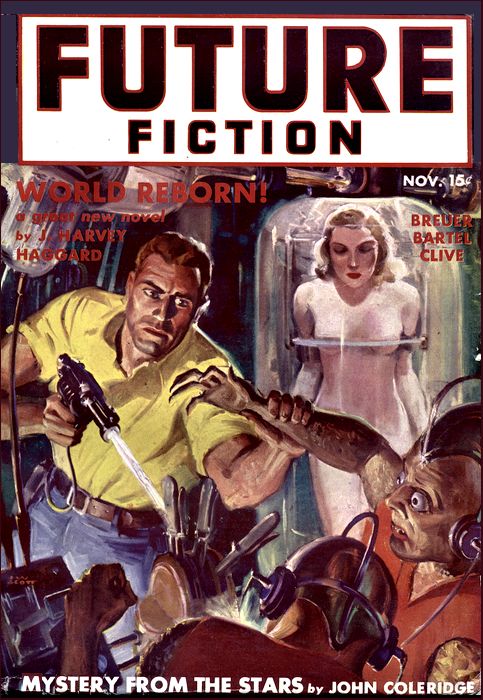
FutureFiction, November 1939, with "The Disappearing Papers"

The Judge dismissed the case because of insufficient evidence—for Professor Bradley's secret retribution was beyond detection by the greatest criminologist!
"YOUR HONOR, and Gentlemen of the Jury: The plaintiff, the Honorable Mark Woodsdale, who is one of our most prominent American financiers, has established by reliable witnesses, that on the 3rd of March, he received from Professor Winston Bradley, physicist and discoverer in the field of volatile solids, a set of formulas and specifications for a solid automobile fuel, in return for a certified check for one hundred thousand dollars. The defendant acknowledges the receipt of the check. The formulas and specifications were contained on eleven sheets of legal-size bond paper, stapled together with a bill-of-sale yielding to the plaintiff all rights in the discovery, which promises to revolutionize the automobile-fuel industry.
"Briefly, it referred to a solid, highly volatile hydrocarbon of the naphthalene series, which could be shoved into a door in the side of an automobile fuel-tank, like a cake of ice into a refrigerator. There it could be volatilized and carried to the carburetor as a gas. Patent specifications for volatilization and for a special carburetor were included.
"It has been brought out that Mr. Woodsdale himself in the presence of three members of his office staff, locked the papers, folded flat and sealed and labeled in a manila envelope, into a separately locked compartment of the Investment Company's vaults, fifteen minutes after Professor Bradley had left the Company's office, and six weeks ago. Mr. Woodsdale was busy for nearly three weeks, and no one else thought of the automobile-fuel papers. People were constantly in the vault, but it has been proven that Mr. Woodsdale carries the only key to the specially locked compartment, and that no one else went near it during the interim. When Mr. Woodsdale's attention was called to it by a ticker memorandum on his desk, he went to the vault and unlocked the compartment. He had no more than picked up the envelope when he became alarmed, because it felt empty. Hurriedly opening it, he found that indeed it was. There was not a trace of the papers. The label on the envelope was the proper one, and it was in Mr. Woodsdale's own handwriting. The seal was intact. The gentlemen of the jury have examined the envelope and have seen that there are no tricks about it.
"The plaintiff offers no explanation for the disappearance of the papers. Skilled investigation has left it a complete mystery. But we have established that the defendant has a discovery, that he intended to sell it, that he did sell it in good faith, and was paid one hundred thousand dollars for it; and that he now refuses to furnish duplicates of the papers. We ask the Court for an order to the defendant that he furnish a new set of formulas and specifications and a bill-of-sale for the discovery.
"An additional circumstance has been unearthed during the investigation on this case, which throws suspicion on the entire transaction, and confirms the plaintiff's feeling that he has been imposed upon. Fifteen years ago, Professor Bradley, as a student, held part-time employment in a chemical plant of which Mark Woodsdale was the manager. Young Bradley was earning his way through school and supporting an invalid mother. There was a dispute as to the proprietorship of an original chemical formula, and Bradley claimed that it was his discovery. He was summarily discharged for this impertinence. Subsequently, his mother died of privation incident on the ensuing poverty, and Bradley's schooling received a setback of several year's. It would seem, therefore, that there is a basis for suspecting that Professor Bradley may have unfriendly feelings toward Mr. Woodsdale. How that might explain the disappearance of the papers, we do not presume to be able to say.
"Your Honor, the plaintiff rests."
"Your Honor, the defense, having already entered a general denial, also rests!"
Both the Judge and the jury were momentarily taken aback by the suddenness of the announcement that there would be no summing-up by the attorney for the defense. The Judge rapped his gavel for attention.
"Mr. Wigmore," the Judge said to Bradley's attorney, "the Court is grateful to you for your consideration in saving its time and energy and the taxpayers' money with what would have been vain effort."
The Judge turned silently through a number of books and read here and there for a few minutes.
"I do not believe I can let this case come to the jury," he finally said, thoughtfully. "It impresses me that we are asking Professor Bradley to hand over plans and specifications of something which he may or may not have discovered. We only have hearsay evidence on the discovery. There has been no concrete evidence exhibited to this Court to show that he ever discovered any solid automobile fuel. The only basis on which the Court could possibly justify action would be the missing papers. Without these papers, the Court has no legal evidence that there is any discovery. Therefore, it is not in a position to demand from Professor Bradley formulas and specifications for one. The case is dismissed for lack of evidence!"
The Judge had to rap violently for order so that he might call the next case, because of the crowd's enjoyment of the discomfiture of a none-too-popular promoter, who had also doubtlessly trimmed many of its members.
THROUGH the turmoil that rose up in the court-room came a thing like a projectile out of a cannon. It was the figure of Spike O'Connell shooting from the press table to the counsel table and grabbing the arm of Professor Bradley. The reporter was about the same age as the Professor and this age was not a great one. Spike grabbed the Professor's arm like that of an old friend and was steering him out of the crowd and away through a back door.
"Now. The real truth!" Spike demanded when they were safely ensconced in a taxi. "Is that story true about Woodsdale having fired you and stolen an invention from you?"
Bradley shrugged his shoulders.
"Thank you, thank you," Spike chuckled. "Have you really discovered a solid automobile fuel?"
"I'm not talking," Bradley smiled.
"Were there really some plans, or papers, or what-not?" Spike smiled ingratiatingly.
"Oh yes, yes," the Professor said carelessly. "He gave me a check, didn't he. When Woodsdale gives a check—"
"Then what became of them?"
"How should I know?" The Professor was a good shoulder-shrugger.
"Well, what about telling just only little me? You know I wouldn't publish anything to hurt you. That's a promise. I'm nuts to know what happened. It looks spooky."
Eloquent silence came from the Professor, until the taxi drew up in front of his laboratory. He motioned the reporter inside. He opened a refrigerator and revealed a hoar-crusted inner door.
"I'll give you a hint," he said to the reporter. "You are welcome to whatever you can find out for yourself."
The reporter waited with eager expectancy. The Professor took out of the refrigerator an 8-by-10-inch photograph of himself.
"I refused to give you my picture last week, when you asked me for it. Do you want this for your paper?"
Spike grabbed it eagerly.
"But the missing papers. You said—"
"Your engraver's deadline comes in thirty minutes," the Professor said, looking at his watch. "If you want my picture in tomorrow's Star, you had better run."
"Thank you. Thank you." Spike suddenly decided that he really had a scoop—a photograph of the shrinking, retiring Professor Bradley, the first one ever published. Harder to get than hen's teeth. This picture would go with the story of the trial.
HE sat perspiring in another taxi, on the way to town. The hot sun shone through the glass of the cab. He laid the photograph on the seat and mopped his face and neck. As he picked up the picture again, it seemed strangely thin and limp. When he had gotten it, it had stood up stiffly in his fingers. Now it draped over his hand like a piece of tissue-paper.
As he sat there and watched it, a corner grew faint and disappeared! It just melted away, leaving a rounded edge in its place. Then the photograph came in two where it lay across his hand, and a limp fragment dropped to his lap on each side. As he gazed dumfoundedly at these, within a space of five minutes, they melted into the thin air at the edges. The edges shrank toward the middle of the piece, till there was nothing left. The picture was gone! There was an odor in the air similar to that of moth-balls.
"Volatile solids!" Spike gasped.
Roy Glashan's Library
Non sibi sed omnibus
Go to Home Page
This work is out of copyright in countries with a copyright
period of 70 years or less, after the year of the author's death.
If it is under copyright in your country of residence,
do not download or redistribute this file.
Original content added by RGL (e.g., introductions, notes,
RGL covers) is proprietary and protected by copyright.