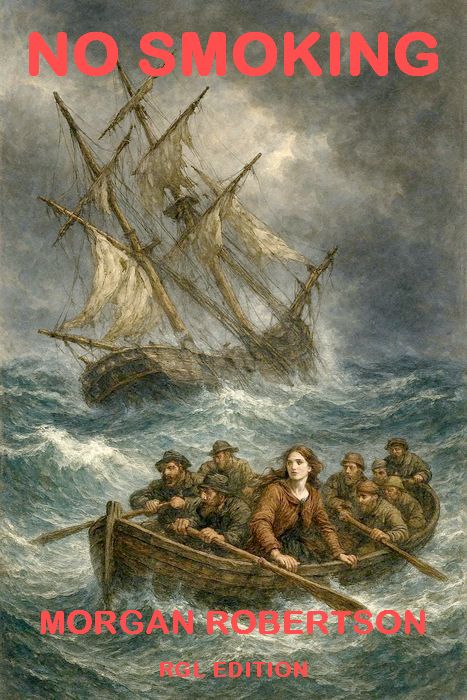
RGL Edition, 2026
Based on an image created with Microsoft Bing software
Roy Glashan's Library
Non sibi sed omnibus
Go to Home Page
This work is out of copyright in countries with a copyright
period of 70 years or less, after the year of the author's death.
If it is under copyright in your country of residence,
do not download or redistribute this file.
Original content added by RGL (e.g., introductions, notes,
RGL covers) is proprietary and protected by copyright.
RGL Edition, 2026
Based on an image created with Microsoft Bing software


The Popular Magazine, 1 January 1910, with "No Smoking"
Mr. Robertson is remembered by all "Popular" readers as the author of a remarkable story, entitled "Man Eaters," which appeared in the April number of the magazine. The following tale of some who went down to the sea in ships is one of the best pieces of fiction ever penned by this versatile writer
I HAD heard him described by my brother, at whose house I lived when ashore, and who was one of the twenty thousand men on his pay roll.
He was a self-made man, proud of both creator and handiwork—proud of the latter especially, for it included not only the making of himself, but the making of others; also, the digging of holes in the ground from which emerged tons and tons of metal, the irrigating of waste lands, the building of steamships and railroads, the breeding of horses and cattle, the creation of model towns and communities, the consolidation of struggling industries into trusts, of which his was the controlling vote; and the placing of men whom he had made in positions of high legislative and judicial importance.
As for the self he had made, it was such a self as would satisfy a multimillionaire. It was a self, as he explained, when he so chose, founded upon a lifelong abstinence from alcohol and tobacco—also, on an intolerance of defeat, either in his own line of effort or in others. Succeed, live virtuously, or do business elsewhere, was his manifesto to man. His shops, farms, and various properties were studded with "No Smoking" signs. He had discharged a ranch superintendent for failing to irrigate from a river gone dry, and an office boy for lighting a cigarette after hours.
He had courted three congressional investigations, had smitten in the face with a folded newspaper a senator of the United States, and had declined a luncheon invitation from the President. Mentally, he was supreme and secure in an armor of justifiable self-esteem; physically, a six-foot, middle-aged Adonis, with a dark, stern face, a keen, gray eye, and a voice that could not, even had he tried, utter an appealing note.
He had never in his life asked a favor, not even work as a boy. He had worked for himself at the beginning, then made others work for him. Briefly, he was such a man as might be pictured leading a cavalry charge, commanding a ship through storm or battle, swaying an antagonistic majority by fire of oratory, or penetrating, alone and unaided, the waste portions of the world for fame of discovery. He was a master of men, but not quite of himself; for, at the proper time, he listened to the sentence of a conclave of physicians—quit work for a year, or die!
He chose the former; but, realizing that he could not make his work quit him, should he remain within reach of it, he decided upon a long sailing voyage; and, as he owned or controlled no sailing ships, he promptly bought one about to sail for Hongkong, directed her captain to prepare the after cabin for his use, and closed up his immediate affairs in one day of dictating, telephoning, and telegraphing.
All these things my brother told me; but what he did not tell me was that the ship he had bought was the one I had signed in as ordinary seaman, and that he had a daughter of twenty who would make the voyage with him. As I was but eighteen, the latter news would not have greatly affected me, had it not come coincidently with the former. When you are scouring a brass gangway stanchion at the behest of a good-looking first mate whom you like, and you find yourself confronted by a sweet-faced vision in gray who smiles at you, and a frowning autocrat who orders you out of the way, you are likely to be affected. I certainly was—by two distinct and strong emotions, admiration for the girl, and dislike of the father.
The good-looking first mate escorted them aft, where they met the skipper, who showed them below, while I scoured brass furiously until ordered to desist by the mate. The exigency was past; the owner had come, traversed the gangway, and gone below.
"Wipe off that brass," said the mate genially, "and put your gear away. And say, youngster," he added, as I started, "you were smiled at a while back. Make good. Keep your shirt buttoned up, and wear your socks."
"Yes, sir," I answered; "I will."
Socks and buttons are not recognized by the etiquette of the forecastle, and I was glad of the tutelage. Mr. Stuart, the mate, a man of about thirty, was, or had been, according to the parlance of the navy, a "bilge midshipman;" that is, an Annapolis man who had failed in examinations, or had been expelled for hazing, or some such reason, but whose love of the sea had kept him at it.
I think that Mr. Stuart had almost won his commission when his light went out, for a more gentlemanly, refined, and generous officer I never met at sea. The men obeyed him because they wanted to, as I had furiously scoured the brass.
Captain Bruce was another kind of a man; tall, angular, old, and anxious of face. He had held command early in life, but had lost his ship on the second voyage, and since then had sailed mate, until this ship came to him. The second mate was a middle-aged sea dog, who has little place in this story. The ship was the typical American kind, carrying, beside the skipper and mates, two boatswains, a carpenter and sail-maker, cook and steward, and twenty hands before the mast, of which another youngster and myself were ordinary seamen, the rest able. These were the usual mixture of German, Irish, Dago, "Sou'wegian," and others, not one a lover of his fellow man, or a student of the simple life.
So when, at noon of the second day out, the starboard watch turned out for dinner, and found a neatly printed sign tacked to the bulkhead with the legend, "No Smoking," the profane comment was only equalled in voltage by that of the other watch, when, on going below at one bell, they found a similar sign in the port forecastle.
Loudly they swore, and fiercely they smoked when the meal was over. Then they laughed forgivingly. It was all a joke, they conceded. As a German of the starboard watch named Weisbacher voiced it: "A leetle foolishness by dot goot feller, Captain Bruce."
But when they mustered out at one bell, and were not turned to; and while they loafed around the windlass listening to the lurid remarks of the port watch as they surrounded the beef kid and looked at the sign, they began to have misgivings, which were confirmed at two bells, when the captain and two mates came forward.
"Heave out, here," sang out the first mate cheerily. "All bags, bedding, and ditty boxes out on deck for inspection. All tobacco and pipes. Both watches. All hands, here. Chips, doctor, sails, bosuns, both—everybody. Turn out and give up your pipes and tobacco."
The port watch, some of whom had turned in for the afternoon sleep, straggled out, knocking the ashes from their pipes and pocketing them. I was a member of this watch, but, not being a smoker, was but mildly interested; and, well socked and buttoned, now, I stood under the weather rail, where I could not only see the fun forward, but watch the owner and his daughter on the poop. He stood at the head of the steps, erect and menacing, with the girl on his arm, the smile upon her face offsetting the frown upon his own. But it was a smile of interest and sympathy, not of derision, or approval of the ruling.
The carpenter and sailmaker, with the steward and cook, joined the muster at the fore hatch. The boatswains lived with the men and were already in line, so that all hands except the man at the wheel listened to the official indorsement of the signs in the forecastles.
"Men," said the captain, "as all of you must know, the owner is on board; and, as he owns the ship, and owns the money that pays us all, he is entitled to his own way. So, as he has decided that there shall be no smoking, and no chewing of tobacco aboard his ship, his wishes must be obeyed. Bring out all your dunnage and dump your pipes and tobacco on the hatch. It will all be returned to you at the end of the voyage."
The men looked at him in amazement, then at one another. A few drew forth their pipes and started toward the forecastle doors. Others made no sign nor motion. As a whole, they were doubtful, uncertain, unsettled. Had the popular first mate spoken at this juncture he might have swerved them toward obedience. Had a master rebel spoken, there would have been a unanimous protest on the spot. As it was, only one—the good-natured Weisbacher—gave utterance to a possibility perhaps unthought of by others.
"Is it so, sir," he asked respectfully, "dot we fellars who pull your ropes und scrub your deck are not to have der only comfort dot a sailor man has? You can stop mine grub, cappen. You can keep me up in mine watch below. You can damn me, und maybe you can hit me, und still I will work, because I signed. But you stop my smoke, und, by Gott, you make me a mutiny and a murder. You hear, sir?"
Weisbacher was in no sense a master spirit among them, but his speech stopped the drift toward the forecastles, sent pipes back into pockets, and roused stronger men to resentment. An Englishman, an Irishman, a Swede, and an American—the latter an educated man—began declaiming at once on sailors' rights, while the mild, and not too confident, skipper raised his hand deprecatingly, and the two mates backed toward the fife rail, where were a few loose belaying pins.
But nothing happened. The owner left the poop, walked briskly forward, and faced the angry group of men.
"What does this mean?" he asked sternly. "Are you having trouble, Captain Bruce, in carrying out my wishes? Stand aside, then, you and your officers. I will put this through myself."
His clear, dark eye wandered around the crowd, and where it fell upon a man, that man seemed to shrivel and grow smaller. The captain, shamed and humiliated, stepped over in my direction; the two mates took their hands off the belaying pins they had seized, and the owner's daughter descended the poop steps and came forward as far as the main hatch. I felt of my buttons and looked at my socks.
"I wish," said the owner incisively, as man after man shrank under his glance, "smoking and chewing of tobacco to cease on board my ship. To that end, every man will bring his clothing and effects out here, where the officers can search for tobacco and pipes."
Weisbacher led the rush for the forecastles; the Englishman, Irishman, and the Swede brought up the rear—only one, the American, daring to speak against the edict. He walked boldly up to the owner, and stared him in the face.
"Do you know, sir," he asked, in a high-pitched voice that trembled a little, "that what you are doing may result in the utter demoralization of this ship's company—that tobacco is more to a sailor than food? You are jeopardizing your property, if not your life."
"Silence," thundered the autocrat. "I am the judge of my actions, not you."
For a moment Thompson stared into his eyes, then dropped his own and meekly joined the others. Boylike, I grinned, and the captain observed me.
"Here, you," he said, assuming a sternness not compatible with his mood. "You get aft and take the wheel. Send that man forward."
I departed for the wheel, meeting the young lady at the hatch. I was near enough to her age to attract her notice, yet enough younger to disarm any embarrassment she may have felt. She was a very pretty girl, with eyes as gray as her clothing, and when she smiled—as she did when I faced her—the smile seemed formed more by these gray eyes than by her lips.
"Are the men angry?" she asked.
"Yes, miss," I answered, lifting my cap as politely as was possible. "They're very angry. They're fighting mad."
"Is—is Mr. Stuart in any danger from them?"
"Oh, no, miss. They like him; and then, too, he can take care of himself. Excuse me, please. I must take the wheel."
I hurried aft, wondering at her interest in the mate. "Perhaps," I mused as I relieved the helmsman, "it is because her father and the skipper are in plain sight." I took no account of the second mate, also hidden behind the house, for I was young in inductive reasoning.
Steering a well-trimmed ship "by the wind" under all canvas is easy, even for a boy; and, standing there, I had good opportunity to observe things as they happened on board that ship—not only on that afternoon, but on others. My being sent to the wheel in my watch below was but the first hint we received that she was to be an "all hands" ship—that is, the afternoon and first dog watch below would be spent on deck, at work; and, because I was an efficient helmsman in fine weather, it was decreed that I should be at the wheel when on deck, while the rightful incumbent worked at seamanly work beyond my powers.
First, I remarked the progress and the closing of the inspection forward—the searching of dunnage, the coming aft of the owner on the arm of his daughter, the skipper with a dish-pan heaped full of pipes and tobacco, and the scattering of the men to tasks about the rigging by the two mates. The skipper went into the cabin by the forward companion, but the owner and his daughter climbed the poop steps to descend by the after.
As the owner went down, he groaned audibly, and I heard her sympathetic endearments.
"Don't coddle me," he answered harshly. "It's nervous dyspepsia, of course, rendered active by temporary excitement. But one annoyance is removed. There'll be no more nicotine under my nose for this voyage."
She followed him down, and soon the captain appeared. When he had glanced at the compass, growled the usual skipperly injunction to "keep a good full," he was joined by the mate.
"Well, sir," said the latter, after he had taken his squint at the compass, "what do you think of this? Don't you think, captain, that it is the most inane, insane bit of business you ever heard of? To stop sailors' tobacco? Why, the government, with all its power, never dared attempt that in the navy, though it did stop the grog."
"I know, I know," rejoined the captain wearily. "I know the danger, and I can only hope that the men will submit quietly. But I shall enforce his orders."
"It may cost you your life," said the mate, his face darkening.
"Yes, it may; but my life is not worth much, nor will it be of long duration. I have spent most of it before the mast or as mate. I want to end it as master, with the confidence and good-will of my owner."
"That reasoning applies more to me than to you, captain; for I am much younger, and have still to obtain my command. But I would not care to base my prospects upon the favor of such a man as this."
"That is your affair, not mine, Mr. Stuart. I expect you to bear me out in this."
"All right, sir. You can count upon that; but I will not answer for the men."
They separated, the captain going down the poop steps to enter the cabin, the mate, after another glance at the compass and at me, lounging in the weather alley, near the steps. Soon the young lady appeared, and when Mr. Stuart spied her he beckoned.
It was either the concave of the cro'-jack or the spanker, acting like the reflecting curves of a whispering gallery, that made their conversation audible to me at the wheel; for they spoke in low tones that came to my ear from another direction. And, to my surprise, they seemed to be well acquainted; for they spoke of mutual friends in New York, Washington, and Annapolis, and referred to their first meeting when she, as a small girl, had been queen of the hop while he, as a senior cadet, had been king. Then they touched upon other matters, and he begged her to intercede with her father.
"For you, Nellie girl, are the only person in the world who can influence him. He will do for you what he would not do for money or power. Tell him that the men will suffer cruelly, and that there is danger of mutiny."
"I know, Fred," she answered. "That boy at the wheel—isn't he homely, Fred?"—I ripped off socks and buttons next watch below—"That boy told me that the men were frightfully angry, but that they liked you. You are not in danger, are you?"
"Yes; for they like their smoke better than they like me, or any one else. Do what you can, Nellie."
The rest of their talk is not vital to this story.
When relieved at four bells I went forward with aching bones and ate my supper in a nest of anarchists. Loud and dire and deep were the curses called down upon the heads of the afterguard, and even the sweet-faced Miss Nellie did not escape the benediction. Women aboard ship always cause trouble, according to forecastle traditions.
Trouble came very quickly. I did not know at the time the inordinate craving of a smoker for his pipe, or the extent of the suffering entailed by deprivation; so, from my vantage point of inexperience, I made lofty and superior comments on the situation, and was rewarded by an open-handed blow on the face from Williams, the Englishman.
Smarting with pain and furious, I sprang toward the bread barge, meaning to return the blow with this heavy box of wood, but was stopped by Thompson, and bundled into my bunk. Then, for a few moments, my countryman busied himself with Williams; and the matter ended with Thompson nursing sore knuckles and Williams a swollen nose, and the crowd considering Thompson's pronunciamento—that there would be no boy slaves in that forecastle.
But while the watch below was in-pressed, the watch on deck, attracted "by the noise and peering into our apartment, must needs make comments and take sides, to the result that Swanson, the Swede, and Daly, the Irishman, locked themselves together and whirled around the deck, each viciously striving to throw the other, while the rest looked moodily on without interfering. Mr. Stuart came forward, and stopped this fight, then wisely hurried aft to escape the questions hurled at him.
With the leading spirits of the crew thus setting the example, all the others yielded to the irritability caused by the stopping of their solace, and fight after fight occurred, on deck or below, in the few days that followed, while insolent answers were hurled to the skipper and mates when they gave an order, and threatening looks were directed at the owner whenever he appeared on deck.
The cook spoiled the dinner on the third day; then, with a long carving knife, defended his galley and his health from an argumentative mob that menaced him at the door.
The carpenter flourished his broad-ax at the sailmaker, who had sought his company because of their common misery, and was later driven out of the forecastle, to which he had retreated.
The boatswains were thrashed in their watch below, and allowed their authority only on deck.
The steward was discharged by the owner for poor service at the cabin table, and reinstated because no one could take his place.
Even the captain and officers—smokers all—gave way to the mental attitude, and there was a petulance and a harshness to their manner that made matters worse.
Men who steered badly were driven from the wheel until two-thirds of the crew had been thus disgraced. But I escaped this, possibly because my nervous balance had not been overthrown, and was kept at the back-breaking task of steering six hours one day and nine the next, according to the watches. My confrère of the other watch was a smoker, a poor helmsman, and had steered his legitimate trick and taken his chance like the rest.
And so, with the gospel of brotherly love at a discount, and all hateful thoughts of mutiny, murder, apprehension, and fear at a premium, this big ship sailed out into the Atlantic and was hit by the tail-end of a West India cyclone centering east of Hatteras.
It came at the usual time, at the end of a hard day's work, and as the weary men pulled and hauled and labored at rope and canvas they were cheered by the sight of the fatuous owner carrying the dishpan full of pipes and tobacco out of the forward companion to the lee rail, where he threw the whole overboard.
Standing at the wheel, I had heard loud voices in the cabin, and surmised that Captain Bruce had been expostulating with the owner, but was hardly prepared for the heated argument which ensued when they met again near the wheel.
Captain Bruce had changed; his seamed and anxious face had hardened, and he looked steadily into the eyes of the owner, whose already hard countenance was black with rage.
"You have done, sir," said the captain, "the one thing necessary to precipitate a mutiny. While that tobacco was on board, the men might hope for it. Now it is gone, the hope has gone. If you have a revolver, get it ready, for you may need it."
"A revolver? Get it ready? You coward! Do you think I do business with revolvers? You are not the man I want here. You are discharged. D'you hear? Discharged. I don't want you in my employ."
"Discharged!" repeated the captain, with a smile. "Oh, no. Are you a student of maritime law? I think not, or you would know that a master cannot be discharged on the high seas. The master's authority is inviolate from port to port. This morning I took the liberty of examining my slop stores in a room off the after cabin. I found all the tobacco gone."
"I threw it over the side the first day aboard," spluttered the owner.
"I surmised as much," said the captain sternly, "and at that moment lost my faith in you and in my future as a master in your employ. I am tired of all this unpleasantness. Here you are merely a passenger, and as such you have committed a crime in broaching cargo. That is what you have done."
"Crime? Damn you, what do you mean? Take yourself out of my presence, and send me your first officer. At once—d'you hear?"
"I will call him when he is disengaged," said Captain Bruce calmly.
Then he looked forward and aloft. Mr. Stuart was amidships overseeing the taking in of the foresail—a job which, in the furious wind now blowing, needed his undivided attention for the next ten minutes. The ship was close-hauled, and the boatswain on the forecastle deck was slacking away the tack while the whole port watch hauled on the clew garnet, gathering up the clew, inch by inch. Clearly, he was not available at present.
The second mate was equally busy; he was aloft with his crowd, standing in the bunt of the upper mizzen topsail yard, and objurgating the men vigorously while they reefed the sail. His boatswain was with him, engaged at the weather oaring. Not a man in the line of promotion could be had to supplant the skipper; but, staggering aft with the cabin supper was the steward, and him the captain called.
"Steward," he said, when that person arrived. "Go down in my room and bring up a pair of handcuffs, and tell Mr. Stuart to send two strong men aft here to me."
"Yes, sir," answered the steward, and departed.
The men arrived as soon as the steward with the irons—two strong men, Daly and Swanson, who seemed to forget their quarrel in the tenacity of their grip on the owner's arms, when the captain had so directed them.
"Now, sir," said the captain, as he took the manacles from the steward, "it is my duty and my right to iron you and confine you in your room for the rest of this passage. Shall I do so, or will you agree, and give me your word to that effect, that you will keep your nose and your hands out of the running of this ship?"
"You insolent scoundrel!" stormed the owner, his eyes glaring and his fingers working convulsively. "I'll ruin you for this. Few men have dared to cross me, and"—he lowered his voice to a hiss—"they're all in jail, or in the jail graveyard."
"But, I'm here; master of this ship."
"Mr. Stuart," called the owner suddenly. "Come here."
Mr. Stuart heard and came. The two clews of the foresail were up, and the men manning the buntlines. He could now be spared.
"Mr. Stuart," said the autocrat, when the brown-faced young officer arrived, "I appoint you captain of this ship; and my first order to you is that you confine your predecessor in irons."
"I'm very sorry, sir," answered the mate, shaking the clinging drops of water from his sou'wester rim by a quick turn of his head, "but Captain Bruce is the master here. He signed me before I ever met you."
"But I am the owner of this ship. I dictate to all on board, for I am the man that pays you."
"Enough of this," said the captain incisively. "Mr. Stuart, it's still blowing up. Get a reef in that upper fore-topsail, and set the spenser. It may be all we can carry before morning. Now, sir"—this to the owner—"hold up your hands and go in irons. You are a discontented, dissatisfied trouble maker, and I shall get you off my mind."
At this moment, while the infuriated man struggled in the grasp of the two sailors, and the mate had turned to go forward, the companion opened suddenly and Miss Nellie appeared, cloaked and hooded, and with an expression of fright and anger on her face.
"Father," she exclaimed. "Oh, father, what are they doing to you? Fred, Fred, don't let them! Help father."
Mr. Stuart stopped and looked back, his features strained and twitching in his embarrassment; but he resolutely shook his head, and turned away.
"Oh, you coward!" she called. "Don't you ever dare address me again."
This momentarily stopped him; but he went on without turning his head. Meanwhile, the captain had snapped the irons on the wrists of the owner, and was pushing him toward the companion door.
"You will be locked in your stateroom," he said, "until you give me the promise I asked. Your daughter shall have her liberty."
The owner had stopped his struggles when he felt the cold steel on his wrists; and, deadly pale now, was clutching his stomach, evidently in great pain. He stumbled down the stairs, followed by his daughter and the captain, while the steward and the two sailors went forward. Soon I heard the slamming of a door in the cabin; then the captain appeared, and, spying me shivering in my sockless shoes and buttonless shirt, mercifully ordered the wheel relieved. I had steered all day, but it was my last long trick in that ship, for from now on things moved rapidly.
We were practically hove to on the starboard tack, heading east-southeast and breasting a wind and sea that came straight out of the south. It had not blown so hard that the starboard watch could not reef the mizzen topsail or the port watch clew up the foresail, but before my relief appeared, I had noticed an increase in the wind and a slight hauling to the west.
The captain, too, saw this when he noticed my condition, and, calling Mr. Stuart aft again, he said:
"Never mind reefing your fore-topsail. Furl it. But first furl the mizzen topsail while the crowd is aloft. We're in for a time. The barometer's falling and the thermometer rising, while the wind is hauling to the west. That means that the storm centre is coming out our way, and will pass close to the north'ard. I don't dare scud. We'll have to fight it out on this tack. Tell the men that I'll signal the first ship we meet for tobacco, and that there'll be grog at eight bells."
The grog may have done some good, that night, but smoke, in its reality, is too intangible a substance to he replaced by its promise; and, though the men worked their best, and no man could say that another was to-blame, things went wrong from the beginning.
As the wind stiffened, sail after sail was blown away, even as we were furling them. At midnight we were stripped to the brand-new main spenser, fore-topmast staysail and reefed spanker. At two o'clock these were gone, and we lay hove down to port, with the lower yardarms dipping, while the mighty seas swept us and the gale sang through our tautened weather rigging with a sound curiously like that of a huge violin out of tune. No rigging could stand the strain and the continued vibration. At four in the morning the fore and mizzen masts went, snapping at the hounds of the lower masts, taking with them the main topgallant mast, and dropping to leeward. The ship partly righted, and we cut away the wreck. "This done, we dodged the falling main topmast, that came whirling down like a flung stick, hitting the side of the ship with a force that sent the two arms of the crosstrees crashing into the planking. As the ship was taking a weather roll at this moment, the hole was well beneath the water line, and things looked serious.
The two legs of the crosstrees—six-inch beams of oak—twisted away from the mast, but remained in the hole, effectually preventing us from covering the leak with thrummed canvas. They could not be dislodged from the outside, and when the carpenter reported three feet of water in the well, the skipper decreed that the main hatch be taken off, cargo removed, and the beams driven out. So, while a gang manned the pump, the rest went to work by lantern light.
Mr. Stuart went down the hatch to oversee the job, but in half an hour he came up and appeared before the captain on the poop. As I happened to be hauling aboard and coiling down trailing running gear at the mizzen rigging, I heard what he said.
"The men have found cases of tobacco and cigars, captain," he reported, "and, in spite of me, they have broken into them. They are all smoking cigars."
"What!" roared the captain. "Broached cargo, have they? Mr. Stuart, you go down there among them, and tell them to send a box of cigars aft here at once."
"Yes, sir," answered the mate, turning away; and I felt, rather than saw, his smile.
At daylight, the carpenter reported seven feet of water, and the mate that the crosstrees had punched the holes below the 'tween deck, and to reach them they would have to descend into the hold.
Obviously there was no time, and Captain Bruce gave the order: "Clear away and provision the three boats." Then he went down, and came up with the owner. His wrists were free, but his spirit unbroken, for he immediately quit the skipper's side and came down to the main deck, where the water was washing back and forth.
What he thought found no expression in his stern, dark face. What he saw were fat perfectos, slim panatellas, slimmer stogies, and still slimmer cigarettes in the mouths of haggard, weary men who, working for life, still found time to grin and jeer at him.
Mr. Stuart and the second mate smoked shamelessly, and behind, on the poop, Captain Bruce secured a light from the man at the wheel. Discipline was at an end. Twenty-nine men, about to take to open boats, were reduced to their lowest terms.
He turned his back on us all, and went below; but when he came up with his daughter he requested that the mate should take them in his boat.
We quit that ship ten minutes before her plunge, and an hour before darkness closed down. When daylight came again, the other boats, commanded by Captain Bruce and the second mate, were not in sight; and, though there was still half a gale blowing, and a heavy sea heaving us, the mate tried to follow the skipper's last orders—to sail north to the lane routes. The experiment was disastrous; the first blast of wind in the lugsail as we rose to the top of a sea snapped the rotten mast and we let it go, to lighten the boat.
But soon we made a discovery that brought joy to the hearts of all. On investigating the boxes and kegs stowed in the bottom, it came out that one keg contained water, and one box hard bread—the rest holding tobacco and cigars. The men had seen to it that the tobacco came along; but, as to the reason of the shortage in food, no man could explain. The mate averred that his orders had been disobeyed, and he used language which, in spite of the presence of our passengers, was perhaps the strongest he had used in his life. But nothing could be done; he put us all on a short allowance, and directed us to keep watch for a sail. Now, it is not vital to this story that I tell in detail of the horror of the days that followed, while we lay between the out and inbound tracks, far to the south of the lanes, roasting under the sun by day, and shivering with cold and wet by night, while the allowance was decreased to a swallow of water and a quarter of hard-tack per day. Nor of the philosophy and good humor of the men, smoking the best cigars they had smoked in their lives, and keeping their gullets moist by incessant chewing until the last, when, hunger and thirst turning their heads to mutiny, they were cowed by a pistol in the hand of the mate, unable to rise at the time; nor of the increasing good humor of the owner, taking his bite and sup on equal terms with the rest.
But I must speak of one thing—the wonderful vitality and courage of Miss Nellie, who cheered us all with her smiling presence, and even forgave Mr. Stuart for his desertion of her father. And I will tell of this as I explained it on board the eastbound steamship that finally picked us up, when most of us lay stretched out on the second-cabin floor, receiving such morsels of food as the two physicians in attendance decreed we should have. One of these was a passenger, and he had been one of the conclave that had sentenced our owner to the rest cure.
"You should have prescribed starvation," said the latter. "It has cured me completely—also worked a mighty change in my sentiments toward smoking. Now that I have seen men suffer so, I would never forbid it again."
"Right," answered the doctor. "It keeps men up under severe strain. See how this boy"—pointing to me—"went down for the lack of it."
"But my daughter?" queried the owner. "She received no such benefit, and she's the strongest of all; while the mate, who smoked, is weaker than the boy."
I beckoned them, and they came.
"The mate," I whispered, "gave Miss Nellie all his bread and water, but she didn't know it."
She knew it a little later, for I saw her arms around his neck.
Roy Glashan's Library
Non sibi sed omnibus
Go to Home Page
This work is out of copyright in countries with a copyright
period of 70 years or less, after the year of the author's death.
If it is under copyright in your country of residence,
do not download or redistribute this file.
Original content added by RGL (e.g., introductions, notes,
RGL covers) is proprietary and protected by copyright.