
RGL e-Book Cover
Based on an image created with Microsoft Bing software
Roy Glashan's Library
Non sibi sed omnibus
Go to Home Page
This work is out of copyright in countries with a copyright
period of 70 years or less, after the year of the author's death.
If it is under copyright in your country of residence,
do not download or redistribute this file.
Original content added by RGL (e.g., introductions, notes,
RGL covers) is proprietary and protected by copyright.
RGL e-Book Cover
Based on an image created with Microsoft Bing software
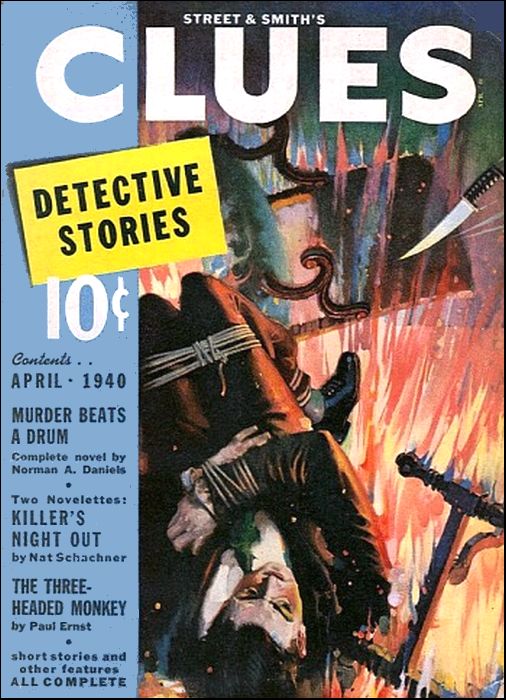
Clues Detective Stories, April, 1940 with "Killer's Night Out"
JERRY CASE hummed tunelessly as he pecked away at his battered typewriter. When one is young and only recently admitted to the bar; and when one has managed to achieve his first client, a lawyer may be pardoned for feeling a bit chipper.
In his absorption over the task at hand, Jerry did not hear the door of his office open quietly behind him. The intruder closed it as softly, stood a moment watching the bent head of the typist. Then he inquired: "Counselor Case?"
Jerry whipped hastily to his feet, buttoning his coat, straightening his tie and smoothing his rumpled brown hair in a single swift motion.
"Yep, that's me! Uh—I mean, yes, I am Mr. Case. Won't you sit down? What can I do for you?"
Jerry was breathless. Another client! Two in two days! Wow! Business sure was picking up!
But the thick, heavy-set visitor made no move to sit down. A pair of keen, cold eyes glared suspiciously in his dead-pan face.
"You had a client name of Bryan Vann?" he growled. Thick, blunt fingers held a bit of pasteboard that Jerry recognized at once as one of his own cards. He had cast many of them hopefully upon the waters and one of them was evidently returning home to roost.
Jerry put on his best professional appearance, coughed, frowned and said: "Bryan Vann? Of course; a very good client, I might add. As a matter of fact"—he waved toward the typewriter—"I am engaged in drawing his will. Er—my stenographer happens to be out for lunch, "Has Mr. Vann recommended you to me?" he added optimistically.
The man grinned. There was sarcasm in the grin. "Well, not exactly. You see, Bryan Vann is dead. Bumped off! He stopped a bullet smack between the eyes."
Jerry Case sat down weakly. "Dead!" he echoed.
His first client murdered before he had even paid his fee. It hadn't been much of a fee he had arranged with him the day before. Fifteen bucks, to be exact. But then, the will hadn't been much. A matter of about a hundred and fifty dollars in a savings account to be left to a veterinary hospital. Hadn't a relative or friend in the world, Vann had told him. And he liked animals. He was to come back today, at noon, to sign the will and pay the fee.
The young lawyer stared at his wasted work; then he straightened up suddenly. "You say he was murdered? Where? And who are you?"
The man tilted his fedora back on his head. "I'm Detective Mike Flanders from headquarters. Vann was shot up in Inwood Park. The examiner thinks it must've happened around midnight; but the body wasn't found until six o'clock this morning. He was doubled up among the rocks at the highest point in the park." Flanders watched Jerry keenly. "Your card was in his wallet. I came down to see if your knowledge of his private affairs might give us a motive for his murder."
"Well, to tell you the truth," Jerry said slowly, "I don't know much about him, myself. He just drifted in here by mistake, yesterday. Was looking for another lawyer, name of Cate. Decided to let me draft his will; said one lawyer was about as good as another. All I know is what I needed for drawing the document. Has no living relatives and no property of any kind except one hundred and fifty dollars in the Penny Savings Bank. Left it to a cat-and-dog clinic."
Flanders looked disgusted. "That'll just about be enough to bury him."
"I have a lien for my fee," Jerry said.
The detective grinned. "You oughta know—burial expense comes first. You'll have to whistle."
The young lawyer said "Damn!" with expression. Then, suddenly: "So you don't know who killed him?"
"Who says I don't?" growled Flanders. "We got the guy all right. A guy by the name of Willoughby—Dr. Luke Willoughby. Funny thing about it—he's a big-shot heart specialist. You'd never think he'd pull a killing like this."
"Did he say why he did it?"
"Naw! Matter of fact, he yells he's innocent. They all do."
"How do you know he did it then?"
"Easy. We find him lying next to Vann on that heap of rocks, unconscious. There's a gun in his mitt, and it's the one that fired the murder bullet. It's simple enough to figure out! Willoughby followed Vann into the park. Maybe they went up together. Anyway, they had a quarrel. Willoughby pulls his gun. Vann sees it coming, and he smacks the doctor on the jaw. There's a pippin of a welt on the doc's chin, all right. Vann was a pretty hefty fellow from the looks of him. Anyway, the doc fires as he drops and plugs Vann between the eyes. Then he smacks the back of his head on the rocks and passes out until we pick 'em both up. Everything tallies."
He frowned. "Except motive. Willoughby swears he never saw Vann before; don't know him from a hole in the wall. Swears he was sapped in the lower section of the park, while he was out getting some fresh air. Ain't nothing to show they ever met before or why Willoughby killed him."
Jerry's eyes popped suddenly. "Wait a minute there!" he exclaimed. "Vann couldn't—" Then he stopped. His eyes veiled.
Flanders looked at him suspiciously. "What couldn't Vann?" he demanded.
"Nothing! I was just wondering how he expected to leave that money to the clinic when it all would be swallowed up by his funeral."
The detective chuckled: "You got yourself a swell client." His eyes wandered significantly around the small, bare office. "And you even lose the coupla bucks for the will. Well, I gotta be going. Motive or no motive, Willoughby's done the trick and we're gonna make it stick. Better luck on your next client, Case—if any."
Jerry didn't like the man's laugh as he went out. His lean, capable hands clenched in anger. Then he relaxed, grinned. "A smart cop," he said softly. "Too smart for his own good. So I lost my fee, eh? And my client? Will Mr. Flanders be surprised when he meets my next client!"
He snatched his well-worn hat off the coat-tree, snapped the brim rakishly over his eyes. His long legs made the door in two swift strides, slammed it shut behind him.
His office was one of a long row along a corridor. The waiting room at the end was in common for all; so was the girl who sat at the switchboard to receive messages. Struggling young lawyers saved money that way. A solitary client was sitting in the corner, waiting for someone.
"Hey, beautiful!" Jerry flung at the girl on His way out. "I'll be down in the Tombs for about two hours or so. If anyone calls, I'll be back at one."
The girl smiled pertly up at him. He was easy to look at; tall, deceptively slender, with muscles like steel springs. His gray eyes were sunny and candid, and his hair was always a rumpled mess that made a girl itch to smooth it out.
"There won't be any calls, Mr. Case," she assured him. "There never are." Her eyes followed his broad shoulders out of the door; and her hand reached instinctively for her compact.
The solitary client got up from his chair. He was a small man with a sharp nose and a weather-beaten face. It was cracked and seamed with many winds and blazing suns. His right arm was curiously stiff in the flapping sleeve. But when you saw the wooden fist that protruded, you knew why. He had a wooden arm, with a steel spring at the elbow.
He went toward the door very fast. His broad, sailor shoes made no sound.
The girl looked up. "Aren't you going to wait? Mr. Carmichael will be back from court shortly."
"See him some other time," the man mumbled and disappeared into the outer hall.
Jerry whistled as he went down the deserted hall toward the elevator. Perhaps that was why he didn't hear the man come up from behind. But he heard the voice fast enough. And he felt the round, hard muzzle press into his side! There was no mistaking the feel of it.
"Keep on goin', Case," growled the voice. "Straight into the lavatory down the hall."
Jerry kept going. The gun muzzle dug deeper; there was no quiver to it. The man who held it was no amateur.
He pulled the door open, hoping that someone might be inside; that in the first confusion he'd be able to whirl. The place was empty.
He started to turn his head. "Now look here—" he protested.
"Keep your head front!" snarled the unknown, "or I'll blow your guts to hell." The door slammed softly behind.
Jerry stared at the washstand. "All right," he said. "What do you want?"
"Keep your nose out of the Vanit-Willoughby business. It won't be healthy for you to go monkeyin'."
Jerry kept on looking straight ahead at the blank wall over the washstand.
"I don't get you," he said calmly.
"You heard me, shyster. I don't want no two-bit lawyer snooping around. If you do, that fat-headed dick, Flanders, will have another corpse to mess over. Understand?"
"I understand," Jerry's voice was steady, but inside flaming anger gripped him. He a shyster, eh?
"O.K., then. Keep watching that spot on the wall and count a hundred."
The door opened behind him, then slammed shut.
He whirled, dived for the handle. But by the time he was out, the corridor was empty. The emergency stairway was two doors beyond.
Thoughtfully he rang for the elevator. The case was no longer as simple as it had seemed a minute before. If only he could have gotten a glimpse of his assailant!
At the clerk's office in general sessions Jerry slipped the desk man a Hoya de Monterey with a careless gesture. "One for the book, Joe. A client just sent me up a box from Havana."
Joe looked at the label, smelled the cigar reverently and shoved it into his vest pocket. "Gee, thanks, Mr. Case. They usually hand me weeds. You must be getting along."
"I manage," Jerry said modestly. The smoke had set him back thirty-five cents, which meant no lunch today. He leaned confidentially over the counter. "About this Doc Willoughby, the guy who was hauled in this morning on suspicion of murder. Has any lawyer filed a retainer for him yet?"
Joe patted his vest pocket. "I dunno, but I'll look it up." He was back from the file in a moment. "Nary a one. Don't tell me—"
But Jerry was already filling out a retainer blank. He signed his name with a flourish and shoved it under the clerk's nose. "A maiden aunt of his," he said glibly, "phoned me this morning to take care of her dear nephew."
Joe looked skeptical; but he filled out the necessary authorization.
DOCTOR Luke Sanford Willoughby was the perfect representation of a successful medical specialist. A big man with a florid complexion, carefully combed hair with a distinguished touch of gray at the temples, a clipped graying mustache and long, capable fingers. His clothes were conservative, but impeccably tailored; and diligent brush marks showed where the dirt and grime of a night's unconsciousness had been eradicated. There was a discolored bruise on the point of his jaw; and a good-sized lump on the back of his head. Otherwise he seemed fully recovered from his session on the rocks in Inwood Park.
He sat down opposite Jerry at the counsel table in the tiny barred and wire-meshed consultation room. There was a puzzled look in his eyes, but he said nothing until the guard had grated the lock behind them and gone away.
"If you're Jerome Case," he began sharply, "let me make things clear. I don't know you, and I don't want to know you. My lawyers are White, White, Slavinsky & Riley. Mr. White is on his way down to see me, now. If you think—"
Jerry grinned at him. "Your aunt sent me down—"
"Young man, I have no aunt!" Jerry's grin widened. "Check and double check! Then I'll have to lay my cards on the table. You see, Bryan Vann was a client of mine."
Willoughby got up from the table. He said slowly: "So you thought to play a trick on me. You'd pump me, and then—" He raised his voice. "Guard!"
Jerry leaned forward unhurriedly. "I have positive proof that Vann could not have knocked you down. Is that worth a retainer of two hundred dollars?"
The guard came on the run, scowling. "What's wrong in there?"
The doctor shook his head. "Nothing! I have a bad cough."
"Hell of a funny-sounding cough! An' you better make it snappy. There's more customers for this room." He went away.
Jerry nodded. "I thought you'd see it my way. Now, if two hundred is O.K.—"
"Go ahead with your story, Mr. Case," Willoughby said. "If you prove your point, the money is yours."
"Fair enough. You're a medical man. Would it be possible to tell by an autopsy whether the subject had suffered from a hardening of the arteries of the arms so that it would be impossible for him to have lifted his arms without excruciating pain; much less smack another man a solid wallop to the jaw?"
The doctor smiled. "Of course. It wouldn't even require an autopsy. A superficial examination would disclose the sclerotic condition."
"Then you're as good as out of jail, Dr. Willoughby. When Bryan Vann came to my office yesterday afternoon I had to open and shut the door for him. He could barely move a finger. He told me he'd have to sign the will with a cross, instead of writing his name. The case against you collapses."
Willoughby took a deep breath. "Thank you! The whole thing was an outrageous mistake. Whenever I have the chance I like to walk in the park. It clears my mind, and the quiet is soothing after handling a lot of scared patients all day. I was walking along slowly, looking down at the lights along the Harlem, when something struck me on the chin. It was a shattering blow, not like that from a fist at all." He felt tenderly along his swollen jaw. "It was as though someone had used a club. That's all I know about it until a policeman shook me by the shoulder. I must have been dragged up there among the rocks by my assailant and placed next to the man he had murdered, for some unknown reason." He started suddenly. "I almost forgot; there was the gun—"
"Don't worry about that," Case assured him. "It's an old trick, pressing this murder gun into a victim's hand. The police pay no attention to it, unless they can prove it belonged to you. And they must have checked it by now."
Relief showed plainly on the doctor's face.
He called the guard again, and asked that his checkbook be brought to him. A few minutes later the guard returned with a folding checkbook and Willoughby wrote with a smooth-flowing hand. He tore out the check and handed it over to Jerry.
Jerry folded it carefully into an empty billfold. "Thanks!" he said. "You'll be out in a couple of hours. I'll get hold of Flanders and have the medical examiner take a look at my late client. After that, it's all over, except—"
His face hardened. "Except for the little matter of finding out who shot down Bryan Vann." He grinned apologetically. "After all, he was my client, even though I won't be able to collect."
Then Jerry smiled and got up. "I'll be seeing you—"
But the prisoner had risen with him. His florid face was serious.
"No, you won't," he said.
Jerry stared. "What do you mean?"
"After you've seen Flanders and the medical examiner, be good enough to forget about this whole business. You've been paid, and paid well."
"I see," nodded the young lawyer. "That's a delicate way of telling me not to try to find poor Vann's murderer."
The doctor's eyes were glacial. "I'll attend to that little matter myself, and I don't like competition. You forget the killer tried to get me, too."
"And if I don't take your advice?" queried Jerry.
"You're liable to get hurt." Then the doctor smiled. "Please don't misunderstand me. I'm advising you for your own good. Amateur detectives usually get into trouble. And I'm well able to take care of myself."
Looking at the doctor's broad shoulders, his capable hands, and the cold glint in his eyes, Jerry decided suddenly that Willoughby was right. He could take care of himself.
AS Jerry climbed the precipitous rocks of Inwood Park, the murky darkness seemed to bear out the weird Indian legends that surround the hill.
"An ideal spot for murder," thought Jerry with a little shiver. The small automatic in his right-hand coat pocket made little clunking noises as it bumped regularly against the loose change in his trousers pocket. A complaisant judge, who had known his father, had granted him a quick permit.
He moved stealthily to the little mound of rocks where both Vann and Willoughby had been found. His hand was in his pocket, gripping the automatic. The park was wild, desolate. A half moon dimly sprinkled the open spot with silver spangles of light. Eyes squinting against the intense alternations of light and pitch blackness, he searched the ground.
He found nothing.
He stood a moment, frowning. He really hadn't expected to find anything. The police had gone over the spot methodically in the morning. Yet Jerry wasn't satisfied. He had studied the photograph an enterprising cameraman had snapped of the huddled body, and it had struck him that it wasn't a natural position for a man crumpling into instant death from a bullet plowing out his brains. If the murderer could have dragged Dr. Willoughby's unconscious form up here, why couldn't he have done the same with Vann?
He jumped sideways and whirled in a single motion! His right hand jerked from the pocket, index finger cold against the trigger. The next instant the gun was chopped from his hand, and something solid crashed against his jaw! Great, shooting pains lanced up his chin, flamed into exploding stars in his brain. He went back with a crash, falling heavily against a rubble of stones.
A pounding whirlwind landed on top of him. A raging demon out of the night; a small man with a sharp, weather-beaten face and snapping fury in his voice. "I told yuh to keep your nose outta this, Case." A hard, wooden fist ground on Jerry's windpipe. The assailant's left hand raised and a knife glittered in the drenching moon!
Jerry was choking under the inexorable grind of that wooden knob; but the sight of the descending knife cleared the muddy haze from his mind. He jacked up his knees and heaved suddenly with his shoulder. The man above him was caught unawares. The knife blade smacked solidly against a rock, shearing through Jerry's coat as it lashed downward. The man grunted and slid to one side. The pressure of his club-like arm relaxed.
Jerry heaved to his knees, but the man sprang up again. His right coat sleeve flapped against his artificial arm. The heavy, fist-like knob at the end was a formidable weapon. It shot out toward the young lawyer like a swift rapier. A steel spring manipulated from the shoulder stump through the elbow gave it crushing momentum.
Jerry rolled with the blow. It glanced across his temple.
Jerry's head rang with clanging bells. Groggily he started to his feet, just in time to meet a new rush of his assailant. The terrible fist was swinging again.
Jerry ducked, and came up sharp and short with his left. There was a grunt of pain as the man's head snapped back; then he was on top of Jerry, clawing with his good hand and pounding with the wooden one. He was like a wild cat in his snarling rage. Though inches shorter and pounds lighter, he flailed Jerry back against the rocks again.
Staggered momentarily under the rain of blows, stunned by the bruising impact of the lead-weighted fist, Jerry twisted over on his elbow, and threw all his weight forward, arms scissoring in a football tackle.
The man tried to jump back as steel-strong fingers gripped around his ankle. Jerry set his teeth, and put all his strength into the jerk. The man's leg went up into the air; he came down with a thud.
"Got you!" said the lawyer triumphantly.
But the one-armed man was like a greased eel. He wriggled and squirmed; there was a ripping sound; and he was free, leaving the cuff of his pants in Jerry's grip.
The two were on their feet simultaneously. But a gun had appeared in the small man's left hand.
"O.K., wise guy!" he gritted. "You asked for it."
The man's eyes were baleful and merciless; his gun hand without a quiver. Jerry knew he couldn't hope to avoid the bullet. Yet his muscles tensed to one last desperate spring. If the leaden missile didn't kill him outright—
The night air was still and the sudden, sharp clang of steel striking against solid rock came like a thunderclap above the muted noises of the city below. It was followed by a thud, a crunching noise and a rattle of earth and pebbles.
The killer's eyes, fixed on Jerry, jerked quickly in the direction of the sound. His wizened, sun-blackened face contorted with alarm and fear. A string of strange oaths spattered like hail from his lips. He whirled on the balls of his feet and dived headlong into the trees, in the direction of the sound. He had forgotten completely about Jerry.
For the split part of a moment Jerry stood stock-still, swaying drunkenly. Death had stared him in the face—and passed him by. A small miracle had happened; and for a reason still obscure. If ever a man had intended to kill, that man was the wooden-armed assailant who had just turned and dived into the trees.
The sounds that had saved his life stopped abruptly. And with their cessation Jerry swung back to normal. He leaped over the intervening rock, bent for the glimmer of metal that lay in a hollow. His gun, bludgeoned from his hand by the crashing blow of that wooden fist.
He caught it up with a grunt of satisfaction, started to straighten.
"Hold it!" said a cold voice that meant business. "Drop that gun again, and turn slowly, hands straight up."
Jerry obeyed. For the second time the automatic thudded into the dirt.
"What is this?" he demanded bitterly. "Killers' night out?"
"A-ah!" said the big, impeccably dressed man who had come up noiselessly behind him. "I thought I told you not to mess around in this business."
Jerry grinned. "That's the second time tonight someone sang that little ditty to me. And both times they sang it with guns. Now, if you'll stop pointing that nasty looking muzzle at me, maybe I could get together with you on this, Dr. Willoughby."
The heart specialist stared at him with narrowed eyes. "What do you mean by that?" he demanded finally. "And what are you prowling around Inwood Park for, at this time of the night?"
He swung the muzzle away from Jerry, but did not pocket the gun. "I might ask you the same question," retorted the lawyer, "but I won't. You've constituted yourself a one-man revenge squadron for that conk you got on the head last night."
Dr. Willoughby nodded slowly. "That's right. I'm a peaceful man of science, but I don't like to be knocked unconscious—even though I was obviously mistaken for someone else—without doing something about it."
Jerry casually scooped up his gun, hefted it. "Neither do I." He explained rapidly.
The doctor looked thoughtful. There still was a swelling on the point of his chin. "I'd say it was the same chap who knocked me cold. He must have sneaked up in back of me and swung with that damned artificial fist. What does he look like?"
"A small, sharp, weather-beaten face. A sailor, obviously. Both from his leather face and the way he cursed. Know him?"
Willoughby shook his head. "A one-armed sailor? Haven't the least idea."
"Well, he evidently knows you, and he knew poor Vann. There's a tie-up somewhere." Jerry started. "But say, there's something fishy going on up here, right now. Someone's digging, or at least was, until a moment ago."
"Digging?" the doctor echoed blankly. "What for?"
"For Indians, perhaps. Come on! We're going to investigate."
"It must have been your imagination."
"Imagination, hell! It was the only thing that saved my life. But if you want to go home, doctor—"
The medical man swore at him, and they both went carefully through the trees, in the direction where the one-armed killer had disappeared.
INWOOD PARK is left untouched at the top. The rocks and little hillocks and shallow valleys are almost as wild and as primitive as they were when the Indians climbed daily up from the shore of the big river with snared game and fish.
It was quiet again; ominously so. Next to him Jerry could hear the hard, quick breathing of his companion. Suppose the sailor were lurking behind one of those trees, waiting to draw a bead on them.
Suppose the mysterious digger were one of a gang.
He shivered, but thrust his way forward just the same. They slid down a declivity into a hollow. The place was a tangle of rocks and bare of underbrush.
The doctor suddenly gripped his arm so hard that he grunted with pain. Then he saw it, too.
A great boulder lay athwart the hollow. And beside it was a hole. A freshly dug hole. A little heap of dirt and rubbly stones lay to one side. The earth was still moist and soft, as though it had been just uncovered.
But it wasn't the hole that brought the sharp exclamation to Jerry's lips. It was the sight of the whitish, glimmering thing that lay outstretched near the pile of stones.
"A skeleton!" husked Willoughby.
Jerry leaped down, forgetting his caution. Had anyone lain there in ambush he would have made a perfect target. But no one was around. Both the digger and the one-armed man had disappeared.
"No question about what it is," agreed Jerry. "It's the skeleton of a man all right." He stared at it with searching eyes. The bones were grayish rather than white, and pitted. The skull was long and narrow, and the bones of the nose extraordinarily prominent.
He bent suddenly, pointed to the base of the skull. "He was killed," he exclaimed. "Look at the way the bones are crushed in and crumbling. Someone hit him from behind with a club or a blackjack." He straightened up. "What do you make of it, Dr. Willoughby? You have had experience with these things. How long has this man been dead; and what hit him?"
Willoughby bent over professionally. "Hm-m-m! I'd say over a year, at least. A blunt instrument was used; there's no question about it. The whole thing is getting pretty clear, now. A crime was committed. The victim was buried. But the killer or killers were afraid that sooner or later the body would be discovered. They came back to dig it up secretly, and do sway with the evidence. I must have disturbed them last night at their work. They knocked me unconscious. Tonight they came back to finish the job, and you interfered."
He pocketed his gun with a relieved sigh. "It's simple, you see. All we have to do is notify the police. They'll remove the skeleton, and sooner or later make an identification. Then they'll be able to track down the killers. The very fact that they were so anxious to get rid of the skeleton shows that they knew they could be identified if it would ever be found."
He made washing motions with his hands. "Thank Heaven! We've uncovered the mystery. Now we don't have to stay out nights any more."
"You're right," said Jerry. "It's simple, as you say. Come on; we'll notify Detective Flanders at once."
THE next morning Jerry Case showered, shaved, fixed up his various cuts and bruises so that they wouldn't be too evident, ate a hearty breakfast. He even changed to his only good suit, discarding the muddied and torn tweeds of the night before. He could afford to do so. The two hundred dollars he had received for springing Dr. Willoughby crackled crisply in his pocket.
Then he sallied forth. First he went to the Public Library and immersed himself in books. Then he went to the New York Historical Society Museum and examined old prints. And finally, he took a cab for the Museum of the American Indian and stared at their displays. He was hungry then, and ate a hearty lunch.
Then he leisurely lit a cigarette and settled back to read the newspaper. The front page had the usual war news, but a small item in Column 1 read:
Pinky Madden, who escaped from Sing Sing Monday night, is still at large. The police, however, are closing in on him and expect to make an arrest shortly.
Madden was a member of the notorious Shorty White gang that specialized in jewelry robberies. The gang was captured.in 1937 after some clever sleuthing by Detective Michael Flanders of the headquarters squad. With the exception of the leader, Shorty White, who has never been apprehended, the members of the gang were sentenced to ten to twenty years apiece. Pictures on Page 18.
Neither Pinky Madden nor Shorty White, whose pictures stared out at Jerry from Page 18, looked like his one-armed assailant. Pinky was a white-haired thug, with albino eyes and a twisted face. Shorty had only one thing in common with the man in Inwood Park. They both were short. But Shorty had a fat, self-satisfied grin, and by no stretch of the imagination could he have been taken for a sailor.
Jerry called his office and Nancy Greer, the switchboard operator, answered.
"Hello, beautiful. Any calls?"
"Only from Detective Flanders; but he's called every fifteen minutes. He seems sore."
"Let him stew in his own juice," Jerry declared airily. "He made some dirty cracks about my—er—clientele that I didn't like. O.K., Nancy, keep on holding the fort—and I didn't call. Remember that."
Nevertheless, when he had hung up, he fished another nickel out of his pocket and dialed headquarters.
Flanders didn't sound particularly happy to hear from him. In fact, he was almost incoherent with rage on the phone.
"Keep your shirt on," Jerry finally edged in sharply. "What's biting you?"
The detective calmed down sufficiently to explain.
"That skeleton!" yelled Flanders.
"A particularly fine specimen of the genus homo, in a state of undress," remarked Jerry.
"Yeah! A murdered man, yeah! Mysterious crime you drop in our laps, you—"
"Your sarcasm positively drips, Flanders. Don't tell me the poor man wasn't murdered?"
"Sure he was," yelled Flanders, "about two or three hundred years ago. That guy's an Indian. Any fool could tell that. You planted him just to get me in Dutch. The medical examiner's been giving me the horse laugh, and every cop around here snickers when he sees me."
Jerry didn't seem at all surprised. "An Indian, eh?" He made clucking sounds of sympathy. "Too bad you fell for it. But then, it's rather natural. What should a cop know about anthropology or the history of Manhattan Island? You see, I suspected it myself last night, and today I checked up on my homework."
Flanders was incoherent again. All that Jerry heard, with the receiver a foot away from his ear, was something about mayhem, sudden death and execution.
When the other had worn himself down, Jerry spoke to the point. "Now look, Flanders, I don't blame you for being sore. But I had a reason for not shooting off my mouth before. I want you to do me—and yourself, incidentally—a favor. I want you to hush up the Indian angle for another day. Tell the gentlemen of the press you haven't been able to identify the bony person yet, but you're working on several clues."
"You want me—"
"Shut up a moment, and I'll tell you why."
At the end of ten minutes' steady conversation Flanders said grudgingly: "All right, Case. We won't spill nothing today. Remember, though, I'm handling this. You keep out—"
But Jerry had already hung up. That was the third warning in two days to keep his nose clean. He grinned. Not bad for an amateur.
The grin froze on his face.
A man wearing a cap low over his face stepped from behind the booth just as he left it. His hands were deep in his coat pockets and he bumped into Jerry. Jerry felt the familiar pressure of something round and hard in his side.
"Keep moving," said the man, low and snarling. "And don't make any cracks."
Jerry sighed. This was getting to be monotonous. Yet he obeyed the command. The drugstore was empty at that hour of the day. The clerk was in the rear, in the little cubbyhole where prescriptions were compounded.
No one saw them walking out, side by side. Out in the street, saunterers saw nothing amiss. There wasn't a cop in sight.
"Get into that car," prodded the man with the cap. A black sedan stood idling at the curb. The man in the driver's seat was slouched low. He, too, wore a cap down over his ears.
"O.K., Al, get going!"
Jerry went in first, the man with the gun after him. The driver in front straightened up and meshed the gears. The car rolled away fast, up Broadway.
"What is this—a game?" demanded Jerry wearily.
The gun was out in the open, now, pointing straight at him. The man only grunted, lifted his free hand to scratch his head. The cap shifted to one side.
Jerry gulped, then blurted without thinking: "Pinky Madden!"
Close-cropped, flaxen-white hair associated only with albinos, had been disclosed by that gesture. Pink eyes, watery and fierce, glared at him.
Jerry bit his lip quickly, swallowed his words. But the damage was done.
Pinky Madden gritted his teeth, snarled: "So you recognized me, huh! You done yourself a lousy turn there, fella."
Jerry was sure of that. Whatever chance he had had for life was lost by that unfortunate identification. His thoughts raced on, as the car moved swiftly through traffic.
THE picture of Inwood Hill was getting more and more complicated every minute. First Bryan Vann had been killed. There was no sense to it. A retired grocer, alone in the world, living meagerly on a small insurance annuity. No friends, no enemies. Every move of his could be traced for years back.
Then Dr. Luke Willoughby, eminent heart specialist. A successful and busy doctor, respectable, well-thought-of. Many friends, no enemies. Yet he had been knocked unconscious.
The man with the wooden arm—a vicious killer; yet fitting into no known picture.
The digger in the park, who had unearthed an Indian skeleton; and then fled. Who was he? Why had he been digging up ancient bones? Why had the one-armed man gone after him like a bat out of hell?
Pinky Madden. He at least made some sort of sense. An escaped gangster from jail. Seventeen years more, with added penalties for a prison break, stared him in the face. He'd kill to prevent that. But what did he want with Jerry? Where did he fit into the puzzle?
Nothing more was said by anyone as the car swung off Broadway, through a maze of side streets, then into a dirt siding that led down to the Harlem River. Inwood Park stretched upward to the west.
A boat was swinging at the end of a dilapidated dock in grimy water. It was a speedboat, built low and rakish, but with plenty of room aft for a large cabin. The boat had seen better days, its paint was peeling and the brasswork was dull with age.
Pinky opened the door behind him, keeping the gun steady-aimed.
"Get out!" he said.
Jerry got out, stretched his legs.
The man in front backed the sedan around and bumped up the dirt road. Not once had he bothered to look at Jerry.
PINKY had his gun in his coat pocket again, but the lawyer knew it was pointed at him. "Into the boat, fella!"
Jerry took a deep breath, looked around. The old dock was sheltered on either side by piled rubbish. Out on the river several craft were passing lazily, but an attempted hail would bring spitting death.
"Make it snappy, or I'll let you have it here."
He shrugged his shoulders and went over the taffrail. Pinky followed nimbly. "Down below!"
"Now look here," expostulated Jerry. "You've made a mistake. I don't know you, and I don't know what this is all about. If—"
"Cut it!" The albino's face was nasty. "You horned in where it didn't concern you. You've gummed up the works for me enough. If you'd kept your trap shut, I might've just kept you quiet until everythin' was set, an' I could lam. But when you shot off about who I was, you cooked your own goose. Get below! I got an awful itchy finger, an' one backfire more or less on the Harlem don't mean nothin'."
Even as Jerry bent to stumble down the narrow stairs, his brain was clicking away at a terrific clip. He'd never come out of that cabin alive! It would be easy enough to shoot him, and dump his body at night into the river.
Behind him came Pinky, gun ready.
The cabin was small, and dirty. Two bunks ranged on either side of the curving walls, and the blankets with which they were stowed showed signs of hard usage. The cookstove was greasy with slopped-over fat, and some beans made a hard, lumpy mass in a frying pan.
Evidently the boat was a regular hide-out, rented by some crooked owner to criminals who were hot or on the lam. From the looks of the interior, Pinky was only the latest of a long series.
A smoky lantern swung from a peg. The glass bowl was half filled with kerosene, but the wick was almost burned out and the light it thrust through the cabin was murky and dim.
Jerry turned desperately, backing against the wall. "All right, so you're Pinky Madden. But you don't have to bump me off to keep me quiet. I'm willing to be tied up and stay here a prisoner until you go on your travels again. As for up there in the park—"
Pinky said nothing. His albino eyes were narrowed and his expression was wolfish. His gun came up.
Jerry was up against the wall. About five feet separated him from Madden—too much of a jump before a bullet would, get him in the guts.
"Up with your hands, fella!" said Pinky.
Slowly Jerry lifted them, edging his body imperceptibly along the wall, his fingers touching the low ceiling. His eyes were wide on Pinky's index finger. It began to whiten!
Jerry swept down with his right hand, flung himself headlong to the left.
The kerosene lamp jerked from its peg, fell with a splintering crash. Simultaneously the cabin was filled with gun roar! The bullet smacked along Jerry's arm, leaving a streamer of pain behind. Then it plowed through the mahogany wall behind him.
Sudden darkness blanked the tiny cabin. Pinky cursed and fired again. The bullet spanged uncomfortably close to where Jerry lay, crouched and holding his breath.
This couldn't continue, he realized. There was no exit except through the steep stairs to the deck. Pinky blocked that path, pumping lead. One of the bullets was bound to get him, or—
A little red tongue of flame ran along the floor. Then it whooshed up as it struck the pool of kerosene. Fire cascaded and billowed. The next instant the cabin was a blazing, crackling, roaring inferno!
Pinky yelled and fled up the stairs with eager torches at his heels. His head banged against the low overhang of the cabin door; then he was out on the deck, his feet beating a rapid tattoo as he raced for the dock, A flaring curtain of fire draped over the doorway, barring further exit.
The flames roared up and bit hungrily into the tinder-dry walls. Jerry reeled back into the corner, staggering from the scorching heat. The open door was a funnel of racing, seething fury. Any attempt to catapult through that roaring furnace would be suicidal.
He was trapped!
It was a lousy way to die. A bullet would have been better and cleaner. Pinky was in the clear. The boat would gut to a mass of smoking, waterlogged timbers before any aid could come. His crisped bones might never even be found. They'd sink into the mud that underlay the Harlem.
He threw himself down upon the floor, seeking vainly the last thin layers of superheated air. Every breath scalded his lungs; his clothes began to smoke. So far the suction of the open door kept the actual flames away from him. But in a matter of moments they would sweep around and envelop him in a holocaust of fire.
Blinded, battered, he crawled along the inside wall. Desperate fingers probed over the wooden panels. In some of the older boats there was a narrow chamber housing the rudder shaft and the gasoline tank. If this were one of them—
But from the bunks to the cook-stove his tapping fingers found nothing. And the flames were shifting, swinging back toward him in a billowing curtain.
He heaved against the round-bellied stove, sent it catapulting directly into the path of the advancing blaze. If there was nothing behind, then he was through.
Feverishly he jerked the wood with his hand. Something gave. A square panel protested and fell out of place with a thud. Jerry gritted his teeth and pushed head and shoulders into the pitch-dark oblong.
He might make it; he might not. It was touch and go. If he got stuck, if the advancing flames ignited the gasoline—
He was wriggling like an eel through a space never meant for passage. Beneath him, he felt the hard crankshaft. Atrove, around him, were compressed walls that scraped the clothes and skin from his body. But still he squirmed on and on.
There was a rending crash behind him. A roaring, smashing sound and a fierce crackle of uprushing sparks. Jerry shuddered, and wriggled on. The roof of the little cabin had just collapsed.
Then his head bumped suddenly into hard wood. It didn't yield. Panic-stricken, he tried to bring his arms to the front, to exert pressure on a panel that hadn't been opened in years. But there wasn't room enough. His hands were pressed tight against his sides.
Gripping the side walls with his shoes, he smacked forward again. His skull exploded into a shower of rushing meteors, but the panel groaned and fell outward. Air, stinking of gasoline and bilge, rushed in. And also blessed sunlight!
Painfully he inched his way out. He sprawled gasping and sobbing in the well of the bow. Rotted gear lay coiled along the sides; an ancient chair was swiveled into position before the wheel. Behind him the entire stern was a gutted furnace, and the red demons were lunging forward. Once the tanks were reached, the boat would lift sky-high.
From the river came shouts and hoarse cries of alarm. Men aboard river craft had seen the blazing speedboat and were hurrying to the scene. But they wouldn't dare come too close. When the tanks exploded, everything within range would be doused with flaming embers.
Jerry grinned feebly and crawled to the shore side. This would be his first break. He didn't want to be picked up by any well-meaning rescuer. He didn't want Pinky, or anyone else, to know that he had escaped alive. But Pinky might be lurking somewhere in the background, waiting to make sure.
One part of the stern swung almost under an overhang of the dock. Jerry waited until the swing with the tide was completed; then he swarmed swiftly over the edge, scraping his head on the barnacle-incrusted underside of the wharf. With barely a splash he dropped into the oily waters and swam between slimy piles.
He barely reached the other side when the boat exploded. The pier, overhead, rocked crazily. The water convulsed and lifted. He smacked his head hard and went down into the muck, dazed and fighting for breath.
He would have drowned there in the slimy depths had not the wave flung him, tumbling and swirling, clear out into the open on the other side.
Luckily, all eyes from the crowding river boats were fixed in fascinated horror on the burning craft. It was a fountain of flame, geysering sparks and thick, black smoke. Rescuers converged from all sides, speeding to the wreck, certain that no one could possibly have remained alive in the holocaust.
Jerry gulped clean, fresh air and dived again. Swimming strongly under water he made for the mountainous dump that stretched down to the water's edge. When he came up again, he was around a bend and out of sight of rescue craft or of any possible watchers on shore.
He pulled himself up, and lay panting and spent for a few moments before he could drag himself to his feet and make his way warily through the rubbish.
He slapped his pocket. Luckily his wallet was intact, though soggy. He wouldn't have to go home. He was tired of lurking killers pushing him from behind with cold, hard steel.
It was nearly ten o'clock that night when Jerry, completely outfitted in new clothes, hopped from a taxi in front of the ornate residence of Dr. Willoughby. His gun, carefully cleaned and oiled after its recent immersion and filled with a fresh clip of bullets, nested reassuringly in his coat pocket.
Somehow, he had the feeling that the tide of mysterious assaults would now shift back to Dr. Willoughby. It seemed logical: Vann had been killed. Willoughby had been attacked. And he, himself, had been left for dead. It was obvious that all three had stumbled on something in Inwood Park that Pinky Madden and the wooden-armed sailor were desperately anxious to keep secret.
With Vann out of the picture and he supposedly so, no doubt another attempt would be made tonight to rub Dr. Willoughby out, also.
Jerry grunted a little as he walked up the graveled path. Situated in an acre of lawn and trees, the estate overlooked the dark-flowing Hudson, beyond. A surprisingly secluded spot for a city like New York, Jerry reflected.
The man who answered Jerry's ring seemed uncomfortable in a shiny new butler's uniform and looked more like an ex-pug than a servant.
He examined Jerry suspiciously. "What d'y'u want?" he demanded.
Jerry clutched his chest. "I've got to see Dr. Willoughby at once," he panted. "I have another one of those attacks. The doctor said if I did, I must come to him at once, day or night. Otherwise, I might die."
The butler's small red eyes were still suspicious. Jerry breathed still faster, hollowed his chest, contorted his face into an expression of pain.
"Hurry!" he gulped. "I must see him at once. These spasms—"
"O.K.," the butler grumbled. "If doc said so, you kin come in."
He led the way into a consultation room, jerked a blunt thumb toward a love seat and growled: "Sit down!" Then he withdrew from the room.
It was obvious that the doctor was scared; knew that he was marked for further attacks. He had hired a bodyguard and was hiding him under the innocuous guise of a butler.
Jerry kept groaning and clutching his chest, in case the suspicious butler was watching him through a keyhole.
Then he heard voices outside in the hall; the butler's muttered explanation, Dr. Willoughby's sharp, clear voice.
"You're crazy, Joe. I haven't given instructions to anyone such as you tell me. This requires investigation."
Jerry forgot his pose, straightened up. His hand slid close to his pocket.
The door flung open violently, and Joe crowded in, Willoughby close behind him. A huge .45 snouted in the butler's hand. It looked as big as a cannon.
"All right, wise guy," he snarled. "Stick 'em up an' start talkin'."
Jerry ignored him, slid his glance in back of the butler. "Hello, Dr. Willoughby. How's everything?" The specialist had a gun in his hand also. His glacial eyes swept the lounging young man. "So it's you, eh?" he exclaimed, annoyance making his voice brittle. "What sort of a game are you trying to play?" Jerry sighed; relaxed. There had been annoyance in the doctor's voice, but no incredulous surprise.
"It's no game, Willoughby," he said earnestly. "But if you'll call off your watchdog I'll explain. I never could talk well with guns ready, able and willing to perform exploratory operations on my insides. My stomach is too delicate."
The doctor said: "O.K., Joe, close the door behind you on your way out."
"But, doc," protested the guard. "You heard me." There was a finality in his voice that sent the supposed butler hastily through the door. It slammed heavily behind him.
Willoughby wheeled on Jerry. The annoyance had not vanished from his florid face. "I thought I told you I didn't want you to bother me any more, Case," he snapped. "I distinctly made it understood that your job was finished when you proved I couldn't have killed this Vann person. What's the idea?" Jerry crossed his legs, shoved his hands deep in his pockets. "Just a hunch. I got to thinking that there's more to this business in the park than we think. I came to advise you to get police protection for a while. The killer, or killers," he accented the plural, "won't rest until they get you out of the way."
Willoughby stared. He pocketed his gun; laughed mirthlessly. "Is that all?" he rasped. "Because if it is, you've wasted your time. As far as I'm concerned, the whole matter is definitely cleared up. I don't consider myself in the slightest danger."
"But—"
"Good night, Mr. Case." The doctor jerked his thumb toward the door. "I've had a hard day at the hospital—and with a mess of reporters and miscellaneous police. Tomorrow morning I have certain medical calls to make. I need sleep."
He moved toward the door, making unmistakable gestures of dismissal.
THE love seat faced a casement window that looked out on the close.clustering trees in back of the house. Jerry slowly took his hands out of his pocket, started to get up. He had done all he could. If Willoughby wanted none of him—
His eyes widened. A face was peering into the room from the outer darkness. The reflection from the shaded lamp highlighted a thin, sharp face, eyes screwed up with tension. The orifice of an automatic made a round circle against the pane.
"Drop to the floor!" yelled Jerry, and dived for his own gun. A loud report shattered glass and the darkness. On its heels—a split second after—came a second report.
The face at the window disappeared as if by magic. Jerry, smoking gun still in hand, raced over the doctor. Willoughby lay in a flung huddle.
As Jerry reached him, expecting to find him dead, the doctor heaved to his knees, vaulted lightly to his feet. Jerry was amazed.
"Then he didn't get you?"
The florid face was pale, but calm. "I'm a man of swift reactions," he smiled grimly. "I dropped as you started to yell."
Feet pounded outside, the door bounced open and Joe hurled in. "What's going on?" he stammered.
Willoughby said tightly. "You're a hell of a bodyguard. Someone took a pot shot at me. Where were you?"
"Why... why, boss, I was just—"
The doctor cut him short. "Never mind the talk. The shot came through the window. Get outside, and comb the grounds, before he gets away."
The three of them raced out of the front door, guns ready, and spread fanwise over the place. But there was no sign of the murderous assailant. He had either climbed quickly down the precipitous slope to the Drive, or he had vaulted the hedge that separated the grounds from a large, tangled growth of woods that lay virgin to the left. "He got away," said Jerry.
Dr. Willoughby looked keenly at him. "So he did. Did you see who it was?"
"Yes. He was the sailor guy with the wooden arm who tried to bump me off last night."
A look passed between master and man. "Know anyone like that, Joe?" The guard scratched his head. "Nix, boss. Don't know any guy with a wooden arm; an' as for sailors—"
Willoughby swung suddenly on Jerry. "You're sure this—er—sailor isn't a figment of your imagination, Case? No one else has ever seen him. And as for you, all I know is what you see fit to tell me. I didn't notice anyone at the window." Jerry exhaled breath. "So that's the way it is," he said quietly. "You think I might have tried to burn you down for reasons of my own." The doctor's eyes never left his face. "Since you put it that way—"
"There were two shots," Jerry pointed out. "One through the window that missed you, because I yelled, and smacked into the wall behind you. You can find it if you look. The other I fired to save your life. I almost got the assassin with it."
"Look, boss," snarled Joe. "He might've tried to clip you with one, and then he smacked the winder wid the second to hide his game."
Willoughby looked thoughtful; then he finally shook his head. "No! Maybe Case is right. And then, again—O.K., we'll let it go at that. Now if you'll go. I'll get that sleep I need. Joe, show Mr. Case the way out."
Jerry went, with Joe lumbering watchfully behind.
HE found himself a moment later on the deserted street. He was indignant, sore. A hell of a guy, Willoughby! He had saved his life, and what thanks did he get? Ugly suspicions.
Then he grinned. Human nature was that way; take it or leave it. But one thing he knew. He had started something, and he had to finish it.
It was no longer loyalty to a client he had seen only once; it was sheer self-preservation. Whoever was in back of the mysterious doings in Inwood Park wouldn't rest until he was safely out of the way. He knew too much; or they thought he did.
Being a firm believer in being one jump ahead of your opponent, Jerry made a long detour ostentatiously to the crowded sections of Broadway. Then, when be was certain that he had thrown any possible shadower off the trail, he dived quickly into a side street and hastened toward Inwood Park.
Jerry looked at his watch. It lacked five minutes of midnight. The night was overcast, and there was no moon. So much the better. He slid silently into the park, scrambling up over rocks and through underbrush, instead of keeping to the paths. As usual, the place was silent and dark as a tomb. If there were police around, they were not inside the park. Jerry had insisted on that to Flanders. He didn't want to flush his game before the climax.
Fortunately, most of the old tangle of brambles had been recently cleared away by W. P. A. workers. Even on the top, where they had attempted to keep the pristine wilderness flavor, some clearing had been done.
Stealthily, and keeping well within the pools of deep shadows, Jerry climbed above the paths and into the rock and tree-packed pinnacle. Through the interlacing branches he caught glimpses of lights across the river, of Palisades Amusement Park glowing like a gigantic, phosphorescent beetle to the southwest.
He stopped suddenly; listened tensely. The gun butt was cold in his rigid fingers.
Someone was digging, not twenty yards away from him. The sounds were unmistakable. Muffled thuds, small rattles of stones, dull plops as dirt was dumped to one side.
The mysterious excavator was back on the job!
The direction of the sound puzzled Jerry at first. He had carefully orientated himself. The place where the skeleton had been unearthed the night before was to the northwest. This was almost due south. Then he understood. The digger had made a mistake; he had taken his bearings wrong; or they had been changed since he had seen them last.
He crept forward, careful not to make the slightest noise. The man with the spade would be alert for interruptions. He'd have no hesitation in shooting first and looking afterward.
Once Jerry stumbled over an invisible rock. The stone teetered and made small, grinding sounds. He stopped and held his breath.
But the noise of digging continued. More and more hurriedly, as though feverish patience were being exhausted.
He went forward again, caught himself at the edge of a tiny clearing, and shrank back behind a tree just in time.
A little hollow lay ahead; something like the one in which the skeleton had been found. A large rock, pointed at one end, slanted over in an outcropping from the ground. Under its overhang, a man was digging furiously.
He made little, cursing sounds as he thrust the keen edge of the collapsible spade deeper and deeper into the soft earth. His back was turned to Jerry, and he paused eagerly over each spadeful as it came up before he threw it away.
Once he straightened up, and Jerry tensed. In the dim, reflected light from the New York glow in the sky, the white, flaxen head made a pale circle.
Pinky Madden, escaped convict!
Though Jerry had expected as much, his jaw went hard and lean. The man was a cold-blooded killer, worse than a snake. He had deliberately attempted to shoot him down, and then, just as callously, had left him to fry inside the burning boat. If Jerry shot him, now, while he had the chance, it would be only proper retribution.
His finger tightened on the trigger, relaxed.
Pinky suddenly uttered a muffled exclamation. The spade fell to the ground; he dropped to his knees and thrust his hands into the hole he had dug. They came up, holding something.
Feverishly he brushed off clinging, damp earth and embedded pebbles. He held up his find, giggling and whining with a wild, repressed exultation.
It was an oblong metal box, about the size of one of the larger safe-deposit boxes. From the looks of it, rusted and pitted with clinging bits of rock, it had been buried for a considerable period of time.
Pinky pressed the box tight against his body and swung around to beat a hasty retreat. In his excitement, he forgot the spade lying close to the hole.
Jerry decided it was time for him to take a hand. Gripping his gun a bit more firmly, he started to step out.
At that moment, however, from the opposite side of the little clearing, something moved. Pinky whirled, and Jerry went back into the shadows again, waiting.
The albino's free hand slid upward under his coat.
"I wouldn't do that if I were you," grated a voice. Then a man stepped down into the hollow, a gun very steady in his left hand and his right swinging stiffly in the flapping sleeve of his coat.
His sharp, wizened face was wreathed in a curious grin. "Hello, Pinky; ain't you glad to see me after all these years?"
Pinky's right hand fell away from his coat, empty-handed. He stared at the one-armed man as if he had seen a ghost. His pinkish eyes seemed to start out of his head; his Adam's apple bobbed jerkily up and down.
"What's the matter with you?" demanded the other irascibly. "Do I look as bad as that?"
"Shorty White!" moaned the albino. "You... you ain't—"
"A ghost? Of course not." The one-armed man's face twisted into a harsh scowl. "Maybe I did lose a bit of weight an' me old trigger-handler since you took orders from me; but don't go an' be gettin' any idees. I'm just as quick as ever wid me left."
"Sure, sure!" Pinky said swiftly. "It was just the sight of you, after all these years. I'm really glad to see you again, Shorty. Me an' the boys; we knew you skipped, but we thought you was dead, by now," Shorty snarled. "Sure! I almost was. I took it on the lam when the bulls got hot. I stowed away on a boat. How should I know it was sailin' for Australia! They found me six days out, an' the captain was a hard case. One of his crew died, an' he needed another hand. Gave me a choice—jail at the next port, or work. I worked." He grimaced. "My arm got caught in some snaking rope while it was blowing fit to kill. The sawbones hadda cut the damn thing off. I been around a lot, I kin tell you."
Pinky hugged the box tighter. "Sure!" he said appeasingly. "It's been tough. The same fer us boys. We been in stir all along, till Finn an' Spider an' Slugs was able to cook up an idea fer a get-away. It was a cinch fer one—poison fer more. So they picked on me."
Shorty nodded. "Seein' as how you hid the ice. Me, I got back to the Big Town only las' week. When I heard you busted outta stir, I says to myself: 'Shorty, one of the boys is out, an' it's Pinky. Now, since you was always a pretty smart guy, Shorty, what does that mean?' An' I answered myself: 'Pinky's gonna make a beeline for that there hot ice he laid aside for us to cool. So, once you find Pinky, you find the ice!' " The gangster grinned with a self-satisfied air. "An' sure enough—"
"Now look," cried Pinky. "Everythin's on the up an' up. We figgered it out in stir. I was to uncover the ice, divvy it into shares. Four fer y'u whenever y'u came back, an' one fer each of the rest of us. Honest I was!"
Shorty's eyes narrowed into baleful slits. "You wouldn't by any chance, Pinky, have been fergettin' my cut? Or even Spider's an' the other boys up there in the Big House?"
"Where'd y'u get such an idea?" Pinky cried virtuously.
The wizened face split into a cruel grin. "Outta my own head, Pinky," he said softly. " 'Cause that's just what I'm goin' to do."
Action followed with the speed of lightning then. It came so fast that Jerry, absorbed in the drama, was caught flat-footed.
Pinky's hand was a blur as it dived for his gun. It was halfway out when Shorty's automatic jerked in his hand. The sound might have been an automobile exhaust backfiring, but Pinky crumpled and fell heavily to the ground. The gun bounced on the rock with a spang, and the metal box rattled and jingled as it smacked the dirt.
Jerry lunged forward. His mouth opened in staccato command. Then his foot caught under an exposed root and he clutched desperately at the tree trunk to save himself from falling.
Shorty, bending over the box, straightened swiftly at the sound. His gun jerked up. Jerry was off-balance. He would never be able to swing his own weapon around in time.
A single shot sounded!
Jerry's flesh quivered in anticipation of the rending impact. Then he blinked.
Shorty White spun on his heel like a wobbling top. A look of pained surprise widened his eyes. For a moment they stared down foolishly at the bright-red stain that spread frothily over the small V of his shirt. Then he coughed and a flood of crimson poured from his lips. He fell, still wobbling, like a slow-motion picture. As he hit the ground he crumpled suddenly.
"What the devil!" exclaimed Jerry.
A heavy-set, impeccably dressed figure jumped nimbly down into the hollow. The weird reflected glow made little burnished lights dance upon the metal in his hand. A wisp of thin smoke drifted lazily into the night.
JERRY walked out, gripping his automatic tightly, as though it had frozen to his fingers.
"Thanks for the lift, Dr. Willoughby. We've evened scores, now." The doctor swiveled like a marionette, his still smoking weapon whipping up. For a man of his bulk he was curiously light on his feet. He looked startled, suddenly pale.
"Oh, it's you, Case!" he said with a relieved smile. "You frightened me there. I thought for the moment—er—this desperado had a friend to take a pot shot at me. But what in blazes are you doing here? I thought you were quitting messing around this infernal place."
Jerry answered him with a grin. "I have a very decided aversion to being manhandled: the same as you," he said equably. "When I left you I thought you were going to bed. Your medical practice will suffer from these nocturnal excursions." Dr. Willoughby said coldly: "I just saved a life. Medical practice can go no further."
"Right, doctor, and I appreciate it. As I said before, now we're even." Willoughby stooped, picked up the box. He looked uneasily around at the surrounding trees. "We'd better be moving, Case," he said hurriedly. "These two birds may have some of their accomplices lurking about. We can notify the police later."
Jerry spoke casually. "I suppose you heard what this is all about." The doctor shook his head. "Not a word. I just happened to blunder in while the—er—fellow I shot was lifting his gat. I recognized him at once from your description as the chap who tried to rub me out; so I fired. You see. I couldn't sleep. The more I thought of it, the more I was sure you were right: That something was going on up here, and that unless I got the jump, the next time our friend with the wooden arm would get me. But come on, we're wasting time," Jerry, however, didn't seem in any particular hurry. He stretched his long legs lazily. "The albino person," he began with maddening calm, "is Pinky Madden, just escaped from Sing Sing where he was serving a long stretch. The chap with the wooden arm—a most effective weapon, by the way—was Shorty White. White was the leader, and Pinky one of a former gang of crooks who specialized in jewel robberies. Ever hear of them before?"
"Never!" Dr. Willoughby snorted. "As a man of science, I've had little to do with that type of person. But we're wasting time; if we—"
"Just a moment. I want you to get the complete picture before we go calling on Detective Flanders. You see, Flanders broke up the gang before they could get rid of their accumulated loot. Pinky managed to bury it before he was picked up. Shorty White was the only one who got away. He turned sailor through no fault of his own. Pressing circumstances, you might say. In any event, he was a damn poor seaman, for he was foolish enough to leave an arm at sea."
"Spare me these biographies," begged the doctor. "I don't like this place as a lecture hall."
Jerry didn't seem to hear. He seemed to have forgotten his gun completely. It swung in a short, rhythmic arc as he talked.
"Shorty finally got back to his old haunts. He wanted those jewels desperately. But only Pinky knew where they were. Then he heard that Pinky had escaped. Being a smart leader, he put one and one together. In the underworld he located Pinky's hide-out. Then he trailed him. Pinky intended doublecrossing his pals, still safely ensconced in stir. And Shorty wanted the cache all for himself. Who made that crack about honor among thieves?"
"Now look here," Willoughby commenced angrily. "I'm—"
"Wait!" Jerry gestured restrainingly with his gun. "I'm coming to the meat of the matter. Pinky made a mistake the first night he dug. His landmark was a hollow with a huge rock. But he didn't know the W. P. A. had been cleaning up the old park. They dumped a rock from a rather dangerous stance on crumbling earth into a hollow. All that Pinky found was an Indian skeleton."
Willoughby stared. He seemed surprised. "What's that? An Indian?"
"Exactly! An original native son, in fact. But tonight he found the right spot—and his death as well."
"Who'd have thought it!" exclaimed Willoughby. "Now let's go."
"Bear with me for another second. That box you've got under your arm, doctor. Know what's inside?"
Willoughby stared down at it as though seeing it for the first time. "No!"
"Jewels! Loot of a dozen robberies. A clean hundred thousand dollars' worth."
"I don't believe it," said the doctor skeptically. "I'll bet Pinky double-crossed the others even before he buried it. I'll bet it's full of pebbles. When we get down to my house, I'll—"
"It's the McCoy," Jerry assured him. "Unless—the real leader of the Shorty White gang already has them in his possession."
Willoughby looked startled. "Real leader!" he echoed. "I don't understand. I thought you just said—"
"Shorty was the front for the brains in the background. The man higher up, who did none of the dirty work, but who had the entree into swanky homes and could put Shorty and his men wise to locations and exact layouts."
Willoughby forgot his uneasiness. He was interested. "Go on," he said. "Do you happen to know the name of the unknown higher-up?"
"Of course," Jerry told him casually. "The real leader is Dr. Luke Willoughby."
The doctor's gun hand came up fast.
But Jerry's weapon stopped short in its slow arc. By a curious coincidence it was dead-centered on Willoughby's stomach.
"Drop it!" he snapped.
Willoughby smiled. His eye flicked past Jerry. "O.K., Joe, let him have it."
"An old trick—" Jerry started, when a thick voice cut across his words.
"A wise guy, huh! I'd plug y'u if there ain't been enough noise already. But if y'u don't let go that gat—"
Jerry dropped his gun slowly. "It looks as though you've won, Willoughby."
The doctor beamed. "It looks that way, doesn't it? You're a smart young chap, Case; but not smart enough. The same as Shorty and Pinky. You might call the whole thing a triple-triple cross. I also heard that Pinky was out. I located him through Joe and trailed him up here. Your client Vann was, so to speak, an innocent bystander. He stumbled on Pinky while he was digging. Pinky lost his head and shot him. Then he got scared and beat it.
"But I didn't know Shorty was back, or here on the same errand. Shorty caught me unawares. He was the only one who knew me. Since my share of the swag was three sevenths, he thought it was a good time to get rid of me. He left me for dead." He fingered the box complacently. "Now I've got enough to keep me in clover for a while."
He stepped forward swiftly, gun clubbed. "Keep your gun on him, Joe, while I bust wide that smart skull of his. You're right. Another shot might bring the cops along."
The gun butt glinted as he swung.
There was a fusillade of shots. The top of Inwood Park seemed torn to shreds.
Joe gave a short, choking cry. The uplifted weapon went sailing in a spinning arc. Dr. Willoughby looked foolishly at the pumping blood that spurted from his wrist.
The hollow was suddenly filled with men.
"Good work, Case!" approved Detective Mike Flanders. "I couldn't have done better myself. We've always wondered about the fellow for whom Shorty played dummy. Shorty's gang knew too damn much about Park Avenue houses. Everything's hunkydory now. The swag recovered, and that eminent heart specialist, Dr. Willoughby, due for a long, long stretch. And, my boy, there's rewards of over ten grand out."
Jerry sat down weakly on the big rock. Now that it was over, he felt a bit shivery. "Whew!" he gasped.
"I never thought you'd get here in time. Flanders. I had the devil's own job keeping Willoughby here this long. I knew that Joe was somewhere in the background." Flanders looked at his watch. "I'm right on the dot, like you said. Twelve thirty."
Jerry lifted his wrist watch into the light of the police torches. "I see where there's going to be a crimp in my reward money."
"What d'ya mean?"
"I'll have to buy you a good watch, Flanders. Your ticker is five minutes slow."
Roy Glashan's Library
Non sibi sed omnibus
Go to Home Page
This work is out of copyright in countries with a copyright
period of 70 years or less, after the year of the author's death.
If it is under copyright in your country of residence,
do not download or redistribute this file.
Original content added by RGL (e.g., introductions, notes,
RGL covers) is proprietary and protected by copyright.