RGL e-Book Cover
Based on an image created with Microsoft Bing software
Roy Glashan's Library
Non sibi sed omnibus
Go to Home Page
This work is out of copyright in countries with a copyright
period of 70 years or less, after the year of the author's death.
If it is under copyright in your country of residence,
do not download or redistribute this file.
Original content added by RGL (e.g., introductions, notes,
RGL covers) is proprietary and protected by copyright.
RGL e-Book Cover
Based on an image created with Microsoft Bing software

Astounding Science Fiction, December 1929,
with "City Of The Corporate Mind"
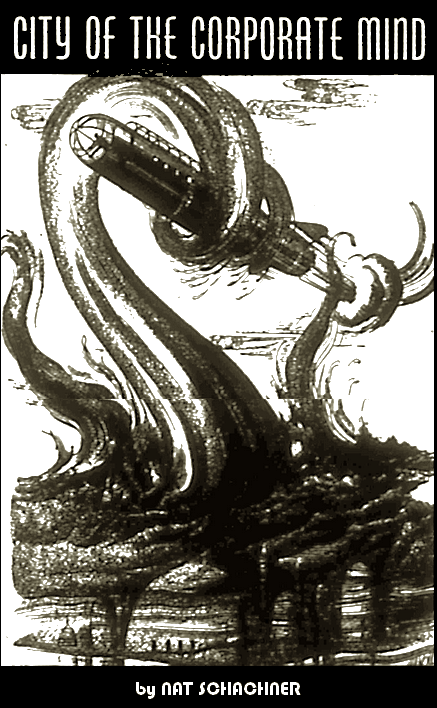
Past, Present and Future—in the persons of three men of three ages—invade a city of the far future—a strange, twisted society—
THE Red Sea made an oily patch beneath. To the left stretched the vast, unbroken jungles of Africa. On the right the sun dazzled back from an interminable expanse of barren sand and rock. Everywhere there was silence—deep, brooding, moveless.
Only the soft roaring of rocket jets punctuated the hush as the stolen ship of Harg fled north and west, cleaving the upper air like a silver bird in flight.
"Still nothing—and always nothing!" groaned Sam Ward, man of the twentieth century, his gray eyes intent on the unpeopled solitudes below. "Perhaps my hunch is wrong. Perhaps Dadelon was the last outpost of the isolated cities of Earth. And even that curious flying city is gone," he added wryly.
Beltan, Olgarch of Hispan, turned his tawny, aristocratic head with a faint smile. "You forget that my native city is still intact," he reminded. "Its neutron walls will defy both the rocket horde of Harg and the mightier thought-waves of Ras."
"A lot of good that will do us—or Earth!" Sam exclaimed. "Your fellow Olgarchs consider you a traitor since you helped us escape. They'd put us all to death if they ever laid hands on us."
"I am not afraid of death," snapped Kleon, Greek of Alexander's time. His golden hair was surmounted by a battered helmet, his clean-chiseled features and bright-blue eyes gave him the appearance of a Phidian god. The shield that ever hung from his shoulder clashed brazenly against his tarnished armor, the javelin that never left his hand described an angry arc. "It isn't death I mind," he repeated, "as long as my feet are firmly planted on the solid ground and my sword can strike at enemies that are palpable and within reach. But these newfangled weapons of the future, that kill at a distance and in cowardly fashion, and this boat that cleaves the air like Icarus with his waxen wings, are beyond me."
Sam Ward thrust a quick, anxious glance to the rear. "We seem to have escaped the hordes of Harg temporarily. There's nothing in sight."
Beltan nibbled with manifest distaste at the smoked hindquarters of a hare. They had captured it during a hurried descent off the Gulf of Aden where they had synthesized fresh rocket fuel and laid in fresh stores of water and game.
"Sooner or later," he observed calmly, "the horde will catch up to us. The thought-tentacles of Ras are far-reaching. And when we go, the last chance of warning whatever cities may still exist goes with us. Vardu of Harg and Ras of Asto will rule triumphant."
"Which means Ras—that spindle-legged, swollen-headed apology for a man," declared Kleon with magnificent contempt. "Vardu's just his tool." Sam's eyes burned ahead. They were right—both of these comrades with whom he had come to be so strangely associated. Ras, who had unscrupulously joined forces with the totalitarian horde of Harg against his own race, who had sent Dadelon hurtling to destruction, would never submit to equality with his fellow conquerors. In his scheming brain, mighty with concentrated thought, there must be plans—The rocketship sped over the sluggish Nile and, where once the Pyramids were thought to stand eternal, nothing remained but the lone and level sands. The Suez Canal was gone, choked by lush, fantastic weeds. The Mediterranean glimmered bluely beyond. This cradle of civilization, home of earliest empires, broad thoroughfare for thousands of years to the traffickings of men, was now silent and desolate, rimmed with unfamiliar contours, tomb of vanished hopes and fears.
Yet Kleon's eyes kindled at the sight. "Home!" His voice was a prayer. "Home to Greece after ten thousand years of absence! Surely the great Alexander's seed has not perished with the rest; surely the glory of Pericles and Plato, of Themistocles and Aristotle have left eternal marks. Here, if anywhere, we shall find that free people of whom you dream, Sam Ward!"
But Sam shook his head in sadness. "The glory that was Greece, like the grandeur that was Rome, had died even before my day, eight thousand years ago. However, we can look."
For hours of precious, waning time they flew feverishly over the deep-indented coast, hurtled over fabled Olympus, sought signs that men still existed in that once-glorious land.
But they found nothing!
The flame of longing in Kleon's eyes died slowly to bitter tragedy. "Gone! All gone!" he whispered, and bowed his head.
Sam and Beltan moved softly to the prow of the rocketship, respecting his grief. Once again they were high over the Mediterranean.
"Were there any other civilizations that might have survived in this land you call Europe?" asked Beltan.
Sam's face clouded. "If you can call them civilizations," he said unwillingly. "In the twentieth century they had mostly turned into dictatorial states, massed nations like the horde of Marg itself. Megalomaniacs ruled them and brought them eventually to that destruction in a later century which buried all mankind and made of Earth a shambles. But farther to the west there may still be some forgotten survivor that—"
Kleon lifted his head and stared moodily over the side. It had been impossible for him to believe that his native land could have shared the general debacle that overtook the world. All through his adventures, since his awakening from the radium-induced sleep in the land of the Mayas, had run the unexpressed hope of revisiting the purple hills of Attica and the windy plains of Thrace and hearing once more the rolling surge of Homer's tongue. A sudden homesickness griped his vitals and left him weak. To a Greek all other races are barbarians, all other lands sterile. To be sure Sam Ward and Beltan were comrades, fit even to have partaken in the god-like Alexander's wide-marching expeditions; but they were exceptions. In all Earth he would find no others. And now the hope that had buoyed him up was gone, shattered beyond redemption!
The sea blinked up at him, beckoning. Only that hadn't changed. The blue Mediterranean, over which the lordly triremes had sailed, arid the hawk-nosed merchants of Sidon and Tyre had sent their wares—
THERE was no wind, and the heat of summer lay breathless on earth and sky, yet the Mediterranean was suddenly in motion. Kleon blinked and looked again. A long shudder rippled over the surface, like the peristaltic movement of a gigantic worm. Then the water bubbled up in a vast arc and overwhelmed the rimming shores. The bubble collapsed and swelled again, rhythmically, in regular pulsation; while underneath dim things moved and stirred.
Kleon clung to the edge of the rushing rocket craft for support. "By Poseidon!" he cried hoarsely. "A monstrous serpent writhes and stirs within the sea. Look yonder!"
His comrades rushed to the side and peered down. The pulsations were increasing in violence. The whole Mediterranean, from the coast of Syria to the Strait of Gibraltar, foamed with expansion. The low coast of Africa buried under countless tons of briny water.
"Good Heaven!" exclaimed Sam. "The sea's alive! There's something underneath."
Beltan remained calm. His proud poise never deserted him. Excitement, or sign of emotion, was unbefitting an Olgarch of Hispan. His long, slim fingers moved effortlessly over the controls. The silver ship swung in spiraling descent until it barely skimmed the surface of the pulling sea.
"There is life below," he admitted, keen eyes searching the roiling depths. "But not of the type friend Kleon supposes. A city is encased within the sea—a city with flexible walls of water."
"But that's impossible," gasped Sam. "How can water create a dividing line?"
"Look out!" shouted the Greek and thrust up his shield in vain defense.
Beltan tugged hard at the controls, the sweat beading on his pale, patrician countenance. Sam dropped flat to the rounded bottom of the ship.
The sea rushed up to meet them. One hundred feet it heaved into the air, while the skimming vessel wrenched in every strut and rocket blasts jetted futilely in swift, upward thrust.
The bubble of waters caught them in irresistible tide, swung over and above them. The roar of flames quenched in the smothering medium; Sam gulped salt water and instinctively braced himself against the furious surge of the sea.
Then, magically, everything cleared. Choking and sputtering, Sam staggered to his feet, coughing up a lungful of spray, clearing his blinded eyes of salty immersion. The gigantic wave had receded, leaving in its wake only a thin film of water at the bottom of the rocketship.
"Belton! Kleon!" he gasped. "Where are you?"
The Greek rose lithely to his feet, thrusting aside the shield under which he had crouched against the invading tide. "Here, Sam Ward." He spat out a mouthful of water. "By Poseidon, but that was a narrow escape! I thought surely the lurking monsters of the deep had caught us that time. It were best that we leave this place—"
The Olgarch of Hispan shook the spume from his tawny head. His face was grim and taut. His fingers leaped over the banked instruments and fell away with a despairing gesture.
"We can't get away, friend Kleon! The rocket tubes no longer function. We are underneath the 'sea!"
SAM LOOKED blankly around. For the first time the muted silence of the rockets struck him, and the sudden cessation of accustomed motion. But that was not all! The fierce blaze of a cloudless sun was gone, replaced by a filtered, soothing illumination. The sky itself had vanished; in its place overhead was a green overarching of smoothly racing waters, rounded in a catenary dome and stretching to misty horizons as far as the eye could see.
Involuntarily he ducked, while Kleon invoked the entire pantheon of gods for succor. But the liquid roof—countless millions of tons of rushing ocean—kept its form and contour and failed to fall in catapulting catastrophe.
"We were plucked under deliberately," Sam said hoarsely. "We were seen and caught."
"By whom?" demanded Kleon.
"That," observed Beltan, "we will find out fast enough. In the meantime, we are moving."
A thin, transparent film formed around the captive ship. Swiftly, silently, like a helpless pupa in a cocoon, they slipped along. The three men of dissimilar times gripped their respective weapons and stared.
The filmy bubble in which they were inclosed picked up speed. It hurtled along a strangely curving track. Outside. Sam could barely see the circumscribing walls of the tube—transparent, shimmering, glittering with little flecks of flame.
"We're in a tunnel of sorts," he whispered, crouching. The automatic that had served him well, though millennia old, snouted outward.
"Or rather, an artery," corrected-Beltan. He held his electro-blaster in negligent grip.
"Good Lord!" exclaimed Sam. "And we're the nucleus of a cell. The wall that surrounds us is the cell wall."
"Exactly." The Olgarch frowned. "I'm afraid—"
"You speak in riddles," Kleon burst out, "but here come human beings whose appearance I much dislike."
A moment before the shimmering tunnel along which they sped had been empty except for themselves. Now, suddenly, it swarmed with hurtling men. But they were men such as Sam Ward had never seen before.
Of two types they were. One was a pale, sickly white, elongated and thin. The other was a brownish-red, chunky and rounded. Both had legs that held firmly together with tough connective tissue and their arms weaved in front of them as though they were swimming. Their lidless, lashless eyes were wide and unblinking; pale hair and reddish streamed backward with the wind of their flight. They came swarming down upon the rocket-ship like divers cleaving an invisible fluid. There was no expression upon their faces, but little knobs bulging on their foreheads quivered with strange vibrations.
They burst through the shimmering bubble that surrounded the plane as though it were merest tissue. On they came, directive, purposive, straight for the three men, arms weaving and clutching.
"Don't resist!" Beltan said quickly, but too late.
A pallid, elongated figure whipped writhing fingers around the startled Greek.
"Ha!" he gasped angrily. A mild shock quivered through his straining muscles, brought red fury to his dauntless spirit. He was not used to tame submission. His short, keen-bladed javelin came up with lightning speed and plunged deep into the dead-white body of the offender.
The man fell away, spurting a sickly-colored blood.
"Ha!" cried the Greek again, brandishing his weapon. "Let that teach you not to lay hands on a free-born Athenian."
"We're in for it now," groaned Beltan. "Kleon will never learn. All right, Sam Ward, we'll have to fight and may Heaven help us!"
The plunging figures had hesitated momentarily at the wounding of their fellow. The little knobs on their foreheads increased their vibration. A blue glow surrounded them in pulsing globules. Then they came on again, faces expressionless, eyes unwinking.
Kleon ejaculated an ancient oath as he lifted his javelin again. The man into whom he had plunged the weapon had galvanized into life again; was darting forward with his fellows as though he had not been disembowelled. The gaping wound in his side had closed and the ichor that issued was reduced to a tiny trickle.
Sam pumped twentieth-century bullets into the oncoming horde. Kleon's javelin thrust again and again. Beltan's electro-blaster flamed its bolts of destruction.
But still they came, hundreds on hundreds. Neither bullets nor javelin blows could stop their assault. The wounded fell back with red or white spurts of blood, and came on again, suddenly healed. Only the flaming disintegration of the electro-blaster ripped through their serried ranks and spattered them into nothingness.
Sam emptied his clip and cursed. Kleon staggered back and reached for the heavy sword that swung from his thigh. As far as the eye could see, newcomers were swarming to the attack, diving headlong, arms outstretched.
Wherever they touched, fierce electric shocks quivered through the defenders. Sam tried to club his useless gun, but his quivering muscles refused to obey his will. Long fingers darted over his body. The contact jolted him with strange fires. It was torture to move. As in a haze he saw Kleon's brawny arm sink slowly to his side and Beltan's face contract with pain.
Stiff, unable to move, yet jerking at the touch of their captors' fingers, they were hurried along. The rocketship and its immobile contents increased their pace. Platoons of white and reddish men, as though obedient to some distant command, wheeled in unison and vanished. Only a handful—fingertips resting on their victims—accompanied them as they careened along the shimmer of inclosing walls.
Through the transparency Sam watched with moveless eyes the shifting panorama of a strange city and stranger land. Scores of similar hollow tubes, varying in color from glassy visibility to red and purple hues, converged in huge arcs from the outermost reaches of the circumscribing watery arch toward the destination to which they were traveling. Crisscrossing channels tied them into a connected system. Red and white beings, similar to the ones who had seized upon them, sped along the tubes and arteries in purposeful, orderly array, bent upon unknown errands.
At stages the channels threw off supplementary tubes that ended in monstrous machines of gleaming metal. Some were like pumps, intricate in pattern, others pulsed with interior glow, some whirred in concentric rings like huge gyroscopes, others seemed manufactories from which endless streams of rounded pellets, held in a matrix of sticky fluid, sprayed into blue, connecting arteries and bathed their denizens in its depths.
Each machine had a cupola at its top, a bubble of sheer transparency. Within the shell sat a man, more human-like than the others, his knobbed forehead aglow with electric aura, and tending the controls. Here and there, as they rushed along, Sam got glimpses of other types of men—some powerful giants and ruddy of complexion, others attenuated and ethereal of hue, who slipped through the atmosphere with the ease and swiftness of a rocket-plane.
Then, suddenly, they were whirled out of their transparent channel into a smaller tube of yellow hue. Three brawny men waited for them there. Their muscles bulged and their bodies were squat and powerful. They caught the speeding ship and brought it to a halt as easily as though it were a toy. The escort of pale and reddish men touched them with whispering hands, then turned and darted back the way they had come. The three jerked forward like unleashed bolts of lightning.
Sam felt the blood once more surge through his body. At the release of those electric fingers the shock oozed from his system. He flung around on his comrades. They, too, were stirring back to normality again. The three men who piloted the ship with muscled grips did not seem to be aware of their existence.
Kleon muttered fiercely and hefted his javelin with still-tingling fingers.
"What do you make of these people?" Sam asked the Olgarch.
Beltan's noble forehead creased into little frowns. He studied the powerful forms of the men who had the ship in tow. "Curious!" he murmured. "A total subdivision of labor and of function. Each group, different from the others, has its specified task. Each member of the group performs his appointed duty regardless of death, or wounds, or obstructions. Those who first picked us up were scavengers—so to speak—detailed to keep the arteries of communication clean and free of all alien matter."
"Are we then scum, or garbage?" demanded Kleon heatedly.
Sam grinned a bit ruefully. "In this city we are. As aliens we have no place in their economy."
"Their job performed," pursued the Olgarch, "they turned us over to these different creatures. They are the muscular type, swift of motion, powerful—the carriers."
"And those fellows in the machines?" Sam pointed to the interior of the city.
"The tenders, the sub-directors of the city's life." Belton shook his head, puzzled. "Hispan had its division of labor, but nothing like this. Each man, regardless of his position, nevertheless was an individual, with a will and a mind of his own. Even the hordes of Harg have the power, if each so desires, to rebel or refuse to do his allotted task. But here—"
"I noticed that too," Sam almost whispered. "They seem to be practically automatic, without power to act for themselves. Orders are given, and their response is mechanical, immediate."
"Do you mean then they are not men?" Kleon demanded.
"They're men, all right, but men who have evolved into subordinate parts of a total economy. Hispan and Harg are but steps along the way. This is the ultimate totalitarian state, the goal toward which Earth's evolution was obviously working. A single corporate existence, in which human beings are but mechanical cogs, specialized in function and obedient to the common purpose."
The Greek shivered a bit. "I do not like your evolution. Man has lost his dignity, his sole reason for existence. Why, I prefer even the Individualists of Asto, or the variants of Dadelon to these—slaves."
"They're not slaves," Sam pointed out, "but component parts of an organized community. No one is greater than his comrade, but all are equally and efficiently subordinate to the common good. Take your own body, for example. There is a similar division of labor. You have your heart and lungs, your arteries and blood corpuscles; each—"
He started violently. "Good Lord!" he husked.
"I thought you'd finally get the idea, friend Sam," nodded Beltan. "It's been in my mind ever since we were first attacked. Your simile is not only apt; it's exact. This city is a monstrous body. These tubes are its arteries; those white and reddish creatures who first attacked us are its corpuscles; these correspond to the muscular elements. Out beyond, you note the attenuated, swift-darting creatures. They are doubtless the messengers—the nerves of the city. The machines are the mechanical organs; heart, lungs, if you wish, that keep the body functioning smoothly. In each sits a director—specialist in the operation at hand—relating his machine to the others—a minor executive."
Kleon snorted. "Bah! Even Plato, who once compared the state to a human body, as you do, knew that it was mere analogy, not the truth."
"He spoke better than he knew," Sam said softly. "But if you are right, Beltan, where is the brain?"
"We're being taken to it—the master person or mechanism that co-ordinates all the others. If you've noticed the strange protuberances on their foreheads, you've also noticed their vibratory glow. These creatures receive their impulses to act and automatically report back what they see, hear and the state of their reaction, through those receiving. and broadcasting knobs."
Kleon gripped his sword tightly. "Then we'd better try to fight our way clear now," he exclaimed. "We've killed their men; we can expect no mercy."
"We could never fight clear," observed the Olgarch. "We've got to take our chances."
CROUCHING, they awaited the end of their strange journey. It came with a curious suddenness. They switched abruptly from the main artery into a short channel that ended in a domed globule where sat a man with bulging forehead and concentrated mien. He did not even look at them. Instead, his receptor knobs quivered at their approach and he threw a switch. The action seemed wholly automatic. An arc blazed electrically. One filament touched the forehead of the three brawny men. Instantly they relaxed their grip on the captive ship, wheeled around in unison and catapulted back the way they had come.
"Well!" Sam pursed his lips. "We've evidently reached the end of the road. This bird must be the brain—"
But he was wrong. For the other flickering surge of the arc reached along a connecting channel. A pallid, elongated, wavering creature darted into view. His speed was of the order of a rocketship.
"Ai-ee!" Kleon sputtered. The attenuated man's incredibly mobile fingers had barely touched the prow of the boat, yet it jerked forward along the new tube at a furious rate.
"You might call him a messenger nerve cell," nodded Beltan with a kind of scientific satisfaction. "We just were switched at an automatic reflex from the motor to the sensory units."
"I'm getting dizzy at all this switching," said Sam wryly. "What I want to know is where we're being taken."
"If the analogy is correct—to the brain, the seat of co-ordination."
Outside the transparent walls of their conducting channel they saw hundreds of others, all converging with them as they hurtled along toward a central source. To Sam it looked for all the world like the tentacles of an octopus, with their as yet unknown destination as the maw itself.
"Our speed is slackening," Kleon said quickly. His knuckles whitened over the hilt of his sword. Come what may, he did not intend to go down unresisting.
Sam felt a curious lump in his throat. The attenuated man pushed them smoothly into a bubble with flexible walls which expanded even as they penetrated to conform in size and shape to its captive load. Then he turned and slid like greased lightning back the way he had come.
"We've reached the brain—the central control," said Beltan without emotion.
As with everything else in this strange undersea city the circumscribing walls of their flexible cell were transparent.
Through them they looked into a huge globular chamber. Its shimmering wall spangled with thousands of flashing lights. Each light connected with a tube that snaked outward into the city proper. They all flashed on and off in definite sequences, multicolored, bewildering. Back in the twentieth century Sam had once visited a telephone exchange with an automatic dialing system. This was something like that.
The interior of the chamber held no furnishings or apparatus of any kind. But a score of figures spun slowly around and around in three concentric living wheels. The outer wheel moved the swiftest, the interior one the slowest, so that always the figures kept invariable distance and vectoral direction with respect to each other.
They were men of an obviously intellectual cast. Limbs and body-were shriveled and dangling, as though they were long-unused appendages. Huge heads dwarfed all else; heads bulging with intellectual calm and utterly hairless. Instead of two knobs, however, lifting from their skulls, there were dozens, constantly quivering with little dartles of cold flame that synchronized with similar flashes on the heads of the others and with the pulsing lights that spangled the chamber.
"But where is the ruler who controls the city?" ejaculated Kleon, disappointed.
"I had expected a brain," said Sam, equally disappointed. Somehow he had expected, by analogy, a huge brain like that of a human being, disembodied, floating in some nutrient liquid, that, controlled the city. These harmless-looking individuals, however, were more like the denizens of Asto, Individualists, unable to co-operate effectively in any common enterprise.
The Olgarch surveyed the gyrating wheels of men with keen attention. To Kleon he said: "There is no single ruler. Together they rule." To Sam he replied."The totality of them constitutes the brain. The analogy holds perfectly. Think of your own brain. It is not a single, unitary mechanism. Rather, it is a republic of individual cells. There are millions of theft). No single one controls them all. Instead, all are equal in power and influence. The ultimate decision represents their common counsel, the end result of their mutual interactions."
Hundreds of nodules pulsed and glowed. Filaments of blue flame darted outward from the revolving heads, coalesced into a sheeted glow.
"Beltan, Olgarch of the distant city of Hispan, had correctly analyzed the fundamental governance of the city of Lyv."
SAM started; Kleon's head jerked around in amazement. The wheeling figures had not slackened their pace; their pursed-up little mouths had not opened; no sounds had echoed within the chamber. Yet each of the three comrades had heard the words distinctly within himself. To Sam it sounded like perfect English, of twentieth-century New York. To Kleon the syllables were Attic Greek of the time of Demosthenes. To Beltan they held the clipped, slurred speech of Hispan.
"They know my native tongue!" gasped Kleon.
Beltan smiled. "They did not speak. Their common thought invaded your mind, set your own processes in motion. You yourself translated it into words."
"Telepathy, of course," said Sam. "But how did they know your name, and where you came from?"
"Your little minds are naked to my examination," came the half-contemptuous interior response. "Yet in their way they unfold interesting 'things. I had not known before of the existence of any other city on Earth but Lyv. When my ancestor fashioned this present abode under the protective waters thousands of years ago, he did it to escape the plagues and fierce wars that swept the surface. Generations later, expeditions that ventured out reported Earth to be desolate and lifeless. Man had killed himself off with efficiency and dispatch. Therefore we remained in our new home, evolving along predetermined lines. I am the ultimate result—the city of Lyv."
"They—or rather, he—it's pretty confusing—talks as though he were the city, and the city was he," Sam ejaculated.
"Why not?" countered Beltan. "Lyv is actually a single organism, just as you are; though made up of a multitude of component parts—just as you are."
"In sooth," muttered Kleon, "Aristotle wrote of the body politic; so did Plato. But I never expected their winged words to take form and meaning like this."
Sam decided it was time to get down to brass tacks. "As long as you can read our minds," he told the three revolving wheels of men, "you must know three things. First, our stories and backgrounds."
The circles quivered in uniform agreement. It was more than confusing; it was a bewildering strain. Sam did not know just where to focus his eyes. One man was just like another; the synchronized revolutions shifted them like a shuffling pack of cards to his gaze. With an effort of will he solved the problem. He concentrated his stare on a single one of the small interior circle, and followed him steadily on his slower, turning arc.
"Second," he pursued, "that we have slain members of your city. That, however," he added in self-defense, "was because they appeared to be on the verge of killing us."
"The members you slew were parts of myself," Lyv replied logically, though it sounded startling enough.
Kleon grunted, half lifted his sword.
Beltan's wonted calm was broken; his hand moved toward his blaster. Yet even as it moved, he knew that he could never draw it; that before he did, strange and powerful weapons of Lyv would have come into play.
"You are quite right in your surmise," the inner voice mocked him. "Your electro-blaster was effective enough against my channel segments, because I wished to explore thoroughly its potentialities. Had I wished, even then it would have been utterly futile."
"You mean you permitted yourself, so to speak, to be disintegrated in part?" demanded Sam in amazement.
"Why not?" came the unexpected reply. "What happens in your own body when an alien disease organism invades your blood stream?"
"Why... why," stammered Sam, "the phagocytes or white blood corpuscles rush to the attack in an attempt to surround and kill them."
"And in the process many of your phagocytes die also, do they not?"
"Why, sure, naturally. But, good Lord!" exploded Sam. "They're only cells; they're not complete human beings, like... like—There are plenty more being manufactured all the time."
"And so do I manufacture new cell beings all the time. Their place as individuals is no more important in my economy than that of a handful of phagocytes in yours."
"Well, of course, if you put it that way," Sam muttered helplessly. It sounded logical; but damn it, those creatures Behan's blaster had disintegrated had been men—human beings—not mere unconscious, simple cells!
It was Kleon, however, who struck at once to the heart of the problem. "Then you do not propose to punish us for slaying your—whatever-you-call-them?"
"I never punish," he heard the wheel's response in purest Greek. "The word punishment has no place in an ordered organism. However, if I cannot utilize your alien frames and minds profitably within myself, or if you represent a focus of irritation or danger, then you must be eliminated."
"As though we were pathogenic bacteria," nodded Beltan. He seemed to be discussing a mere scientific point instead of his probable destruction.
"Exactly."
"But wait a minute," Sam said desperately. "Before you dispose of us summarily there is the third point. The horde of Harg, headed by Vardu and its co-leader, Ras, is on the loose. They have sworn to conquer all the Earth. Perhaps we can help—"
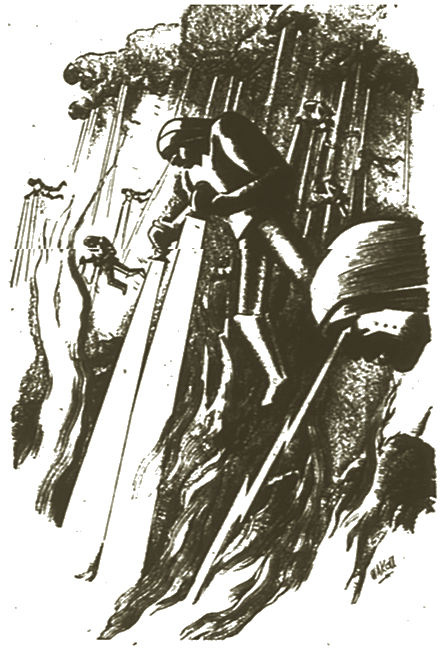
The soldiers of Harg stormed across the skies,
raining irresistible death on the City—
"I require no aid, especially from men of limited capacities such as yourselves," cut in Lyv. "I am safe from detection, and even should I be discovered, their boasted weapons hold no terror for me. Even the mighty thought of Ras must bow before my concentrated unity. Now be quiet for a moment."
LYV was thinking. The impact of his multifarious, yet single mind, on the three comrades was like a physical blow. Kleon muttered resentfully. Sam swore under his breath. Only the proud Olgarch waited with calm fatalism.
The innumerable disks of light on the rounded chamber walls glowed and ebbed; the atmosphere was electric with crisscrossing vibrations. Along far-distant channels motor and sensory beings galvanized into activity. Reflex arcs sputtered in the globe-machines.
"Now, by Heracles!" growled the Greek irascibly. "What is the meaning of all this?"
"Lyv is seeking a place for us in his economy," Beltan said quietly. "If we fit in, we live; if we don't—" He shrugged his shoulders; but the meaning was plain.
Sam knew his clip was empty; knew that even if it were full, he'd never live to raise the gun. Kleon knew the same about his javelin; knew as well that his thoughts were open to those queer little revolving men. Nevertheless, if the decision should prove adverse—
The inner voice came to them suddenly. "I have found places for the three of you. It is frankly an experiment on my part. If you prove properly efficient, I save the labor and expenditure of materials in replacing three constituents who have aged and must be eliminated. If you do not, then you will follow in their paths."
"I am no slave to labor for you on such terms," commenced Kleon indignantly.
"Hush!" warned Beltan. "We have no choice. Besides, it will be an interesting experiment for us as well."
"Where are we to be placed?" Sam demanded.
"Beltan of Hispan, as the farthest advanced, will direct the central machine that activates the motor-ganglion system. It's a position of considerable responsibility. Much of the decisions will be your own, subject only to emergency supervision by myself. The movements of the entire city will be under your control."
Beltan said proudly: "I am honored. You need not fear that I cannot handle it."
"As for you, Sam Ward of New York, since you are not quite as intellectually and scientifically capable, you will be placed at one of the peripheral centers, on the surface of the containing skin of water. Under your control will be the tactile members, the information feeders from the outside world of water and earth. Such a one discovered your presence in the outer air."
"Thanks!" Sam said ironically. "From the way you started I thought I was being relegated to scavenger work."
"That," replied Lyv, "will be the duty of Kleon of Athens."
"What!" exploded the Greek. His eyes flamed dangerously; his javelin lifted. "I, Kleon, heir of the noblest civilization that ever lived, a scavenger! Now by Castor and Pollux—"
"Easy does it," warned Sam.
"You will be in charge of elimination processes," continued the inner voice of Lyv imperturbably. "The corpuscular defenders of the body politic against all alien and inimical intrusion will be under your care."
"Well, now, that's different!" Kleon's handsome face wreathed into a satisfied smile. "Why didn't you say so in the first place?"
"He did," grinned Sam to himself. "Lyv is evidently a diplomat—or rather, twenty diplomats. It all depends on how a thing is said." But he was careful to keep his thoughts from his highly sensitive comrade.
THIS isn't so bad, decided Sam. He sat in his thin-bulbed globule on the outer surface of the city of Lyv. Naturally, he had been a bit sick at first when the man he displaced had been taken away for elimination by the scavenger men under Kleon's control. But the man had been old and worn out; his body was already in the process of disintegration. After all, thought Sam philosophically, we all grow old and die. This is just another method of dying, that's all.
The work itself, he soon discovered, was for the most part automatic, requiring a minimum of intervention on his part. The machine he tended was a marvel of mechanical efficiency. To it, from the smooth-racing flood of waters that inclosed Lyv, came a tremendous complexity of membranous tubes. Along these sped the transmitted reactions of the tactile members—very delicate, fragile-looking men with sensitive skins and fingers on which the faintest disturbance anywhere made electrical contact. Their reactions fed into an intricate bank of vacuum tubes and sensitized electric cells. There they were sorted and graded according to intensity of impulse, directional approach and quality of impression.
Differential analyzers took up the task, broke down the reactions into component elemental parts, then synthesizers built up potentials according to kind. The machine clicked and whirred, the tubes glowed and flashed, gears meshed smoothly, and new impulses raced out along the network of channels, impinged upon the vibratory knobs of the tactile men and shunted them into appropriate responses to the impressions received. The whole process was completed in less than a second, much as it is done in the human body itself.
Sam's job was simply that of a watchman. Only occasionally, when the machine faltered, or a part went wrong, or an emergency arose involving novel elements to which it was not geared, did he intervene. This had happened about a dozen times since he had been installed in the globule, a week of Earth-days ago. The only way he could determine time in this internal underwater daylight was by his original comparison of the steady beat of the machine to his own pulse.
His watch had been irrevocably damaged by the radium emanations during those thousands of years of suspended animation within the sealed chamber of Quetzal.
So far the revolving brain of Lyv had not found it necessary to intervene. He was quite proud of that, preening himself inordinately on his skill. "That will show him," he thought grimly, "that a man of the twentieth century has just as good a brain, when it comes down to cases, as one of the ninety-seventh century, or any combination of men. Show me once how it works, and the rest comes natural."
Vainglory, without doubt, and due soon to a most rude awakening. But in the meantime Sam studied the strange corporate city into which he had come.
The increasing sea, he soon discovered, was held in place by a powerful repeller in the very center of the city. It was encircled by a congeries of smaller machines that fed ceaselessly a type of fuel into its maw, where it was transmuted into power. Atomic energy, he decided, and turned his probing mind elsewhere.
Locomotion was simple.
The tubes were charged with lines of electro-magnetic force. Inside the skin-tight clothes of the creatures of Lyv were thin metallic plates.
By appropriate shielding and energizing, the wearer was catapulted along at any desired speed. Sam and his friends had been given the plates for their use.
Lyv was efficient, without doubt. For more than two thousand years he had been approximately in his present corporate state and everything went on smoothly and without a hitch. New members were regenerated as old ones required elimination; even among the components of the central brain. Yet always the city as a whole kept its identity, gaining in wisdom with the passage of the years, yet immortally the same individual in thought, in imagination and in memory.
For centuries he had deemed himself unique on an otherwise dead world, confined within the surrounding waters of the Mediterranean. He was too vast a total entity to push his way out through the Strait of Gibraltar, even if he wished, and thus gain the huge, almost limitless expanse of the Atlantic and the connecting oceans. But he had never wished it. What did it matter to Lyv where he was? All his horizons would be the same featureless water in any event, and thought could be pondered just as well in one place as in another.
The coming of the strangers, however, had changed the situation somewhat. They brought with them the knowledge of alien cities and alien times, of a horde on the loose whose sole burning desire was conquest.
Yet even this did not disturb Lyv's totalitarian equanimity. He was confident in his protective, overarching floods and in the compact, unified strength that was inherent in himself. He personally had no such desire for alien domination.
SAM TENDED his machine and was fairly well content. Naturally, in time he would tire of his duties and the enforced limitation to his lengthy wanderings. And there was always before his vision that phantom ideal he had set up for himself—the existence somewhere, somehow, of a community, a civilization that conformed to his twentieth-century notions of democracy and noble freedom for all. So far he had not found it. Hispan, Harg, Asto, Dadelon, and now Lyv, were each in his own way utterly hostile and alien »to that ideal.
When he felt restless like that, Sam would get in touch with his comrades. Beltan, accustomed as he was to the strict order and caste system of Hispan, found the combined singleness of Lyv quite satisfactory. He was in a position of authority; the greatest, in fact, under the brain. The city's activities, complicated in detail, yet unified in purpose, passed through his motor machines. Nothing happened anywhere that required movement, energy, without its cognizance. It was true that most of his circuits were closed and self-acting, receiving sensory reports and automatically relaying the requisite motor responses, but there was considerable choice in many fields on which he gave decision. He, too, was under the ultimate control of the brain men, yet he in turn by his decisions and machine responses exercised a measure of control over them. Just as the deliberate clenching of a fist in a normal man will set loose certain reactions which must necessarily affect his brain and make him unwittingly angry.
But Kleon was disgusted. He soon discovered that his high-sounding title meant nothing. The switch at which he had been placed was wholly automatic. It was, in fact, of the order of an instinctive reflex. Perhaps once in a hundred thousand operations would it require direction. The Greek sat glumly in his cubicle, fingering his fast-rusting sword, staring with moody eyes at the shield that long ago had been the recipient of a thousand hacks and blows. The plume on his helmet drooped bedraggled, yet he never doffed the bronze casque. It was his sole present claim to self-respect.
Ill-smelling products of disintegration were shunted almost to his very door by the scavenger men; members who had outlived their usefulness staggered by him to elimination. His proud nostrils contracted with fierce tension; day by day his choler rose. Sam and Beltan tried to cheer him up; couldn't. Sooner or later, they knew uneasily, Kleon must explode, and the consequences would be incalculable.
Now that they were integral cogs in Lyv, they no longer saw the concentric circles of men who made up the cells of the brain. Yet always they were under invisible supervision, submerged in a close knit system.
"Curious," remarked Sam one day into his tiny broadcasting unit. "We must have given Ras the slip completely. Haven't seen a thing of the horde of Harg since the destruction of Dadelon."
The Olgarch stared inscrutably across the intervening transparencies. "We're not rid of them," he shook his head. "Sooner or later the thought-tentacles of Ras will ferret out Lyv; and then—"
Kleon's eyes flashed for the first time in days. "I hope he does," he said violently. "I am sick to death of this foul inaction; of this work that is fit for slaves and women. I'd rather blaze into glorious extinction with my sword in my hand and the Macedonian cry in my throat than rust away in here, condemned never to see the blue sky again or the flush of dawn in the East or hear the strong wind singing in my ears."
The Greek's impassioned words stirred something in Sam. He had not missed the freedom of earth and sea and sky until now. Restlessness seized him. He stared up at the smooth-racing wall of waters with a sudden distaste; they reminded him of prison bars.
The days slipped by. Sam watched his machine, the circumferential waters, the ceaselessly busy tactile men. His gorge rose.' He became as moody as Kleon. Vainly he sought for schemes of escape, knowing all the time that his thought processes were open to the revolving brain men. The rocketship of Harg lay in a separate cubicle, quiescent, just as it had been at the time of their capture. But rack his wits as he might, there was no way to pilot the ship through the intervening tons of water overhead. They were doomed to remain.
ON THE fifteenth day of their immersion in Lyv, barely had Sam taken his seat at the controls when he noted that something was wrong. For one thing, the tactile men at the periphery were in a state of unwonted agitation. They fluttered in wild gyrations through the connective channels; their knobs literally blazed with blue streamers of flame.
The machine was haywire, too. The messages that came in from the distracted tactile men were a jumble of meaningless confusion; gears meshed irregularly, parts clanked and whined, and nothing emerged. Sam jerked forward, startled. Nothing like this had ever happened before. He wrestled with the controls, sought to make the proper adjustments. But the uproar increased rather than diminished. The delicate tactile men were literally running in circles; the channels blazed with distraction.
"Phew!" whistled Sam. "This seems to be a case for the brain. Either all Lyv has turned screwy, or there's high jinks taking place somewhere in the Mediterranean."
Then he sat down abruptly. An invisible hand had pressed him down. Invisible fingers plucked at the secret recesses of his mind, probing, exploring. The pressure increased. The sweat started out on his forehead. He uttered a hoarse cry, his weighted hand caught at his microphone.
"Beltan! Kleon!" he stammered into the instrument. "Ras has found us out! He's sucking me dry! Notify the brain men—quickly—the hordes of Harg are on their way!"
Then he collapsed on his seat.
Kleon sprang to his feet in his cubicle, eyes filled with battle lust. But Beltan made swift connection with the central brain. "The horde of Harg is here! Make ready for defense!"
All of Lyv roiled with agitation. Reflex machines worked furiously, scavenger men massed in overwhelming numbers at the peripheries, messengers raced along the channels with lightning speed. Even the circling brain men increased their pace until they seemed like a blur of motion.
A voice rushed along the tubes, permeated every sector of the body corporate. Sam, staggering weakly to his feet, the pressure lifted from him, heard it buzzing in his head.
"City of Lyv," it spoke, "know that I am Ras, and with me is the rocket horde of Harg, headed by Vardu, its leader. Know that we have conquered all of Earth, and submit. Nothing can withstand our combined prowess; nothing on earth or in the air or under ocean. Take heed from the fate of those who had tried resistance and yield to our sovereignty. Within your city are three men, fugitives from our will. They have seen and they can tell you. I give you but a moment to make up your mind."
"Don't yield!" Sam shouted. "Fight them back, Lyv! Or you will be enslaved forever!"
The confusion in Lyv stilled. Ordered quiet took the place of wild scurryings. Overhead the rushing waters paled and seemed to have become translucent. Through them, as through a glass, Sam saw the blue sky above.
It was darkened with countless shapes. The great ship of Harg, in the prow of which stood Vardu, black hair bristling, dark face filled with fanatical triumph. Next to him stood Ras, a caricature of a man, with bulbous head supported by a weak and swaying body. Around them hovered a hundred thousand fierce robot warriors of Harg, each encased in his stellene rocket sheath and bearing in his hand the flaming rod of disintegration. A mighty armament, fresh from the destruction of Asto and of Dadelon.
A collective sound welled up through the covering waters from Lyv. Sam could not place its origin; it seemed to come from every unit of the city, from scavengers as well as neuron men, from themselves as well as from the swift-whirling brain.
"I, Lyv, do not fear you or any other group of things or beings in this or other worlds," it stated in a matter-of-fact tone. "I am a peaceful individual, intent on myself and seeking no domination over others. For thousands of years I have lived within these waters in peace and quiet. I am content to continue so. It does not matter to me what happens on the face of the earth or in the sky, as long as I am not disturbed. Therefore go about your affairs and seek your conquests elsewhere."
Vardu's face darkened with fury, but Ras merely chuckled. "Unfortunately it is not as simple as that, my dear Lyv," he said. "We cannot afford to leave intact any independent hotly in the bosom of our domain; it would remain a constant temptation and focus for future revolt. Besides, you have in you the three strangers—Sam Ward, Beltan and Ivleon—who have defied us these past months and sought to stir up trouble against us wherever they have fled."
"The three you mention are part of me," replied Lyv. "They remain where they are and you remain where you are, or it will be the worse for you."
"Attaboy!" yelled Sam delightedly. Kleon's war cry rang loud and long; his sword clashed with martial sound against his-shield. Beltan said nothing, but took out his blaster and inspected it carefully.
Vardu screamed with maniacal rage. "What are we waiting far, Ras? Let us blast the presumptuous fool out of the waters in which he is hiding."
The Individualist turned to him with a gesture of contempt. "You do not understand, friend Vardu," he purred. "Lyv is a different case from your former conquests. At Asto, against my former 'people, you would have lost had I not aided, and their stubborn individualism aided as well. At Dadelon it was the same thing. But here is a single unified body, each part obedient to the will of the whole. It will not be an easy victory."
"Bah!" snarled the Hargian. "You overrate Lyv's power and your own services as well. We shall attack, whether you want it or not."
The bulbous head of Ras turned a bluish-green. Lightnings flashed from his cold gray eyes. Then he bowed suddenly. "Very well, Vardu, let it be as you say."
The Hargian sneered in triumph. "It had better be, Ras. You are wise to submit." Then he turned to his waiting horde. "Attack, then of Harg!" he screamed. "Kill, burn, slay for the glory of Harg and of Vardu, your leader!"
A RUSHING, whistling sound enveloped Earth. As though they were a single man the hundred thousand warriors hurtled downward to the attack. Stellene envelopes cushioned in a flame of exploding gases; earth and sea thundered with huge vibrations of sound. In each fanatical eye glared a reckless fury; in each fisted hand gleamed the tipped stellene rod.
Down, down they came, smashing through resistant air, straight for the sea of waters, blazing with speeds of hundreds of miles an hour. Involuntarily Sam threw up his hand to shield his eyes from the molten glare. No power on earth, it seemed to him then, could withstand that massed attack. In water as well as in air the stellene sheaths were impermeable to ordinary weapons or the shock of steel, while the stellene rods could blast their flames through the uni-way metal against their foes.
Helpless, his futile gun in hand, he awaited the shock of contact. In another globule Kleon danced and shouted indistinguishable things, wild with rage at his inability to get at the hated foe. But the Olgarch sat calmly in his compartment, electro-blaster motionless in his lap, curiously undisturbed.
The forward-driving squadrons hit the sea simultaneously. The Mediterranean heaved upward in a geysering roar of seething, boiling, steaming waters. A huge tidal wave lashed outward in all directions, inundated the surrounding coasts under a smothering foam of irresistible fury. Great clouds of hissing vapor rose into the weltering air. The concussion shook all Europe and Africa to their rooted foundations.
As if they were so many sharp knives plunging into soft butter, the rocket horde cleaved the tumbling waters. Rocket tubes sealed tight to guard against the influx of alien elements, but the momentum of incredible acceleration hurtled them down through the foaming green depths.
Down, down, down, like sharp-toothed sharks, each Hargian clearly displayed in his lucent sheath, each warrior ready to burn and smash and slay in accordance with the command of the ineffable leader!
Sam stared up in silent horror. What could Lyv, for all its compact unity, do against this massed assault?
Within, everything was silent and moveless. The clustered component creatures were at their various posts, unstirring. No visible weapons were in their hands. The hush of death pervaded all. Even Kleon had ceased his Macedonian shouts and stared with the rest.
Down, down, through a hundred fathoms, down to the smooth, racing dome of withheld waters. In another spit second the horde would pierce; and then—
There had been no command; there was no sign of new activity in the whirling brain. But suddenly the body corporate of Lyv sprang into fierce motion. The knobbed foreheads of the countless constituents quivered with crackling lightnings. The machines blazed and sparkled and spun like mad. The great network of channels flared with a sun-like brilliance; electric currents of immense amperage and tremendous potential swept outward in a storm of cosmic power.
The wall of waters disintegrated into a seething madness of primordial elements. The down-rushing horde was caught in a fury of crashing vibrations that stopped them in their tracks and swept them backward with accelerating speed.
The stellene rods blasted and sizzled their lightning bolts. The outer channels of Lyv flamed red and hundreds of tactile men crisped into nothingness.
Titanic battle had been joined.
Never, since the first molten surface of Earth had stormed under the constant fury of downpouring waters from an overladen sky, had the seas been in such frightful turmoil. As far as the polar oceans and stress of conflict raged. Ice caps, fixed for eons, tumbled into the boiling waters; huge sections of the coastal regions of the world groaned under the onrushing floods.
Thrust back into the air, the rocket tubes flamed again, and again the Hargian hordes flashed to the attack. Deeper now they hurtled, leaving rocket tubes flaming even as they sliced the waters. Hundreds more of channels flared into disintegration.
Sam cursed and raged. If only he could do something, reach some weapon of unimaginable power before Lyv were overwhelmed, and he and his comrades with it! At least on Asto and Dadelon there had been means of escape, but here there was none. They were condemned to die with their host, like rats in a trap.
Then he blinked.
FROM all sectors, along every channel, swarmed the scavenger men of Lyv. Thousands on thousands in endless, rushing array, bulleting upward the area of destruction and fantastic conflict.
There was no expression in their eyes—pallid, elongated men and chunky, ruddy ones alike. The membraned feet were close together; their flexible arms were wide outspread. Against the fanatical hordes of Harg they pitted the equal obedience of totalitarian unity.
The great magnetic currents swept them on, zooms of cohesive destruction, through the radiating tubes, into the area of blasted channels, into the welter of seething overhead waters.
"They'll all be drowned!" whispered Sam, watching with a thrill of horror.
Like swimmers springing back to the surface they plummeted, arms wide, eager. Each grappled with a stellene-clad warrior. Hundreds fell away in an explosion of flame and steam. But others took their places, grappled with self-annihilation. Their questing fingers wrapped around the steamy surfaces of the stellene-sheaths; the outrushing flow of magnetic fury coursed through their knobs and infused them with tremendous potentials. Inside the sheaths, Hargians screamed and sizzled into smoking ruin, while stellene weapons clanged harmlessly to the hollow cylinders.
Vardu, in his flagship overhead, cursed and sent new hordes downward to attack. To meet them streamed equally fresh battalions of the scavenger men. For each Hargian who died in the depths half a dozen Lyvians disintegrated.
"How much longer can this keep up?" cried Sam, though no one was listening. "There aren't enough scavenger men for replacements at the rate they're going. While Vardu has—"
"Look, Sam! Look around you!" Beltan's voice was sharp and hurried in the receiver.
Sam whirled. Throughout the central mass of Lyv long, white cylinders were scattered. Sam had often wondered at their functions, but never until now had they been active. Now they were incandescent, rotating furiously. The white glow of their surfaces rendered them translucent, and in their interiors he noted little whirling blobs of shadowy matter that pulsed and grew into shape and form. From the ends of the cylinders, fitted snugly into small, connective tubes, catapulted endless streams of scavenger men, still glowing with the fiery energy of their creation.
Without hesitation, they flung themselves into the onsweeping currents and raced upward to join their fellows in the battle.
Sam thrust a shaking hand over his forehead to wipe away the sweat. "So that's the way it is!" he muttered to himself. "I might have known. Component men are cheap in Lyv; just as individual cells in a human body. Plenty more can be manufactured. What a place!"
UP ABOVE, the tide of battle had turned. Vardu, frantic with rage, thrust more and more of his obedient horde into the maelstrom. For every one that died a half-dozen Lyvians went along. But the horde of Harg was limited, while Lyv poured always new supplies to the front.
The waves of Hargians thinned, but still Vardu would not yield. He seemed insane now; his eyeballs glared like beacons, his plastered hair was disheveled.
"More! More!" he shrieked, and the robot soldiers went down to destruction.
At last there were no more. Above, the sky not long before darkened with what seemed an illimitable horde, was cloudless now. Only the hovering ship of Harg with its two occupants, Vardu and Ras.
Vardu flung for the controls. All measure of sanity had quit him at the sight of the immolation of his once resistless horde. "We'll get them yet. Why do you stand there like a mummy, Ras? Where is that vaunted thought-shell you bragged about? Turn it on, while I dive the ship. Turn it on!"
But Ras stood quietly, making no move. A thin smile of cold contempt wrinkled his thin little lips. "You fool!" he said. "You've shot your bolt. In your pride you thought to overreach me, who am worth a million like you. Well, you're through now. Know that I've merely used you for a tool. Your usefulness to me is at an end; I foresee new and greater possibilities than ever before."
Vardu jerked up, startled. Sanity and alarm swept into his eyes. His hand went lightning-swift toward the stellene rod at his side. But swift as he was, Ras was swifter. A shimmer of expanding force moved outward from his skull. It touched Vardu. The Hargian dictator had no chance even to scream. An outward rush of flaming, incandescent gas was all that remained of him. Ras leaned on the rail a moment, his pale lips smiling, his cold gray eyes contemplative on the still heaving wreckage beneath.
Sam was doing a jig in the confines of his globule. Kleon clashed his shield with brazen clangor in a paean of victory. The incredible had happened. Harg, the destroyer, the conqueror of half the Earth, was wiped out, vanished into the mists and obloquies of time as though it had never been. Not a single one remained of that once ruthless, power-mad horde. And Lyv had done it—Lyv, that by his own avowal, wished only peace and self-sufficiency. Earth was saved! Sooner or later they would be permitted to go, to seek more of the hidden remnants of an ancient world that had burst asunder through the greediness and blood lust of men like Vardu. Perhaps among them there would be one—
But Beltan, Olgarch of Hispan, did not join their rejoicing. His aristocratic brow was furrowed with frowning thought. His lips were tight against all utterance.
Sam stopped his impromptu jigging. "What's the matter with you, Beltan?" he demanded.
"Ay, man of Hispan," called Kleon, "why do you not join the paean of victory? Such a battle have I never seen, not even when mighty Alexander thrust through the Persian host or the elephant army of Porus."
The Olgarch stared with wry countenance from one to the other of his fellows. "You forget," he said gently, "Ras of Asto."
"Holy smokes!" grunted Sam. His eyes jerked up and outward.
The overarching veil of waters was still torn to shreds. Debris and sooty wreckage floated tumultuously in the outraged air. The great silver ship of Vardu floated with it. But its prow was empty.
Ras, mighty with evolved thought, had vanished!
"But where the devil—" Sam sputtered in bewilderment.
The Olgarch's face was a proud, cold mask. His words dropped like distilled poison into their astounded ears. "Ras," he said, "has merged himself in Lyv!"
RAS had laid his plans carefully. He had joined Vardu and the rocket horde of Harg because he required their aid to overcome his fellow Individualists on the island of Asto. He utilized them in the destruction of Dadelon. But Vardu had swelled with arrogant pride and deemed himself the stronger in the alliance. Therefore it was 'time to get rid of him.
Perhaps together they might have defeated Lyv. But Ras, with lightning thought, had decided otherwise. Let them battle each other alone while he 'stood aloof, conserving his forces. Harg, he felt certain, would be destroyed in the process, as indeed it was. There were possibilities in the unified structure of Lyv and its totalitarian economy that intrigued him. With such a forged weapon at his command nothing on Earth, nothing from the planets, nothing even in the distant reaches of interstellar space, could stop its irresistible advance.
Therefore, in the instant that Vardu flamed into a blaze of fiery gas, he acted. He sped along the curved potentials of his expansive thought toward the point which he had predetermined on before.
Within the inner, slowly whirling ring of Lyv a brain man flashed sudden alarm. But even as his rotating figure pulsed its message to the others, it was too late. Ras, grim and bulging, materialized at his very throat. A shimmer of force touched the startled brain man. He puffed out as a thin trickle of smoke. Ras slipped into his place, whirled exactly as he had whirled, held with nice attention to axes and vectors the position of the cellular brain man for whom he had substituted so ruthlessly.
The three concentric circles quivered, hesitated in their endless gyrations the split millionth of a second; then took up their whirring round as though nothing had ever changed.
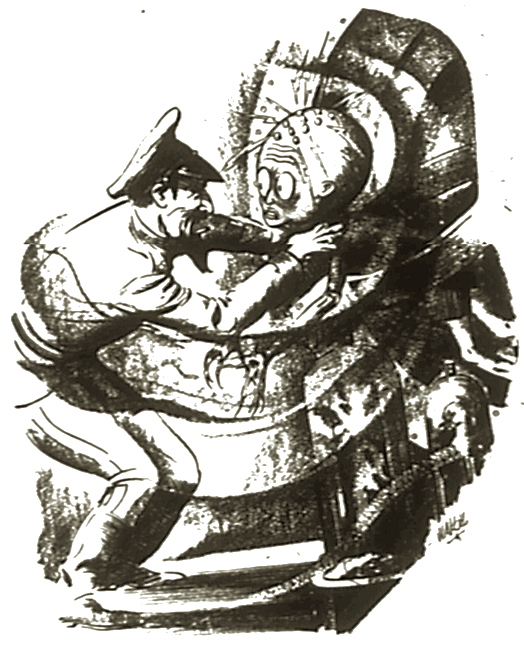
From the spinning wheel of dwarfish men that were the minds of the
Corporate City, she snatched a unit—and slipped into its place.
Ras had become an integral cell in the interdependent brain of Lyv!
He had anticipated just such a result. With his powerful thought-tentacles he had probed the structural base of Lyv, and plotted his course accordingly. Component brain men of Lyv would age and die. just as individual beings might. But at the instant of their death fresh, newly manufactured cells would spring at once into the proper place in the orbital swing, so that the brain as an entity would remain unchanged, immortal in its continuity.
Ras settled himself into his orbit with a grin of satisfaction. Everything had worked out according to plan. He was a constituent member of the great brain that directed the unitary organism known as Lyv. His mind, evolved through countless centuries, he knew to be mightier than that of any individual cell of Lyv. It would therefore be an easy, task to assume overlordship of the whole. An irresistible weapon, tempered, compact, terrible was at his command.
None of the other gyrating brain men seemed to have noticed the alien substitution. Placidly they continued on their interminable wheels, building up potentials of electro-magnetic energy by their patterned turnings.
Ras chuckled silently, and thrust out his mighty thought-shell. "He would take over, but, as he gathered up resources for the outpouring of his will, a strange thing happened. Filaments of thought, of interrelated energy, webbed him in from all sides. He felt them coursing subtly through his mind; he felt his own thought processes reach out and interpenetrate in similar fashion the minds of all the others. He seemed to bathe in a universal bath of merging energies; he was one with his fellows and they were one with him!
At first he tried to fight against the lapping bath. But his individuality began to slip away from him: he was a part of a whole, a being incomplete in himself but vigorous and mighty in the totality. It was pleasant, soothing. He had never had such an experience before.
With a violent effort he retracted his thought-shell back into himself. He had not bargained for such a denouement. He, individual of individuals, to be a mere cog in an organism! For the moment he was frightened. There might still be time to break loose, and flee this sapping interplay. Then he grinned again.
Very well then, he would remain and become a cog. But inasmuch as his solitary, giant intellect was greater than that of any other single cell, though inferior to the totality, he would not waste his energies in violent attempts at alien domination. Instead, he would merge himself, adjust himself to the whole and its interrelations. By so doing, imperceptibly, his plans would interpenetrate the thought-processes of the others, feed in turn on their giant unity. Together they would make up Lyv. He would lose his individuality, it was true, but the greater Lyv, of which he would be a part, would turn to the things he had passionately desired. From a peaceful, self-contained creature, content with its present status within the narrow confines of the Mediterranean, Lyv would move toward restless conquest and subjugation of the Universe.
He adjusted his thought-shell accordingly, not knowing that he could not help himself. It was a strangely pleasant sensation. An ecstasy of merger, of greater unity. The concentric circles continued to whirl gravely on their ordered paths, without a hitch, without a tremor.
BELTAN was the first to feel the alien turn of events. Queer pluckings at his brain, feeble at first, but momentarily growing stronger. He stirred uneasily.
"Something has taken place in the brain of Lyv," he spoke low into his microphone.
"What?" demanded Sam.
With a firm gesture the Olgarch pulled the master switch of the motor-sensory machine. It was an emergency switch, to be contacted only in the almost inconceivable possibility that the economy of Lyv had gone haywire and the brain men had failed to take over.
Every member of the organism, outside the brain chamber, came to a sudden, immobile halt. All activity paralyzed. Scavenger men, neurons, tactile men on the periphery, warders of the manufactories and regulators, all the numerous functions of Lyv stopped in their tracks.
"Hey, what's the idea?" yelled Sam.
But Beltan's gaze was directed with curious intensity upon the single channel that remained open. The channel that connected his globule with the master chamber of the brain. On such a pulling of the switch, a warning impulse leaped with the speed of light to the errant brain which, thus warned, could make the necessary adjustments to redeem the perilous situation that had theoretically arisen.
The brain began to wheel faster. The disks of multicolored lights on its curving walls flashed on and off with blurring speed, as Lyv scanned all of its vast organism for signs of danger.
The Olgarch's eyes widened on the whirling figure in the inner ring. A figure alien to the others. The figure of Ras of Asto!
Recognition was mutual. Ras glowed with curious luster; the visible shell of his thought reached out for his fellows, bathed in their filaments in turn. Slowly, but surely, he was inducing a single, unified thought; a single, powerful will.
"Quick!" shouted Beltan. His face paled; then veined with furious energy. "Ras has merged with Lyv! He's in the brain! Smash every instrument; cripple him as long as possible. Our lives, the lives of every hidden race upon Earth depend on it."
He snatched up a bar, smashed down with powerful, crashing strokes upon the delicate machinery. Tubes splintered into a thousand shards, metal crunched under his blows.
Sam did not wait for a second warning. He caught at a similar bar, heaved with all his strength. In the distance he heard the great strokes of Kleon as his heavy sword rose and fell.
Stirring activity in Lyv froze suddenly again. Tactile men, scavengers, motor-sensory components, remained exactly as they were. Paralysis gripped the city once more.
Even the brain chamber slackened its swift pace. The interchange of energy became feeble, dulled.
"What next?" shouted Sam.
"If we could get to the brain men before they work up new potentials, we might blast them all out of existence, and bring Lyv with its new member, Ras, to an end."
Sam thrust a swift look overhead. "The Mediterranean is closing up above us," he said grimly. "O.K., we die in the general ruin. Come on, Beltan."
"It's too late," cried the Olgarch in accents of utter despair. "Ras is reviving the whole. He wasn't completely merged yet. Look!"
A wavering shell of iridescent thought was beginning to form, with Ras as the center. It lapped out over the feebly moving brain men. Wherever it touched, action quickened. Slowly the wheels began to pick up speed; slowly the wave of energy began to move outward.
Silent machines quivered and moved; silent, paralyzed units in its path galvanized and drifted toward the central chamber where Beltan was.
"We've lost our chance," gasped Sam. "They'll kill us sure. Ras will see to that."
Beltan aimed his electro-blaster. "We'll die fighting," he sad whimsically, "just as friend Kleon is ever wont to remark."
Sam whirled. "Jumping catfish!" he exclaimed. "I forgot all about him.
Where the devil is that Creek?"
"Right here. Sam Ward." clanged a cheerful voice almost in his ear. A strong arm reached out, caught him around the waist, lifted him as easily as if he were a child.
SAM fell into the bottom of the rocketship of Harg with a little thud. He scrambled to his feet. "Holy cats, Kleon! What... what—"
Kleon stood in the prow of the boat, his hand gripping the controls, his eyes burning on the curving channel through which he manipulated his craft with masterful touch. Red blasts of flame jetted behind, making thunderous roar in the confined quarters.
"While you and Beltan, men of advanced civilizations, were so full of plans for saving all Earth," he said ironically, "I, a poor, primitive Greek of Alexander's time, was engaged in more limited, practical things. When Beltan temporarily paralyzed all Lyv, I raced for the globule in which our old craft had been stored. Luckily, the rocket jets kicked into instant action and here I am. Now if we can get to Beltan in time—"
But the Olgarch had already seen what had taken place. He leaped out of his globule, came racing down the channel to meet them. Sam caught them up as Kleon slackened speed.
"Give her the gun now," he shouted about the thunder of the rockets. "It's going to be close. Behind us, the widening influence of Lyv; ahead, the fast-tumbling waters of the sea."
Kleon had never heard that early twentieth-century expression before, Tut he knew what Sam meant. He grinned and stood erect. Like a Greek god he was, with helmet plume and golden hair streaming with the wind of his flight. The silver ship leaped forward in a fierce rush of acceleration.
Behind them, almost touching, sped the electro-magnetic wave of Lyv. In its wake scavengers sprang to life and darted like divers after them, eager arms outspread, tipped with deadly currents of instant destruction.
In their path silent, unmoving men swayed gently in the stagnant air, still held in the paralysis of the broken machines. The flaming rocketship smashed into their yielding bodies, ripped them into spattering blobs of flesh, thrust them behind like refuse in the wake of an ocean liner.
Beltan said with expressionless face. "It's a pity! Those poor creatures—"
Sam felt a little sick. But Kleon was hard and with the hardness of practicality, of one who had long been accustomed to mangled flesh and sudden death. "It's our lives or theirs. They will be replaced; but we have no such assurance."
Slowly, but surely, they pulled away from the fast-coming waves of force. But ahead, new and more hideous peril threatened. "We'll never make it," groaned Sam.
The tumbling Mediterranean, long withheld by the fierce concussions of disintegration, was rushing in once more to claim its own. As far as the eye could see, sky and water mingled in inextricable confusion. Chaos reigned supreme, as at the beginning of the world. Huge waves, hundreds of feet high, were down upon the collapsing vacuum from every point of the compass.
Faster, faster they sped, falling with breath-taking velocity into the gap that had been rudely torn in the midst.
Already, from crest to crest, barely a few hundred yards remained. When that closed, three hundred feet of boiling, savage waters would interpose between the fleeing rocketship and outer safety. Then Lyv would catch up to them, and Ras, the new component, would deal with them in his own manner. They knew quite well what that manner would be!
The fleet ship was straining every brace and strut. The rocket jets were wide, every ounce of power inherent in the fuel hurtled them forward on their path.
But tremendous as was their speed, the crashing overhead sea was faster. The gap narrowed in great clamping chunks. The ship would be caught—
The sweat poured from Kleon. His muscles strained on the controls to extract the last drop of power. "I can't do any more," he cried.
The Olgarch knelt suddenly at the firing valve, twisted.
"Hey!" shouted Sam. "You'll blow us all to kingdom come! Don't open that!"
But Beltan did not seem to hear. His swift, efficient hands turned rapidly. The heavy valve came open. Within, the startled twentieth-century man could see the smooth leap of burning gases, hurtling out through the jets, propelling the ship forward by their fierce recoil. The valve was there for priming when the jets were cold or failed to function in starting. Never, however, had it been opened while firing was in full blast.
Beltan unbuckled his electro-blaster, swiftly thrust the barrel deep into the orifice.
"Well, I'll be damned!" husked Sam. He saw now what the Olgarch was trying to do. A desperate expedient, dangerous to the nth degree. But the situation called for desperate measures. The electro-blaster shot forth bolts of pure energy. Concentrated power that could blast down anything in its path except the primal energy of thought. Joined to the already straining impacts of the rocket gases it might furnish that last fillip, that last extra kick to accelerate them out before the waters closed.
Sam held his breath. Kleon maneuvered with desperate intentness through the broken outer field of Lyv. The tidal sea was barely fifty yards away.
Beltan pressed the plunger, again and again. The blue bolts of power hurled to join the rocket blasts. The silver ship shuddered and groaned. It leaped forward in wild new acceleration.
Out between gray walls of falling waters it fled; out into the limitless expanse of atmosphere and burning sky. Beneath, the hungry sea collapsed with an angry roar, barely five feet away. The Mediterranean boiled and seethed, once more a solid, unrestricted whole, shielding within its womb the city of Lyv.
Kleon leveled off at ten thousand feet, set the prow westward. The Olgarch, calm, inscrutable, twisted back into position the open valve, rose to his feet, the exhausted blaster in his hand. Saying nothing, he breathed in the fresh, keen air.
"Where away now, friend Sam?" demanded the Greek with a grin.
Sam Ward stared at the limitless horizon. His face was a taut mask. "Look back! A more dangerous foe has risen," he said harshly. "Ras in conjunction with the horde of Harg was bad enough. Ras, as an integral part of the unity of Lyv, is far worse." He flung out his arm toward the setting sun. His eyes burned. Lyv was changing, lumps breaking away. The city was sending forth pseudopods—descendants!
"Out there, somewhere, is the answer. A city of decent, kindly folk—men of our own kind. Men who are free and therefore invincible. Men who will help us destroy this new peril to the world of the future. Point west, Kleon; always west!"
Roy Glashan's Library
Non sibi sed omnibus
Go to Home Page
This work is out of copyright in countries with a copyright
period of 70 years or less, after the year of the author's death.
If it is under copyright in your country of residence,
do not download or redistribute this file.
Original content added by RGL (e.g., introductions, notes,
RGL covers) is proprietary and protected by copyright.