
RGL e-Book Cover
Based on an image created with Microsoft Bing software
Roy Glashan's Library
Non sibi sed omnibus
Go to Home Page
This work is out of copyright in countries with a copyright
period of 70 years or less, after the year of the author's death.
If it is under copyright in your country of residence,
do not download or redistribute this file.
Original content added by RGL (e.g., introductions, notes,
RGL covers) is proprietary and protected by copyright.
RGL e-Book Cover
Based on an image created with Microsoft Bing software

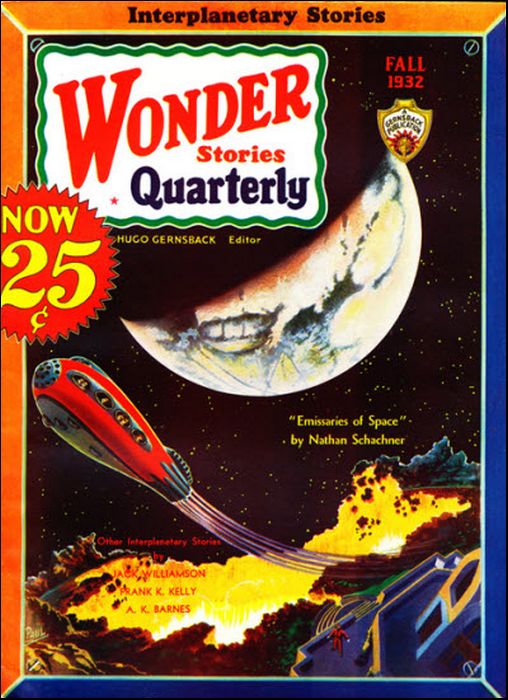
Wonder Stories Quarterly, Fall 1932, with "Emissaries of Space"

We who look calmly up at the blue of the sky, perhaps still think, as the ancients did, that we are the center of the Universe, secure in our place, and masters of the world. We still have not learned what astronomy teaches us, that we are inhabitants of a speck of cosmic dust, at the mercy of all sorts of universal influences.
But not all of these influences need necessarily be harmful; nor need we worry about an invasion of some twelve-legged, six-eyed monsters, as some writers believe. On the other hand, we earthly microbes might find ourselves made the beneficiaries of the vast knowledge of creatures beyond our knowledge or understanding. But suppose in return for that knowledge they were to demand a heavy payment. Would we make it and lose our freedom? This most unusual story, by the author of "Exiles of the Moon" answers the question in 50,000 gripping words.
JOHN BOLING, legs apart, large bony hands clasped tightly behind his back, stared out of his sixtieth story office window in the Empire State Building at the outrageous panorama of New York.
It was sundown. The sun, a molten glow behind the cliffs of Weehawken, dazzled against the westerly sides of the lean, triumphant towers of the city. Twilight had already come to the narrowed canyons a thousand feet below. The broad expanse of the Hudson purpled with dusk. The city winked suddenly into a million lights. It was the daily miracle of New York!
Boling, his massive, sculptured head pressed close to the glass of the window, was no poet, yet his deep-set eyes burned with strange lights as they fixed on the black swarms of electro-motors that crawled, bug-like, along the gorge far below. His eye swept over the sprouting towers, in which, like rocketing lights, tiny elevators accelerated upward. They turned eastward, to the giant electric generating stations that lined the East River, and then west, beyond the Hudson, to the stiff, skeleton-like transmission towers that stalked with outstretched limbs across the Jersey meadows.
A single word came to him from the metropolis, a word that grew in repetitious thunder until it surged through every quivering fiber of his body, beat in moaning crashes against his brain.
"Power!... Power!... POWER!"
He thrust open the window with almost brutal strength, leaned half out in his ecstasy.
"Mine, all mine," he exulted. "Power of generator and dynamo, power of my atomic motor, power over New York and America, over Europe and Asia, power over billions of people, soon to be mine, all mine!"
His ox-like shoulders trembled with excess of emotion, his bony hands clenched and unclenched convulsively. So absorbed was he in the passion of the moment that he did not hear the soft opening of the office door behind him nor the even softer closing.
"The conference will start in ten minutes, sir. I have arranged to have them ushered into the directors' room as they arrive."
The quiet, unassuming voice impacted on Boling's rapt ecstasy like a gush of cold water. He jerked around with hot, resentful eyes that softened almost immediately as they rested on the slight, slim figure of the young man before him. Thick-lensed glasses covered mild blue, nearsighted eyes, and almost obscured thin, ascetic features. A very ordinary-looking young man, one who would merge indistinguishably in even the smallest gathering; an almost violent antithesis to his bold, masterful, domineering employer, John Boling.
Yet Boling knew Philip Haynes too well to be impressed by externals. Haynes had been his assistant for six months, had helped him immeasurably in the successful completion of the atomic motor. Boling readily and generously acknowledged, in private, that without Haynes' brilliant scientific knowledge, the motor would still have been merely an inchoate, dazzling vision. After all, Boling was no scientist. He was eminently a business man, a practical man of affairs, an engineer and power magnate.
"Very well, Haynes," he said. "I am ready for them."
His assistant's face was anxious.
"Do you think they'll back you, Mr. Boling? They promised to come to a final decision tonight, you know."
Boling laughed shortly.
"I'm not worrying. They'll have to," he said confidently. He stabbed out with a long bony finger. "Look. We've been having conference after conference for months now. They've gone over the proposition with a fine tooth comb. Cummings, the engineer of the outfit, has tested the motor time and again. It was successful, wasn't it?"
Haynes' face lit up with a flame of enthusiasm.
"Of course," he cried. "It's revolutionary; the greatest invention that has ever been given to the human race. The disruption of the atom; the utilization of its terrific power. Why, it's almost magical. I've checked it myself mercilessly. Every time I've sent a thousand kilowatts into its transformers and rectifiers, ten thousand registered at the output meters. Ten for one. It's amazing."
Boling smiled grimly. "They'll back me all right. It's to their own selfish interests."
"How about Janus?" Haynes ventured.
Boling's face clouded. "That sanctimonious, psalm-singing preacher! You're right; he may object. His oil interests will be ruined by the motor. He'll cover the fact with pious phrases. I'm sorry I called him into the deal." Then his shoulders squared, his rock-like jaw jutted. He pounded hairy fist into flat palm. "If he gets in my way, I'll wreck him, leave him out in the cold with the rest of the swine. This plan of mine is going through, come hell and high water. Power, that's what the atomic motor means. Power to wreck or save the world. And, by God, I mean to use it!" He was shouting now, his face an angry red.
Haynes looked at him with slightly shocked, yet understanding eyes. He knew the history of the man, the reason for his almost megalomaniac outbursts. John Boling had been a self-made man. Born in poverty and squalor, by the force of his indomitable ambition he had earned his way through engineering school, blasted his way from are obscure engineer in a great utility corporation to the general managership.
It was the heyday of American prosperity, back in the fabulous years of the third decade of the twentieth century. It was the age of mergers too. Boling had taken full advantage of the trend. By a series of bold, yet skilful maneuvers that left his competitors gasping, he had rocketed to a commanding position in a gigantic national combine of power and utility companies. It is true he was like a juggler perched precariously on top of a rocking, staggering pyramid of sweaty humans, yet had the late Coolidge and early Hoover prosperity continued, he would have cemented and consolidated his position into Gibraltar-like firmness.
Unfortunately prosperity took a nose dive that catastrophic day in October of 1929, and Boling found himself topping thin air, with the units of his laboriously assembled structure collapsing underneath him like a pack of cards. Even then, with proper financial assistance from the banking fraternity, he might have pulled through. But those gentry were as panic-stricken as any mob; they pulled in their horns and their loans with tragic, yet ludicrous haste. Besides, they had no special love for Boling. He was a domineering, browbeating individual, and had stepped on very tender corns too many times.
So the great combine collapsed, and Boling went with it. At forty-seven he had found his empire snatched from him, himself offered a subordinate position in an obscure utility by the smug bankers who had ruined him.
He rejected it savagely, and started a second time, at forty-eight, the long and bitter climb from obscurity to eminence. For power was what Boling wanted, loved, needed, with all the fervor of a practical man. He set for himself a frightful task. For years he struggled and labored, earning no more than the merest pittance, greying with age, the hard lines around his heavy mouth etching deeper and deeper. Yet his indomitable ambition, his avid, almost pathetic lust for power, for the seats of the mighty, the thrill of governance, kept him alive. Seven long years of hardship and labor as an engineering consultant; fruitless, discouraging.
For the world was staggering in the throes of the worst depression it had ever seen. Seven long lean years in which the peoples of the world felt the ever-growing pinch of starvation and despair. Countless millions were unemployed, few factories belched cheering smoke, machinery rusted from disuse, ships swung idly and rotting at their anchorages. The pulse of the world beat low; government doles of food were giving out; it required only a tiny spark to touch off the dry tinder of revolt. Communist Russia was no better off than capitalist France; agrarian India than industrialized America. All were seething in the same pot.
To cap the climax for suffering humanity, the year 1936 had brought in its wake a mysterious, far-reaching plague. It had been a year of unparalleled electric storms; the earth was swept time and again in a vast deluge of electrical phenomena and bucketing rains. Even more literally than the poet ever dreamed of, "the lightnings flashed from pole to pole."
But stranger still, at the end of each electrical disturbance, after the heavens had ceased spouting fire, hundreds of thousands of men, of every race and nation, lay down simultaneously, stricken with the same symptoms. A strange, queer, baffling mental malady, that left its victims blank-faced, staring, gibbering idiots, mouthing strange sounds that had no counterpart in any earthly language. And only men were stricken, men in the prime of life, between the ages of eighteen and fifty-five.
Philologists had carefully studied these strange, incoherent ravings, seeking for some basic root, but had confessed their bafflement. The language, if language it were, stemmed from no earthly root-stock.
As for the disease itself, manifestly a product of the weird electrical disturbances, there was no cure. It simply ran its course. In most cases the victims recovered, professing to know nothing of what had occurred during their strange malady, except that they had all experienced a sensation of intense pressure in their brains, as though outside forces were trying to break into their consciousnesses, trying to take possession of their minds. Of the unknown language, they remembered nothing.
A small proportion, yet considerable in point of actual numbers, remained permanent imbeciles; their weaker capacities bursting irremediably under the strain of whatever had impacted on their brains. The medical profession, psychiatrists, alienists, scientists of various persuasions, could make nothing of it. They shrugged shoulders, and hoped for no return of the inducing electrical storms.
Boling had been a victim of the very last mental epidemic, some six months before. Haynes knew this; knew that during his convalescence, the idea of the atomic motor had sprung full born into Boling's brain. It was curious. Boling was not an inventor, had never possessed the imaginative faculty requisite to true genius. More, he knew little of the physics of the atom, of the research that had gone into the problem of breaking it up. That was "pure" physics, and Boling was a practical man, with a practical man's ideas on abstruse science.
Immediately upon his recovery, Boling had called upon Haynes for assistance. Haynes was a brilliant young physicist, making a name for himself in the realm of "atomic physics.
Haynes listened, and became wildly enthusiastic. His trained mind saw at once under the halting phrases with which Boling expressed his conceptions that here was the answer to the tapping of the atom's energy which had proved heretofore an insoluble problem.
Even as he worked, swiftly and feverishly, night and day, in the little laboratory they had rigged up on the Jersey flats, converting the idea into tangible form, curiosity gnawed at him. Doling obviously am not know the meanings even of half the phrases he used to express the highly complex formulations of the atomic motor; he spoke as a man who had learned his piece by rote.
"Tell me," Haynes asked frankly one day, "how do you account for the fact that, without possessing the proper mathematical and scientific foundation, you were able to invent the atomic motor?"
Boling smiled secretively. "I believe I've told you before. It came to me at the end of my—er—illness. Something was boring into me, trying to get it, so it seemed. The pain was frightful. Suddenly there was a flash as of light inside my mind, and my brain seemed to expand immeasurably. It was as though whatever had tried to get in, had succeeded. In one lightning-like instant the whole universe seemed to be unfolded to me; everything, every problem that has ever puzzled humanity, stood stripped to ridiculous simplicity."
He paused and frowned. His words came slowly, as though he were trying to explain the whole inexplicable affair to his own satisfaction.
"Then the universe crashed into darkness. When I came to, they told me I had been ill, but that I was over it. I tried to remember. But everything was vague and shifting except for one thing. The idea of the atomic motor rose before me with startling clearness; every part properly coordinated with every other part, just as I have given it to you."
Haynes had looked at him suspiciously. Was the man trying to pull the wool over his eyes? But no, Boling seemed absolutely in earnest.
"I see you don't believe me," he said.
Haynes shrugged his shoulders and let it go at that. There was one thing that struck him with peculiar force, though. There had been no electrical storms with their concomitant train of mysterious mental maladies since Boling's convalescence. Where lay the connection?
The motor had been finally completed, a great shining mechanism of curious coils, transformers and rectifiers. Together they had bombarded the gases in the test chamber with the lightning energy of high potential currents. Before their very eyes, the atoms had disrupted into a vast flaming surge of high speed electrons. The meters jerked violently, telling the story. Ten for one. Ten units of energy for every one inserted.
Haynes' task was finished. It was Boling's turn now; the ruthless man of business, the practical man He acted immediately, the thrill of domination coursing through his veins like a heady wine.
He chose with careful deliberation eleven men, men of standing and of influence, men with money and a reputation for bold dealing, men diverse in character and profession, yet all equally ambitious. To them he had unfolded his plans with guarded reserve.
It was nothing more or less than the establishment of a world-wide industrial empire with the atomic motor as the basis, and themselves as a Council of Dictators in control. Eventually, he hinted subtly, political domination would follow. He proposed a hundred million dollar investment with which to commence their onslaught on the industrial world.
Naturally, they had been startled, incredulous, even scoffing. But his earnestness, his reputation for sanity and shrewdness, his offer to submit the most elaborate proofs, had conquered their initial distrust.
For a month of days he had gathered these moneyed men, leaders of industry, into his Jersey laboratory, shown them the magic of his motor. Cummings, himself an eminent engineer, checked the equipment from every angle, searching for hidden power sources. Boling smiled grimly and let him search. No one could duplicate the process. Certain alloys, certain thread-like filaments, were of a composition known only to himself and Haynes.
Cummings had at last been convinced, and the group had returned to New York, fascinated with the vistas of power compacted to their hands, yet hesitant at the full implications of the scheme. A week of discussion, almost of wrangling, until Boling had boldly thrown down the gauntlet.
"This is your last chance," he declared. "We shall hold one further conference, and no more. Either you play along with me, or I'll seek another group of more daring men."
This was the deciding conference. Boling would know his fate at their hands within the next hour. He felt strangely calm.
Haynes, watching him, marvelled at his control. He himself felt his heart pounding thickly. It seemed to him as though the destiny of the world depended upon the next few minutes.
The door opened softly. A mouse-like secretary thrust her brown bobbed head into the room.
"The gentlemen are ready for you," she said.
Boling nodded, walked with steady tread through the door held respectfully open for him. Haynes followed, a sheaf of notes and data pressed tight under his right arm.
THE men rose from around the long shiny conference table upon his entrance. The thick-piled carpet muffled his footfalls. Little murmurs of greeting rose like puffs of wind as he shook each man's hand with a quick firm grip.
For the last time he appraised these men who held his destiny, and the destiny of the world, in the hollow of their hands.
Morse Cummings, short, compact, self-contained, world famous engineer and financier. All life to him was a matter of engineering problems. The atomic motor to him was purely a wonderful maker of profit. He was not interested in its human implications.
Henry Burbridge, coldly patrician, inscrutable, surveying the world with faint disdain out of cool gray eyes. He was a firm believer in oligarchies; the thought of a few men, himself included, ruling the world, was what attracted him to the scheme. There was no nonsense with him about democracies, the right of the people to govern themselves, however badly. His money came from railroads and transportation.
Major General Robert Woods, a slight, weazened man, bird-like in features, eyes that were bright and beady, yet without a doubt the most famous warrior of modern times. Veteran of many wars, a brilliant campaigner, who possessed the faculty in this machine age of making his men glad, even eager to die for him. A most essential component in the subtle web that Boling was weaving.
Josiah Biggs, eminent corporation lawyer and skilled in driving teams of horses through tiny inconspicuous loopholes in the law, paunchy, florid, prone to wave a black-ribboned pince-nez with large deliberate gesture when speaking; Benjamin Faulkner, New England woolen manufacturer, nervous, excitable; Lanier Stoddard, a sallow dark little man with Italian features and close-clipped black mustache. He was a fanatic on the subject of Nordic supremacy, the big blonde brute was his beau ideal of the superman. There were also Vincent, Scupps, the publisher, Provost, Harwood, chosen for the money at their command, but otherwise colorless.
All these men Boling greeted with quick staccato phrases, but when he came to the last man, his bold black eyes narrowed beneath bushy gray brows, his handshake was frankly interrogative. This was the man he regretted having included in his plans, the man who might yet prove the stumbling block.
William Janus took his hand with white limp grip. His tall slender frame was garbed in sombre black; his dress affected the clerical touch. A soft black felt hat dangled forgotten from his left hand. His thin bloodless features were cast in a pious, sanctimonious mold, his pale blue eyes looked eternally down a long narrow nose. A most irritating contrast to the full-blooded gusty vitality of Boling.
He had inherited vast oil interests from a hard-hitting father, interests that would be ruined by the introduction of the atomic motor. A faithful contributor to the Anti-Saloon League, the Anti-Nicotine League, the Anti-Life League, in short, to anything that sought to smother the natural appetites of man.
Boling took his seat at the head of the long shiny table, Haynes dropping unobtrusively into a chair to his left.
"Shall we begin, gentlemen?" he asked briefly.
Murmurs of assent came to him from the tensed figures.
After a quick look down the long polished table, noting with curious irrelevance the reflected faces staring up at him, Boling rose to his feet.
"Gentlemen," he said forcefully, "the issue is perfectly clear, and must be decided, one way or the other, this evening. There must not be, there cannot be, any further delays. You have seen the atomic motor, you know what it can do. The terrific power of the disrupted atom is ours for the handling. There need be no further worry about exhaustion of natural resources. Coal may give out," he nodded to Burbridge, "oil wells may peter out," he turned to Janus, "water courses may eventually dry up, but the atomic motor will continue to extract incredible energy from the inexhaustible elements. The day my machine appears on the market, every other source of energy will become antiquated, obsolete, fit for the scrap heap."
He paused and looked up and down the long table at the diverse upturned faces.
"So far we are agreed. You are all willing to pool your finances to back the marketing of the motor, to make money out of its exploitation. But," and his voice took on a deeper, harsher note, "that is not enough. I want more power for myself," his balled fist crashed startingly into open palm, "and for you."
To Haynes, sitting nervously, there seemed a curious hesitancy over the last part of the phrase.
General Woods glanced up sharply.
"Just what do you mean by that?" he asked.
"This. We shall organize ourselves in a Power Council. Biggs will take care of that end of it. We shall not sell or lease our motor. We shall permit the various industries to use it only in return for controlling interests. If they refuse, we start competitive factories, and with our infinitely more efficient motor, drive the recalcitrants out of business, buy them up for junk."
"To what end?" Burbridge inquired, faint interest showing in his cold aloof eyes.
Boling smiled strangely. He enunciated his words slowly, distinctly, as though savoring their import.
"That we may eventually obtain control of the entire world, to be held tight in the hands of a group of a dozen determined men, to wit, ourselves. Political divisions, racial demarcations, will mean nothing to us. The earth will be one vast province, a single unit, and we its dictators, responsible to no one but ourselves."
There was a faint stir of consternation, an audible sucking in of breaths. Only Burbridge leaned forward, nodding his aristocratic head. And General Woods, tapping the table with a rubber-tipped pencil, darted his bright, bird-like eyes eagerly from face to face.
It was Biggs who broke the stunned silence.
"You understand, Boling," he said slowly, "that what you propose may not be quite—er—legal."
Boling brushed the objection aside with an impatient hairy hand. "Legality has nothing to do with it. Once we come into power we shall make our own laws, as the governing classes have done from time immemorial. It will be your duty to frame the new legal code."
There were faint murmurs of approval from Burbridge and Stoddard. Janus sat quietly, his pale clerical face reflecting nothing of his thoughts.
Faulkner stood up self-consciously. "While I am wholeheartedly in favor of utilizing the atomic motor," he said quickly, "I question the wisdom of destroying the industrial system as it now exists. I for one am afraid of setting ourselves up as men on horseback. It smacks of Bolshevism, of Mussolini, of everything repugnant to our cherished American traditions. Why can't we, say, back this thing as a purely commercial enterprise, rent out our motors, reap the profits? They should be enormous. Why must we overthrow the entire structure of things?"
Vehement nods from the colorless men of money.
Boling growled angrily in his throat, like an enraged bear. Before he could speak, though, Biggs was talking.
"You forget," he said gently to Faulkner, "that once these motors are leased out to the nations of the world, there is nothing to prevent them from forgetting about their legal obligations to us in the way of royalties."
The roar burst full-throated from Boling. His face was red, and he pounded the highly polished table.
"Stuff and nonsense. I am not going to evade the issue by such subtleties as Biggs proposes. Let any one refuse to pay, and I can stop the operation of their motors instantly by certain short wave radio signals at my control. Let us face the issue squarely.
"The world is in the throes of a horrible depression. Millions are starving. Revolution is staring us in the face. Our present leaders are politicians, without vision and without imagination. They are incompetent imbeciles, unfit to rule. They must be thrown out.
"If we give them the motor, we help maintain them in power, help perpetuate the present imbecilic system. The motor will revolutionize industry. Unless properly guided by determined men, it may prove a curse, mean chaos, the ruin of civilization.
"No. For better or for worse, we must grasp the opportunity. Let us organize the world, seize the power, administer it wisely for the benefit of all humanity, and—sit in the seats of the mighty."
Applause from four of the men greeted Boling as he concluded his impassioned address. Haynes sat on the edge of his seat, his weak eyes shining. This was why he followed Boling. A strong coherent organization of the world, an equitable distribution of the material resources to all the people, so that misery and starvation and selfish strivings be forever at an end. The atomic motor with its vast reservoirs of power, coupled with the benevolent dictatorship of bold, determined men; to what heights couldn't mankind rise? True, a dictatorship was distasteful. Haynes had an old fashioned faith in the ability of a free people to govern themselves. But one step at a time.
"That means social revolution," Biggs interposed again. "Perhaps war."
"We will be ready for that," Boling responded. "We shall start recruiting an army, well paid, professional, immediately. I rely upon the pressure you gentlemen can bring to bear upon the American government to line up its forces on our side. Besides, the people are sick of the demagogues and quacks who now lead them. They are ready to turn to new leaders. Their empty bellies are our most potent allies. As for armed clashes, I'm sure General Woods is competent to handle that."
"Assuredly," Woods spoke calmly without rising. "Gentlemen, John Boling is absolutely right. I move we vote him our immediate approval."
At once the meeting broke up into angry, heated groups. There were two well defined camps. The colorless men of money, with Biggs and Faulkner, held for moderation, for purely financial projects. The thought of dictatorship left them aghast. But it was that very thought that attracted the other group; Burbridge, Cummings, Stoddard and Woods.
Only Janus held aloof, sitting quietly through all the tumult with flabby hands folded in front of him, pale thin lips compressed, face emotionless.
A broadening line of impatience traced itself across Boling's brow. The meeting was getting out of control. It was time for a bold stroke. He glanced across at Haynes, who nodded slightly. He pounded the table.
"Gentlemen," he cried. "We are not getting anywhere. You are acting like a high school debating society, not like potential rulers of the world. I, for one, am willing to leave the final decision to William Janus. He has not indicated his sentiments at all so far. Let him decide for all of us."
The wrangling ceased at once; the hot, weary men seized upon the way out. They shouted vociferous approval.
Boling looked at the silent oil man with something of alarm. He had not intended saying what he did. Janus, the man he feared most, to be the arbiter of his destinies. It was savagely ironical. Yet the words had forced themselves out of his mouth without any volition on his part. It was as though someone else had spoken through him, and he were only a mechanical mouthpiece. Haynes was staring at him aghast. Had Boling gone suddenly crazy?
It was too late now to back out. Janus had risen ghostlike to his feet. Very quietly he adjusted the black tie from under his clerical collar. There was a sudden hush. Then he spoke. His voice had a singsong monotonous note, his manner was that of the pulpit.
It was, he said in part, Divine Providence that governed all his actions. He had always considered himself an unworthy trustee in the administration of his oil interests. He had humbly striven to justify the ways of God to man.
At this point their were little sceptical smiles. Haynes was indignant; he remembered only too well the savage suppression of strikes on the Janus' properties, all in the name of God.
He could trace, he continued unctuously, the finger of God in the discovery of the atomic motor. It could never have been invented without Providential aid.
Boling started visibly, and Haynes looked up with sudden interest. The pious fanatic had unwittingly brought back to him something he had almost forgotten. The strange electrical storms, the mysterious maladies in their wake, the startling revelation of the secret of the motor to Boling while seemingly delirious. Was it possible that with his unctuous phrases the oil man spoke wiser than he knew?
Then startlingly. "If God has deigned to choose us, unworthy wretches that we are, as the humble vehicles of His designs, it would be presumptuous of us to refuse. We are His appointed trustees, the atomic motor is the weapon forged to our hands, and it is our bounden duty to accept the responsibility thrust upon us, and in all humility strive to establish God's kingdom upon earth."
He sat down, and placidly folded his hands in front of him. The men stared at him, his pious phrases had jarred. Burbridge and Woods were smiling cynically. But there was no mistaking the purport of his speech. The Janus interests held certain powerful controls over the colorless men of money, Biggs received a substantial part of his substantial income as their chief counsel. The others were weary of wrangling. The oracle had spoken, and they were content. In that instant the Power Council was born!
When, an hour later, Boling and Haynes emerged to the street below, it was quite dark. The city seemed bathed in an electric haze. Waves of heat, almost tangible, swept down to the canyoned avenues, Haynes felt a curious electric tingling at the nape of his neck. Boling looked haggard, weary.
"That was a stroke of genius on your part," Haynes said, "calling upon Janus to cast the deciding vote. I thought you had gone suddenly mad at the time, but the event justified itself."
Boling turned a worn face to him. The ruddy vitality was drained; there was a strange look to him. He raised a trembling hand to a perspiration-dripping forehead.
"Mad!" he echoed vaguely. "Yes, I must have been. I had no intention of saying what I did. I was going to lay down the law to them, when something snapped in my brain. The next thing I knew I was speaking mechanically; it was not I, it was a superior force using me as an instrument."
He stopped suddenly, heedless of crowded Fifth Avenue, or of the people who paused to stare curiously, and gripped Haynes' arm.
"Do you know, it was exactly the same sensation I had when I was ill; when the thought of the atomic motor flashed into my mind."
He shook his startled assistant viciously, his voice contained almost a hysterical note.
"What does it mean, Haynes, what does it mean? Can it be true I am mad, or going mad?"
Haynes strove to soothe the trembling man, irritably aware of the passersby.
"Of course not," he said as calmly as he could. "It is just the way genius acts. Ideas come in lightning-like flashes. Let us walk. The air will do you good."
Boling walked at his side up Fifth Avenue, seemingly reassured. But Haynes felt uncomfortable. It was a strange affair, come to think of it. And Janus' pious phrases, nonsensical as they were, had touched off hidden misgivings. But Haynes shook his slightly stooped shoulders, as though to rid himself of a gathering load of superstition, and talked matter-of-factly of their plans, the tremendous problems confronting them.
The air was getting more and more sultry. An immovable force seemed to press down upon the city, deadening even the raucous sounds of slow-moving traffic. Sheet lightning glared intermittently, masking out the bright street lights of Fifth Avenue. Thunder rolled with an ominous sound. Haynes looked upward uneasily. High overhead, framed between the tall structures, blobs of cloud were forming. Long jagged streamers of flame crashed from one to the other. The blobs moved swiftly toward each other, coalesced into a blinding flare.
Haynes hurried his pace, his brow furrowed uneasily. Another of the electrical disturbances was brewing. It had been over six months since the last one. Was there going to be a recurrence of waves of insanity? All traffic had ceased. People were scurrying wildly for shelter. Haynes felt an immense hand plucking at his brain. He cast a sideward glance at his companion. Boling's face was ghastly in the blue electric flares. He put a weak trembling hand to a damp perspiring brow.
"I—I don't feel very well, Haynes," he said weakly. "Something wrong; just as I felt before my illness." He looked apprehensively about him, as though in the deepening haze, in the now blazing skies, he might discover the cause of his indisposition.
They were at the door of Boling's hotel.
"Shall I help you up," asked Haynes anxiously.
"No, I'll be all right. Just need a little rest." Boling held himself upright as though with an effort.
"Shall I see you tomorrow?"
"Of course. We must get to work. There is a good deal to be done. This will pass."
Haynes watched a frightened doorman help him heavily to the elevator, and continued thoughtfully on his way through deserted Forty-Second Street to Grand Central Terminal. He was worried over the queer illness of Boling. Strange that that strong man should be suddenly weakened, strange that it should come now when an electrical disturbance was impending. People crowded and shoved him on the subway platform. They were like hunted animals, intent on getting safely to their lairs. Memories of former storms showed in their fear-stricken countenances; each feared for his own sanity in the inevitable wave of madness to follow.
But Haynes did not heed the buffeting. The whole affair was a jigsaw puzzle, in which he held only scattered non-fitting pieces. The key ones were missing.
The train was rushing through dark tunnels toward Long Island, when suddenly an interminable pressure seemed to have been lifted from Haynes' dulled and aching consciousness. He looked around him in surprise. Everywhere he saw men breathing freely, as though they too had been freed from a nightmare weight. A buzz of conversation arose. Only then did he realize the utter silence that had enveloped them before.
Looking about him more carefully, he noted, as always, with a slight shock, the haggard thin faces, the threadbare clothes, the lifeless dejection of his fellow travelers. Seven long years of unrelieved industrial depression lay like a blight over the world. Politicians, industrialists, financiers, fought for power, bickered selfishly among themselves, heedless of the sullen despair, the slow starvation of their fellow beings.
Never was the need more urgent for a strong dictatorial hand to sweep aside all futile factions, to organize humanity and life itself. The atomic motor, with its illimitable power, was the potent weapon.
Haynes felt that John Boling was the man for the gigantic task of cleaning the Augean stable. True, he was no humanitarian, no philanthropist. Haynes in his deepest heart recognized Boling for the implacable tyrant, the ruthless seeker for power, that he was. But better a tyranny in which everyone was fed and clothed, in which life was organized once more, than the slow decay and dry rot of the present Time enough to consider social changes; freedom, democracy; after men had food in their bellies.
His mild near-sighted eyes glowed strangely behind their thick lenses, his weak-seeming mouth tightened in hard lines. Casual acquaintances might have been surprised at the metamorphosis of their inconspicuous friend.
THE cars were emptying quickly, and Haynes moved forward toward the door. The next station was his. As he stepped out on the platform, he noted with surprise that the sky was cloudless and clear, that is, as clear as it ever could be in smoke-filled New York. Tiny stars pricked the dusty blue. The tremendous electrical disturbance had passed over without a sign.
Three blocks to the left, and he stepped with eager anticipation into the little self-service elevator that carried him to the floor of his apartment.
Philip, Jr., his small two year-old son, greeted him with loud incoherent cries and outstretched chubby arms. Jane, his wife, her ordinarily bright face a little worn, lifted warm lips to his caress.
"I was getting worried," she said. "It is so late."
"Couldn't help it, dear. There was quite a fight for awhile."
"Did it end well?"
"Yes. Boling won out. They all agreed to his terms. A hundred million is being banked tomorrow to the order of Power Council, Inc. Boling will have control of the funds. They're leaving a good deal to his discretion. We commence work at once."
Jane looked thoughtful. "You're sure, Phil, the motor will really work? It seems so unbelievable." She blushed a little as her husband laughed. "Of course I don't understand such matters very well, and you've tested it carefully. But I'm a woman, and look at the practical side. Boling was the last man in the world to have invented something so revolutionary. Don't you see. I have an uneasy feeling that he might be tricking you all."
Haynes shook his head negatively. "You know I am no novice in scientific matters. The plans were theoretically sound, and they worked in practice. If there were a trick, I would have discovered it, and so would Cummings. It's true. Boling has discovered a source of limitless energy."
"And that will mean a new deal for the poor starving millions?" Jane asked hopefully.
Her husband's thin hands, long, sensitive and eager, gripped slowly on the edge of the table.
"It must," he breathed inaudibly. "We will overturn the whole industrial world. Boling and his group will become dictators. There will be a limitless supply of good things of the earth for everybody."
"And Boling—?" Jane asked with curious hesitation. "Yes, I know," Haynes answered her unspoken thought. "He will rule with an iron hand—tyrannically! He will brook no opposition. But what he has to offer is worth the price. The peoples of the world must be fed and kept alive. Afterwards, well, we shall see..."
"I'm afraid, Phil," she said later, worriedly, as they prepared for sleep. "I'm afraid it won't be as easy as all that. Once Boling and his crew gain control, there'll be no chance for freedom. The earth will stifle into slavery."
"Nonsense, dear," he retorted confidently. "Civilization has progressed too far for real old-fashioned tyranny. Either Boling will change for the better, or the people will rise in revolt, and overthrow him."
But far into the night, after Jane had dropped into slumber, he lay awake, wide-eyed. Jane's premonitions had made him more uneasy than he cared to admit. He had never told her of Boling's confession as to the source of his ideas. It might have worried her. Nor had he told her tonight of Boling's inspired calling upon Janus for the final decision, nor of the strange electrical disturbance in New York, and Boling's curious illness. For the first time it seemed to him that Boling might be only a mere automaton!, a conducting vessel through which strange forces were seeking to mold their will upon the world. A terrifying conception—and impossible one! Yet—how else explain the curious concatenation of events? The electrical storms, the frightful mental disorders in their wake.
Haynes felt suddenly small in the presence of dark immensities. Were these supernormal forces benevolent, or evil in their intent? Or were they merely working out their own vast incomprehensible plans, unrecking, unheeding of effects upon the tiny creatures called men?
Then he laughed aloud, and the laugh sounded hollow to his ears in the dark. Jane stirred restlessly at the sound. Fine thoughts for a scientist to be thinking in the dead of night. The strain of the day had proven too much for him. He turned over and deliberately tried to sleep. But his slumber was fitful. Sudden, inexplicable waves of dread passed through him; for deep and remote in his mind were forebodings that would not pass away.
The weeks that followed, in that long, hot summer, were breathless ones for Boling and Haynes. Haynes marveled at the sheer organizing genius of the man as Boling laid the groundwork for the introduction of the atomic motor. With skill, with blunt mastery, with promises and threats, Boling went about winning to his support the men of influence, the political factors requisite for his incipient empire.
To the other members of the Council were delegated the arduous tasks of organization. Cryptic advertisements in the newspapers, secret proselytizing among desperate members of the various American Legion posts, above all, the magical lure of General Woods' name, attracted hordes of bold, reckless men, skilled in the use of arms, ready to face the devil himself in return for three squares a day and a place to sleep. They were scattered into small units, unknowing of the existence of the others, kept in the dark as to the real purpose of their employment, and not caring a damn.
Haynes saw a battalion drilling secretly in the scrub pines of Long Island. A reckless hard bitten crew, who handled their weapons smartly and with obscene jestings. Their commander, strangely enough, was a Frenchman, a veteran of the World War. Colonel Alphonse Colette was rotund, fiercely mustachioed, strutted like a pouter pigeon, yet Woods assured Haynes that he was an efficient officer and an excellent drill master, though lacking in imagination, and too vain for his own good.
Biggs proselytized among his own gentry, the legal profession and the bench. Cummings supervised the construction of an enormous factory on the Jersey flats, and began work on a number of monster motors, ready for distribution at the proper time.
Janus and Harwood, a newspaper publisher, turned out skilful propaganda by the tons. Janus organized the churches. The coming of a Messiah was hinted at. Already the world sensed with strange excitement the preparation for portentous changes. It was ripe for the plucking. Anything was better than what the people had.
The new Empire was almost ready to disclose itself, slip quietly into place of the old.
Haynes himself led a nightmare life. He rushed around the country in fast planes, arranging huge contracts for the purchase of materials for the motors, representing Boling in all financial transactions, keeping him informed as to the activities of the directors.
The hot summer of 1937 yellowed into autumn and then into an abnormally warm winter before Boling announced that the Power Council was ready to act. There had been innumerable private meetings before. In spite of the rush of affairs, certain discords had developed among the members of the Council, quarrels that related mainly to future allocations of power between them. Boling had surveyed them in scornful disgust.
"Like a pack of children," he shouted savagely. "If you keep on quarreling there will be no power to divide. Wait until we get it. There will be enough for all. And remember," he pounded, "I'll brook no interference with my plans. The man or men who get in the way will be crushed."
Already he was unsheathing his claws. The strange illness that had overtaken him the evening of the final decisive meeting had left him the next morning when Haynes had called. He seemed younger, more vigorous than ever, more lustily domineering. The Power Council subsided at his bellow, all, that is, except Janus—pale, self-contained, sanctimonious as ever. He sat through the stormy sessions with faintly smiling face, his long fingers pressed gently together in front of him.
"That's the only man I'm a little afraid of," Boling acknowledged to Haynes in a moment of frankness.
Haynes was returning to New York from Chicago by cabin plane, when the Power Council went into action. The radio newspaper droned in the luxurious cabin.
"Utility stocks and bonds continue persistent decline. Mysterious short selling of stocks forces values to new lows." Then followed uneasy statements from banks and insurance companies—large holders of utility securities, loud cries for government investigation.
Suddenly Haynes sat bolt upright. The newscaster was speaking with a tremor of excitement in his voice.
"Startling developments. Organization known as Power Council claimed to be back of short selling. Possessed of unlimited funds. Claim to have new motor, powered by the disruption of the atom, that will make all other sources of power obsolete. If this is so, and we have it on unimpeachable authority—(Haynes smiled grimly. The unimpeachable authority was Janus) then the bottom will drop out of the market. It is rumored that the Power Council is already in conference with the President to avoid chaos. More developments as we get them. Radio-News signing off."
Haynes' heart pounded. It was the beginning. Swift depression of stocks by throwing all the funds at their command into short selling at a time when the skilfully worded announcement of the atomic motor had all investors panicky as to the future of their holdings. Already, quietly and unostentatiously, the Power Council was picking up selected stocks at panic prices, buying control of key industries.
"A very pretty piece of work, sir."
The words came in so pat with Haynes' own thoughts that he nodded absently. Then realization flooded him, and he turned abruptly. The passenger on his left had spoken them. He found himself staring into a pair of shrewd, estimating black eyes, surmounted by a sloping forehead from which the straight, shiny black hair was carefully brushed back. Pinched thin nose and thin tight lips lent a secretive, cunning air to the man.
"Just what do you mean by that, sir?" Haynes demanded.
The man chuckled thinly.
"Oh, it was easy to see what you were thinking about as the newscaster told his little piece. You are Philip Haynes, are you not?"
"I am Haynes, though I confess I am in the dark as to how you know my name. But I still don't understand your remark."
The man nodded with a self-satisfied smirk. "You are quite right to pretend ignorance. It is part of the game. Very few know as yet that you are a member of the Power Council."
Haynes sat bolt upright, astounded. The secret had been a closely guarded one, yet here was a total stranger blandly telling him about it.
"You are mistaken," he said coldly.
The man edged nearer.
"You needn't be afraid of my knowledge," he said eagerly. "I came upon it quite by accident. You see, Provost, one of the members, is my first cousin. My name is Ferdinand; Karl Ferdinand."
"So he told you, eh?" Haynes burst out indignantly.
"Oh no. I happened across some papers in his study one day, and being curious, I read them."
Haynes stared at the man in blank astonishment.
"You mean," he said in a low voice, "you read the secret papers of your cousin without his knowledge?"
"Why not?" Ferdinand answered blandly. "They were interesting."
Haynes was overwhelmed. Not so much at the disclosure of their secrets; they were practically in the open now; as at the tremendous effrontery of the man. With violently conceived dislike he turned rudely to the right and stared out of the cabin window at the Pennsylvania landscape beneath.
But Ferdinand was not so easily to be cast off.
"Listen, Mr. Haynes," the voice said eagerly in his ear. "I think the Power Council has the right idea. Take control of the entire earth and run it to suit themselves. No nonsense about elections and representative government and all that truck. It's just what the rabble needs."
Haynes faced about and said frostily. "You seem to have an intimate knowledge of the plans of this Power Council."
"Of course," Ferdinand smirked. "My cousin kept full notes on all proceedings."
Haynes surveyed him up and down with as much contempt as his nearsighted eyes could bring to focus through the thick-lensed glasses. His lip curled.
"I make it a point never to speak to eavesdroppers and snoopers."
"Come now," Ferdinand protested, "I only did what any normal curious man would have done under the circumstances. Get me straight. I'm not seeking to put my information to use—that is—if I can help it. But I want a job with the Power Council. I'm a technician, an engineer. I've been out of work for years." There was hatred in his eyes. "I've lived on the scraps, the bones, that my esteemed cousin, the millionaire Provost, was condescending enough to throw me. I've had enough of that. I'm ambitious. I want a job, a good job, with a future. I can help the Power Council, and it can help me."
Haynes looked at him curiously.
"Why don't you go to Provost then?"
The black eyes were malignant. "Never," he burst out violently. "He'd give me a slave's job, where I could never raise my head without having it scotched. It pleases his vanity to have me dependent upon him." Ferdinand's hands were twisting uncontrollably. "No, I want power, just the same as you gentry of the Power Council. Power, and by God, I'm going to have it!"
He stopped abruptly, his face a drawn mask. It seemed to Haynes as though he were looking into a volcanic hell of twisted desires.
"I can't do a thing for you," Haynes said decisively. "In the first place I know nothing of your mythical Power Council, and in the second place, even if I did, I don't think you're the kind of man I would trust with anything."
Ferdinand's face contorted with rage. "You refuse my services? Very well then. Remember, I know things."
"If there is such an organization as this Council," Haynes pointed out deliberately, "no doubt they would know how to handle men who threaten them with exposure."
Ferdinand collapsed like a pricked balloon. Terror was writ large on his sharp-pointed features.
"I was only joking," he literally grovelled. "I don't know a thing, really I don't, Mr. Haynes. There's no such organization as a Power Council, ha! ha! I can keep my mouth shut. You'll be sure to tell them that, won't you?"
"Why, the man's an arrant coward," Haynes thought with contempt. He did not even reply to Ferdinand's whining pleas, but rose from his seat, crossed over to the other aisle, somewhat in front, and reseated himself. For the balance of the trip, he kept his eyes on the terrain below. Ferdinand kept discreetly to the rear.
In the bustle of leaving the plane at the landing field near New York he forgot completely about the man Karl Ferdinand.
The announcer completed his short introductory remarks and stepped aside to permit Boling to face the microphone. The atmosphere in the spacious broadcasting hall was tense. Even Boling, massively self-confident, held the sheaf of notes with a hand that trembled slightly.
Immediately behind him sat Haynes, face flushed, nervously twisting a button on his coat. To the right was Janus, pale, composed as ever; on the left, General Woods, twisting his head with little bird-like gestures. Two hard-looking men lounged against the door of the studio, responsively alert to the slightest gesture from the general. Three officials of the National Broadcasting Company hovered discreetly in the background, in their demeanor anxiety and concern. It was a crucial moment for the entire nation, for the world!
Boling began his speech into the microphone in clear, deliberate tones, bending over his notes, emphasizing his points with a forward thrust of his massive, sculptured head.
"I am speaking," he said, "at the request of the President of the United States. The times are crucial. Panic and despair hold the country in their grip; our major industries are bankrupt; the suffering of the people becomes daily more intense; the forces of law and order are weakening. Crime stalks the streets of our cities openly; desperate starving men are looting and rioting.
"I shall be quite frank," Boling went on. "Within the past three months the Council has purchased controlling interests in the largest power and utility companies of the country. We have taken over bankrupt banks and manufacturing companies. We now in large measure control American industrial life.
"We intend offering no excuse for what we have done. To the starving hopeless millions of this nation I say that you have been dominated for years by selfish, shortsighted, incompetent men in control of great industries. Most of them have been displaced in the last three months, and deservedly so. The process will continue until all are ousted, until a new industrial order has been established in America. And in control of that order, rigid control, mark you, will be the Power Council."
He was talking straight from the shoulder, and the nation hung breathless on his words.
"The men of the Council," he went on, "are able, intelligent, strong. They will not misuse their power. You, the starving people, shall benefit. Already one hundred thousand men have been employed in our factories to manufacture the atomic motor. This motor will supplant all present electric generating equipment. Power in infinite abundance will shortly begin to flow to factories, farms and homes, to give new life to our nation.
"Food, clothing, shelter, yes, the luxuries that yesterday were only for the very rich, will soon be within the reach of all. I can promise this nation, and I am also addressing myself to all the world, that we are on the verge of a new epoch, an epoch in which material wealth will flow in unparalleled abundance. And because the atomic motor produces such extravagant power, the human race will at last be released from the curse of excessive toil that has been its heritage since Adam's time. We have calculated that not more than two or three hours of pleasant labor per day will be required from every able-bodied man. In return for these blessings, the Power Council demands one thing..."
The door of the studio opened softly and closed even more softly behind a well-dressed man in spats and tan overcoat. He walked with noiseless tread over the felt-deadened floor, right hand hidden loosely in overcoat pocket. The hard-faced guards at the door watched him uncertainly, looked to Woods for orders. But none were forthcoming. The general was intent on Boling's dramatic words, as were the others. And the man looked like an important personage, an official of sorts.
Suddenly, as Boling prepared to drive home his final, most important point, the man sprang with the agility of a cat, thrust him violently away from the microphone, whirled, and covered the startled beholders with a flatnosed automatic. Boling staggered backwards, found himself staring directly into the little round bore.
"John Boling," he rasped.
Boling had recovered his stance. "I am Boling," he said quietly. "What do you want?"
The man levelled his weapon. "Dog, traitor!" he screamed. "You ruined me; as you ruined thousands of others, as you intend to ruin the nation in your mad pursuit of power."
Boling raised his hand. "Wait a moment," he said sternly.
"Wait... wait..." the intruder screamed again. "You'll wait in hell..." The carpeted silence was broken by a sharp dead roar that died away as quickly as it had sounded. No echo returned to fill the empty silence as the wisps of smoke hung around the still levelled gun.
Boling staggered backward, clutching his left arm. The tense immobility was broken. Haynes and Woods rushed forward simultaneously. Janus kept on sitting, pale, imperturbable.
The weapon thrust forward again. The well-dressed man's face was fiendish to look at. Two reports sounded in rapid succession. The man opened his mouth wide. A look of ludicrous astonishment gleamed in his eyes, then they clouded. He screamed once, horribly, the revolver dropped from suddenly nerveless fingers, and he pitched heavily to the floor. A widening pool of red stained the green and gold of the carpet.
The two hard-faced men came coolly forward, spinning their automatics suggestively.
"Sorry, General," one of them said apologetically, "but we couldn't get a bead on him at first. Mr. Boling was on a line with him."
"Good work, men," Woods nodded crisply. "Tell Colonel Colette you rate corporal's stripes."
"Thankee, sir." The men saluted smartly and returned to their post of vigilance.
Haynes had rushed over to support Boling, who had gone white. A thin trickle of blood oozed through the sleeve of his coat.
"It—it's nothing," he gasped, "only a scratch. Hurry, help me to the microphone, I—I must complete the message."
With Haynes supporting him, Boling again faced the disk. His voice was weak at first, but gained strength as he went along.
"I regret the unfortunate interruption. A crazed fool tried to shoot me, and missed. I must conclude my address. I have told you what the Power Council has to grant. In return it demands one thing. Non-interference in its activities from politicians, demagogues, governments. Let us be hampered in our work, and the atomic motor will be withdrawn, its secret destroyed. The world will then be plunged back into the chaos, from which we have extricated it. That is all."
BOLING'S arm was neatly bound. The wound, the doctor in attendance at the studio hospital said, was not serious. The room was full of people with tense drawn faces.
One of the broadcasting officials glanced out of the window, withdrew his head hastily. His face was white.
"Good Lord," he said. "There's a mob outside; thousands of people. I don't think it's safe to leave just now." Boling grunted. "Pm ready to leave. Will you help me, Haynes?"
With his assistant holding him carefully by the uninjured arm, flanked on either side by Woods and Janus, and the two soldiers of the Power Council watchfully bringing up the rear, Boling proceeded steadily to the elevator, and was whisked swiftly to the ornate lobby of the building.
The heavy bronze doors of the entrance were barred. A squad of police guarded the interior, nightsticks grasped firmly.
A police sergeant came over to Boling.
"I don't think it wise to go out now, sir," he said respectfully. "This mob seems to be in a pretty ugly temper."
"What do they want?" Boling asked shortly.
"You, I'm afraid. They've got weapons, too."
"Rubbish," Boling snorted. He turned to his associates. "I'm going out."
Janus said sanctimoniously. "It is God's will."
Woods laid a restraining arm on him. "Wait. I'll radio for reinforcements. Colette will send some combat units along on the double-quick. They'll handle the mob."
"Do you think I'm going to be cooped up all my life behind bayoneted guns?" Boling demanded violently. He threw out his arm in an imperious gesture. "Open the doors."
The sergeant shrugged his shoulders and obeyed. The police drew their guns. The two soldiers thrust themselves in the fore. Slowly the heavy bronze gates swung open. A violent agitation, like the wind through a cornfield, swept the crowd. Countless thousands were tight-wedged. A deep murmur that rose in menacing volume and died abruptly into deathly silence as Boling and his associates presented themselves.
In the center of a close-packed phalanx, Boling, erect and unafraid, marched forward to meet the ominously silent throng. Like a living wall, tattered hungry people stretched in waves up and down the avenue.
Boling thrust himself from behind his thin curtain of defenders, put up his unwounded arm as though to clear a path through the mob.
"Boling!" someone shouted.
"Boling!" another took up the cry.
"Boling... Boling..." it echoed and reechoed through the crowded street.
Haynes squared his stooped shoulders. A surge of feral emotion swept his slight frame. He would go down fighting. Woods barked commands to his men. The sergeant said something under his breath.
Then suddenly, astoundingly, the people went mad. A thunderous wave, of "Hurrahs" rose crashing from the packed streets, a storm of whistling and cheering. A lane formed as if by magic, a lane through which Boling marched with fixed smile. His defenders, sheepish, astonished, made haste to thrust their weapons back into hidden holsters.
"Boling... Boling...!" The cheers ran up and down the crush of humanity, wedged solidly in the broad avenue. Hands reached out to touch him reverently as he passed, uplifted faces, etched with suffering and malnutrition, streamed with tears, invoked him as another god. It was a tremendous drama of mass-emotion. From skyscraper windows, black with bobbing heads, a snow of ticker tape drifted to the street level.
"Please get me a taxi," Boling turned a drawn, pallid face to the now smiling Haynes. "I feel weak."
Taking his arm again, Haynes piloted him through the joy-crazed crowd. It took two blocks of a seething sea of humanity before a parked cab could be found.
Boling's face was yellow, his brow damp.
"Climb in. Hurry!" he whispered. The driver slammed the door shut, kicked his engine into roaring life. It literally pushed its way through the shouting, hysterical people, fled down a side street, pursued by running hundreds.
Two hours later Haynes reached his Long Island home.
He had left Boling at his hotel, limp, barely conscious, in charge of a physician. Jane met him at the door with a hysterical sob of relief.
"Phil... you're all right... you are, aren't you?" She clung to him, running her hands up and down his arms as if to assure herself that it really was her husband.
"Why certainly, darling," he laughed. "Nothing has happened to me. See, I'm all right."
He led her gently into the living room, petted and soothed her until her convulsive shudders gradually subsided. Then she relaxed into his arms.
"I was listening to Boling's speech over the radio. I heard an interruption, threats, screams, and the sound of shots. I became hysterical, I suppose. I didn't know if anything had happened to you..."
"You weren't worried about Boling then?" he smiled down at her.
"No." She sat up determinedly. "Somehow I had a feeling that the world might be better off if he were dead. I don't trust him, Phil."
Haynes shook his head negatively.
"I think you are misjudging the man," he said slowly. "In any event the people are solidly in back of him." He recounted the scenes at the studio and in the street. "Today," he concluded solemnly, "Boling is in fact the uncrowned ruler of America. When we reached the hotel, the President himself was on the wire. He assured Boling that there would be no government interference with the Power Council."
"Why doesn't he abdicate at once and be done with it?" Jane asked indignantly.
Haynes smiled wryly. "He might as well," he agreed. "The country was on the edge of revolt. The people will not starve any longer. The President knows that Boling is the only man who can save the situation. He hopes that with Boling, he can retain at least nominal power." He sighed. "It's all working out as Boling planned."
"Then Boling was not sincere in his speech about abundance for everyone?"
"Absolutely," Haynes said positively. "He meant every word of it. But he also meant the rest; about ruling without interference. The President knows it too. From now on, the government will be a farce. It will take orders from the Power Council."
The telephone rang shrilly. Jane answered it. Her face clouded.
"It's Boling's doctor," she told her husband. "He must speak to you at once."
Haynes picked up the receiver quickly. "This is Haynes, doctor."
"Mr. Boling requests that you come to the hotel immediately." The doctor's voice sounded ominous.
"Why, what's wrong?" Haynes gasped.
"I can't tell yet. Mr. Boling is in a serious condition. He complains of voices and strange visions. I think you had better come right over."
Haynes placed the phone down dully.
"Boling wants me," he said to Jane. He patted her shoulder. "No, I can't stop to explain. An emergency of sorts. Don't worry about me."
The blue of the late spring afternoon had faded to a leaden hue. Angry red tinged the borders of great bellying clouds, the air was thick with uncanny prickling electric currents. As he hastened to the station, Haynes felt the little hairs on his body quivering upright under strong electric tension.
Almost instinctively his overwrought faculties connected Boling's new attack with the strange breathless atmosphere. It was ominous. Something horrible was impending, he was sure of that. He had a strange certainty that this cosmic dream, in which Boling and he and all the other gesticulating futile earth figures were mere marionettes, was fast approaching its climax.
He tried to laugh himself out of it, to clear his mind of the heavy overbearing weight it seemed to be staggering under, to tell himself that the atmospheric phenomena were merely the usual presage to a thunderstorm, that Boling's illness, this time, was due to his wound, exhaustion,—but he knew better. The passengers in the subway were all nervous, furtive, jumpy, as if they too sensed unutterable things.
The doctor met him in the anteroom of Boling's suite.
"How is he?" Haynes asked quickly.
"Better now."
"What was the matter?"
The doctor shook his head helplessly. "I don't know," he said frankly. "At first I thought it was fever induced by the bullet wound, but he ran no temperature." He looked around as though fearful of being overheard. He lowered his voice. "It struck me as being a similar condition to that which was epidemic after the electrical storms, except that this time he did not rave. He sat perfectly quiet, rigid, as in a trance, listening, answering something outside of himself in gasping monosyllables. He seemed to be struggling too, the veins on his forehead were corded and knotted, but he could not move."
"What were his words?" Haynes asked in quick anxiety.
"Just one word, repeated over and over. No!"
"Thank God!" The exclamation burst involuntarily from Haynes.
The doctor looked at him strangely. "Hmmmm. Maybe you're right. But you had better go in. He's very weak now, but lucid. And he's been asking for you."
He found Boling sprawled in an easy chair near the window, staring with tight drawn, haggard face out at the street. Haynes was shocked at the evidence of suffering depicted on the massive features, the limp trembling of the hairy hand offered to him.
"It's come; it's come at last," Boling whispered in fear-strained voice, his deep-set eyes burning as though they had looked into Hell.
"What's come?" Haynes asked with an attempt at lightness, yet with a horrible premonition that he knew.
"The price to be paid for the atomic motor."
Haynes started.
The words were tumbling from Boling now, as though he sought surcease from his agonies in speech. The floodgates of long months of repression had burst open.
"I did not tell you the whole truth about the motor, Haynes. I did not dare. You, everyone, would have thought me mad. It is true the idea came to me in my delirium. But there was more to it. I knew it was implanted in my mind deliberately; that I was chosen for some reason as the vehicle of communication with mankind. They had been seeking through thousands of minds for one that was suitable, and mine," his voice rose almost to a scream, "mine had to be the one."
"Who they?" Haynes hardly recognized the sound of his own voice, it was so harsh with strain.
Boling looked at him furtively!
"You'll believe me?" he implored.
"Yes."
"The Emissaries! he whispered. "I know them in my illness, if you can call it seeing. They came from God knows where out in interstellar space. Formless beings not human in our earthly sense of the word at all. In fact I got the impression that they were vortices of pure thought, electrical whorls in the ether, as unimaginably above mere human beings in evolution and in intelligence as we are above the lowest forms of bacteria. And even they, it seemed to me vaguely, were but messengers, Emissaries of some greater power existent in the depths of interstellar space whose bidding they do."
He shuddered and went on, while Haynes listened with mouth agape and brain racing wildly.
"They bored into my brain and communicated as by some mental telephone their commands. Tremendous vistas opened up to me. I saw these strange interstellar beings sweeping from world to world, from sun to sun, from universe to universe, in obedience to some vast overlord, hidden eternally in a space-time outside all the universes, proceeding methodically in accordance with some vast incomprehensible plan whose scope, it was imparted to me, my earth-bound brain could never hope to encompass."
Boling paused, and stared vacantly into space. To Haynes, rapt and silent, it seemed as though he had gone into a trance. This was not the customary speech of Boling, the practical man, who scorned the use of any but the plainest and most vigorous Anglo-Saxon words to convey a plain and vigorous meaning.
At length Boling shook himself awake with a start, and proceeded as though he had not ceased talking.
"Then," he said, "the idea of the motor was implanted in my brain. I was to invent it give it to the world in furtherance of their plan."
Haynes leaned forward. He was beginning to see the light.
"Did they demand that you form a dictatorship on earth and take over all power?" he asked eagerly.
Boling looked at him doubtfully. "No-o-o," he said "That was my own idea. Hell, man!" he burst out violently, "it was only fair that I get power in return for such an immeasurable benefit to the world."
Haynes nodded, satisfied. These Emissaries, these beings from interstellar space, had been uncanny in choosing their vehicle. Boling was ripe to their plans, whatever they were, without realizing in most part that he was only a vehicle.
"They came to you again today?"
"Yes." There was a crease in Boling's forehead.
"What did they want?"
Indecision spread over his face. "I wish I knew," he said worriedly. "They told me, all right, but it was something my mind rejected. I refused. When I awoke, not even the vaguest memory was left, except that I struggled with them, and they went away."
He brightened, and something of the old confidence came back to the man.
"I think I licked them that time. We'll keep the motor and not pay the price, whatever it is." He rose and shook a fist at the unseeing air. It was the old Boling again. "I'll never give in!" he cried.
Haynes shook his head pityingly. He held no illusions.
Boling strode to the window, stared out. Suddenly he fell back, eyes dilated, finger pointing.
"Look," he whispered.
Haynes was at the window in two jumps. Outside, barely clearing the roofs of the building, swirled a whirlpool of vapor. The rest of the sky was cleared, as though all the heavy clouds that had covered the heavens had been sucked into an unimaginable vortex. Even as they stared the vapor condensed and grew black. Its center, a rapidly rotating focus, flared into blue-white brilliance. Then the whole mass revolved more and more rapidly until the blaze of blinding light had formed a vast ball.
Tiny figures gesticulated upward from the street below, then broke into scurrying flight. Perspiration made little balls on Boling's forehead. "For God's sake!" he said, and with an uncontrollable movement ripped down the shade, fell shaking into his chair.
"What is it?" Haynes gasped.
"The Emissaries!"
Boling bent over suddenly, put hairy hands to head, and remained rigid. Little moaning noises burst from him, then strange incoherent sounds. He was struggling visibly, shouting defiance. Then a loud "No!" burst from him.
Haynes himself felt a sudden compressing force in his head, as though unbearable weights were being placed within. Sibilant whispers darted back and forth, every nerve cell seemed torn to shreds by thrusting fingers. A succession of startling confused images passed through his mind. He sat down dizzily.
Then, as suddenly as it had commenced, it was over. The pressure relaxed, Haynes felt as if the invisible forces had been removed. He opened his eyes in relief, saw Boling relaxing, limp, in his chair.
Haynes got up with an effort, thrust open the shade. The sky was an unclouded blue, not a vestige remained of the uncanny ball of flame.
Boling passed a weak hand over his forehead. Then triumphantly:
"I've beaten them again. They wanted me to do something, I can't remember what, but I know I refused. And they went away, defeated."
Haynes said: "I'm afraid. They're infinitely more powerful than you, than all of us. When they are ready to make final demands, you'll have to give in. I tell you I'm afraid." He burst out passionately. "For God's sake, Boling, let's destroy the atomic motor, free ourselves of obligation, lest something infinitely worse befall the world."
Boling stared at him. He had regained his abounding assurance; the seeming victory had been like a heady wine.
"You're talking nonsense, man," he said sharply. "Give up the motor, that means salvation to mankind, that means power to ourselves and our descendants! Ridiculous! I've worked hard to gain my present position, and neither Heaven nor Hell shall take it away from me. Twice I've beaten the Emissaries and I'll do it again."
And that was that. Haynes knew the stubbornness of the man. But his fears grew with the passage of the days. What price was being demanded, that even Boling in his subconsciousness was fighting against? For he saw with blinding clarity that it would have to be paid, whether Boling willed it or not.
These beings from outside the universe, what did they wish from insignificant earth, what vast plan were they enmeshed in? He sighed. Time alone would tell. But he went back to work with a heavy heart. No longer did the atomic motor seem like an open sesame to a bright particular future for the human race. Immeasurable outside forces had intervened. One thing Haynes felt dimly. These strange vortices of thought, these denizens of space, were neither good nor evil in our accepted sense of the words.
To quote Nietzsche, they were "beyond good and evil." There would be no petty malice, nor spirit of revenge, nor deliberate destruction, in their handling of tiny earth, but at the same time the terms justice, mercy, pity, kindness, would have no place in their concepts. They would prove inexorable, undeviating, in the working out of their cosmic plans, regardless of what it meant to the strutting inhabitants of earth or the little speck of dust on which they lived.
A WEEK later Boling requested that Haynes leave immediately for Europe to tie up the great Continental industries with the Power Council.
The man was once more his vital, domineering self. There had been no further visitations from the Emissaries. The Power Council's grip on America had tightened to an absolute dictatorship. The President took orders with pathetic eagerness, grateful to be left with the shadow of office. Congress had been disbanded, together with the State's Legislatures. Only purely local governments were left with a modicum of authority. Woods was Commander-in-Chief of the American forces, as well as of the highly trained, ruthless private army of the Council. Biggs was Attorney General and Supreme Court rolled into one.
Those industries that refused to come under the control of the Power Council were relentlessly harried out of existence. Rival establishments sprang into being, powered by the atomic motor. Their products were undersold at far below cost, raw materials were refused them, governmental restrictions hampered them at every turn, until they were forced to bow to the inevitable.
"They are eating out of our hands," Boling said satirically.
"But you don't expect the opposition to take it lying down," Haynes protested, "There are still powerful interests here and abroad that will fight us to the last ditch."
Boling's answer was characteristic. When the newspapers screamed defiance, he had the President declare a state of emergency, and clamped down with strict censorship. When recalcitrant industrialists incited open armed revolt, Woods struck hard with his private army. Swift, stern retribution, ruthless hunting down of the rebels, wholesale executions, made the army of the Power Council a thing of dread. There were no loose ends when they mopped up a job.
Yet what was more than anything else responsible for Boling's rocketing into power was the enthusiastic acquiescence of the people. He made good on his promises. In the Council's factories, the atomic motor made labor easy. Products flowed in unending abundance; rigorous distribution made certain that every employee had not only the necessities, but a good deal of the luxuries of life.
The people wallowed in unaccustomed abundance. For long years they had starved and suffered, now they could eat and drink to bursting without thought of the morrow.
Those in defiant industries still under private ownership, those outside the warm and coveted pale, looked with hot envious eyes at their luckier brethren. They went out in huge strikes to force their employers into the fold. America was sewed up. Canada, Mexico, South America, were gradually coming in. But there was Europe!
So Haynes went, frankly glad to get away. He needed a new perspective. And the trip would do Jane and Philip, Jr. a world of good.
Boling's last words to Haynes were brief.
"Don't give an inch of ground," he admonished. "The industrialists of Europe will grovel at your feet for the use of the motor so as to leave them a share in the profits. They've seen what happened here and can recognize the handwriting on the wall. Our terms are simple. We demand a fifty-five per cent controlling interest in their companies. If they refuse, tell them we'll establish competing industries, and force them out completely, without a penny in return for their obsolete plants. If you get into difficulties, call on Burbridge for assistance. He's in northern Africa, establishing connections."
The reception Haynes received in Europe varied from hearty welcome to open hostility. There were prominent industrialists who greeted him effusively, pledging their alliance almost before he had opportunity to state his case. This was especially true in Germany, where interest in atomic power had long been rampant.
"Herr Haynes," said the head of the powerful General Electric combine, "you have given the world a new lease on life. We are staggering to destruction. Tell me your terms, and I accept them in advance."
In France he met, on the whole, open-mindedness, mixed with a certain Gallic skepticism. He dined with a group of prominent financiers one evening. Despite the terrible plight of France, Haynes was surprised to find an atmosphere of indifference, of lighthearted gayety.
"But your people are starving," he protested.
"But we are not," said one hawk-faced man with a careless laugh. "We have plenty."
More than anything else that remark made Haynes realize how urgent it was that Boling's control extend over the entire earth. For all of his faults, Boling would see to it that no man starved, that the products of the atomic motor would be equitably distributed. Ail his old enthusiasms rose to the surface again; he forgot the strange Emissaries and their undisclosed plans.
Another man said slyly to Haynes. "You ask a great deal of us. Fifty-five per cent control. Suppose we agree, get your atomic motors, then thumb our noses at you. Alors. What then?"
"We have provided for that," Haynes told him dryly. "We would stop your machines."
There was instant general attention. The lighthearted chatter ceased.
"You would go to war?" someone asked.
"Oh, no," Haynes smiled. "We have a way to stop all machines from a distance."
There were expressions of incredulity.
"You have only to send an expert to America," Haynes commented. "We shall be glad to furnish you with a demonstration."
Only in England did he meet with direct hostility.
"You can go to the devil," the Governor of the Bank of England told him bluntly. "Your terms are impossible."
"Very well then," said Haynes coolly. "I wish you good day."
But when he reached his hotel, he found a message already awaiting him, requesting that he call again upon the banker. Haynes, wise in the lessons Boling had taught him, did not reply.
That very afternoon, a very humble, sobered banker waited in the lobby of the hotel for Haynes to appear.
Mysterious government agents met Haynes in every capital. Veiled questions were put to him regarding the war possibilities of the motor. Could weapons of offense and defense be fashioned from it? If so, how would they work?
To these questions Haynes replied frankly. The Boling principle could be applied only to the large scale production of atomic energy; it could not act at a distance. And even if it could, he added sternly to the mysterious agents, the Power Council would keep it a secret.
It was in the course of these conversations that Haynes sensed the smoldering national hatreds that underlay the apparent quiet of the European nations. English financiers attempted to extract agreements excluding France and Germany from the use of the motors; the French promised everything if only Germany was left out in the cold. Only in Communist Russia did he find a calm appraisal of the atomic motor and a sincere desire to use it for the common good.
Exposed daily to this weltering mass of suspicions, hatreds, greed and intrigue, Haynes gradually sickened of his negotiations. He told this to Jane one day, as they were sunning quietly in a little Italian village.
"I'd like to throw over the entire business," he said bitterly. "The world looks like a hopeless mess. The Boling motor will develop eventually into a weapon of oppression, just as every other scientific device has done in the past."
"But Phil," she put her hand on his knee, her steady gray eyes lighting, "you can't stop now. You have done a marvelous piece of work here in Europe. Because of you, most of the industries have submitted to the Power Council. With Burbridge in Africa and Cummings in Asia, it won't take another year before Boling will be dictator over the entire world."
Her husband turned to her in surprise.
"I thought you dreaded Boling's domination; were afraid of what it might mean?"
She flushed, but her eyes were clear and steady.
"Please," she said in a low voice, "I was just a foolish woman, with foolish, so-called intuitions. I was afraid. I did not trust Boling. I thought he would become an intolerable tyrant. But when I see what happened in our own country, how the people are living more happily than ever before in all history, how everyone who works for the Power Council enjoys the material abundance he fashions, then I feel ashamed of myself."
She nestled her earnest little head on Haynes' shoulder. "Boling is a great man!"
So the virus of material prosperity had finally infected Jane, he thought with a sigh.
"Yes," he said moodily, "They have food for their bellies and clothes for their backs, but they have lost something infinitely more precious."
"And what is that?" she cried.
"Their freedom."
Her voice—the voice of the woman and mother—held scorn. "Of what earthly use is the freedom to starve and bear rickety, puling children into the world?"
"There is something to that," he admitted, "but—"
"But what?" she asked quickly.
He stopped abruptly. How could he tell her what lurked behind the scenes: The vast intangible menace of the formless, fleshless intelligences from beyond the earth. They were quiescent now, but soon they would act. Of that he had no doubt. And when they did, what did they hold in store for the earth? If only he knew; if only Boling could bring back with him some memory of their demands.
Jane watched his slight features intently.
"You are hiding something from me," she accused.
He started guiltily. "Of course not," he said bruskly. "I was just thinking."
She did not press him further. But during the remainder of their stay in Rome, their last stop, he caught her searching, probing gaze whenever he turned suddenly.
It was a hot, clear day when they finally sailed for America, their mission accomplished. Haynes breathed a sigh of relief as the moldy-green buildings of Genoa sank gradually beneath the horizon. A cable from Boling had been congratulatory; he had done his work well. Haynes looked forward to the familiar American shores.
For two days the weather remained calm and clear. Only an occasional fleecy white cloud festooned the bluest of skies. Haynes relaxed in contentment, lazed on the decks with Jane, played with his chubby little son, enjoying a well-earned vacation.
It was on the afternoon of the third day, while Haynes was promenading slowly along the upper deck that he stopped short and stared at the western horizon. The orange blaze of the sun was obscured under a slight haze. Even as he watched, it darkened rapidly until the sun was gone, vanished, as though snuffed out by a gigantic hand. A wall of gray leaden clouds rose swiftly over the horizon. The erstwhile blue of the sky was gone; a greenish-yellow light showed murkily. Little flashes of lightning darted aimlessly across the heavens. It grew dark quickly. The air was warm and sultry. The water turned an oily gray; the stillness of death pervaded the scene.
Then, as he stood stock still, watching in terrible fascination, it came. A great billowing mass of vapor that gathered directly overhead, spinning on invisible axis with frightful velocity. Round and round it went until the whole mass flared into a dazzling blue-white brilliance.
A knife-blade of lightning slashed the western sky. The great ship rocked in a sudden swell. Sheets of solid water cascaded to the sea. The ball of flame spread until the entire heavens were a blinding flame.
"The Emissaries!" Haynes shouted despairingly, and ran in quick fear down toward his cabin, where Jane and Junior were resting.
He met dazed, bewildered passengers, catapulting from their staterooms. The ship rolled ominously. The passageways crowded with frightened people; the voices of blue-coated officers rose in vain to still the growing alarm. Haynes forced his way through like a battering ram; his terror gave strength to his puny frame. He must find Jane and Junior before the Emissaries struck. After that his thoughts were vague, chaotic.
Above the shouting he heard the growing power of the beating storm, the vicious smash of the embattled elements.
He reached his door, swung it open. The cabin was empty. He whirled with a heartsick groan. The saloon, maybe they were there.
By now the passageway was jammed with struggling humanity, fighting to make their way to the upper deck.
"The ship is sinking," some one shouted. There was an answering wail, a wild stampede.
"To the lifeboats!"
Haynes went through the scrambling crush like a juggernaut. He was transformed into a fighting fury. Hands, feet, nails, he smashed his way.
"Jane! Jane!" he shouted to the unheeding tumult.
Suddenly there was a grinding roar that shook the ship from stem to stern. Shrill cries and screams of fear from the deck. Inside, the mob broke loose in wild, unreasoning madness. Haynes felt himself lifted in a terrific surge, was carried, kicking and struggling to get back, onto the deck. It was awash with cold, salty water.
The passengers floundered aimlessly on the pitching deck. Even their screams could not now be heard over the fury of the storm. Hundred-foot waves broke over the doomed ship, sweeping still-struggling people over the rails, out into the turmoil of waters. The sky was a single blaze of fire, so brilliant it seared the eyeball of the beholder.
Haynes went down in a surge of foam. A hand plucked at him, jerked him to his feet again. He staggered drunkenly. There was a rush among the survivors for the lifeboats. Fools! No boat could live an instant in those mountainous seas. He tried to fight his way back, when a second rush of passengers erupting from below caught him, swept him along.
Then he saw Jane! She held their child tight-grasped in her arms. Someone, an officer, was pushing her into a lifeboat swung low on its davits.
Haynes screamed: "Jane!" It was a superhuman effort.
She twisted her head; their eyes locked. He tried to batter his way to her. A leg hooked in with his and he went down. The water closed over his head. He tried to get up; pounding feet trampled down on him. Still he struggled, his lungs laboring for air.
The ship gave a sudden sickening lurch, something crushing struck his head, there was a blinding flash, and he went headlong into an abyss of roaring thunder...
He was floundering in a sea of human bodies. Great whirlpools of crackling blue soared overhead, stared down at him with invisible eyes. Calm, unpitying, dispassionate eyes, that made him shrivel into nothingness. They faded.
A hand pressed lightly on his forehead. He opened his eyes. Life flowed back into him. Pain tore at his body.
The hand was white-clad, ran up and joined a white-clad body. A pitying face bent over him.
"He's conscious now, doctor," a voice said.
Then Haynes, from sheer weariness, slid back into dreams.
When he awoke again, he felt stronger, though the pain in his body had only slightly eased. Rough, hobnailed boots seemed to be trampling over him interminably.
The white form was watching him. "Feel better now?" He nodded. "Water!"
He drank greedily. Suddenly he said:
"Where am I?"
The pink and white face smiled. "In New York." Haynes' nerveless fingers dropped in the glass. It crashed startlingly on the hard glistening tiles.
"Where is Jane, my wife? And Junior?"
The nurse's eyes avoided his.
"The doctor said you must not talk," she said briskly. His pain-wracked body went icy cold. His thin, veined hand plucked futilely at the coverlet. "Tell me," he cried weakly. "I must know; I must—" He was screaming now.
A white-coated interne came in on rubber heels, very stern, very professional.
"What's the matter with our patient, Miss Kay?" he asked with just the right bedside manner.
The nurse held Haynes' hand firmly gripped. "I'm afraid he's just a bit delirious, doctor."
Haynes struggled weakly against the Restraining grip. He was close to tears.
"Nonsense," he cried. "I want my wife, my child. Where are they? Why aren't they here?"
The professional manner dropped abruptly from the young doctor. His eyes were pitying.
"You need rest," he said softly, "lots of it. You have had a bad time of it."
Horrible fear tore at Haynes. "Have pity, doctor," he implored, "tell me—"
A nurse padded softly into the room. "Mr. Boling is in the reception room, sir."
The doctor thrust a quick glance at Haynes. "Will you be quiet if I permit him to see you?"
He nodded submissively.
The sober, lined face of Boling towered over him; a hand grasped his.
"Glad to see you coming around, Haynes," he said heartily.
"What happened to Jane?" Haynes whispered.
Boling glanced quickly around at the doctor. He nodded, and withdrew quietly, beckoning the nurse after him. They were alone.
Boling's face was suddenly haggard. "Buck up, old man," he said.
A spasm of pain shot through Haynes.
"Then she is..."
Boling nodded.
Thin fingers worked spasmodically. His voice was barely a whisper.
"And the child?"
Boling's eyeS, ordinarily hard and flinty, were frankly wet now.
Haynes sucked his breath in sharply, and fell back unconscious.
FOR six more days he hovered between life and death.
The will to live had left him. In his delirium he saw Jane, their child tight-grasped in her arms, her clear gray eyes on him, fixed imploring.
In two weeks he was discharged. Boling insisted upon his being moved to a suite in the hotel next his own. Haynes acquiesced dully; the thought of the vacant Long Island apartment was appalling.
"Now tell me what happened," Haynes said tonelessly one day.
Boling spoke in low repressed tones.
"It was the worst storm that ever swept the earth. All others, even those of two years ago, were mere breezes compared to it. It enveloped the whole earth simultaneously. Not the tiniest section was spared. The loss of life was frightful; we estimate it as close to a hundred thousand. Hundreds of ships went down, whole towns were wiped out. A ghastly affair."
"How was I saved then?" asked Haynes.
"It was lucky the storm lasted only twenty minutes, otherwise there wouldn't have been a vestige of life left in the world. It stopped as abruptly as it began. There were a few planes at the flying field that escaped its full fury. We had them outfitted for rescue parties. I knew you were on the Baronin, and ordered one to its last known position. The plane found only wreckage; no lifeboats were in sight. There were several survivors clinging to splintered hatches, half unconscious. You were one of them."
Haynes said nothing, sat staring dully into space. Life was meaningless now. The faces of his wife and child rose to torment him. Boling was watching him, almost furtively.
Then Haynes arose, faced Boling. His nearsighted eyes grew hard behind the thick lenses. His arm shot out, gripped Boling's with a grip of steel. Boling, the strong, the masterful, winced and said nothing.
"It was the Emissaries who were responsible, wasn't it?" Strange how hard Haynes' ordinarily characterless voice had become.
Boling avoided his eyes. "Yes," he admitted.
"You had refused to accede to their demands again."
"Yes."
Haynes seemed to grow in stature, to tower over the Dictator.
"You heard from them again, after the storm?"
"Yes."
"And this time?"
Cold beaded perspiration started out on Boling's forehead. With an abrupt gesture he broke from his subordinate's grip.
"Damn it, man," he burst out violently, "don't you realize... I had to give in? They showed me the picture of more storms, that would have made the earth a watery planet, lifeless throughout eternity. What could I do?"
His hands spread wide, his gesture was imploring.
Haynes said coldly. "You could have offered to return to them the secret of the atomic motor. But what are their demands? Can you remember them?"
"Yes. As soon as I submitted, everything remained with me." His brow furrowed. "Very curious, what they demand. We are to ring the earth, exactly at the equator, with pyramidal towers, one thousand feet high, spaced evenly at intervals of one thousand feet, over land and ocean, over mountain and swamp."
Haynes gasped. He made a rapid mental calculation. "My God," he said, "that will mean over a quarter of a million towers. How can it be done? How can they be built over the ocean?"
Boling nodded somberly. "I asked them the same questions. They said we had ten generations of earth-lives to complete it in. The power of the atomic motor would be adequate for the task. As for the oceanic towers, we could build them on gigantic floating platforms. That is not all though. The towers must be of metal only; no other material must be used in their construction."
Haynes' brain reeled. "Why, it's slavery for ten generations; the earth will be stripped of all metals. And then what? What is the purpose of these towers, what benefit to these beings from space?"
Boling said frankly: "I don't know. I did get fleeting visions of other worlds, other planets in the universe, all girdled with similar towers, hordes of strange-looking creatures working desperately on their construction."
He sat twisting and untwisting his great hands as Haynes stared at him bitterly.
"You will tell them you refuse," Haynes said sharply. "Give them back the motor. It isn't worth the price."
"You're crazy, Haynes. Besides," he smiled cunningly, "the final decision is up to the Council. We hold a meeting tomorrow."
In the same room in which a dozen men had first met to hear of the Boling atomic motor, the powerful board of the Power Council assembled the next afternoon. Haynes limped in, resting heavily on a cane. He received the sympathy of the others on his bereavement with morose, almost resentful nods.
Woods and Biggs were down from Washington, on 'unofficial' leave. Burbridge had come by fast plane from Africa, faintly smiling, content with the unlimited authority over the black continent vested in his hands. Cummings, Manager-in-Chief of Industries, had become smug, important. Only Janus was the same, unsmiling, silent, secretive.
Boling came directly to the point. Slowly and deliberately, he went over the story of the invention of the atomic motor, the first appearance of the Emissaries, their demands upon him in exchange for the precious secret. He told of his repeated refusals, the resulting destructive hurricane, and his final yielding upon threats of an earth made barren and waste.
"And now, gentlemen," he ended, "unbelievable as it may seem, we are face to face with terrible forces from beyond our world against whom we are helpless. I see no other alternative except to accede to their demands."
The directors had listened to the strange, fantastic-sounding story with mounting amazement and incredulity. Several sprang to their feet in a torrent of confused words. The mildest accusation was that Boling had suddenly gone insane. Only Haynes and Janus kept their seats, saying nothing.
Boling's bull-like voice rose to shout the tumult down.
"I did not call you together to pass judgment on my sanity, but to determine a course of action. If you disbelieve my story, you may question Haynes. He can tell you plenty. Think over the facts. The electrical phenomena of two years ago; the strange illnesses in their wake; the curious language the victims spoke; the discovery of the atomic motor by me, who knew absolutely nothing of the principles involved—ask Haynes again if it isn't so—the most terrible electrical storm in all the world's history directly after my final refusal. These are facts, gentlemen, and must be faced.
"I have given in, to avoid greater disasters. I ask you men to confirm my judgment, and let us proceed with the construction of these towers, whatever their purpose. It will take the race ten generations to complete the task. Then we shall be free. If we refuse," he raised his hand dramatically. "Extinction for the race."
"How do we know the people of the earth will follow us in this insane plan?" Biggs asked in his cracked voice.
Boling smiled grimly. "The Emissaries have answered that. Destruction, annihilation to any group or nation that refuses to obey."
"In other words," Woods put in sternly, "they give us absolute power over the human race, and hold us accountable to them for the results."
"Exactly. It is the only way we can maintain our authority now."
In spite of themselves, the men around the council table were impressed. The whole world had been thrown into confusion by the unparalleled fury of the storm, its terrific destructive power. Scientists had confessed themselves at a loss to explain its seemingly causeless beginning, its swift culmination, and as sudden decline.
As the significance of Boling's words sank deeper and deeper into their consciousness, incredulity gave way to uneasy apprehension. Dreams of grandeur evaporated in the face of the Emissaries, formless, superhuman, coldly intellectual.
Haynes maintained a strong grip on himself. He was not yet ready to express his inner rage. He wanted to see what these men would say.
Shoulders shrugged helplessly.
"How can we fight beings we can't even see?" asked Woods, voicing the general thought.
"Neither can one see God or the devil," Janus said suddenly.
All eyes were turned toward him.
"Yes, God or the devil," he repeated. "That is the choice which faces us now."
Boling reddened angrily.
"What the devil has—"
"Everything," Janus interrupted quietly. "I see it all clearly now. I thought at first, when Boling approached me with his atomic motor, and his program for remodeling the world, that it came directly from above. I felt that we were to be His Viceregents on earth to bring about a new millennium."
Boling smiled scornfully. The others took their cue and sneered openly.
"I know you disbelieve me," Janus said fanatically, "but I have always held my wealth to be a gift of the Almighty. In my innocence I thought the atomic motor to be another manifestation of His wisdom. I see now I was wrong." He was declaiming now. "These Emissaries, they are the messengers of the Devil. It was the Devil who tempted us with this damnable invention. He is exacting the price for it now; the price of our immortal souls."
Boling stared at him. "Well, I'll be damned," he exploded.
"This is the supreme test," Janus went on imperturbably. "Shall we damn ourselves eternally, or shall we reject the infamous proposal, as righteous God-fearing men must? There can be but one answer."
Before he had finished, Haynes was on his feet, his cane forgotten, his voice vibrating with passion.
"Janus is right. I don't hold with him about God and the devil. God is not interested in our petty affairs; the devil is a creature of sick imaginations. But it is a question of the human race itself. Shall we, twelve men, sell the race into slavery for ten generations, forever, it may be, that we may remain its masters? Shall we denude the earth of all its precious metals for the building of these mysterious towers, so that future generations will have cause to curse us? I know what Boling's answer is. I see it in his face. He would strip the earth, harness the race to a gigantic task whose purpose no one knows, that he, John Boling, may have the outward panoply of power during a fleeting lifetime."
Boling's face was black as a thundercloud. He thrust Haynes rudely back into his seat with a sweep of a long hairy arm.
"Haynes is not well," he said angrily. "He has passed through a tragic personal experience, and it has unbalanced him. He must be excused. Janus has overstated the case from his own peculiar angle," he went on more calmly. "The project of the Emissaries, although it would have been impossible before, will be no great burden now. With the energy of the atomic motors to our hands, there can be no talk of selling the race into slavery. Is that correct, Cummings?"
The engineer thought for a moment, and nodded affirmatively.
"Very well then. It naturally means that we can't accept the gift of the atomic motor and live altogether easy, slothful lives. There must be some labor. If the race is properly organized, there need be no undue hardship. The necessary work will be equitably distributed."
"How shall we explain the towers to the people?" asked Faulkner, in charge of propaganda.
"Easy enough," remarked Burbridge. "Inform them it represents a new system of power transmission."
"How explain the stripping of all metals from the earth?" Haynes snapped out.
"No need to," Boling retorted irritably. "The task will take ten generations. In that time the secret of the transmutation of elements will have been discovered."
Haynes rose again with difficulty.
"A mere pious wish," he cried. "Gentlemen, you are allowing yourselves to be led astray by the desire for present power. The future does not concern you. But it should, for your children and your children's children will be alive then to call you infamous. I have been thinking. Why have these beings outside our experience, outside our space, interfered in our earthly affairs? What are these towers being built for? Certainly not for our benefit. They must be part of a carefully conceived plan that does not take into the slightest consideration our welfare, our special needs. What is this plan? Boling has given me a hint. He saw similar structures throughout the universe, on every planet and world where beings with physical bodies lived and moved. The Emissaries, pure thought, whorls of electricity, matter in its ultimate state if you will, can conceive, but they cannot fashion. For that we are required, an infinitely lower order of creation, but unhappily possessed of arms and legs and physical bodies with which to move and build and construct."
Haynes warmed to his speech.
"Think of these towers," he said, "all of metal, girdling this earth, every world in the entire universe. May it not prove ultimately, that they are the binding influences by which the Emissaries, and their unknown Master, may control the universe of material things. The Emissaries are electrical in nature; the metal towers with God knows what equipment we shall be required to install, will be peculiarly subject to their will, amenable to electrical radiations, cosmic rays even. What does that mean? That the earth and all its inhabitants shall forever be slaves of the Emissaries, their overlords. Is that what you wish?" He waved his hands wildly. "I say with Janus. Give them back their atomic motor. Free us from obligations. Rid us of subjection through the ages."
Some of the men stirred, uneasily. It was plain that Haynes' impassioned words had their effect.
Boling came to his feet in intense silence.
"Buncombe," he said explosively. "The raving of a deranged mind. Remember this. If we give back the motor, we must go into every factory in the world, destroy the machines. The people will see themselves thrust back into despair, into starvation. They will rise against us, destroy us. On the other hand, if we do what the Emissaries desire, we retain our power, we are the dictators of a thankful earth, the people are content and happy. I say, let the future take care of itself. No doubt, when the time arrives, the people will find ways to handle the situation."
The tide was definitely turned. These men refused to give up their present luxuries, the pleasant thrill of power.
because of a shadowy, doubtful menace to far-distant generations. A vote was called for with loud shouts.
Boling smiled grimly at the result. Ten votes in favor, and two, Janus and Haynes, against.
Haynes, face white and set, he shot at them: "I shall not be a party to your infamous schemes. I'm through. I'm going to the people to tell them what is in store for them. And I'm going to fight the Emissaries until they are driven out into space, where they belong. And you too, if you persist in your damnable plans."
He kicked back his chair, and limped toward the door. Boling tried to stop him, but he lashed out with his cane at the outstretched hand.
Boling drew back, his eyes hard and pebbly.
"You know me, Haynes. If you get in my way, I'll crush you like an insect."
"Even insects can sting," Haynes retorted. He slammed the door behind him, and limped uncertainly out to the corridor.
He almost collided with a dark-faced man, hair slicked back shinily, whose hand was on the knob of the Power Council's outer door. The man looked at Haynes, a secretive smile forming slowly on his sensuous lips. Just for an instant, then the door opened and he disappeared within.
Haynes stared back reflectively. "Now where have I seen that face before?"
Then it came to him. The passenger on the Chicago-New York airline who had demanded a job with the Power Council, on threat of exposure, Karl Ferdinand.
It was curious this meeting. Haynes leaving the Power Council doors; Ferdinand, somehow reading Haynes' face, entering. The elevator doors opened noiselessly. Haynes entered, once more forgetting the man known as Karl Ferdinand.
Haynes went immediately to his home in Long Island. He wanted time to think over the startling turn of affairs, to decide upon a future course of action.
He hailed a taxi, sank back into the cushions as the cab rolled uptown, and then eastward over the Queensborough Bridge. Now that the force of his fury was spent, he saw more clearly the gigantic task he had set himself. Boling and his associates were masters of the world. At every crossing he saw visible emblems of their power; gray-tunicked soldiers of the Council's private army. Governments, industries, press, radio, courts, all were in their iron control. What chance had he, a single commonplace individual, unused to fighting, against the massed forces of the Council? How get his story over to the people, how overcome their natural skepticism; above all, how evade the certain wrath of the Council?
It sounded hopeless, yet Haynes straightened his stooped shoulders, mouthed defiance at the unheeding back of the chauffeur. He was a mere insect against the might of the Council, against the vaster implications of the Emissaries! Very well then. He had already told Boling that insects could sting.
He did not intend stopping long at his apartment. Every little object, every nook and cranny was overlaid with painful memories. Years of happiness with Jane, joyous fondlings of his young son, gone forever. A new and bitterer resentment burned in his bosom against the Emissaries. They had done this to him.
Haynes packed quickly, taking only a needful change of clothes. He prepared to leave his home forever. A last lingering look around, and he was on his way to the door.
The telephone burred sharply. He paused, hesitated a moment. Perhaps the call was from the Power Council. Should he answer and betray his location? Suddenly deciding, he dropped his bag, lifted the receiver.
To his surprise it was Janus.
"I tried to get you at the hotel," the voice said. "Then I thought of your home. I'd like to talk to you. Immediately."
Distrust flashed through Haynes' mind. Was it a trap? Had the Council acted already, decided to remove this possible menace from their path?
Janus, at the other end, seemed to sense his hesitation.
"Don't be alarmed. You are in no danger—yet." The break was significant.
Haynes decided to take a chance.
"I was just leaving," he said, "but I'll wait for you. How long will you take?"
"Half an hour." The phone clicked into silence.
At last the man arrived, walking stiffly into Haynes' tiny living room. He looked around with interest.
"You live modestly, I see."
"Lived," Haynes corrected bitterly. "My wife and child are dead."
Janus clucked commiseratingly, then got down to business.
"The Council," he said, holding his black hat between thin legs, "after you left, made a clean job of it. Orders have already been issued for the division of the race into working units. Work on the towers starts immediately. At all costs, the members of the Council are determined to cling to their power."
He looked down at his hat. "To me the question is not one entirely as to whether or not the race will benefit materially in the long run by the exchange of gifts. To me the spiritual destiny of mankind is of overshadowing importance." He quoted: " 'What profit is it to man to gain the world, if he lose his immortal soul!' Boling is selling us all to the Devil. The Emissaries are but one of his manifestations."
"But what can we do?" Haynes asked impatiently. "Even agreed that you and I will join forces to fight him together."
Janus reflected. "I am afraid nothing at the moment. Yet I have a great deal of influence. The Federated Churches of America largely follow my guidance. I am determined to raise the banner of God and fight the hosts of evil, but it must be done slowly. I shall pray and exhort; instil fervor against Boling and his Emissaries. When our strength is secure, we shall rise and smite the Devil and his works."
His pale face was lighted with a feverish glow. Haynes watched him uneasily. There was something strange about this mixture of obvious religious fanaticism and worldly cunning.
"Would you come out into the open?" he inquired.
"Oh no." Janus was a man of wiles. "I shall remain a member of the Council, give no hint of my plans. I shall work underneath the surface, subtly. It is always wise to know just what the enemy has in mind."
Haynes stared at him with mingled admiration and repugnance. The devious, twofold character of the man, he could see, was just what was required in the impending titanic battle. He himself, unfortunately perhaps, was not equipped to fight behind a smiling mask of pretence. All his fighting would have to be in the open, and therefore at a terrific disadvantage.
He shook the limp hand Janus extended to him.
"We shall fight together then, each in our own way."
"Very well," said Janus. "It is imperative that you disappear at once. I caught Boling talking secretly to General Woods. I heard your name mentioned. It would be most unfortunate if you should be caught, and—" He paused suggestively.
Haynes nodded bitterly. "I know. I wouldn't put it beyond Boling to eliminate me very quietly and expeditiously from his path. There is nothing an ambitious man will stop at. But my plans are already made. I am leaving at once for South America. I believe the best place for stirring up revolt against the Council will be on the Equator; among the drafted workers on the towers."
Janus nodded. "You are right. Work will commence in about a month. Materials are to be shipped at once to strategic points along the Equator. A conscription of workers commences within a week. You will have time to get the lay of the land, decide on your course of action. You may keep in touch with me by code radio. I have one already in effect for certain purposes. You may call on me for funds, for men. I have found it necessary in the past to use trustworthy men for delicate missions. They are still at my beck; they dare not cross me."
The mixture of Borgia-like practicality and absolutely sincere religiosity in the man perpetually astounded Haynes in all their dealings. But there was no questioning that Janus would prove a valuable ally.
They talked earnestly for half an hour. Somehow, to both of them, the domination of the earth by the Emissaries was summed up in Boling's continuance in authority. Though they knew little or nothing of the nature of these beings from space, they felt certain that if the secret of atomic energy were voluntarily destroyed by the race, the Emissaries would withdraw and leave them in peace. However unfounded this belief may have been, it was the one upon which they determined to work. And in any event, both men, for differing reasons, were grimly determined to risk the total annihilation of mankind rather than have it in perpetual slavery to external beings. For Haynes was positive that once the towers were completed, there would be no further chance of unshackling themselves. Now was the time to fight. Afterwards it would be too late.
"Our destiny is in the hands of the Almighty," Janus said finally.
"It is in the hands of men of conscience and free spirit," Haynes returned.
With these words the two men parted.
PART II
Foreword
A visitor to the planet Earth in the year 1939 would no doubt have envied the golden age through which it seemed to be passing. All over the globe there was material activity, contrasting strangely with the hopeless stagnation and dull despair of three years before.
Mine and farm yielded their choicest treasures; electrically driven trains, planes and conveyor belts brought these raw products in unending stream to hundreds of centers where willing, contented workers, employed only three hours daily, with new machines powered by the Boling atomic motor, converted them into manufactured articles of use and beauty.
Thousands of technicians, artists and inventors were subsidized by the Power Council to create newer and newer articles for mass consumption. In hundreds of cities great structures for habitation and entertainment rushed upward to the sky; the smallest village had its cultural center and play land; radio united the entire earth into a single community with unitary aim and mode of feeling. With the ceaseless output of new labor-saving devices, made possible by the omnipresent Boling motor, human labor became a mere accessory, rather than a prime mover in the world's work. Men yawned rather than sweated over their tasks.
None was unemployed. No one wanted for the goods turned out in such overwhelming abundance. Everywhere there was a speeding up of life to enjoy it to the utmost. A new culture, a dilletantism of dabblers in the aesthetic arts, pervaded the earth. The world was deluged with amateurish sonnets, daubs of color in strained-after effects, musical compositions strangely reminiscent or barren of all melodic structure. Yet no one minded. They were the first short flights of a people suddenly freed from the racking struggle for existence. Men loafed now and invited their souls.
And behind this complex, infinitely sophisticated structure of society—powering mine, farm and factory—were the great squat Boling atomic motors, that made all this possible. Located in strategic centers throughout the world, they absorbed insatiably certain rare gases, tore them asunder with Boling's secret high frequency currents, and liberated the terrific energy of the atom.
Thousands came to the great power plants to gaze in silent awe at the great black squat, ever humming motors. Upon those mechanisms did their happiness and very lives depend. Let them falter for but a day, and grain would rot in the fields, water would stagnate in vast reservoirs, all transportation would cease, and great factories rust in idleness. Life for those in the cities would suddenly become pregnant with disaster.
No wonder the sophisticated, pleasure-loving people of 1939 and 1940 breathed silent prayer that "the motors might never cease, but continue to shower their multifold blessings upon humanity." Such was the prayer that Boling's propaganda had subtly insinuated into the minds of the people.
A golden age, in very truth!
But the mythical visitor, if perspicacious, might have noted certain small signs, certain undercurrents, that everything was not as beautiful and ordered as it seemed on the surface.
For instance, the gray-clad soldiers of the Power Council's army were everywhere. Grim-visaged, alert, ready with fist and the prominently displayed weapons of their craft, officiously mingling with every assemblage of the people, no matter how innocent-seeming, probing ruthlessly for any smallest discontent with the established system, they were the visible evidence of the iron dictatorship of the Council. Radio news and printed newspapers, books, magazines and public addresses, all were clamped under stringent censorship.
There was no freedom of political or economic thought in this pleasant, ordered world.
And if the aforesaid perspicacious visitor could have penetrated certain secret conventicles, deep down in the bowels of the earth, illuminated by the light of primitive smoky torches, he would have detected a remarkable similitude to like gatherings of the early Christian fathers in the catacombs of Rome.
Fiery-eyed hierophants preached outrageous rebellion against the Power Council to clustered religious fanatics, who then dispersed, secretly and in the depths of night, to their respective homes, harboring the seeds of revolt against the established order of things, and especially, the atomic motor.
For Janus had not remained idle these past two years. He sat inscrutable, pale and unperturbed as ever, in the sessions of the Power Council, seemingly acquiescent in all of Boling's schemes and oppressions. Yet subtly and insidiously, he dug underneath the solid-seeming surface, honeycombing the structure of society with doubts and vague fears. Trusty men came to him in the dead of night, took orders, and vanished into silence again. For there were many to whom Boling's motor smacked somewhat of the devil, to whom Janus's skilful disclosure of the Emissaries brought horror and loathing, and the easy materialism of the race was a sign of spiritual degeneracy.
But it was down in the construction camps on the Equator that discontent reared its head openly and unashamed. Fifty million men labored unceasingly on the gigantic project of the Towers. Fifty million men, drafted each year from the pleasure cities of the world, toiling and sweating under a brutal torrid sun, struck down by strange fevers, their very activity rigidly supervised by the iron guards of the Power Council. At first the entire idea of the necessity for the Towers was incomprehensible to the peoples of the earth; they submitted to the draft and the forced labor sullenly, over-awed by the omnipresent Army of the Council; but then the insidious propaganda of Janus, subtly disseminated disclosures from certain other sources, informed the workers as to the true nature of the thrice-blasphemed Towers, of their subjection to mysterious forces from outer space known only vaguely as the Emissaries.
There had been one mysterious flare-up of revolt in a South American construction camp back in 1939, but it had been crushed with efficiency and dispatch by General, formerly Colonel, Alphonse Colette, now in command of the South American Division. His pompous paunchiness covered an able, ruthless soldier.
Since then there had been no other open outbursts, but there were evidences of a subtle, whispering propaganda among the workers that kept them fermenting with dissatisfaction.
IT was the fall of 1940. The black waters of the Rio Negro flowed sluggishly between banks of unbroken Brazilian jungle. Occasionally a blunt-nosed alligator reared his ugly head above the black oily waters, submerged again with hardly a ripple. An occasional macaw screamed harshly, disconcertingly in the depths of the jungle. Except for these, the green hell of the jungle disclosed no signs of animal life. Here, not fifty miles from the Equator, wave on wave of tangled, fecund vegetation stretched northward for hundreds of miles without a break.
Yet here, on the very edge of the Rio Negro, securely hidden from aerial view by the closely intertwined branches and lianas of the jungle, was a little clearing. Two huts, rudely constructed, squatted close to the earth. From the primitive roof of one of them a wire ran upward to an overhanging liana. From within came the low hum of a radio transmitter.
Two men sat impatiently within, listening to the staccato beats of an unfamiliar code. The man at the instrument table lowered his head intently, deciphering with painful frown the thrummed-out message of the keys. The message ceased clicking, and he raised his head, a slow smile of satisfaction spreading over his bronzed, bearded features.
It was Haynes! Weak, near-sighted eyes still burned behind thick lenses. But otherwise he was almost unrecognizable. The stoop had gone from his shoulders; a grim black beard covered a formerly weak-seeming chin; equatorial sun and wind had tanned his skin to a golden mahogany. There was an air of authority about the man, his voice rang with the note of one accustomed to command.
He said to his companion: "That's Janus. He's on his way by fast hydroplane. Expects to land within half an hour. Had difficulty, he said, in orienting himself on our directional beam. Have to keep it narrow, though, otherwise Boling's men could trace us."
The other man nodded. He was a huge blond Viking, with great tawny beard, and heavily muscled frame.
"Of course," he said, "we've had some narrow escapes as it is." He chuckled, "Good Lord! I'll never forget the time they set a trap for us when we raided Tower 3437. They let us finish our little job of bombing, all right, and then dropped on us like a ton of brick out of the sky; twenty fast pursuit planes diving for us with the wind screaming through their struts. I thought sure it was curtains for us. But dammit, man, you did the impossible. I never saw a plane before go catapulting into the jungle at two hundred miles an hour, twisting and turning like mad between thick-growing tree trunks, barely skirting heavy underbrush below, just clearing those damn lianas above. A hundred times I closed my eyes, expecting a crack-up, yet dammit, you made it. Those planes outside and above dropped enough eggs into the jungle to blow up half Brazil, but we weren't there when they dropped them. You're okay, Chief," he finished heartily.
Haynes disregarded the praise, watched his subordinate with meditative eyes. Hugh Jennings had been a technician on the Towers, good natured, carefree, easily given to laughter. He had not joined the first complaints of the workers at the toilsome, disagreeable task. The Council had said it was for the good of mankind, and Jennings believed them. Even the first revolt had found him in the ranks of the loyalists.
But then the story of the Emissaries had been conveyed to his somewhat slow moving intelligence by one of the undercover agents of Haynes. It had taken him a long time to believe it, but when he did, he went berserk. He could submit willingly to the disguised domination of earthmen, but no blankety-blank outlanders were going to make a slave of this particular Norseman.
Then and there he staged a one man revolt. By the time it was over, Tower 3218 was a mass of twisted wreckage, a dozen soldiers of the Council Army were no longer worrying about mundane affairs, and Hugh Jennings, gashed and bleeding from a hundred wounds, was a fugitive crashing his clumsy way through the jungle.
There Haynes found him, raving in delirium. It took weeks of careful nursing to bring him back to sanity and health, and Haynes had made a convert. The big blond Viking followed him around with dog-like devotion; there was no task too difficult, too dangerous, for him to accomplish.
"We're getting ready for the big push, Jennings," Haynes said abruptly. "That's why Janus is on his way down. Do you want to stick?"
The giant looked at him with surprised eyes. "Stick?" he echoed. "Why man, you couldn't get rid of me."
Haynes smiled. "I thought as much. We may all be dead soon, but at least we shall have done our best."
The radio burst into whining life.
"Come on," cried Hayes, "he's down already."
He ran out of the hut, Jennings close behind. Across the little clearing, eternally gloomed by the overhead matting, down a barely perceptible path through tangled vegetation, and abruptly out on the banks of the Rio Negro.
A two-passengered hydroplane rode easily on the jet-black waters.
Haynes waved his hand. An answering wave from the helmeted, leather-coated figure beside the pilot, and the plane swung against the current, churned noisily to shore.
The passenger jumped out on the firm overhang, thrust back his helmet and took Haynes' outstretched hand with limp, gauntleted fingers. Janus had not changed much in the two years since Haynes had seen him last; the same stiff formal clerical mien, the same reserve; only an increased greying at the temples showed the passage of time.
"It is very good to see you again, Haynes," he said formally. "I should never have entrusted myself to this most arduous, and I believe, dangerous trip, if you had not urged me in numerous messages."
Haynes shook his hand gravely.
"It was most necessary, I assure you, Janus," he said. "My plans have reached a stage where action is essential. Your own missionary work is about completed too, I infer."
Janus said solemnly: "God's missionaries are never done."
Haynes did not even smile; he knew Janus too well by this time; but he caught Jennings staring open-mouthed at this oddly incongruous figure against the background of the jungle and the Rio Negro.
Haynes introduced them hastily; Janus uttered formal words, but Jennings could only gape.
"Your plane," said Haynes suddenly. "We can't leave it exposed on the river like that. We'll have the Council air scouts down on us in short order." He cupped his hands and shouted to the pilot. "Run her down stream for fifty yards, until you reach a high overhang; hold her steady there for further orders."
The pilot waved to show he understood, and the two-seater moved swiftly down the river.
"Jennings, get down there, and show him where to bunk her."
"Okay, Chief," and the giant was gone, with a smooth, silent tread surprising in one of his bulk.
"We've hollowed out the bank at that point," Haynes explained to Janus as they moved toward the hut, "so that several planes can easily be hidden behind the matted lianas."
Janus divested himself of his flying clothes, appeared as though he were about to attend a meeting in New York. The eternal decent black clothes, the same high round collar and thin black tie. He sat carefully down on a rickety bench and compressed the tips of his bloodless fingers.
Jennings came back with the pilot, a short, thickset man with beetling brows.
Janus caught Haynes' questioning look.
"James Boardman is all right," he said. "He has been in my employ for years. You can wait outside, James."
The man barely nodded and retired with a sullen expression closing the door behind him.
"Before I go into the details of my plan," said Haynes, "suppose you tell me what has been happening in the world these past two years. Your code messages were necessarily meager."
Janus compressed thin lips. "The Council has consolidated its power. To all appearances it reigns supreme. No one openly defies it. Here and there scattering individuals may talk a little too boldly about dictatorships, but the Council soldiers handle such malcontents very quietly and speedily. They disappear one night and never return. No one dares mention them again.
"On the whole the people are satisfied. They work very little; they are steeped in luxury and sin and forget about God. The Towers they accept with equanimity. Those about to be drafted are a bit apprehensive; and I understand," he smiled thinly, "that the workers on the Towers are actively discontented; but when they return to civilization, they forget, and plunge into pleasure with the utmost greediness."
Haynes leaned forward. "And underneath the surface?"
"It is hard to say. God-fearing people are meeting secretly all over the world. My agents preach the word to them, and furnish them with arms and ammunition I manage to divert from the Council stores. They are not as numerous as the Council's hired cutthroats, but they march beneath the banner, and that is worth a hundred, nay, a thousand, battalions."
Haynes smiled. He knew Janus. He trusted in God's might, but like a careful, prudent man, he would wait until material circumstances favored him. But Jennings, unknowing, snorted mightily.
Janus looked him over coldly. "I see your friend, Mr. Jennings, is not of the elect."
Haynes hastened to smooth things over. "A most devoted soul," he assured Janus, "but a trifle inclined to worldly ways."
Jennings reddened, and did not open his mouth thereafter.
"But how about Boling?" Haynes continued.
"Boling is at the zenith of his glory. He is dictatorial to his heart's content; the other members of the Council, including myself, defer to his expressed wishes; if he strutted any more, he would burst." Was there a trace of vindictiveness in the oil man's characterization? Haynes wondered. "The only thing that holds him down to our puny earth is the thought of the Emissaries. He goes into strange cataleptic trances, in which they inform him of their commands, of the detailed construction of the towers. It galls his pride, yet he cannot help but submit. Then the Council, and his subordinates, suffer for his personal humiliation."
"Does he ever suspect you in any way, Janus?"
"Not at all. I attend meetings meekly; never raise my voice in dissent, no matter how godless the plan under consideration may be."
"And—and—" Haynes' voice trembled slightly, "is there ever any mention of me?"
Janus permitted himself a curious smile.
"Your name is never mentioned at Council meetings. It is understood to be Boling's desire to erase your name from memory. I believe the thought of your defection hurt him more than he cares to admit. But at the same time, I happen to know, a world-wide search had been instituted for you with secret instructions that Boling would prefer your dead body to your being captured alive. Boling is a hard, reckless man."
Haynes nodded. He still felt something of affection for his old chief. Ambition had hardened the man, had made him cruel and ruthless in the pursuit of power. He felt satisfied with the report of the sanctimonious oil man. In spite of frequent references to his reliance upon God's might, Haynes knew he was one of those who kept his powder dry at the same time and moved only in overwhelming force.
"Down here," said Haynes, "Jennings and I have been working steadily. We've kept in constant communication with the agents you slipped into the ranks of the workers on the Towers, and we've picked up more of our own. They are constantly on the alert for signs of disaffection, they whisper and intrigue, they stir up grumbling and discontent, food stores become mysteriously unfit for consumption, accidents happen.
"As a result the work on the Towers has been hampered. It is way behind schedule. On hundreds of towers not even the metallic foundations have been sunk in the ground; on others where work progressed and the skeletons reared, a certain plane would appear suddenly out of nowhere," Jennings grinned reminiscently, "and a crate of high-explosive bombs dropped on the right spot would leave a mass of twisted wreckage.
"Don't think we have an easy time of it though. Colette is General of the Council's forces in South America; a man named Karl Ferdinand is Manager of Construction. I remember him from New York, a thoroughly unscrupulous, insinuating scoundrel, but all the more dangerous to us because of it. They've caught a good many of our agents and made horrible examples of them, public executions and all that.
"They've offered unimaginable rewards for our capture; they've searched up and down the jungle for our hideout. Fortunately we are well hidden; not even our most trusted agent has ever met us here. And fortunately, they do not suspect that it is I who am responsible for the raids."
"What is your plan, Haynes?" asked Janus a bit impatiently.
"This. The affair is as ripe now as it will ever be. The present draft of workers have been in the jungle for over six months and are pretty well shot in morale. Your squadrons all over the world are organized. Every day we delay now means more chance of a slip-up, of someone turning traitor and disclosing our secrets. Every day means the Towers are further advanced, and harder to overthrow."
Janus shook his head doubtfully.
"The Council's army has a strength of two million men; it is well-disciplined and well-equipped. It has a background of limitless supplies, of engines of warfare. I have only a few hundred thousand in my squadrons, poorly armed and equipped. You have at the most several thousand agents among the Tower workers in South America. There are none in Africa, on the Islands or on either ocean."
Haynes waved his hand impatiently.
"True, but South America is the strategic point for attack. Very little work has been done in Africa; only a few floating islands have been constructed on the oceans. Wreck the Towers in South America and the vitality is taken out of the entire plan."
"That may be so," admitted Janus, "but you forget the most important objection. It is not only the Council and its army we have to contend with; it's the people of the world. Aside from the few I control, they are so steeped in luxury and wantonness as to have lost sight of their souls completely. They are satisfied with what Boling has given them; they reck not of the future or of the Emissaries. They do not even care to be told about the menace of the completed Towers. They wallow in the things of the flesh, and care less than nothing for something as remote as ten generations beyond. They will not follow us; nay, they will rise in defense of the Council and smother us under an avalanche."
Haynes blinked owlishly and cried: "Splendid! What you have just told me confirms me in my ideas. It augurs well for the success of my plan."
Janus was startled out of his perpetual calm.
"Eh, what's that? What do you mean?"
Haynes grasped him by the arm, pulled him rather undignifiedly to his feet.
"Come with me, and I'll show you."
He literally dragged the astonished Janus out of the hut, across to the other rude structure that nestled against the wall of the jungle. A veritable forest of wires angled out of the roof, was lost in the dim close-woven lianas above.
They burst through the single door and Haynes pointed proudly.
"Look at that, will you?"
Janus looked and what he saw only increased his bewilderment. A tiny Boling atomic motor hummed softly, tremendous surges of blue flame thrusting through a tube of gases. An ordinary dynamo, powered by a portable gasoline engine, spun around in a crackle of blue sparks. Attached to the dynamo by thick cables was a curious contrivance of grid plates and vacuum tubes. A profusion of wires darted out of the contrivance, disappeared through the roof in sheathed orifices.
"I see a Boling motor, which you got the Lord knows where; a dynamo and a toy plaything that looks like a primitive radio set. What foolery is this?"
Haynes smiled complacently. "You forget I know more about the Boling motor than Boling does himself. I made that motor down here. But I am going to show you something. Watch carefully."
He strode over to the "toy plaything" and closed a switch. Then he went to the dynamo, paused a moment. By now there was a breathless silence in the hut. Jennings stood in the doorway. Janus was leaning forward, his face slightly flushed.
Haynes dramatically threw another switch on the dynamo. The speed of its revolution increased to a whining whirr; the vacuum tubes of the "toy" glowed into life.
The Boling atomic motor faltered in its stride, turned uncertainly a few revolutions, idled to a stop. The blue glare in the great gas tube sputtered and died down to cold, whitish gas.
"There you are!" Haynes cried triumphantly.
It was Janus's turn to blink.
"Is this what you were so eager for me to see that you dragged me all the way down to South America?" he inquired coldly. "I confess I am not used to jesting. You stop the motor by turning off a switch. Marvelous!"
Haynes groaned at the obtuseness of the man.
"It is marvelous," he insisted. "I threw the switch on the dynamo, man, not on the atomic motor. Try and find any wires connecting the motor to the dynamo, or to what you call 'a toy plaything.' "
Janus looked startled. "Eh, what's that?" Unmindful of his dignity, or of his neatly pressed clothes, he got down on his hands and knees, peered searchingly around the motor, along the floor.
When he had arisen and brushed himself, he turned solemnly to Haynes.
"Do you mean to say you've—"
"Exactly," Haynes interrupted in high glee. "I've made a radio scrambler from memory, without blueprints. That 'toy'," he pointed impressively to the little instrument of grid plates and vacuum tubes, "is what we used, Boling and I, to put an instant stop to any atomic motor in the hands of unscrupulous industrialists who refused to acknowledge our domination as required by their agreement. We send out a radio code that trips certain switches on the motors and stops them."
Janus pointed solemnly to heaven. "It is an invention fashioned to our hands."
"No," Haynes corrected with an impish smile. "It was the Emissaries who disclosed its secret to Boling."
"The ways of the world are unfathomable," murmured Janus, unperturbed.
"Now do you see my point?" Haynes cried eagerly. "At the zero hour I turn on the scrambler. Its short wave vibrations reach every Boling motor in the world almost simultaneously. The motors stop; they cannot be started again as long as the scrambler is in operation. All work ceases; on farm, in mines, in factories, transportation, the Towers. Boling has removed all primitive electrical equipment. Civilization will be at a standstill. The people of the world, accustomed to idleness and soft living, will not be able to meet the emergency; they have relied on the Power Council too long. They will rise in revolt, your squadrons will appear suddenly as leaders, the Army, even if it remains loyal, will be swept away. The power of the Council will be crushed forever."
"We must then destroy every Boling motor; that invention of the devil," Janus said in his precise tones.
"At once," Haynes agreed for different reasons. "We shall thrust back their gifts to the Emissaries; then they will leave us alone."
"I am starting at once for New York;" Janus said. "I shall prepare my squadrons. Then I shall give you the signal. Stop the motors, and I shall do the rest."
The two men shook hands. They emerged into the open where Boardman, the aviator, was lounging against a tree, smoking.
"Boardman," said Janus sharply, "get the plane out and be quick about it. We take off at once. And, Boardman—"
The sullen-visaged man mumbled: "Yes, Mr. Janus."
Janus fixed him with a cold, fish-like eye.
"I do not intend being shaken up on the return trip. You were very unskillful on the way down. Remember that."
"Yes, Mr. Janus." The words seemed bitten off with difficulty, and Boardman was gone.
"You are sure Boling nor any one else suspects your complicity?" Haynes asked again, as the plane floated restlessly on the surface of the river.
"I," Janus responded, "am now his most ardent supporter on the Council. He suspects nothing. Goodbye."
The plane took off from the water with a roar that shook the jungle, and was soon lost to sight over the impenetrable hell of interlacing green.
John Boling stood, legs apart, his long bony hands clutching savagely at the polished table top, his fierce gaze traveling up and down the shiny length of the conference table. His head was as massive and indomitable as ever, but there were grooves deep-etched into his granite-like face, the great voice boomed more harshly than ever to cover a certain inner lack of confidence in himself, in his mission.
All of the Power Council were there, all except Janus. They gazed up at him expectantly, unaware as to the exact reason for this hurried, secret session.
"We are face to face with a grave emergency," Boling almost spat at them, without troubling about preliminaries. "The next few days will decide whether or not the Power Council retains its control over the earth."
The members, smug, sleek with good living and the pleasant sense of power, started uneasily in their chairs, stared at each other as if to read the answer. Only General Woods, brightly bird-like as ever, sat with pencil tapping interminably on the polished surface.
Boling raised a hairy hand and stopped an incipient riot.
"I have received information, which I shall pass on to you." His voice was heavily sarcastic. "You see, gentlemen, I do not dawdle and take my ease. To me eternal vigilance is the price of our continued safety."
He pressed a buzzer. A clamor of incoherent questions burst from the Council. Boling ignored them as if they were mere buzzings of flies. The mouse-like secretary thrust her head timidly in at the door.
"Bring him in," he ordered.
A short, thick-set man came in quietly, and stood with sullen brows before the powerful Council.
"James Boardman," Boling said sharply, "answer my questions truthfully and to the point. Your life depends on it."
"Yes sir." The beetling brow lowered heavily.
"You are in the employ of a member of the Power Council?"
"Yes, sir."
The assemblage stared at him curiously. What was in the wind?
"Never mind his name now. How long have you been in his employ?"
"Eleven years."
"He had a hold on you, did he not?"
The sullenness deepened.
"Yes, sir?"
"What was the nature of that hold?" Boling asked, almost silkily.
For the first time the man's composure gave way. His heavy lips twitched uncertainly; his dark forbidding countenance went dirty white. He gulped and said nothing.
"Out with it, man," Boling snapped. "I've promised to take care of you if you tell the truth."
"I—I—murdered my mother," his voice was so low the Council had to strain forward to catch the words, "ten years ago for the insurance money. This—this man found out, and used it as a whip to make me do his dirty work." His face worked with sudden hate. "Damn his black soul; I was not the only one he forced to grovel before him, the—"
Boling raised his hand.
"Never mind. You went with him on a trip recently?"
"Yes, sir. He made me pilot his plane into the jungles of Brazil."
The Council perked up their collective ears, electrified. Brazil, where the Towers were being constructed, where strange reports were filtering back to them of sabotage and raids, of discontent and conspiracies. Each stared at his neighbor furtively, filled with uneasy suspicions.
"You met others there?"
"Two men."
"Tell us what took place."
The man Boardman recounted how he had listened at the door of the hut in the depths of the jungle, carefully avoiding the use of names and identifying remarks. He had evidently been coached by Boling to omit these. As he proceeded, the excitement in the Council room mounted to fever heat; paunchy faces lost their complacency. When he came to the description of the scrambler, of which none of them except Boling had anything but the vaguest knowledge, and the sudden stoppage of the atomic motor, there was a sensation.
They were on their feet, literally snarling their terror. They saw only too well the threat to civilization, to their already accustomed power. They glared at each other, ready to tear at each other's throats. The traitor was in their midst, one of the Council, who had sat side by side with them.
"Names, names!" Biggs almost screamed, his judicial dignity cast to the winds. "Tell us the names of these traitors that we may burn them to Hell!"
"Yes, yes." Everyone was on his feet, even Woods. The clamor was terrific. "We demand that you tell us; it is our right to know. We shall deal with them!"
Boling looked at them grimly, even scornfully. They looked like nothing but a pack of ravening wolves, fangs bared for the kill. The peril of loss of power had stripped from them the veneer of civilization, all their suave culture and aplomb. The beast in them was afoot. Boling did not doubt that if the guilty member of the Council were in their midst, they would turn and rend him limb from limb in true wolf fashion. He held poised a moment, enjoying the sense of contempt, of power he had over them, yet oddly raw inside, and filled with a great reluctance to name at least one name.
"Tell them," he said finally to Boardman, "the name of your employer."
"William Janus."
A long drawn out snarl met the name. Man turned on man, fingers ready to grip, to tear. But Janus was not present.
"I knew it," half screamed Stoddard. "The dirty, psalm-singing hypocrite. With his talk of God and the devil. Judas, that's what he is."
"Why isn't he here, why isn't he under arrest?" Burbridge demanded.
"Because," said Boling calmly, "I did not want him or his confederates to take alarm. We must scotch the entire conspiracy simultaneously; leave no loose ends."
"Who are the men in Brazil?" Woods asked suddenly.
Boling nodded to Boardman, not trusting himself to speak. There was a peculiar obstruction in his throat. He was furiously angry with himself at this sign of human weakness, but he could not help it.
Boardman said sullenly. "A man named Jennings and a man named—Haynes."
Now indeed there was a sensation.
"Haynes!" The name rose on every hand. Incredulity, fear, suspicion, were inextricably intertwined.
"Haynes!" Biggs shouted. "Impossible, man. He's been dead these two years. You told us so, Boling."
The tumult died abruptly. All eyes were turned on Boling, who faced them steadily, his deep eyes pain-swept.
"I did," he said simply. "I was so informed by my spies. But now it seems he is alive."
The Council sensed something of his inner struggle.
"He was your assistant," Burbridge said curiously. "What do you intend doing?"
The man straightened up as though under a lash. His voice boomed out startlingly, savagely.
"Do?" he cried. "I've already done it. Orders were transmitted to Colette and Ferdinand to descend on him in force, seize him and bring him to us in chains. Even if he were my son, he must die. He has betrayed me, all of us. He and Janus die together as a public show, a warning to all traitors. General Woods, have Janus arrested immediately."
Woods nodded quickly, arose at once and left the room.
Then Boling suddenly collapsed. He fell back in his chair, clawing for breath. His face purpled, his hands clutched feebly. Alarmed, the other members of the Council crowded around him.
"It—it's nothing," he gasped. "The Emissaries are trying to communicate with me. Leave me alone."
And such was the force of this indomitable man that they quietly filed out, leaving him rigid, entranced, in his chair.
But Burbridge shook his head.
"It may be the Emissaries," he murmured. "But I think Haynes had something to do with it too. He loved the man in his own peculiar way."
The Council dispersed, filled with forebodings. Janus was a power, they knew, and not lightly to be taken. But the man they feared most was Haynes. They had heard enough of his phenomenal scientific ability; they knew he had been responsible for the creation of the motor, Boling had been merely a channel of communication for the Emissaries. He was dangerous, and they would not breathe easy until they heard of his arrest, and execution.
They did not know that Boling was actually hearing from the Emissaries. When he came to himself, the Council chamber, was dark, deserted. He shook himself savagely. The Emissaries had been coldly dispassionate in their demands. The Towers, they said, were not proceeding as per schedule. Work must be speeded up. Else there would be reprisals.
Haynes flung himself angrily away from the ominously silent radio.
"There's something wrong, Jennings," he said uneasily to his assistant. "This is the fifth day there's been no word from Janus."
"Perhaps he's too busy organizing his squadrons for the big push," Jennings answered soothingly.
"Nonsense. When I heard from him last everything was ready. In a day or two, the signal was to be flashed to me." Haynes was striding up and down the narrow confines of the little hut. "He doesn't answer my code signals; it's as though he was completely swallowed up." He whirled and faced his assistant with eyes that blazed hotly behind their glasses. "I tell you I don't like it. It's maddening; to be on the verge of success and be balked like this. Something has happened to Janus."
Jennings got up lazily, stretched himself. He never lost his calm, even in the thick of battle.
"Why not start the scrambler working any way," he half yawned, "and start things going on our own?"
"No," Haynes replied decisively. "That would be ruinous to our plans. We'd plunge the world into confusion fast enough, but there'd be no one to take over. I'll wait twenty-four hours, and if I don't hear from Janus in that time, I'm leaving for New York to find out what happened. If Janus is missing, I may be able to get in touch with some of his subordinates and try and organize the thing again somehow."
Jennings flexed his great muscles.
"I'm not particularly good at waiting, but if you say it's twenty-four hours more, I'll try and get some sleep now." Without more ado he threw himself down on his narrow bunk, and in half a minute was snoring thunderously.
But Haynes paced up and down, up and down. He was worried. Janus was above all methodical, precise. Unless he were dead or in prison, he would have communicated with him, he was sure. The future was suddenly overcast with ominous clouds. He ached for activity, and he was forcing himself to wait a long, long day.
But already, though he did not know it, a train of events was being set in motion that would bring most unpleasant activity long before the expiration of that period.
CONSTRUCTION CAMP No. 3326 was directly on the Equator, in the heart of the steaming Brazilian jungle, and not a hundred miles southwest from the well-hidden lair of Philip Haynes.
As far as the eye could reach, to the east and to the west, on an undeviating straight line, a half mile-wide gash thrust purposefully through primitive forest——
Within the man-made gash activity roared its insistent note. Every thousand feet, so close together they almost touched, metallic foundations dug deeply into the crumbly soil. Strange gleaming metallic structures rose in skeleton construction at infrequent intervals. Here and there a half finished tower lolled drunkenly, a mass of twisted broken metal.
To one side, close to the northern edge of the jungle, a huge building housed a series of squat, ungainly Boling motors, humming softly and extracting immense power from violently disrupted gases. A narrow gauge railroad ran gleaming steel tracks along the ruler-straight gash. Silent, swift moving trains, powered by the atomic motor, brought on flat cars in endless procession, equipment, metals, food, all to be added to the gigantic dumps of material already on the ground.
The camp was a swarm of activity. Thousands of men sweated and toiled under an unblinking, cruel sun, slapped at fever-laden mosquitoes, cursed at their fate. Hard-faced men, dressed in the universal grey of the Council Army, paraded ostentatiously back and forth, bayoneted rifles ominously at the ready. These men were notoriously quick on the trigger. Sedition to them might be only a resentful gesture, a mere glance of the eye, and there would be one less worker to worry over the task of the Towers.
Only that morning a half dozen supposed agents of a hidden conspiracy had been shot before the assembled workers. The tension was growing; the drafted men, soft-bodied, soft-handed, yearned for the easy fleshpots of home, filled the hospital units with their sick weary bodies. But the guards were numerous and alert, ready to stamp out the slightest sign of trouble. Overhead a dozen pursuit planes swung in great circles, prepared to repel the lone, fast moving raider that had harried the construction camps for months past.
Headquarters perched on the southern edge of the jungle; a low long structure, heavily sheathed with twenty-inch battleship plate to defy bombing from above and sudden revolt from without. The interior was luxuriously fitted; a suite of ornate offices and sybaritic living quarters. The air was artificially cooled and washed of impurities; a swimming pool and cold showers ministered to the comfort and well being of the officials supervising the construction of the Towers.
Two men sat facing each other across a table in one of the outer offices. Iced drinks in tall, tinkling glasses were at their elbows. Karl Ferdinand, General Manager of Construction for the South American sector, glanced keenly across at General Alphonse Colette, resplendent in white and gold braid.
"You have got to put a stop to this, General," said Ferdinand, thrumming with his fingers. "Several more successful raids like the last one; and the morale of our workers will be completely gone. Already they are on edge, sullen, ripe for revolt."
Colette lifted his glass, surveyed its sparkling fizz for a moment, took a long draught, set the glass down, wiped his drooping mustache, and shrugged. When he shrugged, his paunch bobbed ludicrously with his shoulders.
"I can do no more. That fellow is a devil. I've never seen a plane handled like that one. Last time I was sure we had him. The trap was set; he was hemmed in. It should have been what you Americans call 'a cinch.' Yet what happens! The idiot dives into the jungle—the jungle, mind you!—with a plane, and gets away.
"Daily we seize agents of his; we offer them freedom if they will disclose his whereabouts, who he is. But they all go to their death protesting they don't know. And I believe them. He is a clever fellow, that one."
He lifted his glass as if in salute, tossed off the balance of his drink.
A gleam of annoyance flitted over Ferdinand's dark, shifty countenance, and was gone. He spoke heartily and smoothly.
"I know you are an able soldier and have done your best, General. But imagine my position. The work is being held up; and Boling of the Council is making the air blue with messages. I am in disfavor. I am ambitious, General; I don't want to be left in this pesthole all my life. If my work met with approval here, I might be advanced, who knows, even to—"
He checked himself with calculated effect, stared at Colette with shrewd appraising eyes.
That worthy shrugged his shoulders indifferently, helped himself to another drink from a tall, thin-stemmed bottle and a carafe of ice cubes.
"Me, I am not ambitious. I am content to command my soldiers, obey the orders of my superiors. It is simpler so."
Ferdinand said softly to himself. "Fool! That is why you are here, and Woods is on the Council."
"Did you speak?" asked Colette.
"No, my friend, I was just thinking—"
An orderly came soft-footed into the room, laid a typed message in front of Ferdinand, saluted, and glided silently out.
Ferdinand made a gesture of annoyance.
"Another code radiogram from Boling. He positively bombards me with instructions, complaints. I suppose he's on the warpath this time."
He reached in an inside drawer for his code-book, pulled it out. "You'll pardon me, General. You know Boling. He'll want an answer immediately."
"Certainly; go ahead." The General stretched his feet luxuriously, folded his short hands on a corpulent stomach, and composed himself for a nap.
Ferdinand worked steadily at his code, glancing up every so often to look at Colette. But Colette was fast asleep, his mouth slightly open. Ferdinand grimaced contemptuously, went back to his task. Suddenly he exclaimed sharply, hunched over, and fairly pawed through the code in his eagerness. He worked fast and furiously.
At last the deciphering was finished. He leaned back in his chair, read his translation over and over again. His dark eyes glittered. He glanced quickly at the General, but he was still peacefully asleep. For a long while he sat immobile, unstirring, his brow furrowed with thought. At last he smiled strangely, got up, code book under arm, and tiptoed softly out of the room so as not to disturb the sleeper.
He went directly to the radio room. The operator swung around to greet him.
"Have you received any messages from New York for General Colette?"
"Yes sir; one just came through. I was about to send for an orderly to take it to him."
"Never mind," said Ferdinand carelessly. "I am on my way to his quarters and I'll take it in."
"Thank you, sir."
The operator lifted a slip of blue paper, handed it to the manager.
Ferdinand passed swiftly out of the radio room, went rapidly to his own private quarters. There he threw himself down at his desk, scanned the code message. It was an exact counterpart of his own. His lip curled.
"The Council isn't very trusting," he thought bitterly.
He extracted a similar slip of blue paper from his desk. It was blank. For ten minutes he worked steadily, composing a message, thumbing through his code book until he found the right symbols. Then he typed it on the blue paper on a portable hand typewriter. The original he tore into little pieces, thrust them into a waste paper chute.
He surveyed the forged message in his hand with a grim smile, sealed it in an official envelope, walked softly back to the office in which Colette was still placidly sleeping.
He sat down in the seat he had previously quitted, placed the envelope on the table in front of Colette. Then he scuffed his feet noisily.
Colette winked an eye, yawned, stretched luxuriously, and was awake.
"Eh, eh," he blinked. "I was asleep."
"Not for long," Ferdinand assured him. "But an orderly brought a radiogram for you. I told him to put it down, not to awaken you."
Colette surveyed it with sleep-filled eyes, yawned and said: "Pass me the code book, like a good fellow."
He slit open the envelope, and set laboriously to work to decode the forged message. Ferdinand watched him with feline look.
"Eh, what's this?" Colette was thoroughly awake now. "We have our hands on that fine fellow!"
"Possibly you have received a duplicate of my instructions."
"Listen to this!" Colette thrust back his chair and read:
"General Alphonse Colette,
"Commanding Officer,
"South American Sector.
"You are to proceed at once in force to Rio Negro, point 95 miles northwest Headquarters, Longitude 67 degrees, 14 minutes, Latitude 0 degrees, 32 minutes, 36 seconds North. You are to arrest and keep in close custody all men found at indicated point, especially one Hugh Jennings and one Philip Haynes. Take all necessary precautions as they are dangerous and resourceful. Send them under heavy guard to New York Headquarters; other conspirators, if captured, to be shot summarily. Keep intact all equipment, apparatus, buildings, of whatever kind and nature, you find at indicated point. General Manager Ferdinand is placed in full charge. It is essential that these instructions be carried out in complete detail. You will be held personally responsible for their proper execution.
(Signed) "The Power Council,
John Boling, chairman."
"That is exactly the message I received," said Ferdinand.
It was, except that the original message explicitly ordered the complete destruction of Haynes' equipment and made no mention of Ferdinand being placed in charge thereof. But Ferdinand did not see fit to enlighten Colette on such minor details.
Colette smiled triumphantly.
"We'll put an end to these foolish fellows at once. No more will they disturb my repose with idiotic raids. Haynes, Haynes! The name is familiar. Oh yes, I remember. He was Boling's assistant, who disappeared two years ago." Colette wagged his head. "A mouse of a man with glasses and a timid face. I would never expect him to turn out into a bold, bad conspirator."
"I remember the man well," Ferdinand nodded. It was not his nature to remember benefits received, or to forget slights, intended or unintended. Haynes' rebuff to his overtures on the Chicago-New York Airline still rankled.
Colette arose sharply. "I shall proceed at once. This time they shall not escape me. Twenty battle planes to invest by air and a flotilla of three gunboats to ascend the river.
"I shall go with you, on one of the gunboats. And remember, Colette, your instructions. The men are to be captured, but not the slightest piece of equipment to be harmed. All is to be turned over to me intact."
Colette looked at him curiously. "I wonder why?" he murmured. "Well, orders are orders." He turned on his heel and left the room, a most unmilitary looking general.
Ferdinand smiled softly at the corpulent retreating figure.
"You poor fool," he whispered to himself. "Orders are orders to fools like you; but to me—" He shrugged his shoulders in a most expressive gesture.
Haynes walked restless back and forth in the little clearing. Still no word from Janus. There was most assuredly something radically wrong somewhere. He stared irritably down at Jennings, who was placidly sprawling alongside of a twisted root.
"How can you take it so calmly?" he demanded.
"Why not? Getting all excited over the situation won't help any."
"But the twenty-four hour period is almost up, and we haven't heard from Janus."
Jennings sat up slowly. "You won't," he said. "Janus is captured, or dead. He is out of the picture. I feel it in my bones."
"Then what—"
"Do what we agreed to do," Jennings interrupted placidly. "Set your scrambler going, stop every Boling motor everywhere. Then we hop on our plane and fly north to see what we can see."
Haynes resumed his pacing, glanced at his wrist watch. "Good Lord," he groaned, "two hours more."
"What the boys in the trenches called the zero hour," Jennings informed him.
Haynes stopped short in his restless movements, listened upward with strained attention.
"What's that ?"
Jennings cocked his great tawny head, and lazily resumed his reclining position.
"A plane," he said laconically. "Equipped with muffler."
"Maybe it's Janus."
Jennings shook his head. "No. More likely one of the Council's scout planes wandering around, optimistic enough to think they can locate us. Let him try."
But Haynes was not satisfied. He listened again, in strained attitude.
"There's more than one," he announced finally, "and the noise is getting louder."
Jennings came to his feet at once. There was no doubt about it. The muffled roar of the propellers was quite audible now, and increasing in pitch, as though a squadron of planes were diving fast for their hidden location.
"They're coming straight for us," Haynes shouted. "We've been discovered. Run for the plane. It's our only chance."
The overhead roar grew in volumes. The planes were skimming the tangled tops of their sanctuary, swinging around in a wide circle.
The two men ran swiftly down the hidden trail to the bank of the river. A thousand despairs clutched at Haynes. They had been betrayed! Was it Janus? Impossible, yet— Haynes felt his whole life work crumble. He envisioned Boling, triumphant, coldly implacable; himself and Jennings in front of leveled rifles. Another fifty yards and they would reach the overhang where their plane was hidden. It was a chance in a thousand. If they could take off from the river before the circling planes discovered them, they might possibly be able to get away from pursuit. Might! It was the slimmest of chances at the best.
They burst out simultaneously on the Rio Negro, its ominous black waters rolling swiftly down to the Amazon.
Jennings groaned, and thrust Haynes violently back into the protection of the jungle. Escape was cut off. Three gunboats, wicked looking snouts pointing squarely at them, swung in the current, not a hundred feet from shore. A shout showed they had been discovered.
"Into the jungle, Haynes," he cried, "it's our only chance."
"Not even that is left you, messieurs," said a voice close by.
They whirled at the new peril.
General Colette stepped out of dark, cavernous depths, resplendent in full uniform. Haynes glanced wildly about. More men stepped out on the trail, clad in the gray of the Council Army. They were surrounded, trapped. Resistance was impossible.
In a trice they were seized, their arms bound securely behind their backs.
"The fortunes of war, messieurs," Colette murmured courteously. "Mr. Haynes," he bowed, "we have met before. This other gentleman is Mr. Jennings, nest-ce pas?"
The blond giant nodded placidly. He did not seem at all perturbed at the sudden turn of events.
Colette stared at him admiringly. "I could use such a one as you," he said, and shrugged his shoulders. "But Headquarters, they say differently."
"What do you intend doing with us?" It was the first time Haynes had spoken since his capture. He was weighted down with despair; everything was over; plans, life itself, the earth irretrievably bound in slavery to the Emissaries.
"You are to be send direct to Mr. Boling," said Colette. "You will proceed at once on board the Z33. Carewe!" he snapped.
A soldier with double silver bars on his tunic stepped forward, saluted.
"Yes, General."
"Escort these prisoners on board. Guard them well."
"Yes, General."
He turned and snapped out orders. In seconds the two prisoners were proceeding in an electro-launch toward the largest of the grey warships.
Colette stared after them, shrugged characteristically.
"We proceed now to find out what these men hid so long, mes enfants," he addressed the remaining soldiers. "March!"
On board the Z33, Haynes and Jennings stood with bound arms before Karl Ferdinand. He was seated at a table in the Commanding Officer's cabin, his black hair slicked shinily back, his tight compressed lips twisted triumphantly. The door was locked from the inside, no one else was present.
Haynes stared back at him defiantly, Jennings with sleepy calm.
"We've met twice before, Haynes," said Ferdinand vindictively. "Once you refused my offer, you turned me down with insults. The second time you were leaving the Council Chamber in disgrace, while I—I was entering the Council's employ. You see, I took your ill-meant advice. I went to my cousin, flattered him into getting me the chance. Now we meet a third time. This time the tables are turned with a vengeance. I am on the road to a seat in the Council, and you—you are a traitor whose life is forfeit, subject to my whim."
Haynes smiled disdainfully. He had recovered from his first despair. Though he knew it was all over, he determined to face his destiny like a man, without whining or complaint.
"You lie, Ferdinand," he said very precisely. "You are a mere underling of the Council. You have nothing to do with our fate. That is up to Boling."
Ferdinand started furiously from his chair. "You—you—" he choked. "Who told you that?"
Haynes said nothing.
"Ah, I know," Ferdinand sank back again in his seat. "It was Colette. He is a great fool." He looked craftily at Haynes. "Your machines are to be destroyed, you know."
Haynes started slightly, checked himself almost at once. Two years' work to be destroyed in a minute. Well, why not. They certainly would be of no use to him any more.
"It is a pity such important scientific apparatus should be smashed into scrap metal." Haynes felt that Ferdinand was watching him like a hawk. He was playing a deep game. Haynes did not know what it was, but he was determined to be on his guard.
"It's nothing," he said indifferently. "Just a dynamo and some apparatus to furnish us with a little power."
Ferdinand smiled. "Come now. It is of no use to pretend. We know everything. You have been betrayed."
"Then why ask us?"
Ferdinand was baffled for the moment. Haynes was wary. Then Ferdinand determined to try a desperate shot. He had made a shrewd guess at the nature of the equipment upon receipt of Boling's radiogram. The Council had been very insistent upon its immediate and complete destruction. But he needed verification.
So he smiled as frankly as his secretive, cunning features would permit.
"To show you how utterly you were betrayed, I shall tell you what your apparatus consists of."
Haynes said nothing.
"It is," Ferdinand was watching them both closely, "the machine for sending out interfering waves to stop all Boling motors." In spying on his cousin's notes, Ferdinand had come across mention of the scrambler, knew that Haynes had worked with Boling on all of the inventions.
Haynes felt the full force of the shot, but did not betray himself by even a twitch of a muscle. Jennings, however, fell neatly into the trap. His great hands tensed in their bonds.
"Who was the damn traitor?" he started furiously, "Was it—"
Haynes kicked him on the side of his shin. He broke off suddenly, realizing what he had done. But it was too late. Ferdinand rose, his dark sallow face aflame with triumph.
"Thank you, Jennings. You have given me some much needed information. I know now what to do." He went to the door, unlocked it, and called out. Carewe appeared.
"I have examined these men, Captain. I am through with them now. Will you be good enough to lock them up and under strong guard. Under no circumstances are they to be permitted to speak to anyone. General Colette will give you further orders on his return. I am now going ashore to meet him. Please have the launch ready." Down in the dark, airless dungeon into which they had been thrust, heavy leg and arm shackles holding them rigid, uncomfortable, Hugh Jennings turned his head miserably to Haynes.
"I am sorry," he said simply. "My father always accused me of having more muscle than intelligence, and he was right. I fell right into Ferdinand's trap and betrayed your secret."
"You couldn't help it," said Haynes dully. "It was my fault for not warning you. He could never have determined the scrambler s use from mere inspection." He frowned in sudden thought. "He is a smooth, treacherous scoundrel. He is up to something. I wonder what it is."
"There's one thing certain," Jennings said. "Our lives aren't worth a plugged atom. The Council will shoot us sure."
"I'm wondering," frowned Haynes. "I have an idea Ferdinand will never let us get to the Council."
"You mean he'll let us escape?"
"No-o, not exactly. You see, we know too much."
"A-a-ah!" The exclamation spoke volumes.
BOLING stared at the slip of paper in his hand. His face was haggard and lined, yet his shoulders seemed suddenly released from an unbearable weight. Woods sat quietly in Boling's private office, drumming with his eternal pencil.
"By God, they've turned the trick." Boling spoke low. Woods half turned. "What trick?"
"Colette and Ferdinand have captured Haynes and destroyed the entire plant. Ferdinand says there isn't a bit of machinery left intact."
"And Haynes?"
"Is in chains with his man Jennings. Ferdinand is awaiting the arrival of the trans-oceanic flyer M6 to send them direct."
Woods lifted his bird-like head suddenly.
"I don't like that fellow Ferdinand."
Boling stared at him.
"What of it?" he demanded violently. "He's a good tool; does what is told him. What more do we want?"
"Loyalty," Woods murmured.
Boling laughed harshly. "He's loyal; he knows who has the power." He swerved on Woods. "At least he accomplished his mission. Where is Janus?"
"Colonel Short will be reporting here shortly. He must have him by this time."
The door opened. Colonel Short stepped into the room, shut the door behind him. His name was a misnomer; he was tall and angular; pugnacious-jawed and the possessor of a most military looking mustache.
He saluted.
"Well—?" Woods demanded sharply.
"He got away, sir," Short droned.
"What!" The exclamation burst simultaneously from both men.
"We reached his private estate by noon," Short continued, unmoved. "We surrounded it in force. I deployed two regiments across all roads; a fleet of planes guarded the air. I went personally to the house on the hill with a company of men. But the bird was flown, if you'll pardon the expression. We searched the place thoroughly; turned everything inside out. The place was empty. Not even a dog to be found."
"But I spoke to him on the phone at half-hour intervals myself," Boling exploded.
"Yes, sir," Short said woodenly.
"Why man, the last call I put through was ten minutes before noon. He answered it himself."
"Yes sir, but he wasn't there at twelve."
"Get out," Boling yelled.
"Yes sir." And without so much as the turn of a hair Short saluted, and went stiffly out.
"Damn it," Boling stormed to Woods. "A fine lot of help you are. I wanted that damned hypocrite and I wanted him badly. Yet your very efficient subordinate lets him slip through his fingers."
"Colonel Short is a very efficient soldier," Woods retorted defensively.
"And a damned poor thief catcher. Well, after all, he wasn't very important. Haynes was the dangerous man, and he's captured. More, the scrambler's destroyed."
"That was the only one in existence?" Woods asked curiously.
"There was one other; I had possession of it. But we had no more need for it; the world is completely in our control now. I didn't want to take a chance on some other traitor getting hold of it, so I smashed it yesterday. Woods," he said impressively, "the Boling atomic motor is here to stay; no one can stop its use now."
"How about the Emissaries?"
Boling's brow went black. "They're getting their price," he answered, "the Towers are under way. We'll make up on our schedule now that Haynes can't interfere any more. The people are contented."
"Yes," Woods admitted. "They have their luxuries and their little pleasures. They do very little work. What more can they want?"
"They're not quite satisfied down at the Towers."
Woods shrugged. "That's to be expected. Make men soft and they cry at even a little hardship. But Colette will take care of them."
The great flyer, M6, rested its vast bulk easily on the smooth level of the Equatorial airport. A horde of mechanics swarmed over her motor, wings and struts, tightening, tuning up, making certain that everything was in readiness for the return flight to New York. It was the latest type plane, carrying no gas or fuel of any kind. A radio power beam flashed steadily between Construction Camp 3326 and the landing field at New York. The plane lifted into the beam by means of a small auxiliary motor. There it was caught in a vast surge of power created by Boling motors at either end.
The plane hurtled along the beam at five hundred miles an hour, its motors humming under the impact of the power wave, its propellers pounding furiously against resistant air. Thus there was no worry about fuel load, the hardest problem of all to solve for long sustained flights in earlier days, or steering by fallible humans. The plane rocketed through the air on its beam, swerving neither to the right nor to the left, heedless of fogs, air currents and storms.
There was an air of something particularly unusual about this trip. No passengers boarded the vast liner, though the hour of departure was close at hand. No freight trundled on board. Triple lines of guards surrounded its bulk, turned back curiosity seekers among the workers. Soldiers literally bristled on the deck.
Suddenly the great doors of Headquarters slid open. A squad of soldiers, heavily armed, came out at the double quick, shot at a rapid pace through double lanes of guards all the way to the flying field. Right in the center of the squad was the cause of all this commotion; the reason for the unusual precautions. Two prisoners, shackled to each other, were hurried along, roughly propelled by ungentle hands. They were Philip Haynes and Hugh Jennings.
Ferdinand watched them from his office window. There was a strange smile on his face.
"You are taking extraordinary precautions, Colette," he observed to his companion.
"They are necessary," the General said emphatically. "Ever since the workers discovered who our prisoners are, there has been trouble. They are dangerously close to revolt; they feel that Haynes tried to liberate them from these damned Towers. My orders are to deliver them safely to the Council in New York, and I intend to do so."
Again a most peculiar, disagreeable smile played over Ferdinand's lips.
"You think they'll reach New York?" he murmured. The soldier glanced at him sharply.
"Why not? No plane has ever been lost on the power beam. What makes you say that?"
"Nothing. Just idle conversation."
They watched the cordon of soldiers clear hastily away from the great ship, heard its auxiliary motor roar into life. It lifted straight up, very slowly, until it reached the three hundred-foot level. There the power beam caught it. The plane shot northeastward at smoothly accelerating speed. A bullet from a high powered rifle could not have sped more unerringly on its course.
High over the Brazilian jungle it darted, rocketed at ten thousand feet over mountainous Venezuela, fled like a startled bird out over the wide, waste waters of the Caribbean Sea.
Deep in the hold, behind thick steel bars, a guard pacing slowly back and forth in front of their cage, Jennings turned to Haynes with a wry smile.
"You were wrong. Ferdinand did not kill us; he's leaving that to the Council to do in proper and legal form." Haynes shook his head positively.
"There is something wrong about this. I still don't believe he intends letting us get to the Council with our story. He has the scrambler intact; and obviously the Council doesn't know it."
"He can't do anything now," Jennings argued. "We're almost half way on our course, under Colette's men. He must have missed his chance."
Just then the great ship gave a sudden lurch.
Haynes was thrown violently against Jennings, and the two crashed heavily against the bars. The guard went down in a heap, his rifle clattering out of his hands. Jennings, sprawled as he was, made a grab for it, but another and more sickening dive sent it bouncing down a sharp-angled surface, out of his reach.
Haynes struggled dizzily upward, caught hold of the steel bars for support. Jennings hauled himself upright, groaning. His head was badly cut.
"My God," he moaned, "what's happened?"
The great plane was tossing violently as if in the throes of a violent hurricane. The two men clung to the bars with all their might to avoid being smashed to shapeless blobs of flesh. The ship upended, and dived with a sickening rocking motion. Their arms were almost torn out of their sockets by the violently irregular changes of position, but they held on for grim life. The guard had been picked up bodily, and thrown against the bars with a dull thud. His outstretched hand hooked between the bars, held him wedged. His head lolled oddly. His neck had been broken.
Outside there were cries of alarm, sudden screams. The ship tossed and whirled and dived.
"We've dropped out of the power beam," Haynes shouted above the gathering uproar.
"Impossible," Jennings yelled back, bracing himself against a particularly steep roll. "There are too many safeguards."
Haynes' face went white. "I have it," he screamed. "It's Ferdinand's doing. He's deliberately wrecking the liner to get rid of us."
"How?"
"He's shut off the power beam!"
There was stunned, awful silence for a moment, then the screams rose in a crescendo of terror outside. The ship upended almost at a ninety degree angle, and commenced dropping like a plummet.
Jennings slithered over the bars which were now under his feet. His hand pawed over the body of the dead soldier, still wedged between the steel.
"What are you doing?" Haynes cried, desperately trying to hold his position.
"Get out of here."
"What for? We're smashing in a few seconds."
"I'd rather be outside when it comes. Here it is, I've got it."
He fished out a bunch of keys picked out one at random. He looked like a great ape, as he swung to the bars, holding on with one hand, and with the other trying to insert a trembling key into a violently jerking lock. After several failures it finally clicked into position. It was the right key. The bolt tumbled, and the steel door swung open.
The two prisoners dropped cautiously through, slithered down a steeply slanting floor. They were in one of the tubular passageways of the liner. A guard swayed drunkenly down the other end, stared at them with unseeing eyes, screamed something, and tumbled headlong into one of the staterooms that opened on the corridor. They could hear the spring lock slam into place.
They staggered dizzily along, holding on to knobs for support, trying to make the open deck. Already they could hear the scream of the tortured air whistling by.
The ship had settled down to a smooth, headlong drop. There was very little side sway now.
They bumped into guardsmen time and again; but no one paid them the slightest attention. The horror of death was in every eye.
"We're done for if we don't make the open deck by the time we smash," Jennings exhorted, his face a bloody mask.
"We're done for anyway," said Haynes weakly. He was at the end of his physical resources.
Nevertheless they crawled and slithered and slid until they catapulted out onto the deck. It was Jennings' cry of warning that saved Haynes. He grabbed automatically. For a moment they swung from the edge of the hatch almost out into space. Then the ship righted itself a bit, and their bodies slapped against the deck again. They held on panting, the wind of their flight tearing at aching, straining arms.
Haynes looked cautiously below, and closed his eyes with a groan. They were not a thousand feet up now, the Caribbean was a vast convex burnished mirror, blindingly cruel under the hot sun, rushing up at them with terrific speed.
"Goodbye, Jennings," he managed weakly.
He never heard the answer. The doomed liner hit the water like a thunderbolt. There was a terrific crash, a splintering, rending, roaring sound; the resistant water heaved up in a hundred foot avalanche of boiling, tumbling wrath, the sun jumped crazily in a riotously revolving heaven, and Haynes sank into the cold deep waters of oblivion.
Ferdinand read the radiogram aloud with impassive masked features.
"Listen to this, Colette. M6 lost with all on board. Dropped unaccountably out of power beam into Caribbean. Rescue planes find only floating wreckage, some bodies. No one alive."
General Colette stared at Ferdinand with horror-filled eyes. He was a soldier and accustomed to sudden death. But this was too devilish, too coldly malignant.
"You did this, Ferdinand," he said slowly.
Ferdinand whirled around sharply.
"What do you mean by that?"
"There have been several very suspicious circumstances." His eyes fixed his companion with an immovable stare. "For one thing, that message from the Council when I was asleep. It doesn't fit in at all with the one that came through yesterday." He pulled a sheet of paper out of his pocket. Ferdinand watched him with the intensity of a cat. He read:
"'Congratulations on successful capture of Haynes and destruction of his apparatus.' "
He folded it very carefully, replaced it within his tunic, He tugged at his mustache thoughtfully and proceeded.
"I took the trouble to make a secret visit to Haynes' hiding place yesterday evening. Everything was removed; the motor, the dynamo, and the other peculiar-looking bit of equipment. Where, no one knows. You were in complete charge. Haynes knew something; he was to be gotten out of the way. What could be simpler. You are in control of the power beam." He blazed up suddenly. "I don't know what infernal schemes you have up your sleeve, but you've murdered an even hundred of my soldiers, and by the good God, you're going to pay for it."
He moved with little pigeon steps to a buzzer signal, his finger started to press.
Ferdinand watched him with hate-filled, fear-stricken eyes. He started violently, cried out with a restraining gesture.
"What are you going to do?"
Colette paused, said curtly: "Place you under arrest; hold you for the Council's orders."
"Don't. Take your finger away before you place yourself into serious trouble. It's your own life that's at stake, you fool."
Colette held his finger on the buzzer irresolutely, removed it.
It was his turn to say now: "What do you mean?"
Ferdinand was his smooth, cunning self again. He literally beamed on the angry General.
"Just this, my dear Colette. You are in this as deep and as far as I am. If there's to be any facing a firing squad, you'll be alongside of me. No one will believe your story of the forged message."
"I have it to show."
"No you haven't. I had the forethought to remove it from your file as soon as it had outlived its usefulness. The code radio you sent the Council after the event definitely stated that the machinery had been destroyed. It was worded almost exactly like mine. I was clever enough to switch it in place of your real message. What do you say to that, my brave General?"
Colette started, clapped his hand to his side for a nonexistent sword. Swords had not been in fashion these many years. His cheeks swelled like a pouter pigeon; he was beside himself with rage.
"Now, now, Colette," Ferdinand soothed, "don't take it that way. We are in this together for better or for worse, and if you'll listen to me, it will be decidedly for the better. I wanted that apparatus of Haynes very badly. Do you know what it is?"
"No." The word came unwillingly.
"It was a pretty little thing that Haynes and Boling had invented together. I've tried it out already. It can put a stop to any Boling motor anywhere, and in such fashion that the motor cannot be started until the scrambler is switched off. Do you understand what that means?"
Colette stared at him open-mouthed. For the moment he forgot his grievances, his rage. He gulped once.
"Why, that means you can put an end to civilization."
Ferdinand nodded in satisfied fashion.
"Exactly. Or rather, with this as a threat, or by its judicious use for a period of days, we have the Council at our mercy."
"Yes, I can see that," the General murmured abstractedly. "They would never last against the outburst of popular fury."
"You are a man of quick wit and intelligence," Ferdinand flattered his dupe. "You've grasped the idea at once. The Council's power is built solely on its control of the atomic motor. Take that control away, and its power collapses with it." He was talking smoothly and persuasively now.
"Who are the members of the Council? Supermen? No, ordinary individuals who by a freak of the Emissaries were catapulted into positions of unlimited authority. Boling is a bull-headed ninny, with an oxlike brain. That was why the Emissaries' messages did not rip through his nerve cells, as it did through those of better men. Woods, pouf, a thick-headed soldier who has been feeding on an entirely unmerited reputation. You, General, are braver and more skilful; you are a genius at maneuvers, yet your brilliance is hidden here in the depths of the jungle."
Colette took fire at that, as Ferdinand had craftily expected he would. He was a simple soul under all his pompous strutting, and professional jealousy is the one chord to which even the best of men vibrate.
"There is truth in what you say," he acknowledged. "After all, the campaign on the Marne was of my suggestion. He took all the glory."
"Exactly," Ferdinand hastened. "Why shouldn't you have his place on the Council and I one also? We shall not ask much. They will see the force of our arguments and there will be no trouble."
"Suppose they don't?"
"Then we'll give them a taste of what could happen," Ferdinand said airily. "Just stop every motor in the world for one minute. That will bring them around."
"But," Colette protested doubtfully, "how about the Emissaries? They may object, and if they do..."
"Why should they? They are not interested in earth squabbles. They want the Towers. Very well, the work will continue as soon as we are victorious."
Colette fumbled around, sadly puzzled, seeking other objections and finding none on the spur of the moment.
Ferdinand seized the opportunity to grasp his hand and shake it vigorously.
"Now we are agreed," he said heartily. "We are friends and allies and soon members of the Power Council."
"But—but," Colette protested feebly. His thin protest was brushed away in a torrent of words, and before the bewildered soldier knew quite what had happened, he was seated with a tall glass in his hand, listening to a succession of plans evolved in the fertile mind of Ferdinand.
A LITTLE fishing smack sailed steadily westward over the broad monotonous bosom of the Caribbean. Its one patched sail bellied in the furnace-like breeze, a molten sun poured merciless heat on steamy water.
The man holding the tiller was clad only in a dirty white loin-cloth and a wide flapping straw head-covering of indeterminate color. His wiry, brick-red body held little globules of perspiration on its surface. His hair was jet black, straight and coarse.
"Madre de Dios," he said to his companion, an Indian of similar hue and habiliments, in a mixture of bad Spanish and corrupt Mayan, "it is very strange, where these white men come from. We find them floating on the sea, on a strange raft of metal, looking very dead. Nothing else in sight, no ship, no boat, eh, Pedro?"
Pedro nodded. "It is very strange," he agreed. "So came Quetzal, the ancient god of our race." He looked down at the two motionless figures in the bottom of the boat. "He was white too, Jose," he said speculatively.
"Eh, Pedro, you have foolish ideas," Jose assured him.
Thereafter there was silence, while the fishing boat drove steadily for the treacherous, reef-bound coast of the Quintana Roo. Civilization had never touched these primitive descendants of the mighty Mayans; Boling, the Power Council, atomic motors, Emissaries were not even names to the wild Indians of that dangerous, sparsely settled land.
So it was that Haynes and Jennings were nursed back to health through weeks of delirium and exhaustion without the outside world having any suspicion that they were alive.
Six weeks later, two white men, worn, haggard, their clothes hanging loosely on thin, bony frames, slipped surreptiously by boat into the tiny harbor of Campeche. They landed at a deserted rotting wharf, waved a cordial farewell to the two Indian fishermen who had transported them this far, and turned their faces toward the town. They were not afraid of being recognized; the past two months had wrought so many changes. Besides, officially they were dead men.
"What's our next move?" asked Jennings.
Haynes quickened his pace. He scowled behind his glasses, which, by a miracle, had managed to stick to his nose.
"Find out what has happened since we dropped out of sight."
"Campeche is a small town."
"They'll know something," Haynes retorted confidently. "I'm sure Ferdinand's been at work. We'll hop to Mexico City for more detailed information."
"Then what?"
"That depends."
They strode along in silence down the dusty road. A figure approached them, coming the other way, a Mexican in wide sombrero and gala clothing. He was humming a soft, langorous air. His black liquid eyes took in these two tattered strangers curiously, his perfect white teeth flashed in an engaging smile.
They stopped and he stopped. Haynes had a little Spanish. He questioned the Mexican. The Mexican smiled and shrugged his shoulders. He burst into a torrent of fluid vowels. Jennings stared, not understanding a word; Haynes was manifestly bewildered. Then the Mexican smiled again, took off his sombrero with a sweeping flourish, bowed with the grace of a cavalier, and moved on, taking up his interrupted humming air.
"Well?" asked Jennings.
"I—I don't know," replied Haynes with a doubtful air. "I caught something about war and fighting, but he said it did not concern him. He did not bother his head about those things; the sight of his sweetheart was far more important."
Jennings grinned. "At that he may be right. But we'd better find someone who can give us more definite information."
"I think our best course is to hit direct for Mexico City. Maybe there's an airplane in town."
They directed their footsteps to the outskirts. With bounding hearts they discovered a level landing field and a lone plane of antique vintage resting morosely in the dust. No one was in sight; the heat of noon shimmered hazily over the field.
Haynes exclaimed and broke into a run.
"Just what we need." They came up panting. Haynes examined the plane with expert eyes saw that while decrepit it was still serviceable. A glance at the tank showed it to be half full. Haynes made a hasty calculation and took a deep breath. It would just about take them to Mexico City.
He glanced around quickly. There was still no one in sight. He climbed hastily into the cockpit.
"Give her a twirl," he said briefly.
Jennings ran in front, seized the propeller with still powerful hands. He spun it mightily. The motor caught, roared into wheezing, spasmodic life. Jennings ran back and jumped into the cockpit alongside of Haynes. Haynes opened the throttle, lifted the joystick. The plane lumbered along the uneven ground and jerked protestingly into the air.
They found Mexico City in a fever of excitement and ferment of activity. The vast Square in front of the Cathedral was jammed with gesticulating, volatile Latins. On every face, softened by three years of luxurious, almost laborless living, were stamped new and unaccustomed lines of fear and anxiety. A babble of voices rose from the vast assemblage. All eyes were turned to the steps of the Cathedral. A swarm of determined looking Nordic soldiers of the Council army pushed their way arrogantly through the mob. It was the Council's policy to police each country with members of an alien, antagonistic race. By so doing, they thought to avoid the perils of possible fraternizing between the people and the soldiery.
To one side of the Square, before an enormous building in which the Boling motors were housed, a regiment was drawn up in full battle array; green-tunicked, helmeted, bayonets gleaming in the hot Latin sun, machine guns behind sandbags, and light field artillery thrusting their long shiny noses directly on the Square. Something untoward was about to take place.
Haynes and Jennings wormed their way through the uneasy, already panicky mob as far as they could. They had hidden their derelict on the outskirts of the city. Thus far Haynes' efforts with his limited Spanish to make himself understood had been unsuccessful. The Mexicans either shrugged their shoulders or sidled away suspiciously at his halting requests for information. They were still in the dark as to the events of the past two months.
So they waited, now almost in the front rank of the tightly packed mass of people, all faces turning fearfully, expectantly, from the grim, blank, guarded walls of the Power Building, to the Cathedral.
At length a group of men stepped swiftly out on the steps of the great religious edifice. Their ranks opened, and one man, coldly calculating of eye, his aristocratic head proudly uplifted, paused to survey the vast assemblage.
Haynes dug Jennings sharply in the ribs.
"It's Burbridge," he said excitedly.
Jennings grunted. "A member of the Council, eh? That means we've hit into something important."
"Sssh!" Haynes whispered. Burbridge had started to speak. A series of amplifiers carried his words clearly to every part of the great Square; carried them, as they found out afterwards, on radio waves to every village and hamlet in Mexico and Central America. He spoke in precise, impeccable Spanish, and so slowly that Haynes could follow every syllable. There was a hush on the straining people; no one moved, no one coughed even. It was evident that events of the utmost importance were to be foreshadowed.
"People of Mexico," Burbridge enunciated, "you are about to be given an opportunity to show your gratitude for the blessings that the Power Council has bestowed upon your nation, upon the entire world. There are forces at work, dark, evil men and their dupes, who desire to destroy the Boling motors, to bring back the old back-breaking toil, the curse of mankind; to bring back poverty, crime, all the evils of the old struggle for existence, into the world."
A particularly well fed man near Haynes muttered under his breath: "My son, he die on Towers from overwork. He cannot hear you now."
Burbridge continued. "There are other forces, even more unscrupulous. They wish to stop the motors, bring chaos into civilization, for one reason, and one reason only. To gain control of the motors, to oust the present benevolent Council and substitute their own dark tyranny. Then in truth would you be slaves."
Haynes turned furrowed, puzzled brow to Jennings.
"That would be Ferdinand of course, but what and who were those other forces he referred to?"
But Burbridge was speaking again.
"We hear a good deal of complaint about the Towers and the Emissaries who demand their construction of us. It is little enough to pay for the manifold blessings of the atomic motor. For one year of your lives, each of you labor for the benefit of the Emissaries, for all of the other years, in which you enjoy the fruits of a luxurious existence with a minimum of easy toil, is it not worth that slight sacrifice?
"You wish to know why the Towers are being built. Unscrupulous lying men have insinuated that the completion of the Towers means the permanent enslavement of the race to the Emissaries. That is a lie. The Emissaries are beings of a superior race who came to Earth from out of the depths of interstellar space. They are beings of supernal wisdom who wished to share their wisdom with the race of earthmen. They chose John Boling, and the Power Council, as the medium for their relations with Earth. They do not seek your enslavement; if they did, do you not think they could have done so already? They have vast forces at their control, forces incalculably beyond our knowledge. They have given you evidences of their might already. The traitor Ferdinand stopped the motors as he had threatened, with the machine he had stolen from the Council."
Haynes squeezed Jennings' arm. Now they were getting to it.
"What happened? The entire South American continent was swept in a deluge of flaming electrical storms. Thousands of innocent people were killed because of Ferdinand's infamy. The traitor in his terror stopped his machine and the Boling motors resumed their beneficent operation. He fled from our wrath and the wrath of the Emissaries, but he will be found, and his machine destroyed."
Haynes groaned. His own search for Ferdinand might prove a lengthy one.
Burbridge continued, after what was intended to be a dramatic pause.
"It was not necessary for the Emissaries to explain the reason for the Towers, but at Boling's supplication, they consented to do so."
The vast audience swayed like a ripe cornfield in the breeze. This was what they wanted. Burbridge smiled a cold, supercilious smile. Haynes said excitedly to Jennings:
"A masterstroke. Boling has brains. He will invent some beautiful lie to throw as a sop to the people. They will believe him."
Burbridge's clear voice came resonantly through the amplifiers.
"These Towers, when completed, will draw energy from interstellar space, from the cosmic rays themselves. Energy, mind you, in unlimited abundance, with infinite power, as far superior to the Boling atomic motors as they are to the antiquated, inefficient machines they supplanted. Upon their completion, there need be no further labor of any kind for the human race; the Towers will take care of every possible need, the earth will enter into an unimaginable phase of existence of which we can only have a faint conception, a true and eternal Golden Age, for all mankind. That, my friends, is what the Emissaries hold in store for your children and your children's children."
A roar burst from the packed multitudes, a roar that mounted into a tornado of "Vivas" The mob shook and quivered in a frenzy of emotion. The man who had muttered about his dead son was the loudest in the cheering. Straw hats thrown high into the air formed a veritable cloud of obscurance against the sun. The crowd had been won over.
Burbridge stepped back and watched his work with a faintly contemptuous air. Haynes yelled to Jennings in the storm of sound.
"What did I tell you? Boling's masterstroke. They've swallowed it whole, hook and all."
Burbridge raised his hand for silence.
"You are in back of the Council, are you not?"
A storm of "Sis" swept the throng.
"Show it," he shouted suddenly. "March with the Council Army north to Chihuahua. Exterminate the traitor Janus and his horde of religious fanatics."
"Down with Janus. Down with his religios. Give us weapons," the crowd thundered.
But Haynes was not listening. He stood stunned one breathless moment, not knowing what he had heard. Men jostled him, pushed him in their enthusiasm, but he was like a man bereft of his senses. Janus alive, in revolt? Impossible; he had not heard aright! So certain had he been of Janus's capture, and execution.
But someone was shaking his arm violently, yelling into his ear. He turned, still dazed. It was Jennings.
"For God's sake, man, wake up. Did you hear that? Janus is alive!"
Realization came suddenly flooding. Haynes' pale weak eyes blazed with strange fires. He seemed to have grown inches taller. Janus was alive. The machine Ferdinand had taken from him was still intact. The darkness of despair passed from him like a cloud scudding before a great wind. His voice sounded strange in his own ears as in turn he gripped Jennings with a grip of steel. Its exultant ring carried over the frenzied roaring of the crowd. Poor, deluded fools!
"We'll win," he shouted, "we'll win, Jennings. Quick, we're on our way."
"Where?"
"To Chihuahua, of course!"
Heedless of black looks, of muttered oaths, the two outlaws battered their way through the close-packed mob, sped through the wide boulevards of Mexico City, out to the hidden plane, roared their way happily northward on the contents of a stolen drum of gasoline.
Long hours of flying until the tumbled, barren mountains and the encircling heat-stricken desert lay beneath like a relief map. They dived lower.
Jennings discovered the camp first. It stretched on a great tableland between two frowning, serrated ranges, a veritable hive of activity. It was dusk almost, and lights glimmered intermittently. Great battle planes loomed formidably to one side, countless rows of them. Tents were pitched, thousands of them.
"Why, he's got an army," Jennings breathed in awe.
"They are trained combat units," Haynes answered joyously. "Janus was an organizer."
He set the plane down in a huge spiral dive. Below, his presence had been noted. Men were running to the battle planes; already several were in motion along the level stretch. An anti-aircraft gun swung its long thin barrel upward.
But the old plane was trundling along the ground after a perfect three-point landing, scattering men from its path. When it came to a final bumping stop, Haynes stepped stiffly out of the cramped cockpit to face a dozen pointing rifles. A man came forward, clad in bright green. A silver badge was emblazoned on his tunic.
"Identify yourselves at once," he spoke crisply, in English.
"Take me to Janus," Haynes cried impatiently, ignoring the question. Jennings stood coolly at his side.
A buzz of disapprobation came from the thronging men. The officer's brow darkened.
"You mean the Great Liberator?" He laid peculiar stress on the last words.
"Good Lord!" Jennings muttered, intending nothing by it.
"I mean Janus, William-Janus," Haynes said angrily. "What mummery is this?"
"Take care how you speak," retorted the officer. "You are most disrespectful. Death is swift for the sacrilegious. Again I ask your name and your mission."
There was something about his bearing that brought Haynes to a pause. He swallowed his anger and said: "Tell Janus that Philip Haynes is here to see him." The officer fell back a step in swift amazement. His eyes expressed incredulity. A hoarse guffaw broke from a soldier.
"Philip Haynes, you! Now this is too much. You are but a dull impostor, to pick his name out from that of all men. Haynes is dead these past two months; he went to his death on the M6."
"I am very much alive, you fool," Haynes exploded. "Take me to Janus at once, or it will be the worse for you. Or if you are afraid of two weaponless men, leave us here, and proceed to him with my message."
The officer looked at him doubtfully, shook his head, then gave orders to a soldier. The soldier saluted and went off at a trot.
He came back a minute later, whispered into his officer's ear. That worthy nodded, turned to the two men.
"The Liberator will see you," he said meaningly, "and if you are impostors, you had better begin on your prayers now."
They marched between a file of soldiers for a hundred yards, halted before a huge tent. The flap was thrust back by the sentinel, and they entered.
A man was seated behind a desk, writing busily. He continued writing for an appreciable instant after they had entered, then he lifted cold, inscrutable eyes to his visitors. His face was pale, restrained, his dress soberly clerical. Only an enormous golden badge blazoned itself across the front of his civilian dress.
Haynes and Jennings halted and said nothing. Neither did Janus. Their eyes held a long moment. Very precisely, and without emotion, Janus turned to the escorting soldiers.
"You may leave now."
The officer protested, "But, Sire."
The pale lips compressed.
"You may leave now."
The officer stammered, bowed, and retreated in haste.
THERE was silence in the tent. Then Janus spoke quietly.
"You are very welcome, Haynes, and you, Jennings. You come at a propitious moment. We are about to attack."
Haynes marveled at the lack of emotion in the man.
"But you, Janus," he burst out, "we thought you were dead. For a full week we waited your signal. Then we were captured."
Janus smiled his thin smile. "The servants of the Lord are abundantly protected. My spies heard of the approach of the Council soldiers to arrest me. Long ago, for certain reasons, I had a secret tunnel built from under my house to a neighboring hill. I took it and escaped. Since then I remained in hiding, organizing my squadrons. Then I gave the signal, and they gathered. I have quite an army here in Mexico."
"But who," asked Jennings, "was the traitor who disclosed our plans?"
A pale flush surmounted the oil man's sallow cheeks. It was the first sign of emotion Haynes had ever noted in him.
"It was my pilot," he said in low tones. "He has since paid for his treachery."
Haynes asked curiously: "You are called here the Great Liberator; why?"
The man stared at him with veiled eyes, then: "My men are all my children. All religions have laid aside their doctrinal differences in the face of the common enemy, the Devil, and all his works. We go forth to battle under a great banner, and I, it has been said among the men, am the Liberator to lead them to victory."
It was Haynes' turn to stare. He knew the man was a religious megalomaniac, but he never dreamt it would lead him to such absurdities. Janus met his gaze calmly, and Haynes perforce shrugged. War made strange bedfellows and he, without resources, without men, must be content with Janus as an ally. But in the event of victory, he could see now that there would be other dangerous problems to solve if civilization was not to be overwhelmed in a flood of fanaticism.
"What are your plans now?" was all he said.
"Quite simple. I have a thousand bombing planes, each capable of holding twenty-five men and three tons of high explosives. We take off tomorrow for New York. The balance of the army, some fifty thousand men, march north on foot into Texas, to attack and destroy systematically all atomic motor stations. We expect the army will swell on its progress by accretions of sympathizers."
"But surely Boling has not been idle all this time," Haynes protested.
"Of course not. As a matter of fact we have word he is thoroughly prepared. Five thousand battle planes are massed around New York and a half million men."
"Then how—?"
Janus pressed pale fingertips together and proceeded with eyes cast down.
"His planes draw their power from power beams set up by the atomic motor. I have been very careful to assemble only old-fashioned gasoline-powered planes. My Mexican oil wells have provided me with unlimited fuel."
"Well?"
"Ferdinand and Colette have agreed to set the scrambler in operation again."
Exclamations broke simultaneously from Haynes and Jennings.
"What! Ferdinand and Colette? But how in the name of—"
"I have been in communication with them. They are hiding in the Andes, awaiting my signal. They too are stirring up discontent among the natives, organizing an army."
Haynes fixed him indignantly. "How can you join such man as allies. Ferdinand is an unscrupulous man. His one thought is to perpetuate the motors and gain for himself Boling's power."
"I know it."
"Then why—"
Janus smiled inscrutably.
"Ferdinand believes that after the victory, he will snatch the fruits. He is mistaken. I shall have the men, and control of the key cities of the world. He will have the scrambler, and very few men. Very well. He would then be in a position, if displeased, to stop the motors again. Let him. That is just what I want. In fact, I shall proceed further; I shall destroy them."
Haynes was astounded at the cold-blooded subtlety of the man. For the first time he began to feel uneasy. Was he not loosing on the world in the form of Janus a force as menacing to its well-being as Boling and the Emissaries? A ruthless theocracy under the iron hand of a man who already had assumed the title of a Messiah. Yet there was nothing he could do now. Janus was in control of the situation. He needed Janus and Janus did not need him. He dissembled.
"That is a splendid plan," he said heartily. Jennings turned sharply to look at him, but he pretended not to notice. "You say we start tomorrow? Then we had better get some sleep."
Janus arose. An officer entered the tent, bowed respectfully.
"Take Mr. Haynes and Mr. Jennings to officers' quarters. See that they want for nothing."
That night, in the darkness, as they lay on their cots, Jennings voiced in vigorous and forceful language the pent-up emotions he had been compelled to conceal during the interview.
"I couldn't help it. Janus has the power right now. We must pretend to play along. It is all very complicated. If he defeats Boling with Ferdinand's help, each will attempt to double-cross the other. We must stand on the outside, wary, watchful, to take advantage of the situation. Boling and the Emissaries, Ferdinand, Janus, it is a question under which of the three the world would be worse off."
"But how can we do anything?"
"I don't know yet," Haynes frankly acknowledged. "In the meantime let us sleep."
The next morning at dawn the camp stirred into action.
Janus greeted them in the midst of a half dozen radio operators. Instruments buzzed and clattered. Innumerable messages were being sent out on directed beams to various hidden combat units scattered throughout the world, to Ferdinand and Colette on the Andean heights. Acknowledgements, reports, came pouring through the ether. Outside, the great camp was breaking up. The thousand battle planes were tuning up, filling the clear mountain air with indescribable roaring. Fifty thousand soldiers had struck their tents, lined up in mile-long columns, equipped in full marching order. They made a brave show, in their bright green uniforms, the emblazoned badges glittering in the early morning sun. Yet how pitifully few, Haynes reflected, against the massed might of the Council armies, unless of course, Ferdinand kept his word and stopped all wheels from turning by the use of the scrambler.
"It just occurred to me," Jennings whispered. "If the motors are stopped, the Emissaries may interfere again."
"I've thought of that too," Haynes acknowledged. "We must chance it, or prove to them somehow that we repudiate the motors, give them conclusive evidence that we will not, cannot, use the motors again."
"How?"
But Haynes did not reply. He was in a brown study, brow furrowed with thought, from which he did not emerge until Janus approached them and said: "We are ready to start."
Then he came to himself and to his surroundings, a little satisfied smile playing over his lips. He said nothing, but Jennings knew his chief. Haynes had a plan!
It was an awe-inspiring sight, a thousand massed battle planes in long serried rows, each filled with its complement of armed soldiery, propellers whirling in dizzying unison, the air vibrant with the noise of a thousand motors. They climbed into the leading plane, the three of them. The two pilots in the dual control cockpit saluted smartly. They occupied the mid section. In the rear compartment were the fighters, at the machine guns and the bomb controls. Underneath, in neat trip stacks, rested three tons of detonite, the most powerful of all explosives. The army of occupation was drawn up to the north, on the plateau, ready.
Janus picked up his radiophone, looked about him once, spoke low into the transmitter. Every plane, every combat unit, caught the spoken word in its receiver. It was the long awaited signal.
A loud cheer burst from the massed soldiery, the long lines swung into open marching order. "Dies irae" burst from fifty thousand throats. At the same time the front line of planes rocketed into life, shot across the level stretch, engines roaring. They took off with the ease of great birds. As they went into the air, the second line accelerated into motion, then the third, and the fourth and the fifth until one thousand planes were zooming through the resistant atmosphere in a solid phalanx. Twenty parallel rows of fifty planes abreast, keeping their appointed positions in perfect order.
Already the marching army beneath had dwindled to a shapeless blob of tiny moving insects. The planes mounted higher, to the ten thousand foot level, and the fifty thousand men became just an indistinguishable shadow among other shadows in the mountains.
The receiver next to Janus whined. He picked it up. He listened, gave one hasty, startled glance behind him, and poured orders into the transmitter.
"What's happened?" Haynes and Jennings chorused above the roar of the motor.
"We are about to be attacked."
They turned in their seats, peered into the horizon. Already their plane was wheeling, in unison with their row, and climbing for greater altitude. The machine gunners in the rear compartment were grimly at their posts, the squad was breaking out ammunition belts.
Far to the south, at first a series of tiny dots, then developing into individual planes, a squadron came hurtling along and upward to meet them. They were faster planes than the ones at Janus' control, careening along on the surge of a great power beam. They came along fast, easily overhauling the rebels. Mexico City had mobilized; the Power Council was striking the first blow.
Haynes counted them. Two hundred, more or less. The odds of numbers were with Janus, but speed and ease of control rested with the Council planes.
Haynes shouted into the whirlwind.
"Why don't you radio to Ferdinand? Now's the time to start the scrambler."
Janus shook his head.
"No," he said laconically. "Would warn Boling. Give him time to prepare gas-powered motors."
Haynes acknowledged the force of this reasoning, settled back with tingling veins to watch the oncoming fight. The rebel planes were pointing upward, climbing desperately. The air was rare and cold now. Even in their fur-lined garments they felt cold. Oxygen masks had been broken out; they were breathing pure, controlled oxygen. The Council planes started to climb too. Twenty-five thousand feet, thirty thousand! Ice began to form on the struts, on the wings. Haynes was shivering uncontrollably. The motors labored, the propellers whirled aimlessly. The planes wobbled, and flattened out. They were at the ceiling.
Haynes stared down breathlessly through frosted lenses at the Council planes. They seemed to be in difficulty too. They soared above the twenty-five thousand foot level, lost headway like wounded birds, fluttered to broken dives back again until caught in the flow of the power beam.
Jennings grinned behind his mask. His voice came to them through the radio equipment with which each helmet was outfitted.
"Their power wave isn't set for higher levels. They're out of luck."
Janus picked up his outside radiophone, pressed it to a diaphragm set in his helmet.
"What are you going to do?" Haynes interrupted.
Give the order for a general attack."
Don't We'll only waste time, lose part of our strength. That's what Boling wants."
Janus put it down without a word. The Council planes below, seeing they were outmaneuvered, darted suddenly to lower levels, pointed their noses northward, and soon left their slower-moving rivals lumbering behind.
"Going to join Boling's main forces," Jennings observed, taking off his mask. They too had dropped to the fifteen thousand foot level.
They flew steadily northeastward, keeping in formation, maintaining a monotonous two hundred and fifty mile an hour speed.
They met no further opposition. Scout planes hovered at respectful distances, keeping Headquarters in touch with their progress.
The Gulf gleamed bluely below, the Florida peninsula thrust a questing finger into the water. Georgia, South Carolina, North Carolina, passed in ordered procession below. At dusk they were flying over Washington; New York less than an hour away.
Janus had been waiting for this moment. He picked up his radiophone, called the other planes.
"Attach phones in series," he said.
To Haynes' questioning look, he explained.
"I'm communicating with Ferdinand. My transmitter by itself is not powerful enough. So I'm utilizing the combined power of the thousand to get sufficient energy.
The phone buzzed. "All ready? Very well." He repeated the code word, Jafer over and over again. Five minutes of iteration and reiteration. Then the answering signal. He had established communication.
"Ferdinand. I am nearing New York. Proceed with Plan A. Will communicate with you again after occupying New York."
He tuned off, smiled his tight lipped smile.
"He will shut off the atomic motors. Boling's planes will not be able to leave the ground; those in the air will crash. We shall have no difficulty."
Haynes shook his head doubtfully.
"I don't trust the man."
"It is to his interest to work with us. Afterwards, we shall see."
They were nearing the metropolis now. The Jersey flats extended marshily beneath. Not a plane marred the even texture of the sky. From the ten thousand foot level the receding towns seemed motionless, dead.
"You see," said Janus. "Ferdinand has kept his word. The motors have been stepped."
It seemed that way, but Haynes was not satisfied. He did not say anything, however.
New York loomed below, serrated spires thrusting defiance against the heavens. The battle fleet dropped to lower levels, swept out over Long Island, to Astoria, where the Central Power Control Station housed the largest and most powerful of the atomic motors. It was the nerve center of the Americas.
It was darkening fast now; twilight was only a dim glow on the Palisades.
Suddenly Haynes screamed. "Look!"
The men leaned over the cockpit, strained through the gloom. Diving from behind massed clouds over the Atlantic to the east, plane after plane, row after row, squadron after squadron, until the whole sky seemed swarming with hurtling, diving, rushing shapes came the battle fleet of Boling. Five thousand planes equal in size and armament to Janus' fleet, superior in numbers, speed and maneuverability.
Janus gasped once, his pale controlled face grew purplish red, distorted into a hideous mask of rage:
"The dirty, double-crossing son of Belial! He tricked me!
Never before had he lost control of his features, had he used violent words. Haynes grinned to himself, in spite of the seriousness of the situation. Janus, who had intended double-crossing Ferdinand, foaming at the mouth because that worthy had merely anticipated him. Jennings watched him in the darkness, his great hands clenching and unclenching, battle flaming in his eyes, but saying nothing.
The attacking fleet approached like a thunderbolt. In a minute or two they would smash irresistibly into the weaker rebel forces. The surprise was complete; the trap was sprung. And Ferdinand, for reasons of his own, had failed them.
Already individual planes of Janus' force were wavering, dropping back from their positions. They were fast becoming disorganized and demoralized. It would take very little to have them turn tail and flee, every plane itself, in utter rout.
Janus had fallen back in his seat, white-faced, staring.
"For God's sake, man, hold your forces in line," said Haynes sharply.
Janus was suddenly an old man. His lower lip trembled, pendulous. "It is no use," he groaned. "Treachery! We shall be destroyed. Let us flee."
His trembling hand moved for the radiophone. Jennings leaned forward suddenly, seized his hand in a steely grip."
"No, you don't," he growled. "You're fighting, whether you want to or not."
Janus struggled, but his feeble efforts were futile. He opened his mouth to scream, to summon aid from the soldiers in the rear compartment, but Jennings' great hand clamped over his mouth. He dragged him down out of sight.
"Go to it, Haynes," he said laconically, the while tying and gagging the helpless oil man with great dexterity. It was quite dark now. No one had seen the struggle.
Haynes picked up the phone with glinting determination. Boling's fleet blackened the night sky, was almost upon them.
Jennings arose, yelled "so long," heaved a leg over the back of the compartment, dived into the soldiers' enclosure, thrust an astonished machine gun crew to one side, fondled the long barrel with little terms of endearment, squinted along the sights, and yelled in a great voice:
"Now come on, you so and sos."
Haynes spoke rapidly and concisely.
"Haynes talking from flag plane. The Liberator wounded by broken rod. Haynes now in full command. Preserve ranks; any plane losing formation deemed traitor and dealt with accordingly. Keep level course for enemy until I give signal. Then change direction suddenly for upper level, obtain altitude over enemy. Drop first tier bombs at will. Use machine gun bursts only at close range. No wild firing. Proceed."
The rebel planes heard the voice of a master, and obeyed. Even above the thunder of the motors, from twenty-five thousand lusty throats, a rousing, earsplitting cheer crashed out. "Haynes!" it roared.
The lines reformed as if by magic. Men's hearts tensed with emotion, were filled with that power from which desperate valor springs in the face of overwhelming odds. Jennings, sighting along his gun, sang lustily to himself in the frightful clamor.
Down, down, in a swift rushing, irresistible dive, came the massed planes of Boling. Woods was in command, in the front plane, his bright restless eyes aflame. He turned to Short, his second in command.
"Janus is a fool," he observed. "He's heading straight for us. We'll go through his lines as if they were paper. We can afford to lose plane for plane."
Colonel Short grinned. "What does a religious fanatic, a civilian, know about tactics."
The front lines of the approaching fleets were not three hundred yards apart now. Terrific, cataclysmic collision seemed inevitable. Woods was content. He had planes to spare.
Haynes kept his eyes glued ahead, piercing the gloom with nearsighted vision.
The heavens were filled with roaring, rushing planes; the very stars were blotted out. He grasped the phone.
"Now!"
The joy sticks on a thousand planes were thrown suddenly back as far as they could go. Tortured struts, twisting wings, screamed in protest. Men in the planes jerked violently off balance as noses pointed crazily upward. At least twenty planes broke vital parts under the tremendous strain, went wobbling and spitting to smashing destruction on the hard earth beneath.
But the others held, somehow, kept their course. Right over the cowls of the astonished enemy they swept, line after line, barely clearing with their landing carriages. Woods was taken completely by surprise. He swore.
"The so and so psalm-singer. I never gave him credit for that."
He whipped out swift orders, tried to dive his fleet in a steep bank, but it was too late. The enemy had gained altitude, were directly overhead.
Shouting wildly the rebel planes tripped the first rack of bombs. Down they came hurtling, great spheres of destruction. They ripped through the Council planes with great blinding gashes of explosion. A hundred battle fliers ripped into incandescence, fell headlong in long trailers of fire and smoke. Machine guns added staccato bursts to the din. Jennings yelled for more and more belts of ammunition; the bursts from his gun were almost continuous. The barrel blistered to the touch. He sang an old Viking battle song; his blond hair whipped and tousled in the screaming gale.
Bombs missing their mark, dashed to earth with accelerating fury. Astoria was suddenly a mass of exploding craters. The power houses, unharmed as yet, looked blankly on a volcano of spouting desolation. Haynes saw the danger. He needed the power houses intact. He clipped into the phone.
"Cease dropping bombs. Leave power plants intact."
Officers shrugged weary shoulders. Was their new commander suddenly gone mad? Those power plants had been their chief objective for destruction. But being soldiers and officers, they obeyed.
Woods swore as a spray of bullets made tatters of his left wing. Orders spattered. The formation went into a steep-angled, desperate dive.
In seconds it was over. Haynes' flight had overshot its mark, it twisted, and was diving again for the wounded enemy. Woods had lost two hundred odd planes, Haynes not more than twenty-five. Jennings shouted and sang, but Haynes bit his lip. The enemy still outnumbered him almost five to one.
Woods came out of his dive, banked sharply, and zoomed upward, to meet the diving foe in headlong collision. The noise of the encounter was terrific. Planes met head on at a combined speed of five hundred miles an hour. Great battle fliers telescoped completely, and locked in crazy embrace, went hurtling to instant flaming destruction. Unhurt fliers banked swiftly to avoid the dropping death, smashed into each other. The sky was a blazing pyre of deadly meteors.
Then the remnants of the two flights were through each other's ranks. Haynes counted casualties and swore. Of a thousand planes he had only five hundred left, and the Council had thirty-five hundred. Another victory like that, he reflected bitterly, and they would be ruined. But Woods chuckled and rubbed his hands gleefully. He peered out into the night, snapped orders to turn and pursue.
Haynes acted swiftly.
"Break out oxygen helmets," he radioed, "and hit for the ceiling. Keep together."
At least, he figured, they would be able to make their escape. He remembered the combat unit from Mexico City. The power beam hit only the twenty five thousand foot level.
UP and up the five hundred soared. The stars grew in brilliance and unwavering radiance. The night became a thing of freezing cold and desolation. Up and up they went, icy fingers reaching through fur garments, racking each bone with raking claws. Up and up until motors gasped and missed, planes were white-sheeted ghosts in an illimitable expanse of blue-black sky. The flight rocked insanely; it flattened out, barely able to maintain its altitude.
At last they were safe, thought Haynes. They would maintain altitude as long as they could, slip away in the darkness of night, try and establish contact with the foot soldiers in Mexico. Something smothered, strangling, came from beneath his foot. Haynes gasped. He had forgotten completely about Janus. Working with remorseful haste, he ungagged the almost asphyxiated oil man, clapped a helmet on his head. Slow labored breathing told him Janus was still alive, though unconscious.
He turned to the radiophone to give orders. Before he did so, he glanced casually over the side. The glance lengthened into startled alarm. Boling's forces were slanting upward beneath him, at a steady swift pace. Boling was clever. The power beam had been lifted to new levels.
The phone sputtered. The ice-covered planes turned abruptly, and shot westward as fast as gasping motors could hurl them. But Woods was right on their tail. Carried along on the vast surge of the power beam, requiring no air for carburetors, the Council forces catapulted relentlessly along. In fifteen minutes they had caught up with their laboring foe.
Haynes groaned and gave orders to swerve and fight. Jennings sang in his helmet. Then ensued the weirdest, strangest battle since the beginning of the world.
At the thirty thousand foot level, high above the clouds, in darkness relieved only by pale starshine—there was no moon—in thin keen atmosphere where a leak in an oxygen helmet meant horrible, choking death, great snow-white planes, slippery with sleet and ice, dived and labored upright, twisted and crashed, machine guns made thin sounds as tracer bullets flamed startlingly against a velvet black drop, and men fought and died in the vast emptiness of space.
Haynes crouched in his pit and watched the tide of battle with flaming eyes. How the Emissaries must mock their dupes, he reflected bitterly. Killing each other over their gift to the gnat-like earthmen, while they, the Emissaries, out in the unfathomable reaches of interstellar space, were coldly, dispassionately, weaving their nets to envelop the entire universe of worlds in their meshes.
It could not last much longer, he reflected, as flier after flier went soundlessly to its doom. Back and forth the locked flights shattered and blazed. The black sky was pricked with tumbling, flaming planes, diving to atomized destruction thirty thousand feet below. Haynes took hasty count, as his own ship swirled and dipped. A bare hundred and fifty left. Woods, with far greater losses, had still fifteen hundred fighting ships intact. It was a war of attrition in which Haynes would inevitably be annihilated.
At the spoken command, the rebels dived suddenly down, thin air screaming against taut steel wires. Woods' forces tightened ranks and dropped after.
They could not escape, Haynes saw grimly. The Boling ships were speedier than theirs.
"Break ranks and fight, each for himself," he ordered. They would fight to the last ship, be exterminated, yes, but take as many of the enemy with them as possible. Jennings tore off his helmet, breathed in great gulps of keen fresh air, and sang as lustily as ever. The outcome of the fight bothered him not one wit; this was living, and dying.
The command scattered obediently just as fifteen hundred thunderbolts crashed among them. The opened formation lessened the number of casualties, however. It was a dog fight now, each for himself. Such was the confusion in the blackness of the night that friend shot down friend, enemy blundered past enemy scathless.
It could not last forever, though. Haynes was down to a bare fifty ships, fighting desperately, but vainly, against overwhelming odds. Half his own crew was killed, one pilot had dropped over the side, the wings, the fuselage, were literally riddled with bullets. Torn struts and wires whipped backwards, death to any poor devil whose neck got in the way.
They fought on, wearily, hopelessly.
Woods shot a keen glance around, gave the order to close in for the final kill. Haynes saw them massing like an enveloping cloud, turned wearily westward for a last look. Then he jumped. A flight of planes was bearing rapidly eastward, an indeterminate number of them.
One moment of unreasoning hope, then dull despair. Janus had used every available plane. These could only be reinforcements for Woods. But strangely enough, the enveloping cloud opened, turned to meet the invaders. Then Woods was alarmed too; that meant they were strangers. For the moment Haynes was given a breathing spell.
Who could they be, he wondered. Then, as they approached in rapid flight, he groaned. Friend or foe, it made no difference. There were not more than two hundred of them; Woods still maintained an overwhelming superiority.
But the strangers came steadily on, seemingly unafraid of the threatening front. The Council planes surged forward to meet them. Haynes sprang into action. His pitifully few ships were right on their tails, harrying, worrying. The opposing forces were five hundred yards apart, Woods' flight at full speed.
Suddenly, to Haynes' astonished eyes, the enemy seemed to falter. The planes lost their forward motion, poised uncertainly, and went into long fluttering dives. Fifteen hundred ships, suddenly bereft of power, blobbing together into a horrible shapeless mass, coalescing in their downward plunge into splintered, twisted lumps of metal and human flesh. Long before they hit unyielding earth the entire mass was a whirlpool of fire, a vortex of flame.
Haynes watched them fall in blazing ruin with awe-stricken eyes. His own planes were unharmed, kept on their even courses. So did the stranger ships. Suddenly Haynes realized what had happened. He leaped to his feet.
"They're Ferdinand's," he yelled across to a grinning Jennings. "He shipped the scrambler on board; he shut off the atomic motors."
In the ecstasy of his deliverance, all former doubts were resolved. He turned to meet the oncoming planes, radioing joyful greetings. With instinctive precaution, he used the name of Janus, hardly realizing why he did it. Back came the message, laconic, monosyllabled.
"Thanks!"
The two flights were not a hundred yards apart now. Haynes' men hung over the sides of their ships, shouting, waving greetings. Then something happened, so swiftly that there was no time to prepare for it. As at a given signal, myriad streaks of fire made parallel lines out of Ferdinand's ships. The dreaded rat-a-tat of machine guns, multiplied a hundred fold, made the night hideous. A storm of bullets swept the unsuspecting, unprotected ships.
Jennings staggered with a bullet in his shoulder, cursed in strange tongue, dived for the nearest machine gun. Haynes wiped the blood from his mouth, screamed into the phone. But it was too late. Ferdinand, the crafty, the unscrupulous, had caught them in a trap.
Haynes caught fleeting glimpses of his ships rocking to destruction under the hail of steel, then his own plane swerved crazily and dived. He lost consciousness, his last thoughts bitter. Ferdinand had outsmarted them all, the clever ones. Boling, Colette, Janus, and himself, Haynes. Now there were only the Emissaries left. Then everything went black.
Haynes groaned and stirred weakly.
"They're tough, these birds," he heard someone say far away. "You can't kill 'em."
"They landed almost level. That bird with the glasses had a death grip on the stick."
"One died, though."
Who was that, Haynes wondered hazily, and opened his eyes.
He was lying on a bare stone floor in a room bare of furnishings. Other figures lay motionless about him; some were sitting up. Three men, clad in a peculiar lemon yellow, with rifles on their shoulders, paced among the sprawling figures. Obviously Ferdinand's men. Hard bitten, desperate cases they were, with hard cruel mouths and slitted eyes.
Haynes ran a trembling hand over his forehead, turned gingerly and felt himself. He was horribly bruised and mashed all over, a collar bone might or might not be broken, but there were no other serious hurts. Jennings sat next him, holding his head.
"Jennings," Haynes whispered joyfully.
The giant turned slowly, took his hand away, disclosing a battered pulp of a face, a head covered with blood.
"My God!" Haynes cried out.
Jennings grinned helplessly. "No damage done except to my beauty. Glad to see you pull through." »
"Where are we?"
Jennings looked slowly around.
"Seems as though we're in jail, and Ferdinand, bless his little heart, is the jailer."
"He outsmarted us all," Haynes said bitterly.
Jennings spat. "Yeah."
Haynes twisted the other way, saw two bodies, motionless, beyond all help.
"Janus," he whispered. "Janus, and Woods."
Others were in the room, dead bodies and feebly groaning ones.
"They got theirs, and we're getting ours next," Jennings said wryly.
"Keep quiet over there," a guard swerved on them, "or I'll bash your heads in."
A door opened suddenly, and a man came sprawling through, as though he had been violently shoved. He picked himself up and glared around with the furious rage of one accustomed to command. His squat powerful figure was tense, as though ready to spring, his long bony fingers spread wide. His sculptured features were masked in fury.
"You dogs," he roared, "do you know who I am? I am Boling."
A guard moved lithely over, gripped him by the collar, threw him sprawling down near Haynes.
"Yeah?" he sneered. "Well, I'm the Queen o' Sheba, and it makes no difference. Keep your mouth shut if you want your teeth."
Boling tried to rise, but Haynes plucked at him, whispered:
"It won't do you any good."
Boling swerved at the well remembered accents. His eyes went wide, incredulous.
"Haynes!"
His former assistant smiled weakly.
"Yes, still alive, in spite of your well meant efforts."
Boling shook his massive head doggedly.
"It was your own fault. You deliberately stood in my way. I hated to do it, but it was necessary. No one will ever know the pangs I suffered when I heard of your capture, yet had you reached New York on the M6, you would have been executed."
Haynes nodded, half in admiration. Even in defeat, the man was indomitable.
"Janus is dead, you know."
"I have no regrets. He deserved it."
"And now all of us, with our plotting and counterplotting, are dead or captured. By a man with no ideals, with no vision, with no beliefs except a personal lust for power."
Boling shook his head wonderingly.
"I can't understand it."
"It is easy," Haynes told him. "The rest of us had certain ideals; you and Janus in your own ways, sought a far off star. You were not wholly selfish. Ferdinand had no such limitations. His sole aim was power, self. Therefore he could lie, steal, doublecross, kill, without a qualm. Such men usually attain their ends; whether they keep the power that cost them so much is another matter."
"They don't," Jennings interrupted. "There are the Emissaries."
Boling started violently.
"They won't interfere," he said bitterly. "As long as the motors are going, as long as work on the Towers proceeds. Ferdinand has already started them."
"Tell me what happened," Haynes urged.
"Very little. I was fool enough to think Woods completely victorious. I never dreamt Ferdinand was flying north with planes from the Andes, and the scrambler. I was in the powerhouse, underneath a bombproof shelter, watching the progress of the battle. Woods had refused to let me go up with him. Suddenly the vision power in my electro-field glasses died out; the continuous humming of the motors went blank. I ran up into the power room, found the men staring open-mouthed at the motors. Not a wheel turned. I cursed, and dived for the open. I saw the awful cataclysmic fall of a thousand planes." He shuddered. "As long as I live, I'll never forget that sight."
"While still in a daze," he continued, "a flight of planes came trundling to earth; men came jumping out, running. I heard my name called sharply; the next moment I was seized by dozens of hands. And here I am."
"Where are the other members of the Council?" Haynes asked softly.
"Woods is here, dead. Burbridge is in Mexico; Faulkner and Harwood in Europe. The others are in New York."
"Take heart then. Ferdinand has not won yet. He has not even captured New York yet, much less the rest of the world. The other members of the Council will gather their forces, and overwhelm him."
"How?" Boling asked bitterly. He seemed suddenly a broken man, with the weight of a world's sorrows on his sagging shoulders. "All Ferdinand has to do is turn on the scrambler, and everything stops. Unfortunately, the whole earth is geared to the atomic motor."
"That is a fault," Haynes pointed out quietly.
Boling digested that. "Yes, I'm beginning to believe it myself," he said slowly and with great effort, as if the confession were taking frightful toll on his vitality. "If the world were not so well and so closely organized, no one man could control it so easily. Yet I did it purposely, to consolidate my own power. I was selfish, I admit that."
"Selfish, yes," Haynes defended him. "But sincerely believing that what you did was for the benefit of all humanity, too."
Boling's face lit up surprisingly. He grasped Haynes feelingly by the hand. "Thank you," he said simply.
"It's the truth," Haynes told him. "Do you still believe your lie about the Emissaries?"
Boling shook his head remorsefully. "I never did. That was for public consumption. But I never believed your gloomy predictions either. I felt that whatever the Emissaries wanted the Towers for would not interfere too much in the lives of earthmen."
"And now?"
"I still believe so," he said frankly. "But I also see for the first time that human affairs, earth affairs, are too delicately balanced to permit of interference by outside forces, no matter how kindly intentioned. The Emissaries have caused incalculable harm by their injection into our world. We must make our own blunders, find our own happiness, even under continued primitive conditions; any other way lies disaster."
Haynes leaned forward eagerly. Jennings turned a bloody mask.
"Then you are willing now to give back the atomic motor to the Emissaries?" Haynes was trembling.
Boling's face was the visible battleground of a desperate struggle. Ambition, lust for power, in death agonies with realization of defeat, of mistaken life work.
"Ye-e-e-s, I would."
Haynes pounded him on the shoulder.
"Good, we have a chance yet."
"What do you mean?" The man stared at him. "Neither Ferdinand nor the balance of the Council, antagonistic as they are otherwise, would dream of yielding it back. It is their sole means of power over the world. Without it, how could they rule?"
"I'll show—"
A guard bawled: "Shut up."
The door flung open, and Ferdinand entered, Colette at his side, dressed in gleaming white and gold. Ferdinand's cunning, rat-like eyes swept the room, gleamed with unholy triumph as they turned to the trio. Colette looked uneasy, faintly uncomfortable.
"We have all our friends together," Ferdinand mocked. "Boling, the master of the world, Haynes and Jennings, idealists with a pretty little invention they very kindly lent me, Janus," his eye flickered to the motionless, battered body, "gone to the Heaven he craved so often to see; Woods, a good soldier, but unimaginative, like my friend Colette here."
Colette said nothing, and gnawed at his mustache.
"All are here, in my hands," Ferdinand continued his sneering discourse, "except a few ninnies, nonentities, on the Power Council. Pouf," he snapped his fingers contemptuously. "They were merely yes-men for Boling; they may continue to be yes-men for me, if they will. If they won't, why then they die."
"What do you want, Ferdinand?" Boling interrupted harshly. "If you just came to crow over our misfortunes, get out; if you want something, get to the point, man."
"Still think you are the great Boling, eh?" Ferdinand sneered. His mood changed to one of hate, of venom.
"Everyone is dirt beneath your feet. You made me manager in South America, true, but you ordered me around as if I were an office boy. If anything went wrong, I was to blame; I had to submit to your august displeasure. Now it is the other way round; I—"
"I told you to come to the point," Boling interrupted argumentatively.
Surprisingly enough, Ferdinand stopped his tirade and proceeded to do so.
"I want you to show me how to communicate with the Emissaries."
Boling looked his captor over with scathing contempt. Then he threw his head back and laughed harshly. Ferdinand flushed dark red at the mockery, took a threatening step forward.
"Never!" Boling gasped between spasms of laughter. "Even if I could, I wouldn't show you the way. But it happens the volition is all on the side of the Emissaries. I have nothing to do with it."
"You lie," Ferdinand almost screamed. "You know the trick, and by God, unless you tell it to me, you won't have many more hours to live."
Boling stood up. He seemed taller than he was.
"I wouldn't lie even to save my own skin," he said evenly. "The Emissaries cannot be forced. They choose their own vehicles of communication, and there is nothing you or I can do to alter it. But why, may I ask, are you so anxious to establish communication?"
"It is none of your business. I give you until tomorrow morning to make up your mind to tell me. That is the dead line. You face a firing squad if you don't."
He turned sharply on his heel, gave certain orders to the guards, and stalked out of the room. Colette went silently after, looking more uncomfortable than ever. Not a word had issued from his ordinarily voluble lips during the entire interview.
Boling threw himself back on the floor with a groan of despair. His defiance in the face of his enemy had evaporated completely.
Haynes whispered to him. "I believe I know the reason for his anxiety."
Hope flamed into the deep set eyes. "What is it?"
"Ferdinand's position is more precarious than he cares to admit. Colette, who is a soldier and a realist, seems to understand it better. After all, the whole world is still opposed to Ferdinand. The Council members who are still alive control practically everywhere. Ferdinand's forces are insignificant. He knows that as soon as they hear of his coup, overwhelming armies will be set in motion against him."
"But the scrambler Boling protested.
"Exactly. That is his only weapon, and a powerful one, I must admit. But to be effective, it must be used. And not merely for an hour or a day, either. It must continue in operation until the whole world is thrown into demoralization, until the people themselves rise against the Council and demand its surrender, so that the scrambler may be turned off."
Boling nodded. "I can see that. Then why not do it?"
"Because if he does, everything stops, including work on the Towers. That is why he is so desperately anxious to be able to communicate his thoughts to the Emissaries. The last time he stopped work on the Towers, I understand, the Emissaries wiped out half of South America. He is afraid of their retribution. He wants to explain to them that it is only a temporary stoppage, that as soon as he gains control, the work will continue at an even faster tempo, possibly."
Boling threw back his head and laughed harshly. The pacing guards turned in quick suspicion.
"So that's it, eh? Then he'll have to temporize with me.
Haynes looked at him curiously.
"Would you be willing to join forces and split power with him?"
"Never." There was no mistaking the man's sincerity. "I wish for no more power. The atomic motor must go. But wait a minute, Haynes." A sudden thought had struck him. "Supposing you had the power to stop the motors, wouldn't the same situation arise? I mean that the Emissaries would punish the world?"
"There is a chance, of course," Haynes admitted slowly. "But I believe the Emissaries to be far above a mere spirit of revenge, or malice. They will punish for a failure on the part of earthmen to keep a bargain. We are using the atomic motor; we must pay for it."
"But how will you convince them you do not intend to use the secret any further?"
"By the total destruction of every motor throughout the world."
Boling stared. "How—?"
But Jennings, who had fallen into a fitful sleep, woke up babbling. He was delirious. His wounds had been frightful, more serious than he had admitted. In the pressing need of attending to his wants, everything else was forgotten.
FOR a week Jennings lay delirious. No medical care was granted him; the guards were callous and brutal. They were alone in the room now, the dead and the dying had been removed. But the guards had been doubled.
Every morning Ferdinand entered, repeated his demand on Boling for the method of speech with the Emissaries. And just as monotonously, Boling refused, in spite of continued threats of a firing squad. It was plain, as the days passed, that Ferdinand was getting worried. From overhearing the conversation of the guards, the prisoners found out that Burbridge had assumed command of the Council forces; that a vast army was converging on the Astoria power house, where Ferdinand had established his Headquarters.
Colette came in to see them several times. Once he surreptitiously dropped near them a package of medical supplies for Jennings' use, and immediately hurried out as if he had performed a guilty act. At other times he said nothing, just looked at them with uncomfortable, uneasy eyes. The pompousness, the strut, had departed from the little soldier.
"Poor fellow, I'm sorry for him," Haynes remarked. "He's under Ferdinand's domination completely. I don't think he likes the part he's playing."
Boling was joyful. "We'll be free soon," he boasted. "Burbridge will wipe Ferdinand off the map."
"Ferdinand is getting desperate," Haynes warned him. "He'll wreck the whole world rather than submit to defeat now."
That night Jennings awoke, feeble, but clear-headed. His face was healing; though there would be disfiguring scars. And the guards were looking a bit frightened. They conversed in low tones, paying no attention to their prisoners.
Haynes strained his ears to listen. Burbridge was massed in overwhelming force across the Hudson. He had sent an ultimatum to Ferdinand demanding unconditional surrender. Unless the same was forthcoming immediately, he announced his intention of attacking at dawn."
"Why doesn't he bomb Ferdinand out of existence?" Haynes asked Boling.
"Because that would mean destroying the power house. This is the control station for the Americas. It would take months to rebuild."
"You must have a lot of power here." Haynes said craftily.
"There are four master Boling Motors. Each develops twenty-five million kilowatts of electrical energy."
Haynes said nothing to that, but a little contented smile played around his lips.
Late that night Ferdinand came rushing into the room, alone. There was desperation writ large on his forehead; the flame of madness flickered in his eyes.
"Listen, Boling," he said abruptly, "I'm giving you your last chance. Tell me the secret of your speech with the Emissaries, and I'll set you free. Further, I'll divide power with you. Together we'll rule the world. Persist in your defiance, and by God, you die by slow tortures."
Boling looked up at him calmly.
"I've told you time and time again there is no secret. It is they who come to me."
Ferdinand was positively trembling, his mouth opened and shut without any words issuing. He had the air of a cornered rat, driven to desperate things.
He found voice suddenly. "Very well then," he screamed, "I'll stop the motors. I'll stop everything on earth, I'll stop the Towers. I'll rule or bring the world tumbling down in ruin. Let the Emissaries, damn them, do their worst." He shook a fist wildly in defiance. "Let them come. I'll beat them too; I'll bring them to smash with everything else." And still screaming, he rushed wildly out of the room.
The guards followed his wild progress open-mouthed. One of them turned to the others, tapped his head significantly.
"I was afraid of that," Haynes said soberly. "He has reached that state of awful fear which makes him absolutely reckless of consequences. He will fulfill his threat to ruin the world."
Jennings rose weakly on one elbow.
"It's up to us to lick him."
Haynes nodded decidedly. "That is so. We must escape tonight."
But almost immediately, four more guards entered the room, heavily armed. Ferdinand had retained sufficient sanity to redouble their guards. Haynes settled back in despair.
Eight, vigilant, alert men, watching every move the three prisoners made. There wasn't a chance to move even.
Through the narrow barred window the three condemned men saw the first faint flush of dawn. There had been no thought of sleep.
It was the zero hour. The time for submission to Burbridge's ultimatum had expired. Even as the shaft of light thrust athwart sullen clouds, there came to them, distantly, faintly, but unmistakably, the boom of a long range gun. Burbridge had opened fire. Almost instantly, as though it were a signal, the whole horizon flashed into red flickering flares, and the crashing thunder of many guns followed appreciably after.
Battle, to decide the mastery of the world, was under way!
Haynes stared out of the window. The guards scowled, gripped their guns uneasily. A new sound broke in upon them, already deafened by the continuous smash of the big guns, the rolling rifle fire. It was that of airplane motors warming up. Haynes pressed taut against the bars.
Ferdinand's battle fleet, the whole pitiful two hundred of them, was taking the air. Boling snorted. "Burbridge must have thousands."
"Yes," said Haynes quietly, "but Ferdinand's are gasoline powered."
The planes gained altitude, soared quickly past the jagged skyline of New York. Smash! Bang! Boom! The noise of battle seemed nearer. Burbridge was driving Ferdinand's forces back to New York, back on their base in Astoria.
And through it all, the great atomic motors hummed uninterruptedly.
"It's all over," Boling exulted. "Burbridge will be here soon, and release us."
Haynes shook his head. "Things will happen before that." He resumed his listening.
Then suddenly he strained, turned to the others, his face white.
"Ferdinand has done it!"
The great guns boomed as loud as ever; there seemed no change in the horrible racket.
"What?" Boling and Jennings asked simultaneously.
"He's stopped the motors."
Now they caught the difference. The faint constant hum of the motors, almost unnoticed in the greater noise of a battling world, was gone. The four great master motors in the power house were idle.
Then a new sound came to them. A great resounding crash that shook even their faraway prison. Then another thud, and another. The ground groaned underneath them with hollow reverberations.
Haynes turned awestruck eyes at them.
"The Council planes have smashed. Ferdinand's gasoline-powered fleet is in the air, dropping detonite bombs on Burbridge's army. They have no comeback. He'll wipe them out."
Boling groaned. "Then he's victorious."
"Wait," Haynes said cryptically. "There are other forces to be considered."
All that day they listened anxiously. The heavy artillery continued to roll along the horizon, but weaker and weaker as the day spent its strength. The red flashes on the spires of New York dimmed in the gathering dusk.
The guard was changed at twilight. The new men were jubilant, excited. They had evidently participated in the battle. From their disjointed talk, the prisoners, cast down in despair, could form a coherent picture of what had taken place.
True to his word, Burbridge had attacked at dawn. He had half a million men, heavy modern artillery, and two thousand planes at his command. His line of battle stretched over the Palisades from Jersey City to Alpine; his guns frowned down on New York.
Ferdinand's army, under Colette's command, lay across the river, strongly intrenched from Washington Heights down the steep escarpment of Riverside Drive. He had only fifty thousand men, mostly hasty recruits of the past week. They were well armed, but undisciplined, whereas Burbridge's men were Council Army veterans, trained to the minute. Ferdinand's air force consisted of the two-hundred gas-powered planes he had brought with him from South America and about five hundred ships deriving their power from the power beams, that he had captured.
It was inevitable then that the superior weight of Burbridge's army should have made itself felt. His planes swept the skies of Ferdinand's scant hundreds in a battle that took all day. Very cannily, Ferdinand kept his gas-powered ships on the edge of the fighting, out of harm's way.
Colette handled his army skilfully. He was a far better soldier than Burbridge or his supporting generals. But the tremendous superiority in men and in the sky wore him down. He was unable to stop the crossing of the Hudson River. He flung regiments of men as far down as the Holland tunnel to protect the approaches, and Burbridge shipped shipload after shipload across from Staten Island. Then the Council army smashed its way through the Holland tunnel, losing enormously in men, but gaining their objective. The line was too far-flung for Colette to hold with his few men. He inflicted tremendous loss of life, but still Burbridge hurled his men into battle in a never-ending stream.
Colette fought tenaciously; contested each vantage point with all the skill and experience at his command, but mere weight of numbers finally told. And the Council planes—it was late afternoon now—were almost undisputed masters of the skies. Bombs began to drop with increasing frequency.
Colette gathered up the remnant of his forces, retreated across Queensborough Bridge, took his last stand in Long Island City. He blew the Bridge up behind him. But it was only a temporary respite, and he knew it.
He sent a final message to Ferdinand, ensconced in the power house.
"The jig is up. In two hours our army will be destroyed. Prepare to evacuate."
The prisoners could visualize what must have happened when Ferdinand received this last despairing message. He went mad, berserk. He dashed straight for the scrambler, hooked up in anticipation to a small dynamo. It required very little power for it to perform its task.
Mouthing unutterable curses, he threw the switches. He must have felt almost godlike in his madness. One little switch thrown by a puny finger, and the work of the world ceased, leaving civilization chaotic and helpless, at his mercy. That there might be even more horrible consequences, he was too far gone to care about now. It was rule or ruin with a vengeance now.
The great motors stopped dead. All over the world, smaller, subsidiary motors idled down to silence. Planes crashed flaming to the ground, trains, tractors, conveyor belts, skidded to a trundling stop. Darkness plunged abruptly and unrelieved on the night-side of the globe. All industry ceased; the world awoke to a realization that once more Ferdinand, the unscrupulous, the luster after power, had rendered it helpless, liable to starvation in days. Men stared at idle machinery and cursed him, bitterly and long. But it did not help.
Burbridge watched his great armada crash in tangled destruction in mingled horror and unbelief. He had not dreamt that Ferdinand would dare. Down in South America he had been taught a heavy lesson. The wrath of the Emissaries had almost wiped that unfortunate continent off the map. Unless the man meant to keep power off only for a minute; restore it before the Emissaries would interfere. In that case, Burbridge felt confident of ultimate victory. He still had the preponderance of forces, even though his planes had crashed.
But the minutes passed into hours, and still there was no let up. The gas-powered planes dropped a rain of explosive death on his demoralized forces. True, his guns still worked, but he could not coordinate his forces. His radio and telephone service went dead with the stoppage of the power beams. Orders had to be transmitted clumsily, by messenger, whereas Colette used old fashioned storage batteries and retained his system of communication.
Burbridge tried desperate measures. He flung enormous masses of men across the East River. Every skiff, every launch was pressed into service, rowed clumsily with oars, with bits of wood.
Colette raked the river with machine guns, his planes dropped bombs and destruction. Burbridge's vast forces melted until the men, trained hard-bitten soldiers that they were, mutinied and refused to be sent to certain destruction.
Burbridge gathered up his demoralized forces, established camp among the smoking ruins of Fifth Avenue, Broadway, and Forty-second Street. It was pitch black now. The roar of battle quieted to a faint whisper. Even Ferdinand's relentless airplanes were compelled to withdraw; they could not see their objectives. No moon, no stars were out; the sky was a dense mass of sullen, leaden clouds.
Colette sent a brief radio to Ferdinand, announcing victory, encamped his exultant little army at Long Island City placed it in command of an experienced Colonel of his staff and hurried on foot to Astoria. There were no other means of conveyance. He did not at all resemble a victorious soldier who had just achieved a great triumph; his mind was full of restless forebodings.
But Ferdinand slightly mad was standing on top of the power house, arms outstretched, as though they were embracing the entire world under his rule.
"I've beaten them; I've beaten them," he iterated with insane glee. "The Emissaries too. They dare not interfere this time. They know their master. I defy them. Their towers, pouf! I shall destroy what has already been done. I'll make them slink back into interstellar space. I, and I alone, shall be master of the world."
A sudden flash of lightning cut jaggedly across the black gathering clouds, illuminating for a single instant the wildly fantastic figure standing with arms outstretched atop the power house. Then the blackness enveloped all.
Down below, in the room that was their prison, the three captives stood sullenly, despair gnawing at their hearts, barely listening any more to the exultant chatter of their guards.
"Even the Emissaries have bowed to the man Ferdinand," said Boling, in accents of despair.
"It would be better so," Haynes retorted in solemn conviction. "For this time I fear they will grow tired of the antics of us puny earthmen. They may decide to wipe out our globe in one vast act of destruction as a warning to the rest of the universe."
Jennings, who had been staring out of the window at the unrelieved blackness, said suddenly. "Look!"
A single flash of lightning had illuminated the heavens, thrown into relief the great, sullen clouds, and died again.
A minute passed. Nothing else happened, but the three men crowded the window, waiting with beating hearts, waiting with dread for some other and clearer manifestation of the Emissaries.
Boling held his head suddenly. He issued little moaning sounds. Haynes and Jennings stared at him, even the guards stopped their chatter to stare curiously.
"They're coming; they're coming," he moaned. "I feel them—here." He pointed to his head, clasped it again, and sank to the ground, as if bowed under the weight of unutterable things.
Haynes was beginning to feel the tension in the room. Oppressiveness, an unbearable condensation of the atmosphere. Little sparks prickled along his skin; something was pressing down upon his brain, plucking at it with tiny, probing fingers, trying to insert themselves into the very nooks and crannies of his mind. Faint sibilations, whisperings of forgotten things, rustled down the neurone-paths of his memory. Boling had stopped his moaning, he was rigid as in a trance. Jennings had sunk to his knees, holding his head. The guards stood as they were, staring, afraid. They too felt that something terrible was about to occur.
The sky was a ghastly greenish-blue now. Stormy brilliances rushed overhead into swirling vortices of flame. The vortices darted toward each other with almost the speed of light, coalesced into one vast unimaginable whirlpool of coruscating blaze. A great ball of blinding hue spun round and round until it covered almost the entire heavens.
Then with an earsplitting crash the great ball flew asunder into a million tiny balls. A great wind swept out of space in a roaring Niagara of sound. Everything on earth seemed to flatten before the approaching cataclysm.
The blue-white fire balls dropped steadily; one single great clap of thunder and all the sky dissolved into a deluge such as had never been witnessed on earth since molten rock had lain exposed to the steamy combination of the elements.
The great power house, firmly imbedded in solid rock, swayed and groaned in the furious gale. Prisoners and guards alike terrified, battered, forgetful of their respective parts, were tossed from side to side on a heaving floor as if they were unconsidered chips. The heavens were one vast cascade, the earth a spate of waters. The great gale lashed and flogged the cowering ground with the screaming fury of a million devils. Great jagged lightnings darted from horizon to horizon, the world seemed split asunder with the awful clamor.
The Emissaries were speaking to a faithless earth!
Boling slid with the others into a tangle of arms and legs, staggered upright.
"The Emissaries have spoken," he screamed above the infernal din. "They will wipe out all life, they say. We have broken our faith too many times."
He cowered against a wall and held his head.
"We are doomed to destruction."
Haynes came upright with difficulty. He braced himself against the barred window, held on tightly. There was water knee deep in the room now; there was no illumination. But the blaze of a burning sky glared blindingly in their eyes.
Haynes shouted to make himself heard.
"There is still a chance. We must convince the Emissaries of our good faith. We must destroy the motors immediately."
He dashed toward the door, Jennings after him. The guards, cowering and gibbering in fright, saw him slither down the incline. Some vestige of discipline, of duty, came to their fear-darkened minds. They threw themselves down the slope in a smother of spray. Boling saw them and with a great yell catapulted into the middle of the tangle.
Eleven figures heaved and strained, half submerged in a welter of waters, fell headlong every time the power house tossed like a storm-bound ship in a gale, regained their precarious footing, lashed out at each other with leaden arms, slipped and fell in great splashes again.
Jennings forgot his wounds. His battle song rose above the frightful tumult of the elements. His great arms swung and smashed. Haynes, weak-bodied as he was, fought with the fury of a madman. The fate of a world depended on his winning through. Boling knew that the earth was doomed, so he fought with the recklessness of a man to whom life is of no moment.
The guards were taken by surprise at first; their weapons had dropped into the boiling slithering flood; but discipline came back, and they were eight to three. Slowly, but surely, they were overcoming these three spitting, howling wildcats.
Then the heavens collapsed! The sky seemed to split asunder, and fire cascaded to earth. The brilliance seared their eyeballs, even through the single window. The earth staggered under the blow, reeled drunkenly. The men fell away from each other, hands flung over eyes.
Haynes was the first to recover his senses.
"Quick," he shouted. "Out of the door."
Before the stunned guards knew what had happened, the three prisoners had flung themselves through; the heavy steel door bolted on the outside against the furious clamor of the tricked guards.
"Which way to the motors?" Haynes yelled.
"This way." Boling sprang to the fore; he had built this power house. Up stairway after stairway they climbed, holding fast to the rails for support climbing interminably. The awful light seemed to penetrate the very walls; the doom of a cracked earth seemed imminent——
They careened into a vast lofty-ceiled chamber. Four huge motors, tall, sheathed in shining beryllium-steel, from which. emerged great gleaming tubes of thick transparent quartz, stood solidly erect, on concrete foundations that went deep into the vitals of the earth. Even as the men stared in hesitation, the room rocked violently, the motors made swift arcs against a swinging background. For one awful instant it seemed as if they would be torn bodily from their foundations, sent crashing into shapeless crystal and metal to the ground. Then they steadied, stood quivering as with fear. No shining metal parts moved; no gases flamed in the tubes; they were lifeless with the rest of the world's motors.
Haynes sprang forward as the earth steadied underfoot.
"We must find the scrambler," he cried.
He dodged behind the motors, gave a little strangled cry. of triumph. A small dynamo, familiar in outline, crackled and sparked in the prevailing din. It was riveted solidly to an exposed steel girder. Long cables connected it with a machine of grids and tubes, riveted with like solidity. The scrambler!
The tubes glowed with bluish brilliance; the thing seemed quivering with life.
Haynes rushed across the heaving floor. His trembling hand went out for the switch that would stop the scrambler, bring all the Boling motors back to vibrant life.
A figure flowed suddenly into form in front of him; a figure that had hardly anything of the human left in it. A figure of dark bloody forehead, of mad, hate-filled eyes, of yellowed grinning teeth and foaming, slobbering mouth.
Haynes staggered back in fright. The apparition seemed not of this world in its hideous monstrosity. Then he screamed:
"Ferdinand!"
No longer human, no longer a calculating, crafty being, but a thing compounded of madness and primitive horror. He had gone made, completely mad. The Emissaries had heard his defiance.
The creature paused at the sound of his name. It awoke dim sparks of memory. Then with a low strangled cry, Ferdinand launched himself forward. Long fingers gripped around Haynes' throat, gripped with the strength of madness. Haynes tried to beat off the crazed being, plucked with futile hands at the crushing, choking grip. The fingers contracted irresistibly, the man's glaring eyes gleamed with cruel triumph.
There was an exclamation and a rush, the impact of a thudding tackle. The asphyxiating fingers were ripped violently away, a suddenly screaming madman was whirled aloft in powerful arms, sent crashing through the air against the side of a Boling motor. A horrible dull thud, one long sickening scream, and a shapeless mass of battered flesh lay sprawled on the concrete flooring, sliding hideously with each heave of the ground underneath.
Ferdinand would scheme no more; his lust for power was forever stilled.
"Are you all right?" Jennings queried anxiously out of his curiously askew mouth.
Haynes felt his neck gingerly. It seemed a ribbon of fire. He panted, caught his breath, and nodded wordlessly.
The building seemed to split in two from a crash more hideous than any that had come before. Blue light blazed through the solid concrete walls. Water commenced gushing in; swiftly the floor was covered inches deep.
Haynes galvanized into activity. If the water rose to the vital parts of the scrambler, or of the four Boling motors, there would be no salvation from utter destruction. The last slim chance of the world would be gone, forever.
His hand clamped feverishly on the switches. The dynamo whirled a few revolutions, idled to a stop. The blue flares in the scrambler flickered and died into cold gray.
Even as it did so, the Boling motors sputtered, hummed into continuous vibration. The great quartz tubes started into blinding white life. The rare inert gases felt the surge of powerful forces; countless billions of atoms tore violently asunder and immense power was born. Twenty-five million kilowatts each, a combined incredible surge of one hundred million kilowatts!
Haynes' face was already flushed with victory. Yet there was much to be done. The water was cascading down in increasing flood; Long Island outside must be a vast ocean. Another foot and short-circuiting water would contact with spinning parts.
Jennings and Boling shot into feverish action at Haynes' whiplashing orders. They did not quite know what he intended doing, but both men from long experience had supreme confidence in his scientific attainments. Great cables were disconnected, literally torn from their moorings. Racing against time, the three men connected the four great motors in series, ran the cables to the scrambler, disconnected the tiny dynamo. The thin wires from the scrambler to the built-in broadcaster were replaced by stouter ones. They were knee deep in water now. Within minutes the motors would be flooded, and all their work in vain. Splashing, slipping, crawling, fighting huge twisting whipping cables, they fought on with superhuman perseverance. Outside nothing showed but a heaving tumbling welter of waters. Only here and there did a structure raise its roof above the ocean. New York in the distance was a fantastic sight under the blazing, ruining heavens; great lofty spires rising out of the Atlantic Ocean. There seemed no vestige of life; all their work seemed too late, yet they kept on, doggedly, persistently.
At last the last wiring was hooked on. Haynes yelled to them to fall back. He did not know just what might happen when one hundred million kilowatts went crashing through the scrambler.
The two men retreated to the opposite wall, waist deep, staring. What was going to happen?
Haynes' threw the switch on the scrambler and dived backward as far as he could. There was a thunderous roar, a blinding sheet of flame, and he plunged into mouth-smothering blackness.
HE awoke to find himself being rolled over a barrel, and water cascading from his retching stomach. He indignantly shook off his tormentors, groaned, and rolled upright. He was on the roof of the power house, staring straight up at the sky.
There was something wrong, he was quite sure of that, but he could not put his finger on the strangeness. There were voices too. They were familiar; Jennings and Boling; he recognized them all right. But what was wrong?
He sat up with an exclamation, belching up a last tumblerful of water. It was the sky!
It was dark blue, cloudless, serene, having a pure, rain-washed appearance. Moon and stars gleamed down on him with unmatched purity and silvery brilliance. A scene of peace and beauty. He staggered to his feet, shook off solicitous restraining hands, walked unsteadily to the parapet. Had the whole thing been merely a hideous nightmare? He dreaded looking over the side. But he nerved himself to the task and peered downward.
Thank God! He had not been delirious then. For Long Island stretched afar, a monotonous sea of waters. They were receding rapidly, it was true; already the gas tanks of Astoria showed their squat ugly rounded tops above the flood, but the Emissaries had been here, and the Emissaries had gone. He, Haynes, had won!
He staggered and fell back into Jennings' strong arms. He felt suddenly weak, all the strength had flowed out of him. Once more he was just a mild faced, inconspicuous individual to whom passersby would not devote a second glance.
"What happened when I threw the switch?" he muttered weakly.
"Why, the motor blazed like miniature suns, the tubes in the scrambler went molten white, and the next instant there was a deafening roar. The motors blew and shot fused red hot metal in a hissing shower; then the scrambler blew itself to pieces. It was a miracle we weren't all killed. I went down into the water; it was the flood that really saved us. I swallowed a ton of water, and came up to find Boling floundering. I pulled him up; you were, nowhere to be seen. I had to dive again and again before I found you wedged underneath a support. The motors are cold twisted skeletons now. The scrambler has vanished completely."
"And the Emissaries?"
"Why, by the time we dragged ourselves to the roof, the storm was receding in violence. In half an hour it was over. The Emissaries have left the earth."
"Thank God for that," Boling interposed fervently, his face a drawn haggard mask. "I never want to hear from them again, or of their infernal gifts. We on earth must depend on our own resourcefulness in the future. We must resolutely close our doors to beings from beyond our planet. Only disaster can result."
"What is that?" Jennings asked curiously, staring upward.
A meteor flamed across the cloudless sky, then suddenly came to an abrupt halt not a hundred yards directly above the three earthmen.
It was a tiny blue ball of flame, innocuous seeming, a mere will-of-the-wisp.
"Strange," whispered Haynes, unknowing.
But Boling knew and cried out suddenly in accents of terror.
"The Emissaries! They have returned for me."
He sank to the ground, as though bowed down by unutterable forces.
Haynes and Jennings sprang to his assistance.
"No, no!" he panted, thrusting them off. "Keep away, get back, get back, or it will be too late."
And even as he pushed them, something stronger, much more forceful, thrust him irresistibly backwards, away from Boling. They looked upward, saw the tiny blue ball of flame quivering, holding its position. They were perforce spectators of all that occurred afterward, unable to help, unable to move.
Boling was looking up at the strange meteor, gasping, imploring.
He spoke in a dulled, emotionless voice as though under some inner compulsion.
"The Emissaries are delivering a message to all earthmen through me," he repeated tonelessly. "They are returning to interstellar space, their habitat. The whole of our galaxy inhabited by life forms with material bodies are under their domination, and girdled with their Control Towers, except this tiniest of the planets, this mote of dust with its contentious, quarrelsome creatures called men. Mankind accepted their gifts in the person of John Boling. They have refused it now and signified their refusal by the destruction of the motors. It would be a simple matter for the Emissaries to eradicate this insufferably proud and defiant race, but the Emissaries are interested. It is the first time they have been opposed. It will be an experiment with them. Earth is not essential in their scheme of things. They will therefore spare these tiny atoms of defiance; permit earth to be a natural laboratory for the study of these things. They wish to observe how far such a mote-bound, obstreperous race can go. But they do not intend to interfere in the slightest any more. They bid earth farewell; they are returning to the great Master outside of this space-time.
"But before they go," his monotonous trance-like voice droned on, "the fitness of things, the orderly processes of the universe demand that the one of the race of man who first accepted their gift, and now has helped destroy it, must himself be destroyed."
Boling shook himself dazedly, came fully aware. One instant of anguish on his pallid, deep-etched face, then he thrust his shoulders proudly back, lifted his chin with the old commanding arrogance.
"Very well," he said firmly, "if I must be the sacrifice for the freedom of this world, I am ready. Do what you intend, and do it quickly."
Haynes and Jennings tried to. throw themselves forward, gasping and panting with their efforts. But an invisible wall intervened. They fell back, saw the sequel in helpless horror.
The meteor vibrated more and more rapidly. A thin stream of blue flame shot downward to the proud, waiting figure. It pierced the top of Boling's head, seemed to pass right through his body. There was a little puff of flame, and Boling sagged, or rather melted to the ground.
The meteor retracted its fiery finger, shot straight upward into the blue terrific velocity, was soon lost to sight among the stars.
At the same time the invisible barrier collapsed. Haynes and Jennings rushed forward with gasps of horror, threw themselves down beside Boling. One glance was sufficient. Boling was dead; there was no return for him. But strangely enough, though his body had twisted into a shapeless, charred mass, his massive sculptured head had been untouched by the blue lightning. There was an air of repose, of quiet dignity, that had never been visible during the passionate, abounding, ambition-filled life of the man.
His lust for power, nobler, it is true, than Ferdinand's, had ultimately met with defeat, with destruction. Yet even in his death there was something of victory. He had been a sacrifice to the Emissaries for all of the faithlessness of the people of the earth.
"Let that be his epitaph," said Jennings solemnly, as they lifted with tender, gentle hands that poor shapeless mass of which only the head was recognizable as Boling.
Haynes nodded, and his eyes filled with tears behind his glasses. He had loved the man, in spite of his shortcomings, his insatiable desire for power, and more power.
It took the earth years of agony and travail to recover from the devastating visitation of the Emissaries. For a week Haynes and Jennings, together with some dozen of Ferdinand's men who had survived the tremendous outburst, huddled together on the roof of the Power House, watching the waters gradually recede. They lived on soggy emergency rations they found in lockers in the power room; soggy but edible to famished men. All differences had been forgotten in the common disaster; they were men once more, not partisans of ambitious factions, face to face with elemental conditions that required all their skill, all their foresight, to overcome.
When the waters had receded sufficiently to leave marshy, stinking mudflats behind, they ventured out, half wading, half dragging through slime and mud. They had to. The last scrap of food had gone; they must find more or perish. It took two days of unimaginable effort to traverse the fetid, noisome swamps. Then they found themselves on the turbulent banks of the East River. They groaned in despair as they surveyed the wide waste of waters. The Queensborough Bridge was down; it would take days more to traverse the short distance to the downtown bridges. New York shone in the morning sun across the muddied flood, fantastic, castellated. There lay safety, food, possibly others of their kind.
Then Haynes rubbed his eyes and shouted weakly. A plane, an unbelievably impossible plane, was coming fast over the topless spires, roaring across the river, straight for them. Even as they stared, with long withheld tears streaming down dirt-begrimed countenances, the great bomber dropped lightly into the steamy mud almost at their feet.
A man climbed out, stiff-legged, in a tattered smeared uniform that once was white, and epauletted with tarnished gold braid.
"Colette."
The erstwhile soldiers of Ferdinand's army came instinctively to attention. Haynes and Jennings grinned uncertainly, not quite knowing what their reception would be.
But the little general, no longer pompous, thin-drawn from the terrific experiences the world had undergone, came running to them with outstretched hands.
"I am so glad," he said with unaffected warmth, "to see you alive. I never thought any one survived that terrible storm."
And without waiting, he forced the whole contingent of a dozen men into the great bomber. It was manned by a crew of ten, dressed indistinguishably in the field gray of the Council and the lemon yellow of Ferdinand.
The plane took off with difficulty from the mud, soared high over the river to New York.
While they wolfed stale bread and tinned meat, Colette was talking.
He had started that fateful evening for the power house when the great storm had burst. Blinded, deafened, gasping, he found himself uplifted in a tidal wave, swirled out to sea. Just as he had given himself up for lost, something heavy bumped into him. He grasped at it instinctively. It was the roof of a wooden house. For an interminable time he was battered back and forth, submerged in icy waters, coming up again just as he thought his lungs would burst, half-conscious, but holding on with a grip of death, until he and his makeshift raft collided violently against the side of a great steel structure. It was the News Building deep back on East Forty Second Street.
Somehow he managed to crawl in at a second story window, dragged himself further and further up into the tall interior, until on the twenty-second floor, he found a group of huddled, frightened refugees from Burbridge's troops.
By common consent he took command. After the recession of the storm they ventured out on makeshift rafts, established contact with refugees in the other tall structures that had survived the fury of the elements and the earlier bombardment; organized the scattered survivors into military units, searched for food stores.
Burbridge was dead, so were Biggs and the other members of the Council who had been with the army in New York. Some few of his official staff were still alive, how ever.
But all factional differences were laid aside. Colette was given supreme command; everyone knew his brilliant record as a soldier and an organizer. Council men, Ferdinand's troops and the remnants of Janus's contingent, all threw themselves whole-heartedly into the work of rehabilitation.
A common enemy had stricken them down indiscriminately; a long forgotten, or shall we say, never manifested, earth solidarity, sprang full-born into being. The outside universe had proved itself inimical; man must unite into a common front to survive.
Colette did not know how the rest of the world had fared; whether all civilization had been wiped out or not. There was no means of communication. The atomic motors in New York had fused with the rest; materials for storage batteries lay deep in mud and water. But he wondered about the power house at Astoria. He could see it from the old Council Headquarters in the Empire State Building where he had established himself. There were no boats, no bridges to cross over. The downtown bridges had been smashed by the flood.
Then one day a search party of his men found a plane; a gasoline-powered plane of Ferdinand's that had been shot down in the great battle. Fortunately its gas tank was intact, the damage easily repaired. A huge squad of men had worked a day and a night until it was ready to fly. Colette took off at once.
"I am glad," he concluded, "that Ferdinand was killed. He was evil, unscrupulous." And he told them how he had been maneuvered into a false position and practically compelled to join forces.
"As for Boling," he observed thoughtfully, "I am sorry. He was a great man, in spite of correspondingly great faults." And to that, the others said amen.
"But how," he asked curiously of Haynes, "did you destroy the motors?"
"It was simple. The scrambler needed very little power to stop the motors. A small dynamo was amply sufficient. I wondered therefore what would happen if I stepped up the power of the apparatus. I figured it out mathematically. I found, theoretically of course, that it would require one hundred million kilowatts to break down the resistance of the motors, and destroy them utterly. But I had no such power down in South America, nor did I know it existed anywhere until Boling told me the combined output of the four great master motors in Astoria. There was another problem to be faced. Would the scrambler stop the motors before full power was generated by them, which in turn would stop the scrambler? That problem was insoluble except by actual experiment. And most luckily, there seemed to have been a time lag between the building up of power and its repercussion on the motors. Otherwise—"
It took Haynes, who was promptly placed in control of all the technical units of the New York survivors, a full week to rig up a radio broadcasting station, develop new power units from old electrical parts to generate electricity for certain simple needs. They were back to fundamentals now, fundamentals that the advent of the atomic motor had made seem crudely primitive.
Meanwhile Colette, with careful nursing of their scanty supply of gasoline, made short flights over the surrounding country, established communication with small bands of refugees aimlessly roaming the countryside.
It took a month of persistent, anxious broadcasting before the first faint answer came through from Chicago. Then in the following month, replies whispered through from Chicago. Then in the following month, replies whispered through the ether from London, Berlin, Moscow, and the other former great centers of civilization, where men of ingenuity and mechanical skill had taken hold again, rigged up their primitive apparatus. It was a year however, before anything was heard from the whole vast continent of Africa, from far-off Australia.
The devastating storm of the Emissaries had been worldwide; though nowhere with the overwhelming concentration that had hit New York. The interiors of the continents had escaped the tidal floods, but the ruin and loss of life could never be calculated. Long years afterward, historians estimated that over a hundred and fifty million people had been killed in the great disaster or died of starvation and disease in the terrible after-months.
Haynes and Colette took hold with characteristic energy. As message after message came pouring in, the world was found to be in unanimous agreement.
Haynes was given plenary powers, economic and social; Colette commanded the disciplined forces of the world; the labor battalions.
It is not the purpose of this chronicle to give in detail the slow emergence of a stricken world from semi-barbarity to civilization. That may safely be left to the historians.
Suffice it to say that it took long years of willing toil and frightful hardships. Civilization, that had been founded upon the atomic motor, had to be built up anew, with coal and oil and water power and solar power, the utilization of which was to be Haynes' crowning achievement, as the fundamental basis. Under strict unswerving orders, no experimentation was ever attempted on the utilization of atomic powers. Haynes and Boling had been the only two men who knew the secret. Boling's lips were locked in death, and Haynes' were even tighter locked in the fear that Emissaries might consider it a breach of the agreement, and return.
Jennings labored lustily as Haynes' assistant; his great laugh booming out loud as ever, though his face was a scarred and twisted mask. When the world finally emerged triumphant from its trials, in the third generation, once more an ordered, cultured civilization, certain valuable lessons that Haynes had labored diligently through his lifetime to instil, had been thoroughly learned.
Cooperation, solidarity, the common bond of mankind, a distrust for panaceas and demagogues who promised them. And the world that flowered from the travail of these pioneer generations was far more fruitful, far more golden than the so-called Golden Age of the Boling Motors, founded as it was on idleness and selfishness and the avid pursuit of empty pleasure.
Ten generations later, when the first interplanetary rocket expedition expected to take off on the long adventurous flight to Mars, the observatories of the Earth noticed something peculiar. Mars was not at the position the long established charts and calculations declared that it should be.
There was feverish checking and rechecking. The fact remained. Mars was definitely half a million miles out of its orbit and receding rapidly from the sun. Startled astronomers figuratively rubbed their eyes, turned their instruments on the other planets. More sensations. Venus and Ganymede, satellite of Jupiter, had joined the runaway procession. Daily, and month after month, they watched the three bodies darting off into the vast reaches of interstellar space. Fainter and fainter they grew, hurtling past Pluto, last sentinel of the solar system, until they were swallowed up in infinity.
Alarm changed to consternation. What would happen to the earth when the delicate balance of the planets was so rudely disrupted? But strange to say, the most delicate tests disclosed no slightest deviation in the earth's orderly path about the sun, in the majestic march of the remaining planets and satellites.
Then some one made an astounding discovery. Areas of electro-magnetic force of exactly the same strength as the former gravitational fields of the lost planets, existed in the old orbits, followed the old appointed paths. That was the reason the withdrawal of the three bodies had not utterly disrupted the solar system.
Historians and scientists dug back into the records for an explanation, and found it. Those three worlds had been inhabited by material brings who had come under the sway of the Emissaries. It had taken ten generations to build the girdling Control Towers. Now the Emissaries had withdrawn the captive worlds to the unimaginable reaches of interstellar space together with an infinity of other captive worlds from other systems, other galaxies, for their own unimaginable purposes.
Earth had been spared, thanks to the heroism and idealism of Philip Haynes. And true to their promise, the Emissaries had left Earth severely alone; nay more, had established the electromagnetic areas in the solar system to compensate for the lost worlds.
Of course, the interplanetary expedition was abandoned!
On the park site that was once Astoria, future generations pause to admire the gigantic replica in polished basalt of a Boling atomic motor. Surmounting it was a heroic statue; Philip Haynes, highly idealized, with noble commanding brow and firm out-thrusting chin, and no disfiguring glasses. Beneath him, on either side, of less heroic proportions, were two other figures, Jennings and Colette.
And surprising as it may seem, at the bottom, resting one hand against the motor, the other upraised to the heavens in attitude of proud defiance, with massive sculptured head faithfully reproduced, stood—Boling.
Roy Glashan's Library
Non sibi sed omnibus
Go to Home Page
This work is out of copyright in countries with a copyright
period of 70 years or less, after the year of the author's death.
If it is under copyright in your country of residence,
do not download or redistribute this file.
Original content added by RGL (e.g., introductions, notes,
RGL covers) is proprietary and protected by copyright.