
RGL e-Book Cover
Based on an image created with Microsoft Bing software
Roy Glashan's Library
Non sibi sed omnibus
Go to Home Page
This work is out of copyright in countries with a copyright
period of 70 years or less, after the year of the author's death.
If it is under copyright in your country of residence,
do not download or redistribute this file.
Original content added by RGL (e.g., introductions, notes,
RGL covers) is proprietary and protected by copyright.
RGL e-Book Cover
Based on an image created with Microsoft Bing software

Despite optimistic predictions that the future will bring a veritable Utopia for all people, it is quite possible that a very different state of affairs might occur.
We know that in the past powerful men have seized control of cities and nations and have used their inhabitants for their own selfish schemes of power. And today we have eminent students of our modern civilization asserting that powerful industrial groups are working toward an economic enslavement of the masses of the people. If that comes true, the world of the future may indeed be a terrible place for the billions of workers.
Whether this will come true or not, we have no means of knowing; but we must admit that it is a possibility, and that possibility has been used by our authors as the basis of what we must term "a marvelous story." The theme of the authors—the enslavement of the people of the earth and their struggles for freedom—is not accepted by the publishers; but we allow our authors to present it to our readers. For this is not only an exciting, a gripping and a stimulating story, but it is a terrific challenge to every living person!
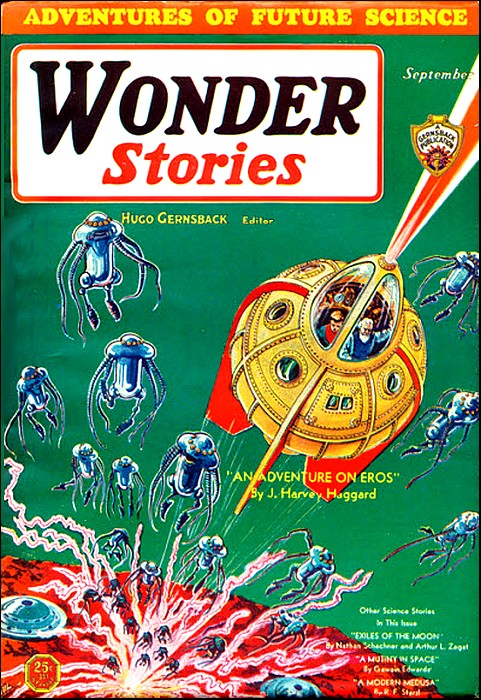
Wonder Stories, September 1931, with part 1 of "Exiles of the Moon"
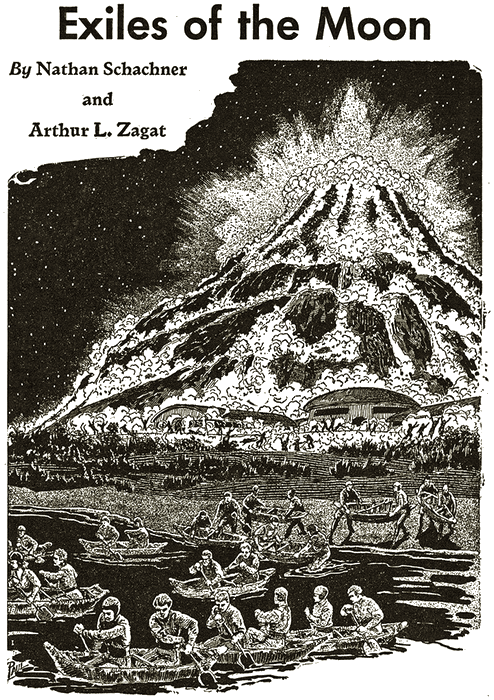
The advancing tide had reached, engulfed the buildings. A great
mountain of green flame loomed, a vast pile of billowing light.
GARRY PARKER, rocket pilot of the flier Ventura, glanced at the chart suspended above the gleaming controls. The light dot quivered, moved slowly toward the red hairline that indicated the end of his trick. It would take the great liner but five minutes to speed the two hundred and fifty miles remaining, then he would be through for this trip. The altimeter showed twenty-five miles up. Right to the dot! A perfect voyage!
Time to check speed for the change-over.
Garry twisted the dial that would send out a furious blast from the bow tube. Careful now. The new nascent hydrogen in the fuel mixture was the very devil. Just a little too much and the Ventura's nose would be driven down; she would dive before the wings and the gyrocopters could be thrown out, and the huge liner would become a flaming meteor, falling faster and faster till she plunged, hissing, with her thousand passengers into the watery depths below. Wonderful stuff, though, the new mixture! It had cut ten minutes from the Berlin-New York schedule—an even hour it took now.
The position light was almost touching the red line. Parker spoke aloud, though there was no one else in the control-cabin. "On the mark, sir."
Another voice sounded; from nowhere, it seemed. "Very good, mister! Change over!" It was the voice of the Ventura's captain from thousands of miles of space from a cubbyhole in Paris, at Western Hemisphere Transportation Headquarters. Another new development this, taking the captain off the ships. It worried Parker sometimes—he felt in his bones that other, greater changes were coming in the operation of the airlines.
The door behind Garry opened and closed. Dick Thomas was at his side, the wings on the breast of his gray-green uniform indicating that he was the plane pilot. A brief shoulder touch of greeting, and Dick had slid into his seat beside Parker's.
Swiftly the two went through the familiar routine of the changeover. As Garry twirled the dials shutting off all rocket tubes, Dick thrust home the levers that swung out the wings and sent aloft the whirling gyrocopter vanes. Outside, they knew, the Ventura was no longer a smooth skinned, stream lined projectile ripping through the near vacuum of the stratosphere, but a huge airplane, ready with its great span of multiple airfoils to bite into the sustaining atmosphere below as it zoomed down to the waiting airport. A faint vibration could be felt as the Preston-Diesels took over the task of propulsion from gas tubes at Dick's touch on a button.
"Change-over complete, sir," Garry reported to his distant chief.
"Very good, mister," the concealed speaker brought the acknowledgement.
"Plane Pilot Thomas, in control, sir!" Dick took up the routine.
"Make it so, Mister. Rocket Pilot Garry Parker, C12574, relieved. Plane Pilot Richard Thomas, C46890, in control, Ship Ventura." The captain could be heard relaying the reports to the chief dispatcher's desk.
"Good landings Dick," Garry voiced the phrase that the etiquette of the air-lines prescribed for a rocket pilot on being relieved. Similarly, when the change-over form a plane to a rocket-ship had come at the start of the journey, Dick had given up control with the words, "Straight flight, Garry." Tradition had it that omission of these ritualistic phrases would bring sure disaster. Superstition, of course, but those who go up into the air in ships have ever been superstitious.
PARKER passed through the door leading into the pilot's rest room, his broad shoulders brushing against the sills. He could relax now, this was his last trip of the day. Almost automatic as these star liners were, it was still a tremendous strain to sit at the controls of a huge shell that was zipping through space at a mile a second. A mile a second, that was the speed the new fuel gave them. And only ten years ago, in 2240, when he was beginning his training, thirty miles a minute was considered the uttermost limit.
Well, now that both the oxygen and the hydrogen were in a nascent state, there couldn't be any further advance. Only the dreamers whose wanderlust called them to the moon and the stars would want greater speed. Seven miles a second it would take to get out of the earth's attraction. No use thinking along those lines. Have to stick to old Earth awhile.
"Garry!" A soft voice thrilled behind him. He whirled.
"Naomi!"
A girl had come into the severe, bare room. A girl of the Aristocrats, her bearing, the soft flowing draperies that accentuated the. lithe grace of her figure, proclaimed that. Long centuries of breeding, of refinement, in the piquant face, in the very gesture of the arms thrown out to him. Character, too, in the frank gaze of her black eyes, in the firm line of her lips, the determined curve of her little chin. The saving grace of humor in the tip-tilted nose, the little twist of mischief tugging at the corners of her mouth. A stride, and his lips were covering hers in a long hungry kiss.
"Naomi, it's good to see you. But what are you doing in here? You know communication between passengers and the pilots is absolutely forbidden."
"Forbidden to me, Naomi of the Fentons! You forget that I am the daughter of Henry of the Fentons, America's member of the World Council of Five. A Fenton is above the Law!" For a moment the hauteur of her caste rendered her less lovely in Garry's eyes, then—"No, nothing is forbidden to me, save to marry the man I love." The ghost of a sob tarnished the silver of her voice.
"But, dear, that's just it. If your father learned that you came in here to talk to me, he'd suspect something. And, I'm afraid you'd suffer for it."
"Oh don't worry about father, I've told you that I always have twisted him about my little finger. The only thing I fear is what he might do to you, and I'm quite sure that he'd never dream that I would fall in love with a Worker."
"Besides, darling," pain showed in Garry's voice, "I have no right to let you keep on loving me. Granted that we might find some way to avoid the strict Caste Law forbidding any union between an Aristocrat and a Worker, I cannot drag you down to my caste. That's what it would mean, you know—" he went on hastily as he saw protest trembling for utterance on the girl's lips. "Our whole social organization rests on the conception that the Aristocrats and the Workers are races apart. You know, as well as I, that the one Law that even the Council cannot change is that which says that a Worker can never rise to the Aristocracy."
"Yes, I know," he went on, forestalling the defence of her class that he saw rising to the girl's lips. "I know the old cant, that the Aristocrats are the only class fit to rule, that they are trustees of the Machines and all they produce, administering the World's goods for benefit of Patrician and Worker alike. Fine words! Specious theories! But how have they worked out?
"This might have been a wonderful place to live in, this Earth of ours. With the development of the Machines hours of labor should have been cut to a minimum, leisure, and culture, all the finer things of life might have been and should have been, the heritage of all. But your class, under the bland pretext of paternalism, have arrogated to themselves the benefits of scientific progress, and have made of us, the Workers, veritable slaves to the Machines we tend. They sit at the banquet table, and expect us to be content with the broken meats they fling us. We crowd around the doorway, gazing at the least, barred forever from entering by the flaming sword of the Caste Law."
"For our good, you say. For our good you give us creature comfort, but kill our minds with the denial of ambition, opportunity, reward, all that to a thinking man makes life worth while! And if we tire, if our gorge at the measured routine of our lives rises in our throats and chokes us, so that we refuse to work in the ordered fashion, you shake your heads sadly, and with tongue in cheek, say to us: 'Very well. You do not care for the way Society is ordered, then get you gone and make your own Society.' And you send us, great hordes of us, to the Idlers' Colonies in the tropical deserts or the arctic ice fields. 'Make your own world here,' you say to us, 'we shall not interfere.' No, you do not interfere with the cold that freezes us, the heat that burns us, the starvation that laughs at the puny efforts that our unused hands make to feed us.
"But what am I saying," he interrupted himself, "you are not responsible for all this. You, as well as I, are a victim of a system we have had no part in making.
"You would forget your caste, and, for the love of me, become a woman of the Workers. What do you know of the life of a Worker's wife? Housed in great barracks, watched, and spied upon, and guarded. Every moment of her life charted and catalogued by inexorable regulation. So many hours for culture, so many hours of exercise and amusement, rigidly delimited in kind and degree. For her good, your Councils say. Yes, for her good they take her children from her after five short years, lose them in the great vocational schools, to be trained to the common mould, fashioned into cogs in the great World Machine. No, Naomi darling! I cannot, dare not, permit you to share that lot with me."
THE girl stood straight before him, her eyes burned into his.
"Garry," she asked, "do you love me?"
"With every fibre of my being, that is why—"
"That is all I want to know. Then what you say means nothing to me. I love you. That is all I know, all I want to know. When you call me, I shall be ready. Ready to go with you, to be your wife, to endure the Worker's lot, or worse, if only it be at your side."
"Do you mean that, Naomi?"
"Must I get down on my knees and beg you to marry me?"
"No use in my arguing further." Garry's voice rang with joy. "We'll find a way." His arms went out, the girl nestled close within them. A moment they clung, then, gently, she pushed him away. "But, Garry dear, I'm forgetting what I came in here to tell you."
Parker interrupted, engrossed in his own thoughts. "Listen, Naomi," his voice dropped low, "I hadn't meant to speak of it so soon. There's something on foot among us Workers, plans that are still only being whispered among a few. Discontent is spreading. There may be a flare-up soon. Conditions may change. Let us wait—six months—a year—and our problem may be solved."
Naomi shook her head. "That's it, we can't wait. That's the news I have for you. Father called me in yesterday, and told me that he had decided that I am to marry in a week."
"What!"
"In a week. And guess whom."
Garry's eyes were blazing, his knuckles showed white, so tightly were his fists clenched. "Who?" he burst out.
"Sadakuchi. Sadakuchi of the Samurai."
"No!" he grained, "Not the Asiatic!"
"Yes, the Asiatic."
"But how could your father bring himself to propose such a thing."
Wearily she explained. "Reasons of state. I've become a pawn in the great game of world politics that so absorbs father. You see, just at present there is a deadlock on the Council of Five. Father and George of the Windsors, the European, against the African and the Australasian. Hokusai of the Samurai, the Asiatic representative, holds the balance. So far he has allied himself to neither side. But his son, Sadakuchi, Chief of the World Police, has decided he wants me. And so Hokusai has delivered his ultimatum. Father is in the seventh heaven of delight. To him it means the fruition of his labors of years, control of the Council and of the world. I wasn't even consulted."
"It's hellish!"
"You see, my dear, life isn't all peaches and cream even of a woman of the Aristocrats. So we have just a week."
"He can't have you." Parker snapped out. "That's up to you. Just a week."
The deep note of a gong startled the couple. "That's the landing signal, Naomi, we're over the airport. You must leave me now, or we'll surely be discovered. I'm off duty for six days. We'll work something out. Can you get away tonight?"
"I'll try. The usual place, at ten?"
"Right. Meantime I'll be thinking hard. Go now, dear."
A swift kiss, and he was alone again in the rest room.
Garry turned toward a port hole, his brain in a whirl. He, a Worker, had dared to raise his eyes to an Aristocrat of the Aristocrats, a daughter of a World Councilman, and she had deigned to stoop to him, to love him. A surge of defiance swept through his blood. In spite of the Law, in spite of the Council itself, he would take his mate. Sadakuchi, indeed. His fingers tightened as if he felt a yellow throat within their grip.
He slid open the metal shutter of the port. The Ventura was hovering above the landing field." A mile below he could see the great jaws of her cradle slowly opening to receive her. To the west, frothing upward in a vast leaping tide of steel and stone, spread the miracle of New York.
GARRY thrilled again to that sight, as he had thrilled hundreds of times before. From a myriad soaring pinnacles the rays of the setting sun flashed in brilliant coruscation. A brilliant haze overhung the city, through which swarms of black midges that were man-bearing planes soared and sped. In graceful arcs white marble bridges curved, spanning half-mile deep chasms, man-made, in whose depths artificial suns fought their day-long battle with the shadows.
Already, in the mid-height zone, where no longer the level beams of sunlight penetrated, and the street-lamps' radiance could not reach, a million lighted windows spread, a wide-flung firmament of stars. In a hundred mile circle the glittering metropolis blanketed the earth with beauty, from where the broad Atlantic heaved its green expanse, to the far north and west, where, in thin silver threads, once mighty rivers disappeared beneath the city's steel and stone, to seek the sea in dark tunnels far below.
Again the deep-toned gong vibrated through the craft. The field drifted upward, slowly at first, then faster and faster, till the Ventura was dropping like a plummet. It seemed as though in a moment the huge ship would crash thunderously into the ground. Then a screech as the gyrocopters bit into the heavier air, a shudder as the great fabric felt the upward tug. And the liner settled, soft as thistledown, into its berth.
A moment's glimpse only, Garry had of his sweetheart, across the bustling field, as she slipped lightly into the seat of a scarlet Arrow runabout, the black WC emblazoned on its nose. Potent symbol that, opening all traffic lanes, voiding all rules of the air! Straight upward the two-seater shot, a frantic green police gyrocopter clearing the way through the crowding traffic with its piercing siren.
"Hey, Garry, wake up! Think you'd never seen a landing field before, the way you're standing there gaping. Come on, let's check out. I've got a dame waiting for me." Dick Thomas' hearty slap on the back brought the tall pilot back from his chaotic thoughts.
"All right, Dick, get a car."
Thomas focussed the violet beam of a hand flash on a plate gleaming from the door of a low structure a hundred yards away. The barrier swung open. The 'eye' of a three-wheeled Hammond scooter caught the guiding ray, came skimming across the concrete tarmac toward the waiting couple.
Once a quick jerk of Dick's hand swerved it out of the path of a lumbering freight conveyor. The vivid curses of the operator came thinly through the tumult of the port, to be ignored by the plane pilot. The objurgations of this groundling were beneath the notice of a flier.
"HOP in, Garry." Parker folded his length into the narrow confines of the little machine, switched off the teleradio control. Under Thomas' skilful hand the Hammond weaved its way through the bustling traffic of the busy terminal. "There goes the 6:15 to Tokyo." Dick remarked to the silent, moody Parker. "Manton has just been transferred to her. I'm glad he's got his step-up at last."
"What happened to Reynolds?" Garry roused himself.
"Idlers' Colony!" came the succinct response.
"'Idlers' Colony', Reynolds!" Parker was startled. "Why, there was no harder working pilot than Reynolds, none more obedient. I can't imagine him insubordinate! How come?"
A bitter note crept into Thomas' voice. "Don't mean to tell me you don't know how those things happen, do you? The reclassification headquarters is a regular hotbed of whispering and intrigue. Couldn't help but being, with the methods they pursue. A complaint from any petty overseer or superintendent and a Worker is shipped off without a chance to be heard in his own defence. He doesn't even know who accused him, or the charge. They say a full quarter of those sent to Idlers' Colonies are perfectly good citizens, with no thought of doing anything but to obey orders.
"I don't know just what happened in Reynolds' case," he continued, "but there was talk that he was in line for promotion to district overseer, and that Kaden thought the job ought to come to him. Kaden, you know, is pretty thick with Layton into classification headquarters. Draw your own conclusions."
"So that's the way it works! Not only are we barred by the Caste Law from ever becoming members of the governing class, but in even the small ambitions left to us we must fear the malice of some petty official or the intrigue of some scheming bootlicker. That's your fine paternalistic government for you! I tell you, this world is organized for the Aristocracy, and for them alone. Fine words to the contrary notwithstanding, we Workers are slaves, downtrodden slaves, serving our masters, the Aristocrats, and living at their sufferance."
Dick paled. "Cut it out. You'll have us both hauled up for sedition. Man, suppose you were overheard!"
"Oh damn that. I'm sick of the whole thing. Suppose one of their spying listening beams did pick me up! I'd be sent to a Colony. At least there I'd be free within limits—"
"Yeah, free to starve to death. Me, I'm perfectly content right here. All I've got to do is obey orders and keep my mouth shut, and I can enjoy life. The Aristocrats can do all the managing—they're trained for that. My job is to start and land rocket ships."
"And you'll be starting and landing rocket ships all your life," Garry broke in. "That would be all right if it was your own will that kept you a pilot. But you have no hope of doing anything else. Don't you feel that there are certain human rights that are denied you, the right to live your own life in your own way, the right to strive to attain any position in society to which your inherent ability entitles you?"
"I think you're talking a lot of buncombe," Thomas growled. "The whole question was settled a hundred years ago, in the Worker's Rebellion. Haven't forgotten your history, have you?"
Parker shrugged. His fist clenched for a fleeting moment. "No," he said slowly, I haven't forgotten my history. The question was settled then, with poison gas, and searing electronic discharges, and the torn bodies of men and women."
"That was unfortunate, I'll grant you. But just look. The Aristocrats, after that victory, might have made us slaves. Instead—"
"Instead, they call us something else—wards, children, Workers! But names don't change truths. We're slaves just the same!" The Hammond hissed to a stop in front of the Airport Headquarters. The two pilots strolled up the broad ramp, entered the high domed lobby, and turned to the left, where a long row of ground glass disks, two inches in diameter, glowed yellowly in the marble wall.
Garry was all impatience now, to check in and be gone. A bare six days of leave lay before him. Six days in which to plan and bring to fruition a scheme to save Naomi from the unnatural marriage to which politics had doomed her. Six days in which to puzzle out a way to evade the Caste Law and take her for his bride.
Dick finished, stepped aside. Parker placed the ball of his right thumb on the disk his comrade had just quitted. A metallic voice sounded from the wall.
"C-One-two-five-seven-four. Checking in." The tall pilot waited for the next words, as a whirring behind the marble surface indicated the operation of. the selective mechanism as it sorted out his orders from the hundreds of encased records. He knew what they would be, of course—"Relieved for six days."
The disembodied voice began again its rasping, unhuman drone. "Garry Parker, pilot, C-one-two-five-seven-four, will report to Overseer Twelfth District for orders."
GARRY stared unbelievingly at the unresponsive disk. Orders! No time to think of his own huge problem, to plan with Naomi—. But wait. Perhaps it was just some minor task that might be completed in an hour or two. He whirled, and, without so much as a nodded good-bye to the startled Thomas, dashed across the lobby to the bronze door above which glowed the words: "Overseer, Twelfth District, Air Transportation Division."
He flung the door open. Within, seated at a desk whose surface was covered with serried push buttons, a grim faced official arched grizzled eyebrows at the unceremonious intrusion. Garry saluted scantily, gasp-out, "Parker, C12574, sir. Reporting for orders.
The overseer nodded coldly, then punched a number of the buttons before him. From a slit in the center of the desk a blue card appeared. The official glanced at it, then looked up.
"Parker." His voice was precise, formal. "You have been transferred to the Tokyo-San Francisco run, ship Ganymede. You will base at San Francisco airport. Report there at midnight for immediate duty." Garry caught at the desk-edge. "But—but I'm due for six days leave, sir."
His superior shrugged. "That can't be helped. Those are your orders."
"But I can't go—tonight. I have things to attend to, important matters."
"You can't go?" The overseer's voice, impersonal before, was now freezingly deliberate. "I have no record of any matters which would interfere with this assignment."
"But these are personal affairs."
"Personal affairs. You'll have to forget them. Orders cannot be changed for personal affairs of a Worker."
Garry's face was white with rage. This transfer would cut him off from Naomi, forever. His brain raced. In a week she would be married to Sadakuchi, and he soaring over the Pacific. "Orders cannot be changed for personal affairs of a Worker." A Worker was a pawn, a slave, a Machine! Something exploded behind his eyes. Then he was saying, very slowly: "I refuse to obey!"
Even then no change of expression showed in the grim face before him. The steely eyes flickered to the card, then back again to the inwardly trembling pilot. "I see a notation that you are suspect of harboring seditious notions. Since I have had nothing to complain of I asked that judgment be suspended. I find that I was wrong.
"You have refused duty. This makes your case one for summary disposal without reference to re-classification headquarters." Gary blanched, he knew what was coming. The overseer referred to a chart that he drew from a drawer. "You will report to Division ZZ at 10 A.M. Greenwich time, tomorrow. That is all." And he turned away.
Garry reeled from the room. This then, was the end.
Bad enough it had been before, aspiring to marry a Fenton. Only some wild, some unheard of plan could have brought him success. Now however, the thing had become impossible. Tomorrow, at this time, he would be broiling beneath a tropical sun, or shivering under the icy blasts of an arctic wind. And Naomi, in another world, thrust by the inexorable rule of her caste into unwilling union with the yellow Samurai. The glow of futile satisfaction that had warned him at his defiance of authority died away. Black despair welled up within him.
Mechanically his long legs carried him to the pneumatic tube station, blind instinct directed him to the proper aperture. A car had almost filled; he could barely wedge his broad shoulders into the remaining space. But the crowded discomfort made no impression on him. He did not notice the sealing of the entrance, the hiss of the admitted air, the twenty minute flight that took him for the last time to the C Division living area, a hundred miles away. Wearily, futilely, his dazed brain strove for some way to break the meshes of the net that had closed inexorably about him.
Afterwards Garry wondered how he managed to reach his cubicle in the bachelor dormitories on the Second Level without accident. One had to be alert to pass across the series of progressively speeding conveyor ribbons to reach the central path that spiralled upward two hundred feet, then shot at sixty miles an hour along the radial street. He dimly remembered stumbling, someone hauling him upright, a shouted objurgation from a Traffic Controlman. But it was only when he found himself in the familiar surroundings of the little room that he really came to himself. He threw himself heavily on the steel-framed cot, stared at the neat shelves that held the few paltry things that he might call his own. Tomorrow he would leave this room forever.
HE had small time, however, to lie there, to strive to find his bearings in the chaos his world had become. The call-disk over the entrance flashed three times, signal for the evening meal. No one ever had less desire for food, but absence from the dining hall would bring swift investigation, demand involved explanation. The iron routine of the Worker's life closed about him once more.
Once seated at the circular table with his fellows, the resiliency of youth asserted itself. The portions he seized from the steaming platters that passed slowly before him on the endless belt were large, his huge body demanded huge amounts of fuel. As he ate, he became aware of the buzz of conversation about him.
"I hear there's been more trouble in the Arctic Idlers' Colony," Thompson, a weazened tender of a solar power converter remarked at large.
"Oh, some of these guys what thinks they're as smart as the Aristocrats got to talking. They grabbed a ship, tied up the crew, and were all set to skip when the Arethusa, with Sadakuchi himself on board, came sailin' up. His ray guns made short work of them, you can bet."
"Damn fools. Don't know when they're well off. Even if the tramps don't want to work, what's the matter with loafing around up there. Just looking for trouble, that's all they are."
"Just heard of something new," someone else broke into the conversation. "Division ZZ special. Been operating about a month. About a thousand been directed to report there so far. No one has learned what Idlers' Colony they've been sent to, nor has any message ever gotten back from them."
"They say it's another new colonization scheme. You know, they've been getting a little worried about all the grumbling in the regular Idlers' Colonies.
"Worried, hell! The Aristocrats ain't worried about our grumbling. I'll bet when the truth comes out about this ZZ special business it'll be a damn sight worse than the old scheme."
"'S funny at that. I knew a few of the bunch that went. And every mother's son o' them were—well, you know, not exactly aces up with the Aristos." The man hesitated as if he could say much more, but was afraid.
The other nodded understandingly. "I get you. You think they were slated."
"Well, it might look that way," the first speaker admitted cautiously.
A freighter pilot spoke up. "Say, fellows, last trip in I carried a bunch of cows, delivered them to ZZ special headquarters."
"Cows! What's that?"
"Hey, don't you know your geometry? That's the animal they used to get meat from, and milk."
"G'wan. You're kidding me." The talk had moved to a group of striplings, youngsters just come up from the training schools. "That stuff is all made in the food factories, I've seen them myself, down in the Harlem district."
"That's only in the past thirty years." A grizzled veteran spoke up. "I can remember, when I was a kid, they had big fields down in South America where they grew all kinds of grain, and others where there were thousands and thousands of cows and other animals that they used to kill for food."
"Oh, Pop's at it again. Hey, bunch, gather round, Pop Foster's telling his fairy stories again."
Parker smiled cynically to himself. From his great age of twenty-five he looked compassionately at these skylarking youngsters of eighteen. They'd learn, soon enough.
THE white glow that lighted the room changed to red for an instant, then to white again. Three minutes to finish. The talk stopped as the eaters hurriedly completed their meals, and shoved their empty plates and soiled utensils on to the ceaselessly moving serving belt that carried them away to the washing machines. A green flash. "Meal over."
Back in his room, Garry pressed the 'time' button on the tiny communication disk strapped to his left upper-arm. "Eight-twenty-six," the metallic voice of the Central Chronometer Broadcast responded. "Time to get going," he muttered.
He stepped to the open doorway, peered up and down the corridor. No one about.
Swiftly he lifted a board in the floor, extracted a flat, cloth-wrapped package from the aperture, thrust it under his tunic.
It was the recreation hour, and the common street was crowded with Workers. On the stationary sidewalks, close against the building lines, couples strolled, in the tight-fitting clothing of their caste, each colored to indicate the wearer's occupation. The slow-moving ways that bordered the walks, were filled with younger men, their eyes gleaming with anticipation of the evening's pleasure. Parker made his way across these to the central express conveyor, more sparsely peopled with those who were hurrying some distance, to community amusement halls, or sports arenas.
The moving belt circled around an opening, a hundred feet across. From a spiral ascendor debouched a group of weary-faced, haggard workers in the factory drab, just released from toil on Level One, below. Garry glanced upward. Infinitely far above, a single star gleamed in a disk of black sky, darting its yellow beam down the half-mile shaft. Then the momentary vision was cut off by the roofing underside of the Level Three conveyors, five hundred feet above.
A blare of music reached the blonde pilot from the arched entrance of an amusement hall, where clustered hundreds sat, watching the televised representation of an entertainment being presented to the patricians in a terraced garden somewhere on the roof of the city, under the star sprinkled sky that was merely a legend to these watchers. Garry started to move outward, striding diagonally across the speed-graded belts, till he reached the stationary walk just opposite a dark aperture in the soaring concrete wall of the Northeast Workers' Gymnasium. A quick glance around showed that he was unobserved. He dived into the narrow passage.
A tunnel angled dimly off, low-ceiled, cluttered with forgotten lumber, broken lumps of discarded concrete blocks, debris of all kind. By what aberration of the building machines this curious passage had been left in the thick wall through which it wandered Garry did not know, nor did he care. It had stood him in good stead more than once, as it would serve him now.
With the ease of familiarity he made his way some distance in, till the last faint beams of outer light had been swallowed up in darkness. Then, working rapidly by feeling alone, he stripped off the pilot's uniform he wore, unwrapped the bundle he had taken with him, and donned the garments the cloth had covered. The silk rustled in the silence, for this was an Aristocrat's uniform, procured somehow by Naomi.
Without it their rendezvous would have been impossible, for the upper levels were prohibited to all Workers save those whose duties took them there. He pulled the close fitting satin helmet down over his blonde hair, inserting his communication disk in the ear-flap pocket, as the patricians wore theirs. Then he stuffed the clothing he had discarded into a hole in the wall, and turned to go.
A scuffling at the entrance halted him. Silhouetted against the light he saw three forms. Garry crouched against the wall. The men were coming in! He tried to halt his breathing, to melt into the very stone. Who were they? Police? No, too tall. Who then?
ONE passed him. The odor of an unwashed body came to his nostrils. The second was passing, tripped, cursing. His reaching hand plumped square into Parker's face. "Hey, what's this? Someone's here, fellows." A gruff voice. "Show a light, Tim."
A hand flash gleamed. Garry glimpsed three burly figures, haggard faces, eyes burning with a wolfish, bestial glare. Then the light was gone.
"A bloomin' Aristo. Well, wadda you think o' that." There was menace in the growling tones. "A nice little patrician, right in our parlor. Here's luck, guys!"
"Kill the dog, quick, before he has a chance to yell."
Parker opened his mouth to deny the impeachment. But a fist crashed into his teeth. "No you don't, you son of a "gun."
The pilot struck out, his fist crunched against tone. Someone grunted. Then Garry was in a whirl of fighting. Back to the wall, he protected himself as well as he could. A butting head crashed into the pilot's chin, drove his skull back against the stone. Shaking his head vigorously, he lashed out and his blows found their mark. Parker fought on, grimly silent, whilst his attackers made the darkness hideous with animal snarls. Garry's fists, his well-directed kicks, did terrible execution. First one, then another of his opponents retired momentarily, from the strife. But the unequal combat could have only one end.
The battling pilot felt hands clutch his feet, pull them out from under him. He was down, three heaving bodies on top of him. His arms, his legs, were pinioned to the ground. A knee ground into his laboring chest, an upraised knife gleamed bluely. "Good-bye, Naomi!" the unuttered farewell flashed through Garry's brain.
A new voice shouted, "Yoicks, hulloa! Up an' at 'em!" The knee suddenly lifted from him. He heard a smash, as of a body crashing against stone. The pinioning hands left his arms, his legs. He was on his feet. A fourth figure was there battling with two of his erstwhile attackers. The third lay, groaning, on the ground.
Parker plunged into the melee. But his aid was not needed. The newcomer was a whirlwind of explosive force. A sharp one-two sent one of the thugs reeling headlong against the wall. The third whirled, ran limping off into the darkness.
"Thanks, old man," Garry gasped. The stocky rescuer turned. Even in the dimness his hair was a red flame.
"That's all right. It was a bully good scrap while it lasted. But they nearly had you." The speaker paused suddenly, peered closer. "What the hell, an Aristo!" He turned on his heels, made as if to go without another word. Every line of his figure was eloquent of disgust.
"Hey—wait a minute. I'm no more an Aristocrat than you are."
The other turned back. "The devil you ain't! What are you trying to pull off on me!"
"No, that's straight. I'm not fooling you. Look—," he held out his identification disk. "The Aristos don't carry these, do they?"
"Then what's the idea of the masquerade."
"A little private matter."
"Oho! You're one of those bally asses that get mixed up with an Aristocrat dame. Flying high, my lad. Look out, that way lies trouble, and I mean trouble. But that, as you're about to say, is none of my business.
"Suppose we introduce ourselves. I'm Garry Parker, C Division. Or rather," a wry smile twisted his features. "I suppose it's ZZ division now."
"Oh, yeah? One o' the Won't-Workers, eh? Well, me lad, yours truly is in the same boat, or maybe a mite worse. Bill Purtell, at your service, called Purty by my friends, 'cause of my well known lack of beauty. And, in case you're inclined to get snooty, I'm entitled to stick ZZ special before my little 54687."
"ZZ special, eh. That's the new division I've been hearing about. Wish they'd assigned me to that. Anything would be better than the Idlers' Colonies."
"I'm not so sure. I'm not so sure," Purty drawled. "There's something that smells a lot off color about that ZZ special business."
"What makes you say that. I've heard that it's some kind of colonization scheme where conditions are bound to be a lot better than in those dam starvation camps."
"Yeah. I've heard a lot of guff too. But did it ever strike you that we've never gotten a single word back from the two groups that have gone off already? Whereas we are allowed to communicate freely with the old Colonies. I've done a bit of snooping around today, being, as it were, somewhat interested, and what I've heard somehow gives me the cold creeps."
"What did you find out?"
"Well, I got hold of one of the crew of the liner that took the first batch out. He told me that he knew some of the men and women in the gang, and every last one of them had been doing a lot too much talking about the rights of the Workers to equal opportunity, and things like that."
"Yes, I've just heard something like that myself."
"On the other hand," the red-headed rescuer continued, "this guy told me that just before they started, the Aristo in charge of the ZZ special made a speech to the colonists and the crew both. Even that sounds kind of funny to me. Our good, kind bosses aren't in the habit of making speeches to us Workers, explaining their orders. It's 'Go here. Go there. Do this. Do that,' with no whys nor wherefores volunteered. And we know better than to ask."
Garry thought grimly of his own experience. "That's true."
"This Aristocrat tells 'em that the Council has selected them because of their superior abilities to try a new stunt. The old Colonies have been just places where lazy Workers and insubordinate ones have been sent. But now they're going to found places where those who can't adjust themselves to this grand and glorious civilization can go back to conditions as they were centuries ago, before machines began to take over the work of man. They're going to give them the ancient tools; shovels, and ploughs, and hoes, and so on. And they're going to furnish 'em with seeds, and cows, and sheep. And then they're going to leave them to their own devices, to reproduce the ancient agricultural civilization. Said they'd been talking a lot about the good old days; here was a chance for them to see how they'd like the good old days. Now does that hokum sound reasonable to you?"
"Why not? It seems to me that it's a very good solution of what to do with the malcontents."
"Hell, the solution of that problem that would appeal most to the Aristocrats would be just to kill off every Worker that showed signs of doing some thinking for himself."
"Sounds simple. But I'm rather inclined to think that they'd be afraid to start that. After all, the Workers outnumber the Aristocrats, and, with all the Machines, are necessary to their welfare. Any such slaughter would be almost sure to start a revolution, meek and downtrodden as our people are. I don't say an uprising would be successful. Probably not. But things would be slightly uncomfortable for the upper class for a while."
Purtell looked at him strangely. "Yeah? Now I wonder if they aren't picking off the leaders this way?"
"Leaders of what?"
"Say, you don't happen to know Appak, do you?"
"Appak? Why, no." Gary's tone expressed his wonderment at this sudden change of subject. "Who's he."
"Never mind, if you don't know him." Then again that queer, speculative gaze. "Oh hell, you might as well know, the damage is done already, even if you are a spy. Not that I think you are," as Garry's eyes blazed, "you don't talk like one. Appak is the recognition signal of a world-wide Worker's organization that's been working undercover, trying to find some way of bettering conditions. We've hoped to avoid resorting to violence, but haven't gotten very far. I happen to be the leader of the Chemical Worker's section. Now you know why I'm so leery about this ZZ special proposition. I'm almost sure the Aristocrat police got in somehow and tumbled to my activities."
"Too damn bad. But maybe you're wrong. You'll know, anyway, what it's all about by this time tomorrow. Say, what do you think made these fellows jump me like that? I know they took me for an Aristocrat, but it's damned dangerous business murdering Aristos. Did they think they'd get away with it?"
"They were Gangmen, of course."
"Gangmen?" Garry's voice expressed his wonderment.
"Say, where have you been that you haven't heard of the Gangs. They're poor dubs that were ordered to the Idlers' Colonies, but didn't show up at ZZ. Crazy lunatics. They run off, hide in nooks and crannies like this, and pick off the Aristos whenever they get a chance."
"Do you mean to tell me that they're succeeding in a wild scheme such as that?"
"Hell no! Appak has tried to help them, but it's not much use. They last a couple of days. Then Sadakuchi's rats hunt them out, and—whiff—they're through. Ray-gunned on the spot. They're outlaws, you know."
"So that's it. Poor fellows. I'm sorry for them, even though they almost finished me. Might have been better for me at that. Well, I've got to get going. Thanks a lot, Purty. Sorry I never met you before. Not much chance of our ever seeing each other again. Good bye, and good luck. I hope you're all wrong in your notion about ZZ special."
"Me too, and many of them." With a jaunty wave of the hand, he was gone.
GARRY adjusted the disorder of his patrician costume, and emerged into the street again. Very different, now, was his progress. Before, he had been just one of the Worker mob, forced to jostle his way through the throng. Now, a path magically opened before him, cringing proletarians moved aside on every hand. A policeman saluted him snappily. One of the Lords of the Universe was honoring the lower region with his presence.
The disguised pilot reached an ascendor spiral, was carried rapidly upward. The broad sweep of Level Three spread before him the marble facades of the Aristocrat homes gleaming iridescent in the ever-changing pastel hues of colored lights. Then he was out in the open, under the eternal sky. He had arrived at Level Four, topmost layer of the many-strataed city, pleasure ground of the Master class.
In the distance, lofty pinnacles glowed silver in the light of a full moon that hung glorious against the gold-dusted velvet of a cloudless firmament. Here and there dots of light, green, and red, and blue, drifted slowly through the air; tiny gyrocopters bearing their patrician owners on pleasure bent. A soft, warm breeze fanned Garry's cheeks, fragrant with the sweet perfume of the vast garden in which he was.
Gravel paths, luminous seeming in their whiteness, wandered in graceful curves amid banked shrubbery and great beds of gorgeous blossoms. The scene was filled with beauty. Slow strolling couples, hand in hand, moved languorous along the winding ways.
A great silver shape soared through the sky, the broad surfaces of its far spreading metal wings flashing in the moonlight. "The ten o'clock to Frisco," Parker muttered, "wonder if Naomi managed to get away." Pat to the thought, a white shape, heavily veiled, came lissome toward him. "Garry, dear," the soft whisper thrilled him.
Near at hand was the welcome shelter of dark green shrubbery. The leaves rustled, as if in fond comment on the lovers' greeting.
At last, "Garry, I've been racking my brain ever since I left you. I've got a plan. Listen. Next Sunday—"
"Just a minute, sweetheart. Next Sunday's about a million years away as far as I'm concerned." Garry hesitated, then went bravely on, "I'll be five thousand miles away from here by then."
"Why, what do you mean?" The girl twisted out of his encircling arm, stood trembling, one white hand at her breast.
"I got my orders to go to an Idlers' Colony this evening."
"Oh, Garry. It isn't true, it can't be true!"
"Unfortunately, it can, and is. I'm afraid it's good-bye to all our planning."
"No, no! I won't let it happen!" The girl stamped an imperious foot. Accustomed from birth to the gratification of her slightest whim, she saw no reason why the great machine of world government could not be halted to suit her desires. "I'm going right to father and tell him that they're not to send you off."
A tender smile eased the tenseness of the man's drawn face. "And when he asks you why this sudden interest in a Worker, you'll tell him, what?"
"I'll tell him I love you, that I'm going to marry you."
"Upon which, of course, he'll snap his fingers in the Samurais' faces, scrap all his plans for world domination, and say, "Yes, my daughter. You shall marry this scum from the lower levels. What do we care for the Caste Law, for the very basis of the civilization we have so laboriously built up. Down with everything, Naomi of the Fentons loves a Worker!' Or will he just calmly have me whiffed out of existence?"
The girl's little fists clenched. "Oh, why wasn't I born a Worker. Then I could marry you, and go with you to the ends of the earth, and nobody would care!"
"Too bad you weren't," bitterly. "No, my dear, I'm afraid there's nothing we can do. If only I had a little time. Maybe—" the buoyancy of his scant years lifted him for a moment above the dark flood of disaster, "Maybe, after I get out there I'll find a way. There have been such things as escapes from the Colonies."
Naomi shook her head. "You forget, Garry, I'm to be married to Sadakuchi in a week."
"Hell! I guess we're licked, honey."
"No. Never!" A flood of passion shook the maid's slight body. "I'll move heaven and earth to save you! I'll do it, never fear."
"Never say die. That's the girl! But it's hopeless. It's good-bye, tonight. Let's forget our troubles. Look at the moon, how calmly she rides there, untroubled, mocking all our little worries." He was talking desperately, striving to quiet the trembling girl. "I've often wondered if man will ever reach her. You know, dear, we rocket pilots are well-trained in the science of the stars. And it's always tantalized me—the centuries—old longing of man to cast the dust of old earth off from his feet, and go adventuring out into uncharted space. I've read all the old books in the dusty archives of the Technological Library. Ancient names of men who spent their lives trying to find some way to strike off the chains that bind us to this little ball of ours.
"Oberth, and Pelterie, and Goddard, geniuses who dreamed nightly of far voyaging in those old days when man couldn't rise more than a half dozen miles above the surface. Our great rocket ships are the result of their labors, but one thing defeated them in their dreams. The lack of a fuel powerful enough to send the ships they planned out beyond the gravitational attraction of the Earth. Otherwise they had it all, down to the minutest detail of equipment, of navigation.
"I've read all their works, all the voluminous publications of the Associations founded to aid them, the American Interplanetary Society, the Deutscher Verein für Raumschiffahrt, the Société Astronomique de France. I've got all the data by heart, could guide a space ship out without a hitch. But in all the three hundred years of progress since they lived, and worked, and died, we have not yet solved that problem, a fuel that would take us to the moon."
"Wouldn't it be wonderful if we could do that," the girl murmured. "If we could step into a little rocket ship, right now, and fly away to the moon. We could be so happy there together, just you and I."
"I'm afraid you wouldn't like it much there, dear. It wouldn't be a very pleasant place to live. No atmosphere, no vegetation, just eternal pitted rocks and tortured shapes of lava. Boiling hot while the sun shines on the spot where you are, abysmally cold in the shadow of the two weeks' night. Nothing but a vast expanse of stony desert. Not a living thing to move across the landscape. A hell of loneliness."
"I don't care. Hell would be Heaven with you."
But all things have an end, even lovers' hours together. A red flash streaked across the sky—midnight.
"Good-bye, Naomi. God be with you."
"I won't say good-bye, Garry. Something tells me we'll see one another again, very soon."
"Good-bye, dear heart. Think of me sometimes." The man spoke calmly, coldly perhaps, but within him a seething inferno boiled and burned.
The green leaves rustled again. They parted.
NAOMI'S little Arrow whirred gently to rest on the broad roof of the domicile of Henry of the Fentons, in Division GI 2 D. To the dwellers in that luxurious home it never occurred that two thousand feet beneath them, in the same building, sweating Workers labored in torrid heat, forging beryllium-steel into grotesque forms that tomorrow would be assembled into graceful ships to rocket through the stratosphere.
The room she now entered was not large, but in the exquisite beauty of its furnishings it represented the very acme of the contribution Art and Science had made to the epicureanism of the world's masters. A soft glow, apparently sourceless, glinted from the graceful crystal flutings that segmented the irregularly curving walls in rhythmic symmetry. The spaces between were of opal; secret iridescent fires shimmering beneath the pearly sheen, while delicate traceries of gold and silver wandered in studied carelessness over the lambent surface.
The chamber was ceiled by a great sheet of transparent quartz, through which the panorama of the summer sky looked down in unmarred splendor. The floor was a deep green expanse, apparently fathomless, whose vast lucent depths seemed alive as changing shades of emerald and jade pulsed in unceasing shifting. This amazing carpeting was soft and yielding to the foot, so that one seemed to walk miraculously upon the surface of a calm, unruffled sea.
Naomi seemed a very nereid as she came softly into this ocean grotto. And the grizzled man, in the robes of a world councillor, who sat with closed eyes in a great chair of carved white coral that was none too large for his huge form might have been Neptune himself, save that the legendary beard was absent. Even in repose every line of his figure bespoke power and dominance.
The poise of his massive, leonine head, the deep graved lines that seamed his large-featured face, stamped him as one born to rule. No saving wrinkles of kindly humor touched the corners of his eyes. The mouth beneath his bulbous nose was harsh, and uncompromising. The thick fingers of his great hands were further thickened by the firmness of his grip on the chair arms.
No effete, decadent oligarch, Henry of the Fentons, but a fit descendant of the Henry Fenton who, three centuries ago, ruled a nation, secretly from behind a screen of gold.
The girl threw herself wearily on a couch cunningly fashioned in simulation of a matted clump of seaweed. For a moment she lay there quiescent, then seemed to gather herself for a mighty effort.
Father, are you asleep?"
Fenton's eyes opened, sought and found his daughter. Piercing eyes, whose black depths showed no softening for this only child. "No, Naomi, just thinking over the council meeting that has just ended.
Did everything go well?"
"Not at all. Na-jomba, the African, and Salisbury, the Australasian, still oppose my plan for execution of the malcontent Workers. They advance some weak-kneed humanitarian excuses, but I'm convinced that they're simply afraid of an uprising. As if the spineless slaves could find enough courage to dare defy any edict of the council! George of the Windsors was splendid, but Hokusai still holds aloof. Damn him, he won't come in with me until our Houses are united indissolubly by your marriage to Sadakuchi."
The girl shuddered, but said nothing.
I had to agree to a continuation of the namby-pamby ZZ special scheme that I was forced into two months ago. I tell you, those Africans and Australasians are degenerating. If this thing continues, the gulf between Aristocrats and Workers will be broken down, and this great civilization of ours will revert to the old chaotic conditions whose shibboleth was, " 'All men are created free and equal.' Bah!"
"What is this mysterious ZZ special business?"
"Something that decorative young ladies like you needn't trouble your heads about."
"But, father, I'm dying of curiosity about it," Naomi pouted. "You usually tell me everything—and you know I can keep a secret. Why all this hush-hush about just that?"
The councillor's face grew grim. "That will be enough of that. This matter happens to be particularly confidential, knowledge of its details is confined to the members of the Council and a few individuals necessary to the operation of the plan. There will be no more mention of it from you. Do you understand?"
"Yes father," meekly.
"Now, daughter, it's long past midnight. Off to bed with you."
"Just a minute. I want to ask a favor of you."
"Ask me tomorrow."
"Tomorrow will be too late. Please listen to me."
"Well, what is it?" testily.
"There's a group of Workers being sent to the Idlers' Colonies this morning."
"I have no doubt there is. That's true most mornings. That's just what I was telling those fools today. The Colonies are becoming overcrowded, additions are growing rapidly as more and more Workers refuse to obey orders, indulge in seditious utterances, or simply indulge in their own degenerate laziness. We'll soon find ourselves swamped—"
Naomi interrupted. "Please, father, I've heard that lecture so often. Mayn't I be spared it just this once? What I started to say is this. There's a rocket pilot booked to go, Garry Parker, C12574. Would you, just as a favor to me, have him taken off the list?"
This startled the great man. "Hello, what's this. What do you know about any Worker? Why this sudden interest in what's to become of one of them?"
The girl stammered in confusion as she sought frantically a plausible reason for her request. "Why—why, I d-don't know anything about him. Only—only that my maid Emma—that's it—Emma begged me to get you to do this."
"Your maid Emma—I never heard of anything so extraordinary in my life—your maid Emma dared to come to you with that! And you—a woman of the Fentons—instead of slapping her face for her insolence, actually relay her absurd plea to me. Are you getting chicken-hearted too? Come, come, forget that rot. Of course I'm not going to do any such thing. Forget about it."
Naomi was white faced, trembling. She had risen from her couch now, as her father had risen from his chair. She came closer to him, put a pleading hand on his arm. "Please, father, oh please don't say no. I'll never ask you to do anything for me again. Only say that you won't send Garry Parker away." An uncontrollable sob choked her.
The head of the House of Fenton grasped the now almost hysterical girl's shoulders, held her away from him as he stared searchingly into her eyes. His voice deepened to a bass rumble. "Naomi, you're lying to me. You couldn't be wrought up to this pitch of emotion over some Worker woman's paramour. There's something deeper than that behind this scene. Out with it, young lady."
The girl found some unsuspected well-spring of strength within her being. She whirled away from the hands that held her, then turned back to face the ruler of a hemisphere. Straight as a flame she stood there, defiant. There were no tears in her eyes, no sob in her vibrant voice.
"All right, then, if you must know the truth. I love him!"
The man stared uncomprehending at her. "You what!"
"I said I love him. And you shall not take him from me!"
THE father's countenance empurpled with rage. "You—my daughter—love a Worker! You—a Fenton—the betrothed of a World Councillor's son—what utter madness is this?" The deep-voiced accents came slowly, trembling with passion. "And you ask me to aid you in your lunacy. I wonder that you do not demand that I defy the Caste Law and permit you to marry him." He seemed on the verge of an apoplectic seizure, then the self-control with which a lifetime of domination had endowed him came to his aid. In a more natural voice he asked, calmly, "What did you say his number was?"
"C12574." Naomi searched the mask of her father's face for some sign of relenting, some intimation of the reason for this request. Henry picked up a communication disk carved from a single diamond. "Classification headquarters."
A pause. Then a voice. "Classification headquarters."
"This is Henry of the Fentons. Get this. Worker C12574 has been listed for ZZ division, this morning's shipment. He is to be changed to ZZ special. My personal order. I will telewrite you the confirmation in the morning."
The voice replied. "Very well, your Excellency. C12574 to be switched from ZZ to ZZ special. Thank you, sir."
"Right. See that there is no error." He put the disk down, and turned to Naomi, whose eyes were great black pools, liquid with unshed tear. "That's what we do with all malcontents, and Workers who have dangerous aspirations." There was a certain grim satisfaction in his tone. "Now, young lady, you will go to your rooms at once, and remain there until you send me word that you have come to your senses. Understand me. You are not to leave under any circumstances, nor communicate with anyone save your maid Emma, who will bring you food and tend to your needs."
"Father, what have you done to my Garry?"
The agonized voice would have moved a heart of stone, but the stern, parent was untouched. His only reply was a cold, "Go to your rooms."
The girl moved blindly toward the concealed entrance. As the panel opened at her approach, she turned back to her father, seemed about to speak, but swung again and went silently out.
Ordinarily a little thrill of pleasure, a glow of comfort warmed her as she entered her exquisite boudoir. But now the room blurred before her tear-filled eyes as she threw her throbbing body headlong on a couch, and great sobs shook her.
But Naomi was a Fenton. Vain repining, tearful acquiescence in adversity, were not in her nature. Very soon her sobs quieted. She rose, eyes blazing, little jaw set in firm determined lines. A dash of icy water removed all traces of the tearful interlude. A swift donning of a dark travelling robe. Then she turned to the entrance.
But the selective beam of the electric eye refused to swing open the portal. Already the orders of the master of the house had barred the door against her. The actuating mechanism that should have operated by the imprint of her image on a telephoto cell, remained dead. She stared uncomprehending for a moment, then a flush of anger suffused her cheeks. The little fists clenched. "Oh, despicable!" she exclaimed, "he's made me a prisoner, a prisoner in my own room!"
Well she knew the futility of battering furiously against the barrier. None but those for whom the mechanism was set could pass through. She seized her jewelled communication disk and, in a voice rendered almost unrecognizable by fury, called: "Father! Father!"
But the dead flatness of her voice against the tiny diaphragm told her that this device too was altered to enforce obedience to the edict her parent had but now pronounced. Her mind worked with the swiftness of desperation. Then, "Emma! Come here at once!"
IN his bare, stone-walled, stone-floored cubicle Garry Parker lay on his hard bed and stared into the darkness. Alone, now, with no one to comfort, no fellow Workers before whom to put on an air of uncaring fortitude, he gave himself up to the tortures of despair. No escape, no evasion of the inexorable decree that had smashed his life presented itself to him.
For a wild moment he played with the thought of refusing to present himself at ZZ, of joining one of the Gangs that roamed, rat-like, the dark passages of the city. But that was sheer madness. A day or two, perhaps a week, and the squat yellow Police would ferret him out, swift dissolution would dissipate every atom of his body in the searing agony of their hand ray-tubes. Garry was not yet ready to die. Perhaps his exile would have an early ending. No, the Gangs were not for him.
"Garry Parker, C12574! C12574! Garry Parker, C12574", a droning mechanical voice sounded in the blackness. He was being called on the disk.
"Garry Parker, C12574." He signified his attention.
"Classification Headquarters. Change of orders. Direction to report at Division ZZ, 10 A.M. Greenwich, cancelled. You will report at Division ZZ Special, 10 A.M. Greenwich this morning. Please acknowledge.
"I am to report at Division ZZ Special instead of Division ZZ, at 10 A.M., Greenwich, 5 A.M. local time. Garry Parker, C12574."
"Correct."
What was the meaning of this? Should he welcome this change, or dread it? Oh, of course. Naomi must have interceded in his behalf. Then that red-haired chap, Purty, was wrong in his pessimism. It must be something better than the Idlers' Colony. Good kid, Naomi. That was the toughest part of this whole business, leaving her.
GARRY sat on a pile of space suits, his back against the grotesque, goggle-eyed helmets. He turned to flaming-haired Bill Purtell, whose cheery "Hey fella, what are you doing in this galley?" had greeted him as he turned into the ZZ Special area, a half-hour before.
"Gosh, Purty, it's a long time since I had one of these things on. Last time was thrilling though. It was on the old Avalon, before they established separate levels for traffic in different directions. The Arcturus almost collided with us, just skimmed by, slicing a long sliver from our outer skin. You should have heard the air start rushing out. I was second relief on her then, my third trip out of training school, and I took a gang out to repair her.
"I tell you it was no fun, trying to keep one's hold on the slippery rounded surface of the old boat, even with the safety belts. She only made thirty miles a minute, but Lord knows that was fast enough to be ripped through the ether. We got her sealed up, though, with Alpha Insert, enough to finish the trip.[1] Her air was gone, and we had to put all the passengers and crew in space suits. The Old Man made a peach of a spiral landing, I remember. The Arcturus had put our landing wings out of commission.
[1] Alpha Insert is a compound possessing a remarkable affinity for metals of all kinds: its molecules hooked up in close union almost instantaneously, hardening to a toughness comparable with that of beryllium-steel itself.
"Great boat, that," he continued, musingly, "and great flying in the old days. This rotten hulk of a freighter reminds me of her. I didn't know there were any like her left."
Purtell extended his long, almost simian, arms in a luxurious stretch. "I've been parleying with one of the crew. Tells me that they got a couple dozen of 'em, freighting to the ZZ colonies. Thought I could dig some info out of him, but he didn't know anything about where we're booked for. Each one of these boats only makes one trip for ZZ Special, then goes back on its regular run. I don't care what you say, there's something not on the up and up about this. Otherwise why all the hocus-pocus, all the mystery?"
Before replying to his companion, Parker's eyes shifted from one to the other of the little groups of Workers in the huge cargo hold. About a thousand, he estimated, men and women. "You heard what the embarkation officer said. Some new islands have appeared in the Pacific, and have cooled off sufficiently for human occupancy. Fertile soil has been spread on them, and some shrubbery planted. The Council wants to determine if it would be possible to use them for a re-creation of the agricultural conditions of the past, and have selected some of the Workers to make the experiment. Seems fair enough."
"Not to me, big boy, not to me. That guy was altogether too glib in his speech." He shook his great head, that would have seemed too large for his short body were it not for the span of his great shoulders. Then a grin lit up the homely features. "Well, what's going to happen will happen. Meantime let's quit worrying."
But Garry could not let the subject drop. He indicated a group of some two hundred men and women, who, slumped in the center of the great hold, showed only blank faces, and black lustre eyes. "You don't mean to tell me that bunch are dangerous radicals."
Purtell grinned. "No. That occurred to me too, and I had a chat with one or two of them. They're the same dumb obedient slaves that most, of the rest of our class is. But, it's the same old story, it was to somebody's interest to get rid of them. That old grey-bearded guy," indicating with a jerk of his spatulate thumb, "had a young wife that the chief of his division kind of liked. This other dumb-looking moron was framed by one of the yellow cops who was caught off post. An' so on. No, young fella' me lad, you can't convince me that there isn't something smelly in all this." Garry shrugged. No use pursuing this line of talk.
"BY the way, Purty, I see by the yellow of your clothes that you were in the Chemical Division. What threw you out?"
"I was in the Bureau of Fuel Research. Nice easy job, too, just watching the photoelectric eye do titrations. Old stuff, but it was kind of fascinating to see the burettes shut off by themselves just as the indicator pink faded out into white at the end-point. Then they got this new nascent hydrogen all set. The big moguls decided that there was no further progress possible along those lines. If they'd asked me, I could have told them different."
Parker shot a startled look at the ginger-headed chemist. "Why, what do you mean. Are you kidding, or..."
"No, Pm not kidding," drawled Purty. "It's true enough that theoretically the greatest amount of power can be obtained from the combustion of the mixture we've got now. Unless some new elements were to be discovered, they give us the greatest output of energy per unit of weight. But," and now a certain earnestness invaded the ordinarily mocking face of the speaker.
I've got an idea that the speed of the reaction can be increased. That would give more power per unit of time. Understand? It wouldn't give more power for the same amount of fuel but would permit us to apply more power in a given time. And since what we're after is acceleration, swifter increase of speed, that's what we're looking for."
"Hey, that's right up my alley." Garry's face glowed with interest. "How do you think that could be accomplished?"
"By a catalyst."
"A catalyst?"
"Gee, don't you know what that is? The influencing of a chemical reaction between two substances by a third substance that itself remains unchanged. Why, the very oxygen in the air we are breathing right now owes its ease of production to catalytic action.
"I suppose you know it's obtained by the heating of a mixture of potassium chlorate and manganese dioxide in the generators between the inner and outer skin. The heat utilized is from the jacketing of the rocket tubes. If the manganese dioxide were not present, and potassium chlorate used alone, the heat required would be so great that this method would not be practical. Yet the manganese dioxide remains unchanged, and can be used over and over again."
"So you think that some similar substance can be found to speed up the reaction between the nascent oxygen and hydrogen sufficiently to double the rate of acceleration now possible?"
"Double, hell! It might multiply it ten times."
"Then interplanetary flight is by no means an impossibility!" Garry was off on his hobby again.
"I don't know what you're talking about."
"Look here—" And the two forgetting their situation, became engrossed in an intricate scientific discussion. Even a sudden overpowering ammoniacal aroma, brought by some wayward current from the other hold, in which mooed a herd of cattle, did not serve to recall them from their speculations.
Meanwhile the ships sped through the stratosphere toward its mysterious goal. In her control cabin the first officer scanned the Pacific with his televisor. A vast, tossing waste of waters, it had long ago been swept clear of navigation when the commerce of man had taken to the air. Here and there a green island, or a little sprinkling of islets, broke the monotony. Suddenly the mate turned to his chief with a puzzled frown.
"The visor seems to be out of gear, sir. There's a small area right at the point we are supposed to land that does not register; the screen just blanks out when I focus on it. I've never seen anything like it before."
The captain scratched a gray, disheveled head. "Yeah. That's in the orders too. 'You will note carefully,' says the Commodore, 'that th' point of arrival is subject to pecooliar conditions which render it a blind spot to raydio commoonication, both visual and aural'. All o' which means that there's one blessed spot on this here Earth o' ours safe from their snoopin' an' their pryin'. We're to take our bearin's from the Island o' Levis, that's ten miles nor nor' east o' Yedor Island."
"This is a queer trip, isn't it, captain? What do you think of it?"
A GREAT cloud of smoke issued from the time-blackened clay that was clenched between the yellowed fangs of the veteran airman. "I don't think nothin' of it. Man and boy for forty year I've flown th' air, an' I ain't thought nothin' about any one o' th' thousands an' thousands o' queer trips I've made. Low grade intelligence they got me rated. All I know is to obey orders. Well, mebbe my intelligence is low grade. But I take notice o' one thing. I trained hundreds o' youngsters like you in my time, nice young fella with high-grade intelligences what did a lot o' thinkin' about the trips. Ambitious—like you. All pepped up to get promoted up to one o' them express liners, with all the noo-fangled automatic devices.
"Well, they all got their promotions. Yeah, they got their nice shiny liners to run. But where are they now? Ninety-nine out o' a hundred got fed up, an' are in the Idlers' Colonies, rottin' away. An' poor old Cap Funston, who ain't got enough intelligence or ambition to get promoted, is still knockin' about, comfortable as a bug in a rug, runnin' a rusty old freighter that's too no-account to have any o' them noo-fangled doo-jiggers put on it." The ancient's bright eyes twinkled shrewdly as he rapped the dottle from his pipe against the metal edging of the televisor screen.
The young cadet-pilot concealed a superior smile. The old fossil really thought he was putting something over. Condemned to this superannuated scow whose top speed was a mere thirty miles a minute. Faugh. Not for him. Better one glorious year at the throttle of one of the super-liners, loosing at a touch of a finger the leashed power of the lightning, than a half century of dry rot. He wouldn't go off half-cock. By golly, he'd obey orders till he was in a position to give them himself.
His keen eyes roamed the instruments, searching for an opportunity to display his alertness. They lighted on the fuel gage.
"We're running awfully low in fuel, sir. Looks to me like we won't have enough for the return trip to New York."
Funston tugged at his beard. "Worryin' again, son. It don't pay. We only took enough for the out trip to leave capacity for an extry heavy cargo. There's plenty more on that Levis Island. We refuel there."
"But that will take at least forty-eight hours."
"In a hell of a rush to get back, ain't yuh. Now, I'm thinkin' o' asking permission to overhaul there. Got an idee that a couple o' the rocket-toobs is pitted." He glanced at the position-light, reached a gnarled hand for the mouthpiece of the communication system by which his craft was controlled. "Stand-by to change over," he snapped.
"Stand-by to change over," echoed the order through the spaces of the flier. The dungaree-clad crew leaped to the levers jutting from the walls. The sudden bustle reached the absorbed two, brought them back from the far reaches of interstellar space, whither they had soared on imagination's gossamer wings.
"Hello, sounds like we're getting to where we're going," grinned Purty.
"Sure does. Let's try to see what it's like." Garry shoved back the metal shield that covered a thick quartz porthole. Outside, as yet, could be seen nothing but the void of the stratosphere.
"Change-over. Hup!"
The men of the crew shoved their levers over. A vast groaning and shrieking clamored. The obsolescent turbines were protesting against being once more prodded into, life.
Purtell crowded his ungainly head close to Garry's. "Move over and give another fellow a look." All through the crowded hold there was a jostling and scuffling as eager Workers sought positions of observation. But many there were who remained apathetically quiet, beyond curiosity, beyond hope.
A VAST dark green expanse swam into sight, the curvature of the earth's surface distinctly apparent, as a great inverted bowl. The bright rays of the sun gleamed back from the tossing waters. As the ship zoomed lower, two minutes specks appeared in the vast emptiness, close together at first, then slowly separating as the heaving Pacific flattened out.
They grew into tiny islands. Garry glimpsed on one a group of low squat buildings, slowly moving dots that must be men, a towering aerial mast. Then the island circled out of his vision as the ship turned in a great arc. Below, rising rapidly toward him, he saw momentarily the other islet, a rocky waste, save near the shore where the green gleam of vegetation showed in. the sunlight. He saw a great black mountain—then the curve of the still descending hull cut off his view. Again there was nothing in sight but the slow rise and fall of a calm, far-spreading sea.
"Stand-by to go ashore!"
A babel of shouts, calling voices, conflicting orders, arose. A great hole opened in mid-deck, as a tremendous cargo sling shot rapidly downward with its human load. Again, and again, till the thousand men and women had been landed on a shelving, sandy beach. Then the cattle, paralyzed with fright, milling wildly as they were released from the great bucket.
Queer shaped implements that afterwards they learned from the instruction sheets fastened to the bundles were axes, spades, hoes, rakes, plows, tools of a primitive agriculture unearthed from some long forgotten stores, or fashioned anew from museum specimens. Cases of canned foods.
Swiftly the hovering rocket ship was emptied of its freight. A parting call came from the grizzled captain as the bucket clanged back into its berth. "Good-bye, good luck!" The silver shape, its vast wings glinting, soared majestically toward where blue line on the horizon showed the location of the other island. The outcasts of civilization were alone with their fate.
"Nice mess!"
Garry turned to the speaker, a tall, lean, saturnine individual whom he was later to know well as Dore Swithin. "Yes, isn't it."
"Hell of a note, I'll say. Dumping us here like this," freckle-faced Purty spoke up. "Look at that bunch o' dubs."
About half of the colonists had dropped, dumbly, among the jumbled piles of supplies, listless, brooding. The rest, younger folk in the main, were racing about, calling to one another, inspecting their new home with avid but unthinking interest. A group was dashing inland, intent on reaching a group of long, low structures, built of black stone, that bulked some hundred yards away. Others were crowding about a stream that cut through the grassy plain on which the beach bordered. None seemed disposed to take thought of the next step, of making provision against the coming night, the future.
Garry felt vaguely uncomfortable, chilled despite the heat of the tropic sun beating down. Something queer about this place. Was it that mountain, a towering mass of black stone, its base a bare half-mile away? Yes, it seemed somehow threatening. But that was not all. Something else. Something wrong about the meadows nearer at hand. He gazed at them. Lush green grass, low bushes, their leaves motionless in the windless air. No trees. Well, they'd hardly bother to bring trees here. The cattle were already scattered, grazing peacefully. Yet he could not rid himself of his nebulous discomfort.
He shook himself. What nonsense, he was getting to be a timorous old woman. It was just a lost feeling that came from not having someone to give him orders, to map out the next step, and the next of his daily life. That's what ailed the rest of the group too, those lying about so apathetically and the others, moving around listlessly.
"Won't do. Need system here. A boss," Swithin's laconic words came pat to Garry's thought.
"You've hit it, friend. We'll have to get some kind of organization started, right away. Suppose we get the bunch together and talk it over. Come on, Purty, we'll gather them up, and this chap here will start the works going."
"Sure thing, let's get going. I've got to start doing something" damn soon or I'll be having the willies." The two started to move off.
"Hey. Come back." A note of panic sounded in Swithin's voice.
"What's the matter?"
"Can't talk to crowd. One of you do it. I'll help."
"All right, you then, Purty. Your tongue's loosely enough jointed."
"Not me. One look at my 'physog' and they'll want to know what the red headed ape was jabbering about. Guess you're elected, Garry."
"Me! I don't—"
"No back talk, young fella me lad. You're the goat. Hell, that blond hair of yours makes you look almost like an Aristocrat anyway. What do you say, buddy?"
"Goes by me."
"That settles it, Gary. Two against one. You do the talking."
"Oh, all right. Suppose it's got to be someone, and you two are such shrinking modest numbers. Come on, let's rustle them together."
IT was a somewhat difficult task to gather the scattered men and women of the prospective colony, but at last, by dint of much shouting, and the vociferous urgings of a number of youths who were quick to grasp the idea, the entire group were gathered about the pile of wood boxes Garry had mounted.
His upraised arm brought a listening silence. For a moment he could not force a sound from his suddenly parched throat, as stage-fright seized him. But the paralysis disappeared as quickly as it came.
"Listen, folks," he launched forth, "we've got to realize that we are on our own now, that there are going to be no more orders from above telling us what to do. As the embarkation officer told us, we are being placed in the environment that many centuries ago our forefathers lived in. We have been supplied with land, with certain tools to work that land, living quarters, and enough food to last us until we can produce our own. That is all we are to receive. We are to be left strictly alone, to survive or die unaided from the outside.
"This situation is brand new to all of us. Thus far we have been mere cogs in a great machine, each doing his appointed part, nor thinking about anything but doing that task. Food, clothing, shelter have been furnished us as we needed them. Now we must produce that food, clothing and shelter from the raw materials, wrest our living from nature. Unless we realize the enormity of this undertaking, unless each one of us does his part, we will not survive."
A murmur of assent ran round the assemblage.
"As I said, the situation is new to all of us. But one thing seems evident to me, and, I am sure, to all of you. There must be nothing haphazard about our life here, no wasted effort, no misdirection of energy. For each man, and woman, to do his part for the community, he or she must know that part. Each person's labors must fit into, complement, those of all the others, so that the whole group may gain a maximum of comfort from a minimum of work."
A rough voice shouted, from somewhere on the edge of the throng. "Who wants to work. We're through with work." There was a scuffle, cries of "Shut up! Don't butt in!" But Garry ignored the interruption. He went on, "This can only be accomplished if we select some one person to be the responsible head of the colony. Oh, I don't mean that we want a Master, someone whose word will be law as the word of the Aristocrats is law. We've all had enough of that, I know. But we do need a chief, a coordinator, a director, who will command the obedience of all of us as long as the general sense of the community finds that he is doing his job properly. His authority should extend only to such matters as affect the community at large, our private lives shall be matters for our own conscience. I think I've said enough to give you my idea. What do you think of it?"
A roar of approbation answered him. What dissent there may have been was drowned out in the general approval. Garry raised his arm again.
"I see you agree with me. The next question is,-who shall be the Chief, to give the job a name."
Purty's familiar voice answered him, "I say that you're the man for it You're the one that had gumption enough to get up the scheme. What do you say, folks, Garry Parker for Chief?"
Before the colonists, unaccustomed to making decisions, could respond, the rough voice that had interrupted before, was heard again. "I say no. It's all a lot of hokum." Garry smiled calmly, and turned to the source of the voice. "Will you come up here and tell the colony what you have on your mind."
"Sure I will. And I don't need you to tell me I can, either." A broad-shouldered, swarthy, square-jawed man in drab ploughed through the crowd. He reached the impromptu rostrum, hoisted himself to Garry's level, turned, and surveyed the audience through little pig eyes almost concealed by bushy, bristling brows.
"THE name is Jeris Farr, bunch," he began in that rough, throaty voice of his. "And if anybody wants to know, I was overseer of a wheat farm in the Iowa district. That's why I say what this guy's been springing on you is all hokum. We aren't going to need to work here. This sun and this soil will just naturally grow things by themselves. And we've got plenty of cattle to kill for food.
"Work, hell! All we've got to do is lay around and take things easy. Make me your Chief if you've got to have one, and everybody will have a good time. Can't you see what this guy is after? He's going to have you all working just like you have all your lives, while he takes it easy, bossing everybody around. He, and that freckle-faced baboon he had all set to pop the proposition of making him boss."
"Who's a freckle-faced baboon?" Purty was scrambling up, the good-natured smile gone from his face. "Wait till I get up there, you black ape, and I'll sure make a monkey out of you."
"Get down, Bill," Garry called warningly. "We don't want to start things with a fight. Besides, the man has a right to say what he thinks."
"Aw, let him come up. I'll show him a thing or two."
"No, no fighting, Farr. Get down, Purty." The red haired Purtell slid back to the ground. "All right, if you say so. But I'd sure like to leave my mark on that face of his."
Garry paid no more attention to the mutterings of his belligerent friend. "Anybody else want to say anything?"
There was no response.
"All right. I just want to remark that I am not all anxious to assume this responsibility. I only assembled you, and spoke as I have because no one else seemed to realize the pressing necessity of organization. Now, what do you say, friends, whom do you want to lead you?"
There were confused shouts of "Farr", "Parker", "No, Farr is the better man."
"We want Parker." The crowd began to break up into knots of disputants. Again Garry's long arm quieted the tumult.
"Listen folks, this isn't getting us anywhere. Suppose we do this. Those of you who want Mr. Farr as chief get over here on my right, those who prefer me gather on my left. Then we'll be able to determine what the real sense of the colony is."
With a great deal of noise and disorder the separation was finally accomplished. Purtell let out a whoop of triumph. The group at the left of the rostrum was almost twice as large as that whose clumping at the left indicated their preference for Farr's leadership. "How do you like that, you black ape?" the ginger-topped firebrand shouted.
The glowering overseer started to reply, but Garry, eyes blazing with wrath, forestalled him. "Look here, Purty, I want that sort of thing stopped at once. We've all got to work together. Private quarrels will endanger the safety of all of us. Now quit it, at once."
Purtell's usual good humor reasserted itself. With a disarming grin he replied, "All right, Chief. Whatever you say. I'll be good."
The newly selected leader thought he heard a muttered, "I'll get you yet," from Farr, but he thought it the better part of wisdom to take no notice. There was work ahead. With a simple, "Thanks, folks, I'll do my best," he launched into the arduous task before him.
"The first thing we ought to think about is shelter. Some of you have already looked over the buildings I see back there." His eyes wandered over the crowd, lighted on a slender, almost effeminate youth of about nineteen, whose handsome features had attracted an admiring knot of girls about him. "You there, what's your name?"
"Rade Perrin, sir."
"I noticed you coming back from those houses. What can you tell me about them?"
"There are twelve altogether. Six of them are just long low dormitory sort of affairs, with about a hundred beds in each, in two long rows. Four are divided up into little rooms, twenty-five on each side of a long corridor, each with a larger bed. Then there is a fairly large, high-ceilinged building that's altogether empty. And another large structure that's divided into two parts, one has a number of long stone tables and chairs, the other is evidently intended for a cooking place. That's about all."
"HMM, it's quite clear, then, what our arrangements must be. Single men in three dormitories, single women in the three others, married couples each to a room. The vacant building is a storehouse, the other a community dining hall and kitchen. Perrin, you're familiar with the location of those buildings, suppose you take charge of assigning the people to their quarters."
"Wait just a minute, folks," as a number of the more volatile members of the crowd started to move off. "There are one or two other things that must be attended to today." He glanced again over his people, selected a stalwart chap in the striped black and white of the General Stores Division, smilingly questioned. "Your name, please?"
"Bert Merrion, R26—"
"Oh forget the number. That sort of thing is gone. We're individuals here, not numbers. Mr. Merrion, kindly make the stores your special province. After you get settled up there, pick out as many men as you need and get these things housed. We don't know just what weather conditions are here, and it's better to get them under protection as soon as possible. And, that reminds me, where's Mr. Farr?"
"Here. What do you want of me?"
"Suppose you take charge of the cattle temporarily, Mr. Farr. I see several more men in olive drab here, they will assist you. Later on, I suppose I shall depend on you to superintend our farming operations."
"Aw, leave me alone. I ain't going to be bothered with no filthy cows."
"What's that!" Garry's voice deepened ominously, as he caught and held the glowering eyes of the malcontent with his own. "We'd better have an understanding right here and now. I've been selected as Chief by the colony, and I intend to be obeyed as long as I am Chief. Had the choice fallen on you I should have obeyed cheerfully any instructions you might have seen fit to give me. As it is, you will do exactly as I say. Otherwise, I make no threats, but I shall find a way to compel obedience."
The blue-jowled, scowling face stared back at Garry, the little eyes narrowed into slits, a sneer curled the corners of the thick lips. The crowd watched, breathless, as Parker's grim face, his blazing, indomitable eyes, answered the silent challenge. Then Farr's gaze wavered, shifted and fell. "Awright," he growled, "if you're goin' to get nasty about it. I'll do it."
Garry's face broke into a friendly smile. "That's a good sport. Go to it, old man," his hearty voice tried to take the sting out of the other's defeat. Back to the group, "One of you women take charge of the kitchen, another of the housekeeping, cleaning, and so on. Mr. Purtell and Mr. Swithin will act as my assistants for the present. All right, folks, that will be all now. Go ahead up to the houses and get settled."
With a spontaneous cheer the crowd broke and ran for their future homes. "Garry, why didn't you let me smear that brute?" Purty was still fulminating.
"Because we're going to need harmony here, need it bad. Don't you see mine was the better way. Farr will make a good man, now."
"Maybe. But I'm predictin' we're going to have plenty of grief from him. But, you're the boss."
"Well, we'll see. Now you and Swithin chase on up to the houses and see that everything goes smoothly. I'll be along in a moment."
Garry suddenly wanted to be alone, to get used to the position of power and responsibility that had so suddenly been thrust en him. Besides, that vague feeling of abnormality, of uneasiness, had flooded back on him with the departure of the colonists.
He started walking slowly toward the little settlement. "Wonder what's happened to Naomi," the thought obtruded. A vision of her laughing face rose before his eyes. Resolutely he forced it from him. He must forget her, she was gone, lost to him forever.
He paused to examine one of the brushes that broke the slanting surface of the grassy meadow. Long withes, strong but pliable. Perhaps some use could be made of them. What the devil was so wrong about this place? Wait, he had it, the silence. The cattle had moved some distance away, the people were beyond earshot. And a heavy, oppressive silence had settled down around him.
IN the sultry heat there should have been the shrilling of insects in the grass, soft scuttlings of little animals, disturbed by his blundering feet; birds chirping overhead. Instead, there was nothing. Not a sign of life save that which had just been brought here by the ship he had seen settle down on the hazy blue line along the horizon.
"Queer," he muttered.
Then, startlingly, behind the thick bush he was examining he heard a soft movement, a stifled sob. He darted around the growth. A slender form lay prone in the green, face buried in an upthrown arm. Another sob shook the lithe figure. Garry bent to the boy.
"What's the trouble, lad?"
The close-cropped head burrowed deeper into the concealing arm.
Parker shook the youth, gently. "Come, son, snap out of it. Tell me what's ailing you. Homesick? Or," his own loss prompted the suggestion, "did you leave a sweetheart behind? Never mind, you'll soon forget her." He turned the recumbent form over. A tearful face looked up at him. "My God—Naomi!"
"G-g-arry," a small voice came to astounded ears, "I d-d-on't have to s-s-sleep w-w-with all those men, do I?"
"Girl alive, how on earth did you get here, here of all places. Naomi, are you stark, raving crazy? Or am I—am I seeing things?"
"N-no. You're not insane. I'm here, all right." A mischievous twinkle came into the still damp eyes, "But I guess I'm crazy, crazy about you."
"Then you're real, real, and here with me! I haven't lost you! Oh, Naomi, Naomi!" He swept her up into his strong arms.
After a bit, when reason returned. "But, darling, what made you do it, and how?"
"One would think you didn't want me—no, stop—as Garry made to deny the accusation. "Be good, Garry. Didn't I tell you, last night in the gardens, that I wouldn't say goodbye, that I would see you again, very soon. A Fenton never lies. Here I am."
"Yes, so I see. What happened? How did you manage it?"
"I went straight to father, last night, and tried to get him to have you kept in New York. Oh, he was terrible, terrible." She told him of how her father had guessed her secret, of the scene that followed. "When I discovered that he had actually made me a prisoner, every iota of love and respect for him that I had ever had, vanished. I made up my mind that I would beat him.
"Emma, my maid, has taken care of me since I was a baby. Since mother died she has taken her place. So when I told her what had happened, and that I was deter? mined to follow you wherever you were bound, she readily agreed to help. She got one of her old uniforms, she's rather buxom, and, working all night, made this uniform for me. Cute, isn't it?" She blushed prettily as she twisted to look at the trim lines of the Worker's garment.
"When morning came, I hid the uniform under my cloak. With Emma's help I climbed up to the quartz ceiling of my room, smashed a hole in it, and climbed out. My little Arrow was still on the roof, and I was in it and away before anybody saw me.
"I got on the ZZ Special beam, and was at the embarkation dock before anyone had gotten there but the guard. He recognized me, of course, and made no objection when I told him that I wanted to look over the ship. He must have thought me insane, but didn't dare to question me. Luckily, father hadn't made any public announcement of my imprisonment. He naturally would not.
"The rest was easy. I found a dark corner in the deserted ship, slipped out my Aristocrat's robes and into this Worker's outfit, cut my hair, and stuffed hair and clothes into one of the space-suits. When the Workers began coming in I mingled with them. My only fear was that you would spy me. But you didn't."
"How about your gyrocopter? How is it the guard didn't give the alarm when he saw you had not returned and the ship was starting off ?"
"Oh, I took Emma with me. She was to tell him that she was to meet me on the other side of the ship and. fly away. She has friends among the wardens of the Midcontinent Nature Park who would take her in and hide her from my father's wrath.
"Everything went just as I had planned till we got here. Oh, Garry, you were wonderful in the way you took charge of everything. You should have been born an Aristocrat. When I saw that ship land on the other island instead of flying back, I decided to wait a day or so before letting you know I was here. I was afraid you'd be mean and make me go back. And then you had to go and spoil it all by making those arrangements about all the men sleeping together in great big houses. I didn't know what to do then. So I just hid behind this bush and cried."
"No wonder, poor girl, you've had a terrible time. Well, everything's going to be all right now."
"You won't send me back?"
"No, after all you've gone through to get here. I guess not. I'm going to hold tight to you. Just try to get away, young lady."
"And, Garry, I don't have to sleep with all those terrible men, do I."
"Silly," he kissed her. "We're going right up to the houses and rig you up some proper woman's clothing, and tell the crowd all about you."
AS the two strolled up to the settlement, arm in arm, Garry's smiling face concealed a terrible fear. He was certain, now, that behind the specious promise of this experiment in primitive agriculture lurked a threat of disaster. Henry of the Fentons had not sent his daughter's lover here because this was a better place than the Idlers' Colony. He must warn the people to watch out—no—better not. No use agitating them as yet. Time enough when the danger, whatever it was, showed itself.
Naomi's advent caused a furore in the camp. That an Aristocrat, a Fenton, should have cast her lot with them for love of a Worker Garry thought it best to be frank) rocked the ingrained concepts of the people to their very foundation. At first there were murmurings, a flaring of suspicion. She was a spy, Garry a wolf in sheep's clothing. Thus ran the whisperings of Farr and his adherents. But the romance of the situation, Naomi's sweet and open smile, her winning grace, won the day. The colony took her to their hearts.
Purty's comment was characteristic. "I gotta hand it to you, Miss. You've sure got nerve. Anytime you get tired of that big bozo, just send for yours truly."
For a moment the girl's eyes blazed with outraged dignity. Then her clear laugh trilled out. It was impossible to be offended at the freckle-faced, grinning rascal. "Why, Mr. Purtell, do you think there won't be another man but you left in the world by the time I weary of Garry?"
Purty shook his great head with a rueful smile. "The little sonuvagun!" he muttered sotto voce.
BY night fall things had shaken down into routine. Almost it seemed they had been there for months. Jeris Farr sent a message that the cattle were grazing quietly, Rade Perrin that the housing arrangements had been completed and everyone apparently contented. Brad Quinlan proudly brought a long list of the supplies, now stacked safely in the warehouse. There was sufficient food to last the colonists six months.
"By the way, Chief," he said, "the cases were marked Vedor Island, via Island of Levis. That gives us the names of this place, and the other island over there."
Garry grunted, "I suppose so. Thanks, Quinlan, you've done good work." Already Parker's mind was busy with plans for the future. Agriculture would have to be started at once, so that food might be ready when the reserve supply gave out.
"Swithin and Purty, will you fellows pass the word that the folks should retire early. They'll have to be up at daybreak, so that we can get things going. Then the two of you come back here to me."
While his assistants hurried away on the mission, Garry paced restlessly, searching his mind for some idea of the hidden threat that menaced the Workers of whom he had taken charge. His eyes drifted to the looming mountain, its pitchy bulk blotting out the stars in a firmament glowing with the light of a swelling moon. Something stirred within him. Perhaps the answer to the question that hammered away at his brain was up there. It looked ominous enough, that depressing mass of bare black rock. He came to a decision.
His aids were black, the sounds of life in the settlement dying out rapidly as the order they had relayed was obeyed. "Listen, boys," Parker began, as they joined him. "I shouldn't feel quite comfortable having everyone asleep in camp. After all, we don't know what might be on the island. I suggest that we stand watch, taking turns, so that there will be at least one person awake should anything happen."
"Good idea," the laconic Swithin responded. Purtell nodded his agreement. For once his usual flow of chatter was damned. The vague oppressiveness that was troubling Garry seemed to have dampened his ebullient spirits.
"All right then, fellows. Suppose you two divide the first part of the night between you, I'll take the last. I want to climb that mountain."
"What's the big idea, Garry," Purtell questioned. "Why don't you get some sleep? Tomorrow is another day."
"Tomorrow I'll be to busy to waste time exploring. And something tells me that I ought to know what's on top there."
Purty shrugged his shoulders, "Well, you're the boss. Come on, Dore, I'll match you who stands first watch."
FOR about an hour Garry toiled upward, picking a laborious way between tumbled masses of rock. More than once he stumbled, and cut himself against the sharp jagged edges of the tumulus. But he forged steadily onward.
About half-way up the slope he paused to rest. Limned clear cut against the great distorted disk of a golden moon now fully above the horizon he could make out the silhouetted outline of the Island of Levis. A long flat body of land, oval shaped. The buildings seemed to be clustered at one end. About mid-way of the clear portion, the moonlight glinted from the silver sides of the rocket ship that had brought them here. A broad pathway of rippling moonlight shot across the calm sea, touched with beauty the silver beach below. About ten miles, Garry estimated. Too far to swim. Then he caught himself. Why should anyone want to swim it?
What was on that island, anyway. Another colony like his own? Possibly. But they had a wireless station, a landing field. That didn't seem much like the same sort of proposition. The crux of this agriculture experiment seemed to be that the colony was to be completely cut off from the rest of the world. Then, remembered that the moving dots he had seen as the transport soared over Levis had been scarlet. Police? Hundreds of them! What were they doing out here, in mid-Pacific? He roused himself. Must get to the summit, see what was there.
Another hour of scrambling progress. At last, the top. And Garry stood, white faced, staring at what was before him!
Instead of the flat tableland that the truncated cone of the height had led him to expect, he was gazing down the steep side of a huge crater. Its black sides dropped sheer from beneath his feet. A vast caldron, five hundred feet below, filled with a heaving, billowing cloud of—what? Not steam, for the biting cold pierced to his marrow. And this surging mass beneath him was green, poisonous green. Nor was it the light of the moon he saw it by. She was not high enough, yet, to shine into those depths. No—that restless gas was glowing with a queer phosphorescence of its own, a limpid radiance that did not quite illumine the cliffy walls of the crater.
How long he stood there, gazing, half-hypnotised, into the restless sea of green mist he did not know. He saw a surge cover a ledge, and retreat. He saw a pocketed pool of the emerald radiance flow slowly over the edge of the ledge. Far heavier than air, this gas was. Then another surge covered the rocky shelf, and the ledge was gone, covered by the green luminescence. The gas was slowly rising in the great bowl.
He forced himself away from the edge. A pulse throbbed painfully in his temples. Was this the menace he had climbed to find?
He must get down, talk it over with Purty, with Swithin. He couldn't hide his forebodings any longer. There was something deadly about that gas—he sensed it.
He tumbled, slid, fell anyhow down the declivity. A need for haste clamored in his veins. A sharp rock gashed his cheek. No matter—he must get back. Suddenly his feet shot out from under, he hurtled down a steep incline, the rattling of a small avalanche all about him. He crashed into a boulder with stunning force, lay gasping for a moment. With an effort he gathered himself, pushed against the ground to force himself erect. Something rustled beneath his hand. He looked down. It was a sheet of paper wedged between two boulders. It was brown and crackly as though it had been exposed to some curious chemicals. Where did it come from? This island had been deserted until today. Wondering, he picked up the enigmatic leaf.
THE moon was high in the heavens now, flooding the island with light. There was writing on the paper—A word framed itself, then another. The paper shook in his trembling hands. Every vestige of color left his face as he read. His lips were white, bloodless.
The message was short, dreadfully short. Blackly against the stained brown it shouted:
"DAMN YOU! WHY DID YOU LIE TO US? MAY YOU DIE GASPING IN THE DEATH GAS AS I'VE WATCHED MY COMRADES DIE! THREE DAYS OF HOPE—NOW THIS! MURDERERS!"
For a long time Garry stared at the stained paper in his hands. The very words seemed to quiver with the agonized tension of the writer. The application of what he read to himself, to his companions, was slow in dawning. Perhaps his brain subconsciously rejected the horror—
But at last realization came, and with it a cold rage at the deception, an icy fury that brought him upright with clenched fists. There was forced from his frozen, scare moving lips a slow stream of venomed words that vented his wrath even as he cursed the Aristocracy. The outbreak at an end, he was left a white dispassionate shell, thin lipped, burning-eyed, whose one thought was that this outrageous scheme of the Aristocrats must not succeed. Had he been condemned to death in an open, honorable way, he would have accepted the decree, schooled from birth as he had been to accept whatever edict the Masters imposed. But this sneaking trick.... He rushed down the mountainside....
"ROUSE out Swithin, I want to talk to the two of you at once."
Bill Purtell, keeping his lonely vigil over the sleeping thousand, whirled, startled. "Hey, what the—" Then he saw Garry's face, and for once his tongue stopped short in its wagging. "All right, Chief." He trotted up the line to the furthest barracks, where Dore Swithin had just turned in after finishing the first tour of sentry.
Parker stood motionless, in a pool of shadow. His eyes searched the jagged top of the mountain. Was that a line of green luminescence just peeping over the edge? No—just the moon's light glinting from the polished stone.
A soft step behind him, a soft whisper in his ear. " 'Lo, Garry dear."
"Naomi, why aren't you asleep?"
"I was restless. Not used to sleeping with crowds of women around me. I thought a walk in the fresh air would calm me. Garry, what's the matter?"
"Why, nothing. I—I just—I'm just a little tired."
"Garry, don't lie to me. There's something wrong, terribly wrong. I can see it in your face, your eyes. Tell me—what have you found that scares you so?"
"Don't be silly girl!" he said testily. "You're imagining things."
"No, I'm not. And here come Mr. Purtell and Mr. Swithin. They wouldn't be up if everything was all right. Tell me. I'm not a child."
"Well, if you must know. There is something wrong. I've just got back from the mountain, am about to tell the boys what I discovered. You may listen too, if you insist."
His two aides came hurrying up. "Come on, Chief, spill it. Did you find a couple of boojums up there?" Purty was his usual self again. Dore Swithin's face was masklike. "What's up?"
Garry turned to them. In slow, even tones, that nevertheless quivered with suppressed emotion, he told them of his find and read the startling message to them.
"The implication is plain," he summed up. "We have not been brought here to remake an old civilization, but to die. Something on this island brings death to everything on it—it must be that gas in the crater. I saw it rising, slowly, to be sure, but still rising. That is why there are no insects, no birds, no animals, no life here but that we brought with us. You were right, Purty, we have been fooled."
The red-headed one wasn't grinning now.
His eyes had narrowed to tiny slits. "The skunks, the lousy skunks!" he was muttering to himself, "The filthy putrid skunks," in a monotonous chant of hate.
"What do we do?" Swithin cut to the heart of the matter. By not a muscle twitch had the expression of his lean, sardonic face changed.
"Do I know what I want to do, but I want you fellows to decide. There are three courses open to us. One, to sit here and take what's coming to us, hoping we go out quickly. Two, to drown ourselves first. Three, to fight. The last is not so easy. In the first place, what are we going to fight against, how are we going to escape. We have no boats, nothing, not even a piece of wood large enough to float one man. And if by some miracle we do manage to get off the island, where do we go? The whole earth is covered by the television of Sadakuchi's police—they would search us out no matter where we went."
"Be damned to them. Fight, I say!" Purtell's answer was the one to be expected from him.
"And you, Swithin?"
"Fight!"
"Naomi?"
"Fight to the last gasp, Garry. You'll find a way out, I'm sure of it."
For the first time since he had gazed into that cauldron of death, Garry's tension relaxed a bit. It was good to find staunch comrades such as these ranging themselves at his side, undismayed. "That's what I had hoped you would say, fellows. Fight it is, and I feel in my bones that we'll win."
They shook hands around on the decision.
"Anyone have any ideas?" Garry asked, commencing the council of war.
"You've known about this the longest. Haven't you thought of something?"
"I have been thinking about it. I wonder if you noticed one thing. The note talks about 'three days of hope.' Perhaps there is a definite periodicity to the overflow, known to the Aristocrats. Perhaps the landings are figured out so that the so-called colonists will have just three days to live. If that is true, we have two more days."
"That sounds like good sense," Purty broke in. "Two days and a night. Boy, I could figure out a scheme to lick the world in that time."
Garry smiled. Bill's enthusiasm was a tonic to his weary nerves. "We cannot look to the Island of Levis for the way out. I am certain that it is tenanted by police, placed there to see that the dirty trick to be played on us works out as planned."
"Wrong." Swithin's laconic comment was startling.
"Why, what are you thinking of, Dore?"
"Capture the island and the ship. Only way. Can't swim across the Pacific."
Purty exploded. "By Jupiter, you're a man after my own heart. Sure, that's what we'll do, capture the island and the ship, and be damned to the Aristos. Come on, let's go. I'll lick ten o' the little yellow devils myself."
"Wait a minute, you red-headed firebrand. There are a few minor difficulties. In the first place, how are you going to get across that ten miles of water? Walk?"
"Hell, I can swim fifty miles if there's a good scrap at the other end."
"Maybe you can, but you can't overcome a strong detachment of police single-handed. From what I saw there must be at least a hundred. No, boys, I don't think there's anything in that suggestion. There's nothing on the island with which we could construct boats, or even rafts."
"Garry, I have an idea." Naomi had been listening avidly. "There is something that we can make boats out of."
"There is? I haven't seen anything. There isn't a piece of wood larger than a pencil—nor anything else that will float."
"Does the word 'coracle' bring anything to your mind?"
The three men shook their heads.
"Well, if you knew your ancient history it would. Coracles were the boats of the primeval Britons. They were made of the skins of animals, shaped like big bowls over frameworks of thin and pliable withes."
A LIGHT dawned on Garry. "The cattle. The bushes. By God, girl, you've got it!"
"Exactly. Look here." She drew a diagram in the earth with her finger. "A circle, like this, of a thick branch, then two semicircles, crossed, and fastened here and here to the circular top. We can use the long grasses for the fastenings, I'm sure they're strong enough. Kill and flay the animals, trim the skins, stretch them over the framework and stitch them around, here, with the same grasses or perhaps the smaller branches of the bushes. There you have your boat.
"Cranky and difficult to manage, perhaps. Each only capable of carrying two persons. But, if we are lucky enough to have the sea remain as calm as it has been, amply sufficient to carry us over to the Island of Levis."
"Great, girl, you've saved the day. I can almost forgive you for being an Aristocrat after that. Come on, Dore, Garry, let's get busy."
"Whew, not such a rush, Purty. That's one problem solved, if, and it's a great big if, the sea remains calm. But what can we do when we get over there? They must have ray-pistols, other weapons. We have nothing but some shovels and axes. Seems to me like a pretty tough proposition."
"Hell, we'll smash 'em before they know what's happening!"
Swithin added his voice. "A night surprise. Perhaps we can do it. If not, die fighting. Better than passing out like a bunch of rats."
Parker was carried away by the enthusiasm of his friends. "All right, fellows. We'll try it. But this thing has to be carefully worked out. The element of surprise may help us. We'll do the work on the other side of the mountain, so that we cannot be seen.
"Dear, won't they find out what we're up to with their reflecting television?"
"No, that's one thing in our favor. We've discovered that there's a radio vacuum" around this island. That's why we couldn't use our communication disks. Wireless waves can't get through. Probably has something to do with the very gas that we're afraid of. What do you think, Purty?"
"Likely. From your description it's probably highly radio-active. That would raise hob with the Hertzian waves. Say, I'd like to analyze it. It doesn't sound like anything that's ever been known before. I Wonder—" And the red-haired chemist softly whistled a discordant tune.
The rising sun found the four still standing in the open, heads close together, laying the plans for the desperate attempt at escape from the fate the World Council had decreed for the hapless "colonists".
When the members of the little community had gathered in the common dining hall, Garry rose and rapped for their attention.
In a dead silence he broke the tiding of the black story of the deception that had been practiced on them. A groan, a sigh, ran through the assemblage; incipient panic stirred. But the steady eyes, the unruffled countenance of their leader held them.
And when he went on to tell of the desperate plan for escape that had been evolved through the night a great cheer went up.
In excited shouts Garry, and his aids, were acclaimed as saviors. Not that there were not dissenting voices a plenty. Jeris Farr, and his adherents, yelled their disbelief, accused Parker of a hoax, ventured dire predictions of defeat, of condign punishment. But they were shouted down by the enthusiasm of the majority, and finally fell silent.
These Garry ignored. From the very nature of this group, made up in so great a part of those already in rebellion against constituted authority, there must be always carpers, and obstructionists. But another group he could not ignore. Those who should never have been included in the doomed party. Some two hundred men and women, dull eyed, abject, who had been stirred by neither fear nor indignation when he had told of the lethal gas. They had sat in utter disinterest during the excitement that followed the broaching of his plans for evading their fate.
So utterly had these been cowed by their years of subjection, so steeped were they in the doctrine that the Workers were mere chattels, that nothing could stir them. Desperately Garry and Purtell, and Naomi strove to arouse them, but to no avail. If the Aristocrats had willed that they must die in the gas, die in the gas they must! They would not stir to save themselves. At last Garry gave them up in disgust, and turned to the work before him.
SWIFTLY he divided the people of the colony into groups, each with a definite task. The stronger men were to drive the cattle on the side of the mountain away from the Island of Levis and slaughter them. Purtell was placed in charge of these. Swithin led another group of men who skinned the carcasses, Perrin a third whose work was to scrape the flayed skins, and trim them into the required form. Naomi was set in charge of the women, whose work was to select and cut the needed withes from the bushes, pluck the long grasses, fashion the frames, and stretch the skins over them.
Tirelessly Garry himself roved from place to place over the bustling island, urging the laboring hundreds on to greater and greater effort. Here he praised, here dropped a smiling word of reproval. His blond head and great frame seemed everywhere, as the piles of flayed corpses grew, as the coracle frameworks took shape, as the hot sun spread a stench of rapidly putrefying cadavers that choked and dismayed the sweating workers.
Spurred on by fear and hope the colonists labored mightily, but there was much to be done, and clumsy unaccustomed fingers worked slowly. By mid-afternoon Parker realized, as he cast a worried glance at the ominous summit of the mountain, that it would not be until the second nightfall that sufficient of the tiny vessels would be completed to enable the contemplated raid to be made. Was his guess as to the time when the gas might be expected correct? Restlessly he returned to the buildings, to make a final appeal to the fatalists who lounged there, uncaring, apathetic. He rose to unexpected heights of eloquence, but his entreaty was futile. It was sacrilege to defy the will of the Masters.
Night came, but with it no rest. In the light of the moon the people labored on. At last Parker realized that there must be an interlude. Fatigue had dulled the senses of the workers. Skins were being ruined, frames carelessly fastened, were springing apart. Willing as the men and women were, they could do no more. So he called a halt, sent them tottering to their beds. In ten minutes the entire colony was asleep.
But Garry could not sleep. Squatted on the ground he watched the dark height rising before him. For a long time he saw nothing but a black blot against the stars. His weary lids dropped over his burning eyes. Then, suddenly, he leaped to his feet. Far above, a thin green line of light appeared, edging the crater. As he watched, it thickened. Slowly a protuberance appeared on the lower edge of the lucent bar. Lazily it lengthened, drifted down the hillside like molasses dripping down the side of an overfilled measure.
Another, and another stream formed. The rivulets seemed to be caught on a ledge, ran together in a glowing pool. For a moment Garry's fatigue-dulled senses were wrapped in admiration of the beauty of the radiant emerald against the black velvet night. Then realization came, and panic. He turned to sound the alarm, to rouse the camp. The gas was coming!
But he caught himself in time. The men? acing light cloud was drifting slowly, almost imperceptibly, down the slope. There was no immediate danger. Let them sleep. They would work faster on the morrow.
A scuffle sounded behind him. "Damn you, I'll break your arm if you don't come along quietly." Purty's voice. He swung around. There he was hauling someone along—the prisoner's arm twisted behind his back in the steely grip of the fighting red-head.
The two reached the astonished Parker. Jeris Farr! What the devil was Purty up to now?
"Hello Chief. Guess where I found this skunk."
"Where?"
"Out on the beach, just shoving off in one of those crazy boats we're making. I had a sneaking suspicion I ought to take a turn down there. Damn good thing I did."
"What is the meaning of that, Farr?"
"Nothing," came the sullen, sneering response. "I didn't believe that the damn things would float, so I decided to go down and try one out."
"You lousy liar!" Purtell shook the man till his teeth rattled. "You are going to the other island, to try to save your own worthless skin by warning them of our plans, I ought to wring your neck."
"Honest. I swear I wasn't. I was just trying out the boat."
HOT rage welled up in Garry, then died away. The man was a rascal, but he bad his adherents. Any dispute now would be disastrous. "Let him go," he said quietly to Purty.
"Aw, Chief. Let me mop up the ground with the yellow dog. I've been aching to do it since he called me a freckle-faced baboon."
"Let him go, I said. Maybe he's telling the truth. And even if you are right, you've stopped him. He won't try it again."
"All right. But he'll do us dirt yet. You are too damned easy with him." Bill loosed his hold. Farr started to slink away, but halted at the cold accents of Parker's voice.
"Just a minute, Mr. Jeris Farr. I'm taking your word, this time. But another suspicious move from you and I'll turn you over to Purtell."
The culprit growled something unintelligible, and took to his heels.
"I think you're crazy, Garry." Purty was almost tearful in his disappointment. "The man's a menace."
"Stop worrying me about him. I've got bigger troubles. Look at that, up there."
"Phew!"
WHEN the sudden tropic sun flashed the end of the night, the camp sprang again into terrific activity. But now it was only the constant driving of Garry and his aids that held paralyzing fear from the laboring hundreds. For the black mountain was a blurred green, now, with the death mist slowly creeping down upon them.
Visible death reached out for them with sluggish but inexorable fingers. Even though daylight had quenched the strange virescent[2] radiance that was the peculiar property of the gas, the very deliberateness of its stealthy advance struck a panic chill to the hearts of all who watched it. Garry felt it, as he forced his body on its weary round. Naomi shuddered even as with smile, and voice, and example she encouraged the lagging efforts of the tired women.
[2] Green-glowing.
Even Purty, ever-smiling Purty, grew grim faced and silent as, blood-covered from head to foot, he swung his axe up and down, up end down in an endless round of slaughter.
The hours dragged on. To each sweating Worker the world narrowed to the monotonous increasing task before him. Mechanically the butcher axes rose and fell, mechanically the flaying knives performed their task, mechanically the women cut, and tied, and fastened. And always the gas crept down upon them, holding them fast-bound to their labors of Sisyphus.
But all things must have an end, and, just as the sun dropped below the horizon, the last coracle was finished. The laborers dropped, exhausted, forgetting the reason for their toil, forgetting all but the overpowering desire for rest, for sleep. Garry, eyes blood-shot, reeling from fatigue, stood watching for a moment. A vast pity flooded him.
But then he turned to the menacing slope behind, and saw that the green-shining death-cloud had almost reached the base of the mountain. One long streamer was in advance of the rest, had almost touched the edge of the grass plot where the stone-houses stood. One of the Workers who had refused to join in the effort was caught by the edge of the cloud. He threw up his hands in a final gesture of farewell, quivered, and lay still. The body glowed greenly, blighter against the brightness that enveloped it. The others, standing about in dumb despair, made not even a motion to retreat.
"The fools! The utter fools!" Garry shouted as he set off in a desperate run toward the doomed group.
"Oh, Garry, we must make them come with us, we must save them." Naomi was running by his side.
The two were among the dull-eyed crowd. "Damn you, you fools. Are you utterly insane to stand here like brute beasts, waiting for death. Come with us—come with us I say, we'll crowd you into the boats somehow. Are you men or animals? Come!" Garry's voice broke into a high-pitched shriek as he drew on the last residue of his energy for strength to pierce their torpid complacence.
BUT to no avail. They looked at him with lack-lustre eyes, then turned away to gaze at the advancing gas. One bearded man replied, in a hollow voice! "The Aristocrats have ordered our death, there is nothing but for us to obey. Trouble us not young man, go on your disobedient way." And he too, turned, and blotted Garry's presence from his thoughts.
"Wait, Garry, let me try." Naomi thrust forward. "Listen, oh Workers. I, Naomi of the Fentons, am an Aristocrat. I command you to leave this island, to go to the boats!" Imperiously her voice vibrated, pierced the dull senses of her hearers. A rustle of movement passed through the crowd. Some started off as if to obey, others were about to follow.
"By God, girl, I think you've done it!"
But it was not to be. Again the old man's voice echoed hollowly, utter contempt in the tones. "Stop, Workers. It is not an Aristocrat who speaks to you. This woman was once of the Masters, but now she is lower than the lowest Worker. The shameless one! She has broken the Caste Law, she has forgotten her class. She has lusted after a Worker and has followed him. No obedience do you owe to her. Rather this!" And he spat on the ground at her feet. "Oh!" Naomi gasped, and turned away. Garry sprang forward, fists clenched. For a moment he forgot the age of the man before him. But a soft hand held him, a low voice sounded in his ear. "No, Garry. It is not his fault. It is ours, the Aristocrats. This is the result of our training, the end to which we have worked. Forgive him." The ancient's sunken eyes clung to the girl's flushed face in a long stare of contempt, then, steadily, he walked straight into the lethal cloud. A moment his body glowed with green flame, then he sank to the ground.
"Come, Naomi, we have the others to think of. Look, the gas is coming faster!" Whether it was an allusion born of their overwrought nerves, or whether some slope in the ground, some vagrant current of air was indeed speeding the death-bearing cloud, the gas did seem to be coming faster. They were running again, forcing leaden limbs and tortured lungs to the uttermost.
"To the boats, to the boats! The gas is coming! To the boats!" The alarm was caught up, repeated by hundreds of voices. "To the boats! The gas is almost here! Hurry! Hurry! To the boats!" Garry and his aides found themselves fighting and crowding, shouting, terrified mob to save the little craft from being swamped. But Purty's driving fists, Garry's commanding voice, quickly reduced the mad rush to calmness. Two by two, the Workers embarked and "pushed off on the glassy sea. The little skin boats, their rims but bare inches above the water, moved out on the ocean, propelled by dipping shovels that now were oars.
"Gosh, just look at it" Purty, who accompanied Parker in the last coracle to leave, exclaimed. The bobbing fleet had progressed three hundred yards from the shore, had paused at Garry's shouted command. With one accord all had turned to view the island they had quitted.
The advancing tide had reached, engulfed the buildings where for two nights they had slept. A great mountain of green flame loomed, a vast piling of lambent, billowing light. And there, tiny against the huge mass, black dots ran, and writhed, and fell, and rose again, and fell to rise no more.
A wailing reached the watchers across the waters whose limpid depths threw back the emerald horror in glowing reflection. A wailing answered from the clustering mass of egg-shell craft, floating suspended in a sea of light. And then the island was silent, and the great lucent jade waves rolled on, across the green sward, across the shelving beach, joining their reflections till the world seemed one great bowl of living emerald radiance.
Frantic, frightened spade-oars dug deep into the tide as the gas billowed on, sluggish on the breast of the ocean. The coracles whirled, and bumped, and started moving in clumsy, dragging flight. A scream came from somewhere in the mass, a splashing, as one of the skin-boats overturned and a couple found in the sea the death they had escaped on land. No rescue was possible, the little craft balanced too delicately for that. Another boat overturned.
Yet somehow, in spite of crashes and sudden sinkings, through the long silence of the night, the adventuring Workers managed to make their way slowly across the bosom of the quiet sea.
"STOP rowing!" Garry's low pitched voice whispered in the communication disks.
"We are in sight of the island. The women will remain where they are until further orders. The boats carrying men gather round me. No talking now. No sound of any kind."
The moon had long since set. The green radiance behind had faded to a dull glow. A mile ahead, in the dim light of the stars, a black mass lay on the bosom of the sea like some huge leviathan. The Island of Levis!
Silently the little craft clustered round the tiny flagship, their approach marked by dim phosphorescent trails in the dark water. Three hundred of them, bearing six hundred bone-weary workers whose spades slowly dipped and rose as they had dipped and risen for an eternity of weary rowing.
The leader's voice came again, low in the ear-pieces. "Men—for you are men now, no longer mere numbers—we have reached the crucial point of our adventure. In the next half-hour we attack a force of the yellow police that has kept the chains of the Aristocrats on the bodies of the Workers. There are many of them. They have ray pistols, death dealing weapons, all the terrible weapons with which they hold the world in subjection. We have only knives and axes to oppose them. But—with our knives and our axes, and the will to do or die, we shall defeat them.
A low splash sounded alongside, a hairy arm hooked over the side of the coracle, a dripping face grinned over the gunwale.
Men," Garry continued. "Bill Purtell has just come back. He swam ahead over to the island. Just a minute, until he reports."
The ripping waves of the sea hissed and glowed along the heaving sides of the bobbing craft.
The Chief was talking once more, a thrill in his voice, "We're in luck, Mr. Purtell reports that the police are all asleep in their barracks, there are no sentries. It's the thing that I have been praying for, complete surprise.
"Now listen carefully. Mr. Swithin, you will select fifty boats, a hundred men. With them, when we land, you will make directly for the landing field and capture the ship. The rest of you will follow me and Mr. Purtell. We shall make a direct attack on the police barracks.
"The women, in charge of Naomi of the Fentons, will remain out here. If we are successful, I shall flash my ray beam, long-short-long. Then they may come in. If we are unsuccessful—but that is not possible."
"Garry, Garry," Naomi's voice interrupted.
"What is it?"
"We women will not remain behind. We have knives—we follow you to fight with you. You need every soul you can muster. We refuse to be coddled. Isn't that right?
A confident murmuring from the women chorused assent.
"Guess we'll have to give the dames their way, Garry," Purty grinned up from where be floated. "No use arguing with 'em, God bless 'em."
Parker protested, but the inflexible reply came back. "No matter what you say, we will disobey you in this. You lead; we follow!"
"Very well then," he gave in. "Follow the main force."
"All right, now. We are starting. Remember, as silent as the grave until the fight begins."
"YOICKS, hulloa!" The myrmidons of the Aristocrats were startled awake by the shout. A grinning, red-haired apparition, naked save for a breech-clout, leaped incredibly through the door of their long dormitory, brandishing a gleaming knife in one hand and an axe in the other. Behind him their sleep-blurred eyes glimpsed a crowding horde of blood-bespattered, ferocious-faced men and women.
"Up an' at 'em," the battle cry resounded. Before they could gather their scattered wits the mob was within. The red-headed one's axe rose, and crushed the skull of a policeman. His knife slashed across the throat of another. A blond giant whirled a gleaming blade, and a saffron head rolled sickeningly across the stone floor. Everywhere in the long room were the howling, shrieking attackers, wielding their primeval weapons in berserk fury. The place was a shambles, the floor ran deep in blood, quivering bodies lay everywhere.
But these men of Sadakuchi's were no cowards. Those who were left alive after the first onslaught seized their ray-pistols, rolled with one motion under the iron cots for shelter. Criss-crossing beams of blue light shot out through the murk. The pungent odor of burned flesh mingled with the warm smell of fresh spilled gore. Now the crowding attackers were falling down, cut down by the sweeping beams of disintegration.
SILENTLY the yellow men fought for their lives, silently and well. But no human force could stand against the fury of that wild mob. Purtell was a whirlwind of death, Garry an irresistible Juggernaut of destruction. The protecting cots were up-heaved, the axes dropped, the knives slashed.
To the battling police it seemed that as one Worker was mowed down by the dart of their beams, two sprang from the ground to take his place. Fewer and fewer were the blue flashes, fewer and fewer the beleaguered defenders. Such a fight as this could not last for long. Ten minutes, and Garry's voice called out, "All right, fellows, it's over!"
It was over, and the Workers had won. But no cheer of victory arose. Inextricably entangled with the slashed and dismembered bodies of the police were many, many white forms, seared and blasted beyond recognition. The ray-beams of the police had taken an awful toll!
Already the women were moving about, searching for wounded to succor. But the conflict had been too sharp, the power of the blue flashes too great, the axes and knives of the Workers too savagely wielded. In all that jumbled mass of fallen bodies there was not one left alive.
"Naomi, Naomi, where are you?"
"Here, Garry, I'm all right." Henry of the Fentons would have been hard put to recognize his carefully nurtured daughter in the gory, tattered, dishevelled Amazon who called to her anxious lover from the other end of the long room.
"Purty!"
"Fine as silk. Never touched me."
"All right. Everybody out. Purty, you and Perrin take a dozen of the men and search the other buildings for any more of the police. The rest of you can rest while I count noses."
Out in the cool air, with the gray dawn-light casting a chill illumination over them, the spent Workers dropped, no longer buoyed up by the stress of excitement. But Garry flogged his weary limbs to support him still. His task was not yet ended.
His tired eyes ran over the recumbent forms, estimated their number. About four hundred. And he had led a full seven hundred into the long squat building that now was a shambles! Three hundred had laid down their lives that their comrades might live!
What of the others? Dore Swithin's force that he had detached to capture the rocket ship? How had they fared? As the thought arose he saw someone running toward him from the direction of the landing field. He swung to meet the messenger.
"Mr. Parker," the youth panted, "Mr. Swithin says he can't make out what's going on out there. The ship's, all closed up, and he can't get any response to his calls, or his banging on the air locks. And—and—how did you make out here?"
"We've won. Come, take me there, must see what that means." Gary was mumbling, so tired he was that he could scarcely talk, or make consecutive sentences. Leaden footed, he dragged himself after the boy.
In the center of the broad landing field the great silver ship rested in its berth. Surrounding it Garry saw the thin line of his followers. Dore Swithin was standing off to one side, a puzzled expression on his lean features. His face lit up when he perceived his leader approaching.
"Parker! If you're here it means that we've won!"
"Yes," Garry replied soberly, "we've won. They're wiped out. But we've paid. They got three hundred of us."
"Three hundred! God! Naomi? Purtell?"
"Got through safely. What's up here?"
"I don't know. The damn ship's tightly closed. I've called through my disk till I'm hoarse, banged on the air-lock slides with my axe till my arm is sore, and not an answer. I'd think the ship was abandoned if it weren't that the entrances are locked from within. I'm stumped."
"Hm. We haven't run across any of the crew. They must be inside. I'll see what I can do."
HE produced his communication disk, "Hello, within there. Parker, Chief of the Workers from Vedor Island speaking. We are in complete control of this island. Unless you open the locks at once, and surrender the ship I shall give orders to have it blown up. You have till I count ten to make your decision."
"Hold it. We're coming out." The great entrance door quivered, slid back. In the opening stood Captain Funston, his eternal black clay belching great clouds of smoke. Queerly, he seemed not at all perturbed, rather there was a twinkle in the shrewd eyes.
He took the pipe from his mouth, spat on the grass. "Whut's all this?" he demanded. "Can't a man sleep quiet when he's done wi' his work and not be pestered by a howlin' mob o' savages?"
"Why didn't you open up before?"
"Wall, I dunno. Whut hud you ha' done in my place? Here I'd bin ordered to keep meself and me crew inside the old boat fer twenty-four hours. 'Any one o' yez found outside after dark t'night wull be rayed wi'out question', the yella guy in charge tells me. Then, all of a sudden, there's a yellin' and a bangin' on me doors, an' somebody callin' to me to come out. Nat'eral, I thinks that's just the thing I bin warned again' an' so I just lays quiet and don't answer nothin'. I seen a policeman ray somebody once, and I ain't a hankerin' after the experience.
"O' course I sees that there's some excitement goin' on at the barracks throo me televisor, but I don't know whut kind o' orgees these heathen may be carryin' on. When I heerd yuh say somethin' about bein' a Leader of Workers, an' havin' control o' the island, howsomever, I sez to meself—'Whoa, old man. Don't get so sot in yuhr stubborn ways. Mebbe somethin' onexpected's happened out there?' So here I am. An' again I asks, Whut's it all about?"
Rapidly Garry outlined the stirring events of the past three days. "Of course," he finished, "they locked up you and your men so that you would not see the catastrophe on Vedor. I'm surprised they allowed you to remain on the island at all."
"Cuddn't help themselves. Me rocket toobes were so pitted thut we wud never ha' reached port had we left. Had to be all relined, thut's a three days' job. So yuh fooled the Aristocrats, huh, an' licked a gang o' Sadakuchi's men wi' axes an' knives? I thought there were no more Workers o' that breed. Now in my day we—"
"Yes, I know," hastily interposed Garry. He had run across these garrulous old airmen before. "What's the condition of the ship now?"
"Better than new. They got a grand machine shop here, an' the boys sure turned out a bootiful job. This crew I got now's an upstandin' set o' boys. They'll make airmen, as good as yuh can expect to get these days. W'ich reminds me. Whut yuh goin' to do wi' the ship an' us?"
"Do you want to join us?"
The old man's mouth opened in a silent laugh. "Thirty years ago I'da wanted nothin' better. But now me blood runs cold an' sluggish in me old veins, an' strife an' bloodshed ha' no attractions for me. Mebbe the boys o' the crew might want to cast their lots wi' yez. I shall not stan' i' their way."
"Very well, you may remain here, free to do as you please provided you give me your word as an Airman that you will not interfere with us and make no attempt to communicate with anyone outside the island."
"Yuh ha' me word, o' course. Me best wishes too."
"The ship we shall take over and use."
"An' where wud yez be goin' in it?"
The face of the captain was bland and innocent as he asked this last question. But it dropped like a bomb into Garry's consciousness. Where indeed, could they go? On all the Earth they could not hide from the vengeance of the Aristocrats. A close network of spying televisor beams, air police patrols, stool pigeons, secret listening devices left not an inch of the world's surface free from Sadakuchi's supervision.
True, it might be possible for one or two men to hide indefinitely in the crowded purlieus of a great metropolis. It was even possible that the doings of as large a group as he had here might escape observation for a day or so. But for live hundred men and women to live anywhere for any length of time without being tracked down by the police was impossible. Utterly!
CONFRONTED by the pressing immediate problems, Garry had not even thought of what would come after the conquest of the Island of Levis. Even now, he was too tired, too weary. An iron band constricted his temples, the lids dropped over his aching eyes and would not rise again. "Swithin—take charge. Must sleep. 'Night," he mumbled. And he felt himself falling into a rising ocean of warm sleep.
" 'Night, Naomi." Outraged nature had rebelled at last.
A ROARING sounded in Garry's ears. A huge serpent with black slant eyes and a scaly body bleeding from a thousand gashes was breathing green flame at him. Closer and closer it came—"Garry, Garry, wake up. Wake up I say!"
"Lemme 'lone, lemme sleep," he muttered. "Wake up, you've slept enough."
Garry sat up. He was in a netted hammock, steel walls all about. Purty was shaking him. From somewhere came a thunderous roaring.
"All right, I'm awake. Where am I? What's that noise?"
"You're in Captain Funston's" cabin. And that roaring is one of the rocket tubes. Listen big boy, snap into it. I've got big news for you."
"What's happened? Are we being attacked?" Garry sprang from his hammock, wide awake now.
"Nope. But listen. I've got it. It works. I've got it at last." The brick-top was fairly dancing with excitement.
"What the hell are you talking about?"
"The catalyst, man, the catalyst that steps up the speed of the oxy-hydrogen explosion twenty times. Listen to it! Look at that gage!"
The pointer on the clock dial marked "bow tube one" was pressing against the pin that indicated full power.
"Look at it," Purty was shouting, "I've got the throttle only a twentieth open, and look at the damn thing!"
"How'd you do it?" Parker snapped, catching the contagion of his friend's excitement.
"I was down at the beach hunting for stray Police. The flare of the green gas over at Vedor had died down, but the water right up to here was aglow. Chock full of dissolved gas.
"There was a can of fuel on its side down at the water line. Something had happened to the duplex nozzle, and the oxygen and hydrogen were hissing out like mad. Guess that's why it had been left out there.
"'Hey, thinks' I to myself, 'this won't do. Suppose a spark lights into that—somebody's goin' to get hurt.'
"I rolled the tank with my foot and gave it a last shove into the water.
"Whoosh. Say Garry, you should'a seen that thing go up. I thought the damn island had exploded. When I came to there wasn't a shred of the tank to be seen, and there was a hole in the beach big enough for a dozen men to hide in.
"Well, I'd seen oxy-hydrogen gas tested at the labs, and I knew damn well this was no ordinary explosion. Why—the amount of gas that was coming out of that nozzle shoulda just popped.
"I stood there gaping at the hole, and rubbing my ear where I had tried to pound some sand with it, when the answer came to me. The impregnated water must have done the trick.
"I scooped up some of the water in my hat and beat it up here to the ship. I tried it out where I could get some measurement of the extra force produced.
"The test was a howling success. There's no doubt about it—it's the catalyst I was talking about on board this very ship. Remember?"
"Great man! Steps it up twenty-fold you say? That means a speed of ten miles a second."
"Right."
"Then we can—" Garry broke off, his eyes danced. "That means the problem of where to go from here is solved."
"Now what are you talking about? Sure you're altogether awake?"
"Never wider awake, Purty. Get Naomi, get Swithin. I've got a plan for you. What time is it?"
You've slept five hours."
"Is everything all right?"
"All hunky-dory. Everybody had a good rest. Then we got the corpses buried, and the place cleaned up a bit. Couldn't find any more Asiatics, and we haven't heard of any trouble from outside."
"Fine. Shut off that rocket, and get the others."
THE Workers, wondering, waited for word from the control chamber of the great rocket-ship, where their leaders were in conference. What was to happen next? Realization had come to them, too, that their troubles were not yet at an end. In the whole vast expanse of the Earth, there was no place where they would be safe. Jeris Far, his dark face twisted by a malevolent grin, was taking aside first one, then another of the men, muttering sly words in all too willing ears.
Purtell appeared in the entrance of the ship, leaped to the ground. Workers crowded round him, expecting an announcement. But all the second in command did was to select a score of the men. "You, and you, and you, each one of you get some of the empty fuel tanks over there and follow me." He strode away, to where, tied to the white gleaming dock, a trim power boat floated. Her broad deck, two great derricks rising from its surface, indicated the grim use to which she was put.
On this vessel the soldiers were accustomed to go over to Vedor Island after the gas had done its deadly work, to clear the place so that the next group of unfortunates would not suspect the fate in store for them. In a moment she was loaded with the empty tanks, was shooting across the sea to the Island of Death.
A quarter of an hour dragged by, then the Chief himself appeared. The erstwhile colonists surged around the elevated doorway. Shouted questions came to Garry in a torrent, "What's up?"
"Where do we go from here?"
"What do we do next?"
Parker raised an arm for silence. "Folks," he began, "you are quite right in getting worried. We cannot remain here. Discovery, and annihilation, would be but a matter of days.
"But, until a certain discovery was made by Mr. Purtell only thirty minutes ago, the question of where to go from here was unanswerable. It looked as though all we had done was for nothing. That discovery, however, has solved the difficulty. It will enable us to reach a place of absolute safety.
"Where that place is, how we are to reach there, I cannot reveal to you now for certain very good reasons. I shall have to ask you to trust me. I have led you thus far successfully—I shall not fail you now.
"Again I must impress on you that absolute obedience is the price of safety. How about it folks, will you trust me to lead you to safety?"
Garry's dominant personality seemed to have effaced the effects of Farr's subversive propaganda. A tremendous "Yes!" answered the appeal.
"Thanks, folks. All right then, we shall leave as soon as we can get things ready.
"Now, here are your orders. Bert Merrion, you and a detail of fifty men will proceed to the warehouse at the nearest end of the camp. You will find there bags of seed of various kinds. See that these are brought on board the ship at once, and stowed as Mr. Swithin will direct you.
"Lano Jonstin, in the warehouse next to the one containing the seed you will find plows, hoes, rakes, other agricultural tools. Select another fifty men, and bring those aboard.
"Rade Perrin; in the shed you see on the field here you will find tanks of fuel. As soon as Merrion and Jonstin have finished their loading, you will have those carried on board. By that time Mr. Purtell should have returned. You will be helped by everyone who can efficiently do so, for as soon as the tanks are on board we shall start.
"The rest of you may do as you please until you see Mr. Perrin begin to load the fuel. Then those who are not helping him will come aboard at once. That is all." Garry returned to the control chamber. Naomi, her neat self again, awaited him there.
"All set, honey. We'll be on our way in an hour."
"Garry, dear. I'm worried."
"Why, everything is going great."
"I know. Yet I've a queer feeling that something is wrong. We shan't get away without trouble. I've been watching that visor screen all the time."
"Oh, you're just a bit nervous. And no wonder, after all that you've passed through. Well, you just sit there and watch that screen, while I go about my work. You've earned a rest." Garry seated himself at the chart table, where great maps were spread, and plunged into a careful study of them.
A HALF-HOUR passed, and Purty came swaggering in. "Just as I expected, the impregnated water was still close to the shores of the island. I've got plenty on board now, a dozen tanks, enough for the two hundred tanks of oxygen and hydrogen that Perrin's getting ready to load, and another batch like it. And say, Garry, you ought to see the neat way I've got the water tanks rigged up to feed just enough into the fuel mixture."
Swithin entered. "Seed and tools all stowed, Chief. Perrin's starting over with the extra fuel tanks."
"Fine. That means we should be ready to start in about ten minutes." Garry stood up. "Say Purty, what do you—"
"Garry, look here, what's this showing on the screen?" Naomi broke in.
Parker whirled, strode swiftly to her side. "H'm, looks like a rocket ship, some distance off. Wonder what it could be, none of the regular routes pass anywhere near. Phew, it's coming fast! It's headed this way! Sure enough, he's nosing down!"
The atmosphere in the little control room tensed. All eyes fixed feverishly on the televisor, where a gleaming silver shape was streaking steadily across the white oblong of the screen, little jets of flame spurting backward on either side.
It was a beautiful picture, but the little group were not interested in pictures just then. A voice broke in among them, a soft, smooth, insinuating voice, yet cold withal, subtle with cruel undertones.
"Sadakuchi of the Samurai, Chief of the World Police, in command of the Rocket-Cruiser Arethusa, speaking. Take heed to my orders, Workers on the Island Levis. You have rebelled against the all-wisdom of the Council of Five, you have forcibly seized the Island Levis and killed the soldier guard, you have abducted Naomi of the Fentons, my betrothed. For this you have merited death!
"Seize and bind one Garry Parker C12574, and one William Purtell, W254687. Hold them against my coming, safeguard Naomi of the Fentons, and I may prove merciful. Otherwise you die, and horribly."
The voice broke off as abruptly as it began.
Naomi gasped. "How did he know—?" Garry's mouth was hard, his eyes flamed. "There is a traitor among us. Some one sneaked through a message to New York. My fault too! Should have dismantled the sending station."
"Why don't we start at once?" urged Naomi desperately. "Are we going to wait until we're caught like rats in a trap?"
"Sorry," Garry answered gently, "but the tanks of fuel are not all on board yet. Our chances of success are slim enough as it is." His eyes held a speculative, inquiring gleam as they fastened on the lovely girl. "At that I don't know if it wouldn't be wiser to surrender. You've just been given an 'out'—you were kidnaped, you know. Why should Purty and I seek to save our own skins at your expense and at the expense of the other Workers? What do you say, Purty?"
"Okay with me." There was no tautening of his irrepressible grin.
But Naomi's black eyes flashed, her breast heaved as the words tumbled out of her mouth in a rushing storm.
"Garry Parker, don't you dare! I—I'll have nothing more to do with you if you ever even talk of such a thing. That brute, Sadakuchi. I hate him! Hate him, do you understand? If we must die, we'll die all together. Tanks or no tanks, start going, do you hear?" She stamped her foot.
"But—" Garry started to protest.
"No buts," she interrupted. "If you haven't the courage to chance it, I'll take the controls."
"That settles it, Garry," Purty was smiling broadly. "We're licked, and you know it. Heave ho for the moon."
Dore-Swithin, the taciturn, nodded his head. "She's right, Mr. Parker! We've stuck together so far, and we'll stick to the bitter end."
GARRY threw up his hands. "Very well then." He turned to the visor screen. The Arethusa was still cleaving the stratosphere. A dot of blue infinitesimally moved across a chart.
"Two hundred and fifty miles away. Gives us about fifteen minutes, before they change over and land. What in hell's holding Perrin up? Should have had those drums on board by now, closed the air locks. Purty, you go out there and see what's what."
"Okay, chief."
But just then a murmur arose outside the control room, the sound of sliding doors. A trample of feet, a confusion of angry voices, and the next minute the door to the chamber slid open, catapulting into the little chamber a torrent of gesticulating figures.
In a moment the cubby hole was jammed. Garry, Purty, Naomi and Dore Swithin had backed up against the control board.
"What is the meaning of this?" Garry demanded sharply. Through the open door, Garry saw more and more men struggling to get in! None of the women were in evidence.
A figure elbowed its way forward. Garry's eyes narrowed. Jeris Farr! He might have known Jeris was at the bottom of this.
There was a mocking sneer on the blue-jowled face, the little beady eyes that were forever shifting, were darting triumphantly around.
"We heard what Sadakuchi of the Samurai said. Didn't we, comrades?" He appealed to the jostling mob. An excited glamor answered affirmatively.
"What about it?" Garry demanded.
"What about it?" echoed Jeris. "Why this, just this, Mister Leader. We intend saving ourselves. No reason why we should suffer for you two and that—woman." He pointed a contemptuous thumb at Naomi.
"That's right."
"Got to consider ourselves. — — We got our wives along too. — — Don't know where you're taking us, anyway."
Shouts rose from the mob, that settled into a steady roar. The gang was getting ugly.
Garry raised his hand for silence. Slowly the clamor quieted to a low rumbling.
"Listen to me, men of the Workers. Don't let yourself be misled by Jeris Farr. He's a traitor to our class. All his life he's toadied to the owners of the machines, and what did it get him? He believes Sadakuchi. I don't! I know the kind he is. Surrender to him, and he'll have no compunction in putting you all to death. If I thought otherwise, I myself would advise you to use me as a sacrifice. Did I fail you on the Island of Death; did I try to save my own life at your expense?"
Garry's voice rose vibrantly. The telling shots hit home. The men muttered and looked shamefacedly at each other.
"That's true."
"He saved us all."
"We shouldn't quit him now, 'tain't fair."
"Can't believe Sadakuchi."
The tide was turning. Jeris Farr saw his cohorts slipping from him; black rage showed on his ugly face. He played his trump card.
"All very pretty, but where is Parker taking us? There's no place on earth where we're safe from the Council of Five. They'll hunt us down like dogs. Why the secrecy? We demand, we insist upon being told—now!"
The inconstancy of the crowd showed plainly. "Tell us, tell us! We have a right to know."
Garry looked into the fear-distorted faces, stumped. Tell them now, and the whole scheme would be through. These workers did not have the stuff to dare the venture he planned. They'd think he was crazy! Perhaps he was!
He cast an impatient glance at the doorway. Where was Rade Perrin? What was holding him up? The blue dot on the chart was crawling ominously nearer the red hair line. The Arethusa was changing over now to a great gleaming battle plane, not fifty miles away. Only five minutes more!
THE yells were louder now; the mob was lashing itself into a fury at his silence.
A quick darting look to his comrades. Naomi's steady gaze was eloquent. Purty was grinning his eternal grin, and Dore Swithin nodded slightly.
Garry took a deep breath. "Very well, then," he stated quietly, "we are going to the moon!'
For a moment there was black incomprehension. Then, understanding crept slowly into the dazed, fuddled brains. Dismay, terror, amazement, bewilderment, anger, a veritable kaleidoscope of emotions flitted in rapid disorder over the upturned faces.
Above the gathering storm of sound, Jeris Farr's voice rose, hysterical, triumphant.
"I told you, I told you, he is mad, insane! We'll all be killed. Come on boys, let's get 'em."
Swithin stepped closer. "In for it. Must fight," he grunted laconically. Purty's face was alight with unholy joy. This was the element he loved. His great red hands were doubled up. Garry thrust Naomi behind him, bracing himself for the expected rush.
Here and there his subconscious eye detected hesitancy, a light as of some vouchsafed vision, an adventurous gleam in a Worker's eye; but by far the greater number were bestial in their fear.
Farr sprang forward. Whatever else he was, he was no coward. There was a rush behind him. Purty stepped forward slightly, his long hairy right arm uncoiled with the swiftness of a striking rattler, caught the oncoming man flush on the point of the chin. He staggered and would have fallen, but the wave of maddened figures held him, pushed him forward.
The next instant the little group were battling for their lives. Garry warded off a flurry of blows, lashed out with either fist. Purty was a fighting whirlwind, his great voice booming over the tumult in his famous war-cry. "Yoicks—hulloa! Up an' at 'em!" Dore was placing his blows methodically, short, spaced jabs that jolted. Good men, loyal comrades.
But Garry had no time for thought. A swinging blow caught him on the side of the head. Another smashed into his ribs. Some one was reaching for his throat. He shot out his fist, felt it sink into yielding flesh. He lashed out again, smashed into a blurred face that disappeared from view.
The Workers withdrew aghast from these fighting devils, left a little space clear about them. On the outer fringe another struggle was going on, a counter disturbance. Some few of the men were proving loyal, arguing at the top of their voices, coming to blows.
Garry shook a slow trickle of blood out of his eyes. A scream! He whirled, saw Naomi struggling in the grasp of Jeris Farr, who was trying to drag her back into the maelstrom. Garry sprang forward, putting all the power of his trained muscles into a blow that clipped Jeris flush behind the ear. Farr relaxed his grip, goggled glassily, and went down in a heap.
Naomi smiled up bravely at the solicitude in her lover's eyes. "I'm all right, dear. Don't worry about me."
A sudden surge of the mob cut short what Garry was going to say. Once more they were in a swirl of flying fists and reaching hands, battling desperately for their lives.
Once Garry went down, only to be dragged upright by Purty's powerful arm; then a knife gleamed. It was descending straight for Bill's shoulder. Garry twisted upward with his left arm, caught the pallid wrist in a grasp of steel, wrenched with a quick jerk. The deadly blade went flying over their heads.
This couldn't keep up much longer. They were all weakening fast under the rain of blows. Even Naomi was fighting, clinging to upraised arms, pushing, beating on heavy faces with her tiny, futile fists.
Garry cast another despairing glance at the doorway, and gave up hope. Rade Perrin was not coming! He had been overpowered or deserted—it did not matter much now. In a dull daze in which he parried and thrust instinctively, he saw the Arethusa, sink to the ground, its gyrocopters whirling. The visor screen showed every little detail. The battle ports flashed open, great ray tubes thrust their ugly snouts forward, already the air-locks were opening.
THE cold insinuating voice of Sadakuchi resounded in the compartment.
"You are covered by our ray tubes. Surrender, or we blast you into nothingness."
The Workers stopped their fighting, shrank against each in deathly fear.
"We surrender, oh Sadakuchi of the Samurai. Spare us!" they quavered in unison.
"No, no!" There were scattered protests, but they were drowned in the general uproar.
"Seize your ringleaders if you desire mercy," came back the invisible voice.
The Workers bunched for another rush. Wearily the punch-drunk, bleeding little band prepared to meet it. A battered grin forced its way through Purty's lips. "So long boys, if we don't meet again."
On they came. The four were swept back against the control board. They had no strength to fight, their arms were weighted with lead. A heavy blow almost knocked Garry down. The others were in as bad a jam. He looked up wearily before passing out of the picture.
What was that?
A crashing through the door, a shrill excited screaming. Women's voices. And high above the clamor, a voice he knew—Rade Perrin!
"Parker, Parker! Everything's ready. Air-locks are closed. Quick! The soldiers are coming!"
The women were plunging at their men, scratching, biting, kicking. "Fools, cowards, weaklings!" Dishevelled, screaming, they belabored their poltroon men folk. "Mr. Parker, we're with you—anywhere you go. Don't mind these big fools." The control room was a bedlam.
Sadakuchi's voice pierced through like a sword blade, cold, cruel.
"I see you desire no mercy. Very well, you all die. Ready! Aim! F—!"
Garry heard, knew what was coming. A blast from the ray tubes that would fuse his ship into a twisted mass of molten metal. He was sagging against the control board, panting heavily. He twisted like a panther, pushed a gleaming button.
A blinding roar, a tremendous concussion, and Garry was thrown heavily to the floor. All about him was a tumbling, sprawling mass of figures, jumbled into an inextricable heap.
Garry's first thought was for Naomi as he staggered to his feet. She was sitting up, pale, but smiling bravely.
"What happened, dear?" she whispered. "Happened?" Garry echoed exultantly.
"We're on our way to the moon!"
Purty was holding his head. Blood was trickling from a little gash.
"Yeah, on our way!" he said. "If you ask me, from the smash we got, the moon must have fallen on us."
Garry grinned happily. All the anxiety, the fever of preparation, the treachery, the instability of the very Workers he was trying to save, the last desperate battle—everything dropped from him like a cast-off cloak. They were actually going to the moon, seeking a new world to conquer, to make livable for all the oppressed of the Earth.
THE prostrate Workers were slowly untangling themselves, looking about in a dazed, stupid fashion. Rade Perrin struggled through the bodies to Garry.
"The men refused to help me," he breathed heavily. "Swore we were all doomed to die anyway and wouldn't do anything about it? I pleaded, begged, cursed them. No good. They wouldn't budge. Then the women got busy. They've got the nerve their husbands need. Pitched in like good ones; juggled those heavy cans, loaded them on board, helped me close the air-locks. Thought we were done for when the Arethusa dropped alongside."
"Good boy, Rade," Garry approved. "You were not a second too soon either. Knew I could depend on you. You have a way with the women, too."
The nineteen year-old lad flushed. His too pretty face was a source of embarrassment to him; he hated the admiring glances that inevitably were cast at his personable form by feminine eyes. He prided himself on being a misogynist. Only Naomi excited his blind adoration; he worshipped her dumbly from afar.
Garry turned to the stupefied Workers. "Men, you have acted disgracefully," he told them sharply. They looked at each other sheepishly. The madness was out of them now. Jeris Farr had slunk out of the compartment. "But we're willing to let bygones be bygones. We're now on our way to the moon. We're doing something that's never been done before. It will require the complete cooperation of every one of you. Can we count on it?"
A goodly number cried "Yes!" but there were many still unconvinced.
"How do we know we're traveling to the moon?" muttered a voice.
Garry threw out his arm dramatically. "Look!" he said. The visor screen was a blank oblong. Garry threw the switch that connected the screen with the periscopes leading to the quartz encased observation chambers. A cry of astonishment burst from the awed Workers. The white of the televisor clouded over with a great convexity of blue waters, far, far below. The Island of Levis was a tiny dot; close to it showed another speck—the dread Island of Vedor. Even as they stared, the blue Pacific was shrinking visibly, the Earth was rolling itself into a vast sphere.
The room was getting hot—perspiration formed on heated brows. The atmosphere was rapidly becoming stifling, steamy.
"Don't worry," Garry called reassuringly, "it's the friction of our rapid flight. We'll cool off soon. Are you satisfied now?" he asked the grumblers.
Some of the company were down on their knees, praying. Others were staring open-eyed at the solid earth they were leaving—perhaps forever. But there were bolder spirits among them.
"We're with you to the limit," they cried. "Take us to the moon. Away with the Earth! Death is all we can expect there." But Jeris Farr was not among them.
The little group relaxed. Naomi breathed a sigh of relief. They had won through.
Garry Parker took command at once. "Very well then. Everyone to his station. Bill Purtell remains here as First Officer. Perrin, break out the space suits. We're landing in forty-eight hours. See that the oxygen pumps are working properly. Brad Quinlan,"—a short, wiry, keen eyed young fellow stepped forward—"you connect up the tanks of treated hydrogen to the storage compartments. Delia Carnac," this was an elderly lady who had cooked for Barrack RL, Section Q, New York, until the invention of the Robot Cooker,—"you take charge of the Commissary"—and so on for fifteen minutes.
Each man or woman as his or her name was called, stepped forward, listened respectfully, saluted in military fashion, turned to pick out a detail of assistants, marched them away. Ingrained habits of discipline and obedience proved invaluable now.
In remarkably short order, the control room was clear,-save for Garry, Purty, and Naomi. Throughout the great rocket lines there rose the ordered hum of activity.
NAOMI looked at her lover with a new respect. This was a different role he was playing now, and playing it to perfection. Her own father, the mighty Henry of the Fentons, accustomed by generations of breeding and of power to quick decisions and command, could not have reduced that disorderly mob to disciplined activity so tersely and efficiently.
"You're wonderful, Garry," she said softly, her eyes speaking volumes, "you should have been born an Aristocrat."
"I'm glad you think so, dear," he answered gratefully. "Not that your caste has brought anything but harm to the Earth," he added hastily.
"I'm beginning to see that now," she nodded slowly. "I never thought the Workers were anything but dull gross creatures, fit only for the routine tasks given them to perform. Then I met you. I thought you an exception. Now I've met others. They are every wit as intelligent, as fine, as the members of my own class."
"Meaning me of course," chortled Purty delightedly. "Thanks for the ad, lady." Naomi smiled at him demurely. "I really hadn't been thinking of you, Mr. Purtell."
"Check!" quoth that worthy dolefully, his freckled features a study in mock despair, "I had that one coming to me. Purty's the name, too, when you do take a day off to consider my case."
Garry was watching his controls closely. The light spot was creeping over the chart. "Nine hundred and fifty miles up."
A glance at the velocimeter. "Four point six three miles per second." The directional apparatus showed fourteen degrees three minutes seventeen seconds to the plane of the earth's equator.
He scribbled some figures, checked them again sixty seconds later, then pulled little levers on the Integral Calculator. This amazing machine had only recently been improved to the point where it performed mathematical feats heretofore possible only to the greatest mathematicians. It juggles the abstruse formula of the Calculus, Hamiltonian equations, vectors, quantums and world curves, as though they were elementary additions.
A series of figures danced across a lighted ribbon.
"Hmm—we're over half a degree off our course. That's because we started late—thanks to our good friend, Jeris Farr." Deftly he pressed buttons, twisted dials. The roaring discharge of rocket tubes was heard faintly within.
"That will put us on the correct course," Garry explained to Naomi and Purty. "In ten more minutes I'll fire off the rear rockets; that'll step us up to seven miles a second. Then we can shut off the power."
Naomi was greatly interested. "You mean at that speed we'll have overcome the gravitational pull of the earth?"
"That's right. We'll coast along on our momentum until we come within the gravitational sphere of the moon."
"Say, Garry," Purty interrupted, "what are we going to do about this bird Farr? He's hiding out on us. It's my idea the louse ought to be dragged out of his hole, and thrown overboard."
"Don't do that," Naomi pleaded. "Remember what Garry said; let bygones be bygones! Give him another chance. He's learned his lesson."
"Oh yeah!" Purty countered sceptically. "I've never yet seen one of that breed that's not a better man dead than alive."
"Naomi's right," Garry interrupted, "we've got to give him another chance. We can't have blood on our hands right at the beginning of the expedition."
"It's your funeral," Bill grumbled, "but I'd rather have his blood now than ours later. He's not through raising hell by a long shot."
A buzzer sounded, followed by a voice, Delia Sarnac's: "Dinner's being served."
Bill uttered a yell. "Oh boy, and what that reminds me of! Lead the way, feller."
THE rocket liner was functioning beautifully. Built to withstand the cold and rarity of the stratosphere, it was taking this tremendous journey into space with perfection. Not a thing amiss; after one or two corrective bursts, it held true to its course like an arrow in flight, pointing steadily on its course.
The observation chambers were continually crowded with Workers off duty, to whom the panorama of the heavens was a constant delight. The jet black of the heavens crowded with pinpricks of light, the molten red disc of the sun, the mighty earth revolving majestically beneath them, its continents and oceans now clearly outlined, now obscured by shifting clouds.
But what held their attention more than any other sight was the gibbous moon. The observational telescopes were in great demand. Every feature, every crater, every misnamed sea, was the subject of interminable discussions. Those of the Workers whose particular tasks had required some elementary astronomical education, were in their glory. They held forth by the hour to knots of eager listeners.
Around the sixth hour, Jeris had crawled out of his hole. The appetizing smell of food was more than he could stand. He came humbly into the control room, abjectly begging for mercy.
"Mercy, hell!" Purty growled. "Out of the air-lock for yours." Jeris cringed.
But Garry and Naomi let him go without punishment—after a sharp warning to behave himself in the future.
But trouble had soon begun from another direction. No one could keep to his feet. At the slightest movement, they started to float slowly to the ceiling. It was a ludicrous sight to see hundreds of astonished men and women wafted through the interior of the liner, grabbing madly at any immovable object, kicking away and working hands and feet for dear life. Only by cautious maneuvering and clutching at available holds, was it possible to progress in any direction. At the dining tables, plates had to be fastened down, and food grabbed hastily before it started, liquid and solid alike, on interminable journeys to the ceiling. Meals had to be swallowed in forced gulps, and even then sometimes they refused to stay down. Seasickness was therefore rampant.
Garry soothed the general alarm. Since the power had gradually been shut off, he explained, the force of gravitation was gone. Now that it was entirely off, they were falling through space in a state of entire weightlessness. Groans greeted this announcement.
But Garry and Purty, with the assistance of a detail of metallurgical workers among the crew, fashioned powerfully magnetized steel plates to be affixed to all shoes. The rocket liner was constructed of a beryllium-iron alloy, a magnetic material. Thereafter there was no trouble in moving about, on the contrary, it required work to lift a steel shod foot from the floor! Food and drink were a different story. Nothing could be done about them.
At the twenty-sixth hour, Bill Purtell was making his regular hourly round of the ship, in the best tradition of first officers. His glance darted into every nook and cranny, nothing escaped his roving eye. It was his duty to see that everything functioned perfectly, and he saw to it in thorough fashion. Any Worker caught soldiering on his job was brought up roundly with a flow of language that startled the astounded culprit into a furious burst of activity. Bill grinned and joshed amicably with those who were attending properly to their tasks. Why be high and mighty just because he was second in command? They were all of the same caste; he was a Worker as well as they.
All, that is, except Naomi. Wonderful girl that; gorgeous! Mighty lucky chap, Garry! But he didn't envy him—no sir! Tickled to death to be footloose and fancy free. He, Bill Purtell, couldn't see himself hogtied for life to any girl. At that, maybe there was trouble ahead for Garry. There were times when Naomi remembered she was a Fenton and flashed out in true Aristocratic style. Couldn't help it, he supposed, was in the blood. Garry would tame her—perhaps!
Purty thrust his hands in his pockets, and whistled tunelessly on his way to the bow air-lock. Purely routine inspection.
A man came hurriedly toward him, alarm written all over his face. It was Bert Merrion, assigned to air-lock supervision.
"Mr. Purtell! Mr. Purtell!" he gasped, and stopped for breath.
Bill brought up short. "What is it man, spit it out. What's wrong?"
"There's a leak in the bow air-lock. Air's rushing out like mad."
Purty waited to hear no more. Thrusting the frightened Worker aside, he made the fifty feet to the massive beryllium-steel inner slide in two leaps. There was a rush of hissing air, a veritable cyclone raged about him. The sweeping eddy caught him, almost threw him against the lock. He braced himself with both hands. Then he found it! A round smooth hole in the three inch thick toughened alloy, through which the life fluid of the ship was tearing into outer space in frenzied swirls.
Purty acted swiftly. Off came his coat. In a jiffy it was bundled and thrust against the aperture. The pressure of the ship's atmosphere held it tight.
"Phew!" quoth Bill mopping his brow. "What a close shave. Wonder who or what the hell drilled a bullet through that!" He knew that three inches of beryllium-steel was proof against any jacketed bullet; only a ray tube could shear through; and rays did not leave little round holes.
He reached up, pulled a lever.
"Hey, Garry," he yelled, "better mosey over pronto to the bow air-lock. I'm the little Dutch boy who stuck his finger in the dike and saved his country."
Garry's well known voice sounded close by. "Don't know what the hell you're talking about. But I'll be right down."
Purty backed against his coat and waited. Garry showed up, sleep-eyed, hair tousled. He had been trying to snatch a few winks. "What's up?"
Bill explained. Garry was instantly wide awake. "A meteor did the trick. Must have gone right through both doors. Damn lucky it was only a little fellow. A big one would have ripped clear through the ship. That would have been the end of us. Hold her tight until I get some help."
Purty grinned. "Try and pull it away. There's one perfectly good coat that's ruined complete."
The alarm signal flashed throughout the liner. From all sides frightened men and women came running, on the verge of panic.
Garry swore fiercely. "Who set off that flash?" No one answered, but anxious, tremulous queries arose on all sides. "What's wrong?"
"Are we lost?"
"We're doomed!"
"Why did we ever leave the earth?" Hysteria threatened; already women were wailing and wringing their hands. Yet no one knew just what had happened.
Garry roared out: "Stop it—stop that nonsense! Clear the way there. There's nothing wrong, and won't be, unless you idiots get panicky." He caught sight of Dore Swithin on the outskirts of the mob, dour, saturnine as ever. "Here, Dore, get some Alpha plugging compound and a space suit."
Without a word Swithin went, returned almost immediately. The mob hysteria had calmed somewhat; Garry was explaining that a tiny meteor had drilled through the air-lock.
He scooped some Alpha Insert out of its canister, deftly rolled a little pellet, whipped away the coat, clapped the highly agglutinated alloy into the round hole. It spread immediately into a smooth, perfect plug.
Garry then started to don the space suit. It was made of exceedingly light, tough sodaluminum, rigid and capable of withstanding extremely high pressures, yet weighing no more than ordinary woolen clothing. A slow-combustion chemical mixture gave off warmth at body temperature indefinitely.
"What's that for?" queried Swithin.
"Have to fix the outer door. That was drilled also."
"Don't need it. Open this slide, fill lock with air. I'll attend to it."
"Better not" Parker warned. "It's safer working in a space suit."
"Nonsense!" Dore was man of few words and decisive action. He reached for the lever on the panel, threw it. The great steel frame slid silently open. Automatically the shell of the hollow inner chamber lit up with 'cold light' beams disseminated from the little disk on its ceiling.
With a roaring sound, the air sucked with cyclonic force into the vacuum. Cries of terror arose from the watching Workers as they shrank back. Naomi clung to Garry, otherwise she would have been swept off her feet.
Dore waited a moment until the 'cold light' had diffused through the interior, showing that there was a sufficiency of atmosphere. The air was escaping violently through a little aperture into outer space. He stepped into the chamber with the canister of Alpha Insert, bent over, rolled his tiny plug, pushed it into the gap. The danger was over!
A SIGH of relief arose from the crowded people, that gave way instantly to screams of horror. How it happened, no one was ever able to explain. Just as Swithin was straightening up, his job completed, the outer shield, somehow, loosened, and slid back into its frame. Dore was caught off balance; he teetered uncertainly a moment on the fenceless edge, then the swift rush of imprisoned air caught him full in the back, and he plunged into the frigid outer reaches of interstellar space, to be swallowed up immediately in horrible blackness as though he had never been.
Inside was a scene of indescribable terror and confusion. The hundreds of Workers were whirling around like dead leaves in a November gale, as the imprisoned air howled its way on a mad dash for freedom.
The great hold was a jumble of tossing bodies, as each man fought and clawed to hold against the tremendous suction. Willy nilly, kicking and screaming, they were being pushed into the fatal air-lock.
Somehow Garry fought clear, made one desperate leap for the lever as he was being swept by. His finger tips barely touched it, another superhuman effort, and his grip tightened. With all the force of his tossing body, he wrenched. Slowly, interminably it seemed, it pushed over. The beryllium shield slid into view, went shut, just as the first struggling victim smashed headlong into its polished surface.
The tornado-like suction died down as swiftly as it had begun, and with it the swirling, floating people dropped down to the floor in a weltering heaving mass.
"Naomi, where are you?" Garry shouted in quick alarm, fighting for breath in the tenuous atmosphere.
"Here!" a faint voice responded. "Help me get out." Never was human voice more welcome.
He caught sight of her pinned underneath a tangle of bodies, feebly struggling. In one bound he was over, tugging away at arms and legs, callously throwing the others to either side, until he had extricated her dear form, helped her upright.
She rewarded him with a wan smile, then shuddered as she remembered the recent horror, "Oh poor Mr. Swithin; the poor people. All lost!"
By now the terrible tangle was somewhat unravelled; Purty, Rude and a few others who had managed to get to their feet unaided, were doing yeoman service, helping the fallen, lifting up those who were too bruised or terror stricken to move.
Garry started violently. He had almost forgotten about Dore Swithin. "Good Lord!" he groaned in sudden contrition. "Dore is out there in space. No one else though; the door closed just in time."
He looked feverishly about him. Every instant was precious. In a heap to one side lay what he was looking for. With a cry of delight he pounced upon the space suit. "Quick, Purty, help me into it."
Bill ran to his side. "What are you going to do with that contraption."
"Don't ask questions," was the fierce response, as Garry struggled and squirmed into the suit. "Snap on the helmet! Hurry!"
Purty was frankly puzzled, but he said no more. He worked swiftly, tightening the clasps on the oxygen helmet in which Garry's head was already enclosed.
Naomi darted forward, threw herself upon her lover. Her quick intuition told her what he intended. "Don't go, Garry" she cried in anguished accents, "it's suicide. You can't help poor Mr. Swithin. He's frozen solid already, and God knows how many hundred miles back. You're only killing yourself."
Garry shook his head vehemently, his eyes goggling. No sound issued. The helmet was sound proof. Gently but firmly, he disengaged himself from the clinging, tearful girl. He ran to the door-knob levers.
"Stop him, Bill," Naomi screamed. "Hold him back; it's murder!"
But Purty was shaking his head slowly, a dawning wonder in his eyes.
"No. He isn't crazy. He must know what he's about."
NAOMI flashed into action, just as the door was sliding inexorably open.
"I'll stop him, if none of you have wits enough left to do it."
"Hey, don't do that! Leave him alone."
Naomi struggled to break free, but Bill's grip was steel. Garry was already in, the fatal door closing behind him. Naomi fainted in Purty's arms. Very gently he carried her to a couch, laid her on it.
"It's not enough Swithin had to die, but Mr. Parker goes crazy and follows him. What'll we do without him? He's the only one could pull us through."
"He's not crazy," Purty retorted confidently. "He'll come back, you'll see." But inside he felt shaky. Suppose Garry didn't come back. Purty felt a swift sinking sensation. Garry was his pal!
Meanwhile Garry Parker was leaping across the empty air-lock, snatching at the lever that opened the outer shield. Fast work was all that could save Dore Swithin. That and the correctness of all his theoretic calculations. God, they must hold good. If they didn't—not only was poor Dore doomed, but each and every one aboard the rocket ship. For he was gambling—a gigantic gamble! He hadn't told anyone—not even Purty, not even Naomi! If he had miscalculated, or if there was a flaw in his deductions, they wouldn't last on the moon more than an instant. All, all would perish!
But that for later, though; he must save poor Swithin now, if possible.
All this flashed through his consciousness in the split second it took for the outer shield to yawn open. The next instant the air in the lock shot out, carrying Garry with it. He did not struggle, as he wanted to reproduce exactly the conditions that had forced Swithin out.
He catapulted into a profound blackness, deeper, more solid, than any he had ever believed could exist. Above him, shone steadily minute nodules of light, the stars; a huge white gibbous ball that was the moon; beneath, off to one side, gleamed a bluish earth, vast, panoramic. But all about him was unrelieved darkness; the great rocket ship a dim shape marked by the starlight. Dore Swithin was nowhere in view; he had vanished completely.
THE second installment of this extraordinary story brings us to some of its most stirring phases. We have seen a brave band of men, on the way to the moony to find a haven there from the death or enslavement that awaited them on earth.
They are going to an airless, lifeless world where they must find a means of sustenance for themselves—air, food, protection from the extremes of temperature.
Our authors do not attempt to gloss over the tremendous difficulties that the exiles will face. They have written, so far as we know, the first story of a colonization of the moon, with its hardships portrayed in a pitiless light.
It is quite possible that in the future, such an attempt at colonization may be made. And when that time comes, the same obstacles must be faced as will confront our "exiles of the moon."
Wonder Stories, October 1931, with part 2 of "Exiles of the Moon"

They streamed out into the frigid blackness to
gaze longingly at the beautifully serene earth.
IT is the year 2240, and Garry Parker is a New York-Berlin rocket pilot. He is in love with Naomi, daughter of Henry of the Fentons, one of the five riders of the earth. Since Garry is one of the billions of enslaved Workers and Naomi is an Aristocrat—of the ruling class—they cannot marry. Naomi is being forced by her father to marry Sadakuchi, son of Hokusai, another of the five world councillors. By this alliance, Henry hopes to control a majority in the world council.
Naomi has but a week before her marriage. She and Garry hope to effect some plan to evade it. But Garry returning from a flight is ordered to another part of the earth. Seeing his plans going astray he refuses the order and as punishment is ordered to be sent to an Idler's Colony, a colony of rebel workers in an uninhabitable part of the earth.
Naomi learning of this tries to intercede with her father, but Henry then orders a more drastic punishment for Garry. He is sent with a load of other rebel workers to a mysterious island of the Pacific from which no Workers have returned. Also on the cargo is Purtell a former chemist.
The Workers are landed on the Island, which has been supplied with the almost extinct cows, and soil for farming. The Workers have presumably been condemned to earn their own sustenance here. Garry is elected their leader against the opposition of Jerie Farr. He ascends the top of the Island mountain to investigate it and discovers a crater filled with poisonous gas—the level rapidly rising. He realizes now that the Workers are to be snuffed out when the gas overflows into their settlement.
At the suggestion of Naomi, who has stolen into the expedition, they strip the cows of their hides and build, coracles to paddle to the Island of Levis, miles away, where there is a detachment of police. They overwhelm the police, and steal a rocket liner. The gas is found to be a catalyzer for oxygen and a voyage to the moon is deemed possible with it. Because they are outlawed on earth, the exiles set off for the moon. On the way Dore Swithin, one of the men, is blown unprotected into space and Garry putting on a space suit goes out after him.
GARRY swore to himself. What twenty kinds of fool was he not to have thought of a pocket ray-director! How was he going to find Dore, when split seconds might mean death from horrible strangulation?
And if he himself remained out here an hour or so, the glacial space-cold would get him. The chemical heat units had not been installed in the space suits. All because he had not thought of the ray-director!
Already he had lost all sense of direction. Dore might be within arm's length, yet he might as well have been light years away. Any move he would make might propel him irrevocably away from the doomed man.
What a dilemma to be in! Here he was, floating in airless space, feeling no weight, not quite sure whether he was topsy turvy or upright. He was seemingly at rest, yet in reality streaking along at a speed far in excess of the fastest bullet. What was he to do?
He awoke from his inaction—set his teeth together with a snap. Find Swithin, of course. After that—
He snapped up the recoil pistol attached to the suit and squeezed the trigger. Only a certain tension followed by a feeling of relaxation told him he had moved for there was no air to resist his passage. He might just as well have been a disembodied spirit.
For what seemed hours he moved about by the recoil shots, becoming agonized in his desperate anxiety. Something cried within him—Dore must be dead by now—give up—turn around—try and save yourself.
BUT an indomitable will carried him on. He must locate Dore first. As for turning around—which way was around?
What was that? His enclosed hand encountered something! His heart gave a great bound! Was it Swithin? Frenziedly he grasped at the obstruction. His hand slid around it. Unmistakably the body of a man! A moment of fierce exultation, followed by realization. The body was limp, inert. Dore was dead!
Nevertheless he clutched the invisible corpse. It was easy to move—both of them were comparatively weightless.
Breathing a fervent prayer, Garry shot his way toward the ship's bulk.
His free hand struck an obstacle. It was the ship! He screamed in sudden hysterical relief. He had not realized how close his nerves had been to snapping. Now renewed strength flowed through him.
Holding Swithin's body in a tight embrace he edged his way along, until, with a great sob of thankfulness, he found the edge of the open air-lock. Painfully he dragged himself through, fumbled for the cold light switch, pressed it. The walls sprang into a steady luminosity. He swiftly shut the side behind him, sprang through the chamber, slid open the inner door, and fell headlong into the bright light of the hold, safe at last!
The shouting, jostling, excited Workers crowded around him, almost overwhelmed him in their welcoming rush.
A slender figure darted forth from the milling mob, threw herself upon his enclosed form. It was Naomi! Tears streamed from her eyes as she called upon him: "Garry darling, oh my dear! Is it really, truly you? I can't believe it. Thank God you were spared!"
Garry could not hear her tremulous words, but he guessed the import of her moving lips. A wave of warmth glowed over him for this beautiful, erstwhile proud Aristocrat.
Then he started. The deathly pale swollen face of Dore Swithin stared up at him with closed eyes. Feverishly he worked at his helmet. Purty was plunging through the crowd like a battering ram, his freckled face agleam with unalloyed delight. "Glory be, you made it, Garry!" He turned fiercely at the pushing people. Get back, all of you, stop shoving, or I'll haul off and hit you one." The Workers pressed back hastily.
Bill took the inanimate figure away from his chief.
His brow clouded at the sight of Swithin's pallor, his limpness. "Poor fellow!" he said softly, "he's dead."
Garry had ripped off his helmet, flung it aside. For a brief moment he held Naomi close to him, then he too gazed sadly at his loyal comrade.
"Did all I could to save him, but it was too late."
"I know you did, Garry," Bill protested warmly.
"How long was I out there. It must have been almost an hour, eh?"
Purty stared at him as though he had gone out of his mind. "Almost an hour?" he echoed, "say man, are you crazy? You've been gone exactly—", he snapped his wrist chronometer, "you've been gone exactly four minutes!"
"What?" Garry sprang forward, seized Bill's wrist with fingers that dug painfully, "say that again!
"Hey, what are you trying to do, break my arm? Let go, feller. What do you want?" Garry dropped the offending hand, but insisted fiercely. "Swear it was only four minutes!"
Somewhat taken aback at his partner's strange demeanor, Bill nodded. "Yeah, so help me—"
But Garry listened no further. He snatched Dore's lifeless form from Purty's arms, disregarded the startled protest. There was the flame of a new hope in his eyes, his voice held an exultant ring.
"Quick, to the ship's hospital. Help me with him. We'll save him yet!"
Bill was sure now his chief was crazy, but Garry gave him no time to voice his thought. He slung the lifeless man over his shoulder, flying through the ship. His ungainly suit impeded him somewhat. But Purty had caught up to him, snatched at Dore's legs, and they were off in a wild scramble against time, a disordered stream of Workers behind them, curious, yet not knowing quite what it was all about.
WHEN they reached the hospital bay, Garry dived straight for the release lever of the pulmotor-reviver. The intricate apparatus slid out from its concealed storage place. Working frantically, aided by Bill who had caught the idea by this time, they laid the pallid, breathless body on the flat base, strapped it down, clamped the oxygen cap into position over the mouth and nose, started the machine.
As it heaved into action, the pair stepped back, breathless, with anxiety, Naomi darted to Garry's side, squeezed his arm with a fierce pressure. The hospital bay filled with awed Workers, all eyes glued to the prone figure that was being worked on by the machine.
Minutes passed, and still the congested, mottled body was lifeless. Despair settled slowly on the watchers, but Garry refused to give up hope. He kept the reviver in action, searching ceaselessly for the first semblance of life.
At last he was rewarded. A little flicker of the pallid eyelid, a faintly etched quiver on the cardiograph chart that showed the heart had resumed its functioning. A great cheer went up. Garry held up his hand for silence. The color was flushing back into the white cheeks, the line of heart action had smoothed out to a steady even pacing, then a little groan that forced its way through blue lips. Dore was alive!
Garry and Purty quickly stopped the machine, unstrapped their comrade. His eyes had closed, he was not yet conscious, but the moans came with increasing frequency.
There were no doctors among the Workers, but several of the women had been nurses. They came forward now and took command of the situation with some of their old imperiousness. Ordering everyone out of the hospital, they went deftly about their ministrations of the man returned from the dead.
The exited crowd milled into the main cargo space. Naomi turned to her lover, adoring, yet puzzled.
"I know you've just accomplished a miraculous thing, but how was it possible? It is inconceivable that Swithin could have existed in the absolute zero of open space for an instant. Yet he did! How?"
Garry nodded in somewhat satisfied fashion. He looked around at his comrades, and the same question was written large on every face.
Speaking ostensibly to Naomi, he yet addressed the larger audience. It was time to explain.
"You remember when I first said we could live on the moon, you were doubtful? And some of my friends here were openly sceptical."
Cries of "That's true!" burst about him.
"Well!" he continued, "Poor Swithin has proved my theories more dramatically and more effectively in the four minutes he spent outside than all my lecturing and figures could have done in a year. Listen!"
His audience crowded closer about him, eager to drink in every word.
"We know that interstellar space is practically a vacuum, and frigid with a temperature of not more than two or three degrees above the absolute zero. We know what would happen to a man's finger if he thrust it into one of our tanks of liquid oxygen, which is much higher in temperature. It would freeze solid almost instantly, and become so brittle it could be broken into little bits. Naturally it was assumed then that the same thing would happen to a human being subjected to the terrific cold of space.
"However, that is not so, as we have just seen. Heat may be lost by a body in three ways, by conduction, by convection, and by radiation." He paused for a moment to let this sink in.
"Now radiation is the only method by which a body can cool off in a vacuum, such as exists in interstellar space. And loss of heat by this method is very slow. Just think of the old 'Thermos' bottles. The thin shell of vacuum enclosed by their double skins of glass was found to be an almost perfect non-conductor of heat. Liquids could be kept warm for forty-eight hours in them, since the only way the contents could lose heat was by radiation. The amount of loss can be readily calculated from known laws of thermodynamics. I have found it would take over an hour for a human being to lose sufficient heat by radiation so that life could not be sustained.[1]
[1] In order to calculate just how long man could live in the absolute zero of space (if he had air to breathe), Parker assumed that the average human weighs 150 lbs., possesses a surface area of 20 square feet, and that a drop in internal body temperature of 10°F. would be sufficient to cause death.
If we consider man's body to be an ideal radiator, the thermodynamic formula applying is:
B.T.U. per hour radiation per square foot is 16x10-10 (T14-T24) where
- B.T.U. are British Thermal Units, unit of heat measurement.
- T1 is the absolute temperature of the human body, or 559°F.
- T2 is the absolute zero of space.
Making the necessary substitutions, we find there would be radiated 160 B.T.U. per hour per square foot, or for 20 square feet of surface, 3200 B.T.U. Since rate of radiation is an inverse function of mass, for man's weight of 150 pounds, divide by 150. Then by 60, to obtain result expressed in minutes. The result indicates a loss of 1/3°F. per minute. But man's body is by no means an ideal radiator; in fact it is almost three times as slow. To apply our results to man, we obtain 1/9°F. loss per minute. Now a loss in body temperature of 10°F. is fatal, whereby it is readily seen that, man could exist in the cold outer space without heating aids for 90 minutes before succumbing. We have not taken into consideration the fact that the constant generation of heat within the human body might not help to offset this small loss, thus extending the time limit.
HE paused dramatically. "Swithin was not frozen when I brought him in. He was suffocated, almost dead, because for four minutes lie had no air to breathe! And the internal pressure of his body accustomed to atmospheric pressure almost killed him. Fortunately he has survived."
"That's wonderful!" Naomi breathed. She had been a rapt listener. "But how will this enable us to live on the moon? Suppose we do manage to exist for an hour or so after we land, what good will that do us?"
Fearful nods from the encircling Workers showed their utter agreement.
"Simply this," Garry explained. "We shall have to use our space suits of course, both for maintenance of needed pressure and for oxygen to breathe. We'll land, if we can, on the dark side of the moon. There conditions approximate that of outer space—no air, and almost absolute zero temperature. On the bright side, we'd be broiled alive by the fierce heat of the sun. Now, since the heat loss is so small, about one degree Fahrenheit every ten minutes, the chemical heaters in our suits could very easily offset this loss.
"Then all that would be necessary would be for us to dig ourselves into underground, air sealed shelters as fast as possible, and arrange for heating and air supply."
A little murmur of dismay broke from the assemblage. "Not a very pleasant outlook for us," Rade Perrin interjected, voicing the general thought.
"You're quite right," Garry agreed with a shrug. "But it's the best in sight. Back on our own earth we're outlaws, condemned to death."
Jeris Farr inched his way forward. He had been keeping discreetly in the background since his attempt to wreck the flight, but the manifest discontent of the Workers with the drab uninviting future emboldened him.
"You see, comrades," he declaimed in his gruff, pseudo-hearty manner, "it's just what I'd been telling you. You're dupes, that's what you are. A pretty life ahead for us all, isn't it?" He laughed scornfully. "Live under ground like moles all your lives, never a breath of fresh air, nor a sight of the heavens; we'd be better off dead, that's what we'd be. I for one am in favor of turning back, giving in to Sadakuchi. He promised us mercy if we gave up those three."
He pointed at Garry, Naomi, and Bill Purtell. A rising murmur accompanied his outburst; it would take but little to translate it into revolt.
Purty saw and heard. He stepped into instant action. His long hairy arm shot out, caught Jeris by the scruff of the neck. He addressed his victim incisively, punctuating his remarks with vigorous shakes.
"Listen, feller, we've had enough from you. You re going back, all right, but all alone! Out the air-lock for yours, and there'll be no rescue act this time, either." With that, he started to drag the struggling Jeris through the astounded Workers.
"Hold on there, Bill," Garry commanded. "No rough stuff."
Purty paused disgustedly. "It's your funeral if you don't throw him out. I told you he's due to make trouble as long as he's alive."
A few of the workers stepped forward quietly, ranged themselves alongside. Loyal men all of them! Rade Perrin, Brad Quinlin, and others of their kind.
Brad spoke up. "We're with you, Mr. Parker. We know what awaits us back on earth. We'll go to the moon, or to Mars, if necessary, where at least we can be free men, and alive. Of course it won't be a bed of roses, but we'll make the best of it As for Jeris Farr," he turned a look of cold contempt on that individual, "it would be wiser to do with him as Mr. Purtell suggests."
"Thanks Brad," Garry responded gratefully. "I knew I could count on you, and the others. But we're not killing anyone, we'll leave that to the Aristocrats back home."
Bill released his captive reluctantly. Jeris made off as fast as possible, fearful that Garry or Purty would change his mind.
GARRY dismissed the incident with a gesture. "That's that! Now for more important matters.
"Every one to his post. We're fast approaching the zone of the moon's attraction. Within a few hours we'll have to employ all our skill to avoid a horrible smash-up. Our plane wings will be useless. Remember, men, if any one neglects in the slightest, the tasks assigned to him, it may mean the death of us all."
Garry's grave voice shocked the muttering malcontents into silence. Without a word they hastened to their posts.
"I don't think we'll have any more trouble now," Bill remarked. "You've scared them plenty."
"It's the truth, though," Garry answered soberly. "Any slip up, and we're through. I hope I'll be able to manage it."
"You will, darling, I know you will," Naomi cried impulsively.
"Maybe," Garry shook his head doubtfully. "Well, it's no use worrying about it. Let's get back into the control room, and get busy."
Through the periscopes the moon, a vast gleaming disk immediately below them, was visibly rushing up to meet them. Garry rapped out a perfect barrage of orders. Forward rockets were fired in searing blasts to check their mad drop.
At three thousand miles from the surface, the starboard rockets were let loose in continuous bursts. The great liner swerved in its course, slanted athwart the moon's surface.
"Can't check ourselves fast enough to land in a perpendicular drop," Garry explained.
Around the moon they swept, in a vast concentric spiral, dropping closer and closer on each circling. The third complete circumnavigation brought them within five hundred miles of the craggy, volcanic crust. The forward rockets were brought into play, in tiny staccato bursts. Garry dared not use full power, as the ship would be instantly clothed in sheets of flame. Anxiously he watched the heat indicators. It was getting very warm inside, but it was bearable. The outer sheathing was an excellent insulator.
At fifty miles up, the speed had dropped to five hundred miles an hour. Garry; changed the direction of their flight.
"We'll land rear of the South Pole," he told them.
A hasty glance at the dials. "Everybody into his hammock. Strap in!" he shouted. He swung himself into the oscillating net near the instruments, made sure Naomi and Bill were safely ensconced, heard the last 'Ready' report, shouted "Now!" and pulled the lever that opened the forward and under rockets full blast.
A violent concussion shook the ship, blinding flashes pierced into the chamber through the open periscopes, and the next moment there was a terrific crash. Stunned and shaken, Garry's first thought was for Naomi. She was already unstrapping herself, pale but smiling.
Bill got up slowly, and grinned ruefully. "Must have swallowed a few teeth. So we've landed on the moon, eh? The least the inhabitants could have done was to have provided a few cushions."
"Come on," Naomi cried eagerly. "Let's get out and explore. I just can't wait to see our new home." Her cheeks were flushed, her black eyes were dancing. She was like a little girl in her enthusiasm. To Garry's enraptured eyes she was even more beautiful than ever. The last traces of the Aristocrat's hauteur had disappeared.
"Hold on," he laughed at her happiness, "we can't just step out, you know. There are preparations to be made."
"Hurry them up then," she demanded. "Remember, this is to be our home, our home, Garry!" Her eyes were pools of tenderness.
Garry yearned to her. "And you are not sorry? Remember, it will be quite different from what we all, and especially you, have been accustomed to.
Naomi stopped his mouth with a warm palm. "I don't want to hear any more," she cried, "we've gone over that before."
Purty was waxing impatient. "Hey, you two love birds, wake up. There's work ahead."
"RIGHTO!"
Both were all contrition.
Out of the control room they ran, to be met by a wildly excited, laughing, crying mob. Gone were the animosities, the grumblings, the fears that had permeated the heterogeneous group. All were eager for the great adventure, for a first glimpse of their new home. Jeris Farr only, and two of his cronies, with dour faces held themselves aloof on the outer fringe.
"Are the space suits all in order?" Garry demanded of Rade.
"There they are, numbered for each individual, oxygen apparatus adjusted chemical heaters set for slow combustion." He pointed to the neatly arranged tiers of the suits.
"Good. We'll make up a little party of exploration to test out the terrain. Purtell, and you, Perrin." Garry, Bill and Perrin got into their space suits. The last helmet was tightened into position. Garry had inserted communication disks so that they would be able to talk to each other. The chemical combustors were adjusted for slow heat. The oxygen supply would last for six hours. Heavy lead weights were attached to their feet to counteract the lessened gravity pull. Everyone crowded about them, wishing them luck, offering advice.
Garry looked around. He did not see Naomi.
"Where's Naomi?" he asked anxiously.
"Here I am," a merry voice answered. He whirled and found her standing directly in back of him, ungainly in a space suit.
"What's this?" he questioned her in amazement.
Her happy laugh was triumphant. "Just that I'm going along too. A Fenton never stays behind."
"But—" Garry started to object.
"'S no use, feller," Purty's gruff voice reached him, "these gals are all alike, Aristocrats or Workers. Once they make up their minds, you might as well save your breath. There's no argument. I know the symptoms."
"Thank you, Mr. Purtell, for recognizing the inevitable," Naomi flashed at him.
"Very well then," Garry interrupted, "you're coming. But please remember to be careful." He raised his voice. "Everything in order?"
"Right!"
He stepped into the air-lock, the others trailing behind. The door closed behind; a pull at the lever, and the outer seal yawned.
Out they stepped on the surface of the satellite, awed and a bit fearful, the first people to ever stand on that desolate orb.
A strange scene waited their amazed eyes. Their weighted feet crunched into a soft, (crumbly, pumice-like material. All about them was heavy, palpable blackness. Overhead a greater moon—the Earth—rode queenlike and myriad stars pricked the mantle of black. Garry could easily pick out his companions in the luminous earth-shine.
But what brought an exclamation to his lips was a glare of dazzling white immediately to the left, not more than five hundred yards away, so dazzling that it blinded his eyes. Beyond, the light stretched interminably away. Little cries of astonishment broke from the others.
For a perfectly definite line of demarcation, the terminator,[2] separated the brilliant area from the blackness, a line that stretched undeviating north and south as far as the eye could see. There was no blur, no shadow, in that amazing division.
[2] Since there is no atmosphere on the moon to hold heat and diffuse light, the demarcation between the glaring light and boiling heat of day, and the impenetrable dark and frigid cold of night is a distinct and sharp line. This is called the terminator, and moves completely around the orb of the moon in a terrestrial month. In the vicinity of the pole, day and night would alternate within a range of only a few miles.
"That we're in luck," he replied happily, "We couldn't possibly have made a better landing. That glare over yonder is from the sunlight. We're on the night side of the moon. For approximately fifteen days we will be in darkness, then the sun will pay us a visit."
What'll we do then," Bill spoke up, "stew in our own juice?"
"If we stay here," Garry agreed. "But that's why I chose the South Pole for a landing. The area of day, of light and heat, is comparatively narrow. All we'll have to do is shift over a few miles, and be on the night side again."
"Fine business," Purty retorted ironically. "We'll be—what did they call 'em—Bedouins of the Moon,—fold up our tents regularly every fifteen days and unpack again."
"Oh, the chances are we'll find plenty of caverns around here. We're not so far from Tycho, you know. Then we can dig in, and hibernate during the long day. But no use discussing that now! Let's get a look around."
With ray-beams that sent a powerful gleam over their surroundings, they moved carefully over the crumbly ground.
It was a wild weird landscape that the flash picked out. Great towering crags jutted unimaginably high in the pale earth-shine, huge massy rocks were tumbled in indescribable confusion as though a race of giants had heaved segments of forgotten planets at each other; while under foot was the yielding pumice in which they bogged. And always, beyond the terminator, was a dazzle that seared the eyes.
Garry warned his companions to keep close to him. He proceeded warily toward a beetling cliff that sprang sheer from the disheveled plain. Perhaps there at the base, he would find what he was looking for.
Suddenly, Rade Perrin stumbled and almost fell. He uttered a cry. The others came hurrying over, alarmed.
"Look at this," he said, turning his ray-beam downward.
A gleaming white marble-like surface sprang into the illuminated area. Rade swung his beam back and forth, disclosing the extent of the white substance to be about fifty yards across. North and south, however, no matter how far he threw the rays, the gleam of white continued.
"This must be one of the mysterious rays that radiate from Tycho. Earth scientists have been puzzled to explain them. Maybe you can tell us something, Purty."
"Maybe," he grunted, bending close to the strange white material. He examined it closely, playing his ray-beam over its structure.
"That's queer," he straightened up finally. "I've never seen stuff like this on earth. It has the hardness and polish of marble, yet it actually is a sponge-like material, honeycombed with tiny cells. I'd like to take a sample of it back to the ship—it looks interesting."
"On our way back", Garry remarked, "We've got to find some place we can dig in, if it's possible!"
They crossed the glimmering white path, plodded heavily through the dusty pumice toward the high craggy overhang that was their goal.
A great welter of rock awaited them, piled high in confusion. A jagged gash in the crag showed where the tumbled boulders had split off and crashed down. The avalanche might have occurred unimaginable ages ago or but yesterday—there was no telling.
"Hello!" Rade's flash picked out a gleam of white in the mass of riven debris. "Here's some more of those Tycho rays."
"That's funny!" Bill announced, "I thought they went in straight lines. How'd it get over here?"
"They do," Garry agreed. "Must be another one that kept on its course over the top of the cliff, and the avalanche smashed it up, dropping segments down here."
A faint shout called their attention to Naomi, who had been climbing in and out of the giant heap with utter disregard of the risk of the whole delicate balance collapsing.
"Come here, quick, all of you!" Her voice was alive with excitement.
Following the reflected flare of her ray-beam, they dived through a series of interstices, Garry racing in the lead. Had Naomi been caught somewhere within under a fallen rock?
To his unutterable relief, he came upon her in a natural chamber caused by overarching boulders, alive and unhurt. She beckoned to him impatiently, pointed a wavering beam at a smooth round hole in what was evidently the side of the cliff.
"Garry, Garry, that hole—it's artificial; nature never smoothed anything like that."
By now Bill and Rade had hurried up, and they all stared. The orifice was some fifty feet across, absolutely circular, and angled off abruptly into the bowels of the cliff, so that their beams could not penetrate very far. Segments of the peculiar white material were scattered in profusion over the base of the passageway.
Garry shook his head sceptically. "It's impossible. There's no life on the moon. It's just a natural freak; there are plenty of similar examples back on the earth."
"I'm sure it was made by intelligent beings," Naomi insisted, "and I'm going to find out."
Without more ado she darted forward, a strange figure in her ballooning space suit, and in the instant way flying down the passageway.
"Come back," Garry shouted in alarm. But there was no answer. Naomi had disappeared as though the moon had swallowed her up.
With one accord, the men raced after her, Garry muttering to himself at the headstrong, wilful girl he loved.
DOWN the black cavity they plunged, down an ever steeper incline. The shattered white blocks littering the slope started from underneath their feet in a little avalanche, all the more terrifying because it was soundless.
Garry halted his wild plunging, shouted in his disk for the others to do the same. Beneath his helmet his face was gray with fear.
"Good God, we'll kill her if we're not careful." He raised his voice and cried again and again. "Naomi! Naomi!" But no answer came back to him; only the frightful silence of the airless moon, in which his labored breathing was magnified a hundred fold.
Perrin's voice came to him, strained and thin. "I'm going after her, Mr. Parker, I can't stand here like this when maybe she is suffering somewhere below, trapped. God!" And off he went, while there flashed through Garry's agonized thoughts: "That boy, he's in love with Naomi!"
But all he said was: "Watch those rocks; don't start them sliding again."
With infinite care they picked their way down the descending path. The ray-beams flashed from smooth black arching walls, flecked with tiny iridescences.
"Say, Garry," Purty's voice resounded in his helmet, "Naomi was right—nature never turned a trick like this."
But Garry did not heed. Where was Naomi herself? That was the most pressing matter in the universe to him just now.
Far ahead a gleam of light flickered irregularly against a black surface, and was instantly swallowed up in the blackness. Garry's heart gave a great heave.
"Naomi!" he shouted again, and strained to listen. Was he mistaken, was it merely the echoing of his hammering pulse, or was it really Naomi's voice, weak, far-off? There it was again—"Help, help!" as though it came from a distant planet.
Rade had heard too, for Garry could hear his sudden exclamation, as he shot recklessly ahead. Down, ever down, they slid and fell and tumbled. Naomi's voice was stilled, there was no further sound! Suddenly the ray-beams flashed against a basalt wall, barring further progress.
Garry saw the yawning irregular gap first, screamed a warning. Purty pulled up in time, but Rade could not stop himself. He slithered down to the edge, tried to recover his equilibrium, could not. His hands went up and the next moment he catapulted into the unknown.
Garry's flesh crawled as he ran to the brim, flashed the ray-beam into the fearsome depths. Purty was talking desperately. "Keep a stiff upper lip, old boy. They're both all right; I'll bet an old hat on that." But Garry's voice was strained, unbelieving. "My God, Bill, look!"
Purty leaned over, and gave a great whoop. "Holy cats, what a place!" Their beams flashed feverishly over the smooth floor of a huge cavern, sixty feet below, seeking, yet dreading the answer.
A faint moan came up to them; then another.
"They're alive," Garry went wild with delight, just as the moving oval of light illuminated two faintly stirring bodies, lying close to each other.
"I'm going down for them, Bill. You wait up here for me."
"Sez you!" Bill promptly retorted. "You do nothing without little Purty, see! It's you and me both together or not at all. But how, may I ask you, brother, are we climbing down without breaking our fool necks? ,We'd better hotfoot it back to the ship and get a coil of rope."
THERE seemed force to his argument. Sixty feet to hard stone seemed fraught with dire consequences. There was no way of descending safely; they were peering down through what seemed the roof of a vast underground chamber. Below, scattered in profusion, were jagged blocks of the omnipresent white ray material.
Garry did not bother to answer such irrefutable logic. Instead, he sat himself down, and began divesting the shoes of his space suit of the heavy lead soles that had been placed there to weight them down.
Purty goggled through his helmet in growing amazement. "Hey, what's the big idea? Gone crazy, or something. Here's your girl down there hurt, and Rade too, and you start undressing."
"Be a good fellow, and go back to the ship for the rope. I told you Pm going down."
Bill shook his helmet decisively. "Hell no! If you've gone crazy, I'm the redheaded lad that's your keeper. I'm undressing too!"
With that he proceeded clumsily to unscrew his own shoe plates. Garry hesitated, looked down again at the drop, saw Naomi trying to lift her head, and made up his mind. It could be chanced. It would be better if Bill went back for the rope, but he knew his man too well to press the point.
"Listen Purty," he told him, "we'll just jump down. It's easy."
Bill looked with an air of resignation at the distance separating them from the bottom. "Yeah, and so is dropping down the elevator chute from Level Four to Level One. All right," he heaved himself to his feet. "Let's go!"
A startled yell broke from him. He had soared straight up from the ground, smacked the top of his helmet with a dangerous crash against the roof of the tunnel, and dropped lightly back to the ground.
"That's the answer," Garry permitted himself the ghost of a smile. "Without weights we can jump six feet to one on earth—here goes."
Without more ado he poised on the brink, and jumped. Purty, who had been ineffectually trying to get at his bruised head, ran to the edge, flashed his beam. Garry was binding over Naomi, helping her up. Bill launched himself into the cavity, felt himself dropping slowly, landing on his feet with only a jar.
Both Naomi and Rade were up now, bruised and shaken, but otherwise uninjured. It had been the unexpected shock of the fall that had done most of the damage.
Garry was expostulating with Naomi for her recklessness, but she was not listening.
"It's true," she cried. "We've fallen right into the midst of a moon civilization. Look, isn't it wonderful?"
And as their rays illuminated the great underground cavern, even Garry forgot his annoyance in the overwhelming awe. Fully half a square mile it stretched, the ground smooth and hard as a ballroom floor, a great vaulting arch soaring dizzily overhead, intricately carved with queer intertwining coils and strange protuberances.
"I wonder what they represent?" Rade asked.
"We'll soon see," Garry answered, pointing to the near wall. A huge implanted circular disk gleamed redly under the impact of the rays. "That must be a door to some other cavern."
He strode swiftly over, in long, light bounds, Purty soaring awkwardly behind him, unable as yet to adjust himself to his lessened weight. Rade and Naomi, however, their shoes still lead-soled, walked normally.
Closely they examined the red plate, pounded on it," heaved. It refused to budge. Purty leaned against the wall, panting lightly in disgust. Suddenly the disk slid up with a smooth, silent rush that almost threw him off balance. He had touched off a hidden spring somewhere.
As they stepped over the threshold into the unknown, a simultaneous sigh exhaled as one breath from the little party. They were rooted to the spot they stood on, unable to move!
A soft green illumination emanated from the involuted arches, the curving walls, the tesselated floor of this marvelous sublunar chamber. Vast and spacious it was, with fluted columns and soaring fantastic traceries that expanded into spiral whorls before joining the lofty carven roof.
But save for a fleeting glimpse, no one heeded the strange architectural designs. All eyes were drawn irresistibly to a welter of figures lying in distorted postures over the green-tinged expanse of floor. Strange creatures, unimaginably different!
AWED beyond speech, they gathered before the nearest of the queerly sprawled moon people, and stared at the dead representatives of an alien race. A green giant, whose head was a perfect sphere, from which stared, unwinking, a circling band of a myriad violet sunken pits. Eyes, Garry decided. Nothing else on the smooth sphere, except at the top, a torn and shattered membrane that disclosed beneath a hard green oval.
The body was covered by a scaly substance, set in numerous squares, while directly in the middle, a funnel-shaped orifice led into the interior. Probably a mouth for direct inception of food into the stomach, he surmised. There were no arms or legs; but projecting at spaced intervals all over the round torso were sucker-like pads Doubtless the moon-man progressed by suction grips aided by a peristaltic motion. An incredible being!
And there were thousands of them, piled in great heaps, scattered singly and in groups, their rotundities twisted and warped as though they had died in frightful agony. And on every one, without exception, the membranous tissue was ripped and torn, with the flapped remnants turned outwards.
Purty broke the ghastly silence, his words in strange contrasts to his usual exuberance.
"We have found a people on the moon, a strange inhuman people, a race that possessed a civilization, and we find them dead!
Why? When were they destroyed, and what did it?"
Garry started out of his bemusement. "The very questions I was putting to myself," he acknowledged. "It is easy to reconstruct some of their history—the early part—but after that—I don't know. No doubt they once lived on the surface; in an earlier time when the moon was young, possessed of an enveloping atmosphere and perhaps a moderate temperature.
"Then, for some unknown reason, the life-giving blanket was dispersed, used up, destroyed, and the moon assumed its present airless, lifeless state.
"The moon race must have had sufficient warning, for they prepared against the day. They constructed these vast underground chambers,—possibly there are thousands of them within the bowels of the globe—and retreated into them.
"Then something struck them—something they had no knowledge of, or could not guard against—and they died, in one universal cataclysm."
"Sounds logical," Purty admitted, "but then that means that they had to have a supply of oxygen for these retreats."
"No question about it. But that would be easy for a race of the high civilization evidenced here."
"Then there should be air in here now," Naomi interjected. She had been following the discussion very closely. "This chamber seems to have been sealed airtight."
Garry shook his head. "There is none. Look!" He turned his ray beam straight up. "You see where the circle of light impacts on the green radiance of the roof. But there is no path of light through the medium to it, as there would be if there were air. No, this place is absolutely airless. The very preservation of these bodies for God knows how many ages indicates that."
"But why?" she insisted. "What happened to the atmosphere, if it had been here originally?"
"It might have escaped gradually through the rocks," Garry submitted. "No stone is absolutely impervious to infiltration."
Purty let out a whoop that almost jarred the communication disks loose. He had been carefully examining one of the strange moon race.
"Glory be, I know the answer. That's what struck these birds down in a heap. The air gave out on them, and it wasn't any slow process either. It just went out with a rush, and left them suffocating and dying like fish in a dried-up river. Look here!"
HE pointed to the torn membrane at the top of the head. "That's his breathing apparatus, or nose, or whatever you want to call it. Notice what happened. The torn edges are lying outside,—just as though an inside explosion ripped it open. Naturally if the outside pressure of the atmosphere was suddenly removed, this thin membrane would burst from the stabilizing inner pressure!"
"I believe you've hit it, Bill," Garry exclaimed.
"Not everything," Rade Perrin's diffident voice intruded. "There is still the objection of Naomi of the Fentons. The place, as far as we can see, is airtight. What caused this sudden withdrawal."
Gary and Purty looked at each other, stumped. But Garry only said: "That's what we'll have to look around for; some break in the walls, some crack due to a moonquake, through which it might have escaped."
They started on a tour of exploration, carefully avoiding the strange forms, frozen here in the agony of death for uncounted ages. Much they found of supreme interest; seemingly cultivated beds of shrivelled, dessicated fungus-like growths, ghastly white in the prevailing green; strange, laminated structures of polished stone that resembled machines—one such affair that Purty inspected, he swore must have been an oxygen-generating apparatus; others that faintly resembled furnaces, dynamos, and motors—yet all of the same stone material. Nowhere was there evidence that metals had been used or known.
Yet the. search was fruitless—there was not the slightest sign of a break or crack through which the air might have escaped. The whole of the vast chamber was hermetically sealed. True, at one point, there was a jagged outcropping from the otherwise smooth texture of the wall. A small strata of rock had been forced through, to intrude some distance into the cavern.
"What do you think of that?" Purty queried.
Garry studied it, then shook his head decisively. "No, that couldn't be the reason. Some minor convulsion or rock slip along a fault might have forced that strata through, but you will note that it automatically sealed itself in. There's not the slightest sign of an open fracture around it."
"Isn't that rock the same stuff we found above in the ray from Tycho?" Naomi asked.
Purty peered closely. "You're dead right, lady," he quoth disgustedly. "And it's you who have to tell it to me, Bill Purtell, sometime chemist and assuming to know my minerals. Well," he sighed, "guess I'll return to Earth and become an Aristocrat. Nothing else left for my ignorance."
"See here!" Naomi flashed, with a stamp of her shod foot. "I'll have you know you can't talk that way in the presence of a Fenton. I—"
Garry interrupted hastily. "Purty didn't mean anything, darling. It's just his way.
And besides, you must remember that he's a Worker—and so am I—and we are under sentence of death imposed by the Aristocrats."
Naomi was all contrition. "I'm sorry. Garry: I'm sorry, Bill. I forgot myself forgot I'm no longer an Aristocrat either. You'll forgive me, won't you?" she pleaded.
"Surest thing. Forgive and forget is the best thing I do," Purty responded quizzically. "It's the call of the Fentons in your blood; that's what it is. Me, I'm only a classification member."
"Don't!" Naomi cried in heartfelt anguish. "Don't make it hard for me. You all are my very best friends. I am not superior to you in any way, and I don't want to be."
"But you are!" Rade Perrin shouted fiercely, silently to himself. "You're a gorgeous goddess, and we're all dirt beneath your dainty feet." Then he blushed to the roots of his hair, and shrank away as though fearful the others had heard him.
Garry said gravely. "We know it, Naomi, and Bill does too. Please, let us drop it." Very briskly. "Now let's get back to the ship, and get busy. This place is made to order for us. Here's where we set up our own moon civilization."
Purty muttered dolefully. "But why did this old race pass out? There's something wrong about this picture."
Nevertheless, he kept his disturbing thoughts to himself.
After several trials, first throwing the lead weights from Perrin's and Naomi's shoes through the outer gap, they all managed by a series of jumps to spring up the sixty feet, and pull themselves into the long tunnel.
As they clambered up the steep slope, Purty picked up a small fragment of the strange white ray-stone, thrust it in the outer pocket of his space suit. Something hammered incessantly at the back of his brain, and would not let him be. Some puzzle that must he solved before he would feel safe about their sojourn on the moon. The others did not notice the act, or if they had, would have thought nothing of it.
FINALLY when they reached the rocket liner, they found an anxious, alarmed group of Workers. They had been gone almost six hours, earth time.
Brad Quinlan was just getting ready to go out with a search party, convinced that Garry and the others had met with serious mishap. Jeris Farr had come to the fore again, playing very skillfully on the tensed nerves of the Workers.
The moon was uninhabitable, he argued, it would be the tomb of all of them. See what had happened already to the first, party to go forth. They were dead, no question about it. Why risk more valuable lives in a senseless search; better try to return to Earth, and throw themselves on the mercy of the Aristocrats. Maybe they'd be let off with transportation to an Idler's Colony.
The group that naturally gravitated to his leadership had ranged themselves alongside. For a while it seemed as though his specious arguments would take hold. Even the great body of Workers who were loyal, hesitated. But Brad had stepped boldly into the breach. In no uncertain tones he denounced Jeris and his ilk as constant troublemakers. Would they desert the four who had gone forth, trusting them, and leave them to die?
That decided it! The greater number agreed that a rescue of the missing party must first be attempted, before any final decision about remaining was reached.
But Garry and the others did not know of the dissension until much later. The Workers crowded eagerly around the returned explorers, exultant at their safe return, bursting to hear their tale.
Garry sketched rapidly the complete story of their astounding discoveries, of the great underground caverns, of the strange moon-race that had existed eons before, and of whom only the pitiful bodies and some remnants of their civilization remained.
"Now," he concluded, "we have been spared the greatest difficulty of founding our moon colony—that of excavating airtight quarters for our party. We have them at hand; broad, spacious, fitted with strange machines that we may be able to utilize after a study of their possible uses. Our fortunate discovery is a happy augury of our future."
A loud cheer greeted his speech, even the supporters of Jeris Farr joined in the acclaim. Only that worthy maintained a stony, sullen silence.
They divested themselves of their space suits. Bill was stacking his away when he reminded himself of the sample of the strange porous ray-stone he had picked up.
He wanted to analyze it; find out what it was. Nothing on earth resembled it. And that strange feeling persisted; that somehow their destinies on this new world were inextricably intertwined with this innocent-looking rock.
He took it out of its cache, turned it over thoughtfully in his hand. It was light, almost weightless. And it struck him more forcibly than ever, how cellular it was; it was more spongy than a sponge.
"What have you there, that fascinated you?" Naomi's clear voice startled him out of his absorption. She came closer. Oh, yes, of course, some of that mysterious stuff from Tycho's rays. I ought to hate it," she laughed, "it almost started an argument between us."
"As a matter of fact it did," he grinned, "but what's an argument between friends! But maybe you're right, for other reasons," he reverted to the stone again in all seriousness. "It's got me worried, and I won't sleep my usual twelve hours until I know what it's all about."
NAOMI'S hand went suddenly to her throat. Garry, still talking to the assembled Workers, saw the quick gesture, the look of alarm imprinted on her features. He broke away, was instantly at her side.
"What's the matter, dear? You look ill!"
"I—I don't know," she gasped. "All of a sudden I felt as though I were strangling. Oh—oh, I find it difficult to breathe. Something's closing my throat. Help me, Garry!"
Wild with alarm at her strange predicament, he caught her. In his arms she lay limp, breathing heavily, with visible effort.
Bill came up on the run, the forgotten stone still clutched tightly in his fist. Others, hearing the cries, were crowding around.
Garry turned a despairing look his friend.
"Naomi, she's ill. Something struck her, just like that. Quick, help me with her to the hospital bay."
Purty opened his mouth to say something, when he gulped, and inhaled violently. A slow surprise spread over his freckled feature. Unheeded, the stone slipped out of nerveless fingers!
"I've got it too," he spoke with apparent effort. "Good God, I can't breathe. Air! Air! His face was purpling.
By now strangled cries were issuing from tortured throats on all sides. The Workers were gasping and heaving, as furiously pumping lungs were trying to obtain an adequate supply of oxygen.
Garry felt a slow constriction at his throat, and he too was gulping and panting. A roaring dizziness pounded in his temples, black spots danced before his eyes. Naomi lay quietly limp now. He laid her down gently, steadied himself to think. The place was a bedlam of staring, panting men and women, laboring for breath.
No question about it—the precious air was rapidly thinning; it was taps for all of them soon if the matter was not remedied quickly.
Garry tried to clear his head from the pounding and hammering in his ears. Either the oxygen generators had failed suddenly, or there was a leak somewhere, and the air was rushing into the airless reaches of the moon.
Purty was swaying near him, eyes bulging, mouth wide open. Garry shouted, his voice a thin squeak in the tenuous atmosphere. "For God sakes, look for a leak; I'm going to the generators. See if we can fix it; otherwise all dead..."
He trailed off to a whisper; the effort had taken too much of the limited supply in his lungs.
Purty nodded with difficulty to show that he understood. Unsteadily he made his way to the air-locks, recruiting on the way several of the stouter Workers who had not yet succumbed. Garry staggered to the pumps; they were working; the pressure dots on the gauge showed normal output. He placed his face close to the stream nozzle; gulped in huge quantities of the issuing oxygen.
The pounding ceased in his veins; his fuddled senses cleared. It must be a leak then!
He ran over to where Naomi lay, picked her up, brought her back to the pulsing oxygen flow. He could hardly breathe by the time he reached it. He held her still face close to the stream, but something had happened. At the very tip, so it seemed, the flow swirled curiously downward.
He was fighting for breath again. His whole being cried for it. Iron bands were constricting about his chest, crushing it in. In a haze he saw Purty staggering over to him, stark horror in a mottled face, weakly shaking his head. No leak had been found! The Workers were dropping like flies, tearing at their throats as though an obstruction was causing their suffocation.
Bill stumbled; a white object clattered from under his feet. There was a roaring universe of shooting, coruscating stars about Garry. Through the sparks he saw Purty suddenly lean forward, almost lose his balance, pick up the little bit of white rock, and grope drunkenly past him.
Occupied as he was with the grim personal fight he was making for every spoonful of near vacuum, he barely heard the thin reedy tones. "Air-lock, quick; life'n death!"
Like some automaton he followed the swaying figure, unknowing what he did. Blood was gushing from his nose and mouth, darkness was enfolding him; but still he followed. Somehow they reached the air-lock. Bill tried to grasp the lever, missed it and slumped to the ground. He couldn't get up again.
With the dim consciousness that was still left him, Garry wondered why Purty wanted to open the air-lock. Go out on the moon? Die faster! Should have tried to put on space suits—air there! Never thought of it—too late now! Damn fool!
Purty was gesturing weakly. His blue lips mouthed a whisper.
"Open!"
Die that way quickly. Bill good fellow, crazy now, though. Oh well, do as he says, can't harm any more. All over anyway!
Fumbling with his last ounce of strength, he found the lever, thrust it home. The great round door slid open. A distorted grin showed on Purty as lie pushed, rather than threw, the little white stone into the air-lock.
His lips formed a desperate "Close it!" and he collapsed into a silent heap. Garry felt himself going fast; his lungs were bursting. Bill was all right now—no more pain, no more torture. Wish it were over for him too. Quiet and peaceful! Rest, fight no more! Just drop down and get it over with!
What was that Purty said before he stopped saying things altogether? "Close it!" What for? Took too much effort, more needless torture. No, Hell no! Bill's his friend; must obey his last words.
An arm that weighed a ton groped upward with a last superhuman effort, clung with tired fingers to the lever, pulled it over!
Garry had a fleeting vision of the seal sliding back into position as he fell headlong into an abyss of black flames. Then, abruptly, the pounding ceased in his ears.
BLACK sparks that changed to a dazzle of white, a chaos, and heaving out of it Garry struggled upwards toward consciousness. Dimly he felt himself gasping; great draughts of air were drawn into tortured lungs; then he heard a moan—it was his own.
He sat up, dizzy, retching, still gulping the blessed fluid. What had happened? Oh yes, he knew! The air in the liner had thinned out, vanished. But there "was air now, plenty of it!
He looked around; Purty was up, blue of face, grinning wanly, but grinning! "Close shave, eh? My fault too! Should have known that—"
But Garry was not attending. All over the hold Workers were staggering to their feet, still dazed and trembling. A slender girlish figure whose eyes were pools of fear, searching, searching!
"Garry!"
"Naomi!"
Simultaneously they saw each other. Garry tried to rise, but his legs gave way, as he slipped back. Naomi darted over, caught him in her arms. "Oh, my dear, I thought you were gone this time."
His head nestled against her bosom. "I'm just a little too tough," he smiled thinly. Their arms went about each other, tightened. Purty waited patiently. He was getting used to these manifestations.
At length—"You were saying—?" Garry requested politely.
"Yeah, I was saying, and that's as far as I got." Purty pretended to be in a huff, but he was too full of the importance of his news to keep it up. "Say, Garry," he broke out, "I knew damn well that white stuff , meant something, and here we are to prove it. Another couple of seconds, though," he grinned wryly, "and the proof would have been just too perfect."
"What on the moon are you talking about?"
"The ray-stone of Tycho, of course." Bill condescended to explain. "I brought along a sample for analysis and the damn thing almost did for us. Evidently it absorbs oxygen, and how! Can you imagine that little lump of stone sucking up into its pores every drop of air in the whole ship? It's uncanny! Lucky I stumbled on it coming back—it flashed on me that here was the cause. The rest you know."
Garry nodded slowly. "That would explain things. Also the airlessness of the moon, and the sudden death of the moon-race in their last desperate stand—remember the protrusion of the stuff into the cavern? Moon quakes must have brought underlying strata of the deadly stone to the surface to doom all life." He relapsed into a brown study.
Naomi gently arose. "Dear, our people need help; there are women still unconscious."
"Righto, let's get busy."
Fortunately, no one had suffered any serious consequences. Within a few hours all were fit for duty, though somewhat weak. "Now we've got to get to work, Purty."
GARRY, with Purty assisting, commenced operations without delay. There was no time to waste. Only eleven days (earthtime) remained before the lunar day would burst upon them with its seething heat. If they were not safely ensconced below by that time, they would be compelled to remain locked up in the rocket liner to wait another fifteen earth days for the lunar night. The oxygen supply was running low—there was grave doubt whether it would last that long.
Garry explained all this with the greatest frankness, urging the necessity of whole hearted cooperation (he looked directly at Farr, who avoided the glance), and for constant unremitting toil. Then, he allotted the various tasks, according to the former training and ability of the Workers; and in charge of each squad he placed a foreman, responsible personally to him.
The first and most important task was to clean out the great underground cavern; give the thousand odd bodies of the moon race reverent burial; wall up the jutting ray-strata; clean out every little speck of the deadly material.
IT took time but the men worked in relays until it was done. There was no soldiering on this job—they had had too frightful an experience.
The next task was to set up the oxygenation apparatus in the underground chamber. Without air nothing could be done. Space suits were clumsy for hard, swift work, and the chemicals had to be. renewed every six hours. Accordingly, every bit of the machinery was taken carefully out of the ship's hold, transported with many groans—the sections were heavy—down the long tunnel. Already a squad working feverishly under Brad Quinlan, had constructed a runway down into the outer chamber. It was Garry's idea eventually to seal up the great break in the roof, to provide for an additional room. But for the present there was ample space for the colony in the inner chamber.
Under Purty's exhortations and running fire of good-natured bantering, the work of setting up the machines went on. For thirty-six hours there was unceasing hammering and tinkering, the steady blows falling and rising, but making not the tiniest sound. At length the gigantic task was completed.
Purty fed into the hopper of the machine pulverized limestone, of which he had found a supply not far from the tunnel mouth. The old fashioned engines, using the treated liquid oxygen and hydrogen for fuel, started operation. The limestone, or calcium carbonate, was first decomposed to calcium oxide and carbon dioxide, from which the oxygen was released by an extremely high tension arc.
With bated breath, all of the Workers stopped whatever they were doing to concentrate their gaze on the clear quartz globe in which the liberated oxygen should gather.
Suddenly a wild cheer rang through all the communication disks; the all-pervading green glow had just disseminated through the crystal sphere.
But Purty was not content. He plucked a bit of fungus, held it in the flickering electric arc till it glowed redly. Very cautiously he opened the pet cock, held the glowing fungus beneath it. A thin blue flame flared up. A twist of the pet cock, and the flare died out as suddenly as it had come. But Bill grinned happily to himself. The stuff was oxygen, all right, good, sound, breathable oxygen.
Steadily the machine spun and whirled, steadily the engines pumped, and the life-giving gas poured into the vast chamber. Faintly at first, then stronger and stronger, there came to the enthralled watchers a sound; then a series of sounds, the old familiar hum and pulsing of machinery in action. There was real air in the chamber.
The eerie effect of illumination on only material objects was gone, a diffused normal glow spread throughout the cavern.
A pentane thermometer, adjusted for extremes of temperature, was set up! Garry watched it anxiously. Would the newly-liberated air be warm enough to heat up this vast space from its normal frigidity to a livable temperature? Or would they have to waste several more of their precious days in installing heating equipment? Slowly the pointer swung around; from minus 100 degrees C., it crept steadily over to minus five degrees C.—cold, but bearable.
Garry gave a great whoop; unscrewed his helmet with trembling fingers. Purty was doing the same. Their bare heads emerged simultaneously, they breathed in great gulps of the frosty air. It was then somewhat similar to that of a great mountain height, but it would do until greater volumes could be manufactured.
The days that followed were days of hard, unremitting toil, but everyone bent to it with a will. The terrible lunar day was creeping slowly upon them. The terminator was only a hundred yards away now; dark glasses were necessary to gaze even for an instant at the blazing white surface beyond. Already they could feel the reflected waves of heat beating up at them when they ventured out of the ship. Even Jeris and his cronies were chastened; working with the rest.
It was a race against time. All equipment, the food stores, apparatus, had to be carried piecemeal, painfully, in a long endless trek to the caverns, more than a mile away; the heat was terrific, the space-suits were baths of steaming oxygen, when the last load was safely off, and the Workers trooped hastily to their new home.
Garry, Naomi and Purty were the last to go. The molten line of the terminator was impinging on the outer shell of the stream-lined rocket ship when the last airlock was securely fastened. The glistening liner was to be abandoned until the lunar night once more made it safe to venture abroad.
Bill made a mock speech. "Farewell, oh last tie to our earthly home—we must leave thee. But fear not, little one, we shall return!"
Garry and Naomi smiled through the windows of their helmets. Now they could see each other without the aid of the beam-rays. The space suits were shining in the waves of reflected light that beat upon them.
"Think of it, dear," Naomi whispered, her eyes starry pools. "Our new home—the moon." She looked overhead. A thin wisp of blue-silver in the blackness of the sky—all that was left of her beloved earth—her father, the ordered luxuries of the Aristocrats, the proud caste she had abandoned.
Who can say there was not a little sigh to her renunciation; Garry-was tense for the faintest symptom. If she regretted—! But she saw the anxiety in his eyes, and smiled reassuringly.
"Come!" she said simply.
IT took time to become acclimated to their new home. At first there was a good deal of confusion, but gradually, as the little colony learned their new tasks, the disorder lessened. The strangeness of their surroundings, the eternal radiance of the evidently radio-active rock walls, the curious lightness of their earth bodies, gradually wore off. Men and women were even heard to laugh again, something they had not done since the last terrible day on the Island of Death.
Yet, when another long lunar night had cooled off the burning upper surface, there was eager donning of space suits, as they streamed out into the frigid blackness, to gaze longingly at the unwinking stars and the beautifully serene earth sailing unimaginably high overhead.
Naomi pressed as close to Garry as her ballooning space suit would permit, as they both watched the bluish tinged disk. Garry sensed a certain nostalgia in her silence. He was an outlaw, debarred forever from returning. The moon with its dread silences, its desolate wastes, must forever be his home; but she, a Fenton, a daughter of the Aristocrats, had voluntarily forsaken all the splendid graciousness of earth life to be an exile—with him!
"Naomi!" He spoke softly.
"What is it, dear?"
"You're sure you do not regret what you have done?"
Was that the faintest of sighs? But she answered bravely enough. "Regret? Not the tiniest bit. I have you, and that is all I desire. I would do it all over again if I had the chance."
But the great love that Garry bore her was not to be deceived. She meant it; there was no repining; but the sacrifice to this proudly nurtured girl had been terrific.
His heart bled for her, but he was helpless.
DORE SWITHIN was on his feet again, his face broken out in curious mottlings as evidence of his strange experience in outer space. He ran the heating plant, and ran it well. The waste gases of the oxygen manufacture were piped to the terminator zone, there heated by the sun's tremendous radiations, and then forced back into the chambers. An inexhaustible supply of electricity was assured by Bill Purtell's happy thought of rigging up thermocouples of beryllium-steel and copper in closed circuit. One point of junction was set on moveable platforms in the terminator zone to follow continuously the heat of the sun. The other junction remained always in the shade at extremely low temperatures.
Fortunately, Purty found, mixed in with the volcanic ash, considerable quantities of alums, sulphates, and carbonates, in large fractured crystals. He gave vent to a whoop of joy.
"Here's our water supply!" he cried to Garry. "I was worrying to death about it. Oxygen we have plenty, but without hydrogen, we'd be sunk after our tanks gave out. Now we can use the water of crystallization from these."
That left only one major problem for the colonists, to solve, but all the others paled into insignificance before it. Food! They had in their stores about a six months' supply. When that was gone, what?
Even if all the essential elements were found, there was none of the intricate machinery necessary to the synthesis of real food. Nor was there anyone in the entire colony who had the faintest idea of the construction of the apparatus.
Garry appreciated the gravity of the situation. He talked it over with Purty. "I had some hopes of finding plant life in the interior caverns of the moon," he confessed, "but that's out."
"How about that fungus stuff we discovered when we broke in here?" Bill suggested.
Garry shook his head decisively. "No good. In the first place it's withered, and the most careful examination I could make disclosed no spores or seeds. Besides, it's not food for us, even though the ancient moon-people evidently used it.
"No, we'll have to get along with what we have; the bags of seed we brought along. There'll be not much variety in our food supply, I'm afraid, but we'll have to get along."
Purty grimaced. He liked his victuals, and a vegetarian diet did not particularly appeal to him.
"So we'll have to get started on our planting," Garry went on, "if we expect to have a crop by the time our stores give out."
"Hmm, who knows anything about farming?"
"Jeris Farr."
Bill's face flamed. "That skunk!"
"Can't help it. He's the only one in the colony. The seeds are too precious to be experimented with by novices. If they fail us—" Garry's shrug was eloquent.
Purty saw his logic, and subsided. But he grumbled nevertheless. "I hate to put that bird in charge. I don't trust him further than I can throw a fit."
Jeris took the news of his appointment as Agriculturist with outward apathy, but there was a gleam in his little pig's eyes, and the black bristles of his beard quivered slightly. Garry ignored the man's sullenness, and explained to him very carefully the importance of his task; how the very life of the colony depended on his success in growing the precious seeds.
Farr sneered openly now. "So the high and mighty so-called Leader has to depend on me, eh? Finds he don't know so much's he thought, hey?"
Garry controlled himself with an effort. "None of us know everything, nor do we pretend to," he answered evenly. "You are qualified for that particular job, and it's up to you to make good on it."
"Well, don't try to teach me my business," Jeris growled in his beard, and turned abruptly away. Garry stared after him thoughtfully.
A month later, the whole colony spent a goodly part of their leisure hours in eager inspection of the carefully raked soil beds where the seeds had been planted under Farr's supervision. Under the forcing influences employed, the first tender green shoots should be pushing their way through the brown earth. A fever of expectancy was in the air. Would the seedlings take root in this strange environment? Would the grain grow?
Even the poorest witted of the Workers knew that their very lives hung in the balance. Sharp eyes scanned the level earth continually for the first sign of a crack. But there was none, not the tiniest.
A week passed, two! Still nothing. The great patch of ground was bare, lifeless. Despair crept upon them, the slow despair of people who still hoped, but were beginning to fear.
Garry questioned Farr, but the man was sullen.
"I'm doing my best. Can't help it if the damn stuff doesn't grow. Seeds might have been sterile, ground may be no good. How should I know?" Parker thought he sensed an undercurrent of mockery, of hidden exultation in the man's attitude, but he had nothing definite to go on.
Two months, and still not a sign. By now, surely, allowing all leeway, the grain should have sprouted. The Workers were frightened, the men becoming bitter and ably. Naomi went about trying to comfort, reckless, while the women tried determinedly to cheer them up, but they refused her ministrations angrily. Somehow they connected her, an Aristocrat, with their misfortunes. Work slackened. The men hung around the fateful area for hours, scanning the ground with hard bitter eyes.
Despair grew into muttered imprecations, little knots muttered together, and drew apart as Garry or Purty approached. The atmosphere was electric. A spark might set them off, into wild, senseless mob violence. In a few months they would all be dead anyway, so why work?
And Jeris Farr, his black face a perpetual taunt, circulated industriously among the disaffected, whispering, whispering.
Garry was frankly puzzled. "I don't understand it, Purty," he confided. "That soil looks to me just as good as any I've seen on earth. And the fact remains that the moan-race actually did grew things in it—remember we found the planted fungi." Purty considered. "There's something smelly about the whole affair. That ape Farr is in charge, and nothing is growing. Seems to me there's a connection there!"
"Nonsense," objected Garry. "The man wouldn't be so crazy that to spite us, he'd kill off the whole colony, including himself."
"HE'S got something up his sleeve," Purty said slowly, "and it doesn't mean losing his precious skin, either. Tell you what, I'm curious. I'm going to dig up the edge of the bed, and see why the blasted stuff isn't taking hold."
"There's nothing else to do," Garry agreed.
In short order, Purty was wielding a vigorous spade. Jeris Farr saw him, came running over, black rage flaming through his distorted countenance.
"Here, you can't do that!"
Purty paused to look him over contemptuously. "Who says I can't?" he challenged.
"I do," fairly shouted the other. A crowd of Workers, attracted by the commotion, surrounded them. Jeris turned to them. "See what he's doing; this fellow that brought us all out here to rot. He's destroying any chance there might be of the grain coming up."
Purty disregarded the growls that went up from the Workers, notably, from those who were Farr's cronies. He spat on his hands contemplatively, took a firmer grip on the spade, while little lights danced in his bright blue eyes.
"And who's going to stop me?"
There was a little edging toward him, but Garry, Swithin, Perrin and Quinlan burst through the encircling crew. Garry raised his voice commandingly. "Back, everyone of you. Purtell knows what's he's doing, and it's for your own good, I tell you."
The threatening adherents of Farr shrank back from the little body of determined men. They had had samples enough of their prowess. Purty turned regretfully. "Here you've got to come butting in and kill a nice little war. I was just aching to spoil that bozo's face for him. Well, have to be some other time now."
His spade bit deep. He turned over the soil carefully. A few blackened shrivelled seeds fell loose.
"See that, just as I thought. All dead as a door knob. 'S funny; must be a reason."
He bent down to examine the scattered soil. Suddenly his freckled face went grim, his jaw hardened. He scooped up some of the dirt in the palm of his hand, held it up for Garry to see.
"The dirty, double crossing, nameless rat!" There was a deadly slowness to his speech that was not usual with him.
"Why, what's the matter?" exclaimed Garry.
"Look here. See that scattering of white. That's alum powder. The residue from our water generator, after the removal of the water of crystallization. No wonder nothing could grow here! It's burnt the seeds to a crisp."
Garry stared fascinated at the noxious mineral. So this was the end of the great scheme of colonizing the moon, as a haven of refuge to the oppressed Workers of the Earth!
Purty and he looked blankly at each other. All their precious seeds had been sown; and all were destroyed. A bare two months their present food supply would last, and then—. Death by slow starvation !
Garry felt a surge of cold reasoned anger at the despicable wretch who had brought them to this pass. But Purty was the first to act. With a wild whoop he dived through the scattering Workers, straight for Jeris Farr. The man saw him coming, set himself to meet the attack. But he never had a chance. A long ape-like arm shot out from nowhere, caught him fairly on the point of the chin. The power of the blow lifted him off his feet, and he came crashing down into a twitching mass. Bill stood over him, a devastating fury.
"Get up, you yellow bellied, thieving son of a cross-eyed sea cook," he roared, "get up and take what's coming to you." But the fallen figure did not stir.
A few of Farr's cronies came forward, protesting. "Here, here, that isn't fair. Why do you attack Jeris Farr like that?"
"Because," it was Garry who spoke up, "this time he has surpassed all his former villainies. Look!" he cried, holding up a spadeful of earth for all to see. "For some unknown reason Jeris Farr has sentenced us all to death. He deliberately mixed alum in with the soil to kill off the seeds. He has succeeded! We have no more! When our food runs out, we are through! There will be none to take its place. Do you know what that means?"
A MURMUR ran through the men and women as the purport of Garry's impassioned speech penetrated their dazed minds. The murmur grew to a growl, the growl to a roar, a roar of mingled terror and execration for the man who had sealed their death-warrant.
Then someone shouted. "Kill the rat!" The cry took hold; in the twinkling of an eye the colonists were transformed into a raging, shrieking mob, clamoring, lusting for the blood of the prone man. They surged forward tumultuously to tear him limb from limb. His former intimates were in the forefront, eager to be the first to stamp on him, to seek vengeance for the betrayal of their own lives.
Garry threw himself forward, straddled the limp figure. Like a clarion his voice burst above the tumult.
"Stop! We'll have no blood on our hands, not even the blood of Jeris Farr. We are civilized beings, not animals. I have a better plan, if you'll listen."
Such was the force of his cool commanding presence that the rush halted dead in its tracks. With blood-shot eyes and snarling lips they paused, and waited.
Garry seized the opportunity to speak rapidly. "He has been a traitor to us all along. I blame my own forbearance in the face of much provocation for this last dastardly deed. It was his idea to force us to return to earth, where he could make his peace with the Aristocrats by betraying us to their tender mercies. You know as well as I what we could expect. Death! Well, we're facing it here, but at least we can face it as free men and women, not as cowards and slinking slaves.
"But Jeris Farr shall not avail himself of his treachery. He shall not even be permitted to have the comfort of the companionship of strong comrades when the inevitable end comes. Let us give him a space suit, and thrust him out Of our society onto the surface of the moon, there to shift for himself. He has destroyed our food, our hopes—let him go out alone, without food, with only the air in his oxygen helmet. What do you say?"
A babel of voices rose high. "No, no!" someone yelled, "throw him out without a space suit; don't give him a chance."
"Absolutely not," Garry retorted vigorously, "that is murder. His chances of survival will be slim enough."
And so, after hot, futile arguments, it was decided.
Farr was dragged roughly to his feet—he had come to by now—and told of the decision. He took it in sullen defiance, his black face glowering. He was thrust none too gently in his suit, and personally conducted by Purty to the mouth of the outer shaft. It was night again, and the blackness was impenetrable. There was no Earth shining in the sky.
"Get out, you louse, and stay out. I hope it takes you a good long time to croak." Bill gave him a parting kick that relieved his savage feelings considerably, and returned in better humor.
A consultation was in progress. Garry greeted him. "We've been waiting for you." There were Swithin and Perrin, Quinlan and Naomi. Their faces were pale and set. There was no underestimating the desperateness of their condition. Outside their little walled-off room, the Workers were giving way to utter despair. An apathy stole over them, broken only by the low moaning of some women. Grim lingering death stared them all in the face.
Garry addressed the little group. "Frankly, we're up against it, yet we must somehow find a way out. There is no possibility of any animal or vegetable life on the moon. No use discussing it even. Returning to Earth is out of the question. Death waits us there also. We cannot hide from the Aristocrats, the earth is too well policed. Fight them is just another form of suicide. What could our few hundred, unarmed, do against a whole world?"
"I say fight!" Purty broke in heatedly. "I vote for taking the old ship, shoving off, and head for New York. Kill as many of the damned Aristos as we can before we get bumped off. At least we'll die like men; not like rats in a trap."
There were murmurs of approval from the other men. They were fighters, all of them.
Garry shook his head doubtfully. "As a last resort, yes!" he agreed. "But that's not a solution; that's just choosing our death. Isn't there anyone who has a plan to get our people out of this predicament whole?"
His questing eyes moved over the set grave faces. Silence! His gaze rested on Naomi, and softened. Poor Naomi! She was going out with the rest!
BUT Naomi's eyes were not on her lover. She was staring thoughtfully at the place where a cemented patch protruded from the smooth surface of the wall. Her forehead puckered into a tiny frown. Then, like the sun bursting from behind a glowering cloud, an excited smile swept over the perfect oval of her face.
"Oh, how stupid of me, how stupid of all of us! Here we stand condemned to death, and salvation is staring straight at us!"
The four men turned to her at once. "What do you mean, Naomi?" Garry cried.
"Bill put the idea into my head with his eternal cry of 'fight!' " Her dark eyes danced as the words came tumbling out in a little rush. "Of course we'll fight, and we'll win too. You said, Garry, that we have no weapons. I say that we have, potent ones too, so potent that the Earth and all my caste will bow down at your feet."
Purty had bowed ironically at her references to him, but now his honest freckled face lit up as he sniffed the taint of approaching battle.
"Say lady," he clamored, "the weapons, the weapons, show me the weapons!" Naomi lifted her arm dramatically. "There!" She pointed to the recently cemented patch. The men looked blank.
"Oh, you fools," she stormed, "and I thought you all had brains. Don't you see, don't you know what is behind that patch? The ray-stone of Tycho!"
A moment of puzzled non-understanding, then Garry and Bill let out a simultaneous whoop.
"Naomi darling, you have saved us again!" Garry's eyes were adoring.
Purty was wringing her hand frantically; the little white hand totally submerged in the great hairy paw. "Lady, you're a wiz! I hereby humbly and solemnly apologize. If that bozo Garry ever gives you the air, you just come to little Purty and he'll take you in."
"When he'll give me up, I'll consider your generous offer. In the meantime my hand can't stand the strain." Purty dropped it hastily.
Garry had her in his arms. "You're just wonderful. It took your quick wit to set us right."
The others stared at the trio blankly. They still hadn't grasped the idea. Garry saw their bewildered looks, and laughed happily.
"You boys don't get it yet?"
They shook their heads.
"You remember what happened on the flier when Purty brought in a tiny piece of the ray-stone."
Rade spoke up. "Can we ever forget?"
"Exactly. That little bit of stone sucked in the entire atmosphere of the great ship. Now suppose we load up the old boat with the stuff, carefully sealed of course, and take it back with us to the earth? We'll plant it all around New York. Use your imaginations for the rest. How long would the city last? Or any other great metropolis where we choose to drop it?"
There was instant comprehension. Rade and Brad burst into wild cheers; Dore Swithin was as impassive as ever. Nothing had ever been known to change his quiet sardonic air.
ALL was bustle and confusion. The men worked as they had never worked before. The prospect of deliverance from the fate that awaited them, the possibility of compelling the Masters of the Earth to bow before them, infused new life into their veins. As usual though, there were some who could not grasp the significance of Naomi's proposal, who were lapsing into the fatalistic apathy of those of their kind who had been destroyed on the Island of Death. But the anger of the majority forced them to work, albeit unwillingly.
As Garry explained, it was impossible to take the entire colony back to Earth. Every inch of available space was needed for the precious cargo of ray-stones. The more that could be planted in strategic centers, the more chance of bringing the proud Aristocrats to their knees. It was not to be a matter of brute strength, but of subtlety, utter secrecy, and infinite daring.
Three were to go—no more! Garry, as leader; Naomi, because of her knowledge of Aristocrat ways and ability to move among them unobserved; and Rade Perrin, to assist in the operation of the rocket-ship and to carry on, if Garry was caught. Rade blushed like a girl at the designation, and the furtive sidelong glance he cast at Naomi told even more.
But Bill raised a howl of disappointment. "Wha-a-at!" he yelled, "leave little Purty behind when there's a fight to be had! No siree, I go too."
"No you don't, Bill," Garry told him flatly. "You, Swithin and Quinlan are necessary here. It'll be a big enough job for all of you to keep things going and the Workers contented until we return. If we don't, you'll know it's because all of us are dead, and then it'll be up to you to find another way out."
It took Purty long enough to see the logic of the situation, and even then he grumbled and growled. "A fight and me not in it! Purty old boy, you're just a doddering old executive, that's 'what'."
Tons of ray-stone of Tycho were chopped out and broken into little pieces to provide the greatest possible area of surface. It was carefully packed in drums, in canisters, in tanks, in every container that was on hand. By the end of a week of earth days the hold of the liner was brimming over with the strange crushed rock.
A small store of food was placed on board—the crew of three would not need much. All other equipment was set in order, the last repairs made to the delicate apparatus. They were ready to start.
Nothing had been seen of Jeris Farr since his expulsion from the colony. He had wandered off in the blackness of the night, and disappeared as though the ground had opened and swallowed him up. The desolate Moon was guarding her secrets well. No one thought he was alive—it was believed he had crept into some hole to die.
None, that is but Bill Purtell. He shook his head and growled.
"You can't scotch a snake like him so easily. Mark my words, we'll hear from him yet and plenty."
But Garry only laughed.
The entire colony was congregated before the air-lock of the rocket liner, awkward, ungainly in their ballooning space suits. The dazzling day was but a few yards away from the hull. Within an earth hour the ship would be bathed in the fiery glow. The loading had been completed just in time.
The adventurous trio, Garry, Naomi and Rade, were standing at the entrance. The colonists, whose lives depended on the success of their mission, were startlingly illuminated against the black curtain of night by the reflected glare of the approaching lunar day. No one spoke, but sobs came here and there through the communication disks. Would they ever see each other again? The three pressed close to each other for comfort.
A hoarse gruff voice, fighting to overcome unaccustomed emotion, sounded in their ears. It was Purty's. "Time's up. Go, Garry, Naomi and Rade. And—and—damn it all—you know what I mean!" A choking sound came to them as a figure turned and ran to the rear. Their own eyes were bright with unshed tears.
Garry waved his hand—that was all he could trust himself to do. Good old Purty, good old everybody! A roar of sound clamored in their helmets; the Workers were shouting, crying farewell. The last they saw, as the great outer seal silently slid into position, was frantic waving arms, and a weird sea of bobbing helmets.
They were in the control room, fastened in the swinging hammocks. Garry was silently watching the chronometer. The affair had been timed perfectly. In thirty seconds they were to take off. Time enough for the colonists to retreat out of range of the searing blasts of the rocket tubes; just on the dot for the calculated course back to Earth.
The light dot was bisected by the hairline. Garry pressed the button. There was a roar, a blinding flash through the periscope, an awful sense of compression, and Garry passed out. But only momentarily. He struggled out of the hammock; released the others. No one was hurt. The second experience was not nearly as bad as the first. The Moon was rushing from beneath them, a great craggy, pitted landscape. The start had been successful. Would their mission be equally successful? Each tried to find the answer in the others' eyes.
THE long rush through space was uneventful. Garry was no longer a novice at interplanetary flying; he plotted the course, touched off corrective rocket bursts, avoided huge meteorites with assured ease and facility. To Naomi and Rade he explained his plans.
"I'll try to land on the Island of Levis. We're running rather short of fuel. There ought to be tanks of it down there, remember we left a lot behind."
On schedule time the liner reached within striking distance of the earth. parry swerved the ship sharply, repeating the initial landing maneuver that had brought them safely to the surface of the moon. The great craft zoomed through the unresistant ether like a new satellite around the earth. Three times it flashed over the round face of the world, on a long spiral slant. The third time, at a height of one hundred and fifty miles, the streamlines bit into the resistant atmosphere.
Half way around on the fourth circling, Garry changed over. The huge airfoils caught hold with the scream of a thousand devils. The gyrocopter vanes whirled aloft. The turbines screamed and settled into steady vibration. They were home again— if this Earth on which their lives were forfeit could be called their home.
Nevertheless the exiles stared down at the fleeting familiar landscape with the yearning of returned prodigals. They were skimming over Asia now; the broad Siberian steppes turned beneath in a shining blue of green. It was spring now! How different from the alien, inimical, desolate Moon! This lovely Earth was theirs; there was no other like it in the universe. Simultaneously they turned to each other; each read aright the shining resolve in the others' eyes. They would conquer for themselves and for those poor people left on the moon, a place in their fair world, or die in the attempt. There must be no turning back!
Soon the Pacific rolled blue beneath. Garry plotted his course by the intermittent signals that came through from Greenwich.
It gave him an odd thrill to see once more the old familiar dots coursing over the charts. The televisor was scanned eagerly, but only the interminable wastes of water flashes at them.
Then, "It's over there, see!" rose Rade's joyous shout. Almost in the center of the visor, the white of the screen showed a blank circle against the tossing, heaving Pacific.
Garry smiled his satisfaction. "We'll drop to the three mile level and have a look—see before we land. Mustn't take any chances, you know."
"Think there are police still on the island?" Naomi queried anxiously.
Garry shrugged. "Can't tell. There shouldn't be any, of course now that Vedor Island has lost its usefulness. But Sadakuchi may have anticipated the possibility of our return."
Naomi shuddered at the mention of the hated name. A sickening wave of repulsion swept over her as she thought how near she had been to marriage with that suave, cruel Asiatic. Garry saw it, and folded her in his arms protectingly.
"Whatever happens," she whispered. "Don't let me fall into his hands." Her lover nodded fiercely as he pressed her closer.
Rade averted his eyes. His devotion was log-like, hopeless, yet something hurt inside at the sight of their complete absorption in each other.
"Three mile level reached, sir," he reported coldly, efficiently.
Garry released the girl, sprang to the periscopes. The televisor was useless in this area. As he peered into the lens, the others saw his body stiffen suddenly, and heard the involuntary groan that escaped him.
"What is it?" Naomi's voice sounded in his ear.
He turned to her a face from which all the blood had drained. "Look for yourself." The words issued slowly.
With a beating heart she took his place at the lens. Below, the two islands were within the range of vision. Vedor, the Island of Death, drew her eyes as though it were a magnet. She stared with a slowly dawning horror.
There, sure enough, was the familiar outlines of the terrible black mountain. But the truncated top, the vast shimmering bowl of the green luminescent gas, where were they?
In its place she saw a great metal dome from which a huge pipe line dropped down the steep slope of the mountain, writhed across the beach, and plunged into the sea.
Her fascinated eyes followed its dim outline through the translucent waters to its emergence on the Island of Levis. Her heart almost stopped beating. For Levis was swarming with tiny moving dots. And though they could not distinguish at this height they fancied they made out the yellow of the Chemical Workers and the flaming scarlet of Sadakuchi's police.
AS she turned away, Garry met her with level gaze. He was himself once more, contained, resourceful.
"Yes, dear," he said gently. "I know what you're about to say.
"Somehow the Aristocrats have discovered the effect of the gas on the explosion rate of the fuel mixture. And they have already set up a plant to utilize the phenomenon. And the worst of it is that it was probably one of the old crew of this ship who reported the secret."
He smiled bitterly. "Down trodden slaves, ready to curry favor by squealing on their own kind. No wonder the masters have lorded it so securely and so long."
"But what are we going to do now?" Rade burst out. "We can't hide any place else on the face of the earth. Their damned televisors will pick out the ship and reveal us."
"That is a problem," Garry agreed. "Of course," he continued musingly, "we could sink the ship offshore somewhere, and trust to our wits to carry us through."
Perrin objected. "Then we can't carry more than a handful of the ray-stone, and even if we do damage somehow, how are we going to get back to the moon for our waiting comrades?"
"That's true," Garry nodded. "We'll simply have to find some spot where the visors can't get at us, to park the old boat."
A memory struggled dimly in Naomi's consciousness. Her maid Emma!
"I have it," she cried delightedly. "The very place."
"Where?"
"In the Great Mid-Continent Park. Remember I told you Emma went there to hide herself from my father's wrath. It's the only wild territory left in the Americas. The Rockies cut right through it, you know. Full of ravines and gorges and shaded glens. Very few people there at this time of the year—there's snow on the mountains yet. And only a handful of rangers.
"Emma knows the chief—he'll be loyal. We can easily hide the ship in an inaccessible cleft, and use that as a base for operations. Besides," she ended with a little wistful smile. "I'll be very glad to see Emma again. She was like a mother to me, even though she was only a Worker."
"The very place!" Garry wasted no further comment. He made his decisions swiftly.
A lever closed the gyrocopter vanes and the expanse of wings, another shut off the turbines from their roaring action. A button, and the rockets spurted in continuous sheets of flame. Once more they were a rocket flier, hurtling through the stratosphere at half a mile a second to their new destination.
In two hours its change-over was made. The gyrocopters held them motionless over a vast wilderness of serrated peaks that thrust their hoary heads boldly into the air. Halfway up their slopes, and as far around as the visors showed, was a tangle of dense forests and rushing, tumbling silver streams. Not a sign of life in thousands of square miles, not a curling smoke drift, not a habitation to show that man or his works had over defaced the primitive wilderness.
A hundred years before, the World Council had ruthlessly evacuated and turn down town after town within this area, replanted it with stately pines and cedars, and decreed that forever this was to be natural parkland, inviolate. Only the Aristocrats were permitted to enjoy its marvelous possibilities as a playground; the Workers were rigorously excluded, except for the necessary rangers and foresters.
GARRY and Rade Perrin hung entranced over the glamorous view. Rade had never been out of New York while on earth, arid Garry had zipped over it countless times, but fifty miles up, where the landscape was only a blur. Naomi had been there several times, but even to her the tumbled mountains and stately forests were an ever-present delight.
"The problem is where to land," Garry broke the silence. "Some place where we'll not be seen. Do you know of any, Naomi?" She shook her head. "I can't seem to place our position," she confessed. "It looks quite different from the air than when you're on the ground."
Garry cruised slowly along, just clearing several jagged peaks, his keen eyes searching the terrain.
"I hope the visors don't catch our image," Perrin sounded worried.
"That's a chance we'll have to take," was Garry's grim response. Then he leaned forward over the scope, holding the ship motionless. When he straightened, his face showed his relief.
"Just the spot for us. Made to order. A canyon, just broad enough to let us through. The bottom seems to widen out a bit. There's a stream running through it." Very gently he set the great liner down. A precipitous mountain loomed to one side as they dropped, cutting off their sight with a vast wall of rock. Down, down they went. The canyon swam into view, a curving gash in the wooded slope. Garry jockeyed into position, and eased the boat very carefully into the yawning gap. A tense moment as she settled. Was there sufficient clearance? A shuddering scrape on one side, a bump on the other, and the tired old freighter drifted by imperceptible stages to the grassy floor of the chasm, came to rest with hardly a tremor.
It was a perfect landing! Garry was secretly proud, for he was a rocket flier, not a plane pilot. But his face was as calm as ever, as he opened the wide exit door.
"Now for a breath of real air, that smells of trees and pastures, not of filthy chemicals."
With one accord they moved to the door, sniffing eagerly the odorous wind that already had glided into the stuffy interior. The way lay past the cargo checker's cage, where the supercargo hand-checked each bale as it was brought into the hold, in the days when the old craft had been a freighter. Now the cubby hole was dark, useless, untenanted.
Naomi was the first to hear the rustling sound, the stealthy tread. She turned swiftly. A startled scream rang out, a scream of warning. It was too late! Garry went down in a bloody heap under the smashing impact of the uplifted bludgeon. Rade Perrin whirled just in time to catch a glimpse of the bearded, hate-filled face, the heavy cudgel raised high to strike. He threw up his hand toward the threatened blow, and tried to dodge. The descending weapon broke down his guard, caught him glancing on the forehead. Ho too dropped with a" little moan and lay still.
Naomi darted in, a fury of beating fists. "You—you!" she choked with the intensity of her wrath. But she was no match for the assailant. A powerful arm shot out, caught her in a grip of steel. In spite of her furious strugglings, the man bound her swiftly and expertly with a length of rope he dragged out of the cage. She lay helpless, watching him proceed coolly to truss up the two unconscious men.
"Thought I was lying dead and frozen up there on the moon, didn't you?" growled Farr as he finished his task. A vicious kick drove into the ribs of the unconscious Parker. "See how you like that, Mr. Leader!"
"Stop that, you brute! Coward, kicking an unconscious man! You wouldn't dare if he was able to fight back." Jeris whirled to her, a vicious snarl twisting his mouth.
"Who're you calling a coward? Me? Think again, lady. I'd like to know who else could have gotten out of the mess I was in? It's taken guts, I tell you."
"Sneak! Traitor!" the girl was finding an unholy satisfaction in thus baiting the man who had finally ruined all Garry's plans and hopes. Satisfaction, and refuge from hysteric weeping. She'd never break down in front of Farr—never. Her little fists clenched, and she spat another epithet at him. "Fool!"
A roaring laugh came from Jeris. "Fool, am I? That's the best joke yet. It's Parker who's the fool, and that ape Purtell. They thought they'd gotten rid of me, huh. Kickin' me out to die.
"Hell, I near split my sides laughin' just as soon as I got out o' sight. There was the ship, restin' nice and pretty without a single guard on board. There was plenty o' food on her for one man, and plenty o' hiding places. So I just opened the door an' walked in. Snug as a bug in a rug I waited for what I knew had to happen.
"You guys had only enough grub left for a month or so. An' you couldn't get any more, I'd damn well taken care o' that. Somebody would have to sail the ship back to earth. Mebbe the whole colony, mebbe only a delegation. ' But sooner or later, back to Earth she'd have to go. So all I had to do was to wait."
He paused, and chuckled. "Too bad I didn't know how to run the ship myself. That would have been the best joke of all, to leave you stranded on the moon while I piked off on my lone. I'd like to have done it."
"What do you think you're going to do now?"
The little pig eyes wandered slowly over Naomi's prostrate figure, "I know what I'd like to do," he muttered to himself. Aloud, however, he said: "That's easy. I'm going back there in the cubby-hole to get my communication disk, ami I'm goin' to let Henry of the Fenton's know that I've got his daughter here for him, and also the guy that swiped her. Guess there won't be a nice little reward fer Jeris Farr when that news gets to New York? And won't I laugh when I see Parker gettin' what's comin' to him!"
"Oh, you couldn't, wouldn't dare."
"I wouldn't, huh? Watch," and the renegade started off to carry out his threat.
"Hey there, what's all this?" a gruff voice started Farr into whirling again. In the entrance stood a burly figure, clad in the forest-green of the Park Rangers. Hid gnarled hands held a paralyzing projector. No Worker was permitted under any circumstances to handle more lethal weapons.
"Stick up your hands!"
Farr's hairy arms went slowly over his head.
"Now, suppose you do some explaining. You've got plenty of it to do too—you've broken about every Park regulation there is." The ranger mouthed the list lovingly: "Unauthorized Workers present in Park. Landin' rocket-ship in Park; Disorderly conduct in Park; Enterin' the Park by other than the designated air-ways. Not reportin' presence in Park at entrance air-ways; and a skintillion others. It's goin' to take me a half a day to telewrite my report on this. Where the devil did you come from, that you don't know the rules?"
"We just came from the moon, officer and—", Farr began to be interrupted by a raucous laugh.
"From the moon, is it! So ye're trying to kid me, are yeh! Well, no prisoner has kidded John Matson yet!"
"What did you say your name was, John Matson?" Naomi's eyes had opened wide, she was writhing herself to a sitting position.
"That's right, John Matson." Instinctively a note of respect crept into the man's voice as he replied, though there was nothing to indicate that the girl was other than a Worker.
"Then you know Emma White?"
The man started, a veil dropped over his eyes; "Emma White?" ha repeated slowly. "You do, I know you do. Many a time has she spoken your name. Your wife was her sister, Julia White."
"Who're you?" the astounded Matson demanded.
"Naomi of the Fentons, Emma's mistress."
"What! In them clothes!" The ranger stepped forward, then paused. "I don't know what you're talking about. I don't know no Emma White, and what would a Worker like me have to do with Naomi of the Fentons?"
"Oh," exasperatedly, "Don't be stupid. I'm not a spy, looking for Emma. If she's here, call her. She'll soon tell you who I am."
THE big forest-keeper looked from Naomi to Farr, his eyes shifted to the recumbent forms of Garry and Perrin, then back again to Naomi. At last he said; "Well I dunno. Mebbe you're tellin' the truth. Mebbe even this guy, what says you come from the moon, ain't lyin'. But it looks mighty queer to me. All o' this looks queer, with the three o' you tied up."
This gave Jeris Farr the cue he was waiting for. "Listen," he broke in eagerly. "It's all true. She is Naomi of the Fentons. And that's the man she ran away with. Do you know what that means to you? You're a made man, just play along with me, help me get word to Henry of the Fentons, and you'll be able to ask for whatever you want."
"Oh, so that's the way the land lies, is it? Here, get them hands up, an' keep 'em up." There was no friendship in Matson's grim voice. "Say, Miss, I'm beginning to dislike this guy. I tell you what I'll do. I'm goin' to tie him up like the others. An' then you an' I are goin' to take a little walk."
"You damn fool, you're throwing away the opportunity of a lifetime!"
"Oh, yeah. Now, here's some nice rope that'll fix you up pretty. S-o-o-o. Now, you kin put them hands down. So-o-o-o, and so-o-o. There, that's a pretty good job. Now lay down, like a nice leetle boy.—Oh, you won't huh! You may be a big guy on the moon, but you're just a blowhard in Mid-Continent Park. Now! I don't think you'll wander very far, till John Matson sez that you kin."
Farr lay, neatly trussed up, the end of the rope that bound him fastened to a steel stanchion. A not-too-clean wad of waste had been shoved into his mouthy to quell the stream of profanity that had accompanied Matson's operation.
"All right, Missy, now we'll cut your ropes, and we'll take that little walk I spoke of before."
"And the boys too," Naomi begged eagerly, as the ranger's keen knife sliced through her lashings.
"Nosser. Not them," flatly refused Matson. Again that queer gleam peeped from his eyes. "They lay here till we take that walk."
"Then let me take care of them." The girl, freed, sprang to her feet, ran to the prone Garry. She kneeled; "Garry, dear, are you badly hurt." His head was in her arms, white fingers searched gently through the thick blond hair.
Garry stirred, groaned. His eyes opened, stared dazedly. "Wha-what happened?" Farr ambushed you, hit you on the head." Farr. Why he's dead?"
"No, he's alive, too much alive. But just a minute, while I take care of Rade."
The boy had also come to. His face lit as the girl knelt at his side. "I'm quite all right, Naomi of the Fentons. Don't trouble yourself about me." His eyes were big with admiration. "How's the Chief?"
"Oh, I'm so glad neither of you are hurt badly." Naomi's eyes danced. "Listen boys, I think our troubles are pretty well over. She told rapidly the events of the past fifteen minutes. "John Maston," she wound up, "is the person to whom I sent Emma from the ZZ special embarkation field in New York. And she must still be here, even though her brother-in-law is so reluctant to admit it. I'm going with him, and you boys just rest here quietly. I'm sure everything will be all right." Naomi was expressing a confidence she did not feel for Matson was acting in a troublingly queer manner.
"All right, Mr. Matson, I'm ready to go with you."
The man in forest green bent over the recumbent forms of Garry and Perrin, his brawny hand tugged and tested their bonds. He was evidently taking no chances of Naomi's having covertly freed her friends.
"Okay. Come on. You go ahead of me so's I can keep an eye on you."
A zigzag, narrow path led up the precipitous side of the ravine into which the rocket-ship had descended.
As the path came over the lip of the cliff it plunged at once into the depths of a forest. Giant pines soared two hundred feet from the very brink of the precipice, their far spreading boughs meeting and interlacing to form an almost, continuous green roof.
Naomi breathed deep of the fragrance, and new life flowed into her. Even the watchful eyes of her escort, the projector held ready for action, could not disturb the feeling of well-being that pervaded her. It was good to be back on Earth again, good to feel the soft slither of the humus beneath, the cool touch of the breeze on her cheek!
"STOP here!" her armed escort snapped suddenly. The curt command formed the first sounds to come from his lips since they had left the ship. There was a little clearing, where the tail-springing trees opened a space, and a thicket of man-high bushes had taken their place. The dim trail dived into the thicket, followed a tortuous course where one could scarce see a hands-breath in front.
The girl halted. Matson stood, listening, a moment, then whistled. Three notes, ascending, a pause, a trill. From somewhere ahead, startlingly close, the call was repeated. A gangling youngster appeared, goggling at the girl. He too, was in forest green, carrying a paralyzer.
"Here Jim, I want you to do something." Matson put an arm around the youth's shoulder, whispered in his ear. "You understand?" the older man finished, aloud. "Now snap into it!"
Jim bobbed his head, turned, and was gone. Naomi rubbed her eyes. He had disappeared into the green so quickly, so noiseless was his passage through the thickly interlaced bushes, that she thought she had imagined his presence.
"Go on about ten yards, we'll wait there." The girl walked forward. An opening had been hacked into the greenery, a boulder invited her. She sat down. Her guide stood silently. She noted that his. vigilance had not relaxed, the projector was tensed for quick action.
A soft rustling sounded in the bushes beyond. Naomi turned to its source, but the foliage was too thick. The noise came nearer, then stopped. Only for a moment, though. When there erupted into the clearing a buxom, gray haired woman, the pastel orchid of her silken Domestic Worker's dress fluttering with the speed of her coming. Her arms were outstretched.
"Miss Naomi! Miss Naomi! Is it really you? Oh, how I've cried and cried, wondering what had become of you." The excited hands fluttered over the girl, as if to assure themselves that she was no phantom.
Naomi was standing, her face glowing. For a moment she struggled with the old hauteur of the class she had forsworn, then her arms went out around the form of her old nurse, her head was pillowed on the ample bosom. Sobs choked her.
"Oh Emma, it's so good to see you again!"
"There, there," crooned the woman, "Don't you cry, dear. Emma's right here, nobody can hurt you." The dimpled, pudgy hands stroked the girl's hair. The words, the old familiar action, took Naomi back to her childhood.
"Emma, tell that man to go right down and untie my Garry." Just so had she pouted, many years ago, and said, "Emma, tell that boy to let my doll alone."
"You, John Matson, where have you got her man tied up? Go, let him free at once, or your life won't be worth living."
"All right, Emm, now that I'm sure this young lady is who she said she was. I thought mebbe they was spies, 'specially when she asked for you."
"Spies. You big fool, couldn't you tell this was my Miss Naomi? Now you just hustle right along and bring up her Garry."
"And Rade Perrin too," added the girl, "but be careful that awful Jeris Farr doesn't get away."
Matson strode away. Emma turned back to her mistress.
"Dearie, what have they been doing to you. You're so thin, and worn looking. I've worried myself sick over you. Where have you been, all these months?"
"I've been on the moon, nursie dear."
"On the—!" An expression of alarm crossed the woman's face, quickly replaced by solicitude. "Yes, of course, you've been on the moon. Now you just come with old Emma, and everything will be all right."
"But, Emma, I'm not crazy. I have been on the moon."
"Hush, child. Don't excite yourself. Just be easy. Emma's here to take care of you."
"GEE, jumping Jehosaphat, I wish I'd been with yez!" the boy Jim burst forth, as Garry finished his sketchy outline of their adventures. He had touched only the high spots, being especially carefully to avoid all mention of the ray-stone of Tycho. These people appeared friendly, but there was no use taking unnecessary chances. The safety of Naomi, Perrin, and himself, the success of their mission, the salvation of Purtell and the others left behind on the moon, depended on their utmost circumspection.
The concrete cabin of the ranger was comfortable. The chillness that still lingered in the night-air at this high altitude was dissipated by the warm glow of a rad-chro-heater, tapping the world-wide power waves that reached even this remote wilderness. The same invisible source provided light too, and heat for the gleaming cook-stove in the corner.
A simple people, they appeared, the burly ranger and his wife Julia, a buxom counterpart of her sister Emma. Two rangy apprentice lads, Jim Tolley, whom they had already met, and Mat Fistel, completed the roll of the little outpost in the woods. Garry studied them, covertly, as he talked. Would they aid him?
His gaze shifted to Naomi. Brave girl! She seemed ill at ease under the fluttering attentions of her old nurse and maid. Months of self-reliance had done that for her. Rade was hunched over the heater, his fine drawn face pale, his eyes two glowing coals that followed Naomi's every move. A livid welt showed on his forehead, where Farr's blow had landed.
Jeris must be cold in that outhouse, where he had been taken, blindfolded, from the ship. What the devil could be done with the fellow? Impossible to kill him in cold blood, yet, living, he was a constant menace to their plans. If he escaped again, got in touch with the Aristocrats! True, he would not know the exact location of the rocket-ship, Matson had seen to that, leading the blinkered rascal by; devious routes to the improvised prison he now occupied.
From the corner of his mouth Matson shot a brown stream of tobacco juice straight into the moss-filled receptacle, ten feet away. "Wall," he drawled, "you fellows have done a sight o' scrappin', and' I guess I've gotta believe that you have been to th' moon an' back—but—tell me—how much the farther have yez got? Seems to me that the folks yez left up there are bound to die o' starvation, an' you three here—we kin hide yez here fer a while, but in th' long run yez must be found by the yella men. Much as I hate to say it, after the fight yez have put up, but it would have been better had yez just lain down on that island and let the gas kill yez."
Garry came to a sudden decision. These people had hidden Emma, had shown every desire to aid him and his companions thus far. Why, they had already involved themselves so deeply in defiance of the Aristocrats that their lives were forfeit. Living here in the great forest, subject to a minimum of supervision, they were not as abject as the great majority of the Workers of the World. There was no servile bowing of those straight shoulders, frank eyes looked straight at one when they talked. He caught Naomi's eye, a silent question, a signalled approval. He plunged.
"You would be right, Matson," he said, gravely, "were it not for one thing. On the moon we found something that's going to make it possible for us to challenge the power of the Aristocrats, to demand free pardon and safety for our comrades. No, far more," his eyes glowed as a vision rose before them.
"We have in our hands a weapon that will enable us to force the Aristocrats to their knees, that gives us the strength to demand for all the Workers their share of the Earth's goods. The little group right here in this room can reform the world."
The peal of his ringing voice ceased. A silence fell. John Matson's eyes bored into Garry's, an inscrutable mask had dropped over his bronzed features. At last he spoke; and strong emotion vibrated in his deep, slow voice.
"You be not fooling-me, man. Don't don't tell me that 'tis a tissue o' lies that you spin. To free our people from the iron clutch o' the Masters! To make o' the Workers men again, not slaves! 'Tis the thing I have dreamed of these many years, as I've wandered through the clean-green woods, and watched even the very rabbits play in the freedom that is denied to men."
He shook his head. "Nay, 'twill be of no use. I too have busied myself in plannin', foolish schemes o' gatherin' here in the wilderness a great army o' Workers. But then I wud go tuh the cities on my furlough weeks, and despair. On the one side were the Aristocrats, strong, confident, guarded by the yellow police whom Sadakuchi o' the Samurai heads, almost inhuman machines o' destruction. On the other, an unarmed mob' o' slaves. Why, a full three-quarters o' the Workers are beast-content with their lot, wud lift not a little finger to battle for liberty. An' nine-tenths o' the rest are a flock o' headless sheep, ready to run if an Aristo so much as scowls at 'em. So I'd slink back to my trees, and fergit my dreams.
"And now, you come. You tell me you've bin to th' moon. You have a weapon that the Aristos cannot stand against. Mebbe so, mebbe so. But you will not succeed. The Workers will not stand by you. No matter how strong the weapon you place in their han's, they will not use it."
Gary smiled bitterly. "You tell me nothing I do not know already, John. Even with the little group I led those slave traits you speak of have given me greater trouble than the very enemies, human and natural, from whom I have fought to save them. That fellow tied up outside is an example. But," and his face showed grim and powerful, "this power we bring from the moon needs no great army of Workers, no tremendous uprising of Slaves. What I said before I meant literally. The little group in this room, unaided, can defeat the Aristocrats, dictate a reformation of the World. We can conquer the Earth, or destroy it!"
MIDNIGHT. A full moon spread a silvery blanket of light over the tops of the pine forest in the deep fastness of the Rockies. Apparently from the very side of a craggy peak a man-bird soared, a scarlet Arrow runabout, with a black WC emblazoned on its nose. Naomi of the Fentons was again driving her gyrocopter, hidden for half a year in a mountain cave, carefully tended. Straight up into the New York directional beam the whirling vanes lifted its load—Naomi, Garry, Rade—and—black and mysterious under the seat—a great metal box filled with white lumps of the ray-stone of Tycho.
"Wasn't it lucky, Garry, that I had left my old travelling robe in the plane?"
Garry looked fondly at his beloved. Once more she wore the garb of an Aristocrat, and his pulse leaped as he realized anew that this exquisite girl had given up a life of the utmost luxury for love of him.
The Arrow reached the two-thousand foot level, leaped eastward as her automatic controls caught the surge of the beam wave for which they had been set.
Beneath the rustling, silver blanketed tree-tops, Matson, and Jim, and Mat, and even the two women toiled. The cautious ranger, skilled in the stratagems of the wild, had suggested that the ray-stone supply be stowed away from the ship. "If the yellow men locate the ship, then yez will still have the ray-stone to battle with. An' if they find the ray-stone, then yez will have the ship to go and git some more. Whereas, if yez leave the stone in the ship, and they find the ship—'tis all over."
Drum by drum, tank by tank, box by box, the long night through, the five Workers carried the precious store through the dark forest to the cave where the Arrow had been hidden.
All night the devoted five had worked, secure in the covering blanket of the forest night. At last Matson swung a drum from his huge shoulder to the dry floor of the cave.
"That's the last. And it's me that's glad there be no more. For the dawn light glimmers already in the east."
"John!"
"What is it, Emma?"
"I thought I heard a rustling in the brush outside, just before you came up this time."
"Ah, don't be timorous, woman. There be no one within fifty miles o' this place but us."
"And yet, I'm nervous. How about the prisoner."
"Safe bound in the tool-house. He'll never get out of there unhelped."
"Are you sure?"
"Sure as that I be standin' here. Come, let's go away from this place, before the light breaks. We be all dead for the want o' sleep."
"I'm goin' up to the tool-house, to see if that Farr is still there. I have a queer feelin' in my bones."
"There's no escapin' the persistency of you women. Jim, you go. Then join us at the house. We can sleep but two hours. Then we must be up an' around, as if nothing had happened. Emma, do not forget, you must remain hid durin' the day. 'Twould be too bad if you should grow careless now, after all these months."
THE scarlet Arrow hovered over the leaping pinnacles of the great city, just as the false dawn grayed in the east. The air was almost deserted, only the lone green patrol ships soared here and there above the sleeping metropolis. A slant eyed flier in scarlet glanced carelessly at the gyrocopter. He yawned. That Aristocrat woman was out early, or homing late. Really he should hail her. But he might get a wigging for his pains. That was a World Councillor's ship—far be it from him to interfere with the amours of the Aristo women. If the Masters couldn't keep their women in order, 'twas no business of his.
SIX months before, he would have been on the tail of that gyro' in hurry. A confidential alarm with the personal signature of Sadakuchi himself had ripped through the air for just such a vessel as this. But that was a long time ago, and the sleepy patrolman had forgotten it. So he yawned again, and looked searchingly down at the police airport. Would that damned relief of his never come?
The Arrow drifted slowly down, alighted softly on the old familiar roof. Naomi slipped from the vessel. A whispered, "Careful dear," came from beneath the cowling, where Garry and Perrin crouched, hidden. She waved a careless hand, belying the trembling that shook her slight form.
Had the settings of the alarm signals, the door seals, been changed? Would they rouse the house; refuse her admittance? Here was the crisis of the adventure.
She stepped into the guardian beams of the elevator door, her heart thumping as though it was striving to betray her, to sound the alarm. But the ornate gold portal slid open—all was well! As the silent cage descended she thought of the last time she had been in this moving chamber, the scene with her father, her imprisonment, her escape. Lucky that only the door of her suite had been barred against her. She must remember not to approach that corridor.
TO the two cramped in their hiding place, hours seemed to drag slowly by as they waited. "Damn it," Garry breathed in the ear of his companion, "I shouldn't have let her go. Suppose she is caught, suppose something happens—"
The boy stirred a bit. "She'll take care of herself, Mr. Parker. She's wonderful, nothing can beat her."
"I hope you're right. God, I hope so." And the two crouched silent again.
A soft step on the roof outside, someone climbing into the gyro, the long awaited voice. "Everything's all right, boys. I left the message. And here—look what I have for you."
The lifting vanes whirred through a crescendo of power as Garry and Rade seized the bundle thrust down to them. Two Aristocrat robes—the girl thought of everything!
"Where now, Garry?"
"North, above the city limits. The old Ashokan reservoir, that was drained when the great aqueduct to the polar ice cap was completed. The pipe leading from it is a tunnel thirty feet in diameter. Plenty of room to hide, plane and all, in that."
Ten minutes later the plane zoomed down to the hiding place. Just as it disappeared in the gaping aperture of the abandoned duct a red sun poked its disk over the horizon. A superstitious police pilot, viewing New York bathed in the red glow, shuddered. "Looks just like blood," he muttered to himself, "something terrible is going to happen."
HENRY of the Fentons rose from the table. Outside the day had clouded over, was leaden dull, dreary. But there a flood of warm simulated sunlight bathed the heaped flowers, gleamed from the crystal faceting of the graceful breakfast service. A young and pretty Worker woman, her charms enhanced by the orchid of the Domestic Service, hovered near, unobtrusive, but ready to serve the World Councillor. No mechanical servants, no synthetic food, for the Aristocrats. The art of fine living required human servitors to add the last touch of finesse to luxury.
A half year seemed to have aged Henry inordinately. The hair above his temples was fairly white now, the wrinkles deeper into the leather of his face. Sometimes, when he thought himself unobserved, a haunting sadness softened for a moment the harsh lines. But that lion head was as stiffly erect, that stern mouth as uncompromising as ever.
The oligarch strode through a softly opening panel in the wall. This room, from which the western hemisphere was ruled, had no trace of luxury. Blank walls of translucent glass, a polished floor of oak. Square in the centre, a massive desk. The Fenton started. From the surface of that desk, which should be bare at this early hour, a yellow paper stared at him. He snatched it up.
"To the World Council," he read:
"We hold within our hands the power to destroy the world!
"At nine a.m., Eastern Standard Time, we shall demonstrate our power in the City of New York!
"At ten a.m. we shall make known to you our demands.
"Unless you accede to those demands, we shall proceed to make the earth uninhabitable.
"For the Workers."
THE thick spatulate fingers clenched on the paper. For a moment he stared, rage suffusing his face with purple. Then, a thick voice snapped—"Tokisan!"
On the wall opposite appeared a scarlet clad, squat, slant-eyed figure. The captain of the household guard. "What is it, sir?"
"Someone entered this room last night! Who was it?"
"No one, sir. There has been no alarm."
"You lie! Someone was here and left this paper on my desk."
"Impossible, sir. I tested the seals myself after you left. They were in order. There was no report of any disturbance during the night. If any one had forced the door, we should have known it. Any one, that is, except you, and—", he hesitated. "And who? Talk up, you fool!"
"And—and the one whose name you have forbidden us to mention."
"My daughter! Were not the seals changed to bar her?"
"No, sir."
"Why not? Someone will suffer for that!"
"You gave no orders to that effect, sir." Henry of the Fentons glared. Impossible that she should have dared to enter this house. Impossible?
"Place every Worker in the house under arrest." The swift commands crackled. "Search every nook and cranny of the house. Find out if anyone heard or saw anything unusual. Report to me at once. Go!"
The figure disappeared from the screen. The World Councillor picked up his communication disk. "Police headquarters."
"Police headquarters," came back the reply.
"Henry of the Fentons. Give me General Yamurai at once!"
"Sorry sir. The General has just been called to Level One. Something is wrong down there. I'll try to get him for you as quickly as possible."
"What time is it?"
"Nine-five, sir."
From somewhere without came a dull rumbling roar. The room seemed to vibrate as if the great tower at whose pinnacle it was had been suddenly struck by some tremendous force.
FAR underneath the city, beneath even the teeming industrial activity of Level One, where the broad stream of the Hudson flowed in darkness to the sea, the white beam of a hand-flash lit momentarily the dripping brick walls of the great river's prison. An answering flash came from far ahead. Scuttlings, scrapings, the startled squeal of a water rat on the two-foot runway that bordered the stream. The flashes showed again, nearer to one another now. Two dim forms met in blackness.
"All right, Rade? No trouble?"
"Not a bit, Garry," came the whispered reply. "The Aristocrat robe Naomi got for me sure worked wonders. I heard some of the Workers curse as I passed. I used to do that myself when one of the inspectors came through. That's what they thought I was."
"Of course, that was the idea. The cops wouldn't question you either. Got the ray-stone placed?"
"You bet. I worked inward from a mile away from the man-hole, just as you suggested. By the time I reached it I could already hear shouts coming from where I started. They'll never find the stones, plenty of places to hide them. How'd you get along?"
"Great."
"There's only one thing that worries me. That stuff's going to hit the Workers first, poor fellows."
"I thought we thrashed that out last night, Rade. It's unfortunate, but some of the Workers will have to be sacrificed to the common cause. We couldn't warn them. As Matson said, ninety per cent of them are too downtrodden, too bestially content with conditions to back us up. They'd be sure to give the whole thing away."
"That's true. But it seems tough."
"It's the way of the world, my boy. Every great reform has been purchased with the blood and suffering of the very people it benefited. But enough of this. You shoot back to Naomi and the gyrocopter. Go back at once to Mid-Continent Park and load up with ray-stones, then return just as fast as you can make it.
"I'll hit for Level Three, where the broadcasters are. I think I know a way to sneak our demands through.
"I'll try to get back to Ashokan by six this evening. But if something happens, and I don't show up, distribute a double quantity of the ray-stone to-morrow morning at nine."
"Do you think the Council will give in?"
"Not if I know them. I expect we'll have to give them another dose tomorrow."
"JOHN, John," Jim Tolley was shouting as he ran up the little glade where the Matson cabin stood. "John, he's gone!"
The big form of the ranger appeared in the doorway. "What's that," he grasped the panting youth by the arm, "what's that you say?"
"He's gone. The prisoner got out! Look," he held up a frayed rope, "worked this against the wall till he wore it through. There's blood here. Bet it took him all night. Then he smashed the door, don't know what with. Maybe his shoulder, he's a powerful brute."
"My God! If he gets to the Police we're done. Come on, after him. And pray we're in time. Damn good thing I took his communication disk away."
Matson leaped inside, was out again in a moment with his paralyzing tube. "Told Mat to stay here, look after the women," he snapped, as the two loped through the woods. "If the two of us can't get him, three can't."
The trail was easy to pick up. Farr was no woodsman to glide through the forest without leaving betraying marks. "He got out just before dawn," Matson muttered. "Look, the dew fell on these leaves after his foot pressed them down, but this moss was already wet when he passed."
"The trail points straight for the cave where we hid the stone. Think he's hiding there, John?"
"Mebbe. I hope so. But it looks to me like he musta' seen or heard something. Yeah. Look here. He stopped here for a moment, behind the tree. Sure. There's my tracks beyond. And here's where he bedded down, watching us at the cave mouth." The woodsman was talking more to himself than to his companion, as he read the message in the ground, plainer to him than print.
"The sonuvagun watched us. But not long. He knows where the stone is, then. How about the ship? No, see here, it was on my very last trip that he got here, here are all the other tracks, beneath his footprints. Thank God for that, at least."
"Now he angled away, down the slope. Come on, Jim, we've got to hurry. If he kept on this way he ran right into the police post, down at the bottom of Three Forks Gorge."
"Kin' we catch him?"
"Dunno. He's had an hour's start." Silently now, the two slid through the forest, like two hounds on the scent of their prey. Silently, and fast. But when at last the trail debouched into a hillside clearing, the pursuers could see, far below, the prostrate figure of the fugitive, tattered, torn, bleeding—a scarlet clad policeman bending over him.
"Hell! Too late!" Jim's exclamation was a groan.
"Mebbe not." Matson's face was grim, his paralysis projector up. "Mebbe he ain't had time to say anything."—A slither of invisible emanation. The swarthy form below quivered, lay still. Sometimes death resulted. Would it this time?
"Wonder how much he had time to tell?" the grim-faced Matson muttered as he turned to flee the scene.
GARRY came out of the mouth of the tunnel into a world of indescribable confusion. A furious blast of wind howled past, plucked at him with raging fingers. He snatched hold of an iron support, pulled himself back into the tunnel just in time to avoid being hurled from his feet. Very cautiously, holding on, he looked out again.
Level One was a wreck. A terrific cyclone roared and howled unimpeded down the great corridors. Countless tons of air hurtled by in a vain attempt to fill the vacuum. Timbers, chairs, gyrocopters, tables, steel girders, and vague darker shapes that might be people, scudded through the murk, torn loose from their moorings by the swift, impalpable air.
Garry put out his hand. It was almost wrenched off by the pressure of the invisible blast. He received the impression of a solid wall moving with incredible speed. It was hard to breathe, even within the shelter, for the air swirled out to join the hurrying tide.
Parker pressed the "time" button on his wrist communication disk. "Nine thirty-two and a half," intoned the Central Chronometer Broadcast. So Level Three was still unaffected by the catastrophic storm that raged beneath it, at least to the extent that the broadcast systems were still intact. That was a relief. Only through their functioning could he hope to cut in with his ultimatum.
"Hell, I'd never get there alive," he muttered to himself, "I'll have to wait for this to die down. Whew, I've seen storms and storms, but they were mere babes compared to this one. Wonder how long the ray-stone will keep sucking up the air?"
It was almost a half hour before his question was answered. Garry watched the interminable debris shooting past his place of refuge, heard the screaming chaos of that stunned world.
Then, as abruptly as it had commenced, the great wind died to a faint whisper. A kaleidoscope of tossing wreckage crashed heavily to the ground. The storm was over; the cached ray-stone had reached the limit of its absorption.
Parker's ears still rang with the suddenly stilled clamor when he ventured out into an unfamiliar world. Level One was obliterated under a tangle of twisted wreckage. Here and there in the jumbled mass were things that caused him to avert his eyes quickly. Remorse welled within him. All these men had been killed by him, just as directly as though he had used a ray-gun. Was the cause worth it?
"Yes," he said angrily to himself, "only a few are slain of all the Workers; there are myriads who some day would bless this morning's work." So he stilled his uneasy conscience, hurrying along the deserted corridor as fast as he could.
There was only five minutes to cut in on the broadcasting from Level Three. The moving ways were out of commission; no doubt the spiral ascendors were also smashed. He dared not use the elevators. The whole way would have to be made on foot.
In all his journeying through hurricane-twisted Level One, not once did he come upon the slightest sign of life. He felt the desolation more than on the reaches of the Moon. There at least it was natural; but here it was man-made; he, Garry, had done this.
He climbed painfully up the choked stationary ascendor into Level Two. As he swung out of the entrance into the common amusement street, once gay with cold light radiance, he found himself suddenly enveloped in a world of nightmarish shadows and screams and thudding feet.
The long corridor, ordinarily dedicated to garish pleasures, was filled with running, gesticulating Workers, a surging mob impelled by panic fear, flowing like a resistless tide—toward the ascendors to Level Four!
A lank, squint-eyed individual, his clothes awry, a deep gash dripping blood from his pasty face, ran headlong into Garry.
Garry braced himself under the blow, and cried angrily to his assailant. "Here, what's the idea?"
The Worker shook himself clear. His squinting eyes were lit with madness, with stark unreasoning fear.
"It's comin' again, I tell you. At ten o'clock! We'll all be wiped out. The Aristos are killing us Workers. The lower levels' to be blown up. Up to Level Four. 'S our only chance!"
And shouting unintelligently, he ran on.
Others, grim faced, panic-stricken, bestial, were roaring by in a common flood.
"On to Level Four!"
"Kill the bloody Aristos!"
"I heard him say as plainly as I hear you—ten o'clock we let loose again."
"It's not enough to send us to the Idlers' Colonies—they want tuh get rid uv us all at once!"
And above the confused clamor rose a steady, ominous roar that became a welded, beating chant of hate.
"Kill the Aristos! Kill! Kill!"
THE Workers were trapped rats turning at bay to snarl and snap at their oppressors. A revolution was under way—unorganized, desperate, impelled by fear and the sights of Level One!
Garry felt a fierce surge of exultation. The Workers, the meek submissive slaves, were aroused. They thought the Aristocrats had engineered the cataclysm below, had deliberately planned their extinction. He had not planned this, but perhaps this was the way out—destroy Level Four, the home of the Aristocrats, beat them to their knees. For a moment he envisioned himself the leader of this disorganized eruption.
Then cold reason descended on him, chilled him to the bone. These poor devils, what could they do, unarmed, against the disciplined battalions of Police that even now were congregating on Level Four. Ray-guns, disintegrators, paralyzing projectors—why, they'd sweep the attacking horde into nothingness.
The howling berserk Workers were snatching up metal rods, table legs, everything movable that might serve as a weapon. Gleaming machines were torn to pieces by frantic naked hands for the metal pistons, struts and rods. Then with one voice the great flood roared on:
"On to Level Four! Death to the Aristos!"
Garry awoke to the necessity of doing something, of stopping the inevitable slaughter. He hurled himself into the pushing, jostling mass. Head down, fists and elbows flying, he transformed himself into a human battering ram. He must reach the ascendor before too many of the madmen had rushed to meet extinction. At length, bruised, battered, bloody, he found a precarious foothold on the guard-rail over the motionless ascendor.
Balancing himself unsteadily, he raised his hand, shouted to make himself heard above the tumult of the struggling mob.
"Friends, Workers!" he bellowed at the top of his lungs, "you are mad, insane. Sadakuchi's Police are waiting for you in Level Four. They'll blast you into nothingness. Not a man will survive. Down with the Aristocrats, I say too. But not this way. Leave it to me. I know a way to beat them at their own game."
The great voice soared over stilling cries, as the Workers paused at the sight of this strange figure haranguing them. A sea of blood-stained faces. Garry exulted. He had them listening. They would understand.
Then suddenly, out of the uncanny calm, came a single angry shout. "It's a bloody Aristo! Kill the—!"
A roar went up, the snarl of wolves sniffing blood. A tossing ocean of weapons, of insane fists. Garry looked at his still outstretched arm in a spasm of horror. He still had on his Aristocrat cloak! Then the furious mob was upon him!
He was torn off his perch, went under a storm of blows and clawing fingers that sought to tear him into little bits. A myriad feet stamped and pounded on him. Still fighting, Garry gave himself up for lost. He wriggled and squirmed, warded off as best he could the hail of fists and legs.
Then there was a surge over and beyond him. "Ten o'clock—" the cry went up—"let us through; Level Two is going to be blown up."
In an ecstasy of fear, the combatants forgot their victim, shoved in stark panic up the ascendor, trampling each other in their mad rush to be out of the doomed area before the expected blow of the Aristos fell.
Somehow Garry managed to totter to his feet. He was engulfed, swallowed up, a helpless chip tossed aloft in the vast flood.
Up, ever up, the rush carried him, past Level Three, that was a hazy glimpse of power and television units, onto the choked ascendor to Level Four.
A last surge and he was spewed out into the ordered magnificence of the abode of the Aristocrats. Garry just had time to envision the great crystal palaces, the lovely gardens, on this roof of their world, as the maddened Workers spread out in a disorderly flood, when he saw something straight ahead.
The Police! Ranks on ranks of them, yellow men, trim, disciplined, silent! A single officer stood coolly in front, surveying the erupting Workers.
The mob was crazy now. The pushing, driving fear from below and the sight of the hated Police ahead, awoke frenzied rage in their breasts. With cries of execration and hideous blasphemes they rushed upon the waiting foe.
Garry saw the arm of the officer go up. He knew what that meant. Heedless of being trampled, he threw himself flat on the ground. Above his quivering back he felt a stab of searing heat. The ray guns!
Screams of anguish, wails of fear, and glowing twisted bodies fell in heaps all over the crystal surface. Garry was submerged in a deluge of smoldering forms.
Then above the piteous cries of the tortured rose a fierce animal-like shout. He twisted and gasped his Way from under the charred bodies.
The great crystal level was a seething mass of fighting, clawing men. The Workers in their multitudinous numbers had broken the ranks of the Police.
A thrill ran through Garry. Though he knew it was suicide, though he knew the Police would reform and mow down the embattled Workers, he could not restrain himself. With a wild cry that sounded strange in his ears, he hurled himself into the fray.
What followed was forever dim in his memory. Somewhere he snatched up a steel rod. He saw a Policeman levelling his deadly ray-gun. A crash of the heavy rod, and down went the yellow man in a tangle of gore.
Garry went mad, utterly, triumphantly mad. His bloody weapon swung and crashed. Men dropped their cudgels, sprang upon the Police to hammer them with bare fists, to strangle them with animal snarls.
But slowly, inevitably, the Police reformed. Garry had a glimpse of a cold, unflustered, aloof Oriental, a single star on his shoulder strap, issuing calm commands into his communication disk. Sadakuchi! Parker saw red, rushed for him. He collided heavily with another Worker, stumbled and fell. That saved his life!
A withering blast from ray-guns, disintegrators, swept the crystal plain. A paralyzing beam, deflected somehow, caught him. He sank into unconsciousness.
AS he weltered out of the influence, of the ray, he heard a murmur of voices, faint, far-off at first, then clearer.
"Hello, here's an Aristocrat. How'd he get here?"
"That's funny, thought they were all hiding in their palaces, leaving the dirty work to us."
Garry's eyes opened slowly.
"Sssh!" A warning hiss.
It was ludicrous to see two members of the Police jumping to attention. All over the great area were strangely contorted piles of bodies. Not a live Worker was to be seen. The Police in little groups were searching methodically.
"Are you hurt, sir?" There was a note of respectful solicitation in the officer's voice.
Garry shook his head weakly. Now he thanked his stars for the Aristocrat cloak—a wounded Worker would get short shrift. Perhaps they would let him go.
But his hopes were dashed.
"That's very good, sir. Would you be gracious enough to accompany us?"
Strong arms set him on his feet gently.
Garry simulated the haughty indignation of an Aristocrat.
"What do you mean, accompany you? You are overbold, sirrahs. I go my own way!" he said cuttingly.
"Sorry, sir, but those are our orders. From the Chief himself. Everyone found alive must be brought before him." Respectful, but insistent.
Garry darted a hasty glance around. Not a chance for escape.
"Very well, if I must. But you'll regret this outrage."
"I can't help it, sir," the Policeman said doggedly.
With a sinking heart he was led through a welter of blasted bodies, over to where the single-starred officer was standing. He racked his brain furiously, but there seemed no way out of his predicament. Where were Naomi and Rade—were they safe? They'd have to carry on.
Sadakuchi surveyed him coldly, a squat, high-cheeked Oriental with an arrogant air and a cruel droop to his lips.
"What have you here," he purred to Garry's escort.
One of them explained. "An Aristocrat, your Excellency, whom we found lying amid the Workers—caught by a paralyzing ray, evidently.
"An Aristocrat, hmm." Garry felt the slant black eyes boring into him. He steeled himself for the ordeal.
Unexpectedly Sadakuchi's arm shot out, ripped open the collar of Parker's robe. Garry started forward, but the Police gripped him, hauled him back.
A supercilious sneer spread over the Police Chief's sleek countenance, while Garry raged and struggled.
"Just as I thought—a Worker masquerading."
ON Garry's chest, as on the chests of all Workers, there had been indelibly impressed at maturity, his number.
"What is your name?" The arrogant command snapped at him. Parker was silent.
"A rebellious dog! We'll soon make you talk. Hufan!" He spoke low into the communication disk. "Bring me the Worker's Register—C file."
Sadakuchi turned away as though he had forgotten the prisoner's existence. Garry strained to get at him. Just one free moment, he panted, and he'd be satisfied even if death would follow inevitably. But the encompassing arms were too strong.
A gyrocopter whipped through the air, settled down slowly. A Policeman jumped out with a fat volume, and handed it respectfully to his Chief.
Sadakuchi turned the thin metal leaves.
"Ah, here we are—C12574, Garry Parker, Rocket Pilot."
A subtle sneer enveloped his features.
"So, you are Garry Parker," he said contemptuously. "Most interesting indeed. Naomi of the Fentons must have gone mad to take up with a slave like you." He motioned to the waiting Police. "Take him to the Gaol. I'll attend to him later!"
And while Garry was being dragged away, shouting threats and objurgations, Sadakuchi meditated.
HENRY of the Fentons sat glowering before his desk. In grim silence he stared straight ahead, where, in place of what had been a blank wall of translucent glass, appeared a vast and moving panorama. There was being depicted the maelstrom of wild fury, the mad onslaught of the fear-ridden Workers, the cold battling of the scarlet police, the flashing ray-tubes of destruction, all the chaotic scene of the metropolis, so clearly limned that the watcher seemed in the midst of it. The clamor and turmoil filled the room, the shrieks of the dying, the crisp commands of the police officers, the hoarse shouting of the rioting Workers, mingling and merging into an indescribable continuous roar that was the voice of the mob. A tortured face loomed large on the screen, crazed eyes stared out at the oligarch, a shriek of agony—and the face melted into nothingness. Impassive, no sign of emotion on the cold mask of his face, Henry sat and watched.
A thought seemed to strike the Fenton. His hand went out, touched a button on the desk. The noise was stilled; in silent pantomime the pictured conflict continued. He spoke quietly into the diamond communication disk.
"Anton."
"Yes sir." The suave voice of his secretary responded.
"Call a Council meeting for a half-hour from now. I think this will bring Salisbury and Na-jomba around to my idea, that the idle Workers must be done away with."
"Very good sir," came the non-committal reply. "Council meeting, thirty minutes from now."
"I shall be here; switch them right on the screens without bothering to notify me.
"Yes sir."
"That will be all."
THIS last installment of this marvelous story of two worlds brings forcibly to mind the difficulties in the way of all revolutions. In the world of the future, where instruments of destruction and warfare will be those of science, the mere size of armies will not be at all important. Ten men armed with scientific instruments of great destruction could easily hold at bay an army of thousands.
Bringing into existence such terrible instruments of destruction, scientists of the future will have to realize that they may be putting tremendous power into the hands of people unfit to use it. A few men with such instruments may well control the earth. It happens in this story that the scientific weapons discovered are used for purposes both good and bad. The climax of the story, therefore is the struggle not of men but of weapons of destruction. And when the end does come, it leaves us with a great thrill, and the hope that the future may be as this story finally pictures it.

Wonder Stories, November 1931, with part 3 of "Exiles of the Moon"

On the dread line between boiling heat and cold unutterable a
swarm of little figures was dancing frantically. A few would make
a sudden rush into the inferno and retreat in wild staggerings.
IT is the year 2240, and Garry Parker is a New York-Berlin rocket pilot. He is in love with Naomi, daughter of Henry of the Fentons, one of the five rulers of the earth. Since Garry is one of the billions of enslaved Workers and Naomi is an Aristocrat—of the ruling class—they cannot marry. Naomi is being forced by her father to marry Sadakuchi, son of Hokusai, another of the five world councillors. By this alliance, Henry hopes to control a majority in the world council.
Naomi has but a week before her marriage. She and Garry hope to effect some plan to evade it. But Garry returning from a flight is ordered to another part of the earth. Seeing his plans going astray, he refuses the order and as punishment is ordered to be sent to an Idler's Colony, a colony of rebel workers in an uninhabitable part of the earth.
Naomi learning of this tries to intercede with her father, but Henry then orders a more drastic punishment for Garry. He is sent with a load of other rebel workers to a mysterious island of the Pacific from which no Workers have returned. Also on the cargo is Purtell a former chemist.
The Workers are landed on the Island, which has been supplied with the almost extinct cows, and soil for farming. The Workers have presumably been condemned to earn their own sustenance here. Garry is elected their leader against the opposition of Jeris Farr. He ascends the top of the Island mountain to investigate it and discovers a crater filled with a poisonous gas—the level rapidly rising. He realizes now that the Workers are to be snuffed out when the gas overflows into their settlement.
At the suggestion of Naomi, who has stolen into the expedition, they strip the cows of their hides and build coracles to paddle to the Island of Levis, miles away, where there is a detachment of police. They overwhelm the police, and steal a rocket liner. The gas is found to be a catalyzer for oxygen and a voyage to the moon is deemed possible with it. Because they are outlawed on earth, the exiles set off for the moon.
On the moon the exiles discover a cavern with the remains of a curious lunar civilization. Here they establish themselves by making artificial air, and planting seeds for food. But Jeris Farr destroys the crops. He is thrown out into the lunar night.
The Workers, faced with starvation, realise that they cannot remain here long. But they discover a curious stone that absorbs great quantities of oxygen. Parker, with Naomi and one other set out for the earth with a quantity of the stone to bring the Aristocrats to terms.
They land in Mid-Continent Park but Jeris Farr springs out of the ship to knock the men unconscious. But a friend of Naomi in the Park saves her and imprisons Farr.
Leaving the space ship in the Park, the Workers travel to New York and distribute the stone about on the streets.
Meanwhile Henry of the Fentons, Naomi's father, discovers a note on his desk stating that at nine o'clock the Workers would demonstrate their power. At nine o'clock with most of the oxygen sucked into the stone from the streets, the Workers arc thrown into a panic. The workers attack the Aristocrat's police but are mowed down. Garry among them, in the dress of an Aristocrat, is captured and brought before his enemy Sadakuchi, who recognizes him. Meanwhile Henry of the Fentons is preparing for an important meeting of his Council.
THE servant did not turn to go as Fenton had expected. "I am having a dispute with police headquarters, sir," he said. "They have a prisoner who they say insists that he be brought before you, that he has an important message that must be delivered to you alone. I told them that you could not be bothered, but somehow they seem impressed and have requested me to ask whether you would condescend to receive the prisoner."
Henry of the Fentons growled testily. "What, more insolence! I told you that I was not to be disturbed on any pretext. It seems to me I've grown too lenient with my household, too easy going. I'm of more than half a mind to send you all to the Idlers' Colonies and train a fresh crew. There's something gravely wrong when you must pester me with the demands, the demands forsooth, of every prisoner. You're all incompetent! Terrifically so. Why, only this morning my room was entered, an impudent message left on my very desk, and nobody knows anything about it.
"Of all the—" He choked in his fury. Anton took advantage of the pause in the tirade.
"That's just it, sir," he cut in. "This prisoner claims that what he has to say to you concerns that message."
"What! What's that? How does he come to know anything about the message. Who is he? What's his name, his number?"
"A Worker disguised as an Aristocrat. His name is Garry Parker, his number ZZ special ex C12574" There was a peculiar note of triumph in the suave, servile voice of the secretary, as if he were saying, inwardly, "Guess that will hold you."
"Garry Parker—C12574," the world councillor repeated slowly. "Why, that's—that's—" Swift scenes flashed through his mind.—A white clad, white-faced girl, blazing-eyed, defiant. Himself, cold and grim. "Change C12574 from ZZ to ZZ special."—A forest glade that was a room, vacant, a gaping hole in the quartz ceiling—
"You idiot!" he shouted into the disk. "Why didn't you tell me that before. Have him brought here at once!"
"Very good sir."
Henry of the Fentons sank back in his chair, his thick fingers drumming on the desk. So that was it, that was who had slipped into his house, his workroom, left the warning on his desk. Naomi lived! The daughter whose name had not passed his lips since that morning six months ago, against whom he had barred his heart, but not his house! For a moment a haunting loneliness, a vast yearning, softened the stern features, peered from beneath the bushy, forbidding brows. Then the stony mask dropped again.
A soft chime sounded. "Who is it?" The questioning voice showed no trace of emotion; the Fenton was himself again.
"The prisoner, sir."
"Very well. Bring him in." The entrance panel slowly opened as the thick fingers pressed the release.
His clothing torn to shreds, a smear of blood across his face, a livid burn on one bare arm, Garry stood there, between two Asiatics. Their neat scarlet uniforms seemed to emphasize his dishevelled state. Each had a ray-pistol at the ready in a yellow hand, and the oblique eyes watched him, cat-like, even as they saluted the ruler of their world.
"Come in, come in," the councillor repeated, testily. "Let's get it over with."
The trio advanced, came to a halt before the great desk.
"Well, what is it?"
Garry drew himself erect with an effort, every fiber of his body was utterly weary. Steadily his eyes met the glowering gaze of the oligarch.
"What I have to say is for your ears alone. Dismiss these men, I shall not attack you."
The very audacity of the demand, the assurance with which this Worker thus addressed an Aristocrat warned Henry that the man who stood before him represented some new, some unlooked-for element in the relation between the classes. Prisoner though he were, there was apparent in the man's bearing a consciousness of power, a defiance of the old order. Not for a moment did the councillor think of his own safety. He moved his hand and the policemen went out—wondering. The portal closed behind them.
For a long moment there was silence, as the two men estimated each other. A peculiar tenseness seemed to fill the room. The oligarch spoke first.
"Go ahead."
"You found a message this morning on your desk. It made two promises. The first," and Parker waved at the pictured chaos on the wall behind him, "has been fulfilled. I am about to carry out the second."
"Just a moment," the other interrupted, "you don't think I believe the peculiar wind storm that started this insane riot going was caused you, or any other human being?"
"Exactly. You had better believe it, for it is true. I, and my co-workers, very simply, very easily, exhausted the air from the lowest level of the city. The windstorm you speak of was caused by that."
"You lie!" came the snapped rejoinder.
A SMILE flickered over Garry's countenance. "How otherwise can you explain what happened? Remember, the thing came about at nine o'clock, the exact time named in our message."
His antagonist retreated. "Well, granting your claim for the sake of argument, what then ?"
As Garry started to reply, a sudden change affected the glassy walls of the room. They began to glow, to deepen in a misty perspective. From the surface behind him the scene vanished, and the same cloudy aspect replaced it. Then dim shapes bulked on each of the four sides of the room, dim shapes that became rapidly more defined. In minutes, the office of the ruler of the Americas had seemed to expand, to grow larger by many feet. Its boundaries were vague, misty.
And, four square, seated at desks identical with the one at which Henry of the Fentons sat, facing inward toward him, were four stern figures. Parker's astounded gazes shifted from one to the other of these almost legendary men as he identified them. And even as he looked, he realized with a thrill that he was present at a tele-audiovised meeting of the World Council, that the Councillors he saw were each seated in his own room, thousands of miles distant from New York.
Here to his right, with clipped beard, high forehead, aquiline nose, was George of the Windsors. That desk was in London, from where the continent of Europe was dominated. To the left, the ruler of Africa, his image brought by the etheric waves from Capetown—Na-jomba of the Zulus, huge, his ebon countenance gleaming oily, his thick red lips sensual, but the gleaming black eyes alive with power and wisdom. Behind, facing Henry, a lean, lank, weather-beaten, saturnine faced figure—Salisbury of the Salisburys, lord of Australasia. There was something kindly in the expression of the Australian's firm mouth.
Directly facing Garry, behind the bulking figure of Henry of the Fentons, Hokusai of the Samurai, Master of Asia's teeming millions, sat, inscrutable. His short, thin figure contrasted oddly with the giant stature of Na-jomba, his saffron countenance, his coal-black hair, his oblique eyes were emphasized in their Oriental strangeness by the clean cut blond Occidentalism of George, archetype of Anglo-Saxonism.
In the others, one read strength, dominance, intelligence, grim austerity or lurking humor in the lines, the shaping of their features.
The Asiatic's face was a blank mask, unreadable, mysterious. From Naomi's talk Parker knew that Hokusai for long had held in the grip of his yellow hands the balance of power between the uncompromising autocracy of Henry and George, and the more humane ideas of Salisbury and Na-jomba. He knew that it was the Asiatic that he must sway in the struggle about to commence.
The struggle that was about to commence! For a moment Garry blanched. He, a Worker, unconsidered, discarded cog in the vast, impersonal World Machine, stood here, about to dispute with the Five who ruled that Machine! Rash presumption!
But then, as Henry of the Fentons began to speak, to address himself to the others of the Council, Garry felt a flood of confidence, of strength. This, he realized, was not a conflict of Garry Parker against the World Council. The swift moving course of events, the irresistible surge of destiny, had broadened the issue immeasurably, had placed a weightier burden on him. He was no longer the Leader of a little band of insurgents, struggling to save them from death in an alien world. He was the representative of a great people, millions upon millions of the world's downtrodden, champion of their cause against these, their oppressors—
He focused his attention on what the American councillor was saying. Through the turmoil of his own thoughts he had hazily been aware of Henry's words—a retailing of the finding of the note, of the sudden upspringing of the terrific wind and the cataclysmic events that had followed. "I ordered my secretary to call you together, gentlemen," the Fenton continued, "in order to lay these matters before you, in the belief that they would convince you, as I have been unable, that we must abandon our vacillating, weak-kneed policy of dealing with the Workers. Again and again I have insisted that all malcontents must be ruthlessly dealt with, before they infect the steady, loyal Workers with their damnable rantings about equality.
"I warned you that they were becoming restive, dangerous. You, my friends of Africa and Australasia, have countered with foolish sentimentality, so-called humanitarism. Even when I brought to you convincing evidence that certain of the Workers were actively seditious, you insisted that they be removed in the sneaking, puerile way that we denominate ZZ special.
"What has been the result? Open, unabashed rebellion! Here, in my very room, a Worker presents demands! Demands, forsooth! I had not planned his presence, but it is apropos. An object lesson, my friends Salisbury and Na-jomba, in the workings of the softhearted policy you have pursued, and that you, Hokusai, have refused to aid in ending."
Henry's face contorted in a mirthless laugh. "Let us listen to what the knave has to say. It will afford us some amusement. I am sure. Go ahead, Worker."
GARRY'S moment had come. He gathered himself, and began.
"I have simply this to say, gentlemen of the World Council. A group of Workers are in possession of the means to destroy the Earth's atmosphere, and the determination to use their power unless their demands are met.
"The disaster that had just occurred in New York is merely a mild example of the effects of the power we wield. Unless I signal your assent to our stipulations before nine to-morrow morning, New York will be entirely destroyed. If you are still obdurate, another twenty-four hours will see the annihilation of London and Paris. And so it will go on, until either you have capitulated, or the Earth is no longer habitable. That this process will destroy the Workers too will not deter us. Better for a part, or for all the Workers to die than to continue the brutish, slave existence to which you Aristocrats have condemned us.
"We demand abolition of the demarcation between Aristocrats and Workers, and recognition of the principle that all human beings are entitled to equal opportunity to share in the product of the Machines, and to equal social status. As a specific application of this we demand the immediate abrogation of the Caste Law.
"The practical details may be worked out later. But in order to avoid the destruction of the Earth the principle must be acceded to. That is all."
Garry finished. For a moment there was silence.
Then Henry's voice:
"You hear, gentlemen! That is all they want—demand they have the audacity to put it. Equality with us. Abrogation of the Caste Law. That is what your leniency has encouraged. Now, if you have been amused enough, I shall have this rascal removed, and we will proceed with our business." His hand reached out to press a summoning button, but Salisbury interfered.
"Wait," his low voice came. "I am not amused—nor inclined to dismiss this question summarily, as you would. I feel as you know I have felt for a long time, that we Aristocrats have no real right to usurp the good things of the Earth, and make the Workers our slaves."
"And I," came Na-jomba's support. "I too feel that we arrogate to ourselves too much. Neither my friend Salisbury, nor I, are afraid of this Worker's threats. But, I take it, we are afraid of our own conscience. Let us discuss this matter further."
"Discuss this matter further!" Henry was purple with rage. "There is nothing to discuss, except how severe will be the punishment of the Workers for daring to send this messenger to us. As for him, my executioners do their work very well."
Salisbury was coldly calm. "You forget, my dear Henry, that there are other members of the Council. What do you say, George of the Windsors?"
The European's face told Garry the answer, before he spoke. "I agree with Henry of the Fentons. There is nothing to discuss save the matter of punishment."
"The old alignment. You and Henry, against Na-jomba and myself. And you, Hokusai of the Samurais, do you still hold yourself aloof from our counsels, refusing to cast the deciding vote?"
Garry's keen eyes shot to the Asiatic, striving to read the issue. But the saffron face was a graven ivory mask, age-yellowed—inscrutable. No faintest flicker of emotion, no gleam on the black beaded eyes, half-hidden behind the slant lids, to tell which way the deciding voice would speak. Parker was trembling inwardly with the vibrant tension, though to all outward seeming he was as coldly calm as the Samurai himself.
At last the Oriental spoke. "You weary me, my honorable friends, with your talk of conscience, and of divine right, your prating of leniency or force. To me the question is elemental. We hold what we have by the right of might. By might it can be wrested from us. If what this Worker claims be true, if the ones for whom he speaks truly possess this power to destroy the world, then we must yield. If not—you may flay him alive, burn his comrades in oil, for all I care.
"Worker!" The beady eyes fixed Garry's own, and it seemed to him they pierced into the depths of his very soul. "What proof have you that you possess this power you claim?"
With an effort Garry replied: "Is not the proof logical? At eight this morning Henry of the Fentons read the note that promised a demonstration at nine.
"Promptly at the time named, the air is sucked from the lowest level of this city. A tremendous wind springs up as the surrounding atmosphere rushes to fill the vacuum. Either I and my co-workers produced this thing, or we were possessed of a magical foreknowledge of the precise time when an unprecedented natural phenomenon would occur. The conclusion seems obvious to me." And he shrugged a shoulder, in simulation of a carelessness he did not feel.
The black eyes continued to bore into his. "Grant that you did produce this storm. Can you repeat the occurrence, magnify it, as you say you will?"
"If you will search through Level One, you will find scattered here and there a peculiar white stone, the like of which has never before been seen on Earth. That stone carries the secret of our power. It will suck in, occlude, vast quantities of any gas with which it comes in contact. And we have an unlimited supply."
"Where?" came the snapped question, but Garry was not to be caught napping. He merely smiled.
"That is beside the question. Wait until to-morrow morning, if you dare, and you will learn whether or not I speak the truth."
The Oriental's eyes still held the Worker's fixed. Twin glittering points of light they were—that swam together to merge in one. To Garry, the watching council, the screens, the room itself faded. All he could see was that shining point of black light, boring, boring into his brain as if to wrest therefrom his very secret. A cold sweat broke out on his forehead, involuntarily his great fists clenched. Unflinchingly he gazed back at that piercing eye—
The Eye blinked for a moment, released him. To Parker the room, the council came back into reality. The Asiatic sighed.
"Gentlemen, he speaks the truth. He has the power he claims, and the will to use it."
Henry of the Fentons sprang to his feet. "Hokusai, I don't care whether he has or not. I don't care whether he can blast every Aristocrat into extinction by a wave of his hand. Never will I yield, to him, to the Workers. Never will I admit that rabble, that scum, that race of slaves to equality with me, with my people. Rather annihilation than that!"
George, too, had risen. "I must add my voice to yours, Henry. I too believe that the Aristocrats are a race apart, of a different, finer fibre than the mob. I feel that at this moment countless centuries of our ancestors look down upon us, waiting to see how well we fulfill the trust they imposed on us. I say with you, Henry, rather death than dishonor!"
Hokusai, having listened to these impassioned speeches, cut in now with his chill, measured voice. "Histrionics again, George—Henry. They do not impress me. Let us have an end of this. I cast my vote in favor of—"
But just at this moment, when Garry, with a great upsurge of emotion, saw the victory within his grasp, came an interruption. A soft chime. The Asiatic paused—the American spoke rapidly into his disk. Imperative indeed, must be the reason justifying this interruption of a council meeting. "Who is it?"
"Sadakuchi of the Samurai with important news for the Council." There was a triumphant note in the suave cold accents.
The Fenton glanced quickly at his colleagues, noted their nods of consent. "Very well, come in." He released the door. The figure of Na-jomba flickered and disappeared as the portal swung in the wall where his representation was. Then the black man was back. Garry swung to the newcomer.
The intruder bowed gravely to Henry of the Fentons, to each of the other Councillors, then stood at attention. The American oligarch spoke hoarsely,—"What is it, what news have you that is important enough to interrupt a Council meeting?"
For all the deference of his bearing, there was a mocking note in the Asiatic's voice as he replied. "The word I have bears, I believe, a direct relation to the matter which I conclude from the presence of the Worker Parker engages the Council's present attention." A sudden glance of implacable hatred shot toward Garry, then was swiftly veiled. "Otherwise I should not have presumed to intrude."
"Come, come, forget the apologies, out with it!"
The police chief's first words sent a shudder of apprehension through Garry. An agony of suspense seized him. Naomi—had she been captured—had she been captured—was she safe? As if sensing the mental torture that was racking the man who had stolen his bride from him, Sadakuchi spoke deliberately, prolonging the tenseness, the uncertainty.
"Immediately upon being informed of the cyclonic disturbance that had assailed this city, and the seditious action of the Workers, I hastened here, to take personal command of the situation. You gentlemen will be pleased to learn that order has now been restored. Investigations that I set on foot even while the riot was still unchecked disclosed that the atmospheric disturbance had its apparent inception in a sudden exhaustion of the air in Level One. A large number of small white stones, of unknown composition, were discovered hidden at various points on that Level. I had just arrived at the theory that these stones were somehow concerned in the phenomenon when I received an 'urgent' call in my communication disk. That call came from a police post in Mid-Continent Nature Park."
AGAIN the Asiatic paused, his eyes met Parker's gloatingly. The Worker's face whitened—a dull pulse throbbed in his temples—God, would the man never get to the point. What had happened to Naomi? Was she in this brute's power?
"The message was interesting, very. A Worker who had been kidnapped from Vedor Island and compelled to accompany the rebels had finally managed to escape, and had at that moment reached a patrol. The information he gave enabled us to—" He broke off and favored Garry with a slow, sneering smile, then turned again to the Fenton. "Pardon me, sir. It has just occurred to me that since the entire conspiracy has not yet been cleaned up, it might be advisable to remove this man from the room until I have completed my report."
Henry nodded his assent. Fighting hard to keep his breaking nerves under control, clenching his teeth on the question that clamored for utterance, the question that might betray her whom it concerned, Garry was led out, forced to wait in an anteroom, under the vigilant eyes of the guards. Sadakuchi was an expert in the application of the refinements of torture, mental as well as physical. He was enjoying his revenge, full measure and running over.
After what seemed hours of tense waiting, hours during which horrible imaginings seethed through the agonized mind of the despairing man, the panelled door into the Council chamber opened and his arch-enemy stepped through. There was no concealment, now, of the gloating triumph in the man's face. As the door slid shut behind him Sadakuchi paused, his black eyes wandered casually over Parker's tall figure.
He turned to the guards, "Take him to the Condemned Chamber in the City Gaol."
For an awful moment the world swam black before Garry's eyes. Then the clutch of a guard's hand on his shoulder cleared his vision. "Damn you," he shrieked at the Asiatic, "Damn you, what have you done to—" But he caught himself there. With swift returning sanity he realized that if Naomi by some miracle had not been captured, if Jeris Farr had not mentioned her, (of course he realized that the renegade farmer was the "kidnapped Worker"), he must not reveal her presence upon Earth to Sadakuchi. His teeth bit deep into his lip as he stifled the wild sentence he had begun.
"Yes," the voice of the Asiatic came to his ears. "What have I done to what—or is it whom?"
Garry did not reply, but swung toward the exit with his guards.
"Just a minute, Worker," the Samurai called. The guards halted Parker, though he strove to force himself out of his enemy's presence. "Just as something for you to think over in the little time you have yet to live. I leave for the moon at nine to-morrow morning—to take care of the friends you left there. You may console yourself as you face the disintegrator rays with the thought that your traitorous actions have resulted in a great gift to the world—the discovery of the power of the gas on Vedor."
TWENTY-FIVE hundred feet above the ground, the scarlet Arrow drove westward. Within, Naomi stared unblinkingly ahead, tenseness showing in every line of her taut figure. On the vast tumbling floor of dark cloud that hid the ground varicolored patterns showed, produced by the beacon beams of argon-xenon light from the earth below. The girl had set her gyro in the "miscellaneous westward" direction beam, not daring to call on the Mid-Continent Park station for a local guide, and she must watch the location marks for the point where she must take over manual direction of the flier.
"There's Denver, Rade." She indicated a red circle framed in a square of blue. "Another five minutes and we'll start to drop."
The youth nodded. Throughout the two-hour flight his adoring eyes had never left Naomi's face. "That's good, I'm awfully anxious to load up and get back to New York."
"I too." The girl bit her lip. "I'm terribly nervous. Something has gone wrong, I'm positive. We should never have left Garry there alone. Why didn't you insist on his coming back with you? If anything happens to him I'll never forgive you."
Perrin stirred miserably. "What could I do, Naomi of the Fentons? He is the Chief. I could only obey orders."
Swift compunction brought a comforting smile to Naomi's face. "I know," she said softly, "You were helpless. I shouldn't have said that."
Again the soft whirring of the solar motor was the only sound in the little cabin of the flyer.
Suddenly Naomi twirled the "automatic control" dial to the "off" position, snapped in the "manual" switch-button. The diamond beacon, flashing red—green—green—red, was directly beneath. Swiftly she checked the notation on the chart that had been unrolling before Her. North-east by east, twenty miles. Under her skilled manipulation, the Arrow began to drop, slanting downward in the direction indicated.
"We'll be there in two minutes now."
"Hadn't we better drop slowly, stop to reconnoiter as soon as we get through the cloud bank? Something might have happened?"
"But that'll take too long. We must get back to Garry as quickly as possible." There was urgency in her voice—but the gyro slowed in its descent.
They drifted down into cloud bank. The world disappeared. Grey, writhing shapes bulked close against the plane, shrouded them in dampness. A moment of drab nothingness, then the fog thinned again. Naomi checked the descent, peered eagerly below.
A driving rain blurred the tossing tree tops. Where was the cabin? There, by the tall spruce whose lightning-blasted crown gleamed blackly wet. An exclamation burst from Naomi.
"Look, Rade, what's that?"
"What? Where?"
"There, by the cabin door."
"My God! The police!"
The rain cleared a moment. A scarlet clad form moved, disappeared into the cabin. The two in the hovering flyer looked at each other aghast.
"The police! Then everything is lost." The youth whispered, as if the Asiatics could hear, a thousand feet below.
"Wait." Naomi was regaining control of herself. "Perhaps it's just a routine visit of the patrol. Let's take a look at the cave where they were going to cache the ray-stone."
The Arrow retreated into the safety of the clouds. Its mistress snapped on the tiny televisoscope—a miniature instrument whose range was barely half a mile. Across the three-inch screen the rain-beaten tree tops swept swiftly, then paused as the hillside in which was the cavern came into view.
The watchers groaned. Distinct against the green, scarlet dots moved. One—two—three! Then a fourth appeared.
A despairing silence gripped the girl and the youth. Words were useless in the face of the disaster that had overtaken them. Soundlessly Naomi's lips moved, as a faint glimmer of hope crept into her numbed brain. "The ship!"
Again the forest moved across the screen. Here was the clearing where Emma had met her. A green police plane nestled there. More police swarmed about! And another figure. The two peered closely at the imaged scene. A characteristic gesture—the truth dawned on them. "Jeris Farr!"
The renegade entered the police vessel's cabin. A scarlet form followed. "Wonder where they're taking him?" Rade muttered.
"I hope they drown him in the deepest part of the ocean!" Naomi flared. "He's the cause of all our troubles. Bill Purtell was right from the start, we should have thrown him out of the air-lock on the way to the moon."
"Look here!" A sudden thought had excited Perrin. "If it was Farr who gave us away, maybe the ship is safe. He doesn't know where it's hidden. Remember Matson insisted on blindfolding him!"
"Gosh!" The exclamation was a prayer. The girl forced herself to move the objective of the 'scope slowly, holding a tight grip on her feverish fingers. So easy to overshoot the mark with this minute instrument. At last—the ravine—its top a slit in the greenery. A silver gleam—the ship! Were there any police around? Impossible to tell in that little screen.
"We'll have to chance a quick drop. You watch in the screen."
THE whir of the motor rose to a whine. "Now!" A scarlet streak curved through the rain, zoomed along the length of the ravine, shot up into the cloud blanket again. Swift indeed would the eye have been that noted that lightning swoop.
"Did you see anyone?"
"Not a soul! The ship's safe, so Tar!"
"Then we've got to get Garry. It's our only chance, to get back to the moon for another load of the ray-stone! Hold tight. I'm going to drive this ship as never gyro was driven before!"
ONCE more two human figures moved in the darkness of the great tunnel through which the Hudson rushed to its resting place in the Atlantic. A light flashed, caught on the dripping rungs of a steel ladder that clung to the dank stone Avail, was quenched.
"This is it. The man-hole above opens behind a blank wall. We can get out of there unobserved."
"Then let's hurry. I must find out what's happened to Garry."
"Hadn't you better let me go up alone, and wait here?" Perrin's voice was anxious. "No telling what might happen to you up there."
Naomi stamped a petulant foot. "Rade Perrin! That's the last time I want to hear anything like that from you. I'm going with you, do you understand?" The beam illuminated the ladder momentarily. Two dark figures moved cautiously upward. A disk of light showed in the tunnel roof, against it two moving silhouettes. Then the aqueduct was left to its eternal night again.
With marvelous rapidity, the police and the City Administration Workers had removed all the physical traces of the morning's chaos. Outwardly New York was as usual, save where, here and there, busy knots of laborers toiled to repair some major damage to street or building. But Naomi and Perrin, strolling the stationary walks of Level Two, sensed a new spirit among the Workers. There were furtive whisperings, muttered curses directed at the scarlet law-officers whose usual numbers had been tripled. Where before the denizens of this level had worn the placid, expressionless faces of bovine resignation to eternal labor and oppression, there was now shadowed in those very faces an active resentment, inarticulate as yet, but very definite.
The couple, having returned to the uniforms of Workers, had not dared to linger on Level One. Their unauthorised presence would very quickly have been discovered, their reason for not being at their posts demanded. Level One was for active Workers alone.
But on the Second Level, especially at this evening hour when the day shifts had completed their meals and were issuing forth for the evening's recreation, it was comparatively easy for Naomi and Rade to escape observation and questioning. As to what would occur when the curfew hour struck, and the streets were cleared, they had taken no thought. Their whole energy was concentrated on finding some trace of Garry.
The task seemed hopeless. They did not dare inquire openly of even the most harmless looking Worker—spies were everywhere. All they could do was to thrust themselves through the thickest throngs and listen covertly to the hum of conversation, hoping against hope that some clue as to their Leader's fate would be vouchsafed them. Their nerves, strained already by the long hours of fruitless waiting at the rendezvous, were tensed to the point of collapse by the necessity for simulating care-free leisure.
Bit by bit they had gathered a fairly definite idea of the morning's events, the sudden gasping of the Workers on Level One for breath, the cyclonic inrush of the terrific winds, the upsurge of the terrified mob. Here a white-faced clerk told of how a searing ray-beam had whipped within a scant inch of his head, there a burly steel-worker retailed with gusto how he had snapped with a blow of his great fist the neck of a policeman, isolated from his fellows by a sudden eddy in the marl rush of battle. But of Garry not a word.
A trio of stalwart fellows in the gray-green of the Air Division swept by on the conveyor belt. Naomi darted over behind them, Perrin following more slowly. One of the pilots wore a white bandage about his forehead, another carried his arm in a sling. These youngsters had evidently been in the thick of the fighting, perhaps their talk might bear the information the couple sought.
"Yep. It was a good scrap while it lasted," one was saying, "but we didn't stand a chance. Wonder how many were killed before it ended."
"Plenty," drawled the chap with the bandaged head. "Tough for them, but there's one consolation. Those of us who are left will last a little longer before being sent off to the Idlers' Colonies."
"You're a tough bird, aren't you?" the third chimed in. "Not worrying a hell of a lot about the poor fellows who were whiffed out by those damned cops."
"Say, that reminds me. What was the name of that big fellow with the blond hair that had the Berlin run as rocket pilot?"
PERRIN'S arm flinched from the excited clutch of his companion's fingers. Was this the break they were looking for?
"Big square-jawed fellow?" The drawl was exasperatingly deliberate. "Hell of a fine chap. Let's see. What was his name. It's on the tip of my tongue." His fingers snapped. "Oh yes, Parker, Garry Parker."
"That's the guy! Well, it's a queer thing, but I thought I saw him in the thick of the scrap."
"Aw go on, you're dreaming. He's safe in one of the Colonies. They don't come back, you know."
"Well, maybe I'm wrong. But I've got a good memory for faces, and I could swear this bird was Parker. Say, did I tell you fellows about the dame I carried last trip ? She—"
Rade groaned aloud in his disappointment. But Naomi was not to be balked—casting caution to the winds she stepped forward and accosted the youth who had been speaking.
"Pardon me, but I happened to overhear what you were saying just now and I want to ask you something." The man addressed whirled about. A broad grin spread over his good-natured face. "Oh hello, sister. What's troubling you?"
"About the man you thought you saw, Garry Parker." The girl was gasping in her excitement. "Can you tell me more about him, what happened to him?"
"Why—no-o-o. Just saw him for a minute. I was a leetle bit too busy myself just then to watch anybody else."
"Oh!" Tears sprang unbidden to Naomi's eyes. "I did so hope that you could tell me—" her voice broke. "Who is he, your sweetie?"
"A very dear friend. Oh, please think hard. Isn't there anything else?"
"We-e-ll," came the slow drawl, "now that you prod my memory, it does seem to me that I saw him grabbed by the cops, him and a couple of others. Alec Simpson, of our bunch was one—by Jove! There's Alec now. Maybe he'll know more. Hey Alec!" he shouted across the rapidly speeding central platform to a long, gangling individual who was on the 'slow' belt moving in the opposite direction, "Come over here, you old sonuvagun!" The other waved a nonchalant hand, moved slowly across the belts till he was on the express platform going their way, stood still while the speeding conveyor brought him abreast, then joined the little group. "Hello, gang, what's all the yellin' for?"
"Thought you were rotting in jail. What happened, were you too lousy for even the yellow men to stand you around?"
"Oh—that. I just used me influence. When they found out who I was Sadakuchi himself came down to apologize for pestering me. Asked me to join him for lunch with Henry of the Fentons, but I told him that I really couldn't spare the time!"
"No kidding. This girl here's worried about a chap who was nabbed about the same time you were. Know anything about him?" Briefly he described Garry. The new-comer nodded and turned to Naomi.
"Always ready to oblige the ladies. Yuh see, sister, it was like this. I met him in the calaboose. We're all nice an' meek except the chap you're askin' about. He sets up a holler that he's got to see Henry of the Fentons, that he's got to tell him somethin'. At first they just laugh at him, but he whispers somethin' in the captain's ear, an' after a while two guards come for him. Whether they took him to the Fenton or not I don't know.
"We hung about for a couple of hours, an' then the big gun o' the New York division himself talks to us over the televisoscope. He give us rats for what we done, but winds up with the cheerin' news that the Fenton has decided to be merciful an' release us. But we're to remember that we was all booked, an' that if we kick over the traces again, or so much as looked cross-eyed at an Aristocrat it'd be curtains for us.
"Well, yuh can bet we was glad to get out o' that jug. Me, I'd never expected to see daylight again. Just as we came through the door, jamming in the big rush to get out, I see this blonde chap between the same two guards what took him away. They was just goin' in a tower right next to the place we'd been. Funny lookin' place, too. All painted black."
Naomi gasped, her face, white enough since she had heard of Garry's capture, grew paler yet. Every drop of blood drained from it. "The Condemned Chamber," her whisper was scarcely audible, "The Death House!"
"Oh yeah," her informant whistled. "That explains what I heard one o' the guards call to the cop that was lettin' us out. 'Try to get over at noon to-morrow,' it was. Then he laughed, a nasty greasy kind of laugh. I felt like plantin' me fist in his mug." His face showed his concern. "Say, I'm sure sorry it's bad news I'm telling you."
IT seemed to the girl that the world had crashed about her. But she forced a tremulous smile, and a whispered, "Thank you." Then she turned away, reeled, and would have fallen had it not been for Perrin's quick supporting arm. She felt that arm trembling as it held her.
"Take me away somewhere," she whispered, "I've got to think."
"Yes—but where?"
"Oh, I don't know—anywhere. Out of this crowd—Oh, Rade—they're going to kill my Garry!"
The youth looked around him, despairingly. Where was he to take the almost fainting woman? Then he noted a scarlet clad Asiatic peering curiously.
"Naomi of the Fentons," he whispered urgently, "pull yourself together, or we'll be in trouble. That policeman is about to make up his mind to come over."
The girl straightened. "I'm all right now," she said bravely. "But we've got to get away. We must plan something—get into our Aristocrat costumes and go up to Level Three." Hidden underneath their Worker's uniforms were the robes that would make them free of the upper regions of the city. Her lover's description of how he had made his nightly way to her in the days of their courtship, so long ago, came back to her—suggested something.
"Oh, I know. There's a place where Garry used to change—listen—do you think you could find it?" Quickly she repeated the details as they crowded back into her memory. As lovers will, Garry had described to her every inch of the path. Rade's face lit up as she talked.
"Right!" he exclaimed. "I know just where that is. Come on!" and he almost dragged Naomi across to the express belt. Neither noticed the watching policeman gesture covertly to a wizened Worker in navy-blue, whisper a rapid sentence. They were blissfully unaware that the seeming Worker was on the conveyor, merging himself in the crowd behind.
"There it is!" The dark aperture in the Gymnasium wall showed plainly. In moments they were diving into the welcome blackness.
"Oh, it's good to get away from all those eyes, every one of which might discover us for what we are! Let's get away back, where we can talk and work out some way of saving Garry."
Naomi was leading now, stumbling over the debris strewn floor. "This is far enough, I think. Let's sit down here on the floor."
"Listen, Rade," she spoke again, after they had made themselves as comfortable as possible. "I know that Death House. Sadakuchi took me all over it one day, about a week before I ran away. He was very proud of it, had planned it himself.
"The condemned are kept in small cells at the very top of the tower. There are no bars on the windows, the doors are not sealed. There isn't any need for bars or seals, because the whole outside of the tower, the corridor along the cells, are bathed in paralyzing rays. There is even an inverted cone of them above the tower, to guard against attack from the air. No one can penetrate that screen, except when momentarily the rays are shut off from the guardroom at the base.
"The floor below the cells is one great room. It is here that the executions take place. The condemned man is made to stand in the centre of the room. All around him are police, each with a ray tube."
"The only entrance into the tower is through the guardroom on the lowest floor. And a strong force of Sadakuchi's most loyal and efficient men are stationed there."
Naomi paused. "Seems hopeless to attempt a rescue," Perrin observed in flat dull tones.
The girl did not seem to notice. She appeared to be meditating, striving mightily for some way to force this impregnable fort.
"For some reason," she resumed, "the City Prison, and this tower of which it is a part, were placed on Level Four. Perhaps it was thought that in the event of an uprising of the Workers it would be safer to have it surrounded by Aristocrats. As a matter of fact, it is located in the great Pleasure Gardens, hidden by a thick screen of shrubbery from those who take their recreation there. Perhaps, if we get into the Aristocrat robes, and conceal ourselves in that thicket, from which we can watch what is going on around the Death Tower, we may chance upon some scheme by which we can rescue Garry. If we can only get him out—there's a police gyro' always kept in readiness just outside,—the swiftest one they have. We could jump into that—they'd never catch us. Oh—think hard, Rade. There must be some way. There must be."
"I'm sorry, Naomi of the Fentons, I can think of nothing. But perhaps if, as you suggest, we hide in the shrubbery, something will occur to us. You change here. I'll go further up the tunnel and get into my disguise."
"Very well. But it seems such a forlorn hope." Perrin got to his feet, turned to proceed further into the darkness. Meantime he was unbuttoning his tunic, reaching in for the concealed robe. Suddenly a sharp hiss from Naomi startled him.
"What is it?" he whispered.
"Hush. I thought I heard a sound, way down at the entrance."
A TENSE silence, in which Rade heard the thud of his heart. At last Naomi spoke again, her voice low. "I must have been wrong."
Perrin crept up the tunnel. This was far enough, he decided; he would change here. In great haste he stripped off his tunic. He felt the bulge of a knife in its folds. Without thinking he pulled it out, was about to thrust it into the Aristo robe, when he heard a sudden scream.
He whirled in an agony of apprehension. That was Naomi's voice!
Knife in hand he dashed back. There were sounds of a struggle! A light flashed in the blackness—illuminating momentarily two struggling figures. Rade shouted something as he ran—what it was he himself did not know. Another flash showed Naomi prostrate on the floor of the tunnel; someone bending over her. The intruder saw the racing youth, snapped out the flash. Then a blue beam stabbed through the darkness.
Missed him!
Perrin leaped, his blade slashing before him.
Another blue dart caught him in mid-air. Excruciating agony cut through him. But he felt the knife sink sickeningly into softness. Then a pang of exquisite anguish as the ray-gun flashed once more, close against his body.
Naomi crouched where she had fallen. The light that had been borne by her half-seen captor lay on the floor, its dazzling beam full in her eyes. She could see nothing of the combatants, heard only their snarls, the threshing of their bodies. She pushed against the floor to go to Perrin's aid. But a scream stayed her, a scream of mortal agony. Then a blubbing sound, as of air being blown through some thick liquid. A moan. Silence.
The girl seized the ray-beam that was casting its useless illumination on the debris underfoot, swung it around. Two contorted bodies lay sprawled, locked close. A horrible veiling of blood covered both. She bent over the couple. The blood was flooding from the slashed throat of a wizened Worker in navy blue, whose hand still clutched his deadly weapon. An awful stillness told its tale of death.
The other, Rade, moved as she knelt and laid a trembling hand gently on him. She gasped in horror. Two great wounds, their edges charred black, marked where the lethal ray had seared through him. The eyelids under the white, damp forehead flickered open. Eyes, darkened by pain, looked up into hers. The twisted mouth smiled, faintly.
"Are—you—safe?" She could barely hear him.
"Yes—yes. But you? Oh Rade! You're terribly hurt!"
"Dying. But—it's all right—if you're—safe."
"Rade, Rade—why did you do it? You should have remained hidden. You could have gotten away, saved Garry, saved our people on the moon. He was the one to think of, not me."
Again the pathetic smile showed on the tortured face.
"Garry—moon—earth could smash—all I care. You—Naomi—of the Fentons—all that mattered—to me. You safe—I die happy. Because,—can say it now." A momentary strength seemed to come into his voice, "Because I loved you so." Then a shudder shook his body, the eyes closed. A faint whisper, "Goodbye." And it was over.
Naomi kissed the white, still brow. "Poor boy, and I never knew it." She moved dully, as if in a dream. Aided by the spy's light, she covered the lad's body as well as she could with the bits of debris. Then she performed the same office for the other. These things done, the comfort of activity denied her, a sudden weight of irremediable loss, of horrible loneliness, overwhelmed her. Her legs seemed to lose their strength, she slid gropingly down the wall to the floor. Head buried in hands, she sat, black despair filling her soul. Then the dam broke, and the welcome relief of tears came to her.
At last the thought of Garry struck through her grief, for the boy who had so long loved her hopelessly. She must pull herself together, try to accomplish alone what had seemed an impossible task even with Rade's help, the rescue of her lover. She dried her tears, adjusted the white robe which she had just donned when the spy had slipped up silently behind her, pulled down the close-fitting helmet.
Apparently the pseudo-Worker had been alone, no one had appeared to see what had become of him. It would be safe for her to emerge.
A last look at the stony mound that concealed what remained of Perrin. The glint of the spy's ray-gun caught her eye. She picked it up, thrust it underneath the white folds of her garments.
"Goodbye, Rade," she whispered.
THE vernal sun, nearing its midday height, beat down with unwonted warmth on the great Pleasure Garden of the Aristocrats, freshly green with the newly unfolded leaves, the just opening flowers of spring.
But to the heart-sick girl, hidden in a dense thicket of shrubbery, all this beauty was drab and grey. Hour upon hour she had crouched there, burning eyes focussed upon the black tower across the wide, crystal-floored plaza, her brain, her very soul searching, demanding a way to save her lover. Fruitless, all the long watching, the weary thinking. Not even a glimpse of Garry's face had been vouchsafed her at one of those windows so deceptively open to the spring breezes. No break in the iron routine, no momentary relaxation in the watchfulness of the outer guard, had rewarded her untiring watch. And now the fatal moment was twenty minutes away.
NAOMI fingered the ray-tube. She would never return to the house of her father, to be bartered for power to a member of an alien race, or to live on, a scorned outcast, saved from the wrath of the outraged Caste Law by her father's position. The rapidly contracting shadow of the green gyrocopter in the centre of the plaza made a grotesque pool on the translucent pavement. When that shadow disappeared under the fuselage, as the sun reached the meridian—well—perhaps her soul would accompany Garry's in some wild flight among the stars.
The great bronze door of the grey Gaol slid open. A stocky police officer appeared, a file of a dozen patrolmen followed. To the staccato commands of the officer, they formed in platoon front. Naomi caught her breath. From a black box that he carried the officer was distributing ray-guns to the men. She knew what that meant.
A staccato command. With the precision of long training the scarlet executioners goose-stepped across the plaza, right-faced at another barked order, and disappeared in the Death Tower through the portal that glided open to admit them. The clang of the returning barrier seemed to shut out the last faint gleam of hope.
A soft hissing sound caught her ear, A Hammond car was coming up the path that entered the prison plaza a hundred feet to her right. Striving to drive from her mind the torturing images of what must be going on in the black tower, she peered in the direction of the sound. Witnesses to executions were unusual. Could it be that Sadakuchi himself was coming to watch the final dissolution of his rival? The scenes of carnage that she had witnessed, the primitive struggles that she had passed through in the half-year since last she had been in this park, had stripped much of her innate gentleness, of civilization's fine veneer from this daughter of the Fenton's. She raised her weapon. If it were the Samurai,—
The Hammond nosed out of the path's entrance. The sun's rays flashed golden from it. She knew the rider. Not the Asiatic, but Anton Francks, her father's secretary. No mistaking the dark, sharp features, the hooked nose, the black, kinked hair, the slender, almost effeminate figure. Even if he were not in the aureate uniform of the Councillor's personal service she would have recognized him anywhere.
What could his errand be? A nebulous plan formed—was translated swiftly into action. The secretary was close alongside her hiding place.
"Anton!" she called from her concealment.
Francks slammed on his brakes, was almost catapulted from his seat by the sudden halt. He turned a startled face toward the shrubbery.
Naomi called again. "Anton, in here. I want to talk to you."
The secretary's mouth dropped open in ludicrous amazement. Incredulity, joy, a veritable kaleidoscope of emotion showed in his sensitive face. He half rose from his seat, hesitated.
Naomi was desperate. The time was short. Ten minutes, not more. Greatly daring, she thrust her head through the leafy screen, showed her face momentarily. "It's I, Naomi of the Fentons, come in here at once."
Francks was convinced this was no illusion. He sprang from the tiny vehicle, shoved through the interlacing bushes. There she was, veritably, the lost daughter of his master. But—but—his eyes goggled, his face paled. The girl was pointing a ray-gun at him!
"Quick!" Her voice was urgent. "What are you doing here?"
The man's mouth opened, closed, opened again, soundlessly. Incongruously the thought flashed through Naomi's mind, he looked just like a startled fish, with those bulging eyes, that rounded, gaping mouth.
"Answer me, or I fire! Quick!"
"I—I, Henry—your father," the frightened man was stuttering, "he ordered me to attend Parker's execution, to—to try to get news of you from him—secretly. At the last moment his iron control broke. But he would not come himself."
There was a chance, a slim chance!
"Do the guards know you?" she snapped.
"N-no. Never been here." Something of Naomi's haste had impressed itself on Francks.
"You must have credentials then, a pass. Let me see it."
He pulled a paper from his pocket. Naomi snatched it from him. Swiftly she read.
To the Commandant, City Gaol:
The bearer, Anton Francks, A96053, is my personal representative. You will honor his requests as if they were made by me.
Henry of the Fentons,
World-Councillor.
Emblazoned in purple was the seal of power; the eagle, circled by thirteen stars.
A new light blazed from Naomi's eyes. Her scheme was full formed now.
"Strip off that uniform!"
The other flushed. "But, but—"
The ray-gun jerked threateningly. "Strip it off, I say."
There was no doubting the ominous threat in the girl's tone. Francks complied—in a moment his golden garment was lying on the ground.
Long ago Naomi had been told that a momentary flash of the death ray, at quarter power, would render its victim unconscious for hours, but would not kill. Remorselessly she snapped the trigger. Francks collapsed, tumbled into a bush that held his inert body from the ground.
Naomi was out of her robe, had donned the gold uniform with the speed of desperation. Was she in time? The metallic Time Broadcaster's voice responded to her flick of the button on her disk—"Eleven fifty-five."
SHE was in the Hammond car, had skimmed the short distance to the grim door of the Death Tower, was raising her hand in the signal for admission. Outwardly calm, but it seemed to her that the thumping of her heart could be heard through inch-thick beryllium-steel barrier.
"Well, what is it?" a gruff voice sounded.
She held out the paper with her father's signature so that the invisible search-ray might scan it. "I come from Henry of the Fentons. Take me to your commandant at once." Not a tremor in her voice. An icy calm had descended on her.
A deep respect sounded in the response. "But he is in the execution chamber, sir. He will be at liberty in ten minutes."
Her eyes flashed dangerously. "Do you dare dispute the Fenton's command? Take me to the Commandant at once!"
"Yes, sir." She caught a shimmer as the paralyzing ray-screen was lifted. She was within the tower, a deferentially saluting policeman at her side.
"Hurry!" she snapped.
She was rising on the elevator platform. Slow, oh how slow. "Oh God," she prayed silently, "may I be in time."
The stone-vaulted execution chamber. Her eyes flew to the stalwart figure, naked to the waist, standing alone in the centre. Garry! Erect, no cringing fibre in his body. His eyes were fixed on some distant scene that only he saw. There was the shadow of a smile on his face.
A line of scarlet circled about Garry's straight figure, bristling with ray-tubes directed at that human focus. A circle of stony-faced, slant-eyed Asiatics. To one side, the young officer she had seen outside. Another, stout, gray haired. Even as she took in this scene in a flashing glance his mouth opened for the fatal command.
"Stop!" her voice rang out, cut startlingly across the tense silence.
The Commandant whirled, the command ungiven. Naomi was running across the floor to him, the stolen token of authority held out before her.
The officer's stout face darkened with anger. "Yama-San, what does this mean?" he roared at the cringing guard who had brought her.
Naomi had reached him. "Orders from the Councillor." she gasped. The Commandant was reading the paper. Out of the corner of her eye the masquerader caught a single start from Garry, then his body froze into rigidity. The girl's attention fixed on the Oriental's inscrutable face. Would her colossal bluff work? Would he think to compare her thumbprint with the identifying numerals after Francks' name?
The officer looked up. "What are the Councillor's orders?" Deference in his tones! It was working. The impossible scheme was working!
Could she keep that surge of jubilation from thrilling in her voice. "The Councillor received certain information this morning concerning which he wishes to question the prisoner, Garry Parker. His sentence of death is commuted until this hour to-morrow. He is to accompany me to the Councillor."
Perhaps the Oriental wondered at this peculiar message, but his expression did not change. "Very well, sir. I shall have a guard go with you."
Naomi's heart sank. "No," she said deliberately, thinking fast meanwhile. "I do not think that will be necessary. Henry of the Fentons is engaged in conference with an assembly of division-governors present in person and would not wish the interruption of police officers in his chambers. I have this," she displayed the ray-tube, "and will convey the prisoner in the police gyrocopter stationed just outside. That will be safe." The officer looked doubtful. "If you will permit me, I am responsible for the custody of the prisoner. If he escapes—"
The seeming secretary broke in. "I will assume all responsibility in the name of the Councillor."
The Asiatic still hesitated. Naomi played her trump card. "There has been enough of this," she said testily. "The paper you hold in your hand gives me the requisite authority. Do not delay me further or you will suffer the consequences of disobedience."
The Commandant shrugged a fatalistic shoulder. He dared not dispute the Fenton's own signature, and the purple seal. He turned to the younger officer.
"Have the prisoner clothed, and deliver him to the Councillor's representative. Be sure you take a receipt for him in the proper form."
THE speeding gyrocopter was left to the automatic pilot as its two occupants, safe at last, gave vent to the emotions that overwhelmed them. All Naomi's fine courage fled. The inevitable reaction had come. She was crying and laughing by turns as Garry held her close, petted her as if she were a little child, strove mightily to soothe her hysteria.
At last sanity came back to her. She raised a shame filled face. "Oh, Garry—what must you think of me? Playing the baby act like that?"
"Think of you?" His voice found new low tones. "That you are the bravest, finest, splendidest, most wonderful woman on Earth!"
"Really, Garry? And you don't think less of me because I broke down?"
"Not a bit."
"Garry—you needn't kiss me with every word you say." She was herself again. "Enough of that. I have terrible news for you. Matson and the rest were captured, and all our ray-stones too."
"I know." Parker welcomed this. The question that had been trembling on his lips since the green gyrocopter had soared from the prison plaza, that had been held back only because Naomi had been in no condition to answer coherently, came rushing forth. "The ship. Did they get that?"
"No, Garry."
"Thank God for that! We've got to get to it at once. Sadakuchi planned to leave at nine this morning for the moon."
"At nine. It's one now. And this plane's awfully slow. It will take us another four hours to get to the Nature Park. Eight hours' start. Oh, Garry—what can we do?"
"Do ? Get after him. That's all there is to do. But where's Rade. Did you leave him at the ship?"
Tears sprang to Naomi's eyes. "I—I've been afraid to tell you. Rade was killed last night. He died bravely, Garry—fighting for me."
"Dead! Rade! How? What happened?" And Naomi commenced the long tale of her adventures.
The green gyrocopter had hardly touched the ground, when Garry and Naomi were out of it, racing for the great liner that loomed before them. Through the entrance they flung, barely taking time to pull the levers behind them.
"Oh, Garry, do you think we'll be in time?" Naomi panted.
"Sadakuchi's got eight hours' start on us," he flung over his shoulder as he leaped for the control room. "If he gets there ahead of us—" There was no necessity to complete the sentence. Both knew what would be the fate of their comrades on the Moon.
With swift, sure movements Garry eased the great liner up through the narrow opening. A little to one side, a faint shade to the other, and the race would be over right at the start. Neither breathed until there was a sudden vista of pine covered slopes. They were through!
"Hold tight," Garry warned. "I'm rocketing right from here. Every second counts."
The girl nodded bravely, caught hold of a stanchion for support. In a concussion of swift flame they were off, leaping for the heavens. No careful calculations of their course, no cautious pointing for their target. There was no time for that.
All that Parker knew was that Sadakuchi was ahead, careening through space to catch the moon colony unawares; to capture and destroy it.
Even as he plotted his course, in the interior of the little cubicle, Naomi crouching white-faced, tense, at his side, there was but one repetitive thought hammering at his brain: "God, we must get there before he does, we must!"
Eight hours' start! Eight hours in thirty-six! How could he make it up?
He looked at the white-faced girl. "There's hardly any fuel left in the tanks," he said irrelevantly.
She knew what he had in mind. "Use it," she answered his unspoken thought. "It won't matter anyway if we come too late; if our people are destroyed!"
"Good girl!" he nodded approvingly, as well at the fine bravery of her as at her unconscious identification with his caste.
Without another word he set the rear rockets to continuous bursts. They were hurtling through the void at a reckless twelve miles a second. On and. on they swept, the great ship quivering to the blasts of the rocket tubes, the two figures within consumed with a terrible impatience, barely taking time to gulp a mouthful of food, watching with strange fierce eyes the reluctantly growing disk of their destination, feeding the last driblets of their precious fuel into the combustion chambers with a reckless abandon, obsessed with but one driving, overpowering emotion. "We must get there before it is too late!" On! On!"
THE old freighter crashed into the crumbly pumice of the moon in a smother of flame and a storm of dust. The last ounce of fuel had been drained to cushion the force of the landing. The tanks were dry!
But Garry and Naomi did not care! Only one thing mattered. Had they won the race with Sadakuchi? If not, and his rocket-cruiser were already landed, had he discovered the hidden caverns of the settlement?
The craft was still rocking from the jar of the tremendous impact as, clad in space suits, they darted out of the air-lock. The blackness of the lunar night enveloped them. An oval disk of light danced uncannily athwart the uneven ground from Garry's ray-beam. Naomi's hand thrust out, covered the lens.
"Turn it off," she whispered, "for all we know they're here." It had taken all her pleading to persuade Garry to land a half mile away from the tunnel entrance. "No use inviting our own destruction, if the cruiser has gotten there first," she had argued. "One whiff of their rays and we wouldn't be any help at all to our friends."
Garry masked his light. "All right, but if they can't see us, neither can we see them."
"We'll have to reconnoitre, I suppose."
"Come on then," impatiently. "But watch your step and keep close to me, or we'll lose each other."
Very cautiously, with many stumblings and sudden falls, they worked their way over the scarred and pitted terrain. Suddenly Naomi gripped Garry's arm.
"Do you see it?"
Off in the distance, faint scutterings of light darted aimlessly over the jagged landscape, weird flashes that paused and turned and lifted. In that direction lay the underground colony!
A space-suited figure was caught in momentary illumination before the light moved and was quenched in the airless dark.
The girl gave a little joyous cry. "Our people! They're safe yet, thank God." With that she would have darted forward, but Garry's upthrust arm barred her way.
At the sight of the moving lights, at the brief disclosure of a human figure, all his fierce eagerness died. Once more he was his old cool, reasonable self.
"Don't be in too much of a hurry," he warned the ardent girl, "how do we know they are not Police?"
Naomi stopped suddenly. "Garry, Garry, it can't be! It mustn't be! That would mean—" she could go no further.
"Yes, it would mean that our friends are either killed or captured. That is why we must make sure of their identity before we disclose ourselves." A sudden suspicion struck him. "If they are Sadakuchi's police, they were guided here. Otherwise they could never have discovered our hideout in the vast spaces of the moon."
"Jeris. Farr!"
"Exactly." The way Garry's jaw set with a snap boded ill for the traitor if they ever came face to face. There would be no mercy!
Then a laugh broke from him. "How damn silly of me! May be our own fellows at that. Come on; let's look. But no beams."
Once more they crept along, like scouts on a trail, closer and closer to the intermittent flashes. Suddenly Garry seized his companion, dragged her down behind a jutting boulder.
"Ssh, not a sound, as you value our lives," his voice barely whispered in Naomi's disk.
Faint voices came to them. Whoever was out there had communication disks also. A distorted circle of light cut across the ground, directly past their hiding place, lifted into nothingness, and impinged again yards away.
Garry strained fiercely to hear what was being said. But only a confusion of murmurings beat upon his ears. From the darting disks of light, from the dissonant noises, there were a good many people out in the dark of the moon. Friends or foes—which? He could not tell. If they were the Workers, what was the reason for leaving the warmth and light of the interior caverns? If they were Sadakuchi's police, then the colony must have been captured already. These men were searching for something—that was evident from the way they threw their beam-rays. For what?
THEN suddenly a voice roared out of the chaos of small noises—a harsh, rough voice, yet somehow tinged with servile fear.
"I tell you, Excellency, those two who escaped were the worst rascals of them all, except Parker, damn him, who's back on Earth."
Garry's heart gave a great bound. There was a faint smothered exclamation from the girl at his side.
Jeris Farr! Back on the Moon!
A cold smooth voice flowed out of the sudden hushed silence, suave yet arrogant with command. "The fellow Parker who frightens you so much is dead. He was executed at noon of the day we left."
Garry grinned at the news of his untoward demise, even as he recognized the voice of Sadakuchi of the Samurai, Chief of the World Police.
"But why should we fear these two," the speaker pursued with delicate contempt, "why should we not leave them to die in this so desolate place, instead of wasting our time in futile searchings? The purpose of the expedition is accomplished." Garry shuddered. "I shall order my men to return."
"Excellency, you do not know those two devils as I do," Farr cried in that strange mixture of gruffness and servility, "give them any kind of a chance and they'll do you harm."
"Bah, they are Workers, and not to be feared," sneered the Asiatic Aristocrat. "Back to the cruiser, men, we start for Earth at once."
A short sharp sneeze resounded loudly in Parker's disk. Naomi!
"What was that? Who sneezed?" Sadakuchi's voice rang out, suave no longer, but brittle, clipped.
Garry heard the faint hammer of Naomi's heart as they shrank deeper against the blackness of the rock.
Out beyond no one answered.
There was a dangerous edge to the Police Chief's voice as he repeated his question sharply. "Who sneezed, I say?"
"Not I."
"I didn't." There was a hasty chorus of denials.
A breathless pause that seemed centuries long to the crouching pair.
Then Sadakuchi's voice again, subtly cruel, faintly tinged with mockery. "Ah, there are others about on the Moon; doubtless the Workers who have eluded us so long. Strange that a poor little sneeze should give us the opportunity of meeting again."
Abruptly the mockery vanished; incisive and harsh were the commands he snapped off. "Scatter, men. Search every nook and cranny. A reward for the man who catches the slaves."
Garry did not wait for the quick shifting and crisscrossing of the hand flashes. He was wrenching at the bolts that held the leaden soles affixed to the shoes of Naomi's space costume.
"We'll have to run for it," he whispered rapidly, as he literally tore them off, and seconds later followed suit with his own.
The grim darting lights were coming closer to their hiding place. If they remained where they were, they would inevitably be discovered.
The searching flashes shifted a little away. "Now," Garry said tensely, "run as fast as you can."
Two silent figures arose, and bounded noiselessly into the impenetrable lunar night. High off the ground at each stride they leaped; like giant hurdlers they soared and dipped.
A searcher swung his beam in a wide arc. The invisible ray caught Garry in full flight; blazed him into being against the impenetrable curtain of blackness.
A distant shout came to Garry. He veered his head sharply, saw the glow of illumination on his body. The exposing ray held him cruelly steady. Far off he could see the scattered flashes untangle, shift toward them. The bloodhounds were on their trail.
"Run in zigzags," he cried sharply to Naomi, "away from me!" No sooner were the words out of his month than a sharp pinnacle of rock directly in front of him glowed startingly into being; fused into a welter of cherry red, and whiffed suddenly into the surrounding darkness.
"They're using disintegrator rays," he shouted desperately. "Run the other way. Keep away from me, Naomi; they've got me focussed."
The girl's figure loomed close. "We stay together," she panted.
Another boulder flared and melted; then another, unpleasantly close. The police were getting the range now. Two fantastic figures dashed erratically over the shattered surface of the moon.
"I'm afraid I can't run any further," Naomi panted.
"We're leaving them far behind," Garry encouraged her, throwing a hasty glance over his shoulder. Then he jumped. Inches away, the ground flamed and seethed. It was a narrow escape from annihilation.
Naomi's labored breathing came in whistling sobs now. Parker flashed his ray-beam. It impinged upon a beetling cliff that loomed incredibly high to the right.
"This way, dear," he cried. "We'll lose them around that height."
NAOMI staggered along, putting every ounce of her remaining energy into this last effort. Garry's arm supported and guided her. They darted behind a sharp angle, and found themselves in a maze of narrow ravines. More slowly now they moved, picking their way cautiously by the light of their rays. The pursuit had been outdistanced, lost.
"What will we do now?" Naomi tried to speak bravely, but there was a quiver to her voice. "The colony's captured the police know we're here. They're sure to find our ship, and then—we're—we're marooned on the Moon."
"Do?" Garry echoed savagely. "We'll smash their ship if it's our last act on the Moon. Then we'll all go under together. Or else—"
A black shape loomed suddenly in front of his startled vision, and the next instant he was borne crashing to the ground. The violence of the fall stunned him momentarily. He heard a faint choked cry from Naomi. Garry struggled dazedly to disentangle himself from his unseen assailant, but a great weight oppressed his chest, a metal shod hand was fumbling at his throat through the thin fabric of his space suit.
"Got your man, too?" he heard a fiercely exultant voice. "Rip the suit off his yellow belly an' give him a taste o' moon medicine." A thin pale gleam of steel lifted in the dim earth-shine.
An incredulous gladness overwhelmed Parker, even in the imminent danger of death.
"Stop your damned nonsense, you crazy fools," he shouted hastily, even as the weapon poised for swift descent. "It's us—Garry and Naomi!"
Two simultaneous exclamations, then a whoop of joyful half-belief.
"You old son—you—how in Tycho's name did you ever—here, lemme take a look!" A flash dazzled in Garry's eyes.
"Hey, Dore—it's him—he—hell, it's the pair of 'em. What d' you know about that?"
Purty and Swithin scrambled to their feet, dragging up after them the comrades they had so viciously attacked. In the wild surge of their delight they danced insanely, grotesquely about the battered pair.
When the violence of their emotions had subsided somewhat, Purty told his story—in grim, repressed accents.
"After you left, a kind of apathy settled down on the Workers. We could hardly get any of them to perform the most necessary jobs—even to keep life going in the Colony. No one really believed in the success of your venture. Some there were who muttered about your desertion—that you had taken this means of escaping back to Earth. I put a stop to that damn soon, I'm telling you.
"The better part of a week passed, and still no sign from you. The poor slobs just floundered into dull despair—lay around all day doing nothing. Couldn't get them to budge. Rade and I did our best—had to run the machinery all ourselves—and we were getting sort of worried too—though Dore here wouldn't admit it. He sure can keep a stiff upper lip.
"We had a man stationed at the entrance to the tunnel continuously, two-hour shifts, to report any sign of your return. I was just turning in for a little snooze, when the fellow comes scooting down to our quarters, just as fast as he can chase. He was all out of breath by the time he got his helmet off.
"'They're back, they're back,' he pants away, and stops to catch another gulp of air.
"'Who's back, you eternal fool,' I screamed at him, and begin to shake the daylight out of him. My nerves were a bit on edge.
"The poor fellow choked out his words. 'Our comrades. I just saw the ship land in a smother of flame and dust.'
"Well, you can imagine the yell that went up from the crowd. Before I knew what is up, the whole gang was dashing for their space-suits, squirming into 'em just as fast as they could, and were making a bee-line for the sliding gate. You bet I was just as excited as they were. But Swithin here says to me. 'Better investigate. Send just a couple to see.'
"'See what, you old idiot?' I yell at him.
"'See if they are Garry and Naomi!'
"That pulls me up a bit, but while I'm staring at him, the whole mob's out, and racing up the tunnel like scared rabbits. 'Too late!' He bites it off, and calmly gets into his suit. We're following the bunch, most of 'em a good ways ahead.
"Suddenly we hear a scream, an' another, that starts off full power, and dies abruptly right in the middle. We head for the commotion on the run, and see the whole mob coming lickety-split down the grade, as though the devil himself were after him.
"We push our way through, trying to keep our feet in the rush. We want to find out what's struck 'em like that. There's just a scattering of stumbling figures up ahead. One poor fellow trips, gets up, looks back, and starts to run again. Right in the middle of a leap, he stops short. I hear a yell of agony in my disk, and then he falls to the ground, a twisting, glowing, shapeless mass. Scattered all over the floor of the tunnel up ahead are more little heaps that once were our comrades.
"Up at the mouth of the tunnel stand a group of figures, all in space-suits. It was too dim to see what they were, or what they were doing. But every once in a while the side wall would turn a bright red, and just crumble.
"Well, at that I saw red too, and I started for them. I was too mad to think things out. But Swithin, he just grabbed me, and pulled me flat against the wall. 'As I thought. Police,' he says, calm as ever. I never did see a fellow who could keep his temper the way he can."
Swithin spoke up in his cold sardonic way. "Lose temper, lose everything."
"Righto, my fine bucko," Bill agreed heartily, "but you can't expect a guy with red hair to be a bloomin' icicle. Well, as I was saying, Dore drags me back with him to the great round slab. It was down, closed tight. We tried to release the spring, but it wouldn't budge. The scared fools inside had jammed it. We pounded and yelled, but it wasn't any good.
"Meanwhile we could just make out shapes moving cautiously down the tunnel. We'd be caught like rats in a trap. Dore whispers to me, 'Better hide.'
"But where? That was the question. Already the Police were coming down the staircase we had built, their ray-beams flashing around. We hustled away from there, I can tell you, keeping close to the wall, until we found a little crevice where a rock had smashed through. We crept in as far as we could, and waited, our hearts way up in our throats.
"That unholy bunch went straight up to the red seal, just as though they knew where it was all the time. It's a puzzle to me, all right."
Garry said simply. "Jeris Farr showed them the way."
"What!" Purty exploded. "How in the name of the Seven Virgins did that skunk tie up with 'em? He's deader'n a door-nail."
"It's my fault he isn't," Parker confessed bitterly. "But go on with your story; I'll explain later."
"Well, I'll be mistaken for a cross-eyed cat," Bill wondered, "that ape still alive! That leaves just one more score for me to settle, and this time there'll be no resurrection either. Not for him, and some others like him."
"You mean Sadakuchi?" Naomi couldn't help but interrupt.
"Exactly!" There was a flat finality to Bill. "But to resume my little tale of woe. It was the blessed Sadakuchi himself, who spoke up in that sweet snaky voice of his. 'Rebel Workers,' says he, 'open the seal, and quickly.'
"Not a sound from within. He steps back a bit. 'If you don't open on the count of three, I'll instruct my men to blow a hole through with their ray-guns. One—two—!
"From where we are, we see the rock lift up in a swift rush. Our gang had surrendered. I was grinding my teeth down to stumps, and even cold-blooded Dore was cursing a bit."
"Was not," denied Swithin, "Never use oaths."
"Maybe not," retorted Bill, "but it sounded damn suspicious. Anyway, the troop of Police march right in, leaving a squad at the entrance. We couldn't budge, for fear of having the whole caboodle on our necks. And it isn't pleasant crouching in a two by four cranny in space-suits, either.
"Just as my body begins to itch all over, and my feet have stopped belonging to me, the yellow dogs came out again. Sadakuchi gives an order; the rock slides into position, and while we feel the goose flesh creeping on us, one of the men points his ray-gun directly on the spot where the hidden spring is, and fuses the place into a molten mass. The Colony, all who survived the first slaughter, are entombed!
"I went wild at the senseless cruelty of it. I could see our comrades dying in there, slowly. If Dore hadn't grabbed me in time, it would have been taps for yours truly. I was just crazy enough to jump 'em.
"I saw one of the figures whisper to Sadakuchi. I couldn't hear what he said, but I heard the damned Aristo's reply. 'We'll get them later. We return to the cruiser now, men.' And just as though they were on parade, they goose-stepped up the gangway, leaving the place deserted.
"We crept out of our hole, stretched our cramped limbs. 'Now what did he mean by that'?" I asked my partner.
"'Meant us!' Swithin retaliates, short and sweet.
"'Can't be,' I tell him, 'how's he know we even exist?'
"'Don't know, but he does.' And that's all I can get out of him.
"We hasten over to the seal, try to open it. No go. Shout, pound, not a sound. Like the silence of the tomb. No use hanging around. The Police might be back any minute. Can't go out the usual way, we'd be sure to be caught. So we scout around in the outside chamber. Nothing doing. We creep up into the tunnel, and feel along the walls—don't dare use our flashes—until we find a little opening. Result of the original moonquake, I suppose. We wriggle and squirm, almost rip our suits, until—blam—we're out on the cold black surface. That was about three hours ago, I should judge.
"We just lay here, trying to figure what to do, and not making a hit of it. Then you came along, and we jumped you, thinking you were Police. Now you tell us, Garry, how, why, and where? We're just exploding to know, aren't we, Dore?"
"Yes."
Parker told them, rapidly and succinctly, to the accompaniment of loud ejaculations and profane swearing from the irrepressible Bill. He crowed with delight at the near capitulation of the Aristocrats, grunted explosively at the tale of Garry's capture, sobered at Rade Perrin's great sacrifice, and then, as the story came to its seemingly hopeless close, he refused to be depressed at their present precarious position.
"We'll lick 'em yet," he avowed. "First thing we better do is take a squint at the ship, and see if we can't move her out of harm's way."
"All right," said Garry, "but we'll have to be careful not to run into the Police."
"Okay, lead the way, brother."
THEY retraced their steps, taking advantage of every jutting rock to avoid possible observation. They came out suddenly on the great crumbling plain. Far to the east, a line of blazing light, the terminator, showed the advancing lunar day. It would be only a matter of hours now before the entire plain would be bathed in the brutal glare. Life outside of shelter would then be impossible.
Parker searched eagerly for the sight of his ship. Off to one side, angling west, and a little north of them, were little flashes, momentarily illuminating the ground, moving and bobbing. Then a beam struck high, flashing over a smooth curving surface. A dozen beams followed suit, playing like brilliant searchlights over the hull of the liner.
A simultaneous groan arose from the watchers. A sullen despair gripped.
"Look what they're doing—oh—oh!" Naomi wailed. By now the liner was a shining apparition, on which tiny blobs of red sprang into being, grew larger and larger, melted and ran indeterminably into each other, until the great craft was a blazing, fusing, twisted wreckage, revealed starkly against the black monotony of the heavens.
"The dirty yellow hounds," Bill swore, "to deliberately ray the old boat into junk. We're sunk! No way to get back, and not only that, but they know you're here too"
"That's fine," came surprisingly from Garry. "Yeah?" Purty growled disgustedly, "what made you turn into a fair haired Pollyanna?"
"Why, it's simple enough. There was one thing had me worried all along."
"And that was—"
"That Sadakuchi would decide to return to Earth immediately."
"It sure would have been tough," Bill wailed sarcastically, "leaving us here to release the Workers, and shoot back with another load of stone."
"It certainly would," Garry agreed calmly, "for you see, there wasn't an ounce of fuel left on the old ship to take us back."
"Wha-a-t?" Purty yelled. Even Swithin emitted a grunt.
"Exactly. So you see it was a bit of good luck for the Police to find our boat. It was no good to us anyway. And now they'll have to stay and hunt us out. They daren't leave before. As far as they know we might have brought back with us more seeds, more machinery, and unloaded it already."
"I'd like to know what good that does us," Bill retorted stubbornly. "Unless—" he peered suddenly at the faint shadow that was Garry, "you're thinking of capturing the rocket-cruiser."
"That's just what I have in mind."
"How?" Swithin interposed with his usual directness. "Listen," Garry spoke low and guardedly, "we can't see anything now, but I want you to visualize the lay of the land here clearly. You remember that the entrance to the cavern we colonized is in the face of a tremendous cliff rising sheer some fifteen hundred feet from this plain in front of us. That cliff runs almost due north and south where the cave mouth is, but about a half-mile to the east it suddenly turns at right angles and juts out to the north for approximately another half mile. Then it turns sharply again, and resumes its original direction."
"Right you are," broke in Purty the garrulous.
"We are now just at the corner made by that second turn. In other words, you, Purty and Swithin, worked your way in a wide semi-circle when you escaped. The cave entrance is south-west of us, with Sadakuchi's ship a hundred feet north of it. That brings it also a little over a half mile from the precipice here, that faces the west. Is that clear?"
A murmured chorus of assent answered him.
"Remember how, when the sun was just rising, the shadow of this height behind us stretched out far across the plain, reaching beyond the cavern mouth, so that we could watch the terminator slowly creep along the level out here to our left, while still the ground for a half mile in front of us as we stood in the opening was black with impenetrable night? I just thought of that, and a scheme occurred to me. Now listen carefully." Garry's voice dropped lower still. Long and earnestly he talked, while his companions listened intently.
"Oh boy," Purty exploded with delight as Parker finished. "That'll sure do the trick, or I'll eat my shirt."
"But it means we'll have to divide our party," Naomi was tremulous.
"I'm sorry dear, but we'll have to. You and Swithin will start things going, and Purty and I will finish up."
She drew a deep sigh, then bravely: "Very well, when do we commence?"
GARRY glanced once more at the slowly moving terminator, frowned heavily in rapid calculation. "You see that whitish boulder jutting up against the light?" He pointed to the east. "When the sun just touches that."
Never did time pass so slowly as it did for the next hour. The sharp division between blackness and light, between frigid cold and boiling heat, crept nearer and nearer. At last the blaze of light touched, overlapped the mark.
"Now," snapped Garry. Something rose in his throat and choked him. He was sending his beloved and his friend out to what probably would be their destruction.
The two waved hands in silent farewell, forgetting they could not be seen. The faint scuttering of their progress sounded in Garry's and Purtell's disks for a moment—then silence. Garry was tempted desperately to shout, to call them back from the insane adventure. But the cry died in his throat. It was either this way, or they might as well rip their space-suits and perish suddenly, peacefully.
Garry vainly strained his eyes after the vanished figures. Suddenly two blobs of light danced fantastically over the moonscape, a hundred yards to the north. They had turned on the ray-beams!
The elongated ovals swerved in wide circling swaths, interlaced, and swung again—unceasing in their regularity.
Garry gazed anxiously in the direction of Sadakuchi's ship. It was invisible. Nothing stirred! Nothing seemed to be alive on the dead blistered Moon except themselves and those dancing beams out yonder. Minutes passed, and still the blackness was unbroken.
Parker was filled with a quick anxiety. He cursed silently, but fiercely, the blundering stupidity of Sadakuchi. Was the man mad not to have guards posted? All his carefully laid plans were threatened with ruin by such lack of elementary precautions on the part of his enemy.
Despairing he turned again for another look. The time was getting perilously short. Then his heart gave a quick bound. Purty was whooping near him. "Yoicks hulloa—the blithering fools—they've bit!"
Far off, a momentary gleam stabbed the ground, wavered a bit, then slithered along straight in the direction of the steadily swinging circles of light. An other darted into being close alongside, then another—and another, until the distance was alive with running beams. Garry counted aloud: "Two—four—six—thirty one. What would you place the complement of the cruiser at, Purty?"
Purtell thought awhile. "About fifty, I should say."
"Leaves about twenty on guard, eh?"
"Yeah, about. Sadakuchi's a wise bird, but what the hell—we're a damn sight smarter."
By now there was no mistaking the purpose of this nocturnal excursion on the part of the police. The beams were progressing rapidly, relentlessly towards the still circling beam-rays.
"Time to get started, Purty," Garry took a deep breath. "Only hope Naomi and Dore don't slip up. God, if they get caught!"
"Don't you worry about them," Bill encouraged him. "Swithin's got guts—and brains, even though he's a mummy when it comes to talk; and Naomi—say, I don't have to tell you about her."
Garry's heart ached within him, but: "Come on then," he said simply.
With great bounds they fled back along the base of the tremendous overhang, back toward where the cliff turned west again. The lead soles that weighed them down had been removed earlier. It was a wild flight in absolute darkness. They smashed recklessly into bruising rocks that almost tore their space-suits wide open; they stumbled and crashed with bone-shaking jars. But ever on they sped, heedless of everything except their goal. Now they had reached the turning, were speeding toward where the police cruiser should be. If only they didn't overshoot their mark in the tangled desolation. Over their shoulders they saw the moving stabs of flame that showed the steady advance of the Police. The two lone ovals were moving now also, slowly, tantalizingly, back to the jumbled ravines they had just quitted.
"Wonderful girl," Garry breathed to himself, "she's working it perfectly." Not for an instant did he think to give Swithin credit for the splendidly-timed maneuver. But then, he was in love!
He felt Purty's hand plucking at him. "There, over there, see it!" A gaunt black shape loomed to one side, silhouetted against the dim starlight. He stopped short, measured the distance as best he could.
"Let 'em have it," he whispered.
Two tiny slivers of light flicked against the ground, moved stealthily toward the silent ominous ship. The ray-beams were shuttered down to pinholes. Back and forth they played the beams, taking care to keep them well away from themselves. Nothing!
The grim cruiser was black, aloof.
GARRY shot a hasty glance backwards. The two little gleams were gone; but the massed flashes were moving swiftly, purposefully toward their former hiding place. Far off, but palpably closer, flamed the inexorably approaching lunar day, in which no man could live. That part of the maneuver was a complete success. It was up to them now to carry on!
Purty grumbled under his breath. "Hell, what sort of dumb-bells were left behind. Can't they see us?"
"Sssh," Garry whispered tensely. "They're coming out now."
A stabbing ray shot suddenly athwart their own flickers. They were ensconced behind a convenient boulder, hiding while they flashed the tantalizing gleams.
A voice, faintly tinged with an Oriental flavor, came through Garry's communication disk.
"Who's there?"
The crouching pair snapped off their ray-beams, kept silence.
The voice came louder. "Who's there, I say? Speak, or I'll turn the ray-gun on you."
The silence of the grave, while the questing ray darted frantically over the jumbled moonscape. They could hear the guard muttering, then a blinding blue glare furrowed through the spot where they had cast their rays a while before. The ground boiled up, showing a molten channel. The disintegrating ray!
The hidden pair flattened themselves into the dusty pumice. It was not their move yet.
"Here, what's up?" A voice, gruff with command, resounded in Garry's ears.
"I just saw some beam-rays out there, sergeant," the first voice explained respectfully. "I challenged, but there was no answer. Then I let them have it."
The sergeant swore. "Must be those other damned Workers that got away." He raised his voice. "Fall in, guard!"
A darting crisscross of rays spattered the plain.
"Scatter, men, and after them. Don't let them get away, or I'll have you all sent to an Idlers' Colony."
"Run for it, Purty," Garry whispered. Two black shapes rose silently, and shot off for the precipice from which they had just come. Behind, the searching rays turned the ground into a pool of light. They were hugging the foot of the north-south cliff as they ran.
Half way to the western steep, the racing pair opened their beam-rays, held them at an angle so that the falling ovals would move alongside of them, seventy-five feet away. Blue darts of death whipped the ground, showing they had been discovered.
On they flew, the deceiving lights paralleling their wild course. A towering crag loomed high overhead just where the ridge changed direction. They turned too, dashed north for a moment, the dancing disks from their ray-beams directly ahead of them now.
"Douse the light," Garry ordered. The fitful gleams quenched utterly, leaving the black around them even more intense than before. To the following police it was as if they had dived into one of the numberless ravines that crannied the height.
The wave of following rays lit up the middle distance, foaming like a strong tide toward them.
Garry laughed happily. "We've got them now. Swing around to the back of the ship, Purty."
"Okay, old son."
Off on a trot they went, back along the road they had just sped, careful to keep out of range of the betraying illumination. But the Police were hot on the scent, running toward the cliff without a swerve, confident in their belief that the fugitives were trying to hide in the gullies that scarred the base of the huge overhang.
"If only Naomi and Dore don't miss out," Garry panted.
"They'll make it," Purty was positive, as they skirted the cruiser.
In the distance, the search rays of the Police shot along the base of the height, methodically covering the ground with a white glare. The two parties were converging.
To the north the blaze of the lunar day had already crept on and past the ship's station. Far behind, westward, a thin band of light marked the end of the ridge's long shadow, joining in an irregular angle the terminator cutting straight out from the edge of the cliff. Even as they stared, the ribbon widened in both directions, away from and toward them, as the yet invisible sun soared higher in the lunar heavens.
THEY were creeping cautiously around the ship to the air-lock, keeping close to the side. A dark shape, barely discernible, leaned against the outer seal, humming a tuneless Oriental melody.
Garry pressed Purty's arm—the agreed signal. Two forms launched themselves simultaneously through the airless night.
The unsuspecting guard never had a chance. He went down in a twisted heap that lay curiously silent. Purty caught up the ray gun with a grunt of satisfaction:
"This is something like. Bring 'em all on now."
"Shut up, you blithering ass," Garry whispered, as he sought desperately for the control button that opened the air-lock. "They'll hear you inside."
His questing hand found what he sought. The seal yawned black before them. They crept quietly in; stationed themselves before the inner door, every muscle tensed.
Garry's finger was on the button. Purty's ray-gun was pointing straight ahead.
"Ready?"
"Right, let's go!"
The door slid open with a little rush, and the waiting men catapulted themselves into the brightly lit interior of the cruiser, "Yoicks—hulloa; up and at 'em," Purty's irrepressible war-cry resounded in his helmet.
Three men started up in amaze at the sudden irruption. Two of the Police, and—Jeris Farr! Even in their bewilderment, the yellow men reacted with the swift discipline of their kind. Their hands shot to the ray-guns at their belts.
But Purty's weapon flamed, and the nearer one crisped into smoking ruin. Garry's headlong rush carried him right up to the other police guard just as his gun swept out of the belt. Parker's mailed fist shot out, caught him flush on the point of the chin. Down he went with a crash. Garry did not even falter in his stride as he made for Farr.
That worthy had recovered from his surprise. With a stream of execrations he flung himself upon his enemy, his swarthy face distorted with rage. A long-bladed knife gleamed in his right hand.
Garry sidestepped just as the blade ripped downwards. With a swift motion he caught the uplifted hand and wrenched. The weapon dropped clattering. The next instant the two were rolling on the floor, locked in furious combat.
Purty ran to the aid of his friend, but just then he observed the guard that Garry had knocked out, twisting his ray gun around from under him to bear on the struggling pair. Up went his own tube, and the yellow man collapsed into a pile of cinders.
Somehow Farr managed to loose Garry's hold, as they rolled near the open air-lock. With the bound of a panther he was on his feet again, saw Bill's weapon pointing deliberately at him. A single animal scream, and he was caught in the outrush of the air, dived headlong through the portal, out into the airless reaches of the moon—without a space suit!
Garry shot after him, but he had been swallowed up in the fathomless night.
"Let him go," Purty shouted in his ear. "He won't last long. That's the end of Mr. Jeris Farr!"
A joyous hail reached them from the outer dark. Naomi's voice! Immediately two figures sprang into being in the glow of their lights.
Naomi was sobbing unashamedly. "Thank God! Thank God, you are alive. I was afraid you had been killed."
Clad though he was in his suit, Garry pressed the similarly attired girl to him. A fierce wave of exultation swept through him.
"You were marvelous. How did you elude the Police?"
"It was awfully simple," she laughed through her tears. "We just slipped into the ravine, turned off through a side gully, and ran back here as fast as we could. The boobies are still hunting for us."
Far off, two flickering streams of light moved toward each other. The two contingents of the Police had met in their futile searchings.
Swithin had not said a word thus far. Now he spoke, phlegmatic as ever.
"Must release Workers at once. Day is almost on us."
Sure enough, the great white blaze was almost upon the ship on its western side, as the cliff's shadow slowly shortened. Waves of heat were already beating around them.
Recalled to his senses, Garry rushed into the ship again, pushing Naomi before him. He picked up a fallen ray-gun, came hurtling out again, and thrust it into Swithin's hand.
"You and Purty get down that tunnel as fast as you can, cut through the smashed air-seal. If any of our Colony are still alive, bring them out. If they aren't—but God, they must be!" He ended in an agonized cry.
They went without a word, out into the enfolding night. Heavy hearted, Garry pushed against the waning current of air into the interior of the ship, closed the lock behind him. There was little enough air left, but he was confident that the generators would soon make up the deficiency.
WITH one accord the lovers ran to the periscopes in the control room. The blaze of day was impinging on the metal sheath of cruiser, creeping relentlessly over it. A few ray beams of the Police danced on the face of the cliff. Most had disappeared within the tangled ravines. They were still searching, blind to their approaching doom. "What an idiot your Sadakuchi is," Garry exclaimed. "Doesn't he see the trap into which he has been led?"
Naomi drew herself up in indignation. "My Sadakuchi!" she exclaimed, "Why, Garry—Then she laughed softly. "That's why I decided to take you, dear."
He cursed the space-suits that prevented him from gathering her into his arms. "Well, your Sadakuchi won't trouble us much longer," he said lightly. "What a surprise is waiting for him."
"I'm not thinking of him any more," Naomi's voice was troubled. "I'm worrying about those poor people down in the cavern. Are they still alive—or did that beast kill them deliberated before he sealed them in ?"
Garry's brow darkened. "We'll know soon enough," he sighed.
Then there was silence as they strained at the periscope. The lunar day was almost full upon them. Only the side of the cruiser that faced the cliff where Sadakuchi still searched was yet black with the blackness of night.
They were desperate with anxiety now. What was holding up their friends? In a few minutes it would be too late. The path from the tunnel to the ship would be a seething cauldron of heat, through which it would be impossible for a human being to penetrate more than a few yards without collapsing. Had Purty and Swithin been unable to blast their way through ? Had they found the immured Workers butchered ?
"Hurry! Hurry!" Garry found himself whispering.
Now the ship was bathed in the fearful glare. A luminous space was slowly widening between them and the blackness that crept back toward the precipice whose shadow it was. The top of the beetling cliff was a luminous line.
"Garry, where are Bill, Dore? Where are the others? What has happened? A minute more and they will be cut off from us."
Garry groaned. There was a bunching of the lights off there. Sadakuchi had at last realized his danger. They were moving, coming rapidly toward them. And he did not know the mechanism of the terrible disintegrators that stuck their ugly snouts in serried rows out of the sealed ports. If the Police reached before that space of boiling heat was too wide for them to cross—!
Of course he could flash on the rockets, escape. But that would mean abandoning Purty, Swithin, the Workers. It was not in Garry Parker to scuttle away.
His agonized eyes turned back to where the edge of the infernal glare was just touching the cavern entrance. God! Would they never come?
The Police were half way across the great waste, racing along with the fear of death in their hearts.
"Poor fellows!" Naomi had a qualm of pity. Even Garry sympathized a moment, then he hardened his heart.
"They'd kill us in cold blood, unconcernedly, if they had the chance. And our own people, they too seem doomed. Purty—"
He broke off suddenly, and stared as if he had seen an apparition. A figure burst out of the cave-mouth into the tortured glare. He was staggering along under a heavy weight. Another figure with a similar burden, and then an inundation of limping grotesques.
"The Workers. They're coming! Oh, Garry, do you think they'll make it? It looks like a furnace out there."
"Why don't they run, the fools?" Garry almost screamed his impatience. "They'll shrivel to death if they don't."
"They're carrying something heavy. Look how they stagger. What could it be?"
Parker shook his head; he didn't know. Idiots, not to drop those mysterious loads. There was nothing he could do but wait, and watch their struggles.
On came the weighted men and women, stumbling in the insane heat. Garry clenched his bands, until the blood came. Naomi was gasping with the aching pity of it. On and on they came, falling, helping each other up, blindly tottering, yet hugging their strangely precious burdens as though their lives depended on it. The foremost figure lurched past the stern of the ship, out of range of the periscope.
Garry ran to the air-lock, and thrust it open. The space-suited individual tottered feebly in the chamber, said something with strangely dried, cracked voice.
"Hey, close—the—lock—damn—quick. Look—" It was Purty. He dropped an irregular gleaming block of stone on the metal floor. It was the ray-stone of Tycho!
Garry saw it all in a flash. The crazy fools, to risk their lives this way! Yet he could not help a sudden swelling pride at the bravery, the desperate courage of these men, welded together now by the suffering they had undergone. It was magnificent!
He closed the great inner seal, even as the chamber filled with the weary, half-crawling Workers. One by one they dropped the precious stones; one by one Parker passed them quickly into the ship, where Naomi, all womanly, ministered to the gasping parboiled colonists.
WHEN the last straggler had come through, Garry shut the outer door and clambering over the vast pile that choked the air-lock, let himself in.
Purty and Swithin had struggled out of their suits, and were grinning sheepishly.
"You idiots," Garry stormed, "Why did you do it?"
"Needed the stuff when we got back to Earth, didn't we?" Bill wanted to know. "How else could we lick the everlasting tar out of the Aristos?"
"What was the matter with getting it later, instead of imperiling all your lives?"
"Didn't know if there would be any later," Bill grinned. "Where are the Police?"
Garry started. He had forgotten completely about them. "Good Lord," he groaned, "I'm the prize idiot to stand here gabbing." He leaped for the control room, the others after him.
His eyes were glued to the 'scope as they rushed in, his forefinger tense over the button that would start the rockets into flaming life. Then his finger relaxed, his hand dropped away. As he turned, they could see the paleness, the horror on his countenance.
"What's the matter with you?" they chorused.
"Look for yourselves," he said simply, and as though drawn by an invisible magnet, was back again at the eyepiece. The others rushed for the auxiliary lenses.
Outside, the plain was seething in the violence of the lunar day. Five hundred feet beyond, the terminator had advanced, the dread line between boiling heat and cold unutterable.
A swarm of little figures were dancing frantically almost on the thin edge. They seemed like marionettes in a particularly jerky pantomime. A few would made a sudden rush into the inferno, slow down to a sudden halt, and retreat in wild staggerings. And every instant the blazing line in its slow march forced the doomed band further and further back.
A form sprang out from the huddled mass. He was evidently haranguing vehemently. Garry could see him gesturing across the boiling desert toward the space ship. The despairing wretches did not budge.
The leader threw up his arms in a final angry gesture, spun around, and ran directly into the inferno. Garry watched him breathlessly. He felt sure that this was Sadakuchi.
The ballooning figure kept on its course with unfaltering stride, though the onlookers knew that by now the air within the suit was at furnace heat. On and on he came with never a stagger. It was suicide, but it was magnificent.
But he was more than half way across the flaming waste, the metal fabric of the suit dazzling with burnished glare. Garry's excitement mounted momentarily. Would he make it? There was a slight possibility now. There was no break in the ungainly leaping. Parker vowed that if the runner reached the ship through that hell, he would rescue him, regardless of the consequences.
Even Purty was stirred by the gameness of the man. "Come on there, guy," he implored, "just a little more and you'll make it. I don't care if you are a damned Police, you're good."
But the runner was staggering now. He fell, and a groan went up from the watchers.
"He's getting up again," Purty yelled hysterically, "look at him go; come on, you. Damn, he's down. He's up. Whee, what a guy, what guts." He was hoarse with excitement.
In a last desperate attempt, the lone figure forced itself across the burning pumice right up to the very side of the ship. Then he collapsed, this time not to stir again.
"I'm going to get him," Purty threw back over his shoulder as he darted from the control room.
A moment later, they saw him, ensconced in space-suit, dashing out of the air-lock, heaving the limp form on his back, swiftly returning.
"Here he is, see if you can't bring him to," he almost bellowed at Naomi. She knelt before the silent figure, undid his helmet with deft fingers. A blast of superheated air and mingled steam shot forth in clouds from the interior of the suit. Slowly the vapors cleared, disclosing a hideously swollen mass of raw flesh, barely recognizable as a face, from which the skin had peeled, was hanging in long shreds.
She applied a soothing ointment to the horribly burned areas. At the touch of her cool fingers, the eyes of the unconscious man fluttered, opened with manifestly painful effort. Dark, bead-like pupils, convulsed in agony.
"Sadakuchi!" The name ripped from her. At the sound of her voice, Sadakuchi's eyes opened wider, and the light of understanding came into them.
The rawness of his swollen lips moved, sounds issued. Mere murmurings that grew in resonance under the driving impact of his will.
"Naomi—you have—betrayed—your caste. I want you—no more. These Workers—don't—let them—touch me—an Aristocrat. I'll die—rather than be—saved—by them."
The ferocious effort exhausted the last thin strip of vitality. Without a groan the voice subsided, was stilled.
Sadakuchi was dead.
IN spite of themselves the Workers rendered involuntary homage to the unbending iron of this haughty Aristocrat, who had died true to the narrow traditions of his caste, scornful to the last of those he deemed inferiors.
Purty summed it up. "Hell, he was a man according to his own lights."
Outside, the beating light had surged right up to the very base of the cliff. Little huddled groups dotted the fierce desert plain, writhing in their last agony.
The Police had died to a man! The invasion of the Moon had failed disastrously.
Garry took command, stilled the excited babel of the Workers.
"We've won out so far, beyond our utmost hopes. But there is much more to do. The Moon is definitely not for us. We move now to conquer the Earth, to force the Aristocrats to submit to our demands, to grant equal freedom to all the Workers. Into your hammocks, everyone, we start at once."
A great cheer burst forth, to be drowned by the louder roar of the exploding rockets. The great cruiser was a silver projectile, flashing through space.
* * * * * * * *
Fifty hours later a startling message flashed to the communication disks of the five World Councillors from the gleaming shape hovering over the Pacific.
YOUR EMISSARY HAS BEEN DEFEATED. I HAVE RETURNED. UNLESS I RECEIVE YOUR SUBMISSION TO MY DEMANDS WITHIN THIRTY MINUTES I SHALL COMMENCE THE DESTRUCTION OF THE EARTH. GARRY PARKER.
In twenty of the thirty minutes the epoch-making answer ripped through the ether:
YOUR DEMANDS ACCEDED TO IN FULL. WE RECOGNISE THE EQUALITY OF THE WORKERS WITH THE ARISTOCRATS. WE ABROGATE THE CASTE LAW. WE ASK THAT YOU ENTER IMMEDIATE CONFERENCE WITH US TO TAKE OVER FROM US WORLD CONTROL. HOKUSAI OF THE SAMURAI, FOR THE WORLD COUNCIL.
The rest is history. Every schoolboy has thrilled at the dramatic representation, on the Education Screens, of the soul-stirring event when Garry Parker, still in the soiled and tattered pilot's uniform, stayed the rising tide of massacre and butchery with the historic announcement of the Great Compromise.
Already the rumor of the defeat of the Aristocrats had spread with lightning swiftness throughout the world. Already Workers, crazed with their new freedom, had disarmed the scarlet-clad Asiatics, dazed and leaderless. Already in Berlin, in Moscow, in San Francisco, growing mobs were gathering in the lower levels, and the cry of "Kill! Kill! Kill every Aristocrat!" was roaring upward to shatter the nerves of the cowering Masters, stripped of their power.
History was about to repeat itself. Again the oppressed, the galling yoke once more removed from their weary shoulders, were about to embark on a debauch of carnage, of arson and rapine, and murder, in a blind revenge that would sow the seeds of destruction of the very triumph it celebrated. History was about to repeat itself, but a strong and wise man stood in the way.
In every communication disk the sudden command sounded: "To the assembly halls, Workers, to the assembly halls! The deliverer is about to appear to you. Garry Parker will talk to his people in half an hour. To the assembly halls!"
And in Africa, in Europe, in America the mob surged to the great auditoriums. In Asia, and in far Australasia the vast halls filled. That name had already taken on the magic power that it still bears. A great chime sounded around the world. All Earth was silent. The teeming millions sat and watched the gray screens.
The screens grew luminous with the warning light. The cloudy mist coalesced. A man stood before them, and looked out with eyes that glowed with a great vision. Tall he was, and broad shouldered, his hair blond above a bronzed face that was lined and weary with struggle. His gray-green airman's livery was in rags, its color almost hidden by the grime and dust of two worlds that was upon it. But an aura of power and dignity seemed to invest that torn uniform with a regalness that the silk robe of a World Councillor had never borne.
"Workers of the World. We are free."
He paused and a vast murmuring answered him. He raised a hand for silence, and the torn sleeve dropped back from the arm, revealing a livid, scarce healed burn.
"We are free," that calm, vibrant voice began again, "from the domination of the Aristocrats, from the fear of the Idlers' Colonies, from the harsh rules that they have inflicted upon us for so many weary centuries."
The grave eyes seemed to hold each of the millions that faced his image with resistless strength, checked the cries of "Kill; Kill!" that surged to the lips of the emancipated slaves.
"From to-day, from this moment forward, we, each one of us, the lowliest of us, is equal to the highest born Aristocrat.
"Equal, I say." The word pealed round the world. "Equal, not superior. For a Society founded on the proposition that any man is by even the shade of a hair the superior of another, that one man, by so much as the paring of a nail is entitled to more of privilege, of opportunity, than another, cannot long survive.
"We are free from slavery to a cast. We are free to live our own lives, to pursue happiness as we may conceive happiness. We are not free to deprive others, even though they be of the caste that has so long exploited us, of the right to pursue happiness as they conceive happiness.
"We are free from the obligation to serve a Master class. But we are not free from the obligation to serve the social organization of which each one of us is a part. We are not free to refuse to do the thing for which we are fitted, to contribute our share to the sum total of the labor of the world, that each of the other dwellers on the globe may share in the best that the genius of man may devise, that the work of man may produce."
Garry Parker turned and beckoned, and another figure came upon the screen. A girl this, a slender, beautiful girl. She was pale with the realization that hundreds of millions were gazing at her. But her eyes clung to the man, and she did not shrink. She wore the white robe of an Aristocrat, but it swung open, and the watching workers could see the uniform of a Worker beneath, shredded and soiled as Parker's own.
"Naomi of the Fentons, my people." The Leader's voice vibrated with pride and love. "An Aristocrat. But had it not been for her quick and live intelligence, I should be a shrivelled corpse on an island in the Pacific, or a heap of ashes on the floor of the Execution Chamber in New York's Gaol. For half a year this Aristocrat has fought by my side, has adventured across the cold and dark of interstellar space with me. a Worker, has agonized that I might live, that I might bring back from across the void the power to free you from slavery. Without her aid I should not, could not have accomplished your deliverance.
"Let that be a symbol, and a lesson to you, my people. Just as I, a Worker, needed her, an Aristocrat, to accomplish the great task that was given into my unwitting hands, so do we, the Workers of the World, need her people, the Aristocrats, to accomplish the great task that lies before us. Were we to sweep every Aristocrat from existence to-day, to-morrow our world would seethe in chaos. For hundreds upon hundreds of years they have learned the vast and intricate science of government, of organization. To-day that vast and necessary knowledge is theirs, and theirs alone. We need them, and they need us. Together, we can, we shall, work for a better, a fairer, a happier world.
"To-night, I wed this Aristocrat. Let our nuptials be a symbol of the union of the Workers and the Aristocrats of the world in one harmonious whole."
No need for us to continue. Look about you at this happy world of this glorious twenty-fifth century and you will see the result of that speech, the answer the Workers made it to Garry Parker's appeal. The long tale of what followed belongs to the historian, the economist. We have tried to bring to you Garry Parker, Naomi of the Fentons, Bill Purtell, and the others of that legendary band as warm, human, living beings of flesh and blood, rather than the glamorous, almost legendary figures they have become in the century since they loved, and fought and won. If we have succeeded in this, then we count the long and arduous task well repaid.
Roy Glashan's Library
Non sibi sed omnibus
Go to Home Page
This work is out of copyright in countries with a copyright
period of 70 years or less, after the year of the author's death.
If it is under copyright in your country of residence,
do not download or redistribute this file.
Original content added by RGL (e.g., introductions, notes,
RGL covers) is proprietary and protected by copyright.