
RGL e-Book Cover
Based on an image created with Microsoft Bing software
Roy Glashan's Library
Non sibi sed omnibus
Go to Home Page
This work is out of copyright in countries with a copyright
period of 70 years or less, after the year of the author's death.
If it is under copyright in your country of residence,
do not download or redistribute this file.
Original content added by RGL (e.g., introductions, notes,
RGL covers) is proprietary and protected by copyright.
RGL e-Book Cover
Based on an image created with Microsoft Bing software
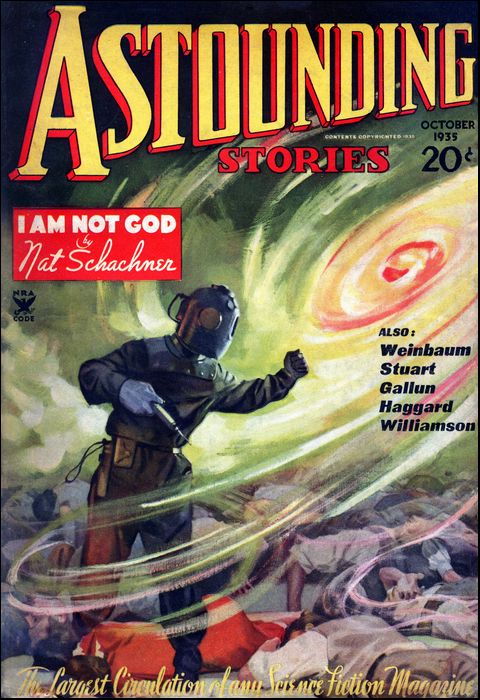
Astounding Stories, Oct 1935, with first part of "I Am Not God"
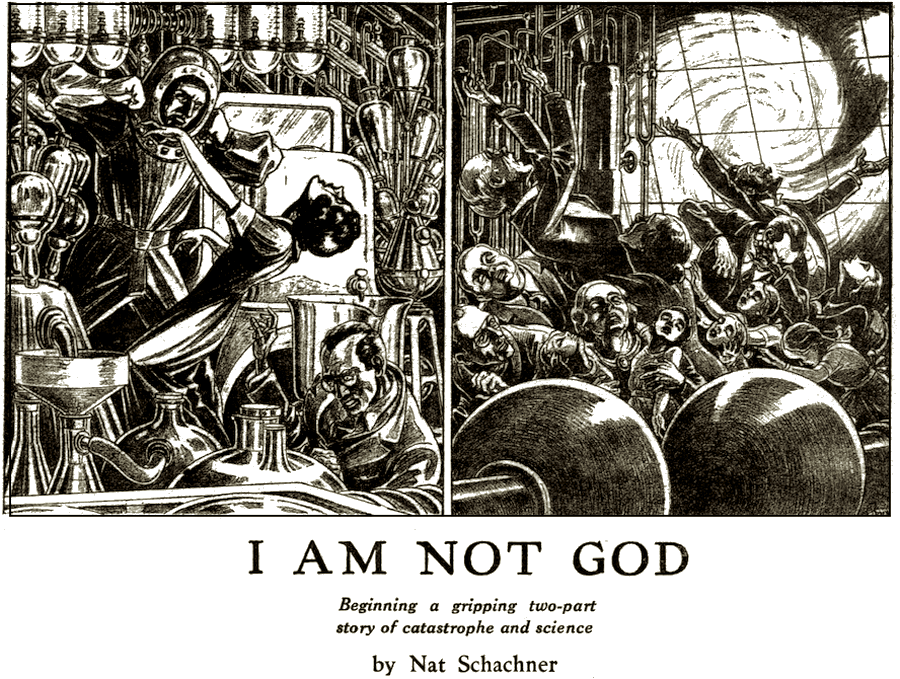
Deborah!She was trying to prevent him from loosening his helmet,
while all around him humanity was succumbing to the nebulat gas.
THE first appearance of the nebula was unexciting enough. It was small and inconspicuous, and but one of a dozen faint blotches of deposited silver on the exposed photographic plate of the new two-hundred-inch telescope. The astronomer in charge of the observatory checked the plate against the older ones in his possession, and found that this was a new nebula. But so were several others in that particular area—which was understandable enough, considering the increased light-gathering power of the recently installed instrument.
He therefore duly noted its position, jotted down that it was of the order of the twenty-fifth magnitude, gave it a catalogue number, G 113, and filed the plate away for further routine study. The discovery did not rate a line in the world's newspapers. But the scanty data appeared, in consort with other anonymous numbers, in the next issue of the Astrophysical Journal, a month and a half later.
It was there that Stephen Dodd first came across it. Ordinarily it would have meant very little to him also. But it happened that he was just then in the throes of a highly upsetting bit of research, and there was not a nebula in the entire universe, big, small or medium-sized, remote or near, in which he was not feverishly interested.
For the thousandth time his eyes clung to the tightly sealed flask that nestled with careful caution in its supporting cradle. Within it a greenish gas glimmered weirdly in the overhead illumination of the laboratory. For the thousandth time his eyes strayed, almost unwillingly, yet with fearful fascination, to the motionless, strangely stiff little body of the white mouse that lay unhearing, unseeing, within the oxygen chamber.
Steve Dodd shook his head savagely. Damn it! If only the mouse were dead, it would be understandable, normal. The green gas he had toiled over would then have been but another poison gas, lethal enough in all conscience—a deadly weapon to add to the arsenal of already over-sufficiently equipped nations—but nothing that did not fit into the established properties of familiar gases.
But that mouse lying there, still, motionless, was terrifying. For a month, ever since he had tried a minute spray of the new gas on its outer skin, it had not moved. Its heart had stopped beating, the most delicate tests betrayed no sign of breathing, of the normal processes of metabolism that continue without pause in a living body.
Yet the mouse was not dead. Its blood, skillfully withdrawn in hypodermic specimens, remained unclotted and fresh and bright-red in appearance. The organs showed no evidences of degeneration; the bacterial decay and loathsome putrescence that begin almost immediately on death were conspicuously absent. And, worst of all, its eyes, bright and beady in life, were still bright and beady and unfilmed. They seemed to follow Dodd with mute and hopeless pathos, as if imploring him to remove the weird catalepsy that had clogged its limbs.
Steve Dodd shook his head impatiently, in unconscious answer to that mute appeal. He had tried his best to bring life back to those tiny limbs with every device that modern science and medicine held available. Baths of pure oxygen, intravenous injections of digitalis, strychnine and adrenalin, electrical massage and short-wave treatments. Everything that his friend, Dr. George Cunningham, sworn to secrecy, could suggest.
But the mouse lay in its cataleptic trance, unmoving, unstirring, shriveling daily, wasting away to a thing of skeleton bones and loose, wrinkling skin, queerly alive, yet soon to die irretrievably.
Steve shivered, though the night was warm, and his glance went back to that strange, semi-luminescent green gas in the specially leaded glass container. That was another property about it which made it even more of a menace. Its remarkable penetrating powers! Ordinary glass was like a sieve to it, so were wood and stone and most of the metals.
Its first production had almost sent him, Stephen Dodd, into the place of the mouse. It was only the accidental intervention of a lead screen used in conjunction with his X-ray work that saved him. So the glass he now used was leaded, and he wore a special suit and helmet of fabric heavily impregnated with lead salts when he worked with the gas.
STEPHEN DODD was a chemist, and a very good one. He was internationally known for his work on the rare gases, and his laboratory was generously endowed by the Lauterbach Foundation. Yet he was not quite thirty, and possessed of decided views on a good many matters only remotely connected with the science to which he had devoted his life. Deborah Gardner, daughter of the famous astronomer, Samuel Gardner, who headed the observatory in the same university town, could vouch for that. Perhaps that was why, she thought tenderly to herself, Steve was the darling he was.
He had started his researches with the idea of duplicating nebulium—that strange, unknown gas which is found in most nebulae. Bowen of Pasadena had proved in 1927 that the three mysterious bright lines in the nebular spectrum—whose wave lengths are 5007, 4959 and 3727 Angstroms respectively—are due to multi-ionized oxygen and nitrogen under peculiar nebular conditions. But no investigator had been able to reproduce the mysterious lines in earth laboratories.
Dodd had thrown himself into the work with characteristic enthusiasm. For a year he had toiled ceaselessly, immured night after night in his laboratory with complicated apparatus and machines capable of generating giant electrical charges. Finally, using a modification of a De Graaff electrostatic machine, he had been able to superinduce multiple ionizations on a mixture of oxygen and nitrogen—in other words, plain, everyday air.
But, with success at his very door, the thing itself eluded him. For the spectral lines were slightly displaced. Allowing for all possible velocity shifts, they were still seven Angstroms each to the left of the corresponding line in the nebular spectra. It was infuriating. He had discovered a new type gas, but it was not nebulium, the gas he had set out to discover. At least, it was not the nebulium in any of the nebulae known to date.
THEREFORE he had called on Samuel Gardner, his good friend, and prospective father-in-law, to assist him—though not even to him had he disclosed the terrible properties of the pseudo-nebulium he had evolved. The secret of its manufacture must die with him; the very fact of its existence must remain undisclosed, unless somewhere in the universe it existed naturally.
Thus it was that Gardner good-naturedly analyzed the spectra of nebula after nebula, thinking young Steve a little bit crazy, but to be humored nevertheless.
Steve received the reports with a queer mixture of disappointment at repeated failures and relief that he would not be compelled to disclose what he had discovered. For nowhere in the universe were the nebulium lines anything but normal; nowhere was there evidence of the existence of pseudo-nebulium with its seven Angstrom units shift to the left.
Steve lifted the receiver mechanically, heard himself calling the observatory. After a decent interval, Gardner's quizzical drawl came lazily over the wire.
"Hello, Steve!" he complained, "this, is my busy night. If you've got any more fool nebulae for me, you'll have to count me out. I——"
"Listen, Gardner," Dodd pleaded, "this is the last batch. If you can't locate what I'm after to-night, I won't bother you any more." He had determined to give his scientific sense of fair play this final opportunity. To-night, after Gardner's usual report, he would destroy the flask with its dreadful contents, kill the mouse with weapons that left no doubt as to its demise, and forget all about it. Dr. Cunningham was close-mouthed, and besides, he did not know more than it had been necessary to tell him.
It was characteristic of Dodd not to have sought personal aggrandizement from the discovery, or to think even momentarily of the fabulous sums the war departments of the various nations of the earth would have paid him for the formula. He had very positive ideas on the subject of the nations of the earth and all their works. Even now, the mad race of armaments was nearing its inevitable close. The earth resounded with the rumble of mobilizations and the thunderous roar of tanks and motorized artillery moving everywhere up to the frontiers. Ultimatums were in the air and dates set for the vast explosion.
"Well," Gardner chuckled, "this once; but mind you——"
"Here they are," Dodd interrupted hastily. He read off the list from the item in the Astrophysical Journal. They were mostly fifteenth or twentieth magnitude nebulae. When he came to G 113 he hesitated. The twenty-fifth magnitude was a bit faint for Gardner's apparatus. For a moment he was going to leave it out—it was such an unimportant speck of gas somewhere in the far remotenesses of the universe. The fate of the world trembled on his indecision. Then he read it aloud.
"Now listen here, my boy," the astronomer expostulated patiently. "I can't get that magnitude. You know that. I have only a thirty-inch spectrograph, not a two-hundred-inch."
"Oh, well," Dodd responded indifferently. "If you can't locate it, you can't. And remember, my promise holds good. This is positively the last batch. If their spectra do not disclose the one I'm after, I'm through, washed up!"
IT was some three hours later, after 1 a.m., while Steve was dozing in his chair, fatigued from work and jumbled emotions, that the persistent ringing of the phone awoke him. He stared around, bewildered a moment, getting his bearings. Everything was quiet and very peaceful. The noise of the neighboring city had dulled to a stealthy murmur, the laboratory enfolded him in its illuminated quiescence, the green gas glowed steadily in its leaded flask, and the mouse was still stretched out, gaunt and unmoving, though still alive, in the oxygen chamber.
He shook the black mop of his hair out of his eyes, picked up the receiver. It was Gardner, his drawl forgotten, his voice muffled and queerly excited.
"Hello, Steve! Just finished the spectroscopic analysis of that list. Here they are." He bit them off rapidly, concisely, one after the other. Angstrom units of the three nebulium lines monotonously identical, as always. Then a perceptible pause. "About G 113 now, Steve. Sure you gave me the right coordinates?"
"Sure," Dodd answered sleepily. "But just a moment, I'll check it." He flung open the Journal to the right page, ran his finger down the list, then read aloud. "Right ascension—1 hour, 9 minutes; declination—plus 52.8."
"Humph!" Samuel Gardner muttered. "That's exactly what you gave me before, but——"
"Couldn't locate it, eh? Don't bother then. The magnitude is evidently too low for your instruments."
"You're right, Steve. I couldn't locate it, but there's another nebula, close enough by to be its twin. Listen to this! Right ascension—1 hour, 8 minutes; declination—plus 51.7."
"That's funny," Dodd said puzzled. "Must be the same one, but it's the first time I've known the Peters Observatory people to be caught in an error."
"That's not the only error," Gardner pursued, still with that queer tinge of excitement in his voice. "The nebula I have is of the order of the sixteenth magnitude, not the twenty-fifth."
This time Dodd was thoroughly awake. "But that's impossible," he protested. "A difference of nine magnitudes! Some one must have been drunk over there. I've a good mind to call them up right now and congratulate them on their staff. By heavens, I am. So long!"
"But wait," Gardner shouted, "I haven't told you——"
It was too late. Dodd had hung up and was already getting long distance. He was angry. If there was anything he prided himself on, it was meticulous accuracy, and here was the famous Peters Observatory——
Meanwhile Gardner was jingling the hook frantically, trying to get him back. But the operator was imperturbable. "The line is still busy, sir," she repeated sweetly, albeit a bit wearily, until Gardner swore and hung up in disgust. "The young idiot!" he muttered, and stared again with frowning intentness at the spectograph that lay before him, with its three bright lines plainly showing. Then he shrugged his scholarly-stooped shoulders. "Plenty of time in the morning to let him know, I suppose."
How could he know that every minute, every second even, was infinitely precious; that the continued existence of all life on this planet depended on those three innocent-seeming bright lines!
"Norman Kittredge?" Steve flung finally into the phone. The lengthy wait for a connection had brought his inexplicable anger to the boiling point.
A sleepy voice came through faintly. "Yes. Who are you?"
"Stephen Dodd, of East Haven. You're the fellow doing the plates for the new star map?"
"Dodd? Dodd?" the faint voice sounded puzzled. "Oh yes, the chemist. Sure, what about it?"
"Well, let me tell you something," Steve said carefully. Inwardly he was surprised at the irritation he felt. "You must have been drunk when you reported the coordinates for that new nebula, G 113."
There was a pregnant silence. Then Kittredge said furiously. "Now listen here, Dodd! If this is a joke, it's a damn fool thing. I don't know you personally, and I don't want to——"
"It's no joke," Steve retorted heatedly. "Look at that plate again, and check it against the figures in the Astrophysical Journal. Being out a degree or so in declination and a mere minute in right ascension may be not so bad—from your point of view; but when an astronomer of the Peters Observatory is out nine magnitudes, I'm giving him the benefit of the doubt when I tell him he was drunk."
Kittredge's voice was suddenly icy, carefully precise. "I'm going to make you eat those words, Dodd. I'm a fool for doing this; but I'm getting out that plate right now, and by heavens——"
The receiver crashed down on a faraway table. Steve waited, his irritated anger subsiding. He even grinned at himself. Wait until Kittredge got on again, meek and full of apologies.
"Hello!" It was Kittredge. "You still there?"
"Sure," Steve chuckled. "What's the story? Mislaid the plate?"
"No, Dodd," the astronomer answered coldly. "I have it right in front of me, and the Journal. If I was drunk then, I'm still drunk. The figures couldn't be more right. Now let me tell you what I think of you, young man." And for fifteen minutes he told him, steadily, continuously, without stopping for breath. It was an expert performance, and when Steve finally hung up, he was red all around the ears, his temples were wet, and his finger nails had dug red arcs into the palms of his hands.
"Whew!" he said to himself, almost admiringly. "That chap must have driven mules in his time." Then his thoughts swung to his future father-in-law. "Damn!" he muttered. "He got me into a peck of trouble. Must have been his idea of a joke. I'll get him before I forget all the neat phrases Kittredge used." And up went the phone again.
There was real relief in Gardner's voice. "I've been trying to get you, Steve——"
"Sure, it was a great joke, wasn't it?" Dodd interrupted. "Kittredge thought so, too. Wait till I tell you what he called me——"
"Joke?" Gardner echoed, astonished. "What do you mean?"
"Don't pretend. Those figures you gave me. The Journal had the right ones."
"Oh!" Gardner said slowly. Then: "Steve, I was not joking. Mine were correct, too."
"You mean——" Steve started aghast.
"I mean that within the past month and a half the nebula G 113 has moved that distance over the face of the heavens."
"Great heavens, man!" Steve exploded. "Then it must be right within the solar system."
"Not quite. You didn't give me a chance to tell you some very important things. The spectral lines of G 113 are all shifted heavily to the violet. I've calculated a velocity of fifteen thousand miles per second in the line of sight—an extra-galactic velocity. That means it's now somewhere within a few trillion miles of our system, where no nebula has ever been known to be, and coming toward us with fearful speed. I'll need another observation, a month from now, to be able to plot its course definitely."
Steve forgot his anger. He was immensely interested. But after all, this was more up Gardner's alley than his own. He had forgotten all about the fact that he had not been given the report on G 113's spectral lines.
"There is another thing," the astronomer continued. "You didn't give me a chance to tell you. The Angstrom units for the three lines. Let me read them to you: 500; 4952; 3720."
It took Steve a perceptible second to grasp what he had heard. Then his heart spun like a pinwheel within his breast. He could hardly breathe. "You don't know what you're saying." His voice sounded strangled. "It isn't so—you're playing a joke—it's——"
"My boy," the older man answered seriously, "the one thing I never jest about is my work. This is my life work, the air I breathe. Thanks to you I've discovered the closest nebula in the universe to us; with a velocity that is almost unbelievable, and showing the spectral lines of new elements. But how did you know? About the new elements, I mean. You've been mighty secretive, Steve, and I've humored you. But now——"
DODD stared with horrified eyes at the little flask with the green gas, at the mouse that was alive, yet shriveling slowly from day to day, and groaned. His scientific integrity demanded now that he publish the results of his work, no matter what the final outcome.
"I want you to come over to my laboratory right now," Steve said rapidly. "Now! At once! And bring all the data on G 113 with you. It—it's important as hell!"
He could hear Gardner taking a deep breath at the other end. "All right, my boy, if you say so. Be over in half an hour."
It was a fifteen-minute run by motor, but it was almost two-thirty when the doorbell rang. That hour's wait was the longest Steve had ever been compelled to undergo. He paced up and down the laboratory with quick, jerky steps, eying mouse and gas with alternate stabs, He was in a furious turmoil. Scientific integrity, tremendous discoveries, nations arming, horribly deadly weapon, consequences to humanity—phrases that spun round and round until they were empty of all content, of all meaning.
He jerked like a mechanical toy to the door when the buzzer sounded, flung it open with an impatient gesture. "Good heavens, Gardner," he cried impatiently, "it's about time——"
"Don't bawl dad out," a fresh young voice greeted him. "It wasn't his fault. I dropped in at the observatory just as he was leaving, and insisted on coming along. It took a bit of time to get rid of my friends."
Steve stared. "Deborah! What are you doing out this time of the night?"
"Emulating my elderly parent and the man who thinks he's going to be my husband," she retorted. "There was a party over at Jean's, and you were here, so I went on my own."
She was slim and petite, and the laughter glinted always in her eyes. Steve felt the tired lines around his mouth relax at the sight of her. "All right," he yielded a bit ungraciously. "If you're here, you're here. Though I would have preferred——"
The tall, slightly stooped, quizzical figure of Samuel Gardner followed his daughter in. Under his arm he held a leather portfolio.
"I told her the same thing, Steve," he groaned. "But you ought to know by this time——"
"He does," Deborah retorted. Her eyes roamed alertly around the laboratory, came to a dead stop on the glass tank in which the mouse lay silently. "This early morning conversation have anything to do with that little dead animal?"
"Plenty," Steve said in quiet desperation. "And he's not dead. Let me see those plates, please, and your data."
Gardner opened his portfolio without a word, spread them on the table. Steve studied the spectral lines against the standard comparison plate, checked rapidly through the calculations in deathly silence. Deborah sensed from the strained attitudes of the men that she had inadvertently muddled into something important, and she was levelheaded enough to make herself as unobtrusive as possible.
Steve finally raised his head. "It checks," he said wearily. Gardner stared at him. There should have been exultation, the thrill of some startling new discovery in his voice; instead, there was something akin to despair.
"If you wish to tell us," he started very quietly——
"Of course. I need your advice. Listen!" And for half an hour they listened while Steve poured out the story; father and daughter, engrossed, not seeing even the slow-shading dawn light over the quiet street outside.
"So you see," he concluded finally, "the dilemma I'm in. It isn't a question of fame and glory with me, heaven knows. I've synthesized a new air, a multi-ionized mixture of oxygen and nitrogen, and it's what I've called pseudo-nebulium. And lo and behold! Along comes a nebula, composed of that same deadly atmosphere, the only one of its kind in the universe. Scientists will want to know about those three lines, a shade of ionization under that of true nebulium. I hold the secret. What shall I do?"
"I say destroy it," Deborah answered promptly. Her eyes were wide on that motionless mouse. "Civilization is at a low enough ebb as it is. The world is preparing for a new era of slaughter. Put this new weapon in the hands of unprincipled men, and they will destroy humanity. You yourself say only lead will resist its penetrating powers. There isn't enough of the metal in existence to protect all humanity. Think, Steve, of millions of men, women and children, lying in a coma like that poor beast, shriveling away slowly, while nothing can be done to save them. A living death, far worse than actual annihilation."
Steve's eyes were grim. "You're right, Deborah," he said slowly. He moved quickly toward the fatal flask.
"Just a moment," Gardner's voice rang out. Steve swung around in surprise. Deborah cried desperately: "Father, don't let your scientific ardor run away with you. Don't you see what this particular discovery means?"
"I see everything, only too well. But Steve mustn't destroy that flask of gas, or the mouse. They both are infinitely valuable."
"Why?"
"I did not tell you, Steve," the astronomer said heavily, "because the data is still too fragmentary for accuracy. But now, under the circumstances, I must. At the terrific speed G 113 is traveling, its path through space may be considered for its relatively short distance from us as a straight line. From the two observations we already have, it looks very much as if"—he paused and took a deep breath—"as if it might pass very close to the solar system. But," he added hastily, "I'd need another observation, at least a month from now, to trace its course with real accuracy."
Deborah said, "Oh," very faintly. Lines etched themselves around Steve's eyes. He nodded, as if certain inchoate fears had been confirmed for him. "By close you mean of course a direct hit on our system," he said evenly.
"I didn't say that," Gardner answered quickly.
"You didn't have to." Again there was a deathly silence in the laboratory. The quiet dawn filtered slowly through the window, but no one noticed it.
It was Deborah who finally broke the unbearable weight of their thoughts.
"But father," she protested, "isn't it true that the earth has passed more than once right through cometary tails? I remember reading that in 1910 we were literally enveloped by Halley's comet."
Gardner lifted his head hopefully. "That's true," he murmured excitedly. "I had forgotten."
"And cyanogen is definitely known to exist in the spectra of comets," she continued quickly. "You wouldn't want a more deadly gas than that. Yet no one in the world died, or suffered the least inconvenience. Now comets' tails are rare enough—I understand that they are thousands of times less dense than our atmosphere at sea level, but I've also read that the density of the average nebula is considerably less even than that. It runs as low as ten to the minus seventeenth power that of the sun, or about a millionth of the best vacuum we can produce on earth. Isn't that so, dad?"
Gardner jerked his head in quick affirmative. His eyes glowed proudly on his daughter. "Quite right, Deborah. While G 113 seems more compact than the average nebula, yet I doubt if it is much more dense than the tail of a comet."
"Then," she burst out triumphantly, "what is there to worry about?"
"I used," observed Steve with strained deliberation, "a single drop in the form of an unbelievably fine spray on that mouse. It diffused through a five-gallon tank against air resistance. That is a pretty good approximation of a vacuum."
The hope died in Gardner's eyes. He squared his stooped shoulders. "There is only one thing to do, my boy. Publish our results. Warn the world. Furnish qualified scientists with the gas in the hope that they may find a neutralizing agent in time. And pray that my first rough calculations are inaccurate; that the nebula will swing outside the solar system."
THE late afternoon papers carried the headlines.
"FAMOUS ASTRONOMER AND NOTED
CHEMIST WARN OF LETHAL NEBULA.
PREDICT DOOM OF WORLD
UNLESS ANTIDOTE FOUND.
SCIENTIFIC BODIES MEET
HURRIEDLY TO EXAMINE PROOFS."
The cables took up the tale, the radio crackled frantically through the ether, until, by the second day, not a nook or cranny of the civilized world but knew of the Cassandra-like prediction.
By evening Steve's laboratory was a beleaguered fortress. The street outside was black with reporters, clamoring to the heavens for interviews. Sirens screamed as motorcycles cleared the way through heaving humanity for worried scientists, sceptical scientists, and just frankly curious scientists in search of data. The pronouncements of such a combination as Gardner and Dodd were not to be treated too cavalierly.
It was long past midnight before the clamor had subsided and the house cleared of visitors and barricaded against further intrusion. Steve was hoarse and his eyes bloodshot from much explaining; Gardner's shoulders sagged even more than usual. Only Deborah seemed as fresh and neat as if she had not been up for two days and a night.
The mouse had been studied from every angle, the flask with its deadly contents examined with respectful attention, and the spectra and astronomical data pored over with immense interest. The last was something definite. There was no question about the position and unusual velocity or of the pseudo-nebulium in its composition.
Only one thing did Steve refuse, politely but firmly, to disclose—the method for manufacturing the pseudo-nebulium. Inquisitive glances thrust surreptitiously toward his apparatus, toward the De Graaff machine, but Steve was not worried. The synthesis was a matter of complicated and laborious steps, and not to be fathomed by mere cursory glances.
THE thing was a nine-day wonder. The newspapers played it up sensationally; the Sunday supplements spread themselves with faked, synthetic photographs of cities choking under the effects of thick-billowing nebular gases. The magazines printed long interviews with prominent scientists. Apprehension rustled over the earth. Men looked up to the heavens for almost the first time in their lives, seeking in vain the tiny blob of light that might mean their ultimate destruction. It was of course as yet invisible except to the lenses of powerful telescopes. Scientists, medical men, furnished with minute samples by Dodd, busied themselves with the effects of the gas on animals, while a ceaseless search for an antidote went on in a hundred laboratories. Thousands of mice and guinea pigs and rabbits were offered up to the cause.
And everywhere, the animals lapsed into their coma, and wasted away gradually, the living dead, oblivious of all attempts to bring them back to normal life. The scientists were of course interested in the new discoveries per se—the astronomers over the onrushing nebula with its speed that had been heretofore associated only with the great nebulae of the extra galactic universes; the physicists were agog over the multiple-ionized air; the biologists and medical men over the deadly effects on life forms.
But the man in the street was vitally interested in just one speculation, and justly so. Nothing else mattered to him. If the nebula were to sweep through the solar system, and plunge all humanity into the strange, wasting coma, what profit then the ardors of pure science?
For a few days then the world suffered a bad case of jitters. Even the preparations for war ceased. Then seeming sanity returned. The official announcements of international bodies of scientists were calculated to have a soothing effect. In the first place, the data on the onrushing nebula was as yet too scanty for a prediction of its course with anything like accuracy.
To this, Samuel Gardner promptly subscribed. He pointed out that he had avowed as much in his very first statement. Then, too, Deborah's initial arguments had been taken almost verbatim by the scientists of the world as their own. Granting even a direct hit, it was argued that, aside from certain possible aurora-like effects, the earth would not even know that the nebula was upon it. Concentrations were calculated, vacuums were learnedly discussed. Old files on Halley's comet and other earlier envelopments were resurrected and published to the world for its reassurance.
The excitement died. Men even began to laugh good-humoredly over the recent scare. Jokes sprang up like mushrooms, in which nebula and nervous scientists appeared in ridiculous lights. The reputations of Dodd and Gardner suffered irretrievably from their published warning. The rumor spread that they were notoriety seekers; that somehow they had intended to profit by throwing mankind into convulsive fear. Life flowed on an even keel again. The interrupted preparations for war renewed at an accelerated pace. The nebula was forgotten. Astronomers watched it carefully, of course, but that was their professional business.
But in a certain chancellery in Europe the matter was not permitted to drop so easily. The War Lord, resplendently military in Nile green, was in conference. Close-cropped heads bent over outspread maps.
The War Lord raised his head. There was an eager gleam in his feral eyes. "Good!" he jerked out in staccato fashion. He loved to clip his speech. It sounded so military. "The fatherland is ready. We will strike, there—and there—and there." His blunt finger passed rapidly from red-inked frontier to frontier. "Troops, tanks, planes, everything is prepared."
"Everything," echoed his councillors. The War Lord drummed rapidly with his fingers on the table. He frowned. "It will not be easy," he admitted, half to himself. "Our spies report the enemy is also prepared."
A swarthy man in the much-decorated uniform of a general said confidently: "It is not necessary to worry. Our troops are filled with patriotic ardor. They will be irresistible."
"Hmmm!" The leader seemed doubtful. He pressed a buzzer suddenly. An aide swung open the door, sprang to attention. "Show Bollman in."
A little man entered. His eyes were bright and birdlike, and his mien was humble in the presence of the dreaded War Lord.
The dictator fixed him with a cold, penetrating stare. He loved to see the scientist cringe before him. It inflated his ego; it soothed the involuntary feeling of inferiority he possessed in the presence of those who had brains.
"That gas the American discovered," he commented abruptly. "It works?" The little man bowed deeply. "It does. Even as the American, Dodd, has stated. One hundred monkeys, two thousand rabbits, two lions, a tiger and an elephant are in comas induced by one cubic centimeter of the gas which I sprayed into the sealed and leaded enclosure of the zoo. They dropped, highness, as if felled, and they have not moved since."
"And there is no cure?"
"None whatever. Our staffs have tried; all over the world the laboratories are busy, without result."
"And what use," pursued the War Lord, "could be made of this gas in war?"
For the first time the scientist permitted his head to lift. His voice held a confident ring. "A dozen bombs, filled with pseudo-nebulium, dropped from a single fast plane over the largest city in the world, would release enough gas to place every man, woman and child in the area into the coma. Hiding in the deepest cellars, behind the thickest walls, could not save them. Only lead is impenetrable to its influence, and lead chambers to house millions, are—well——" He smiled significantly.
THE dictator glanced sharply around the circle of his advisers. Suppressed excitement was in their eyes, excepting only those of the general. He was a firm believer in Massenmensch, in the massed attack of countless hordes of men backed up by heavy artillery. Gas and such were mere toys, fit only for impractical theorists.
There was a faint grin of triumph on the War Lord's face as he swung back to the respectful scientist. "Good!" he clipped. "Within ten days you are to have ready a sufficient supply of this gas to fill ten thousand bombs—leaden bombs." The fingers of his right hand ran rapidly over his left, as if he were ticking off the number. "London! Paris! New York!" Satisfaction creased his smug features. The world was already at his feet. He, that once had been the digger of ditches, was smarter than those who had sneered at him! He had brains enough to avail himself of even the nebulae in the heavens, while his enemies, with their snobbish superior culture——
The little scientist cringed. Alarm sprang into his bead-like eyes. His hands made helpless fluttering motions.
"B-but, highness," he stuttered.
The War Lord descended rapidly to earth. He frowned. "Well, Bollman, what is it?" he demanded ominously.
"We—we can't get that much of the gas," the scientist managed to gasp.
"Why not?"
"Because, highness, we do not know how to make it. We have tried, and tried, but it is so far impossible."
The face of the dictator suffused with red. A dangerous sign. He took a step forward. "The American has done it, has he not?" His tone was deadly.
The scientist went white. "Yes, highness," he breathed hard, "but he has not told how. And no one else in the world has duplicated his method. He gave samples to our laboratories, but there is only half a cubic centimeter left."
The War Lord seized the terrified little man, shook him until his teeth chattered. "Stupid ass!" he screamed. "What good are you? You can't find the secret, eh? An American, a pig of an American, is smarter than you are, is he? Go back to the laboratory, and make me that gas within ten days, do you hear?" He flung the scientist away from him, stood there in apoplectic fury.
Bollman fled to the door. "Yes, yes, highness," he choked. "Your will is law. It shall be done." And he was gone, stumbling in his eagerness to get away.
The dictator rubbed his hands, smiled. "There!" he bragged, sweeping his eyes arrogantly over the motionless figures of his councillors. "That is the way to do things."
There was a hasty murmur of approval. But the minister of propaganda, unofficially known as the "brains" of the War Lord, remarked dryly: "Science is a coy mistress. Not even for your highness does she disclose her secrets on mere command. The ten days will pass, and Bollman will feel the sharp edge of the ax on his neck, but you won't have the gas. There is another and a more practical way."
"What is that?" the dictator demanded uneasily. He hated the minister of propaganda, resented his calm superiority, but he needed him.
"Buy the process from the American. Offer him money. No American has ever refused money," he answered cynically. "It is their god!"
"You are right." The dictator clenched his fist, pounded the table. "That will be your job. Offer him a million, ten million! Kidnap him, if necessary. With that gas, gentlemen, we rule the world!"
Two weeks had passed since the first preliminary announcement. The tumult had died. The eyes of the world had swerved to the threatening situation in Europe. All pretense at concealment had been contemptuously cast aside. The nations were ready, eager, under the lash of skillful propaganda, to surge at each other's throats. Bollman was dead, executed secretly as a traitor to the fatherland. The ten-day grace period had expired, and the requisite process had not been forthcoming.
Then there were other matters to divert the attention of humanity. Important, all-absorbing matters. A beautiful woman had killed her lover in Paris. The scoundrel had expressed a desire to return to his deserted wife and three children. The trial was on. The jury craned and almost broke their necks to see the defendant's shapely, crossed legs. They grinned lewdly at the lawyer for the defense—a clever man—read certain very passionate letters with unctuous, sly meaning. The courtroom was wired for broadcasting so that every detail could be carried on the wings of modem inventive genius to the tiniest tot in the land.
In England it was Jubilee Year. The King and Queen, the Prince of Wales, and all the little princelings, showed themselves time and again to a never satiated nation. The tableaux were terrific, the crush almost as bad. The papers boasted of the number of loyal subjects who fainted or suffered severe injuries in the mighty throngs.
In Germany there was scandal. Some one had dared accuse the leader of having non-Aryan blood in his veins. More, he had documentary evidence to prove his thesis. The nation rocked to its foundations. But the matter was soon satisfactorily explained. It had been all a mistake. The documents related to a man who had despicably assumed the leader's name at birth, in expectation of this very vile attempt to besmirch the leader's purity. He had been protectively removed, so had the accuser, so had the documents. Everything was lovely again.
Russia had no scandals. They were not permitted. But they were in the throes of renaming every city, town and village in the country. This evoked violent discussions, accompanied by the interminable drinking of tea. Some doddering oldsters insisted that Lenin should be similarly honored. At length a compromise was reached. A tiny village of some sixty souls, including pigs, cows and chickens, was formally christened Leningrad, and every one was happy.
But in the United States there was the Irish Sweepstakes. By a stroke of genius the hospital authorities had tied it up with the chain-letter craze. Mail a ticket to the top of ten names on the list, cross him off and add your own at the bottom. Eventually, with the patient aid of the mail carriers, over a thousand tickets in the great lottery would return to you, increasing your chances of success just that much. The lottery officials chuckled and took in millions of dollars. Every one was in it, from bootblacks to captains of finance. There was no other topic of conversation. A president was elected almost without an engrossed nation, knowing that there had been an election. Not half of the people could tell you the new incumbent's name.
NATURALLY, a nebula somewhere in space, that could not even be seen, about which some fool prediction had been made, was pushed out of the way. It was as dead as last year's best seller.
There was one place, however, where it was still a matter of grave importance, even in the face of these world-shaking events. That was the laboratory of Stephen Dodd. Gardner had obtained a new set of observations. G 113 was the order of the tenth magnitude now and shifting its coordinates rapidly.
"I am afraid there is not much chance of its missing us," he told Deborah and Steve gravely. "It is still an approximation, but——"
He stopped. There was nothing more for him to say. Steve cast Deborah a quick glance. "When do you think the collision will take place?"
"If it does, it would be in about six weeks from now."
Deborah cried out: "Dad! Steve!"
Six weeks between them and possible annihilation. Six short weeks for love and laughter and the warmth of human relations!
Steve clenched his fists desperately. "The fools!" he groaned. "Six weeks between them and death, and they won't believe." He flung open the window. "Look at them now; going about their silly tasks as if all eternity were ahead of them."
The street was thick with traffic. Autos moved in a solid queue; pedestrians dotted the sidewalks, intent and hurrying; the human ant heap buzzed and swarmed.
"Don't blame them," Deborah said quietly. "It is not their fault. They're been told by the scientific societies that there is no cause for alarm; that you and dad are either mistaken or charlatans."
Steve swung away, paced the laboratory with hurried steps. "If only the entire world threw everything else aside, devoted all the resources of civilization to the problem, a safeguard, an antidote might be found in time, and manufactured in sufficient quantities to save at least a sizable portion of humanity. Even lead chambers——"
"Would be of small value," Gardner pointed out. "There is not that much lead in the world. And furthermore, one could not live indefinitely in lead. Lord knows how long earth's atmosphere will be permeated with the deadly gas!"
Steve stopped short in his pacings. His eyes glittered with feverish intensity. "At least," he cried, "we can make the attempt. We are men, not animals to await extinction with helpless fatalism."
"What would you do?" Deborah asked.
"This! Get together a choice group of scientists, those whom we can convince. Work night and day on an antidote, build ourselves a lead-lined house, capable of being hermetically sealed, equipped with oxygenation apparatus, stored with food. Perhaps——"
"That will cost money, lots of it," the practical astronomer interposed. "I have none; you've used up all your grant from the Lauterbach Foundation. In the face of the unfavorable publicity we've received, no man of wealth would dream of financing us."
Despair settled on Steve's face. "You're right, Gardner," he acknowledged heavily. They looked at each other, the two men and the girl, feeling the future of mankind to rest on their precarious shoulders—a mankind that heeded them not and had already forgotten their very existence.
The doorbell rang—sharp, impatient, ominous. Deborah moved quickly, opened the door. A dapper, dark-faced man stood a moment in the doorway, then entered with a courteous gesture. His clothes were expensive and of foreign cut; his face was saturnine and slightly alien. His quick, dark eyes flitted rapidly around the room. His black sleek hair was heavy with pomade and curled slightly up at the corners of his temples.
"Like Mephistopheles," Deborah thought.
"Pardon me, my dear lady," he bowed and smiled. His English was impeccable, yet tinged with alien intonations. "I wish to have the honor to address myself to Mr. Stephen Dodd."
Steve stepped forward. "I am he. What do you want?"
"Ah!" The man's eyes rested with some astonishment on his youthful, powerfully built figure. These Americans were a strange breed. This young man should be an army officer, not wasting his time in potterings around laboratories. He shrugged his shoulders slightly. He had a mission to perform.
"It is an honor, sir, to meet you." He smiled expansively. "My business, is unfortunately, of a delicate nature, and requires—you understand——"
"We have something to take care of in the lab," Deborah said sweetly. "Come, dad!" She linked her arm in his, steered him out. The man's eyes followed her admiringly. Ah, the American women were pretty! Then they came back, focused sharply on Steve.
"This, sir, is my business. I need not inquire if you are in need of money. All Americans are, are they not?" And he laughed heartily.
Steve felt a vague dislike for the man.
But his ears prickled. Money, had he said? And how he needed money right now!
"I could use some," he admitted cautiously.
"Good!" the man said with an air of satisfaction. "Sir, I am authorized to offer you the sum of one million dollars in cash, immediately."
For a moment the room swayed around Steve. One million dollars! Was the man mad or just a practical joker? With an amount like that, he could——
Steve snapped out of it. "What's the catch?" he demanded.
"Catch?" His visitor seemed puzzled, then he smiled. "Ah, I know. One of your very charming Americanisms. There is no catch—as you call it." He inserted his hand in his inner coat pocket, took out an embossed leather wallet, spread it open, and delicately removed a check. He smoothed it out before Steve's astonished eyes. It was for one million dollars, payable to Stephen Dodd, Esq., drawn on the City National Bank of East Haven, and certified. Steve recognized the certification as genuine. His own very modest account was with the same institution.
IN a daze he heard the smooth voice of the tempter. "It is yours, my dear sir, in return for one very small thing."
With an effort Steve controlled himself. "And that is——"
"The exclusive rights to the secret of the manufacture of pseudo-nebulium. That is all. Nothing else. Not even your services will be required. Quite a satisfactory arrangement, is it not?"
Steve's head cleared. He was instantly wary. "I don't know," he said coldly. "It depends. Whom do you represent?"
The man seemed surprised. "Does it matter? One million dollars is exactly the same amount whoever offers it to you."
"Perhaps," Steve fenced. "But I don't sell unless I know the buyer."
"Even if the amount were raised to two millions?" the emissary asked insinuatingly.
"Not even for ten millions."
The agent of the minister of propaganda felt the blood rush to his head. What manner of fool was this American? It was maddening. He had received positive instructions not to disclose his superiors, but one look at this most surprising imbecile convinced him that he was up against an insurmountable obstacle. Terror seeped through him. He knew what awaited him if he returned with his mission unfulfilled.
He took a desperate breath, clicked his heels smartly. "It is for his highness," he saluted as he spoke the dread name, "the War Lord!" He dropped his hand, opened his wallet again, and took out another check. The fabulous figure danced before Steve's eyes. It was for ten million dollars!
Ten million dollars! His life, the life of Deborah, of this smooth-smiling tempter who stood before him, of the entire world, nestled in the crinkling folds of that oblong stretch of paper. A vision swam before him of the magic ink changing, by a sort of fierce alchemy, into a swarm of laboratories, into a thousand doctors, chemists, biologists, working night and day, seeking, searching, for the antidote that must exist, somewhere, locked in the secret recesses of plants, of trees, of drugs, of strange combinations of chemicals. Six weeks! What a pitifully short time!
Then the vision faded. It was a dream, an illusion. The War Lord desired his process. It was to be an outright, exclusive sale. The corners of his mouth tightened. He knew what that meant. He knew the particular brand of idealism his highness affected.
Pseudo-nebulium was a frightful weapon of destruction, was it not? In the hands of the War Lord——
What did it matter which way the world went to destruction—the hellish way of bombs dropping from fast planes, or the way of impersonal forces? His shoulders straightened. His face was grim and hard. If the world must necessarily become a mausoleum for the human race, let it be without the intervention of man's bloody hands.
The agent read the look rightly. It was a refusal. But he misunderstood the cause. He said hastily: "Ten million is the maximum I am authorized to offer."
Steve fought to steady his voice. "A million would have been enough," he said in cold anger.
The emissary felt perspiration bead his dark smooth forehead. Had he overbid in his anxiety? Had he——
Steve stepped close to him, fists clenched, lips writhing contemptuously. "Go back," he lashed out, "to your master. Tell him the process is not for sale. I know to what despicable use he intends putting it. Tell him I'd rather see all humanity extinct under the nebula than give him even the fleeting satisfaction of strutting as the ruthless conqueror." The young scientist laughed harshly. "Tell him in six weeks time we'll all be dead because he and all the other fools like him refuse to believe our warnings. Now get out!"
The man moved back a step from this insane American. He was desperate. Already he felt the ax on his slender neck. "I'll raise it to twelve million," he cried.
Steve clenched his fists. "Get out!" he repeated.
The agent stared at those capable hands in fright, and backed hastily out through the door. It slammed behind him with a definitive crash. For an instant he stood rooted to the ground, heedless of curious passers-by, staring at the obdurate door that meant his very life. Then he smiled faintly. It was not a pleasant smile. He knew certain compatriots of his in this town, men who would do the bidding of the War Lord. He hailed a taxi and drove rapidly away.
Inside the laboratory, Steve was writing furiously at his desk. He barely raised his head at the entrance of Deborah and her father. Six weeks! Six weeks! The words patterned themselves over and over in his brain as he wrote. The letters piled high before him—five, ten, twenty. Desperate appeals to certain picked scientists, scattered over the world, with whom he was personally acquainted. The letters bristled with arguments and mathematical computations of the deadly penetrative power of pseudo-nebulium, and invited them to come posthaste with their families to East Haven, together with all the cash at their disposal.
And high overhead, still unseen to the naked eye, a vast cloud of tenuous gas, millions of miles in diameter, was rushing with terrific speed through the cold reaches of interstellar space; a colossus, intent on its victim—a certain small red sun and its attendant train of nine circling planets.
THREE weeks later, a handful of people gathered in the living room of Stephen Dodd's house. Only a few had responded to his appeal. There were Samuel Gardner and Deborah of course. Also Dr. George Cunningham, Steve's friend, a round, jolly medico with a bald, pink expanse of forehead. Dr. William Clay, tall and pale and thin-lipped, an authority on glandular secretions and hormones, with his stout, comfortable wife and two little children, a boy and a girl. Henry Claiborne, the biologist, known the world over for his work on the genes of inheritance and the mechanism of the cell.
His weak, near-sighted eyes were eternally adoring the platinum blonde, sinuously curved ex-chorus girl whom he had somehow married. But her calculating gaze, sheathed by long, mascaraed lashes, appraised the men in the little gathering with interest, and lingered longest on the clean-limbed body of their host. As for the women, she dismissed them with casual contempt, except for Deborah. Their glances measured each other, and Deborah turned away with a queer feeling of dislike for the exotic, empty-headed creature.
Then there was Herr Josef Kuntz, a meek little German scholar, manifestly under the thumb of his massive, mannish wife. They had four girls, with scrubbed, shining cheeks and thick flaxen hair neatly braided in pigtails down their backs. It was hard to believe that Herr Kuntz was a chemist whose researches on colloids were classic examples of the scientific method. Monsieur Armand Hanteaux, with his huge black beard and expressive shoulders, was obviously French. It was not so obvious that he had penetrated further into the innermost vitals of the atom than almost any other man then living. He was there alone. Marriage, he proclaimed with Gallic freedom, was an institution for fools. He, Armand Hanteaux, let other men wear the fetters, while he—and his bold black eyes rested admiringly on the seductive lines of Clara Claiborne.
There was only one other in the little company—Oscar Folch, a subject of the War Lord. Steve had heard of him vaguely as a chemical engineer in charge of munitions plants. The fifty invitations that had finally gone out had not included his name. But Folch had shown up with a black hand bag swinging from bony fingers—dark, reticent, a man of few words. He had explained shortly that he had heard of Steve's plan, that he approved, and had come uninvited. Steve had welcomed him politely. He did not connect the appearance of Folch with the visit of the emissary from the minister of propaganda several weeks before.
Of the fifty, no others had come. Most had not taken the trouble to answer; some had written curt, abrupt refusals, imitating that Dodd was a bit cracked, if not a charlatan. A few had been more courteous in their regrets.
Steve made them a little speech of welcome. They were, he told them, the sole hope of mankind. Their resources were limited, and the time perilously short. They were leaders in their respective fields, and perhaps, by unremitting cooperative labor, they might evolve an antidote, a defense against the onrushing nebula before it seeped into earth's atmosphere.
"And if we don't?" queried Dr. Clay dryly.
Steve shrugged his shoulders slightly. "Sauve qui peut," he quoted. "We must try to save ourselves then. At least humanity shall not become completely extinct. With ourselves as a nucleus, men and women and children, we'd have to rebuild a world."
Clay's little girl let out a frightened wail. The prospect did not seem to please her very much. Deborah flushed and held her level eyes steady. Mrs. Kuntz sniffed audibly. Her child-bearing days were over.
Dr. Cunningham groaned comically. "A swell future you're mapping out for us poor bachelors, Steve." But Hanteaux's eyes were hot and admiring on Clara Claiborne. She bridled and shot him a long seductive glance. Her husband glowered at her furiously. It was evidently not the first time she had given him cause for jealousy.
"We save ourselves then," Oscar Folch said thinly. "How?"
It was the first time he had spoken at the meeting, and his voice jarred unpleasantly on Steve. Was there more than a hint of mockery, perhaps, in that thin, creaking voice?
But nothing of that appeared in Steve's tones as he answered. "We'll lead-sheathe this house and seal it against the penetrating gas. We'll install air-conditioning apparatus, and store food supplies sufficient for a year. That will be your job, Folch, and yours, Hanteaux."
"I would prefer working with the pseudo-nebulium," Folch announced calmly.
The blood rushed to Steve's face. He clenched his hands angrily. Gardner saw the explosion coming, and hastened to intervene. "There is one thing we must all understand," he told Folch gravely. "The project can only be a success if there is the strictest discipline. Mr. Dodd is the leader. I cheerfully submit to his orders and so must every one else. It is the only way."
Folch glanced inscrutably around the circle and saw nods of approval everywhere. "Very well, then," he said suddenly, and relapsed into his former silence.
Hanteaux rumbled in his beard. "A praiseworthy idea, Monsieur Dodd.
That is, if the nebular gas does not make the earth's atmosphere permanently poisonous. But what you ask for is expensive. Have we perchance a Croesus in our midst?"
Steve frowned anxiously. He stared at the taut, intent faces about him. "I've figured the costs," he said slowly. "It will take about a hundred thousand dollars. I have exactly seventy-four hundred dollars, including all spare equipment that I've already sold. Gardner, how much have you?"
The astronomer blinked. "Nine thousand, which includes three months' salary I managed to persuade the board to advance."
"And you, Dr. Cunningham?"
The rotund doctor grinned. "Besides my stethoscope, and an inestimable education which cost my late venerated father some twenty thousand, I have exactly six hundred and twenty dollars and thirty-four cents."
Herr Kuntz looked bewildered. "I have maybe a few dollars yet. It cost all my savings to bring my family here." Hanteaux rumbled something about several thousand; Claiborne was the wealthiest, with ten thousand; Dr. Clay had a little less. Steve figured quickly. So far the total was about forty thousand, and there was only Folch to hear from. He turned inquiringly to the engineer from the realm of the War Lord.
Folch shook his head sardonically. "I have," he bowed precisely, "my traveling bag—nothing else."
A tense silence held them. Even Clara Claiborne felt the weight of the situation and stopped her ogling. Then Steve's jaw snapped tight. "That means the 'safety first' idea is out. We'll use every cent of it on the finding of an antidote. Time is short, gentlemen. We'll get to work at once."
Not for a moment did the idea enter his head that, with the elimination of those without funds, notably Herr Kuntz, his wife and four scrubbed children, Dr. George Cunningham, and the uninvited Oscar Folch, there would be sufficient funds to build a smaller retreat for the moneyed people. Deborah felt the thought flash through her mind, and dismissed it with a shudder. She was more proud of Steve than ever before. They would live or die together, all of them. Those poor little girls with their shining faces and serious, pigtailed expressions! But she saw the sudden, hard, calculating look on Clara's face as her blue eyes flitted over the moneyless ones. The feline beauty turned to her adoring husband. "Darling!" she gushed, "I don't see why——
"That's enough, Mrs. Claiborne," Deborah flared quickly, eyes sparkling with anger.
"But——" Clara started.
"You heard what Mr. Dodd said," Deborah repeated firmly. "His plan is final."
Henry Claiborne stared bewilderedly from his wife to Deborah, and back again. "I don't understand——" he protested.
But his wife did. She shot a look of unutterable hatred at her antagonist, bit her lip until the marks showed white against the carmine of her lipstick, then smiled sweetly at the nearsighted, blinking biologist.
"It is really nothing, Henry, darling," she cooed.
THEY started at once. Not an instant could be lost. There were only three weeks in which to discover the antidote. Steve divided the work with swift precision. He took sole charge of the manufacture of the pseudo-nebulium to be used in the experiments. A vague, uneasy feeling made him more secretive about the process than ever before. Not even to Gardner, his father-in-law-to-be, did he disclose it. He shut himself up in the special laboratory, and permitted no one to enter its precincts. Several times he caught Folch in close proximity to the door with its intricate lock, but always he had a sufficiently plausible excuse for his presence.
The two doctors, Clay and Cunningham, as well as the biologist, Claiborne, worked cooperatively and with feverish intensity on the effects of the gas on a hundred newly martyred mice. In the laboratory, Claiborne, his uxoriousness forgotten, was a totally different man. Quick, accurate in his movements, precise.
Herr Josef Kuntz also sloughed his meekness. Chemicals flowed under his expert fingers in unending combinations, each carefully ticketed, and immediately forwarded to the biologic lab for injection into the quiet, unmoving mice. The original mouse martyr was nothing but skin and bones. Claiborne was positive that the spark of life still flickered somewhere in that emaciated frame; Clay was just as positive it had vanished completely.
Oscar Folch, in his engineering capacity, built apparatus as it was required by the others. There was no question that he knew his job thoroughly. He rarely spoke, but his eyes darted ceaselessly and inscrutably over every nook and cranny of the three-story building in which they were housed. Without quite knowing why he did it, Steve, after meeting his dark, mocking gaze, invariably turned back to his manufacturing chamber to make sure that the door was locked.
Gardner remained at the observatory for constant vigil at the telescope, coming to Dodd's house only to sleep and report. There was no question about it now. G 113, the runaway nebula, had grown to the order of the fifth magnitude, and was faintly visible to the naked eye on moonless nights as a patch of wan light near Sagittarius. It was only some twenty billion miles away now. At the tremendous speed with which it was traveling—15,000 miles per second—it would take only another fifteen days to engulf the solar system.
The observations were sufficiently extensive by this time for accuracy. There would be a direct hit. Gardner's figures agreed with those of other astronomers. The observatories of the world were excited over the approaching nebula. But none of them felt any untoward alarm. They announced comfortably that aside from a certain luminescence in the heavens, there would be no other effects. Their calculations, again tallying with Gardner's, proved it to be more tenuous than a comet's tail. What was there to worry about, then? The gray-haired astronomer came in for a good deal of joshing from his associates; the newspapers made merry over the immured scientists and their families in Dodd's house. "Noah's Ark," it was dubbed, and the name stuck.
Yet even so, the onrushing nebula rated headlines in the papers. After all, it was the first to penetrate the solar system. Scientists prepared delicate apparatus to examine and probe the innermost secrets of the strange visitant. It would have received far more attention had not the War Lord, tired of waiting, commenced his long-heralded attack. Bombing planes smashed huge cities, sent long streams of refugees—those who survived—into panic-stricken flight. Heavy artillery thundered, great tanks lumbered like monstrous caterpillars over shell-torn landscapes, poison gas enveloped hundreds of miles in a dense, searing pall. Millions of men, grotesque in gas masks, hurled like gray ghosts through the poisoned atmosphere, locked in furious combat. Nation after nation tumbled into the maelstrom. All Europe, all Asia, was aflame with battle and sudden death. Only America as yet was aloof from the turmoil.
Naturally, the nebula, now grown to a silver disk of light, was unimportant. Steve groaned and harried his little group to even more furious efforts. Only a week remained, and nothing—absolutely nothing had been accomplished. Hanteaux forgot to stare boldly and lecherously at the quivering charms of Clara Claiborne. His great beard almost immersed itself in the whirring apparatus he had evolved and Folch had constructed. He was attempting an electrical approach to pseudo-nebulium, to see whether it could not be deionized into normal, innocuous air by tremendous surges of current. But the strange gas was unusually stable, and its multiple ionization resisted all his efforts. The women, under Deborah's leadership, purchased supplies, prepared meals, ran the house, assisted their menfolk in the laboratories.
Funds were running low. Equipment was expensive and ate rapidly into their modest account. Steve tried desperately to interest certain men of wealth, offering them dazzling visions of being the possible saviors of humanity, of saving themselves in any event. He was laughed at, and dismissed with mocking words. He was a charlatan—the papers had said so. He and his associates at Noah's Ark were crazy predicters of the end of the world—and besides, there were immense profits to be had in the sale of munitions and supplies to feed the holocaust on the other side.
STEVE returned wearily from a last fruitless appeal. It was night. The nebula was plainly visible now, a shimmering flash of light across the horizon. Four more days! He shuddered. He thought of Deborah, with her steady, tender eyes, and felt sick all over. There had not been any time for love making. And in a few days——
There were the others too; the rest of mankind. He stared with strange intensity after the people as they hurried about their petty affairs, as though he had never seen them before. He tried to vision them all, moveless, shriveling slowly, as the mice had done—were still doing. Then his mood changed. A fierce anger gnawed at his vitals. Half the world was engaged in insane slaughter, for no other purpose but to feed megalomaniac ambitions. They laughed at him and his warnings, refused the very small sums, the cooperation that might have saved them all from a dreadful fate.
They were not worth saving, he cried aloud. A man stopped a moment, looked at him curiously. Steve moved on hurriedly. He must be in a pretty bad fix, he thought, if he began talking to himself.
At the laboratory, they huddled around him. He did not have to speak. They saw from his face that he had met with no success. It had been his last hope. To-morrow it would be too late.
Without a word Deborah came to him and put her slender hand in his. "Never mind," she whispered. "You'll manage it somehow."
He squeezed her cool fingers, shook his head soberly. "I think I'm on the right track," he said. "It's only a guess, of course. But there are certain very rare and expensive chemicals that I need. We haven't money enough to buy them. Money!" He laughed bitterly. "Trash that will be less than meaningless in four days."
Dr. Cunningham said quietly. "What do you need?"
"Three grams of radium sulphate, half a kilo of metallic scandium, a tank of krypton, and two kilos of lutecium chloride. Almost fabulous stuff. Kungesser's the only place in this country that carries a supply. They quoted me, after much scurrying, eighty-five thousand dollars for the lot. Might as well ask for the moon."
Dr. Cunningham said even more quietly. "You'll have it by to-morrow morning." For once in his life the jolly grin was gone from his rotund countenance.
A babble rose hurriedly. Gardner expostulated. "But how in Heaven's name, George——"
Cunningham cut him short. "Never mind. I said to-morrow morning." Without another word he left the room. They heard the front door slam, and he was gone.
Steve shrugged his shoulders. "Poor George! The strain's been too much. In any event, to-morrow's too late. The reactions I've calculated will take four full days, and midnight is the deadline. After that each hour, each second even, will be just about that much after the nebula envelops us."
Folch smiled for the first time. It was not a pleasant smile. "I think," he remarked thinly, "I can provide you with what you need, with money enough for all the experimenting in the world, within half an hour."
They stared at him. Steve's head snapped up. "What's that?" he demanded.
Folch repeated carefully what he had said. "I can offer you up to ten million," he stated calmly.
There was a sensation. Memory struggled in the back of Steve's mind. That was the exact sum with which the agent of the War Lord had tempted him.
Anger flared in him, burned down. He eyed the spy grimly. "And all you want in return is the method for manufacturing pseudo-nebulium, isn't it?"
For the first time Folch betrayed emotion. He fell back, caught off balance. "Why, how did you know?"
Steve laughed harshly. "Your fellow spy offered me the same amount weeks ago. And I turned him down.
Now go back and tell your master——"
But Folch had recovered himself. "I don't know what you're talking about, Dodd," he stated evenly. "I received word from a friend of mine, a millionaire in my country, only a little while ago. He is willing to give me that sum, but naturally he drives a bargain. He wishes to manufacture the gas for certain reasons——"
"Your millionaire is the War Lord," Steve broke in furiously, "and I know his reasons quite well. His dreams of conquest aren't progressing as smoothly as he had thought. The use of pseudo-nebulium in sufficient quantities would make him absolute master of the world. But——"
Folch's eyes glinted dangerously. "You are a pack of fools," he flung out to the others, ignoring Steve. "According to Dodd you'll be dead, or what amounts to death, in four days. Nothing can save you now. What does it matter if my country gets the secret of pseudo-nebulium? What difference would it make to you, to any one else? But the money that will be paid you would buy those supplies Dodd thinks necessary to his antidote. That means you will all be saved, while the rest of the world, including my countrymen, would have passed under the influence of the gas."
He was sneering covertly now, making mock of their foolishness. Yet it was a specious argument, carefully calculated to win them over to his side.
Mrs. Kuntz nodded her masculine head vigorously. "Do you hear, Josef? It makes sense. Say something!"
Poor Kuntz said timidly, doubtfully, "Perhaps then he. is right. Maybe it would be best——"
Clara Claiborne moved between her husband and Hanteaux. Her perfume intoxicated the Frenchman, enwrapped her husband. Her lips were parted, and panic stared out of her baby eyes. It had taken her a long time to discover just what it was these others feared so greatly, and only that morning it had really penetrated. Since then she had been hysterical. She wanted to live with all the ardor of her selfish nature.
"Give him your silly old secret," she panted to Steve. "I don't want to die." Henry Claiborne turned his nearsighted eyes on his wife with a strange, puzzling look. He said nothing. But Hanteaux bowed gallantly to her. "It is already done, chérie," he murmured.
Steve clenched his hands. "The answer is no!" he snapped. "Not even for a minute would I turn the process over to your War Lord."
Dr. Clay compressed his thin lips. "You forget, my dear Dodd," he said precisely, "that we also have something to say concerning our lives. We have invested our energies and our money, and we may be considered as partners. I suggested we take a vote."
Steve took a step forward. "Why, you——" he started in a choked voice.
The atmosphere fairly crackled with electricity. Folch waited, a saturnine look on his dark face. Matters were playing into his hands. Then Gardner moved into the breach. It was high time.
"Just a moment, Steve," he interrupted. He faced the others. "You of course realize that Folch and his master do not believe that the nebular gas will have any effect on humanity?"
"Naturally not," Folch answered contemptuously, and stopped short, realizing he had said too much.
"Exactly," Gardner pursued evenly. "If they are right, then you have placed a weapon in the War Lord's hands that will make slaves of the rest of the world. Oscar Folch was sent here deliberately as a spy, to steal the secret, to buy it, if possible."
"But we believe," Dr. Clay clipped out. "I've worked too long with pseudo-nebulium to doubt its effects even in concentrations approaching a vacuum. Folch was correct, even though he thought he was mocking us. They'll die from the effects of the gas, whether they have possession of the process or not. While we at least could use the money to perfect the antidote on which Dodd bases his hopes. What's wrong with that?"
ONCE more Steve was himself. He could see how plausible the argument was to the others. "This!" he told Clay. "The formula I evolved is purely theoretical at present. From certain physical data Hanteaux has furnished me, from the knowledge I have of the properties of the rare elements I mentioned, it seems to me that they, in certain combinations, would remove the ionization from the gas and bring it to the condition of ordinary air. Claiborne's experiments have shown definitely that the peculiar catalepsy it induces is caused by the permanent fixation of the molecules within the blood stream. Once pseudo-nebulium turns to un-ionized air, it will bubble out, and the effect dissipated. But mind you, this is all theory. It may work; it may not. If it doesn't, nothing will matter; sale of the secret, or no sale. But if it does——"
"Then certainly we are saved," Hanteaux rumbled.
"Yes," Steve flashed back. "But you forget that unwittingly I told Folch, as well as the rest of you, what materials I required. The War Lord has scientists also, and with more resources than we have at their disposal. They will duplicate our work, make the antidote in enormous quantities, inject it into their people. The rest of the world will succumb; only the subjects of the War Lord will remain."
"And ourselves," Clay amended.
"How long could we survive against his hordes?" Steve flung at him. "Unless we bowed our necks and became the meanest of his slaves."
There was silence at that. Only Clara whimpered: "I want to live! I want to live!" Her husband quietly edged away from her, his forehead puckered with struggling thoughts. The others sensed the dilemma, thrashed it out in their own minds. Folch, glancing keenly from one to the other, saw that he had been beaten. He moved stealthily toward the door. But he could not resist a last attempt. "The offer will hold good," he announced, "for exactly three hours more. Until midnight. After that——"
Deborah cried out suddenly. "But he knows the formula for the antidote already, Steve."
A snarl of triumph writhed over the spy's dark features. "Fools! Of course I do. Go on with your silly Noah's Ark. I'll have both gas and antidote within a day. Good-by!"
He swung around and darted through the door. But already Steve had left his feet in a long slashing tackle. His outstretched hands caught at Folch's legs. The power of his driving body knocked the spy off balance, sent him crashing to the ground. Within seconds Steve had dragged the stunned, half-unconscious man within the house, and locked the door. Fortunately it was night, and no one had seen the struggle from the street.
Within seconds more Folch was trussed up and carried bodily to a room in the upper story, where he was left bound and helpless, a prisoner.
"That's that," Steve said grimly. "If humanity becomes extinct, at least the War Lord and his legions will not be left to inherit the earth. And now let's get back to our work. Perhaps we can find some other method of deionizing the gas."
Despair was on every face. It took an effort of will to return. Hope itself was hopeless. No one thought of Dr. Cunningham's wild promise.
It was dawn again. Lights had burned steadily in the house. They were working day and night now. Sleep was a matter of snatches. Steve, hollow-eyed, gaunt, groaned as he gulped the hot black coffee that Deborah had brought him. "You're killing yourself," she said anxiously. "You must get some sleep."
He laughed mirthlessly. "Look at those mice," he said. "We'll all sleep a long time soon enough."
"On the track of anything yet?"
"Not a thing," he answered wearily. "The other formula had at least theoretic possibilities. Now I'm just going blind. Hello, what's that?"
Downstairs there was a commotion, a babble of voices. Then hasty steps, clearing the stairs two at a time. Dr. Cunningham flung into the room, panting, his rosy cheeks white with exertion. Under his pudgy arms were bottles. Behind him stout Mrs. Clay staggered under the weight of a metal pressure tank.
"Good Lord, George!" Steve cried. "What the devil have you got there?" Cunningham deposited his bundles carefully on the table. One was a leaden tube. Then he straightened, gulped twice before he could catch his breath.
"Let's see now," he glowed in triumph. "The lead tube contains radium sulphate; over there is metallic scandium; here is lutecium chloride; and that tank Mrs. Clay helped me with holds krypton."
Steve caught hold of his shoulder, gripped him with fierce intensity. "How did you get them?"
Dr. Cunningham's blue eyes opened innocently. "Let go, Steve, you're hurting my shoulder." Dodd dropped his hand. "That's better. How did I get the stuff? Simple. I took it." He chuckled. "Took it when they weren't looking. I really was cut out for a burglar. That is a profession. It requires skill, daring, a certain athletic agility"—he winced at the thought of something, looked down mournfully at his trousers. There was a long rip down the left leg. "Yes, sir, I mustn't forget the art of tapping a watchman not too hard on the head, yet sufficient——
"You stole!" Deborah cried, horrified.
Cunningham turned to her with a hurt look. "Stole? No. Just borrowed what those idiots won't need in a few days anyway, unless Steve here——"
Steve shook his head with a groan. "It's too late, George. By four hours. Your larcenous venture almost saved the world against its will. Four little hours!"
Deborah flashed out at him. "Steve!" she spoke rapidly, "never mind the four hours. Get started. Work as you've never worked before. Let every one drop whatever they are doing, concentrate on this one thing. Parcel out the task so that even a hundredth of a second is not lost—day or night. Your reaction-time calculations may be wrong; the nebula may reach here a trifle late; its period of Alteration through earth's atmosphere may prove longer than you anticipate. Hurry!"
Steve sprang into action. His face lighted up, even though inwardly he knew all the data had been checked and rechecked. But feverish work would take their minds off the inevitable doom; hope would still flare. He crackled out orders. The huge house became an ordered bedlam of activity. Every one pitched in—men, women, and even the smallest child—in a gigantic race with time, with onrushing death.
IT was the last day. The whole colony of Noah's Ark was huddled in Steve's laboratory, watching with dull, sleep-bleared eyes the last maddening reaction. It was a highly delicate, slow-moving affair. A glass chamber held the product of days and nights of ceaseless toil. The scandium and lutecium chloride were in complicated combination with more plebeian elements—phosphorus, hydrogen, oxygen and aluminum.
The formula was of staggering complexity. The last step consisted in forcing this black, powdery end-product into chemical union with the krypton gas in which it was bathed. Now krypton had always been thought to be chemically inert; that is, it would not enter into any reaction whatsoever. But Steve believed—and so his theoretic formulae seemed to indicate—that if the two were associated in the presence of a radium salt, the constant bombardment of emitted electrons and gamma rays would force them into the desired combination. And this combination should, according to theory, deionize pseudo-nebulium.
But unfortunately the process could not be hurried. There was no known method to increase the speed of emission of radium. All they could do was stand by helplessly while the radium kept up its constant bombardment on the black powder and krypton gas. Behind the glass chamber was a fluorescent screen. It was dark now. When that sprang into sparkling brilliance, it would mean that the radium emissions had finally completely saturated the mixture in the chamber, that the reaction was complete, and that the free electrons were hurtling through to impinge on the screen.
According to Steve's figures, that would take exactly ten hours longer. It was now six in the evening. At the stroke of midnight the penetrative molecules of the nebular gas would have sliced through earth's atmosphere as if it were so much butter. Hanteaux had proved conclusively, by painstaking experiments, that even the presence of one molecule of gas per cubic millimeter—a vacuum less than that of interstellar space—would bring about the weird catalepsy.
They, stood there, listlessly, watching. There was nothing more they could do——
Outside, the sun was setting in a strange smoky glow. Nightly the nebula G 113 had grown in intensity. The night before it had been a broad band obscuring half the heavens. Behind its strange, greenish glow only the moon and the brightest stars glimmered faintly.
Now it was rushing with inconceivable velocity through the belt of the asteroids, well within the solar system. Nothing could stop its mad flight. Not the bulks of Neptune or Saturn, not the vastness of Jupiter itself. All were enveloped in the poisonous vapors. Life, should there have been any on those planets, was wrapped now in wasting sleep. Within several hours more Mars would go into the trance; within six hours earth and all its teeming millions would be a huge mausoleum, a graveyard of moveless things. Only plant life would go on. The gas affected blood corpuscles only, nothing else.
In spite of the still-confident pronouncements of scientific bodies, a certain unease had swept over the world. That vast band of greenish light which obscured the night sky was terrifying enough in all conscience. Suppose, the whisper ran rustling around the earth, the prophesiers of doom who had immured themselves voluntarily in Noah's Ark might be right. They had been scientists of reputation.
Crowds milled ceaselessly through the streets of the cities, stared upward at the boding heavens. Even in shattered Europe, the war had languished for over a day. The troops refused to fight, waiting in their trenches for the fatal time limit to pass. It was silly, they had been told, but still—— Desertions from the ranks took on the aspect of mass movements, as soldiers fled secretly to their homes and loved ones, in case——
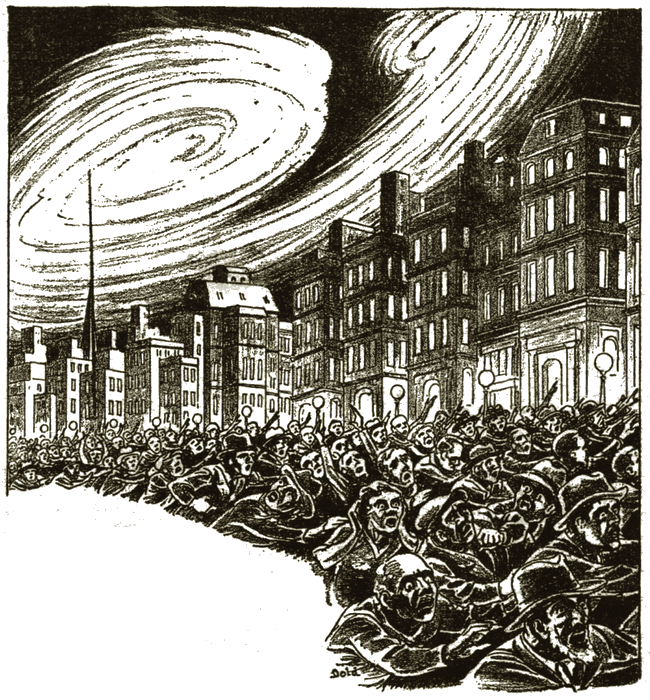
Crowds milled ceaselessly through the streets of the
cities. staring horror-stricken at the boding heavens.
The War Lord fumed and stormed in vain. He ordered decimation of certain mutinous regiments. The men died, but the living sullenly refused to move against the enemy. Then, wisely, on the advice of the minister of propaganda, he backed down. Another series of executions, and he would have had a first-class revolt on his hands.
The agent he had sent to America was not heard from—failure was the unforgivable offense—and Folch had disappeared, vanished. One could only wait for the passage of the nebula. In the stillness of his room the War Lord suddenly shivered. Suppose the fools had been right; suppose—— Bah! It could not be. Tomorrow when the dead line had been passed, and nothing happened, he would renew the attack on all fronts. He would send at once a swarm of armed agents in disguise to America, to get the secret of the manufacture of pseudo-nebulium by swift attack. Then—and a thin, cruel smile writhed over his lips.
OUTSIDE the windows of Dodd's laboratory in East Haven the crowds were gathering. Hundreds, thousands, until the street was packed solid with humanity. As the sun had died away in a green haze, the nebula had flashed into viridescent splendor. It was an awe-inspiring sight. A strange, pulsing glow that flashed across the heavens. Growing visibly larger, extending its boundaries, minute by minute. Star after star wavered, pathetic pin points of light, on the edge of the flare, then disappeared, swallowed in the maw of an insatiable monster. It was ten o'clock; two hours more. Mars was already penetrated with nebular atmosphere.
The crowd muttered and shuffled and stared upward at the lighted windows of the laboratory. The contagion of belief swept like a great wind through their ranks. That terrible green monster hurtling through space must be poisonous. The fanatics of Noah's Ark had been right.
Their voices raised in multitudinous babble. They cried aloud for aid. Suddenly the bemocked were greeted as the saviors of the world. Help us, they clamored! The world seemed to arouse itself to its peril, at this belated hour. The-telephone began to ring. Scientists phoned, their scepticism wavering under the impact of that vast band of green light, questioning, asking with carefully casual speech about the antidote, if any. Then came the deluge. Men of wealth, bankers, financiers, captains of industry, giants whose lives had been wrapped in impenetrable glamour, caught the last-minute fear, offered thousands, hundreds of thousands, millions, for the antidote.
Steve finally cut the wires. It was all so tragically ironic. Days earlier, money meant possible salvation of all humanity. Now, it was so much useless metal, curious symbols of nothingness.
But that did not stop the distraught men of wealth. Men somehow even in the face of death clutched with desperate fingers at the magic metal. Multimillionaires forced their way behind charging bodies of police to the locked doors of Noah's Ark. Steve had to talk to them. Otherwise in their terror they would have battered down the doors. He explained carefully and bitterly how vain their wealth was now; that it was too late; that the antidote had not been found.
They did not believe. They offered fabulous sums, all their fortunes, for admittance to the supposed haven of safety. They would have smashed their way through, had not other forces arrived, convoying other frightened men of wealth. Disputes for precedence arose, words turned to blows, to pitched battles. The street became a shambles of struggling, cursing men. Revolvers barked, machine guns suddenly clattered. The crowd fled screaming, trampling each other in their mad rush.
Soon only the dead and the dying were left.
The little group had huddled behind barricaded doors while the shout and the tumult was on. It was eleven-thirty now. One half hour more to live. One half hour between life, awareness, and the creeping sleep of inevitable death.
Steve hugged Deborah fiercely, openly, unashamed. Life would have been so glorious, and now——
They were all silent, even the children. Mrs. Clay held tightly to her little boy and girl. They were whimpering softly, somehow afraid. Dr. Clay was stroking his wife's hair awkwardly. He was not used to emotion. Mrs. Kuntz, masculine, domineering, had suddenly become pliantly feminine. She was clinging with brimming eyes to her meek little husband, and he was comforting her. Their four children stared with wide, serious eyes on the scene.
Clara Claiborne was hysterical. She cried wildly, again and again, demanding that Steve do something, that her husband save her from the hour of midnight. But her husband stared at her curiously with his near-sighted eyes and made no move. Steve did not answer, nor did Samuel Gardner, sitting quietly, with a certain dignified nobility, awaiting death. She turned with streaming eyes and disheveled hair to Hanteaux. The Frenchman, ordinarily gallant and attentive, turned away without a word.
Fifteen minutes to twelve! Steve's eyes were intent on the fluorescent screen. Nothing! Its surface was blank and dull. He crushed Deborah closer to him. Outside, the sky was a blaze of green luminosity. There was no moon, no stars, only the overpowering nebula. The street was clear. Even the groans of the wounded had ceased. But from afar came the frightened wail of a city in fear. The nebula was too imminent, too all-pervasive, for belief in the assertions of those who were optimists.
Steve said suddenly, "Darling, we have only five more minutes." Their lips met in desperate union. For a long moment there was silence, punctuated only by Clara's hysterics. No one paid her any attention. Then there was another sound. Of stumbling, fleeing feet. Down the stairs they went, across the living room. A door slammed shut. Dr. Cunningham remarked in casual voice: "Friend Folch has escaped."
Steve grinned mirthlessly. "Let him. It doesn't matter now—for him, for us, for any one."
Three more minutes. The screen mocked at them with its lusterless surface. The radium emanations shot across the canalized path, impacted steadily on the mixture. The black powder rested inertly in its bath of krypton. It seemed as stable as ever.
Deborah raised her eyes. They were brave and steady. "Steve, I want you to put on your lead-impregnated suit and helmet."
He looked at her in surprise. "Why, darling?"
"In case the reaction goes through. The suit will protect you against the gas. You might even be able to bring the rest of us back to life."
Steve laughed harshly. "It will take exactly four more hours for the final reaction. I can live in that helmet not over ten minutes."
"Try it anyway," she urged, "for my sake, for the sake of all these people.
My father——" Her voice broke; she could not go on.
"All right," Steve said. "I'll do it." The others watched him apathetically as he thrust his body into the lead fabric suit, as Deborah with quick-moving fingers fastened the helmet into place. No one else made a move to help. It was silly; it was worse than useless.
Clara Claiborne let out a wild shriek.
Her eyes were wide on the clock on the wall. It was striking midnight!
BONG! Bong! Bong! Strokes of doom. Hammer thuds counting out death to them, death to all humanity, death to a swarming earth. The great experiment called life was irrevocably over. Nothing could be heard but the remorseless blows of fate, and the frothing hysterics of Clara. No one went to her as she slumped in her chair in a faint.
At once all eyes turned for the last time to the screen. Its dull surface was unmarred. A deep suspiration went up, the sacrificial offering of those about to die. They huddled close together, like sheep before the butcher's mallet.
The last stroke died on the air. Silence, impenetrable, profound! Even the city outside seemed wrapped in silent fear. All the earth was cowering in the presence of the visitor from extra-galactic space.
For a moment time itself seemed to stand still, to stretch itself into an eternity of expectation. They were a tableaux of wax figures, unmoving, hardly daring to breathe. God knows what emotions each one experienced, down to the smallest child, waiting, suspended between infinitudes. Each inhalation might bring with it the deadly molecules of pseudo-nebulium. They had seen what had happened to mice, to guinea pigs.
A minute passed, and the thudding of their hearts filled their ears with alarming sound. Two minutes. Hanteaux stirred. "We are still alive," he growled shakily.
"That does not mean anything yet," Gardner said calmly. His eyes were fixed with painful intensity on his daughter. She was clutching the heavily clothed arm of Steve.
Thee minutes—four minutes—then five——
Outside, the earth seemed to shake itself in bewilderment. A low hum arose, the half-hopeful buzz of thousands of voices. It rose in intensity; it became a joyful paen of humanity released from its fear. The dead line had passed, and they had not died.
Dr. Clay threw back his head and laughed. Hysteria shot through his laugh like a scarlet thread. As if a spring had released them, the others moved. They jumped to their feet. Hanteaux's eyes glowed on the limp form of Clara. He ran to her, lifted her up. Claiborne stared at him with furious, hating eyes, but did not move. The others chattered with the reprieve from annihilation. Outside, the paean of joy that swelled from the city's thousands had taken on an uglier note.
Dr. Cunningham cocked his ears. "It sounds," he remarked gently, "as if our friends of the human race resent the fact that we might have misled them. We had better prepare to receive visitors shortly."
Mrs. Kuntz sprang away from her husband as if ashamed of her excess of tender emotion. She glared owlishly at the grotesque, motionless figure of Steve.
"It's all your fault," she screamed. "You fooled us: you scared me and my idiot husband to death. We are penniless now, do you hear—penniless! I hope they tear you to pieces. Josef!" She swept him and the four little girls into the compelling folds of her glance. "We go from here—now—at once!"
Josef Kuntz looked at Steve and Deborah imploringly. Then meekly he followed her. "Yes, Anna!"
Dr. Clay said maliciously. "Might as well take off your mask, Dodd. Too bad——"
He stopped on the word. A puzzled expression flitted over his face. His body stiffened. Slowly, very slowly, he went toppling to the floor. His stout wife screamed, took a step forward, and dropped. Steve wrestled frantically with the screws of his helmet.
It had come! The nebula G 113 had arrived, seven minutes late, but with deadly effect. All around him they were dropping, huddles of limbs and clothes on the floor, unstirring where they fell. God! One frantic thought burned in his mind, seared all other thoughts with shriveling flame. Deborah! She must get that last few minutes of life, not he. Her dear face wavered before the leaded lenses of his goggles. Something was happening to her. Her arm went up with infinite slowness, jostled his fingers. She was trying to prevent him from loosening the. helmet. Then her mouth opened, did not close. He caught her as she wilted. He set her down in a chair. Horrible stillness reigned in the room. All had succumbed to the deadly, invisible molecules of the nebular gas. The silence spread over the city. The storm of voices had cut off abruptly.
He was alone, horribly alone, in an inimical universe. Of all the earth and its teeming millions, he only was still alive. The last poor solitary specimen of the curious thing called life. He strode clumsily to the window, stared out. The street was a graveyard. The dead and the living dead were indistinguishable. Nothing stirred. Hundreds of bodies lay in the sleep that would never end. He raised his eyes to the heavens. The nebula was a green flame enswathing the sky. It was a glowing pall that draped the earth it had doomed to extinction; it danced and mocked with hellish fires.
Steve lifted his fist and shook it fiercely at the merciless visitor from outer space. He, the last man on the lifeless ball called earth, cursed it and shouted senseless defiance. The skies seemed to rock with cosmic laughter at their puny antagonist. G 113 had done its appointed task. Within a day it would vanish, trailing its frightful speed farther out into space, seeking new solar systems, new galaxies, new universes to stifle with its tenuous breath of destruction.
Steve choked suddenly. His futile curses had used up the air in his helmet. He gulped and breathed in no oxygen. His chest labored, his heart hammered. He staggered back into the room. He would die at Deborah's side. Die, too, cleanly and swiftly, by the cataleptic trance of pseudo-nebulium, not by the horrible retchings of suffocation. He tore with frozen fingers at his helmet. The screws turned slowly. His tongue lolled out of his swollen mouth. Air! Air! Poisoned or not! Anything but this frightful choking sensation.
Ah! There it was coming! Another turn and the helmet would drop back. He would take one blessed gulp, then——
His fading eyes lifted for a last look at the peaceful figure of Deborah. They wavered on her, blinked.
The fluorescent screen was a glittering sparkle of dazzling, tiny pin points! Within the glass chamber the black powder had disappeared. In its place a dark-red liquid caught the light, winked at him with beaded bubbles. The reaction was complete!
Complete? What tragic irony? All were dead; he was dead, or as good as dead! The blood was roaring in his ears, his throat a tight constriction of fire. His feet, weighted with the leaden fabric, were rooted immovably to the floor. Too late! Everything was too late! Even if that wine-dark liquor held the elixir of life, even if it were capable of its theoretic possibilities!
Pain racked his frame. His heart seemed to have stopped its pumping. The room was growing dark around him. His eyes drooped, clung dimly to the still form of Deborah. Deborah! Brave girl! She had urged him on, she had never given up hope. She——
He was failing her, was not worthy of her confidence. The thought fumbled in his clogging brain, swirled around. He was failing her. Darling—must not—the haze deepened—he moved somehow. His legs were tons, but they moved—moved toward the glass chamber. The screen seemed to swell, the coruscating sparks filled the room, the universe itself.
His fingers were not a part of him. Yet instinctively he knew they had picked up the plunger hypodermic that lay prepared on the stand before the chamber. In a red blaze of gasping lungs he knew that somehow he had turned the pet cock, that the red liquid had poured into the basin before it.
He was only semiconscious now, yet under the driving impact of Deborah's trust, his gloved, icy fingers held the hypodermic steady in the new-born liquor, sucked it up. The last movement was unbearable agony, yet it was completed. There was no time for zipping open the suit, no strength for it. With the last expiring spurt of superinduced energy he drove the sharp needle through the thick fabric, through the skin and flesh of the arm beneath. The plunger went home.
Even as it did, he dropped as if shot. The deadly molecules of pseudo-nebulium had sped along the steel of the needle as if it were a tenuous medium, had penetrated into the blood stream. Gas and theoretic antidote flowed simultaneously through his body.
His head struck heavily against the floor. Cataleptic rigor seized his limbs. There was a splintering crash. The lead-glass windows of his helmet had smashed. Air streamed inside. A second's awful clarity while his mouth and nostrils involuntarily gulped in the rush of oxygen. Too late, too late! His head sagged to one side, and he was still.
The laboratory was a huddle of unmoving forms. The city of East Haven was a vast mausoleum housing the sleeping dead. All over the world life had ceased. Ships swung pilotless to the beat of the waves, railroad trains thundered along steel rails until fires foundered, or they went splintering and crashing into stalled trains ahead. The armies lay in their trenches, heaps of moveless uniforms, locked in the same strange embrace of life-in-death. The War Lord sagged over the maps in his private chamber, arms spread greedily over territory that he could no longer conquer. The animals lay in the fields, and the birds had dropped like plummets to the ground.
The earth revolved ceaselessly in space, on its appointed orbit around its mother sun, feeling no longer the slow, crawling progress of parasitic life across its stony bosom. And overhead, all around, interpenetrative, the nebula mocked with green fires, careening through space with unbelievable speed, its unknown destiny still unfulfilled.
Next month Nat Schachner tells how a man tried to guide the destinies of
a new world. It is a very human, very thrilling conclusion to a great story.

Astounding Stories, November 1935, with Part 2 or "I Am Not God"
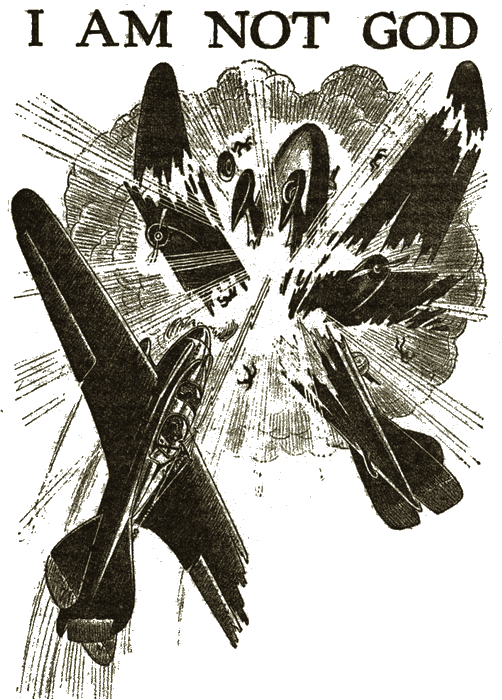
The crew of the bomber evidently sensed their purpose to crash. They
swerved desperately Steve uttered a prayer and swung straight into its path.
A new nebula, known as G 113, and radiating a poisonous gas, pseudo-nebulium, has just been discovered by an astronomer in the Peters Observatory. Stephen Dodd, chemist, has discovered the secret of pseudo-nebulium. Having experimented on a mouse, he has worked ceaselessly and unsuccessfully to find the antidote which will restore life to the victim.
Samuel Gardner, famous astronomer, with whose daughter Stephen is in love, is actively interested in the experiment, although not even to him does Stephen disclose the terrible properties of pseudo-nebulium.
About the time that the War Lord, ambitious dictator of a foreign country, takes steps to appropriate this new poisonous gas and become ruler of the world, Stephen discovers that the recently discovered nebula is directly approaching the earth at an incredible speed, surrounded by a gas that is fatal to all humanity. Only a few, however, have faith in his prediction.
The War Lord, failing in his attempt to acquire pseudo-nebulium, sets about forcefully to conquer the world. Stephen, unable to obtain sufficient funds to carry on his search for the antidote calls in Dr. George Cunningham, Dr. William Clay, Henry Claiborne, Herr Josef Kuntz, and Armand Hanteaux, all specialists in medicine or biology. He convinces them of the danger, and they join him in his work.
Oscar Folch, secret agent of the War Lord, uninvited, comes to the meeting, and is accepted because of his ability to build apparatus.
In the midst of the proceedings, the nebula reaches the orbit of the earth, and all humanity is stricken by the gas with the exception of Stephen who, in a lead-impregnated suit, carries on his experiment, until he, too, is overcome. But the antidote has begun to function——
LIGHT struggled painfully through the welter of darkness. Huge waterfalls roared somewhere in the darkness; the noise of falling waters grew in intensity until it was almost insupportable. Trip-hammers took up the refrain, pounded on hard rock with repetitious thunders. Steve's skull was bursting; he could not stand the unending clamor any longer. He thrust out a feeble arm to ward it off, to brush it from his consciousness as though it were a cosmic buzzing fly.
Then he sat up, pulling himself erect against the weight of the lead-saturated suit in which he was clothed. What was the matter? Where was he? What had happened?
Bright sunlight streamed through the street window. It was warm and dancing and golden. No haze obscured its mote-kissed passage, no green tinge gave it a sinister tone. Steve pressed his aching head with a gloved hand, and found hard metal in the way. Why had he thought just then of green? Why had the color evocation brought unaccountable shivers to his pain-racked body? Why was he dressed in helmet and heavy clothes?
His bleary eyes moved painfully around. They fell upon the glass tank, empty now, upon a screen which even in the bright radiance of the sunlight gave off little dartles of flame, upon a deep receptacle under a pet cock in which a heavy, wine-dark liquor glowed like a stained glass window.
With a weak cry Steve thrust his weighted form upward. His hands tore at the broken helmet, sent it crashing across the room. He swerved unsteadily around, dreading what he would see. A great groan burst from pale, quivering lips.
Deborah sat in her chair, slumped slightly over, as if she were asleep. All around the room, huddled into contorted positions, lay the others; silent, unmoving, fixed in immutable catalepsy.
Awareness flooded Steve then. The events of the past few days swarmed in his consciousness. The deadly nebula from extrastellar space had passed through the earth as though it were a sieve, had gone on its way, leaving behind—what?
He staggered to the window. It took a tremendous effort to lift the sash. He leaned out dizzily. Once the street had been a main thoroughfare; now it was a desolation and a grave. Thousands lay just as they had fallen, sprawled on the sidewalks, flooding the asphalt with heaped forms. An automobile had telescoped itself against the side of a building. Behind it was a trail of crushed and mangled bodies.
He hung limply to the sill. It was gradually coming to him, slowly, but inexorably. In all this world of former teeming millions, in all this earth where humanity's hordes had lived and loved, fought and hated, read the stars and soared on the viewless wings of the imagination, groveled in the slime, lusted, hungered, pondered, coveted, and been both beast and god, inextricably intertwined—he alone was alive! He, Stephen Dodd, heir of all the ages, sole existing representative of the human race, emperor of the earth, possessed of all its gold and fabulous wealth, of buildings and harvests and forests and the fruits thereof, of yachts and machines and tools and precious gems.
Then suddenly the mood dropped from Steve like a cloak. Fear gripped him tight. Alone! No more horrible word had ever existed.
Steve pressed his eyeballs with tight fingers. If only he had one person with whom to share this terrible desolation; if only he could look into human eyes instinct with sympathy, with comprehension; if only he could hear the sound of another voice to break this awful silence. He had tried his own, and he would never try it again. It had shrilled with approaching madness.
His arms went out blindingly, imploringly. Deborah! If only she were alive to share his domain, life might yet be bearable.
Exalted for the moment he turned to see the girl moveless in her chair, even as the others, immersed in the strange sleep of pseudo-nebulium from which there was no waking. The fuddlement had not quite left his brain.
Then his eyes wandered in a stupor of despair, rested once more on the dark-red liquid. Out of the corner of his eye he could see the hypodermic on the floor, where it had dropped as he had fallen.
HE blinked. A vague excitement filled his veins, surged into ecstatic awareness. Fool that he had been! Of course! How else had he managed to survive the holocaust? He remembered now—Deborah's insistence on his donning his protective suit, the slow suffocation, the completion of the reaction, his last desperate efforts to inject the fluid before he strangled, the sharp jab of the needle—then darkness.
He could hardly catch his breath. Would it work again—now, after the gas had had time to fix itself into the blood? Was the time element important? How long was it since the nebula had come? How long had he remained unconscious?
It had been midnight when they had succumbed. It was bright day now—from the position of the sun, it must be just about noon. He looked quickly at the clock on the wall. The hands pointed to ten minutes to six. It had stopped. A cold hand clutched his heart. It was an eight-day clock, and he remembered distinctly rewinding it on the morning of the fatal day. Poor George Cunningham had even made some jest about winding it only one sixteenth of the way. They wouldn't need it after that.
That meant only one thing. More than eight days had elapsed while he had lain in his coma. How much longer? It was impossible ever to know. But the bodies of the stricken people, his own, too, had not wasted appreciably. He remembered the first mouse. It was about the twentieth day when it had started to shrivel.
With grim tautness he divested himself of his clumsy suit. There would be no more need for it. With painful deliberation he picked up the hypodermic, washed it clean. Then he dipped it into the liquid antidote, withdrew it again. For long seconds he stared at it in fascination. He was surprised to find his hand steady and rigid. On that sharp, glistening instrument depended——
He started to shake. Deborah!
Gardner, her father! George Cunningham! The destiny of a world hung breathless in the balance.
He straightened savagely, walked with careful slowness to the side of the girl he loved. She was asleep, or dead, or a strange combination of both. His heart thumped at the sight of her sweet oval face, her eyes mercilessly closed. Thank heavens they were not open! The needle point grazed the smooth satin of her forearm. Eternities of dreadful hesitation. Then it sank deep into the flesh. He quickly pressed the plunger——
Steve's eyes burned into the limp form before him. But there was no movement, no change, no sign of returning life. A vast, helpless despair seized him. Better if he, too, had succumbed with the rest of them. Better anything than this aching solitude. Fool! You were unconscious for more than eight days before the antidote worked. Why do you expect miracles now? But he found no comfort in that, for he knew the answer. The nebular gas had impregnated the atmosphere that length of time. As fast as the elixir deionized the fixated molecules in his blood, more had taken their place.
A fierce resolve shook him. He took a deep breath, squared his shoulders, and walked steadily toward the cradle in which the flask still rested with its green-glowing contents. The pseudo-nebulium he had evolved. One quick, sharp tap-, on the leaded glass, and the lethal gas would flow over and through him. The last solitary spark of life left in the world would flicker out. He would be at one with his fellows. It was the best way.
His hand made a fist as it raised high in the air. And there it froze. For there was a strange sound behind him; the sound of some one stirring uneasily in a chair. He whirled and raced for the girl. "Deborah!" he cried. It was a sob, a joyous shout, a prayer of thanksgiving. He was no longer alone!
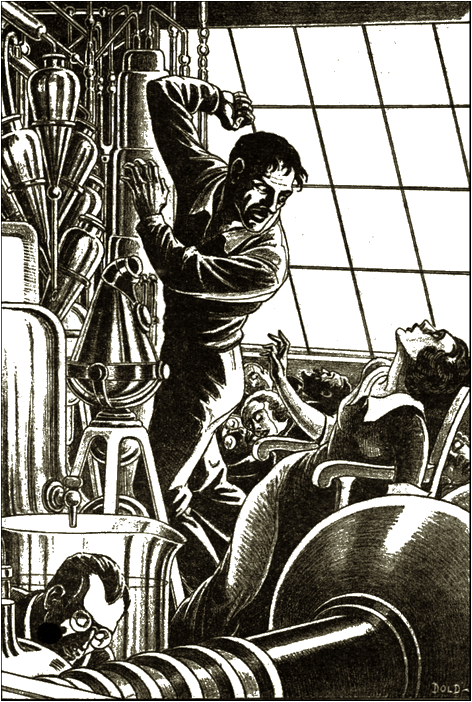
Steve's hand made a fist as it raised
high in the air. And there it froze.
Her eyes were sleepy with tenderness upon him as he enfolded her in his arms, and felt the blessed beat of her heart against his. "What happened?" she whispered.
He told her, hugging her fiercely all the time as if she might slip away from him again into the limbo of forgotten things. Her eyes widened as the story unfolded.
"Listen, darling," he said finally. "It had just come to me again—a vision!
Do you know what we are? A new Adam and a new Eve! Man and woman created, we ourselves, to inhabit a new earth. Think what it means! With us, just the two of us, might rest the future of this planet, the rebuilding of a cleaner, finer, better world." His eyed burned on her with mounting enthusiasm.
"Perhaps the catastrophe of the nebula was nature's method of cleansing this planet of the vermin who inhabited it, to make room for a race of supermen.
Humanity thus far has been an experiment that turned out badly. For thousands of years they have struggled from the ape, aspiring toward the stars. For a while it seemed as if they were succeeding. But as they grew in knowledge, in the mastery of nature, they descended more and more into the brute. Look, darling, at the civilization which has just been erased. Man fought with man, with sly cunning, with greed and selfishness, with the weapons he wrested from the earth. There was enough for every one; yet most of mankind starved. There was room for all, yet they killed and mangled each other to gain territory they could not inhabit. A filthy world! a vile world! Thank Heaven it has been cleansed and purified."
He bent closer to her, whispering. "Our children will inherit the earth. We shall teach them the learning of mankind, and—what is more important—love and generosity and kindliness and the dignity of the individual. Don't you see them down the vistas of time, creating a new paradise?"
Deborah flushed, and closed her eyes as if to savor the vision. Then she opened them again with a start, staring at the sprawled form of Samuel Gardner, her father. A layer of dust covered his clothes, his thin, kindly face.
"Oh!" she wailed, "to think we had forgotten. Steve!" She grasped the young chemist's arm imploringly. "You must wake him at once!"
Steve shook himself like a swimmer breaking surface water again after a long dive. It had been a good dream, but—— "Naturally, darling," he muttered. Samuel Gardner was his friend, possessed of all the qualities he had enumerated. The new earth needed him. And he was Deborah's father. So it was that some ten minutes later Deborah was sobbing affectionate explanations into the ear of a rather befuddled parent.
GARDNER looked around with a little shiver. "Do you realize what you are now, Steve?" he said very slowly. "The sole and absolute arbiter of life and death for each and every individual in the world. You have the power to save or destroy the race with a gesture; you can pick and choose and say, 'this man lives; this man dies!' The destiny of mankind rests in the hollow of your hand. Great heavens, Steve!" he went on with a tinge of awe, "you are almost in a position to play God!"
The young chemist stared off into unfathomable spaces, just as if the walls of the enclosing room were so much emptiness. There was a strange look in his eyes. "I intend playing at God." There was no hint of sacrilege in the quiet, simple way he put it.
"What do you mean?" Gardner demanded quickly. Deborah watched him with flushed cheeks and parted lips, but said nothing.
"This! I have enough of the antidote already prepared to awaken some five hundred people. I shall not bring them back to life indiscriminately. I've already outlined my plan to Deborah." He did not say of course on what a restricted scale it had been first proposed.
"The world has had a cleansing. It is the greatest opportunity that has ever existed for a rebuilding of civilization. I shall pick and choose—with your help—those whose revival would prove of distinct assistance to the new world we are contemplating. Scientists, doctors, writers, painters, men and women of sound bodies and sounder understandings, men and women who can give; to their offspring a heritage of unlimited possibilities."
Gardner shook his lean, scholarly head doubtfully. "In any event, there are more than five hundred in the world who possess the qualities you stress."
"Of course. Within four or five days I can make up sufficient quantities of the antidote to arouse the whole world if necessary. I can obtain the necessary materials from Kungesser's." He grinned. "There'll be no one to call a halt to burglary this time, and fast planes to European centers will tap unlimited supplies."
"And what will happen to those you do not awake?"
"They will gradually wither away to things of skin and skeleton," Steve answered. "Eventually they can be buried." At Deborah's faint gasp he went on quickly. "I know it sounds brutal and callous. But we cannot permit the world to proceed as it has in the past. Within another few months all civilization would have been in ruins. The opportunity has been thrust into our hands and we must use it." He was obviously attempting justification to himself as well as to the others.
Deborah slipped down to the dusty floor, lifted one of the unstirring pigtailed Kuntz girls. "The children first, Steve, please. My heart aches to see the poor things in this horrible condition."
Gardner stared at the young chemist quizzically. "Well? This is your first choice. First choices are always the most important. Do they live, or do they"—he made a significant gesture—"wither away?"
Steve stared with frowning intensity at the six silent children, five girls and one little boy. Their faces were smooth and unlined and inscrutable as blank paper. What would they be like when they grew up?
"Of course," Sieve said after a short pause. "They are young; they can be readily molded to the new ways; and their heredity is good." With quick, rapid movements he injected the antidote into their veins. It took ten minutes for it to take effect. Then, while Deborah bent over them, arranging their little limbs into more comfortable positions, Steve filled the hypodermic again. Gardner watched him with grave interest, making as yet no attempt to interfere.
The first adult Steve injected was Dr. Cunningham. It was done without hesitation. Henry Claiborne next. Then Josef Kuntz. At Dr. William Clay he paused a moment, then the plunger went home. Armand Hanteaux was the last male figure. He sprawled face upward. His great black beard swept his chest. His bold black eyes were open, and seemed to mock Steve as he bent over him. Twice Steve held the needle ready; twice he stopped.
"What's the matter, Steve?" Gardner asked slyly. "Hanteaux's a great physicist, isn't he?" But the older man knew what was in his mind without being told.
"Yes, he is," Steve admitted. The puzzled hesitance on his knit brow did not smooth away. "But there are other things——"
"I know," Gardner acknowledged. "Yet we need him; the new world needs him."
Steve sighed. "I suppose so." The hypodermic went in with a certain vicious intensity.
A joyful cry came from Deborah. "Look! They're waking up. The little darlings!"
It was true. The children were stirring uneasily, as if just coming out of a heavy sleep. By the time they had been taken care of, and soothed and petted into wide-eyed quiescence again, the men had all revived and risen shakily from their prone positions. A veritable torrent of explanations ensued, to be cut short by a sudden outcry from Josef Kuntz. He had seen the unmoving figure of his wife. He darted to her side, sank to his knees frantically and chafed her cold, limp hands with little sobs. "Anna! Meine liebe Anna! Speak to me! It is your Josef who implores you!"
He looked up wildly. His meek eyes were bright with tears. "Herr Dodd! You haf forgotten my Anna!"
It was pathetic to see the famous chemist pleading for restoration to his former browbeaten and harried condition. Steve shrugged his shoulders. After all, he had no right to withhold life from Mrs. Kuntz, even though she was not exactly fit material for the new-world. Her husband obviously loved her. and there were the four pigtailed children to Ire considered.
It was with less hesitation that he approached the stout, comfortable form of Mrs. Clay. She had impressed him as a kindly, warm-hearted creature, and she had adored her, her tall, pale husband and their two youngsters.
Dr. William Clay barred his way. His voice was dry and rasping. "I think, Dodd," he said without expression, "that if your plan is to work, a start at discrimination must be made somewhere."
SILENCE fell like a physical thing on the room. All eyes turned on the tall, thin-lipped man. He did not seem to mind. "My wife," he went on, "was a rather common, vulgar sort of woman. I married her when I was much younger—and a bit foolish. She has nothing, that could pass as brains. She would be a hindrance rather than a asset to your new world."
For a moment the stunned silence w-as insupportable. Then Deborah's shocked voice arose. "But she is your wife; the mother of your children!"
Clay turned to her. A strange light glowed in his pale eyes. They flicked with veiled approval over her slender form, then down at the still motionless figure of Clara Claiborne, passed rapidly and contemptuously over Herr Kuntz and the hard-visaged woman he was fondling, then his gaze slid toward the open window, and the wide world of as yet unawakened women.
"What of it?" he demanded tonelessly. "That still does not give her brains, good looks. Those are what are needed for a new civilization. Look at her!" He stared down with a grimace of loathing. "Old, fat, foolish!"
The little boy and little girl held on to each other's hand with desperate tightness. "Mummy!" they whimpered. "Wake up, mummy!"
Steve went dark with anger. "Get out of my way, Clay," he said very low. The doctor fell back involuntarily from the blaze of wrath in the young chemist's face. He made no further movement to stop him. But there was a covert sneer on his saturnine countenance as he watched Steve drive the plunger down.
Now there was only Clara Claiborne. Her voluptuous figure was draped over a chair. Her lips were scarlet pouts, and her long lashes, heavily mascaraed, hid her eyes.
Steve squared his shoulders for an unpleasant duty. Already his marvelous plan, so clear-cut and simple when he had enthusiastically, proclaimed it to the others, was striking snags. And if this occurred within this select and carefully chosen circle, what would be the result when he applied it to the world at large? Nevertheless there was nothing he could do about Clara Claiborne now. She was one of them; she was Henry Claiborne's wife. So, with reluctant feet, he started across the room.
"Just a moment." It was a sharp command. It came from the biologist, her husband. Steve turned in surprise. It was not Claiborne's usual unoffending manner, and his near-sighted eyes fairly snapped with determination.
"I, too, have objections," the biologist said harshly. "Like Dr. Clay. His reasons, however, were discreditable. Mine, I trust, are not."
The man was suffering, there was no doubt about that. His lips twitched incessantly as he talked, his forehead was white and clammy. But his voice was strong, steady. "I loved Clara; God knows I love her still. I'll never love another woman as long as I live. But I am thinking of that new world of your dream. That dream is mine, too. I am a biologist; I have done some modest work in heredity. I know how important it is to have sound stock. Environmental influences play their part, no doubt, but the basic factors in rearing a new race are the genes inherent in the parents. Clay was right, though his motives were petty. If we are not to make a farce of the entire scheme, we must start right here and now to pick and choose with care."
His eyes went to the still form of his wife, clung for a moment, and tore away again. "Clara is a beautiful woman. I do not regret having married her. I would marry her again if the opportunity arose in the world as it had previously been constituted. Don't ask me why. Love, I suppose, is like that—reasonless, senseless. But I am looking to the future world, not to the one we have just quitted."
His voice dropped. "Clara has none of the qualities the new race desires. She is selfish, vain, empty-headed and brainless; she is greedy and petty; she never had a kindly, generous thought in all her life. She is incapable of love in its true sense. She primps and dresses all day long to make herself more beautiful and attractive to other men. She would be without question a subversive, damning influence in the world you are trying to evoke. I beg you, Dodd, let her sleep on, quietly, peacefully, until—until——" He choked and stopped short. His voice had grown hoarse with struggle. He was suffering terribly.
The strange drama of this soul in torment held them speechless. Steve felt a vast ache of pity for the man. Everything he had said was only too damnably true. Clara Claiborne, awakened, would set even their little circle by the ears. It had almost happened during the days of stress and fear before the coming of the nebula. What could not take place now? Hanteaux was obviously enmeshed, and he had not failed to note Clay's raking glance.
And it was Hanteaux who flared up, his voice growling in his beard, his shoulders shrugging with excitement. "What manner of a man is this husband, hein? He talks of genes of inheritance, of a charming woman's pretty vanities, and behold—she must die. What does a woman need with brains to addle her lovely head? What matter these petty vices he proclaims from the house-tops? Woman has fulfilled her function when she is beautiful and desirable. I demand, Monsieur Dodd, that she be awakened."
"And I demand it also," Dr. Clay joined with dry malice. "We must all remain good married men."
Steve looked indecisively to Gardner. Claiborne had been right, only too right. But—— The astronomer smiled quizzically, and said nothing. His eyes were bright with interest.
"You must awaken her," Deborah said quietly. "She was one of us, from the beginning. That is part of the bargain. And I know, if you took Mr. Claiborne's word for it now, he would be the most miserable and unhappy man in all the world to come."
The biologist staggered to a chair, and sat there with face buried in his hands. Steve said grimly: "Very well!" and picked up the hypodermic again.
LATE that afternoon they ventured out into the silence of the city. All, that is, except the children, who had been left under the motherly care of Mrs. Clay. No one had said a word to her of her husband's protest, and he had accepted, calmly and coldly as ever, her tearful adoration when she had arisen from her stupor. Claiborne's dramatic plea had not been mentioned either. But Hanteaux whispered indistinguishable things into Clara's ear as they walked along.
Prepared though they were, the awful reality far exceeded any anticipations they could have formed. The city of East Haven, once a teeming mart of life and movement, was now a silent jumble of buildings in a dead world. The streets were carpeted with pathetic bodies, thick strewn like the leaves of autumn, even as they had fallen in that dreadful moment when the nebular molecules had lanced through earth's atmosphere like driving bullets.
Everywhere they were—men, women, children, old and young, those whose clothes proclaimed them rich and prosperous with earth's goods, and those who toiled and labored with hard, rough hands in ditches and restaurants and factories. And on all their faces, sightless, staring in huddled blankness at an unfeeling sky, was the calm of those who never more would wake.
It was an eerie feeling, picking their way through the sprawl of bodies. To know that these were not yet dead, that two months would pass before the wasting of flesh through non-nutrition would bring ultimate dissolution, to know that they had it in their power to bring these sleeping beings back to normal life, like that kiss in the fairy tale on the slumbering lips of the princess—these were thoughts that awed and disquieted them more than they cared to admit.
A hundred times Deborah, her woman's heart squeezed with pity, turned impulsively to Steve, but he shook his head with grim, set features. He could not afford to be pitiful.
There were scenes of dreadful horror, too. Autos and street cars and huge lumbering trucks whose drivers had been stricken with the nebular paralysis and had slumped forward on the wheels. Juggernauts of destruction whose crashing, unrestricted progress had left bloody trails of maimed and mangled bodies behind until sidewalks and walls and lack of fuel had stopped their insane careenings. The factory chimneys were dead; not the tiniest thread of smoke curled through the lazy air.
It was over eight days since the cessation of life. But there were sections of the town where untended fires had stirred into flaming wrath, and ravaged without let or hindrance for days. Whose quarters were heaps of charred and sooty ruins. God knew how many human beings, insensible to heat or pain, had been immolated in the fiery furnaces.
But the deep silence was perhaps the most dreadful sensation of all. The silence and the utter lack of movement. Not even a dog or a cat scurried through the deserted streets at their approach; not a bird winged its way through the sun-filled air. A thin layer of dust covered asphalt and stone and human flesh.
"To think," muttered Dr. Cunningham with a little shiver that went rippling over this rotund body, "that we are the only ones alive in the entire world—the solar system, perhaps. To think that this scene, with all its implications, is duplicated in a hundred thousand areas, from polar snow to tropic jungles. It's—terrifying!"
Dr. Clay stopped suddenly short. He was bending over the body of a young girl, beautiful even through the disfiguring layer of dust. Her eyes were wide with appeal—as though she saw them, as though she implored their aid.
His pale face suffused with blood. "Here's some one to be awakened," he said thickly. "Beautiful, clean-limbed. We need women like her."
But Steve held his face averted. He must not show the others what a struggle it cost him to drive through with his plan; how each individual, lifeless form he passed literally cried for resuscitation.
"Not now," he said harshly. "I have only a limited supply of the antidote. It must be saved for those whom we know personally to be valuable additions to the new world to be. Later, when more is manufactured, we shall see."
He was glad when they reached the observatory. Deborah was white and silent as they entered. She was trembling in every limb from the pitiful sights she had seen, but she held herself tight. Steve's plan was the only way. They must be ruthless and merciless if it were to succeed. But, oh, it was going to be terribly hard!
Within the vast rotunda they found a dozen men, seized in the midst of their labors with the deadly stupor. Friends of Gardner, intimate co-workers.
Steve saw the quiver on the astronomer's lips as he stared down at these men he had known and loved. "Before we rouse a single person," he stated quietly, "we must organize our plan of action. The first move as I see it is to obtain the necessary supplies for new batches of the antidote from Kungesser's. Suppose we let Clay and Cunningham handle that. George knows just where they can be found. The second move is to decide just whom to inject with what we have on hand. It will take over four days before the additional supply will be ready. Any suggestions?"
GARDNER tore reluctant eyes away from his sleeping colleagues. "Every one of these men—with the possible exception of Horne, the assistant chief, who was forced on us by the donor of the observatory—is extremely valuable. They are scientists in the true sense of the word, men of high ideals and characters. But"—and his face twisted painfully—"we must be realists. Just at present we cannot afford a top-heavy list. We must balance our group; otherwise we shall not be able to survive long. Too many astronomers would be superfluous. There are men here who are more profound in the science than I am. God knows I would gladly have you waken them and put me back to sleep."
Deborah ran to him, put her shapely hand over his mouth. "Don't you dare talk like that," she scolded. He smiled wanly, disengaged her hand. "It's a terrible thing to do, but I'd suggest at least for the present that you inject only Morehouse, the spectroscopist, and Ackley, in charge of stellar photography. And, oh yes—another man." He searched the rotunda for the figure he desired. "Come, I know where he is." They followed him in silence into the cellars of the observatory, where the machinery operated that activated all the delicate precision instruments above.
He found him at last, a grimy, oil-stained, lanky individual in still grimier, nondescript overalls. He lay on his side, half facing a huge, shiny motor, an oil can still clutched in frozen fingers.
"This," Gardner declared, "is Jimmy. I never heard his last name; perhaps he was born without one. But he is an electrician par excellence. There is no machine powered by current that he cannot repair; there is no electrical gadget he cannot make. I believe he quit school in the sixth grade. He reads by spelling out the words aloud, he is wholly superstitious, but he'll share his last dime with the first bum he meets. I think, Steve, he'll be more of an asset to the new world than any number of high and mighty scientists."
Steve grinned, then said seriously. "You're absolutely right, Gardner. I'd almost forgotten that we need the humble as well as the intellectually proud. The hewers of wood and drawers of water, the farmers and ditch diggers, the mechanics and truck drivers. And just now, we need them even more. So Jimmy will have the honor of being the first of the new era, besides ourselves, to return to the scheme of things."
It took two full days before the supply of antidote was exhausted. It had taken considerably more in energy and wrangling and dissensions among the steadily growing group. Clay had violently opposed the rousing of Banton, acknowledged as the world's greatest authority on glandular secretions. "He is a charlatan, a braggart, whose work is superficial and along radically wrong lines," he exclaimed vehemently, as he stared with hostile eyes at the slight, gray-haired figure slumped over apparatus in tire immaculately neat laboratory on Dawson Street.
But Dr. Cunningham took Steve aside, and explained in a low voice. Clay had always been jealous of the other's overshadowing fame; Banton's work had been fundamental compared to his. So Steve disregarded his objections and roused the man. Little lights smoldered in Clay's eyes, but he said nothing aloud. It was noticeable, however, that he kept to himself a great deal after that, repulsing even the timid advances of his wife.
There were other highly, disturbing cases, too. As men, scientists, mechanics, aviators, were brought to blinking life, inquiries were instituted of them as to others known to them in their particular fields, as fit material for the new order of things. Too often it was discovered that their judgments were warped by envy, hatred, rivalry—the very qualities Steve had tried desperately to eliminate from his picked band.
Just as disturbing were other signs which boded ill for the perfect state he was attempting to evolve. Wherever possible, he had made it a rule to join wives to their husbands, and children to both, arguing that thereby family units would be continued, and real happiness would have a better chance of survival. But certain very remarkable facts were soon evident. Notably, that a good many elderly, wrinkled scientists were possessed of remarkably young and beautiful wives. Wives who on awaking did not seem to recognize the husbands who claimed them. This, remarked the embarrassed husbands involved, must have been due to some strain of amnesia produced by the nebular gas. It was also remarkable to note the number of elderly, plain-featured women who, though discovered in the homes of these distinguished scientists, were disavowed hastily as mere servants. Their wives, strangely enough, were to be discovered elsewhere, and just as invariably were good to look at.
The matter came to a head when Wickersham, the oil expert, parading through an abandoned street with a certain young and lovely thing who had not recognized him at first, but now, after sundry private conversations, had avowed him as her lawful husband, was confronted with a small party of newly aroused people under escort of Claiborne from a different section of the town. A powerfully built youngster whose garb proclaimed him as an aviator, broke ranks with a shout. At the sight of him the young girl thrust Wickersham's arm away with a violent gesture, and rushed headlong into the aviator's arms.
"Dick!"
"Alice!"
WICKERSHAM attempted to bluster it out. But the upshot was that he received a very neat and thorough trouncing at the hands of the enraged real husband, while Claiborne stood thoughtfully by, making not the slightest attempt to interfere. When it was over, Wickersham was a pitiful sight, and had to be carried back to his unit. The young aviator and the girl, married, it was soon established, only a month before, walked joyfully away, wholly wrapped in each other. To add to the oil expert's tribulations, it was hastily decided in conference that evening to arouse the so-called servant in his apartment.
"Let his wife take care of him," Steve said grimly. "I sometimes wish," he went on, "I had the callousness to put some of these men back to sleep again."
"It wouldn't matter much," Gardner remarked. "You'll find that no matter how much you pick and choose, there will always be mistakes."
"There may be," Steve admitted. "But," he went on confidently, "there is no question that so far, in the five hundred from East Haven alone, we have immeasurably raised the average from what it had been before the nebula."
Gardner shrugged his shoulders in a queer gesture, but made no further comment.
There had been one very ugly incident, however. Fortunately, it had been the only one. The others were more in the nature of farce-comedy and mere pettinesses than anything else. This was stark tragedy. The matter of choosing men to be brought to life was simple compared to the devious intricacies when women were involved.
Wives, of course, were given preference, and on the whole their problems were satisfactorily solved, except in such instances as Wickersham's and others of his stamp. But when it came to unmarried women the difficulties increased a thousand fold. It had been decided in advance to awaken approximately as many as there were unmarried men, so as not to have a superfluity of either sex. But the men's judgments could not be relied on. They almost invariably wished to pick by beauty of face and body, rather than by mental and character tests.
The women, on the other hand, were just as obdurate in proclaiming every sleeping girl whose features were in the slightest degree attractive as an empty-headed nincompoop. Given their way, the ranks of the women would have been augmented by a bevy of plain-featured, unattractive ladies. The uglier they were, the more votes were cast in favor of restoring them to life.
There was one girl, however, whom Deborah recognized as a classmate. This girl, Deborah told Steve excitedly, had captured every prize at college. She was brilliant, a research student in economics; she had been voted the most popular girl in the class because of her charm and essential kindliness and finely tempered character. And, quite obviously, as they found her in her little furnished room, she was of surpassing beauty.
Hanteaux sucked in his breath sharply through his black beard. His eyes sparkled with avid desire. He moved quickly away from Clara, on whom he had hitherto danced constant and devoted attendance, while Claiborne had watched their antics with somber, inscrutable gaze.
"But certainly we must awaken this little pigeon," Hanteaux said greedily. "She is—ah!" His eyes rolled, his hands made an expressive gesture.
Clara turned white with fury under her rouge. She stamped her foot. "We'll do nothing of the sort," she almost screamed. "She looks to me to be a hussy, a person without—uh—morals." This from Clara Claiborne partook of high comedy, but she was too furiously jealous to notice any inconsistency in what she said. "There are plenty other women, far better than she, who are still asleep."
But she was overruled, unanimously. Even those more elderly ladies who had sided with her before in such little matters were convinced by Deborah's pleas. The men of course were a unit. Hanteaux's gaze never left the silent, sprawled body. Not once did it shift to Clara.
Unfortunately Steve had exhausted his traveling kit of antidote. It was necessary therefore to return to the laboratory for the scanty remainder of the precious liquid. The others scattered on assigned duties. When Steve returned, with Deborah, tragedy stared up at them with ghastly countenance. A long bread knife quivered in the bosom of the girl they had come to arouse. Little beads of blood oozed around the edges of the steel. Her sleep had shifted to eternal death.
The affair aroused great excitement in the little community. Steve, grim-eyed and stern, convoked court. "This," he declared, "is brutal, callous murder. The murderer is one of us. It is imperative that he, or she"—it was remarked how he hesitated on that change of sex—"be discovered and ruthlessly punished. Our new world must be free of all taint."
Suspicion was naturally cast upon Clara Claiborne. But proof of her guilt was another matter. She vehemently and indignantly denied all knowledge or complicity. The handle of the knife had been carefully wiped clean of fingerprints. Henry Claiborne arose in the impromptu court, to state calmly and clearly that he had left the scene where the tragedy was to take place, in the company of his wife; that from that time on, she had never quitted his side; that they had spent the period in examining the stock of Kungesser's for certain supplies. No! No one else had seen them in Kungesser's.
Claiborne was known to be a man of unimpeachable honesty. His word must therefore be accepted as final, albeit reluctantly. Every one knew of the affair that had existed between Hanteaux and Clara. So that Clara, sobbing copious tears, was freed. Nor was the crime ever legally solved!
After the trial. Gardner said abruptly to Steve: "Poor Claiborne! He still loves that vicious wife of his." And turned away before the young chemist could reply.
By the tenth day after the great awakening, the community had become somewhat organized. The five hundred men, women and children, an oasis of life in a world of sleepers, were divided into companies and squads under the driving compulsion of Steve's flaming genius. He didn't spare himself. He had hardly slept through the entire period. There was so much to do, and little time in which to accomplish it. It was a mad race with time. At the end of the twentieth day, he knew, the almost imperceptible processes of metabolism would begin to show effects. It was approximately that since the nebula had passed through the earth. Within another month it would be impossible to bring them back to life.
EVERY ONE had a specific task to perform. No one was exempt, not even the children. The first and most important duty had been to manufacture a new supply of the antidote. Steve had taken personal charge of that, and now he had sufficient units of injection for almost a hundred thousand resurrections. A new batch had already been set into operation.
The second vital task was to bury those who were irremediably dead. Fortunately, the nebular gas had laid bacterial forms under the same trance as the higher animal life, so there had as yet been no pollution and disintegration. The sleepers of course, being as yet alive, would not decay. But as human beings were awakened, their bacterial parasites sprang also into activity, and it would not take long for the contagion to spread from East Haven as a focus. Accordingly, a considerable squad worked unremittingly at the arduous and loathsome task of seeking out and burying the unmistakably dead.
Scientists for whom at present there were no particular set duties toiled side by side with mechanics and honest longshoremen.
The food problem came third. For the present it was an easy one. There was a sufficient supply in the homes and warehouses of East Haven for their purposes, but Steve was looking ahead. Those few who professed a knowledge of farming were sent to the neighboring fields to take care of the lush crops that had been growing untended. He even had used some of his precious units of the wine-dark liquor to restore to life carefully selected cows, hogs and chickens.
It must not be believed that all this activity went through without a hitch. There had been grumblings and much resentment among a certain few. There were even mutterings of dictatorship and tyranny. But Steve held the whip hand. They all owed their lives to him; the great majority of the five hundred were all his devoted followers. Gardner, Claiborne, Cunningham, Kuntz, followed him blindly and unquestioningly. Deborah was adored by the women and held powerful, albeit invisible strands of influence over the men. Even Hanteaux, whom Steve had found it necessary to admonish sharply on more than one occasion, was loyal and a good worker. He was weak only where women were concerned.
But Clay brooded apart, saying nothing openly, but appearing invisibly at the bottom of each little whirlpool of discontent and disturbance. And Clara Claiborne was openly a seething volcano of hatred. Her husband avoided her, even in public, after his notorious alibi in her favor. His speech had become more and more clipped, and he threw himself into his work with a passionate fervor that argued a desire for the obliviousness of physical fatigue.
Meanwhile fast planes were being put into repair. With a hundred thousand units of the antidote on hand and more on the way, revivification need no longer be confined to East Haven. There was the whole world now to be considered.
The matter was the subject of an extended and exacerbated conference to which every one was invited. Steve made an impassioned introductory speech, restating his aims and ideals for the new humanity they were in the process of forging. He brought calculations and charts to bear with great skill. They had been prepared by Claiborne, as an authority on inheritable qualities, in conjunction with Stoddard, the anthropologist, and Behr, the statistical economist.
They tended to prove that not more than a thousandth part of all the earth's people were possessed of the genes of inheritance and the necessary environmental conditions for a superior race.
"That means," Steve explained, "that out of a billion and a half dwellers on the earth, about a million and a half are good, sound material for the new race. No one country, no one race, no one nationality of religious sect holds a monopoly or preponderance of this available stock. The studies are rather conclusive on that point. The distribution seems to be remarkable even.
"We must of course make exceptions of the bushmen of Australia, of certain indigenous tribes in the interior of Africa, of certain degraded Indians in the Brazilian jungle. They will have to be left out of the picture, and also certain other sections of the world, more from a lack of ability to discriminate than because they have not good potentialities.
"But I think," he went on, "we ought to be rather ruthless. I'd advocate picking and choosing not over half a million. The task will be gigantic as it is. The mere searching out of these men, women and children over the far reaches of the earth, the mechanical transportation required and the innumerable injections of the antidote will bring us perilously close to the dead line when their present life-in-death will have merged with the irrevocable sleep of eternity.
"God knows," he proceeded grimly, "that many, far too many mistakes will be made. We are human beings, with finite limitations. We cannot open the sleepers, like dissected animals, to see what they are like. It will be essentially a hit or miss affair. We must proceed from those who are nationally and internationally known for definite worthy achievements to the vouched-for acquaintances of those whom we awaken. The circle of contacts will spread thus like the ripples from a stone thrown in still water until it embraces the whole earth."
THEN started the wranglings. His statistics were questioned and defended. Religious divisions reared their heads. Catholics hinted that they were entitled to a rather greater proportion of the saved inasmuch as they were already of the elect. Certain Fundamentalist Protestants were even more vehement that Popishness in itself should be a ground for dismissal from the ranks of humanity. While a Jew tried to prove by picked quotations that at least one out of every ten of his race was intellectually superior.
But the religious squabble was a mere flurry compared to the nationalist rancors that sprang vociferously to the fore. It was started by Jimmy, the electrician from the observatory. He was, he said, a hundred per cent American. His father had been a Swede and his mother Scotch-Irish, but that did not matter. Why bother with foreigners, he demanded? They were a filthy lot; they ate strange foods and wore peculiar clothes, they were always fighting among themselves and unanimous only in doing Uncle Sam out of the money they owed him. There were more than half a million honest Americans right here at home who exceeded in quality ten million foreigners. "Let's stick to our own kind," he finished shouting, "and you'll be having a world that is a world."
Armand Hanteaux was on his feet instantly, coldly furious. "I am," he remarked icily, "one of those pigs of a foreigner to whom this Jimmy alluded."
"I say," Jimmy expostulated, the scarlet creeping through the everlasting smudge on his cheek bones. "I ain't been referring to you, Mr. Hanteaux. You're all right." It happened that a rather strange friendship had sprung up between the two, seemingly so far apart in every respect.
But Hanteaux was not to be appeased. He rose to heights of Gallic eloquence, and ended up by proclaiming the French race to be the Gallic salt of the earth, that civilization had initiated and readied its ultimate fruition in la belle France, that it was an oasis of light surrounded on all sides by howling barbarians, that he personally knew at least a million compatriots who must—and he glared at Steve—who must, Monsieur Dodd, be brought back to life."
Thereafter there was bedlam. A half dozen nationalities were on their feet, clamoring for special recognition of their kind, indignant in repudiating the absurd claims of the others. Faces became distorted, passions rose to fever heat. It would not have taken long for the argument to have passed the wordy stage.
Steve thrust himself into the fray. His clear, smashing voice beat down the babel, brought a gradual cessation of the noise.
"So you," he said sarcastically, "are the elite, the chosen few of East Haven, picked under the closest supervision and with personal acquaintance of your abilities and achievements. If in this select group such narrow, distorted arguments can be vented, what will happen when we arouse even half a million?" His voice rose to a thunder.
"I sometimes feel that my whole plan is futile, that the human race is doomed to extinction because of certain inherent, ingrained qualities from which even the best of us are not entirely free. Perhaps"—and there was now a hush over the flushed combatants—"it might have been wiser not to have awakened a single individual, to have left the earth free at last from the loathsome corruption called life. But, being a hopeless optimist, I am willing to concede that this emotional outburst did not represent the real you; that it has already passed, and that you are heartily ashamed of it."
Jimmy's voice came small and confused. "It's me that started it all, and I ain't feeling too good about it. You know; I'd clean forgot about Mr. Hanteaux being a foreigner. He's a pretty white guy at that."
A roar of laughter swept the rotunda of the observatory. And with the laughter came a cleansing gust of feeling. Once more they were a unit, a common humanity. The resolutions were carried with acclaim.
The next day a dozen planes roared up from the flying field, to scatter to the four corners of the earth. Each held two men—a pilot and a scientific observer to whom had been given power of life and death over certain specified areas of the earth. The hundred thousand units of antidote were divided exactly and apportioned among the planes. Instructions were rigorous. Guesswork was to be eliminated as far as possible. Scientists, artists, writers, men in public life, mechanics, farmers, lumbermen, were all to be chosen from personal knowledge and inquiry.
Men, women, and children to be aroused in certain definite ratios to make for a well-balanced world. The scientist observer to establish in each area a form of government with himself at the head, patterning after that in East Haven, which was to control the United States east of the Mississippi. He was also at once to gather in his section the materials for making the antidote and to manufacture only the definite amounts required to revive the allotted number, as well as a sufficiency of domestic animals and a certain percentage of wild life.
The planes took off amid a storm of cheers. The entire community was there to see them go. Within a few days the isolated group of five hundred would no longer represent the sum total of mankind. A half million of their fellows would rise from their slumbers and join them in the new world. It was an awe-inspiring thought. What would they be like, these newcomers, what manner of civilization would they evolve? Something of the spark of Steve's driving enthusiasm infected them all. Lumps rose in their throats. Deborah, clinging proudly to Steve's arm, blinked back the tears from her eyes. Only Gardner, her father, seemed a bit reserved in his attitude.
THE last plane was gone, a fast disappearing speck over a lost horizon. The community started to go back to their tasks. There was a general letdown feeling. Then they stopped short. Another plane had risen from somewhere on the outskirts of the city. It went hurtling upward, gaining altitude all the time. Then it swung out over the Atlantic. The roar of its multiple motors beat down upon them with insensate sound, became a rapid diminuendo as the plane picked up speed. There were two occupants, but it was impossible to determine who they were.
Deborah turned to Steve. "I thought all the planes had gone."
He nodded. There were worried lines on his forehead. "They have," he said slowly. "That wasn't one of our planes. It's an outsider. Is it possible that some one else managed to survive the nebular gas?" He raised his voice suddenly. "I want every one to return to the observatory at once—every one, please."
They huddled into the vast rotunda, wondering, questioning. Steve was obviously upset. This strange plane—what did it portend? But Steve did not answer questions. He was calling the roll of the little community, checking them off carefully as they answered. When it was over he took a deep breath. His face was hard and set. "We are all accounted for," he said, "except for two individuals. They are—Dr. William Clay and Mrs. Clara Claiborne."
A long murmur of understanding went up. Fortunately the deserted husband was even now winging his way to the Chinese sector as scientific observer.
"If it were a mere elopement," Steve went on grimly, "I'd say good riddance. They both were malcontents, and did everything in their power to stir up trouble among us. Sooner or later we would have had to deal with them. But I'm afraid that this running away has more to it than appears. It has evidently been carefully planned. Clay must have found a plane somewhere in his scoutings and fueled it secretly for this voyage. What is his destination, and what did he take along?"
Gardner rose quickly. He whispered something into Steve's ear. The latter nodded. "I'm afraid of that myself," he returned in a low tone. He raised his voice. "Now please, every one, back to your duties. They are many, I know, and arduous, but they must be done. In the meantime Gardner and I have some investigating to do."
Half an hour later the two stood silently before the wreckage of Steve's laboratory. It was a thorough job. Every bit of apparatus in the place had been smashed to a thousand pieces. The tank in which the antidote was prepared lay in a million jagged shards, and the precious materials—the radium salts, the lutecium and scandium, were gone.
This was bad, but not irreplaceable. It could not be compared for tremendous consequences to what had taken place in Steve's inner sanctum, the closely guarded and intricately locked laboratory in which were stored the apparatus and equipment for manufacturing the lethal pseudo-nebulium.
The door had been smashed in with heavy crowbar, and the laboratory itself was a shambles. Metal parts were twisted scraps, the De Graaff machines were battered into unrecognizability, and the secret drawer in the desk, where Steve had kept his plans and formulas, had been rifled and the papers gone.
It was this more than anything else that whitened their cheeks as they stared at each other in stunned silence.
"He'd been plotting this for a long time," Gardner finally said.
Steve smiled mirthlessly. "I should have destroyed the plant myself a long time ago. But I required supplies of the pseudo-nebulium for experimental purposes. Now——"
"Within the time necessary to build the requisite apparatus from your plans Clay will have the world at his mercy," Gardner finished soberly. "The new world of our dreams will prove more horrible than the old reality."
Steve ridged his jaw into hard knots. He moved rapidly toward the door, without even a backward glance at the wreck of all his hopes.
"Where are you going?" Gardner asked in alarm, hurrying after him.
"To put a stop to Mr. Clay and his inamorata," Steve shot back, not slacking his pace.
Gardner's wind was not very good. He had a hard job keeping up with the younger man's long, purposeful strides. "But you don't know where he went to," he panted.
"I have a pretty good idea."
And with that, perforce, all of them had to be content. Steve hurried to the observatory, and within seconds the whole community was moved into frantic action. Scouting autos dashed out over the roads, radiating from East Haven. Tins of gasoline were rushed to the flying field, supplies flung into a heap in record time.
Within two hours exactly a plane thrummed out of the inland, and deposited lightly on the level ground. Dick Mansfield, the young pilot, whose wife the oil expert, Wickersham, had attempted to claim as his own, climbed out, a broad smile over his blond countenance.
"I found a beauty, Mr. Dodd," he said eagerly. "Standing in the Aero Company's hangar at Westfield. She'll do eight thousand miles without refueling, and I tested her before I got her started. All tuned up, r'aring to go."
"Good!" Steve snapped. "Now get everything on board, supplies, everything. Fill the tanks, load the rest of the tins in the fuselage. And don't forget that." He indicated a machine gun that rested on its side, a little apart from the rest of the luggage.
Dick Mansfield face lighted up. "So that's it, eh?" he breathed. "Listen, Mr. Dodd, you've got to take me along. I know how to handle that baby, and I can fly planes—plenty."
Steve looked him over briefly. "O.K.," he said. "And Jimmy!"
The lanky electrician, grimy as ever, slouched over slowly. He avoided Steve since his hundred per cent speech had had such unfortunate consequences. He touched his oil-stained cap with a timid fingers.
"Yes, Mr. Dodd."
"Know how to handle a gun?"
A broad smile spread over Jimmy's dirty face. "Say, you don't mean——"
"I do, Jimmy, that is, if you want to come along. It'll be hard, dirty business."
"Can a duck swim?"
THE trip across the ocean was uneventful. As they neared the shores of Europe, some fifteen hours later, Mansfield leaned back for further instructions. "Where are we supposed to land?" Not even to his companions had Steve as yet disclosed his destination.
"Pergonia," he said shortly. He was rewarded with a whistle of surprise from his companions. Pergonia was the newly established capital of the War Lord!
"Jumping catfish!" Mansfield exploded. "You don't think that's where Clay and his frail were headed to?"
"If they weren't, I've been badly mistaken," Steve answered grimly. "How much ahead of us do you think they are?"
Mansfield scratched at his head with his free hand, forgetting the leather covering of his flying helmet. "It all depends. Clay much of a pilot?"
"Had his own private plane."
"In that case I'd say about seven hours. They had a good wind on their tail all the way, and we've been running into some cross currents quite a bit."
"Seven hours," Steve repeated. Seven hours was a long time. Much could be done by a determined, revengeful man in that period.
They were flying past the coast now. Holland, Belgium and part of France spread like a variegated carpet beneath them. No sign of life anywhere. One vast, interminable desolation. No smoke, no railroad trains crawling like long caterpillars over the landscape, none of the signs of activity that were normal even from the height they were traveling.
Of course, Hanteaux had not started his job yet. How could he know the desperate need for hurry? Like any scientist, he would first land, set up his laboratory gather data. Then he would commence bringing back to life those whom he knew personally. Scientists chiefly, which was only natural. It would take a deal of time to ferret them out. There would be explanations, further inquiries. A slow, tedious process. Such too would be the course of procedure in Germany, where Kuntz had gone. Ironically enough, the territory of the War Lord was included in his sector.
A quick spasm of anxiety pulsed over Steve. Kuntz did not know, could not know of the calamity that was so close to him. Hanteaux, too, and the others, must be told, so that they could speed their work, take measures for their safety before it was too late.
Fortunately their plane was equipped with a broadcasting unit. So were most of the others that had departed. Steve turned to Jimmy, gave him swift instructions.
"O.K., Mr. Dodd," replied the electrician. His expert fingers worked rapidly at the apparatus. Their recognition signal surged out into the ether, crackling and sparking, over and over again. There was no answer. Jimmy puckered up his dirty forehead. "Either they're not near their planes, Mr. Dodd, or else——"
Steve broke in hurriedly. "That must be it, Jimmy." He did not want to envision the other possibility. "Send out the warning anyway. Repeat it every five minutes. Perhaps it will be picked up."
They had swung to the east now. France was behind, Germany overrun. They were flying steadily and swiftly. Steve sat with hands tightly clenched. They must get there in time, before Clay could make a good start on his traitorous work. Clay, in his thirst for revenge against the men who had snubbed and slighted him—according to his hate-twisted mind—would nevertheless have realized he was impotent without help.
The apparatus for manufacturing pseudo-nebulium was complicated, and required expert assistance and considerable resources to construct. There was only one place in the world where he would find such skilled assistance and the peculiar type of mind that would fall in with his plans. The realm of the War Lord! So, at least, Steve thought Clay had reasoned. Especially when Clay had known how desperately anxious the War Lord had been to possess himself of the secret. It was a gamble of course, trying to trace the workings of another man's mind, but it was Steve's only possibility, and he was staking everything upon it.
"We've just crossed into his territory," Mansfield reported.
"Keep high," Steve ordered. He looked over the side. Far below were a series of thin, zigzag lines, stretching away on both sides as far as the eye could see. Trenches! Filled with soldiers huddled together in the death-like coma. Guns were down there too, great engines of destruction. A seemingly peaceful, monstrous graveyard. Ready at the prick of needled syringes to awake in stark bewilderment, yielding shortly to the passions and hatreds that had animated them before the great sleep. Then once more the guns would belch and the tanks lumber and the siege guns vomit express trains of hurtling death. And if only the soldiers of the War Lord were awakened—— Steve shivered.
"Pergonia!"
THE capital city lay like a jigsaw puzzle beneath them. It was newly constructed, highly modernistic, with broad blocks of masonry, thick as fortresses, and wide squares from which long, unimpeded highways radiated like the spokes of a wheel. Everything had been subordinated to military efficiency. A groan burst from Steve's lips. There was movement far below. Thin trickles of smoke were beginning to curl up into the air from a dozen factory chimneys. Men were massing in the huge central square. Mere blobs of movement! A single bug-like automobile dissociated itself from the mass, moved at what seemed from their height at a snail's pace. Another, and another. The War Lord was wasting no time!
Steve could tell just what had happened as though he had been present. Clay had driven directly for the War Lord's palace. He had brought him back to life, under certain precautionary conditions. He had made his proposition, and it must have proven attractive to the War Lord. An agreement must have been speedily arranged. Together they had gone in search of the unsuspecting Herr Kuntz. The meek little German and his pilot must have been killed or captured before they had a chance to resist. Their supply of the antidote was seized. Already a considerable number of the troops had been revived, and the balance of the precious liquid was even now on its way to the front. It would be a comparatively simple affair to bayonet the enemy troops as they lay entranced in their trenches.
The next step would be to overwhelm the other scientists, Hanteaux, Cunningham in England, and seize control of the world. A sleeping, death-like world. What they intended doing after that, Steve could not fathom. Perhaps they would awake select portions of mankind, picked this time for amenability as slave material; perhaps ruthless destruction was to be ordered, and the entire world colonized with docile subjects of the War Lord. They bred like rabbits. As for the solitary community at East Haven, a few bombing planes would take care of that. And the secret of the manufacture of pseudo-nebulium——
Steve was sure Clay would never give that up. It was his weapon for controlling the greed of the War Lord. He would manufacture it, yes, but he would be a fool to disclose the process.
"Get down close to that line of factories," Steve ordered.
Mansfield blinked and banked into a steep dive. Already they had been spotted. Little ants had left the central mass, were running frantically toward an open field, where a dozen fast pursuit planes were standing in serried rows.
Jimmy thrust a loving hand over the barrel of the machine gun. A slow grin spread over his grimy countenance. This was living!
Down, down they swept, the wind thrusting up against them in a furious gale. Steve crouched keen-eyed against the heavy plate glass window, trying to spot signs of Clay. Damn! If only he had bombs with him. He'd drop them on those factories from which the trickles of smoke were steadily getting straighter and heavier. Clay must be in one of them, supervising the production of the apparatus for the manufacture of pseudo-nebulium.
Closer and closer, in a headlong swoosh of atmosphere. Already some of the ants, now grown to dolls, were at the banked pursuit planes. In minutes they'd be taking off. They wouldn't have a chance then.
Steve thought of something suddenly. Mansfield heard him, and grinned. Jimmy positively chuckled. The plane swerved from its downward plunge, shot like a great bird of prey direct for the landing field. Down, down, until they were skimming over the surface, not fifty feet away. Jimmy swiveled the machine gun around. Its wicked muzzle bored through the interstices of the struts.
Startled shouts came up to them faintly. Some of the men below, sensing their purpose, had started running. Others, braver, were lunging into cockpits, trying desperately to get started before the thunderbolt was upon them.
Then Jimmy cut loose. It sounded like the spatter of dry hail on tin roofing. Around and around the field they swung, while the machine gun ripped out burst after burst, raking the planes with remorseless fury. When they zoomed upward again, there was a deep silence beneath. Silence even as when the nebular gas had overwhelmed the world.
"I betcha," remarked Jimmy belligerently, "not a one of those babies will take the air for days and days."
No one took him up.
But this little victory was meaningless. They must find Clay, or else——
A vast ache of despair enveloped Steve. It was like finding a needle in a haystack. Clay might be in any one of those factories, he might be closeted with the War Lord, he might be in the front line trenches, supervising the resuscitation of the troops, he might be anywhere. Yet he must be found.
Dick Mansfield spoke up mildly. "We'd better be getting out of this place, Mr. Dodd. They are starting to shoot, and those hangars over there must be full of planes. I see autos scooting for them, jammed with men."
Little puffballs of white smoke exploded not a hundred yards away. Vicious spats of sound followed closely. Troops were debouching rapidly in their direction. Rifles sang their peculiar whine. And the antiaircraft guns were limbering up, with short, rapid barks. A tracer bullet scorched through their fuselage, almost set them afire. Jimmy looked anxiously at Steve, but said nothing. The place was getting pretty hot.
STEVE refused to give the order to turn and flee for the frontier. A desperate hunch held him to this one spot, even at the risk of death. Clay was here, somewhere below, the conviction hammered in his skull. Again they swung in a low, lazy circle around the now swarming terrain. A shrapnel shell burst over their wing tip. The plane rocked heavily. Mansfield had difficulty in righting her.
"I'm not a coward, Mr. Dodd," he flung over his shoulder as he gripped the controls with whitened knuckles, "but I don't see——"
Almost directly below them was a little copse. A clump of trees bordering a winding stream. The only shade for miles around. Steve was not listening to the pilot. He did not even hear him. All his attention was engrossed on the tiny figure that had stumbled out of the mass of trees and was gesticulating frantically upward in their direction.
"Land down there," Steve shouted to Mansfield.
"But look here——" the pilot started to protest.
"The order is to land and pick that man up," Steve barked.
"It may be a trap to get us down," Jimmy suggested diffidently.
But Mansfield was already losing altitude rapidly. They hit the uneven terrain with a jar, jumped heavily along before coming to a dead stop. The man came toward them on the run.
Jimmy cried: "For Heaven's sake!" It was not directed toward the fugitive. A body of troops had breasted the little rise not three hundred yards away. The morning sun glinted on their bayoneted rifles. Jimmy swung the nose of the machine gun around just as the first bullets spattered over them. He pressed the trigger with long, steady finger. The gun started to chatter, and a stream of steel missiles cut down the first spate of men as if they were ripe wheat for the sickle. The others flung themselves flat. Bullets whined and zipped. Jimmy grunted. A long sliver of steel sliced off the gun barrel, raked his left arm almost to the bone. "We'd better be going," he remarked.
But Steve paid no attention to the bullets, to their imminent danger. "Hurry! Hurry!" he was shouting at the fleeing man. He reached out a sinewy hand to grab him just as he staggered up to the plane, tottered and was about to fall. With a powerful heave he pulled him into the cockpit.
"Now run for it," he screamed over the uproar to the crouching pilot. Mansfield did not wait for a second order. The motor roared into a crescendo of sound, bumped for agonizing yards along the hummocky ground, while the soldiers, lifting a great shout, had risen and were running furiously toward them, firing as they ran. Then, after interminable seconds, the plane lifted. Just in time, too. A sharp fusillade followed it as it went thrumming through the air. In seconds the troops were left helplessly behind.
For the first time Jimmy turned to see who it was they had rescued. His jaw dropped foolishly; he forgot the ache in his wounded arm.
"Mr. Kuntz!" he shouted unbelievingly.
The little German chemist was panting heavily. He lay in the bottom of the cockpit, while Steve ministered to him from a flask of amber fluid. Finally he sat up, choking and gasping.
"Herr Dr. Clay is a traitor," he stuttered.
"I know it," Steve replied grimly. "That's why we're here. But how did you get away from him? I can imagine the first part—how he captured you."
The meek little chemist shook his head mournfully. "Ja! I was in Berlin. It is where my home was. I see for myself great pleasure in finding my old comrades, and making them live once more. Then Clay come. I suspicion nothing. He is one of us. I start to welcome him, when a man in the plane commences to shoot. He kills Bailey, my pilot. Me, I was seized roughly, brought to Pergonia. Clay tells the War Lord I am good chemist. But in the excitement of that verdammter Clay going away, I run." He groaned. "Ja, how I run! Then I see the plane every one is shooting at. So I know it must be friend, and it is you, Herr Dodd."
"Where was Clay going?" Steve asked quickly.
The German tamed toward him in surprise. "Ja. I almost forgot. He was going to find Herr Hanteaux."
"What?" Steve exploded. He swerved on Mansfield, bit off his words. "Paris! As fast as this plane can go!"
Back across Germany, over fertile fields and black-forested mountains they fled, while Steve kept urging Dick Mansfield to ever faster speeds, and Jimmy, his left arm bandaged, sent a steady stream of warnings crashing through the ether.
Herr Kuntz looked sadly down at the silent spaces of his beloved homeland. Munich, Dresden, Nuremberg, wrapped in impenetrable slumbers. While the antidote, thousands of units, with which he had expected to conjure up certain gemütlich, scholarly men and their comfortable, laughter-loving wives, was even now being used to manufacture troops, and more troops, for the despoiling of the frontiers.
And now the pleasant pays of France. Champagne country, waving grain, the Loire. But not a sign of life anywhere. The peasants lay where they had fallen in the fields, beat upon by torrid sun and washed by flooding rains. The carters sprawled in the estaminets, the vin rouge dried into gummy pools near the still-open mouths that had gulped for the trickling pleasure. Workmen lay in dessicating similitude of life near silent machinery in the munition districts, the miners huddled in the dark, dank bowels of Lorraine.
OVER all the country was silence, changelessness, the contours of a dead world. Steve gulped back the lump in his throat. Hanteaux then had been captured or killed before he had a chance. It was a fast bombing plane, Kuntz had overheard, that was to take Dr. Clay to seek out Hanteaux. Armed with rapid-firers, laden with stacks of detonite bombs, manned by a crew of ten. The French physicist couldn't possibly have had a chance, even if he had suspected Clay's mission, even if the frantic warnings that were winging the ether had reached him. Nor for that matter, thought Steve despairingly, would they have a chance against the bomber. Even their one poor machine gun had been put out of commission by that last bullet which had wounded Jimmy.
Yet still he kept driving Dick on to more furious speed. It was suicide, it was impossible to be of any use, but Steve held to the course. Better to die this way than to survive as slaves to the War Lord. He thought of the cold hatred he had once seen in Clay's eyes, and smiled mirthlessly. There would be no mercy for him, Stephen Dodd.
Dick Mansfield turned slightly. "There's a plane headed our way, Mr. Dodd. It's coming along fast."
It was a mere speck on the horizon as yet. That way lay Paris. For a moment Steve's heart jumped. Was it Hanteaux, perhaps, taking to the air to escape from Clay?
The plane grew rapidly on the sight. It was traveling at a terrific clip, straight for them. It was a big ship, far bigger than the one in which Hanteaux had taken off across the Atlantic.
Dick turned again. His face was white, but his voice was steady. "It's a bomber, Mr. Dodd, and a Swazy-Angho. I can tell from the cut of the wings."
"What does that mean?"
"Only the War Lord has Swazy-Anghos," Dick replied quietly.
Steve swore bitterly, while Jimmy looked solemnly at the disabled machine gun.
"Then it's Clay," Steve exclaimed. "He must have finished off Hanteaux and is coming back with the supply of antidote Hanteaux had."
"If it catches us it'll be just too bad," Jimmy remarked to no one in particular."
The pilot wrestled with the controls. "We aren't fast enough to escape," he threw over his shoulder, "but we can try."
Steve jerked forward suddenly. "Wait a minute," he called excitedly. "I've an idea——"
Jimmy's shout drowned him out. "There's a whole slew of planes coming up fast, following him."
Mansfield said in a dead tone. "Reinforcements. We're cooked!"
The electrician spat disgustedly. "Reinforcements, hell! Them's Frenchies. I seen pictures of them planes and they're chasing Clay hell-bent-for-election."
Dick whooped. "You're right, Jimmy. Where in tarnation could they have come from?"
Steve leaned forward, eyes burning. He spoke rapidly. "Hanteaux must have gotten our messages. And did the right thing, being a Frenchman. He's used the antidote first of all to restore French soldiers and aviators to life. He's had not more than an hour at the most. But he seems to have made good use of his time."
For a young scientist who had disbelieved firmly in war and battle and the whole profession of soldiering, Steve seemed to be enjoying the new shift of events hugely.
But Herr Kuntz put his finger on the crux of the situation in his mild, weak voice. "That bomber is too fast. They can't catch him. And Herr Dr. Clay, he knows how to make the pseudo-nebulium. It will not be very gut for the world."
It was obvious. The bomber was pulling away from its pursuers, and heading directly for the territory of the War Lord. Steve's jaw tightened. His idea! The one that had been interrupted by the apparition of the French battle planes. He measured the distances carefully with his eyes. Mansfield had swerved from the oncoming bomber, but they were still in front of it.
"Cut back across its path," he said crisply. The pilot looked at him in astonishment, but by this time he had learned better than to argue. The plane swung in a wide circle, doubled back on itself. Unless either one swerved there would be a collision. Dick Mansfield thought of his young wife back in East Haven, waiting anxiously. The perspiration beaded on his forehead, but his hand did not shift from the controls. If Mr. Dodd thought they could save the world from the clutches of the War Lord by a suicidal crack-up with Clay's ship, he wouldn't be the one to draw back.
STEVE had no such sacrificial intentions. At least not just then. He was firing rapid questions at Jimmy. "You've got a directional beam on the transmitter?"
"Tight as tight and true as a knife edge," Jimmy said pridefully.
"Think you can focus it on Clay's ship?"
Jimmy squinted at the giant of the air. Not five miles separated them now. At the headlong pace of both planes it would be barely a minute before they'd meet—and crash. "In thirty seconds," he announced calmly.
"Good! Hop to it. And send full juice along the beam—all you've got."
While Jimmy's fingers dazzled with the speed of their movements over the apparatus. Steve explained to the unspoken query of Herr Kuntz. "It's a chance, nothing more. I noticed in working with the antidote that it wasn't very stable. Lasted not over two weeks at the most. Krypton was always considered absolutely inert. I literally forced it into the combination by means of continued radioactivity. Therefore its chemical bonds must be highly unstable.
"A powerful tight beam focused on the antidote should, I believe, by its rapid oscillation of energy, jar the krypton back to its former inert, inactive free state. Each gram of the liquid contains ten litres of free gas. If the release is sudden, the expansion will be immense. That means a violent explosion, and a violent explosion——"
Steve broke off. The rushing ships were less than a mile apart now. Jimmy was still doing complicated things.
"You assume, natürlich," Herr Kuntz stated calmly, "that there is a supply of your antidote on board with Clay.
"That is the gamble."
"And if not?"
Steve shrugged casually. "Then we'll ram them. Clay must not get away." Kuntz nodded silently, as if everything had been satisfactorily explained. There was no change in his placid expression.
The planes were less than half a mile apart. A tracer bullet zipped through the air in a long fiery arc. They were getting the range. The bomber shifted to the left. Dick shifted also with grim intensity. If a head-on collision was what Mr. Dodd wanted, why, then it was up to him to furnish it.
Jimmy said: "O.K. It's all set." He pushed buttons. A long spark crashed out from the antenna, blended invisibly into space. But Jimmy knew, and Steve hoped fiercely, that the surge of vibration was scooting along a tight, restricted path straight for the monster bombing plane.
More bullets. The rat-a-tat of a machine gun. The staccato bark of a rapid firer. A wing tip shattered into nothingness. The plane careened, righted. Jimmy shifted focus by hand, steady, unconcerned—a bare five hundred yards.
The crew of the bomber evidently sensed their purpose to crash. They swerved desperately. At maneuvering they were not as fast as the lighter plane nor was their pilot as skillful as Mansfield. He uttered a prayer and swung straight into its path.
Steve stiffened. His idea had not worked. Either it was theoretically wrong or there was no supply of antidote on the other ship. Which meant a crack-up as the last hope. Deborah! The vision of her warm, searching eyes, the pure oval of her face, rose to torment him. Yet it was the only way. Good-by, Deborah, good-by——
A vast puff of air smote him full in the face. A tremendous weight pressed suddenly upon his chest, made breathing impossible. Sky and land and plane rocked and heaved in a huge concussion of sound. They went sliding down an invisible chute of atmosphere. All around them fragments of steel and wood tossed in furious uproar.
Mansfield strained at the controls until the veins stood out on his forehead like whipcords. Down, always down, in a spinning sideslip, while the solid earth rushed ominously up to meet them. The plane leveled momentarily at one hundred feet, hesitated, then dropped with a fluttering of broken wings and disjointed struts to a plowed field. There was a splintering crash which catapulted Steve into darkness.
He awoke minutes later to find himself free of the wreckage, and his hurts being skillfully bandaged by a strange doctor in the horizon blue of the French infantry. The familiar, great-bearded face of Armand Hanteaux grinned down at him. "Sacré nom, Monsieur Dodd!" he swore, "but that was a crash!"
STEVE looked feebly around. Dick had a gash across his forehead, Jimmie's wounded arm hung limp, and Kuntz sat on the ground nursing a swollen jaw.
"Where," he asked "is Clay?"
Understanding flooded the mobile features of the French physicist. "Nom de chien! So it was our very good friend, Dr. Clay, in that bomber, eh? He, my friend, is gone—gone," and he screwed up his face in sardonic piety, "to the little angels with leather wings and pitch-forks in their lovely paws. It was beautiful—how she went pouf like a bag of smoke."
"You received our warnings then?" Steve lifted himself.
"But of course. I arouse my very brave compatriots, and we make ready—what do you Americans call it—a hot spot for our very good friend. But he almost escaped, when you come along with that most efficient weapon of which I am dying to hear."
But Steve was singularly callous about Hanteaux's dolorous condition. There were other matters to be thrashed out first.
"How much of the antidote did you use?"
The Frenchman's eyes widened. "Only a sufficiency to receive Monsieur Dr. Clay. About three hundred units. The rest I keep for your plan of campaign." He lowered his voice. "I am sorry about these. Some are only gendarmes, not fit maybe for the new world.
But you understand the exigencies of the occasion."
Steve understood, and felt a choking sensation at the man's loyalty. But he had already come to a momentous decision.
"Hanteaux, Kuntz, I want to talk to you."
They stared at him silently, waiting. Dick Mansfield and Jimmy were a little apart, sensing vaguely that something of the utmost importance was about to happen.
Steve cleared his throat. It was hard to give up all one's enthusiasms, all one's dreams, like this one. But the skeptical, kindly features of Samuel Gardner rose in his mind to comfort him. He realized now that the astronomer had known all along what would be the end result.
"I've decided," he said quietly, "to reawaken the entire world without any further attempts at discrimination."
They gazed at him in shocked astonishment. "But, Herr Dodd," Kuntz started timidly.
"I've tried to play God," Steve interrupted, "and it has turned out to be a miserable fizzle. I thought I could pick and choose and erect an ideal civilization, a perfect humanity, free of all the besetting sins of the past. I find it is impossible. Within our tiny group at East Haven, there were dissension, jealousies, hatreds, envies, lusts, all the vices we had thought to uproot. Nor did scientific attainments or intellectuality mean a thing.
"Dr. William Clay was a scientist, a picked man, and he effectually destroyed my idea and almost plunged a world into slavery. The War Lord is alive, so is his army. Clay no doubt has batches of the antidote in preparation. The whole nation will arise, in arms again. There is nothing left for us but to arouse the rest of the world in self-protection."
He turned to the astounded Frenchman. "Hanteaux, you will give every one the injection—every one. Soldiers, scientists, mechanics, artists, farmers, peasants, shopfolk, the lame, the halt, and the blind, yes—even the criminals in jail, the stupid politicians, the demagogues, the scum of the earth. Who are we to deny life to any one?" Hanteaux's face lighted up gloriously. "Mon peuple!" he breathed ecstatically. "La belle France, you are to live again." Kuntz asked timidly, yet anxiously, "And my country?"
Steve felt abashed before the intense patriotism of his fellow scientists. Humanitarianism, internationalism, scientific scepticism, he realized, were but pallid symbols to these men.
"Of course, Herr Kuntz," he smiled. "Hanteaux will give you part of the antidote he is now preparing. Within another five days you should all have sufficient for all your needs.
He rose painfully. "We'll radio to Cunningham in England, to poor Claiborne in China, to Gardner in America, what has happened. Every one is to be restored. Let the world wag as it did before the nebula—and myself—interfered. Let there be wars and trouble; let there be slaughter and poverty; let there be disease and petty spites. Perhaps nature is working dimly through these agents toward something of which we have as yet no knowledge." He smiled wryly. "I am not God!"
Roy Glashan's Library
Non sibi sed omnibus
Go to Home Page
This work is out of copyright in countries with a copyright
period of 70 years or less, after the year of the author's death.
If it is under copyright in your country of residence,
do not download or redistribute this file.
Original content added by RGL (e.g., introductions, notes,
RGL covers) is proprietary and protected by copyright.