
RGL e-Book Cover
Based on an image created with Microsoft Bing software
Roy Glashan's Library
Non sibi sed omnibus
Go to Home Page
This work is out of copyright in countries with a copyright
period of 70 years or less, after the year of the author's death.
If it is under copyright in your country of residence,
do not download or redistribute this file.
Original content added by RGL (e.g., introductions, notes,
RGL covers) is proprietary and protected by copyright.
RGL e-Book Cover
Based on an image created with Microsoft Bing software

Astounding Stories, December 1936, with first part of "Infra-Universe"

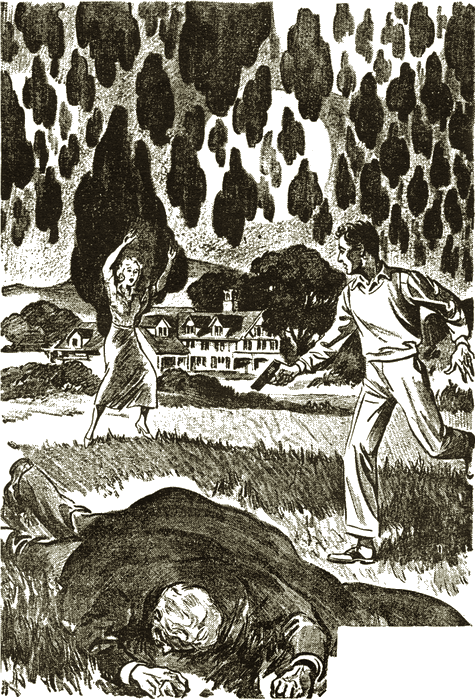
A mass clung to her shoulders, was sinking
swiftly out of sight, into her slender body.
JIM WENTWORTH lifted the old-fashioned knocker, let it drop with a resounding thud. Then he waited, leaning against the newel post that framed the door, and mopped his brow. It was hot, as only a Maine summer day can be, and he had trudged the last weary miles from the railroad station. If he failed in this quest—he grinned wryly—he'd have to walk all the way back to New York. A well-worn silver dime rattled lonesomely in his pocket.
It took a long time for some one to answer. Jim looked about him. The house was as lonesome as his dime; a long, one-story, rambling structure set by itself at the edge of the pine wilderness, with a half mile of dirt road interposing itself between civilization in the form of a concrete highway and its own exclusiveness. A queer place for the laboratory of a scientist like Matthew Draper, Jim reflected; but then Draper had always been known to be somewhat eccentric.
There was no stir of movement, however; and the windows were thick-shuttered. He slammed the knocker again, impatiently. The late-afternoon sun swept over the broad fields like a gleaming sword, illuminated the upper windows of the Harbor House, a mile away. Jim had passed it on his hike; a fashionable summer resort where the wealthy idled and flirted desperately to avoid boredom. He grimaced. It was dinner hour. Over there they would be sitting down to a host of courses, perfectly prepared, impeccably served, while he hadn't eaten more than a sandwich since noon. A sudden fear assailed him.
Suppose it had been a hoax; suppose Matthew Draper was not——
The door creaked, opened slightly. A girl peered warily through the crack. "What do you want?" she demanded. There was a quaver in her voice, a certain desperation.
Jim Wentworth had been trained to detect such things. He wondered, bent forward slightly to make out her features. But the shadows baffled him. Aloud he said: "I came all the way from New York to see Professor Draper. He advertised for a scientific assistant. I fill the bill, and—I need the job." He grinned ingratiatingly, trying to lure the girl out into the sun where he could see if her face lived up to the strange sense of strain in her voice. She refused to be lured. Instead, the thin opening narrowed even more.
"The position is—uh—filled," she declared. "I'm sorry. You had better go. There's a train from Sauk Corners at 7:10." She tried to shut the door, but Jim was too quick for her. His foot shot out, wedged itself into the crack.
"No, you don't," he said firmly. "I didn't spend my last nest egg on a trip to this neck of the woods for nothing. The station agent at Sauk Corners told me I was the only one to inquire the way here to-day. And"—his eye swept the rutted country road—"they'd have to ask to find this God-forsaken place." His sinewy fingers gripped the door edge. "You see, I used to know Professor Draper. I studied under him at Tech some years ago. So I'd rather get it direct from him."
"Oh-h-h!" the girl quavered, thrusting her slight body against the door to hold it from intrusion. Then urgency crept into her voice. "Please go away, Mr.—uh——"
"Wentworth! Jim Wentworth!" he told her cheerfully.
"Please go away," she repeated. "I can't explain, but it's important." She fumbled a moment; then a small, slim hand thrust out into the glare of the sun. "Here's money—for your fare, your trouble. I'm sorry."
Jim stared down at the proffered bills. The hand that held them was trembling. He shook his head, refused to withdraw his foot. "No can do," he submitted. "You're too anxious. I thought there was something wrong when I read the ad. Matthew Draper doesn't have to advertise for assistants. There are thousands of bright young physicists—and old ones, too—that'd give anything to work under him. Now, I've got to see him."
The girl tried vainly to close the door. "Please believe me," she implored. "You must go away—at once. Don't you see—it's for your own sake I'm doing this. I——" She bit her lip, stopped—as if she had said too much.
"You interest me strangely," Jim murmured, and shoved suddenly.
The girl fell back with a startled little cry; the door swung open. Jim stepped into a long, raftered reception room, glanced swiftly around. There seemed nothing wrong. It was comfortably fitted with easy-chairs, reading lamps, tables littered with the latest scientific magazines, and scatter rugs.
Open bookshelves lined the walls, crammed with an impressive array of technical volumes. Among them were a goodly number authored by Draper himself. "The Higher Mathematics of Space" was one; "An Inquiry into the Gravitational Warp" was another. Jim knew them all, knew of his old instructor's preoccupation with the abstruse properties of space.
EVERYTHING seemed normal, perfectly proper. Except, perhaps, that the windows were tight-shuttered, and the lamps that illumined the room glowed with an eerie tinge of violet, as if that end of the spectrum were being favored against the normal yellows.
He took a deep breath. He had braced himself against something—he knew not quite what. Then he remembered the girl. He swung on her. She faced him, fists tiny, quivering balls at her sides. Her face was pale, her eyes wide but steady. She was evidently under a terrific inner strain. Jim made a mental note to study that face more thoroughly—later, when he had more leisure. He was certain the study would be rewarding—and pleasant. But just now——
She came closer, taut, desperate. Her voice was a whisper, as if she did not wish to be overheard. "For the last time," she begged, "will you go—now, before it may be too late! Trust me; don't ask for reasons."
Her urgency, her obvious sincerity, shook his resolution. Before he had seen her full face, he had suspected foul play. Now, that was impossible. But there was mystery here—more! The girl was quite evidently scared. He couldn't leave her alone. And where was Draper?
He grinned tightly. "Sorry, miss," he answered slowly. "I trust you—that's why I'm staying. If you won't tell me what's wrong, Draper will."
"I am Draper," some one said calmly. "What can I tell you?"
The girl stiffened, moved quickly to the nearest table, pretended to be arranging the magazines. Over her shoulder she cast Jim an appealing glance. He understood, swung about to face the man who had quietly entered the room from the left. Through the open door Jim could see a tremendous laboratory, filling an entire wing of the structure. Machinery hummed and glowed, and the pungent smell of ozone flooded the reception room. Then the man had closed the door behind him.
"If you are the Professor Matthew Draper I used to know at Tech——"
Jim started. "But of course you are. I'm Jim Wentworth; took several courses with you back in 1926. Have knocked about a bit since; ran a railroad through an African jungle, got blown up in a rocket-fuel experiment, helped stage a revolution in China against the Japs, did some research under Bentley in California." He went on soberly, "Poor Bentley died; there was a depression; the colleges spewed forth thousands of keen young graduates willing to work for nothing; and I'm on my uppers. I saw your ad—I still remember your space-dynamic theory—and I came."
There was a perceptible, embarrassing pause. Keen, gray eyes seemed to pierce Jim through and through, to penetrate into the innermost recesses of his soul. The girl shifted uneasily at her pretended work.
Then, finally, the man said: "Ah, yes, of course. Wentworth! I remember you now. A brilliant student, one of the few who could really understand my theory. Glad to see you again." But his hand did not go out; and his eyes probed more keenly than ever.
JIM steeled himself with an effort. There was something wrong. He recognized Draper, of course. A little older, a little more gray at the temples, but that was due to the lapse of years. There was no mistaking the well-set, muscular frame, a little above the average height, the firm jaw, the bushy, overhanging eyebrows, the quick, piercing gaze.
But Jim had an odd feeling of discomfort. His old professor had hesitated in recognizing him—and it was a sincere hiatus, too, as if he had to call into play an outside memory, a memory that was not exactly indigenous to him. Draper had been famous for his phenomenal, instantaneous memory. He had been known to stop a total stranger in the street, demand of him whether or not he had on such and such a day, years before, been in Boston, walking on such and such a street at a specified hour. And been exactly right, too, though the startled accosted one had lost all recollection.
There were other things as well. The voice, for example. Draper's, all right, but with a queer intonation, a certain foreign preciseness, as if Draper were making a conscious effort to speak in a fashion that had once been easy and natural for him, but was no longer. In all his bearing, his manner, there was that sense of subtle duality, of alienness, of a deliberate willing to be what should have required no strain at all.
Jim held his features blank and composed, to betray to that searching scrutiny no trace of his inner unease. After all, he was thinking insane thoughts. Before him. without the shadow of a doubt, stood Professor Matthew Draper famous physicist, and propounder of startlingly novel theories on space.
"You'll do," said Draper suddenly. "Miss Gray will show you your room. You can wash, arrange things. We eat in half an hour. Then we'll get to work at once." A strange intensity crept into his voice. "There's no time to be lost. I must hurry. Every moment is precious."
With a little laugh he recovered himself, said more easily. "But let's not talk shop until we enter the lab. In the meantime let me introduce Claire Gray, my very faithful secretary. Been with me for years. Remained even when my assistants quit. I commend her to you for loyalty—uh—Jim." Then he was gone, back through the door to the left.
The girl stared at the new assistant with frightened eyes. Her finger crept to her lip, for silence. "This way, Mr. Wentworth," she said aloud in prim, business-like tones. He followed her, toward the right, into the other wing of the sprawling building. No words passed until they came to the room at the farther end.
It was simple, but adequate: a four-poster bed, a lowboy, several straight-backed chairs, a washstand. Jim dropped his battered bag on the floor, looked at the girl quizzically.
She had shut the door tight, backed against it with pressing hands. Her face was pale, her voice a panting whisper. "There is still time to go, Jim Wentworth," she said breathlessly. "Before dinner. There's an exit through this wing. He won't see you. If you hurry, you can catch the 7:10 at Sauk Corners." Her fright was dreadfully sincere.
"Why should I go, Claire Gray?" Jim demanded gravely. "I need the job, and Draper's the best man in the world to work under."
"You fool!" she cried desperately. "Are you blind? Didn't you see with your own eyes? You knew Matthew Draper back in Tech. Why do you think his assistants left him last week, secretly, at night? Ran away, that's what they did, swearing they wouldn't stay in this place another minute. And they'd been with him almost as long as I have."
"You didn't go," Jim pointed out, evading the questions. He wanted time to think, to piece out the puzzle himself. He was almost afraid of what the girl might say next.
"I?" She stammered and flushed. "I—I couldn't. They begged me to go with them." She raised her head suddenly. "Professor Draper's been like a father to me—my own parents are dead—and I couldn't leave him—in this condition. But you—you're not bound. Didn't you see? Didn't you notice? Hasn't he changed since Tech?"
"We all change with the course of years," Jim again evaded.
"Not that way," she declared. "And the change was sudden, instantaneous. Three weeks ago, in fact. He—he's a different man."
"He looks the same."
"It isn't that," she whispered. "The shell is Draper, the Matthew Draper we all knew. But inside there's something else, something alien, foreign. Something that peeps out at me inquiringly, scares me. I can't quite explain it. It's as if Matthew Draper had been submerged, and an alien entity had taken possession of his body."
"That's impossible," Jim said loudly. He was arguing against his own instincts as well as with the girl. "Rubbish! Nonsense! He remembered me. I'll bet if I asked him about little incidents at Tech he'd remember them, too."
"Of course," retorted Claire. "That's what makes it all the more frightening. But he'll remember them with an effort, willing himself to remember, as if he were doing so through an alien medium—a personality not his own. Broderick and Hanson noticed that at once—in the laboratory. There was an incomplete experiment. Oh, he finished it all right, but unenthusiastically, groping his way. And the solution was a queer one, along lines radically different from the way it had started.
"Then he threw everything aside, all the work that had absorbed him before the—the change. He started a new experiment with feverish haste, ordered materials by the carload, worked night and day, drove them with a dreadful intensity, as if every second counted—almost as if——"
"It was queer, they told me—that experiment, the machines he was building. Something not quite of this world; something outside all our concepts. They didn't understand what they were doing, and he refused to explain. You remember the old Draper—how clear, how lucid his explanations were."
Jim nodded.
THE girl went on, with a rush of words. "The experiment scared them. So did Draper. There were times when he did not think they were looking, and his features relaxed, as if he had been keeping a pose for their benefit. I—I've had that experience, too." She shivered. "It's dreadful—that look—a peep into a strange universe, at something not—not human! They couldn't stand it any more, and they went. They said this experiment might lead to God knew what consequences, and they wanted to be far away when it happened. That's why you must go, too—now."
"You're staying," Jim said very gently.
"I—I told you why," she declared defiantly.
"Then so will I."
"O-oh!" There was a perceptible pause. Then, "I didn't tell you everything," she said quietly. "Three weeks ago a man came here. He appeared to be a farmer—the average type—wind-tanned, face coarse-stubbled, rough-handed. But there was a certain intensity in his eyes. He demanded to see Professor Draper. I tried to ask him his business, but he pushed past me, into the lab. I heard a click, as if the door had locked. Then Draper's voice, surprised, inquiring—and silence. I was alone in the place. It was Betsy's day off, and Broderick and Hanson were at Sauk Corners, awaiting a shipment of supplies."
Her eyes held a far-off look. "I became afraid of the continued silence," she proceeded. "I knocked on the door. No answer. I knocked louder. There seemed a strange, slithering movement, as of something crawling, inching its way along the floor. I must have screamed. I know I started for the telephone, to get help. Then the door flung open, and the farmer came out. Behind him stood Draper.
"But even in the flood of my relief, I noticed at once the strange difference in them both. The intensity was gone from the intruder's eyes; he seemed bewildered, staggering. He looked around the room as if he had never seen it before, as if he didn't know how he came to be here. He muttered thickly, and fled out of the door. He was scared. And Matthew Draper—well—he was as you've just seen him—something alien, distinct. There was a triumphant look to him that was quickly veiled when he saw me. He stared at me—strangely; it seemed to me he was trying to place me, to remember me. Then he went back to the lab, shut the door. I never dared question him since. But"—and now Jim had to strain to hear her whispered words—"when I entered the lab a little later I saw something. A slimy trail across the floor, as though something damp and snail-like had crawled there."
She stopped. Jim's scalp prickled. Then he laughed. "You've let your imagination run away with you, Claire Gray. You've built up for yourself a horrible picture out of the flimsiest materials. The farmer had merely come with a message; perhaps he was a little drunk. Certainly Draper has a right to halt a line of experiments and start a new one. That may explain his change, his seeming preoccupation. He's hot on the trail of something. Such intensity of absorption changes a man, makes him absent-minded, causes memory to be something of an effort. He'll be himself as soon as he finishes."
He talked confidently, trying to convince himself as well as the girl. And failed in both instances. She looked at him quietly a moment, said in matter-of-fact tones, "The dining room is just off the entrance hall, on this side. Dinner will be served in fifteen minutes." Then she was gone.
THE meal passed without incident. There was only Draper, the girl and himself. The housekeeper, a fat, comfortable-looking native of the neighborhood, served with wholesome Maine heartiness, if not with effortless efficiency.
Matthew Draper did not seem disposed to talk much. He ate hurriedly, gulping his food, as if anxious to be done. Jim, alert for little things, noticed that he held his knife and fork a bit awkwardly, as if not quite accustomed to their use. The girl kept her eyes intent on her plate. She looked pale, weary. She did not speak.
Jim was forced to keep the conversational ball rolling. He did it with deliberate skill. He interspersed a casual flow of talk with even more casual references to Tech, little incidents of years before.
Every one of them was answered properly—by Draper. This in itself was strange. In ordinary talk a good many allusions to the past are permitted to drop without further remark. Not so here. To Jim it seemed as if, behind the hurried mask of his old professor, there was a desperate alertness, a wariness, an eagerness to allay suspicion. Yet always there was that gap, that pause, that obvious willing himself into the memory of the incidents. And always that strange impatience to be through, as though every moment were a precious part of eternity that was needlessly slipping through his fingers.
It was with audible relief that Draper pushed his chair back to announce the end of the meal. "That's that, Jim," he declared. "Sorry to rush you so, but we'll have to work a bit in the laboratory. I've got to finish what I'm doing as soon as possible. I must hurry. Hurry!" He seemed to forget their presence. "They can't wait much longer." He was speaking to himself.
Claire flashed the new assistant a stalled glance, looked away again. But Jim said cheerfully, "That's O.K. with me. I don't mind working nights."
The scientist jerked his head up. There was gratitude in his eyes. "Thanks!" he muttered. "Those fools, Broderick and Hanson, left me in a lurch, brought everything to the verge of ruin. But then, how could they know what they did?"
JIM had never seen quite such an array of apparatus in a private laboratory before. There were dynamos for the generation of current, Diesel engines, huge electronic tubes, cloud chambers for the study of disrupted atom tracks, electrostatic globes, great bar magnets, a high-temperature electric furnace for refractory metals, a mass spectrograph, an interferometer, and a profusion of other instruments, some of which Jim, for all his training, did not recognize. It took his breath away.
"Good Lord!" he said involuntarily. "They represent a fortune. I didn't know——" He stopped in embarrassment.
Draper smiled queerly. "You didn't know I was that wealthy, eh, Jim? I'm not. But the name of Matthew Draper is rather well-known; and my credit is good." He chuckled and added, "Especially when no one firm shipped more than a small part of the whole."
That startled Jim; then he forgot the strangeness of the statement in wonder at the apparatus that held the place of honor in the very center of the lab. Whereas every other available inch of space was crowded with instruments, the central portion was scrupulously bare except for this.
A huge, hollow cylinder of gleaming crystal rested solidly on a metallic base. It appeared some eight feet high and five feet in diameter, sufficient, thought Jim incongruously, to house a man comfortably. Fine metallic wire, spaced an inch apart, ran spirally around the transparent circumference, darted upward toward the roof of the lab, pierced through; and, at the bottom, embedded itself in the base of the metal block.
Enringing the cylinder were machines of intricate design. Jim had never seen their like before. Giant metallic mouths, their orifices swirling in queer, distorted curves, making a wavy pattern of gaping wideness toward the central transparency. Like prehistoric monsters, ready to spew forth flaming vibrations at the word of command.
"Good heavens!" Jim ejaculated. "What are those?"
Draper avoided his gaze. "Oh, they!" he muttered vaguely. "Part of the experiment. But come," he added quickly; "we have no time to lose. Must get to work. Please hook up those tubes in series with the cloud chamber. It's already prepared. Use soft X rays, helium, and argon. Shoot them through to get a constant stream of electrons. You know the technique, of course?"
Jim nodded, asked dryly, "For what purpose?"
"Set up your magnets to deflect the stream," Draper went on, unheeding. "That is, I want you to see what happens; take pictures. Hurry, please!"
Jim Wentworth stiffened, was going to retort angrily. This was not the leisurely, meticulous attitude of the Draper of old, the careful explanation of details, of ultimate purposes. Obviously, the scientist was reluctant to disclose what he was about, was laboring himself under a terrific urgency. Jim could see it in every move he made, in the feverish rush from instrument to instrument.
Then Jim relaxed, grinned. Very well, if old Draper wanted him merely as a technician, let it go. But to himself he determined to keep his eyes open, senses alert. He'd solve before long both the mystery of the machines and of Draper himself.
THE electrons broke off from the parent atoms, hurtled across the cloud chamber, made bright lines through the fog molecules, were deflected by the magnets. Everything was normal, usual. fie so reported to Draper.
The scientist jerked erect from the ring of metal monsters, groaned. He was suddenly gray and haggard. "More time lost," he mumbled. "I've got to get back, before it's too late. Try again," he screeched suddenly at Jim. "Step up the current to fifty thousand amperes; pass it first through the Agrav——" He pointed to the first of the queerly shaped enringing machines. "But be careful not to get in front of the orifice."
"What did you call it?" demanded Jim.
"Oh!" Draper seemed confused. "Just a name I gave it. Now hurry, hurry!"
But when, at three in the morning, the cloud chamber sizzled with streaking electrons, the picture was still normal, just as it should have been. Reluctantly, Draper called a halt; grim, despairing. He said good night with a feeble attempt at cordiality, saw Jim out of the laboratory, then closed and locked the door.
The young man was drunk with fatigue. Nevertheless, he stood outside the door, listening. He heard movements within, apparatus being shifted. Draper was continuing on his own. Evidently he did not intend to sleep. Puzzled, Jim went slowly to his room. So preoccupied was he with his thoughts that he almost jumped at the wraith-like figure that loomed up at him in the dark, in front of his door.
"I simply had to see you again," said a girl's voice. It was Claire. Without a word, Jim opened his door, switched on the light, closed it behind the girl. She was paler even than before. She had not slept. "Yes?" he said inquiringly.
"Did you—did you find out what he was doing?" she demanded hurriedly.
For the moment he was angry. What the devil did she mean by pumping him? If Draper wanted his experiment held a secret, it was not her business. Good Lord! Was she a spy for some rival, interested in what Draper was up to? Were there commercial possibilities in whatever it was? Then he grinned. She was too desperately sincere to be that.
"Not a thing," he declared cheerfully. "The old fellow wouldn't talk. And what I did was routine stuff."
She nodded. "Just as I thought. The others said the same. But those horrible machines. They give me the creeps." She gripped his arm suddenly. There was amazing strength in her slim fingers. "And Draper himself. I'm afraid—call it a woman's foolish intuition, if you will—but I'm afraid that something is going to happen soon that will mean disaster to us all—to you, to me, to the whole world, perhaps."
"Nonsense!" He placed his hand on her shoulder gently. She was not the hysterical type, but she was trembling. "It's been lonely here, and you've been brooding a lot of little things, magnifying them." He laughed shortly. "If it'll comfort you, I have a very efficient little automatic in my pocket. I always carry it."
"Guns won't help," she retorted. "But—good night."
FOR a week nothing happened—that is, on the surface. Claire said nothing more to the new assistant of her strange fears. Meals were served on time; Betsy, the housekeeper, waddled back and forth, keeping up a good-natured, interminable stream of meaningless conversation. The atmosphere of the place did not seem to affect her in the slightest. But then, nothing external ever ruffles your true down-Easter.
All day, and most of each night, Jim was in the laboratory. His work branched out. He made new alloys in the electric furnace, of materials furnished by Draper. There were curious, unusual combinations. Some of the products, to Jim's eye, possessed qualities that would mean millions commercially.
But Draper, seemingly, was not interested in that phase of it. He threw them into the discard impatiently, tried new fusions. He was searching for something definite. But invariably, four times a day, Draper would hand him samples of materials that had been breathed forth from the maw of the metal enringing monsters he had named Agravs, for disruption in the cloud chambers. And each time, as Jim, with growing puzzlement, reported nothing untoward in the reactions, new lines etched themselves into the scientist's haggard countenance.
He seemingly never slept. Long after Jim was reluctantly released from duty, in the early hours of the morning, he could hear the whine of the motors in the laboratory. Once he caught a new note; a sibilant, hissing noise, muted by the intervening barriers. Like the hiss of an angry snake. But it held inflections, curious seesaw intonations, as if it were a coherent language of sorts.
A strange reluctance withheld Jim from flinging open the door and discovering the source of the sound. He went to bed, troubled, grim of face. His sleep was disturbed. He tossed in a welter of strange dreams, in which Matthew Draper appeared in Proteus-like transformations.
As the second week grew and waned, a curious bond arose between the scientist and his assistant. The initial sense of distrust gradually wore off. It could hardly have been called liking, or affection; on both sides there was a realization of alienness. But there was a certain respect, an awareness of each other's attainments. Jim did his work doggedly, efficiently, unobtrusively giving valuable suggestions.
Still Draper did not take him into his confidence, or disclose the secret of the Agravs. Nor did Jim attempt any underhanded spying, though his brain worked furiously all day in the attempt to solve the mystery. For he was well aware by now, and Draper knew that he was aware, that some alien entity was inhabiting the body of his old professor, and possessing, besides the brilliance and knowledge of the savant, an additional fund of incredible extent. Knowledge that had not hitherto existed on Earth, that in the main did not seem to fit Earth conditions.
It was this that evidently delayed Draper, or the thing that appeared to be Draper. The correlation and the transference of a body of outside fundamentals to the laws and materials that governed Earth. Jim was able to help here, and Draper appeared duly grateful.
IT had early been forced upon Jim that the experiment had something to do with the properties of space—in fact, an attempt to modify those properties in some unknown fashion. Which was but natural, considering that Draper had been the foremost authority in the world on space and gravitational influences.
A dim light flickered in Jim's brain at that. Could it have been possible that this entity or personality which was now Draper had deliberately penetrated, in some unknown manner, into the form of the scientist in order to avail itself of that authoritative knowledge and perspicacity? Was it, in fact, that rough farmer intruder of whom Claire had spoken? If so, what had happened to Draper? How account for Draper's complete knowledge of his past, of his former associations? What was the purpose of this experiment? Why the dreadful haste? He was obviously racing against some contingent tragic denouement. What was it? Would it involve Draper only, or Jim and Claire as well, or the entire world, as the girl intuitively feared? Questions that troubled Jim through the tossing hours of supposed sleep, and during the furious energy of the lab.
Claire and Jim made it a nightly practice to compare notes in the privacy of the right wing, before going to sleep. Another bond was springing up between them—unawares—but very much of this Earth. Jim no longer scoffed at her intuitions. He, also, was afraid, now. Not for himself, nor, for that matter, of the thing that was Draper. "Whatever he is," he told the girl, "he means us no personal harm. Nor the world, either. His is a tremendous brain, far beyond that even of the old Draper. It frightens me; it's so—un-Earthly. That's the only word I can use to describe it."
"Do you think," whispered Claire, "he might lie a being from Mars, or Venus, who somehow managed to span the gulf and fused himself into Draper's body? Perhaps he's now trying to find a way to get back—the door by which he came had somehow closed in the interim."
Woman's intuition, sixth sense, whatever it may be called! But even she, with all her swift imaginings, could not encompass the entire, incredible truth, the utter incomprehensibility of Draper!
Jim laughed a bit at that. He was too practical, too much of the engineer, to go off into such wild fantasies. "The chances are," he declared, "the explanation, when it comes, will be much simpler, and more within the bounds of reason. What it will be, I don't pretend to know. We can only wait and see."
They did not have to wait long. The denouement came with stunning, unbelievable force. On the Monday of the third week Jim was staring aghast at the cloud chamber, scene of familiar daily routine. Something new had happened, so novel that he could only stare and rub his eyes in wonderment.
The familiar electron tracks no longer bent to the influence of the magnets. Instead, the bright sparkles flashed straight and undeviating across the fog, unheeding of the magnetic pull, to a point almost midway between the plates. Then something else happened. The tracks stopped dead! It was not merely that they collided with some interior substance—that would have been evidenced by a scattering of light, or a sharp-angled divergence of the path; they literally disappeared, vanished! The electrons had ceased to exist!
Jim frowned, glanced surreptitiously back at Draper. The scientist was busy with the adjustments of the spectrograph in the rear; he had not seen the untoward phenomenon.
Jim's brain raced feverishly. Wherein had this particular emission of electrons differed from all the other batches? For one thing, the current had been stepped up another notch; and, for the first time, had passed through the interior maws of the strange Agrav machines in a certain complicated crisscross of alternations, whose pattern he had tried to puzzle out mathematically in the privacy of his own room the night before, when Draper had first suggested it.
The mathematics had been incredible; he had been certain there were errors in his calculations, and had fallen into bed too tired to check his figures. Now, it struck him with blinding realization, perhaps he had been right. There had been exponentials of the tenth order in the resultant equations. Ten dimensions, when the universe of known things was limited, even in the relativity equations, to four!
HE checked himself firmly. He had a simple observational fact to report. That the electron emissions had not bent to magnetic stresses, and that they had disappeared at a given point. Never mind the theories. That would come later. As a loyal assistant, it was his duty to report at once.
But still he hesitated. There was no doubt in his mind that this was the phenomenon for which Draper had been waiting so feverishly. What, then, would happen next? Would he, Jim Wentworth, be the unwitting means of releasing some unknown, horrible doom upon them all? Matter had not yielded to normal, this-universe influences. It had vanished, suddenly, completely, dropped into some hole of which he had no present knowledge. What would it mean if this experiment could be universalized? What did Matthew Draper—or the being who seemed Draper—intend to do with this weapon?
He took a deep breath, walked steadily over to the still-bending scientist. "I think I have the result you've been looking for," he stated quietly.
Draper whirled. Flame sprang into his eyes, and died. "Meaning-——"
Jim explained rapidly, went over the procedure from beginning to end. Then he exhibited the photographic plates to substantiate his eyewitness account. "I've checked for every other possibility," he concluded, "and eliminated them. There's only one conclusion to be drawn. You have managed to divest electrons, at least, from the ordinary attributes of matter. More, you have annihilated matter without any corresponding manifestations of energy. It's a great discovery, one that will set the scientific world on its collective ear."
But Matthew Draper was paying no attention. His face was a stony mask, his body a graven image. But out of his eyes peeped a fierce, unhuman exultation, a flame that seared and burned.
"Thank you, Jim Wentworth," he said slowly. "You possess brains beyond most of your kind, and you have been—loyal, asking no questions, even when you suspected. I shall remember that. Now I ask you to leave me; there is much I must do alone. I shall expect you back at four in the afternoon. Not earlier, not later."
Before Jim knew quite what had happened, he was out in the reception room, and the strong lock to the laboratory had clicked irrevocably behind him.
Claire looked up from her work, startled. She had been answering polite, dunning notes, all of the same tenor: No doubt Professor Matthew Draper had overlooked, in the pressure of his work, their little bill for apparatus and supplies of the instant. Would he favor them with a remittance at his earliest convenience?
The bills ran to staggering totals. To each Claire sent an identical answer—that Professor Draper was away for a week: that on his return he would, without fail, forward the necessary check.
She rose quickly, anxious, overwrought. "What has happened?" she exclaimed, with an apprehensive look at the locked laboratory.
Jim grinned tiredly. "Nothing much, except that I've found for Draper whatever it was he was looking for." And for the second time that crucial morning he explained. "There is no doubt," he finished, "that the man we knew as Draper harbors an another-world entity. He let it slip out of the bag when he thanked me for—er—well, never mind. But he classed all of us together as your kind, thereby differentiating himself from the rest of humanity. Now the question is—what is he up to?"
Claire clung suddenly to him. "I'm afraid," she whispered. "Poor Draper, who had been a father to me—is dead. That which is walking around in his shape is the murderer, an alien being. God knows what else he. is planning."
She moved away suddenly, confused. "Perhaps we'd better get help—the State police—before he does something terrible."
Jim shook his head decisively. "No, that won't do. Whoever he is, I'm sure he doesn't intend to do any harm. Perhaps you were right, though, in the beginning. He was trying to find a way to get back to wherever he came from. Mars, Venus, perhaps. He's discovered it. It wouldn't be right for us to stop him."
"But the Matthew Draper that was!" Claire exclaimed desperately. "What about him?"
Jim frowned, grew grim. "I've thought of that," he admitted. "We must do something to restore him to his former status, if it's at all possible. But a lot of blundering police wouldn't help; they'd only make matters worse. Leave it to me."
THE hours dragged on leaden feet. At lunch Draper did not show up. The eastern wing of the house vibrated with the pounding of heavy machines, with the whine of the dynamos. The acrid taint of ozone permeated the entire structure. Evidently Draper was building up tremendous power. The meal passed in silence.
When Betsy cleared away the last dishes, she announced that she was going to Sauk Corners. The professor had told her to take the rest of the day off. "And if you ask me," she added significantly, "I don't know as I'll be comin' back. I kinda didn't care for the way the perfessor looked when he sneaked over to the kitchen to tell me. He 'peared a bit—well—teched in the head. I'd advise you to clear out, too, dearie," she addressed Claire. "This ain't no place for decent folk." And she flounced out.
Claire and Jim exchanged glances. "I—I think old Betsy is right," the girl said breathlessly. "There's still a chance, Jim. Let's get to the Harbor House. It's only a mile or so. There's a State trooper always on the grounds."
"No," Jim repeated grimly. "But you ought to go with Betsy," he added. "She'll drive you to the hotel. You need the day off, too. You can play golf, idle luxuriously, dance. Stay overnight. I'll pick you up in the morning."
"Jim Wentworth," she declared quietly, "you're trying to get rid of me. You're getting a bit afraid, also. It's no go. Either we leave together, or I'm seeing it through with you." And that was that.
At four o'clock Jim took a deep breath, looked quizzically at Claire, went quietly to the laboratory door, and flung it open. The girl followed him with firm tread.
The great interior was a hive of humming activity. Every dynamo, every motor, was whirring at full speed. A strange violet light bathed every nook and cranny. The galvanometers registered an incredible half a million amperes, voltmeters oscillated at the incredible figure of fifteen million volts. Power surged in almost visible waves through the laboratory. But what held them taut and speechless was the sight of Matthew Draper.
He stood within the crystal cylinder! He seemed taller than before; his eyes were burning coals of frenzied eagerness. His body quivered with impatience. He seemed like a whippet restrained on the leash, tense for the moment of release. Earth characteristics had dropped away from him. Matthew Draper, Earth scientist, was wholly submerged by—what?
Around the shimmering cylinder stood the ring of Agravs; long, squat, metallic monsters, their strangely curved mouths gaping and pointing directly at him. Huge cables snaked across the floor, connecting power machines, great electronic tubes, and Agravs, in intricate pattern. A gigantic knife switch had been cut into the circuit on a panel directly outside the enringing Agravs.
Draper turned at the sound of their entry. The fierce, unrestrained light in his eyes died, gave way to more human emotion. Almost, Jim thought he detected a certain sadness, a certain regret in that piercing gaze. But he must have been mistaken, for the flame leaped back again, more glittering than before.
He gestured to them. Involuntarily, Jim's hand closed tight in his trousers pocket on the flat automatic. It was fully loaded, and a cartridge belt hung snug around his waist under his khaki shirt. He had come prepared for all eventualities.
"YOU are prompt, Jim Wentworth, as usual," said Draper. He expressed no surprise at his secretary's presence. His voice penetrated the cylinder walls without distortion. Jim had often wondered at the composition of the transparent substance, but Draper had not explained, and there were no other samples of it he could have used for analysis. It was not glass, nor quartz. At the most, Jim had determined that its crystalline structure was arranged in polarized planes, parallel to the axes of the Agravs.
"At exactly ten minutes after four," Draper continued, "you are to close that switch." He pointed to the newly installed panel. "By exactly fifteen minutes after four, you are to be out of the house. You'll find my car on the driveway. The motor is going. The tank is full of gas. Get away without an instant's delay, and don't stop until you reach the Harbor House. And don't come back! That is imperative. My instructions must be followed minutely; the slightest deviation may mean disaster. And—you will find an envelope addressed to each of you at the Harbor House. You will both find yourselves amply rewarded for your work. That is all."

"Go away and do not come back! My directions must be followed
minutely; the slightest deviation may mean disaster!"
Claire save a little gasp. Her hand went out blindly to the man at her side for protection. Jim's lips tightened; he took a half step forward. "Now listen to me, Matthew Draper, or whoever you are," he rasped. "This farce has gone on long enough. I have, as you say, been extraordinarily patient; but it is time now for the show-down."
The scientist within the shimmering cylinder stiffened. A palpable wave of force seemed to lash out from his flaming eyes. Then he swerved to the electric clock on the wall. Its hands pointed to two minutes after four. "Have your say," he replied calmly. "You have eight minutes time. Not a second more."
"I have this to say," Jim retorted grimly. "You are not Matthew Draper; you are some strange being, entity—God knows what—that took violent residence in his body. I demand answers to the following questions: Who, in Heaven's name, are you? Where have you come from, and for what purpose? What have you done with Matthew Draper? What forces are involved in the manipulations of these monstrous Agravs? And what will happen when I pull the switch?"
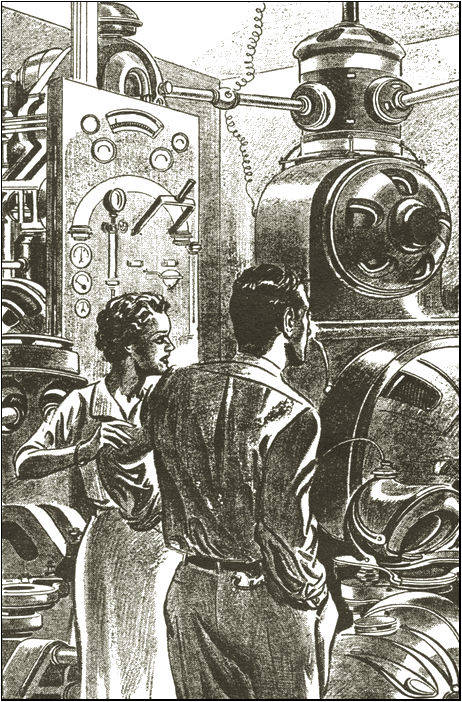
"First, I must say this: "You are not Matthew Draper;
you are some strange being, entity—God knows
what—that took violent residence in his body. Why?"
"Softly," answered Draper with a tinge of mockery. "I would not have time to answer all your questions, even if I wished. But I do not wish. It is enough that you have guessed a dim part of the truth. I am not Matthew Draper. What I am, does not matter. You would not, could not possibly believe the real truth."
"I know the truth," Claire cried out. "You are a Martian, or a Venusian—a being of some other planet."
Draper smiled queerly. "I am not of your Earth; that much is true," he admitted. "But I cannot tell you more. The knowledge would make you mad, it would sound so utterly incredible to your limited intelligences. Enough that I have been here; am now returning.
Earth will know me no more." His voice took on steely determination. "Nor any more of my fellows, if what I propose is successful. And that, my Earth friends, you will discover to be of infinite advantage to you, though it is impossible for me to explain.
"Nor shall I explain the workings of the Agravs. You, Jim Wentworth, would have sufficient intelligence to reconstruct them. You, or others of your race, might foolishly try to follow into my world, in spite of all warnings. Such a course would prove disastrous to you, and possibly to us as well."
"Eve discovered this much," said Jim. "The cloud chamber experiments gave me the clue. Their emanations do things to space, and to matter. The ordinary laws no longer apply. Magnetism, light, heat, yes, perhaps even gravitation, have no influence. And the matter vanishes—where to, I have not been able to determine. Perhaps into a fourth dimension."
"You have discovered more than you should," said Draper, biting his lip. "Though the full, incredible truth is beyond your imagination. Perhaps I should destroy you before I leave; it might be wiser."
CLAIRE cried out; Jim's finger tightened on the trigger of his concealed automatic.
"But it is not necessary," continued Draper. "For, at four thirty, this building, and all it contains, will be thoroughly destroyed. I have seen to that. The place is mined with explosives, and a clockwork mechanism will set it off. That is why I gave you warning to leave immediately after you have performed your appointed task."
Jim compressed his lips. "That is just what I won't do," he declared, "unless you return Matthew Draper to us, alive and unharmed."
Draper's brow darkened. "It is impossible," he said angrily. "I am a part of him and he is a part of me. My continued life depends on this community of intra-position. It is unfortunate, but he must accompany me to my destination. Now hurry," he added hastily, hi'-, eye flicking to the wall clock. "In another minute, exactly, the switch must be pulled."
Jim settled hack comfortably on his heels. "Release Draper then," he insisted.
"I told you it is impossible," the immured scientist cried out in exasperation. "I've trusted you, Jim Wentworth. A clockwork mechanism to activate the switch might have gone astray; you, I thought, would not fail. You must believe me. It means disaster to a mighty race, to your universe as well, if you don't obey."
"Release Draper," Jim repeated stubbornly.
The clock ticked on. Ten seconds to go. "Fool!" shouted the man in the cylinder in an awful voice. "Do it now, or it will be too late."
Claire plucked at Jim's arm. "Quick! Obey him! He's really sincere. Something terrible will happen."
Jim shook his head. "He's bluffing; that's all."
Five seconds of ten after four!
Draper literally cowered. His face was a dreadful mask of anguish. "Claire Gray," he said thickly, "believe me! Your fate, the fate of all the universes, depend on knifing the switch. Quick."
Her eyes widened on him. "I believe you," she screamed suddenly, and darted for the panel.
Jim whirled, shouted savagely. "Tie's bluffing, I tell you. Don't touch it!"
"He's not," she panted. Her fingers reached up, pulled desperately down. The second hand clicked into the last position.
Jim grunted an oath, sprinted. If that switch made contact, his trump card would be gone. They would never see Draper again. What reason had they to believe that the entity in the cylinder was telling the truth? Perhaps the transparent material was a shield of force, to protect him from what was going to happen. How did they know that they would not unwittingly bring disaster to an unknowing world? Given time, he'd force the truth out of the man in the cylinder.
In his mad, forward rush, he collided with the snout of one of the Agravs. It pivoted around on a turntable, oscillated back and forth with the jarring vibration. Jim had no time to think of that. His sinewy hand jerked forward, caught at Claire's wrist. Too late! The blades made contact with an irrevocable click.
The violet flame deepened. Great sparks flared and sputtered over the copper flanges. It would be suicide to try and grasp the handle now. There was a humming noise that grew quickly into a full-throated roar.
Claire sobbed, "I shouldn't have done it, Jim!"
The roar grew louder. The building rocked with vibration. And high above it the half-outcry, half-piercing hiss, of Matthew Draper. Jim whirled. The cylinder was aglow in the violet bath. The spiral casing of wire flared a fiery red. The man himself was a gleaming torch of radiance. But his finger pointed desperately to the solitary Agrav which Jim had knocked askew.
It was oscillating on its pivoted base in a wide arc. Palpable vibrations, waves of violent cracklings, issued from its twisted mouth, steeped everything in its path in the strange, torch-like radiance. Apparatus, walls, hazed and became transparent. Beyond their confinement, the outer fields appeared; sky, road, the distant Harbor House. Then they, too, hazed and shimmered with violent transparence.
Then Claire's cry came to him, faint, far-off. He swung around again. She, also, was a flaring, misting waviness.
Her features blurred, mouth still open with the faintness of her cry.
Too late, Jim realized what he had done. With a groan he sprang for the wide-swinging Agrav. Or rather, tried to spring. For the curved maw, in its oscillation, bore directly upon him. The crackling waves spattered over him, past him. Something happened. A curious sense of lightness, of floating on air. His limbs seemed independent of his shrieking will. The universe seemed to flatten out, to roll away from him like a lifting curtain from a stage.
The laboratory receded into nothingness; so did Claire, the Agravs themselves. Only illimitable violet radiance remained. He was dropping—no, that was not the sensation, for that involved a feeling of weight, of gravitational tug. He was being released from the trammels of space, was emerging from its confines, was leaving it far behind.
The enveloping light roared and sang. It grew to unbearable intensity. There was a vast, soundless explosion, as if the universe itself had burst asunder. And with it, the individual who once had been Jim Wentworth seemed to burst into a thousand million sundering shards!
JIM WENTWORTH looked about him dazedly. His senses were still scattered, his mind not functioning efficiently. He seemed to be sitting at an angle, as if somehow he had landed on a mountainside. He struggled, half conscious, to his feet, and slipped. He tried to hold himself, couldn't. Down the smooth, steep floor of the laboratory he slithered, until, with a crash, he brought up, breathless and bruised, at the solid wood of the wall.
Warily he arose again, tried to get his bearings. The wall sagged away from him at a steep angle. It was but a semi-shell. Loose apparatus huddled in a smashed heap at its base. It extended its full length, but the inclosing sides were cut off abruptly.
Slowly, he turned, looked up at the place from which he had just tumbled. He caught his breath. The tilted floor of the lab was cut off as abruptly as the sides of an arc convex to himself. Beyond was—nothingness. Or rather, a faint cerise glow that extended interminably, seemingly to infinity itself. Nothing moved in that circumscribed expanse; no Sun, no Moon, no stars, no clouds.
He was thoroughly awake now. The Agravs had been in that upper part, so had the cylinder inclosing Matthew Draper. They were gone, with the rest of the house, the Maine woods, Earth, the universe itself. Swift pain stabbed suddenly through him. Where was Claire Gray?
As if in answer, a low moan came to him. He swung precariously on the angled floor, saw something stir in the heaped wreckage against the wall. He skidded toward the huddled girl, lifted her in his arms. She was alive, her eyelids fluttering. A shallow gash bled freely on her forehead. But—and he heaved a great sigh—she was alive!
He stanched the flow with his pocket handkerchief, rubbed her limbs briskly. He had no water. She opened her eyes, stared bewilderedly around. "What happened? Where are we?"
"I can answer the first question easily enough," he told her grimly. "Draper was right. My fool rush to stop you jerked one of his confounded Agravs around. We got the same dose that was meant only for himself, within the guarding walls of the cylinder. But just where we are is another matter." He pointed upward at the illimitable cerise. "There's one answer, and it looks senseless. The other must be on the other side of this wall." His face tightened. "We're going out to see."
IT was difficult picking their way through, the strewn rubbish. The door sagged crazily, and required force to swing open. The reception room was level, untouched. Nothing seemed to have happened in here. Jim stared. "That's funny," he muttered. Perhaps it was only the explosion that upended the lab—or what is left of the lab." New hope stirred. "Maybe that cerise business is only an optical illusion, and everything is as it was. Maybe——" He paused, grinned. "There's only one way to find out."
The lights still burned in the room. The windows were tight-shuttered. His hand gripped the knob of the door that led to the open. He looked at Claire, took a deep breath, flung it wide. A cry broke simultaneously from both. It was a cry of gladness.
The peaceful Maine countryside shimmered lazily before them. There was the meandering dirt road, the waving fields of grain, the several farmhouses, with the gray smoke curling slowly into the sky. In the distance, the Harbor House lifted its many windows. A man even, a normal human being, was trudging down the road toward them.
"Thank Heaven!" Claire said in a choked voice. "It was all a dream, a horrible nightmare."
But Jim's eyes narrowed against the glare of light. For one thing, it was faintly tinged with cerise—not the honest yellow-white of sunshine; for another, there was something strangely familiar in the dress, the walk, of that approaching figure. The man lifted his bowed head. Jim groaned. "I was afraid of that," he whispered.
"What?" demanded Claire. "Isn't everything all right?" Then she, too, saw the man. He was close to them now. A little cry broke from her. "Matthew Draper!"
Draper nodded wearily. His face was haggard and seamed with new lines. "Yes," he answered simply. "The old Draper; the vanished one to whom you remained loyal in spite of everything." He passed his hand over his brow. He was trembling. "Lord! What a horrible experience!"
Jim stared, bewildered. The alienness had gone out of Draper. There was no question of his complete Earthiness. Claire sobbed joyfully. "We misjudged the other. He released you after all; went back to his own world without harming any of us in the least."
Draper shook his head sadly. "You haven't seen. Look!" He pointed upward.
Heads flung back, they saw for the first time. High above, swimming in a cerise void, three suns, gigantic, rotating rapidly on flattened axes, one a deep orange, another a canary yellow, the third a dark blue, whirled around each other in swaying, complex orbits. The sky of Earth ended abruptly not over a mile overhead, cut off sharply and cleanly from the illimitable, superimposed cerise as with a knife.
Far distant, to one side, and over the Harbor House, hung a gigantic silver globe. Its metal-seeming surface was studded with flaming sparkles of light whose hues shifted with the majestic sweep of the multicolored suns across its gleaming convex. Jim rapidly estimated its distance as a thousand Earth miles, its size somewhat half that of Earth itself.
"We've been transported to a system in some distant nebula," he said aloud. "The home of the being who took your form, Professor Draper. The entire Earth has been shifted."
Draper shook his head again. "He warned you the truth would be incredible," he said. "Look behind you, for one thing."
They turned. The ground lifted up at a steep angle, even as the laboratory floor had done. There was a knife-like ridge, then—nothingness. Or rather, the infinite cerise of a space beyond their wildest dreams.
The Earth had been cut off sharply, in an arc convex to them. In that immense inane, far off, so far it seemed but a tiny green disk, was another globe, solitary, green-tinged, swimming in the impalpable, all-pervading glow. No suns spread their kindly rays over its surface; the dull green of its somber metal absorbed, rather than reflected, light. Claire shivered. "It's somehow sinister."
JIM turned slowly to the scientist. He was beginning to understand—and the knowledge left him shaken. "I gummed up the works. The Agrav I knocked out of line precipitated a segment of Earth into this nebula, universe, whatever it is, along with the entity that had taken possession of your body."
"A segment of about one hundred and twenty degree spread, with a radius of ten miles, a depth of some two miles, and an atmosphere of not over a mile," Draper confirmed. "Back on Earth, North America is being shaken by tremendous storms, due to the vacuum created; and, no doubt, later, there will be scientific expeditions to puzzle over the vast hole in northwestern Maine; and deep lamentations over the hundreds of people who were whirled with it into nothingness."
Jim said grimly. "Of course! I'd almost forgotten. There are others with us in the same boat." He waved toward the distant Harbor House, and laughed mirthlessly. "The nouveau riche, the pampered wealthy! Swell company for an incredible adventure like this! Bet they're still dancing, playing golf, not knowing what struck them. Imagine some one's astonishment, on the eighteenth hole, slicing a ball suddenly into a newly created hazard—a cerise nothingness."
"They're not so bad," Claire defended them. "Some of them are quite nice." Jim looked at her quickly. He was surprised at an unsuspected twinge of jealousy within him. But there were more serious, more tremendous problems at hand. "Before we go off half cocked, we'd better take stock, get our bearings." He addressed Draper directly. "Do you know where we are?"
"Yes." An odd reluctance made the scientist hesitate. Then he made up his mind to frankness. "You might as well know. Perhaps it'll help. We're in a different universe." He held up his hand in warning at Jim's half-sceptical nod. "I don't mean merely another galaxy, like the Great Nebula of Andromeda; we're out of our space time completely."
Something tightened around Jim's heart. "You mean another dimension?" he asked.
"Worse than that," Draper retorted. "I told you the truth would be incredible. We're in a place where even the dimensions have no meaning."
"Suppose you explain." Jim grunted. Claire said nothing. She was overwhelmed.
"It's rather difficult," the scientist submitted, "but I'll try. Before Einstein and relativity, our universe, space, was supposed to be infinite in extent. Journey as far as you wished, in any direction, for an infinite time, and you'd never get to the end of the universe."
"Go on," urged Jim.
"With Einstein, however, the conception changed. The size of our universe, or better still, space time, depended on the quantity of matter in the universe. Matter created space time, warped it around itself. The warp was, in itself, gravitation. But mathematical calculations proved the amount of matter to be limited. Hence space time itself is limited, warped around the universe matter in a gigantic hypershell, unbounded, because it is globular, but finite."
"That much we knew," Jim said.
"YES, but few have speculated as to the obvious problems arising out of this conception. True, it was known that the universe was expanding, eating into outer nonspace time, warping it into the familiar gravitational pattern around the outrushing nebula, but hardly any one ever thought to consider the inner core; in other words, what was inside of this hypershell of space time which constituted our universe.
"Those who did, like Eddington, ducked the issue. He maintained that only the skin, or shell of the hypersphere existed—that the skin existed without any inside. But my own researches, even before this—this happened to me, had convinced me that there an inside. And I am proven incontestably right by this terrific transposition of ours. We are no longer in our own universe, or any universe of the hypersphere of space time. That is a shell outside of us, inclosing us, yet as infinitely remote as if it held no existence.
"We are within the superimposed round of the familiar universe—we are the inside—in an incredible space time with completely novel properties."
"I was afraid of that," Jim said slowly. "We're on a mere sliver of Earth, sliced off by my own incredible folly, catapulted into something even more incredible than my folly, marooned for all eternity."
"It wasn't your fault," Claire cried warmly. "It was mine; for believing that—that other-universe creature who was——" She turned swiftly to Draper, awed. "Where, then, were you all that time?"
The scientist shivered. "If I live an eternity, I'll never forget the horror of it," he declared fervently. "It started with the abrupt visitation of the farmer. He was a farmer, but Insar had already pierced the unfathomable gulf from here into our hypershell, contacted Earth, and interpenetrated himself into the form of that poor, unknowing fellow. For Insar, as I discovered later, is an incredible entity, a colloidal, formless mass, structureless, alike in every part—and lifeless."
"Lifeless?" echoed Claire and Jim simultaneously. "That superintelligence lifeless!"
Draper puckered his brow with frowning thought. "It's hard to understand. I admit. Even I find it difficult; though, when we were fused together, so to speak, I caught glimmerings from the contact of his vast mind. It seems that he and his fellows are what, in our universe, would be considered that twilight borderland between living and nonliving matter.
"They are primal compounds, an interfusion of pure matter and pure thought—the two great principles of all universes. Yet they are neither one nor the other, nor separated as we find them. There is no structure—on the one hand, into electrons, protons; on the other, into the unknown vibrations we term thought, intellect, soul, if you will. Only when such structures are furnished them may they function and live. At least in our universe.
"Here, where the laws of being are different, no doubt these essences of pure thought and pure matter have an uninhibited life of their own, all the more vast and splendid for the lack of restrictions of body and structure."
"That sounds," Jim interposed excitedly, "like a description, only on an infinitely vaster scale, of certain strange borderline forms that were only recently discovered on Earth. I mean the ultraviruses. They, too, have been assumed to be lifeless, unable to propagate, vet, on contact with living forms, such as bacteria or animal tissues, they display activities similar to those of life. They absorb the living tissues; they grow and reproduce their kind They range in size from an organic molecule in unbroken grade to the tiniest of the bacteria. Some of our most terrible diseases are caused by them."
DRAPER looked startled. "I've heard of them, vaguely. They're, of course, out of my field. But it does sound like a striking similarity." Whereupon he dismissed that angle of it, and proceeded with his personal narrative.
"As I said, Insar required an Earthly form in order to manifest an Earth life. The farmer was evidently the first material at hand. But he was rather poor material for his purposes. I gathered that Insar, for some reason, had been exiled from his own universe, had been thrust unwillingly into ours. He wanted to get back, and some dreadful urgency drove him to a furious haste. He required an Earth intelligence more advanced, an Earth body more likely to get him the apparatus and supplies he needed to build his Agravs, than the farmer. He found me."
Draper blushed, stammered. "I don't mean that I was such an intelligence, but——"
"Insar was quite right in his choice," Jim interposed.
"Well—anyway—I was close at hand to the travel possibilities of this Maine countryman; I had a laboratory which held a good deal of apparatus useful for his purposes; and I knew something about the particular problem he was attacking—the piercing of space and its concomitant, gravitation. I don't know exactly what happened. But when the strange intruder burst into my laboratory, and stared at me with remarkably intense eyes, I must have fallen asleep.
"When I awoke, the visitor was gone, and I was—well—some one else. A new entity interpenetrated all my being, dominated my physical movements, drained my thought processes, was something that was not I. Yet all the while I was aware of what was going on—a potential, rather than an actual being. It was a choking, helpless sensation, such as one gets in nightmares."
He stopped, shivered again.
Jim had a swift vision of an incredible, amorphous body oozing out of the immobile farmer, inserting itself into all the interstices of Matthew Draper, becoming Matthew Draper; and he also shuddered.
"He quit your form on his return to his own universe, I suppose," he said aloud.
"Yes. I found myself suddenly walking down this road toward you."
"And the principle of the universe transposition?" Jim persisted. "Of the Agravs themselves? Did you get any inkling?"
"I was on the verge of it, in theory at least, before Insar came. Space is merely an attribute of matter—its clothing, so to speak. Gravitation is an attribute of the warp of space. Yow suppose it were possible to dissociate the clothing from the man; in other words, matter from its warp of space. What would happen?"
Jim puckered his forehead. "Matter would cease to exist in our space time. The laws of space would no longer apply. Gravitation among them."
"Exactly. Somehow—I don't pretend to know the process—Insar was able to flatten out the space that surrounded us by means of a vibration that emanated from the Agravs. By so doing, he withdrew us, and all of Earth within range of the machine you set swinging, from the properties of our space time. We were, in a way, free of our universe.
"Then it was that the interior universe, hitherto circumscribed, was enabled to act upon us, draw us toward it. There is no way of telling how long we dropped through a space time that flattened always out of our path, into this new space time. It might have been an instant; it might have been millions of years. But then, our concepts of time must perforce be discarded."
Jim started to his feet. They had been sitting on the steps that led into the house. "Other universe or not, I find Earth appetites asserting themselves with normal vehemence. I'm hungry."
"So am I." Claire piped up.
Draper smiled. "We carried with us, on this small segment of Earth and layer of atmosphere, all of Earth's properties. I must sorrowfully confess that I could eat, too."
THEY found, fortunately, that the kitchen was intact. There was ample food for at least a week. After that Jim shrugged. He felt better now that he had eaten. New vigor stirred in him—the vigor of pioneer forbears.
"If this is to be our new world," he said buoyantly, "we had better get it organized. There must lie several hundred people scattered on this sliver of Earth, wondering what it's all about. We've got a job ahead."
His eyes kindled; he proceeded with mounting enthusiasm. "Think of it; a bare hundred Earth people, marooned in a universe beyond their former imaginings, clinging precariously to a few square miles of ground. With these we must rebuild a civilization, provide food, shelter, clothing for all the generations that will spring from us, take our part in the immensity of the inner universe.
"Perhaps"—and he turned brooding eyes aloft at the rainbow-hued suns, the gleaming vastness of the silver sphere; a more somber glance at the dull-green, tremendously remote orb that seemed to cast a blight on a cerise infinity—"perhaps we may in time find a way to migrate to those other worlds, or planets, and find a larger sphere for our talents and activities."
"Captain John Smith leading the colonists to a new world," Claire contributed gayly.
A certain grimness settled on Jim. He was staring out at the Harbor House. "And like John Smith," he growled, "for the main I'll have a pack of lily-handed gentlemen—and ladies—who never did a day's work in their lives, and will expect those who did to continue to perform for their special benefit."
"You are rather bitter against the guests of the Harbor House," Claire said wonderingly. "Why?"
"Because," he answered fiercely. "I've had to work for what I got all my life. I've tried, in my modest way, to create things, whether it was railroads, or bridges, or help some one else advance the world's stock of knowledge a bit.
"Matthew Draper has done very much more—he thrust back the boundaries, made man a bit nearer the stars." He grinned suddenly. "Or nearer Infra-Universe, as it turned out. But, over there, they have been mere parasites, living on others' labors, contributing not a whit. Well," he went on grimly, "they'll contribute here, or damn well starve."
"They're not as bad as you paint them," Claire said softly. "I know a good many of them. You forget—or rather, you don't know—that when father was alive, I, too, was a gilded lily, and stopped at the Harbor House."
He looked at her queerly. "That's all been burned out by the fires of adversity," he retorted gruffly. "You've been doing your bit."
"We're running a little ahead of the picture," the scientist interposed. "We'll be at the most a mere handful, and obviously vastly inferior to at least some of the denizens of this new universe. That is, assuming that Insar was a fair example."
"We can't even assume that," Claire objected. "He had been exiled, cast out, by his own admission. That means there are others, more powerful, who were his enemies. Which also indicates that all is not peaceful in Infra-Universe, any more than it is in our own world."
"Exactly," Draper agreed. He shook his head gravely. "Our problems will include not only those inherent in adjusting ourselves to a new environment, but the possibility of conflict with unknown, and unknowable, forces and beings." He stared across infinity with troubled gaze. "I'm afraid we'll have to reckon with one of those spheres before long."
"Not the nearer one," protested Claire. "It's too beautiful! That must be Insar's home. It's that far-distant orb of green, solitary in the immensities as if there were a curse upon it, that sends cold shudders up and down my back every time I look at it." Wherein, as is usual with woman's intuitions, she was partly right and partly wrong. The entire truth was too complex and terrifying for hyper-universe instincts.
"Insar was racing to avert some incredible catastrophe," Draper murmured. "I wonder if he has succeeded."
"We're speculating idly," Jim declared with practical common sense, "and wasting valuable time. If we don't get started organizing this poor, exiled little sliver of Earth in a hurry, nothing else will matter very much. We'd better take stock, find out what our resources are. Come on!"
As they trudged down the rutted dirt road toward the concrete highway—fitting symbol of their strange predicament, beginning in abrupt nothingness, and terminating in the void—Jim said: "I've been wondering why, with the mass of our world reduced to infinitesimal proportions, don't we feel a difference in the gravitational tug? According to our hyper-universe laws, we should be incredibly light; the least of steps should send us soaring off the surface and out into the void."
"I've been thinking of that, also," Draper confessed. "The only explanation that occurs to me is that the Agravs tore away, along with us, an inclosing strip of space, warp and all. If our space is of a different order from that which exists in this Infra-Universe, then they wouldn't mix, in the fashion of oil and water, and the warp would remain constant, even though the residue of matter no longer possessed sufficient bending qualities. Which naturally would mean that the gravitational tug would not have varied."
THE first human habitation to which they came was a farmhouse. Green fields surrounded it, ripe with the dark of potato plants, with the yellow of tall, waving corn. A sleek cow turned wondering eyes at them, swished her tail lazily at the buzzing insects, and returned to the serious business of chewing her cud. An old sow suckled a squealing brood of future hams and rashers of bacon, oblivious of fine distinctions between one universe and another. Gray smoke curled lazily from a bedraggled brick chimney. Everything was peaceful, inert, with the brooding sultriness of late summer.
"One problem seems to have solved itself—at least for the while," Jim said joyfully. "Food!"
"Why, they don't even seem to realize what has happened," Claire burst out wonderingly.
"Of course not," Draper commented. "They just fell out of one universe, and into another; earth, fields, atmosphere and all. Strange suns and silver-shining globes mean nothing to cows and pigs. You felt the shock of disruption because you were at the very edge of the change. They wouldn't."
Jim shouted, "Hello, in there!"
There was the slow stir of feet within, the scraping of chairs. A figure blotted out the door space, peered out. "Howdy, strangers!" it said in a cracked, high-pitched voice. "Seems as if I hearn you call."
He was old and gnarled, and weathered by many summers and winters. His lantern jaws were still chewing vigorously. He had been disturbed from his evening meal.
"Gracious heavens!" Claire whispered unbelievingly. "He doesn't know!"
"You all right?" Jim queried.
"Why, sure!" the farmer returned wonderingly.
"And the rest of your family? All inside and O.K.?"
The man turned in some bewilderment to the dark interior. "Maria, Amos, Sal!" he called.
There was a confusion of voices, a dull thud of movement. "What's the matter, pa?" A stout, slatternly woman in faded gingham edged him slightly away from the door, stared at the intruders suspiciously. Two tow-headed children, bright-eyed, inquisitive, peeped out from behind their mother's skirts.
"You ain't tax collectors?" she demanded.
"No, just checking up," Jim responded cheerfully. "You haven't noticed anything wrong?"
"Why should we?" she snapped. There was no doubt as to who was the head of this particular family. "Exceptin' for strangers who disturb us at our meal," she added meaningly.
"Sorry we had to do that, ma'am." Jim bowed gallantly. "But it was necessary. You're not in Maine anymore, and life is going to be a bit different from now on."
"Not in Maine?" husband and wife chorused. A tinge of anger crept into the woman's voice. "Ye're jokin', stranger, and I ain't keen on jokes."
"Not at all," Jim assured her gravely. "If you'll just step out into the open and look at the sky, you'll notice the difference."
They all piled out at that, and stared, mouths agape, eyes round like saucers, at the incredible sky. The children reached up grubby fingers.
"Pretty!" said the little girl.
The boy started to howl. "Gimme!" he cried eagerly, pointing to the flashing sphere.
The woman compressed her lips with a snap. "It's a fake!" she said decisively, and glowered at the bringers of the news. "C'mon, Hiram; ain't got no time to be wasting on suchlike. Supper'll be gittin' cold."
"Yes, Maria," he answered meekly. "I'm a-comin'."
It took exhausting explanations to convince them the sky was not a show, put on by the strangers for some cryptic reason of their own; that they had been carried, willy nilly, into a strange and unknown universe.
WHEN the three, who perforce bad assumed leadership of the new state of affairs, had ended, and Draper had surreptitiously mopped a perspiring forehead, they were still only half convinced.
"Well," declared the woman reluctantly, "Mebbe it's so. But I don't see as it's much concern of our'n. We kin git along, wherever we be. Crops'll grow, and cows an' pigs'll litter." She slapped the children suddenly. "Stop gawping!" she scolded. "Ain't I told you time'n again never to gawp at people. Git inside!" She was already back inside the door. "Thankee, strangers," she called back. "But there ain't no call to go worryin' about us."
The old farmer shrugged, winked stealthily at his visitors, followed her in. The door slammed shut.
The three looked at each other. Claire suddenly doubled up with laughter. "They're just entering the most tremendous adventure that could possibly happen to human beings," she gasped, "and all they're afraid of is their supper getting cold."
"Whew!" Jim whistled. "And I was scared stiff of frightening them out of their senses!"
"The remarkable elasticity of the human spirit, or more accurately, the remarkable resistive inertia to all shattering novelties, is nowhere better exemplified than in down-East Yankees," said Draper. "Which, under present conditions, is rather a blessing."
They passed several other farmhouses on the way. In some, the inhabitants had noticed the change-over, and been mildly interested; in others, the men were taking advantage of the inexplicable length of the day to collect their hay, to finish up daylight chores. For the fragment of Earth was stationary in the vast inane, without rotatory spin or forward revolution. The three many-hued suns gyrated interminably overhead. It would always be day.
Life went on!
THE HARBOR HOUSE hove in sight. Here, if anywhere, in this abstracted sector of Maine, there would be panic, confusion, vast wonderment.
There was! The entire population of the fashionable resort, guests, management, waiters, cooks, stableboys, were out on the widespreading, flower-decked lawns, pointing, chattering like parrots, milling inconclusively. A woman huddled in a gayly striped sun chair, crying softly. No one paid any attention to her.
The racket ceased as the three purveyors of the impossible news swung off the highway, onto the grounds. There was a concerted movement toward them. An iron-gray man, tall, eyes popping, waved his hands wildly. "For Heaven's sake, what's the meaning of all this?" he shouted.
Others pressed up eagerly. Voices rose again, hurling questions, heeding no one else. A man had teed off on the fourteenth hole. The ball had whizzed off into a sudden void of swirling light.
If he hadn't jumped backward, he would have gone, too.
Another had one moment waved a welcoming hand to a car, New York bound, filled with friends, at a point where the highway took a bend into the valley. The next moment car and road and valley were swallowed up in nothingness, and the terrified observer had raced back to the hotel, crying the catastrophic news.
The manager of the hotel, no longer suave and oilily polite, stood wringing his hands. His season, all future seasons, would be ruined if the newspapers got hold of this freakish, unheralded calamity. As for the triple sun aloft, the studded planetary orb, they had been too stunned even to venture an opinion.
Jim. raised his hand authoritatively. There would be a first-class panic on his hands if he didn't quell it in its incipient stages. These were civilized people—overcivilized, in fact. Their reactions would be far different from those of the phlegmatic natives, accustomed to the unaccountable vagaries of nature, blessed with an utter lack of nerves or imagination.
"Quiet!" he shouted. "You're worse than a pack of children." They paused, looked at him with mingled indignation and amazement—and obeyed.
Jim Wentworth was stripped of all scientific meekness; once more he was the builder of railroads, the organizer of masses of men, the leader of a revolutionary command. His lean face was hard, his body tough and wiry, his voice that of one accustomed to instant obedience. There was obvious relief in the yielding of the frightened people to his will. He inspired confidence.
Claire Gray stole a surreptitious look at him; she was seeing him with new eyes; and, from the sudden sparkle in them, it was evident that Jim was not suffering in her estimation thereby.
"That's better," Jim said with easy arrogance. "But before we try to tell you exactly what has happened to all of us, let me introduce ourselves. I'm Jim Wentworth; this is Miss Gray." Several of the more decorative young men and women waved greeting. They knew her. "And this is Professor Matthew Draper, most outstanding physicist in the world."
Draper turned red, made feeble motions of denial. They examined him with respectful interest. Newspaper accounts of his work, highly sensational, had made his name familiar even to those who read only the headlines.
Jim was playing for time, to calm their nerves against the stunning nature of their announcement. Draper's name would be sufficient guarantee that it was not some kind of a dreadful hoax.
THEY listened to his short, staccato sentences. He let them down as easily as possible. He explained in the simplest of terms. They harkened, faces uplifted in the pinkish light, stealing incredulous looks from time to time at those incredible bodies in an incredible heaven. It took time to penetrate—especially the fact that they were marooned in an alien universe, never in all eternity to win back to the world of Earth and Sun and Moon and familiar stars which they had taken for granted all their lives.
When he had finished, a woman shrieked suddenly. "My babies! I'll never see them again!" She promptly went into hysterics and had to be led, sobbing and crying, into the hotel. The tragedy of endless separation spread like a pall on many faces, as realization dawned that loved ones, friends, all that they had held dear, were an infinity away.
A Wall Street broker loosened his collar with trembling fingers. "I've got to get back!" he implored. "I'll be ruined if I don't attend the opening of the market on Monday." He looked eagerly around, wildly. "I'll give five thousand dollars to any one who gets me through to New York."
It was tragi-comedy of a high order, but only Jim and Claire and Draper could savor it entire. The others were too wrapped up in their own predicaments to detect the touch of farce in any one else's reactions. And even to these three, the farce was mingled with the elements that brought unbidden lumps into their throats.
It was too much to ask of these people, accustomed to the shelter and security, the order of their Earthly life, that they grasp at once the nature of the astounding, impossible thing that had happened to them. They would for the most part have gone mad, if they had. They still clung with a pathetic, trustful hope to the delusion that, no matter what they were being told, somehow a way would be found for their return, for the gathering up of old threads.
For the present it was the immediacies that enlisted their fears and worries: a party in Boston to which she had looked forward for weeks; the opening of the racing season at Saratoga, which he had not missed in ten years; a business deal that meant more hundreds of thousands added to millions; a local golf tournament in which the sleek-haired young man had been runner-up the year before; a debutante dance that simply must—must, didn't they understand?—go through on the appointed day; school, college, sports, business—all the petty details and pursuits which mankind deludes itself into believing to be all-important, the end and aim of life.
Jim felt a rising disgust with this horde of well-dressed, aimless idlers. There was more guts, he thought, to those phlegmatic farmers who had heard of their predicament, and dismissed it as unimportant compared to the elemental facts of life. As long as their crops would grow, their cows calve, and the pigs litter, what did anything else matter?
But even here, at Harbor House, there was poignant tragedy: that poor mother whose children had been left at camp; others like her, reft irrevocably of loved ones. Tragedy—and something that descended to a lower level of human emotion. A lovely woman breathed audible relief, and turned to a dark, handsome man with impulsive gesture. She found no horror in the thought that her husband was infinities away. Meaningful looks passed between others. A blond, weak-looking face cleared magically. Its owner giggled hysterically. For the past week he had been screwing up his courage to return and face the music, and instead drank himself into a stupor every night. There was the matter of certain forged checks, a mulcting of a partnership, that need now no longer worry him.
And, as in every human society, certain young men and women, with the dew of freshness still upon them, had inevitably paired off, and did not care whether they were on Earth, or the Moon, or a queer Infra-Universe—as long as they were together.
THE following day—Earth time—an improvised council met in one of the more retired rooms of the hotel. Present were Jim Wentworth, elected chief by acclamation; Matthew Draper; Claire Gray; Dudley Nichols, a slight, wizened man with a nervous habit of biting his nails—he was the president of a mining company; and Ben Hinkman, a thickset farmer, as representative of the agricultural community.
Jim laid the situation before them more frankly and fully than he had to the huddled people outside. "We have got to forget, once and for all," he declared firmly, "about Earth and the universe from which we came. There is no way of ever getting back. With that in mind, it is our duty to lay permanent foundations for our future, and the future of those who will come after us, under the peculiar conditions by which we are inextricably bound."
He ticked them off on his fingers for emphasis. "They are, first, that our world is horribly limited. Our party of exploration proved that. We're on a mere fragment, a segment of a sphere, tapered at one end to a point, with a radius of some ten miles, and not over twenty miles across the circumscribing arc. We could only estimate the depth, but Professor Draper feels certain that there are about two or three miles, at the most, of solid earth beneath us. And the atmosphere that was luckily dragged along with us rises a little over a mile into the immensity of this alien space. In other words, we're precariously on a mere slice, a segment of a pancake, that lack on Earth would not have represented a good-sized township.
"Second, the present population of our little world is two hundred and seventy-three men, women and children, who, for our purposes, can be divided into three broad groups. Group A consists of the farmers and their families, the natives of this piece of ravished soil; and I don't mind telling you"—he grinned engagingly—"that I consider them the most valuable, and the most vital for our continued existence, of any of the groups."
Ben Hinkman chuckled approvingly, cried, "Hear! Hear!"
"Group B," Jim continued, "is very much smaller—a mere forty-eight all told. I've placed in this rating the hotel management, clerks, waiters, cooks, gardeners, stablemen, chambermaids, etc. Most of them will have their uses in the new world we are fashioning, though"—and again he grinned—"the clerks, waiters and the high-and-mighty manager of the Harbor House will have to develop new functions to become an integral part of the community. But I anticipate that, after some initial maladjustments, they will not be found wanting."
His face grew grave. "I come now to Group C—the largest of them all, reaching the staggering number of one hundred and eighty-six out of a total population of two hundred and seventy-three. They are the guests of the Harbor House. I am throwing in with them certain others—ourselves; the political gentleman who, in trying to persuade the Maine folk to vote him into office, was unfortunately catapulted into a universe where votes will be of little avail for a long time, I hope; and also the miscellaneous parties of tourists who were caught in the toils while following the broad highway on their way to Canada. But in the main, Group C, comprising the guests of the hotel, is rather homogeneous in character and—a problem."
DUDLEY NICHOLS chewed absent-mindedly on the finger nail of his left thumb, cleared his throat. "Hem, young man, just what do you mean by that?"
Jim said calmly: "It's plain enough. Take a look at them in the mass. Wealthy, every one of them; otherwise they couldn't have afforded Harbor House prices. Some of them work, it is true, but a.t what? Banking, brokerage, stock-market manipulations, insurance. Even those who head great basic industries are mere fronts, signers of checks. The real work is done by executive managers, plant superintendents, men who are too busy, or too scornful, to come to a place like this."
Nichols rose with dignity. His nervous tic left him. "Young man," he said, "I happen to be one of those—uh—fronts. I'm president of the Vulcan mining outfit. It happens, also, that I had prospected all the way from the Andes to Alaska when I was your age, grubbed with pick and shovel, and can run every damn machine in my outfit—or any outfit—if I have to."
"I don't doubt it, Mr. Nichols," Jim agreed warmly. "That's why I wanted you on this council. I simply made a generalization. I didn't mean that there weren't exceptions. But how many are there like you in that crowd?"
"Darn few," said Nichols, mollified, and sat down.
"Exactly. And unfortunately—or rather fortunately—our present situation does not call for the exercise of any talents for the stock market, or for juggling money.
"Look at the women also—highly decorative, I'll grant you—but what do they know, what skills have they, in the basic arts of life? They may play the piano, paint a little, sing a little, understand quite expertly the uses and abuses of Parisian gowns, the gentle art of spending money. But those fine arts won't help here at all.
"And the young men, who have broken the eighties in golf, possess an adequate backhand, and know Culbertson's system of forced bidding to perfection—what can we do with them? We're pioneers, faced with problems far more serious and desperate than any John Smith's pitiful crew of gentlemen adventurers were ever called upon to face in the Virginia wilderness. We've got to till the soil, dig for metals, make clothes from the too-scanty materials that will be at our disposal, build machines, run and repair them; in short—fashion a complete way of life, a civilization in microcosm. Otherwise we'll die, miserably."
"You paint a gloomy picture," Claire protested. "It is accurate enough, and quite right, up to a certain point. But you forget that not so long ago I, too, was of this lily-handed group of whom you speak so scornfully. Give them a chance. They've never had to work, but now that they have to, you'll be surprised at the skills they'll develop, the energy they'll display. Of course, there will be wasters, some who won't fit in; but there won't be many."
"I hope you're right," Jim answered gloomily. Then he turned his attention to other points. "Granted that we make a go of it, there is still the vaster problem of the enveloping alien universe. We'll get accustomed in time to the perpetual day of three fantastic suns, to a seasonless year. But those two other spheres in outer space hold a constant threat. We have no means of defense against their inhabitants.
"If Insar was a fair sample of their kind, they are mightier far than ourselves, possessed of weapons beyond our knowledge. And they can descend at will from their own space into our circumscribed limits, whereas we can't even dream of lifting ourselves above our atmosphere. And Insar himself, though not inimical, was an exile, thrust into our universe by enemies obviously mightier even than he.
"Should those enemies decide to invade our poor little colony—well—it would be just too bad. However," he added lightly, "let's not worry about that angle until there is reason to worry. And then"—he grinned—"I suppose it will be too late. In the meantime, we'll have to perfect our organization for the new life."
They nodded approval. "Ben Hinkman, of course, will be in charge of agriculture, live stock, etc.," Jim resumed. "Dudley Nichols will start prospecting and mining operations. There should be iron in this neck of the woods. Luckily, we can work our way around the exposed flanks and even the bottom of the earth. The old gravitational laws still hold good as far as we are concerned. We seem to be a wholly self-contained system. And I'm certain that other metals will be found in the under layers."
"No doubt of it," Nichols assured him.
"Matthew Draper, of course, will be in complete control of all scientific work," Jim continued. "And our future, if we are not to degenerate into the beast, will depend on his work. Claire Gray"—he smiled at her eager face—"suppose you take over the horde of females who infested Harbor House. See what you can do with them."
Her chin firmed. "You'll be eating those words, Jim Wentworth," she told him vehemently.
"Hope so." He grunted skeptically. "As for myself, I'll supervise building and construction. We're all set now. Let's go."
FOR a month of Earth time—they had agreed to keep the old measurements and divisions of time for convenience's sake—the pitiful fragment was a chaos of groaning activity. Men who had never worked in their lives were set to digging, with haphazard implements, for metals, to plowing fields, to felling trees and hacking them, somehow, into crude wagons, ax handles, wheels, pulleys, containers.
Women whose shapely white hands had been carefully masked in softening unguents, under the directing eye of Claire, and tutored by openly contemptuous farm women, now combed wool from shorn lambs; trundled old-fashioned spinning wheels; wove unsightly garments; cooked; drew water from the lake, which, aside from the wells, was their sole source of that precious fluid; cleaned; washed dishes; and milked cows.
At first all was enthusiasm, misdirected, and with much wasted effort. Then blisters came, and roughened hands, and strained, hitherto unused muscles. There were loud complaints the second week, much more dangerous mutterings, considerable malingering, and, finally, open mutiny.
Jim acted at once, and decisively. The ringleaders were warned they must work, or starve. They refused to heed the warning. There was plenty of food as yet; the hotel had been well-stocked, and the fruit was ripe on the trees. They were certain their friends would not permit drastic action against them.
But Jim swooped down on them suddenly, with a picked number of determined, hard-fisted men he had carefully gathered around him from the farmers, the chauffeurs and stablemen, and some of the younger collegians. Kicking and protesting, men and women alike, they were shoved into creaking carts, and hauled incontinently away from the hotel grounds, while their former friends and acquaintances watched sullenly, but made no more to interfere.
They were dumped at the very edge of the little kingdom, where it had been torn loose from its mother Earth. It was a wilderness of jagged rocks and barren, exposed clay, with a steep climb over the edge to the angular bereavements on the other side.
A half dozen stout fellows were left as guards to keep them from returning to the fleshpots, great staves in their hands to enforce obedience. They were mainly the porters and handy men of the hotel, and they had old scores to settle with the recalcitrants. They would have positively welcomed a forcible attempt to break through their cordon.
"O.K.!" Jim told the outcasts cheerily, as his caravan turned to go back from the dismal encampment. "I don't believe in forced labor. You don't have to work. But you can't expect to share the community food, shelter and clothing if you don't. Good-by!"
For a whole day the mutineers held out. They stormed and pleaded; they cursed and wheedled. The guards were adamant. Hunger gnawed at them; the jagged rocks were torture to their soft flesh. Then they gave in, begged to return, promised to do their share thereafter.
They did. They were a strangely humble lot for a long time. There were no more mutinies.
GRADUALLY order grew out of chaos. Unskilled men and women learned new skills, slowly and crudely at first, but steadily and surely. Claire in particular was proud of the progress her once-wealthy women made. She called on Jim to apologize for his withering remarks. He did it with a good grace, publicly and with much humor. They outdid themselves after that.
The crops were harvested, threshed, and carefully stored away. Seed was reserved for new plantings. There would be four crops in a year of Earth time. Day was eternal, and it was always warm. The three fantastic, gyrating suns overhead never set. It was hardest to habituate themselves to the lack of sheltering darkness, but Jim solved it by setting aside rigid periods for sleep, in quarters that were closely shaded against the light.
The cattle, the sheep, the swine, were vigilantly guarded and bred for increase. Only the excess was butchered for food. The corps of miners, under Nichols, soon uncovered a vein of iron. It was taken out laboriously with picks, crowbars and shovels, the implements of the hotel and farmhouses. The mine president set up makeshift crushers, smelters.
Charcoal at first was the only fuel available. The gasoline of the cars, of the solitary filling station on the highway, was conserved as being more precious than diamonds. So there was great rejoicing when a small vein of coal was discovered. Nichols estimated it at about five thousand tons. Not very much, but of infinite value in the present. Once the iron was smelted and worked into more adequate digging tools and machines, the work progressed more rapidly. On the under side was found copper, tin, and others of the elements.
Draper fished out of the wreckage of his laboratory much of his apparatus. Most of it could be patched up and repaired. He concentrated in the beginning, however, on chemistry rather than on physics. It would be of more immediate use. But in his spare moments he worked diligently on the fashioning of a telescope. He took the lenses from his great cameras, ground them to meet his purpose, and fitted them into a tube that Nichols had made for him.
"If we are to survive," he told Jim, "we must know more about the silver sphere and that more remote green disk."
Jim squinted upward. The strange trinity of suns had become a commonplace to them by now. But not so the flashing sphere with its ever-shifting colors. It was a beautiful sight, swinging in endless flight around the central suns. They speculated constantly on the secrets it contained; whether it was inhabited; and if so, by what manner of strange beings.
Claire insisted that it was the home of Insar and his kind. But the strange orb withheld its secrets. It swam in the cerise universe without a sign that there was life, or activity, or intelligence on its gleaming surface. Few of the little colony paid much heed to the tinier and much more remote green globe. It did not seem to move at all; day in and day out it held its position, solitary, withdrawn.
"I wonder what happened to Insar," Jim meditated aloud. He was tired, and there were far more immediate problems to be solved. "He seemed to think that the fate of this universe, and possibly of our own, depended on his swift return."
Draper shivered a little. Even at this late date any mention of the strange this universe entity affected him like that. That period of their mutual identity, and his submergence, would remain a hideous nightmare for him to his dying day. Yet, strangely enough, he held no rancor against Insar. The latter had acted thus from the necessities of the occasion, had carefully released him when his usefulness was at an end. He said nothing, but continued to tinker with his telescope.
TWO months had passed. Several marriages had taken place. Romance and love have a habit of flourishing under the most untoward conditions. Children played happily in the fields, on the lawns, already forgetful of their former universe. Even for the older people. Mother Earth, the universe of the hypershell, was becoming a memory. Life is tenacious.
More complex machinery was being constructed; more ambitious plans were put into effect. Hands hardened; bodies grew tough and wiry; laughter was more wholesome than it had been on Earth. Strangely enough, sickness diminished. There were ailments, it is true, but a good many diseases were wholly conspicuous by their absence. The common cold, for instance. There had not been a single case of it since their tremendous hegira.
"Queer, isn't it?" said Draper. "We've had cases of the other germ diseases."
"Colds are not caused by germs," Jim corrected. "The modern theory is that they are caused by viruses—the so-called filterable viruses that pass through the pores of the most closely meshed porcelains. It has even been suggested that they are of ultra-virus origin; those strange submicroscopic bodies that are of molecular size. Hello!" He stopped short, frowned.
"What's the matter?" Clair asked in some surprise.
"Matter enough," he answered slowly. "Remember we had about decided that there was a remarkable similarity in structure between Insar and the ultraviruses. There's a clue somewhere in that. There are none of them here, in this universe. Or if there are——"
HE was interrupted in the pursuit of his thought by a great shout. It shattered the air, whirled them around as if on pivots. Dudley Nichols was running up the path to their laboratory. His face was a gray mask of horror; his hands plucked desperately at his side. In the distance, where colonists had been working in the fields, there were more shouts, shrieks, a sudden uproar.
Jim was the first out of the door. Claire was on his heels; Draper immediately behind. "For Heaven's sake, Nichols! What's happened?"
The man ran as a drunken man runs, insanely, wabbling from side to side, clawing at himself with raking fingers. "It's got me," he shrieked. "Help! Help!" Then he fell, writhing and twisting, to the ground.
Jim raced toward him. From the hotel—headquarters for the little community—a tumult rose—screams, curses, strangled cries. A window crashed open with a distant spatter of glass. A tiny, doll-like figure of a woman poised a moment in the broken frame, writhed, and jumped headlong to the ground. There were four intervening floors.
Nichols was suddenly still. Something formless, structureless, like an enormous slug, clung viscously to his side. Even as Jim stared in horror, it seemed to ooze into the body of the motionless man, as if he were so much porous blotting paper.
"My Lord!" moaned Draper. "It's Insar, come back! This time he's got Nichols!"
"Not if I can help it," Jim said tightly. His automatic was somehow in his hand as he raced again for the fallen man. He had no clear plan of action, but he knew that this time Insar had enfolded a human being for a purpose far more dreadful than when on Earth. That is, if it was Insar.
Behind him came a terrible cry. "Jim! Help! It's got me! Help!" He lashed around with despair twisting his feet, clotting the blood in his veins. That had been Claire's anguished scream.
He saw a sight that froze the very marrow in his bones. The air was thick with great blobs of formless, viscid matter. There were hundreds of them, thousands, and the number increased every second. Claire seemed rooted to the ground, her features contorted with suffering, her eyes wide with a dreadful terror. A mass clung to her shoulders, was sinking swiftly out of sight, into her slender form. Draper sank slowly to the soil, shuddered, and lay still. Claire flung out her slender arms in mute appeal; her mouth opened, but no sound issued.
"Coming, Claire! Hold tight!" he shouted futilely, and catapulted toward her. He had flung the useless gun away; if he fired, he would kill the girl as well as the terrible entity that was taking possession of her.
But even as he reached her, she had slipped out of his grasp. The interstitial admixture was complete. The eyes that gazed malevolently, triumphantly at him, were no longer Claire's. They were the eyes of an alien being.
She rose straight up into the air, still watching with mocking gaze. He caught at the hem of her dress, pulled with every ounce of despairing strength. The dress ripped. The girl went steadily up, accelerating, faster, faster.
He cried vainly after her, shouted in a delirium of rage, heedless of the steadily dropping entities that fell like great drops of rain around him. She was already out of hearing, growing smaller, tinier. Already she had pierced the enveloping atmosphere, was out into the unknown space beyond.
He stood stock-still, paralyzed. She was gone, vanished from sight. But above something else had happened. The three suns still pursued their complicated pattern as before. But the great silver sphere, with its studded knobs, was fleeing out into the illimitable inane, quitting the multicolored trinity with a speed almost that of light.
The universe was no longer cerise; a dull, thick green pervaded everything, misted the atmosphere with its clammy hue. A startled cry burst involuntarily from Jim's laboring chest. The green orb was no longer infinitely remote. Its featureless smoothness blanketed the void, yawned down at him with dark, lusterless green. Even the colorful suns paled in the sinister shadow of its swift approach.
Jim Wentworth was alone—a helpless, futile human in an inimical universe. Draper and Nichols, or rather the beings who had invaded them, had followed Claire into the terrible void. Silence lay thick on what had been, moments before, a populous colony. No one seemed alive. And all around him the viscous entities were still dropping.
He ran for the gun he had cast away. Blind, savage fury rocked his senses. Claire was gone, so were the others, carried to an unknown fate! He alone was left. Soon they'd get him, too. But he'd die fighting. He'd see if Earthly bullets couldn't smash these infra-universe devils. He'd show them!
A huge, crystalline mass swept straight for him. lie had bent over to retrieve the automatic. The next instant he was infolded. The sticky substance twisted around his head, blinded him. He cried out, struck out vainly with threshing hands. It did no good.
Swiftly, the strange entity oozed into his body, absorbing through every pore. He was caught, irretrievably. He tried to run, couldn't. Volition, movement, swept away from him. He fought to retain the integrity of his identity against the invading mind. It was a hopeless fight. His limbs, his thoughts, his mind, were overborne. He was no more Jim Wentworth. He was——

Astounding Stories, January 1937, with second part of "Infra-Universe"
JIM WENTWORTH was no longer Jim Wentworth. He was an alien entity, a being of the Infra-Universe, his identity submerged by the overpowering pressure of an intellect immeasurably superior to his own; his body, lithe, hard with the muscles of Earth, the unwilling host of a formless, colloidal ooze. It was a nightmare sensation. Added to this was the realization that Claire Gray and all of his fellow colonists on the ravished segment of Earth had likewise been preempted by the invaders, and were even now being carried out of sight into the strange cerise infinity of the Infra-Universe.
Yet he could do nothing. He was helpless, will-less. His body moved in obedience to desires not of his fashioning. Perforce his anguished self must go along, willy-nilly.
All about him the Earth fragment lay in a death-like silence. The lush fields were void of human forms; the distant Harbor House, only minutes before astir with men and women, was a motionless desolation. He was alone!
Yet not alone. More horrible than mere solitude was that choked feeling of an interstitial presence, the sight of hundreds of other-universe invaders, slithering amoeba-like over the fields, along the road, seeking with avid eagerness more human beings into whom to penetrate. There were no more!
They flowed in a viscid river toward Jim. His mouth opened. A queer, snake-like hiss came forth, ran sharply, up the scale. His struggling, submerged: mind understood. They were being warned off; one of their fellows had already preempted him.
The formless masses retreated, disappointed. Then, as one, they raised swiftly into the air, shot upward with accelerating velocity, past the sharp cleavage of the atmosphere, into their own cerise space, straight for the sinister loom of the green planet.
The trinity of multicolored suns was somehow pale and wan in the dull-green emanations of the invader. The graceful silver sphere was nowhere to be seen. It had fled in mortal fear to the farthest reaches of infraspace. A pinkish void spread featureless in all directions.
SUDDENLY, Jim Wentworth's body hurtled upward, following the fast-disappearing denizens of the green planet. He struggled desperately, in the still independent niches of his own mind, to control the muscles of his soaring form. But all nerve connections had been snapped. He was a floating entity, homeless within himself.
A powerful intelligence stirred, pressed relentlessly upon his helpless senses. He tried to cry out. His cries were voiceless. The pressure grew insupportable. He was like a drowning;, man, gasping frantically for air. Then, suddenly, the pressure released. His mind abounded to normal functioning. Alien thought surged through him.
"This is but a foretaste, Jim Wentworth, of what will happen if you struggle, or attempt to cry out your identity, or try in any manner to thwart my will;when we join our fellows," it said.
For the moment wonder pervaded Jim; wonder that this Infra-Universe denizen of his body knew his name. Then he realized. It was in possession of his physical brain, of all the neuron tracks and memory synapses. It held his memory, equally with his own voiceless self. Even as Insar, back on an infinitely remote Earth, had inhabited and known the past of Matthew Draper.
The knife-like edge of their atmosphere loomed directly overhead. They were catapulting toward it, were through, like a sundering sword; then the strange outer space infolded them. Involuntarily, Jim's submerged brain tried to hold its breath. Yet the alien inhabitant betrayed no darkening fear. Jim's nostrils flared; his heart beat tranquilly; his lungs expanded and expelled, even as within Earth's atmosphere. Yet no air had entered his quivering nostrils. How could it? This Infra-Universe space was airless.
The preempting intelligence condescended to answer his voiceless wonder. "You need not fear, Jim Wentworth," its thought beat within him. "Your body is as precious to me as ever it was to you on Earth. I shall guard it as far as possible from all harm. Our space is not the lifeless, hostile void it is in your universe. True, it is neither matter nor thought, the two vital principles of all the universes. But neither is it sheer emptiness. Rather is it the inchoate substratum from which matter and thought originally sprang, from which we ourselves evolved aeons ago.
"Thus, there is no sharp line of differentiation, as with you. Matter, structureless as ourselves, limited in its precise functions as yourself, is nevertheless at one with its ancient mother, Space, and imbibes through every nook and cranny of our beings the requisite impalpable elements for continued existence.
"Here, in our universe, your body will require no air, no food, no drink. There is none, in the crude, literal sense of your own imperfect universe."
Jim looked fearfully ahead at the swift-spreading disk of the green invader. He had accelerated almost to the speed of light. It seemed to him as though his possessor were straining every nerve to catch up with his fellows, to enter the dominion of the virescent world on the very heels of the others. At least, he thought thankfully, he might once more see Claire and the other colonists. Who knew, perhaps by some unknown means, he might even be able to rid himself of his incredible incubus, and free the others?
"That will be impossible," said a voice within him calmly. "Your limited Earth intelligences could never rid themselves from the mighty beings of Orimuz. Only one way——" The thought ceased abruptly, as if he had said too much.
Jim had been stunned for a moment. He had forgotten that his thoughts were part of the infolding being as well as of himself. Now he inquired eagerly, "What way?"
"You shall never know," retorted the other in seeming anger. But Jim had caught a faint image in his consciousness of the fleeing silver sphere, by name Aldahor, and was content. Meanwhile, he blanked his thoughts against the prying inspection of the other.
THE green world of Orimuz swelled to enormous proportions. It obliterated the whirling suns, became the universe. The thin sliver of Earth was a puny, inconspicuous speck in the farther void. Yet neither one nor the other was up or down. Gravitation had ceased with the upper limits of Earth's tiny atmosphere. Here, in Infra-Universe, space was flat, featureless, unwarped by the matter which it had Spawned. Only the tension of the surrounding hyper-universe, of the galaxies, held it within bounded circumscription.
They hurtled closer. With eyes that were his. and yet not his, Jim stared at the sinister wonder of approaching Orimuz.
Its surface, a dull, light-quenching green, seemed pock-marked with thousands of tiny craters. Concavities that were veritable shallow cups uplifted from the surface on slender stems. They shimmered and danced and sparkled with an inner, fiery green. Like a myriad brightly poisonous flowers, Jim thought. Within their cupped depressions lay, motionless, quiescent, the structureless beings of Orimuz. They who had sallied forth in hurtling invasion of the fragment of Earth, and had returned in bitter disappointment because the extrauniverse bodies had been too few for all to clothe themselves. They seemed lifeless, bereft of motion or sensation.
"It is not quite as you think," remarked Jim's preemptor. "They are alive, yet not quite alive. Thought spins its web within their being with slow but inexorable filaments, icons long in the process, but mighty as the universe itself. Thought and matter are inextricably intertwined. But, in the presence of alien, differentiated structures as yourself, thought dissociates, becomes more subtle and active. The vast web of a boundless time is compressed into small compass, and becomes the mightier for it."
Again that strange analogy to the ultra-viruses of Earth flashed through Jim. Those mere molecules of organic life-hovering that become immensely active, multiply and spread, in the presence of living tissues. The carriers of dread plagues to suffering humanity.
The body of Jim Wentworth sped over the vast green surface, over countless passive Orimuzians in their virescent cups, toward a huge amphitheater, countersunk within the lusterless surface, and orbed over with a gleaming bubble of transparent yellow. The ground swept closer and closer: the shimmering dome reared to tremendous height.
ABRUPTLY, he checked his forward rush as a panel thrust open and a hideous being catapulted out to meet them. Jim, helpless within himself, felt a wave of swift revulsion spread over him. A distaste, seemingly, not merely of his own emotions, but involving as well the hatred and loathing of his Orimuzian captor.
A grating, hissing sound emanated from the tiny monster. Somehow, by some filtration of the enveloping intelligence, Jim was enabled to understand. A sentinel's challenge, suspicious, wary.
Jim's mouth opened, and there issued an answering series of hisses. An explanation. He, the entity, an Orimuzian, had been fortunate enough to clothe himself in a body from the alien speck of matter that had so mysteriously appeared in their universe. Unfortunately, he had had to search long for this queer life being; his fellows had gobbled up the scanty numbers in an incredibly short time. That was the reason he was returning alone, long after his comrades had made their obeisance and reported to almighty Kam.
The sentinel glared out of his solitary eye, hissed ungraciously, and drew aside to let him pass. He floated through the orifice. In so doing, he passed close to the leering monster. Jim's body swerved away, as if mere contact were incredibly repulsive.
There seemed hardly sufficient reason for overpowering hatred in the mere appearance of the sentinel, hideous though it was in all conscience. He was a bare two feet in height, jet-black in hue, body chain-mailed like that of an armadillo, hairless, and with a single Cyclopean eye glaring lidlessly from what should have been a forehead.
To Jim there seemed a sense of terrific weight and solidity to that tiny form, of a compression beyond all Earth experience. On his chest a hyperbolic mirror glowed a sullen green; yet Jim sensed that horrible destruction could lash forth from its shallow depths at a gesture.
Then he was carried past, willy-nilly. The alien infolding intelligence beat about him in corroding wrath, almost suffocated the Earthman's finite mind. "Why," demanded Jim feebly, "do you hate him so? Isn't he, also, a captive body to one of your own kind?"
"No!" was the vehement answer. But almost immediately came a hasty, correcting thought: "That is, yes. He is the outer shell for an Orimuzian." Bitterly, "A denizen of your universe, Jim Wentworth. He, and others like him, once dwelt on a planet that circled the white dwarf companion of Sirius."
"That's the incredibly heavy sun," exclaimed Jim. "The one where a pint of stripped-nuclei matter weighs about twenty-five tons!"
"Yes, and its planet was even more densely compacted. As the ages passed, the nuclei, under the unbelievable gravitational weight, collapsed inward upon themselves more and more, until a pint would have weighed over two thousand tons. At that terrific density, the crushed matter warped its surrounding space completely around itself, and ripped free from the feeble gravitational influence of your hyper-universe. It fell into ours, and with the planet came its inhabitants, of similar mold."
"And your comrades seized upon the bodies?"
There was a pause. "Some of the Orimuzians did," the entity answered with seeming reluctance. "Praise to the ten universes, there were comparatively few."
"Why do you give praise?"
"Because," retorted the alien with unwonted vehemence, "they—or rather the resultant combination—proved thoroughly evil. Even to the other Orimuzians. Through many aeons they have degenerated until their own fellows avoid them. Now they are merely the unscrupulous instruments of Kam."
"Kam?" echoed Jim inquiringly.
But there was silence.
HELPLESSLY, he was hurried along. There was nothing he could do. Despair crushed Jim. Ahead loomed an eternity of hopeless subindividuality, of a gray and endless nonentity—not only for himself, but for Claire, for Matthew Draper, for all the men and women and children who had been his companions in this tremendous adventure.
Darkling wonder, too. There was a mystery about his captor. Seemingly, he was one with his fellow Orimuzians, yet there had been certain signs, certain indiscretions!
Then all was lost in awareness of the fantastic world through which he was hurrying. The great amphitheater was pitted with funnel-shaped orifices. They seemed to lead bleakly into the interior of the planet. From them issued, and reentered, like streams of scurrying ants, a horde of tiny beings, similar to the sentinel who had challenged him at the outer bubble. Their dwarf compactnesses staggered under incredible loads, a hundredfold their size.
From the dark interiors flashed out, intermittently, dazzling violet emanations, more intense, though queerly like, those which Insar had controlled in Draper's laboratory back on an infinitely distant Earth. The bowels of the planet rumbled steadily, and the amphitheater shook with the constant vibrations of deep-hidden machinery. Others of the black dwarfs were busy setting up strange hyperbolic reflectors, of a dull-glowing green, at the mouths of the orifices. They all pointed in one direction.
Jim tried to follow their baleful focus, but his eyes were intent on something straight ahead. He was a stranger in his own body. Yet, intuitively, he realized that the threat of the reflectors was concentrated on the fleeing silver orb of Aldahor, and that Orimuz was straining every resource to overhaul the fear-stricken planet. A tremendous chase across infinity!
Directly ahead, a hundred Earth miles on, in the very center of the hollow round, loomed a blood-red tower. It tossed fantastic battlements into the emptiness of the overarching yellow transparency, but was itself opaque to the view. Up to tremendous heights it reared, Pelion piled on Ossa, ever receding in a step-back pyramid, until the huge central pinnacle pierced through the inclosing bubble, and thrust its sharp spire out into the encompassing void.
At the rate with which his volitionless feet were skimming the concave surface, he would reach its base within the minute.
VAGUELY, he was aware of a reluctance within himself to enter that tower. But, for the first time, he realized that he was not unobserved. A pale-violet beam was focused on him, directed from the entrance to the amphitheater, flashed by the sentinel who had accosted him, following every move. His alien other self was heading for the grim central structure because he could not help himself.
Then, with a rush, he was there. Dwarf guards stared at him with single baleful eye, ungraciously waved him in. The smooth red wall misted, wavered, disappeared in an oval section. Before Jim knew exactly what had happened, he was inside, and the wall was a solid, fissureless sheet behind him.
He blinked; that is, he would have blinked if eye muscles were under his control. He was a tiny, inconspicuous being in an immensity of space. Miles on miles stretched the vast interior before him; miles on miles removed was the vaulted roof.
In the center of the great inclosure loomed a throne-like chair, a thousand yards in height. Seated on this inconceivable throne was an even more inconceivable being. In all the hoary memories of Earth's elder giants, there was no mention of any giant like him. Even seated, he towered a mile into the central structure. His legs were endless columns; his thighs and trunk an interminable structure; his head, recessed in perspective distance, a planetary orb. A being of god-like size and proportions! Yet, curiously insubstantial.
For he was a mist, a glowing, iridescent fog of widely spaced molecules, a fiery portent like the vacuous tail of a comet. Even as the black dwarfs, who seemed mere scurrying ants on the floor of the great tower, had impressed Jim with a feeling of incredible compactment and weight, so did this mighty being seem like a spacious tenuity, containing in all his frame a mere thimbleful of solid matter.
Around him, like lesser dignities, sat six others, like himself, yet only a mere thousand feet or so in stature. Giantesque in their own right, but dwarfed by the overtopping vastness of the mighty one.
This, then, was Kam!
Jim's thoughts went round and round in a tiny circle. The entity who dwelt within him was taking no chances. A strange yearning, and a stranger hatred surged inward from his super-finite intelligence, beat upon Jim's bewildered mind in furious storm—as though the outer round of the entity's thoughts had been deliberately masked from the probing mind of Kam; as though, nevertheless, an outlet for otherwise insupportable emotions was required.
"Who are you?" There was imperiousness in the wave of thought which emanated from Kam; there was tyrannical abruptness and a sudden suspicious glitter in the huge eyes as they bent downward.
"I am now Jim Wentworth, one of those hyper-universe creatures who unaccountably appeared in the void close to the triple sun, clinging precariously to a small fragment of world," he heard himself answer readily. "Before that, I, one of Orimuz, had no name."
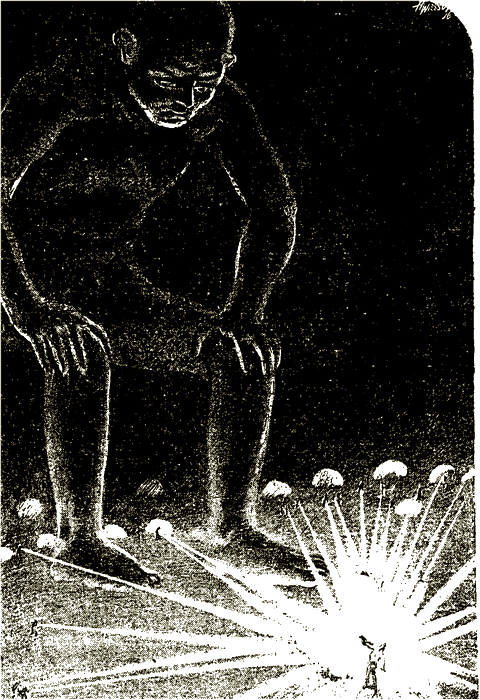
"I am now Jim Wentworth, one of those hyper-universe
creatures. Before that, I, one of Orimuz, had no name."
The great Kam glowered down at the speck of Jim Wentworth. "You have loitered on the way," he said. "Your fellows were here long before this—both those who were successful in finding bodily forms, and those who failed, and have returned to their vegetative baths, waiting for further opportunity to conquer the active state. Why are you, of them all, so late?"
Jim's occupant explained, even as he had explained to the black dwarf at the gate of Orimuz. But Kam was not so readily satisfied. "It is passing strange." His thought beat like hammer blows in Jim's circumscribed mind. "Aldahor has escaped. It was forewarned. Yet how was it possible? Our plans were laid in utmost secrecy; our foray upon the triple suns was faster than the light that carried news of our approach. By now, all the life-bordering men of Orimuz should have been clothed in the stolen forms of Aldahor—forms that rightfully belonged to us uncounted aeons ago—and stirred to active, sentient being, even as these who surround me. The hated world of Aldahor would have been irrevocably destroyed, and Orimuz would once more have assumed her rightful overlordship of the universe."
The six who ringed him round shifted their misted iridescence, and wove approving thoughts.
"Instead," Kam pursued, "Aldahor received warning, and has fled, while a poor few of you have to be content with these puny, insufficient forms of low-scaled creatures from another space. Who, then, was the traitor?"
Jim Wentworth bowed with restrained humbleness. "I would not know of these subtle things, O Kam," he heard his mouth form hissing speech. "I was but recently awakened from my cup of formless thought, and am but newly activated with this form which you have truly designated as low-scaled."
Kam stared down from his tremendous height, probing, wary. Slowly, the swirling fog of spaced molecules regained its pristine glow. He leaned back, waved a giant, tenuous hand. "For the moment I had thought——" He then retracted the emanations of his mind. "Get you into the preparing chamber with your fellows, you who are now called Jim Wentworth—a barbarous name."
Jim bowed again, and moved with dignified motion over the gleaming red floor. But it seemed to the prisoned Earthman that Kam had not withdrawn his thought in time. He heard, or seemed to have heard, a whispered name. "Insar!"
INSAR! Why should Kam, the mighty one of Orimuz, have thought of him? Insar, who had claimed to be an exile from this universe in the familiar hyper-universe of Earth and the galaxies, who had seized on Matthew Draper's form to gain Earth life, and labored desperately to regain this weird interior universe to avert some terrible, impending doom; who, nevertheless, his purpose accomplished, had yielded voluntarily the no-longer-useful body to its rightful owners? Who then was Insar, and where was he now?
Then that, too, was forgotten.
He had already, with effortless ease, traversed the vast spaciousness of the tower. A violet beam guided him on the way. Behind, somehow, he sensed the still-inquiring thought of Kam surging after him, trying to probe inward into the intelligence that surrounded him. And, somehow, he knew, as well, that the entity had sheathed himself against the prying emanations.
Two dwarfs of Sirius lounged their incredible weights before a vaulted arch. They stared up at him with malign laughter in their solitary eyes.
The chamber was smaller than the great inner hall, but still of spacious vastness. A pale-violet glow quivered lambently over its occupants. The light emanated from a central column of flame that sprang sheer and cylindrical from a bottomless pit in the dark-red floor, and soared interminably to the topmost reaches of the tower. It seethed with inner turbulence, but its rounded surface was smooth with pulsing color. It flamed, but there was no heat. It was light; yet it was not light. It consisted of emanations unknown to Earth, emerging from the innermost bowels of Orimuz. It was beautiful with an eerie splendor; yet Jim—entity and Earthman alike—shrank from its flower-like glory as from something indescribably malign.
None of the other Earthmen or women in the chamber seemed to be afraid of the shining column. They walked unconcernedly close to its shimmering round, disclosing, even, by their movements, an eagerness, restrained for the moment, an impatience to thrust themselves into the pulsing glow, to bathe in its vibratory radiance.
There they were—all of them—the ravished people of Earth. They turned at the advent of the newcomer. Hissing words of greeting issued from their mouths. Jim recognized them all.
Here, to one side, was Dudley Nichols, the slight, wizened mine president whom Jim had last seen running and stumbling and choking with terror in the grip of an Orimuzian ooze; over there was Ben Hinkman, thickset farmer broad of face and speech. Others shifted into his vision—youthful elegants, male and female, of the Harbor House; horny-handed down-East natives; garagemen; waiters in tattered jackets; men with gnarled hands and weather-twisted countenances; women with smooth, lifted faces and diamonds still glittering on their once carefully manicured fingers; little children in faded overalls; others in expensive English importations.
In short, all the strange conglomerate that had been reft from one universe and catapulted into another through the stumbling intervention of Jim Wentworth.
He recognized them all, and passed, them by. He was seeking desperately, through eyes that focused under an alien influence, for two persons: Matthew Draper and Claire Gray—especially the latter.
HE saw the scientist first. He was staring avidly into the pillar of fire, and had not even turned at the arrival of his former assistant. Jim could not see his eyes; the man's back was turned half away from him.
As Jim moved toward the knot of colonists, his pace slowed, dragging, reluctant. He tried to will himself forward—and moved even more slowly. He must find Claire. Then, as though his occupant finally realized his urgent thought, his eyes swerved to the right, Jim's detached entity pulsed eagerly, subsided with a shocked despair.
He had seen her! And she was staring straight at him! But what had happened?
The girl's beauty had not changed. In fact, she was more breath-takingly beautiful than ever before. Her charms, hitherto modestly concealed, were now semi-bare for all to behold. Jim Wentworth himself had been responsible for this. Back on the Earth fragment, during the swift invasion of Orimuzians, he had tried to rescue Claire from the interpenetration of a life-avid entity. He had failed; but, as she had hurtled aloft, the grip of his clutching fingers had ripped the sheer material of her dress. It hung on her now, torn, desecrated, betraying the loveliness beneath.
Yet Claire Gray made no attempt to cover her semi-nudity with the tattered remnants of her clothes; instead, she was staring boldly at her fellows. It was her eyes that forced a soundless groan from the restricted consciousness of Jim. They were the eyes of Claire in color and shape and texture. But the spirit behind the hazel limpidity, the light that had once revealed her soul, were gone. In their place were coldness, calculation, malicious triumph—everything that had been foreign to the girl with whom Jim had worked on Earth and in Infra-Universe.
She moved toward him. A smile, half mockery, half invitation, wreathed her features.
"No! No!" he cried out soundlessly, in helpless anguish. He had yearned to take her in his arms—but not this way. Not in such a shameless condition; not with that smirk on her lips and strange invitation in her eyes.
He tried to recoil his body, could not. He was a frozen prisoner, compelled to stand and await the oncoming of this travesty of the girl he now knew he loved. For with the shame and degradation had come bitter realization. It was not Claire who was doing this—but the Orimuzian incubus, forcing her forward, seeking amusement and malicious satisfaction from the tumbled memories he was evoking.
She was speaking to him, in the language of Earth, with lips that were hers, and yet not hers. Or rather, to the being who had taken possession of him. "Welcome, one of Orimuz! I have been waiting for your appearance. The creature in whom I am clad has thought of you often and long. There seems to have been a strange connection between us on that inferior planet known as Earth. Love—she called it—though I had to drag the name out of her unwilling memories. Love!" She laughed at that, brutally, shamelessly. "I think we two ought to probe the mysteries of this queer sensation. Come!"
Her arms went out in voluptuous gesture. The remnants of her dress fell farther away. Jim shrank himself in a nausea of shame and degradation.
She came closer. He felt the warm incense of her breath, saw the glitter in her eyes. Then, quietly, easily, the body of Jim Wentworth stepped aside. "I am not interested in the primitive sports of these people whose forms we have adopted," he said coldly. "We require the latter for active life, but the former would only becloud the pure flame of our own mightier intellects."
Claire laughed, but her eyes were icy. Something lurked in their depths. Yet she stopped short, and turned away with shrugging shoulders.
Jim breathed again; the choking nightmare slowly lifted. In its place was a flooding gratitude for his entity, the first emotion other than helpless anger he had felt for him. His thanks surged out, were swiftly thrust back. An almost audible "S-s-sh!" whispered in his consciousness.
For a mighty thought was blasting at their minds—the thought of Kam! "It is time to enter the bath of preparation," he decreed. "We are fast overtaking the cowardly orb of Aldahor. There is no question as to the outcome. Aldahor will be eradicated from the universe, her god-like forms transferred to the waiting essences or Orimuz, and the traitorous Aldahorians exiled to the hyperuniverse to exercise their talents." Kam's thought grew gray with anger.
"This time there will be no slip-up, as in the case of the false Insar. The flaw in the projection machine has been discovered, and repaired. They shall dissociate into a million fragments, so infinitesimal and so wide-scattered that not even their intelligences will ever be able to reassociate them."
Jim hearkened in a chaos of turbulent emotion. His earlier wild surmise had been correct. The ultra-viruses of Earth, harbinger of infinite suffering, were then the smashed fragments of beings from this universe! Because it was their only method of achieving active life, they brought death and desolation to the inhabitants of their place of exile. Not all of them, it was true. For some—know as bacteriophages to me—by a freak of chance attacked only the pathogenic bacteria, and thereby aided their unwitting hosts in the endless struggle against disease.
JIM reeled in a circle of circumscribed agony. If Aldahor were conquered, and the threats of Kam put into effect, there would be unleashed upon a helpless Earth, and upon the other inhabited planets of his universe, such a horde of swarming ultravirus beings as must sweep all life away in one great, devastating plague!
All the laborious evolution of man, all the similar evolutions of the unknown beings of other planets, would be lost to eternity. Matter would remain; but thought, the motivating impulse, would vanish as if it had never been. Even the destroying viruses, left without the quickening means of organized life, would return to their original state of unsentient immobility—frozen forms not far removed from the crystals.
Through a haze, he heard Kam continuing. "It is necessary, before we reach Aldahor, that you fuse irremovably in the bath of preparation the bodies you have adopted and your own formless essences. So that, in the fury of combat, you may not be wrenched apart; and that there be no cause for quarrels here on Orimuz between the various forms, as there once was in the past. Such is my will!"
The captured Earth people bowed humble acquiescence to the invisible master. All, that is, except Jim Wentworth. He stood a little to one side, straight and proud, hands clenched at his sides. Jim wondered at himself. His detached brain tried in vain to pierce the sentience of the invading intellect. Queer, incredible thoughts whirled round and round.
Already a man had stepped forward. He was young and dark-haired, a banker's son on Earth, who had won the golf championship at Harbor House. He moved eagerly toward the seductive cylinder of flame, as to a tryst with one dearly beloved.
Jim cried out involuntarily: "For Heaven's sake, Horton, don't go!" To his surprise the cry echoed from his lips in the language of Earth.
But young Charlie Horton did not hear, or, hearing, paid no heed. He plunged into the fiery bath, hung momentarily suspended within the pulsing vibration, shimmered in lambent fusion, and stepped out on the other side. Charlie Horton was no more—the separateness of his being had merged irrevocably into the entity of Orimuz.
Jim felt sick with horror. One after the other his fellow beings were streaming into the malign radiation; one after the other they fused beyond redemption into the alienness of Infra-Universe! Always they must remain shells of Earth, slaves to their infused masters, never even to have the poor consolation of their own helpless thoughts.
They crowded and jostled, waiting their chance. The ranks thinned. Jim struggled desperately at invisible bonds. If only, somehow, he could burst through his engulfing captor, thrust them away, beat them back with smashing fists. But he remained motionless. He had managed to break through with one unaccountable outcry; after that, the mesh of restraint had choked him down.
A bare fifty remained of all his comrades; only fifty on this side of the perilous bath. The others had received the fiery unction, had vanished to the rear.
CLAIRE! Draper! Jim sought them in deep anguish, through will-less eyes. Draper was waiting his turn, his body quivering with eagerness. Only a little knot was before him, swinging into the glow two by two, in unison. The knot melted rapidly away. Soon it would be his turn. Heaven alone knew with what inner thoughts the hapless, interpenetrated scientist awaited the approaching annihilation of his identity!
Jim was suddenly aware of the calculating gaze of Claire Gray. She, too, stood a little to one side, watching him through half-veiled lids. Simultaneously, his own muscles relaxed. A glimpse of almost fear beat within him, clamped down to smooth blankness. What did it mean?
Claire parted her tender lips. Incongruous mockery issued forth. "I see, one of Orimuz, how impatiently you await the bath of preparation. You are anxious to be rid of the troubling identity of Jim Wentworth. I do not blame you. The silly little mind of Claire Gray flutters around within me, struggling futilely against my superior intelligence."
She glanced down at the graceful contours of her rounded body, laughed. "These petty Earth things seem actually ashamed of their own forms. Queer, isn't it?" Deliberately, the girl ripped more of the tattered dress, revealed more and more of glowing charms.
Jim Wentworth said nothing, nor did he make any move. But the real Jim plumbed the depths of wildest shame and humiliation for the girl he loved.
Her long lashes lifted, probed Jim Wentworth. "You are so impatient," she said. "It is not fit that you wait your turn. I am certain our fellows will yield their place in your behalf. Go, one of Orimuz, into the fire that makes you unity."
A new note had crept into Claire's voice, commanding, sinister. Obviously, the Orimuzian was one of Kam's lieutenants—a spy, perhaps, upon his comrades.
Jim tensed his inclosed mind against the bitterness of final dissolution. Soon it would be over, and he, young, avid for life, would be no more.
But the body of Jim Wentworth made no movement. The muscles tensed stealthily.
"Why do you wait?" Claire demanded harshly. Suspicion flared in her narrowing eyes. "Know that I am Lei, instructed by the mighty one himself. Do not disobey, you who have clad yourself in the form of Jim Wentworth."
A wave of inbeating hate and fury lashed over Jim. But the outer round was smooth, emotionless. "I but wait my turn," he said aloud, calmly. "Claire Gray goes first into the purifying flame. Which is right and proper. On Earth, from which our bodies have stemmed, the gentleman always yields the post of honor to the lady. You, O Lei, are now that lady."
Something split and sundered in Jim's mind. Little fragments of a jumbled puzzle clicked into place. All the strange actions of himself, the subtle differences. His blinding revelation smote out involuntarily, calling out a name!
At the same time Claire—the real Claire burst the bonds of her enveloping degradation, rose to the heights of intuition. She, too, cried out a name!
THE name leaped from her virgin thought, impacted on neuron tracks, switched open memory synapses, flooded the whelming intelligence of Lei. The body of Claire Gray stumbled back a rod; her mouth sagged open; a dread name issued.
"Insar!"
Insar, chief of Aldahor, who had been caught unawares by an overwhelming force of the beings of Orimuz and dispossessed violently from his god-like form! Insar, who should have been exiled in a million, million irrecoverable fragments into the strange outer universe, never to return! Insar, unaccountably back again, even more unaccountably in possession of one of the Earth bodies—a spy in their midst!
Lei repeated the name in quick alarm. Of all the beings of Aldahor, only Insar, their chief, was to be feared. Even Kam himself——
At the dread sound of that name the dwindling few before the shining rush of flame whirled, gaped wide. "Insar! Insar!" The name leaped from tongue to tongue, murmuring at first, swilling into a scream of hate and fear.
Outside the archway, the dwarf guards heard, and hissing syllables spilled excitedly from thick, swart lips. The name ran like a fiery spark along a train of gunpowder down the endless outer hall. The tiny Sirians paused from their labors, dropped their overwhelming loads, took up the cry.
The din increased, rising in a crescendo of hisses and barking shouts as it sped faster and faster toward the central throne of the mighty one and his surrounding council.
The lesser ones started in their seats; their shimmering nebulosities quivered in dun fear. Kam, towering like a colossus on his throne, heard the tumult and the shouting, and jerked upright. His vast form filled the great inner chamber with its tremendous presence. The rainbow iridescence of his wide-spaced molecules paled, then burst into a flare of angry colors.
His thought swept out with the speed of light—a physical, roaring wave. It ripped into the cowering consciousnesses of the black dwarfs from Sirius; it slammed into the entities of the people of Earth; it brought his surrounding fellows to their feet.
"Get the traitor, Insar!" it screamed. "Seize him, ones of Orimuz. This time he must not escape; this time he shall catapult to shattering ruin."
The black monsters heard and wheeled in obedience. The hyperbolic mirrors glowed green on their breasts. A single spasm, and paralyzing waves would flow over the focused victim in their paths.
They ran, hissing and chattering, toward the inner chamber of the bath of preparation. Within, the entities of Orimuz heard the mighty one's command. Dread of the master overcame the dread of Insar. Lei darted forward, a white flash of graceful limbs peeping through the swirling remnants of Earth garments. The others sprang after her, their faces inflamed with the chase, twisted into alien cruelties. Matthew Draper was their leader!
Insar—Jim Wentworth—released his tense muscles. He swept swiftly to one side, moved in a single flowing motion toward the entrance arch. Tiny monsters blocked escape, Cyclopean eyes baleful in Stygian bodies. The mirrors of paralysis glowed, flashed toward him. He swung back in a smooth rush. The ones of Orimuz, in their Earth shells, shouted triumphantly, whirled for him.
Insar poised a fractional instant; then, without hesitation, darted straight for the bath of preparation!
Jim writhed, struggled unavailingly. That way lay annihilation for himself, if not for Insar. But the latter paid no heed to his futile will. Into the glowing, pulsing emanations, whose source was the mysterious interior of Orimuz, he sprang. A shout of exultation followed him. Then a cry of terror. For Insar dropped unhesitatingly into the vent, vanished out of sight into the dim, forbidden hollow of the planet. The pursuers drew back in fear, ran blindly for the gateway to report to Kam. Thereby they blocked the influx of the dwarfs, who alone knew the secrets of the depths, who alone might have followed Insar in his desperate flight.
JIM felt a heat that was not of Earth, heard a soft roaring that ran through swift diapasons of sound. His body glowed in a shimmering dance of atoms. A fusing radiance flowed in and over him.
Then he was dropping down, down, through an upward blast of emanations. Insar swerved Jim Wentworth's body in swift acceleration. A cold, light-quenching green, like that of an overcast sea, enveloped them. The plucking, resistless pressure ceased. The edges of identity trembled, tried to pull apart. He had burst through the fiery bath of preparation, was lunging meteor-like through the hollow round of Orimuz.
Jim shuddered with the swift reprieve. His death-shadowed mind stirred unbelievingly, slowly oriented itself. But the edges resisted his identity; there he was neither Jim Wentworth, nor yet Insar. There had been partial fusion in that blinding instant of the bath.
He looked about him with the wary glances that Insar cast. Now was no time for ejaculations, for inquiry. The two-in-one of them must find shelter somewhere, somehow, before the inevitable pack got on his heels.
The dim interior of Orimuz was even stranger than the outer surface of this alien world. Through a hundred openings in the smooth, concave crust that led directly into the great tower of Kam, the dwarfs streamed in endless files.
Each was weighted down under a top-heavy load of jagged, dark-glowing substance.
Down into the interior they dropped with their packs, down toward the very center of the hollow orb. Up they soared again, packless, obviously to reload, and return. Since matter in the Infra-Universe did not warp its surrounding space into gravitational world lines, there was really no up or down, except as Jim's Earth-habituated mind superimposed such concepts on a featureless space. Hence the ease of locomotion.
Insar skirted the unheeding dwarfs warily. Jim's bodily eyes clung in fascination to a central glow. It was a ball of bright-green fire, expanding and contracting in rapid, regular impulses. As it flared outward, tubes of vitreous material snaking from its pulsing core to the sphere crust of the planet, like spokes of a wheel, pumped bright-green fire upward.
The hum of invisible machinery rose in volume, died again with contraction. The continual dumps of metal were evidently fuel to keep the central sun alive; the ball of green flame itself was just as obviously the motor power that drove Orimuz on its hurtling path, suffused the planet with its sinister glow.
But one of the translucent tubes did not extend with its fellows to the surface. Instead, it angled out a short distance, buried itself in a gourd-shaped machine. From the mouth of this machine a column of iridescent flame leaped upward, shining with unholy beauty, to pass effortlessly through an orifice in the crust, and be lost to view.
With a shock, Jim realized what it was: the bath of preparation, through which he had just escaped! But his eyes, uncontrolled by him, were fastened with a kind of flaming eagerness upon the central pulsation—not on the sheer cylinder of lambent blaze. He was two alien intelligences, each with a different objective.
But there was no time for such precarious speculations now. For the outer turmoil that attended Insar's flight had reached the toiling inmates of the depths. The swarthy beings from Sirius hissed excitedly, hastened to drop their burdens into the central fire. Guards with hyperbolic reflectors sinister on their chests came pouring in through the vents, seeking their prey.
DESPERATELY, Jim searched for a hiding place. The huge interior seemed horribly bare of nooks and crannies. Sooner or later he must be discovered. Only the dark sea-green of the inner space held his dodging, swift-swerving form from instant disclosure. And the violet pursuit beams were already crisscrossing the gloom in a spraying network of betraying rays.
Silently, stealthily, Jim clung to the inner round, seeking to keep out of the way of the searchers. But it was a game of hide and seek that could have only one ending: discovery—irrevocable exile for Insar—more irrevocable annihilation for Jim Wentworth.
His body sprang suddenly. Jim was taken by surprise. What was Insar up to? But the being of Aldahor gave no inkling of his plan. Like a plummet, he dropped, accelerating to breath-taking speed, straight for the central globe of pulsing green.
Jim cried out, tried to swerve his crashing body from its insane course. He might as well have tried to stop a rushing locomotive with bare, back-thrusting hands. Insar had determined on a suicidal course.
Jim saw it all in a flash. If, by the momentum of their crash, Insar could jar the mechanism of the directive power supply into even temporary uselessness, his fleeing homeland of Aldahor would make good its escape. Even in his shattering fear, Jim could not restrain a burst of admiration for the patriotic sacrifice of his other personality.
Then he smiled grimly to himself. Insar was immortal, indestructible. At most, a dissociated exile would be his lot when captured by the raging Orimuzians. But he, Jim Wentworth, man of Earth, would meet with instant death, cessation of being. And there was Claire somewhere above!
The black dwarfs clustered round the central blaze heard the screech of his passage. They whirled in alarm, saw the hurtling body, tried vainly to get out of the way of the smashing thunderbolt, twisted to bring their mirrors of paralysis to bear.
Then Jim Wentworth was upon them. His hands reached out, gripped a hissing dwarf. A giant load of jagged ore weighted him down. The sudden, decelerating wrench swung the struggling, screeching wretch in a whirling arc, almost tore Jim's arms out of their sockets. These fused compacts of monsters of Sirius and ooze of Orimuz were incredibly heavy; and the ore itself was no mean mass. Weight, of course, in the Earth sense, was absent, since there was no gravitation; but mass, momentum and inertia still held their fundamental qualities.
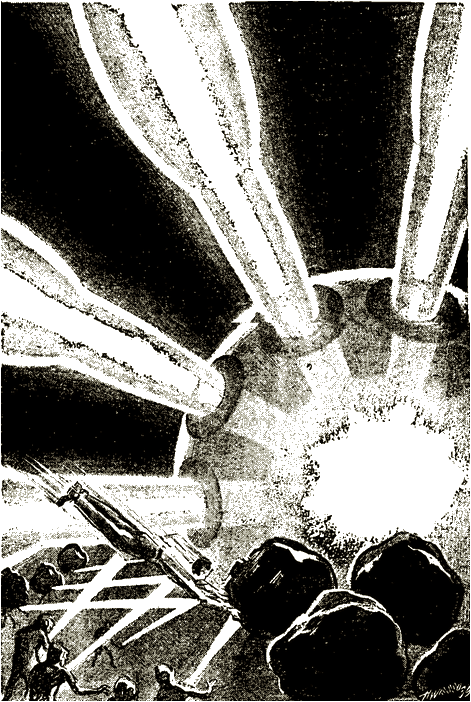
Then the body of Jim Wentworth sprang! Weight, of
course, in the Earth sense, was absent—but mass—
Jim knew now exactly what Insar intended. He bided his time with a grim intensity. The vast interior of Orimuz was a screeching, seething pandemonium of tiny dwarfs. The luckless captive was an incredible swinging arc. Reflectors flashed toward them, but the paralytic beam would be too late. Insar concentrated all his supermind on the task before him.
Jim's arm lashed out, let go its squalling load. Dwarf and metal fuel hurtled forward. But in that last instant between retracted muscles and forward thrust, Jim Wentworth himself had acted. He summoned all the concentration, all the gritting will at his disposal, in that single act of volition. Insar's own absorption, the semi-fused edging that overlapped their entities, assisted. Jim's scheme worked!
The living missile hurtled forward—but not in the line of flight that Insar had anticipated. It swerved slightly from the true. Instead of catapulting directly into the baleful orb of green that motored Orimuz, it went smashing and crashing into the gourd-shaped machine that powered the bath of preparation. There was a rending sound, a shattering of metal. A blinding, blasting explosion rent the glowing column apart, caught Jim's body in its outward rush, sent it tossing and tumbling in insane flight. The interior of Orimuz was a hell of flame and sound and hurtling bodies.
JIM grinned happily. Now nothing mattered. Let death come! He had saved Claire and Draper and the pitiful few who had not yet entered the bath of preparation, from a horrible future of complete submergence.
Insar pressed furiously in upon him, smothering him with the beat of his wrath. "You've ruined my plans!" he blazed. "I would have saved Aldahor from Kam and his accursed cohorts. Now all is lost. I'll never get the chance again."
Jim fought back against the unendurable pressure. "I am not sorry," he retorted defiantly. "I, too, have had my plans. I have succeeded. I have saved Claire and the others of my kind from a fate, that was horrible beyond conception. Death itself is welcome compared to what was pending. What happened to us did not matter to you; I, too, therefore, had to think only of my own."
Insar was suddenly silent. His wrath ebbed. His thought even glowed with semi-admiration. "If Matthew Draper and you, Jim Wentworth," he said finally, "are fair examples of Earth's people, there are possibilities in them, primitive and limited in intelligence though they be. But the ones of Orimuz are after us," he said, "and this time there will be no getting away."
The blast had spent itself. The green orb pulsed as before; the translucent tubes glowed with force emanations, Orimuz whined with the speed of its pursuit across an unending universe; only the shimmering column of violet light was gone. Already the scattered hordes of Sirians were screeching their cries for vengeance; already the search beams crisscrossed the void to pick up the trail of Insar.
"There is still a chance," said Jim quietly. "It is probable that Kam has gone to the preparing chamber to discover what damage has been done. And, if I read his character aright, his subsidiary ones will trail along, appendages to his mightiness. That means the great tower itself is empty, except possibly for the little black monsters. We may be able to avoid them, get out somehow to the surface. Then——"
Insar was a being of swift decisions, even as Jim Wentworth. "You are right," he interrupted, and translated thought into instantaneous movement. He doubled on his tracks, shot upward like a bullet from a high-powered rifle.
A round orifice loomed ahead. He shot toward it. Luckily, no dwarf blocked his path. All the tiny guards were either within the hollow interior, joining the hue and cry, or outside the tower. At least, that was the only basis for Jim's desperate attempt.
He flung out into the great inner chamber of the mighty tower. It was empty. Jim's surmise had been correct. The mile-high throne and its satellite seats loomed silent and vacant.
"Swell!" Jim exclaimed. "Now if you can get to that entrance wall, find the combination to make it open, and then——"
Insar said: "Look! It's too late!"
PALE-VIOLET beams swung from the far-distant wall with seeking fingers. The guards were warned, alert, Jim turned his head. The peaked arch to the preparing chamber blurred. Misty figures, like thick fog, were coming through.
"Kam and the subsidiary ones!" Jim exclaimed. "Returning!"
"Yes. They'll be here soon."
"But they are small now, a tenth of their former size."
"Only to be able to get through the doorway," replied Insar. "Watch—they'll grow back to normal now. It's a compressive property possible to the tenuous Aldahorian forms."
"What shall we do now? We seem trapped."
Already Kam was looming in the distance, expanding into giant vastness, coming on with swift angry strides. Insar did not hesitate. He cleaved the dun expanse, rushing aloft like a rocket projectile. It was touch and go. If Kam had seen him; if the search beams had contacted his swift-rising form——
But there was no cry of discovery, no green swath of paralyzing rays. Temporarily, he was safe. Up and up, Jim hurtled, mile on mile. There seemed no end to the tower.
Then Insar braked acceleration. He had reached the top. He swung Jim's body up to a platform of glassy green, suspended beneath a dome of paler hue. An observation platform. The dome was transparent and gave view on infinity itself. From below, the hiss of unremitting search beat faintly up at him.
Jim's consciousness had noticed a subtle change in the relationship between himself and Insar ever since the plunge into the bath of preparation. He was no longer submerged, no longer a helpless entity. The slight fusion of identities at the edges had given him roots again, made him more nearly equal to the mightier, dominant Insar.
A channel of free communication had formed.
Now both were staring out of his eyes at cerise infinity.
Orimuz lay far beneath, countersunk under the swelling bubble of glittering yellow. The slender cups, like inverted mushrooms, in which lay the structureless ones of Orimuz, awaiting contact with life forms to come to quivering activity, were dots of poisonous green. The triple sun, flashing with kaleidoscopic colors, was nowhere in sight, lost in the void.
But straight ahead, silhouetted against a back drop of infinity, glowed another sphere. A silver world, shiny and lustrous, flashing with studded knobs of diamond brilliance—Aldahor!
Jim groaned, or rather, it was Insar who gave vent to his despair. "Aldahor is doomed," he lamented. "Its flight has been in vain. Orimuz is speedier by far. There is no shelter anywhere in all the universe."
"Can't your comrades fight?" Jim demanded.
"Fight?" echoed Insar dully. "With what? We are a peaceful race, bent on contemplation rather than activity. Orimuz has weapons such as we never thought to build. See! They are trying them out already."
Green flashes stabbed out from the surface beneath, ripped through the void for millions of Earth miles. They fell short of their prey, but by perilously small margins. It would not take long for the pursuing world to bring Aldahor within range.
"Those flashes," explained Insar bitterly, "are gigantic paralyzing waves. All matter, all thought, stop in their tracks while the ray is upon them. The world of Aldahor will become a motionless rigidity in the envelopment of the rays, a fixture in space. My people will lose all thought, all power of locomotion, all resistance. It will then be a simple matter for the triumphant ones of Orimuz to dispossess us from our bodily forms, to insert instead the waiting hordes of their own kind.
"Since our thought-matter content is essentially indestructible, we shall all be thrust out into your alien universe, shattered by their diabolical machines, so that our million million dissociated entities will be helpless, powerless to return. Already some half dozen of my people are ruinous dissociants in your world. Ultra-viruses, you call them. They destroy your people because they cannot help it; because their tiny blobs are barely sentient, seeking rebirth, and finding only multiplication of destructive possibilities. You may understand," he ended quietly, "what will happen when all Aldahor is thrust similarly into your space time."
JIM understood, had already weighed the future. But now that the deadly fruition seemed veritably at hand, he was appalled. "You must fight!" he cried desperately. "There must be a way out."
"We shall fight, of course," Insar said grimly. "But it will do no good. We have no weapons!"
"Were not your bodies fused with yourselves, as with the Orimuzians?" Jim insisted.
"No. We did not believe in the annihilation of the entities of our hosts. The arrangement is what on Earth you call symbiosis—a mutual interweaving of parts, a give-and-take arrangement that is highly profitable to both members of the dual entity. You see," he explained, "Orimuz was once the sole world in all Infra-Universe. It revolved around the triple sun in solitary majesty. All life consisted of the structureless fusion of matter and thought as in the waiting ones of Orimuz, and as you found me in my temporary exile."
"And then the super-heavy dwarfs of Sirius broke into this universe?" queried Jim.
"I didn't tell you," answered Insar. "There was an earlier invasion—if you could call it that. They came from Betelgeuse, the giant star of your galaxy. They had dwelt on the surface of the Sun itself, giant inhabitants, misty, tenuous vacuums on a star that itself was but a glorified vacuum of heat and light.
An explosion took place in the interior of the bubble star. The force of the explosion, the fierce storm of outward-thrusting radiation, pried the atoms and molecules of the Betelgeusans still farther apart, beyond even the best vacuum Matthew Draper could have manufactured on Earth. Gravitational pull weakened to the vanishing point; the space warp, during the tremendous expansion, flattened out and vanished with it. As a result, they became dissociated from their own universe, found themselves suddenly within our Infra-Universe."
Jim's throat constricted; his eyes still stared across the fast-narrowing space of Aldahor. "They made their way to Orimuz, unwittingly contacted the lifeless-seeming ones that were ourselves," Insar went on. "Life forms are catalytic to us—activate us with incredible rapidity. We took possession. At first they struggled, unavailingly; then mutual respect grew. Their intelligences were equal to our own; we each possessed knowledge, capacities, not granted to the other. The symbiosis was mutually helpful, and became a voluntary act. We lived in amity, have continued to do so ever since."
"But how about the black dwarfs of Sirius?" Jim interrupted.
"I'm coming to them. From their irruption into Infra-Universe dates all disaster. We didn't realize it at first. We welcomed them, infused our life-bordering brethren into their monstrous little bodies. But something happened. The race of Sirius was as twisted in its mind as in its body. The symbiosis was demoralizing. Their evil intelligences poi-soiled the thought wells of our brethren, warped them to their own ends. As a result, two fast-differentiating races inhabited Orimuz. It could not continue.
"We, the inheritors of Betelgeuse, voluntarily withdrew, and builded a beautiful new world which we called Aldahor. There we thought to live in peace and quiet contemplation. The dwarfs of Sirius hated the light and glow of the triple sun, and took their planet out into the timeless void. There they busied themselves with strange new forces, weapons of destruction. They resented our shining forms, our giant size. Through the aeons the envy grew. A few of our wide-wandering comrades were caught unawares, stripped of their forms, expelled to alien space. Among them was the chief of Aldahor."
"Yourself?"
"Myself," Insar repeated with dignity. "Kam, one of the dwarfs, clothed himself in my shape. Because of superior cunning, because of the unwilling aid my Betelgeusan entity could furnish, inhibited from rebellion by a small dosage of the paralyzing beam, he was soon able to gain control of Orimuz. It is his plan to capture Aldahor, to clothe his fellow Sirians in our shining garments, to thrust the old puny husks on the still-lifeless ones, and rule the universe entire. That was the reason he wished to merge your Earth entities with the newly wakened ones. They might, in turn, strive to do unto him and his dwarf intelligences as they are on the verge of doing to us."
INSAR paused; there was silence. The distance between the two worlds was rapidly diminishing. The stabs of green flame jutted closer and closer to the fleeing planet. It was but a matter of minutes, now.
"We'll have to do something," Jim said violently.
"I intend to," Insar agreed quietly. Yet he seemed to make no move.
"What's happening?" Jim cried suddenly. There had been a faint, ripping sound, as of something tearing loose. There was no answer. Instead, he felt as if a nightmare weight were slowly being lifted. His ego expanded, swelled with a blessed sense of release. His mind breathed freely once again, took hold with firm roots on memory synapses, on nerve and muscle controls. He willed, and his arm lifted in responsive obedience.
In his first bewilderment, Jim did not realize exactly what was taking place. Then his eyes dropped to his body, and he staggered back with a cry, half of loathing, half of fear. From every pore, from every interstice, a viscous, structureless mass was oozing. Insar was voluntarily quitting his Earth host, cutting himself off from active thought and motion!
With a supreme effort Jim overcame his first repulsion. "Here, don't do that!" he exclaimed to the Aldahorian. "You're losing your last chance to do anything for yourself, for your race. With my body, perhaps——"
Insar's retreating thought ebbed around his expanding intelligence. "I am returning to Aldahor. It is the only way. Alone, I have a chance to avoid the search beams of Orimuz. With your solid, clumsy form we'd be cut down in the void before we reached halfway. I have sufficient activation to last until I make the silver planet. There my comrades will furnish me with one of their own forms. Perhaps I may be able to help—who knows! Good-by, Jim Wentworth, good luck!"
The ooze was forming a transparent mass in the tapering dome. It quivered like a jelly. The last thin thread snapped off. Contact between Earthman and Insar of Aldahor was broken.
"Come back!" Jim urged desperately. Now that the moment had arrived for which he had prayed this long, weary while, he was afraid. Afraid for Insar, for Aldahor, for his Earth companions down below, still bound to brutal entities, for himself.
But only a sibilant hiss was the response. No thought surged within him. There was no further bond of communication.
Insar vibrated rapidly. Then, suddenly, he was gone, piercing the green transparency of the dome as though it were a mere illusion.
JIM turned slowly. It took time for full awareness to come to him. He was a free agent again—Jim Wentworth, himself! He flexed his arms, shifted his legs, breathed deeply. Everything moved as he willed. A sense of power flooded his being, subsided as rapidly as it had arisen. His position was more desperate than ever. Before, he had Insar's mighty intelligence to rely on, but now—— What could he, a mere Earthman, do against the sinister ones of Orimuz, headed by the mighty one himself?
He peered down. The search was still going on. The violet rays were an impenetrable network, lifting slowly, higher and higher. Soon they must reach the platform on which he had found temporary safety. He laughed grimly. He would be incontinently hauled down, interpenetrated with a waiting one, eventually to join his fellows in a new-constructed bath of preparation.
A faint, hissing cry sprang up at him, grew in volume to a great, tower-vibrating shout. The platform swayed precariously. He almost lost his balance. He peered down into the depths in alarm. Had they discovered his whereabouts? Were they even now rising swiftly to get him?
But the web of interlacing beams had not raised. Rather, they had dropped to the ground, were flicking off as if the search had been abandoned. Jim's forehead crinkled in a frown. What was up?
Something made him turn. An Earth curse swept his lips. He knew now what that paean of triumph had portended. The pirate planet had caught up with its prey!
Across a no-longer cerise void the green flames lapped out with avid eagerness. Swords of doom extended across infinity. Their tips quivered with obscene fires around the silvery disk of Aldahor, farther and farther, wrapping it round in inextricable embrace.
Jim Wentworth shivered. He was witnessing the doom of a mighty planet, of a mighty race. Insar had arrived too late, would be caught in the fate of his fellows. Back in the hyper-universe of Jim's own kind, the repercussions of this strange, other-universe struggle would be incredibly disastrous.
Jim ground his teeth in helpless desperation. Then his jaw slowly hardened; a grim light sprang into his eyes. He would not be caught like a rat in a trap, waiting here, cowering against inevitable discovery. No matter what the overwhelming odds, it was his duty to fight on to the end.
FOR a while he thought, quietly, intensely. He did not turn his head, refused to glance back at what was taking place on Aldahor, He did not wish to see. Then he grinned, and when Jim Wentworth grinned, he had a plan. Insane, impossible, no doubt, but a plan nevertheless.
He peered cautiously down again. The great hall seemed bare of all life forms. Without question, the ones of Orimuz had catapulted from their planet, were winging their way to the captive Aldahor.
Not without an inward qualm, Jim stepped off the platform. He knew that here there was neither height nor depth, nor gravitation to tug his body and bring it crashing to the ground; but old use and wont were too instinctively embedded to be cast aside thus summarily. Supposing——
He floated!
The withheld breath escaped slowly from his pursed lips. From contact with Insar he had learned the secret of locomotion in Infra-Universe, It was a matter of will. He forced his thoughts into his muscular coordinates. He descended, not rapidly at first, because he did not quite know his powers, but with increasing velocity as his confidence grew.
He decelerated easily and effortlessly as he neared the ground. He landed lightly, looked swiftly around. There was no one in all the vast tower. He swung eagerly to the nearest vent. It would be much simpler than he had anticipated. With the Orimuzians intent on their captive planet, on the horrible work of transposition, he could easily go——
Vast, furious thought surged through his skull, battered his reeling senses in a roaring torrent. "You have managed to elude our search long enough," it pounded. "But we have you now, Insar. Your Earth form will hide your guile no longer."
Jim whirled in the direction of the beating waves, gasped. Before him, on the hitherto empty central throne, a giant shape was slowly shimmering into visibility. Kam, the mighty one!
Kam's great globular head bent down. Huge eyes shaped into being, filled with cruel mockery. "I thought that you might still be hiding somewhere in the tower of Orimuz, O Insar!" He grinned. "That was why, before my subjects went to seize the captive Aldahor, I had a paralysis beam of low intensity trained on me. It was sufficient to slow down the atoms of this form to near-zero vibration. Widely spaced as they are, I, Kam, the mighty one, vanished from view. But enough of thought remained in the residual me to impact the automatic inducing current, to switch it off.
"I saw you descend, or rather, sensed the vibration of your motion, acted, and here I am—and here you are! A splendid trick, don't you think, O Insar? You would not have thought it out in your palmiest days. Ho! Ho!" His head went back, and waves of laughter streamed around Jim.
Jim swung suddenly, dived for the nearest vent. Once beneath, he might be——
He froze in his tracks, suspended in mid-motion.
"Oh, no, you don't," snapped Kam. "I am not such a fool as you seem to think."
Green paralysis rays ringed Jim's helpless form in a shimmer of frozen light. Across the vast red floor, through the dissolving haze of the opening wall, came dwarf guards, hyperbolic reflectors glowing angrily.
"Take him out to his fellows. Let their fates be his as well," Kam ordered. "But be careful—he is as elusive as thought itself. If he escapes, I'll place the ones responsible in the vegetative state for all eternity."
THEY advanced on Jim, little sooty demons, grinning horribly. They picked up his rigid body as if it were a feather, tossed it across their twisted shoulders. The incredible mass of their bodies was as unyielding to the touch as his own frozen hardness.
Out through the wavering open wall they went, carrying him: Kam strode behind, a mile-high giant of iridescent nothingness.
Jim stared up at the void with frozen, unblinking eyes. Infinity was circumscribed, blotted out by the great bulk of the silver planet. The yellow transparency that sheathed Orimuz had slid away. Green swords of flame thrust at the shining orb of Aldahor, held it in paralyzed embrace, even as Jim himself. As he heaved on rock-hard shoulders he caught another glimpse—sideways, this time. A sea of stalked, green-shining mushrooms waved back and forth in unison, stretched their slender stalks aloft like rubber bands. The cups of formless thought! Within them, quivering with anticipation, lay the life-bordering ones of Orimuz, sensing somehow that life, active, sentient, was soon to be theirs.
Kam grinned a vast grin of satisfaction. "Be patient, my brethren!" he told them. "Your eternity of waiting is over. Orimuz is triumphant. We planned for this many a weary aeon, and the plans are bearing fruit. Aldahor will be destroyed, your traitorous brethren dispersed, and Infra-Universe will know no other but the mighty ones of Orimuz. Let us go!"
His great form rose, like shining fog lifting over the mountains of an infinitely remote Earth. Straight up from the green surface of Orimuz it shot, swift on its journey to the captive planet, Aldahor. The midnight shapes of Sirius followed after, and with them, Jim Wentworth, helpless, immobile, thinking slow, terrible thoughts. Kam was positive that Insar was still an interstitial part of him. What would happen when he discovered the truth?
The gleaming sphere filled all space, blotted out the void. It rushed to meet them. Then they were descending to its dazzling surface. An artificial world it was, graceful, lovely beyond all Earthly imagining. The rounded surface was of a silvery metal, chased with exquisite designs of hyper-geometric beauty. There were mathematical figures, whose fantastic curves seemed somehow to retreat into dimensions not for human sight; there were abstract designs that flowed and seemed alive to the fascinated eye. Brilliant colors inlaid the incised lines, made of Aldahor a shifting vision of aesthetic delight.
Jim, as he descended, made out the structure of the studding knobs which had flashed with such perilous fires when seen from the fragment of Earth. They were tremendous domes of many facets, cut like glittering diamonds, and an iridescent flame of ever-shifting color played over their angular surfaces.
They headed for the largest of the diamond domes. It was almost as huge an extent as the great tower of Orimuz. A subsidiary one stood guard at the portal. He bowed to Kam, the overlord, as the giant swept through. The dwarfs followed pell-mell, and with them, the rigid form of Jim Wentworth.
EVEN in his frozen state, Jim sucked in sharply the indescribable splendor of the immense interior.
But the creators of this mighty splendor, this unimaginable civilization, were lying on the crystalline floor, just as they had fallen—dim, huge, barely discernible frozen forms, immobile under the frigid embrace of the green radiance. Yet on their misty countenances there was a god-like benignity, a super-universe benevolence beyond all description. Kam himself, though huger than any, by the evil force of his own interstitial being, seemed a ravaged, fallen angel.
The subsidiary ones, fellows in outward form to the captive Aldahorians, were busied with the assemblage of certain strange machinery. Jim tried to blink and could not. Those machines, fantastic, with huge, gaping maws like dragon vents, curved into the insane patterns of ultra-dimensions, were, but on a vaster scale, what Insar, in the person of Matthew Draper, had erected on Earth——
Horror welled and froze. From their hideous maws would spew the weird emanations that would hurtle the disembodied entities of Aldahor to a shattering exile, there to wreak unwitting disease and desolation to the being of the galaxies.
Kam bent his moon-like eyes on Jim. "I am doing you great honor, O Insar," he said mockingly. "You shall be the first to be dragged out of your muffling form, and sent, dispersed and desolate, into the hyper-universe."
Dwarf guards scurried his frozen body over the crystalline floor, placed it urgently before the curving mouth of the central machine, different somewhat in design from the others. Lemon-yellow emanations leaped out, bathed his still-paralyzed form in fantastic glow. Kam bent his towering height to view the expected dissolution more closely. The subsidiary ones made a vast, intent circle. Between their giant legs the tiny Sirians peered and hissed excitedly.
The glow slashed through Jim with plucking fingers of fire. His body surged and heaved convulsively under the impact. His brain plucked at its moorings in an agony of tearing fury. The glow increased, sang with relentless power. Jim felt himself dropping through a haze of suffering; his mind swelled and jerked as if it would burst. But there was no dissociation. How could there be? Matter and thought were inextricably fused—were unity.
The emanations ceased; the glow died. Jim grew slowly aware of his surroundings. There was a mutter of movement around him. He lifted his head weakly; the paralysis had left him. Kam was staring down at him, his vast brow furrowed.
Jim grinned. "One up on you, O Kam!" he mocked. "I am not Insar; I am but Jim Wentworth, of Earth, alone and indivisible. Insar has escaped; you are not through with him."
A roar of thought shook Jim as though he were a leaf, made the very walls to sway and quake. "Escaped, has he? Not for long. Scatter, ones of Orimuz! Give the alarm. Let Aldahor, let Orimuz, let the triple sun, let all the universe be combed until he be found and brought back to me. Find him, or feel the full weight of my vengeance!"
They scattered with a rush like the swash of a typhoon. Kam's wrath was not lightly to be aroused. "As for you," rasped the giant, "you infinitesimal, puny being who call yourself Jim Wentworth, I shall reserve your fate for later. I have far more weighty matters than your disposition to attend to now. Take him back to Orimuz until I am ready."
Obediently, two dwarfs swung him up and over their shoulders. Jim lay there, rigid, motionless. Then Aldahor spurned beneath their upward rush. Outside, the intervening void was thick with the formless blobs of the ones of Orimuz. They hurtled through space in a globulous rain, rearing from the cups of formless thought, surging with quivering avidity on Aldahor, seeking the mighty shapes that would give them active, motile life. Jim shivered, and lay still.
The tiny Sirians hissed and grumbled to each other. Jim could not understand their speech, yet it seemed to him that they were discontented at the endless trek of the ones of Orimuz. They had been promised the giant bodies or Betelgeuse in exchange for sooty dwarf-hood. Would not that promise be broken in the hurry of events; would not all forms be tenanted by the time of their return?
THE vast amphitheater lay strangely dull under its bubble sheath of yellow crystal. The stalked cups no longer waved in eagerness. They were dim pools of somber green, vacant of their former occupants. Still hissing and squeaking, the dwarfs tumbled Jim close to the tower. He quivered and lay still, rigid as ever, staring up with unblinking eyes. He had seen something—or thought he had. One of the cups, close by, still held its shapeless ooze. Something had happened. The solitary one of Orimuz had not followed his mates to activation.
Yet it must have been an illusion. For, as they swept past, and the motion of his carriers had jerked him round a bit, his eyes fell once more on the cup. It was tenantless, vacant as all the others. Strange!
An animated discussion was taking place between the guards. They grew excited. They squeaked and gibbered at each other. Their single eyes rolled with mingled fear and greed. Then, suddenly, they seemed to have come to a decision. As one, they turned and stared at him. Jim lay stiff and frozen as ever. They grinned horribly. Then, with a rush, they were gone, hurrying upward, back to Aldahor, fiercely intent on the promised transformations before it would be too late. Jim Wentworth was abandoned.
For a long time he lay on his back, staring with wide, frozen eyes at outer space. Orimuz was silent as a tomb; the intervening void was bare of occupants. Then, and then only, did he cautiously raise his head. He had been freed from the paralyzing influence in the dissociation bath, had pretended it ever since. Only rage at Insar's escape could have blinded Kam to the realization of his pretense.
There was no one around. Jim rose quickly. His legs tottered; his body was weak. But a driving will forced him on.
Slowly, his tired body moved over the ground, past the empty cups into the tower. The intervening wall was a thin mist of blood, left open in the excitement of Aldahor's capture. He went in. The vast hall was a thing of echoing shadows. All had gone, to partake of the spoils of the silver planet.
He stared down at the nearest pit, leading into the mysterious bowels of Orimuz. So far his luck had held. Would it continue to hold?
Silently, warily, he dropped through the dim green glow into the hollow interior. The weird central globe of bright-green fire expanded and contracted with regular heat. The spoked tubes pulsed in sympathy, pumping green radiance to the outer surface of the planet. Thus far, everything was as it had been on his first journey into the depths—except that the shining column, which had fed the bath of preparation, was gone.
But the vast hollow was now tenantless. There were no endless streams of dwarfs straining under gigantic loads of fuel.
Jim's heart gave a great bound. Here indeed was a break; one that he had hardly expected. He knew exactly what he had to do. Insar had tried it, and would have succeeded, had it not been for his own ultra-stupid act in diverting the missile from its destination.
He dropped swiftly through a thousand Earth miles of emptiness. There was no air to resist his lightning progress. He breathed, and the strange space of this universe furnished energy to his heart and tissues, just as if there were present in fact the essential elements of life—air, food, water.
DOWN! Down! and still only the vibration pulse of the central glow disturbed the utter silence. His luck still held. He set his course for the gourd-like machine which he had smashed in the earlier encounter. It floated dose to the power plant, its huge metallic pieces sluggish in the central void. With one of those great fragments to hurl full tilt into the pulsing glow, a tearing, crashing weapon, he might stop that regular beat, the flow of energy along the radiating tubes.
The power gone, the mighty paralyzing rays must necessarily cease to function. The giants of Aldahor, released from their prisoned helplessness, would rise and overwhelm the surprised forces of the invaders.
He swung close to a huge fragment. His eager fingers gripped on it, seeking a firm hold. Its mass was vast, its inertia great. He could not budge it. Grimly, he thought the problem out. There was only one way to do it. It meant suicide! Jim clenched his teeth, shot backward through the void a hundred Earth miles. He must die in any event. In fact, he had nothing to live for. Claire——
He shot forward again, hurtling with tremendous speed. He was a human bullet, a projectile of flesh and blood, a mass of terrific momentum. The impact of his down-rushing body would hurl the metal lump irresistibly into the blazing sphere, there to wreak its wild destruction.
The jagged mass came up to meet him with alarming speed. He steeled his nerves for the frightful impact. Involuntarily, he shut his eyes. In another instant——
A VOICE cried out in shrill fear. "Jim! Jim Wentworth! Stop!"
Was he dreaming, or was he crazy? That voice, those accents! He forced his eyes open, shouted joyfully, unthinking: "Claire!"
Instinctive reflexes, inbred from long years in the jungle, were all that saved him from catapulting destruction. He jerked to a quivering halt not five yards away from the floating hulk, so sudden in his deceleration that the blood roared and pounded in every artery, hazing his senses, making girl and central orb and consciousness itself but a blur of flashing color.
Claire Gray had suddenly appeared from behind the power plant. She was between him and the green-pulsing sphere he had intended to destroy. Her Earth dress was but a mere wisp of torn stuff, concealing practically nothing. Her body was infinitely beautiful, infinitely desirable. Invitation peeped from under long-lashed lids, seductive, alluring. "Jim!" she whispered throatily, "I have been waiting long for you. Come!"
One rounded arm went out to him in voluptuous gesture; the other swung at the same time from behind her back. For the moment Jim lost his head, jerked forward. Then he saw the heavy eyelids lift, saw the unveiled triumph, caught the stealthy movement of the hidden hand.
Realization flooded him with horror. He had forgotten! Before him was—only the helpless shell of Claire. It was Lei who had stopped him from his purpose, who even now was luring him to destruction. Already her right arm was swinging forward. In the dainty palm nestled a tiny mirror, glowing with green fires. The paralyzing ray!
Jim's own hand was a blur of lightning motion. It was wholly instinctive, a reaction to the stimulus of threatened danger. He did not know how it happened, but, thrusting forward, pulsing to the grip of trigger finger, was the automatic he had brought from Earth. "Drop it, Lei!" he heard himself say harshly, and did not recognize the voice as his own. "Drop it, or I'll plug you." The blue snout of the gun was centered on Claire's heart.
CLAIRE stared at him with startled eyes. Her hand still held the mirror of paralysis, but it made no farther move. An upward turn and it, too, would bear on the Earthman. Lei had never seen Earth's lethal weapon before, but Claire had, and knew its potency. And Claire's memories were at the service of Lei.
"Jim Wentworth, man of Earth," she said, "for the moment you had me what the silly creature whose body I possess quaintly calls bluffed. But you forget. If you loose that strange weapon of yours, you slay, not Lei, the immortal, but the girl, Claire Gray, whom you love."
Jim staggered. It was true. He forced his voice to steadiness. Yet it was no more than a whisper. "I shall do even that. For her sake as well as the sake of all the universes. She will die; so shall I; but before I do Orimuz will be rendered helpless and Aldahor Saved. Your evil being, Lei, divorced from the body that gives it life, can do nothing to prevent it."
They stared at each other, trying to read alien thoughts. Then Claire's lips moved again. "I do not believe it," she cried harshly. "You wouldn't dare. You love the girl too much." Her hand moved forward.
The cold sweat beaded on Jim's brow. Desperately, he screamed, "Before Heaven I'll do it! Drop the mirror, or I'll shoot."
But the paralyzing ray swung inexorably around. A cruel smile distorted Claire's face.
"Claire! I love you!" burst from Jim in anguish. "It is because I love you I will shoot. Forgive me!" His finger tightened; he breathed an agonized prayer.
Claire would understand, must! Her tortured spirit, submerged under incredible degradation, must approve of what he was doing.
His finger trembled. He must hurry. Already the fatal mirror was almost upon him, the green ray darting. Another instant's hesitation, and all would be lost. He pressed.
As he did so, another figure hurtled from behind the pulsing globe of energy. A tearing groan burst from Jim. He had waited too long. For the figure was that of Matthew Draper. Before the bullet left Jim's gun, before he could bring it to bear again, Draper would be upon him. He had permitted Earth sentiments to hold back his fire for fruitless parley.
The gun barked; the bullet sang its song of death. Draper was a blur of catapulting motion. Jim blinked, stared foolishly at his smoking weapon, at the tableau before him. For Draper had smashed, like a bolt of lightning, not for him, but straight for the figure of Claire! The force of the impact sent her reeling and rocking out into the void. The paralysis beam cut a green swath through empty space, and Draper's long arms pinioned the struggling girl in crushing embrace.
"Quick!" the Earth scientist was shouting unaccountably. "Get the mirror, turn the ray on the metal mass. It will dissipate the inertia, send it crashing into the fiery orb. Hurry! The dwarfs are coming."
JIM saw them. A horde of seal Sirians, streaming through all the vents, hissing and shrilling with alarm. Kam had sent them, belatedly, to guard the source of all his power.
Jim did not understand exactly what had happened, how Draper had managed to wrest control from the one of Orimuz. But it was a time for quick action rather than for reasoned thought. He hurled himself upon the tiny mirror, still glowing with virescent paralysis, scooped it up, trained it on the gigantic mass of the machine. The metal seemed to quiver under the emanations, hazed slightly as the full force struck it.
Then Jim lunged forward, shoulder down. There was a sickening thud, a sharp stab of pain through bone and muscle. But the great block of metal rocketed off, went spinning and hurtling into the glowing central fires. There was a scream of dismay from the onrushing dwarfs.
Deep within the ball of energy something snapped. The huge machine had crashed into the inner core of pulsing atoms, whose disintegration powered all Orimuz. There was a blinding flash, a rain of fiery fragments, and—sudden darkness. Energy was dead! The green glow of Orimuz was gone! The planet floated in the outer void, reft of motion, of evil force, like a ship wallowing in the calms.
A huge wail lifted from the frightened dwarfs. Panic invaded their beings. They cast their useless mirrors from them, fled in inextinguishable fear, smashing into each other in the lightlessness, blundering, bumping, shrilling.
But Jim paid no attention to the struggling horde. He was straining forward, calling on two names. "Claire! Draper! Where are you?"
"Here!" came the scientist's voice strongly. "I've still got hold of Lei—or Claire! Help me!"
Somehow he found them, gripped the still writhing form of the girl lie loved, the squalling and rush of bodies had ceased. The dwarfs had found the vents, had fled to the surface, were even then catapulting madly into outer space, into the infinite void, anywhere, to get away from the swift vengeance they knew must follow.
"Wait!" whispered Draper. "There'll be help soon. With the paralysis rays lifted, the Aldahorians will have no difficulty in overcoming Kam and those few who will stick with him. They'll be here shortly for us."
Jim held tight to the squirming girl. He was still bewildered at the swift course of events. "But how did you do it?" he gasped. "How did you manage to overcome the one of Orimuz?" Draper laughed. "I," he answered, "am Draper, it is true; but I am also another—one who had been very close to you, Jim. I am Insar!"
"Insar!" Jim cried. "How in Heaven's name——"
"I started for Aldahor," he explained, "but I was less than halfway there when the green rays gripped and held. If I went on, I, too, would have been rendered helpless. I swung back for Orimuz, therefore, and, in the confusion, managed to escape observation. I crept into an empty cup of formless thought and lay quiescent, waiting. The others left, in obedience to Kam's command, for Aldahor. I remained, watching for my chance."
"Then it was you I saw," Jim said wonderingly, "and thought I was seeing things. For you disappeared quickly."
"Yes. I had found my opportunity. I oozed into the interior, seeking desperately some way to clothe myself in tangible form. Once embodied, I intended doing exactly what you have done. I blundered into Draper.
"The one from Orimuz paid no attention to me, thinking my floating entity one of his own kind, strayed from the fold. I was upon him, forcing my structureless ooze into every pore, before he knew exactly what had happened.
"He fought back, and would have won. But Matthew Draper recognized me, exerted all the force of his submerged intellect to help. Between us we were victorious. I drove the one of Orimuz out into the void, hissing and wailing, entered in his place, explained matters rapidly to my old friend. He understood at once. We came down here, found you—and Lei!"
"But where did you obtain the necessary activation during your formless state?"
Insar chuckled. "From you, friend Jim," he answered. "You forget that in the bath of preparation we fused slightly at the edges. I shall always have with me some part of Jim Wentworth; and you, my alter ego, will, during mortal life, have a constant reminder of that strange and alien being from a different universe. But here come my comrades."
Light streamed through a hundred orifices—blessed, white light, neither poisonous-green nor sinister-purple. The giants of Aldahor brought with them a captive Kam, and disgruntled subsidiary ones. The Sirian dwarfs had vanished into an infinity profound, so had the ones of Orimuz, whose entities had been fused inextricably with the Earthmen. Long after, millions of aeons, strange tales permeated the hyper-universe—of monstrous creatures who had somehow managed to break through the veil into their different space time.
But the fifty-odd Earth people who had escaped the ultimate fusion were rescued, dissociated. The naked shells of Kam, of Lei, of the others who had been caught, were thrust into a triply sealed metallic orb, inchoate, life-bordering, there to remain in harmless state for all eternity.
JIM WENTWORTH, Claire Gray, Matthew Draper, the pitiful few of all the colonists from Earth, stood once more on their fragment of homeland, stared with misted eyes at the Harbor House, then out at the triple sun, a radiant kaleidoscope of whirling color, the glistening sphere of Aldahor, basking in the kindly rays. Orimuz, tenantless, dark, had been banished to the farther spaces.
Once more their identities were their own, and Earth was beckoning. For around their tiny sliver of planet was a ring of Agravs, constructed under the supervision of Insar himself. He was a godlike form—a giant body, that had been captive to Kam, now returned to its rightful owner. His huge, iridescent face was filled with indescribable benevolence; his saddened smile was a shining glory. His thought beat around the Earth people, sorrowful, regretting. It is still not too late to change your minds, friends of Earth," he said. "Give but the word and we shall build you a noble planet here where a future of happiness, of achievement, will await you."
Jim's arm tightened around the slender form of Claire. Once more she was clad in modest garments. She smiled at him happily, though the shadows of her humiliation still clung to her eyes.
"What do you say?" Jim asked her, asked Draper, asked them all.
Their voices were a chorus of unanimity. "We are Earth people. Let us return to Earth."
Jim smiled up at the huge mistiness of Insar. "You see," he explained, "how it is." He was surprised to find that his voice quavered, and that there was a strange moisture in his eyes. He glowered at Draper, but Draper, too, was surreptitiously wiping an invisible mote from the corner of his eye.
Insar said slowly. "Yes, I see. Farewell, then, my friends, and may your native Earth be kind and fruitful to you. Farewell!"
His great arm lifted. The ring of Agravs hummed. The Earth people waved in final farewell. They were going home; they were returning to the hyper-universe of their own kind. The tremendous adventure was over!
Roy Glashan's Library
Non sibi sed omnibus
Go to Home Page
This work is out of copyright in countries with a copyright
period of 70 years or less, after the year of the author's death.
If it is under copyright in your country of residence,
do not download or redistribute this file.
Original content added by RGL (e.g., introductions, notes,
RGL covers) is proprietary and protected by copyright.