
RGL e-Book Cover
Based on an image created with Microsoft Bing software
Roy Glashan's Library
Non sibi sed omnibus
Go to Home Page
This work is out of copyright in countries with a copyright
period of 70 years or less, after the year of the author's death.
If it is under copyright in your country of residence,
do not download or redistribute this file.
Original content added by RGL (e.g., introductions, notes,
RGL covers) is proprietary and protected by copyright.
RGL e-Book Cover
Based on an image created with Microsoft Bing software

Astounding Science-Fiction, November 1938,
with first part of "Simultaneous Worlds"
Beginning a two-part serial involving a
new concept of worlds and atom-waves.
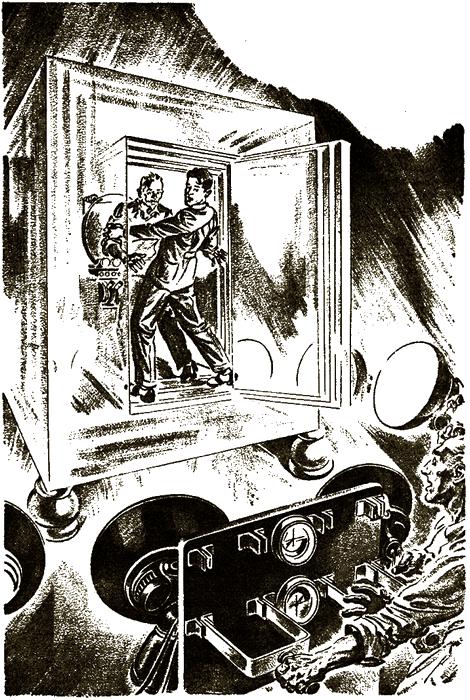
"Close those switches," Aiken snapped, "and hurry! Pay
no attention to him—the madness has taken him, too."
JUAN BAPTISTE MORALES brought his fist down with a crash that set the rickety table to quivering and the dishes to dancing. "Madre de Dios!" he swore. "Thees must stop!"
Pepita, his wife, straightened her squat back with a jolt, turned blinking eyes from the stew over which she was laboring. "Eh, Juan?" she demanded, astonished. "What ees this shouting for? I am not deaf. What ees it must stop?"
Her husband glared at her. He had never dared do so before. His meek little face had set in a rigid mold. His thin, scraggly mustache—the despair of his life; in spite of patient twirling and waxing it drooped like the ears of a sad hound—now bristled with a strange fierceness.
"Thees tyranny, woman!" he shouted.
Pepita stared at her husband in bewilderment. She had always been the boss in the family. She knew it; Juan had known it and acted accordingly; everyone in the little village of Angra del Reis found it quite natural. But she suddenly felt afraid of this stranger to whom she had borne half a dozen broad-faced children.
"What tyranny do you talk about?" she asked hesitatingly.
He looked upon his wife with a lofty scorn. "You are a fool, Pepita!" he told her. "Otherwise you would know it ees the Federated States of the Americas of wheech I speak. Eet has become most insupportable to me this very moment. I can stand no longer the sufferings of my fellow ceetizens in our State of Brazil."
Indignation awoke in her—a flare-up of her old assertiveness. "It ees you who are a fool, Juan Baptiste! What ees this tyranny you make nonsense about? Never since the good Lord first made thees world and put plain peons upon it to labor and grow things upon the ground, has it been so good for people like us. You, Juan Baptiste, who are eegnorant and but a leetle shrimp, eat savory stews and cakes of the finest corn; you vote on election day for delegates to the House Locale in Brazil; you vote for delegates to the Congress of all the Americas; you vote even for the great Preseedent who stays in Washeengton—though praise to the Holy Mother, you vote always as I, Pepita, tell you to. Who else has made us so strong that United Europe looks toward our shores weeth tongues that hang, yet dares not try to seize our goods and enslave our bodies?"
Juan paid no attention to her tirade. He thrust his sheath-knife, broad-bladed, sharp, within his belt. He clapped his battered straw hat upon his head. "You are a woman, Pepita," he observed tolerantly, "and a woman's head is but an empty gourd in which words rattle meaninglessly. Know that there ees a tyranny; that I, Juan Baptiste Morales, say so; and that it must come to an end—thees very moment."
He walked with firm, quick steps toward the open door of the hut, out into the fields of waving corn that spread up to the very edge of the jungle.
"Where are you going?" Pepita screamed.
"To Rio," he shouted back, "to make a revolution!"
So it started—the civil war that made of Brazil a shambles and a nightmare; that cost thousands of lives and brought ruin and desolation to once smiling fields and populous cities. For other Juans, Pedros, Joses, Sanchos, wrought upon by a similar irresistible compulsion, downed peaceful implements with simultaneous gestures, seized weapons from crudest machetes to most advanced rocket-bombs, converged in unexpected assault upon the startled troops of the Federated State.
DEEP inside the impenetrable jungle of the Matto Grosso, Iskra sat enclosed within a shimmering cube. Its walls hazed strangely under the tropic sun; they seemed to have no outer terminus, but trailed off into the void in wavering bands of light. Inside, Iskra watched and listened and manipulated innumerable controls with uncanny fingers. A sardonic smile flicked over his hawk-like features. He seemed satisfied with what was taking place.
A human visitant, had there been any in that solitary jungle, would have fled in terror from that strange cube and its stranger contents. For even as the walls of the enclosure tapered off into endless nothingness, so, too, did Iskra seem to blur upon the sight and have interior beginning, but no outer end.
Yet his form and features, though subtly different, were substantially not unlike those of the denizens of Earth, especially when he pressed a certain key control. Then the illimitable haze that surrounded him flared briefly, died, and left his outer lineaments clean-cut and abrupt; somewhat alien, it is true, but not otherwise frightening to the beholder.
He was pleased. The first step in his carefully mapped campaign had proven eminently successful. The sono-visors, of strange concavity and orange-metallic luster, brought to him the sequence of events that disrupted Brazil and made of it a shambles. Every so often he pressed an octahedral disk. Blue spears of flame stabbed through the lush enclosing the trees, yet harmed them not, and new hordes of unknowing Brazilian citizens of the Federated States of the Americas quivered with irresistible compulsions, and flung themselves into unwonted rebellion and slaughter.
Every so often Iskra paused in his mundane labors, and pressed a different set of controls. Then both cube and himself seemed to elongate into infinity; the shimmering became a blaze of colors beyond the ordinary visible spectrum, and the tapering waves bent and twisted into curves and angles unknown to terrestrial mathematicians.
Far off, so far that it seemed to be within another universe, the tortured waves spread suddenly, expanded and made contact with a human-appearing creature. His face was lean and dark, and furrowed with a driving will. His smooth black hair fell in a disdainful mop over his low forehead. Authority glittered in his eyes, lurked in the thin compression of his lips. Outside his form, all else was blurred and indistinct.
Iskra spoke into a convex mirror of burnished green. His voice was tinctured with a curious respect.
"Your commands have been obeyed, mighty Ontho," he said. "The first section of your magnificent plan has been effected with admirable success. But to comprehend the whole will take almost a year of this-time."
Ontho's lips parted in a thin smile. "It does not matter. Time is a slow-paced snail within the borders of your subordinate world. Our time moves at a more rapid rate. A year such as you specify means but a week in Ooroopah."
"You are right, as always," Iskra replied humbly.
"Naturally," retorted Ontho. "But continue with the other sections of the plan, and report to me at intervals. I, myself, shall watch for the effects as they develop in Amrique, and prepare to strike with all our forces."
His eyes glowed with a fierce luster. "Too long have they thought themselves impregnable. Too long have they mocked us with their insupportable condescension. The day of Ooroopah is coming."
He faded abruptly. The queerly distorted waves of light retracted from infinity, seemed to roll back upon themselves into normality.
Iskra muttered something, shifted new controls with long, snake-like fingers. The glistening cube rose silently into the air, fled with a swift swoosh over the featureless jungle toward the north.
DOUGLAS AIKEN frowned impatiently at the first of the reports that lay upon his shiny duraluminum desk. The frown deepened as he leafed through the heap. The little furrows on his forehead intensified as he read on with ever-increasing care.
The group that sat waiting in his unostentatious office followed every play of expression on his mobile countenance with tense anxiety. Not a sound came from them; even their breathing seemed withheld. The swift rustling of the composition sheets was curiously loud.
Doug Aiken finally turned the last report, ran lean, lithe fingers through his tousled hair. His face was preternaturally grave, almost incredulous in its expression. His quick, ordinarily humorous eyes ran over the tensely expectant men.
They were important personages—the Cabinet of the Federated States of the Americas. The President himself, Paul Winslow, sat at the farther end of the table. His tall, spare frame drooped with the cares of office. His homely, yet profound features were weighted with this newly added burden. On his left was Donald Burchell, Secretary of Defense, grizzled, rock-hewn, slow in speech and thought, yet a tower of imperturbable strength. To his right sat perky little Manuel Ribera, Secretary of Education. He fidgeted on the edge of his seat, holding in his explosive Latin volubility with a mighty effort. Crowding behind them were Preston Hale, Secretary of Communications; Jean Laforte of Canada, Secretary of Industry; and the Argentinian, Pancho Estoban, Secretary of Science and Arts.
Doug Aiken was younger than any of them; he was only twenty-nine. Nor did he hold any official position in the bureaucracy of the Federated States. His bronzed, lean features and athletic build seemed more fitted for strenuous outdoor activities and Olympic championships than for stodgy conferences with these grave and revered seniors.
Yet they had come to him, by unanimous decision, and dumped this strange and disturbing problem upon him with a certain relief. If any one could possibly ferret out the obscure motivations for what had occurred, for what was even then taking place, it would be Douglas Aiken.
Already, within the comparatively few years of his work, he had forged into universal recognition as a great psychologist, as a profound delver into the curious quirks and crannies of the human mind. He possessed an uncanny faculty for taking it apart and finding out what made it tick, for determining what made human beings do the things they did—irrational and incongruous though their outward actions might seem to be.
President Winslow broke the silence. His voice was low, deep with pain. "Those are the reports, Aiken," he said. "The confidential communications from our secret agents within the various trouble areas. I don't suppose you have arrived as yet at any conclusions. You will doubtless require time to study the matter at your leisure. But if you could possibly give us even a hint as to what you——"
DOUG sighed, drummed impatient fingers upon the crisp pile of sheets. The incredulous look upon his face became fixed in a brooding certainty. "I can give you much more than a hint, Mr. President," he said softly.
There was a stir among the Cabinet members. Manuel Ribera almost bounced off his seat. "You mean, Mr. Aiken, you have fathomed already the causes of these—these occurrences?"
Doug shook his head in the negative. "Not the causes," he corrected. "But at least I can correlate the effects, go back even to disclose an underlying historical sequence."
"What we are interested in at present," declared Burchell, Defense Secretary, with slow emphasis, "is not history, but ways and means to quarantine these unheard-of disturbances, to prevent their spread."
A dour, unimaginative man, Doug thought; one who did not see beyond his nose. "Nevertheless," he retorted, "to understand the present, we must go back into the past. Let me explain."
He picked up the first report, tapped it with his thumb. "The whole business received its initial impulse in Brazil about four months ago. A strange affair to startle a world that had appeared to have outgrown its early twentieth-century cataclysms. Here, according to all accounts, everything was peaceful and contented. The people of Brazil were happy, well-fed, free to think and speak as they pleased, governed by delegates of their own choosing. Not a cloud to mar the horizon of civilization and steady evolution.
"Suddenly, however, without warning, without previous preparation or concerted conspiracy, thousands of widely scattered farmers, workers, professional men, even deputies, went haywire. A savage lust to kill, to slay, seized upon them, brought them headlong upon Rio, the provincial capital."
"Twenty thousand died before the rebellion was crushed." Estoban said grimly.
"Exactly. But when it was all over, those who had revolted did not seem to know what had happened to them. Their stories, taken down by dictaphones in widely separated localities, were remarkably alike. One minute, they claimed, they were going about their ordinary duties, without thought of war or government or politics; the next, something surged in their brains, furious, uncontrollable. As in a blinding flash they realized that they were victims of oppressive tyranny; that their lives were forfeit unless they shook off the intolerable load."
"Mass hypnotism?" suggested Hale.
"It sounds like it," admitted Doug, "but if it is, it's hypnotism on a scale unprecedented in the annals of the human race. Remember that those affected were scattered, unknown to each other. I thought as I read along that there might be a possibility of mental suggestion by means of a radio program. But the depositions are positive. Not one per cent had been listening at the time to the televisors."
"Then what's the answer?" queried Laforte.
But Doug had already lifted the second report. "We might stretch the science of the human mind to the cracking point to attempt an explanation of one such manifestation, but here we have half a dozen before us already. As soon as the Brazil revolution came to an abrupt halt, Bolivia and Ecuador flared into interstate war. The Chaco, that ancient, half-obliterated memory, was the pretext. It took three divisions of rocket-troops to bring the two states to their senses."
"We had to resurrect musty history films to determine what the Chaco was," President Winslow said gravely.
"Yet every last peon seemed to know the answers," Doug argued. "Though Ribera assures me not a word of the Chaco dispute had ever appeared in the school-visors. Next on the list of states to succumb to the madness was Mexico. Here the virus—I call it that for want of a better name—took an even more vicious form. Race prejudice, eradicated for a hundred and fifty years. Racial hatred between the Indians and the whites. A sudden explosion of slaughter, of men running amuck, screaming forgotten slogans, slaying with sadistic hate those whose skins were bronzed a different tinge than their own."
"My own brother was one of them," Ribera whispered, for once all volubility gone.
"Then came the anti-church smash-up in Alaska, the youth versus old age movements in Canada. And now, latest of all, and still going full blast, the declaration of war between California and Florida."
HALE could not repress a grin. "And over what? The weather, of all things. The Californian newscaster had spoken disparagingly of a hurricane that lashed the Florida coast; the Florida announcers retaliated by raking up all the old floods and earthquakes that had harassed California in the past. When finally they spoke of the San Francisco earthquake, back in the beginning of the twentieth century instead of the fire, California promptly mobilized and declared war."
"It sounds funny," Doug Aiken admitted soberly, "but when you think that Miami has already been destroyed by a raiding rocket party and that Los Angeles is in flames, the humor begins to evaporate."
"I don't know where to begin to rush still-loyal troops," declared Burchell.
"I wonder," interposed President Winslow soberly, "whether United Europe has anything to do with these remarkable fomentations. Oothout, the Dictator, has openly avowed for years that his empire requires the rich natural resources of the Americas."
"Oothout wouldn't have a chance," said Burchell with sublime confidence.
Doug shook his head. "The roots of the matter go far deeper than that. There is no science on Earth that would account for this recrudescence of ancient hates and animal passions. Besides, even as I read the reports, a thought struck me. I've often wondered, in tracing the history of humanity, just how to account for the cataclysms of the twentieth century.
"For hundreds of years before that, mankind had slowly emerged from the brute. True enough, the civilization evolved was primitive at best. But at least by the end of the nineteenth century there were certain amenities, a limited amount of reasonableness."
"Huh!" snorted Estoban. "How about the First World War?"
"My point, exactly. An orderly, law-abiding world went mad, fought what they thought to be a cataclysmic war. Then sanity intervened temporarily. It lasted but a few years. This time not merely rulers went crazy, but whole nations. A crop of dictators arose—Hitler, Mussolini, Stalin, Carol, Franco—persecutions on a scale unexampled before or since. The Second World War crashed into existence, and the Third. Three quarters of the peoples of Europe died; civilization went to pieces."
"I remember the story," interposed Ribeya. "If it hadn't been that the Americas were immune from the infection. and promptly formed their present Federation, the Earth would have reverted to the cave man and the brute."
"Even that had its elements of strangeness," retorted Doug. "We were on the verge of precipitating ourselves into the caldron. The then United States and Mexico were threatening war with each other over oil expropriations; Haiti and San Domingo were actually fighting; Chile thought Brazil overbearing; and Canada was ready to hurl its troops overseas to aid its mother country, England. Suddenly a deep calm descended on the spirits of the exacerbated peoples in our hemisphere. Reason, submerged for years, asserted a powerful sway. Without a hitch, without a murmur, a Federation of locally autonomous States was formed, presented a peaceful, united front to the fury that flamed in Europe. When Europe finally emerged from its nightmare, its remnants conquered and fused willy-nilly under the iron hand of Oothout the First, we were too strong for him to tamper with. I say," he went on with slow emphasis, "that both manifestations—the madness of Europe and the abrupt sanity of the Americas—were equally inexplicable from any psychological viewpoint."
"What are you driving at?" demanded Winslow quickly.
"This, Mr. President. I said a while ago that no science on Earth could explain such mass hypnotism. But suppose"—he was hesitating now, feeling his way—"there were a science beyond that of Earth—a superscience that could blanket various sections of the world with intense vibrations, and induce at will either madness or sanity inside the delicate structures of human brain tissues."
A LONG silence followed. The rulers of the Americas stared at the young psychologist to see if what he said were some ill-timed jest. But Doug's face was grave, deeply concerned.
Then Ribera broke the strained quiet with an explosive snort. "Bah! My young friend, it is you who are mad!"
A babble of angry voices arose. Preston Hale cried sarcastically: "No doubt it must be our long expected visitors from Mars." Laforte swore contemptuous French phrases within his black beard. Burchell twiddled thumbs over the expanse of his stomach and grinned dourly. Even President Winslow lifted his tired head with a slightly shocked expression upon his face.
"It is, of course, a rather difficult explanation to accept, Mr. Aiken," he said slowly. "It's like—uh—invoking the supernatural to hide a confession of ignorance. Surely you must have some evidence to substantiate such a startling statement which you haven't disclosed to us——"
"Not a single item," Doug admitted. He realized he had gone too far. He hadn't intended making this assertion; it had slipped out. But now that he had stated it in so many words, he was convinced of its essential truth. Every fact, every sequence of events, from the beginning of the twentieth century on, was explicable in no other way. "But I intend," he continued with quiet emphasis, "to work on that angle at once."
"And in the meantime," sneered Burchell, "we'll let the Americas disrupt themselves, so that Oothout can step in and join us to his totalitarian empire."
"I didn't say that," Doug retorted with some heat. "You've come to me with a problem in mass psychology. By so doing you've confessed your own inability to handle the situation. You laugh at my solution. Very well then, continue to crush each inexplicable war in the only way you know—by force—until every portion of the Americas, and your crack troops as well, become infected with the virus. In the meantime I'll work along my own lines."
"But there is a fatal flaw in your reasoning," Estoban said earnestly. "Even granting the possibility of such a fantastic business. By your own admission, the first series of events took place from 1914 until 1978. But then there was a gap until now—over two hundred years of interlude. Surely your superscientific phantasms, your extraterrestrial manipulators, are extremely long-lived, and extremely patient. Why did they wait so long to recommence their plots, and what, after all, is their purpose?"
Doug was taken aback. He frowned. "You've put your finger on something to which I don't know the answer as yet, Senor Estoban," he confessed.
Ribera laughed raucously. There was something hysterical in his laughter. His brother had died—over a slow, roasting fire. Now this young man with a world-wide reputation wanted to divert his vengeance toward vague superbeings whom he could never meet face to face.
The Cabinet meeting broke up in confusion. President Winslow paused a moment after the others had left. He placed a kindly hand on Doug's shoulder. "I have faith in your idea, Mr. Aiken," he said with a certain abruptness.
"Thank you, Mr. President," Doug replied gratefully.
The tired, gaunt man shook his head. "But even if it is true, what could we do about it?"
THE words of the President echoed in Doug's ears long after he had gone. He slumped ever his desk, chin cupped in sinewy hand, thinking furiously. There were two problems confronting him—both seemingly insoluble. The first was to verify his almost incredible thesis as to the cause of the sudden uprisings in the Americas. The second was to find some way of pitting Earthly weapons against such fabulous superscience. Neither of these was in his line. He cast around in his thoughts for someone to assist him in his search.
The very first name that popped into his head was that of Dr. Ernest Coss. Coss was a physicist who was working on the very frontiers of wave mechanics and ultra-vibrations. But Coss would be a difficult man to get started on such a harebrained chase. Doug conjured up a vivid picture of the old scientist. A spare, thin man in his middle fifties, with a gray little beard, a head of still-vigorous hair, and a pince-nez that forever dangled from a black silk ribbon. No one had ever seen him wear the glasses, even for his most delicate experiments.
But Coss, though he had known Arnold Aiken, Doug's father, would doubtless snort derisively at such poppycock, even as the Cabinet had snorted. Besides, he was holed up somewhere on the top of a Colorado mountain, engrossed in a series of new experiments. The newscasters had mentioned it only the day before.
While Doug frowned around his office indecisively, the visor buzzed. One short, two long. That meant a special news flash—triple-A news. The young man strode angrily across the room, tripped the visor open. His thoughts were muddled anyway. Might as well try——
The dandified newscaster looked a bit pale. His neatly manicured fingers trembled as he clutched the unwinding steel tape. There were no preliminaries.
"There has been a terrible disaster in Chicago," he said in a queer, choked voice. "Every child, male or female, under the age of sixteen, has died at the hands of its parents. The great city is a gory shambles. Knives, guns, poison, clubs have been used to effect the frightful slaughter. Even the police joined in the hideous work, butchered their own offspring.
"A correspondent, a bachelor, escaped by fast plane and just radioed the news. He's all shaken up over what he saw. Claims the inhuman parents gloried in their work. Shouted that youth had had its fling long enough; that it was time to put a halt to its encroachments on the prerogatives and privileges of age. It—it's absolutely awful. I don't know what to——"
Doug's face went ashen. Mass murder of the most revolting type—parents against their own children! Never in the history of mankind——
With a gasp he turned off the visor, raced to the beam-communicator. Swiftly he plugged in on the tight-band wave of the Colorado laboratory. His fingers drummed staccato on the metal siding. Coss must——
But the screen remained obstinately blank. Damn! He must be there; it was just that he was refusing outside calls. With grim stubbornness Doug put through the emergency flash. By statute this was to be used only in matters of the gravest necessity; the ultrasurge tripped open locked receivers, crashed through to unwilling ears.
The angry face of Dr. Coss looked up startled from the tinted screen. He straightened up from the cyclotron over which he was bending. Around him, to the limits of the scanner, stretched his laboratory, complex with gleaming metal, spun quartz, and buzzing with the whir of mighty machines.
"Who the devil——?" he started; stopped. "So it's you, Doug," he said with a diminishing asperity. "Glad to see you, of course, my boy. Haven't heard from you for a long time. But just this moment I'm busy as hell on some revolutionary experiments. That's why I shut off the screens. What's the emergency?"
Doug explained rapidly, yet with a sinking feeling. He could see the physicist's face screw up into sardonic incredulity; his pointed little beard twisted to the left. Once or twice he lifted his inevitable pince-nez on its cord, as if to clap it firmly on his nose, dropped it again.
WHEN Doug was through, he grinned maliciously. "So those are the ideas of a psychologist, are they? I told your poor father you ought to go into a good, sound science like physics or chemistry, instead of a crackbrained charlatanry like psychology. But you were a headstrong youngster. Now let me tell you something, my boy. I'm a conservative physicist, not a witch-hunter. I'm not going to go on a wild goose chase for ogres or devils or what-have-you on the basis of your silly imaginings. I know damn well that mankind does not require any outside assistance to go haywire every now and then. It's part of our heritage from the knock-'em-down and drag-'em-out cave-man days." Scholarly Dr. Coss used slang and swore with deplorable fluency.
"But listen——" Doug pleaded desperately.
"Nothing doing," the physicist told him flatly. "Besides, I'm on the verge of a most important climax to my experiments. I think I've got something that'll knock my esteemed compeers off their backsides. It's about the nature and origin of cosmic rays. I've evolved a method'——"
Doug didn't give a hoot about cosmic rays, especially not just then. But he was a very crafty young man. So he said: "Say, that's swell, Dr. Coss. I've been wondering about that a lot myself for the past few years. In fact, in my own poor way, I've been trying to study the effect of their radiations on the human mind. Could you give me any ideas?"
Up came the shiny glasses, down they dangled again. The scientist's face lit up. "We-e-ell!" he exploded. "Why didn't you tell me that in the first place? For a psychologist you're beginning to talk sense. Tell you what! Hop your plane out here right away. You ought to make it by five; it's noon now. You'll be just in time to see the pay-off on my final crucial experiment; then maybe I can tell you things that'll stand your hair on end."
Still craftily smiling, Doug Aiken tooled his fast two-seater into the Fifth Level of through-flying. Even Coss had his blind side, his little string of vanity that could be vibrated when properly touched.
Coss' retreat proved to be a remote tableland in the highest Rockies. Around it, for a hundred miles, the mountains tumbled and swirled. The elevation was well over 9000 feet, and the air was thin and piercing. The buildings were simple—a long, low, one-story laboratory; a bunk house of two rooms; and a cook house a little to one side.
Coss met him grinning. One could not tell his age from the springiness of his step, just as one could not surmise the fluent picturesqueness of his speech from his lean, scholarly face and beard, or from the ultra-respectable pince-nez.
He almost dragged the tall young man from the plane. "Glad to see you, Doug," he greeted. "If only for your poor father's sake. It must have been a blow to him to see a son of his go into a wool-gathering science like psychology. He had a fondness for the clean-cut—same as yours truly." He grinned again, impishly. "Now come on in, and see a beautiful example of precision work. No ogres, no super-worldly phantasms. Just straight cosmic rays, all set to yield up their secrets to the two of us."
"All right, Dr. Coss," Doug agreed amiably. "I'm willing to sit in on the parturition of your cosmic rays." Though the Americas were crashing in ruin about them, he knew that his companion could not be hurried. He must be patient, bide his time. Not for nothing was he a psychologist.
ONCE inside the laboratory and out of the keen wind that swept the plateau, Doug was curious in spite of himself. It was an impressive sight. Some of the equipment he recognized—cyclotrons, atom smashers, Geiger counters, cloud chambers, spiral helices. Others were new to him and—he had a vague idea—to science.
But one huge affair that almost filled the south end of the lab aroused his liveliest curiosity. A spiral helix of huge copper coils funneled upward at an acute angle to make contact with the ceiling. Around it swung concentric rims of steel spaced at regular intervals and supported by stout insulators from the floor. Between steel and copper slanted what seemed to be a hollow-walled funnel of transparent quartz. Within the walls a greenish liquid swirled smoothly.
The curved, nether tip of the helix pointed directly at the shiny base of a small cylinder of metal, tilted over on its side. The cylinder was about six inches in length, and consisted of laminated layers of diverse metals. The first—in contact with the helix—seemed of chromium; the last was a lusterless lead.
Beyond the leaden farther base, and enveloping it, was a Geiger counter and trap; but of a design such as Doug had never seen before. It led directly into a curious oblong box, opaque to the sight, which in turn flared out into a series of lenses. These lenses turned their convexities upon a huge screen of silvery metal that faced the entire south wall of the lab.
"What is that contraption?" Doug demanded. In his curiosity he almost forgot the real purpose of his visit.
"That, my boy," Coss grinned jovially, "is my ultimate experiment, my masterpiece. In a few minutes now the cosmic rays will yield their last secrets to us, and, through us, to a breathless mankind."
Doug thought wryly that at the rate mankind was going just then, there wouldn't be enough of them left, when the results were announced, to be particularly breathless. But he held his peace.
Dr. Coss, for all his age, hustled around like a schoolboy, his little beard wagging, his never-used glasses dangling precariously. "No one has ever known just what the cosmic rays actually are," he rushed on. "From the earliest days of their discoverers the controversy has raged. To one, they've been pure photon bullets; to another, electrified particles so close to the speed of light that their mass was increased some hundred and thirty times. One chap, back in the twentieth century, almost stumbled on the answer. He considered them as a combination of the two—photon bullets superimposed upon ordinary electrons. In fact, most of the investigators were correct—insofar as they held a little facet of truth in their hands."
He screwed up his bright, piercing eyes, stared at the young man. "I think, Doug," he said, "I've hit upon the ultimate truth—if there is any such thing as ultimate truth."
"And that is——?" the psychologist asked politely.
"The cosmic ray as we know it on the surface of the Earth is only partly a cosmic phenomenon. The true ray is a photon bullet—pure light—but a photon such as we have never experienced before on Earth. It is light of an almost inconceivable energy—in fact, it has a mass effect\of one hundred thirty-six times that of an electron. It obviously does not originate in the Sun or in the stars. Hitting Earth's atmosphere, it smacks square into matter-atoms—oxygen, nitrogen, and so on. The atom smashes. So far so good.
"But now another strange phenomenon occurs, one for which all our previous experience with photons has no counterpart. Instead of going on its own lonesome way, this ultra-heavy light somehow attaches itself to one of the knocked-out electrons, superimposes its energy and speed upon that of the tiny particle, and rides it, so to speak, straight down to Earth." He grinned impishly. "Like one of those old cowboys our narrators are so fond of talking about in their bed-time hours."
DOUG had been listening with half his mind. But something Coss had said made him prick up his ears. His heart started to pump oddly. "You say these cosmic photons do not originate in any of the suns we know of? Where, then, do they come from?"
The physicist shrugged expressive shoulders. "That's what this contraption—as you so inelegantly described it—is for. I'm about to trap these errant photons, concentrate them, make them perform for me. That screen, if nothing goes wrong, should deliver us the answer within the next ten minutes."
"But you must have some idea," Doug persisted.
The elderly scientist glared angrily. "Suppose I do," he stormed. "Suppose I think they're light particles from another universe, immensely beyond the confines of our own—perhaps beyond Einsteinian space itself. Suppose I think that universe has properties wholly different from our own. What of it? A physicist has no right to be compelled to spill his ideas before he completes his experiment Suppose he's wrong; suppose he's just a doddering old fool!"
"O.K.! O.K.!" Doug said hastily. He was too' excited now to bandy phrases. This business of another universe fitted in strangely with his own conceptions. "Didn't mean a thing, Dr. Coss. But how does your—uh—contraption work?"
Mollified, the physicist explained. "The concentric steel loops are under a staggering magnetic load. Between them and the non-magnetic copper helix, through which a current of 2,000,000 amperes is forced, there is a magnetic gradient. The liquid within the quanta shell is a highly complex azo-amino acid, hooked on to a series of silver, thorium and radium atoms. Suspended within the electro-magnetic gradient, it generates a field of force that bends even the hitherto unbendable cosmic rays along the slant of the gradient—herds them, so to speak, directly upon the metal cylinder."
"You employ the cylinder to stop the electron-photon bullets?"
"To slow them down to manageable speeds," Coss corrected. "Even six inches of pure lead would not stop them entirely. By the time they emerge from the lead layer at the opposite end, they're pretty tired. They've slowed to speed that can be handled. The Geiger counter and trap catches them, herds them into greater concentration, assorts them according to energy content, spews them out into the oblong box.
"That's another invention of mine. It dissociates the exhausted electron captives from their cowboy masters, drops them innocuously among receptive protons to form new normal atoms. But the photons, pure now and unadulterated, pass through the lenses, and yield their hidden message in huge magnification on the sensitized screen. Neat, isn't it? That is," he-added with a little grin, "if it works."
"By heavens," said Doug violently, "it's got to work! Hurry, get it started."
"Hello!" Coss was surprised. "For a psychologist you're pretty impatient. How do you work your so-called experiments? With a time-clock?" Then, chuckling, he skipped over to the control panel, threw a single master switch.
THE smooth green liquid within the funnel shell began to glitter like a million fireflies. A blue flame shimmered in a quivering sheet between steel rings and copper helix. A deep-throated hum rose crescendo to an almost unbearable pitch. Ozone rasped at their nostrils. The chrome base of the cylinder danced with explosive sparklets of light. The oblong box glowed a cherry-red.
But both men's eyes were centered on the gray metallic screen. For once Dr. Coss had lost his fluent language. His scholarly face was suddenly pinched and gray. All his fanatical devotion to science was concentrated on this crowning experiment. Doug Aiken strained for another reason. Perhaps, on that still-blank expanse, there might show the answer to the insanities that had gripped the Earth for over two hundred years.
But the gray metal still remained blank.
Doug tried to make his voice casual. "Perhaps you overlooked some minor detail," he said.
Dr. Coss shook his head. He seemed suddenly old, weary. "Everything was checked and rechecked a hundred times," he whispered. "I've just failed! Failed!"
"Don't take it so hard," Doug started awkwardly, and stopped. "Look!" he cried excitedly, "something's beginning to, form on the screen."
It was only a thin play of vague, amorphous color at first. Yet even as they stared, hearts beating with suffocating clamor, the thing began to take shape and form.
Cosmic photons—divested of their Earthly electron carriers, concentrated and marshalled in ordered waves—were beating upon that sensitized screen, printing a picture that moved and shifted in sequence with a brilliant life of its own.
A huge globe spun majestically on its axis, filling the screen almost from end to end. Behind it, at the upper left-hand corner, gleamed a small red sun. Slowly the globe moved into clearer focus. There were snow caps at the poles, blue-green water covered most of its surface; soft green continents, spotted with barren yellow patches, divided the oceans.
There was something strangely familiar about that globe.
"Damn!" exploded Coss with startling violence. "It's only a representation of our own Earth, seen from outer space!"
Doug surveyed it with a sinking heart. There was no question about it. There was North and South America; now United Europe swung into view; then the broad expanse of Asia. On a large scale, perhaps, but that might have been due to the magnification, to divergence——
Dr. Coss recovered his aplomb with surprising resiliency. "This knocks sky-high all my theories. The cosmic rays are merely reflected light from our own Earth, thrust back to us from some reflecting medium in outer space that surrounds us like a concentric shell. Hm-m-m! That may prove as important a discovery as any I had originally dreamed of——"
Doug had been watching the turning orb with narrowed eyes. His disappointment over this unforeseen replica of Earth contained no such consoling scientific implications as did that of Coss. His problem was still as insoluble as ever.
THEN he started, stared even more closely. "Wait a minute, Dr. Coss," he said in a strangled voice. "That picture your cosmic rays are developing on the screen does not represent the Earth as we know it. There is a startling resemblance, it's true, but it's actually another world."

"Wait—" Doug called. "That's not Earth—there's
a startling resemblance, but it's ANOTHER WORLD!"
"Eh, what's that?" cried the scientist. "You're crazy!"
"Look closer," Doug insisted. His excitement was rising. "Here come the Americas. Check the coast line. There is no Florida, no Long Island. The two continents are severed—there is no Isthmus of Panama. And watch Europe again. What might have been the British Isles is now merely a knob on the continental coast. Spain has retreated inland; the Mediterranean is wide open to the Atlantic. Wherever you look there are changes—some minor, others quite evident. It's not our world," he ended with conviction.
Dr. Coss gulped, reached blindly for his pince-nez, brought it almost up to the thin bridge of his nose before he dropped it violently. His voice was a cracked whisper. "It is Earth, Doug, but a queerly distorted Earth, as if—as if——"
"As if we were viewing it at a different stage of its career," Doug finished for him. "Good Lord!" he added with sudden awe. "You don't mean that we've pierced somehow through time; that we're looking at the Earth of the past or the future?"
Dr. Coss, for the first time in all his life, looked bewildered. "It couldn't be the future; the light photons wouldn't have been born yet. And as for the past, it could only be accounted for on the theory that the cosmic rays have been traveling since their birth completely around the universe. But that, too, is incredible. In the first place, it would smash to smithereens our present conception of an expanding universe. The rate of expansion is such that light, at its known velocity, could never struggle back to its initial starting point. In the second place, such long-traveling light would be weak, tired; instead, these photon bullets have an inconceivable energy."
"How, then, explain what we see?" Doug demanded. "Unless it's all an illusion."
"It's no illusion," Coss retorted grimly. He seemed to have shaken himself together. Once more he was the efficient scientist. "And I'll get the proper answer fast enough." Already he had whirled to his lenses, was fiddling with their controls.
"What are you going to do?"
"Step up the magnification. Get a detail picture of some part of that strange Earth. Find out what manner of civilization it possesses—or lack of one."
The lenses swung smoothly into new combinations. An electronic scanner flickered into place.
At once the globe bubbled out, faded from view. In its place something swirled vaguely. Coss focused more sharply.
An exclamation broke from both men.
A MIGHTY city had taken shape and form upon the screen. A city such as neither had ever seen before. A city of dazzling white; of fantastic structures that soared miles into the air, graceful in every line, smoothly curved and rounded. The sky above was filled with swift-darting cubes of crystalline texture. Within their hollow depths sat human-seeming creatures, clad in lustrous purple, lofty of brow, benign of countenance. The spacious thoroughfares beneath swarmed with life and laughter.
"No city like that, no people like that, ever inhabited the past of our Earth; it must be the future," Doug asserted positively.
"But the future has not come into being yet," cried Coss.
"How about time as a fourth dimension?" argued Doug. "Cannot all the time-states lie coterminously in a four-dimensional universe? Cannot the light from a future state, by some unknown access of energy, have achieved sufficient strength to have broken through the spatial dimensions?"
"Plausible, but unscientific," stormed the physicist. When he was most in doubt, he became most heated. Knowledge brought calm to him. "Too many laymen have that erroneous idea about the function of time. In mathematical analysis it is found convenient to treat it as another dimension; but that does not mean that it is of the same order as a spatial dimension. Space is reversible; time is not. It is a function of space, rather than a separate entity."
"Yet that is Earth out there; and it is not the present," the young man insisted.
"True enough," admitted Coss, fiddling with his glasses. "There's a mystery somewhere. If only——"
He reached for the lens controls, shifted their positions once more. "I magnified a portion of what seems like the Americas," he explained. "I'm shifting it over now to the segment that resembles United Europe."
Even as he spoke, the scene faded, swirled, and clarified. The light prickled over another huge city, mighty, widespread, but curiously different from the white rounded aspirations they had just quitted. Here were no curves or graceful arches. Here the buildings were jagged, angular, uncompromising in their harsh lines, almost brutally unornamented.
Shining cubes likewise populated the air; but within them were men of a darker hue, saturnine of feature, sharp-nosed, thin-lipped. The wide streets were filled with silent crowds, each man intent upon his destination, speaking not to his neighbor, yet looking furtively to the right and to the left.
"Strange," murmured the psychologist. "Even the characters of the two peoples seem but the future of the Americas and of Europe. Yet still you say that——"
In his anxiety to observe the screen closer lie had leaned forward. In so doing he contacted one of the lenses. It swung slightly on its gimbal. At once the picture faded, misted into new form.
"Sorry!" he apologized. "I didn't mean to——"
But Coss had grabbed him fiercely by the arm. "Ssh!" he whispered tightly, "look at that."
Blurred streaks of light raced across the screen diagonally. Curious shimmers that twisted and angled in strange dimensions. At the lower right-hand corner they seemed to emanate from a shining cube, within which a hawk-faced man stabbed unknown controls and smiled a lean, sardonic smile. Both man and cube were eerily blurred, and wavered out along the streaking light.
Each time his finger touched a knob, blue streaks of flame lanced out from the enclosure.
DOUGLAS AIKEN felt a shiver ripple over his lithe body. Close to that shimmering cube, truncated by the edge of the screen, was a mountain. Against its rock-hewn edge was silhouetted a face—stem, calm, immobile with the majesty of centuries.
"Great heavens!" he exclaimed. "I'd recognize that anywhere. That's the Great Stone Face in Franconia Notch. That's New Hampshire, back here on Earth. Do you understand, Dr. Coss?"
But the scientist did not answer. All his gaze was concentrated on the upper left-hand corner of the screen. There the tortured streaks of light seemed to flow and terminate within a segment of a huge, monolithic building.
The roof, of transparent texture, permitted their gaze to follow down into a chamber that receded in a misty blur. But sharply focused by the penetrating rays was a figure. Authority radiated from his lean, furrowed features. A mop of hair fell over his low forehead. His head was slightly to one side, as though he were listening. His thin lips opened and he seemed to answer. A satisfied smile made more murky the darkness of his face.
Then, suddenly, the streaking light collapsed upon itself, retracted toward the lower cube. As it did, the screen went blank and quiescent.
"I'm beginning to understand," said Doug in a strained voice. "My first hunch was correct. I never dreamed I'd get the verification from your experiment."
Coss blinked. "Eh, what's that?" The pince-nez dangled unheeded.
"It's shaping up," Doug reiterated grimly. "I knew no Earthly science could have caused those psychological reactions our world has been witnessing. Here is the proof. That chap in that queer cube close by the Great Stone Face is an emissary from the other Earth. They're far ahead of us in civilization and science—if not in the more elemental qualities of tolerance, pity and humaneness. For some reason he has come over to us, with his devilish controls over our primitive brain structures, and is deliberately utilizing them to stir up madnesses, insanities, destruction, among the peoples of Earth. But why?" He clenched his hands, opened sweaty palms again to run fingers through his disordered hair. "Why should these people of our future Earth desire to destroy their own ancestors? Don't they realize that if they succeed, they must inevitably destroy themselves?"
Dr. Coss was a stubborn man, up to a certain point. "It still sounds crazy," he muttered, and strode with a determined air to the silent screen. "We'll settle this once and for all," he announced, as he flung wide the safety catch.
A newscaster, harried, distraught, was in the middle of his text. He dared not lift his eyes from the steel tape as it poured out its dreadful tale before him.
"The farmers of New Hampshire and Vermont are pouring by the thousands along the speed-roads toward Maine. They claim that the latter State is making secret preparations to divert their tourist trade from them this summer. The Maine authorities deny the report indignantly—so does Preston Hale, Secretary of Communications. But the denials have made no impression on the maddened farmers. They are determined to extirpate every human being in their neighbor State. Government troops are even now on their way to head them off.
"This is but the latest of a series of inexplicable outbreaks that have troubled the Americas since——"
DR. COSS snapped it off. His shoulders, erstwhile erect, cocky, now sagged. "I'm sorry, Doug," he whispered, "for having mocked at your hunch. It sounded fantastic; it still sounds the same. But it's the truth. There is another Earth, somewhere, farther advanced than ourselves in science. Long before I stumbled on my explanation of cosmic rays, they had found a method of contacting our Earth. They are deliberately destroying us for purposes of their own. The only reason we saw that fellow in New Hampshire was because he was in communication with his superior. We caught the reflected light waves on our screen."
Doug's face was a blazing mask. Without a word he started for the door.
"Hey, where are you going?" yelled Coss.
"To get him," the psychologist flung over his shoulder, "before he can do any more harm. My plane can hit 500 miles per hour."
Coss was fast for a man of his age. He caught the younger man in two quick leaps. "You can't do that, you fool!" he panted. "With his superscience he'd destroy you as easily as he's destroying all the Americas."
"But we've got to do something."
"Wait a minute." The physicist's beard was rigid with thought. He fumbled at his glasses. "Those queer blurs of light that streaked out from him, from his vehicle. As though they were both being sucked along some incredible path. They must have some meaning."
"Well?"
"If only I could——" Coss' mouth sagged; his eyes widened with surprise. "Good Lord!" he husked, talking to himself. "It's impossible—insane—yet it fits perfectly."
"What fits?" demanded Doug impatiently.
Dr. Coss sank into a chair, mopped his brow. "I've got the answers—to everything." He bounced up again like a jack-in-the-box. "Of course!" he almost shouted. "I've been a ninny. The solution was staring me in the face all the time—right down-my alley, too."
"Stop talking riddles."
"I'm not. You were partly right, my boy, partly wrong. That other world—Ultra-Earth, we'll call it—is connected with ours, all right. But it's neither our past nor our future."
"Then what the devil is it?"
"I can only explain by talking wave mechanics. We've known for a long time that an electron, a proton, all the constituent elements of matter, are in fact wave-trains in space."
"Sure."
"But all the mathematical analyses of their properties call for more dimensions than we have in normal space."
"I thought the physicists disregarded them as mere mathematical fictions," Doug protested.
"We did—and the more fools we! For now it seems that those fictions portray physical realities."
"You mean——?"
"I mean," retorted Coss impressively, "that every electron, proton, and so forth, that exists in our bodies, in our Earth, in our universe, is but a small segment of the total reality of that electron, proton, and so forth. We are only the tag end of vast wave-trains that continue on and out of our puny three-dimensional universe—to a greater reality, as a matter of fact, in a series of other dimensions."
DOUG AIKEN staggered a bit. "According to that, Ultra-Earth is but the other end of our own Earth; their universe the continuation in ultra-dimensions of our universe. Why—why, even you, Dr. Ernest Coss, myself, Douglas Aiken, have counterparts existing simultaneously with ourselves on that other Earth!"
"Exactly!" In his excitement Coss actually caught up his glasses, adjusted them to his nose. With a quick move he dropped them again, swinging on their black silk cord. "They're closer to us than a brother, bound to us by stronger ties than father and mother." He grinned. "Perhaps even that bird we just saw at Franconia Notch is Douglas Aiken himself."
"Or the very righteous Dr. Ernest Coss," amended Doug. "But wait a moment. Your theory falls flat. They are not the same. We watched their cities, the people in them. Even their Ultra-Earth is different."
"That is explainable too. Obviously the shift of the wave-trains into higher dimensions involves a time difference. Time, being a function of space, would naturally have a different meaning in their ultra-space. Hence they might have been more primitive than ourselves, or more advanced. It seems," he added ruefully, "they are more advanced. Our universe, unfortunately, represents but the lower end of the electron wave-trains; they are the higher level."
Doug nodded his head slowly. "That accounts for a lot. The streaky blurs we saw emanating from the man in the cube were the electron-trains made visible—his path of translation from his end to our own. Instead of shifting himself back into his counterpart on Earth, he bent the trains through the dimensions to reach here in person."
He spoke faster, more breathlessly, as the dizzying concepts unfolded. "Their Europe, their Americas, are but exaggerated counterfoils of our own. Their characters, their psychologies, would also follow suit. While their science is on a vaster scale, while their civilization would be further advanced, nevertheless, the ratio between our matter-waves on this side must necessarily be transferred intact on the other side."
"For a psychologist you reason rather well," approved Coss.
"Wait; I'm not finished. Everything is clear now. The Americas over there are, therefore, ordinarily peaceful, democratic, liberty-loving. Their Europe, on the contrary, would be totalitarian, under the iron grip of a dictator."
"I think we saw him," agreed the physicist, "in consultation with his emissary here."
"This dictator," Doug pursued the analogy, "would have approximately the same attitude toward his neighboring democracy as William Oothout, our European Dictator, would have toward the Americas. He'd resent it fiercely, as an ever-present invitation to revolt on the part of his own subjects; he'd cast greedy eyes toward its rich resources. But"—and now Doug's voice rose triumphantly—"the Americas at both ends of the wave-trains are too strong for a frontal attack."
Coss screwed up his face, waggled his little beard. "What are you driving at?" he asked sharply.
"I'm putting myself in that other Dictator's shoes," said the young man more slowly. "My adversary is too strong for me. His weapons are as good as mine, or better; his people immune to the propaganda I employ successfully in my own realm. Nevertheless, I must overcome him somehow.
"In this dilemma, one of my scientists makes a discovery. He finds, even as a certain Dr. Ernest Coss discovers later in a different universe, that Ultra-Earth is hut a portion of infinitely extended matter-waves; the major portion, it is true, but with physical counterparts on a reduced scale in an other-dimensional universe.
"On further examination, this lesser Earth, with its similar set-up and subdivisions, is proven to be at the younger end of time—more primitive, with weaker weapons of offense and defense."
THE elderly scientist let out a most boyish whoop. "Doug!" he shouted, "I take everything back. I'll never run down psychology again. It's a noble science. You've hit the nail on the head. This Ultra-Dictator of yours, since he can't attack his enemy directly, hits him from the rear. He translates his emissaries into the lesser universe, utilizes his super-weapons to stir up dissensions, mutual murders, mass slaughters, among the counterparts of his own opponents. By so doing, by weakening or eliminating the lower ends of the electron-trains, he necessarily causes profound disturbances at the top ends—which represent the people of Ultra-America."
"Exactly," countered Doug, taking up the tale again. "Once he has softened them sufficiently, he will attack and conquer. By the same token, Oothout here will also be in a position to conquer. Even the strange madness of the Three World Wars becomes clear now. No wonder the peoples of our Earth seemed moved by compulsions inexplicable by reason or sanity. Their electron-waves had to follow willy-nilly the deliberate pattern imposed on them by what was taking place on Ultra-Earth."
There was a moment's silence. The two men stared at each other.
"It's a devilish scheme," Coss whispered.
"We've got to fight it," Doug declared energetically.
"But how? We're helpless children in the hands of such superscientists. They do with us as they please. Evidently they can even compel our minds by a species of direct wave control, as well as along their own matter-trains. What chance have we?"
"If only," Doug murmured thoughtfully, "we could enlist the aid of our counterparts in Ultra-America. It's their battle as well as our own. If we die, inevitably they must die as well." Coss shook his head mournfully. "Obviously they haven't the slightest idea of what is going on. Ultra-Europe's discovery of our existence must be a closely guarded secret."
Doug's eyes narrowed. He stared speculatively at the physicist. "It is up to us then," he said with calm finality, "to warn them—as much for our own sakes as for theirs."
"You're crazy," his elder declared vehemently. "There is no method known to man——"
"You," the younger man interrupted softly, "are this Earth's greatest authority on wave mechanics. If scientists, constrained by a brutal dictatorship, no matter how technically far they may be advanced, can have discovered a method of translation into our universe, there is absolutely no reason why you, a free spirit, can't discover a similar translation into their universe."
"Now I know you're crazy!" Coss shouted.
Doug Aiken grinned. "We start at once," he announced.
THE next two months were days—and nights—of nerve-racking toil. Dr. Ernest Coss shut himself up in his mountain laboratory, barely ate, never slept. Two gaunt-faced technicians, sworn to secrecy, assisted him. Doug Aiken, without sufficient knowledge of these rarefied reaches of pure science, was liaison officer to the world.
His fast rocket plane shuttled back and forth between the Colorado tableland and the technical supply houses of the Americas, carting unusual machinery split up into small sections, purchases from widely scattered houses; bringing all equipment in under the mantle of night.
"It's important," he answered the scientist's vigorous remarks on these wasteful tactics, "that no one person have any suspicion as to what we're doing. There is no telling when the emissaries from Ultra-Earth may gain control of their minds, and extract disastrous information."
It never dawned on Doug that perchance his own brain or that of Coss might also come under the directive wave-control.
Every night he asked Coss the same question, and every night received the same monotonous answer.
"No progress! We're just groping in a fog. The theory is simple enough." The tired, haggard man grinned a twisted grin. "The tracks are there, the rails are laid. Every particle in our bodies is connected by unbreakable wave-trains with our homologues in the Ultra-Universe. All we have to do is find a method of stepping up those tenuous trains, create such a head of potential in ourselves that we'll slide along those tracks as though they were greased." The grin grew bitter. "That's all, my boy, that's all."
In the outer world the tragedy was deepening. Neither Doug nor Coss could ever get another glimpse of Iskra again on their cosmic-ray projector, but the field of his shifting operations was easy to follow. There would be an outbreak in southernmost Patagonia, followed almost immediately by a wave of madness that sent the salmon fishermen of British Columbia tearing at each other's throats.
Iskra, seated in his cube, smiled sardonically, and sent forth the blue stabs of flame that were controlled vibrations attuned to his command. They impinged upon the brains of his victims, modified the vibratory periods of specified neurons according to a predetermined pattern, opened up new paths of thought, closed old synapses—and behold, masses of men were but tools for his skillful fingers, willed along by forces beyond their control.
Iskra was satisfied. Matters on this Infra-Earth, this tag end of his own great world, were approaching a proper climax. Even Ontho, seated in his palace within the capital city of Ooroopah, had nodded grudging approval. Soon the repercussions would appear within Amrique; and the day of Ooroopah would have arrived. He, Iskra, had been promised the governorship of that hated land.
Sometimes he wondered who his degenerate counterpart might be on this degenerate planet. He knew, from his observation of Infra-Earth, that William Oothout, Dictator of United Europe, was doubtless the lesser representation of mighty Ontho. Of course, he had never dared transmit the information. In spite of Ontho's knowledge of science, in spite of his awareness of the wave-train shifts into these lower dimensions, he somehow clung stubbornly to the delusion that he, Ontho, was a unique exception to the universal law. That he alone held retracted within his singular compass all the wave-trains of his being. Any other conception would have been a deep humiliation to his pride.
A strange smile brooded over Iskra's countenance as he thought of that. How easy would it be for him to send a directive ray toward this puny William Oothout, destroy him utterly—or, more subtly still, force him into gibbering madness and vilest self-immolation. What strange effects such a course might have upon the proud counterpart who ruled in Ooroopah, who treated all his subjects, even Iskra himself, as unimportant dirt beneath his feet!
Iskra played with the idea, rolled it on his tongue, coddled it in his brain, surrendered it in reluctant fear. Who knew what the end-results of such a stroke might be, what the repercussions on himself! The iron rule of Ontho was not conducive to daring in his subordinates.
Furthermore, Iskra considered, he did not know who he himself might be on this inferior plane. Sometimes he wondered, and thought to translate himself along his wave-trains to seek him out; but each time he shuddered away from the thought. Who knew what wretched caricature he might be! He, Iskra, would always have before him the picture of that vile distortion of himself; it would be profoundly disturbing. It was better not to know——
DOUGLAS AIKEN was forced to take time off from his unremitting labors to answer the increasingly frantic calls from the Cabinet of the Federated States of the Americas.
They were at their wits' ends. "For Lord's sake, man, we've been relying on you to find some method of stopping this madness," exploded Secretary Hale.
"You've let us down," nodded Burchell, Secretary of Defense. His rock-hewn face was lined and seamed now. His slow-moving brain found it hard to grasp what was happening.
Only President Winslow said nothing. But the brooding pain in his sunken eyes was more of a reproach to Doug than all the castigations of the others.
Yet he dared not tell them what he and Coss had discovered; what their desperate, fantastic plans actually were. Even they, sooner or later, might come under the compulsion of the emissary from Ultra-Earth.
So he put them off with vague explanations, with vaguer promises. He had lost caste with them, he realized that. Donald Burchell openly snubbed him at their final conference, declared he was through with quack psychologists. Force was what was needed, force to the uttermost. He intended gathering his crack rocket-squadrons, hurl them mercilessly upon all offenders, wipe them out root and branch. He was tired of their present policy of babying madmen, simply because young Aiken had assured them they were not responsible for their actions.
But even as he made this angry speech, unwontedly long for him, to an assemblage of men whose nerves were almost as frayed as his own, the private communication-unit buzzed. A wave of overwhelming news broke about them, swept all rancor into oblivion.
The crack rocket-squadron, on which Burchell had so pathetically relied, had suddenly and without warning fallen upon each other with hurtling tons of exploding metal and atom disruptors.
Even as they sat, speechless, stunned, the unit buzzed again. A tight-band report from a secret agent in United Europe. News of the gravest consequence. William Oothout, hitherto cannily biding his time, was rushing preparations for a swift descent upon the helpless, chaotic Americas.
The gaunt President buried his face in his hands. "This is the end," he whispered. "Our beloved America is lost. All civilization will disappear."
Doug Aiken came to his feet. He had listened quietly to Burchell's diatribe because he must. But Winslow's despair cut him to the quick. He lost his head.
"It's not all over yet," he cried. "We know what's responsible for this strange madness that has attacked our hemisphere. Even now, Dr. Coss is working on a method of putting a stop to it. Lord grant that he'll be in time."
They were on their feet, clamoring, crowding excitedly around him, hurling excited questions.
"Why the devil didn't you tell us before?" expostulated Estoban. "If Dr. Ernest Coss is working on the problem, we should have known."
"Have you convinced him of your fantastic business about super-worldly creatures?" demanded Laforte, his voice edged with sarcasm.
But already Doug was cursing his own blabbing. Now that others knew their secret, it would only be a question of time before the super-emissary in his shiny cube would trace it to their hideout in the Rockies. And then——
HE snatched his hat, muttered unconvincing words of denial, and rushed out of the Council Chamber, racing for his plane. He had made a fool of himself, had relaxed his guard for one disastrous moment.
He warmed up the jets with preliminary bursts of flame, took off at a reckless pace. With their secret designs now known to so many, with the Americas crashing into ruin, with Oothout ready to move in and take over, nothing much mattered any more. Even if, by some miracle, Coss did discover a method of translation into the Ultra-Universe, it would be too late. Both worlds would already have been overwhelmed by the Dictators.
He soared hastily to the Fifth Level, pointed the nose of his shining plane toward the west. Pittsburgh was a smoking shambles beneath him. The flat lands of Ohio were dark with battling men. At St. Louis he swerved in a wide detour to avoid the suicidal crash of opposing rocket-troops. Denver mourned its slain.
Wherever he went, conflict raged between brother and brother, father and son, State against State. The madness had seized them all, overlaid all reason, the common ties of race and blood.
Then the Rockies tumbled beneath him, grim, solitary. He was nearing his destination. But within his heart was only anguish, a terrible despair.
"Too late!" he groaned. "Even if Coss does find out——"
The familiar plateau lifted underneath; the thrice-familiar laboratory hove into view. Swiftly he descended.
No one came out to greet him, as was usual. Neither Dr. Coss nor his silent assistants. A strange fear gripped Doug. Had something happened to them, had they, too, succumbed to the induced madness and slain each other?
The rockets were still firing when he leaped from the plane, pelted toward the laboratory. Inside he heard new sounds; the throbbing beat of power, endlessly repeated.
"Coss, where are you?" he cried, and flung the door wide. Then he stopped short.
The laboratory was bathed in an eerie blue light. Within the very center of the long, low-ceiled room, where before his departure east two days ago there had been a clutter of tangled parts, there was now a cleared space that held but a single object—a shining, shimmering cube of transparent structure, hollow within and large enough to house a man standing upright.
Around the cube were grouped parabolic reflectors, their lenses concentrating a deep-blue glow upon the crystal shell. Three men bent eagerly over a maze of cables and electron tubes of queer design. Their fingers moved in frantic haste—tightening, adjusting, making last minute changes. So absorbed were they that they had not heard Doug's tumultuous entrance, his first shout.
On the farther wall the gray metallic screen was alive again. Ultra-Earth moved majestically on its axis. Amrique was calm, unsuspecting.
A wave of relief flooded Doug at the sight of the three men. His knees were suddenly weak; he leaned against the door jamb for support.
"Thank Heaven you're all right," he said. "For a while I thought——"
Dr. Coss swung up startled. His eyes blinked from the shifting of attention. His face was haggard with days and nights of unremitting toil, but excitement overlaid all fatigue.
"Doug, my boy," he cried exultantly, "you're just in time. I've got it! I've got it!"
"Got what?"
THE scientist flung a wide hand at the glowing cube. "A replica of the super-world machine. I stumbled on it by accident, just as I was giving up all hope. It's made of fused quartz, divided into three thin layers. Each layer has been polarized at a different angle." His outstretched arm circled the reflectors. "I've stepped up vibratory power to a degree hitherto undreamed-of by super-imposing the energy of the photon bullets from the Ultra-Universe upon an electro-magnetic field of tremendous intensity. The resultant vibrations are directed in parabolic beams upon the polarized quartz, are twisted through three angles, and fling out from the last lamination in a fourth angle."
"And that angle means——"
"A new dimension entirely," crowed Coss. "The dimension of Ultra-Earth. The cube, all its contents, will be forced into that angle. A tremendous head of energy, a huge potential, will flood every single particle of matter." He rubbed his hands jovially. "We'll slide along our own electron-waves like cars on greased tracks. We'll land smack in Ultra-America, on a tableland corresponding to our own. It'll be a simple matter to spread our warning, gel aid."
For a moment the younger man's pulses hammered. Then he remembered what he had heard, and he said despairingly, "It's too late. A week too late."
Coss and his assistants stared at him. They had been too busy even to listen to the newscasts. "What do you mean?" they chorused.
For answer Doug strode over to the visor-screen, tuned it on.
The newscaster's tie was askew, his clothes rumpled, his voice hoarse with strain.
"The reports are coming in thick and fast," he said huskily. "United Europe is mobilizing. Ten thousand rocket-cruisers are ready to take the air. Oothout demands our unconditional surrender. The Cabinet is in emergency session. More alarming news pours in from all over the Americas. In Peru the people are yelling for Fascism. Minnesota has formally seceded from the Federation. Alabama is in the throes of an orgy of lynching. President Winslow has called on all good citizens——"
Doug snapped him off, said quietly, "Now you know why it is too late?"
Red suffused the scientist's face. "It's never too late." He was literally dancing with rage.
A quiver fan over Doug's lean form. There was an open slide-panel in the glistening cube. He walked quietly in. "When do we start?" he demanded.
Dr. Coss beamed. His trim little beard waggled. "Good boy!" he grinned. "We start at once. Jones and Satterlee have their instructions. They know how to handle the power."
He moved in with a little dancing step beside the young psychologist. There was barely room for the two of them. He nodded his head to his grave-faced assistants. He opened his mouth to issue the final instructions.
ISKRA, hovering in his ultra-cube over Pikes Peak, manipulated his controls. The stern, fanatical visage of Ontho faded from his screen. The long, twisted waves retracted into this alien lesser universe of time and space. Yet the glow on Iskra's face persisted. Ontho, with unheard-of condescension, had praised his work. "Amrique," he had said, "is weakening. Strange, mysterious ailments attack their people. They are puzzled, alarmed. They cannot understand what is taking place. I have issued secret orders. Our forces are ready. The day of Ooroopah has arrived!"
Already Iskra envisioned himself as Governor of Amrique. He rolled the official title speculatively over his pointed tongue. It had a splendid sound. His dark hand clenched. Always had he hated the smug, superior beings of the other side and raged in impotent silence against them. Now——
He flicked on the orange-metallic sono-visor. He would see for the last time what was happening with these lesser levels of the hated Amriquians. The visor glowed. The Rocky Mountains spread out before him like a frozen sea. Desolate, bald, with shattered towns dotting the heights. Far over on the edge, glittering rocket planes met in head-on collision, rained to the ground in a dazzle of flame and molten metal. He smiled sardonically. His control vibrations were working perfectly. They hurtled across the time-space of this subsidiary universe, bearing upon them the impress of his commands, impacted upon the weaker brains of these subordinate creatures, impelled them to his will.
A little glowing spot almost within the center of the visor-screen attracted his attention. It was intense, ablaze with generated power. He frowned. In all his scanning of this Infra-Earth, he had never noted such a manifestation of energy before. It almost rivaled the surge of his own vibrations. So intense was it that it clouded with a halo of reflected light its generating source.
Iskra stepped up his own power. The orange concavity flamed with almost insupportable luster. But the glowing veil faded before the mighty magnification, stripped to a pinpoint of blue dazzlement.
A plateau sprang into view. A long, low building, flanked by two small cabins, appeared. Within the larger, structure flared the focus of disturbance.
Iskra started violently. Obscure phrases tumbled from his lips. Bewilderment spread over his saturnine features. Instinctively his finger stabbed toward the octahedral knob that governed the translation-trains, the ultradimensional waves of himself and his vehicle that would send them all hurtling back to the safety of Ooroopah.
For who else but a denizen of his own Universe could have duplicated his triple-polarized cube? Who else but an Amriquian could have come secretly into this lower end of their dimensional wave-trains without his knowledge? Which meant that Ontho's plans had been discovered—and all was lost!
Then the first frantic fear ebbed from his brain. His stabbing finger poised. New images impressed themselves. Those two creatures within the ominous cube were not Amriquians; they were mere primitives from this lesser continent of the Americas.
Rage succeeded his former fear. Rage at the audacity of these puny men in duplicating his own invention, rage at himself for having succumbed, even if only for a moment, to unworthy fear. That rage clouded his reactions, caused his finger, as it darted viciously toward the command-control, to shift its aim by a tiny fraction.
A blue bolt of vibrations seared out from the cube, leaped across the mountains toward its destination. But the bolt of induced hypnosis was a trifle askew!
DR. ERNEST COSS opened his mouth to issue the final order. Jones and Satterlee, expectant, were poised at the switches, hands clutching at the huge handles. Coss had drilled them carefully in their tasks. As he gave the command, the switches were to close.
The panel in the cube would slide into hermetic ensealment; the photon energy in the reflectors would step up to incredible figures; the rays would beat out upon the laminated quartz, shift through three planes of polarization, and erupt both cube and contents into a fourth-dimensional angle in streaks of elongated electron-trains.
But even as his mouth gaped for the final order, something happened. His eyes suddenly glazed; his gray little beard stiffened; his body went rigid. New words, not of his original choosing, issued from his lips.
"Wait!" he cried. "Get away from those controls, Jones and Satterlee!" And he leaped for the still open slide.
Quick as he was, Doug was quicker. His arm darted forward, caught the scientist by the shoulder. "Hey, what's the matter?" he queried in surprise.
Dr. Coss wriggled in his grasp. "Matter enough!" he retorted. "I've changed my mind. I made a terrible mistake. There was a flaw in my calculations. We'd be killed in a jiffy if those switches closed."
Doug did not release his grip. He stared at the struggling physicist, saw the glazed expression of his eyes, maneuvered his lithe, athletic body between him and the panel.
"Funny!" he murmured. "Everything was O.K. until just this moment. Just when did you decide you had made a mistake?"
"I knew it all along," Coss screamed back at him, his face distorted with anger. "Let me go, you idiot!"
The younger man thrust him violently back against the farther wall, flicked a quick glance at the gaping assistants. They had frozen in their positions.
"Know anything about an error in the calculations?" he demanded.
Satterlee shook his head, puzzled. He was a short, stout man with a pinkish face and horn-rimmed glasses. "We checked Dr. Coss' figures a dozen times," he said doubtfully. "Everything was perfect. But if he says——"
"I say it again, you fools," yelled the scientist. His eyes now held a mad glare, his body hunched to spring at his companion, and his hand clenched convulsively. It caught on the dangling pince-nez. There was a sickening crunch of glass. Blood spurted from the palm and fingers. The shattered lens tinkled to the floor.
But he did not seem to mind, did not even know. He sprang.
DOUG, for all his extra height and wiry body, staggered back against the open slide under the impact of that bullet-like rush. Then, with a mighty effort, he regained his footing, sent the maddened man back with a swift, straight-arm jab.
The blow jarred Doug to his depths. He loved the man, respected him as a genius in super-physics. But the safety of Earth came first; the lives of millions of his fellow-men were involved. He knew now what had happened to transform Dr. Coss to this pitiable state; he knew that any moment Jones and Satterlee, as well as himself, might be reduced to the same will-less state. He must act at once.
"Close the switches!" he flung back over his shoulder. "Hurry! It's life and death. Pay no attention to Dr. Coss. The madness has got him too. Hurry!"
Satterlee looked foolishly from one to the other. He scratched his head.
"Well, I don't know——" he started doubtfully.
But Jones, angular, dour of visage, understood. He reached out both long arms, thrust the rotund little assistant aside. His bony fingers clutched at the switches, jammed them down on their knife-edges with quick, firm strokes.
"God bless you," he cried, "and good luck!"
The panel slid into place; there was a blinding blue blaze. Doug flung his arm involuntarily over his eyes to shield them from the dreadful flare. He heard his companion's great cry.
Then every atom in his body seemed to disrupt. He seemed lifted to unimaginable heights, to be dropped swiftly and with breath-taking speed. An answering cry burst from his own lips.
For Coss, eyes staring, still glazed with a will not his own, was blurring, elongating, streaking out to an incredible infinity in long streamers of pulsing vibration. The enclosing cube stretched along distorted paths, reached out toward an unknown destination. The laboratory, the encompassing reflectors, the gaping assistants, rushed away from them, vanished into nothingness. They were alone in a curvilinear void, suspended in neither space nor time; they were a whiz of flaming waves, probability patterns along which they fled without particular locus, roaring through negative infinity into strange, multi-spatial dimensions.
There was a grinding crash, a superhuman rending of muscle and bone. Light flared and died and flared again.
They had broken through into a new space and a new time!
Even in his agony, Doug had never taken his dissociated gaze from the blurring form of his companion. But now Coss seemed to diverge from him, to streak away through cube walls, through the illimitable gray beyond, and vanish in a rocketing shower of parallel meteors.
Douglas Aiken tried to reach out to stop him, tried to cry out his protest. But neither arm nor tongue obeyed the will of his dissociated brain. As though there had been an open switch on the tracks of their electron trains, Coss diverged from him and vanished.
The next instant—or it might have been eternity for all Doug knew—the headlong rush collapsed, a huge inertial weight tugged at his potentials, attraction and repulsion strained to counterbalance their thrusts. A face leaped into the orbit of his tortured vision, pulled away with a startled cry. A face surrounded by glistening walls of immaculate purity; a face attached to a lean, lithe body; a face that seemed strangely familiar for all its alien contours.
Then the universe crashed heavily upon him and he toppled to the ground, unconscious. His last remembered thought was one of wonder at the vanishment of the cube in which he had completed his tremendous journey into the Ultra-Universe.

Astounding Science-Fiction, December 1938,
with second part of "Simultaneous Worlds"

Early in the twenty-first century, the Americas had united under a single, democratic government to form a state so powerful in science and military resources that the European Warlord, Oothout, dared not attack. Envying their wealth of material and science, fearful that his own people, influenced by the freedom of the Americas, might rebel, he still held back because of that military power America held available.
Then, suddenly, millions throughout America go mad. Whole regions flare up in abrupt, spontaneous madness. Parents destroy their children, screaming that Youth sought to enslave Age. Vermont and New Hampshire attack Maine, the farmers shouting that Maine sought to steal the tourist traffic.
President Winslow and his cabinet call in Douglas Aiken, brilliant young psychologist, in hopes that he may see some solution, some reason for this madness. In the meantime, Oothout, seeing the Americas disintegrate, is hastily gathering his forces, for the madness has not struck Europe.
Aiken calls on Dr. Ernest Coss, America's most brilliant physicist, for Aiken has an idea that some being from another world—universe—dimension—from somewhere else, is causing the trouble. Coss, by concentrating cosmic rays in a device he has invented, succeeds in forming a risible image on a specially prepared screen. An image that shows a strangely like-yet-unlike Earth. And—a being, similarly like-and-unlike a man, in a cube of transparent stuff, shooting queer, polychrome rays of madness across America.
This, Coss suddenly realizes, is a projection of Earth—an Ultra-Earth. On the wave theory of matter, each atom extends to infinity and back in a system of canceling waves. Coss modifies this, and says it extends to infinity—but not back. Ultra-Earth represents the other end of the wave-chains that make Earth. Ultra-Earth, they see in Dr. Coss' visor, is more advanced, larger, the higher end of the chain. Coss postulates that each man of Earth has his counterpart in a man of Ultra-Earth; that each nation has its counterpart. The being in the cube—Iskra—Coss believes to be a scientist working in the interests of Ultra-Europe. There, too, Ultra-America is too strong for Ultra-Europe to attack. But by attacking this lesser America with their more advanced weapons—the rays of madness—disorganization is set up that reacts on Ultra-America, Similar disorganization is introduced through the interlocked wave-chains, and Ultra-America becomes vulnerable to Ultra-Europe's attack, as America falls to Oothout.
Coss and Aiken build a cube similar to that used by Iskra, and set out to reach Ultra-America, since there, science able to meet and, perhaps, defeat Iskra may be found. They take off in the cube, and blackness overwhelms them.
DOUGLAS AIKEN emerged slowly from the star-shattered blackness into which he had fallen. His head ached horribly, and every fiber of his being seemed to have been wrenched apart by his terrific translation into ultra-space.
Men bent over him, alien of countenance, and clad in single flowing garments of shimmering purple that were caught up at the waist with belts of gold. Their faces were grim with impending tragedy, but the startled wonder of his sudden apparition in their midst had not yet left their eyes.
"By Erdu!" exclaimed one as Doug opened his eyes with feeble effort. "The stranger-being is coming to life." He spoke in English, stressing each vowel with a pleasant liquidity.
"Look, Du-lakon," ejaculated another. "He is the mirror-image of yourself. Had you a brother, I would say that this is he."
Slowly Doug struggled to his feet. A young man came toward him. The others fell away and made room. Within the circle that they formed the two men stared at each other open-eyed. A shiver of half fear, half awe, coursed through Doug's still fumbling brain. Were it not for the alien clothes, for a certain softer set to jaw and mouth, he, Douglas Aiken, might have been standing in front of himself. A tense silence had fallen on the spectators.
An almost similar fear leaped in Du-lakon's eyes. "Who are you, and where did you come from?" he demanded. "And why, in Erdu's name, do you appear like a mirror image of myself?"
Doug swayed, holding his throbbing head. Memory came back in little spurts. The tragedy back on Earth—Dr. Ernest Coss—the feverish building of the cube—their translation along their own electron-waves into an Ultra-Earth—the sudden disappearance of both cube and Coss—and then the crash.
He stared again at this man who was strangely himself. "Du-lakon!" he whispered the name. "Even that resembles my own. I am Douglas Aiken of Earth, and you... you are closer to me than my brother. You\are myself, even as I am you. We are both but segments of the same wave trains, cut off from each other until now by insurmountable barriers of space and time." It was somehow terrifying, in spite of the fact that Doug had been prepared on theoretical considerations for just such an eventuality.
Du-lakon frowned blankly. Almost, Doug could have sworn it was his own frown. "Your words leave me in a fog. Your materialization in the very midst of our Council barely missed Wal-tor, my assistant. Indeed, had it not been for your most curious resemblance to myself, you would have been slain forthwith as a spy from Ontho."
"I am no spy," Doug assured him. "In fact, I have come to warn you—and to receive aid. But first, what has happened to my friend, Dr. Ernest Coss, who accompanied me across the gulf? And where is the cube in which we traveled?"
The men of Ultra-Earth looked at each other askance. Astonishment shone in their eyes. Du-lakon shook his head. "You came alone, and without a cube." He laid a kindly hand on Doug's shoulder. "Suppose you tell us about your strange journeying. Perhaps we may be able to help you—and your friend, if he still lives."
DOUG'S lips twitched. If anything had happened to the slangy little physicist—He pulled himself together. His mission to this other world overshadowed all personal griefs. The lives of more than a billion people depended upon the success or failure of this mighty journey. That came first.
"O.K.!" he agreed. "I'll give it to you in as short a compass as I can."
Rapidly he sketched the history of Earth, and the strange hypnotic madness that had seized upon the hitherto peaceful people of the Americas. Briefly he outlined the researches of Dr. Coss and his discovery that cosmic rays were in fact photon bullets from another universe, superimposed upon Earthly electrons. He told them of the pictures they had obtained of Ultra-Earth, of the overwhelming conclusion that both universes were but the opposite ends of simultaneous matter-waves in different space-times.
"You mean," stared Wal-tor, his blond face expressing his amazement, "that I, too, have a counterpart back on that Earth of yours, even as you resemble Du-lakon?"
Doug grinned. "Not only you," he pointed out, "but each and every one of you in different guise walk the streets of American cities, or"—he added grimly—"are already dead under the madness and the bombs of Oothout."
But when he came to the appearance of the Ultra-Universe cube and its strange occupant, a buzz of angry voices ran around the listening men.
"That must be Iskra, Ontho's next in command," said Du-lakon softly. "I'm beginning to understand now. What you tell us dovetails only too well with our problems here on Erdu. Amrique, our continent, has always been peaceful and civilized. But the other continent, Ooroopah, is a single slave state under the iron domination of Ontho. He hates us with a venomous hate, but has never before dared to attack us. Though we are a peaceful folk, our science is mighty. In a fair conflict we could have destroyed him utterly."
He began to pace up and down in agitation, while his fellows muttered fiercely among themselves. "But Ontho has used cunning to destroy us. The fortuitous discovery of your Universe, and the knowledge that all our matter-waves have lesser simulacrums in your dimensions, has given him his weapon. He sent Iskra among you. Iskra used our science to control your brains, to whip you to madness. By your destruction, we of Amrique are necessarily weakened, so as to fall an easy prey to Ontho's hordes."
Something in the ring of. Du-lakon's voice, in the somber looks of his comrades, brought quick alarm to Doug.
His long, lithe arm whipped out, caught his counterpart by the shoulder, whipped him around so that they faced each other.
"Good Lord!" he demanded hoarsely. "Has Ontho already started his campaign?"
There was bitterness in Du-lakon's eyes. "Started?" he groaned. "It is practically over." He indicated the little group of a dozen Amriquians. "We are almost all who are still left free of the vast cities that once adorned our land. Look for yourself!"
As Doug's clutching arm fell away, he swung to an oblong of gray metal that made a panel within the white surface of the nearby wall. He touched a button.
Immediately the inside of a laboratory flashed upon the screen. An Amriquian lifted his overheavy head from a bench. His face was drawn with fatigue; his eyes could barely open. The great machines that fenced him in were motionless.
"It is too late, Du-lakon," the image spoke in lifeless tones. "All the city of Issla is infected with a mysterious illness. I alone of all our millions have still strength enough to open the visor plate. When Ontho comes he will find an easy victory." Then his head fell back again, and he moved no more.
THROUGH the open frame, stretching vastly, could be seen the towered city of Issla. Huge structure on structure, white with an unimaginable beauty, graceful in every curve and line. But within all that breath-taking loveliness, nothing stirred. No shining cubes cleft the ambient air; no gracious figures in purple garments moved through the flower-bordered thoroughfares. All was silent. A great hush brooded over the far-flung city.
"That," explained Du-lakon grimly, "is but a sample of the strange, sapping illness that has descended upon Amrique within the past several weeks. No one could decipher its cause; no cure has been found. Now for the first time we know what it is—when it is too late."
"It is never too late," Doug declared vehemently.
They smiled at him with the smile of men who are already facing death. "I told you the city of Issla was but a sample," said Du-lakon. "Look at these others." He stabbed at other buttons on the screen control.
A great metropolis flamed in ruin before Doug's horrified eyes. Above its doomed spires hovered hordes of glittering cubes, each guided by dark, squat men in green and yellow. Gigantic streamers of flame jetted from the shimmering sides, plunged downward with the velocity of light. Wherever they touched, huge white buildings crumbled into fiery dust. Amriquians, too weak to move or lift a hand in self-defense, vanished in the flaring holocaust.
Methodically the war cubes of Ooroopah completed their dreadful task of destruction. The area of smoking ruin widened. Then all was over. Only a few wisps of smoke curled upward from a charred and level plain.
Doug felt sick. Low growls came from the men who watched with him. Du-lakon said dully, "That was once Arilu, one of the mightiest of our cities. A million of our fellows have just gone to their deaths. Ontho has already struck!"
"Isn't there anything we can do?" Doug groaned aloud.
Du-lakon shrugged. "Nothing—except to die like men, fighting to the end. Only a dozen of us—those whom you see—are left of the great laboratories of Alkinor. The others are all in the grip of the epidemic weakness; neither living nor dead, easy prey to the war cubes of Ontho. We escaped to this last stronghold in all Amrique, determined to sell our lives as dearly as possible."
For the first time, Doug took stock of his physical surroundings. The great room into which he had been catapulted was sheathed in white metal that glowed with an inner iridescence of its own. Great machines rimmed the walls; machines of strange and complicated patterns at whose purposes he could not even hazard a guess. Then he stared out of the open frame at the surrounding terrain.
It was a breath-taking vista. Like a greater Eiffel, the tower in which they were, reared itself on great metallic stilts over a mighty mountain. Ten thousand feet below, jagged hills tumbled in wild confusion to the limits of the horizon. Nothing stirred, nothing moved in all that wilderness. A red sun, larger than that which flooded Earth with light, glittered balefully overhead.
"THIS is our astronomical laboratory," explained Du-lakon. "It was built in these uninhabited mountains to get steadiness of base and the necessary altitude for our work. We felt, when we escaped, that this would be the last place to be attacked by the triumphant hordes of Ooroopah."
"Then we stay here until they find us—like rats in a trap?" exclaimed Doug.
"There is nothing else to do," shrugged the blond Wal-tor. "We have certain defenses—"
"And in the meantime both of our worlds go down to flaring ruin. Damn, if only Dr. Coss were here, alive; he'd find a way!"
They stared at each other in unhappy silence. Then Du-lakon said: "I do not know what your Doctor Coss could do. We too had a great scientist, the greatest in all Amrique, who might have pointed out a path to avert the menace."
"But Er-koss is dead," groaned Walter. "His laboratory on the farther ocean is dark and silent. He answers none of our frantic signals."
"Er-koss!" repeated Doug with wrinkled forehead. "Er-koss! Good Lord! That sounds suspiciously like Ernest Coss. Each the greatest scientist in his universe." New hope flared suddenly in his eyes. "I'll bet that's where he went. Why didn't I think of it before? Naturally—Dr. Coss was pulled along his electron trains toward his counterpart. As for the cube, since it had no organized duplicate on Ultra-Earth, its constituent parts scattered along trillions of separate waves to seek their destinations."
He gripped Du-lakon's arm with fierce eagerness. "Quick! Have you some means of transportation to get me there?"
The man of Ultra-Earth made no move. His glance was filled with deep understanding. "You forget, my more than brother," he said softly, "that Er-koss is dead."
The Earthman's jaw set in grim, hard lines. "Nevertheless," he declared, "I'm going to find them out."
"It is too late." Something vibrated in Du-lakon's voice. "Look through the frame."
Doug stared out over the wilderness of tumbling mountains. In the distance, coming swiftly over the jagged horizon, were tiny specks. Even as he watched they grew, hurtling through the red noonday with frightful speed. Hundreds of shining, transparent cubes, converging like winged wasps upon the solitary tower, each with its crew of green-and-yellow-uniformed men. The battle hordes of Ontho!
"They found us at last," sighed Waltor. His blond face was pale, taut.
But now that death had caught up to them, Du-lakon moved with swift certitude. Orders crackled from his lips. "Set up the repellent screens at once, Wal-tor. You, Ro-lai, see to the projectors. Cam-bru, attend to the potentials." To each, he assigned a post, and each man sprang swiftly to the great machines without a word, without a murmur.
The laboratory woke to rocking life. Gigantic tubes flared with blue and golden flames; huge wheels spun in dizzying concentric circles; mighty orbs expanded and contracted with irresistible inner force. Du-lakon sped to the open frame, near which a master panel glowed with a confusion of varicolored lights. Doug ranged at his side, tiny Earth automatic in hand. A curious sense of futility overwhelmed him.
"How long can you hold them off?" he asked quietly.
Du-lakon shook his head. "I do not know," he confessed. "We have defenses, but there are too many of the enemy. Here they come."
ON they drove, hundreds of shiny war cubes, powered by Erdu's magnetic forces. As they hurtled through the rushing atmosphere, they spread fanwise to invest the beleaguered tower from all directions.
The young Amriquian touched an oblong of orange light upon the panel. At once a weaving screen of force blazed outward from the smooth round of the structure, wrapped it round in cometary splendor. It was not a moment too soon.
The invaders from Ooroopah seemed suddenly to twist upon their axes. Long lances of green flame leaped out from their sides, crashed across the intervening void, converged with a thunder of mighty armaments upon the solitary tower. Involuntarily Doug ducked. It did not seem possible that any building made by man or superman could resist the seething maelstrom of their impact.
The heavens were obliterated with searing madness. The great tower staggered and rocked unsteadily on its base. Doug flung his arm over his eyes to keep from being blinded, to shield from his view the last destruction of themselves. He was deafened, blasted in every atom.
Grimly he tore his arm away. If it were the end, he would face it like a man, like—He swore crackling Earth phrases in sheer amazement.
Du-lakon had not shifted from his position at the controls. His face had not changed its calmly serious expression. Outside, the maelstrom roared and battered; the very elements of the atmosphere disrupted into primal electrons. But the furious fires stabbed in vain against the soft glow of the protective screen of force. A mere shimmer of luminescence, it thrust back the mighty turmoil as with an invisible shield, held intact its impalpable mesh.
"Damn!" husked Doug. "That is something. But how about taking the offensive?"
Du-lakon smiled slightly. He touched another oblong that shone with a pale-blue light.
The protective vibrations expanded in an exploding bubble. Little balls of blue fire shot out like rockets from a Roman candle, sprayed swiftly into the void.
The attacking cubes dove in sudden terror at their coming. But three were a trifle slow. The tiny, innocuous-seeming balls of blue contacted their lambent surfaces. There were little puffs.
At once the spheres of flame flattened and spread in a thin film of running blue fire over the doomed cubes. The blue grew brighter, insupportable in its dazzlement. Relentlessly it ate into the quartz. The men within flung desperately from side to side. The cubes gyrated and twisted in frantic effort to rid themselves from the clinging death. In vain!
There was a last sudden outburst of explosive flame, a plummet-like drop to the mountains beneath—smashing, splintering concussions that reared their hideous sounds above even the screaming welter of destruction.
"Good Lord!" breathed the Earthman. "You've put three out of commission. But the rest are still coming on."
Whatever else might be said about the soldiers of Ontho, they were not cowards. A fanatic fury possessed them, drove them on in the face of the terrible destruction of their comrades.
On they came, slashing headlong for the tower of the Amriquians, hurtling their green thunderbolts before them. Two more went down in flaming ruin, but still they came.
"Your screen is sagging," the Earthman said suddenly.
His Amriquian counterpart nodded. "Our power is almost gone," he replied quietly. "To build up that screen of repulsion and generate the electron bolts requires enormous energy. Our potentials are ebbing. In another half hour or so, the sub-space rays of the enemy will break through and flash us to extinction."
DOUG clenched sweaty palms. He felt peculiarly helpless in the presence of these outlandish weapons. If only he had his hand on the steering jet of a familiar rocket plane of Earth, with his finger close to the firing pin of a rocket torpedo, he'd feel better, no matter how great the odds. But here—
The interior of the laboratory was a smoky madness. The bare dozen of trapped men worked with superhuman strength at their machines. The dust of disintegration bellied in from the sagging screen, covering everything with a fine gray soot. They seemed like sweaty demons laboring in a pitchy fog. New machines were feverishly assembled; hooked into series to stem the tide of waning power. Metal desks, furniture, the walls themselves were torn down with electric blasts and thrust into the hungry maws of sub-atomic furnaces to gain the last ounce of energy.
Briefly the screen flared outward; again the electron bolts took their toll.
But it was a losing fight. More than fifty of the cubes of Ooroopah had rocketed like blazing meteors to the cruel depths beneath. But hundreds more held grimly on, diving and slashing with green blasts at the fast-weakening defenses.
Du-lakon watched them come and come again in battering waves of attack. His eyes were grave, unfathomable. They flicked to his instrument board, where already the potentials measured perilously low. Then, with grave, unhurried calm, he turned to his Earthly counterpart, placed kindly hand on his shoulder.
"In another five minutes," he said, "it will be over. Our maximum peak has been reached, yet it cannot take up the load of the sub-space attack. In five minutes more, at the most, they will break through. I am sorry—for your sake more than my own. It was our stupidity—or rather our innocence—in the face of Ontho's secret preparations, that is to blame. As the result, you of the Americas, on a lesser plane, will have to suffer. Farewell, my brother, we can die but once."
"Is there nothing we can do?" Doug blurted out in helpless wrath. He did not care for himself; but the thought of two great civilizations, until now unaware of their coexistence, doomed to slavery and destruction because he had been too late, misted his eyes.
"Nothing," Du-lakon repeated softly. "Only Er-koss could have found a way out now—and Er-koss is dead."
The rounded roof of the tower overhead seemed suddenly to blast open. The sun beat momentarily upon their startled faces, blanked out again. The gray fog of disintegration swirled out into the cold, thin atmosphere outside, coalesced again around a blurred and half-seen shape that plunged downward toward the floor.
"I wouldn't be too sure of that, Du-lakon," came a strange voice out of the whirling haze.
Doug jerked around. His automatic snouted in his hand. His finger whitened on the trigger.
But Du-lakon's great cry stayed the bullet. "Er-koss!" he had screamed.

Du-lakon's welcoming shout of "Er-koss" stayed the bullet.
THE thick dust fell away. A cube emerged into view; a glittering, four-square vehicle that gleamed through the fog and smoke like a faceted diamond.
A slide opened even as Du-lakon cried out. Two men stepped out. One was an Amriquian, of grave and benignant mien. A golden sun darted golden rays on the breast of his purple garment in symbol of authority. White hair and patriarchal white beard enhaloed a face that, for all its obvious years, betrayed not a single wrinkle. Blue eyes, light as a summer sea, were clouded now with thought.
"Naturally!" he said quietly. "I have work to do before I die."
But Doug's vision darted past him, clung incredulously to the slighter man who tumbled out of the cube behind Er-koss. A spare, thin man in his middle fifties, with a gray little beard that twisted sardonically to one side, and a shattered pince-nez that dangled from a black silk cord. Even as the young Earthman stared, the man grinned, and his fingers, still showing the scar of a recent wound, caught instinctively at the broken lenses.
"Dr. Coss!" whooped Doug. "By the nine moons of Jupiter, where have you come from? I thought you were—"
The little Earth-scientist widened his grin. It was impish, mocking. "I know," he finished for him, "I was supposed to be also dead. But like my... uh... friend, or other self, Er-koss, I don't die easily."
The next second Douglas Aiken was pounding him on the back in an ecstasy of released emotion. "Lord, but it's good to see you again, even if we have only five more minutes to live. But I thought you were under the influence of—"
"Iskra?" A shadow flitted over the bird-like features, lifted. "I was—until Er-koss got through with me." His voice took on an oddly humble note. "And I thought I was a scientist! Doug, I don't hold a candle to him. If there were a dozen other universes, I don't believe you could find his peer in any of them. My only pride now consists in the knowledge that I am an extension of him, even though it be on a much lower plane. I fell into his lap, so to speak, in his. laboratory on the farther sea. It took him split seconds to recover his poise, to determine what was wrong with me. Before I could do any harm, obedient to Iskra's hypnotic will, I was strapped under a healing ray; the synapses of my addled brain sprang back to their normal relays; and I awoke, once more myself and free from the madness."
Doug stared past him at the cube in which they had come. It seemed oddly familiar; quite different in luster and equipment from the flying vehicles of Erdu. Something choked inside of him; almost he was afraid to speak.
"Isn't... isn't that," he said huskily, "something like... like our own cube?"
"Like it!" laughed Coss. "My young friend, it is."
"But how... how?" Doug's head was bursting. For the moment he forgot the death that crashed and flamed outside. "I thought it had scattered along its individual electron trains."
"I told you Er-koss was a great scientist. His instruments detected within his laboratory the alien elements from our universe. Even as we had our counterparts on Erdu, so had the crystal laminations of our cube and the apparatus by which it was motivated. He employed a reduplication machine to assemble the constituent atoms in the form with which they had originally been impressed. There was no chance to explain the process to me. Time was too limited." Coss smiled wryly. "I doubt if I would have understood if he had explained."
ER-KOSS approached them in the company of Du-lakon. They had been consulting rapidly while the two Earthmen met in explanation. Similar stern resolves were painted on their countenances.
"Precious seconds are slipping away," said Er-koss in his deep, grave voice. "My young friend informs me that already their screens are blasting away under the sub-space units of the Ooroopans. As we dived from the hundred-thousand-foot level to trip open the astronomical cupola of the tower, my visors showed thousands more of. Ontho's war cubes hurrying up to reenforce their squadrons. The fate of Amrique is sealed."
"If we had time," groaned Doug, "we could build more cubes and take all of us back to Earth."
"There is no time for that," Er-koss said with decision. "But there is time for Ernest Coss, with my assistance, to set up the transmission apparatus to return this single cube to its initial starting point."
The young psychologist took a deep breath. "Good!" he said evenly. "In that case you and Dr. Coss return. Back on Earth, your superscience may find a method of stopping the inferior forces of William Oothout. Perhaps even yet you may be in time to retrieve a hopeless situation. By destroying Oothout you will so weaken Ontho here that the tide will turn; even as he has done through the agency of Iskra."
"And you—" cried Dr. Coss in sudden alarm.
"I will stay here and help the others fight to the last."
"I won't have it," stormed Coss. "Either you go back with us, or I stay also."
"You forget," Doug pointed out. "If Du-lakon dies, my usefulness is at an end, no matter where I am. We are parts of one set of waves."
"Then he comes too. We'll squeeze in somehow."
"My place," said Du-lakon, with pale, set features, "is with my comrades."
Wal-tor jerked forward. "It is not," he said harshly. "It is your duty to save Amrique, to rescue that other world from the ruin that descended upon it. Do not worry about us. We'll hold off the hordes of Ontho until the very end."
The others crowded round, shouting assent. Their faces, blackened with soot, shone with the exaltation of self-sacrifice.
"I won't do it," cried Du-lakon.
"Fools!" thundered Er-koss. His countenance was transfigured with an awful wrath. "While you are disputing, our common end approaches on winged seconds. And with us, the end of two worlds."
Simultaneously, all heads turned to the transparent frame. The sky was black with darting, slashing cubes. Thousands where there had been hundreds before. Green blasts crisscrossed in blinding confusion; the roar of hurtling bolts deafened their ears with awful sound. Scant minutes before, the repellent screen had interlocked its vibratory defense some fifty yards beyond the naked walls of the tower, now it hugged the round metal with paper-thin thickness. And, relentlessly, wave on wave of furious bombardment pressed it farther back, seeking out a tiny crack through which to smash and crisp all within to smoking disintegration.
"Shut off the electron bolts," snapped Er-koss. "They use up too much energy. Save all power for the screen and for polarization of the cube. Thrust everything you have into the furnaces; tear down the walls, strip yourselves even of clothes. Du-lakon. bring out your store of parabolic reflectors. Get cables and tubes and whatever else Dr. Coss may require. We have but three minutes at the uttermost."
THERE was no thought now of further argument. Three minutes in which to build up a transmission apparatus; three minutes in which to hold the fast-thinning screen intact.
The laboratory became a bedlam. The Amriquians hurled themselves furiously upon every ounce of movable matter that remained. The blue-hot furnaces flared with renewed vigor. The repulsion screen of force stiffened momentarily. Then fuel vanished, and bare fingers wrenched at the metal struts, thrust them in as well. When fingers failed, they tore the purple garments from themselves and tossed them into the fiery blast.
Meanwhile Doug and Du-lakon hurried precious reflectors and a tangle of wires to the center of the room. Working like madmen, under the gesticulating supervision of Ernest Coss and the swift calm of his Amriquian counterpart, they bolted the reflectors into position, strung wires in proper series to the power controls, framed in the quiescent cube with a rim of polarization units.
"Hurry! Hurry!" Er-koss goaded them on to renewed madness. "In one minute more the screen will collapse, and all power cease."
Doug had thought he could do no more. Every muscle ached, every fiber shrieked with pain. But now he flung himself upon the still-entangled cables with superhuman strength. The steel cut his fingers, rasped his nails to the quick. But nothing mattered—nothing but the completion of their task in time.
With a cry of triumph Dr. Coss stepped back, surveyed each part with swift, bird-like glances. "It's done!" he yelled. "Inside, Du-lakon; inside, Er-koss; inside, Doug!"
But even as they darted in, with the Earth scientist on their heels, Er-koss cried out in sudden despair. "The screen is yielding. We have not enough power to twist us through the dimensions."
Through the crystal walls, four agonized pair of eyes turned to the giant control board where Wal-tor, naked as the day he was born, and almost unrecognizable under layers of impalpable soot, was tugging vainly at the master switch. A quiver ran through the vehicle, a slight blur misted its exterior. That was all.
Beyond, through the frame, the heavens were a single livid slash of green. A crack widened with ominous speed in the feeble mesh of defensive force. A section of the laboratory fused suddenly, crashed to destruction in a blaze of blinding fury. High above the turmoil came the thundering shouts of the attackers. The end had come!
Wal-tor screamed unintelligible words. His once-blond face, blackened now almost beyond recognition, took on a terrible resolve. He sprang to the multicolored panel, stabbed furious finger at the orange oblong.
At once the shimmering play of force outside collapsed. The tower was naked to its enemies!
"Great God!" shouted Doug. "He's mad! In split seconds we'll all be dead."
But Wal-tor was already catapulting toward the atomic furnace. Without a moment's hesitation, without even a gesture of farewell, he leaped in a headlong arc, straight into the maw of fierce disintegration.
"By Erdu!" exclaimed Er-koss in his deep, resonant voice. "The boy has done the only possible thing. With his own body as added fuel, with the screen cut off to conserve every minim of power, perhaps—"
Another section of the great room collapsed suddenly, taking with it to horrible death Ro-lai and three of his comrades.
"We're starting," veiled Coss madly. "We're—"
There was a blinding blue blaze. The four men crushed tightly together. Everything blurred, elongated into angular streaks. The flaming laboratory, the quick, triumphant rush of the victorious cubes of Ontho, the screaming lilt of the men of Amrique as they blasted into nothingness, fell away.
They were leaping through multidimensions, through incredible vistas of time, back to the Earth from which two of them had ventured, unguessable time units before.
DOUGLAS AIKEN was the first to emerge from the wrenching agony of their return flight. Blindly his arm groped through the tangled welter of their tight-packed bodies, seeking the button that controlled the exit slide. His fingers contacted the tiny knob, pressed.
Blessed air rushed into the stifling cage, keen mountain wind and a warm, invigorating overhead sun. He staggered out, pulled the others after him.
With groans and ejaculations they rubbed gingerly their aching sides, stared around them.
"Where are we?" demanded Du-lakon.
"Back on the Colorado plateau where I have my laboratory," started Dr. Coss. Then he stopped abruptly, his fingers clutching at the still-dangling pince-nez.
"Where you had your laboratory," corrected Doug grimly.
They had come to rest upon the level terrain where once before Doug had landed his little rocket two-seater in great haste.
But only charred and weatherworn ruins remained where the long frame building and the bunkhouses had been. Twisted machines, great cyclotrons, steel and glass alike were merged into an indistinguishable mass, bedded down into rust and caked mud and smoke-grimed embers. Desolation unrelieved, silent as the grave. The distant mountains glimmered in the blue haze of morning, reflecting not a sign of human life to the startled men.
"Gone!" groaned Coss, his little pointed beard twisted askew. "All the research of a lifetime—my instruments, my notes, everything."
"More than that," Doug added, eyes stinging suddenly. "Jones and Satterlee, your assistants, are buried somewhere within the wreckage."
"But who could have done this?" demanded Du-lakon with quick sympathy.
The Earth scientist balled his trembling fist. He shook it at the unknowing heavens; his voice was hoarse with rage.
"That triple-dyed scoundrel from your own universe—Iskra!" he yelled. "He burned down everything I possessed, and two good, loyal men, in revenge for our escape from his clutches."
The Amriquian scientist surveyed the holocaust with inscrutable blue eyes. "From the signs," he observed, "your laboratory was destroyed quite awhile ago."
"At least a month; perhaps more," agreed Doug. "Yet we were only part of a day on Erdu."
"The threads of time that bind the two Universes have curious kinks," Er-koss muttered. "Our-time and your-time are independent entities, each relative to its own dimensions. A week or a month here might prove but a minute on Erdu; yet a second on Erdu might in turn be incalculable centuries here on Earth."
"In which case," groaned Doug, "we are certainly too late. By this time the legions of Oothout must have inundated the Americas, and swept out the last vestige of resistance. There is nothing that we can do."
"Softly," advised Er-koss. "Nothing is impossible. Between Dr. Coss, who is bound to me by strange, indissoluble ties, and myself, perhaps something can be done. Together, we may find ourselves a forceful unit."
Du-lakon smiled at the tall, lithe psychologist to whom he was similarly bound. "And do not forget, Douglas Aiken, that the strength of two is greater than the strength of one."
"All that I know," retorted Doug bitterly, "is that we are marooned on a plateau with the nearest town a hundred miles away—without food, without implements, with only our naked hands to match the rocket squads of the Dictator."
"We still have the cube," Er-koss pointed out. "Before I quit my laboratory on Erdu, I incorporated the simple mechanism that taps the sub-space energy. We can navigate anywhere on this globe of yours, even as on Erdu. The fundamental stratum of both universes is alike."
"Then let's get started," snapped Dr. Coss A deep, angry flame burned in his eyes. More than all the tragedy that had befallen both worlds, the destruction : of his own scientific work had touched him to the quick.
"Where to?" asked Du-lakon curiously.
"To find Iskra—and Oothout."
THE laminated cube took off once more in the sparkling sunlight. Er-koss, tight-wedged in the crowded quarters, was at the controls. It rose to the Third Level, swung eastward over Pikes Peak, darted across the vast flat prairies.
Silently the four watched the unfolding vistas beneath; two with aching hearts and stinging eyes at the sight of what had once been their beloved land; two with the eager curiosity of alien eyes.
America was a shambles. Denver no longer existed, St. Louis was level with the muddy waters of the Mississippi, Cleveland was a thing of horror and skeleton struts, Pittsburgh sprayed forlorn smoke from battered chimneys. Great craters pitted the once-smiling fields, farmhouses twisted in charred agony. Over all was silence.
"But where are your people?" demanded Er-koss.
"Dead, or dragged off as slaves to Oothout," said Doug tonelessly. "It's hard to say which is worse."
They encountered their first sign of the conquerors as the Alleghenies tossed beneath them. A rocket squadron, roaring along on the Third Level, blasting its way westward on cushions of stabbing flame. They came out of a cloudbank like hurtling thunderbolts, their waspish sides flaunting the black and yellow convolutions of Oothout's insignia.
"Look out!" yelled Doug.
Barely had the words torn from his lips when the upper atmosphere was filled with slender torpedoes, powered by tiny rockets and radio-controlled from the cockpits of the roaring battle fleet.
On they came, sinister little stingers, hundreds of them, whose barest touch meant detonation and exploding ruin. But Er-koss merely smiled as his long, delicately veined hands moved over the controls.
The cube swerved, shot perpendicularly into the stratosphere like-a meteor in reverse. Behind, the torpedoes lifted in response, while ship after ship pointed nose upward in pursuit.
But fast as they were, the shining cube was faster. Up to the hundred-thousand-foot level it catapulted, turned, and fled with dizzying speed toward the east.
Dr. Coss gulped. His eyes were bright with excitement. "By the great Horn Spoon," lie said, "you were going almost a thousand miles an hour then."
Er-koss nodded, inscrutably grave. "Sub-space provides an unlimited reservoir of power. Our speed is limited only by the resistance of the atmosphere."
Doug stared down at the slanting lines of ships, already receding in the distance. "They'll radio the alarm to all the world," he observed tensely. "There'll be thousands of battle fleets on the lookout for us now."
"If only," groaned Du-lakon, "there had been time to install some offensive weapons of our own."
But Er-koss only said: "Give me a laboratory, and I shall install them."
"They are all destroyed, or in enemy hands," Dr. Coss answered dully.
"Hold on!" Doug's voice crackled with excitement. "It is barely possible there is one still untouched."
"Where?" chorused the others.
"In the Great Smokies, close to Clingman's Dome. I remember in the last cabinet session at Washington that Burchell, the minister of defense, said something about it. It's a secret underground stronghold used to store the Federation's gold supply. Concrete caverns, hundreds of feet beneath the surface, armed with the latest weapons, stored with food and water, prepared against indefinite siege. The secret of its existence has been so closely guarded that it is possible Oothout hasn't discovered it as yet."
"Let us go, mes enfants," Coss whooped.
THE Great Smokies retained their immemorial solitude. Majestic mountains, wooded to the summits, flaming now with the last blossoms of mighty rhododendrons. In the distance was the sweep of the Blue Ridge, angling northward toward the ruins of Washington. But here all seemed peace and quiet.
Warily the cube dropped out of the stratosphere, plummeted toward the smooth round bald of Clingman's Dome. It was deserted. Doug's eyes narrowed on the surrounding terrain. Nothing disturbed the even tangle of pines and hemlocks and the omnipresent flowering rhododendrons. They stretched in smooth green and white down the mighty slopes, tumbled interminably in all directions.
"Damn!" he exploded. "Naturally there would be no outer sign. We'll never be able to find out."
Dr. Coss screwed up his bright little eyes. "There is gold down there; there are hollow caverns filled with electrical apparatus. If we could produce an electric echo by throwing short waves at them—"
Er-koss turned his high, calm forehead. "You are right, my friend. We have no short waves, but I can manage something infinitely better."
"What?"
"The warps produced by our intake of sub-space vibrations. Electric flows create magnetic fields which twist in the sub-stratum. Their patterns shift the intensity of our power by minute intervals. Now if we can plot them and narrow the source down—"
For an hour they cruised slowly and painstakingly around the shaggy mountain. Du-lakon steered, while Er-koss watched the infinitesimal variations in power as they shifted from position to position. Then, finally, he nodded. His long finger pointed downward to a tiny valley, almost hidden in the obliterating jungle of trees. "It is down there," he said simply.
An unbearable tension held them tight as they drifted slowly down. The sea of vegetation seemed unbroken. But' almost as they touched the topmost branches, Doug cried out, "I see a clearing!"
It had been skillfully protected from vagrant spying! The sweeping trees formed an arch which opened only as they dropped within. The brush had been felled, and a field no bigger than an acre disclosed itself to view.
"If only Oothout's men haven't found it yet," Doug whispered. There was a drying sensation in his throat as the cube settled noiselessly on the grassy floor. Du-lakon fumbled at the panel. It slid open. Doug was the first outside.
But even as he stepped upon the green, the earth around him seemed to open up. A quadrangular gulf yawned as if by magic; there was a rushing, whirring sound. Hordes of men, armed with guns, the sun dazzling from the steel of their helmets, sprang literally up from the ground, ringed them in with hurtling menace.
Doug darted back with a cry of warning toward the cube. Coss yelled, "Quick, jump in!" Du-lakon tugged frantically at the controls.
"We'll blow the first one of you mugs that moves to kingdom come!" rasped a voice. Guns lifted threateningly—a hundred grim orifices, that on the pressure of a finger would belch armor-piercing explosive bullets.
Doug leaned suddenly against the side of the cube, and started to laugh.
"What's the joke, guy?" growled the same voice suspiciously. "You'd better be saying your prayers instead of cackling like that. There ain't anyone finding this place that stays alive to talk about it."
"It's all right," Doug gasped. "Come out, the rest of you. We're among friends."
THE soldiers crowded down upon him. They were a hard-bitten lot, grim of face and grimmer of eye. They had been through Hell—it was visible in their hollow cheeks, in the taut wrinkles around their eyes—and hate burned in the glances they thrust toward the cube and its strange occupants.
The sergeant who had spoken before jerked forward, his gun trained on Doug. "Where do yuh get that stuff-friends?" he rasped. "We ain't no friends to devils like those two inside. We got our bellyfuls of a guy just like them that's thrown in with Oothout, blast him! And we've seen that damned cube before, too. As for you and that funny little guy with the apology for a beard—"
"You've got us all wrong, soldier," Doug broke in hurriedly, as Dr. Coss let out an indignant yell at this unflattering description of himself. "That little guy is Dr. Ernest Coss; I'm Douglas Aiken—both of us Americans. We've brought back help from another universe to combat Iskra and Oothout both."
The big sergeant glared at him. "Yeh!" he snorted. "And I'd be President Winslow if I wasn't Jim Regan. So what?"
"I'm telling you the truth," Doug insisted. "Look! Is President Winslow still alive?"
The soldier stared at him. "He's below, if you really must know," he said finally.
"Thank God!" breathed the young man. "I thought he was dead. Take us to him at once. We have important news for him."
"O.K. But maybe you'll wish you never saw him, if you're trying to pull a fast one. Mac, take charge of a squad, and hustle this devilish contraption underground and out of sight, while I escort these bozos to the Chief."
A tall, gangling, carroty-headed individual saluted, said: "O.K., sarge!" A platoon of husky khaki-clad men closed in on them. Regan bent over, tugged at something.
Instantly the pit of Doug's stomach collided with his throat. The ground seemed to give way with breath-taking suddenness. They were falling swiftly into the bowels of the Earth, past tier on concrete tier, down into a circular pit.
Then the platform came to a halt, and they stepped off. They were in a smooth-walled chamber, with concrete passageways radiating in all directions. The place was a hive of activity. Overhead arcs lit up a ceaseless scurry of grim-visaged men, working, burrowing new tunnels, setting huge cannon into movable emplacements, staggering under sacks of munitions, of food and implements.
"This way, you guys!" called Regan. A dozen men hemmed them in with wary guns as they stepped on board a moving conveyor belt, were whizzed down a passageway. About half a mile of swift flight, then they braked to a stop in front of a barred door. A sentry lounged outside, leaning on the long barrel of his rifle.
"Tell President Winslow we caught some spies in Iskra's cube," snapped Regan, "and we brought them down for his final say-so."
"You blankety-blank fool!" exploded Coss wrathfully. "No wonder Oothout wiped us out, with thick-headed numskulls like yourself to defend the Americas." He swung on the startled sentry. "You tell the President that Dr. Ernest Coss and Douglas Aiken are in a hurry to see him, do you hear?"
The soldier grinned, ducked inside. The door slammed. "You little squirt!" threatened Regan. "I'll knock that monocle—"
THE door flung open. There was a pound of hastening feet; a cry of voices.
"Aiken! Dr. Coss! Good Lord! I thought you had been killed a month ago. How in Heaven's name did you get here?"
President Winslow's eyes were glowing with a strange fever. His gaunt face was lined and haggard with suffering. His shoulders sagged under invisible burdens.
Behind him hurried Donald Burchell, minister of defense; Hale, secretary of communications; and a short, stocky man in uniform whom Doug recognized as General Simpson, commander of the East.
"We've been on an incredible journey, Mr. President," explained Doug, as they shook hands. "Thanks to Dr. Coss, we made it all right. And we've brought back help. Meet Er-koss, scientist of Erdu, and Du-lakon, to whom I am of closer kin than if I had a brother."
"They look to me more like brothers to that damned Iskra," said General Simpson bluntly, viewing their purple garments with disfavor.
"It's a long story," Doug grinned, "and time is short. What is the situation on Earth, Mr. President?"
Winslow's eyes seemed to shrink deeper into their sockets. He made a gesture of despair. "It couldn't be worse. The few men that you find in this underground fortress are all that are left free and independent on the face of the Earth. Weakened by internal dissensions, torn apart by internecine madness, the Americas could offer but a feeble resistance to Oothout. Here and there, isolated detachments fought gallantly to the last man, but they could hold up this irresistible advance but slightly. Worse still, a strange being appeared suddenly, piloting a cube of terrific speed and equipped with weapons of destruction hitherto unknown to us. He joined forces with Oothout, and smashed down our strongest defenses with frightful green rays. After that, it was all over."
"It was lucky," broke in Burchell, "that the enemy doesn't know of this hide-out. I managed to get General Simpson and a single regiment to fly us down here under cover of night."
"And the other members of the cabinet?" Doug asked softly.
A spasm of pain passed over Winslow's gaunt features. "Dead!" Then, with a wan smile: "Now tell us about yourselves—and these two strangers."
A half hour later Er-koss, Dr. Coss and Du-lakon were installed in an underground laboratory. Again the interlacement of passages swarmed with activity; but this time it was purposeful, immediate in its furious urgency. Every man, every resource, was at the command of the calm, white-bearded scientist from Amrique.
"I'm afraid it's too late." Winslow shook his head sadly. "Nothing can stop Oothout now. He's too strongly entrenched."
Doug was under no illusions. Already, in, the short time they had been in this last stronghold of the Americas, he had seen man after man stagger suddenly and collapse, stricken by a mysterious ailment against which the doctors were helpless. The defeat of the Amriquians on their unimaginably distant world was being reproduced with deadly effect among these lesser counterparts on Earth. But he forced a cheerfulness he did not feel.
"Er-koss is a superscientist, such as the universes have never seen," he said brightly. "And he has the assistance of Dr. Coss, himself no slouch. But tell me, where does Oothout keep his headquarters?"
"In Washington—at the White House. He came over from Europe to direct the mopping-up operations and gain the final glory."
"We'll get to him," declared the psychologist positively. "Leave it to—"
THERE was a commotion at the door. Then it slammed inward with a violent crash. Sergeant Regan catapulted into the room, his broad red face beaded with perspiration, his eyes popping with excitement. He forgot even to salute.
"Mr. President," he shouted hoarsely, "the enemy has discovered us. Our periscopes show thousands of planes plunging toward our hiding place. The whole damn mountains are full of them."
Even as the words tumbled from his lips, there was a series of tremendous detonations. The ground underfoot rocked and rumbled as though in the throes of a mighty earthquake.
General Simpson moved forward with surprising speed for a man of his bulk. "Snap out of it, sergeant," he said coldly. "How did they find us?"
"I think I can tell you," Doug interposed bitterly. "We had been intercepted on the way, but managed to escape. However, they evidently radioed warning of our coming, and a scout plane must have seen us descend into this valley."
Hale threw up his hands. "This is the end, I suppose. We've got barely two hundred men left; the rest are hospitalized. They're dropping half-ton detonite bombs. They'll blast us Out in no time."
"Not without a fight, they won't," growled Simpson. "Come with me, Regan. We'll round up every damn soldier here, sick or not, to man the guns."
Regan saluted sharply. His shoulders straightened. "Yes, sir!" he said. They hurried out on the run.
"Good man, Simpson," observed President Winslow quietly. "He'll do everything a human being can do. But the odds are too great. Listen to that!"
Overhead, it seemed as if the world was coming to an end. Blast on blast of dreadful sound smashed through to them, merged into a single continuous roar. The ground beneath lifted and heaved like a storm at sea. The three men clung to the walls for support. Speech became impossible. Huge cracks showed in the concrete walls; chunks of cement loosened and fell with a thundering crash.
Donald Burchell shouted something, but the heavy concussions blasted the words from his mouth. He went out the door, pale, purposeful. Hale, with a fixed grin around his lips, followed him. Doug knew without being told where they were going. They were joining the few embattled troops in the upper reaches, to fight to the very last.
He started to follow; stopped. He had forgotten. An exclamation burst from his throat, unheard in the frightful racket. He whirled, staggered toward the immobile President, caught him by the arm.
"To the laboratory!" he screamed. "If Er-koss hasn't finished—"
Whether Winslow heard him he was never to know. The President's features were fixed in an unalterable mold of despair. But he went.
The conveyors were useless; the mechanism had been jarred loose by the detonations. But somehow they staggered through the maze of passageways, ducking falling concrete and rocks, supporting each other against the swaying walls, groping through stretches where the light wires had broken and plunged the winding corridors into pitchy darkness.
THEN, finally, they pushed into the laboratory. Here they found a blessed release from the smashing concussions of sound. Faintly, far off, came the muted roar of the bombs as they poured into the devoted valley.
"We're on the other side of Clingman's Dome at this point," said Winslow quietly.
The vast chamber was filled with driving power. Huge arcs glowered and sputtered. Blue flames shimmered through the room. Machines throbbed with incessant beat. Soldiers, like fantastic gnomes in the weird light, heaved with straining muscles at heavy apparatus.
In the center rested the cube, rocking gently on its base as quake after quake, drummed through the ground. Er-koss was inside, his fingers moving with effortless speed over delicate bits of wire, of tiny crystal segments that he was fitting into a complicated pattern.
Outside, Dr. Coss and Du-lakon worked with a certain intense fury. They soldered equipment together, bent tiny magnets into angular zigzags, placed the small but immensely potent Harkness tubes in double series on panels. As fast as they had finished with a bit of apparatus, they passed it inside to Er-koss, who deftly set it into the growing pattern that made a maze on the crystal walls of the cube.
"We've almost completed our offensive equipment," Du-lakon called cheerily at the sight of Doug and the President. "In another hour at the outside, we'll have set up a defensive screen as well."
"You might as well ask for eternity," grimaced Doug.
Dr. Coss looked up quickly from his task. "Eh, what do you mean, my boy?" he demanded.
"I mean that Oothout's caught up with us. Don't you hear the bombardment?"
The scientist straightened his weary back, startled. "So I do," he exclaimed. "But we've been so infernally busy we thought it was only an earthquake of sorts."
"I think"—Winslow turned his head in a frozen gesture—"that they've broken through already."
The weaving noise had cut loose suddenly. The mountains seemed to tumble and fall upon the underground shelter. Heavy machines, lining the walls, toppled from their fixed positions with thunderous crash. A soldier screamed in sharp agony; then they heard him no more. Far off, like beating surf, came heavy gunfire, punctuated by mounting yells of triumph.
A wave of grimy, powder-blackened men erupted into the laboratory. Behind them came more waves, choking up the narrow passageway. The gunfire increased in strength. The explosions sounded dangerously near.
General Simpson, one arm dangling at the side, his once-neat uniform a bloody mess, hastened in. He saluted the President with his one good arm.
"There's still a chance for you to get away, Mr. President," he gasped. "We can hold them off for another ten minutes or so. They're in control of the central chamber, and of all the passageways but this one. If that infernal cube that Coss made can take off under its own power, the way is still open through the auxiliary exit near Chimney Rocks."
Er-koss tightened a last strut. "Our power is intact," he said.
"Then for God's sake get in!" Doug implored. "Take Coss and Du-lakon with you. I'll help the General—"
THE soldiers were kneeling across the entrance to the chamber. Their guns fired with a steady rhythm into the smoking blackness. Explosive bullets sprayed past them, smashed into the walls, crashed still-standing machinery to the ground. Men jerked suddenly forward, fell on their faces. Shrieks of pain came from the wounded and dying. The place was fast becoming a shambles.
The shouting was coming nearer. The hail of vicious pellets increased. The ranks of the defenders were thinning.
"Hurry!" screamed Simpson above the tumult. "We can't hold them off much longer."
Doug started for the President. In so doing, he cut close to the open slide of the cube. "You've got to go," he commenced—and never finished.
Dr. Coss nodded to Du-lakon. They flung forward simultaneously. Together they crashed into the young man, shoved.
"Hey! What the—" cried the startled young psychologist. He lost his balance, fell forward into the cube. Er-koss, gravely calm, slid the mechanism shut, pressed controls.
Outside, the Earth scientist danced with impish glee, shouted half-audible words. "There's only room for two in the cube. Er-koss for science—you to fight. We'll stay with the President."
Already Du-lakon had caught up a rifle from the limp fingers of a sprawled soldier, was hurrying to take his place in the fast-thinning line of khaki.
"Let me out!" raged Doug, stumbling to his feet. But it was too late.
The vault of the laboratory seemed to open. The cube shot upward with accelerating speed; up through a yawning cylinder of utter blackness, out from the precipitous steep of a jagged mountain, catapulted like a bullet into the blinding light of day.
Doug swore vehemently to relieve his feelings. "The little bantam!" he exclaimed. "Trying to save my life at the expense of his own. Doesn't he know that if he dies you go under as well; that if Du-lakon succumbs, I'm no good for anything, either?"
"Neither of them will die," said Er-koss quietly.
"What do you mean?"
The man of Erdu smiled. "I took precautions. The entrance to the laboratory is mined. At the proper moment Dr. Coss will set off the charge. Not only will the tunnel be effectually sealed, but a goodly number of Oothout's men will be trapped under the collapsing walls. There is ample food for those within to last for several weeks. By that time—"
"By that time," Doug broke in grimly, "we'll either put Oothout out of business—or nothing much will ever matter again. Head northeast, across the mountain range toward tire coastal plain beyond."
THERE was no pursuit. The rocket-squadron had not seen them emerge, had taken no note of their catapulting flight into the stratosphere. They whipped smoothly through the rarefied air, Washington their goal.
"You know, of course, that William Oothout must have set up what he considers impregnable defenses," Doug observed casually.
Er-koss nodded gravely. "In nature," he said, "there are neither impregnable defenses nor irresistible weapons of attack. The terms are purely relative."
The Shenandoah Valley made a checkerboard far beneath; then the Piedmont of Virginia yielded to broad tidal rivers arid still-smiling fields of corn and soya bean. Washington, the capital of the Americas, glittered to the east. It was deceptively silent. There was no sign of untoward activity. The white dome of the Capitol, the golden ornateness of the Congressional Library, the granite shaft of the Monument, and the sprawling miles of huge governmental structures, seemed naked to attack from air and from land.
"I don't like that," muttered Doug. "Oothout's nobody's fool."
"Neither is Iskra," the Amriquian scientist added. "Here he comes now." Even as he spoke, a series of shining specks rose swiftly from the field at Arlington, spread fanwise to envelop the onrushing cube.
Doug stared and gasped. "Good Lord! Those aren't rocket-planes; those are Erduan cubes. Almost a hundred of them. Is it possible—"
Not a muscle of Er-koss' countenance changed. "I had expected this," he said. "Iskra has received reenforcements from Ooroopah on hearing of our escape."
"But what can we do?" groaned the young man. "You can't fight a hundred cubes, whose equipment is better than your own."
"Worse still," admitted the white-bearded scientist, "I haven't even power enough to utilize my own offense. No Earthly machines could generate sufficient power for that."
"Yet you took off," gulped Doug. "For Pete's sake, at least try to escape."
"That," said Er-koss, "is now impossible. Their enveloping movement is complete."
It was true. Er-koss had not deviated from his course by a hair-breadth on sighting the enemy. The cube had driven straight along; straight into the far-flung net that had been cast for them.
"Have you gone crazy?" gritted the Earthman. "Do you intend dying without a fight?" His hand lashed out. "Get away from the controls; I'll handle this."
But the Amriquian, for all his years and white hair, was stronger than he seemed. He thrust the young man's hand away as easily as if it were a brushing moth. "Wait!" he advised.
The war cubes of Ooroopah closed in with a rush upon their prey. Long lances of green flame spurted from their sides. The tortured atmosphere blazed with disintegration. Doug flung his arm over his eyes as though to ward off the screaming death that reached out for them.
The cube shuddered under the impact, tossed violently from side to side. A green hell wrapped them round, spun them on their axis, rocked them in a fury of seething destruction that seemed to rip the crystalline structure from end to end. The filigree of wires and struts that Er-koss had traced upon the inside of the vehicle flared a curious red under the terrific bombardment.
Blinded, stunned, Doug gasped for breath, awaiting the end with a strange, numbed calm. No thing of crystal and metal, no being of flesh and blood, could last more than a second under that fiery test. Inevitably the rays of Ooroopah must penetrate; and then—
In a daze he saw the wavering figure of Er-koss still clinging to the controls, still trying to hold the plunging cube along its given course. Suspicion stabbed his dulled brain. Had the Amriquian turned traitor; was he in fact as mighty a scientist as Du-lakon had pretended? This did not look like it—
The universe seemed to collapse. The wire filigree blazed suddenly into an insupportable cherry red. Er-koss fumbled with his knobs. The cube stopped short its headlong flight and dropped like a plummet toward the ground. Through the fiery bath of green Doug saw the city rush up to meet them; saw the chaste white pillars of the White House grow to overwhelming size beneath; saw the cubes of Ooroopah dive after them like vengeful demons.
Even as he passed out of consciousness, a single thought floated in his brain. Why hadn't they crashed?
DOUGLAS AIKEN awoke to find Er-koss bending anxiously over him. A cut on the scientist's forehead was still bleeding, and his beard was slightly dabbled with blood.
Relief showed in his eyes. "By Erdu, I was afraid you had succumbed to the green disintegration," he exclaimed. "For the moment I thought I had miscalculated."
Doug struggled to his feet. His head throbbed; he could feel the lump at the base of his skull. "Eh, what's that?" he muttered vaguely. "Where are we?"
"Inside Washington," the scientist said calmly. "Look about you."
Doug blinked. Their cube nestled on the White House lawn. Around it, in a circle, facing it with wary triumph, were the cubes of Ooroopah. Within each unit sat two warriors, in green uniforms faced with yellow, their lean, dark fingers poised over convex mirrors that blazed the terrible green rays on the slightest pressure.
Overhead, curtaining the city like an arching rainbow, shimmered and danced an electric glow. Impalpable it was, like the veriest gossamer, yet, as Doug's senses cleared, he recognized it as a mesh of interwoven vibrations similar to that which had protected the tower of Amrique from the first onslaughts of Ontho's hordes.
"So that was what cradled our fall," he cried.
Er-koss nodded. "Ontho must have discovered the secret from our subjugated laboratories, and installed it here for the protection of his lesser counterpart. I had not nearly enough power to crash through by main force."
"Then... then you deliberately engineered our capture?"
Er-koss smiled and said nothing. He was watching with inscrutable eyes the cubes that ringed them in.
"But why weren't we destroyed by the green rays—and what do you expect to gain except death by your tactics?" demanded Doug, now thoroughly aroused.
"Ssh!" whispered the scientist of Erdu. "Here is Iskra."
A cube floated down to a feathery landing within the ring. A dark, lean figure stepped out. Malicious triumph breathed his hawk-like countenance. He strode toward the quiescent cube. His voice registered on the sono-visor.
"Amrique evolved a legend around the mighty name of Er-koss," he jeered. "Yet he blundered like any fool into our trap."
The scientist said nothing; a warning pressure on Doug's arm cut off the hot retort that had sprung to his lips.
Iskra's face darkened. "Open your cube, before we blast it open, and spatter the two of you into non-existence in the process."
"Haven't you tried that already without success?" queried Er-koss in equable tones.
"You have a screen of some sort," Iskra admitted sullenly. "But it can't last forever. Your power must soon give way, and certainly your oxygen supply will become exhausted. You had better come out peaceably."
"I make it a point never to surrender to a subordinate," the scientist taunted him. "We are quite comfortable within, nor can all your rays dislodge us. Unfortunately, we have no weapons of offense—otherwise you would not be so safely insolent."
ISKRA took a hasty step backward. for the surrounding cubes fingers moved a trifle closer to the convex mirrors. His shifting eyes had raked every nook and cranny of the beleaguered cube, and saw no evidence of any weapon either of Amrique or of Earth.
"You'll pay for your own insolence," he snarled. "I, Iskra, am subordinate to no one."
Er-koss chuckled mildly. "If Ontho on Erdu heard that, or even William Oothout within those very walls, they might dispute that assertion."
"I do, indeed," thundered a voice that seemed to emanate from the walls of the White House itself. "Bring these prisoners within, Iskra, and let me see them.
Iskra's face turned a ghastly gray. He turned blindly toward the blank porticoes. "I did not mean anything—" he began.
"Spare me your apologies," rasped the voice. "Bring them in."
"But I cannot. They are sealed within their cube. They have a screen of peculiar force which makes it impossible for our rays to break through."
"Are they armed?"
"They have no weapon at all," Iskra averred positively.
"Then bring them in, cube and all." Hope flared in Doug's breast. He had his automatic in his pocket. If only at the right moment Er-koss would have sense enough to thrust open the slide, a well-placed bullet might at least end Oothout's career of absolutism. Their own lives were forfeit in any event.
Iskra bowed to the unseen voice. He rapped out an order. A score of Ooroopan guards approached, lifted the cube and its human freight upon brawny shoulders, trundled them through the gleaming white columns, through the broad double doors that led into the majestic anteroom of what had been for many centuries the gracious abode of democratic presidents.
The guards deposited them with an ungentle crash upon the floor and withdrew. A startled cry broke from Doug. At the farther end of the blue-draped chamber two men sat. On the lower step of a raised dais, in a cramped armchair that barely held his billowing bulk, was William Oothout. Doug recognized him at once. He had seen his bloated picture only too often. A veritable man-mountain, with black, greasy hair that slicked back from his forehead, and a greasy brown complexion that just now seemed strangely sallow. His little dark eyes were curiously unhappy, in spite of his conquest of all Earth.
On the upper platform of the dais, however, sat another being. He was lean and cadaverous; his black hair matched the black flame of his eyes. Authority was stamped upon his saturnine features——
"Ontho!" gasped Doug.
"I thought he might be here," murmured Er-koss. "I knew he couldn't resist the chance to seize ultimate power over both universes. He'll utilize Oothout, his Earthian counterpart, as a mere tool."
Doug's jaw hardened. He whispered quickly. "Open the slide, Er-koss. I have a gun—"
Ontho, on his dais, smiled sardonically. "Open the slide, Er-koss, even as your young Earth friend suggests, and you are both dead men—a little sooner." His lean fingers, gripping the flat arm of his chair, had depressed slightly.
A SOFT green flame flickered into being around the cube in which they were imprisoned; once more the interlacing wires that patterned the inner walls glowed with a cherry red.
Er-koss stared absently. "Ontho is right," he said without a tremor. "We are in his power. Once the slide opens, the green disintegration will blast us into nothingness."
Ontho chuckled. "Er-koss, mighty scientist of Amrique, realizes that at last he has met his master. Look at your cube. The green ray has already penetrated. See how that spray of little wires reacts to its influence. Your defensive screen is slowly but surely collapsing. It will be of infinite merriment to me to watch your suffocating antics under the compulsion of the ray; to see you finally spatter into a mere layer of fine dust."
Already Doug could feel tight bands compress about his skull, and a strange, unpleasant prickling of his skin. The green glow seemed to grow in intensity. The air inside the cube was suddenly close, yet his laboring lungs gasped at its thinness. It was becoming hot. The network of wire took on a deeper red.
Everything began to haze.
As from a great distance he heard Oothout's pleading voice, saw him squirm uncomfortably in the narrow confines of his chair. "Now look here, Ontho! After all, I'm supposed to rule this Earth. You have your own Erdu to govern. That was our original bargain, the bargain that Iskra, your emissary, made with me. Yet you try deliberately to humiliate me. I don't think—"
"You are a fool," Ontho interrupted arrogantly. "Do you think one universe is sufficient to satisfy me, now that Amrique, my ancient enemy, has succumbed? From henceforth I am lord of all the universes. Be satisfied with what crumbs I deign to grant you. It is enough that I permit you to remain as my lieutenant on Earth, subject to my control. Were it not for Iskra's silly belief that your petty existence is somehow wrapped up with my own, I would not tolerate your stupidity even for a moment."
Oothout, once Dictator and sole master of a billion people, cowered in his chair and said nothing. Iskra beamed, happy that his former slip seemed to have been forgotten.
Doug felt as though each gasp was his last. There remained but a little air within the confines of the cube, and that was insupportably foul. The prickling all over his body increased and become a searing agony. His lips were parched, his throat was dry, and the lining of his stomach was etched with fire.
In a semidaze his fingers clutched in his pocket for the gun. "For God's sake, Er-koss!" he cried, "open the slide. At least let us rather go down fighting like, men than die here like rats in a trap."
Ontho directed his gaze back upon his victim. "He is right, Er-koss," he approved sarcastically. "That way you gain a quick death; this way, you suffer interminably. But I suppose you Amriquians prefer the cowards' way."
But Er-koss paid no heed either to the pleas of his comrade or to the gibes of his captor. His stare was blankly unfocused. It fell upon the wire screen he had evolved, where the reddish glow was slowly fading, it passed beyond to the two Dictators and embraced Iskra and the watchful guards, it seemed to penetrate even the walls themselves and to lose itself in outer space.
No longer was his robe or mien immaculate. White hair and blood-specked beard were limp with perspiration; an inner agony twisted his dignified features.
DOUG could stand it no longer. Whipping the automatic from his pocket, he sprang for the controls. "Damn you, Er-koss!" he cried savagely. "I think Ontho is right. One bullet is all I need—"
Fast as he was, the scientist was faster. His body hurled forward to block the rush of the maddened young man. His eyes, once glued to the walls of the cube, now held a curious light.
"Wait just another moment, my young Earth friend," he cried, shielding the controls. "Trust me that long."
Doug stiffened. Once more Er-koss seemed the superbeing of old. "If you have something up your sleeve—" he commenced eagerly.
But the Amriquian had already swung toward the Dictators on their dais. "Listen to me, Ontho, and that pallid simulacrum of yours, Oothout," he thundered. "Until a moment ago the game was in your hands; now it has shifted into mine."
"Bah!" grunted the Lord of Ooroopan incredulously. "You are my helpless prisoner, yet you think to scare me with idle talk."
"You know I am not prone to idle talk," Er-koss said sternly. Somehow, in spite of intolerable agony, in spite of ever-growing pressure from the filtering green disintegration, the scientist had recovered his former majestic bearing. Doug listened, wondering, noting only vaguely that the wire network no longer glowed under the rays.
"I give you exactly one minute of Earth time to come to my terms," continued the scientist. "They are: down your weapons and those of your satellite on Earth; submit to the destruction of all your war cubes and the releasement of your respective peoples from your rule; rebuild with your hoarded wealth the civilizations you have destroyed—and consent to your perpetual exile on some sterile world I shall nominate."
Ontho thrust back his head and laughed loud and long. Iskra followed suit; so did the guards who stood in solid ranks around the great blue chamber. Only William Oothout did not laugh. A frightened look crept into his eyes. He licked his lips nervously.
"And if I don't, O maker of terms?" roared Ontho.
"In half a minute," retorted Er-koss imperturbably, "I shall destroy you as well as every living being within this structure."
A sudden silence fell upon them. The raucous laughter of the guards died abruptly; they looked at each other with uneasy glances. After all, the reputation of Er-koss as a superscientist had been universal in all Erdu. Who knew what weapon he might have evolved? Iskra, softly and without haste, began to move toward the door.
"Perhaps we'd better come to some agreement with him," said Oothout nervously. Damn these interlopers from another universe! Already they were making him into a lackey, a matter for sport. His pride could not endure it. Let them fight it out between them, destroy each other in their madness—but let him not be around when it happened. "Of course," he hurried on placatingly, "we couldn't consider the terms he has laid down. They are preposterous."
Ontho arose from his chair. His glance fell like a chilling blight on those around him. Even Iskra stopped his stealthy withdrawal and pretended nonchalance.
"I am no longer amused," he said with cold emphasis. "It is time to put a stop to such insolent chatter." His hand darted down to the arm of his chair, pressed viciously upon the controls.
The green glow spurted across the room, impacted with incredible force upon the cube. There was an ominous crackling sound; a sizzle of molten quartz. Doug felt unbearable weights upon his chest, a frightful heat wrapped him round in a fiery blanket. With a choked cry he raised his lead-weighted arm and fired his automatic at the saturnine face that already hazed through the distorted laminations.
Er-koss staggered, fell half against the panel controls. With a last desperate effort he groped blindly for a small aluminum sphere, twisted it with dying strength. Then he collapsed on the floor of the superheated cube.
Suddenly Doug found himself alone in rushing darkness. The walls of the polarized structure, seemed to expand with the speed of thought. The great blue room with all its crowded men vanished into the blackness of space. Somehow, Doug caught a glimpse of Ontho, his mouth curiously open, his eyes filled with unutterable fear. Then he, too, was swallowed up in the swift engulfment of night. In all the universe but one thing appeared to exist: a bright-red tracery of patterned wires etched against the curtained void of space and time.
The gun dropped from his nerveless fingers, clattered somewhere with a strangely hollow sound. The unbearable weights lifted; the stifling heat gave way to the cold of interstellar space. A terrible silence pervaded where before there had been sound and form and motion. Terror stiffened his muscles; the cold chilled his blood.
"Er-koss!" he shouted. "Where are you?"
Someone groaned close by. Doug flung himself down, pawed frantically around for the unseen body of the man from Erdu. The darkness was profound; the scarlet tracery had faded into the all-embracing black.
The next instant the darkness split open with an indescribable sound. There was a roar of a million Niagaras; a smashing, thundering noise that blotted but non-space and non-time with screaming velocity. A thousand suns careened through the void, burst into a wild rebirth. Then everything exploded, and Doug, holding tight to the limp form of Er-koss, knew no more.
DOUGLAS AIKEN weltered up out of infinite darkness into light and sound and motion. Someone was calling his name, someone whose voice was strangely familiar. He opened his eyes, stared dazedly around.
Dr. Ernest Coss whooped with delight. His little pointed beard positively danced. "Boy, but you gave us a scare for a while! If it hadn't been for Du-lakon's first aid I think both of you would have been goners."
Doug sat up. There was something startlingly wrong about the whole picture. Where was he? What had happened? What were Coss and Du-lakon doing here? Wasn't that General Simpson standing to one side, his left arm dangling queerly, his head bandaged? And those grim, bloody soldiers in khaki who swarmed in all directions—hadn't he seen them before? And in Heaven's name where was the cube, the White House in which they had been imprisoned, the City of Washington itself?
He jerked unsteadily to his feet just as Er-koss lifted himself slowly from the ground. They were standing on a level plain that Doug did not remember. It was strangely artificial. To the uttermost horizon it stretched, smooth and straight as a ballroom floor—of a hard, fused, siliceous substance—without a building, without a tree, without a tiny mound, without even a blade of grass to disturb its dreadful monotony.
Nowhere was there a sign of Ooroopan or European, of Ontho or Iskra or Oothout; no vestige of baleful war cube or of rocket plane that held the symbols of the Dictator. Only a few battered American speedsters, resting quietly on the hard-packed ground.
Doug tried to rally his aching senses. "I don't understand," he said haltingly. "What happened?"
"We don't know either," responded the Earth scientist jovially. "All that we know is that after we sealed ourselves into the laboratory after your flight, the bombardment continued with increasing violence for almost an hour. Then suddenly it stopped. Fearing a trap we rushed to our penetrascopes. In them we saw an incredible sight. The whole of the attacking squadrons had taken to flight; even as we watched, they winged fast and furiously toward the East, high out over the Atlantic, and vanished in the general direction of Europe. They looked as though all the devils in Hell were on their tail."
ER-KOSS, holding tight for support to the slim shoulder of Du-lakon, hobbled over. The blood dripped unheaded from the gash on his skull; a little smile twisted his firm, full mouth.
"I can explain exactly what happened," he said quietly. "Both men and city still exist—if you can call their present state a real existence. I simply withdrew from them the attributes of time and space, so that they have neither dimensional extension nor the forward life that only the time flow can give. They are here—eternal, indestructible—but they are no part of this universe, nor of any other universe. Time has ceased for them, and so has motion.
Just as they were when they were wrapped away, so shall they remain even after the universes run down and cease to be."
Doug shook his head violently to clear away the cobwebs. A memory of that glowing red tracery of wires came to him. "But how did you manage it?" he exclaimed.
"The principle was not difficult. I faced the sides of the cube with a network of crystals of different compositions, of wires that made them into a certain patterned whole. Form and vectoral direction." he continued earnestly, "are only beginning to be studied. We are barely on the verge of a new science. It has been overlooked heretofore that form is as important as chemical and physical composition. Crystal structures, for example, are possessed of peculiar properties only because of the internal relation of their molecules. Polarization bases its effects completely upon the shift in directional planes. The very fundamentals of the atom, the building stone of the universes, are dependent on the orbits and respective energy states of its constituent electrons.
"It was the particular pattern I employed, as much as the elements used, that broke down the temporal and spatial elements of all matter within a radius of fifteen miles." He smiled queerly. "The radius depends wholly upon the power employed. Given sufficient in-forming energy, I could cause the Earth—the universe itself—to vanish into the limbo of forgotten things."
A curious shudder stirred over the listeners. If such a mighty weapon ever fell into the hands of a power-mad individual such as Ontho had been, or Oothout—
Er-koss read their thoughts. "You need not fear, my friends," he said with grave emphasis. "The secret dies with me."
"But where," demanded Doug, "did you get the requisite power even for this limited translation?"
"That was my chief problem," the white-bearded scientist acknowledged. "There was not sufficient within the laboratory of your underground stronghold; there was not sufficient in all the laboratories of your Earth. Only through sub-space vibrations could I tap enough for my purposes. But I did not have the equipment, and time was short. There was only one way to get it—to make Iskra and Ontho supply me with the power I needed."
Doug stared at the old man with a vast admiration. "Now I understand," he nodded. "That was why you deliberately permitted our cube to be captured. That was why you taunted Ontho into turning on the green disintegration. It is based on sub-space energy. Your tanglement of wires absorbed the rays and stored them up until they carried maximum load. Then you turned them loose as a counterblast."
"That was the principle. Unfortunately"—and Er-koss smiled wryly—"I goaded Ontho just a trifle too far. He turned on the rays full energy just at the point when the load had reached its maximum. The excess almost blasted us out of existence."
GENERAL SIMPSON stepped, smartly forward, saluted with his one good arm. "What are your orders Mr. President? I have a dozen rocket planes on hand and a hundred good, sound men Paring to go. Shall I send them out to mop up the Americas?"
"I don't think there will be any need for mopping up," Winslow said quietly. "I have just received a radio message from the revolutionary forces in Europe. The people rose on hearing of Oothout's elimination, and have set up a democratic form of government. They offer the people of the Americas"—a cloud passed over his countenance—"at least those who still survive, a perpetual alliance of peace and amity."
"Which means," Du-lakon burst out, "that a similar situation must already exist on Erdu. With Ontho and Iskra gone, the forces of enslavement must inevitably collapse. We, too," he smiled sadly, "will have but a pitiful handful with which to rebuild our civilization."
"There will be enough," Douglas Aiken said with decision. "The peoples of both universes have learned a bitter lesson. Within the span of a generation the scars of these horrible conflicts will have vanished, and a new and mightier brotherhood will have arisen."
Roy Glashan's Library
Non sibi sed omnibus
Go to Home Page
This work is out of copyright in countries with a copyright
period of 70 years or less, after the year of the author's death.
If it is under copyright in your country of residence,
do not download or redistribute this file.
Original content added by RGL (e.g., introductions, notes,
RGL covers) is proprietary and protected by copyright.